Cambridge IGCSE Enterprise 0454 — 2017 May/June Paper 1 · Variant 2
0454/12/M/J/17 · 100 marks · ≈113 min
The question paper and its mark scheme, free to read here and free to download. This is Cambridge’s own paper, exactly as it was sat.
Question paper16 pages






Mark scheme10 pages
Answers below. Sit the paper first if you are practising.
Paper as text
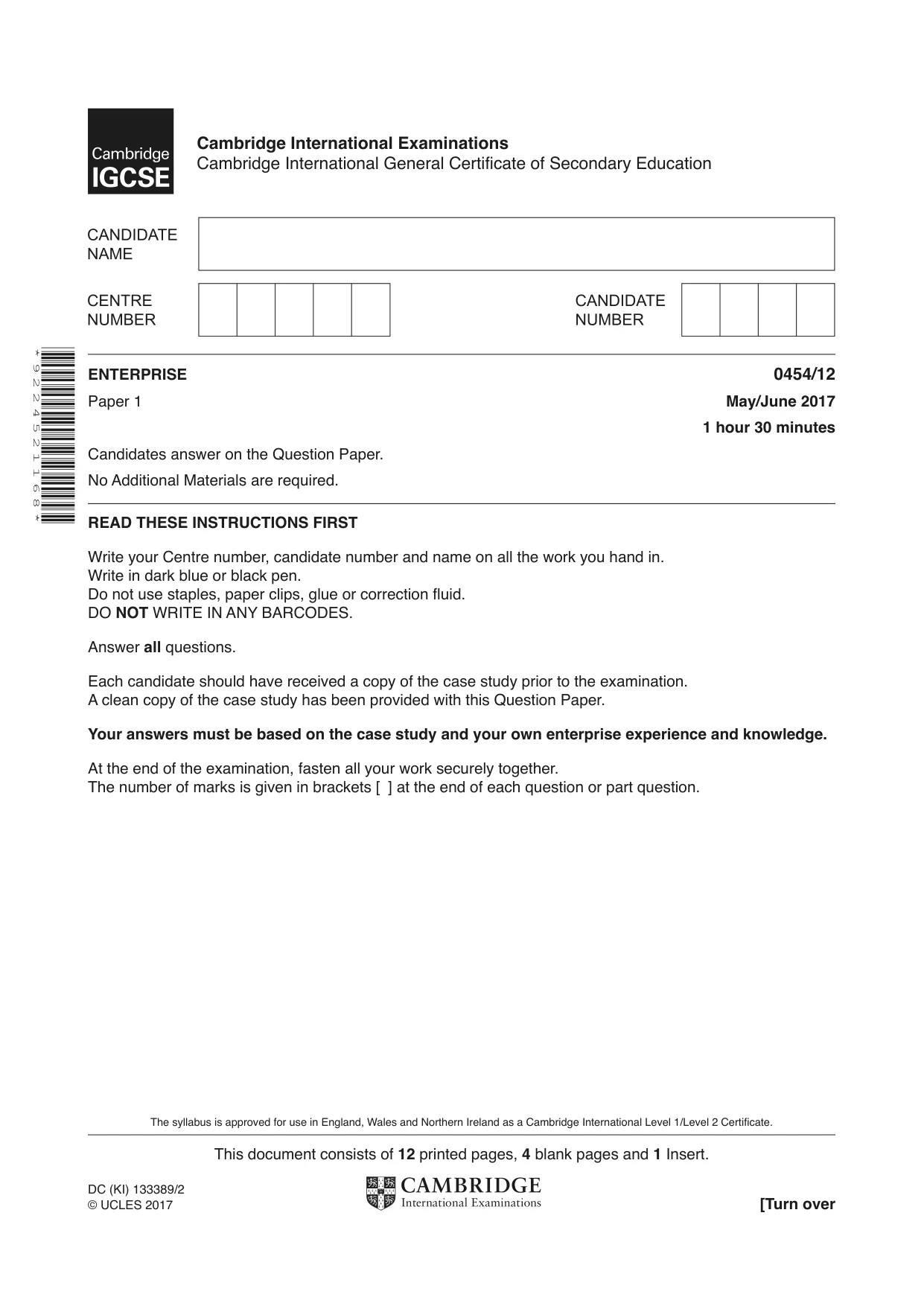
Question paper, page 1
This document consists of 12 printed pages, 4 blank pages and 1 Insert. DC (KI) 133389/2 © UCLES 2017 [Turn over Cambridge International Examinations Cambridge International General Certificate of Secondary Education * 9 2 2 4 5 2 1 1 6 8 * ENTERPRISE 0454/12 Paper 1 May/June 2017 1 hour 30 minutes Candidates answer on the Question Paper. No Additional Materials are required. READ THESE INSTRUCTIONS FIRST Write your Centre number, candidate number and name on all the work you hand in. Write in dark blue or black pen. Do not use staples, paper clips, glue or correction fluid. DO NOT WRITE IN ANY BARCODES. Answer all questions. Each candidate should have received a copy of the case study prior to the examination. A clean copy of the case study has been provided with this Question Paper. Your answers must be based on the case study and your own enterprise experience and knowledge. At the end of the examination, fasten all your work securely together. The number of marks is given in brackets [ ] at the end of each question or part question. The syllabus is approved for use in England, Wales and Northern Ireland as a Cambridge International Level 1/Level 2 Certificate.
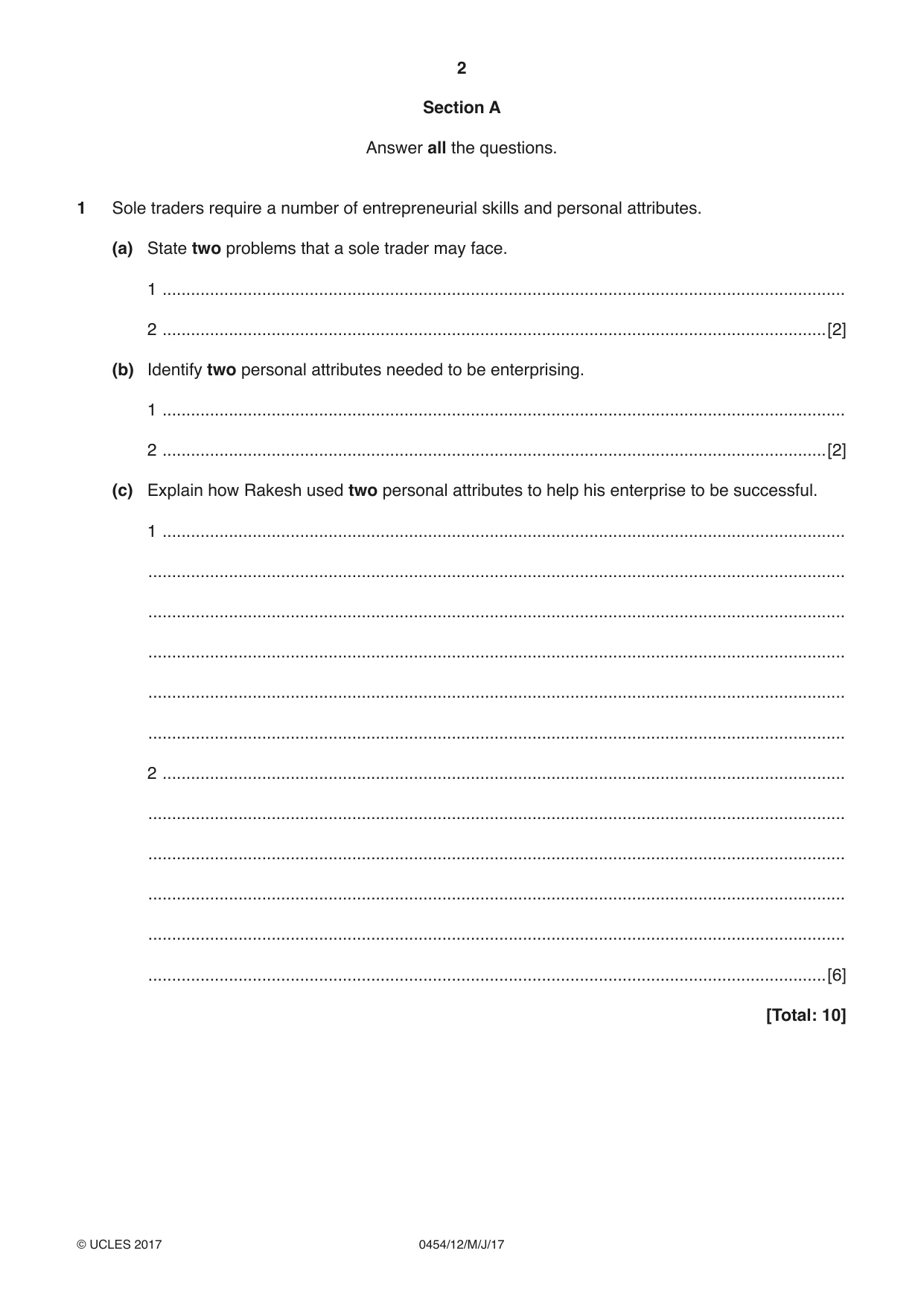
Question paper, page 2
2 0454/12/M/J/17 © UCLES 2017 Section A Answer all the questions. 1 Sole traders require a number of entrepreneurial skills and personal attributes. (a) State two problems that a sole trader may face. 1 … 2 …[2] (b) Identify two personal attributes needed to be enterprising. 1 … 2 …[2] (c) Explain how Rakesh used two personal attributes to help his enterprise to be successful. 1 … … … … … … 2 … … … … … …[6] [Total: 10]
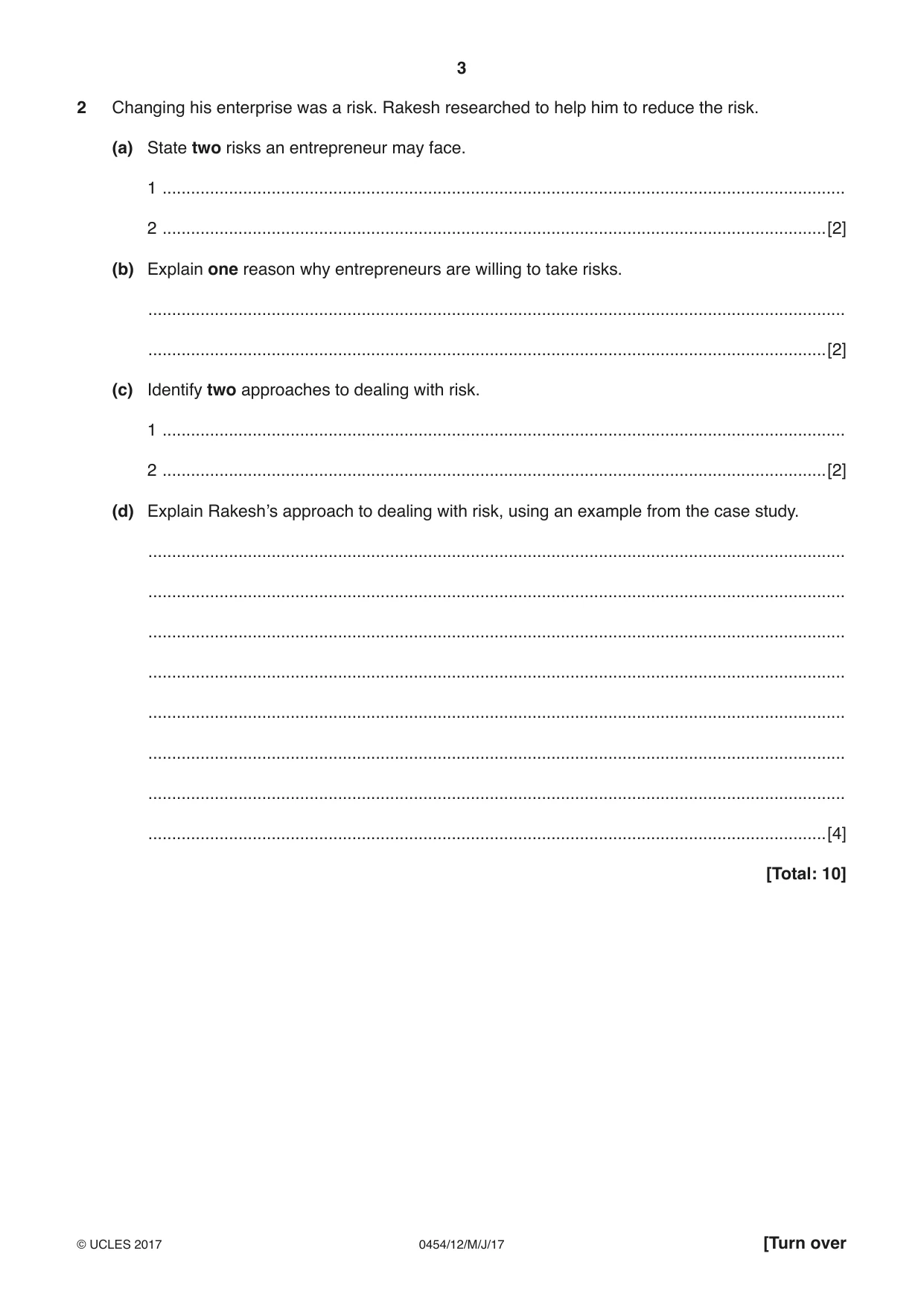
Question paper, page 3
3 0454/12/M/J/17 © UCLES 2017 [Turn over 2 Changing his enterprise was a risk. Rakesh researched to help him to reduce the risk. (a) State two risks an entrepreneur may face. 1 … 2 …[2] (b) Explain one reason why entrepreneurs are willing to take risks. … …[2] (c) Identify two approaches to dealing with risk. 1 … 2 …[2] (d) Explain Rakesh’s approach to dealing with risk, using an example from the case study. … … … … … … … …[4] [Total: 10]
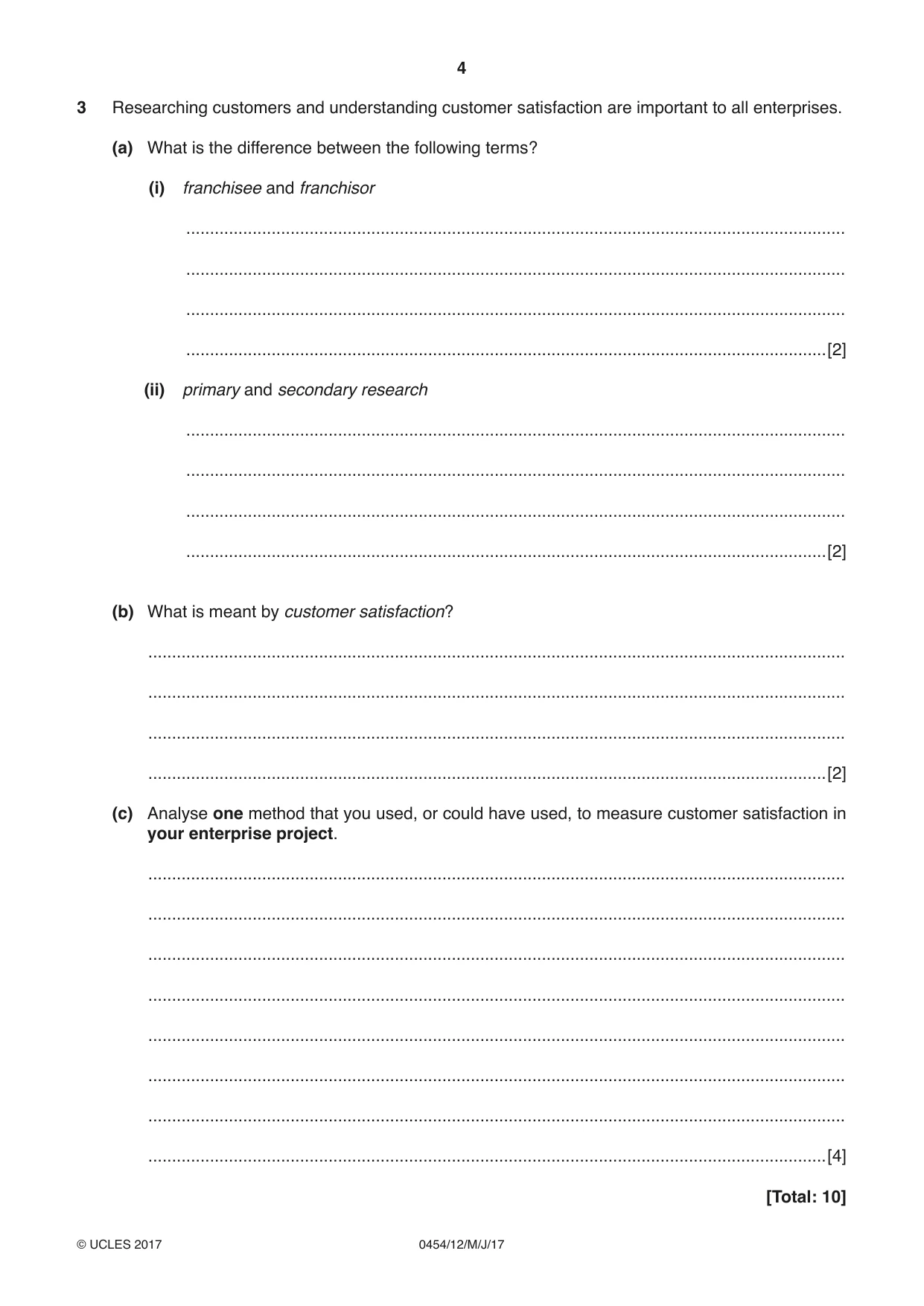
Question paper, page 4
4 0454/12/M/J/17 © UCLES 2017 3 Researching customers and understanding customer satisfaction are important to all enterprises. (a) What is the difference between the following terms? (i) franchisee and franchisor … … … …[2] (ii) primary and secondary research … … … …[2] (b) What is meant by customer satisfaction? … … … …[2] (c) Analyse one method that you used, or could have used, to measure customer satisfaction in your enterprise project. … … … … … … … …[4] [Total: 10]
Question paper, page 5
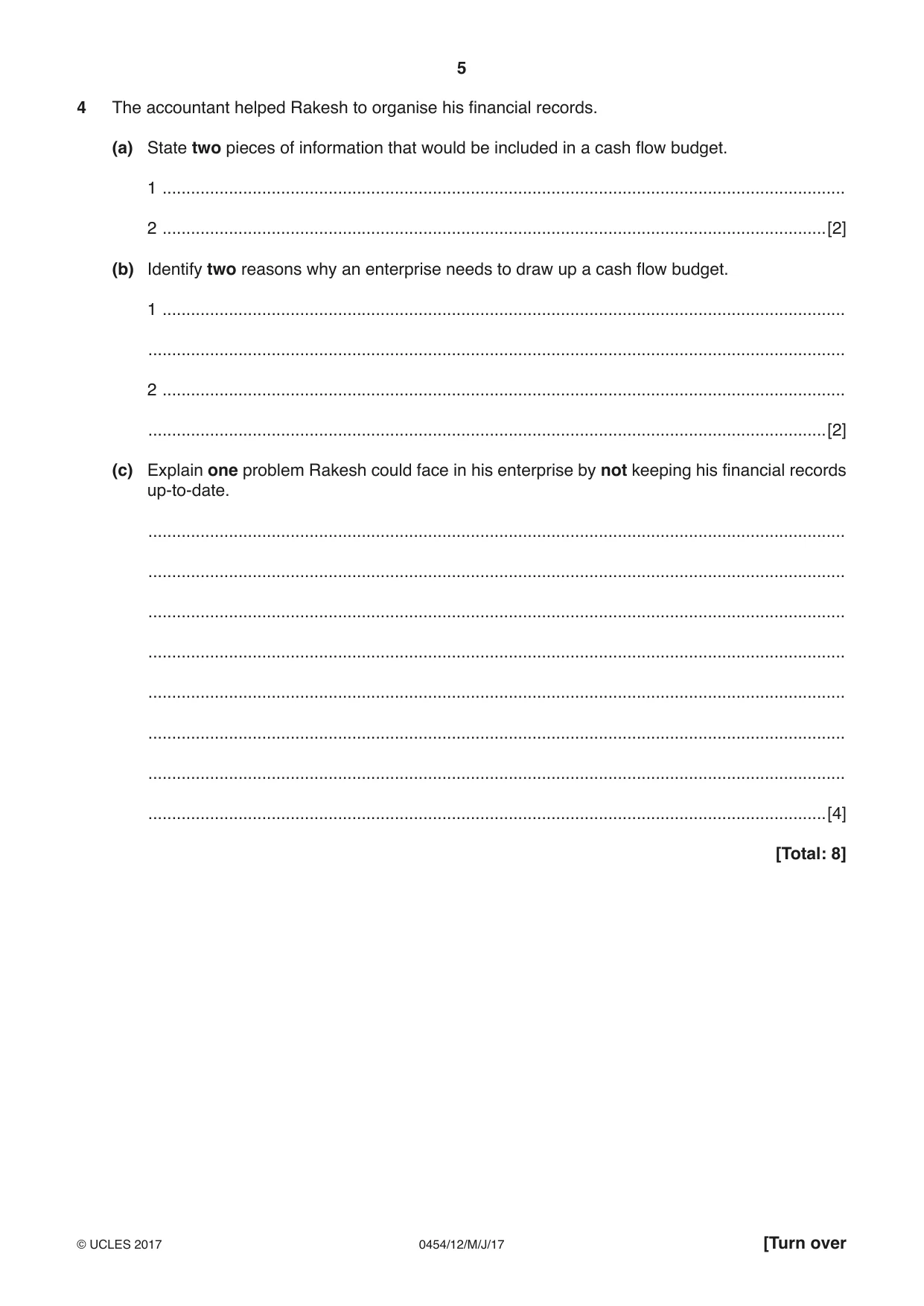
5 0454/12/M/J/17 © UCLES 2017 [Turn over 4 The accountant helped Rakesh to organise his financial records. (a) State two pieces of information that would be included in a cash flow budget. 1 … 2 …[2] (b) Identify two reasons why an enterprise needs to draw up a cash flow budget. 1 … … 2 … …[2] (c) Explain one problem Rakesh could face in his enterprise by not keeping his financial records up-to-date. … … … … … … … …[4] [Total: 8]
Question paper, page 6
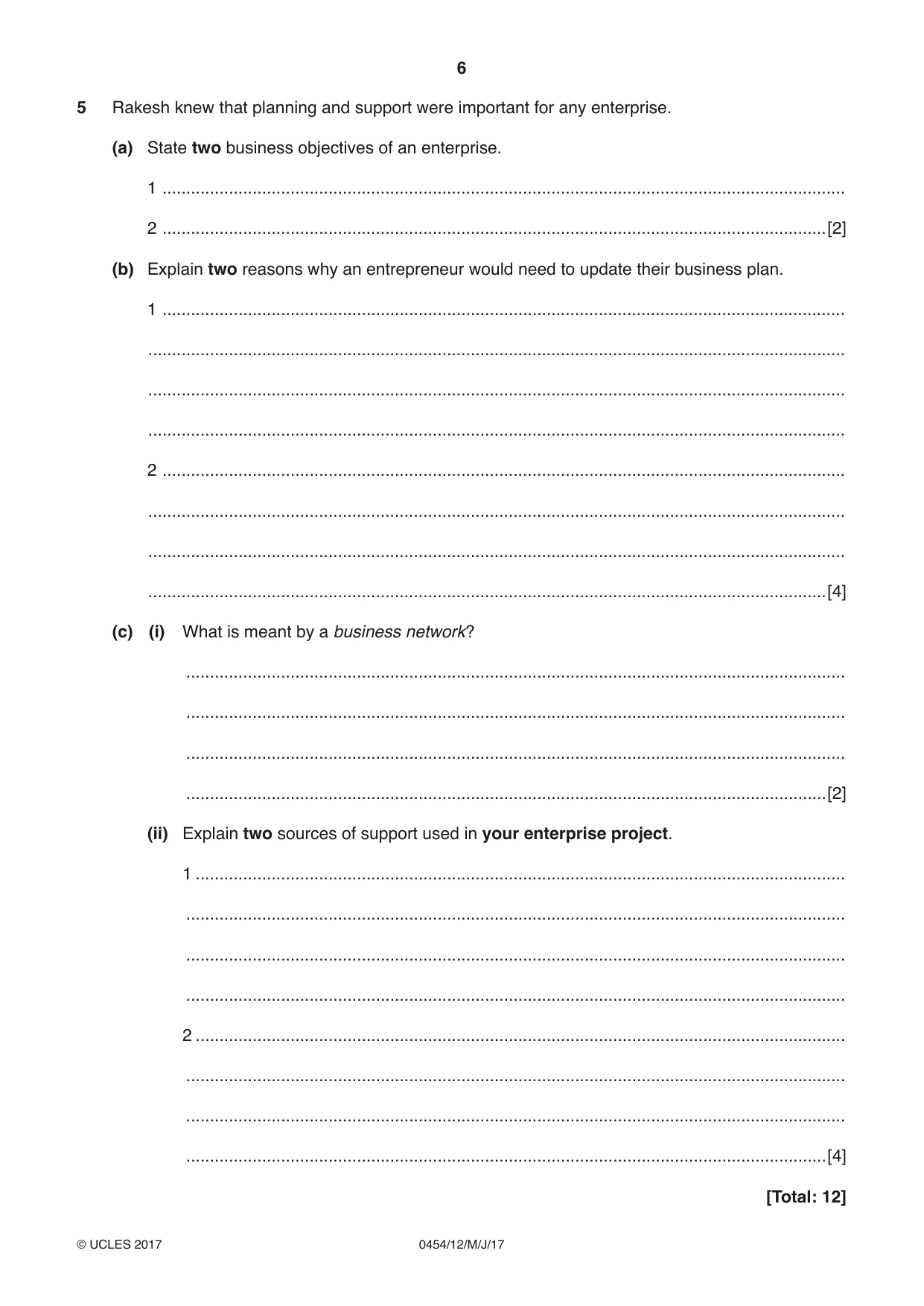
6 0454/12/M/J/17 © UCLES 2017 5 Rakesh knew that planning and support were important for any enterprise. (a) State two business objectives of an enterprise. 1 … 2 …[2] (b) Explain two reasons why an entrepreneur would need to update their business plan. 1 … … … … 2 … … … …[4] (c) (i) What is meant by a business network? … … … …[2] (ii) Explain two sources of support used in your enterprise project. 1 … … … … 2 … … … …[4] [Total: 12]
Question paper, page 7
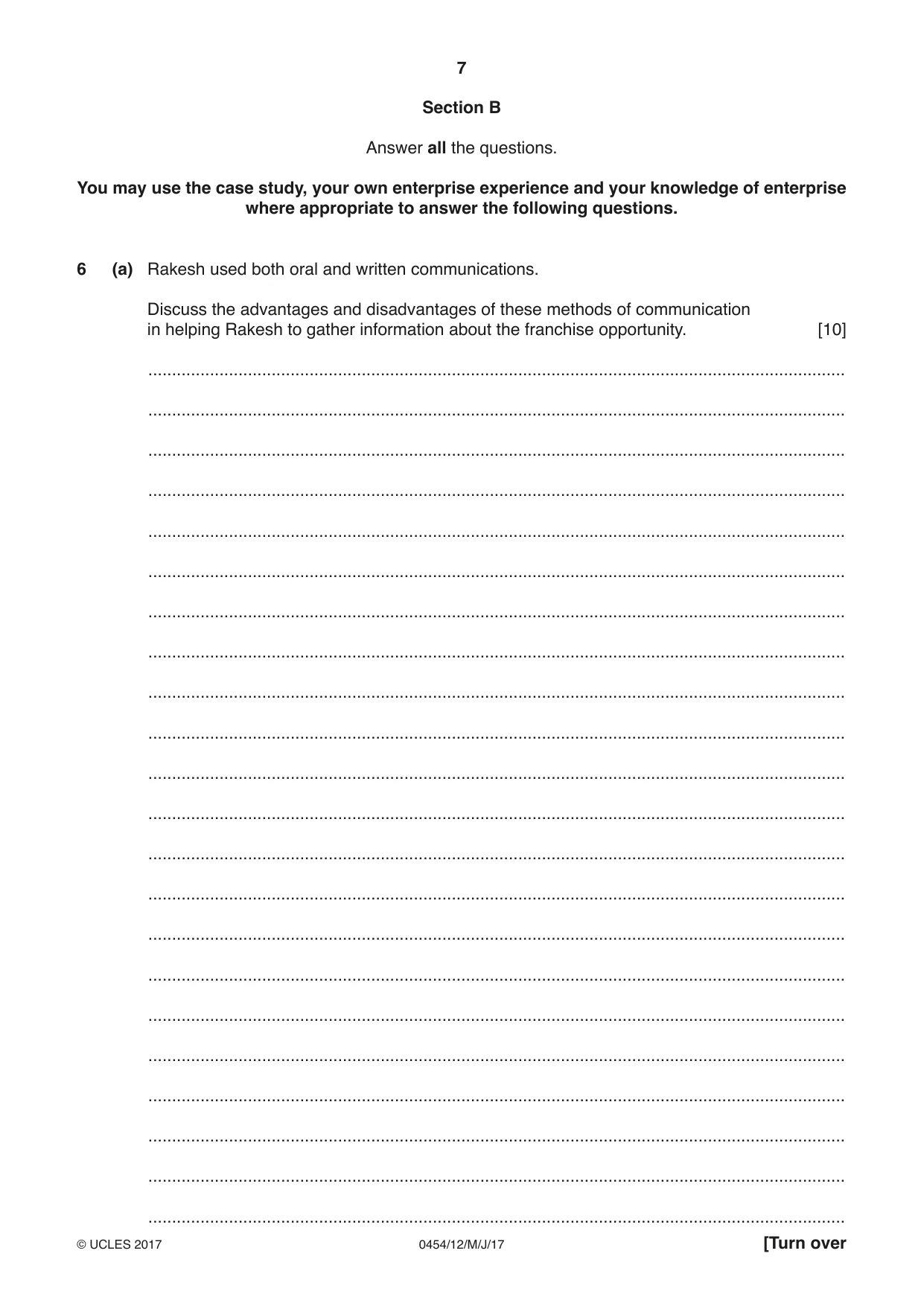
7 0454/12/M/J/17 © UCLES 2017 [Turn over Section B Answer all the questions. You may use the case study, your own enterprise experience and your knowledge of enterprise where appropriate to answer the following questions. 6 (a) Rakesh used both oral and written communications. Discuss the advantages and disadvantages of these methods of communication in helping Rakesh to gather information about the franchise opportunity. [10] … … … … … … … … … … … … … … … … … … … … … …
Question paper, page 8
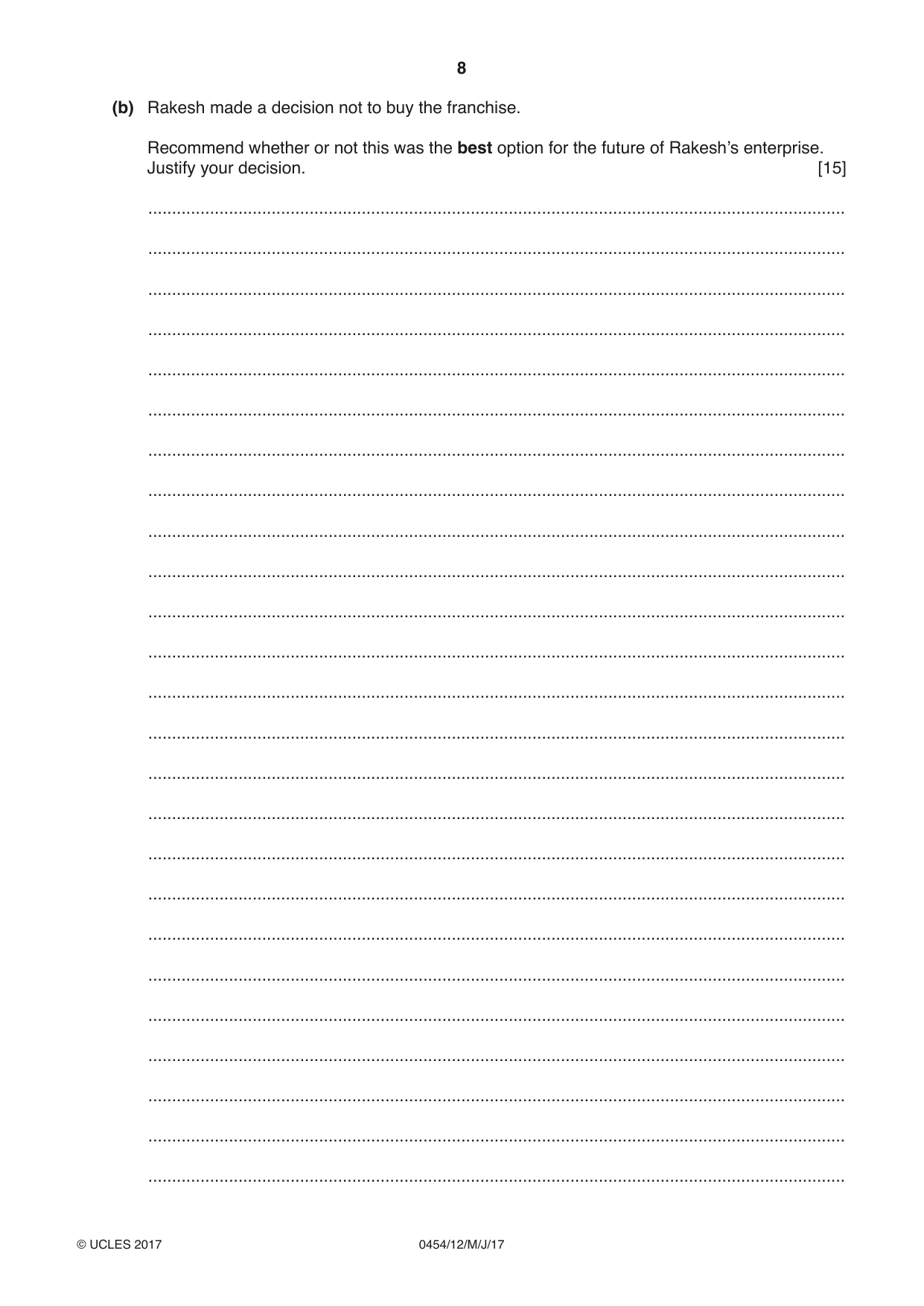
8 0454/12/M/J/17 © UCLES 2017 (b) Rakesh made a decision not to buy the franchise. Recommend whether or not this was the best option for the future of Rakesh’s enterprise. Justify your decision. [15] … … … … … … … … … … … … … … … … … … … … … … … … …
Question paper, page 9
9 0454/12/M/J/17 © UCLES 2017 [Turn over … … … … … … … … … … … … … … … … … … … … … … … … … … … [Total: 25]
Question paper, page 10
10 0454/12/M/J/17 © UCLES 2017 BLANK PAGE
Question paper, page 11
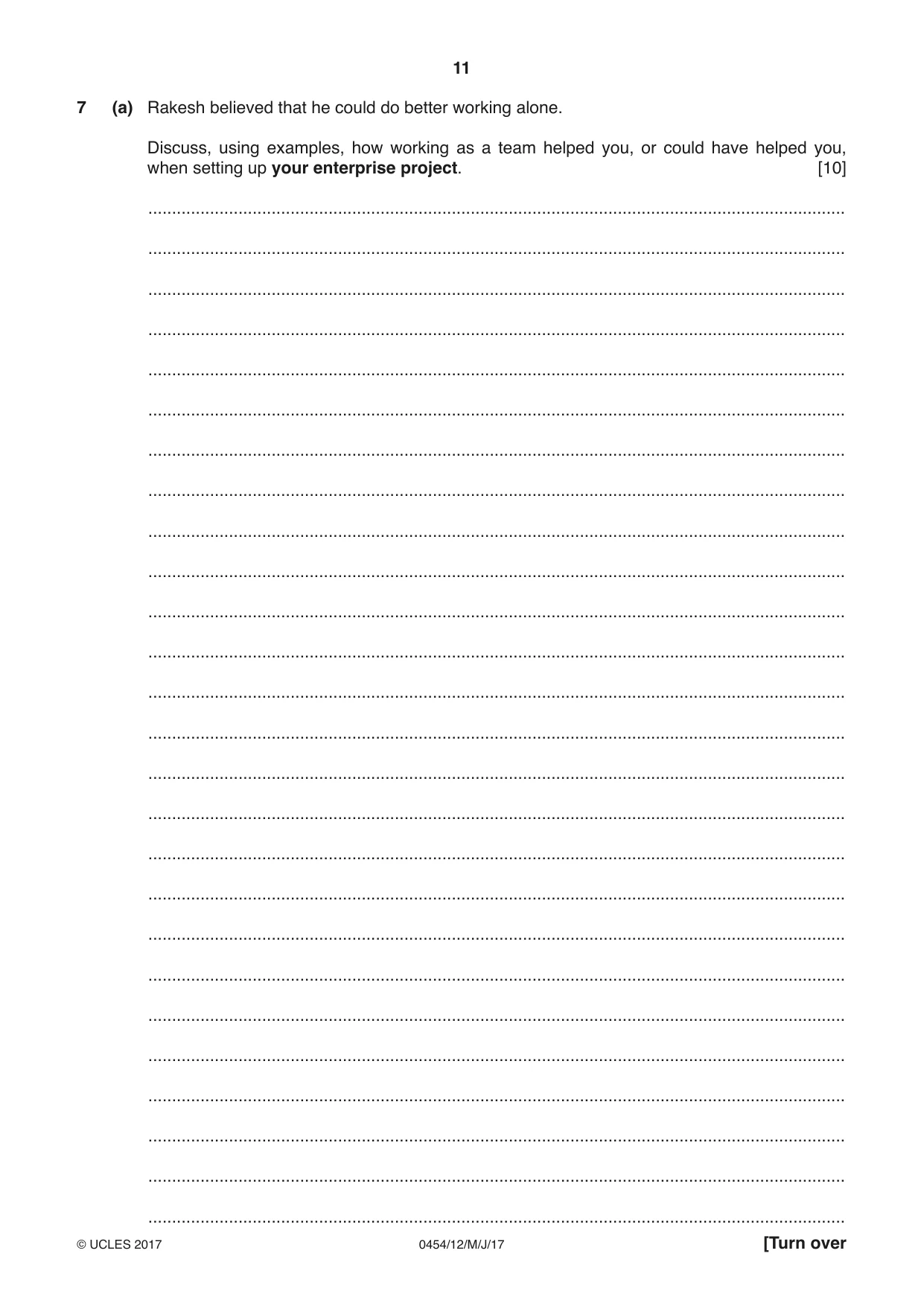
11 0454/12/M/J/17 © UCLES 2017 [Turn over 7 (a) Rakesh believed that he could do better working alone. Discuss, using examples, how working as a team helped you, or could have helped you, when setting up your enterprise project. [10] … … … … … … … … … … … … … … … … … … … … … … … … … …
Question paper, page 12
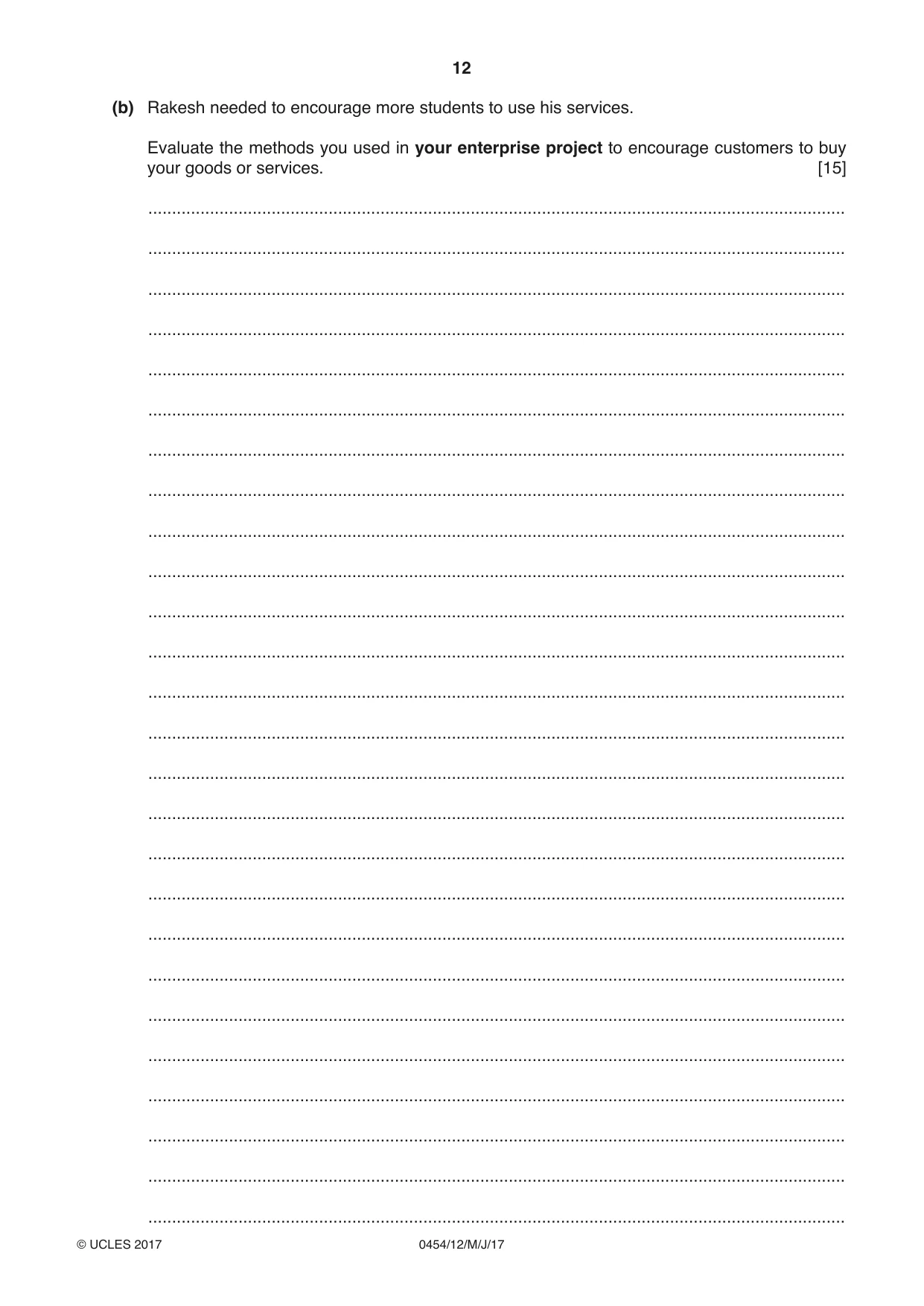
12 0454/12/M/J/17 © UCLES 2017 (b) Rakesh needed to encourage more students to use his services. Evaluate the methods you used in your enterprise project to encourage customers to buy your goods or services. [15] … … … … … … … … … … … … … … … … … … … … … … … … … …
Question paper, page 13
13 0454/12/M/J/17 © UCLES 2017 … … … … … … … … … … … … … … … … … … … … … … … … … … … [Total: 25]
Question paper, page 14
14 0454/12/M/J/17 © UCLES 2017 BLANK PAGE
Question paper, page 15
15 0454/12/M/J/17 © UCLES 2017 BLANK PAGE
Question paper, page 16
16 0454/12/M/J/17 © UCLES 2017 BLANK PAGE Permission to reproduce items where third-party owned material protected by copyright is included has been sought and cleared where possible. Every reasonable effort has been made by the publisher (UCLES) to trace copyright holders, but if any items requiring clearance have unwittingly been included, the publisher will be pleased to make amends at the earliest possible opportunity. To avoid the issue of disclosure of answer-related information to candidates, all copyright acknowledgements are reproduced online in the Cambridge International Examinations Copyright Acknowledgements Booklet. This is produced for each series of examinations and is freely available to download at www.cie.org.uk after the live examination series. Cambridge International Examinations is part of the Cambridge Assessment Group. Cambridge Assessment is the brand name of University of Cambridge Local Examinations Syndicate (UCLES), which is itself a department of the University of Cambridge.
Mark scheme, page 1
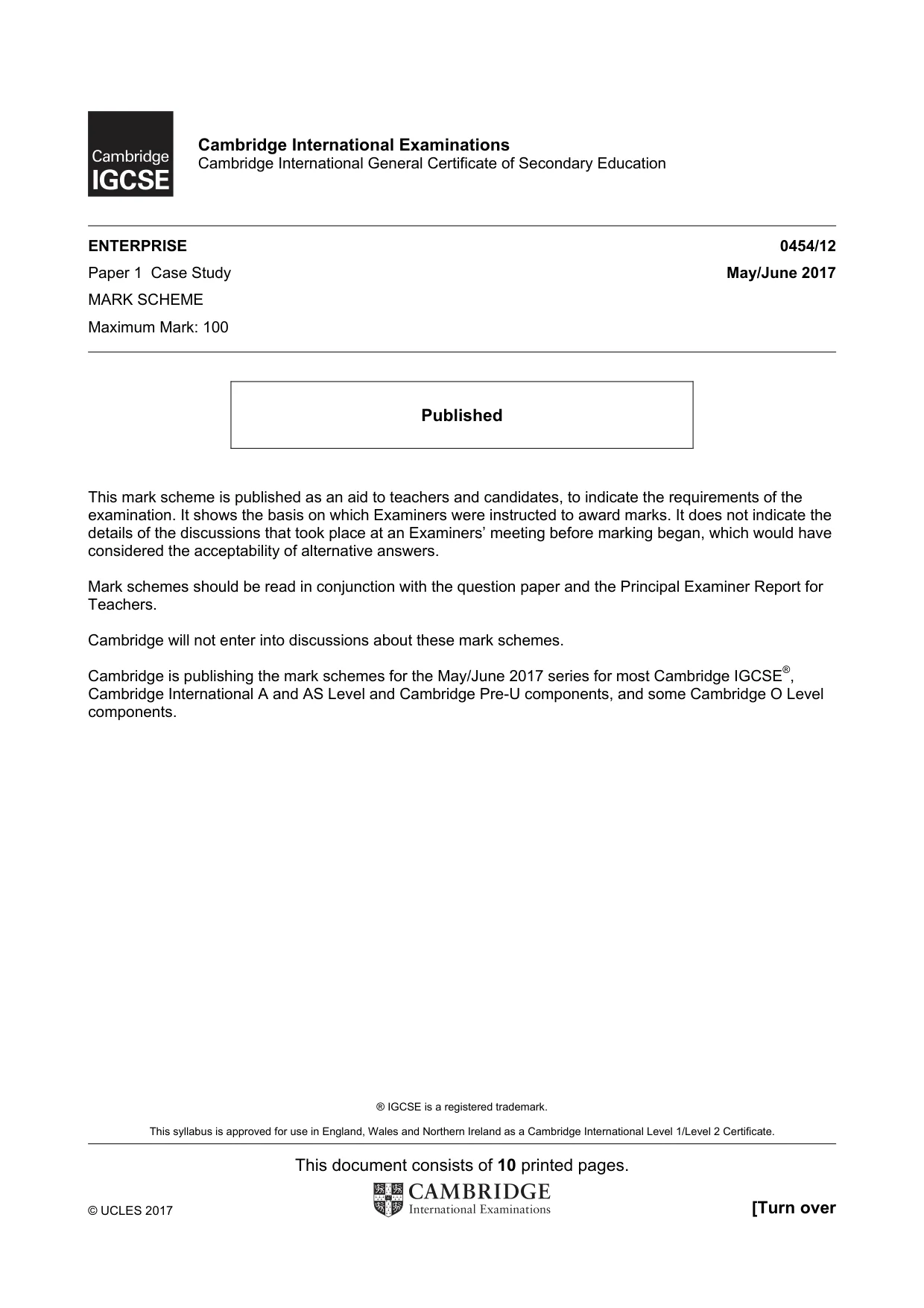
® IGCSE is a registered trademark. This syllabus is approved for use in England, Wales and Northern Ireland as a Cambridge International Level 1/Level 2 Certificate. This document consists of 10 printed pages. © UCLES 2017 [Turn over Cambridge International Examinations Cambridge International General Certificate of Secondary Education ENTERPRISE 0454/12 Paper 1 Case Study May/June 2017 MARK SCHEME Maximum Mark: 100 Published This mark scheme is published as an aid to teachers and candidates, to indicate the requirements of the examination. It shows the basis on which Examiners were instructed to award marks. It does not indicate the details of the discussions that took place at an Examiners’ meeting before marking began, which would have considered the acceptability of alternative answers. Mark schemes should be read in conjunction with the question paper and the Principal Examiner Report for Teachers. Cambridge will not enter into discussions about these mark schemes. Cambridge is publishing the mark schemes for the May/June 2017 series for most Cambridge IGCSE®, Cambridge International A and AS Level and Cambridge Pre-U components, and some Cambridge O Level components.
Mark scheme, page 2
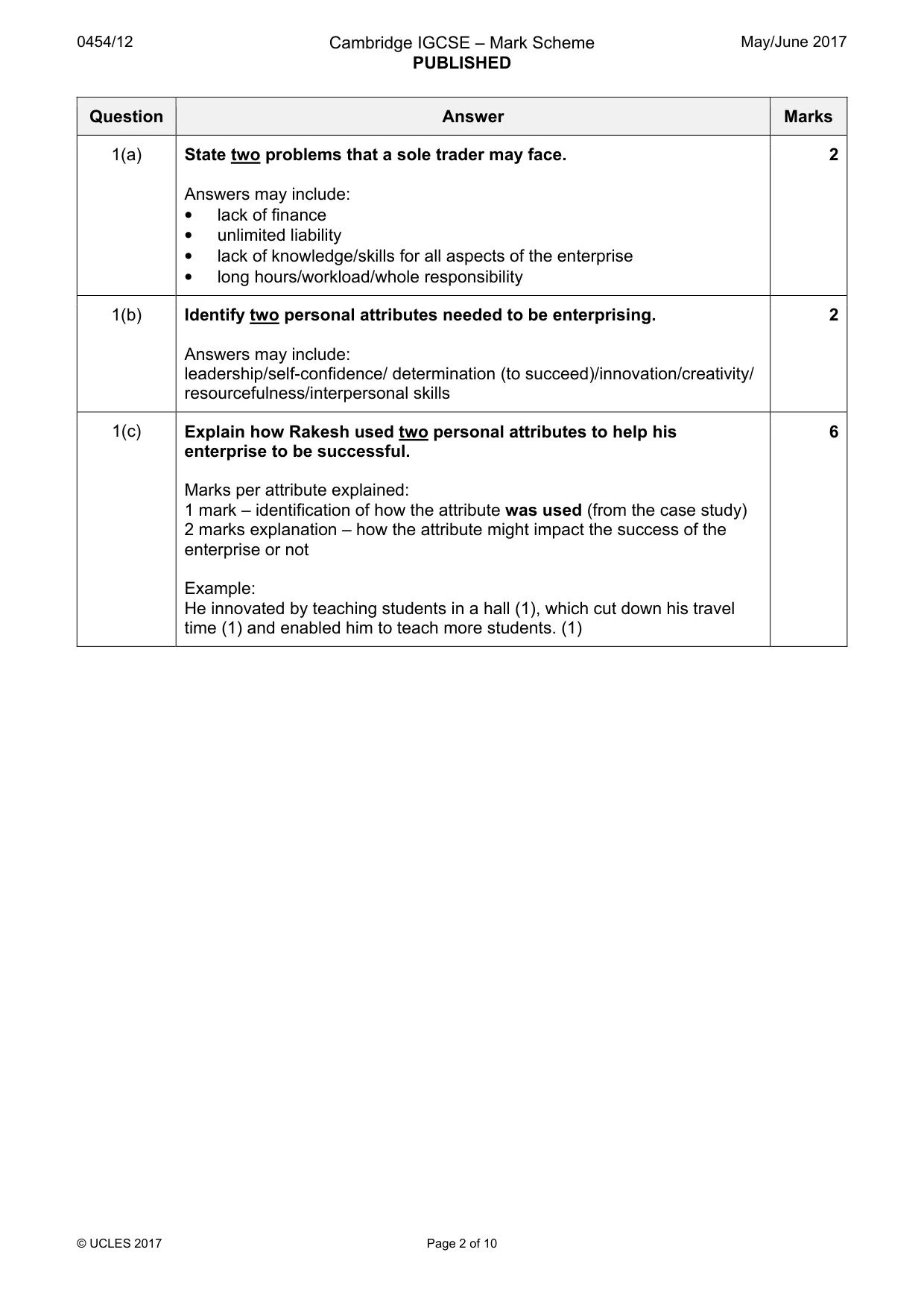
0454/12 Cambridge IGCSE – Mark Scheme PUBLISHED May/June 2017 © UCLES 2017 Page 2 of 10 Question Answer Marks 1(a) State two problems that a sole trader may face. Answers may include: • lack of finance • unlimited liability • lack of knowledge/skills for all aspects of the enterprise • long hours/workload/whole responsibility 2 1(b) Identify two personal attributes needed to be enterprising. Answers may include: leadership/self-confidence/ determination (to succeed)/innovation/creativity/ resourcefulness/interpersonal skills 2 1(c) Explain how Rakesh used two personal attributes to help his enterprise to be successful. Marks per attribute explained: 1 mark – identification of how the attribute was used (from the case study) 2 marks explanation – how the attribute might impact the success of the enterprise or not Example: He innovated by teaching students in a hall (1), which cut down his travel time (1) and enabled him to teach more students. (1) 6
Mark scheme, page 3
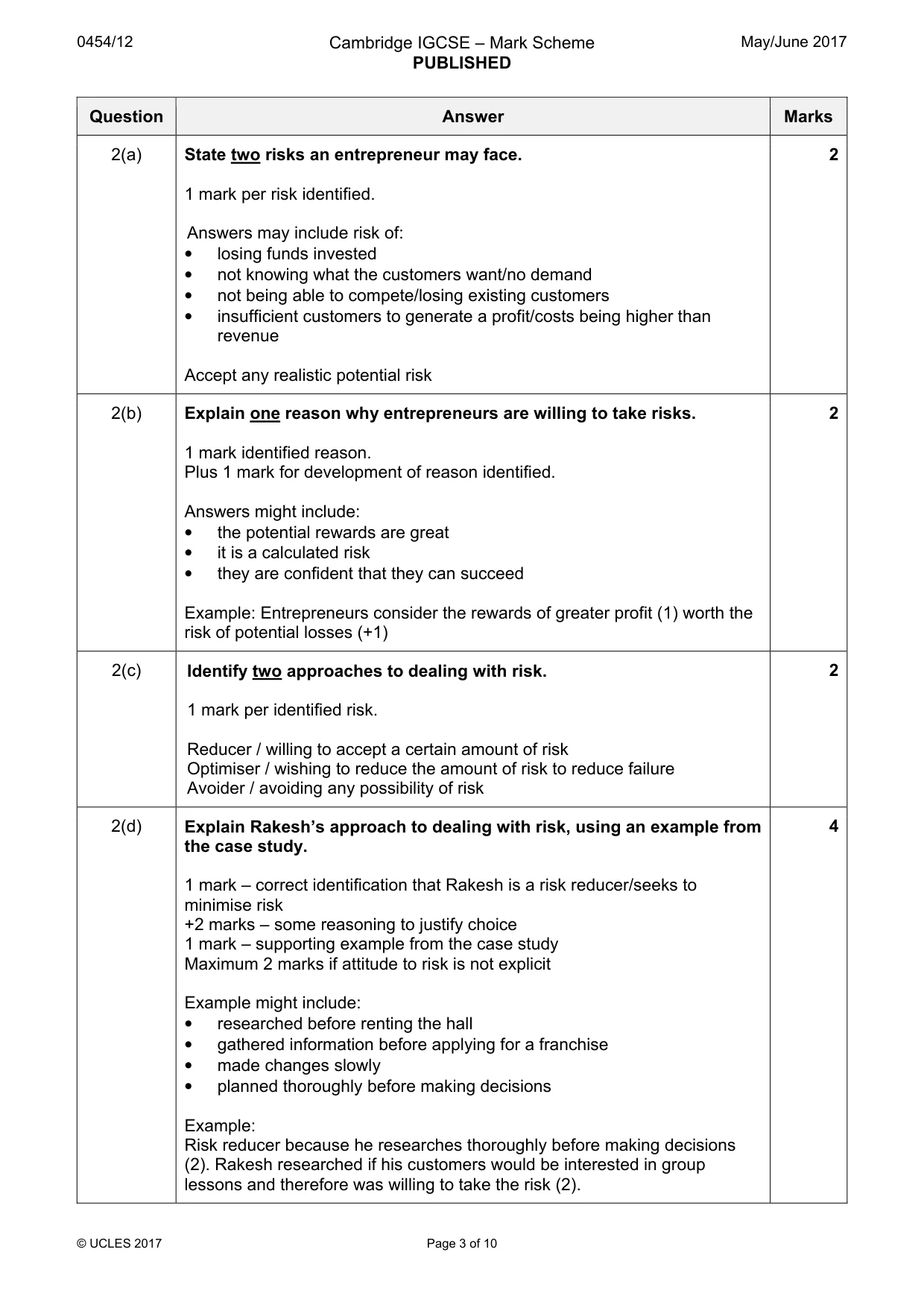
0454/12 Cambridge IGCSE – Mark Scheme PUBLISHED May/June 2017 © UCLES 2017 Page 3 of 10 Question Answer Marks 2(a) State two risks an entrepreneur may face. 1 mark per risk identified. Answers may include risk of: • losing funds invested • not knowing what the customers want/no demand • not being able to compete/losing existing customers • insufficient customers to generate a profit/costs being higher than revenue Accept any realistic potential risk 2 2(b) Explain one reason why entrepreneurs are willing to take risks. 1 mark identified reason. Plus 1 mark for development of reason identified. Answers might include: • the potential rewards are great • it is a calculated risk • they are confident that they can succeed Example: Entrepreneurs consider the rewards of greater profit (1) worth the risk of potential losses (+1) 2 2(c) Identify two approaches to dealing with risk. 1 mark per identified risk. Reducer / willing to accept a certain amount of risk Optimiser / wishing to reduce the amount of risk to reduce failure Avoider / avoiding any possibility of risk 2 2(d) Explain Rakesh’s approach to dealing with risk, using an example from the case study. 1 mark – correct identification that Rakesh is a risk reducer/seeks to minimise risk +2 marks – some reasoning to justify choice 1 mark – supporting example from the case study Maximum 2 marks if attitude to risk is not explicit Example might include: • researched before renting the hall • gathered information before applying for a franchise • made changes slowly • planned thoroughly before making decisions Example: Risk reducer because he researches thoroughly before making decisions (2). Rakesh researched if his customers would be interested in group lessons and therefore was willing to take the risk (2). 4
Mark scheme, page 4
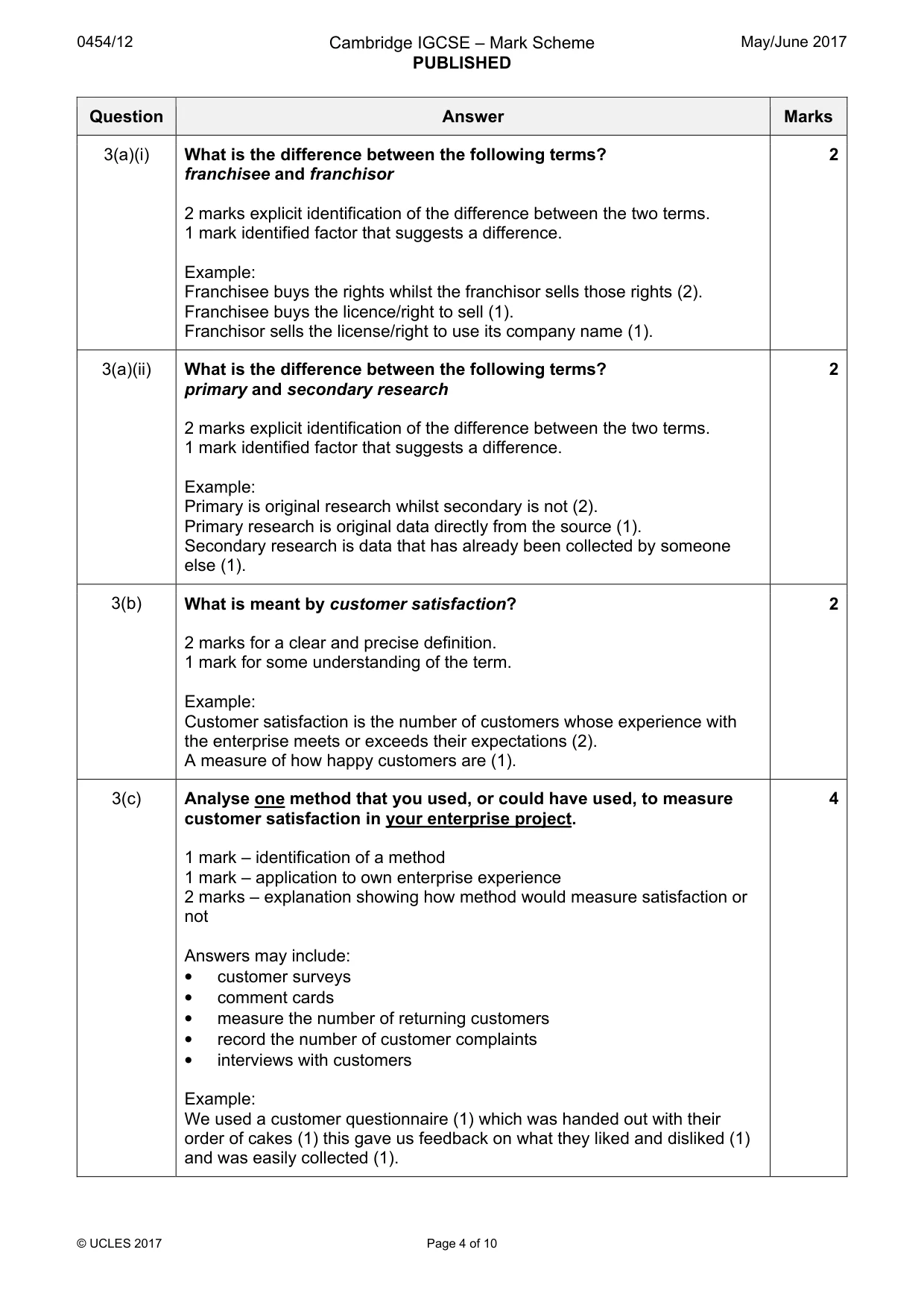
0454/12 Cambridge IGCSE – Mark Scheme PUBLISHED May/June 2017 © UCLES 2017 Page 4 of 10 Question Answer Marks 3(a)(i) What is the difference between the following terms? franchisee and franchisor 2 marks explicit identification of the difference between the two terms. 1 mark identified factor that suggests a difference. Example: Franchisee buys the rights whilst the franchisor sells those rights (2). Franchisee buys the licence/right to sell (1). Franchisor sells the license/right to use its company name (1). 2 3(a)(ii) What is the difference between the following terms? primary and secondary research 2 marks explicit identification of the difference between the two terms. 1 mark identified factor that suggests a difference. Example: Primary is original research whilst secondary is not (2). Primary research is original data directly from the source (1). Secondary research is data that has already been collected by someone else (1). 2 3(b) What is meant by customer satisfaction? 2 marks for a clear and precise definition. 1 mark for some understanding of the term. Example: Customer satisfaction is the number of customers whose experience with the enterprise meets or exceeds their expectations (2). A measure of how happy customers are (1). 2 3(c) Analyse one method that you used, or could have used, to measure customer satisfaction in your enterprise project. 1 mark – identification of a method 1 mark – application to own enterprise experience 2 marks – explanation showing how method would measure satisfaction or not Answers may include: • customer surveys • comment cards • measure the number of returning customers • record the number of customer complaints • interviews with customers Example: We used a customer questionnaire (1) which was handed out with their order of cakes (1) this gave us feedback on what they liked and disliked (1) and was easily collected (1). 4
Mark scheme, page 5
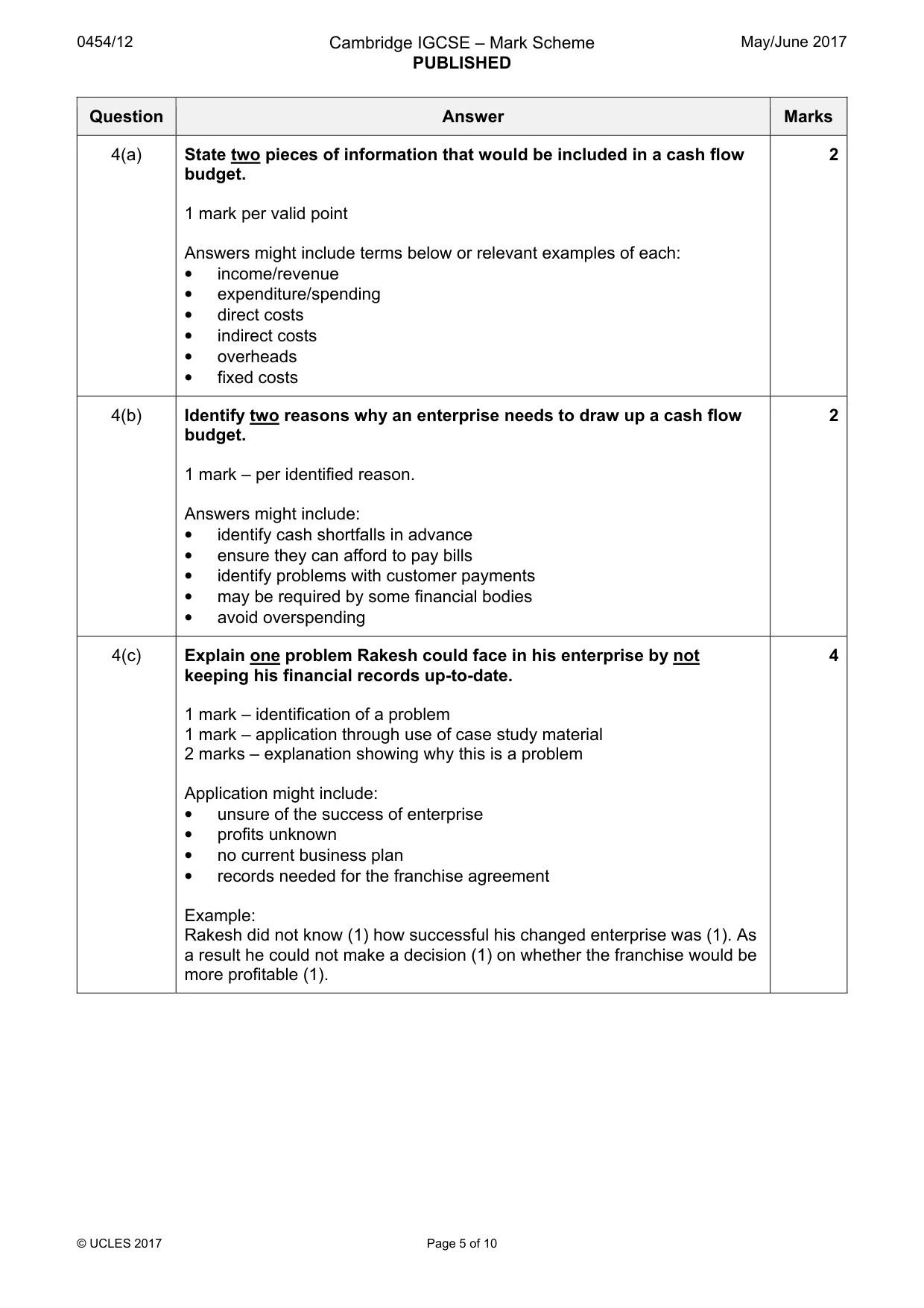
0454/12 Cambridge IGCSE – Mark Scheme PUBLISHED May/June 2017 © UCLES 2017 Page 5 of 10 Question Answer Marks 4(a) State two pieces of information that would be included in a cash flow budget. 1 mark per valid point Answers might include terms below or relevant examples of each: • income/revenue • expenditure/spending • direct costs • indirect costs • overheads • fixed costs 2 4(b) Identify two reasons why an enterprise needs to draw up a cash flow budget. 1 mark – per identified reason. Answers might include: • identify cash shortfalls in advance • ensure they can afford to pay bills • identify problems with customer payments • may be required by some financial bodies • avoid overspending 2 4(c) Explain one problem Rakesh could face in his enterprise by not keeping his financial records up-to-date. 1 mark – identification of a problem 1 mark – application through use of case study material 2 marks – explanation showing why this is a problem Application might include: • unsure of the success of enterprise • profits unknown • no current business plan • records needed for the franchise agreement Example: Rakesh did not know (1) how successful his changed enterprise was (1). As a result he could not make a decision (1) on whether the franchise would be more profitable (1). 4
Mark scheme, page 6
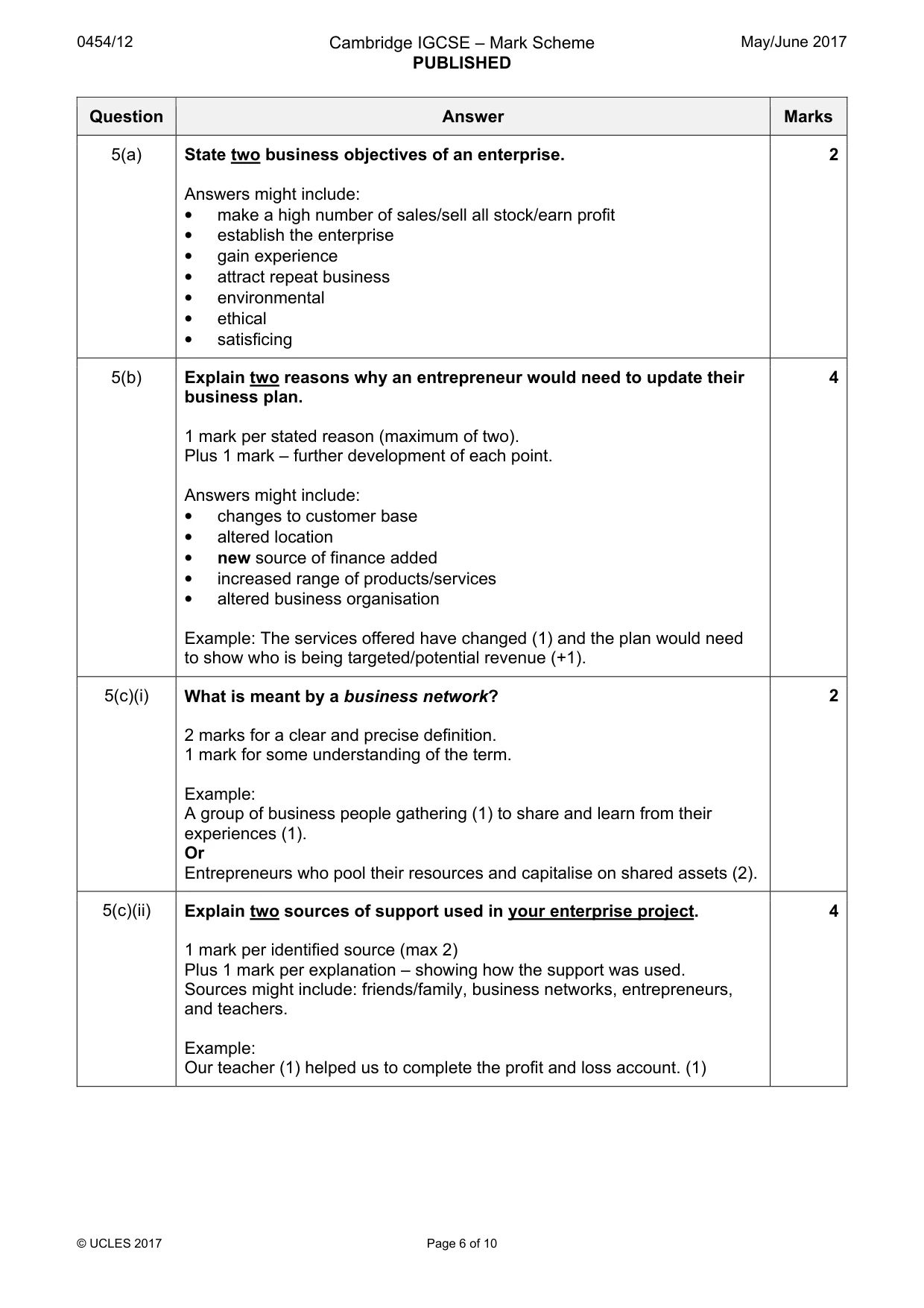
0454/12 Cambridge IGCSE – Mark Scheme PUBLISHED May/June 2017 © UCLES 2017 Page 6 of 10 Question Answer Marks 5(a) State two business objectives of an enterprise. Answers might include: • make a high number of sales/sell all stock/earn profit • establish the enterprise • gain experience • attract repeat business • environmental • ethical • satisficing 2 5(b) Explain two reasons why an entrepreneur would need to update their business plan. 1 mark per stated reason (maximum of two). Plus 1 mark – further development of each point. Answers might include: • changes to customer base • altered location • new source of finance added • increased range of products/services • altered business organisation Example: The services offered have changed (1) and the plan would need to show who is being targeted/potential revenue (+1). 4 5(c)(i) What is meant by a business network? 2 marks for a clear and precise definition. 1 mark for some understanding of the term. Example: A group of business people gathering (1) to share and learn from their experiences (1). Or Entrepreneurs who pool their resources and capitalise on shared assets (2). 2 5(c)(ii) Explain two sources of support used in your enterprise project. 1 mark per identified source (max 2) Plus 1 mark per explanation – showing how the support was used. Sources might include: friends/family, business networks, entrepreneurs, and teachers. Example: Our teacher (1) helped us to complete the profit and loss account. (1) 4
Mark scheme, page 7
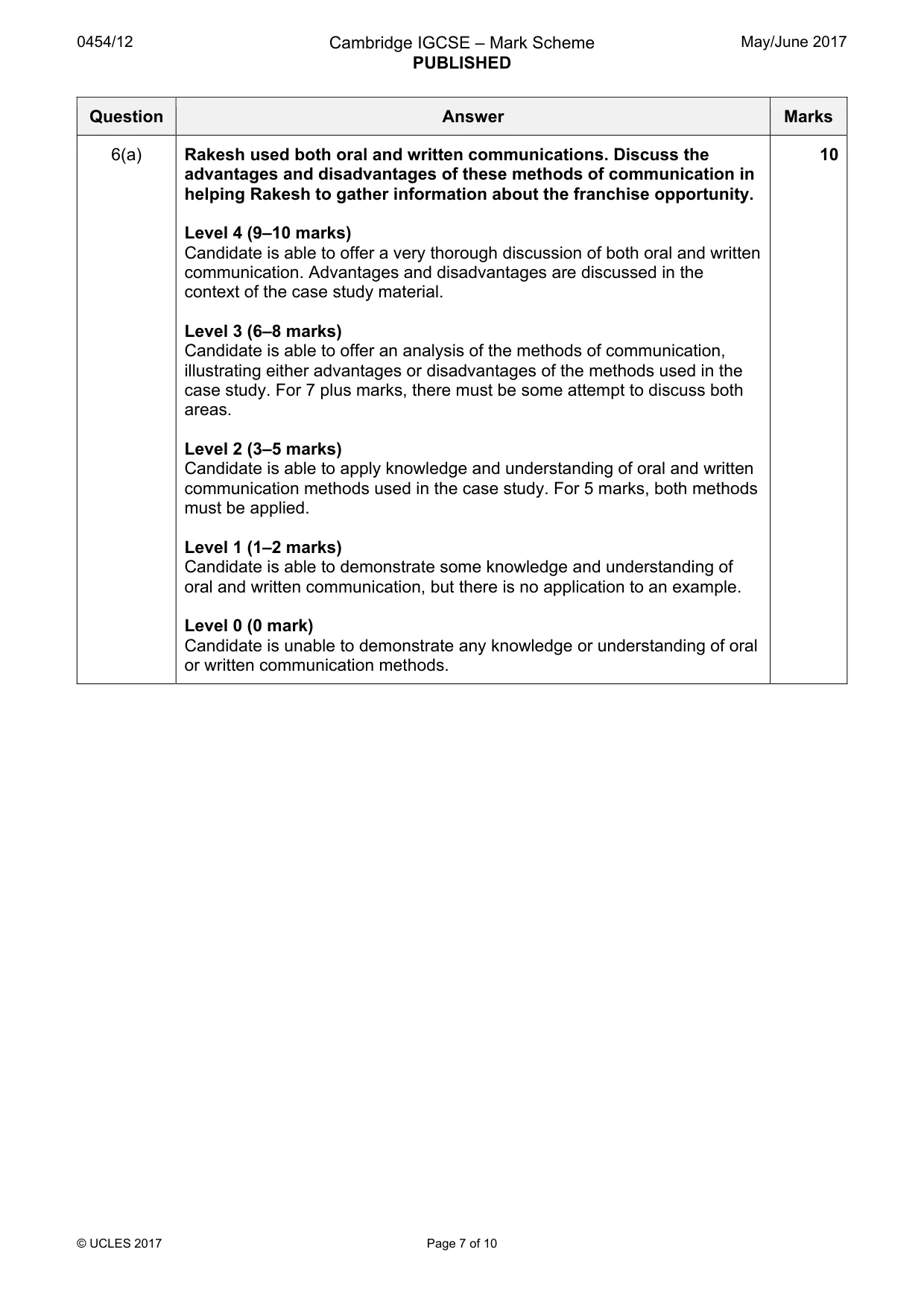
0454/12 Cambridge IGCSE – Mark Scheme PUBLISHED May/June 2017 © UCLES 2017 Page 7 of 10 Question Answer Marks 6(a) Rakesh used both oral and written communications. Discuss the advantages and disadvantages of these methods of communication in helping Rakesh to gather information about the franchise opportunity. Level 4 (9–10 marks) Candidate is able to offer a very thorough discussion of both oral and written communication. Advantages and disadvantages are discussed in the context of the case study material. Level 3 (6–8 marks) Candidate is able to offer an analysis of the methods of communication, illustrating either advantages or disadvantages of the methods used in the case study. For 7 plus marks, there must be some attempt to discuss both areas. Level 2 (3–5 marks) Candidate is able to apply knowledge and understanding of oral and written communication methods used in the case study. For 5 marks, both methods must be applied. Level 1 (1–2 marks) Candidate is able to demonstrate some knowledge and understanding of oral and written communication, but there is no application to an example. Level 0 (0 mark) Candidate is unable to demonstrate any knowledge or understanding of oral or written communication methods. 10
Mark scheme, page 8
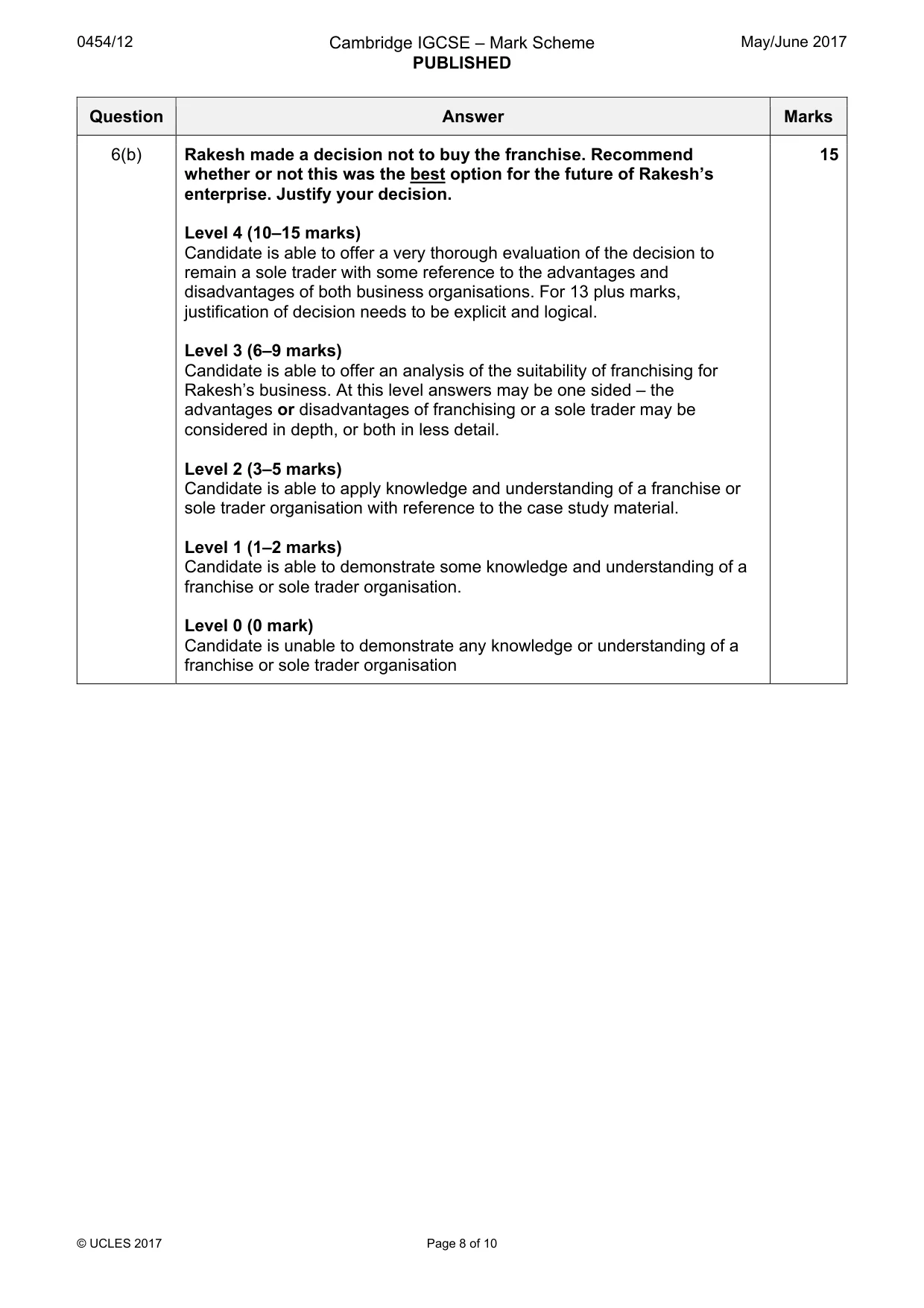
0454/12 Cambridge IGCSE – Mark Scheme PUBLISHED May/June 2017 © UCLES 2017 Page 8 of 10 Question Answer Marks 6(b) Rakesh made a decision not to buy the franchise. Recommend whether or not this was the best option for the future of Rakesh’s enterprise. Justify your decision. Level 4 (10–15 marks) Candidate is able to offer a very thorough evaluation of the decision to remain a sole trader with some reference to the advantages and disadvantages of both business organisations. For 13 plus marks, justification of decision needs to be explicit and logical. Level 3 (6–9 marks) Candidate is able to offer an analysis of the suitability of franchising for Rakesh’s business. At this level answers may be one sided – the advantages or disadvantages of franchising or a sole trader may be considered in depth, or both in less detail. Level 2 (3–5 marks) Candidate is able to apply knowledge and understanding of a franchise or sole trader organisation with reference to the case study material. Level 1 (1–2 marks) Candidate is able to demonstrate some knowledge and understanding of a franchise or sole trader organisation. Level 0 (0 mark) Candidate is unable to demonstrate any knowledge or understanding of a franchise or sole trader organisation 15
Mark scheme, page 9
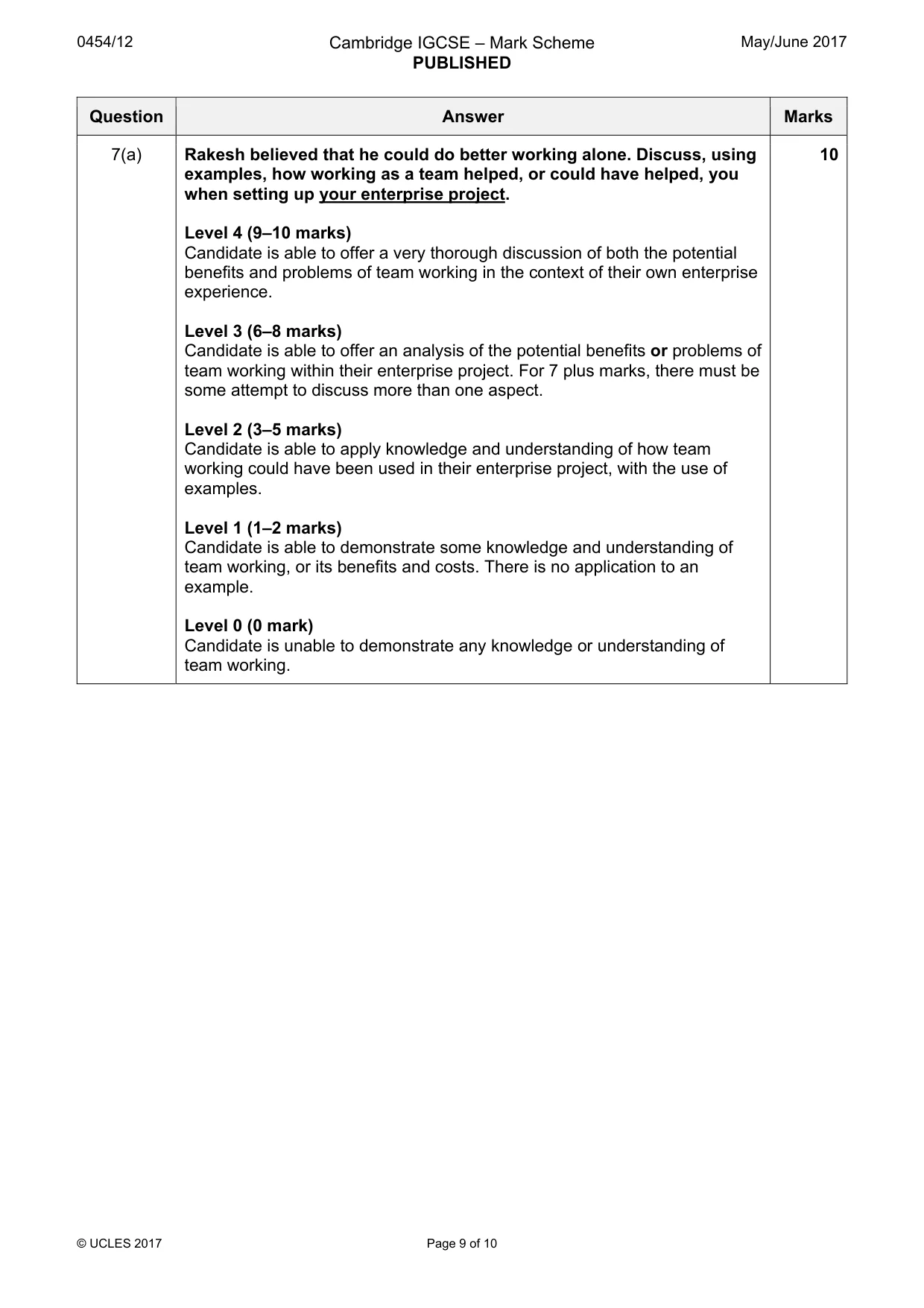
0454/12 Cambridge IGCSE – Mark Scheme PUBLISHED May/June 2017 © UCLES 2017 Page 9 of 10 Question Answer Marks 7(a) Rakesh believed that he could do better working alone. Discuss, using examples, how working as a team helped, or could have helped, you when setting up your enterprise project. Level 4 (9–10 marks) Candidate is able to offer a very thorough discussion of both the potential benefits and problems of team working in the context of their own enterprise experience. Level 3 (6–8 marks) Candidate is able to offer an analysis of the potential benefits or problems of team working within their enterprise project. For 7 plus marks, there must be some attempt to discuss more than one aspect. Level 2 (3–5 marks) Candidate is able to apply knowledge and understanding of how team working could have been used in their enterprise project, with the use of examples. Level 1 (1–2 marks) Candidate is able to demonstrate some knowledge and understanding of team working, or its benefits and costs. There is no application to an example. Level 0 (0 mark) Candidate is unable to demonstrate any knowledge or understanding of team working. 10
Mark scheme, page 10
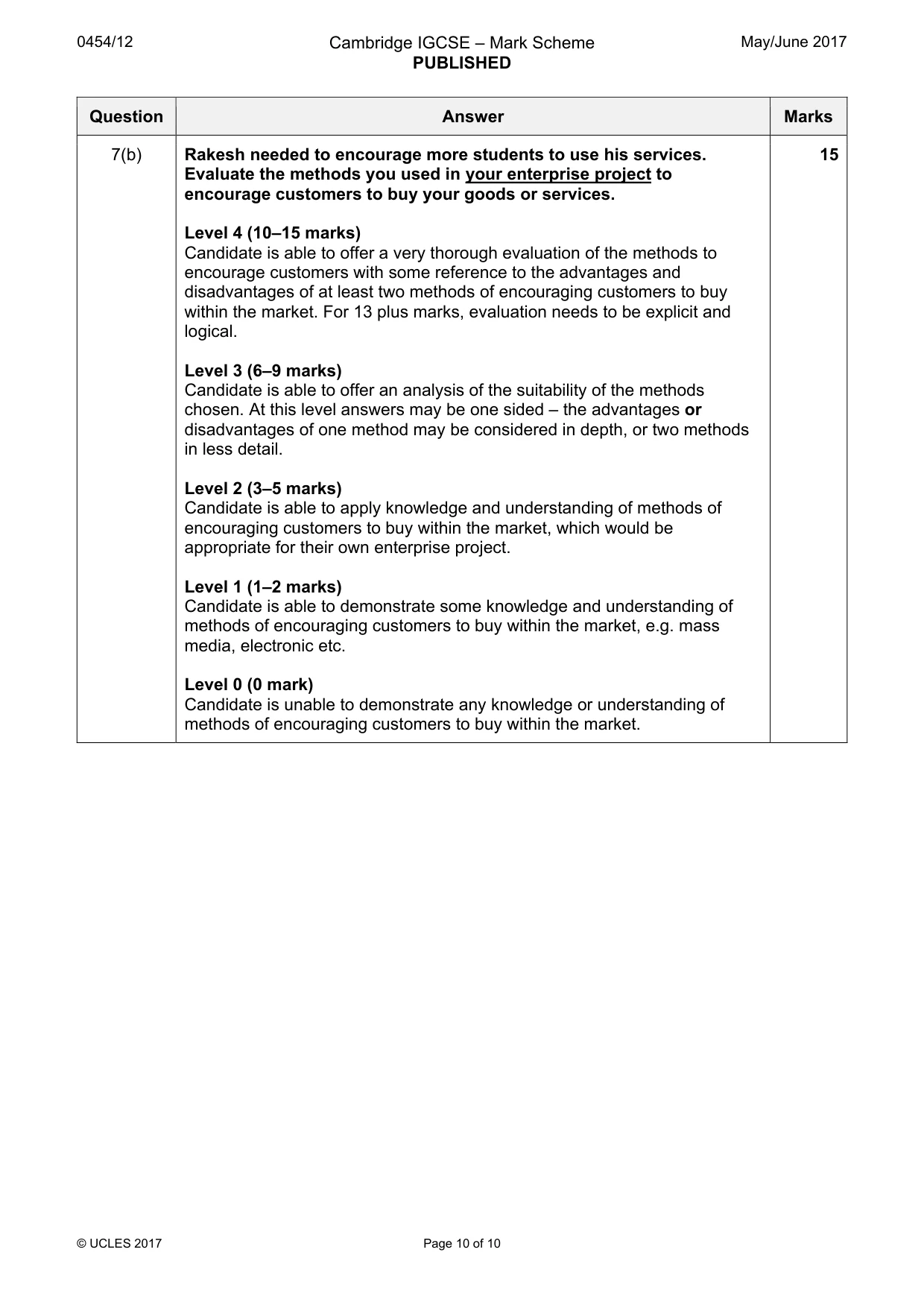
0454/12 Cambridge IGCSE – Mark Scheme PUBLISHED May/June 2017 © UCLES 2017 Page 10 of 10 Question Answer Marks 7(b) Rakesh needed to encourage more students to use his services. Evaluate the methods you used in your enterprise project to encourage customers to buy your goods or services. Level 4 (10–15 marks) Candidate is able to offer a very thorough evaluation of the methods to encourage customers with some reference to the advantages and disadvantages of at least two methods of encouraging customers to buy within the market. For 13 plus marks, evaluation needs to be explicit and logical. Level 3 (6–9 marks) Candidate is able to offer an analysis of the suitability of the methods chosen. At this level answers may be one sided – the advantages or disadvantages of one method may be considered in depth, or two methods in less detail. Level 2 (3–5 marks) Candidate is able to apply knowledge and understanding of methods of encouraging customers to buy within the market, which would be appropriate for their own enterprise project. Level 1 (1–2 marks) Candidate is able to demonstrate some knowledge and understanding of methods of encouraging customers to buy within the market, e.g. mass media, electronic etc. Level 0 (0 mark) Candidate is unable to demonstrate any knowledge or understanding of methods of encouraging customers to buy within the market. 15
What you needed in this session
Cambridge’s own grade thresholds for 2017 May/June, Paper 1 · Variant 2. A higher threshold means an easier paper — the bar moves with how the cohort did.