Cambridge IGCSE English - Second Language (oral endorsement) 0510 — 2021 Feb/March Paper 4 · Variant 2
0510/42/F/M/21
The question paper and its mark scheme, free to read here and free to download. This is Cambridge’s own paper, exactly as it was sat.
Question paper12 pages



Mark scheme7 pages
Answers below. Sit the paper first if you are practising.
Paper as text
Question paper, page 1
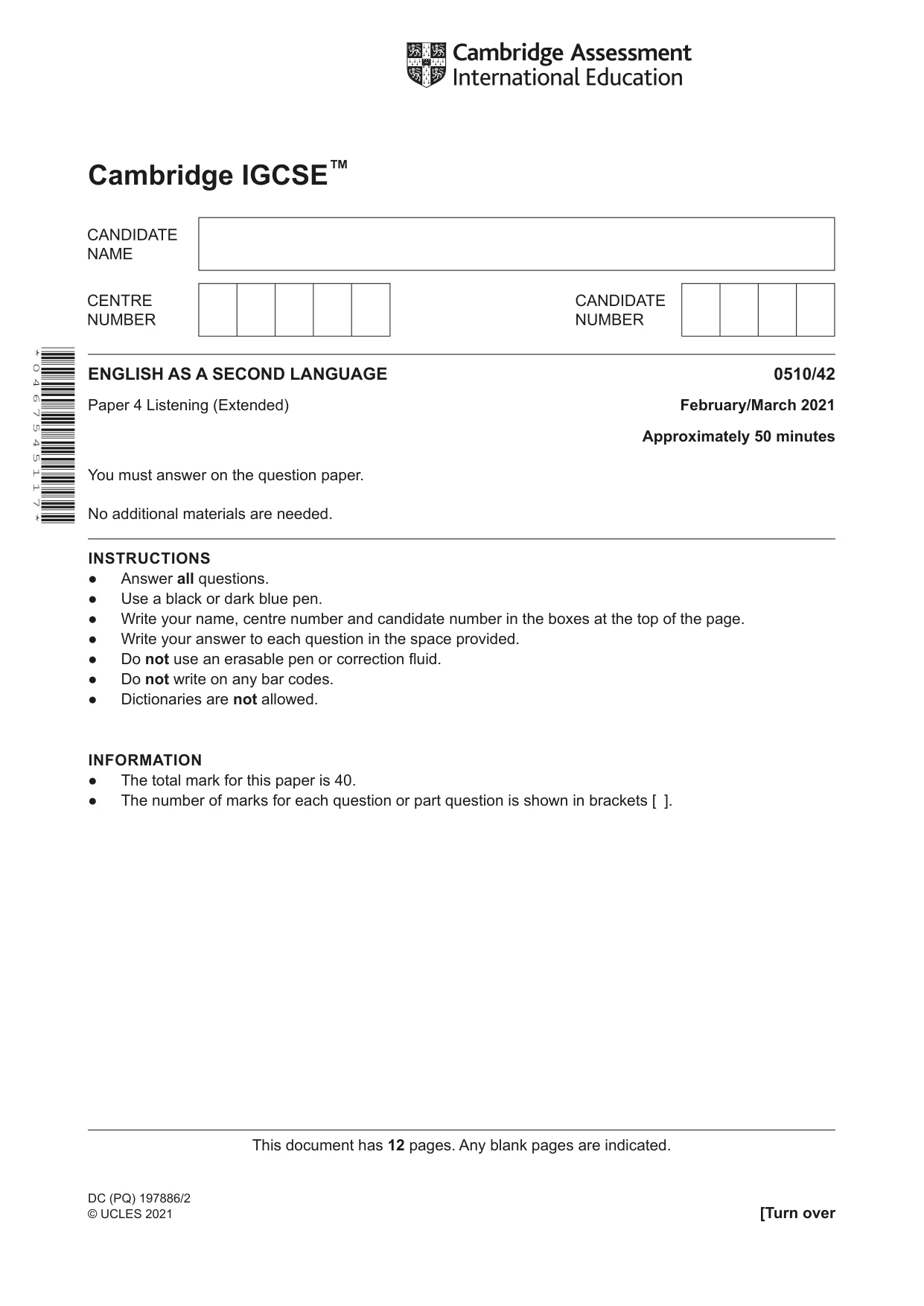
This document has 12 pages. Any blank pages are indicated. Cambridge IGCSE™ * 0 4 6 7 5 4 5 1 1 7 * DC (PQ) 197886/2 © UCLES 2021 [Turn over ENGLISH AS A SECOND LANGUAGE 0510/42 Paper 4 Listening (Extended) February/March 2021 Approximately 50 minutes You must answer on the question paper. No additional materials are needed. INSTRUCTIONS ● Answer all questions. ● Use a black or dark blue pen. ● Write your name, centre number and candidate number in the boxes at the top of the page. ● Write your answer to each question in the space provided. ● Do not use an erasable pen or correction fluid. ● Do not write on any bar codes. ● Dictionaries are not allowed. INFORMATION ● The total mark for this paper is 40. ● The number of marks for each question or part question is shown in brackets [ ].
Question paper, page 2
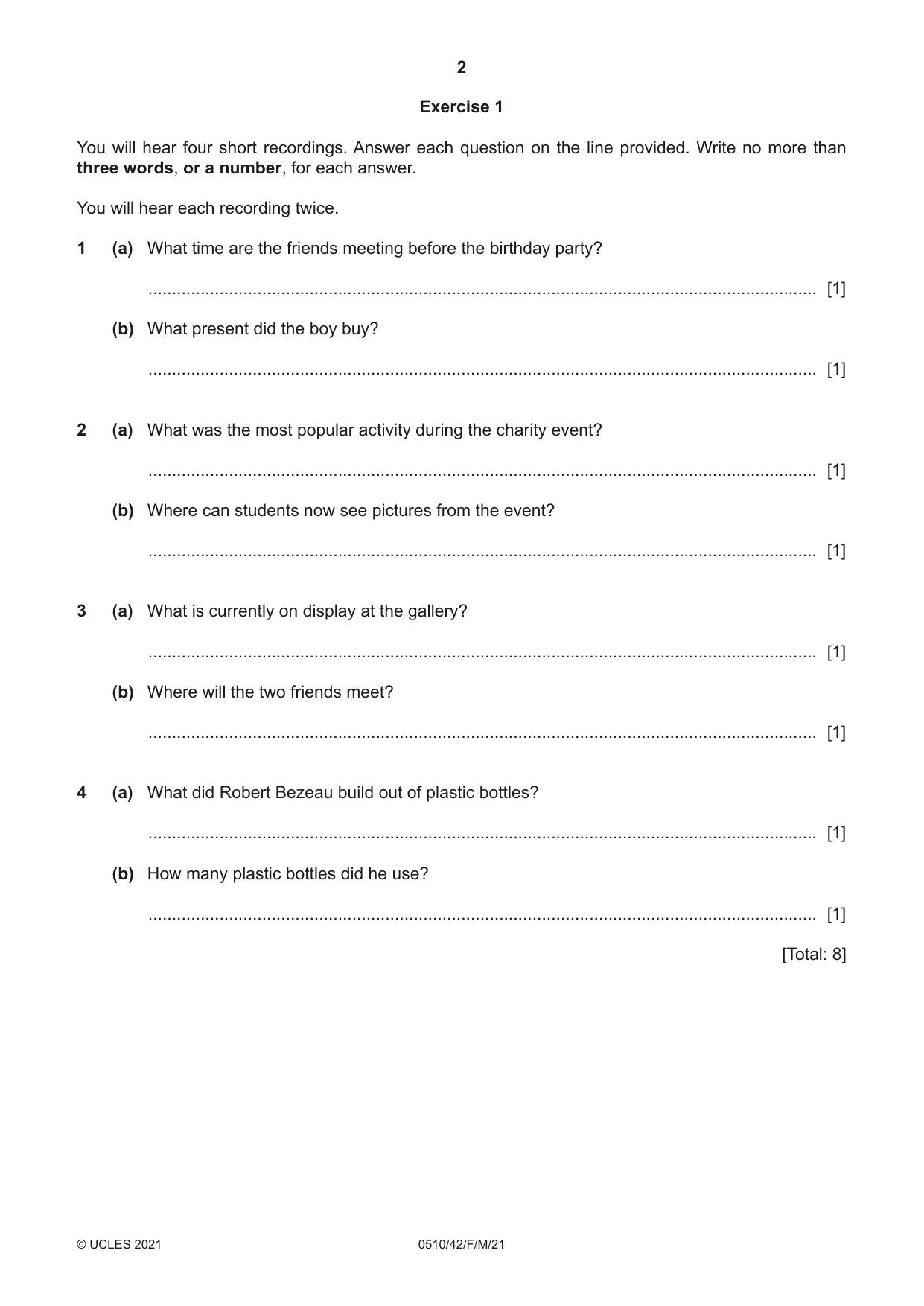
2 0510/42/F/M/21 © UCLES 2021 Exercise 1 You will hear four short recordings. Answer each question on the line provided. Write no more than three words, or a number, for each answer. You will hear each recording twice. 1 (a) What time are the friends meeting before the birthday party? … [1] (b) What present did the boy buy? … [1] 2 (a) What was the most popular activity during the charity event? … [1] (b) Where can students now see pictures from the event? … [1] 3 (a) What is currently on display at the gallery? … [1] (b) Where will the two friends meet? … [1] 4 (a) What did Robert Bezeau build out of plastic bottles? … [1] (b) How many plastic bottles did he use? … [1] [Total: 8]
Question paper, page 3
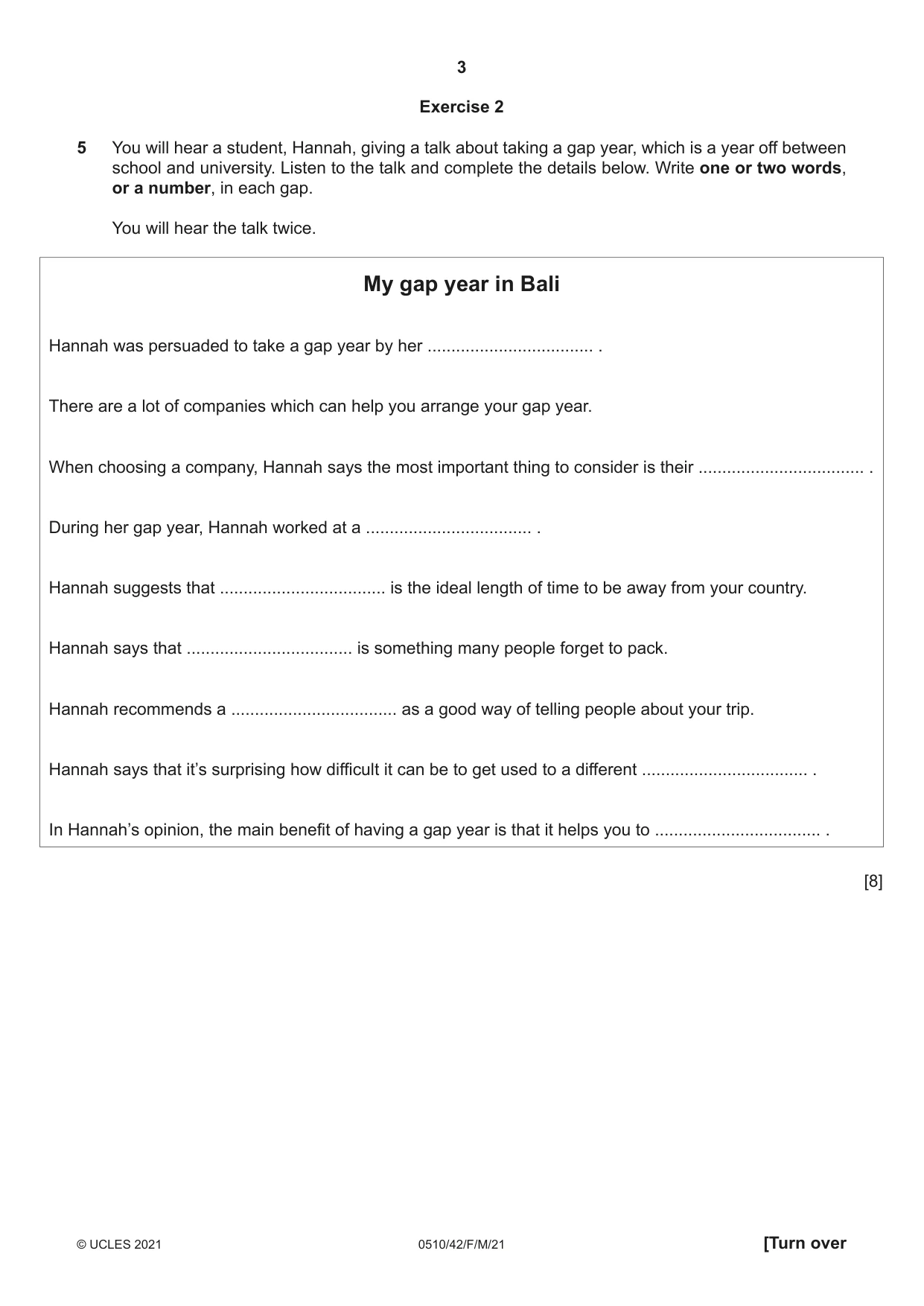
3 0510/42/F/M/21 © UCLES 2021 [Turn over Exercise 2 5 You will hear a student, Hannah, giving a talk about taking a gap year, which is a year off between school and university. Listen to the talk and complete the details below. Write one or two words, or a number, in each gap. You will hear the talk twice. My gap year in Bali Hannah was persuaded to take a gap year by her … . There are a lot of companies which can help you arrange your gap year. When choosing a company, Hannah says the most important thing to consider is their … . During her gap year, Hannah worked at a … . Hannah suggests that … is the ideal length of time to be away from your country. Hannah says that … is something many people forget to pack. Hannah recommends a … as a good way of telling people about your trip. Hannah says that it’s surprising how difficult it can be to get used to a different … . In Hannah’s opinion, the main benefit of having a gap year is that it helps you to … . [8]
Question paper, page 4
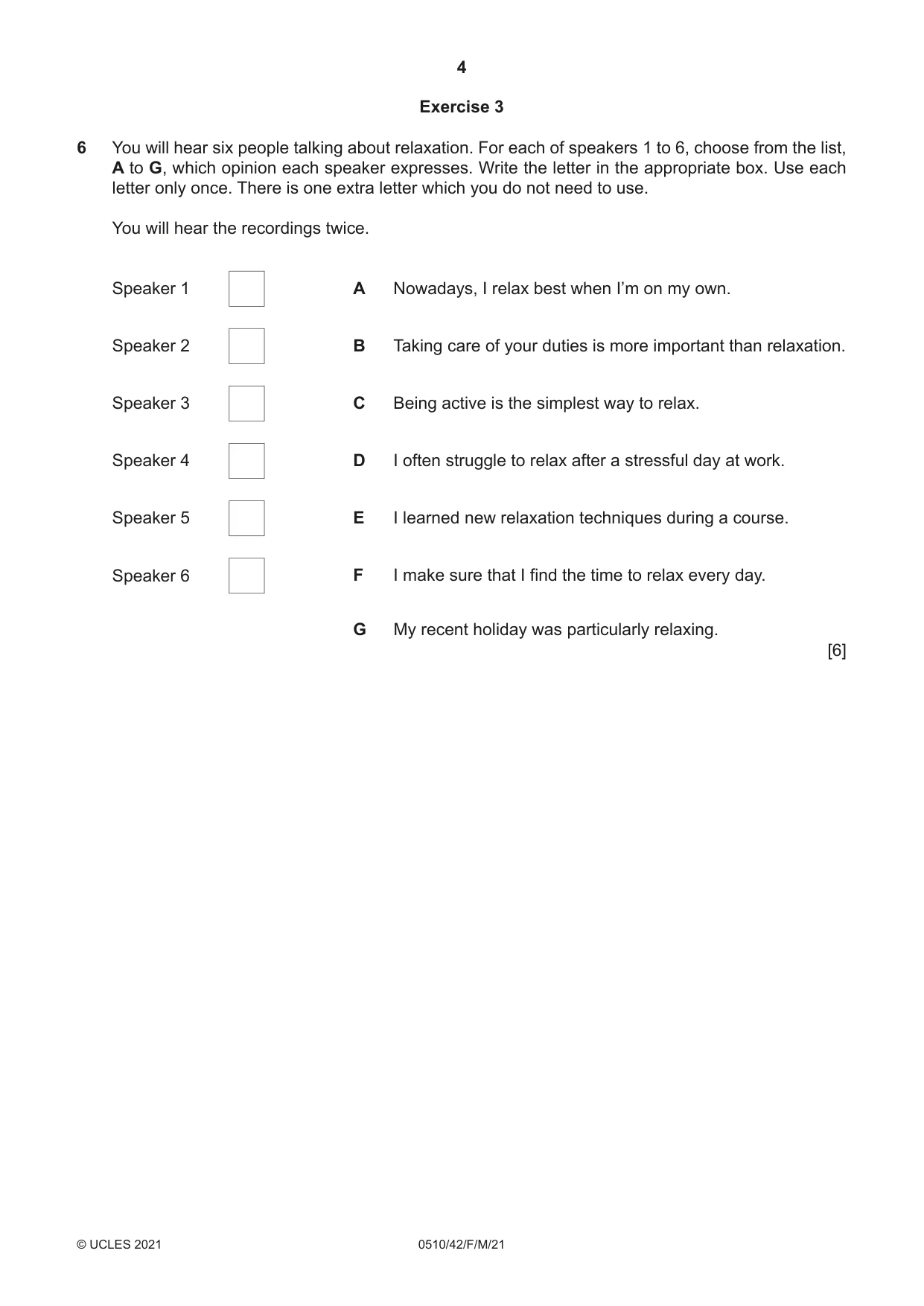
4 0510/42/F/M/21 © UCLES 2021 Exercise 3 6 You will hear six people talking about relaxation. For each of speakers 1 to 6, choose from the list, A to G, which opinion each speaker expresses. Write the letter in the appropriate box. Use each letter only once. There is one extra letter which you do not need to use. You will hear the recordings twice. Speaker 1 A Nowadays, I relax best when I’m on my own. Speaker 2 B Taking care of your duties is more important than relaxation. Speaker 3 C Being active is the simplest way to relax. Speaker 4 D I often struggle to relax after a stressful day at work. Speaker 5 E I learned new relaxation techniques during a course. Speaker 6 F I make sure that I find the time to relax every day. G My recent holiday was particularly relaxing. [6]
Question paper, page 5
5 0510/42/F/M/21 © UCLES 2021 [Turn over Please turn over for Exercise 4.
Question paper, page 6
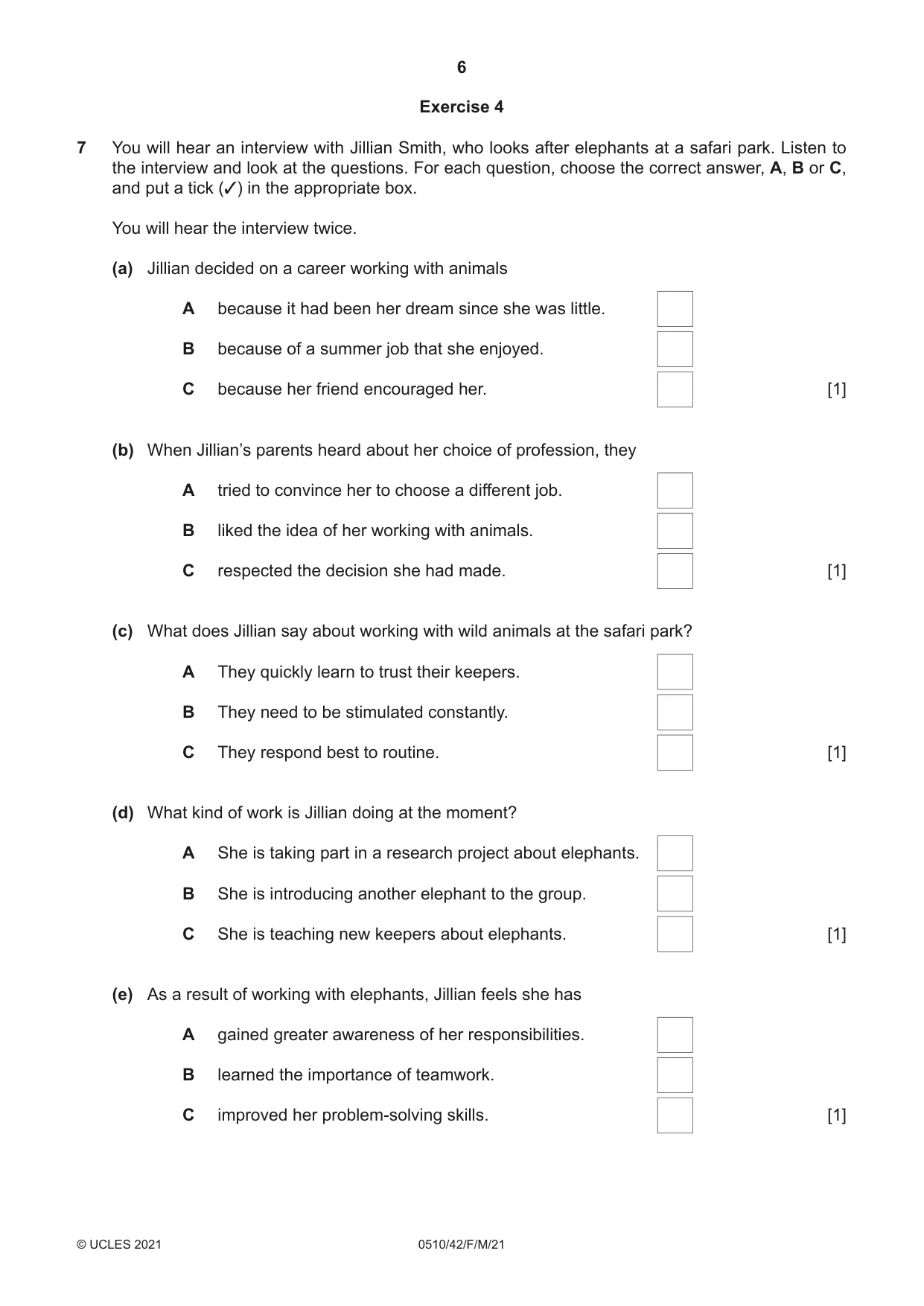
6 0510/42/F/M/21 © UCLES 2021 Exercise 4 7 You will hear an interview with Jillian Smith, who looks after elephants at a safari park. Listen to the interview and look at the questions. For each question, choose the correct answer, A, B or C, and put a tick (3) in the appropriate box. You will hear the interview twice. (a) Jillian decided on a career working with animals A because it had been her dream since she was little. B because of a summer job that she enjoyed. C because her friend encouraged her. [1] (b) When Jillian’s parents heard about her choice of profession, they A tried to convince her to choose a different job. B liked the idea of her working with animals. C respected the decision she had made. [1] (c) What does Jillian say about working with wild animals at the safari park? A They quickly learn to trust their keepers. B They need to be stimulated constantly. C They respond best to routine. [1] (d) What kind of work is Jillian doing at the moment? A She is taking part in a research project about elephants. B She is introducing another elephant to the group. C She is teaching new keepers about elephants. [1] (e) As a result of working with elephants, Jillian feels she has A gained greater awareness of her responsibilities. B learned the importance of teamwork. C improved her problem-solving skills. [1]
Question paper, page 7
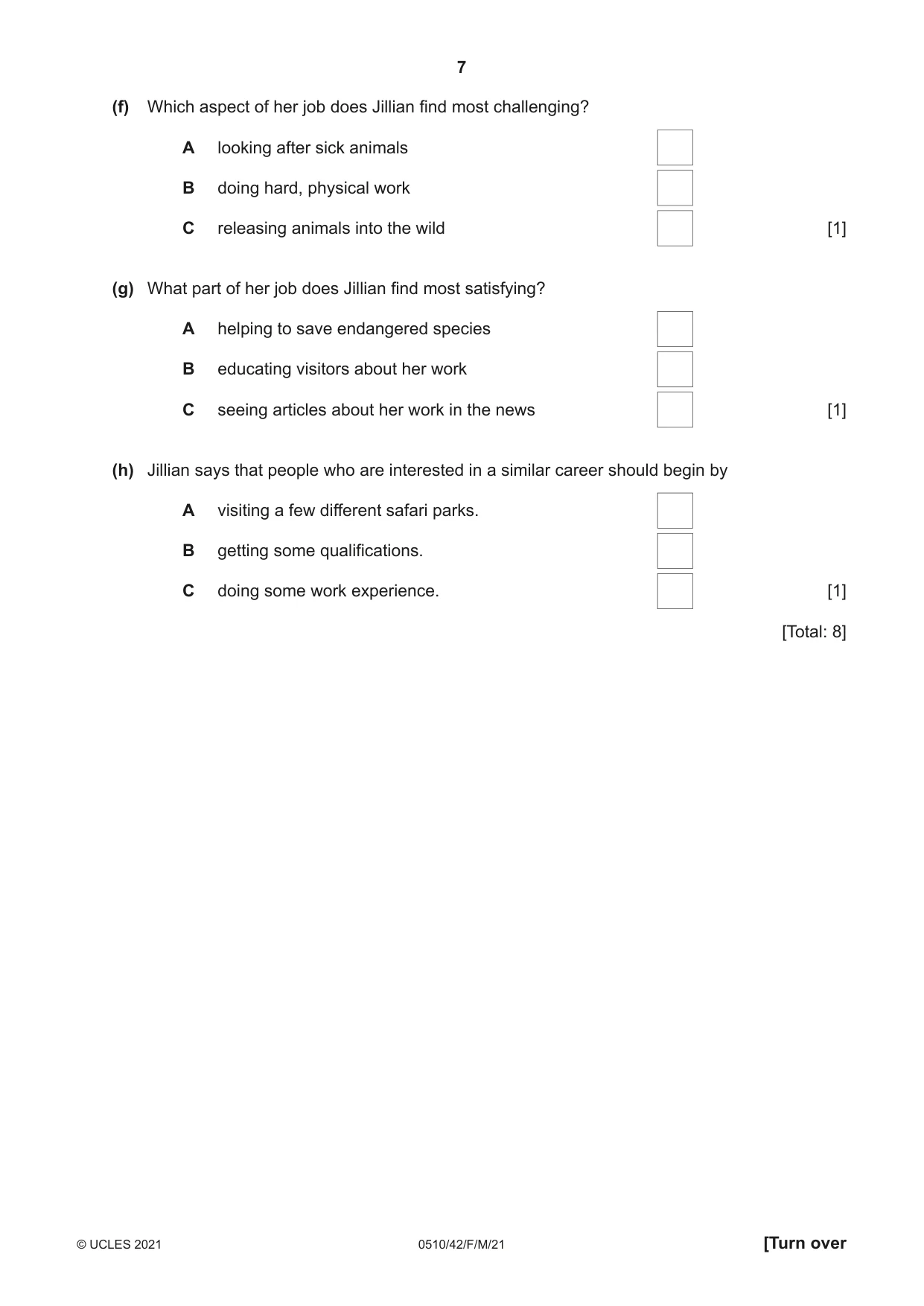
7 0510/42/F/M/21 © UCLES 2021 [Turn over (f) Which aspect of her job does Jillian find most challenging? A looking after sick animals B doing hard, physical work C releasing animals into the wild [1] (g) What part of her job does Jillian find most satisfying? A helping to save endangered species B educating visitors about her work C seeing articles about her work in the news [1] (h) Jillian says that people who are interested in a similar career should begin by A visiting a few different safari parks. B getting some qualifications. C doing some work experience. [1] [Total: 8]
Question paper, page 8
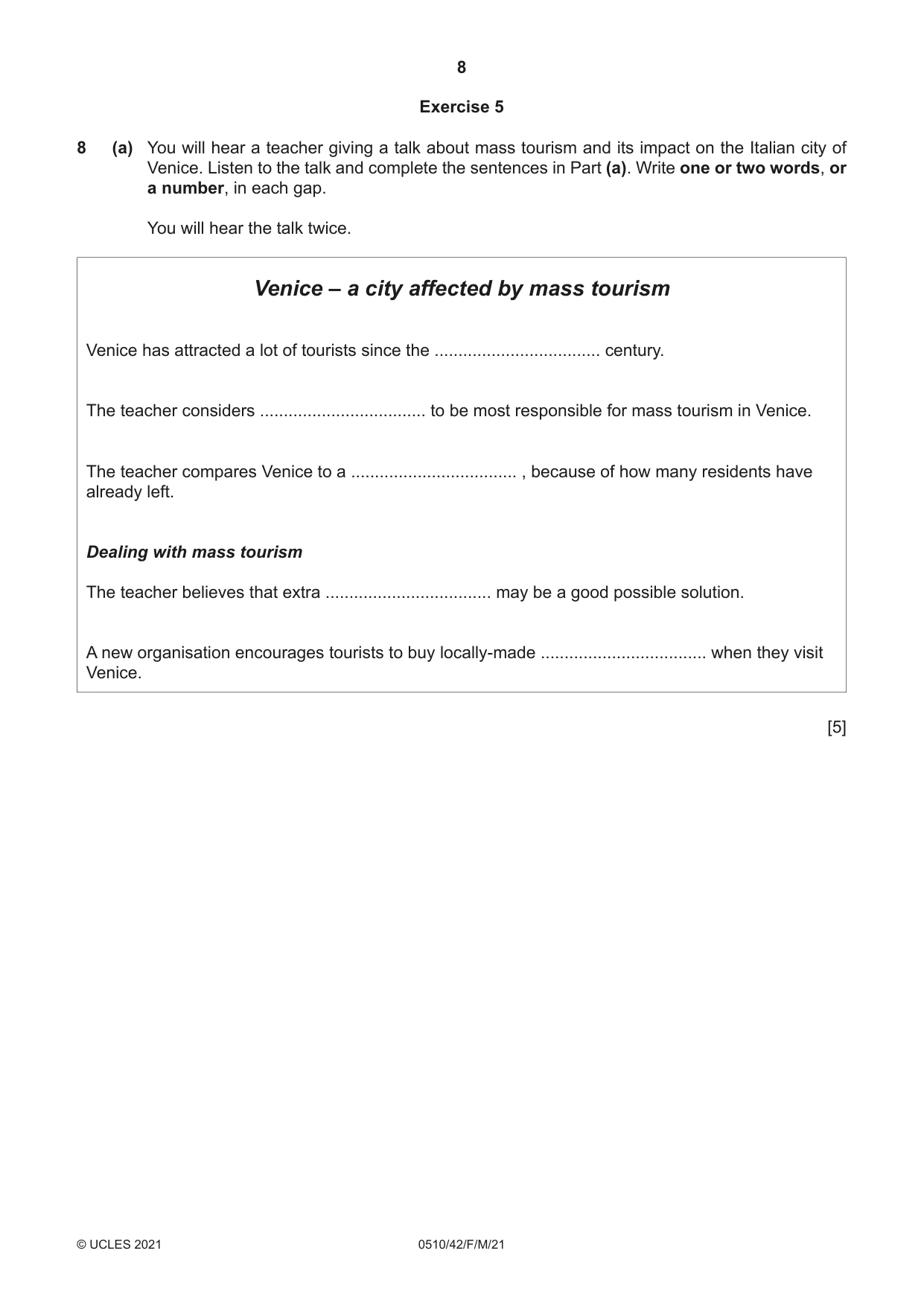
8 0510/42/F/M/21 © UCLES 2021 Exercise 5 8 (a) You will hear a teacher giving a talk about mass tourism and its impact on the Italian city of Venice. Listen to the talk and complete the sentences in Part (a). Write one or two words, or a number, in each gap. You will hear the talk twice. Venice – a city affected by mass tourism Venice has attracted a lot of tourists since the … century. The teacher considers … to be most responsible for mass tourism in Venice. The teacher compares Venice to a … , because of how many residents have already left. Dealing with mass tourism The teacher believes that extra … may be a good possible solution. A new organisation encourages tourists to buy locally-made … when they visit Venice. [5]
Question paper, page 9
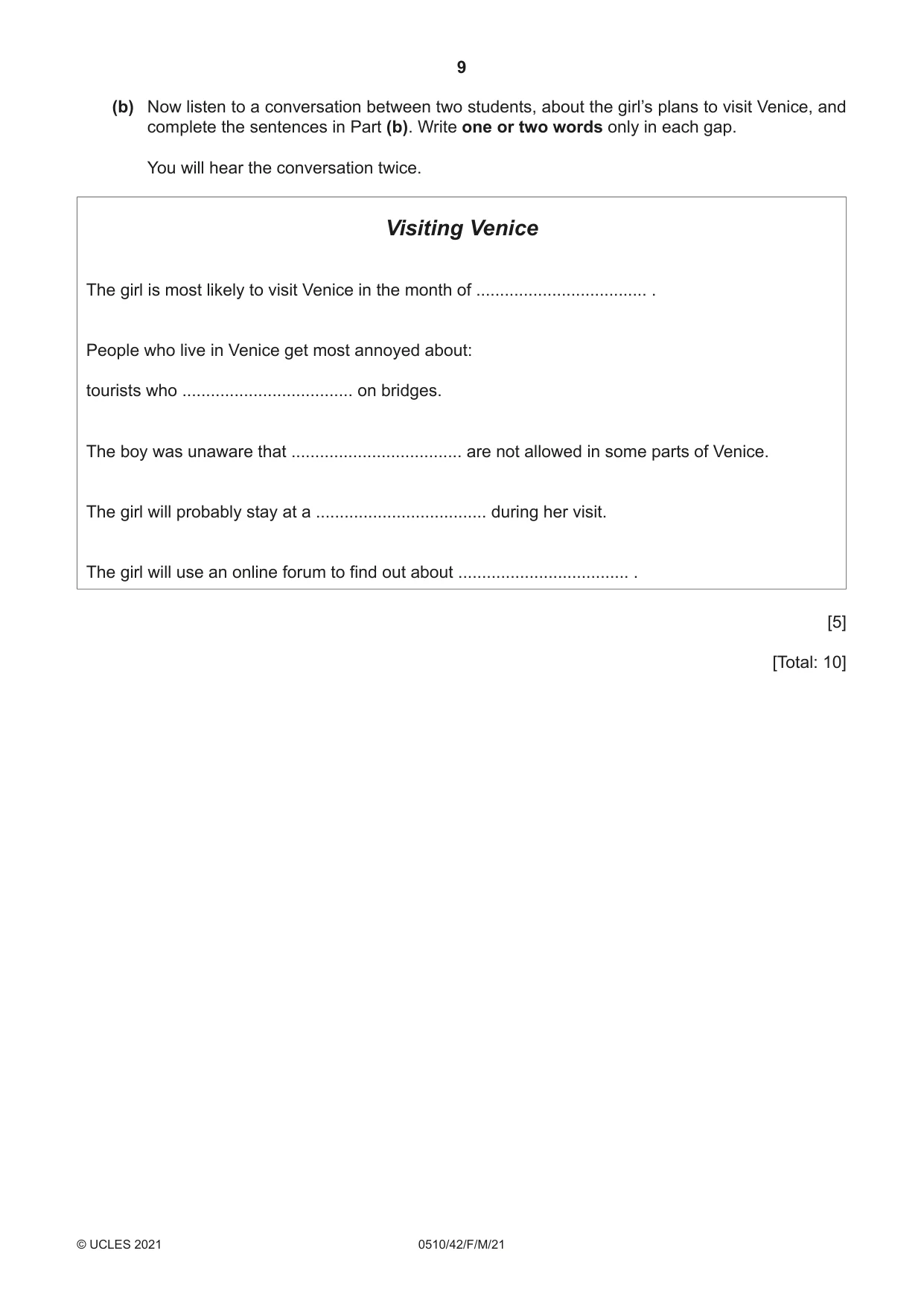
9 0510/42/F/M/21 © UCLES 2021 (b) Now listen to a conversation between two students, about the girl’s plans to visit Venice, and complete the sentences in Part (b). Write one or two words only in each gap. You will hear the conversation twice. Visiting Venice The girl is most likely to visit Venice in the month of … . People who live in Venice get most annoyed about: tourists who … on bridges. The boy was unaware that … are not allowed in some parts of Venice. The girl will probably stay at a … during her visit. The girl will use an online forum to find out about … . [5] [Total: 10]
Question paper, page 10
10 0510/42/F/M/21 © UCLES 2021 BLANK PAGE
Question paper, page 11
11 0510/42/F/M/21 © UCLES 2021 BLANK PAGE
Question paper, page 12
12 0510/42/F/M/21 © UCLES 2021 Permission to reproduce items where third-party owned material protected by copyright is included has been sought and cleared where possible. Every reasonable effort has been made by the publisher (UCLES) to trace copyright holders, but if any items requiring clearance have unwittingly been included, the publisher will be pleased to make amends at the earliest possible opportunity. To avoid the issue of disclosure of answer-related information to candidates, all copyright acknowledgements are reproduced online in the Cambridge Assessment International Education Copyright Acknowledgements Booklet. This is produced for each series of examinations and is freely available to download at www.cambridgeinternational.org after the live examination series. Cambridge Assessment International Education is part of the Cambridge Assessment Group. Cambridge Assessment is the brand name of the University of Cambridge Local Examinations Syndicate (UCLES), which itself is a department of the University of Cambridge. BLANK PAGE
Mark scheme, page 1
This document consists of 7 printed pages. © UCLES 2021 [Turn over Cambridge IGCSE™ ENGLISH AS A SECOND LANGUAGE 0510/42 Paper 4 Listening (Extended) March 2021 MARK SCHEME Maximum Mark: 40 Published This mark scheme is published as an aid to teachers and candidates, to indicate the requirements of the examination. It shows the basis on which Examiners were instructed to award marks. It does not indicate the details of the discussions that took place at an Examiners’ meeting before marking began, which would have considered the acceptability of alternative answers. Mark schemes should be read in conjunction with the question paper and the Principal Examiner Report for Teachers. Cambridge International will not enter into discussions about these mark schemes. Cambridge International is publishing the mark schemes for the March 2021 series for most Cambridge IGCSE™, Cambridge International A and AS Level components and some Cambridge O Level components.
Mark scheme, page 2
0510/42 Cambridge IGCSE – Mark Scheme PUBLISHED March 2021 © UCLES 2021 Page 2 of 7 Generic Marking Principles These general marking principles must be applied by all examiners when marking candidate answers. They should be applied alongside the specific content of the mark scheme or generic level descriptors for a question. Each question paper and mark scheme will also comply with these marking principles. GENERIC MARKING PRINCIPLE 1: Marks must be awarded in line with: • the specific content of the mark scheme or the generic level descriptors for the question • the specific skills defined in the mark scheme or in the generic level descriptors for the question • the standard of response required by a candidate as exemplified by the standardisation scripts. GENERIC MARKING PRINCIPLE 2: Marks awarded are always whole marks (not half marks, or other fractions). GENERIC MARKING PRINCIPLE 3: Marks must be awarded positively: • marks are awarded for correct/valid answers, as defined in the mark scheme. However, credit is given for valid answers which go beyond the scope of the syllabus and mark scheme, referring to your Team Leader as appropriate • marks are awarded when candidates clearly demonstrate what they know and can do • marks are not deducted for errors • marks are not deducted for omissions • answers should only be judged on the quality of spelling, punctuation and grammar when these features are specifically assessed by the question as indicated by the mark scheme. The meaning, however, should be unambiguous. GENERIC MARKING PRINCIPLE 4: Rules must be applied consistently, e.g. in situations where candidates have not followed instructions or in the application of generic level descriptors. GENERIC MARKING PRINCIPLE 5: Marks should be awarded using the full range of marks defined in the mark scheme for the question (however; the use of the full mark range may be limited according to the quality of the candidate responses seen). GENERIC MARKING PRINCIPLE 6: Marks awarded are based solely on the requirements as defined in the mark scheme. Marks should not be awarded with grade thresholds or grade descriptors in mind.
Mark scheme, page 3
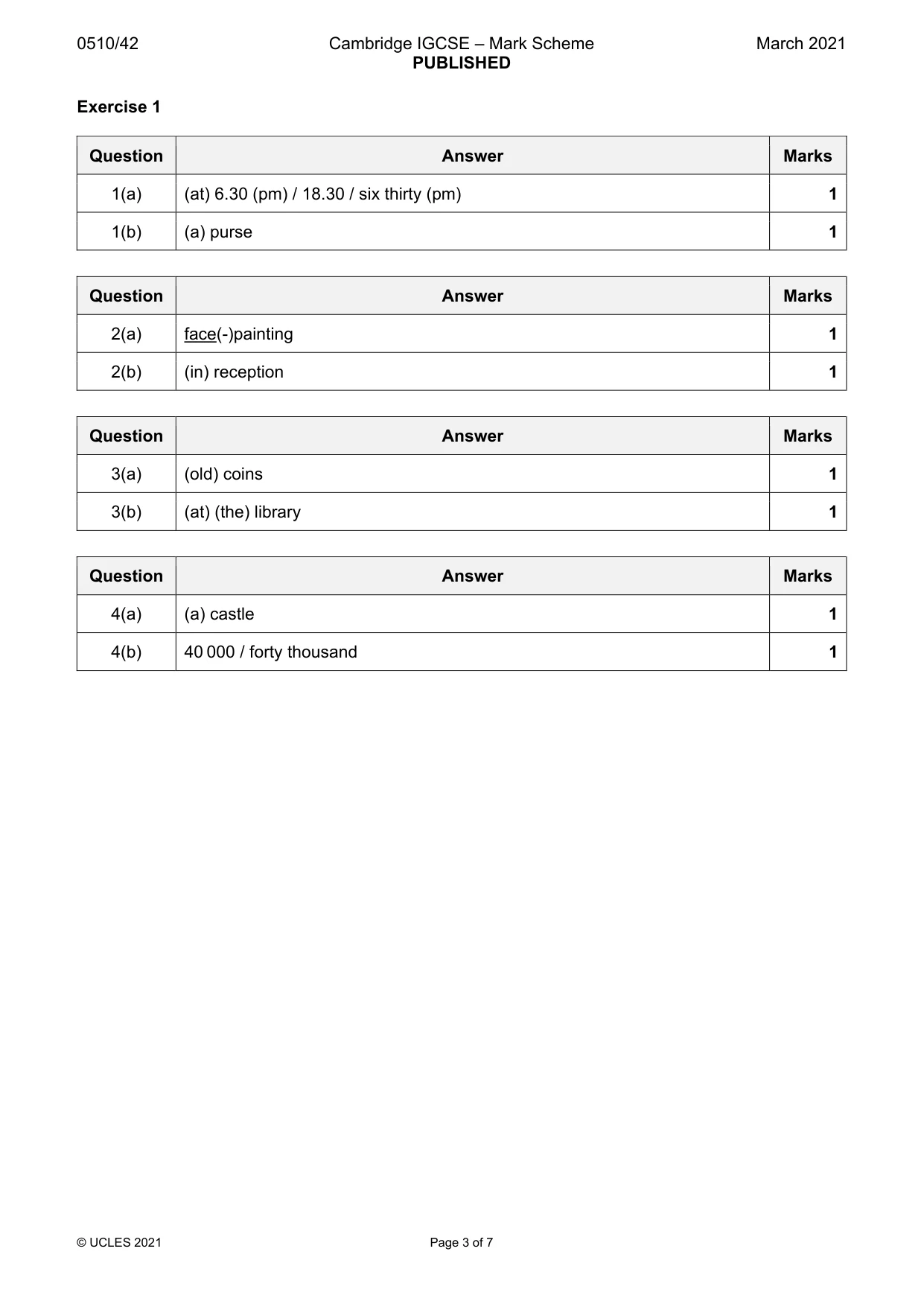
0510/42 Cambridge IGCSE – Mark Scheme PUBLISHED March 2021 © UCLES 2021 Page 3 of 7 Exercise 1 Question Answer Marks 1(a) (at) 6.30 (pm) / 18.30 / six thirty (pm) 1 1(b) (a) purse 1 Question Answer Marks 2(a) face(-)painting 1 2(b) (in) reception 1 Question Answer Marks 3(a) (old) coins 1 3(b) (at) (the) library 1 Question Answer Marks 4(a) (a) castle 1 4(b) 40 000 / forty thousand 1
Mark scheme, page 4
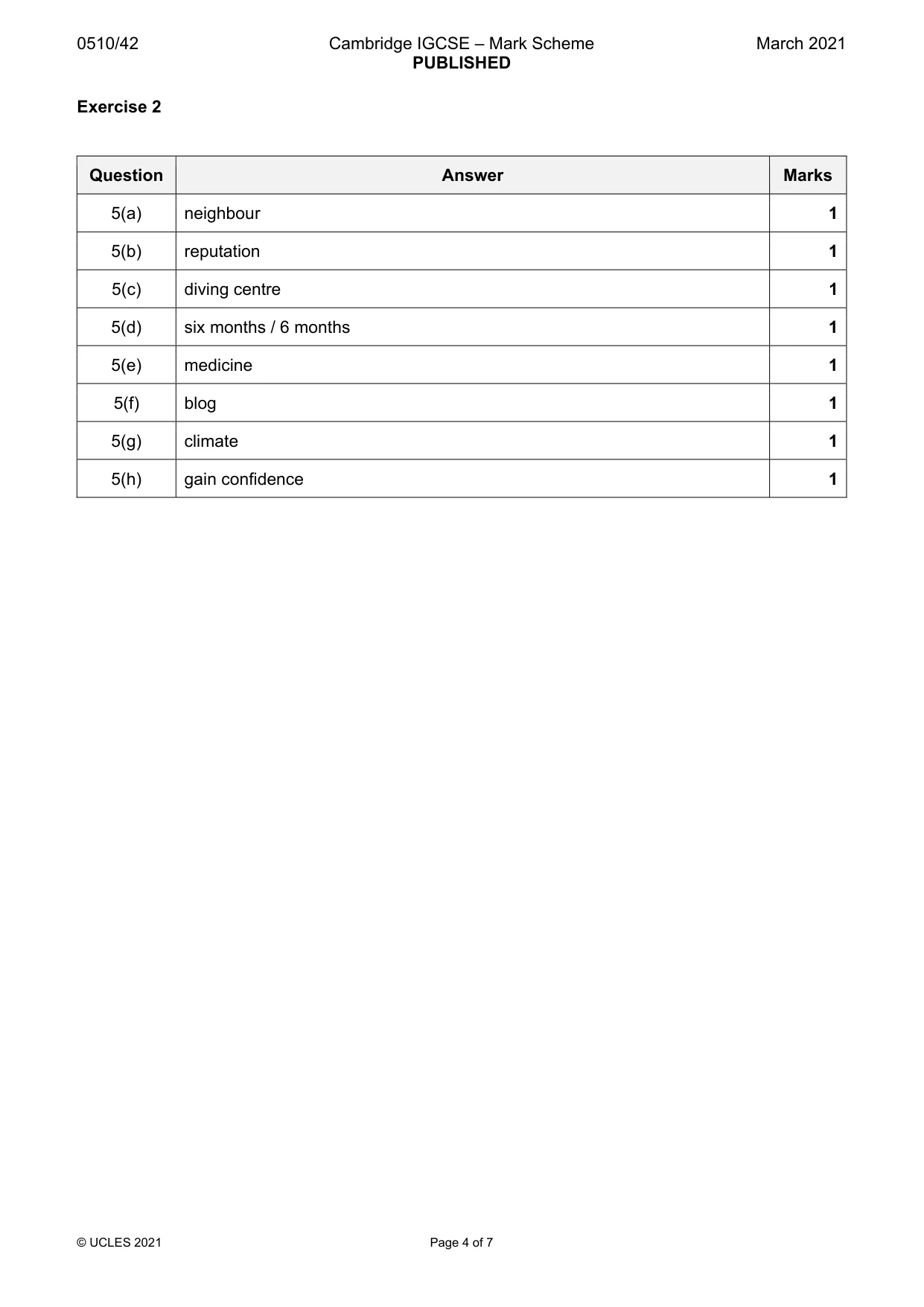
0510/42 Cambridge IGCSE – Mark Scheme PUBLISHED March 2021 © UCLES 2021 Page 4 of 7 Exercise 2 Question Answer Marks 5(a) neighbour 1 5(b) reputation 1 5(c) diving centre 1 5(d) six months / 6 months 1 5(e) medicine 1 5(f) blog 1 5(g) climate 1 5(h) gain confidence 1
Mark scheme, page 5
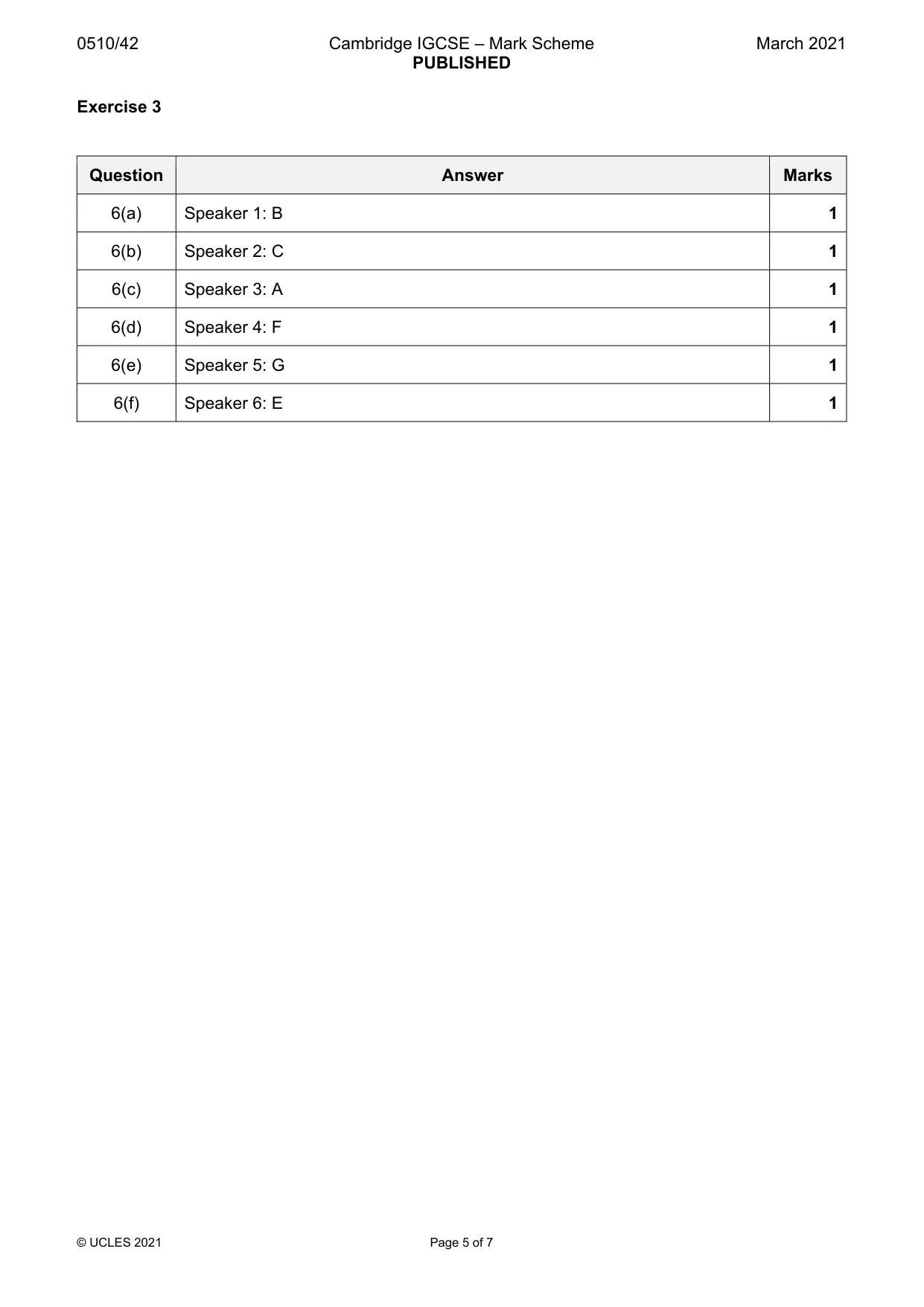
0510/42 Cambridge IGCSE – Mark Scheme PUBLISHED March 2021 © UCLES 2021 Page 5 of 7 Exercise 3 Question Answer Marks 6(a) Speaker 1: B 1 6(b) Speaker 2: C 1 6(c) Speaker 3: A 1 6(d) Speaker 4: F 1 6(e) Speaker 5: G 1 6(f) Speaker 6: E 1
Mark scheme, page 6
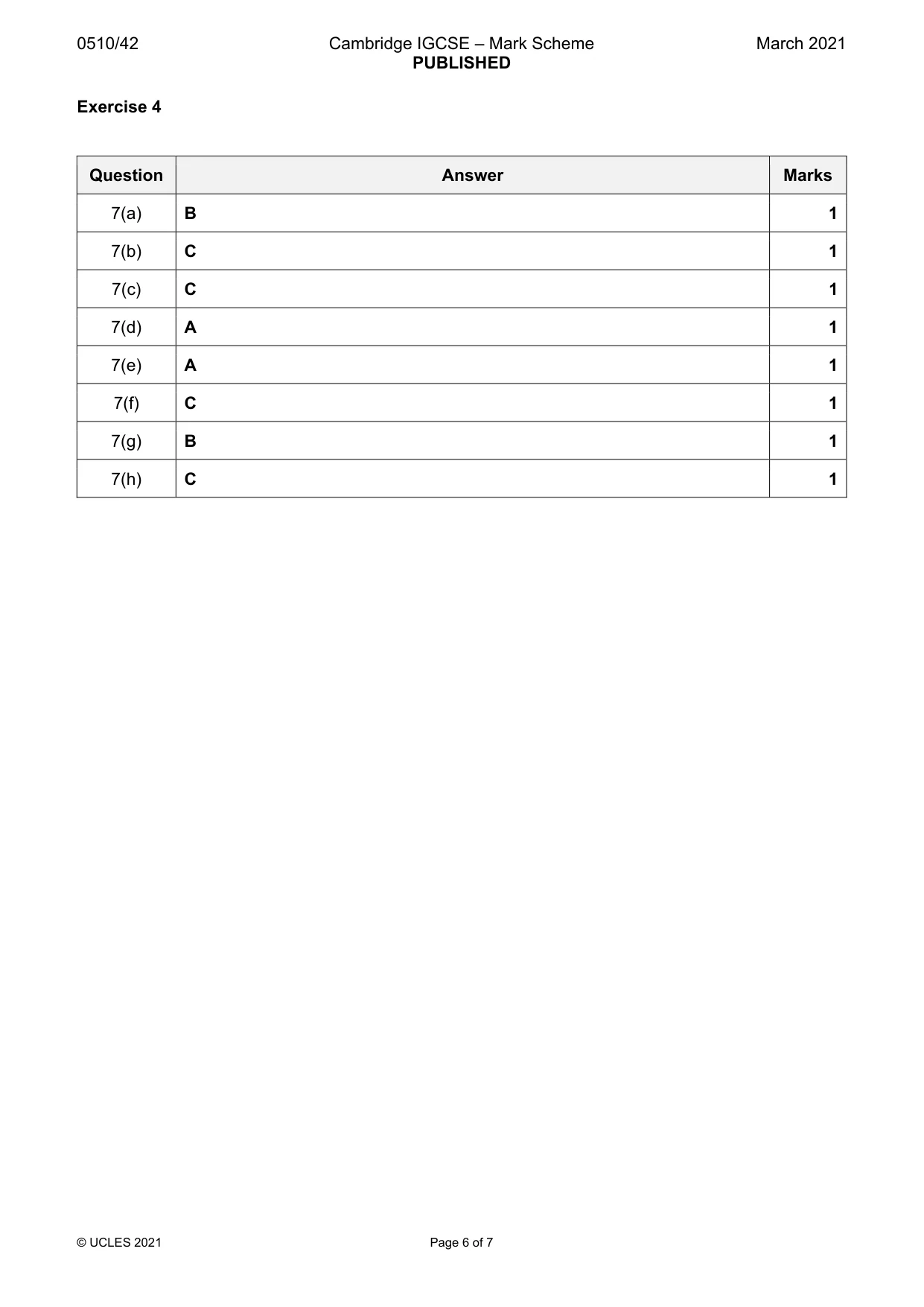
0510/42 Cambridge IGCSE – Mark Scheme PUBLISHED March 2021 © UCLES 2021 Page 6 of 7 Exercise 4 Question Answer Marks 7(a) B 1 7(b) C 1 7(c) C 1 7(d) A 1 7(e) A 1 7(f) C 1 7(g) B 1 7(h) C 1
Mark scheme, page 7
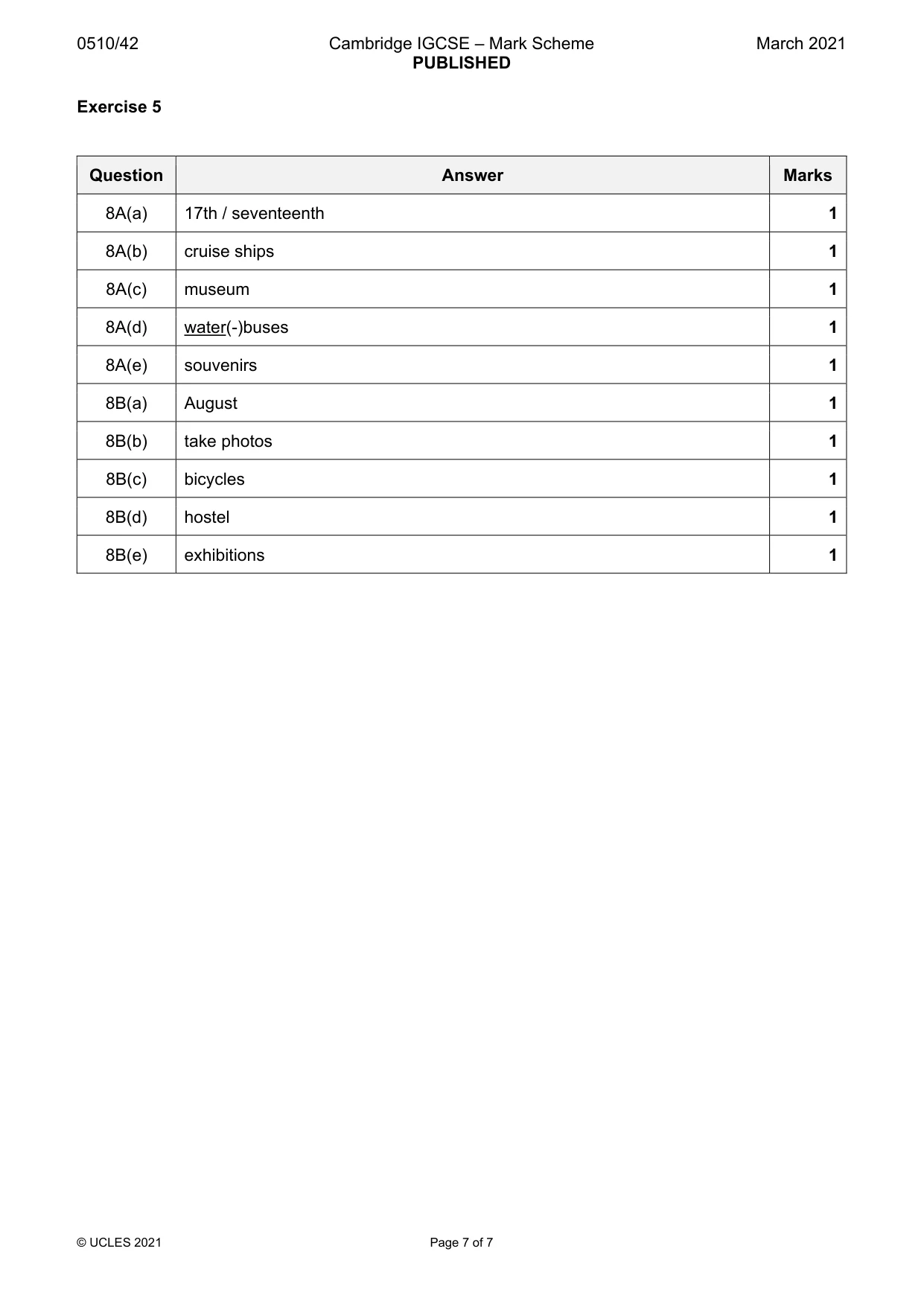
0510/42 Cambridge IGCSE – Mark Scheme PUBLISHED March 2021 © UCLES 2021 Page 7 of 7 Exercise 5 Question Answer Marks 8A(a) 17th / seventeenth 1 8A(b) cruise ships 1 8A(c) museum 1 8A(d) water(-)buses 1 8A(e) souvenirs 1 8B(a) August 1 8B(b) take photos 1 8B(c) bicycles 1 8B(d) hostel 1 8B(e) exhibitions 1