Cambridge IGCSE English - Second Language (oral endorsement) 0510 — 2020 Oct/Nov Paper 2 · Variant 3
0510/23/O/N/20 · 80 marks · ≈90 min
The question paper and its mark scheme, free to read here and free to download. This is Cambridge’s own paper, exactly as it was sat.
Question paper16 pages






Mark scheme11 pages
Answers below. Sit the paper first if you are practising.
Paper as text
Question paper, page 1
Cambridge IGCSE™ This document has 16 pages. Blank pages are indicated. ENGLISH AS A SECOND LANGUAGE 0510/23 Paper 2 Reading and Writing (Extended) October/November 2020 2 hours You must answer on the question paper. No additional materials are needed. INSTRUCTIONS ● Answer all questions. ● Use a black or dark blue pen. ● Write your name, centre number and candidate number in the boxes at the top of the page. ● Write your answer to each question in the space provided. ● Do not use an erasable pen or correction fluid. ● Do not write on any bar codes. ● Dictionaries are not allowed. INFORMATION ● The total mark for this paper is 80. ● The number of marks for each question or part question is shown in brackets [ ]. * 7 6 2 6 3 0 1 8 7 9 * DC (CJ/CB) 186552/3 © UCLES 2020 [Turn over
Question paper, page 2
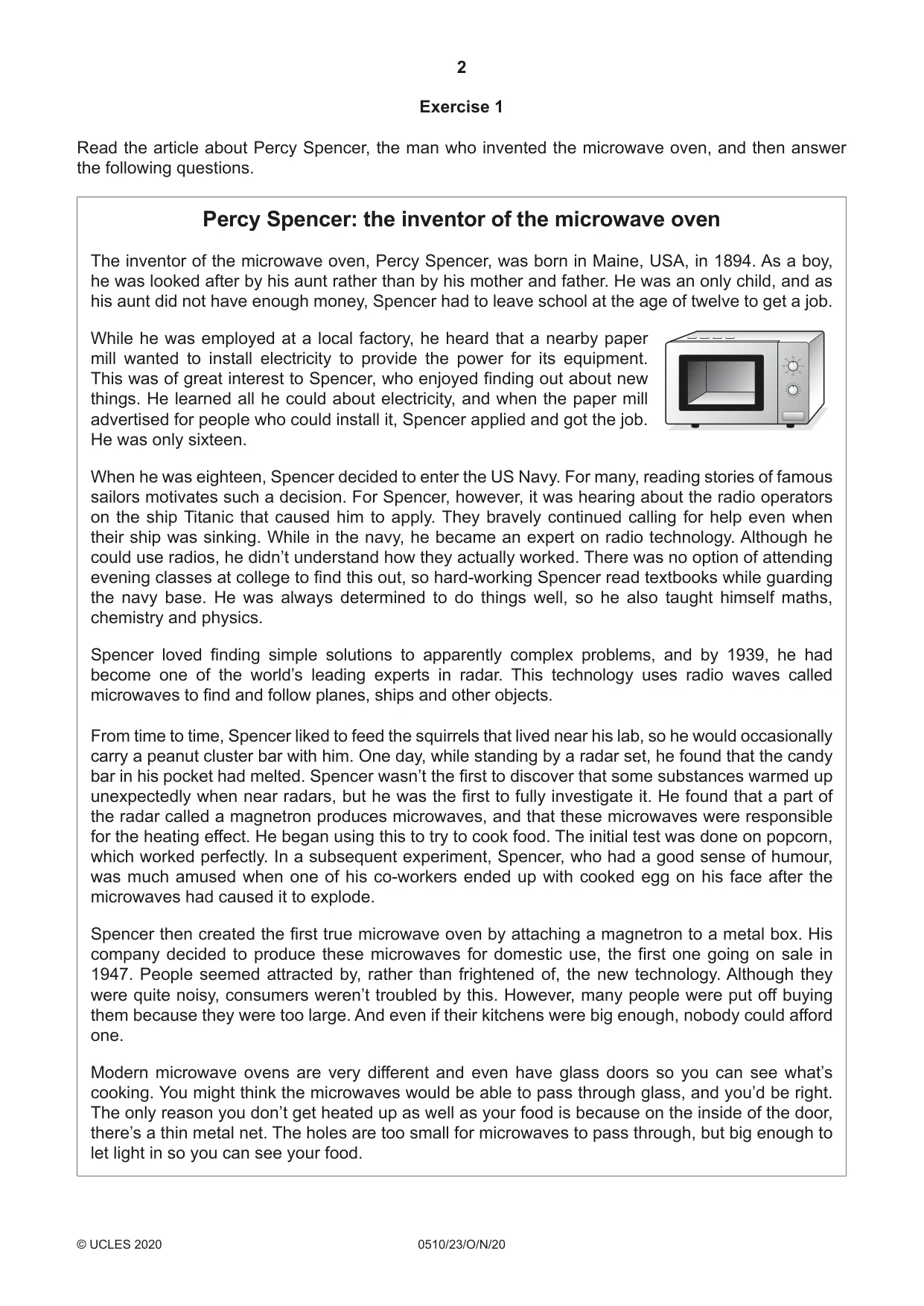
2 0510/23/O/N/20 © UCLES 2020 Exercise 1 Read the article about Percy Spencer, the man who invented the microwave oven, and then answer the following questions. Percy Spencer: the inventor of the microwave oven The inventor of the microwave oven, Percy Spencer, was born in Maine, USA, in 1894. As a boy, he was looked after by his aunt rather than by his mother and father. He was an only child, and as his aunt did not have enough money, Spencer had to leave school at the age of twelve to get a job. While he was employed at a local factory, he heard that a nearby paper mill wanted to install electricity to provide the power for its equipment. This was of great interest to Spencer, who enjoyed finding out about new things. He learned all he could about electricity, and when the paper mill advertised for people who could install it, Spencer applied and got the job. He was only sixteen. When he was eighteen, Spencer decided to enter the US Navy. For many, reading stories of famous sailors motivates such a decision. For Spencer, however, it was hearing about the radio operators on the ship Titanic that caused him to apply. They bravely continued calling for help even when their ship was sinking. While in the navy, he became an expert on radio technology. Although he could use radios, he didn’t understand how they actually worked. There was no option of attending evening classes at college to find this out, so hard-working Spencer read textbooks while guarding the navy base. He was always determined to do things well, so he also taught himself maths, chemistry and physics. Spencer loved finding simple solutions to apparently complex problems, and by 1939, he had become one of the world’s leading experts in radar. This technology uses radio waves called microwaves to find and follow planes, ships and other objects. From time to time, Spencer liked to feed the squirrels that lived near his lab, so he would occasionally carry a peanut cluster bar with him. One day, while standing by a radar set, he found that the candy bar in his pocket had melted. Spencer wasn’t the first to discover that some substances warmed up unexpectedly when near radars, but he was the first to fully investigate it. He found that a part of the radar called a magnetron produces microwaves, and that these microwaves were responsible for the heating effect. He began using this to try to cook food. The initial test was done on popcorn, which worked perfectly. In a subsequent experiment, Spencer, who had a good sense of humour, was much amused when one of his co-workers ended up with cooked egg on his face after the microwaves had caused it to explode. Spencer then created the first true microwave oven by attaching a magnetron to a metal box. His company decided to produce these microwaves for domestic use, the first one going on sale in 1947. People seemed attracted by, rather than frightened of, the new technology. Although they were quite noisy, consumers weren’t troubled by this. However, many people were put off buying them because they were too large. And even if their kitchens were big enough, nobody could afford one. Modern microwave ovens are very different and even have glass doors so you can see what’s cooking. You might think the microwaves would be able to pass through glass, and you’d be right. The only reason you don’t get heated up as well as your food is because on the inside of the door, there’s a thin metal net. The holes are too small for microwaves to pass through, but big enough to let light in so you can see your food.
Question paper, page 3
3 0510/23/O/N/20 © UCLES 2020 [Turn over 1 Who did Percy Spencer live with when he was a child? … [1] 2 Where was Spencer working when he first became interested in electricity? … [1] 3 Who inspired Spencer to join the US Navy? … [1] 4 When did Spencer find time to study during his time in the US Navy? … [1] 5 Why did Spencer sometimes have something sweet with him while at work? … [1] 6 What was the first food Spencer tried to cook using microwaves? … [1] 7 Why didn’t the first microwave ovens sell well? Give two details. … … [2] 8 What prevents microwaves escaping from modern microwave ovens? … [1] 9 What does the article state about Percy Spencer’s character? Give four details. … … … … [4] [Total: 13]
Question paper, page 4
4 0510/23/O/N/20 © UCLES 2020 Exercise 2 Read the four sections of the film review (A–D). Then answer Question 10(a)–(j). Film Review: Fisheye’s World A Based on a novel by Karen Hudderston, this new fantasy film is directed by Jonas Hartley. You may have seen his superb Last Days of Wonder last year. The hero in Fisheye’s World, Angelo Donnelly, gets on a train dressed in his school uniform as normal, but the train doesn’t stop where it’s supposed to. In fact, it doesn’t stop for hours and when the doors finally open, Angelo finds himself in a very strange world indeed: the world of Mr Fisheye. The first thing he sees there is a strange-looking building with a sign reading ‘Mr Fisheye’s Home for Lost Animals’. He enters and a great adventure begins. From this minute on, Angelo is transported from his ordinary life into a tale of three-metre-tall, scary-looking but friendly monsters, and days that constantly change in length. Though the film has its faults, it’s a wild ride from start to finish. Hartley constructs an entirely impossible world that you can’t help being tricked into believing. B When reading the novel, it’s tremendously difficult to imagine the world that Karen Hudderston created when she wrote Fisheye’s World. The striking scenes in the book are either too beautiful or too terrifying to picture in your mind’s eye. Therefore the job of turning such a story into a movie must have been incredibly challenging for Hartley. The result is far from perfect, as whole sections of the original novel are missing from the film. Nevertheless, Hartley’s careful and effective selection of the cast, and the performances he manages to get from them, are impressive. It is these that give the movie even more of its magic. The costumes used in the movie are also fantastic, and they really help to emphasise the enormous differences between the real world and that of Mr Fisheye. C Of course, Mr Fisheye’s lost animals aren’t animals at all. They’re kind and gentle monsters that society has rejected because of their huge size and frightening appearance. Hartley has created some superb-looking beasts – far more impressive than in any of his previous films, and even better, in my opinion, than those described in the book. Angelo has a part to play in saving these gentle giants when they, and the whole of Mr Fisheye’s world, are faced with destruction by local people. The battle scene between the two sides had the potential to be thrilling. As I was watching it, however, I felt that I’d seen a very similar thing done more effectively in other films. An additional disappointment was that the special effects used in this section of the movie seemed somewhat artificial compared to the rest of the film, and therefore looked a little out of place. However, I’d still very much recommend seeing Fisheye’s World. D Overall, the plot is largely believable and the absolutely beautiful production more than makes up for any weaknesses. There is hardly a dull moment from the minute the first image flashes onto the screen until the film’s final scenes. I’d like to have seen even more of Mr Fisheye, as I ended up actually having more affection for him than I did for Angelo, but perhaps one day there can be a sequel with him in a more central role. After a truly enjoyable film, when the screen goes black and the lights come back on, for several moments you really believe that you are still living in the world created by the movie. Fisheye’s World had this effect on me, so you can walk into the cinema expecting to be wonderfully entertained, because that is exactly what will happen.
Question paper, page 5
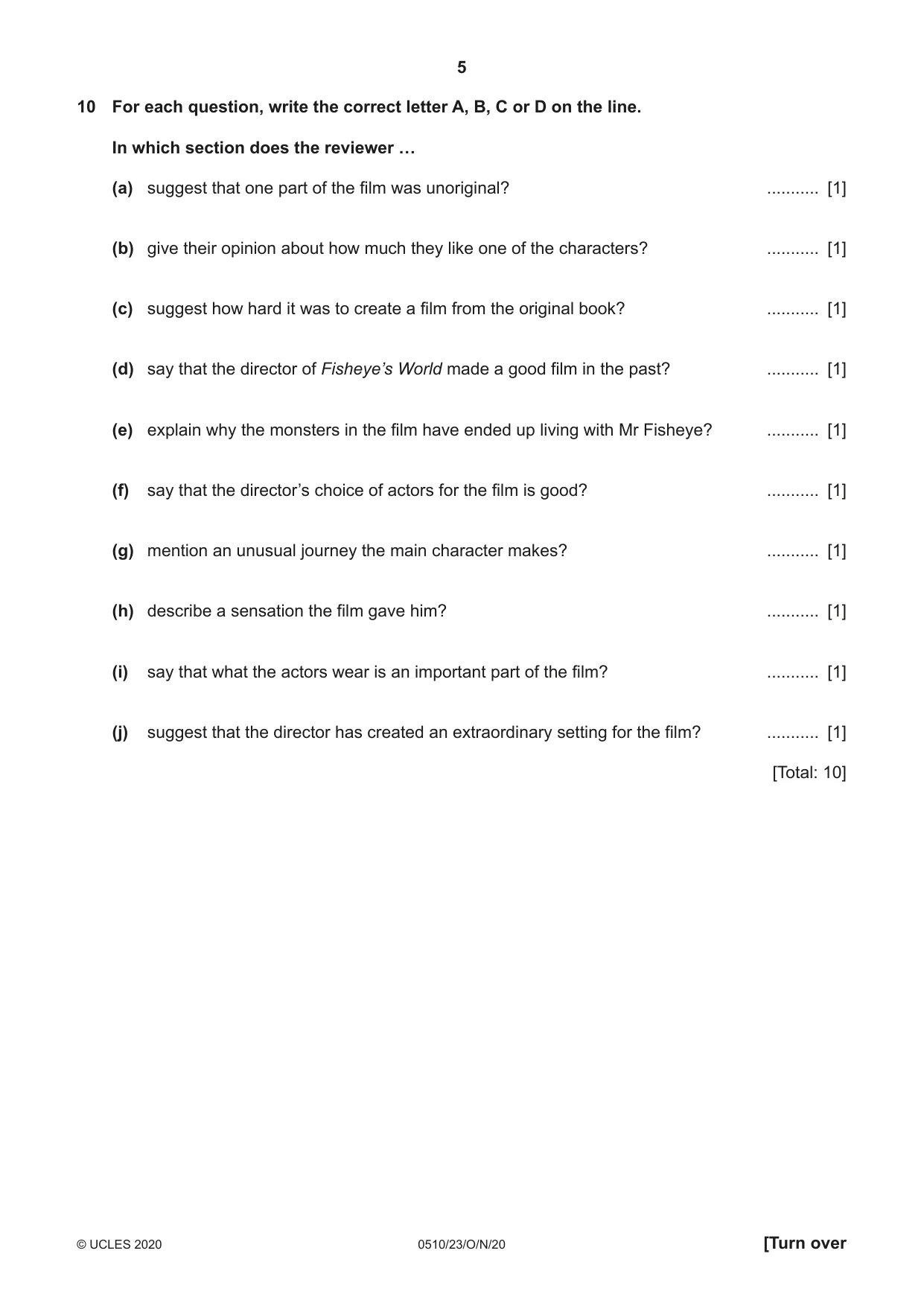
5 0510/23/O/N/20 © UCLES 2020 [Turn over 10 For each question, write the correct letter A, B, C or D on the line. In which section does the reviewer … (a) suggest that one part of the film was unoriginal? … [1] (b) give their opinion about how much they like one of the characters? … [1] (c) suggest how hard it was to create a film from the original book? … [1] (d) say that the director of Fisheye’s World made a good film in the past? … [1] (e) explain why the monsters in the film have ended up living with Mr Fisheye? … [1] (f) say that the director’s choice of actors for the film is good? … [1] (g) mention an unusual journey the main character makes? … [1] (h) describe a sensation the film gave him? … [1] (i) say that what the actors wear is an important part of the film? … [1] (j) suggest that the director has created an extraordinary setting for the film? … [1] [Total: 10]
Question paper, page 6
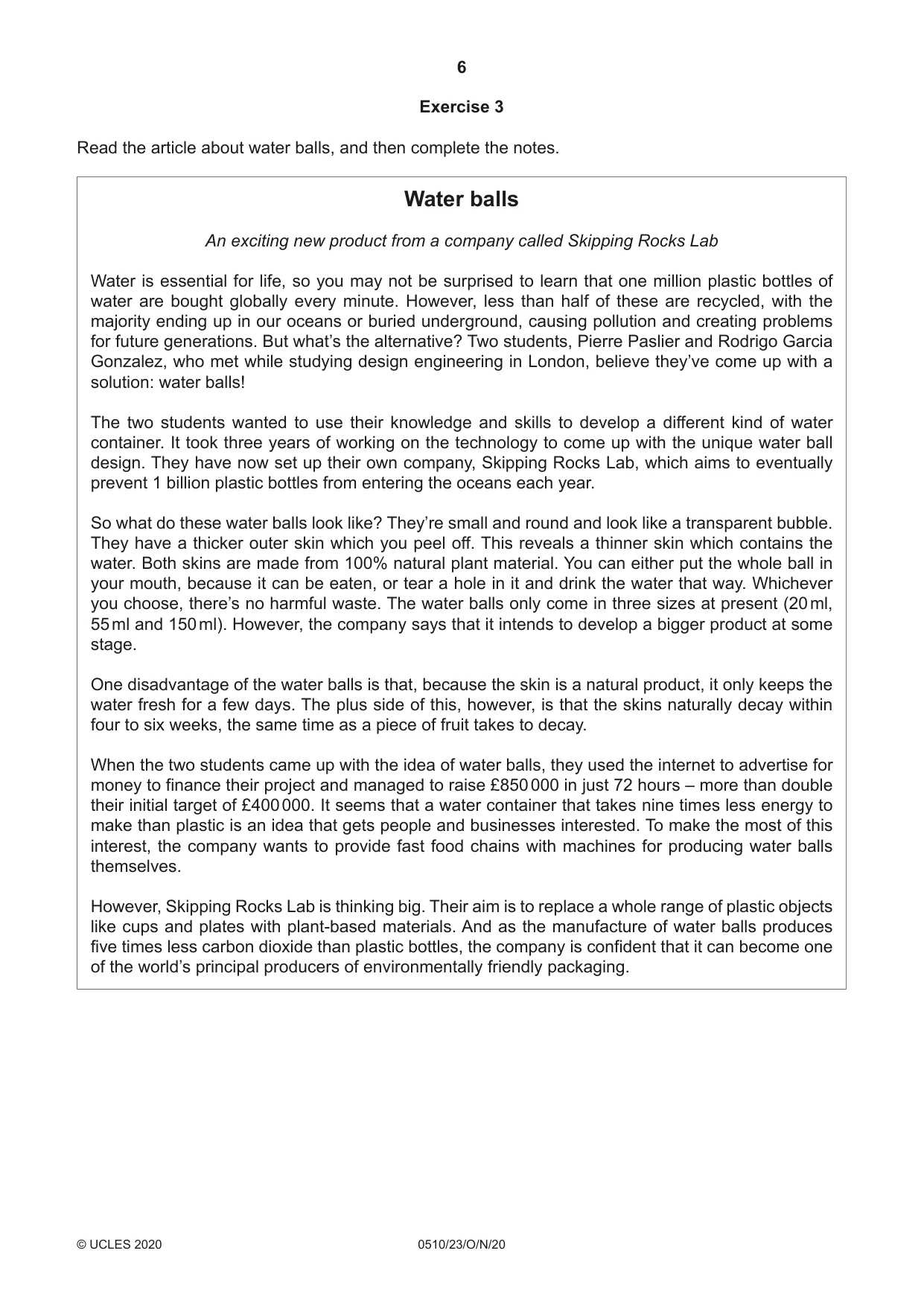
6 0510/23/O/N/20 © UCLES 2020 Exercise 3 Read the article about water balls, and then complete the notes. Water balls An exciting new product from a company called Skipping Rocks Lab Water is essential for life, so you may not be surprised to learn that one million plastic bottles of water are bought globally every minute. However, less than half of these are recycled, with the majority ending up in our oceans or buried underground, causing pollution and creating problems for future generations. But what’s the alternative? Two students, Pierre Paslier and Rodrigo Garcia Gonzalez, who met while studying design engineering in London, believe they’ve come up with a solution: water balls! The two students wanted to use their knowledge and skills to develop a different kind of water container. It took three years of working on the technology to come up with the unique water ball design. They have now set up their own company, Skipping Rocks Lab, which aims to eventually prevent 1 billion plastic bottles from entering the oceans each year. So what do these water balls look like? They’re small and round and look like a transparent bubble. They have a thicker outer skin which you peel off. This reveals a thinner skin which contains the water. Both skins are made from 100% natural plant material. You can either put the whole ball in your mouth, because it can be eaten, or tear a hole in it and drink the water that way. Whichever you choose, there’s no harmful waste. The water balls only come in three sizes at present (20 ml, 55 ml and 150 ml). However, the company says that it intends to develop a bigger product at some stage. One disadvantage of the water balls is that, because the skin is a natural product, it only keeps the water fresh for a few days. The plus side of this, however, is that the skins naturally decay within four to six weeks, the same time as a piece of fruit takes to decay. When the two students came up with the idea of water balls, they used the internet to advertise for money to finance their project and managed to raise £850 000 in just 72 hours – more than double their initial target of £400 000. It seems that a water container that takes nine times less energy to make than plastic is an idea that gets people and businesses interested. To make the most of this interest, the company wants to provide fast food chains with machines for producing water balls themselves. However, Skipping Rocks Lab is thinking big. Their aim is to replace a whole range of plastic objects like cups and plates with plant-based materials. And as the manufacture of water balls produces five times less carbon dioxide than plastic bottles, the company is confident that it can become one of the world’s principal producers of environmentally friendly packaging.
Question paper, page 7
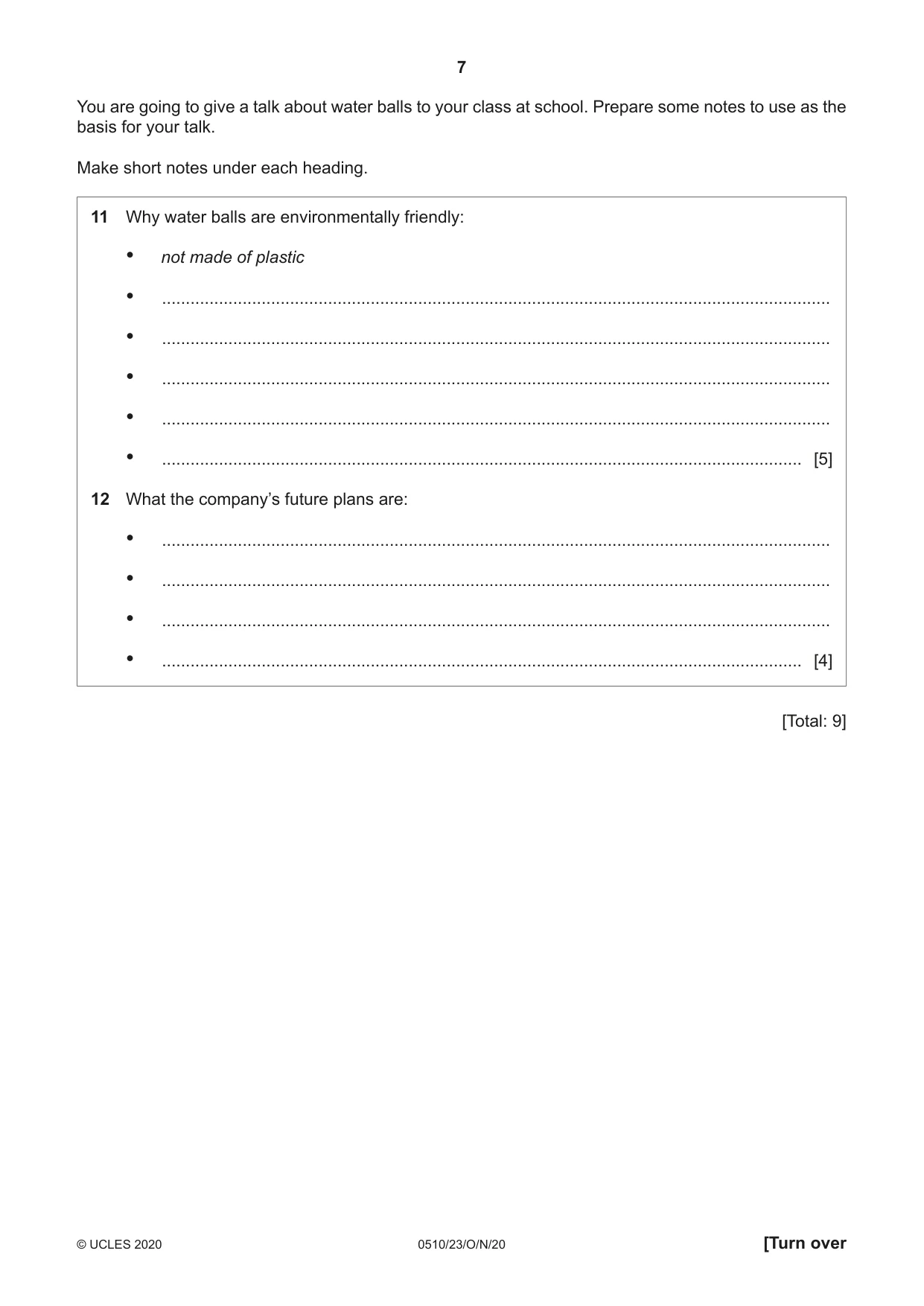
7 0510/23/O/N/20 © UCLES 2020 [Turn over You are going to give a talk about water balls to your class at school. Prepare some notes to use as the basis for your talk. Make short notes under each heading. 11 Why water balls are environmentally friendly: • not made of plastic • … • … • … • … • … [5] 12 What the company’s future plans are: • … • … • … • … [4] [Total: 9]
Question paper, page 8
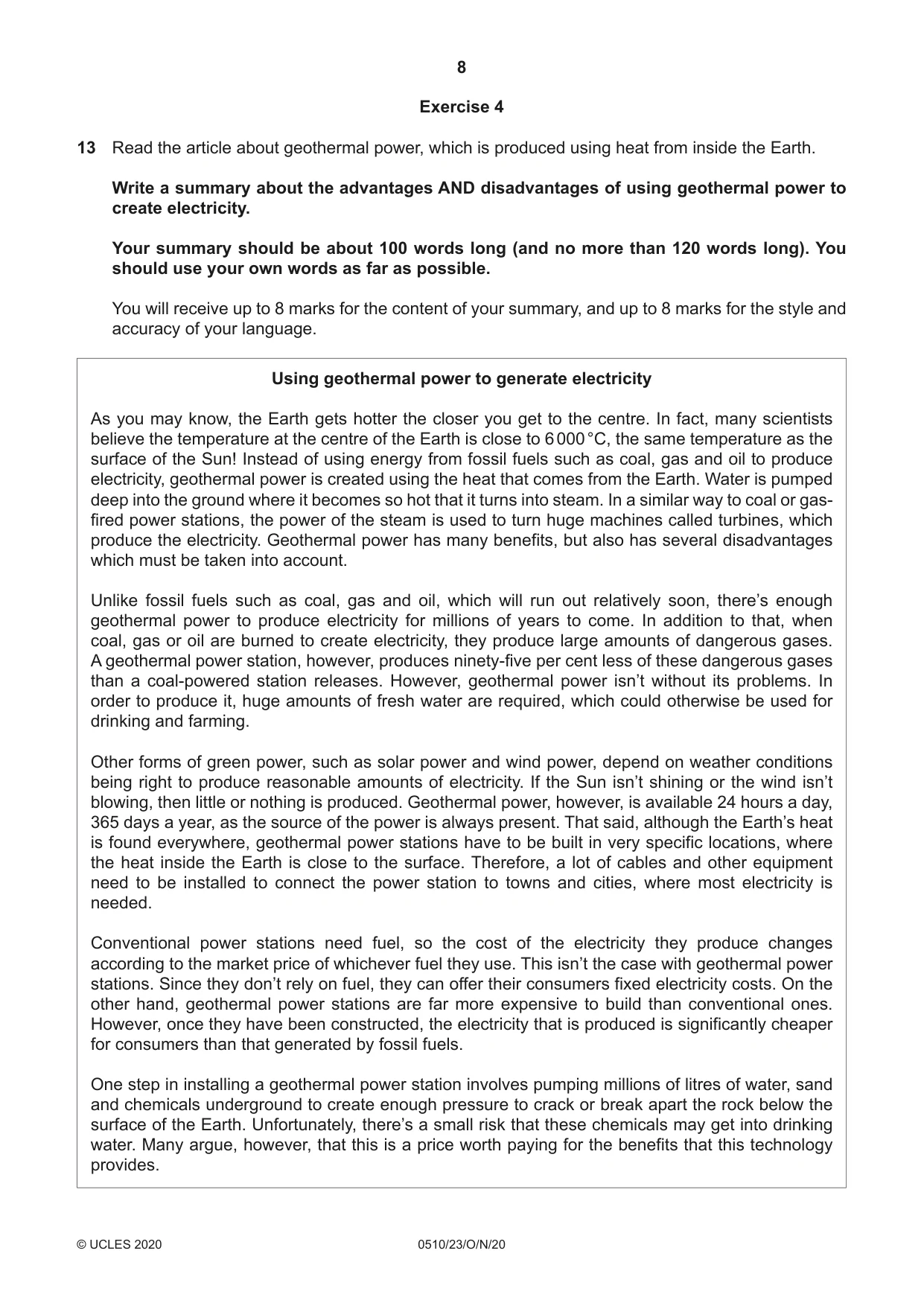
8 0510/23/O/N/20 © UCLES 2020 Exercise 4 13 Read the article about geothermal power, which is produced using heat from inside the Earth. Write a summary about the advantages AND disadvantages of using geothermal power to create electricity. Your summary should be about 100 words long (and no more than 120 words long). You should use your own words as far as possible. You will receive up to 8 marks for the content of your summary, and up to 8 marks for the style and accuracy of your language. Using geothermal power to generate electricity As you may know, the Earth gets hotter the closer you get to the centre. In fact, many scientists believe the temperature at the centre of the Earth is close to 6 000 °C, the same temperature as the surface of the Sun! Instead of using energy from fossil fuels such as coal, gas and oil to produce electricity, geothermal power is created using the heat that comes from the Earth. Water is pumped deep into the ground where it becomes so hot that it turns into steam. In a similar way to coal or gas- fired power stations, the power of the steam is used to turn huge machines called turbines, which produce the electricity. Geothermal power has many benefits, but also has several disadvantages which must be taken into account. Unlike fossil fuels such as coal, gas and oil, which will run out relatively soon, there’s enough geothermal power to produce electricity for millions of years to come. In addition to that, when coal, gas or oil are burned to create electricity, they produce large amounts of dangerous gases. A geothermal power station, however, produces ninety-five per cent less of these dangerous gases than a coal-powered station releases. However, geothermal power isn’t without its problems. In order to produce it, huge amounts of fresh water are required, which could otherwise be used for drinking and farming. Other forms of green power, such as solar power and wind power, depend on weather conditions being right to produce reasonable amounts of electricity. If the Sun isn’t shining or the wind isn’t blowing, then little or nothing is produced. Geothermal power, however, is available 24 hours a day, 365 days a year, as the source of the power is always present. That said, although the Earth’s heat is found everywhere, geothermal power stations have to be built in very specific locations, where the heat inside the Earth is close to the surface. Therefore, a lot of cables and other equipment need to be installed to connect the power station to towns and cities, where most electricity is needed. Conventional power stations need fuel, so the cost of the electricity they produce changes according to the market price of whichever fuel they use. This isn’t the case with geothermal power stations. Since they don’t rely on fuel, they can offer their consumers fixed electricity costs. On the other hand, geothermal power stations are far more expensive to build than conventional ones. However, once they have been constructed, the electricity that is produced is significantly cheaper for consumers than that generated by fossil fuels. One step in installing a geothermal power station involves pumping millions of litres of water, sand and chemicals underground to create enough pressure to crack or break apart the rock below the surface of the Earth. Unfortunately, there’s a small risk that these chemicals may get into drinking water. Many argue, however, that this is a price worth paying for the benefits that this technology provides.
Question paper, page 9
9 0510/23/O/N/20 © UCLES 2020 [Turn over … … … … … … … … … … … … … … … … … … … … … … … … … … … [Total: 16]
Question paper, page 10
10 0510/23/O/N/20 © UCLES 2020 Exercise 5 14 A relative who you hadn’t seen for a long time came to stay at your home for a week recently. Write an email to a friend telling them about your relative’s visit. In your email, you should: • explain why your relative hadn’t visited you for such a long time • describe what you all did together during your relative’s stay • say what plans you made to meet your relative again in the future. The pictures above may give you some ideas, and you can also use some ideas of your own. Your email should be between 150 and 200 words long. You will receive up to 8 marks for the content of your email, and up to 8 marks for the language used.
Question paper, page 11
11 0510/23/O/N/20 © UCLES 2020 [Turn over … … … … … … … … … … … … … … … … … … … … … … … … … … … [Total: 16]
Question paper, page 12
12 0510/23/O/N/20 © UCLES 2020 Exercise 6 15 A famous singer recently came to give a talk to the students at your school about her life and work. Your head teacher has asked you to write a report about the talk and make suggestions for a future talk. Here are two comments from other students in your class: She showed that anything is possible if you try hard enough. I thought her talk was too short. Write a report for your head teacher. The comments above may give you some ideas, and you can also use some ideas of your own. Your report should be between 150 and 200 words long. You will receive up to 8 marks for the content of your report, and up to 8 marks for the language used.
Question paper, page 13
13 0510/23/O/N/20 © UCLES 2020 … … … … … … … … … … … … … … … … … … … … … … … … … … … [Total: 16]
Question paper, page 14
14 0510/23/O/N/20 © UCLES 2020 BLANK PAGE
Question paper, page 15
15 0510/23/O/N/20 © UCLES 2020 BLANK PAGE
Question paper, page 16
16 0510/23/O/N/20 © UCLES 2020 Permission to reproduce items where third-party owned material protected by copyright is included has been sought and cleared where possible. Every reasonable effort has been made by the publisher (UCLES) to trace copyright holders, but if any items requiring clearance have unwittingly been included, the publisher will be pleased to make amends at the earliest possible opportunity. To avoid the issue of disclosure of answer-related information to candidates, all copyright acknowledgements are reproduced online in the Cambridge Assessment International Education Copyright Acknowledgements Booklet. This is produced for each series of examinations and is freely available to download at www.cambridgeinternational.org after the live examination series. Cambridge Assessment International Education is part of the Cambridge Assessment Group. Cambridge Assessment is the brand name of the University of Cambridge Local Examinations Syndicate (UCLES), which itself is a department of the University of Cambridge. BLANK PAGE
Mark scheme, page 1
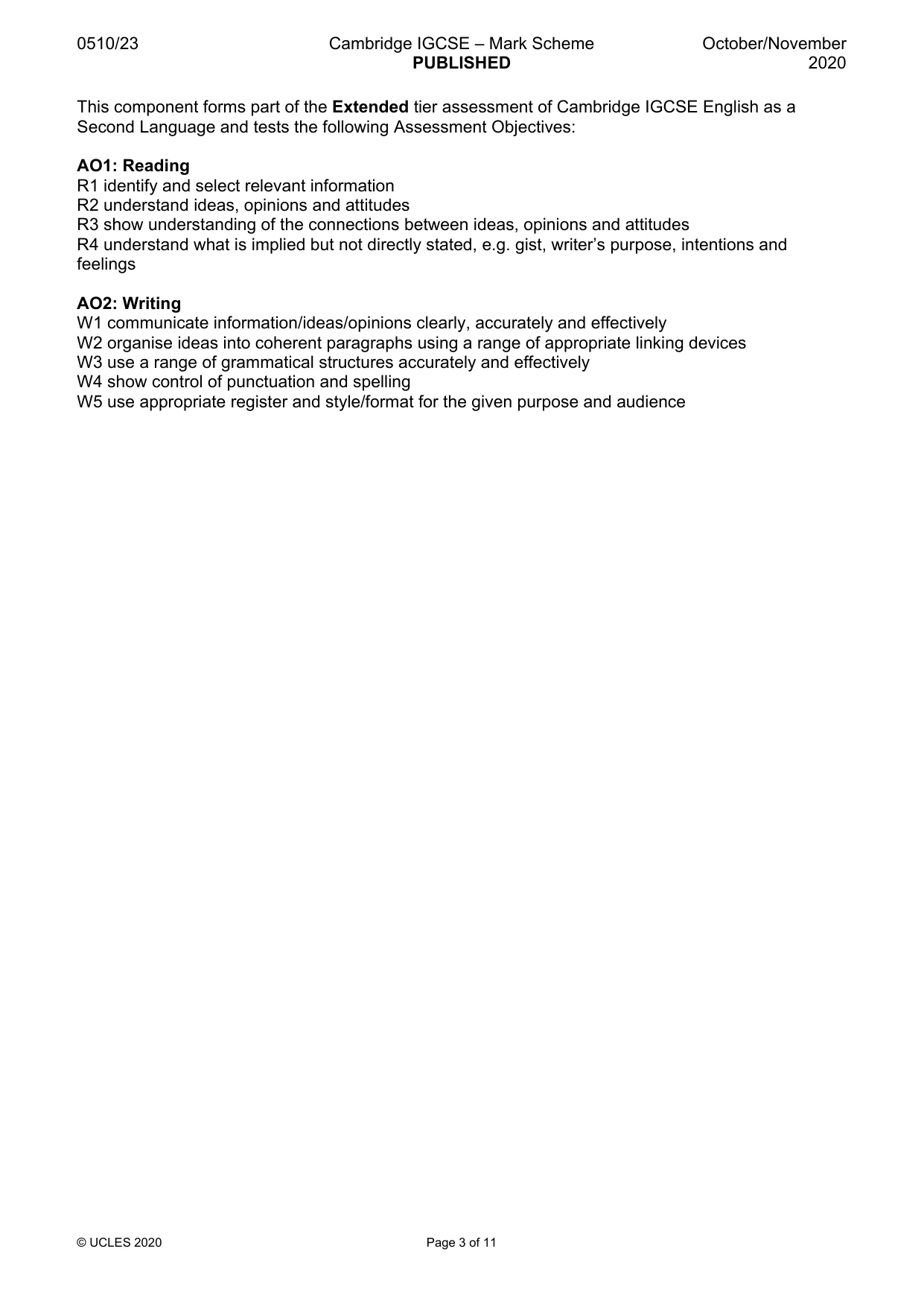
This document consists of 11 printed pages. © UCLES 2020 [Turn over Cambridge IGCSE™ ENGLISH AS A SECOND LANGUAGE 0510/23 Paper 2 Reading and Writing (Extended) October/November 2020 MARK SCHEME Maximum Mark: 80 Published This mark scheme is published as an aid to teachers and candidates, to indicate the requirements of the examination. It shows the basis on which Examiners were instructed to award marks. It does not indicate the details of the discussions that took place at an Examiners’ meeting before marking began, which would have considered the acceptability of alternative answers. Mark schemes should be read in conjunction with the question paper and the Principal Examiner Report for Teachers. Cambridge International will not enter into discussions about these mark schemes. Cambridge International is publishing the mark schemes for the October/November 2020 series for most Cambridge IGCSE, Cambridge International A and AS Level and Cambridge Pre-U components, and some Cambridge O Level components.
Mark scheme, page 2
0510/23 Cambridge IGCSE – Mark Scheme PUBLISHED October/November 2020 © UCLES 2020 Page 2 of 11 Generic Marking Principles These general marking principles must be applied by all examiners when marking candidate answers. They should be applied alongside the specific content of the mark scheme or generic level descriptors for a question. Each question paper and mark scheme will also comply with these marking principles. GENERIC MARKING PRINCIPLE 1: Marks must be awarded in line with: • the specific content of the mark scheme or the generic level descriptors for the question • the specific skills defined in the mark scheme or in the generic level descriptors for the question • the standard of response required by a candidate as exemplified by the standardisation scripts. GENERIC MARKING PRINCIPLE 2: Marks awarded are always whole marks (not half marks, or other fractions). GENERIC MARKING PRINCIPLE 3: Marks must be awarded positively: • marks are awarded for correct/valid answers, as defined in the mark scheme. However, credit is given for valid answers which go beyond the scope of the syllabus and mark scheme, referring to your Team Leader as appropriate • marks are awarded when candidates clearly demonstrate what they know and can do • marks are not deducted for errors • marks are not deducted for omissions • answers should only be judged on the quality of spelling, punctuation and grammar when these features are specifically assessed by the question as indicated by the mark scheme. The meaning, however, should be unambiguous. GENERIC MARKING PRINCIPLE 4: Rules must be applied consistently, e.g. in situations where candidates have not followed instructions or in the application of generic level descriptors. GENERIC MARKING PRINCIPLE 5: Marks should be awarded using the full range of marks defined in the mark scheme for the question (however; the use of the full mark range may be limited according to the quality of the candidate responses seen). GENERIC MARKING PRINCIPLE 6: Marks awarded are based solely on the requirements as defined in the mark scheme. Marks should not be awarded with grade thresholds or grade descriptors in mind.
Mark scheme, page 3
0510/23 Cambridge IGCSE – Mark Scheme PUBLISHED October/November 2020 © UCLES 2020 Page 3 of 11 This component forms part of the Extended tier assessment of Cambridge IGCSE English as a Second Language and tests the following Assessment Objectives: AO1: Reading R1 identify and select relevant information R2 understand ideas, opinions and attitudes R3 show understanding of the connections between ideas, opinions and attitudes R4 understand what is implied but not directly stated, e.g. gist, writer’s purpose, intentions and feelings AO2: Writing W1 communicate information/ideas/opinions clearly, accurately and effectively W2 organise ideas into coherent paragraphs using a range of appropriate linking devices W3 use a range of grammatical structures accurately and effectively W4 show control of punctuation and spelling W5 use appropriate register and style/format for the given purpose and audience
Mark scheme, page 4
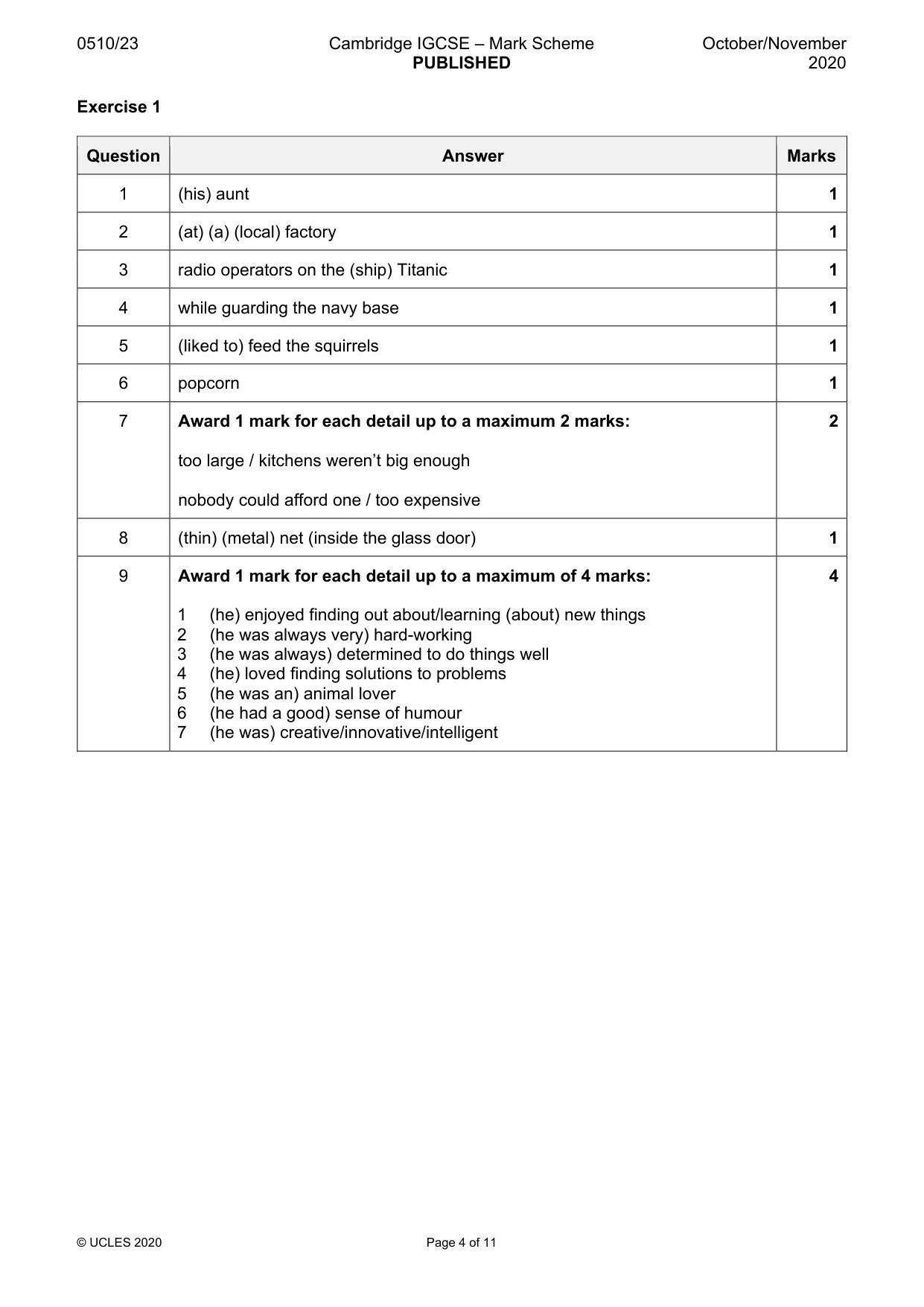
0510/23 Cambridge IGCSE – Mark Scheme PUBLISHED October/November 2020 © UCLES 2020 Page 4 of 11 Exercise 1 Question Answer Marks 1 (his) aunt 1 2 (at) (a) (local) factory 1 3 radio operators on the (ship) Titanic 1 4 while guarding the navy base 1 5 (liked to) feed the squirrels 1 6 popcorn 1 7 Award 1 mark for each detail up to a maximum 2 marks: too large / kitchens weren’t big enough nobody could afford one / too expensive 2 8 (thin) (metal) net (inside the glass door) 1 9 Award 1 mark for each detail up to a maximum of 4 marks: 1 (he) enjoyed finding out about/learning (about) new things 2 (he was always very) hard-working 3 (he was always) determined to do things well 4 (he) loved finding solutions to problems 5 (he was an) animal lover 6 (he had a good) sense of humour 7 (he was) creative/innovative/intelligent 4
Mark scheme, page 5
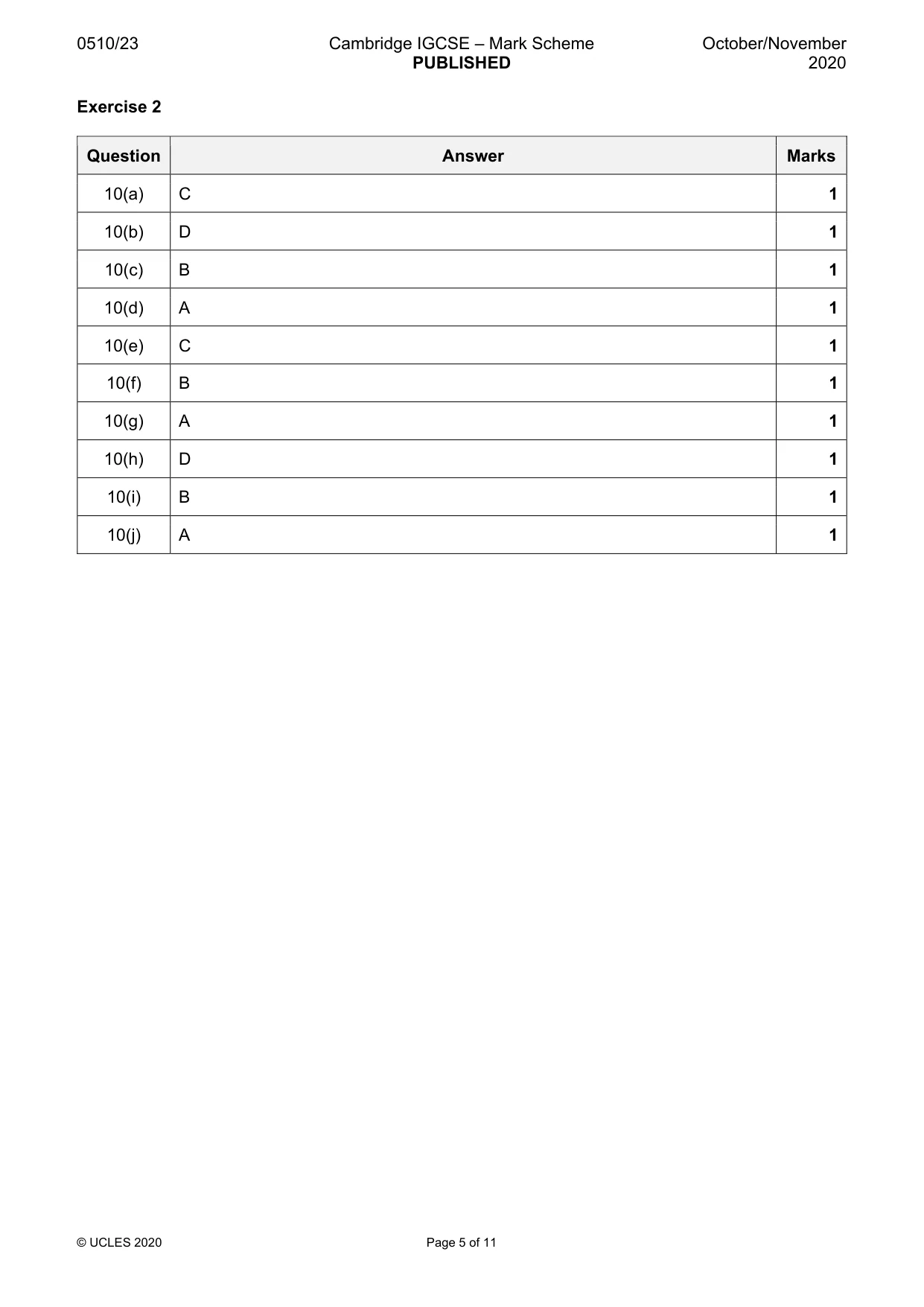
0510/23 Cambridge IGCSE – Mark Scheme PUBLISHED October/November 2020 © UCLES 2020 Page 5 of 11 Exercise 2 Question Answer Marks 10(a) C 1 10(b) D 1 10(c) B 1 10(d) A 1 10(e) C 1 10(f) B 1 10(g) A 1 10(h) D 1 10(i) B 1 10(j) A 1
Mark scheme, page 6
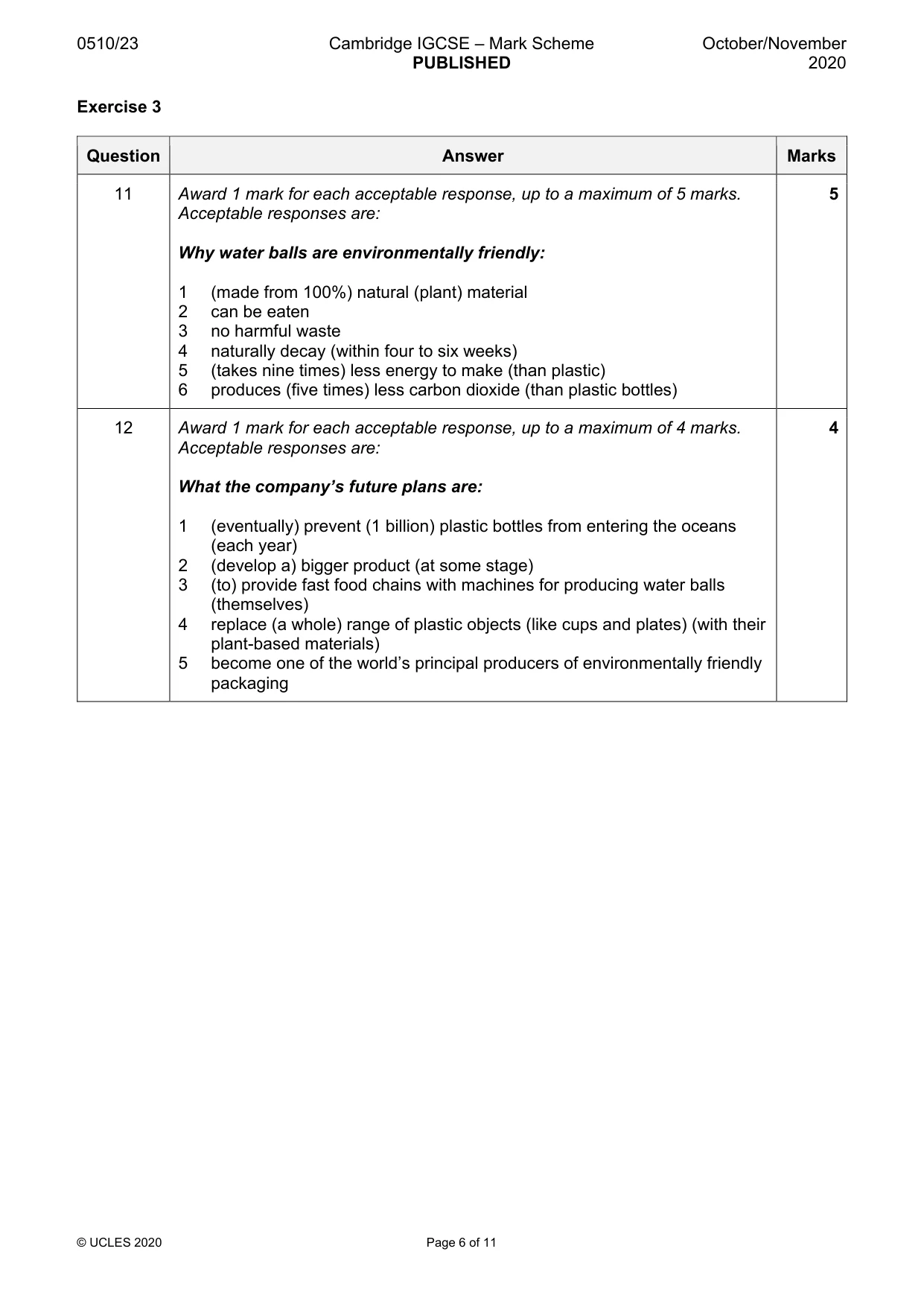
0510/23 Cambridge IGCSE – Mark Scheme PUBLISHED October/November 2020 © UCLES 2020 Page 6 of 11 Exercise 3 Question Answer Marks 11 Award 1 mark for each acceptable response, up to a maximum of 5 marks. Acceptable responses are: Why water balls are environmentally friendly: 1 (made from 100%) natural (plant) material 2 can be eaten 3 no harmful waste 4 naturally decay (within four to six weeks) 5 (takes nine times) less energy to make (than plastic) 6 produces (five times) less carbon dioxide (than plastic bottles) 5 12 Award 1 mark for each acceptable response, up to a maximum of 4 marks. Acceptable responses are: What the company’s future plans are: 1 (eventually) prevent (1 billion) plastic bottles from entering the oceans (each year) 2 (develop a) bigger product (at some stage) 3 (to) provide fast food chains with machines for producing water balls (themselves) 4 replace (a whole) range of plastic objects (like cups and plates) (with their plant-based materials) 5 become one of the world’s principal producers of environmentally friendly packaging 4
Mark scheme, page 7
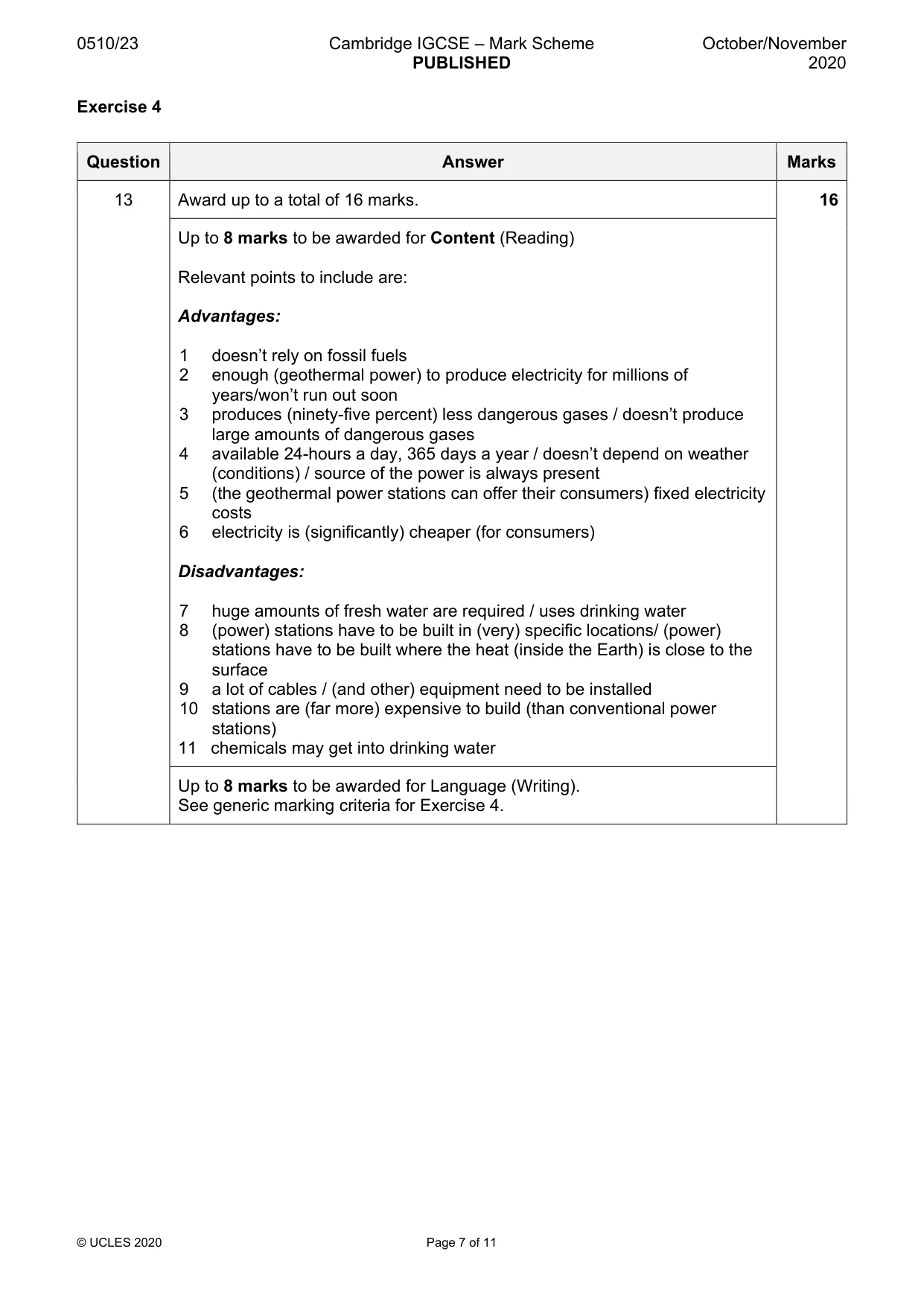
0510/23 Cambridge IGCSE – Mark Scheme PUBLISHED October/November 2020 © UCLES 2020 Page 7 of 11 Exercise 4 Question Answer Marks 13 Award up to a total of 16 marks. 16 Up to 8 marks to be awarded for Content (Reading) Relevant points to include are: Advantages: 1 doesn’t rely on fossil fuels 2 enough (geothermal power) to produce electricity for millions of years/won’t run out soon 3 produces (ninety-five percent) less dangerous gases / doesn’t produce large amounts of dangerous gases 4 available 24-hours a day, 365 days a year / doesn’t depend on weather (conditions) / source of the power is always present 5 (the geothermal power stations can offer their consumers) fixed electricity costs 6 electricity is (significantly) cheaper (for consumers) Disadvantages: 7 huge amounts of fresh water are required / uses drinking water 8 (power) stations have to be built in (very) specific locations/ (power) stations have to be built where the heat (inside the Earth) is close to the surface 9 a lot of cables / (and other) equipment need to be installed 10 stations are (far more) expensive to build (than conventional power stations) 11 chemicals may get into drinking water Up to 8 marks to be awarded for Language (Writing). See generic marking criteria for Exercise 4.
Mark scheme, page 8
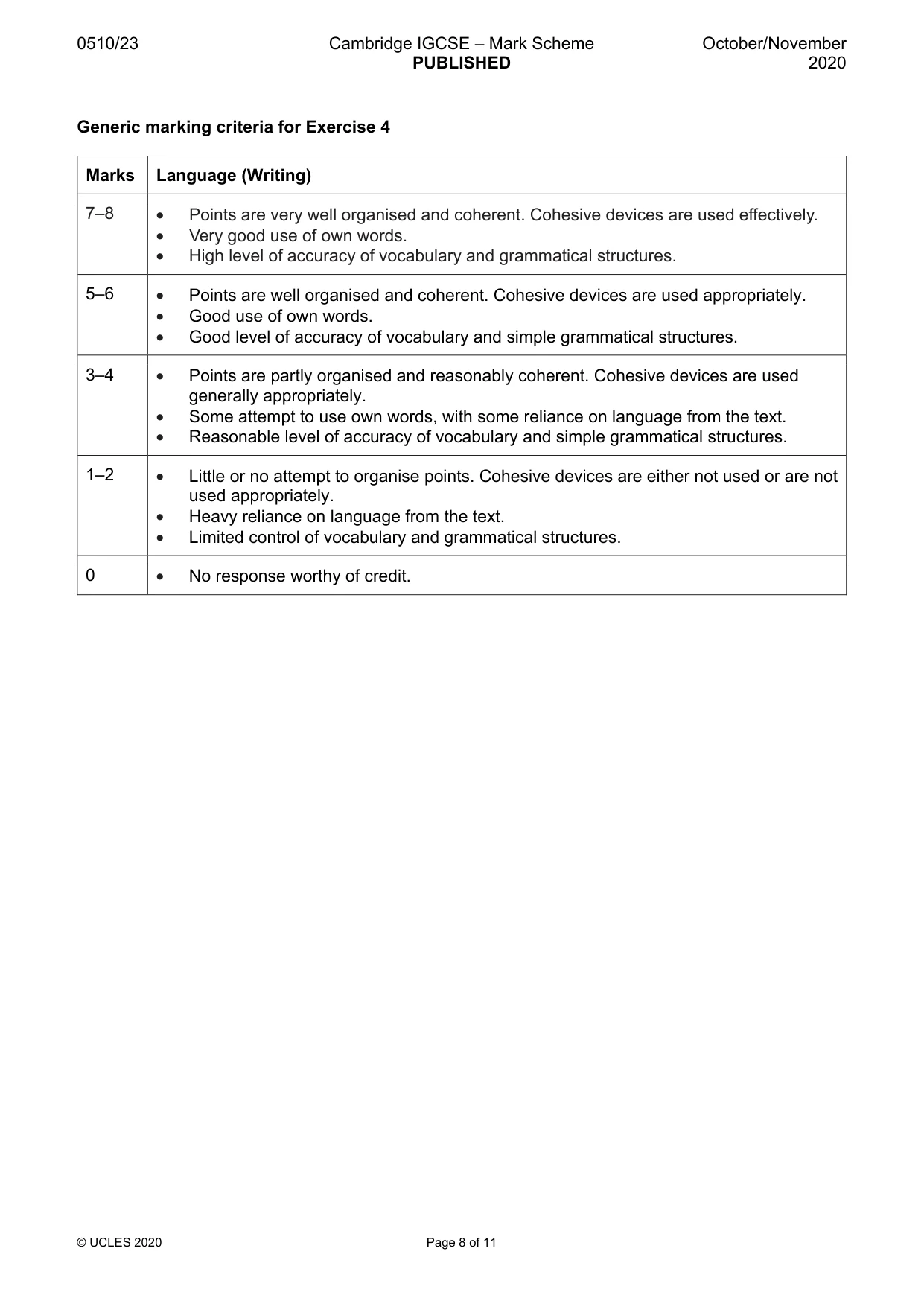
0510/23 Cambridge IGCSE – Mark Scheme PUBLISHED October/November 2020 © UCLES 2020 Page 8 of 11 Generic marking criteria for Exercise 4 Marks Language (Writing) 7–8 • Points are very well organised and coherent. Cohesive devices are used effectively. • Very good use of own words. • High level of accuracy of vocabulary and grammatical structures. 5–6 • Points are well organised and coherent. Cohesive devices are used appropriately. • Good use of own words. • Good level of accuracy of vocabulary and simple grammatical structures. 3–4 • Points are partly organised and reasonably coherent. Cohesive devices are used generally appropriately. • Some attempt to use own words, with some reliance on language from the text. • Reasonable level of accuracy of vocabulary and simple grammatical structures. 1–2 • Little or no attempt to organise points. Cohesive devices are either not used or are not used appropriately. • Heavy reliance on language from the text. • Limited control of vocabulary and grammatical structures. 0 • No response worthy of credit.
Mark scheme, page 9
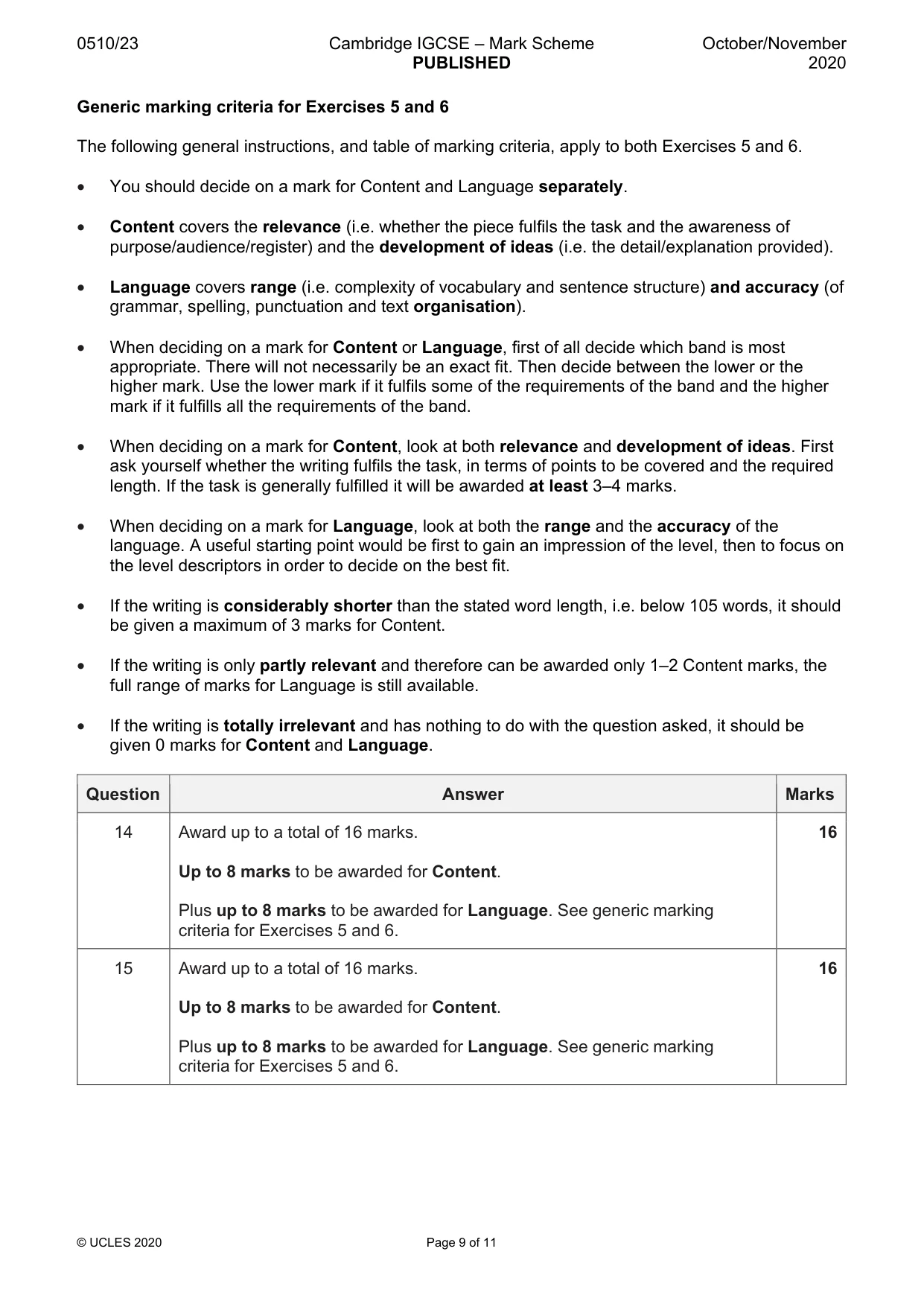
0510/23 Cambridge IGCSE – Mark Scheme PUBLISHED October/November 2020 © UCLES 2020 Page 9 of 11 Generic marking criteria for Exercises 5 and 6 The following general instructions, and table of marking criteria, apply to both Exercises 5 and 6. • You should decide on a mark for Content and Language separately. • Content covers the relevance (i.e. whether the piece fulfils the task and the awareness of purpose/audience/register) and the development of ideas (i.e. the detail/explanation provided). • Language covers range (i.e. complexity of vocabulary and sentence structure) and accuracy (of grammar, spelling, punctuation and text organisation). • When deciding on a mark for Content or Language, first of all decide which band is most appropriate. There will not necessarily be an exact fit. Then decide between the lower or the higher mark. Use the lower mark if it fulfils some of the requirements of the band and the higher mark if it fulfills all the requirements of the band. • When deciding on a mark for Content, look at both relevance and development of ideas. First ask yourself whether the writing fulfils the task, in terms of points to be covered and the required length. If the task is generally fulfilled it will be awarded at least 3–4 marks. • When deciding on a mark for Language, look at both the range and the accuracy of the language. A useful starting point would be first to gain an impression of the level, then to focus on the level descriptors in order to decide on the best fit. • If the writing is considerably shorter than the stated word length, i.e. below 105 words, it should be given a maximum of 3 marks for Content. • If the writing is only partly relevant and therefore can be awarded only 1–2 Content marks, the full range of marks for Language is still available. • If the writing is totally irrelevant and has nothing to do with the question asked, it should be given 0 marks for Content and Language. Question Answer Marks 14 Award up to a total of 16 marks. Up to 8 marks to be awarded for Content. Plus up to 8 marks to be awarded for Language. See generic marking criteria for Exercises 5 and 6. 16 15 Award up to a total of 16 marks. Up to 8 marks to be awarded for Content. Plus up to 8 marks to be awarded for Language. See generic marking criteria for Exercises 5 and 6. 16
Mark scheme, page 10
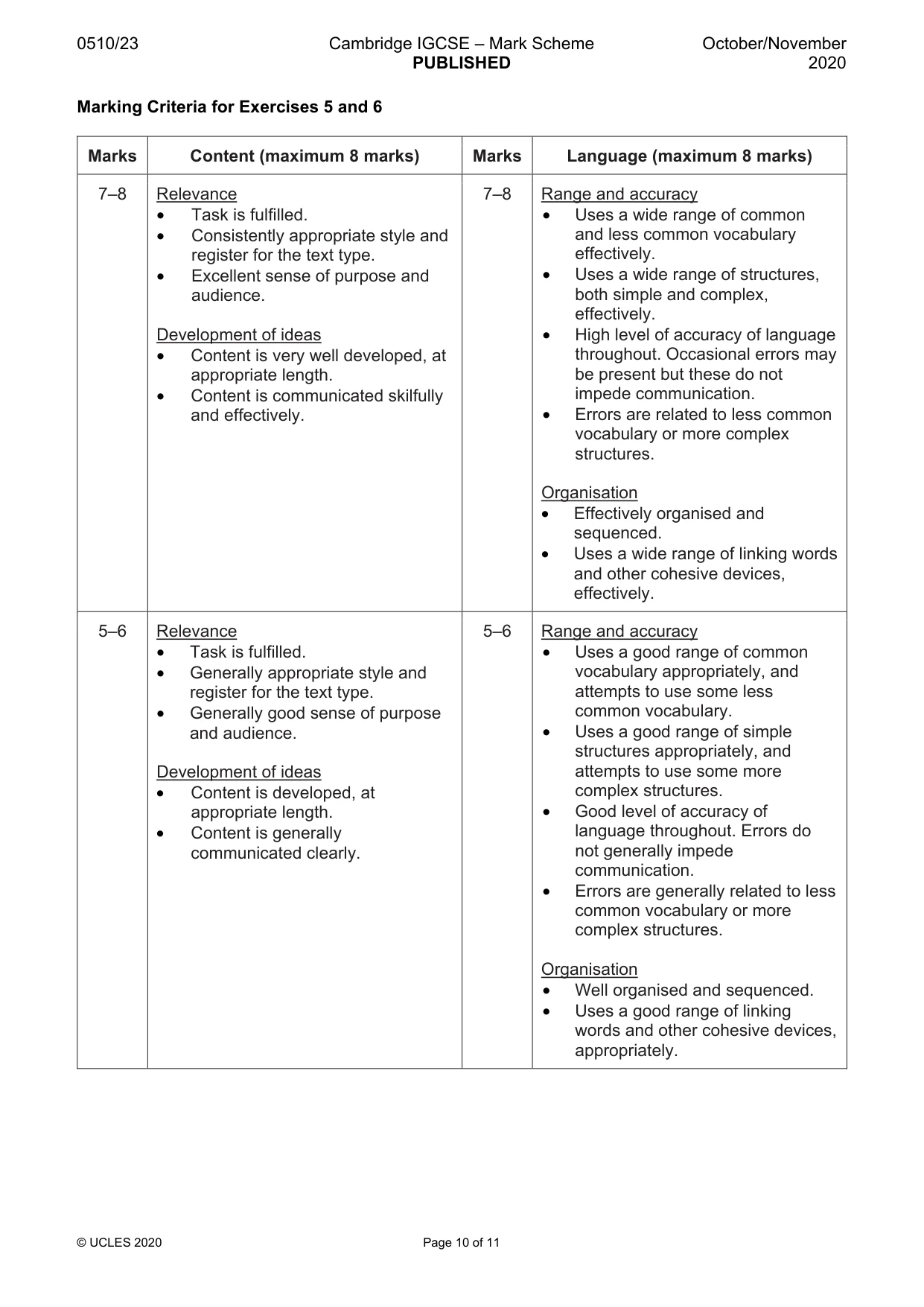
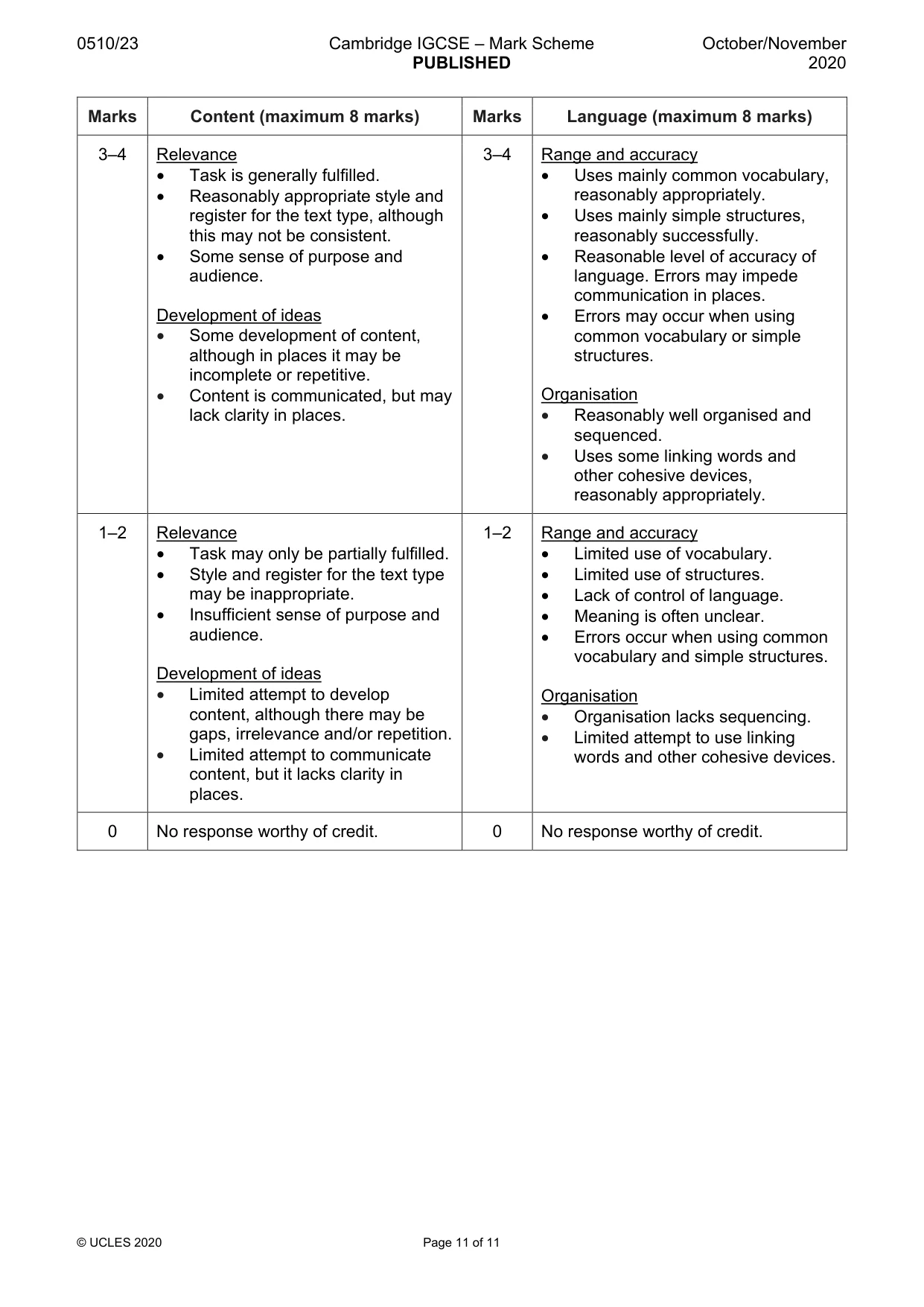
0510/23 Cambridge IGCSE – Mark Scheme PUBLISHED October/November 2020 © UCLES 2020 Page 10 of 11 Marking Criteria for Exercises 5 and 6 Marks Content (maximum 8 marks) Marks Language (maximum 8 marks) 7–8 Relevance • Task is fulfilled. • Consistently appropriate style and register for the text type. • Excellent sense of purpose and audience. Development of ideas • Content is very well developed, at appropriate length. • Content is communicated skilfully and effectively. 7–8 Range and accuracy • Uses a wide range of common and less common vocabulary effectively. • Uses a wide range of structures, both simple and complex, effectively. • High level of accuracy of language throughout. Occasional errors may be present but these do not impede communication. • Errors are related to less common vocabulary or more complex structures. Organisation • Effectively organised and sequenced. • Uses a wide range of linking words and other cohesive devices, effectively. 5–6 Relevance • Task is fulfilled. • Generally appropriate style and register for the text type. • Generally good sense of purpose and audience. Development of ideas • Content is developed, at appropriate length. • Content is generally communicated clearly. 5–6 Range and accuracy • Uses a good range of common vocabulary appropriately, and attempts to use some less common vocabulary. • Uses a good range of simple structures appropriately, and attempts to use some more complex structures. • Good level of accuracy of language throughout. Errors do not generally impede communication. • Errors are generally related to less common vocabulary or more complex structures. Organisation • Well organised and sequenced. • Uses a good range of linking words and other cohesive devices, appropriately.
Mark scheme, page 11
0510/23 Cambridge IGCSE – Mark Scheme PUBLISHED October/November 2020 © UCLES 2020 Page 11 of 11 Marks Content (maximum 8 marks) Marks Language (maximum 8 marks) 3–4 Relevance • Task is generally fulfilled. • Reasonably appropriate style and register for the text type, although this may not be consistent. • Some sense of purpose and audience. Development of ideas • Some development of content, although in places it may be incomplete or repetitive. • Content is communicated, but may lack clarity in places. 3–4 Range and accuracy • Uses mainly common vocabulary, reasonably appropriately. • Uses mainly simple structures, reasonably successfully. • Reasonable level of accuracy of language. Errors may impede communication in places. • Errors may occur when using common vocabulary or simple structures. Organisation • Reasonably well organised and sequenced. • Uses some linking words and other cohesive devices, reasonably appropriately. 1–2 Relevance • Task may only be partially fulfilled. • Style and register for the text type may be inappropriate. • Insufficient sense of purpose and audience. Development of ideas • Limited attempt to develop content, although there may be gaps, irrelevance and/or repetition. • Limited attempt to communicate content, but it lacks clarity in places. 1–2 Range and accuracy • Limited use of vocabulary. • Limited use of structures. • Lack of control of language. • Meaning is often unclear. • Errors occur when using common vocabulary and simple structures. Organisation • Organisation lacks sequencing. • Limited attempt to use linking words and other cohesive devices. 0 No response worthy of credit. 0 No response worthy of credit.
What you needed in this session
Cambridge’s own grade thresholds for 2020 Oct/Nov, Paper 2 · Variant 3. A higher threshold means an easier paper — the bar moves with how the cohort did.