Cambridge IGCSE English - Second Language (oral endorsement) 0510 — 2020 Oct/Nov Paper 2 · Variant 2
0510/22/O/N/20 · 80 marks · ≈90 min
The question paper and its mark scheme, free to read here and free to download. This is Cambridge’s own paper, exactly as it was sat.
Question paper16 pages




Mark scheme10 pages
Answers below. Sit the paper first if you are practising.
Paper as text
Question paper, page 1
Cambridge IGCSE™ This document has 16 pages. Blank pages are indicated. DC (JC/JG) 186462/2 © UCLES 2020 [Turn over * 7 9 8 3 9 2 6 0 7 3 * ENGLISH AS A SECOND LANGUAGE 0510/22 Paper 2 Reading and Writing (Extended) October/November 2020 2 hours You must answer on the question paper. No additional materials are needed. INSTRUCTIONS ● Answer all questions. ● Use a black or dark blue pen. ● Write your name, centre number and candidate number in the boxes at the top of the page. ● Write your answer to each question in the space provided. ● Do not use an erasable pen or correction fluid. ● Do not write on any bar codes. ● Dictionaries are not allowed. INFORMATION ● The total mark for this paper is 80. ● The number of marks for each question or part question is shown in brackets [ ].
Question paper, page 2
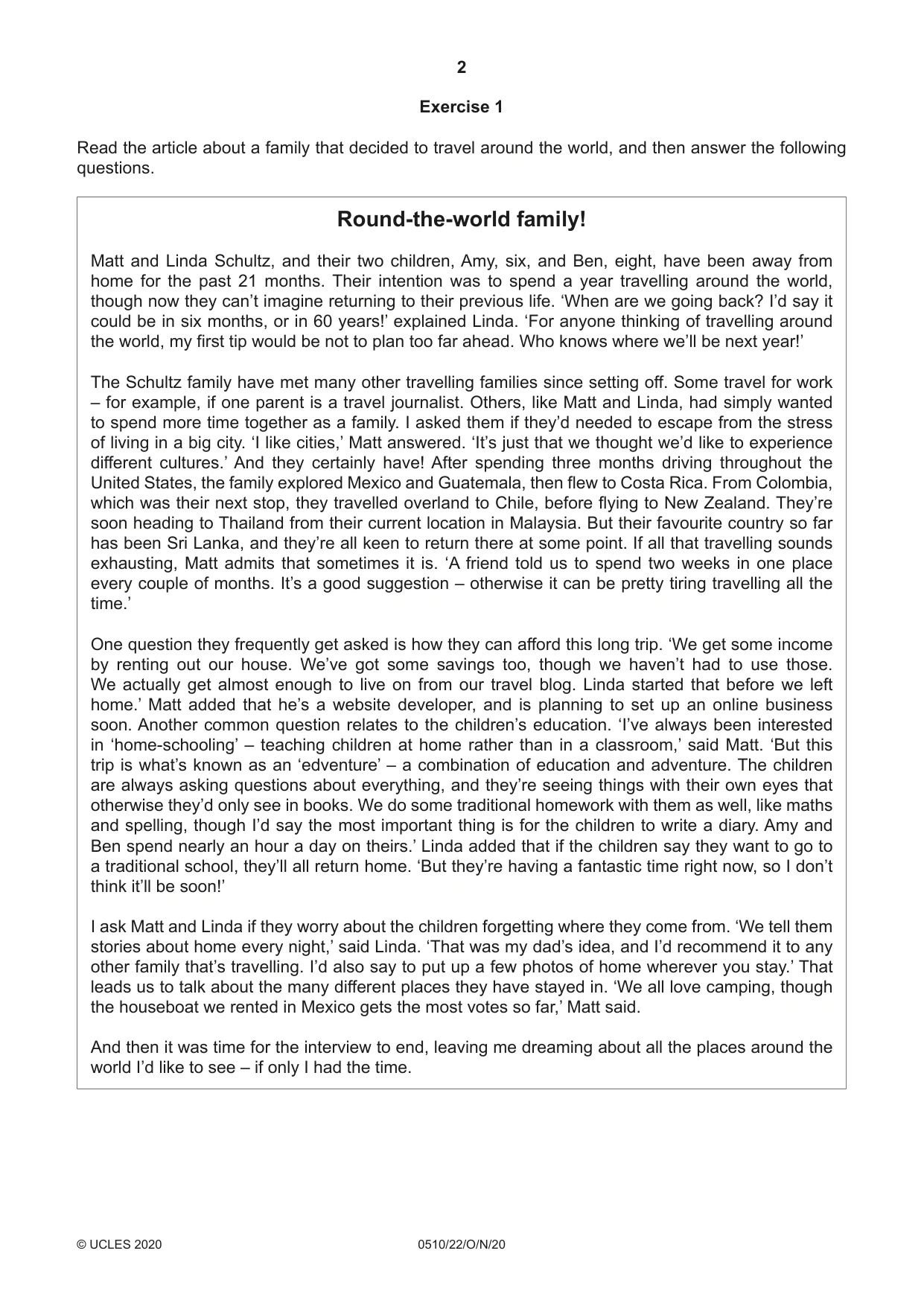
2 0510/22/O/N/20 © UCLES 2020 Exercise 1 Read the article about a family that decided to travel around the world, and then answer the following questions. Round-the-world family! Matt and Linda Schultz, and their two children, Amy, six, and Ben, eight, have been away from home for the past 21 months. Their intention was to spend a year travelling around the world, though now they can’t imagine returning to their previous life. ‘When are we going back? I’d say it could be in six months, or in 60 years!’ explained Linda. ‘For anyone thinking of travelling around the world, my first tip would be not to plan too far ahead. Who knows where we’ll be next year!’ The Schultz family have met many other travelling families since setting off. Some travel for work – for example, if one parent is a travel journalist. Others, like Matt and Linda, had simply wanted to spend more time together as a family. I asked them if they’d needed to escape from the stress of living in a big city. ‘I like cities,’ Matt answered. ‘It’s just that we thought we’d like to experience different cultures.’ And they certainly have! After spending three months driving throughout the United States, the family explored Mexico and Guatemala, then flew to Costa Rica. From Colombia, which was their next stop, they travelled overland to Chile, before flying to New Zealand. They’re soon heading to Thailand from their current location in Malaysia. But their favourite country so far has been Sri Lanka, and they’re all keen to return there at some point. If all that travelling sounds exhausting, Matt admits that sometimes it is. ‘A friend told us to spend two weeks in one place every couple of months. It’s a good suggestion – otherwise it can be pretty tiring travelling all the time.’ One question they frequently get asked is how they can afford this long trip. ‘We get some income by renting out our house. We’ve got some savings too, though we haven’t had to use those. We actually get almost enough to live on from our travel blog. Linda started that before we left home.’ Matt added that he’s a website developer, and is planning to set up an online business soon. Another common question relates to the children’s education. ‘I’ve always been interested in ‘home-schooling’ – teaching children at home rather than in a classroom,’ said Matt. ‘But this trip is what’s known as an ‘edventure’ – a combination of education and adventure. The children are always asking questions about everything, and they’re seeing things with their own eyes that otherwise they’d only see in books. We do some traditional homework with them as well, like maths and spelling, though I’d say the most important thing is for the children to write a diary. Amy and Ben spend nearly an hour a day on theirs.’ Linda added that if the children say they want to go to a traditional school, they’ll all return home. ‘But they’re having a fantastic time right now, so I don’t think it’ll be soon!’ I ask Matt and Linda if they worry about the children forgetting where they come from. ‘We tell them stories about home every night,’ said Linda. ‘That was my dad’s idea, and I’d recommend it to any other family that’s travelling. I’d also say to put up a few photos of home wherever you stay.’ That leads us to talk about the many different places they have stayed in. ‘We all love camping, though the houseboat we rented in Mexico gets the most votes so far,’ Matt said. And then it was time for the interview to end, leaving me dreaming about all the places around the world I’d like to see – if only I had the time.
Question paper, page 3
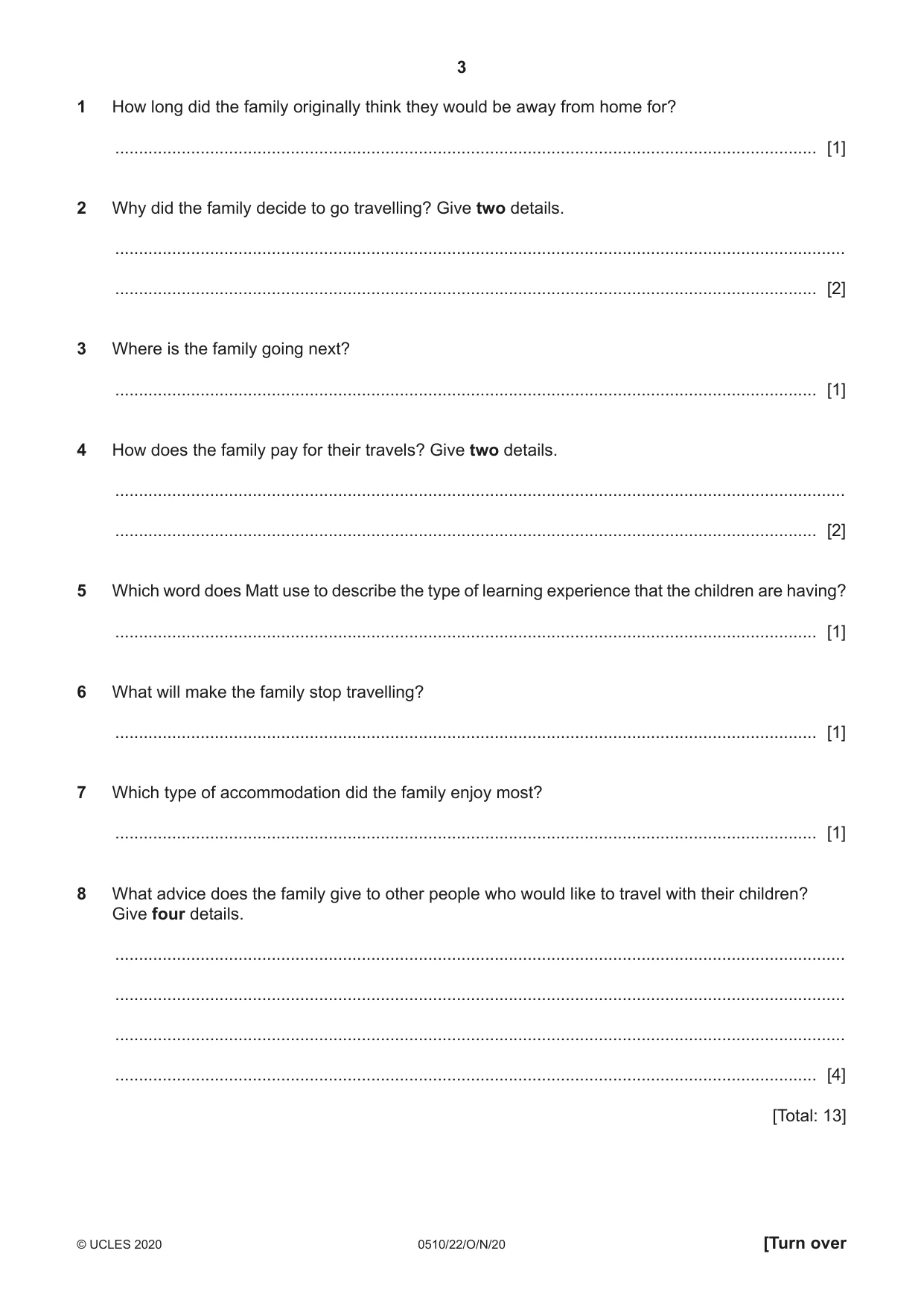
3 0510/22/O/N/20 © UCLES 2020 [Turn over 1 How long did the family originally think they would be away from home for? … [1] 2 Why did the family decide to go travelling? Give two details. … … [2] 3 Where is the family going next? … [1] 4 How does the family pay for their travels? Give two details. … … [2] 5 Which word does Matt use to describe the type of learning experience that the children are having? … [1] 6 What will make the family stop travelling? … [1] 7 Which type of accommodation did the family enjoy most? … [1] 8 What advice does the family give to other people who would like to travel with their children? Give four details. … … … … [4] [Total: 13]
Question paper, page 4
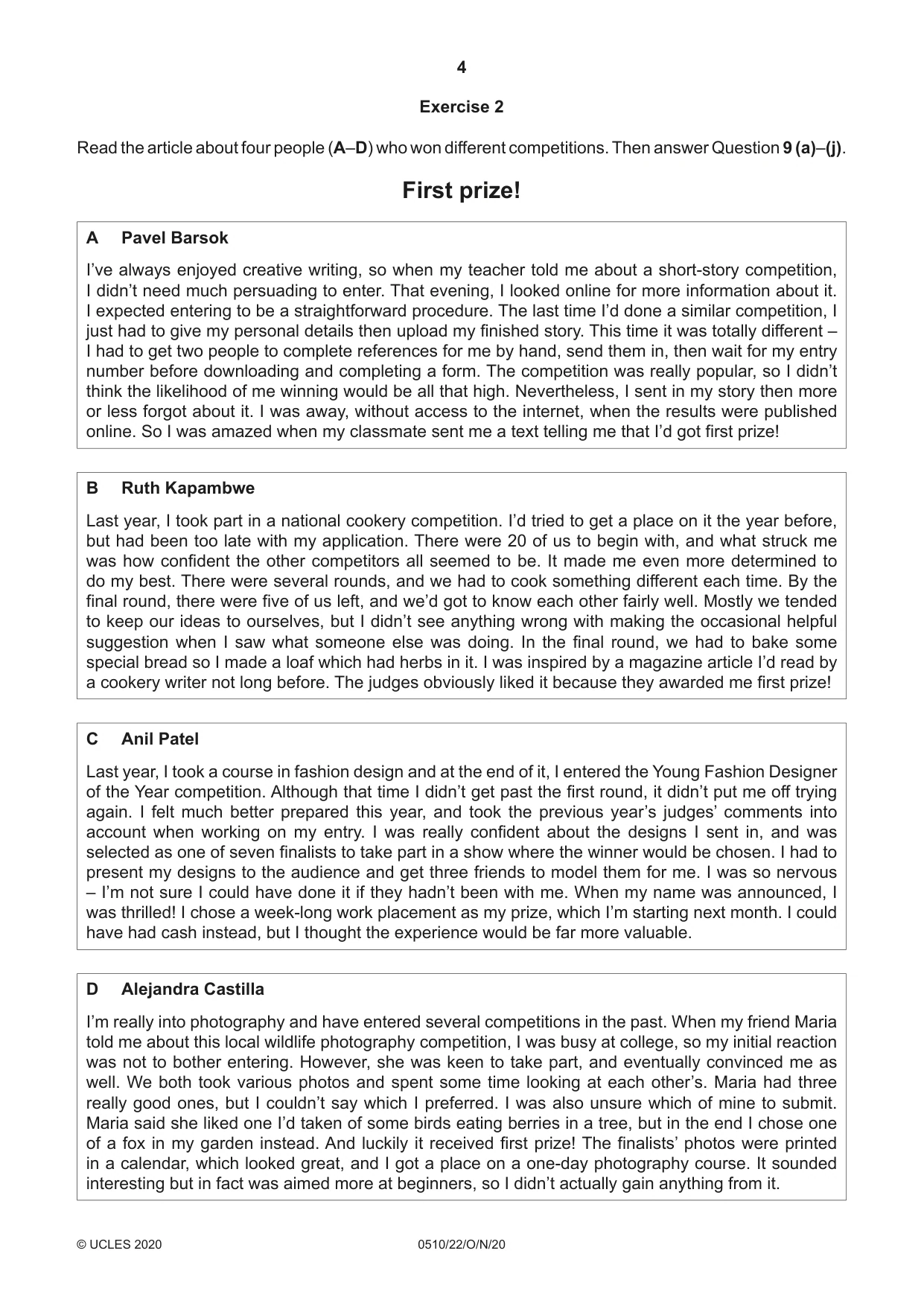
4 0510/22/O/N/20 © UCLES 2020 Exercise 2 Read the article about four people (A–D) who won different competitions. Then answer Question 9 (a)–(j). First prize! A Pavel Barsok I’ve always enjoyed creative writing, so when my teacher told me about a short-story competition, I didn’t need much persuading to enter. That evening, I looked online for more information about it. I expected entering to be a straightforward procedure. The last time I’d done a similar competition, I just had to give my personal details then upload my finished story. This time it was totally different – I had to get two people to complete references for me by hand, send them in, then wait for my entry number before downloading and completing a form. The competition was really popular, so I didn’t think the likelihood of me winning would be all that high. Nevertheless, I sent in my story then more or less forgot about it. I was away, without access to the internet, when the results were published online. So I was amazed when my classmate sent me a text telling me that I’d got first prize! B Ruth Kapambwe Last year, I took part in a national cookery competition. I’d tried to get a place on it the year before, but had been too late with my application. There were 20 of us to begin with, and what struck me was how confident the other competitors all seemed to be. It made me even more determined to do my best. There were several rounds, and we had to cook something different each time. By the final round, there were five of us left, and we’d got to know each other fairly well. Mostly we tended to keep our ideas to ourselves, but I didn’t see anything wrong with making the occasional helpful suggestion when I saw what someone else was doing. In the final round, we had to bake some special bread so I made a loaf which had herbs in it. I was inspired by a magazine article I’d read by a cookery writer not long before. The judges obviously liked it because they awarded me first prize! C Anil Patel Last year, I took a course in fashion design and at the end of it, I entered the Young Fashion Designer of the Year competition. Although that time I didn’t get past the first round, it didn’t put me off trying again. I felt much better prepared this year, and took the previous year’s judges’ comments into account when working on my entry. I was really confident about the designs I sent in, and was selected as one of seven finalists to take part in a show where the winner would be chosen. I had to present my designs to the audience and get three friends to model them for me. I was so nervous – I’m not sure I could have done it if they hadn’t been with me. When my name was announced, I was thrilled! I chose a week-long work placement as my prize, which I’m starting next month. I could have had cash instead, but I thought the experience would be far more valuable. D Alejandra Castilla I’m really into photography and have entered several competitions in the past. When my friend Maria told me about this local wildlife photography competition, I was busy at college, so my initial reaction was not to bother entering. However, she was keen to take part, and eventually convinced me as well. We both took various photos and spent some time looking at each other’s. Maria had three really good ones, but I couldn’t say which I preferred. I was also unsure which of mine to submit. Maria said she liked one I’d taken of some birds eating berries in a tree, but in the end I chose one of a fox in my garden instead. And luckily it received first prize! The finalists’ photos were printed in a calendar, which looked great, and I got a place on a one-day photography course. It sounded interesting but in fact was aimed more at beginners, so I didn’t actually gain anything from it.
Question paper, page 5
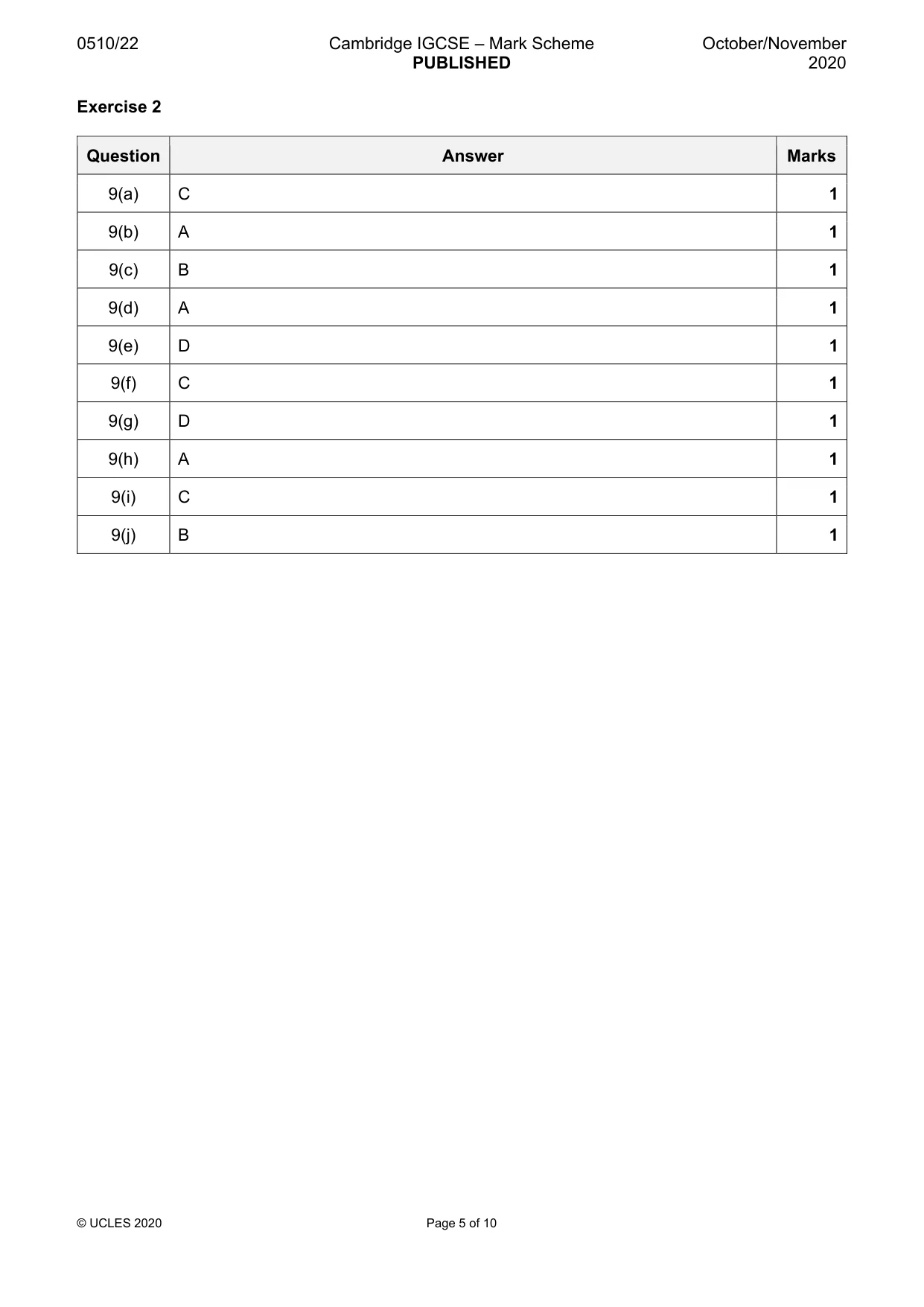
5 0510/22/O/N/20 © UCLES 2020 [Turn over 9 For each question, write the correct letter A, B, C or D on the line. Which person … (a) had taken part in the same competition before? ……… [1] (b) heard that they had won from a friend? ……… [1] (c) got their winning idea from another person? ……… [1] (d) lacked confidence in their chance of winning? ……… [1] (e) was unimpressed with the prize they received? ……… [1] (f) needed to make a decision about their prize? ……… [1] (g) had to be persuaded to enter the competition? ……… [1] (h) was surprised how complicated the application process was? ……… [1] (i) suggested that they couldn’t have won without support from others? ……… [1] (j) gave some advice to another competitor? ……… [1] [Total: 10]
Question paper, page 6
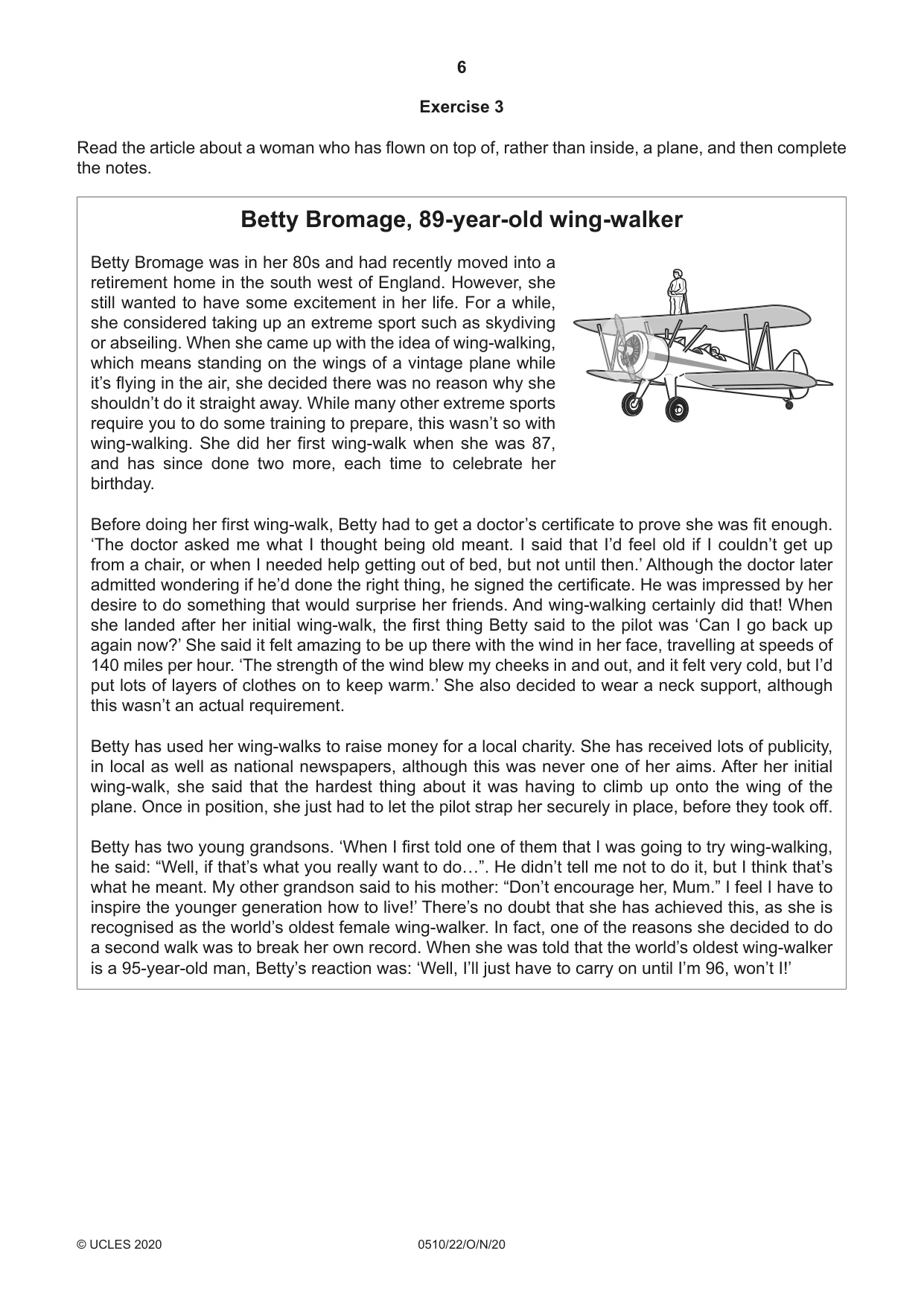
6 0510/22/O/N/20 © UCLES 2020 Exercise 3 Read the article about a woman who has flown on top of, rather than inside, a plane, and then complete the notes. Betty Bromage, 89-year-old wing-walker Betty Bromage was in her 80s and had recently moved into a retirement home in the south west of England. However, she still wanted to have some excitement in her life. For a while, she considered taking up an extreme sport such as skydiving or abseiling. When she came up with the idea of wing-walking, which means standing on the wings of a vintage plane while it’s flying in the air, she decided there was no reason why she shouldn’t do it straight away. While many other extreme sports require you to do some training to prepare, this wasn’t so with wing-walking. She did her first wing-walk when she was 87, and has since done two more, each time to celebrate her birthday. Before doing her first wing-walk, Betty had to get a doctor’s certificate to prove she was fit enough. ‘The doctor asked me what I thought being old meant. I said that I’d feel old if I couldn’t get up from a chair, or when I needed help getting out of bed, but not until then.’ Although the doctor later admitted wondering if he’d done the right thing, he signed the certificate. He was impressed by her desire to do something that would surprise her friends. And wing-walking certainly did that! When she landed after her initial wing-walk, the first thing Betty said to the pilot was ‘Can I go back up again now?’ She said it felt amazing to be up there with the wind in her face, travelling at speeds of 140 miles per hour. ‘The strength of the wind blew my cheeks in and out, and it felt very cold, but I’d put lots of layers of clothes on to keep warm.’ She also decided to wear a neck support, although this wasn’t an actual requirement. Betty has used her wing-walks to raise money for a local charity. She has received lots of publicity, in local as well as national newspapers, although this was never one of her aims. After her initial wing-walk, she said that the hardest thing about it was having to climb up onto the wing of the plane. Once in position, she just had to let the pilot strap her securely in place, before they took off. Betty has two young grandsons. ‘When I first told one of them that I was going to try wing-walking, he said: “Well, if that’s what you really want to do…”. He didn’t tell me not to do it, but I think that’s what he meant. My other grandson said to his mother: “Don’t encourage her, Mum.” I feel I have to inspire the younger generation how to live!’ There’s no doubt that she has achieved this, as she is recognised as the world’s oldest female wing-walker. In fact, one of the reasons she decided to do a second walk was to break her own record. When she was told that the world’s oldest wing-walker is a 95-year-old man, Betty’s reaction was: ‘Well, I’ll just have to carry on until I’m 96, won’t I!’
Question paper, page 7
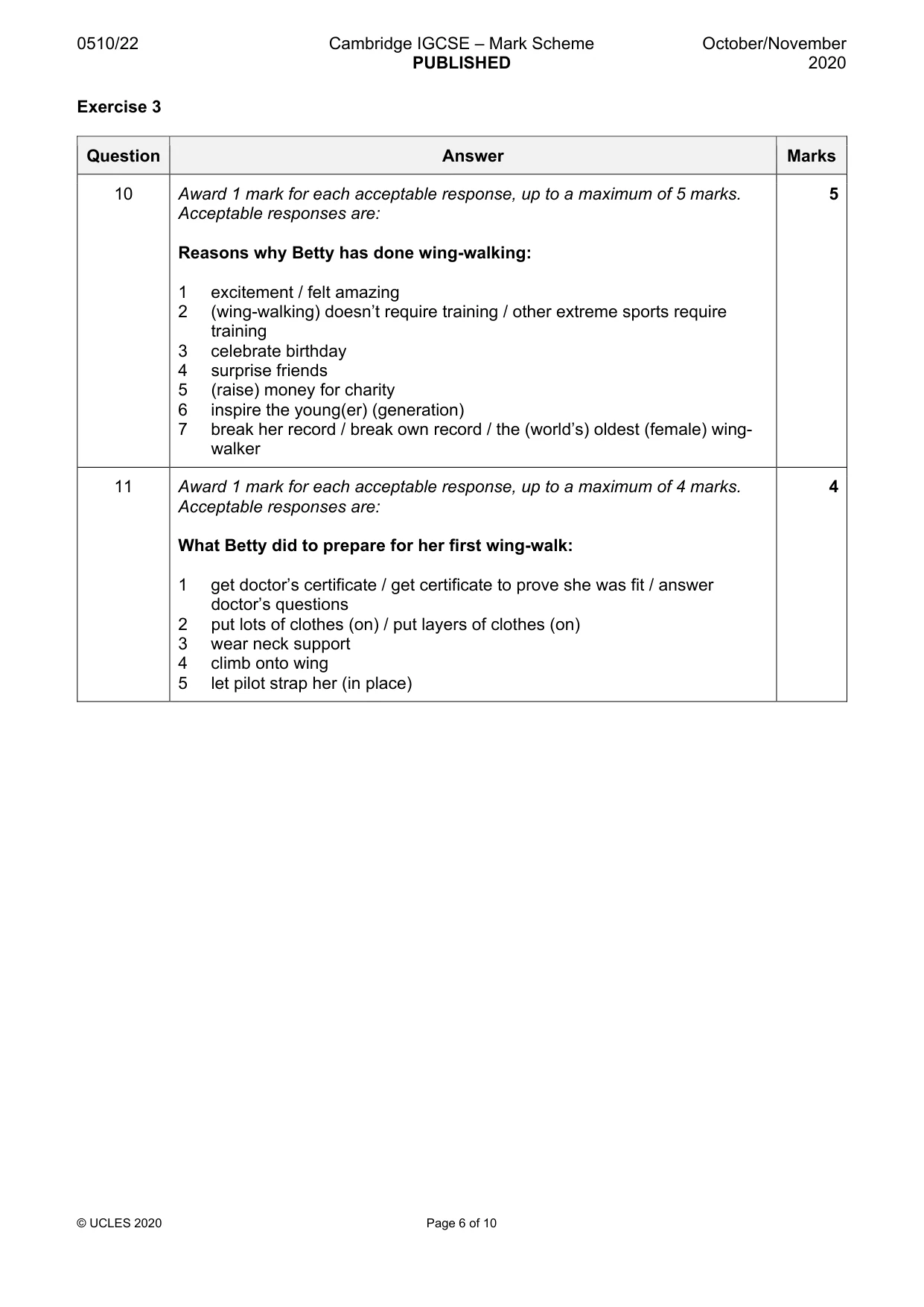
7 0510/22/O/N/20 © UCLES 2020 [Turn over You are going to give a talk about Betty Bromage to your class at school. Prepare some notes to use as the basis for your talk. Make short notes under each heading. 10 Reasons why Betty has done wing-walking: • … • … • … • … • … [5] 11 What Betty did to prepare for her first wing-walk: • … • … • … • … [4] [Total: 9]
Question paper, page 8
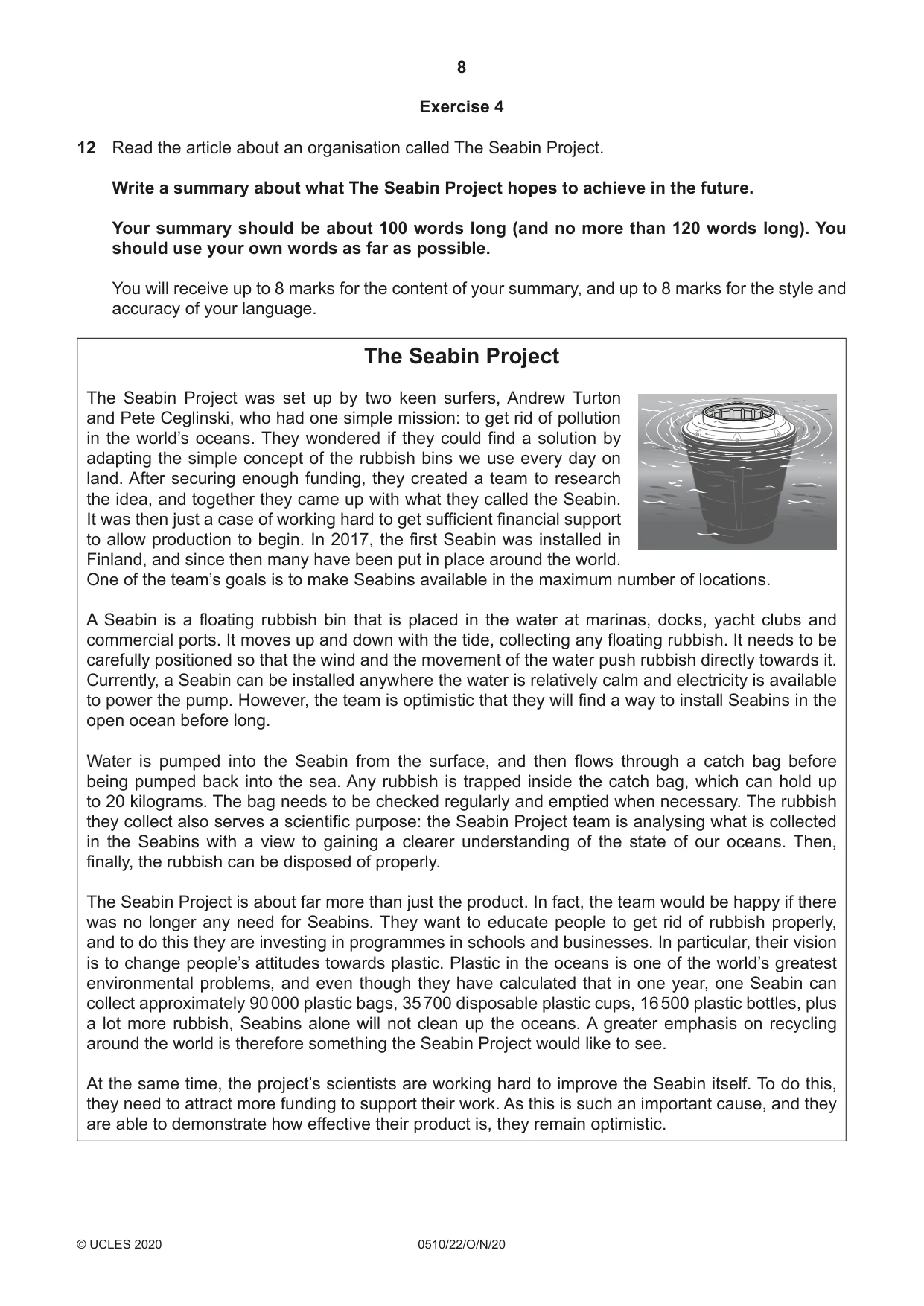
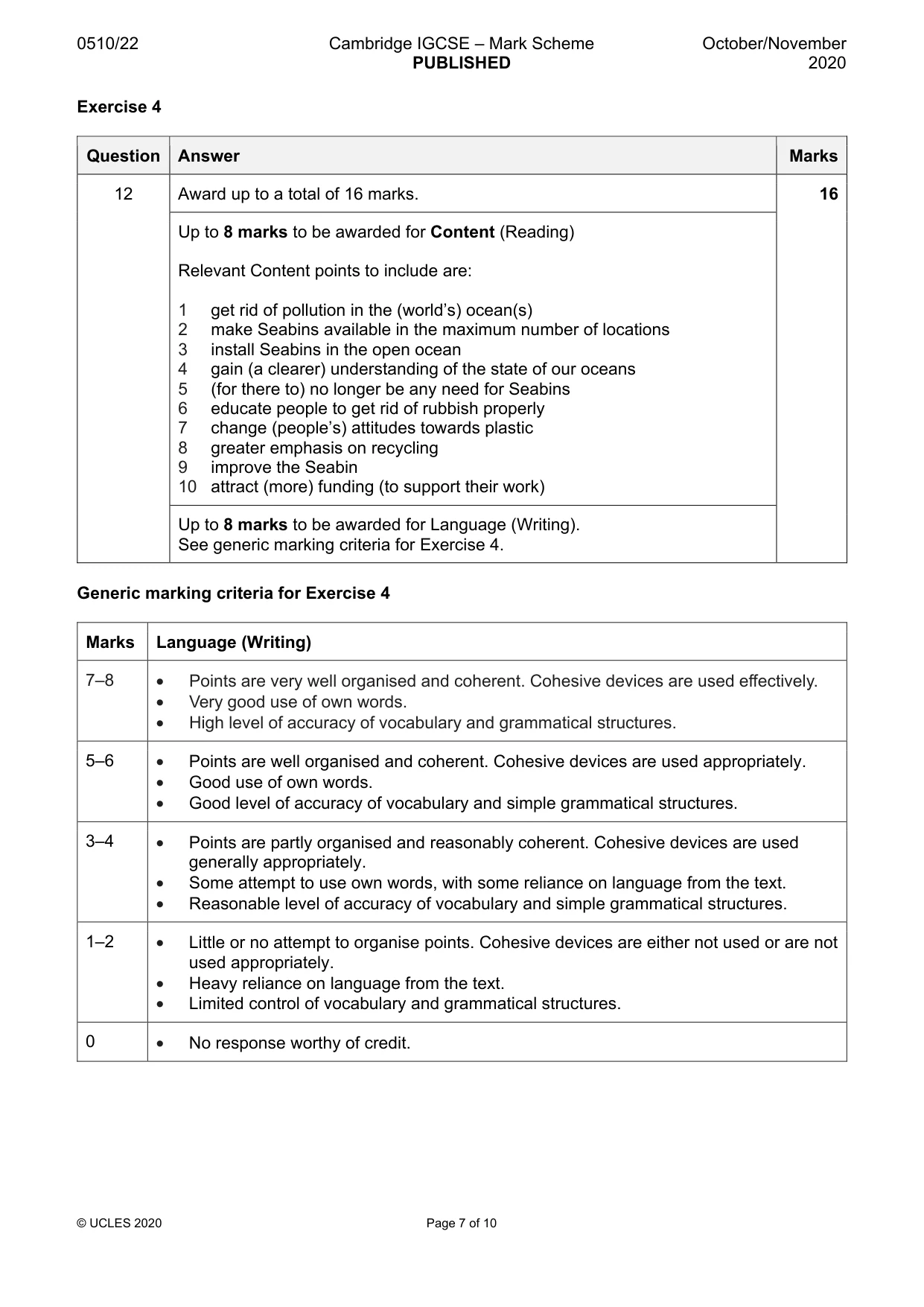
8 0510/22/O/N/20 © UCLES 2020 Exercise 4 12 Read the article about an organisation called The Seabin Project. Write a summary about what The Seabin Project hopes to achieve in the future. Your summary should be about 100 words long (and no more than 120 words long). You should use your own words as far as possible. You will receive up to 8 marks for the content of your summary, and up to 8 marks for the style and accuracy of your language. The Seabin Project The Seabin Project was set up by two keen surfers, Andrew Turton and Pete Ceglinski, who had one simple mission: to get rid of pollution in the world’s oceans. They wondered if they could find a solution by adapting the simple concept of the rubbish bins we use every day on land. After securing enough funding, they created a team to research the idea, and together they came up with what they called the Seabin. It was then just a case of working hard to get sufficient financial support to allow production to begin. In 2017, the first Seabin was installed in Finland, and since then many have been put in place around the world. One of the team’s goals is to make Seabins available in the maximum number of locations. A Seabin is a floating rubbish bin that is placed in the water at marinas, docks, yacht clubs and commercial ports. It moves up and down with the tide, collecting any floating rubbish. It needs to be carefully positioned so that the wind and the movement of the water push rubbish directly towards it. Currently, a Seabin can be installed anywhere the water is relatively calm and electricity is available to power the pump. However, the team is optimistic that they will find a way to install Seabins in the open ocean before long. Water is pumped into the Seabin from the surface, and then flows through a catch bag before being pumped back into the sea. Any rubbish is trapped inside the catch bag, which can hold up to 20 kilograms. The bag needs to be checked regularly and emptied when necessary. The rubbish they collect also serves a scientific purpose: the Seabin Project team is analysing what is collected in the Seabins with a view to gaining a clearer understanding of the state of our oceans. Then, finally, the rubbish can be disposed of properly. The Seabin Project is about far more than just the product. In fact, the team would be happy if there was no longer any need for Seabins. They want to educate people to get rid of rubbish properly, and to do this they are investing in programmes in schools and businesses. In particular, their vision is to change people’s attitudes towards plastic. Plastic in the oceans is one of the world’s greatest environmental problems, and even though they have calculated that in one year, one Seabin can collect approximately 90 000 plastic bags, 35 700 disposable plastic cups, 16 500 plastic bottles, plus a lot more rubbish, Seabins alone will not clean up the oceans. A greater emphasis on recycling around the world is therefore something the Seabin Project would like to see. At the same time, the project’s scientists are working hard to improve the Seabin itself. To do this, they need to attract more funding to support their work. As this is such an important cause, and they are able to demonstrate how effective their product is, they remain optimistic.
Question paper, page 9
9 0510/22/O/N/20 © UCLES 2020 [Turn over … … … … … … … … … … … … … … … … … … … … … … … … … … … [Total: 16]
Question paper, page 10
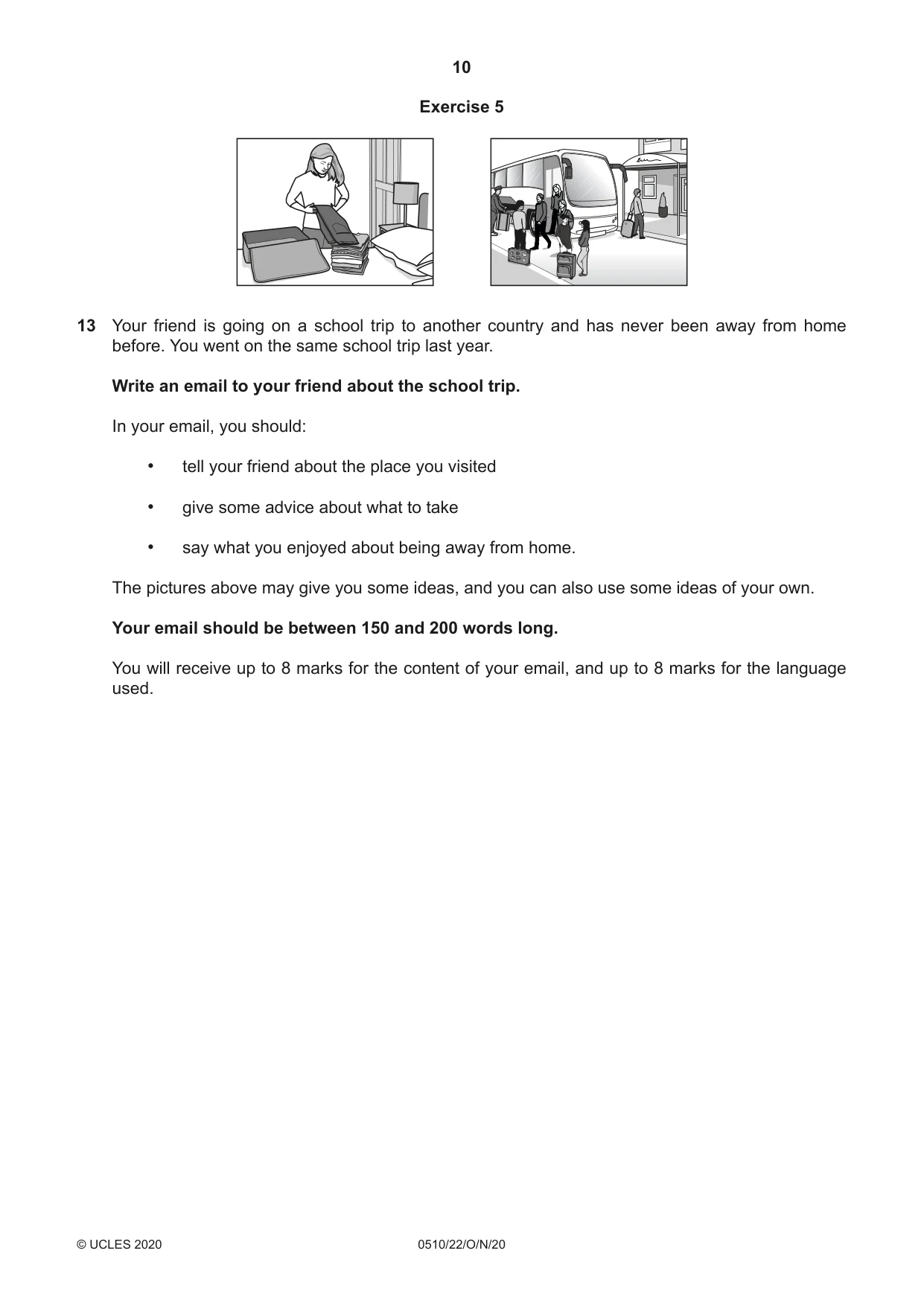
10 0510/22/O/N/20 © UCLES 2020 Exercise 5 13 Your friend is going on a school trip to another country and has never been away from home before. You went on the same school trip last year. Write an email to your friend about the school trip. In your email, you should: • tell your friend about the place you visited • give some advice about what to take • say what you enjoyed about being away from home. The pictures above may give you some ideas, and you can also use some ideas of your own. Your email should be between 150 and 200 words long. You will receive up to 8 marks for the content of your email, and up to 8 marks for the language used.
Question paper, page 11
11 0510/22/O/N/20 © UCLES 2020 [Turn over … … … … … … … … … … … … … … … … … … … … … … … … … … … [Total: 16]
Question paper, page 12
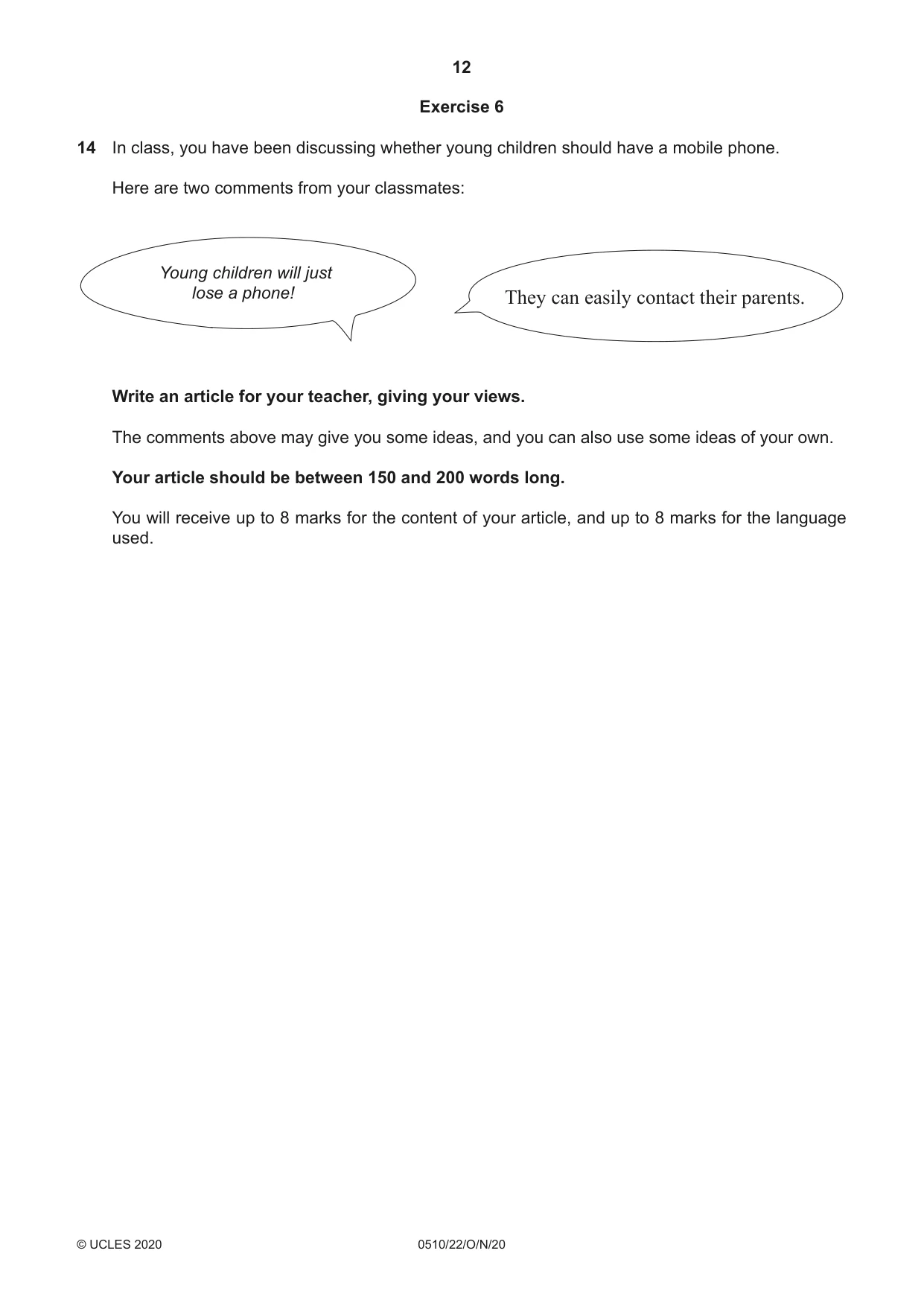
12 0510/22/O/N/20 © UCLES 2020 Exercise 6 14 In class, you have been discussing whether young children should have a mobile phone. Here are two comments from your classmates: Young children will just lose a phone! They can easily contact their parents. Write an article for your teacher, giving your views. The comments above may give you some ideas, and you can also use some ideas of your own. Your article should be between 150 and 200 words long. You will receive up to 8 marks for the content of your article, and up to 8 marks for the language used.
Question paper, page 13
13 0510/22/O/N/20 © UCLES 2020 … … … … … … … … … … … … … … … … … … … … … … … … … … … [Total: 16]
Question paper, page 14
14 0510/22/O/N/20 © UCLES 2020 BLANK PAGE
Question paper, page 15
15 0510/22/O/N/20 © UCLES 2020 BLANK PAGE
Question paper, page 16
16 0510/22/O/N/20 © UCLES 2020 Permission to reproduce items where third-party owned material protected by copyright is included has been sought and cleared where possible. Every reasonable effort has been made by the publisher (UCLES) to trace copyright holders, but if any items requiring clearance have unwittingly been included, the publisher will be pleased to make amends at the earliest possible opportunity. To avoid the issue of disclosure of answer-related information to candidates, all copyright acknowledgements are reproduced online in the Cambridge Assessment International Education Copyright Acknowledgements Booklet. This is produced for each series of examinations and is freely available to download at www.cambridgeinternational.org after the live examination series. Cambridge Assessment International Education is part of the Cambridge Assessment Group. Cambridge Assessment is the brand name of the University of Cambridge Local Examinations Syndicate (UCLES), which itself is a department of the University of Cambridge. BLANK PAGE
Mark scheme, page 1
This document consists of 10 printed pages. © UCLES 2020 [Turn over Cambridge IGCSE™ ENGLISH AS A SECOND LANGUAGE 0510/22 Paper 2 Reading and Writing (Extended) October/November 2020 MARK SCHEME Maximum Mark: 80 Published This mark scheme is published as an aid to teachers and candidates, to indicate the requirements of the examination. It shows the basis on which Examiners were instructed to award marks. It does not indicate the details of the discussions that took place at an Examiners’ meeting before marking began, which would have considered the acceptability of alternative answers. Mark schemes should be read in conjunction with the question paper and the Principal Examiner Report for Teachers. Cambridge International will not enter into discussions about these mark schemes. Cambridge International is publishing the mark schemes for the October/November 2020 series for most Cambridge IGCSE™, Cambridge International A and AS Level and Cambridge Pre-U components, and some Cambridge O Level components.
Mark scheme, page 2
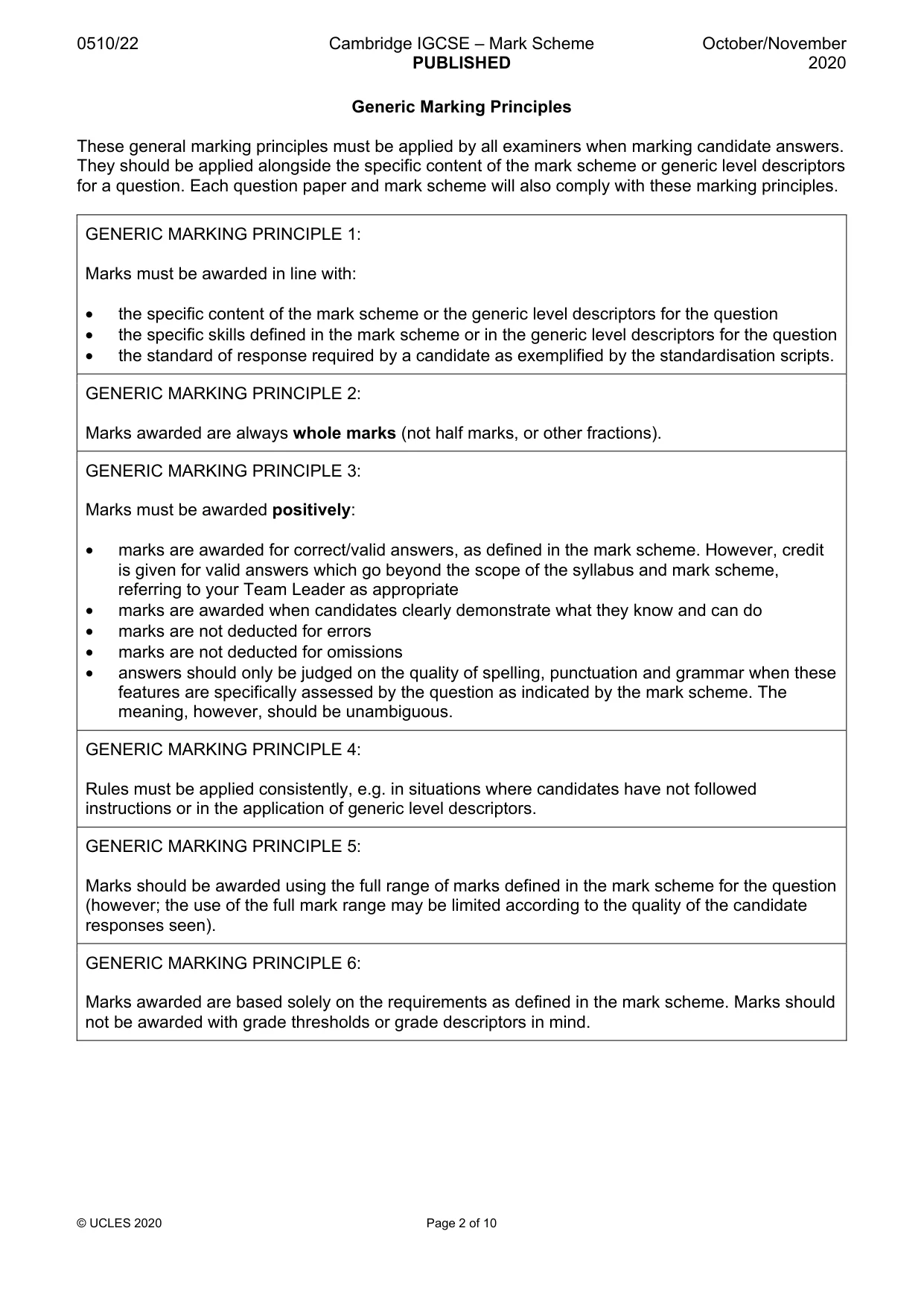
0510/22 Cambridge IGCSE – Mark Scheme PUBLISHED October/November 2020 © UCLES 2020 Page 2 of 10 Generic Marking Principles These general marking principles must be applied by all examiners when marking candidate answers. They should be applied alongside the specific content of the mark scheme or generic level descriptors for a question. Each question paper and mark scheme will also comply with these marking principles. GENERIC MARKING PRINCIPLE 1: Marks must be awarded in line with: • the specific content of the mark scheme or the generic level descriptors for the question • the specific skills defined in the mark scheme or in the generic level descriptors for the question • the standard of response required by a candidate as exemplified by the standardisation scripts. GENERIC MARKING PRINCIPLE 2: Marks awarded are always whole marks (not half marks, or other fractions). GENERIC MARKING PRINCIPLE 3: Marks must be awarded positively: • marks are awarded for correct/valid answers, as defined in the mark scheme. However, credit is given for valid answers which go beyond the scope of the syllabus and mark scheme, referring to your Team Leader as appropriate • marks are awarded when candidates clearly demonstrate what they know and can do • marks are not deducted for errors • marks are not deducted for omissions • answers should only be judged on the quality of spelling, punctuation and grammar when these features are specifically assessed by the question as indicated by the mark scheme. The meaning, however, should be unambiguous. GENERIC MARKING PRINCIPLE 4: Rules must be applied consistently, e.g. in situations where candidates have not followed instructions or in the application of generic level descriptors. GENERIC MARKING PRINCIPLE 5: Marks should be awarded using the full range of marks defined in the mark scheme for the question (however; the use of the full mark range may be limited according to the quality of the candidate responses seen). GENERIC MARKING PRINCIPLE 6: Marks awarded are based solely on the requirements as defined in the mark scheme. Marks should not be awarded with grade thresholds or grade descriptors in mind.
Mark scheme, page 3
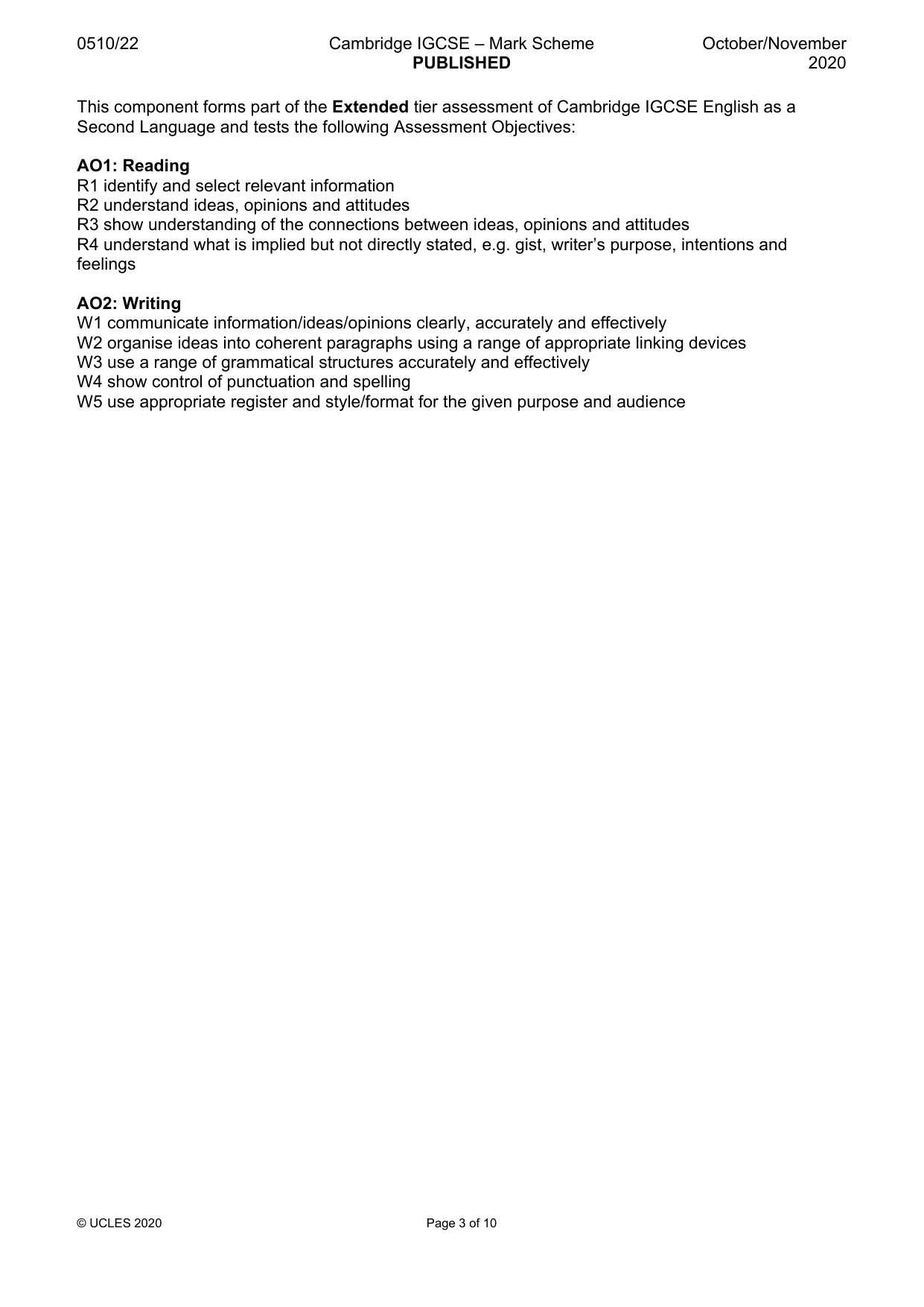
0510/22 Cambridge IGCSE – Mark Scheme PUBLISHED October/November 2020 © UCLES 2020 Page 3 of 10 This component forms part of the Extended tier assessment of Cambridge IGCSE English as a Second Language and tests the following Assessment Objectives: AO1: Reading R1 identify and select relevant information R2 understand ideas, opinions and attitudes R3 show understanding of the connections between ideas, opinions and attitudes R4 understand what is implied but not directly stated, e.g. gist, writer’s purpose, intentions and feelings AO2: Writing W1 communicate information/ideas/opinions clearly, accurately and effectively W2 organise ideas into coherent paragraphs using a range of appropriate linking devices W3 use a range of grammatical structures accurately and effectively W4 show control of punctuation and spelling W5 use appropriate register and style/format for the given purpose and audience
Mark scheme, page 4
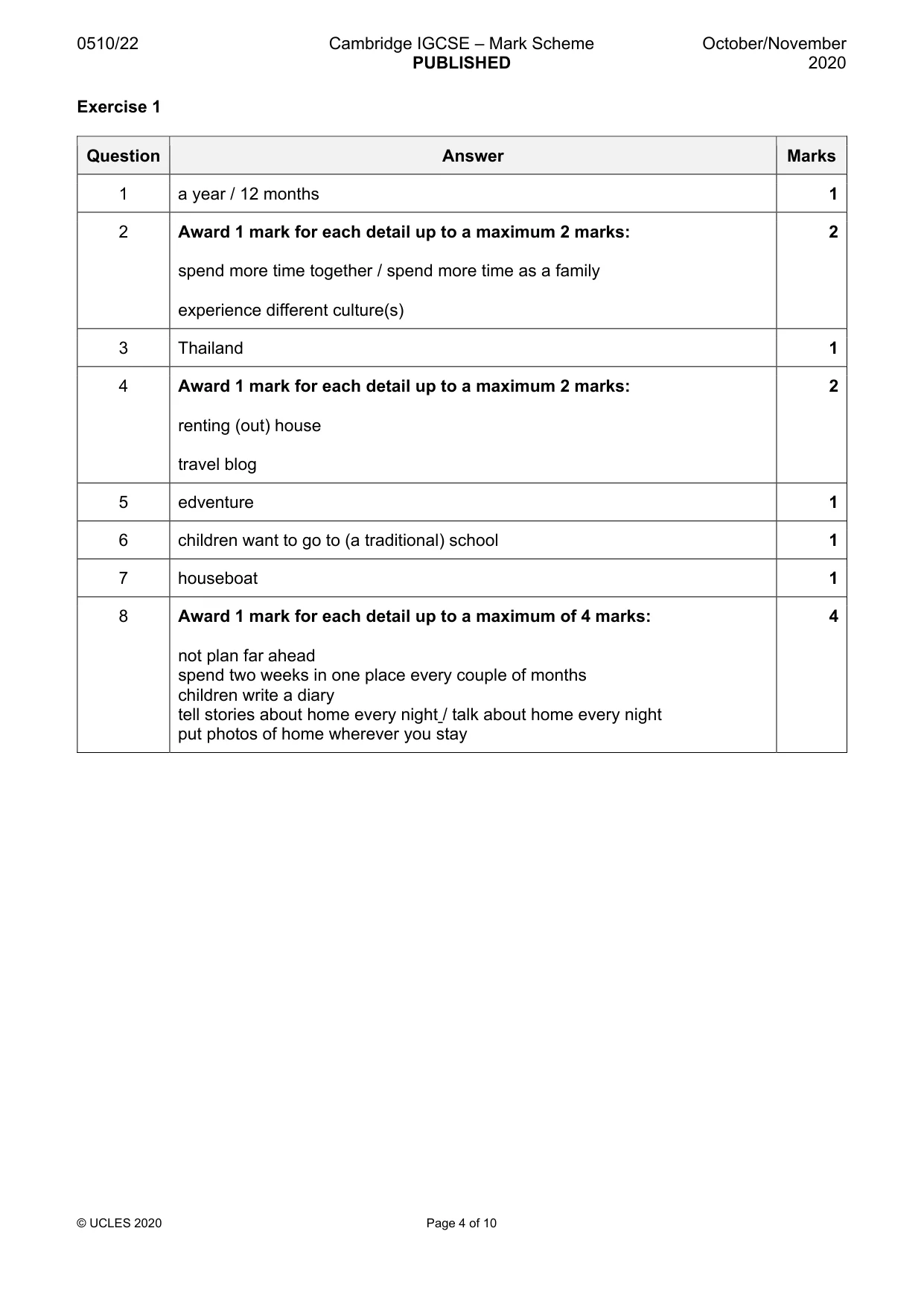
0510/22 Cambridge IGCSE – Mark Scheme PUBLISHED October/November 2020 © UCLES 2020 Page 4 of 10 Exercise 1 Question Answer Marks 1 a year / 12 months 1 2 Award 1 mark for each detail up to a maximum 2 marks: spend more time together / spend more time as a family experience different culture(s) 2 3 Thailand 1 4 Award 1 mark for each detail up to a maximum 2 marks: renting (out) house travel blog 2 5 edventure 1 6 children want to go to (a traditional) school 1 7 houseboat 1 8 Award 1 mark for each detail up to a maximum of 4 marks: not plan far ahead spend two weeks in one place every couple of months children write a diary tell stories about home every night / talk about home every night put photos of home wherever you stay 4
Mark scheme, page 5
0510/22 Cambridge IGCSE – Mark Scheme PUBLISHED October/November 2020 © UCLES 2020 Page 5 of 10 Exercise 2 Question Answer Marks 9(a) C 1 9(b) A 1 9(c) B 1 9(d) A 1 9(e) D 1 9(f) C 1 9(g) D 1 9(h) A 1 9(i) C 1 9(j) B 1
Mark scheme, page 6
0510/22 Cambridge IGCSE – Mark Scheme PUBLISHED October/November 2020 © UCLES 2020 Page 6 of 10 Exercise 3 Question Answer Marks 10 Award 1 mark for each acceptable response, up to a maximum of 5 marks. Acceptable responses are: Reasons why Betty has done wing-walking: 1 excitement / felt amazing 2 (wing-walking) doesn’t require training / other extreme sports require training 3 celebrate birthday 4 surprise friends 5 (raise) money for charity 6 inspire the young(er) (generation) 7 break her record / break own record / the (world’s) oldest (female) wing- walker 5 11 Award 1 mark for each acceptable response, up to a maximum of 4 marks. Acceptable responses are: What Betty did to prepare for her first wing-walk: 1 get doctor’s certificate / get certificate to prove she was fit / answer doctor’s questions 2 put lots of clothes (on) / put layers of clothes (on) 3 wear neck support 4 climb onto wing 5 let pilot strap her (in place) 4
Mark scheme, page 7
0510/22 Cambridge IGCSE – Mark Scheme PUBLISHED October/November 2020 © UCLES 2020 Page 7 of 10 Exercise 4 Question Answer Marks 12 Award up to a total of 16 marks. 16 Up to 8 marks to be awarded for Content (Reading) Relevant Content points to include are: 1 get rid of pollution in the (world’s) ocean(s) 2 make Seabins available in the maximum number of locations 3 install Seabins in the open ocean 4 gain (a clearer) understanding of the state of our oceans 5 (for there to) no longer be any need for Seabins 6 educate people to get rid of rubbish properly 7 change (people’s) attitudes towards plastic 8 greater emphasis on recycling 9 improve the Seabin 10 attract (more) funding (to support their work) Up to 8 marks to be awarded for Language (Writing). See generic marking criteria for Exercise 4. Generic marking criteria for Exercise 4 Marks Language (Writing) 7–8 • Points are very well organised and coherent. Cohesive devices are used effectively. • Very good use of own words. • High level of accuracy of vocabulary and grammatical structures. 5–6 • Points are well organised and coherent. Cohesive devices are used appropriately. • Good use of own words. • Good level of accuracy of vocabulary and simple grammatical structures. 3–4 • Points are partly organised and reasonably coherent. Cohesive devices are used generally appropriately. • Some attempt to use own words, with some reliance on language from the text. • Reasonable level of accuracy of vocabulary and simple grammatical structures. 1–2 • Little or no attempt to organise points. Cohesive devices are either not used or are not used appropriately. • Heavy reliance on language from the text. • Limited control of vocabulary and grammatical structures. 0 • No response worthy of credit.
Mark scheme, page 8
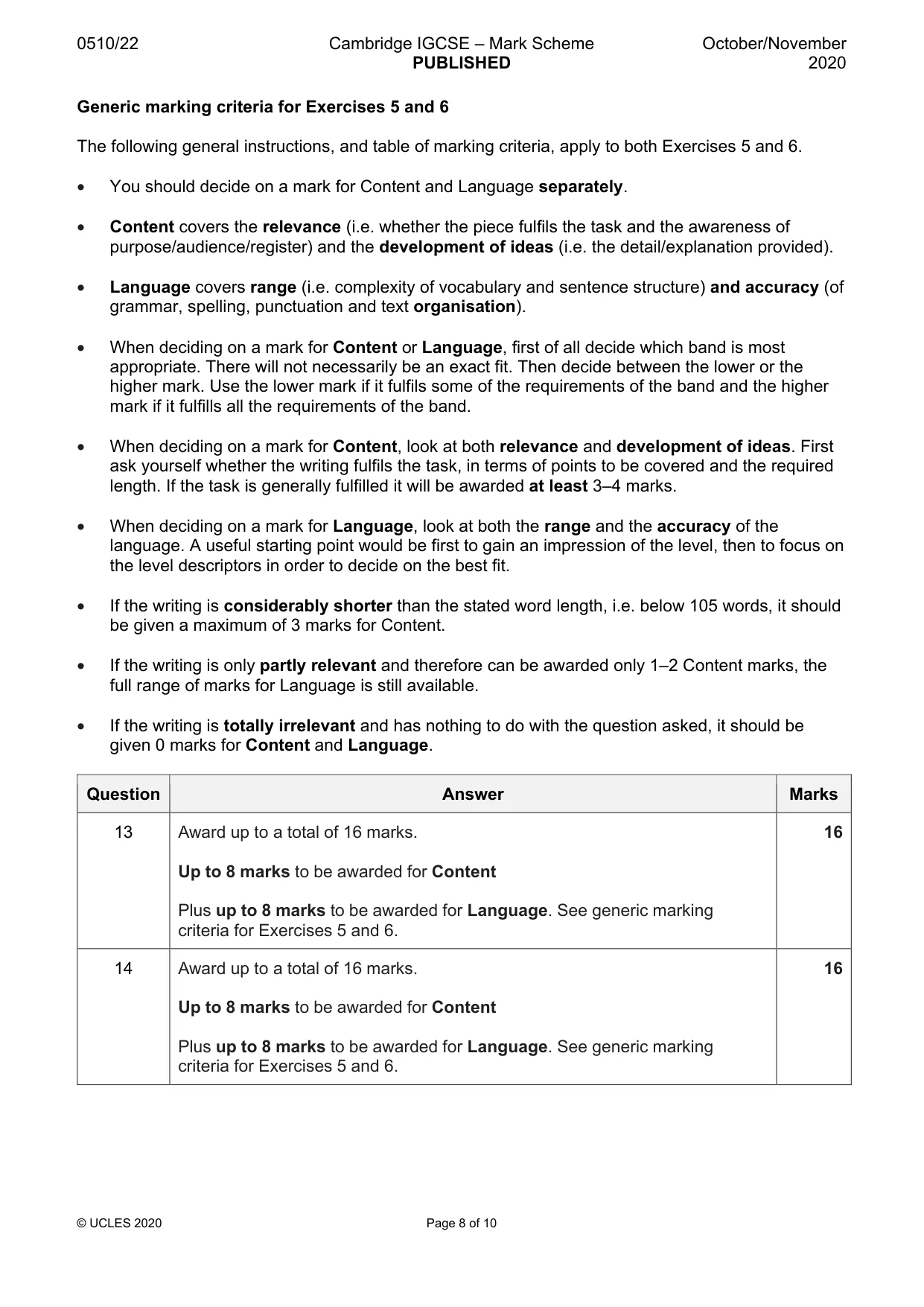
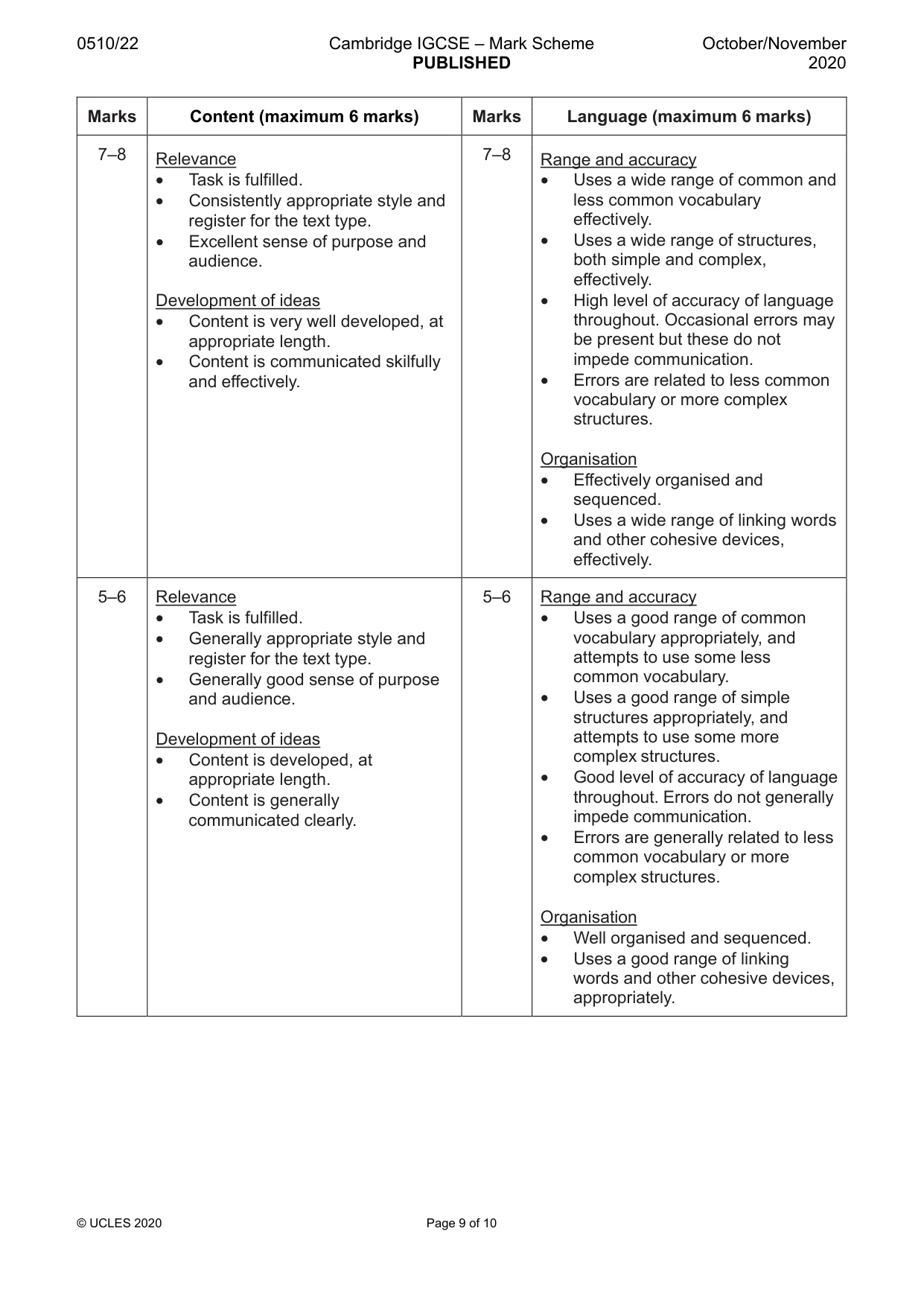
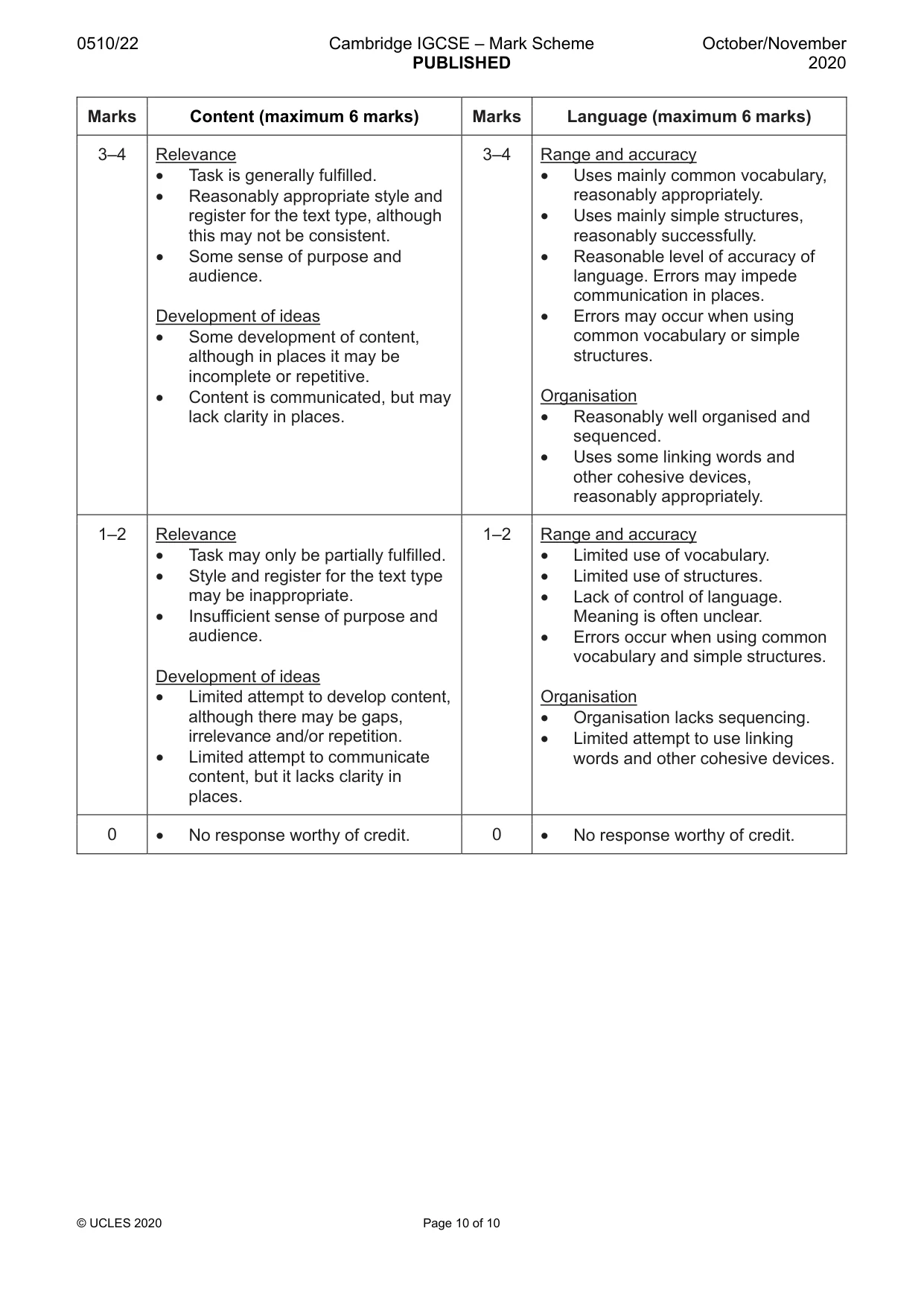
0510/22 Cambridge IGCSE – Mark Scheme PUBLISHED October/November 2020 © UCLES 2020 Page 8 of 10 Generic marking criteria for Exercises 5 and 6 The following general instructions, and table of marking criteria, apply to both Exercises 5 and 6. • You should decide on a mark for Content and Language separately. • Content covers the relevance (i.e. whether the piece fulfils the task and the awareness of purpose/audience/register) and the development of ideas (i.e. the detail/explanation provided). • Language covers range (i.e. complexity of vocabulary and sentence structure) and accuracy (of grammar, spelling, punctuation and text organisation). • When deciding on a mark for Content or Language, first of all decide which band is most appropriate. There will not necessarily be an exact fit. Then decide between the lower or the higher mark. Use the lower mark if it fulfils some of the requirements of the band and the higher mark if it fulfills all the requirements of the band. • When deciding on a mark for Content, look at both relevance and development of ideas. First ask yourself whether the writing fulfils the task, in terms of points to be covered and the required length. If the task is generally fulfilled it will be awarded at least 3–4 marks. • When deciding on a mark for Language, look at both the range and the accuracy of the language. A useful starting point would be first to gain an impression of the level, then to focus on the level descriptors in order to decide on the best fit. • If the writing is considerably shorter than the stated word length, i.e. below 105 words, it should be given a maximum of 3 marks for Content. • If the writing is only partly relevant and therefore can be awarded only 1–2 Content marks, the full range of marks for Language is still available. • If the writing is totally irrelevant and has nothing to do with the question asked, it should be given 0 marks for Content and Language. Question Answer Marks 13 Award up to a total of 16 marks. Up to 8 marks to be awarded for Content Plus up to 8 marks to be awarded for Language. See generic marking criteria for Exercises 5 and 6. 16 14 Award up to a total of 16 marks. Up to 8 marks to be awarded for Content Plus up to 8 marks to be awarded for Language. See generic marking criteria for Exercises 5 and 6. 16
Mark scheme, page 9
0510/22 Cambridge IGCSE – Mark Scheme PUBLISHED October/November 2020 © UCLES 2020 Page 9 of 10 Marks Content (maximum 6 marks) Marks Language (maximum 6 marks) 7–8 Relevance • Task is fulfilled. • Consistently appropriate style and register for the text type. • Excellent sense of purpose and audience. Development of ideas • Content is very well developed, at appropriate length. • Content is communicated skilfully and effectively. 7–8 Range and accuracy • Uses a wide range of common and less common vocabulary effectively. • Uses a wide range of structures, both simple and complex, effectively. • High level of accuracy of language throughout. Occasional errors may be present but these do not impede communication. • Errors are related to less common vocabulary or more complex structures. Organisation • Effectively organised and sequenced. • Uses a wide range of linking words and other cohesive devices, effectively. 5–6 Relevance • Task is fulfilled. • Generally appropriate style and register for the text type. • Generally good sense of purpose and audience. Development of ideas • Content is developed, at appropriate length. • Content is generally communicated clearly. 5–6 Range and accuracy • Uses a good range of common vocabulary appropriately, and attempts to use some less common vocabulary. • Uses a good range of simple structures appropriately, and attempts to use some more complex structures. • Good level of accuracy of language throughout. Errors do not generally impede communication. • Errors are generally related to less common vocabulary or more complex structures. Organisation • Well organised and sequenced. • Uses a good range of linking words and other cohesive devices, appropriately.
Mark scheme, page 10
0510/22 Cambridge IGCSE – Mark Scheme PUBLISHED October/November 2020 © UCLES 2020 Page 10 of 10 Marks Content (maximum 6 marks) Marks Language (maximum 6 marks) 3–4 Relevance • Task is generally fulfilled. • Reasonably appropriate style and register for the text type, although this may not be consistent. • Some sense of purpose and audience. Development of ideas • Some development of content, although in places it may be incomplete or repetitive. • Content is communicated, but may lack clarity in places. 3–4 Range and accuracy • Uses mainly common vocabulary, reasonably appropriately. • Uses mainly simple structures, reasonably successfully. • Reasonable level of accuracy of language. Errors may impede communication in places. • Errors may occur when using common vocabulary or simple structures. Organisation • Reasonably well organised and sequenced. • Uses some linking words and other cohesive devices, reasonably appropriately. 1–2 Relevance • Task may only be partially fulfilled. • Style and register for the text type may be inappropriate. • Insufficient sense of purpose and audience. Development of ideas • Limited attempt to develop content, although there may be gaps, irrelevance and/or repetition. • Limited attempt to communicate content, but it lacks clarity in places. 1–2 Range and accuracy • Limited use of vocabulary. • Limited use of structures. • Lack of control of language. Meaning is often unclear. • Errors occur when using common vocabulary and simple structures. Organisation • Organisation lacks sequencing. • Limited attempt to use linking words and other cohesive devices. 0 • No response worthy of credit. 0 • No response worthy of credit.
What you needed in this session
Cambridge’s own grade thresholds for 2020 Oct/Nov, Paper 2 · Variant 2. A higher threshold means an easier paper — the bar moves with how the cohort did.