Cambridge IGCSE English - Second Language (oral endorsement) 0510 — 2020 May/June Paper 4 · Variant 2
0510/42/M/J/20
The question paper and its mark scheme, free to read here and free to download. This is Cambridge’s own paper, exactly as it was sat.
Question paper12 pages




Mark scheme4 pages
Answers below. Sit the paper first if you are practising.
Paper as text
Question paper, page 1
Cambridge IGCSE™ This document has 12 pages. Blank pages are indicated. DC (LK/SW) 186084/1 © UCLES 2020 [Turn over ENGLISH AS A SECOND LANGUAGE 0510/42 Paper 4 Listening (Extended) May/June 2020 Approximately 50 minutes You must answer on the question paper. No additional materials are needed. INSTRUCTIONS ● Answer all questions. ● Use a black or dark blue pen. ● Write your name, centre number and candidate number in the boxes at the top of the page. ● Write your answer to each question in the space provided. ● Do not use an erasable pen or correction fluid. ● Do not write on any bar codes. ● Dictionaries are not allowed. INFORMATION ● The total mark for this paper is 40. ● The number of marks for each question or part question is shown in brackets [ ]. * 7 3 6 1 6 0 8 2 7 3 *
Question paper, page 2
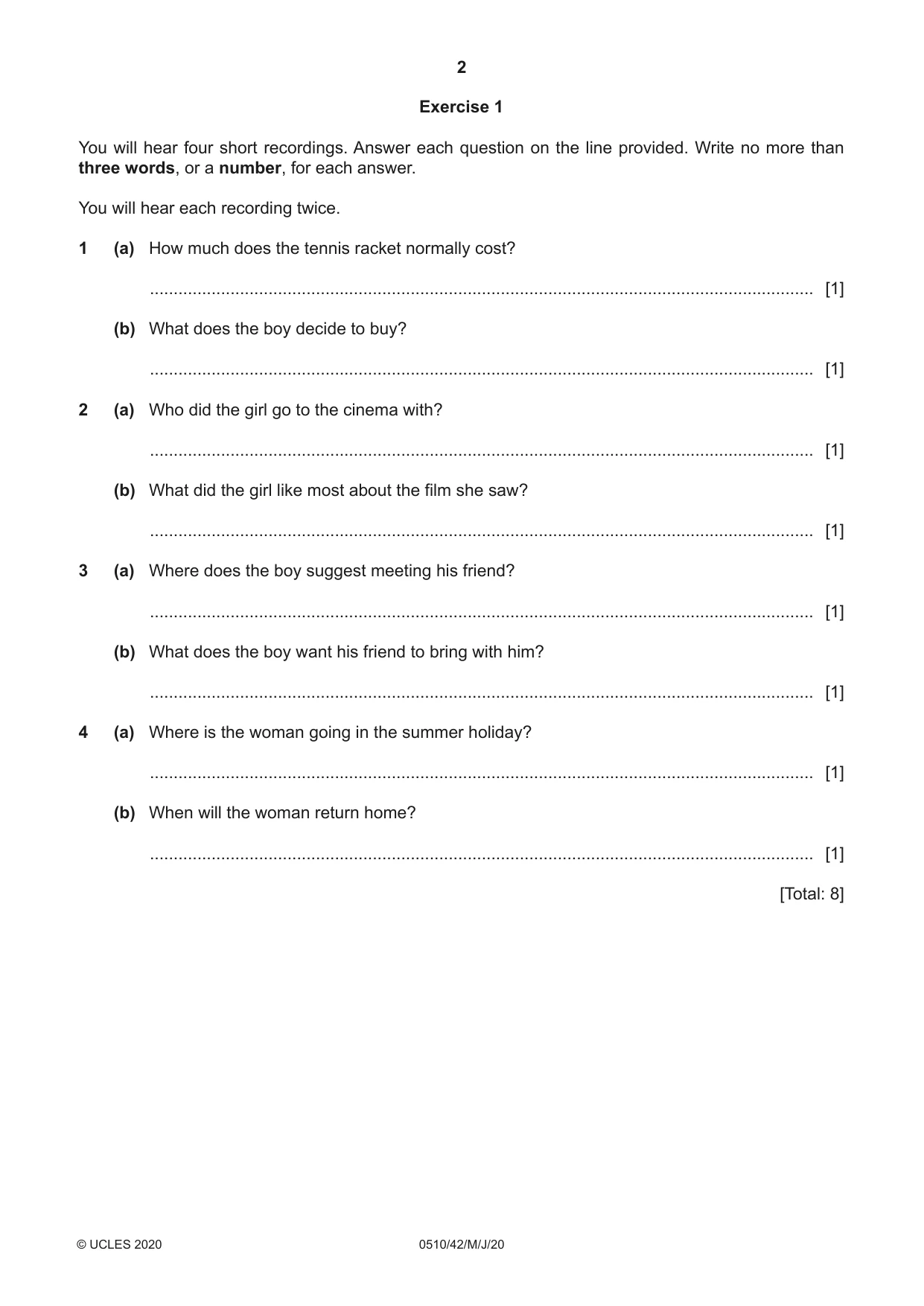
2 0510/42/M/J/20 © UCLES 2020 Exercise 1 You will hear four short recordings. Answer each question on the line provided. Write no more than three words, or a number, for each answer. You will hear each recording twice. 1 (a) How much does the tennis racket normally cost? … [1] (b) What does the boy decide to buy? … [1] 2 (a) Who did the girl go to the cinema with? … [1] (b) What did the girl like most about the film she saw? … [1] 3 (a) Where does the boy suggest meeting his friend? … [1] (b) What does the boy want his friend to bring with him? … [1] 4 (a) Where is the woman going in the summer holiday? … [1] (b) When will the woman return home? … [1] [Total: 8]
Question paper, page 3
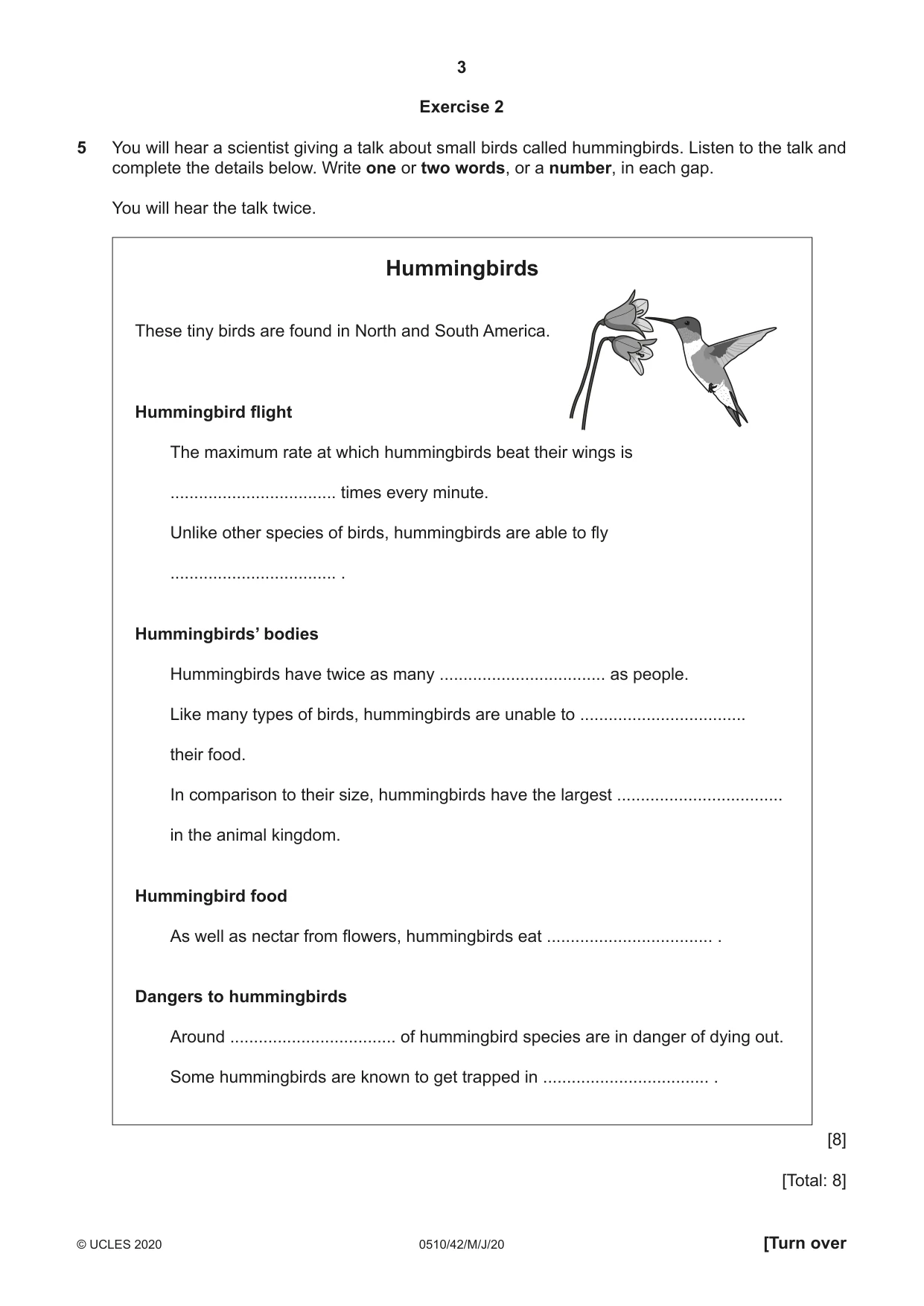
3 0510/42/M/J/20 © UCLES 2020 [Turn over Exercise 2 5 You will hear a scientist giving a talk about small birds called hummingbirds. Listen to the talk and complete the details below. Write one or two words, or a number, in each gap. You will hear the talk twice. Hummingbirds These tiny birds are found in North and South America. Hummingbird flight The maximum rate at which hummingbirds beat their wings is … times every minute. Unlike other species of birds, hummingbirds are able to fly … . Hummingbirds’ bodies Hummingbirds have twice as many … as people. Like many types of birds, hummingbirds are unable to … their food. In comparison to their size, hummingbirds have the largest … in the animal kingdom. Hummingbird food As well as nectar from flowers, hummingbirds eat … . Dangers to hummingbirds Around … of hummingbird species are in danger of dying out. Some hummingbirds are known to get trapped in … . [8] [Total: 8]
Question paper, page 4
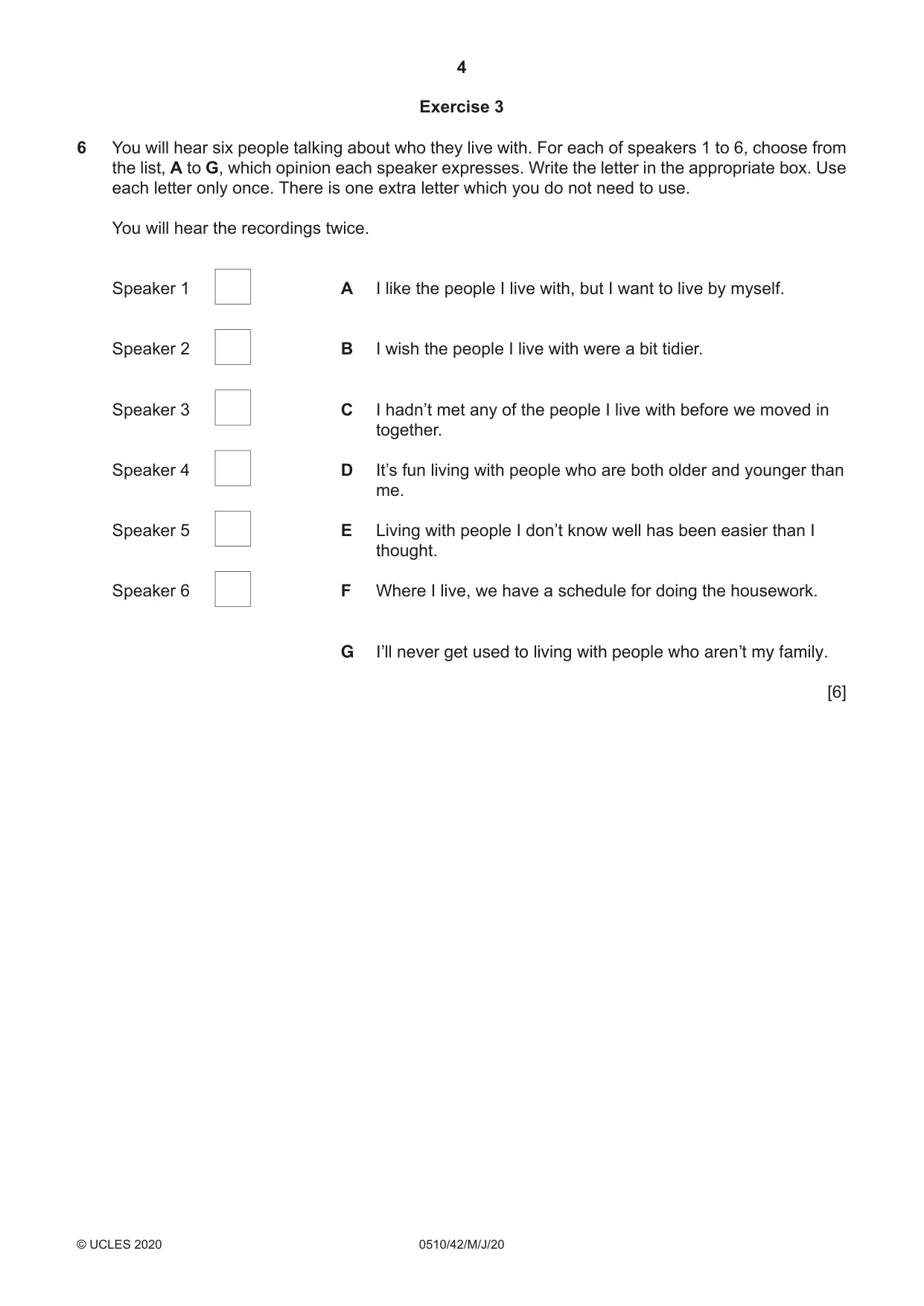
4 0510/42/M/J/20 © UCLES 2020 Exercise 3 6 You will hear six people talking about who they live with. For each of speakers 1 to 6, choose from the list, A to G, which opinion each speaker expresses. Write the letter in the appropriate box. Use each letter only once. There is one extra letter which you do not need to use. You will hear the recordings twice. Speaker 1 A I like the people I live with, but I want to live by myself. Speaker 2 B I wish the people I live with were a bit tidier. Speaker 3 C I hadn’t met any of the people I live with before we moved in together. Speaker 4 D It’s fun living with people who are both older and younger than me. Speaker 5 E Living with people I don’t know well has been easier than I thought. Speaker 6 F Where I live, we have a schedule for doing the housework. G I’ll never get used to living with people who aren’t my family. [6]
Question paper, page 5
5 0510/42/M/J/20 © UCLES 2020 [Turn over Please turn over for Exercise 4.
Question paper, page 6
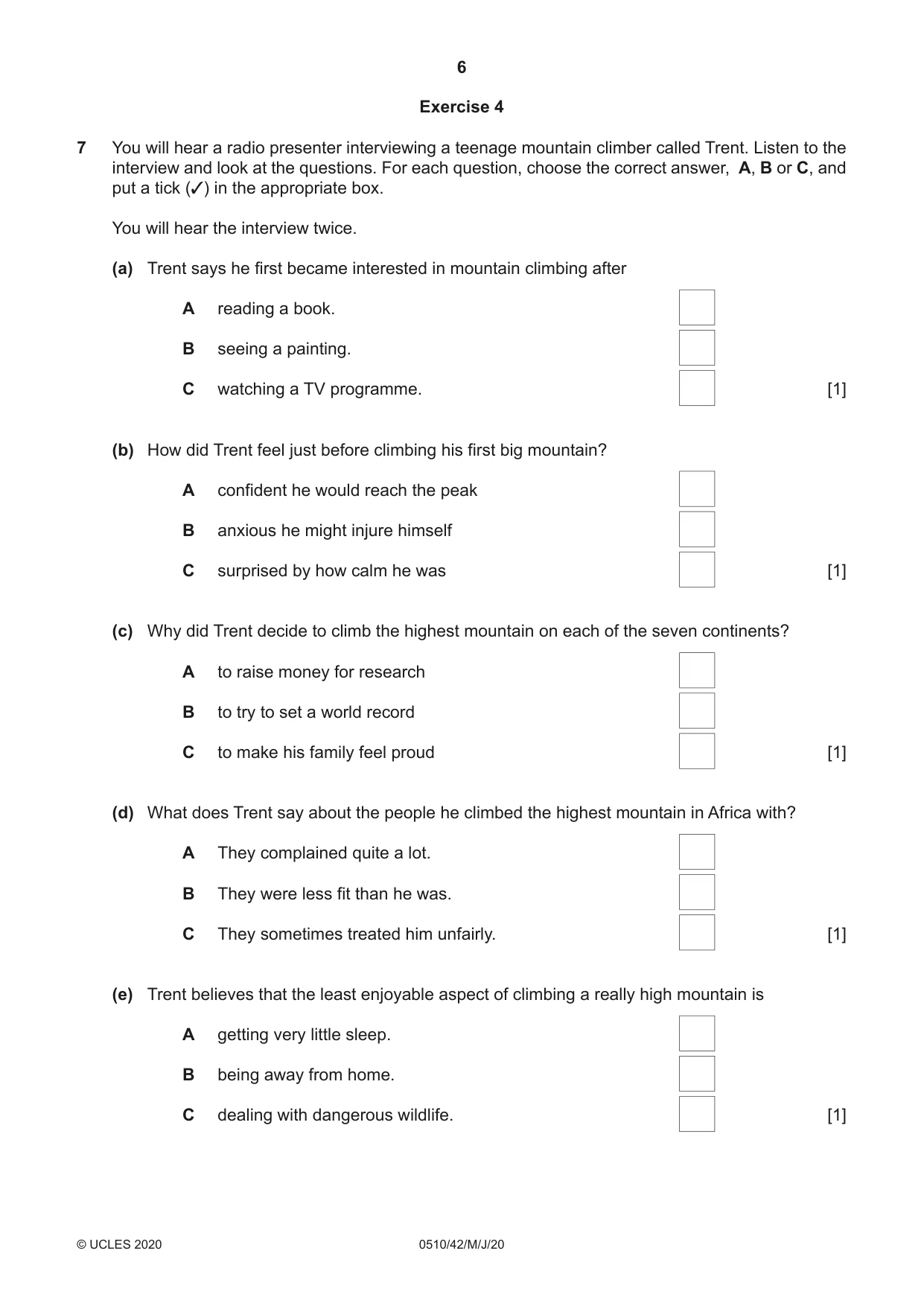
6 0510/42/M/J/20 © UCLES 2020 Exercise 4 7 You will hear a radio presenter interviewing a teenage mountain climber called Trent. Listen to the interview and look at the questions. For each question, choose the correct answer, A, B or C, and put a tick (3) in the appropriate box. You will hear the interview twice. (a) Trent says he first became interested in mountain climbing after A reading a book. B seeing a painting. C watching a TV programme. [1] (b) How did Trent feel just before climbing his first big mountain? A confident he would reach the peak B anxious he might injure himself C surprised by how calm he was [1] (c) Why did Trent decide to climb the highest mountain on each of the seven continents? A to raise money for research B to try to set a world record C to make his family feel proud [1] (d) What does Trent say about the people he climbed the highest mountain in Africa with? A They complained quite a lot. B They were less fit than he was. C They sometimes treated him unfairly. [1] (e) Trent believes that the least enjoyable aspect of climbing a really high mountain is A getting very little sleep. B being away from home. C dealing with dangerous wildlife. [1]
Question paper, page 7
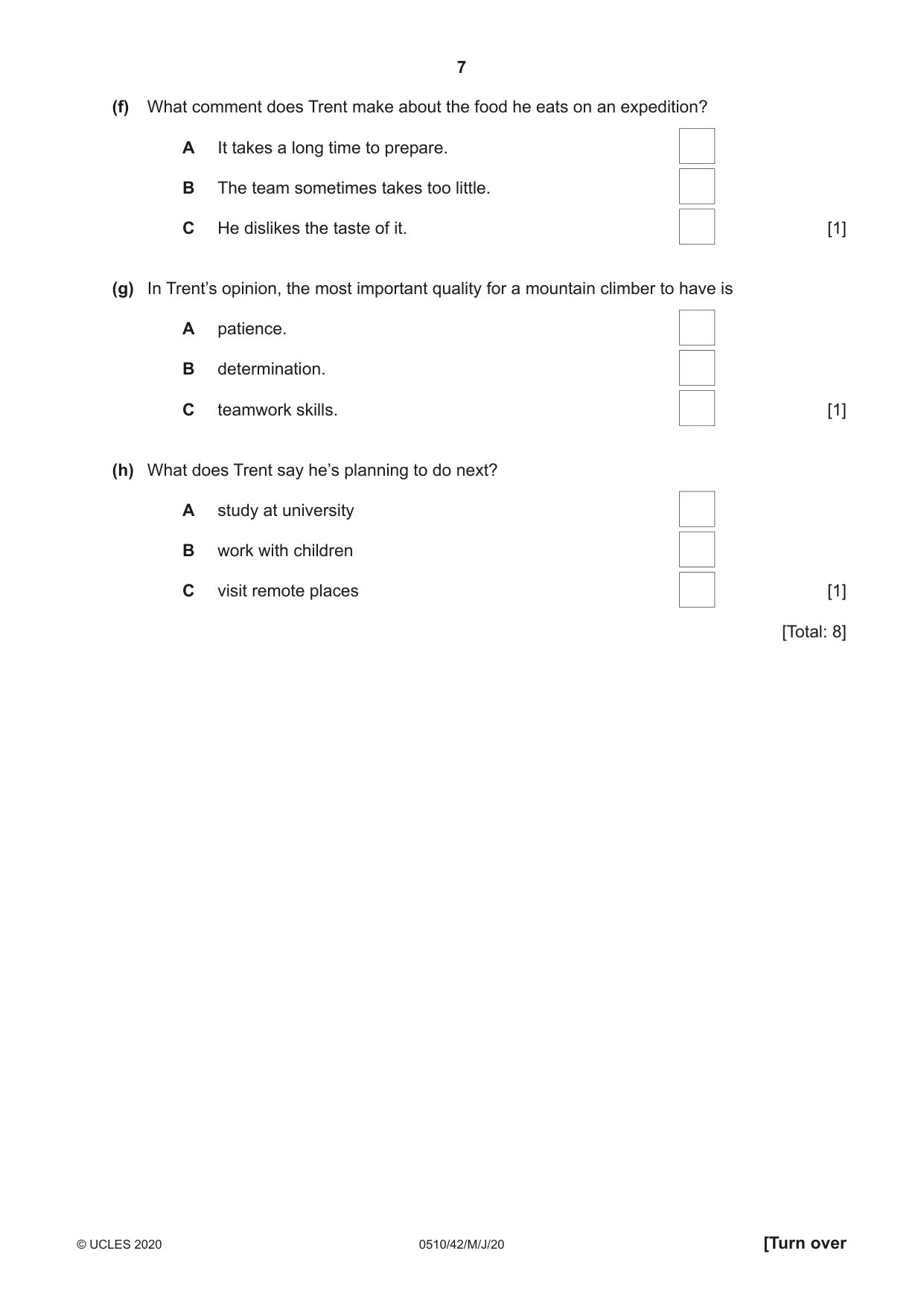
7 0510/42/M/J/20 © UCLES 2020 [Turn over (f) What comment does Trent make about the food he eats on an expedition? A It takes a long time to prepare. B The team sometimes takes too little. C He dislikes the taste of it. [1] (g) In Trent’s opinion, the most important quality for a mountain climber to have is A patience. B determination. C teamwork skills. [1] (h) What does Trent say he’s planning to do next? A study at university B work with children C visit remote places [1] [Total: 8]
Question paper, page 8
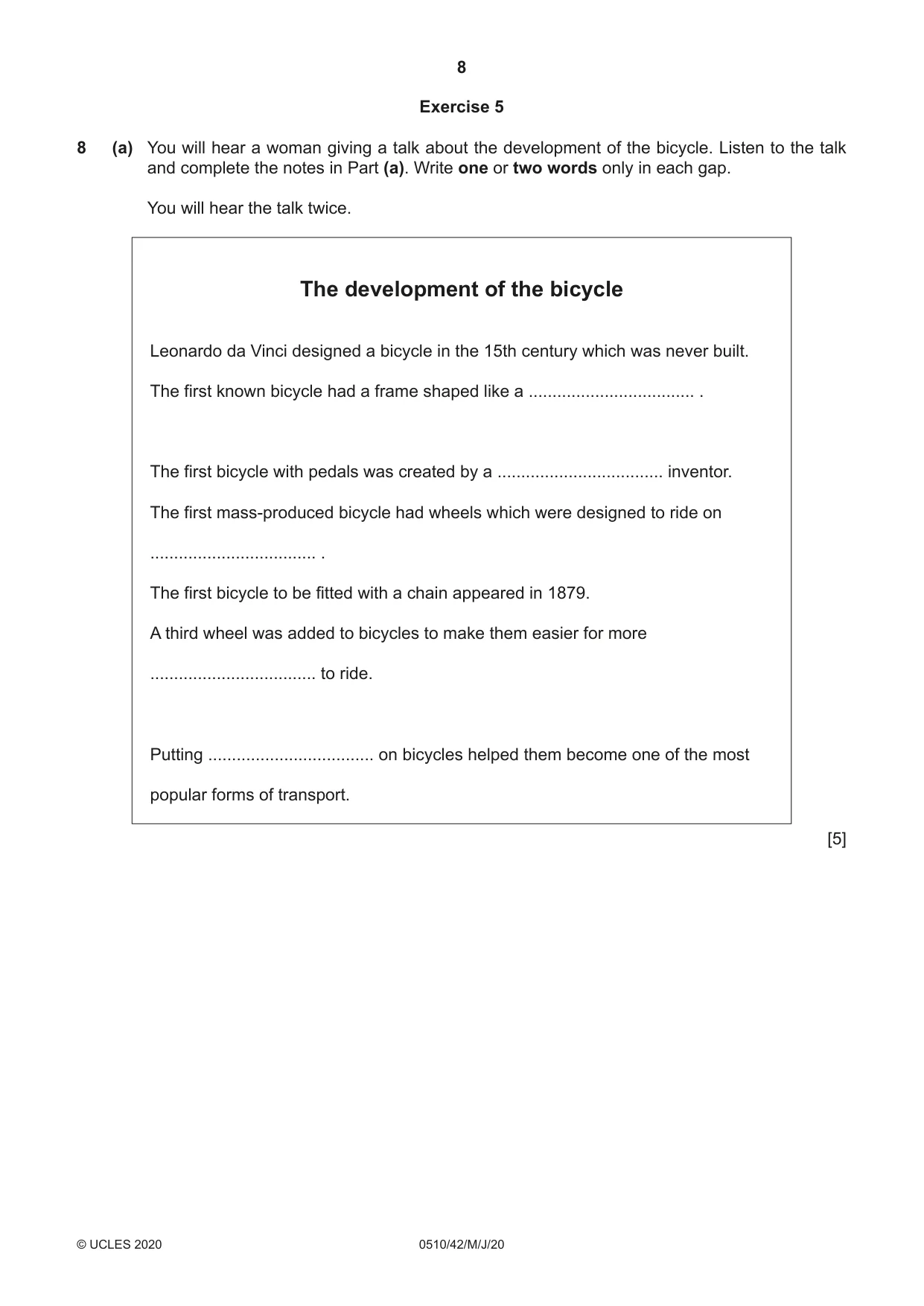
8 0510/42/M/J/20 © UCLES 2020 Exercise 5 8 (a) You will hear a woman giving a talk about the development of the bicycle. Listen to the talk and complete the notes in Part (a). Write one or two words only in each gap. You will hear the talk twice. The development of the bicycle Leonardo da Vinci designed a bicycle in the 15th century which was never built. The first known bicycle had a frame shaped like a … . The first bicycle with pedals was created by a … inventor. The first mass-produced bicycle had wheels which were designed to ride on … . The first bicycle to be fitted with a chain appeared in 1879. A third wheel was added to bicycles to make them easier for more … to ride. Putting … on bicycles helped them become one of the most popular forms of transport. [5]
Question paper, page 9
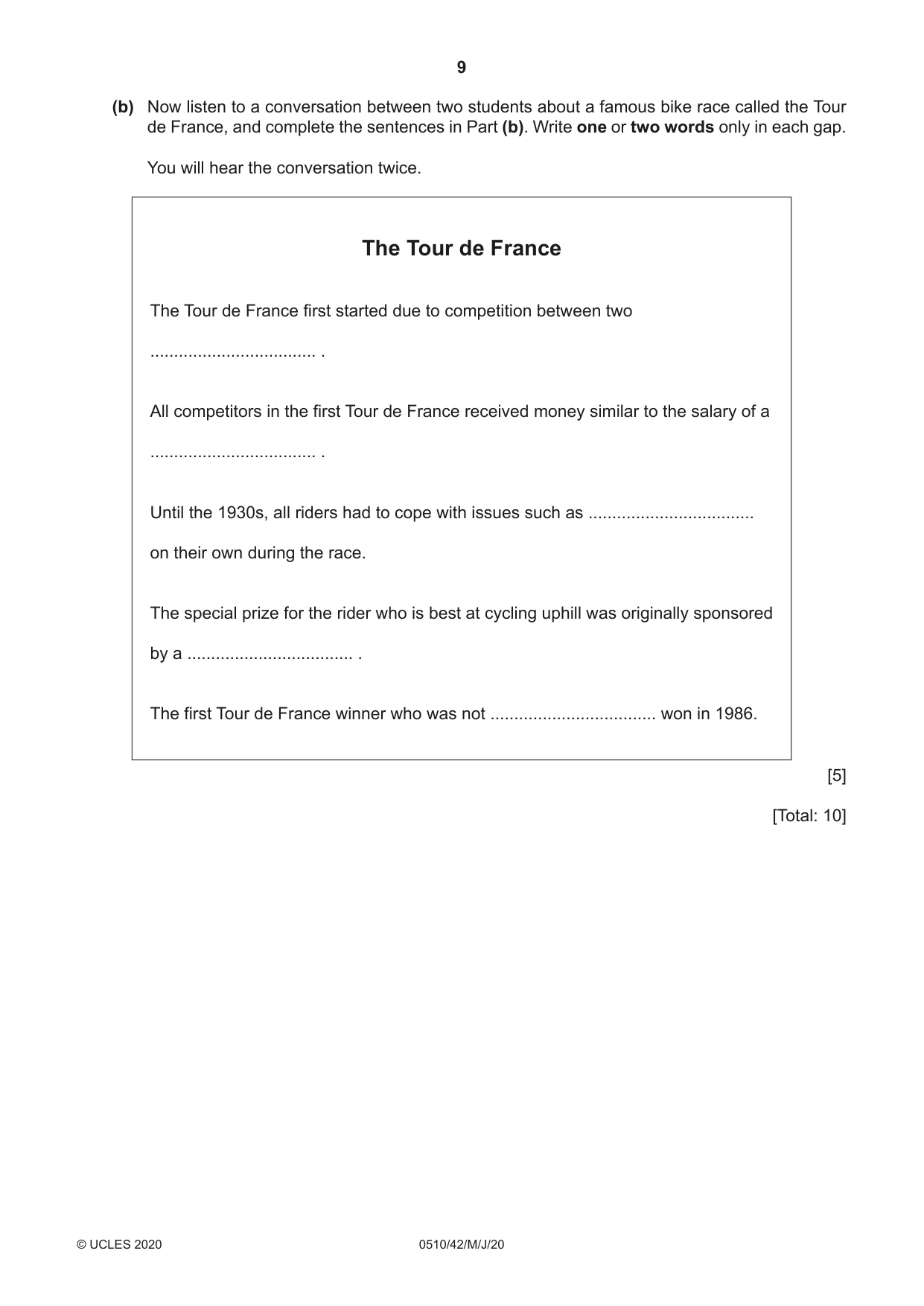
9 0510/42/M/J/20 © UCLES 2020 (b) Now listen to a conversation between two students about a famous bike race called the Tour de France, and complete the sentences in Part (b). Write one or two words only in each gap. You will hear the conversation twice. The Tour de France The Tour de France first started due to competition between two … . All competitors in the first Tour de France received money similar to the salary of a … . Until the 1930s, all riders had to cope with issues such as … on their own during the race. The special prize for the rider who is best at cycling uphill was originally sponsored by a … . The first Tour de France winner who was not … won in 1986. [5] [Total: 10]
Question paper, page 10
10 0510/42/M/J/20 © UCLES 2020 BLANK PAGE
Question paper, page 11
11 0510/42/M/J/20 © UCLES 2020 BLANK PAGE
Question paper, page 12
12 0510/42/M/J/20 © UCLES 2020 Permission to reproduce items where third-party owned material protected by copyright is included has been sought and cleared where possible. Every reasonable effort has been made by the publisher (UCLES) to trace copyright holders, but if any items requiring clearance have unwittingly been included, the publisher will be pleased to make amends at the earliest possible opportunity. To avoid the issue of disclosure of answer-related information to candidates, all copyright acknowledgements are reproduced online in the Cambridge Assessment International Education Copyright Acknowledgements Booklet. This is produced for each series of examinations and is freely available to download at www.cambridgeinternational.org after the live examination series. Cambridge Assessment International Education is part of the Cambridge Assessment Group. Cambridge Assessment is the brand name of the University of Cambridge Local Examinations Syndicate (UCLES), which itself is a department of the University of Cambridge. BLANK PAGE
Mark scheme, page 1
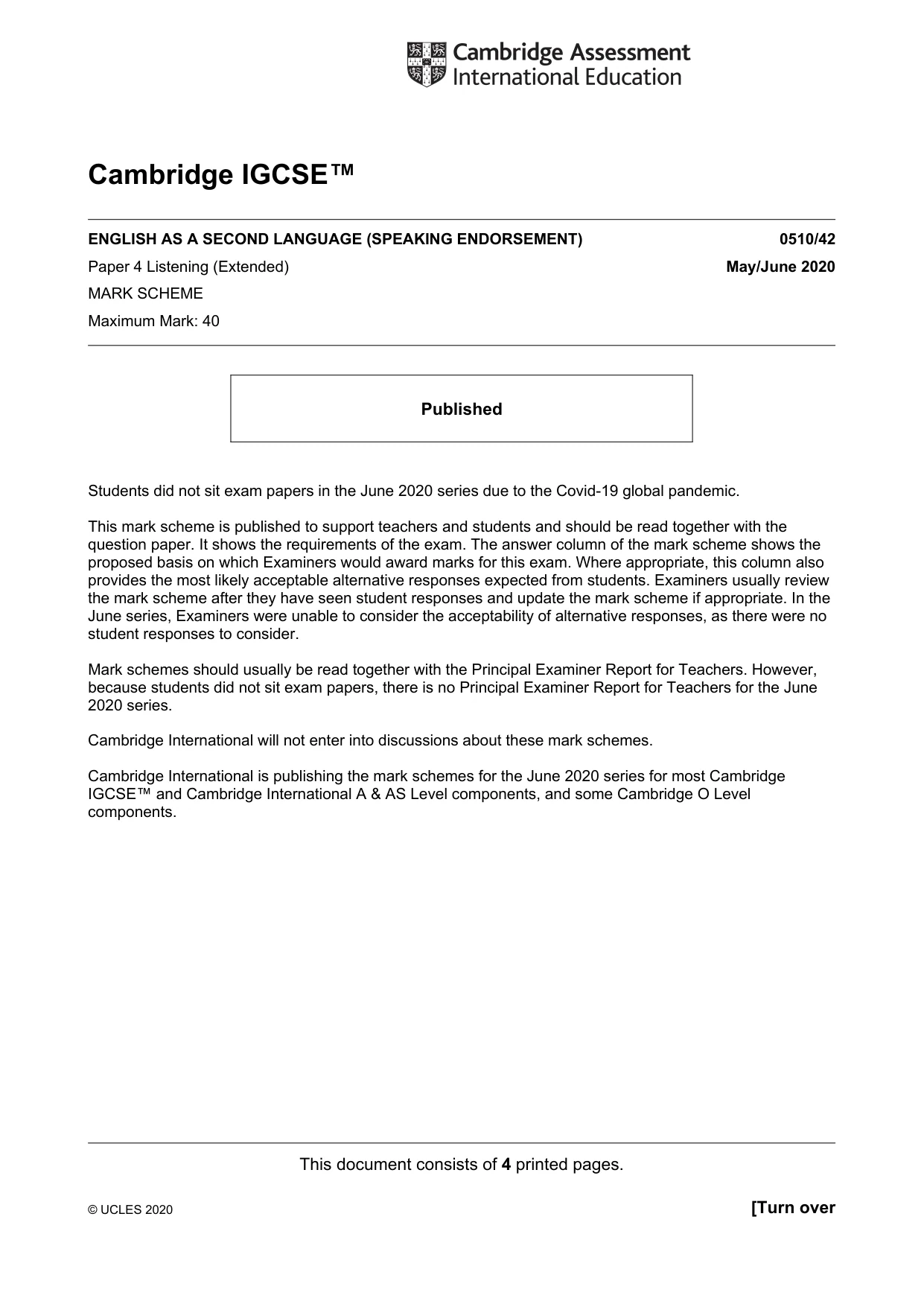
This document consists of 4 printed pages. © UCLES 2020 [Turn over Cambridge IGCSE™ ENGLISH AS A SECOND LANGUAGE (SPEAKING ENDORSEMENT) 0510/42 Paper 4 Listening (Extended) May/June 2020 MARK SCHEME Maximum Mark: 40 Published Students did not sit exam papers in the June 2020 series due to the Covid-19 global pandemic. This mark scheme is published to support teachers and students and should be read together with the question paper. It shows the requirements of the exam. The answer column of the mark scheme shows the proposed basis on which Examiners would award marks for this exam. Where appropriate, this column also provides the most likely acceptable alternative responses expected from students. Examiners usually review the mark scheme after they have seen student responses and update the mark scheme if appropriate. In the June series, Examiners were unable to consider the acceptability of alternative responses, as there were no student responses to consider. Mark schemes should usually be read together with the Principal Examiner Report for Teachers. However, because students did not sit exam papers, there is no Principal Examiner Report for Teachers for the June 2020 series. Cambridge International will not enter into discussions about these mark schemes. Cambridge International is publishing the mark schemes for the June 2020 series for most Cambridge IGCSE™ and Cambridge International A & AS Level components, and some Cambridge O Level components.
Mark scheme, page 2
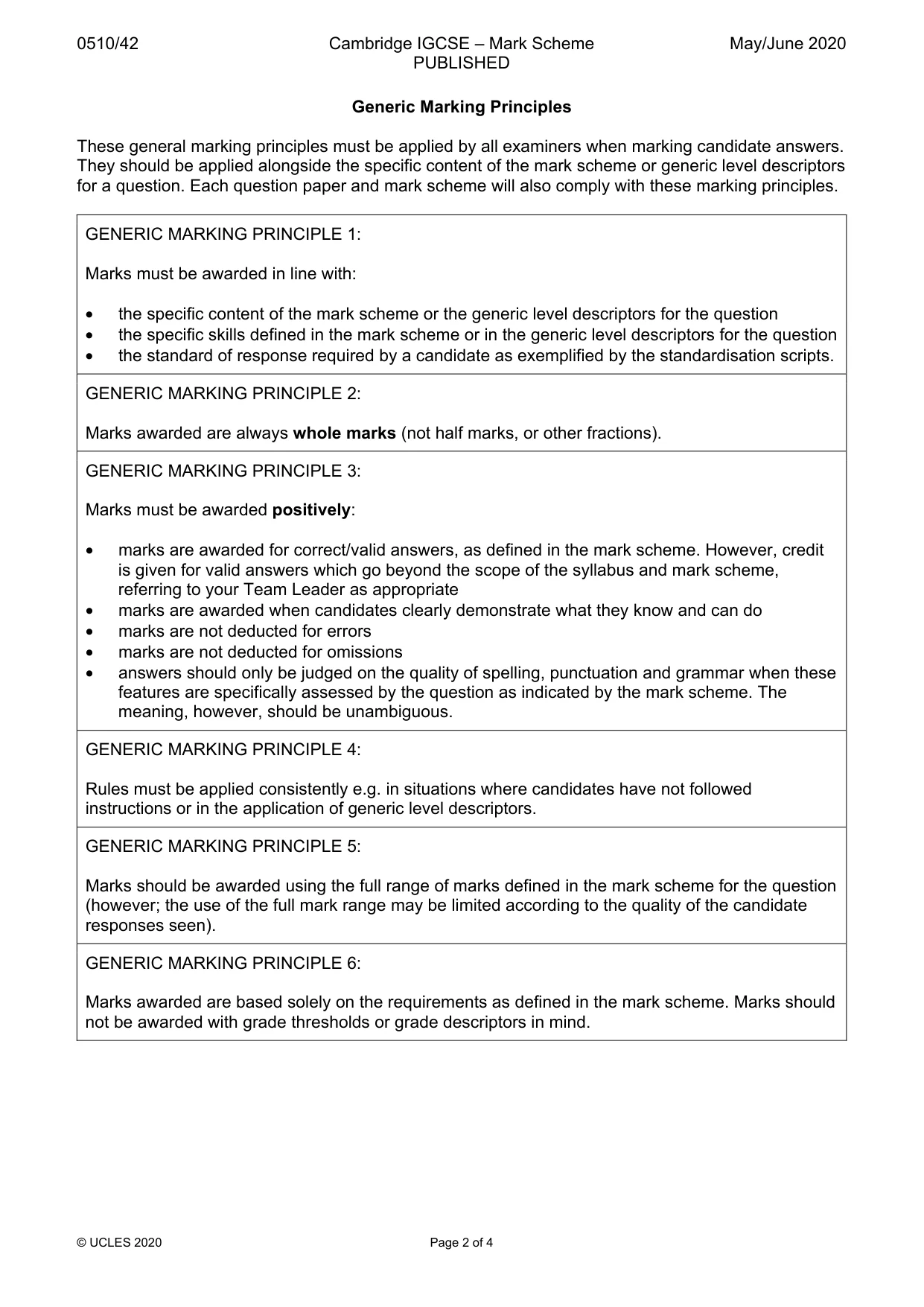
0510/42 Cambridge IGCSE – Mark Scheme PUBLISHED May/June 2020 © UCLES 2020 Page 2 of 4 Generic Marking Principles These general marking principles must be applied by all examiners when marking candidate answers. They should be applied alongside the specific content of the mark scheme or generic level descriptors for a question. Each question paper and mark scheme will also comply with these marking principles. GENERIC MARKING PRINCIPLE 1: Marks must be awarded in line with: • the specific content of the mark scheme or the generic level descriptors for the question • the specific skills defined in the mark scheme or in the generic level descriptors for the question • the standard of response required by a candidate as exemplified by the standardisation scripts. GENERIC MARKING PRINCIPLE 2: Marks awarded are always whole marks (not half marks, or other fractions). GENERIC MARKING PRINCIPLE 3: Marks must be awarded positively: • marks are awarded for correct/valid answers, as defined in the mark scheme. However, credit is given for valid answers which go beyond the scope of the syllabus and mark scheme, referring to your Team Leader as appropriate • marks are awarded when candidates clearly demonstrate what they know and can do • marks are not deducted for errors • marks are not deducted for omissions • answers should only be judged on the quality of spelling, punctuation and grammar when these features are specifically assessed by the question as indicated by the mark scheme. The meaning, however, should be unambiguous. GENERIC MARKING PRINCIPLE 4: Rules must be applied consistently e.g. in situations where candidates have not followed instructions or in the application of generic level descriptors. GENERIC MARKING PRINCIPLE 5: Marks should be awarded using the full range of marks defined in the mark scheme for the question (however; the use of the full mark range may be limited according to the quality of the candidate responses seen). GENERIC MARKING PRINCIPLE 6: Marks awarded are based solely on the requirements as defined in the mark scheme. Marks should not be awarded with grade thresholds or grade descriptors in mind.
Mark scheme, page 3
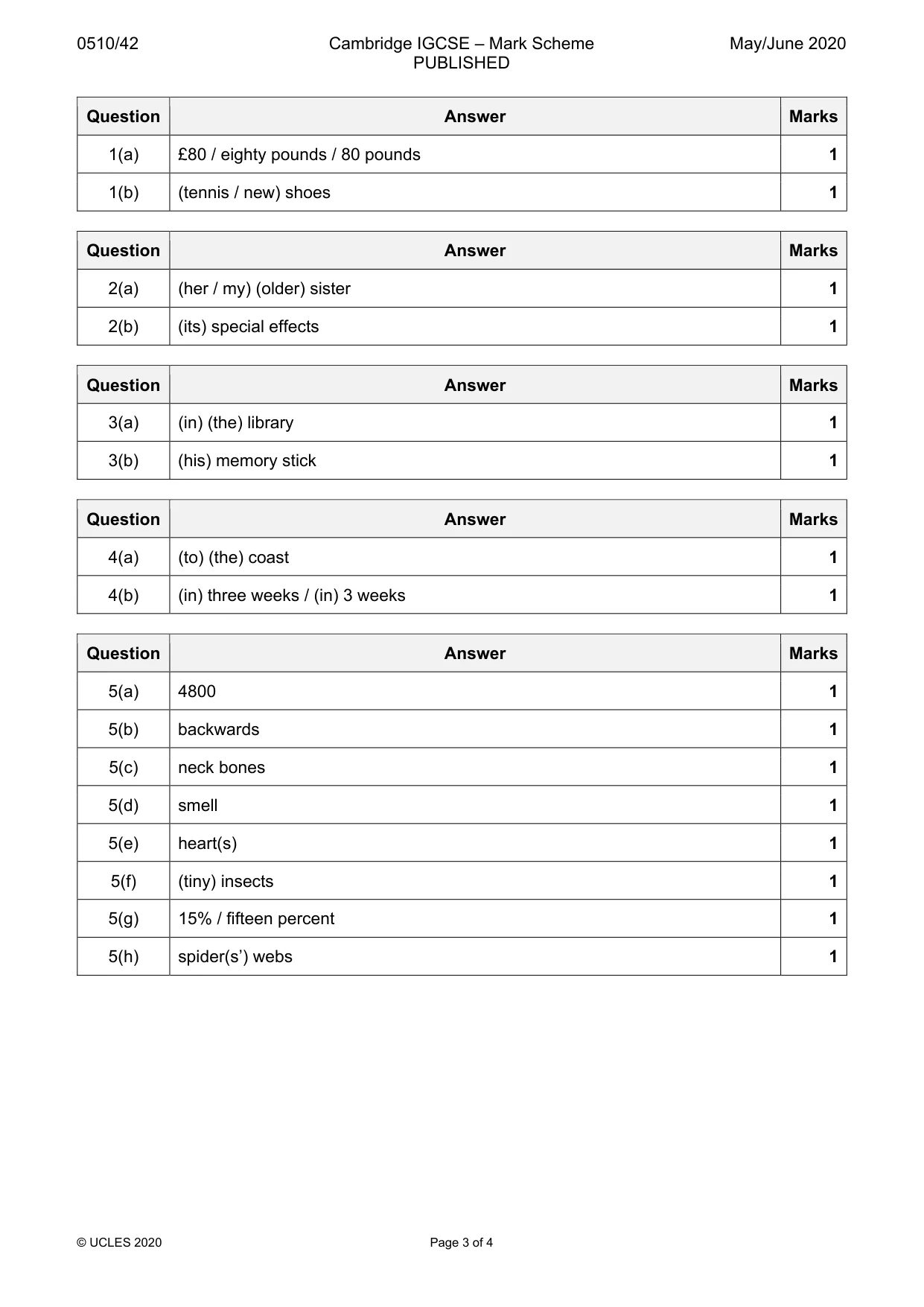
0510/42 Cambridge IGCSE – Mark Scheme PUBLISHED May/June 2020 © UCLES 2020 Page 3 of 4 Question Answer Marks 1(a) £80 / eighty pounds / 80 pounds 1 1(b) (tennis / new) shoes 1 Question Answer Marks 2(a) (her / my) (older) sister 1 2(b) (its) special effects 1 Question Answer Marks 3(a) (in) (the) library 1 3(b) (his) memory stick 1 Question Answer Marks 4(a) (to) (the) coast 1 4(b) (in) three weeks / (in) 3 weeks 1 Question Answer Marks 5(a) 4800 1 5(b) backwards 1 5(c) neck bones 1 5(d) smell 1 5(e) heart(s) 1 5(f) (tiny) insects 1 5(g) 15% / fifteen percent 1 5(h) spider(s’) webs 1
Mark scheme, page 4
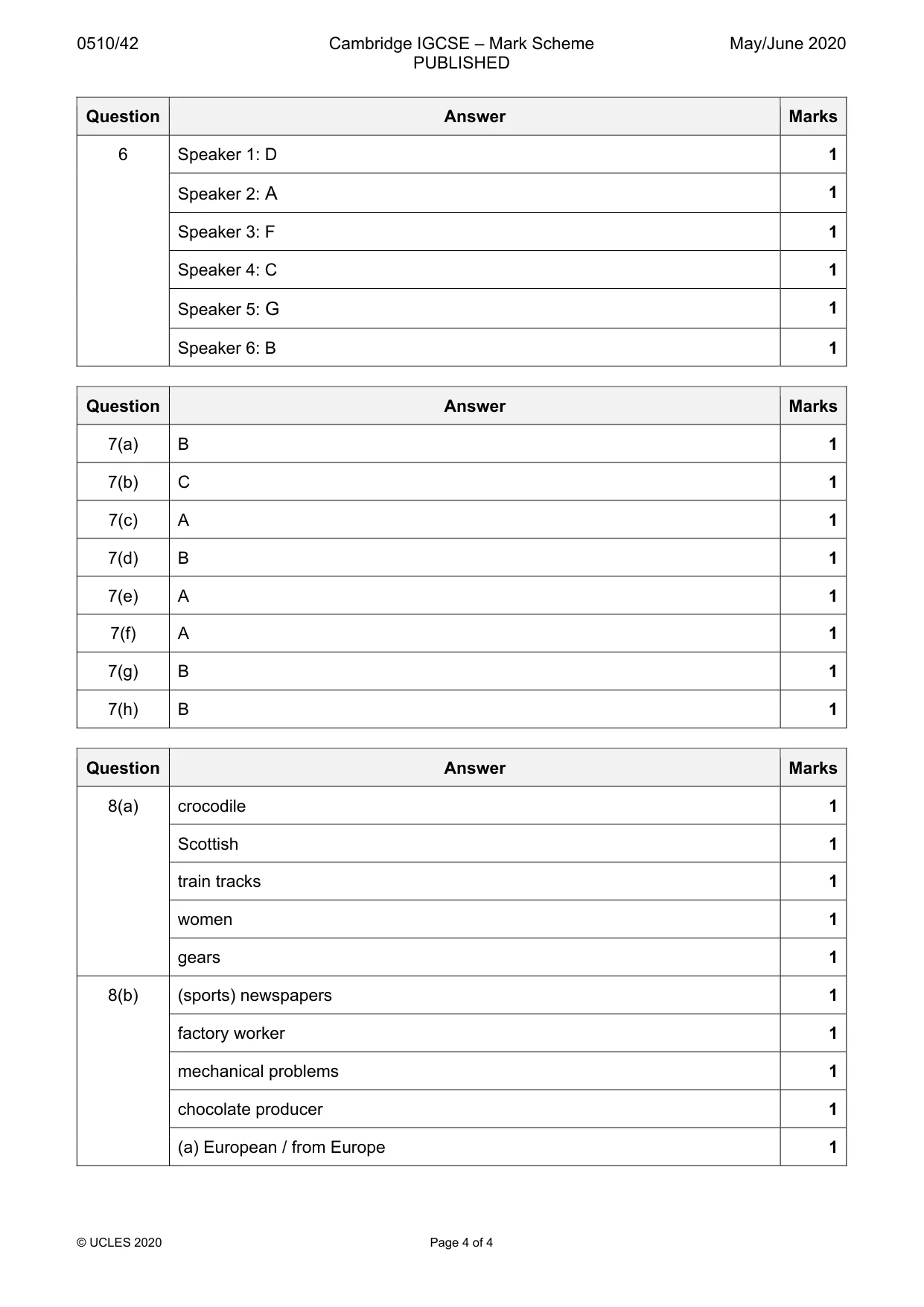
0510/42 Cambridge IGCSE – Mark Scheme PUBLISHED May/June 2020 © UCLES 2020 Page 4 of 4 Question Answer Marks 6 Speaker 1: D 1 Speaker 2: A 1 Speaker 3: F 1 Speaker 4: C 1 Speaker 5: G 1 Speaker 6: B 1 Question Answer Marks 7(a) B 1 7(b) C 1 7(c) A 1 7(d) B 1 7(e) A 1 7(f) A 1 7(g) B 1 7(h) B 1 Question Answer Marks 8(a) crocodile 1 Scottish 1 train tracks 1 women 1 gears 1 8(b) (sports) newspapers 1 factory worker 1 mechanical problems 1 chocolate producer 1 (a) European / from Europe 1