Cambridge IGCSE English - Second Language (oral endorsement) 0510 — 2021 May/June Paper 4 · Variant 1
0510/41/M/J/21 · 40 marks · ≈45 min
The question paper and its mark scheme, free to read here and free to download. This is Cambridge’s own paper, exactly as it was sat.
Question paper12 pages




Mark scheme6 pages
Answers below. Sit the paper first if you are practising.
Paper as text
Question paper, page 1
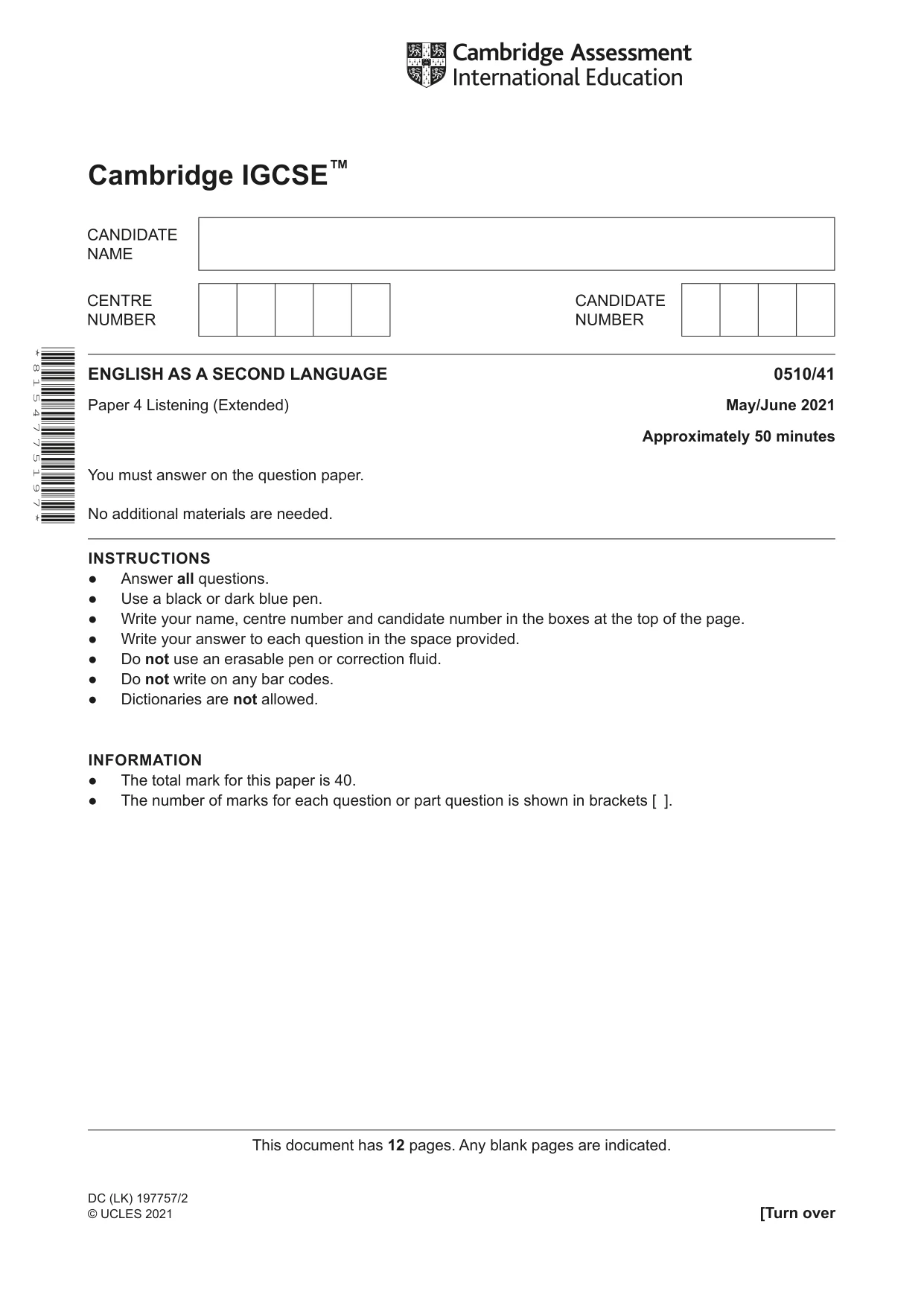
This document has 12 pages. Any blank pages are indicated. Cambridge IGCSE™ DC (LK) 197757/2 © UCLES 2021 [Turn over ENGLISH AS A SECOND LANGUAGE 0510/41 Paper 4 Listening (Extended) May/June 2021 Approximately 50 minutes You must answer on the question paper. No additional materials are needed. INSTRUCTIONS ● Answer all questions. ● Use a black or dark blue pen. ● Write your name, centre number and candidate number in the boxes at the top of the page. ● Write your answer to each question in the space provided. ● Do not use an erasable pen or correction fluid. ● Do not write on any bar codes. ● Dictionaries are not allowed. INFORMATION ● The total mark for this paper is 40. ● The number of marks for each question or part question is shown in brackets [ ]. * 8 1 5 4 7 7 5 1 9 7 *
Question paper, page 2
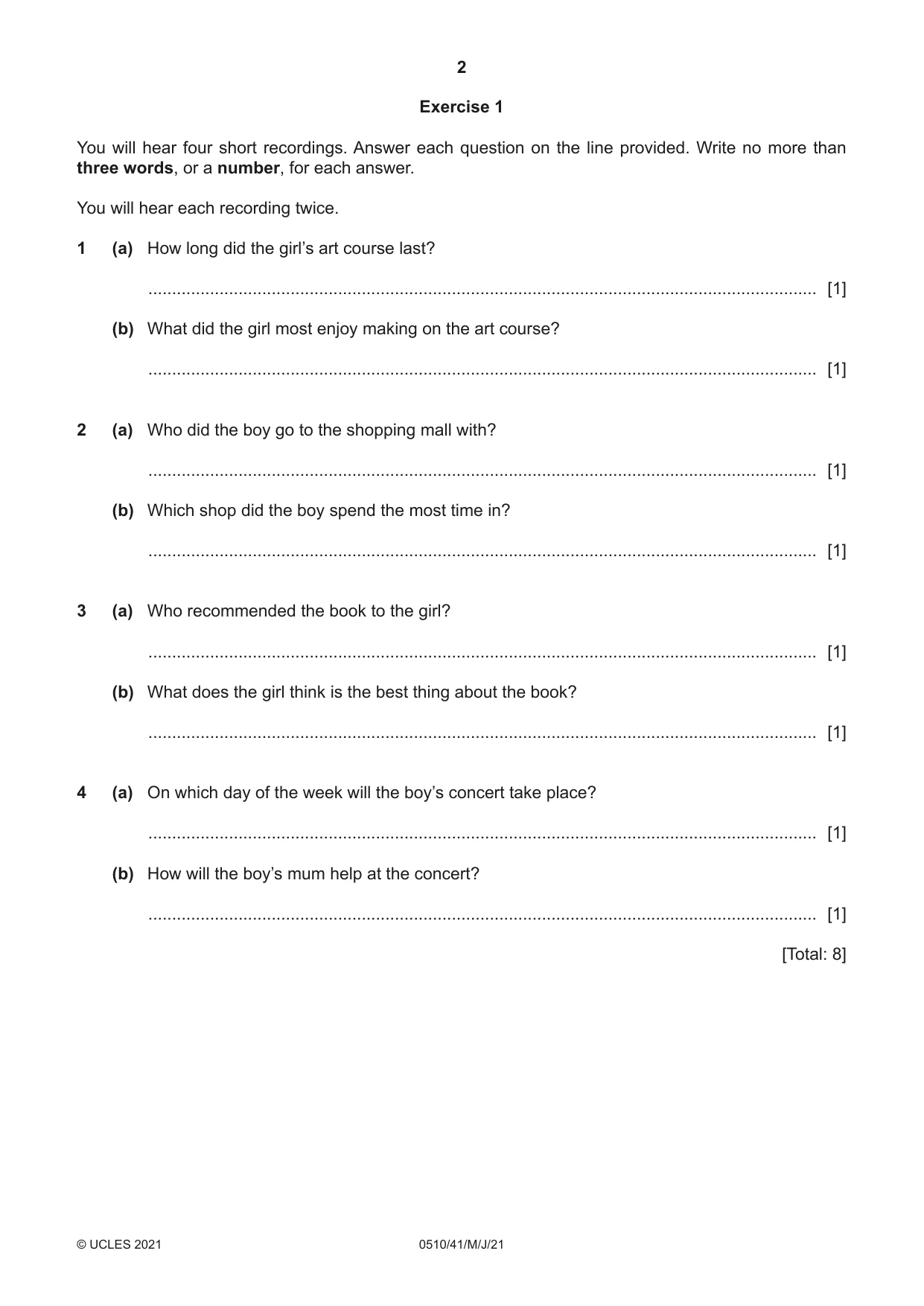
2 0510/41/M/J/21 © UCLES 2021 Exercise 1 You will hear four short recordings. Answer each question on the line provided. Write no more than three words, or a number, for each answer. You will hear each recording twice. 1 (a) How long did the girl’s art course last? … [1] (b) What did the girl most enjoy making on the art course? … [1] 2 (a) Who did the boy go to the shopping mall with? … [1] (b) Which shop did the boy spend the most time in? … [1] 3 (a) Who recommended the book to the girl? … [1] (b) What does the girl think is the best thing about the book? … [1] 4 (a) On which day of the week will the boy’s concert take place? … [1] (b) How will the boy’s mum help at the concert? … [1] [Total: 8]
Question paper, page 3
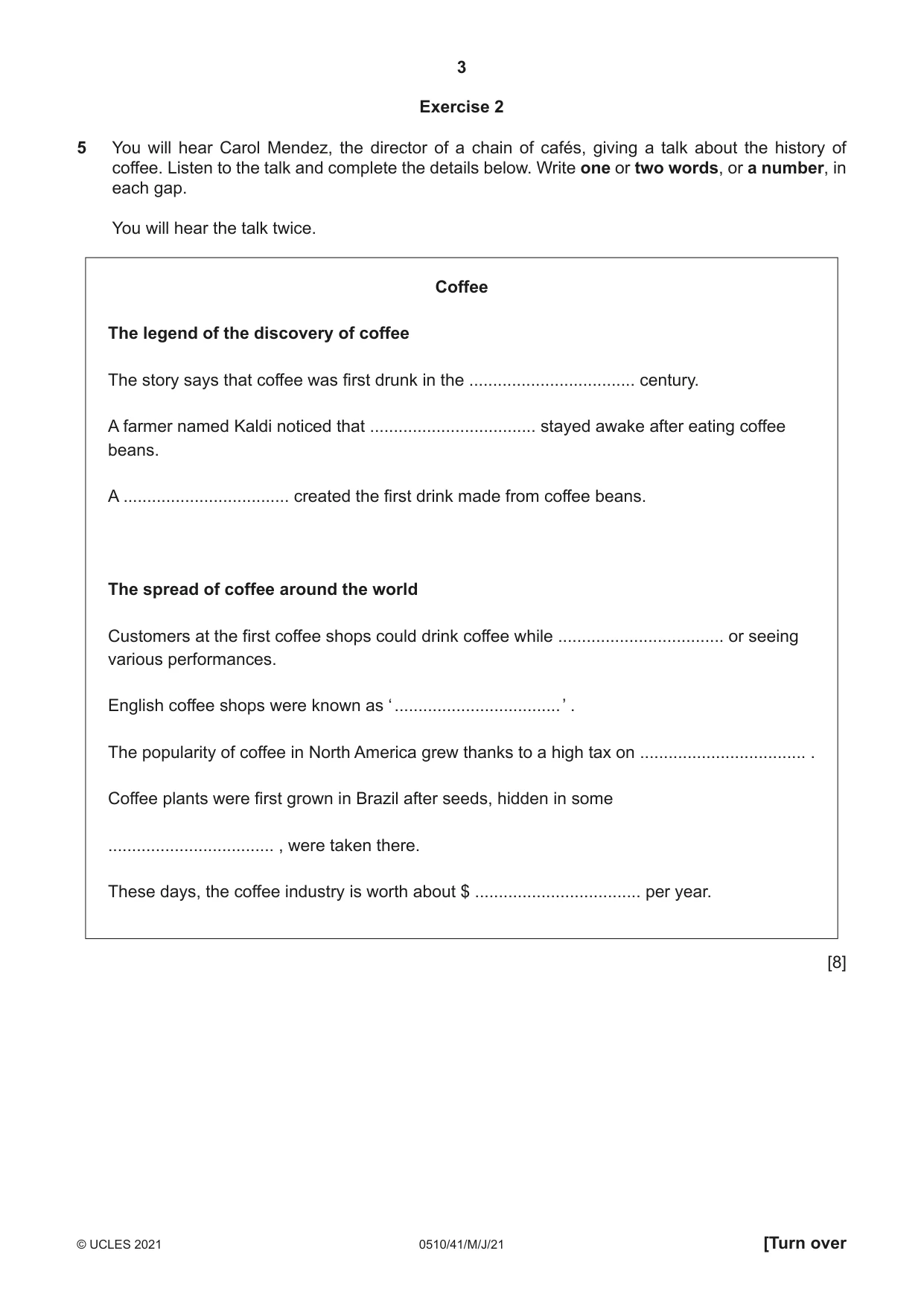
3 0510/41/M/J/21 © UCLES 2021 [Turn over Exercise 2 5 You will hear Carol Mendez, the director of a chain of cafés, giving a talk about the history of coffee. Listen to the talk and complete the details below. Write one or two words, or a number, in each gap. You will hear the talk twice. Coffee The legend of the discovery of coffee The story says that coffee was first drunk in the … century. A farmer named Kaldi noticed that … stayed awake after eating coffee beans. A … created the first drink made from coffee beans. The spread of coffee around the world Customers at the first coffee shops could drink coffee while … or seeing various performances. English coffee shops were known as ‘ … ’ . The popularity of coffee in North America grew thanks to a high tax on … . Coffee plants were first grown in Brazil after seeds, hidden in some … , were taken there. These days, the coffee industry is worth about $ … per year. [8]
Question paper, page 4
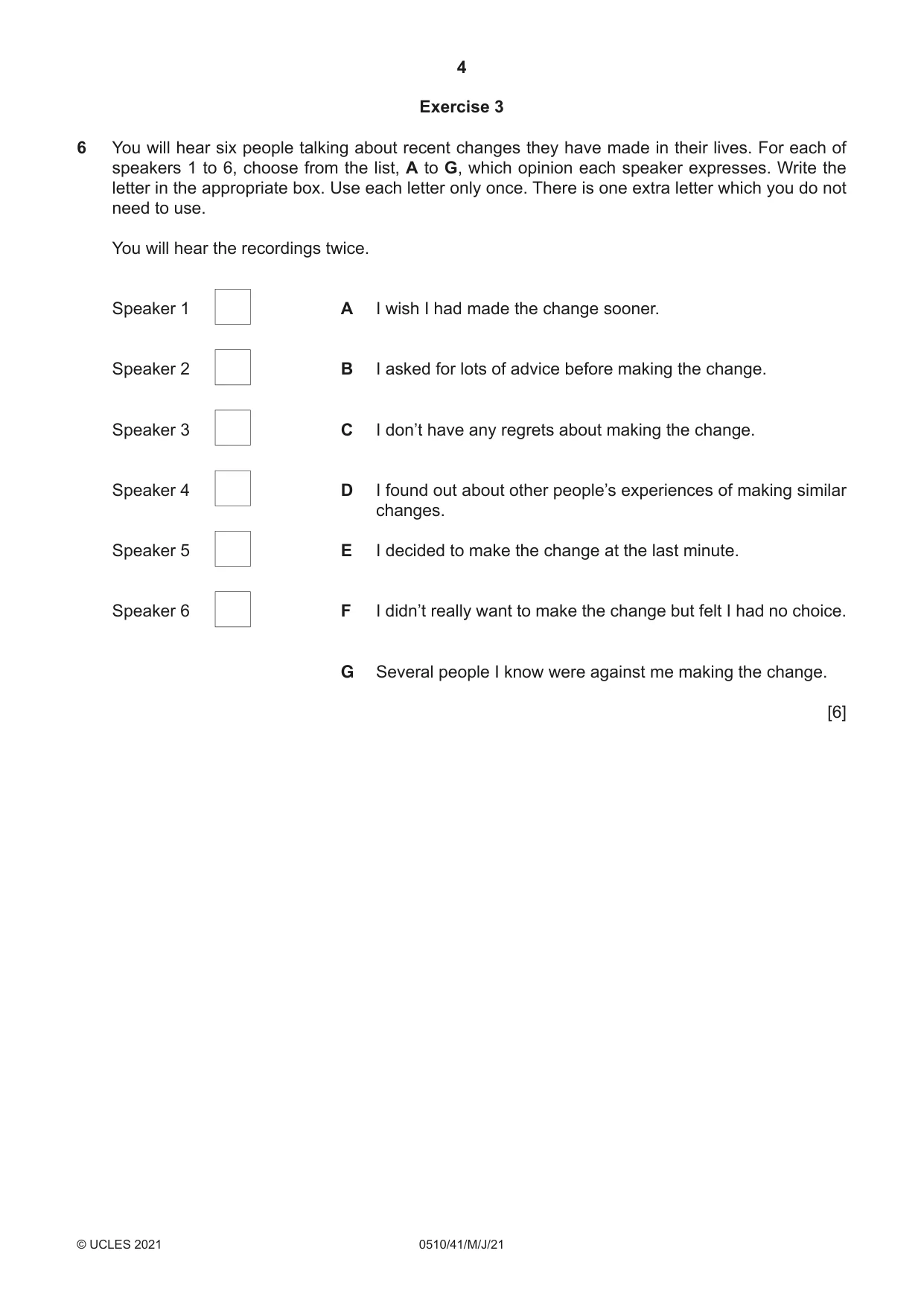
4 0510/41/M/J/21 © UCLES 2021 Exercise 3 6 You will hear six people talking about recent changes they have made in their lives. For each of speakers 1 to 6, choose from the list, A to G, which opinion each speaker expresses. Write the letter in the appropriate box. Use each letter only once. There is one extra letter which you do not need to use. You will hear the recordings twice. Speaker 1 A I wish I had made the change sooner. Speaker 2 B I asked for lots of advice before making the change. Speaker 3 C I don’t have any regrets about making the change. Speaker 4 D I found out about other people’s experiences of making similar changes. Speaker 5 E I decided to make the change at the last minute. Speaker 6 F I didn’t really want to make the change but felt I had no choice. G Several people I know were against me making the change. [6]
Question paper, page 5
5 0510/41/M/J/21 © UCLES 2021 [Turn over Please turn over for Exercise 4.
Question paper, page 6
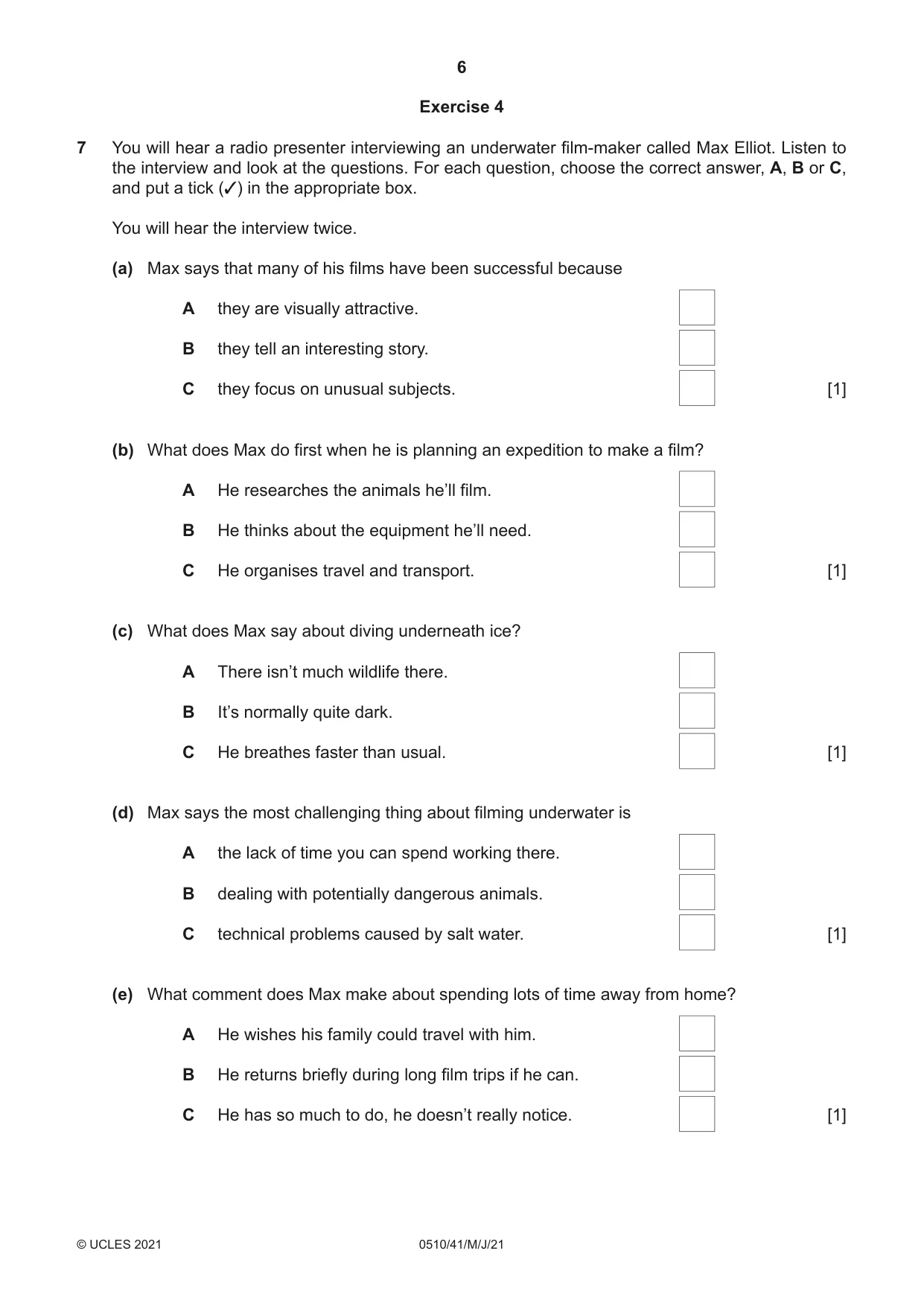
6 0510/41/M/J/21 © UCLES 2021 Exercise 4 7 You will hear a radio presenter interviewing an underwater film-maker called Max Elliot. Listen to the interview and look at the questions. For each question, choose the correct answer, A, B or C, and put a tick (3) in the appropriate box. You will hear the interview twice. (a) Max says that many of his films have been successful because A they are visually attractive. B they tell an interesting story. C they focus on unusual subjects. [1] (b) What does Max do first when he is planning an expedition to make a film? A He researches the animals he’ll film. B He thinks about the equipment he’ll need. C He organises travel and transport. [1] (c) What does Max say about diving underneath ice? A There isn’t much wildlife there. B It’s normally quite dark. C He breathes faster than usual. [1] (d) Max says the most challenging thing about filming underwater is A the lack of time you can spend working there. B dealing with potentially dangerous animals. C technical problems caused by salt water. [1] (e) What comment does Max make about spending lots of time away from home? A He wishes his family could travel with him. B He returns briefly during long film trips if he can. C He has so much to do, he doesn’t really notice. [1]
Question paper, page 7
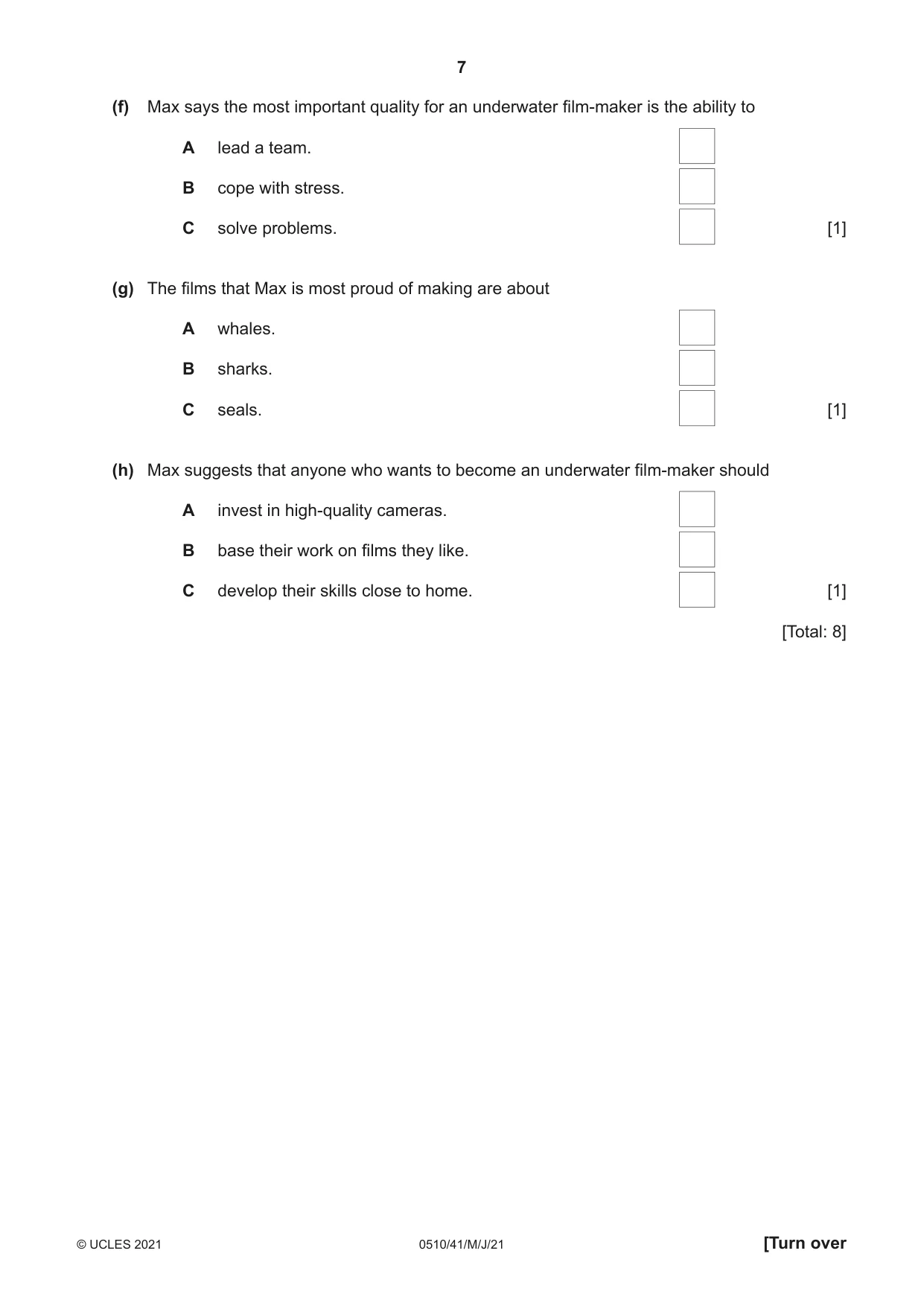
7 0510/41/M/J/21 © UCLES 2021 [Turn over (f) Max says the most important quality for an underwater film-maker is the ability to A lead a team. B cope with stress. C solve problems. [1] (g) The films that Max is most proud of making are about A whales. B sharks. C seals. [1] (h) Max suggests that anyone who wants to become an underwater film-maker should A invest in high-quality cameras. B base their work on films they like. C develop their skills close to home. [1] [Total: 8]
Question paper, page 8
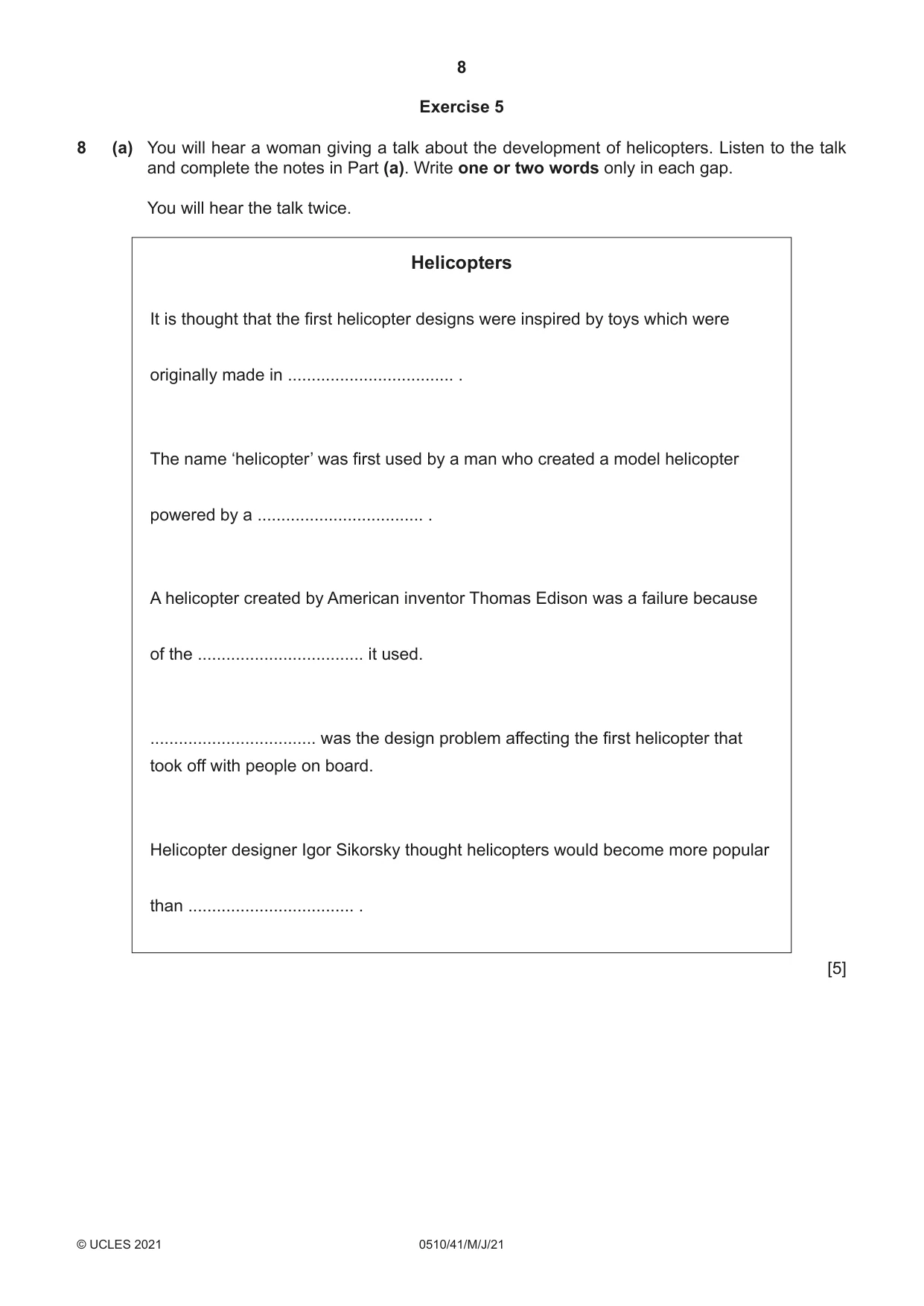
8 0510/41/M/J/21 © UCLES 2021 Exercise 5 8 (a) You will hear a woman giving a talk about the development of helicopters. Listen to the talk and complete the notes in Part (a). Write one or two words only in each gap. You will hear the talk twice. Helicopters It is thought that the first helicopter designs were inspired by toys which were originally made in … . The name ‘helicopter’ was first used by a man who created a model helicopter powered by a … . A helicopter created by American inventor Thomas Edison was a failure because of the … it used. … was the design problem affecting the first helicopter that took off with people on board. Helicopter designer Igor Sikorsky thought helicopters would become more popular than … . [5]
Question paper, page 9
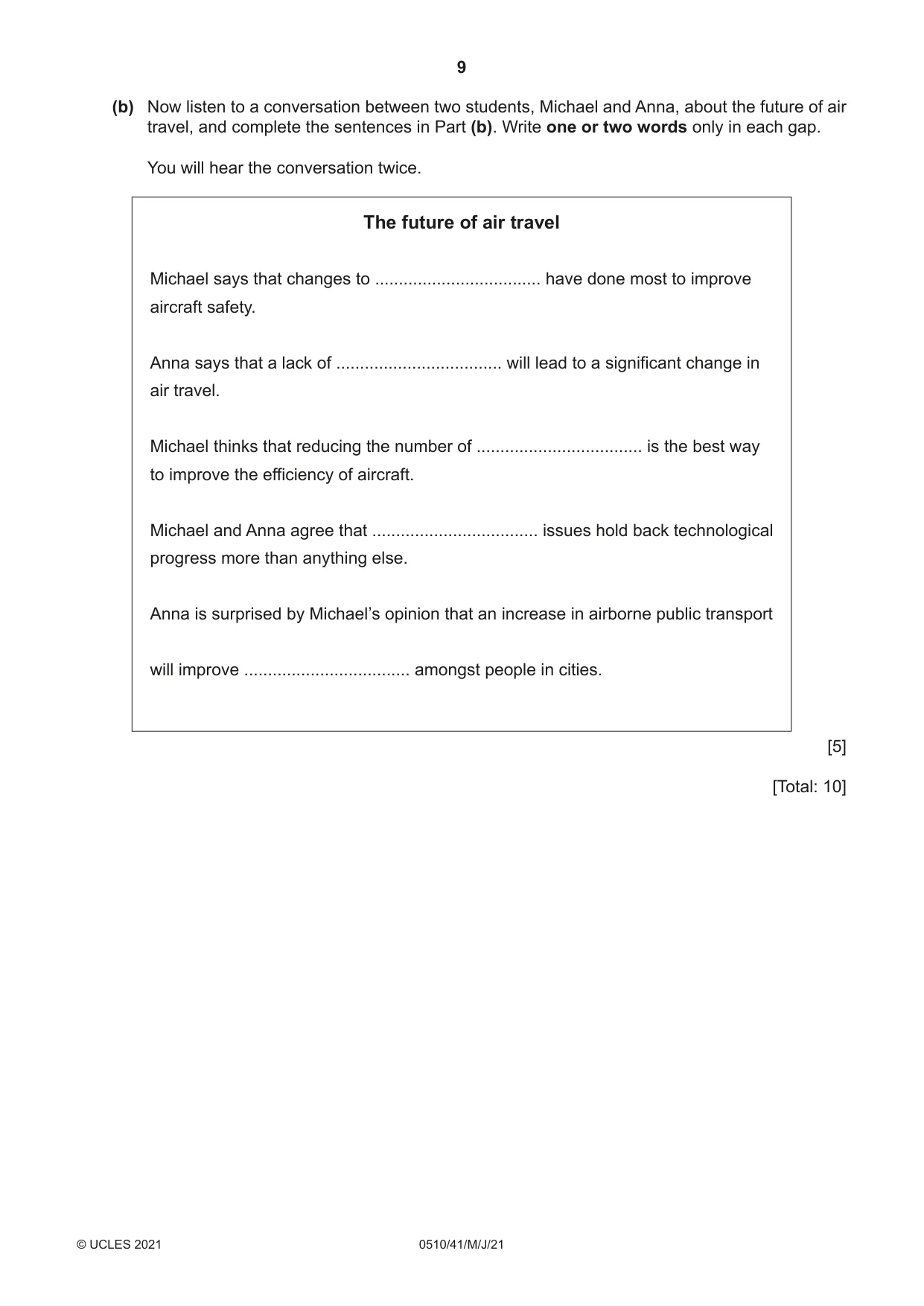
9 0510/41/M/J/21 © UCLES 2021 (b) Now listen to a conversation between two students, Michael and Anna, about the future of air travel, and complete the sentences in Part (b). Write one or two words only in each gap. You will hear the conversation twice. The future of air travel Michael says that changes to … have done most to improve aircraft safety. Anna says that a lack of … will lead to a significant change in air travel. Michael thinks that reducing the number of … is the best way to improve the efficiency of aircraft. Michael and Anna agree that … issues hold back technological progress more than anything else. Anna is surprised by Michael’s opinion that an increase in airborne public transport will improve … amongst people in cities. [5] [Total: 10]
Question paper, page 10
10 0510/41/M/J/21 © UCLES 2021 BLANK PAGE
Question paper, page 11
11 0510/41/M/J/21 © UCLES 2021 BLANK PAGE
Question paper, page 12
12 0510/41/M/J/21 © UCLES 2021 Permission to reproduce items where third-party owned material protected by copyright is included has been sought and cleared where possible. Every reasonable effort has been made by the publisher (UCLES) to trace copyright holders, but if any items requiring clearance have unwittingly been included, the publisher will be pleased to make amends at the earliest possible opportunity. To avoid the issue of disclosure of answer-related information to candidates, all copyright acknowledgements are reproduced online in the Cambridge Assessment International Education Copyright Acknowledgements Booklet. This is produced for each series of examinations and is freely available to download at www.cambridgeinternational.org after the live examination series. Cambridge Assessment International Education is part of the Cambridge Assessment Group. Cambridge Assessment is the brand name of the University of Cambridge Local Examinations Syndicate (UCLES), which itself is a department of the University of Cambridge. BLANK PAGE
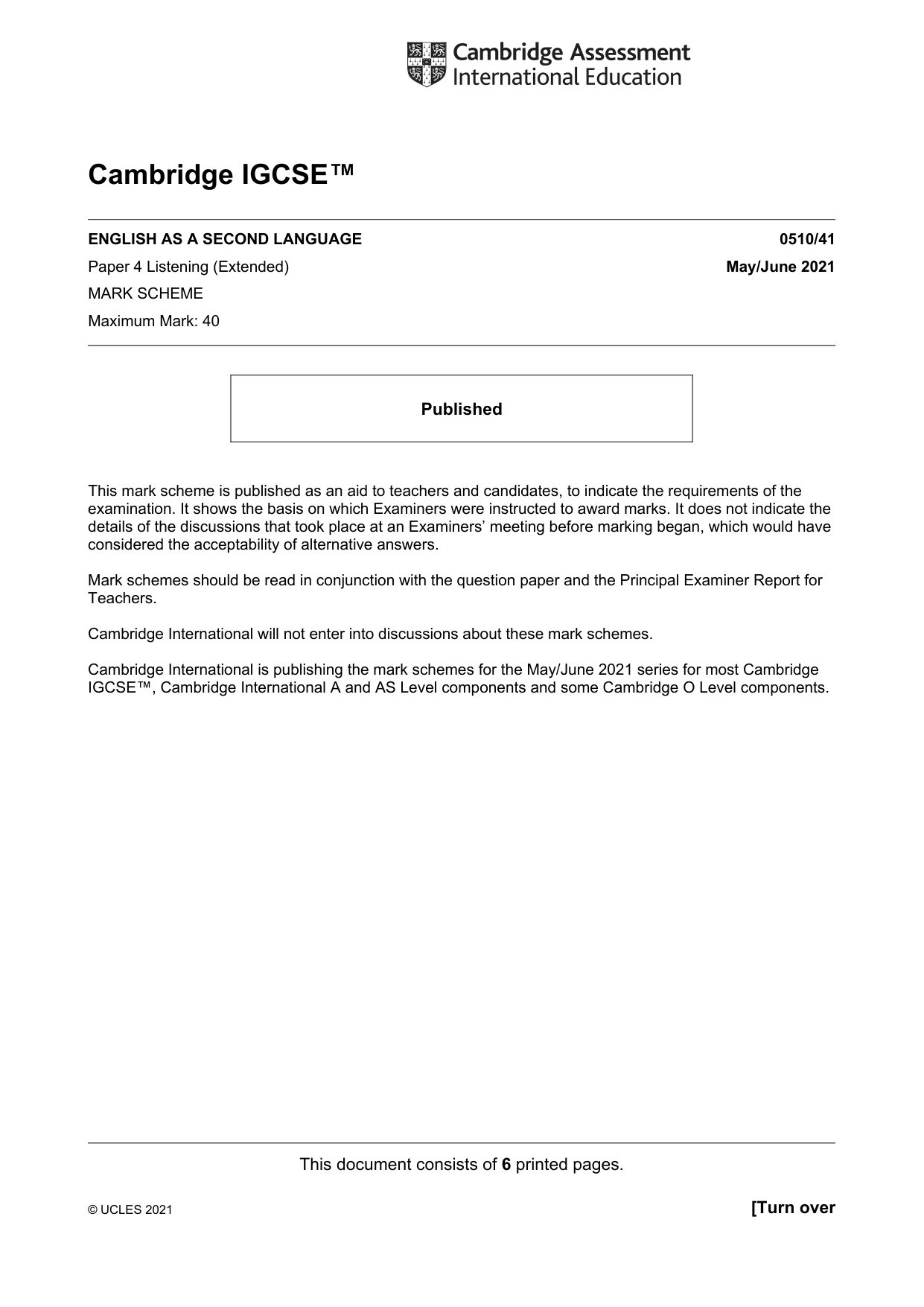
Mark scheme, page 1
This document consists of 6 printed pages. © UCLES 2021 [Turn over Cambridge IGCSE™ ENGLISH AS A SECOND LANGUAGE 0510/41 Paper 4 Listening (Extended) May/June 2021 MARK SCHEME Maximum Mark: 40 Published This mark scheme is published as an aid to teachers and candidates, to indicate the requirements of the examination. It shows the basis on which Examiners were instructed to award marks. It does not indicate the details of the discussions that took place at an Examiners’ meeting before marking began, which would have considered the acceptability of alternative answers. Mark schemes should be read in conjunction with the question paper and the Principal Examiner Report for Teachers. Cambridge International will not enter into discussions about these mark schemes. Cambridge International is publishing the mark schemes for the May/June 2021 series for most Cambridge IGCSE™, Cambridge International A and AS Level components and some Cambridge O Level components.
Mark scheme, page 2
0510/41 Cambridge IGCSE – Mark Scheme PUBLISHED May/June 2021 © UCLES 2021 Page 2 of 6 Generic Marking Principles These general marking principles must be applied by all examiners when marking candidate answers. They should be applied alongside the specific content of the mark scheme or generic level descriptors for a question. Each question paper and mark scheme will also comply with these marking principles. GENERIC MARKING PRINCIPLE 1: Marks must be awarded in line with: • the specific content of the mark scheme or the generic level descriptors for the question • the specific skills defined in the mark scheme or in the generic level descriptors for the question • the standard of response required by a candidate as exemplified by the standardisation scripts. GENERIC MARKING PRINCIPLE 2: Marks awarded are always whole marks (not half marks, or other fractions). GENERIC MARKING PRINCIPLE 3: Marks must be awarded positively: • marks are awarded for correct/valid answers, as defined in the mark scheme. However, credit is given for valid answers which go beyond the scope of the syllabus and mark scheme, referring to your Team Leader as appropriate • marks are awarded when candidates clearly demonstrate what they know and can do • marks are not deducted for errors • marks are not deducted for omissions • answers should only be judged on the quality of spelling, punctuation and grammar when these features are specifically assessed by the question as indicated by the mark scheme. The meaning, however, should be unambiguous. GENERIC MARKING PRINCIPLE 4: Rules must be applied consistently, e.g. in situations where candidates have not followed instructions or in the application of generic level descriptors. GENERIC MARKING PRINCIPLE 5: Marks should be awarded using the full range of marks defined in the mark scheme for the question (however; the use of the full mark range may be limited according to the quality of the candidate responses seen). GENERIC MARKING PRINCIPLE 6: Marks awarded are based solely on the requirements as defined in the mark scheme. Marks should not be awarded with grade thresholds or grade descriptors in mind.
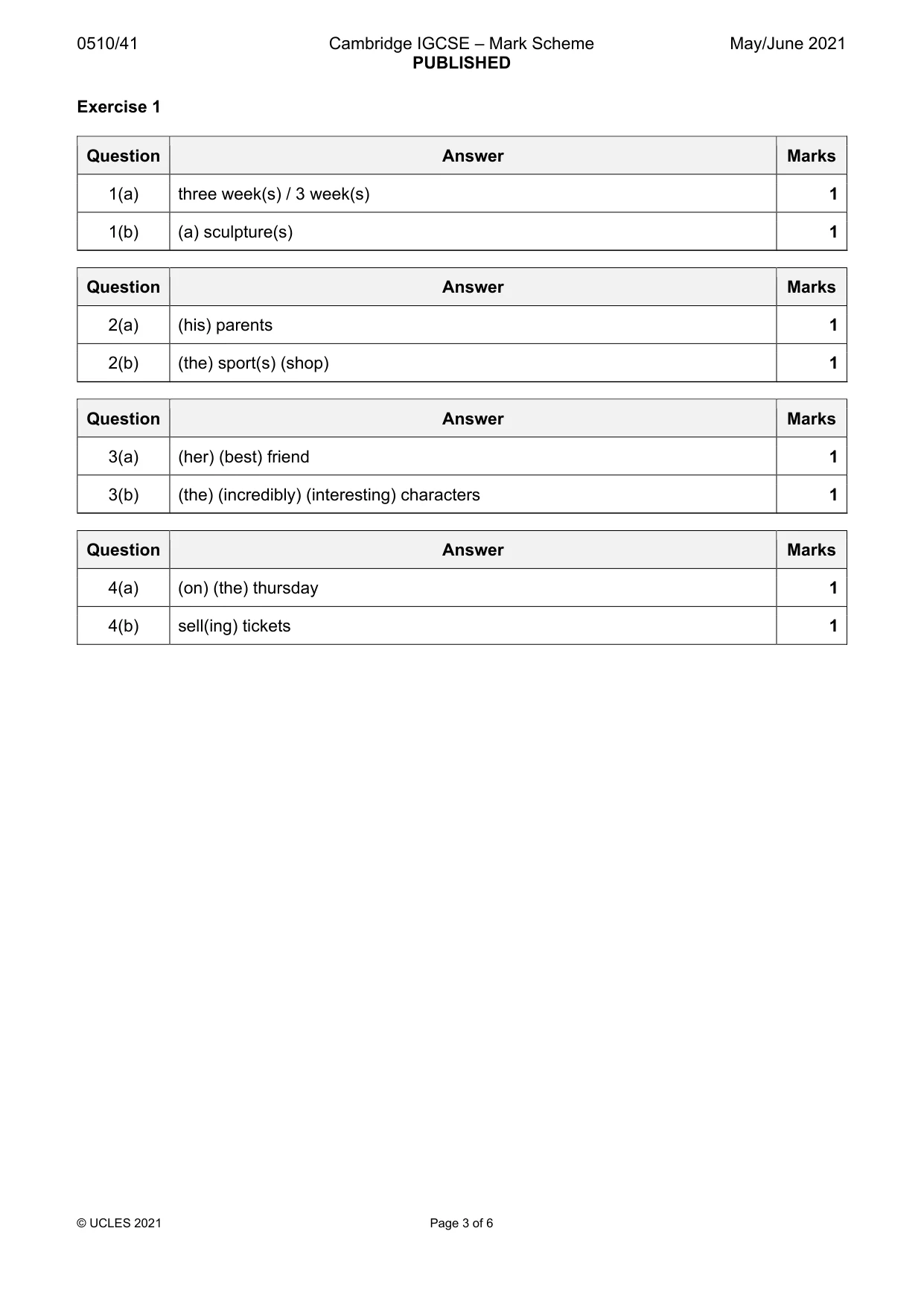
Mark scheme, page 3
0510/41 Cambridge IGCSE – Mark Scheme PUBLISHED May/June 2021 © UCLES 2021 Page 3 of 6 Exercise 1 Question Answer Marks 1(a) three week(s) / 3 week(s) 1 1(b) (a) sculpture(s) 1 Question Answer Marks 2(a) (his) parents 1 2(b) (the) sport(s) (shop) 1 Question Answer Marks 3(a) (her) (best) friend 1 3(b) (the) (incredibly) (interesting) characters 1 Question Answer Marks 4(a) (on) (the) thursday 1 4(b) sell(ing) tickets 1
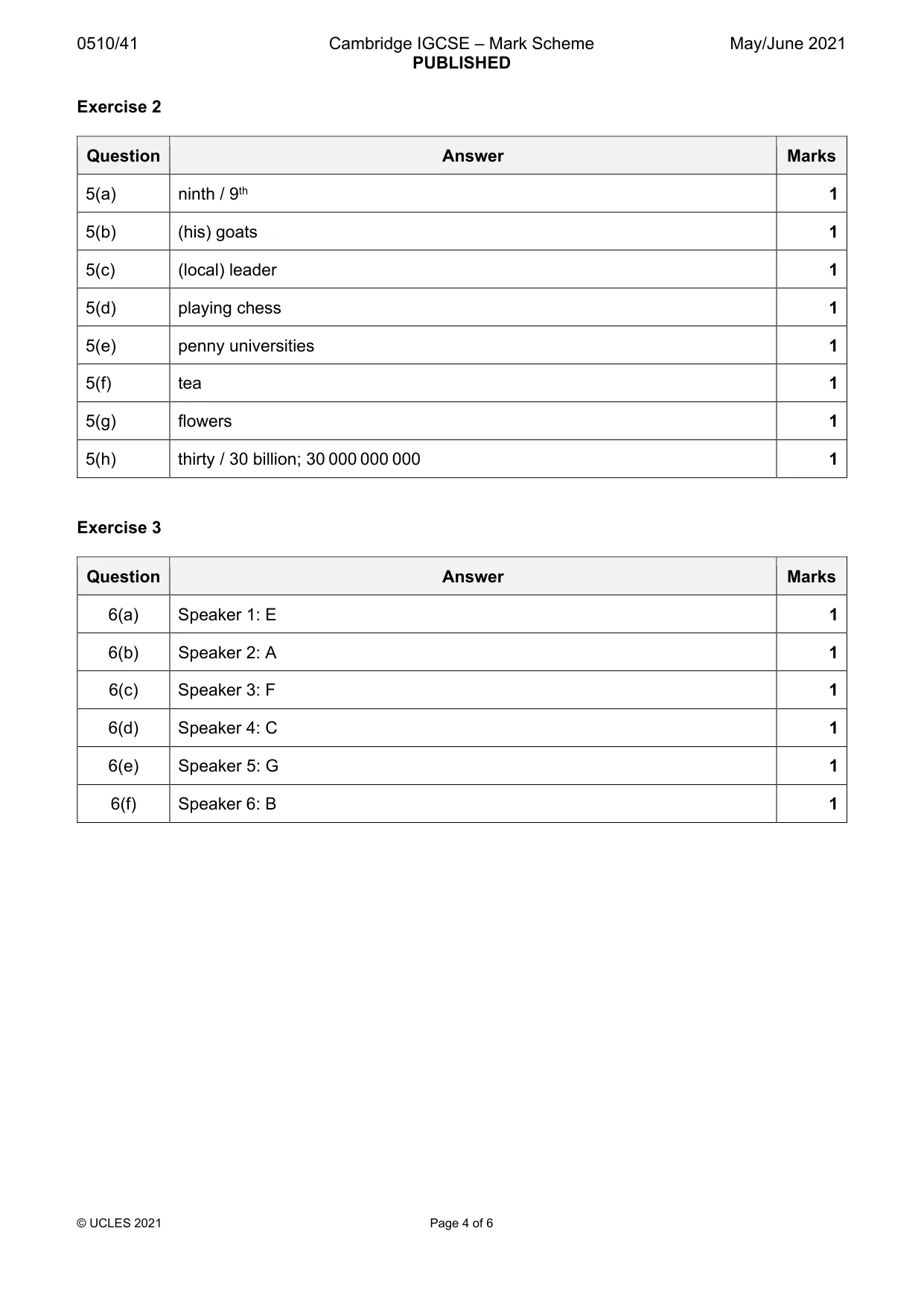
Mark scheme, page 4
0510/41 Cambridge IGCSE – Mark Scheme PUBLISHED May/June 2021 © UCLES 2021 Page 4 of 6 Exercise 2 Question Answer Marks 5(a) ninth / 9th 1 5(b) (his) goats 1 5(c) (local) leader 1 5(d) playing chess 1 5(e) penny universities 1 5(f) tea 1 5(g) flowers 1 5(h) thirty / 30 billion; 30 000 000 000 1 Exercise 3 Question Answer Marks 6(a) Speaker 1: E 1 6(b) Speaker 2: A 1 6(c) Speaker 3: F 1 6(d) Speaker 4: C 1 6(e) Speaker 5: G 1 6(f) Speaker 6: B 1
Mark scheme, page 5
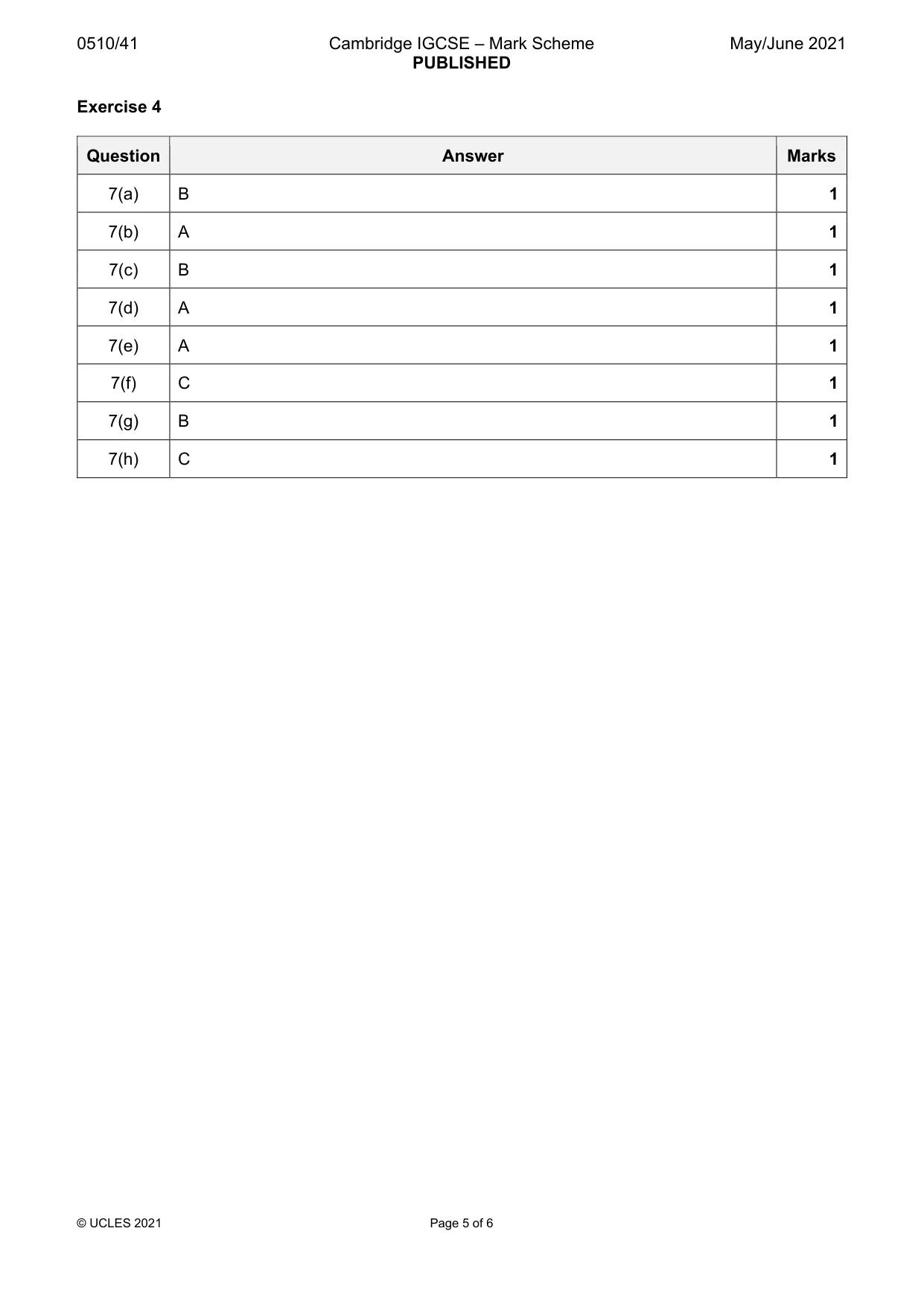
0510/41 Cambridge IGCSE – Mark Scheme PUBLISHED May/June 2021 © UCLES 2021 Page 5 of 6 Exercise 4 Question Answer Marks 7(a) B 1 7(b) A 1 7(c) B 1 7(d) A 1 7(e) A 1 7(f) C 1 7(g) B 1 7(h) C 1
Mark scheme, page 6
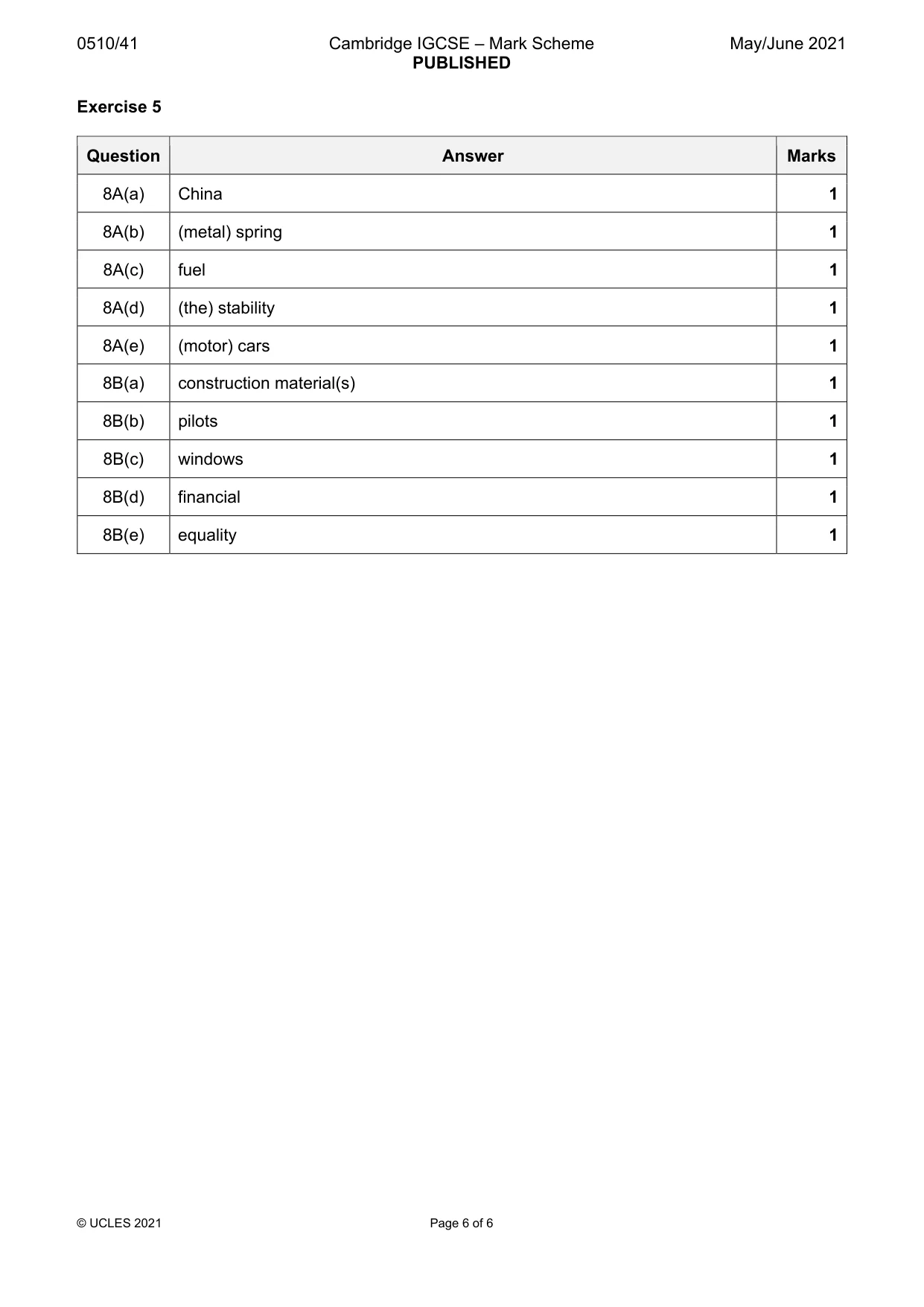
0510/41 Cambridge IGCSE – Mark Scheme PUBLISHED May/June 2021 © UCLES 2021 Page 6 of 6 Exercise 5 Question Answer Marks 8A(a) China 1 8A(b) (metal) spring 1 8A(c) fuel 1 8A(d) (the) stability 1 8A(e) (motor) cars 1 8B(a) construction material(s) 1 8B(b) pilots 1 8B(c) windows 1 8B(d) financial 1 8B(e) equality 1
What you needed in this session
Cambridge’s own grade thresholds for 2021 May/June, Paper 4 · Variant 1. A higher threshold means an easier paper — the bar moves with how the cohort did.