Cambridge IGCSE English - Second Language (oral endorsement) 0510 — 2018 May/June Paper 1 · Variant 3
0510/13/M/J/18 · 70 marks · ≈79 min
The question paper and its mark scheme, free to read here and free to download. This is Cambridge’s own paper, exactly as it was sat.
Question paper16 pages



Mark scheme12 pages
Answers below. Sit the paper first if you are practising.
Paper as text
Question paper, page 1
This document consists of 13 printed pages and 3 blank pages. DC (CE/CGW) 145737/3 © UCLES 2018 [Turn over Cambridge International Examinations Cambridge International General Certificate of Secondary Education * 8 0 6 1 1 9 1 8 6 9 * ENGLISH AS A SECOND LANGUAGE 0510/13 Paper 1 Reading and Writing (Core) May/June 2018 1 hour 30 minutes Candidates answer on the Question Paper. No Additional Materials are required. READ THESE INSTRUCTIONS FIRST Write your Centre number, candidate number and name on all the work you hand in. Write in dark blue or black pen. Do not use staples, paper clips, glue or correction fluid. DO NOT WRITE IN ANY BARCODES. Answer all questions. Dictionaries are not allowed. At the end of the examination, fasten all your work securely together. The number of marks is given in brackets [ ] at the end of each question or part question.
Question paper, page 2
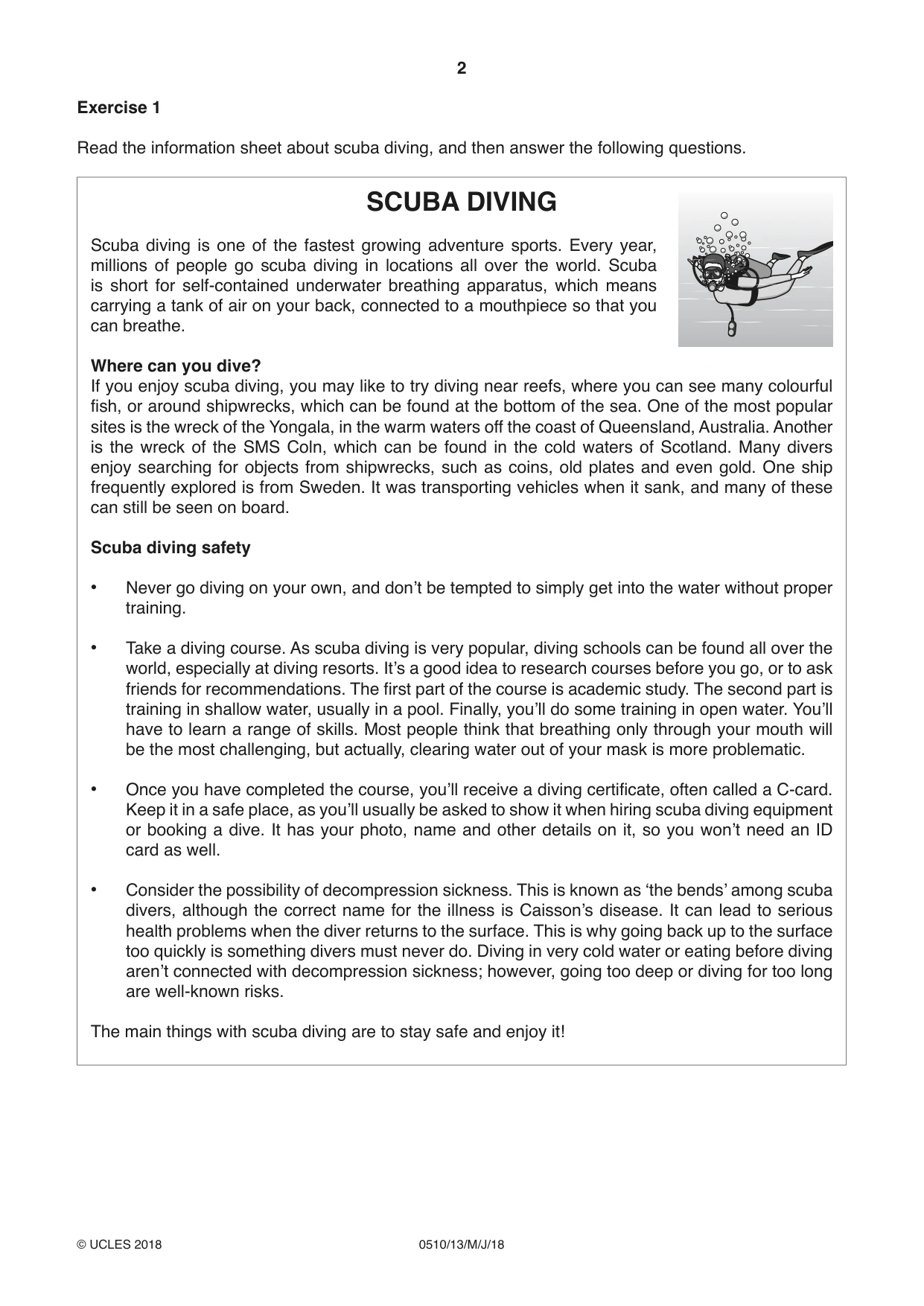
2 0510/13/M/J/18 © UCLES 2018 Exercise 1 Read the information sheet about scuba diving, and then answer the following questions. SCUBA DIVING Scuba diving is one of the fastest growing adventure sports. Every year, millions of people go scuba diving in locations all over the world. Scuba is short for self‑contained underwater breathing apparatus, which means carrying a tank of air on your back, connected to a mouthpiece so that you can breathe. Where can you dive? If you enjoy scuba diving, you may like to try diving near reefs, where you can see many colourful fish, or around shipwrecks, which can be found at the bottom of the sea. One of the most popular sites is the wreck of the Yongala, in the warm waters off the coast of Queensland, Australia. Another is the wreck of the SMS Coln, which can be found in the cold waters of Scotland. Many divers enjoy searching for objects from shipwrecks, such as coins, old plates and even gold. One ship frequently explored is from Sweden. It was transporting vehicles when it sank, and many of these can still be seen on board. Scuba diving safety • Never go diving on your own, and don’t be tempted to simply get into the water without proper training. • Take a diving course. As scuba diving is very popular, diving schools can be found all over the world, especially at diving resorts. It’s a good idea to research courses before you go, or to ask friends for recommendations. The first part of the course is academic study. The second part is training in shallow water, usually in a pool. Finally, you’ll do some training in open water. You’ll have to learn a range of skills. Most people think that breathing only through your mouth will be the most challenging, but actually, clearing water out of your mask is more problematic. • Once you have completed the course, you’ll receive a diving certificate, often called a C-card. Keep it in a safe place, as you’ll usually be asked to show it when hiring scuba diving equipment or booking a dive. It has your photo, name and other details on it, so you won’t need an ID card as well. • Consider the possibility of decompression sickness. This is known as ‘the bends’ among scuba divers, although the correct name for the illness is Caisson’s disease. It can lead to serious health problems when the diver returns to the surface. This is why going back up to the surface too quickly is something divers must never do. Diving in very cold water or eating before diving aren’t connected with decompression sickness; however, going too deep or diving for too long are well‑known risks. The main things with scuba diving are to stay safe and enjoy it!
Question paper, page 3
3 0510/13/M/J/18 © UCLES 2018 [Turn over (a) What do the letters SCUBA stand for? …[1] (b) If you prefer to dive in warmer water, which shipwreck should you visit? …[1] (c) What can divers see on the Swedish shipwreck? …[1] (d) On a diving course, what type of learning takes place before students get into the water? …[1] (e) Which is the most difficult skill to learn on a diving course? …[1] (f) What should you take with you when you book a dive? …[1] (g) What is the medical name for decompression sickness? …[1] [Total: 7]
Question paper, page 4
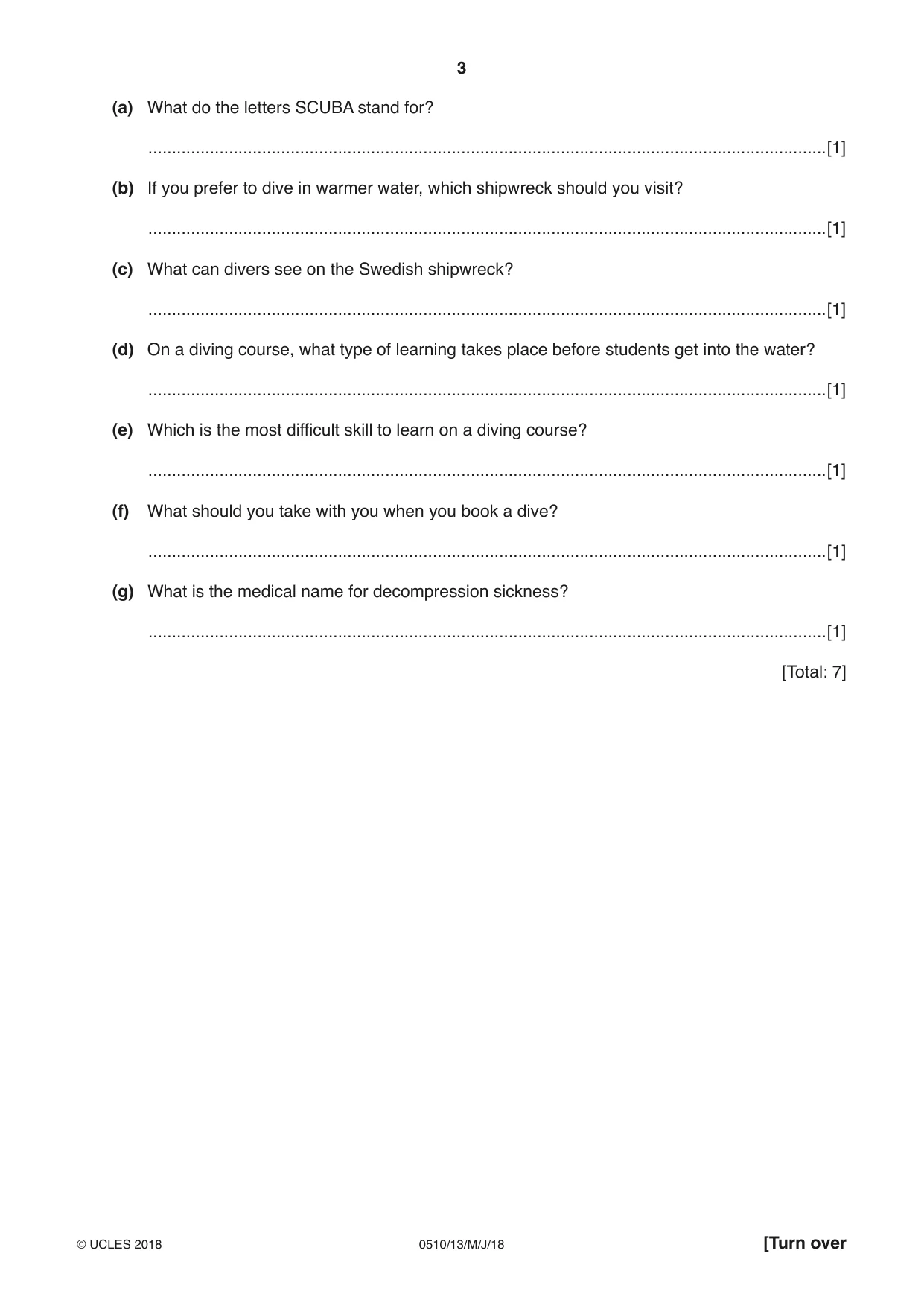
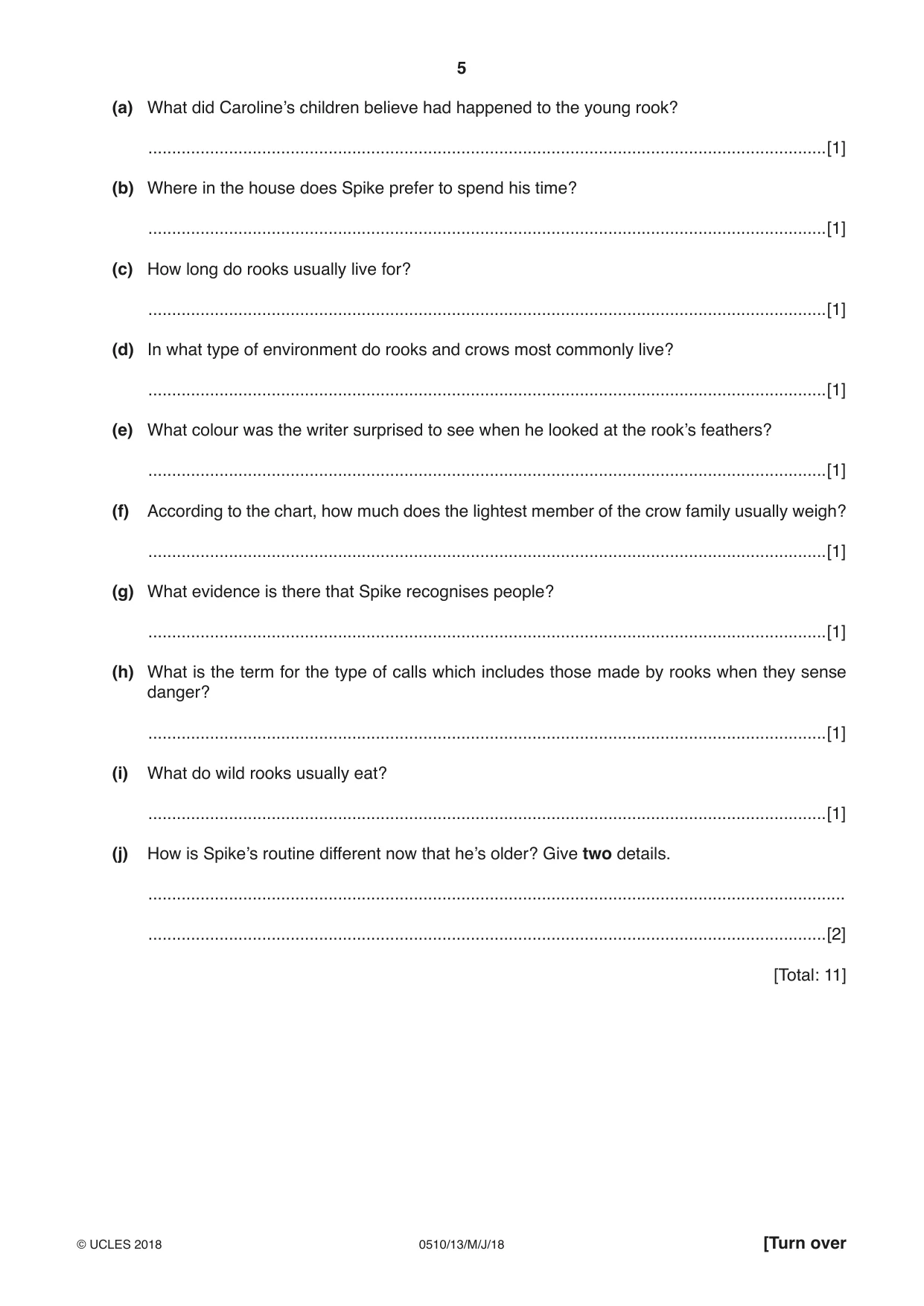
4 0510/13/M/J/18 © UCLES 2018 Exercise 2 Read the article about a woman who has a pet bird, and then answer the following questions. Caroline’s pet rook Caroline Allen, a teacher from England, isn’t unusual in having a pet. However, hers isn’t the usual cat or rabbit, but a rook called Spike. Rooks are black birds, about forty‑five centimetres tall, which can be found all over Europe, America and western Asia. Spike came to Caroline’s family by accident. Her children found the baby bird alone, and they thought its parents had abandoned it. In fact, it was simply learning to fly. However, by the time the children had taken the bird home, it was too late for Caroline to try to return it to its parents. She considered taking it to a wildlife organisation once it was grown up, but when she researched this option, she discovered that returning them to the wild often isn’t successful, so she decided to keep the bird instead. The children named the bird Spike, and made a cage out of wire and wood, with branches to perch on. Despite all the effort that went into making the cage, Caroline says Spike is in it very rarely, choosing instead to sit under her chair in the study. Spike has lived with Caroline for fifteen years now. On average, rooks survive for twenty years, although one rook is known to have lived to be twenty‑two. Rooks and crows are both members of the crow family. Although they can be seen in towns, they are mainly found in the countryside. I sometimes see crows in my local park, and when I was invited to meet Spike recently, I noticed he looked very similar to them. When I mentioned this to Caroline, she admitted it was only after Spike arrived that she found out rooks can be distinguished by the greyish-white skin around their beaks. I’d always assumed that rooks’ feathers were entirely black, but once I was close to Spike, I noticed something unexpected: they actually have a purple shine to them. Rooks are sociable by nature, and Caroline thinks this is why Spike adapted so well to living with her family. Her children have left home now, but whenever they visit their mother’s house, Spike greets them enthusiastically – whereas he completely ignored me! Rooks make a wide range of noises, which can be divided into two main groups – companion calls and context calls. An example of the first is the noise a rook makes in order to be sociable, and the second includes expressing alarm. Caroline didn’t realise that rooks can be taught to say words, although she knew that other birds such as parrots can do so. One thing Caroline has found out about rooks is that they like hiding food. In Spike’s case, this means under rugs, and even between the pages of books. Although Spike prefers human food such as bread with butter, and cheese biscuits, generally a rook’s diet consists of insects and seeds. Remarkably for a bird, Spike doesn’t seem to like being outside much, and he now spends even less time outside than he used to. Even when the door to the garden is open, he doesn’t try to escape. These days, Spike wakes up later than when he was younger. He still starts his morning calls earlier in the spring than in the darker winter days though, and Caroline says that is one of the few things she likes about winter. She once tried covering his cage at night to stop him waking the family, but he panicked, flapping his wings and jumping up and down. She consulted the internet, and discovered that rooks like to be on constant look‑out. Caroline never covered him up again. 1650 1500 1350 1200 1050 900 weight in grams 750 crow jackdaw jay birds of the crow family Average weight of birds in the crow family magpie raven rook 600 450 300 150 0
Question paper, page 5
5 0510/13/M/J/18 © UCLES 2018 [Turn over (a) What did Caroline’s children believe had happened to the young rook? …[1] (b) Where in the house does Spike prefer to spend his time? …[1] (c) How long do rooks usually live for? …[1] (d) In what type of environment do rooks and crows most commonly live? …[1] (e) What colour was the writer surprised to see when he looked at the rook’s feathers? …[1] (f) According to the chart, how much does the lightest member of the crow family usually weigh? …[1] (g) What evidence is there that Spike recognises people? …[1] (h) What is the term for the type of calls which includes those made by rooks when they sense danger? …[1] (i) What do wild rooks usually eat? …[1] (j) How is Spike’s routine different now that he’s older? Give two details. … …[2] [Total: 11]
Question paper, page 6
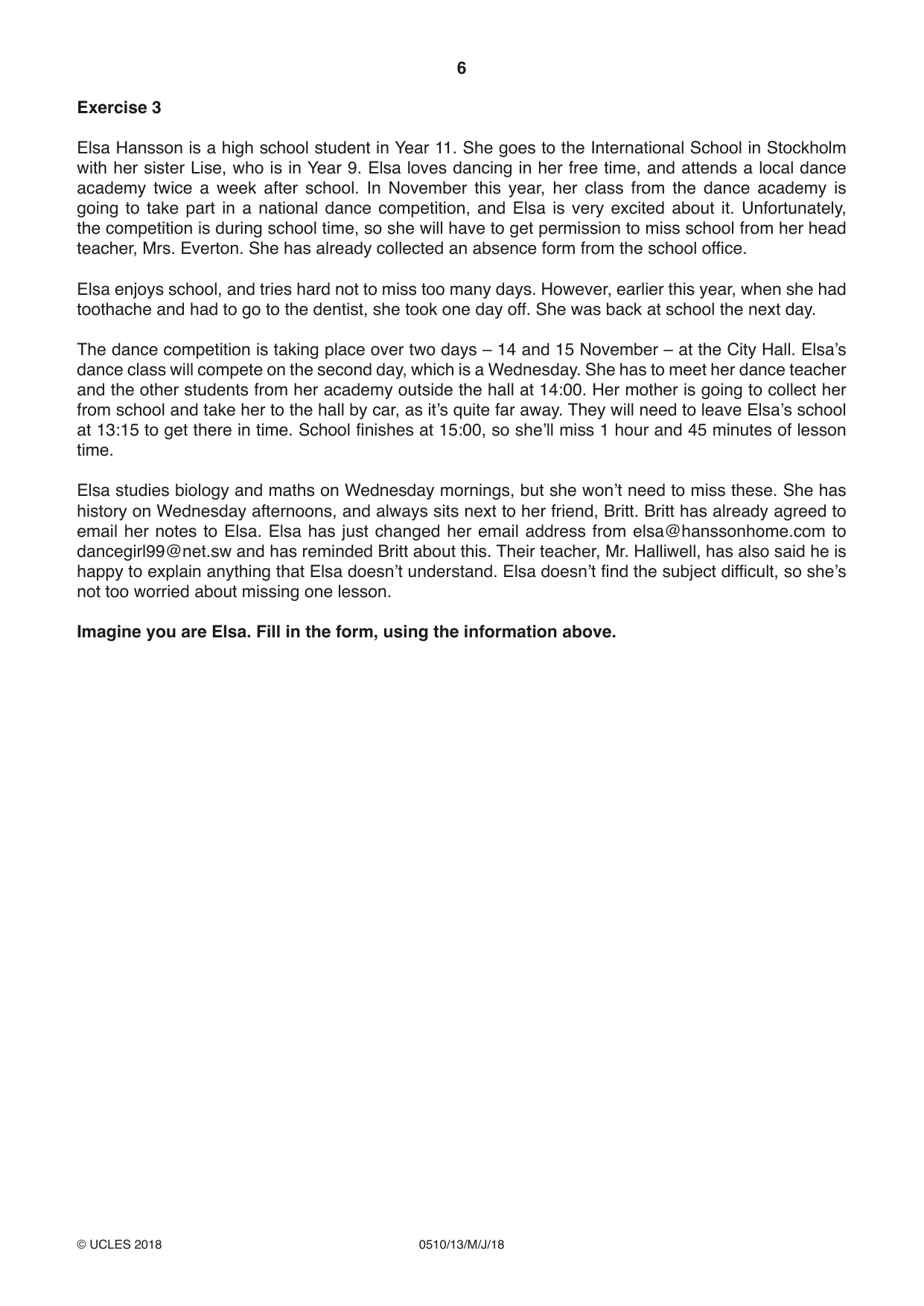
6 0510/13/M/J/18 © UCLES 2018 Exercise 3 Elsa Hansson is a high school student in Year 11. She goes to the International School in Stockholm with her sister Lise, who is in Year 9. Elsa loves dancing in her free time, and attends a local dance academy twice a week after school. In November this year, her class from the dance academy is going to take part in a national dance competition, and Elsa is very excited about it. Unfortunately, the competition is during school time, so she will have to get permission to miss school from her head teacher, Mrs. Everton. She has already collected an absence form from the school office. Elsa enjoys school, and tries hard not to miss too many days. However, earlier this year, when she had toothache and had to go to the dentist, she took one day off. She was back at school the next day. The dance competition is taking place over two days – 14 and 15 November – at the City Hall. Elsa’s dance class will compete on the second day, which is a Wednesday. She has to meet her dance teacher and the other students from her academy outside the hall at 14:00. Her mother is going to collect her from school and take her to the hall by car, as it’s quite far away. They will need to leave Elsa’s school at 13:15 to get there in time. School finishes at 15:00, so she’ll miss 1 hour and 45 minutes of lesson time. Elsa studies biology and maths on Wednesday mornings, but she won’t need to miss these. She has history on Wednesday afternoons, and always sits next to her friend, Britt. Britt has already agreed to email her notes to Elsa. Elsa has just changed her email address from elsa@hanssonhome.com to dancegirl99@net.sw and has reminded Britt about this. Their teacher, Mr. Halliwell, has also said he is happy to explain anything that Elsa doesn’t understand. Elsa doesn’t find the subject difficult, so she’s not too worried about missing one lesson. Imagine you are Elsa. Fill in the form, using the information above.
Question paper, page 7
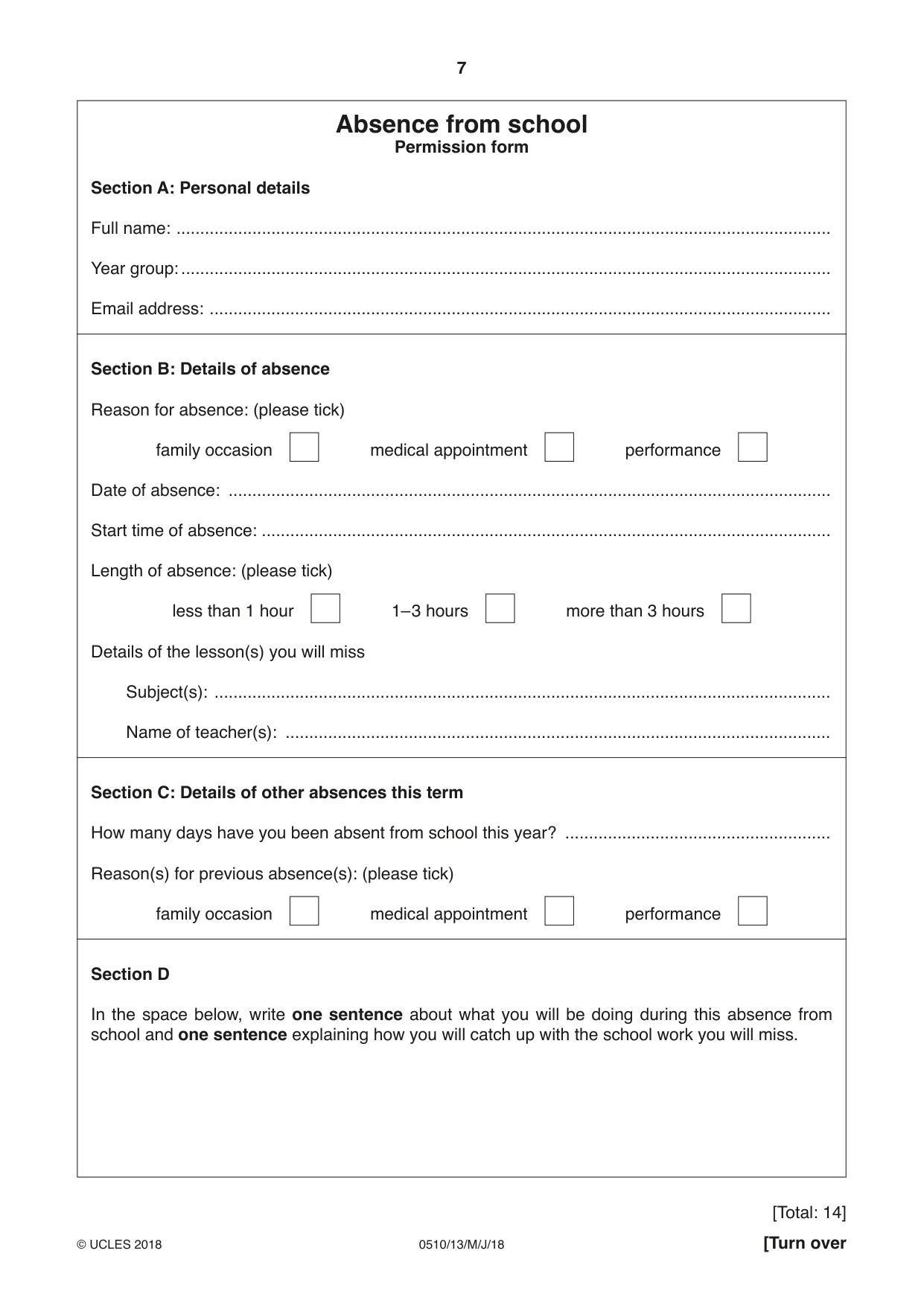
7 0510/13/M/J/18 © UCLES 2018 [Turn over Absence from school Permission form Section A: Personal details Full name: … Year group: … Email address: … Section B: Details of absence Reason for absence: (please tick) family occasion medical appointment performance Date of absence: … Start time of absence: … Length of absence: (please tick) less than 1 hour 1– 3 hours more than 3 hours Details of the lesson(s) you will miss Subject(s): … Name of teacher(s): … Section C: Details of other absences this term How many days have you been absent from school this year? … Reason(s) for previous absence(s): (please tick) family occasion medical appointment performance Section D In the space below, write one sentence about what you will be doing during this absence from school and one sentence explaining how you will catch up with the school work you will miss. [Total: 14]
Question paper, page 8
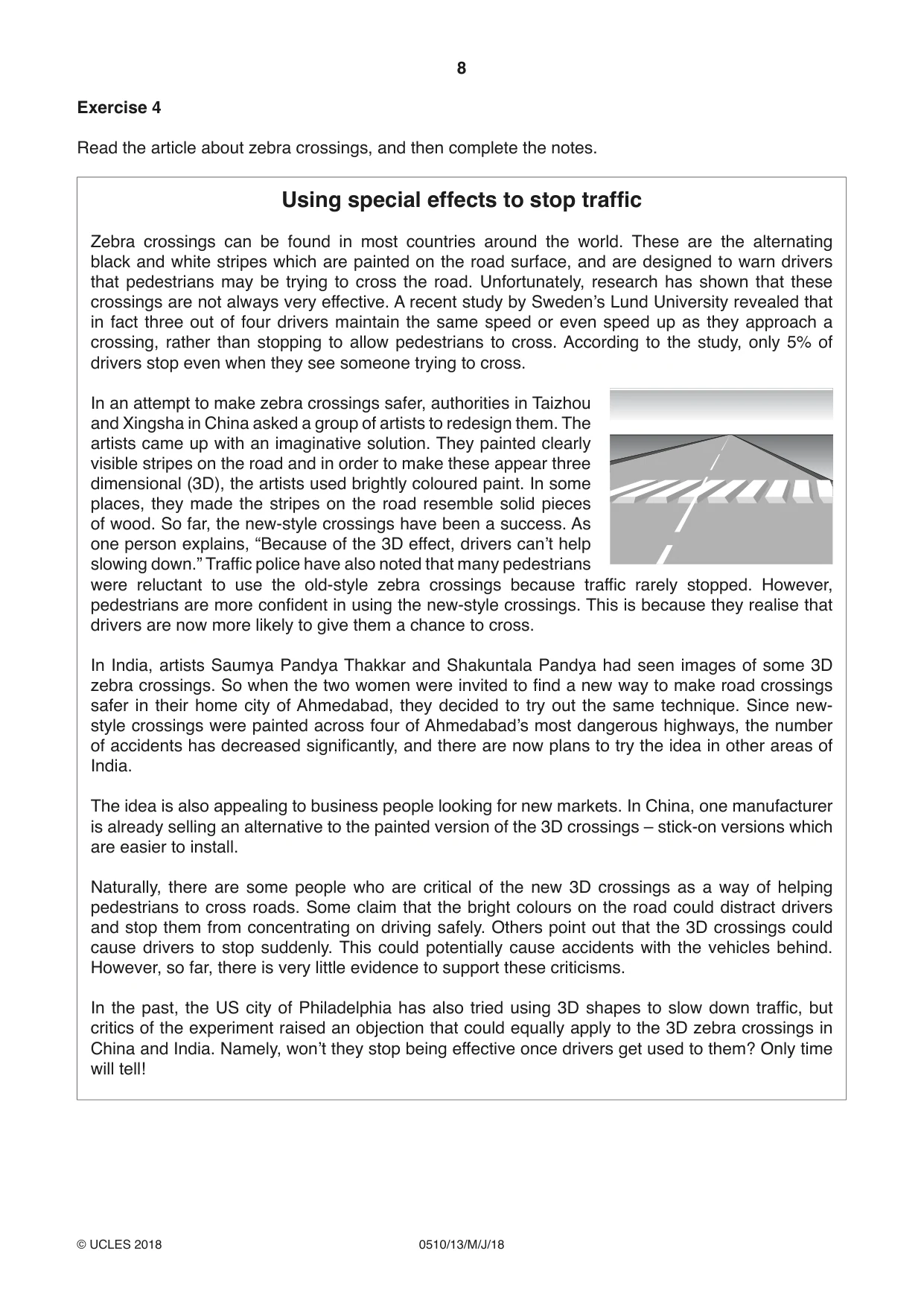
8 0510/13/M/J/18 © UCLES 2018 Exercise 4 Read the article about zebra crossings, and then complete the notes. Using special effects to stop traffic Zebra crossings can be found in most countries around the world. These are the alternating black and white stripes which are painted on the road surface, and are designed to warn drivers that pedestrians may be trying to cross the road. Unfortunately, research has shown that these crossings are not always very effective. A recent study by Sweden’s Lund University revealed that in fact three out of four drivers maintain the same speed or even speed up as they approach a crossing, rather than stopping to allow pedestrians to cross. According to the study, only 5% of drivers stop even when they see someone trying to cross. In an attempt to make zebra crossings safer, authorities in Taizhou and Xingsha in China asked a group of artists to redesign them. The artists came up with an imaginative solution. They painted clearly visible stripes on the road and in order to make these appear three dimensional (3D), the artists used brightly coloured paint. In some places, they made the stripes on the road resemble solid pieces of wood. So far, the new‑style crossings have been a success. As one person explains, “Because of the 3D effect, drivers can’t help slowing down.” Traffic police have also noted that many pedestrians were reluctant to use the old-style zebra crossings because traffic rarely stopped. However, pedestrians are more confident in using the new‑style crossings. This is because they realise that drivers are now more likely to give them a chance to cross. In India, artists Saumya Pandya Thakkar and Shakuntala Pandya had seen images of some 3D zebra crossings. So when the two women were invited to find a new way to make road crossings safer in their home city of Ahmedabad, they decided to try out the same technique. Since new‑ style crossings were painted across four of Ahmedabad’s most dangerous highways, the number of accidents has decreased significantly, and there are now plans to try the idea in other areas of India. The idea is also appealing to business people looking for new markets. In China, one manufacturer is already selling an alternative to the painted version of the 3D crossings – stick‑on versions which are easier to install. Naturally, there are some people who are critical of the new 3D crossings as a way of helping pedestrians to cross roads. Some claim that the bright colours on the road could distract drivers and stop them from concentrating on driving safely. Others point out that the 3D crossings could cause drivers to stop suddenly. This could potentially cause accidents with the vehicles behind. However, so far, there is very little evidence to support these criticisms. In the past, the US city of Philadelphia has also tried using 3D shapes to slow down traffic, but critics of the experiment raised an objection that could equally apply to the 3D zebra crossings in China and India. Namely, won’t they stop being effective once drivers get used to them? Only time will tell!
Question paper, page 9
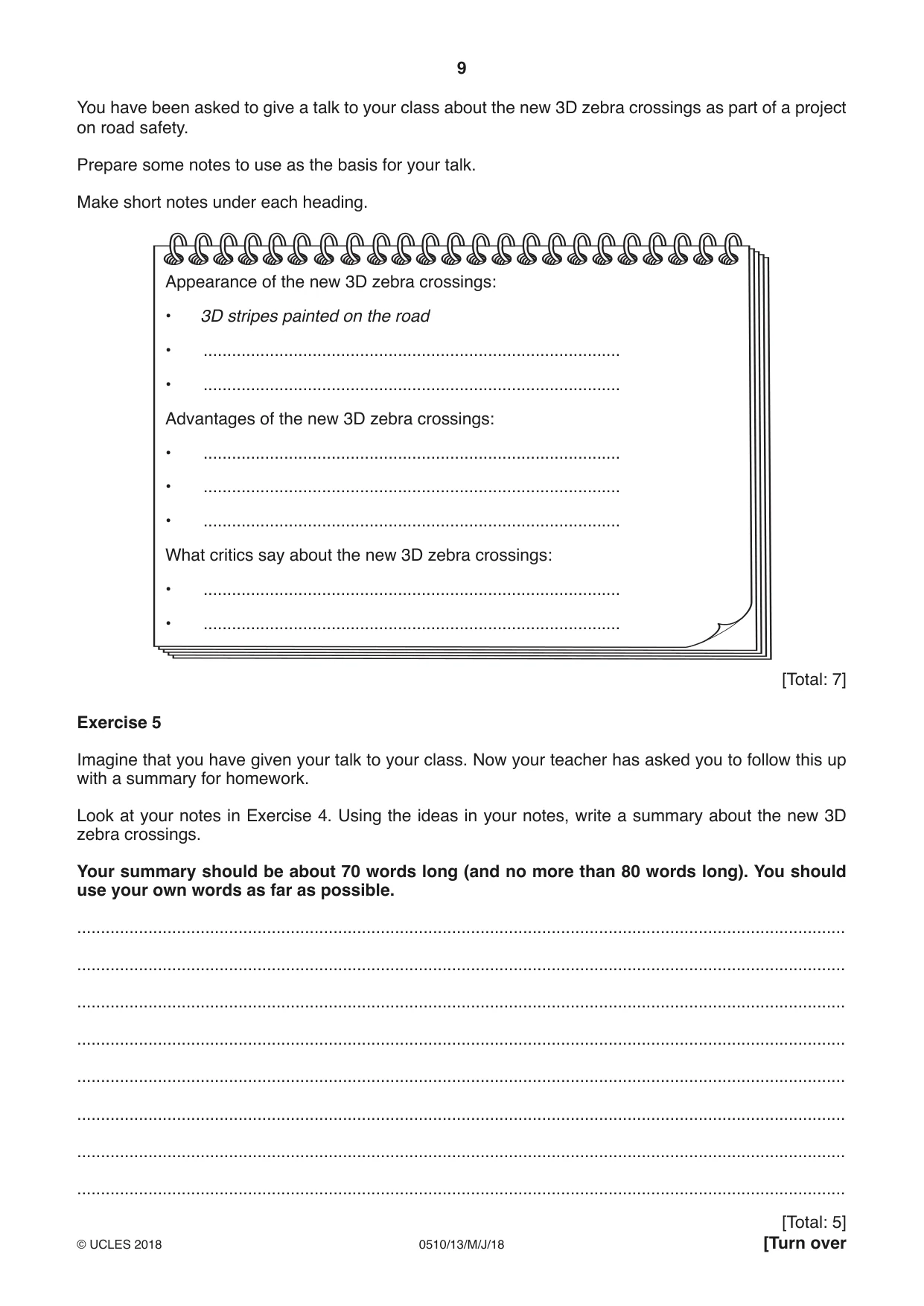
9 0510/13/M/J/18 © UCLES 2018 [Turn over You have been asked to give a talk to your class about the new 3D zebra crossings as part of a project on road safety. Prepare some notes to use as the basis for your talk. Make short notes under each heading. Appearance of the new 3D zebra crossings: • 3D stripes painted on the road • … • … Advantages of the new 3D zebra crossings: • … • … • … What critics say about the new 3D zebra crossings: • … • … [Total: 7] Exercise 5 Imagine that you have given your talk to your class. Now your teacher has asked you to follow this up with a summary for homework. Look at your notes in Exercise 4. Using the ideas in your notes, write a summary about the new 3D zebra crossings. Your summary should be about 70 words long (and no more than 80 words long). You should use your own words as far as possible. … … … … … … … … [Total: 5]
Question paper, page 10
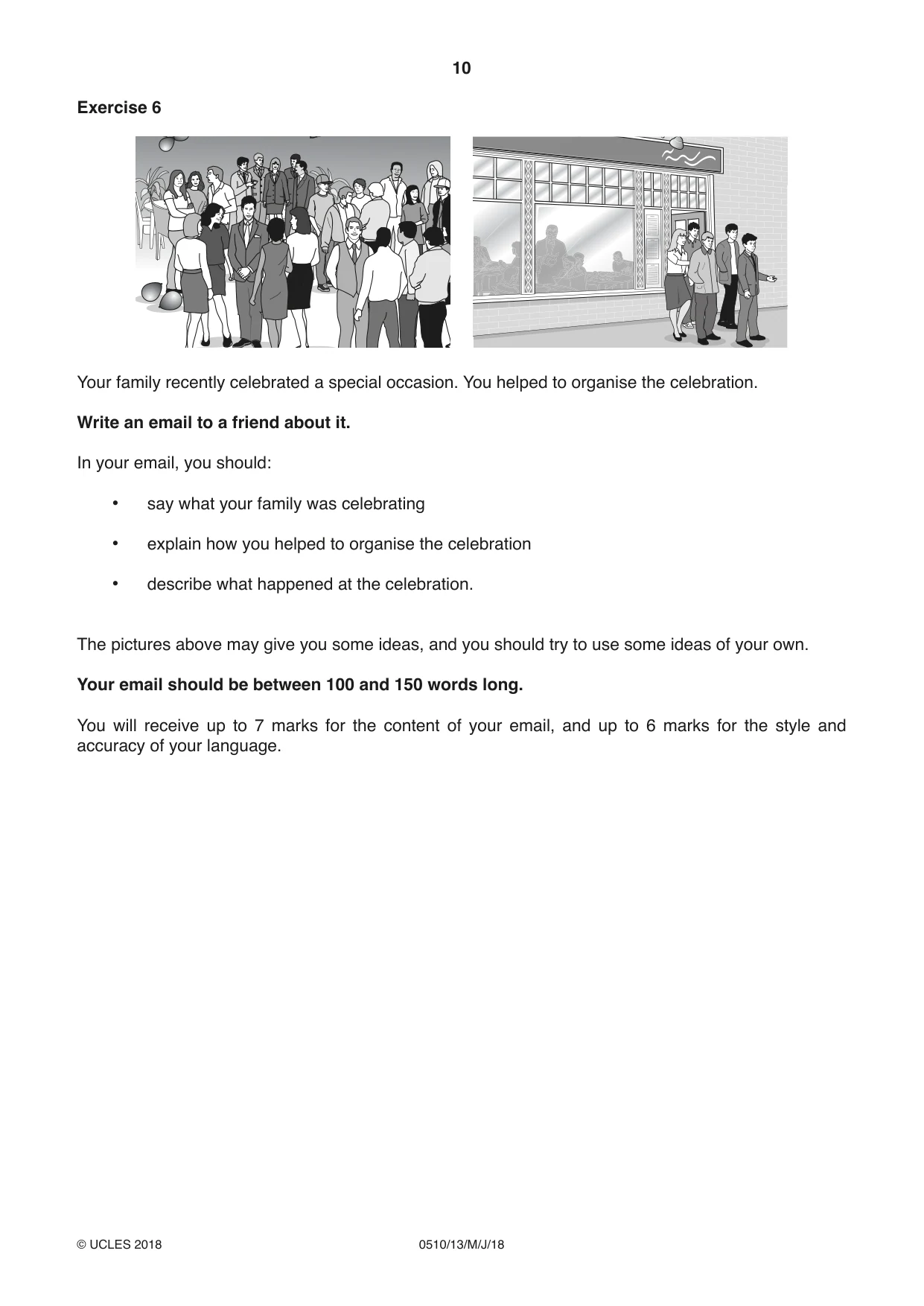
10 0510/13/M/J/18 © UCLES 2018 Exercise 6 Your family recently celebrated a special occasion. You helped to organise the celebration. Write an email to a friend about it. In your email, you should: • say what your family was celebrating • explain how you helped to organise the celebration • describe what happened at the celebration. The pictures above may give you some ideas, and you should try to use some ideas of your own. Your email should be between 100 and 150 words long. You will receive up to 7 marks for the content of your email, and up to 6 marks for the style and accuracy of your language.
Question paper, page 11
11 0510/13/M/J/18 © UCLES 2018 [Turn over … … … … … … … … … … … … … … … … … … … … … … … … … … … [Total: 13]
Question paper, page 12
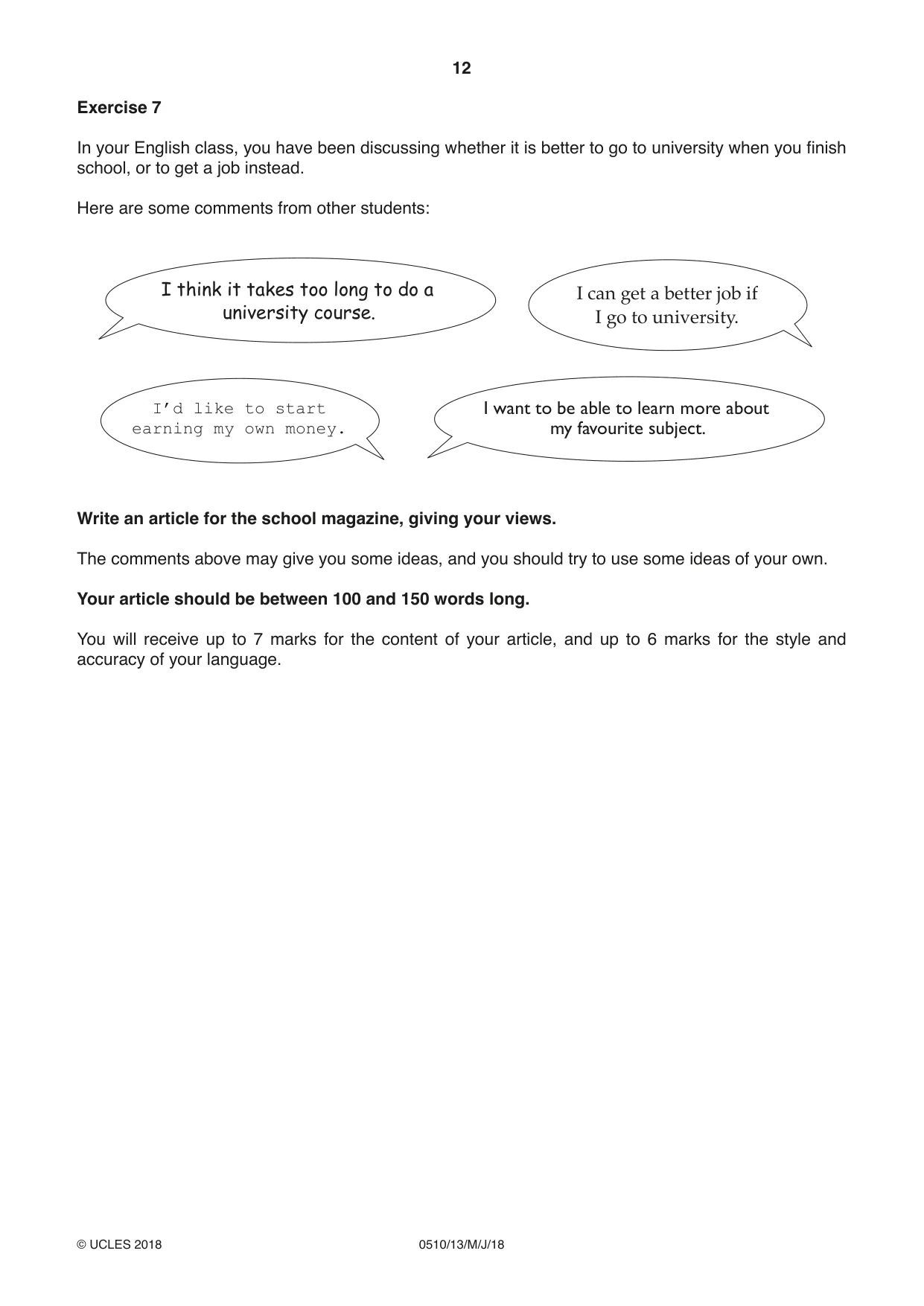
12 0510/13/M/J/18 © UCLES 2018 Exercise 7 In your English class, you have been discussing whether it is better to go to university when you finish school, or to get a job instead. Here are some comments from other students: I think it takes too long to do a university course. I can get a better job if I go to university. I want to be able to learn more about my favourite subject. I’d like to start earning my own money. Write an article for the school magazine, giving your views. The comments above may give you some ideas, and you should try to use some ideas of your own. Your article should be between 100 and 150 words long. You will receive up to 7 marks for the content of your article, and up to 6 marks for the style and accuracy of your language.
Question paper, page 13
13 0510/13/M/J/18 © UCLES 2018 … … … … … … … … … … … … … … … … … … … … … … … … … … … [Total: 13]
Question paper, page 14
14 0510/13/M/J/18 © UCLES 2018 BLANK PAGE
Question paper, page 15
15 0510/13/M/J/18 © UCLES 2018 BLANK PAGE
Question paper, page 16
16 0510/13/M/J/18 © UCLES 2018 Permission to reproduce items where third‑party owned material protected by copyright is included has been sought and cleared where possible. Every reasonable effort has been made by the publisher (UCLES) to trace copyright holders, but if any items requiring clearance have unwittingly been included, the publisher will be pleased to make amends at the earliest possible opportunity. To avoid the issue of disclosure of answer‑related information to candidates, all copyright acknowledgements are reproduced online in the Cambridge International Examinations Copyright Acknowledgements Booklet. This is produced for each series of examinations and is freely available to download at www.cie.org.uk after the live examination series. Cambridge International Examinations is part of the Cambridge Assessment Group. Cambridge Assessment is the brand name of University of Cambridge Local Examinations Syndicate (UCLES), which is itself a department of the University of Cambridge. BLANK PAGE
Mark scheme, page 1
IGCSE™ is a registered trademark. This document consists of 12 printed pages. © UCLES 2018 [Turn over Cambridge Assessment International Education Cambridge International General Certificate of Secondary Education ENGLISH AS A SECOND LANGUAGE 0510/13 Paper 1 Reading and Writing (Core) May/June 2018 MARK SCHEME Maximum Mark: 70 Published This mark scheme is published as an aid to teachers and candidates, to indicate the requirements of the examination. It shows the basis on which Examiners were instructed to award marks. It does not indicate the details of the discussions that took place at an Examiners’ meeting before marking began, which would have considered the acceptability of alternative answers. Mark schemes should be read in conjunction with the question paper and the Principal Examiner Report for Teachers. Cambridge International will not enter into discussions about these mark schemes. Cambridge International is publishing the mark schemes for the May/June 2018 series for most Cambridge IGCSE™, Cambridge International A and AS Level and Cambridge Pre-U components, and some Cambridge O Level components.
Mark scheme, page 2
0510/13 Cambridge IGCSE – Mark Scheme PUBLISHED May/June 2018 © UCLES 2018 Page 2 of 12 Generic Marking Principles These general marking principles must be applied by all examiners when marking candidate answers. They should be applied alongside the specific content of the mark scheme or generic level descriptors for a question. Each question paper and mark scheme will also comply with these marking principles. GENERIC MARKING PRINCIPLE 1: Marks must be awarded in line with: • the specific content of the mark scheme or the generic level descriptors for the question • the specific skills defined in the mark scheme or in the generic level descriptors for the question • the standard of response required by a candidate as exemplified by the standardisation scripts. GENERIC MARKING PRINCIPLE 2: Marks awarded are always whole marks (not half marks, or other fractions). GENERIC MARKING PRINCIPLE 3: Marks must be awarded positively: • marks are awarded for correct/valid answers, as defined in the mark scheme. However, credit is given for valid answers which go beyond the scope of the syllabus and mark scheme, referring to your Team Leader as appropriate • marks are awarded when candidates clearly demonstrate what they know and can do • marks are not deducted for errors • marks are not deducted for omissions • answers should only be judged on the quality of spelling, punctuation and grammar when these features are specifically assessed by the question as indicated by the mark scheme. The meaning, however, should be unambiguous. GENERIC MARKING PRINCIPLE 4: Rules must be applied consistently e.g. in situations where candidates have not followed instructions or in the application of generic level descriptors. GENERIC MARKING PRINCIPLE 5: Marks should be awarded using the full range of marks defined in the mark scheme for the question (however; the use of the full mark range may be limited according to the quality of the candidate responses seen). GENERIC MARKING PRINCIPLE 6: Marks awarded are based solely on the requirements as defined in the mark scheme. Marks should not be awarded with grade thresholds or grade descriptors in mind.
Mark scheme, page 3
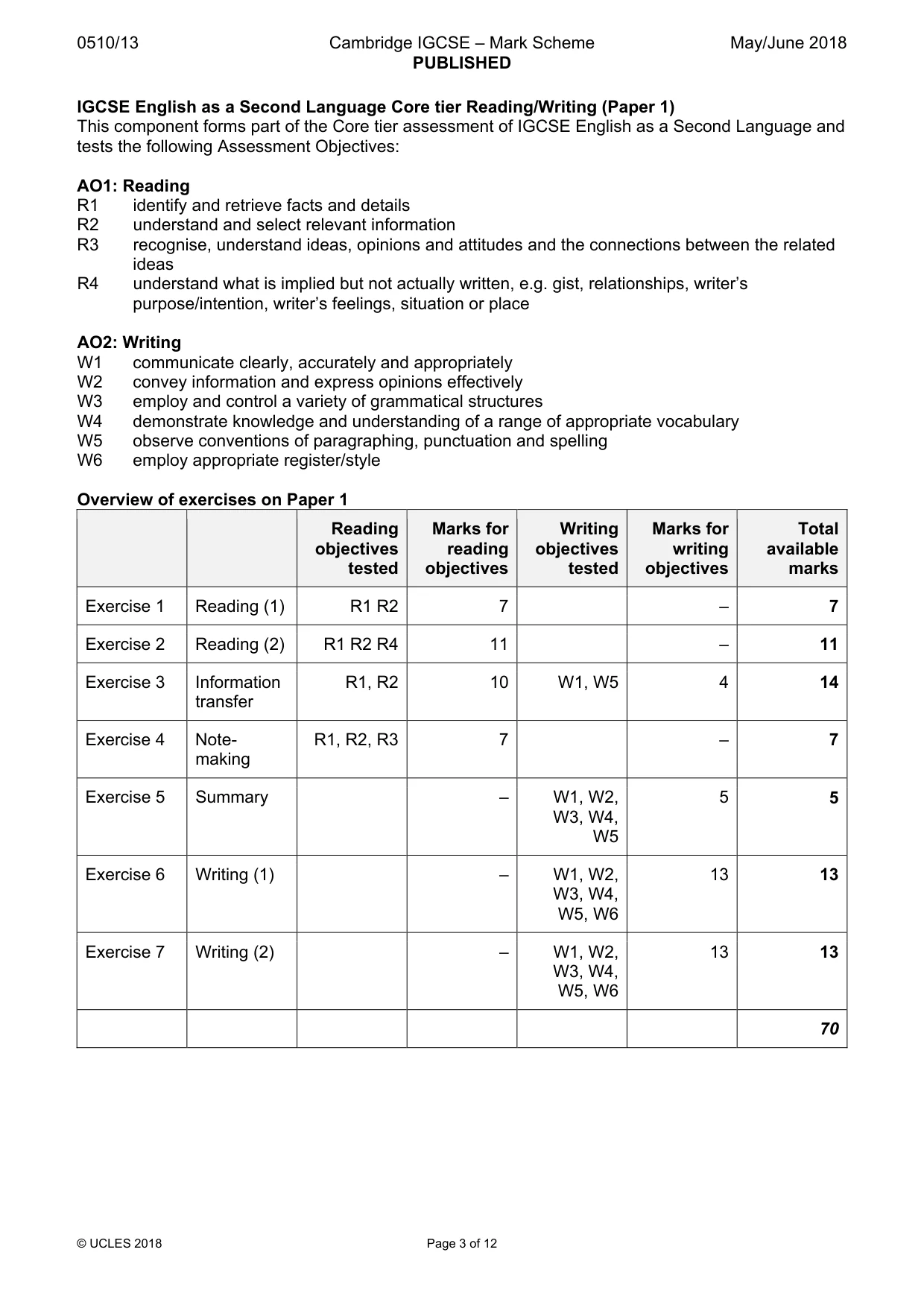
0510/13 Cambridge IGCSE – Mark Scheme PUBLISHED May/June 2018 © UCLES 2018 Page 3 of 12 IGCSE English as a Second Language Core tier Reading/Writing (Paper 1) This component forms part of the Core tier assessment of IGCSE English as a Second Language and tests the following Assessment Objectives: AO1: Reading R1 identify and retrieve facts and details R2 understand and select relevant information R3 recognise, understand ideas, opinions and attitudes and the connections between the related ideas R4 understand what is implied but not actually written, e.g. gist, relationships, writer’s purpose/intention, writer’s feelings, situation or place AO2: Writing W1 communicate clearly, accurately and appropriately W2 convey information and express opinions effectively W3 employ and control a variety of grammatical structures W4 demonstrate knowledge and understanding of a range of appropriate vocabulary W5 observe conventions of paragraphing, punctuation and spelling W6 employ appropriate register/style Overview of exercises on Paper 1 Reading objectives tested Marks for reading objectives Writing objectives tested Marks for writing objectives Total available marks Exercise 1 Reading (1) R1 R2 7 – 7 Exercise 2 Reading (2) R1 R2 R4 11 – 11 Exercise 3 Information transfer R1, R2 10 W1, W5 4 14 Exercise 4 Note- making R1, R2, R3 7 – 7 Exercise 5 Summary – W1, W2, W3, W4, W5 5 5 Exercise 6 Writing (1) – W1, W2, W3, W4, W5, W6 13 13 Exercise 7 Writing (2) – W1, W2, W3, W4, W5, W6 13 13 70
Mark scheme, page 4
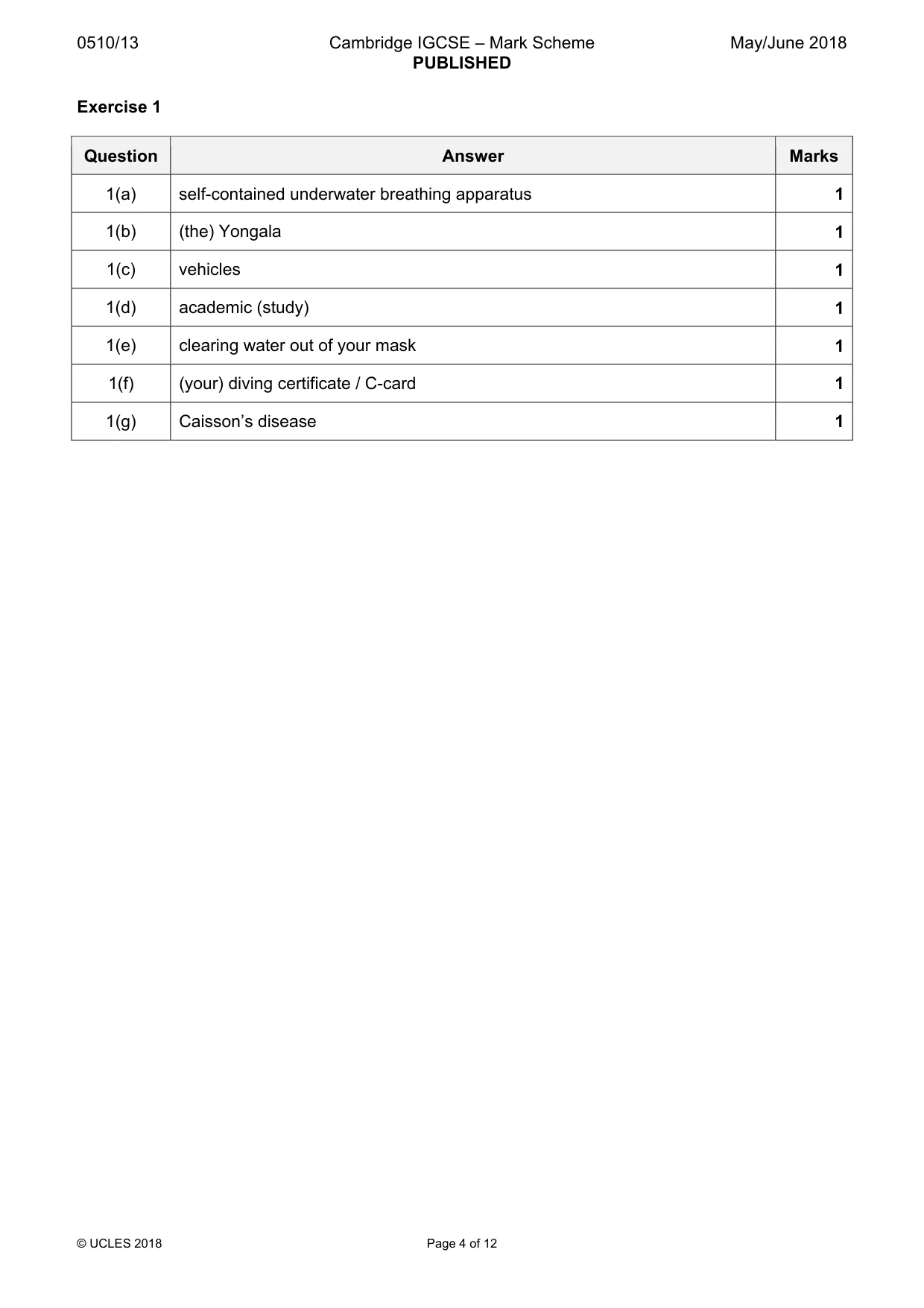
0510/13 Cambridge IGCSE – Mark Scheme PUBLISHED May/June 2018 © UCLES 2018 Page 4 of 12 Exercise 1 Question Answer Marks 1(a) self-contained underwater breathing apparatus 1 1(b) (the) Yongala 1 1(c) vehicles 1 1(d) academic (study) 1 1(e) clearing water out of your mask 1 1(f) (your) diving certificate / C-card 1 1(g) Caisson’s disease 1
Mark scheme, page 5
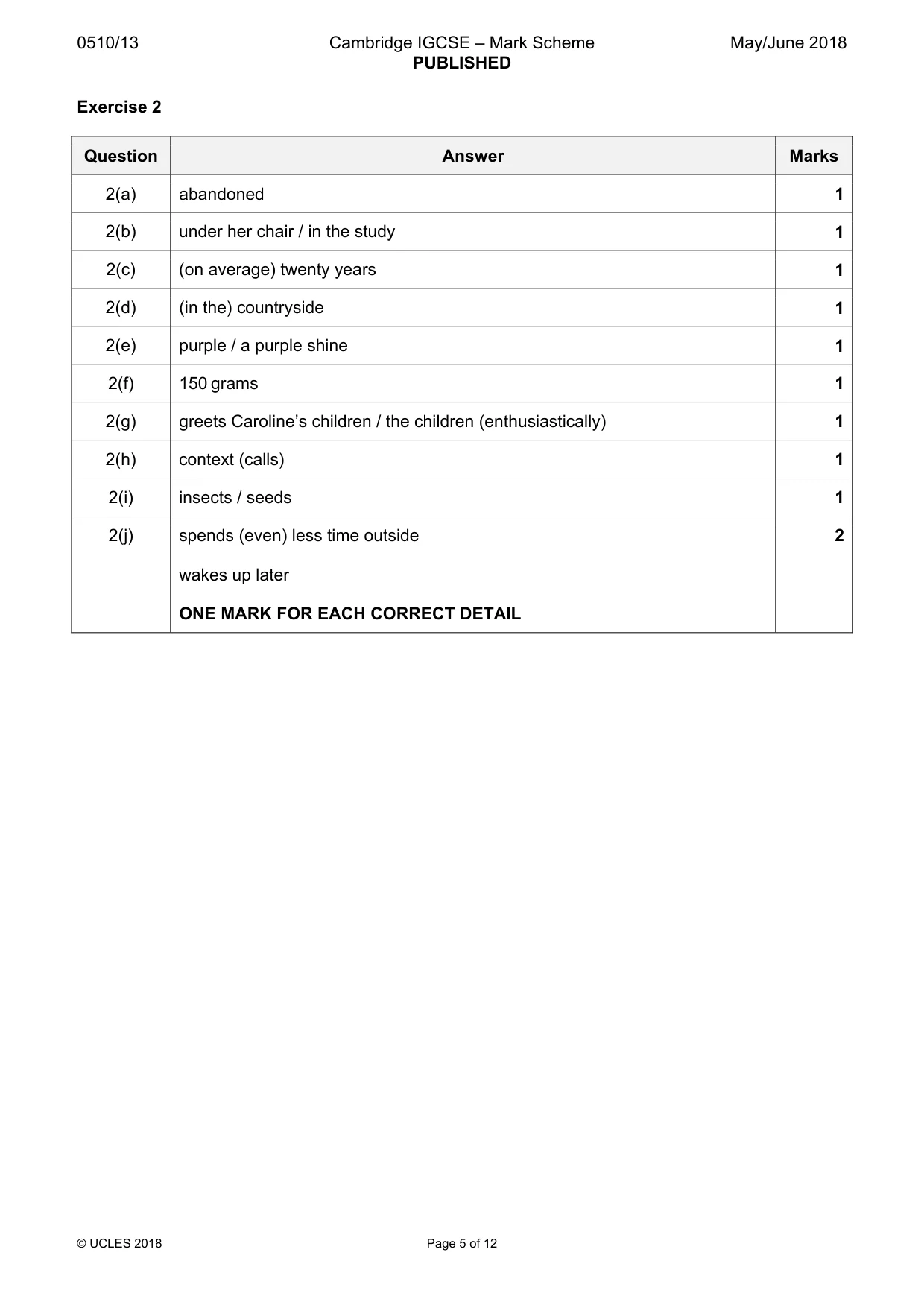
0510/13 Cambridge IGCSE – Mark Scheme PUBLISHED May/June 2018 © UCLES 2018 Page 5 of 12 Exercise 2 Question Answer Marks 2(a) abandoned 1 2(b) under her chair / in the study 1 2(c) (on average) twenty years 1 2(d) (in the) countryside 1 2(e) purple / a purple shine 1 2(f) 150 grams 1 2(g) greets Caroline’s children / the children (enthusiastically) 1 2(h) context (calls) 1 2(i) insects / seeds 1 2(j) spends (even) less time outside wakes up later ONE MARK FOR EACH CORRECT DETAIL 2
Mark scheme, page 6
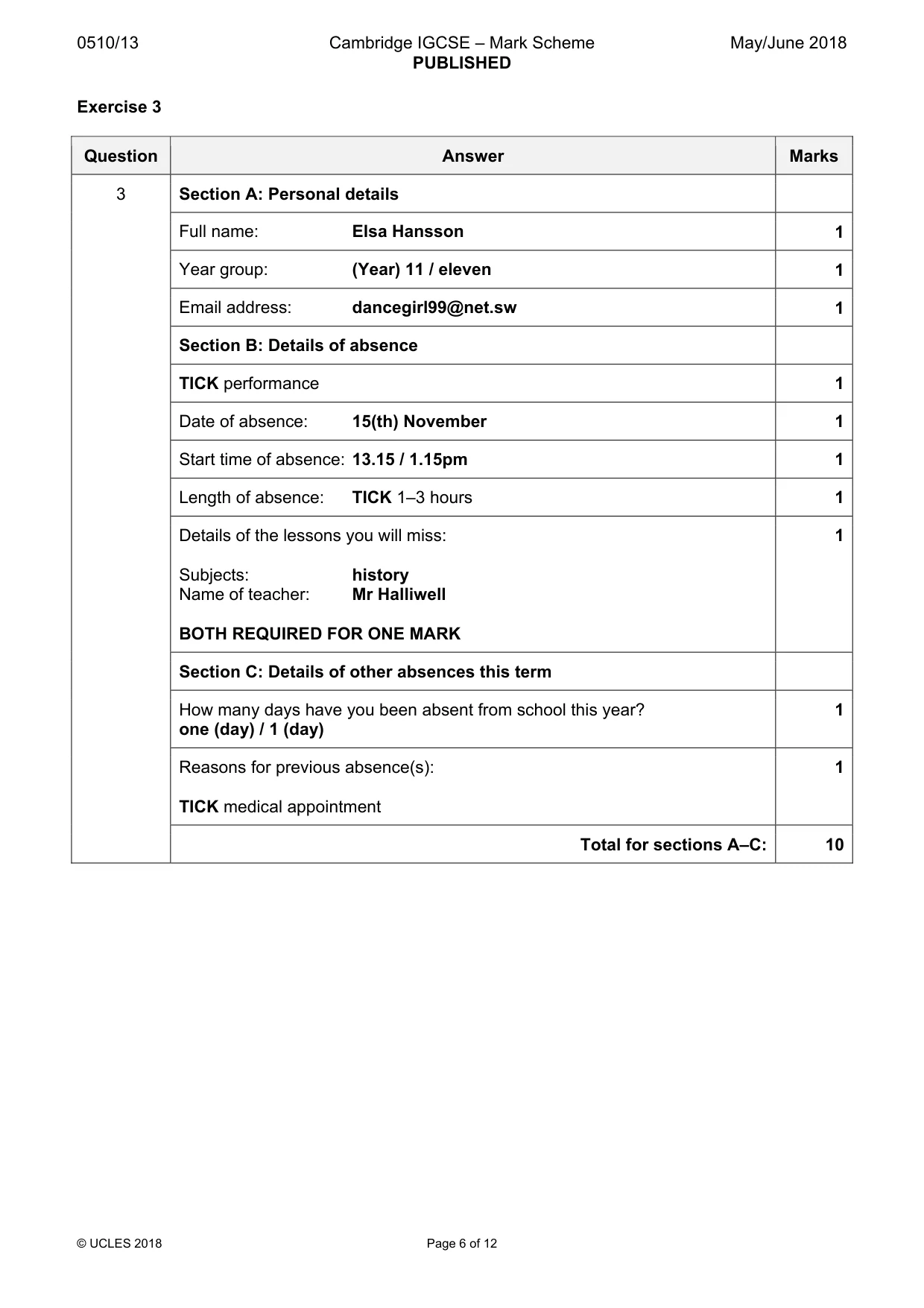
0510/13 Cambridge IGCSE – Mark Scheme PUBLISHED May/June 2018 © UCLES 2018 Page 6 of 12 Exercise 3 Question Answer Marks 3 Section A: Personal details Full name: Elsa Hansson 1 Year group: (Year) 11 / eleven 1 Email address: dancegirl99@net.sw 1 Section B: Details of absence TICK performance 1 Date of absence: 15(th) November 1 Start time of absence: 13.15 / 1.15pm 1 Length of absence: TICK 1–3 hours 1 Details of the lessons you will miss: Subjects: history Name of teacher: Mr Halliwell BOTH REQUIRED FOR ONE MARK 1 Section C: Details of other absences this term How many days have you been absent from school this year? one (day) / 1 (day) 1 Reasons for previous absence(s): TICK medical appointment 1 Total for sections A–C: 10
Mark scheme, page 7
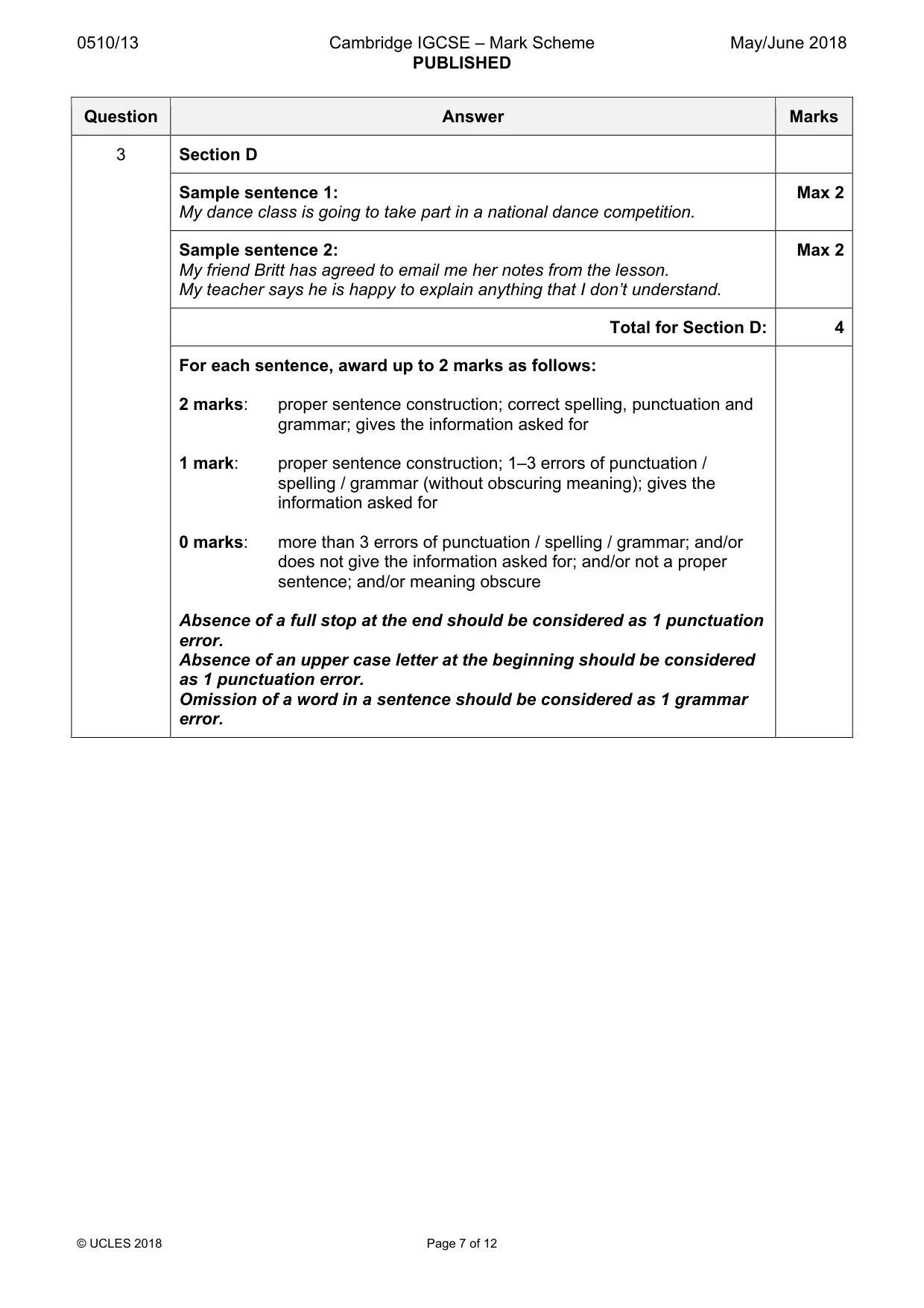
0510/13 Cambridge IGCSE – Mark Scheme PUBLISHED May/June 2018 © UCLES 2018 Page 7 of 12 Question Answer Marks 3 Section D Sample sentence 1: My dance class is going to take part in a national dance competition. Max 2 Sample sentence 2: My friend Britt has agreed to email me her notes from the lesson. My teacher says he is happy to explain anything that I don’t understand. Max 2 Total for Section D: 4 For each sentence, award up to 2 marks as follows: 2 marks: proper sentence construction; correct spelling, punctuation and grammar; gives the information asked for 1 mark: proper sentence construction; 1–3 errors of punctuation / spelling / grammar (without obscuring meaning); gives the information asked for 0 marks: more than 3 errors of punctuation / spelling / grammar; and/or does not give the information asked for; and/or not a proper sentence; and/or meaning obscure Absence of a full stop at the end should be considered as 1 punctuation error. Absence of an upper case letter at the beginning should be considered as 1 punctuation error. Omission of a word in a sentence should be considered as 1 grammar error.
Mark scheme, page 8
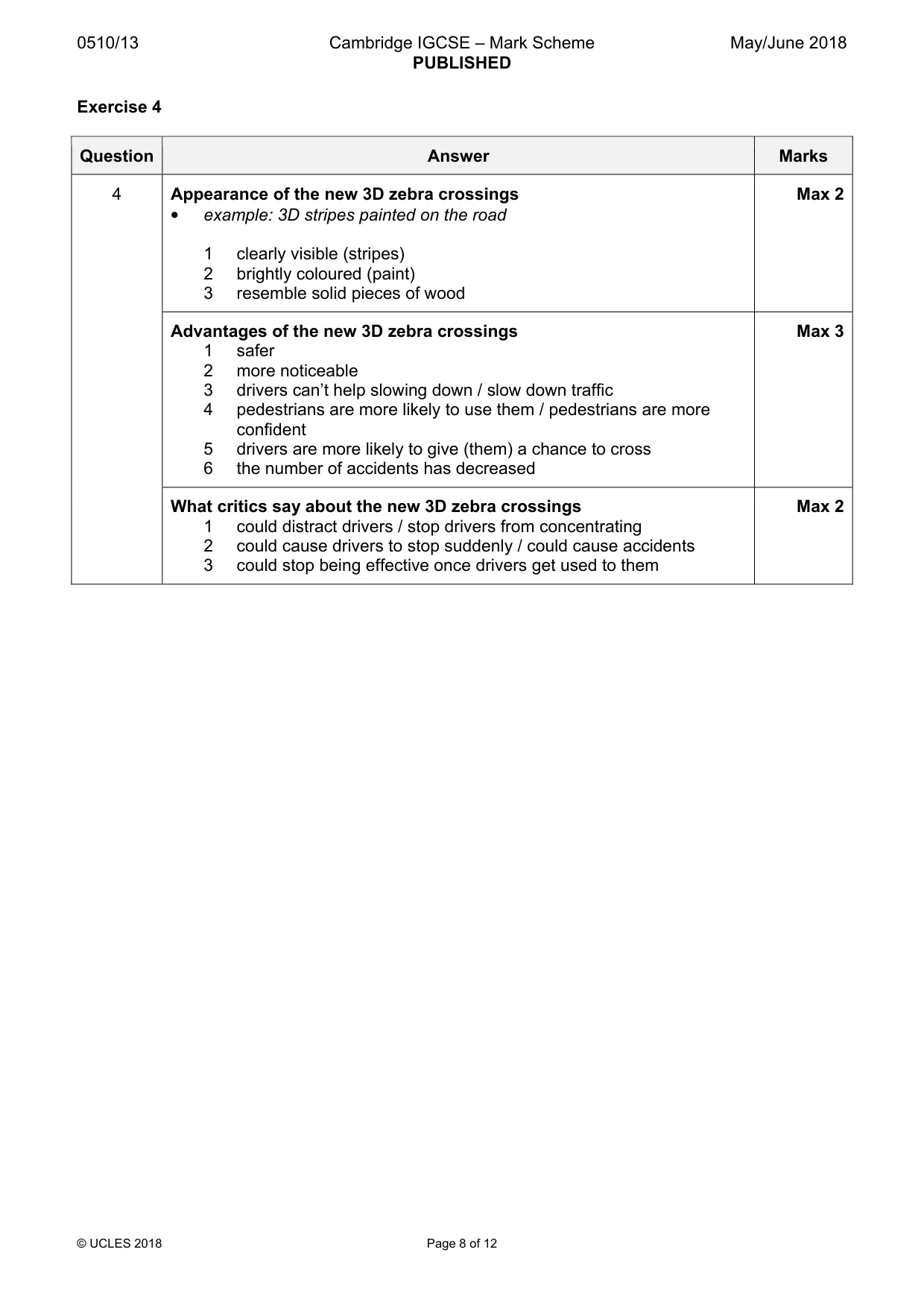
0510/13 Cambridge IGCSE – Mark Scheme PUBLISHED May/June 2018 © UCLES 2018 Page 8 of 12 Exercise 4 Question Answer Marks 4 Appearance of the new 3D zebra crossings • example: 3D stripes painted on the road 1 clearly visible (stripes) 2 brightly coloured (paint) 3 resemble solid pieces of wood Max 2 Advantages of the new 3D zebra crossings 1 safer 2 more noticeable 3 drivers can’t help slowing down / slow down traffic 4 pedestrians are more likely to use them / pedestrians are more confident 5 drivers are more likely to give (them) a chance to cross 6 the number of accidents has decreased Max 3 What critics say about the new 3D zebra crossings 1 could distract drivers / stop drivers from concentrating 2 could cause drivers to stop suddenly / could cause accidents 3 could stop being effective once drivers get used to them Max 2
Mark scheme, page 9
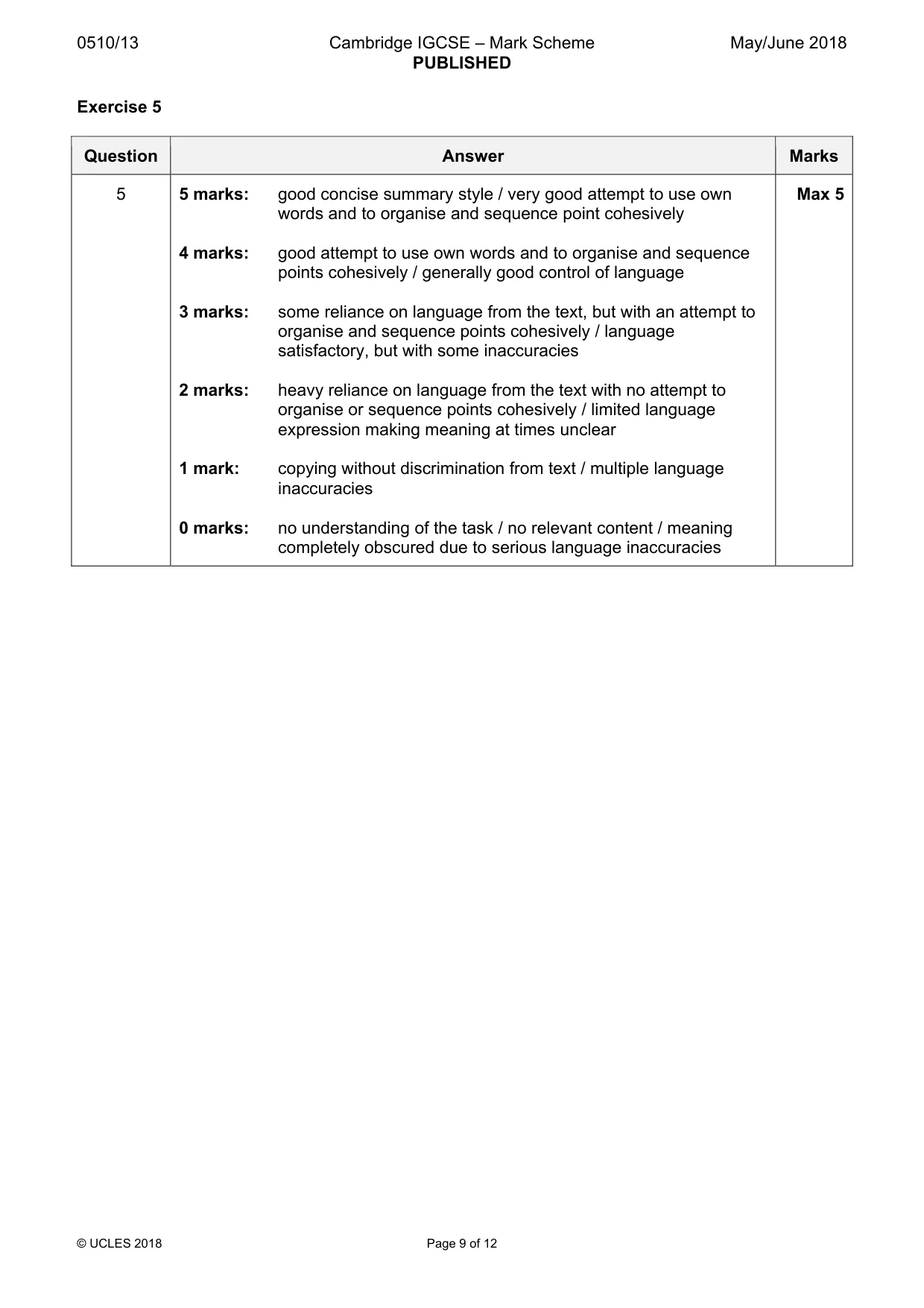
0510/13 Cambridge IGCSE – Mark Scheme PUBLISHED May/June 2018 © UCLES 2018 Page 9 of 12 Exercise 5 Question Answer Marks 5 5 marks: good concise summary style / very good attempt to use own words and to organise and sequence point cohesively 4 marks: good attempt to use own words and to organise and sequence points cohesively / generally good control of language 3 marks: some reliance on language from the text, but with an attempt to organise and sequence points cohesively / language satisfactory, but with some inaccuracies 2 marks: heavy reliance on language from the text with no attempt to organise or sequence points cohesively / limited language expression making meaning at times unclear 1 mark: copying without discrimination from text / multiple language inaccuracies 0 marks: no understanding of the task / no relevant content / meaning completely obscured due to serious language inaccuracies Max 5
Mark scheme, page 10
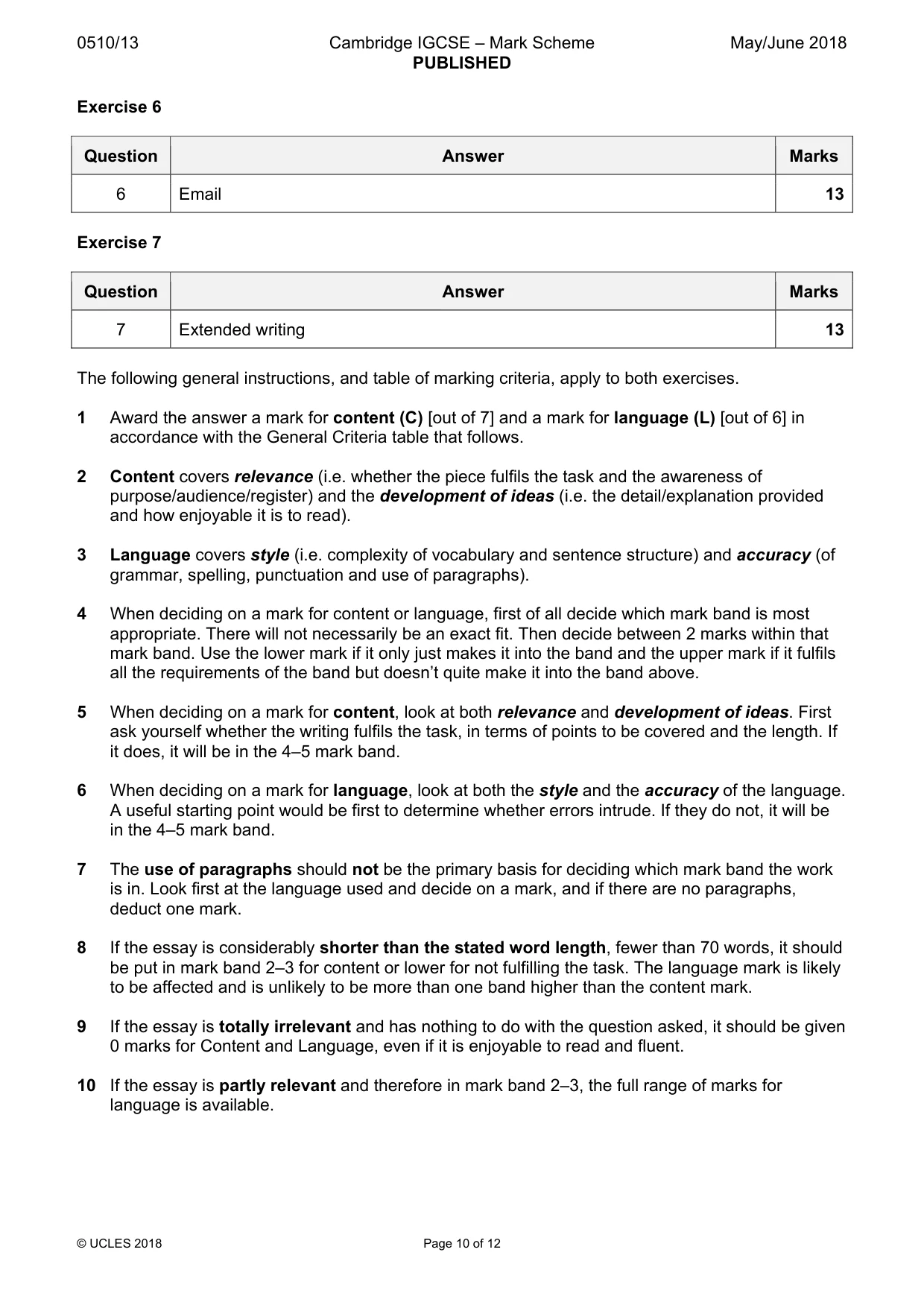
0510/13 Cambridge IGCSE – Mark Scheme PUBLISHED May/June 2018 © UCLES 2018 Page 10 of 12 Exercise 6 Question Answer Marks 6 Email 13 Exercise 7 Question Answer Marks 7 Extended writing 13 The following general instructions, and table of marking criteria, apply to both exercises. 1 Award the answer a mark for content (C) [out of 7] and a mark for language (L) [out of 6] in accordance with the General Criteria table that follows. 2 Content covers relevance (i.e. whether the piece fulfils the task and the awareness of purpose/audience/register) and the development of ideas (i.e. the detail/explanation provided and how enjoyable it is to read). 3 Language covers style (i.e. complexity of vocabulary and sentence structure) and accuracy (of grammar, spelling, punctuation and use of paragraphs). 4 When deciding on a mark for content or language, first of all decide which mark band is most appropriate. There will not necessarily be an exact fit. Then decide between 2 marks within that mark band. Use the lower mark if it only just makes it into the band and the upper mark if it fulfils all the requirements of the band but doesn’t quite make it into the band above. 5 When deciding on a mark for content, look at both relevance and development of ideas. First ask yourself whether the writing fulfils the task, in terms of points to be covered and the length. If it does, it will be in the 4–5 mark band. 6 When deciding on a mark for language, look at both the style and the accuracy of the language. A useful starting point would be first to determine whether errors intrude. If they do not, it will be in the 4–5 mark band. 7 The use of paragraphs should not be the primary basis for deciding which mark band the work is in. Look first at the language used and decide on a mark, and if there are no paragraphs, deduct one mark. 8 If the essay is considerably shorter than the stated word length, fewer than 70 words, it should be put in mark band 2–3 for content or lower for not fulfilling the task. The language mark is likely to be affected and is unlikely to be more than one band higher than the content mark. 9 If the essay is totally irrelevant and has nothing to do with the question asked, it should be given 0 marks for Content and Language, even if it is enjoyable to read and fluent. 10 If the essay is partly relevant and therefore in mark band 2–3, the full range of marks for language is available.
Mark scheme, page 11
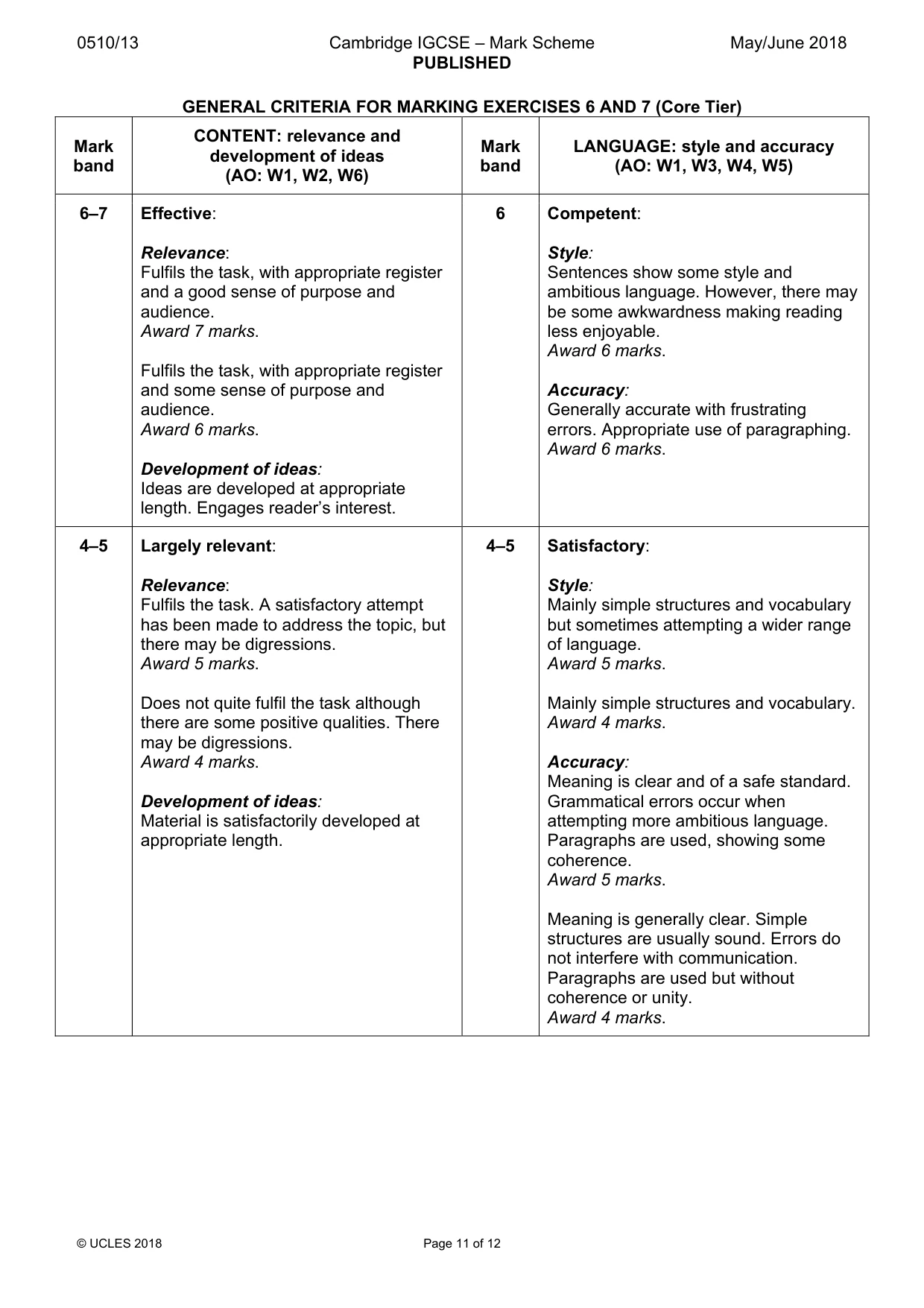
0510/13 Cambridge IGCSE – Mark Scheme PUBLISHED May/June 2018 © UCLES 2018 Page 11 of 12 GENERAL CRITERIA FOR MARKING EXERCISES 6 AND 7 (Core Tier) Mark band CONTENT: relevance and development of ideas (AO: W1, W2, W6) Mark band LANGUAGE: style and accuracy (AO: W1, W3, W4, W5) 6–7 Effective: Relevance: Fulfils the task, with appropriate register and a good sense of purpose and audience. Award 7 marks. Fulfils the task, with appropriate register and some sense of purpose and audience. Award 6 marks. Development of ideas: Ideas are developed at appropriate length. Engages reader’s interest. 6 Competent: Style: Sentences show some style and ambitious language. However, there may be some awkwardness making reading less enjoyable. Award 6 marks. Accuracy: Generally accurate with frustrating errors. Appropriate use of paragraphing. Award 6 marks. 4–5 Largely relevant: Relevance: Fulfils the task. A satisfactory attempt has been made to address the topic, but there may be digressions. Award 5 marks. Does not quite fulfil the task although there are some positive qualities. There may be digressions. Award 4 marks. Development of ideas: Material is satisfactorily developed at appropriate length. 4–5 Satisfactory: Style: Mainly simple structures and vocabulary but sometimes attempting a wider range of language. Award 5 marks. Mainly simple structures and vocabulary. Award 4 marks. Accuracy: Meaning is clear and of a safe standard. Grammatical errors occur when attempting more ambitious language. Paragraphs are used, showing some coherence. Award 5 marks. Meaning is generally clear. Simple structures are usually sound. Errors do not interfere with communication. Paragraphs are used but without coherence or unity. Award 4 marks.
Mark scheme, page 12
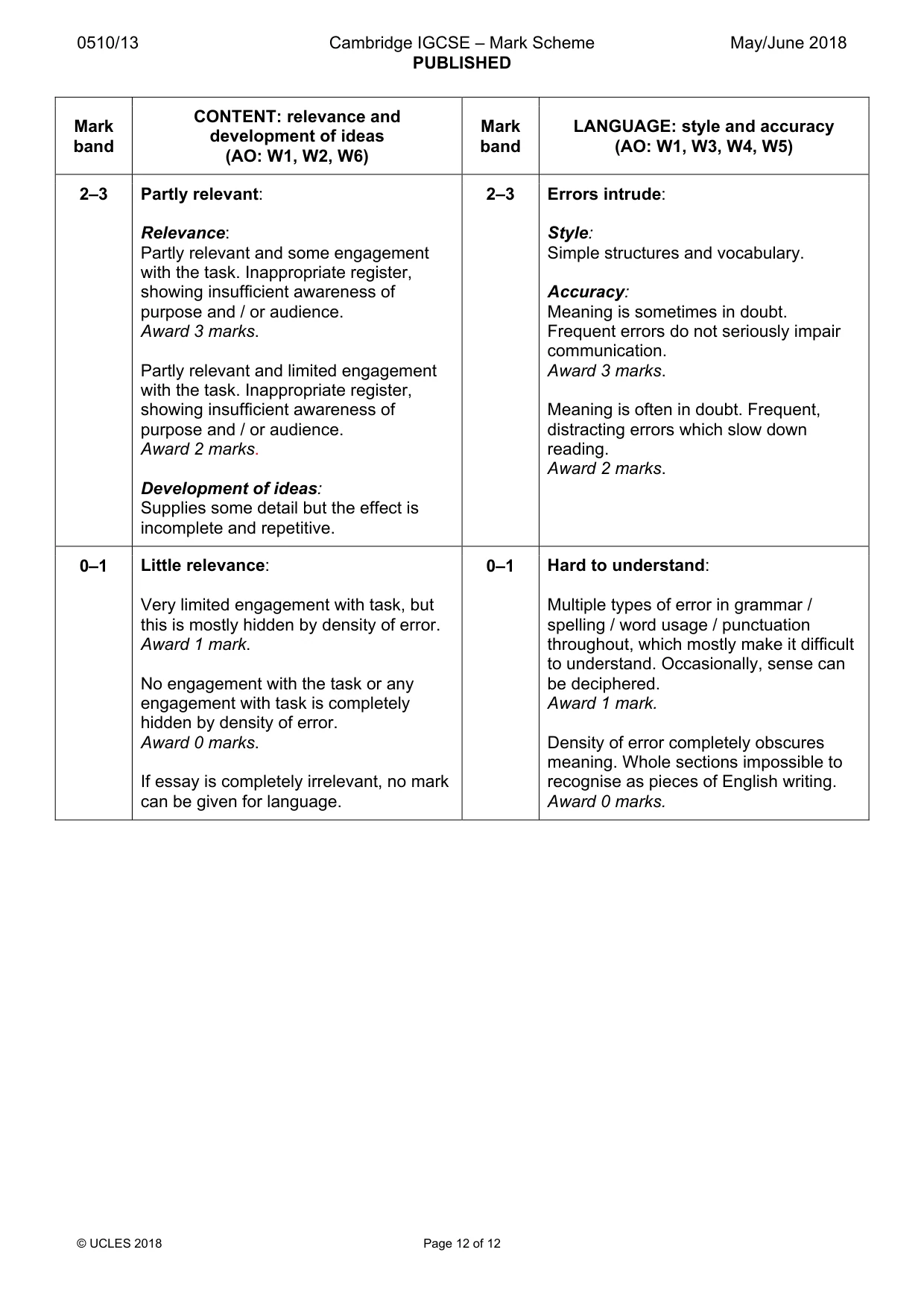
0510/13 Cambridge IGCSE – Mark Scheme PUBLISHED May/June 2018 © UCLES 2018 Page 12 of 12 Mark band CONTENT: relevance and development of ideas (AO: W1, W2, W6) Mark band LANGUAGE: style and accuracy (AO: W1, W3, W4, W5) 2–3 Partly relevant: Relevance: Partly relevant and some engagement with the task. Inappropriate register, showing insufficient awareness of purpose and / or audience. Award 3 marks. Partly relevant and limited engagement with the task. Inappropriate register, showing insufficient awareness of purpose and / or audience. Award 2 marks. Development of ideas: Supplies some detail but the effect is incomplete and repetitive. 2–3 Errors intrude: Style: Simple structures and vocabulary. Accuracy: Meaning is sometimes in doubt. Frequent errors do not seriously impair communication. Award 3 marks. Meaning is often in doubt. Frequent, distracting errors which slow down reading. Award 2 marks. 0–1 Little relevance: Very limited engagement with task, but this is mostly hidden by density of error. Award 1 mark. No engagement with the task or any engagement with task is completely hidden by density of error. Award 0 marks. If essay is completely irrelevant, no mark can be given for language. 0–1 Hard to understand: Multiple types of error in grammar / spelling / word usage / punctuation throughout, which mostly make it difficult to understand. Occasionally, sense can be deciphered. Award 1 mark. Density of error completely obscures meaning. Whole sections impossible to recognise as pieces of English writing. Award 0 marks.
What you needed in this session
Cambridge’s own grade thresholds for 2018 May/June, Paper 1 · Variant 3. A higher threshold means an easier paper — the bar moves with how the cohort did.