Cambridge IGCSE English - Second Language (oral endorsement) 0510 — 2018 May/June Paper 1 · Variant 2
0510/12/M/J/18 · 70 marks · ≈79 min
The question paper and its mark scheme, free to read here and free to download. This is Cambridge’s own paper, exactly as it was sat.
Question paper16 pages





Mark scheme12 pages
Answers below. Sit the paper first if you are practising.
Paper as text
Question paper, page 1
* 2 5 5 3 0 8 3 8 3 7 * This document consists of 13 printed pages and 3 blank pages. DC (NF/FC) 143919/3 © UCLES 2018 [Turn over Cambridge International Examinations Cambridge International General Certificate of Secondary Education ENGLISH AS A SECOND LANGUAGE 0510/12 Paper 1 Reading and Writing (Core) May/June 2018 1 hour 30 minutes Candidates answer on the Question Paper. No Additional Materials are required. READ THESE INSTRUCTIONS FIRST Write your Centre number, candidate number and name on all the work you hand in. Write in dark blue or black pen. Do not use staples, paper clips, glue or correction fluid. DO NOT WRITE IN ANY BARCODES. Answer all questions. Dictionaries are not allowed. At the end of the examination, fasten all your work securely together. The number of marks is given in brackets [ ] at the end of each question or part question.
Question paper, page 2
2 0510/12/M/J/18 © UCLES 2018 Exercise 1 Read the information sheet about foods that are very good for you, and then answer the following questions. Superfoods There are some types of foods, called superfoods, which are particularly good for us. Ones we have known about for a long time include avocados, blueberries and seaweed. But here are four more that you might not have heard of. First, daikon is a root vegetable that is popular in Japanese and Chinese cookery. People also refer to it as moola, and it is a type of radish. Not only does it have a peppery, fresh taste; it contains incredibly high levels of vitamin C, making it particularly healthy. Another vegetable superfood is the bitter gourd, or bitter melon. Although its appearance isn’t pretty – it resembles an ugly cucumber – it is believed to reduce cholesterol and lower blood sugar levels, so is great news for diabetics. Two fantastic fruits are gubinge and lucuma. The first is a small green fruit from Australia. The other grows in valleys in Peru, and contains several minerals and vitamins. Even greater benefit Until recently, most scientists have concentrated on studying the effects of individual foods on our health. But in the last few years, what is known as food synergy has become popular. This is the idea that eating certain foods in pairs can make them even healthier for us than if they are eaten alone. Researcher David Jacobs came up with the name, and dietician Elaine Magee has written a book on the topic. She explains: “It is like adding one plus one and getting four instead of two: the total is greater than the sum of the individual parts.” One pair of foods that works well together is salmon and yogurt. The vitamin D from the oily fish helps the body to take in a greater quantity of calcium from the yogurt – and that is good news for your bones. We all know that vegetables are good for us, but pairing them with certain other foods seems to make them significantly better for us than they would be alone. One such combination is broccoli and tomatoes, which was discovered by scientists at the University of Illinois; another is cauliflower and chicken, which was the focus of a study at The Institute of Food Research. They found that selenium, which is an essential mineral contained in chicken, and sulforaphane, a plant chemical found in cauliflower, work together to provide the winning combination. So, next time you’re wondering what to eat for dinner, maybe this will give you some ideas!
Question paper, page 3
3 0510/12/M/J/18 © UCLES 2018 [Turn over (a) What is another name for daikon? … [1] (b) What does the bitter gourd look similar to? … [1] (c) Which country does the fruit called lucuma come from? … [1] (d) What is the term for combining foods so they work better together, and who invented this term? … … [2] (e) What can your body absorb more of when you eat salmon and yogurt together? … [1] (f) Where did scientists look into the benefits of pairing cauliflower with chicken? … [1] [Total: 7]
Question paper, page 4
4 0510/12/M/J/18 © UCLES 2018 Exercise 2 Read the article about the Global Teacher Prize, and then answer the following questions. The Global Teacher Prize The Global Teacher Prize is a US$1 million award presented annually to an exceptional teacher who has made an outstanding contribution to their profession. A few years ago, an educational charity called the Varkey Foundation was concerned that many problems around the world are caused by lack of education. They decided to ask Populus, a leading research company, to find out more, by comparing education in countries around the world. One section was on how teaching compares with other professions. Their investigation also covered many other key topics, such as are children encouraged to become teachers. The results of this survey, published in 2013, shocked the chairman of the Varkey Foundation, whose parents had both been teachers. Therefore, in the same year, he decided to establish the Global Teacher Prize, with the overall intention of raising the profile of the teaching profession. The first prize was awarded in 2015. The process of choosing a winner is a lengthy one. People can name a teacher they know, or a teacher can apply themselves. In the first year, teachers from 127 different countries were nominated, and over 5000 applications were received. After the closing date, a team of judges carefully select 10 finalists, who gather in Dubai for an exciting event where the award is presented. The winner in the first year was Nancie Atwell, a teacher from the USA, and media interest in her success was enormous. After accepting her prize, Nancie gave a speech in which she talked about the fact that as a teacher you can make a real difference to students’ lives. Nancie discovered a love of books when she was a child, and went on to become an English teacher. Like many other teachers, she enjoys the chance to be creative in the classroom. She developed a technique called the writing-reading workshop, which she first described in her book ‘In The Middle’. Her method allows students to choose the subjects they write about and the books they read, and her success is evident in that many of her students have become published authors. Being able to see students make progress is an explanation given by many teachers for their love of teaching. The winner of the Global Teacher Prize receives US$1 million. When asked what they would do with this money, various finalists suggested that they could buy teaching equipment for their school, or use it to design an educational website. Nancie donated her award to the Center for Teaching and Learning, the school she set up in 1990 to support less advantaged students. One thing finalists all agree on, however, is that their role as a teacher enables them to share their love of learning. The 2016 competition was also a great success. The award was presented to a primary school teacher called Hanan Al Hroub. She developed her own specialist teaching approach, which is based on developing trusting and friendly relationships with students, paying attention to their individual needs, and above all, rewarding positive behaviour. She wrote about this in her book ‘We Play and Learn’, which has inspired other teachers to review the way they teach. Would you consider going into the teaching profession? After all, no two days are the same, which is what attracts many to teaching in the first place. Perhaps the Global Teacher Prize can inspire more people to try to become the outstanding teachers of the future! A teacher’s average working week Registration 1.5 hours Teaching classes 25 hours Preparing lessons 5 hours Marking homework/coursework 9 hours Meetings 1.5 hours Administration 2.5 hours School duty 2 hours
Question paper, page 5
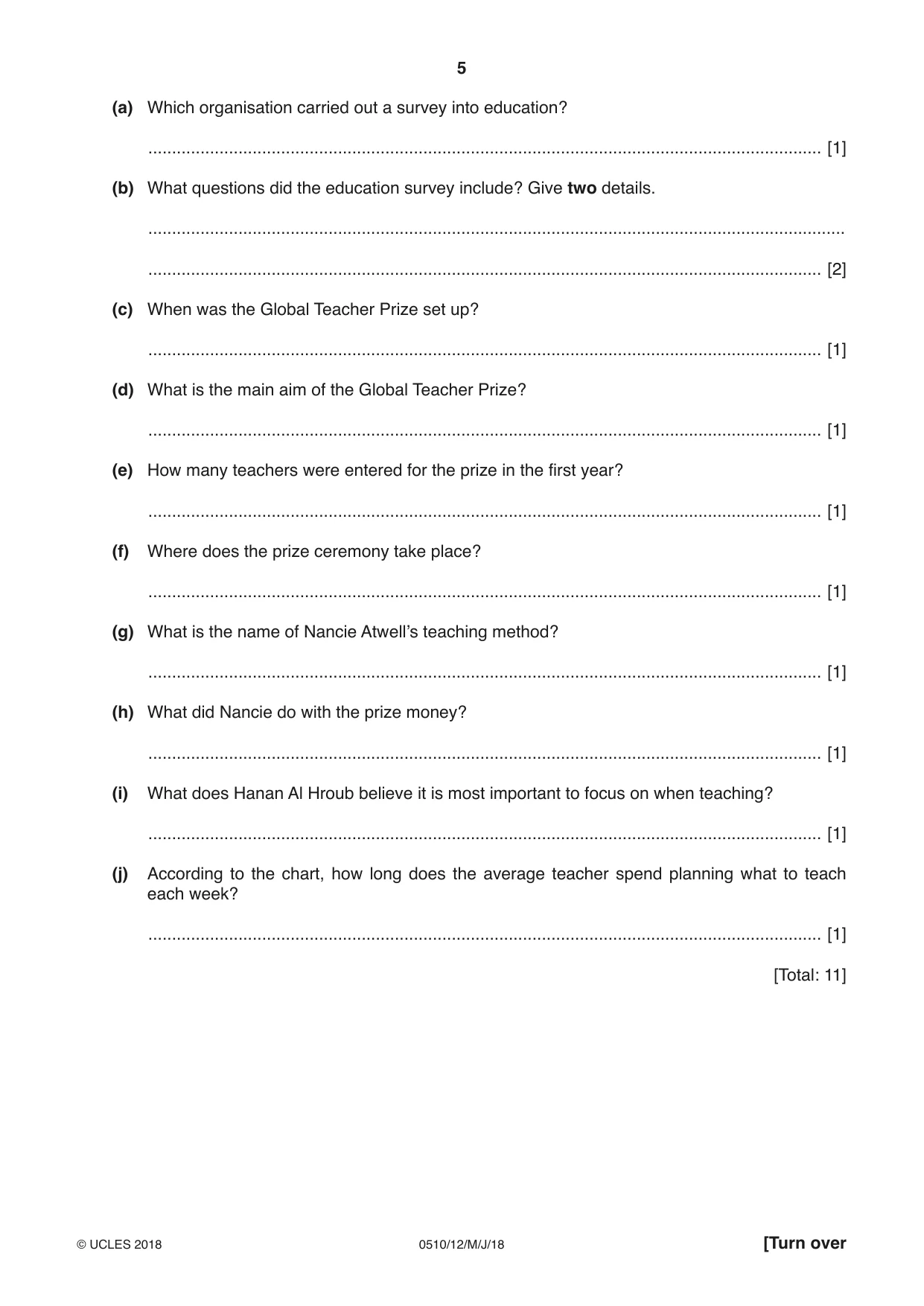
5 0510/12/M/J/18 © UCLES 2018 [Turn over (a) Which organisation carried out a survey into education? … [1] (b) What questions did the education survey include? Give two details. … … [2] (c) When was the Global Teacher Prize set up? … [1] (d) What is the main aim of the Global Teacher Prize? … [1] (e) How many teachers were entered for the prize in the first year? … [1] (f) Where does the prize ceremony take place? … [1] (g) What is the name of Nancie Atwell’s teaching method? … [1] (h) What did Nancie do with the prize money? … [1] (i) What does Hanan Al Hroub believe it is most important to focus on when teaching? … [1] (j) According to the chart, how long does the average teacher spend planning what to teach each week? … [1] [Total: 11]
Question paper, page 6
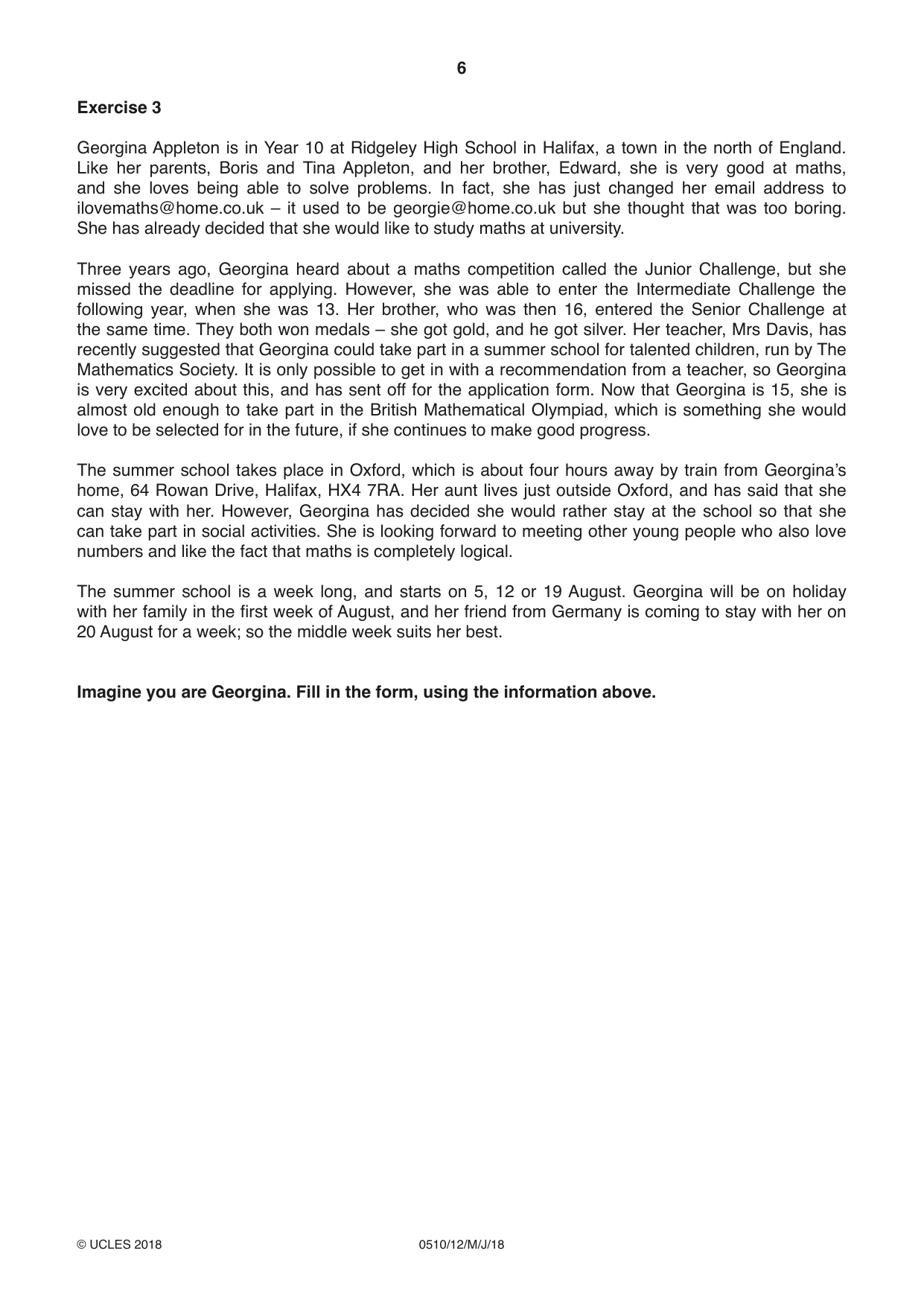
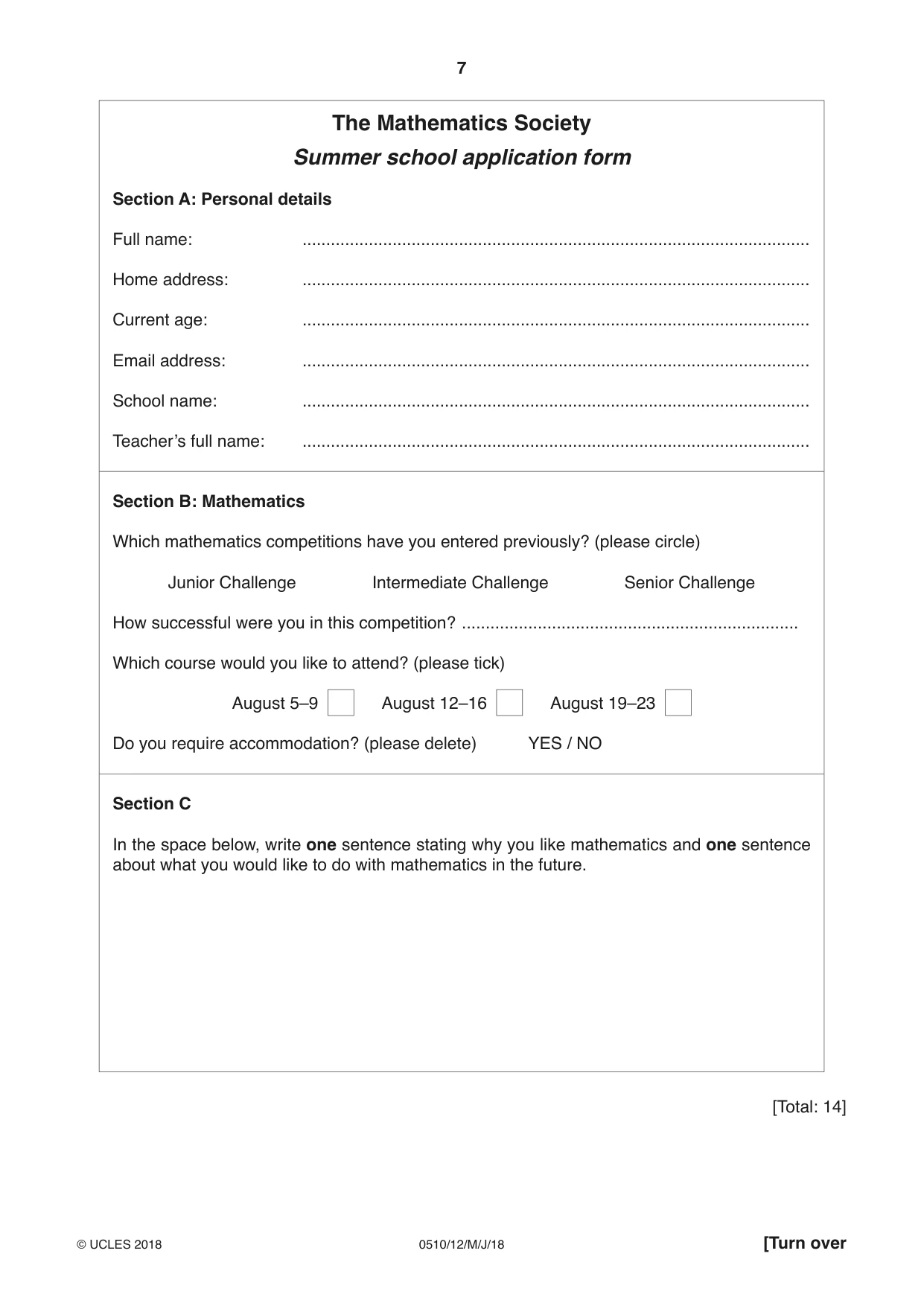
6 0510/12/M/J/18 © UCLES 2018 Exercise 3 Georgina Appleton is in Year 10 at Ridgeley High School in Halifax, a town in the north of England. Like her parents, Boris and Tina Appleton, and her brother, Edward, she is very good at maths, and she loves being able to solve problems. In fact, she has just changed her email address to ilovemaths@home.co.uk – it used to be georgie@home.co.uk but she thought that was too boring. She has already decided that she would like to study maths at university. Three years ago, Georgina heard about a maths competition called the Junior Challenge, but she missed the deadline for applying. However, she was able to enter the Intermediate Challenge the following year, when she was 13. Her brother, who was then 16, entered the Senior Challenge at the same time. They both won medals – she got gold, and he got silver. Her teacher, Mrs Davis, has recently suggested that Georgina could take part in a summer school for talented children, run by The Mathematics Society. It is only possible to get in with a recommendation from a teacher, so Georgina is very excited about this, and has sent off for the application form. Now that Georgina is 15, she is almost old enough to take part in the British Mathematical Olympiad, which is something she would love to be selected for in the future, if she continues to make good progress. The summer school takes place in Oxford, which is about four hours away by train from Georgina’s home, 64 Rowan Drive, Halifax, HX4 7RA. Her aunt lives just outside Oxford, and has said that she can stay with her. However, Georgina has decided she would rather stay at the school so that she can take part in social activities. She is looking forward to meeting other young people who also love numbers and like the fact that maths is completely logical. The summer school is a week long, and starts on 5, 12 or 19 August. Georgina will be on holiday with her family in the first week of August, and her friend from Germany is coming to stay with her on 20 August for a week; so the middle week suits her best. Imagine you are Georgina. Fill in the form, using the information above.
Question paper, page 7
7 0510/12/M/J/18 © UCLES 2018 [Turn over The Mathematics Society Summer school application form Section A: Personal details Full name: … Home address: … Current age: … Email address: … School name: … Teacher’s full name: … Section B: Mathematics Which mathematics competitions have you entered previously? (please circle) Junior Challenge Intermediate Challenge Senior Challenge How successful were you in this competition? … Which course would you like to attend? (please tick) August 5–9 August 12–16 August 19–23 Do you require accommodation? (please delete) YES / NO Section C In the space below, write one sentence stating why you like mathematics and one sentence about what you would like to do with mathematics in the future. [Total: 14]
Question paper, page 8
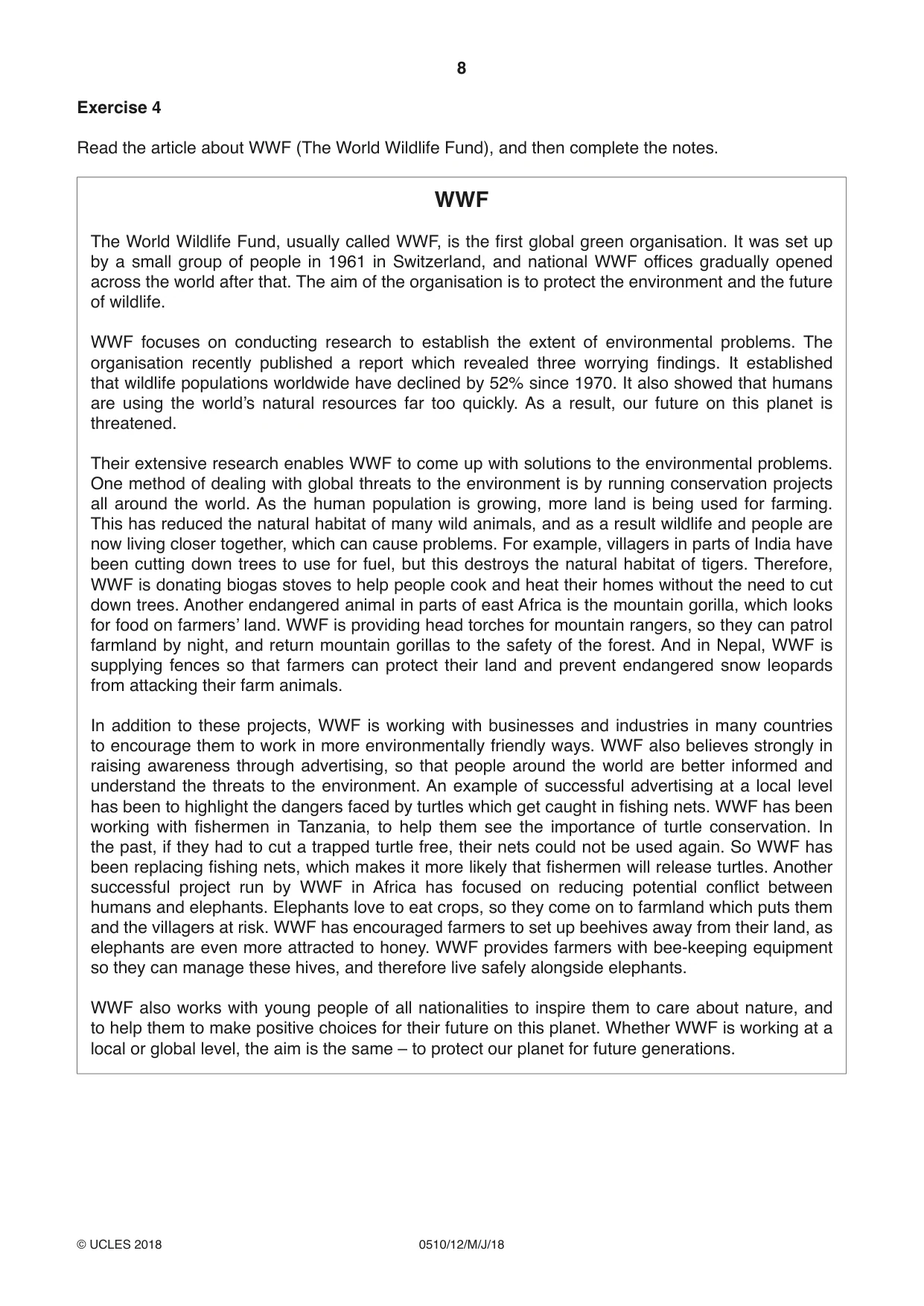
8 0510/12/M/J/18 © UCLES 2018 Exercise 4 Read the article about WWF (The World Wildlife Fund), and then complete the notes. WWF The World Wildlife Fund, usually called WWF, is the first global green organisation. It was set up by a small group of people in 1961 in Switzerland, and national WWF offices gradually opened across the world after that. The aim of the organisation is to protect the environment and the future of wildlife. WWF focuses on conducting research to establish the extent of environmental problems. The organisation recently published a report which revealed three worrying findings. It established that wildlife populations worldwide have declined by 52% since 1970. It also showed that humans are using the world’s natural resources far too quickly. As a result, our future on this planet is threatened. Their extensive research enables WWF to come up with solutions to the environmental problems. One method of dealing with global threats to the environment is by running conservation projects all around the world. As the human population is growing, more land is being used for farming. This has reduced the natural habitat of many wild animals, and as a result wildlife and people are now living closer together, which can cause problems. For example, villagers in parts of India have been cutting down trees to use for fuel, but this destroys the natural habitat of tigers. Therefore, WWF is donating biogas stoves to help people cook and heat their homes without the need to cut down trees. Another endangered animal in parts of east Africa is the mountain gorilla, which looks for food on farmers’ land. WWF is providing head torches for mountain rangers, so they can patrol farmland by night, and return mountain gorillas to the safety of the forest. And in Nepal, WWF is supplying fences so that farmers can protect their land and prevent endangered snow leopards from attacking their farm animals. In addition to these projects, WWF is working with businesses and industries in many countries to encourage them to work in more environmentally friendly ways. WWF also believes strongly in raising awareness through advertising, so that people around the world are better informed and understand the threats to the environment. An example of successful advertising at a local level has been to highlight the dangers faced by turtles which get caught in fishing nets. WWF has been working with fishermen in Tanzania, to help them see the importance of turtle conservation. In the past, if they had to cut a trapped turtle free, their nets could not be used again. So WWF has been replacing fishing nets, which makes it more likely that fishermen will release turtles. Another successful project run by WWF in Africa has focused on reducing potential conflict between humans and elephants. Elephants love to eat crops, so they come on to farmland which puts them and the villagers at risk. WWF has encouraged farmers to set up beehives away from their land, as elephants are even more attracted to honey. WWF provides farmers with bee-keeping equipment so they can manage these hives, and therefore live safely alongside elephants. WWF also works with young people of all nationalities to inspire them to care about nature, and to help them to make positive choices for their future on this planet. Whether WWF is working at a local or global level, the aim is the same – to protect our planet for future generations.
Question paper, page 9
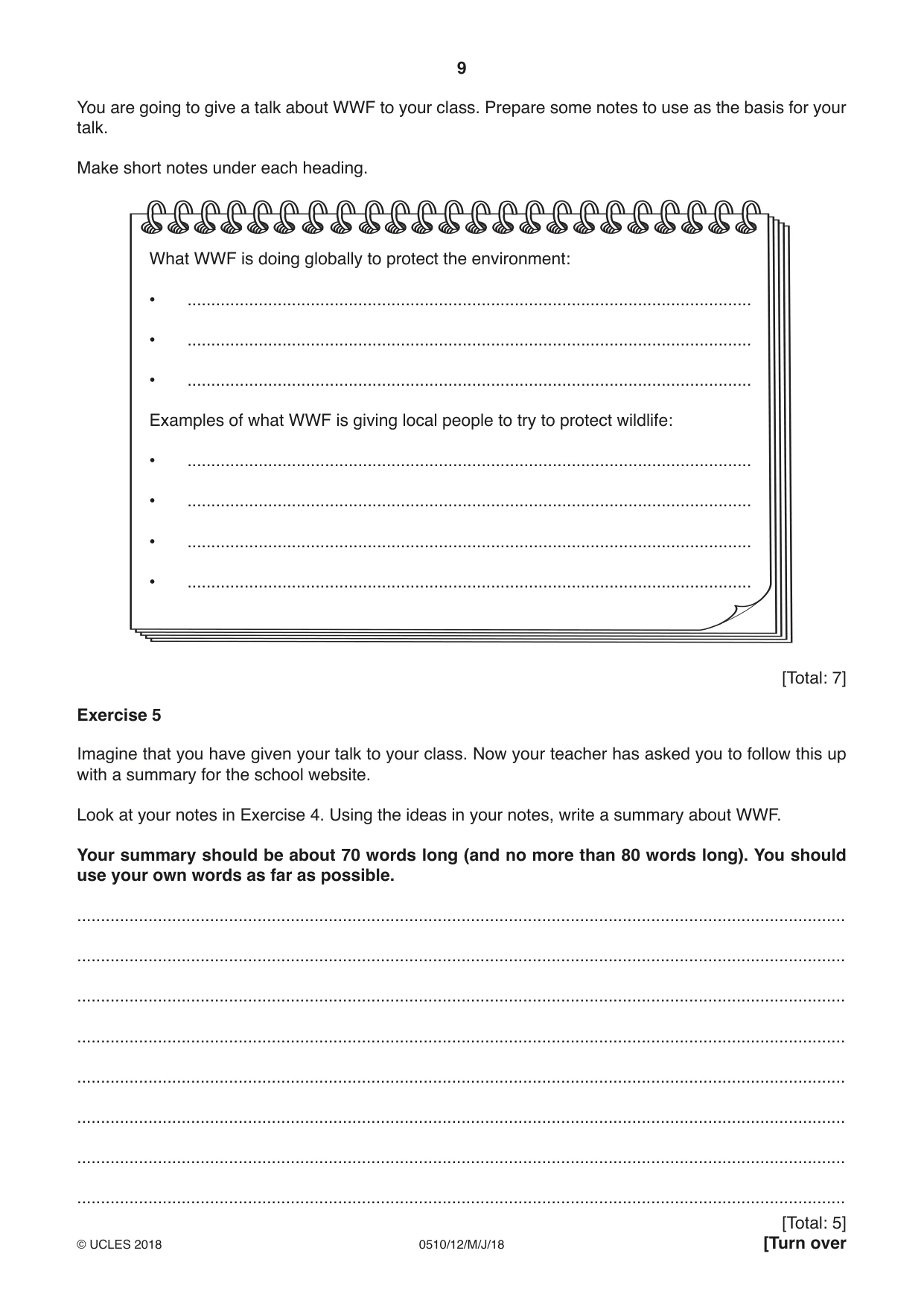
9 0510/12/M/J/18 © UCLES 2018 [Turn over You are going to give a talk about WWF to your class. Prepare some notes to use as the basis for your talk. Make short notes under each heading. What WWF is doing globally to protect the environment: • … • … • … Examples of what WWF is giving local people to try to protect wildlife: • … • … • … • … [Total: 7] Exercise 5 Imagine that you have given your talk to your class. Now your teacher has asked you to follow this up with a summary for the school website. Look at your notes in Exercise 4. Using the ideas in your notes, write a summary about WWF. Your summary should be about 70 words long (and no more than 80 words long). You should use your own words as far as possible. … … … … … … … … [Total: 5]
Question paper, page 10
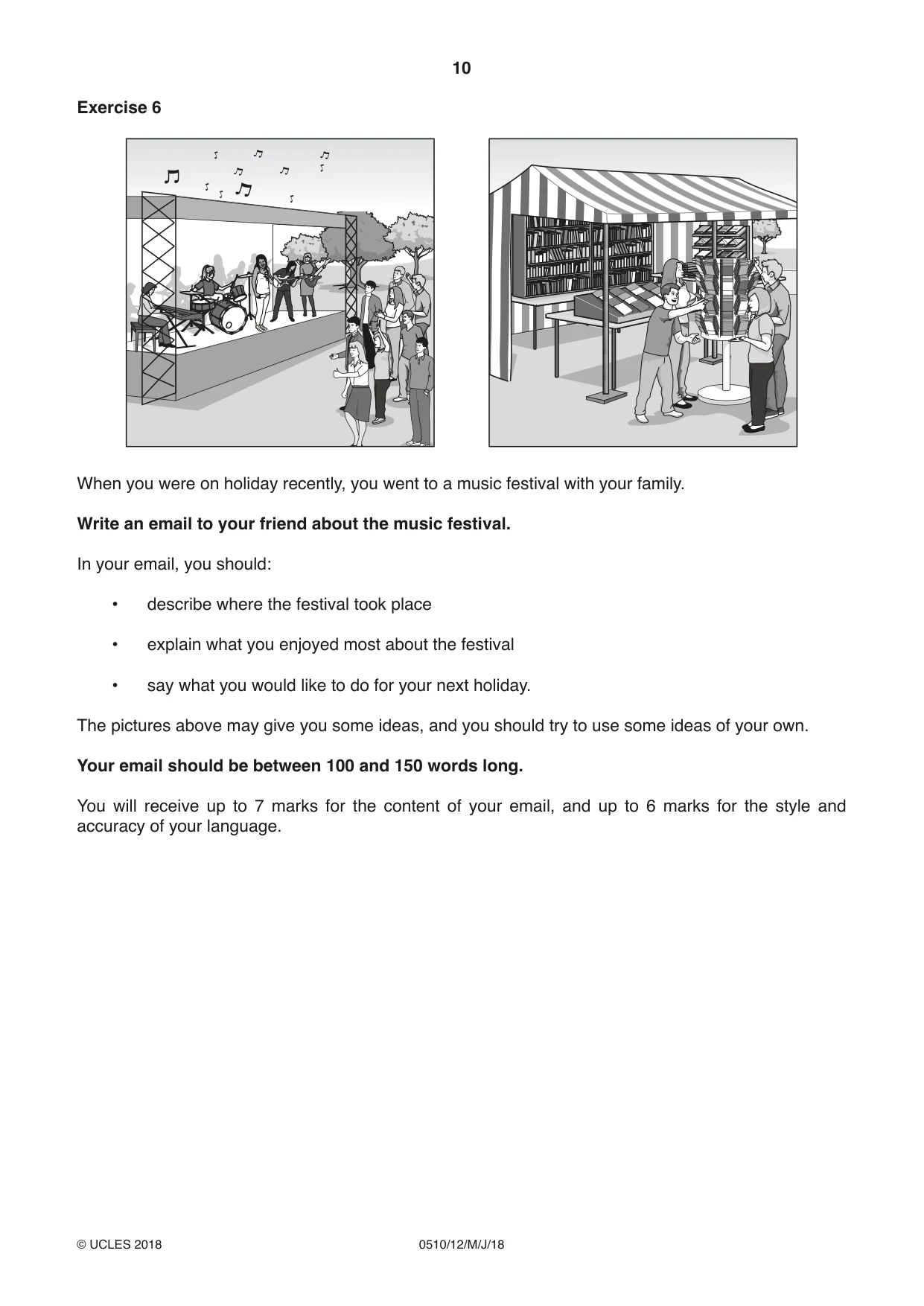
10 0510/12/M/J/18 © UCLES 2018 Exercise 6 When you were on holiday recently, you went to a music festival with your family. Write an email to your friend about the music festival. In your email, you should: • describe where the festival took place • explain what you enjoyed most about the festival • say what you would like to do for your next holiday. The pictures above may give you some ideas, and you should try to use some ideas of your own. Your email should be between 100 and 150 words long. You will receive up to 7 marks for the content of your email, and up to 6 marks for the style and accuracy of your language.
Question paper, page 11
11 0510/12/M/J/18 © UCLES 2018 [Turn over … … … … … … … … … … … … … … … … … … … … … … … … … … … [Total: 13]
Question paper, page 12
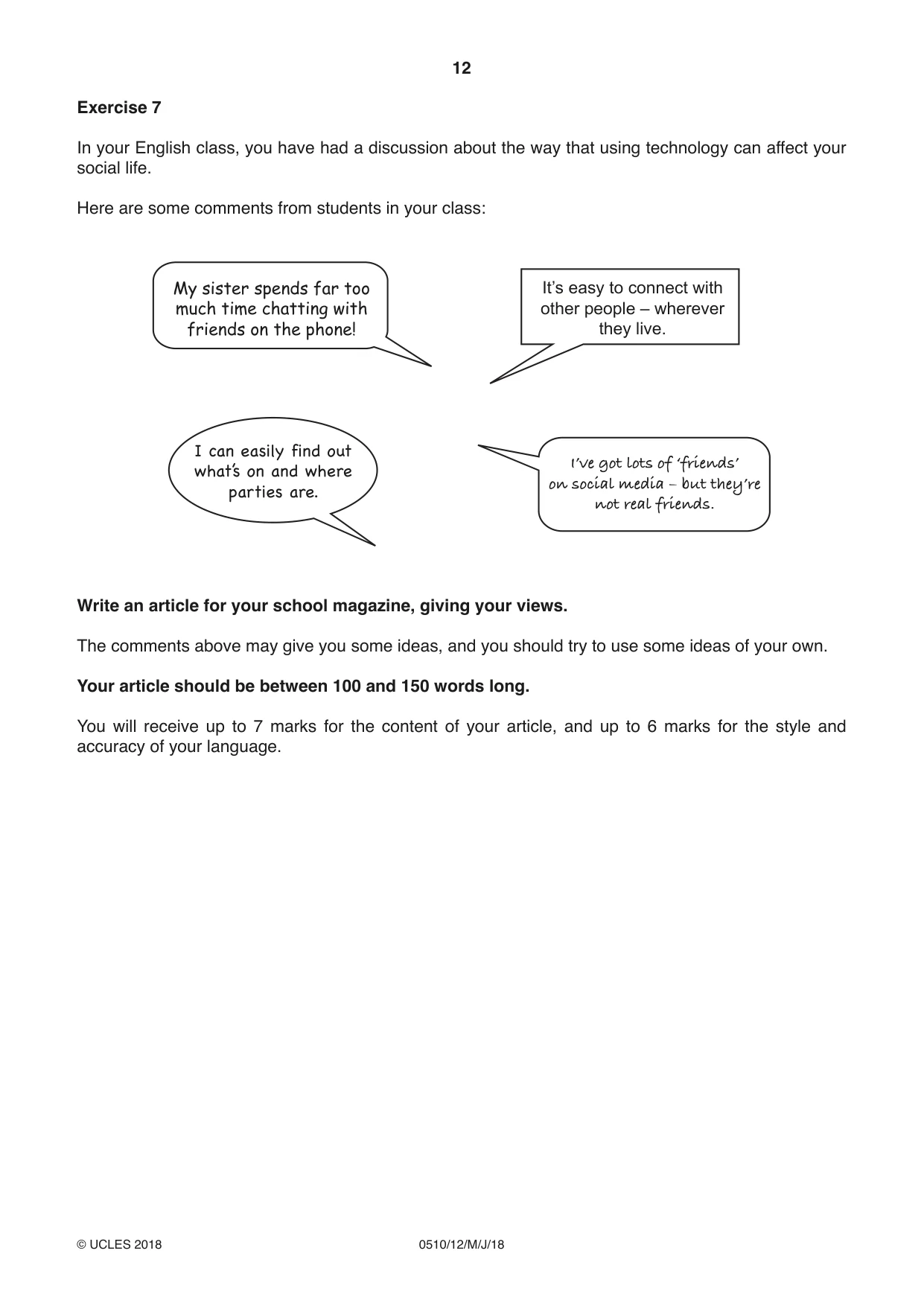
12 0510/12/M/J/18 © UCLES 2018 Exercise 7 In your English class, you have had a discussion about the way that using technology can affect your social life. Here are some comments from students in your class: My sister spends far too much time chatting with friends on the phone! I can easily find out what’s on and where parties are. It’s easy to connect with other people – wherever they live. I’ve got lots of ‘friends’ on social media – but they’re not real friends. Write an article for your school magazine, giving your views. The comments above may give you some ideas, and you should try to use some ideas of your own. Your article should be between 100 and 150 words long. You will receive up to 7 marks for the content of your article, and up to 6 marks for the style and accuracy of your language.
Question paper, page 13
13 0510/12/M/J/18 © UCLES 2018 … … … … … … … … … … … … … … … … … … … … … … … … … … … [Total: 13]
Question paper, page 14
14 0510/12/M/J/18 © UCLES 2018 BLANK PAGE
Question paper, page 15
15 0510/12/M/J/18 © UCLES 2018 BLANK PAGE
Question paper, page 16
16 0510/12/M/J/18 © UCLES 2018 Permission to reproduce items where third-party owned material protected by copyright is included has been sought and cleared where possible. Every reasonable effort has been made by the publisher (UCLES) to trace copyright holders, but if any items requiring clearance have unwittingly been included, the publisher will be pleased to make amends at the earliest possible opportunity. To avoid the issue of disclosure of answer-related information to candidates, all copyright acknowledgements are reproduced online in the Cambridge International Examinations Copyright Acknowledgements Booklet. This is produced for each series of examinations and is freely available to download at www.cie.org.uk after the live examination series. Cambridge International Examinations is part of the Cambridge Assessment Group. Cambridge Assessment is the brand name of University of Cambridge Local Examinations Syndicate (UCLES), which is itself a department of the University of Cambridge. BLANK PAGE
Mark scheme, page 1
IGCSE™ is a registered trademark. This document consists of 12 printed pages. © UCLES 2018 [Turn over Cambridge Assessment International Education Cambridge International General Certificate of Secondary Education ENGLISH AS A SECOND LANGUAGE 0510/12 Paper 1 Reading and Writing (Core) May/June 2018 MARK SCHEME Maximum Mark: 70 Published This mark scheme is published as an aid to teachers and candidates, to indicate the requirements of the examination. It shows the basis on which Examiners were instructed to award marks. It does not indicate the details of the discussions that took place at an Examiners’ meeting before marking began, which would have considered the acceptability of alternative answers. Mark schemes should be read in conjunction with the question paper and the Principal Examiner Report for Teachers. Cambridge International will not enter into discussions about these mark schemes. Cambridge International is publishing the mark schemes for the May/June 2018 series for most Cambridge IGCSE™, Cambridge International A and AS Level and Cambridge Pre-U components, and some Cambridge O Level components.
Mark scheme, page 2
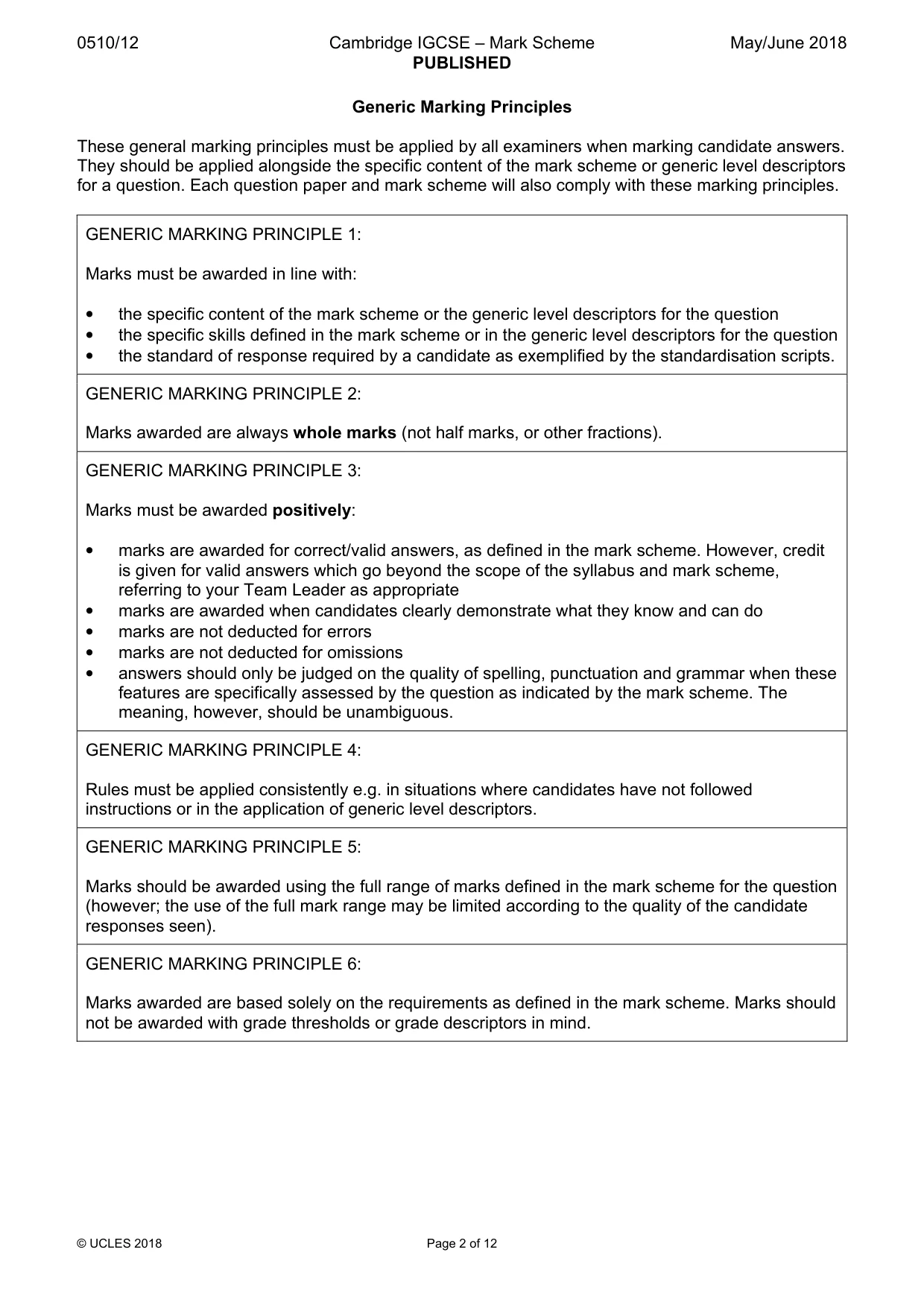
0510/12 Cambridge IGCSE – Mark Scheme PUBLISHED May/June 2018 © UCLES 2018 Page 2 of 12 Generic Marking Principles These general marking principles must be applied by all examiners when marking candidate answers. They should be applied alongside the specific content of the mark scheme or generic level descriptors for a question. Each question paper and mark scheme will also comply with these marking principles. GENERIC MARKING PRINCIPLE 1: Marks must be awarded in line with: • the specific content of the mark scheme or the generic level descriptors for the question • the specific skills defined in the mark scheme or in the generic level descriptors for the question • the standard of response required by a candidate as exemplified by the standardisation scripts. GENERIC MARKING PRINCIPLE 2: Marks awarded are always whole marks (not half marks, or other fractions). GENERIC MARKING PRINCIPLE 3: Marks must be awarded positively: • marks are awarded for correct/valid answers, as defined in the mark scheme. However, credit is given for valid answers which go beyond the scope of the syllabus and mark scheme, referring to your Team Leader as appropriate • marks are awarded when candidates clearly demonstrate what they know and can do • marks are not deducted for errors • marks are not deducted for omissions • answers should only be judged on the quality of spelling, punctuation and grammar when these features are specifically assessed by the question as indicated by the mark scheme. The meaning, however, should be unambiguous. GENERIC MARKING PRINCIPLE 4: Rules must be applied consistently e.g. in situations where candidates have not followed instructions or in the application of generic level descriptors. GENERIC MARKING PRINCIPLE 5: Marks should be awarded using the full range of marks defined in the mark scheme for the question (however; the use of the full mark range may be limited according to the quality of the candidate responses seen). GENERIC MARKING PRINCIPLE 6: Marks awarded are based solely on the requirements as defined in the mark scheme. Marks should not be awarded with grade thresholds or grade descriptors in mind.
Mark scheme, page 3
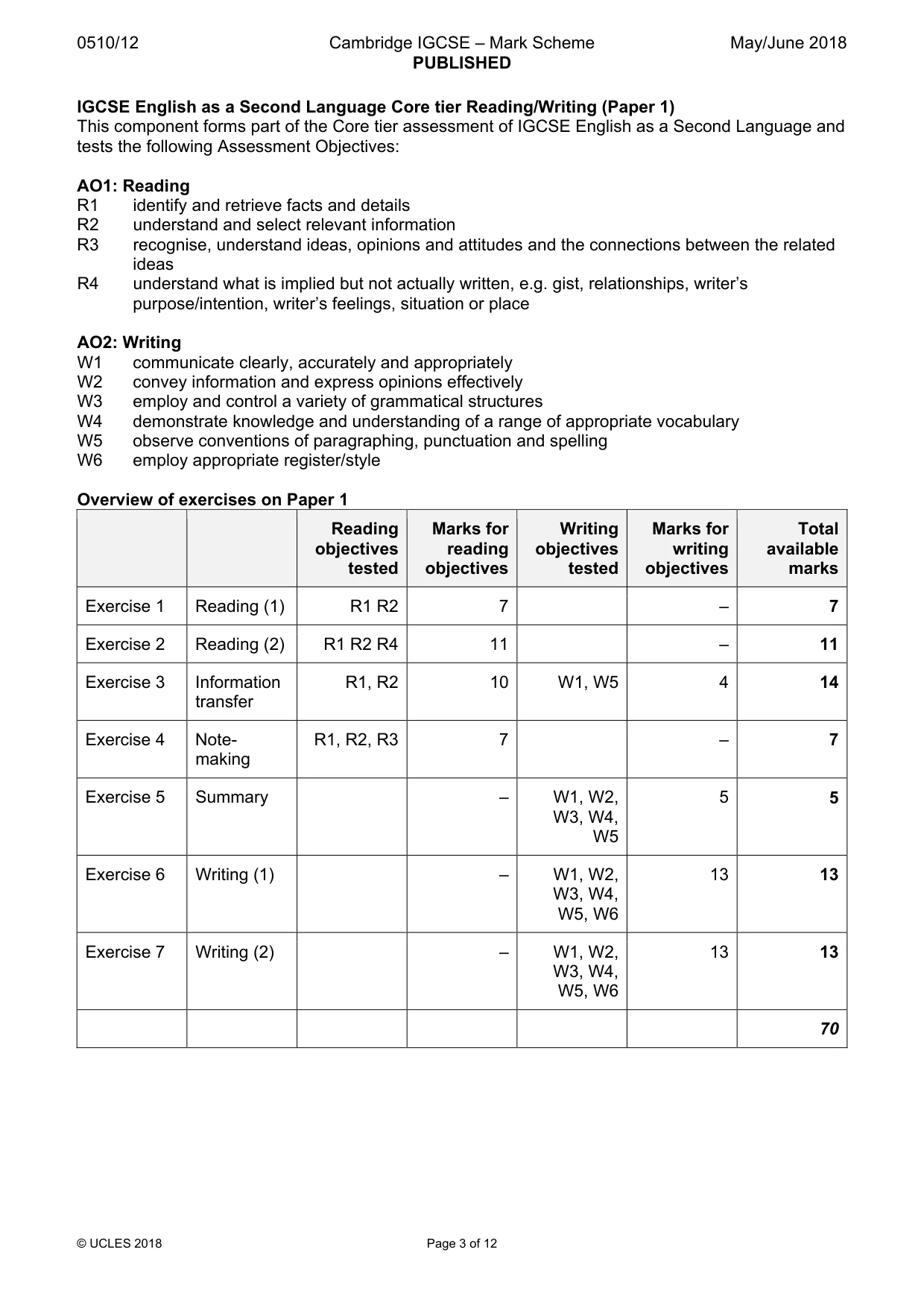
0510/12 Cambridge IGCSE – Mark Scheme PUBLISHED May/June 2018 © UCLES 2018 Page 3 of 12 IGCSE English as a Second Language Core tier Reading/Writing (Paper 1) This component forms part of the Core tier assessment of IGCSE English as a Second Language and tests the following Assessment Objectives: AO1: Reading R1 identify and retrieve facts and details R2 understand and select relevant information R3 recognise, understand ideas, opinions and attitudes and the connections between the related ideas R4 understand what is implied but not actually written, e.g. gist, relationships, writer’s purpose/intention, writer’s feelings, situation or place AO2: Writing W1 communicate clearly, accurately and appropriately W2 convey information and express opinions effectively W3 employ and control a variety of grammatical structures W4 demonstrate knowledge and understanding of a range of appropriate vocabulary W5 observe conventions of paragraphing, punctuation and spelling W6 employ appropriate register/style Overview of exercises on Paper 1 Reading objectives tested Marks for reading objectives Writing objectives tested Marks for writing objectives Total available marks Exercise 1 Reading (1) R1 R2 7 – 7 Exercise 2 Reading (2) R1 R2 R4 11 – 11 Exercise 3 Information transfer R1, R2 10 W1, W5 4 14 Exercise 4 Note- making R1, R2, R3 7 – 7 Exercise 5 Summary – W1, W2, W3, W4, W5 5 5 Exercise 6 Writing (1) – W1, W2, W3, W4, W5, W6 13 13 Exercise 7 Writing (2) – W1, W2, W3, W4, W5, W6 13 13 70
Mark scheme, page 4
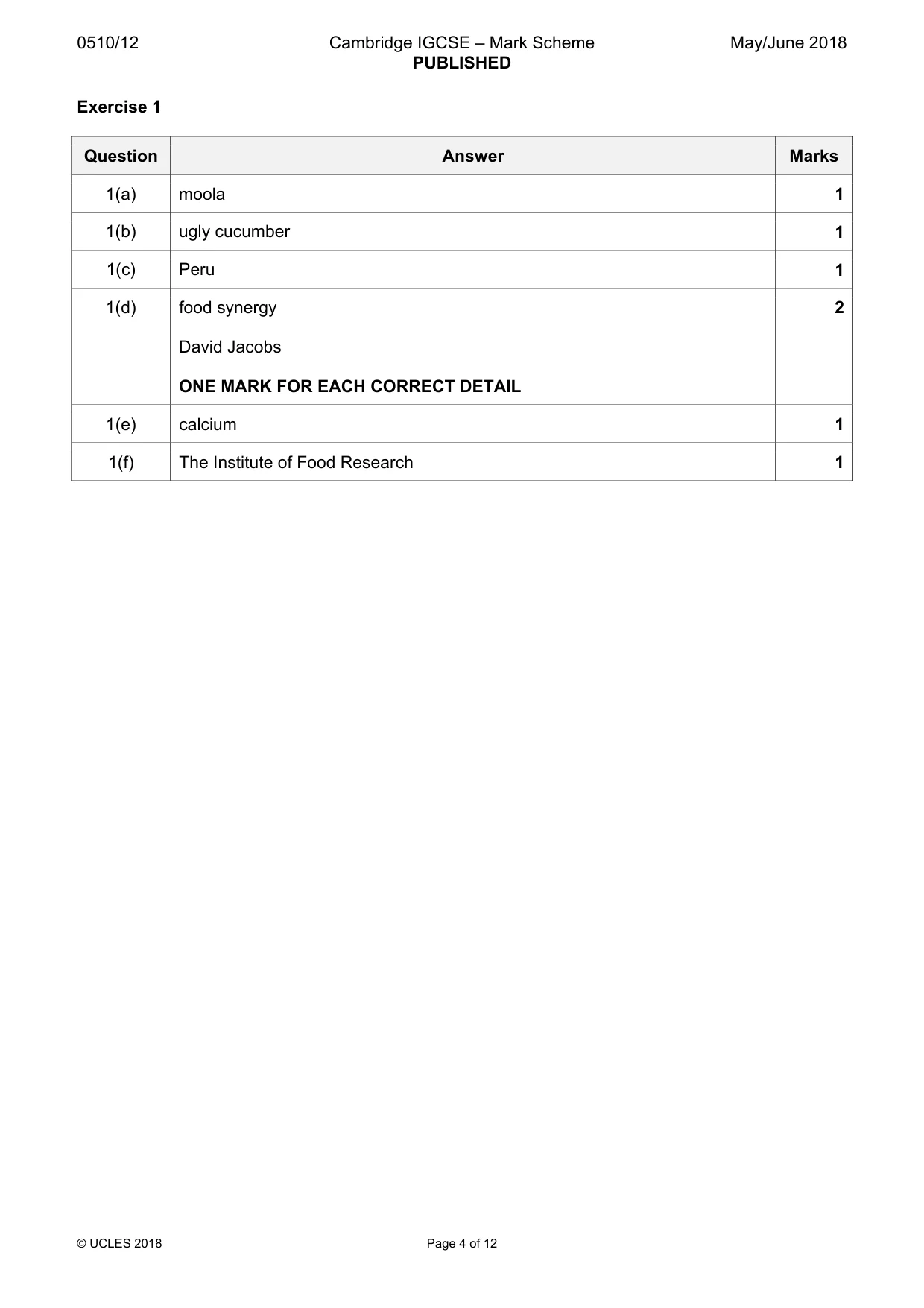
0510/12 Cambridge IGCSE – Mark Scheme PUBLISHED May/June 2018 © UCLES 2018 Page 4 of 12 Exercise 1 Question Answer Marks 1(a) moola 1 1(b) ugly cucumber 1 1(c) Peru 1 1(d) food synergy David Jacobs ONE MARK FOR EACH CORRECT DETAIL 2 1(e) calcium 1 1(f) The Institute of Food Research 1
Mark scheme, page 5
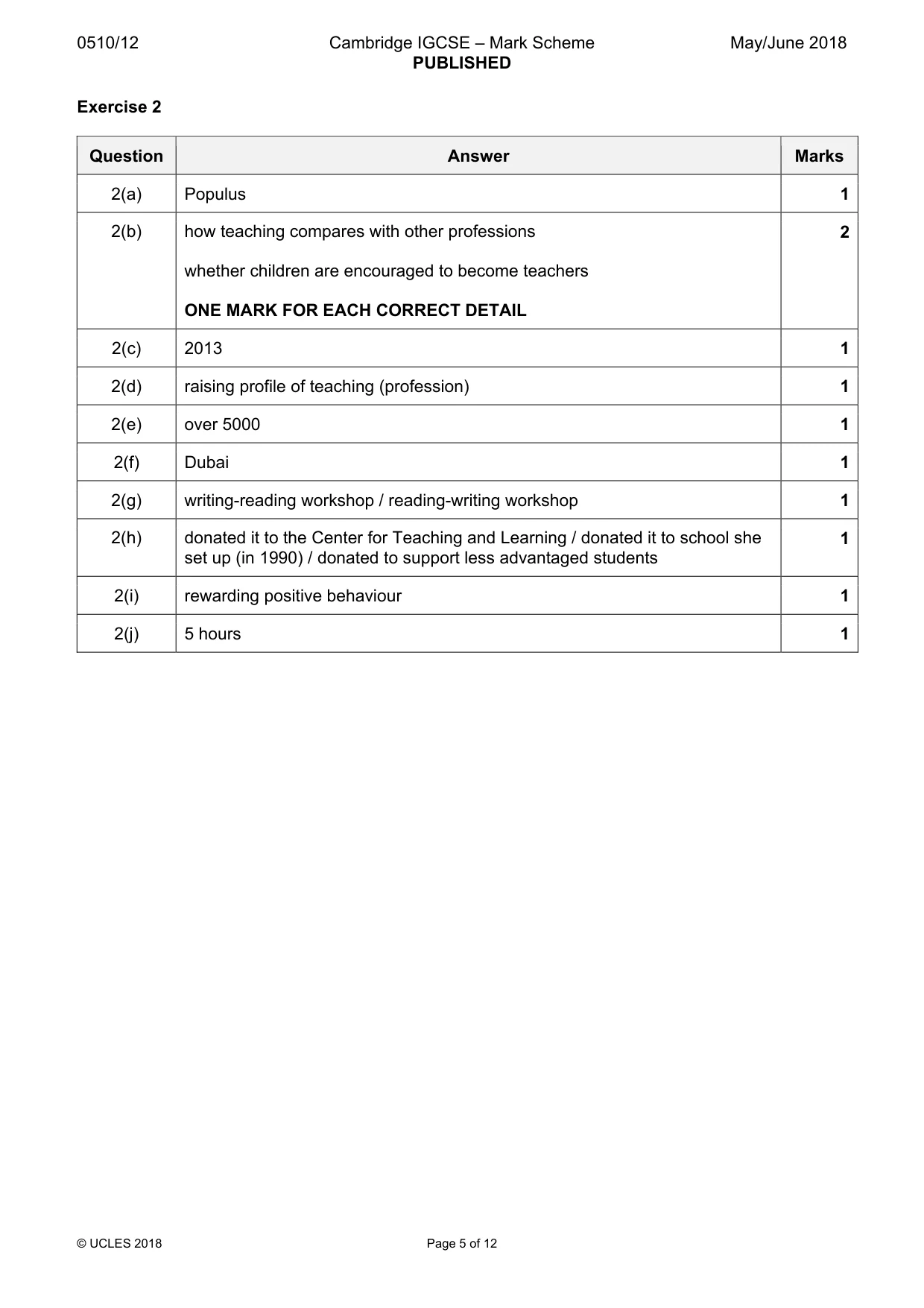
0510/12 Cambridge IGCSE – Mark Scheme PUBLISHED May/June 2018 © UCLES 2018 Page 5 of 12 Exercise 2 Question Answer Marks 2(a) Populus 1 2(b) how teaching compares with other professions whether children are encouraged to become teachers ONE MARK FOR EACH CORRECT DETAIL 2 2(c) 2013 1 2(d) raising profile of teaching (profession) 1 2(e) over 5000 1 2(f) Dubai 1 2(g) writing-reading workshop / reading-writing workshop 1 2(h) donated it to the Center for Teaching and Learning / donated it to school she set up (in 1990) / donated to support less advantaged students 1 2(i) rewarding positive behaviour 1 2(j) 5 hours 1
Mark scheme, page 6
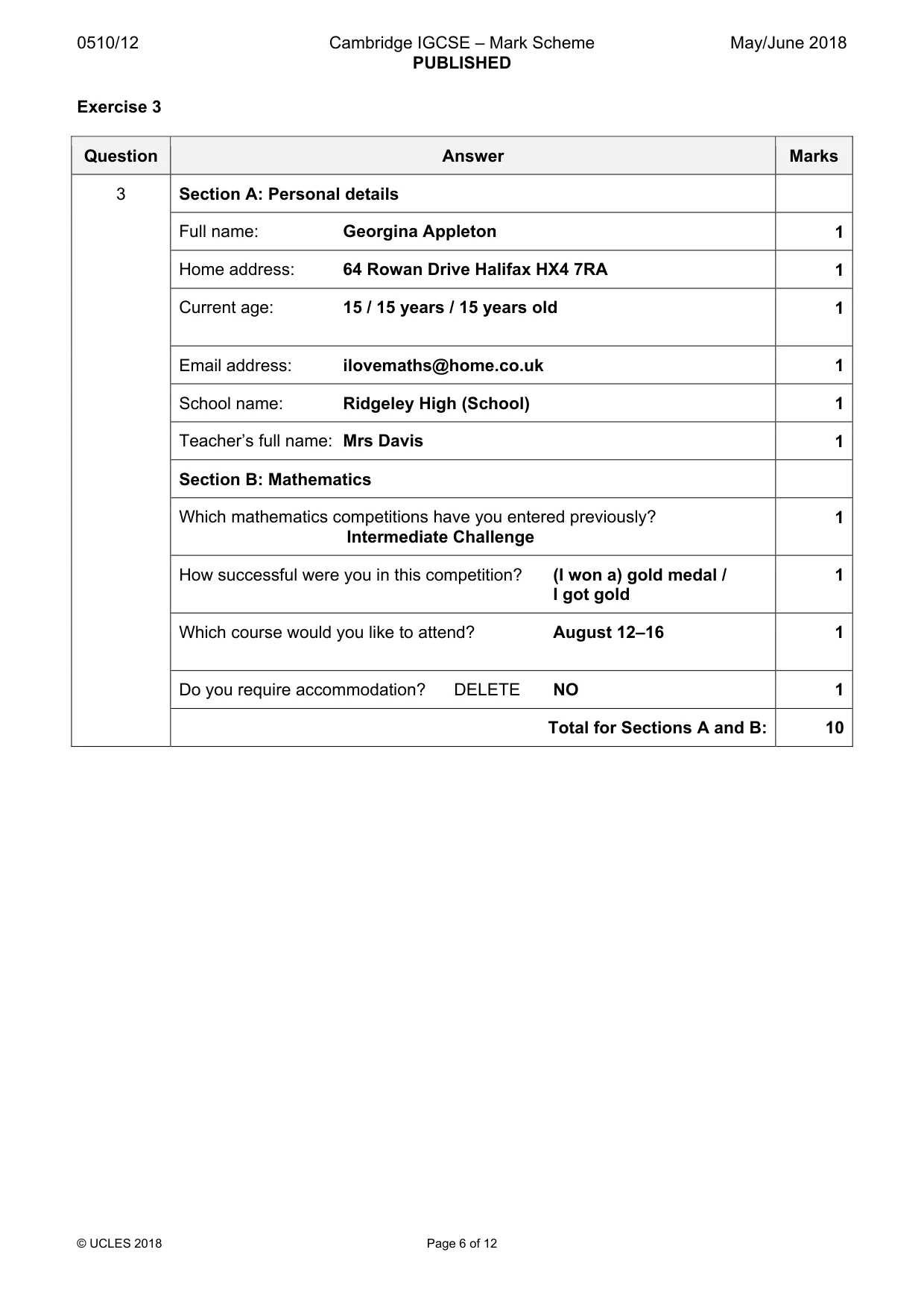
0510/12 Cambridge IGCSE – Mark Scheme PUBLISHED May/June 2018 © UCLES 2018 Page 6 of 12 Exercise 3 Question Answer Marks 3 Section A: Personal details Full name: Georgina Appleton 1 Home address: 64 Rowan Drive Halifax HX4 7RA 1 Current age: 15 / 15 years / 15 years old 1 Email address: ilovemaths@home.co.uk 1 School name: Ridgeley High (School) 1 Teacher’s full name: Mrs Davis 1 Section B: Mathematics Which mathematics competitions have you entered previously? Intermediate Challenge 1 How successful were you in this competition? (I won a) gold medal / I got gold 1 Which course would you like to attend? August 12–16 1 Do you require accommodation? DELETE NO 1 Total for Sections A and B: 10
Mark scheme, page 7
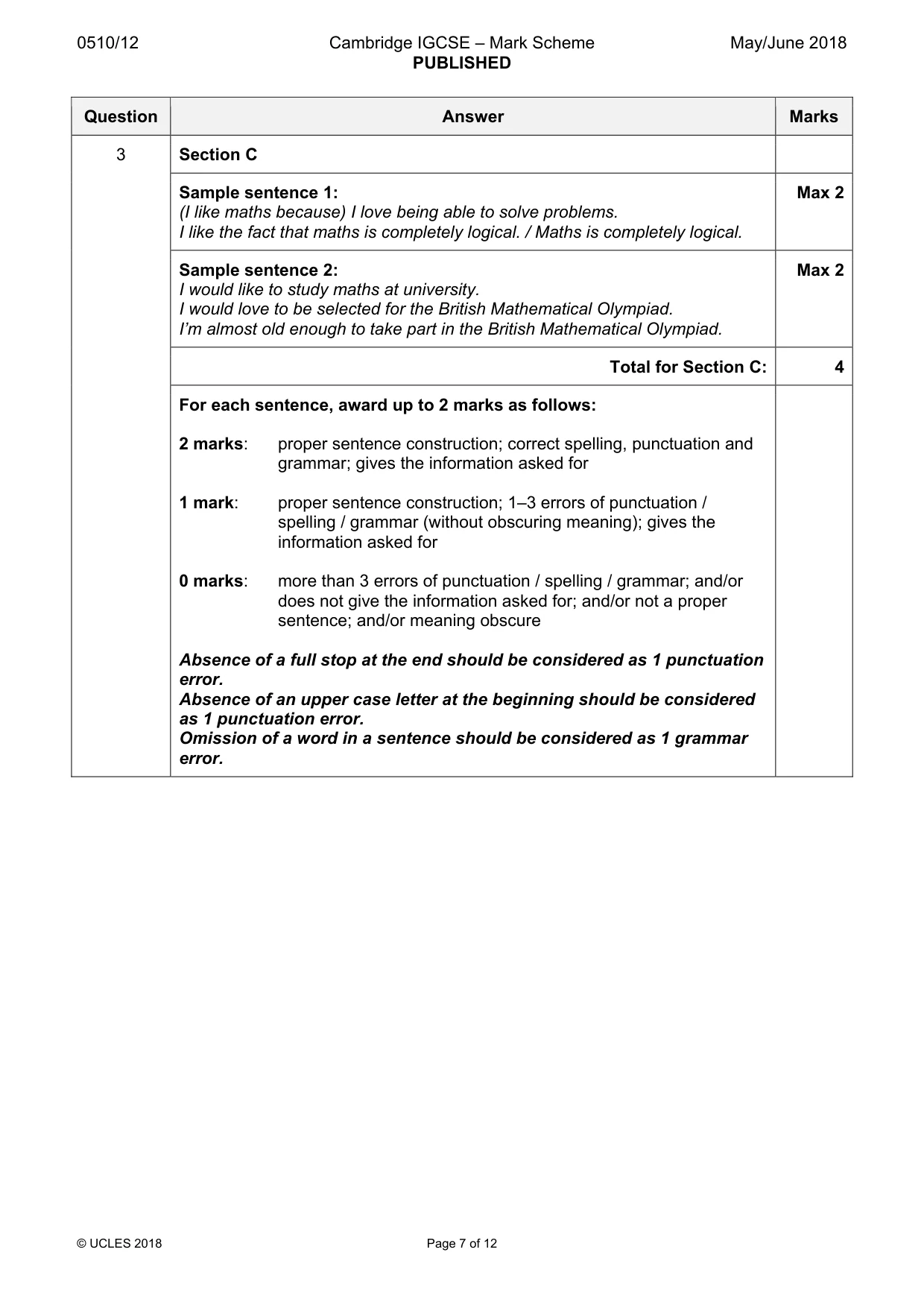
0510/12 Cambridge IGCSE – Mark Scheme PUBLISHED May/June 2018 © UCLES 2018 Page 7 of 12 Question Answer Marks 3 Section C Sample sentence 1: (I like maths because) I love being able to solve problems. I like the fact that maths is completely logical. / Maths is completely logical. Max 2 Sample sentence 2: I would like to study maths at university. I would love to be selected for the British Mathematical Olympiad. I’m almost old enough to take part in the British Mathematical Olympiad. Max 2 Total for Section C: 4 For each sentence, award up to 2 marks as follows: 2 marks: proper sentence construction; correct spelling, punctuation and grammar; gives the information asked for 1 mark: proper sentence construction; 1–3 errors of punctuation / spelling / grammar (without obscuring meaning); gives the information asked for 0 marks: more than 3 errors of punctuation / spelling / grammar; and/or does not give the information asked for; and/or not a proper sentence; and/or meaning obscure Absence of a full stop at the end should be considered as 1 punctuation error. Absence of an upper case letter at the beginning should be considered as 1 punctuation error. Omission of a word in a sentence should be considered as 1 grammar error.
Mark scheme, page 8
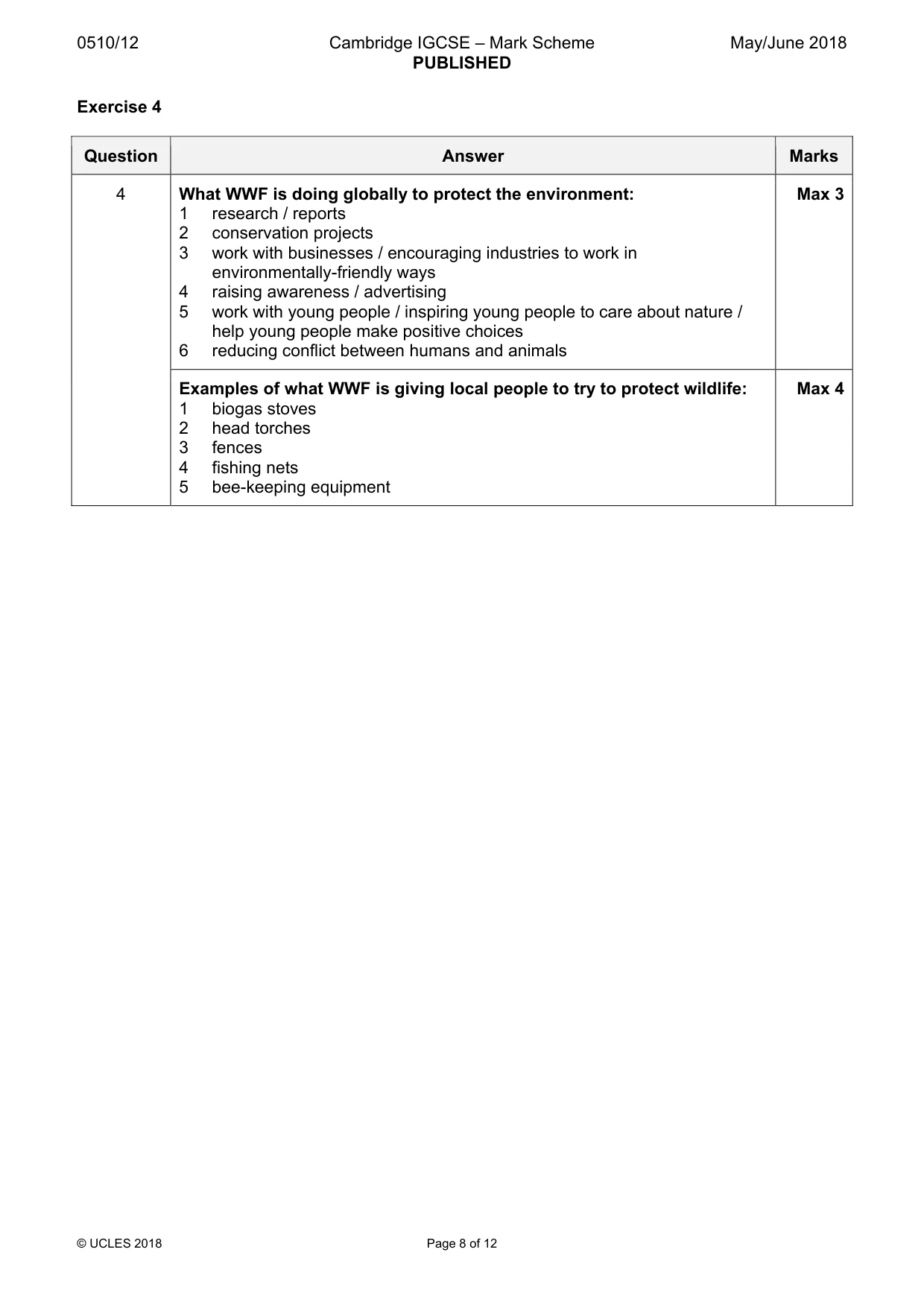
0510/12 Cambridge IGCSE – Mark Scheme PUBLISHED May/June 2018 © UCLES 2018 Page 8 of 12 Exercise 4 Question Answer Marks 4 What WWF is doing globally to protect the environment: 1 research / reports 2 conservation projects 3 work with businesses / encouraging industries to work in environmentally-friendly ways 4 raising awareness / advertising 5 work with young people / inspiring young people to care about nature / help young people make positive choices 6 reducing conflict between humans and animals Max 3 Examples of what WWF is giving local people to try to protect wildlife: 1 biogas stoves 2 head torches 3 fences 4 fishing nets 5 bee-keeping equipment Max 4
Mark scheme, page 9
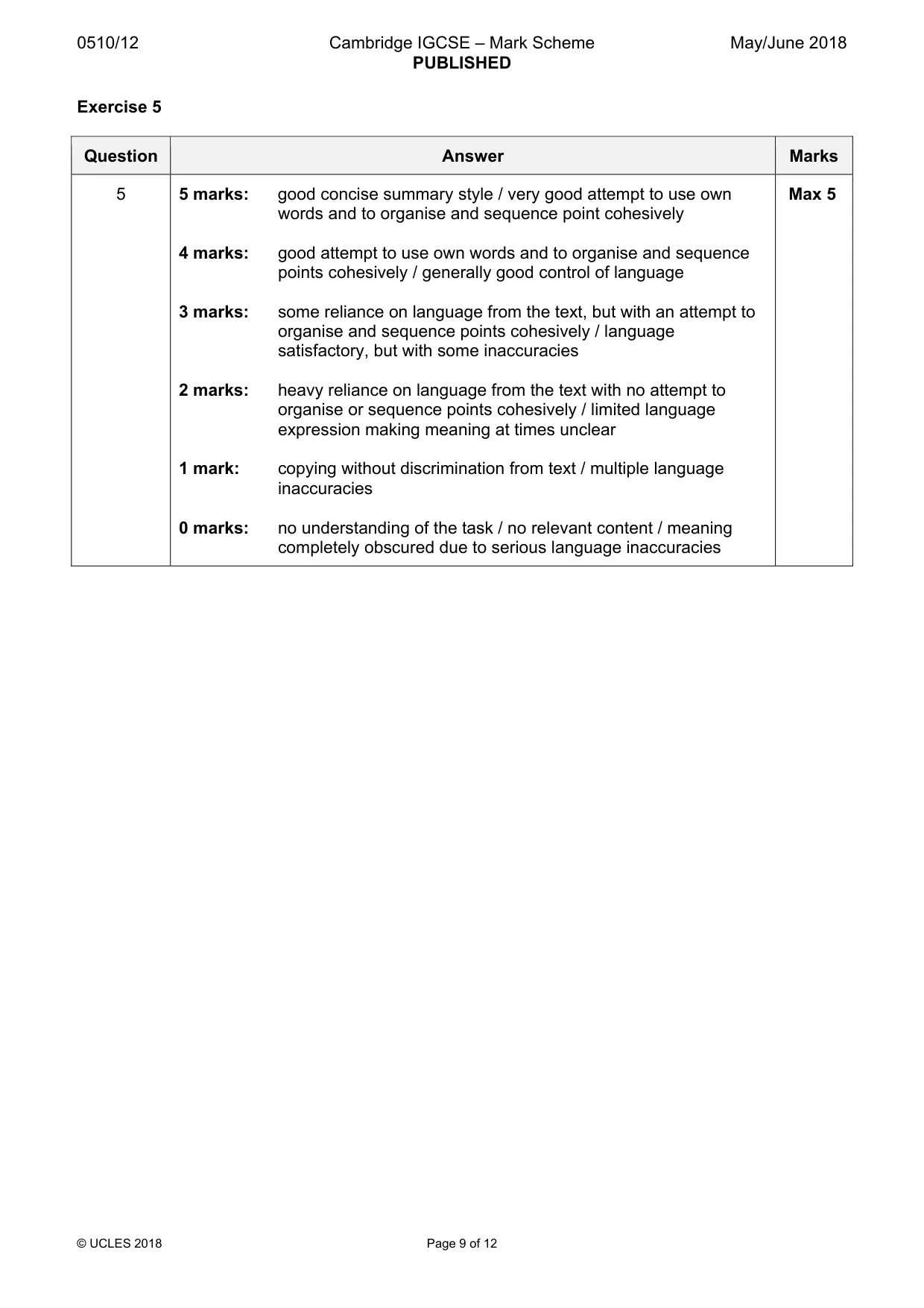
0510/12 Cambridge IGCSE – Mark Scheme PUBLISHED May/June 2018 © UCLES 2018 Page 9 of 12 Exercise 5 Question Answer Marks 5 5 marks: good concise summary style / very good attempt to use own words and to organise and sequence point cohesively 4 marks: good attempt to use own words and to organise and sequence points cohesively / generally good control of language 3 marks: some reliance on language from the text, but with an attempt to organise and sequence points cohesively / language satisfactory, but with some inaccuracies 2 marks: heavy reliance on language from the text with no attempt to organise or sequence points cohesively / limited language expression making meaning at times unclear 1 mark: copying without discrimination from text / multiple language inaccuracies 0 marks: no understanding of the task / no relevant content / meaning completely obscured due to serious language inaccuracies Max 5
Mark scheme, page 10
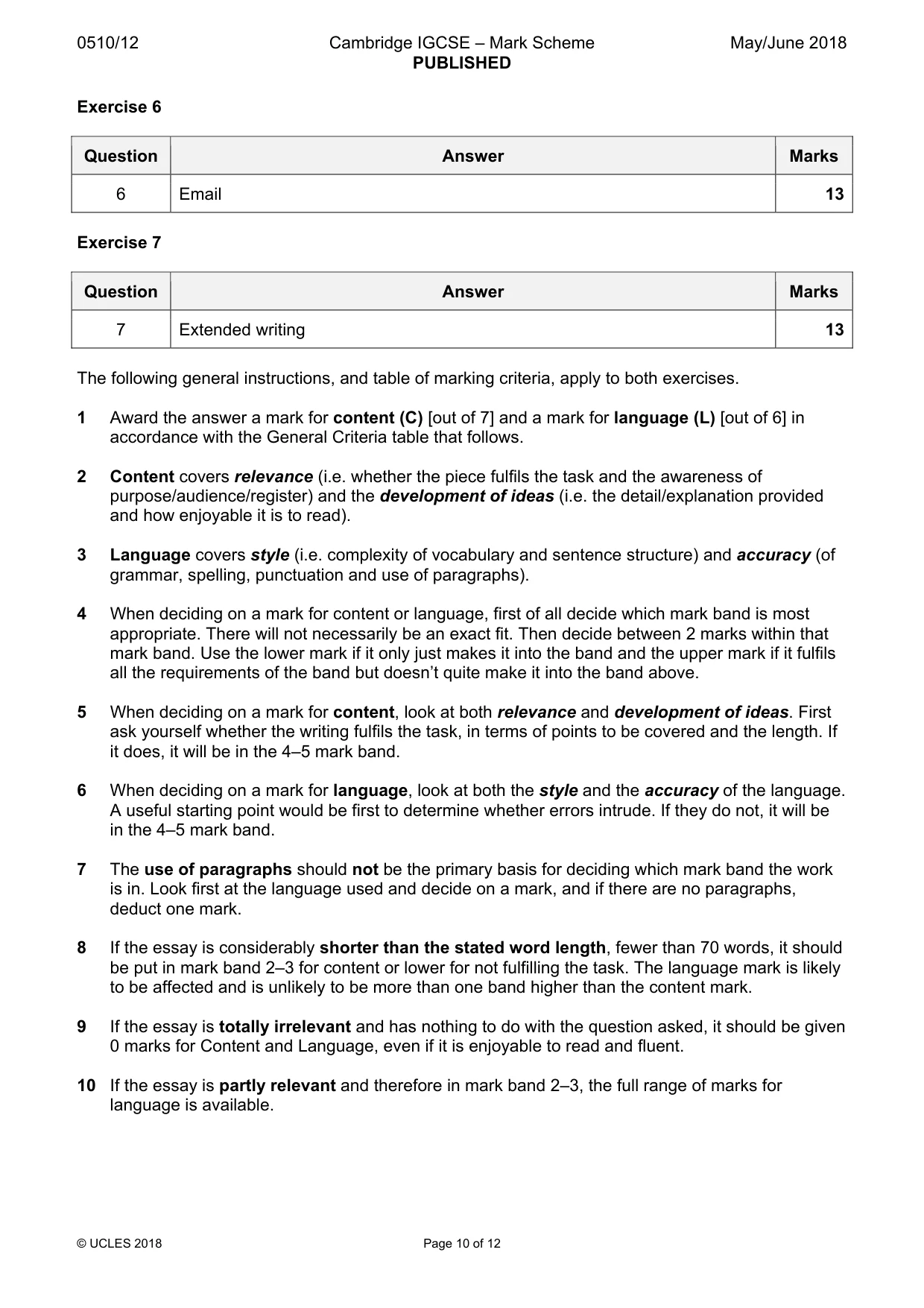
0510/12 Cambridge IGCSE – Mark Scheme PUBLISHED May/June 2018 © UCLES 2018 Page 10 of 12 Exercise 6 Question Answer Marks 6 Email 13 Exercise 7 Question Answer Marks 7 Extended writing 13 The following general instructions, and table of marking criteria, apply to both exercises. 1 Award the answer a mark for content (C) [out of 7] and a mark for language (L) [out of 6] in accordance with the General Criteria table that follows. 2 Content covers relevance (i.e. whether the piece fulfils the task and the awareness of purpose/audience/register) and the development of ideas (i.e. the detail/explanation provided and how enjoyable it is to read). 3 Language covers style (i.e. complexity of vocabulary and sentence structure) and accuracy (of grammar, spelling, punctuation and use of paragraphs). 4 When deciding on a mark for content or language, first of all decide which mark band is most appropriate. There will not necessarily be an exact fit. Then decide between 2 marks within that mark band. Use the lower mark if it only just makes it into the band and the upper mark if it fulfils all the requirements of the band but doesn’t quite make it into the band above. 5 When deciding on a mark for content, look at both relevance and development of ideas. First ask yourself whether the writing fulfils the task, in terms of points to be covered and the length. If it does, it will be in the 4–5 mark band. 6 When deciding on a mark for language, look at both the style and the accuracy of the language. A useful starting point would be first to determine whether errors intrude. If they do not, it will be in the 4–5 mark band. 7 The use of paragraphs should not be the primary basis for deciding which mark band the work is in. Look first at the language used and decide on a mark, and if there are no paragraphs, deduct one mark. 8 If the essay is considerably shorter than the stated word length, fewer than 70 words, it should be put in mark band 2–3 for content or lower for not fulfilling the task. The language mark is likely to be affected and is unlikely to be more than one band higher than the content mark. 9 If the essay is totally irrelevant and has nothing to do with the question asked, it should be given 0 marks for Content and Language, even if it is enjoyable to read and fluent. 10 If the essay is partly relevant and therefore in mark band 2–3, the full range of marks for language is available.
Mark scheme, page 11
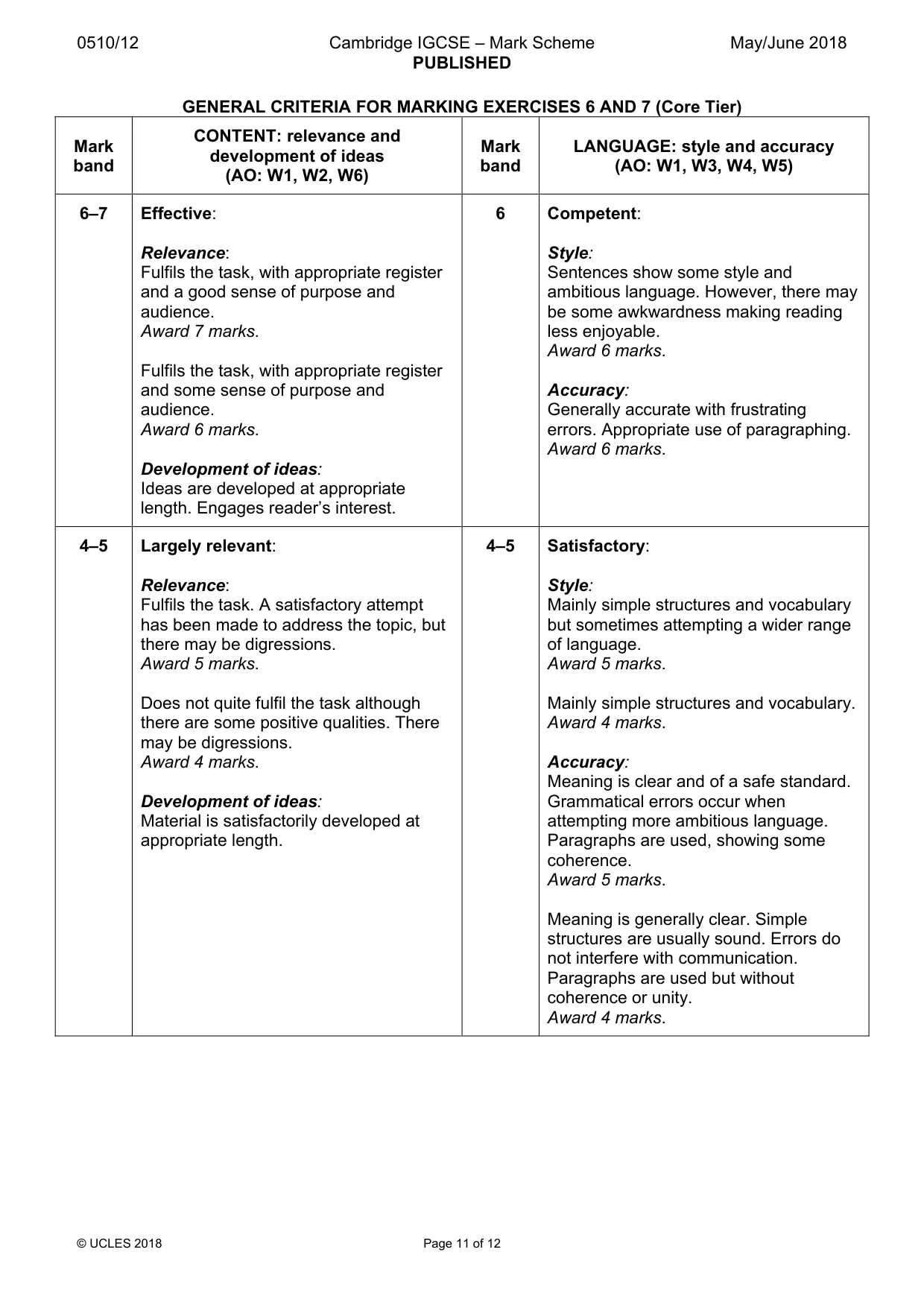
0510/12 Cambridge IGCSE – Mark Scheme PUBLISHED May/June 2018 © UCLES 2018 Page 11 of 12 GENERAL CRITERIA FOR MARKING EXERCISES 6 AND 7 (Core Tier) Mark band CONTENT: relevance and development of ideas (AO: W1, W2, W6) Mark band LANGUAGE: style and accuracy (AO: W1, W3, W4, W5) 6–7 Effective: Relevance: Fulfils the task, with appropriate register and a good sense of purpose and audience. Award 7 marks. Fulfils the task, with appropriate register and some sense of purpose and audience. Award 6 marks. Development of ideas: Ideas are developed at appropriate length. Engages reader’s interest. 6 Competent: Style: Sentences show some style and ambitious language. However, there may be some awkwardness making reading less enjoyable. Award 6 marks. Accuracy: Generally accurate with frustrating errors. Appropriate use of paragraphing. Award 6 marks. 4–5 Largely relevant: Relevance: Fulfils the task. A satisfactory attempt has been made to address the topic, but there may be digressions. Award 5 marks. Does not quite fulfil the task although there are some positive qualities. There may be digressions. Award 4 marks. Development of ideas: Material is satisfactorily developed at appropriate length. 4–5 Satisfactory: Style: Mainly simple structures and vocabulary but sometimes attempting a wider range of language. Award 5 marks. Mainly simple structures and vocabulary. Award 4 marks. Accuracy: Meaning is clear and of a safe standard. Grammatical errors occur when attempting more ambitious language. Paragraphs are used, showing some coherence. Award 5 marks. Meaning is generally clear. Simple structures are usually sound. Errors do not interfere with communication. Paragraphs are used but without coherence or unity. Award 4 marks.
Mark scheme, page 12
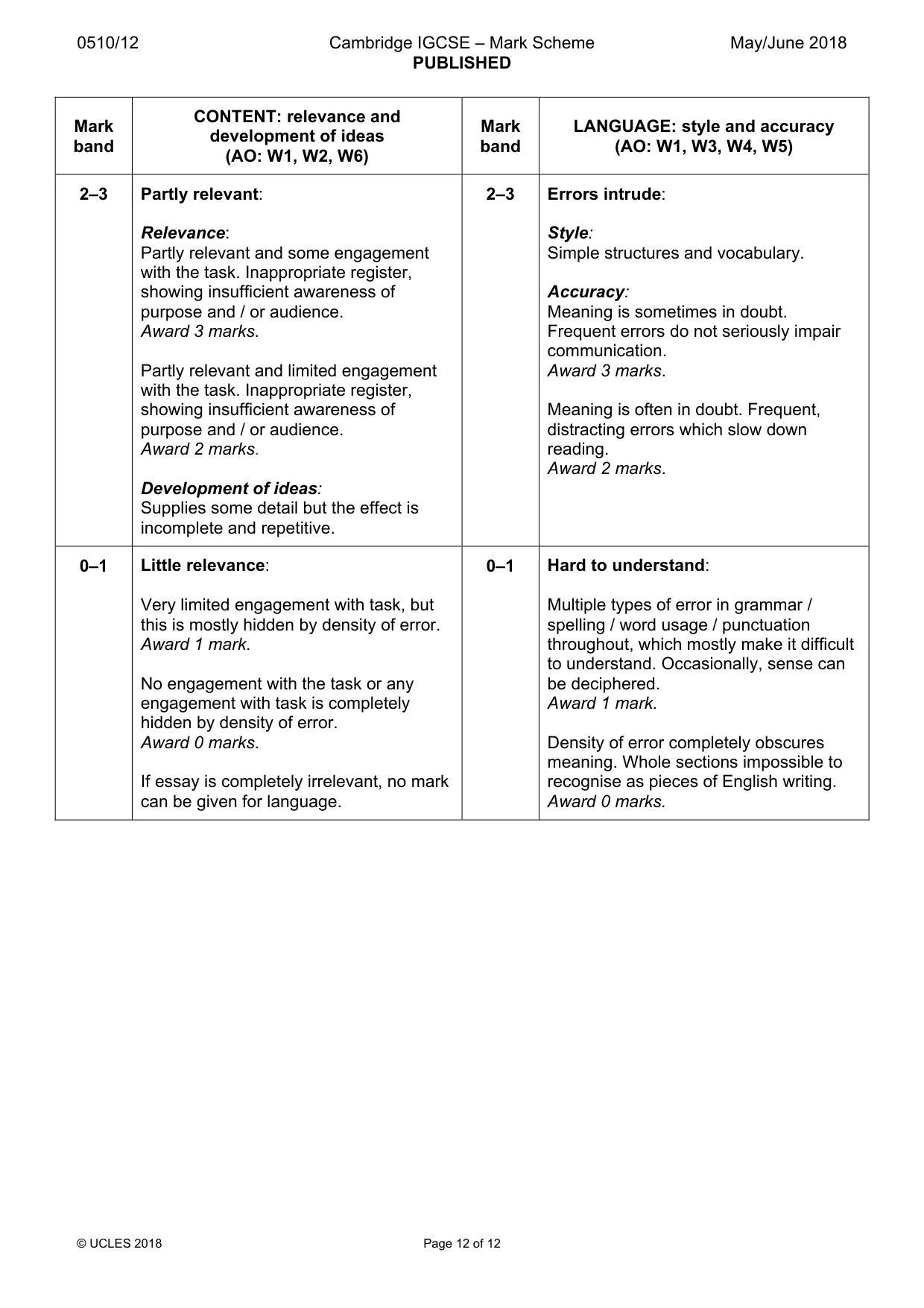
0510/12 Cambridge IGCSE – Mark Scheme PUBLISHED May/June 2018 © UCLES 2018 Page 12 of 12 Mark band CONTENT: relevance and development of ideas (AO: W1, W2, W6) Mark band LANGUAGE: style and accuracy (AO: W1, W3, W4, W5) 2–3 Partly relevant: Relevance: Partly relevant and some engagement with the task. Inappropriate register, showing insufficient awareness of purpose and / or audience. Award 3 marks. Partly relevant and limited engagement with the task. Inappropriate register, showing insufficient awareness of purpose and / or audience. Award 2 marks. Development of ideas: Supplies some detail but the effect is incomplete and repetitive. 2–3 Errors intrude: Style: Simple structures and vocabulary. Accuracy: Meaning is sometimes in doubt. Frequent errors do not seriously impair communication. Award 3 marks. Meaning is often in doubt. Frequent, distracting errors which slow down reading. Award 2 marks. 0–1 Little relevance: Very limited engagement with task, but this is mostly hidden by density of error. Award 1 mark. No engagement with the task or any engagement with task is completely hidden by density of error. Award 0 marks. If essay is completely irrelevant, no mark can be given for language. 0–1 Hard to understand: Multiple types of error in grammar / spelling / word usage / punctuation throughout, which mostly make it difficult to understand. Occasionally, sense can be deciphered. Award 1 mark. Density of error completely obscures meaning. Whole sections impossible to recognise as pieces of English writing. Award 0 marks.
What you needed in this session
Cambridge’s own grade thresholds for 2018 May/June, Paper 1 · Variant 2. A higher threshold means an easier paper — the bar moves with how the cohort did.