Cambridge IGCSE English - Second Language (oral endorsement) 0510 — 2018 May/June Paper 1 · Variant 1
0510/11/M/J/18 · 70 marks · ≈79 min
The question paper and its mark scheme, free to read here and free to download. This is Cambridge’s own paper, exactly as it was sat.
Question paper16 pages





Mark scheme12 pages
Answers below. Sit the paper first if you are practising.
Paper as text
Question paper, page 1
* 8 3 9 9 7 7 7 9 1 6 * This document consists of 13 printed pages and 3 blank pages. DC (LK/CGW) 145735/4 © UCLES 2018 [Turn over Cambridge International Examinations Cambridge International General Certificate of Secondary Education ENGLISH AS A SECOND LANGUAGE 0510/11 Paper 1 Reading and Writing (Core) May/June 2018 1 hour 30 minutes Candidates answer on the Question Paper. No Additional Materials are required. READ THESE INSTRUCTIONS FIRST Write your Centre number, candidate number and name on all the work you hand in. Write in dark blue or black pen. Do not use staples, paper clips, glue or correction fluid. DO NOT WRITE IN ANY BARCODES. Answer all questions. Dictionaries are not allowed. At the end of the examination, fasten all your work securely together. The number of marks is given in brackets [ ] at the end of each question or part question.
Question paper, page 2
2 0510/11/M/J/18 © UCLES 2018 Exercise 1 Read the brochure about different activity holidays for families, and then answer the following questions. Holidays with the Family Adventure company Cycling in France Whether you’re a keen cyclist or simply enjoy bike rides at the weekend, we have plenty of one- or two-week cycling holidays to choose from. Trips are designed for teenagers and their families, so there’s every opportunity to make new friends while enjoying some great rides. The holiday package includes accommodation in some lovely hotels, as well as bike hire and the cost of food and drink. However, there is an additional local charge for staying in private houses that we use when we visit more remote areas during the trip. We avoid city routes – spending the majority of the time cycling on country lanes, and because the bikes we provide are ideal for more challenging riding, those who wish to can also explore mountain tracks. Hiking in Morocco This trip to Morocco combines a challenging climb of North Africa’s highest mountain, Jebel Toubkal, with a visit to the exciting city of Marrakech, a favourite destination with our customers since we arranged our first visit there a decade ago. We hike for one day through villages with their beautiful traditional houses, to reach the mountain top at 4167 metres. There are majestic views, and we spend an unforgettable night in a campsite under the stars. We end our trip in the ancient city of Marrakech, which was founded in 1062. Here, you can take a break in your hotel before exploring the bustling markets and the lively city centre. Kayaking in Croatia Imagine kayaking in the glorious blue Adriatic Sea – now make that dream a reality! You stay on the island of Sipan, 17 kilometres northwest of the city of Dubrovnik in Croatia. A typical day’s programme, which is fully guided by our friendly team, will see you kayaking between 15 and 20 kilometres and there’ll be time for swimming and taking photos. If you want a break from water activities, and you are not a fan of stony beaches, then a trip to the island’s nature reserve is well worth doing. You are guaranteed a holiday to remember! Horse Riding in Portugal The fantastic Alves Riding Centre is in southern Portugal and is great for families. Our beginner riding course is very popular. We provide you with safety equipment including a riding helmet. It’s a good idea for you to learn the basic riding terms that your instructor will use so that you can understand what is going on in your lessons. On completion of the course, you’ll get a certificate of achievement. Intermediate and advanced riders are not forgotten, as there are 20 trail rides available, with a set of fact sheets which give you details about the levels of difficulty of each trail. Centre staff are all local to the area and are happy to answer questions about the region’s wildlife.
Question paper, page 3
3 0510/11/M/J/18 © UCLES 2018 [Turn over (a) What will you have to pay extra for on a cycle holiday in France? …[1] (b) When did the holiday company start organising their trips to the city of Marrakech? …[1] (c) What accommodation is provided on the tour in Morocco? Give two details. … …[2] (d) What is the maximum distance you can expect to kayak in one day? …[1] (e) Where does the holiday company recommend visiting on the island of Sipan? …[1] (f) What information is available for more confident riders? …[1] [Total: 7]
Question paper, page 4
4 0510/11/M/J/18 © UCLES 2018 Exercise 2 Read the article about a race in the Sahara Desert, and then answer the following questions. The Marathon of the Sands The Marathon des Sables, or ‘Marathon of the Sands’, which takes place in the Sahara Desert, has gained a reputation as the ‘toughest footrace on Earth’ since it began in 1986 with 186 competitors. Runners have to complete 250 kilometres in 6 days in one of the most challenging environments on the planet. The event has 1400 entries, with a support team of 400, and 200 members of the media are also involved in it this year. The race attracts runners from all over the world, and Moroccan runners have been particularly successful. Irishman Ben Turner, who is 71, is hoping to become the race’s oldest finisher ever. In order to prepare for the race, he has spent the last month training in a hotter climate in Spain. For most runners, it is not about winning but about finishing the race and receiving the famous kiss on each cheek from Patrick Bauer, the man who originally set up the race. The rules state that competitors must be able to rely on themselves: organisers provide everyone with water, but individual competitors are free to choose their own food items. There are strict rules about the weight of the items that competitors take with them. Equipment must weigh between 6.5 and 15 kilograms, and though tents are supplied, runners need to bring lightweight sleeping bags. Most runners aim for the lower end of the weight range, as it decreases the effort they need to put in during the race. Marathon des Sables: numbers and facts 72 number of medical personnel present 28 age of the person making first attempt to complete the course 14 average speed in kilometres per hour of slowest runners 10 highest number of race wins by a single person 2 helicopters available to follow runners’ progress 5 quad bikes to move equipment quickly Deciding what to take is hard. Hot food or a music player? Runner David Kelly explains his choice. “I was happy to give up the luxury of a small stove to warm my food,” he says. “The only time I don’t have music playing to keep me going is when I’m doing the special hot yoga classes I do to help me prepare for the desert.” This year, over 200 runners are women, including Marie Davies who is competing for the third time. She has learnt from experience that the weight of her equipment is very important, so this time she is making sure that it is lighter than in her previous attempts. She has also been training on a running machine in a heated room to prepare for the conditions that she will face. The temperatures in the Sahara Desert are very high during the day, but sink to freezing at night. For another runner, Jordan Smith, recreating these conditions in the UK is a challenge – particularly in the British winter. Jordan knows that he cannot prepare for heat and sun, so he ensures that he runs an average of one hundred kilometres a week, which has helped him to improve his strength. At weekends, he tends to have a break from this routine by cycling in a nearby park. Often, runners have to be inventive with training. Some run in boxing tracksuits, which are designed to make the wearer very hot and so lose weight as they sweat. Others improve their technique by going to special sand tracks used for athletics. Although Jordan has been preparing for the event for a year, his biggest fear is the thought of not finishing, rather than the more common concern of being stung by a scorpion. With entry fees, and travel costs coming to more than five thousand dollars, there’s a lot at stake. “I’ve done all I can to prepare myself physically for the race, and I know I’m at the peak of fitness. On its own that’s not enough – determination is everything. I’ll make it, even if I have to crawl!”
Question paper, page 5
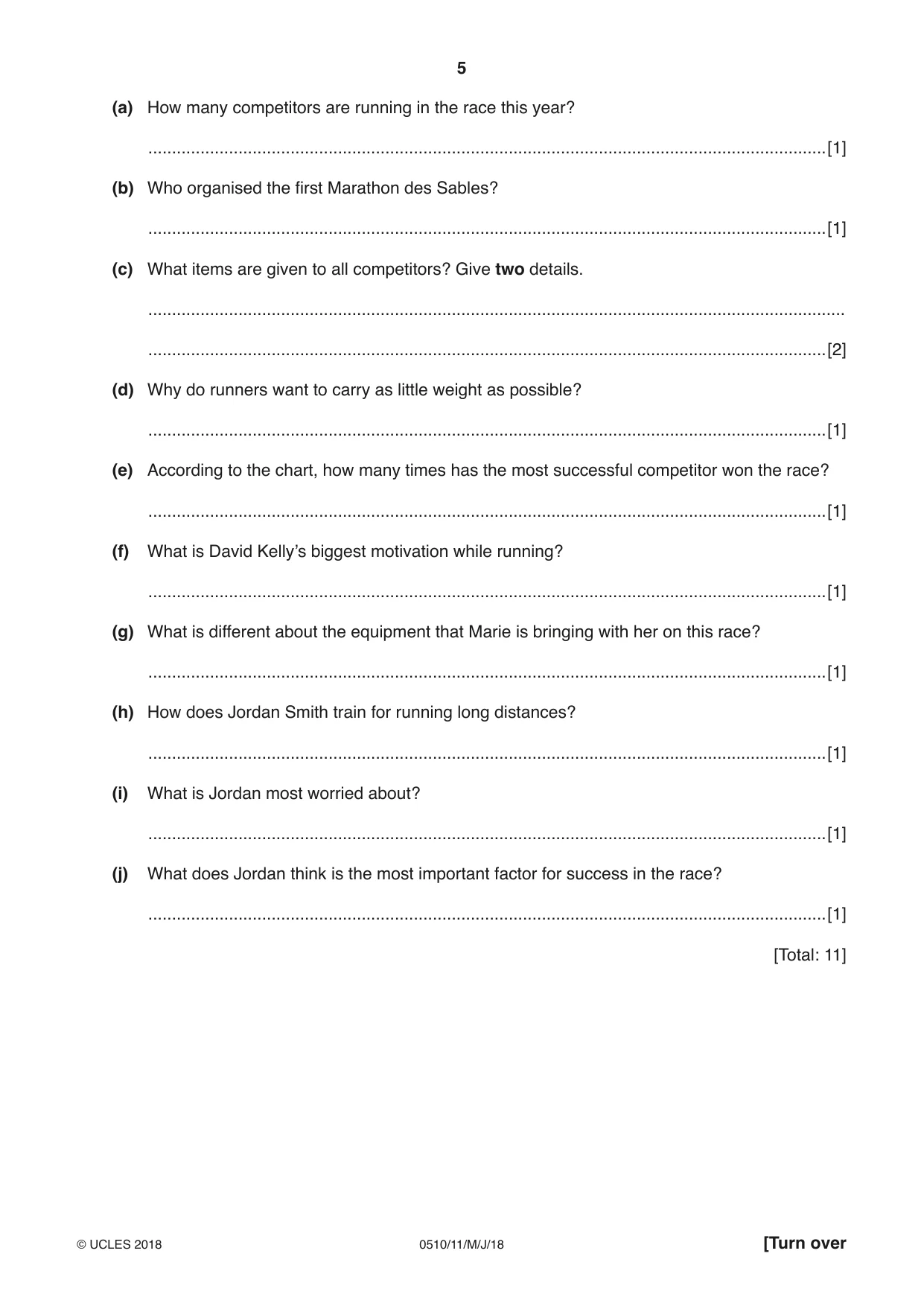
5 0510/11/M/J/18 © UCLES 2018 [Turn over (a) How many competitors are running in the race this year? …[1] (b) Who organised the first Marathon des Sables? …[1] (c) What items are given to all competitors? Give two details. … …[2] (d) Why do runners want to carry as little weight as possible? …[1] (e) According to the chart, how many times has the most successful competitor won the race? …[1] (f) What is David Kelly’s biggest motivation while running? …[1] (g) What is different about the equipment that Marie is bringing with her on this race? …[1] (h) How does Jordan Smith train for running long distances? …[1] (i) What is Jordan most worried about? …[1] (j) What does Jordan think is the most important factor for success in the race? …[1] [Total: 11]
Question paper, page 6
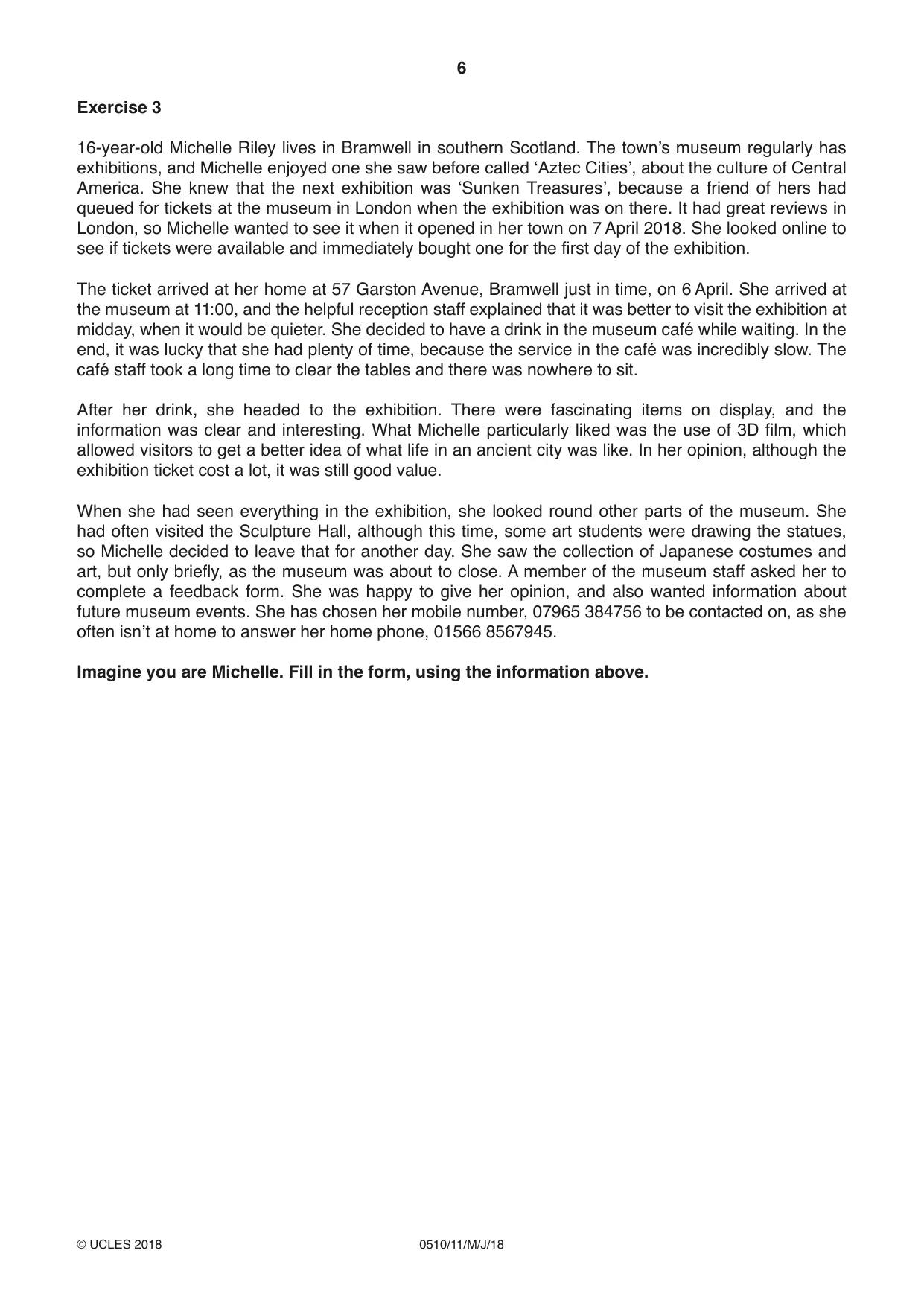
6 0510/11/M/J/18 © UCLES 2018 Exercise 3 16-year-old Michelle Riley lives in Bramwell in southern Scotland. The town’s museum regularly has exhibitions, and Michelle enjoyed one she saw before called ‘Aztec Cities’, about the culture of Central America. She knew that the next exhibition was ‘Sunken Treasures’, because a friend of hers had queued for tickets at the museum in London when the exhibition was on there. It had great reviews in London, so Michelle wanted to see it when it opened in her town on 7 April 2018. She looked online to see if tickets were available and immediately bought one for the first day of the exhibition. The ticket arrived at her home at 57 Garston Avenue, Bramwell just in time, on 6 April. She arrived at the museum at 11:00, and the helpful reception staff explained that it was better to visit the exhibition at midday, when it would be quieter. She decided to have a drink in the museum café while waiting. In the end, it was lucky that she had plenty of time, because the service in the café was incredibly slow. The café staff took a long time to clear the tables and there was nowhere to sit. After her drink, she headed to the exhibition. There were fascinating items on display, and the information was clear and interesting. What Michelle particularly liked was the use of 3D film, which allowed visitors to get a better idea of what life in an ancient city was like. In her opinion, although the exhibition ticket cost a lot, it was still good value. When she had seen everything in the exhibition, she looked round other parts of the museum. She had often visited the Sculpture Hall, although this time, some art students were drawing the statues, so Michelle decided to leave that for another day. She saw the collection of Japanese costumes and art, but only briefly, as the museum was about to close. A member of the museum staff asked her to complete a feedback form. She was happy to give her opinion, and also wanted information about future museum events. She has chosen her mobile number, 07965 384756 to be contacted on, as she often isn’t at home to answer her home phone, 01566 8567945. Imagine you are Michelle. Fill in the form, using the information above.
Question paper, page 7
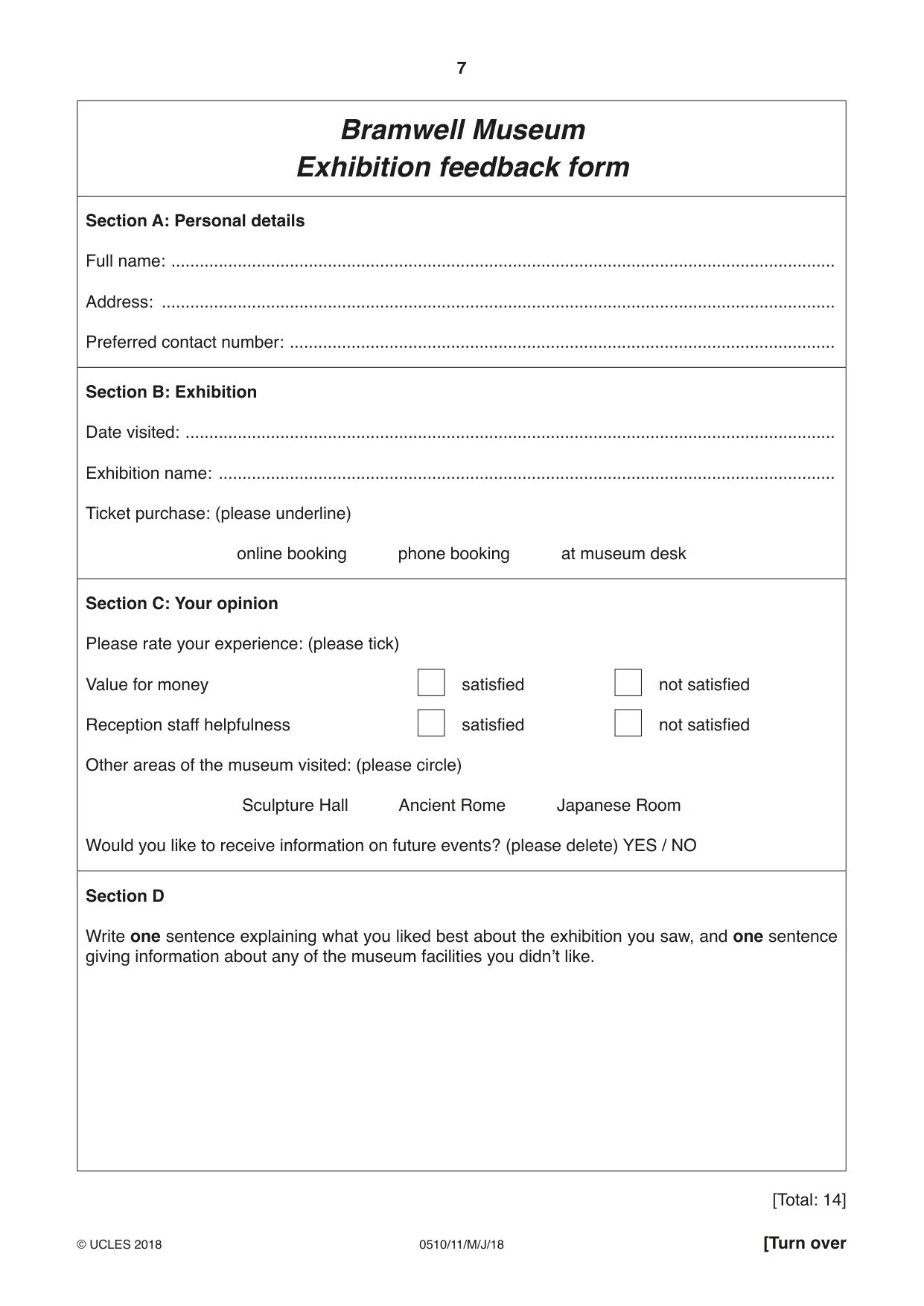
7 0510/11/M/J/18 © UCLES 2018 [Turn over Bramwell Museum Exhibition feedback form Section A: Personal details Full name: … Address: … Preferred contact number: … Section B: Exhibition Date visited: … Exhibition name: … Ticket purchase: (please underline) online booking phone booking at museum desk Section C: Your opinion Please rate your experience: (please tick) Value for money satisfied not satisfied Reception staff helpfulness satisfied not satisfied Other areas of the museum visited: (please circle) Sculpture Hall Ancient Rome Japanese Room Would you like to receive information on future events? (please delete) YES / NO Section D Write one sentence explaining what you liked best about the exhibition you saw, and one sentence giving information about any of the museum facilities you didn’t like. [Total: 14]
Question paper, page 8
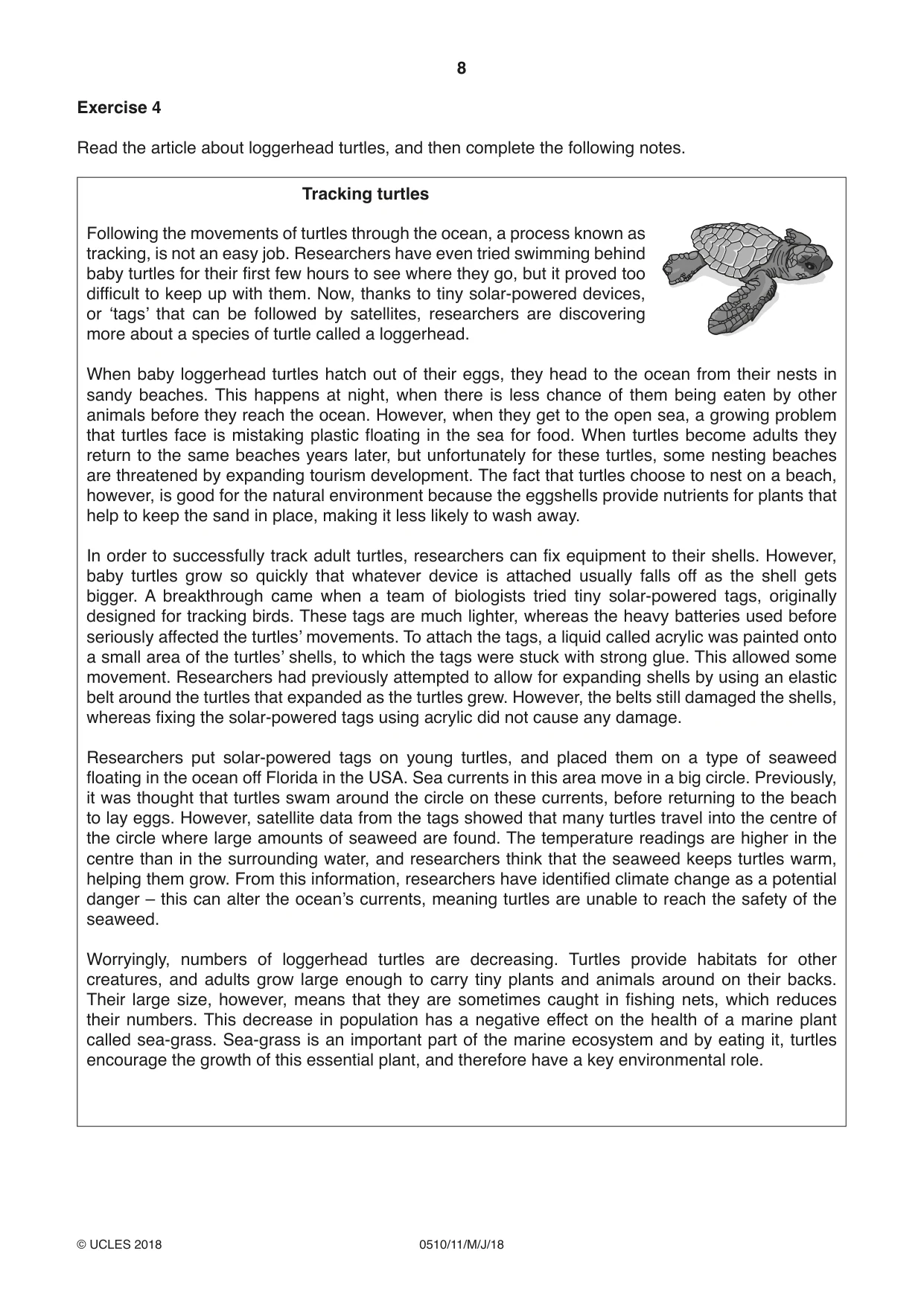
8 0510/11/M/J/18 © UCLES 2018 Exercise 4 Read the article about loggerhead turtles, and then complete the following notes. Tracking turtles Following the movements of turtles through the ocean, a process known as tracking, is not an easy job. Researchers have even tried swimming behind baby turtles for their first few hours to see where they go, but it proved too difficult to keep up with them. Now, thanks to tiny solar-powered devices, or ‘tags’ that can be followed by satellites, researchers are discovering more about a species of turtle called a loggerhead. When baby loggerhead turtles hatch out of their eggs, they head to the ocean from their nests in sandy beaches. This happens at night, when there is less chance of them being eaten by other animals before they reach the ocean. However, when they get to the open sea, a growing problem that turtles face is mistaking plastic floating in the sea for food. When turtles become adults they return to the same beaches years later, but unfortunately for these turtles, some nesting beaches are threatened by expanding tourism development. The fact that turtles choose to nest on a beach, however, is good for the natural environment because the eggshells provide nutrients for plants that help to keep the sand in place, making it less likely to wash away. In order to successfully track adult turtles, researchers can fix equipment to their shells. However, baby turtles grow so quickly that whatever device is attached usually falls off as the shell gets bigger. A breakthrough came when a team of biologists tried tiny solar-powered tags, originally designed for tracking birds. These tags are much lighter, whereas the heavy batteries used before seriously affected the turtles’ movements. To attach the tags, a liquid called acrylic was painted onto a small area of the turtles’ shells, to which the tags were stuck with strong glue. This allowed some movement. Researchers had previously attempted to allow for expanding shells by using an elastic belt around the turtles that expanded as the turtles grew. However, the belts still damaged the shells, whereas fixing the solar-powered tags using acrylic did not cause any damage. Researchers put solar-powered tags on young turtles, and placed them on a type of seaweed floating in the ocean off Florida in the USA. Sea currents in this area move in a big circle. Previously, it was thought that turtles swam around the circle on these currents, before returning to the beach to lay eggs. However, satellite data from the tags showed that many turtles travel into the centre of the circle where large amounts of seaweed are found. The temperature readings are higher in the centre than in the surrounding water, and researchers think that the seaweed keeps turtles warm, helping them grow. From this information, researchers have identified climate change as a potential danger – this can alter the ocean’s currents, meaning turtles are unable to reach the safety of the seaweed. Worryingly, numbers of loggerhead turtles are decreasing. Turtles provide habitats for other creatures, and adults grow large enough to carry tiny plants and animals around on their backs. Their large size, however, means that they are sometimes caught in fishing nets, which reduces their numbers. This decrease in population has a negative effect on the health of a marine plant called sea-grass. Sea-grass is an important part of the marine ecosystem and by eating it, turtles encourage the growth of this essential plant, and therefore have a key environmental role.
Question paper, page 9
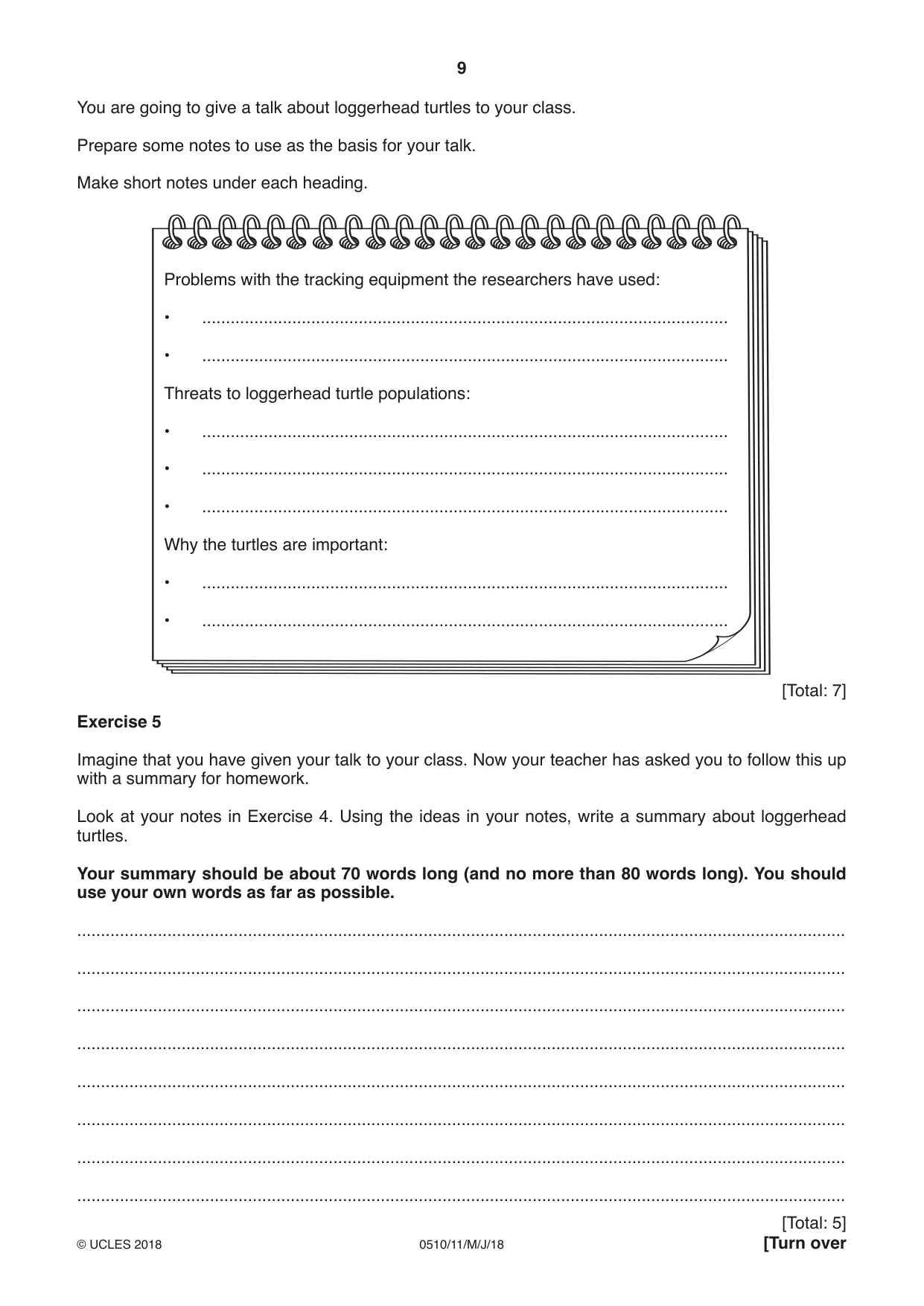
9 0510/11/M/J/18 © UCLES 2018 [Turn over You are going to give a talk about loggerhead turtles to your class. Prepare some notes to use as the basis for your talk. Make short notes under each heading. Problems with the tracking equipment the researchers have used: • … • … Threats to loggerhead turtle populations: • … • … • … Why the turtles are important: • … • … [Total: 7] Exercise 5 Imagine that you have given your talk to your class. Now your teacher has asked you to follow this up with a summary for homework. Look at your notes in Exercise 4. Using the ideas in your notes, write a summary about loggerhead turtles. Your summary should be about 70 words long (and no more than 80 words long). You should use your own words as far as possible. … … … … … … … … [Total: 5]
Question paper, page 10
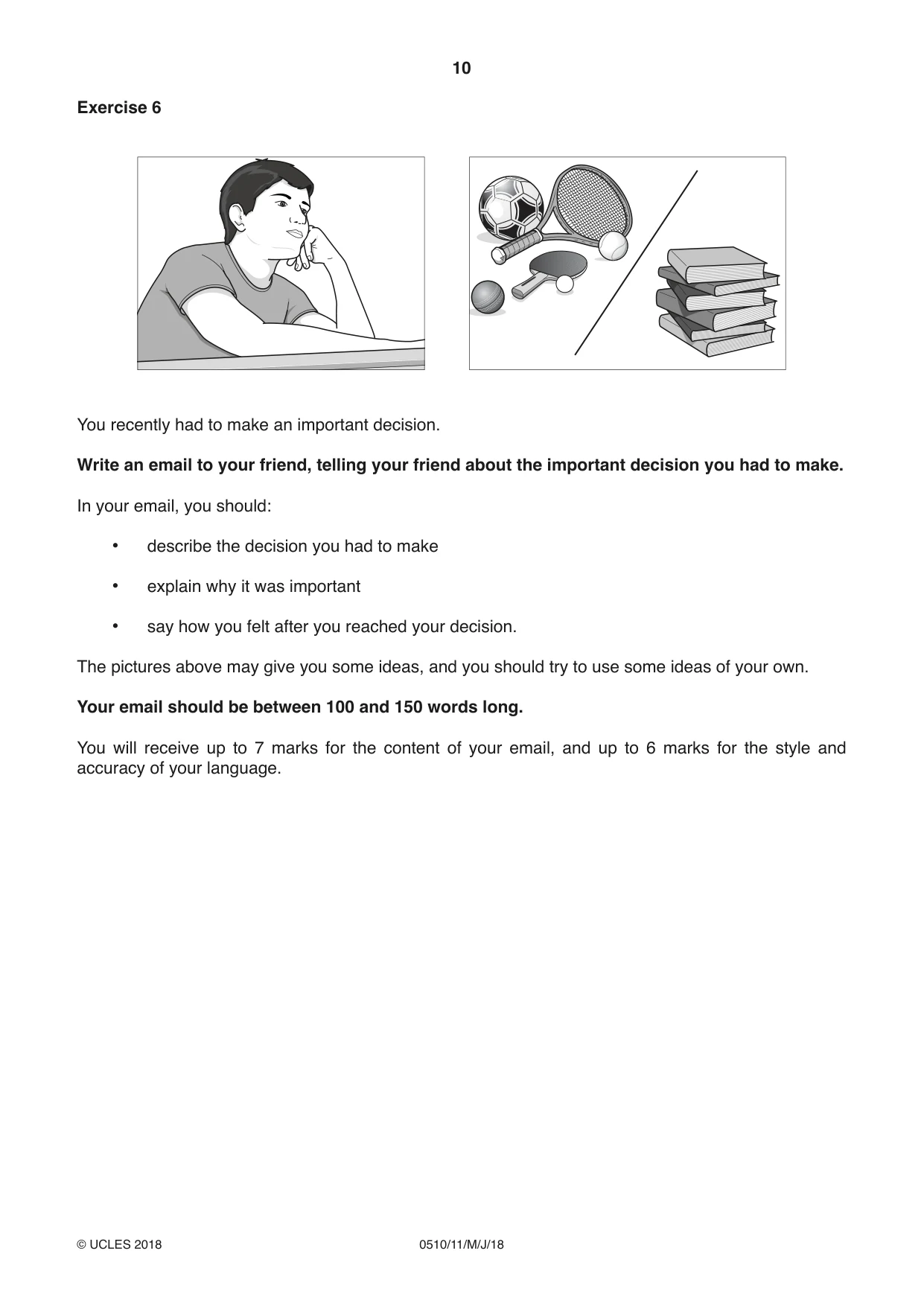
10 0510/11/M/J/18 © UCLES 2018 Exercise 6 You recently had to make an important decision. Write an email to your friend, telling your friend about the important decision you had to make. In your email, you should: • describe the decision you had to make • explain why it was important • say how you felt after you reached your decision. The pictures above may give you some ideas, and you should try to use some ideas of your own. Your email should be between 100 and 150 words long. You will receive up to 7 marks for the content of your email, and up to 6 marks for the style and accuracy of your language.
Question paper, page 11
11 0510/11/M/J/18 © UCLES 2018 [Turn over … … … … … … … … … … … … … … … … … … … … … … … … … … … [Total: 13]
Question paper, page 12
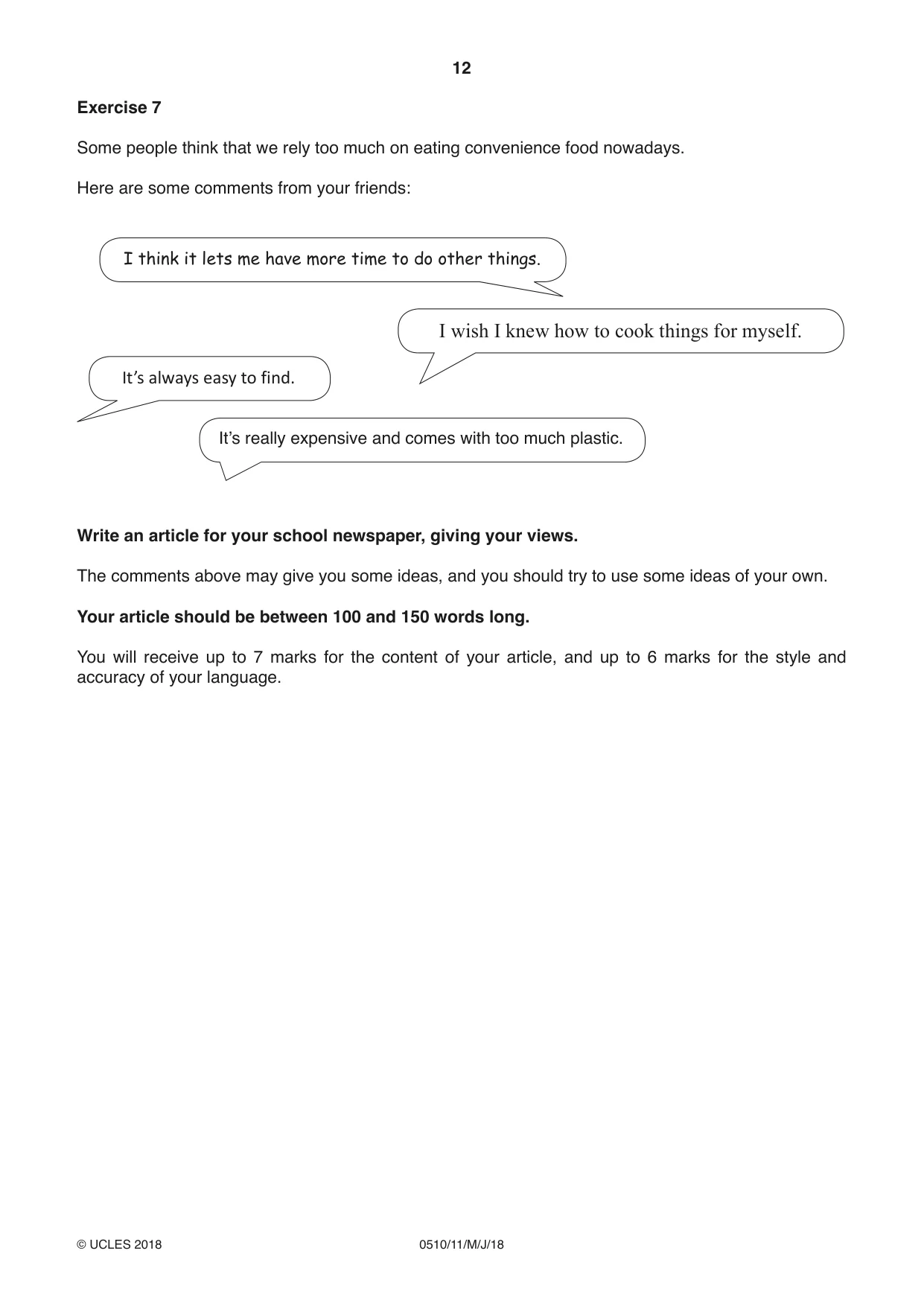
12 0510/11/M/J/18 © UCLES 2018 Exercise 7 Some people think that we rely too much on eating convenience food nowadays. Here are some comments from your friends: I wish I knew how to cook things for myself. I think it lets me have more time to do other things. It’s always easy to find. It’s really expensive and comes with too much plastic. Write an article for your school newspaper, giving your views. The comments above may give you some ideas, and you should try to use some ideas of your own. Your article should be between 100 and 150 words long. You will receive up to 7 marks for the content of your article, and up to 6 marks for the style and accuracy of your language.
Question paper, page 13
13 0510/11/M/J/18 © UCLES 2018 … … … … … … … … … … … … … … … … … … … … … … … … … … … [Total: 13]
Question paper, page 14
14 0510/11/M/J/18 © UCLES 2018 BLANK PAGE
Question paper, page 15
15 0510/11/M/J/18 © UCLES 2018 BLANK PAGE
Question paper, page 16
16 0510/11/M/J/18 © UCLES 2018 Permission to reproduce items where third-party owned material protected by copyright is included has been sought and cleared where possible. Every reasonable effort has been made by the publisher (UCLES) to trace copyright holders, but if any items requiring clearance have unwittingly been included, the publisher will be pleased to make amends at the earliest possible opportunity. To avoid the issue of disclosure of answer-related information to candidates, all copyright acknowledgements are reproduced online in the Cambridge International Examinations Copyright Acknowledgements Booklet. This is produced for each series of examinations and is freely available to download at www.cie.org.uk after the live examination series. Cambridge International Examinations is part of the Cambridge Assessment Group. Cambridge Assessment is the brand name of University of Cambridge Local Examinations Syndicate (UCLES), which is itself a department of the University of Cambridge. BLANK PAGE
Mark scheme, page 1
IGCSE™ is a registered trademark. This document consists of 12 printed pages. © UCLES 2018 [Turn over Cambridge Assessment International Education Cambridge International General Certificate of Secondary Education ENGLISH AS A SECOND LANGUAGE 0510/11 Paper 1 Reading and Writing (Core) May/June 2018 MARK SCHEME Maximum Mark: 70 Published This mark scheme is published as an aid to teachers and candidates, to indicate the requirements of the examination. It shows the basis on which Examiners were instructed to award marks. It does not indicate the details of the discussions that took place at an Examiners’ meeting before marking began, which would have considered the acceptability of alternative answers. Mark schemes should be read in conjunction with the question paper and the Principal Examiner Report for Teachers. Cambridge International will not enter into discussions about these mark schemes. Cambridge International is publishing the mark schemes for the May/June 2018 series for most Cambridge IGCSE™, Cambridge International A and AS Level and Cambridge Pre-U components, and some Cambridge O Level components.
Mark scheme, page 2
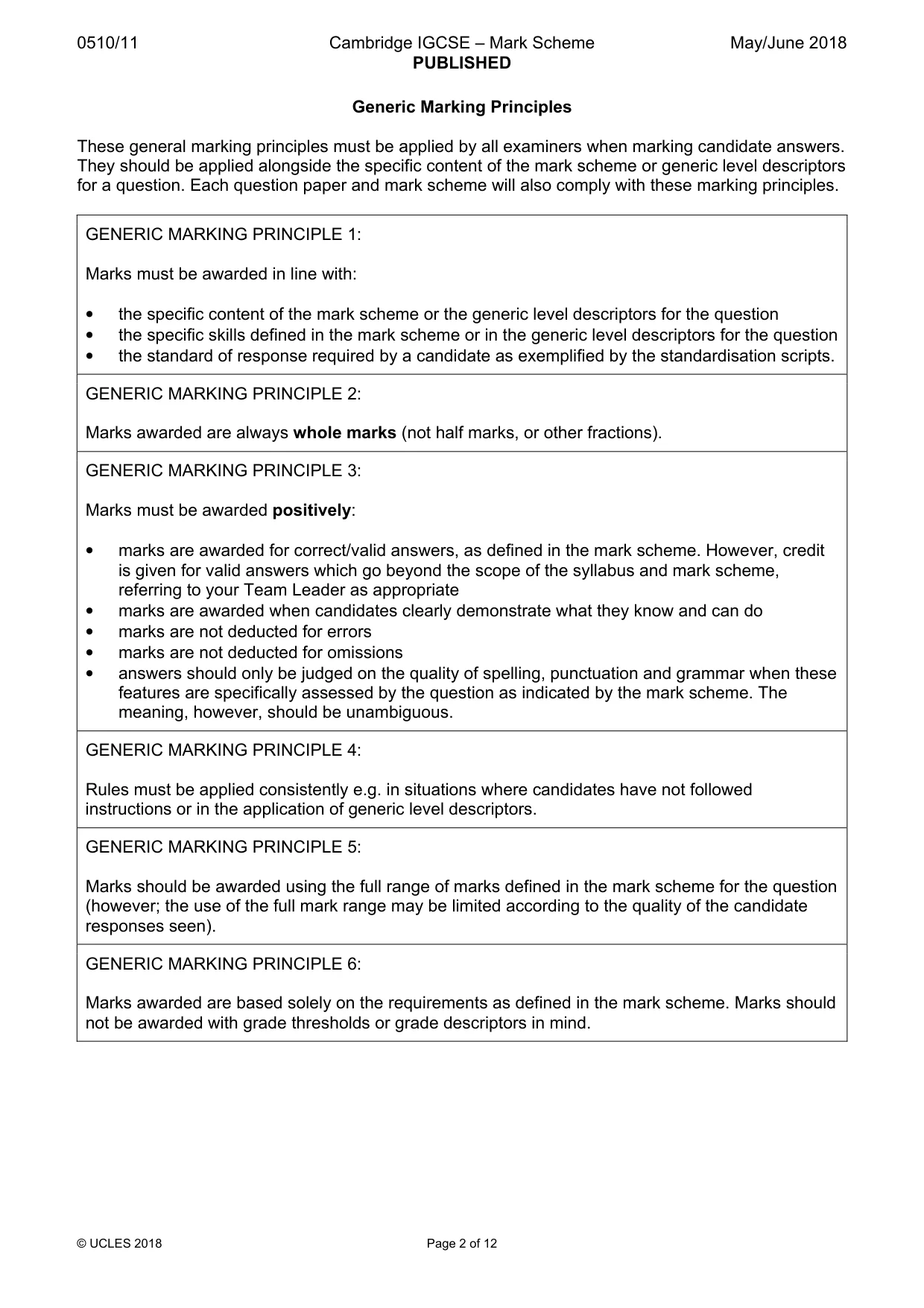
0510/11 Cambridge IGCSE – Mark Scheme PUBLISHED May/June 2018 © UCLES 2018 Page 2 of 12 Generic Marking Principles These general marking principles must be applied by all examiners when marking candidate answers. They should be applied alongside the specific content of the mark scheme or generic level descriptors for a question. Each question paper and mark scheme will also comply with these marking principles. GENERIC MARKING PRINCIPLE 1: Marks must be awarded in line with: • the specific content of the mark scheme or the generic level descriptors for the question • the specific skills defined in the mark scheme or in the generic level descriptors for the question • the standard of response required by a candidate as exemplified by the standardisation scripts. GENERIC MARKING PRINCIPLE 2: Marks awarded are always whole marks (not half marks, or other fractions). GENERIC MARKING PRINCIPLE 3: Marks must be awarded positively: • marks are awarded for correct/valid answers, as defined in the mark scheme. However, credit is given for valid answers which go beyond the scope of the syllabus and mark scheme, referring to your Team Leader as appropriate • marks are awarded when candidates clearly demonstrate what they know and can do • marks are not deducted for errors • marks are not deducted for omissions • answers should only be judged on the quality of spelling, punctuation and grammar when these features are specifically assessed by the question as indicated by the mark scheme. The meaning, however, should be unambiguous. GENERIC MARKING PRINCIPLE 4: Rules must be applied consistently e.g. in situations where candidates have not followed instructions or in the application of generic level descriptors. GENERIC MARKING PRINCIPLE 5: Marks should be awarded using the full range of marks defined in the mark scheme for the question (however; the use of the full mark range may be limited according to the quality of the candidate responses seen). GENERIC MARKING PRINCIPLE 6: Marks awarded are based solely on the requirements as defined in the mark scheme. Marks should not be awarded with grade thresholds or grade descriptors in mind.
Mark scheme, page 3
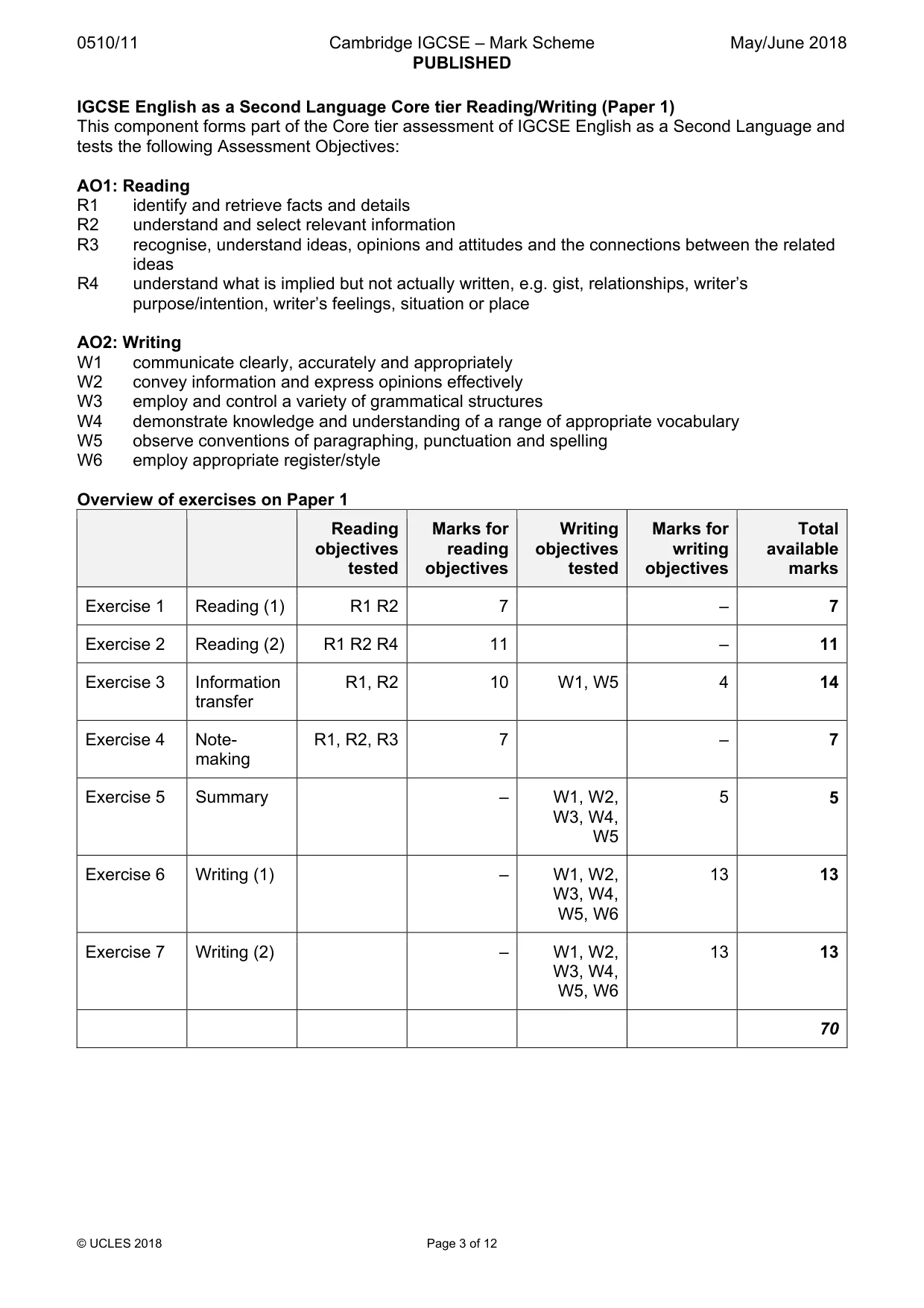
0510/11 Cambridge IGCSE – Mark Scheme PUBLISHED May/June 2018 © UCLES 2018 Page 3 of 12 IGCSE English as a Second Language Core tier Reading/Writing (Paper 1) This component forms part of the Core tier assessment of IGCSE English as a Second Language and tests the following Assessment Objectives: AO1: Reading R1 identify and retrieve facts and details R2 understand and select relevant information R3 recognise, understand ideas, opinions and attitudes and the connections between the related ideas R4 understand what is implied but not actually written, e.g. gist, relationships, writer’s purpose/intention, writer’s feelings, situation or place AO2: Writing W1 communicate clearly, accurately and appropriately W2 convey information and express opinions effectively W3 employ and control a variety of grammatical structures W4 demonstrate knowledge and understanding of a range of appropriate vocabulary W5 observe conventions of paragraphing, punctuation and spelling W6 employ appropriate register/style Overview of exercises on Paper 1 Reading objectives tested Marks for reading objectives Writing objectives tested Marks for writing objectives Total available marks Exercise 1 Reading (1) R1 R2 7 – 7 Exercise 2 Reading (2) R1 R2 R4 11 – 11 Exercise 3 Information transfer R1, R2 10 W1, W5 4 14 Exercise 4 Note- making R1, R2, R3 7 – 7 Exercise 5 Summary – W1, W2, W3, W4, W5 5 5 Exercise 6 Writing (1) – W1, W2, W3, W4, W5, W6 13 13 Exercise 7 Writing (2) – W1, W2, W3, W4, W5, W6 13 13 70
Mark scheme, page 4
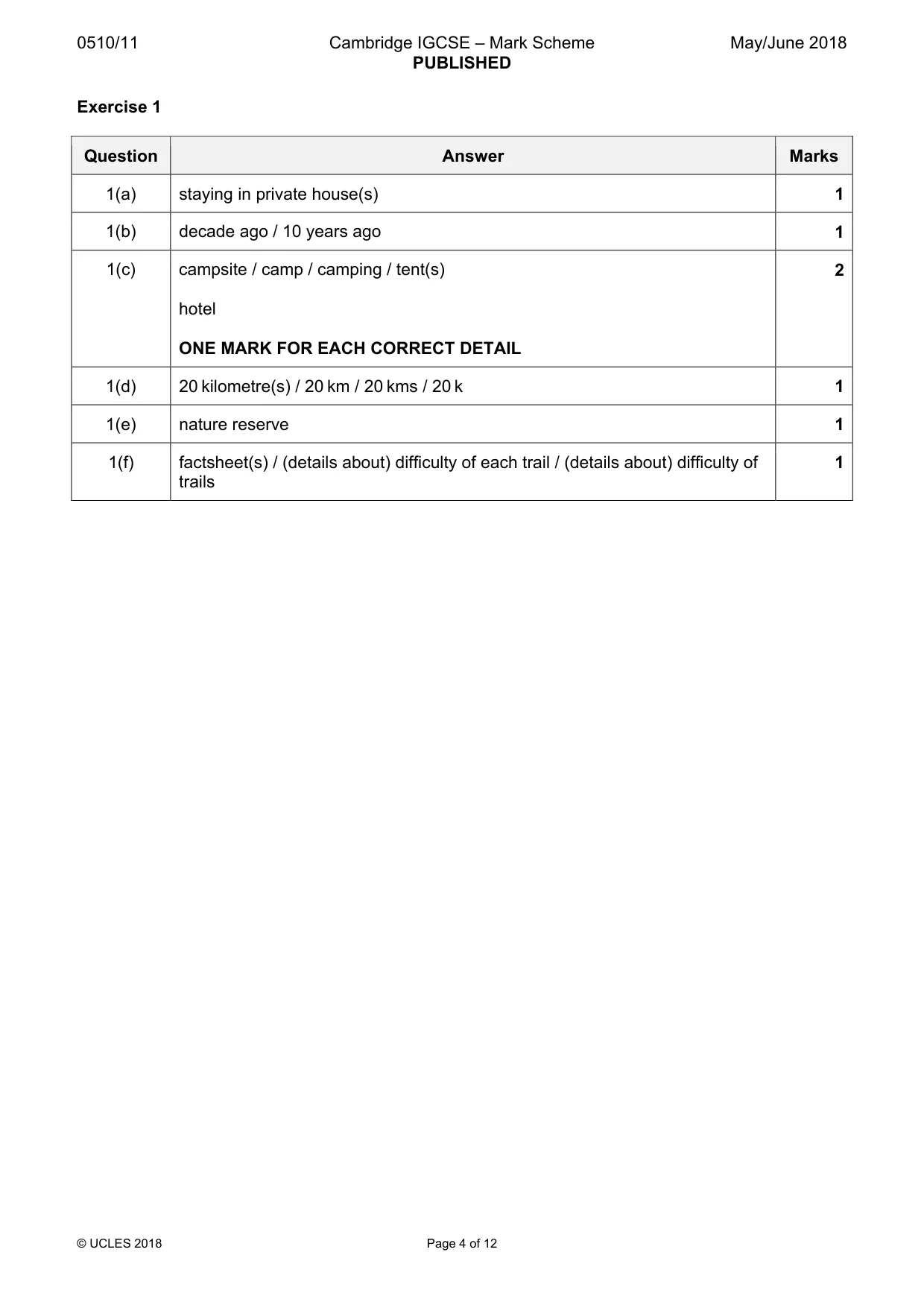
0510/11 Cambridge IGCSE – Mark Scheme PUBLISHED May/June 2018 © UCLES 2018 Page 4 of 12 Exercise 1 Question Answer Marks 1(a) staying in private house(s) 1 1(b) decade ago / 10 years ago 1 1(c) campsite / camp / camping / tent(s) hotel ONE MARK FOR EACH CORRECT DETAIL 2 1(d) 20 kilometre(s) / 20 km / 20 kms / 20 k 1 1(e) nature reserve 1 1(f) factsheet(s) / (details about) difficulty of each trail / (details about) difficulty of trails 1
Mark scheme, page 5
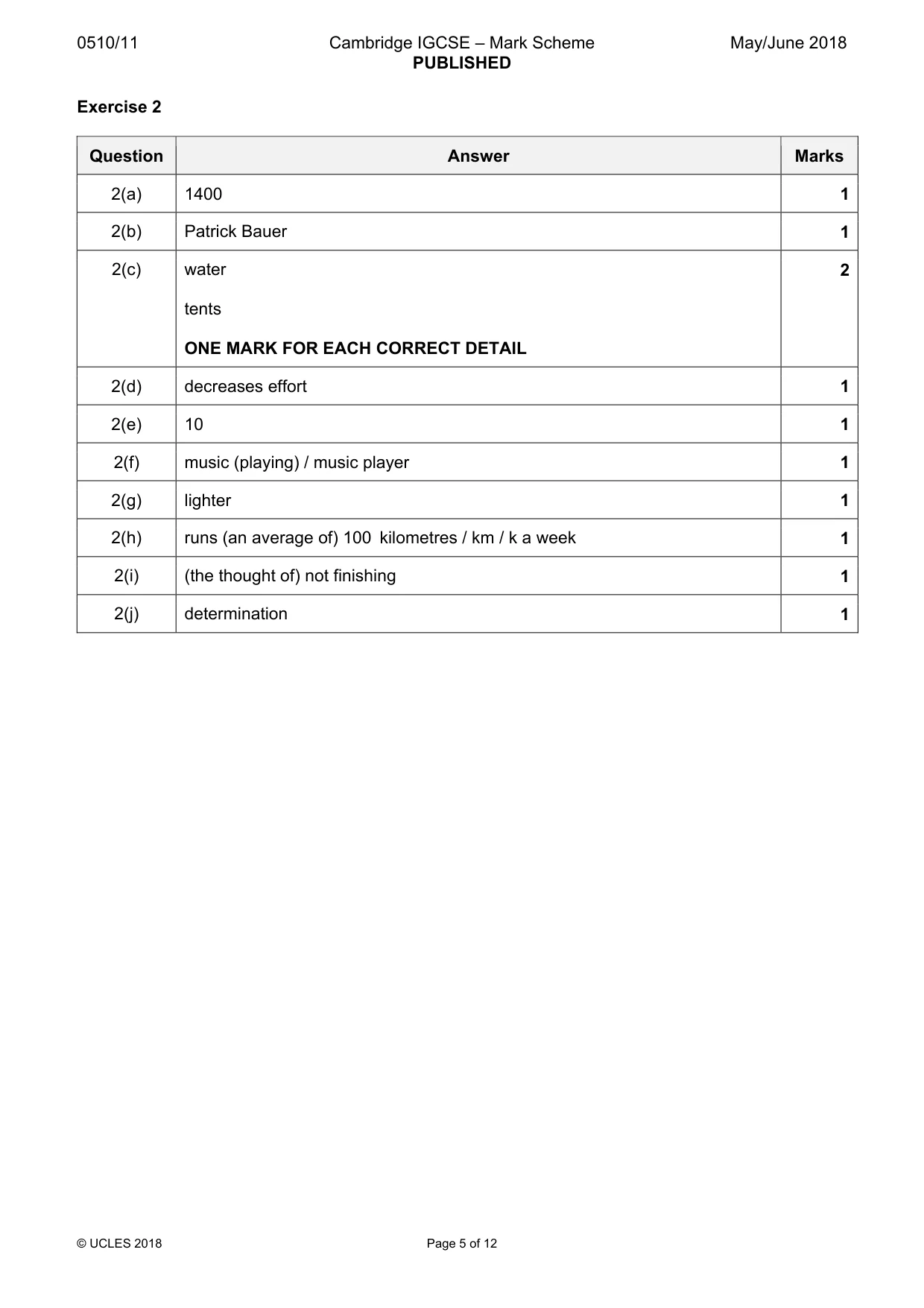
0510/11 Cambridge IGCSE – Mark Scheme PUBLISHED May/June 2018 © UCLES 2018 Page 5 of 12 Exercise 2 Question Answer Marks 2(a) 1400 1 2(b) Patrick Bauer 1 2(c) water tents ONE MARK FOR EACH CORRECT DETAIL 2 2(d) decreases effort 1 2(e) 10 1 2(f) music (playing) / music player 1 2(g) lighter 1 2(h) runs (an average of) 100 kilometres / km / k a week 1 2(i) (the thought of) not finishing 1 2(j) determination 1
Mark scheme, page 6
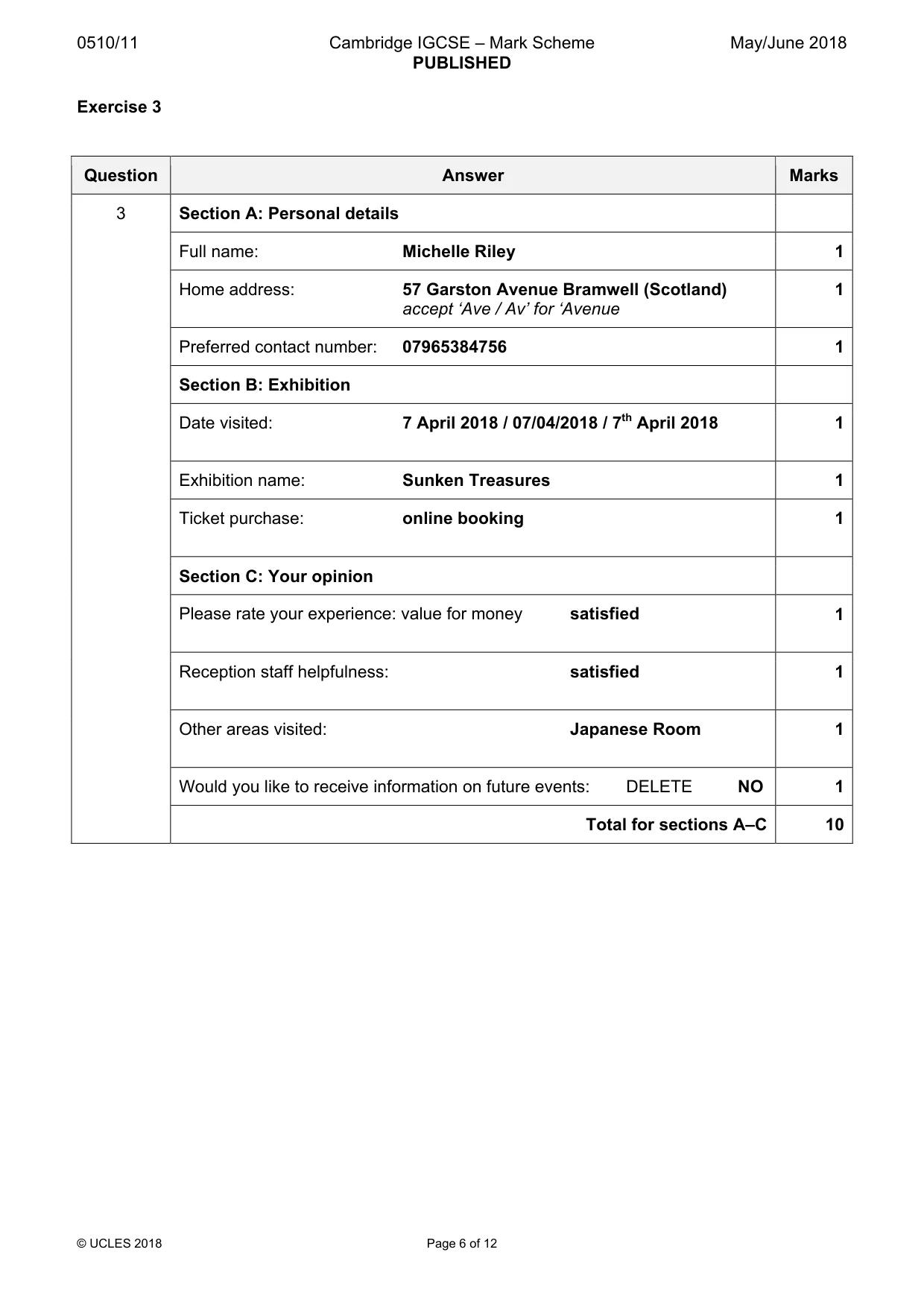
0510/11 Cambridge IGCSE – Mark Scheme PUBLISHED May/June 2018 © UCLES 2018 Page 6 of 12 Exercise 3 Question Answer Marks 3 Section A: Personal details Full name: Michelle Riley 1 Home address: 57 Garston Avenue Bramwell (Scotland) accept ‘Ave / Av’ for ‘Avenue 1 Preferred contact number: 07965384756 1 Section B: Exhibition Date visited: 7 April 2018 / 07/04/2018 / 7th April 2018 1 Exhibition name: Sunken Treasures 1 Ticket purchase: online booking 1 Section C: Your opinion Please rate your experience: value for money satisfied 1 Reception staff helpfulness: satisfied 1 Other areas visited: Japanese Room 1 Would you like to receive information on future events: DELETE NO 1 Total for sections A–C 10
Mark scheme, page 7
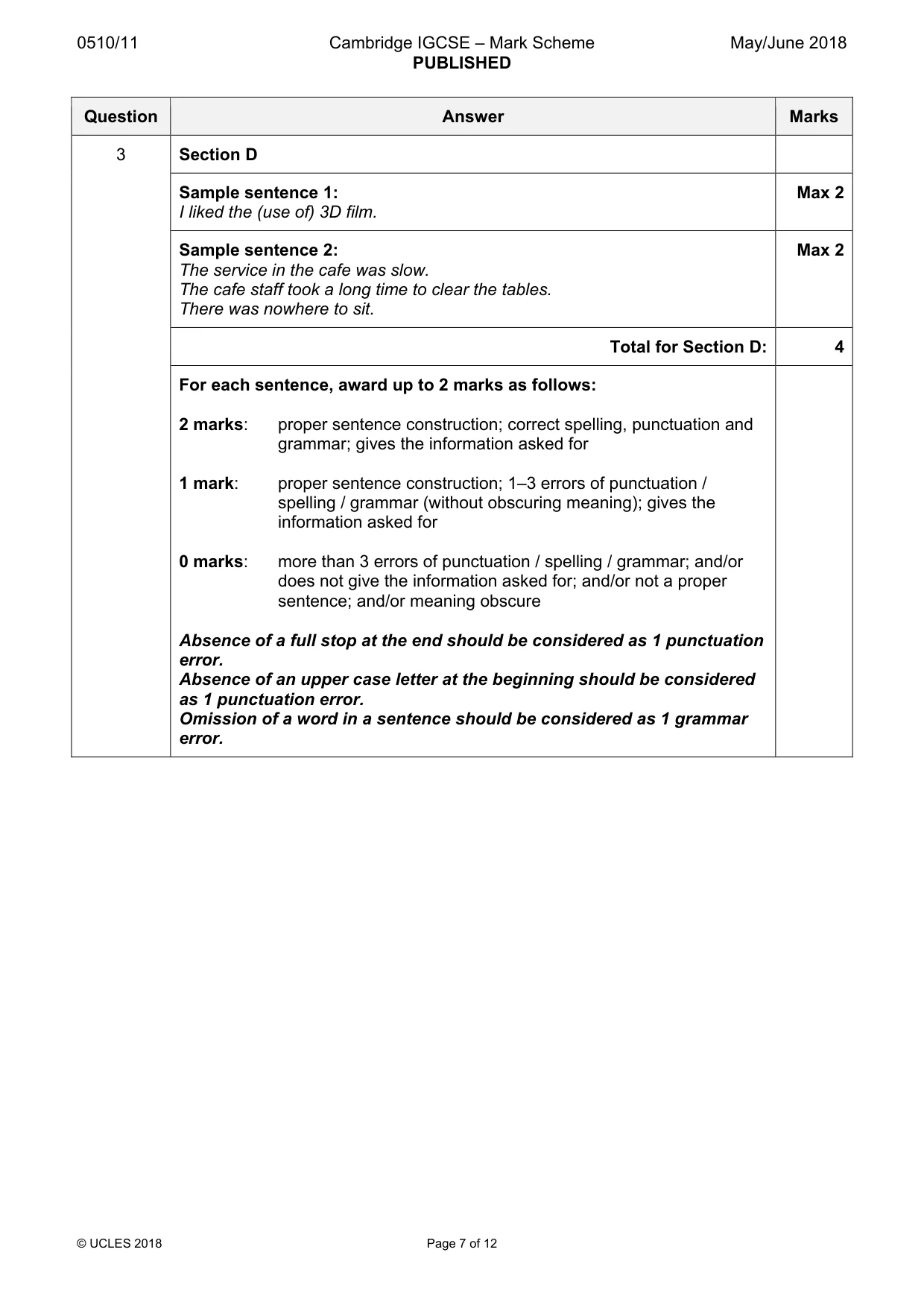
0510/11 Cambridge IGCSE – Mark Scheme PUBLISHED May/June 2018 © UCLES 2018 Page 7 of 12 Question Answer Marks 3 Section D Sample sentence 1: I liked the (use of) 3D film. Max 2 Sample sentence 2: The service in the cafe was slow. The cafe staff took a long time to clear the tables. There was nowhere to sit. Max 2 Total for Section D: 4 For each sentence, award up to 2 marks as follows: 2 marks: proper sentence construction; correct spelling, punctuation and grammar; gives the information asked for 1 mark: proper sentence construction; 1–3 errors of punctuation / spelling / grammar (without obscuring meaning); gives the information asked for 0 marks: more than 3 errors of punctuation / spelling / grammar; and/or does not give the information asked for; and/or not a proper sentence; and/or meaning obscure Absence of a full stop at the end should be considered as 1 punctuation error. Absence of an upper case letter at the beginning should be considered as 1 punctuation error. Omission of a word in a sentence should be considered as 1 grammar error.
Mark scheme, page 8
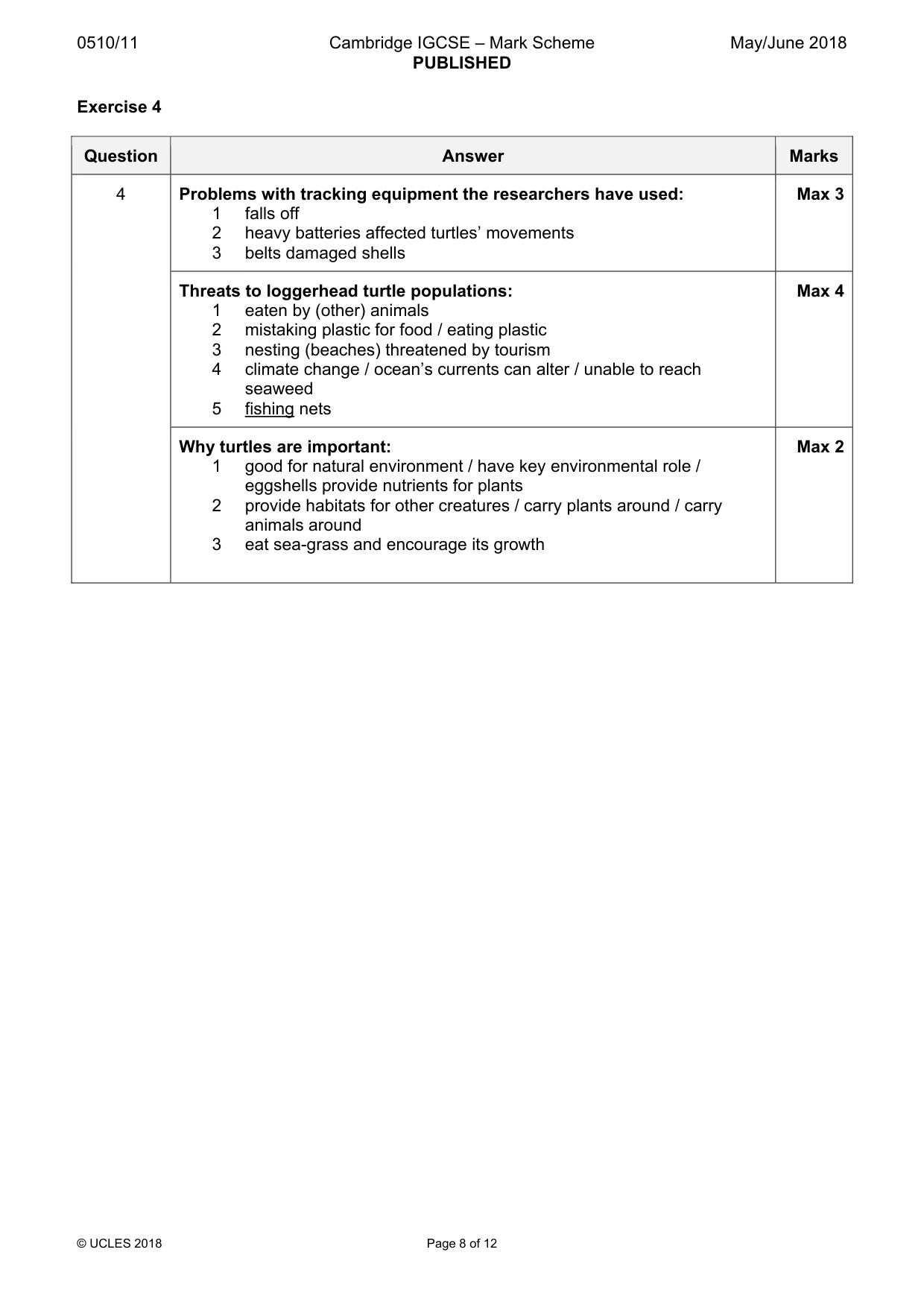
0510/11 Cambridge IGCSE – Mark Scheme PUBLISHED May/June 2018 © UCLES 2018 Page 8 of 12 Exercise 4 Question Answer Marks 4 Problems with tracking equipment the researchers have used: 1 falls off 2 heavy batteries affected turtles’ movements 3 belts damaged shells Max 3 Threats to loggerhead turtle populations: 1 eaten by (other) animals 2 mistaking plastic for food / eating plastic 3 nesting (beaches) threatened by tourism 4 climate change / ocean’s currents can alter / unable to reach seaweed 5 fishing nets Max 4 Why turtles are important: 1 good for natural environment / have key environmental role / eggshells provide nutrients for plants 2 provide habitats for other creatures / carry plants around / carry animals around 3 eat sea-grass and encourage its growth Max 2
Mark scheme, page 9
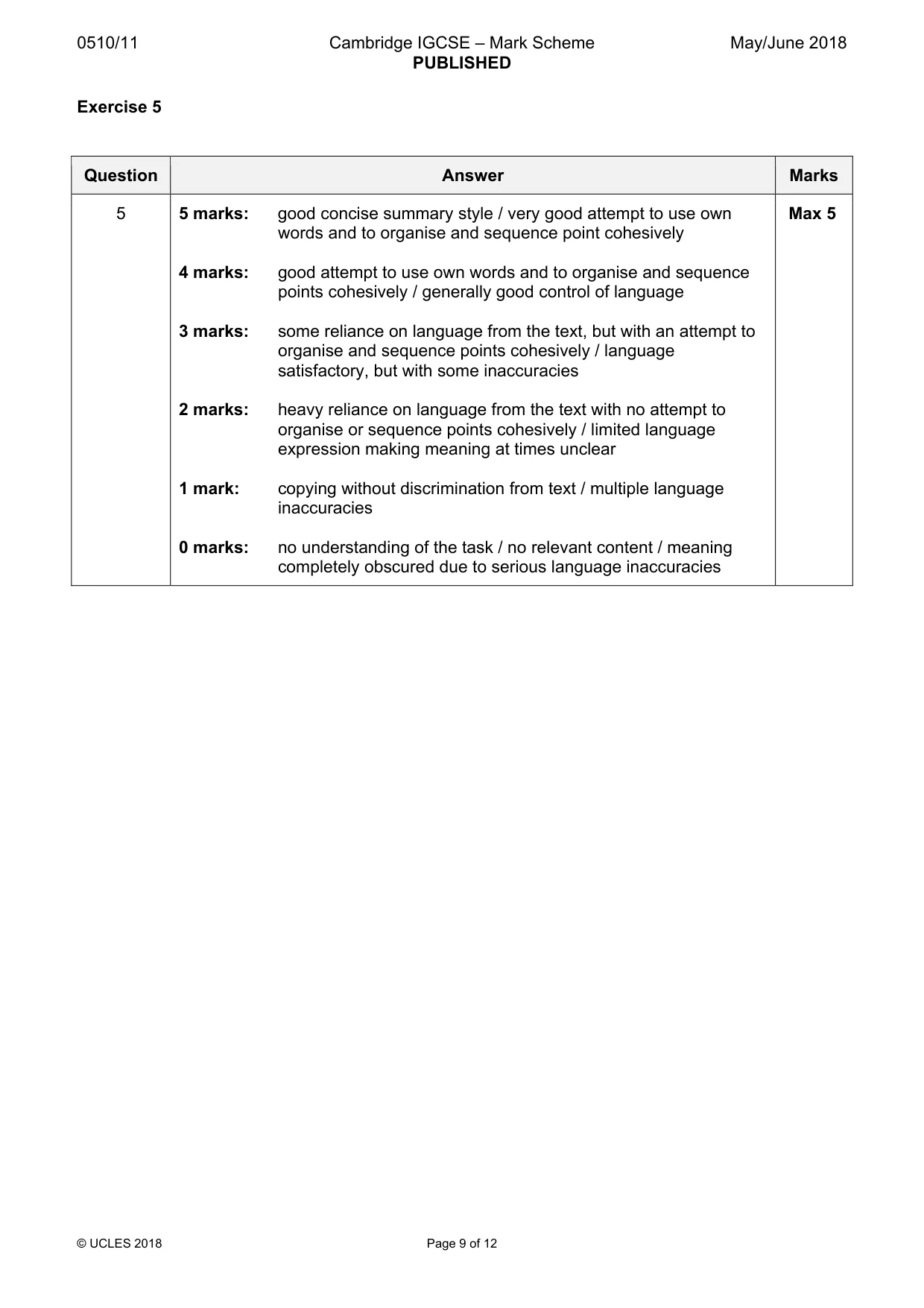
0510/11 Cambridge IGCSE – Mark Scheme PUBLISHED May/June 2018 © UCLES 2018 Page 9 of 12 Exercise 5 Question Answer Marks 5 5 marks: good concise summary style / very good attempt to use own words and to organise and sequence point cohesively 4 marks: good attempt to use own words and to organise and sequence points cohesively / generally good control of language 3 marks: some reliance on language from the text, but with an attempt to organise and sequence points cohesively / language satisfactory, but with some inaccuracies 2 marks: heavy reliance on language from the text with no attempt to organise or sequence points cohesively / limited language expression making meaning at times unclear 1 mark: copying without discrimination from text / multiple language inaccuracies 0 marks: no understanding of the task / no relevant content / meaning completely obscured due to serious language inaccuracies Max 5
Mark scheme, page 10
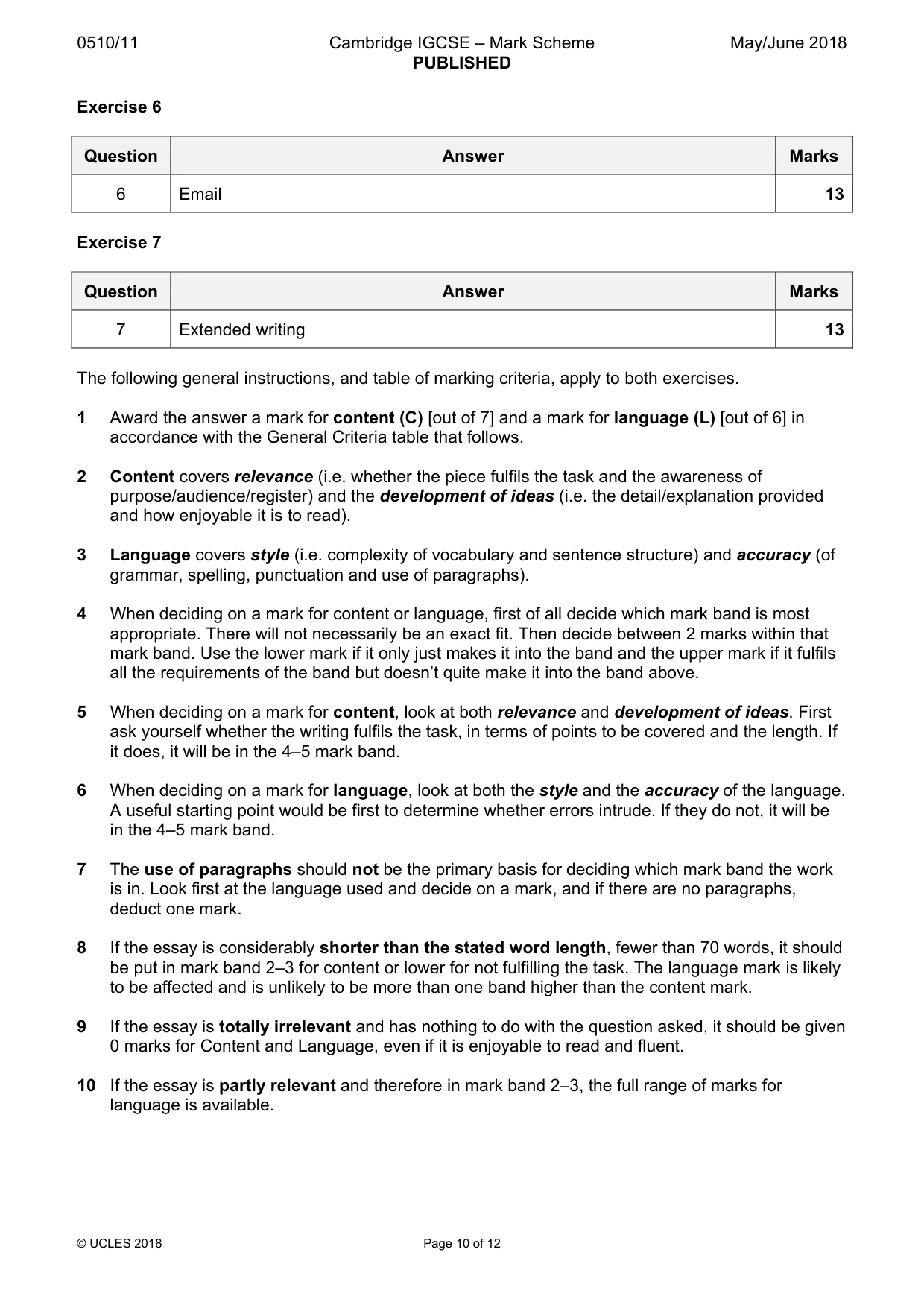
0510/11 Cambridge IGCSE – Mark Scheme PUBLISHED May/June 2018 © UCLES 2018 Page 10 of 12 Exercise 6 Question Answer Marks 6 Email 13 Exercise 7 Question Answer Marks 7 Extended writing 13 The following general instructions, and table of marking criteria, apply to both exercises. 1 Award the answer a mark for content (C) [out of 7] and a mark for language (L) [out of 6] in accordance with the General Criteria table that follows. 2 Content covers relevance (i.e. whether the piece fulfils the task and the awareness of purpose/audience/register) and the development of ideas (i.e. the detail/explanation provided and how enjoyable it is to read). 3 Language covers style (i.e. complexity of vocabulary and sentence structure) and accuracy (of grammar, spelling, punctuation and use of paragraphs). 4 When deciding on a mark for content or language, first of all decide which mark band is most appropriate. There will not necessarily be an exact fit. Then decide between 2 marks within that mark band. Use the lower mark if it only just makes it into the band and the upper mark if it fulfils all the requirements of the band but doesn’t quite make it into the band above. 5 When deciding on a mark for content, look at both relevance and development of ideas. First ask yourself whether the writing fulfils the task, in terms of points to be covered and the length. If it does, it will be in the 4–5 mark band. 6 When deciding on a mark for language, look at both the style and the accuracy of the language. A useful starting point would be first to determine whether errors intrude. If they do not, it will be in the 4–5 mark band. 7 The use of paragraphs should not be the primary basis for deciding which mark band the work is in. Look first at the language used and decide on a mark, and if there are no paragraphs, deduct one mark. 8 If the essay is considerably shorter than the stated word length, fewer than 70 words, it should be put in mark band 2–3 for content or lower for not fulfilling the task. The language mark is likely to be affected and is unlikely to be more than one band higher than the content mark. 9 If the essay is totally irrelevant and has nothing to do with the question asked, it should be given 0 marks for Content and Language, even if it is enjoyable to read and fluent. 10 If the essay is partly relevant and therefore in mark band 2–3, the full range of marks for language is available.
Mark scheme, page 11
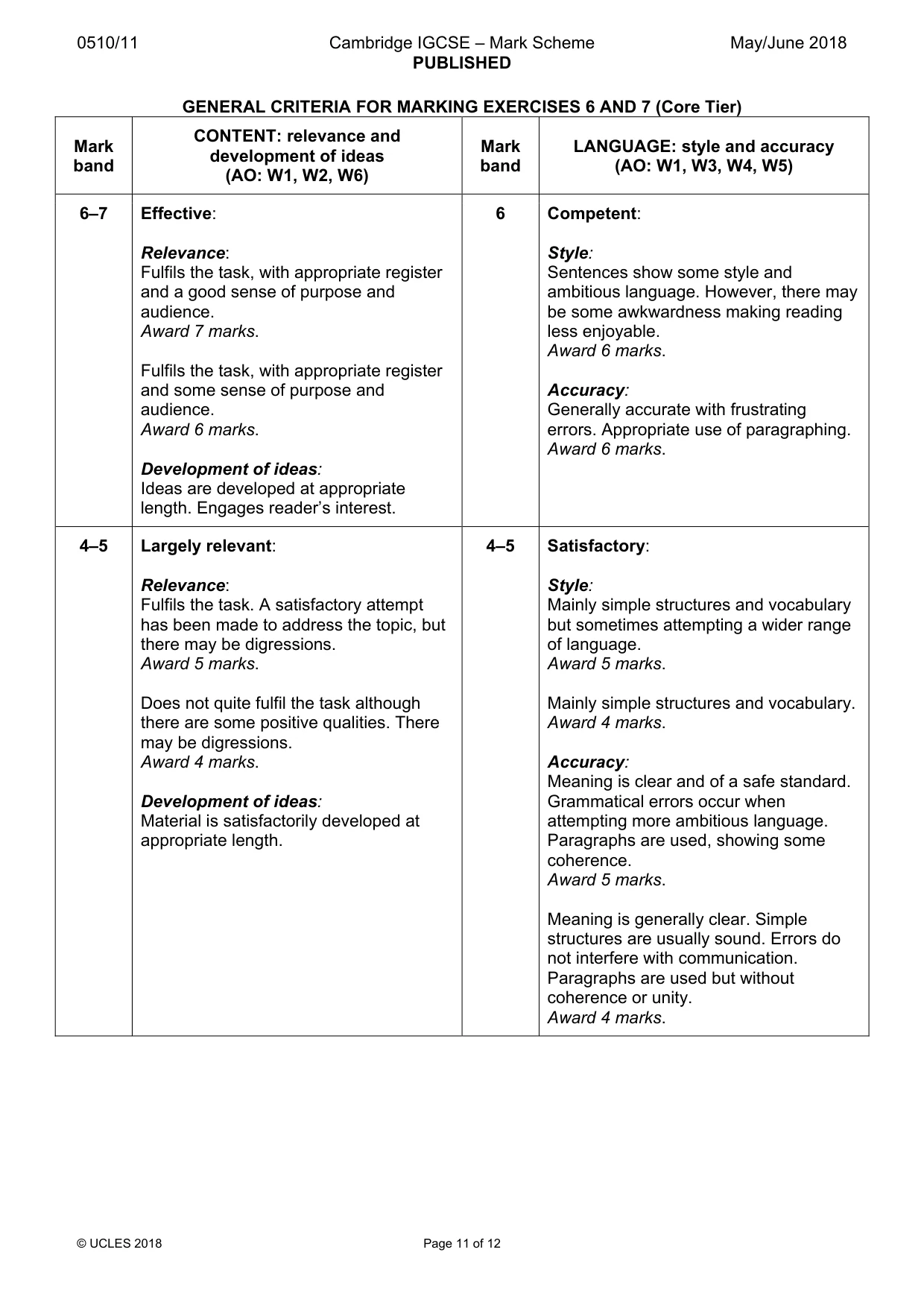
0510/11 Cambridge IGCSE – Mark Scheme PUBLISHED May/June 2018 © UCLES 2018 Page 11 of 12 GENERAL CRITERIA FOR MARKING EXERCISES 6 AND 7 (Core Tier) Mark band CONTENT: relevance and development of ideas (AO: W1, W2, W6) Mark band LANGUAGE: style and accuracy (AO: W1, W3, W4, W5) 6–7 Effective: Relevance: Fulfils the task, with appropriate register and a good sense of purpose and audience. Award 7 marks. Fulfils the task, with appropriate register and some sense of purpose and audience. Award 6 marks. Development of ideas: Ideas are developed at appropriate length. Engages reader’s interest. 6 Competent: Style: Sentences show some style and ambitious language. However, there may be some awkwardness making reading less enjoyable. Award 6 marks. Accuracy: Generally accurate with frustrating errors. Appropriate use of paragraphing. Award 6 marks. 4–5 Largely relevant: Relevance: Fulfils the task. A satisfactory attempt has been made to address the topic, but there may be digressions. Award 5 marks. Does not quite fulfil the task although there are some positive qualities. There may be digressions. Award 4 marks. Development of ideas: Material is satisfactorily developed at appropriate length. 4–5 Satisfactory: Style: Mainly simple structures and vocabulary but sometimes attempting a wider range of language. Award 5 marks. Mainly simple structures and vocabulary. Award 4 marks. Accuracy: Meaning is clear and of a safe standard. Grammatical errors occur when attempting more ambitious language. Paragraphs are used, showing some coherence. Award 5 marks. Meaning is generally clear. Simple structures are usually sound. Errors do not interfere with communication. Paragraphs are used but without coherence or unity. Award 4 marks.
Mark scheme, page 12
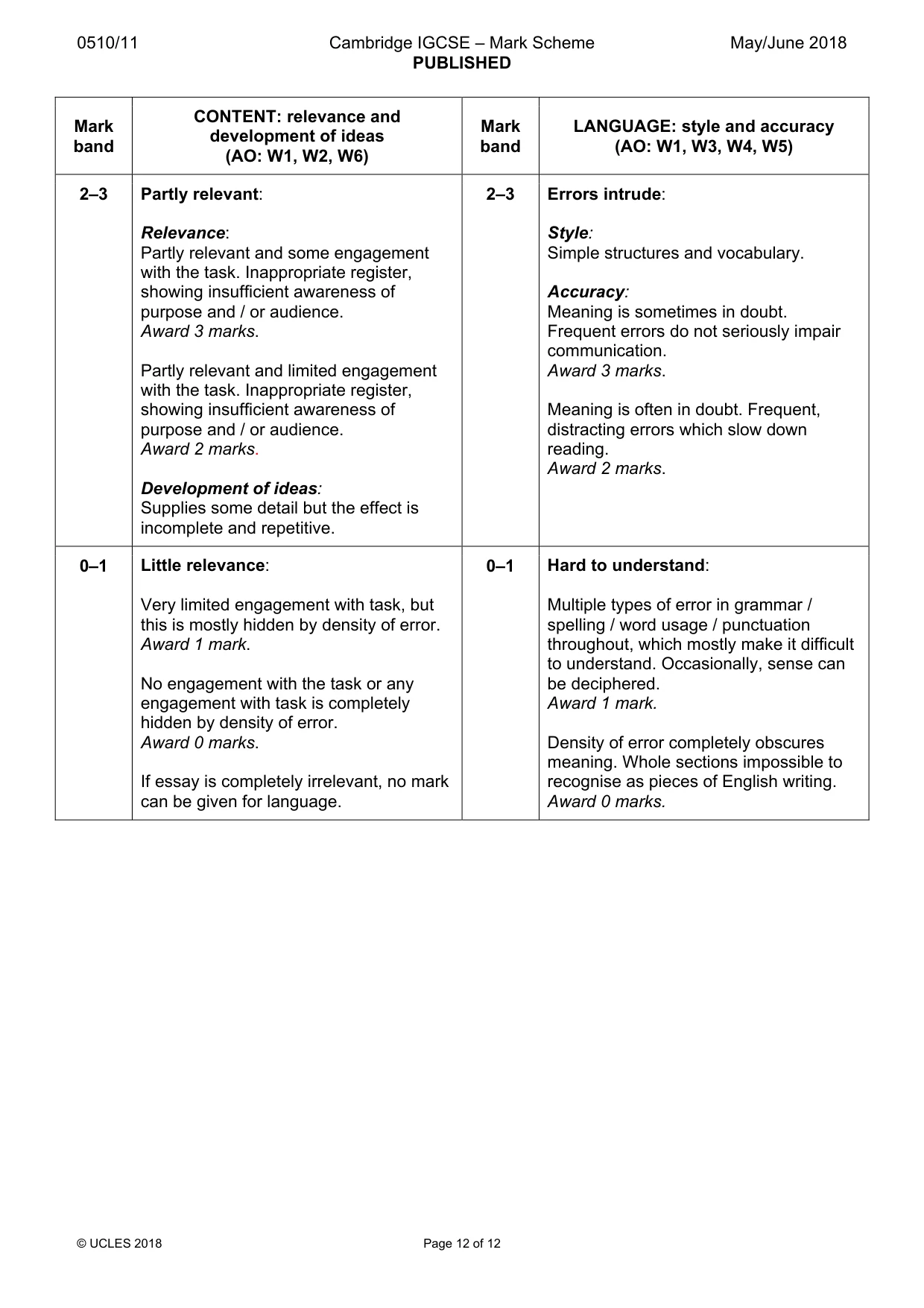
0510/11 Cambridge IGCSE – Mark Scheme PUBLISHED May/June 2018 © UCLES 2018 Page 12 of 12 Mark band CONTENT: relevance and development of ideas (AO: W1, W2, W6) Mark band LANGUAGE: style and accuracy (AO: W1, W3, W4, W5) 2–3 Partly relevant: Relevance: Partly relevant and some engagement with the task. Inappropriate register, showing insufficient awareness of purpose and / or audience. Award 3 marks. Partly relevant and limited engagement with the task. Inappropriate register, showing insufficient awareness of purpose and / or audience. Award 2 marks. Development of ideas: Supplies some detail but the effect is incomplete and repetitive. 2–3 Errors intrude: Style: Simple structures and vocabulary. Accuracy: Meaning is sometimes in doubt. Frequent errors do not seriously impair communication. Award 3 marks. Meaning is often in doubt. Frequent, distracting errors which slow down reading. Award 2 marks. 0–1 Little relevance: Very limited engagement with task, but this is mostly hidden by density of error. Award 1 mark. No engagement with the task or any engagement with task is completely hidden by density of error. Award 0 marks. If essay is completely irrelevant, no mark can be given for language. 0–1 Hard to understand: Multiple types of error in grammar / spelling / word usage / punctuation throughout, which mostly make it difficult to understand. Occasionally, sense can be deciphered. Award 1 mark. Density of error completely obscures meaning. Whole sections impossible to recognise as pieces of English writing. Award 0 marks.
What you needed in this session
Cambridge’s own grade thresholds for 2018 May/June, Paper 1 · Variant 1. A higher threshold means an easier paper — the bar moves with how the cohort did.