Cambridge IGCSE English - Second Language (oral endorsement) 0510 — 2023 Oct/Nov Paper 1 · Variant 3
0510/13/O/N/23 · 60 marks · ≈68 min
The question paper and its mark scheme, free to read here and free to download. This is Cambridge’s own paper, exactly as it was sat.
Question paper16 pages





Mark scheme10 pages
Answers below. Sit the paper first if you are practising.
Paper as text
Question paper, page 1
This document has 16 pages. Any blank pages are indicated. [Turn over Cambridge IGCSE™ ENGLISH AS A SECOND LANGUAGE 0510/13 Paper 1 Reading and Writing (Core) October/November 2023 1 hour 30 minutes You must answer on the question paper. No additional materials are needed. INSTRUCTIONS ● Answer all questions. ● Use a black or dark blue pen. ● Write your name, centre number and candidate number in the boxes at the top of the page. ● Write your answer to each question in the space provided. ● Do not use an erasable pen or correction fluid. ● Do not write on any bar codes. ● Dictionaries are not allowed. INFORMATION ● The total mark for this paper is 60. ● The number of marks for each question or part question is shown in brackets [ ]. * 9 4 3 2 7 5 7 3 3 8 * DC (CJ/SG) 320173/2 © UCLES 2023
Question paper, page 2
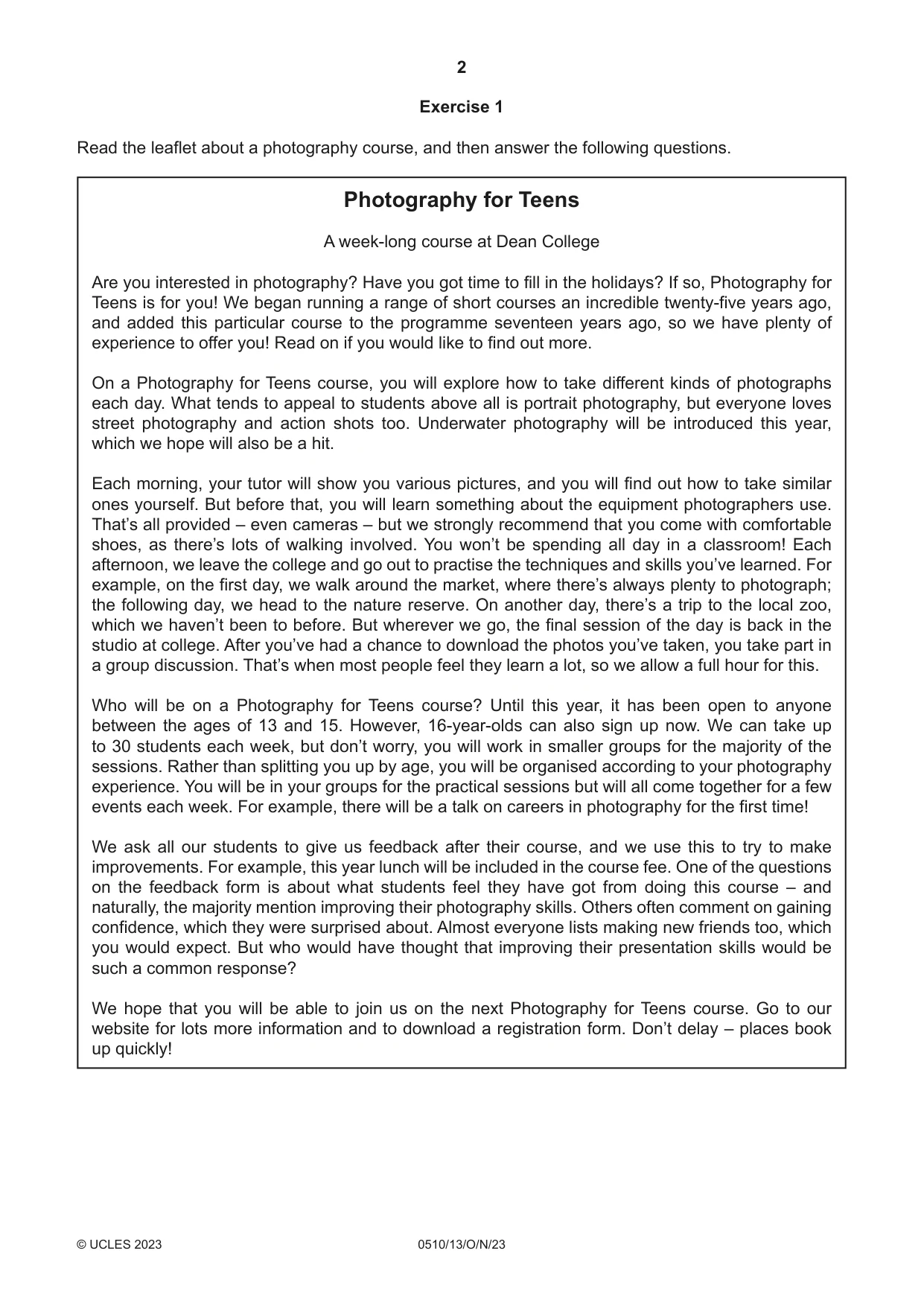
2 0510/13/O/N/23 © UCLES 2023 Exercise 1 Read the leaflet about a photography course, and then answer the following questions. Photography for Teens A week-long course at Dean College Are you interested in photography? Have you got time to fill in the holidays? If so, Photography for Teens is for you! We began running a range of short courses an incredible twenty-five years ago, and added this particular course to the programme seventeen years ago, so we have plenty of experience to offer you! Read on if you would like to find out more. On a Photography for Teens course, you will explore how to take different kinds of photographs each day. What tends to appeal to students above all is portrait photography, but everyone loves street photography and action shots too. Underwater photography will be introduced this year, which we hope will also be a hit. Each morning, your tutor will show you various pictures, and you will find out how to take similar ones yourself. But before that, you will learn something about the equipment photographers use. That’s all provided – even cameras – but we strongly recommend that you come with comfortable shoes, as there’s lots of walking involved. You won’t be spending all day in a classroom! Each afternoon, we leave the college and go out to practise the techniques and skills you’ve learned. For example, on the first day, we walk around the market, where there’s always plenty to photograph; the following day, we head to the nature reserve. On another day, there’s a trip to the local zoo, which we haven’t been to before. But wherever we go, the final session of the day is back in the studio at college. After you’ve had a chance to download the photos you’ve taken, you take part in a group discussion. That’s when most people feel they learn a lot, so we allow a full hour for this. Who will be on a Photography for Teens course? Until this year, it has been open to anyone between the ages of 13 and 15. However, 16-year-olds can also sign up now. We can take up to 30 students each week, but don’t worry, you will work in smaller groups for the majority of the sessions. Rather than splitting you up by age, you will be organised according to your photography experience. You will be in your groups for the practical sessions but will all come together for a few events each week. For example, there will be a talk on careers in photography for the first time! We ask all our students to give us feedback after their course, and we use this to try to make improvements. For example, this year lunch will be included in the course fee. One of the questions on the feedback form is about what students feel they have got from doing this course – and naturally, the majority mention improving their photography skills. Others often comment on gaining confidence, which they were surprised about. Almost everyone lists making new friends too, which you would expect. But who would have thought that improving their presentation skills would be such a common response? We hope that you will be able to join us on the next Photography for Teens course. Go to our website for lots more information and to download a registration form. Don’t delay – places book up quickly!
Question paper, page 3
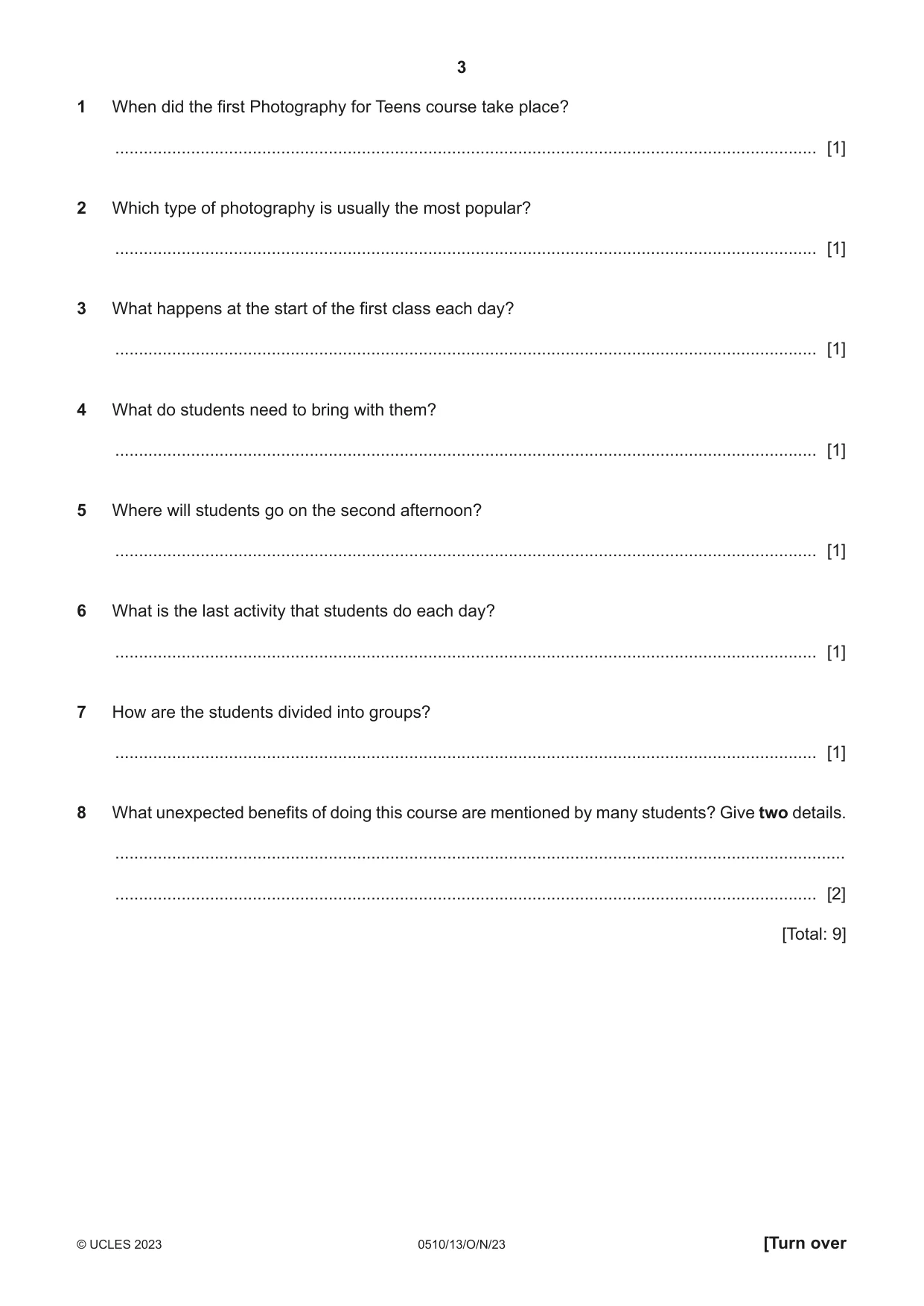
3 0510/13/O/N/23 © UCLES 2023 [Turn over 1 When did the first Photography for Teens course take place? … [1] 2 Which type of photography is usually the most popular? … [1] 3 What happens at the start of the first class each day? … [1] 4 What do students need to bring with them? … [1] 5 Where will students go on the second afternoon? … [1] 6 What is the last activity that students do each day? … [1] 7 How are the students divided into groups? … [1] 8 What unexpected benefits of doing this course are mentioned by many students? Give two details. … … [2] [Total: 9]
Question paper, page 4
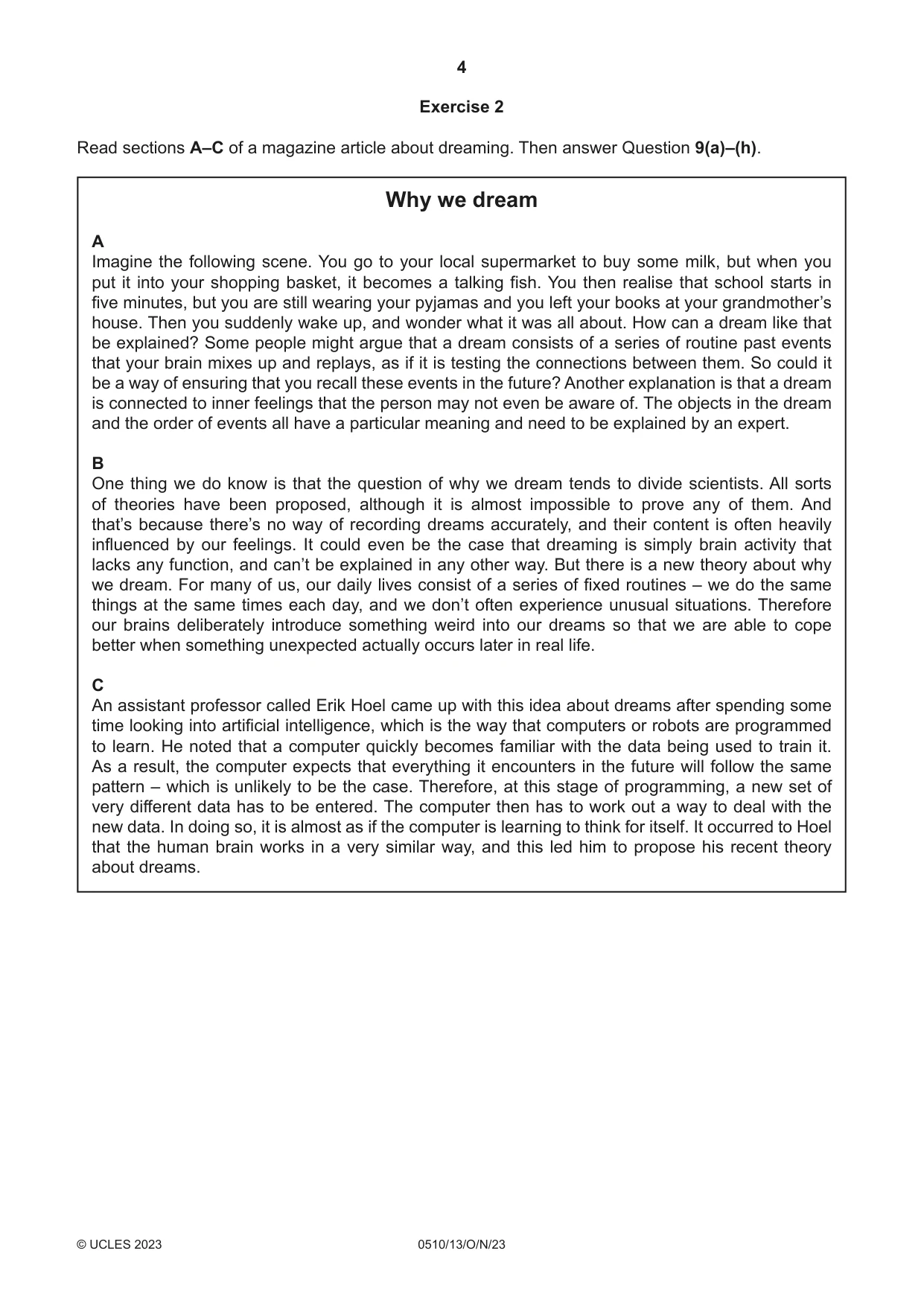
4 0510/13/O/N/23 © UCLES 2023 Exercise 2 Read sections A–C of a magazine article about dreaming. Then answer Question 9(a)–(h). Why we dream A Imagine the following scene. You go to your local supermarket to buy some milk, but when you put it into your shopping basket, it becomes a talking fish. You then realise that school starts in five minutes, but you are still wearing your pyjamas and you left your books at your grandmother’s house. Then you suddenly wake up, and wonder what it was all about. How can a dream like that be explained? Some people might argue that a dream consists of a series of routine past events that your brain mixes up and replays, as if it is testing the connections between them. So could it be a way of ensuring that you recall these events in the future? Another explanation is that a dream is connected to inner feelings that the person may not even be aware of. The objects in the dream and the order of events all have a particular meaning and need to be explained by an expert. B One thing we do know is that the question of why we dream tends to divide scientists. All sorts of theories have been proposed, although it is almost impossible to prove any of them. And that’s because there’s no way of recording dreams accurately, and their content is often heavily influenced by our feelings. It could even be the case that dreaming is simply brain activity that lacks any function, and can’t be explained in any other way. But there is a new theory about why we dream. For many of us, our daily lives consist of a series of fixed routines – we do the same things at the same times each day, and we don’t often experience unusual situations. Therefore our brains deliberately introduce something weird into our dreams so that we are able to cope better when something unexpected actually occurs later in real life. C An assistant professor called Erik Hoel came up with this idea about dreams after spending some time looking into artificial intelligence, which is the way that computers or robots are programmed to learn. He noted that a computer quickly becomes familiar with the data being used to train it. As a result, the computer expects that everything it encounters in the future will follow the same pattern – which is unlikely to be the case. Therefore, at this stage of programming, a new set of very different data has to be entered. The computer then has to work out a way to deal with the new data. In doing so, it is almost as if the computer is learning to think for itself. It occurred to Hoel that the human brain works in a very similar way, and this led him to propose his recent theory about dreams.
Question paper, page 5
5 0510/13/O/N/23 © UCLES 2023 [Turn over 9 For each question, write the correct letter A, B or C on the line. Which section includes the following information? (a) the suggestion that dreams do not have a purpose … [1] (b) the suggestion that dreams are connected to memory … [1] (c) how scientists deal with a potential issue … [1] (d) the idea that dreams represent hidden emotions … [1] (e) reasons why scientists disagree about why we dream … [1] (f) an example of a strange dream … [1] (g) how strange dreams might help people to manage future challenges … [1] (h) some research which inspired a scientist to suggest a theory … [1] [Total: 8]
Question paper, page 6
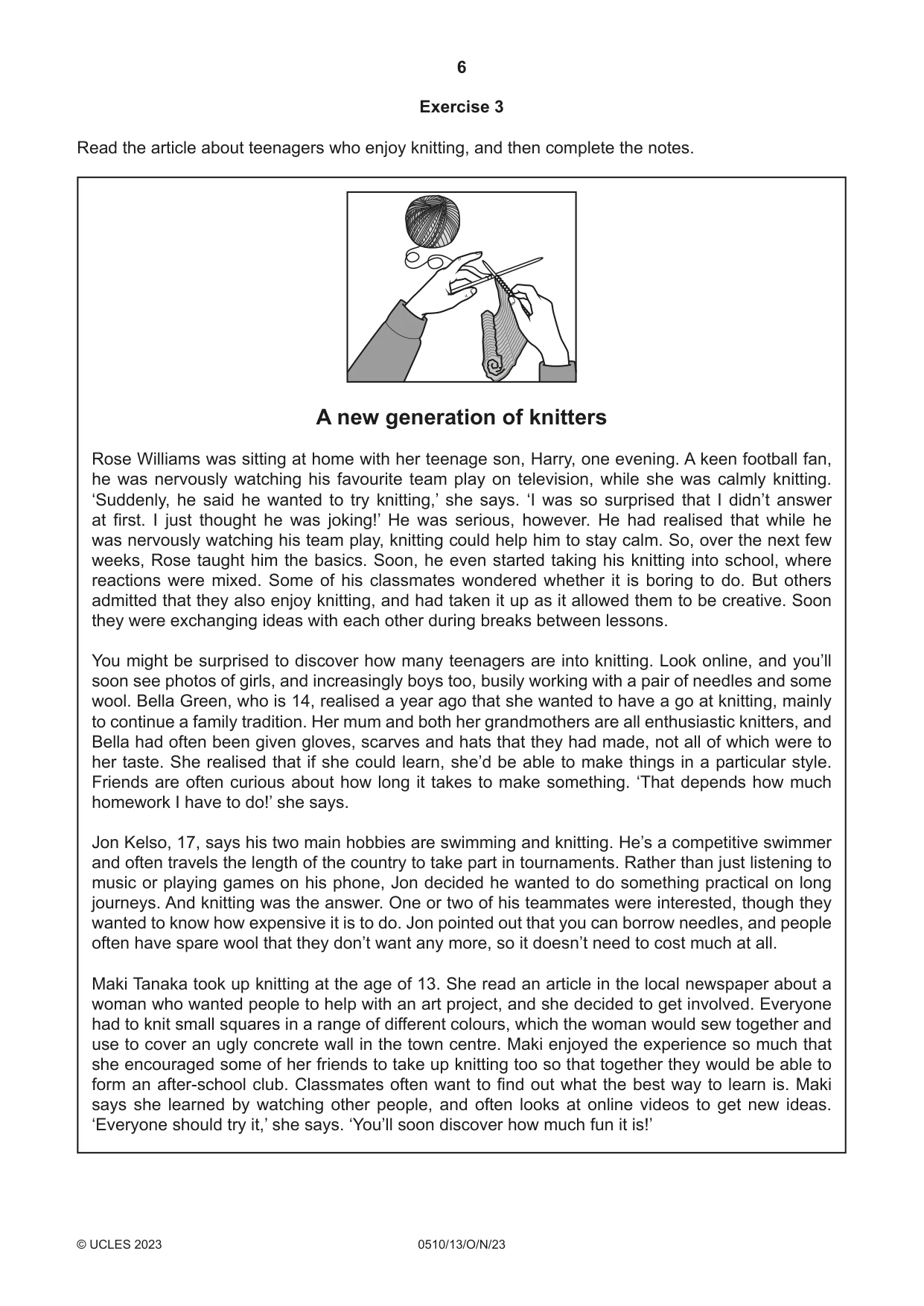
6 0510/13/O/N/23 © UCLES 2023 Exercise 3 Read the article about teenagers who enjoy knitting, and then complete the notes. A new generation of knitters Rose Williams was sitting at home with her teenage son, Harry, one evening. A keen football fan, he was nervously watching his favourite team play on television, while she was calmly knitting. ‘Suddenly, he said he wanted to try knitting,’ she says. ‘I was so surprised that I didn’t answer at first. I just thought he was joking!’ He was serious, however. He had realised that while he was nervously watching his team play, knitting could help him to stay calm. So, over the next few weeks, Rose taught him the basics. Soon, he even started taking his knitting into school, where reactions were mixed. Some of his classmates wondered whether it is boring to do. But others admitted that they also enjoy knitting, and had taken it up as it allowed them to be creative. Soon they were exchanging ideas with each other during breaks between lessons. You might be surprised to discover how many teenagers are into knitting. Look online, and you’ll soon see photos of girls, and increasingly boys too, busily working with a pair of needles and some wool. Bella Green, who is 14, realised a year ago that she wanted to have a go at knitting, mainly to continue a family tradition. Her mum and both her grandmothers are all enthusiastic knitters, and Bella had often been given gloves, scarves and hats that they had made, not all of which were to her taste. She realised that if she could learn, she’d be able to make things in a particular style. Friends are often curious about how long it takes to make something. ‘That depends how much homework I have to do!’ she says. Jon Kelso, 17, says his two main hobbies are swimming and knitting. He’s a competitive swimmer and often travels the length of the country to take part in tournaments. Rather than just listening to music or playing games on his phone, Jon decided he wanted to do something practical on long journeys. And knitting was the answer. One or two of his teammates were interested, though they wanted to know how expensive it is to do. Jon pointed out that you can borrow needles, and people often have spare wool that they don’t want any more, so it doesn’t need to cost much at all. Maki Tanaka took up knitting at the age of 13. She read an article in the local newspaper about a woman who wanted people to help with an art project, and she decided to get involved. Everyone had to knit small squares in a range of different colours, which the woman would sew together and use to cover an ugly concrete wall in the town centre. Maki enjoyed the experience so much that she encouraged some of her friends to take up knitting too so that together they would be able to form an after-school club. Classmates often want to find out what the best way to learn is. Maki says she learned by watching other people, and often looks at online videos to get new ideas. ‘Everyone should try it,’ she says. ‘You’ll soon discover how much fun it is!’
Question paper, page 7
7 0510/13/O/N/23 © UCLES 2023 [Turn over You are going to give a talk to your class about teenagers who knit. Prepare some notes to use as the basis for your talk. Make short notes under each heading. 10 Reasons why the teenagers started knitting: • … • … • … • … • … [5] 11 What the teenagers have been asked about knitting: • … • … [2] [Total: 7]
Question paper, page 8
8 0510/13/O/N/23 © UCLES 2023 Exercise 4 12 Read the article about a girl who took part in a TV cookery competition. Write a summary about the rules for entering the competition AND what the judges are looking for to decide on a winner. Your summary should be about 80 words long (and no more than 90 words long). You should use your own words as far as possible. You will receive up to 6 marks for the content of your summary, and up to 6 marks for the style and accuracy of your language. Kids can cook! by Sabi Olonga I’ve always loved cooking, and this summer I had one of the best experiences in my life – I took part in Kids can cook! a TV cookery competition. The competition has only been running for three years, but if you love cooking too, why not try to enter next year? There are a few things you need to be aware of, like, for example, the fact that you can only apply once. That means I can’t take part again in the future, but you could! The application is actually quite a complicated process, and takes a lot of time. Your recipe has to be original, and an additional requirement is that the dish you prepare contains healthy ingredients. If the competition organisers like it, you are then invited for an interview. This summer, more than 300 people applied, and 40 of those, including me, were interviewed. They asked me lots of questions about my recipe and how long each step would take, because you must be able to create your dish in less than 60 minutes. Anyway, I was one of the lucky 12 who got through to the actual competition! The competition itself took place in the TV studios, which were amazing! The people there were all so friendly, which was lucky as I felt really nervous on the way there. Though once I was in the kitchen and I had met the judges, I felt much better. What they want to see is how confident you are in the kitchen, as well as how good your skills are. I had spent weeks practising my recipe before the competition, so I knew I could do it in the time allowed. When the time is up, you present your food to the judges. Not only should your dish taste nice, it should look good too. The judges were impressed with my dish, and gave me some useful tips as well. In the end I came third, but I was just thrilled that I’d been able to take part!
Question paper, page 9
9 0510/13/O/N/23 © UCLES 2023 [Turn over … … … … … … … … … … … … … … [Total: 12]
Question paper, page 10
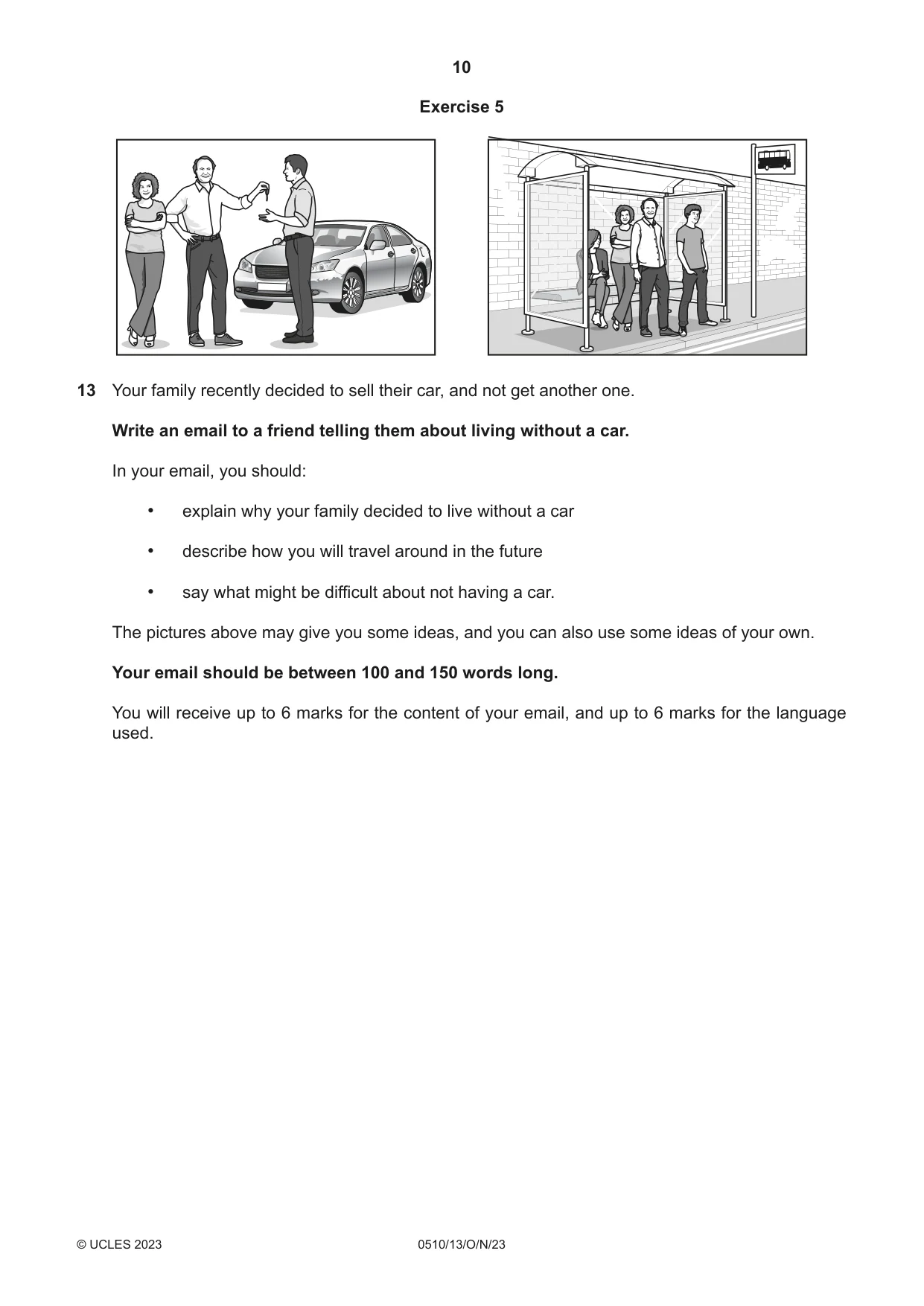
10 0510/13/ O/ N/23 © UCLES 2023 Exercise 5 13 Your family recently decided to sell their car, and not get another one. Write an email to a friend telling them about living without a car. In your email, you should: • explain why your family decided to live without a car • describe how you will travel around in the future • say what might be difficult about not having a car. The pictures above may give you some ideas, and you can also use some ideas of your own. Your email should be between 100 and 150 words long. You will receive up to 6 marks for the content of your email, and up to 6 marks for the language used.
Question paper, page 11
11 0510/13/O/N/23 © UCLES 2023 [Turn over … … … … … … … … … … … … … … … … … … … … … … … … … … … [Total: 12]
Question paper, page 12
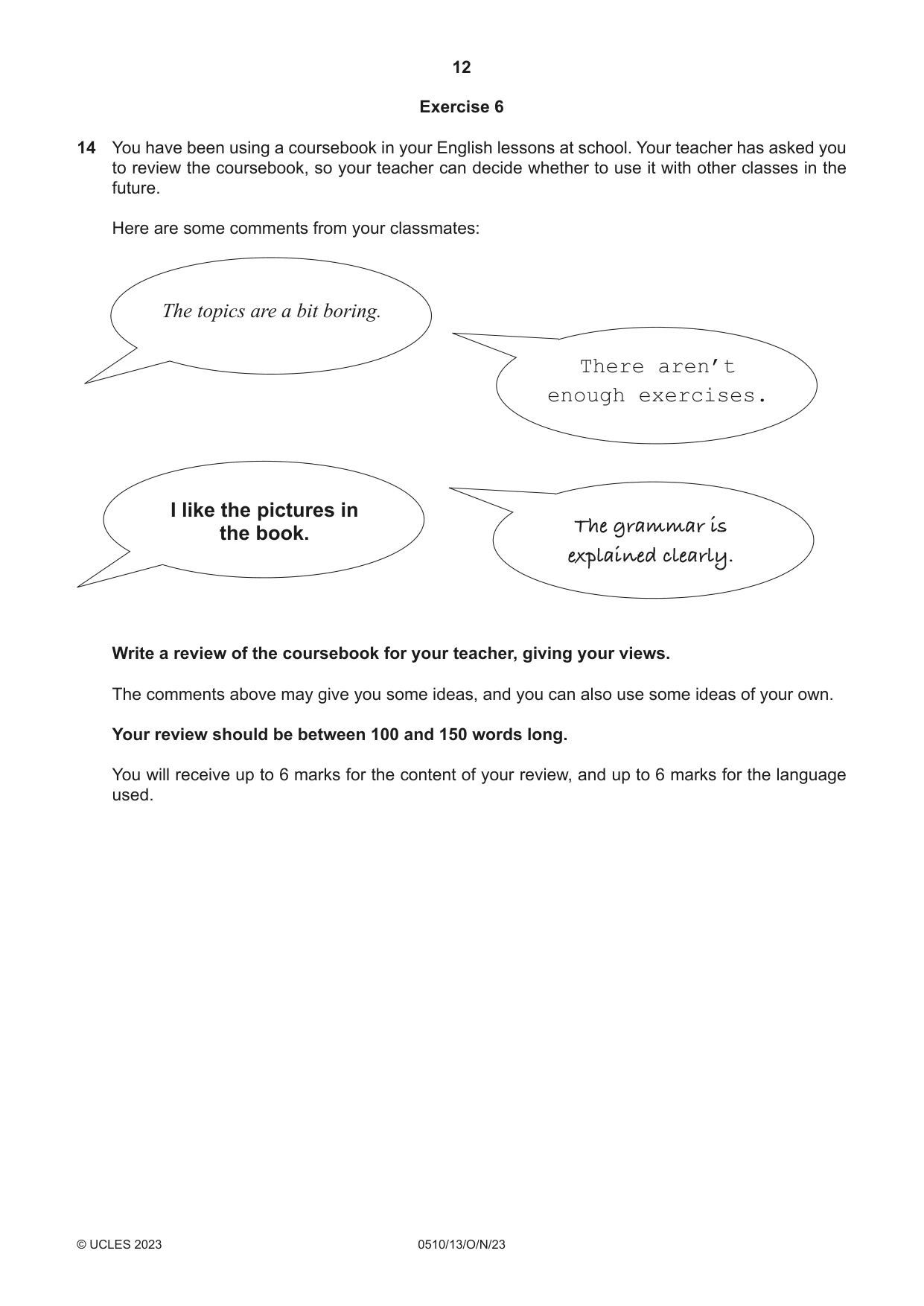
12 0510/13/O/N/23 © UCLES 2023 Exercise 6 14 You have been using a coursebook in your English lessons at school. Your teacher has asked you to review the coursebook, so your teacher can decide whether to use it with other classes in the future. Here are some comments from your classmates: The topics are a bit boring. The grammar is explained clearly. I like the pictures in the book. There aren’t enough exercises. Write a review of the coursebook for your teacher, giving your views. The comments above may give you some ideas, and you can also use some ideas of your own. Your review should be between 100 and 150 words long. You will receive up to 6 marks for the content of your review, and up to 6 marks for the language used.
Question paper, page 13
13 0510/13/O/N/23 © UCLES 2023 … … … … … … … … … … … … … … … … … … … … … … … … … … … [Total: 12]
Question paper, page 14
14 0510/13/O/N/23 © UCLES 2023 BLANK PAGE
Question paper, page 15
15 0510/13/O/N/23 © UCLES 2023 BLANK PAGE
Question paper, page 16
16 0510/13/O/N/23 © UCLES 2023 Permission to reproduce items where third-party owned material protected by copyright is included has been sought and cleared where possible. Every reasonable effort has been made by the publisher (UCLES) to trace copyright holders, but if any items requiring clearance have unwittingly been included, the publisher will be pleased to make amends at the earliest possible opportunity. To avoid the issue of disclosure of answer-related information to candidates, all copyright acknowledgements are reproduced online in the Cambridge Assessment International Education Copyright Acknowledgements Booklet. This is produced for each series of examinations and is freely available to download at www.cambridgeinternational.org after the live examination series. Cambridge Assessment International Education is part of Cambridge Assessment. Cambridge Assessment is the brand name of the University of Cambridge Local Examinations Syndicate (UCLES), which is a department of the University of Cambridge. BLANK PAGE
Mark scheme, page 1
This document consists of 10 printed pages. © UCLES 2023 [Turn over Cambridge IGCSE™ ENGLISH AS A SECOND LANGUAGE 0510/13 Paper 1 Reading and Writing (Core) October/November 2023 MARK SCHEME Maximum Mark: 60 Published This mark scheme is published as an aid to teachers and candidates, to indicate the requirements of the examination. It shows the basis on which Examiners were instructed to award marks. It does not indicate the details of the discussions that took place at an Examiners’ meeting before marking began, which would have considered the acceptability of alternative answers. Mark schemes should be read in conjunction with the question paper and the Principal Examiner Report for Teachers. Cambridge International will not enter into discussions about these mark schemes. Cambridge International is publishing the mark schemes for the October/November 2023 series for most Cambridge IGCSE, Cambridge International A and AS Level components, and some Cambridge O Level components.
Mark scheme, page 2
0510/13 Cambridge IGCSE – Mark Scheme PUBLISHED October/November 2023 © UCLES 2023 Page 2 of 10 Generic Marking Principles These general marking principles must be applied by all examiners when marking candidate answers. They should be applied alongside the specific content of the mark scheme or generic level descriptors for a question. Each question paper and mark scheme will also comply with these marking principles. GENERIC MARKING PRINCIPLE 1: Marks must be awarded in line with: • the specific content of the mark scheme or the generic level descriptors for the question • the specific skills defined in the mark scheme or in the generic level descriptors for the question • the standard of response required by a candidate as exemplified by the standardisation scripts. GENERIC MARKING PRINCIPLE 2: Marks awarded are always whole marks (not half marks, or other fractions). GENERIC MARKING PRINCIPLE 3: Marks must be awarded positively: • marks are awarded for correct/valid answers, as defined in the mark scheme. However, credit is given for valid answers which go beyond the scope of the syllabus and mark scheme, referring to your Team Leader as appropriate • marks are awarded when candidates clearly demonstrate what they know and can do • marks are not deducted for errors • marks are not deducted for omissions • answers should only be judged on the quality of spelling, punctuation and grammar when these features are specifically assessed by the question as indicated by the mark scheme. The meaning, however, should be unambiguous. GENERIC MARKING PRINCIPLE 4: Rules must be applied consistently, e.g. in situations where candidates have not followed instructions or in the application of generic level descriptors. GENERIC MARKING PRINCIPLE 5: Marks should be awarded using the full range of marks defined in the mark scheme for the question (however; the use of the full mark range may be limited according to the quality of the candidate responses seen). GENERIC MARKING PRINCIPLE 6: Marks awarded are based solely on the requirements as defined in the mark scheme. Marks should not be awarded with grade thresholds or grade descriptors in mind.
Mark scheme, page 3
0510/13 Cambridge IGCSE – Mark Scheme PUBLISHED October/November 2023 © UCLES 2023 Page 3 of 10 This component forms part of the Core tier assessment of Cambridge IGCSE English as a Second Language and tests the following Assessment Objectives: AO1: Reading R1 identify and select relevant information R2 understand ideas, opinions and attitudes R3 show understanding of the connections between ideas, opinions and attitudes R4 understand what is implied but not directly stated, e.g. gist, writer’s purpose, intentions and feelings AO2: Writing W1 communicate information/ideas/opinions clearly, accurately and effectively W2 organise ideas into coherent paragraphs using a range of appropriate linking devices W3 use a range of grammatical structures accurately and effectively W4 show control of punctuation and spelling W5 use appropriate register and style/format for the given purpose and audience
Mark scheme, page 4
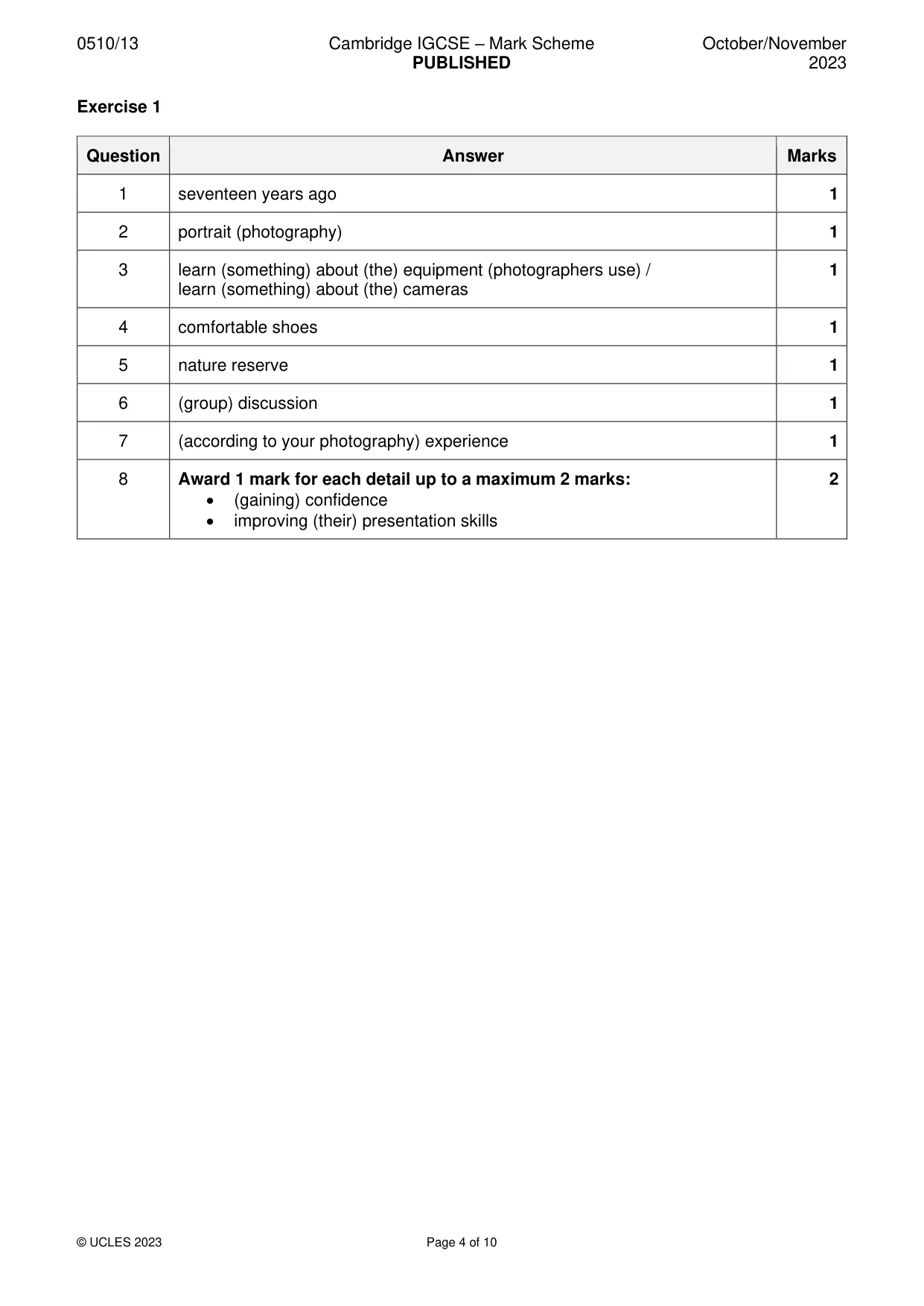
0510/13 Cambridge IGCSE – Mark Scheme PUBLISHED October/November 2023 © UCLES 2023 Page 4 of 10 Exercise 1 Question Answer Marks 1 seventeen years ago 1 2 portrait (photography) 1 3 learn (something) about (the) equipment (photographers use) / learn (something) about (the) cameras 1 4 comfortable shoes 1 5 nature reserve 1 6 (group) discussion 1 7 (according to your photography) experience 1 8 Award 1 mark for each detail up to a maximum 2 marks: • (gaining) confidence • improving (their) presentation skills 2
Mark scheme, page 5
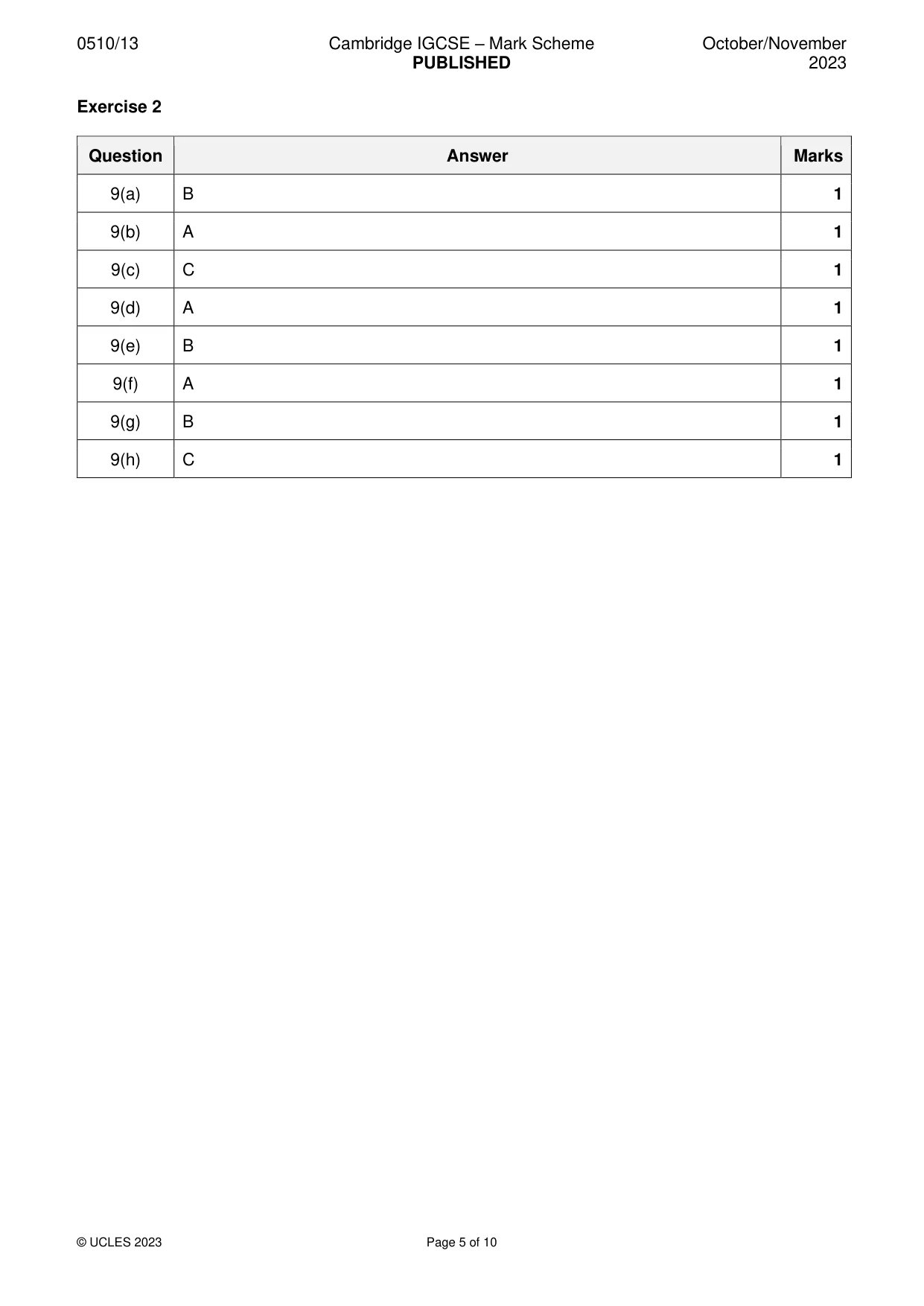
0510/13 Cambridge IGCSE – Mark Scheme PUBLISHED October/November 2023 © UCLES 2023 Page 5 of 10 Exercise 2 Question Answer Marks 9(a) B 1 9(b) A 1 9(c) C 1 9(d) A 1 9(e) B 1 9(f) A 1 9(g) B 1 9(h) C 1
Mark scheme, page 6
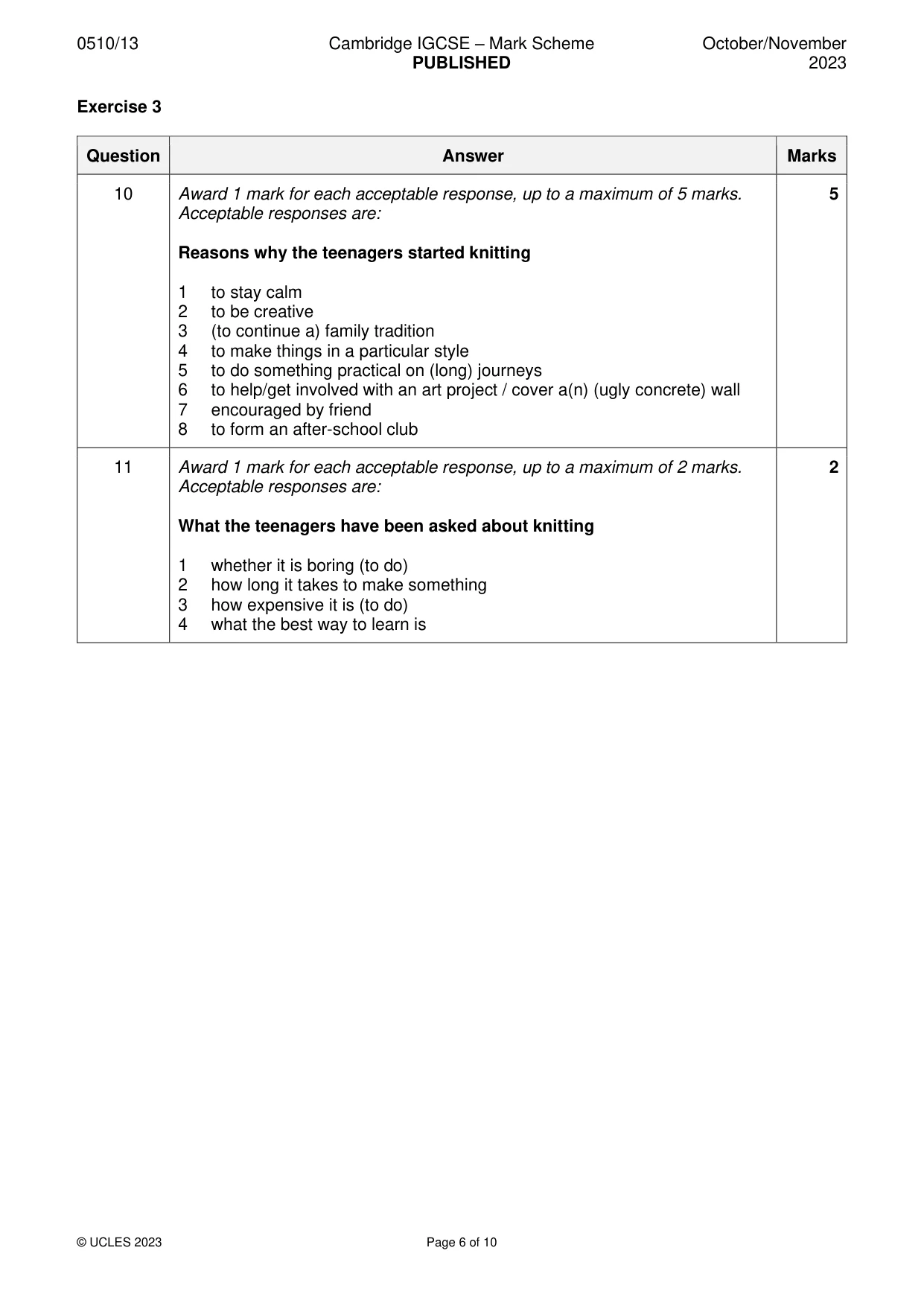
0510/13 Cambridge IGCSE – Mark Scheme PUBLISHED October/November 2023 © UCLES 2023 Page 6 of 10 Exercise 3 Question Answer Marks 10 Award 1 mark for each acceptable response, up to a maximum of 5 marks. Acceptable responses are: Reasons why the teenagers started knitting 1 to stay calm 2 to be creative 3 (to continue a) family tradition 4 to make things in a particular style 5 to do something practical on (long) journeys 6 to help/get involved with an art project / cover a(n) (ugly concrete) wall 7 encouraged by friend 8 to form an after-school club 5 11 Award 1 mark for each acceptable response, up to a maximum of 2 marks. Acceptable responses are: What the teenagers have been asked about knitting 1 whether it is boring (to do) 2 how long it takes to make something 3 how expensive it is (to do) 4 what the best way to learn is 2
Mark scheme, page 7
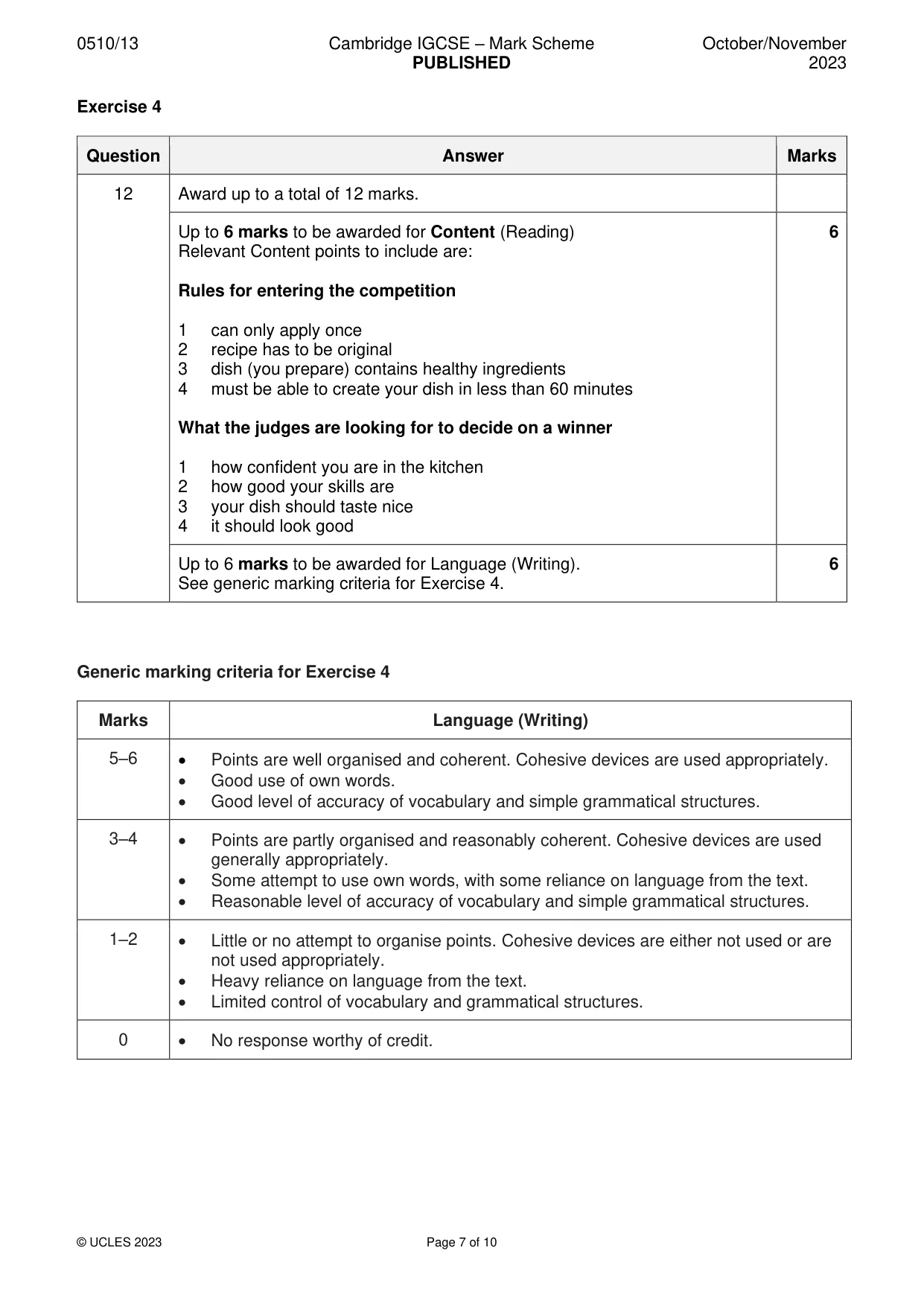
0510/13 Cambridge IGCSE – Mark Scheme PUBLISHED October/November 2023 © UCLES 2023 Page 7 of 10 Exercise 4 Question Answer Marks 12 Award up to a total of 12 marks. Up to 6 marks to be awarded for Content (Reading) Relevant Content points to include are: Rules for entering the competition 1 can only apply once 2 recipe has to be original 3 dish (you prepare) contains healthy ingredients 4 must be able to create your dish in less than 60 minutes What the judges are looking for to decide on a winner 1 how confident you are in the kitchen 2 how good your skills are 3 your dish should taste nice 4 it should look good 6 Up to 6 marks to be awarded for Language (Writing). See generic marking criteria for Exercise 4. 6 Generic marking criteria for Exercise 4 Marks Language (Writing) 5–6 • Points are well organised and coherent. Cohesive devices are used appropriately. • Good use of own words. • Good level of accuracy of vocabulary and simple grammatical structures. 3–4 • Points are partly organised and reasonably coherent. Cohesive devices are used generally appropriately. • Some attempt to use own words, with some reliance on language from the text. • Reasonable level of accuracy of vocabulary and simple grammatical structures. 1–2 • Little or no attempt to organise points. Cohesive devices are either not used or are not used appropriately. • Heavy reliance on language from the text. • Limited control of vocabulary and grammatical structures. 0 • No response worthy of credit.
Mark scheme, page 8
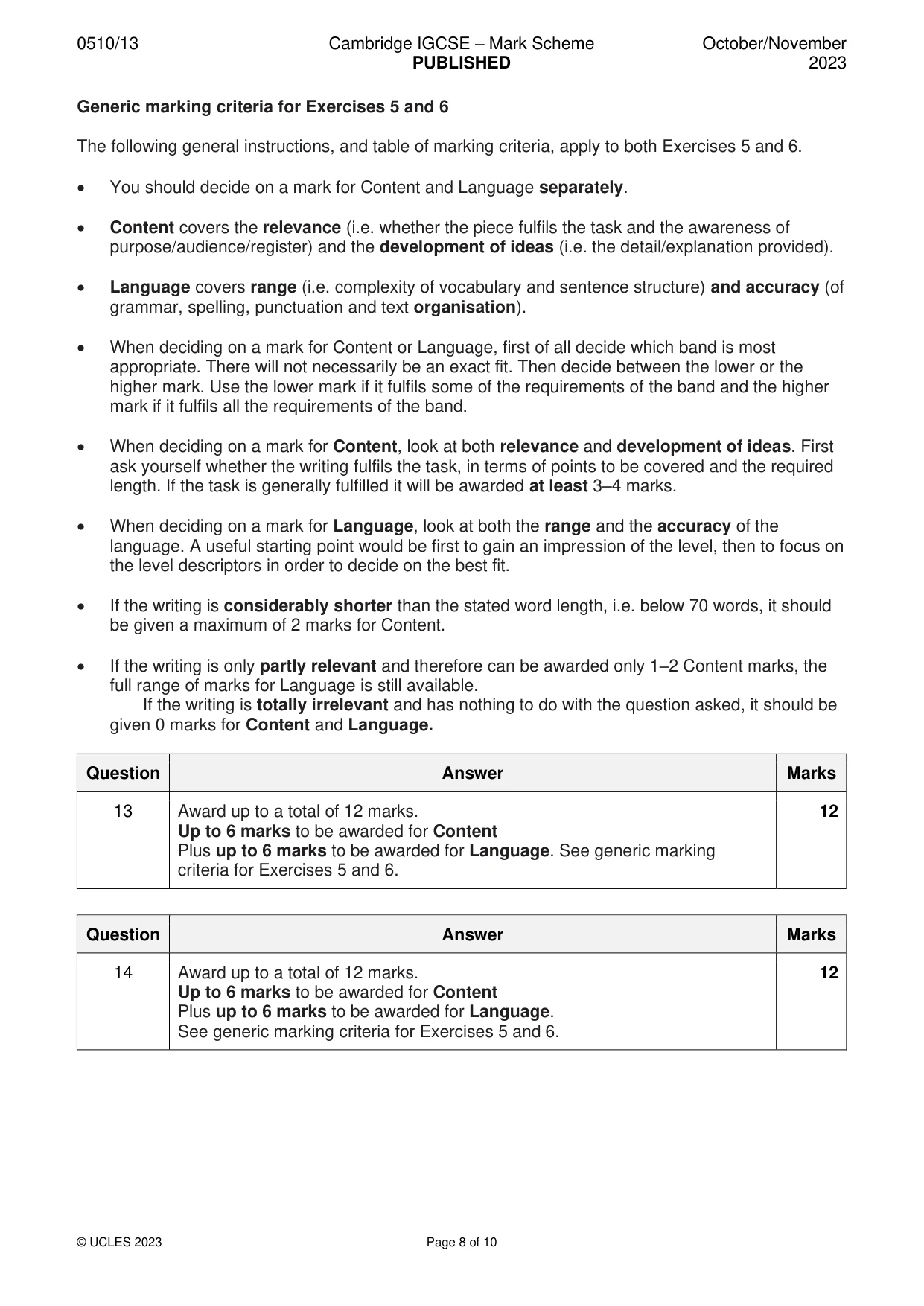
0510/13 Cambridge IGCSE – Mark Scheme PUBLISHED October/November 2023 © UCLES 2023 Page 8 of 10 Generic marking criteria for Exercises 5 and 6 The following general instructions, and table of marking criteria, apply to both Exercises 5 and 6. • You should decide on a mark for Content and Language separately. • Content covers the relevance (i.e. whether the piece fulfils the task and the awareness of purpose/audience/register) and the development of ideas (i.e. the detail/explanation provided). • Language covers range (i.e. complexity of vocabulary and sentence structure) and accuracy (of grammar, spelling, punctuation and text organisation). • When deciding on a mark for Content or Language, first of all decide which band is most appropriate. There will not necessarily be an exact fit. Then decide between the lower or the higher mark. Use the lower mark if it fulfils some of the requirements of the band and the higher mark if it fulfils all the requirements of the band. • When deciding on a mark for Content, look at both relevance and development of ideas. First ask yourself whether the writing fulfils the task, in terms of points to be covered and the required length. If the task is generally fulfilled it will be awarded at least 3–4 marks. • When deciding on a mark for Language, look at both the range and the accuracy of the language. A useful starting point would be first to gain an impression of the level, then to focus on the level descriptors in order to decide on the best fit. • If the writing is considerably shorter than the stated word length, i.e. below 70 words, it should be given a maximum of 2 marks for Content. • If the writing is only partly relevant and therefore can be awarded only 1–2 Content marks, the full range of marks for Language is still available. If the writing is totally irrelevant and has nothing to do with the question asked, it should be given 0 marks for Content and Language. Question Answer Marks 13 Award up to a total of 12 marks. Up to 6 marks to be awarded for Content Plus up to 6 marks to be awarded for Language. See generic marking criteria for Exercises 5 and 6. 12 Question Answer Marks 14 Award up to a total of 12 marks. Up to 6 marks to be awarded for Content Plus up to 6 marks to be awarded for Language. See generic marking criteria for Exercises 5 and 6. 12
Mark scheme, page 9
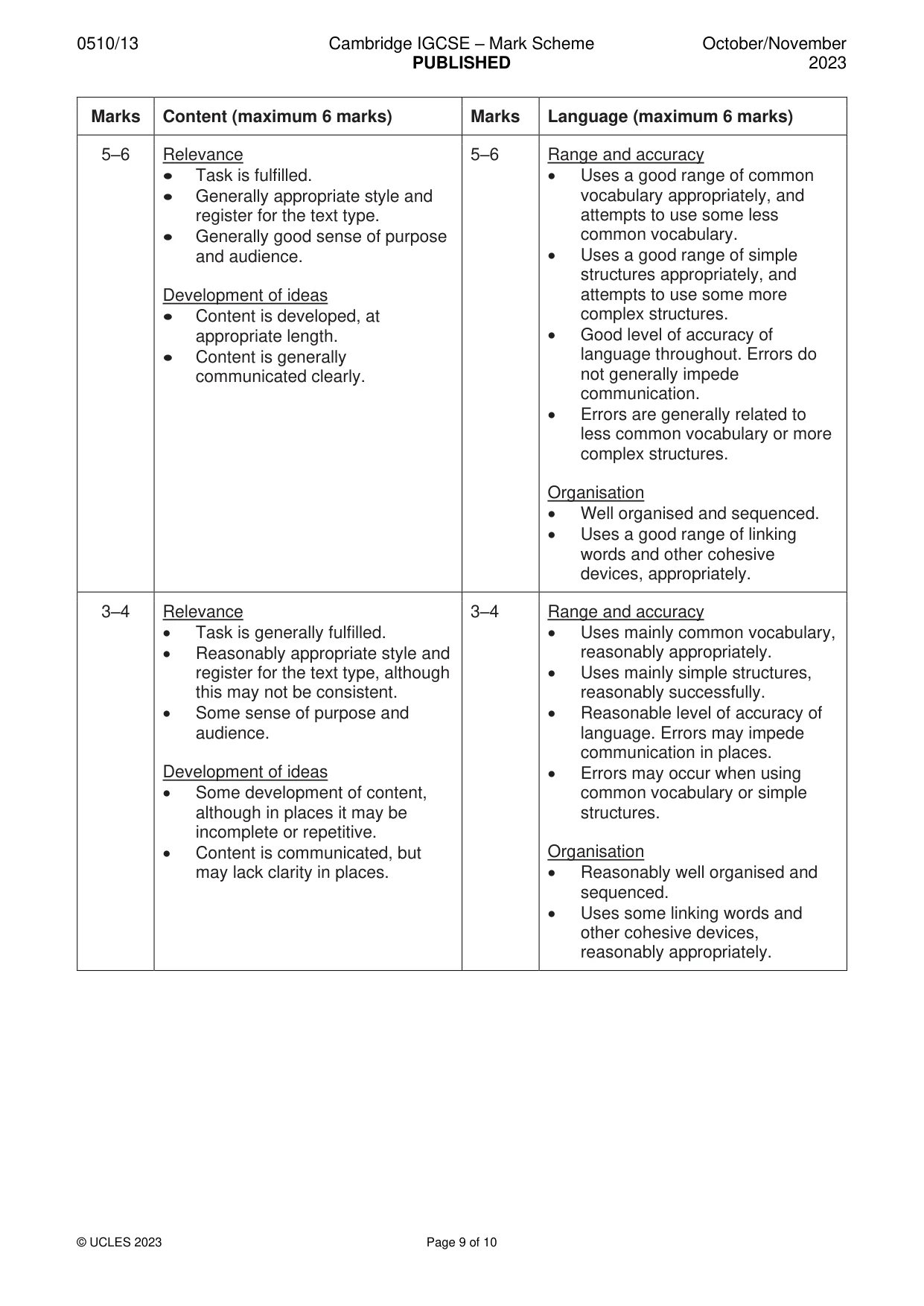
0510/13 Cambridge IGCSE – Mark Scheme PUBLISHED October/November 2023 © UCLES 2023 Page 9 of 10 Marks Content (maximum 6 marks) Marks Language (maximum 6 marks) 5–6 Relevance • Task is fulfilled. • Generally appropriate style and register for the text type. • Generally good sense of purpose and audience. Development of ideas • Content is developed, at appropriate length. • Content is generally communicated clearly. 5–6 Range and accuracy • Uses a good range of common vocabulary appropriately, and attempts to use some less common vocabulary. • Uses a good range of simple structures appropriately, and attempts to use some more complex structures. • Good level of accuracy of language throughout. Errors do not generally impede communication. • Errors are generally related to less common vocabulary or more complex structures. Organisation • Well organised and sequenced. • Uses a good range of linking words and other cohesive devices, appropriately. 3–4 Relevance • Task is generally fulfilled. • Reasonably appropriate style and register for the text type, although this may not be consistent. • Some sense of purpose and audience. Development of ideas • Some development of content, although in places it may be incomplete or repetitive. • Content is communicated, but may lack clarity in places. 3–4 Range and accuracy • Uses mainly common vocabulary, reasonably appropriately. • Uses mainly simple structures, reasonably successfully. • Reasonable level of accuracy of language. Errors may impede communication in places. • Errors may occur when using common vocabulary or simple structures. Organisation • Reasonably well organised and sequenced. • Uses some linking words and other cohesive devices, reasonably appropriately.
Mark scheme, page 10
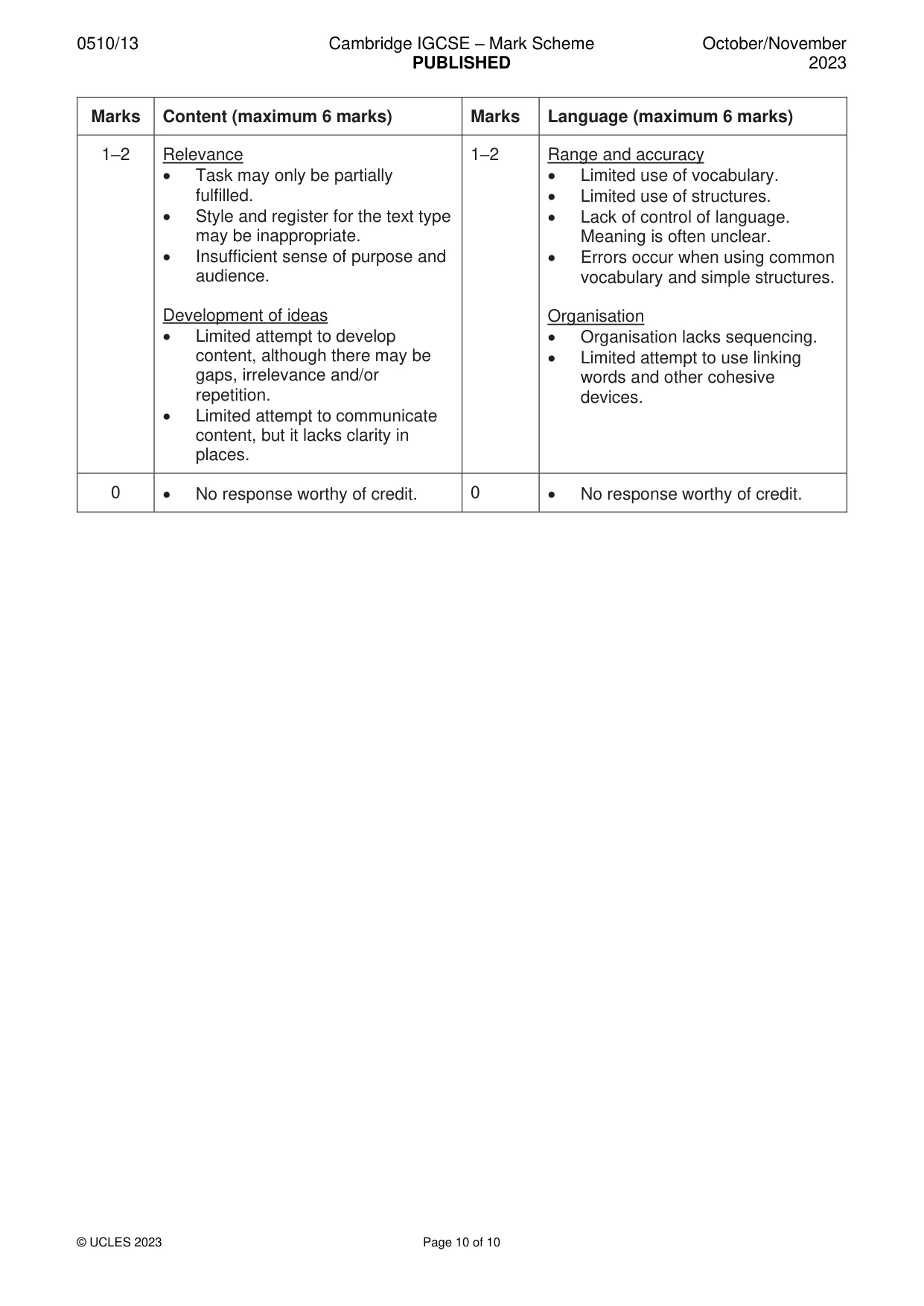
0510/13 Cambridge IGCSE – Mark Scheme PUBLISHED October/November 2023 © UCLES 2023 Page 10 of 10 Marks Content (maximum 6 marks) Marks Language (maximum 6 marks) 1–2 Relevance • Task may only be partially fulfilled. • Style and register for the text type may be inappropriate. • Insufficient sense of purpose and audience. Development of ideas • Limited attempt to develop content, although there may be gaps, irrelevance and/or repetition. • Limited attempt to communicate content, but it lacks clarity in places. 1–2 Range and accuracy • Limited use of vocabulary. • Limited use of structures. • Lack of control of language. Meaning is often unclear. • Errors occur when using common vocabulary and simple structures. Organisation • Organisation lacks sequencing. • Limited attempt to use linking words and other cohesive devices. 0 • No response worthy of credit. 0 • No response worthy of credit.
What you needed in this session
Cambridge’s own grade thresholds for 2023 Oct/Nov, Paper 1 · Variant 3. A higher threshold means an easier paper — the bar moves with how the cohort did.