Cambridge IGCSE English - Second Language (oral endorsement) 0510 — 2024 Feb/March Paper 1 · Variant 2
0510/12/F/M/24 · 60 marks · 120 min
The question paper and its mark scheme, free to read here and free to download. This is Cambridge’s own paper, exactly as it was sat.
Question paper16 pages




Mark scheme9 pages
Answers below. Sit the paper first if you are practising.
Paper as text
Question paper, page 1
This document has 16 pages. Any blank pages are indicated. [Turn over Cambridge IGCSE™ ENGLISH AS A SECOND LANGUAGE 0510/12 Paper 1 Reading and Writing February/March 2024 2 hours You must answer on the question paper. No additional materials are needed. INSTRUCTIONS ● Answer all questions. ● Use a black or dark blue pen. ● Write your name, centre number and candidate number in the boxes at the top of the page. ● Write your answer to each question in the space provided. ● Do not use an erasable pen or correction fluid. ● Do not write on any bar codes. ● Dictionaries are not allowed. INFORMATION ● The total mark for this paper is 60. ● The number of marks for each question or part question is shown in brackets [ ]. * 5 3 0 3 7 9 5 8 1 3 * DC (PQ/CT) 326543/4 © UCLES 2024
Question paper, page 2
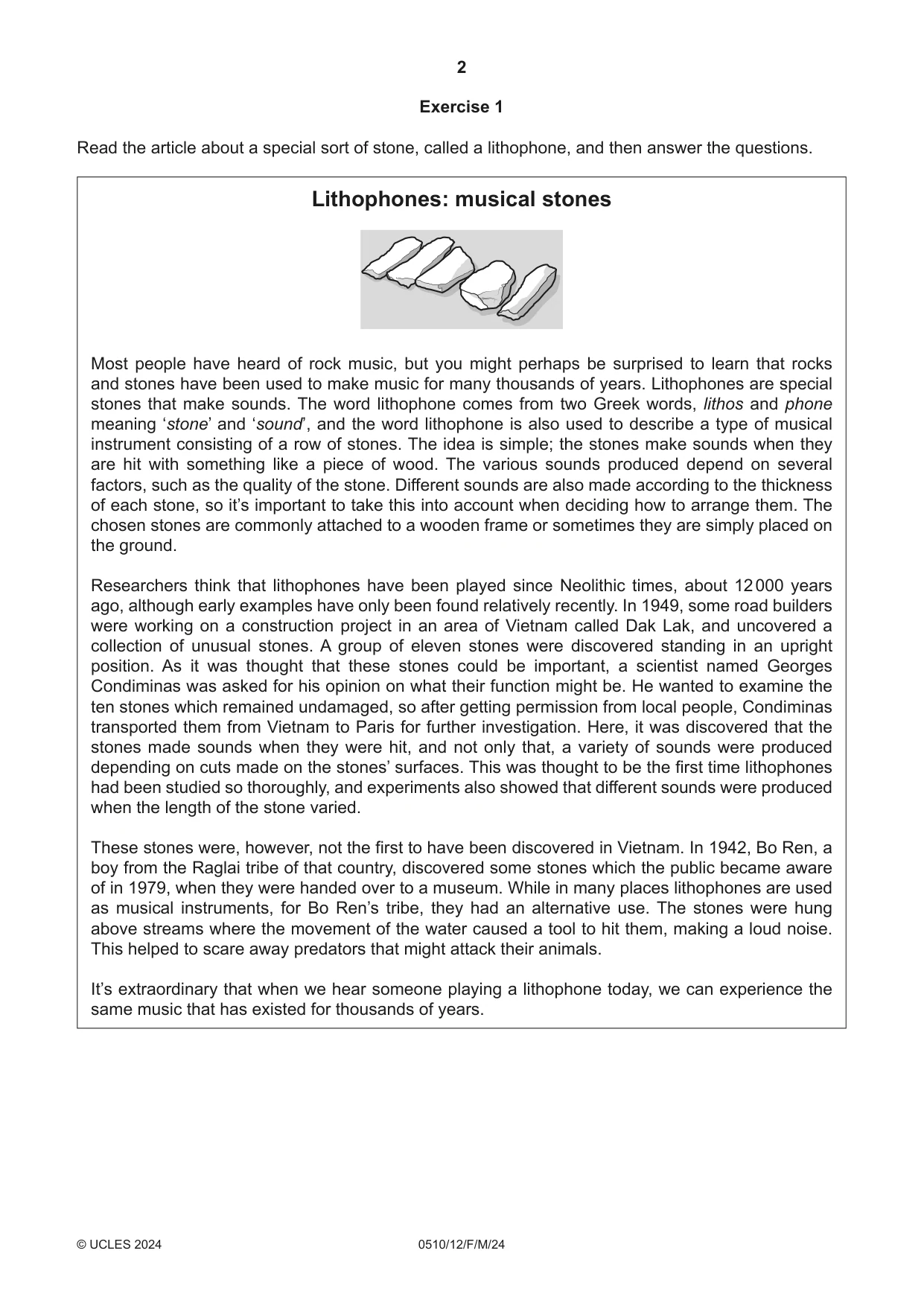
2 0510/12/F/M/24 © UCLES 2024 Exercise 1 Read the article about a special sort of stone, called a lithophone, and then answer the questions. Lithophones: musical stones Most people have heard of rock music, but you might perhaps be surprised to learn that rocks and stones have been used to make music for many thousands of years. Lithophones are special stones that make sounds. The word lithophone comes from two Greek words, lithos and phone meaning ‘stone’ and ‘sound’, and the word lithophone is also used to describe a type of musical instrument consisting of a row of stones. The idea is simple; the stones make sounds when they are hit with something like a piece of wood. The various sounds produced depend on several factors, such as the quality of the stone. Different sounds are also made according to the thickness of each stone, so it’s important to take this into account when deciding how to arrange them. The chosen stones are commonly attached to a wooden frame or sometimes they are simply placed on the ground. Researchers think that lithophones have been played since Neolithic times, about 12 000 years ago, although early examples have only been found relatively recently. In 1949, some road builders were working on a construction project in an area of Vietnam called Dak Lak, and uncovered a collection of unusual stones. A group of eleven stones were discovered standing in an upright position. As it was thought that these stones could be important, a scientist named Georges Condiminas was asked for his opinion on what their function might be. He wanted to examine the ten stones which remained undamaged, so after getting permission from local people, Condiminas transported them from Vietnam to Paris for further investigation. Here, it was discovered that the stones made sounds when they were hit, and not only that, a variety of sounds were produced depending on cuts made on the stones’ surfaces. This was thought to be the first time lithophones had been studied so thoroughly, and experiments also showed that different sounds were produced when the length of the stone varied. These stones were, however, not the first to have been discovered in Vietnam. In 1942, Bo Ren, a boy from the Raglai tribe of that country, discovered some stones which the public became aware of in 1979, when they were handed over to a museum. While in many places lithophones are used as musical instruments, for Bo Ren’s tribe, they had an alternative use. The stones were hung above streams where the movement of the water caused a tool to hit them, making a loud noise. This helped to scare away predators that might attack their animals. It’s extraordinary that when we hear someone playing a lithophone today, we can experience the same music that has existed for thousands of years.
Question paper, page 3
3 0510/12/F/M/24 © UCLES 2024 [Turn over Question 1 How are the stones usually displayed when they are played? … [1] Question 2 Who first discovered the stones in Dak Lak? … [1] Question 3 How many of the stones in Dak Lak were in good condition? … [1] Question 4 Where did the tests on the Dak Lak stones take place? … [1] Question 5 What did the Raglai people use the stones for? … [1] Question 6 What affects the range of sounds that the stones make? Give three details. … … … [3] [Total: 8]
Question paper, page 4
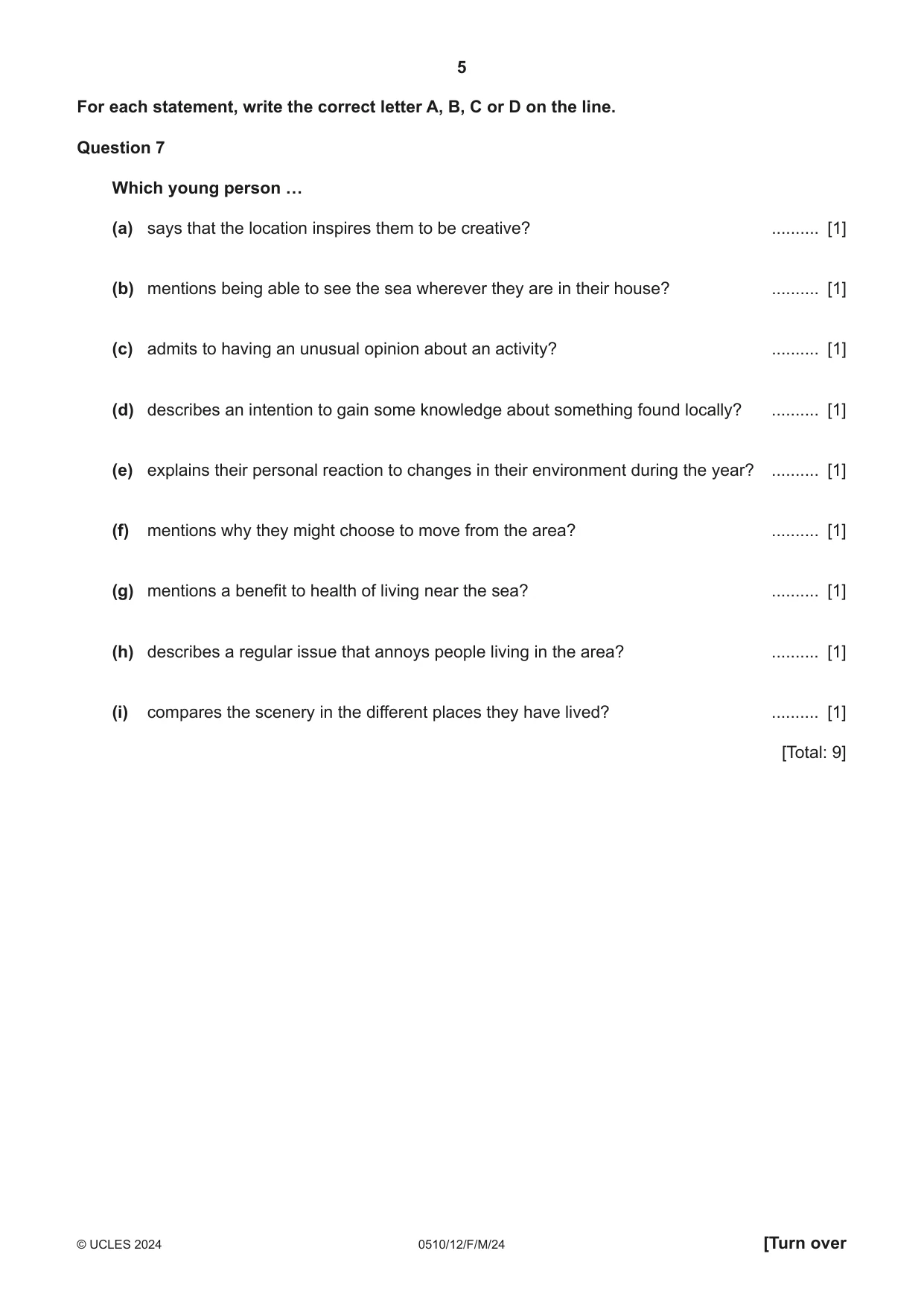
4 0510/12/F/M/24 © UCLES 2024 Exercise 2 Read the article about four young people (A–D) who live by the sea. Then answer Questions 7(a)–(i). Why I love living by the sea A Amin I grew up in the mountains, away from the coast. Everything there was green as far as you could see, and we were so high up. It’s the opposite now – I love seeing the ocean. I get fantastic views from every window in my home as the beach isn’t far away. I spend a lot of time there and I’m always bringing in sand on my clothes – enough to build a sandcastle, my mum says! Last year, I started working in a local craft shop during the holidays, selling paintings of the sea by local artists. After spending their holidays looking at the sea, tourists want a souvenir to take back. I have to admit there aren’t many opportunities outside the tourism industry here, especially in what I want to do, which is engineering. I’m determined to follow my dream, so unfortunately I’ll have to make some big decisions, I know. B Joey I can’t imagine living anywhere else. I mean, the weather’s not always fantastic it’s true, but no one minds. After all, there’s always something to do, cycling along the coast paths or water sports like swimming and sailing. I love anything active, but I also love watching the waves. Now, you might think that’s a bit strange – after all, waves all look the same, right? Wrong! Every day brings something new, and the colours and shapes change completely. I’ve started taking photos and making interesting prints from them. I’ve just done one where it’s impossible to tell where the sea ends and the sky begins. I’m really pleased with it. And it’s not only the waves that are interesting. What’s under them is just as fascinating. There are some rare seahorses that live in our area, and I’m really keen to find out more about them. C Kira I’m so lucky my home is here. Of course, surfing is what most people come here to do – the beaches are full of colourful surfboards every summer – and people laugh that local kids can surf before they can walk! All except me – it’s just never appealed, I’m afraid. My friends are always trying to persuade me to find out what I’m missing, with no success! I’m still happy to be here, though. I listened to a science podcast where I learned that having a diet of fish meant our ancient ancestors living on the coast developed bigger brains! I don’t know if that’s true, but what I do know is that when I lived in a city, I used to find that the air quality caused me a few problems. Since we moved here, with the fresh sea air, that’s not been the case at all. D Dom This is a beautiful place to live. I actually like it just as much in the winter as I do in the summer. In the winter, after the tourists leave, the wild waves crashing onto the beach during a storm make me appreciate the power of nature, and the drama of the waves, whereas in the summer, it’s much calmer. That’s what attracts the huge summer crowds, of course. If you’re not into swimming, there are lots of things to do like sailing, or scuba diving. My parents are always fed up because the car parks get so full at peak tourist times. But for me, any season is perfect. In winter, when it’s not so busy, my friends and I go for long walks along the beach. We’ve found some really strange shells, and even a part of a dinosaur fossil! It’s in the local museum now, helping people learn more about the history of the area.
Question paper, page 5
5 0510/12/F/M/24 © UCLES 2024 [Turn over For each statement, write the correct letter A, B, C or D on the line. Question 7 Which young person … (a) says that the location inspires them to be creative? … [1] (b) mentions being able to see the sea wherever they are in their house? … [1] (c) admits to having an unusual opinion about an activity? … [1] (d) describes an intention to gain some knowledge about something found locally? … [1] (e) explains their personal reaction to changes in their environment during the year? … [1] (f) mentions why they might choose to move from the area? … [1] (g) mentions a benefit to health of living near the sea? … [1] (h) describes a regular issue that annoys people living in the area? … [1] (i) compares the scenery in the different places they have lived? … [1] [Total: 9]
Question paper, page 6
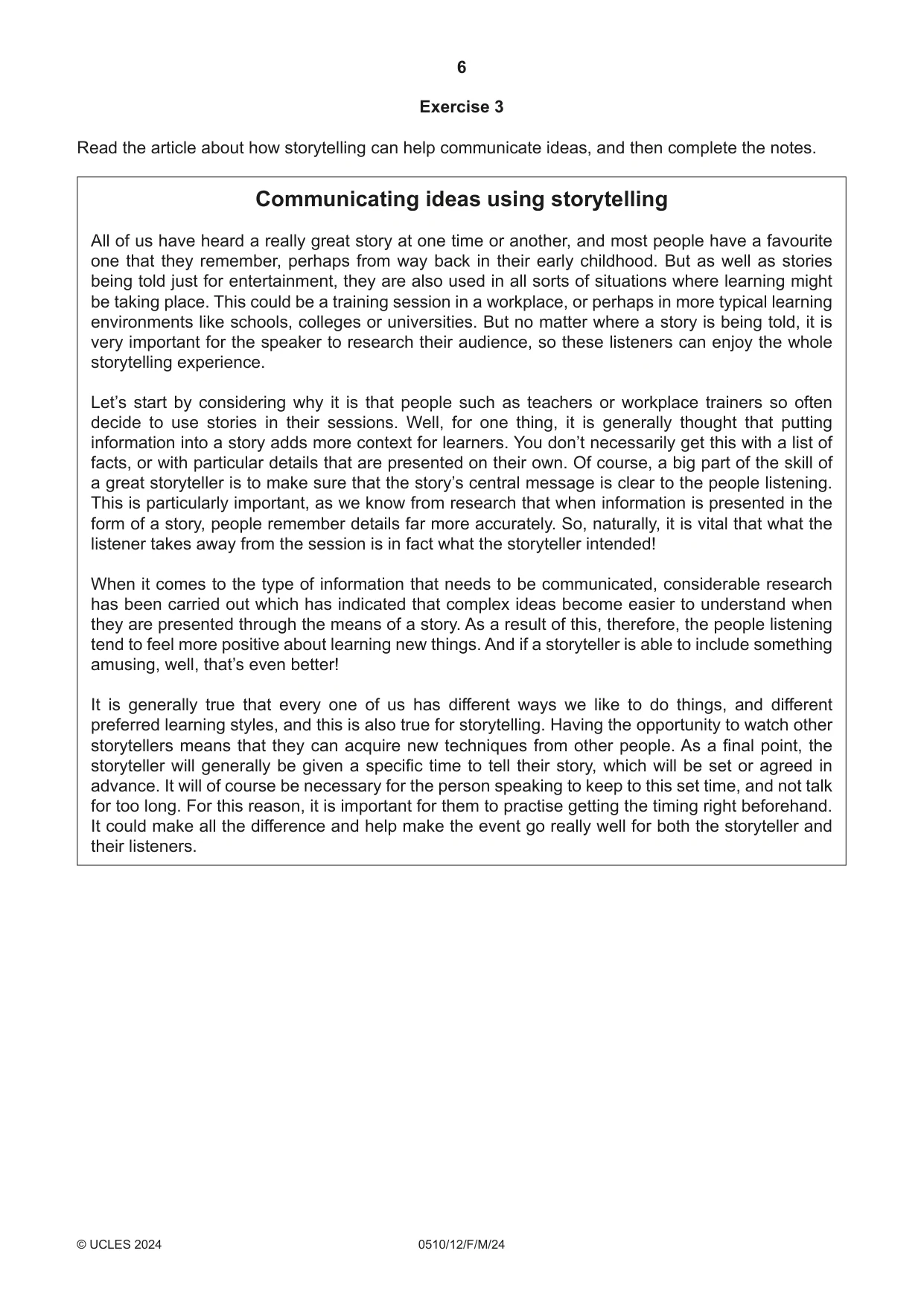
6 0510/12/F/M/24 © UCLES 2024 Exercise 3 Read the article about how storytelling can help communicate ideas, and then complete the notes. Communicating ideas using storytelling All of us have heard a really great story at one time or another, and most people have a favourite one that they remember, perhaps from way back in their early childhood. But as well as stories being told just for entertainment, they are also used in all sorts of situations where learning might be taking place. This could be a training session in a workplace, or perhaps in more typical learning environments like schools, colleges or universities. But no matter where a story is being told, it is very important for the speaker to research their audience, so these listeners can enjoy the whole storytelling experience. Let’s start by considering why it is that people such as teachers or workplace trainers so often decide to use stories in their sessions. Well, for one thing, it is generally thought that putting information into a story adds more context for learners. You don’t necessarily get this with a list of facts, or with particular details that are presented on their own. Of course, a big part of the skill of a great storyteller is to make sure that the story’s central message is clear to the people listening. This is particularly important, as we know from research that when information is presented in the form of a story, people remember details far more accurately. So, naturally, it is vital that what the listener takes away from the session is in fact what the storyteller intended! When it comes to the type of information that needs to be communicated, considerable research has been carried out which has indicated that complex ideas become easier to understand when they are presented through the means of a story. As a result of this, therefore, the people listening tend to feel more positive about learning new things. And if a storyteller is able to include something amusing, well, that’s even better! It is generally true that every one of us has different ways we like to do things, and different preferred learning styles, and this is also true for storytelling. Having the opportunity to watch other storytellers means that they can acquire new techniques from other people. As a final point, the storyteller will generally be given a specific time to tell their story, which will be set or agreed in advance. It will of course be necessary for the person speaking to keep to this set time, and not talk for too long. For this reason, it is important for them to practise getting the timing right beforehand. It could make all the difference and help make the event go really well for both the storyteller and their listeners.
Question paper, page 7
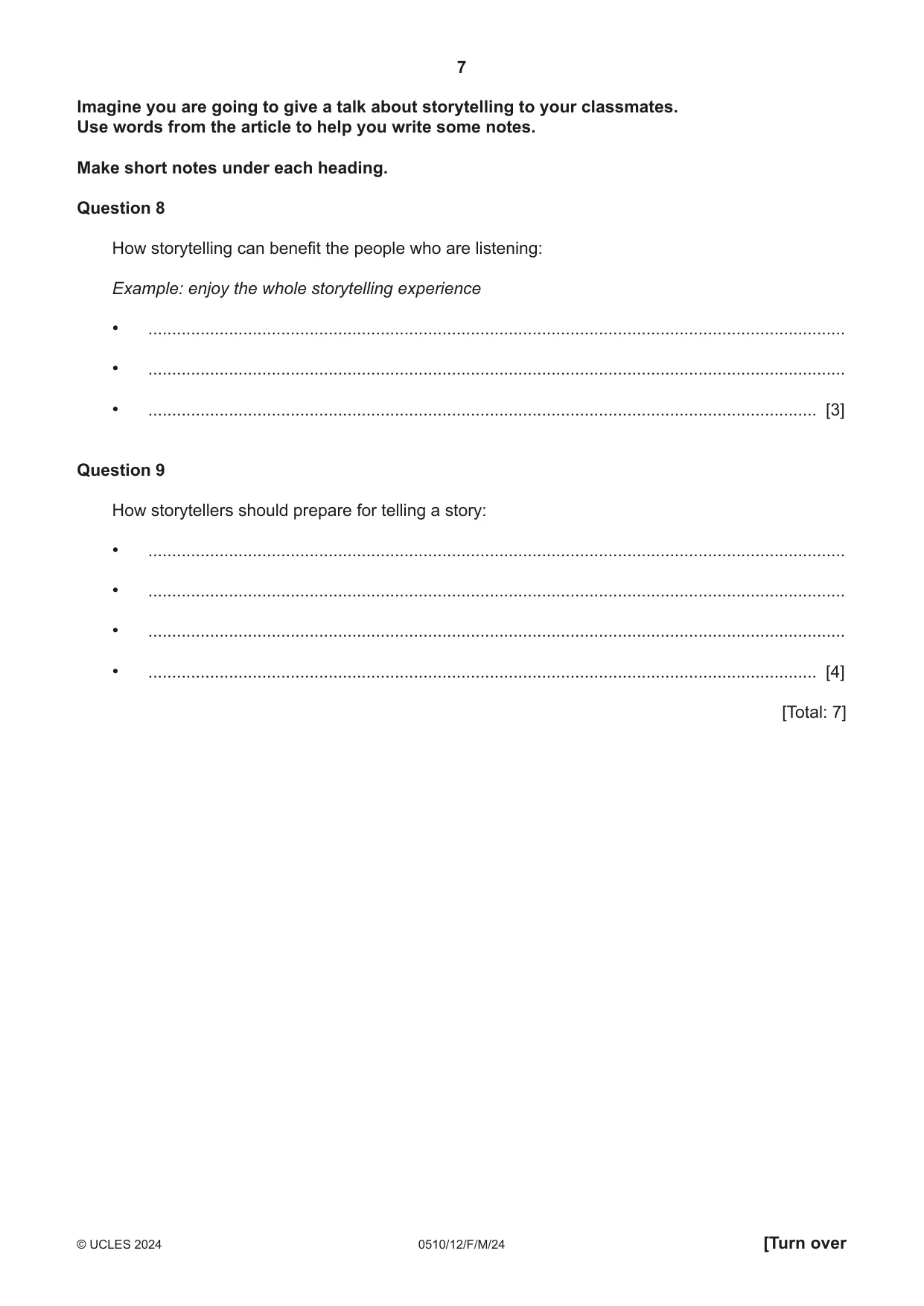
7 0510/12/F/M/24 © UCLES 2024 [Turn over Imagine you are going to give a talk about storytelling to your classmates. Use words from the article to help you write some notes. Make short notes under each heading. Question 8 How storytelling can benefit the people who are listening: Example: enjoy the whole storytelling experience • … • … • … [3] Question 9 How storytellers should prepare for telling a story: • … • … • … • … [4] [Total: 7]
Question paper, page 8
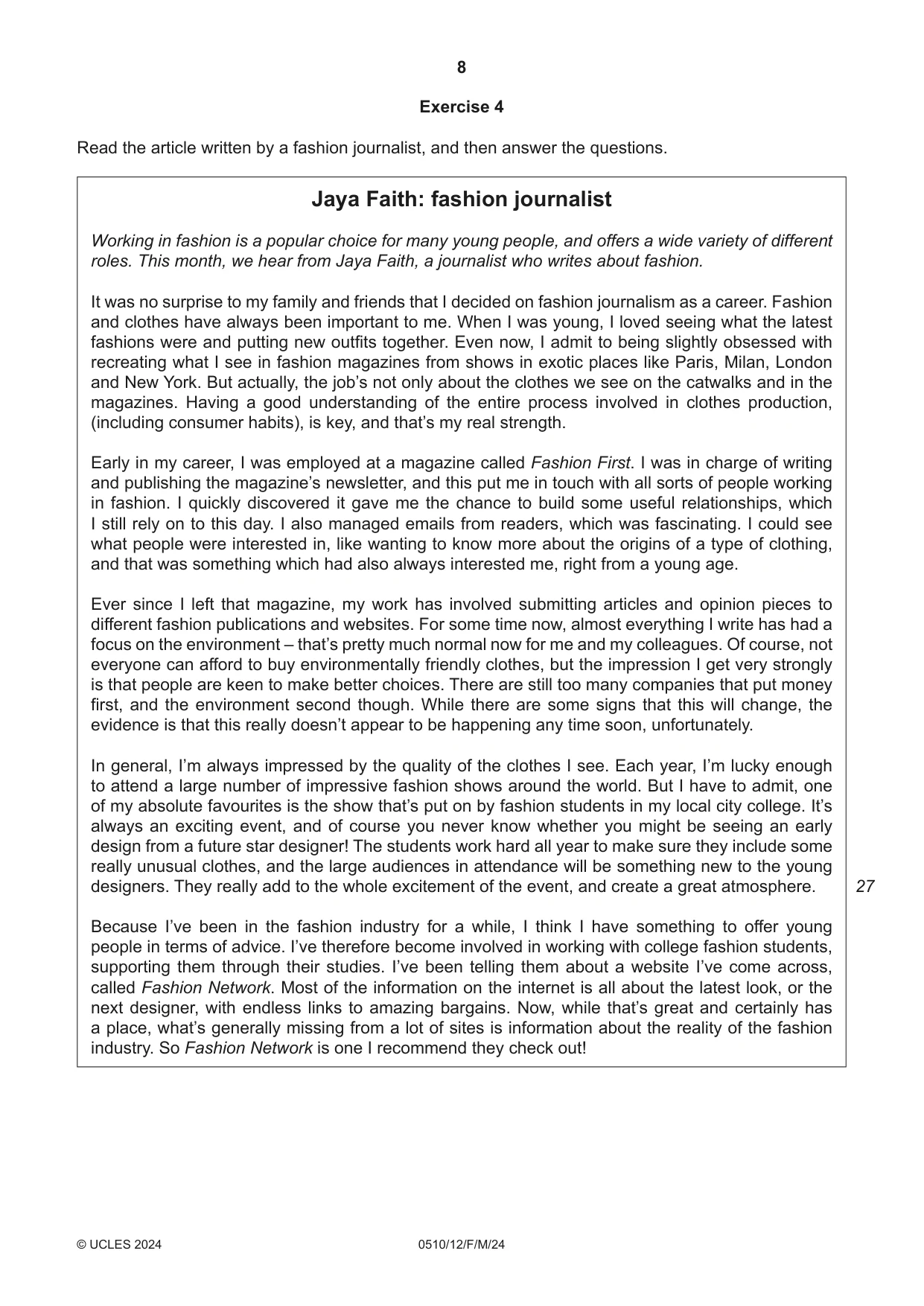
8 0510/12/F/M/24 © UCLES 2024 Exercise 4 Read the article written by a fashion journalist, and then answer the questions. Jaya Faith: fashion journalist Working in fashion is a popular choice for many young people, and offers a wide variety of different roles. This month, we hear from Jaya Faith, a journalist who writes about fashion. It was no surprise to my family and friends that I decided on fashion journalism as a career. Fashion and clothes have always been important to me. When I was young, I loved seeing what the latest fashions were and putting new outfits together. Even now, I admit to being slightly obsessed with recreating what I see in fashion magazines from shows in exotic places like Paris, Milan, London and New York. But actually, the job’s not only about the clothes we see on the catwalks and in the magazines. Having a good understanding of the entire process involved in clothes production, (including consumer habits), is key, and that’s my real strength. Early in my career, I was employed at a magazine called Fashion First. I was in charge of writing and publishing the magazine’s newsletter, and this put me in touch with all sorts of people working in fashion. I quickly discovered it gave me the chance to build some useful relationships, which I still rely on to this day. I also managed emails from readers, which was fascinating. I could see what people were interested in, like wanting to know more about the origins of a type of clothing, and that was something which had also always interested me, right from a young age. Ever since I left that magazine, my work has involved submitting articles and opinion pieces to different fashion publications and websites. For some time now, almost everything I write has had a focus on the environment – that’s pretty much normal now for me and my colleagues. Of course, not everyone can afford to buy environmentally friendly clothes, but the impression I get very strongly is that people are keen to make better choices. There are still too many companies that put money first, and the environment second though. While there are some signs that this will change, the evidence is that this really doesn’t appear to be happening any time soon, unfortunately. In general, I’m always impressed by the quality of the clothes I see. Each year, I’m lucky enough to attend a large number of impressive fashion shows around the world. But I have to admit, one of my absolute favourites is the show that’s put on by fashion students in my local city college. It’s always an exciting event, and of course you never know whether you might be seeing an early design from a future star designer! The students work hard all year to make sure they include some really unusual clothes, and the large audiences in attendance will be something new to the young designers. They really add to the whole excitement of the event, and create a great atmosphere. Because I’ve been in the fashion industry for a while, I think I have something to offer young people in terms of advice. I’ve therefore become involved in working with college fashion students, supporting them through their studies. I’ve been telling them about a website I’ve come across, called Fashion Network. Most of the information on the internet is all about the latest look, or the next designer, with endless links to amazing bargains. Now, while that’s great and certainly has a place, what’s generally missing from a lot of sites is information about the reality of the fashion industry. So Fashion Network is one I recommend they check out! 27
Question paper, page 9
9 0510/12/F/M/24 © UCLES 2024 [Turn over For each question, choose the correct answer, A, B or C, and put a tick (✓) in the appropriate box. Question 10 Why does Jaya think she is successful at her job? A She is good at predicting the next fashion trend. B She has experience of fashion in many different cultures. C She feels confident when writing about different elements of fashion. [1] Question 11 Jaya says that working for Fashion First magazine A improved her communication skills. B allowed her to make valuable contacts. C made her think more about where clothes were made. [1] Question 12 What does Jaya say about the impact of fashion on the environment? A The fashion industry needs to make faster improvements. B Fashion journalists need to highlight the problems more effectively. C Customers need to be more aware of the issues fashion creates. [1] Question 13 What does ‘They’ in Line 27 refer to? A young designers B unusual clothes C large audiences [1]
Question paper, page 10
10 0510/12/F/M/24 © UCLES 2024 Question 14 In the last paragraph, Jaya mentions a website and A describes her contribution to the site. B suggests readers use the links it contains. C explains how it fills a particular gap in knowledge. [1] Question 15 Jaya is writing this article to A give an account of her experiences as a fashion journalist. B explain the steps involved in becoming a fashion journalist. C describe why fashion journalism is important to the clothes industry. [1] [Total: 6]
Question paper, page 11
11 0510/12/F/M/24 © UCLES 2024 [Turn over Please turn over for Exercise 5.
Question paper, page 12
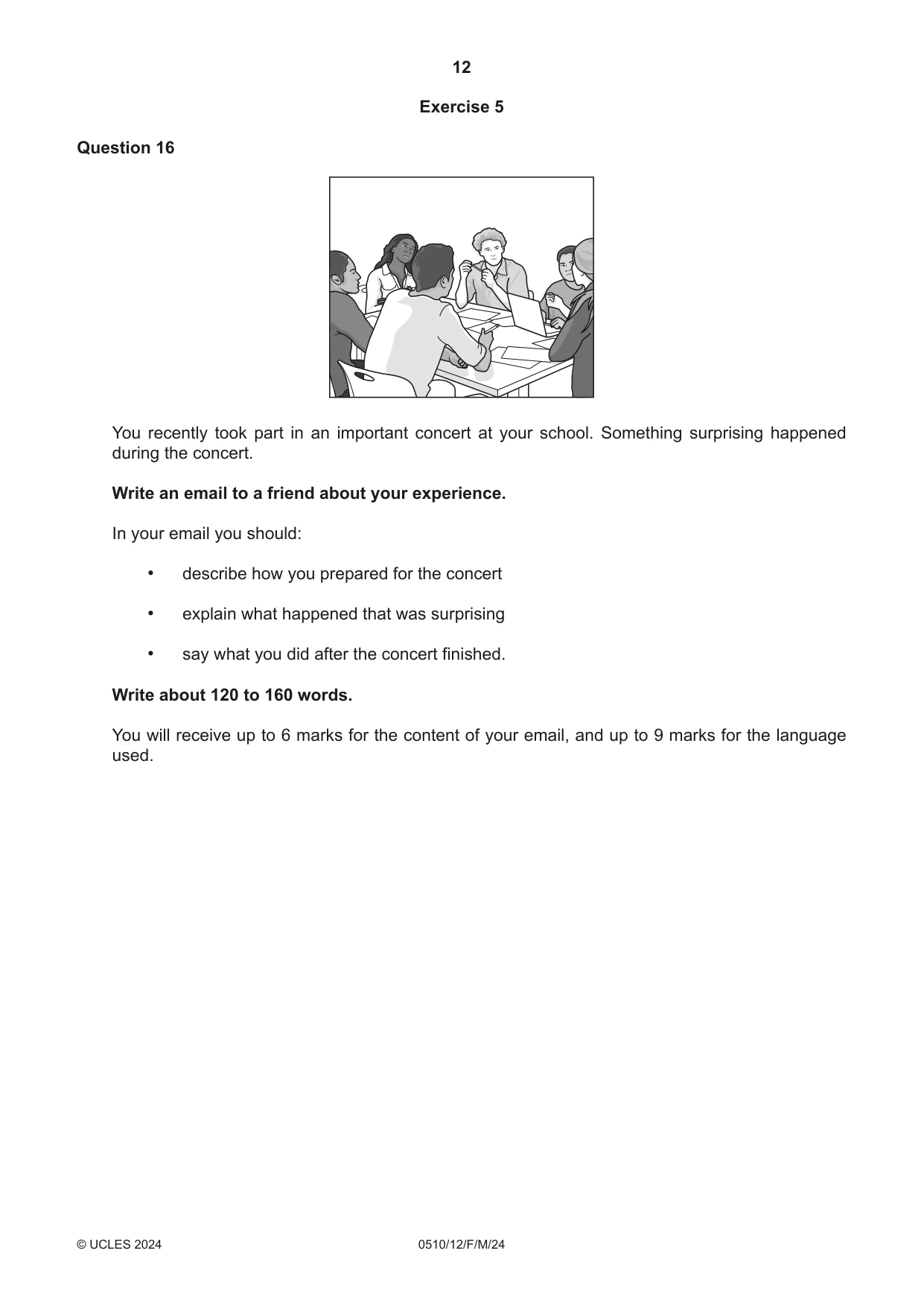
12 0510/12/F/M/24 © UCLES 2024 Exercise 5 Question 16 You recently took part in an important concert at your school. Something surprising happened during the concert. Write an email to a friend about your experience. In your email you should: • describe how you prepared for the concert • explain what happened that was surprising • say what you did after the concert finished. Write about 120 to 160 words. You will receive up to 6 marks for the content of your email, and up to 9 marks for the language used.
Question paper, page 13
13 0510/12/F/M/24 © UCLES 2024 [Turn over … … … … … … … … … … … … … … … … … … … … … … … … … … … [15] [Total: 15]
Question paper, page 14
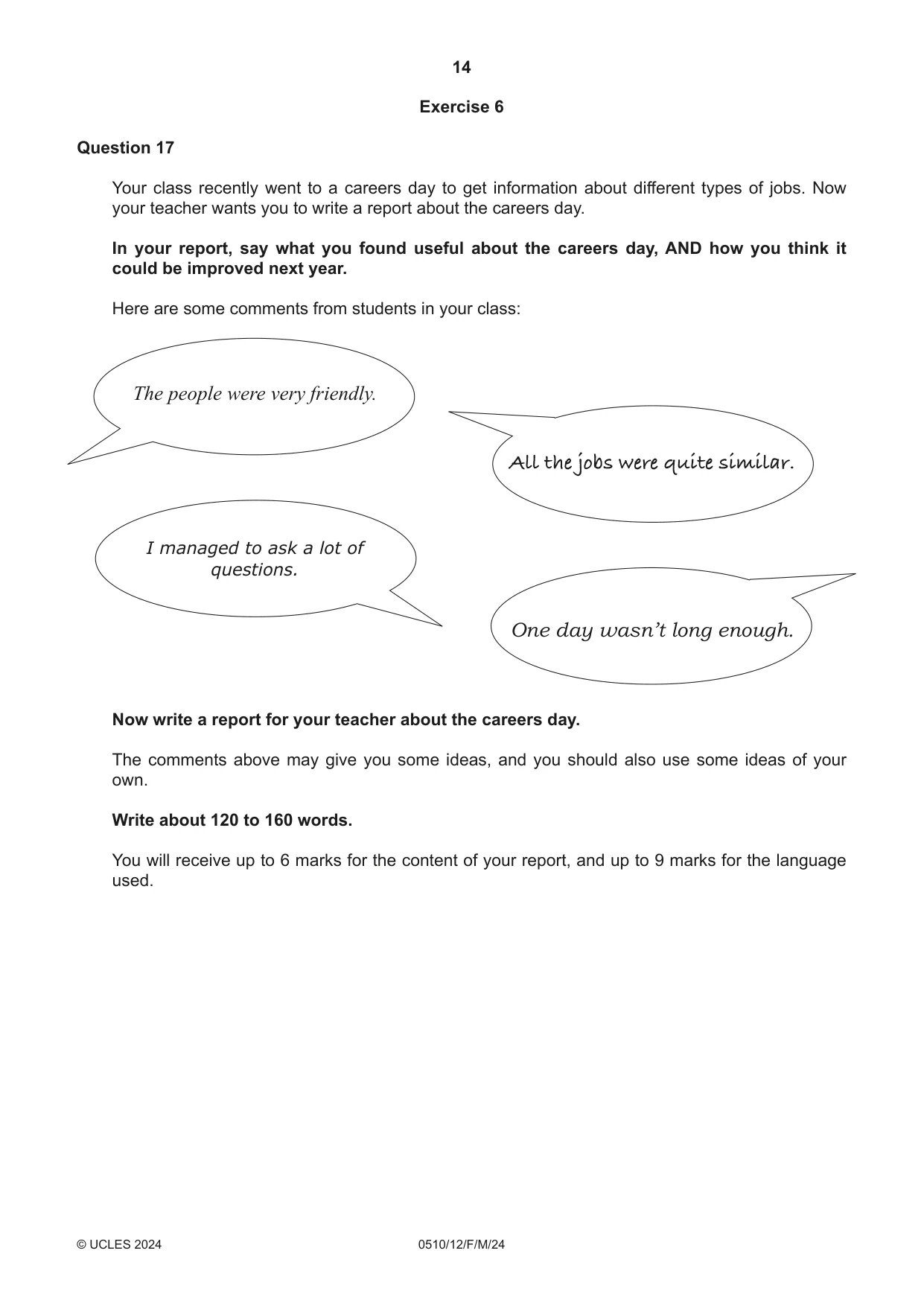
14 0510/12/F/M/24 © UCLES 2024 Exercise 6 Question 17 Your class recently went to a careers day to get information about different types of jobs. Now your teacher wants you to write a report about the careers day. In your report, say what you found useful about the careers day, AND how you think it could be improved next year. Here are some comments from students in your class: The people were very friendly. I managed to ask a lot of questions. All the jobs were quite similar. One day wasn’t long enough. Now write a report for your teacher about the careers day. The comments above may give you some ideas, and you should also use some ideas of your own. Write about 120 to 160 words. You will receive up to 6 marks for the content of your report, and up to 9 marks for the language used.
Question paper, page 15
15 0510/12/F/M/24 © UCLES 2024 … … … … … … … … … … … … … … … … … … … … … … … … … … … [15] [Total: 15]
Question paper, page 16
16 0510/12/F/M/24 © UCLES 2024 Permission to reproduce items where third-party owned material protected by copyright is included has been sought and cleared where possible. Every reasonable effort has been made by the publisher (UCLES) to trace copyright holders, but if any items requiring clearance have unwittingly been included, the publisher will be pleased to make amends at the earliest possible opportunity. To avoid the issue of disclosure of answer-related information to candidates, all copyright acknowledgements are reproduced online in the Cambridge Assessment International Education Copyright Acknowledgements Booklet. This is produced for each series of examinations and is freely available to download at www.cambridgeinternational.org after the live examination series. Cambridge Assessment International Education is part of Cambridge Assessment. Cambridge Assessment is the brand name of the University of Cambridge Local Examinations Syndicate (UCLES), which is a department of the University of Cambridge. BLANK PAGE
Mark scheme, page 1
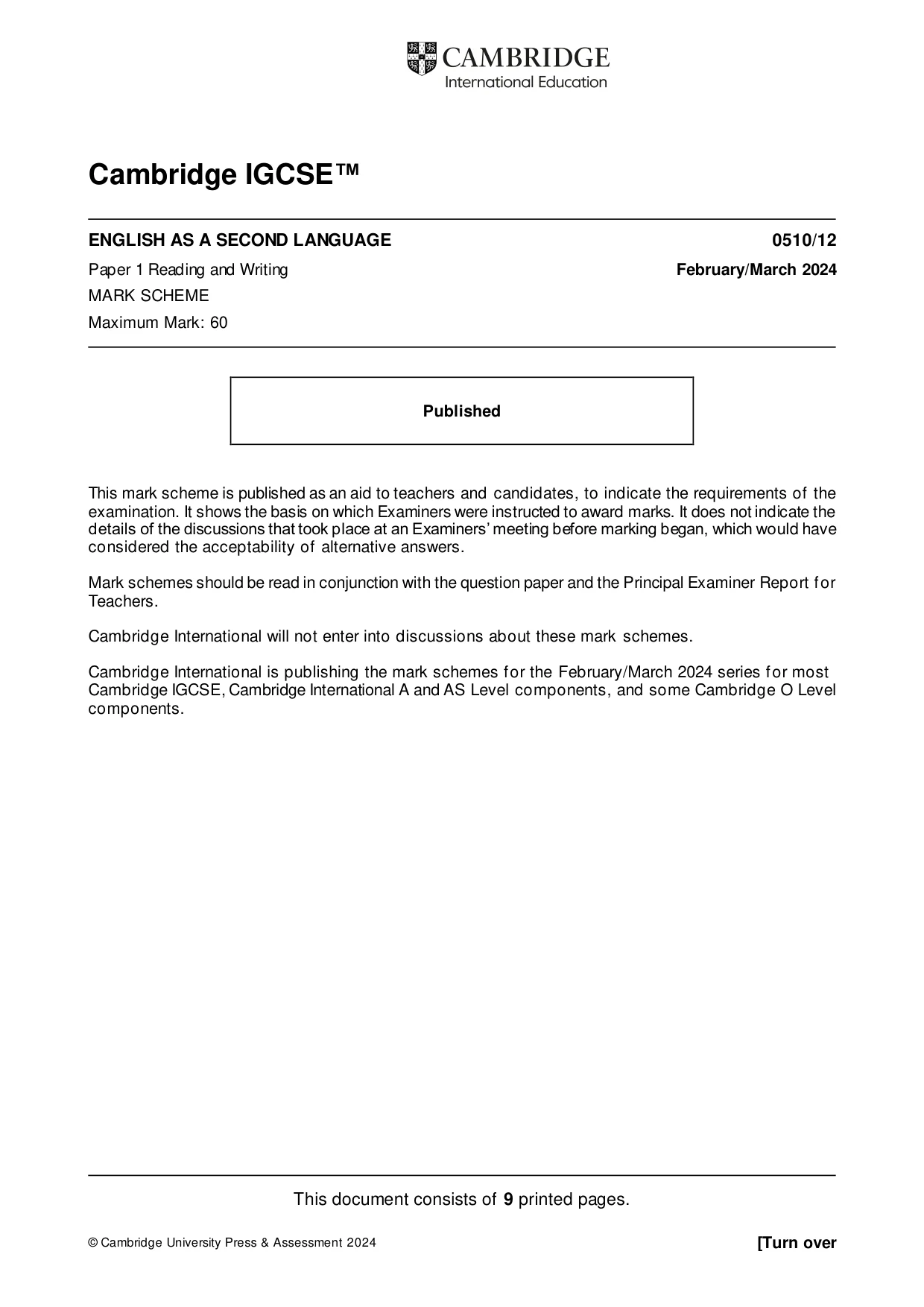
This document consists of 9 printed pages. © Cambridge University Press & Assessment 2024 [Turn over Cambridge IGCSE™ ENGLISH AS A SECOND LANGUAGE 0510/12 Paper 1 Reading and Writing February/March 2024 MARK SCHEME Maximum Mark: 60 Published This mark scheme is published as an aid to teachers and candidates, to indicate the requirements of the examination. It shows the basis on which Examiners were instructed to award marks. It does not indicate the details of the discussions that took place at an Examiners’ meeting before marking began, which would have considered the acceptability of alternative answers. Mark schemes should be read in conjunction with the question paper and the Principal Examiner Report for Teachers. Cambridge International will not enter into discussions about these mark schemes. Cambridge International is publishing the mark schemes for the February/March 2024 series for most Cambridge IGCSE, Cambridge International A and AS Level components, and some Cambridge O Level components.
Mark scheme, page 2
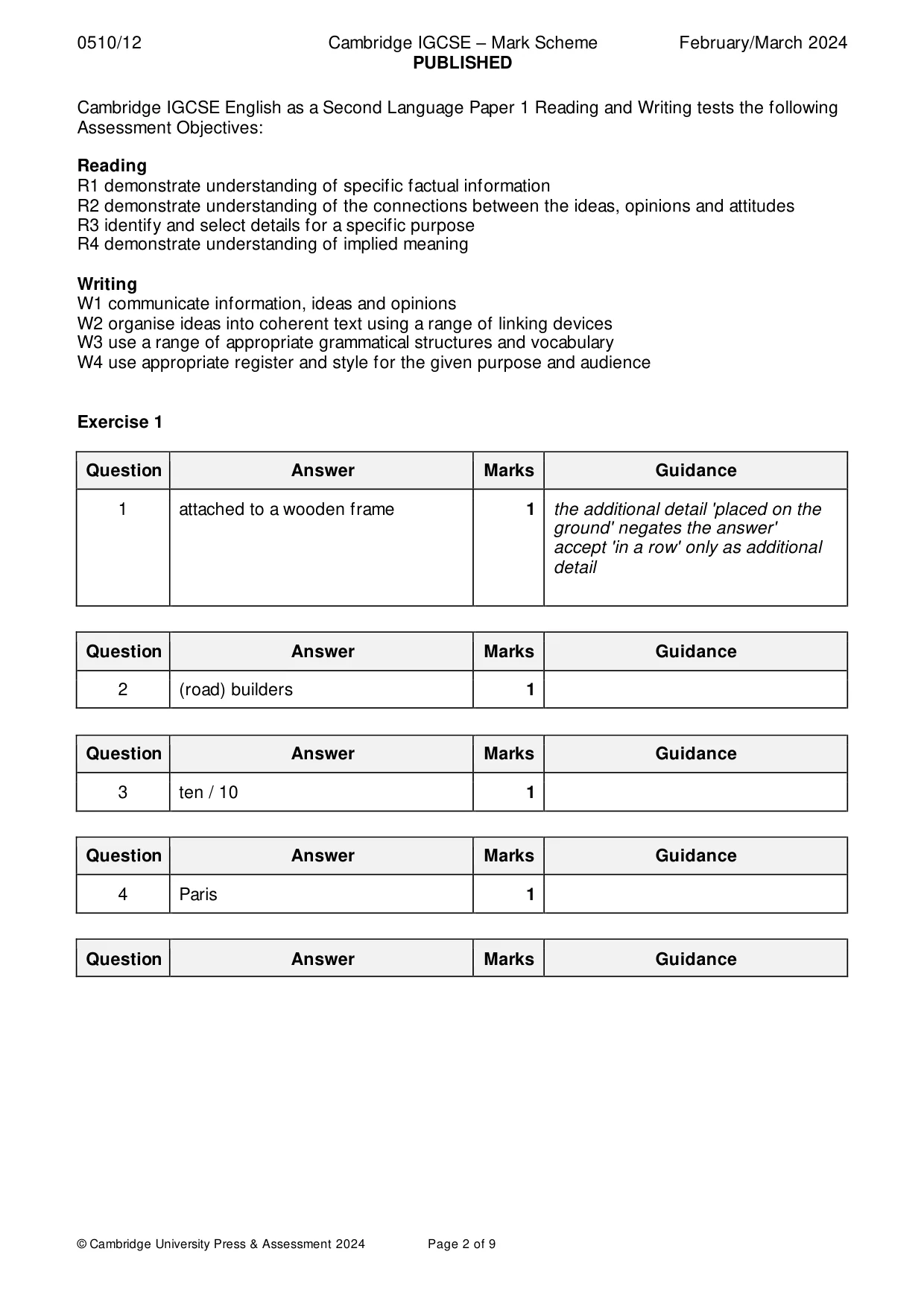
0510/12 Cambridge IGCSE – Mark Scheme PUBLISHED February/March 2024 © Cambridge University Press & Assessment 2024 Page 2 of 9 Cambridge IGCSE English as a Second Language Paper 1 Reading and Writing tests the following Assessment Objectives: Reading R1 demonstrate understanding of specific factual information R2 demonstrate understanding of the connections between the ideas, opinions and attitudes R3 identify and select details for a specific purpose R4 demonstrate understanding of implied meaning Writing W1 communicate information, ideas and opinions W2 organise ideas into coherent text using a range of linking devices W3 use a range of appropriate grammatical structures and vocabulary W4 use appropriate register and style for the given purpose and audience Exercise 1 Question Answer Marks Guidance 1 attached to a wooden frame 1 the additional detail 'placed on the ground' negates the answer' accept 'in a row' only as additional detail Question Answer Marks Guidance 2 (road) builders 1 Question Answer Marks Guidance 3 ten / 10 1 Question Answer Marks Guidance 4 Paris 1 Question Answer Marks Guidance
Mark scheme, page 3
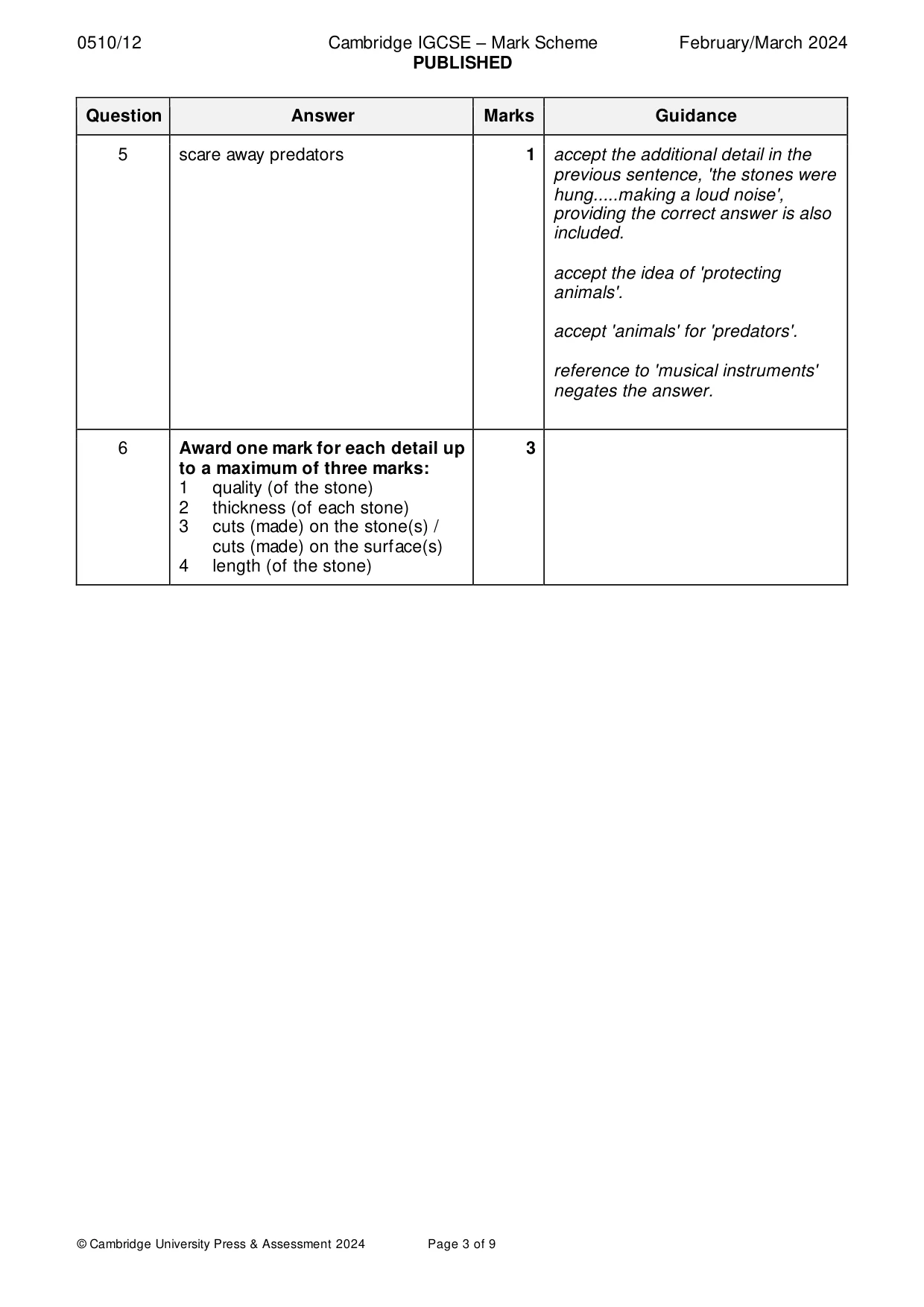
0510/12 Cambridge IGCSE – Mark Scheme PUBLISHED February/March 2024 © Cambridge University Press & Assessment 2024 Page 3 of 9 Question Answer Marks Guidance 5 scare away predators 1 accept the additional detail in the previous sentence, 'the stones were hung…making a loud noise', providing the correct answer is also included. accept the idea of 'protecting animals'. accept 'animals' for 'predators'. reference to 'musical instruments' negates the answer. 6 Award one mark for each detail up to a maximum of three marks: 1 quality (of the stone) 2 thickness (of each stone) 3 cuts (made) on the stone(s) / cuts (made) on the surface(s) 4 length (of the stone) 3
Mark scheme, page 4
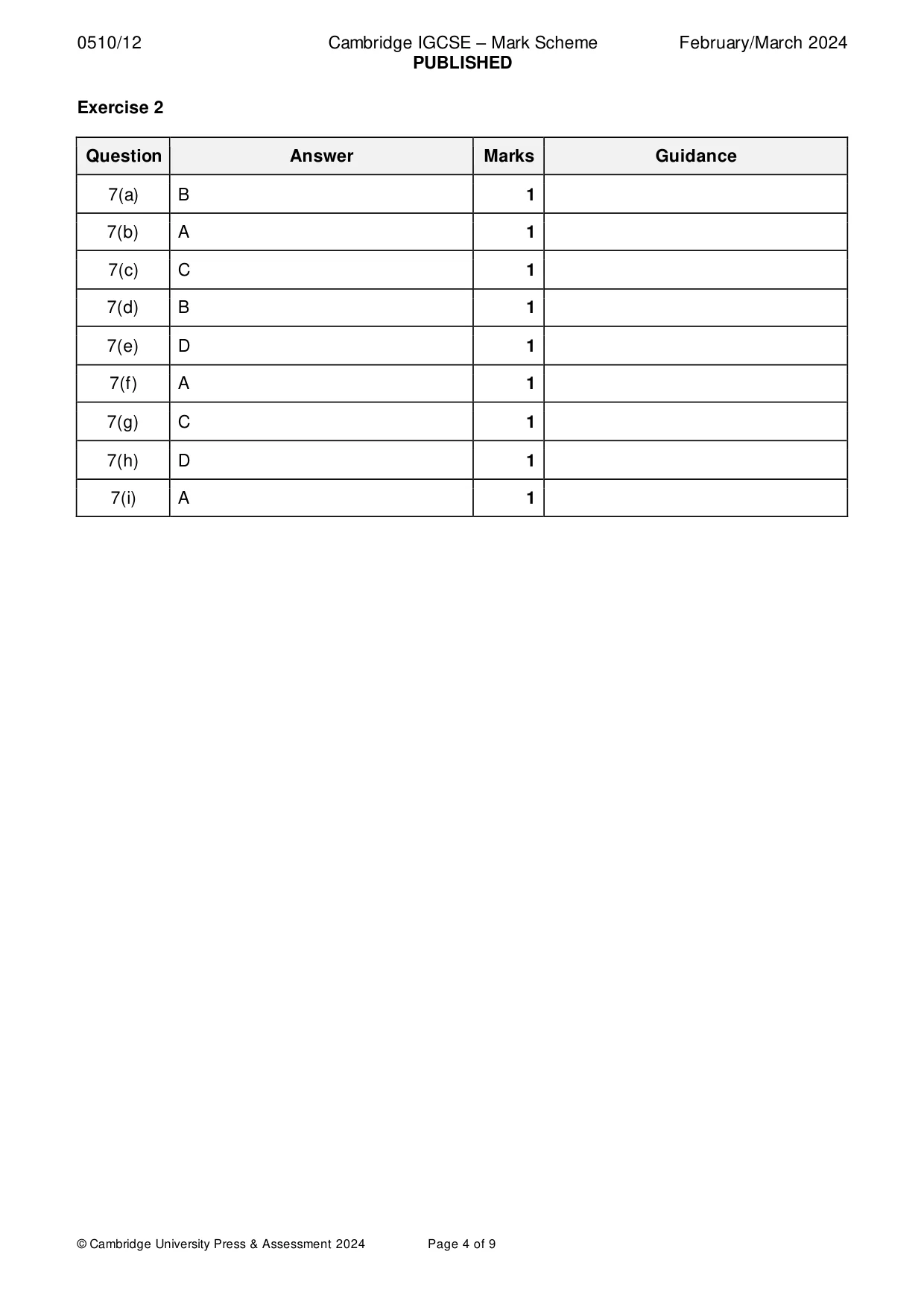
0510/12 Cambridge IGCSE – Mark Scheme PUBLISHED February/March 2024 © Cambridge University Press & Assessment 2024 Page 4 of 9 Exercise 2 Question Answer Marks Guidance 7(a) B 1 7(b) A 1 7(c) C 1 7(d) B 1 7(e) D 1 7(f) A 1 7(g) C 1 7(h) D 1 7(i) A 1
Mark scheme, page 5
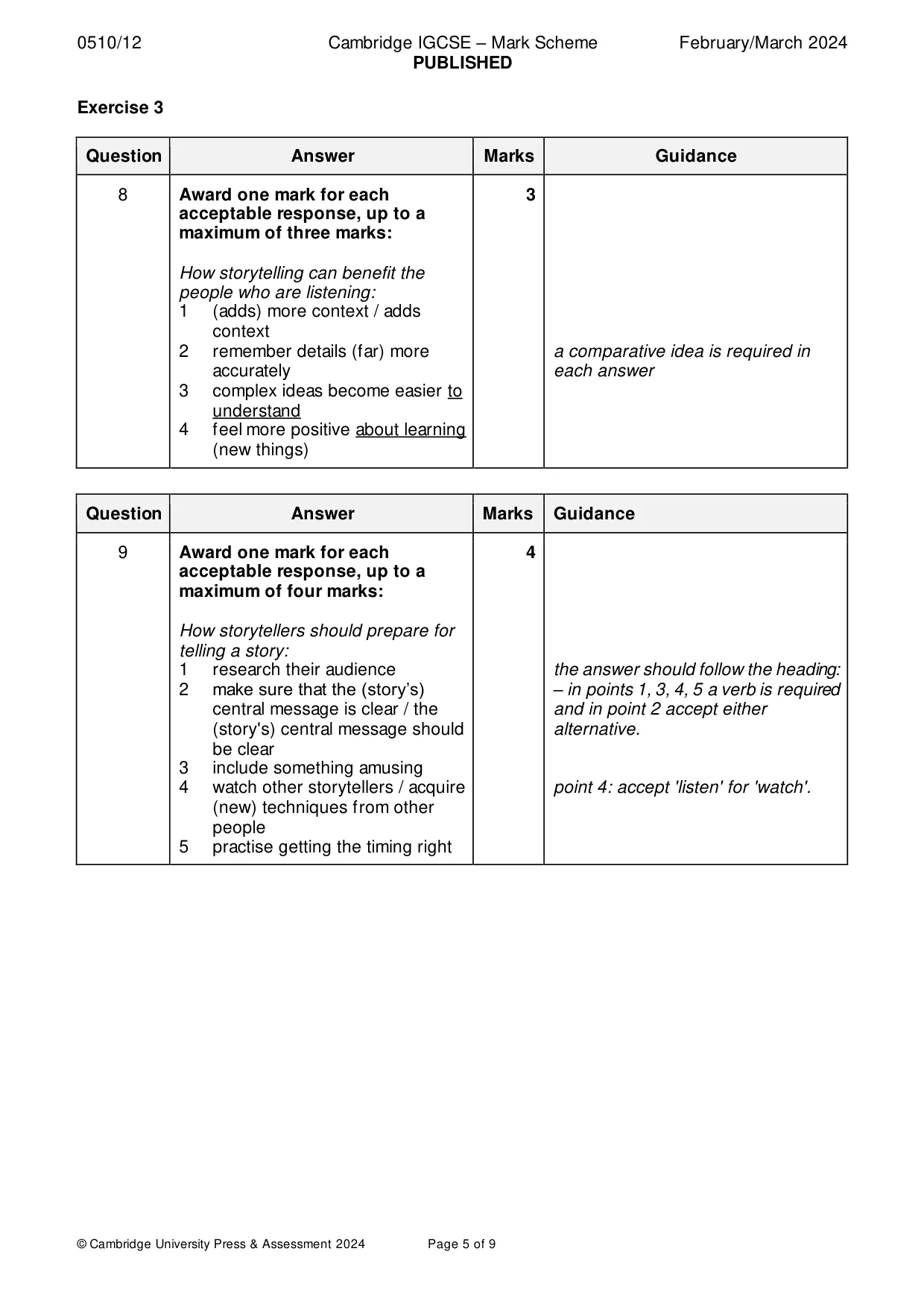
0510/12 Cambridge IGCSE – Mark Scheme PUBLISHED February/March 2024 © Cambridge University Press & Assessment 2024 Page 5 of 9 Exercise 3 Question Answer Marks Guidance 8 Award one mark for each acceptable response, up to a maximum of three marks: How storytelling can benefit the people who are listening: 1 (adds) more context / adds context 2 remember details (far) more accurately 3 complex ideas become easier to understand 4 feel more positive about learning (new things) 3 a comparative idea is required in each answer Question Answer Marks Guidance 9 Award one mark for each acceptable response, up to a maximum of four marks: How storytellers should prepare for telling a story: 1 research their audience 2 make sure that the (story’s) central message is clear / the (story's) central message should be clear 3 include something amusing 4 watch other storytellers / acquire (new) techniques from other people 5 practise getting the timing right 4 the answer should follow the heading: – in points 1, 3, 4, 5 a verb is required and in point 2 accept either alternative. point 4: accept 'listen' for 'watch'.
Mark scheme, page 6
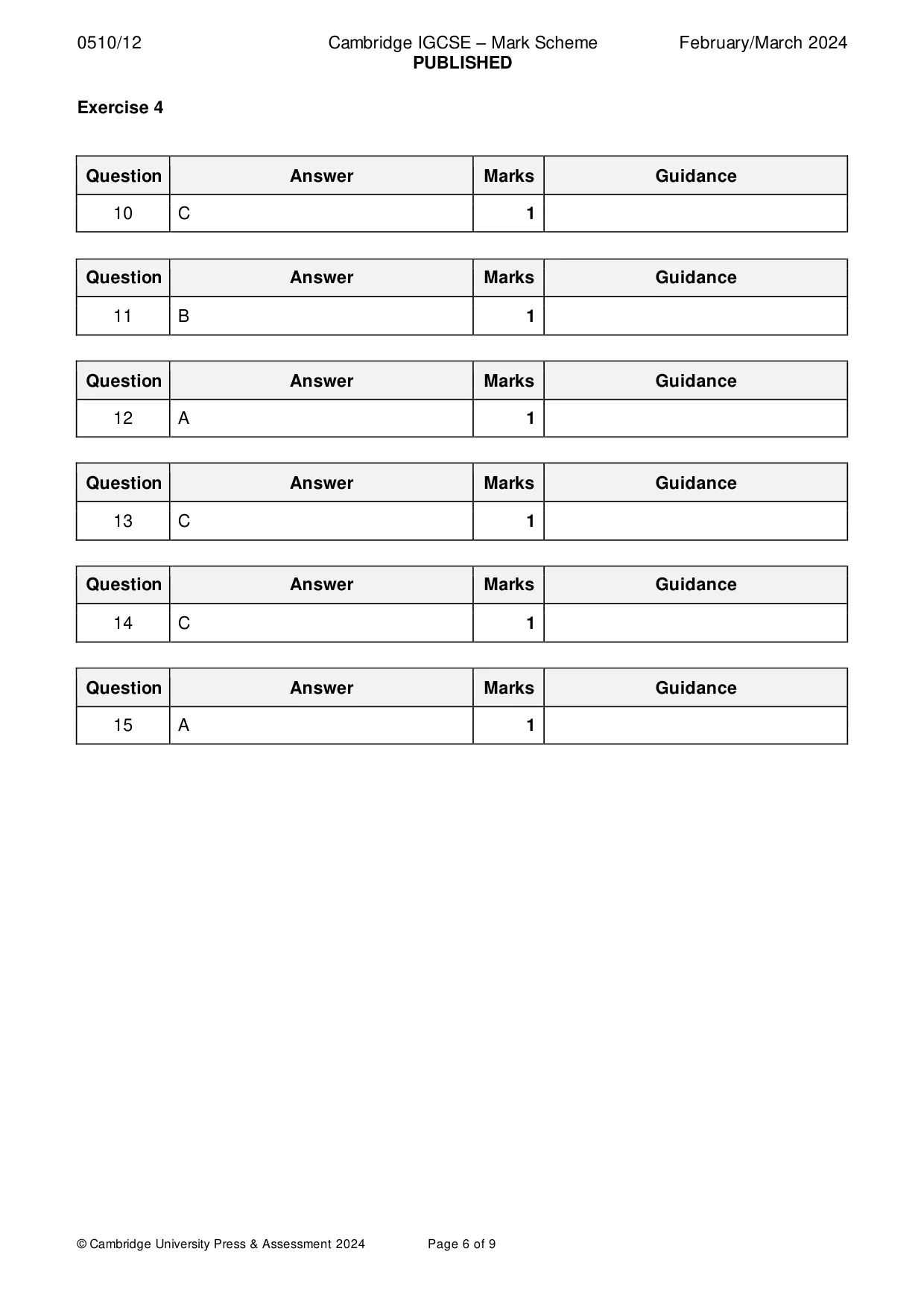
0510/12 Cambridge IGCSE – Mark Scheme PUBLISHED February/March 2024 © Cambridge University Press & Assessment 2024 Page 6 of 9 Exercise 4 Question Answer Marks Guidance 10 C 1 Question Answer Marks Guidance 11 B 1 Question Answer Marks Guidance 12 A 1 Question Answer Marks Guidance 13 C 1 Question Answer Marks Guidance 14 C 1 Question Answer Marks Guidance 15 A 1
Mark scheme, page 7
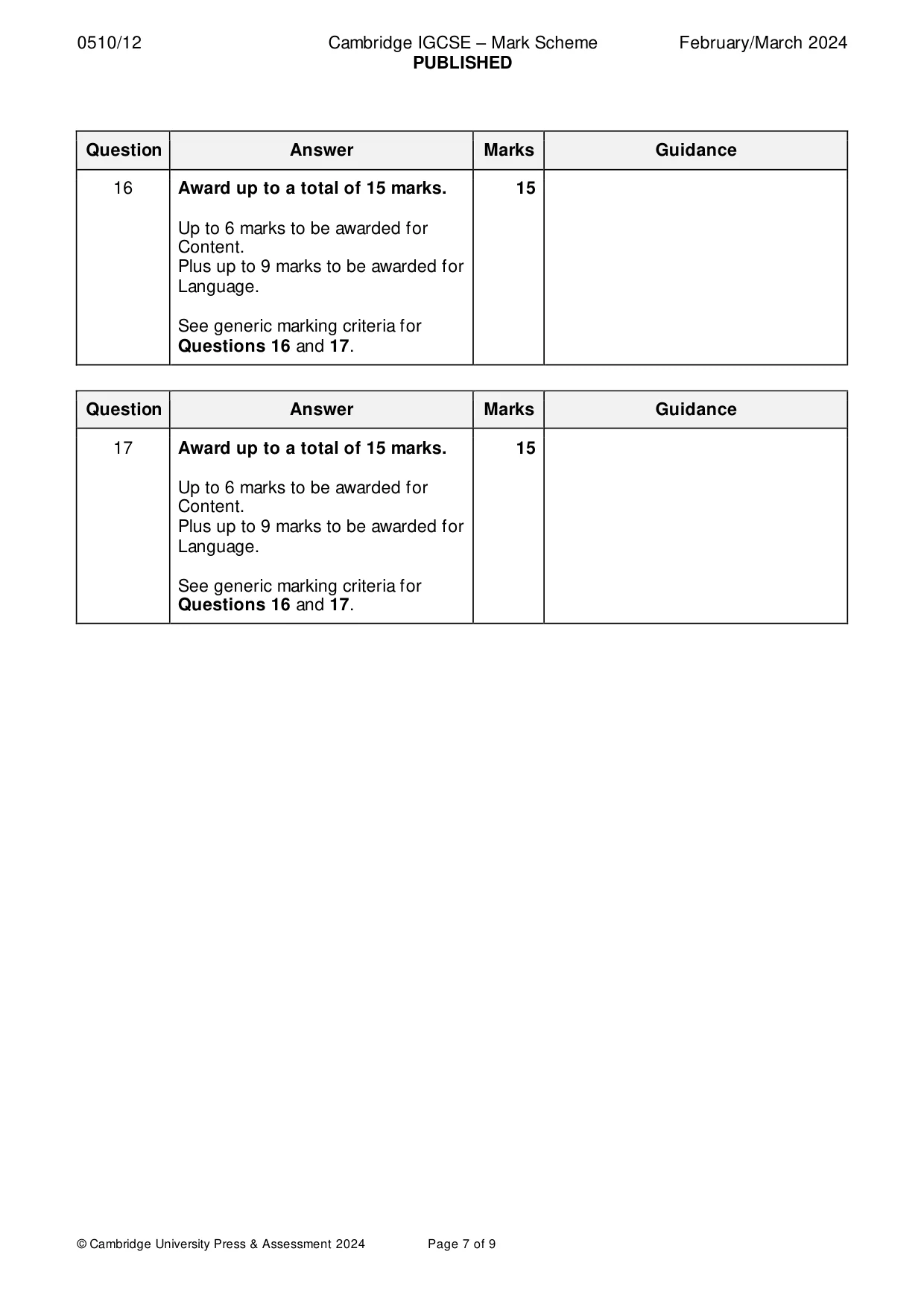
0510/12 Cambridge IGCSE – Mark Scheme PUBLISHED February/March 2024 © Cambridge University Press & Assessment 2024 Page 7 of 9 Question Answer Marks Guidance 16 Award up to a total of 15 marks. Up to 6 marks to be awarded for Content. Plus up to 9 marks to be awarded for Language. See generic marking criteria for Questions 16 and 17. 15 Question Answer Marks Guidance 17 Award up to a total of 15 marks. Up to 6 marks to be awarded for Content. Plus up to 9 marks to be awarded for Language. See generic marking criteria for Questions 16 and 17. 15
Mark scheme, page 8
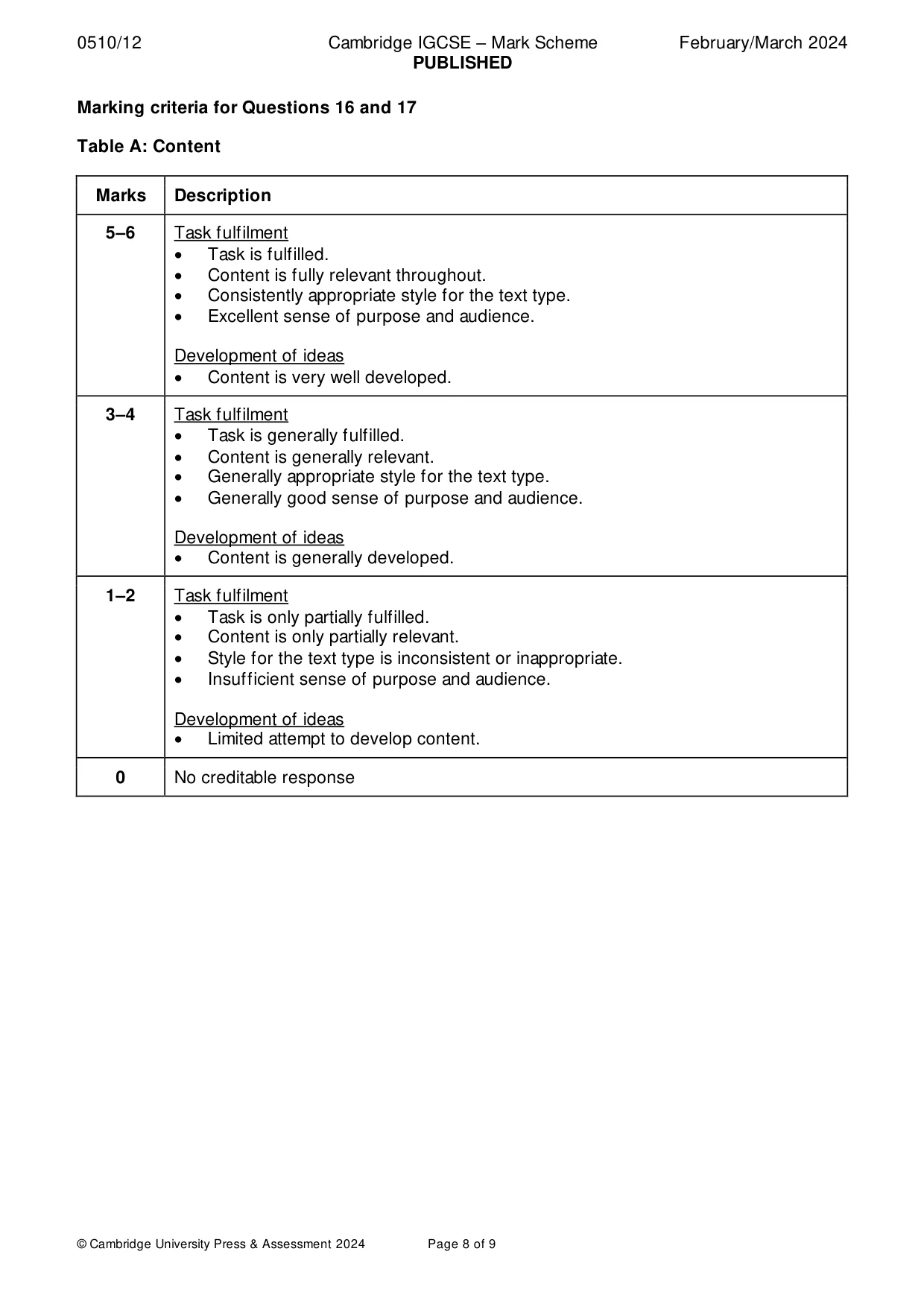
0510/12 Cambridge IGCSE – Mark Scheme PUBLISHED February/March 2024 © Cambridge University Press & Assessment 2024 Page 8 of 9 Marking criteria for Questions 16 and 17 Table A: Content Marks Description 5–6 Task fulfilment • Task is fulfilled. • Content is fully relevant throughout. • Consistently appropriate style for the text type. • Excellent sense of purpose and audience. Development of ideas • Content is very well developed. 3–4 Task fulfilment • Task is generally fulfilled. • Content is generally relevant. • Generally appropriate style for the text type. • Generally good sense of purpose and audience. Development of ideas • Content is generally developed. 1–2 Task fulfilment • Task is only partially fulfilled. • Content is only partially relevant. • Style for the text type is inconsistent or inappropriate. • Insufficient sense of purpose and audience. Development of ideas • Limited attempt to develop content. 0 No creditable response
Mark scheme, page 9
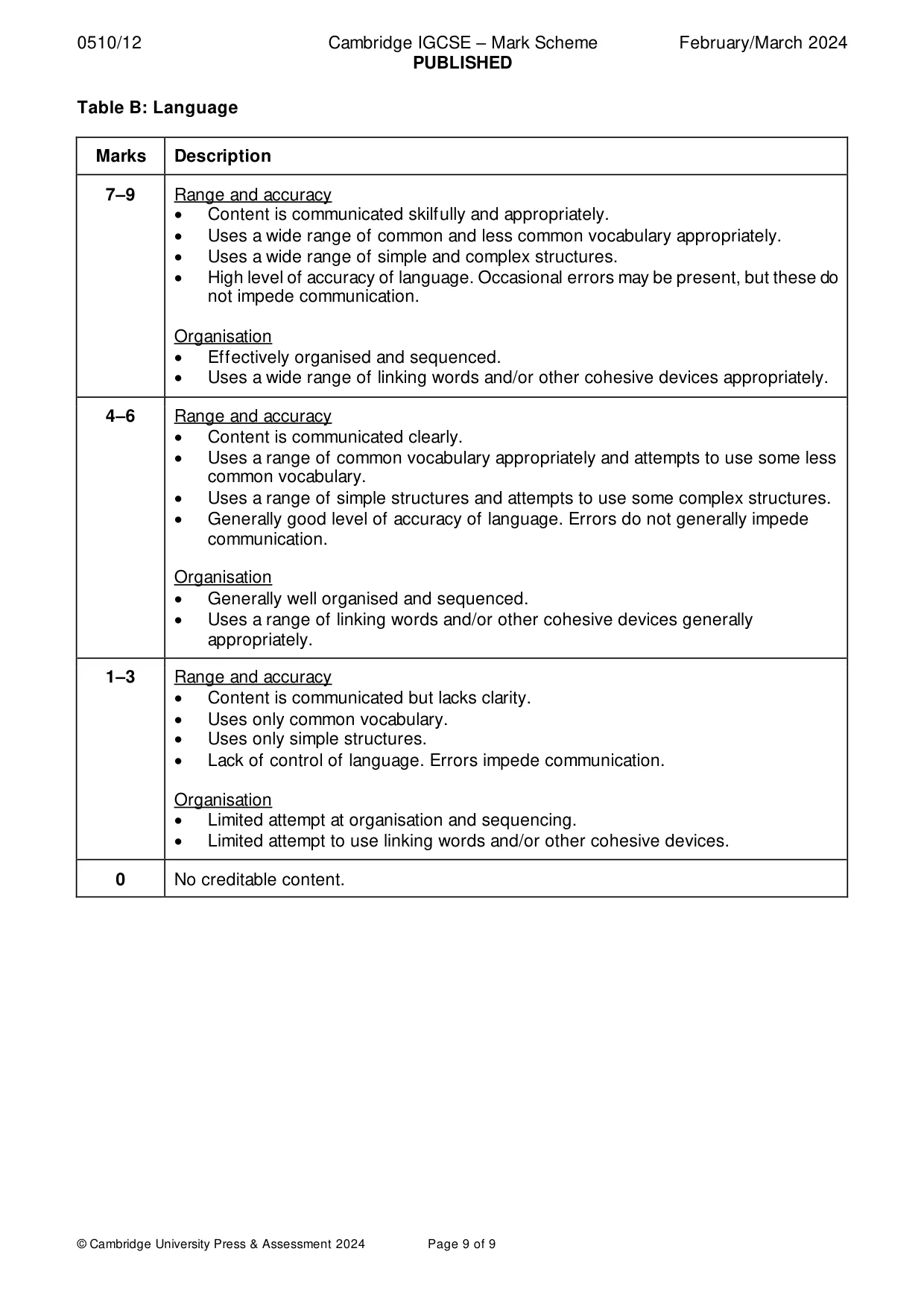
0510/12 Cambridge IGCSE – Mark Scheme PUBLISHED February/March 2024 © Cambridge University Press & Assessment 2024 Page 9 of 9 Table B: Language Marks Description 7–9 Range and accuracy • Content is communicated skilfully and appropriately. • Uses a wide range of common and less common vocabulary appropriately. • Uses a wide range of simple and complex structures. • High level of accuracy of language. Occasional errors may be present, but these do not impede communication. Organisation • Effectively organised and sequenced. • Uses a wide range of linking words and/or other cohesive devices appropriately. 4–6 Range and accuracy • Content is communicated clearly. • Uses a range of common vocabulary appropriately and attempts to use some less common vocabulary. • Uses a range of simple structures and attempts to use some complex structures. • Generally good level of accuracy of language. Errors do not generally impede communication. Organisation • Generally well organised and sequenced. • Uses a range of linking words and/or other cohesive devices generally appropriately. 1–3 Range and accuracy • Content is communicated but lacks clarity. • Uses only common vocabulary. • Uses only simple structures. • Lack of control of language. Errors impede communication. Organisation • Limited attempt at organisation and sequencing. • Limited attempt to use linking words and/or other cohesive devices. 0 No creditable content.
What you needed in this session
Cambridge’s own grade thresholds for 2024 Feb/March, Paper 1 · Variant 2. A higher threshold means an easier paper — the bar moves with how the cohort did.