Cambridge IGCSE English - Second Language (oral endorsement) 0510 — 2017 Oct/Nov Paper 4 · Variant 2
0510/42/O/N/17 · 40 marks · ≈45 min
The question paper and its mark scheme, free to read here and free to download. This is Cambridge’s own paper, exactly as it was sat.
Question paper12 pages



Mark scheme4 pages
Answers below. Sit the paper first if you are practising.
Paper as text
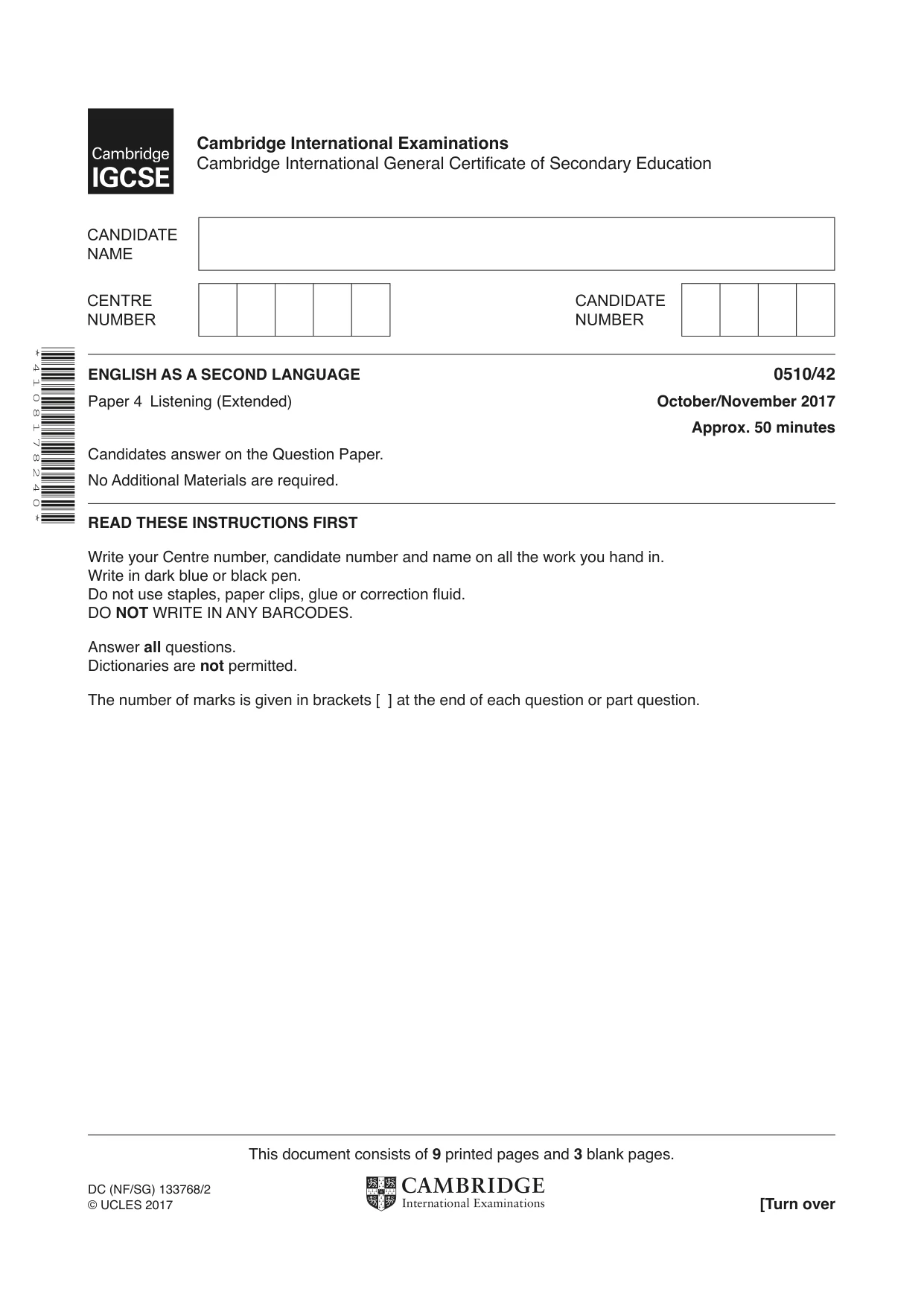
Question paper, page 1
This document consists of 9 printed pages and 3 blank pages. DC (NF/SG) 133768/2 © UCLES 2017 [Turn over Cambridge International Examinations Cambridge International General Certificate of Secondary Education * 4 1 0 8 1 7 8 2 4 0 * ENGLISH AS A SECOND LANGUAGE 0510/42 Paper 4 Listening (Extended) October/November 2017 Approx. 50 minutes Candidates answer on the Question Paper. No Additional Materials are required. READ THESE INSTRUCTIONS FIRST Write your Centre number, candidate number and name on all the work you hand in. Write in dark blue or black pen. Do not use staples, paper clips, glue or correction fluid. DO NOT WRITE IN ANY BARCODES. Answer all questions. Dictionaries are not permitted. The number of marks is given in brackets [ ] at the end of each question or part question.
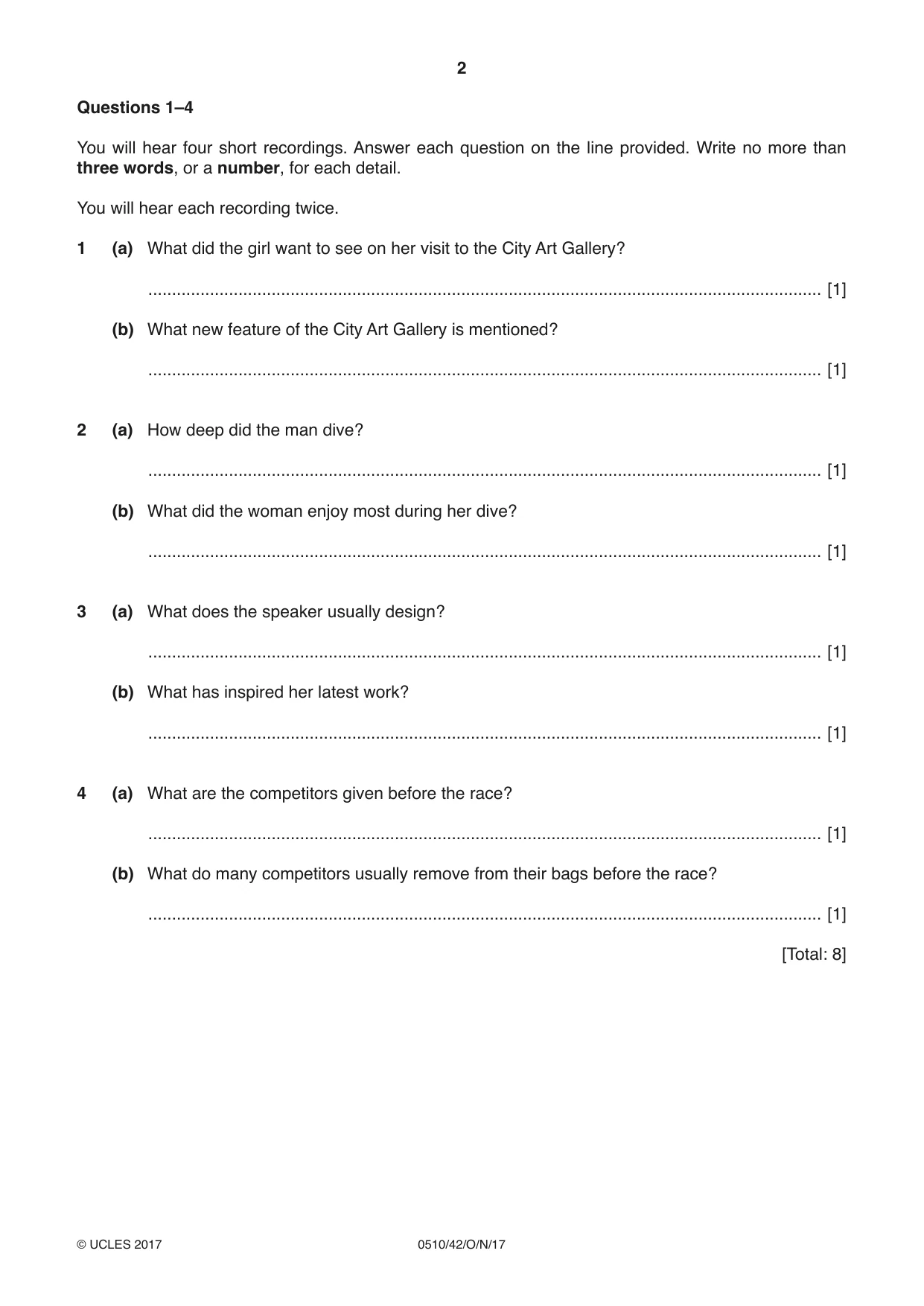
Question paper, page 2
2 0510/42/O/N/17 © UCLES 2017 Questions 1–4 You will hear four short recordings. Answer each question on the line provided. Write no more than three words, or a number, for each detail. You will hear each recording twice. 1 (a) What did the girl want to see on her visit to the City Art Gallery? … [1] (b) What new feature of the City Art Gallery is mentioned? … [1] 2 (a) How deep did the man dive? … [1] (b) What did the woman enjoy most during her dive? … [1] 3 (a) What does the speaker usually design? … [1] (b) What has inspired her latest work? … [1] 4 (a) What are the competitors given before the race? … [1] (b) What do many competitors usually remove from their bags before the race? … [1] [Total: 8]
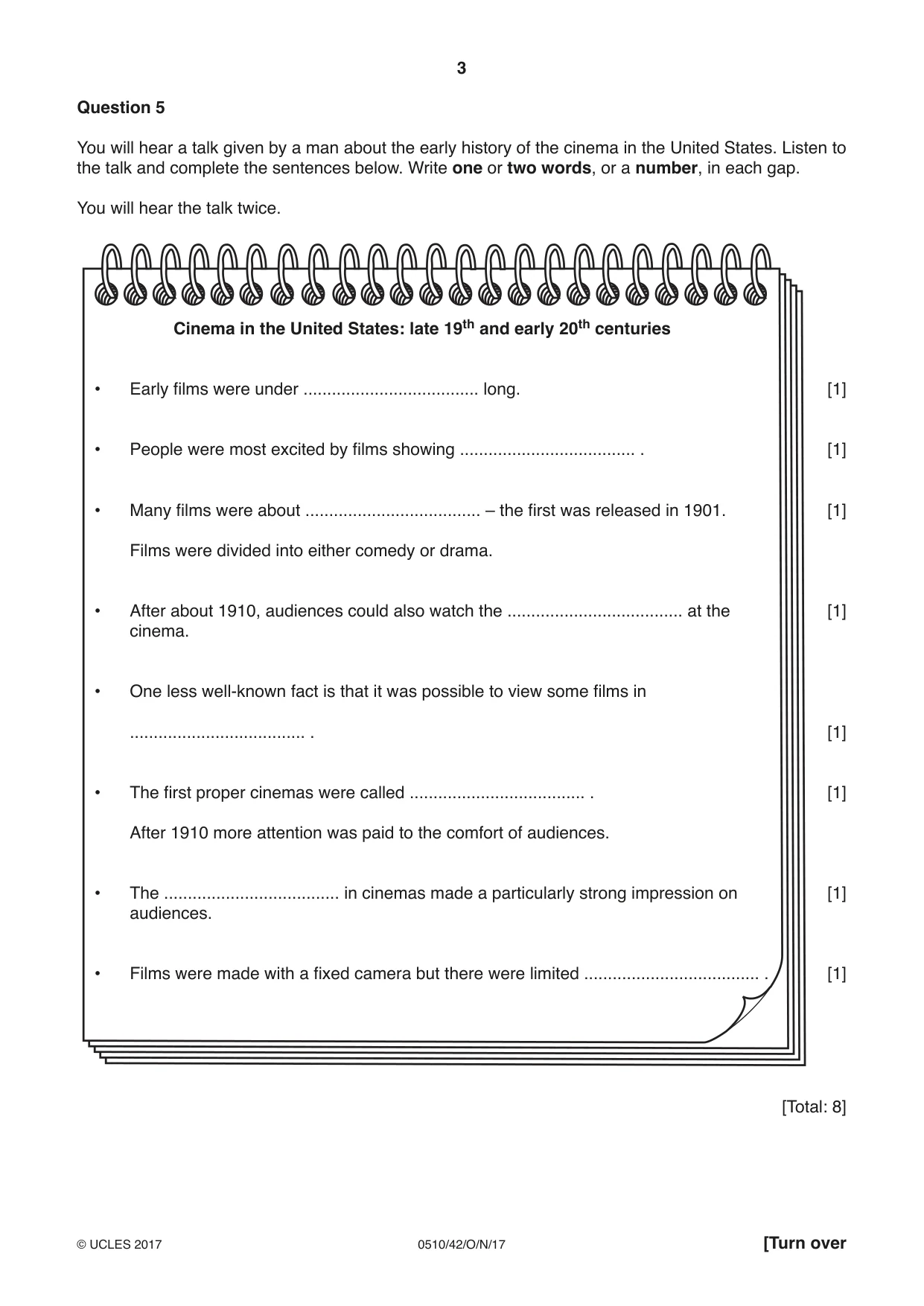
Question paper, page 3
3 0510/42/O/N/17 © UCLES 2017 [Turn over Question 5 You will hear a talk given by a man about the early history of the cinema in the United States. Listen to the talk and complete the sentences below. Write one or two words, or a number, in each gap. You will hear the talk twice. Cinema in the United States: late 19th and early 20th centuries • Early films were under … long. [1] • People were most excited by films showing … . [1] • Many films were about … – the first was released in 1901. [1] Films were divided into either comedy or drama. • After about 1910, audiences could also watch the … at the [1] cinema. • One less well-known fact is that it was possible to view some films in … . [1] • The first proper cinemas were called … . [1] After 1910 more attention was paid to the comfort of audiences. • The … in cinemas made a particularly strong impression on [1] audiences. • Films were made with a fixed camera but there were limited … . [1] [Total: 8]
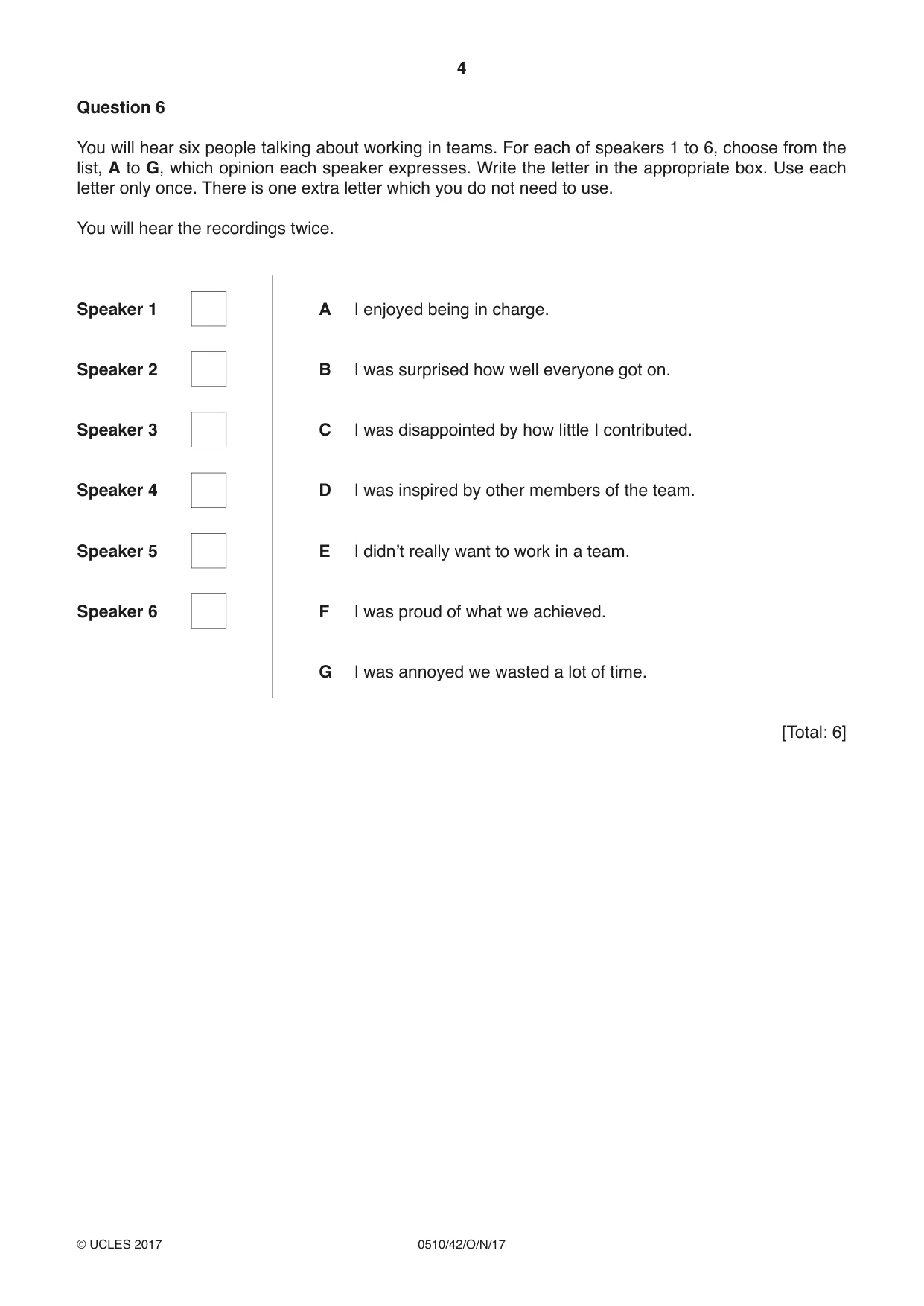
Question paper, page 4
4 0510/42/O/N/17 © UCLES 2017 Question 6 You will hear six people talking about working in teams. For each of speakers 1 to 6, choose from the list, A to G, which opinion each speaker expresses. Write the letter in the appropriate box. Use each letter only once. There is one extra letter which you do not need to use. You will hear the recordings twice. Speaker 1 A I enjoyed being in charge. Speaker 2 B I was surprised how well everyone got on. Speaker 3 C I was disappointed by how little I contributed. Speaker 4 D I was inspired by other members of the team. Speaker 5 E I didn’t really want to work in a team. Speaker 6 F I was proud of what we achieved. G I was annoyed we wasted a lot of time. [Total: 6]
Question paper, page 5
5 0510/42/O/N/17 © UCLES 2017 [Turn over Please turn over for Question 7.
Question paper, page 6
6 0510/42/O/N/17 © UCLES 2017 Question 7 You will hear an interview with Shirley Sullivan about her work as a tour guide. Listen to the interview and look at the questions. For each question, choose the correct answer, A, B or C, and put a tick (✓) in the appropriate box. You will hear the interview twice. (a) What made Shirley decide to become a tour guide? A She was encouraged by one of her friends. B She wanted to realise a childhood dream. C She discovered by chance it suited her. [1] (b) Shirley believes that the most effective preparation she can do for a tour is A to consult history books. B to check a range of websites. C to read the notes provided by her company. [1] (c) What does Shirley say is the most important quality for a tour guide? A being positive B being patient C being well-informed [1] (d) What does Shirley find particularly challenging? A disappointing weather conditions B tourist attractions being closed C people not being on time [1] (e) When Shirley gets asked a difficult question she A tries to hide the fact she’s unsure. B feels strongly motivated to learn more. C expresses her surprise at how much the person knows. [1]
Question paper, page 7
7 0510/42/O/N/17 © UCLES 2017 [Turn over (f) How does Shirley feel when she gives a guided tour of her own town? A frustrated that she can’t show everything B slightly embarrassed by her passion for it C annoyed when visitors don’t appreciate it [1] (g) Shirley doesn’t normally go on guided tours when she’s on holiday because she A prefers to relax completely. B doubts that guides can tell her much. C enjoys discovering a place on her own. [1] (h) What would Shirley be interested in doing in the future? A tours for quite small groups of tourists B tours for adventurous travellers C tours for university students [1] [Total: 8]
Question paper, page 8
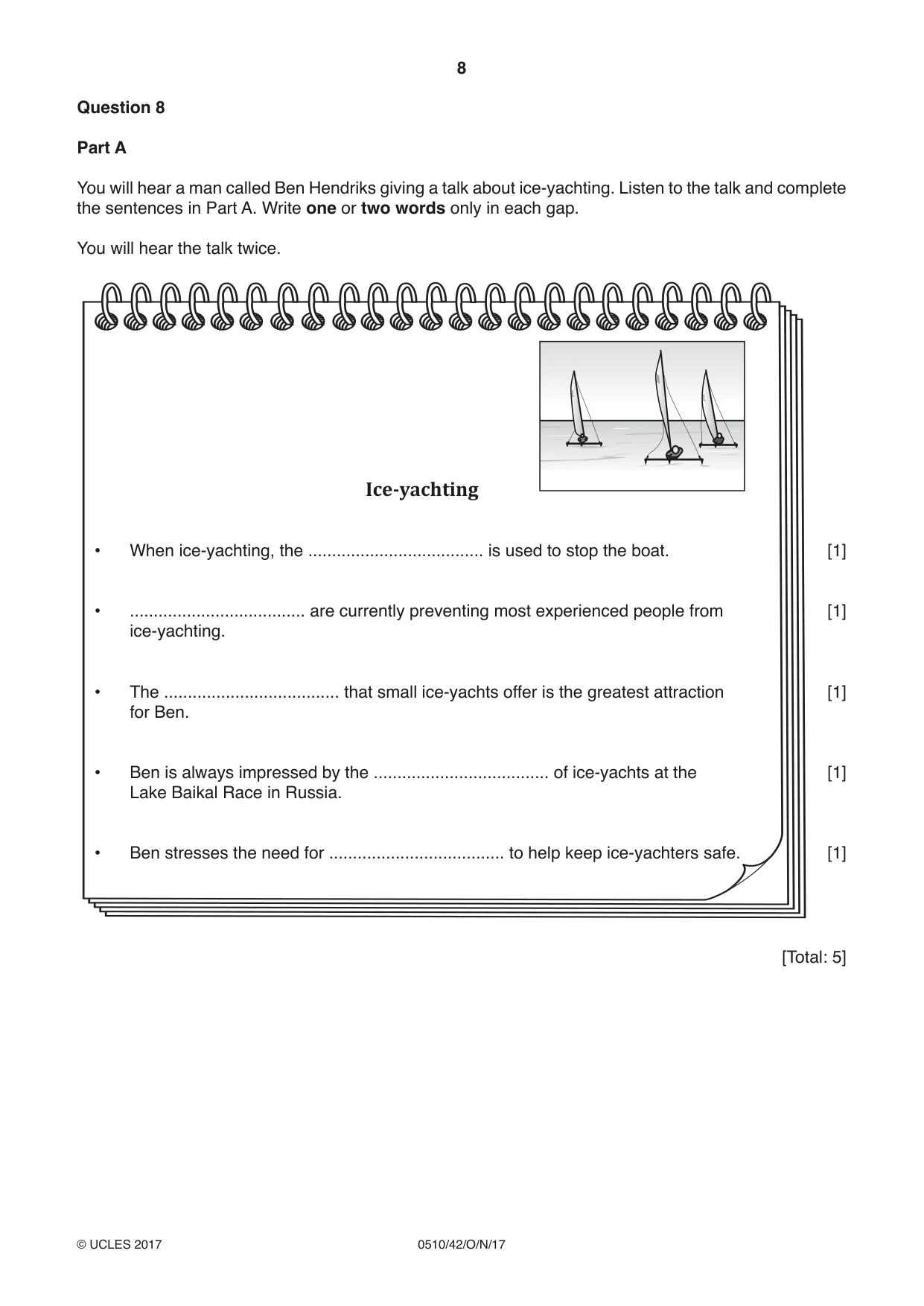
8 0510/42/O/N/17 © UCLES 2017 Question 8 Part A You will hear a man called Ben Hendriks giving a talk about ice-yachting. Listen to the talk and complete the sentences in Part A. Write one or two words only in each gap. You will hear the talk twice. Ice-yachting • When ice-yachting, the … is used to stop the boat. [1] • … are currently preventing most experienced people from [1] ice-yachting. • The … that small ice-yachts offer is the greatest attraction [1] for Ben. • Ben is always impressed by the … of ice-yachts at the [1] Lake Baikal Race in Russia. • Ben stresses the need for … to help keep ice-yachters safe. [1] [Total: 5]
Question paper, page 9
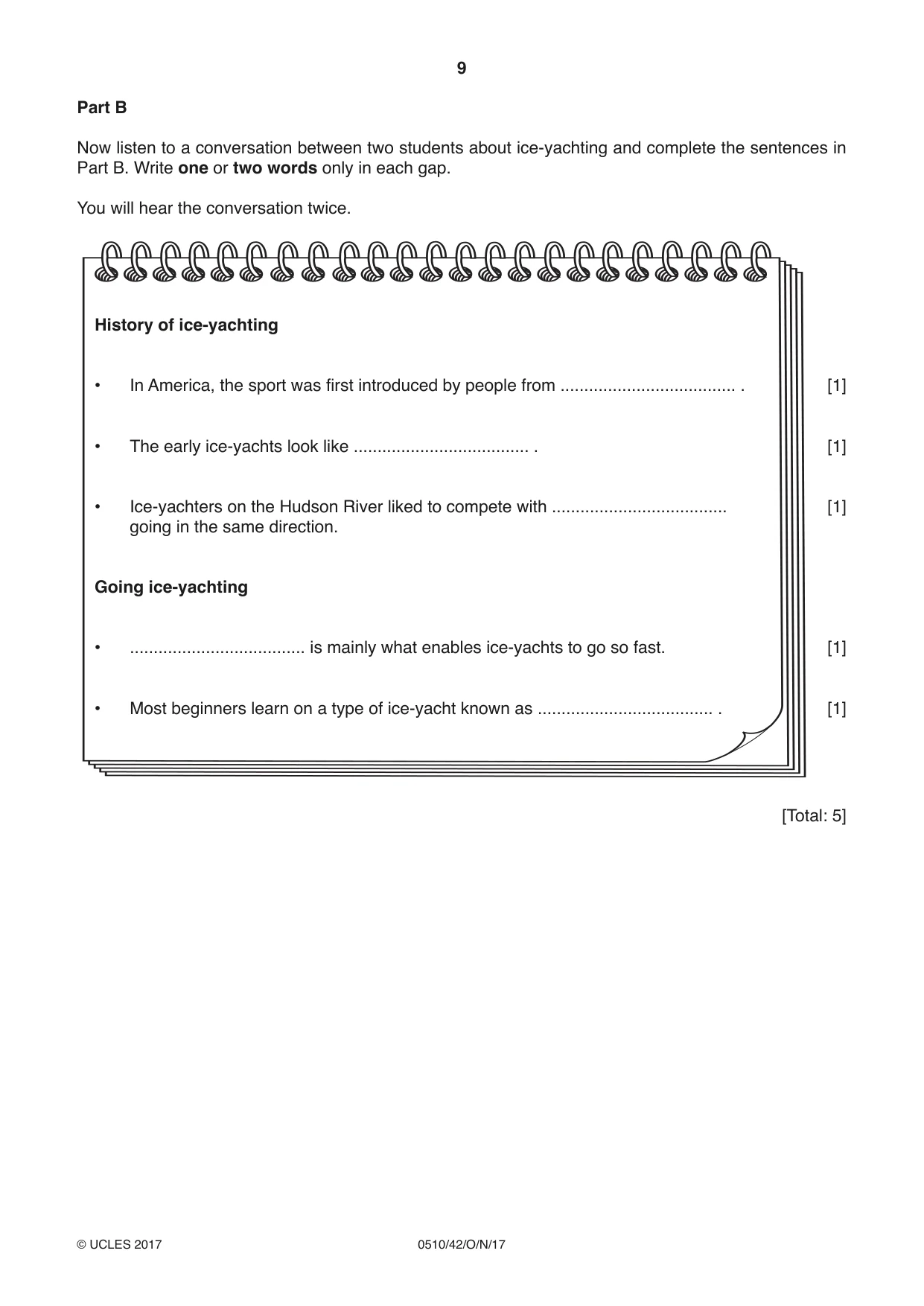
9 0510/42/O/N/17 © UCLES 2017 Part B Now listen to a conversation between two students about ice-yachting and complete the sentences in Part B. Write one or two words only in each gap. You will hear the conversation twice. History of ice-yachting • In America, the sport was first introduced by people from … . [1] • The early ice-yachts look like … . [1] • Ice-yachters on the Hudson River liked to compete with … [1] going in the same direction. Going ice-yachting • … is mainly what enables ice-yachts to go so fast. [1] • Most beginners learn on a type of ice-yacht known as … . [1] [Total: 5]
Question paper, page 10
10 0510/42/O/N/17 © UCLES 2017 BLANK PAGE
Question paper, page 11
11 0510/42/O/N/17 © UCLES 2017 BLANK PAGE
Question paper, page 12
12 0510/42/O/N/17 © UCLES 2017 BLANK PAGE Permission to reproduce items where third-party owned material protected by copyright is included has been sought and cleared where possible. Every reasonable effort has been made by the publisher (UCLES) to trace copyright holders, but if any items requiring clearance have unwittingly been included, the publisher will be pleased to make amends at the earliest possible opportunity. To avoid the issue of disclosure of answer-related information to candidates, all copyright acknowledgements are reproduced online in the Cambridge International Examinations Copyright Acknowledgements Booklet. This is produced for each series of examinations and is freely available to download at www.cie.org.uk after the live examination series. Cambridge International Examinations is part of the Cambridge Assessment Group. Cambridge Assessment is the brand name of University of Cambridge Local Examinations Syndicate (UCLES), which is itself a department of the University of Cambridge.
Mark scheme, page 1
® IGCSE is a registered trademark. This document consists of 4 printed pages. © UCLES 2017 [Turn over Cambridge Assessment International Education Cambridge International General Certificate of Secondary Education ENGLISH AS A SECOND LANGUAGE 0510/42 Paper 4 Listening (Extended) October/November 2017 MARK SCHEME Maximum Mark: 40 Published This mark scheme is published as an aid to teachers and candidates, to indicate the requirements of the examination. It shows the basis on which Examiners were instructed to award marks. It does not indicate the details of the discussions that took place at an Examiners’ meeting before marking began, which would have considered the acceptability of alternative answers. Mark schemes should be read in conjunction with the question paper and the Principal Examiner Report for Teachers. Cambridge International will not enter into discussions about these mark schemes. Cambridge International is publishing the mark schemes for the October/November 2017 series for most Cambridge IGCSE®, Cambridge International A and AS Level components and some Cambridge O Level components.
Mark scheme, page 2
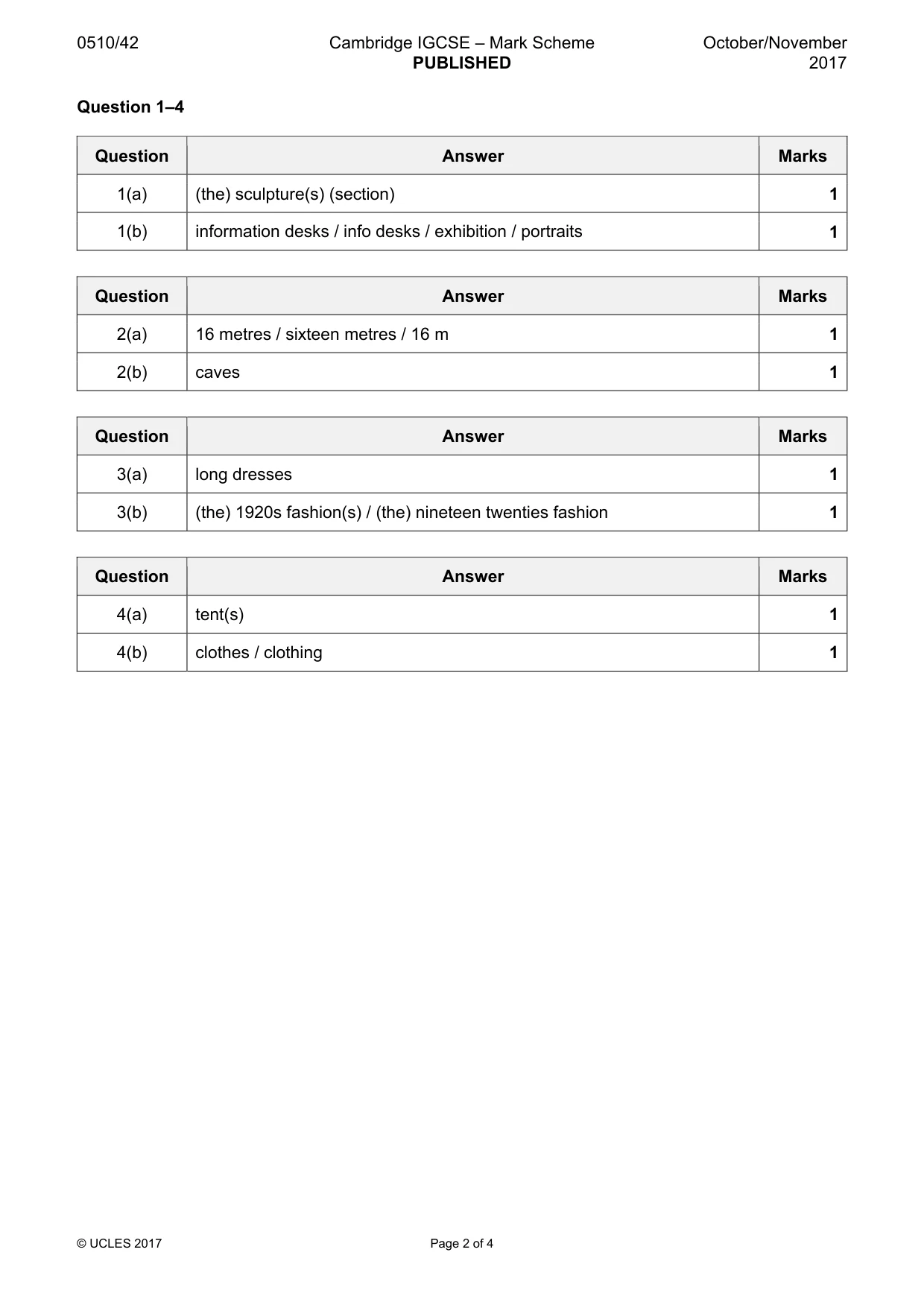
0510/42 Cambridge IGCSE – Mark Scheme PUBLISHED October/November 2017 © UCLES 2017 Page 2 of 4 Question 1–4 Question Answer Marks 1(a) (the) sculpture(s) (section) 1 1(b) information desks / info desks / exhibition / portraits 1 Question Answer Marks 2(a) 16 metres / sixteen metres / 16 m 1 2(b) caves 1 Question Answer Marks 3(a) long dresses 1 3(b) (the) 1920s fashion(s) / (the) nineteen twenties fashion 1 Question Answer Marks 4(a) tent(s) 1 4(b) clothes / clothing 1
Mark scheme, page 3
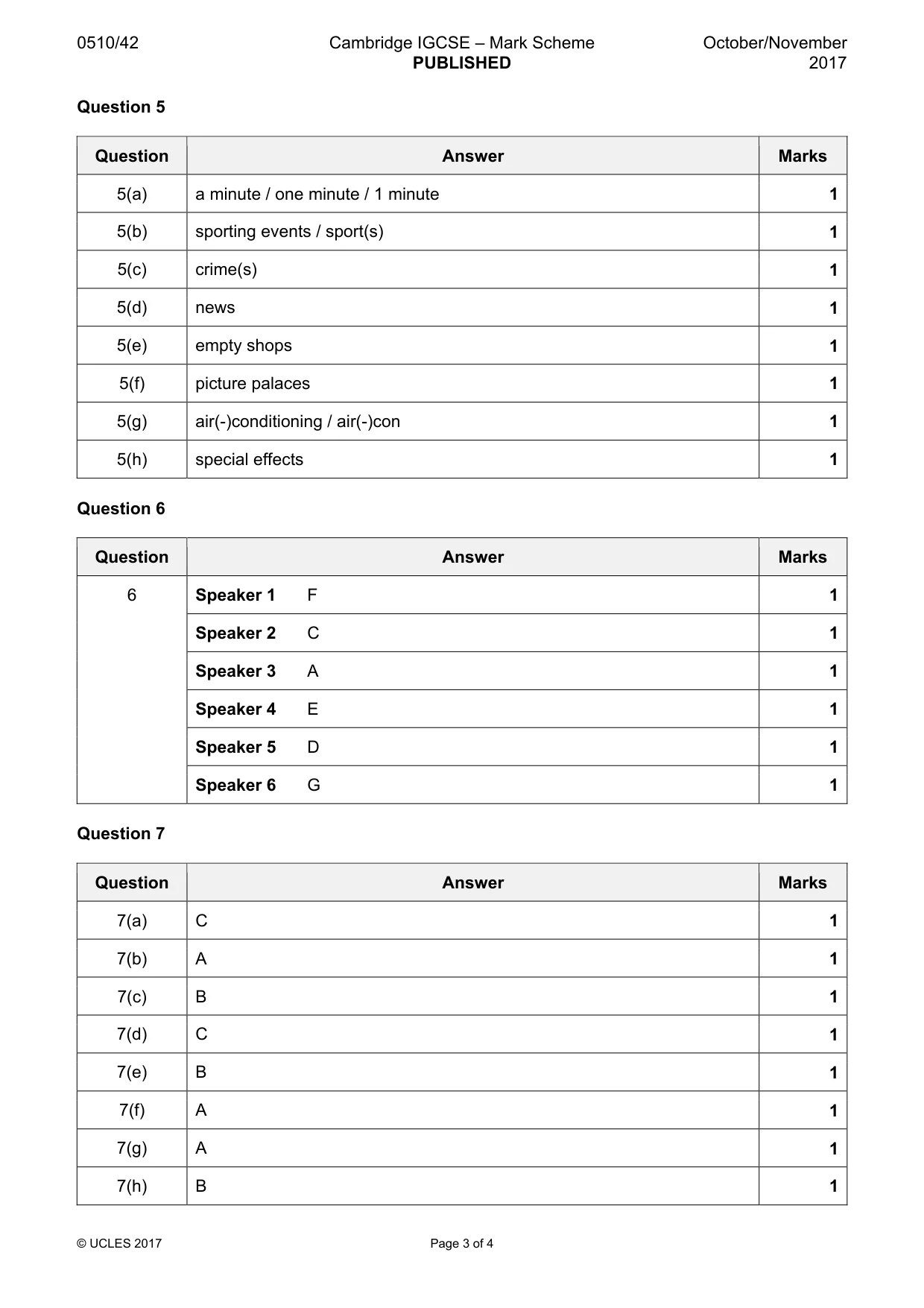
0510/42 Cambridge IGCSE – Mark Scheme PUBLISHED October/November 2017 © UCLES 2017 Page 3 of 4 Question 5 Question Answer Marks 5(a) a minute / one minute / 1 minute 1 5(b) sporting events / sport(s) 1 5(c) crime(s) 1 5(d) news 1 5(e) empty shops 1 5(f) picture palaces 1 5(g) air(-)conditioning / air(-)con 1 5(h) special effects 1 Question 6 Question Answer Marks 6 Speaker 1 F 1 Speaker 2 C 1 Speaker 3 A 1 Speaker 4 E 1 Speaker 5 D 1 Speaker 6 G 1 Question 7 Question Answer Marks 7(a) C 1 7(b) A 1 7(c) B 1 7(d) C 1 7(e) B 1 7(f) A 1 7(g) A 1 7(h) B 1
Mark scheme, page 4
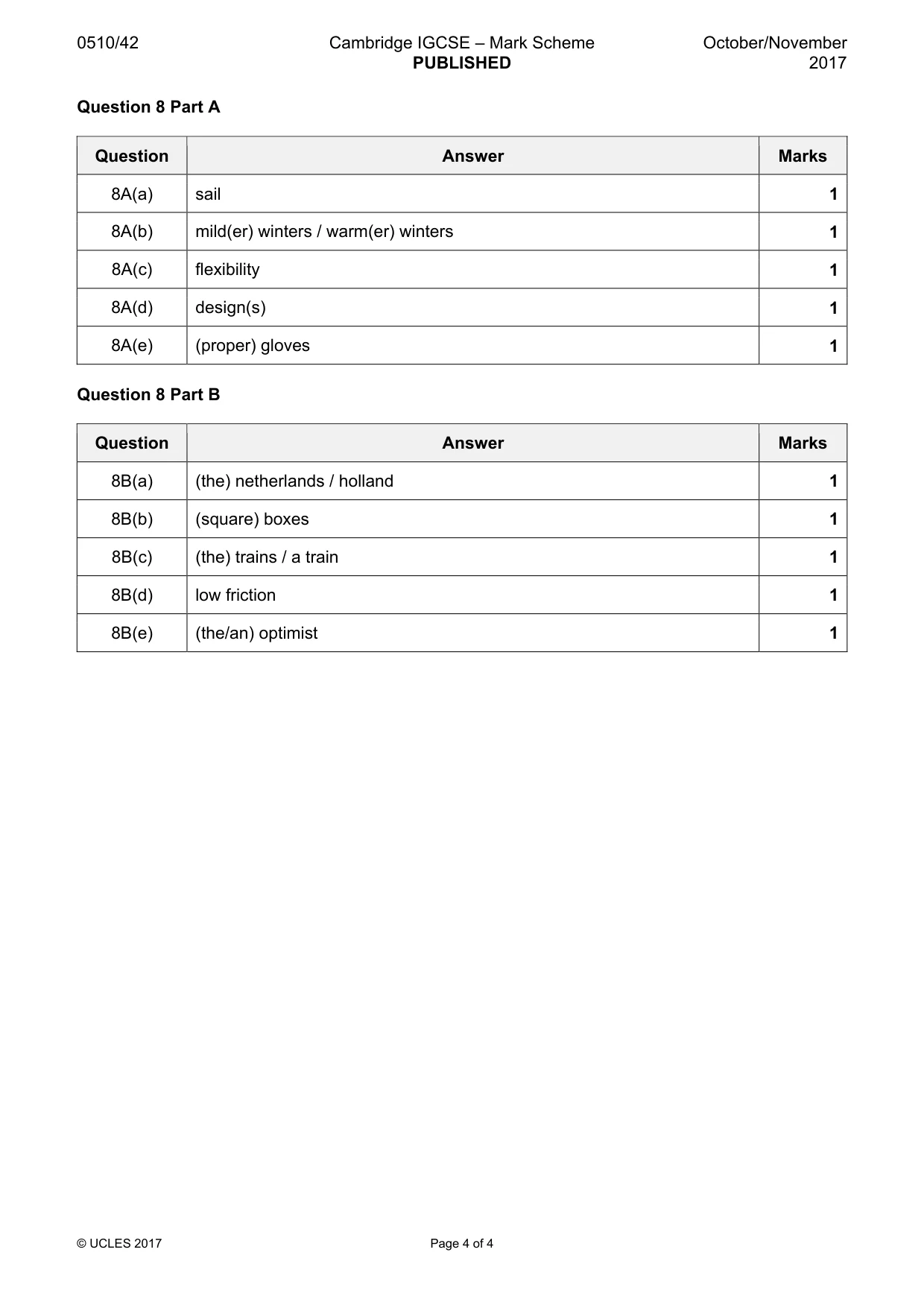
0510/42 Cambridge IGCSE – Mark Scheme PUBLISHED October/November 2017 © UCLES 2017 Page 4 of 4 Question 8 Part A Question Answer Marks 8A(a) sail 1 8A(b) mild(er) winters / warm(er) winters 1 8A(c) flexibility 1 8A(d) design(s) 1 8A(e) (proper) gloves 1 Question 8 Part B Question Answer Marks 8B(a) (the) netherlands / holland 1 8B(b) (square) boxes 1 8B(c) (the) trains / a train 1 8B(d) low friction 1 8B(e) (the/an) optimist 1
What you needed in this session
Cambridge’s own grade thresholds for 2017 Oct/Nov, Paper 4 · Variant 2. A higher threshold means an easier paper — the bar moves with how the cohort did.