Cambridge IGCSE English - Second Language (oral endorsement) 0510 — 2017 Oct/Nov Paper 2 · Variant 3
0510/23/O/N/17 · 90 marks · ≈101 min
The question paper and its mark scheme, free to read here and free to download. This is Cambridge’s own paper, exactly as it was sat.
Question paper16 pages




Mark scheme10 pages
Answers below. Sit the paper first if you are practising.
Paper as text
Question paper, page 1
This document consists of 15 printed pages and 1 blank page. DC (CW/SW) 135222/3 © UCLES 2017 [Turn over Cambridge International Examinations Cambridge International General Certificate of Secondary Education * 6 6 9 1 0 6 9 2 1 2 * ENGLISH AS A SECOND LANGUAGE 0510/23 Paper 2 Reading and Writing (Extended) October/November 2017 2 hours Candidates answer on the Question Paper. No Additional Materials are required. READ THESE INSTRUCTIONS FIRST Write your Centre number, candidate number and name on all the work you hand in. Write in dark blue or black pen. Do not use staples, paper clips, glue or correction fluid. DO NOT WRITE IN ANY BARCODES. Answer all questions. Dictionaries are not allowed. At the end of the examination, fasten all your work securely together. The number of marks is given in brackets [ ] at the end of each question or part question.
Question paper, page 2
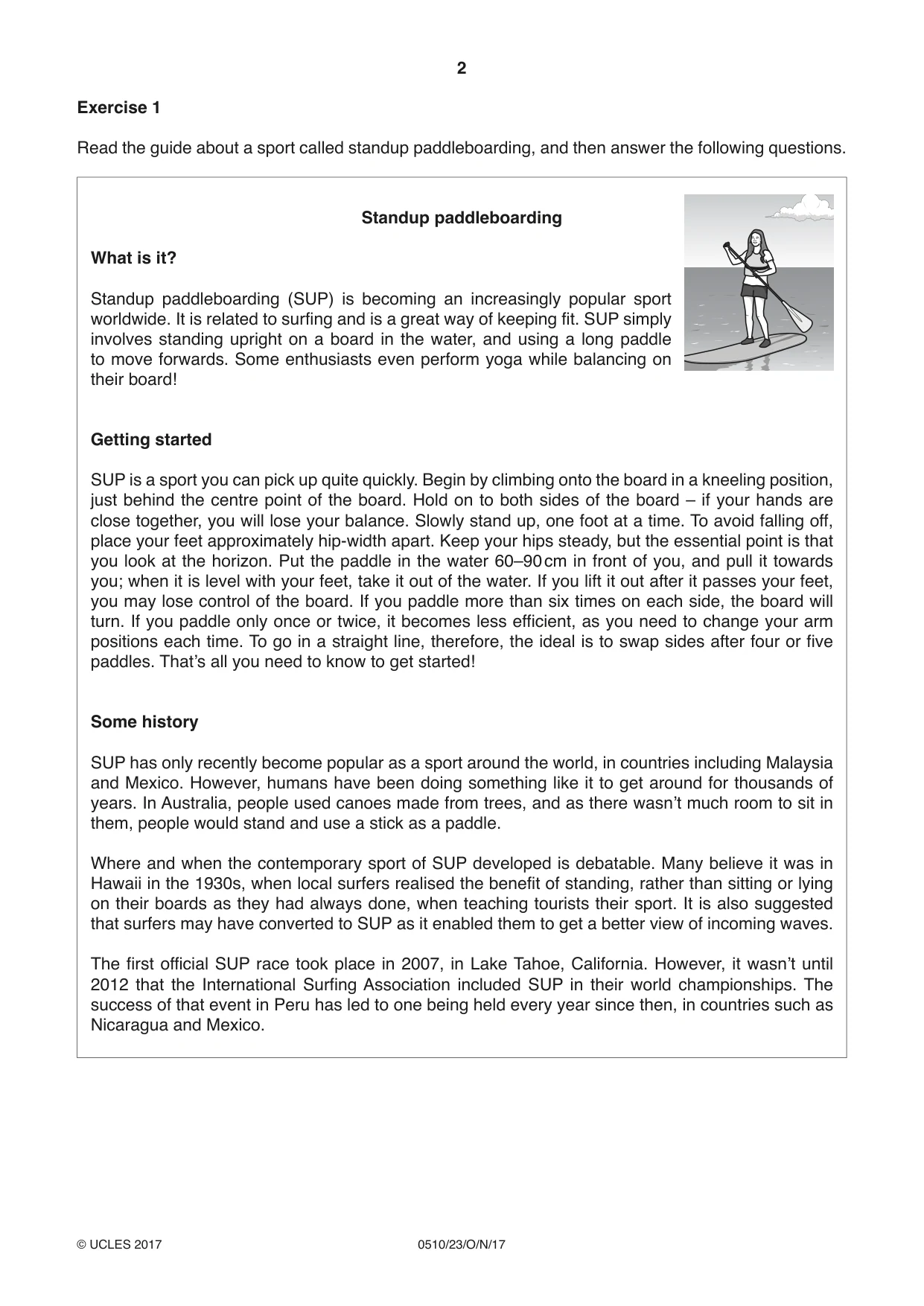
2 0510/23/O/N/17 © UCLES 2017 Exercise 1 Read the guide about a sport called standup paddleboarding, and then answer the following questions. Standup paddleboarding What is it? Standup paddleboarding (SUP) is becoming an increasingly popular sport worldwide. It is related to surfing and is a great way of keeping fit. SUP simply involves standing upright on a board in the water, and using a long paddle to move forwards. Some enthusiasts even perform yoga while balancing on their board! Getting started SUP is a sport you can pick up quite quickly. Begin by climbing onto the board in a kneeling position, just behind the centre point of the board. Hold on to both sides of the board – if your hands are close together, you will lose your balance. Slowly stand up, one foot at a time. To avoid falling off, place your feet approximately hip-width apart. Keep your hips steady, but the essential point is that you look at the horizon. Put the paddle in the water 60–90 cm in front of you, and pull it towards you; when it is level with your feet, take it out of the water. If you lift it out after it passes your feet, you may lose control of the board. If you paddle more than six times on each side, the board will turn. If you paddle only once or twice, it becomes less efficient, as you need to change your arm positions each time. To go in a straight line, therefore, the ideal is to swap sides after four or five paddles. That’s all you need to know to get started! Some history SUP has only recently become popular as a sport around the world, in countries including Malaysia and Mexico. However, humans have been doing something like it to get around for thousands of years. In Australia, people used canoes made from trees, and as there wasn’t much room to sit in them, people would stand and use a stick as a paddle. Where and when the contemporary sport of SUP developed is debatable. Many believe it was in Hawaii in the 1930s, when local surfers realised the benefit of standing, rather than sitting or lying on their boards as they had always done, when teaching tourists their sport. It is also suggested that surfers may have converted to SUP as it enabled them to get a better view of incoming waves. The first official SUP race took place in 2007, in Lake Tahoe, California. However, it wasn’t until 2012 that the International Surfing Association included SUP in their world championships. The success of that event in Peru has led to one being held every year since then, in countries such as Nicaragua and Mexico.
Question paper, page 3
3 0510/23/O/N/17 © UCLES 2017 [Turn over (a) Which sport did standup paddleboarding develop from? …[1] (b) Before trying to stand up on a board, where should you put your hands? …[1] (c) What is the most important piece of advice for staying upright on the board? …[1] (d) What could happen if you let the paddle go too far behind you? …[1] (e) How many times is it best to paddle on each side of the board to move forwards? …[1] (f) Where was an early form of standup paddleboarding used as a means of transport in the past? …[1] (g) Why did surfers begin to stand on their boards? Give two details. … …[2] (h) When did the first world championship for standup paddleboarding take place? …[1] [Total: 9]
Question paper, page 4
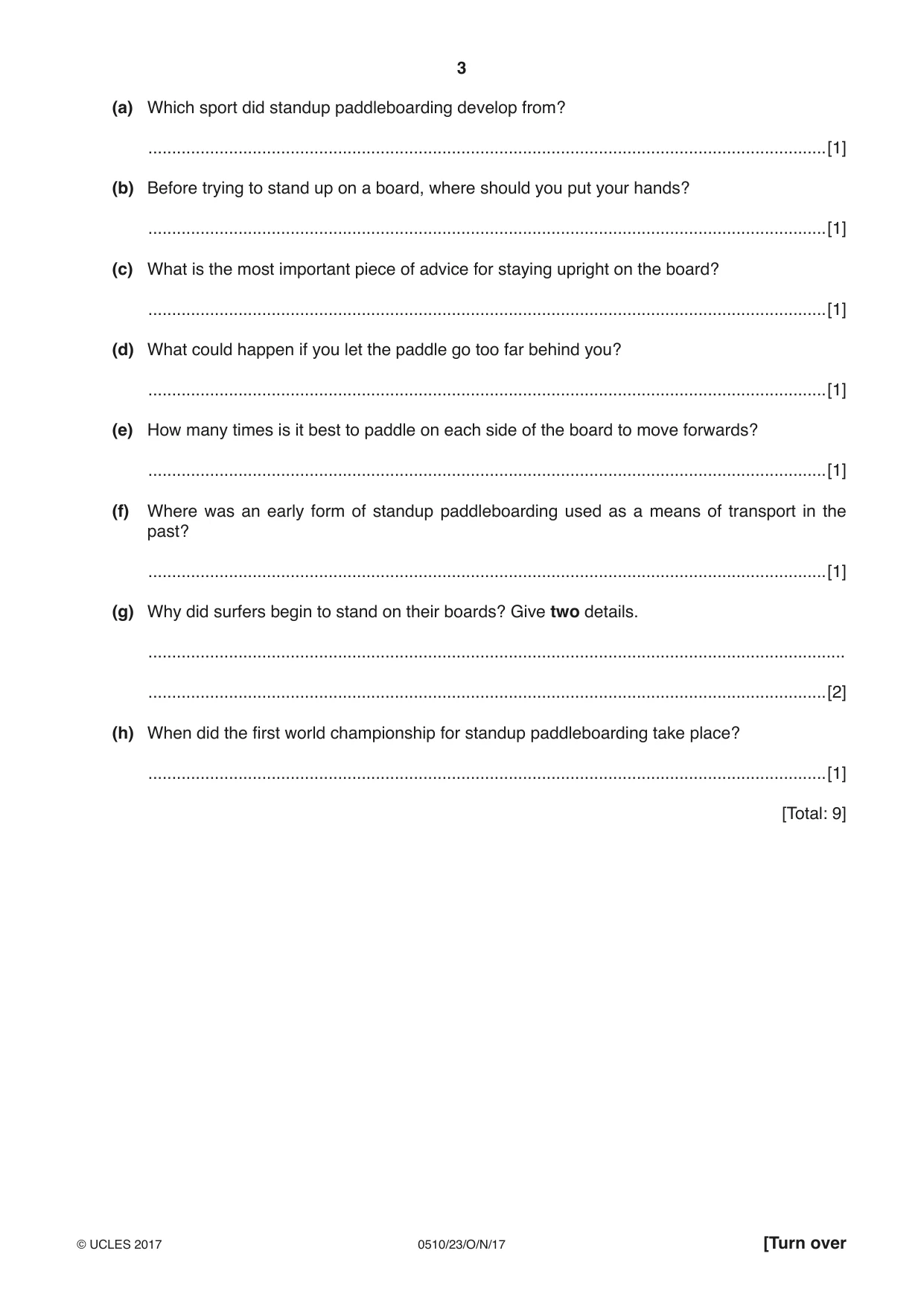
4 0510/23/O/N/17 © UCLES 2017 Exercise 2 Read the article about scouts and guides, and then answer the following questions. Scouts and guides around the world Many young people aged between 6 and 25 belong to the Scout Movement. This is a worldwide organisation, which was set up to help young people achieve their full potential as they grow up. The organisation was established in 1907 by a British general called Robert Baden-Powell. While in the army, he wrote a publication about scouting (which means searching and keeping watch) and how to survive in the wild, called ‘Aids to Scouting’. He realised how popular this was, and the result was another book, ‘Scouting for Boys’, which had less emphasis on the military. To test his ideas, he held a week-long camp for 21 boys from various schools in London, Poole and Bournemouth. This took place in August 1907, on Brownsea Island, which is in southern England. These boys had the chance to enjoy the outdoors, which became another of the movement’s objectives. The Scout Movement quickly became established in Europe, first in Gibraltar and soon after in Malta. It then spread throughout the rest of the world, starting in Chile in 1909. To begin with, the focus was on boys aged 11 to 18. However, as the movement grew, it was clear that younger boys, older boys and girls all wanted to be involved too. Baden-Powell’s sister set up the Girl Guides in 1910, and in 1914 she started Rosebuds, later renamed Brownies, for younger girls. In the early years, boys and girls belonged to separate groups, but gradually more groups became mixed. By the 1990s, this applied to 100% of groups in some countries, but only two-thirds of groups globally. The movement’s intention to help young people play useful roles in society applies equally to girls and boys. By 2010, there were 32 million scouts, and by 2006, there were 10 million guides around the world, from a total of 216 different countries. Country Membership Population participation Scouting introduced Guiding introduced India 4 150 000 0.3% 1909 1911 Indonesia 17 100 000 7.2% 1912 1912 Philippines 2 150 000 2.2% 1910 1918 Thailand 1 300 000 1.9% 1911 1957 United States 7 500 000 2.4% 1910 1912 2007 marked 100 years of the Scout Movement, and events took place around the world to celebrate this centenary. To mark the occasion, a colourful badge was produced for scouts to sew onto their uniforms or bags. The design included the official scout emblem, as well as the phrase ‘one world one promise’, and images of doves and the globe. 2007 was also the 150th anniversary of Baden-Powell’s birth. To honour both occasions, a flame was lit at Baden-Powell’s grave in Nyeri. This is the place in Kenya where he spent the last few years of his life. The flame was then carried through several countries until it reached the UK. It was taken to the 21st World Jamboree, the main event of the year, with 40 000 scouts and guides present from around the world. Held in Chelmsford, England, this was a huge event, although not the largest – over 50 000 scouts camped in Birkenhead, England, for the Jamboree in 1929. Many other centenary events took place around the world too. A team of scouts and guides from France were presented with a flag which they carried to the top of a mountain called Mont Blanc. Then, on a glacier near the resort of Crans-Montana, a group of Swiss scouts built several igloos from snow and ice, breaking a world record in doing so. This type of activity is typical of scout and guide groups, which encourage their members to learn survival skills. The importance of scouting is reflected in the fact that films, artwork and even songs focus on the subject. Examples include ‘Edge of Honor’, an adventure film featuring scouts on a camping trip, and ‘Troop Beverly Hills’, a film which deals with scouting in a humorous way.
Question paper, page 5
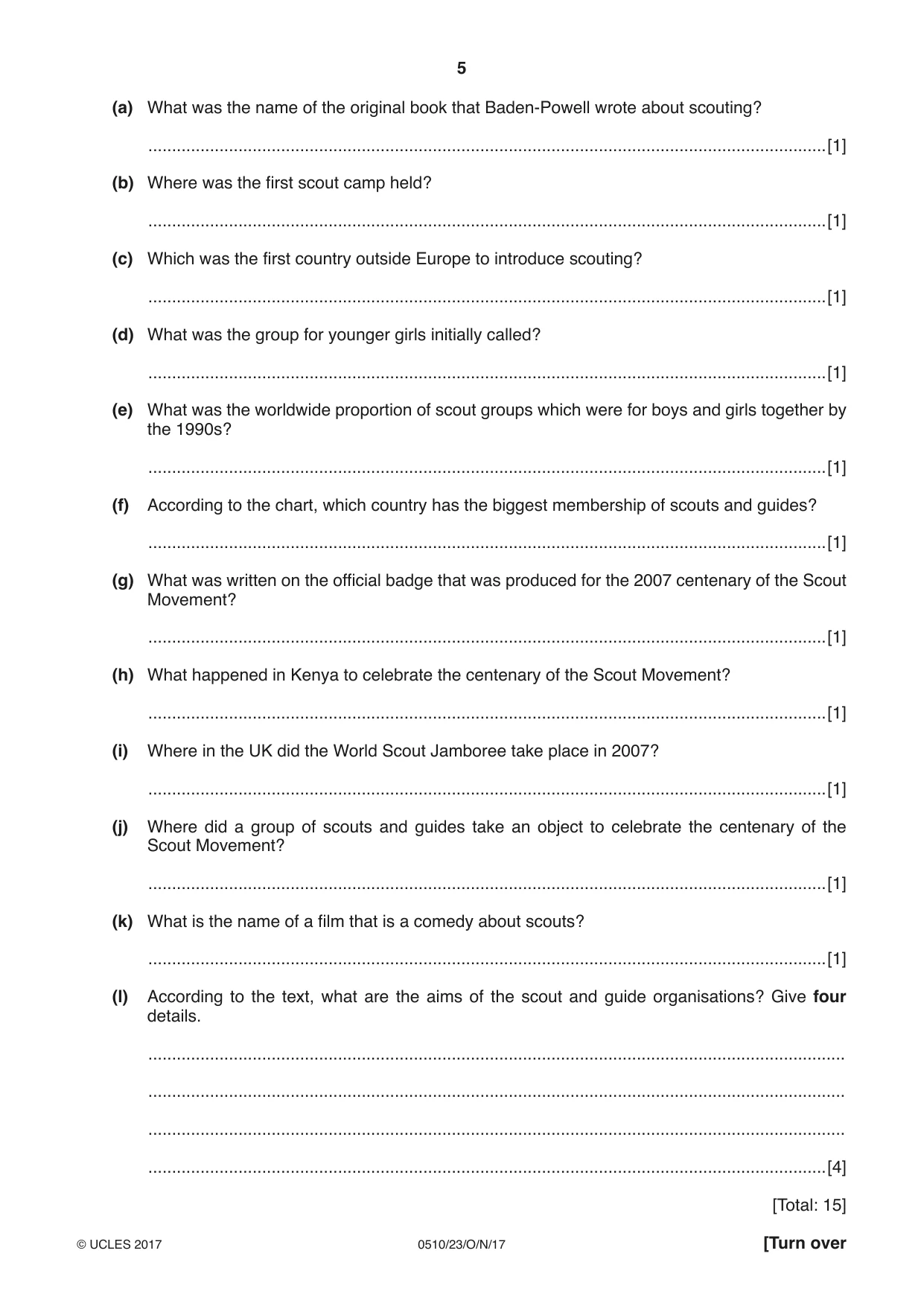
5 0510/23/O/N/17 © UCLES 2017 [Turn over (a) What was the name of the original book that Baden-Powell wrote about scouting? …[1] (b) Where was the first scout camp held? …[1] (c) Which was the first country outside Europe to introduce scouting? …[1] (d) What was the group for younger girls initially called? …[1] (e) What was the worldwide proportion of scout groups which were for boys and girls together by the 1990s? …[1] (f) According to the chart, which country has the biggest membership of scouts and guides? …[1] (g) What was written on the official badge that was produced for the 2007 centenary of the Scout Movement? …[1] (h) What happened in Kenya to celebrate the centenary of the Scout Movement? …[1] (i) Where in the UK did the World Scout Jamboree take place in 2007? …[1] (j) Where did a group of scouts and guides take an object to celebrate the centenary of the Scout Movement? …[1] (k) What is the name of a film that is a comedy about scouts? …[1] (l) According to the text, what are the aims of the scout and guide organisations? Give four details. … … … …[4] [Total: 15]
Question paper, page 6
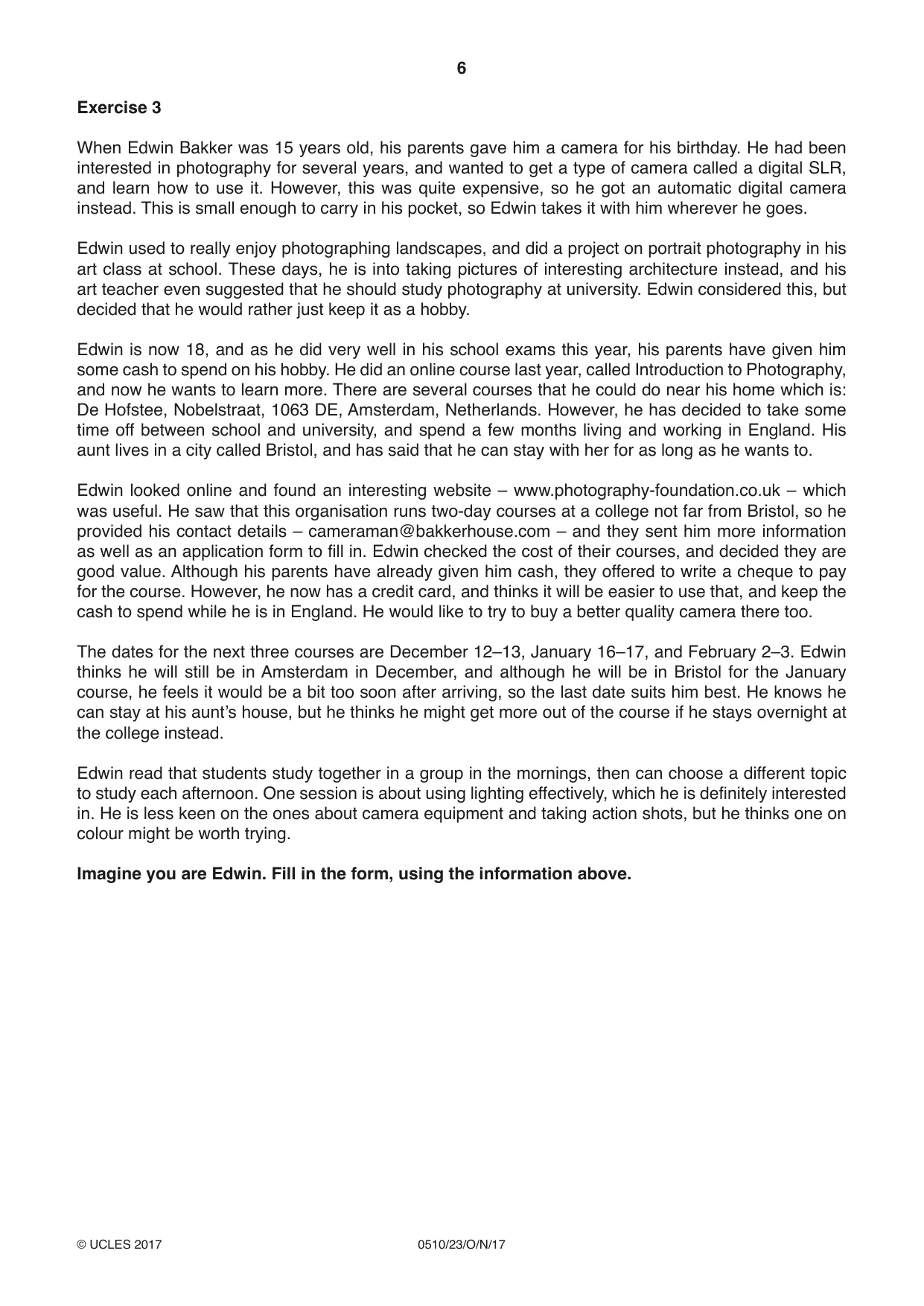
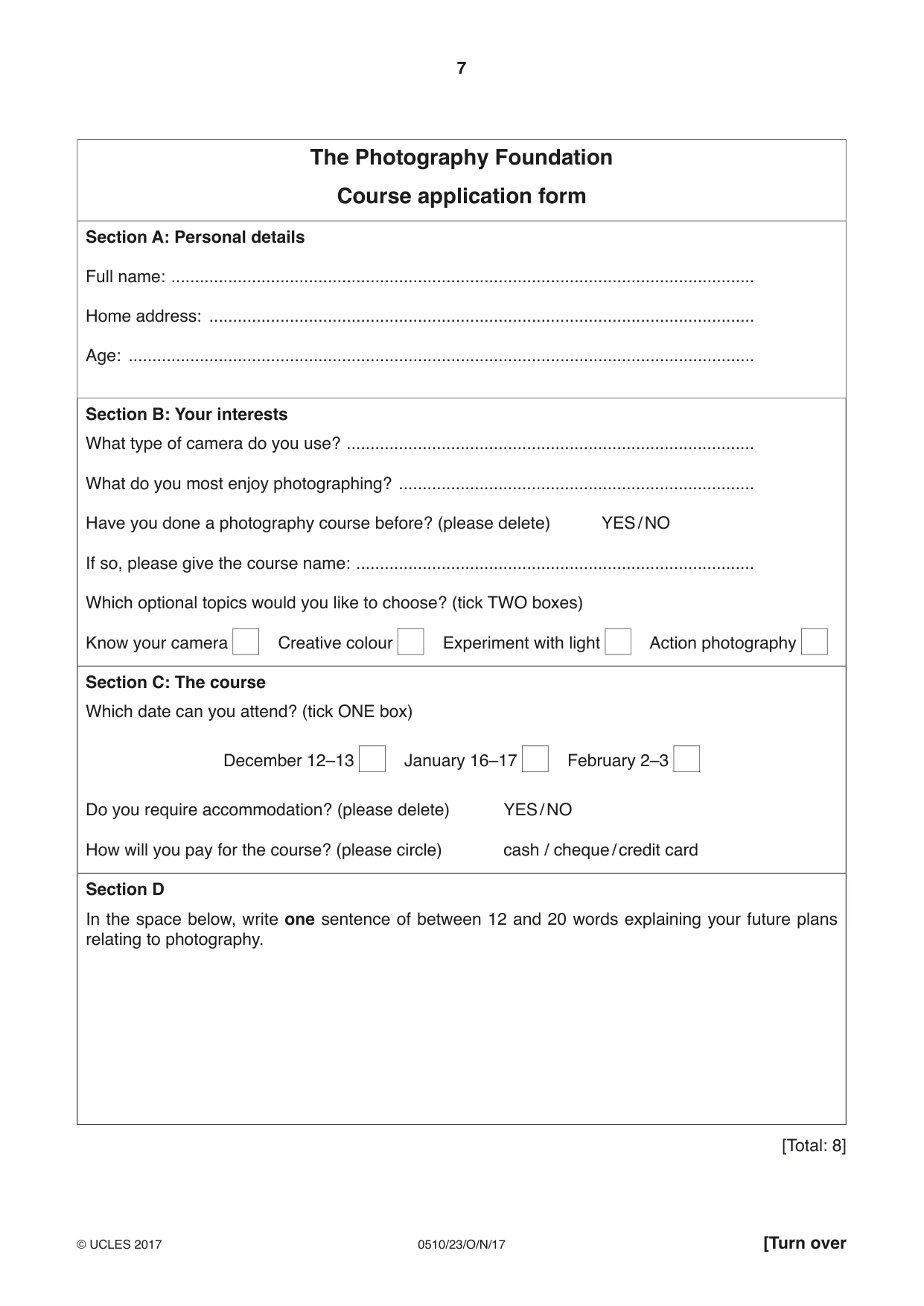
6 0510/23/O/N/17 © UCLES 2017 Exercise 3 When Edwin Bakker was 15 years old, his parents gave him a camera for his birthday. He had been interested in photography for several years, and wanted to get a type of camera called a digital SLR, and learn how to use it. However, this was quite expensive, so he got an automatic digital camera instead. This is small enough to carry in his pocket, so Edwin takes it with him wherever he goes. Edwin used to really enjoy photographing landscapes, and did a project on portrait photography in his art class at school. These days, he is into taking pictures of interesting architecture instead, and his art teacher even suggested that he should study photography at university. Edwin considered this, but decided that he would rather just keep it as a hobby. Edwin is now 18, and as he did very well in his school exams this year, his parents have given him some cash to spend on his hobby. He did an online course last year, called Introduction to Photography, and now he wants to learn more. There are several courses that he could do near his home which is: De Hofstee, Nobelstraat, 1063 DE, Amsterdam, Netherlands. However, he has decided to take some time off between school and university, and spend a few months living and working in England. His aunt lives in a city called Bristol, and has said that he can stay with her for as long as he wants to. Edwin looked online and found an interesting website – www.photography-foundation.co.uk – which was useful. He saw that this organisation runs two-day courses at a college not far from Bristol, so he provided his contact details – cameraman@bakkerhouse.com – and they sent him more information as well as an application form to fill in. Edwin checked the cost of their courses, and decided they are good value. Although his parents have already given him cash, they offered to write a cheque to pay for the course. However, he now has a credit card, and thinks it will be easier to use that, and keep the cash to spend while he is in England. He would like to try to buy a better quality camera there too. The dates for the next three courses are December 12–13, January 16–17, and February 2–3. Edwin thinks he will still be in Amsterdam in December, and although he will be in Bristol for the January course, he feels it would be a bit too soon after arriving, so the last date suits him best. He knows he can stay at his aunt’s house, but he thinks he might get more out of the course if he stays overnight at the college instead. Edwin read that students study together in a group in the mornings, then can choose a different topic to study each afternoon. One session is about using lighting effectively, which he is definitely interested in. He is less keen on the ones about camera equipment and taking action shots, but he thinks one on colour might be worth trying. Imagine you are Edwin. Fill in the form, using the information above.
Question paper, page 7
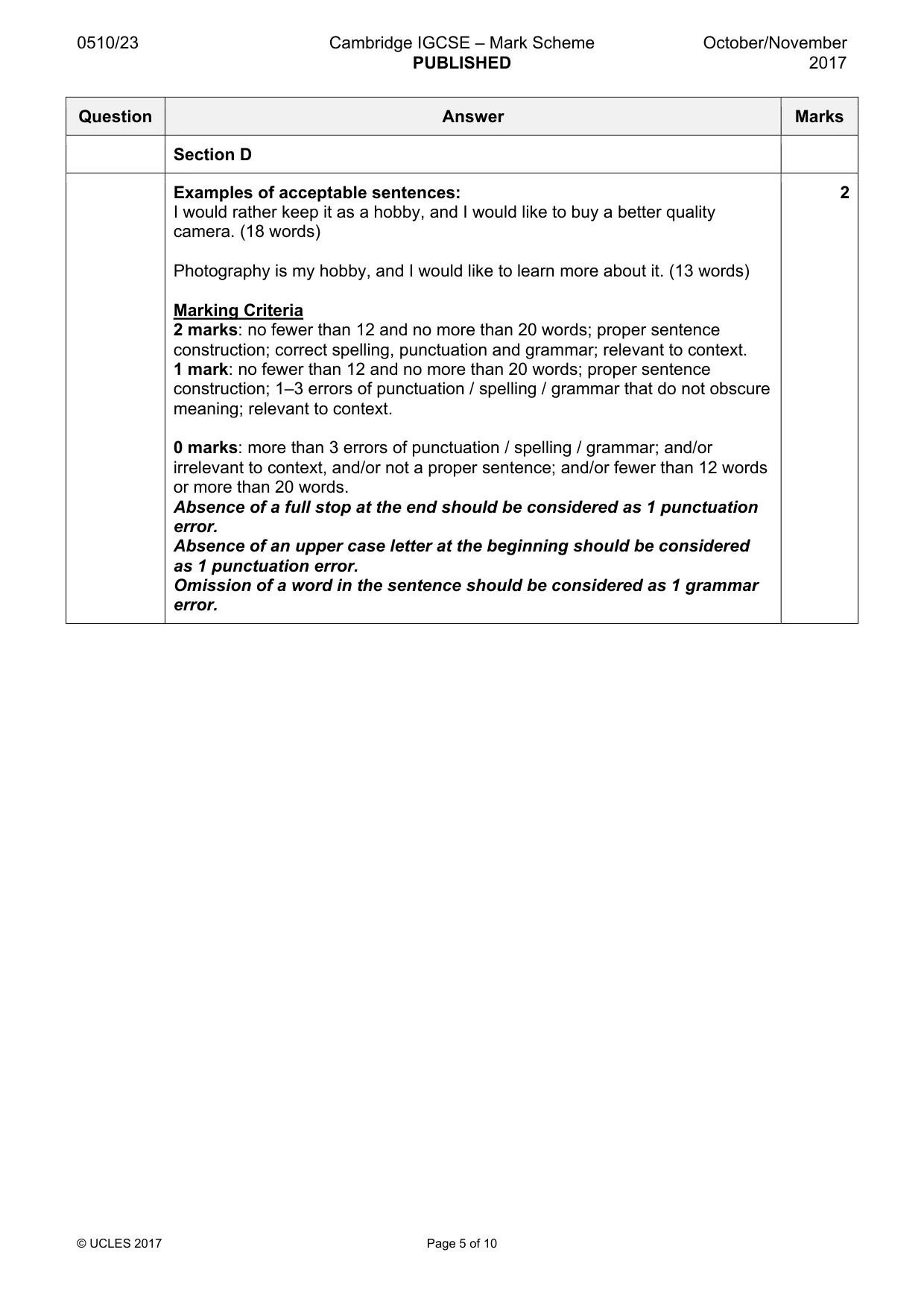
7 0510/23/O/N/17 © UCLES 2017 [Turn over The Photography Foundation Course application form Section A: Personal details Full name: … Home address: … Age: … Section B: Your interests What type of camera do you use? … What do you most enjoy photographing? … Have you done a photography course before? (please delete) YES / NO If so, please give the course name: … Which optional topics would you like to choose? (tick TWO boxes) Know your camera Creative colour Experiment with light Action photography Section C: The course Which date can you attend? (tick ONE box) December 12–13 January 16–17 February 2–3 Do you require accommodation? (please delete) YES / NO How will you pay for the course? (please circle) cash / cheque / credit card Section D In the space below, write one sentence of between 12 and 20 words explaining your future plans relating to photography. [Total: 8]
Question paper, page 8
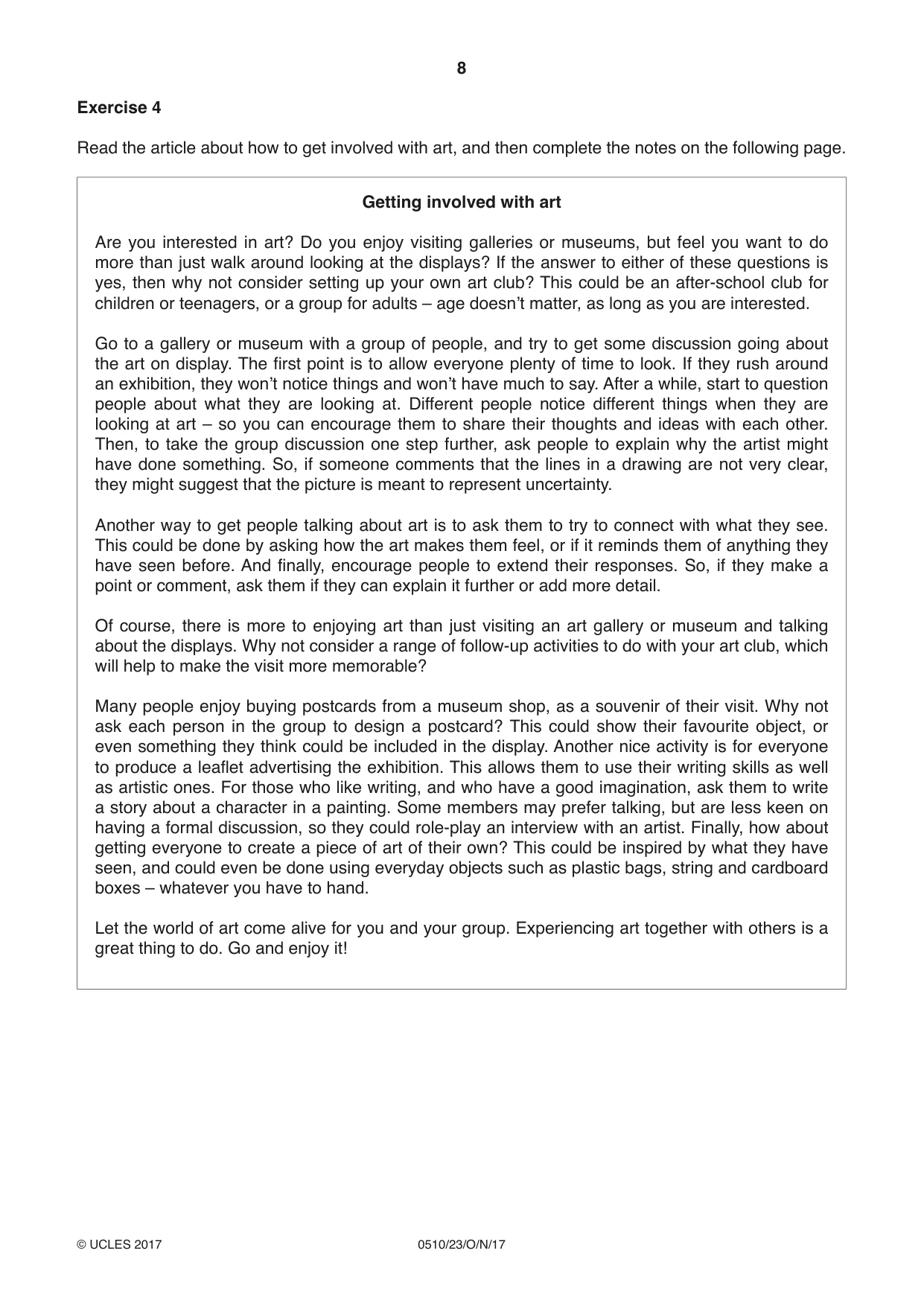
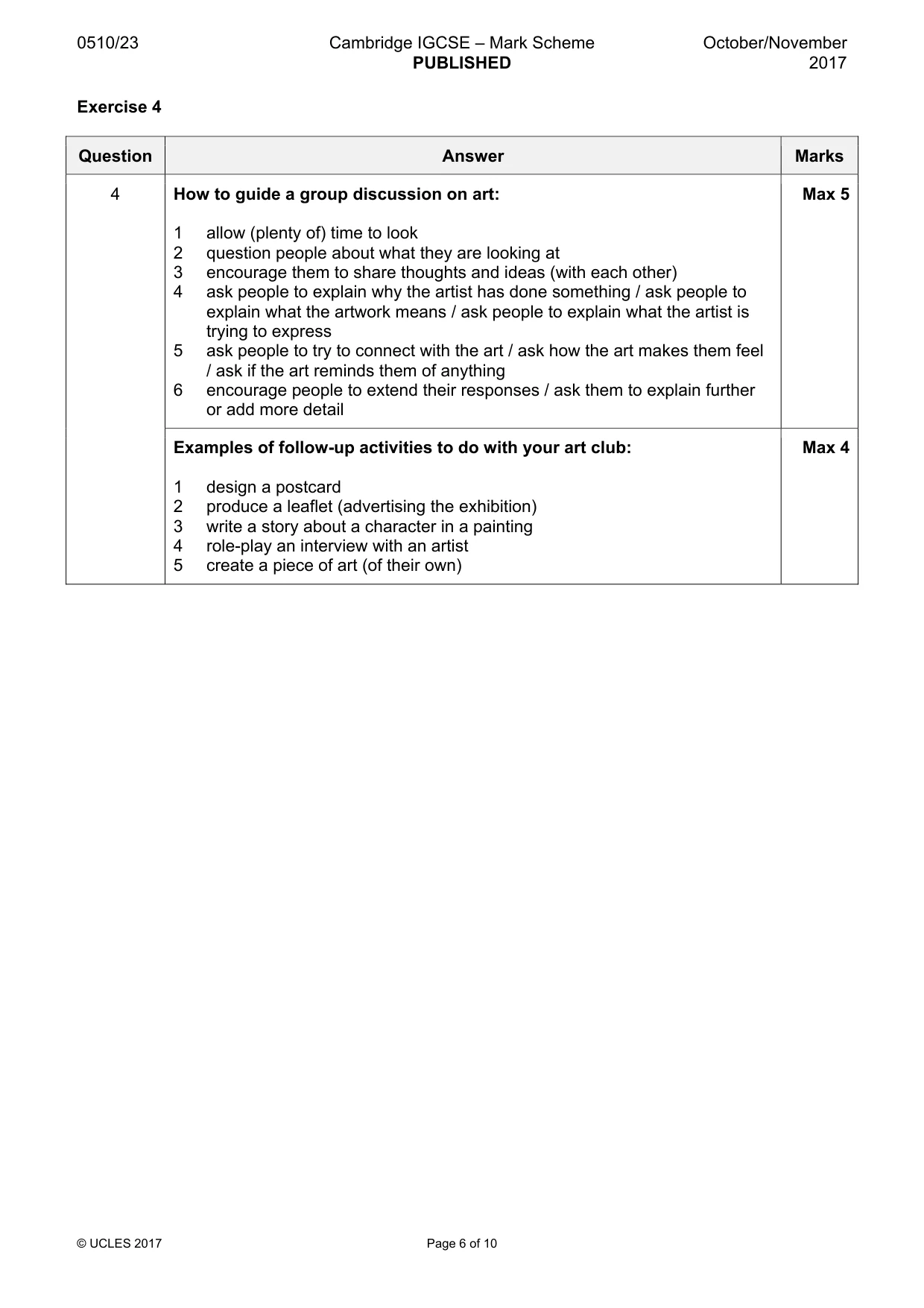
8 0510/23/O/N/17 © UCLES 2017 Exercise 4 Read the article about how to get involved with art, and then complete the notes on the following page. Getting involved with art Are you interested in art? Do you enjoy visiting galleries or museums, but feel you want to do more than just walk around looking at the displays? If the answer to either of these questions is yes, then why not consider setting up your own art club? This could be an after-school club for children or teenagers, or a group for adults – age doesn’t matter, as long as you are interested. Go to a gallery or museum with a group of people, and try to get some discussion going about the art on display. The first point is to allow everyone plenty of time to look. If they rush around an exhibition, they won’t notice things and won’t have much to say. After a while, start to question people about what they are looking at. Different people notice different things when they are looking at art – so you can encourage them to share their thoughts and ideas with each other. Then, to take the group discussion one step further, ask people to explain why the artist might have done something. So, if someone comments that the lines in a drawing are not very clear, they might suggest that the picture is meant to represent uncertainty. Another way to get people talking about art is to ask them to try to connect with what they see. This could be done by asking how the art makes them feel, or if it reminds them of anything they have seen before. And finally, encourage people to extend their responses. So, if they make a point or comment, ask them if they can explain it further or add more detail. Of course, there is more to enjoying art than just visiting an art gallery or museum and talking about the displays. Why not consider a range of follow-up activities to do with your art club, which will help to make the visit more memorable? Many people enjoy buying postcards from a museum shop, as a souvenir of their visit. Why not ask each person in the group to design a postcard? This could show their favourite object, or even something they think could be included in the display. Another nice activity is for everyone to produce a leaflet advertising the exhibition. This allows them to use their writing skills as well as artistic ones. For those who like writing, and who have a good imagination, ask them to write a story about a character in a painting. Some members may prefer talking, but are less keen on having a formal discussion, so they could role-play an interview with an artist. Finally, how about getting everyone to create a piece of art of their own? This could be inspired by what they have seen, and could even be done using everyday objects such as plastic bags, string and cardboard boxes – whatever you have to hand. Let the world of art come alive for you and your group. Experiencing art together with others is a great thing to do. Go and enjoy it!
Question paper, page 9
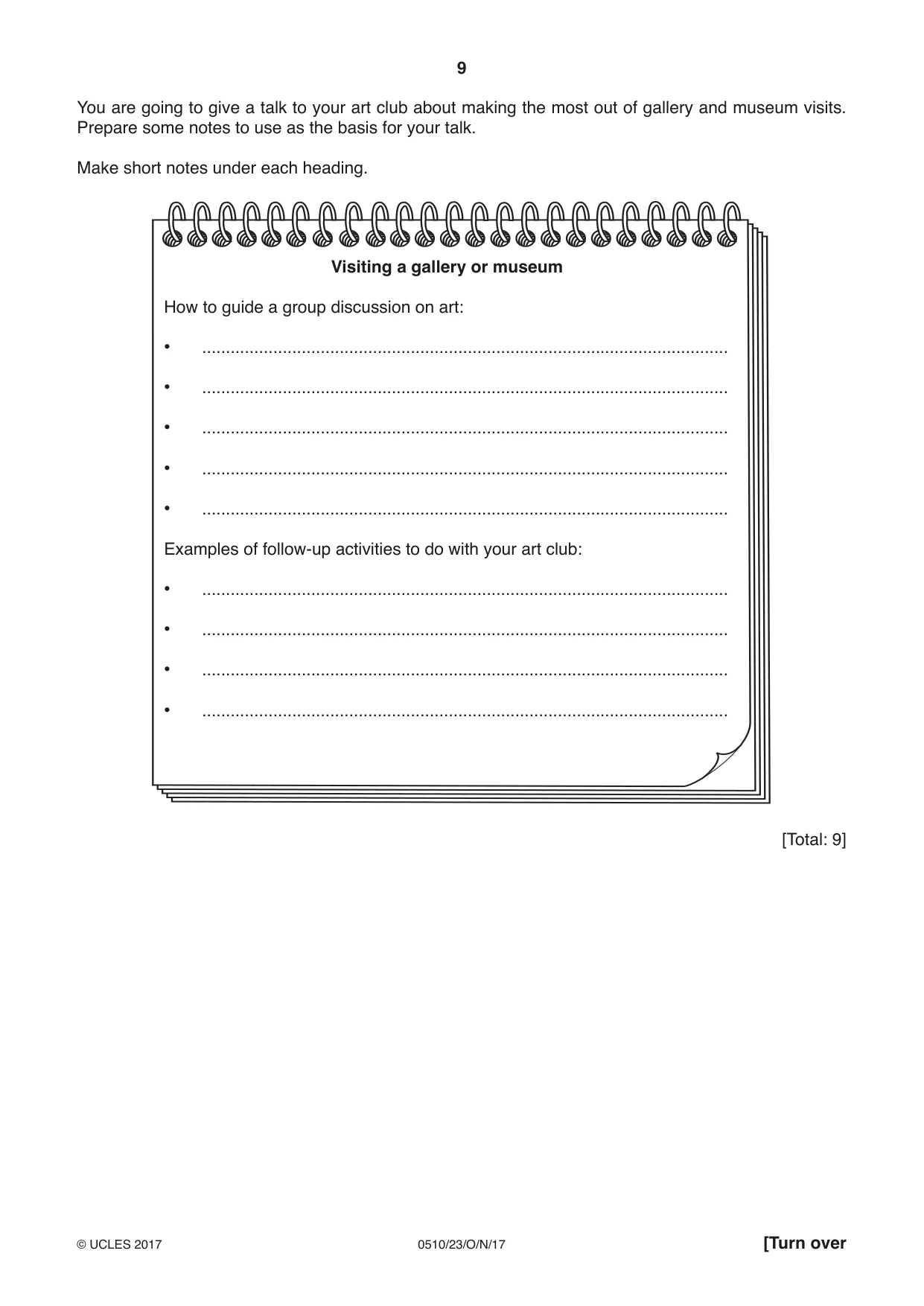
9 0510/23/O/N/17 © UCLES 2017 [Turn over You are going to give a talk to your art club about making the most out of gallery and museum visits. Prepare some notes to use as the basis for your talk. Make short notes under each heading. Visiting a gallery or museum How to guide a group discussion on art: • … • … • … • … • … Examples of follow-up activities to do with your art club: • … • … • … • … [Total: 9]
Question paper, page 10
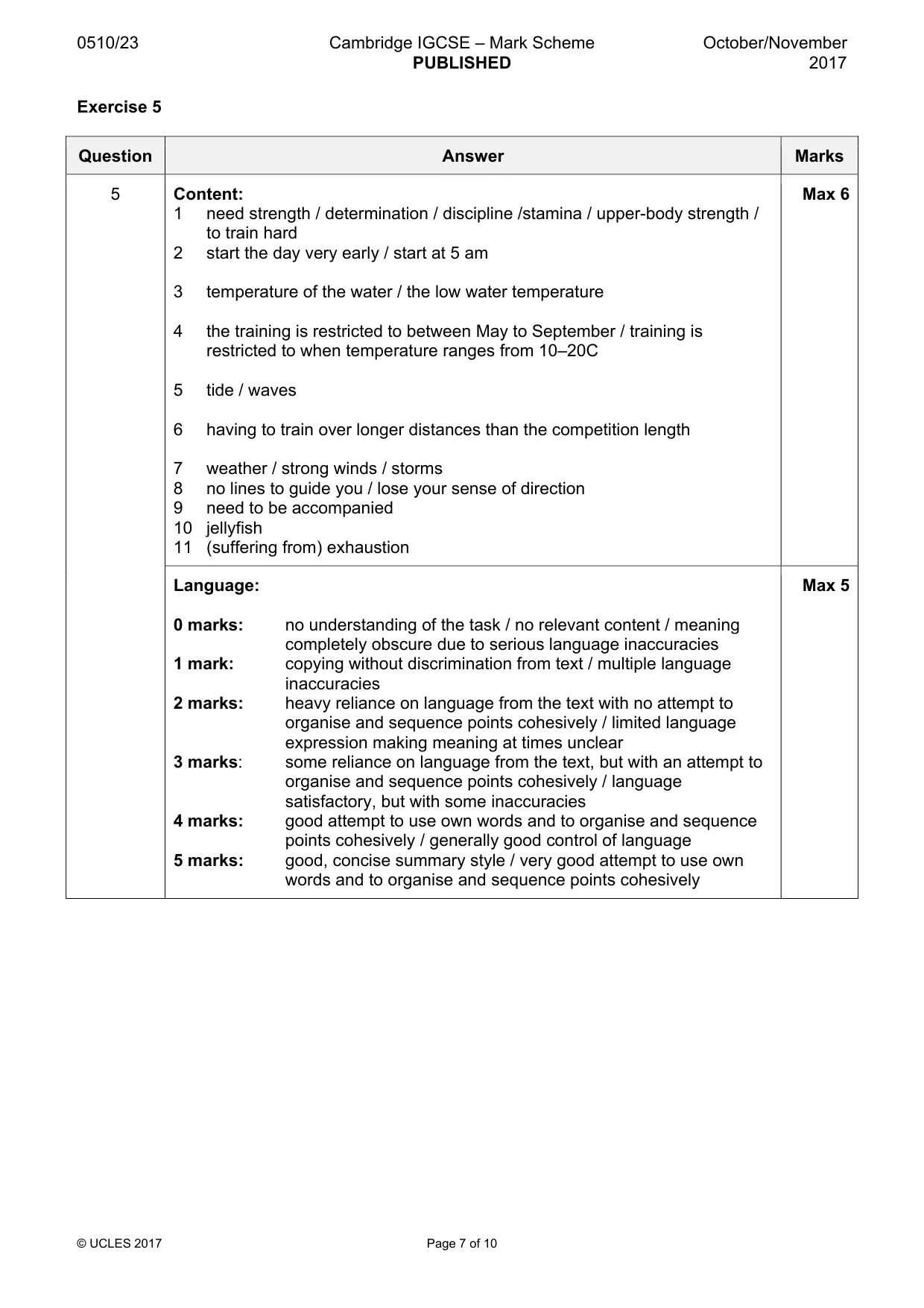
10 0510/23/O/N/17 © UCLES 2017 Exercise 5 Read the article about Jane Bolton, an open water swimmer. Write a summary about the difficulties which are experienced by open water swimmers. Your summary should be about 100 words long (and no more than 120 words long). You should use your own words as far as possible. You will receive up to 6 marks for the content of your summary, and up to 5 marks for the style and accuracy of your language. Open water swimming Jane Bolton, a successful open water swimmer, started swimming as a young child. She learnt to swim very quickly, and it was clear to her parents that this was going to be more than just a fun activity for Jane. They enrolled her in a local junior swimming club, and the coach confirmed that Jane was not only talented, but also displayed incredible strength and determination for her age. She was unusually disciplined too, a quality that is vital for someone who wants to pursue sport at a professional level. The coach suggested that Jane should try swimming in open water. At the time, her family lived in the Lake District, an area in the United Kingdom which has several natural lakes. This meant that Jane could practise in them under the close supervision of a new personal trainer. This trainer put together a schedule of swimming and other exercises to build up Jane’s stamina and upper-body strength. She had to start her day very early, at 05:00, and, just like other swimmers in her position, Jane found this quite challenging. The temperature of lakes and the sea is generally very low in the United Kingdom, so Jane’s training was restricted to between May and September, when the temperature of the water ranges from 10 to 20 degrees Celsius. Jane’s first big national success came at the age of 15, when she became the fastest junior to swim across the English Channel, which is between England and France. Since then, Jane has had considerable success in international swimming competitions and has broken around 20 world records. Her most recent record, as an adult, is the world’s fastest time to swim around Manhattan Island in the USA, using the ‘butterfly’ style of swimming. Jane swam the distance of 46 kilometres in the record time of 9 hours and 28 minutes. Jane now has so much experience to offer that she has recently decided to train young swimmers who want to change from indoor swimming to open water swimming. The main difference that these youngsters notice is that the tide and the waves in the sea affect their swimming speed. For this reason, swimmers are advised to train over longer distances than they intend to swim in competitions. They find this incredibly demanding. However, it ensures that they are able to cope with these conditions. It is also advisable to check for the likelihood of strong winds or storms before going into open water. Thanks to Jane’s extensive experience, she is the best person to give invaluable tips such as these to her trainees. At the moment, Jane is coaching two young swimmers, and they are still getting used to the fact that there are no lines to guide them in open water, as there are in swimming pools. Jane always tells them to focus on a point in the distance, whenever possible, so that they don’t lose their sense of direction. Nevertheless, she insists that they are accompanied by somebody in a boat who keeps an eye on them during their training sessions. After all, anything can happen in the sea, from being stung by a jellyfish to suffering from exhaustion. For Jane, safety comes first. The next thing Jane is planning to do is set up an organisation to promote swimming among young people. She says that swimming has not only kept her fit, but has also taught her perseverance and discipline – two qualities that she considers necessary for success in life.
Question paper, page 11
11 0510/23/O/N/17 © UCLES 2017 [Turn over … … … … … … … … … … … … … … … … … … … … … … … … … … … [Total: 11]
Question paper, page 12
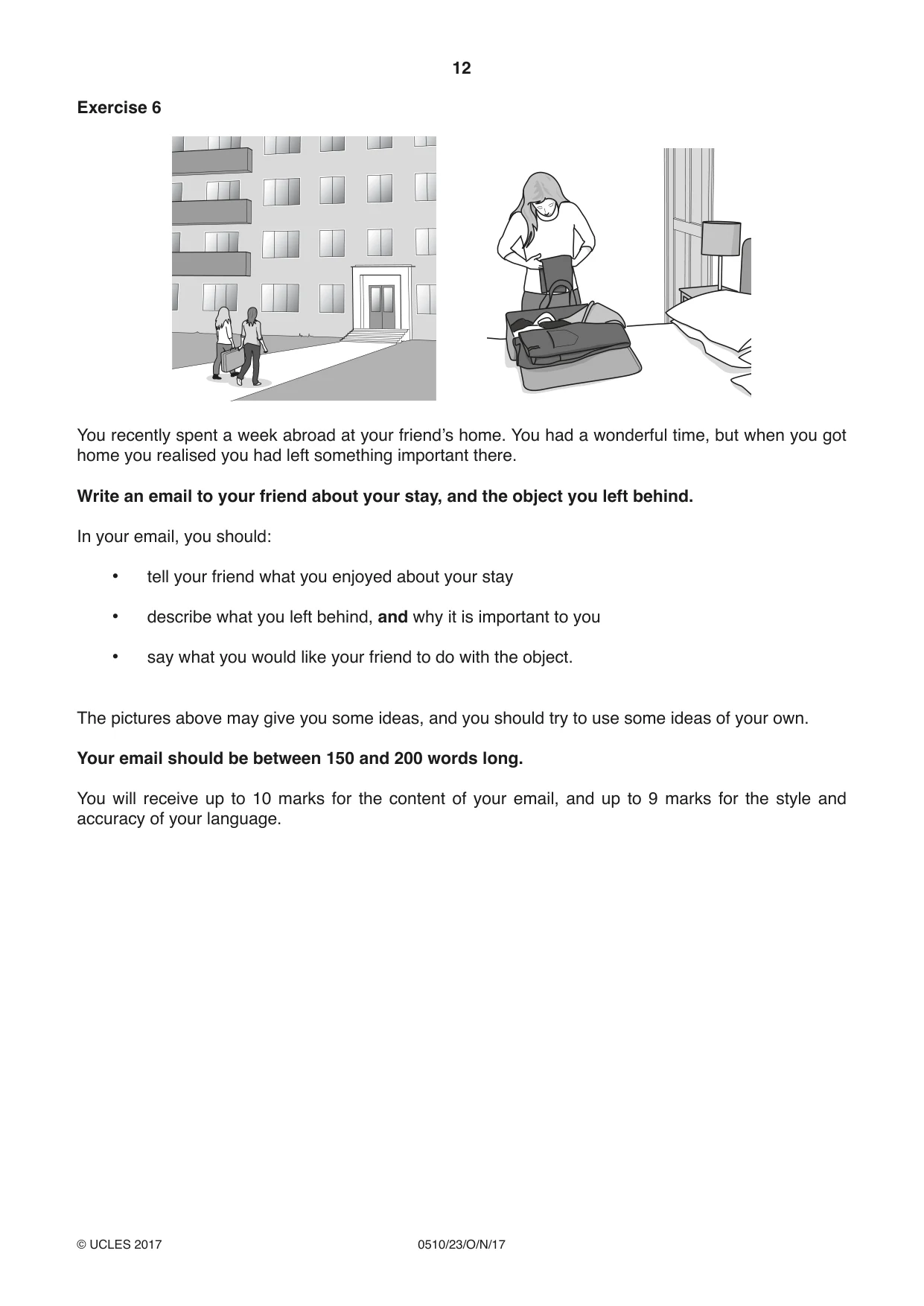
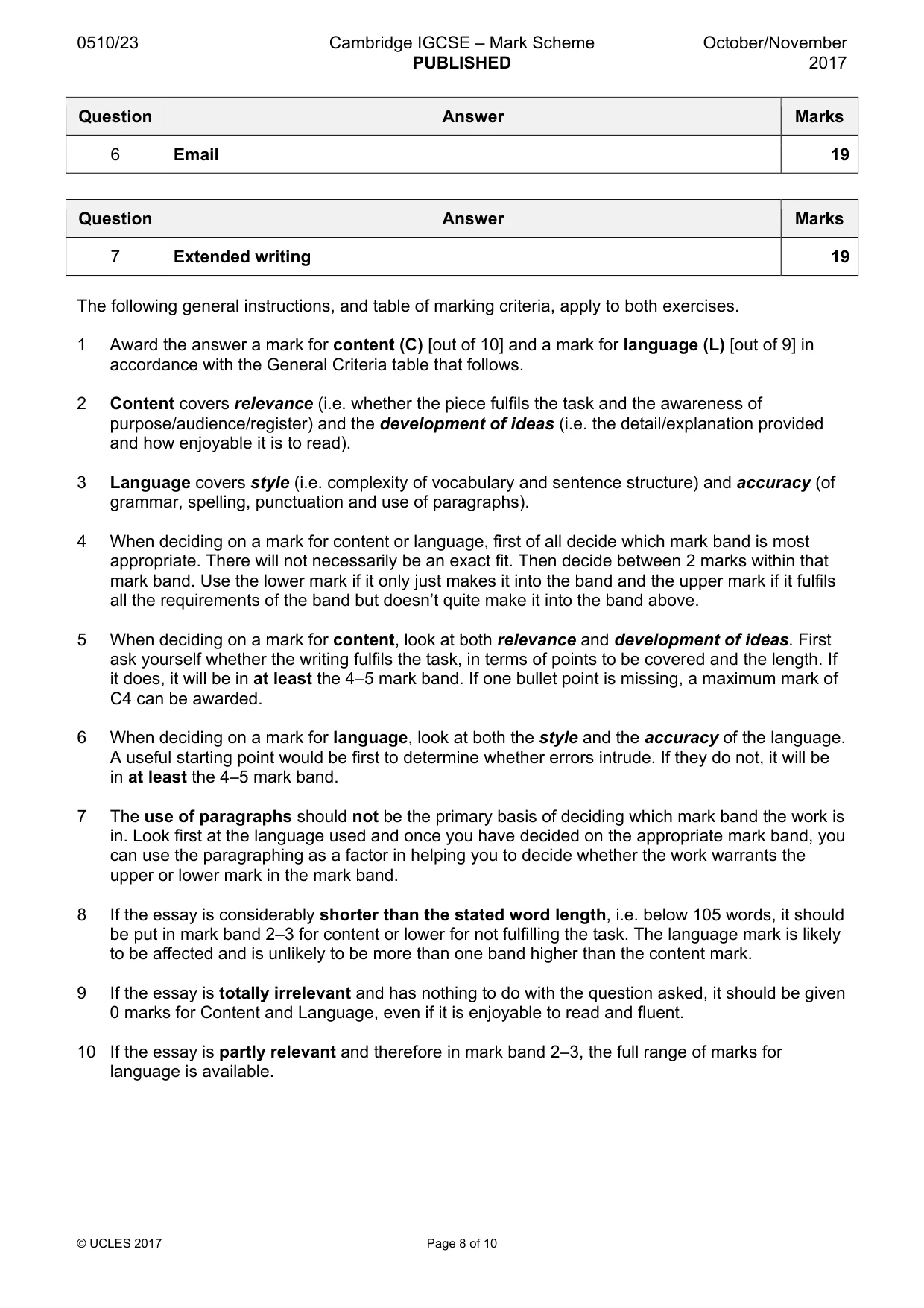
12 0510/23/O/N/17 © UCLES 2017 Exercise 6 You recently spent a week abroad at your friend’s home. You had a wonderful time, but when you got home you realised you had left something important there. Write an email to your friend about your stay, and the object you left behind. In your email, you should: • tell your friend what you enjoyed about your stay • describe what you left behind, and why it is important to you • say what you would like your friend to do with the object. The pictures above may give you some ideas, and you should try to use some ideas of your own. Your email should be between 150 and 200 words long. You will receive up to 10 marks for the content of your email, and up to 9 marks for the style and accuracy of your language.
Question paper, page 13
13 0510/23/O/N/17 © UCLES 2017 [Turn over … … … … … … … … … … … … … … … … … … … … … … … … … … … [Total: 19]
Question paper, page 14
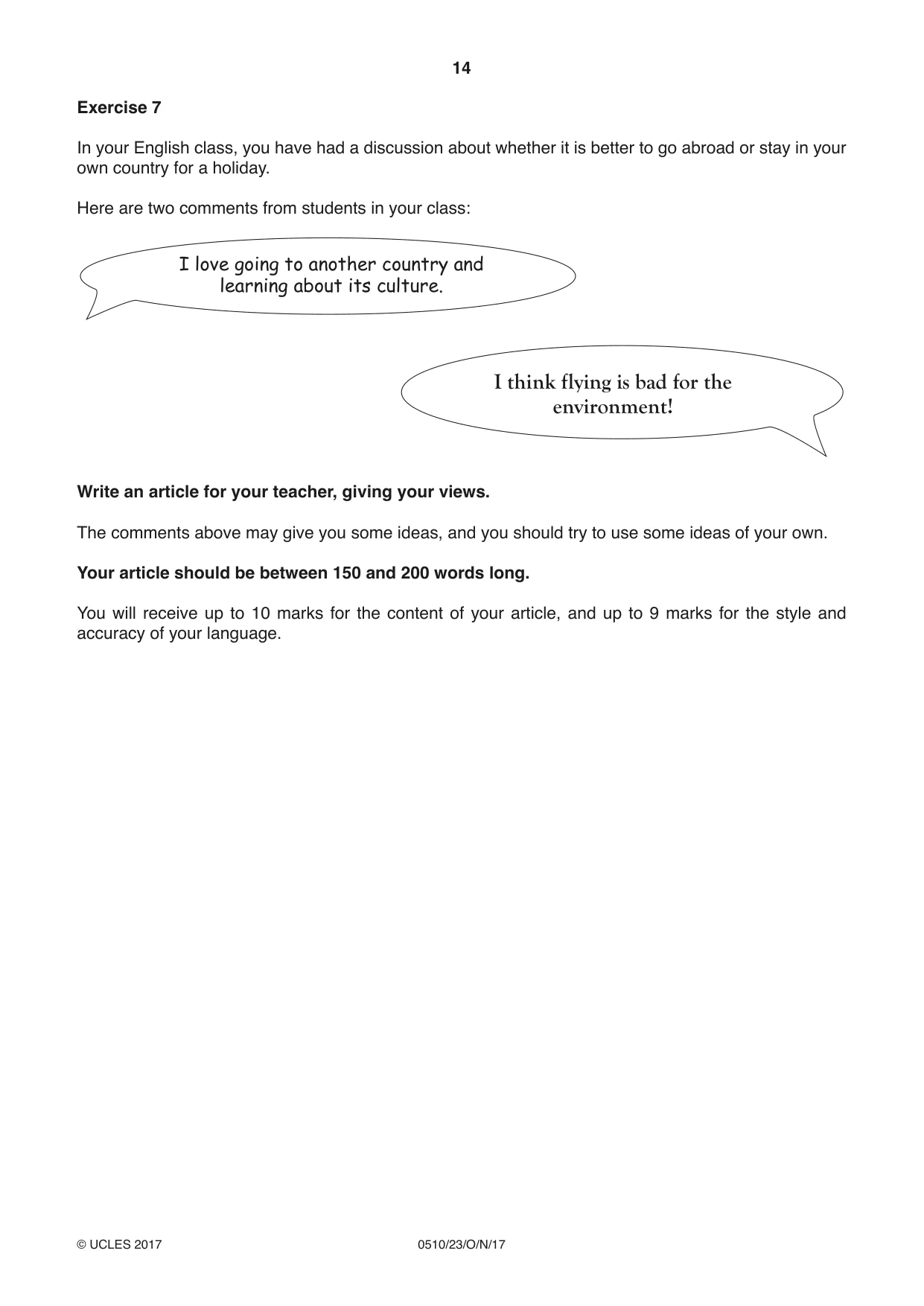
14 0510/23/O/N/17 © UCLES 2017 Exercise 7 In your English class, you have had a discussion about whether it is better to go abroad or stay in your own country for a holiday. Here are two comments from students in your class: I love going to another country and learning about its culture. I think flying is bad for the environment! Write an article for your teacher, giving your views. The comments above may give you some ideas, and you should try to use some ideas of your own. Your article should be between 150 and 200 words long. You will receive up to 10 marks for the content of your article, and up to 9 marks for the style and accuracy of your language.
Question paper, page 15
15 0510/23/O/N/17 © UCLES 2017 … … … … … … … … … … … … … … … … … … … … … … … … … … … [Total: 19]
Question paper, page 16
16 0510/23/O/N/17 © UCLES 2017 Permission to reproduce items where third-party owned material protected by copyright is included has been sought and cleared where possible. Every reasonable effort has been made by the publisher (UCLES) to trace copyright holders, but if any items requiring clearance have unwittingly been included, the publisher will be pleased to make amends at the earliest possible opportunity. To avoid the issue of disclosure of answer-related information to candidates, all copyright acknowledgements are reproduced online in the Cambridge International Examinations Copyright Acknowledgements Booklet. This is produced for each series of examinations and is freely available to download at www.cie.org.uk after the live examination series. Cambridge International Examinations is part of the Cambridge Assessment Group. Cambridge Assessment is the brand name of University of Cambridge Local Examinations Syndicate (UCLES), which is itself a department of the University of Cambridge. BLANK PAGE
Mark scheme, page 1
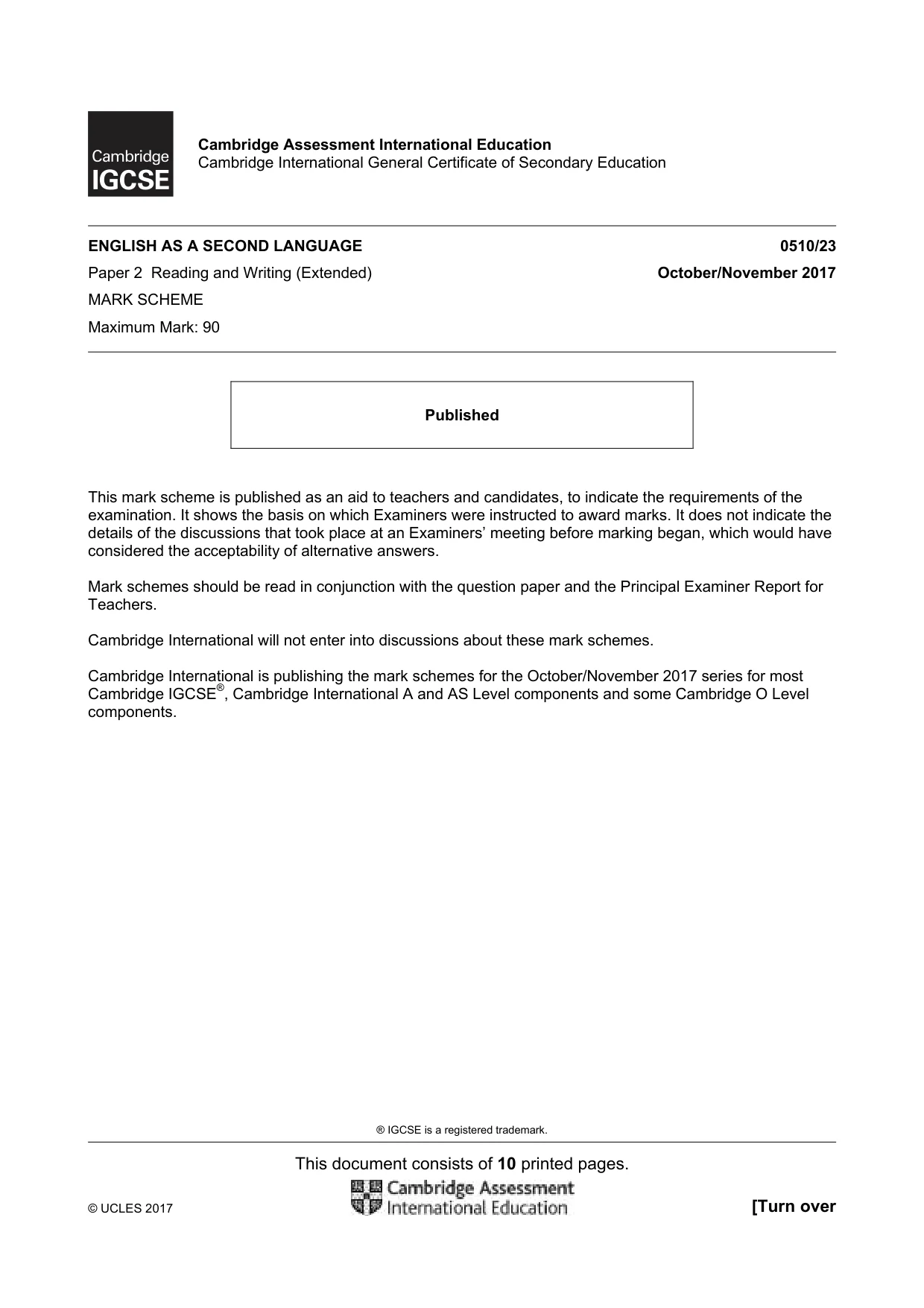
® IGCSE is a registered trademark. This document consists of 10 printed pages. © UCLES 2017 [Turn over Cambridge Assessment International Education Cambridge International General Certificate of Secondary Education ENGLISH AS A SECOND LANGUAGE 0510/23 Paper 2 Reading and Writing (Extended) October/November 2017 MARK SCHEME Maximum Mark: 90 Published This mark scheme is published as an aid to teachers and candidates, to indicate the requirements of the examination. It shows the basis on which Examiners were instructed to award marks. It does not indicate the details of the discussions that took place at an Examiners’ meeting before marking began, which would have considered the acceptability of alternative answers. Mark schemes should be read in conjunction with the question paper and the Principal Examiner Report for Teachers. Cambridge International will not enter into discussions about these mark schemes. Cambridge International is publishing the mark schemes for the October/November 2017 series for most Cambridge IGCSE®, Cambridge International A and AS Level components and some Cambridge O Level components.
Mark scheme, page 2
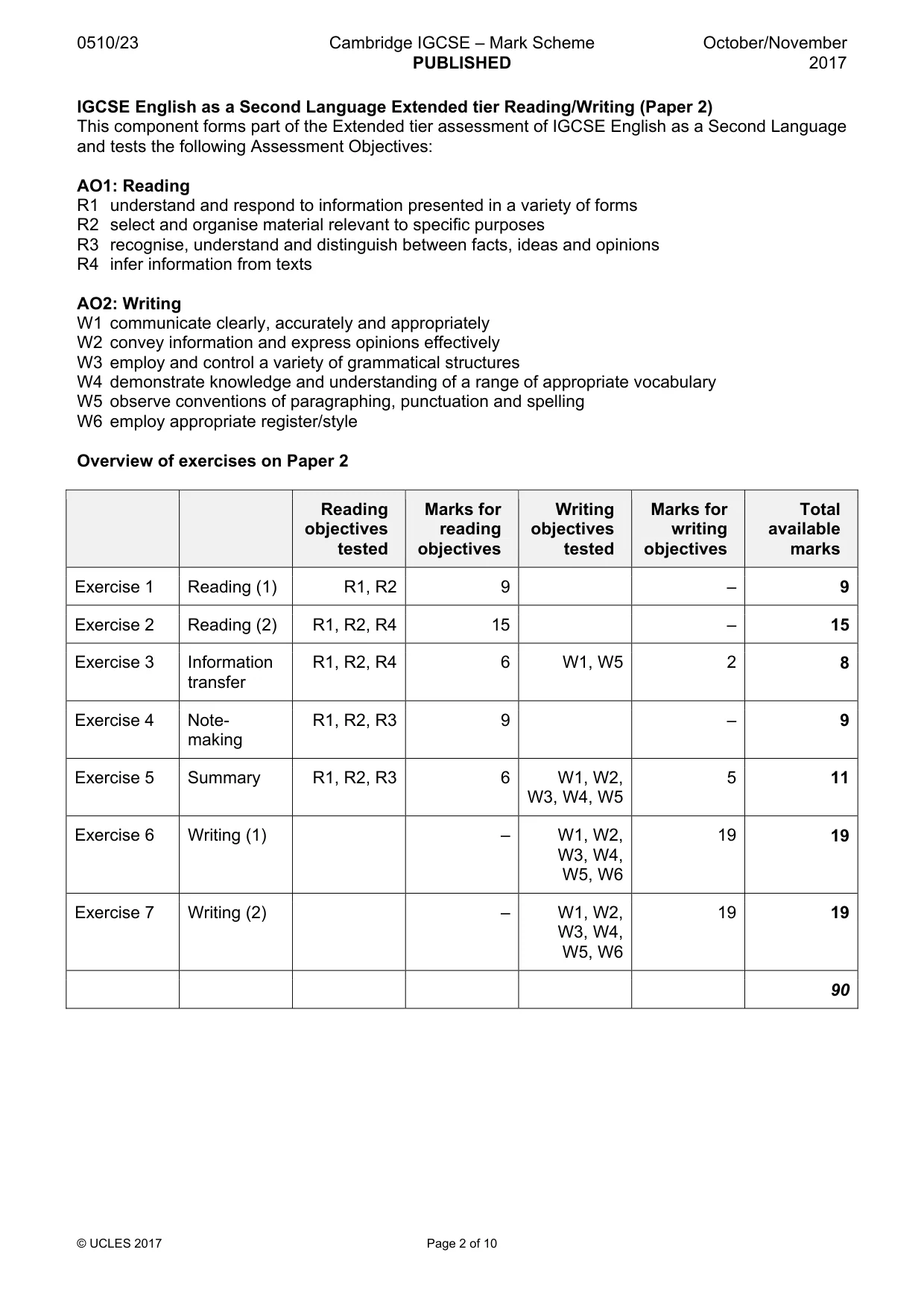
0510/23 Cambridge IGCSE – Mark Scheme PUBLISHED October/November 2017 © UCLES 2017 Page 2 of 10 IGCSE English as a Second Language Extended tier Reading/Writing (Paper 2) This component forms part of the Extended tier assessment of IGCSE English as a Second Language and tests the following Assessment Objectives: AO1: Reading R1 understand and respond to information presented in a variety of forms R2 select and organise material relevant to specific purposes R3 recognise, understand and distinguish between facts, ideas and opinions R4 infer information from texts AO2: Writing W1 communicate clearly, accurately and appropriately W2 convey information and express opinions effectively W3 employ and control a variety of grammatical structures W4 demonstrate knowledge and understanding of a range of appropriate vocabulary W5 observe conventions of paragraphing, punctuation and spelling W6 employ appropriate register/style Overview of exercises on Paper 2 Reading objectives tested Marks for reading objectives Writing objectives tested Marks for writing objectives Total available marks Exercise 1 Reading (1) R1, R2 9 – 9 Exercise 2 Reading (2) R1, R2, R4 15 – 15 Exercise 3 Information transfer R1, R2, R4 6 W1, W5 2 8 Exercise 4 Note- making R1, R2, R3 9 – 9 Exercise 5 Summary R1, R2, R3 6 W1, W2, W3, W4, W5 5 11 Exercise 6 Writing (1) – W1, W2, W3, W4, W5, W6 19 19 Exercise 7 Writing (2) – W1, W2, W3, W4, W5, W6 19 19 90
Mark scheme, page 3
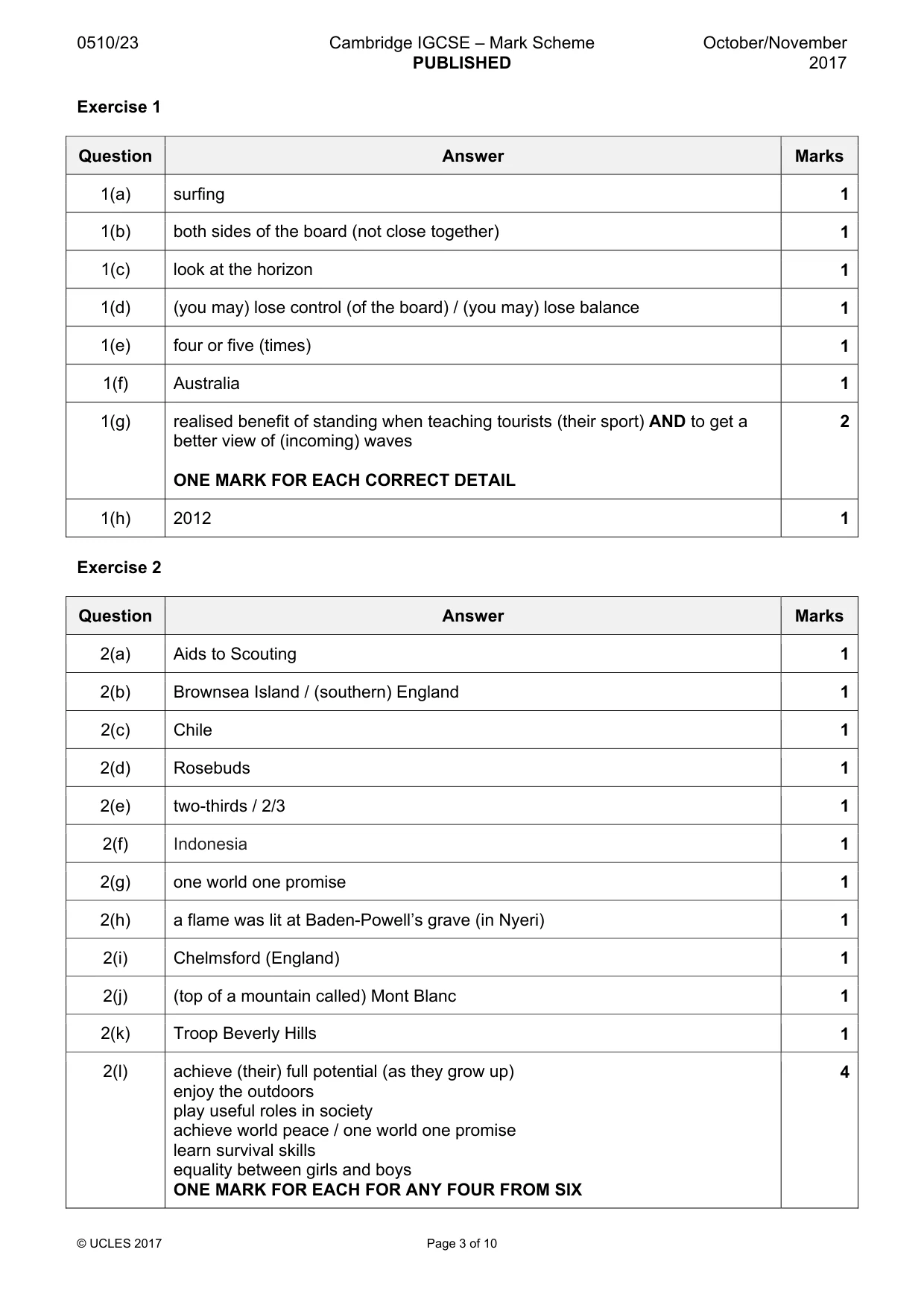
0510/23 Cambridge IGCSE – Mark Scheme PUBLISHED October/November 2017 © UCLES 2017 Page 3 of 10 Exercise 1 Question Answer Marks 1(a) surfing 1 1(b) both sides of the board (not close together) 1 1(c) look at the horizon 1 1(d) (you may) lose control (of the board) / (you may) lose balance 1 1(e) four or five (times) 1 1(f) Australia 1 1(g) realised benefit of standing when teaching tourists (their sport) AND to get a better view of (incoming) waves ONE MARK FOR EACH CORRECT DETAIL 2 1(h) 2012 1 Exercise 2 Question Answer Marks 2(a) Aids to Scouting 1 2(b) Brownsea Island / (southern) England 1 2(c) Chile 1 2(d) Rosebuds 1 2(e) two-thirds / 2/3 1 2(f) Indonesia 1 2(g) one world one promise 1 2(h) a flame was lit at Baden-Powell’s grave (in Nyeri) 1 2(i) Chelmsford (England) 1 2(j) (top of a mountain called) Mont Blanc 1 2(k) Troop Beverly Hills 1 2(l) achieve (their) full potential (as they grow up) enjoy the outdoors play useful roles in society achieve world peace / one world one promise learn survival skills equality between girls and boys ONE MARK FOR EACH FOR ANY FOUR FROM SIX 4
Mark scheme, page 4
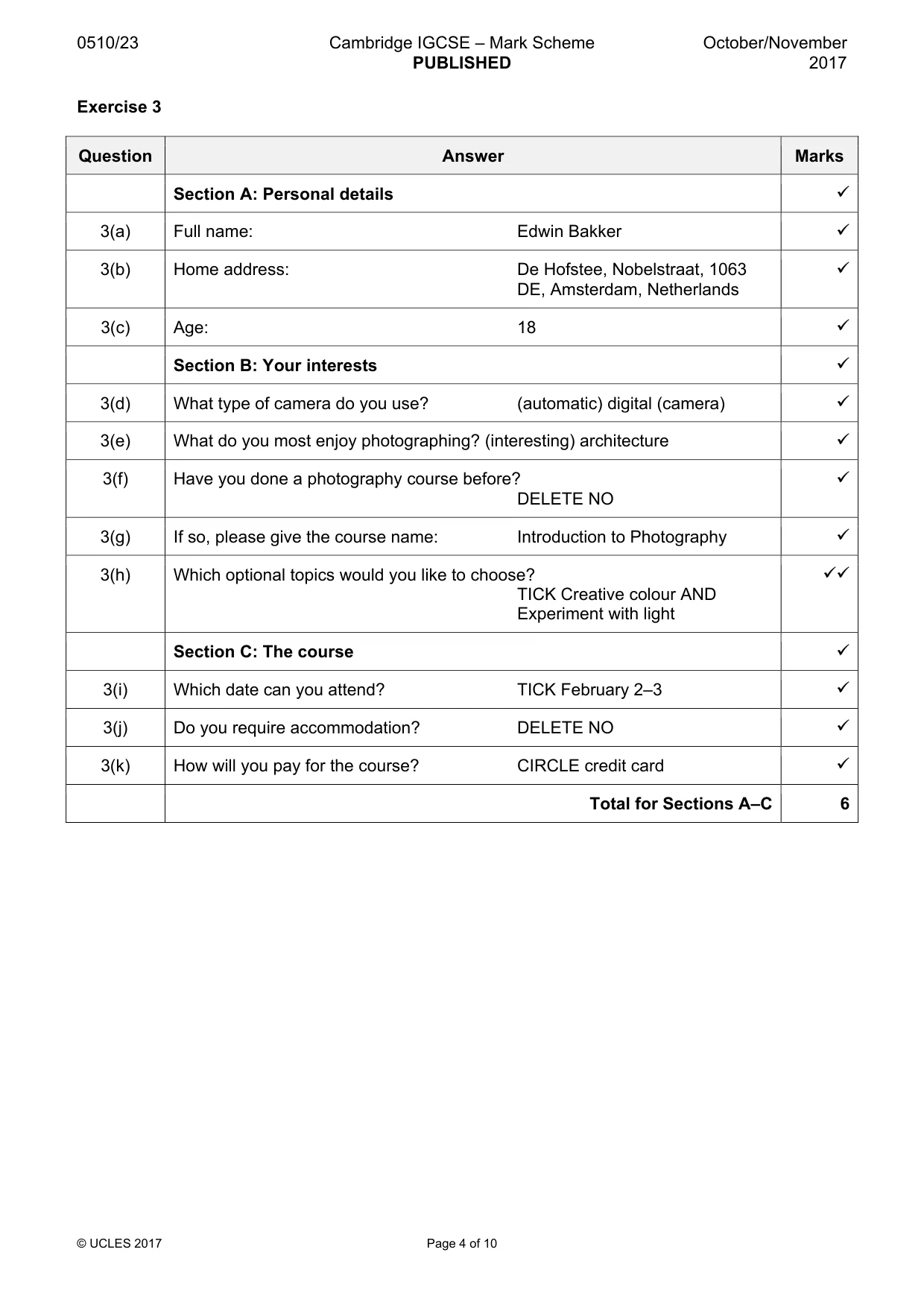
0510/23 Cambridge IGCSE – Mark Scheme PUBLISHED October/November 2017 © UCLES 2017 Page 4 of 10 Exercise 3 Question Answer Marks Section A: Personal details 9 3(a) Full name: Edwin Bakker 9 3(b) Home address: De Hofstee, Nobelstraat, 1063 DE, Amsterdam, Netherlands 9 3(c) Age: 18 9 Section B: Your interests 9 3(d) What type of camera do you use? (automatic) digital (camera) 9 3(e) What do you most enjoy photographing? (interesting) architecture 9 3(f) Have you done a photography course before? DELETE NO 9 3(g) If so, please give the course name: Introduction to Photography 9 3(h) Which optional topics would you like to choose? TICK Creative colour AND Experiment with light 99 Section C: The course 9 3(i) Which date can you attend? TICK February 2–3 9 3(j) Do you require accommodation? DELETE NO 9 3(k) How will you pay for the course? CIRCLE credit card 9 Total for Sections A–C 6
Mark scheme, page 5
0510/23 Cambridge IGCSE – Mark Scheme PUBLISHED October/November 2017 © UCLES 2017 Page 5 of 10 Question Answer Marks Section D Examples of acceptable sentences: I would rather keep it as a hobby, and I would like to buy a better quality camera. (18 words) Photography is my hobby, and I would like to learn more about it. (13 words) Marking Criteria 2 marks: no fewer than 12 and no more than 20 words; proper sentence construction; correct spelling, punctuation and grammar; relevant to context. 1 mark: no fewer than 12 and no more than 20 words; proper sentence construction; 1–3 errors of punctuation / spelling / grammar that do not obscure meaning; relevant to context. 0 marks: more than 3 errors of punctuation / spelling / grammar; and/or irrelevant to context, and/or not a proper sentence; and/or fewer than 12 words or more than 20 words. Absence of a full stop at the end should be considered as 1 punctuation error. Absence of an upper case letter at the beginning should be considered as 1 punctuation error. Omission of a word in the sentence should be considered as 1 grammar error. 2
Mark scheme, page 6
0510/23 Cambridge IGCSE – Mark Scheme PUBLISHED October/November 2017 © UCLES 2017 Page 6 of 10 Exercise 4 Question Answer Marks 4 How to guide a group discussion on art: 1 allow (plenty of) time to look 2 question people about what they are looking at 3 encourage them to share thoughts and ideas (with each other) 4 ask people to explain why the artist has done something / ask people to explain what the artwork means / ask people to explain what the artist is trying to express 5 ask people to try to connect with the art / ask how the art makes them feel / ask if the art reminds them of anything 6 encourage people to extend their responses / ask them to explain further or add more detail Max 5 Examples of follow-up activities to do with your art club: 1 design a postcard 2 produce a leaflet (advertising the exhibition) 3 write a story about a character in a painting 4 role-play an interview with an artist 5 create a piece of art (of their own) Max 4
Mark scheme, page 7
0510/23 Cambridge IGCSE – Mark Scheme PUBLISHED October/November 2017 © UCLES 2017 Page 7 of 10 Exercise 5 Question Answer Marks 5 Content: 1 need strength / determination / discipline /stamina / upper-body strength / to train hard 2 start the day very early / start at 5 am 3 temperature of the water / the low water temperature 4 the training is restricted to between May to September / training is restricted to when temperature ranges from 10–20C 5 tide / waves 6 having to train over longer distances than the competition length 7 weather / strong winds / storms 8 no lines to guide you / lose your sense of direction 9 need to be accompanied 10 jellyfish 11 (suffering from) exhaustion Max 6 Language: 0 marks: no understanding of the task / no relevant content / meaning completely obscure due to serious language inaccuracies 1 mark: copying without discrimination from text / multiple language inaccuracies 2 marks: heavy reliance on language from the text with no attempt to organise and sequence points cohesively / limited language expression making meaning at times unclear 3 marks: some reliance on language from the text, but with an attempt to organise and sequence points cohesively / language satisfactory, but with some inaccuracies 4 marks: good attempt to use own words and to organise and sequence points cohesively / generally good control of language 5 marks: good, concise summary style / very good attempt to use own words and to organise and sequence points cohesively Max 5
Mark scheme, page 8
0510/23 Cambridge IGCSE – Mark Scheme PUBLISHED October/November 2017 © UCLES 2017 Page 8 of 10 Question Answer Marks 6 Email 19 Question Answer Marks 7 Extended writing 19 The following general instructions, and table of marking criteria, apply to both exercises. 1 Award the answer a mark for content (C) [out of 10] and a mark for language (L) [out of 9] in accordance with the General Criteria table that follows. 2 Content covers relevance (i.e. whether the piece fulfils the task and the awareness of purpose/audience/register) and the development of ideas (i.e. the detail/explanation provided and how enjoyable it is to read). 3 Language covers style (i.e. complexity of vocabulary and sentence structure) and accuracy (of grammar, spelling, punctuation and use of paragraphs). 4 When deciding on a mark for content or language, first of all decide which mark band is most appropriate. There will not necessarily be an exact fit. Then decide between 2 marks within that mark band. Use the lower mark if it only just makes it into the band and the upper mark if it fulfils all the requirements of the band but doesn’t quite make it into the band above. 5 When deciding on a mark for content, look at both relevance and development of ideas. First ask yourself whether the writing fulfils the task, in terms of points to be covered and the length. If it does, it will be in at least the 4–5 mark band. If one bullet point is missing, a maximum mark of C4 can be awarded. 6 When deciding on a mark for language, look at both the style and the accuracy of the language. A useful starting point would be first to determine whether errors intrude. If they do not, it will be in at least the 4–5 mark band. 7 The use of paragraphs should not be the primary basis of deciding which mark band the work is in. Look first at the language used and once you have decided on the appropriate mark band, you can use the paragraphing as a factor in helping you to decide whether the work warrants the upper or lower mark in the mark band. 8 If the essay is considerably shorter than the stated word length, i.e. below 105 words, it should be put in mark band 2–3 for content or lower for not fulfilling the task. The language mark is likely to be affected and is unlikely to be more than one band higher than the content mark. 9 If the essay is totally irrelevant and has nothing to do with the question asked, it should be given 0 marks for Content and Language, even if it is enjoyable to read and fluent. 10 If the essay is partly relevant and therefore in mark band 2–3, the full range of marks for language is available.
Mark scheme, page 9
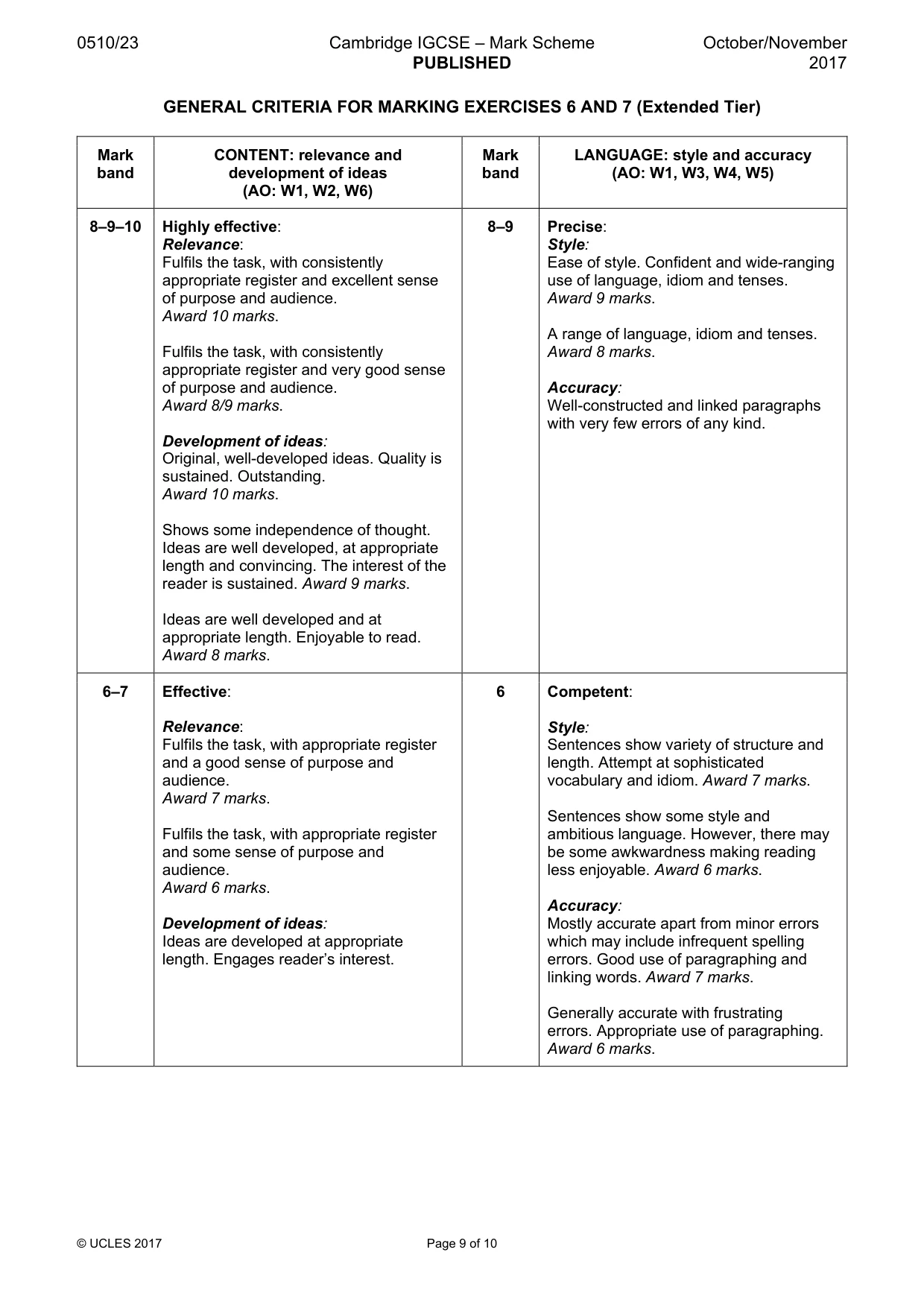
0510/23 Cambridge IGCSE – Mark Scheme PUBLISHED October/November 2017 © UCLES 2017 Page 9 of 10 GENERAL CRITERIA FOR MARKING EXERCISES 6 AND 7 (Extended Tier) Mark band CONTENT: relevance and development of ideas (AO: W1, W2, W6) Mark band LANGUAGE: style and accuracy (AO: W1, W3, W4, W5) 8–9–10 Highly effective: Relevance: Fulfils the task, with consistently appropriate register and excellent sense of purpose and audience. Award 10 marks. Fulfils the task, with consistently appropriate register and very good sense of purpose and audience. Award 8/9 marks. Development of ideas: Original, well-developed ideas. Quality is sustained. Outstanding. Award 10 marks. Shows some independence of thought. Ideas are well developed, at appropriate length and convincing. The interest of the reader is sustained. Award 9 marks. Ideas are well developed and at appropriate length. Enjoyable to read. Award 8 marks. 8–9 Precise: Style: Ease of style. Confident and wide-ranging use of language, idiom and tenses. Award 9 marks. A range of language, idiom and tenses. Award 8 marks. Accuracy: Well-constructed and linked paragraphs with very few errors of any kind. 6–7 Effective: Relevance: Fulfils the task, with appropriate register and a good sense of purpose and audience. Award 7 marks. Fulfils the task, with appropriate register and some sense of purpose and audience. Award 6 marks. Development of ideas: Ideas are developed at appropriate length. Engages reader’s interest. 6 Competent: Style: Sentences show variety of structure and length. Attempt at sophisticated vocabulary and idiom. Award 7 marks. Sentences show some style and ambitious language. However, there may be some awkwardness making reading less enjoyable. Award 6 marks. Accuracy: Mostly accurate apart from minor errors which may include infrequent spelling errors. Good use of paragraphing and linking words. Award 7 marks. Generally accurate with frustrating errors. Appropriate use of paragraphing. Award 6 marks.
Mark scheme, page 10
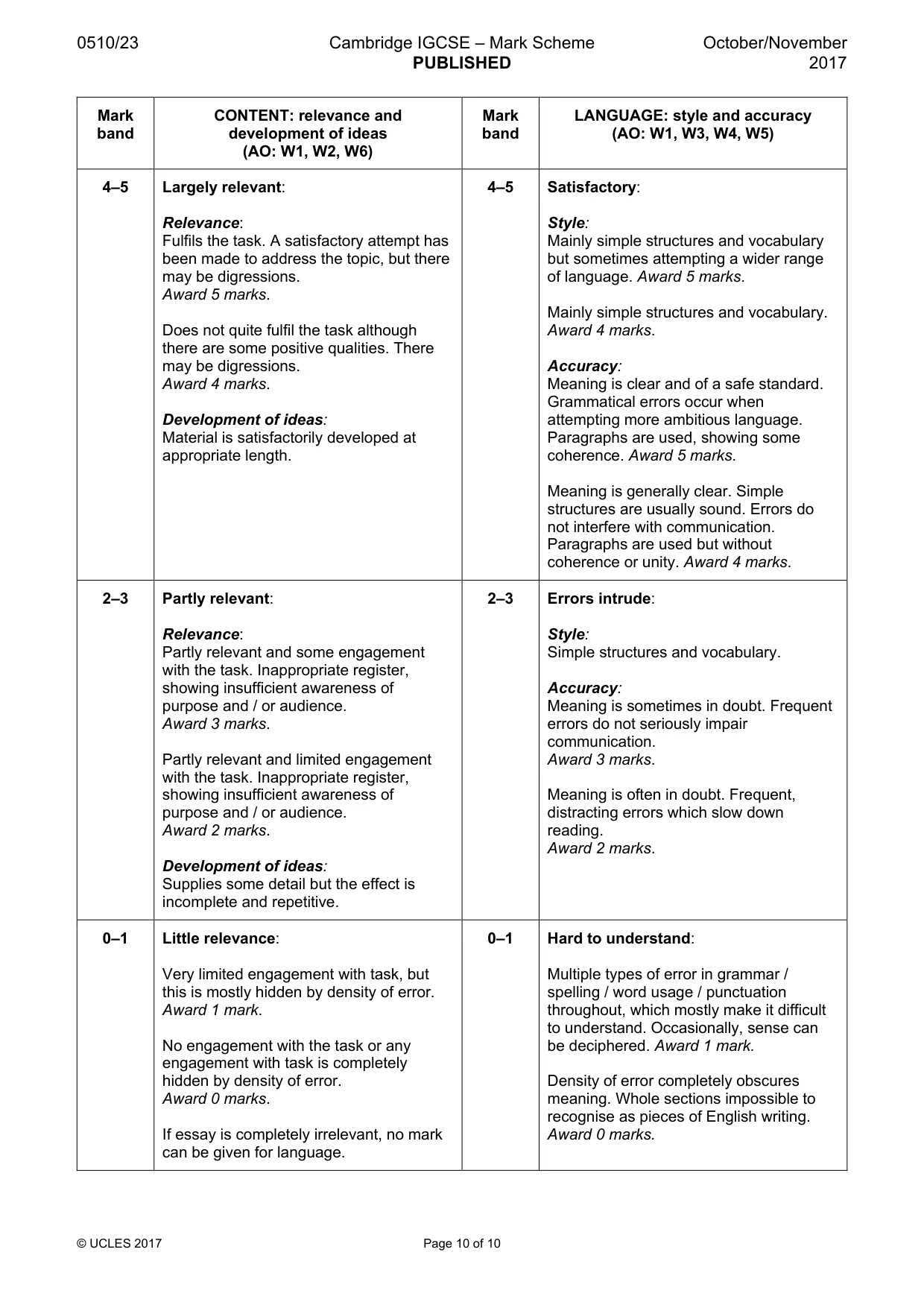
0510/23 Cambridge IGCSE – Mark Scheme PUBLISHED October/November 2017 © UCLES 2017 Page 10 of 10 Mark band CONTENT: relevance and development of ideas (AO: W1, W2, W6) Mark band LANGUAGE: style and accuracy (AO: W1, W3, W4, W5) 4–5 Largely relevant: Relevance: Fulfils the task. A satisfactory attempt has been made to address the topic, but there may be digressions. Award 5 marks. Does not quite fulfil the task although there are some positive qualities. There may be digressions. Award 4 marks. Development of ideas: Material is satisfactorily developed at appropriate length. 4–5 Satisfactory: Style: Mainly simple structures and vocabulary but sometimes attempting a wider range of language. Award 5 marks. Mainly simple structures and vocabulary. Award 4 marks. Accuracy: Meaning is clear and of a safe standard. Grammatical errors occur when attempting more ambitious language. Paragraphs are used, showing some coherence. Award 5 marks. Meaning is generally clear. Simple structures are usually sound. Errors do not interfere with communication. Paragraphs are used but without coherence or unity. Award 4 marks. 2–3 Partly relevant: Relevance: Partly relevant and some engagement with the task. Inappropriate register, showing insufficient awareness of purpose and / or audience. Award 3 marks. Partly relevant and limited engagement with the task. Inappropriate register, showing insufficient awareness of purpose and / or audience. Award 2 marks. Development of ideas: Supplies some detail but the effect is incomplete and repetitive. 2–3 Errors intrude: Style: Simple structures and vocabulary. Accuracy: Meaning is sometimes in doubt. Frequent errors do not seriously impair communication. Award 3 marks. Meaning is often in doubt. Frequent, distracting errors which slow down reading. Award 2 marks. 0–1 Little relevance: Very limited engagement with task, but this is mostly hidden by density of error. Award 1 mark. No engagement with the task or any engagement with task is completely hidden by density of error. Award 0 marks. If essay is completely irrelevant, no mark can be given for language. 0–1 Hard to understand: Multiple types of error in grammar / spelling / word usage / punctuation throughout, which mostly make it difficult to understand. Occasionally, sense can be deciphered. Award 1 mark. Density of error completely obscures meaning. Whole sections impossible to recognise as pieces of English writing. Award 0 marks.
What you needed in this session
Cambridge’s own grade thresholds for 2017 Oct/Nov, Paper 2 · Variant 3. A higher threshold means an easier paper — the bar moves with how the cohort did.