Cambridge IGCSE English - Second Language (oral endorsement) 0510 — 2017 Oct/Nov Paper 2 · Variant 1
0510/21/O/N/17 · 90 marks · ≈101 min
The question paper and its mark scheme, free to read here and free to download. This is Cambridge’s own paper, exactly as it was sat.
Question paper16 pages





Mark scheme12 pages
Answers below. Sit the paper first if you are practising.
Paper as text
Question paper, page 1
This document consists of 15 printed pages and 1 blank page. DC (NH/FC) 135224/3 © UCLES 2017 [Turn over * 2 9 9 3 1 1 1 5 2 3 * ENGLISH AS A SECOND LANGUAGE 0510/21 Paper 2 Reading and Writing (Extended) October/November 2017 2 hours Candidates answer on the Question Paper. No Additional Materials are required. READ THESE INSTRUCTIONS FIRST Write your Centre number, candidate number and name on all the work you hand in. Write in dark blue or black pen. Do not use staples, paper clips, glue or correction fluid. DO NOT WRITE IN ANY BARCODES. Answer all questions. Dictionaries are not allowed. At the end of the examination, fasten all your work securely together. The number of marks is given in brackets [ ] at the end of each question or part question. Cambridge International Examinations Cambridge International General Certificate of Secondary Education
Question paper, page 2
2 0510/21/O/N/17 © UCLES 2017 Exercise 1 Read the leaflet about volunteering for archaeological work, and then answer the following questions. Volunteering for archaeological work How do we know what human life was like hundreds or even thousands of years ago? We know a lot because of archaeologists, who dig up and study the remains of ancient buildings, tools and other objects. They are often helped by volunteers, people who work without being paid. Why volunteer? People volunteer for various reasons. One is to have an unusual family holiday. Another, which is mentioned more than any other, is to learn about the past. Some people want to see if archaeology would be an interesting career. Whatever the reason, it can be a wonderful experience for people of all ages. Finding an archaeological project Many archaeologists encourage volunteers. Volunteering is seen as a way to raise public awareness of archaeology and previous experience is not always necessary. Also, the extra workers help to speed up the project. There are various ways of finding volunteer work, and your best chance is with universities, which usually run a number of projects for students and non-students. Museums also sometimes take volunteers for special projects, and archaeological associations give useful information on opportunities available. You should arrange volunteer work in advance. There are legal reasons why project directors can find it impossible to give you work if you just turn up unexpectedly. Preparing to volunteer When a project has accepted you, there are various things to think about including these obvious points. Firstly, there’s the cost, as volunteers usually pay for accommodation, food and travel. You will also need a strong pair of boots, good work gloves and a sun-hat for outside work. Old clothes are also recommended. You will probably be doing work which is exhausting. You don’t need to be an athlete, but people often don’t remember, or don’t realise, the level of fitness required – make sure you’re ready physically. On site Projects usually take place during the summer and because it may be impossible to work outside in the middle of the day, they generally start very early in the morning. This can be challenging at first, but you have to get used to it. You’ll be in a team led by a trained archaeologist and you’ll probably be using a range of tools to dig and move earth. As with most outdoor activities, there are risks involved, but in order to avoid accidents, a ‘tool talk’ is given to everyone on the site. No-one can predict exactly what you might discover. One volunteer recently uncovered a box full of beautiful 1000-year-old jewellery. Volunteers often come across ancient coins, although pieces of old pots are dug up more than anything else. Most volunteers love the experience, but it’s good to be prepared.
Question paper, page 3
3 0510/21/O/N/17 © UCLES 2017 [Turn over (a) What is the most common reason for volunteering to do archaeological work? …[1] (b) Why do archaeologists often welcome volunteers? Give two details. … …[2] (c) Which organisations offer most archaeological work to volunteers? …[1] (d) What sometimes prevents archaeologists from accepting volunteers who arrive at a site without warning? …[1] (e) What do some volunteers forget about when they are preparing to do archaeological work? …[1] (f) What do new volunteers often find difficult about the work timetable at a site? …[1] (g) How do archaeologists make sure that people on site work safely? …[1] (h) What is the most common object that volunteers discover during archaeological work? …[1] [Total: 9]
Question paper, page 4
4 0510/21/O/N/17 © UCLES 2017 Exercise 2 Read the article about a tree called the mountain ash, and then answer the following questions. The mountain ash tree I have come to a forest on the Australian island of Tasmania, and I am near the top of a mountain ash, one of the tallest trees on earth. I’m here with some scientists who are taking measurements of the tree, and collecting information about the wildlife which lives in it. The insects, possums, reptiles, and even frogs which are found in the treetops rely on rainwater which collects in holes in the tree trunk. One of the scientists, Pete Douglas, suddenly shouts: “There’s a huge hole here full of rainwater! This is the perfect place to observe the wildlife.” We all make our way towards Pete’s discovery. Today is windless and dry, which means that the trunk of the mountain ash tree is its usual whitish-grey colour. In wet weather, however, the tree trunk turns bright green. There are over 140 mountain ash trees more than 85 metres tall in Tasmania, and the one we are climbing is almost 90 metres tall, the height of a thirty-storey building. However, these trees are not as tall as some of the North American giant redwoods, and neither do they live as long – 400 rather than 3000 years – but they are the tallest flowering trees on earth. Most mountain ash trees, however, seem to have a natural height limit. There is a point where they find it difficult to go any further up, and grow wider instead. A tree needs energy to grow taller, and the leaves in the treetop are very important because they absorb energy from sunlight. Treetop leaves also need water, however. The taller a tree is, the harder it becomes for the tree to pull up enough water from the ground to feed those leaves, and they grow less. As a result of this, they capture less energy from the sun, which in turn slows the tree’s growth. One of my fellow climbers, Laura Potter, has been looking closely at the leaves growing at the top of the tree that we are climbing. “The leaves are quite large,” she says. “That’s not what I expected to find, which might mean that the tree hasn’t yet reached its peak height.” Mountain ash trees often die from forest fires before they reach their full height, whereas giant redwoods which are affected by fire grow new branches. Redwoods are also able to produce chemicals that resist diseases. Mountain ash trees, on the other hand, cannot protect themselves like that, and diseases often kill them. The biggest threat to mountain ash trees in the last 200 years, however, has been humans. Logging companies have cut down huge areas of mountain ash forests in order to provide wood for building and other purposes. Moreover, logging businesses in the 19th and 20th centuries generally chose to cut down the giant trees first because these provided more wood. Surprisingly, Pete Douglas and his colleagues are not pessimistic about the future of the tallest mountain ash trees. “Large areas where they grow are now protected by state regulations,” says Pete. Unfortunately, several logging companies have continued to cut down mountain ash trees in unprotected areas. However, even this is changing. Falling prices for mountain ash wood mean that some businesses are abandoning their activities. Pressure from environmental organisations is also forcing them to look for more sustainable sources of wood. Climate change may also affect the mountain ash trees. Scientists don’t yet know, however, whether warmer temperatures will limit the growth of these trees or encourage them to get even taller. Only time will tell. 0 20 40 60 80 100 height in metres Hyperion, California, USA Stratosphere Giant, California, USA Centurion, Tasmania, Australia Icarus Dream, Tasmania, Australia Orokonui, New Zealand 120 140 115.5 m 112 m 99.6 m 97 m 80.5 m mountain ash giant redwood Tallest individual trees alive today
Question paper, page 5
5 0510/21/O/N/17 © UCLES 2017 [Turn over (a) Why is Pete Douglas pleased to find water near the top of the tree? …[1] (b) When does the trunk of the mountain ash tree change colour? …[1] (c) According to the chart, how high is the tallest mountain ash tree alive today? …[1] (d) What happens to mountain ash trees when they stop getting taller? …[1] (e) How does a shortage of water affect the leaves at the top of tall trees? Give two details. … …[2] (f) What has surprised Laura Potter about the tree that she is studying? …[1] (g) What is the most serious danger facing mountain ash trees? …[1] (h) How are governments helping to preserve mountain ash forests? …[1] (i) What factors are causing some companies to stop cutting down mountain ash trees? Give two details. … …[2] (j) What differences are there between mountain ash trees and giant redwood trees? Give four details. … … … …[4] [Total: 15]
Question paper, page 6
6 0510/21/O/N/17 © UCLES 2017 Exercise 3 For the past two years, Domino has been a very keen video games player. Dominic Noles is his real name, but most people call him Domino, even his parents. When his family lived in Australia, he was always busy doing karate, surfing, mountain-biking and other sports. Since they moved to Belgium, however, as his mother recently pointed out, Domino’s only hobbies have been playing his guitar and gaming. Domino has a huge passion for video games. In the eight years since he was introduced to gaming by a cousin, he has played everything from digital drawing and painting games to hugely popular sports games. For about a year, he played an online role-playing game called The Land Beyond. In fact, he spent more hours on that than any other game he has ever played. However, he has recently discovered Questor, an action-adventure game, which he is convinced is the best he has ever seen. It has a reputation for unusual graphics and characters, but it is the fact that it sets complicated challenges that appeals most to Domino. Domino works hard at school, but even though he is only sixteen, he has already decided on a career as a video games designer because he is aware that successful designers are well paid. His friend, Johan, recently told Domino that he had heard of people their age working part-time as video games testers. He wondered if this might provide Domino with some useful experience while he was still at school. Domino thought this made good sense so he asked his computer science teacher if she knew anything about games testing. She recommended that he look at the website of an organisation called Rattler, which runs training courses for games testers. His teacher thought Domino might be suitable for it. The most important things you need, she said, are a logical mind and the ability to focus on details. Domino was pleased because he believes he has both of these. He has looked carefully through the information that Rattler provides online. Three different training programmes are offered. Programme A is an intensive, 60-hour course, Programme B is a 30-hour course designed for people particularly interested in sports games, and Programme C is a 30-hour course that can be taken over six months and covers a wide range of game types. Domino has decided that the last of these would suit him as he could fit it in around his school work. Domino has just set up a new email account as dominogamer1@truemail.com and he will put this in the form instead of the address he has used previously – noles.d@gmail.com – which he felt wasn’t cool enough for a video games tester. He has discussed the course with his parents and is now ready to complete the application form. Imagine you are Domino. Fill in the form, using the information above.
Question paper, page 7
7 0510/21/O/N/17 © UCLES 2017 [Turn over RATTLER – VIDEO GAMES TESTER TRAINING Application form Section A: Personal details Full name: … Age: … Country of residence: … Email: … What interests do you have besides gaming? … Section B: You and video games How long have you been playing video games? … Which type of video games have you played most? Please tick one. action-adventure role-playing art sport What’s the name of your favourite video game? … Why do you like this game so much? … Section C: Video games testing Which of your personal qualities do you think would make you a good video games tester? … How did you first find out about this training to be a video games tester? … Which of the video games tester training programmes would you prefer to do? (please circle) Programme A Programme B Programme C Section D In the space below, write one sentence of between 12 and 20 words saying what kind of work you would like to do in the long-term, and why. [Total: 8]
Question paper, page 8
8 0510/21/O/N/17 © UCLES 2017 Exercise 4 Read the article about Lion Encounter which offers people the chance to walk with young lions, and then complete the notes on the following page. Lion Encounter – walking with lions Mauritius is an island in the Indian Ocean, 2000 kilometres from Africa. It has no native lions, but it is one of the few places on earth where you can walk with them. The Casela Nature Park on the island includes a large area of woodland and grassland which is similar to the landscape that many lions inhabit in Africa. The park provides a home to young lions from various parts of Africa who would not survive in the wild because their mothers have abandoned them. Soon after I arrive, Graeme Bristow, the head of Lion Encounter, goes through some basic information and rules. The two lions we will walk with are both about 18 months old and are very excited to be let out into the open landscape. I feel very nervous when I first catch sight of them – they already weigh one hundred kilogrammes. Graeme and his assistants always accompany visitors on lion walks, and they ensure that all regulations are followed. You have to carry a large stick, which enables a young lion to understand its relationship with you. You do not normally use the stick to hit the lions, but it shows them who is in charge. During the walk, the lions behave like normal wild cats. They are incredibly agile and I watch one jump easily high up into the branches of a tree. We always have to stay behind them so they are in our sight. If we let them get behind us, they might well attack. Sometimes we get close enough to be able to touch them, but it must only be from the neck down – definitely not the head. After a while, I ask Graeme if I can lie on the ground to take a photograph of the lions. “Sure,” he jokes, “if you want it to be your last ever photo.” He’s only half-joking, however. Graeme says: “If lions see that you’re smaller than them, they may think you’re food.” This is why visitors are not allowed on the walk unless they are at least 1.50 metres tall. What’s more, if the lions decide to chase you, running won’t help because over short distances they can easily reach forty kilometres per hour. As I get into position to take the picture, Graeme and his assistant stand close by holding big sticks. Some people criticise projects like these. They say that close contact with humans is unnatural for wild animals, and point out that the animals in the park can never be returned to the wild. They argue that it is better to protect wild animals in their natural environment than in parks like these. Graeme Bristow admits that a park is not ideal, but he claims that seeing the lions close-up helps non-experts like me to understand them better. He is also confident that the experience of walking with lions encourages people to do more to help protect lions’ natural habitat. The rights and wrongs of projects like these are complex, but there is no doubt that walking with lions is a thrilling experience.
Question paper, page 9
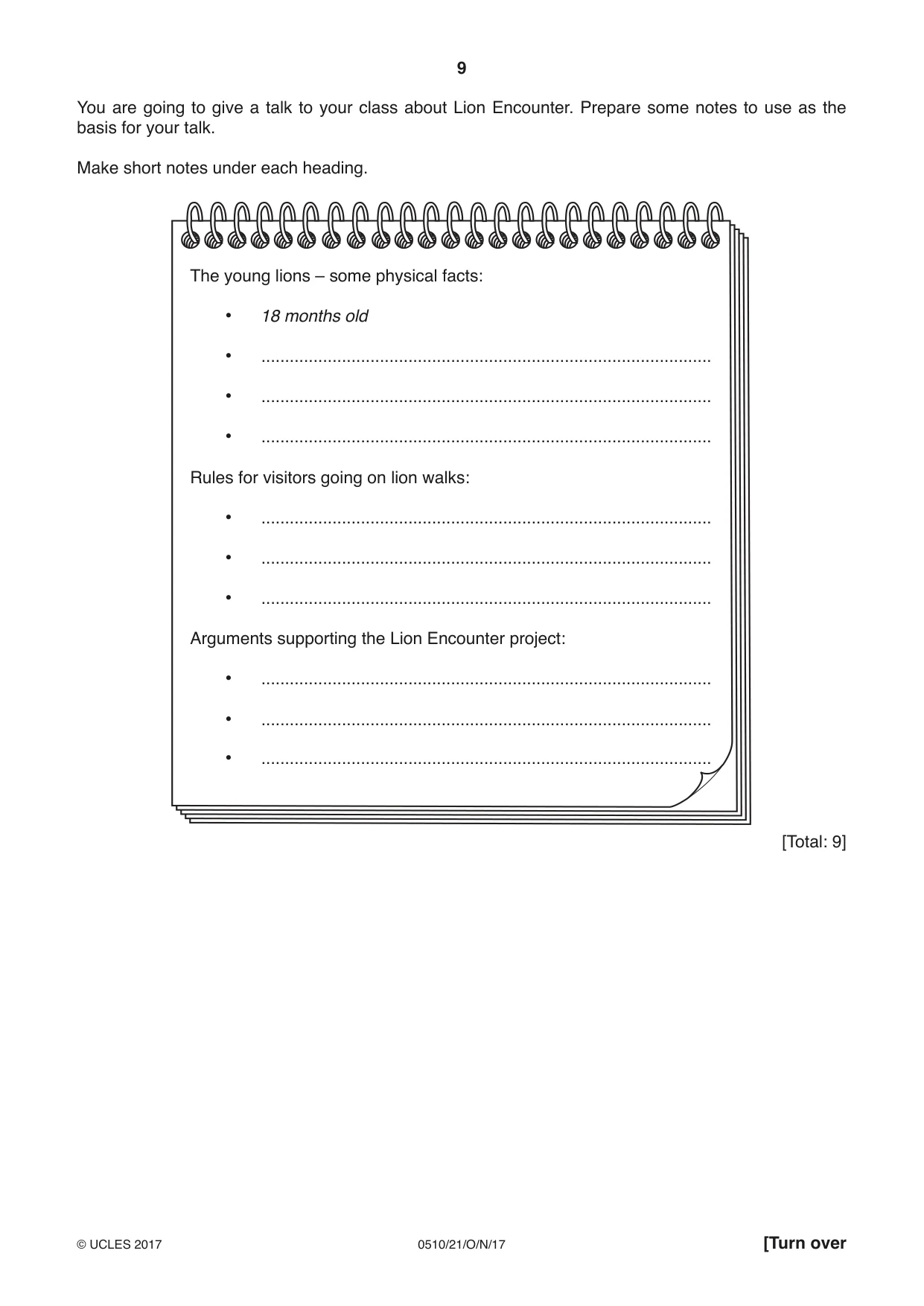
9 0510/21/O/N/17 © UCLES 2017 [Turn over You are going to give a talk to your class about Lion Encounter. Prepare some notes to use as the basis for your talk. Make short notes under each heading. The young lions – some physical facts: • 18 months old • … • … • … Rules for visitors going on lion walks: • … • … • … Arguments supporting the Lion Encounter project: • … • … • … [Total: 9]
Question paper, page 10
10 0510/21/O/N/17 © UCLES 2017 Exercise 5 Read the article about what some song-writers say about writing lyrics, the words for songs. Write a summary about what the song-writers say you should do AND what you should avoid doing in order to write good lyrics. Your summary should be about 100 words long (and no more than 120 words long). You should use your own words as far as possible. You will receive up to 6 marks for the content of your summary, and up to 5 marks for the style and accuracy of your language. Writing lyrics Some of the most popular songs seem so simple that it’s tempting to think that almost anyone could have written them. But what exactly do you have to do to write a good song, and in particular, good lyrics? Jack Wilson, the writer of several recent pop hits, believes that while a lucky few are born with a special talent, song-writing is something that anyone can learn. “I spent years listening carefully to songs by great writers. That taught me a huge amount, and anyone taking up song-writing would benefit from doing a similar thing.” Jack stresses that he doesn’t recommend imitating songs. “Copying doesn’t help as people see through that immediately,” he says. Jack first wrote songs for Mission, an indie rock band that he formed with two school friends. “We had some success in Europe, Australia and Japan with a couple of good songs, but many of the lyrics I wrote at that time were more like poetry than songs. Song lyrics and poems are different things and we shouldn’t mix them up.” Lindy Stringer, who has co-written songs for other artists with Wilson, recalls writing hundreds of songs when she was in a band in her early twenties. “Most were never performed,” she says, “but the more I wrote, the more I understood what was needed.” So, as with many skills, practice is crucial. Lindy gradually realised that her best songs had certain characteristics: they were directed at a particular audience, whether a group of people or an individual, and they were about issues she had strong feelings about. Also, the language she used in them was clear and easy to follow, so that the intended audience could understand the meaning without difficulty. “I think these are basic principles in effective song-writing,” she says. Professional song-writer Graham Platter believes that it is a mistake to worry too much about using correct grammar in lyrics. He points out that some of the most exciting and popular songs in the last fifty years feature combinations of words that writers of traditional grammar books would not accept. “But this kind of language can give a song something special.” Twelve years ago, Platter gave up teaching to write songs full time. He had been trying to write songs for many years with little success. His luck changed when he showed some of his work to an experienced writer, who saw some potential but suggested a few improvements. “Songs which didn’t quite work before were suddenly amazing,” Platter says. “So, asking a ‘song editor’ to take a look at them is something I’d always recommend.” Dee Bloom, a very experienced soul musician, thinks that song-writers often stick to a formula. While this may produce temporary success, in the long-term everything ends up sounding the same and is boring to listen to. So, experts say that writing great song lyrics is not as simple as it might seem. But we all have to start somewhere, don’t we?
Question paper, page 11
11 0510/21/O/N/17 © UCLES 2017 [Turn over … … … … … … … … … … … … … … … … … … … … … … … … … … … [Total: 11]
Question paper, page 12
12 0510/21/O/N/17 © UCLES 2017 Exercise 6 TAXI You have been saving money for something that you have wanted for a long time. Finally, you have been able to buy it. Write an email to a friend about your experience. In your email, you should: • say what you wanted to buy and why • explain how you managed to get the money you needed • describe how you feel now that you have got what you wanted. The pictures above may give you some ideas, and you should try to use some ideas of your own. Your email should be between 150 and 200 words long. You will receive up to 10 marks for the content of your email, and up to 9 marks for the style and accuracy of your language.
Question paper, page 13
13 0510/21/O/N/17 © UCLES 2017 [Turn over … … … … … … … … … … … … … … … … … … … … … … … … … … … [Total: 19]
Question paper, page 14
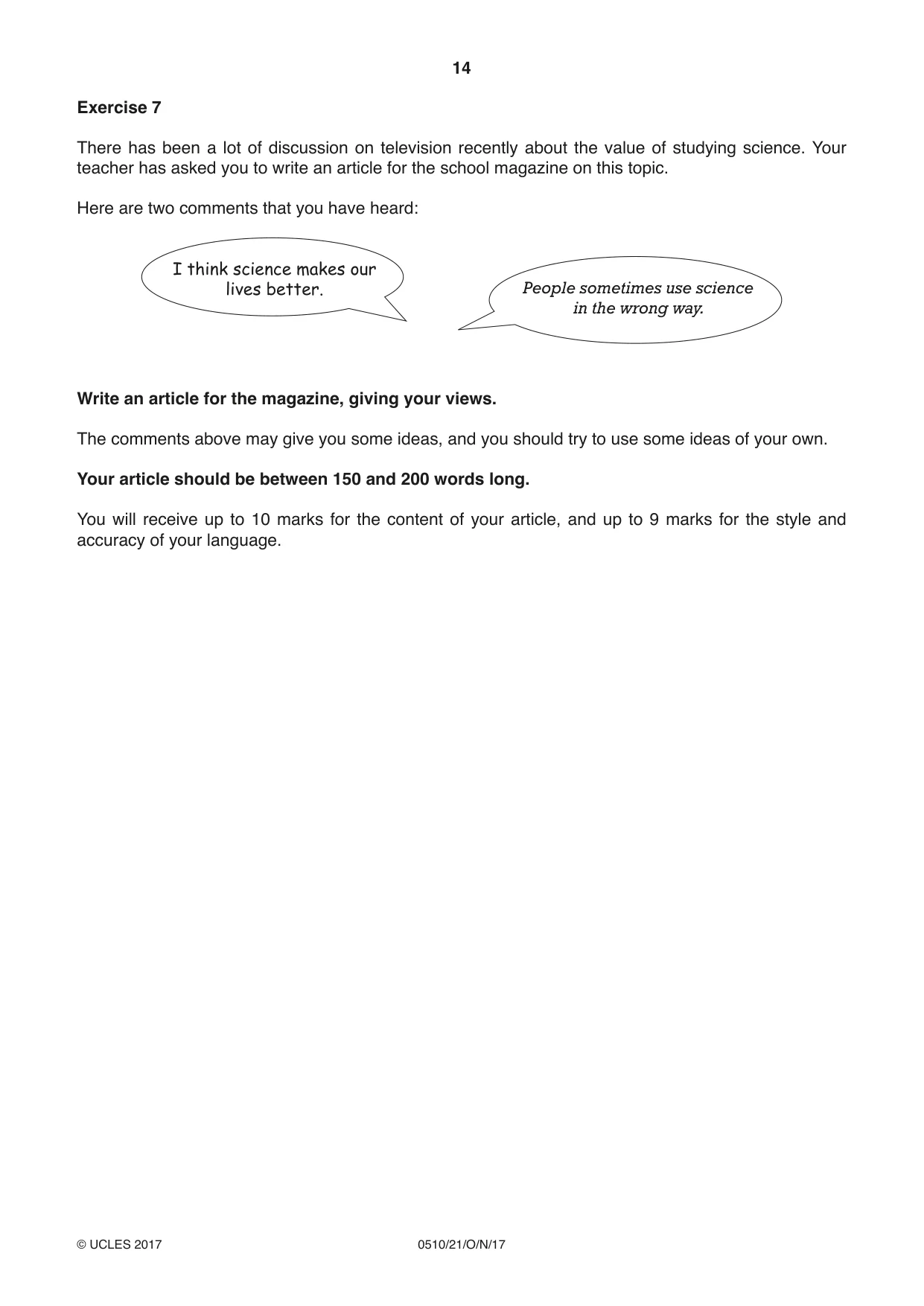
14 0510/21/O/N/17 © UCLES 2017 Exercise 7 There has been a lot of discussion on television recently about the value of studying science. Your teacher has asked you to write an article for the school magazine on this topic. Here are two comments that you have heard: I think science makes our lives better. People sometimes use science in the wrong way. Write an article for the magazine, giving your views. The comments above may give you some ideas, and you should try to use some ideas of your own. Your article should be between 150 and 200 words long. You will receive up to 10 marks for the content of your article, and up to 9 marks for the style and accuracy of your language.
Question paper, page 15
15 0510/21/O/N/17 © UCLES 2017 … … … … … … … … … … … … … … … … … … … … … … … … … … … [Total: 19]
Question paper, page 16
16 0510/21/O/N/17 © UCLES 2017 Permission to reproduce items where third-party owned material protected by copyright is included has been sought and cleared where possible. Every reasonable effort has been made by the publisher (UCLES) to trace copyright holders, but if any items requiring clearance have unwittingly been included, the publisher will be pleased to make amends at the earliest possible opportunity. To avoid the issue of disclosure of answer-related information to candidates, all copyright acknowledgements are reproduced online in the Cambridge International Examinations Copyright Acknowledgements Booklet. This is produced for each series of examinations and is freely available to download at www.cie.org.uk after the live examination series. Cambridge International Examinations is part of the Cambridge Assessment Group. Cambridge Assessment is the brand name of University of Cambridge Local Examinations Syndicate (UCLES), which is itself a department of the University of Cambridge. BLANK PAGE
Mark scheme, page 1
® IGCSE is a registered trademark. This document consists of 12 printed pages. © UCLES 2017 [Turn over Cambridge Assessment International Education Cambridge International General Certificate of Secondary Education ENGLISH AS A SECOND LANGUAGE 0510/21 Paper 2 Reading and Writing (Extended) October/November 2017 MARK SCHEME Maximum Mark: 90 Published This mark scheme is published as an aid to teachers and candidates, to indicate the requirements of the examination. It shows the basis on which Examiners were instructed to award marks. It does not indicate the details of the discussions that took place at an Examiners’ meeting before marking began, which would have considered the acceptability of alternative answers. Mark schemes should be read in conjunction with the question paper and the Principal Examiner Report for Teachers. Cambridge International will not enter into discussions about these mark schemes. Cambridge International is publishing the mark schemes for the October/November 2017 series for most Cambridge IGCSE®, Cambridge International A and AS Level components and some Cambridge O Level components.
Mark scheme, page 2
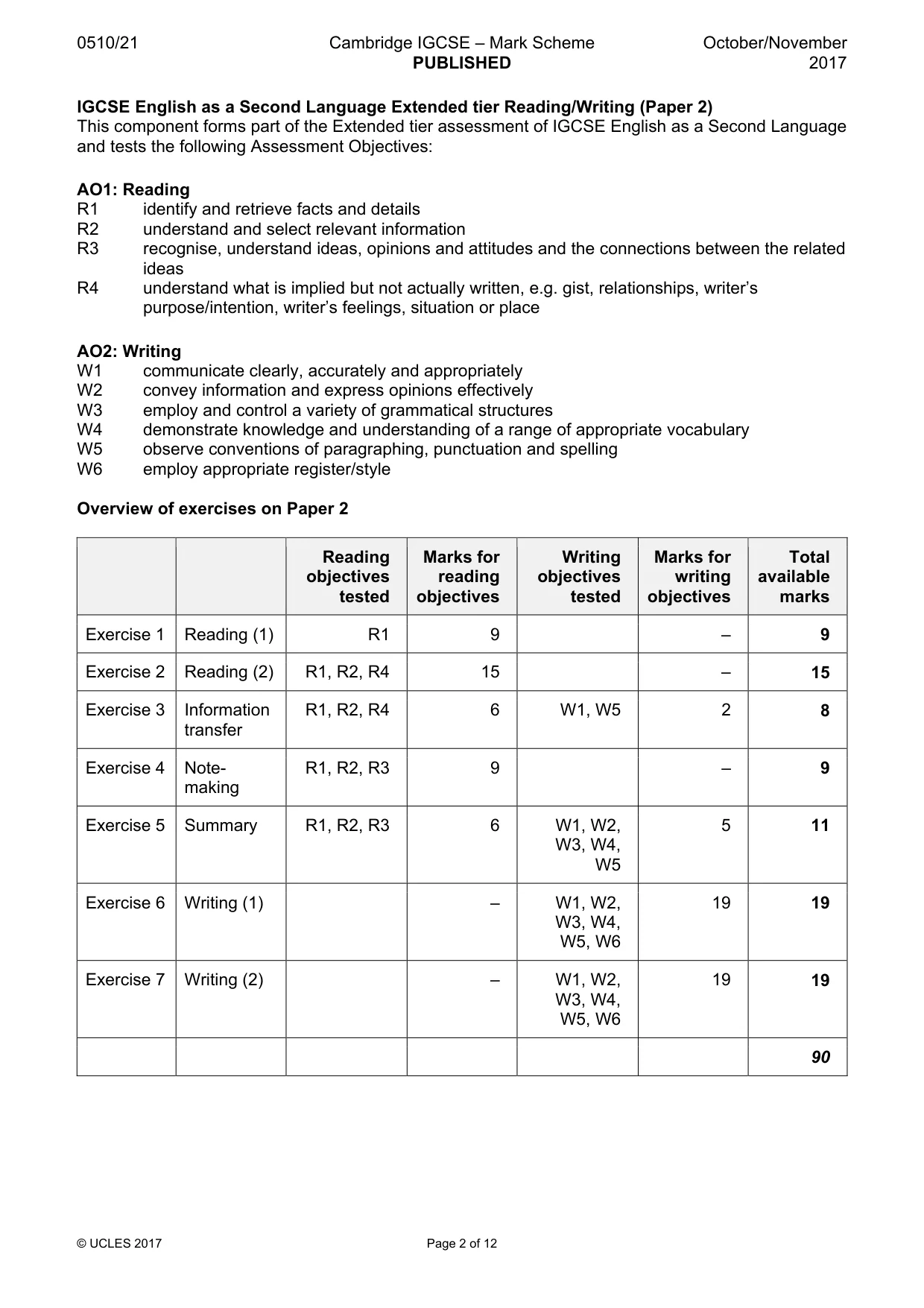
0510/21 Cambridge IGCSE – Mark Scheme PUBLISHED October/November 2017 © UCLES 2017 Page 2 of 12 IGCSE English as a Second Language Extended tier Reading/Writing (Paper 2) This component forms part of the Extended tier assessment of IGCSE English as a Second Language and tests the following Assessment Objectives: AO1: Reading R1 identify and retrieve facts and details R2 understand and select relevant information R3 recognise, understand ideas, opinions and attitudes and the connections between the related ideas R4 understand what is implied but not actually written, e.g. gist, relationships, writer’s purpose/intention, writer’s feelings, situation or place AO2: Writing W1 communicate clearly, accurately and appropriately W2 convey information and express opinions effectively W3 employ and control a variety of grammatical structures W4 demonstrate knowledge and understanding of a range of appropriate vocabulary W5 observe conventions of paragraphing, punctuation and spelling W6 employ appropriate register/style Overview of exercises on Paper 2 Reading objectives tested Marks for reading objectives Writing objectives tested Marks for writing objectives Total available marks Exercise 1 Reading (1) R1 9 – 9 Exercise 2 Reading (2) R1, R2, R4 15 – 15 Exercise 3 Information transfer R1, R2, R4 6 W1, W5 2 8 Exercise 4 Note- making R1, R2, R3 9 – 9 Exercise 5 Summary R1, R2, R3 6 W1, W2, W3, W4, W5 5 11 Exercise 6 Writing (1) – W1, W2, W3, W4, W5, W6 19 19 Exercise 7 Writing (2) – W1, W2, W3, W4, W5, W6 19 19 90
Mark scheme, page 3
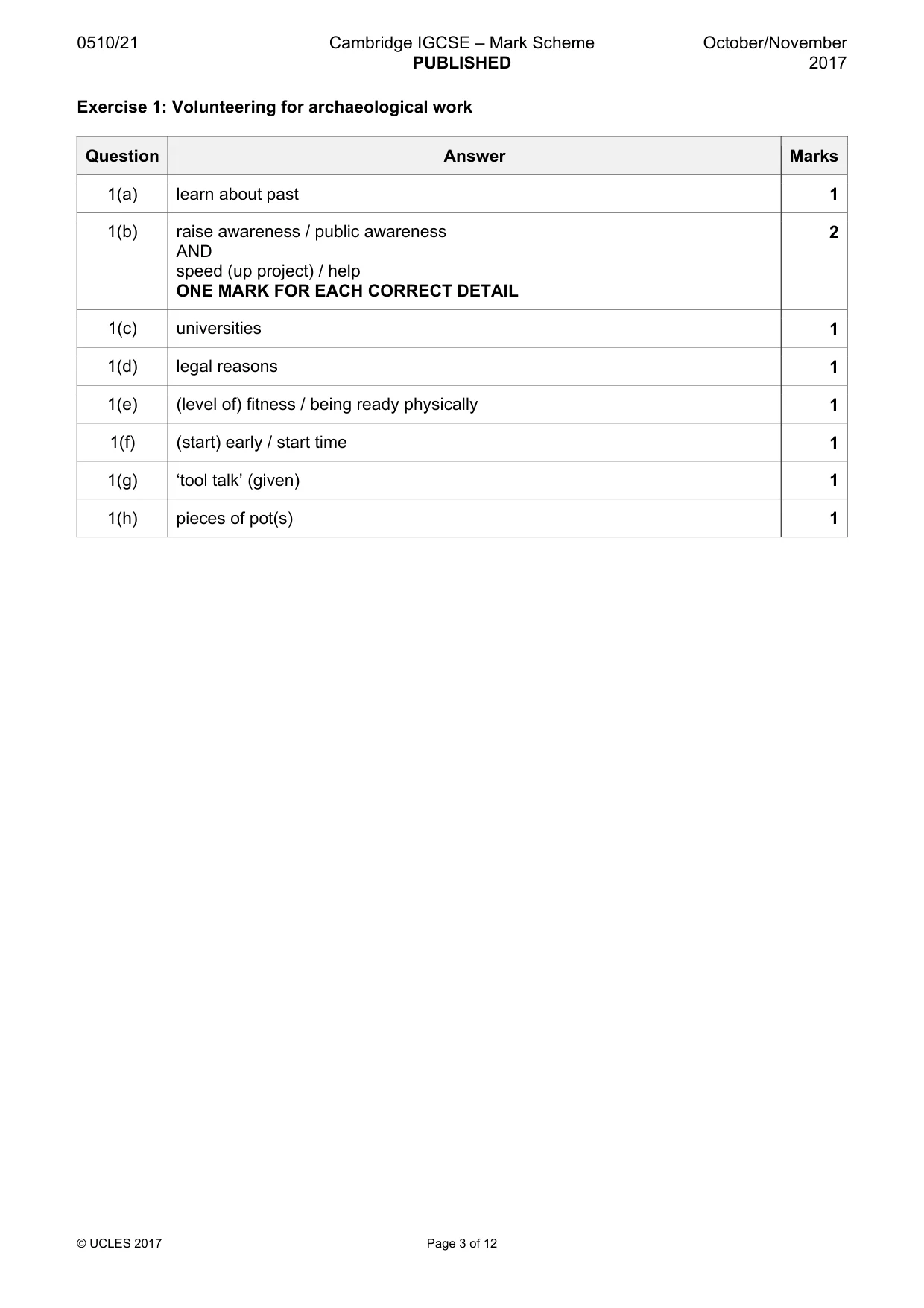
0510/21 Cambridge IGCSE – Mark Scheme PUBLISHED October/November 2017 © UCLES 2017 Page 3 of 12 Exercise 1: Volunteering for archaeological work Question Answer Marks 1(a) learn about past 1 1(b) raise awareness / public awareness AND speed (up project) / help ONE MARK FOR EACH CORRECT DETAIL 2 1(c) universities 1 1(d) legal reasons 1 1(e) (level of) fitness / being ready physically 1 1(f) (start) early / start time 1 1(g) ‘tool talk’ (given) 1 1(h) pieces of pot(s) 1
Mark scheme, page 4
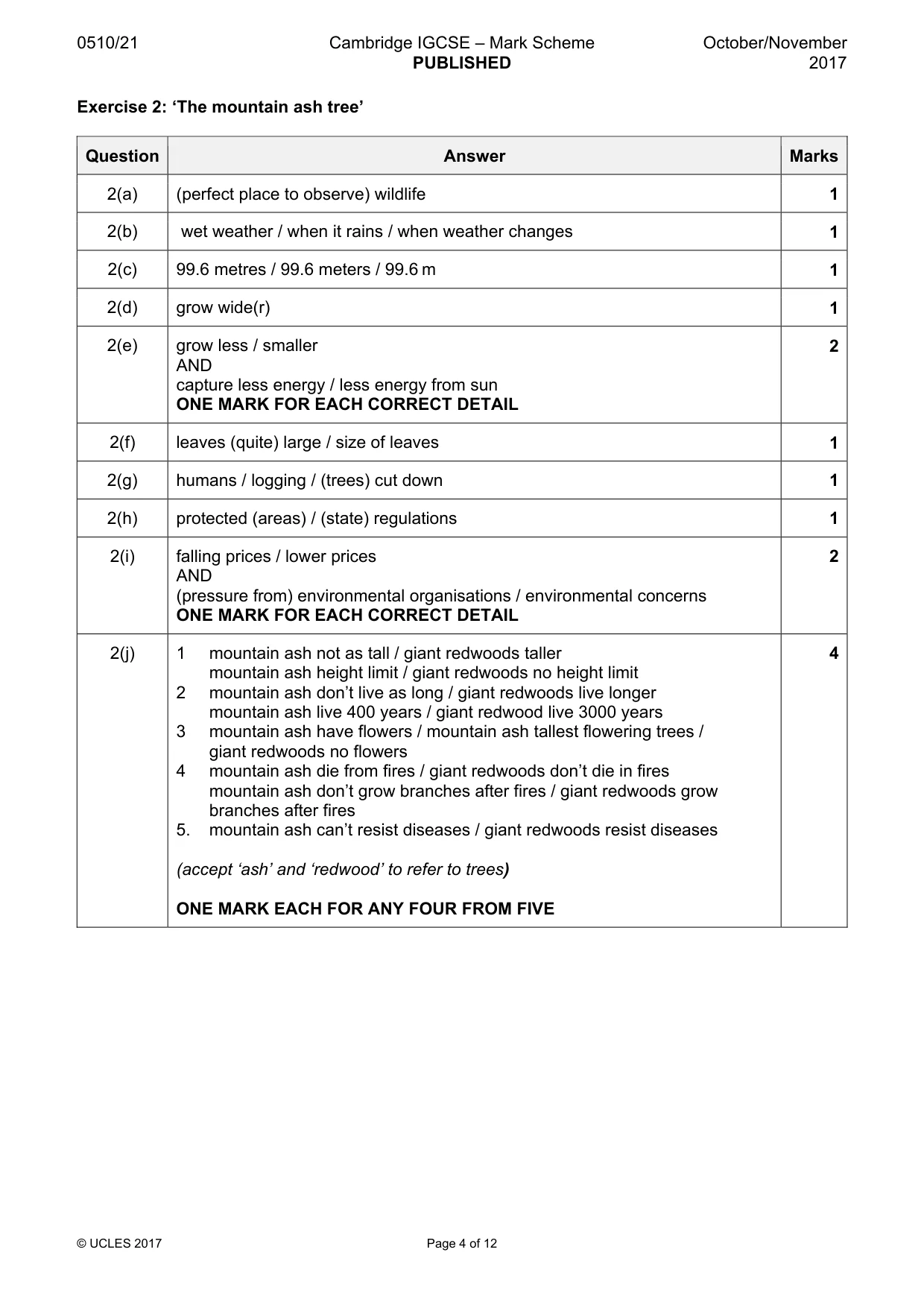
0510/21 Cambridge IGCSE – Mark Scheme PUBLISHED October/November 2017 © UCLES 2017 Page 4 of 12 Exercise 2: ‘The mountain ash tree’ Question Answer Marks 2(a) (perfect place to observe) wildlife 1 2(b) wet weather / when it rains / when weather changes 1 2(c) 99.6 metres / 99.6 meters / 99.6 m 1 2(d) grow wide(r) 1 2(e) grow less / smaller AND capture less energy / less energy from sun ONE MARK FOR EACH CORRECT DETAIL 2 2(f) leaves (quite) large / size of leaves 1 2(g) humans / logging / (trees) cut down 1 2(h) protected (areas) / (state) regulations 1 2(i) falling prices / lower prices AND (pressure from) environmental organisations / environmental concerns ONE MARK FOR EACH CORRECT DETAIL 2 2(j) 1 mountain ash not as tall / giant redwoods taller mountain ash height limit / giant redwoods no height limit 2 mountain ash don’t live as long / giant redwoods live longer mountain ash live 400 years / giant redwood live 3000 years 3 mountain ash have flowers / mountain ash tallest flowering trees / giant redwoods no flowers 4 mountain ash die from fires / giant redwoods don’t die in fires mountain ash don’t grow branches after fires / giant redwoods grow branches after fires 5. mountain ash can’t resist diseases / giant redwoods resist diseases (accept ‘ash’ and ‘redwood’ to refer to trees) ONE MARK EACH FOR ANY FOUR FROM FIVE 4
Mark scheme, page 5
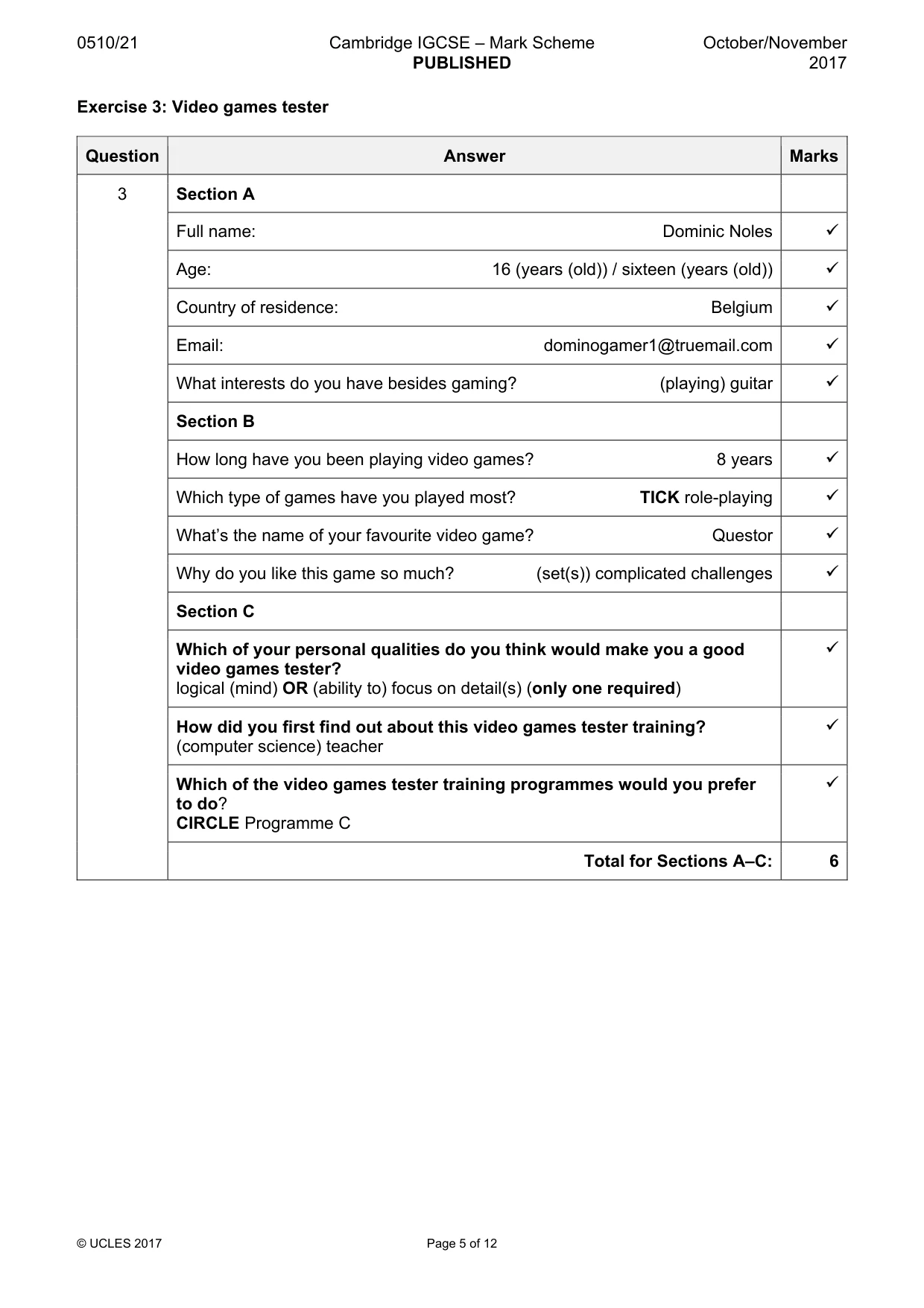
0510/21 Cambridge IGCSE – Mark Scheme PUBLISHED October/November 2017 © UCLES 2017 Page 5 of 12 Exercise 3: Video games tester Question Answer Marks 3 Section A Full name: Dominic Noles 9 Age: 16 (years (old)) / sixteen (years (old)) 9 Country of residence: Belgium 9 Email: dominogamer1@truemail.com 9 What interests do you have besides gaming? (playing) guitar 9 Section B How long have you been playing video games? 8 years 9 Which type of games have you played most? TICK role-playing 9 What’s the name of your favourite video game? Questor 9 Why do you like this game so much? (set(s)) complicated challenges 9 Section C Which of your personal qualities do you think would make you a good video games tester? logical (mind) OR (ability to) focus on detail(s) (only one required) 9 How did you first find out about this video games tester training? (computer science) teacher 9 Which of the video games tester training programmes would you prefer to do? CIRCLE Programme C 9 Total for Sections A–C: 6
Mark scheme, page 6
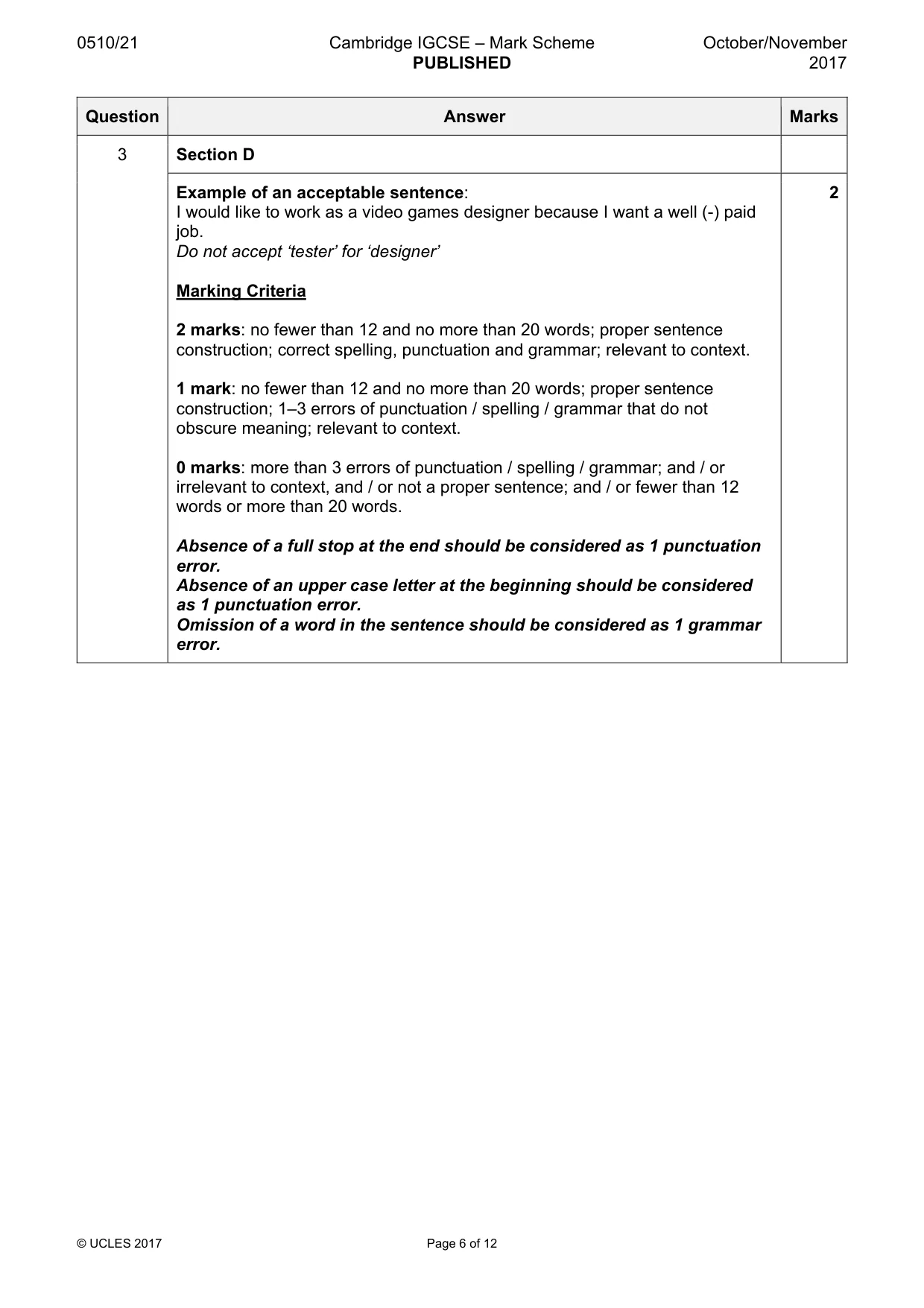
0510/21 Cambridge IGCSE – Mark Scheme PUBLISHED October/November 2017 © UCLES 2017 Page 6 of 12 Question Answer Marks 3 Section D Example of an acceptable sentence: I would like to work as a video games designer because I want a well (-) paid job. Do not accept ‘tester’ for ‘designer’ Marking Criteria 2 marks: no fewer than 12 and no more than 20 words; proper sentence construction; correct spelling, punctuation and grammar; relevant to context. 1 mark: no fewer than 12 and no more than 20 words; proper sentence construction; 1–3 errors of punctuation / spelling / grammar that do not obscure meaning; relevant to context. 0 marks: more than 3 errors of punctuation / spelling / grammar; and / or irrelevant to context, and / or not a proper sentence; and / or fewer than 12 words or more than 20 words. Absence of a full stop at the end should be considered as 1 punctuation error. Absence of an upper case letter at the beginning should be considered as 1 punctuation error. Omission of a word in the sentence should be considered as 1 grammar error. 2
Mark scheme, page 7
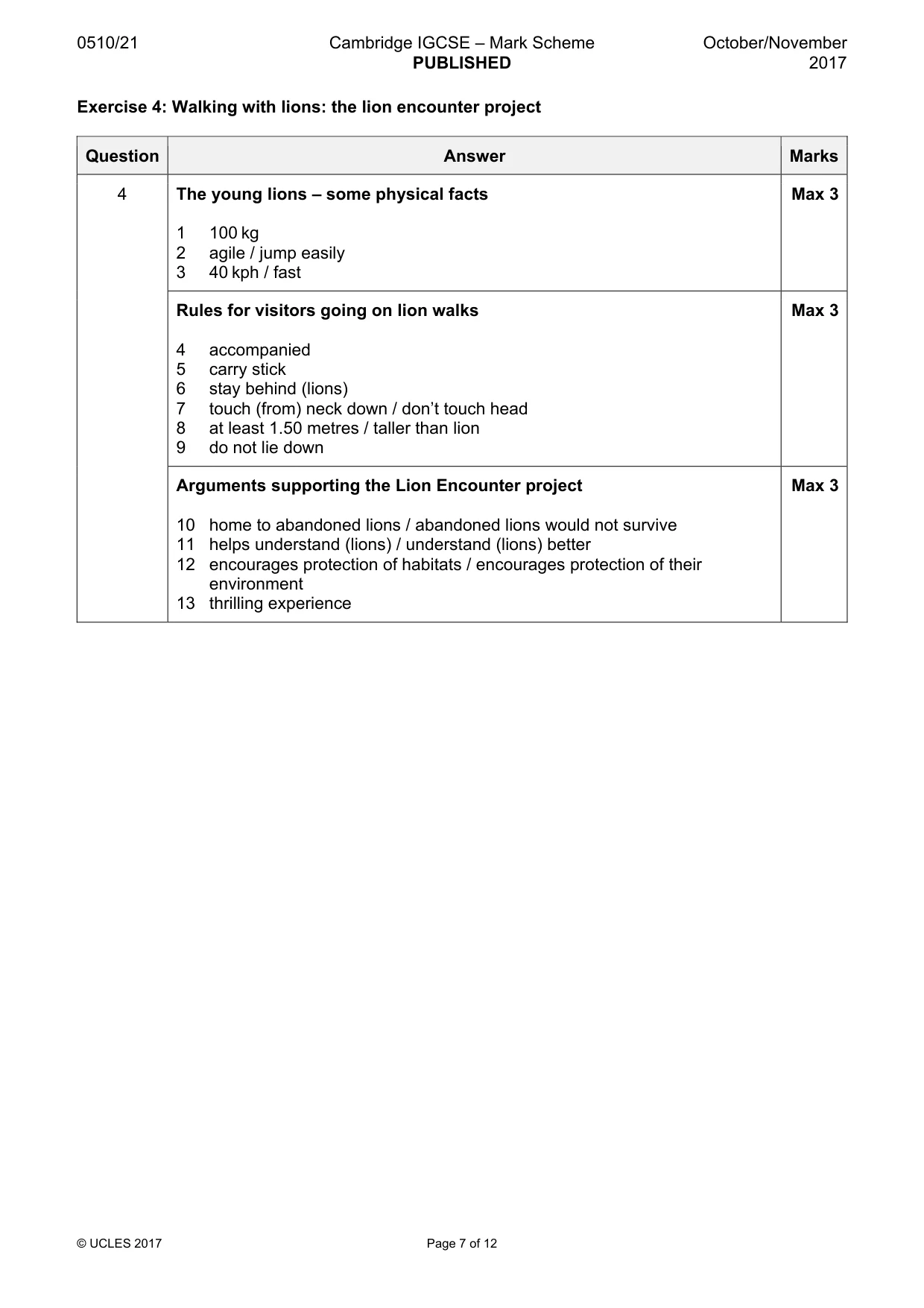
0510/21 Cambridge IGCSE – Mark Scheme PUBLISHED October/November 2017 © UCLES 2017 Page 7 of 12 Exercise 4: Walking with lions: the lion encounter project Question Answer Marks 4 The young lions – some physical facts 1 100 kg 2 agile / jump easily 3 40 kph / fast Max 3 Rules for visitors going on lion walks 4 accompanied 5 carry stick 6 stay behind (lions) 7 touch (from) neck down / don’t touch head 8 at least 1.50 metres / taller than lion 9 do not lie down Max 3 Arguments supporting the Lion Encounter project 10 home to abandoned lions / abandoned lions would not survive 11 helps understand (lions) / understand (lions) better 12 encourages protection of habitats / encourages protection of their environment 13 thrilling experience Max 3
Mark scheme, page 8
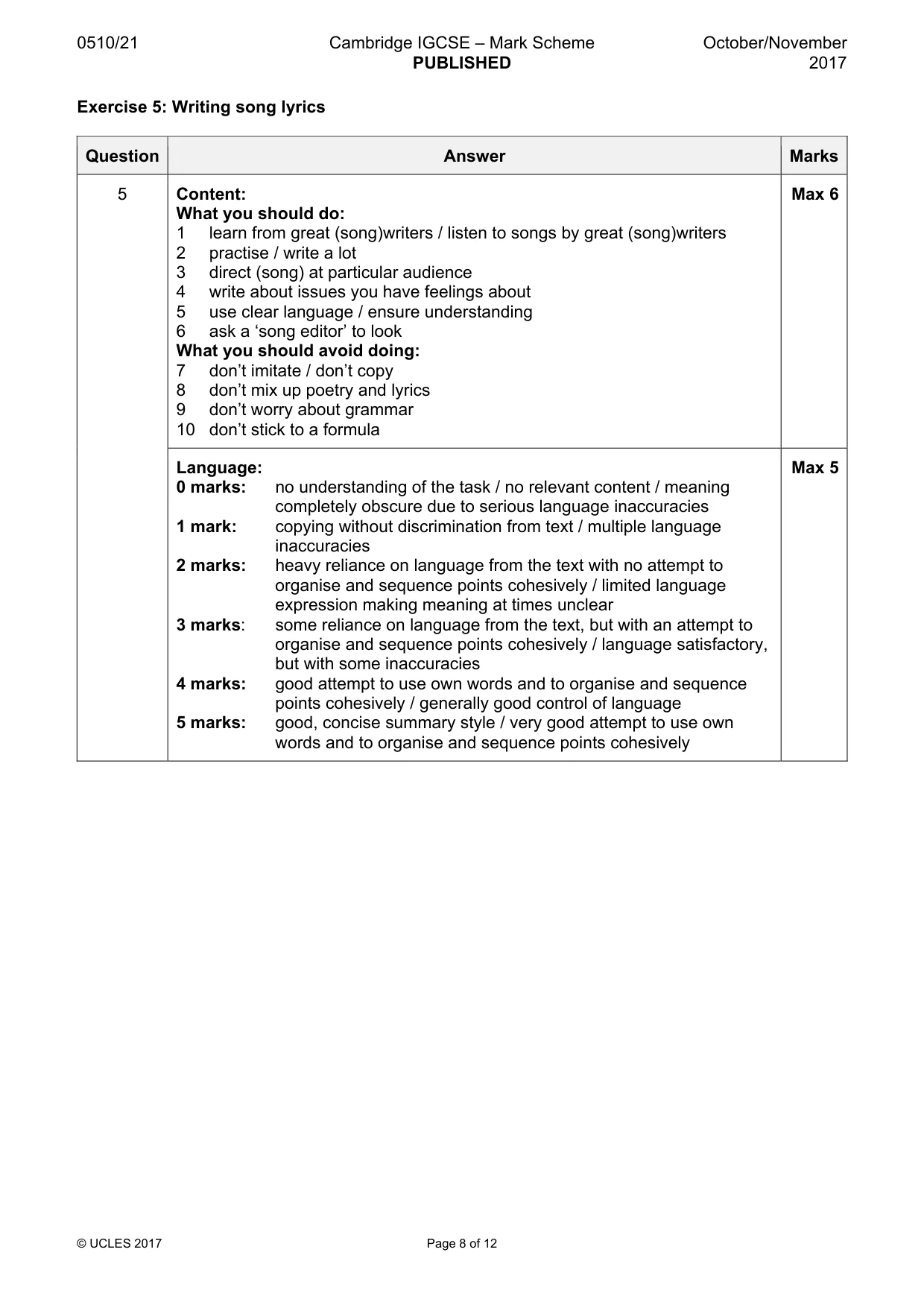
0510/21 Cambridge IGCSE – Mark Scheme PUBLISHED October/November 2017 © UCLES 2017 Page 8 of 12 Exercise 5: Writing song lyrics Question Answer Marks 5 Content: What you should do: 1 learn from great (song)writers / listen to songs by great (song)writers 2 practise / write a lot 3 direct (song) at particular audience 4 write about issues you have feelings about 5 use clear language / ensure understanding 6 ask a ‘song editor’ to look What you should avoid doing: 7 don’t imitate / don’t copy 8 don’t mix up poetry and lyrics 9 don’t worry about grammar 10 don’t stick to a formula Max 6 Language: 0 marks: no understanding of the task / no relevant content / meaning completely obscure due to serious language inaccuracies 1 mark: copying without discrimination from text / multiple language inaccuracies 2 marks: heavy reliance on language from the text with no attempt to organise and sequence points cohesively / limited language expression making meaning at times unclear 3 marks: some reliance on language from the text, but with an attempt to organise and sequence points cohesively / language satisfactory, but with some inaccuracies 4 marks: good attempt to use own words and to organise and sequence points cohesively / generally good control of language 5 marks: good, concise summary style / very good attempt to use own words and to organise and sequence points cohesively Max 5
Mark scheme, page 9
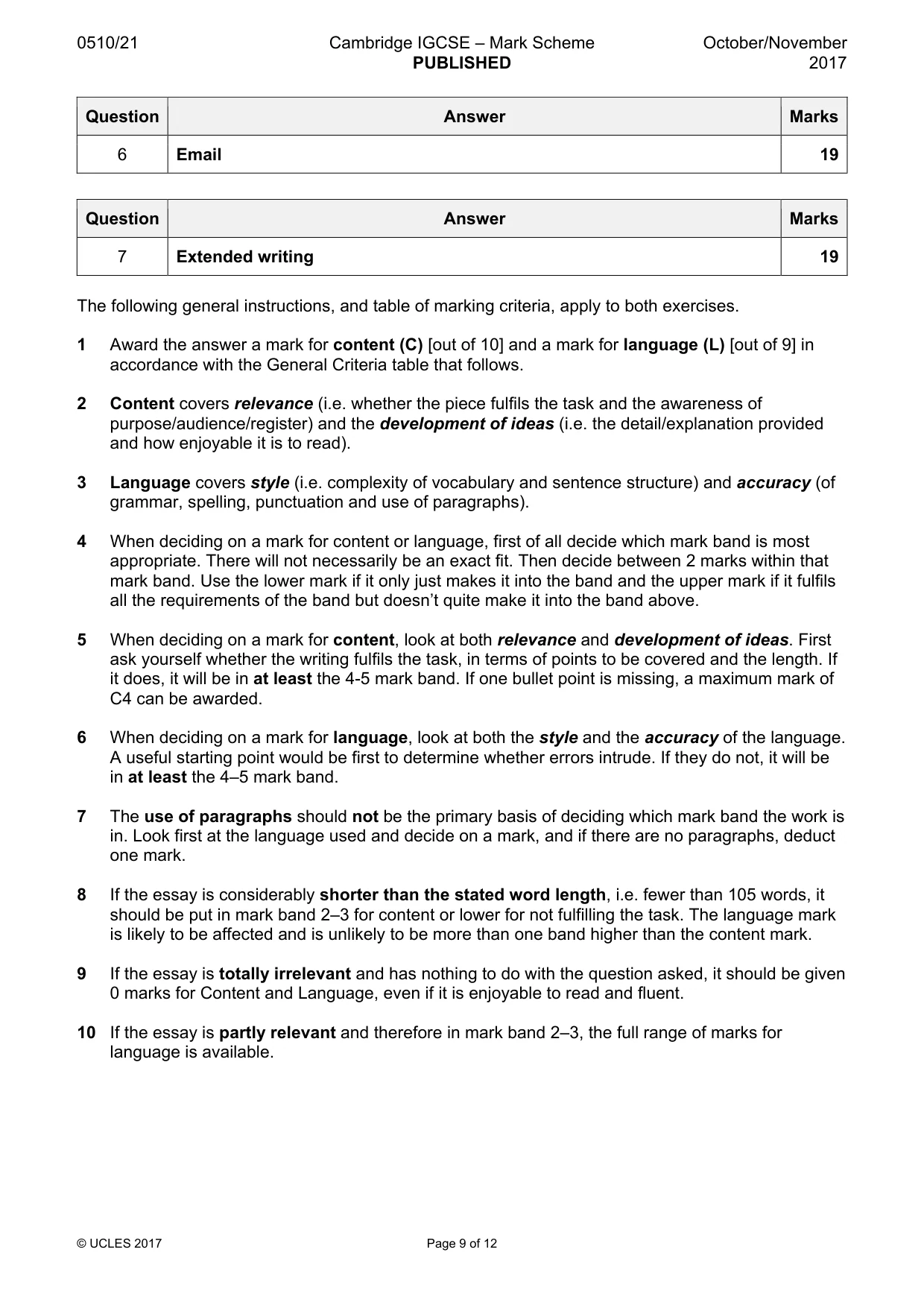
0510/21 Cambridge IGCSE – Mark Scheme PUBLISHED October/November 2017 © UCLES 2017 Page 9 of 12 Question Answer Marks 6 Email 19 Question Answer Marks 7 Extended writing 19 The following general instructions, and table of marking criteria, apply to both exercises. 1 Award the answer a mark for content (C) [out of 10] and a mark for language (L) [out of 9] in accordance with the General Criteria table that follows. 2 Content covers relevance (i.e. whether the piece fulfils the task and the awareness of purpose/audience/register) and the development of ideas (i.e. the detail/explanation provided and how enjoyable it is to read). 3 Language covers style (i.e. complexity of vocabulary and sentence structure) and accuracy (of grammar, spelling, punctuation and use of paragraphs). 4 When deciding on a mark for content or language, first of all decide which mark band is most appropriate. There will not necessarily be an exact fit. Then decide between 2 marks within that mark band. Use the lower mark if it only just makes it into the band and the upper mark if it fulfils all the requirements of the band but doesn’t quite make it into the band above. 5 When deciding on a mark for content, look at both relevance and development of ideas. First ask yourself whether the writing fulfils the task, in terms of points to be covered and the length. If it does, it will be in at least the 4-5 mark band. If one bullet point is missing, a maximum mark of C4 can be awarded. 6 When deciding on a mark for language, look at both the style and the accuracy of the language. A useful starting point would be first to determine whether errors intrude. If they do not, it will be in at least the 4–5 mark band. 7 The use of paragraphs should not be the primary basis of deciding which mark band the work is in. Look first at the language used and decide on a mark, and if there are no paragraphs, deduct one mark. 8 If the essay is considerably shorter than the stated word length, i.e. fewer than 105 words, it should be put in mark band 2–3 for content or lower for not fulfilling the task. The language mark is likely to be affected and is unlikely to be more than one band higher than the content mark. 9 If the essay is totally irrelevant and has nothing to do with the question asked, it should be given 0 marks for Content and Language, even if it is enjoyable to read and fluent. 10 If the essay is partly relevant and therefore in mark band 2–3, the full range of marks for language is available.
Mark scheme, page 10
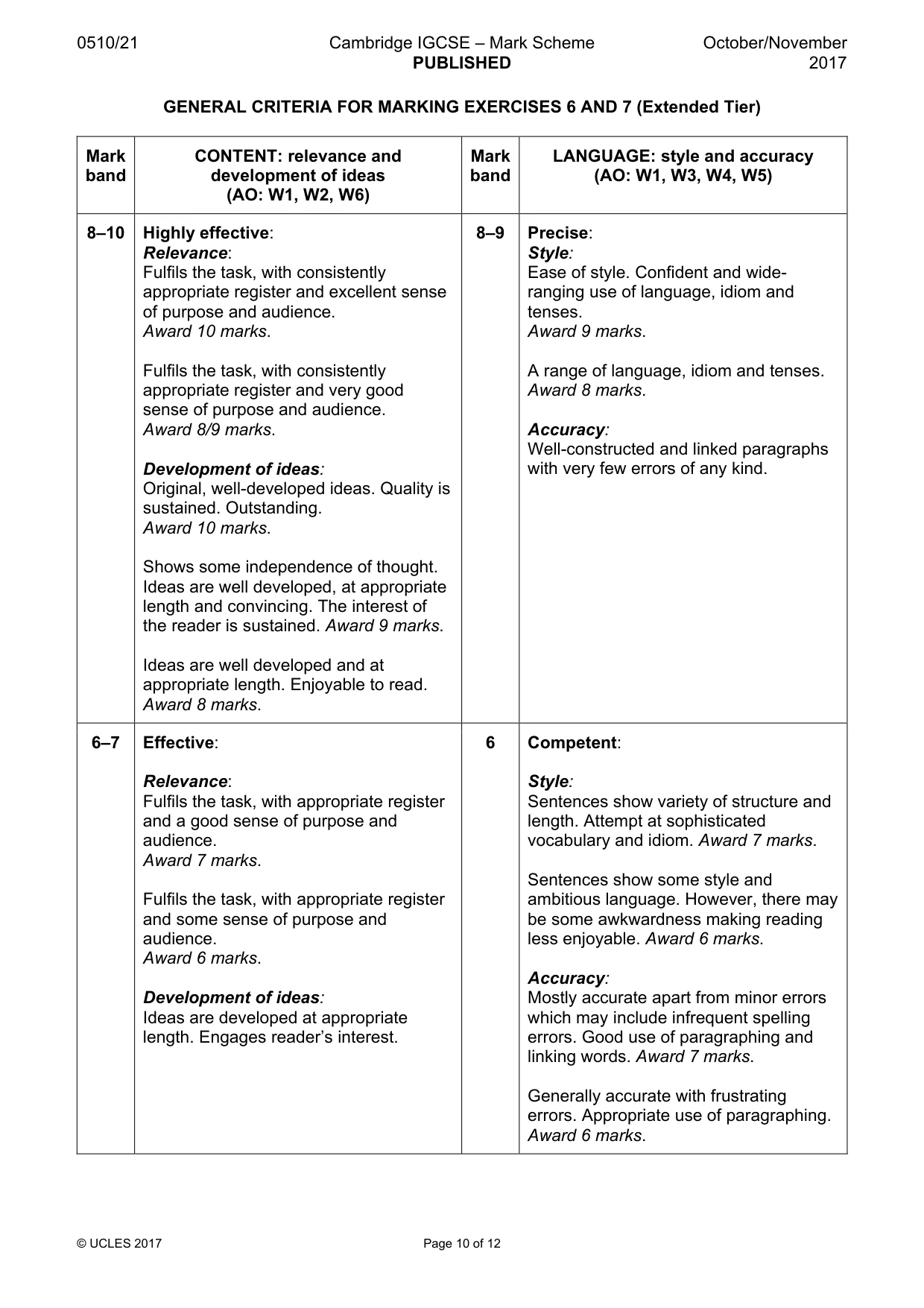
0510/21 Cambridge IGCSE – Mark Scheme PUBLISHED October/November 2017 © UCLES 2017 Page 10 of 12 GENERAL CRITERIA FOR MARKING EXERCISES 6 AND 7 (Extended Tier) Mark band CONTENT: relevance and development of ideas (AO: W1, W2, W6) Mark band LANGUAGE: style and accuracy (AO: W1, W3, W4, W5) 8–10 Highly effective: Relevance: Fulfils the task, with consistently appropriate register and excellent sense of purpose and audience. Award 10 marks. Fulfils the task, with consistently appropriate register and very good sense of purpose and audience. Award 8/9 marks. Development of ideas: Original, well-developed ideas. Quality is sustained. Outstanding. Award 10 marks. Shows some independence of thought. Ideas are well developed, at appropriate length and convincing. The interest of the reader is sustained. Award 9 marks. Ideas are well developed and at appropriate length. Enjoyable to read. Award 8 marks. 8–9 Precise: Style: Ease of style. Confident and wide- ranging use of language, idiom and tenses. Award 9 marks. A range of language, idiom and tenses. Award 8 marks. Accuracy: Well-constructed and linked paragraphs with very few errors of any kind. 6–7 Effective: Relevance: Fulfils the task, with appropriate register and a good sense of purpose and audience. Award 7 marks. Fulfils the task, with appropriate register and some sense of purpose and audience. Award 6 marks. Development of ideas: Ideas are developed at appropriate length. Engages reader’s interest. 6 Competent: Style: Sentences show variety of structure and length. Attempt at sophisticated vocabulary and idiom. Award 7 marks. Sentences show some style and ambitious language. However, there may be some awkwardness making reading less enjoyable. Award 6 marks. Accuracy: Mostly accurate apart from minor errors which may include infrequent spelling errors. Good use of paragraphing and linking words. Award 7 marks. Generally accurate with frustrating errors. Appropriate use of paragraphing. Award 6 marks.
Mark scheme, page 11
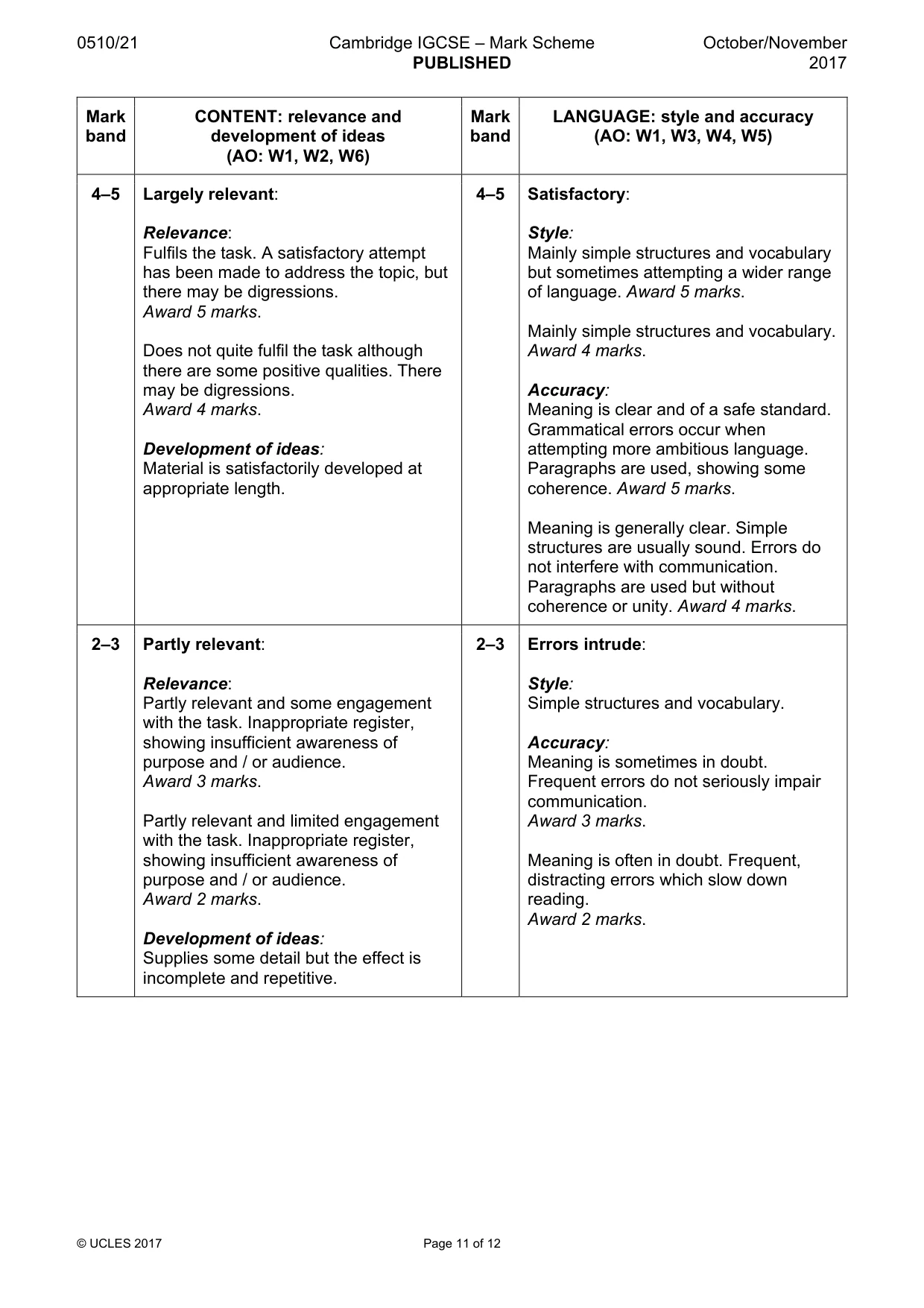
0510/21 Cambridge IGCSE – Mark Scheme PUBLISHED October/November 2017 © UCLES 2017 Page 11 of 12 Mark band CONTENT: relevance and development of ideas (AO: W1, W2, W6) Mark band LANGUAGE: style and accuracy (AO: W1, W3, W4, W5) 4–5 Largely relevant: Relevance: Fulfils the task. A satisfactory attempt has been made to address the topic, but there may be digressions. Award 5 marks. Does not quite fulfil the task although there are some positive qualities. There may be digressions. Award 4 marks. Development of ideas: Material is satisfactorily developed at appropriate length. 4–5 Satisfactory: Style: Mainly simple structures and vocabulary but sometimes attempting a wider range of language. Award 5 marks. Mainly simple structures and vocabulary. Award 4 marks. Accuracy: Meaning is clear and of a safe standard. Grammatical errors occur when attempting more ambitious language. Paragraphs are used, showing some coherence. Award 5 marks. Meaning is generally clear. Simple structures are usually sound. Errors do not interfere with communication. Paragraphs are used but without coherence or unity. Award 4 marks. 2–3 Partly relevant: Relevance: Partly relevant and some engagement with the task. Inappropriate register, showing insufficient awareness of purpose and / or audience. Award 3 marks. Partly relevant and limited engagement with the task. Inappropriate register, showing insufficient awareness of purpose and / or audience. Award 2 marks. Development of ideas: Supplies some detail but the effect is incomplete and repetitive. 2–3 Errors intrude: Style: Simple structures and vocabulary. Accuracy: Meaning is sometimes in doubt. Frequent errors do not seriously impair communication. Award 3 marks. Meaning is often in doubt. Frequent, distracting errors which slow down reading. Award 2 marks.
Mark scheme, page 12
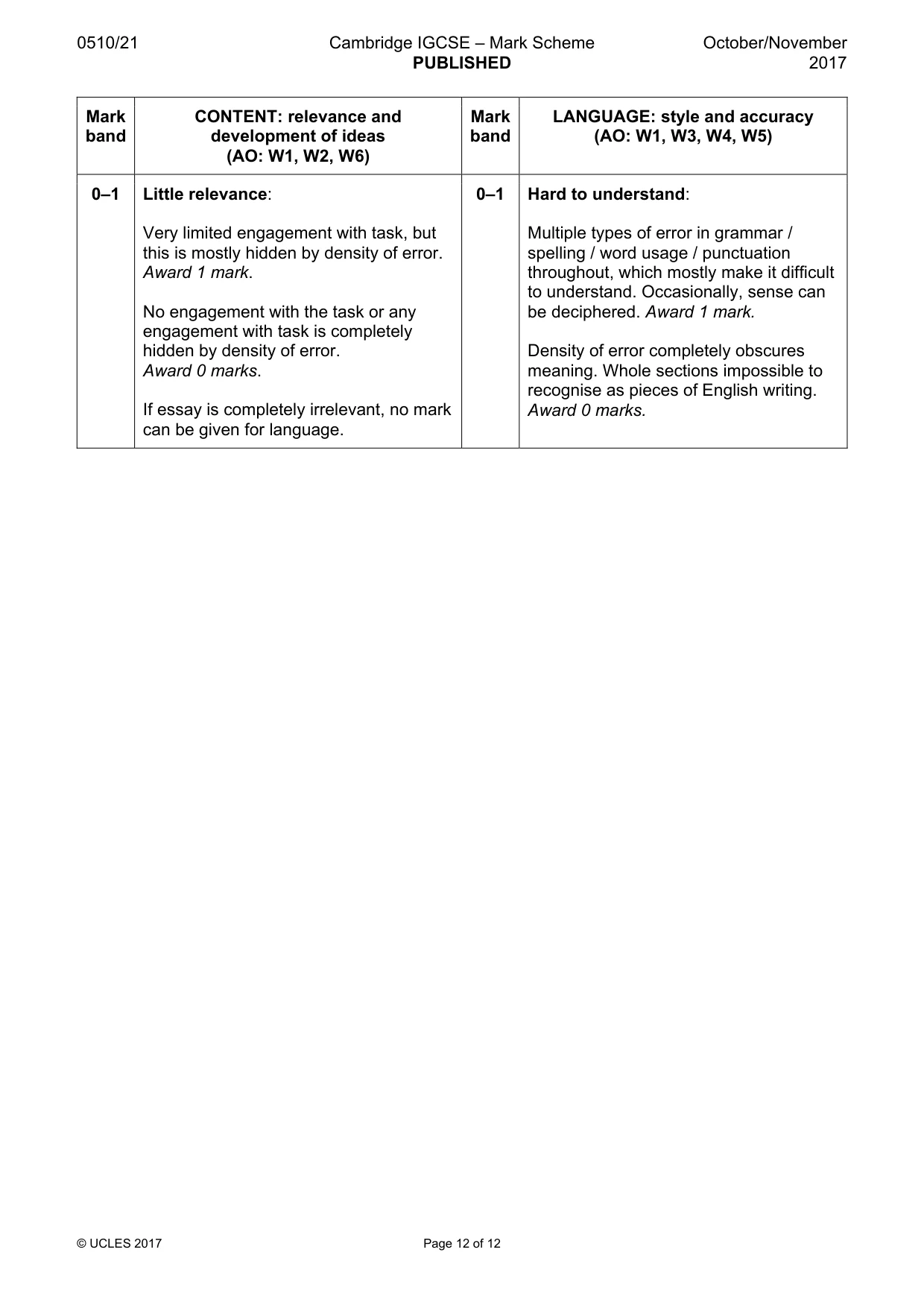
0510/21 Cambridge IGCSE – Mark Scheme PUBLISHED October/November 2017 © UCLES 2017 Page 12 of 12 Mark band CONTENT: relevance and development of ideas (AO: W1, W2, W6) Mark band LANGUAGE: style and accuracy (AO: W1, W3, W4, W5) 0–1 Little relevance: Very limited engagement with task, but this is mostly hidden by density of error. Award 1 mark. No engagement with the task or any engagement with task is completely hidden by density of error. Award 0 marks. If essay is completely irrelevant, no mark can be given for language. 0–1 Hard to understand: Multiple types of error in grammar / spelling / word usage / punctuation throughout, which mostly make it difficult to understand. Occasionally, sense can be deciphered. Award 1 mark. Density of error completely obscures meaning. Whole sections impossible to recognise as pieces of English writing. Award 0 marks.
What you needed in this session
Cambridge’s own grade thresholds for 2017 Oct/Nov, Paper 2 · Variant 1. A higher threshold means an easier paper — the bar moves with how the cohort did.