Cambridge IGCSE English - Second Language (oral endorsement) 0510 — 2017 Feb/March Paper 4 · Variant 2
0510/42/F/M/17 · 40 marks · ≈45 min
The question paper and its mark scheme, free to read here and free to download. This is Cambridge’s own paper, exactly as it was sat.
Question paper12 pages




Mark scheme5 pages
Answers below. Sit the paper first if you are practising.
Paper as text
Question paper, page 1
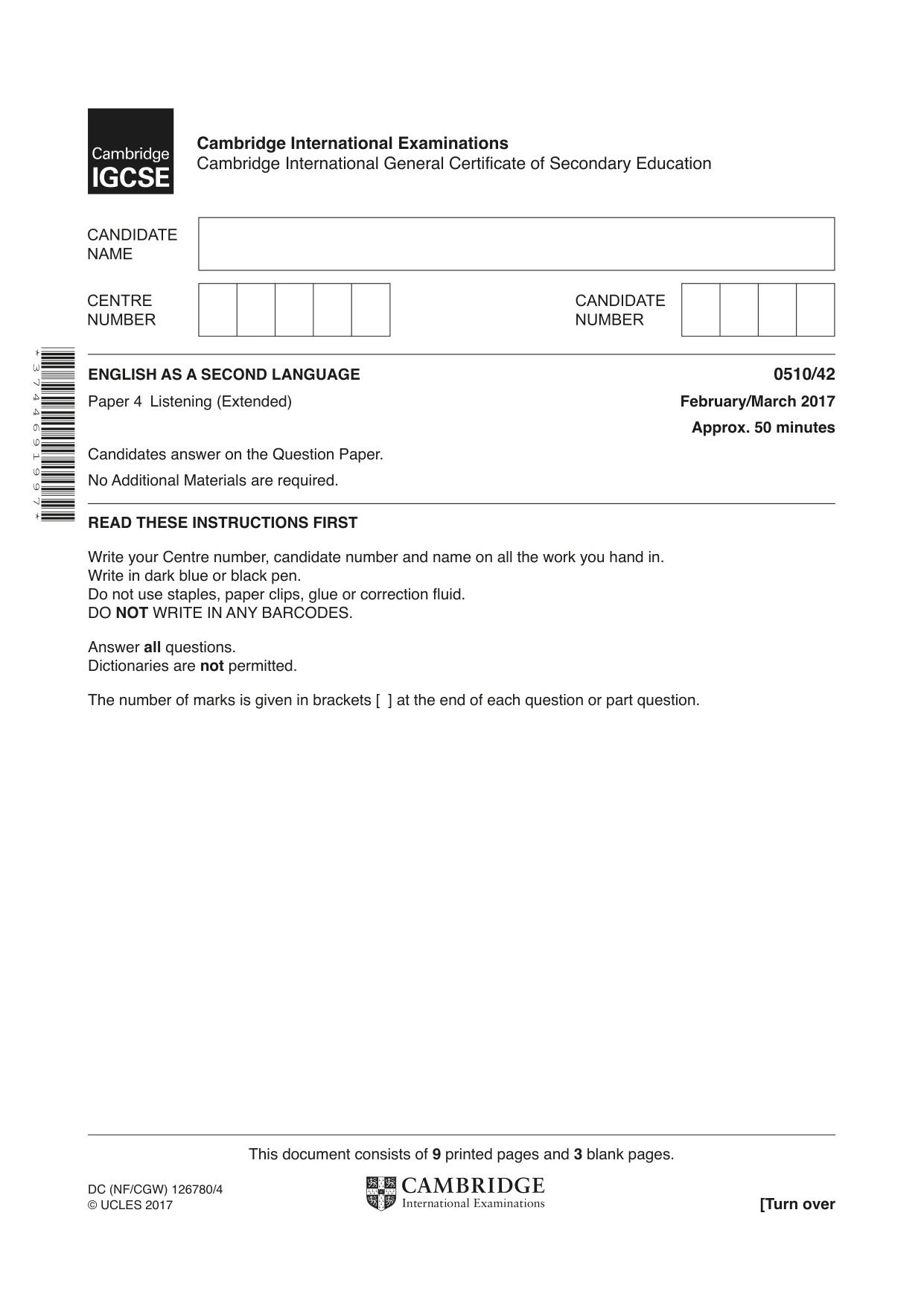
This document consists of 9 printed pages and 3 blank pages. DC (NF/CGW) 126780/4 © UCLES 2017 [Turn over Cambridge International Examinations Cambridge International General Certificate of Secondary Education * 3 7 4 4 6 9 1 9 9 7 * ENGLISH AS A SECOND LANGUAGE 0510/42 Paper 4 Listening (Extended) February/March 2017 Approx. 50 minutes Candidates answer on the Question Paper. No Additional Materials are required. READ THESE INSTRUCTIONS FIRST Write your Centre number, candidate number and name on all the work you hand in. Write in dark blue or black pen. Do not use staples, paper clips, glue or correction fluid. DO NOT WRITE IN ANY BARCODES. Answer all questions. Dictionaries are not permitted. The number of marks is given in brackets [ ] at the end of each question or part question.
Question paper, page 2
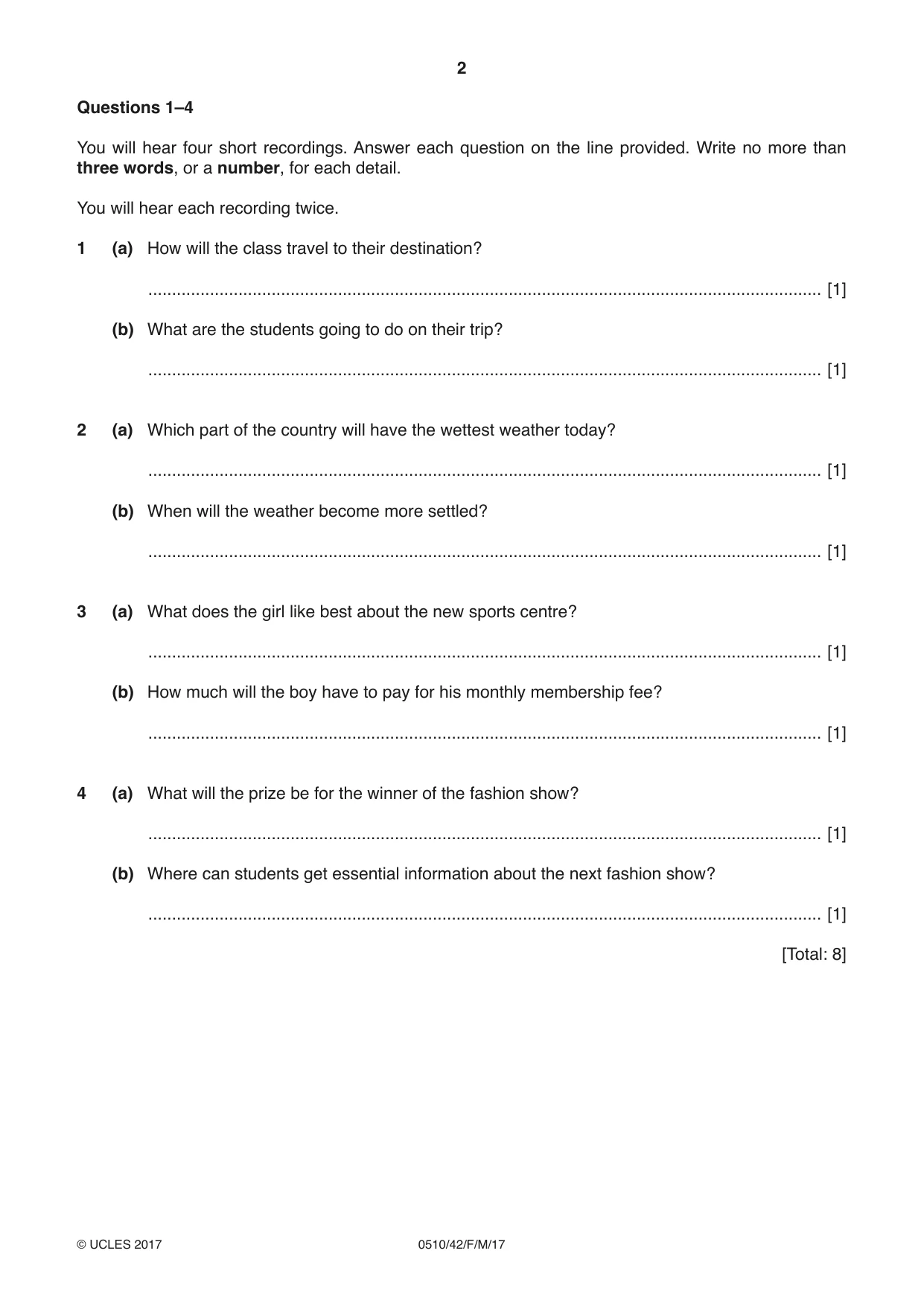
2 0510/42/F/M/17 © UCLES 2017 Questions 1–4 You will hear four short recordings. Answer each question on the line provided. Write no more than three words, or a number, for each detail. You will hear each recording twice. 1 (a) How will the class travel to their destination? … [1] (b) What are the students going to do on their trip? … [1] 2 (a) Which part of the country will have the wettest weather today? … [1] (b) When will the weather become more settled? … [1] 3 (a) What does the girl like best about the new sports centre? … [1] (b) How much will the boy have to pay for his monthly membership fee? … [1] 4 (a) What will the prize be for the winner of the fashion show? … [1] (b) Where can students get essential information about the next fashion show? … [1] [Total: 8]
Question paper, page 3
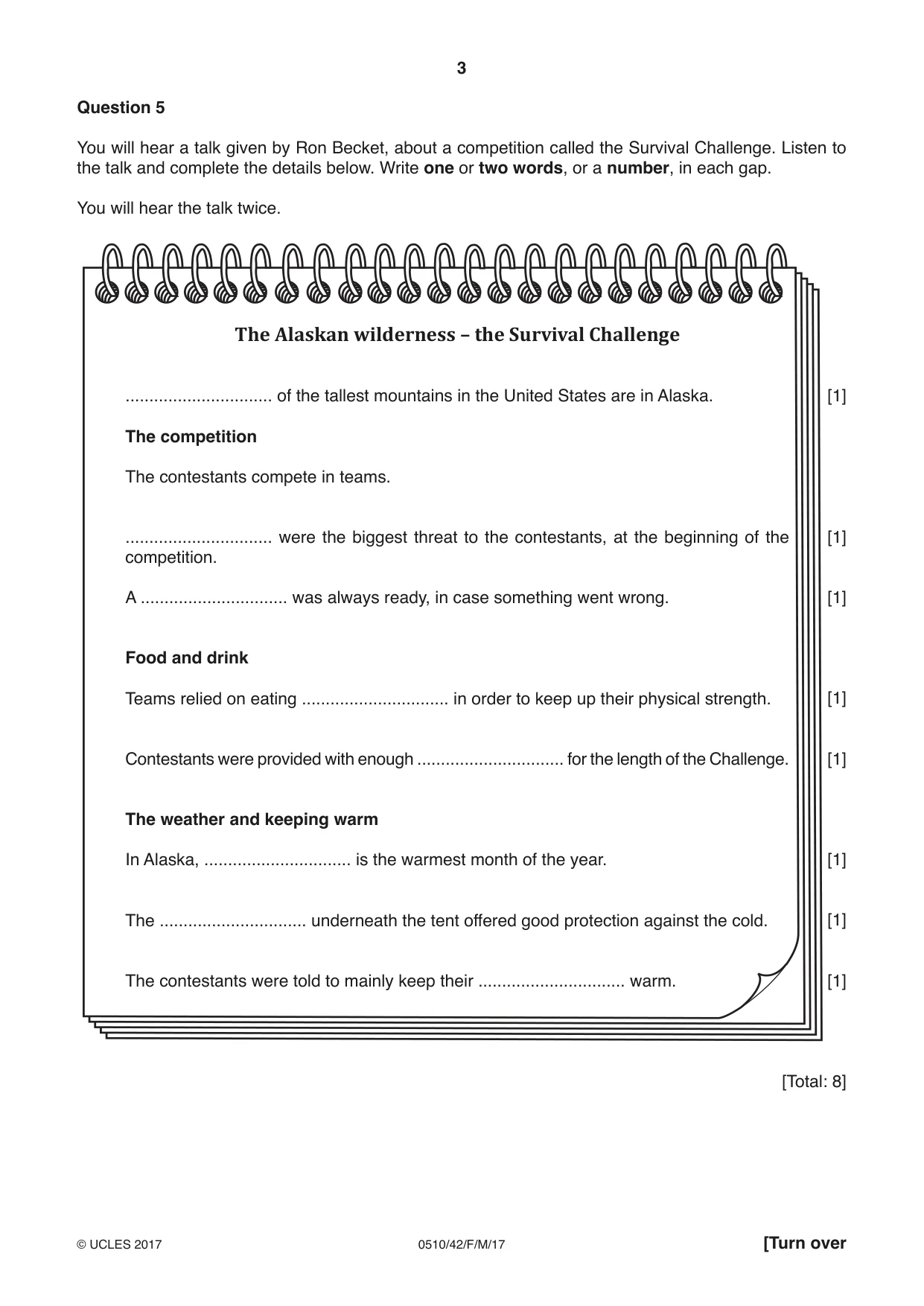
3 0510/42/F/M/17 © UCLES 2017 [Turn over Question 5 You will hear a talk given by Ron Becket, about a competition called the Survival Challenge. Listen to the talk and complete the details below. Write one or two words, or a number, in each gap. You will hear the talk twice. The Alaskan wilderness – the Survival Challenge … of the tallest mountains in the United States are in Alaska. The competition The contestants compete in teams. … were the biggest threat to the contestants, at the beginning of the competition. A … was always ready, in case something went wrong. Food and drink Teams relied on eating … in order to keep up their physical strength. Contestants were provided with enough … for the length of the Challenge. The weather and keeping warm In Alaska, … is the warmest month of the year. The … underneath the tent offered good protection against the cold. The contestants were told to mainly keep their … warm. [1] [1] [1] [1] [1] [1] [1] [1] [Total: 8]
Question paper, page 4
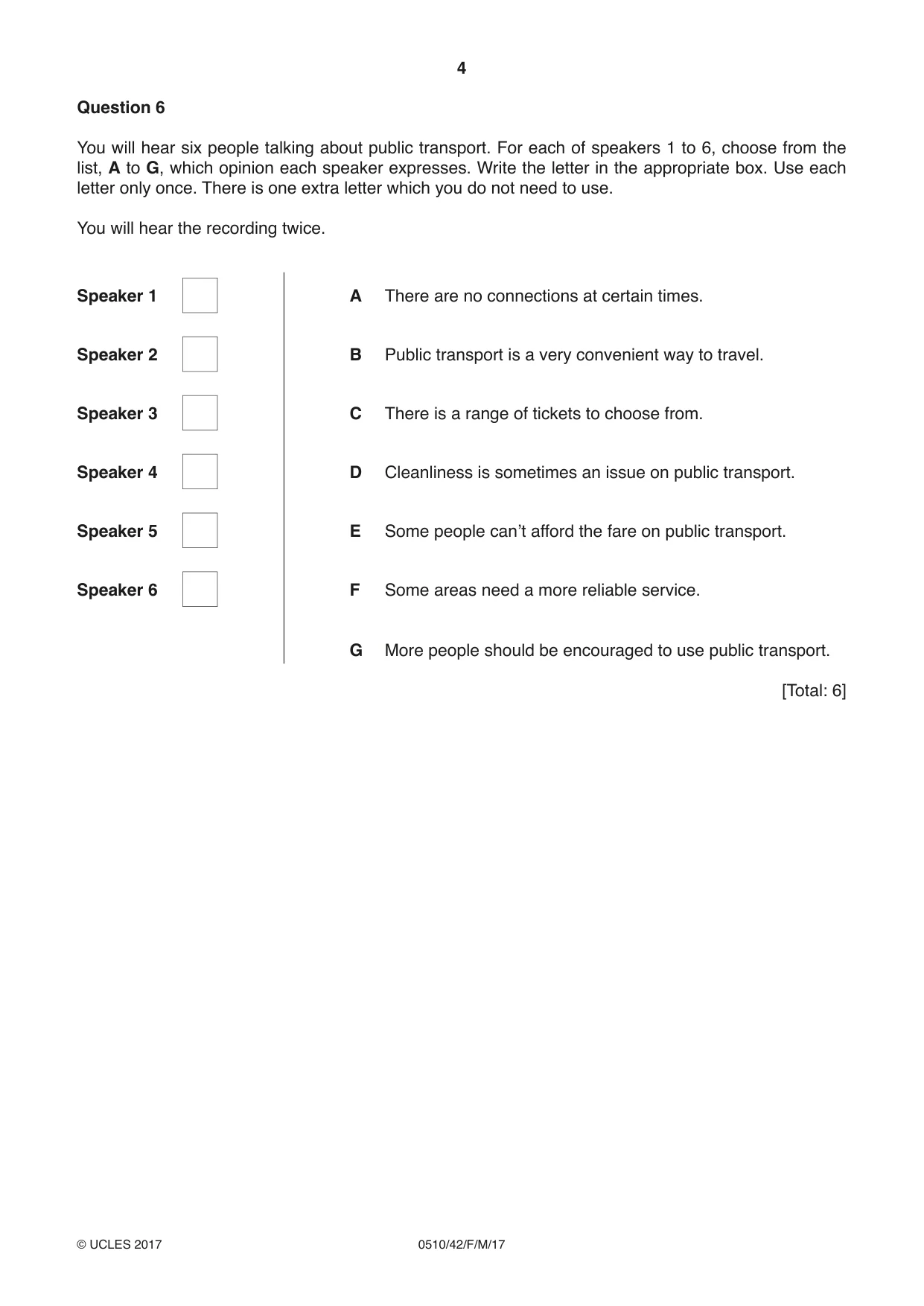
4 0510/42/F/M/17 © UCLES 2017 Question 6 You will hear six people talking about public transport. For each of speakers 1 to 6, choose from the list, A to G, which opinion each speaker expresses. Write the letter in the appropriate box. Use each letter only once. There is one extra letter which you do not need to use. You will hear the recording twice. Speaker 1 A There are no connections at certain times. Speaker 2 B Public transport is a very convenient way to travel. Speaker 3 C There is a range of tickets to choose from. Speaker 4 D Cleanliness is sometimes an issue on public transport. Speaker 5 E Some people can’t afford the fare on public transport. Speaker 6 F Some areas need a more reliable service. G More people should be encouraged to use public transport. [Total: 6]
Question paper, page 5
5 0510/42/F/M/17 © UCLES 2017 [Turn over Please turn over for Question 7.
Question paper, page 6
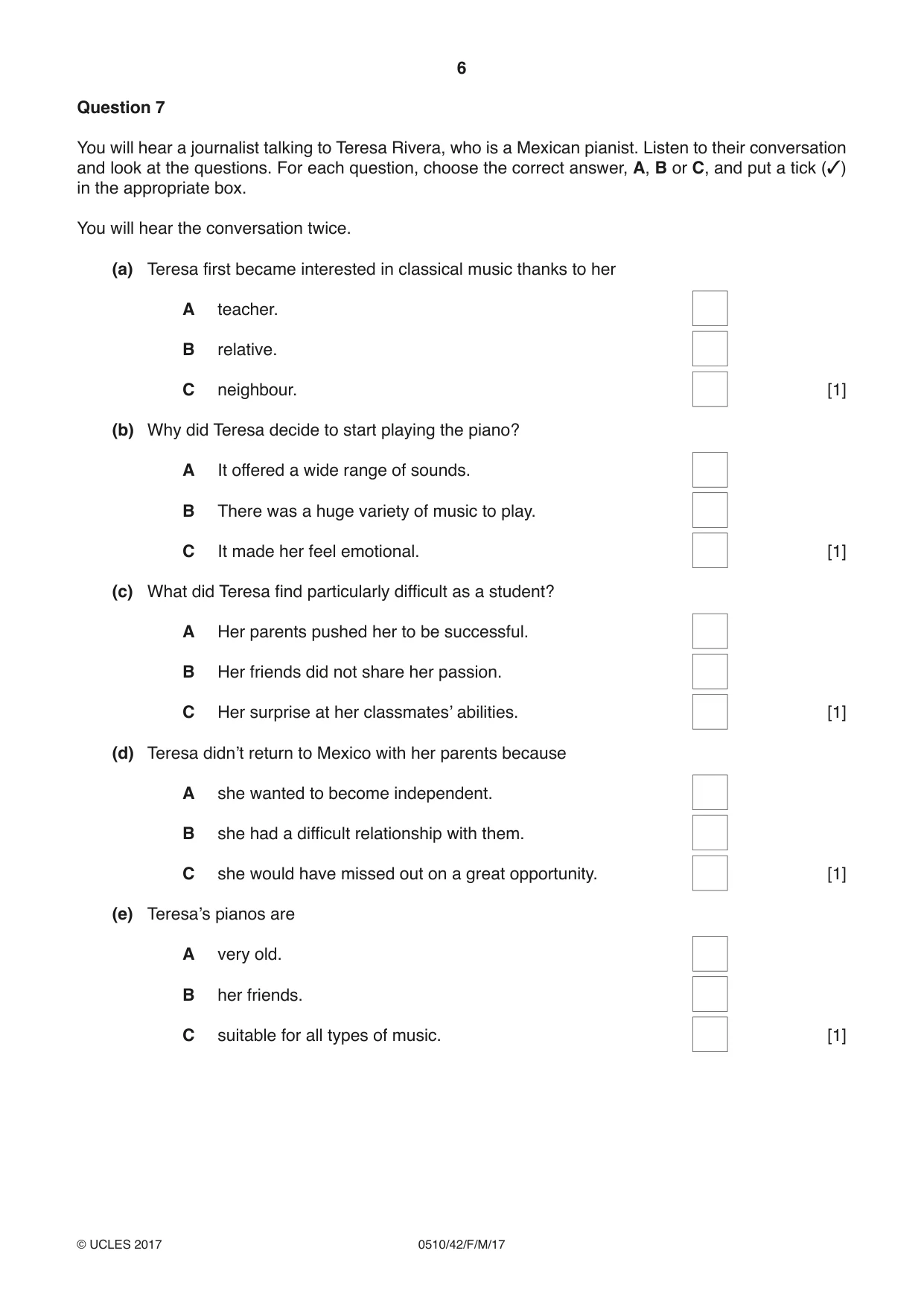
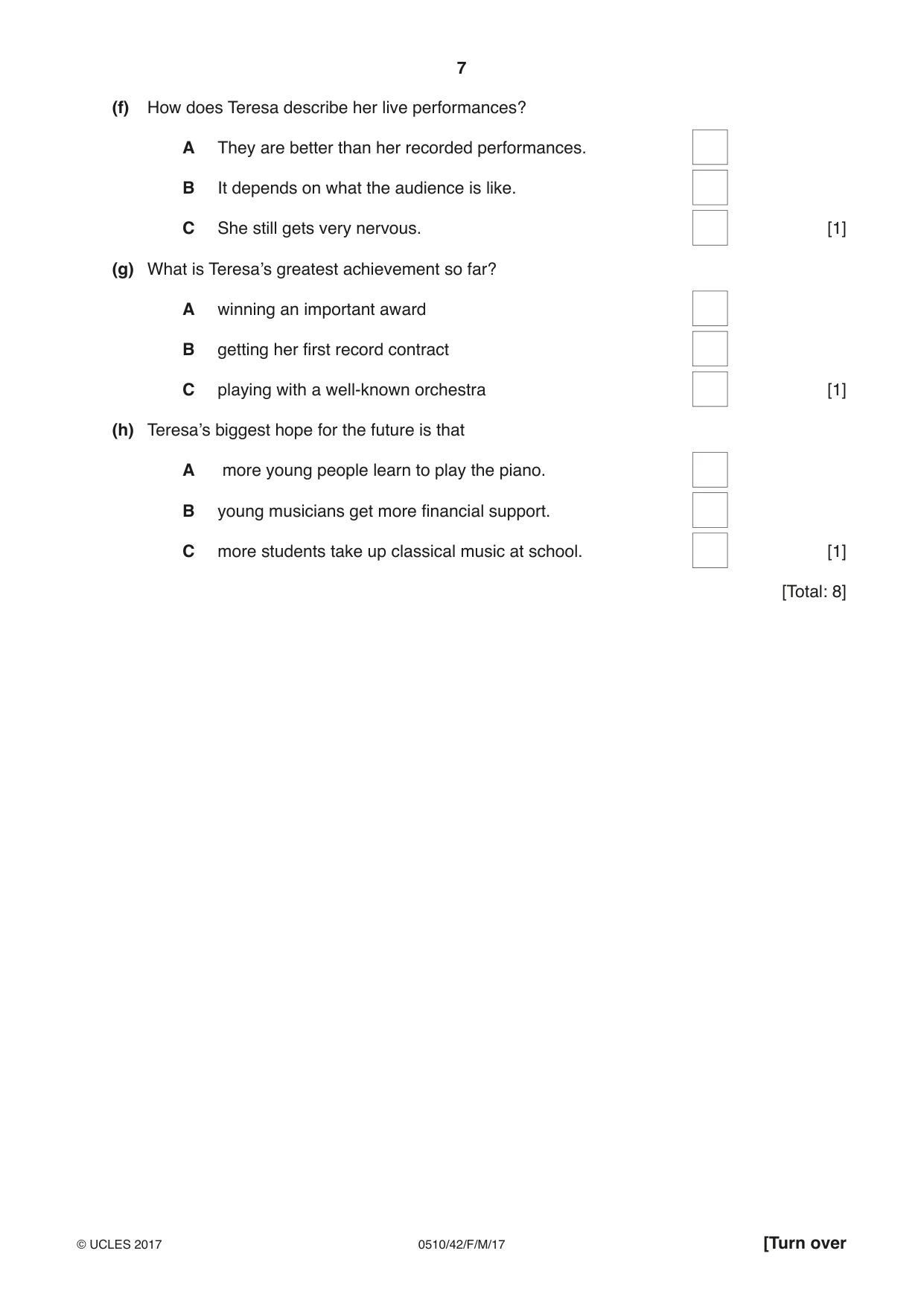
6 0510/42/F/M/17 © UCLES 2017 Question 7 You will hear a journalist talking to Teresa Rivera, who is a Mexican pianist. Listen to their conversation and look at the questions. For each question, choose the correct answer, A, B or C, and put a tick (✓) in the appropriate box. You will hear the conversation twice. (a) Teresa first became interested in classical music thanks to her A teacher. B relative. C neighbour. [1] (b) Why did Teresa decide to start playing the piano? A It offered a wide range of sounds. B There was a huge variety of music to play. C It made her feel emotional. [1] (c) What did Teresa find particularly difficult as a student? A Her parents pushed her to be successful. B Her friends did not share her passion. C Her surprise at her classmates’ abilities. [1] (d) Teresa didn’t return to Mexico with her parents because A she wanted to become independent. B she had a difficult relationship with them. C she would have missed out on a great opportunity. [1] (e) Teresa’s pianos are A very old. B her friends. C suitable for all types of music. [1]
Question paper, page 7
7 0510/42/F/M/17 © UCLES 2017 [Turn over (f) How does Teresa describe her live performances? A They are better than her recorded performances. B It depends on what the audience is like. C She still gets very nervous. [1] (g) What is Teresa’s greatest achievement so far? A winning an important award B getting her first record contract C playing with a well-known orchestra [1] (h) Teresa’s biggest hope for the future is that A more young people learn to play the piano. B young musicians get more financial support. C more students take up classical music at school. [1] [Total: 8]
Question paper, page 8
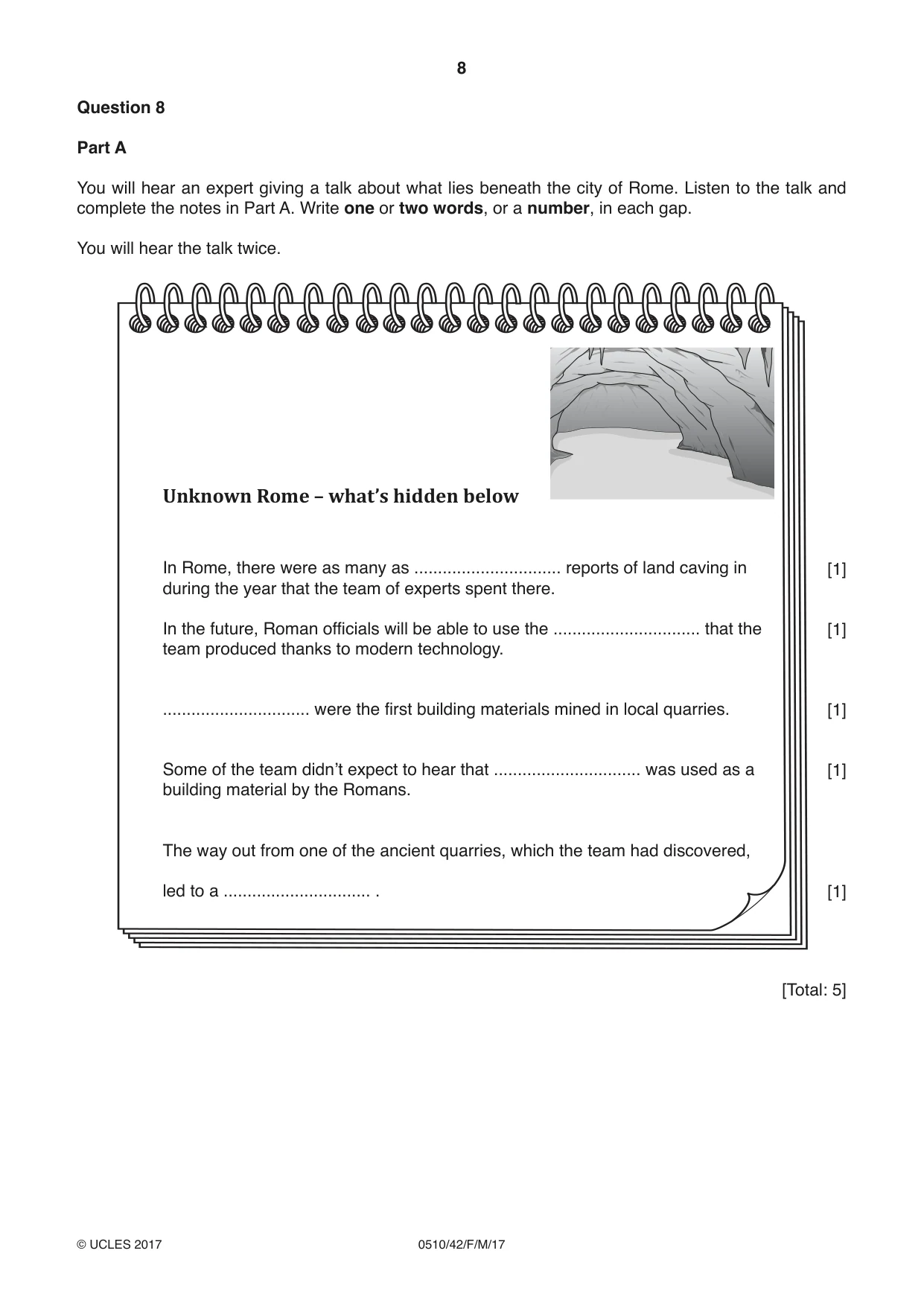
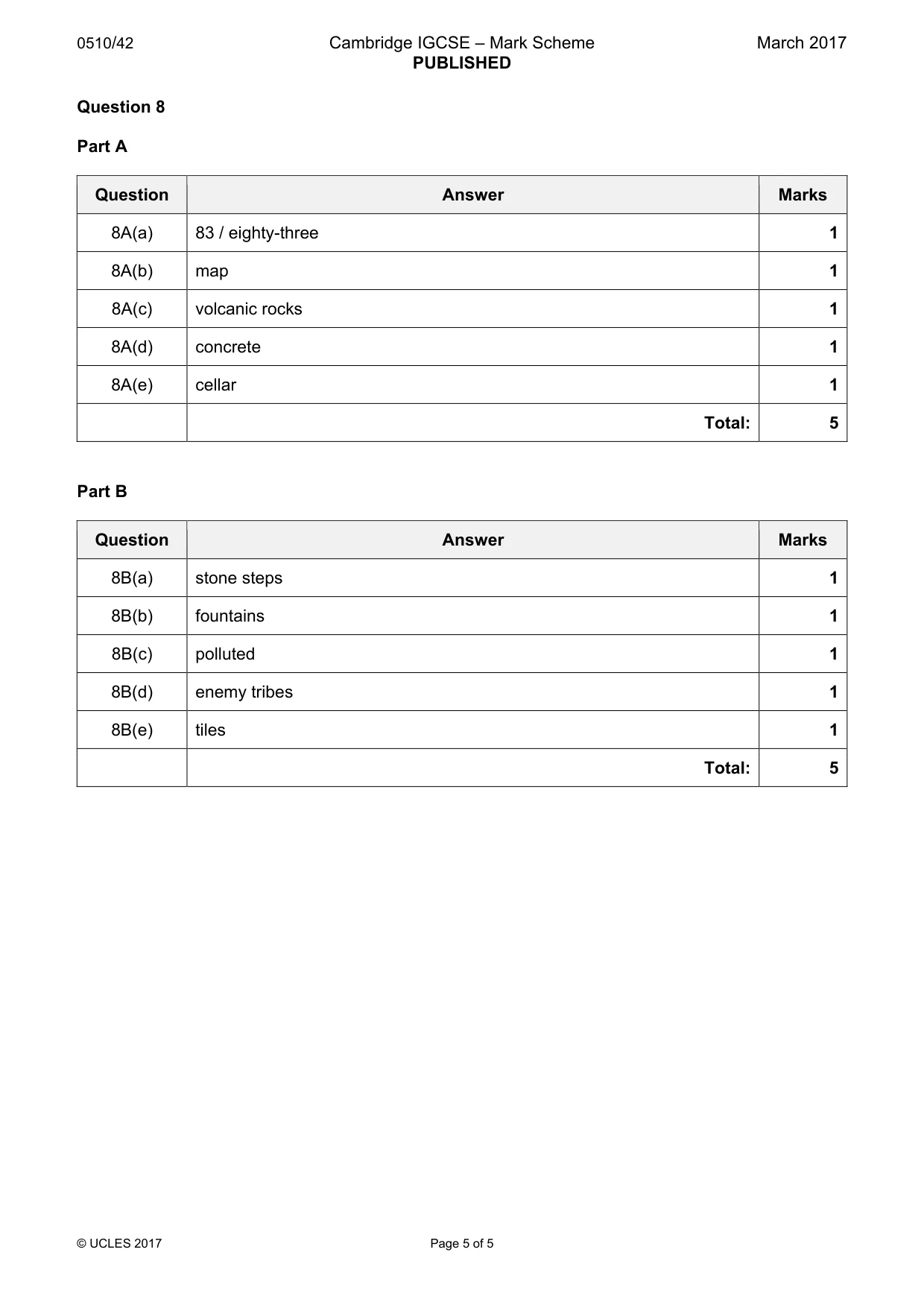
8 0510/42/F/M/17 © UCLES 2017 Question 8 Part A You will hear an expert giving a talk about what lies beneath the city of Rome. Listen to the talk and complete the notes in Part A. Write one or two words, or a number, in each gap. You will hear the talk twice. Unknown Rome – what’s hidden below In Rome, there were as many as … reports of land caving in during the year that the team of experts spent there. In the future, Roman officials will be able to use the … that the team produced thanks to modern technology. … were the first building materials mined in local quarries. Some of the team didn’t expect to hear that … was used as a building material by the Romans. The way out from one of the ancient quarries, which the team had discovered, led to a … . [1] [1] [1] [1] [1] [Total: 5]
Question paper, page 9
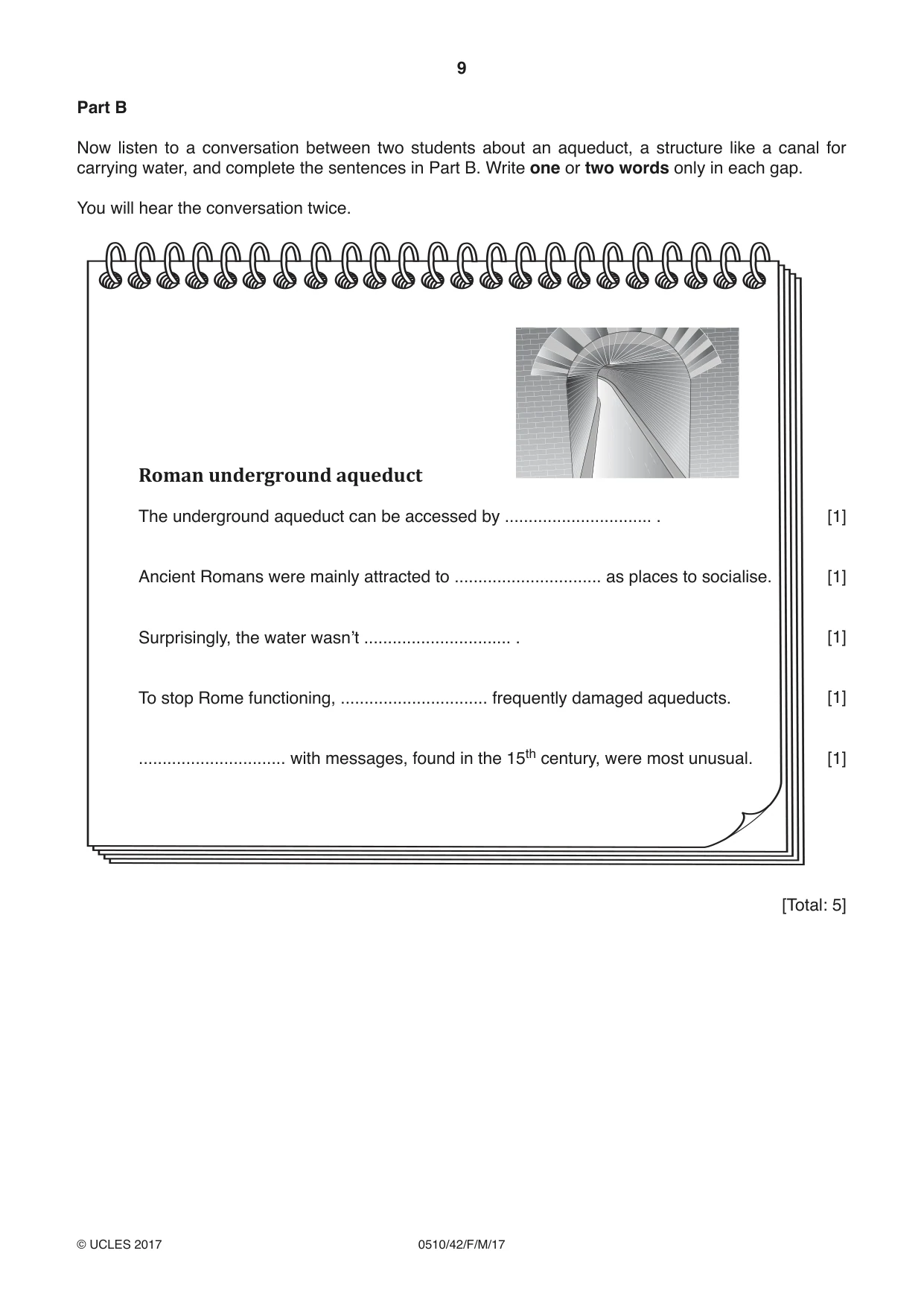
9 0510/42/F/M/17 © UCLES 2017 Part B Now listen to a conversation between two students about an aqueduct, a structure like a canal for carrying water, and complete the sentences in Part B. Write one or two words only in each gap. You will hear the conversation twice. Roman underground aqueduct The underground aqueduct can be accessed by … . Ancient Romans were mainly attracted to … as places to socialise. Surprisingly, the water wasn’t … . To stop Rome functioning, … frequently damaged aqueducts. … with messages, found in the 15th century, were most unusual. [1] [1] [1] [1] [1] [Total: 5]
Question paper, page 10
10 0510/42/F/M/17 © UCLES 2017 BLANK PAGE
Question paper, page 11
11 0510/42/F/M/17 © UCLES 2017 BLANK PAGE
Question paper, page 12
12 0510/42/F/M/17 © UCLES 2017 BLANK PAGE Permission to reproduce items where third-party owned material protected by copyright is included has been sought and cleared where possible. Every reasonable effort has been made by the publisher (UCLES) to trace copyright holders, but if any items requiring clearance have unwittingly been included, the publisher will be pleased to make amends at the earliest possible opportunity. To avoid the issue of disclosure of answer-related information to candidates, all copyright acknowledgements are reproduced online in the Cambridge International Examinations Copyright Acknowledgements Booklet. This is produced for each series of examinations and is freely available to download at www.cie.org.uk after the live examination series. Cambridge International Examinations is part of the Cambridge Assessment Group. Cambridge Assessment is the brand name of University of Cambridge Local Examinations Syndicate (UCLES), which is itself a department of the University of Cambridge.
Mark scheme, page 1
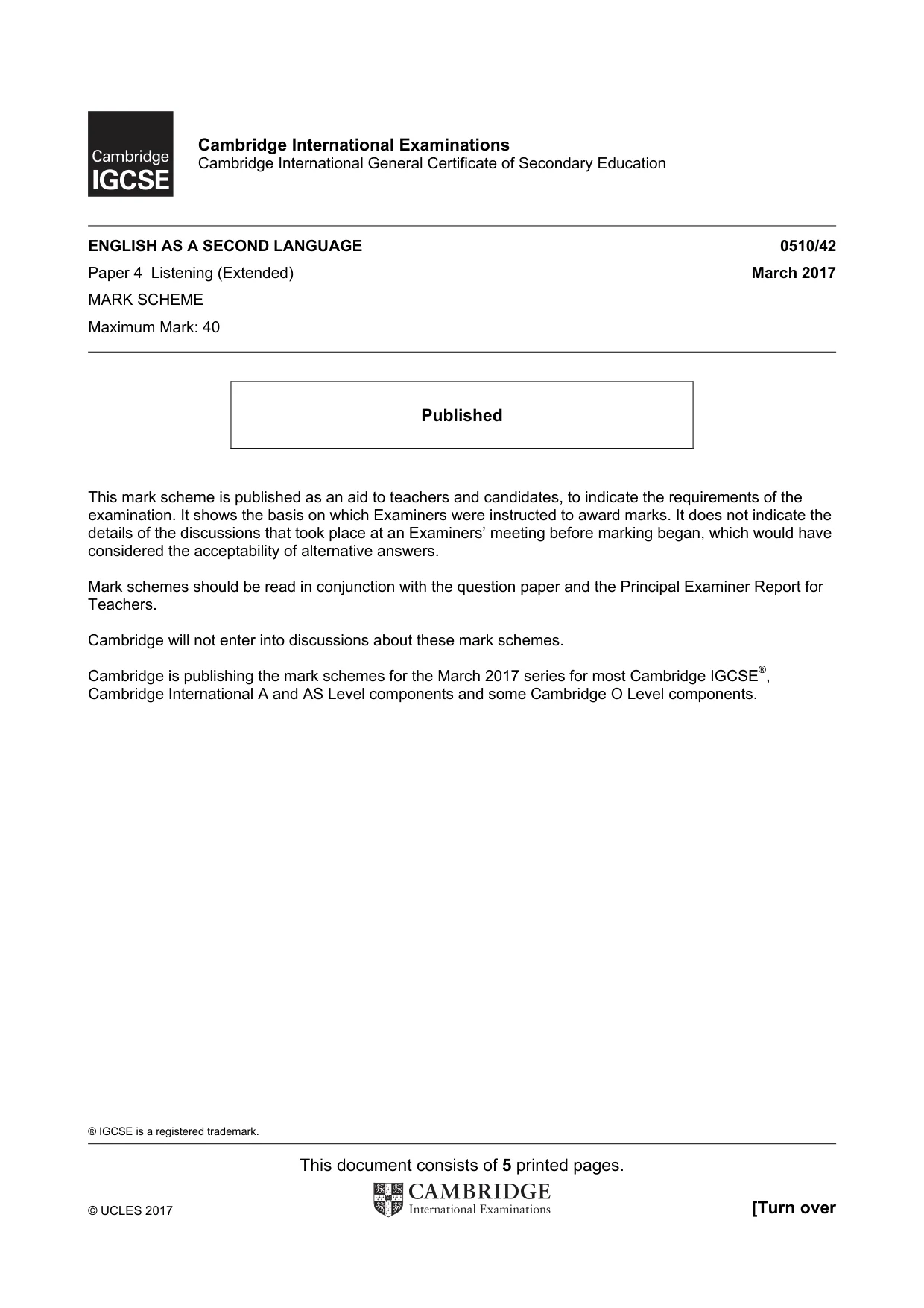
® IGCSE is a registered trademark. This document consists of 5 printed pages. © UCLES 2017 [Turn over Cambridge International Examinations Cambridge International General Certificate of Secondary Education ENGLISH AS A SECOND LANGUAGE 0510/42 Paper 4 Listening (Extended) March 2017 MARK SCHEME Maximum Mark: 40 Published This mark scheme is published as an aid to teachers and candidates, to indicate the requirements of the examination. It shows the basis on which Examiners were instructed to award marks. It does not indicate the details of the discussions that took place at an Examiners’ meeting before marking began, which would have considered the acceptability of alternative answers. Mark schemes should be read in conjunction with the question paper and the Principal Examiner Report for Teachers. Cambridge will not enter into discussions about these mark schemes. Cambridge is publishing the mark schemes for the March 2017 series for most Cambridge IGCSE®, Cambridge International A and AS Level components and some Cambridge O Level components.
Mark scheme, page 2
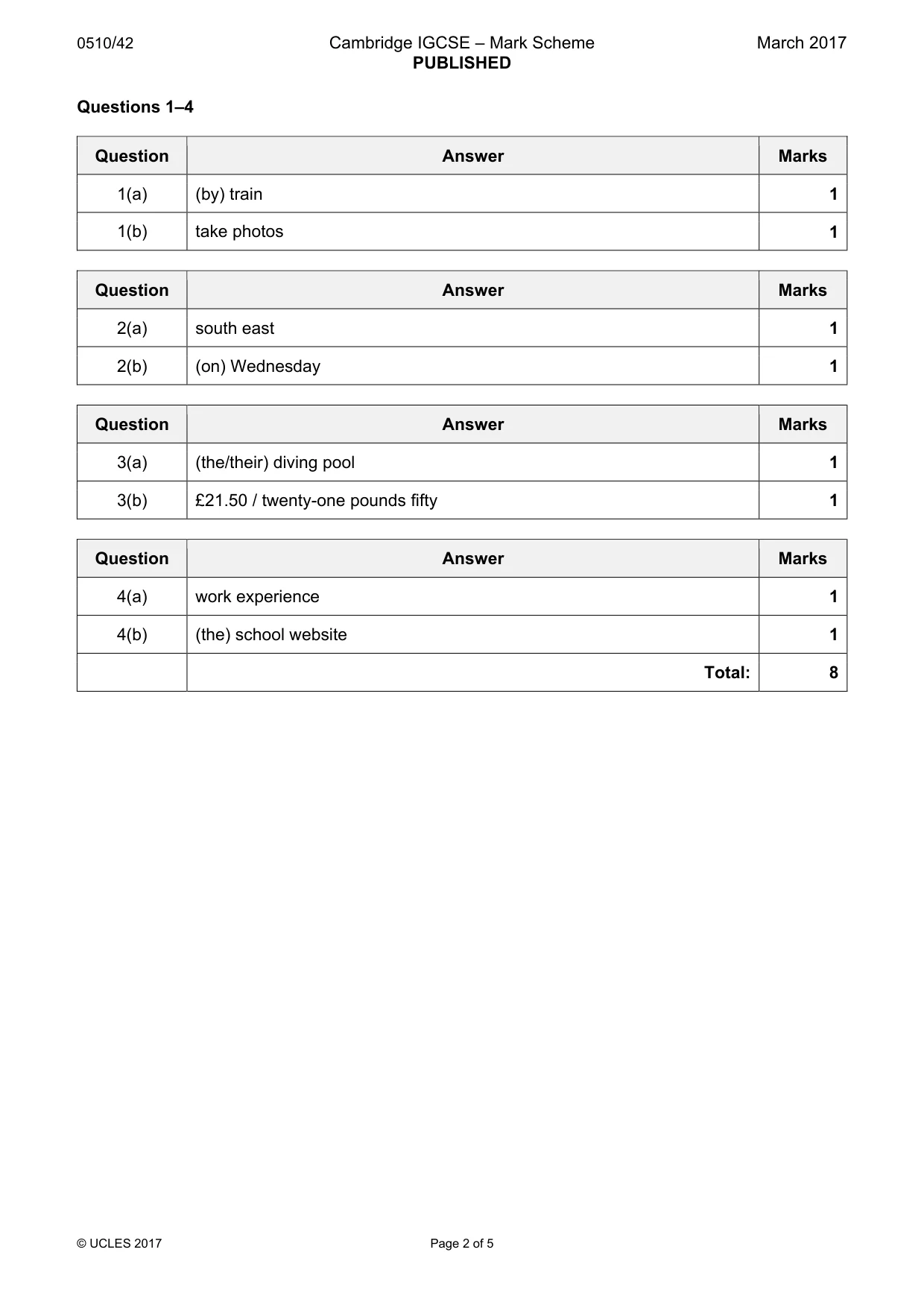
0510/42 Cambridge IGCSE – Mark Scheme PUBLISHED March 2017 © UCLES 2017 Page 2 of 5 Questions 1–4 Question Answer Marks 1(a) (by) train 1 1(b) take photos 1 Question Answer Marks 2(a) south east 1 2(b) (on) Wednesday 1 Question Answer Marks 3(a) (the/their) diving pool 1 3(b) £21.50 / twenty-one pounds fifty 1 Question Answer Marks 4(a) work experience 1 4(b) (the) school website 1 Total: 8
Mark scheme, page 3
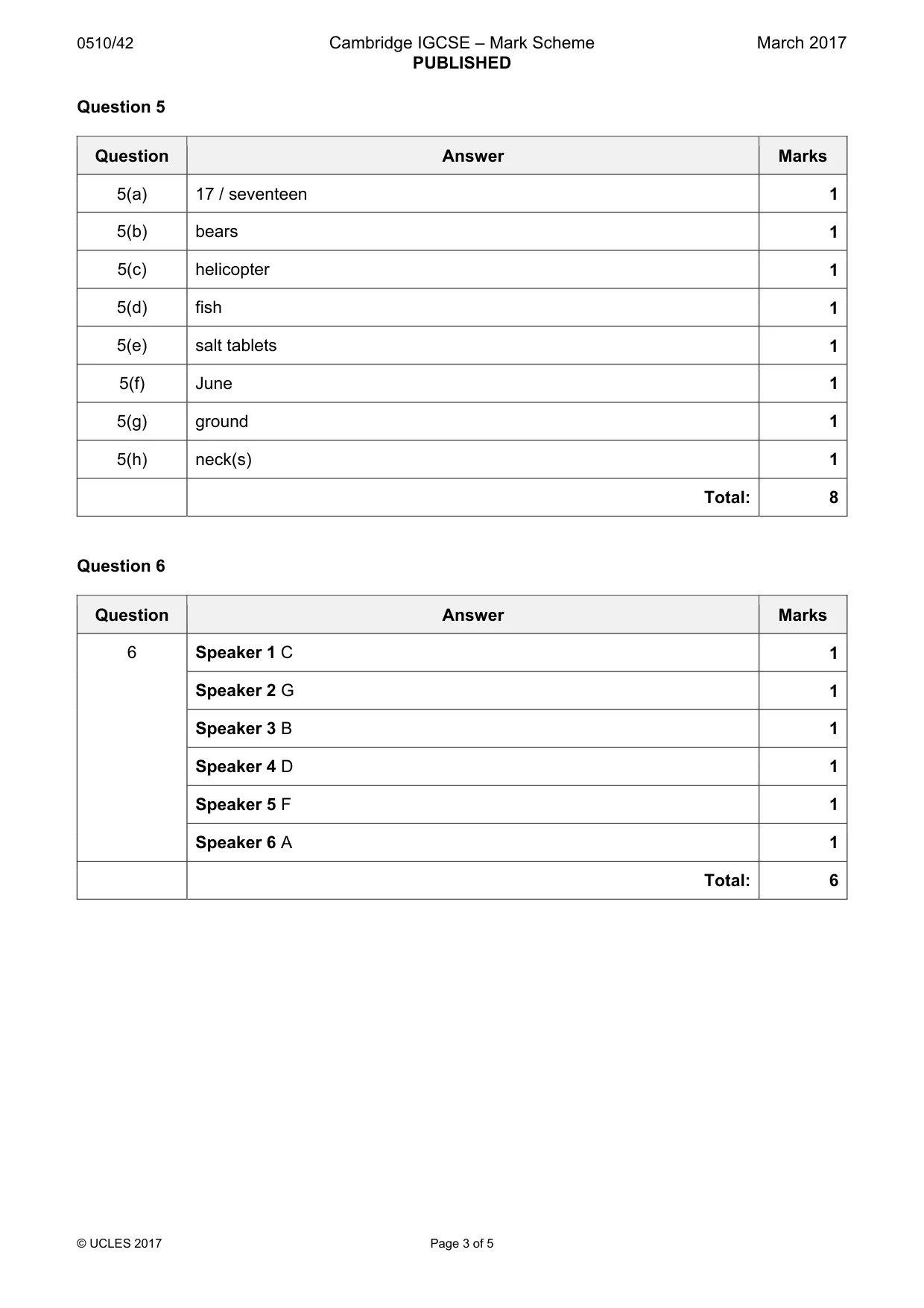
0510/42 Cambridge IGCSE – Mark Scheme PUBLISHED March 2017 © UCLES 2017 Page 3 of 5 Question 5 Question Answer Marks 5(a) 17 / seventeen 1 5(b) bears 1 5(c) helicopter 1 5(d) fish 1 5(e) salt tablets 1 5(f) June 1 5(g) ground 1 5(h) neck(s) 1 Total: 8 Question 6 Question Answer Marks 6 Speaker 1 C 1 Speaker 2 G 1 Speaker 3 B 1 Speaker 4 D 1 Speaker 5 F 1 Speaker 6 A 1 Total: 6
Mark scheme, page 4
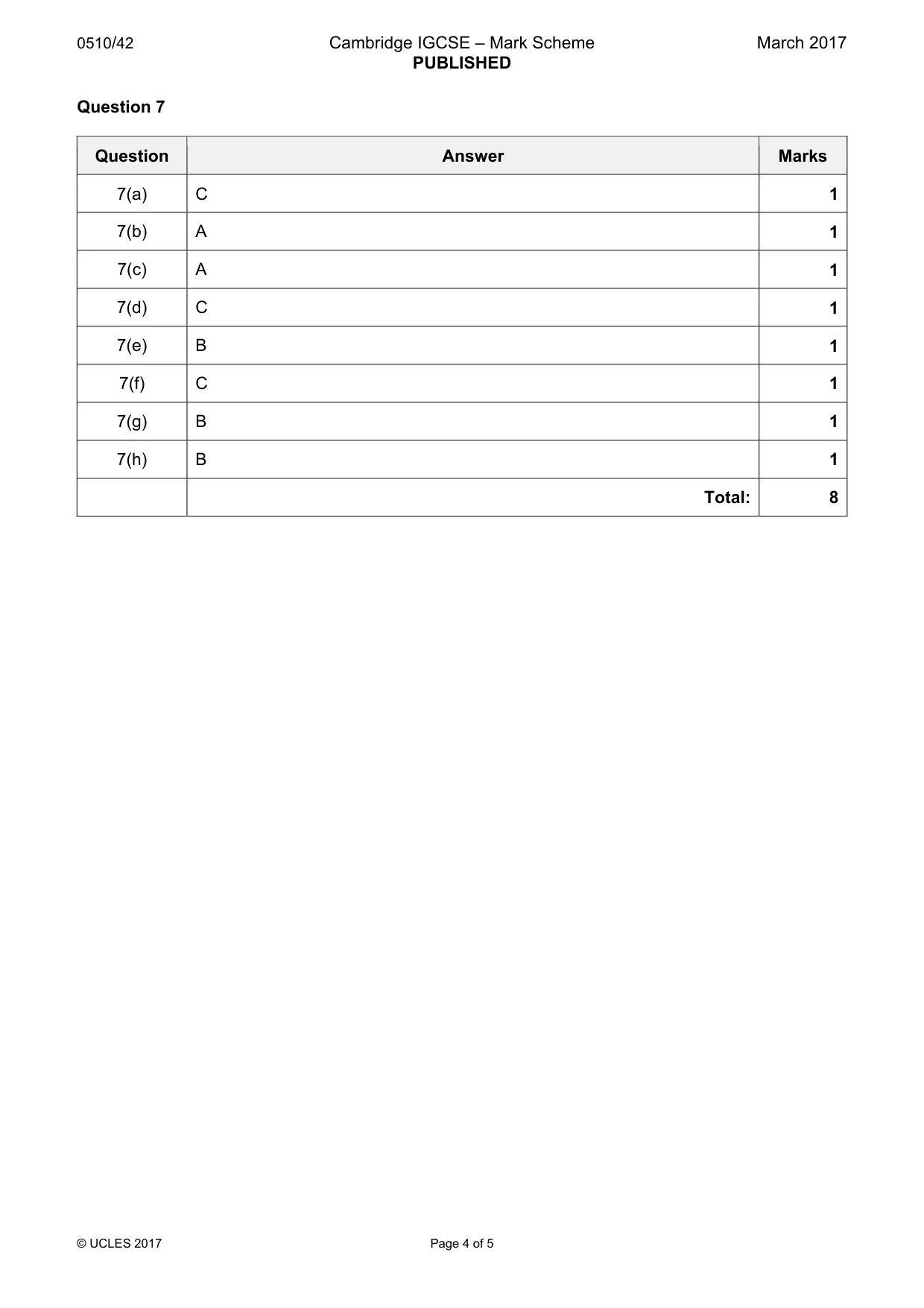
0510/42 Cambridge IGCSE – Mark Scheme PUBLISHED March 2017 © UCLES 2017 Page 4 of 5 Question 7 Question Answer Marks 7(a) C 1 7(b) A 1 7(c) A 1 7(d) C 1 7(e) B 1 7(f) C 1 7(g) B 1 7(h) B 1 Total: 8
Mark scheme, page 5
0510/42 Cambridge IGCSE – Mark Scheme PUBLISHED March 2017 © UCLES 2017 Page 5 of 5 Question 8 Part A Question Answer Marks 8A(a) 83 / eighty-three 1 8A(b) map 1 8A(c) volcanic rocks 1 8A(d) concrete 1 8A(e) cellar 1 Total: 5 Part B Question Answer Marks 8B(a) stone steps 1 8B(b) fountains 1 8B(c) polluted 1 8B(d) enemy tribes 1 8B(e) tiles 1 Total: 5
What you needed in this session
Cambridge’s own grade thresholds for 2017 Feb/March, Paper 4 · Variant 2. A higher threshold means an easier paper — the bar moves with how the cohort did.