Cambridge IGCSE English - Second Language (oral endorsement) 0510 — 2016 May/June Paper 4 · Variant 3
0510/43/M/J/16 · 40 marks · ≈45 min
The question paper and its mark scheme, free to read here and free to download. This is Cambridge’s own paper, exactly as it was sat.
Question paper12 pages




Mark scheme15 pages
Answers below. Sit the paper first if you are practising.
Paper as text
Question paper, page 1
This document consists of 9 printed pages and 3 blank pages. DC (ST) 108084/4 © UCLES 2016 [Turn over Cambridge International Examinations Cambridge International General Certificate of Secondary Education * 3 7 9 2 6 6 3 2 0 4 * ENGLISH AS A SECOND LANGUAGE 0510/43 Paper 4 Listening (Extended) May/June 2016 Approx. 50 minutes Candidates answer on the Question Paper. No Additional Materials are required. READ THESE INSTRUCTIONS FIRST Write your Centre number, candidate number and name on all the work you hand in. Write in dark blue or black pen. Do not use staples, paper clips, glue or correction fluid. DO NOT WRITE IN ANY BARCODES. Answer all questions. Dictionaries are not permitted. The number of marks is given in brackets [ ] at the end of each question or part question.
Question paper, page 2
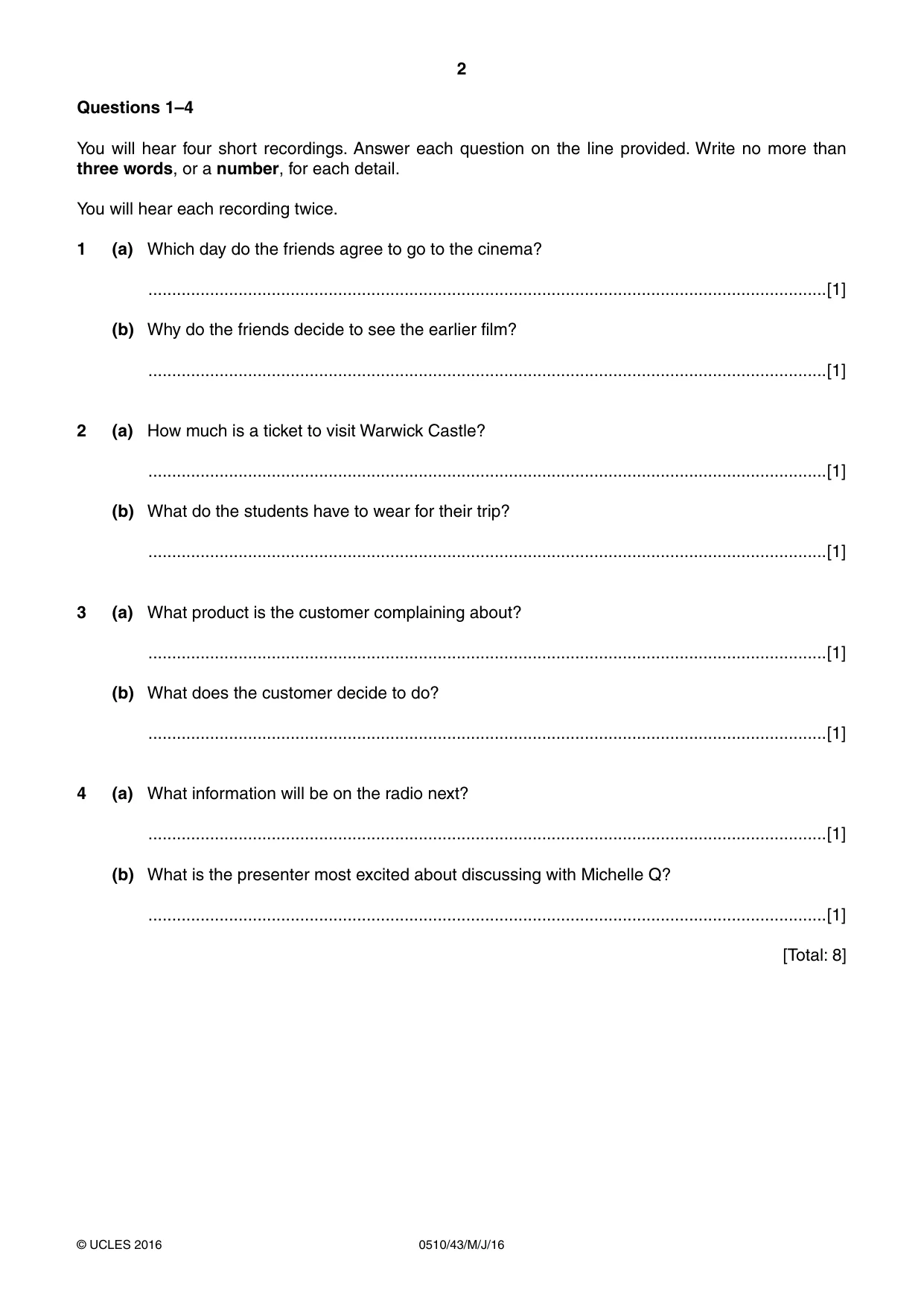
2 0510/43/M/J/16 © UCLES 2016 Questions 1–4 You will hear four short recordings. Answer each question on the line provided. Write no more than three words, or a number, for each detail. You will hear each recording twice. 1 (a) Which day do the friends agree to go to the cinema? …[1] (b) Why do the friends decide to see the earlier film? …[1] 2 (a) How much is a ticket to visit Warwick Castle? …[1] (b) What do the students have to wear for their trip? …[1] 3 (a) What product is the customer complaining about? …[1] (b) What does the customer decide to do? …[1] 4 (a) What information will be on the radio next? …[1] (b) What is the presenter most excited about discussing with Michelle Q? …[1] [Total: 8]
Question paper, page 3
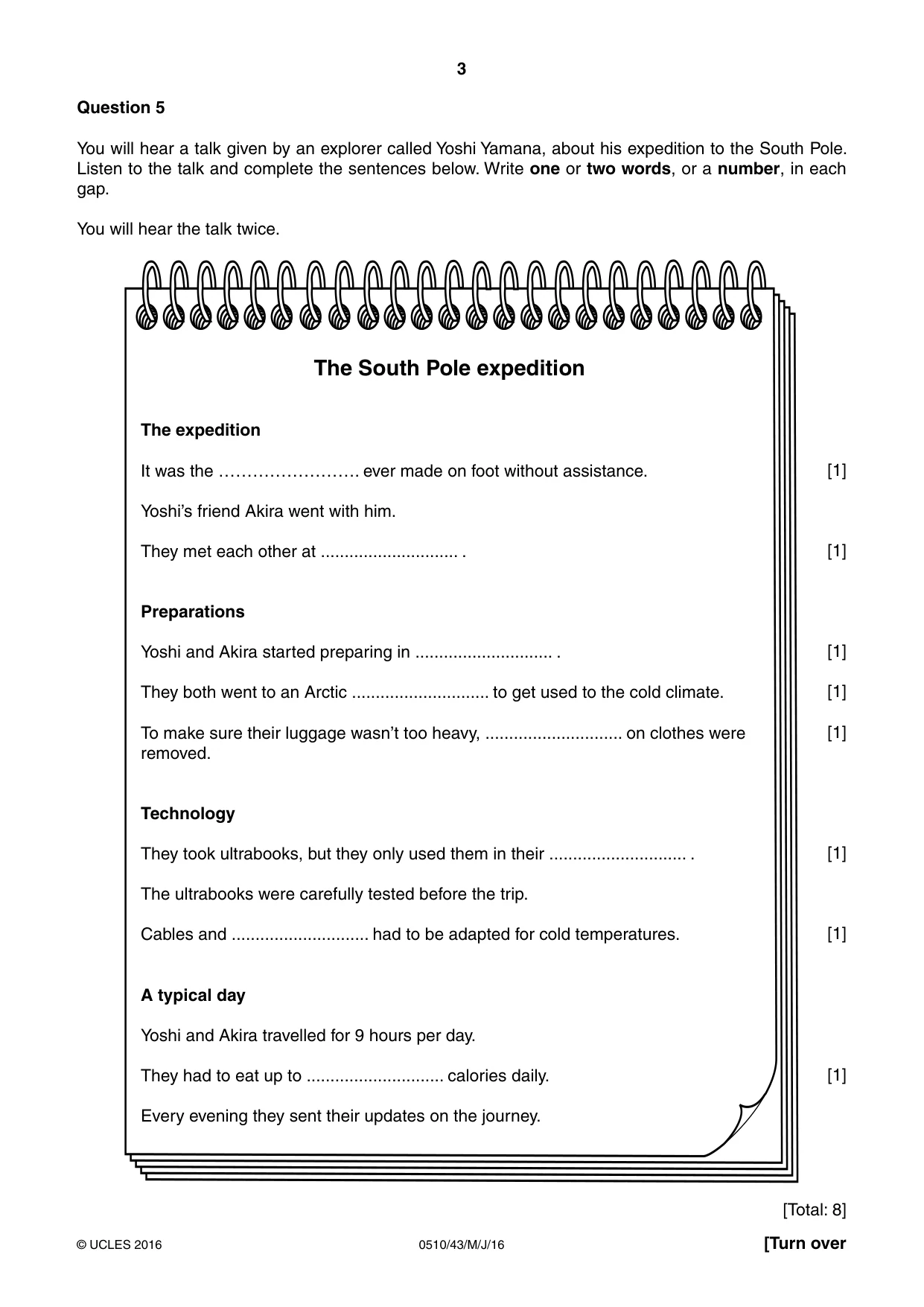
3 0510/43/M/J/16 © UCLES 2016 [Turn over Question 5 You will hear a talk given by an explorer called Yoshi Yamana, about his expedition to the South Pole. Listen to the talk and complete the sentences below. Write one or two words, or a number, in each gap. You will hear the talk twice. The South Pole expedition The expedition It was the ……………………. ever made on foot without assistance. Yoshi’s friend Akira went with him. They met each other at … . Preparations Yoshi and Akira started preparing in … . They both went to an Arctic … to get used to the cold climate. To make sure their luggage wasn’t too heavy, … on clothes were removed. Technology They took ultrabooks, but they only used them in their … . The ultrabooks were carefully tested before the trip. Cables and … had to be adapted for cold temperatures. A typical day Yoshi and Akira travelled for 9 hours per day. They had to eat up to … calories daily. Every evening they sent their updates on the journey. [1] [1] [1] [1] [1] [1] [1] [1] [Total: 8]
Question paper, page 4
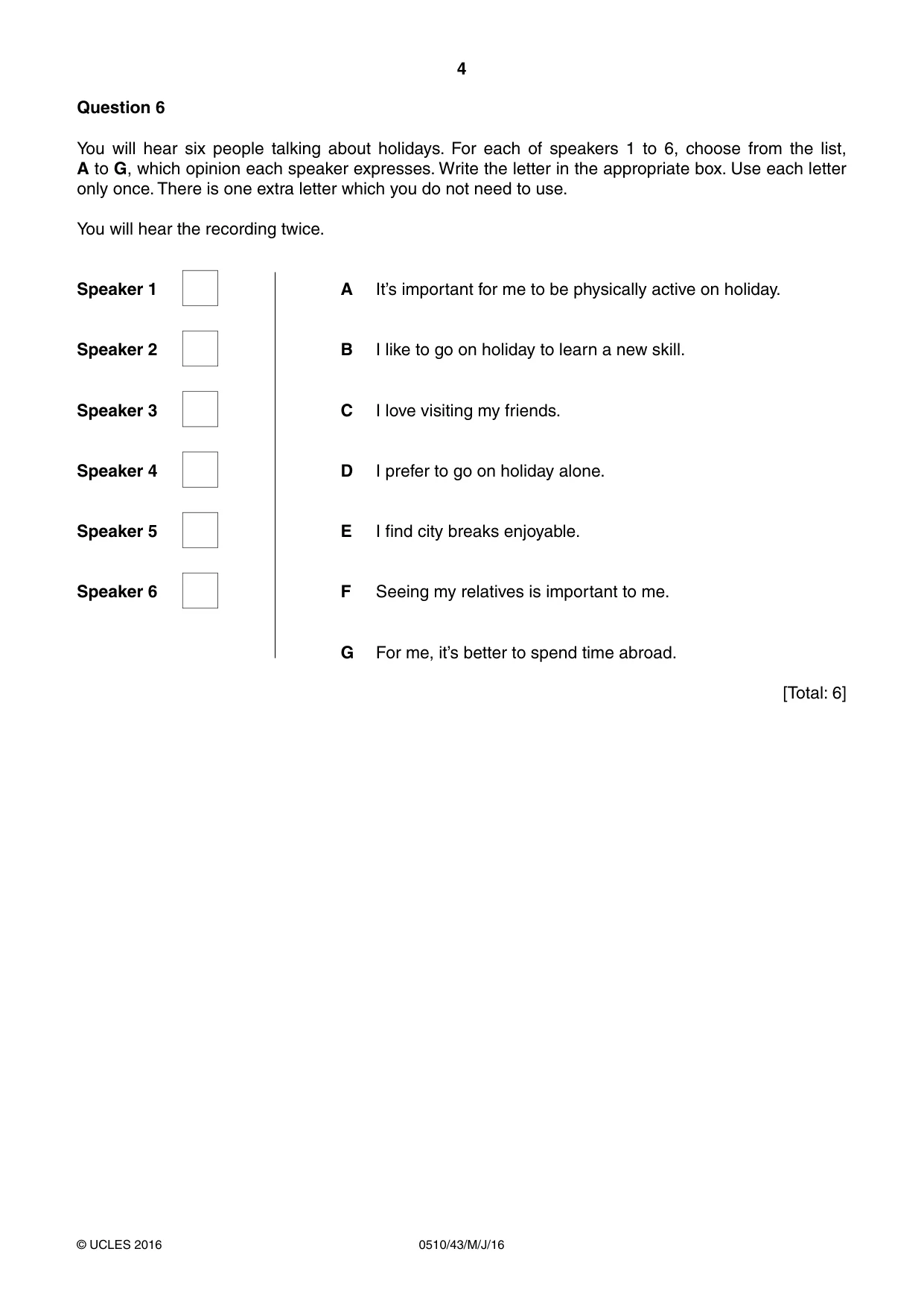
4 0510/43/M/J/16 © UCLES 2016 Question 6 You will hear six people talking about holidays. For each of speakers 1 to 6, choose from the list, A to G, which opinion each speaker expresses. Write the letter in the appropriate box. Use each letter only once. There is one extra letter which you do not need to use. You will hear the recording twice. Speaker 1 A It’s important for me to be physically active on holiday. Speaker 2 B I like to go on holiday to learn a new skill. Speaker 3 C I love visiting my friends. Speaker 4 D I prefer to go on holiday alone. Speaker 5 E I find city breaks enjoyable. Speaker 6 F Seeing my relatives is important to me. G For me, it’s better to spend time abroad. [Total: 6]
Question paper, page 5
5 0510/43/M/J/16 © UCLES 2016 [Turn over Please turn over for Question 7.
Question paper, page 6
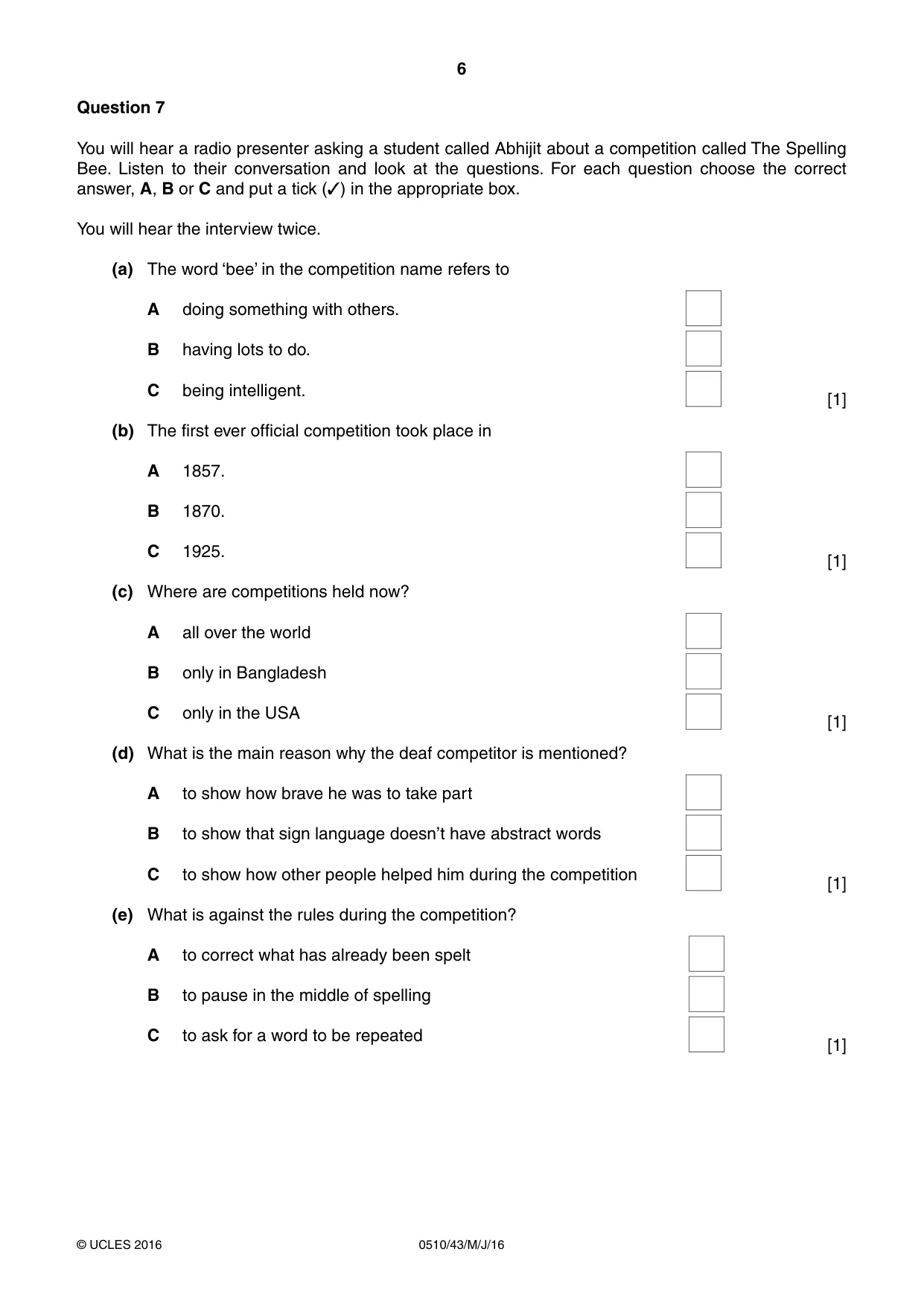
6 0510/43/M/J/16 © UCLES 2016 Question 7 You will hear a radio presenter asking a student called Abhijit about a competition called The Spelling Bee. Listen to their conversation and look at the questions. For each question choose the correct answer, A, B or C and put a tick (✓) in the appropriate box. You will hear the interview twice. (a) The word ‘bee’ in the competition name refers to A doing something with others. B having lots to do. C being intelligent. [1] (b) The first ever official competition took place in A 1857. B 1870. C 1925. [1] (c) Where are competitions held now? A all over the world B only in Bangladesh C only in the USA [1] (d) What is the main reason why the deaf competitor is mentioned? A to show how brave he was to take part B to show that sign language doesn’t have abstract words C to show how other people helped him during the competition [1] (e) What is against the rules during the competition? A to correct what has already been spelt B to pause in the middle of spelling C to ask for a word to be repeated [1]
Question paper, page 7
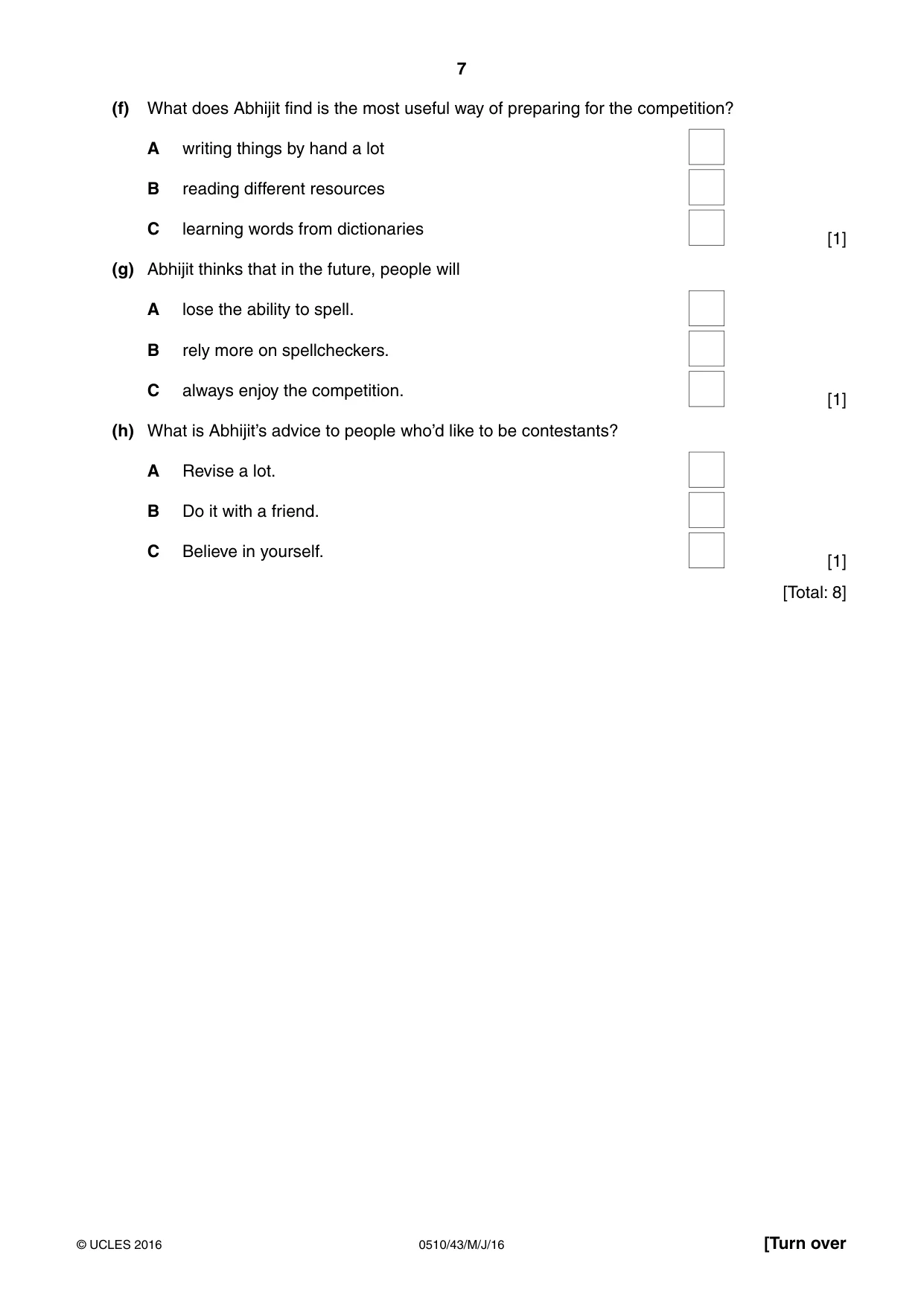
7 0510/43/M/J/16 © UCLES 2016 [Turn over (f) What does Abhijit find is the most useful way of preparing for the competition? A writing things by hand a lot B reading different resources C learning words from dictionaries [1] (g) Abhijit thinks that in the future, people will A lose th e ability to spell. B rely more on spellcheckers. C always enjoy the competition. [1] (h) What is Abhijit’s advice to people who’d like to be contestants? A Revise a lot. B Do it with a friend. C Believe in yourself. [1] [Total: 8]
Question paper, page 8
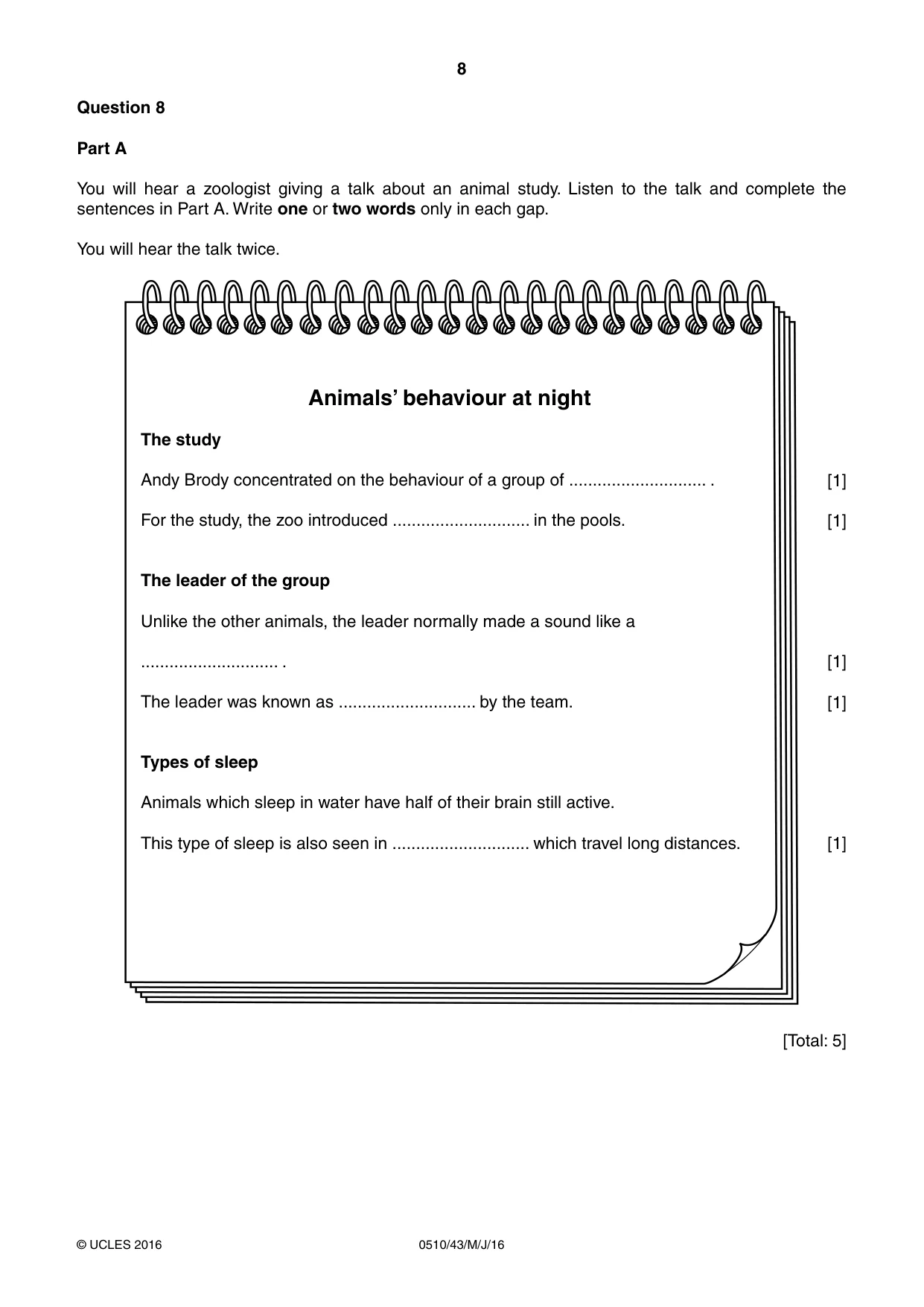
8 0510/43/M/J/16 © UCLES 2016 Question 8 Part A You will hear a zoologist giving a talk about an animal study. Listen to the talk and complete the sentences in Part A. Write one or two words only in each gap. You will hear the talk twice. Animals’ behaviour at night The study Andy Brody concentrated on the behaviour of a group of … . For the study, the zoo introduced … in the pools. The leader of the group Unlike the other animals, the leader normally made a sound like a … . The leader was known as … by the team. Types of sleep Animals which sleep in water have half of their brain still active. This type of sleep is also seen in … which travel long distances. [1] [1] [1] [1] [1] [Total: 5]
Question paper, page 9
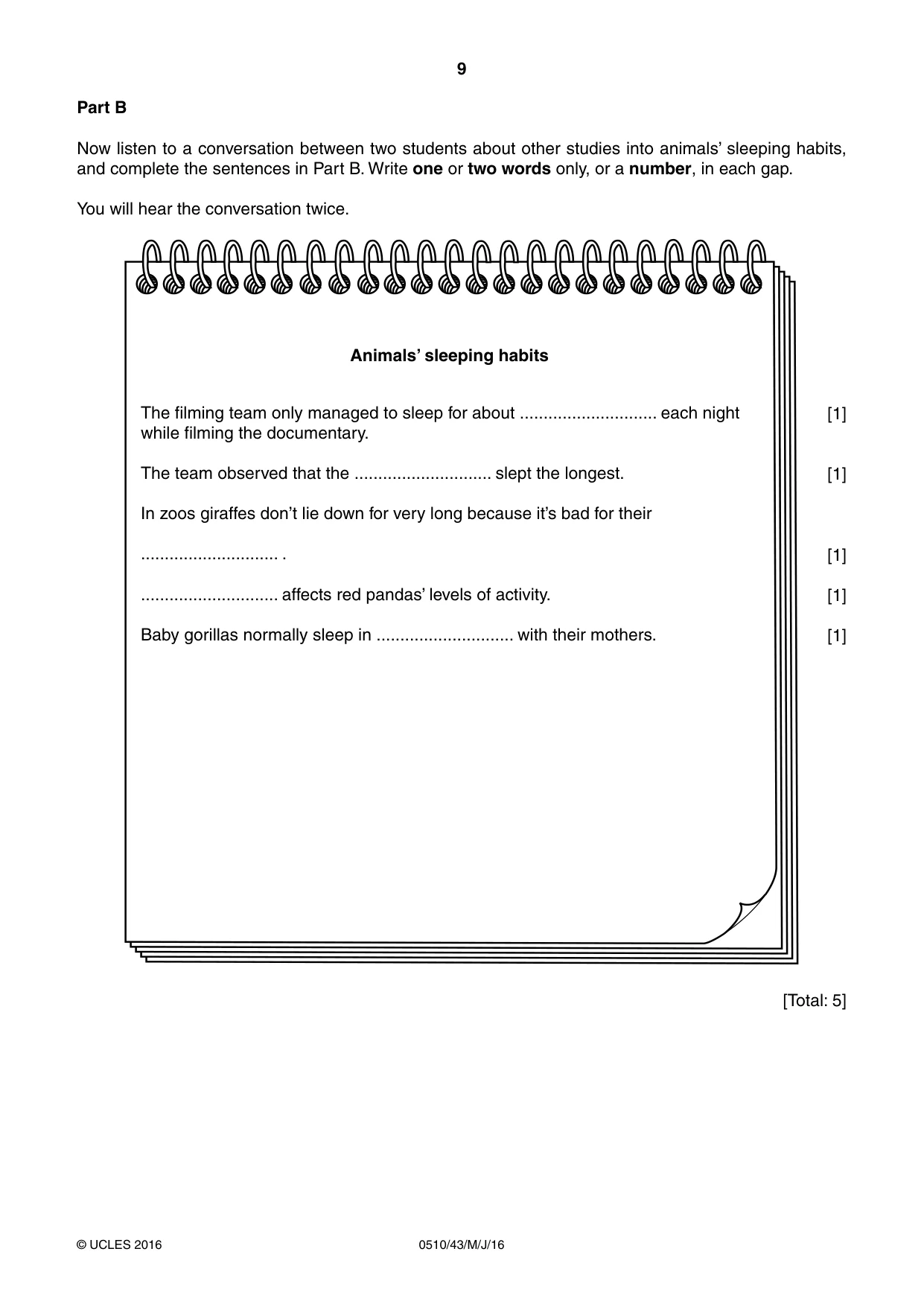
9 0510/43/M/J/16 © UCLES 2016 Part B Now listen to a conversation between two students about other studies into animals’ sleeping habits, and complete the sentences in Part B. Write one or two words only, or a number, in each gap. You will hear the conversation twice. Animals’ sleeping habits The filming team only managed to sleep for about … each night while filming the documentary. The team observed that the … slept the longest. In zoos giraffes don’t lie down for very long because it’s bad for their … . … affects red pandas’ levels of activity. Baby gorillas normally sleep in … with their mothers. [1] [1] [1] [1] [1] [Total: 5]
Question paper, page 10
10 0510/43/M/J/16 © UCLES 2016 BLANK PAGE
Question paper, page 11
11 0510/43/M/J/16 © UCLES 2016 BLANK PAGE
Question paper, page 12
12 0510/43/M/J/16 © UCLES 2016 Permission to reproduce items where third-party owned material protected by copyright is included has been sought and cleared where possible. Every reasonable effort has been made by the publisher (UCLES) to trace copyright holders, but if any items requiring clearance have unwittingly been included, the publisher will be pleased to make amends at the earliest possible opportunity. To avoid the issue of disclosure of answer-related information to candidates, all copyright acknowledgements are reproduced online in the Cambridge International Examinations Copyright Acknowledgements Booklet. This is produced for each series of examinations and is freely available to download at www.cie.org.uk after the live examination series. Cambridge International Examinations is part of the Cambridge Assessment Group. Cambridge Assessment is the brand name of University of Cambridge Local Examinations Syndicate (UCLES), which is itself a department of the University of Cambridge. BLANK PAGE
Mark scheme, page 1
® IGCSE is the registered trademark of Cambridge International Examinations. This document consists of 15 printed pages. © UCLES 2016 [Turn over Cambridge International Examinations Cambridge International General Certificate of Secondary Education ENGLISH AS A SECOND LANGUAGE 0510/43 Paper 4 Listening (Extended) May/June 2016 MARK SCHEME Maximum Mark: 40 Published This mark scheme is published as an aid to teachers and candidates, to indicate the requirements of the examination. It shows the basis on which Examiners were instructed to award marks. It does not indicate the details of the discussions that took place at an Examiners’ meeting before marking began, which would have considered the acceptability of alternative answers. Mark schemes should be read in conjunction with the question paper and the Principal Examiner Report for Teachers. Cambridge will not enter into discussions about these mark schemes. Cambridge is publishing the mark schemes for the May/June 2016 series for most Cambridge IGCSE®, Cambridge International A and AS Level components and some Cambridge O Level components.
Mark scheme, page 2
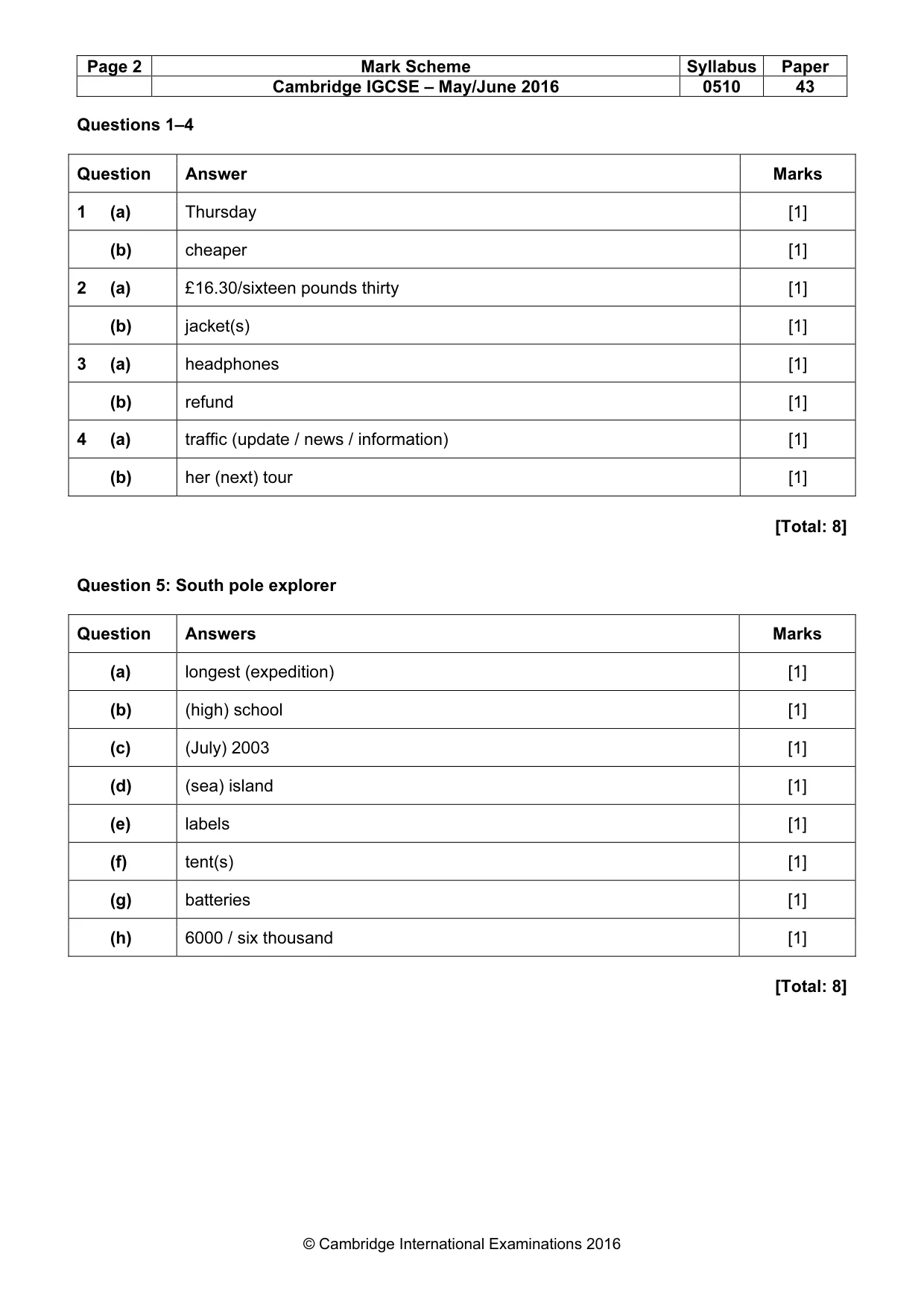
Page 2 Mark Scheme Syllabus Paper Cambridge IGCSE – May/June 2016 0510 43 © Cambridge International Examinations 2016 Questions 1–4 Question Answer Marks 1 (a) Thursday [1] (b) cheaper [1] 2 (a) £16.30/sixteen pounds thirty [1] (b) jacket(s) [1] 3 (a) headphones [1] (b) refund [1] 4 (a) traffic (update / news / information) [1] (b) her (next) tour [1] [Total: 8] Question 5: South pole explorer Question Answers Marks (a) longest (expedition) [1] (b) (high) school [1] (c) (July) 2003 [1] (d) (sea) island [1] (e) labels [1] (f) tent(s) [1] (g) batteries [1] (h) 6000 / six thousand [1] [Total: 8]
Mark scheme, page 3
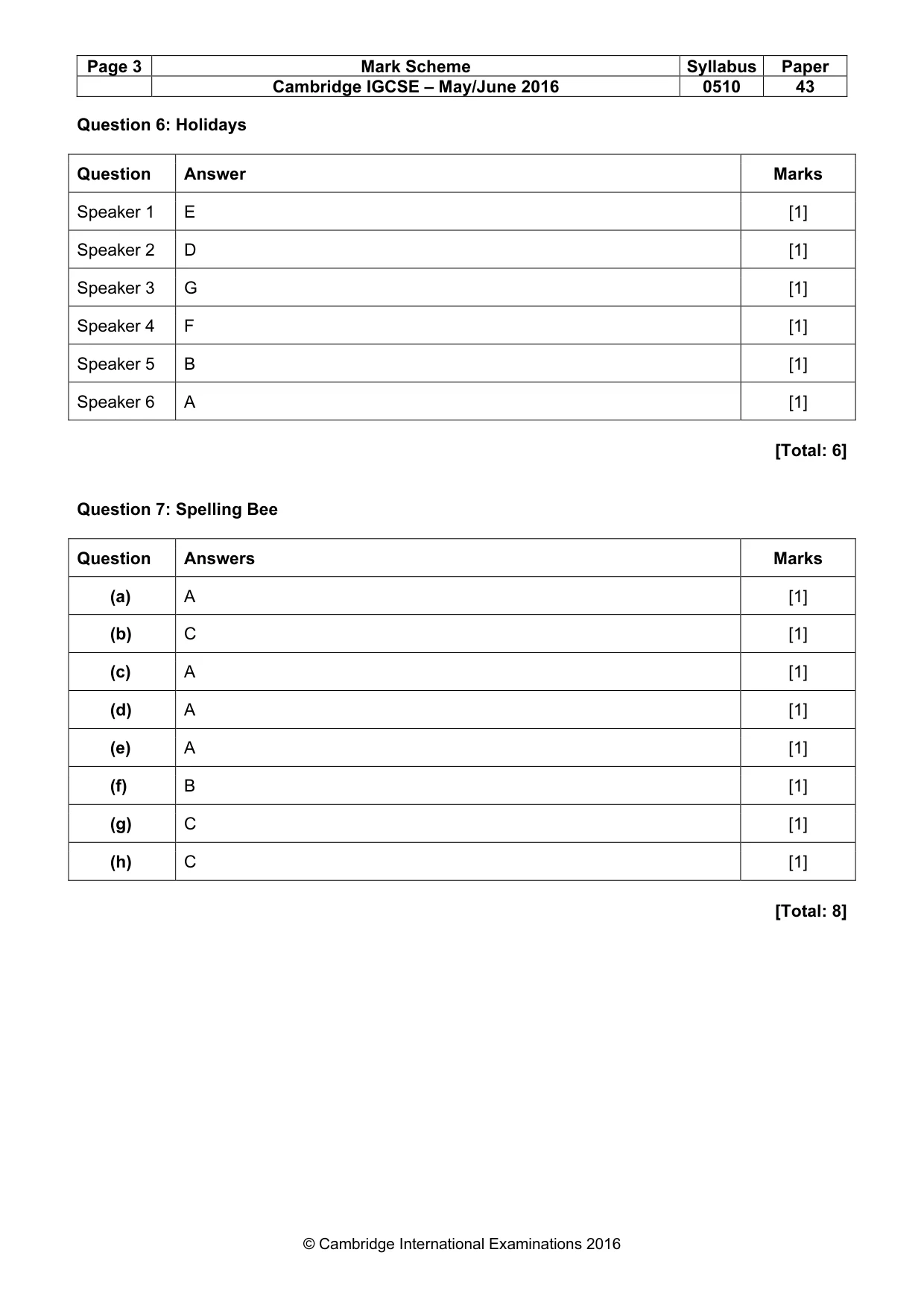
Page 3 Mark Scheme Syllabus Paper Cambridge IGCSE – May/June 2016 0510 43 © Cambridge International Examinations 2016 Question 6: Holidays Question Answer Marks Speaker 1 E [1] Speaker 2 D [1] Speaker 3 G [1] Speaker 4 F [1] Speaker 5 B [1] Speaker 6 A [1] [Total: 6] Question 7: Spelling Bee Question Answers Marks (a) A [1] (b) C [1] (c) A [1] (d) A [1] (e) A [1] (f) B [1] (g) C [1] (h) C [1] [Total: 8]
Mark scheme, page 4
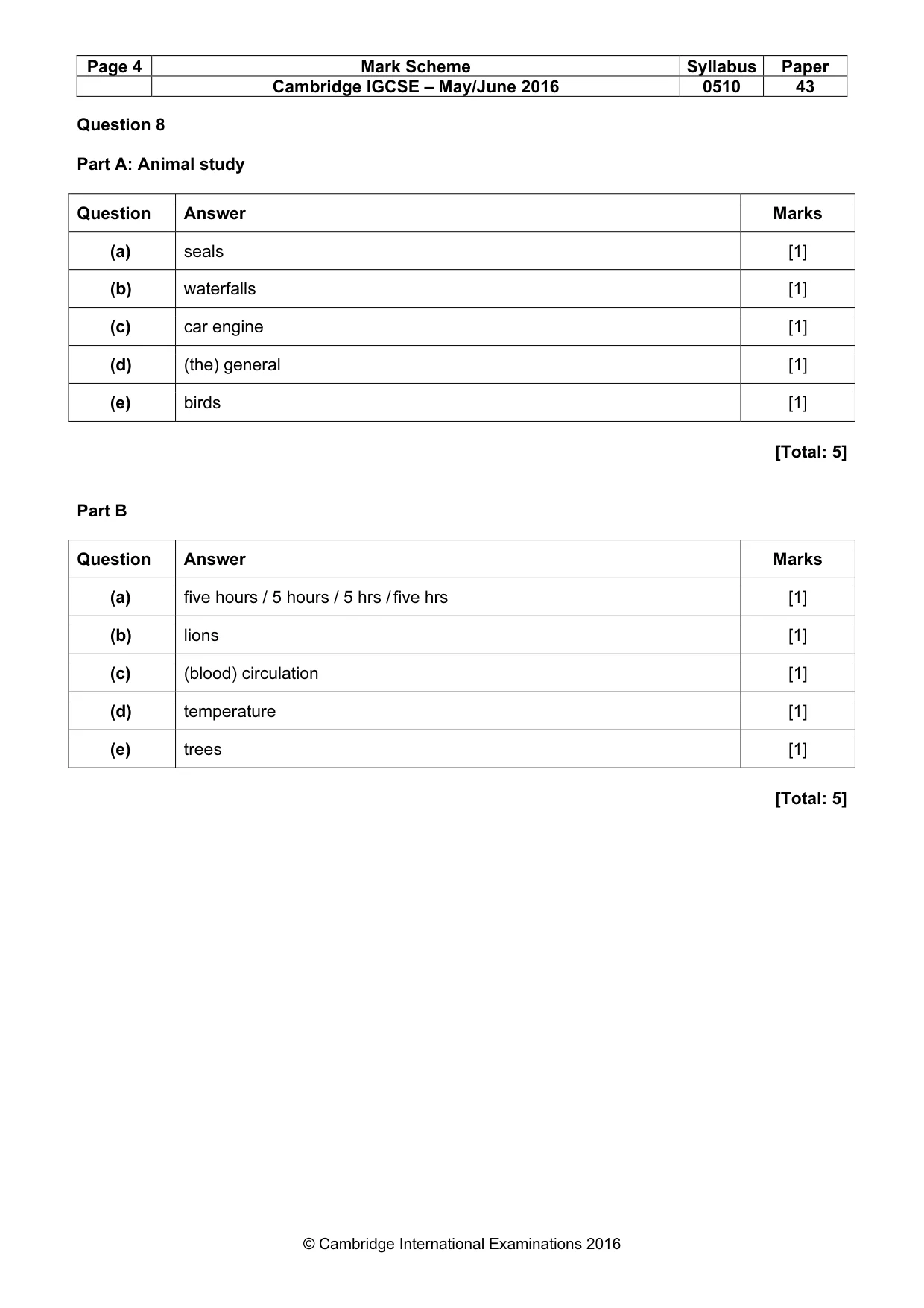
Page 4 Mark Scheme Syllabus Paper Cambridge IGCSE – May/June 2016 0510 43 © Cambridge International Examinations 2016 Question 8 Part A: Animal study Question Answer Marks (a) seals [1] (b) waterfalls [1] (c) car engine [1] (d) (the) general [1] (e) birds [1] [Total: 5] Part B Question Answer Marks (a) five hours / 5 hours / 5 hrs / five hrs [1] (b) lions [1] (c) (blood) circulation [1] (d) temperature [1] (e) trees [1] [Total: 5]
Mark scheme, page 5
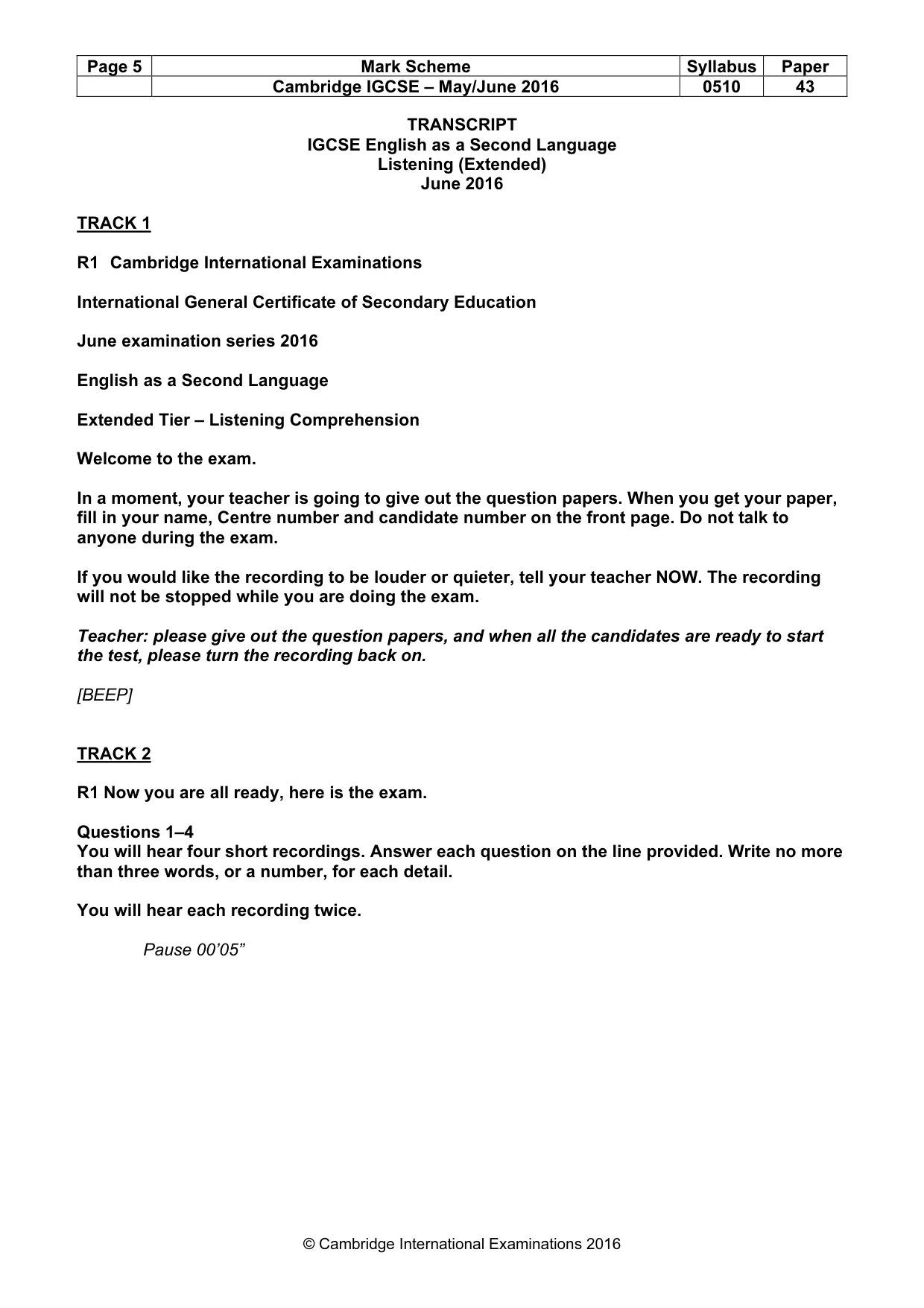
Page 5 Mark Scheme Syllabus Paper Cambridge IGCSE – May/June 2016 0510 43 © Cambridge International Examinations 2016 TRANSCRIPT IGCSE English as a Second Language Listening (Extended) June 2016 TRACK 1 R1 Cambridge International Examinations International General Certificate of Secondary Education June examination series 2016 English as a Second Language Extended Tier – Listening Comprehension Welcome to the exam. In a moment, your teacher is going to give out the question papers. When you get your paper, fill in your name, Centre number and candidate number on the front page. Do not talk to anyone during the exam. If you would like the recording to be louder or quieter, tell your teacher NOW. The recording will not be stopped while you are doing the exam. Teacher: please give out the question papers, and when all the candidates are ready to start the test, please turn the recording back on. [BEEP] TRACK 2 R1 Now you are all ready, here is the exam. Questions 1–4 You will hear four short recordings. Answer each question on the line provided. Write no more than three words, or a number, for each detail. You will hear each recording twice. Pause 00’05”
Mark scheme, page 6
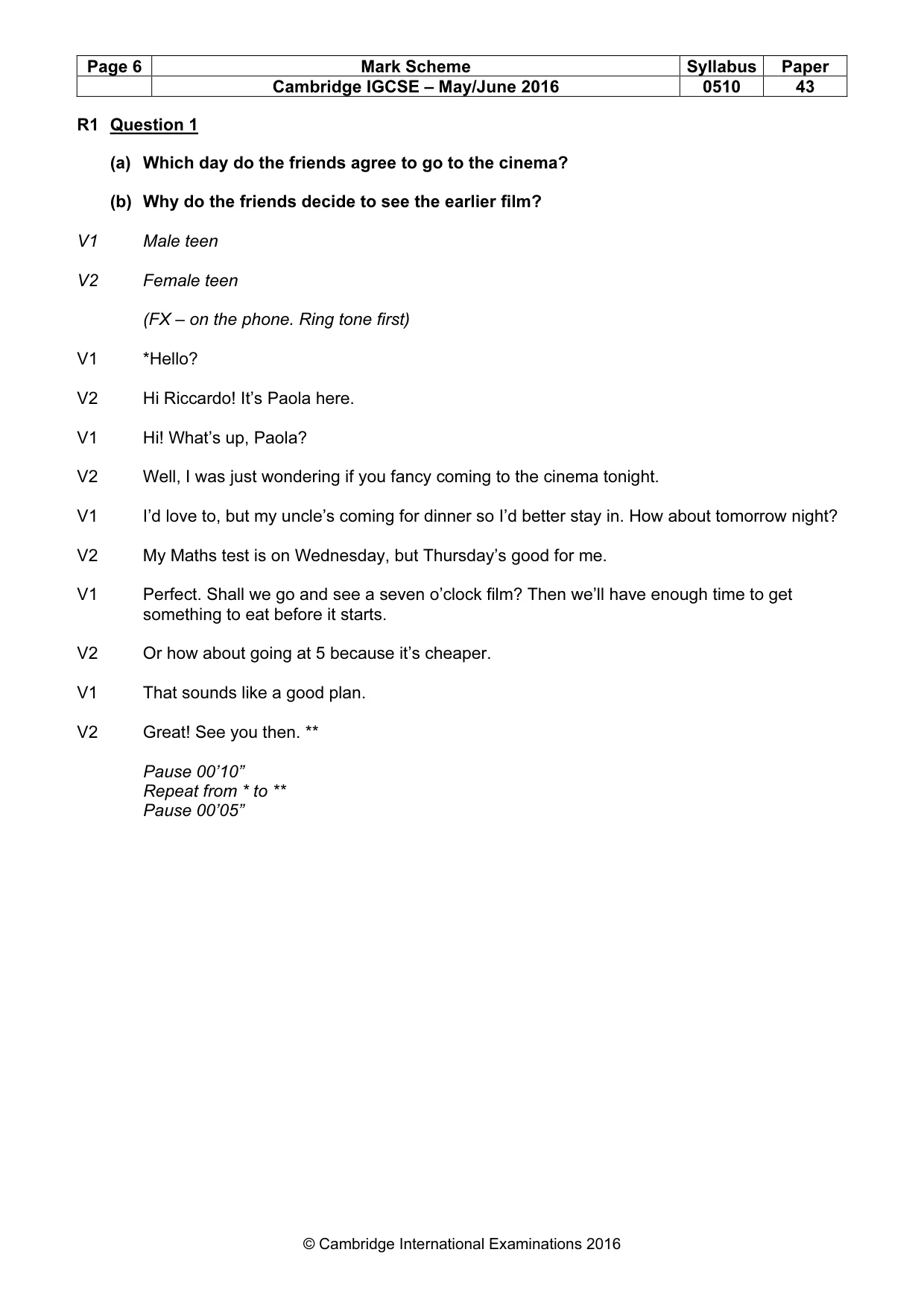
Page 6 Mark Scheme Syllabus Paper Cambridge IGCSE – May/June 2016 0510 43 © Cambridge International Examinations 2016 R1 Question 1 (a) Which day do the friends agree to go to the cinema? (b) Why do the friends decide to see the earlier film? V1 Male teen V2 Female teen (FX – on the phone. Ring tone first) V1 *Hello? V2 Hi Riccardo! It’s Paola here. V1 Hi! What’s up, Paola? V2 Well, I was just wondering if you fancy coming to the cinema tonight. V1 I’d love to, but my uncle’s coming for dinner so I’d better stay in. How about tomorrow night? V2 My Maths test is on Wednesday, but Thursday’s good for me. V1 Perfect. Shall we go and see a seven o’clock film? Then we’ll have enough time to get something to eat before it starts. V2 Or how about going at 5 because it’s cheaper. V1 That sounds like a good plan. V2 Great! See you then. ** Pause 00’10” Repeat from * to ** Pause 00’05”
Mark scheme, page 7
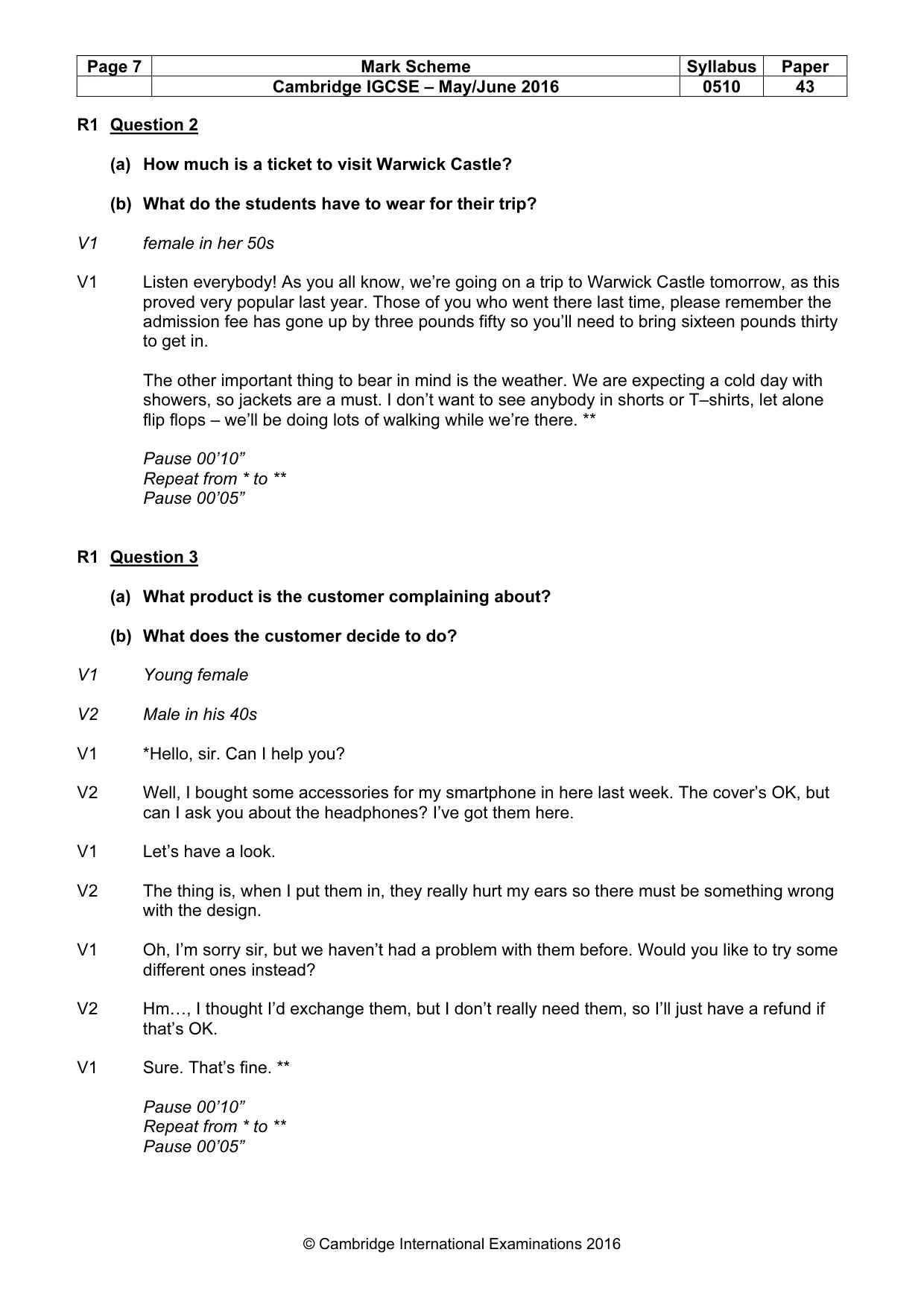
Page 7 Mark Scheme Syllabus Paper Cambridge IGCSE – May/June 2016 0510 43 © Cambridge International Examinations 2016 R1 Question 2 (a) How much is a ticket to visit Warwick Castle? (b) What do the students have to wear for their trip? V1 female in her 50s V1 Listen everybody! As you all know, we’re going on a trip to Warwick Castle tomorrow, as this proved very popular last year. Those of you who went there last time, please remember the admission fee has gone up by three pounds fifty so you’ll need to bring sixteen pounds thirty to get in. The other important thing to bear in mind is the weather. We are expecting a cold day with showers, so jackets are a must. I don’t want to see anybody in shorts or T–shirts, let alone flip flops – we’ll be doing lots of walking while we’re there. ** Pause 00’10” Repeat from * to ** Pause 00’05” R1 Question 3 (a) What product is the customer complaining about? (b) What does the customer decide to do? V1 Young female V2 Male in his 40s V1 *Hello, sir. Can I help you? V2 Well, I bought some accessories for my smartphone in here last week. The cover’s OK, but can I ask you about the headphones? I’ve got them here. V1 Let’s have a look. V2 The thing is, when I put them in, they really hurt my ears so there must be something wrong with the design. V1 Oh, I’m sorry sir, but we haven’t had a problem with them before. Would you like to try some different ones instead? V2 Hm…, I thought I’d exchange them, but I don’t really need them, so I’ll just have a refund if that’s OK. V1 Sure. That’s fine. ** Pause 00’10” Repeat from * to ** Pause 00’05”
Mark scheme, page 8
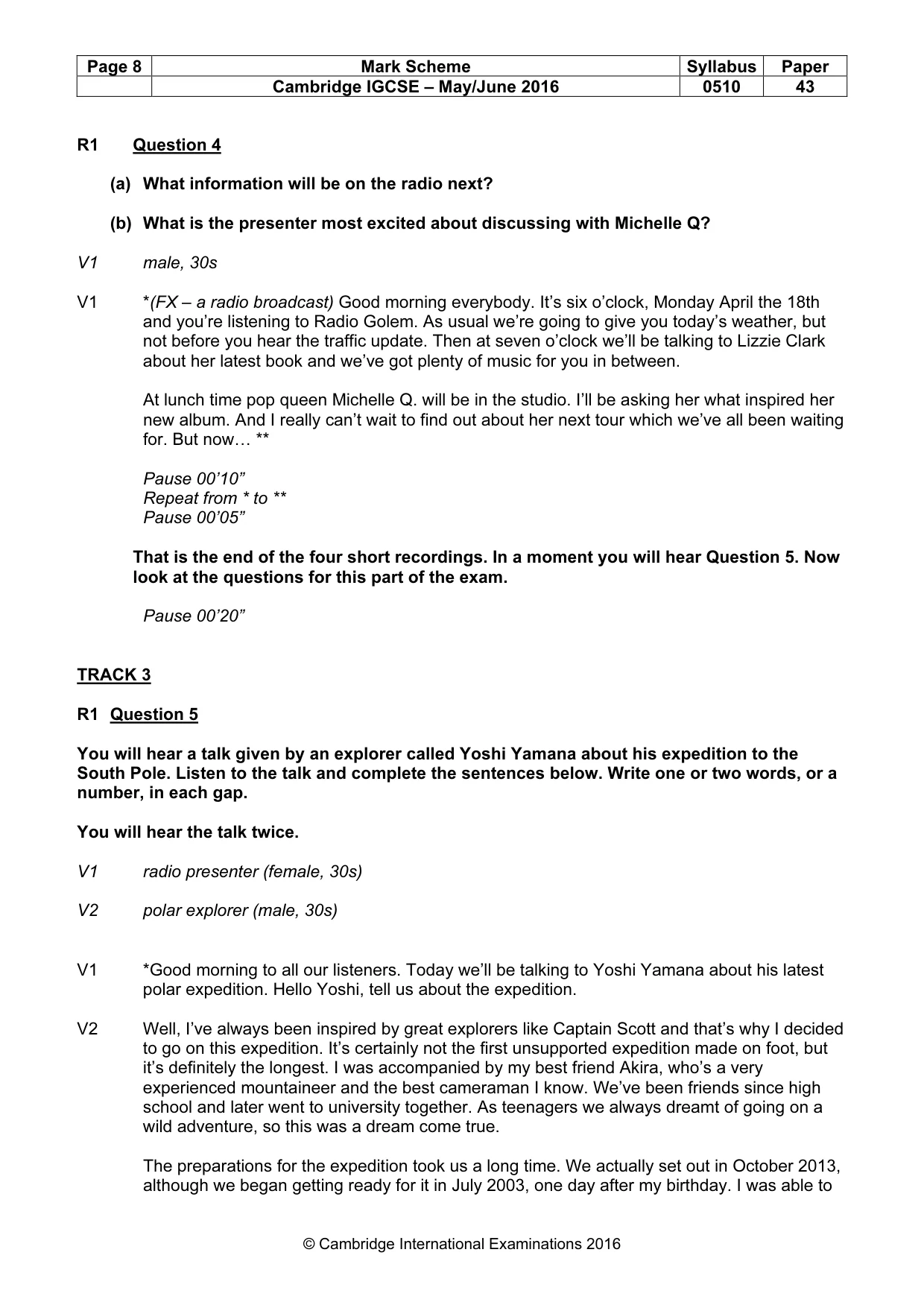
Page 8 Mark Scheme Syllabus Paper Cambridge IGCSE – May/June 2016 0510 43 © Cambridge International Examinations 2016 R1 Question 4 (a) What information will be on the radio next? (b) What is the presenter most excited about discussing with Michelle Q? V1 male, 30s V1 *(FX – a radio broadcast) Good morning everybody. It’s six o’clock, Monday April the 18th and you’re listening to Radio Golem. As usual we’re going to give you today’s weather, but not before you hear the traffic update. Then at seven o’clock we’ll be talking to Lizzie Clark about her latest book and we’ve got plenty of music for you in between. At lunch time pop queen Michelle Q. will be in the studio. I’ll be asking her what inspired her new album. And I really can’t wait to find out about her next tour which we’ve all been waiting for. But now… ** Pause 00’10” Repeat from * to ** Pause 00’05” That is the end of the four short recordings. In a moment you will hear Question 5. Now look at the questions for this part of the exam. Pause 00’20” TRACK 3 R1 Question 5 You will hear a talk given by an explorer called Yoshi Yamana about his expedition to the South Pole. Listen to the talk and complete the sentences below. Write one or two words, or a number, in each gap. You will hear the talk twice. V1 radio presenter (female, 30s) V2 polar explorer (male, 30s) V1 *Good morning to all our listeners. Today we’ll be talking to Yoshi Yamana about his latest polar expedition. Hello Yoshi, tell us about the expedition. V2 Well, I’ve always been inspired by great explorers like Captain Scott and that’s why I decided to go on this expedition. It’s certainly not the first unsupported expedition made on foot, but it’s definitely the longest. I was accompanied by my best friend Akira, who’s a very experienced mountaineer and the best cameraman I know. We’ve been friends since high school and later went to university together. As teenagers we always dreamt of going on a wild adventure, so this was a dream come true. The preparations for the expedition took us a long time. We actually set out in October 2013, although we began getting ready for it in July 2003, one day after my birthday. I was able to
Mark scheme, page 9
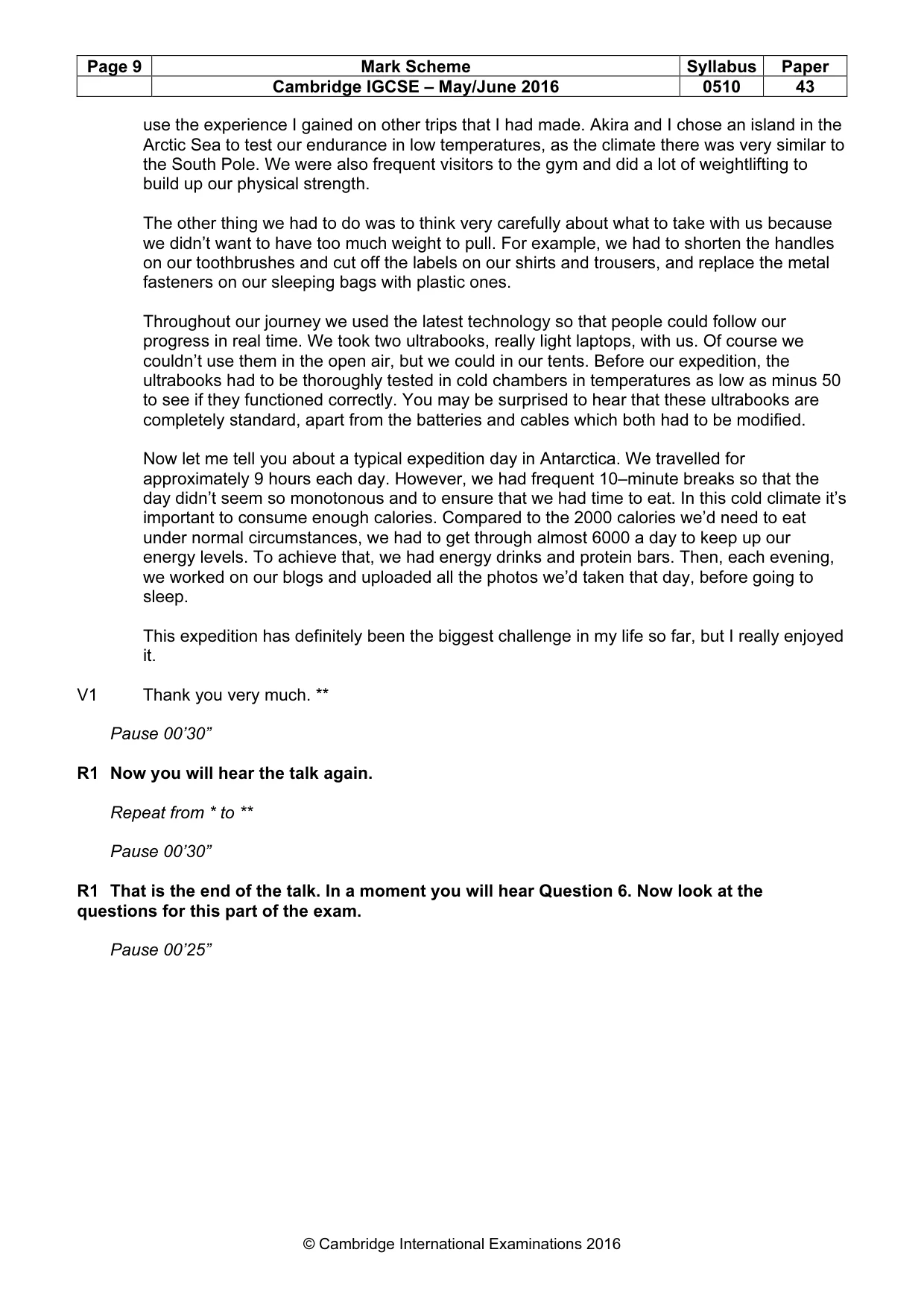
Page 9 Mark Scheme Syllabus Paper Cambridge IGCSE – May/June 2016 0510 43 © Cambridge International Examinations 2016 use the experience I gained on other trips that I had made. Akira and I chose an island in the Arctic Sea to test our endurance in low temperatures, as the climate there was very similar to the South Pole. We were also frequent visitors to the gym and did a lot of weightlifting to build up our physical strength. The other thing we had to do was to think very carefully about what to take with us because we didn’t want to have too much weight to pull. For example, we had to shorten the handles on our toothbrushes and cut off the labels on our shirts and trousers, and replace the metal fasteners on our sleeping bags with plastic ones. Throughout our journey we used the latest technology so that people could follow our progress in real time. We took two ultrabooks, really light laptops, with us. Of course we couldn’t use them in the open air, but we could in our tents. Before our expedition, the ultrabooks had to be thoroughly tested in cold chambers in temperatures as low as minus 50 to see if they functioned correctly. You may be surprised to hear that these ultrabooks are completely standard, apart from the batteries and cables which both had to be modified. Now let me tell you about a typical expedition day in Antarctica. We travelled for approximately 9 hours each day. However, we had frequent 10–minute breaks so that the day didn’t seem so monotonous and to ensure that we had time to eat. In this cold climate it’s important to consume enough calories. Compared to the 2000 calories we’d need to eat under normal circumstances, we had to get through almost 6000 a day to keep up our energy levels. To achieve that, we had energy drinks and protein bars. Then, each evening, we worked on our blogs and uploaded all the photos we’d taken that day, before going to sleep. This expedition has definitely been the biggest challenge in my life so far, but I really enjoyed it. V1 Thank you very much. ** Pause 00’30” R1 Now you will hear the talk again. Repeat from * to ** Pause 00’30” R1 That is the end of the talk. In a moment you will hear Question 6. Now look at the questions for this part of the exam. Pause 00’25”
Mark scheme, page 10
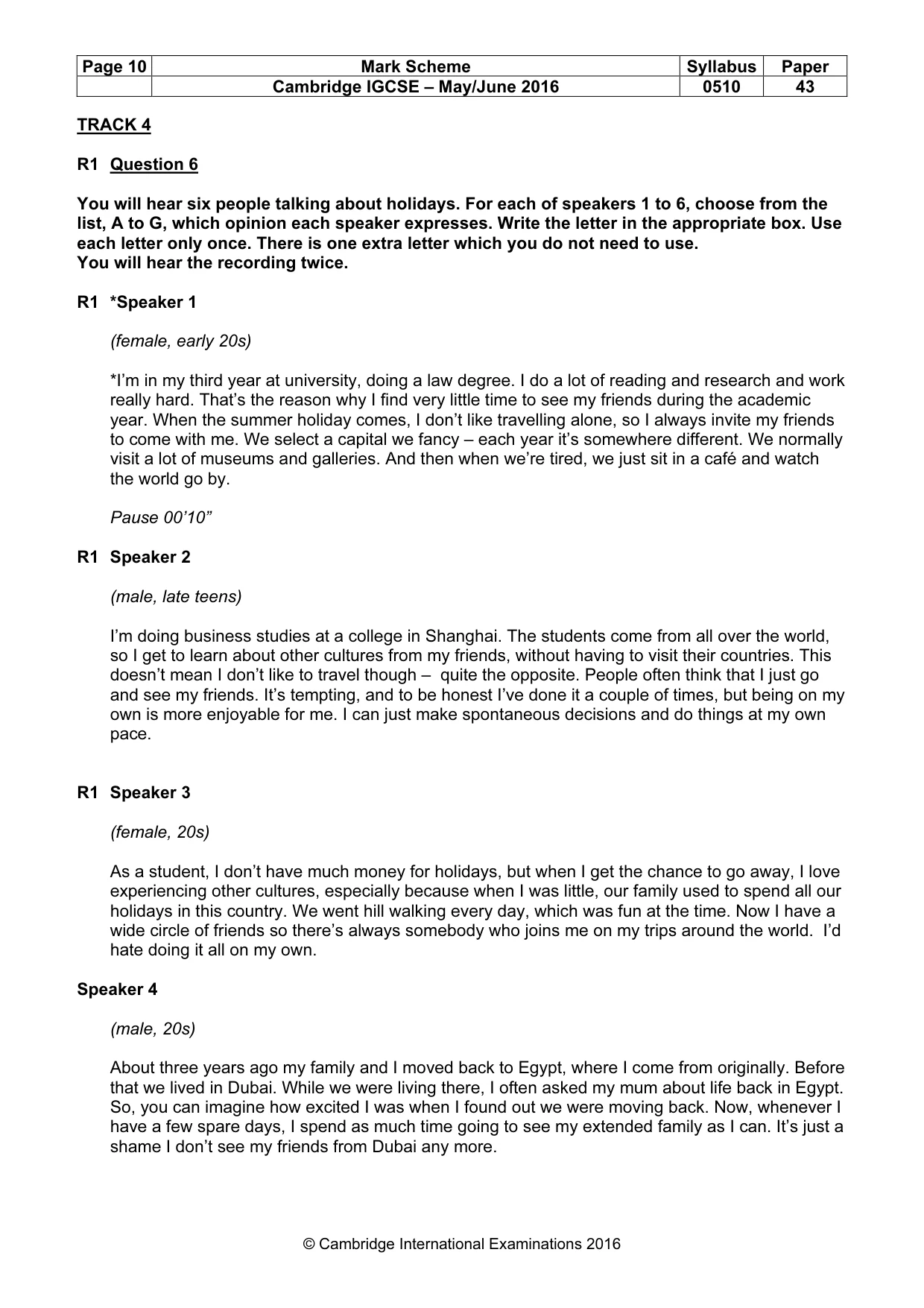
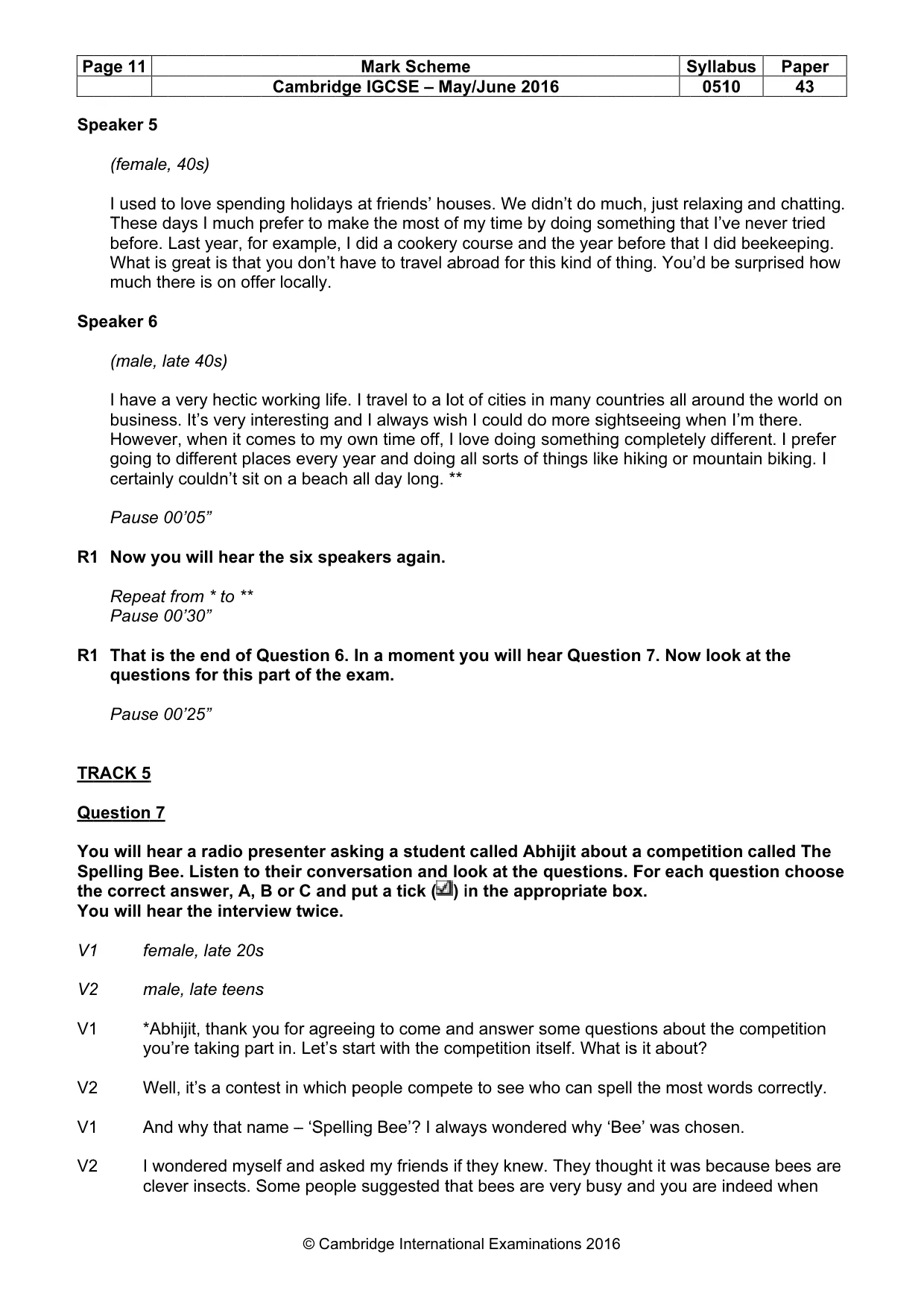
Page 10 Mark Scheme Syllabus Paper Cambridge IGCSE – May/June 2016 0510 43 © Cambridge International Examinations 2016 TRACK 4 R1 Question 6 You will hear six people talking about holidays. For each of speakers 1 to 6, choose from the list, A to G, which opinion each speaker expresses. Write the letter in the appropriate box. Use each letter only once. There is one extra letter which you do not need to use. You will hear the recording twice. R1 *Speaker 1 (female, early 20s) *I’m in my third year at university, doing a law degree. I do a lot of reading and research and work really hard. That’s the reason why I find very little time to see my friends during the academic year. When the summer holiday comes, I don’t like travelling alone, so I always invite my friends to come with me. We select a capital we fancy – each year it’s somewhere different. We normally visit a lot of museums and galleries. And then when we’re tired, we just sit in a café and watch the world go by. Pause 00’10” R1 Speaker 2 (male, late teens) I’m doing business studies at a college in Shanghai. The students come from all over the world, so I get to learn about other cultures from my friends, without having to visit their countries. This doesn’t mean I don’t like to travel though – quite the opposite. People often think that I just go and see my friends. It’s tempting, and to be honest I’ve done it a couple of times, but being on my own is more enjoyable for me. I can just make spontaneous decisions and do things at my own pace. R1 Speaker 3 (female, 20s) As a student, I don’t have much money for holidays, but when I get the chance to go away, I love experiencing other cultures, especially because when I was little, our family used to spend all our holidays in this country. We went hill walking every day, which was fun at the time. Now I have a wide circle of friends so there’s always somebody who joins me on my trips around the world. I’d hate doing it all on my own. Speaker 4 (male, 20s) About three years ago my family and I moved back to Egypt, where I come from originally. Before that we lived in Dubai. While we were living there, I often asked my mum about life back in Egypt. So, you can imagine how excited I was when I found out we were moving back. Now, whenever I have a few spare days, I spend as much time going to see my extended family as I can. It’s just a shame I don’t see my friends from Dubai any more.
Mark scheme, page 11
P Sp Sp R1 R1 TR Qu Yo Sp th Yo V1 V2 V1 V2 V1 V2 ag pea ( I T b W m pea ( I b H g c P 1 N R P 1 T q P RA ues ou pel e c ou 1 2 1 2 1 2 ge 1 ake (fem I us The bef Wh mu ake (m I ha bus Ho goi cer Pa No Re Pa Th qu Pa ACK sti wi lin cor wi 11 er 5 ma sed ese for hat uch er 6 ale ave sin owe ing rtai us ow epe us at es us K 5 on ill h ng rre ill h fe m * y W A I c 5 ale, d to e d e. t is h th 6 e, la e a nes eve g to inly e 0 yo eat e 0 is tio e 0 5 n 7 hea Be ect hea fem mal Ab you We And wo clev , 4 o lo day La gr here ate a ve ss. er, o di y c 00’ ou w fro 00’ the ons 00’ ar ee. an ar male le, bhij u’re ell, d w ond ver 0s) ove ys I st y rea e is e 40 ery It’s wh iffe cou ’05 wil om ’30 e e s fo ’25 a r Lis nsw the e, l lat it, e ta it’s why der r in ) e s I m yea t is s o 0s) y he s ve hen ere ldn ” ll h * t ” end or t ” rad ste wer e in late te t tha akin s a y th red nse spe muc ar, s th on o ) ect ery n it nt n’t s hea to * d o thi dio en r, A nte e 2 tee ank ng co hat d m cts end ch p fo hat offe tic y in co pla sit ar t ** of Q s p pr to A, erv 20s ens k yo pa onte na mys s. S C ding pre r e yo er wo nter ome ace on the Qu par res th B o view s s ou art est am self Som Cam g h efe exa ou d loc ork res es es e n a e s es rt o sen eir or w t fo in. t in e – f an me mb © oli r to amp do call ing stin to eve be ix tio of t nte r co C a twi r a Le wh – ‘S nd e pe brid Ca da o m ple n’t ly. g lif ng a my ery eac sp on 6 the er a on an ice agre et’s hic Spe as eop dge amb ys mak e, I ha fe. and y o y ye ch a pea 6. e e ask ve d p e. eei s st ch p elli ske ple M e IG brid at ke did ave I tr d I own ear all ake In exa kin ersa put ing tart peo ng ed m e su Mar GC dge frie the d a e to rav alw n ti r an da ers a m am. g a ati t a g to t w opl Be my ugg k S CSE e In end e m a co o tr vel wa me nd ay l ag mo . a s on tic o co with le c ee’ y fri ges Sch E – nter ds’ mos ook rav to ays e o do on gai om stu n an ck om th com ? I en ste hem – M rnat ’ ho st o ker el a a l wi ff, oing g. in. en de nd ( me a e c mp al ds ed t me May tion ous of m ry c ab lot ish I lo g a ** t y ent lo ) i and com pete wa s if tha e y/J nal ses my cou roa of I c ove all s you ca ook in t d a mp e to ays the at b un Ex s. W y tim urs ad cit cou e d sor u w alle k at the ans etit o s s w ey bee ne 2 xam We me e a for ties uld oin rts will ed t th e a swe tio see won kne es a 20 mina e d by and r th s in do ng of he Ab he pp er s n it e w de ew are 16 atio idn y d d th his n m o m so thi ear bhi qu pro som tse who ered w. T e ve ons n’t d oin he kin man mor me ng r Q jit ues opr me elf. ca d w The ery s 20 do ng ye nd ny c re s eth gs l Que ab stio iat e qu W an why ey t y bu 016 m so ar of cou sig ing ike est bou ons te b ues hat sp y ‘B tho usy 6 uch me be thi unt hts g co e hi ion ut a s. F box stio t is ell Bee oug y a h, j eth efor ng trie see om ikin n 7 a c Fo x. ons s it the e’ w ght and jus ing re t . Y es a ein mple ng 7. N com r e s a ab e m wa it w d yo S st re g th tha You all g w ete or Now mp eac bo bou mos s c wa ou Syl 0 ela hat at I u’d aro whe ely mo w l peti ch out ut? st w cho as b are llab 051 axin I’v did be oun en dif oun loo itio qu the wo ose bec e in bu 10 ng ve n d b e su nd I’m ffer nta ok on ues e c ords en. cau nde s an nev bee urp the m th ren ain at ca stio com s c use eed P nd c ver eke pris e w he nt. I bik the alle on mpe corr e b d w Pa 4 cha r tr eep sed wor re. I pr kin e ed T ch etit rec ee whe pe 43 atti ried ping d ho rld ref g. Th hoo tion ctly es a en er ng d g. ow on fer I e ose n y. are . w n e e
Mark scheme, page 12
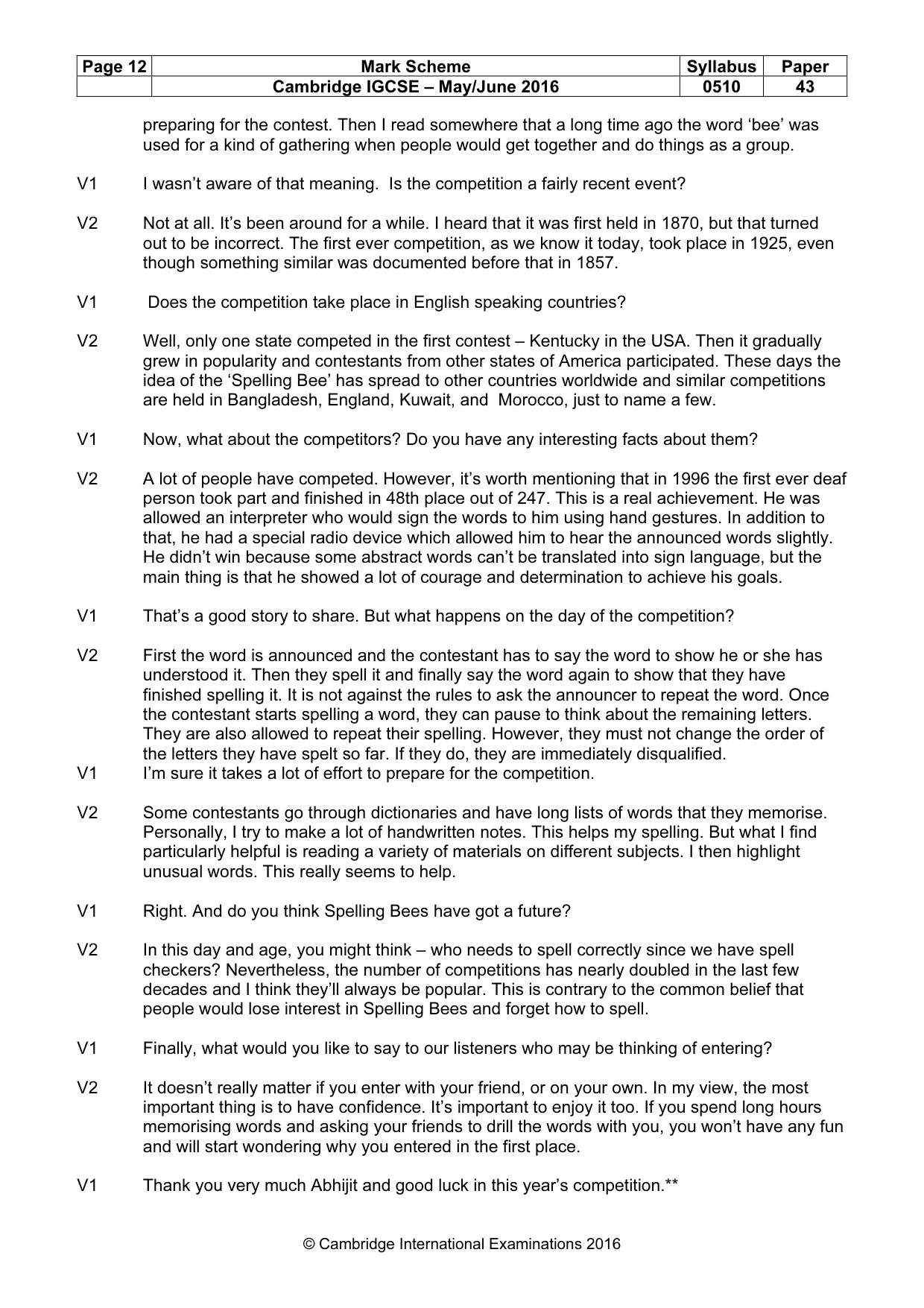
Page 12 Mark Scheme Syllabus Paper Cambridge IGCSE – May/June 2016 0510 43 © Cambridge International Examinations 2016 preparing for the contest. Then I read somewhere that a long time ago the word ‘bee’ was used for a kind of gathering when people would get together and do things as a group. V1 I wasn’t aware of that meaning. Is the competition a fairly recent event? V2 Not at all. It’s been around for a while. I heard that it was first held in 1870, but that turned out to be incorrect. The first ever competition, as we know it today, took place in 1925, even though something similar was documented before that in 1857. V1 Does the competition take place in English speaking countries? V2 Well, only one state competed in the first contest – Kentucky in the USA. Then it gradually grew in popularity and contestants from other states of America participated. These days the idea of the ‘Spelling Bee’ has spread to other countries worldwide and similar competitions are held in Bangladesh, England, Kuwait, and Morocco, just to name a few. V1 Now, what about the competitors? Do you have any interesting facts about them? V2 A lot of people have competed. However, it’s worth mentioning that in 1996 the first ever deaf person took part and finished in 48th place out of 247. This is a real achievement. He was allowed an interpreter who would sign the words to him using hand gestures. In addition to that, he had a special radio device which allowed him to hear the announced words slightly. He didn’t win because some abstract words can’t be translated into sign language, but the main thing is that he showed a lot of courage and determination to achieve his goals. V1 That’s a good story to share. But what happens on the day of the competition? V2 First the word is announced and the contestant has to say the word to show he or she has understood it. Then they spell it and finally say the word again to show that they have finished spelling it. It is not against the rules to ask the announcer to repeat the word. Once the contestant starts spelling a word, they can pause to think about the remaining letters. They are also allowed to repeat their spelling. However, they must not change the order of the letters they have spelt so far. If they do, they are immediately disqualified. V1 I’m sure it takes a lot of effort to prepare for the competition. V2 Some contestants go through dictionaries and have long lists of words that they memorise. Personally, I try to make a lot of handwritten notes. This helps my spelling. But what I find particularly helpful is reading a variety of materials on different subjects. I then highlight unusual words. This really seems to help. V1 Right. And do you think Spelling Bees have got a future? V2 In this day and age, you might think – who needs to spell correctly since we have spell checkers? Nevertheless, the number of competitions has nearly doubled in the last few decades and I think they’ll always be popular. This is contrary to the common belief that people would lose interest in Spelling Bees and forget how to spell. V1 Finally, what would you like to say to our listeners who may be thinking of entering? V2 It doesn’t really matter if you enter with your friend, or on your own. In my view, the most important thing is to have confidence. It’s important to enjoy it too. If you spend long hours memorising words and asking your friends to drill the words with you, you won’t have any fun and will start wondering why you entered in the first place. V1 Thank you very much Abhijit and good luck in this year’s competition.**
Mark scheme, page 13
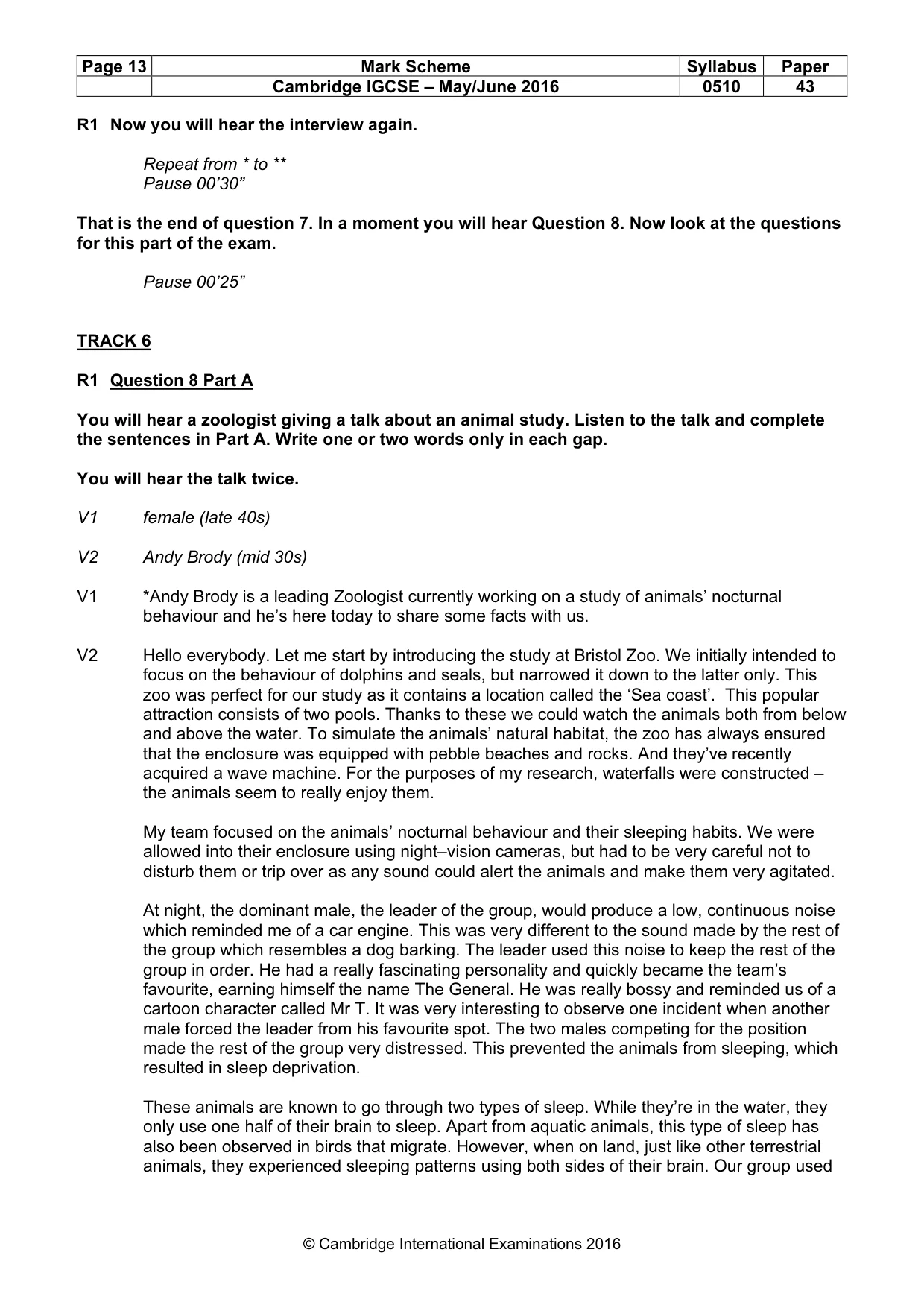
Page 13 Mark Scheme Syllabus Paper Cambridge IGCSE – May/June 2016 0510 43 © Cambridge International Examinations 2016 R1 Now you will hear the interview again. Repeat from * to ** Pause 00’30” That is the end of question 7. In a moment you will hear Question 8. Now look at the questions for this part of the exam. Pause 00’25” TRACK 6 R1 Question 8 Part A You will hear a zoologist giving a talk about an animal study. Listen to the talk and complete the sentences in Part A. Write one or two words only in each gap. You will hear the talk twice. V1 female (late 40s) V2 Andy Brody (mid 30s) V1 *Andy Brody is a leading Zoologist currently working on a study of animals’ nocturnal behaviour and he’s here today to share some facts with us. V2 Hello everybody. Let me start by introducing the study at Bristol Zoo. We initially intended to focus on the behaviour of dolphins and seals, but narrowed it down to the latter only. This zoo was perfect for our study as it contains a location called the ‘Sea coast’. This popular attraction consists of two pools. Thanks to these we could watch the animals both from below and above the water. To simulate the animals’ natural habitat, the zoo has always ensured that the enclosure was equipped with pebble beaches and rocks. And they’ve recently acquired a wave machine. For the purposes of my research, waterfalls were constructed – the animals seem to really enjoy them. My team focused on the animals’ nocturnal behaviour and their sleeping habits. We were allowed into their enclosure using night–vision cameras, but had to be very careful not to disturb them or trip over as any sound could alert the animals and make them very agitated. At night, the dominant male, the leader of the group, would produce a low, continuous noise which reminded me of a car engine. This was very different to the sound made by the rest of the group which resembles a dog barking. The leader used this noise to keep the rest of the group in order. He had a really fascinating personality and quickly became the team’s favourite, earning himself the name The General. He was really bossy and reminded us of a cartoon character called Mr T. It was very interesting to observe one incident when another male forced the leader from his favourite spot. The two males competing for the position made the rest of the group very distressed. This prevented the animals from sleeping, which resulted in sleep deprivation. These animals are known to go through two types of sleep. While they’re in the water, they only use one half of their brain to sleep. Apart from aquatic animals, this type of sleep has also been observed in birds that migrate. However, when on land, just like other terrestrial animals, they experienced sleeping patterns using both sides of their brain. Our group used
Mark scheme, page 14
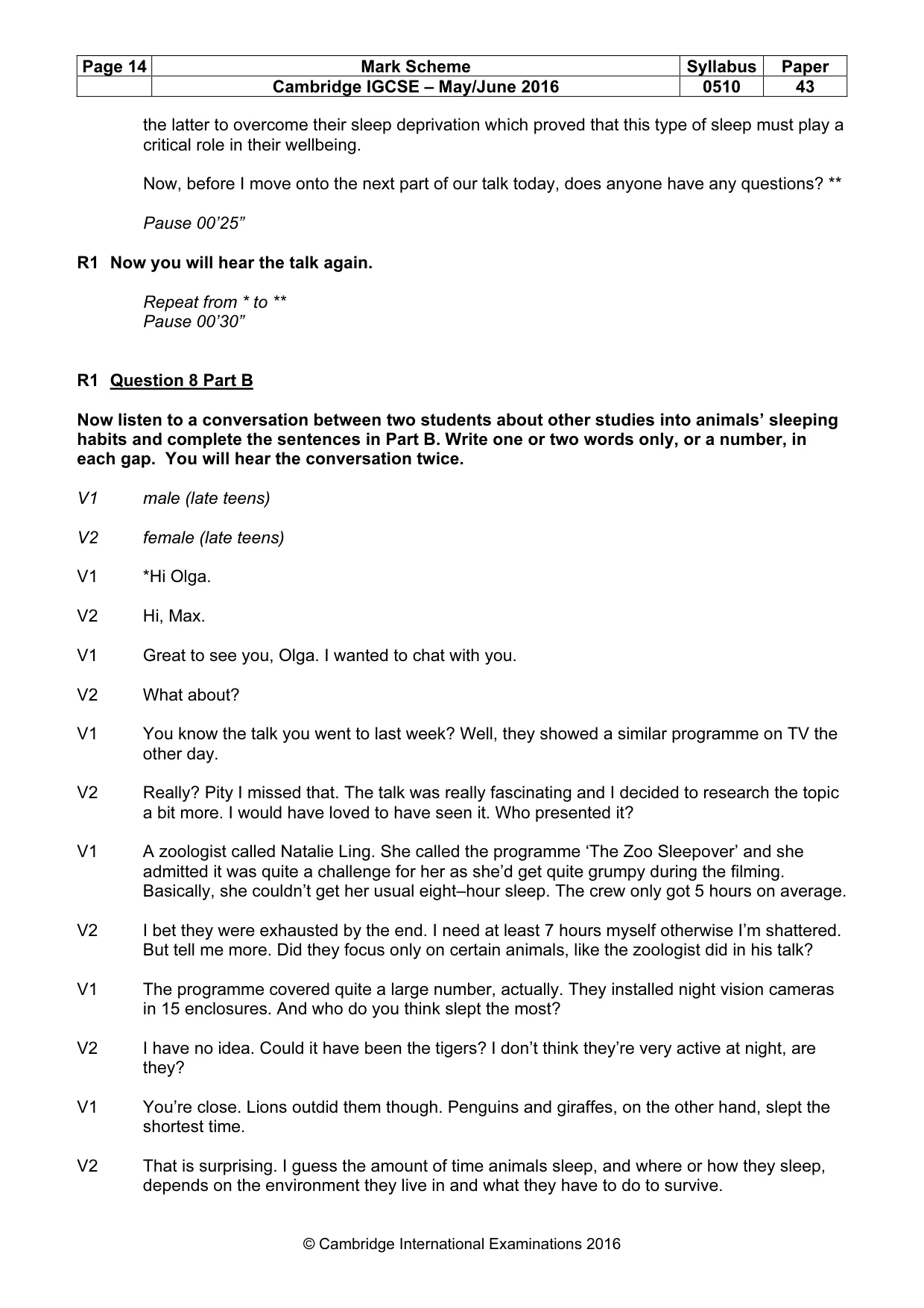
Page 14 Mark Scheme Syllabus Paper Cambridge IGCSE – May/June 2016 0510 43 © Cambridge International Examinations 2016 the latter to overcome their sleep deprivation which proved that this type of sleep must play a critical role in their wellbeing. Now, before I move onto the next part of our talk today, does anyone have any questions? ** Pause 00’25” R1 Now you will hear the talk again. Repeat from * to ** Pause 00’30” R1 Question 8 Part B Now listen to a conversation between two students about other studies into animals’ sleeping habits and complete the sentences in Part B. Write one or two words only, or a number, in each gap. You will hear the conversation twice. V1 male (late teens) V2 female (late teens) V1 *Hi Olga. V2 Hi, Max. V1 Great to see you, Olga. I wanted to chat with you. V2 What about? V1 You know the talk you went to last week? Well, they showed a similar programme on TV the other day. V2 Really? Pity I missed that. The talk was really fascinating and I decided to research the topic a bit more. I would have loved to have seen it. Who presented it? V1 A zoologist called Natalie Ling. She called the programme ‘The Zoo Sleepover’ and she admitted it was quite a challenge for her as she’d get quite grumpy during the filming. Basically, she couldn’t get her usual eight–hour sleep. The crew only got 5 hours on average. V2 I bet they were exhausted by the end. I need at least 7 hours myself otherwise I’m shattered. But tell me more. Did they focus only on certain animals, like the zoologist did in his talk? V1 The programme covered quite a large number, actually. They installed night vision cameras in 15 enclosures. And who do you think slept the most? V2 I have no idea. Could it have been the tigers? I don’t think they’re very active at night, are they? V1 You’re close. Lions outdid them though. Penguins and giraffes, on the other hand, slept the shortest time. V2 That is surprising. I guess the amount of time animals sleep, and where or how they sleep, depends on the environment they live in and what they have to do to survive.
Mark scheme, page 15
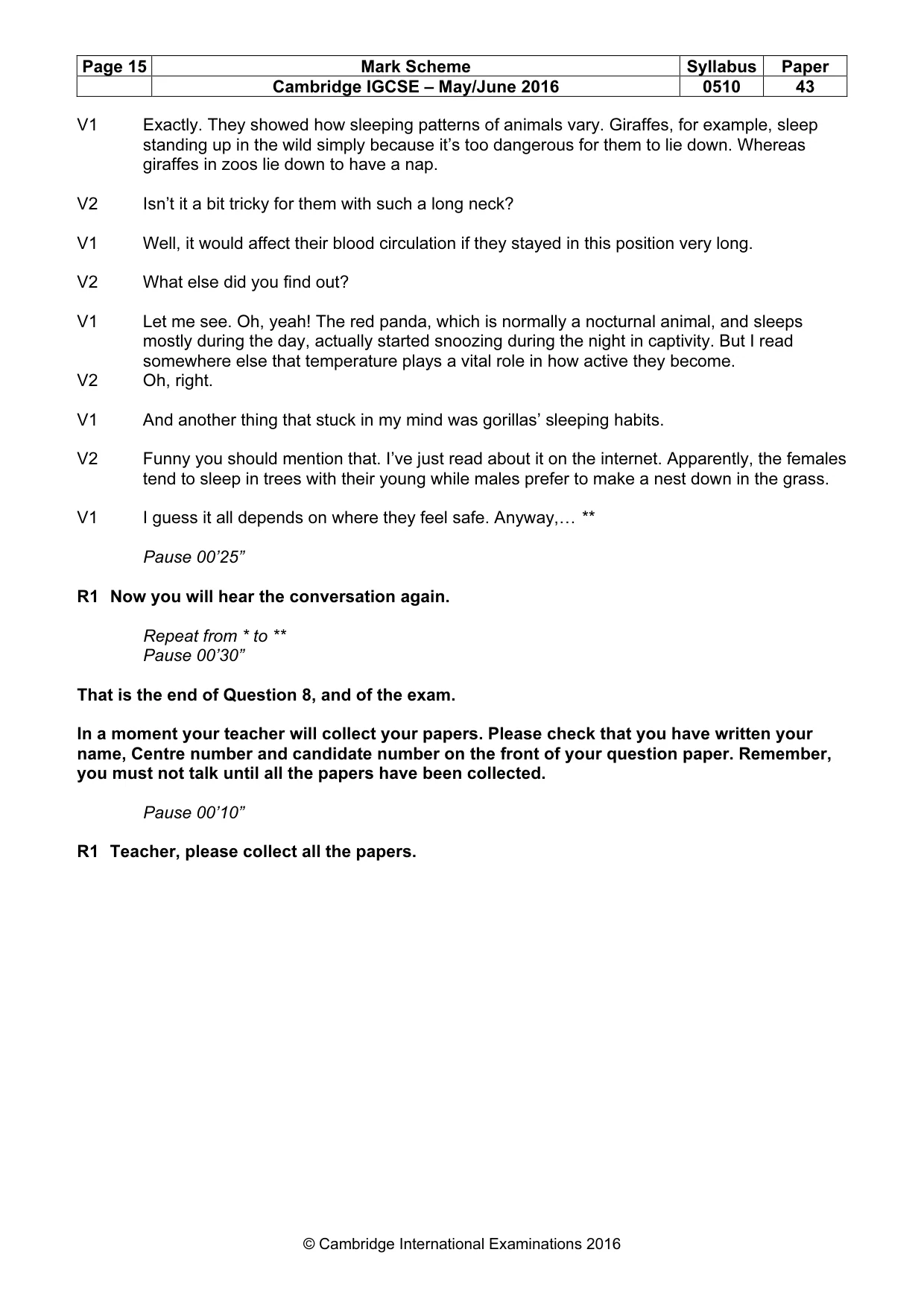
Page 15 Mark Scheme Syllabus Paper Cambridge IGCSE – May/June 2016 0510 43 © Cambridge International Examinations 2016 V1 Exactly. They showed how sleeping patterns of animals vary. Giraffes, for example, sleep standing up in the wild simply because it’s too dangerous for them to lie down. Whereas giraffes in zoos lie down to have a nap. V2 Isn’t it a bit tricky for them with such a long neck? V1 Well, it would affect their blood circulation if they stayed in this position very long. V2 What else did you find out? V1 Let me see. Oh, yeah! The red panda, which is normally a nocturnal animal, and sleeps mostly during the day, actually started snoozing during the night in captivity. But I read somewhere else that temperature plays a vital role in how active they become. V2 Oh, right. V1 And another thing that stuck in my mind was gorillas’ sleeping habits. V2 Funny you should mention that. I’ve just read about it on the internet. Apparently, the females tend to sleep in trees with their young while males prefer to make a nest down in the grass. V1 I guess it all depends on where they feel safe. Anyway,… ** Pause 00’25” R1 Now you will hear the conversation again. Repeat from * to ** Pause 00’30” That is the end of Question 8, and of the exam. In a moment your teacher will collect your papers. Please check that you have written your name, Centre number and candidate number on the front of your question paper. Remember, you must not talk until all the papers have been collected. Pause 00’10” R1 Teacher, please collect all the papers.
What you needed in this session
Cambridge’s own grade thresholds for 2016 May/June, Paper 4 · Variant 3. A higher threshold means an easier paper — the bar moves with how the cohort did.