Cambridge IGCSE English - Second Language (oral endorsement) 0510 — 2016 May/June Paper 4 · Variant 1
0510/41/M/J/16 · 40 marks · ≈45 min
The question paper and its mark scheme, free to read here and free to download. This is Cambridge’s own paper, exactly as it was sat.
Question paper12 pages




Mark scheme15 pages
Answers below. Sit the paper first if you are practising.
Paper as text
Question paper, page 1
This document consists of 9 printed pages and 3 blank pages. DC (ST) 108081/5 © UCLES 2016 [Turn over Cambridge International Examinations Cambridge International General Certificate of Secondary Education * 2 9 2 7 8 1 5 6 9 7 * ENGLISH AS A SECOND LANGUAGE 0510/41 Paper 4 Listening (Extended) May/June 2016 Approx. 50 minutes Candidates answer on the Question Paper. No Additional Materials are required. READ THESE INSTRUCTIONS FIRST Write your Centre number, candidate number and name on all the work you hand in. Write in dark blue or black pen. Do not use staples, paper clips, glue or correction fluid. DO NOT WRITE IN ANY BARCODES. Answer all questions. Dictionaries are not permitted. The number of marks is given in brackets [ ] at the end of each question or part question.
Question paper, page 2
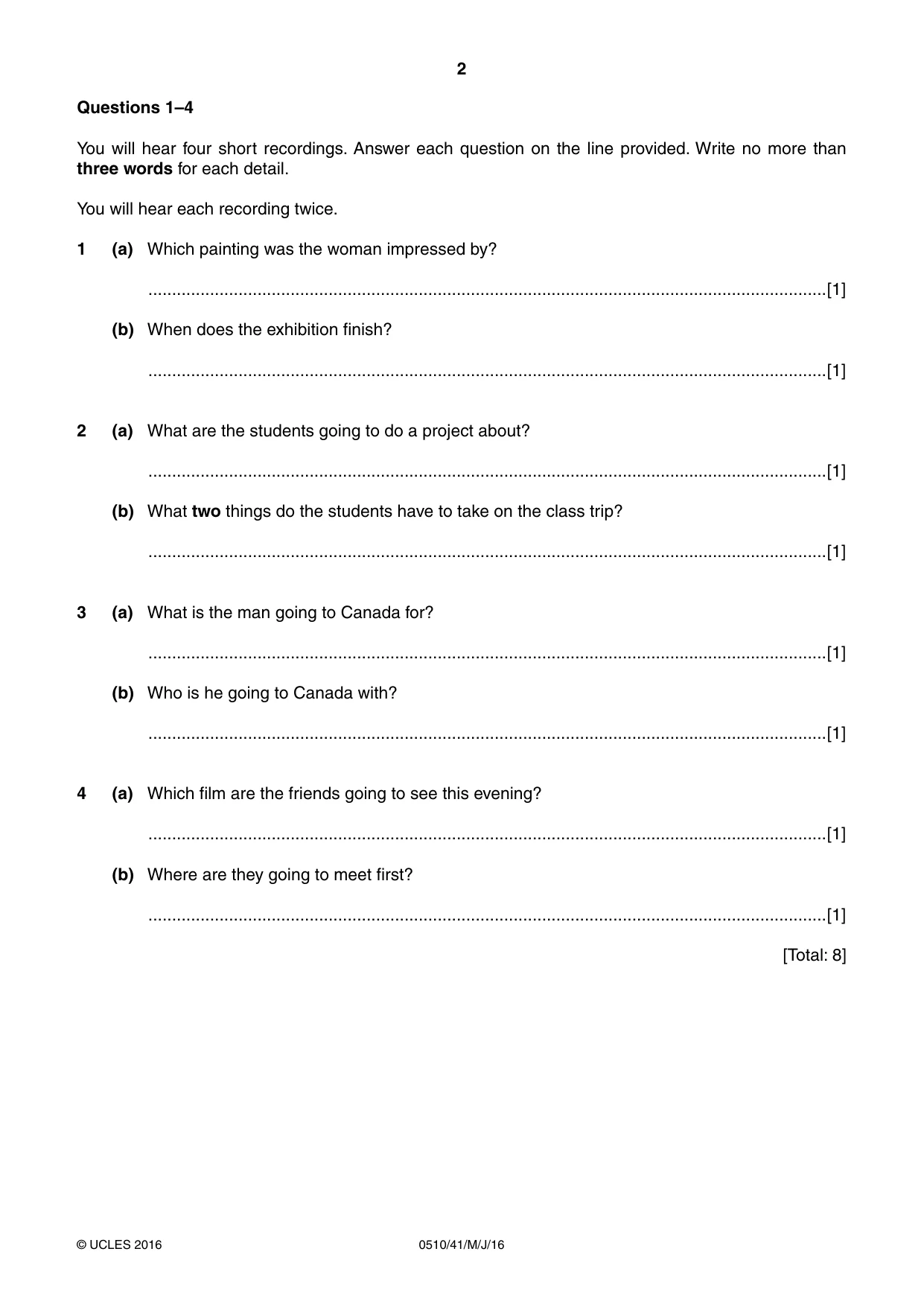
2 0510/41/M/J/16 © UCLES 2016 Questions 1–4 You will hear four short recordings. Answer each question on the line provided. Write no more than three words for each detail. You will hear each recording twice. 1 (a) Which painting was the woman impressed by? …[1] (b) When does the exhibition finish? …[1] 2 (a) What are the students going to do a project about? …[1] (b) What two things do the students have to take on the class trip? …[1] 3 (a) What is the man going to Canada for? …[1] (b) Who is he going to Canada with? …[1] 4 (a) Which film are the friends going to see this evening? …[1] (b) Where are they going to meet first? …[1] [Total: 8]
Question paper, page 3
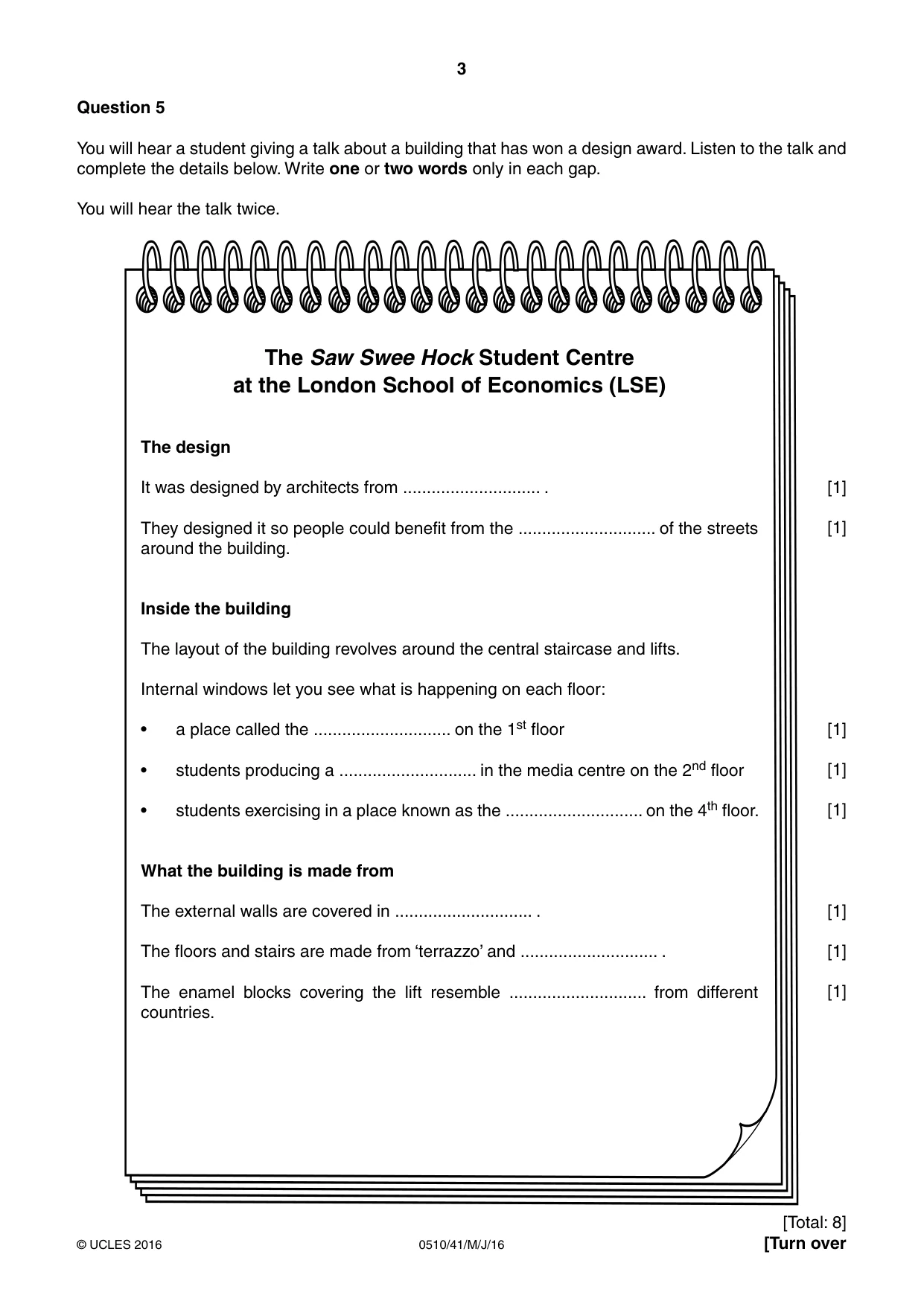
3 0510/41/M/J/16 © UCLES 2016 [Turn over Question 5 You will hear a student giving a talk about a building that has won a design award. Listen to the talk and complete the details below. Write one or two words only in each gap. You will hear the talk twice. The Saw Swee Hock Student Centre at the London School of Economics (LSE) The design It was designed by architects from … . They designed it so people could benefit from the … of the streets around the building. Inside the building The layout of the building revolves around the central staircase and lifts. Internal windows let you see what is happening on each floor: • a place called the … on the 1st floor • students producing a … in the media centre on the 2nd floor • students exercising in a place known as the … on the 4th floor. What the building is made from The external walls are covered in … . The floors and stairs are made from ‘terrazzo’ and … . The enamel blocks covering the lift resemble … from different countries. [1] [1] [1] [1] [1] [1] [1] [1] [Total: 8]
Question paper, page 4
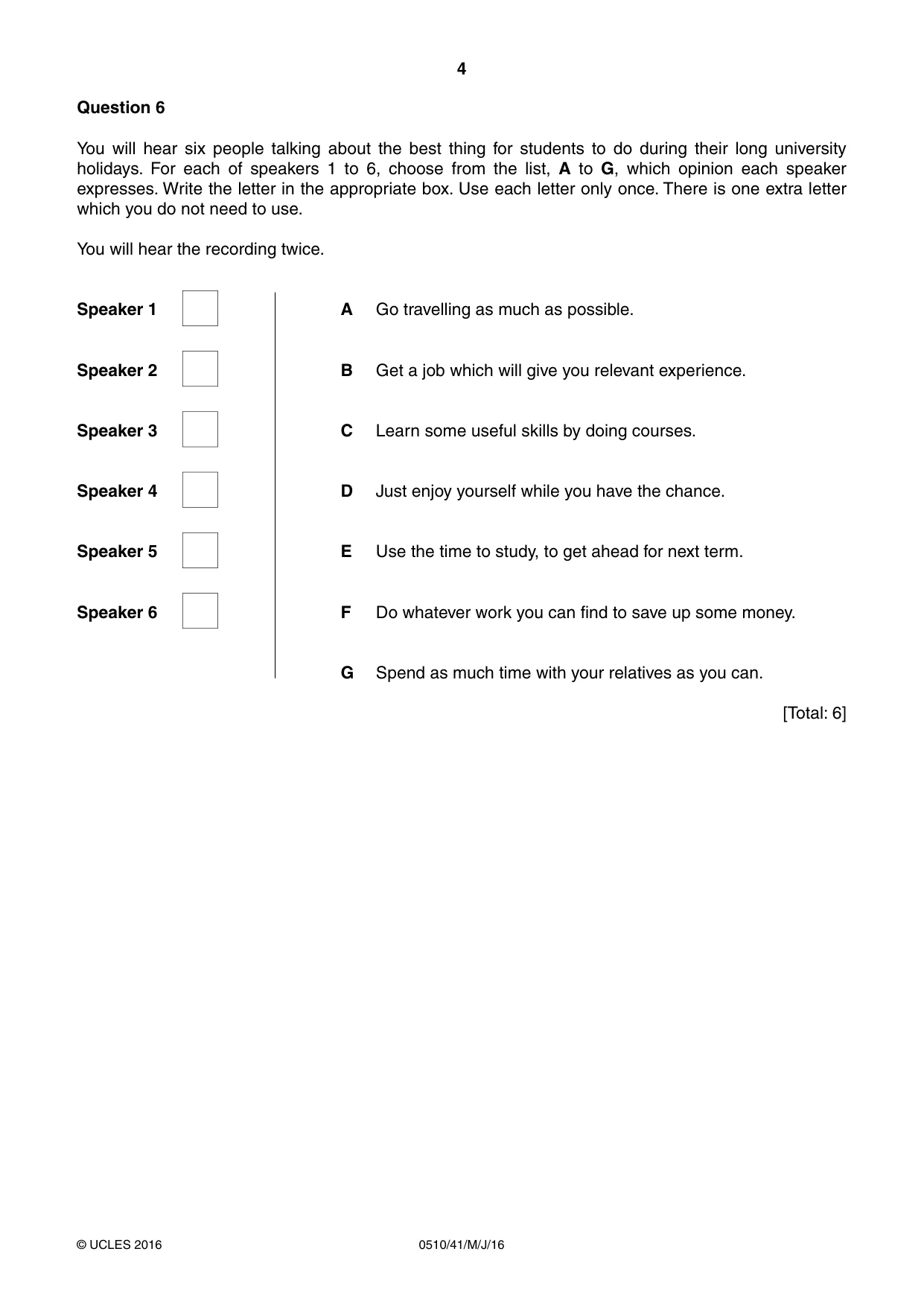
4 0510/41/M/J/16 © UCLES 2016 Question 6 You will hear six people talking about the best thing for students to do during their long university holidays. For each of speakers 1 to 6, choose from the list, A to G, which opinion each speaker expresses. Write the letter in the appropriate box. Use each letter only once. There is one extra letter which you do not need to use. You will hear the recording twice. Speaker 1 A Go travelling as much as possible. Speaker 2 B Get a job which will give you relevant experience. Speaker 3 C Learn some useful skills by doing courses. Speaker 4 D Just enjoy yourself while you have the chance. Speaker 5 E Use the time to study, to get ahead for next term. Speaker 6 F Do whatever work you can find to save up some money. G Spend as much time with your relatives as you can. [Total: 6]
Question paper, page 5
5 0510/41/M/J/16 © UCLES 2016 [Turn over Please turn over for Question 7.
Question paper, page 6
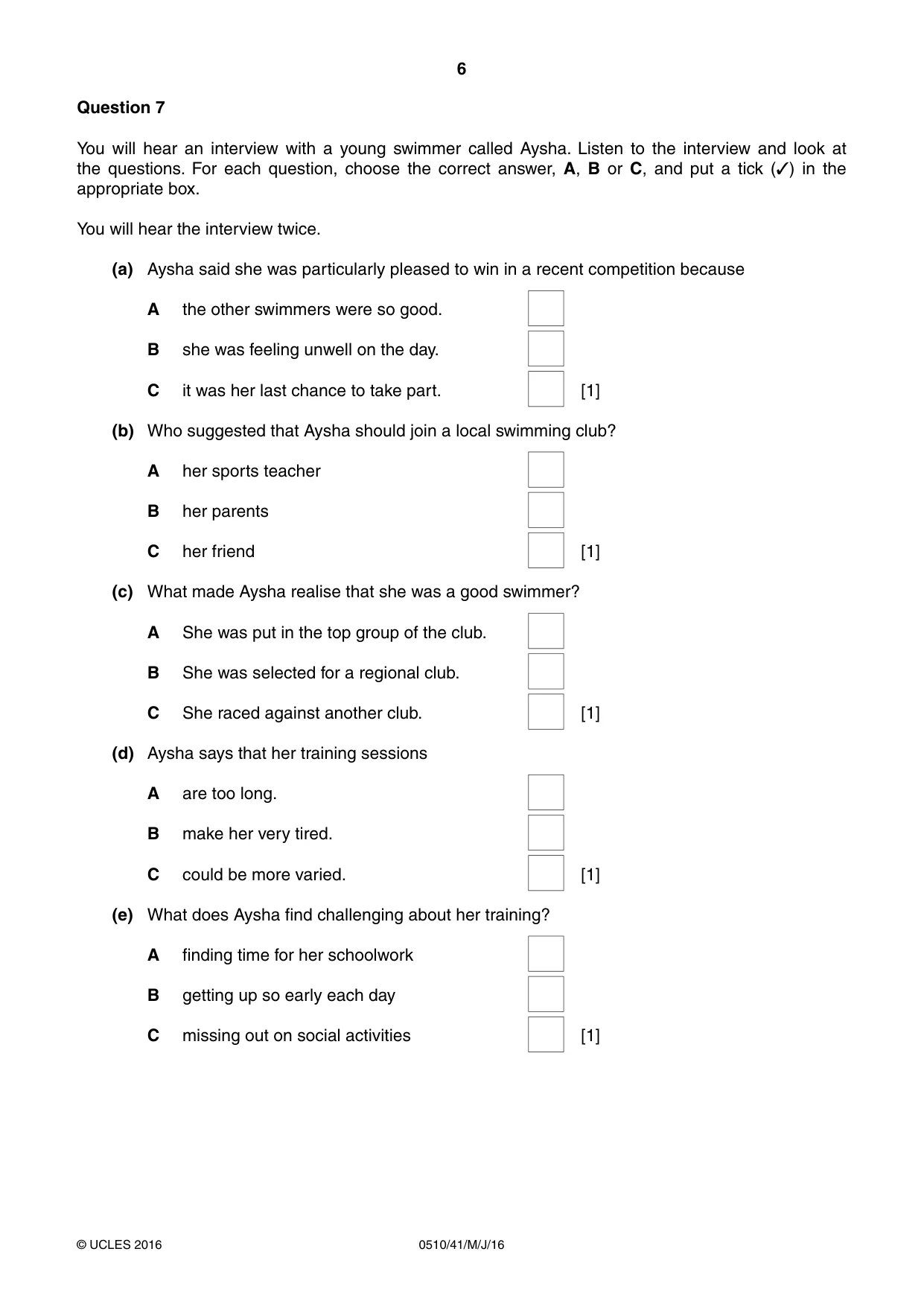
6 0510/41/M/J/16 © UCLES 2016 Question 7 You will hear an interview with a young swimmer called Aysha. Listen to the interview and look at the questions. For each question, choose the correct answer, A, B or C, and put a tick (✓) in the appropriate box. You will hear the interview twice. (a) Aysha said she was particularly pleased to win in a recent competition because A the other swimmers were so good. B she was feeling unwell on the day. C it was her last chance to take part. [1] (b) Who suggested that Aysha should join a local swimming club? A her sports teacher B her parents C her friend [1] (c) What made Aysha realise that she was a good swimmer? A She was put in the top group of the club. B She was selected for a regional club. C She raced against another club. [1] (d) Aysha says that her training sessions A are too long. B make her very tired. C could be more varied. [1] (e) What does Aysha find challenging about her training? A finding time for her schoolwork B getting up so early each day C missing out on social activities [1]
Question paper, page 7
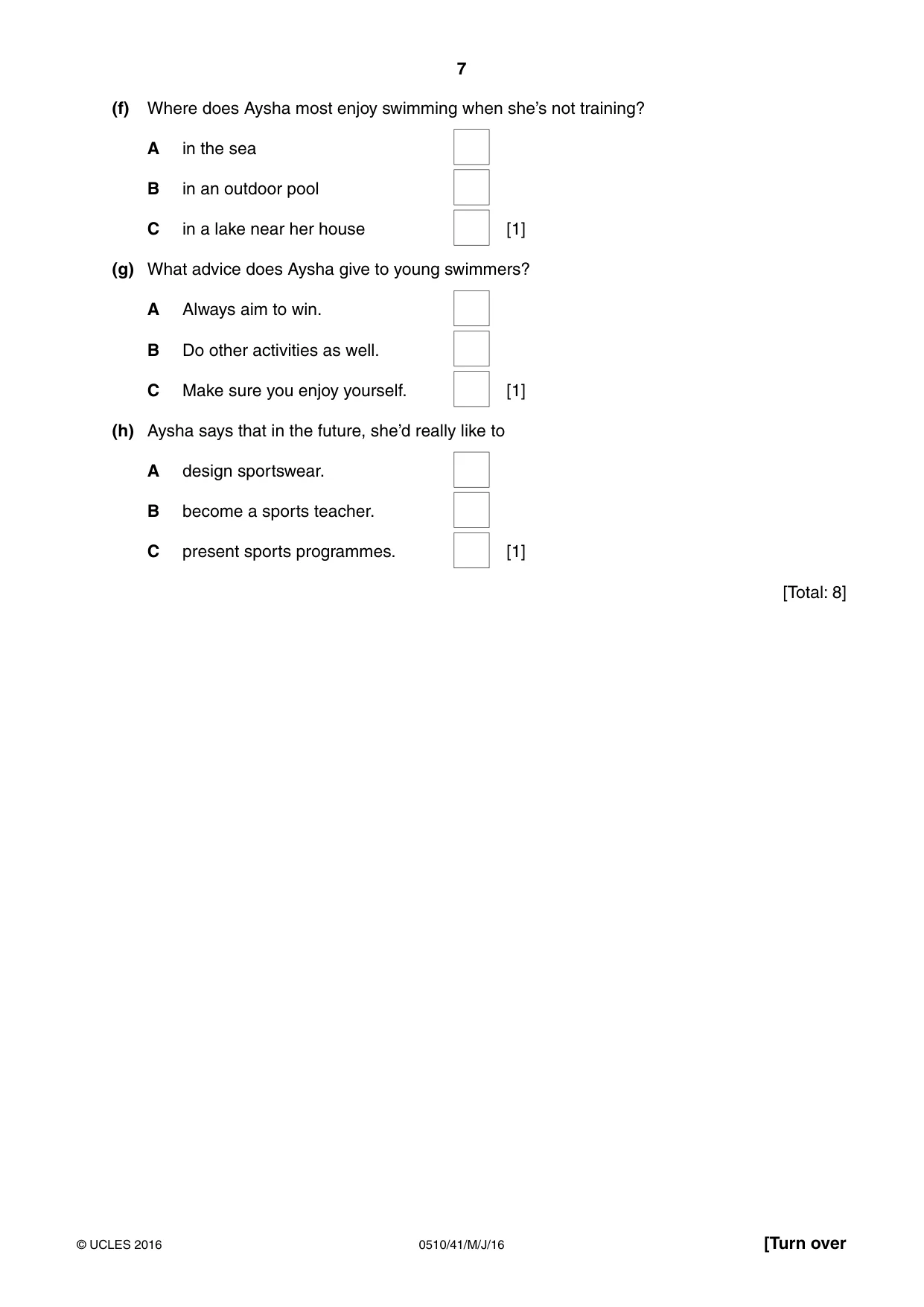
7 0510/41/M/J/16 © UCLES 2016 [Turn over (f) Where does Aysha most enjoy swimming when she’s not training? A in the sea B in an outdoor pool C in a lake near her house [1] (g) What advice does Aysha give to young swimmers? A Always aim to win. B Do other activities as well. C Make sure you enjoy yourself. [1] (h) Aysha says that in the future, she’d really like to A design sportswear. B become a sports teacher. C present sports programmes. [1] [Total: 8]
Question paper, page 8
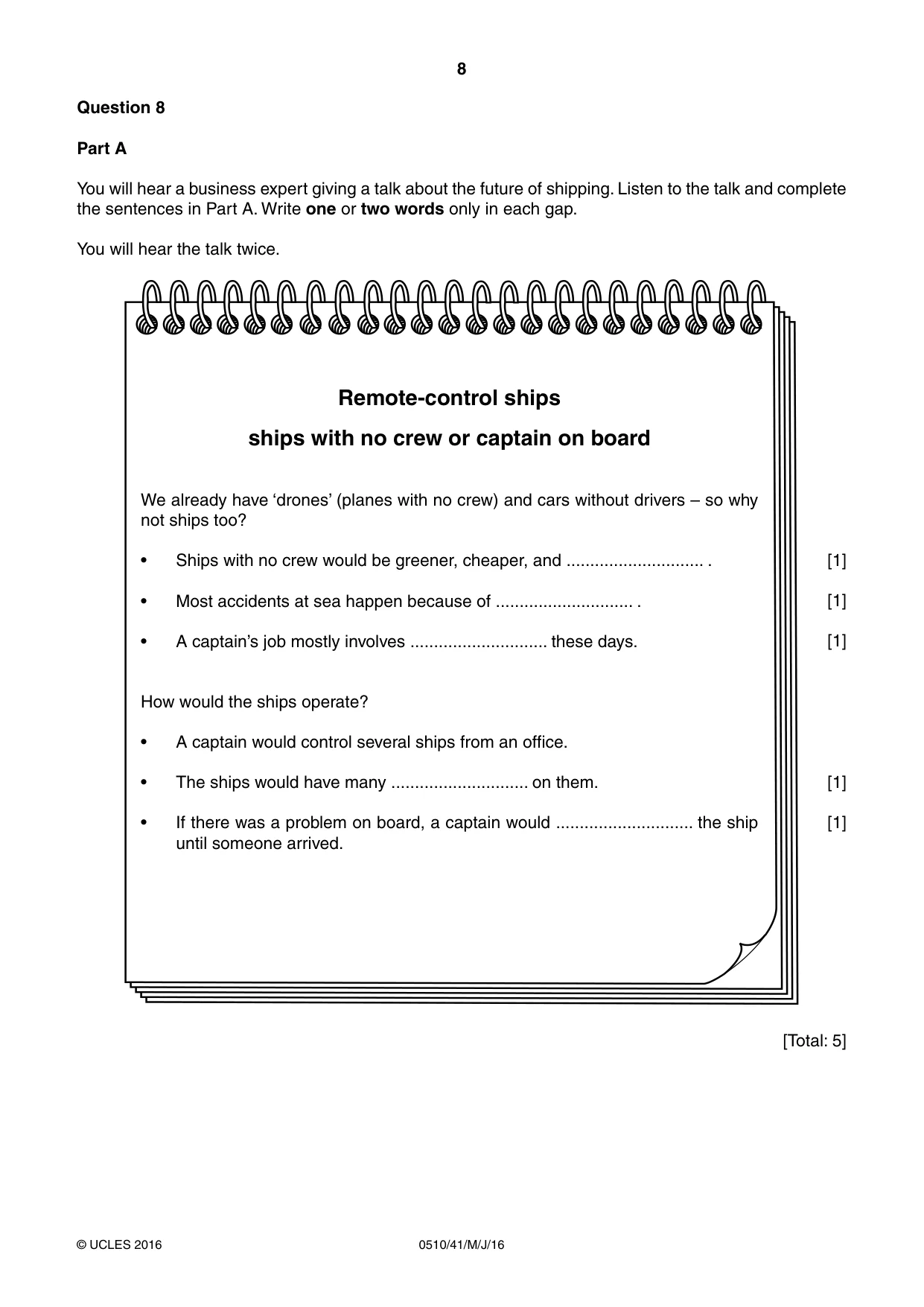
8 0510/41/M/J/16 © UCLES 2016 Question 8 Part A You will hear a business expert giving a talk about the future of shipping. Listen to the talk and complete the sentences in Part A. Write one or two words only in each gap. You will hear the talk twice. Remote-control ships ships with no crew or captain on board We already have ‘drones’ (planes with no crew) and cars without drivers – so why not ships too? • Ships with no crew would be greener, cheaper, and … . • Most accidents at sea happen because of … . • A captain’s job mostly involves … these days. How would the ships operate? • A captain would control several ships from an office. • The ships would have many … on them. • If there was a problem on board, a captain would … the ship until someone arrived. [1] [1] [1] [1] [1] [Total: 5]
Question paper, page 9
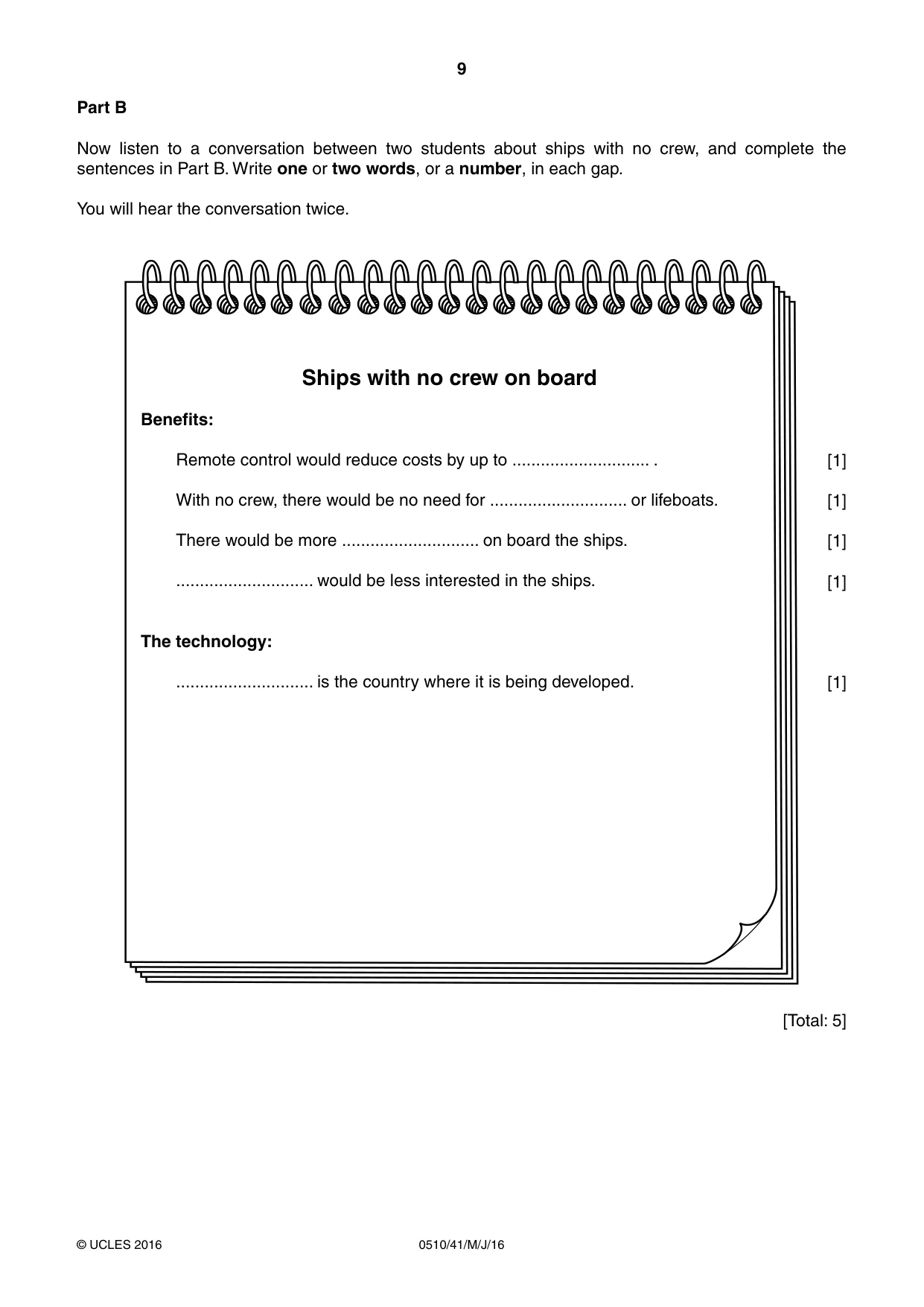
9 0510/41/M/J/16 © UCLES 2016 Part B Now listen to a conversation between two students about ships with no crew, and complete the sentences in Part B. Write one or two words, or a number, in each gap. You will hear the conversation twice. Ships with no crew on board Benefits: Remote control would reduce costs by up to … . With no crew, there would be no need for … or lifeboats. There would be more … on board the ships. … would be less interested in the ships. The technology: … is the country where it is being developed. [1] [1] [1] [1] [1] [Total: 5]
Question paper, page 10
10 0510/41/M/J/16 © UCLES 2016 BLANK PAGE
Question paper, page 11
11 0510/41/M/J/16 © UCLES 2016 BLANK PAGE
Question paper, page 12
12 0510/41/M/J/16 © UCLES 2016 Permission to reproduce items where third-party owned material protected by copyright is included has been sought and cleared where possible. Every reasonable effort has been made by the publisher (UCLES) to trace copyright holders, but if any items requiring clearance have unwittingly been included, the publisher will be pleased to make amends at the earliest possible opportunity. To avoid the issue of disclosure of answer-related information to candidates, all copyright acknowledgements are reproduced online in the Cambridge International Examinations Copyright Acknowledgements Booklet. This is produced for each series of examinations and is freely available to download at www.cie.org.uk after the live examination series. Cambridge International Examinations is part of the Cambridge Assessment Group. Cambridge Assessment is the brand name of University of Cambridge Local Examinations Syndicate (UCLES), which is itself a department of the University of Cambridge. BLANK PAGE
Mark scheme, page 1
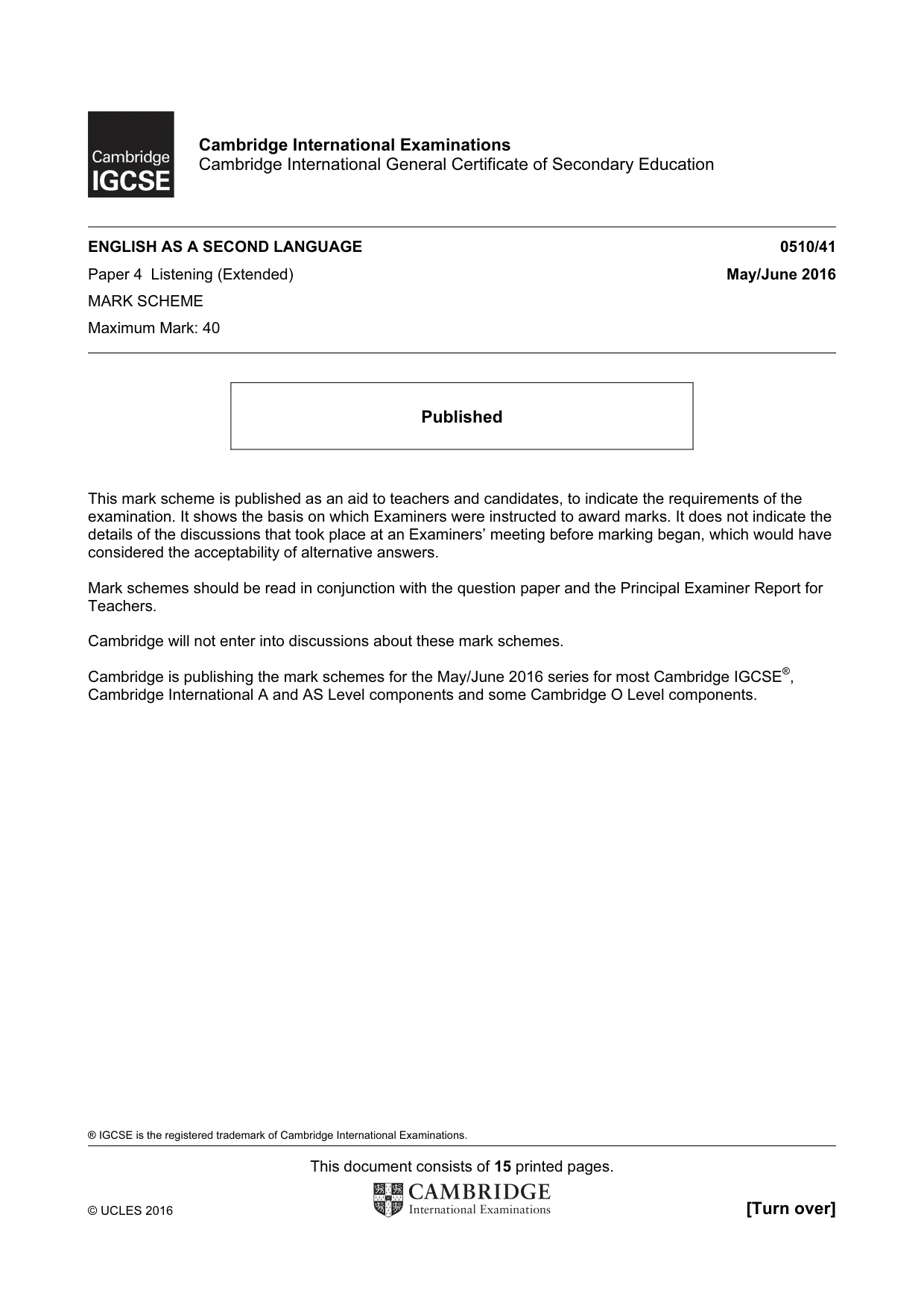
® IGCSE is the registered trademark of Cambridge International Examinations. This document consists of 15 printed pages. © UCLES 2016 [Turn over] Cambridge International Examinations Cambridge International General Certificate of Secondary Education ENGLISH AS A SECOND LANGUAGE 0510/41 Paper 4 Listening (Extended) May/June 2016 MARK SCHEME Maximum Mark: 40 Published This mark scheme is published as an aid to teachers and candidates, to indicate the requirements of the examination. It shows the basis on which Examiners were instructed to award marks. It does not indicate the details of the discussions that took place at an Examiners’ meeting before marking began, which would have considered the acceptability of alternative answers. Mark schemes should be read in conjunction with the question paper and the Principal Examiner Report for Teachers. Cambridge will not enter into discussions about these mark schemes. Cambridge is publishing the mark schemes for the May/June 2016 series for most Cambridge IGCSE®, Cambridge International A and AS Level components and some Cambridge O Level components.
Mark scheme, page 2
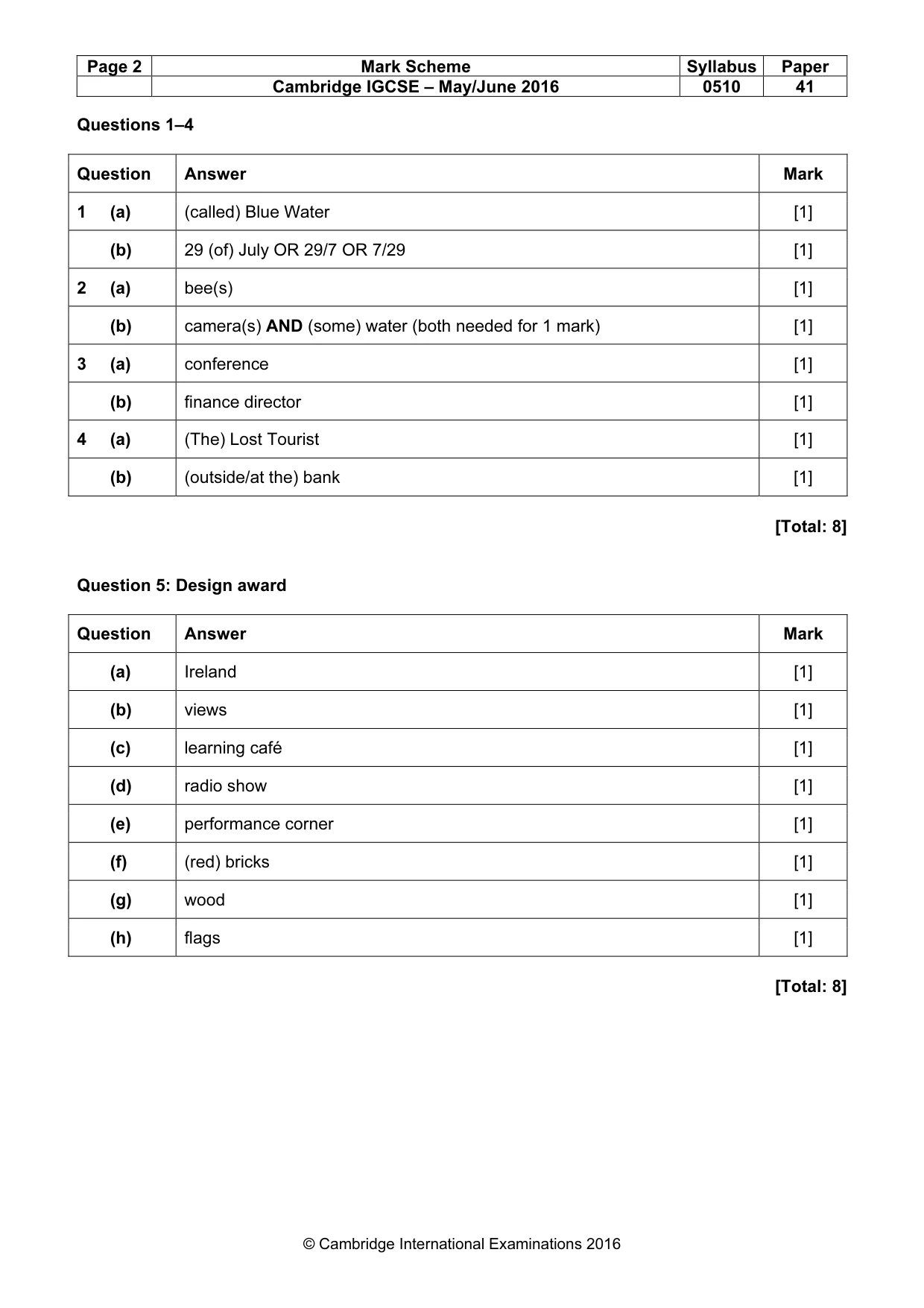
Page 2 Mark Scheme Syllabus Paper Cambridge IGCSE – May/June 2016 0510 41 © Cambridge International Examinations 2016 Questions 1–4 Question Answer Mark 1 (a) (called) Blue Water [1] (b) 29 (of) July OR 29/7 OR 7/29 [1] 2 (a) bee(s) [1] (b) camera(s) AND (some) water (both needed for 1 mark) [1] 3 (a) conference [1] (b) finance director [1] 4 (a) (The) Lost Tourist [1] (b) (outside/at the) bank [1] [Total: 8] Question 5: Design award Question Answer Mark (a) Ireland [1] (b) views [1] (c) learning café [1] (d) radio show [1] (e) performance corner [1] (f) (red) bricks [1] (g) wood [1] (h) flags [1] [Total: 8]
Mark scheme, page 3
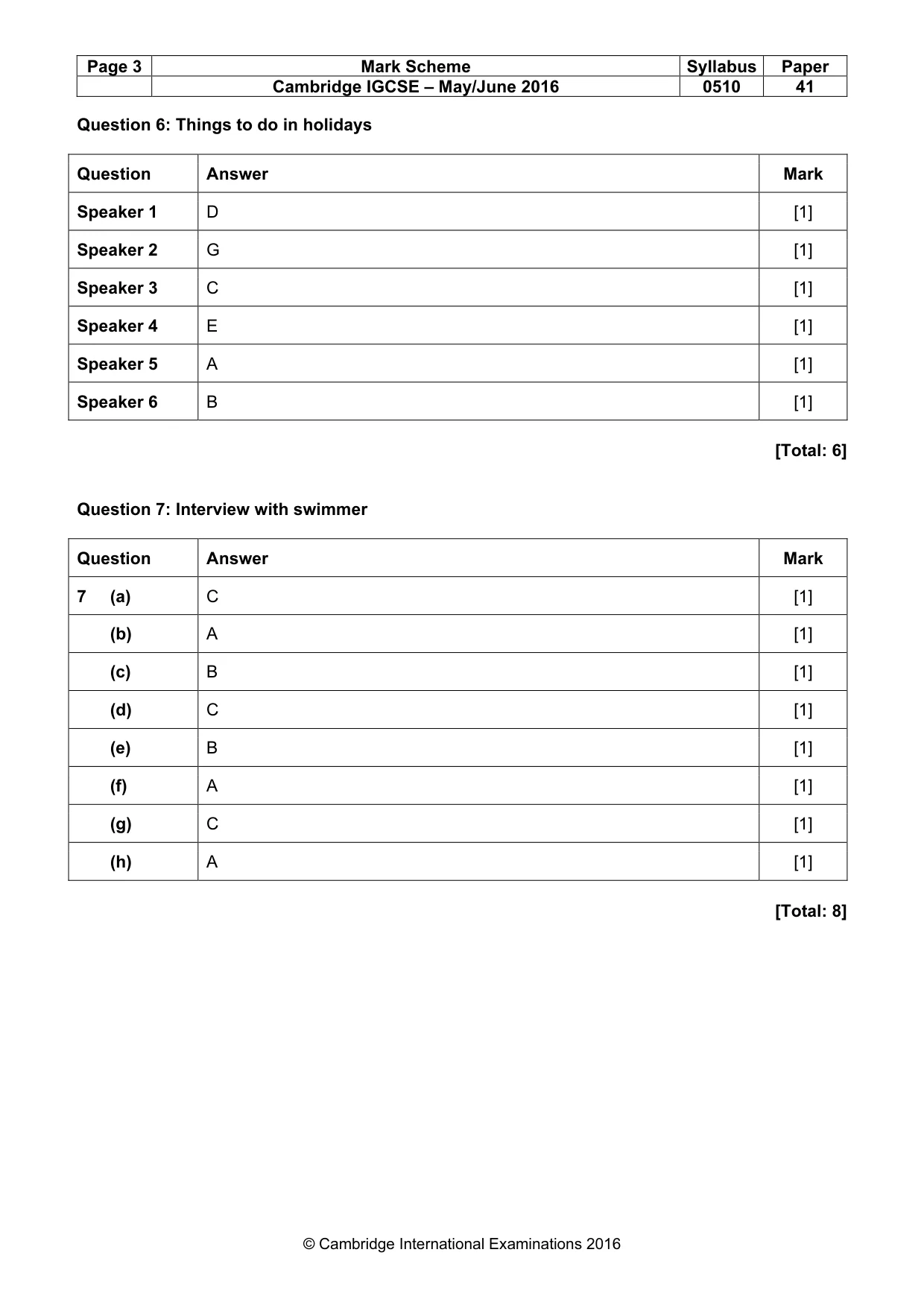
Page 3 Mark Scheme Syllabus Paper Cambridge IGCSE – May/June 2016 0510 41 © Cambridge International Examinations 2016 Question 6: Things to do in holidays Question Answer Mark Speaker 1 D [1] Speaker 2 G [1] Speaker 3 C [1] Speaker 4 E [1] Speaker 5 A [1] Speaker 6 B [1] [Total: 6] Question 7: Interview with swimmer Question Answer Mark 7 (a) C [1] (b) A [1] (c) B [1] (d) C [1] (e) B [1] (f) A [1] (g) C [1] (h) A [1] [Total: 8]
Mark scheme, page 4
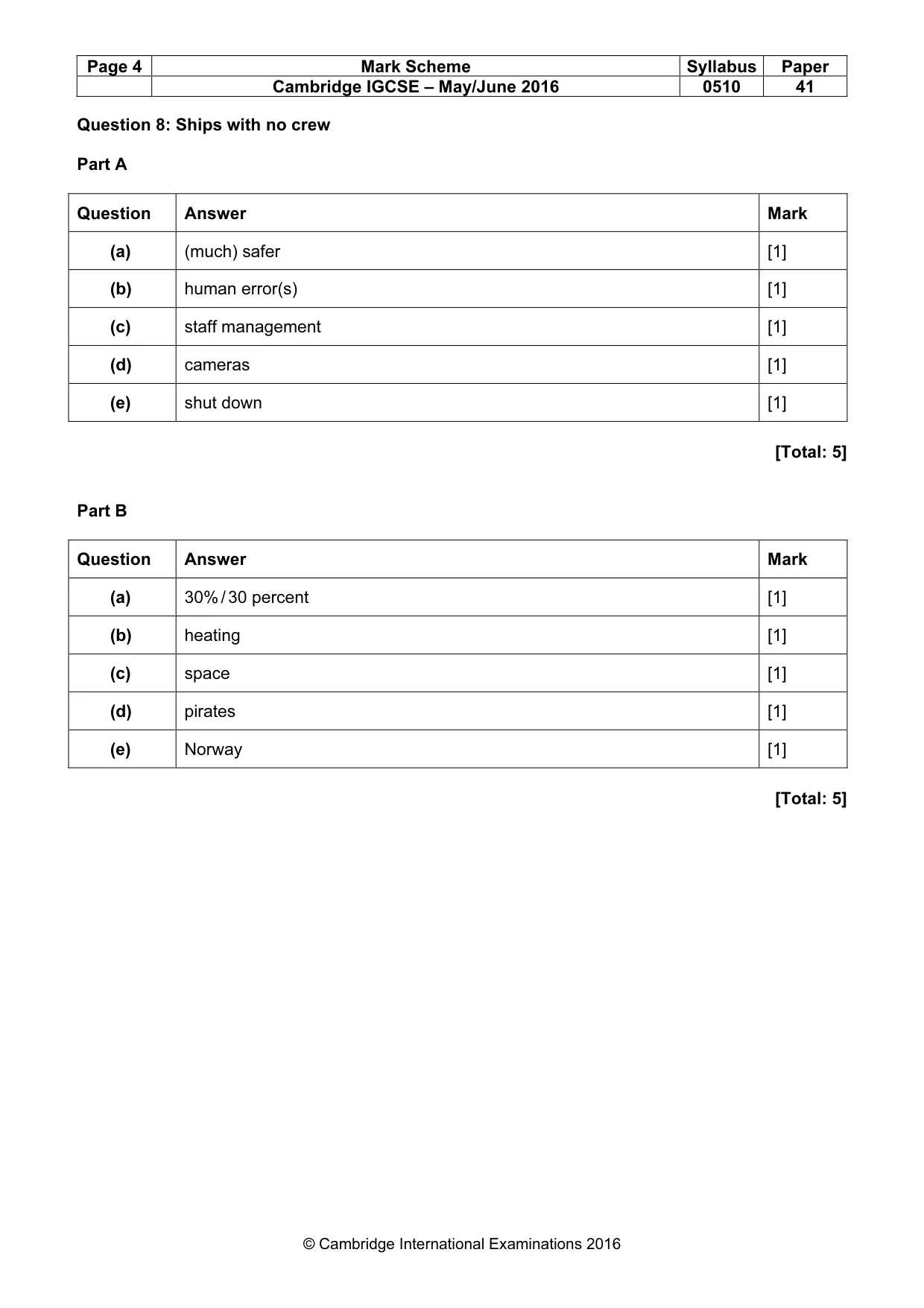
Page 4 Mark Scheme Syllabus Paper Cambridge IGCSE – May/June 2016 0510 41 © Cambridge International Examinations 2016 Question 8: Ships with no crew Part A Question Answer Mark (a) (much) safer [1] (b) human error(s) [1] (c) staff management [1] (d) cameras [1] (e) shut down [1] [Total: 5] Part B Question Answer Mark (a) 30% / 30 percent [1] (b) heating [1] (c) space [1] (d) pirates [1] (e) Norway [1] [Total: 5]
Mark scheme, page 5
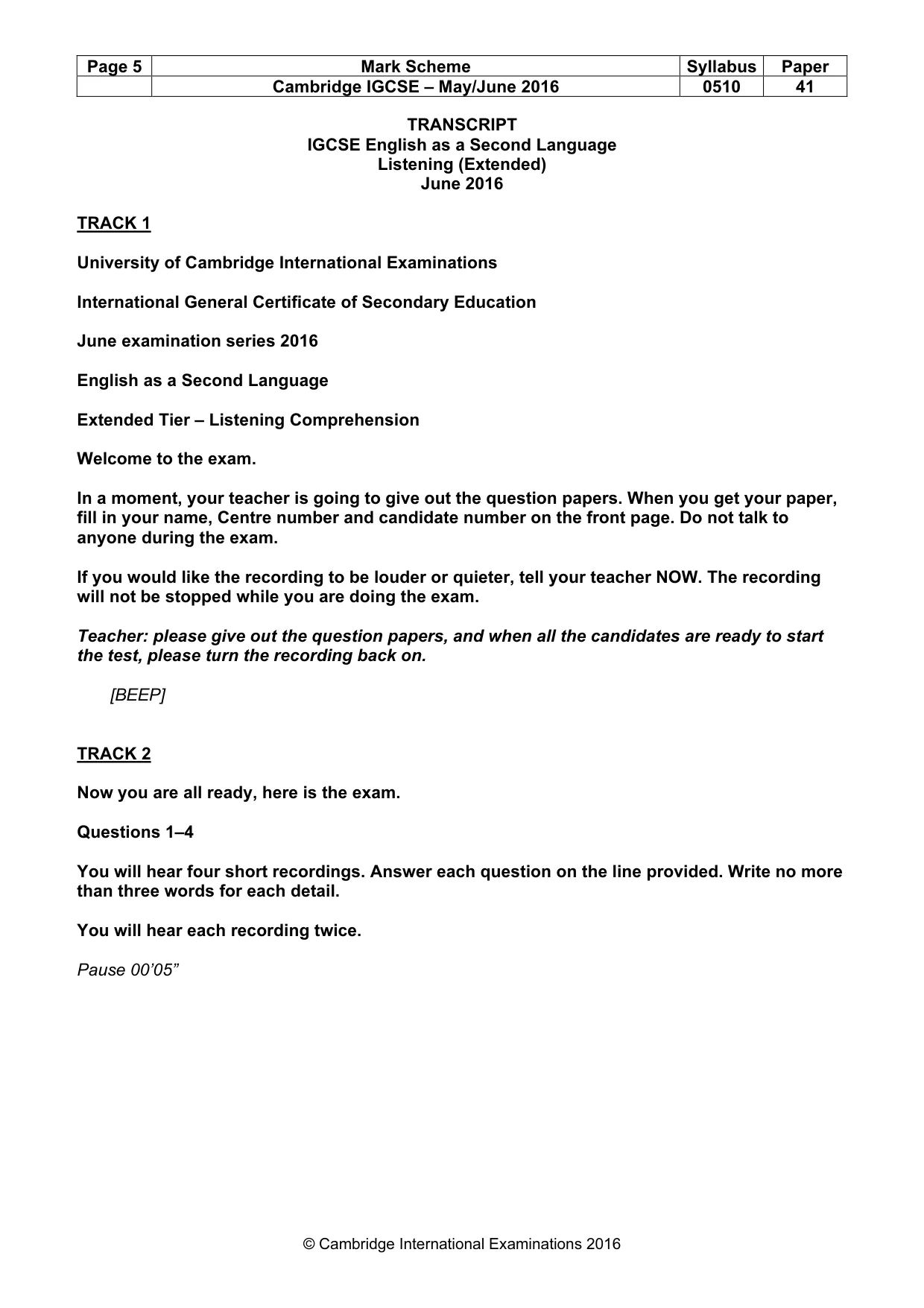
Page 5 Mark Scheme Syllabus Paper Cambridge IGCSE – May/June 2016 0510 41 © Cambridge International Examinations 2016 TRANSCRIPT IGCSE English as a Second Language Listening (Extended) June 2016 TRACK 1 University of Cambridge International Examinations International General Certificate of Secondary Education June examination series 2016 English as a Second Language Extended Tier – Listening Comprehension Welcome to the exam. In a moment, your teacher is going to give out the question papers. When you get your paper, fill in your name, Centre number and candidate number on the front page. Do not talk to anyone during the exam. If you would like the recording to be louder or quieter, tell your teacher NOW. The recording will not be stopped while you are doing the exam. Teacher: please give out the question papers, and when all the candidates are ready to start the test, please turn the recording back on. [BEEP] TRACK 2 Now you are all ready, here is the exam. Questions 1–4 You will hear four short recordings. Answer each question on the line provided. Write no more than three words for each detail. You will hear each recording twice. Pause 00’05”
Mark scheme, page 6
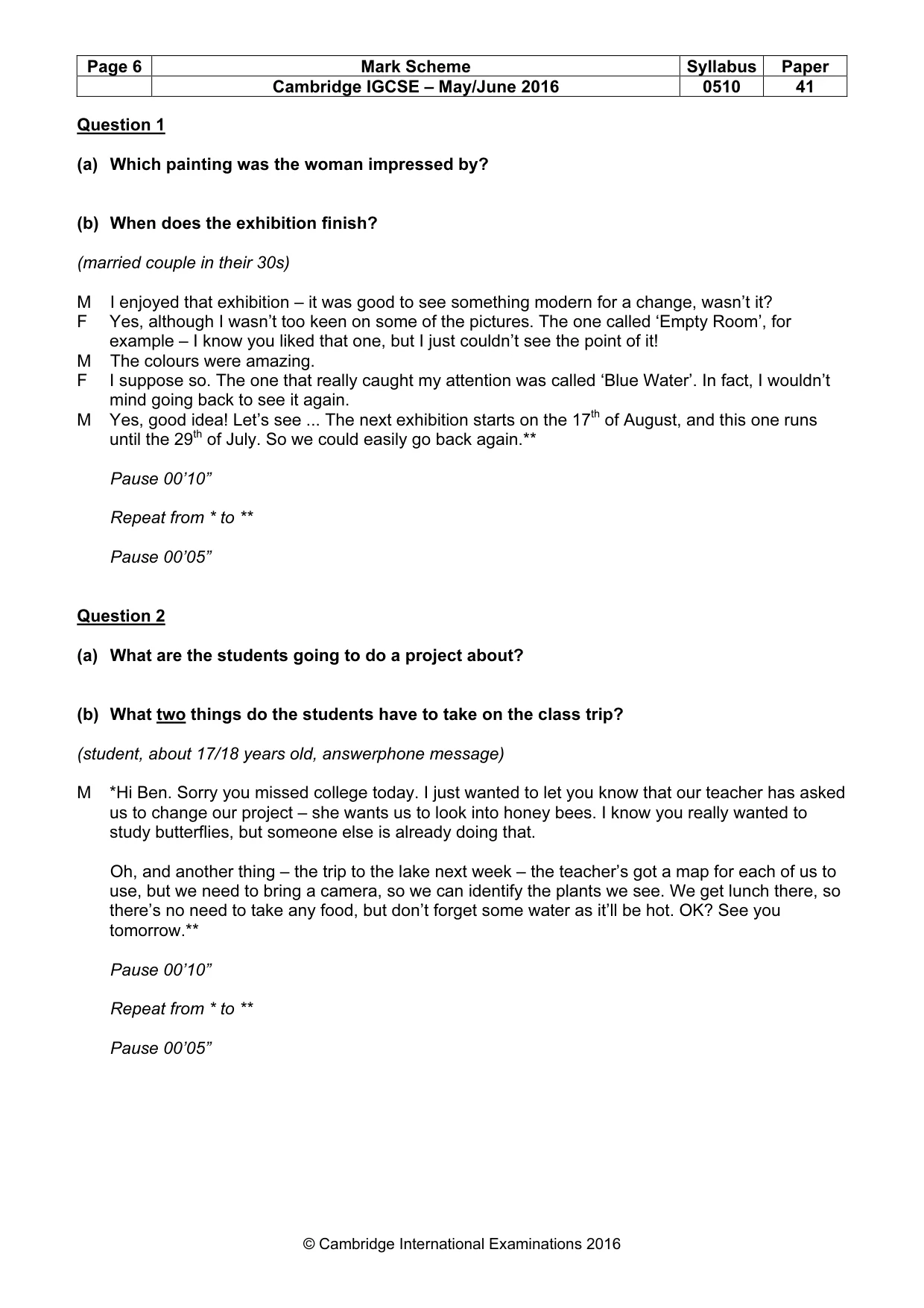
Page 6 Mark Scheme Syllabus Paper Cambridge IGCSE – May/June 2016 0510 41 © Cambridge International Examinations 2016 Question 1 (a) Which painting was the woman impressed by? (b) When does the exhibition finish? (married couple in their 30s) M I enjoyed that exhibition – it was good to see something modern for a change, wasn’t it? F Yes, although I wasn’t too keen on some of the pictures. The one called ‘Empty Room’, for example – I know you liked that one, but I just couldn’t see the point of it! M The colours were amazing. F I suppose so. The one that really caught my attention was called ‘Blue Water’. In fact, I wouldn’t mind going back to see it again. M Yes, good idea! Let’s see ... The next exhibition starts on the 17th of August, and this one runs until the 29th of July. So we could easily go back again.** Pause 00’10” Repeat from * to ** Pause 00’05” Question 2 (a) What are the students going to do a project about? (b) What two things do the students have to take on the class trip? (student, about 17/18 years old, answerphone message) M *Hi Ben. Sorry you missed college today. I just wanted to let you know that our teacher has asked us to change our project – she wants us to look into honey bees. I know you really wanted to study butterflies, but someone else is already doing that. Oh, and another thing – the trip to the lake next week – the teacher’s got a map for each of us to use, but we need to bring a camera, so we can identify the plants we see. We get lunch there, so there’s no need to take any food, but don’t forget some water as it’ll be hot. OK? See you tomorrow.** Pause 00’10” Repeat from * to ** Pause 00’05”
Mark scheme, page 7
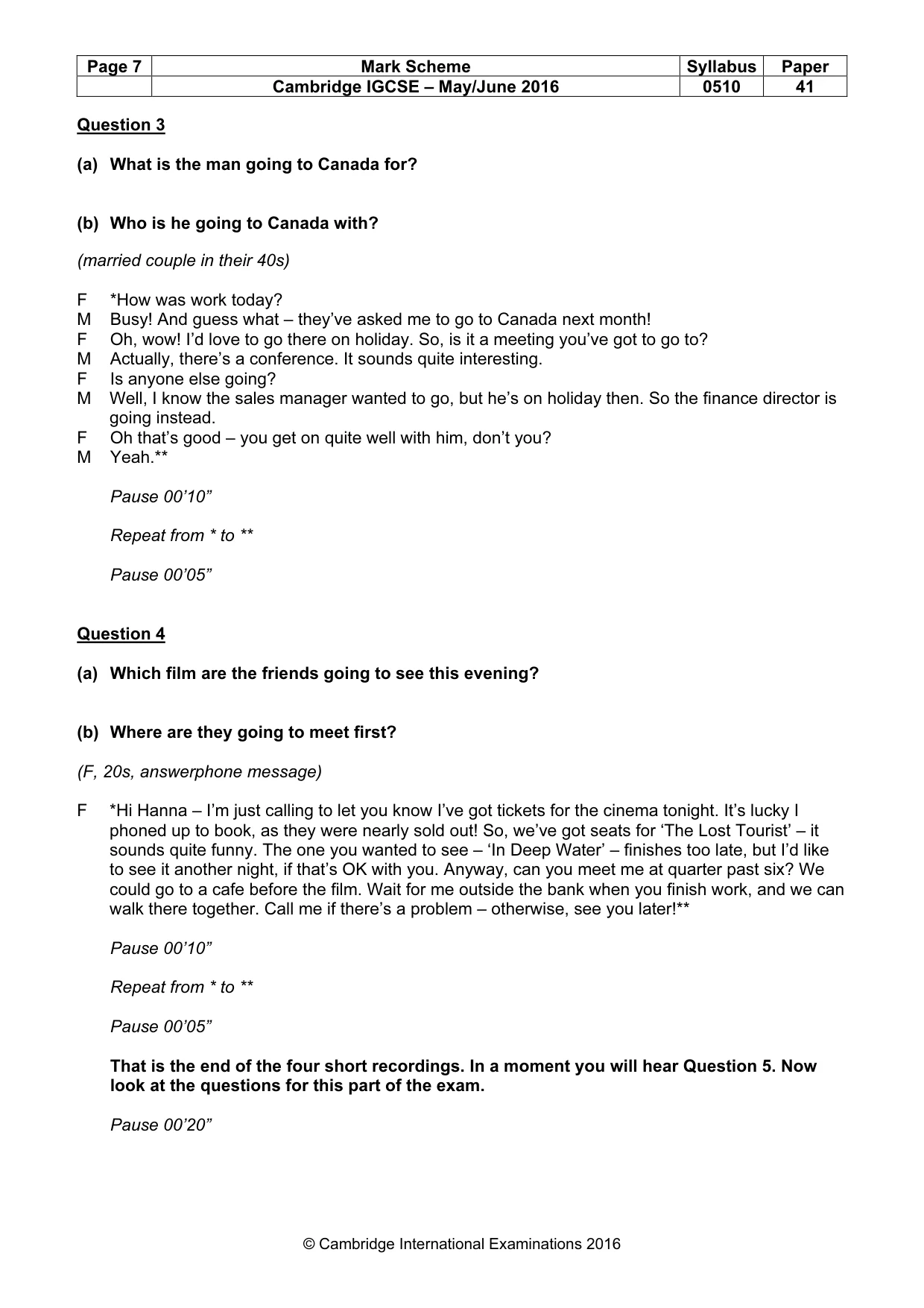
Page 7 Mark Scheme Syllabus Paper Cambridge IGCSE – May/June 2016 0510 41 © Cambridge International Examinations 2016 Question 3 (a) What is the man going to Canada for? (b) Who is he going to Canada with? (married couple in their 40s) F *How was work today? M Busy! And guess what – they’ve asked me to go to Canada next month! F Oh, wow! I’d love to go there on holiday. So, is it a meeting you’ve got to go to? M Actually, there’s a conference. It sounds quite interesting. F Is anyone else going? M Well, I know the sales manager wanted to go, but he’s on holiday then. So the finance director is going instead. F Oh that’s good – you get on quite well with him, don’t you? M Yeah.** Pause 00’10” Repeat from * to ** Pause 00’05” Question 4 (a) Which film are the friends going to see this evening? (b) Where are they going to meet first? (F, 20s, answerphone message) F *Hi Hanna – I’m just calling to let you know I’ve got tickets for the cinema tonight. It’s lucky I phoned up to book, as they were nearly sold out! So, we’ve got seats for ‘The Lost Tourist’ – it sounds quite funny. The one you wanted to see – ‘In Deep Water’ – finishes too late, but I’d like to see it another night, if that’s OK with you. Anyway, can you meet me at quarter past six? We could go to a cafe before the film. Wait for me outside the bank when you finish work, and we can walk there together. Call me if there’s a problem – otherwise, see you later!** Pause 00’10” Repeat from * to ** Pause 00’05” That is the end of the four short recordings. In a moment you will hear Question 5. Now look at the questions for this part of the exam. Pause 00’20”
Mark scheme, page 8
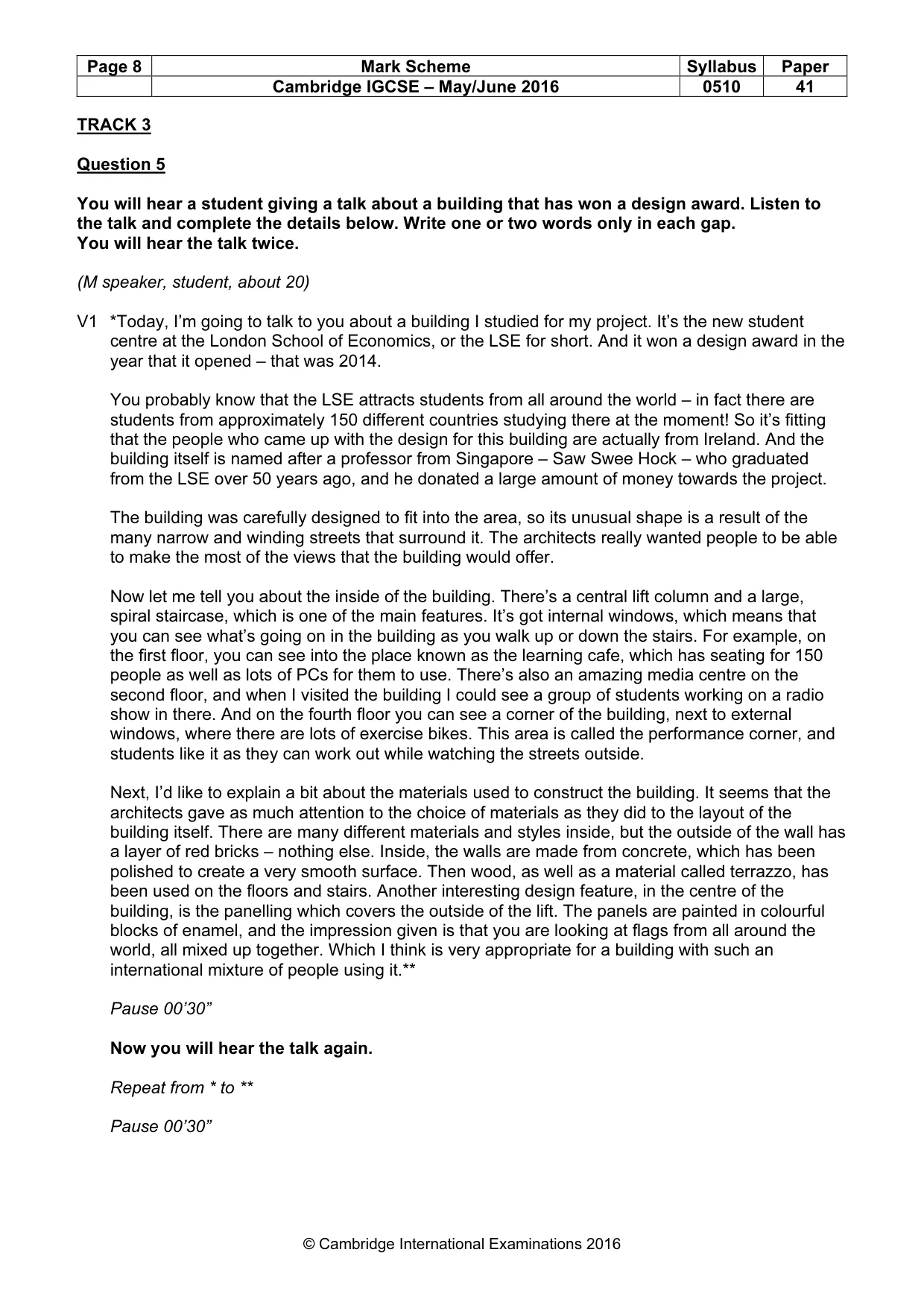
Page 8 Mark Scheme Syllabus Paper Cambridge IGCSE – May/June 2016 0510 41 © Cambridge International Examinations 2016 TRACK 3 Question 5 You will hear a student giving a talk about a building that has won a design award. Listen to the talk and complete the details below. Write one or two words only in each gap. You will hear the talk twice. (M speaker, student, about 20) V1 *Today, I’m going to talk to you about a building I studied for my project. It’s the new student centre at the London School of Economics, or the LSE for short. And it won a design award in the year that it opened – that was 2014. You probably know that the LSE attracts students from all around the world – in fact there are students from approximately 150 different countries studying there at the moment! So it’s fitting that the people who came up with the design for this building are actually from Ireland. And the building itself is named after a professor from Singapore – Saw Swee Hock – who graduated from the LSE over 50 years ago, and he donated a large amount of money towards the project. The building was carefully designed to fit into the area, so its unusual shape is a result of the many narrow and winding streets that surround it. The architects really wanted people to be able to make the most of the views that the building would offer. Now let me tell you about the inside of the building. There’s a central lift column and a large, spiral staircase, which is one of the main features. It’s got internal windows, which means that you can see what’s going on in the building as you walk up or down the stairs. For example, on the first floor, you can see into the place known as the learning cafe, which has seating for 150 people as well as lots of PCs for them to use. There’s also an amazing media centre on the second floor, and when I visited the building I could see a group of students working on a radio show in there. And on the fourth floor you can see a corner of the building, next to external windows, where there are lots of exercise bikes. This area is called the performance corner, and students like it as they can work out while watching the streets outside. Next, I’d like to explain a bit about the materials used to construct the building. It seems that the architects gave as much attention to the choice of materials as they did to the layout of the building itself. There are many different materials and styles inside, but the outside of the wall has a layer of red bricks – nothing else. Inside, the walls are made from concrete, which has been polished to create a very smooth surface. Then wood, as well as a material called terrazzo, has been used on the floors and stairs. Another interesting design feature, in the centre of the building, is the panelling which covers the outside of the lift. The panels are painted in colourful blocks of enamel, and the impression given is that you are looking at flags from all around the world, all mixed up together. Which I think is very appropriate for a building with such an international mixture of people using it.** Pause 00’30” Now you will hear the talk again. Repeat from * to ** Pause 00’30”
Mark scheme, page 9
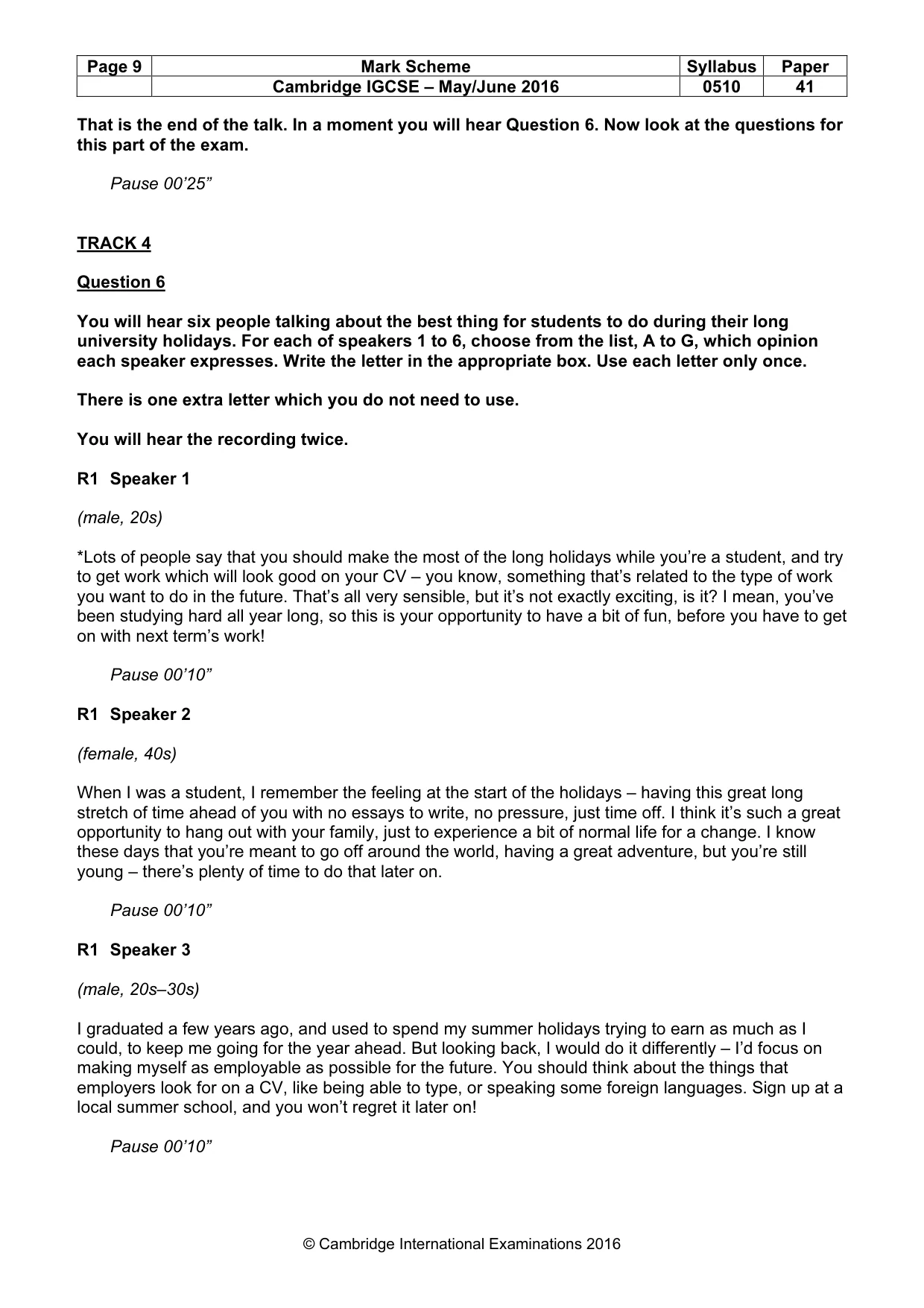
Page 9 Mark Scheme Syllabus Paper Cambridge IGCSE – May/June 2016 0510 41 © Cambridge International Examinations 2016 That is the end of the talk. In a moment you will hear Question 6. Now look at the questions for this part of the exam. Pause 00’25” TRACK 4 Question 6 You will hear six people talking about the best thing for students to do during their long university holidays. For each of speakers 1 to 6, choose from the list, A to G, which opinion each speaker expresses. Write the letter in the appropriate box. Use each letter only once. There is one extra letter which you do not need to use. You will hear the recording twice. R1 Speaker 1 (male, 20s) *Lots of people say that you should make the most of the long holidays while you’re a student, and try to get work which will look good on your CV – you know, something that’s related to the type of work you want to do in the future. That’s all very sensible, but it’s not exactly exciting, is it? I mean, you’ve been studying hard all year long, so this is your opportunity to have a bit of fun, before you have to get on with next term’s work! Pause 00’10” R1 Speaker 2 (female, 40s) When I was a student, I remember the feeling at the start of the holidays – having this great long stretch of time ahead of you with no essays to write, no pressure, just time off. I think it’s such a great opportunity to hang out with your family, just to experience a bit of normal life for a change. I know these days that you’re meant to go off around the world, having a great adventure, but you’re still young – there’s plenty of time to do that later on. Pause 00’10” R1 Speaker 3 (male, 20s–30s) I graduated a few years ago, and used to spend my summer holidays trying to earn as much as I could, to keep me going for the year ahead. But looking back, I would do it differently – I’d focus on making myself as employable as possible for the future. You should think about the things that employers look for on a CV, like being able to type, or speaking some foreign languages. Sign up at a local summer school, and you won’t regret it later on! Pause 00’10”
Mark scheme, page 10
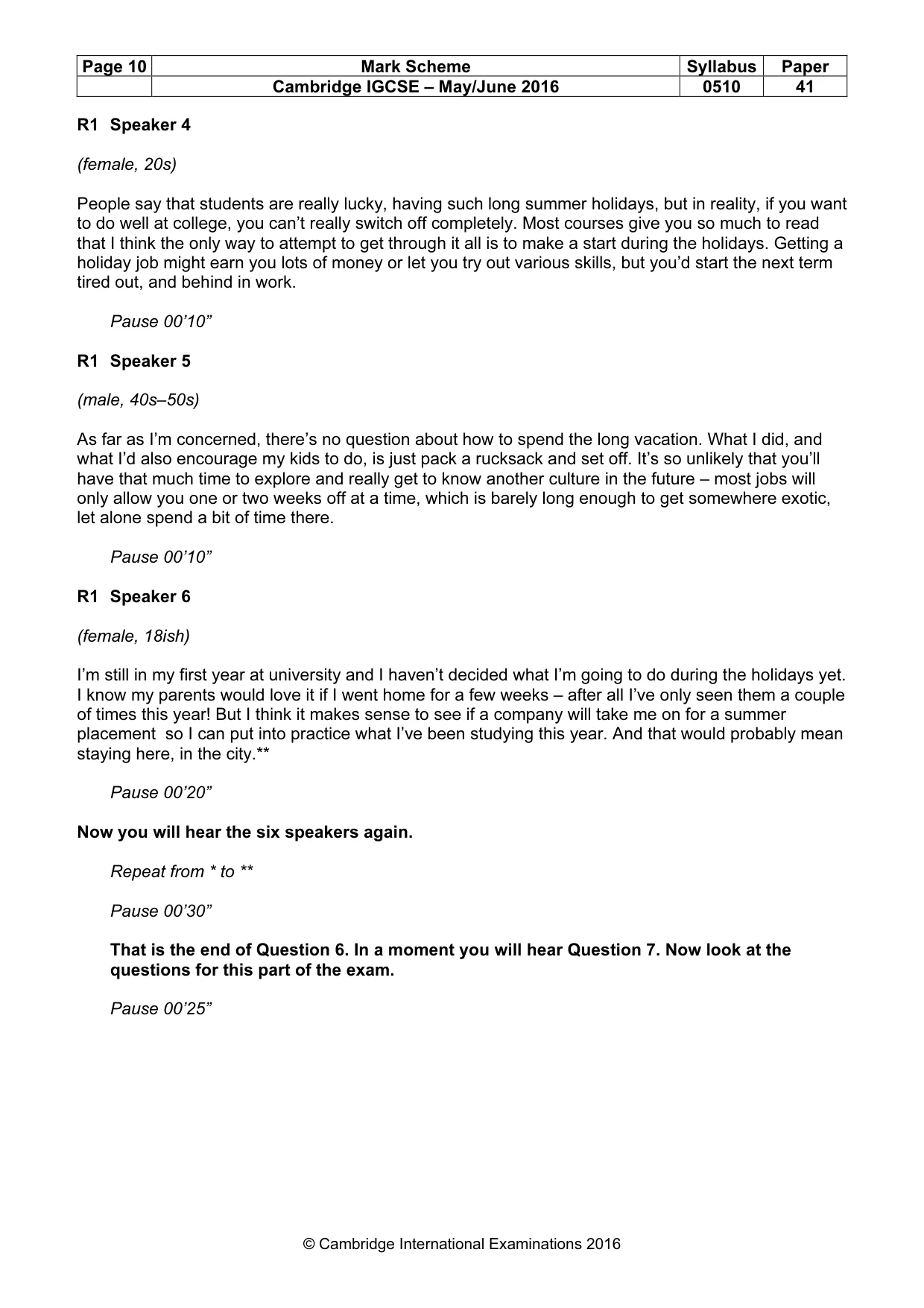
Page 10 Mark Scheme Syllabus Paper Cambridge IGCSE – May/June 2016 0510 41 © Cambridge International Examinations 2016 R1 Speaker 4 (female, 20s) People say that students are really lucky, having such long summer holidays, but in reality, if you want to do well at college, you can’t really switch off completely. Most courses give you so much to read that I think the only way to attempt to get through it all is to make a start during the holidays. Getting a holiday job might earn you lots of money or let you try out various skills, but you’d start the next term tired out, and behind in work. Pause 00’10” R1 Speaker 5 (male, 40s–50s) As far as I’m concerned, there’s no question about how to spend the long vacation. What I did, and what I’d also encourage my kids to do, is just pack a rucksack and set off. It’s so unlikely that you’ll have that much time to explore and really get to know another culture in the future – most jobs will only allow you one or two weeks off at a time, which is barely long enough to get somewhere exotic, let alone spend a bit of time there. Pause 00’10” R1 Speaker 6 (female, 18ish) I’m still in my first year at university and I haven’t decided what I’m going to do during the holidays yet. I know my parents would love it if I went home for a few weeks – after all I’ve only seen them a couple of times this year! But I think it makes sense to see if a company will take me on for a summer placement so I can put into practice what I’ve been studying this year. And that would probably mean staying here, in the city.** Pause 00’20” Now you will hear the six speakers again. Repeat from * to ** Pause 00’30” That is the end of Question 6. In a moment you will hear Question 7. Now look at the questions for this part of the exam. Pause 00’25”
Mark scheme, page 11
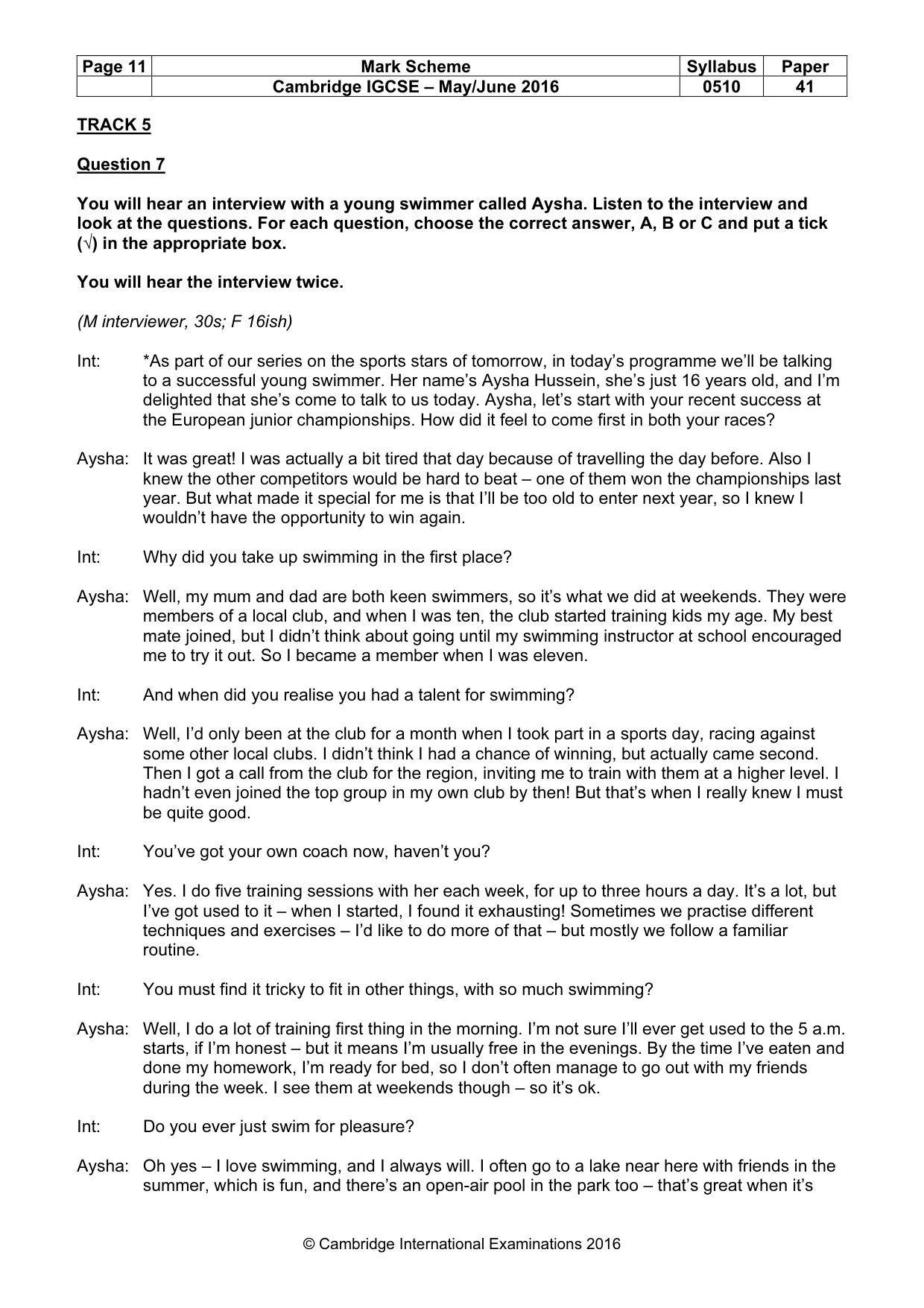
Page 11 Mark Scheme Syllabus Paper Cambridge IGCSE – May/June 2016 0510 41 © Cambridge International Examinations 2016 TRACK 5 Question 7 You will hear an interview with a young swimmer called Aysha. Listen to the interview and look at the questions. For each question, choose the correct answer, A, B or C and put a tick (√) in the appropriate box. You will hear the interview twice. (M interviewer, 30s; F 16ish) Int: *As part of our series on the sports stars of tomorrow, in today’s programme we’ll be talking to a successful young swimmer. Her name’s Aysha Hussein, she’s just 16 years old, and I’m delighted that she’s come to talk to us today. Aysha, let’s start with your recent success at the European junior championships. How did it feel to come first in both your races? Aysha: It was great! I was actually a bit tired that day because of travelling the day before. Also I knew the other competitors would be hard to beat – one of them won the championships last year. But what made it special for me is that I’ll be too old to enter next year, so I knew I wouldn’t have the opportunity to win again. Int: Why did you take up swimming in the first place? Aysha: Well, my mum and dad are both keen swimmers, so it’s what we did at weekends. They were members of a local club, and when I was ten, the club started training kids my age. My best mate joined, but I didn’t think about going until my swimming instructor at school encouraged me to try it out. So I became a member when I was eleven. Int: And when did you realise you had a talent for swimming? Aysha: Well, I’d only been at the club for a month when I took part in a sports day, racing against some other local clubs. I didn’t think I had a chance of winning, but actually came second. Then I got a call from the club for the region, inviting me to train with them at a higher level. I hadn’t even joined the top group in my own club by then! But that’s when I really knew I must be quite good. Int: You’ve got your own coach now, haven’t you? Aysha: Yes. I do five training sessions with her each week, for up to three hours a day. It’s a lot, but I’ve got used to it – when I started, I found it exhausting! Sometimes we practise different techniques and exercises – I’d like to do more of that – but mostly we follow a familiar routine. Int: You must find it tricky to fit in other things, with so much swimming? Aysha: Well, I do a lot of training first thing in the morning. I’m not sure I’ll ever get used to the 5 a.m. starts, if I’m honest – but it means I’m usually free in the evenings. By the time I’ve eaten and done my homework, I’m ready for bed, so I don’t often manage to go out with my friends during the week. I see them at weekends though – so it’s ok. Int: Do you ever just swim for pleasure? Aysha: Oh yes – I love swimming, and I always will. I often go to a lake near here with friends in the summer, which is fun, and there’s an open-air pool in the park too – that’s great when it’s
Mark scheme, page 12
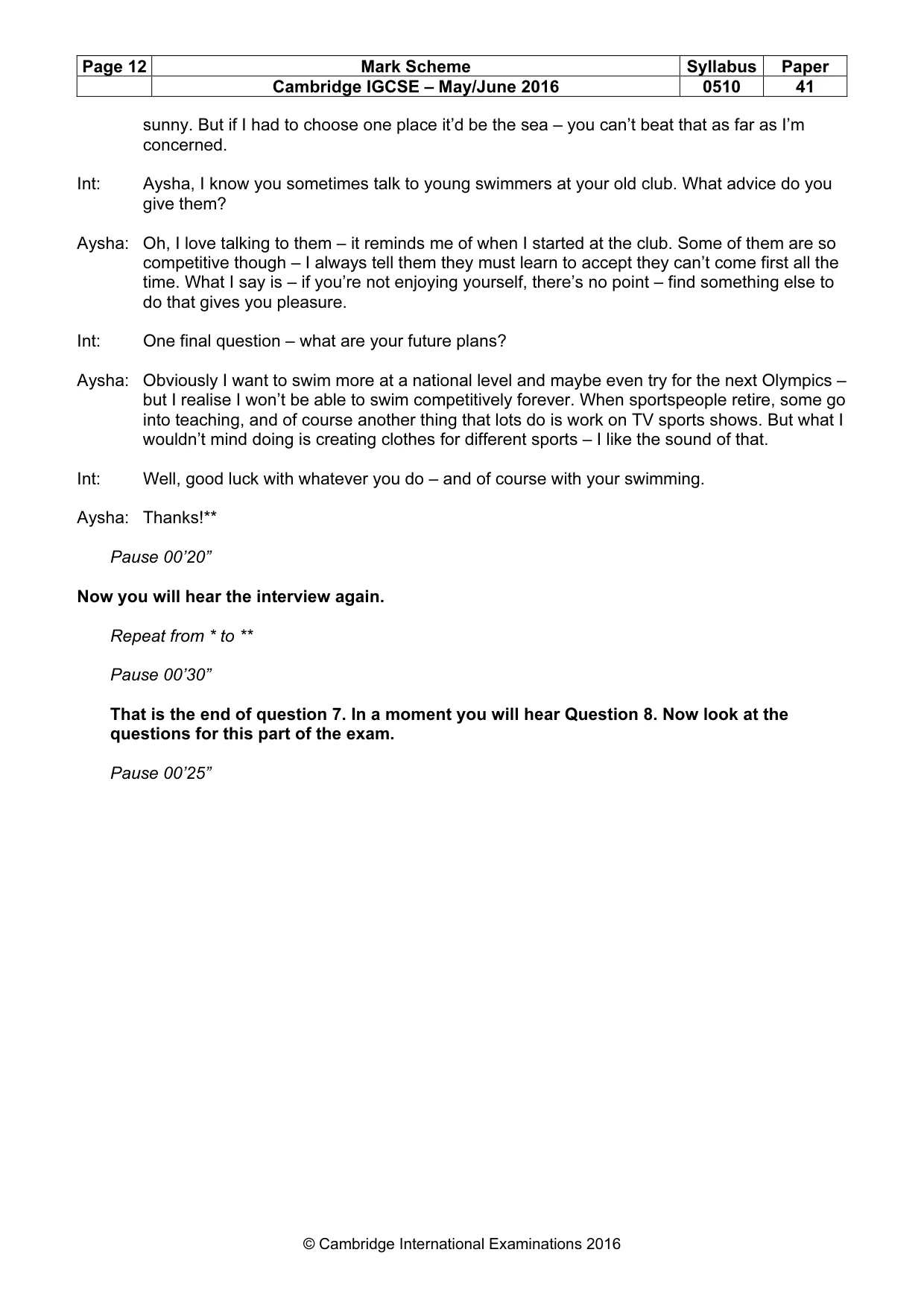
Page 12 Mark Scheme Syllabus Paper Cambridge IGCSE – May/June 2016 0510 41 © Cambridge International Examinations 2016 sunny. But if I had to choose one place it’d be the sea – you can’t beat that as far as I’m concerned. Int: Aysha, I know you sometimes talk to young swimmers at your old club. What advice do you give them? Aysha: Oh, I love talking to them – it reminds me of when I started at the club. Some of them are so competitive though – I always tell them they must learn to accept they can’t come first all the time. What I say is – if you’re not enjoying yourself, there’s no point – find something else to do that gives you pleasure. Int: One final question – what are your future plans? Aysha: Obviously I want to swim more at a national level and maybe even try for the next Olympics – but I realise I won’t be able to swim competitively forever. When sportspeople retire, some go into teaching, and of course another thing that lots do is work on TV sports shows. But what I wouldn’t mind doing is creating clothes for different sports – I like the sound of that. Int: Well, good luck with whatever you do – and of course with your swimming. Aysha: Thanks!** Pause 00’20” Now you will hear the interview again. Repeat from * to ** Pause 00’30” That is the end of question 7. In a moment you will hear Question 8. Now look at the questions for this part of the exam. Pause 00’25”
Mark scheme, page 13
Page 13 Mark Scheme Syllabus Paper Cambridge IGCSE – May/June 2016 0510 41 © Cambridge International Examinations 2016 TRACK 6 Question 8 Part A You will hear a business expert giving a talk about the future of shipping. Listen to the talk and complete the sentences in Part A. Write one or two words only in each gap. You will hear the talk twice. (male, 50s) V1 *Thank you for coming along to today’s business talk. The topic is slightly different today, and will be useful to anyone interested in overseas trade and shipping. I’m going to tell you about the possibility of remote-controlled ships – that’s ships with no crew or captain on board, but controlled from somewhere else. Your first thought might be that this doesn’t sound possible, let alone sensible. But drones – those are planes with no crew – already exist, and driverless cars too, so there’s no reason why ships can’t be next. Let’s consider some of the reasons in favour of developing this technology. Firstly, of course, the lack of crew would reduce costs quite significantly, be much safer, and also be more environmentally friendly. You might think that these ships would be more dangerous, but in fact, the majority of accidents that occur at sea are due to human error, rather than extreme weather or poor maintenance. And there’s plenty of research available to support this statement. Another point to consider is the role of a ship’s captain. In the past, the captain would’ve spent long days controlling the ship, steering it in the right direction. However, technology has progressed so fast that most systems on board are computer-controlled – which means that staff management is the captain’s biggest responsibility. So the reality is that you have highly trained people who only actually operate their ship for a very small amount of time – why not have them operating ships all the time? I can hear you asking yourselves how this would work. Well, the idea is that a ship’s captain would no longer work on the ship itself, but would be relocated to an office in a city. There, they’d be able to control not just one, but a whole fleet of ships, using a computer and several large screens. There would be lots of cameras located all around each ship, which would actually give the captain better views than he’d get if he was working on board. Some people have expressed concern over this technology – saying that the ships could be dangerous for other smaller boats or even people working in ports. However, we need to consider that it’s the crew who are usually in danger if there’s a problem on board – so removing them is a logical step. And if a ship does get into difficulties, it will simply be shut down by the captain, and will float where it is until the problem is resolved or someone turns up to fix it. In a moment, we’ll look at some pictures which show what these ships might look like. But first, are there any questions?** Pause 00’25” Now you will hear the talk again. Repeat from * to ** Pause 00’30”
Mark scheme, page 14
Page 14 Mark Scheme Syllabus Paper Cambridge IGCSE – May/June 2016 0510 41 © Cambridge International Examinations 2016 Question 8 Part B Now listen to a conversation between two students about ships with no crew, and complete the sentences in Part B. Write one or two words, or a number, in each gap. You will hear the conversation twice. (M/F both 18-20ish – students) M: *So, did you manage to find out any more about this idea of ships that don’t have any crew? F: Yeah, I found a couple of websites that were quite interesting. M: Oh good, I did too. I wanted to find out more about the advantages – you know, like the ones the speaker mentioned in his talk yesterday. F: Well, the most obvious advantage is that you could really cut operating costs. I mean, if you’ve got one captain in charge of ten ships, that’s a huge saving straightaway. But overall, it’s estimated it’d be as much as thirty per cent cheaper with this new technology – and if it goes ahead, that approximately fifty per cent of the world’s cargo ships will become remote controlled. It’s incredible, isn’t it? M: I find it quite hard to imagine! The other thing is that ships these days spend weeks or even months at sea, so the crew need to eat, sleep, wash – all of that would become irrelevant. And of course, heating wouldn’t be required in colder climates if there’s no crew on board. F: And you wouldn’t have to have lifeboats either, as there wouldn’t be any people to get off the ship if there was an emergency! So, all these things mean that you’d be able to maximise the amount of space on these ships. M: Yeah – remember those pictures we saw yesterday? All the things like stairs, and rails to hold on to, would no longer be needed. In fact, the whole design would be different. F: There was one other thing I read about that just didn’t occur to me before. M: What’s that? F: It’s that if you don’t have crew on the ships, then pirates wouldn’t be so much of an issue. There’d be no prisoners for them to negotiate over! M: And anyway, even if they did get on board, what would they do? With remote control, the captain is the only person who can control the ship. They wouldn’t be able to take it anywhere. F: Of course! M: So, did you find out anything else about the research that’s going on? That’s what I’d like to look into a bit more. F: Well, I think it was an engineering company from Britain that set the whole thing up. And apparently there’s a big research centre in Norway where they’re currently working on the technology. And they predict that it’ll be mostly shipping companies in northern Europe that’ll want to use it –because wages for the crew are generally highest there. M: Oh, right. Will you show me the site where you read about that? F: Sure.
Mark scheme, page 15
Page 15 Mark Scheme Syllabus Paper Cambridge IGCSE – May/June 2016 0510 41 © Cambridge International Examinations 2016 M: Thanks. Anyway, come on, we’d better get to our next lecture...** Pause 00’25” Now you will hear the conversation again. Repeat from * to ** Pause 00’30” That is the end of Question 8, and of the test. In a moment your teacher will collect your papers. Please check that you have written your name, Centre number and candidate number on the front of your question paper. Remember, you must not talk until all the papers have been collected. Pause 00’10” Teacher, please collect all the papers.
What you needed in this session
Cambridge’s own grade thresholds for 2016 May/June, Paper 4 · Variant 1. A higher threshold means an easier paper — the bar moves with how the cohort did.