Cambridge IGCSE English - Second Language (oral endorsement) 0510 — 2013 May/June Paper 2 · Variant 3
0510/23/M/J/13
The question paper and its mark scheme, free to read here and free to download. This is Cambridge’s own paper, exactly as it was sat.
Question paper16 pages

Mark scheme12 pages
Answers below. Sit the paper first if you are practising.
Paper as text
Question paper, page 1
This document consists of 15 printed pages and 1 blank page. DC (CW/SW) 59171/4 © UCLES 2013 [Turn over UNIVERSITY OF CAMBRIDGE INTERNATIONAL EXAMINATIONS International General Certificate of Secondary Education * 6 6 7 5 6 0 0 7 7 8 * ENGLISH AS A SECOND LANGUAGE 0510/23 Paper 2 Reading and Writing (Extended) May/June 2013 2 hours Candidates answer on the Question Paper. No Additional Materials are required. READ THESE INSTRUCTIONS FIRST Write your Centre number, candidate number and name on all the work you hand in. Write in dark blue or black pen. Do not use staples, paper clips, highlighters, glue or correction fluid. DO NOT WRITE IN ANY BARCODES. Answer all questions. Dictionaries are not allowed. At the end of the examination, fasten all your work securely together. The number of marks is given in brackets [ ] at the end of each question or part question.
Question paper, page 2
2 0510/23/M/J/13 © UCLES 2013 Exercise 1 Read the following description of the capital city of the USA, and then answer the questions on the opposite page. DISCOVER WASHINGTON DC Washington DC offers visitors a wealth of interesting things to see and do. In the 1790s, the first US President, George Washington, moved his national government there. Since then its wide avenues and impressive monuments have given the city its unique style. Many politicians live in the city, and it has a mixture of international influences. This can be seen everywhere in art, culture, and food and drink. Getting around The quickest and easiest way to get around the city is by metro bus. These buses run on 338 routes throughout the city, and many are powered by natural gas or electricity as part of the city’s eco-friendly project. For just $1 you can take the popular ‘DC Circulator’, which travels on three specific routes designed to allow passengers to ‘hop on and off’ at points of interest. The yellow line travels east to west, from Georgetown to Union Station; the red line runs north to south along the historic 7th Street, and the purple line goes around the National Mall at the weekends and stops at all the most important museums and galleries. Touring the city If you really want to investigate the city’s rich and varied history, then your stay in Washington DC should definitely include a tour. There are many unusual and highly entertaining tours to take by bus, bike or alternatively on foot. The organisation ‘Cultural Tourism DC’ offers several self- guided tours, including the ‘US Civil War’ experience, and a neighbourhood tour of Broadway and the waterfront. However, for something more extraordinary, you could try the ‘Spy Drive’ tour and listen as intelligence and security experts from the US military describe where spies used to operate. At one time there were more spies living and working in Washington DC than anywhere else in the world. Visit the cathedral Make a behind-the-scenes visit to the National Cathedral, and climb to the top of the tower. Tours cost $10 but the view you get is worth it. The cathedral is located on the highest point within the city, from where visitors can see for many kilometres into Virginia and Maryland. For sports enthusiasts Baseball is one of America’s favourite pastimes and the Washington Nationals are one of the newest teams in the Major Baseball League, with one of the most modern stadiums. April to September is the baseball season and family groups can buy discounted tickets for league matches at the Nationals Ballpark. Don’t forget your camera because from the upper deck of the ballpark, along with the cheering spectators, you will have excellent views of the Capitol Building and the Washington Monument.
Question paper, page 3
3 0510/23/M/J/13 © UCLES 2013 [Turn over For Examiner’s Use (a) When did George Washington establish his government? …[1] (b) What aspects of foreign influence are evident in the city? Give two details. … …[1] (c) Why do the metro buses run on natural gas and electricity? …[1] (d) What are passengers permitted to do on the ‘DC Circulator’ routes? …[1] (e) Which bus line should tourists take to the famous museums? …[1] (f) By which two modes of transport might visitors go on a city tour? …[1] (g) What do people learn about spies on the ‘Spy Drive’ tour? …[1] (h) Who can watch baseball matches at a reduced cost? …[1] (i) From where can spectators see the Capitol Building particularly well? …[1] [Total: 9]
Question paper, page 4
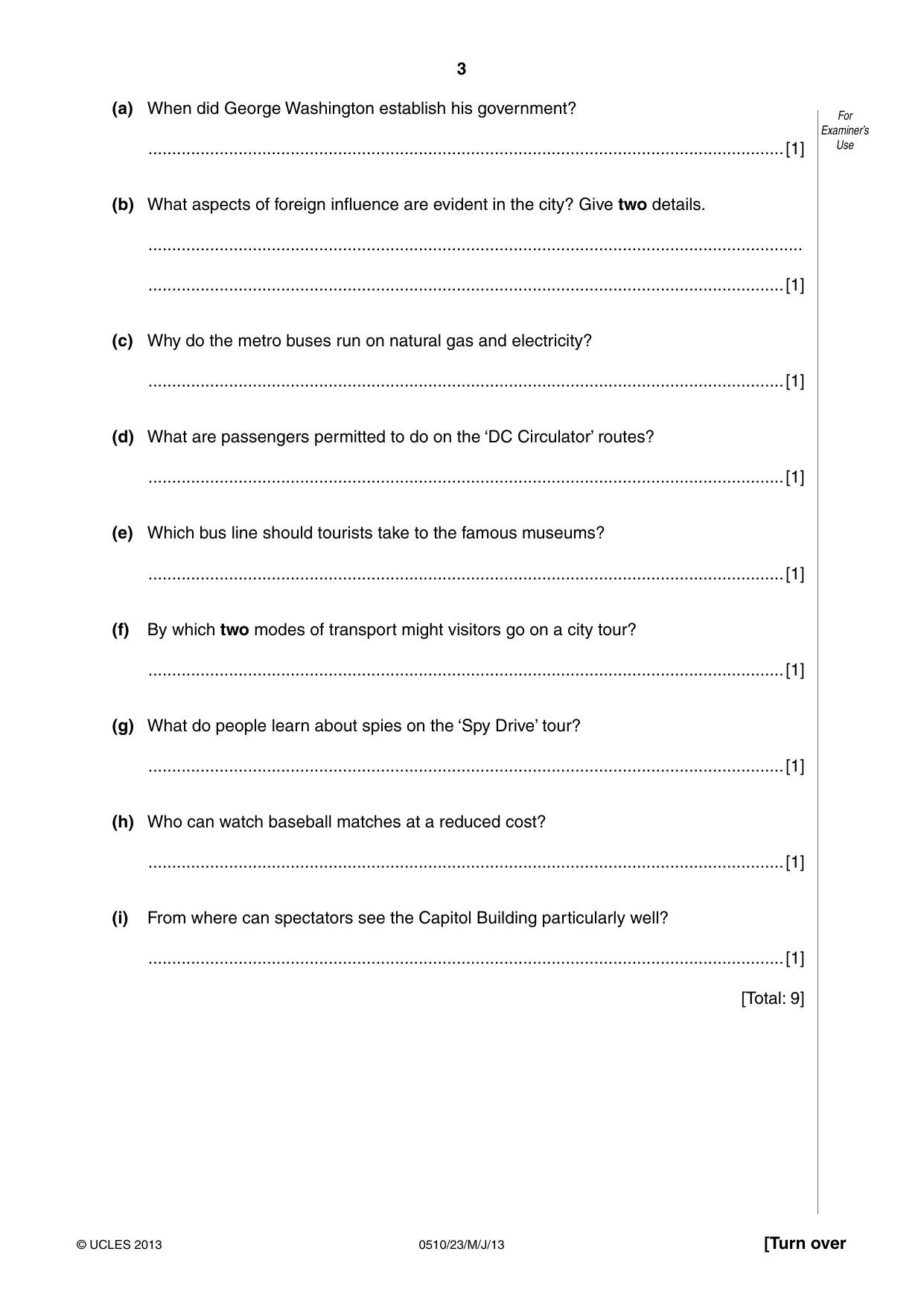
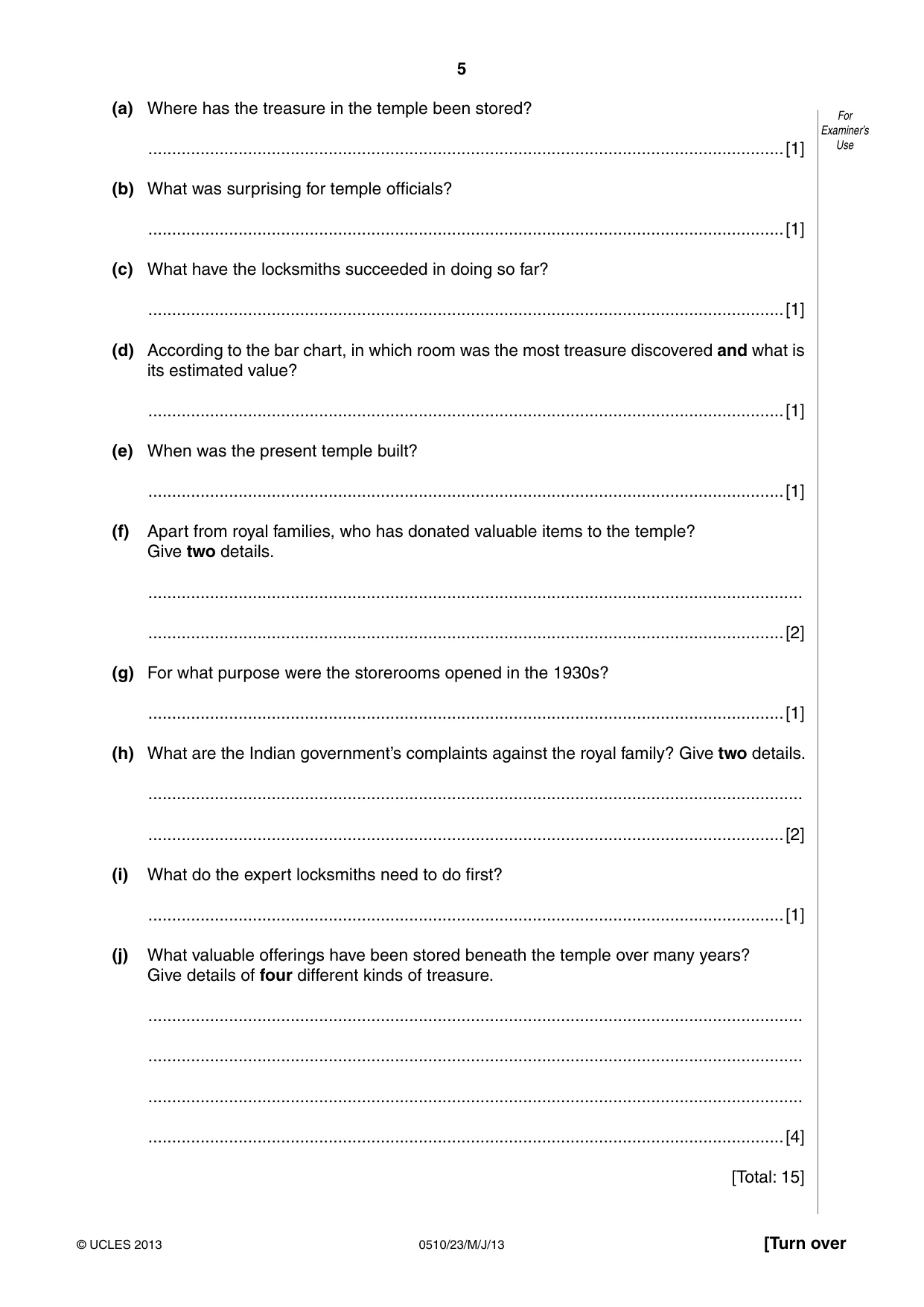
4 0510/23/M/J/13 © UCLES 2013 Exercise 2 Read the following article about hidden treasure in a temple in the south of India, and then answer the questions on the opposite page. INDIAʼS HIDDEN TREASURE INDIAʼS HIDDEN TREASURE It was just like a scene from the popular Hollywood film, ʻIndiana Jones and the Temple of Doomʼ. Even though experts had only unlocked five of the six secret underground rooms beneath the largest temple in the Indian state of Kerala, they had already discovered many valuable items including gold statues and precious silver rings. It is estimated that the centuries-old treasure stored there will eventually be worth more than twenty billion dollars. An official of the temple admitted that they had known all along that offerings presented by worshippers over the last 500 years had been lying buried in these secret underground rooms. However, they were definitely surprised at the vast quantity of treasure discovered in the first five rooms. The whole population of Kerala has been celebrating this extraordinary find. Its discovery has made the Padmanabha Swami temple, located in the state capital, Thiruvananthapuram, the richest temple in all of India. During the past few months, a team of locksmiths appointed by Indiaʼs Supreme Court has managed to open five of the six secure underground storerooms. They have revealed an enormous hoard of treasure: jewellery covered in diamonds and hundreds of antique silver coins. The original temple dates back to the 10th century, but the present massive granite structure was built in the 18th century after the King of Travancore expanded his kingdom. Historically, the temple has been for the use of the king and the royal family. Over the years, however, valuable offerings have been placed in the underground rooms. These have come not only from royal families in Kerala, but also from millions of ordinary citizens. One gift, apparently donated by a wealthy merchant, consists of two golden coconut shells decorated with precious stones. The storerooms containing the donations have remained locked over the years. They were last opened in the 1930s, so that a detailed list of all the contents could be made by servants of the royal family at that time. Now, however, the Supreme Court of India has ordered a fresh check of the treasure as a result of an important legal dispute, which has not yet been resolved. A lawyer representing the government has challenged the current head of the royal family. On behalf of the government, he is claiming that the family is not competent to manage the enormous wealth of the temple and to keep the treasure adequately secure. The unopened room has special locks, and the authorities are getting experts to examine them carefully before trying to open the room without breaking the locks. They hope to be able to open the last room soon. The entire operation is taking place under heavy police guard, and nothing is being filmed or photographed, because taking photos within the temple is strictly prohibited. The Chief Minister of Kerala State has rejected all demands that the treasure should be used for the public benefit. He argues that it belongs to the temple and is determined to ensure that it must continue to be preserved in the underground storerooms there. 0 1 room 1 2 3 4 5 6 room 2 room 3 underground storerooms estimated value (in billions of dollars) room 4 room 5
Question paper, page 5
5 0510/23/M/J/13 © UCLES 2013 [Turn over For Examiner’s Use (a) Where has the treasure in the temple been stored? …[1] (b) What was surprising for temple officials? …[1] (c) What have the locksmiths succeeded in doing so far? …[1] (d) According to the bar chart, in which room was the most treasure discovered and what is its estimated value? …[1] (e) When was the present temple built? …[1] (f) Apart from royal families, who has donated valuable items to the temple? Give two details. … …[2] (g) For what purpose were the storerooms opened in the 1930s? …[1] (h) What are the Indian government’s complaints against the royal family? Give two details. … …[2] (i) What do the expert locksmiths need to do first? …[1] (j) What valuable offerings have been stored beneath the temple over many years? Give details of four different kinds of treasure. … … … …[4] [Total: 15]
Question paper, page 6
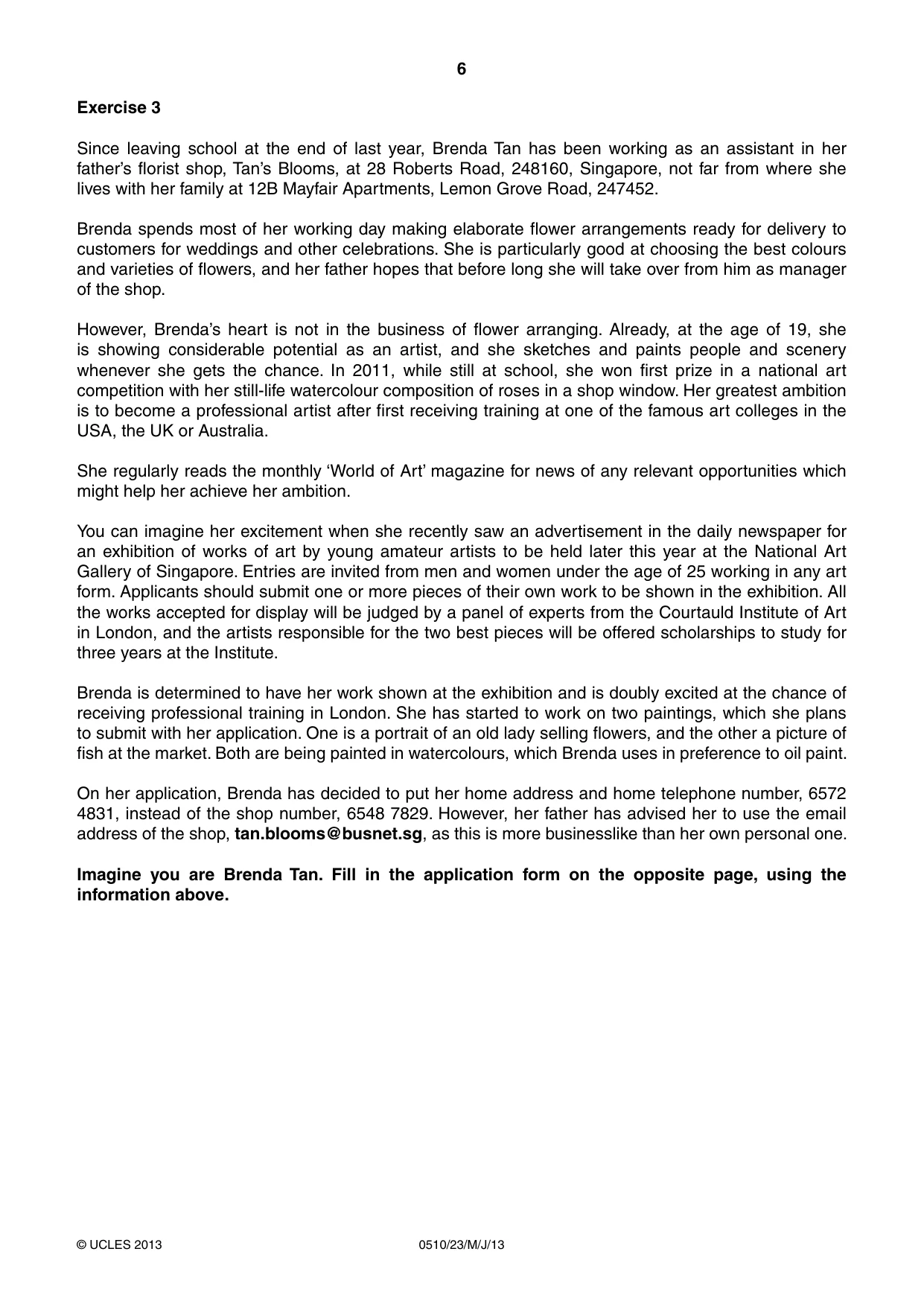
6 0510/23/M/J/13 © UCLES 2013 Exercise 3 Since leaving school at the end of last year, Brenda Tan has been working as an assistant in her father’s florist shop, Tan’s Blooms, at 28 Roberts Road, 248160, Singapore, not far from where she lives with her family at 12B Mayfair Apartments, Lemon Grove Road, 247452. Brenda spends most of her working day making elaborate flower arrangements ready for delivery to customers for weddings and other celebrations. She is particularly good at choosing the best colours and varieties of flowers, and her father hopes that before long she will take over from him as manager of the shop. However, Brenda’s heart is not in the business of flower arranging. Already, at the age of 19, she is showing considerable potential as an artist, and she sketches and paints people and scenery whenever she gets the chance. In 2011, while still at school, she won first prize in a national art competition with her still-life watercolour composition of roses in a shop window. Her greatest ambition is to become a professional artist after first receiving training at one of the famous art colleges in the USA, the UK or Australia. She regularly reads the monthly ‘World of Art’ magazine for news of any relevant opportunities which might help her achieve her ambition. You can imagine her excitement when she recently saw an advertisement in the daily newspaper for an exhibition of works of art by young amateur artists to be held later this year at the National Art Gallery of Singapore. Entries are invited from men and women under the age of 25 working in any art form. Applicants should submit one or more pieces of their own work to be shown in the exhibition. All the works accepted for display will be judged by a panel of experts from the Courtauld Institute of Art in London, and the artists responsible for the two best pieces will be offered scholarships to study for three years at the Institute. Brenda is determined to have her work shown at the exhibition and is doubly excited at the chance of receiving professional training in London. She has started to work on two paintings, which she plans to submit with her application. One is a portrait of an old lady selling flowers, and the other a picture of fish at the market. Both are being painted in watercolours, which Brenda uses in preference to oil paint. On her application, Brenda has decided to put her home address and home telephone number, 6572 4831, instead of the shop number, 6548 7829. However, her father has advised her to use the email address of the shop, tan.blooms@busnet.sg, as this is more businesslike than her own personal one. Imagine you are Brenda Tan. Fill in the application form on the opposite page, using the information above.
Question paper, page 7
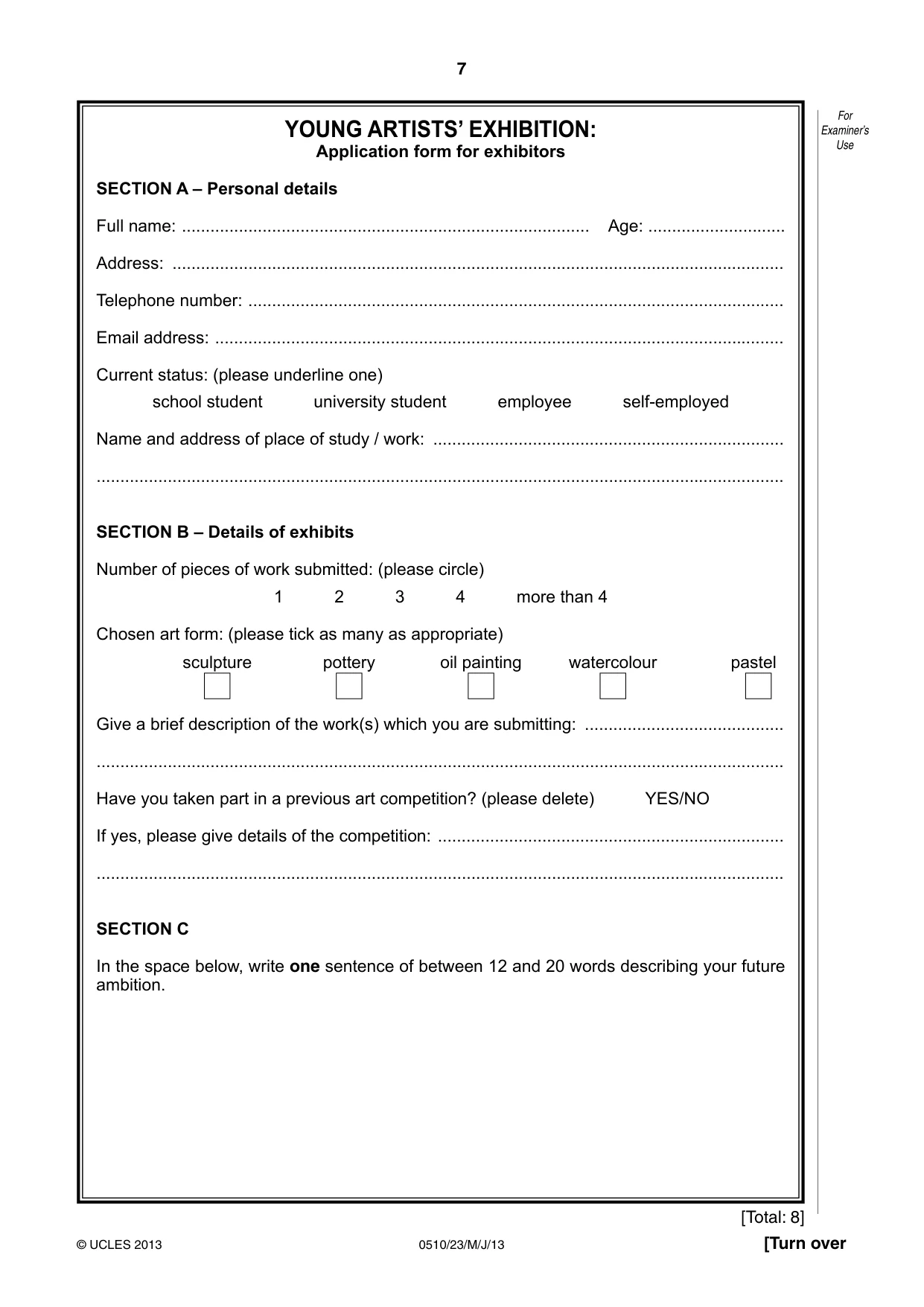
7 0510/23/M/J/13 © UCLES 2013 [Turn over For Examiner’s Use YOUNG ARTISTS’ EXHIBITION: Application form for exhibitors SECTION A – Personal details Full name: … Age: … Address: … Telephone number: … Email address: … Current status: (please underline one) school student university student employee self-employed Name and address of place of study / work: … … SECTION B – Details of exhibits Number of pieces of work submitted: (please circle) 1 2 3 4 more than 4 Chosen art form: (please tick as many as appropriate) sculpture pottery oil painting watercolour pastel Give a brief description of the work(s) which you are submitting: … … Have you taken part in a previous art competition? (please delete) YES/NO If yes, please give details of the competition: … … SECTION C In the space below, write one sentence of between 12 and 20 words describing your future ambition. [Total: 8]
Question paper, page 8
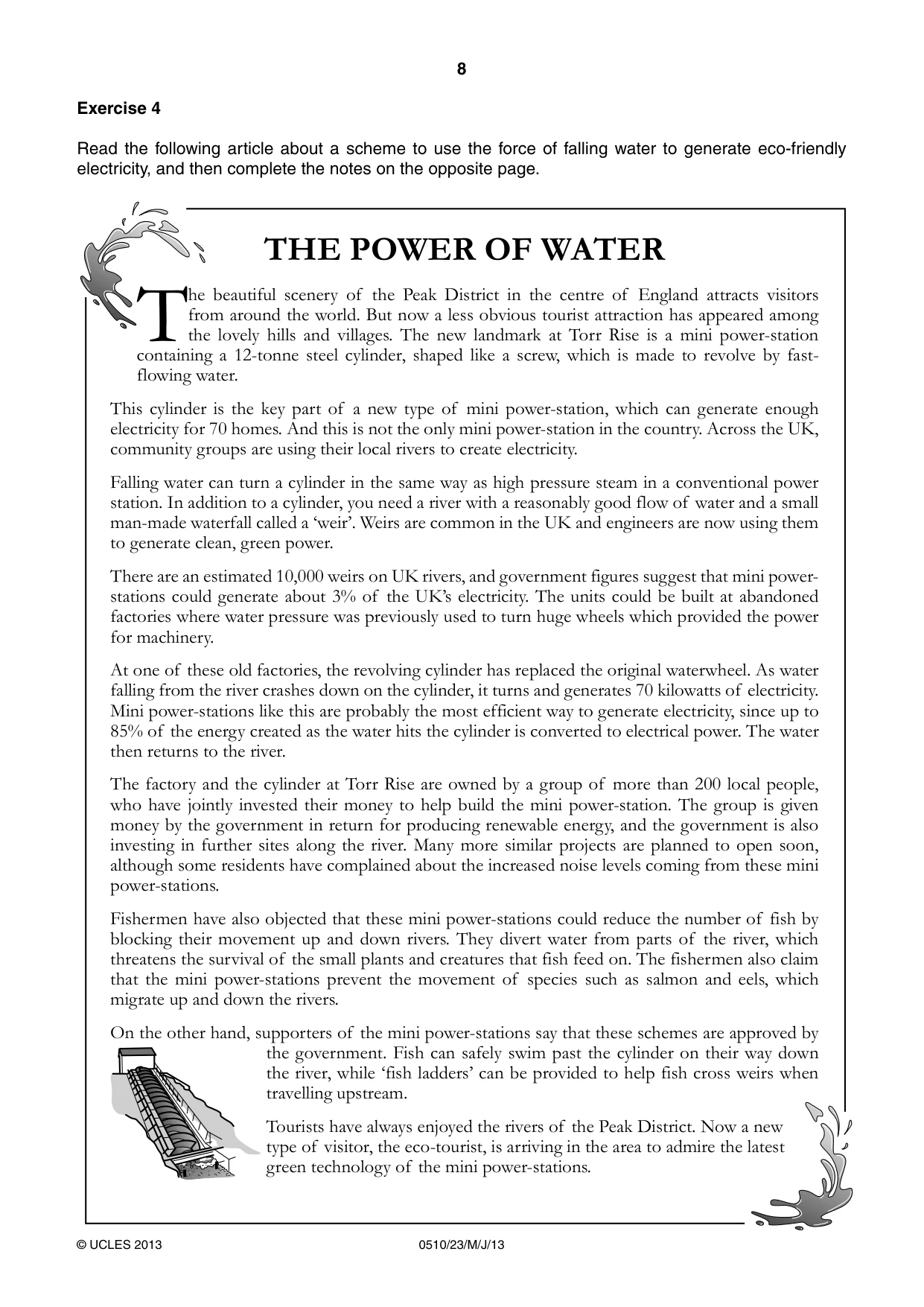
8 0510/23/M/J/13 © UCLES 2013 Exercise 4 Read the following article about a scheme to use the force of falling water to generate eco-friendly electricity, and then complete the notes on the opposite page. THE POWER OF WATER T he beautiful scenery of the Peak District in the centre of England attracts visitors from around the world. But now a less obvious tourist attraction has appeared among the lovely hills and villages. The new landmark at Torr Rise is a mini power-station containing a 12-tonne steel cylinder, shaped like a screw, which is made to revolve by fast- flowing water. This cylinder is the key part of a new type of mini power-station, which can generate enough electricity for 70 homes. And this is not the only mini power-station in the country. Across the UK, community groups are using their local rivers to create electricity. Falling water can turn a cylinder in the same way as high pressure steam in a conventional power station. In addition to a cylinder, you need a river with a reasonably good flow of water and a small man-made waterfall called a ‘weir’. Weirs are common in the UK and engineers are now using them to generate clean, green power. There are an estimated 10,000 weirs on UK rivers, and government figures suggest that mini power- stations could generate about 3% of the UK’s electricity. The units could be built at abandoned factories where water pressure was previously used to turn huge wheels which provided the power for machinery. At one of these old factories, the revolving cylinder has replaced the original waterwheel. As water falling from the river crashes down on the cylinder, it turns and generates 70 kilowatts of electricity. Mini power-stations like this are probably the most efficient way to generate electricity, since up to 85% of the energy created as the water hits the cylinder is converted to electrical power. The water then returns to the river. The factory and the cylinder at Torr Rise are owned by a group of more than 200 local people, who have jointly invested their money to help build the mini power-station. The group is given money by the government in return for producing renewable energy, and the government is also investing in further sites along the river. Many more similar projects are planned to open soon, although some residents have complained about the increased noise levels coming from these mini power-stations. Fishermen have also objected that these mini power-stations could reduce the number of fish by blocking their movement up and down rivers. They divert water from parts of the river, which threatens the survival of the small plants and creatures that fish feed on. The fishermen also claim that the mini power-stations prevent the movement of species such as salmon and eels, which migrate up and down the rivers. On the other hand, supporters of the mini power-stations say that these schemes are approved by the government. Fish can safely swim past the cylinder on their way down the river, while ‘fish ladders’ can be provided to help fish cross weirs when travelling upstream. Tourists have always enjoyed the rivers of the Peak District. Now a new type of visitor, the eco-tourist, is arriving in the area to admire the latest green technology of the mini power-stations.
Question paper, page 9
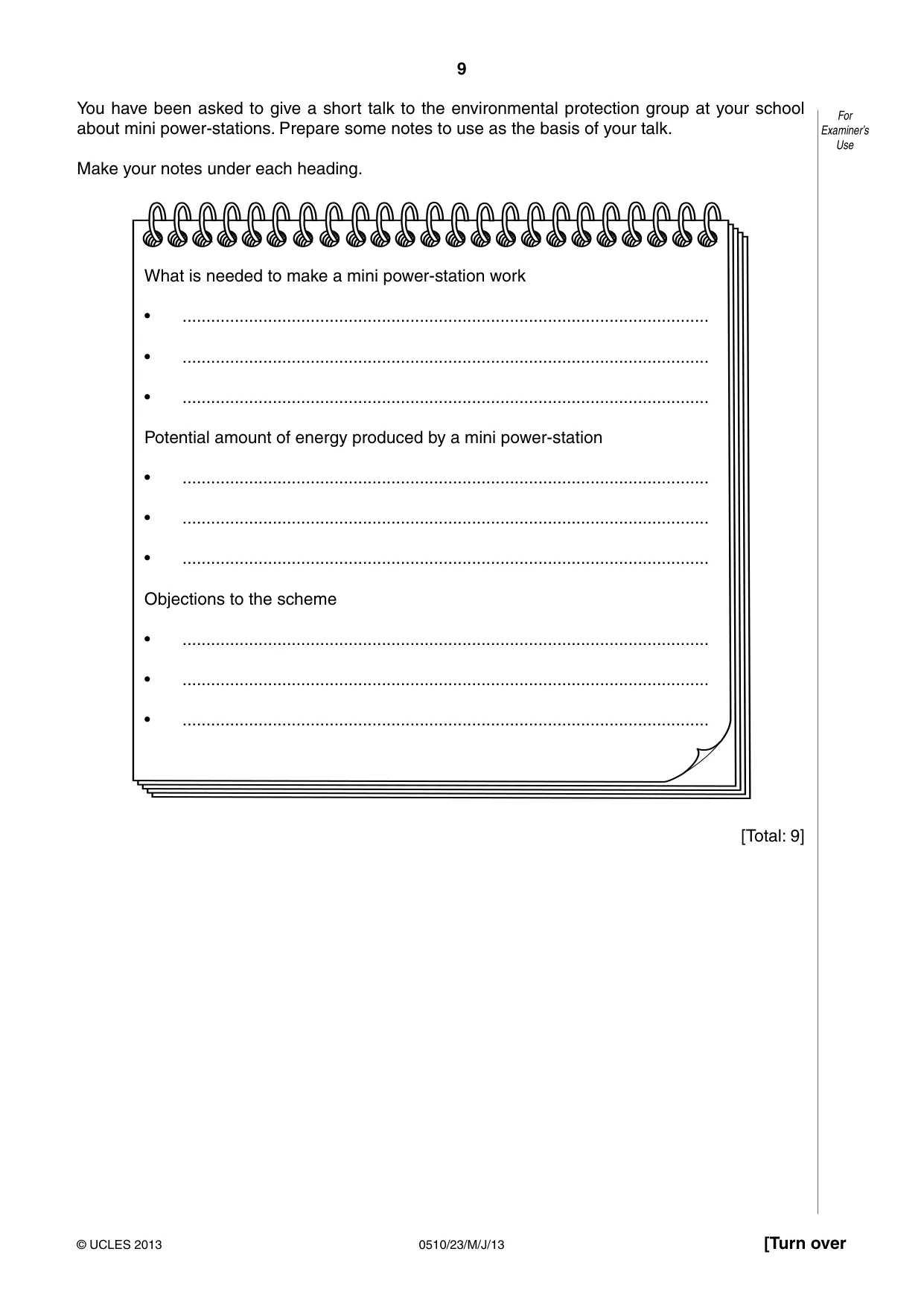
9 0510/23/M/J/13 © UCLES 2013 [Turn over For Examiner’s Use You have been asked to give a short talk to the environmental protection group at your school about mini power-stations. Prepare some notes to use as the basis of your talk. Make your notes under each heading. What is needed to make a mini power-station work • … • … • … Potential amount of energy produced by a mini power-station • … • … • … Objections to the scheme • … • … • … [Total: 9]
Question paper, page 10
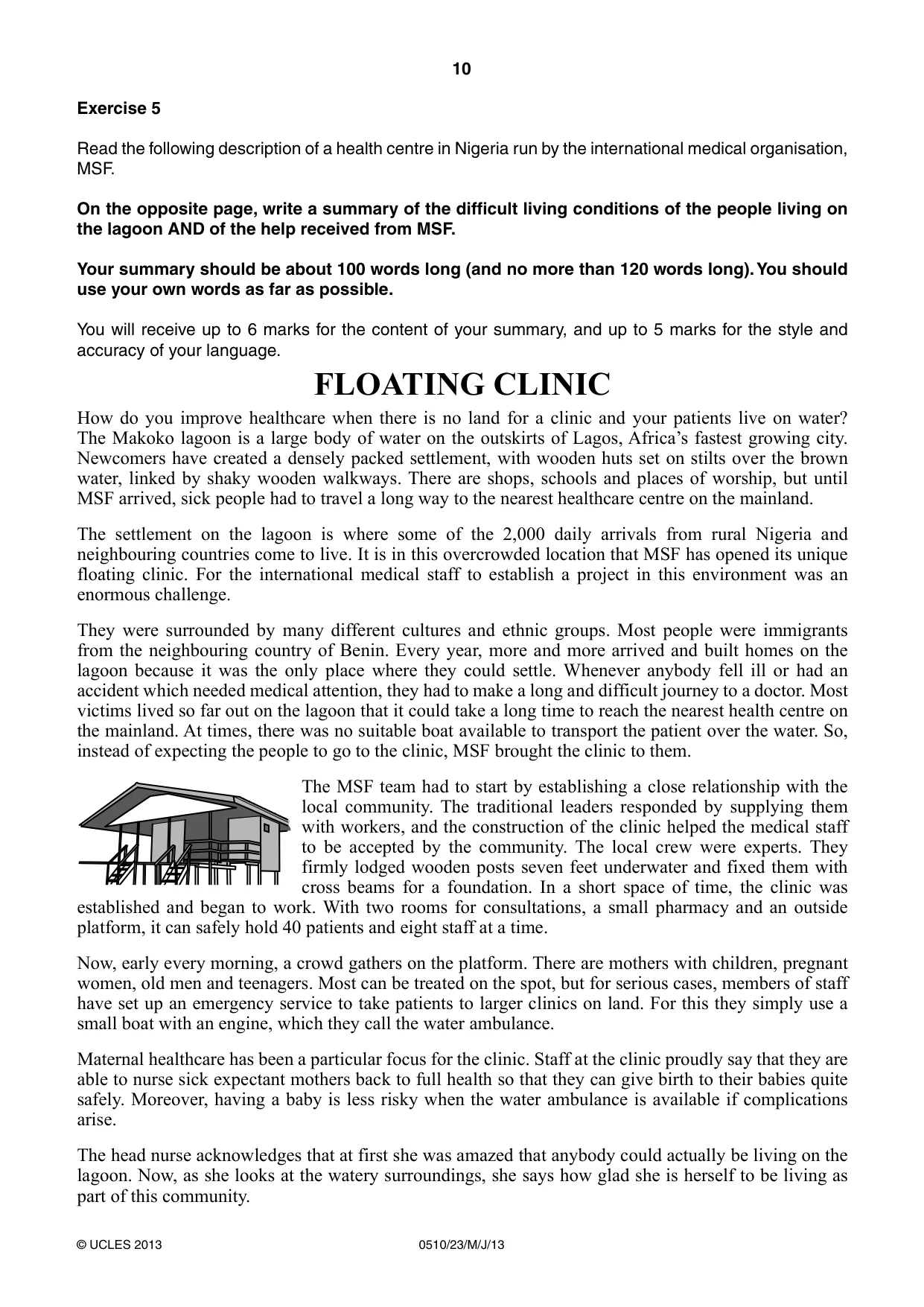
10 0510/23/M/J/13 © UCLES 2013 Exercise 5 Read the following description of a health centre in Nigeria run by the international medical organisation, MSF. On the opposite page, write a summary of the difficult living conditions of the people living on the lagoon AND of the help received from MSF. Your summary should be about 100 words long (and no more than 120 words long). You should use your own words as far as possible. You will receive up to 6 marks for the content of your summary, and up to 5 marks for the style and accuracy of your language. FLOATING CLINIC How do you improve healthcare when there is no land for a clinic and your patients live on water? The Makoko lagoon is a large body of water on the outskirts of Lagos, Africa’s fastest growing city. Newcomers have created a densely packed settlement, with wooden huts set on stilts over the brown water, linked by shaky wooden walkways. There are shops, schools and places of worship, but until MSF arrived, sick people had to travel a long way to the nearest healthcare centre on the mainland. The settlement on the lagoon is where some of the 2,000 daily arrivals from rural Nigeria and neighbouring countries come to live. It is in this overcrowded location that MSF has opened its unique floating clinic. For the international medical staff to establish a project in this environment was an enormous challenge. They were surrounded by many different cultures and ethnic groups. Most people were immigrants from the neighbouring country of Benin. Every year, more and more arrived and built homes on the lagoon because it was the only place where they could settle. Whenever anybody fell ill or had an accident which needed medical attention, they had to make a long and difficult journey to a doctor. Most victims lived so far out on the lagoon that it could take a long time to reach the nearest health centre on the mainland. At times, there was no suitable boat available to transport the patient over the water. So, instead of expecting the people to go to the clinic, MSF brought the clinic to them. The MSF team had to start by establishing a close relationship with the local community. The traditional leaders responded by supplying them with workers, and the construction of the clinic helped the medical staff to be accepted by the community. The local crew were experts. They firmly lodged wooden posts seven feet underwater and fixed them with cross beams for a foundation. In a short space of time, the clinic was established and began to work. With two rooms for consultations, a small pharmacy and an outside platform, it can safely hold 40 patients and eight staff at a time. Now, early every morning, a crowd gathers on the platform. There are mothers with children, pregnant women, old men and teenagers. Most can be treated on the spot, but for serious cases, members of staff have set up an emergency service to take patients to larger clinics on land. For this they simply use a small boat with an engine, which they call the water ambulance. Maternal healthcare has been a particular focus for the clinic. Staff at the clinic proudly say that they are able to nurse sick expectant mothers back to full health so that they can give birth to their babies quite safely. Moreover, having a baby is less risky when the water ambulance is available if complications arise. The head nurse acknowledges that at first she was amazed that anybody could actually be living on the lagoon. Now, as she looks at the watery surroundings, she says how glad she is herself to be living as part of this community.
Question paper, page 11
11 0510/23/M/J/13 © UCLES 2013 [Turn over For Examiner’s Use … … … … … … … … … … … … … … … … … … … … [Total: 11]
Question paper, page 12
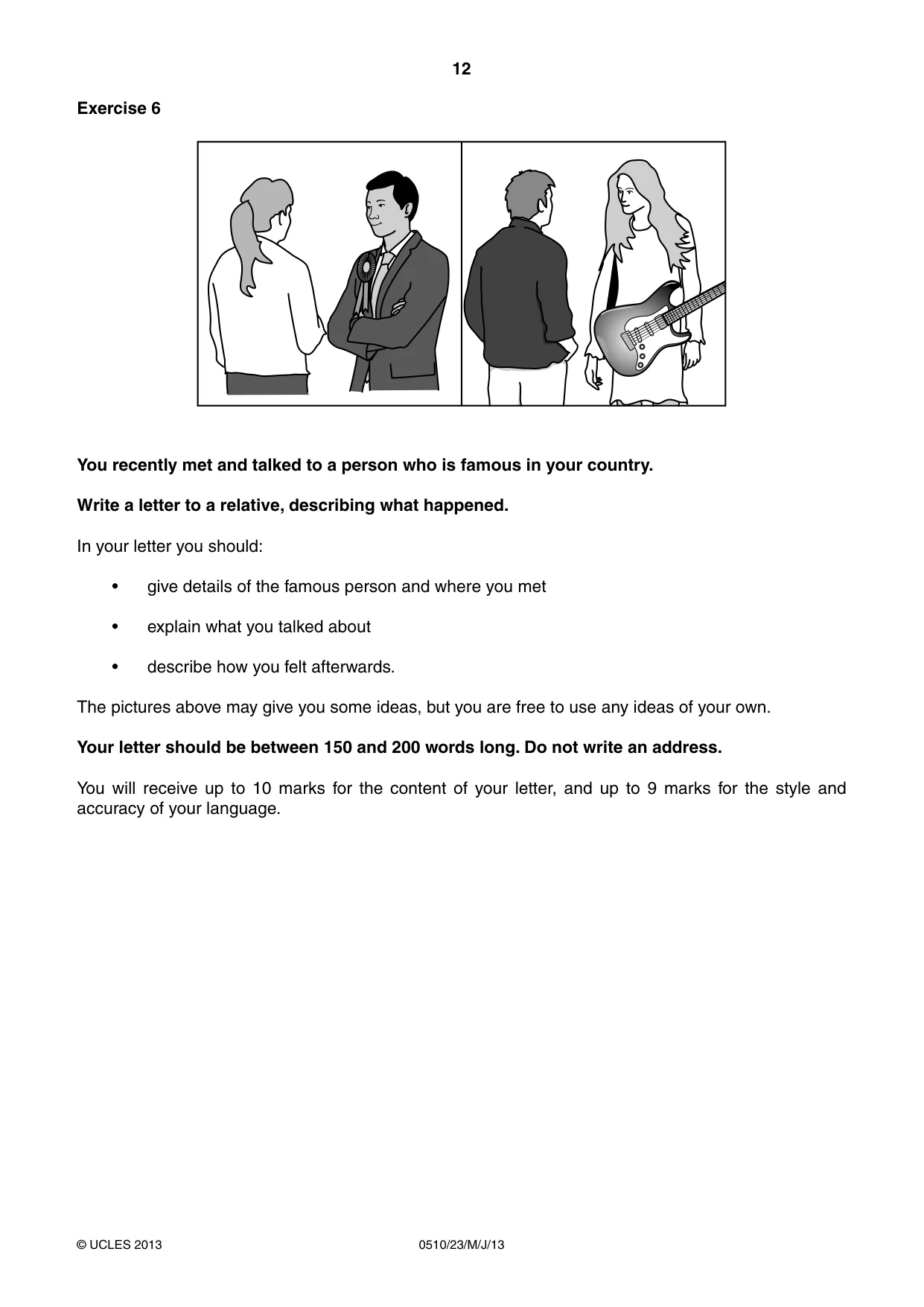
12 0510/23/M/J/13 © UCLES 2013 Exercise 6 You recently met and talked to a person who is famous in your country. Write a letter to a relative, describing what happened. In your letter you should: • give details of the famous person and where you met • explain what you talked about • describe how you felt afterwards. The pictures above may give you some ideas, but you are free to use any ideas of your own. Your letter should be between 150 and 200 words long. Do not write an address. You will receive up to 10 marks for the content of your letter, and up to 9 marks for the style and accuracy of your language.
Question paper, page 13
13 0510/23/M/J/13 © UCLES 2013 [Turn over For Examiner’s Use … … … … … … … … … … … … … … … … … … … … … … … … … [Total: 19]
Question paper, page 14
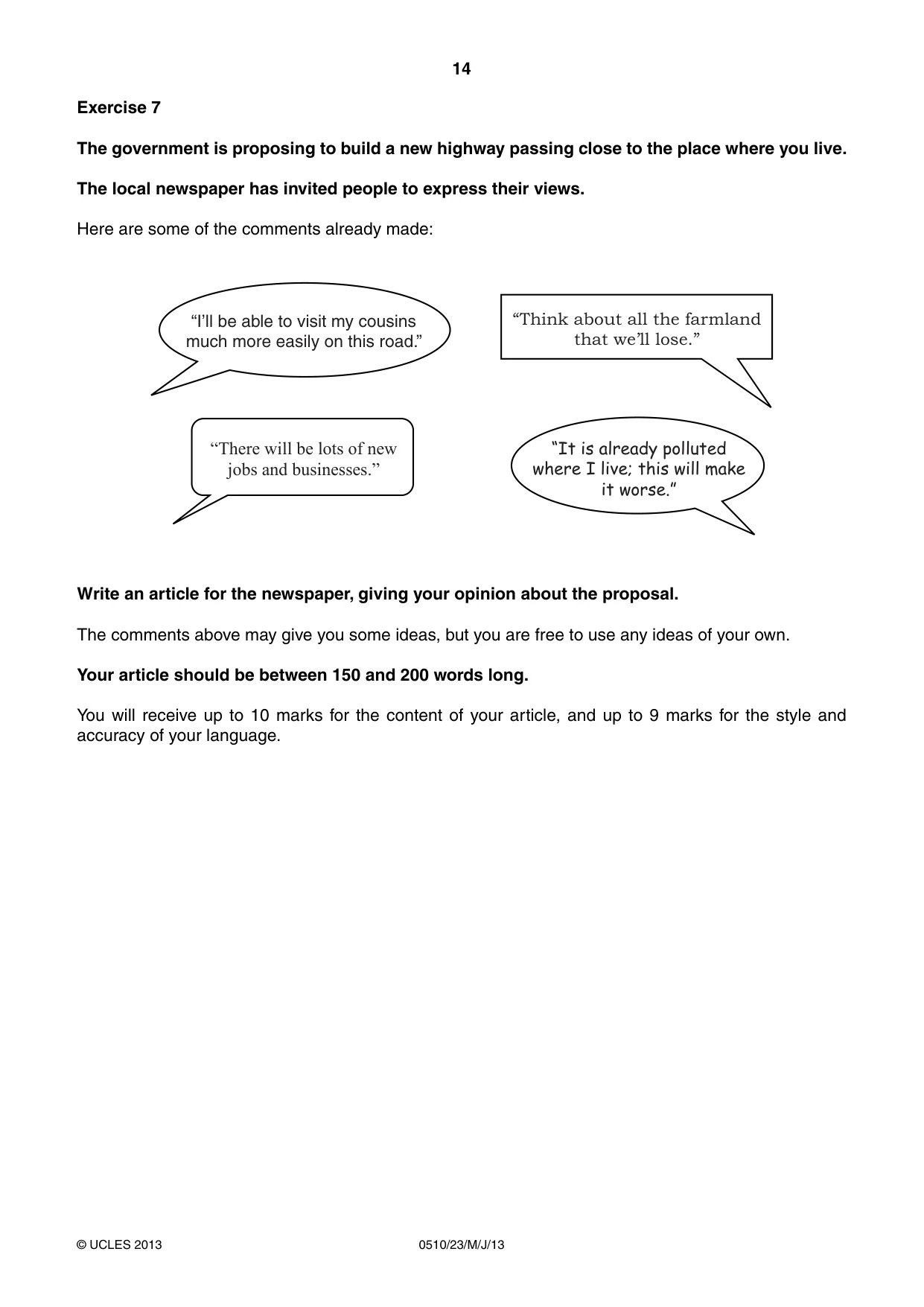
14 0510/23/M/J/13 © UCLES 2013 Exercise 7 The government is proposing to build a new highway passing close to the place where you live. The local newspaper has invited people to express their views. Here are some of the comments already made: “I’ll be able to visit my cousins much more easily on this road.” “Think about all the farmland that we’ll lose.” “There will be lots of new jobs and businesses.” “It is already polluted where I live; this will make it worse.” Write an article for the newspaper, giving your opinion about the proposal. The comments above may give you some ideas, but you are free to use any ideas of your own. Your article should be between 150 and 200 words long. You will receive up to 10 marks for the content of your article, and up to 9 marks for the style and accuracy of your language.
Question paper, page 15
15 0510/23/M/J/13 © UCLES 2013 For Examiner’s Use … … … … … … … … … … … … … … … … … … … … … … … … … [Total: 19]
Question paper, page 16
16 0510/23/M/J/13 © UCLES 2013 BLANK PAGE Permission to reproduce items where third-party owned material protected by copyright is included has been sought and cleared where possible. Every reasonable effort has been made by the publisher (UCLES) to trace copyright holders, but if any items requiring clearance have unwittingly been included, the publisher will be pleased to make amends at the earliest possible opportunity. University of Cambridge International Examinations is part of the Cambridge Assessment Group. Cambridge Assessment is the brand name of University of Cambridge Local Examinations Syndicate (UCLES), which is itself a department of the University of Cambridge.
Mark scheme, page 1
CAMBRIDGE INTERNATIONAL EXAMINATIONS International General Certificate of Secondary Education MARK SCHEME for the May/June 2013 series 0510 ENGLISH AS A SECOND LANGUAGE 0510/23 Paper 2 (Reading and Writing – Extended), maximum raw mark 90 This mark scheme is published as an aid to teachers and candidates, to indicate the requirements of the examination. It shows the basis on which Examiners were instructed to award marks. It does not indicate the details of the discussions that took place at an Examiners’ meeting before marking began, which would have considered the acceptability of alternative answers. Mark schemes should be read in conjunction with the question paper and the Principal Examiner Report for Teachers. Cambridge will not enter into discussions about these mark schemes. Cambridge is publishing the mark schemes for the May/June 2013 series for most IGCSE, GCE Advanced Level and Advanced Subsidiary Level components and some Ordinary Level components.
Mark scheme, page 2
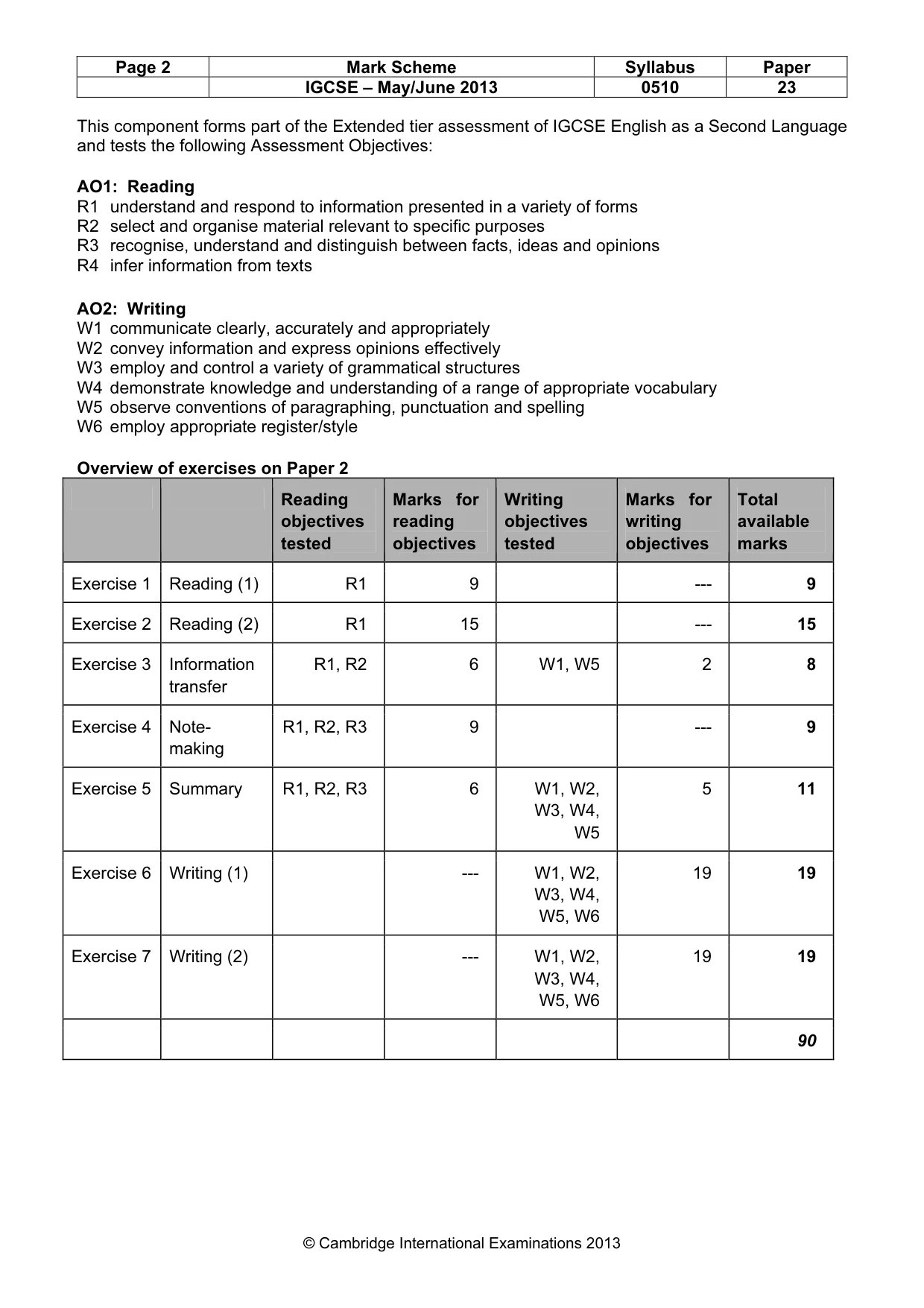
Page 2 Mark Scheme Syllabus Paper IGCSE – May/June 2013 0510 23 © Cambridge International Examinations 2013 This component forms part of the Extended tier assessment of IGCSE English as a Second Language and tests the following Assessment Objectives: AO1: Reading R1 understand and respond to information presented in a variety of forms R2 select and organise material relevant to specific purposes R3 recognise, understand and distinguish between facts, ideas and opinions R4 infer information from texts AO2: Writing W1 communicate clearly, accurately and appropriately W2 convey information and express opinions effectively W3 employ and control a variety of grammatical structures W4 demonstrate knowledge and understanding of a range of appropriate vocabulary W5 observe conventions of paragraphing, punctuation and spelling W6 employ appropriate register/style Overview of exercises on Paper 2 Reading objectives tested Marks for reading objectives Writing objectives tested Marks for writing objectives Total available marks Exercise 1 Reading (1) R1 9 --- 9 Exercise 2 Reading (2) R1 15 --- 15 Exercise 3 Information transfer R1, R2 6 W1, W5 2 8 Exercise 4 Note- making R1, R2, R3 9 --- 9 Exercise 5 Summary R1, R2, R3 6 W1, W2, W3, W4, W5 5 11 Exercise 6 Writing (1) --- W1, W2, W3, W4, W5, W6 19 19 Exercise 7 Writing (2) --- W1, W2, W3, W4, W5, W6 19 19 90
Mark scheme, page 3
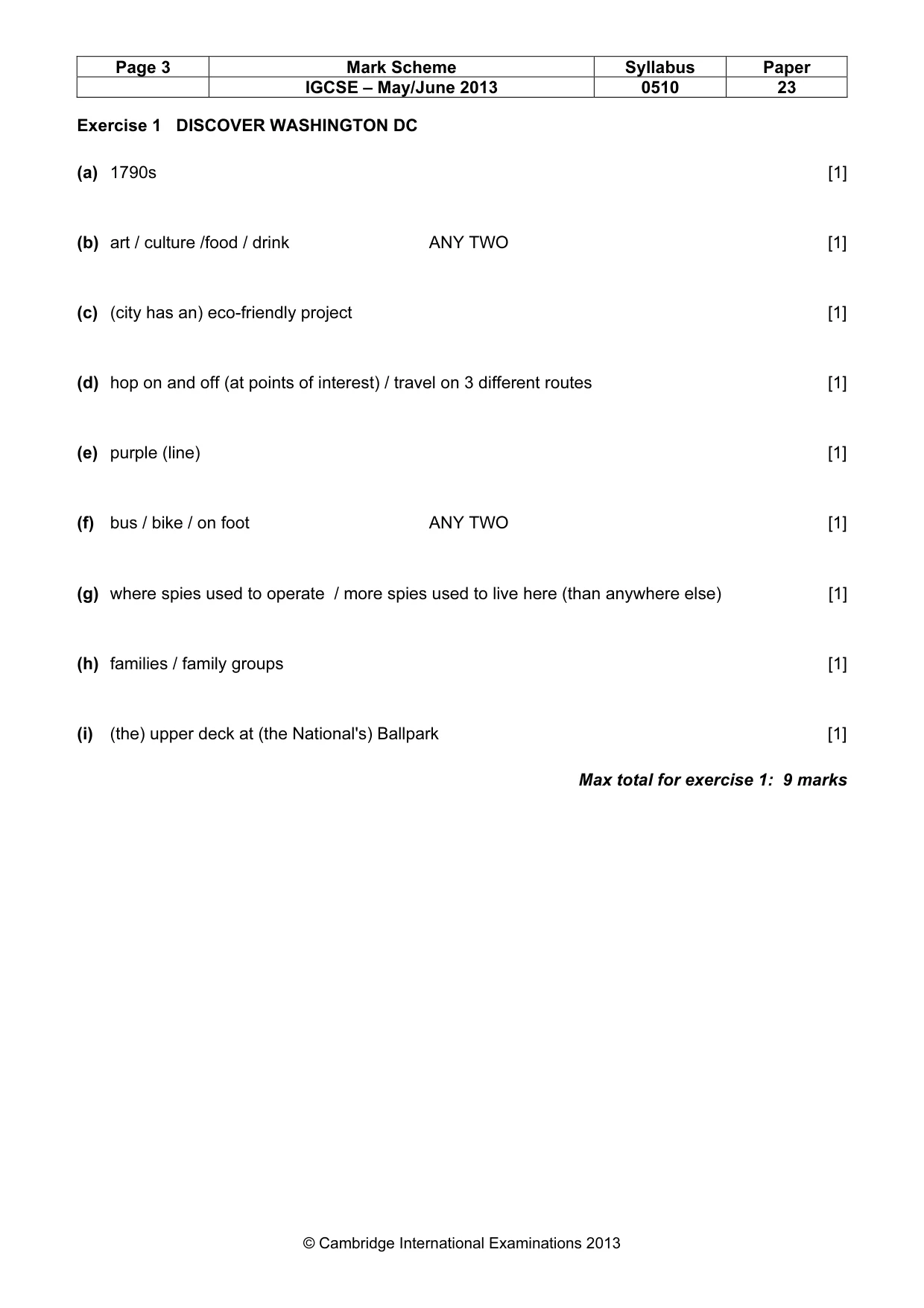
Page 3 Mark Scheme Syllabus Paper IGCSE – May/June 2013 0510 23 © Cambridge International Examinations 2013 Exercise 1 DISCOVER WASHINGTON DC (a) 1790s [1] (b) art / culture /food / drink ANY TWO [1] (c) (city has an) eco-friendly project [1] (d) hop on and off (at points of interest) / travel on 3 different routes [1] (e) purple (line) [1] (f) bus / bike / on foot ANY TWO [1] (g) where spies used to operate / more spies used to live here (than anywhere else) [1] (h) families / family groups [1] (i) (the) upper deck at (the National's) Ballpark [1] Max total for exercise 1: 9 marks
Mark scheme, page 4
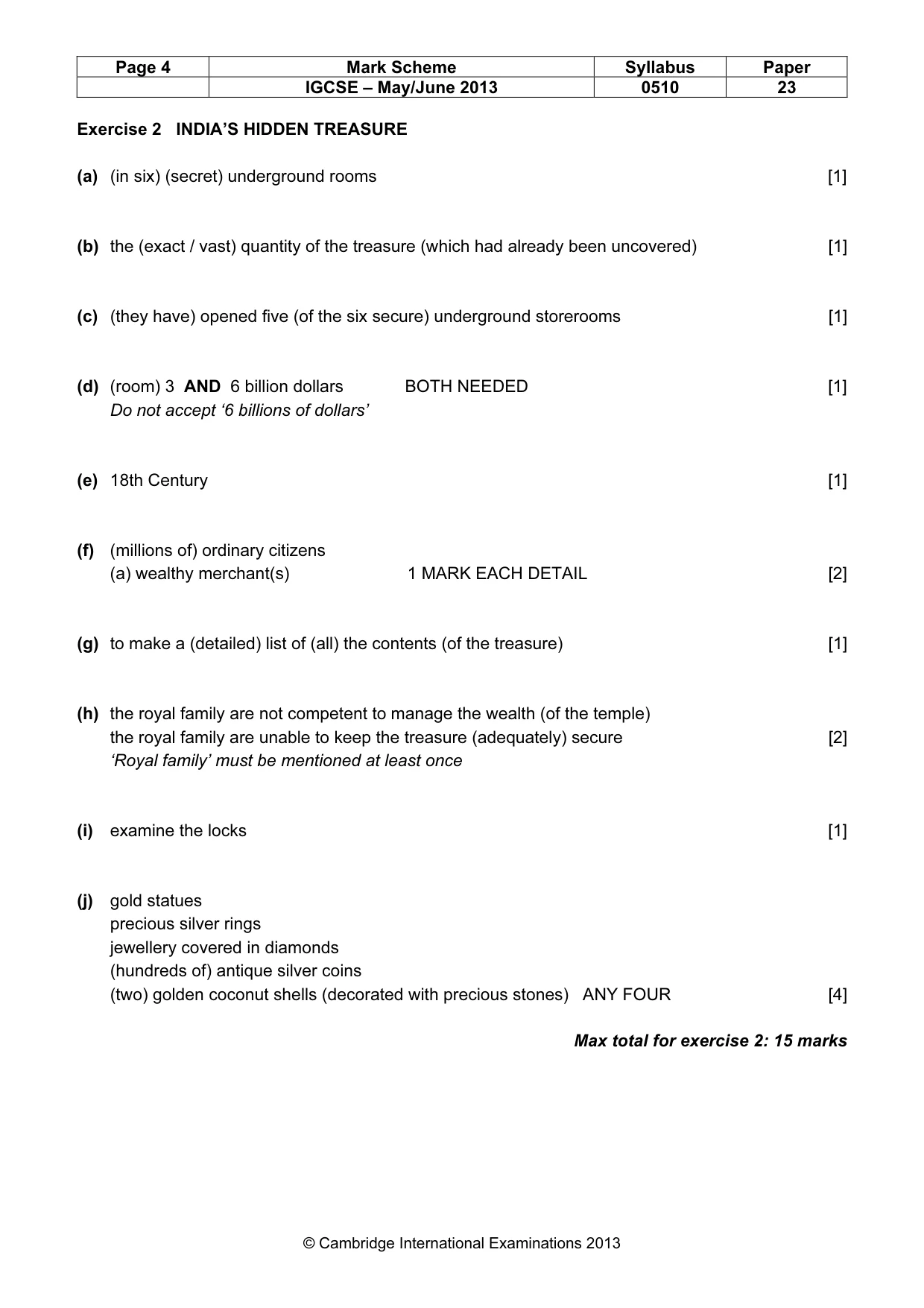
Page 4 Mark Scheme Syllabus Paper IGCSE – May/June 2013 0510 23 © Cambridge International Examinations 2013 Exercise 2 INDIA’S HIDDEN TREASURE (a) (in six) (secret) underground rooms [1] (b) the (exact / vast) quantity of the treasure (which had already been uncovered) [1] (c) (they have) opened five (of the six secure) underground storerooms [1] (d) (room) 3 AND 6 billion dollars BOTH NEEDED [1] Do not accept ‘6 billions of dollars’ (e) 18th Century [1] (f) (millions of) ordinary citizens (a) wealthy merchant(s) 1 MARK EACH DETAIL [2] (g) to make a (detailed) list of (all) the contents (of the treasure) [1] (h) the royal family are not competent to manage the wealth (of the temple) the royal family are unable to keep the treasure (adequately) secure [2] ‘Royal family’ must be mentioned at least once (i) examine the locks [1] (j) gold statues precious silver rings jewellery covered in diamonds (hundreds of) antique silver coins (two) golden coconut shells (decorated with precious stones) ANY FOUR [4] Max total for exercise 2: 15 marks
Mark scheme, page 5
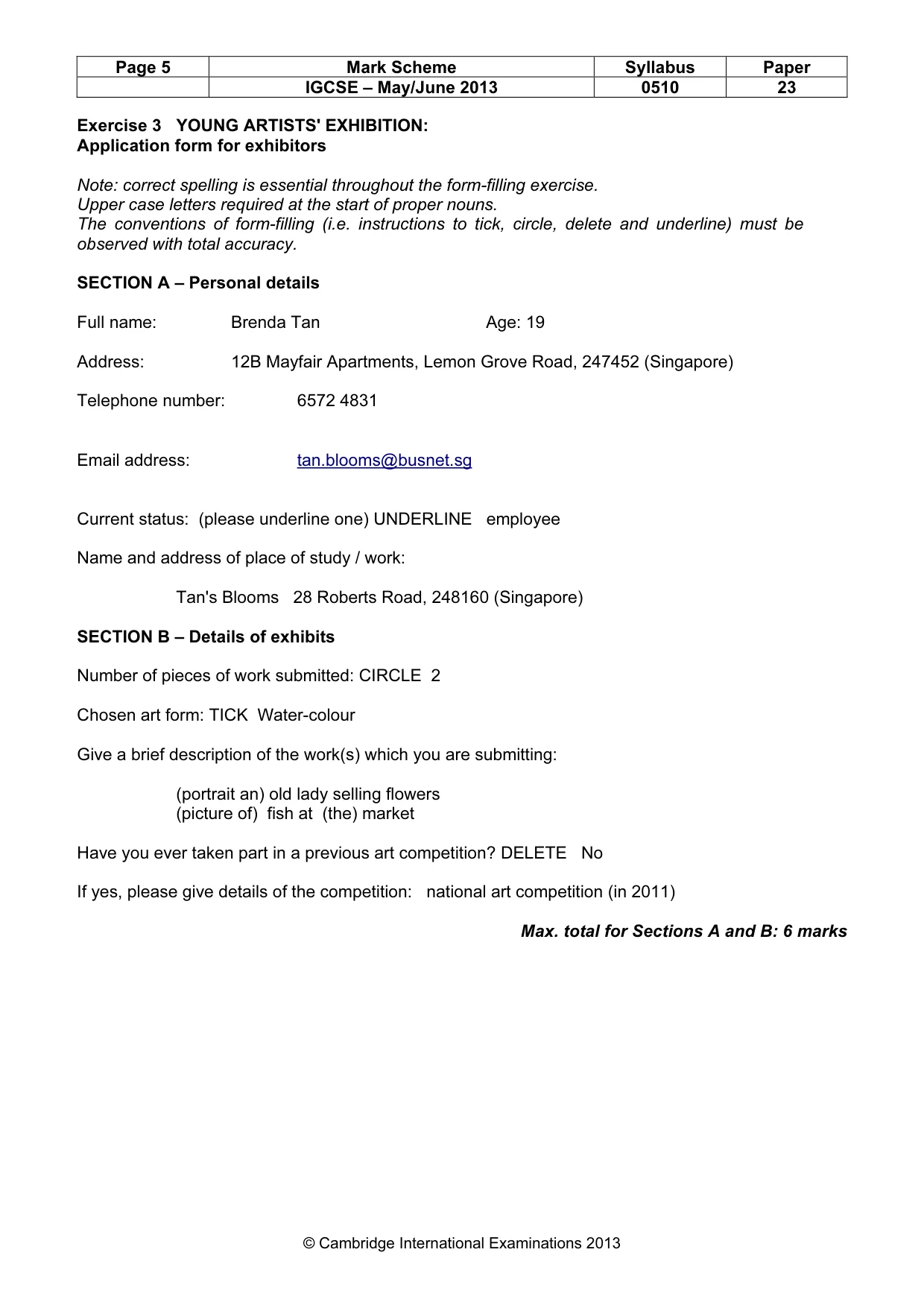
Page 5 Mark Scheme Syllabus Paper IGCSE – May/June 2013 0510 23 © Cambridge International Examinations 2013 Exercise 3 YOUNG ARTISTS' EXHIBITION: Application form for exhibitors Note: correct spelling is essential throughout the form-filling exercise. Upper case letters required at the start of proper nouns. The conventions of form-filling (i.e. instructions to tick, circle, delete and underline) must be observed with total accuracy. SECTION A – Personal details Full name: Brenda Tan Age: 19 Address: 12B Mayfair Apartments, Lemon Grove Road, 247452 (Singapore) Telephone number: 6572 4831 Email address: tan.blooms@busnet.sg Current status: (please underline one) UNDERLINE employee Name and address of place of study / work: Tan's Blooms 28 Roberts Road, 248160 (Singapore) SECTION B – Details of exhibits Number of pieces of work submitted: CIRCLE 2 Chosen art form: TICK Water-colour Give a brief description of the work(s) which you are submitting: (portrait an) old lady selling flowers (picture of) fish at (the) market Have you ever taken part in a previous art competition? DELETE No If yes, please give details of the competition: national art competition (in 2011) Max. total for Sections A and B: 6 marks
Mark scheme, page 6
Page 6 Mark Scheme Syllabus Paper IGCSE – May/June 2013 0510 23 © Cambridge International Examinations 2013 SECTION C The sentence must be written in the first person. Sample sentences: I want to receive training at one of the famous foreign art colleges. My greatest ambition is to become a professional artist after I finish my training. For the sentence, award up to 2 marks as follows: 2 marks: no fewer than 12 and no more than 20 words; proper sentence construction; correct spelling, punctuation and grammar; relevant to context. 1 mark: no fewer than 12 and no more than 20 words; proper sentence construction; 1- 3 errors of punctuation / spelling / grammar that do not obscure meaning; relevant to context. 0 marks: more than 3 errors of punctuation / spelling / grammar; and/or irrelevant to context, and/or not a proper sentence; and/or fewer than 12 words or more than 20 words. Absence of a full stop at the end should be considered as 1 punctuation error. Absence of an upper case letter at the beginning should be considered as 1 punctuation error. Omission of a word in a sentence should be considered as 1 grammar error. Max total for exercise 3: 8 marks
Mark scheme, page 7
Page 7 Mark Scheme Syllabus Paper IGCSE – May/June 2013 0510 23 © Cambridge International Examinations 2013 Exercise 4 THE POWER OF WATER NB Correct answers only apply if they are placed under the correct sub-heading (as detailed below). Only one mark may be awarded per line. Add the correct answers (i.e. total of ticks) to give a total out of 9. Remember that this exercise is marked for content (reading) not language. What is needed to make a mini-power station work (max 3 marks for this section) 1 (screw-shaped) (revolving) cylinder 2 river with (reasonably) good flow (of water) 3 weir/man-made waterfall 4 abandoned factory building 5 falling water Potential amount of energy produced by a mini power-station (max 3 marks for this section) 6 (enough electricity to) power 70 homes 7 3% of the UK’s electricity 8 70 kilowatts (kw) (of electricity) 9 85% of energy converted to electrical power Objections to the scheme (max 3 marks for this section) 10 (increased) noise (pollution / levels) 11 number of fish reduced 12 fish movement blocked/fish stopped from migrating up and down rivers 13 parts of rivers dried up 14 survival of food for fish / invertebrates threatened Max total for exercise 4: 9 marks
Mark scheme, page 8
Page 8 Mark Scheme Syllabus Paper IGCSE – May/June 2013 0510 23 © Cambridge International Examinations 2013 Exercise 5 FLOATING CLINIC Content (up to 6 marks) Difficult living conditions of the people on the lagoon 1 overcrowded / densely packed accommodation 2 shaky wooden walkways 3 nearest hospital/healthcare centre on mainland 4 long / difficult journey to reach doctor 5 (suitable) boat not always available Help provided by MSF 6 established close relationship with community 7 (floating) clinic opened in (middle of) lagoon 8 can treat most patients on the spot / at clinic 9 transport worst cases to mainland (by 'ambulance' boat) 10 maternal healthcare / cure sick expectant mothers / ensure safe births Language (up to 5 marks) 0 marks: no understanding of the task / no relevant content / meaning completely obscure due to serious language inaccuracies 1 mark: copying without discrimination from text / multiple language inaccuracies 2 marks: heavy reliance on language from the text with no attempt to organise and sequence points cohesively / limited language expression making meaning at times unclear 3 marks: some reliance on language from the text, but with an attempt to organise and sequence points cohesively / language satisfactory, but with some inaccuracies 4 marks: good attempt to use own words and to organise and sequence points cohesively / generally good control of language 5 marks: good, concise summary style /very good attempt to use own words and to organise and sequence points cohesively Max total for exercise 5: 11 marks
Mark scheme, page 9
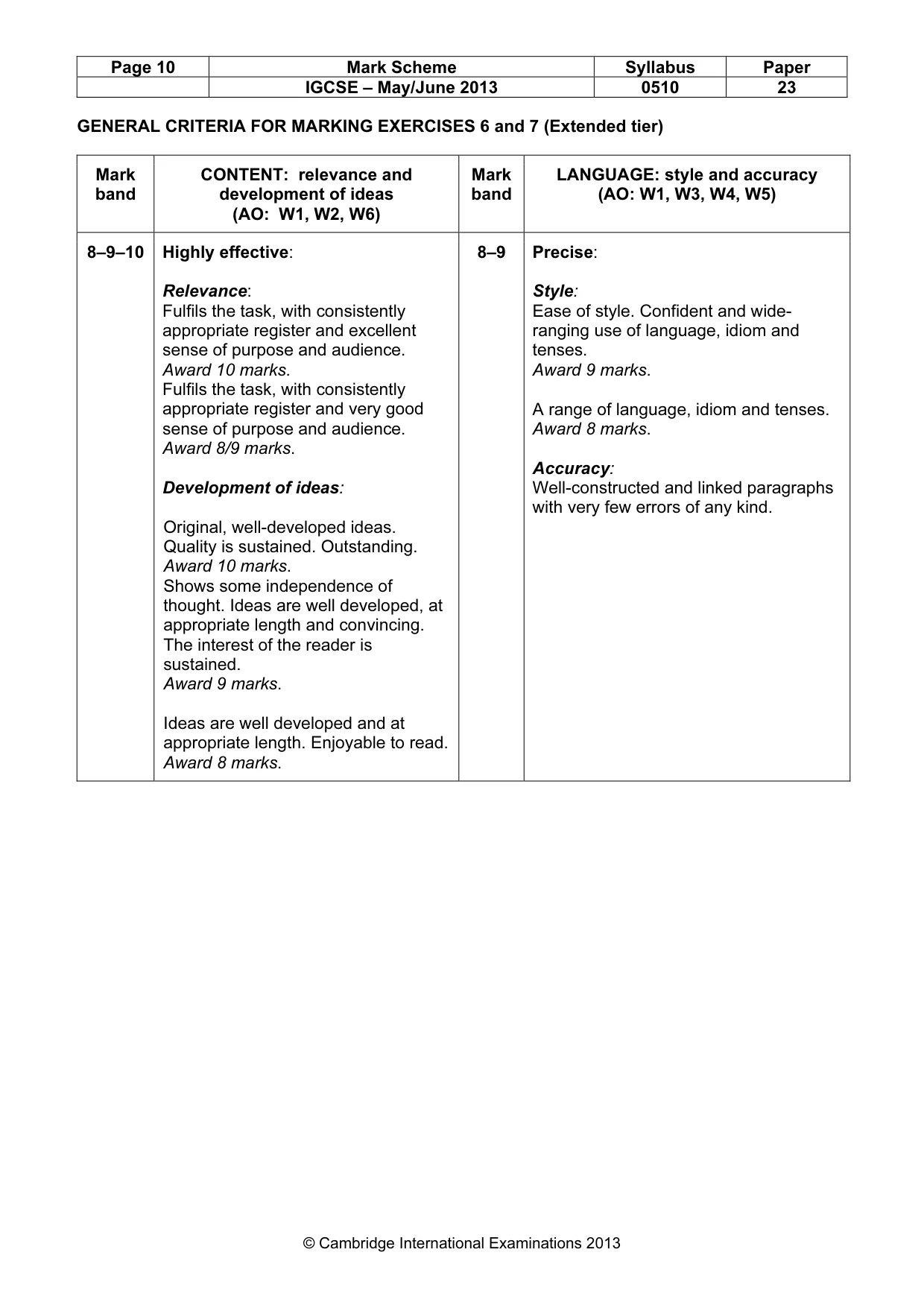
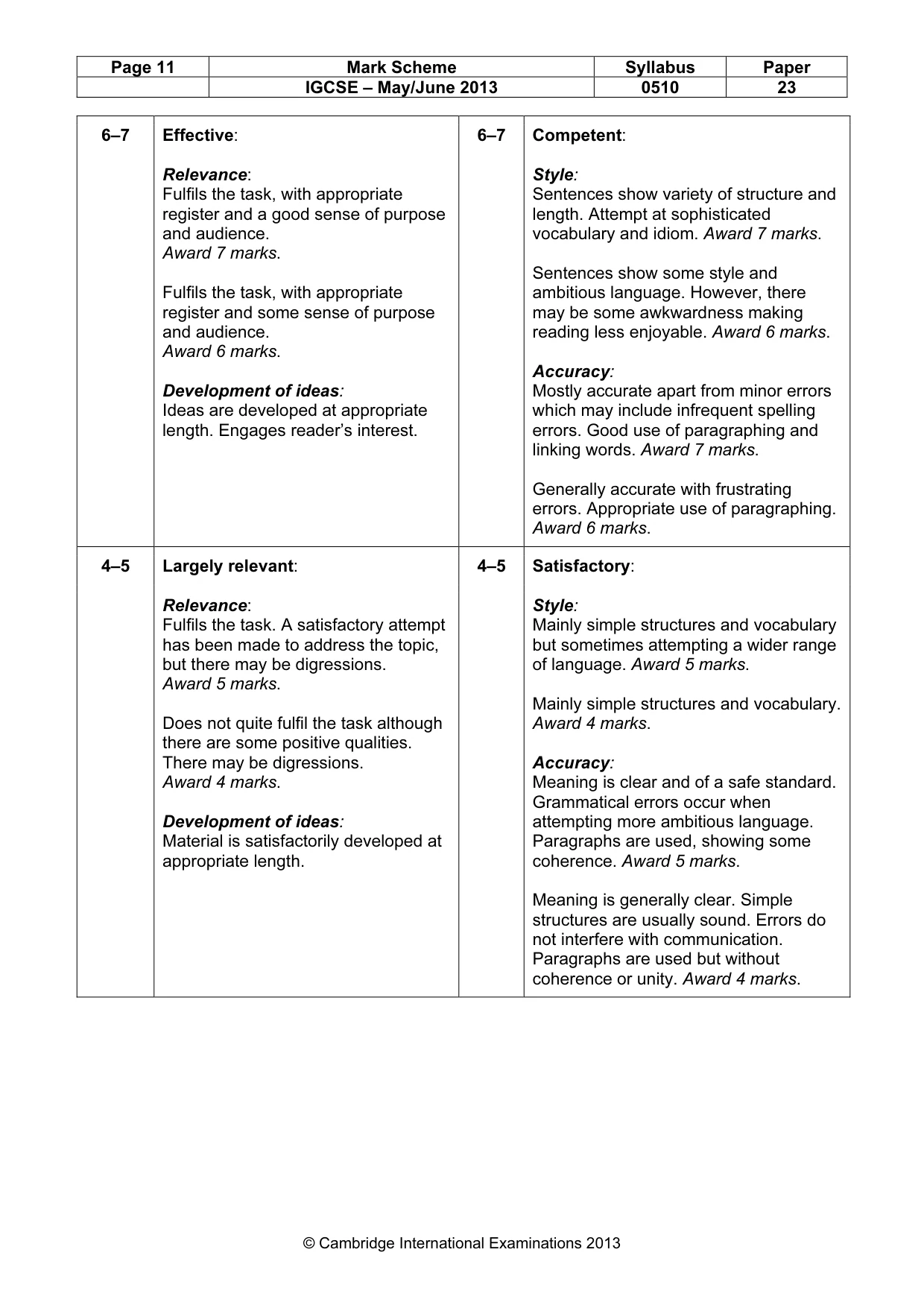
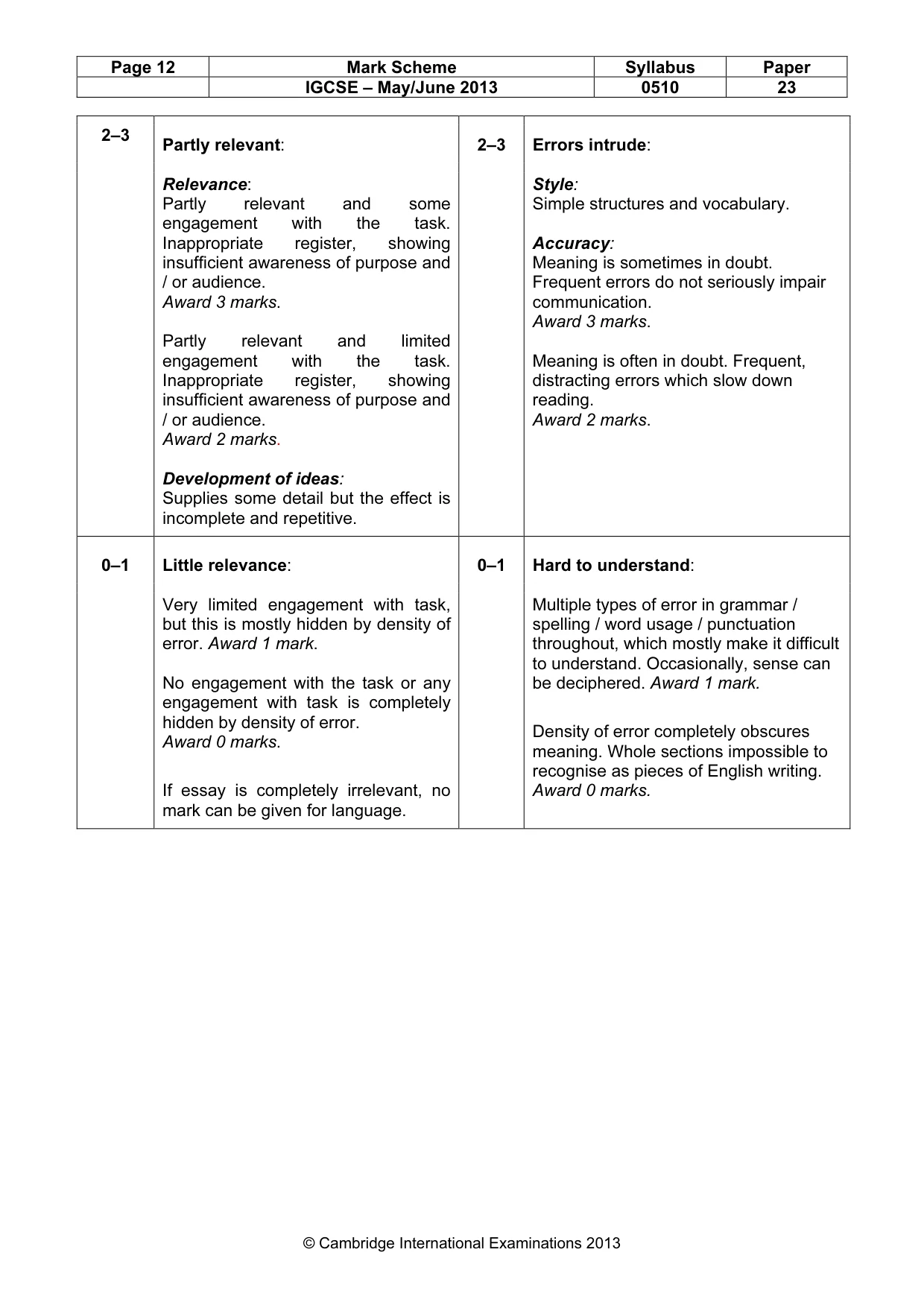
Page 9 Mark Scheme Syllabus Paper IGCSE – May/June 2013 0510 23 © Cambridge International Examinations 2013 Exercise 6: Conversation with a celebrity Exercise 7: New highway close to where you live The following general instructions, and table of marking criteria, apply to both exercises. • Award the answer a mark for content (C) [out of 10] and a mark for language (L) [out of 9] in accordance with the General Criteria table that follows. • Content covers relevance (i.e. whether the piece fulfils the task and the awareness of purpose/audience/register) and the development of ideas (i.e. the detail/explanation provided and how enjoyable it is to read). • Language covers style (i.e. complexity of vocabulary and sentence structure) and accuracy (of grammar, spelling, punctuation and use of paragraphs). • When deciding on a mark for content or language, first of all decide which mark band is most appropriate. There will not necessarily be an exact fit. Then decide between 2 marks within that mark band. Use the lower mark if it only just makes it into the band and the upper mark if it fulfils all the requirements of the band but doesn’t quite make it into the band above. • When deciding on a mark for content, look at both relevance and development of ideas. First ask yourself whether the writing fulfils the task, in terms of points to be covered and the length. If it does, it will be in at least the 4-5 mark band. • When deciding on a mark for language, look at both the style and the accuracy of the language. A useful starting point would be first to determine whether errors intrude. If they do not, it will be in at least the 4-5 mark band. • The use of paragraphs should not be the primary basis of deciding which mark band the work is in. Look first at the language used and once you have decided on the appropriate mark band, you can use the paragraphing as a factor in helping you to decide whether the work warrants the upper or lower mark in the mark band. • If the essay is considerably shorter than the stated word length, it should be put in mark band 2-3 for content or lower for not fulfilling the task. The language mark is likely to be affected and is unlikely to be more than one band higher than the content mark. • If the essay is totally irrelevant and has nothing to do with the question asked, it should be given 0 marks for Content and Language, even if it is enjoyable to read and fluent. • If the essay is partly relevant and therefore in mark band 2-3, the full range of marks for language is available. Max total for exercise 6: 19 marks Max total for exercise 7: 19 marks
Mark scheme, page 10
Page 10 Mark Scheme Syllabus Paper IGCSE – May/June 2013 0510 23 © Cambridge International Examinations 2013 GENERAL CRITERIA FOR MARKING EXERCISES 6 and 7 (Extended tier) Mark band CONTENT: relevance and development of ideas (AO: W1, W2, W6) Mark band LANGUAGE: style and accuracy (AO: W1, W3, W4, W5) 8–9–10 Highly effective: Relevance: Fulfils the task, with consistently appropriate register and excellent sense of purpose and audience. Award 10 marks. Fulfils the task, with consistently appropriate register and very good sense of purpose and audience. Award 8/9 marks. Development of ideas: Original, well-developed ideas. Quality is sustained. Outstanding. Award 10 marks. Shows some independence of thought. Ideas are well developed, at appropriate length and convincing. The interest of the reader is sustained. Award 9 marks. Ideas are well developed and at appropriate length. Enjoyable to read. Award 8 marks. 8–9 Precise: Style: Ease of style. Confident and wide- ranging use of language, idiom and tenses. Award 9 marks. A range of language, idiom and tenses. Award 8 marks. Accuracy: Well-constructed and linked paragraphs with very few errors of any kind.
Mark scheme, page 11
Page 11 Mark Scheme Syllabus Paper IGCSE – May/June 2013 0510 23 © Cambridge International Examinations 2013 6–7 Effective: Relevance: Fulfils the task, with appropriate register and a good sense of purpose and audience. Award 7 marks. Fulfils the task, with appropriate register and some sense of purpose and audience. Award 6 marks. Development of ideas: Ideas are developed at appropriate length. Engages reader’s interest. 6–7 Competent: Style: Sentences show variety of structure and length. Attempt at sophisticated vocabulary and idiom. Award 7 marks. Sentences show some style and ambitious language. However, there may be some awkwardness making reading less enjoyable. Award 6 marks. Accuracy: Mostly accurate apart from minor errors which may include infrequent spelling errors. Good use of paragraphing and linking words. Award 7 marks. Generally accurate with frustrating errors. Appropriate use of paragraphing. Award 6 marks. 4–5 Largely relevant: Relevance: Fulfils the task. A satisfactory attempt has been made to address the topic, but there may be digressions. Award 5 marks. Does not quite fulfil the task although there are some positive qualities. There may be digressions. Award 4 marks. Development of ideas: Material is satisfactorily developed at appropriate length. 4–5 Satisfactory: Style: Mainly simple structures and vocabulary but sometimes attempting a wider range of language. Award 5 marks. Mainly simple structures and vocabulary. Award 4 marks. Accuracy: Meaning is clear and of a safe standard. Grammatical errors occur when attempting more ambitious language. Paragraphs are used, showing some coherence. Award 5 marks. Meaning is generally clear. Simple structures are usually sound. Errors do not interfere with communication. Paragraphs are used but without coherence or unity. Award 4 marks.
Mark scheme, page 12
Page 12 Mark Scheme Syllabus Paper IGCSE – May/June 2013 0510 23 © Cambridge International Examinations 2013 2–3 Partly relevant: Relevance: Partly relevant and some engagement with the task. Inappropriate register, showing insufficient awareness of purpose and / or audience. Award 3 marks. Partly relevant and limited engagement with the task. Inappropriate register, showing insufficient awareness of purpose and / or audience. Award 2 marks. Development of ideas: Supplies some detail but the effect is incomplete and repetitive. 2–3 Errors intrude: Style: Simple structures and vocabulary. Accuracy: Meaning is sometimes in doubt. Frequent errors do not seriously impair communication. Award 3 marks. Meaning is often in doubt. Frequent, distracting errors which slow down reading. Award 2 marks. 0–1 Little relevance: Very limited engagement with task, but this is mostly hidden by density of error. Award 1 mark. No engagement with the task or any engagement with task is completely hidden by density of error. Award 0 marks. If essay is completely irrelevant, no mark can be given for language. 0–1 Hard to understand: Multiple types of error in grammar / spelling / word usage / punctuation throughout, which mostly make it difficult to understand. Occasionally, sense can be deciphered. Award 1 mark. Density of error completely obscures meaning. Whole sections impossible to recognise as pieces of English writing. Award 0 marks.