Cambridge IGCSE English - Second Language (oral endorsement) 0510 — 2013 May/June Paper 2 · Variant 1
0510/21/M/J/13
The question paper and its mark scheme, free to read here and free to download. This is Cambridge’s own paper, exactly as it was sat.
Question paper16 pages


Mark scheme12 pages
Answers below. Sit the paper first if you are practising.
Paper as text
Question paper, page 1
This document consists of 15 printed pages and 1 blank page. DC (CW/JG) 59167/4 © UCLES 2013 [Turn over UNIVERSITY OF CAMBRIDGE INTERNATIONAL EXAMINATIONS International General Certificate of Secondary Education * 9 2 7 6 9 4 6 6 0 1 * ENGLISH AS A SECOND LANGUAGE 0510/21 Paper 2 Reading and Writing (Extended) May/June 2013 2 hours Candidates answer on the Question Paper. No Additional Materials are required. READ THESE INSTRUCTIONS FIRST Write your Centre number, candidate number and name on all the work you hand in. Write in dark blue or black pen. Do not use staples, paper clips, highlighters, glue or correction fluid. DO NOT WRITE IN ANY BARCODES. Answer all questions. Dictionaries are not allowed. At the end of the examination, fasten all your work securely together. The number of marks is given in brackets [ ] at the end of each question or part question.
Question paper, page 2
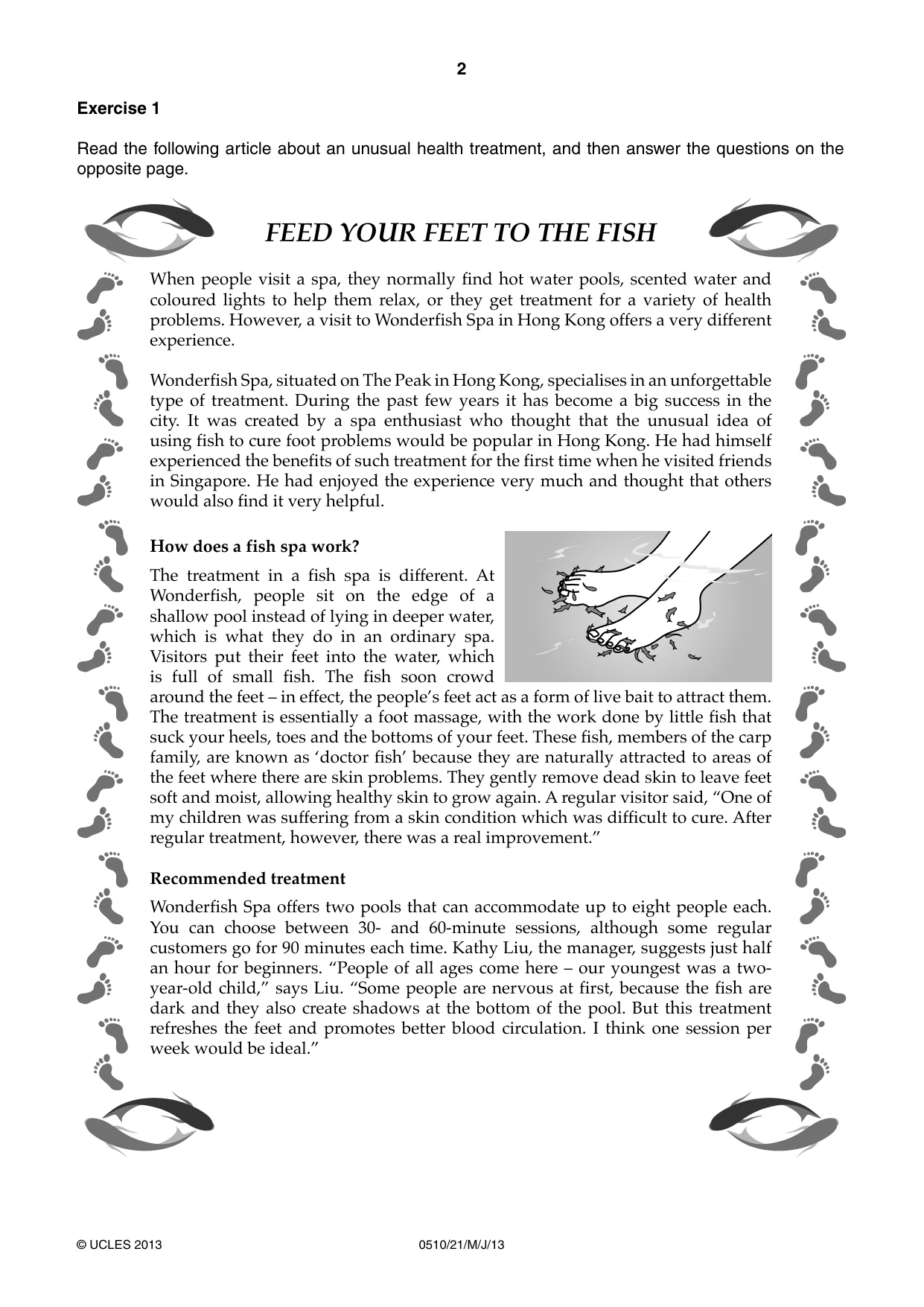
2 0510/21/M/J/13 © UCLES 2013 Exercise 1 Read the following article about an unusual health treatment, and then answer the questions on the opposite page. FEED YOUR FEET TO THE FISH When people visit a spa, they normally find hot water pools, scented water and coloured lights to help them relax, or they get treatment for a variety of health problems. However, a visit to Wonderfish Spa in Hong Kong offers a very different experience. Wonderfish Spa, situated on The Peak in Hong Kong, specialises in an unforgettable type of treatment. During the past few years it has become a big success in the city. It was created by a spa enthusiast who thought that the unusual idea of using fish to cure foot problems would be popular in Hong Kong. He had himself experienced the benefits of such treatment for the first time when he visited friends in Singapore. He had enjoyed the experience very much and thought that others would also find it very helpful. How does a fish spa work? The treatment in a fish spa is different. At Wonderfish, people sit on the edge of a shallow pool instead of lying in deeper water, which is what they do in an ordinary spa. Visitors put their feet into the water, which is full of small fish. The fish soon crowd around the feet – in effect, the people’s feet act as a form of live bait to attract them. The treatment is essentially a foot massage, with the work done by little fish that suck your heels, toes and the bottoms of your feet. These fish, members of the carp family, are known as ‘doctor fish’ because they are naturally attracted to areas of the feet where there are skin problems. They gently remove dead skin to leave feet soft and moist, allowing healthy skin to grow again. A regular visitor said, “One of my children was suffering from a skin condition which was difficult to cure. After regular treatment, however, there was a real improvement.” Recommended treatment Wonderfish Spa offers two pools that can accommodate up to eight people each. You can choose between 30- and 60-minute sessions, although some regular customers go for 90 minutes each time. Kathy Liu, the manager, suggests just half an hour for beginners. “People of all ages come here – our youngest was a two- year-old child,” says Liu. “Some people are nervous at first, because the fish are dark and they also create shadows at the bottom of the pool. But this treatment refreshes the feet and promotes better blood circulation. I think one session per week would be ideal.”
Question paper, page 3
3 0510/21/M/J/13 © UCLES 2013 [Turn over For Examiner’s Use (a) According to the article, why do people go to spas? …[1] (b) When did the owner of the Wonderfish Spa try the treatment? …[1] (c) How is the water level different at Wonderfish? …[1] (d) How do the fish massage the feet? …[1] (e) What happens to skin after the treatment? …[1] (f) How many minutes are recommended for a beginner’s session? …[1] (g) Why might people be anxious about this type of treatment? Give two details. … …[2] (h) Apart from helping with skin conditions, what other benefits does the treatment give? Give two details. …[1] [Total: 9]
Question paper, page 4
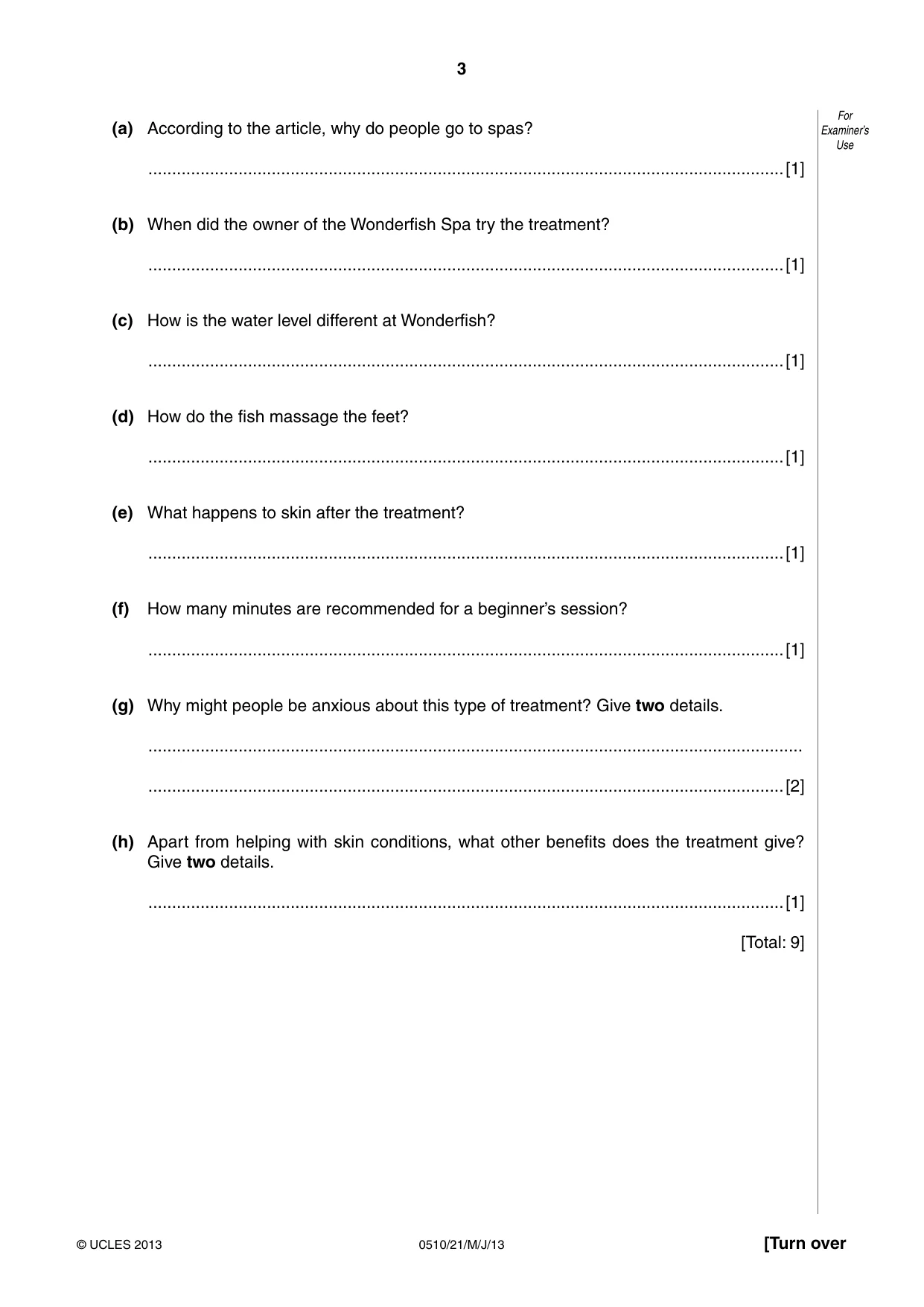
4 0510/21/M/J/13 © UCLES 2013 Exercise 2 Read the following article about using bananas to produce biofuel, and then answer the questions on the opposite page. PLANTATION POWER On her hillside plantation on the Caribbean island of St Lucia, Leona Cecil is holding up heavy bunches of bananas. It is hard work, but she wants to make sure that none of her precious bananas fall to the ground and suffer damage. After tourism, the island’s biggest money earner is the export of bananas. However, this income has been severely reduced after Hurricane Tomas hit St Lucia three years ago, causing widespread damage to the island. Owners of small farms such as Leona’s have found it difficult to compete with bigger producers from other countries. The number of St Lucian farmers exporting bananas has fallen by about 80%. “I am one of the few growers left – I have bunches of bananas to sell, but no foreign buyers,” Leona says. “It’s hard to pay my bills.” The farmers are desperate to find new sources of income, because although supermarkets are offering to buy, they are paying lower and lower prices to the farmers. Without enough foreign buyers, most bananas end up as animal feed or just simply rot away, with the result that the fruit is wasted. 0 5 10 15 20 25 30 1996 2000 2004 2008 2012 Year of survey Number of Caribbean farmers exporting bananas (in thousands) Leona is one of about 20 banana farmers on St Lucia keen to experiment with a more profitable alternative for this waste fruit – turning it into ethanol, a biofuel. In the past, the island’s economy has depended on the export of bananas. Now the farmers want to use the fruit to provide fuel for their cars, boats and the local minibuses. If successful, the ‘banana ethanol’ project could not only help support the struggling farmers but also provide a cheap alternative to expensive imported fuel. Just like its neighbouring islands, St Lucia has to import almost all of its fuel. That means both transport and electricity production are expensive and add to the cost of living for the inhabitants of the island. Donald Holder is leading the ‘banana ethanol’ project after completing his studies in renewable energy technology at university. He says, “People are always complaining about the cost of public transport here. That’s why I thought of biofuels.” The biofuel process produces ethanol and methane. It begins by mixing very ripe, squashed bananas with water. This mixture goes into a tank, where it ferments and is distilled to make a fuel that is 95% ethanol and can be used in vehicles. The methane which is also produced is then used to provide the power for the machinery itself, helping to keep production costs low. Organic waste left at the end of the process can be used as fertiliser, some of which goes back to farmers and some of which is sold. Holder expects to produce 80,000 litres of fuel in the first year. This level of production will use nearly all the bananas that are thrown away each year on St Lucia. A criticism of biofuel projects is that they use crops which could be eaten, but this scheme only uses food that would have been wasted. Holder estimates that his product will be about 10% cheaper than imported fuel. Initially, the ethanol will be mixed with normal petrol because cars on the island are not yet equipped to run on pure biofuel and pumps at petrol stations have not yet been adapted to supply it. The project expects to provide fuel for about 300 cars per week. Holder has been helped financially by winning an international competition, and this has enabled him to buy equipment from various international suppliers. Other development agencies have also funded the research needed to move the project forward.
Question paper, page 5
5 0510/21/M/J/13 © UCLES 2013 [Turn over For Examiner’s Use (a) Where on St Lucia is Leona’s plantation? …[1] (b) Which industry produces most money for the island’s economy? …[1] (c) What was the result of extreme weather conditions on the island? …[1] (d) Why aren’t the farmers earning as much from their crops these days? Give two details. … …[2] (e) According to the chart, in the most recent survey, how many Caribbean growers were exporting bananas? …[1] (f) What are the negative consequences of using expensive imported fuel? Give two details. …[1] (g) What gave Donald Holder the idea of producing biofuel? …[1] (h) How does the use of methane keep production costs low? …[1] (i) At the moment, why is it impossible for drivers to use ethanol on its own? …[1] (j) How has Donald Holder benefited from his competition success? …[1] (k) Apart from reducing fuel costs, what are the main advantages of the project for the struggling farmers? Give four details. … … … …[4] [Total: 15]
Question paper, page 6
6 0510/21/M/J/13 © UCLES 2013 Exercise 3 Helen Douglas was born in England, but her parents came originally from Scotland. When she was small, the family used to return there regularly on holiday. It is true to say that Helen found Scotland one of the most interesting places that she had ever visited because of the beautiful scenery and the variety of wildlife. When she was at school, she was a member of the Natural History Society and often made day trips to sites of interest near her home to watch birds or animals in their natural environment. In her first year at university, she joined the Wildlife Club and in March 2013, volunteered to work for Natwatch, an organisation researching the movements and numbers of various wildlife species around the United Kingdom. The organisation offered the choice of working in different areas with a variety of research possibilities. Helen decided that she would choose the beautiful north-east region of Scotland and observe the sea life, and, in particular, the number and behaviour of dolphins, as the main area of her research. The policy of the research organisation is for the volunteers to work together in small groups, no larger than five. Helen was grouped with two other girls, both aged 20, and therefore one year older than she was. The older girls had been on these trips before, but this was the first time for Helen. She decided it would be most convenient to travel to the area by train, because there was a station close to the accommodation. The group stayed at a hostel in an isolated spot where the river flowed into the sea. The address of their accommodation was Arisaig House, Dundonnell, IN2 2BG. On the first day, the group walked along the bank of the river towards the sea. They saw many different types of wildlife, including birds which were returning to Scotland for the warmer weather. On the second day, they started observing and counting the number of dolphins that they saw. They had to take a boat trip about one kilometre out to sea and were soon rewarded when a group of dolphins started to follow the boat and jump out of the water beside them. Helen had never been so close to these creatures before and was particularly excited. When she returned to the hostel that evening, she spent about one hour making notes and organising the pictures that she had taken during the day. Three days after Helen returned home to England, she was delighted to receive even more photos by email at h.dougie@zippy.co.uk from her two colleagues. She now had the huge task of trying to select the best ones from her own collection to send to them. A requirement of the research organisation is for each volunteer to complete a report on the project after the trip. Imagine you are Helen Douglas. Fill in the project report on the opposite page, using the information above.
Question paper, page 7
7 0510/21/M/J/13 © UCLES 2013 [Turn over For Examiner’s Use Natwatch Wildlife Research Project Report SECTION A Personal details Full name: … MALE/ FEMALE (please delete) Age: … Contact details: … Club memberships since leaving school: … SECTION B Project details In which UK country did you work? (please circle) England Scotland Northern Ireland Wales In which region did you work? … Number of previous volunteering trips: (please tick) none one two three or more Number in group: … Address of accommodation: … Main species observed: (please underline one) birds land animals sea animals Purpose of research: … SECTION C In the space below, write one sentence of between 12 and 20 words about the most enjoyable part of your research, and say why it was so enjoyable. [Total: 8]
Question paper, page 8
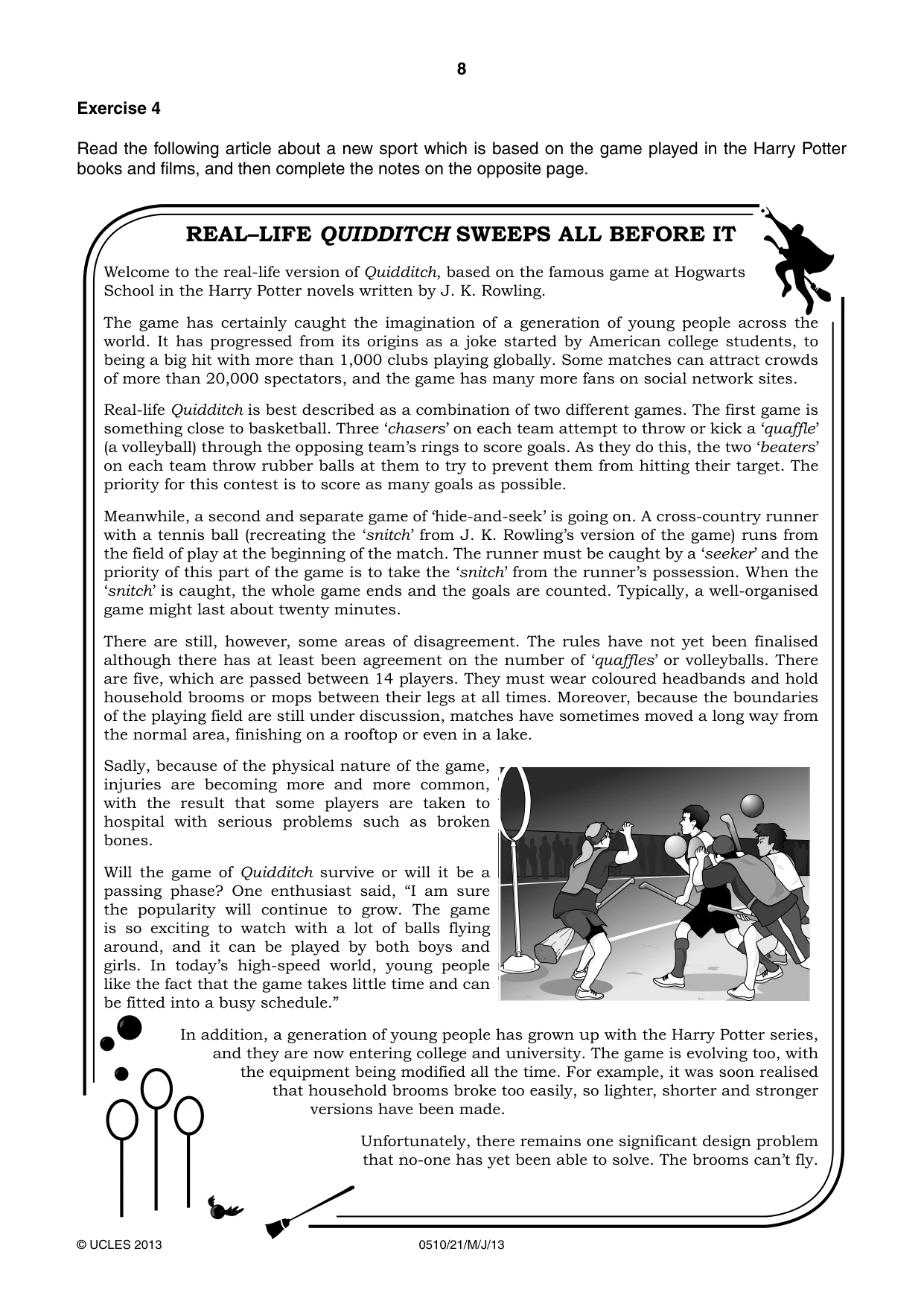
8 0510/21/M/J/13 © UCLES 2013 Exercise 4 Read the following article about a new sport which is based on the game played in the Harry Potter books and films, and then complete the notes on the opposite page. REAL–LIFE QUIDDITCH SWEEPS ALL BEFORE IT Welcome to the real-life version of Quidditch, based on the famous game at Hogwarts School in the Harry Potter novels written by J. K. Rowling. The game has certainly caught the imagination of a generation of young people across the world. It has progressed from its origins as a joke started by American college students, to being a big hit with more than 1,000 clubs playing globally. Some matches can attract crowds of more than 20,000 spectators, and the game has many more fans on social network sites. Real-life Quidditch is best described as a combination of two different games. The first game is something close to basketball. Three ‘chasers’ on each team attempt to throw or kick a ‘quaffle’ (a volleyball) through the opposing team’s rings to score goals. As they do this, the two ‘beaters’ on each team throw rubber balls at them to try to prevent them from hitting their target. The priority for this contest is to score as many goals as possible. Meanwhile, a second and separate game of ‘hide-and-seek’ is going on. A cross-country runner with a tennis ball (recreating the ‘snitch’ from J. K. Rowling’s version of the game) runs from the field of play at the beginning of the match. The runner must be caught by a ‘seeker’ and the priority of this part of the game is to take the ‘snitch’ from the runner’s possession. When the ‘snitch’ is caught, the whole game ends and the goals are counted. Typically, a well-organised game might last about twenty minutes. There are still, however, some areas of disagreement. The rules have not yet been finalised although there has at least been agreement on the number of ‘quaffles’ or volleyballs. There are five, which are passed between 14 players. They must wear coloured headbands and hold household brooms or mops between their legs at all times. Moreover, because the boundaries of the playing field are still under discussion, matches have sometimes moved a long way from the normal area, finishing on a rooftop or even in a lake. Sadly, because of the physical nature of the game, injuries are becoming more and more common, with the result that some players are taken to hospital with serious problems such as broken bones. Will the game of Quidditch survive or will it be a passing phase? One enthusiast said, “I am sure the popularity will continue to grow. The game is so exciting to watch with a lot of balls flying around, and it can be played by both boys and girls. In today’s high-speed world, young people like the fact that the game takes little time and can be fitted into a busy schedule.” In addition, a generation of young people has grown up with the Harry Potter series, and they are now entering college and university. The game is evolving too, with the equipment being modified all the time. For example, it was soon realised that household brooms broke too easily, so lighter, shorter and stronger versions have been made. Unfortunately, there remains one significant design problem that no-one has yet been able to solve. The brooms can’t fly.
Question paper, page 9
9 0510/21/M/J/13 © UCLES 2013 [Turn over For Examiner’s Use You are going to give a talk to your school sports club about the game of Quidditch. Prepare some notes to use as the basis for your talk. Make your notes under each heading. Main aims of the two games • … • … Present problems with Quidditch • … • … • … Reasons for the continuing popularity of Quidditch • … • … • … • … [Total: 9]
Question paper, page 10
10 0510/21/M/J/13 © UCLES 2013 Exercise 5 Read the following article about how the human body and brain have changed over thousands of years. Write a summary about the possible reasons why humans have become shorter AND why their brains have become smaller. Your summary should be about 100 words long (and no more than 120 words long). You should use your own words as far as possible. You will receive up to 6 marks for the content of your summary, and up to 5 marks for the style and accuracy of your language. WHY ARE WE SHRINKING? The human species may have passed its physical peak. Scientists have found that modern-day people are about 10% smaller and shorter than their hunting ancestors from 200,000 years ago. Most of this decline in size, however, has only happened in the past 10,000 years, and has been accompanied by a corresponding 10% decline in brain size. These findings have emerged from studies of fossilised human remains, including skulls, discovered across Africa, Europe and Asia. Early humans evolved as hunters, a lifestyle which required strength and stamina. Humans with powerful chests and large brains emerged about 35,000 years ago. During this period and throughout the emergence of more developed societies, size remained constant. This is shown by the discovery of tools, weapons, and even musical instruments from that time, and by the fossil records themselves. It is not until the last 10,000 years that the sizes of the body and the brain have changed substantially. The question is why these changes should have happened so recently. One theory is that the decline in size is linked to agriculture, which began about 9,000 years ago and was perhaps the greatest change in lifestyle that humans experienced in pre-historic times. Recent research shows that declines in size were found in 19 out of 21 societies that switched from hunting to farming. This would seem to reverse popular opinion that when societies switch to farming there is usually an increase in the size of people as food becomes more plentiful. Research also suggests that the decreased size in populations across the globe was linked to a probable shortage of micronutrients, such as the vitamins and minerals that are essential to growth. There would have been an inadequate supply of these in the human diet even though calories were plentiful. One example of this was in China where early farmers relied largely on cereals such as rice and maize – both of which lack a vitamin called niacin, vital for growth. The heavy reliance on rice and maize also caused nutritional diseases, which limited normal growth in children. Other researchers, however, are less certain about the role of agriculture and consider that the change was more as a result of different lifestyle demands. These researchers tend to link the decreased height more with social inequality, where a dominant class took more than their fair share of the produce, leaving others short of food. Even if agriculture was in part responsible for the physical changes, it would not explain why human brain size has also decreased. The male human brain has become smaller over the past 10,000 years. Compared to our ancestors, it now averages 1,350 cubic centimetres, a decrease in size equivalent in volume to a tennis ball. There is speculation that part of the answer must lie in the huge amount of energy required to maintain large brains – in humans, it accounts for about 20% of the energy used by the whole body. Researchers claim that our brains have got smaller because of the need to save energy for the increased number of tasks that we are required to do in the modern world. Evolution would have made the brain smaller but more efficient – a similar process to the changes in computers and technology that we see today. We may have smaller brains than our ancestors, but that does not mean that we are less intelligent.
Question paper, page 11
11 0510/21/M/J/13 © UCLES 2013 [Turn over For Examiner’s Use … … … … … … … … … … … … … … … … … … … … [Total: 11]
Question paper, page 12
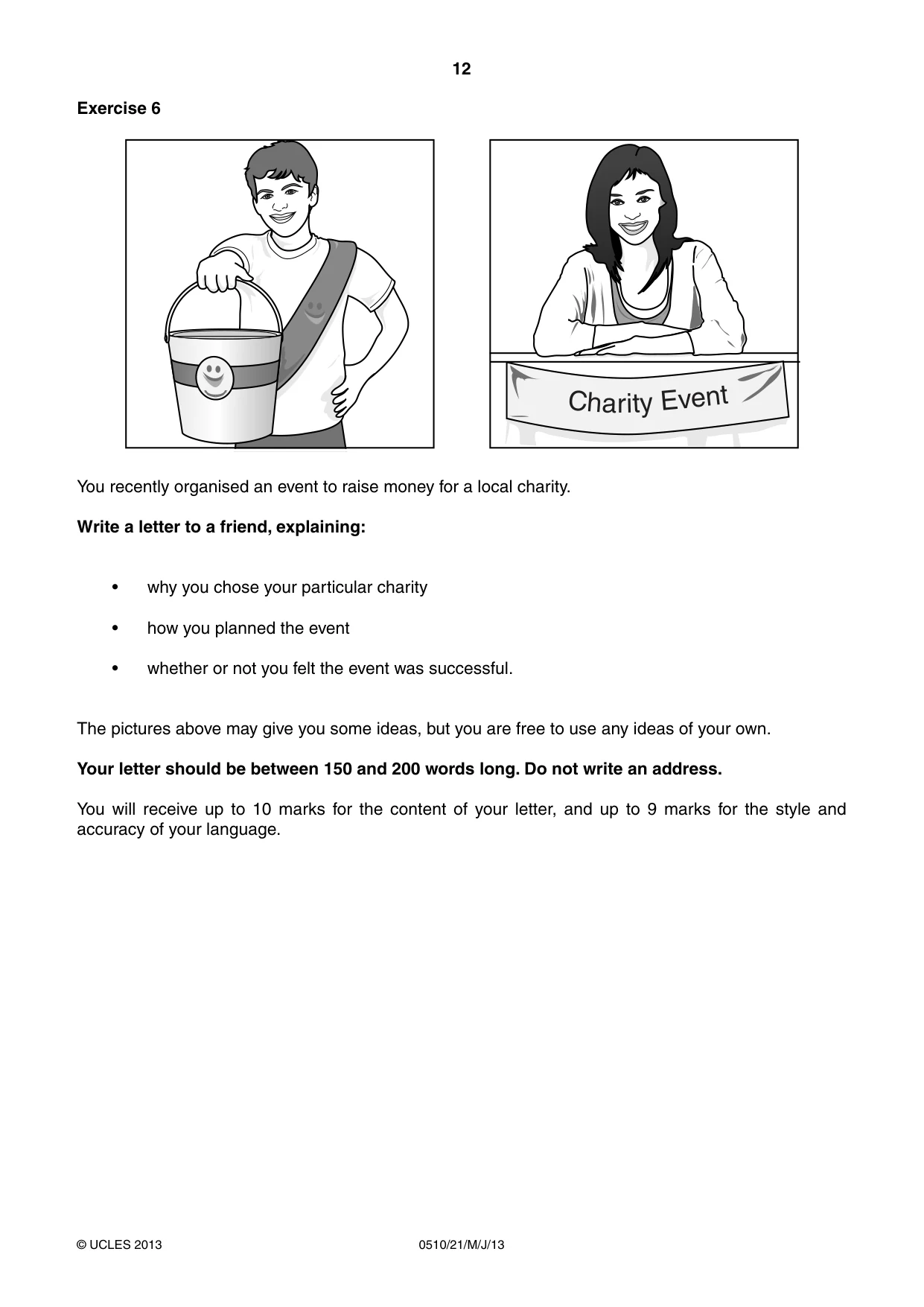
12 0510/21/M/J/13 © UCLES 2013 Exercise 6 Ch ar it y Event You recently organised an event to raise money for a local charity. Write a letter to a friend, explaining: • why you chose your particular charity • how you planned the event • whether or not you felt the event was successful. The pictures above may give you some ideas, but you are free to use any ideas of your own. Your letter should be between 150 and 200 words long. Do not write an address. You will receive up to 10 marks for the content of your letter, and up to 9 marks for the style and accuracy of your language.
Question paper, page 13
13 0510/21/M/J/13 © UCLES 2013 [Turn over For Examiner’s Use … … … … … … … … … … … … … … … … … … … … … … … … … [Total: 19]
Question paper, page 14
14 0510/21/M/J/13 © UCLES 2013 Exercise 7 Your school magazine is looking for articles on the following topic: “The ability to travel easily is a great benefit to our generation.” Here are some comments from your friends on the subject: “ We should be more concerned about the amount of fuel and energy we use when travelling from place to place. ” “ There is no doubt that travel broadens the mind. ” “ It’s vital to travel if family members live far away or even in different countries. ” “ Each country is losing its identity with so many tourists. ” Write an article for the school magazine, giving your views. The comments above may give you some ideas but you are free to use any ideas of your own. Your article should be between 150 and 200 words long. You will receive up to 10 marks for the content of your article, and up to 9 marks for the style and accuracy of your language.
Question paper, page 15
15 0510/21/M/J/13 © UCLES 2013 For Examiner’s Use … … … … … … … … … … … … … … … … … … … … … … … … … [Total: 19]
Question paper, page 16
16 0510/21/M/J/13 © UCLES 2013 BLANK PAGE Permission to reproduce items where third-party owned material protected by copyright is included has been sought and cleared where possible. Every reasonable effort has been made by the publisher (UCLES) to trace copyright holders, but if any items requiring clearance have unwittingly been included, the publisher will be pleased to make amends at the earliest possible opportunity. University of Cambridge International Examinations is part of the Cambridge Assessment Group. Cambridge Assessment is the brand name of University of Cambridge Local Examinations Syndicate (UCLES), which is itself a department of the University of Cambridge.
Mark scheme, page 1
CAMBRIDGE INTERNATIONAL EXAMINATIONS International General Certificate of Secondary Education MARK SCHEME for the May/June 2013 series 0510 ENGLISH AS A SECOND LANGUAGE 0510/21 Paper 2 (Reading and Writing – Extended), maximum raw mark 90 This mark scheme is published as an aid to teachers and candidates, to indicate the requirements of the examination. It shows the basis on which Examiners were instructed to award marks. It does not indicate the details of the discussions that took place at an Examiners’ meeting before marking began, which would have considered the acceptability of alternative answers. Mark schemes should be read in conjunction with the question paper and the Principal Examiner Report for Teachers. Cambridge will not enter into discussions about these mark schemes. Cambridge is publishing the mark schemes for the May/June 2013 series for most IGCSE, GCE Advanced Level and Advanced Subsidiary Level components and some Ordinary Level components.
Mark scheme, page 2
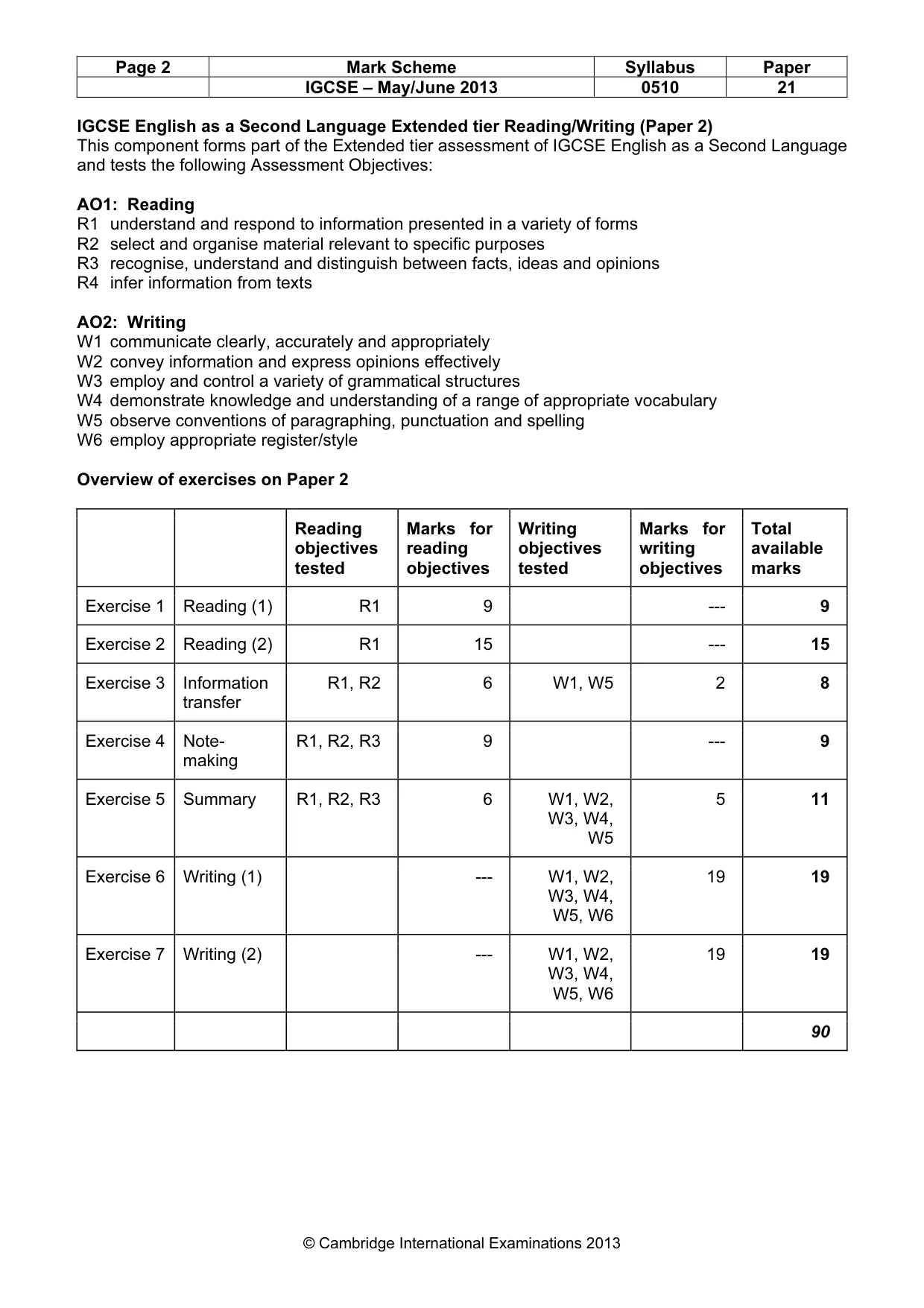
Page 2 Mark Scheme Syllabus Paper IGCSE – May/June 2013 0510 21 © Cambridge International Examinations 2013 IGCSE English as a Second Language Extended tier Reading/Writing (Paper 2) This component forms part of the Extended tier assessment of IGCSE English as a Second Language and tests the following Assessment Objectives: AO1: Reading R1 understand and respond to information presented in a variety of forms R2 select and organise material relevant to specific purposes R3 recognise, understand and distinguish between facts, ideas and opinions R4 infer information from texts AO2: Writing W1 communicate clearly, accurately and appropriately W2 convey information and express opinions effectively W3 employ and control a variety of grammatical structures W4 demonstrate knowledge and understanding of a range of appropriate vocabulary W5 observe conventions of paragraphing, punctuation and spelling W6 employ appropriate register/style Overview of exercises on Paper 2 Reading objectives tested Marks for reading objectives Writing objectives tested Marks for writing objectives Total available marks Exercise 1 Reading (1) R1 9 --- 9 Exercise 2 Reading (2) R1 15 --- 15 Exercise 3 Information transfer R1, R2 6 W1, W5 2 8 Exercise 4 Note- making R1, R2, R3 9 --- 9 Exercise 5 Summary R1, R2, R3 6 W1, W2, W3, W4, W5 5 11 Exercise 6 Writing (1) --- W1, W2, W3, W4, W5, W6 19 19 Exercise 7 Writing (2) --- W1, W2, W3, W4, W5, W6 19 19 90
Mark scheme, page 3
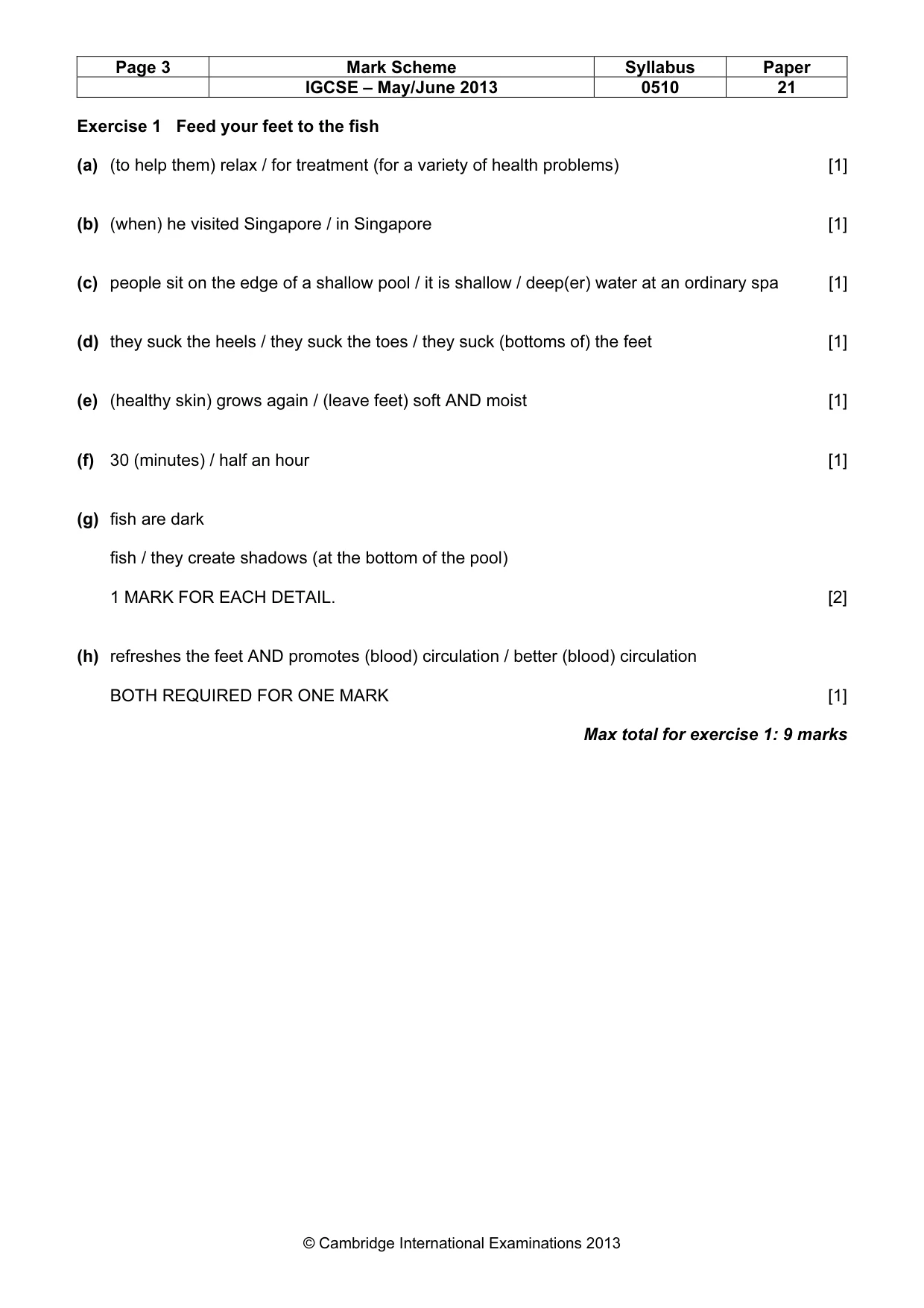
Page 3 Mark Scheme Syllabus Paper IGCSE – May/June 2013 0510 21 © Cambridge International Examinations 2013 Exercise 1 Feed your feet to the fish (a) (to help them) relax / for treatment (for a variety of health problems) [1] (b) (when) he visited Singapore / in Singapore [1] (c) people sit on the edge of a shallow pool / it is shallow / deep(er) water at an ordinary spa [1] (d) they suck the heels / they suck the toes / they suck (bottoms of) the feet [1] (e) (healthy skin) grows again / (leave feet) soft AND moist [1] (f) 30 (minutes) / half an hour [1] (g) fish are dark fish / they create shadows (at the bottom of the pool) 1 MARK FOR EACH DETAIL. [2] (h) refreshes the feet AND promotes (blood) circulation / better (blood) circulation BOTH REQUIRED FOR ONE MARK [1] Max total for exercise 1: 9 marks
Mark scheme, page 4
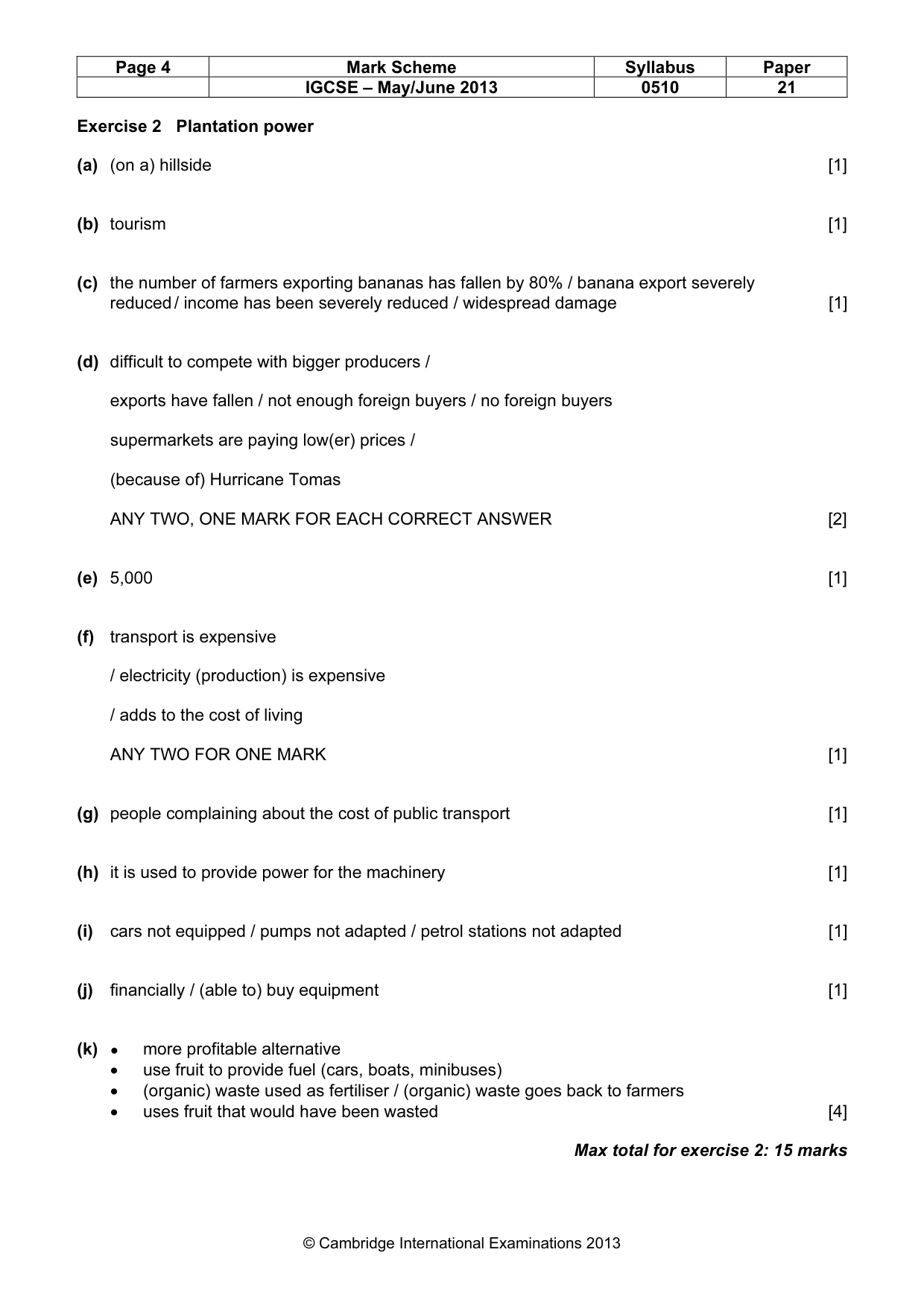
Page 4 Mark Scheme Syllabus Paper IGCSE – May/June 2013 0510 21 © Cambridge International Examinations 2013 Exercise 2 Plantation power (a) (on a) hillside [1] (b) tourism [1] (c) the number of farmers exporting bananas has fallen by 80% / banana export severely reduced / income has been severely reduced / widespread damage [1] (d) difficult to compete with bigger producers / exports have fallen / not enough foreign buyers / no foreign buyers supermarkets are paying low(er) prices / (because of) Hurricane Tomas ANY TWO, ONE MARK FOR EACH CORRECT ANSWER [2] (e) 5,000 [1] (f) transport is expensive / electricity (production) is expensive / adds to the cost of living ANY TWO FOR ONE MARK [1] (g) people complaining about the cost of public transport [1] (h) it is used to provide power for the machinery [1] (i) cars not equipped / pumps not adapted / petrol stations not adapted [1] (j) financially / (able to) buy equipment [1] (k) ● more profitable alternative • use fruit to provide fuel (cars, boats, minibuses) • (organic) waste used as fertiliser / (organic) waste goes back to farmers • uses fruit that would have been wasted [4] Max total for exercise 2: 15 marks
Mark scheme, page 5
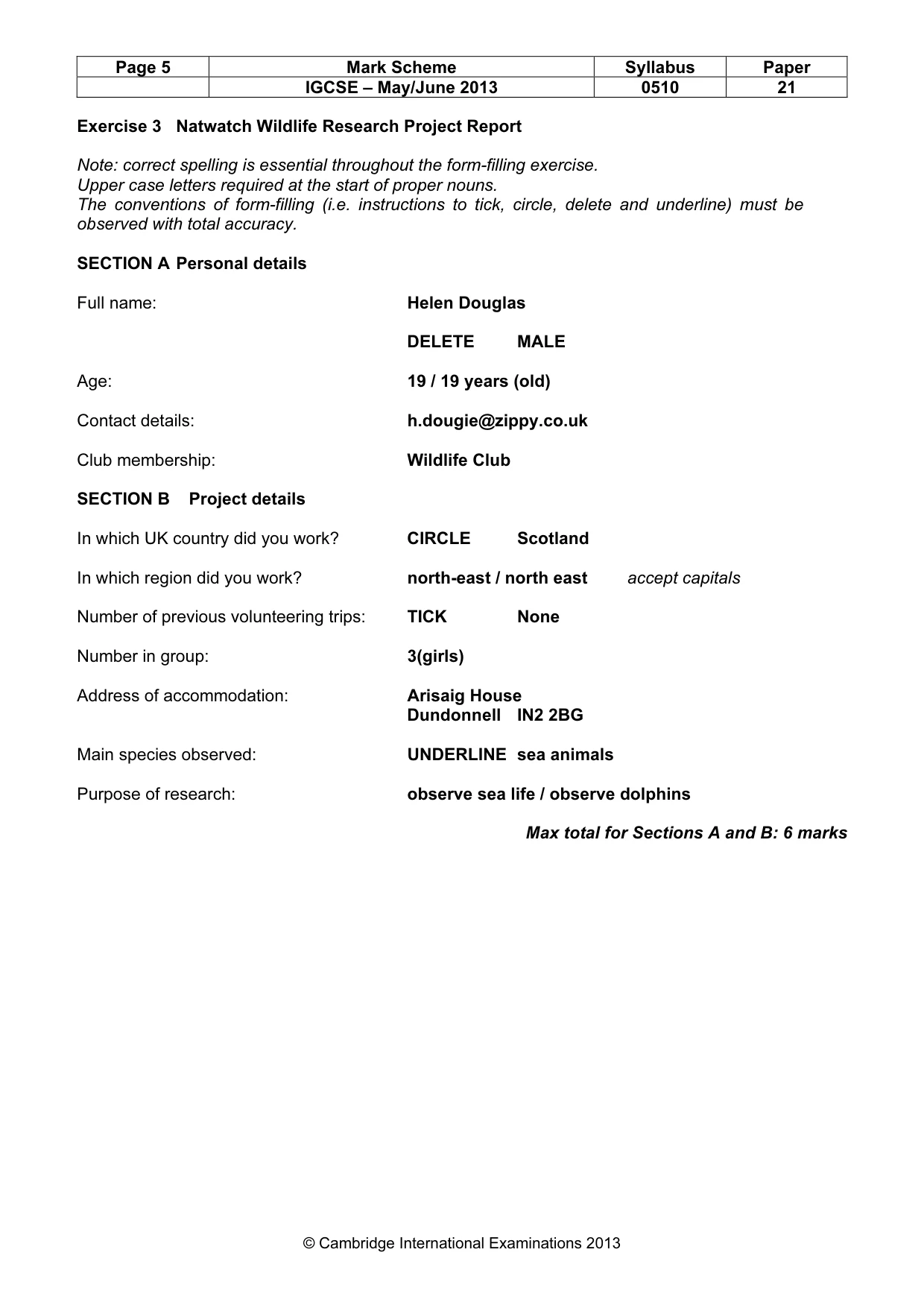
Page 5 Mark Scheme Syllabus Paper IGCSE – May/June 2013 0510 21 © Cambridge International Examinations 2013 Exercise 3 Natwatch Wildlife Research Project Report Note: correct spelling is essential throughout the form-filling exercise. Upper case letters required at the start of proper nouns. The conventions of form-filling (i.e. instructions to tick, circle, delete and underline) must be observed with total accuracy. SECTION A Personal details Full name: Helen Douglas DELETE MALE Age: 19 / 19 years (old) Contact details: h.dougie@zippy.co.uk Club membership: Wildlife Club SECTION B Project details In which UK country did you work? CIRCLE Scotland In which region did you work? north-east / north east accept capitals Number of previous volunteering trips: TICK None Number in group: 3(girls) Address of accommodation: Arisaig House Dundonnell IN2 2BG Main species observed: UNDERLINE sea animals Purpose of research: observe sea life / observe dolphins Max total for Sections A and B: 6 marks
Mark scheme, page 6
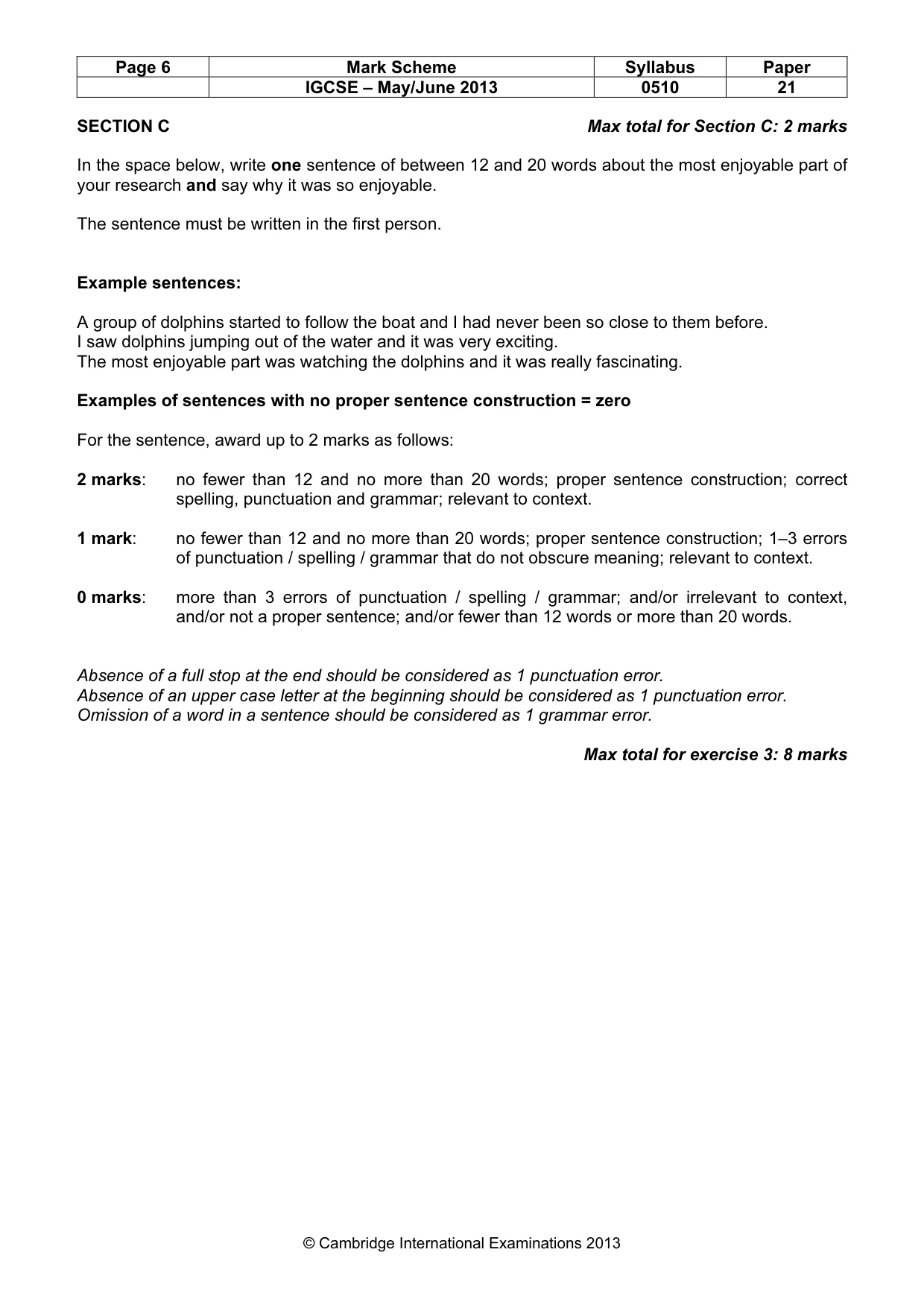
Page 6 Mark Scheme Syllabus Paper IGCSE – May/June 2013 0510 21 © Cambridge International Examinations 2013 SECTION C Max total for Section C: 2 marks In the space below, write one sentence of between 12 and 20 words about the most enjoyable part of your research and say why it was so enjoyable. The sentence must be written in the first person. Example sentences: A group of dolphins started to follow the boat and I had never been so close to them before. I saw dolphins jumping out of the water and it was very exciting. The most enjoyable part was watching the dolphins and it was really fascinating. Examples of sentences with no proper sentence construction = zero For the sentence, award up to 2 marks as follows: 2 marks: no fewer than 12 and no more than 20 words; proper sentence construction; correct spelling, punctuation and grammar; relevant to context. 1 mark: no fewer than 12 and no more than 20 words; proper sentence construction; 1–3 errors of punctuation / spelling / grammar that do not obscure meaning; relevant to context. 0 marks: more than 3 errors of punctuation / spelling / grammar; and/or irrelevant to context, and/or not a proper sentence; and/or fewer than 12 words or more than 20 words. Absence of a full stop at the end should be considered as 1 punctuation error. Absence of an upper case letter at the beginning should be considered as 1 punctuation error. Omission of a word in a sentence should be considered as 1 grammar error. Max total for exercise 3: 8 marks
Mark scheme, page 7
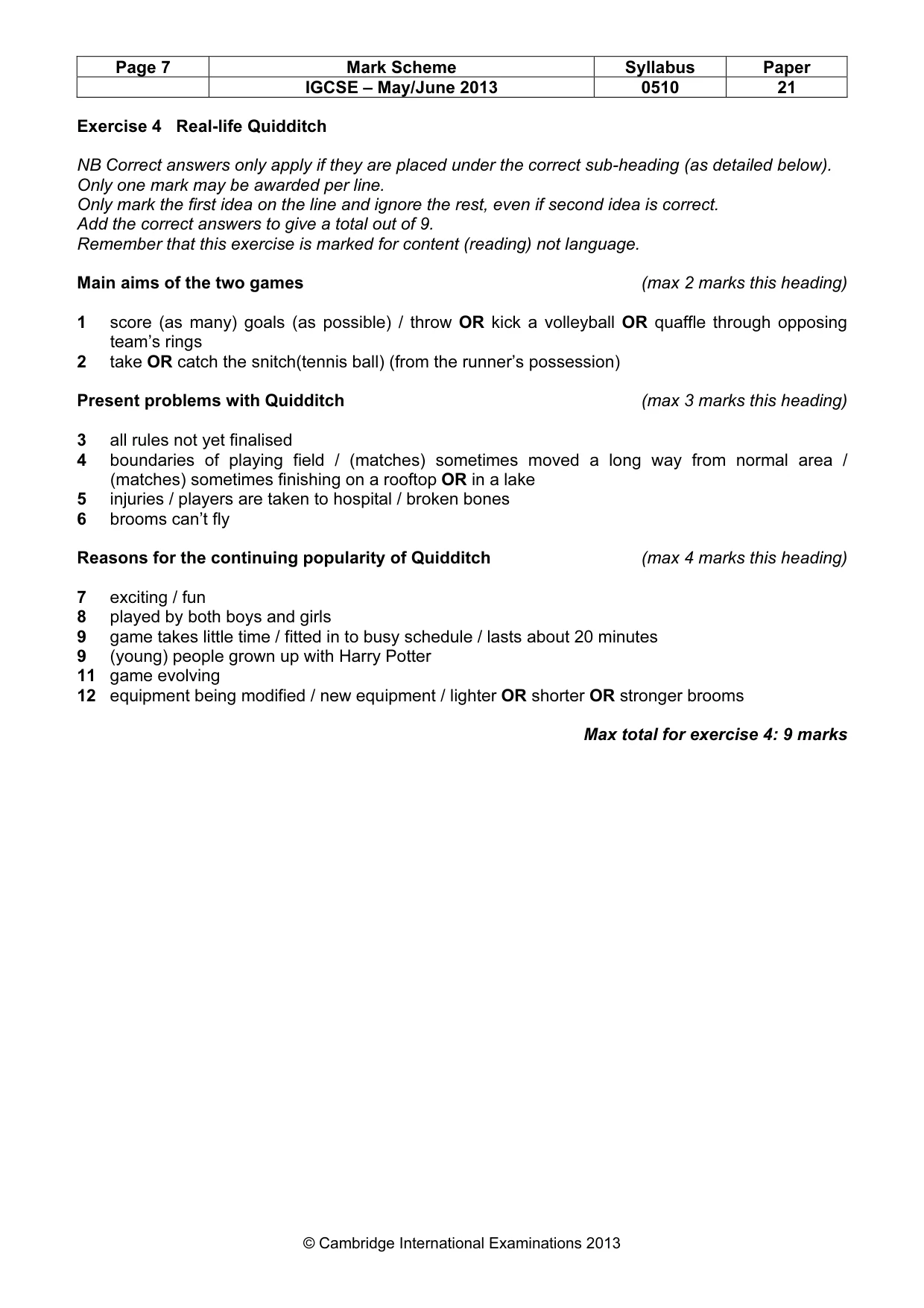
Page 7 Mark Scheme Syllabus Paper IGCSE – May/June 2013 0510 21 © Cambridge International Examinations 2013 Exercise 4 Real-life Quidditch NB Correct answers only apply if they are placed under the correct sub-heading (as detailed below). Only one mark may be awarded per line. Only mark the first idea on the line and ignore the rest, even if second idea is correct. Add the correct answers to give a total out of 9. Remember that this exercise is marked for content (reading) not language. Main aims of the two games (max 2 marks this heading) 1 score (as many) goals (as possible) / throw OR kick a volleyball OR quaffle through opposing team’s rings 2 take OR catch the snitch(tennis ball) (from the runner’s possession) Present problems with Quidditch (max 3 marks this heading) 3 all rules not yet finalised 4 boundaries of playing field / (matches) sometimes moved a long way from normal area / (matches) sometimes finishing on a rooftop OR in a lake 5 injuries / players are taken to hospital / broken bones 6 brooms can’t fly Reasons for the continuing popularity of Quidditch (max 4 marks this heading) 7 exciting / fun 8 played by both boys and girls 9 game takes little time / fitted in to busy schedule / lasts about 20 minutes 9 (young) people grown up with Harry Potter 11 game evolving 12 equipment being modified / new equipment / lighter OR shorter OR stronger brooms Max total for exercise 4: 9 marks
Mark scheme, page 8
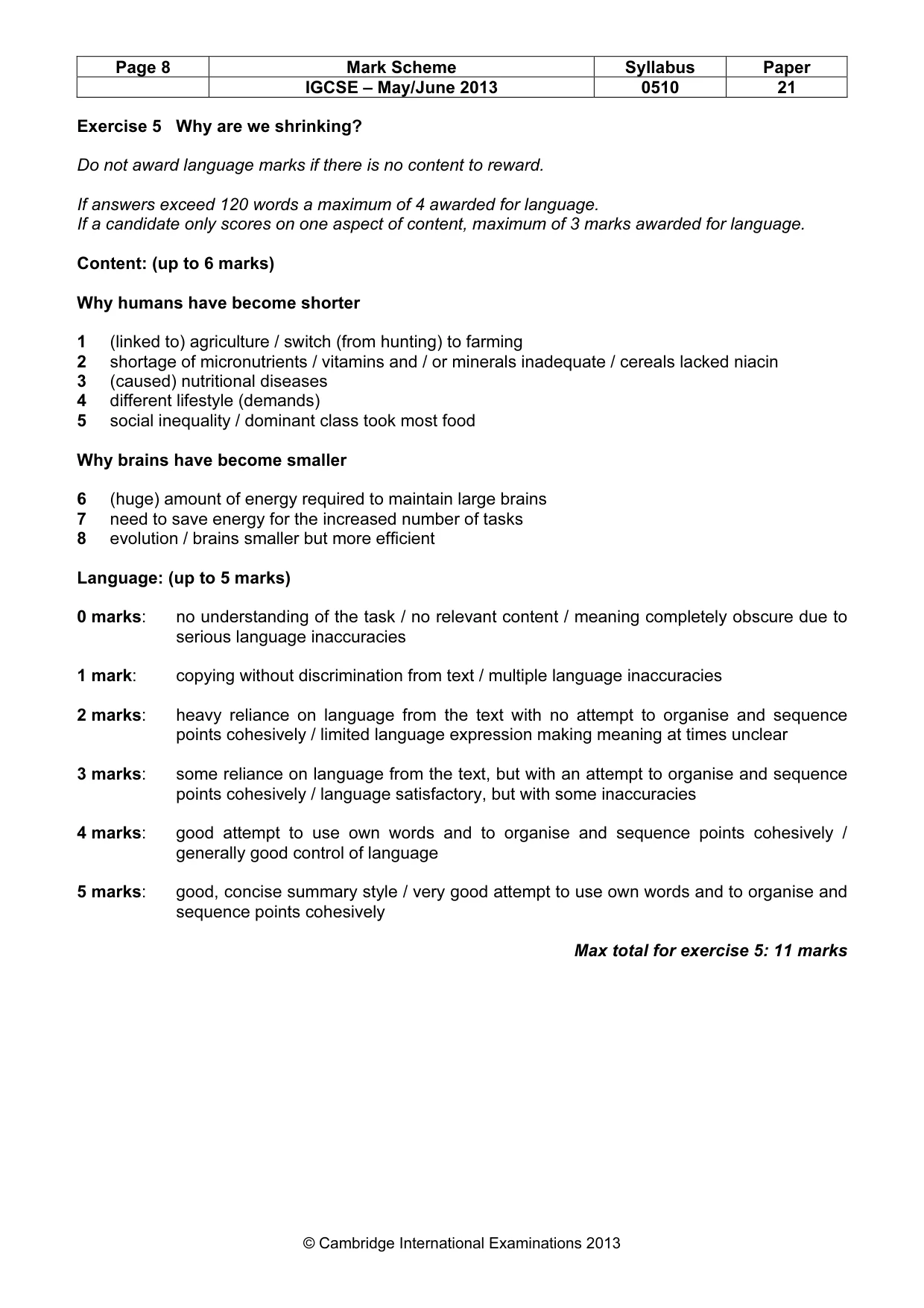
Page 8 Mark Scheme Syllabus Paper IGCSE – May/June 2013 0510 21 © Cambridge International Examinations 2013 Exercise 5 Why are we shrinking? Do not award language marks if there is no content to reward. If answers exceed 120 words a maximum of 4 awarded for language. If a candidate only scores on one aspect of content, maximum of 3 marks awarded for language. Content: (up to 6 marks) Why humans have become shorter 1 (linked to) agriculture / switch (from hunting) to farming 2 shortage of micronutrients / vitamins and / or minerals inadequate / cereals lacked niacin 3 (caused) nutritional diseases 4 different lifestyle (demands) 5 social inequality / dominant class took most food Why brains have become smaller 6 (huge) amount of energy required to maintain large brains 7 need to save energy for the increased number of tasks 8 evolution / brains smaller but more efficient Language: (up to 5 marks) 0 marks: no understanding of the task / no relevant content / meaning completely obscure due to serious language inaccuracies 1 mark: copying without discrimination from text / multiple language inaccuracies 2 marks: heavy reliance on language from the text with no attempt to organise and sequence points cohesively / limited language expression making meaning at times unclear 3 marks: some reliance on language from the text, but with an attempt to organise and sequence points cohesively / language satisfactory, but with some inaccuracies 4 marks: good attempt to use own words and to organise and sequence points cohesively / generally good control of language 5 marks: good, concise summary style / very good attempt to use own words and to organise and sequence points cohesively Max total for exercise 5: 11 marks
Mark scheme, page 9
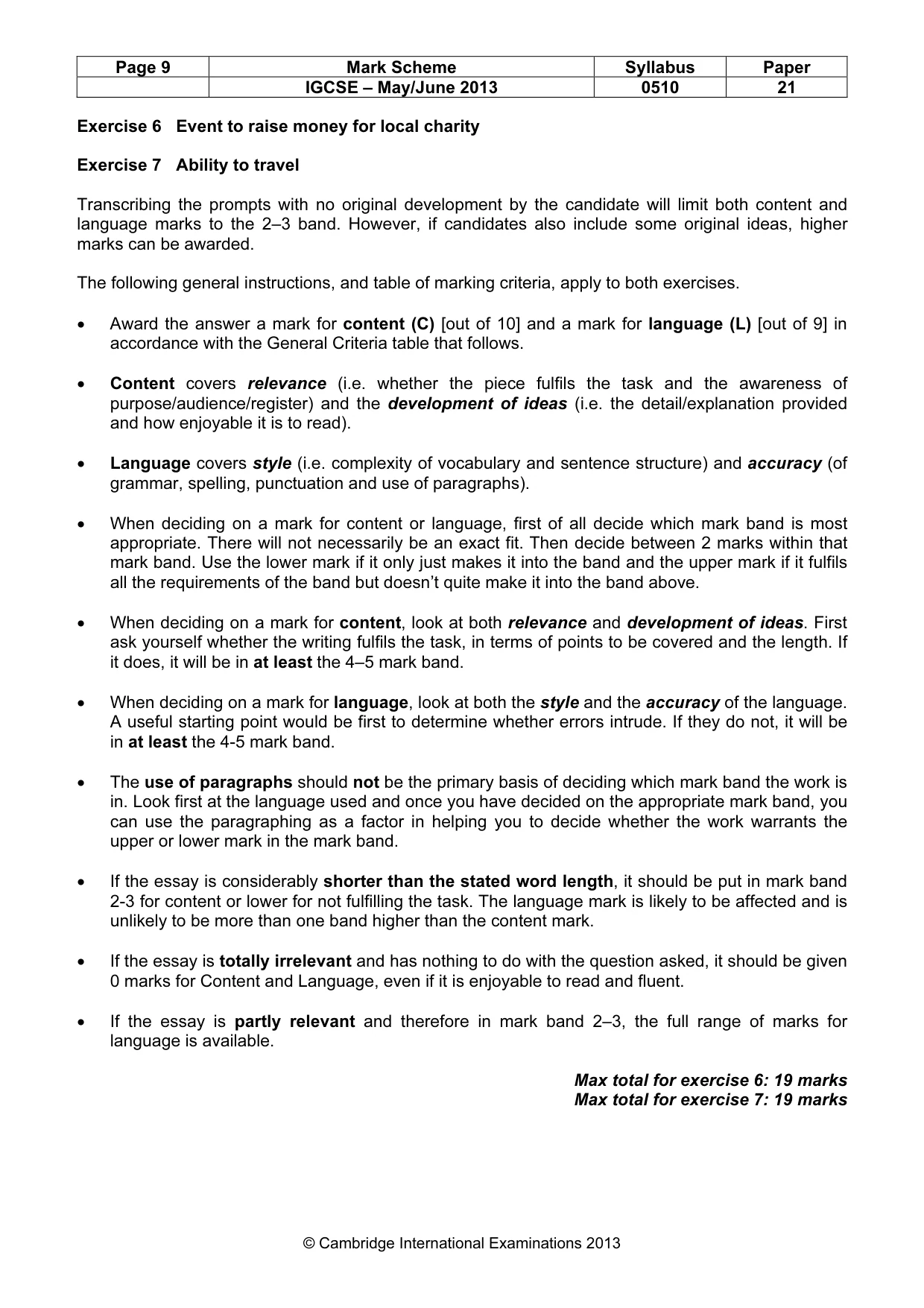
Page 9 Mark Scheme Syllabus Paper IGCSE – May/June 2013 0510 21 © Cambridge International Examinations 2013 Exercise 6 Event to raise money for local charity Exercise 7 Ability to travel Transcribing the prompts with no original development by the candidate will limit both content and language marks to the 2–3 band. However, if candidates also include some original ideas, higher marks can be awarded. The following general instructions, and table of marking criteria, apply to both exercises. • Award the answer a mark for content (C) [out of 10] and a mark for language (L) [out of 9] in accordance with the General Criteria table that follows. • Content covers relevance (i.e. whether the piece fulfils the task and the awareness of purpose/audience/register) and the development of ideas (i.e. the detail/explanation provided and how enjoyable it is to read). • Language covers style (i.e. complexity of vocabulary and sentence structure) and accuracy (of grammar, spelling, punctuation and use of paragraphs). • When deciding on a mark for content or language, first of all decide which mark band is most appropriate. There will not necessarily be an exact fit. Then decide between 2 marks within that mark band. Use the lower mark if it only just makes it into the band and the upper mark if it fulfils all the requirements of the band but doesn’t quite make it into the band above. • When deciding on a mark for content, look at both relevance and development of ideas. First ask yourself whether the writing fulfils the task, in terms of points to be covered and the length. If it does, it will be in at least the 4–5 mark band. • When deciding on a mark for language, look at both the style and the accuracy of the language. A useful starting point would be first to determine whether errors intrude. If they do not, it will be in at least the 4-5 mark band. • The use of paragraphs should not be the primary basis of deciding which mark band the work is in. Look first at the language used and once you have decided on the appropriate mark band, you can use the paragraphing as a factor in helping you to decide whether the work warrants the upper or lower mark in the mark band. • If the essay is considerably shorter than the stated word length, it should be put in mark band 2-3 for content or lower for not fulfilling the task. The language mark is likely to be affected and is unlikely to be more than one band higher than the content mark. • If the essay is totally irrelevant and has nothing to do with the question asked, it should be given 0 marks for Content and Language, even if it is enjoyable to read and fluent. • If the essay is partly relevant and therefore in mark band 2–3, the full range of marks for language is available. Max total for exercise 6: 19 marks Max total for exercise 7: 19 marks
Mark scheme, page 10
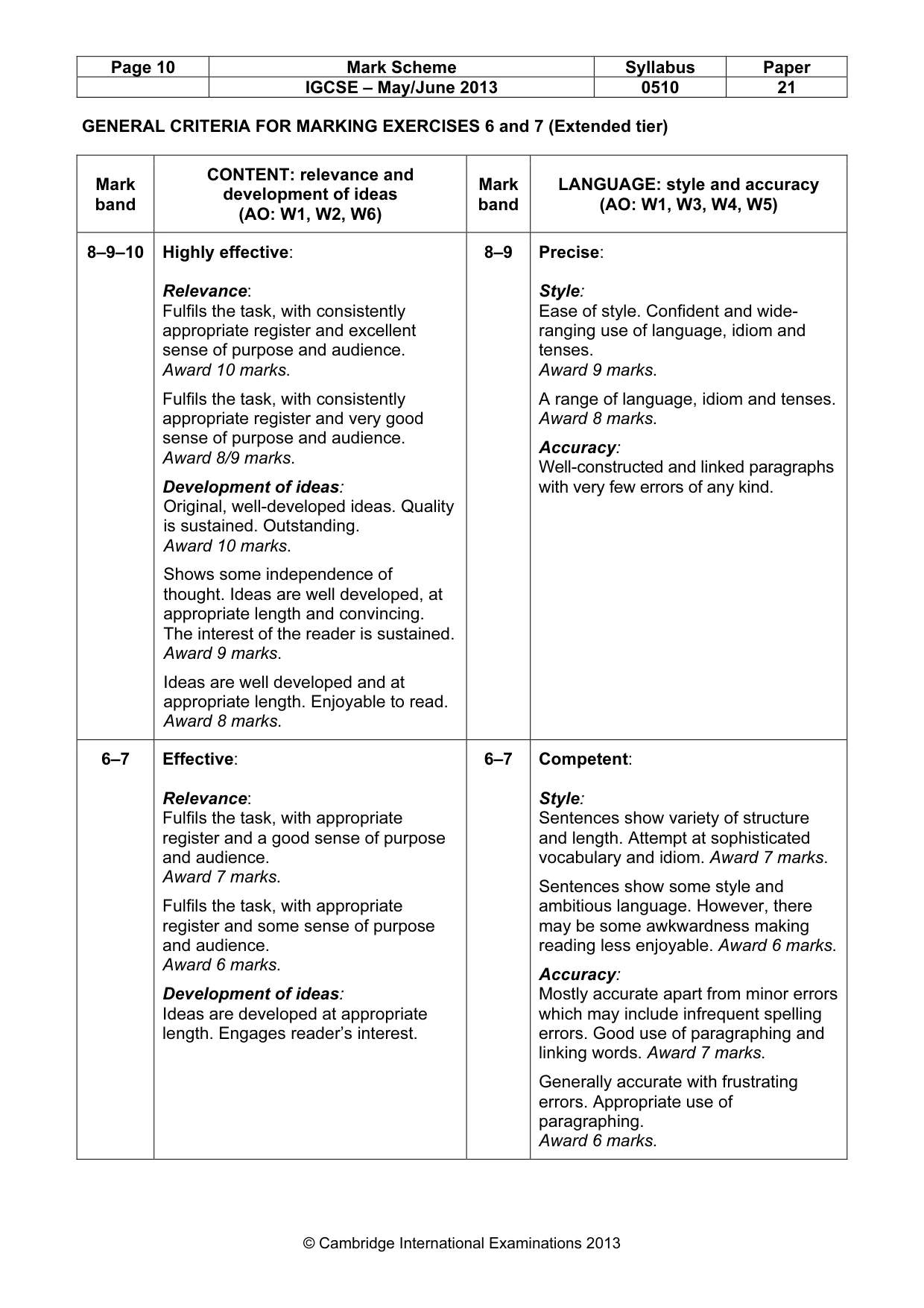
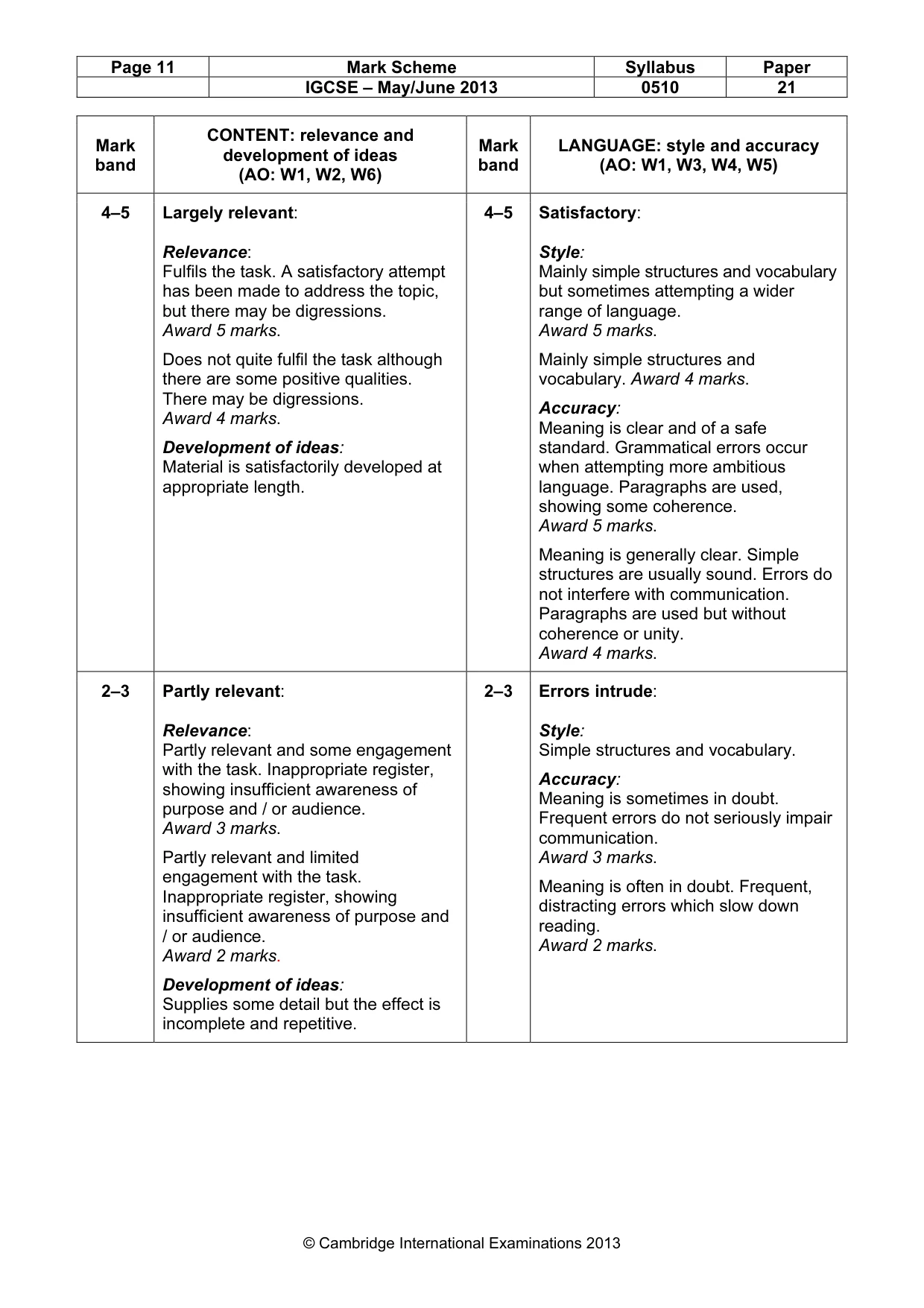
Page 10 Mark Scheme Syllabus Paper IGCSE – May/June 2013 0510 21 © Cambridge International Examinations 2013 GENERAL CRITERIA FOR MARKING EXERCISES 6 and 7 (Extended tier) Mark band CONTENT: relevance and development of ideas (AO: W1, W2, W6) Mark band LANGUAGE: style and accuracy (AO: W1, W3, W4, W5) 8–9–10 Highly effective: Relevance: Fulfils the task, with consistently appropriate register and excellent sense of purpose and audience. Award 10 marks. Fulfils the task, with consistently appropriate register and very good sense of purpose and audience. Award 8/9 marks. Development of ideas: Original, well-developed ideas. Quality is sustained. Outstanding. Award 10 marks. Shows some independence of thought. Ideas are well developed, at appropriate length and convincing. The interest of the reader is sustained. Award 9 marks. Ideas are well developed and at appropriate length. Enjoyable to read. Award 8 marks. 8–9 Precise: Style: Ease of style. Confident and wide- ranging use of language, idiom and tenses. Award 9 marks. A range of language, idiom and tenses. Award 8 marks. Accuracy: Well-constructed and linked paragraphs with very few errors of any kind. 6–7 Effective: Relevance: Fulfils the task, with appropriate register and a good sense of purpose and audience. Award 7 marks. Fulfils the task, with appropriate register and some sense of purpose and audience. Award 6 marks. Development of ideas: Ideas are developed at appropriate length. Engages reader’s interest. 6–7 Competent: Style: Sentences show variety of structure and length. Attempt at sophisticated vocabulary and idiom. Award 7 marks. Sentences show some style and ambitious language. However, there may be some awkwardness making reading less enjoyable. Award 6 marks. Accuracy: Mostly accurate apart from minor errors which may include infrequent spelling errors. Good use of paragraphing and linking words. Award 7 marks. Generally accurate with frustrating errors. Appropriate use of paragraphing. Award 6 marks.
Mark scheme, page 11
Page 11 Mark Scheme Syllabus Paper IGCSE – May/June 2013 0510 21 © Cambridge International Examinations 2013 Mark band CONTENT: relevance and development of ideas (AO: W1, W2, W6) Mark band LANGUAGE: style and accuracy (AO: W1, W3, W4, W5) 4–5 Largely relevant: Relevance: Fulfils the task. A satisfactory attempt has been made to address the topic, but there may be digressions. Award 5 marks. Does not quite fulfil the task although there are some positive qualities. There may be digressions. Award 4 marks. Development of ideas: Material is satisfactorily developed at appropriate length. 4–5 Satisfactory: Style: Mainly simple structures and vocabulary but sometimes attempting a wider range of language. Award 5 marks. Mainly simple structures and vocabulary. Award 4 marks. Accuracy: Meaning is clear and of a safe standard. Grammatical errors occur when attempting more ambitious language. Paragraphs are used, showing some coherence. Award 5 marks. Meaning is generally clear. Simple structures are usually sound. Errors do not interfere with communication. Paragraphs are used but without coherence or unity. Award 4 marks. 2–3 Partly relevant: Relevance: Partly relevant and some engagement with the task. Inappropriate register, showing insufficient awareness of purpose and / or audience. Award 3 marks. Partly relevant and limited engagement with the task. Inappropriate register, showing insufficient awareness of purpose and / or audience. Award 2 marks. Development of ideas: Supplies some detail but the effect is incomplete and repetitive. 2–3 Errors intrude: Style: Simple structures and vocabulary. Accuracy: Meaning is sometimes in doubt. Frequent errors do not seriously impair communication. Award 3 marks. Meaning is often in doubt. Frequent, distracting errors which slow down reading. Award 2 marks.
Mark scheme, page 12
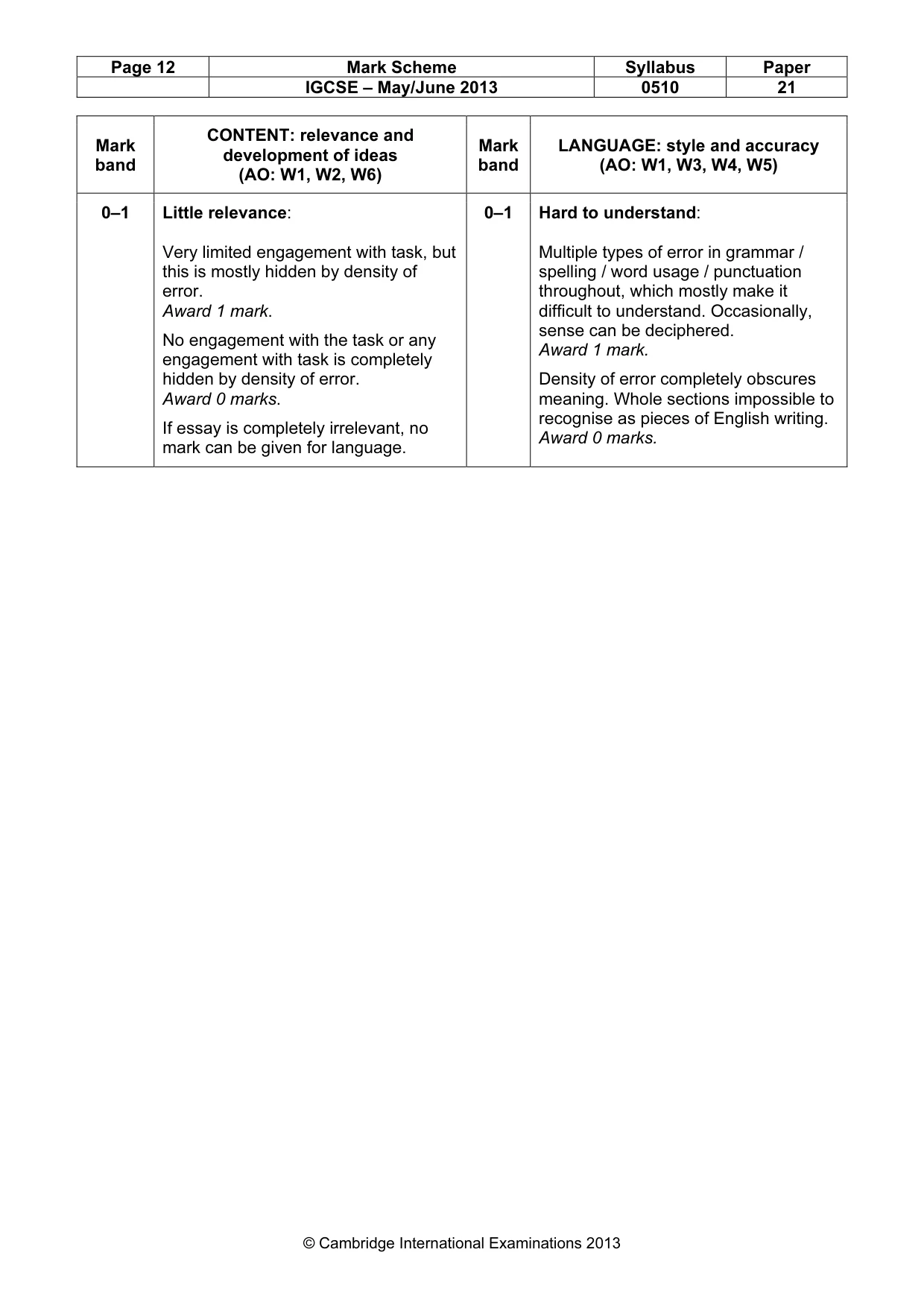
Page 12 Mark Scheme Syllabus Paper IGCSE – May/June 2013 0510 21 © Cambridge International Examinations 2013 Mark band CONTENT: relevance and development of ideas (AO: W1, W2, W6) Mark band LANGUAGE: style and accuracy (AO: W1, W3, W4, W5) 0–1 Little relevance: Very limited engagement with task, but this is mostly hidden by density of error. Award 1 mark. No engagement with the task or any engagement with task is completely hidden by density of error. Award 0 marks. If essay is completely irrelevant, no mark can be given for language. 0–1 Hard to understand: Multiple types of error in grammar / spelling / word usage / punctuation throughout, which mostly make it difficult to understand. Occasionally, sense can be deciphered. Award 1 mark. Density of error completely obscures meaning. Whole sections impossible to recognise as pieces of English writing. Award 0 marks.