Cambridge IGCSE English - Second Language (count-in oral) 0511 — 2019 May/June Paper 1 · Variant 3
0511/13/M/J/19 · 60 marks · ≈68 min
The question paper and its mark scheme, free to read here and free to download. This is Cambridge’s own paper, exactly as it was sat.
Question paper16 pages



Mark scheme11 pages
Answers below. Sit the paper first if you are practising.
Paper as text
Question paper, page 1
This document consists of 13 printed pages and 3 blank pages. DC (MM) 181735 © UCLES 2019 [Turn over Cambridge Assessment International Education Cambridge International General Certificate of Secondary Education * 7 6 7 8 6 3 2 3 7 9 * ENGLISH AS A SECOND LANGUAGE 0511/13 Paper 1 Reading and Writing (Core) May/June 2019 1 hour 30 minutes Candidates answer on the Question Paper. No Additional Materials are required. READ THESE INSTRUCTIONS FIRST Write your centre number, candidate number and name in the spaces at the top of this page. Write in dark blue or black pen. Do not use staples, paper clips, glue or correction fluid. DO NOT WRITE IN ANY BARCODES. Answer all questions. Dictionaries are not allowed. The number of marks is given in brackets [ ] at the end of each question or part question. This syllabus is regulated for use in England, Wales and Northern Ireland as a Cambridge International Level 1/Level 2 Certificate.
Question paper, page 2
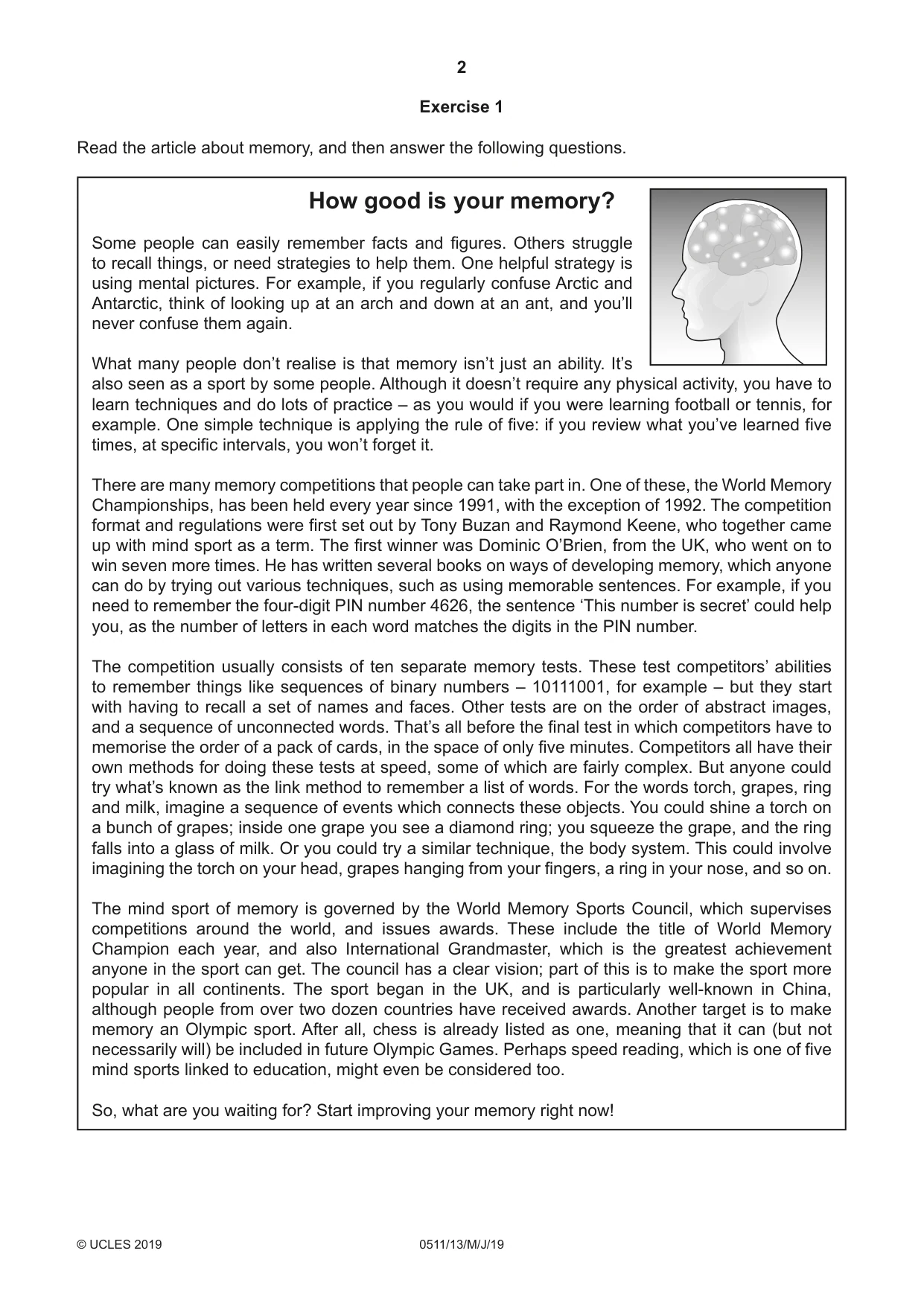
2 0511/13/M/J/19 © UCLES 2019 Exercise 1 Read the article about memory, and then answer the following questions. How good is your memory? Some people can easily remember facts and figures. Others struggle to recall things, or need strategies to help them. One helpful strategy is using mental pictures. For example, if you regularly confuse Arctic and Antarctic, think of looking up at an arch and down at an ant, and you’ll never confuse them again. What many people don’t realise is that memory isn’t just an ability. It’s also seen as a sport by some people. Although it doesn’t require any physical activity, you have to learn techniques and do lots of practice – as you would if you were learning football or tennis, for example. One simple technique is applying the rule of five: if you review what you’ve learned five times, at specific intervals, you won’t forget it. There are many memory competitions that people can take part in. One of these, the World Memory Championships, has been held every year since 1991, with the exception of 1992. The competition format and regulations were first set out by Tony Buzan and Raymond Keene, who together came up with mind sport as a term. The first winner was Dominic O’Brien, from the UK, who went on to win seven more times. He has written several books on ways of developing memory, which anyone can do by trying out various techniques, such as using memorable sentences. For example, if you need to remember the four-digit PIN number 4626, the sentence ‘This number is secret’ could help you, as the number of letters in each word matches the digits in the PIN number. The competition usually consists of ten separate memory tests. These test competitors’ abilities to remember things like sequences of binary numbers – 10111001, for example – but they start with having to recall a set of names and faces. Other tests are on the order of abstract images, and a sequence of unconnected words. That’s all before the final test in which competitors have to memorise the order of a pack of cards, in the space of only five minutes. Competitors all have their own methods for doing these tests at speed, some of which are fairly complex. But anyone could try what’s known as the link method to remember a list of words. For the words torch, grapes, ring and milk, imagine a sequence of events which connects these objects. You could shine a torch on a bunch of grapes; inside one grape you see a diamond ring; you squeeze the grape, and the ring falls into a glass of milk. Or you could try a similar technique, the body system. This could involve imagining the torch on your head, grapes hanging from your fingers, a ring in your nose, and so on. The mind sport of memory is governed by the World Memory Sports Council, which supervises competitions around the world, and issues awards. These include the title of World Memory Champion each year, and also International Grandmaster, which is the greatest achievement anyone in the sport can get. The council has a clear vision; part of this is to make the sport more popular in all continents. The sport began in the UK, and is particularly well-known in China, although people from over two dozen countries have received awards. Another target is to make memory an Olympic sport. After all, chess is already listed as one, meaning that it can (but not necessarily will) be included in future Olympic Games. Perhaps speed reading, which is one of five mind sports linked to education, might even be considered too. So, what are you waiting for? Start improving your memory right now!
Question paper, page 3
3 0511/13/M/J/19 © UCLES 2019 [Turn over 1 Why is memory considered to be a sport? … [1] 2 When did the first World Memory Championships take place? … [1] 3 Who first called memory a mind sport? … [1] 4 What do people have to remember in the first and last tests in a World Memory Championship? Give two details. … … [2] 5 What is the highest award given by the World Memory Sports Council? … [1] 6 What does the World Memory Sports Council aim to achieve in the future? Give two details. … … [2] 7 Which study skill apart from memory is recognised as a mind sport? … [1] [Total: 9]
Question paper, page 4
4 0511/13/M/J/19 © UCLES 2019 Exercise 2 Read the article about three people (A–C) who use digital technology to help them learn English. Then answer Question 8 (a)–(h). Using digital technology to learn English A Hans Schneider I’ve just started an online course which is for people who need to use English in their job. The first unit was great, and I’m determined to finish it though nearly everyone I know who’s tried learning English online says that it’s easy to lose motivation and give up. The best thing about this online course is that it’s totally free, like lots of other sites I use. Sometimes there’s a fee to access part of a site, or if you progress to a certain level, but I can’t understand why people would hand over money, as there’s so much to choose from out there. Some sites are fun to use – if you need to learn a list of verbs, for example, you can copy them into various sites which then create matching activities for you, or let you make your own sample sentences to put the words in context. I tend to use a website to look up new words on my laptop – it’s instant, always up-to-date, and you can check pronunciation too. B Elif Yildirim When I started learning English, we didn’t use technology at all. Now we use it all the time! We can translate language really quickly, and there are all sorts of other sites and programs that are free to use. Some people definitely prefer doing everything with computers, but for some I think that stops them focusing on what they’re supposed to be learning, especially if it all involves games or competitions. Having said that, our teacher got us to try one site when we were learning some new phrases, and it couldn’t have been more effective. I told my sister how good it was and she’s using it now too. Another site that I had initial doubts about helps you to correct mistakes in your written work. You type in a text or paragraph, then it highlights anything that needs changing – different colours for different types of mistakes. I regularly use it now. C Marc Durand I’ve got a few apps on my phone which I like using when I’ve got a few spare minutes. Most of them involve quizzes and games of some sort, which motivates me. Our teacher often gets us to use them for homework – we make up revision activities and have to send them to each other to work on in class. That’s always fun to do! She also encouraged a few of us to sign up for a course delivered online to help us with academic writing. The first few lessons were really good, but I was too busy and kept on getting distracted by other things, so I just never quite got around to finishing it. Sometimes our teacher bans all technology from the classroom. I don’t think that reflects real life, so I’m not so keen on those lessons. What’s the point, for example, of looking up words in paper dictionaries?
Question paper, page 5
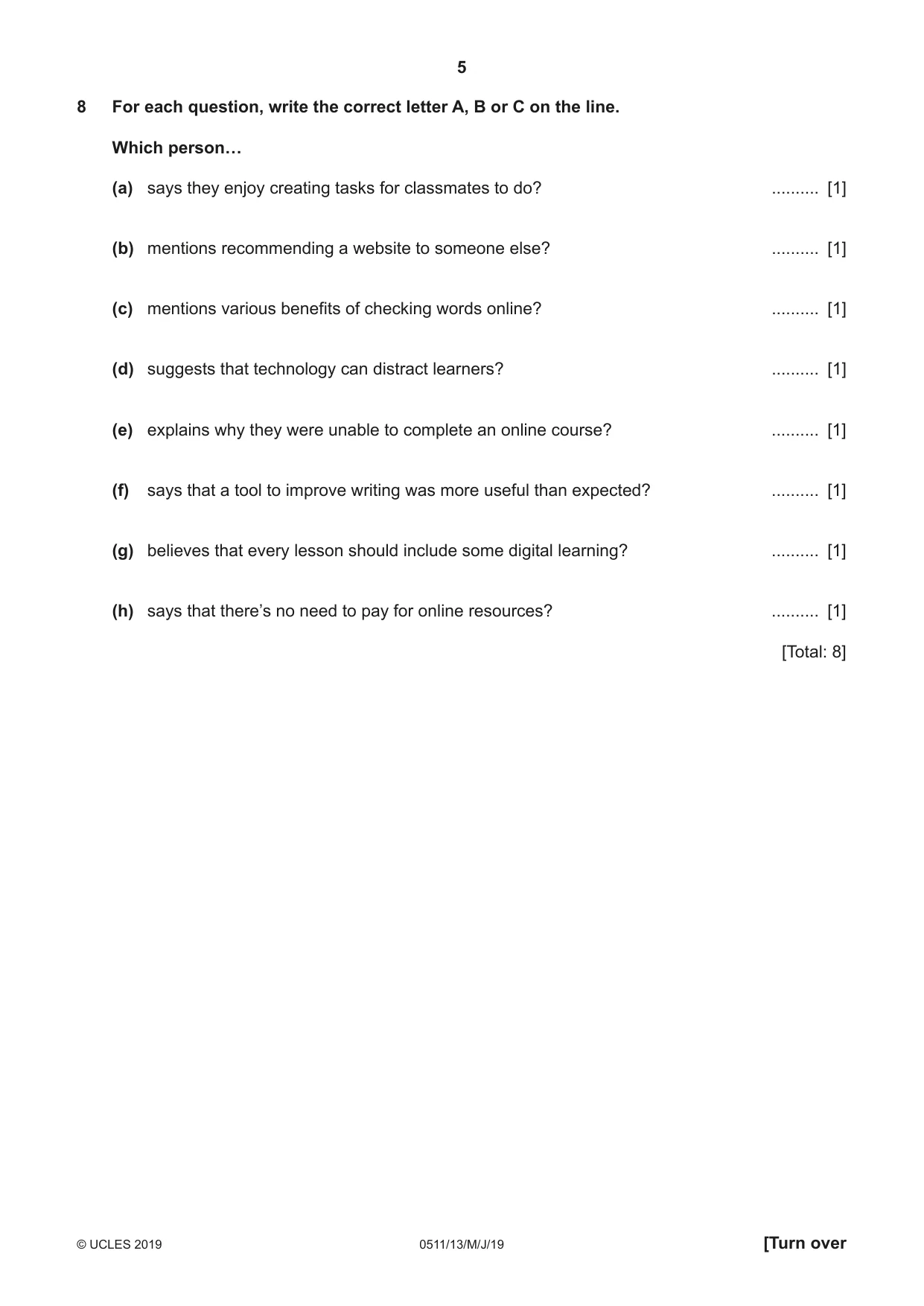
5 0511/13/M/J/19 © UCLES 2019 [Turn over 8 For each question, write the correct letter A, B or C on the line. Which person… (a) says they enjoy creating tasks for classmates to do? … [1] (b) mentions recommending a website to someone else? … [1] (c) mentions various benefits of checking words online? … [1] (d) suggests that technology can distract learners? … [1] (e) explains why they were unable to complete an online course? … [1] (f) says that a tool to improve writing was more useful than expected? … [1] (g) believes that every lesson should include some digital learning? … [1] (h) says that there’s no need to pay for online resources? … [1] [Total: 8]
Question paper, page 6
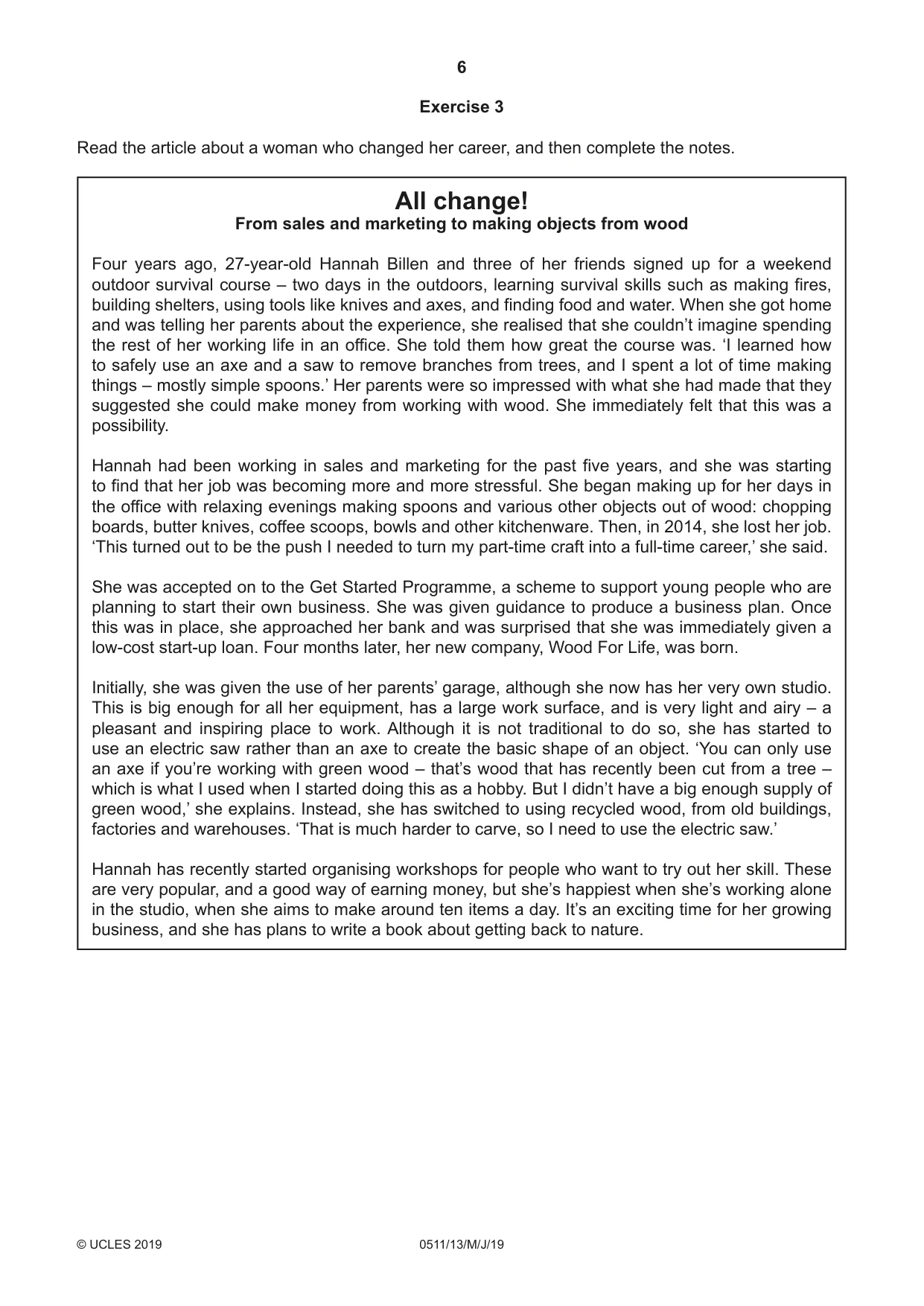
6 0511/13/M/J/19 © UCLES 2019 Exercise 3 Read the article about a woman who changed her career, and then complete the notes. All change! From sales and marketing to making objects from wood Four years ago, 27-year-old Hannah Billen and three of her friends signed up for a weekend outdoor survival course – two days in the outdoors, learning survival skills such as making fires, building shelters, using tools like knives and axes, and finding food and water. When she got home and was telling her parents about the experience, she realised that she couldn’t imagine spending the rest of her working life in an office. She told them how great the course was. ‘I learned how to safely use an axe and a saw to remove branches from trees, and I spent a lot of time making things – mostly simple spoons.’ Her parents were so impressed with what she had made that they suggested she could make money from working with wood. She immediately felt that this was a possibility. Hannah had been working in sales and marketing for the past five years, and she was starting to find that her job was becoming more and more stressful. She began making up for her days in the office with relaxing evenings making spoons and various other objects out of wood: chopping boards, butter knives, coffee scoops, bowls and other kitchenware. Then, in 2014, she lost her job. ‘This turned out to be the push I needed to turn my part-time craft into a full-time career,’ she said. She was accepted on to the Get Started Programme, a scheme to support young people who are planning to start their own business. She was given guidance to produce a business plan. Once this was in place, she approached her bank and was surprised that she was immediately given a low-cost start-up loan. Four months later, her new company, Wood For Life, was born. Initially, she was given the use of her parents’ garage, although she now has her very own studio. This is big enough for all her equipment, has a large work surface, and is very light and airy – a pleasant and inspiring place to work. Although it is not traditional to do so, she has started to use an electric saw rather than an axe to create the basic shape of an object. ‘You can only use an axe if you’re working with green wood – that’s wood that has recently been cut from a tree – which is what I used when I started doing this as a hobby. But I didn’t have a big enough supply of green wood,’ she explains. Instead, she has switched to using recycled wood, from old buildings, factories and warehouses. ‘That is much harder to carve, so I need to use the electric saw.’ Hannah has recently started organising workshops for people who want to try out her skill. These are very popular, and a good way of earning money, but she’s happiest when she’s working alone in the studio, when she aims to make around ten items a day. It’s an exciting time for her growing business, and she has plans to write a book about getting back to nature.
Question paper, page 7
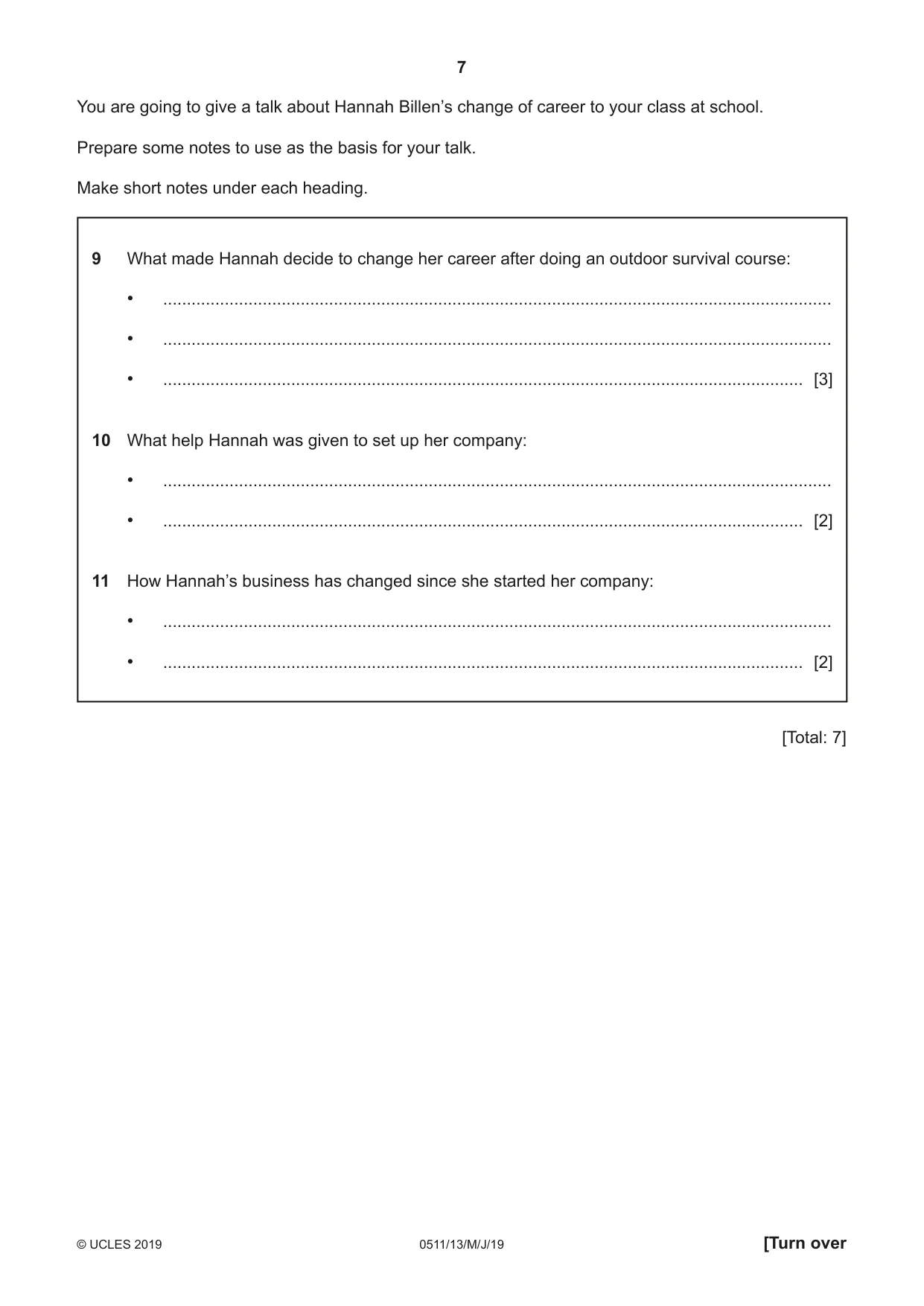
7 0511/13/M/J/19 © UCLES 2019 [Turn over You are going to give a talk about Hannah Billen’s change of career to your class at school. Prepare some notes to use as the basis for your talk. Make short notes under each heading. 9 What made Hannah decide to change her career after doing an outdoor survival course: • … • … • … [3] 10 What help Hannah was given to set up her company: • … • … [2] 11 How Hannah’s business has changed since she started her company: • … • … [2] [Total: 7]
Question paper, page 8
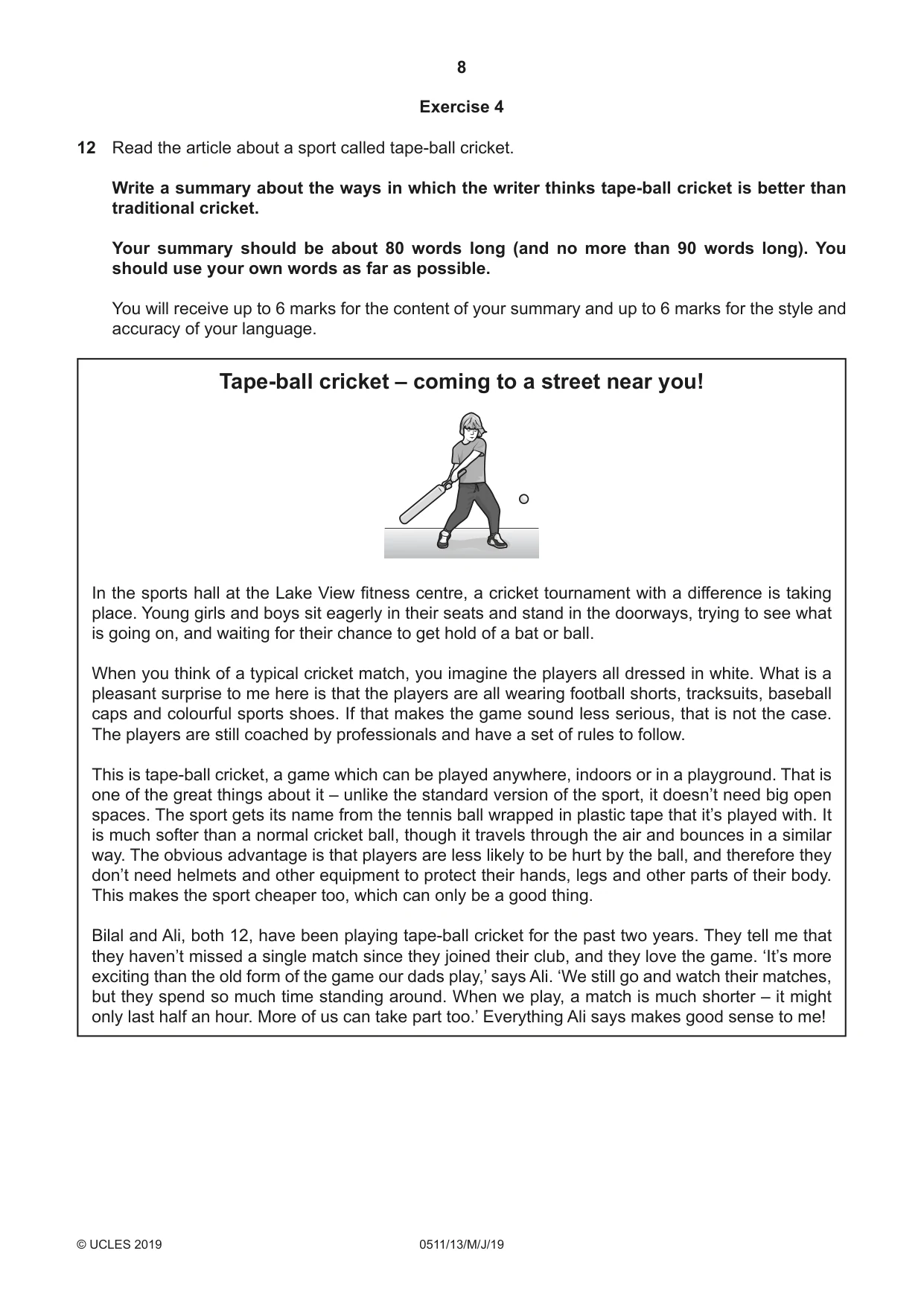
8 0511/13/M/J/19 © UCLES 2019 Exercise 4 12 Read the article about a sport called tape-ball cricket. Write a summary about the ways in which the writer thinks tape-ball cricket is better than traditional cricket. Your summary should be about 80 words long (and no more than 90 words long). You should use your own words as far as possible. You will receive up to 6 marks for the content of your summary and up to 6 marks for the style and accuracy of your language. Tape-ball cricket – coming to a street near you! In the sports hall at the Lake View fitness centre, a cricket tournament with a difference is taking place. Young girls and boys sit eagerly in their seats and stand in the doorways, trying to see what is going on, and waiting for their chance to get hold of a bat or ball. When you think of a typical cricket match, you imagine the players all dressed in white. What is a pleasant surprise to me here is that the players are all wearing football shorts, tracksuits, baseball caps and colourful sports shoes. If that makes the game sound less serious, that is not the case. The players are still coached by professionals and have a set of rules to follow. This is tape-ball cricket, a game which can be played anywhere, indoors or in a playground. That is one of the great things about it – unlike the standard version of the sport, it doesn’t need big open spaces. The sport gets its name from the tennis ball wrapped in plastic tape that it’s played with. It is much softer than a normal cricket ball, though it travels through the air and bounces in a similar way. The obvious advantage is that players are less likely to be hurt by the ball, and therefore they don’t need helmets and other equipment to protect their hands, legs and other parts of their body. This makes the sport cheaper too, which can only be a good thing. Bilal and Ali, both 12, have been playing tape-ball cricket for the past two years. They tell me that they haven’t missed a single match since they joined their club, and they love the game. ‘It’s more exciting than the old form of the game our dads play,’ says Ali. ‘We still go and watch their matches, but they spend so much time standing around. When we play, a match is much shorter – it might only last half an hour. More of us can take part too.’ Everything Ali says makes good sense to me!
Question paper, page 9
9 0511/13/M/J/19 © UCLES 2019 [Turn over … … … … … … … … … … … … … … [Total: 12]
Question paper, page 10
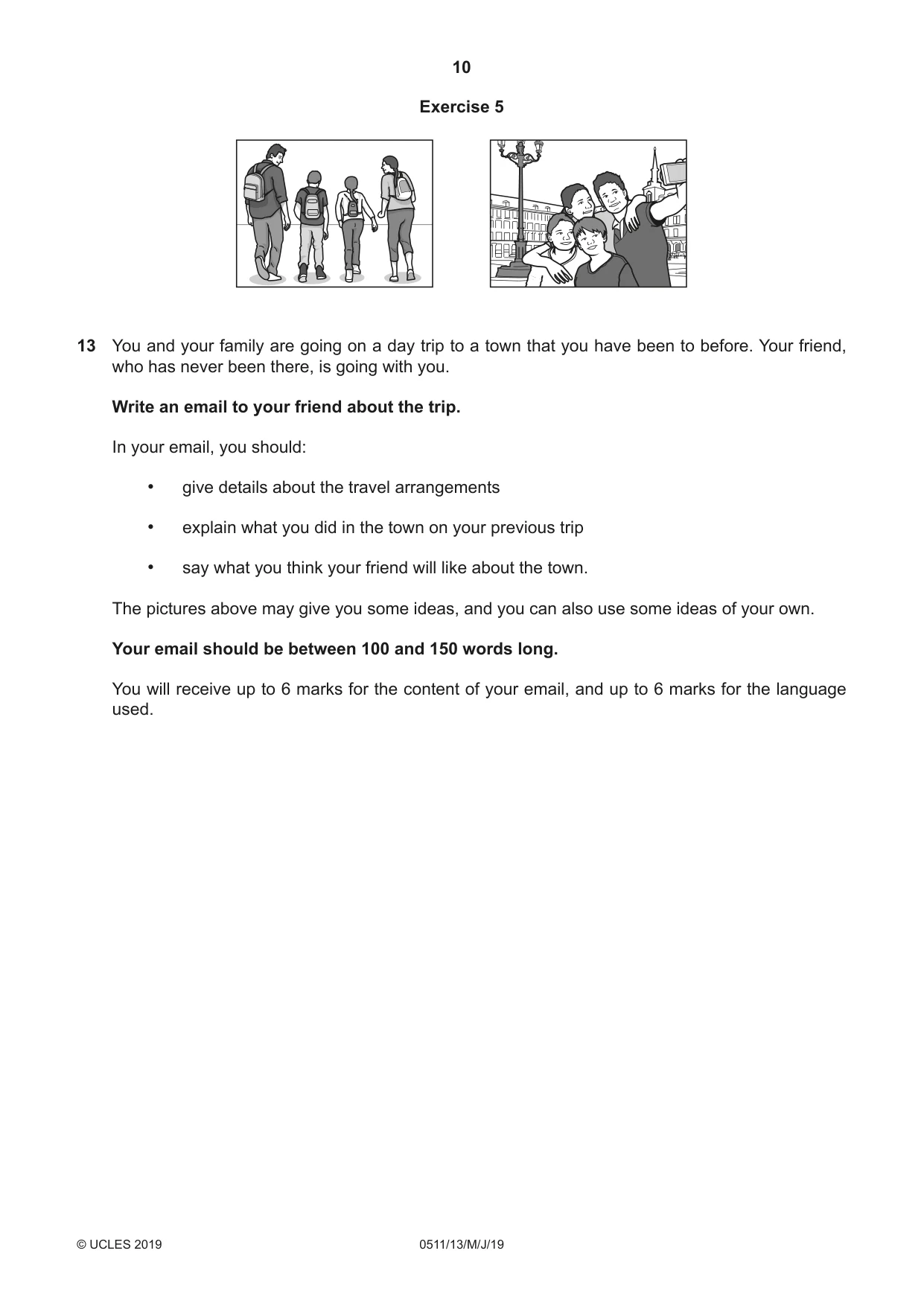
10 0511/13/M/J/19 © UCLES 2019 Exercise 5 13 You and your family are going on a day trip to a town that you have been to before. Your friend, who has never been there, is going with you. Write an email to your friend about the trip. In your email, you should: • give details about the travel arrangements • explain what you did in the town on your previous trip • say what you think your friend will like about the town. The pictures above may give you some ideas, and you can also use some ideas of your own. Your email should be between 100 and 150 words long. You will receive up to 6 marks for the content of your email, and up to 6 marks for the language used.
Question paper, page 11
11 0511/13/M/J/19 © UCLES 2019 [Turn over … … … … … … … … … … … … … … … … … … … … … … … … … … … [Total: 12]
Question paper, page 12
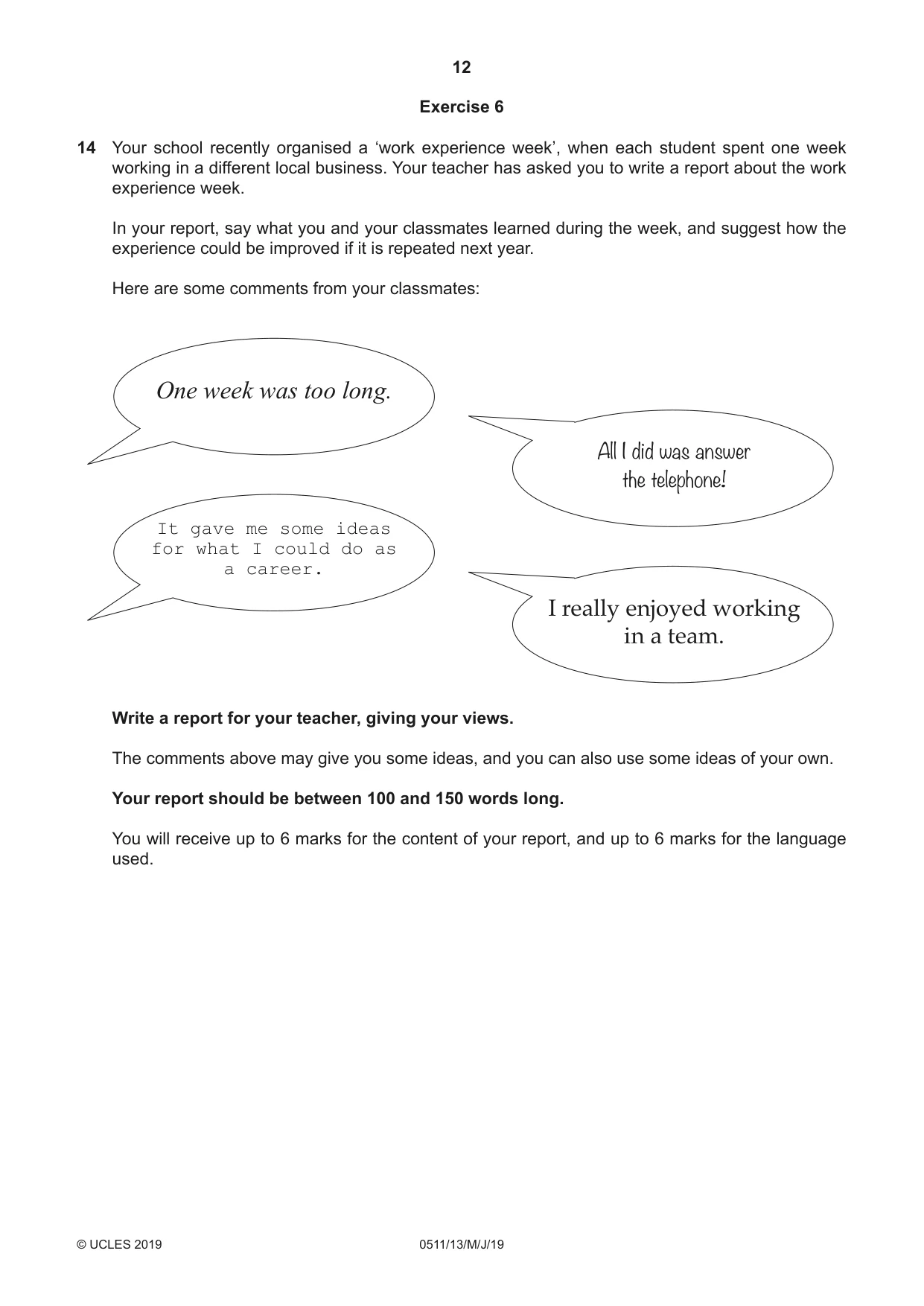
12 0511/13/M/J/19 © UCLES 2019 Exercise 6 14 Your school recently organised a ‘work experience week’, when each student spent one week working in a different local business. Your teacher has asked you to write a report about the work experience week. In your report, say what you and your classmates learned during the week, and suggest how the experience could be improved if it is repeated next year. Here are some comments from your classmates: One week was too long. It gave me some ideas for what I could do as a career. All I did was answer the telephone! I really enjoyed working in a team. Write a report for your teacher, giving your views. The comments above may give you some ideas, and you can also use some ideas of your own. Your report should be between 100 and 150 words long. You will receive up to 6 marks for the content of your report, and up to 6 marks for the language used.
Question paper, page 13
13 0511/13/M/J/19 © UCLES 2019 … … … … … … … … … … … … … … … … … … … … … … … … … … … [Total: 12]
Question paper, page 14
14 0511/13/M/J/19 © UCLES 2019 BLANK PAGE
Question paper, page 15
15 0511/13/M/J/19 © UCLES 2019 BLANK PAGE
Question paper, page 16
16 0511/13/M/J/19 © UCLES 2019 Permission to reproduce items where third-party owned material protected by copyright is included has been sought and cleared where possible. Every reasonable effort has been made by the publisher (UCLES) to trace copyright holders, but if any items requiring clearance have unwittingly been included, the publisher will be pleased to make amends at the earliest possible opportunity. To avoid the issue of disclosure of answer-related information to candidates, all copyright acknowledgements are reproduced online in the Cambridge Assessment International Education Copyright Acknowledgements Booklet. This is produced for each series of examinations and is freely available to download at www.cambridgeinternational.org after the live examination series. Cambridge Assessment International Education is part of the Cambridge Assessment Group. Cambridge Assessment is the brand name of the University of Cambridge Local Examinations Syndicate (UCLES), which itself is a department of the University of Cambridge. BLANK PAGE
Mark scheme, page 1
This syllabus is regulated for use in England, Wales and Northern Ireland as a Cambridge International Level 1/Level 2 Certificate. This document consists of 11 printed pages. © UCLES 2019 [Turn over Cambridge Assessment International Education Cambridge International General Certificate of Secondary Education ENGLISH AS A SECOND LANGUAGE 0511/13 Paper 1 Reading and Writing (Core) May/June 2019 MARK SCHEME Maximum Mark: 60 Published This mark scheme is published as an aid to teachers and candidates, to indicate the requirements of the examination. It shows the basis on which Examiners were instructed to award marks. It does not indicate the details of the discussions that took place at an Examiners’ meeting before marking began, which would have considered the acceptability of alternative answers. Mark schemes should be read in conjunction with the question paper and the Principal Examiner Report for Teachers. Cambridge International will not enter into discussions about these mark schemes. Cambridge International is publishing the mark schemes for the May/June 2019 series for most Cambridge IGCSE™, Cambridge International A and AS Level and Cambridge Pre-U components, and some Cambridge O Level components.
Mark scheme, page 2
0511/13 Cambridge IGCSE – Mark Scheme PUBLISHED May/June 2019 © UCLES 2019 Page 2 of 11 Generic Marking Principles These general marking principles must be applied by all examiners when marking candidate answers. They should be applied alongside the specific content of the mark scheme or generic level descriptors for a question. Each question paper and mark scheme will also comply with these marking principles. GENERIC MARKING PRINCIPLE 1: Marks must be awarded in line with: • the specific content of the mark scheme or the generic level descriptors for the question • the specific skills defined in the mark scheme or in the generic level descriptors for the question • the standard of response required by a candidate as exemplified by the standardisation scripts. GENERIC MARKING PRINCIPLE 2: Marks awarded are always whole marks (not half marks, or other fractions). GENERIC MARKING PRINCIPLE 3: Marks must be awarded positively: • marks are awarded for correct/valid answers, as defined in the mark scheme. However, credit is given for valid answers which go beyond the scope of the syllabus and mark scheme, referring to your Team Leader as appropriate • marks are awarded when candidates clearly demonstrate what they know and can do • marks are not deducted for errors • marks are not deducted for omissions • answers should only be judged on the quality of spelling, punctuation and grammar when these features are specifically assessed by the question as indicated by the mark scheme. The meaning, however, should be unambiguous. GENERIC MARKING PRINCIPLE 4: Rules must be applied consistently e.g. in situations where candidates have not followed instructions or in the application of generic level descriptors. GENERIC MARKING PRINCIPLE 5: Marks should be awarded using the full range of marks defined in the mark scheme for the question (however; the use of the full mark range may be limited according to the quality of the candidate responses seen). GENERIC MARKING PRINCIPLE 6: Marks awarded are based solely on the requirements as defined in the mark scheme. Marks should not be awarded with grade thresholds or grade descriptors in mind.
Mark scheme, page 3
0511/13 Cambridge IGCSE – Mark Scheme PUBLISHED May/June 2019 © UCLES 2019 Page 3 of 11 This component forms part of the Core tier assessment of Cambridge IGCSE English as a Second Language and tests the following Assessment Objectives: AO1: Reading R1 identify and select relevant information R2 understand ideas, opinions and attitudes R3 show understanding of the connections between ideas, opinions and attitudes R4 understand what is implied but not directly stated, e.g. gist, writer’s purpose, intentions and feelings AO2: Writing W1 communicate information/ideas/opinions clearly, accurately and effectively W2 organise ideas into coherent paragraphs using a range of appropriate linking devices W3 use a range of grammatical structures accurately and effectively W4 show control of punctuation and spelling W5 appropriate register and style/format for the given purpose and audience
Mark scheme, page 4
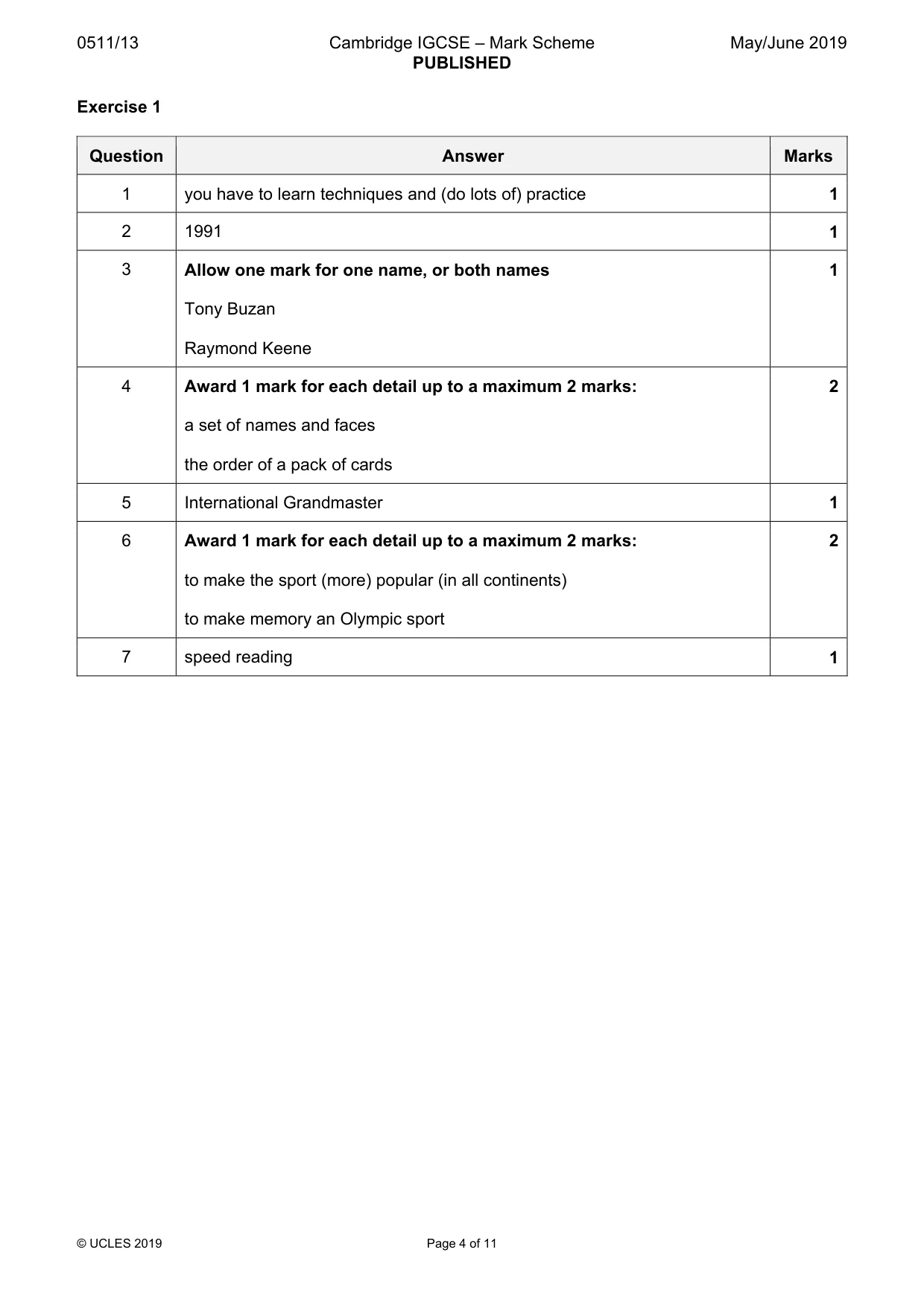
0511/13 Cambridge IGCSE – Mark Scheme PUBLISHED May/June 2019 © UCLES 2019 Page 4 of 11 Exercise 1 Question Answer Marks 1 you have to learn techniques and (do lots of) practice 1 2 1991 1 3 Allow one mark for one name, or both names Tony Buzan Raymond Keene 1 4 Award 1 mark for each detail up to a maximum 2 marks: a set of names and faces the order of a pack of cards 2 5 International Grandmaster 1 6 Award 1 mark for each detail up to a maximum 2 marks: to make the sport (more) popular (in all continents) to make memory an Olympic sport 2 7 speed reading 1
Mark scheme, page 5
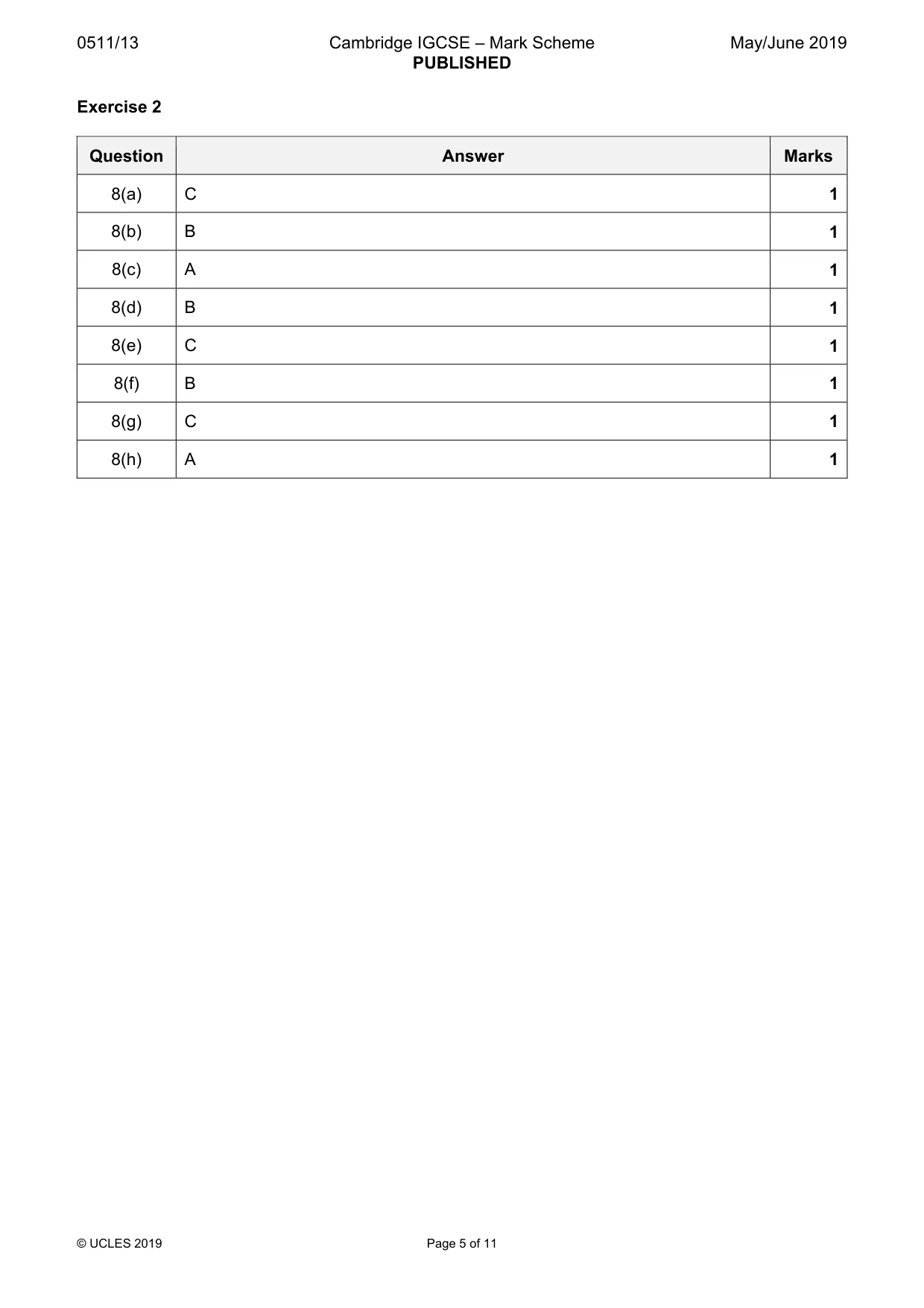
0511/13 Cambridge IGCSE – Mark Scheme PUBLISHED May/June 2019 © UCLES 2019 Page 5 of 11 Exercise 2 Question Answer Marks 8(a) C 1 8(b) B 1 8(c) A 1 8(d) B 1 8(e) C 1 8(f) B 1 8(g) C 1 8(h) A 1
Mark scheme, page 6
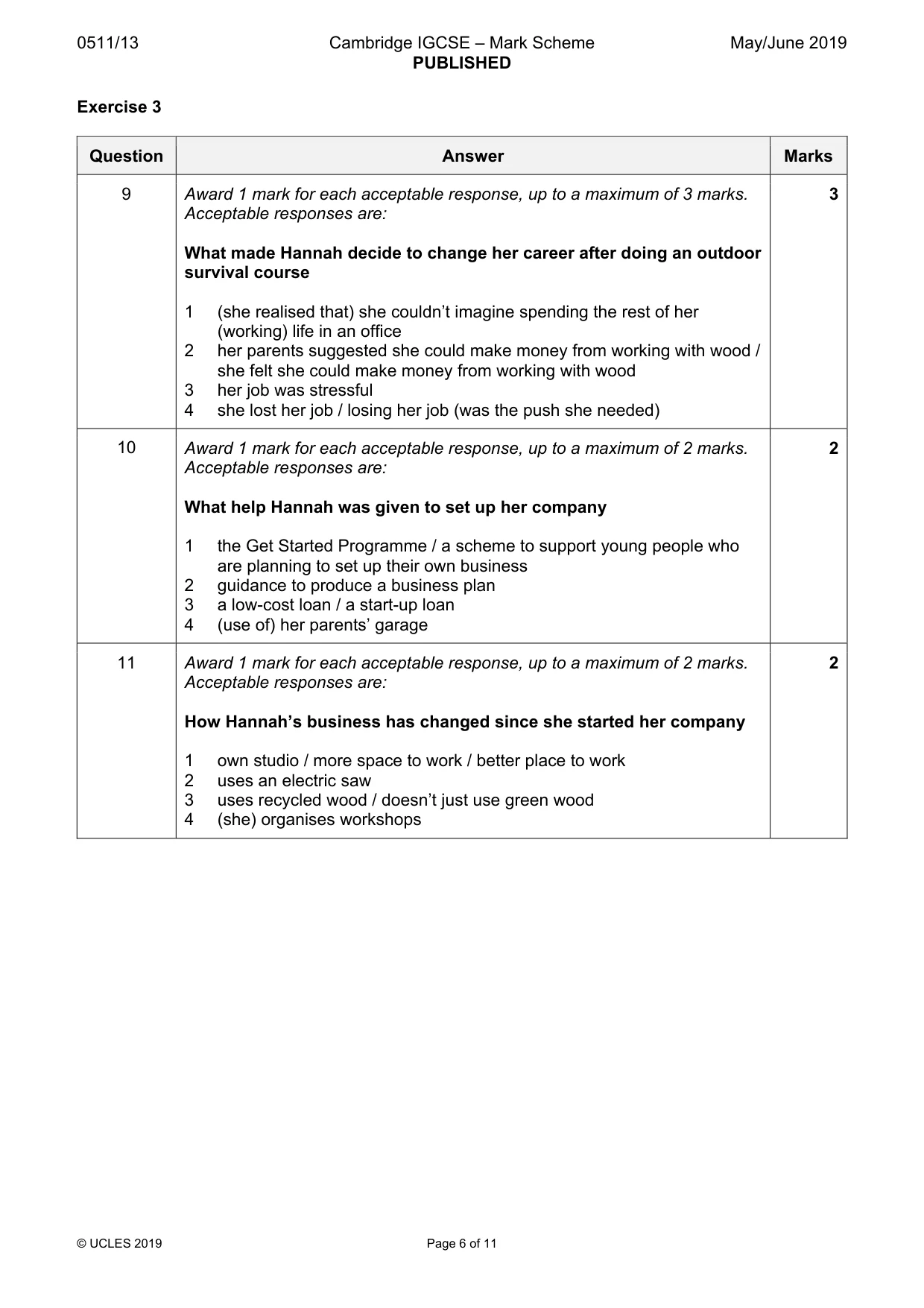
0511/13 Cambridge IGCSE – Mark Scheme PUBLISHED May/June 2019 © UCLES 2019 Page 6 of 11 Exercise 3 Question Answer Marks 9 Award 1 mark for each acceptable response, up to a maximum of 3 marks. Acceptable responses are: What made Hannah decide to change her career after doing an outdoor survival course 1 (she realised that) she couldn’t imagine spending the rest of her (working) life in an office 2 her parents suggested she could make money from working with wood / she felt she could make money from working with wood 3 her job was stressful 4 she lost her job / losing her job (was the push she needed) 3 10 Award 1 mark for each acceptable response, up to a maximum of 2 marks. Acceptable responses are: What help Hannah was given to set up her company 1 the Get Started Programme / a scheme to support young people who are planning to set up their own business 2 guidance to produce a business plan 3 a low-cost loan / a start-up loan 4 (use of) her parents’ garage 2 11 Award 1 mark for each acceptable response, up to a maximum of 2 marks. Acceptable responses are: How Hannah’s business has changed since she started her company 1 own studio / more space to work / better place to work 2 uses an electric saw 3 uses recycled wood / doesn’t just use green wood 4 (she) organises workshops 2
Mark scheme, page 7
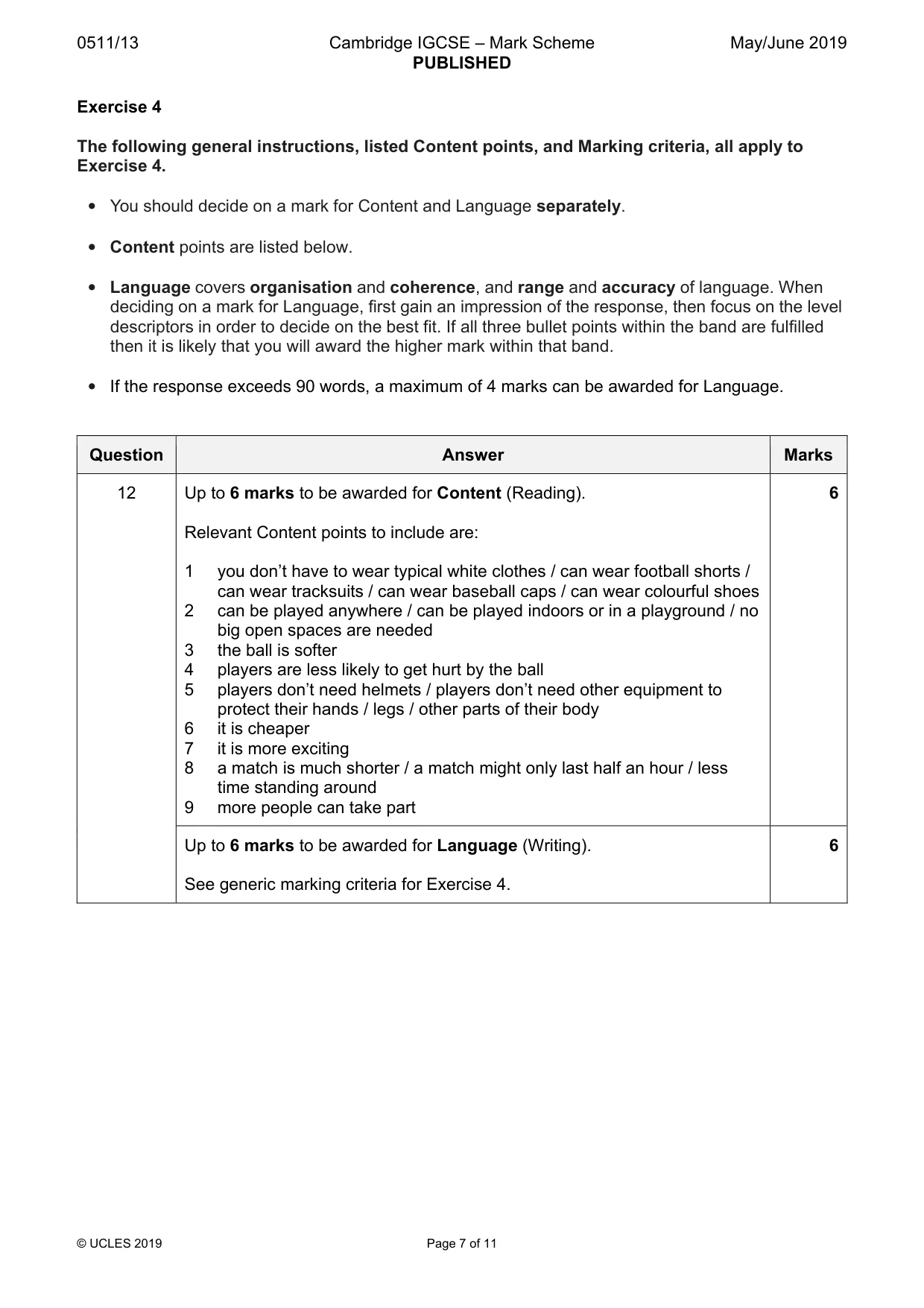
0511/13 Cambridge IGCSE – Mark Scheme PUBLISHED May/June 2019 © UCLES 2019 Page 7 of 11 Exercise 4 The following general instructions, listed Content points, and Marking criteria, all apply to Exercise 4. • You should decide on a mark for Content and Language separately. • Content points are listed below. • Language covers organisation and coherence, and range and accuracy of language. When deciding on a mark for Language, first gain an impression of the response, then focus on the level descriptors in order to decide on the best fit. If all three bullet points within the band are fulfilled then it is likely that you will award the higher mark within that band. • If the response exceeds 90 words, a maximum of 4 marks can be awarded for Language. Question Answer Marks 12 Up to 6 marks to be awarded for Content (Reading). Relevant Content points to include are: 1 you don’t have to wear typical white clothes / can wear football shorts / can wear tracksuits / can wear baseball caps / can wear colourful shoes 2 can be played anywhere / can be played indoors or in a playground / no big open spaces are needed 3 the ball is softer 4 players are less likely to get hurt by the ball 5 players don’t need helmets / players don’t need other equipment to protect their hands / legs / other parts of their body 6 it is cheaper 7 it is more exciting 8 a match is much shorter / a match might only last half an hour / less time standing around 9 more people can take part 6 Up to 6 marks to be awarded for Language (Writing). See generic marking criteria for Exercise 4. 6
Mark scheme, page 8
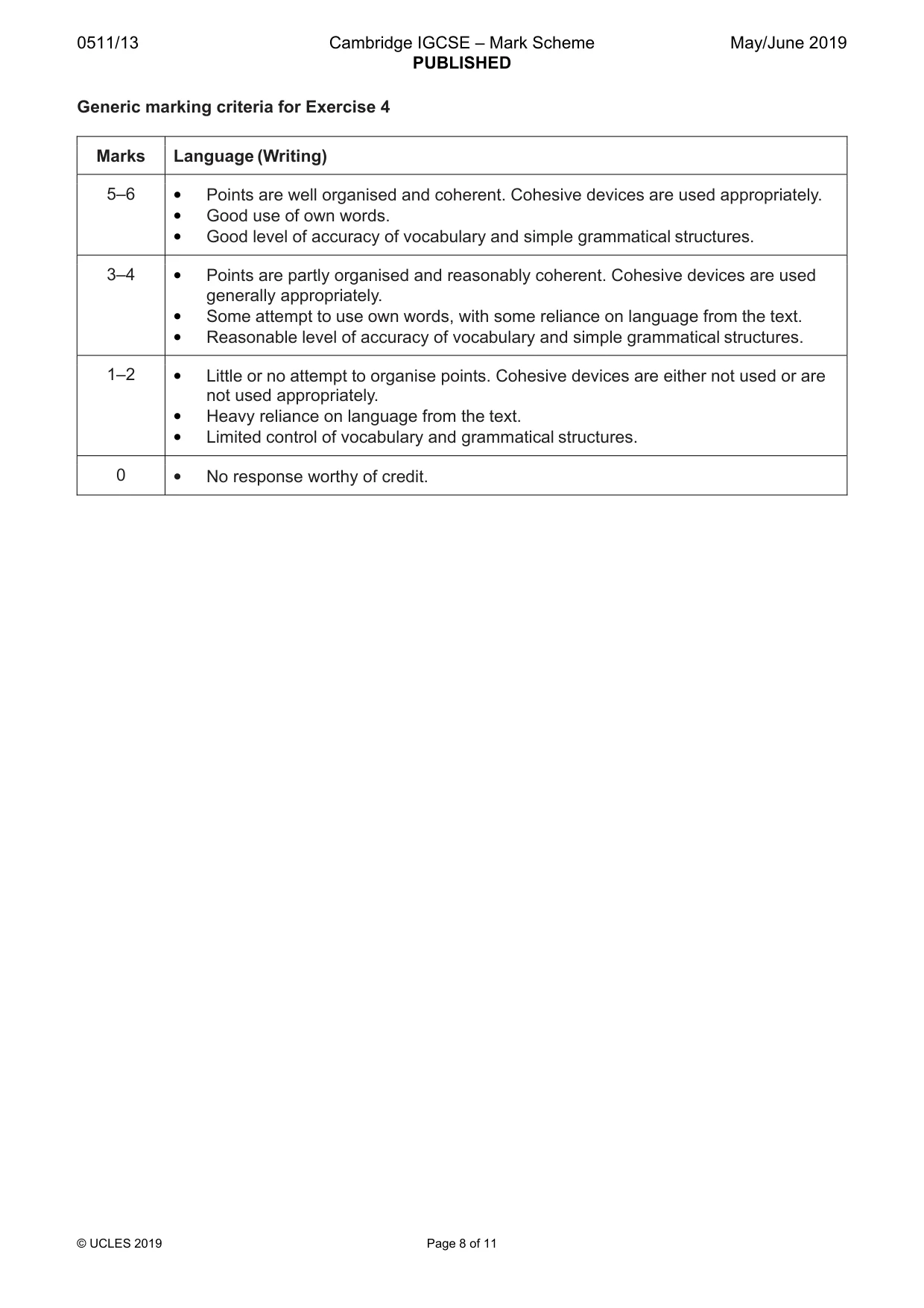
0511/13 Cambridge IGCSE – Mark Scheme PUBLISHED May/June 2019 © UCLES 2019 Page 8 of 11 Generic marking criteria for Exercise 4 Marks Language (Writing) 5–6 • Points are well organised and coherent. Cohesive devices are used appropriately. • Good use of own words. • Good level of accuracy of vocabulary and simple grammatical structures. 3–4 • Points are partly organised and reasonably coherent. Cohesive devices are used generally appropriately. • Some attempt to use own words, with some reliance on language from the text. • Reasonable level of accuracy of vocabulary and simple grammatical structures. 1–2 • Little or no attempt to organise points. Cohesive devices are either not used or are not used appropriately. • Heavy reliance on language from the text. • Limited control of vocabulary and grammatical structures. 0 • No response worthy of credit.
Mark scheme, page 9
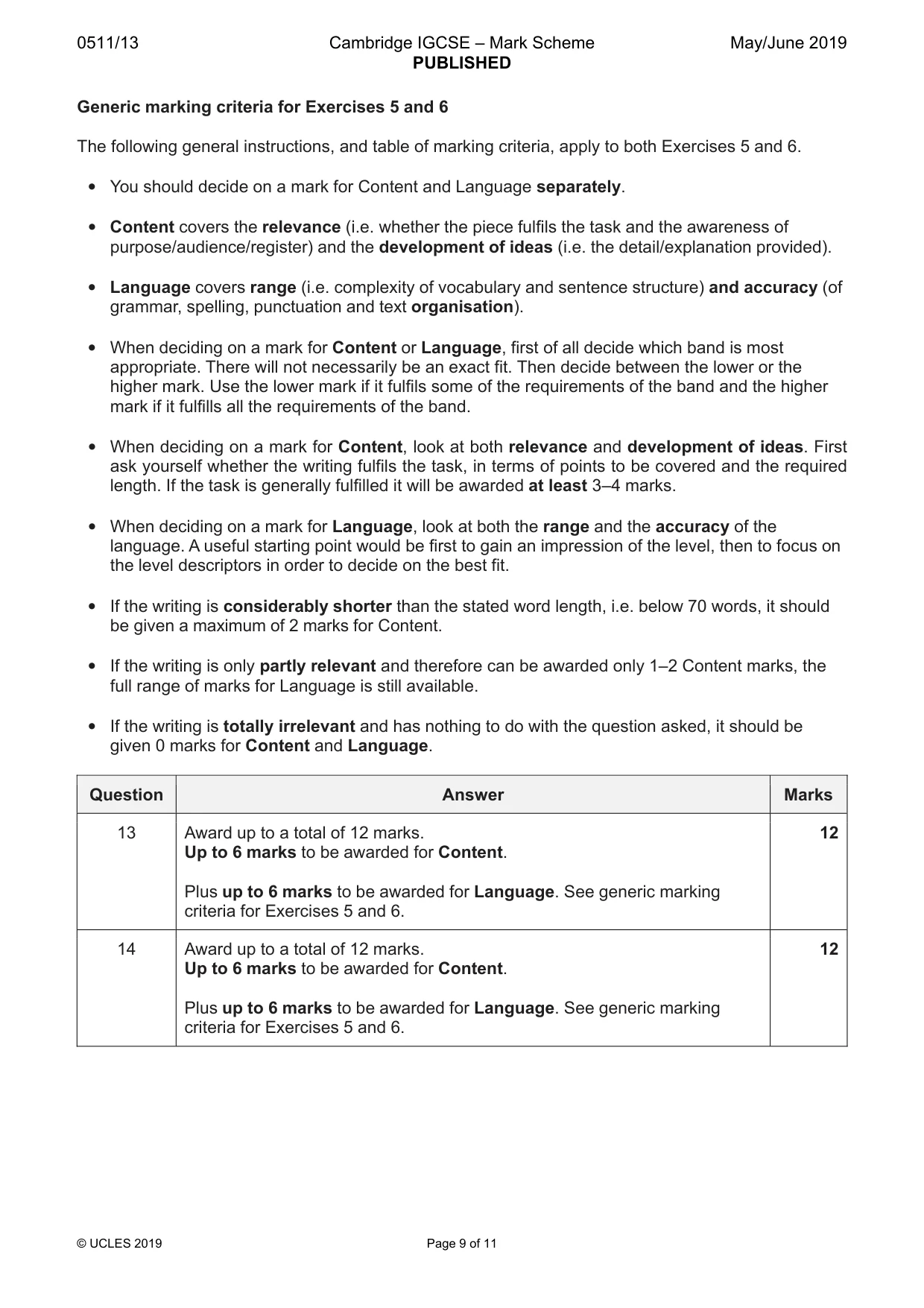
0511/13 Cambridge IGCSE – Mark Scheme PUBLISHED May/June 2019 © UCLES 2019 Page 9 of 11 Generic marking criteria for Exercises 5 and 6 The following general instructions, and table of marking criteria, apply to both Exercises 5 and 6. • You should decide on a mark for Content and Language separately. • Content covers the relevance (i.e. whether the piece fulfils the task and the awareness of purpose/audience/register) and the development of ideas (i.e. the detail/explanation provided). • Language covers range (i.e. complexity of vocabulary and sentence structure) and accuracy (of grammar, spelling, punctuation and text organisation). • When deciding on a mark for Content or Language, first of all decide which band is most appropriate. There will not necessarily be an exact fit. Then decide between the lower or the higher mark. Use the lower mark if it fulfils some of the requirements of the band and the higher mark if it fulfills all the requirements of the band. • When deciding on a mark for Content, look at both relevance and development of ideas. First ask yourself whether the writing fulfils the task, in terms of points to be covered and the required length. If the task is generally fulfilled it will be awarded at least 3–4 marks. • When deciding on a mark for Language, look at both the range and the accuracy of the language. A useful starting point would be first to gain an impression of the level, then to focus on the level descriptors in order to decide on the best fit. • If the writing is considerably shorter than the stated word length, i.e. below 70 words, it should be given a maximum of 2 marks for Content. • If the writing is only partly relevant and therefore can be awarded only 1–2 Content marks, the full range of marks for Language is still available. • If the writing is totally irrelevant and has nothing to do with the question asked, it should be given 0 marks for Content and Language. Question Answer Marks 13 Award up to a total of 12 marks. Up to 6 marks to be awarded for Content. Plus up to 6 marks to be awarded for Language. See generic marking criteria for Exercises 5 and 6. 12 14 Award up to a total of 12 marks. Up to 6 marks to be awarded for Content. Plus up to 6 marks to be awarded for Language. See generic marking criteria for Exercises 5 and 6. 12
Mark scheme, page 10
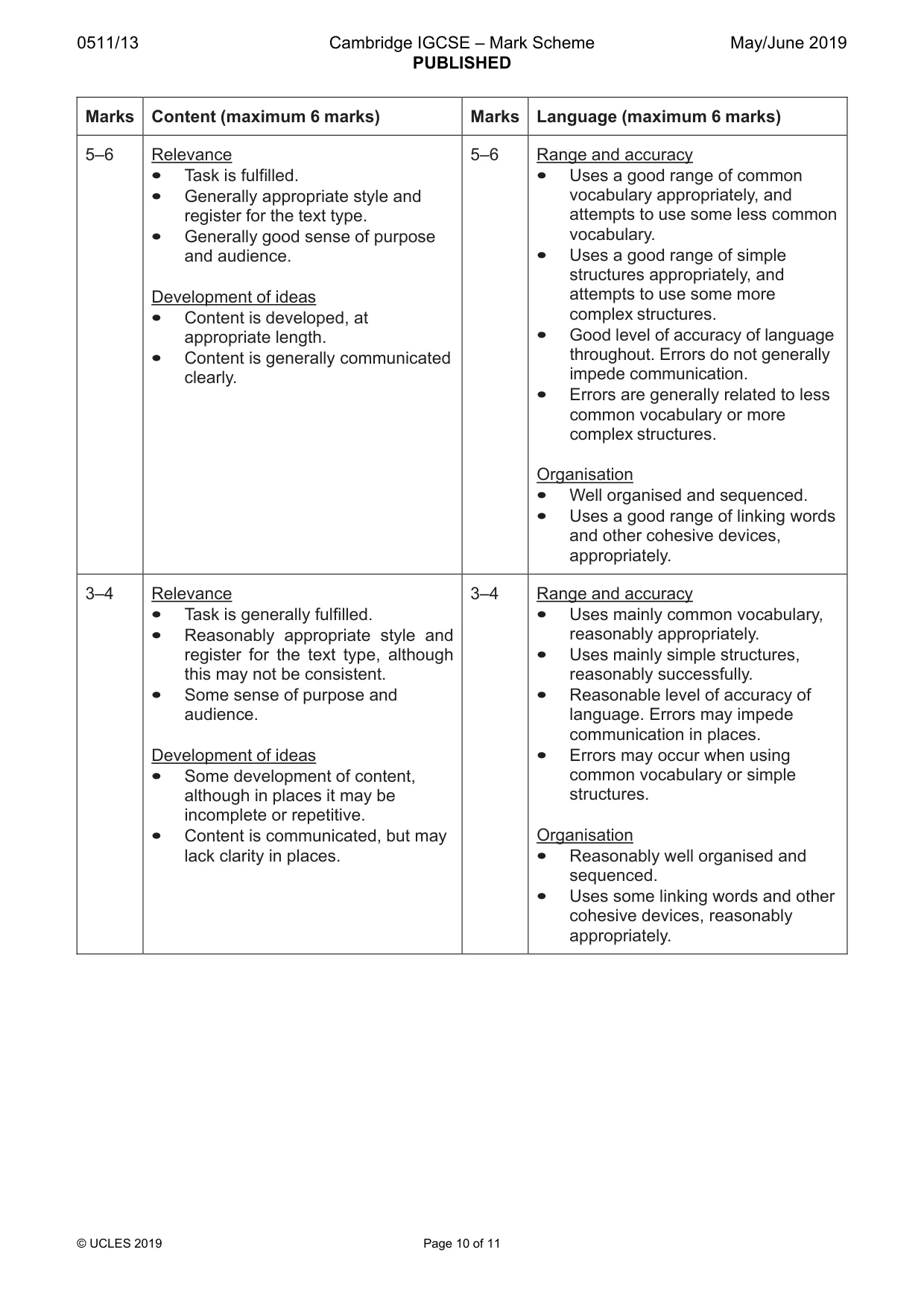
0511/13 Cambridge IGCSE – Mark Scheme PUBLISHED May/June 2019 © UCLES 2019 Page 10 of 11 Marks Content (maximum 6 marks) Marks Language (maximum 6 marks) 5–6 Relevance • Task is fulfilled. • Generally appropriate style and register for the text type. • Generally good sense of purpose and audience. Development of ideas • Content is developed, at appropriate length. • Content is generally communicated clearly. 5–6 Range and accuracy • Uses a good range of common vocabulary appropriately, and attempts to use some less common vocabulary. • Uses a good range of simple structures appropriately, and attempts to use some more complex structures. • Good level of accuracy of language throughout. Errors do not generally impede communication. • Errors are generally related to less common vocabulary or more complex structures. Organisation • Well organised and sequenced. • Uses a good range of linking words and other cohesive devices, appropriately. 3–4 Relevance • Task is generally fulfilled. • Reasonably appropriate style and register for the text type, although this may not be consistent. • Some sense of purpose and audience. Development of ideas • Some development of content, although in places it may be incomplete or repetitive. • Content is communicated, but may lack clarity in places. 3–4 Range and accuracy • Uses mainly common vocabulary, reasonably appropriately. • Uses mainly simple structures, reasonably successfully. • Reasonable level of accuracy of language. Errors may impede communication in places. • Errors may occur when using common vocabulary or simple structures. Organisation • Reasonably well organised and sequenced. • Uses some linking words and other cohesive devices, reasonably appropriately.
Mark scheme, page 11
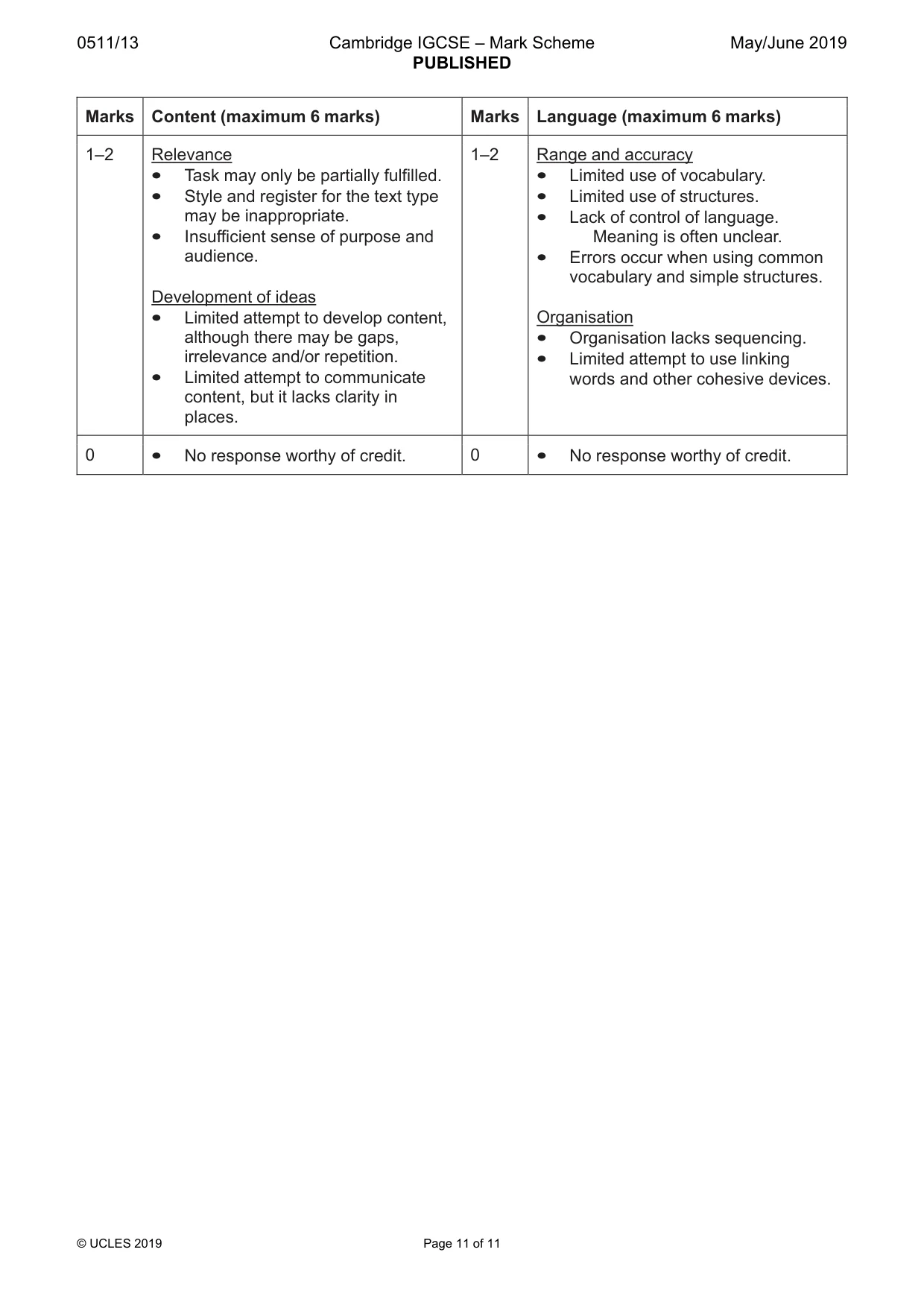
0511/13 Cambridge IGCSE – Mark Scheme PUBLISHED May/June 2019 © UCLES 2019 Page 11 of 11 Marks Content (maximum 6 marks) Marks Language (maximum 6 marks) 1–2 Relevance • Task may only be partially fulfilled. • Style and register for the text type may be inappropriate. • Insufficient sense of purpose and audience. Development of ideas • Limited attempt to develop content, although there may be gaps, irrelevance and/or repetition. • Limited attempt to communicate content, but it lacks clarity in places. 1–2 Range and accuracy • Limited use of vocabulary. • Limited use of structures. • Lack of control of language. Meaning is often unclear. • Errors occur when using common vocabulary and simple structures. Organisation • Organisation lacks sequencing. • Limited attempt to use linking words and other cohesive devices. 0 • No response worthy of credit. 0 • No response worthy of credit.
What you needed in this session
Cambridge’s own grade thresholds for 2019 May/June, Paper 1 · Variant 3. A higher threshold means an easier paper — the bar moves with how the cohort did.