Cambridge IGCSE English - Second Language (count-in oral) 0511 — 2023 May/June Paper 1 · Variant 3
0511/13/M/J/23 · 60 marks · ≈68 min
The question paper and its mark scheme, free to read here and free to download. This is Cambridge’s own paper, exactly as it was sat.
Question paper16 pages



Mark scheme9 pages
Answers below. Sit the paper first if you are practising.
Paper as text
Question paper, page 1
This document has 16 pages. Any blank pages are indicated. [Turn over Cambridge IGCSE™ * 6 4 3 2 9 0 4 6 9 3 * DC (LK) 327064 © UCLES 2023 ENGLISH AS A SECOND LANGUAGE 0511/13 Paper 1 Reading and Writing (Core) May/June 2023 1 hour 30 minutes You must answer on the question paper. No additional materials are needed. INSTRUCTIONS ● Answer all questions. ● Use a black or dark blue pen. ● Write your name, centre number and candidate number in the boxes at the top of the page. ● Write your answer to each question in the space provided. ● Do not use an erasable pen or correction fluid. ● Do not write on any bar codes. ● Dictionaries are not allowed. INFORMATION ● The total mark for this paper is 60. ● The number of marks for each question or part question is shown in brackets [ ].
Question paper, page 2
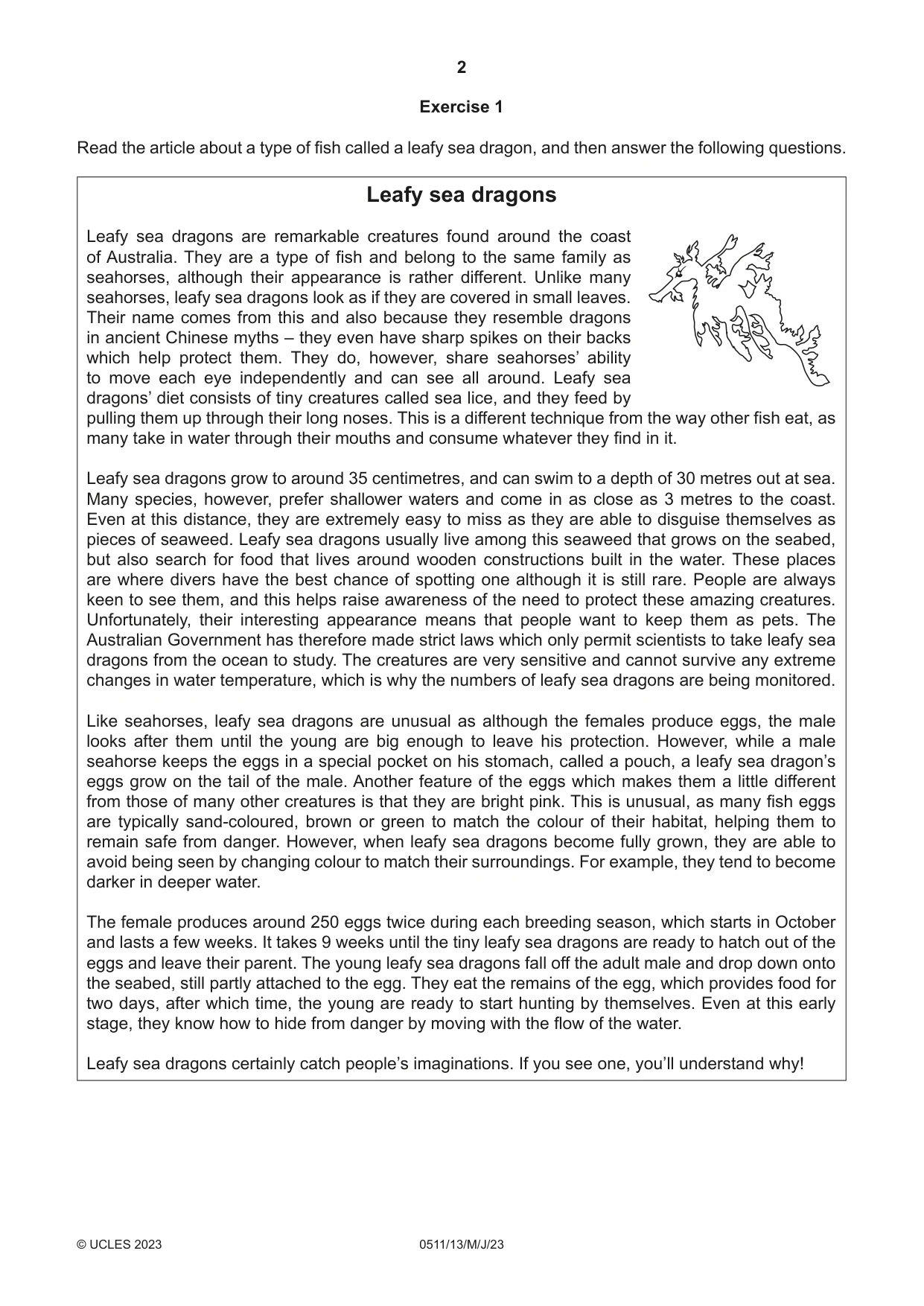
2 0511/13/M/J/23 © UCLES 2023 Exercise 1 Read the article about a type of fish called a leafy sea dragon, and then answer the following questions. Leafy sea dragons Leafy sea dragons are remarkable creatures found around the coast of Australia. They are a type of fish and belong to the same family as seahorses, although their appearance is rather different. Unlike many seahorses, leafy sea dragons look as if they are covered in small leaves. Their name comes from this and also because they resemble dragons in ancient Chinese myths – they even have sharp spikes on their backs which help protect them. They do, however, share seahorses’ ability to move each eye independently and can see all around. Leafy sea dragons’ diet consists of tiny creatures called sea lice, and they feed by pulling them up through their long noses. This is a different technique from the way other fish eat, as many take in water through their mouths and consume whatever they find in it. Leafy sea dragons grow to around 35 centimetres, and can swim to a depth of 30 metres out at sea. Many species, however, prefer shallower waters and come in as close as 3 metres to the coast. Even at this distance, they are extremely easy to miss as they are able to disguise themselves as pieces of seaweed. Leafy sea dragons usually live among this seaweed that grows on the seabed, but also search for food that lives around wooden constructions built in the water. These places are where divers have the best chance of spotting one although it is still rare. People are always keen to see them, and this helps raise awareness of the need to protect these amazing creatures. Unfortunately, their interesting appearance means that people want to keep them as pets. The Australian Government has therefore made strict laws which only permit scientists to take leafy sea dragons from the ocean to study. The creatures are very sensitive and cannot survive any extreme changes in water temperature, which is why the numbers of leafy sea dragons are being monitored. Like seahorses, leafy sea dragons are unusual as although the females produce eggs, the male looks after them until the young are big enough to leave his protection. However, while a male seahorse keeps the eggs in a special pocket on his stomach, called a pouch, a leafy sea dragon’s eggs grow on the tail of the male. Another feature of the eggs which makes them a little different from those of many other creatures is that they are bright pink. This is unusual, as many fish eggs are typically sand-coloured, brown or green to match the colour of their habitat, helping them to remain safe from danger. However, when leafy sea dragons become fully grown, they are able to avoid being seen by changing colour to match their surroundings. For example, they tend to become darker in deeper water. The female produces around 250 eggs twice during each breeding season, which starts in October and lasts a few weeks. It takes 9 weeks until the tiny leafy sea dragons are ready to hatch out of the eggs and leave their parent. The young leafy sea dragons fall off the adult male and drop down onto the seabed, still partly attached to the egg. They eat the remains of the egg, which provides food for two days, after which time, the young are ready to start hunting by themselves. Even at this early stage, they know how to hide from danger by moving with the flow of the water. Leafy sea dragons certainly catch people’s imaginations. If you see one, you’ll understand why!
Question paper, page 3
3 0511/13/M/J/23 © UCLES 2023 [Turn over 1 How do leafy sea dragons eat their food? … [1] 2 How near to the shore can leafy sea dragons be found? … [1] 3 Where are you more likely to see a leafy sea dragon if you are diving in Australia? … [1] 4 What dangers do leafy sea dragons face? Give two details. … … [2] 5 Where do leafy sea dragon eggs develop? … [1] 6 What colour are the eggs of leafy sea dragons? … [1] 7 How many times do leafy sea dragons lay eggs in a year? … [1] 8 How do the young leafy sea dragons get food before they become independent? … [1] [Total: 9]
Question paper, page 4
4 0511/13/M/J/23 © UCLES 2023 Exercise 2 Read the article about three people (A–C) who each have a favourite song. Then answer Question 9(a)–(h). My Favourite Song A Yashi: Perfect Moon Perfect Moon is a song that’s important to me. It’s one my mum has played every now and again for as long as I can remember. She always talks about first hearing it on holiday, and how it brings back memories of that special time – which I guess is why she loves it, and now I love it too! And I know that won’t change, since it’s the one I turn to when things aren’t going too well, or I need cheering up. Although the singer’s recorded a lot of songs in the past, this is the one that I think shows off her talent the best. And even though when I play it on my phone my mates all laugh about how old-fashioned they think it is, I don’t mind! I know they’re only teasing, and I’d still recommend it to anyone who loves beautiful music. B Peta: Whole World The song I love, Whole World, is rather special. You see, it was written for me by my dad! He sang in a band – not one that was well known, but at one point it was important enough to play at a few festivals. There were even some in Spain and France, but I was too young to go, unfortunately! I used to think no one would ever write a better song, although I’ve come to appreciate that’s not actually the case – my dad won’t mind me saying that! But the most exciting moment for our family was when his band went on to record the song in a studio. They even performed it at some of their concerts when I was older – can you imagine how great it was for me, being in the crowd at a local festival, listening to everyone singing along to MY song? It’s definitely an old favourite and it’s become a bit of a tradition to play it on my birthday. It’s one I’ll keep for sure! C Sue: Tell Me I’m not sure if many people will have heard of my favourite song. It’s called Tell Me, and I think I like it so much because it’s just a really happy song! I find it’s the perfect choice of song to play when I’m in a great mood and just want to sing loudly and dance around my room. There’s also something about the fact that the lead singer isn’t singing in her first language – it allows her accent to come through in the song. When it came out a few years ago now, I had a lot going on, you know, a lot of big changes like moving schools, and I guess I was still finding my way a little. It’s funny how just hearing a song brings back all sorts of memories of a particular time, isn’t it! The song is quite different to a lot of other music I listen to, but I really think it’s good to have a variety, and I don’t think I’ll ever stop listening to it.
Question paper, page 5
5 0511/13/M/J/23 © UCLES 2023 [Turn over 9 For each question, write the correct letter A, B or C on the line. Which person … (a) says she first heard the song at an important time of her life? … [1] (b) explains how she felt hearing the song with other people who liked it too? … [1] (c) explains how the song can affect how she is feeling? … [1] (d) admits that her feelings about the song have changed? … [1] (e) suggests it is very different to the songs her friends like? … [1] (f) mentions how the singer’s background affected the song? … [1] (g) mentions a special time when she likes to listen to the song? … [1] (h) compares the song with the singer’s other work? … [1] [Total: 8]
Question paper, page 6
6 0511/13/M/J/23 © UCLES 2023 Exercise 3 Read the article about designing buildings, and then complete the notes. Designing buildings Most of us spend the majority of our lives indoors. But how often do we stop to consider the design of buildings where we spend so much time? When we’re not in our homes, we’re in various public places, including schools or places of work. Apparently, research shows that in well-designed buildings, people take less time off, so you can clearly see that design matters! Of course, there are also practical considerations which can affect the design of a building, like the date to complete a project, which the architects and designers involved in creating buildings can’t avoid. Given enough time, however, there’s no end to how amazing a building can be. A key consideration for those who design buildings is being aware of the performance requirements – in other words, understanding what a space will be used for. There’s no point in designing a building with lovely large open-plan rooms if what’s needed are smaller spaces where people can talk privately or work individually without interruption. It’s generally agreed that we work more efficiently when there are different-sized spaces to suit our individual needs, whether the building is designed for work or study. Of course, we all need to be able to concentrate on whatever task we’re occupied with. If you’re working on something artistic, then it might be useful to know that higher ceilings can generate more creative thoughts. So perhaps that’s something to remember when you’re struggling to write your next novel or trying to find the perfect lyrics to a song! Now, you might think that staring out of the window is certain to result in a lack of concentration, but actually, having windows with views of natural scenes can help people pay better attention to what they’re doing. While it might not always be possible to have great views – the position of neighbouring properties might get in the way, for example – it’s certainly worth bearing in mind. If a country is naturally very hot and sunny, then perhaps large windows might not be the most practical idea, so building designers also need to think carefully about the local climate conditions. It is perfectly possible to use special glass, but it can be expensive and may put it outside the available budget. It is not just the structural features of the building that are important; the interior design features also play an essential role in a well-designed building. The level of lighting changes how fast people move around a building. This is why, for example, bright lighting is often used in places such as fast-food-style canteens as it encourages people to move more quickly. And lighting isn’t the only thing that should be carefully considered. Scientific research has shown that certain colour schemes can alter people’s mood quite significantly. As you can see, therefore, the buildings that we use every day can have more effect on our lives than we might realise at first.
Question paper, page 7
7 0511/13/M/J/23 © UCLES 2023 [Turn over You are going to give a talk about building design to your class at school. Prepare some notes to use as the basis for your talk. Make short notes under each heading. 10 The effects that a well-designed building can have on people: • … • … • … • … [4] 11 Factors which influence a designer’s plans for a building: • … • … • … [3] [Total: 7]
Question paper, page 8
8 0511/13/M/J/23 © UCLES 2023 Exercise 4 12 Read the article about sailing. Write a summary about the skills you can gain from learning to sail. Your summary should be about 80 words long (and no more than 90 words long). You should use your own words as far as possible. You will receive up to 6 marks for the content of your summary, and up to 6 marks for the style and accuracy of your language. Learning to sail Have you ever been on a sailing boat? If so, then you’ll know what fun it can be! Did you know that sailing’s included on the training courses of some professions – not necessarily ones connected with the water? That’s because learning to sail offers an all-round learning experience. For example, when you’re learning to sail, you must make choices quickly about what to do next. This is an important ability in other areas of life too. Sailing is very much a team activity. Each crew member has a job to do and it is essential that everyone learns to work well together. However, there isn’t always time for discussion as weather conditions at sea can change without warning. If you’re the person in charge, then communicating instructions in a clear way is vital. You might not find this easy, but you should keep trying. If you don’t, you risk confusing your crew, and that causes problems. This is what’s involved in being a good leader. It’s not a role that feels natural to everyone, but it’s something that can be developed, and learning to take charge of a boat is a great place to do this. Sailing can be great fun, but sometimes things can go wrong. It’s therefore crucial that all the safety equipment is working. If you’re responsible for these checks, you must be completely focused on what you are doing and avoid distractions until you’ve finished. It could make all the difference in an emergency. If you’re on a boat with more experienced sailors, watch how they move the sails to catch the wind and vary speed. Listen carefully to what they tell you as learning to take advice from people who know more than you is always useful. When you sail regularly with a crew, you’re likely to see an increase in your ability to complete several tasks at the same time. You might be pulling ropes while you’re checking sails and confirming your position. This isn’t straightforward, but it’s a great way of helping you to trust in yourself, and is of huge benefit to sailors.
Question paper, page 9
9 0511/13/M/J/23 © UCLES 2023 [Turn over … … … … … … … … … … … … … … [Total: 12]
Question paper, page 10
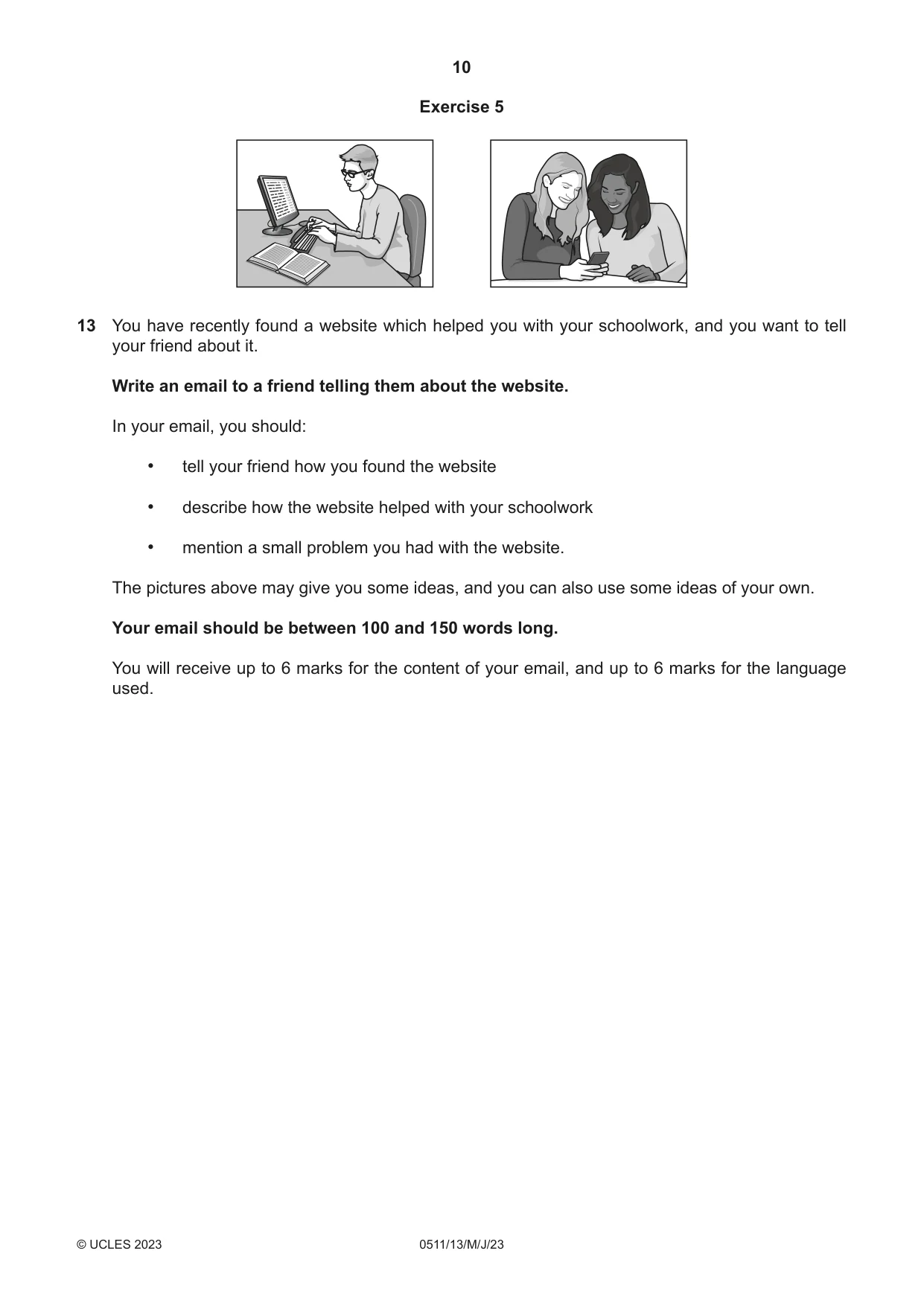
10 0511/13/M/J/23 © UCLES 2023 Exercise 5 13 You have recently found a website which helped you with your schoolwork, and you want to tell your friend about it. Write an email to a friend telling them about the website. In your email, you should: • tell your friend how you found the website • describe how the website helped with your schoolwork • mention a small problem you had with the website. The pictures above may give you some ideas, and you can also use some ideas of your own. Your email should be between 100 and 150 words long. You will receive up to 6 marks for the content of your email, and up to 6 marks for the language used.
Question paper, page 11
11 0511/13/M/J/23 © UCLES 2023 [Turn over … … … … … … … … … … … … … … … … … … … … … … … … … … … [Total: 12]
Question paper, page 12
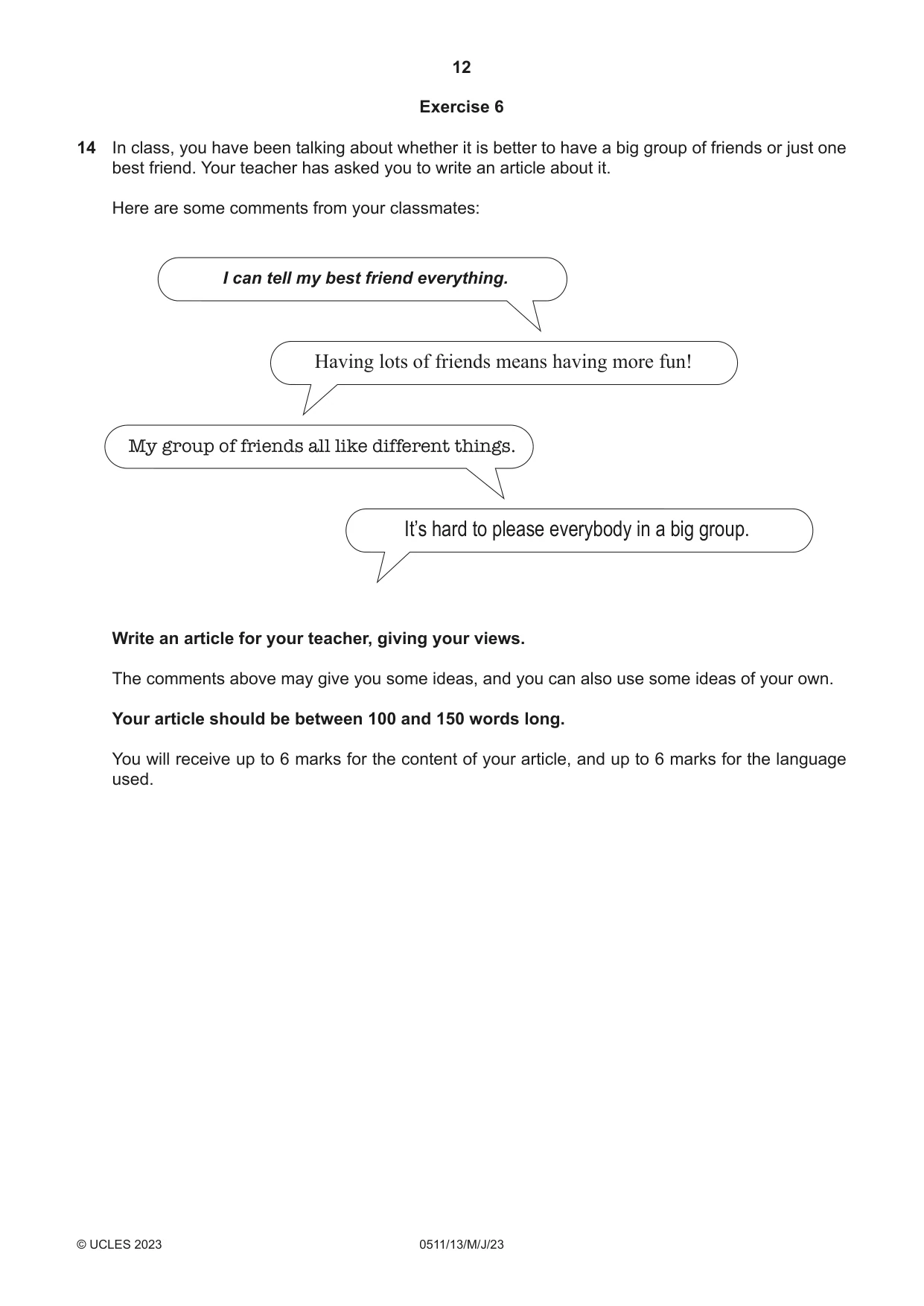
12 0511/13/M/J/23 © UCLES 2023 Exercise 6 14 In class, you have been talking about whether it is better to have a big group of friends or just one best friend. Your teacher has asked you to write an article about it. Here are some comments from your classmates: I can tell my best friend everything. Having lots of friends means having more fun! My group of friends all like different things. It’s hard to please everybody in a big group. Write an article for your teacher, giving your views. The comments above may give you some ideas, and you can also use some ideas of your own. Your article should be between 100 and 150 words long. You will receive up to 6 marks for the content of your article, and up to 6 marks for the language used.
Question paper, page 13
13 0511/13/M/J/23 © UCLES 2023 … … … … … … … … … … … … … … … … … … … … … … … … … … … [Total: 12]
Question paper, page 14
14 0511/13/M/J/23 © UCLES 2023 BLANK PAGE
Question paper, page 15
15 0511/13/M/J/23 © UCLES 2023 BLANK PAGE
Question paper, page 16
16 0511/13/M/J/23 © UCLES 2023 Permission to reproduce items where third-party owned material protected by copyright is included has been sought and cleared where possible. Every reasonable effort has been made by the publisher (UCLES) to trace copyright holders, but if any items requiring clearance have unwittingly been included, the publisher will be pleased to make amends at the earliest possible opportunity. To avoid the issue of disclosure of answer-related information to candidates, all copyright acknowledgements are reproduced online in the Cambridge Assessment International Education Copyright Acknowledgements Booklet. This is produced for each series of examinations and is freely available to download at www.cambridgeinternational.org after the live examination series. Cambridge Assessment International Education is part of Cambridge Assessment. Cambridge Assessment is the brand name of the University of Cambridge Local Examinations Syndicate (UCLES), which is a department of the University of Cambridge. BLANK PAGE
Mark scheme, page 1
This document consists of 9 printed pages. © UCLES 2023 [Turn over Cambridge IGCSE™ ENGLISH AS A SECOND LANGUAGE 0511/13 Paper 1 Reading and Writing (Core) May/June 2023 MARK SCHEME Maximum Mark: 60 Published This mark scheme is published as an aid to teachers and candidates, to indicate the requirements of the examination. It shows the basis on which Examiners were instructed to award marks. It does not indicate the details of the discussions that took place at an Examiners’ meeting before marking began, which would have considered the acceptability of alternative answers. Mark schemes should be read in conjunction with the question paper and the Principal Examiner Report for Teachers. Cambridge International will not enter into discussions about these mark schemes. Cambridge International is publishing the mark schemes for the May/June 2023 series for most Cambridge IGCSE, Cambridge International A and AS Level and Cambridge Pre-U components, and some Cambridge O Level components.
Mark scheme, page 2
0511/13 Cambridge IGCSE – Mark Scheme PUBLISHED May/June 2023 © UCLES 2023 Page 2 of 9 Generic Marking Principles These general marking principles must be applied by all examiners when marking candidate answers. They should be applied alongside the specific content of the mark scheme or generic level descriptors for a question. Each question paper and mark scheme will also comply with these marking principles. GENERIC MARKING PRINCIPLE 1: Marks must be awarded in line with: the specific content of the mark scheme or the generic level descriptors for the question the specific skills defined in the mark scheme or in the generic level descriptors for the question the standard of response required by a candidate as exemplified by the standardisation scripts. GENERIC MARKING PRINCIPLE 2: Marks awarded are always whole marks (not half marks, or other fractions). GENERIC MARKING PRINCIPLE 3: Marks must be awarded positively: marks are awarded for correct/valid answers, as defined in the mark scheme. However, credit is given for valid answers which go beyond the scope of the syllabus and mark scheme, referring to your Team Leader as appropriate marks are awarded when candidates clearly demonstrate what they know and can do marks are not deducted for errors marks are not deducted for omissions answers should only be judged on the quality of spelling, punctuation and grammar when these features are specifically assessed by the question as indicated by the mark scheme. The meaning, however, should be unambiguous. GENERIC MARKING PRINCIPLE 4: Rules must be applied consistently, e.g. in situations where candidates have not followed instructions or in the application of generic level descriptors. GENERIC MARKING PRINCIPLE 5: Marks should be awarded using the full range of marks defined in the mark scheme for the question (however; the use of the full mark range may be limited according to the quality of the candidate responses seen). GENERIC MARKING PRINCIPLE 6: Marks awarded are based solely on the requirements as defined in the mark scheme. Marks should not be awarded with grade thresholds or grade descriptors in mind.
Mark scheme, page 3
0511/13 Cambridge IGCSE – Mark Scheme PUBLISHED May/June 2023 © UCLES 2023 Page 3 of 9 This component forms part of the Core tier assessment of Cambridge IGCSE English as a Second Language and tests the following Assessment Objectives: AO1: Reading R1 identify and select relevant information R2 understand ideas, opinions and attitudes R3 show understanding of the connections between ideas, opinions and attitudes R4 understand what is implied but not directly stated, e.g. gist, writer’s purpose, intentions and feelings AO2: Writing W1 communicate information/ideas/opinions clearly, accurately and effectively W2 organise ideas into coherent paragraphs using a range of appropriate linking devices W3 use a range of grammatical structures accurately and effectively W4 show control of punctuation and spelling W5 use appropriate register and style/format for the given purpose and audience
Mark scheme, page 4
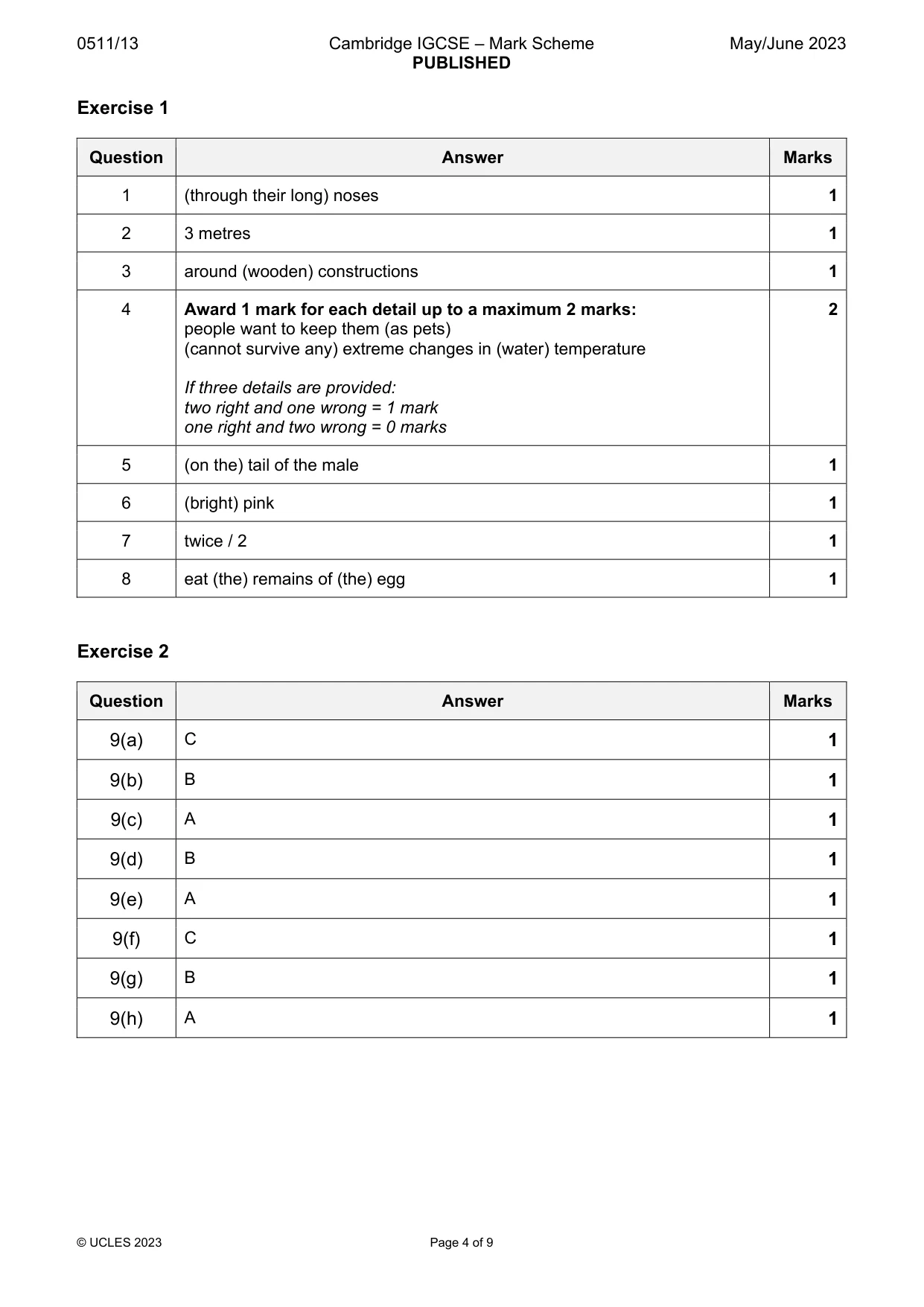
0511/13 Cambridge IGCSE – Mark Scheme PUBLISHED May/June 2023 © UCLES 2023 Page 4 of 9 Exercise 1 Question Answer Marks 1 (through their long) noses 1 2 3 metres 1 3 around (wooden) constructions 1 4 Award 1 mark for each detail up to a maximum 2 marks: people want to keep them (as pets) (cannot survive any) extreme changes in (water) temperature If three details are provided: two right and one wrong = 1 mark one right and two wrong = 0 marks 2 5 (on the) tail of the male 1 6 (bright) pink 1 7 twice / 2 1 8 eat (the) remains of (the) egg 1 Exercise 2 Question Answer Marks 9(a) C 1 9(b) B 1 9(c) A 1 9(d) B 1 9(e) A 1 9(f) C 1 9(g) B 1 9(h) A 1
Mark scheme, page 5
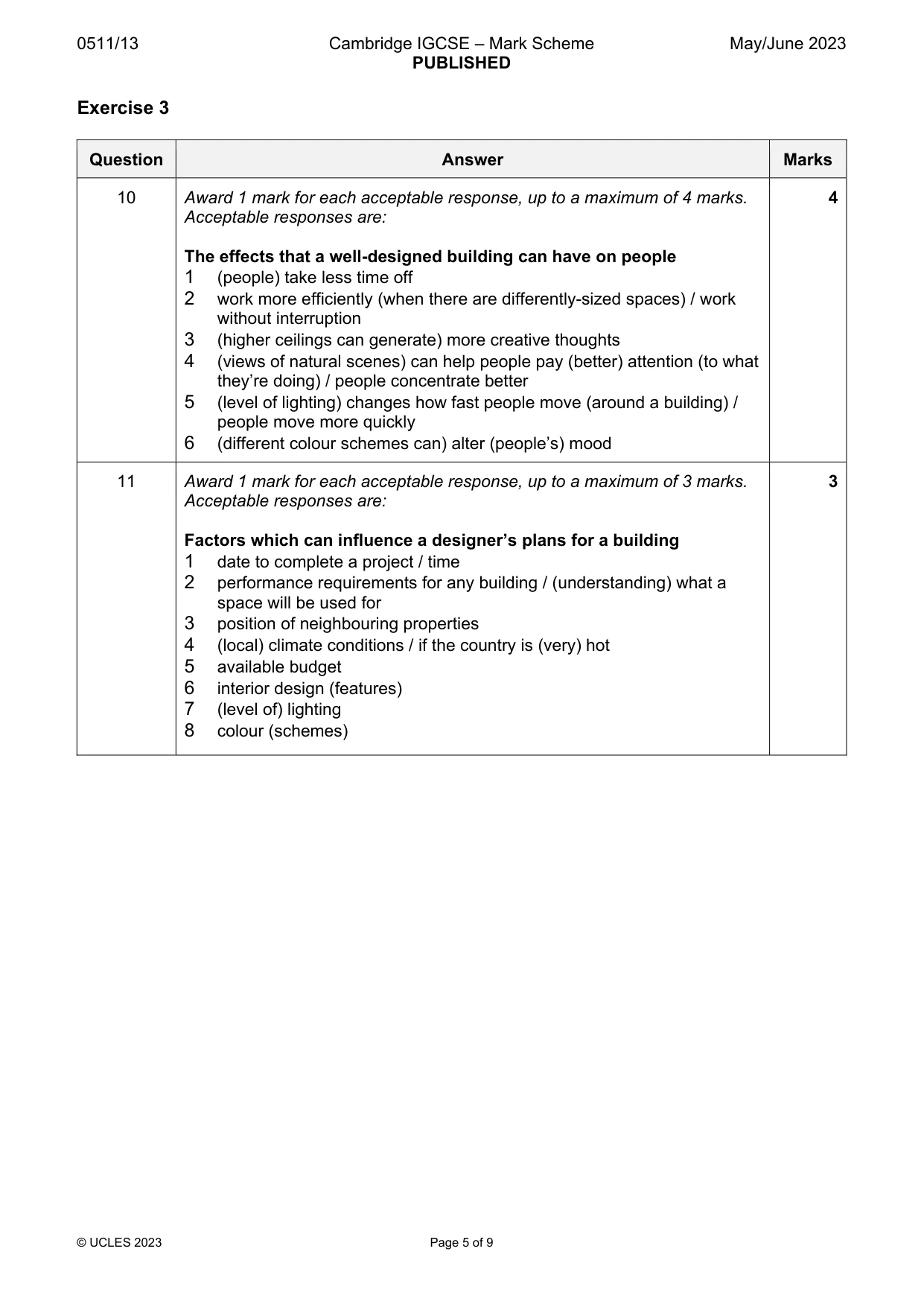
0511/13 Cambridge IGCSE – Mark Scheme PUBLISHED May/June 2023 © UCLES 2023 Page 5 of 9 Exercise 3 Question Answer Marks 10 Award 1 mark for each acceptable response, up to a maximum of 4 marks. Acceptable responses are: The effects that a well-designed building can have on people 1 (people) take less time off 2 work more efficiently (when there are differently-sized spaces) / work without interruption 3 (higher ceilings can generate) more creative thoughts 4 (views of natural scenes) can help people pay (better) attention (to what they’re doing) / people concentrate better 5 (level of lighting) changes how fast people move (around a building) / people move more quickly 6 (different colour schemes can) alter (people’s) mood 4 11 Award 1 mark for each acceptable response, up to a maximum of 3 marks. Acceptable responses are: Factors which can influence a designer’s plans for a building 1 date to complete a project / time 2 performance requirements for any building / (understanding) what a space will be used for 3 position of neighbouring properties 4 (local) climate conditions / if the country is (very) hot 5 available budget 6 interior design (features) 7 (level of) lighting 8 colour (schemes) 3
Mark scheme, page 6
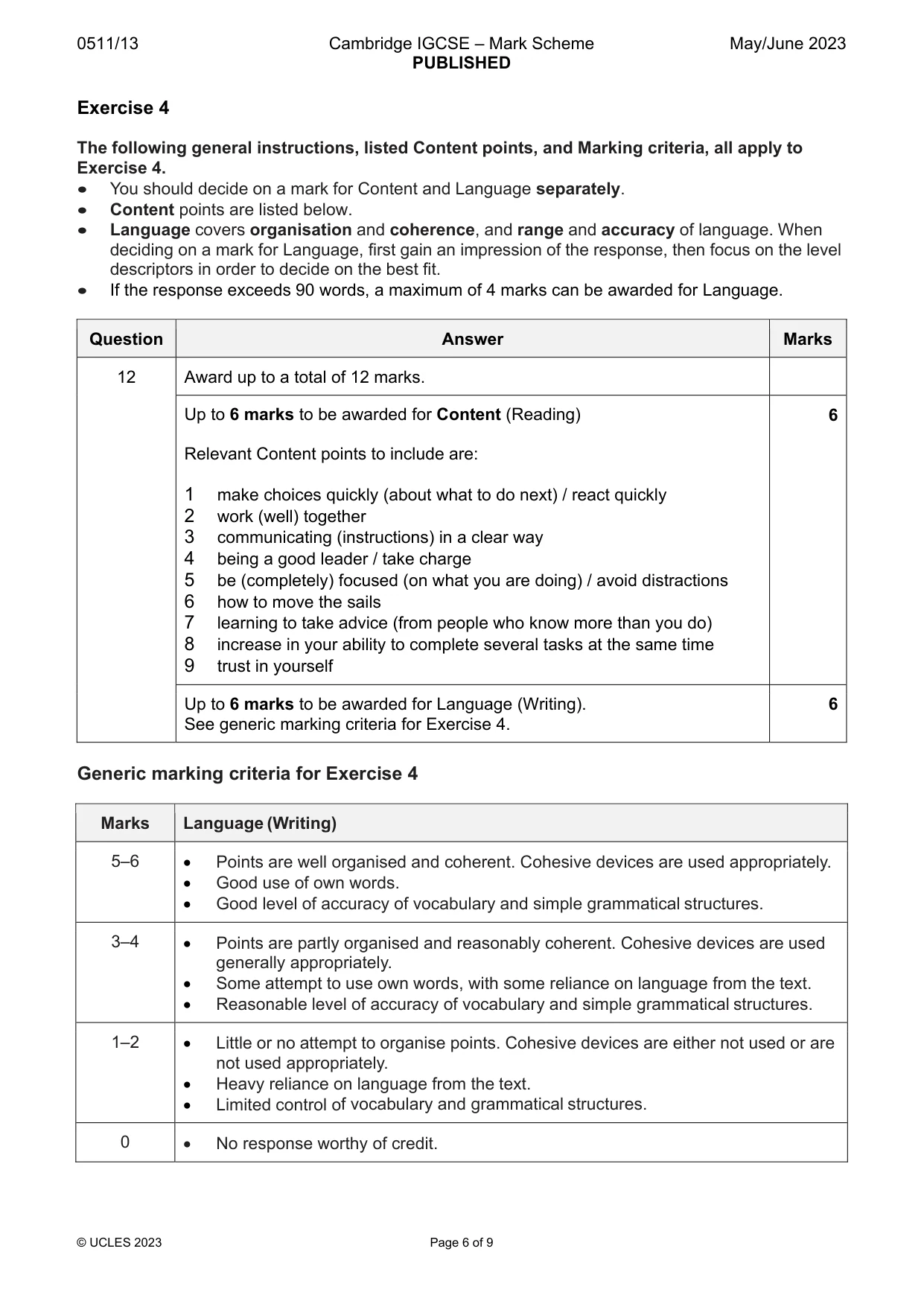
0511/13 Cambridge IGCSE – Mark Scheme PUBLISHED May/June 2023 © UCLES 2023 Page 6 of 9 Exercise 4 The following general instructions, listed Content points, and Marking criteria, all apply to Exercise 4. You should decide on a mark for Content and Language separately. Content points are listed below. Language covers organisation and coherence, and range and accuracy of language. When deciding on a mark for Language, first gain an impression of the response, then focus on the level descriptors in order to decide on the best fit. If the response exceeds 90 words, a maximum of 4 marks can be awarded for Language. Question Answer Marks 12 Award up to a total of 12 marks. Up to 6 marks to be awarded for Content (Reading) Relevant Content points to include are: 1 make choices quickly (about what to do next) / react quickly 2 work (well) together 3 communicating (instructions) in a clear way 4 being a good leader / take charge 5 be (completely) focused (on what you are doing) / avoid distractions 6 how to move the sails 7 learning to take advice (from people who know more than you do) 8 increase in your ability to complete several tasks at the same time 9 trust in yourself 6 Up to 6 marks to be awarded for Language (Writing). See generic marking criteria for Exercise 4. 6 Generic marking criteria for Exercise 4 Marks Language (Writing) 5–6 Points are well organised and coherent. Cohesive devices are used appropriately. Good use of own words. Good level of accuracy of vocabulary and simple grammatical structures. 3–4 Points are partly organised and reasonably coherent. Cohesive devices are used generally appropriately. Some attempt to use own words, with some reliance on language from the text. Reasonable level of accuracy of vocabulary and simple grammatical structures. 1–2 Little or no attempt to organise points. Cohesive devices are either not used or are not used appropriately. Heavy reliance on language from the text. Limited control of vocabulary and grammatical structures. 0 No response worthy of credit.
Mark scheme, page 7
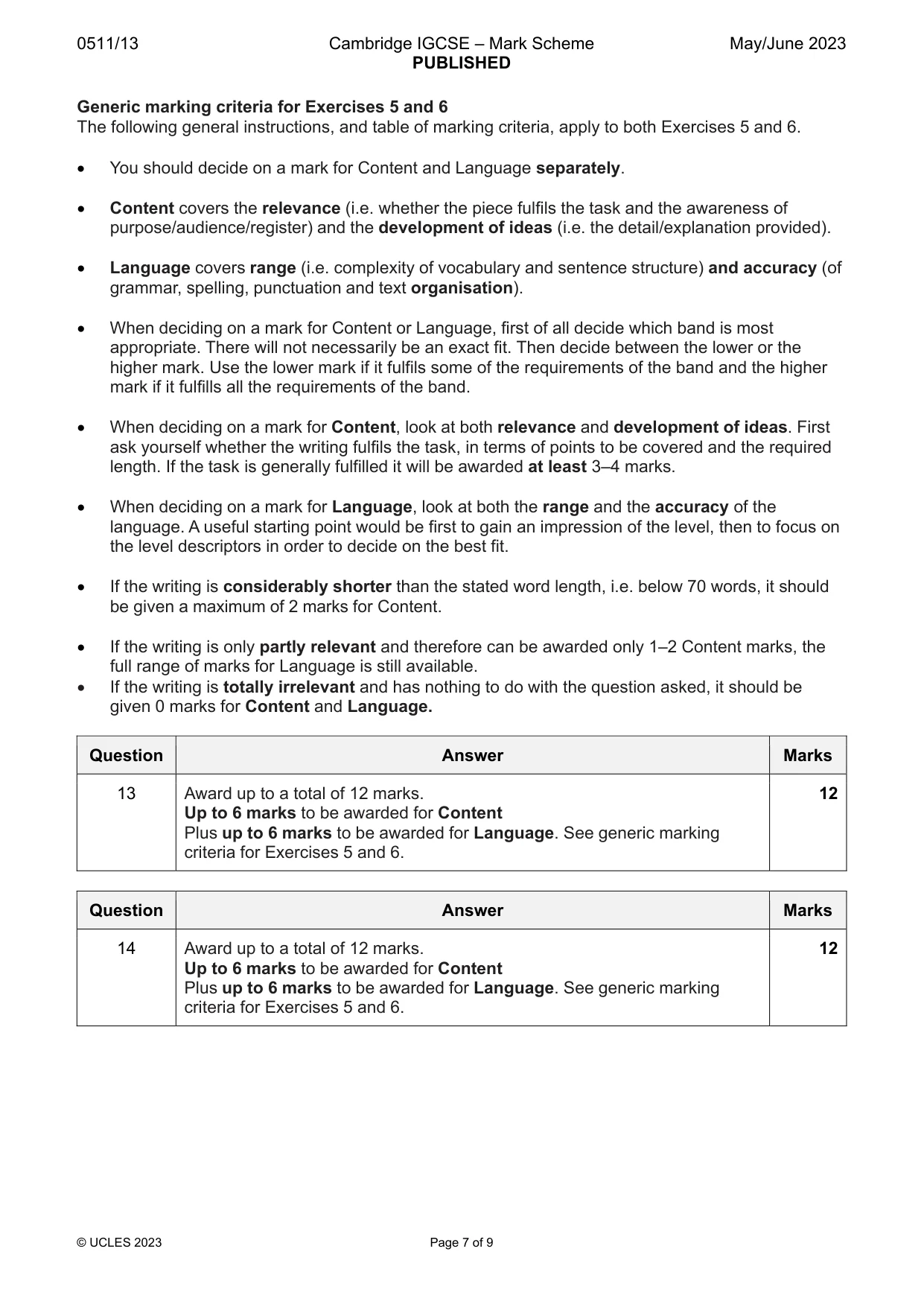
0511/13 Cambridge IGCSE – Mark Scheme PUBLISHED May/June 2023 © UCLES 2023 Page 7 of 9 Generic marking criteria for Exercises 5 and 6 The following general instructions, and table of marking criteria, apply to both Exercises 5 and 6. You should decide on a mark for Content and Language separately. Content covers the relevance (i.e. whether the piece fulfils the task and the awareness of purpose/audience/register) and the development of ideas (i.e. the detail/explanation provided). Language covers range (i.e. complexity of vocabulary and sentence structure) and accuracy (of grammar, spelling, punctuation and text organisation). When deciding on a mark for Content or Language, first of all decide which band is most appropriate. There will not necessarily be an exact fit. Then decide between the lower or the higher mark. Use the lower mark if it fulfils some of the requirements of the band and the higher mark if it fulfills all the requirements of the band. When deciding on a mark for Content, look at both relevance and development of ideas. First ask yourself whether the writing fulfils the task, in terms of points to be covered and the required length. If the task is generally fulfilled it will be awarded at least 3–4 marks. When deciding on a mark for Language, look at both the range and the accuracy of the language. A useful starting point would be first to gain an impression of the level, then to focus on the level descriptors in order to decide on the best fit. If the writing is considerably shorter than the stated word length, i.e. below 70 words, it should be given a maximum of 2 marks for Content. If the writing is only partly relevant and therefore can be awarded only 1–2 Content marks, the full range of marks for Language is still available. If the writing is totally irrelevant and has nothing to do with the question asked, it should be given 0 marks for Content and Language. Question Answer Marks 13 Award up to a total of 12 marks. Up to 6 marks to be awarded for Content Plus up to 6 marks to be awarded for Language. See generic marking criteria for Exercises 5 and 6. 12 Question Answer Marks 14 Award up to a total of 12 marks. Up to 6 marks to be awarded for Content Plus up to 6 marks to be awarded for Language. See generic marking criteria for Exercises 5 and 6. 12
Mark scheme, page 8
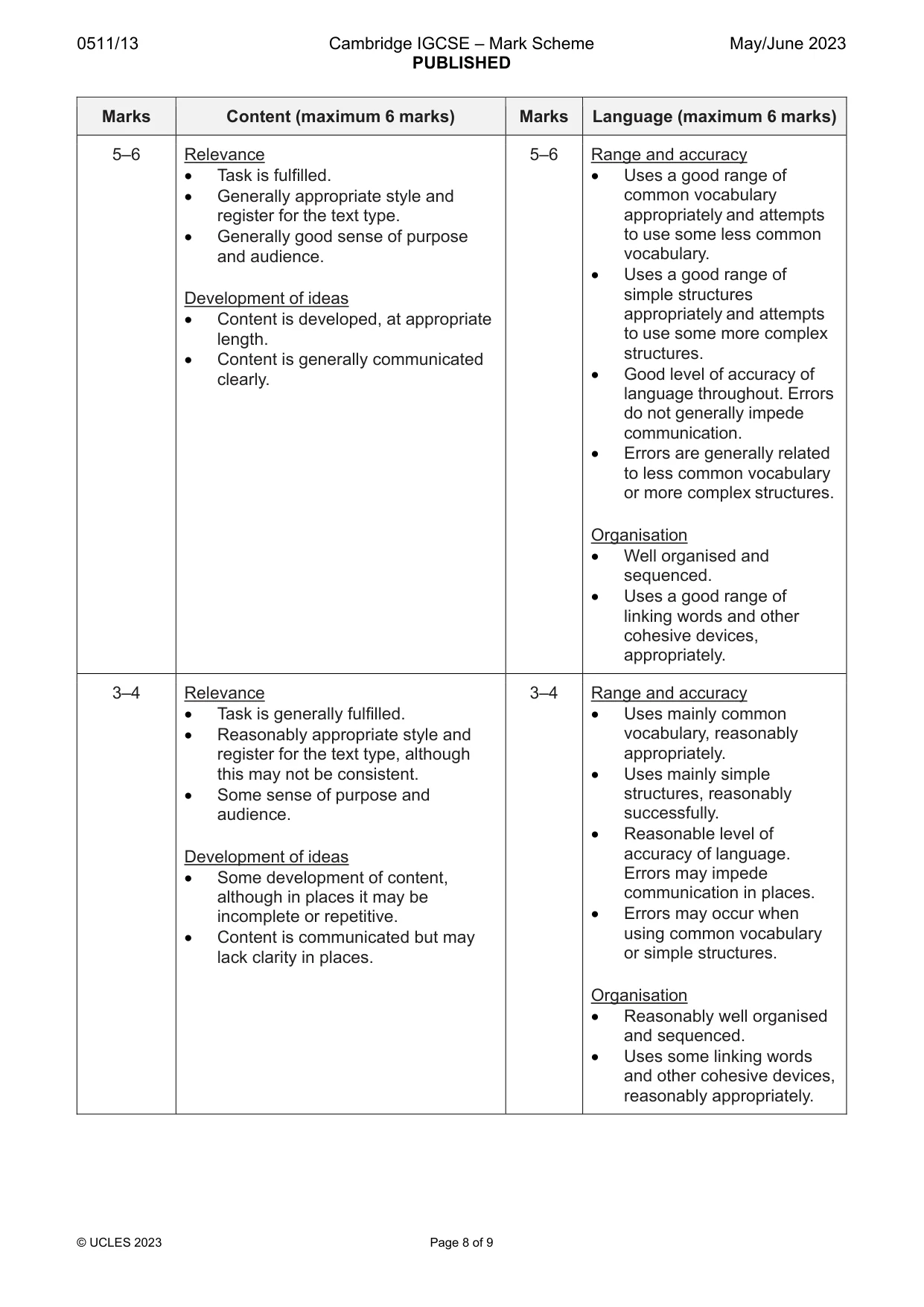
0511/13 Cambridge IGCSE – Mark Scheme PUBLISHED May/June 2023 © UCLES 2023 Page 8 of 9 Marks Content (maximum 6 marks) Marks Language (maximum 6 marks) 5–6 Relevance Task is fulfilled. Generally appropriate style and register for the text type. Generally good sense of purpose and audience. Development of ideas Content is developed, at appropriate length. Content is generally communicated clearly. 5–6 Range and accuracy Uses a good range of common vocabulary appropriately and attempts to use some less common vocabulary. Uses a good range of simple structures appropriately and attempts to use some more complex structures. Good level of accuracy of language throughout. Errors do not generally impede communication. Errors are generally related to less common vocabulary or more complex structures. Organisation Well organised and sequenced. Uses a good range of linking words and other cohesive devices, appropriately. 3–4 Relevance Task is generally fulfilled. Reasonably appropriate style and register for the text type, although this may not be consistent. Some sense of purpose and audience. Development of ideas Some development of content, although in places it may be incomplete or repetitive. Content is communicated but may lack clarity in places. 3–4 Range and accuracy Uses mainly common vocabulary, reasonably appropriately. Uses mainly simple structures, reasonably successfully. Reasonable level of accuracy of language. Errors may impede communication in places. Errors may occur when using common vocabulary or simple structures. Organisation Reasonably well organised and sequenced. Uses some linking words and other cohesive devices, reasonably appropriately.
Mark scheme, page 9
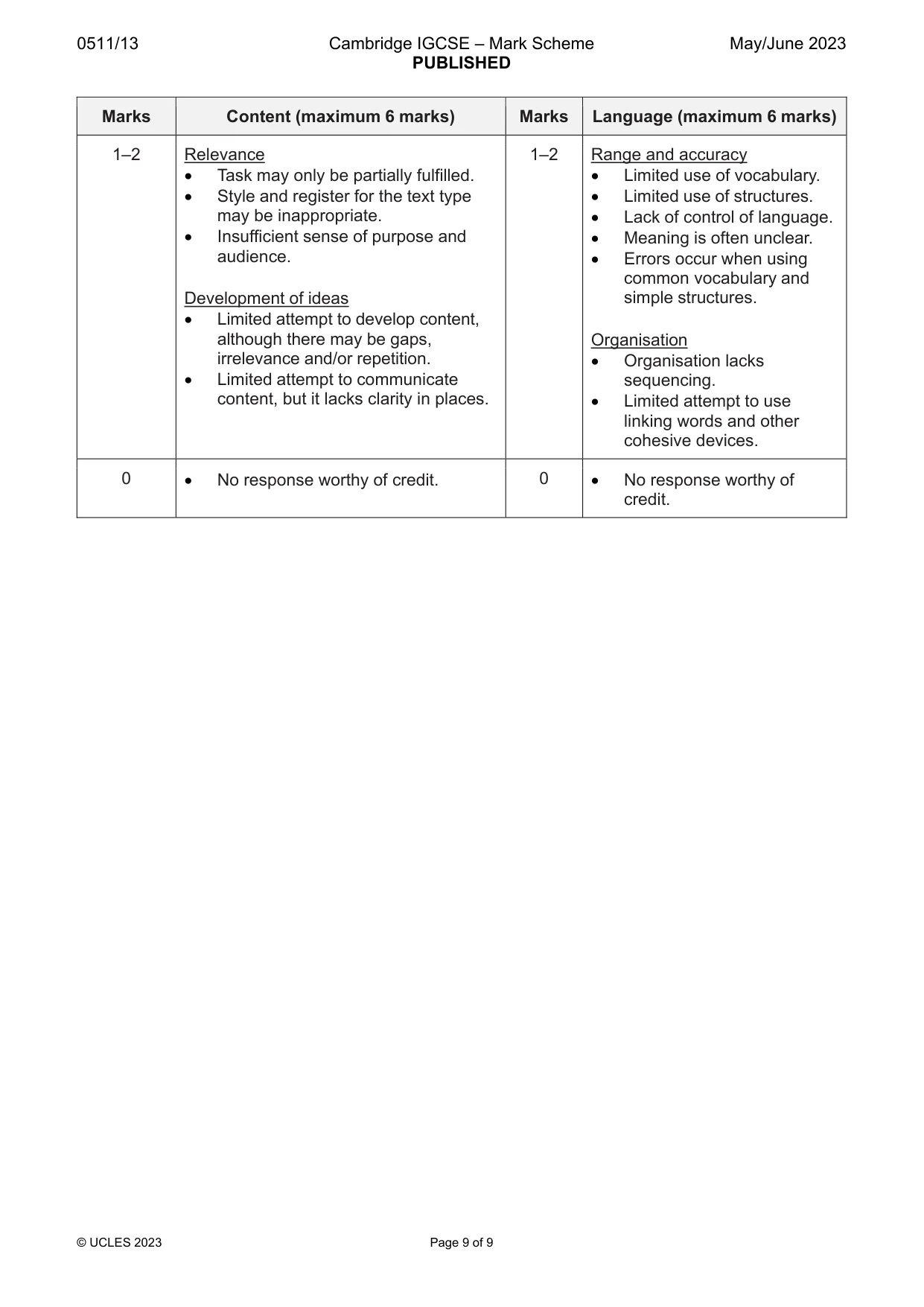
0511/13 Cambridge IGCSE – Mark Scheme PUBLISHED May/June 2023 © UCLES 2023 Page 9 of 9 Marks Content (maximum 6 marks) Marks Language (maximum 6 marks) 1–2 Relevance Task may only be partially fulfilled. Style and register for the text type may be inappropriate. Insufficient sense of purpose and audience. Development of ideas Limited attempt to develop content, although there may be gaps, irrelevance and/or repetition. Limited attempt to communicate content, but it lacks clarity in places. 1–2 Range and accuracy Limited use of vocabulary. Limited use of structures. Lack of control of language. Meaning is often unclear. Errors occur when using common vocabulary and simple structures. Organisation Organisation lacks sequencing. Limited attempt to use linking words and other cohesive devices. 0 No response worthy of credit. 0 No response worthy of credit.
What you needed in this session
Cambridge’s own grade thresholds for 2023 May/June, Paper 1 · Variant 3. A higher threshold means an easier paper — the bar moves with how the cohort did.