Cambridge IGCSE English - Second Language (count-in oral) 0511 — 2024 May/June Paper 1 · Variant 3
0511/13/M/J/24 · 60 marks · 120 min
The question paper and its mark scheme, free to read here and free to download. This is Cambridge’s own paper, exactly as it was sat.
Question paper16 pages



Mark scheme10 pages
Answers below. Sit the paper first if you are practising.
Paper as text
Question paper, page 1
This document has 16 pages. Any blank pages are indicated. [Turn over Cambridge IGCSE™ * 2 3 8 4 8 5 6 8 8 3 * ENGLISH AS A SECOND LANGUAGE 0511/13 Paper 1 Reading and Writing May/June 2024 2 hours You must answer on the question paper. No additional materials are needed. INSTRUCTIONS ● Answer all questions. ● Use a black or dark blue pen. ● Write your name, centre number and candidate number in the boxes at the top of the page. ● Write your answer to each question in the space provided. ● Do not use an erasable pen or correction fluid. ● Do not write on any bar codes. ● Dictionaries are not allowed. INFORMATION ● The total mark for this paper is 60. ● The number of marks for each question or part question is shown in brackets [ ]. DC (PQ) 341244 © UCLES 2024
Question paper, page 2
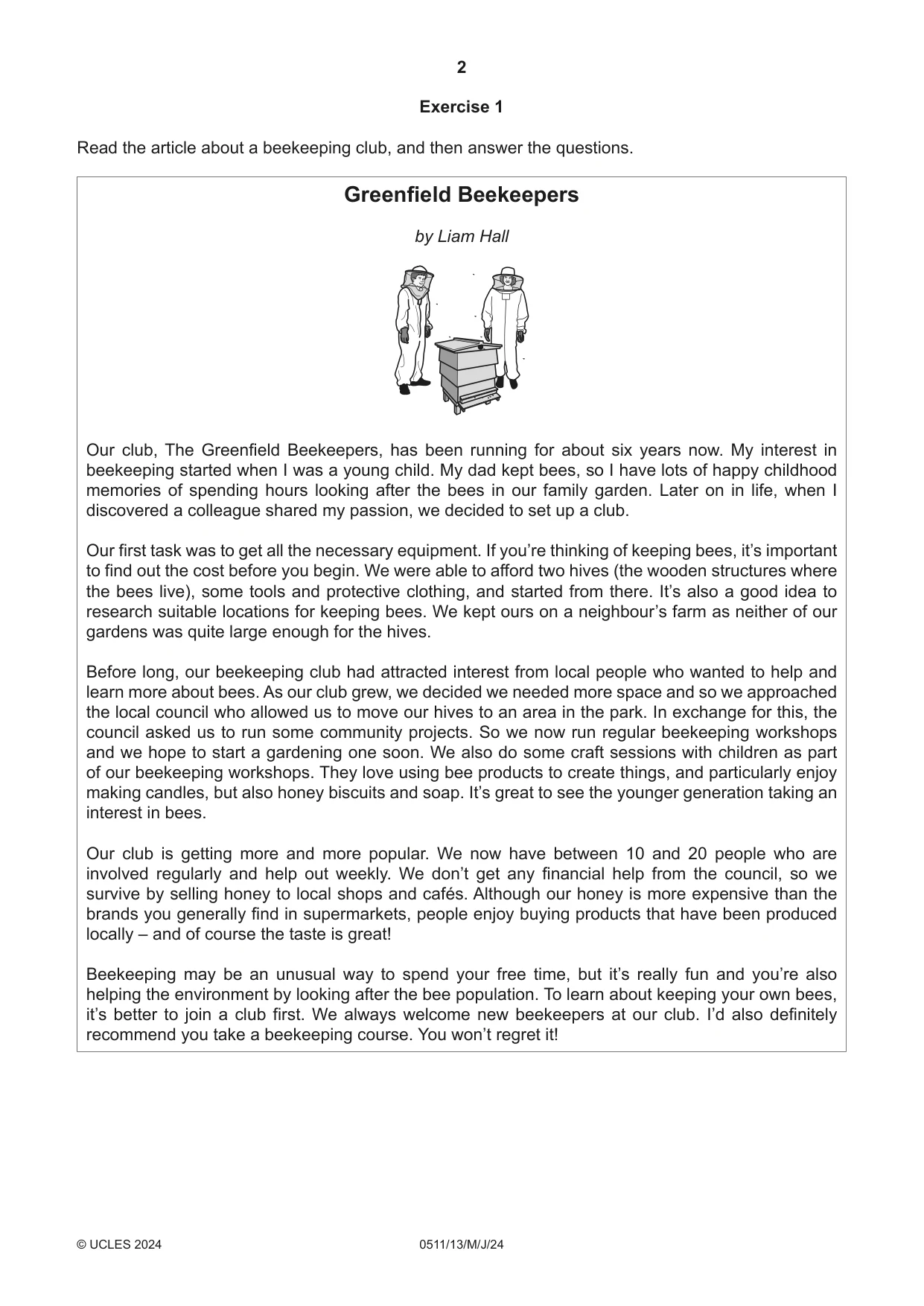
2 0511/13/M/J/24 © UCLES 2024 Exercise 1 Read the article about a beekeeping club, and then answer the questions. Greenfield Beekeepers by Liam Hall Our club, The Greenfield Beekeepers, has been running for about six years now. My interest in beekeeping started when I was a young child. My dad kept bees, so I have lots of happy childhood memories of spending hours looking after the bees in our family garden. Later on in life, when I discovered a colleague shared my passion, we decided to set up a club. Our first task was to get all the necessary equipment. If you’re thinking of keeping bees, it’s important to find out the cost before you begin. We were able to afford two hives (the wooden structures where the bees live), some tools and protective clothing, and started from there. It’s also a good idea to research suitable locations for keeping bees. We kept ours on a neighbour’s farm as neither of our gardens was quite large enough for the hives. Before long, our beekeeping club had attracted interest from local people who wanted to help and learn more about bees. As our club grew, we decided we needed more space and so we approached the local council who allowed us to move our hives to an area in the park. In exchange for this, the council asked us to run some community projects. So we now run regular beekeeping workshops and we hope to start a gardening one soon. We also do some craft sessions with children as part of our beekeeping workshops. They love using bee products to create things, and particularly enjoy making candles, but also honey biscuits and soap. It’s great to see the younger generation taking an interest in bees. Our club is getting more and more popular. We now have between 10 and 20 people who are involved regularly and help out weekly. We don’t get any financial help from the council, so we survive by selling honey to local shops and cafés. Although our honey is more expensive than the brands you generally find in supermarkets, people enjoy buying products that have been produced locally – and of course the taste is great! Beekeeping may be an unusual way to spend your free time, but it’s really fun and you’re also helping the environment by looking after the bee population. To learn about keeping your own bees, it’s better to join a club first. We always welcome new beekeepers at our club. I’d also definitely recommend you take a beekeeping course. You won’t regret it!
Question paper, page 3
3 0511/13/M/J/24 © UCLES 2024 [Turn over Question 1 Who did Liam start a beekeeping club with? … [1] Question 2 Where did the club put its hives initially? … [1] Question 3 What kind of workshop is the club planning to run in the future? … [1] Question 4 What is the most popular workshop activity with children? … [1] Question 5 How does the club get money? … [1] Question 6 What advice does Liam give people who want to start keeping bees? Give three details. … … … [3] [Total: 8]
Question paper, page 4
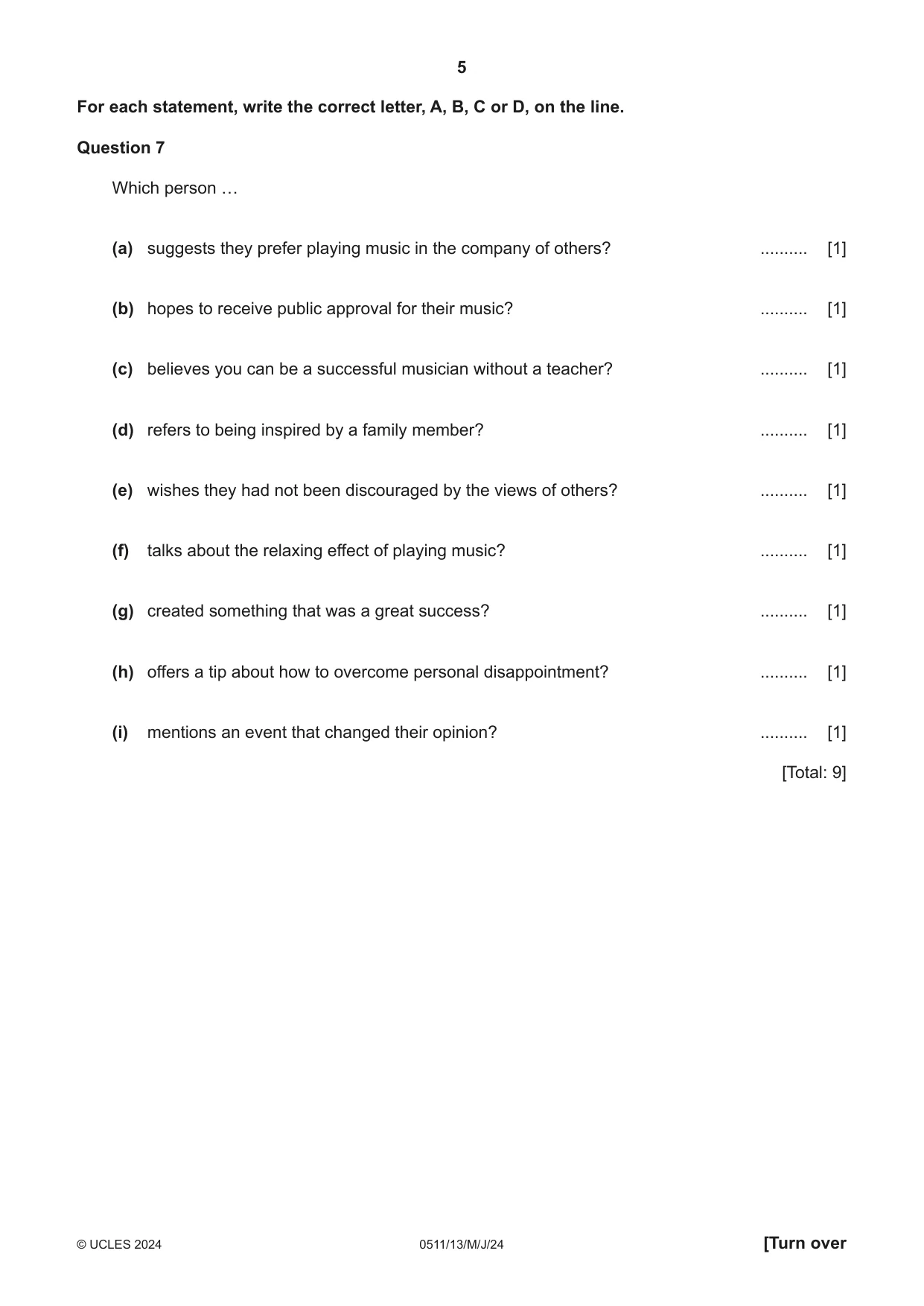
4 0511/13/M/J/24 © UCLES 2024 Exercise 2 Read the article about four young people (A–D) who love playing musical instruments. Then answer Questions 7(a)–(i). Four young musicians A Piero My guitar is always leaning against the wall next to my bed and it’s the first thing I pick up when I get home after school. It helps me escape my everyday worries and pressures. When I’m playing, I just focus on the music – I love it! At first I had weekly lessons at school but they weren’t as enjoyable as I’d expected, which was a bit disappointing. I found the style of learning a bit too formal – I just wanted to know how to play along to my favourite songs! I personally found watching music videos a lot more fun and effective. To be honest, most of my favourite rock stars were self-taught musicians, so I think that proves you don’t have to spend money on lessons. My little sister wants to play the guitar now so I’m showing her the basics. B Aliza I didn’t start playing the violin until the last year of school. During research for a history project, I discovered that my great uncle was a well-known violinist. I think that really impressed me and pushed me to try to be the same. As well as being something I love doing, I feel playing an instrument has really helped me. I used to avoid any attention and lacked confidence. I always believed I was too shy to perform in front of people, but I remember my first concert and being surprised at how comfortable I felt on stage. I’ve actually just entered a national competition where the judges and the audience vote for their favourite performer. It’s not until next month and I’m already feeling a bit nervous, but it would be amazing to win. C Danny As a young child, I always loved listening to my neighbour play the flute – it was so calming. It seems silly now, but even though I wanted to take it up myself, I was too embarrassed to have lessons. All my friends were into football or rugby and I knew they’d make fun of me. I regret not having the confidence to do what I wanted, but at least I play now. Over the years, I’ve definitely developed as a musician. I used to struggle when things went wrong, when I missed a note or messed up my timing during a rehearsal, or worse still, a performance! The feeling that I’d let myself and my teacher down would stay with me for ages. But now I’d say to anyone who feels this way that they should see the mistakes they make as part of the learning process. D Chloe I got my first drum kit for my tenth birthday. I’d wanted one for ages but my dad wasn’t keen to encourage my interest as he was worried about the noise I’d make! I’ve now got an electric drum kit so I can plug in my headphones and play whenever I like. I loved playing the drums, but after a while it got boring practising alone and I put an advert in our local shop saying I wanted to form a band. There were so many responses to the advert – it was impossible for me to meet everyone. Choosing the band members was actually quite stressful but we’ve been together for a year now and meet every week in our garage. We’ve even been asked to play at a local event, though I’m not sure we’re ready for that!
Question paper, page 5
5 0511/13/M/J/24 © UCLES 2024 [Turn over For each statement, write the correct letter, A, B, C or D, on the line. Question 7 Which person … (a) suggests they prefer playing music in the company of others? … [1] (b) hopes to receive public approval for their music? … [1] (c) believes you can be a successful musician without a teacher? … [1] (d) refers to being inspired by a family member? … [1] (e) wishes they had not been discouraged by the views of others? … [1] (f) talks about the relaxing effect of playing music? … [1] (g) created something that was a great success? … [1] (h) offers a tip about how to overcome personal disappointment? … [1] (i) mentions an event that changed their opinion? … [1] [Total: 9]
Question paper, page 6
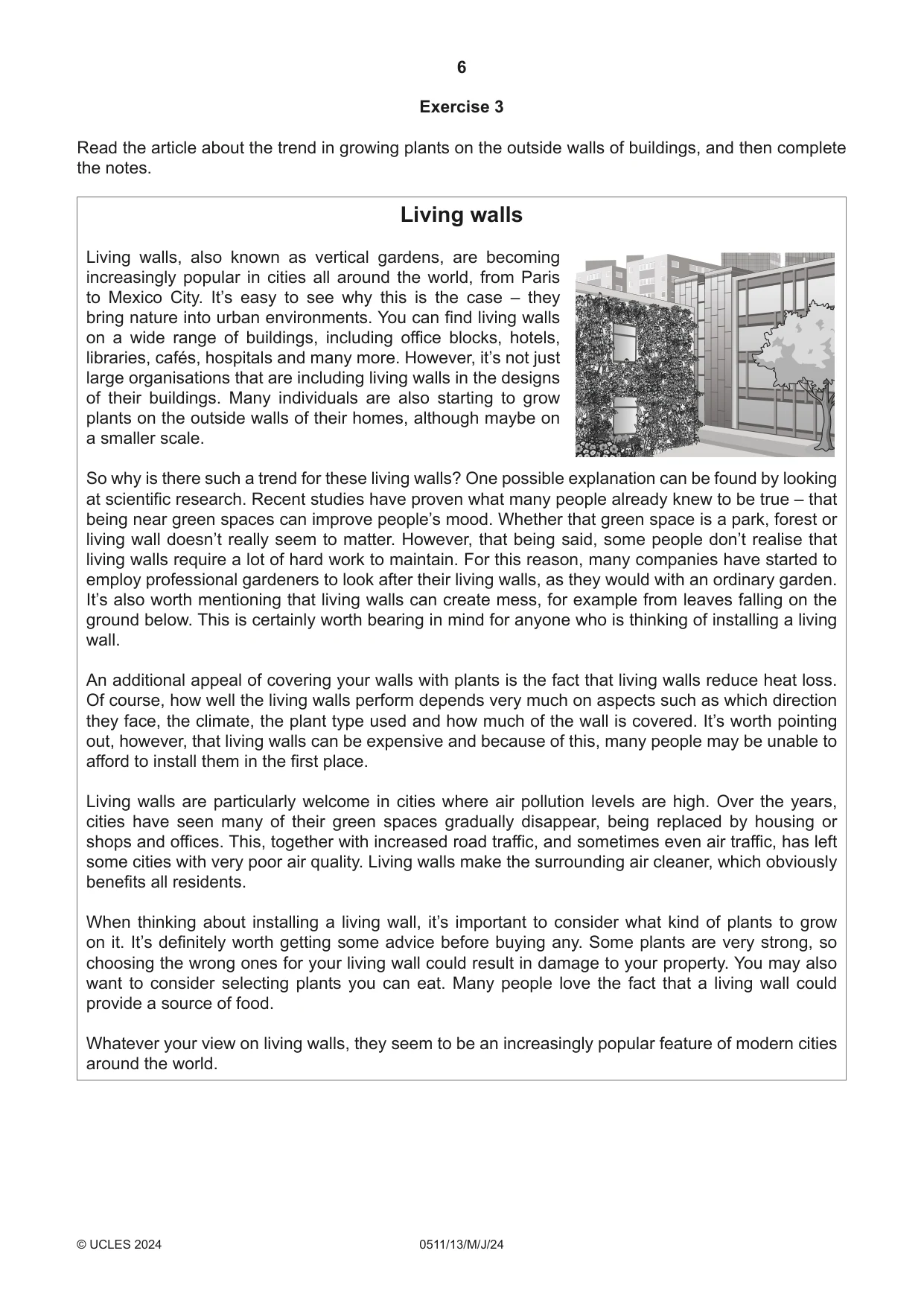
6 0511/13/ M/J/24 © UCLES 2024 Exercise 3 Read the article about the trend in growing plants on the outside walls of buildings, and then complete the notes. Living walls Living walls, also known as vertical gardens, are becoming increasingly popular in cities all around the world, from Paris to Mexico City. It’s easy to see why this is the case – they bring nature into urban environments. You can find living walls on a wide range of buildings, including office blocks, hotels, libraries, cafés, hospitals and many more. However, it’s not just large organisations that are including living walls in the designs of their buildings. Many individuals are also starting to grow plants on the outside walls of their homes, although maybe on a smaller scale. So why is there such a trend for these living walls? One possible explanation can be found by looking at scientific research. Recent studies have proven what many people already knew to be true – that being near green spaces can improve people’s mood. Whether that green space is a park, forest or living wall doesn’t really seem to matter. However, that being said, some people don’t realise that living walls require a lot of hard work to maintain. For this reason, many companies have started to employ professional gardeners to look after their living walls, as they would with an ordinary garden. It’s also worth mentioning that living walls can create mess, for example from leaves falling on the ground below. This is certainly worth bearing in mind for anyone who is thinking of installing a living wall. An additional appeal of covering your walls with plants is the fact that living walls reduce heat loss. Of course, how well the living walls perform depends very much on aspects such as which direction they face, the climate, the plant type used and how much of the wall is covered. It’s worth pointing out, however, that living walls can be expensive and because of this, many people may be unable to afford to install them in the first place. Living walls are particularly welcome in cities where air pollution levels are high. Over the years, cities have seen many of their green spaces gradually disappear, being replaced by housing or shops and offices. This, together with increased road traffic, and sometimes even air traffic, has left some cities with very poor air quality. Living walls make the surrounding air cleaner, which obviously benefits all residents. When thinking about installing a living wall, it’s important to consider what kind of plants to grow on it. It’s definitely worth getting some advice before buying any. Some plants are very strong, so choosing the wrong ones for your living wall could result in damage to your property. You may also want to consider selecting plants you can eat. Many people love the fact that a living wall could provide a source of food. Whatever your view on living walls, they seem to be an increasingly popular feature of modern cities around the world.
Question paper, page 7
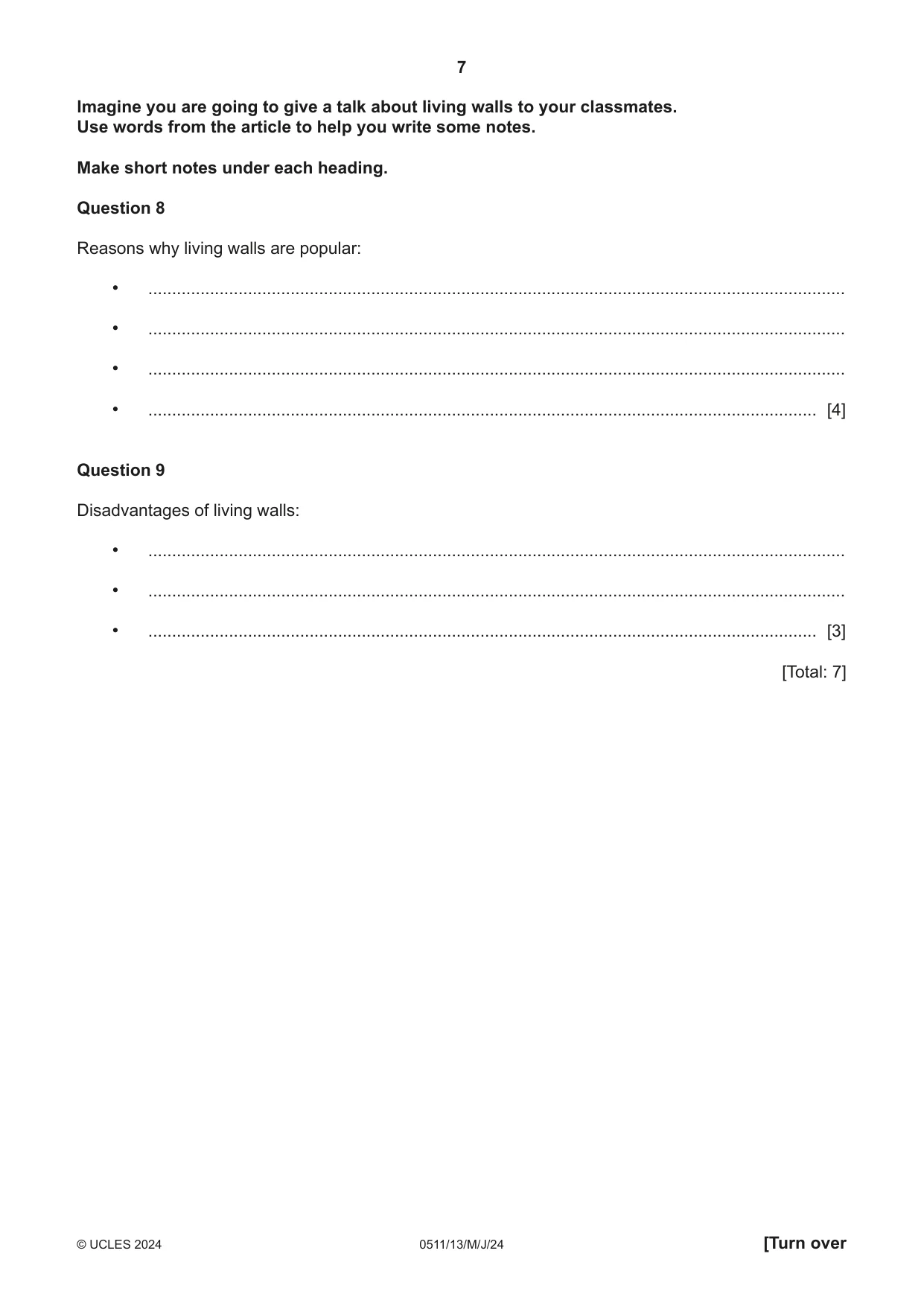
7 0511/13/ M/J/24 © UCLES 2024 [Turn over Imagine you are going to give a talk about living walls to your classmates. Use words from the article to help you write some notes. Make short notes under each heading. Question 8 Reasons why living walls are popular: • … • … • … • … [4] Question 9 Disadvantages of living walls: • … • … • … [3] [Total: 7]
Question paper, page 8
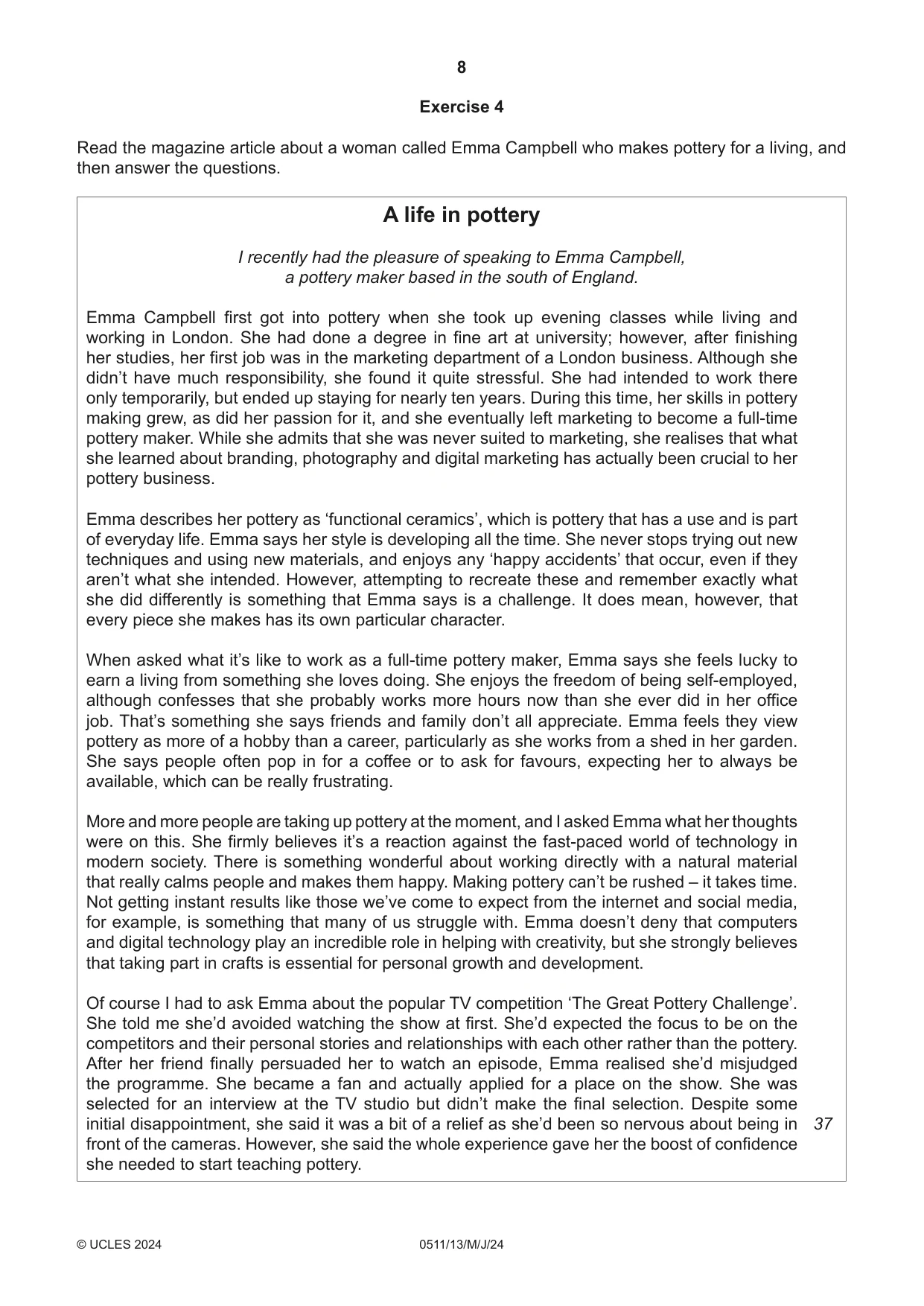
8 0511/13/M/J/24 © UCLES 2024 Exercise 4 Read the magazine article about a woman called Emma Campbell who makes pottery for a living, and then answer the questions. A life in pottery I recently had the pleasure of speaking to Emma Campbell, a pottery maker based in the south of England. Emma Campbell first got into pottery when she took up evening classes while living and working in London. She had done a degree in fine art at university; however, after finishing her studies, her first job was in the marketing department of a London business. Although she didn’t have much responsibility, she found it quite stressful. She had intended to work there only temporarily, but ended up staying for nearly ten years. During this time, her skills in pottery making grew, as did her passion for it, and she eventually left marketing to become a full-time pottery maker. While she admits that she was never suited to marketing, she realises that what she learned about branding, photography and digital marketing has actually been crucial to her pottery business. Emma describes her pottery as ‘functional ceramics’, which is pottery that has a use and is part of everyday life. Emma says her style is developing all the time. She never stops trying out new techniques and using new materials, and enjoys any ‘happy accidents’ that occur, even if they aren’t what she intended. However, attempting to recreate these and remember exactly what she did differently is something that Emma says is a challenge. It does mean, however, that every piece she makes has its own particular character. When asked what it’s like to work as a full-time pottery maker, Emma says she feels lucky to earn a living from something she loves doing. She enjoys the freedom of being self-employed, although confesses that she probably works more hours now than she ever did in her office job. That’s something she says friends and family don’t all appreciate. Emma feels they view pottery as more of a hobby than a career, particularly as she works from a shed in her garden. She says people often pop in for a coffee or to ask for favours, expecting her to always be available, which can be really frustrating. More and more people are taking up pottery at the moment, and I asked Emma what her thoughts were on this. She firmly believes it’s a reaction against the fast-paced world of technology in modern society. There is something wonderful about working directly with a natural material that really calms people and makes them happy. Making pottery can’t be rushed – it takes time. Not getting instant results like those we’ve come to expect from the internet and social media, for example, is something that many of us struggle with. Emma doesn’t deny that computers and digital technology play an incredible role in helping with creativity, but she strongly believes that taking part in crafts is essential for personal growth and development. Of course I had to ask Emma about the popular TV competition ‘The Great Pottery Challenge’. She told me she’d avoided watching the show at first. She’d expected the focus to be on the competitors and their personal stories and relationships with each other rather than the pottery. After her friend finally persuaded her to watch an episode, Emma realised she’d misjudged the programme. She became a fan and actually applied for a place on the show. She was selected for an interview at the TV studio but didn’t make the final selection. Despite some initial disappointment, she said it was a bit of a relief as she’d been so nervous about being in front of the cameras. However, she said the whole experience gave her the boost of confidence she needed to start teaching pottery. 37
Question paper, page 9
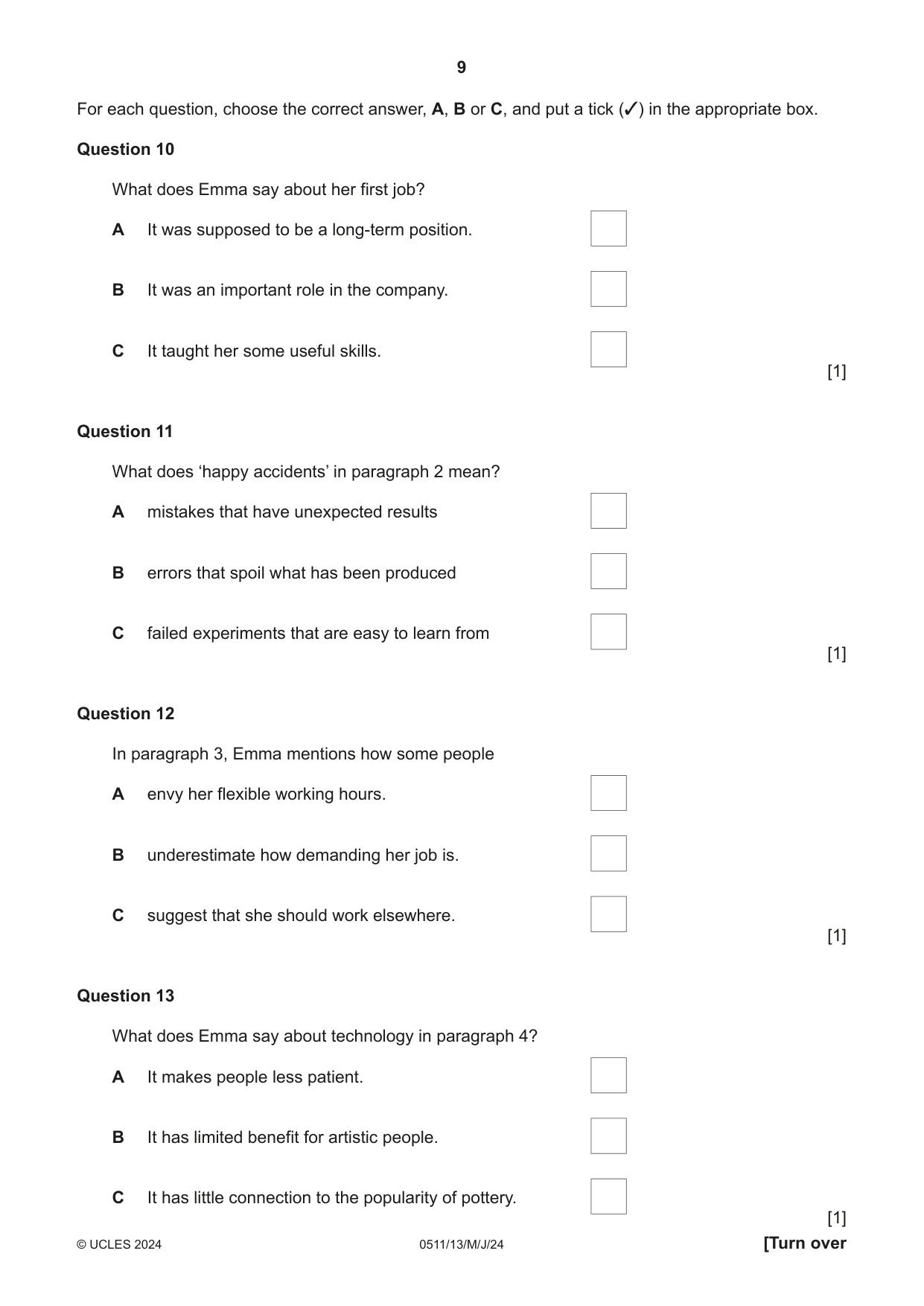
9 0511/13/M/J/24 © UCLES 2024 [Turn over For each question, choose the correct answer, A, B or C, and put a tick (✓) in the appropriate box. Question 10 What does Emma say about her first job? A It was supposed to be a long-term position. B It was an important role in the company. C It taught her some useful skills. [1] Question 11 What does ‘happy accidents’ in paragraph 2 mean? A mistakes that have unexpected results B errors that spoil what has been produced C failed experiments that are easy to learn from [1] Question 12 In paragraph 3, Emma mentions how some people A envy her flexible working hours. B underestimate how demanding her job is. C suggest that she should work elsewhere. [1] Question 13 What does Emma say about technology in paragraph 4? A It makes people less patient. B It has limited benefit for artistic people. C It has little connection to the popularity of pottery. [1]
Question paper, page 10
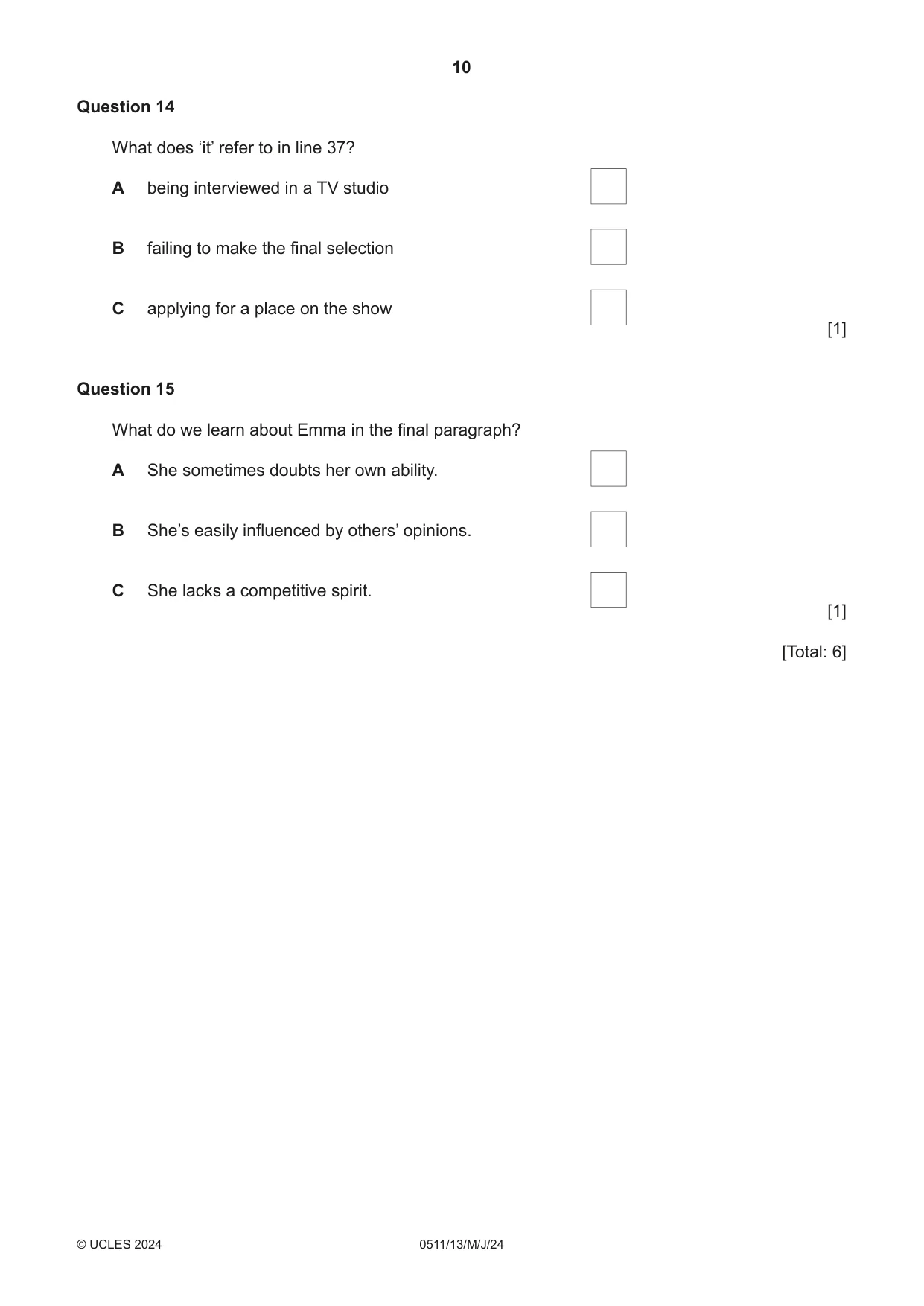
10 0511/13/M/J/24 © UCLES 2024 Question 14 What does ‘it’ refer to in line 37? A being interviewed in a TV studio B failing to make the final selection C applying for a place on the show [1] Question 15 What do we learn about Emma in the final paragraph? A She sometimes doubts her own ability. B She’s easily influenced by others’ opinions. C She lacks a competitive spirit. [1] [Total: 6]
Question paper, page 11
11 0511/13/M/J/24 © UCLES 2024 [Turn over Please turn over for Exercise 5.
Question paper, page 12
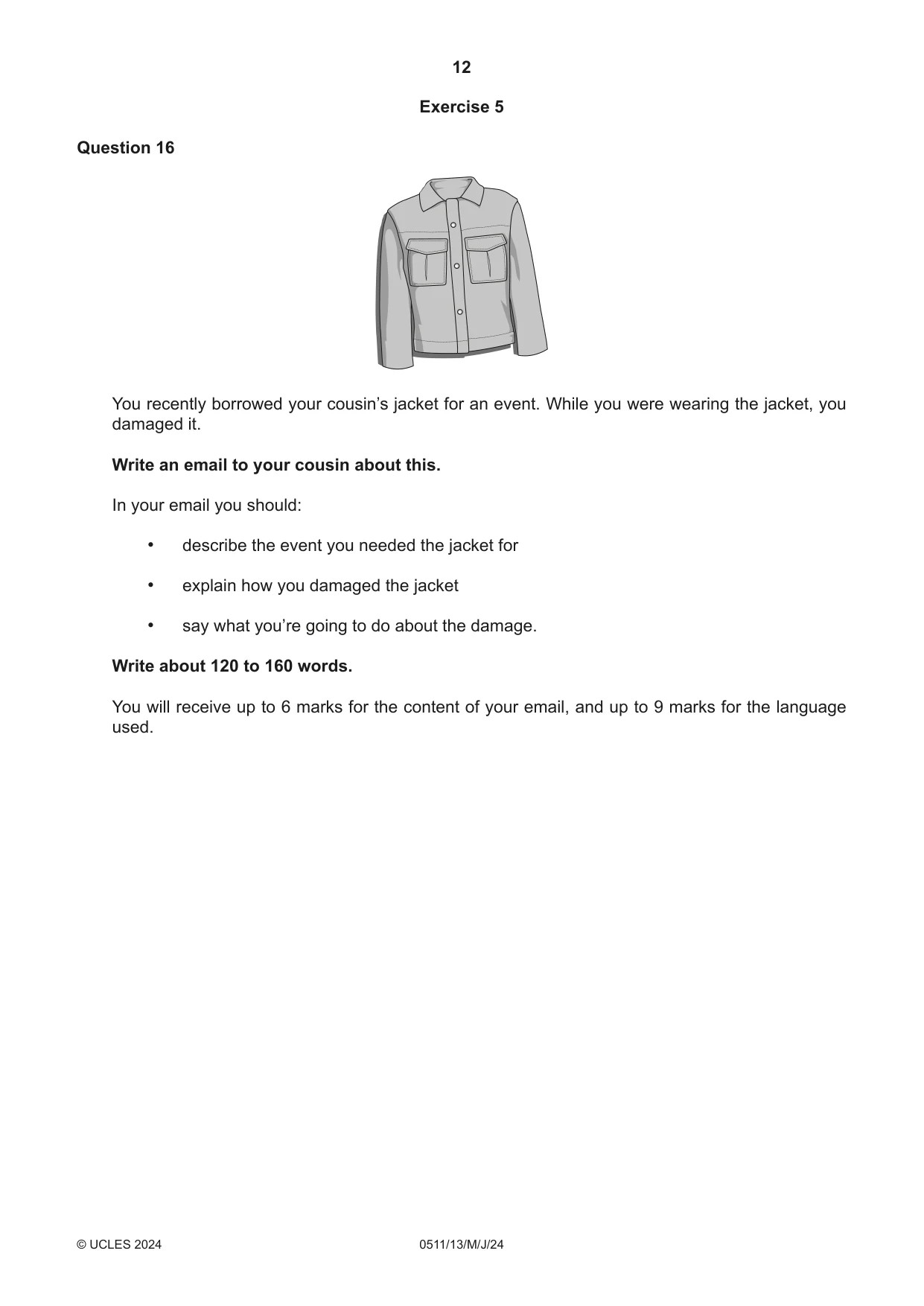
12 0511/13/M/J/24 © UCLES 2024 Exercise 5 Question 16 You recently borrowed your cousin’s jacket for an event. While you were wearing the jacket, you damaged it. Write an email to your cousin about this. In your email you should: • describe the event you needed the jacket for • explain how you damaged the jacket • say what you’re going to do about the damage. Write about 120 to 160 words. You will receive up to 6 marks for the content of your email, and up to 9 marks for the language used.
Question paper, page 13
13 0511/13/M/J/24 © UCLES 2024 [Turn over … … … … … … … … … … … … … … … … … … … … … … … … … … [Total: 15]
Question paper, page 14
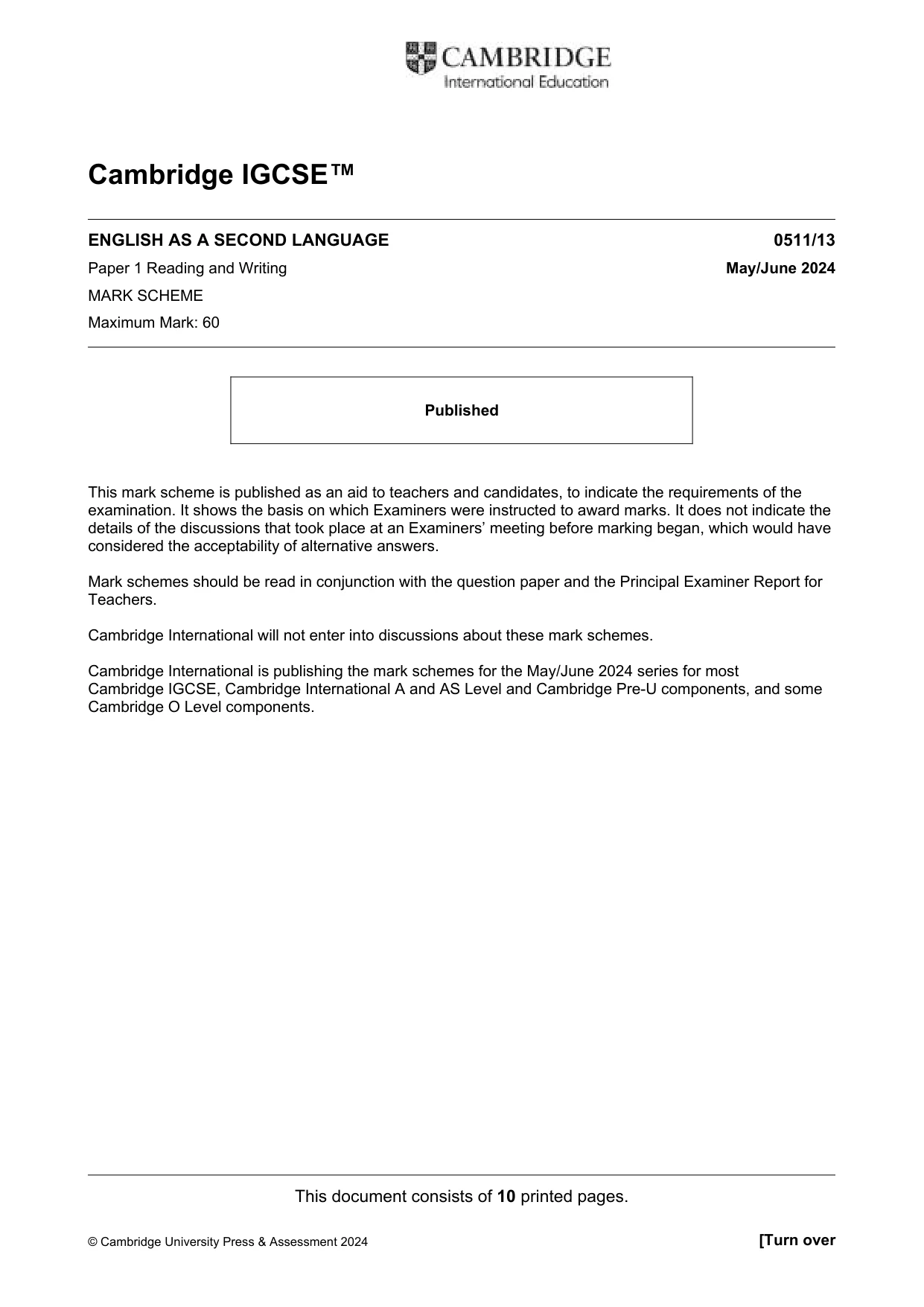
14 0511/13/M/J/24 © UCLES 2024 Exercise 6 Question 17 You and your class recently spent a weekend at an activity centre where students could try different outdoor sports such as sailing and rock climbing. Now your teacher has asked you to write a report about the activity weekend. In your report, say what was enjoyable about the activity weekend, AND suggest how it could be improved. Here are some comments from students who went on the activity weekend: It was great fun! We couldn‛t try all the sports. The meals were too small. I loved the accommodation. Now write a report for your teacher about the activity weekend. The comments above may give you some ideas, and you should also use some ideas of your own. Write about 120 to 160 words. You will receive up to 6 marks for the content of your report and up to 9 marks for the language used.
Question paper, page 15
15 0511/13/M/J/24 © UCLES 2024 … … … … … … … … … … … … … … … … … … … … … … … … … … [Total: 15]
Question paper, page 16
16 0511/13/M/J/24 © UCLES 2024 Permission to reproduce items where third-party owned material protected by copyright is included has been sought and cleared where possible. Every reasonable effort has been made by the publisher (UCLES) to trace copyright holders, but if any items requiring clearance have unwittingly been included, the publisher will be pleased to make amends at the earliest possible opportunity. To avoid the issue of disclosure of answer-related information to candidates, all copyright acknowledgements are reproduced online in the Cambridge Assessment International Education Copyright Acknowledgements Booklet. This is produced for each series of examinations and is freely available to download at www.cambridgeinternational.org after the live examination series. Cambridge Assessment International Education is part of Cambridge Assessment. Cambridge Assessment is the brand name of the University of Cambridge Local Examinations Syndicate (UCLES), which is a department of the University of Cambridge. BLANK PAGE
Mark scheme, page 1
This document consists of 10 printed pages. © Cambridge University Press & Assessment 2024 [Turn over Cambridge IGCSE™ ENGLISH AS A SECOND LANGUAGE 0511/13 Paper 1 Reading and Writing May/June 2024 MARK SCHEME Maximum Mark: 60 Published This mark scheme is published as an aid to teachers and candidates, to indicate the requirements of the examination. It shows the basis on which Examiners were instructed to award marks. It does not indicate the details of the discussions that took place at an Examiners’ meeting before marking began, which would have considered the acceptability of alternative answers. Mark schemes should be read in conjunction with the question paper and the Principal Examiner Report for Teachers. Cambridge International will not enter into discussions about these mark schemes. Cambridge International is publishing the mark schemes for the May/June 2024 series for most Cambridge IGCSE, Cambridge International A and AS Level and Cambridge Pre-U components, and some Cambridge O Level components.
Mark scheme, page 2
0511/13 Cambridge IGCSE – Mark Scheme PUBLISHED May/June 2024 © Cambridge University Press & Assessment 2024 Page 2 of 10 Generic Marking Principles These general marking principles must be applied by all examiners when marking candidate answers. They should be applied alongside the specific content of the mark scheme or generic level descriptions for a question. Each question paper and mark scheme will also comply with these marking principles. GENERIC MARKING PRINCIPLE 1: Marks must be awarded in line with: the specific content of the mark scheme or the generic level descriptors for the question the specific skills defined in the mark scheme or in the generic level descriptors for the question the standard of response required by a candidate as exemplified by the standardisation scripts. GENERIC MARKING PRINCIPLE 2: Marks awarded are always whole marks (not half marks, or other fractions). GENERIC MARKING PRINCIPLE 3: Marks must be awarded positively: marks are awarded for correct/valid answers, as defined in the mark scheme. However, credit is given for valid answers which go beyond the scope of the syllabus and mark scheme, referring to your Team Leader as appropriate marks are awarded when candidates clearly demonstrate what they know and can do marks are not deducted for errors marks are not deducted for omissions answers should only be judged on the quality of spelling, punctuation and grammar when these features are specifically assessed by the question as indicated by the mark scheme. The meaning, however, should be unambiguous. GENERIC MARKING PRINCIPLE 4: Rules must be applied consistently, e.g. in situations where candidates have not followed instructions or in the application of generic level descriptors. GENERIC MARKING PRINCIPLE 5: Marks should be awarded using the full range of marks defined in the mark scheme for the question (however; the use of the full mark range may be limited according to the quality of the candidate responses seen). GENERIC MARKING PRINCIPLE 6: Marks awarded are based solely on the requirements as defined in the mark scheme. Marks should not be awarded with grade thresholds or grade descriptors in mind.
Mark scheme, page 3
0511/13 Cambridge IGCSE – Mark Scheme PUBLISHED May/June 2024 © Cambridge University Press & Assessment 2024 Page 3 of 10 Cambridge IGCSE English as a Second Language Paper 1 Reading and Writing tests the following Assessment Objectives: Reading R1 demonstrate understanding of specific factual information R2 demonstrate understanding of the connections between the ideas, opinions and attitudes R3 identify and select details for a specific purpose R4 demonstrate understanding of implied meaning Writing W1 communicate information, ideas and opinions W2 organise ideas into coherent text using a range of linking devices W3 use a range of appropriate grammatical structures and vocabulary W4 use appropriate register and style for the given purpose and audience
Mark scheme, page 4
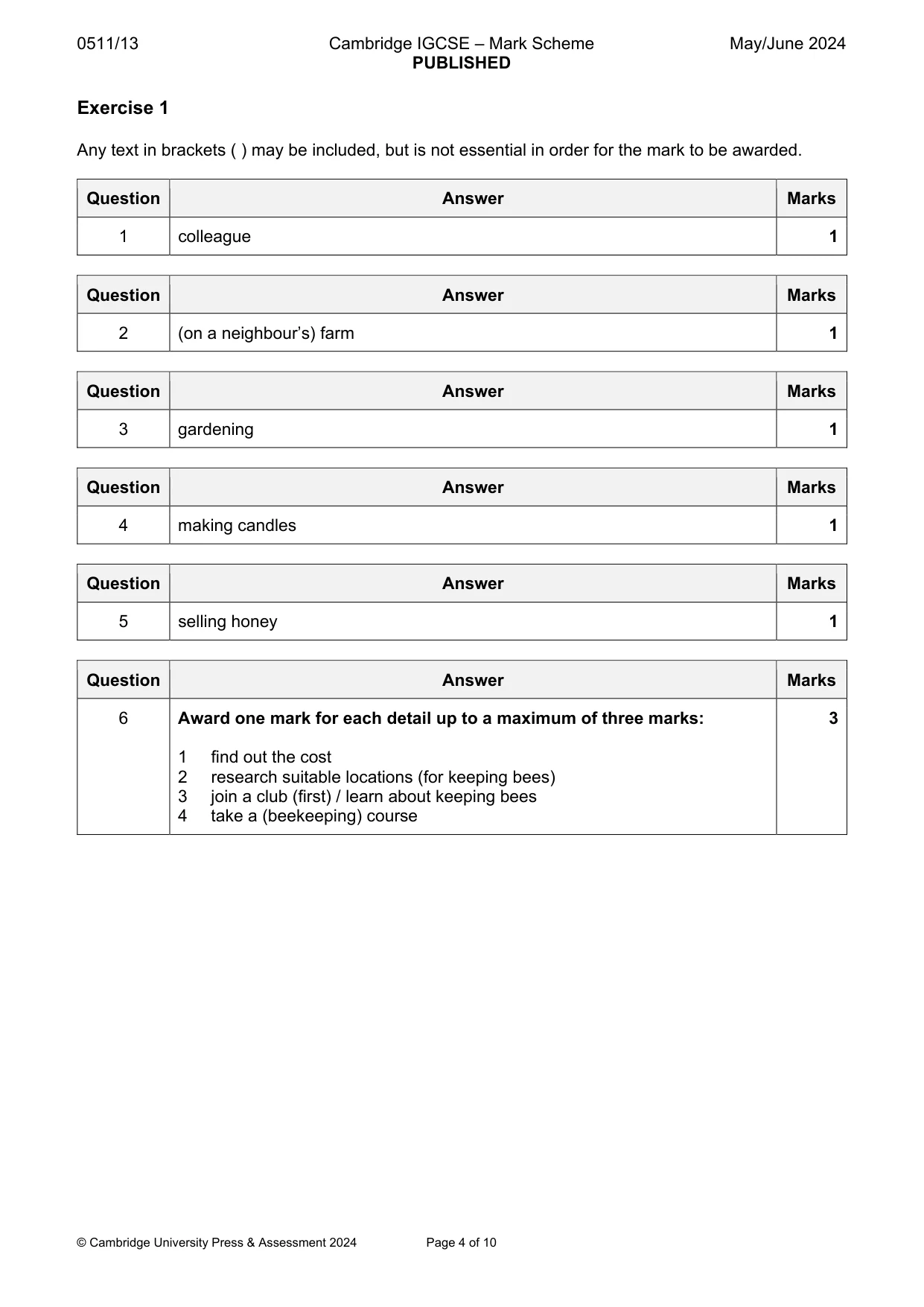
0511/13 Cambridge IGCSE – Mark Scheme PUBLISHED May/June 2024 © Cambridge University Press & Assessment 2024 Page 4 of 10 Exercise 1 Any text in brackets ( ) may be included, but is not essential in order for the mark to be awarded. Question Answer Marks 1 colleague 1 Question Answer Marks 2 (on a neighbour’s) farm 1 Question Answer Marks 3 gardening 1 Question Answer Marks 4 making candles 1 Question Answer Marks 5 selling honey 1 Question Answer Marks 6 Award one mark for each detail up to a maximum of three marks: 1 find out the cost 2 research suitable locations (for keeping bees) 3 join a club (first) / learn about keeping bees 4 take a (beekeeping) course 3
Mark scheme, page 5
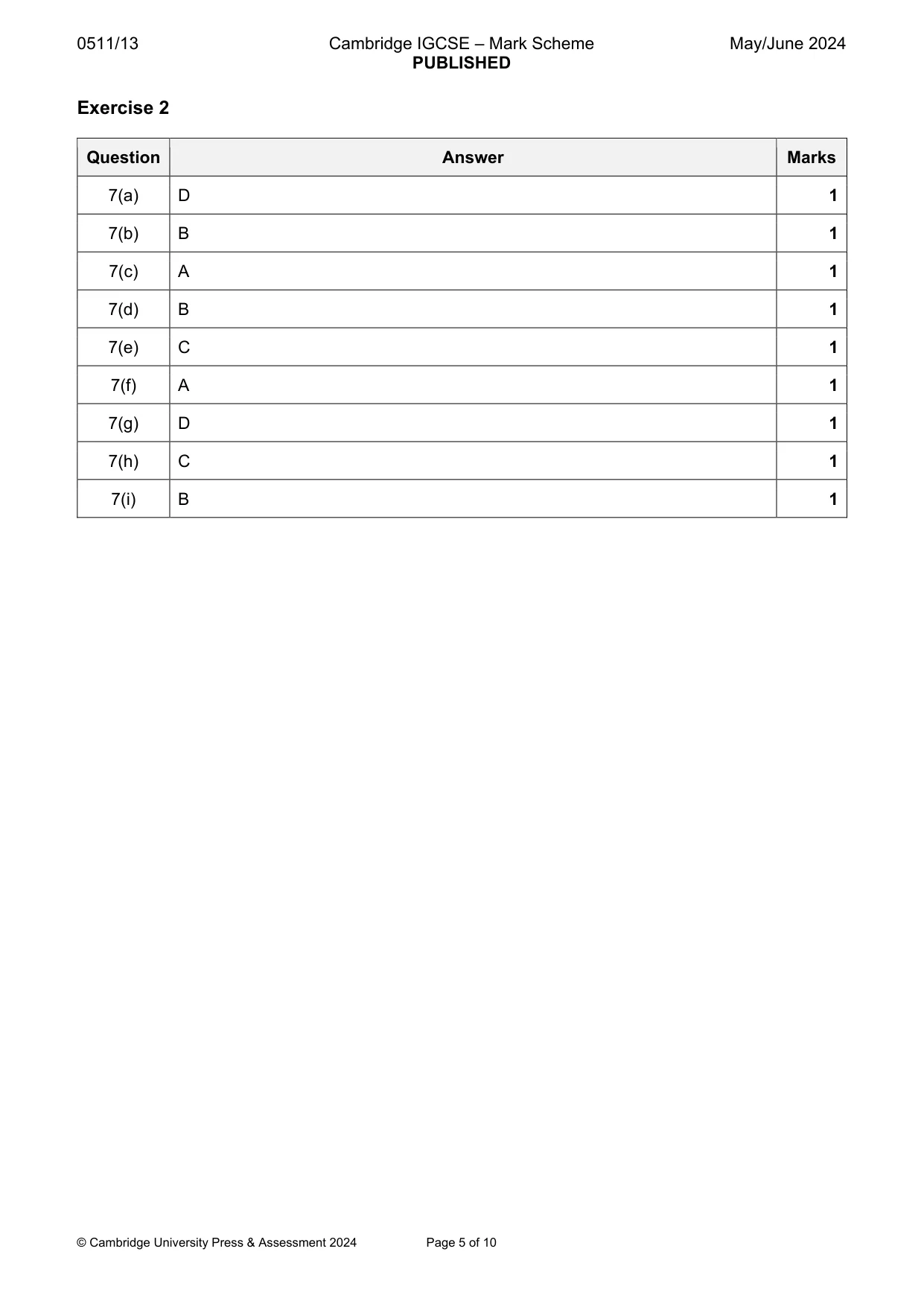
0511/13 Cambridge IGCSE – Mark Scheme PUBLISHED May/June 2024 © Cambridge University Press & Assessment 2024 Page 5 of 10 Exercise 2 Question Answer Marks 7(a) D 1 7(b) B 1 7(c) A 1 7(d) B 1 7(e) C 1 7(f) A 1 7(g) D 1 7(h) C 1 7(i) B 1
Mark scheme, page 6
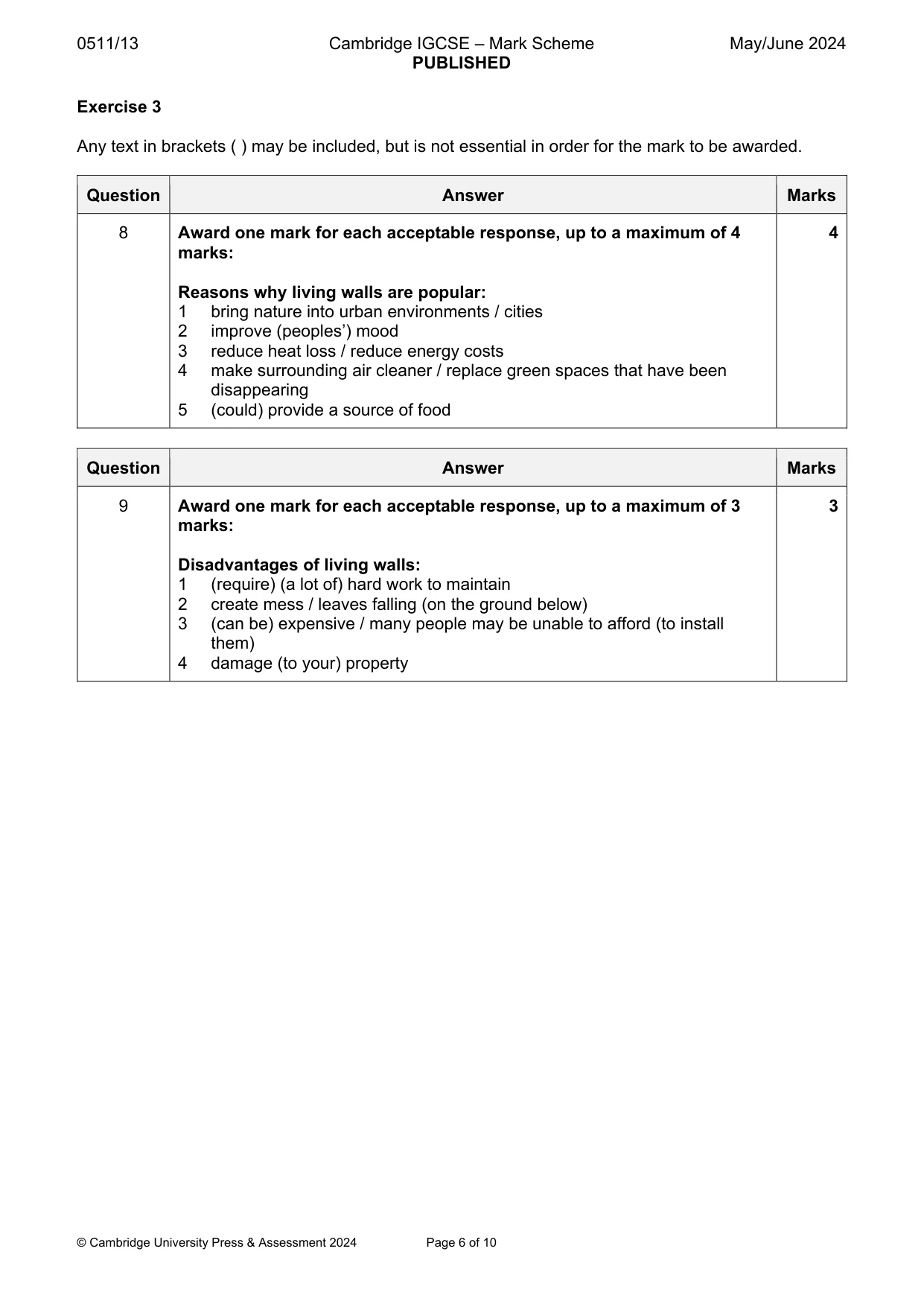
0511/13 Cambridge IGCSE – Mark Scheme PUBLISHED May/June 2024 © Cambridge University Press & Assessment 2024 Page 6 of 10 Exercise 3 Any text in brackets ( ) may be included, but is not essential in order for the mark to be awarded. Question Answer Marks 8 Award one mark for each acceptable response, up to a maximum of 4 marks: Reasons why living walls are popular: 1 bring nature into urban environments / cities 2 improve (peoples’) mood 3 reduce heat loss / reduce energy costs 4 make surrounding air cleaner / replace green spaces that have been disappearing 5 (could) provide a source of food 4 Question Answer Marks 9 Award one mark for each acceptable response, up to a maximum of 3 marks: Disadvantages of living walls: 1 (require) (a lot of) hard work to maintain 2 create mess / leaves falling (on the ground below) 3 (can be) expensive / many people may be unable to afford (to install them) 4 damage (to your) property 3
Mark scheme, page 7
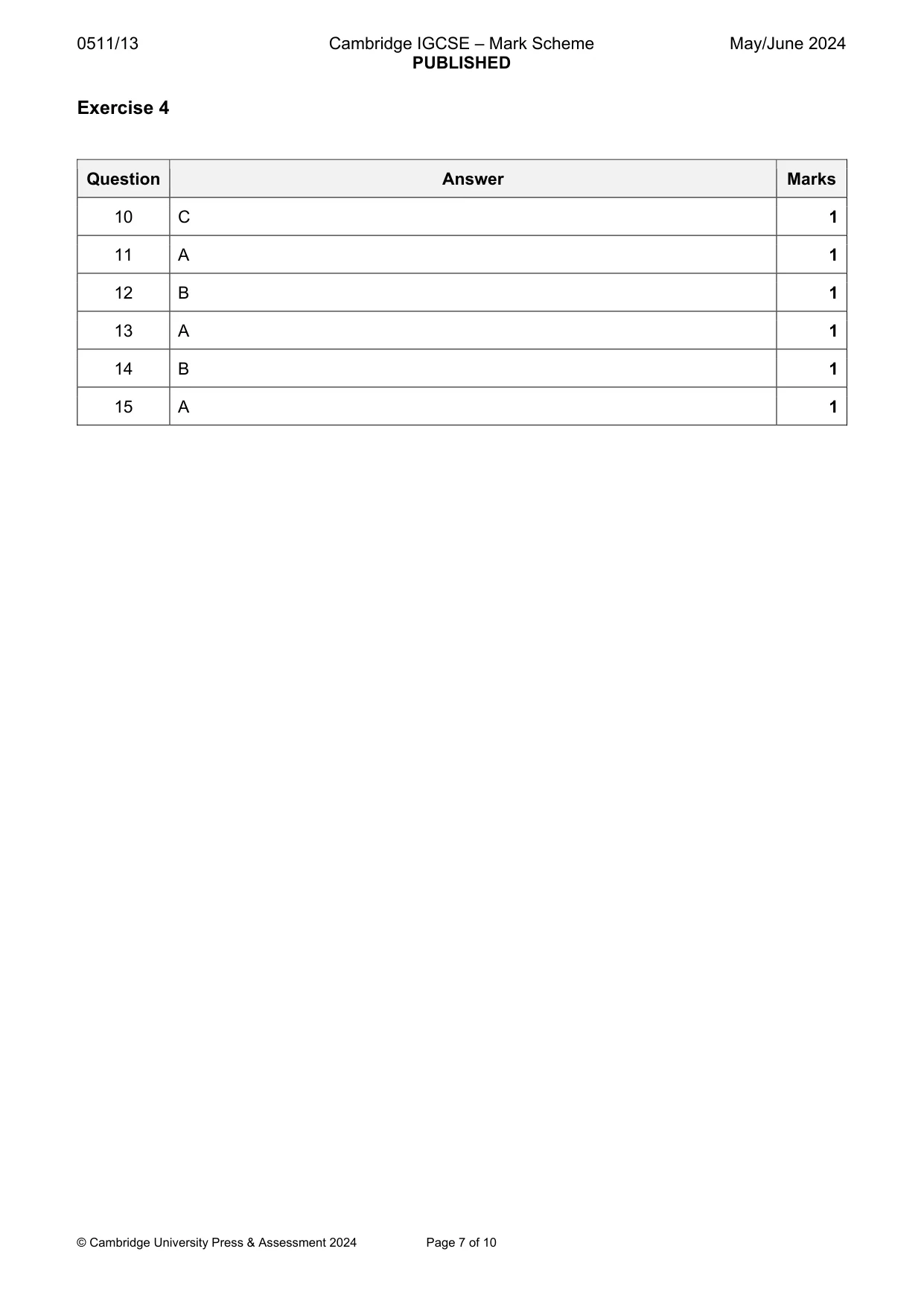
0511/13 Cambridge IGCSE – Mark Scheme PUBLISHED May/June 2024 © Cambridge University Press & Assessment 2024 Page 7 of 10 Exercise 4 Question Answer Marks 10 C 1 11 A 1 12 B 1 13 A 1 14 B 1 15 A 1
Mark scheme, page 8
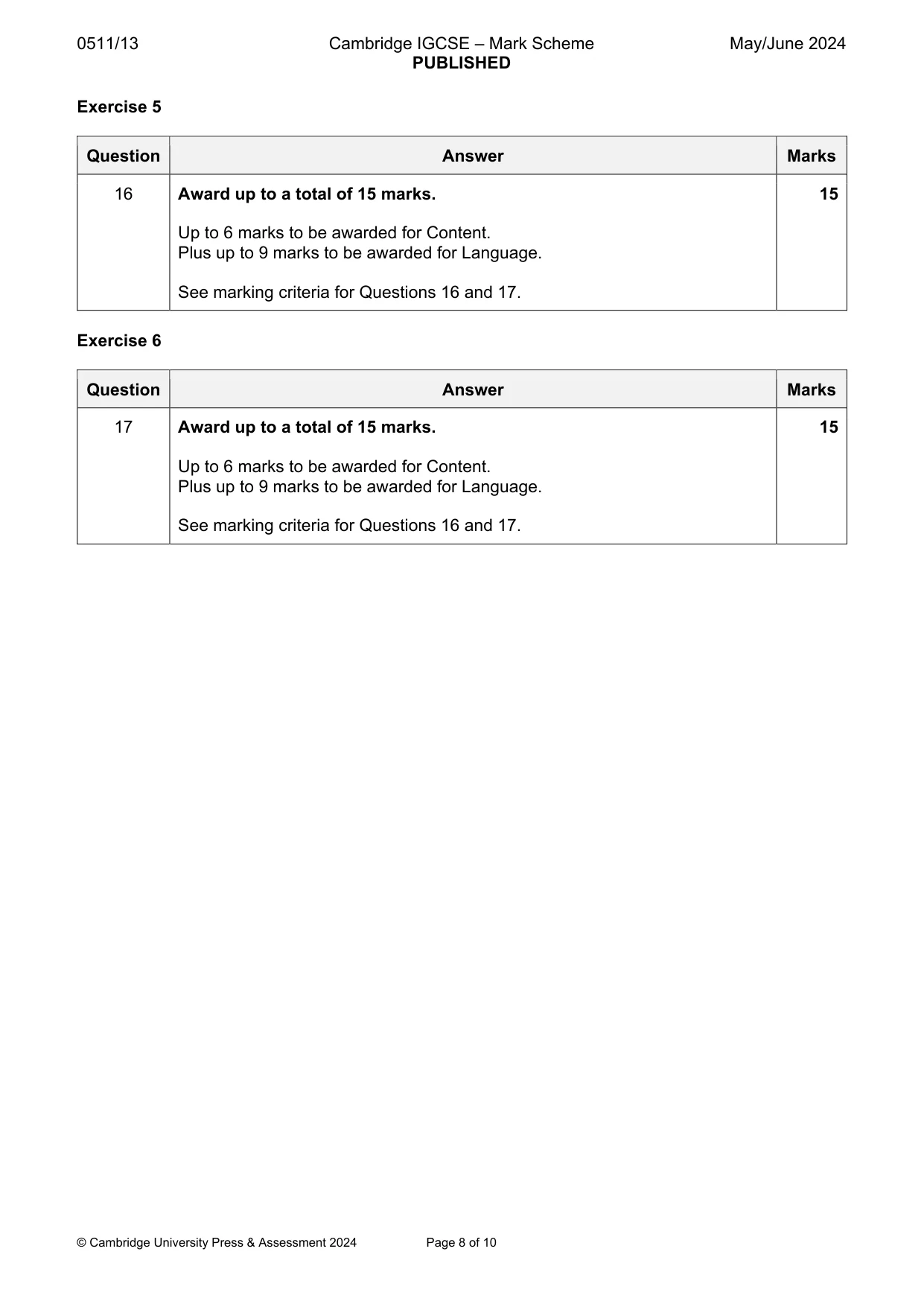
0511/13 Cambridge IGCSE – Mark Scheme PUBLISHED May/June 2024 © Cambridge University Press & Assessment 2024 Page 8 of 10 Exercise 5 Question Answer Marks 16 Award up to a total of 15 marks. Up to 6 marks to be awarded for Content. Plus up to 9 marks to be awarded for Language. See marking criteria for Questions 16 and 17. 15 Exercise 6 Question Answer Marks 17 Award up to a total of 15 marks. Up to 6 marks to be awarded for Content. Plus up to 9 marks to be awarded for Language. See marking criteria for Questions 16 and 17. 15
Mark scheme, page 9
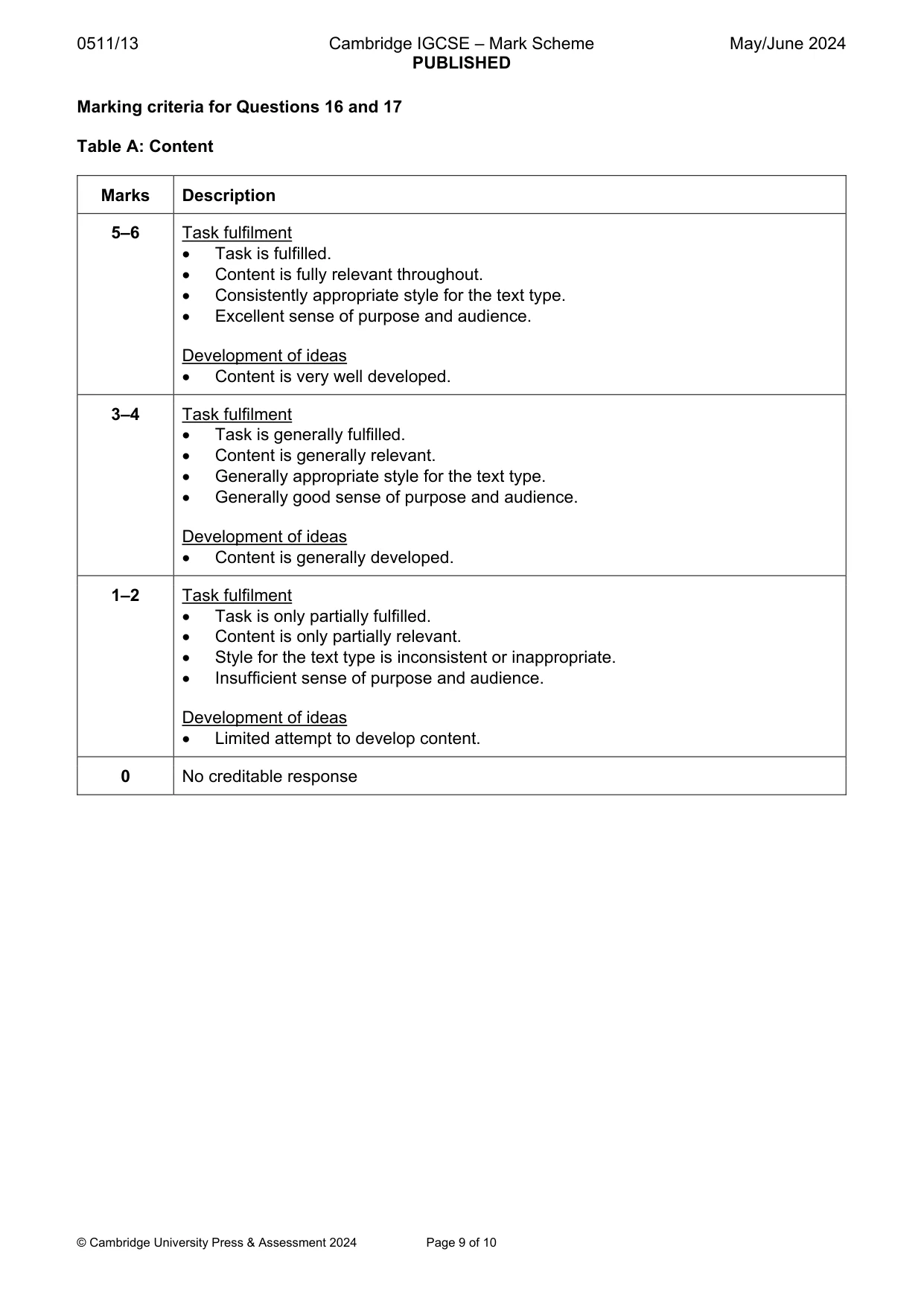
0511/13 Cambridge IGCSE – Mark Scheme PUBLISHED May/June 2024 © Cambridge University Press & Assessment 2024 Page 9 of 10 Marking criteria for Questions 16 and 17 Table A: Content Marks Description 5–6 Task fulfilment Task is fulfilled. Content is fully relevant throughout. Consistently appropriate style for the text type. Excellent sense of purpose and audience. Development of ideas Content is very well developed. 3–4 Task fulfilment Task is generally fulfilled. Content is generally relevant. Generally appropriate style for the text type. Generally good sense of purpose and audience. Development of ideas Content is generally developed. 1–2 Task fulfilment Task is only partially fulfilled. Content is only partially relevant. Style for the text type is inconsistent or inappropriate. Insufficient sense of purpose and audience. Development of ideas Limited attempt to develop content. 0 No creditable response
Mark scheme, page 10
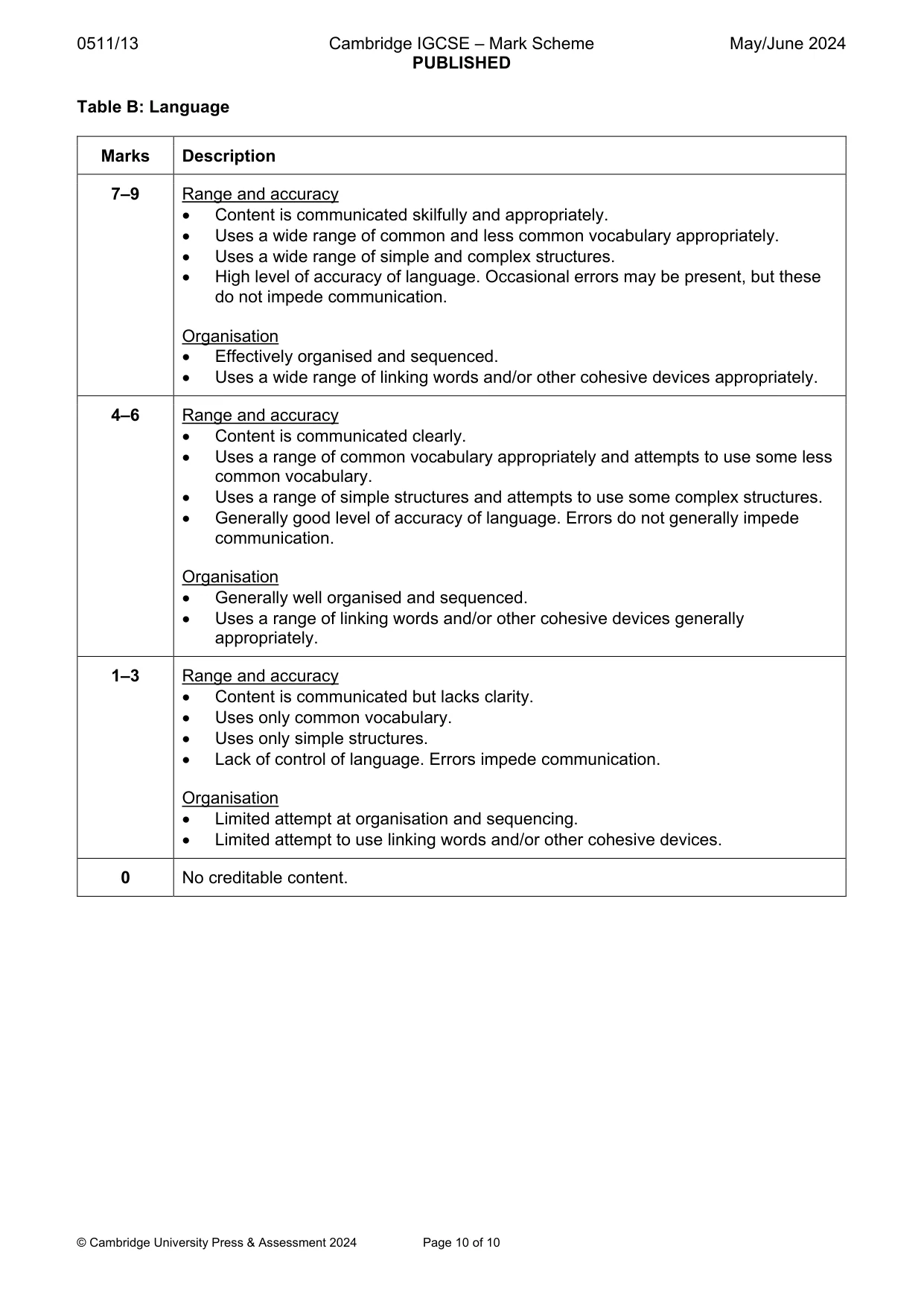
0511/13 Cambridge IGCSE – Mark Scheme PUBLISHED May/June 2024 © Cambridge University Press & Assessment 2024 Page 10 of 10 Table B: Language Marks Description 7–9 Range and accuracy Content is communicated skilfully and appropriately. Uses a wide range of common and less common vocabulary appropriately. Uses a wide range of simple and complex structures. High level of accuracy of language. Occasional errors may be present, but these do not impede communication. Organisation Effectively organised and sequenced. Uses a wide range of linking words and/or other cohesive devices appropriately. 4–6 Range and accuracy Content is communicated clearly. Uses a range of common vocabulary appropriately and attempts to use some less common vocabulary. Uses a range of simple structures and attempts to use some complex structures. Generally good level of accuracy of language. Errors do not generally impede communication. Organisation Generally well organised and sequenced. Uses a range of linking words and/or other cohesive devices generally appropriately. 1–3 Range and accuracy Content is communicated but lacks clarity. Uses only common vocabulary. Uses only simple structures. Lack of control of language. Errors impede communication. Organisation Limited attempt at organisation and sequencing. Limited attempt to use linking words and/or other cohesive devices. 0 No creditable content.
What you needed in this session
Cambridge’s own grade thresholds for 2024 May/June, Paper 1 · Variant 3. A higher threshold means an easier paper — the bar moves with how the cohort did.