Cambridge IGCSE English - Literature in English 0475 — 2023 May/June Paper 3 · Variant 2
0475/32/M/J/23 · 25 marks · ≈28 min
The question paper and its mark scheme, free to read here and free to download. This is Cambridge’s own paper, exactly as it was sat.
Question paper12 pages
Mark scheme5 pages
Answers below. Sit the paper first if you are practising.
Paper as text
Question paper, page 1
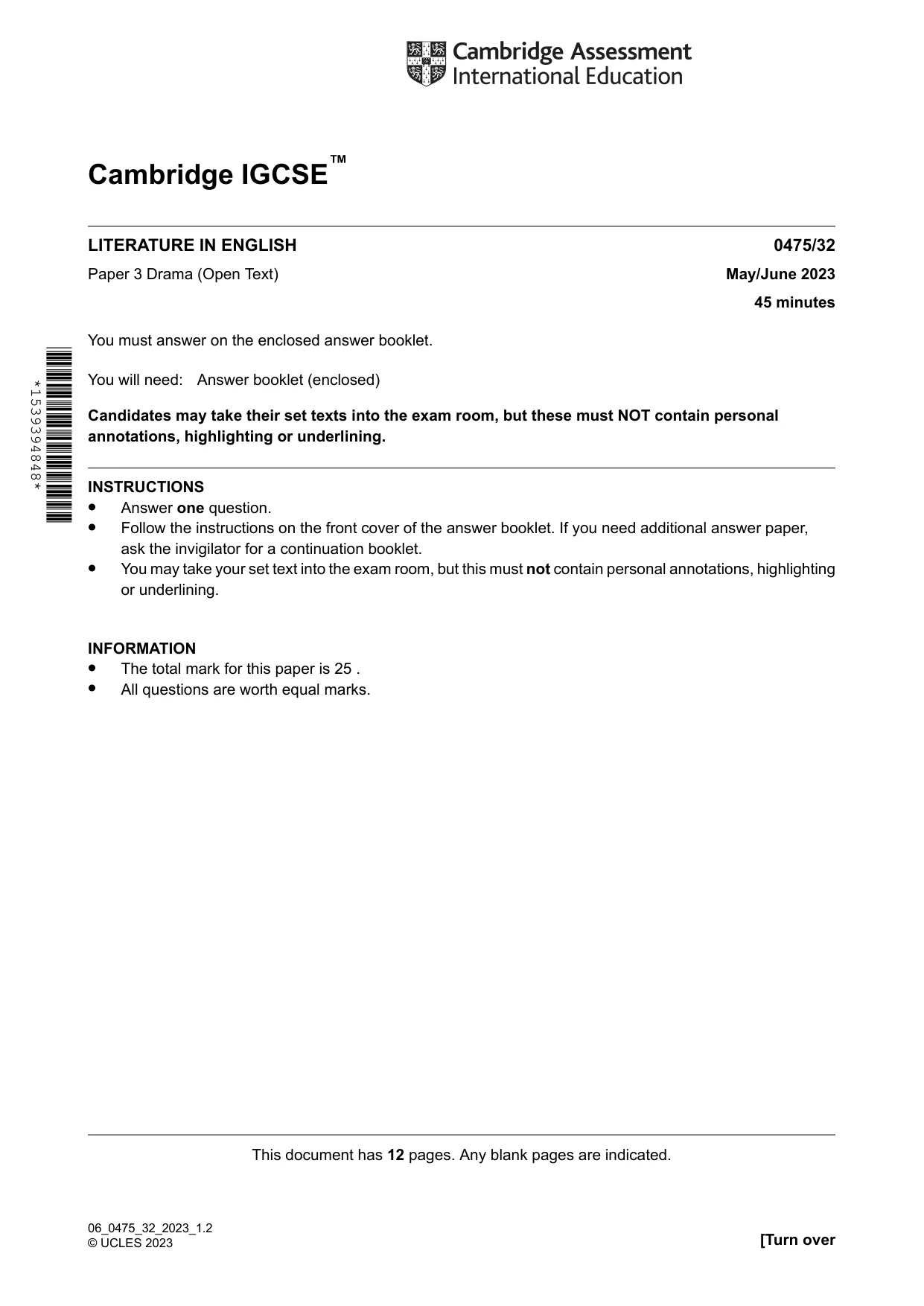
Cambridge IGCSE™ 0475/32 LITERATURE IN ENGLISH May/June 2023 Paper 3 Drama (Open Text) 45 minutes You must answer on the enclosed answer booklet. You will need: Answer booklet (enclosed) Candidates may take their set texts into the exam room, but these must NOT contain personal annotations, highlighting or underlining. INSTRUCTIONS • Answer one question. • Follow the instructions on the front cover of the answer booklet. If you need additional answer paper, ask the invigilator for a continuation booklet. • You may take your set text into the exam room, but this must not contain personal annotations, highlighting or underlining. INFORMATION • The total mark for this paper is 25 . • All questions are worth equal marks. This document has 12 pages. Any blank pages are indicated. [Turn over 06_0475_32_2023_1.2 © UCLES 2023 *1539394848*
Question paper, page 2
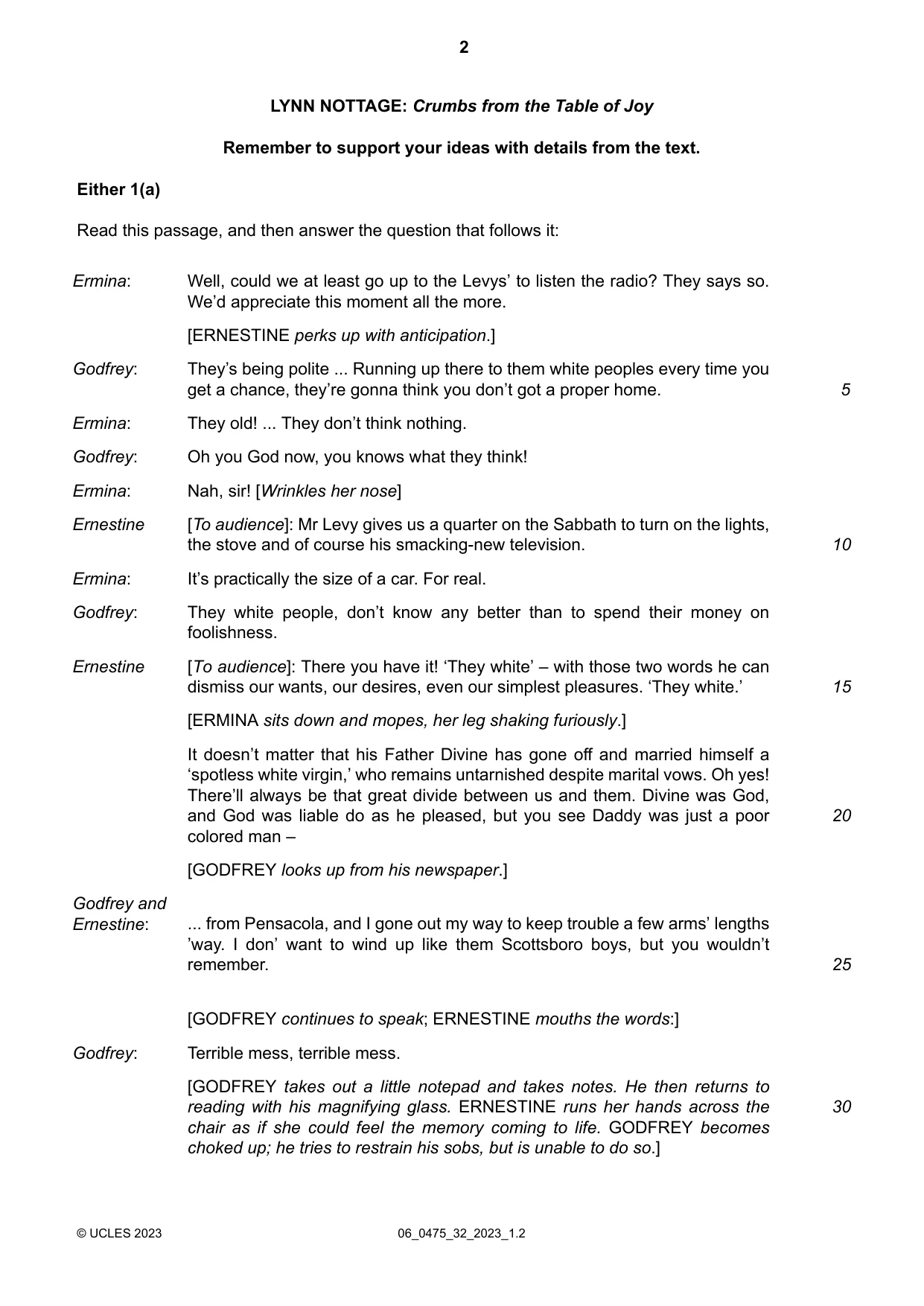
30 25 20 15 10 5 LYNN NOTTAGE: Crumbs from the Table of Joy Remember to support your ideas with details from the text. Either 1(a) Read this passage, and then answer the question that follows it: Well, could we at least go up to the Levys’ to listen the radio? They says so. We’d appreciate this moment all the more. Ermina: [ERNESTINE perks up with anticipation.] They’s being polite ... Running up there to them white peoples every time you get a chance, they’re gonna think you don’t got a proper home. Godfrey: They old! ... They don’t think nothing. Ermina: Oh you God now, you knows what they think! Godfrey: Nah, sir! [Wrinkles her nose] Ermina: [To audience]: Mr Levy gives us a quarter on the Sabbath to turn on the lights, the stove and of course his smacking-new television. Ernestine It’s practically the size of a car. For real. Ermina: They white people, don’t know any better than to spend their money on foolishness. Godfrey: [To audience]: There you have it! ‘They white’ – with those two words he can dismiss our wants, our desires, even our simplest pleasures. ‘They white.’ Ernestine [ERMINA sits down and mopes, her leg shaking furiously.] It doesn’t matter that his Father Divine has gone off and married himself a ‘spotless white virgin,’ who remains untarnished despite marital vows. Oh yes! There’ll always be that great divide between us and them. Divine was God, and God was liable do as he pleased, but you see Daddy was just a poor colored man – [GODFREY looks up from his newspaper.] ... from Pensacola, and I gone out my way to keep trouble a few arms’ lengths ’way. I don’ want to wind up like them Scottsboro boys, but you wouldn’t remember. Godfrey and Ernestine: [GODFREY continues to speak; ERNESTINE mouths the words:] Terrible mess, terrible mess. Godfrey: [GODFREY takes out a little notepad and takes notes. He then returns to reading with his magnifying glass. ERNESTINE runs her hands across the chair as if she could feel the memory coming to life. GODFREY becomes choked up; he tries to restrain his sobs, but is unable to do so.] 06_0475_32_2023_1.2 © UCLES 2023 2
Question paper, page 3
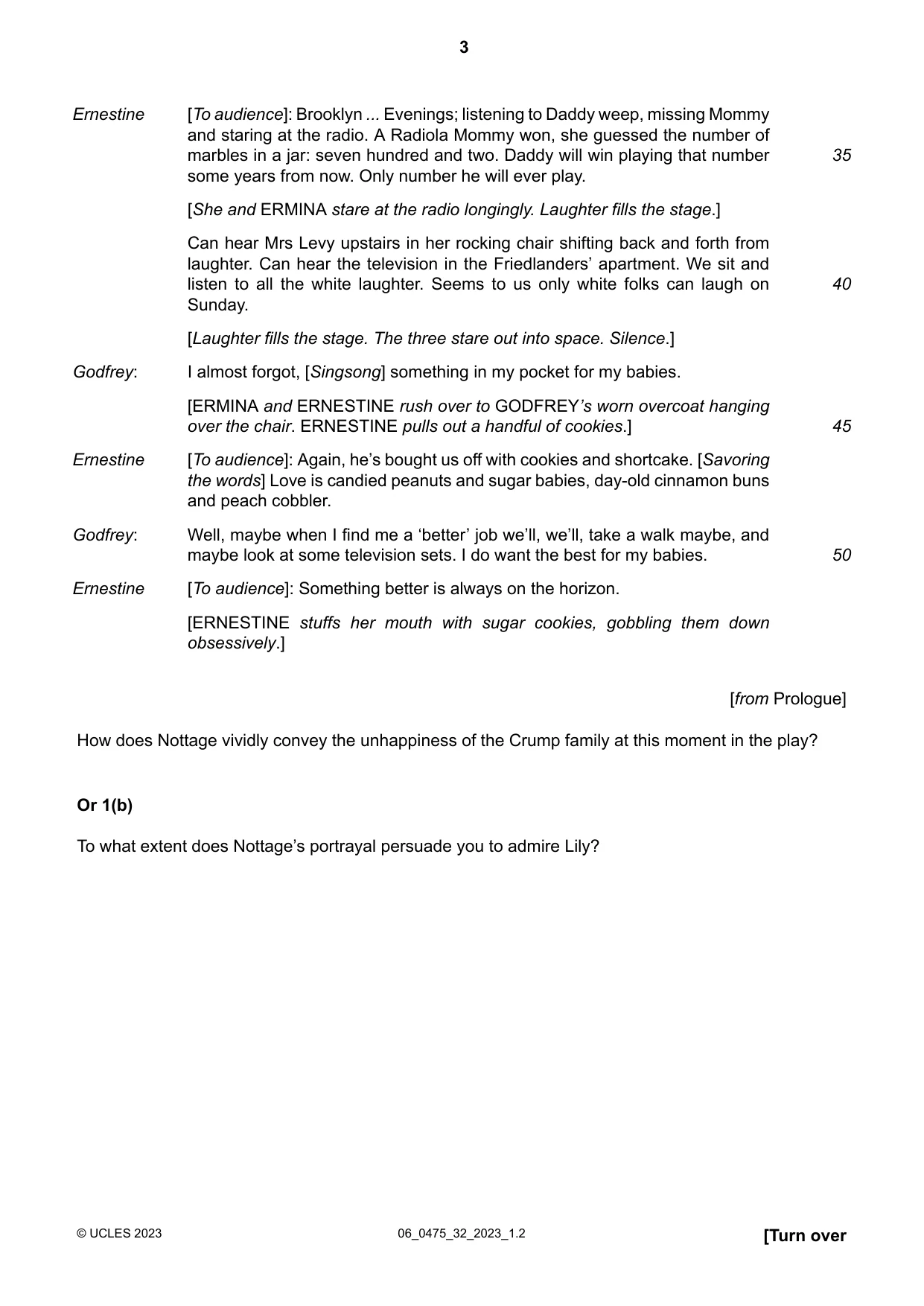
50 45 40 35 [To audience]: Brooklyn ... Evenings; listening to Daddy weep, missing Mommy and staring at the radio. A Radiola Mommy won, she guessed the number of marbles in a jar: seven hundred and two. Daddy will win playing that number some years from now. Only number he will ever play. Ernestine [She and ERMINA stare at the radio longingly. Laughter fills the stage.] Can hear Mrs Levy upstairs in her rocking chair shifting back and forth from laughter. Can hear the television in the Friedlanders’ apartment. We sit and listen to all the white laughter. Seems to us only white folks can laugh on Sunday. [Laughter fills the stage. The three stare out into space. Silence.] I almost forgot, [Singsong] something in my pocket for my babies. Godfrey: [ERMINA and ERNESTINE rush over to GODFREY’s worn overcoat hanging over the chair. ERNESTINE pulls out a handful of cookies.] [To audience]: Again, he’s bought us off with cookies and shortcake. [Savoring the words] Love is candied peanuts and sugar babies, day-old cinnamon buns and peach cobbler. Ernestine Well, maybe when I find me a ‘better’ job we’ll, we’ll, take a walk maybe, and maybe look at some television sets. I do want the best for my babies. Godfrey: [To audience]: Something better is always on the horizon. Ernestine [ERNESTINE stuffs her mouth with sugar cookies, gobbling them down obsessively.] [from Prologue] How does Nottage vividly convey the unhappiness of the Crump family at this moment in the play? Or 1(b) To what extent does Nottage’s portrayal persuade you to admire Lily? [Turn over 06_0475_32_2023_1.2 © UCLES 2023 3
Question paper, page 4
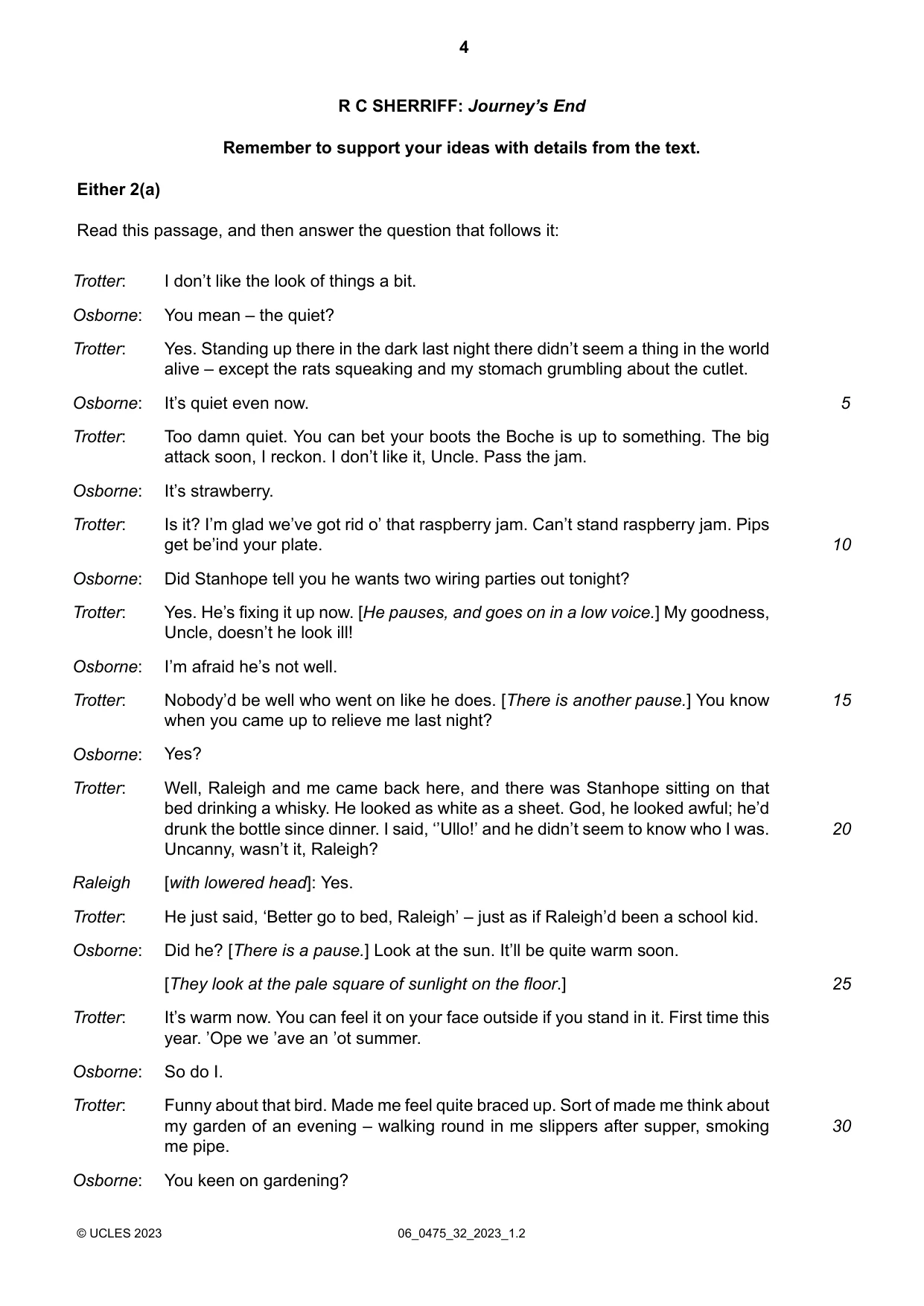
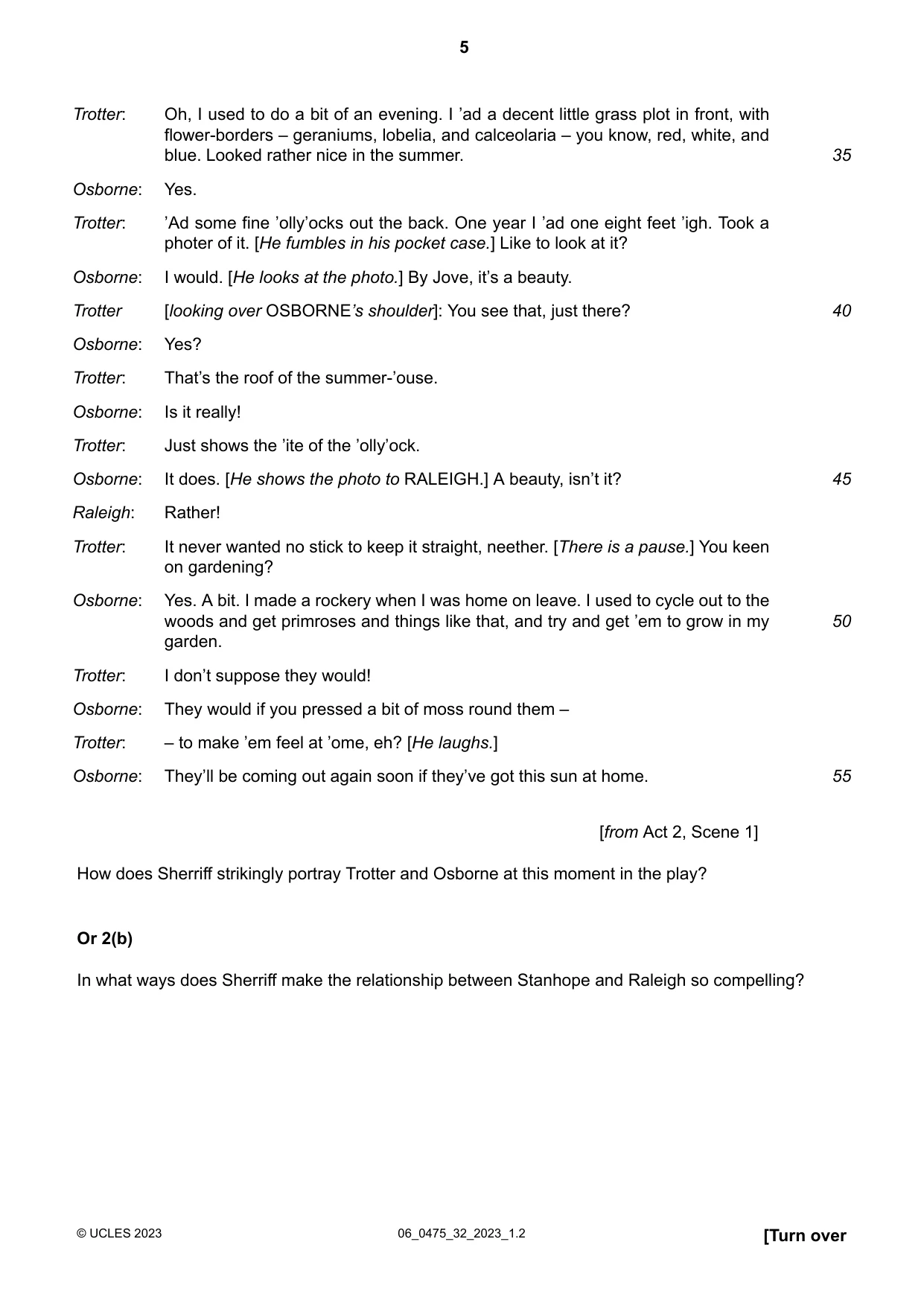
30 25 20 15 10 5 R C SHERRIFF: Journey’s End Remember to support your ideas with details from the text. Either 2(a) Read this passage, and then answer the question that follows it: Ι don’t like the look of things a bit. Trotter: You mean – the quiet? Osborne: Yes. Standing up there in the dark last night there didn’t seem a thing in the world alive – except the rats squeaking and my stomach grumbling about the cutlet. Trotter: It’s quiet even now. Osborne: Too damn quiet. You can bet your boots the Boche is up to something. The big attack soon, I reckon. I don’t like it, Uncle. Pass the jam. Trotter: It’s strawberry. Osborne: Is it? I’m glad we’ve got rid o’ that raspberry jam. Can’t stand raspberry jam. Pips get be’ind your plate. Trotter: Did Stanhope tell you he wants two wiring parties out tonight? Osborne: Yes. He’s fixing it up now. [He pauses, and goes on in a low voice.] My goodness, Uncle, doesn’t he look ill! Trotter: I’m afraid he’s not well. Osborne: Nobody’d be well who went on like he does. [There is another pause.] You know when you came up to relieve me last night? Trotter: Yes? Osborne: Well, Raleigh and me came back here, and there was Stanhope sitting on that bed drinking a whisky. He looked as white as a sheet. God, he looked awful; he’d drunk the bottle since dinner. I said, ‘’Ullo!’ and he didn’t seem to know who I was. Uncanny, wasn’t it, Raleigh? Trotter: [with lowered head]: Yes. Raleigh He just said, ‘Better go to bed, Raleigh’ – just as if Raleigh’d been a school kid. Trotter: Did he? [There is a pause.] Look at the sun. It’ll be quite warm soon. Osborne: [They look at the pale square of sunlight on the floor.] It’s warm now. You can feel it on your face outside if you stand in it. First time this year. ’Ope we ’ave an ’ot summer. Trotter: So do I. Osborne: Funny about that bird. Made me feel quite braced up. Sort of made me think about my garden of an evening – walking round in me slippers after supper, smoking me pipe. Trotter: You keen on gardening? Osborne: 06_0475_32_2023_1.2 © UCLES 2023 4
Question paper, page 5
55 50 45 40 35 Oh, I used to do a bit of an evening. I ’ad a decent little grass plot in front, with flower-borders – geraniums, lobelia, and calceolaria – you know, red, white, and blue. Looked rather nice in the summer. Trotter: Yes. Osborne: ’Ad some fine ’olly’ocks out the back. One year I ’ad one eight feet ’igh. Took a photer of it. [He fumbles in his pocket case.] Like to look at it? Trotter: I would. [He looks at the photo.] By Jove, it’s a beauty. Osborne: [looking over OSBORNE’s shoulder]: You see that, just there? Trotter Yes? Osborne: That’s the roof of the summer-’ouse. Trotter: Is it really! Osborne: Just shows the ’ite of the ’olly’ock. Trotter: It does. [He shows the photo to RALEIGH.] A beauty, isn’t it? Osborne: Rather! Raleigh: It never wanted no stick to keep it straight, neether. [There is a pause.] You keen on gardening? Trotter: Yes. A bit. I made a rockery when I was home on leave. I used to cycle out to the woods and get primroses and things like that, and try and get ’em to grow in my garden. Osborne: I don’t suppose they would! Trotter: They would if you pressed a bit of moss round them – Osborne: – to make ’em feel at ’ome, eh? [He laughs.] Trotter: They’ll be coming out again soon if they’ve got this sun at home. Osborne: [from Act 2, Scene 1] How does Sherriff strikingly portray Trotter and Osborne at this moment in the play? Or 2(b) In what ways does Sherriff make the relationship between Stanhope and Raleigh so compelling? [Turn over 06_0475_32_2023_1.2 © UCLES 2023 5
Question paper, page 6
WOLE SOYINKA: Death and the King’s Horseman Remember to support your ideas with details from the text. Either 3(a) Read this passage, and then answer the question that follows it: Iyaloja, who is she? Elesin: 06_0475_32_2023_1.2 © UCLES 2023 6 Content removed due to copyright restrictions.
Question paper, page 7
I dare not refuse. [from Scene 1] In what ways does Soyinka make this such a dramatic moment in the play? Or 3(b) What does Soyinka’s portrayal of Simon Pilkings encourage you to feel about him? [Turn over 06_0475_32_2023_1.2 © UCLES 2023 7 Content removed due to copyright restrictions.
Question paper, page 8
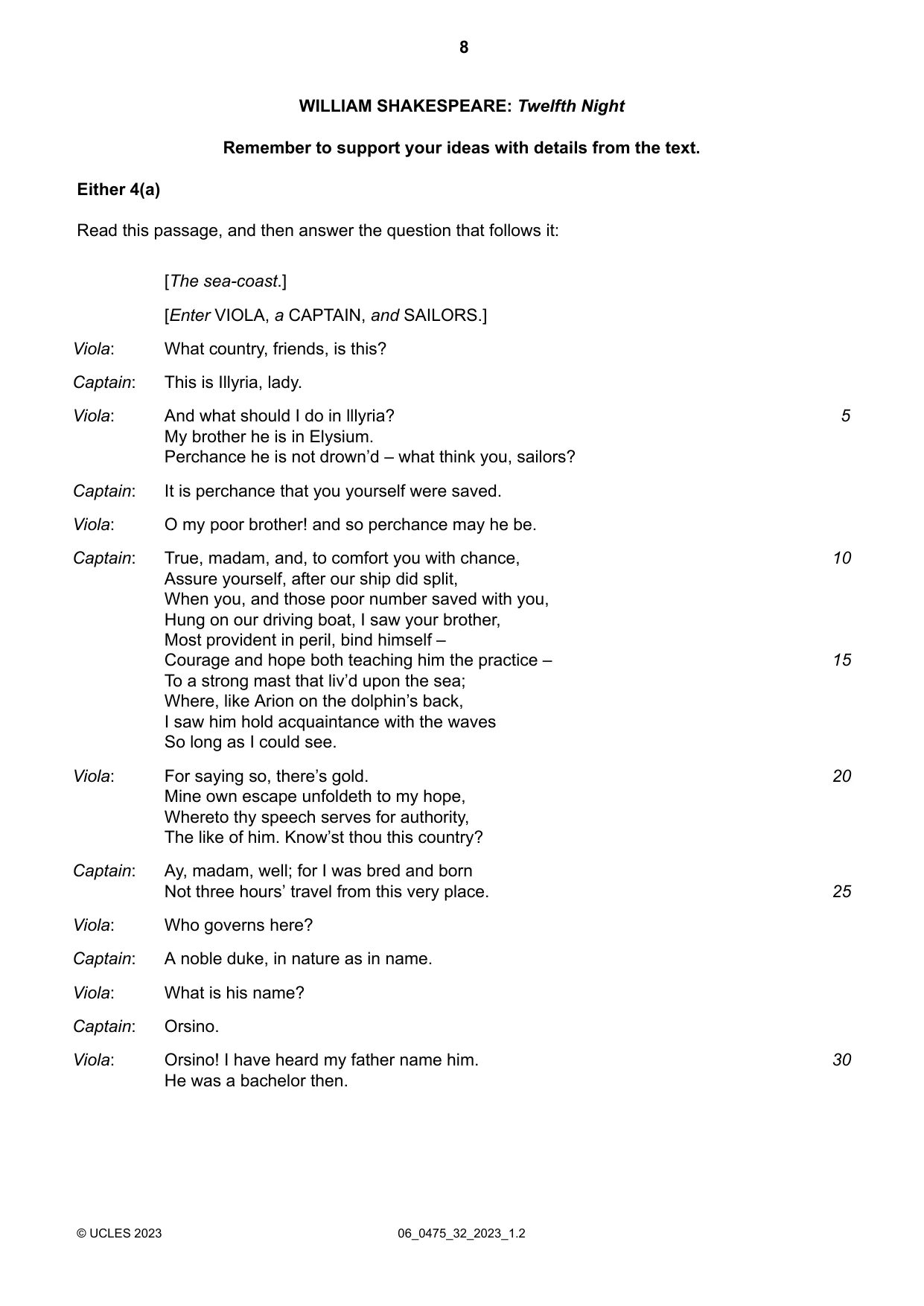
30 25 20 15 10 5 WILLIAM SHAKESPEARE: Twelfth Night Remember to support your ideas with details from the text. Either 4(a) Read this passage, and then answer the question that follows it: [The sea-coast.] [Enter VIOLA, a CAPTAIN, and SAILORS.] What country, friends, is this? Viola: This is Illyria, lady. Captain: And what should I do in lllyria? My brother he is in Elysium. Perchance he is not drown’d – what think you, sailors? Viola: It is perchance that you yourself were saved. Captain: O my poor brother! and so perchance may he be. Viola: True, madam, and, to comfort you with chance, Assure yourself, after our ship did split, When you, and those poor number saved with you, Hung on our driving boat, I saw your brother, Most provident in peril, bind himself – Courage and hope both teaching him the practice – To a strong mast that liv’d upon the sea; Where, like Arion on the dolphin’s back, I saw him hold acquaintance with the waves So long as I could see. Captain: For saying so, there’s gold. Mine own escape unfoldeth to my hope, Whereto thy speech serves for authority, The like of him. Know’st thou this country? Viola: Ay, madam, well; for I was bred and born Not three hours’ travel from this very place. Captain: Who governs here? Viola: A noble duke, in nature as in name. Captain: What is his name? Viola: Orsino. Captain: Orsino! I have heard my father name him. He was a bachelor then. Viola: 06_0475_32_2023_1.2 © UCLES 2023 8
Question paper, page 9
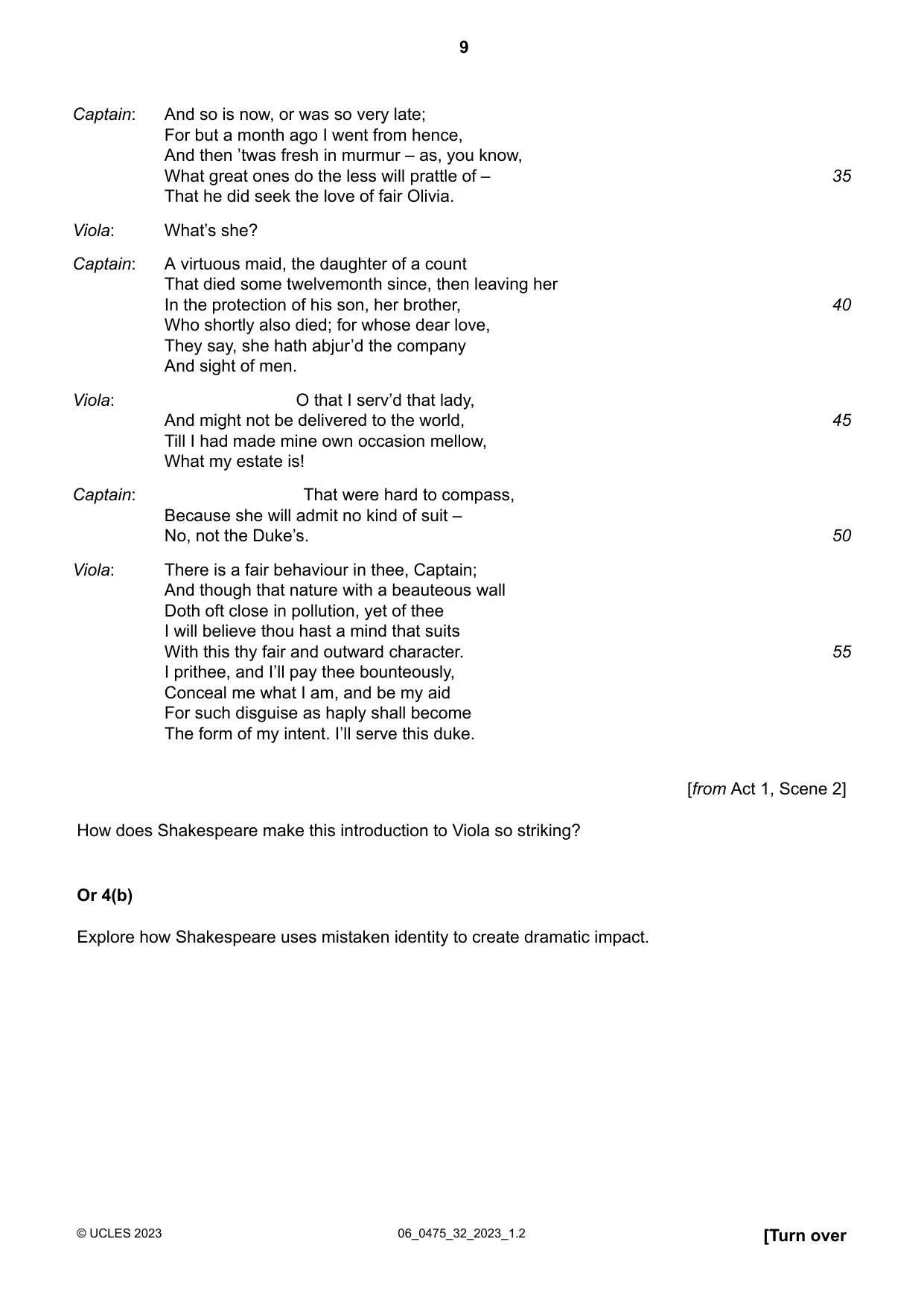
55 50 45 40 35 And so is now, or was so very late; For but a month ago I went from hence, And then ’twas fresh in murmur – as, you know, What great ones do the less will prattle of – That he did seek the love of fair Olivia. Captain: What’s she? Viola: A virtuous maid, the daughter of a count That died some twelvemonth since, then leaving her In the protection of his son, her brother, Who shortly also died; for whose dear love, They say, she hath abjur’d the company And sight of men. Captain: O that I serv’d that lady, And might not be delivered to the world, Till I had made mine own occasion mellow, What my estate is! Viola: That were hard to compass, Because she will admit no kind of suit – No, not the Duke’s. Captain: There is a fair behaviour in thee, Captain; And though that nature with a beauteous wall Doth oft close in pollution, yet of thee I will believe thou hast a mind that suits With this thy fair and outward character. I prithee, and I’ll pay thee bounteously, Conceal me what I am, and be my aid For such disguise as haply shall become The form of my intent. I’ll serve this duke. Viola: [from Act 1, Scene 2] How does Shakespeare make this introduction to Viola so striking? Or 4(b) Explore how Shakespeare uses mistaken identity to create dramatic impact. [Turn over 06_0475_32_2023_1.2 © UCLES 2023 9
Question paper, page 10
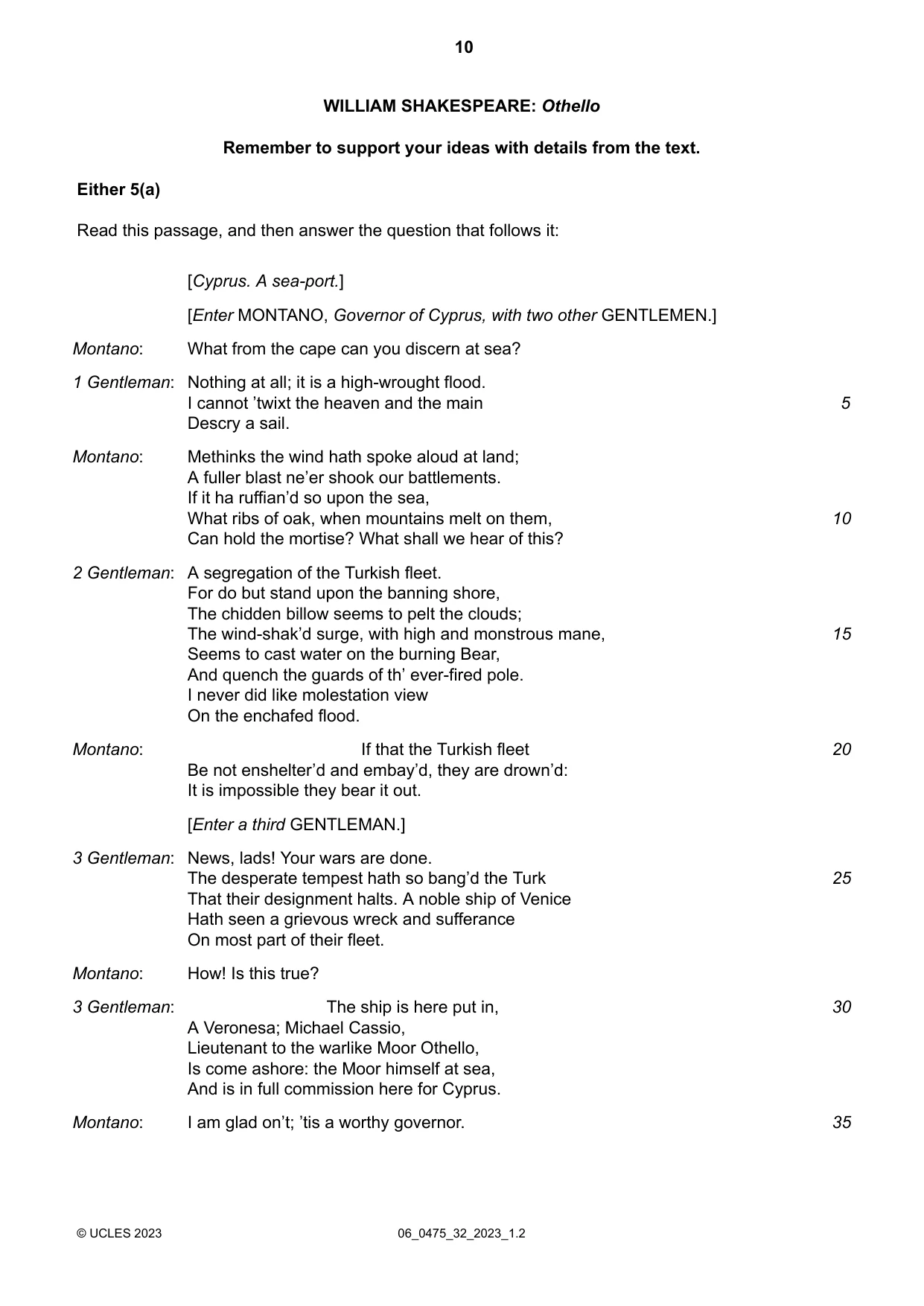
35 30 25 20 15 10 5 WILLIAM SHAKESPEARE: Othello Remember to support your ideas with details from the text. Either 5(a) Read this passage, and then answer the question that follows it: [Cyprus. A sea-port.] [Enter MONTANO, Governor of Cyprus, with two other GENTLEMEN.] What from the cape can you discern at sea? Montano: Nothing at all; it is a high-wrought flood. I cannot ’twixt the heaven and the main Descry a sail. 1 Gentleman: Methinks the wind hath spoke aloud at land; A fuller blast ne’er shook our battlements. If it ha ruffian’d so upon the sea, What ribs of oak, when mountains melt on them, Can hold the mortise? What shall we hear of this? Montano: A segregation of the Turkish fleet. For do but stand upon the banning shore, The chidden billow seems to pelt the clouds; The wind-shak’d surge, with high and monstrous mane, Seems to cast water on the burning Bear, And quench the guards of th’ ever-fired pole. I never did like molestation view On the enchafed flood. 2 Gentleman: If that the Turkish fleet Be not enshelter’d and embay’d, they are drown’d: It is impossible they bear it out. Montano: [Enter a third GENTLEMAN.] News, lads! Your wars are done. The desperate tempest hath so bang’d the Turk That their designment halts. A noble ship of Venice Hath seen a grievous wreck and sufferance On most part of their fleet. 3 Gentleman: How! Is this true? Montano: The ship is here put in, A Veronesa; Michael Cassio, Lieutenant to the warlike Moor Othello, Is come ashore: the Moor himself at sea, And is in full commission here for Cyprus. 3 Gentleman: I am glad on’t; ’tis a worthy governor. Montano: 06_0475_32_2023_1.2 © UCLES 2023 10
Question paper, page 11
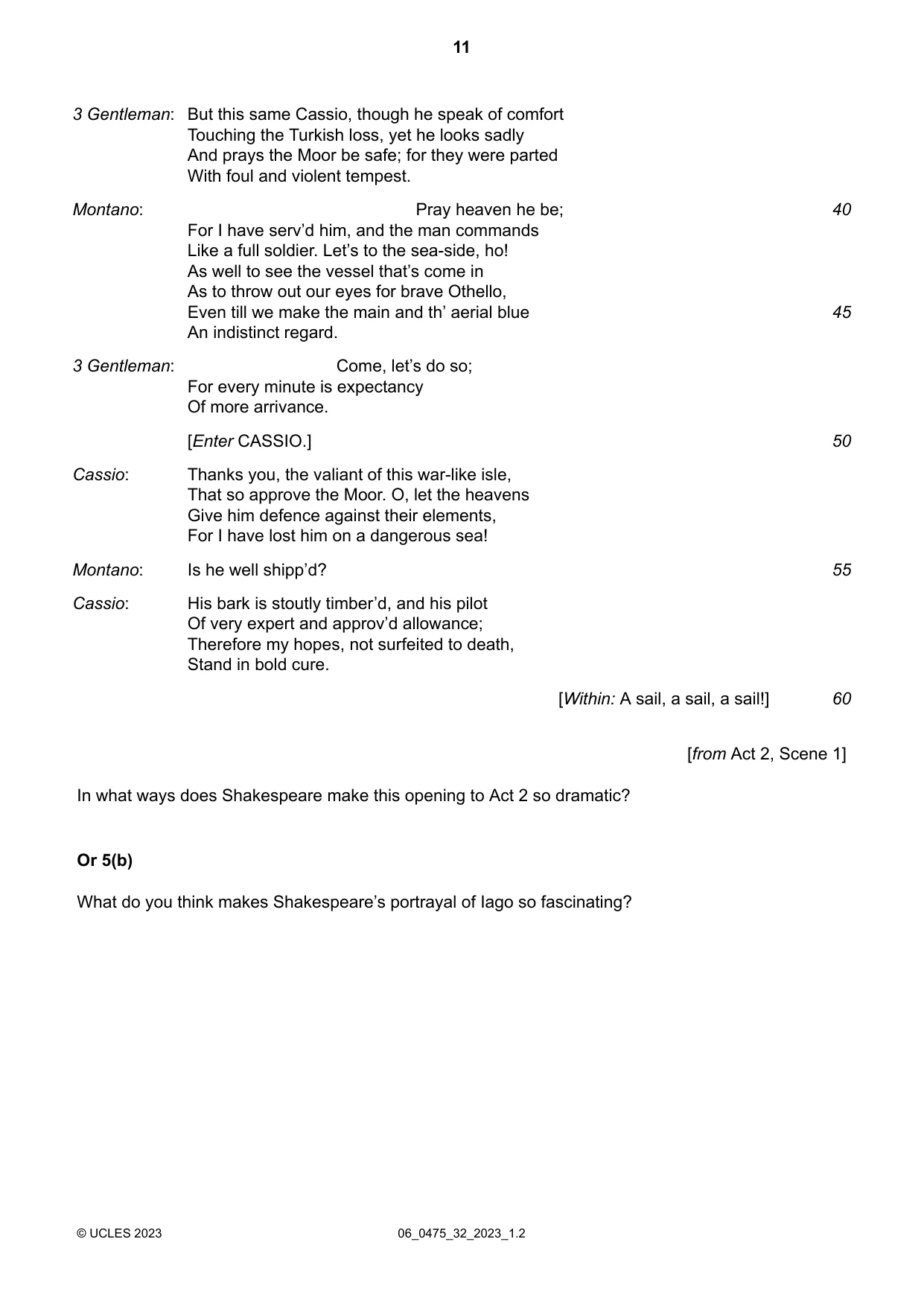
60 55 50 45 40 But this same Cassio, though he speak of comfort Touching the Turkish loss, yet he looks sadly And prays the Moor be safe; for they were parted With foul and violent tempest. 3 Gentleman: Pray heaven he be; For I have serv’d him, and the man commands Like a full soldier. Let’s to the sea-side, ho! As well to see the vessel that’s come in As to throw out our eyes for brave Othello, Even till we make the main and th’ aerial blue An indistinct regard. Montano: Come, let’s do so; For every minute is expectancy Of more arrivance. 3 Gentleman: [Enter CASSIO.] Thanks you, the valiant of this war-like isle, That so approve the Moor. O, let the heavens Give him defence against their elements, For I have lost him on a dangerous sea! Cassio: Is he well shipp’d? Montano: His bark is stoutly timber’d, and his pilot Of very expert and approv’d allowance; Therefore my hopes, not surfeited to death, Stand in bold cure. Cassio: [Within: A sail, a sail, a sail!] [from Act 2, Scene 1] In what ways does Shakespeare make this opening to Act 2 so dramatic? Or 5(b) What do you think makes Shakespeare’s portrayal of Iago so fascinating? 06_0475_32_2023_1.2 © UCLES 2023 11
Question paper, page 12
BLANK PAGE Permission to reproduce items where third-party owned material protected by copyright is included has been sought and cleared where possible. Every reasonable effort has been made by the publisher (UCLES) to trace copyright holders, but if any items requiring clearance have unwittingly been included, the publisher will be pleased to make amends at the earliest possible opportunity. To avoid the issue of disclosure of answer-related information to candidates, all copyright acknowledgements are reproduced online in the Cambridge Assessment International Education Copyright Acknowledgements Booklet. This is produced for each series of examinations and is freely available to download at www.cambridgeinternational.org after the live examination series. Cambridge Assessment International Education is part of Cambridge Assessment. Cambridge Assessment is the brand name of the University of Cambridge Local Examinations Syndicate (UCLES), which is a department of the University of Cambridge. 06_0475_32_2023_1.2 © UCLES 2023 12
Mark scheme, page 1
This document consists of 5 printed pages. © UCLES 2023 [Turn over Cambridge IGCSE™ LITERATURE IN ENGLISH 0475/32 Paper 3 Drama (Open Text) May/June 2023 MARK SCHEME Maximum Mark: 25 Published This mark scheme is published as an aid to teachers and candidates, to indicate the requirements of the examination. It shows the basis on which Examiners were instructed to award marks. It does not indicate the details of the discussions that took place at an Examiners’ meeting before marking began, which would have considered the acceptability of alternative answers. Mark schemes should be read in conjunction with the question paper and the Principal Examiner Report for Teachers. Cambridge International will not enter into discussions about these mark schemes. Cambridge International is publishing the mark schemes for the May/June 2023 series for most Cambridge IGCSE, Cambridge International A and AS Level and Cambridge Pre-U components, and some Cambridge O Level components.
Mark scheme, page 2
0475/32 Cambridge IGCSE – Mark Scheme PUBLISHED May/June 2023 © UCLES 2023 Page 2 of 5 Generic Marking Principles These general marking principles must be applied by all examiners when marking candidate answers. They should be applied alongside the specific content of the mark scheme or generic level descriptors for a question. Each question paper and mark scheme will also comply with these marking principles. GENERIC MARKING PRINCIPLE 1: Marks must be awarded in line with: the specific content of the mark scheme or the generic level descriptors for the question the specific skills defined in the mark scheme or in the generic level descriptors for the question the standard of response required by a candidate as exemplified by the standardisation scripts. GENERIC MARKING PRINCIPLE 2: Marks awarded are always whole marks (not half marks, or other fractions). GENERIC MARKING PRINCIPLE 3: Marks must be awarded positively: marks are awarded for correct/valid answers, as defined in the mark scheme. However, credit is given for valid answers which go beyond the scope of the syllabus and mark scheme, referring to your Team Leader as appropriate marks are awarded when candidates clearly demonstrate what they know and can do marks are not deducted for errors marks are not deducted for omissions answers should only be judged on the quality of spelling, punctuation and grammar when these features are specifically assessed by the question as indicated by the mark scheme. The meaning, however, should be unambiguous. GENERIC MARKING PRINCIPLE 4: Rules must be applied consistently, e.g. in situations where candidates have not followed instructions or in the application of generic level descriptors. GENERIC MARKING PRINCIPLE 5: Marks should be awarded using the full range of marks defined in the mark scheme for the question (however; the use of the full mark range may be limited according to the quality of the candidate responses seen). GENERIC MARKING PRINCIPLE 6: Marks awarded are based solely on the requirements as defined in the mark scheme. Marks should not be awarded with grade thresholds or grade descriptors in mind.
Mark scheme, page 3
0475/32 Cambridge IGCSE – Mark Scheme PUBLISHED May/June 2023 © UCLES 2023 Page 3 of 5 English & Media subject specific general marking principles (To be read in conjunction with the Generic Marking Principles (and requiring further guidance on how to place marks within levels)) Components using level descriptors: We use level descriptors as a guide to broad understanding of the qualities normally expected of, or typical of, work in a level. Level descriptors are a means of general guidance, and should not be interpreted as hurdle statements. Where indicative content notes are supplied for a question, these are not a prescription of required content, and must not be treated as such. Alternative correct points and unexpected answers in candidates’ scripts must be given marks that fairly reflect the knowledge and skills demonstrated. While we may have legitimate expectations as to the ground most answers may occupy, we must at all times be prepared to meet candidates on their chosen ground, provided it is relevant ground (e.g. clearly related to and derived from a relevant passage/text and meeting the mark scheme requirements for the question). Components using point-based marking: Point marking is often used to reward knowledge, understanding and application of skills. We give credit where the candidate’s answer shows relevant knowledge, understanding and application of skills in answering the question. We do not give credit where the answer shows confusion. From this it follows that we: a DO credit answers which are worded differently from the mark scheme if they clearly convey the same meaning (unless the mark scheme requires a specific term). b DO credit alternative answers/examples which are not written in the mark scheme if they are correct. c DO credit answers where candidates give more than one correct answer in one prompt/numbered/scaffolded space where extended writing is required rather than list-type answers. For example, questions that require n reasons (e.g. State two reasons…). d DO NOT credit answers simply for using a ‘key term’ unless that is all that is required. (Check for evidence it is understood and not used wrongly.). e DO NOT credit answers which are obviously self-contradicting or trying to cover all possibilities. f DO NOT give further credit for what is effectively repetition of a correct point already credited unless the language itself is being tested. This applies equally to ‘mirror statements’ (i.e. polluted/not polluted). g DO NOT require spellings to be correct, unless this is part of the test. However spellings of syllabus terms must allow for clear and unambiguous separation from other syllabus terms with which they may be confused (e.g. Corrasion/Corrosion).
Mark scheme, page 4
0475/32 Cambridge IGCSE – Mark Scheme PUBLISHED May/June 2023 © UCLES 2023 Page 4 of 5 All questions are marked out of 25. The assessment objectives for the paper are: AO1: show detailed knowledge of the content of literary texts, supported by reference to the text AO2: understand the meanings of literary texts and their contexts, and explore texts beyond surface meanings to show deeper awareness of ideas and attitudes AO3: recognise and appreciate ways in which writers use language, structure and form to create and shape meanings and effects AO4: communicate a sensitive and informed personal response to literary texts. The Level Descriptors cover marks from 0 to 25, and apply to the marking of each question. They guide examiners to an understanding of the qualities normally expected of, or typical of, work in a level. They are a means of general guidance. For the purposes of standardisation of marking, they are to be used in conjunction with examples of candidates’ work and discussed during the examiners’ coordination meeting.
Mark scheme, page 5
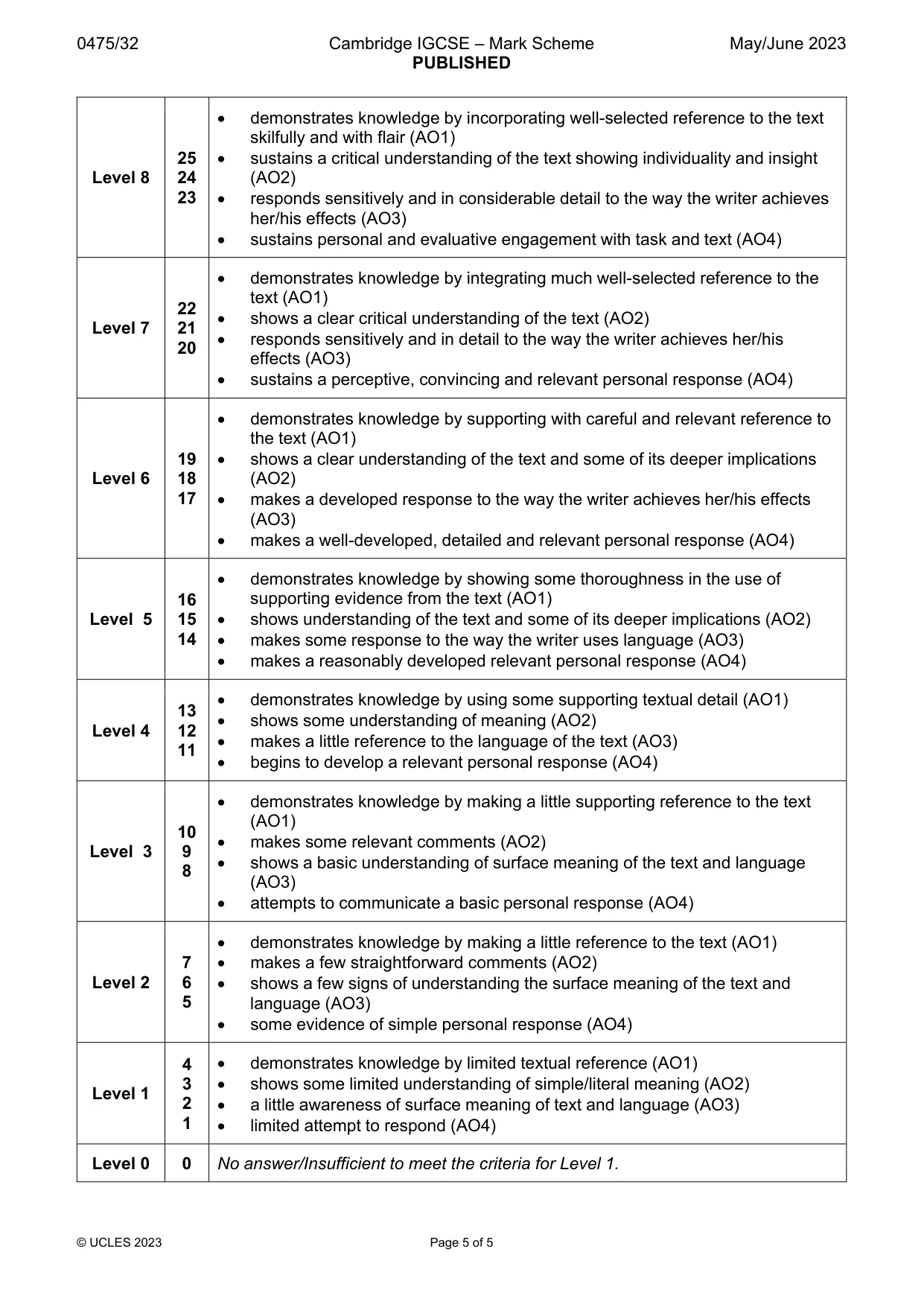
0475/32 Cambridge IGCSE – Mark Scheme PUBLISHED May/June 2023 © UCLES 2023 Page 5 of 5 Level 8 25 24 23 demonstrates knowledge by incorporating well-selected reference to the text skilfully and with flair (AO1) sustains a critical understanding of the text showing individuality and insight (AO2) responds sensitively and in considerable detail to the way the writer achieves her/his effects (AO3) sustains personal and evaluative engagement with task and text (AO4) Level 7 22 21 20 demonstrates knowledge by integrating much well-selected reference to the text (AO1) shows a clear critical understanding of the text (AO2) responds sensitively and in detail to the way the writer achieves her/his effects (AO3) sustains a perceptive, convincing and relevant personal response (AO4) Level 6 19 18 17 demonstrates knowledge by supporting with careful and relevant reference to the text (AO1) shows a clear understanding of the text and some of its deeper implications (AO2) makes a developed response to the way the writer achieves her/his effects (AO3) makes a well-developed, detailed and relevant personal response (AO4) Level 5 16 15 14 demonstrates knowledge by showing some thoroughness in the use of supporting evidence from the text (AO1) shows understanding of the text and some of its deeper implications (AO2) makes some response to the way the writer uses language (AO3) makes a reasonably developed relevant personal response (AO4) Level 4 13 12 11 demonstrates knowledge by using some supporting textual detail (AO1) shows some understanding of meaning (AO2) makes a little reference to the language of the text (AO3) begins to develop a relevant personal response (AO4) Level 3 10 9 8 demonstrates knowledge by making a little supporting reference to the text (AO1) makes some relevant comments (AO2) shows a basic understanding of surface meaning of the text and language (AO3) attempts to communicate a basic personal response (AO4) Level 2 7 6 5 demonstrates knowledge by making a little reference to the text (AO1) makes a few straightforward comments (AO2) shows a few signs of understanding the surface meaning of the text and language (AO3) some evidence of simple personal response (AO4) Level 1 4 3 2 1 demonstrates knowledge by limited textual reference (AO1) shows some limited understanding of simple/literal meaning (AO2) a little awareness of surface meaning of text and language (AO3) limited attempt to respond (AO4) Level 0 0 No answer/Insufficient to meet the criteria for Level 1.
What you needed in this session
Cambridge’s own grade thresholds for 2023 May/June, Paper 3 · Variant 2. A higher threshold means an easier paper — the bar moves with how the cohort did.