Cambridge IGCSE English - Literature in English 0475 — 2024 Feb/March Paper 3 · Variant 2
0475/32/F/M/24 · 25 marks · ≈28 min
The question paper and its mark scheme, free to read here and free to download. This is Cambridge’s own paper, exactly as it was sat.
Question paper12 pages


Mark scheme4 pages
Answers below. Sit the paper first if you are practising.
Paper as text
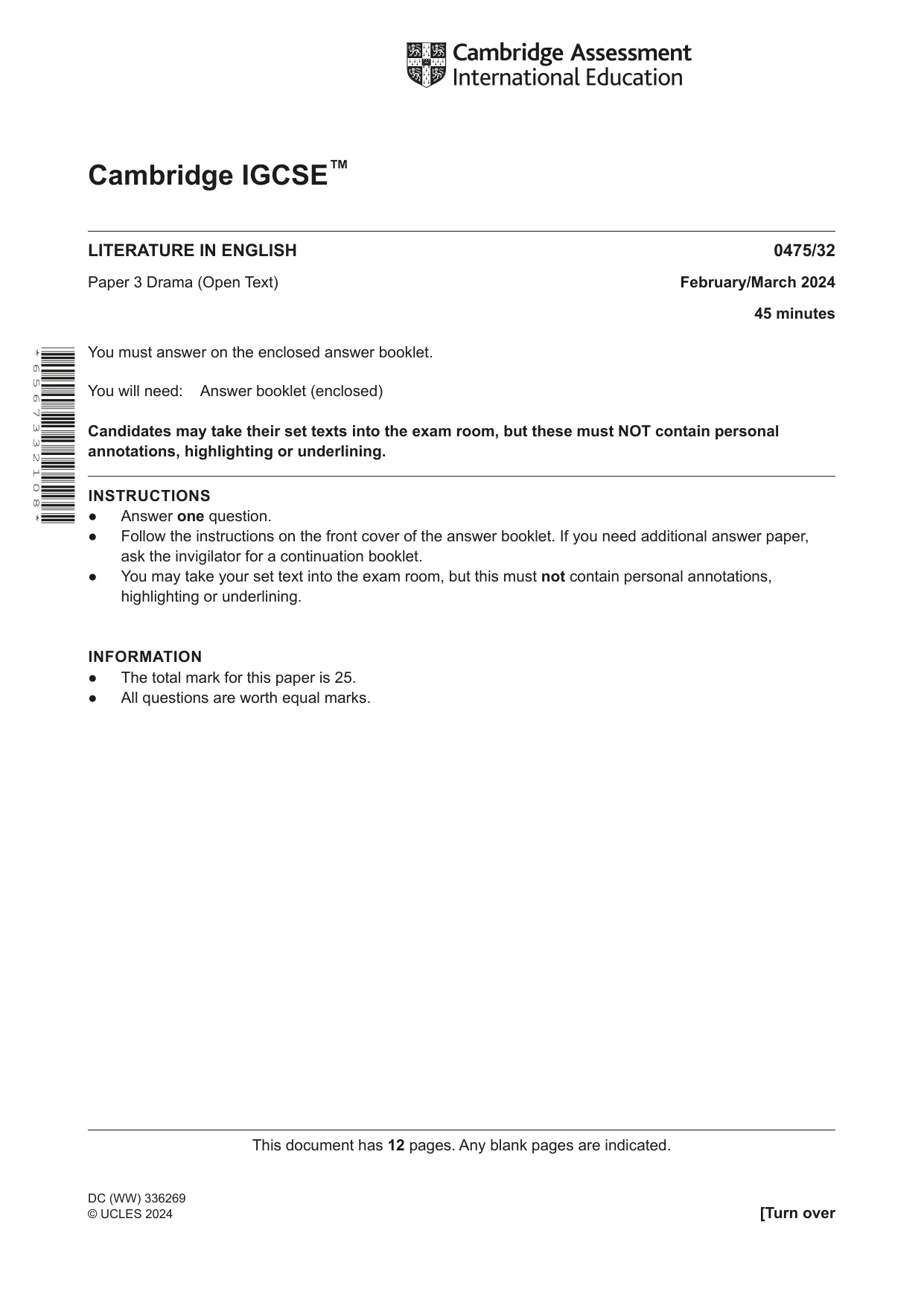
Question paper, page 1
This document has 12 pages. Any blank pages are indicated. [Turn over Cambridge IGCSE™ * 6 5 6 7 3 3 2 1 0 8 * DC (WW) 336269 © UCLES 2024 LITERATURE IN ENGLISH 0475/32 Paper 3 Drama (Open Text) February/March 2024 45 minutes You must answer on the enclosed answer booklet. You will need: Answer booklet (enclosed) Candidates may take their set texts into the exam room, but these must NOT contain personal annotations, highlighting or underlining. INSTRUCTIONS ● Answer one question. ● Follow the instructions on the front cover of the answer booklet. If you need additional answer paper, ask the invigilator for a continuation booklet. ● You may take your set text into the exam room, but this must not contain personal annotations, highlighting or underlining. INFORMATION ● The total mark for this paper is 25. ● All questions are worth equal marks.
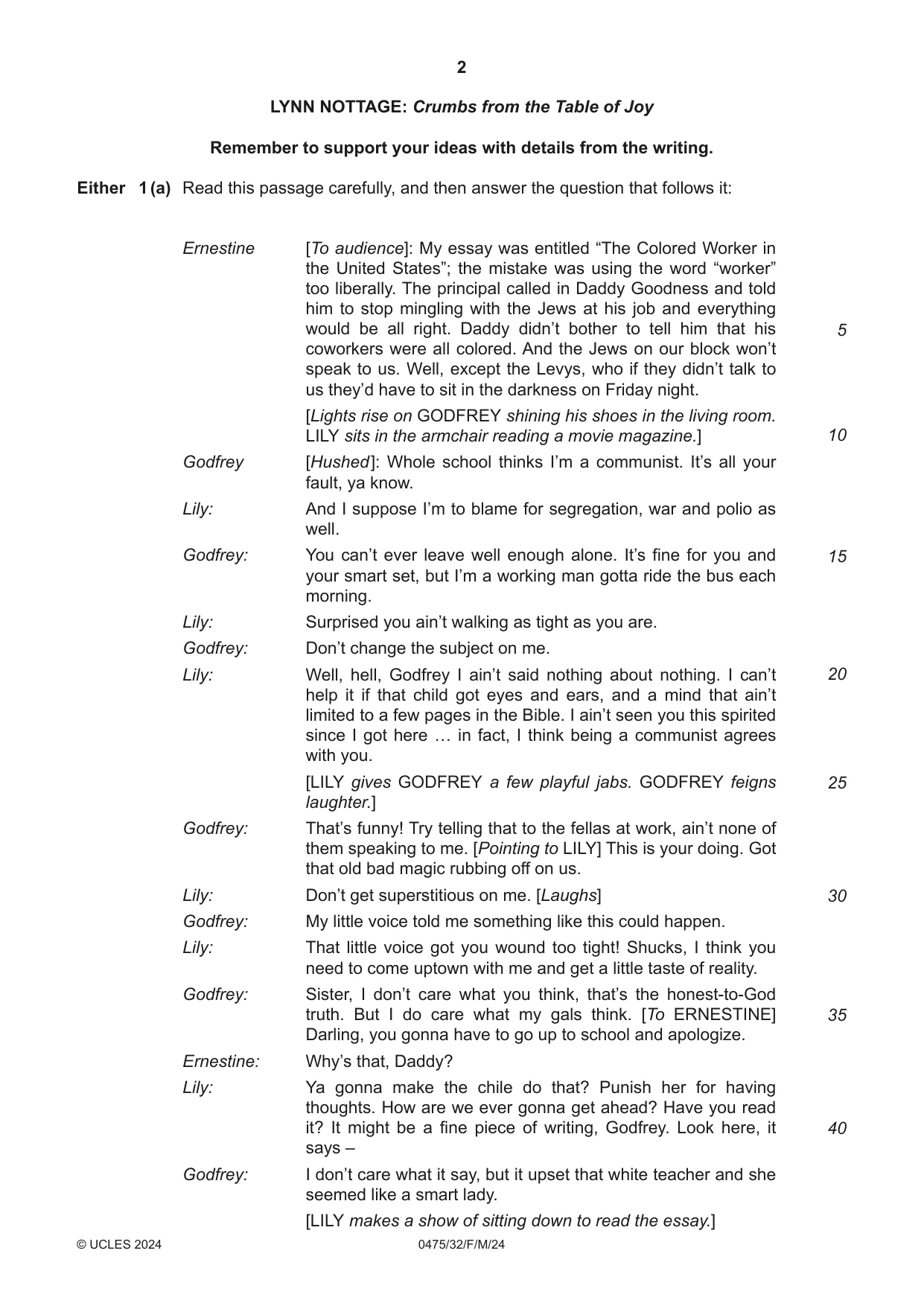
Question paper, page 2
2 0475/32/F/M/24 © UCLES 2024 LYNN NOTTAGE: Crumbs from the Table of Joy Remember to support your ideas with details from the writing. Either 1 (a) Read this passage carefully, and then answer the question that follows it: Ernestine [To audience]: My essay was entitled “The Colored Worker in the United States”; the mistake was using the word “worker” too liberally. The principal called in Daddy Goodness and told him to stop mingling with the Jews at his job and everything would be all right. Daddy didn’t bother to tell him that his coworkers were all colored. And the Jews on our block won’t speak to us. Well, except the Levys, who if they didn’t talk to us they’d have to sit in the darkness on Friday night. [Lights rise on GODFREY shining his shoes in the living room. LILY sits in the armchair reading a movie magazine.] Godfrey [Hushed ]: Whole school thinks I’m a communist. It’s all your fault, ya know. Lily: And I suppose I’m to blame for segregation, war and polio as well. Godfrey: You can’t ever leave well enough alone. It’s fine for you and your smart set, but I’m a working man gotta ride the bus each morning. Lily: Surprised you ain’t walking as tight as you are. Godfrey: Don’t change the subject on me. Lily: Well, hell, Godfrey I ain’t said nothing about nothing. I can’t help it if that child got eyes and ears, and a mind that ain’t limited to a few pages in the Bible. I ain’t seen you this spirited since I got here … in fact, I think being a communist agrees with you. [LILY gives GODFREY a few playful jabs. GODFREY feigns laughter.] Godfrey: That’s funny! Try telling that to the fellas at work, ain’t none of them speaking to me. [Pointing to LILY] This is your doing. Got that old bad magic rubbing off on us. Lily: Don’t get superstitious on me. [Laughs] Godfrey: My little voice told me something like this could happen. Lily: That little voice got you wound too tight! Shucks, I think you need to come uptown with me and get a little taste of reality. Godfrey: Sister, I don’t care what you think, that’s the honest-to-God truth. But I do care what my gals think. [To ERNESTINE] Darling, you gonna have to go up to school and apologize. Ernestine: Why’s that, Daddy? Lily: Ya gonna make the chile do that? Punish her for having thoughts. How are we ever gonna get ahead? Have you read it? It might be a fine piece of writing, Godfrey. Look here, it says – Godfrey: I don’t care what it say, but it upset that white teacher and she seemed like a smart lady. [LILY makes a show of sitting down to read the essay.] 5 10 15 20 25 30 35 40
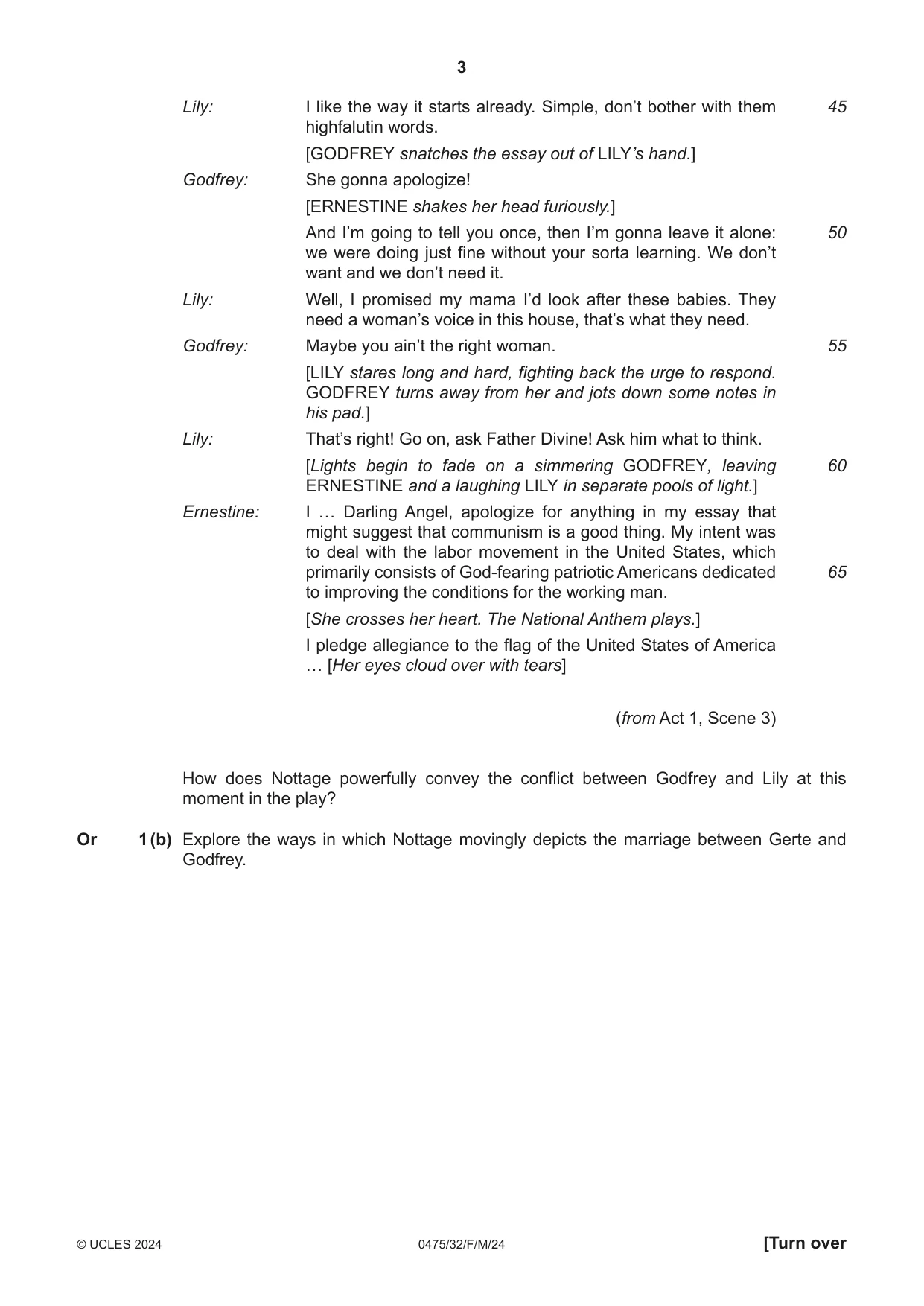
Question paper, page 3
3 0475/32/F/M/24 © UCLES 2024 [Turn over Lily: I like the way it starts already. Simple, don’t bother with them highfalutin words. [GODFREY snatches the essay out of LILY’s hand.] Godfrey: She gonna apologize! [ERNESTINE shakes her head furiously.] And I’m going to tell you once, then I’m gonna leave it alone: we were doing just fine without your sorta learning. We don’t want and we don’t need it. Lily: Well, I promised my mama I’d look after these babies. They need a woman’s voice in this house, that’s what they need. Godfrey: Maybe you ain’t the right woman. [LILY stares long and hard, fighting back the urge to respond. GODFREY turns away from her and jots down some notes in his pad.] Lily: That’s right! Go on, ask Father Divine! Ask him what to think. [Lights begin to fade on a simmering GODFREY, leaving ERNESTINE and a laughing LILY in separate pools of light.] Ernestine: I … Darling Angel, apologize for anything in my essay that might suggest that communism is a good thing. My intent was to deal with the labor movement in the United States, which primarily consists of God-fearing patriotic Americans dedicated to improving the conditions for the working man. [She crosses her heart. The National Anthem plays.] I pledge allegiance to the flag of the United States of America … [Her eyes cloud over with tears] (from Act 1, Scene 3) How does Nottage powerfully convey the conflict between Godfrey and Lily at this moment in the play? Or 1 (b) Explore the ways in which Nottage movingly depicts the marriage between Gerte and Godfrey. 45 50 55 60 65
Question paper, page 4
4 0475/32/F/M/24 © UCLES 2024 WOLE SOYINKA: Death and the King’s Horseman Remember to support your ideas with details from the writing. Either 2 (a) Read this passage carefully, and then answer the question that follows it: Iyaloja: We called you leader and oh, how you led us on. Content removed due to copyright restrictions.
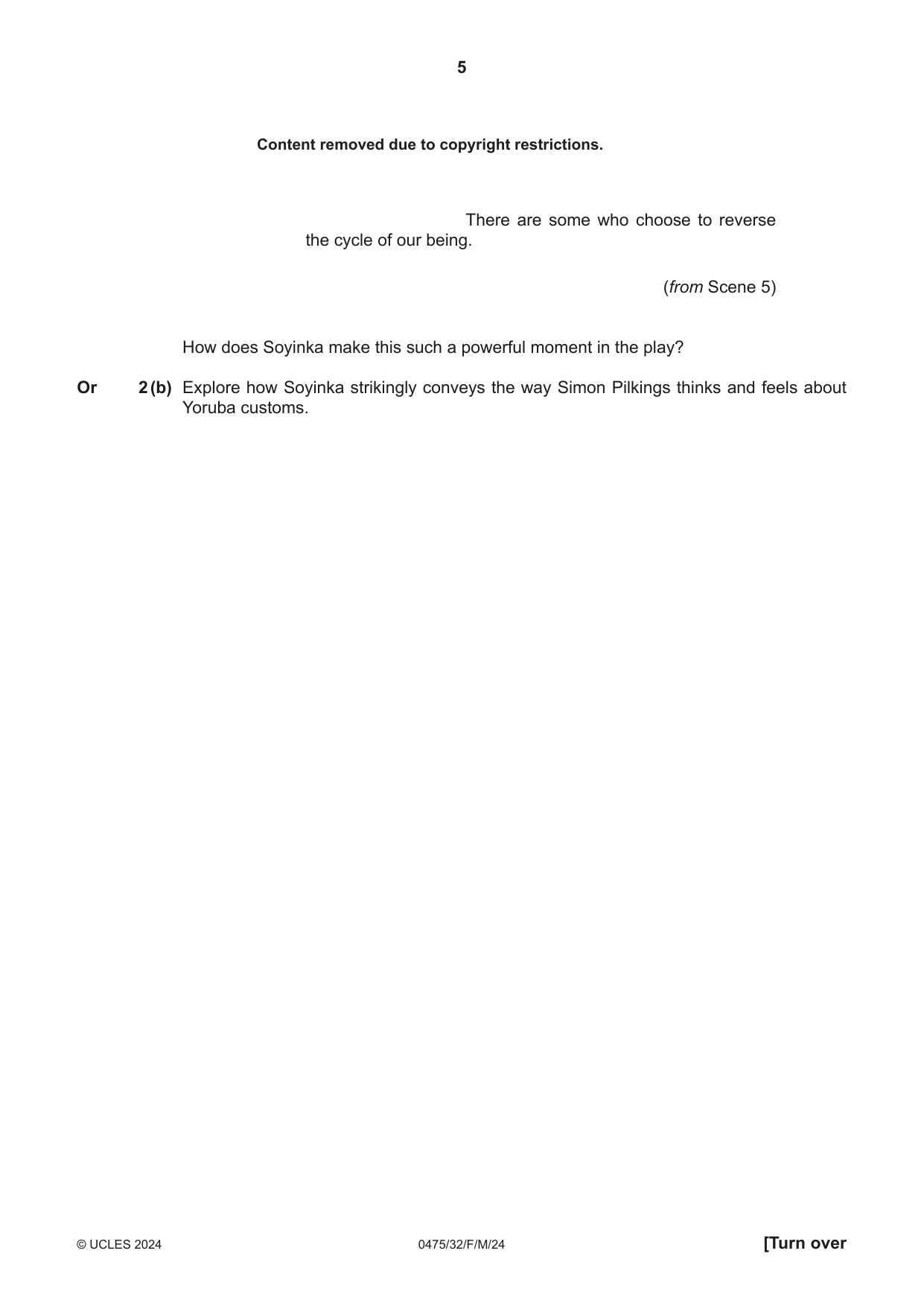
Question paper, page 5
5 0475/32/F/M/24 © UCLES 2024 [Turn over There are some who choose to reverse the cycle of our being. (from Scene 5) How does Soyinka make this such a powerful moment in the play? Or 2 (b) Explore how Soyinka strikingly conveys the way Simon Pilkings thinks and feels about Yoruba customs. Content removed due to copyright restrictions.
Question paper, page 6
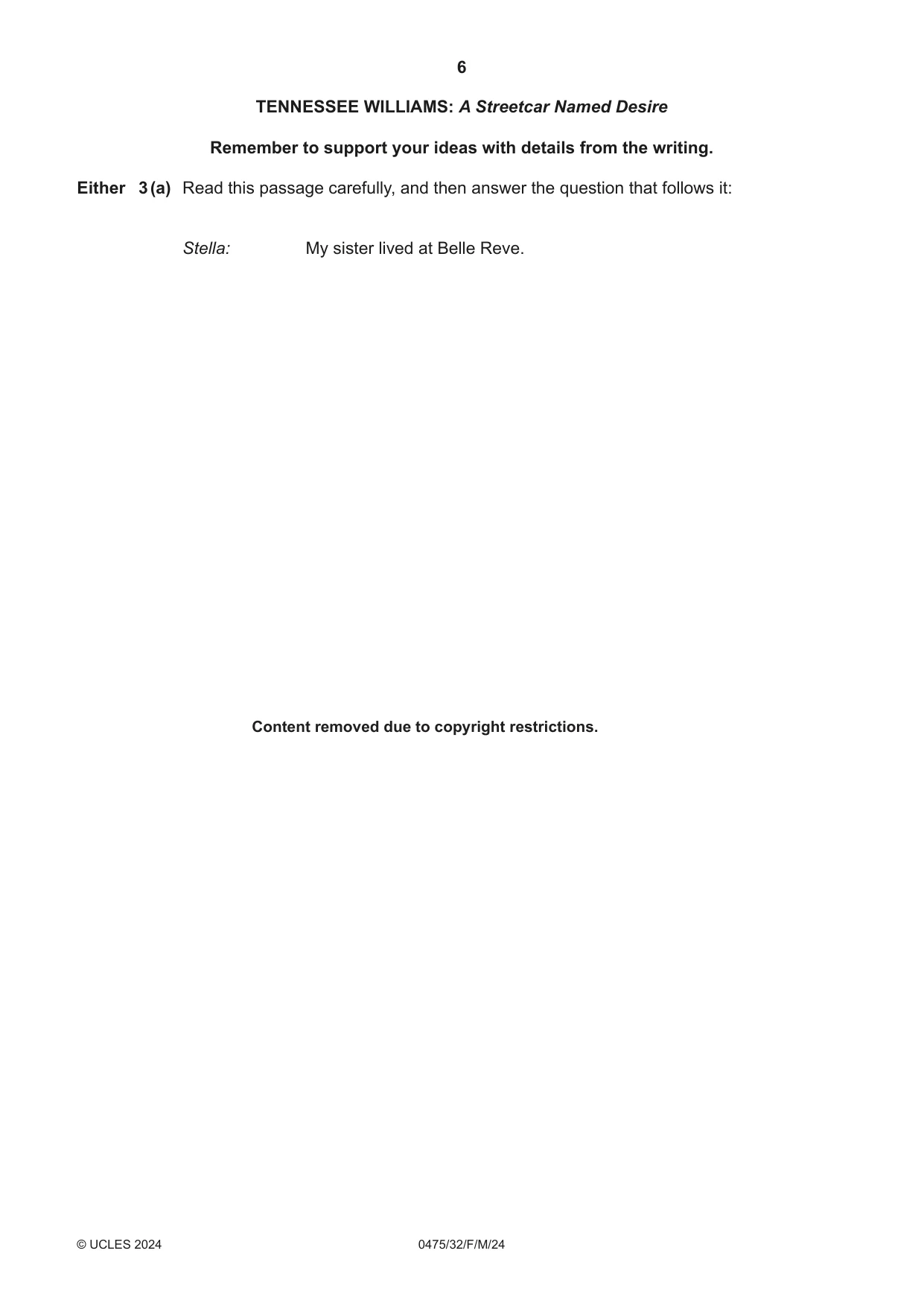
6 0475/32/F/M/24 © UCLES 2024 TENNESSEE WILLIAMS: A Streetcar Named Desire Remember to support your ideas with details from the writing. Either 3 (a) Read this passage carefully, and then answer the question that follows it: Stella: My sister lived at Belle Reve. Content removed due to copyright restrictions.
Question paper, page 7
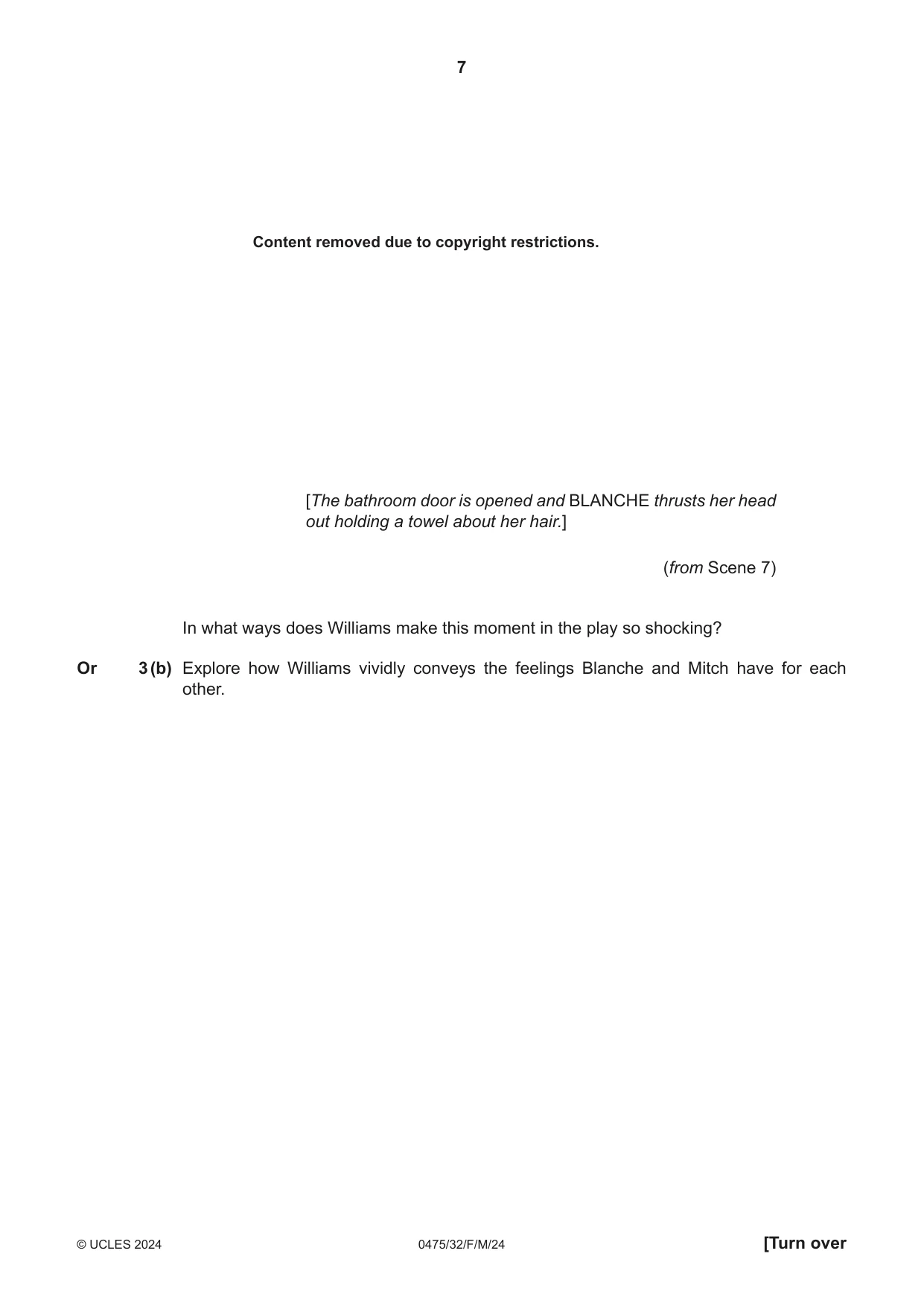
7 0475/32/F/M/24 © UCLES 2024 [Turn over [The bathroom door is opened and BLANCHE thrusts her head out holding a towel about her hair.] (from Scene 7) In what ways does Williams make this moment in the play so shocking? Or 3 (b) Explore how Williams vividly conveys the feelings Blanche and Mitch have for each other. Content removed due to copyright restrictions.
Question paper, page 8
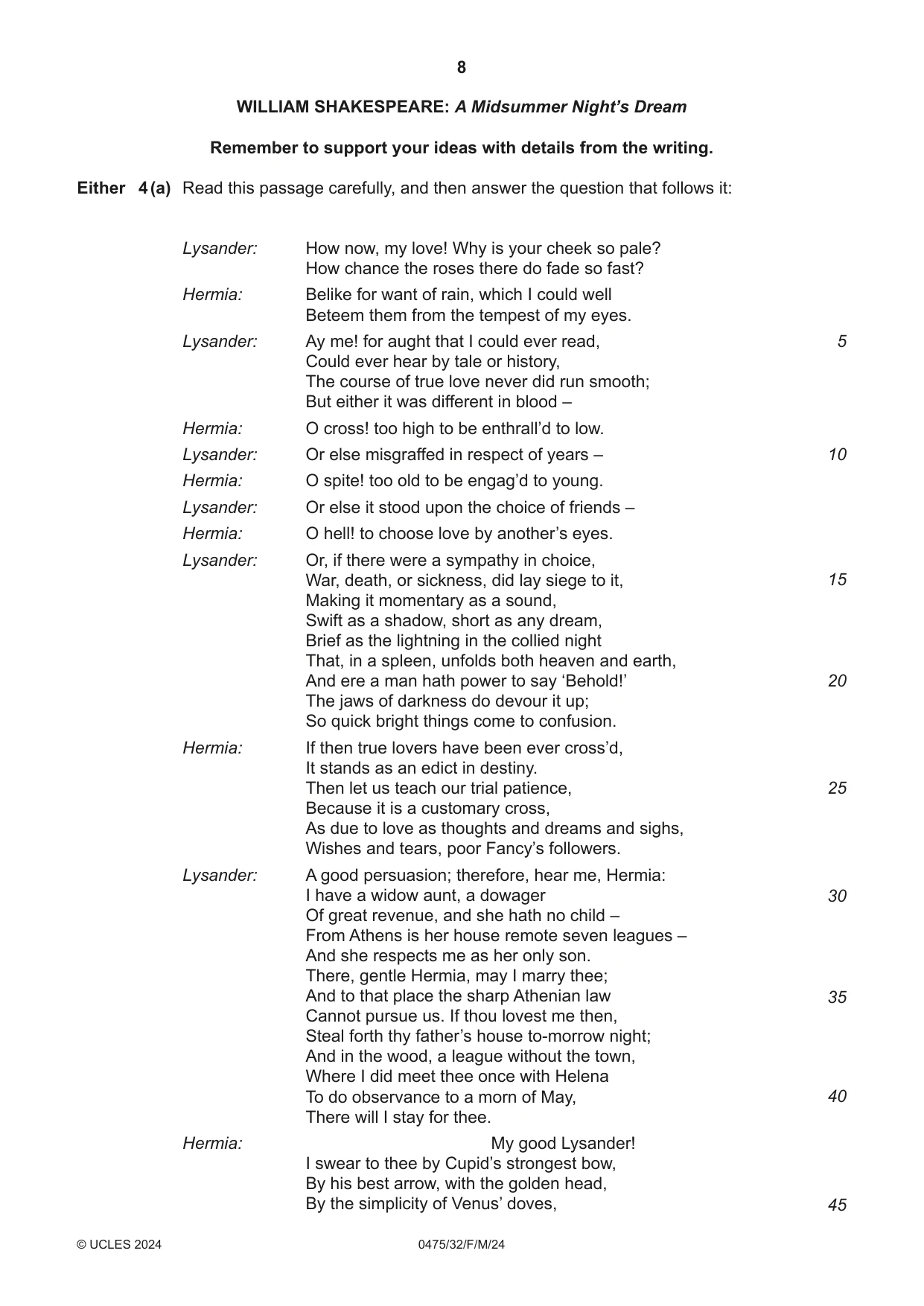
8 0475/32/F/M/24 © UCLES 2024 WILLIAM SHAKESPEARE: A Midsummer Night’s Dream Remember to support your ideas with details from the writing. Either 4 (a) Read this passage carefully, and then answer the question that follows it: Lysander: How now, my love! Why is your cheek so pale? How chance the roses there do fade so fast? Hermia: Belike for want of rain, which I could well Beteem them from the tempest of my eyes. Lysander: Ay me! for aught that I could ever read, Could ever hear by tale or history, The course of true love never did run smooth; But either it was different in blood – Hermia: O cross! too high to be enthrall’d to low. Lysander: Or else misgraffed in respect of years – Hermia: O spite! too old to be engag’d to young. Lysander: Or else it stood upon the choice of friends – Hermia: O hell! to choose love by another’s eyes. Lysander: Or, if there were a sympathy in choice, War, death, or sickness, did lay siege to it, Making it momentary as a sound, Swift as a shadow, short as any dream, Brief as the lightning in the collied night That, in a spleen, unfolds both heaven and earth, And ere a man hath power to say ‘Behold!’ The jaws of darkness do devour it up; So quick bright things come to confusion. Hermia: If then true lovers have been ever cross’d, It stands as an edict in destiny. Then let us teach our trial patience, Because it is a customary cross, As due to love as thoughts and dreams and sighs, Wishes and tears, poor Fancy’s followers. Lysander: A good persuasion; therefore, hear me, Hermia: I have a widow aunt, a dowager Of great revenue, and she hath no child – From Athens is her house remote seven leagues – And she respects me as her only son. There, gentle Hermia, may I marry thee; And to that place the sharp Athenian law Cannot pursue us. If thou lovest me then, Steal forth thy father’s house to-morrow night; And in the wood, a league without the town, Where I did meet thee once with Helena To do observance to a morn of May, There will I stay for thee. Hermia: My good Lysander! I swear to thee by Cupid’s strongest bow, By his best arrow, with the golden head, By the simplicity of Venus’ doves, 5 10 15 20 25 30 35 40 45
Question paper, page 9
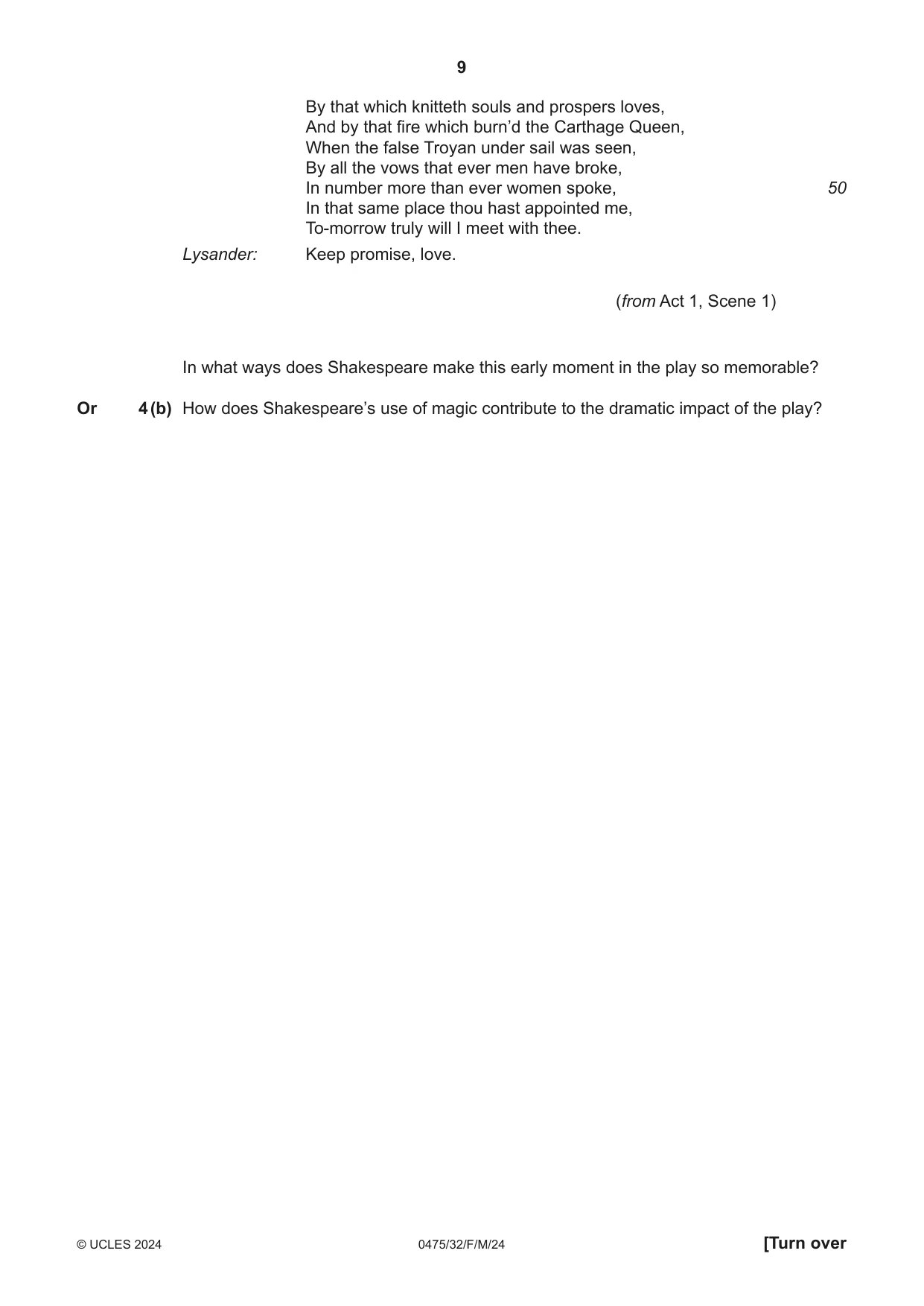
9 0475/32/F/M/24 © UCLES 2024 [Turn over By that which knitteth souls and prospers loves, And by that fire which burn’d the Carthage Queen, When the false Troyan under sail was seen, By all the vows that ever men have broke, In number more than ever women spoke, In that same place thou hast appointed me, To-morrow truly will I meet with thee. Lysander: Keep promise, love. (from Act 1, Scene 1) In what ways does Shakespeare make this early moment in the play so memorable? Or 4 (b) How does Shakespeare’s use of magic contribute to the dramatic impact of the play? 50
Question paper, page 10
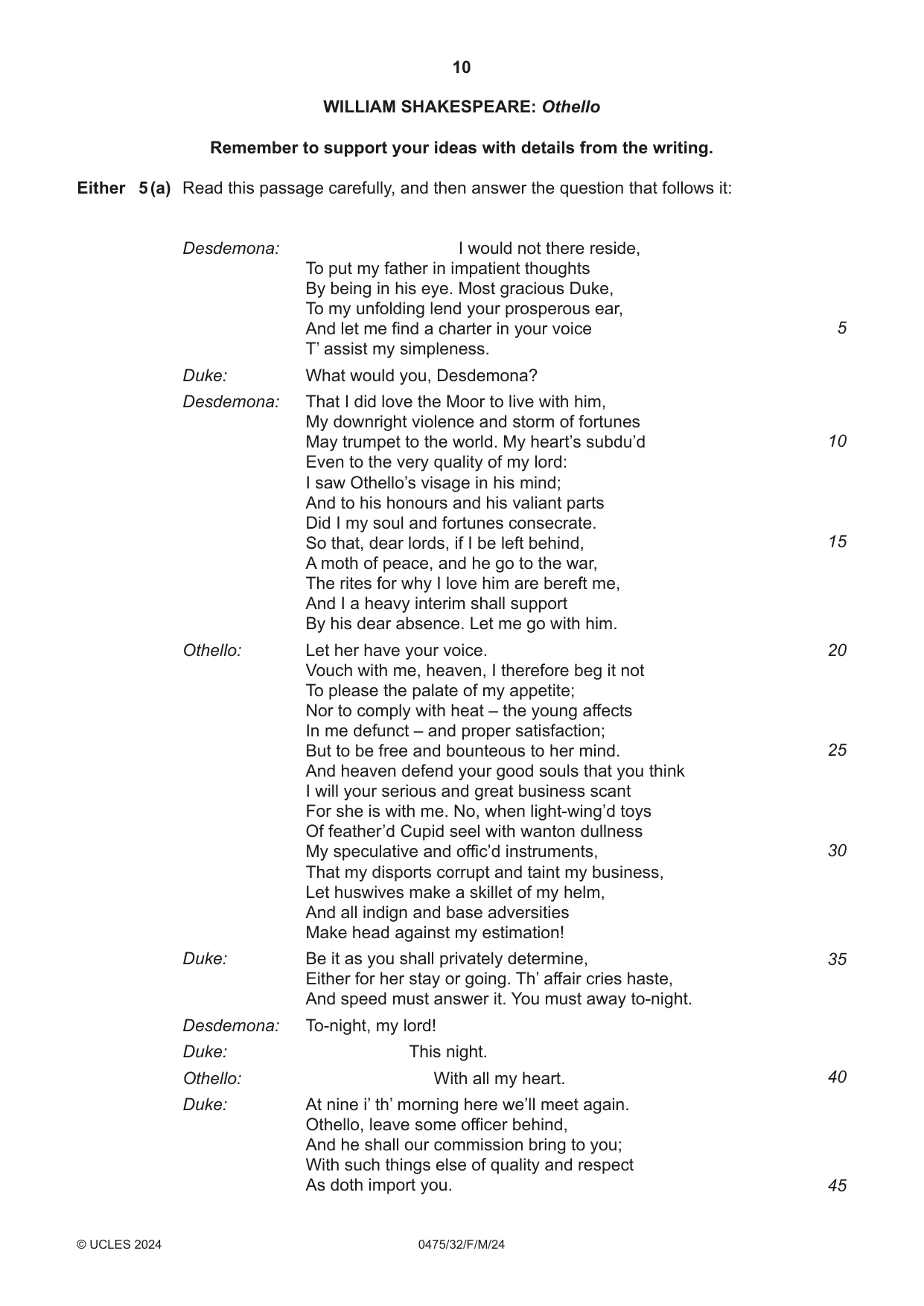
10 0475/32/F/M/24 © UCLES 2024 WILLIAM SHAKESPEARE: Othello Remember to support your ideas with details from the writing. Either 5 (a) Read this passage carefully, and then answer the question that follows it: Desdemona: I would not there reside, To put my father in impatient thoughts By being in his eye. Most gracious Duke, To my unfolding lend your prosperous ear, And let me find a charter in your voice T’ assist my simpleness. Duke: What would you, Desdemona? Desdemona: That I did love the Moor to live with him, My downright violence and storm of fortunes May trumpet to the world. My heart’s subdu’d Even to the very quality of my lord: I saw Othello’s visage in his mind; And to his honours and his valiant parts Did I my soul and fortunes consecrate. So that, dear lords, if I be left behind, A moth of peace, and he go to the war, The rites for why I love him are bereft me, And I a heavy interim shall support By his dear absence. Let me go with him. Othello: Let her have your voice. Vouch with me, heaven, I therefore beg it not To please the palate of my appetite; Nor to comply with heat – the young affects In me defunct – and proper satisfaction; But to be free and bounteous to her mind. And heaven defend your good souls that you think I will your serious and great business scant For she is with me. No, when light-wing’d toys Of feather’d Cupid seel with wanton dullness My speculative and offic’d instruments, That my disports corrupt and taint my business, Let huswives make a skillet of my helm, And all indign and base adversities Make head against my estimation! Duke: Be it as you shall privately determine, Either for her stay or going. Th’ affair cries haste, And speed must answer it. You must away to-night. Desdemona: To-night, my lord! Duke: This night. Othello: With all my heart. Duke: At nine i’ th’ morning here we’ll meet again. Othello, leave some officer behind, And he shall our commission bring to you; With such things else of quality and respect As doth import you. 5 10 15 20 25 30 35 40 45
Question paper, page 11
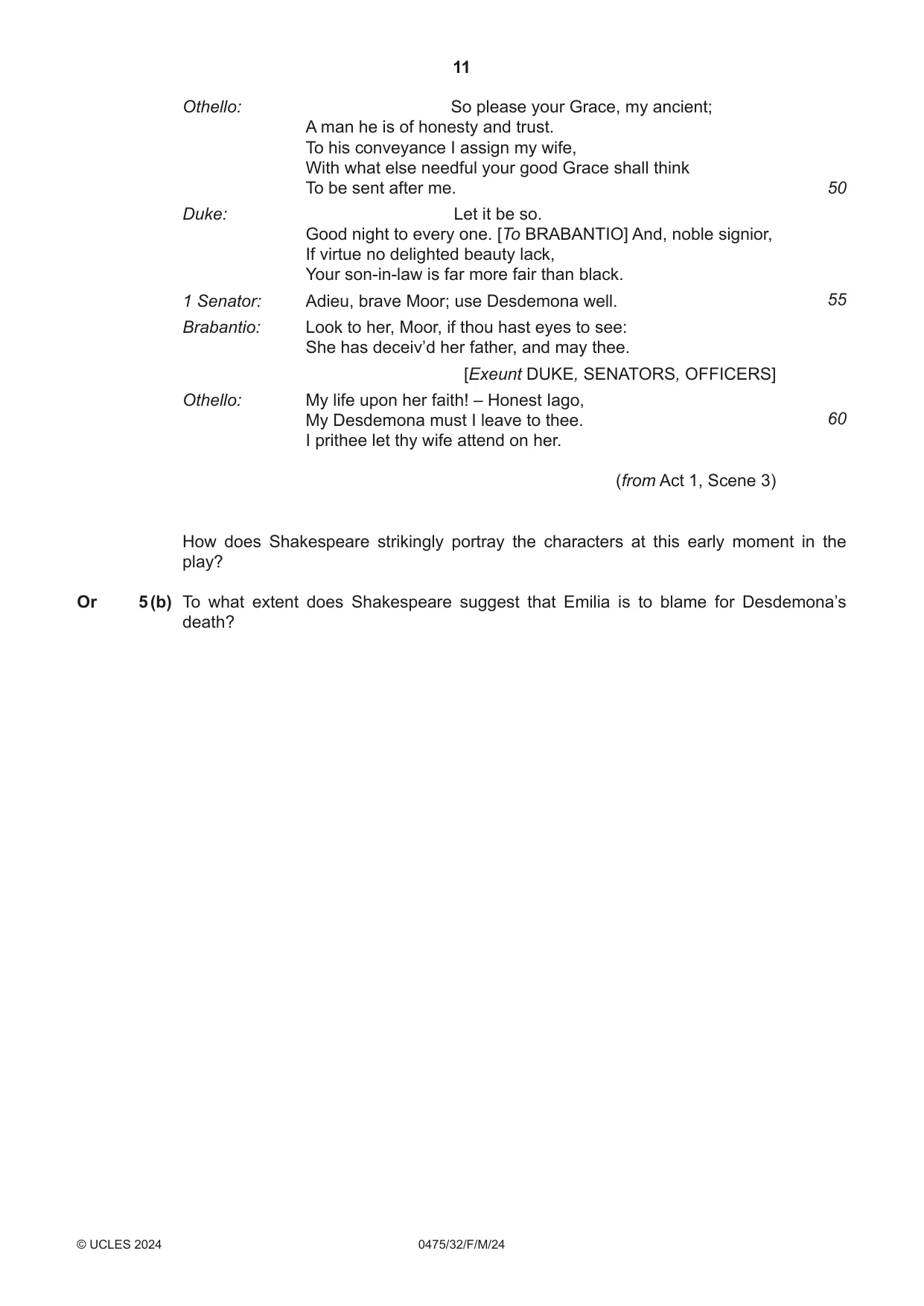
11 0475/32/F/M/24 © UCLES 2024 Othello: So please your Grace, my ancient; A man he is of honesty and trust. To his conveyance I assign my wife, With what else needful your good Grace shall think To be sent after me. Duke: Let it be so. Good night to every one. [To BRABANTIO] And, noble signior, If virtue no delighted beauty lack, Your son-in-law is far more fair than black. 1 Senator: Adieu, brave Moor; use Desdemona well. Brabantio: Look to her, Moor, if thou hast eyes to see: She has deceiv’d her father, and may thee. [Exeunt DUKE, SENATORS, OFFICERS] Othello: My life upon her faith! – Honest Iago, My Desdemona must I leave to thee. I prithee let thy wife attend on her. (from Act 1, Scene 3) How does Shakespeare strikingly portray the characters at this early moment in the play? Or 5 (b) To what extent does Shakespeare suggest that Emilia is to blame for Desdemona’s death? 50 55 60
Question paper, page 12
12 0475/32/F/M/24 © UCLES 2024 Permission to reproduce items where third-party owned material protected by copyright is included has been sought and cleared where possible. Every reasonable effort has been made by the publisher (UCLES) to trace copyright holders, but if any items requiring clearance have unwittingly been included, the publisher will be pleased to make amends at the earliest possible opportunity. To avoid the issue of disclosure of answer-related information to candidates, all copyright acknowledgements are reproduced online in the Cambridge Assessment International Education Copyright Acknowledgements Booklet. This is produced for each series of examinations and is freely available to download at www.cambridgeinternational.org after the live examination series. Cambridge Assessment International Education is part of Cambridge Assessment. Cambridge Assessment is the brand name of the University of Cambridge Local Examinations Syndicate (UCLES), which is a department of the University of Cambridge. BLANK PAGE
Mark scheme, page 1
This document consists of 4 printed pages. © Cambridge University Press & Assessment 2024 [Turn over Cambridge IGCSE™ LITERATURE IN ENGLISH 0475/32 Paper 3 Drama (Open Text) February/March 2024 MARK SCHEME Maximum Mark: 25 Published This mark scheme is published as an aid to teachers and candidates, to indicate the requirements of the examination. It shows the basis on which Examiners were instructed to award marks. It does not indicate the details of the discussions that took place at an Examiners’ meeting before marking began, which would have considered the acceptability of alternative answers. Mark schemes should be read in conjunction with the question paper and the Principal Examiner Report for Teachers. Cambridge International will not enter into discussions about these mark schemes. Cambridge International is publishing the mark schemes for the February/March 2024 series for most Cambridge IGCSE, Cambridge International A and AS Level components, and some Cambridge O Level components.
Mark scheme, page 2
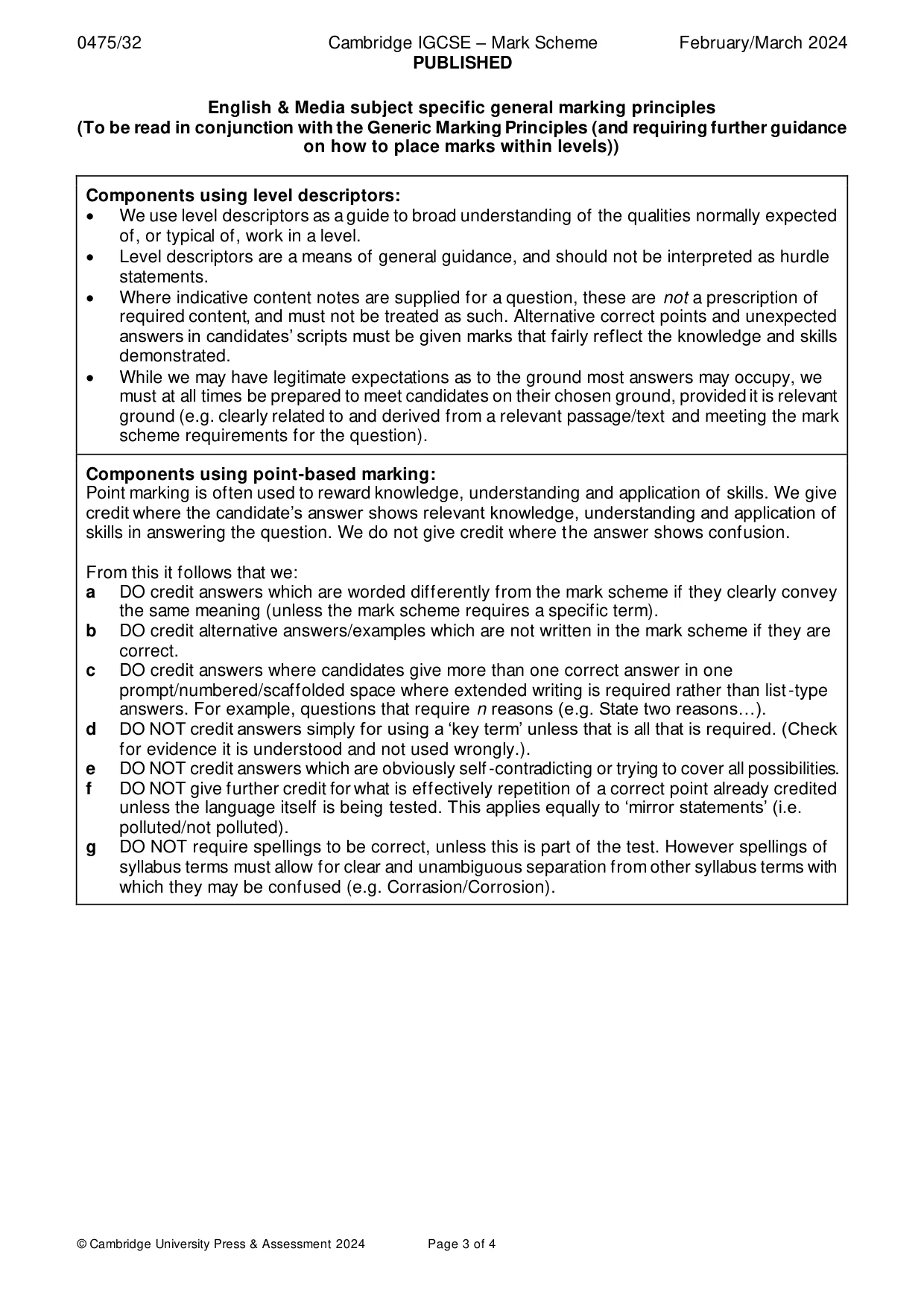
0475/32 Cambridge IGCSE – Mark Scheme PUBLISHED February/March 2024 © Cambridge University Press & Assessment 2024 Page 2 of 4 Generic Marking Principles These general marking principles must be applied by all examiners when marking candidate answers. They should be applied alongside the specific content of the mark scheme or generic level descriptions for a question. Each question paper and mark scheme will also comply with these marking principles. GENERIC MARKING PRINCIPLE 1: Marks must be awarded in line with: • the specific content of the mark scheme or the generic level descriptors for the question • the specific skills defined in the mark scheme or in the generic level descriptors for the question • the standard of response required by a candidate as exemplified by the standardisation scripts. GENERIC MARKING PRINCIPLE 2: Marks awarded are always whole marks (not half marks, or other fractions). GENERIC MARKING PRINCIPLE 3: Marks must be awarded positively: • marks are awarded for correct/valid answers, as defined in the mark scheme. However, credit is given for valid answers which go beyond the scope of the syllabus and mark scheme, referring to your Team Leader as appropriate • marks are awarded when candidates clearly demonstrate what they know and can do • marks are not deducted for errors • marks are not deducted for omissions • answers should only be judged on the quality of spelling, punctuation and grammar when these features are specifically assessed by the question as indicated by the mark scheme. The meaning, however, should be unambiguous. GENERIC MARKING PRINCIPLE 4: Rules must be applied consistently, e.g. in situations where candidates have not followed instructions or in the application of generic level descriptors. GENERIC MARKING PRINCIPLE 5: Marks should be awarded using the full range of marks defined in the mark scheme for the question (however; the use of the full mark range may be limited according to the quality of the candidate responses seen). GENERIC MARKING PRINCIPLE 6: Marks awarded are based solely on the requirements as defined in the mark scheme. Marks should not be awarded with grade thresholds or grade descriptors in mind.
Mark scheme, page 3
0475/32 Cambridge IGCSE – Mark Scheme PUBLISHED February/March 2024 © Cambridge University Press & Assessment 2024 Page 3 of 4 English & Media subject specific general marking principles (To be read in conjunction with the Generic Marking Principles (and requiring further guidance on how to place marks within levels)) Components using level descriptors: • We use level descriptors as a guide to broad understanding of the qualities normally expected of, or typical of, work in a level. • Level descriptors are a means of general guidance, and should not be interpreted as hurdle statements. • Where indicative content notes are supplied for a question, these are not a prescription of required content, and must not be treated as such. Alternative correct points and unexpected answers in candidates’ scripts must be given marks that fairly reflect the knowledge and skills demonstrated. • While we may have legitimate expectations as to the ground most answers may occupy, we must at all times be prepared to meet candidates on their chosen ground, provided it is relevant ground (e.g. clearly related to and derived from a relevant passage/text and meeting the mark scheme requirements for the question). Components using point-based marking: Point marking is often used to reward knowledge, understanding and application of skills. We give credit where the candidate’s answer shows relevant knowledge, understanding and application of skills in answering the question. We do not give credit where the answer shows confusion. From this it follows that we: a DO credit answers which are worded differently from the mark scheme if they clearly convey the same meaning (unless the mark scheme requires a specific term). b DO credit alternative answers/examples which are not written in the mark scheme if they are correct. c DO credit answers where candidates give more than one correct answer in one prompt/numbered/scaffolded space where extended writing is required rather than list-type answers. For example, questions that require n reasons (e.g. State two reasons…). d DO NOT credit answers simply for using a ‘key term’ unless that is all that is required. (Check for evidence it is understood and not used wrongly.). e DO NOT credit answers which are obviously self-contradicting or trying to cover all possibilities. f DO NOT give further credit for what is effectively repetition of a correct point already credited unless the language itself is being tested. This applies equally to ‘mirror statements’ (i.e. polluted/not polluted). g DO NOT require spellings to be correct, unless this is part of the test. However spellings of syllabus terms must allow for clear and unambiguous separation from other syllabus terms with which they may be confused (e.g. Corrasion/Corrosion).
Mark scheme, page 4
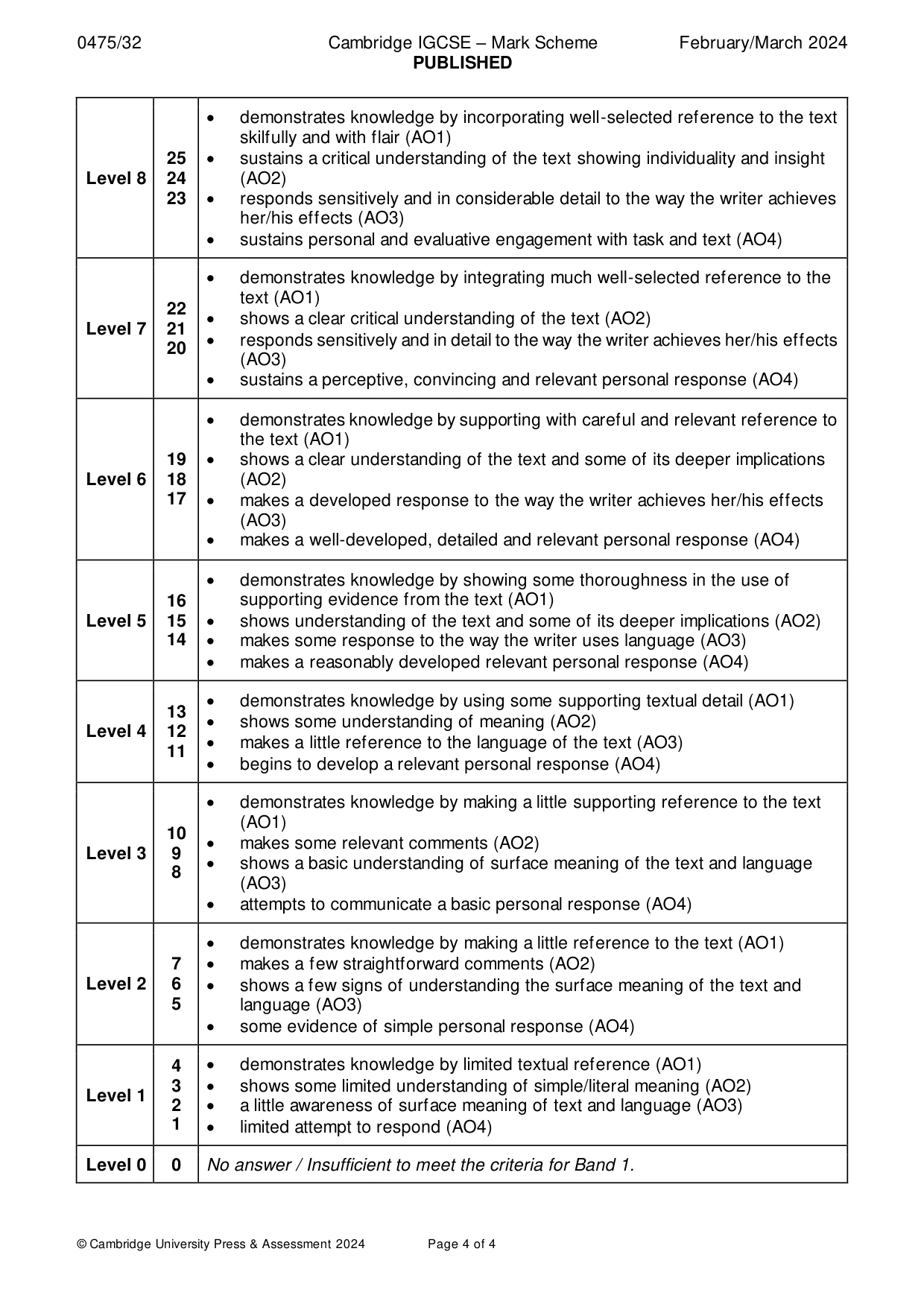
0475/32 Cambridge IGCSE – Mark Scheme PUBLISHED February/March 2024 © Cambridge University Press & Assessment 2024 Page 4 of 4 Level 8 25 24 23 • demonstrates knowledge by incorporating well-selected reference to the text skilfully and with flair (AO1) • sustains a critical understanding of the text showing individuality and insight (AO2) • responds sensitively and in considerable detail to the way the writer achieves her/his effects (AO3) • sustains personal and evaluative engagement with task and text (AO4) Level 7 22 21 20 • demonstrates knowledge by integrating much well-selected reference to the text (AO1) • shows a clear critical understanding of the text (AO2) • responds sensitively and in detail to the way the writer achieves her/his effects (AO3) • sustains a perceptive, convincing and relevant personal response (AO4) Level 6 19 18 17 • demonstrates knowledge by supporting with careful and relevant reference to the text (AO1) • shows a clear understanding of the text and some of its deeper implications (AO2) • makes a developed response to the way the writer achieves her/his effects (AO3) • makes a well-developed, detailed and relevant personal response (AO4) Level 5 16 15 14 • demonstrates knowledge by showing some thoroughness in the use of supporting evidence from the text (AO1) • shows understanding of the text and some of its deeper implications (AO2) • makes some response to the way the writer uses language (AO3) • makes a reasonably developed relevant personal response (AO4) Level 4 13 12 11 • demonstrates knowledge by using some supporting textual detail (AO1) • shows some understanding of meaning (AO2) • makes a little reference to the language of the text (AO3) • begins to develop a relevant personal response (AO4) Level 3 10 9 8 • demonstrates knowledge by making a little supporting reference to the text (AO1) • makes some relevant comments (AO2) • shows a basic understanding of surface meaning of the text and language (AO3) • attempts to communicate a basic personal response (AO4) Level 2 7 6 5 • demonstrates knowledge by making a little reference to the text (AO1) • makes a few straightforward comments (AO2) • shows a few signs of understanding the surface meaning of the text and language (AO3) • some evidence of simple personal response (AO4) Level 1 4 3 2 1 • demonstrates knowledge by limited textual reference (AO1) • shows some limited understanding of simple/literal meaning (AO2) • a little awareness of surface meaning of text and language (AO3) • limited attempt to respond (AO4) Level 0 0 No answer / Insufficient to meet the criteria for Band 1.
What you needed in this session
Cambridge’s own grade thresholds for 2024 Feb/March, Paper 3 · Variant 2. A higher threshold means an easier paper — the bar moves with how the cohort did.