Cambridge IGCSE English - Literature in English 0475 — 2023 May/June Paper 3 · Variant 1
0475/31/M/J/23 · 25 marks · ≈28 min
The question paper and its mark scheme, free to read here and free to download. This is Cambridge’s own paper, exactly as it was sat.
Question paper12 pages
Mark scheme5 pages
Answers below. Sit the paper first if you are practising.
Paper as text
Question paper, page 1
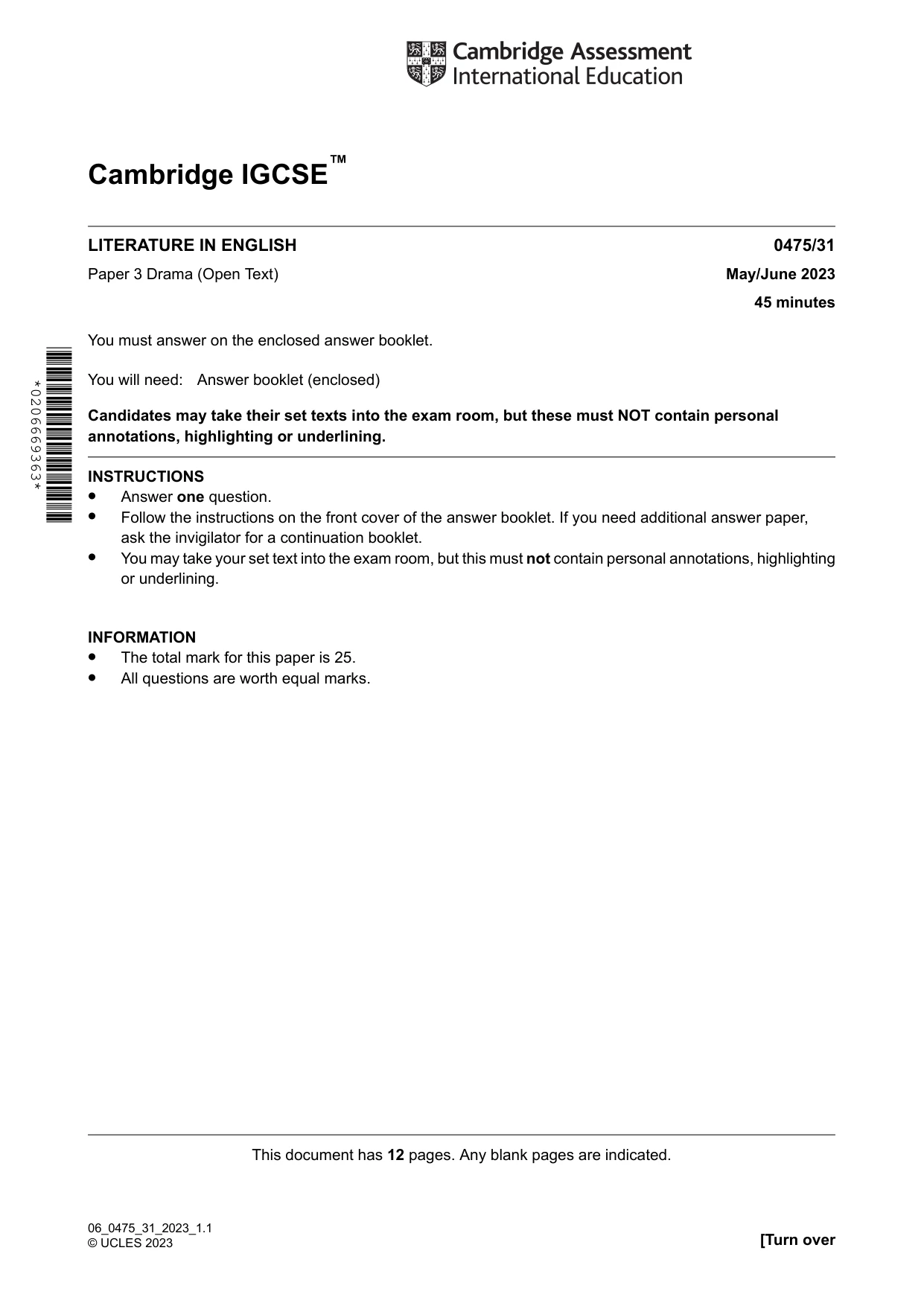
Cambridge IGCSE™ 0475/31 LITERATURE IN ENGLISH May/June 2023 Paper 3 Drama (Open Text) 45 minutes You must answer on the enclosed answer booklet. You will need: Answer booklet (enclosed) Candidates may take their set texts into the exam room, but these must NOT contain personal annotations, highlighting or underlining. INSTRUCTIONS • Answer one question. • Follow the instructions on the front cover of the answer booklet. If you need additional answer paper, ask the invigilator for a continuation booklet. • You may take your set text into the exam room, but this must not contain personal annotations, highlighting or underlining. INFORMATION • The total mark for this paper is 25. • All questions are worth equal marks. This document has 12 pages. Any blank pages are indicated. [Turn over 06_0475_31_2023_1.1 © UCLES 2023 *0206669363*
Question paper, page 2
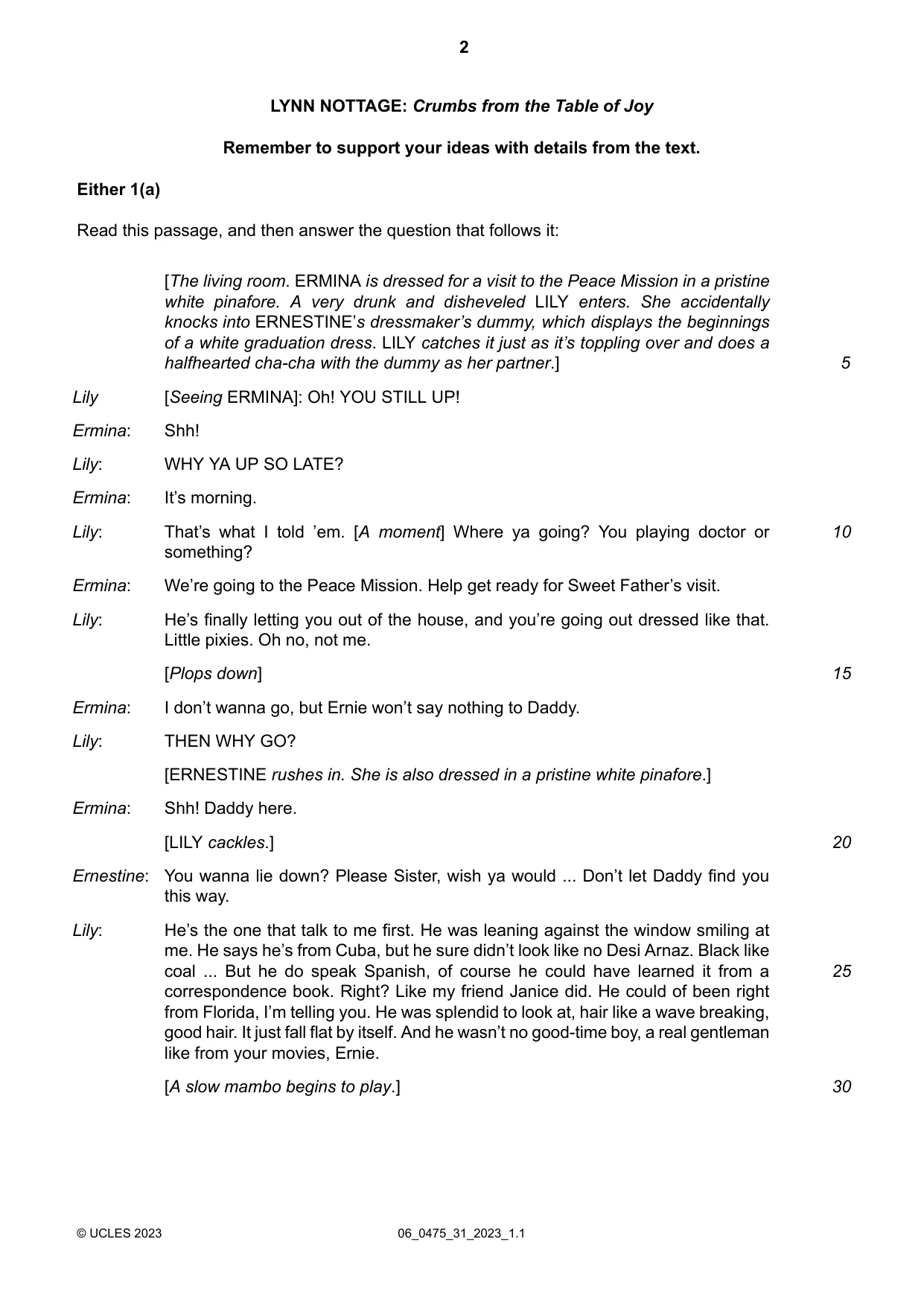
30 25 20 15 10 5 LYNN NOTTAGE: Crumbs from the Table of Joy Remember to support your ideas with details from the text. Either 1(a) Read this passage, and then answer the question that follows it: [The living room. ERMINA is dressed for a visit to the Peace Mission in a pristine white pinafore. A very drunk and disheveled LILY enters. She accidentally knocks into ERNESTINE’s dressmaker’s dummy, which displays the beginnings of a white graduation dress. LILY catches it just as it’s toppling over and does a halfhearted cha-cha with the dummy as her partner.] [Seeing ERMINA]: Oh! YOU STILL UP! Lily Shh! Ermina: WHY YA UP SO LATE? Lily: It’s morning. Ermina: That’s what I told ’em. [A moment] Where ya going? You playing doctor or something? Lily: We’re going to the Peace Mission. Help get ready for Sweet Father’s visit. Ermina: He’s finally letting you out of the house, and you’re going out dressed like that. Little pixies. Oh no, not me. Lily: [Plops down] I don’t wanna go, but Ernie won’t say nothing to Daddy. Ermina: THEN WHY GO? Lily: [ERNESTINE rushes in. She is also dressed in a pristine white pinafore.] Shh! Daddy here. Ermina: [LILY cackles.] You wanna lie down? Please Sister, wish ya would ... Don’t let Daddy find you this way. Ernestine: He’s the one that talk to me first. He was leaning against the window smiling at me. He says he’s from Cuba, but he sure didn’t look like no Desi Arnaz. Black like coal ... But he do speak Spanish, of course he could have learned it from a correspondence book. Right? Like my friend Janice did. He could of been right from Florida, I’m telling you. He was splendid to look at, hair like a wave breaking, good hair. It just fall flat by itself. And he wasn’t no good-time boy, a real gentleman like from your movies, Ernie. Lily: [A slow mambo begins to play.] 06_0475_31_2023_1.1 © UCLES 2023 2
Question paper, page 3
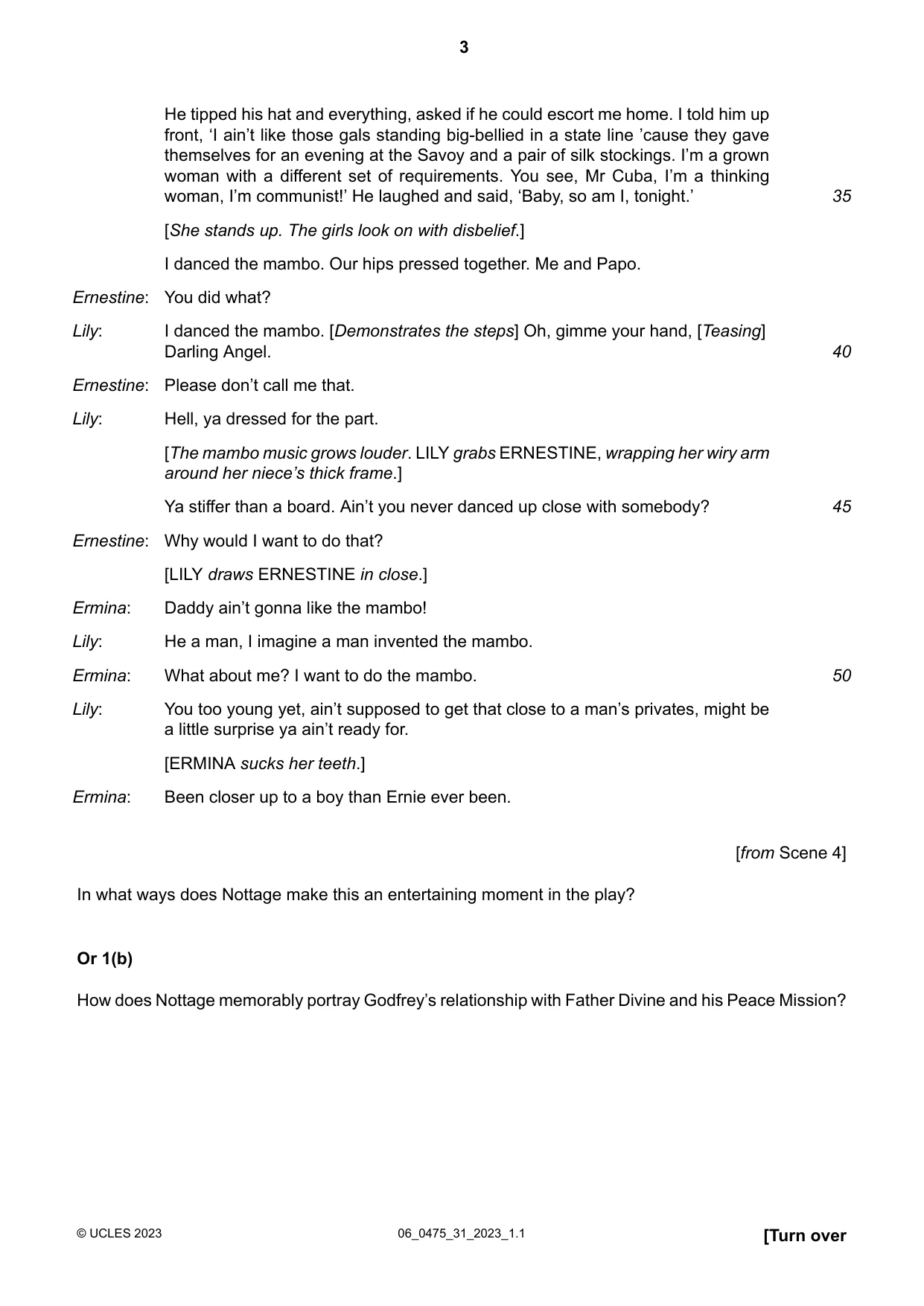
50 45 40 35 He tipped his hat and everything, asked if he could escort me home. I told him up front, ‘I ain’t like those gals standing big-bellied in a state line ’cause they gave themselves for an evening at the Savoy and a pair of silk stockings. I’m a grown woman with a different set of requirements. You see, Mr Cuba, I’m a thinking woman, I’m communist!’ He laughed and said, ‘Baby, so am I, tonight.’ [She stands up. The girls look on with disbelief.] I danced the mambo. Our hips pressed together. Me and Papo. You did what? Ernestine: I danced the mambo. [Demonstrates the steps] Oh, gimme your hand, [Teasing] Darling Angel. Lily: Please don’t call me that. Ernestine: Hell, ya dressed for the part. Lily: [The mambo music grows louder. LILY grabs ERNESTINE, wrapping her wiry arm around her niece’s thick frame.] Ya stiffer than a board. Ain’t you never danced up close with somebody? Why would I want to do that? Ernestine: [LILY draws ERNESTINE in close.] Daddy ain’t gonna like the mambo! Ermina: He a man, I imagine a man invented the mambo. Lily: What about me? I want to do the mambo. Ermina: You too young yet, ain’t supposed to get that close to a man’s privates, might be a little surprise ya ain’t ready for. Lily: [ERMINA sucks her teeth.] Been closer up to a boy than Ernie ever been. Ermina: [from Scene 4] In what ways does Nottage make this an entertaining moment in the play? Or 1(b) How does Nottage memorably portray Godfrey’s relationship with Father Divine and his Peace Mission? [Turn over 06_0475_31_2023_1.1 © UCLES 2023 3
Question paper, page 4
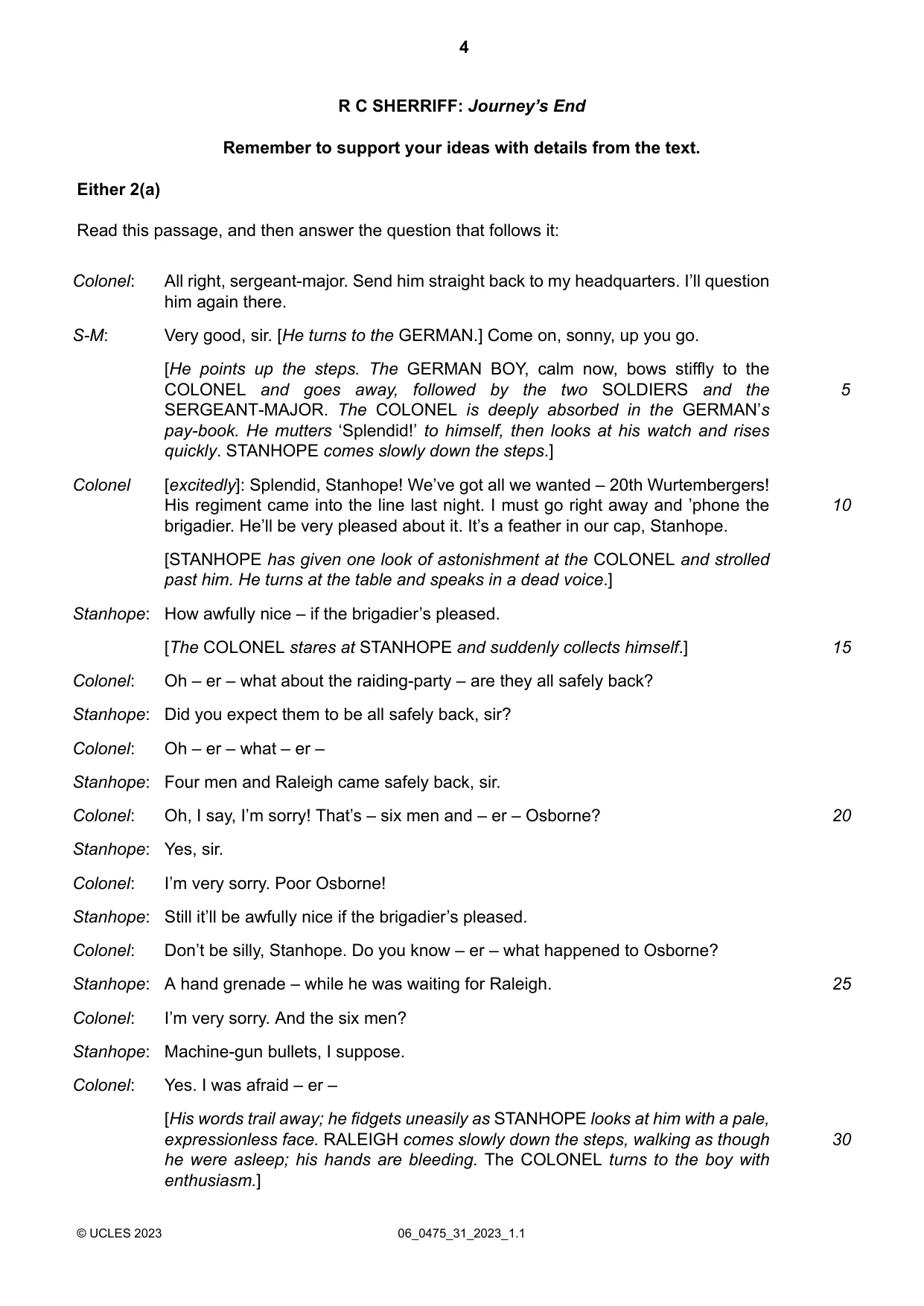
30 25 20 15 10 5 R C SHERRIFF: Journey’s End Remember to support your ideas with details from the text. Either 2(a) Read this passage, and then answer the question that follows it: All right, sergeant-major. Send him straight back to my headquarters. I’ll question him again there. Colonel: Very good, sir. [He turns to the GERMAN.] Come on, sonny, up you go. S-M: [He points up the steps. The GERMAN BOY, calm now, bows stiffly to the COLONEL and goes away, followed by the two SOLDIERS and the SERGEANT-MAJOR. The COLONEL is deeply absorbed in the GERMAN’s pay-book. He mutters ‘Splendid!’ to himself, then looks at his watch and rises quickly. STANHOPE comes slowly down the steps.] [excitedly]: Splendid, Stanhope! We’ve got all we wanted – 20th Wurtembergers! His regiment came into the line last night. I must go right away and ’phone the brigadier. He’ll be very pleased about it. It’s a feather in our cap, Stanhope. Colonel [STANHOPE has given one look of astonishment at the COLONEL and strolled past him. He turns at the table and speaks in a dead voice.] How awfully nice – if the brigadier’s pleased. Stanhope: [The COLONEL stares at STANHOPE and suddenly collects himself.] Oh – er – what about the raiding-party – are they all safely back? Colonel: Did you expect them to be all safely back, sir? Stanhope: Oh – er – what – er – Colonel: Four men and Raleigh came safely back, sir. Stanhope: Oh, I say, I’m sorry! That’s – six men and – er – Osborne? Colonel: Yes, sir. Stanhope: I’m very sorry. Poor Osborne! Colonel: Still it’ll be awfully nice if the brigadier’s pleased. Stanhope: Don’t be silly, Stanhope. Do you know – er – what happened to Osborne? Colonel: A hand grenade – while he was waiting for Raleigh. Stanhope: I’m very sorry. And the six men? Colonel: Machine-gun bullets, I suppose. Stanhope: Yes. I was afraid – er – Colonel: [His words trail away; he fidgets uneasily as STANHOPE looks at him with a pale, expressionless face. RALEIGH comes slowly down the steps, walking as though he were asleep; his hands are bleeding. The COLONEL turns to the boy with enthusiasm.] 06_0475_31_2023_1.1 © UCLES 2023 4
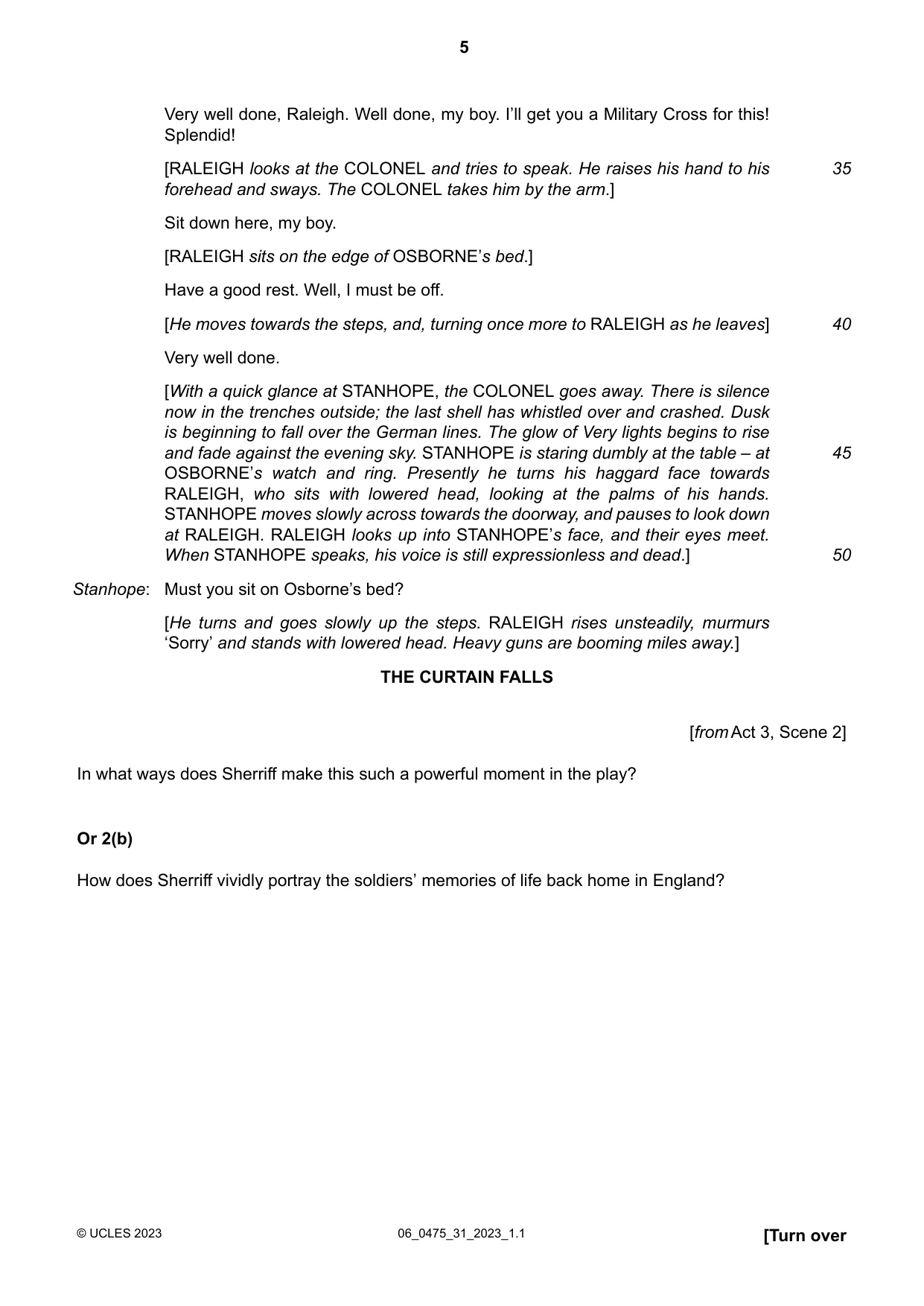
Question paper, page 5
50 45 40 35 Very well done, Raleigh. Well done, my boy. I’ll get you a Military Cross for this! Splendid! [RALEIGH looks at the COLONEL and tries to speak. He raises his hand to his forehead and sways. The COLONEL takes him by the arm.] Sit down here, my boy. [RALEIGH sits on the edge of OSBORNE’s bed.] Have a good rest. Well, I must be off. [He moves towards the steps, and, turning once more to RALEIGH as he leaves] Very well done. [With a quick glance at STANHOPE, the COLONEL goes away. There is silence now in the trenches outside; the last shell has whistled over and crashed. Dusk is beginning to fall over the German lines. The glow of Very lights begins to rise and fade against the evening sky. STANHOPE is staring dumbly at the table – at OSBORNE’s watch and ring. Presently he turns his haggard face towards RALEIGH, who sits with lowered head, looking at the palms of his hands. STANHOPE moves slowly across towards the doorway, and pauses to look down at RALEIGH. RALEIGH looks up into STANHOPE’s face, and their eyes meet. When STANHOPE speaks, his voice is still expressionless and dead.] Must you sit on Osborne’s bed? Stanhope: [He turns and goes slowly up the steps. RALEIGH rises unsteadily, murmurs ‘Sorry’ and stands with lowered head. Heavy guns are booming miles away.] THE CURTAIN FALLS [fromAct 3, Scene 2] In what ways does Sherriff make this such a powerful moment in the play? Or 2(b) How does Sherriff vividly portray the soldiers’ memories of life back home in England? [Turn over 06_0475_31_2023_1.1 © UCLES 2023 5
Question paper, page 6
WOLE SOYINKA: Death and the King’s Horseman Remember to support your ideas with details from the text. Either 3(a) Read this passage, and then answer the question that follows it: Ever since I learnt of the King’s death. Olunde: 06_0475_31_2023_1.1 © UCLES 2023 6 Content removed due to copyright restrictions.
Question paper, page 7
Excuse me a minute. [from Scene 4] How does Soyinka make this moment in the play so uncomfortable? Or 3(b) In what ways does Soyinka powerfully portray Iyaloja? [Turn over 06_0475_31_2023_1.1 © UCLES 2023 7 Content removed due to copyright restrictions.
Question paper, page 8
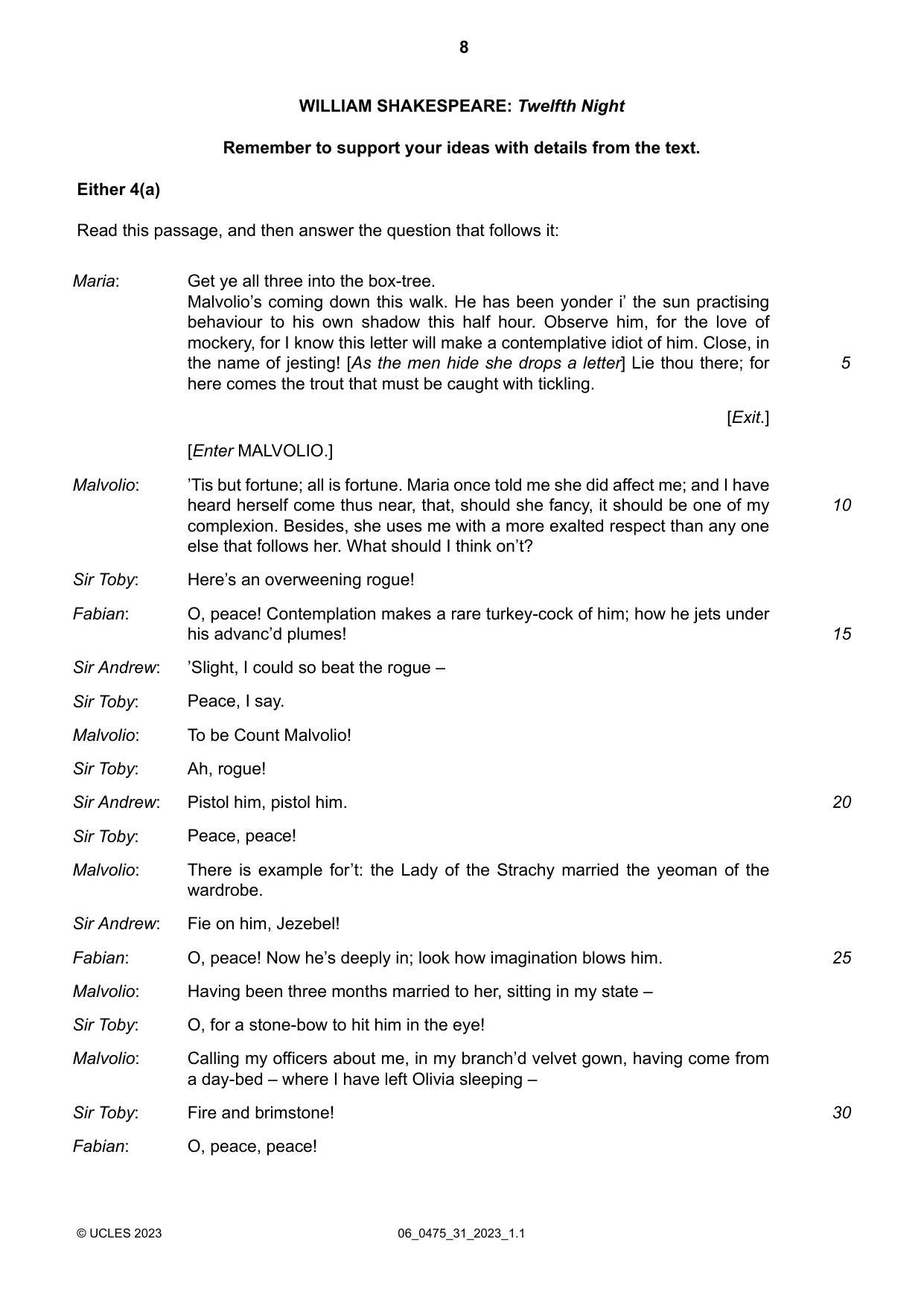
30 25 20 15 10 5 WILLIAM SHAKESPEARE: Twelfth Night Remember to support your ideas with details from the text. Either 4(a) Read this passage, and then answer the question that follows it: Get ye all three into the box-tree. Malvolio’s coming down this walk. He has been yonder i’ the sun practising behaviour to his own shadow this half hour. Observe him, for the love of mockery, for I know this letter will make a contemplative idiot of him. Close, in the name of jesting! [As the men hide she drops a letter] Lie thou there; for here comes the trout that must be caught with tickling. Maria: [Exit.] [Enter MALVOLIO.] ’Tis but fortune; all is fortune. Maria once told me she did affect me; and I have heard herself come thus near, that, should she fancy, it should be one of my complexion. Besides, she uses me with a more exalted respect than any one else that follows her. What should I think on’t? Malvolio: Here’s an overweening rogue! Sir Toby: O, peace! Contemplation makes a rare turkey-cock of him; how he jets under his advanc’d plumes! Fabian: ’Slight, I could so beat the rogue – Sir Andrew: Peace, I say. Sir Toby: To be Count Malvolio! Malvolio: Ah, rogue! Sir Toby: Pistol him, pistol him. Sir Andrew: Peace, peace! Sir Toby: There is example for’t: the Lady of the Strachy married the yeoman of the wardrobe. Malvolio: Fie on him, Jezebel! Sir Andrew: O, peace! Now he’s deeply in; look how imagination blows him. Fabian: Having been three months married to her, sitting in my state – Malvolio: O, for a stone-bow to hit him in the eye! Sir Toby: Calling my officers about me, in my branch’d velvet gown, having come from a day-bed – where I have left Olivia sleeping – Malvolio: Fire and brimstone! Sir Toby: O, peace, peace! Fabian: 06_0475_31_2023_1.1 © UCLES 2023 8
Question paper, page 9
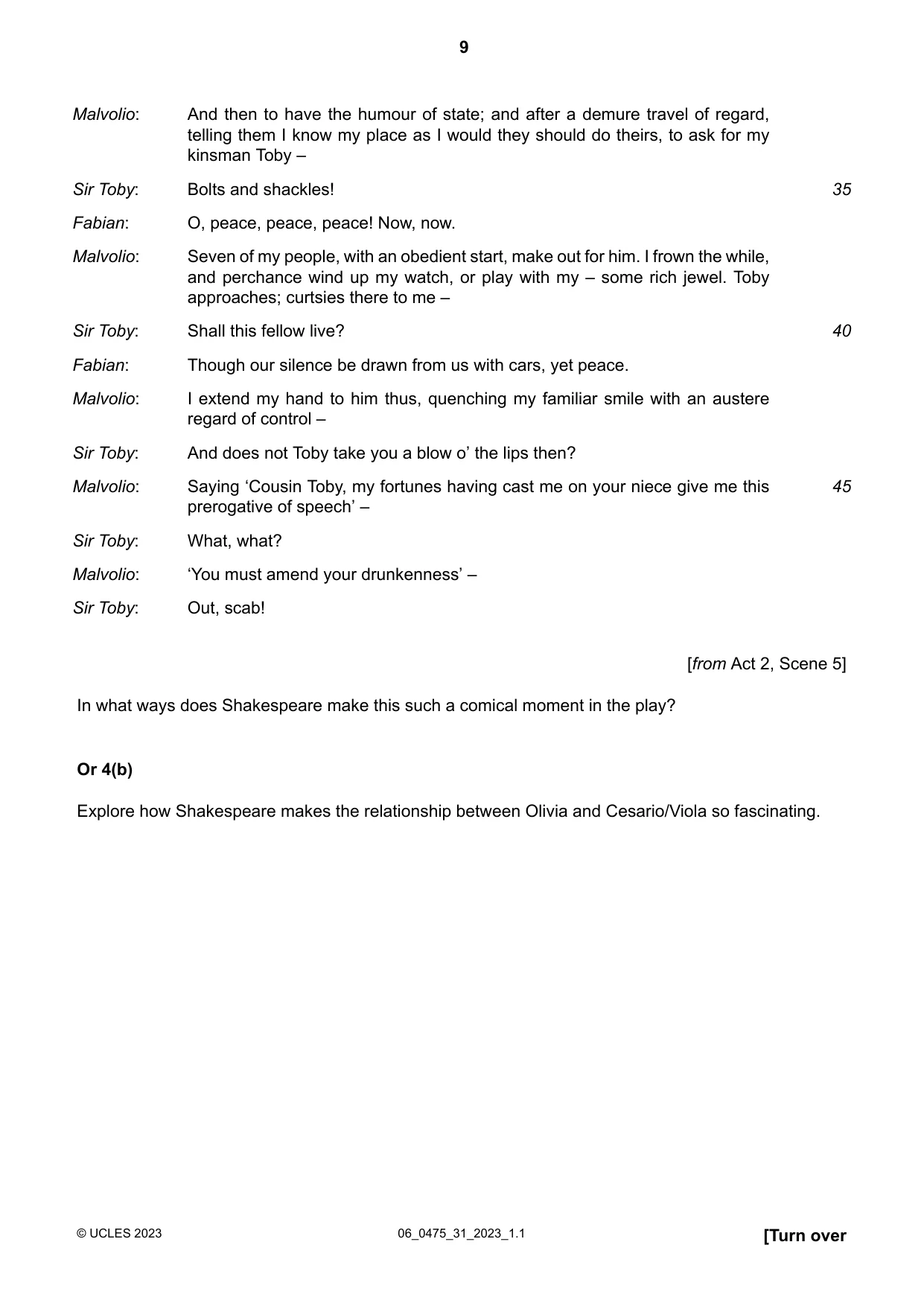
45 40 35 And then to have the humour of state; and after a demure travel of regard, telling them I know my place as I would they should do theirs, to ask for my kinsman Toby – Malvolio: Bolts and shackles! Sir Toby: O, peace, peace, peace! Now, now. Fabian: Seven of my people, with an obedient start, make out for him. I frown the while, and perchance wind up my watch, or play with my – some rich jewel. Toby approaches; curtsies there to me – Malvolio: Shall this fellow live? Sir Toby: Though our silence be drawn from us with cars, yet peace. Fabian: I extend my hand to him thus, quenching my familiar smile with an austere regard of control – Malvolio: And does not Toby take you a blow o’ the lips then? Sir Toby: Saying ‘Cousin Toby, my fortunes having cast me on your niece give me this prerogative of speech’ – Malvolio: What, what? Sir Toby: ‘You must amend your drunkenness’ – Malvolio: Out, scab! Sir Toby: [from Act 2, Scene 5] In what ways does Shakespeare make this such a comical moment in the play? Or 4(b) Explore how Shakespeare makes the relationship between Olivia and Cesario/Viola so fascinating. [Turn over 06_0475_31_2023_1.1 © UCLES 2023 9
Question paper, page 10
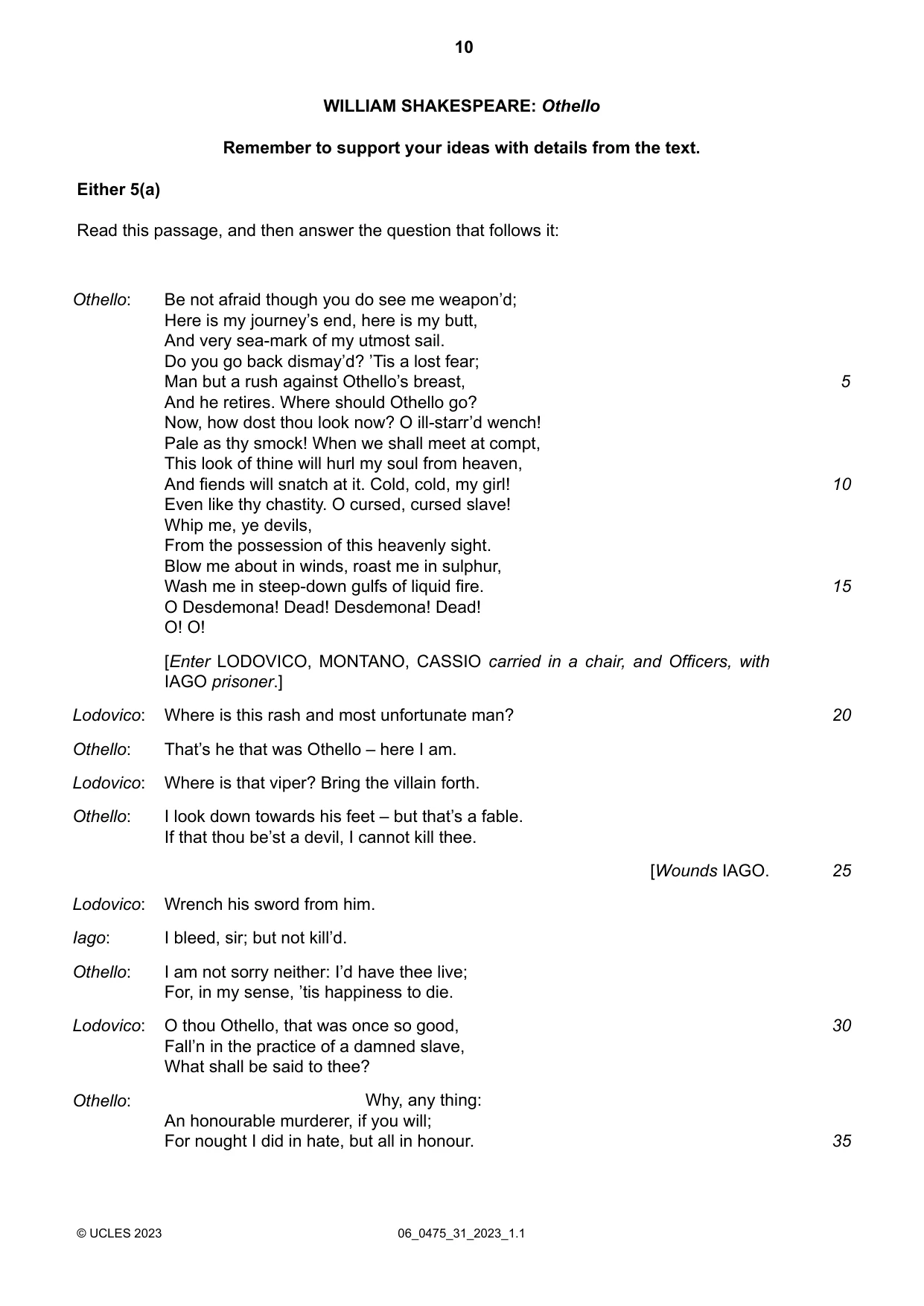
35 30 25 20 15 10 5 WILLIAM SHAKESPEARE: Othello Remember to support your ideas with details from the text. Either 5(a) Read this passage, and then answer the question that follows it: Be not afraid though you do see me weapon’d; Here is my journey’s end, here is my butt, And very sea-mark of my utmost sail. Do you go back dismay’d? ’Tis a lost fear; Man but a rush against Othello’s breast, And he retires. Where should Othello go? Now, how dost thou look now? O ill-starr’d wench! Pale as thy smock! When we shall meet at compt, This look of thine will hurl my soul from heaven, And fiends will snatch at it. Cold, cold, my girl! Even like thy chastity. O cursed, cursed slave! Whip me, ye devils, From the possession of this heavenly sight. Blow me about in winds, roast me in sulphur, Wash me in steep-down gulfs of liquid fire. O Desdemona! Dead! Desdemona! Dead! O! O! Othello: [Enter LODOVICO, MONTANO, CASSIO carried in a chair, and Officers, with IAGO prisoner.] Where is this rash and most unfortunate man? Lodovico: That’s he that was Othello – here I am. Othello: Where is that viper? Bring the villain forth. Lodovico: I look down towards his feet – but that’s a fable. If that thou be’st a devil, I cannot kill thee. Othello: [Wounds IAGO. Wrench his sword from him. Lodovico: I bleed, sir; but not kill’d. Iago: I am not sorry neither: I’d have thee live; For, in my sense, ’tis happiness to die. Othello: O thou Othello, that was once so good, Fall’n in the practice of a damned slave, What shall be said to thee? Lodovico: Why, any thing: An honourable murderer, if you will; For nought I did in hate, but all in honour. Othello: 06_0475_31_2023_1.1 © UCLES 2023 10
Question paper, page 11
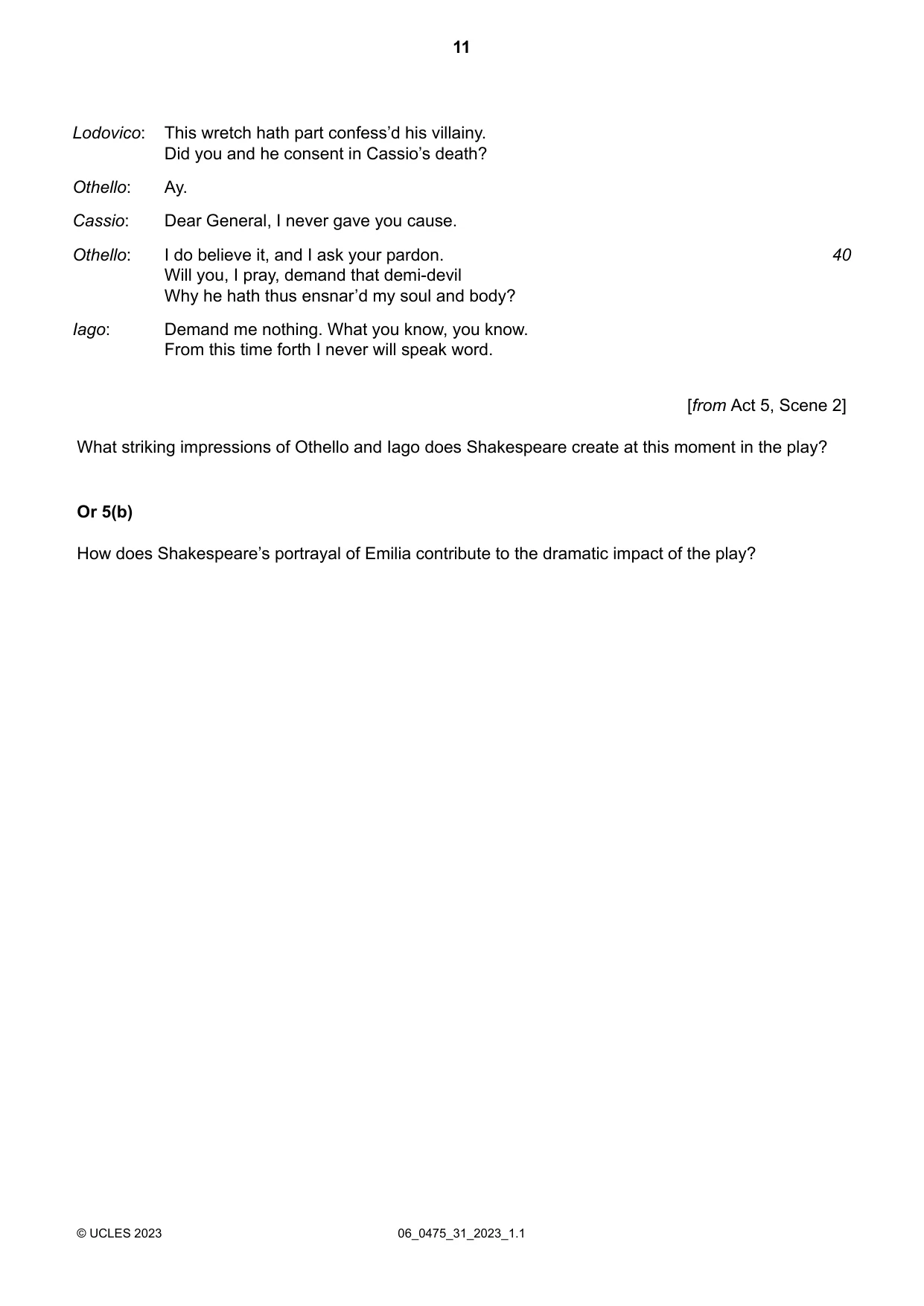
40 This wretch hath part confess’d his villainy. Did you and he consent in Cassio’s death? Lodovico: Ay. Othello: Dear General, I never gave you cause. Cassio: I do believe it, and I ask your pardon. Will you, I pray, demand that demi-devil Why he hath thus ensnar’d my soul and body? Othello: Demand me nothing. What you know, you know. From this time forth I never will speak word. Iago: [from Act 5, Scene 2] What striking impressions of Othello and Iago does Shakespeare create at this moment in the play? Or 5(b) How does Shakespeare’s portrayal of Emilia contribute to the dramatic impact of the play? 06_0475_31_2023_1.1 © UCLES 2023 11
Question paper, page 12
BLANK PAGE Permission to reproduce items where third-party owned material protected by copyright is included has been sought and cleared where possible. Every reasonable effort has been made by the publisher (UCLES) to trace copyright holders, but if any items requiring clearance have unwittingly been included, the publisher will be pleased to make amends at the earliest possible opportunity. To avoid the issue of disclosure of answer-related information to candidates, all copyright acknowledgements are reproduced online in the Cambridge Assessment International Education Copyright Acknowledgements Booklet. This is produced for each series of examinations and is freely available to download at www.cambridgeinternational.org after the live examination series. Cambridge Assessment International Education is part of Cambridge Assessment. Cambridge Assessment is the brand name of the University of Cambridge Local Examinations Syndicate (UCLES), which is a department of the University of Cambridge. 06_0475_31_2023_1.1 © UCLES 2023 12
Mark scheme, page 1
This document consists of 5 printed pages. © UCLES 2023 [Turn over Cambridge IGCSE™ LITERATURE IN ENGLISH 0475/31 Paper 3 Drama (Open Text) May/June 2023 MARK SCHEME Maximum Mark: 25 Published This mark scheme is published as an aid to teachers and candidates, to indicate the requirements of the examination. It shows the basis on which Examiners were instructed to award marks. It does not indicate the details of the discussions that took place at an Examiners’ meeting before marking began, which would have considered the acceptability of alternative answers. Mark schemes should be read in conjunction with the question paper and the Principal Examiner Report for Teachers. Cambridge International will not enter into discussions about these mark schemes. Cambridge International is publishing the mark schemes for the May/June 2023 series for most Cambridge IGCSE, Cambridge International A and AS Level and Cambridge Pre-U components, and some Cambridge O Level components.
Mark scheme, page 2
0475/31 Cambridge IGCSE – Mark Scheme PUBLISHED May/June 2023 © UCLES 2023 Page 2 of 5 Generic Marking Principles These general marking principles must be applied by all examiners when marking candidate answers. They should be applied alongside the specific content of the mark scheme or generic level descriptors for a question. Each question paper and mark scheme will also comply with these marking principles. GENERIC MARKING PRINCIPLE 1: Marks must be awarded in line with: the specific content of the mark scheme or the generic level descriptors for the question the specific skills defined in the mark scheme or in the generic level descriptors for the question the standard of response required by a candidate as exemplified by the standardisation scripts. GENERIC MARKING PRINCIPLE 2: Marks awarded are always whole marks (not half marks, or other fractions). GENERIC MARKING PRINCIPLE 3: Marks must be awarded positively: marks are awarded for correct/valid answers, as defined in the mark scheme. However, credit is given for valid answers which go beyond the scope of the syllabus and mark scheme, referring to your Team Leader as appropriate marks are awarded when candidates clearly demonstrate what they know and can do marks are not deducted for errors marks are not deducted for omissions answers should only be judged on the quality of spelling, punctuation and grammar when these features are specifically assessed by the question as indicated by the mark scheme. The meaning, however, should be unambiguous. GENERIC MARKING PRINCIPLE 4: Rules must be applied consistently, e.g. in situations where candidates have not followed instructions or in the application of generic level descriptors. GENERIC MARKING PRINCIPLE 5: Marks should be awarded using the full range of marks defined in the mark scheme for the question (however; the use of the full mark range may be limited according to the quality of the candidate responses seen). GENERIC MARKING PRINCIPLE 6: Marks awarded are based solely on the requirements as defined in the mark scheme. Marks should not be awarded with grade thresholds or grade descriptors in mind.
Mark scheme, page 3
0475/31 Cambridge IGCSE – Mark Scheme PUBLISHED May/June 2023 © UCLES 2023 Page 3 of 5 English & Media subject specific general marking principles (To be read in conjunction with the Generic Marking Principles (and requiring further guidance on how to place marks within levels)) Components using level descriptors: We use level descriptors as a guide to broad understanding of the qualities normally expected of, or typical of, work in a level. Level descriptors are a means of general guidance, and should not be interpreted as hurdle statements. Where indicative content notes are supplied for a question, these are not a prescription of required content, and must not be treated as such. Alternative correct points and unexpected answers in candidates’ scripts must be given marks that fairly reflect the knowledge and skills demonstrated. While we may have legitimate expectations as to the ground most answers may occupy, we must at all times be prepared to meet candidates on their chosen ground, provided it is relevant ground (e.g. clearly related to and derived from a relevant passage/text and meeting the mark scheme requirements for the question). Components using point-based marking: Point marking is often used to reward knowledge, understanding and application of skills. We give credit where the candidate’s answer shows relevant knowledge, understanding and application of skills in answering the question. We do not give credit where the answer shows confusion. From this it follows that we: a DO credit answers which are worded differently from the mark scheme if they clearly convey the same meaning (unless the mark scheme requires a specific term). b DO credit alternative answers/examples which are not written in the mark scheme if they are correct. c DO credit answers where candidates give more than one correct answer in one prompt/numbered/scaffolded space where extended writing is required rather than list-type answers. For example, questions that require n reasons (e.g. State two reasons…). d DO NOT credit answers simply for using a ‘key term’ unless that is all that is required. (Check for evidence it is understood and not used wrongly.). e DO NOT credit answers which are obviously self-contradicting or trying to cover all possibilities. f DO NOT give further credit for what is effectively repetition of a correct point already credited unless the language itself is being tested. This applies equally to ‘mirror statements’ (i.e. polluted/not polluted). g DO NOT require spellings to be correct, unless this is part of the test. However spellings of syllabus terms must allow for clear and unambiguous separation from other syllabus terms with which they may be confused (e.g. Corrasion/Corrosion).
Mark scheme, page 4
0475/31 Cambridge IGCSE – Mark Scheme PUBLISHED May/June 2023 © UCLES 2023 Page 4 of 5 All questions are marked out of 25. The assessment objectives for the paper are: AO1: show detailed knowledge of the content of literary texts, supported by reference to the text AO2: understand the meanings of literary texts and their contexts, and explore texts beyond surface meanings to show deeper awareness of ideas and attitudes AO3: recognise and appreciate ways in which writers use language, structure and form to create and shape meanings and effects AO4: communicate a sensitive and informed personal response to literary texts. The Level Descriptors cover marks from 0 to 25, and apply to the marking of each question. They guide examiners to an understanding of the qualities normally expected of, or typical of, work in a level. They are a means of general guidance. For the purposes of standardisation of marking, they are to be used in conjunction with examples of candidates’ work and discussed during the examiners’ coordination meeting.
Mark scheme, page 5
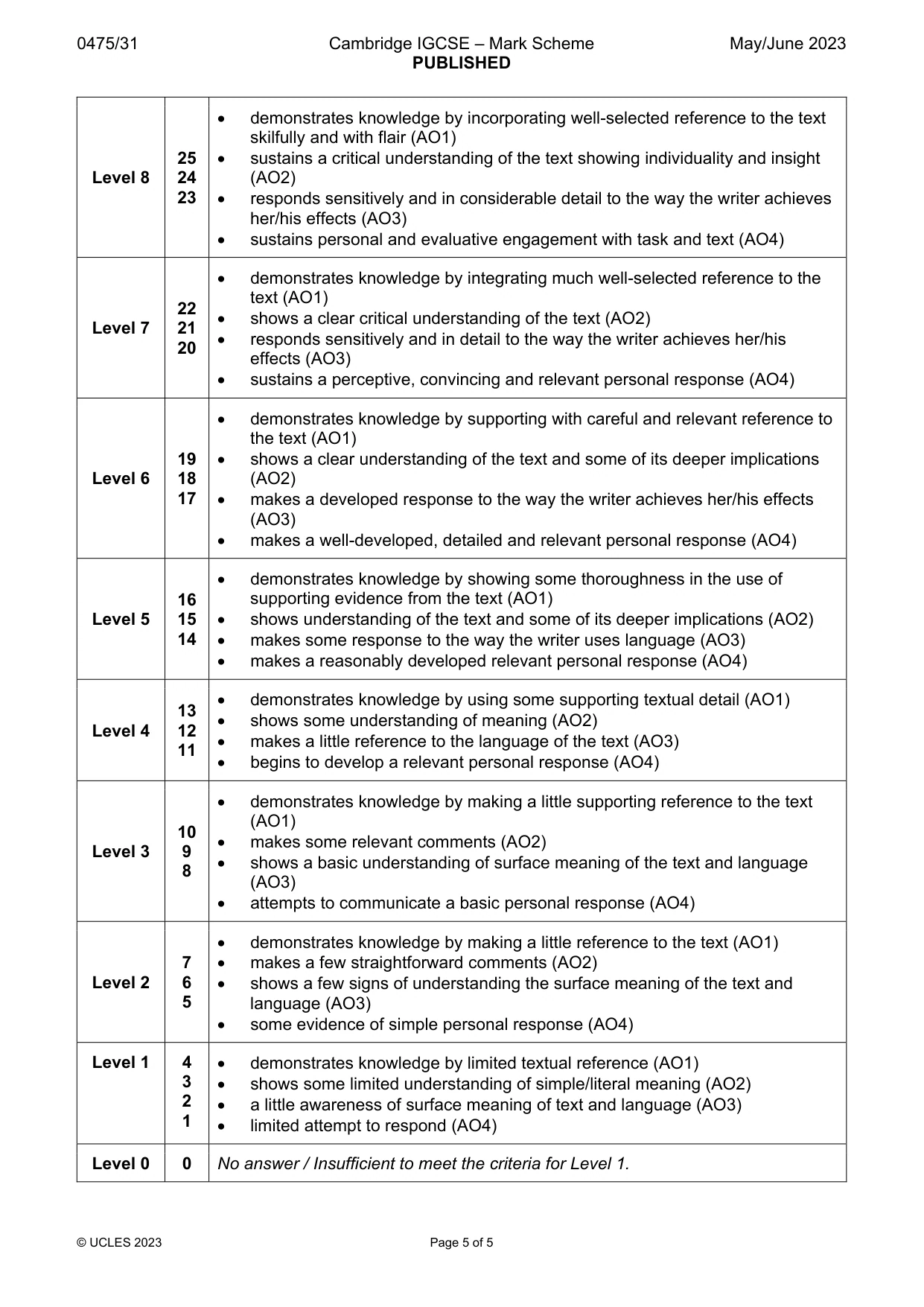
0475/31 Cambridge IGCSE – Mark Scheme PUBLISHED May/June 2023 © UCLES 2023 Page 5 of 5 Level 8 25 24 23 demonstrates knowledge by incorporating well-selected reference to the text skilfully and with flair (AO1) sustains a critical understanding of the text showing individuality and insight (AO2) responds sensitively and in considerable detail to the way the writer achieves her/his effects (AO3) sustains personal and evaluative engagement with task and text (AO4) Level 7 22 21 20 demonstrates knowledge by integrating much well-selected reference to the text (AO1) shows a clear critical understanding of the text (AO2) responds sensitively and in detail to the way the writer achieves her/his effects (AO3) sustains a perceptive, convincing and relevant personal response (AO4) Level 6 19 18 17 demonstrates knowledge by supporting with careful and relevant reference to the text (AO1) shows a clear understanding of the text and some of its deeper implications (AO2) makes a developed response to the way the writer achieves her/his effects (AO3) makes a well-developed, detailed and relevant personal response (AO4) Level 5 16 15 14 demonstrates knowledge by showing some thoroughness in the use of supporting evidence from the text (AO1) shows understanding of the text and some of its deeper implications (AO2) makes some response to the way the writer uses language (AO3) makes a reasonably developed relevant personal response (AO4) Level 4 13 12 11 demonstrates knowledge by using some supporting textual detail (AO1) shows some understanding of meaning (AO2) makes a little reference to the language of the text (AO3) begins to develop a relevant personal response (AO4) Level 3 10 9 8 demonstrates knowledge by making a little supporting reference to the text (AO1) makes some relevant comments (AO2) shows a basic understanding of surface meaning of the text and language (AO3) attempts to communicate a basic personal response (AO4) Level 2 7 6 5 demonstrates knowledge by making a little reference to the text (AO1) makes a few straightforward comments (AO2) shows a few signs of understanding the surface meaning of the text and language (AO3) some evidence of simple personal response (AO4) Level 1 4 3 2 1 demonstrates knowledge by limited textual reference (AO1) shows some limited understanding of simple/literal meaning (AO2) a little awareness of surface meaning of text and language (AO3) limited attempt to respond (AO4) Level 0 0 No answer / Insufficient to meet the criteria for Level 1.
What you needed in this session
Cambridge’s own grade thresholds for 2023 May/June, Paper 3 · Variant 1. A higher threshold means an easier paper — the bar moves with how the cohort did.