Cambridge IGCSE English - Literature in English 0475 — 2024 Oct/Nov Paper 3 · Variant 2
0475/32/O/N/24 · 25 marks · ≈28 min
The question paper and its mark scheme, free to read here and free to download. This is Cambridge’s own paper, exactly as it was sat.
Question paper12 pages
Mark scheme4 pages
Answers below. Sit the paper first if you are practising.
Paper as text
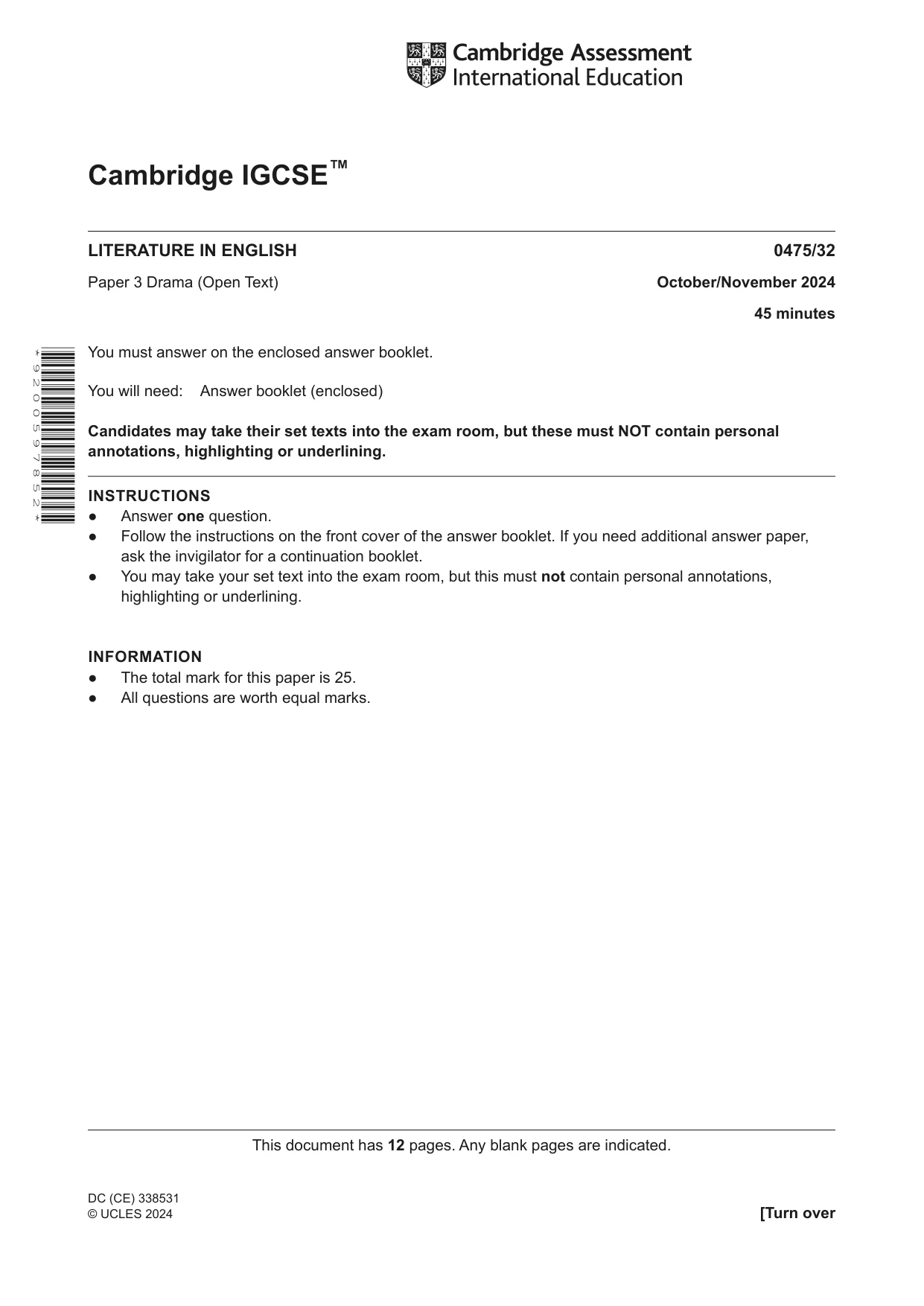
Question paper, page 1
This document has 12 pages. Any blank pages are indicated. [Turn over Cambridge IGCSE™ * 9 2 0 0 5 9 7 8 5 2 * DC (CE) 338531 © UCLES 2024 LITERATURE IN ENGLISH 0475/32 Paper 3 Drama (Open Text) October/November 2024 45 minutes You must answer on the enclosed answer booklet. You will need: Answer booklet (enclosed) Candidates may take their set texts into the exam room, but these must NOT contain personal annotations, highlighting or underlining. INSTRUCTIONS ● Answer one question. ● Follow the instructions on the front cover of the answer booklet. If you need additional answer paper, ask the invigilator for a continuation booklet. ● You may take your set text into the exam room, but this must not contain personal annotations, highlighting or underlining. INFORMATION ● The total mark for this paper is 25. ● All questions are worth equal marks.
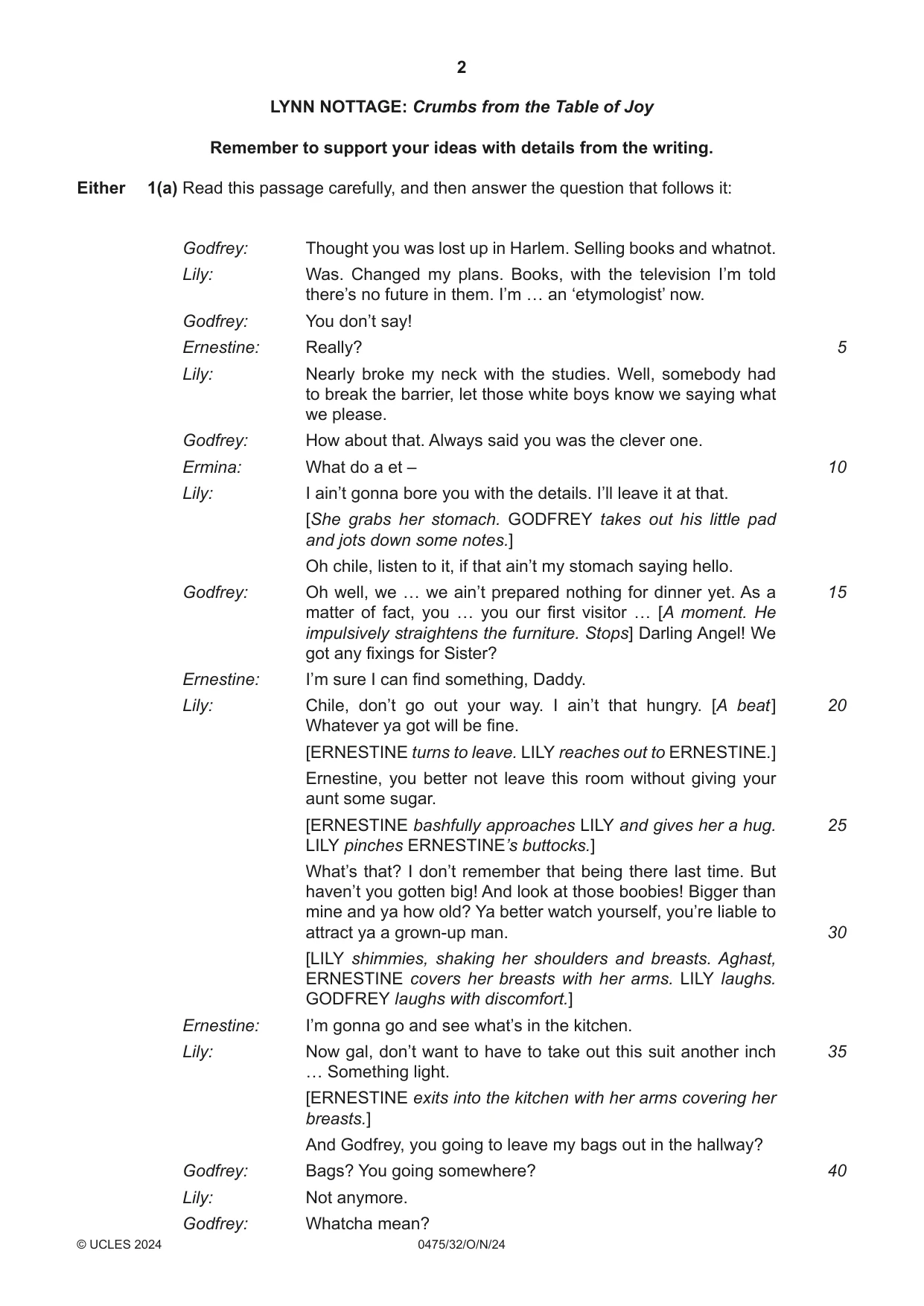
Question paper, page 2
2 0475/32/O/N/24 © UCLES 2024 LYNN NOTTAGE: Crumbs from the Table of Joy Remember to support your ideas with details from the writing. Either 1(a) Read this passage carefully, and then answer the question that follows it: Godfrey: Thought you was lost up in Harlem. Selling books and whatnot. Lily: Was. Changed my plans. Books, with the television I’m told there’s no future in them. I’m … an ‘etymologist’ now. Godfrey: You don’t say! Ernestine: Really? Lily: Nearly broke my neck with the studies. Well, somebody had to break the barrier, let those white boys know we saying what we please. Godfrey: How about that. Always said you was the clever one. Ermina: What do a et – Lily: I ain’t gonna bore you with the details. I’ll leave it at that. [She grabs her stomach. GODFREY takes out his little pad and jots down some notes.] Oh chile, listen to it, if that ain’t my stomach saying hello. Godfrey: Oh well, we … we ain’t prepared nothing for dinner yet. As a matter of fact, you … you our first visitor … [A moment. He impulsively straightens the furniture. Stops] Darling Angel! We got any fixings for Sister? Ernestine: I’m sure I can find something, Daddy. Lily: Chile, don’t go out your way. I ain’t that hungry. [A beat ] Whatever ya got will be fine. [ERNESTINE turns to leave. LILY reaches out to ERNESTINE.] Ernestine, you better not leave this room without giving your aunt some sugar. [ERNESTINE bashfully approaches LILY and gives her a hug. LILY pinches ERNESTINE’s buttocks.] What’s that? I don’t remember that being there last time. But haven’t you gotten big! And look at those boobies! Bigger than mine and ya how old? Ya better watch yourself, you’re liable to attract ya a grown-up man. [LILY shimmies, shaking her shoulders and breasts. Aghast, ERNESTINE covers her breasts with her arms. LILY laughs. GODFREY laughs with discomfort.] Ernestine: I’m gonna go and see what’s in the kitchen. Lily: Now gal, don’t want to have to take out this suit another inch … Something light. [ERNESTINE exits into the kitchen with her arms covering her breasts.] And Godfrey, you going to leave my bags out in the hallway? Godfrey: Bags? You going somewhere? Lily: Not anymore. Godfrey: Whatcha mean? 5 10 15 20 25 30 35 40
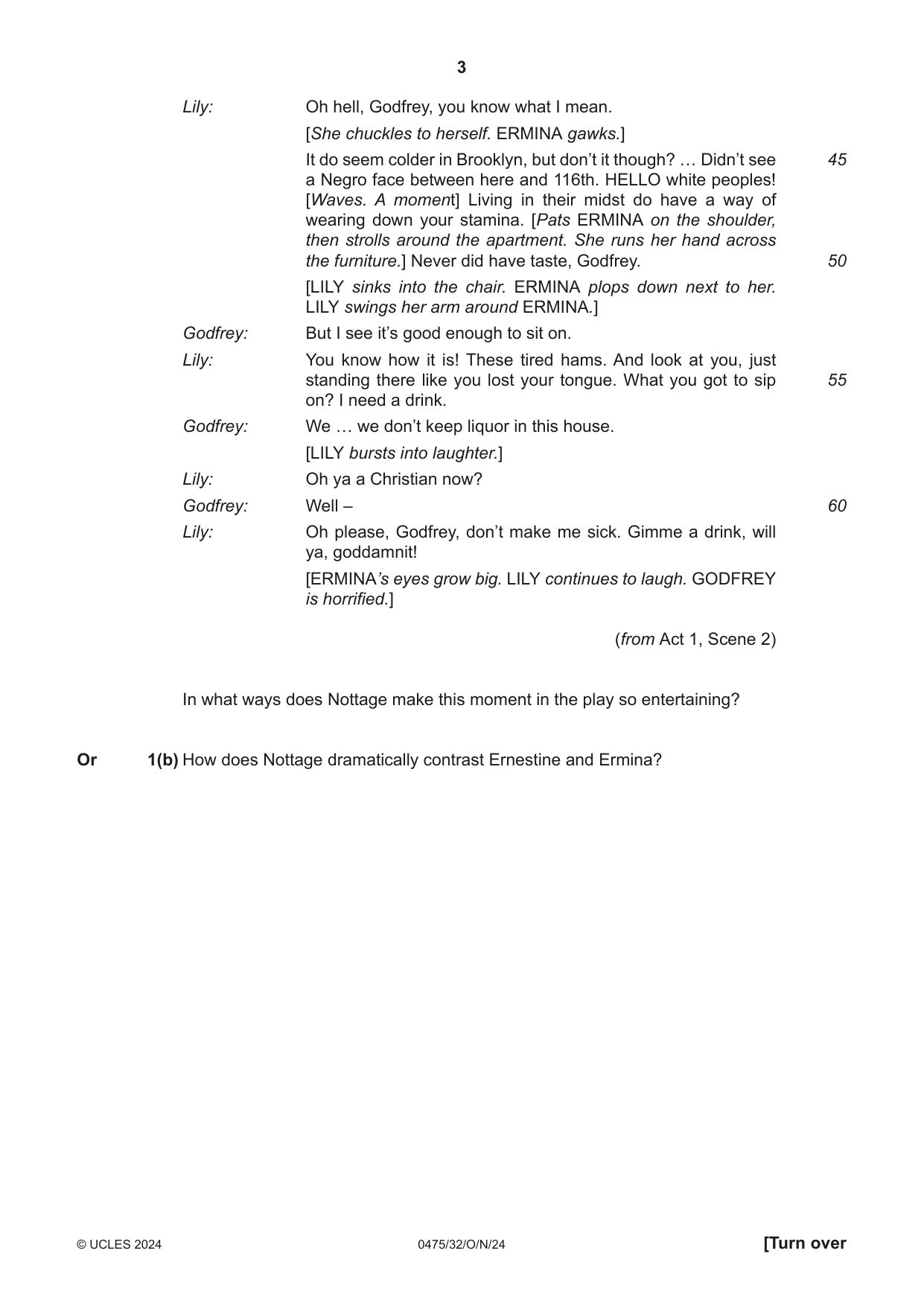
Question paper, page 3
3 0475/32/O/N/24 © UCLES 2024 [Turn over Lily: Oh hell, Godfrey, you know what I mean. [She chuckles to herself. ERMINA gawks.] It do seem colder in Brooklyn, but don’t it though? … Didn’t see a Negro face between here and 116th. HELLO white peoples! [Waves. A moment] Living in their midst do have a way of wearing down your stamina. [Pats ERMINA on the shoulder, then strolls around the apartment. She runs her hand across the furniture.] Never did have taste, Godfrey. [LILY sinks into the chair. ERMINA plops down next to her. LILY swings her arm around ERMINA.] Godfrey: But I see it’s good enough to sit on. Lily: You know how it is! These tired hams. And look at you, just standing there like you lost your tongue. What you got to sip on? I need a drink. Godfrey: We … we don’t keep liquor in this house. [LILY bursts into laughter.] Lily: Oh ya a Christian now? Godfrey: Well – Lily: Oh please, Godfrey, don’t make me sick. Gimme a drink, will ya, goddamnit! [ERMINA’s eyes grow big. LILY continues to laugh. GODFREY is horrified.] (from Act 1, Scene 2) In what ways does Nottage make this moment in the play so entertaining? Or 1(b) How does Nottage dramatically contrast Ernestine and Ermina? 45 50 55 60
Question paper, page 4
4 0475/32/O/N/24 © UCLES 2024 WOLE SOYINKA: Death and the King’s Horseman Remember to support your ideas with details from the writing. Either 2(a) Read this passage carefully, and then answer the question that follows it: Elesin: I am bitterly offended. Content removed due to copyright restrictions.
Question paper, page 5
5 0475/32/O/N/24 © UCLES 2024 [Turn over In emptiness. (from Scene 1) In what ways does Soyinka make this early moment in the play so striking? Or 2(b) How does Soyinka dramatically convey the importance of duty to Elesin and Pilkings? Content removed due to copyright restrictions.
Question paper, page 6
6 0475/32/O/N/24 © UCLES 2024 TENNESSEE WILLIAMS: A Streetcar Named Desire Remember to support your ideas with details from the writing. Either 3(a) Read this passage carefully, and then answer the question that follows it: Blanche: Oh, in my youth I excited some admiration. Content removed due to copyright restrictions.
Question paper, page 7
7 0475/32/O/N/24 © UCLES 2024 [Turn over Connected with the plantation. (from Scene 2) In what ways does Williams powerfully create tension between Stanley and Blanche at this moment in the play? Or 3(b) How does Williams vividly depict Blanche’s disturbed state of mind? Content removed due to copyright restrictions.
Question paper, page 8
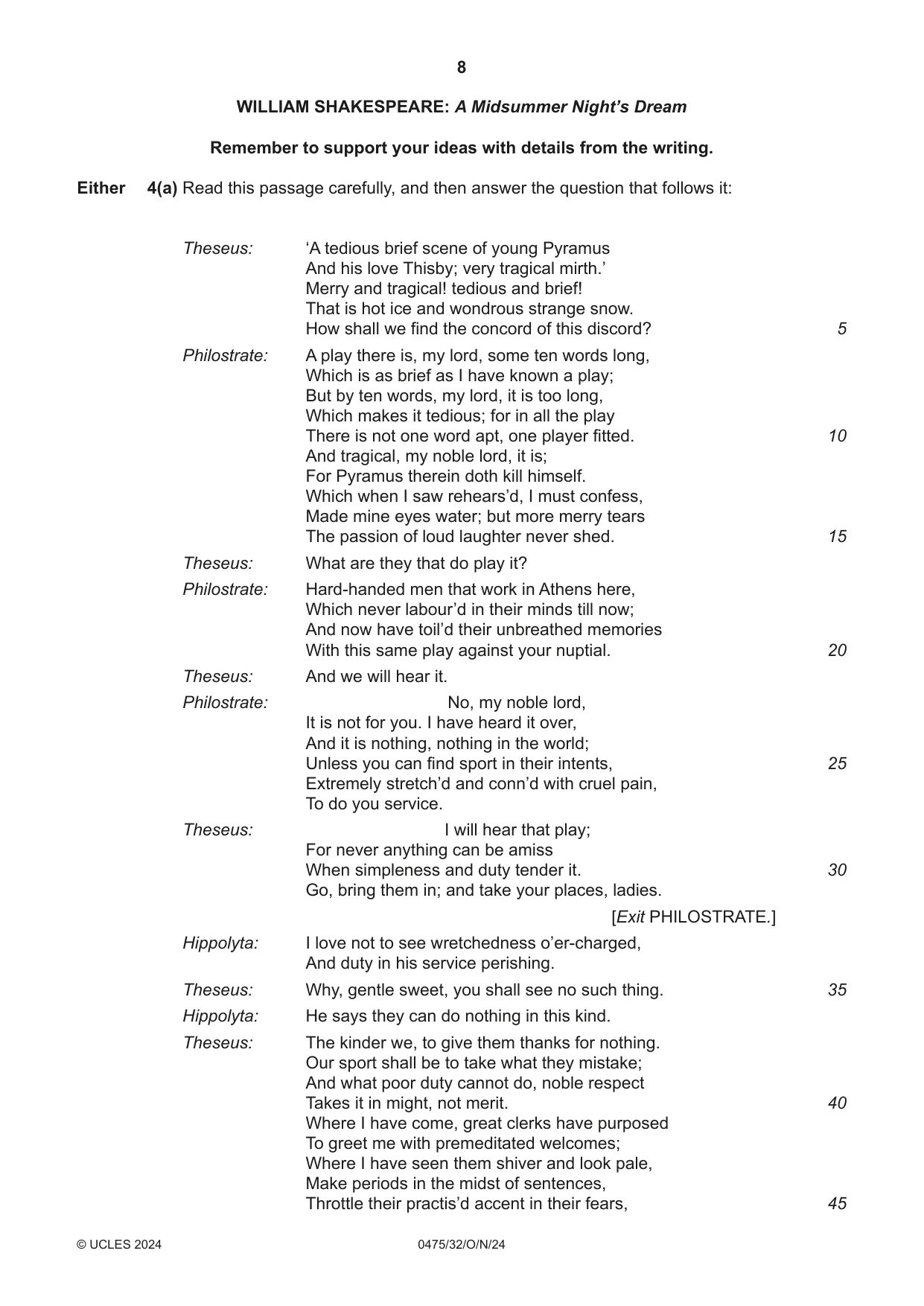
8 0475/32/O/N/24 © UCLES 2024 WILLIAM SHAKESPEARE: A Midsummer Night’s Dream Remember to support your ideas with details from the writing. Either 4(a) Read this passage carefully, and then answer the question that follows it: Theseus: ‘A tedious brief scene of young Pyramus And his love Thisby; very tragical mirth.’ Merry and tragical! tedious and brief! That is hot ice and wondrous strange snow. How shall we find the concord of this discord? Philostrate: A play there is, my lord, some ten words long, Which is as brief as I have known a play; But by ten words, my lord, it is too long, Which makes it tedious; for in all the play There is not one word apt, one player fitted. And tragical, my noble lord, it is; For Pyramus therein doth kill himself. Which when I saw rehears’d, I must confess, Made mine eyes water; but more merry tears The passion of loud laughter never shed. Theseus: What are they that do play it? Philostrate: Hard-handed men that work in Athens here, Which never labour’d in their minds till now; And now have toil’d their unbreathed memories With this same play against your nuptial. Theseus: And we will hear it. Philostrate: No, my noble lord, It is not for you. I have heard it over, And it is nothing, nothing in the world; Unless you can find sport in their intents, Extremely stretch’d and conn’d with cruel pain, To do you service. Theseus: I will hear that play; For never anything can be amiss When simpleness and duty tender it. Go, bring them in; and take your places, ladies. [Exit PHILOSTRATE.] Hippolyta: I love not to see wretchedness o’er-charged, And duty in his service perishing. Theseus: Why, gentle sweet, you shall see no such thing. Hippolyta: He says they can do nothing in this kind. Theseus: The kinder we, to give them thanks for nothing. Our sport shall be to take what they mistake; And what poor duty cannot do, noble respect Takes it in might, not merit. Where I have come, great clerks have purposed To greet me with premeditated welcomes; Where I have seen them shiver and look pale, Make periods in the midst of sentences, Throttle their practis’d accent in their fears, 5 10 15 20 25 30 35 40 45
Question paper, page 9
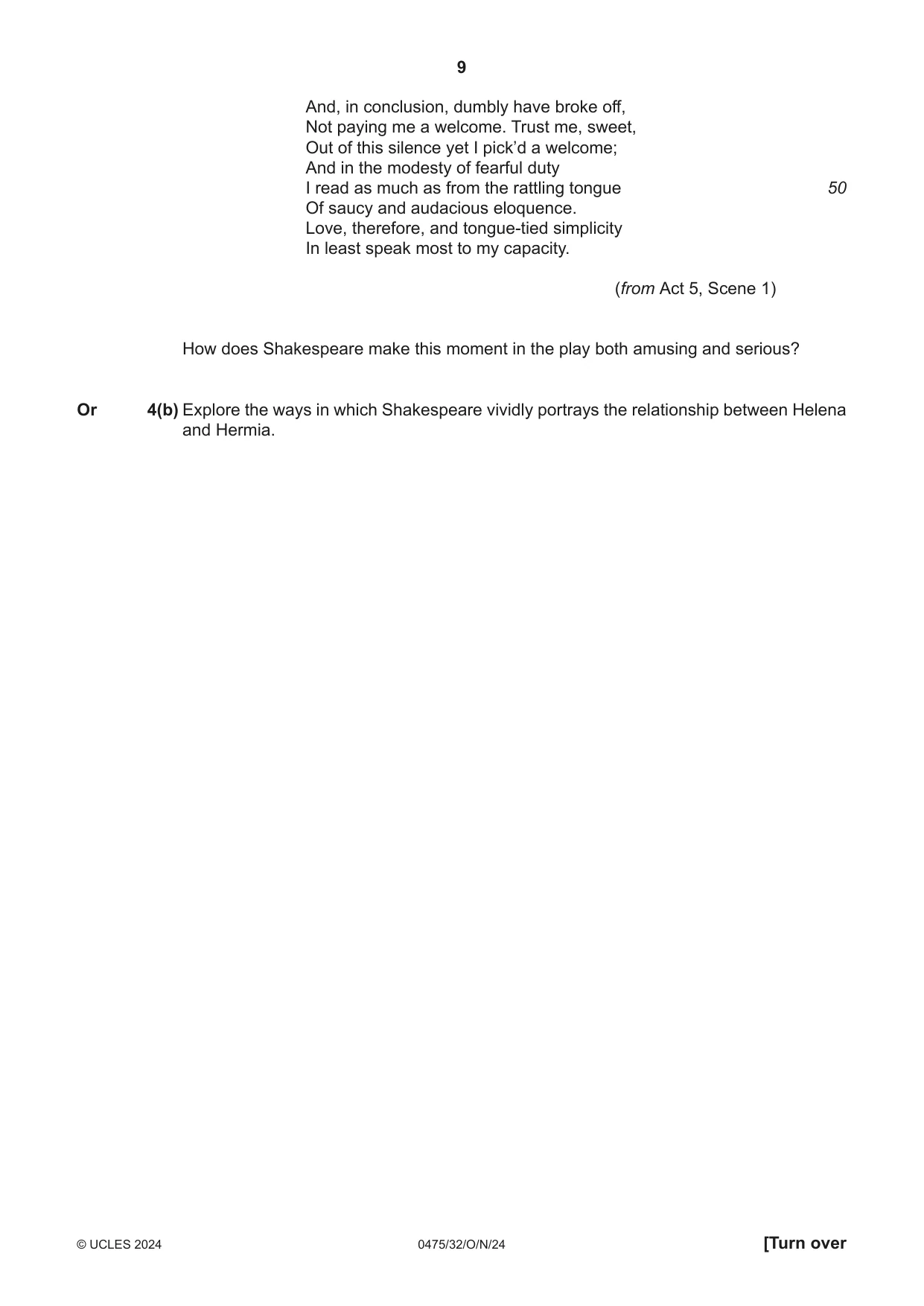
9 0475/32/O/N/24 © UCLES 2024 [Turn over And, in conclusion, dumbly have broke off, Not paying me a welcome. Trust me, sweet, Out of this silence yet I pick’d a welcome; And in the modesty of fearful duty I read as much as from the rattling tongue Of saucy and audacious eloquence. Love, therefore, and tongue-tied simplicity In least speak most to my capacity. (from Act 5, Scene 1) How does Shakespeare make this moment in the play both amusing and serious? Or 4(b) Explore the ways in which Shakespeare vividly portrays the relationship between Helena and Hermia. 50
Question paper, page 10
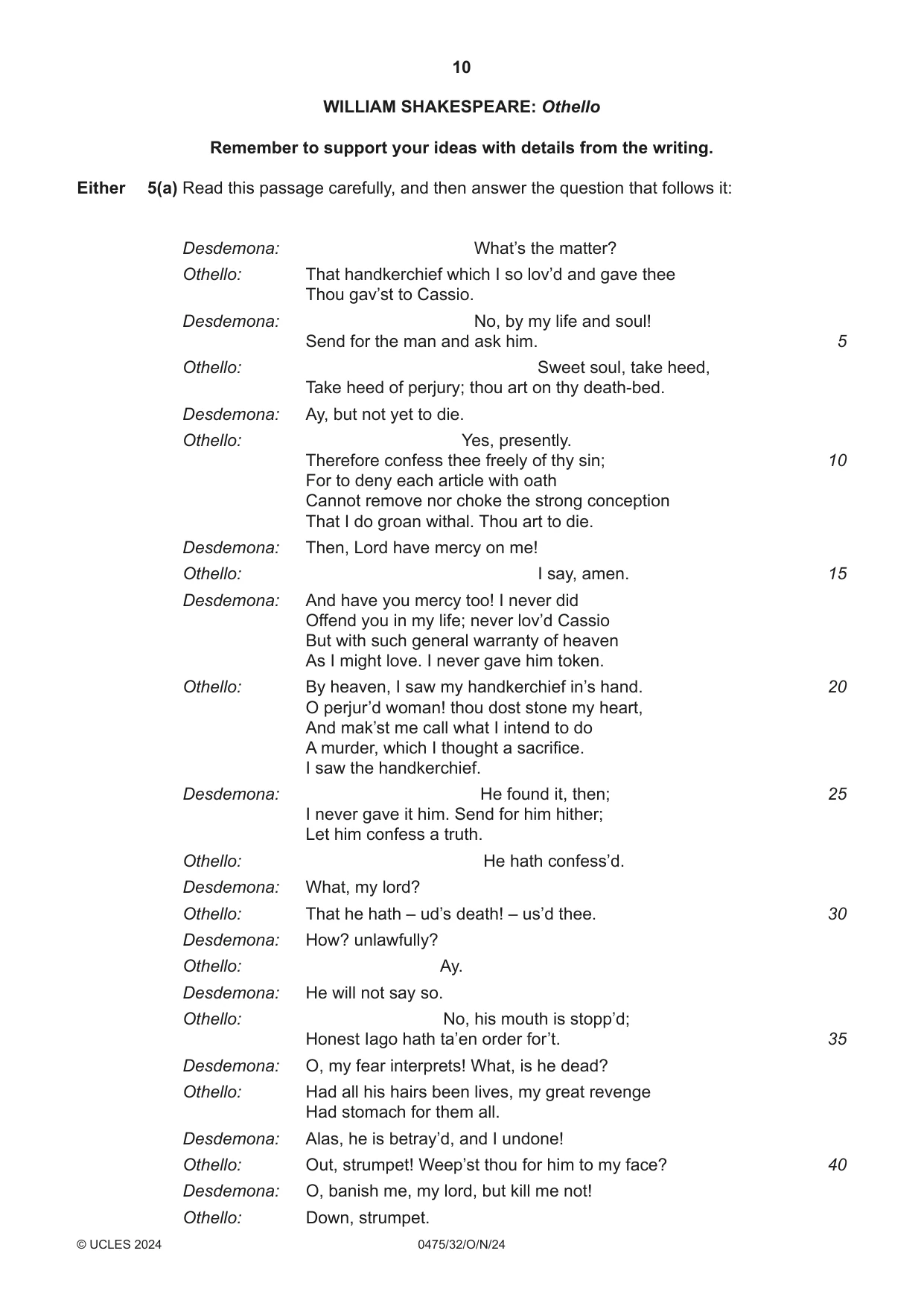
10 0475/32/O/N/24 © UCLES 2024 WILLIAM SHAKESPEARE: Othello Remember to support your ideas with details from the writing. Either 5(a) Read this passage carefully, and then answer the question that follows it: Desdemona: What’s the matter? Othello: That handkerchief which I so lov’d and gave thee Thou gav’st to Cassio. Desdemona: No, by my life and soul! Send for the man and ask him. Othello: Sweet soul, take heed, Take heed of perjury; thou art on thy death-bed. Desdemona: Ay, but not yet to die. Othello: Yes, presently. Therefore confess thee freely of thy sin; For to deny each article with oath Cannot remove nor choke the strong conception That I do groan withal. Thou art to die. Desdemona: Then, Lord have mercy on me! Othello: I say, amen. Desdemona: And have you mercy too! I never did Offend you in my life; never lov’d Cassio But with such general warranty of heaven As I might love. I never gave him token. Othello: By heaven, I saw my handkerchief in’s hand. O perjur’d woman! thou dost stone my heart, And mak’st me call what I intend to do A murder, which I thought a sacrifice. I saw the handkerchief. Desdemona: He found it, then; I never gave it him. Send for him hither; Let him confess a truth. Othello: He hath confess’d. Desdemona: What, my lord? Othello: That he hath – ud’s death! – us’d thee. Desdemona: How? unlawfully? Othello: Ay. Desdemona: He will not say so. Othello: No, his mouth is stopp’d; Honest Iago hath ta’en order for’t. Desdemona: O, my fear interprets! What, is he dead? Othello: Had all his hairs been lives, my great revenge Had stomach for them all. Desdemona: Alas, he is betray’d, and I undone! Othello: Out, strumpet! Weep’st thou for him to my face? Desdemona: O, banish me, my lord, but kill me not! Othello: Down, strumpet. 5 10 15 20 25 30 35 40
Question paper, page 11
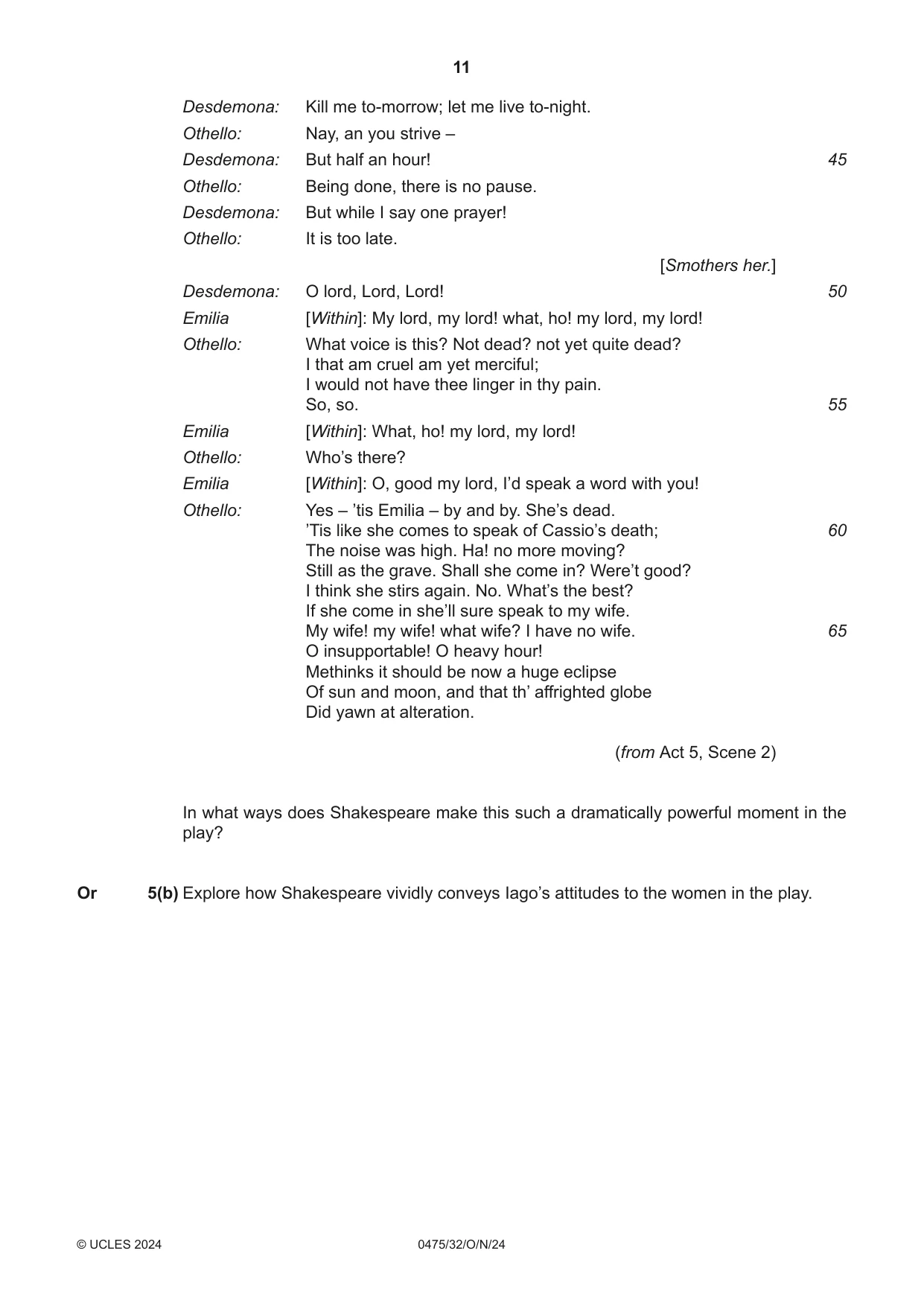
11 0475/32/O/N/24 © UCLES 2024 Desdemona: Kill me to-morrow; let me live to-night. Othello: Nay, an you strive – Desdemona: But half an hour! Othello: Being done, there is no pause. Desdemona: But while I say one prayer! Othello: It is too late. [Smothers her.] Desdemona: O lord, Lord, Lord! Emilia [Within]: My lord, my lord! what, ho! my lord, my lord! Othello: What voice is this? Not dead? not yet quite dead? I that am cruel am yet merciful; I would not have thee linger in thy pain. So, so. Emilia [Within]: What, ho! my lord, my lord! Othello: Who’s there? Emilia [Within]: O, good my lord, I’d speak a word with you! Othello: Yes – ’tis Emilia – by and by. She’s dead. ’Tis like she comes to speak of Cassio’s death; The noise was high. Ha! no more moving? Still as the grave. Shall she come in? Were’t good? I think she stirs again. No. What’s the best? If she come in she’ll sure speak to my wife. My wife! my wife! what wife? I have no wife. O insupportable! O heavy hour! Methinks it should be now a huge eclipse Of sun and moon, and that th’ affrighted globe Did yawn at alteration. (from Act 5, Scene 2) In what ways does Shakespeare make this such a dramatically powerful moment in the play? Or 5(b) Explore how Shakespeare vividly conveys Iago’s attitudes to the women in the play. 45 50 55 60 65
Question paper, page 12
12 0475/32/O/N/24 © UCLES 2024 Permission to reproduce items where third-party owned material protected by copyright is included has been sought and cleared where possible. Every reasonable effort has been made by the publisher (UCLES) to trace copyright holders, but if any items requiring clearance have unwittingly been included, the publisher will be pleased to make amends at the earliest possible opportunity. To avoid the issue of disclosure of answer-related information to candidates, all copyright acknowledgements are reproduced online in the Cambridge Assessment International Education Copyright Acknowledgements Booklet. This is produced for each series of examinations and is freely available to download at www.cambridgeinternational.org after the live examination series. Cambridge Assessment International Education is part of Cambridge Assessment. Cambridge Assessment is the brand name of the University of Cambridge Local Examinations Syndicate (UCLES), which is a department of the University of Cambridge. BLANK PAGE
Mark scheme, page 1
This document consists of 4 printed pages. © Cambridge University Press & Assessment 2024 [Turn over Cambridge IGCSE™ LITERATURE IN ENGLISH 0475/32 Paper 3 Drama (Open Text) October/November 2024 MARK SCHEME Maximum Mark: 25 Published This mark scheme is published as an aid to teachers and candidates, to indicate the requirements of the examination. It shows the basis on which Examiners were instructed to award marks. It does not indicate the details of the discussions that took place at an Examiners’ meeting before marking began, which would have considered the acceptability of alternative answers. Mark schemes should be read in conjunction with the question paper and the Principal Examiner Report for Teachers. Cambridge International will not enter into discussions about these mark schemes. Cambridge International is publishing the mark schemes for the October/November 2024 series for most Cambridge IGCSE, Cambridge International A and AS Level components, and some Cambridge O Level components.
Mark scheme, page 2
0475/32 Cambridge IGCSE – Mark Scheme PUBLISHED October/November 2024 © Cambridge University Press & Assessment 2024 Page 2 of 4 Generic Marking Principles These general marking principles must be applied by all examiners when marking candidate answers. They should be applied alongside the specific content of the mark scheme or generic level descriptions for a question. Each question paper and mark scheme will also comply with these marking principles. GENERIC MARKING PRINCIPLE 1: Marks must be awarded in line with: • the specific content of the mark scheme or the generic level descriptors for the question • the specific skills defined in the mark scheme or in the generic level descriptors for the question • the standard of response required by a candidate as exemplified by the standardisation scripts. GENERIC MARKING PRINCIPLE 2: Marks awarded are always whole marks (not half marks, or other fractions). GENERIC MARKING PRINCIPLE 3: Marks must be awarded positively: • marks are awarded for correct/valid answers, as defined in the mark scheme. However, credit is given for valid answers which go beyond the scope of the syllabus and mark scheme, referring to your Team Leader as appropriate • marks are awarded when candidates clearly demonstrate what they know and can do • marks are not deducted for errors • marks are not deducted for omissions • answers should only be judged on the quality of spelling, punctuation and grammar when these features are specifically assessed by the question as indicated by the mark scheme. The meaning, however, should be unambiguous. GENERIC MARKING PRINCIPLE 4: Rules must be applied consistently, e.g. in situations where candidates have not followed instructions or in the application of generic level descriptors. GENERIC MARKING PRINCIPLE 5: Marks should be awarded using the full range of marks defined in the mark scheme for the question (however; the use of the full mark range may be limited according to the quality of the candidate responses seen). GENERIC MARKING PRINCIPLE 6: Marks awarded are based solely on the requirements as defined in the mark scheme. Marks should not be awarded with grade thresholds or grade descriptors in mind.
Mark scheme, page 3
0475/32 Cambridge IGCSE – Mark Scheme PUBLISHED October/November 2024 © Cambridge University Press & Assessment 2024 Page 3 of 4 English & Media subject specific general marking principles (To be read in conjunction with the Generic Marking Principles (and requiring further guidance on how to place marks within levels)) Components using level descriptors: • We use level descriptors as a guide to broad understanding of the qualities normally expected of, or typical of, work in a level. • Level descriptors are a means of general guidance, and should not be interpreted as hurdle statements. • Where indicative content notes are supplied for a question, these are not a prescription of required content, and must not be treated as such. Alternative correct points and unexpected answers in candidates’ scripts must be given marks that fairly reflect the knowledge and skills demonstrated. • While we may have legitimate expectations as to the ground most answers may occupy, we must at all times be prepared to meet candidates on their chosen ground, provided it is relevant ground (e.g. clearly related to and derived from a relevant passage/text and meeting the mark scheme requirements for the question). Components using point-based marking: Point marking is often used to reward knowledge, understanding and application of skills. We give credit where the candidate’s answer shows relevant knowledge, understanding and application of skills in answering the question. We do not give credit where the answer shows confusion. From this it follows that we: a DO credit answers which are worded differently from the mark scheme if they clearly convey the same meaning (unless the mark scheme requires a specific term). b DO credit alternative answers/examples which are not written in the mark scheme if they are correct. c DO credit answers where candidates give more than one correct answer in one prompt/numbered/scaffolded space where extended writing is required rather than list-type answers. For example, questions that require n reasons (e.g. State two reasons…). d DO NOT credit answers simply for using a ‘key term’ unless that is all that is required. (Check for evidence it is understood and not used wrongly.) e DO NOT credit answers which are obviously self-contradicting or trying to cover all possibilities. f DO NOT give further credit for what is effectively repetition of a correct point already credited unless the language itself is being tested. This applies equally to ‘mirror statements’ (i.e. polluted/not polluted). g DO NOT require spellings to be correct, unless this is part of the test. However spellings of syllabus terms must allow for clear and unambiguous separation from other syllabus terms with which they may be confused (e.g. Corrasion/Corrosion).
Mark scheme, page 4
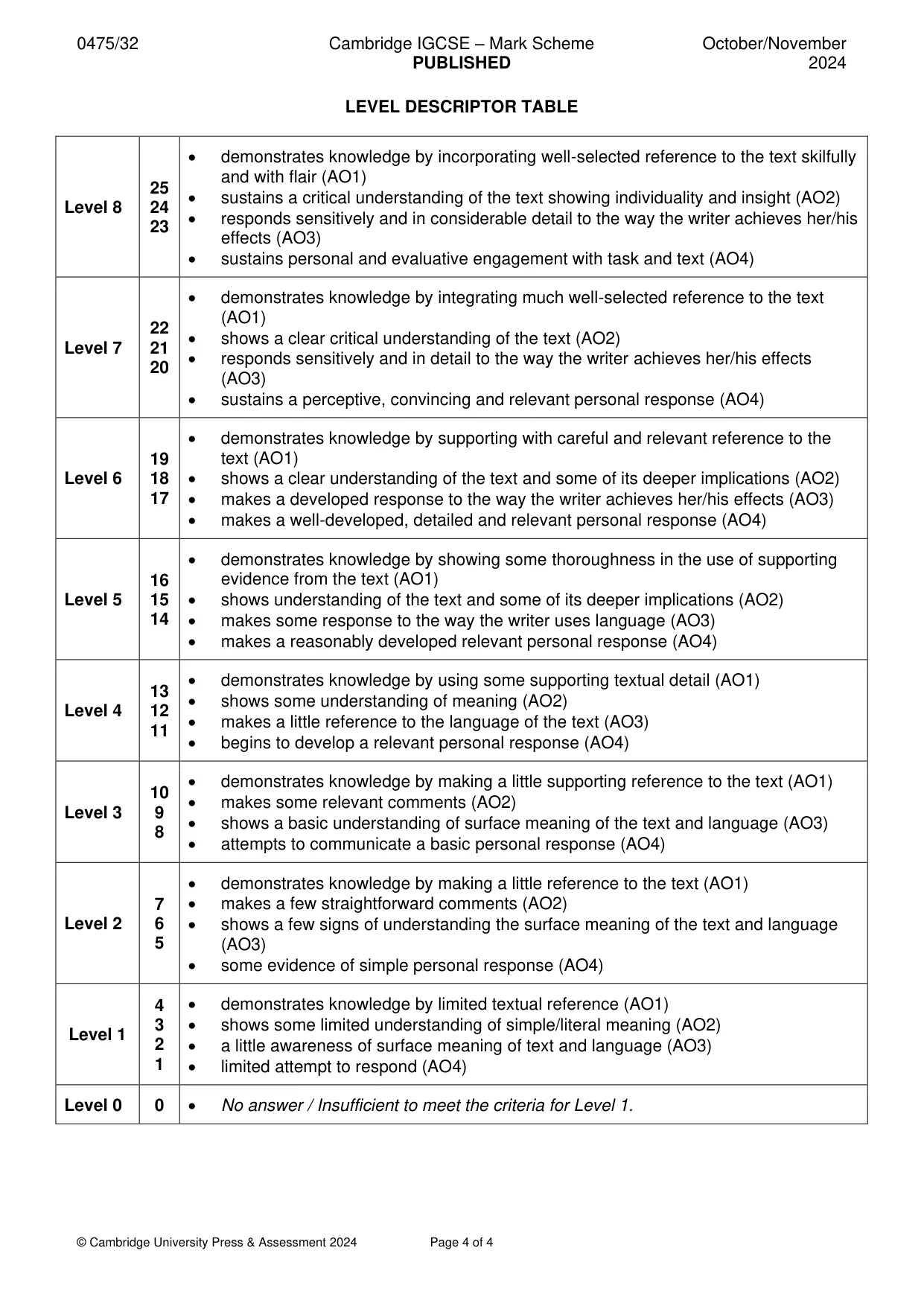
0475/32 Cambridge IGCSE – Mark Scheme PUBLISHED October/November 2024 © Cambridge University Press & Assessment 2024 Page 4 of 4 LEVEL DESCRIPTOR TABLE Level 8 25 24 23 • demonstrates knowledge by incorporating well-selected reference to the text skilfully and with flair (AO1) • sustains a critical understanding of the text showing individuality and insight (AO2) • responds sensitively and in considerable detail to the way the writer achieves her/his effects (AO3) • sustains personal and evaluative engagement with task and text (AO4) Level 7 22 21 20 • demonstrates knowledge by integrating much well-selected reference to the text (AO1) • shows a clear critical understanding of the text (AO2) • responds sensitively and in detail to the way the writer achieves her/his effects (AO3) • sustains a perceptive, convincing and relevant personal response (AO4) Level 6 19 18 17 • demonstrates knowledge by supporting with careful and relevant reference to the text (AO1) • shows a clear understanding of the text and some of its deeper implications (AO2) • makes a developed response to the way the writer achieves her/his effects (AO3) • makes a well-developed, detailed and relevant personal response (AO4) Level 5 16 15 14 • demonstrates knowledge by showing some thoroughness in the use of supporting evidence from the text (AO1) • shows understanding of the text and some of its deeper implications (AO2) • makes some response to the way the writer uses language (AO3) • makes a reasonably developed relevant personal response (AO4) Level 4 13 12 11 • demonstrates knowledge by using some supporting textual detail (AO1) • shows some understanding of meaning (AO2) • makes a little reference to the language of the text (AO3) • begins to develop a relevant personal response (AO4) Level 3 10 9 8 • demonstrates knowledge by making a little supporting reference to the text (AO1) • makes some relevant comments (AO2) • shows a basic understanding of surface meaning of the text and language (AO3) • attempts to communicate a basic personal response (AO4) Level 2 7 6 5 • demonstrates knowledge by making a little reference to the text (AO1) • makes a few straightforward comments (AO2) • shows a few signs of understanding the surface meaning of the text and language (AO3) • some evidence of simple personal response (AO4) Level 1 4 3 2 1 • demonstrates knowledge by limited textual reference (AO1) • shows some limited understanding of simple/literal meaning (AO2) • a little awareness of surface meaning of text and language (AO3) • limited attempt to respond (AO4) Level 0 0 • No answer / Insufficient to meet the criteria for Level 1.
What you needed in this session
Cambridge’s own grade thresholds for 2024 Oct/Nov, Paper 3 · Variant 2. A higher threshold means an easier paper — the bar moves with how the cohort did.