Cambridge IGCSE English - Literature in English 0475 — 2022 Oct/Nov Paper 2 · Variant 1
0475/21/O/N/22 · 50 marks · ≈56 min
The question paper and its mark scheme, free to read here and free to download. This is Cambridge’s own paper, exactly as it was sat.
Question paper12 pages
Mark scheme5 pages
Answers below. Sit the paper first if you are practising.
Paper as text
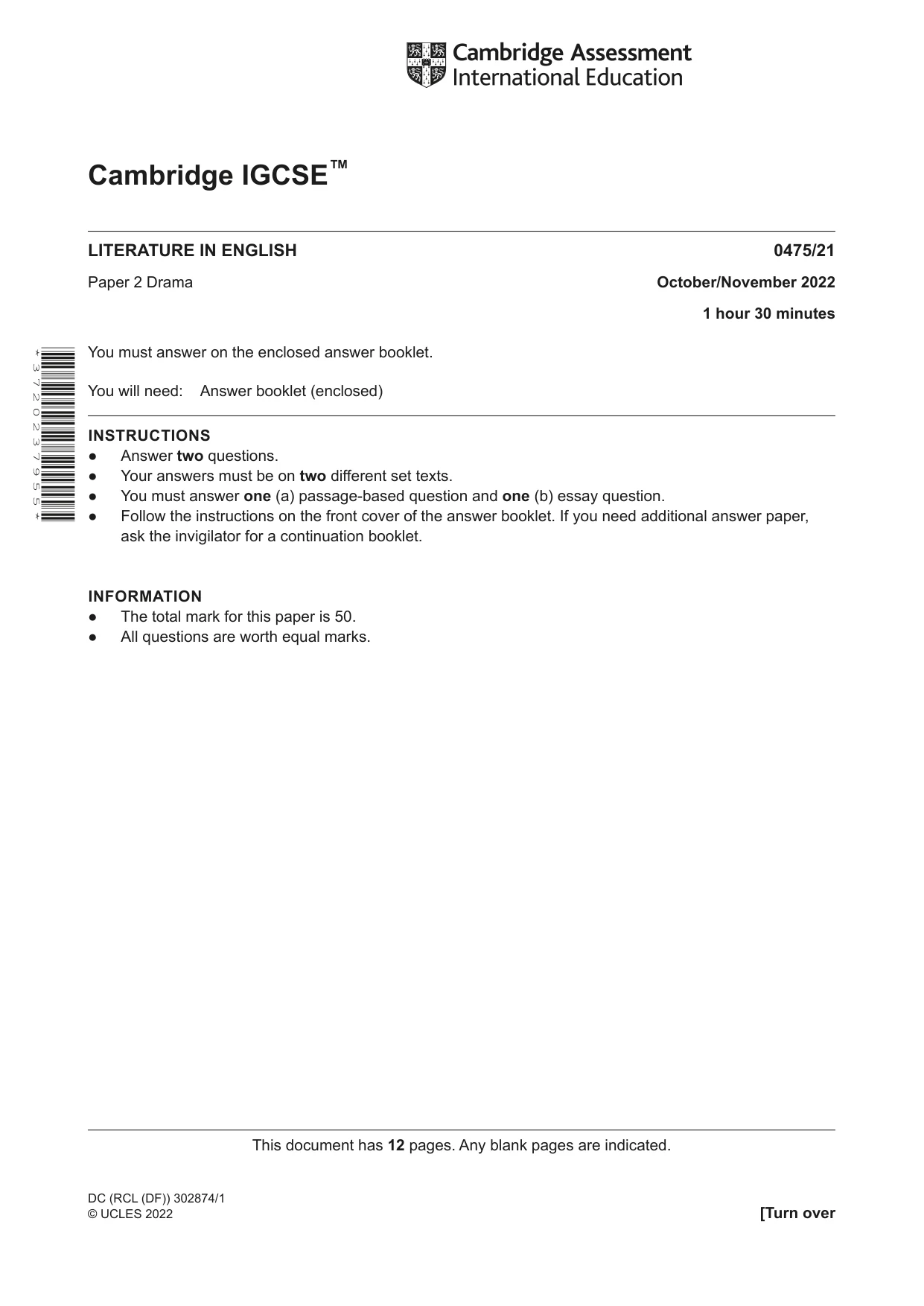
Question paper, page 1
This document has 12 pages. Any blank pages are indicated. Cambridge IGCSE™ * 3 7 2 0 2 3 7 9 5 5 * LITERATURE IN ENGLISH 0475/21 Paper 2 Drama October/November 2022 1 hour 30 minutes You must answer on the enclosed answer booklet. You will need: Answer booklet (enclosed) INSTRUCTIONS ● Answer two questions. ● Your answers must be on two different set texts. ● You must answer one (a) passage-based question and one (b) essay question. ● Follow the instructions on the front cover of the answer booklet. If you need additional answer paper, ask the invigilator for a continuation booklet. INFORMATION ● The total mark for this paper is 50. ● All questions are worth equal marks. DC (RCL (DF)) 302874/1 © UCLES 2022 [Turn over
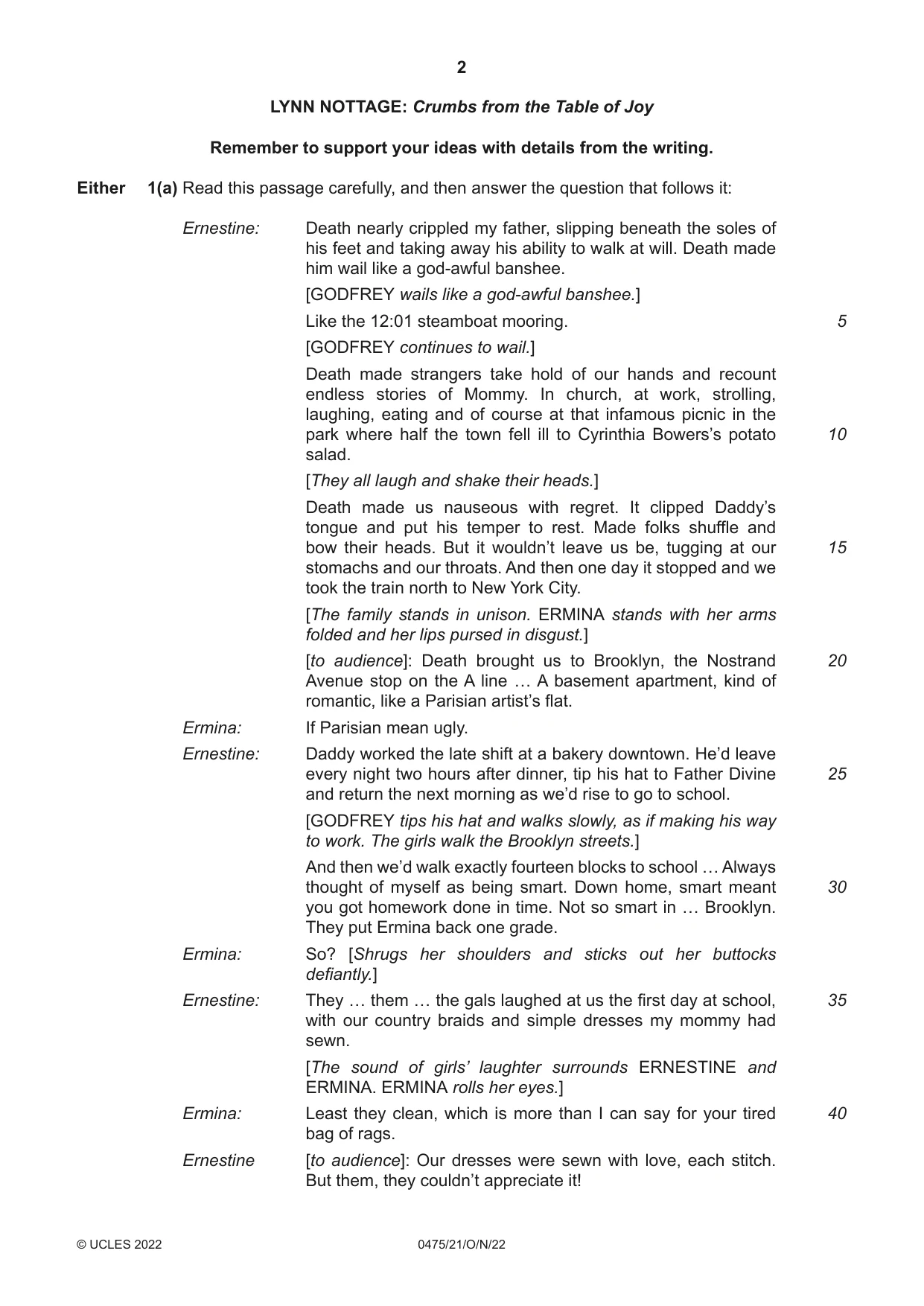
Question paper, page 2
2 0475/21/O/N/22 © UCLES 2022 LYNN NOTTAGE: Crumbs from the Table of Joy Remember to support your ideas with details from the writing. Either 1(a) Read this passage carefully, and then answer the question that follows it: Ernestine: Death nearly crippled my father, slipping beneath the soles of his feet and taking away his ability to walk at will. Death made him wail like a god-awful banshee. [GODFREY wails like a god-awful banshee.] Like the 12:01 steamboat mooring. [GODFREY continues to wail.] Death made strangers take hold of our hands and recount endless stories of Mommy. In church, at work, strolling, laughing, eating and of course at that infamous picnic in the park where half the town fell ill to Cyrinthia Bowers’s potato salad. [They all laugh and shake their heads.] Death made us nauseous with regret. It clipped Daddy’s tongue and put his temper to rest. Made folks shuffle and bow their heads. But it wouldn’t leave us be, tugging at our stomachs and our throats. And then one day it stopped and we took the train north to New York City. [The family stands in unison. ERMINA stands with her arms folded and her lips pursed in disgust.] [to audience]: Death brought us to Brooklyn, the Nostrand Avenue stop on the A line … A basement apartment, kind of romantic, like a Parisian artist’s flat. Ermina: If Parisian mean ugly. Ernestine: Daddy worked the late shift at a bakery downtown. He’d leave every night two hours after dinner, tip his hat to Father Divine and return the next morning as we’d rise to go to school. [GODFREY tips his hat and walks slowly, as if making his way to work. The girls walk the Brooklyn streets.] And then we’d walk exactly fourteen blocks to school … Always thought of myself as being smart. Down home, smart meant you got homework done in time. Not so smart in … Brooklyn. They put Ermina back one grade. Ermina: So? [Shrugs her shoulders and sticks out her buttocks defiantly.] Ernestine: They … them … the gals laughed at us the first day at school, with our country braids and simple dresses my mommy had sewn. [The sound of girls’ laughter surrounds ERNESTINE and ERMINA. ERMINA rolls her eyes.] Ermina: Least they clean, which is more than I can say for your tired bag of rags. Ernestine [to audience]: Our dresses were sewn with love, each stitch. But them, they couldn’t appreciate it! 5 10 15 20 25 30 35 40
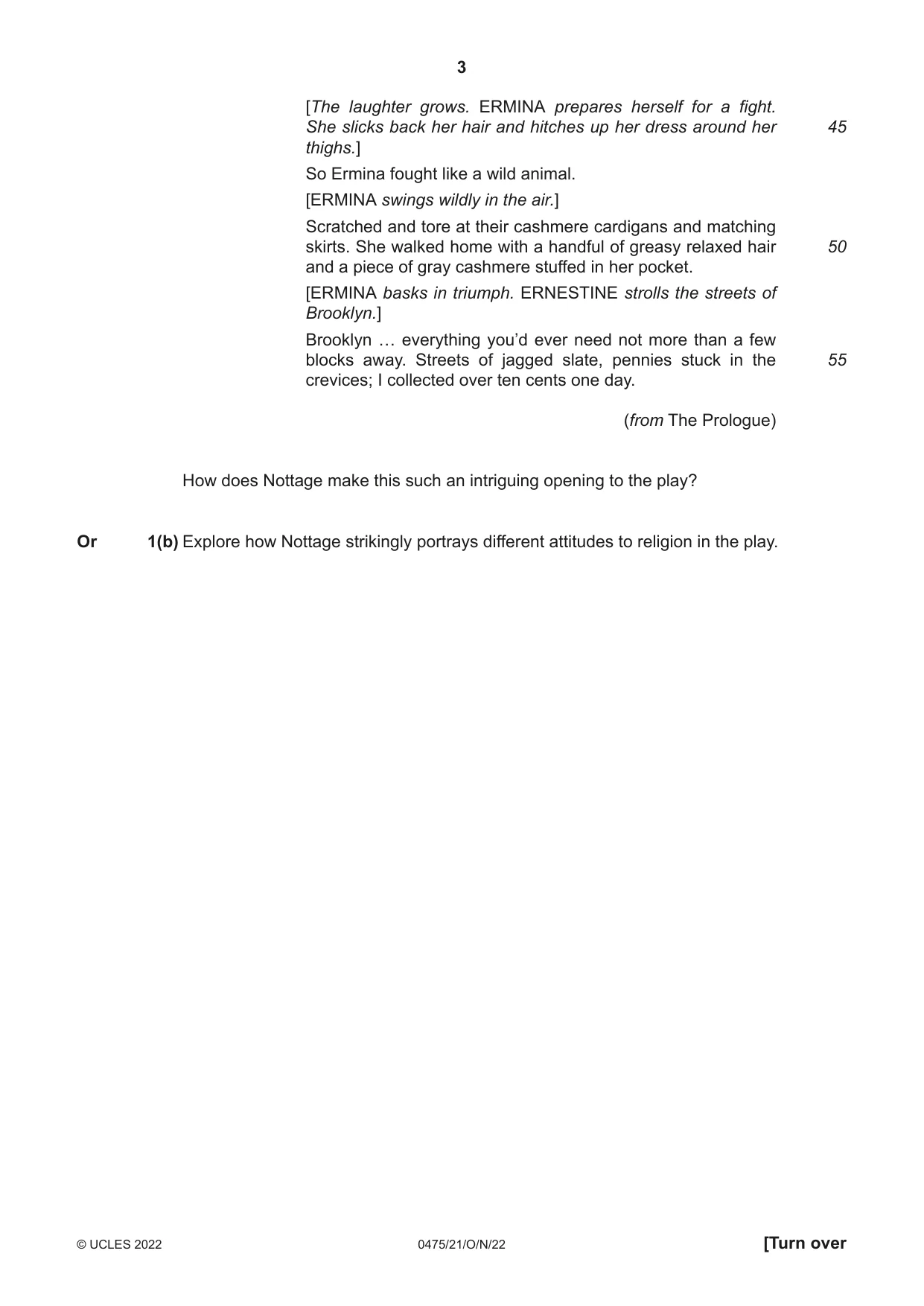
Question paper, page 3
3 0475/21/O/N/22 © UCLES 2022 [Turn over [The laughter grows. ERMINA prepares herself for a fight. She slicks back her hair and hitches up her dress around her thighs.] So Ermina fought like a wild animal. [ERMINA swings wildly in the air.] Scratched and tore at their cashmere cardigans and matching skirts. She walked home with a handful of greasy relaxed hair and a piece of gray cashmere stuffed in her pocket. [ERMINA basks in triumph. ERNESTINE strolls the streets of Brooklyn.] Brooklyn … everything you’d ever need not more than a few blocks away. Streets of jagged slate, pennies stuck in the crevices; I collected over ten cents one day. (from The Prologue) How does Nottage make this such an intriguing opening to the play? Or 1(b) Explore how Nottage strikingly portrays different attitudes to religion in the play. 45 50 55
Question paper, page 4
4 0475/21/O/N/22 © UCLES 2022 ARTHUR MILLER: The Crucible Remember to support your ideas with details from the writing. Either 2(a) Read this passage carefully, and then answer the question that follows it: Elizabeth: Let you go to Ezekiel Cheever – he knows you well. Content removed due to copyright restrictions.
Question paper, page 5
5 0475/21/O/N/22 © UCLES 2022 [Turn over Proctor [laughing bitterly]: Oh, Elizabeth, your justice would freeze beer! (from Act 2) Explore how Miller powerfully creates tension at this moment in the play. Or 2(b) How does Miller’s portrayal of Ann and Thomas Putnam contribute to the dramatic impact of the play? Content removed due to copyright restrictions.
Question paper, page 6
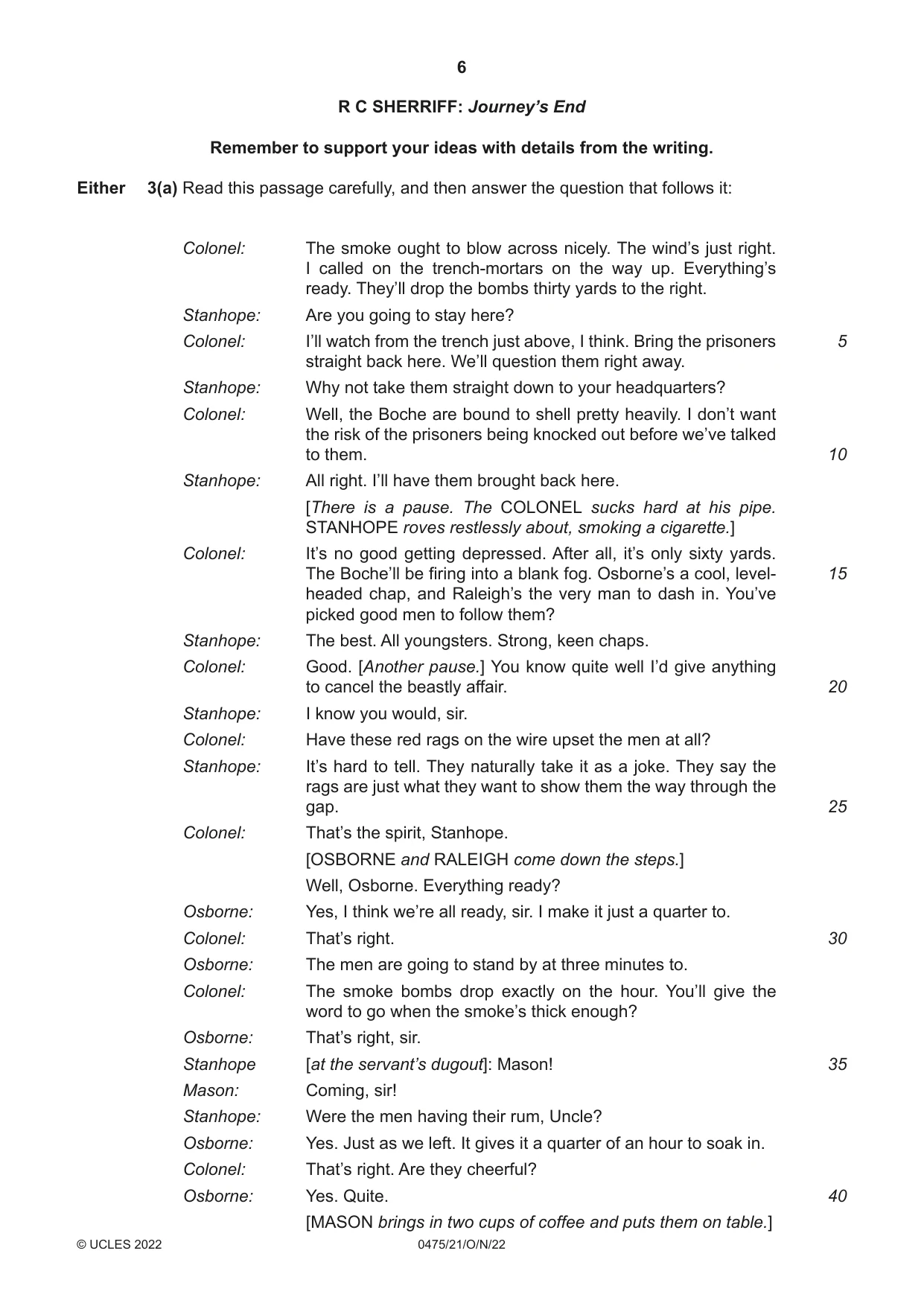
6 0475/21/O/N/22 © UCLES 2022 R C SHERRIFF: Journey’s End Remember to support your ideas with details from the writing. Either 3(a) Read this passage carefully, and then answer the question that follows it: Colonel: The smoke ought to blow across nicely. The wind’s just right. I called on the trench-mortars on the way up. Everything’s ready. They’ll drop the bombs thirty yards to the right. Stanhope: Are you going to stay here? Colonel: I’ll watch from the trench just above, I think. Bring the prisoners straight back here. We’ll question them right away. Stanhope: Why not take them straight down to your headquarters? Colonel: Well, the Boche are bound to shell pretty heavily. I don’t want the risk of the prisoners being knocked out before we’ve talked to them. Stanhope: All right. I’ll have them brought back here. [There is a pause. The COLONEL sucks hard at his pipe. STANHOPE roves restlessly about, smoking a cigarette.] Colonel: It’s no good getting depressed. After all, it’s only sixty yards. The Boche’ll be firing into a blank fog. Osborne’s a cool, level- headed chap, and Raleigh’s the very man to dash in. You’ve picked good men to follow them? Stanhope: The best. All youngsters. Strong, keen chaps. Colonel: Good. [Another pause.] You know quite well I’d give anything to cancel the beastly affair. Stanhope: I know you would, sir. Colonel: Have these red rags on the wire upset the men at all? Stanhope: It’s hard to tell. They naturally take it as a joke. They say the rags are just what they want to show them the way through the gap. Colonel: That’s the spirit, Stanhope. [OSBORNE and RALEIGH come down the steps.] Well, Osborne. Everything ready? Osborne: Yes, I think we’re all ready, sir. I make it just a quarter to. Colonel: That’s right. Osborne: The men are going to stand by at three minutes to. Colonel: The smoke bombs drop exactly on the hour. You’ll give the word to go when the smoke’s thick enough? Osborne: That’s right, sir. Stanhope [at the servant’s dugout]: Mason! Mason: Coming, sir! Stanhope: Were the men having their rum, Uncle? Osborne: Yes. Just as we left. It gives it a quarter of an hour to soak in. Colonel: That’s right. Are they cheerful? Osborne: Yes. Quite. [MASON brings in two cups of coffee and puts them on table.] 5 10 15 20 25 30 35 40
Question paper, page 7
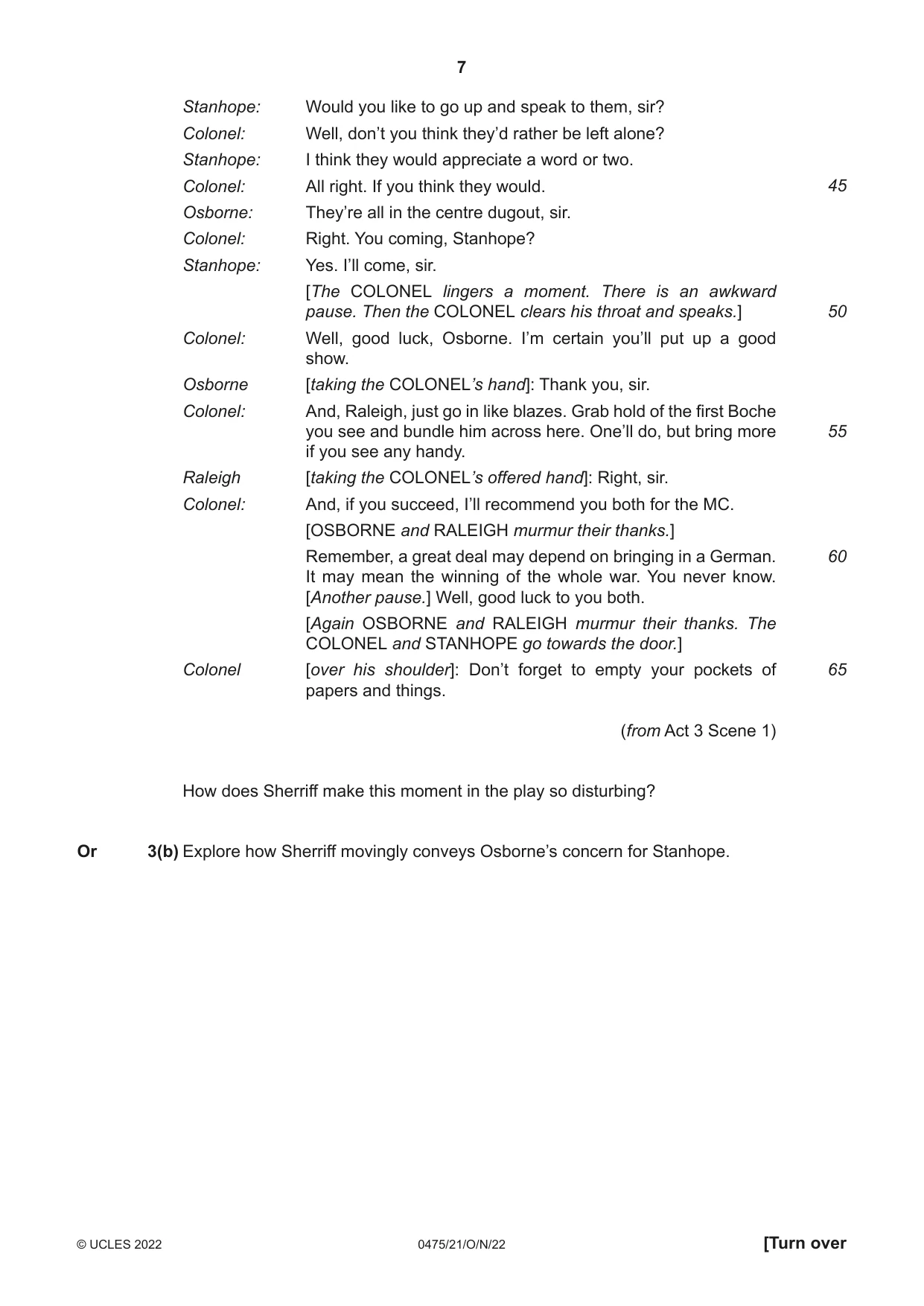
7 0475/21/O/N/22 © UCLES 2022 [Turn over Stanhope: Would you like to go up and speak to them, sir? Colonel: Well, don’t you think they’d rather be left alone? Stanhope: I think they would appreciate a word or two. Colonel: All right. If you think they would. Osborne: They’re all in the centre dugout, sir. Colonel: Right. You coming, Stanhope? Stanhope: Yes. I’ll come, sir. [The COLONEL lingers a moment. There is an awkward pause. Then the COLONEL clears his throat and speaks.] Colonel: Well, good luck, Osborne. I’m certain you’ll put up a good show. Osborne [taking the COLONEL’s hand]: Thank you, sir. Colonel: And, Raleigh, just go in like blazes. Grab hold of the first Boche you see and bundle him across here. One’ll do, but bring more if you see any handy. Raleigh [taking the COLONEL’s offered hand]: Right, sir. Colonel: And, if you succeed, I’ll recommend you both for the MC. [OSBORNE and RALEIGH murmur their thanks.] Remember, a great deal may depend on bringing in a German. It may mean the winning of the whole war. You never know. [Another pause.] Well, good luck to you both. [Again OSBORNE and RALEIGH murmur their thanks. The COLONEL and STANHOPE go towards the door.] Colonel [over his shoulder]: Don’t forget to empty your pockets of papers and things. (from Act 3 Scene 1) How does Sherriff make this moment in the play so disturbing? Or 3(b) Explore how Sherriff movingly conveys Osborne’s concern for Stanhope. 45 50 55 60 65
Question paper, page 8
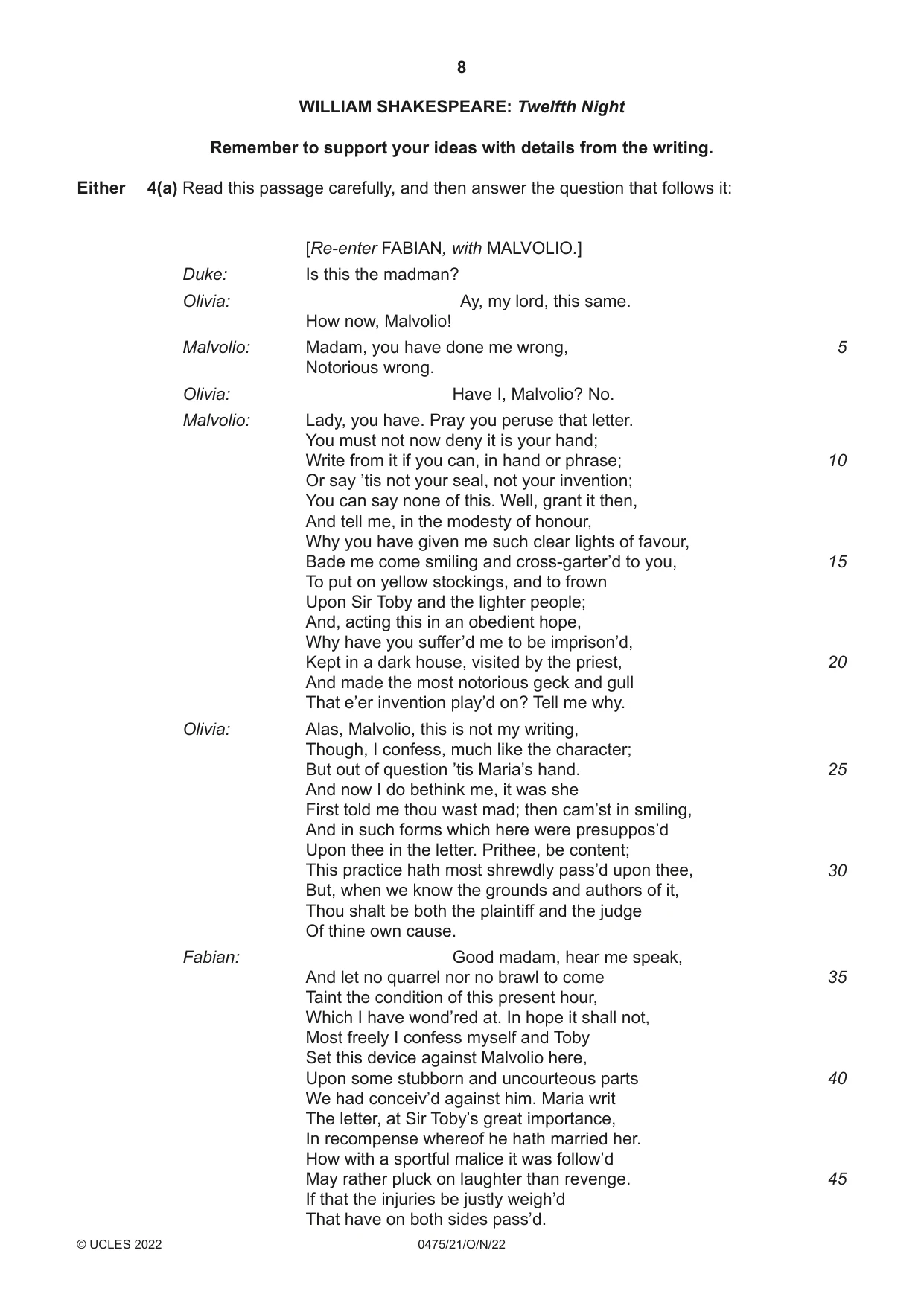
8 0475/21/O/N/22 © UCLES 2022 WILLIAM SHAKESPEARE: Twelfth Night Remember to support your ideas with details from the writing. Either 4(a) Read this passage carefully, and then answer the question that follows it: [Re-enter FABIAN, with MALVOLIO.] Duke: Is this the madman? Olivia: Ay, my lord, this same. How now, Malvolio! Malvolio: Madam, you have done me wrong, Notorious wrong. Olivia: Have I, Malvolio? No. Malvolio: Lady, you have. Pray you peruse that letter. You must not now deny it is your hand; Write from it if you can, in hand or phrase; Or say ’tis not your seal, not your invention; You can say none of this. Well, grant it then, And tell me, in the modesty of honour, Why you have given me such clear lights of favour, Bade me come smiling and cross-garter’d to you, To put on yellow stockings, and to frown Upon Sir Toby and the lighter people; And, acting this in an obedient hope, Why have you suffer’d me to be imprison’d, Kept in a dark house, visited by the priest, And made the most notorious geck and gull That e’er invention play’d on? Tell me why. Olivia: Alas, Malvolio, this is not my writing, Though, I confess, much like the character; But out of question ’tis Maria’s hand. And now I do bethink me, it was she First told me thou wast mad; then cam’st in smiling, And in such forms which here were presuppos’d Upon thee in the letter. Prithee, be content; This practice hath most shrewdly pass’d upon thee, But, when we know the grounds and authors of it, Thou shalt be both the plaintiff and the judge Of thine own cause. Fabian: Good madam, hear me speak, And let no quarrel nor no brawl to come Taint the condition of this present hour, Which I have wond’red at. In hope it shall not, Most freely I confess myself and Toby Set this device against Malvolio here, Upon some stubborn and uncourteous parts We had conceiv’d against him. Maria writ The letter, at Sir Toby’s great importance, In recompense whereof he hath married her. How with a sportful malice it was follow’d May rather pluck on laughter than revenge. If that the injuries be justly weigh’d That have on both sides pass’d. 5 10 15 20 25 30 35 40 45
Question paper, page 9
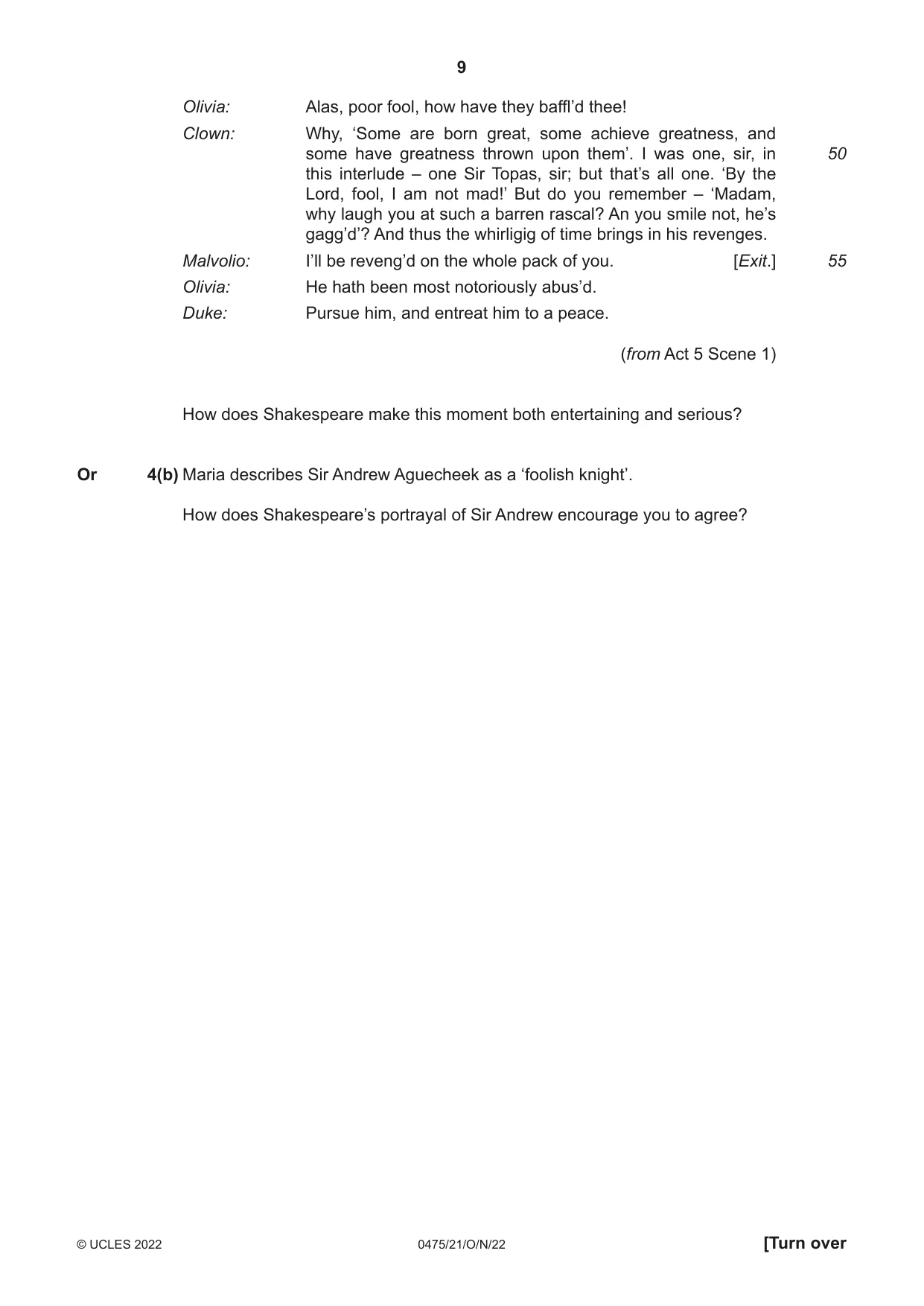
9 0475/21/O/N/22 © UCLES 2022 [Turn over Olivia: Alas, poor fool, how have they baffl’d thee! Clown: Why, ‘Some are born great, some achieve greatness, and some have greatness thrown upon them’. I was one, sir, in this interlude – one Sir Topas, sir; but that’s all one. ‘By the Lord, fool, I am not mad!’ But do you remember – ‘Madam, why laugh you at such a barren rascal? An you smile not, he’s gagg’d’? And thus the whirligig of time brings in his revenges. Malvolio: I’ll be reveng’d on the whole pack of you. [Exit.] Olivia: He hath been most notoriously abus’d. Duke: Pursue him, and entreat him to a peace. (from Act 5 Scene 1) How does Shakespeare make this moment both entertaining and serious? Or 4(b) Maria describes Sir Andrew Aguecheek as a ‘foolish knight’. How does Shakespeare’s portrayal of Sir Andrew encourage you to agree? 50 55
Question paper, page 10
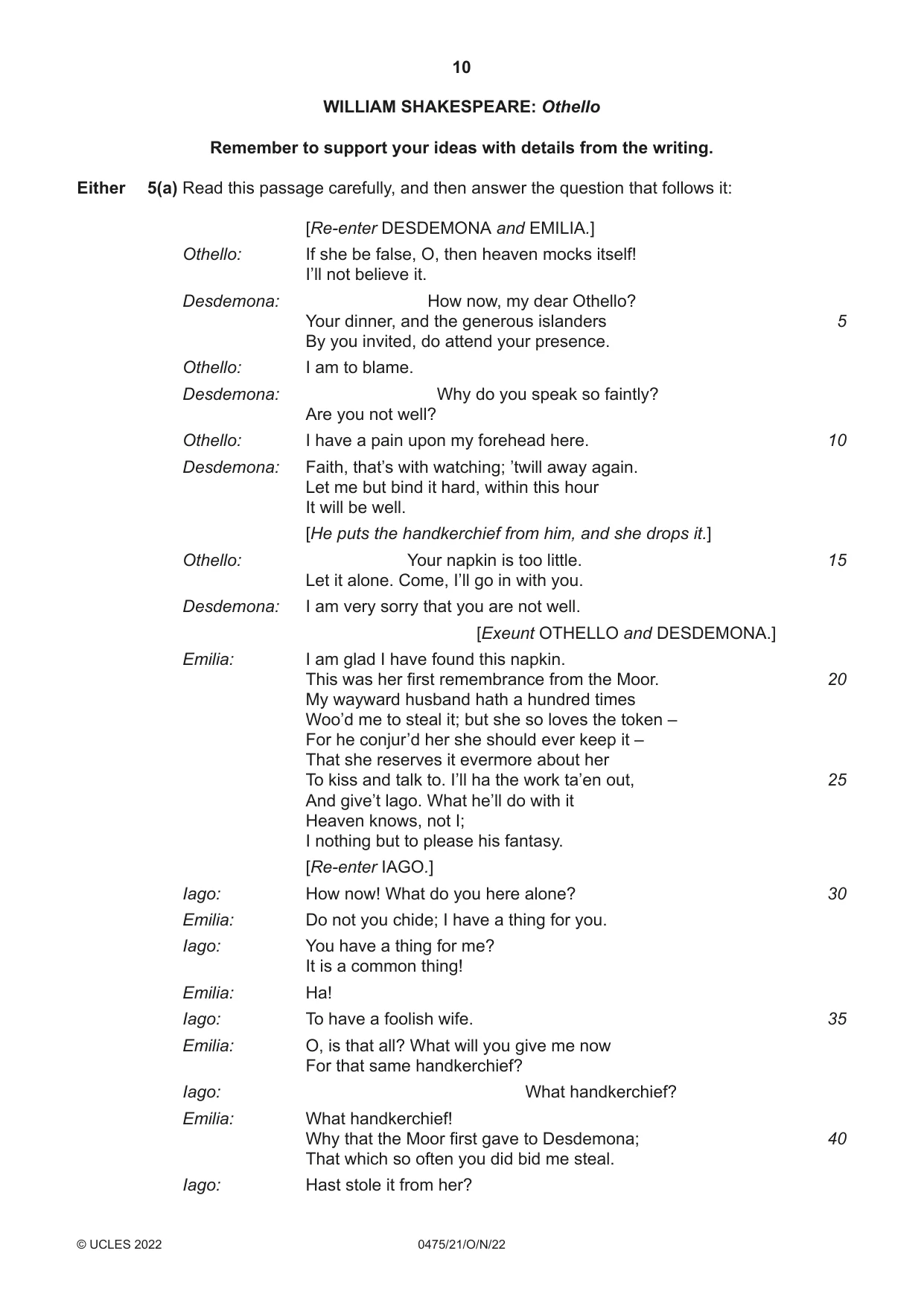
10 0475/21/O/N/22 © UCLES 2022 WILLIAM SHAKESPEARE: Othello Remember to support your ideas with details from the writing. Either 5(a) Read this passage carefully, and then answer the question that follows it: [Re-enter DESDEMONA and EMILIA.] Othello: If she be false, O, then heaven mocks itself! I’ll not believe it. Desdemona: How now, my dear Othello? Your dinner, and the generous islanders By you invited, do attend your presence. Othello: I am to blame. Desdemona: Why do you speak so faintly? Are you not well? Othello: I have a pain upon my forehead here. Desdemona: Faith, that’s with watching; ’twill away again. Let me but bind it hard, within this hour It will be well. [He puts the handkerchief from him, and she drops it.] Othello: Your napkin is too little. Let it alone. Come, I’ll go in with you. Desdemona: I am very sorry that you are not well. [Exeunt OTHELLO and DESDEMONA.] Emilia: I am glad I have found this napkin. This was her first remembrance from the Moor. My wayward husband hath a hundred times Woo’d me to steal it; but she so loves the token – For he conjur’d her she should ever keep it – That she reserves it evermore about her To kiss and talk to. I’ll ha the work ta’en out, And give’t lago. What he’ll do with it Heaven knows, not I; I nothing but to please his fantasy. [Re-enter IAGO.] Iago: How now! What do you here alone? Emilia: Do not you chide; I have a thing for you. Iago: You have a thing for me? It is a common thing! Emilia: Ha! Iago: To have a foolish wife. Emilia: O, is that all? What will you give me now For that same handkerchief? Iago: What handkerchief? Emilia: What handkerchief! Why that the Moor first gave to Desdemona; That which so often you did bid me steal. Iago: Hast stole it from her? 5 10 15 20 25 30 35 40
Question paper, page 11
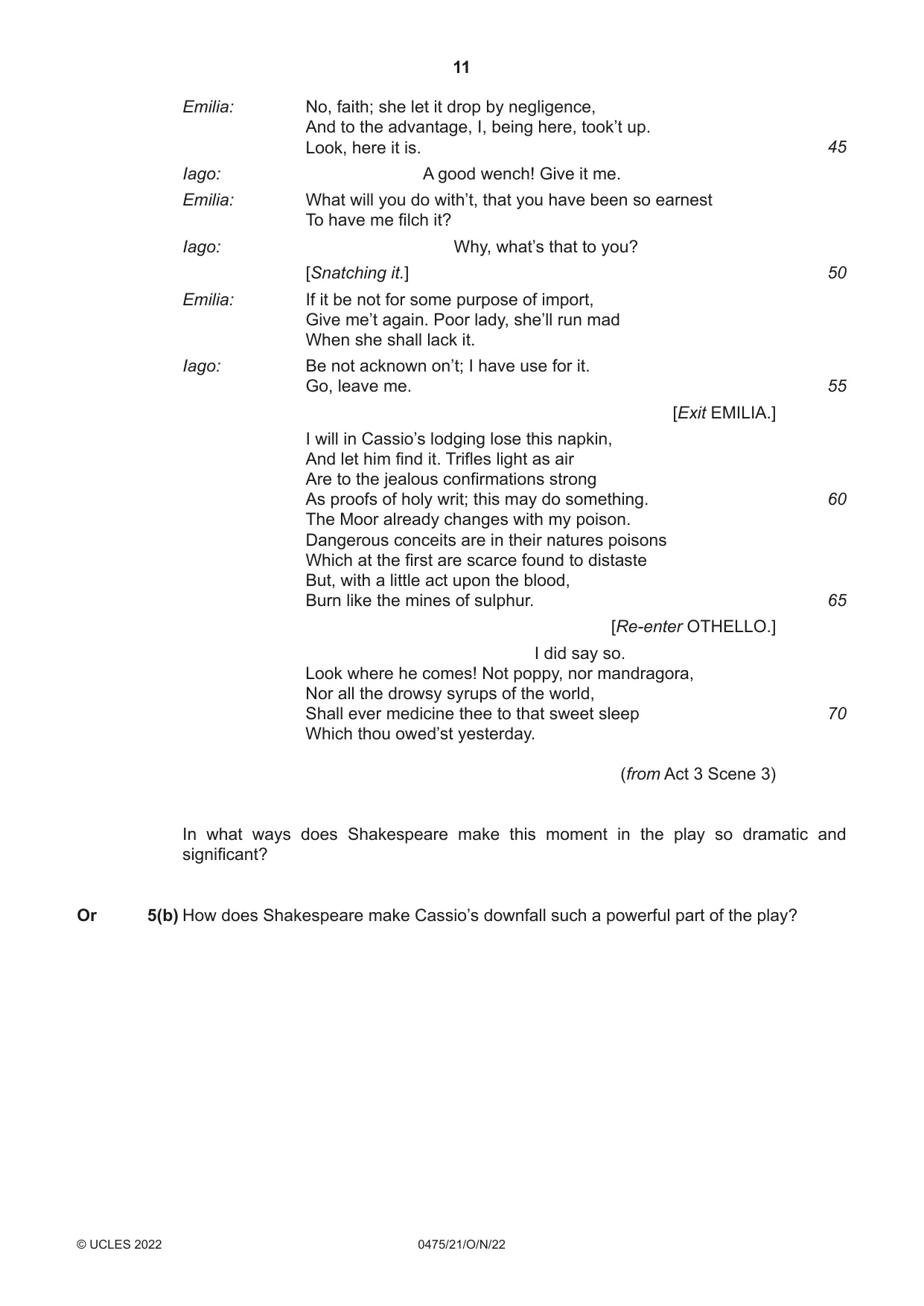
11 0475/21/O/N/22 © UCLES 2022 Emilia: No, faith; she let it drop by negligence, And to the advantage, I, being here, took’t up. Look, here it is. Iago: A good wench! Give it me. Emilia: What will you do with’t, that you have been so earnest To have me filch it? Iago: Why, what’s that to you? [Snatching it.] Emilia: If it be not for some purpose of import, Give me’t again. Poor lady, she’ll run mad When she shall lack it. Iago: Be not acknown on’t; I have use for it. Go, leave me. [Exit EMILIA.] I will in Cassio’s lodging lose this napkin, And let him find it. Trifles light as air Are to the jealous confirmations strong As proofs of holy writ; this may do something. The Moor already changes with my poison. Dangerous conceits are in their natures poisons Which at the first are scarce found to distaste But, with a little act upon the blood, Burn like the mines of sulphur. [Re-enter OTHELLO.] I did say so. Look where he comes! Not poppy, nor mandragora, Nor all the drowsy syrups of the world, Shall ever medicine thee to that sweet sleep Which thou owed’st yesterday. (from Act 3 Scene 3) In what ways does Shakespeare make this moment in the play so dramatic and significant? Or 5(b) How does Shakespeare make Cassio’s downfall such a powerful part of the play? 45 50 55 60 65 70
Question paper, page 12
12 0475/21/O/N/22 © UCLES 2022 Permission to reproduce items where third-party owned material protected by copyright is included has been sought and cleared where possible. Every reasonable effort has been made by the publisher (UCLES) to trace copyright holders, but if any items requiring clearance have unwittingly been included, the publisher will be pleased to make amends at the earliest possible opportunity. To avoid the issue of disclosure of answer-related information to candidates, all copyright acknowledgements are reproduced online in the Cambridge Assessment International Education Copyright Acknowledgements Booklet. This is produced for each series of examinations and is freely available to download at www.cambridgeinternational.org after the live examination series. Cambridge Assessment International Education is part of Cambridge Assessment. Cambridge Assessment is the brand name of the University of Cambridge Local Examinations Syndicate (UCLES), which is a department of the University of Cambridge. BLANK PAGE
Mark scheme, page 1
This document consists of 5 printed pages. © UCLES 2022 [Turn over Cambridge IGCSE™ LITERATURE IN ENGLISH 0475/21 Paper 2 Drama October/November 2022 MARK SCHEME Maximum Mark: 50 Published This mark scheme is published as an aid to teachers and candidates, to indicate the requirements of the examination. It shows the basis on which Examiners were instructed to award marks. It does not indicate the details of the discussions that took place at an Examiners’ meeting before marking began, which would have considered the acceptability of alternative answers. Mark schemes should be read in conjunction with the question paper and the Principal Examiner Report for Teachers. Cambridge International will not enter into discussions about these mark schemes. Cambridge International is publishing the mark schemes for the October/November 2022 series for most Cambridge IGCSE™, Cambridge International A and AS Level components and some Cambridge O Level components.
Mark scheme, page 2
0475/21 Cambridge IGCSE – Mark Scheme PUBLISHED October/November 2022 © UCLES 2022 Page 2 of 5 Generic Marking Principles These general marking principles must be applied by all examiners when marking candidate answers. They should be applied alongside the specific content of the mark scheme or generic level descriptors for a question. Each question paper and mark scheme will also comply with these marking principles. GENERIC MARKING PRINCIPLE 1: Marks must be awarded in line with: • the specific content of the mark scheme or the generic level descriptors for the question • the specific skills defined in the mark scheme or in the generic level descriptors for the question • the standard of response required by a candidate as exemplified by the standardisation scripts. GENERIC MARKING PRINCIPLE 2: Marks awarded are always whole marks (not half marks, or other fractions). GENERIC MARKING PRINCIPLE 3: Marks must be awarded positively: • marks are awarded for correct/valid answers, as defined in the mark scheme. However, credit is given for valid answers which go beyond the scope of the syllabus and mark scheme, referring to your Team Leader as appropriate • marks are awarded when candidates clearly demonstrate what they know and can do • marks are not deducted for errors • marks are not deducted for omissions • answers should only be judged on the quality of spelling, punctuation and grammar when these features are specifically assessed by the question as indicated by the mark scheme. The meaning, however, should be unambiguous. GENERIC MARKING PRINCIPLE 4: Rules must be applied consistently, e.g. in situations where candidates have not followed instructions or in the application of generic level descriptors. GENERIC MARKING PRINCIPLE 5: Marks should be awarded using the full range of marks defined in the mark scheme for the question (however; the use of the full mark range may be limited according to the quality of the candidate responses seen). GENERIC MARKING PRINCIPLE 6: Marks awarded are based solely on the requirements as defined in the mark scheme. Marks should not be awarded with grade thresholds or grade descriptors in mind.
Mark scheme, page 3
0475/21 Cambridge IGCSE – Mark Scheme PUBLISHED October/November 2022 © UCLES 2022 Page 3 of 5 English & Media subject specific general marking principles (To be read in conjunction with the Generic Marking Principles (and requiring further guidance on how to place marks within levels)) Components using level descriptors: • We use level descriptors as a guide to broad understanding of the qualities normally expected of, or typical of, work in a level. • Level descriptors are a means of general guidance, and should not be interpreted as hurdle statements. • Where indicative content notes are supplied for a question, these are not a prescription of required content, and must not be treated as such. Alternative correct points and unexpected answers in candidates’ scripts must be given marks that fairly reflect the knowledge and skills demonstrated. • While we may have legitimate expectations as to the ground most answers may occupy, we must at all times be prepared to meet candidates on their chosen ground, provided it is relevant ground (e.g. clearly related to and derived from a relevant passage/text and meeting the mark scheme requirements for the question). Components using point-based marking: Point marking is often used to reward knowledge, understanding and application of skills. We give credit where the candidate’s answer shows relevant knowledge, understanding and application of skills in answering the question. We do not give credit where the answer shows confusion. From this it follows that we: a DO credit answers which are worded differently from the mark scheme if they clearly convey the same meaning (unless the mark scheme requires a specific term). b DO credit alternative answers/examples which are not written in the mark scheme if they are correct. c DO credit answers where candidates give more than one correct answer in one prompt/numbered/scaffolded space where extended writing is required rather than list-type answers. For example, questions that require n reasons (e.g. State two reasons…). d DO NOT credit answers simply for using a ‘key term’ unless that is all that is required. (Check for evidence it is understood and not used wrongly.). e DO NOT credit answers which are obviously self-contradicting or trying to cover all possibilities. f DO NOT give further credit for what is effectively repetition of a correct point already credited unless the language itself is being tested. This applies equally to ‘mirror statements’ (i.e. polluted/not polluted). g DO NOT require spellings to be correct, unless this is part of the test. However spellings of syllabus terms must allow for clear and unambiguous separation from other syllabus terms with which they may be confused (e.g. Corrasion/Corrosion).
Mark scheme, page 4
0475/21 Cambridge IGCSE – Mark Scheme PUBLISHED October/November 2022 © UCLES 2022 Page 4 of 5 Introduction For general administrative guidance, see Notes for Examiners Handbook. All questions are marked out of 25. Assessment Objectives The Assessment Objectives are evenly weighted across each question. The assessment objectives for the paper are: • AO1 show detailed knowledge of the content of literary texts, supported by reference to the text • AO2 understand the meanings of literary texts and their context, and explore texts beyond surface meaning to show deeper awareness of ideas and attitudes • AO3 recognise and appreciate ways in which writers use language, structure, and form to create and shape meanings and effects • AO4 communicate a sensitive and informed personal response The Band Descriptors cover marks from 0 to 25, and apply to the marking of each question. They guide examiners to an understanding of the qualities normally expected of, or typical of, work in a band. They are a means of general guidance, and must not be interpreted as hurdle statements. For the purposes of standardisation of marking, they are to be used in conjunction with the Practice and Standardisation scripts discussed during the coordination meeting and with Team Leaders, as well as the question-specific notes. The supplementary notes for each question are related to the assessment objectives above. Because of the nature of the subject, they are for general guidance; they are not designed as prescriptions of required content and must not be treated as such. The syllabus aims at encouraging candidates to make some personal response to their reading. Whilst there are legitimate expectations of the content of most answers, examiners may see responses that include ideas not covered in the supplementary guidance. For these cases, examiners should credit valid responses fairly and not penalise candidates for including valid points outside the mark scheme.
Mark scheme, page 5
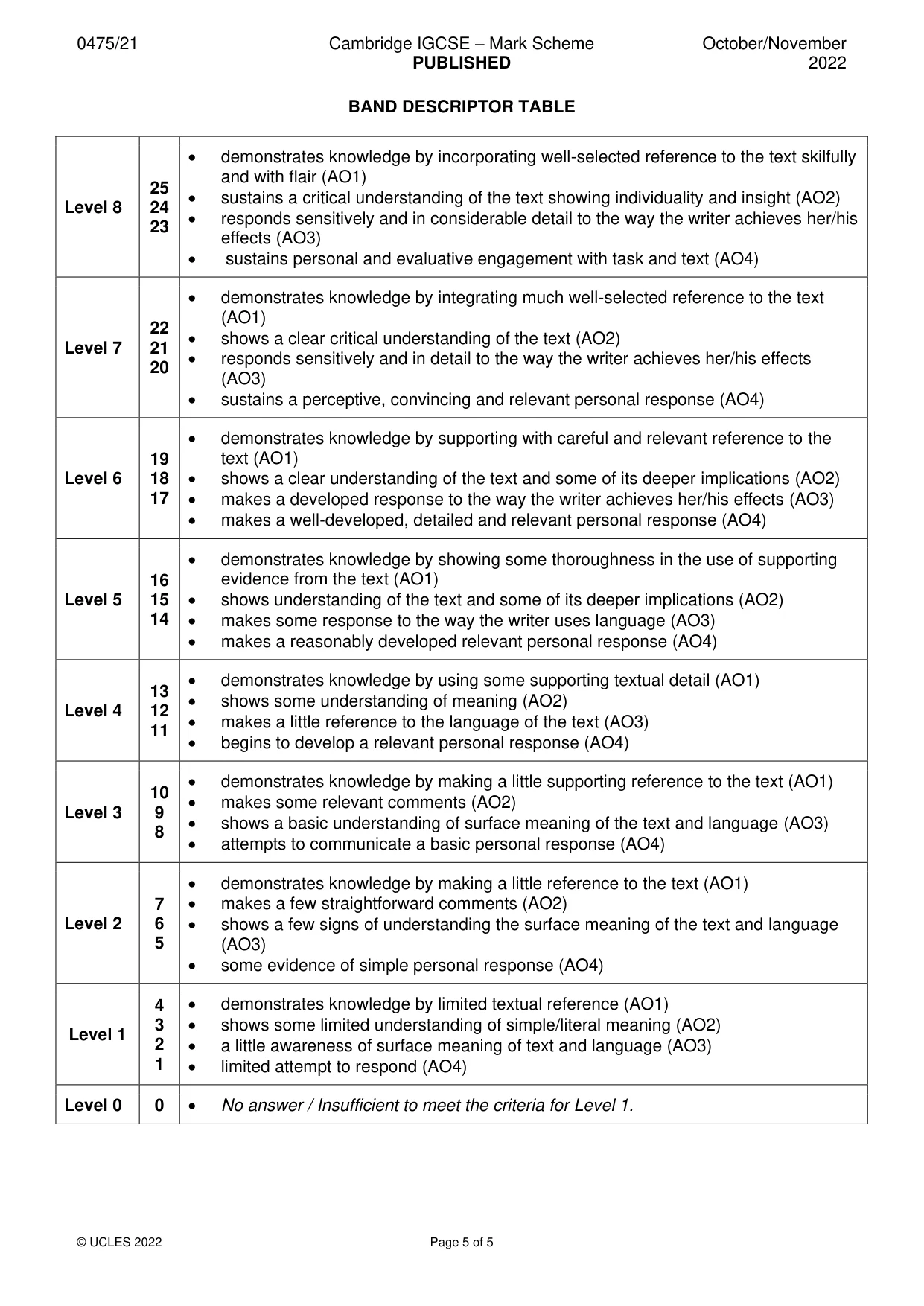
0475/21 Cambridge IGCSE – Mark Scheme PUBLISHED October/November 2022 © UCLES 2022 Page 5 of 5 BAND DESCRIPTOR TABLE Level 8 25 24 23 • demonstrates knowledge by incorporating well-selected reference to the text skilfully and with flair (AO1) • sustains a critical understanding of the text showing individuality and insight (AO2) • responds sensitively and in considerable detail to the way the writer achieves her/his effects (AO3) • sustains personal and evaluative engagement with task and text (AO4) Level 7 22 21 20 • demonstrates knowledge by integrating much well-selected reference to the text (AO1) • shows a clear critical understanding of the text (AO2) • responds sensitively and in detail to the way the writer achieves her/his effects (AO3) • sustains a perceptive, convincing and relevant personal response (AO4) Level 6 19 18 17 • demonstrates knowledge by supporting with careful and relevant reference to the text (AO1) • shows a clear understanding of the text and some of its deeper implications (AO2) • makes a developed response to the way the writer achieves her/his effects (AO3) • makes a well-developed, detailed and relevant personal response (AO4) Level 5 16 15 14 • demonstrates knowledge by showing some thoroughness in the use of supporting evidence from the text (AO1) • shows understanding of the text and some of its deeper implications (AO2) • makes some response to the way the writer uses language (AO3) • makes a reasonably developed relevant personal response (AO4) Level 4 13 12 11 • demonstrates knowledge by using some supporting textual detail (AO1) • shows some understanding of meaning (AO2) • makes a little reference to the language of the text (AO3) • begins to develop a relevant personal response (AO4) Level 3 10 9 8 • demonstrates knowledge by making a little supporting reference to the text (AO1) • makes some relevant comments (AO2) • shows a basic understanding of surface meaning of the text and language (AO3) • attempts to communicate a basic personal response (AO4) Level 2 7 6 5 • demonstrates knowledge by making a little reference to the text (AO1) • makes a few straightforward comments (AO2) • shows a few signs of understanding the surface meaning of the text and language (AO3) • some evidence of simple personal response (AO4) Level 1 4 3 2 1 • demonstrates knowledge by limited textual reference (AO1) • shows some limited understanding of simple/literal meaning (AO2) • a little awareness of surface meaning of text and language (AO3) • limited attempt to respond (AO4) Level 0 0 • No answer / Insufficient to meet the criteria for Level 1.
What you needed in this session
Cambridge’s own grade thresholds for 2022 Oct/Nov, Paper 2 · Variant 1. A higher threshold means an easier paper — the bar moves with how the cohort did.