Cambridge IGCSE English - Literature in English 0475 — 2024 Oct/Nov Paper 4 · Variant 2
0475/42/O/N/24 · 25 marks · ≈28 min
The question paper and its mark scheme, free to read here and free to download. This is Cambridge’s own paper, exactly as it was sat.
Question paper8 pages


Mark scheme5 pages
Answers below. Sit the paper first if you are practising.
Paper as text
Question paper, page 1
Cambridge IGCSE™ 0475/42 LITERATURE IN ENGLISH October/November 2024 Paper 4 Unseen 1 hour 15 minutes You must answer on the enclosed answer booklet. You will need: Answer booklet (enclosed) INSTRUCTIONS • Answer one question: either Question 1 or Question 2. • Follow the instructions on the front cover of the answer booklet. If you need additional answer paper, ask the invigilator for a continuation booklet. INFORMATION • The total mark for this paper is 25. • All questions are worth equal marks. This document has 8 pages. Any blank pages are indicated. [Turn over 11_0475_42_2024_1.16 © UCLES 2024 *4780260705*
Question paper, page 2
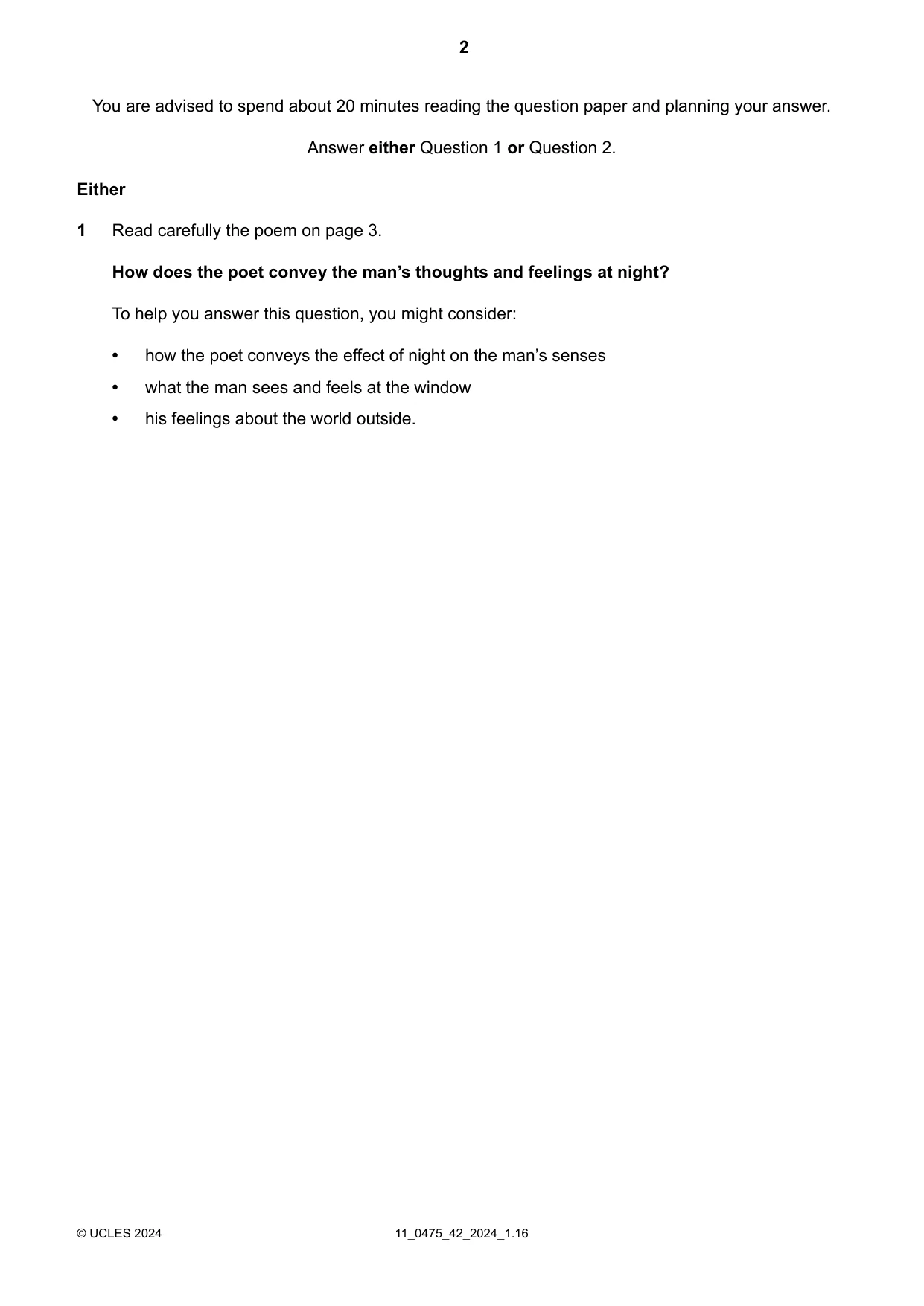
You are advised to spend about 20 minutes reading the question paper and planning your answer. Answer either Question 1 or Question 2. Either Read carefully the poem on page 3. 1 How does the poet convey the man’s thoughts and feelings at night? To help you answer this question, you might consider: • how the poet conveys the effect of night on the man’s senses • what the man sees and feels at the window • his feelings about the world outside. 11_0475_42_2024_1.16 © UCLES 2024 2
Question paper, page 3
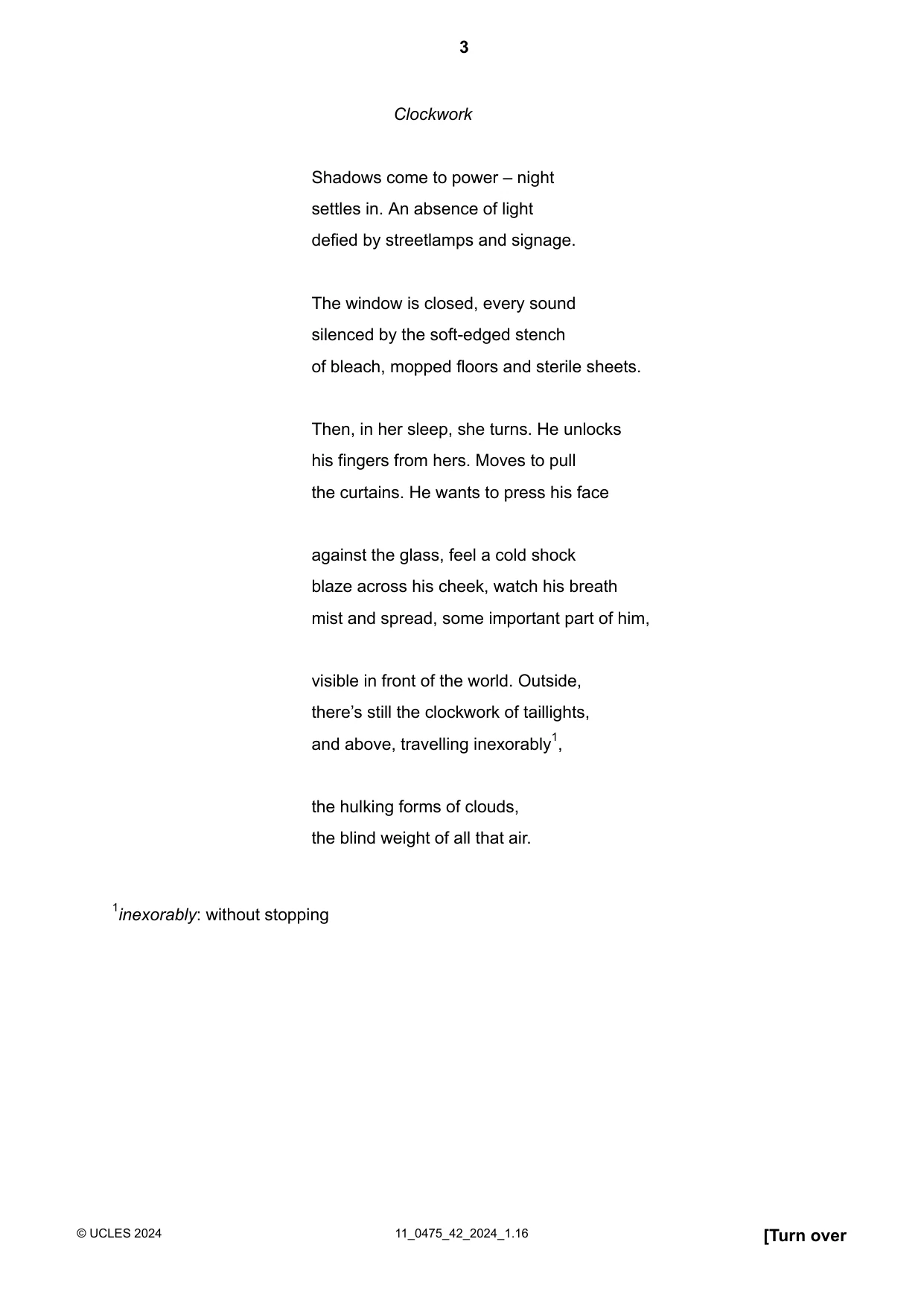
Clockwork Shadows come to power – night settles in. An absence of light defied by streetlamps and signage. The window is closed, every sound silenced by the soft-edged stench of bleach, mopped floors and sterile sheets. Then, in her sleep, she turns. He unlocks his fingers from hers. Moves to pull the curtains. He wants to press his face against the glass, feel a cold shock blaze across his cheek, watch his breath mist and spread, some important part of him, visible in front of the world. Outside, there’s still the clockwork of taillights, and above, travelling inexorably1, the hulking forms of clouds, the blind weight of all that air. 1inexorably: without stopping [Turn over 11_0475_42_2024_1.16 © UCLES 2024 3
Question paper, page 4
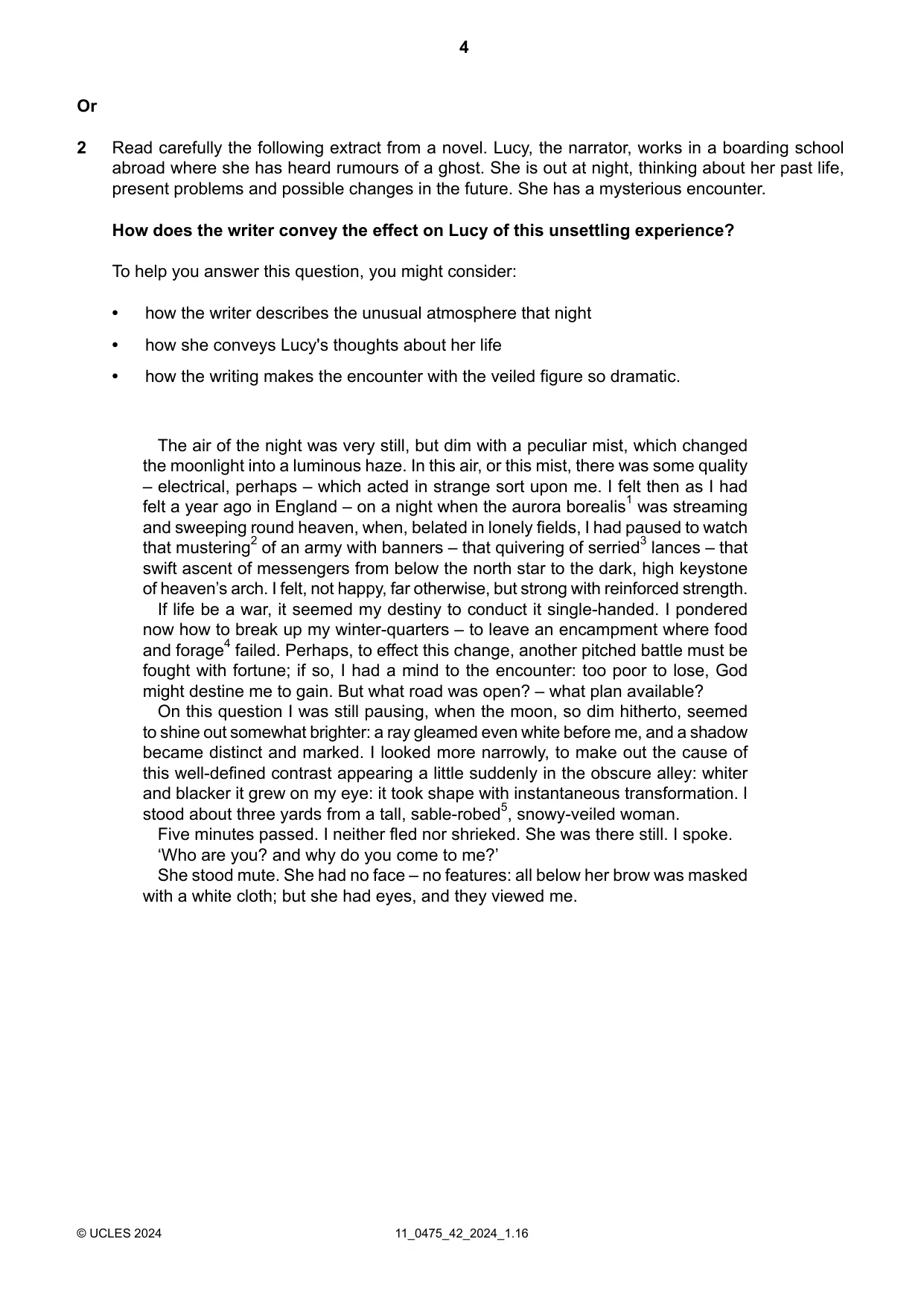
Or Read carefully the following extract from a novel. Lucy, the narrator, works in a boarding school abroad where she has heard rumours of a ghost. She is out at night, thinking about her past life, present problems and possible changes in the future. She has a mysterious encounter. 2 How does the writer convey the effect on Lucy of this unsettling experience? To help you answer this question, you might consider: • how the writer describes the unusual atmosphere that night • how she conveys Lucy's thoughts about her life • how the writing makes the encounter with the veiled figure so dramatic. The air of the night was very still, but dim with a peculiar mist, which changed the moonlight into a luminous haze. In this air, or this mist, there was some quality – electrical, perhaps – which acted in strange sort upon me. I felt then as I had felt a year ago in England – on a night when the aurora borealis1 was streaming and sweeping round heaven, when, belated in lonely fields, I had paused to watch that mustering2 of an army with banners – that quivering of serried3 lances – that swift ascent of messengers from below the north star to the dark, high keystone of heaven’s arch. I felt, not happy, far otherwise, but strong with reinforced strength. If life be a war, it seemed my destiny to conduct it single-handed. I pondered now how to break up my winter-quarters – to leave an encampment where food and forage4 failed. Perhaps, to effect this change, another pitched battle must be fought with fortune; if so, I had a mind to the encounter: too poor to lose, God might destine me to gain. But what road was open? – what plan available? On this question I was still pausing, when the moon, so dim hitherto, seemed to shine out somewhat brighter: a ray gleamed even white before me, and a shadow became distinct and marked. I looked more narrowly, to make out the cause of this well-defined contrast appearing a little suddenly in the obscure alley: whiter and blacker it grew on my eye: it took shape with instantaneous transformation. I stood about three yards from a tall, sable-robed5, snowy-veiled woman. Five minutes passed. I neither fled nor shrieked. She was there still. I spoke. ‘Who are you? and why do you come to me?’ She stood mute. She had no face – no features: all below her brow was masked with a white cloth; but she had eyes, and they viewed me. 11_0475_42_2024_1.16 © UCLES 2024 4
Question paper, page 5
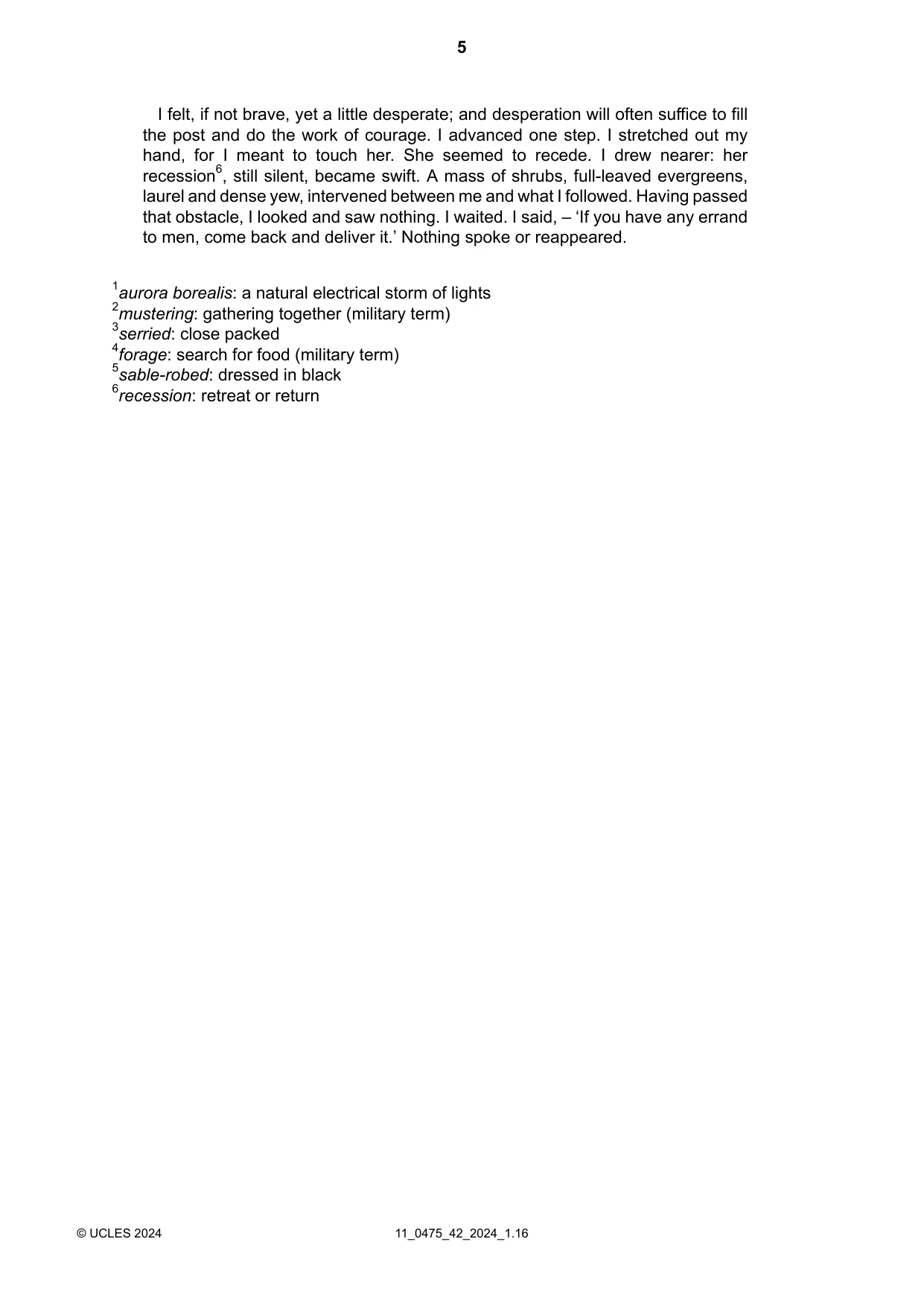
I felt, if not brave, yet a little desperate; and desperation will often suffice to fill the post and do the work of courage. I advanced one step. I stretched out my hand, for I meant to touch her. She seemed to recede. I drew nearer: her recession6, still silent, became swift. A mass of shrubs, full-leaved evergreens, laurel and dense yew, intervened between me and what I followed. Having passed that obstacle, I looked and saw nothing. I waited. I said, – ‘If you have any errand to men, come back and deliver it.’ Nothing spoke or reappeared. 1aurora borealis: a natural electrical storm of lights 2mustering: gathering together (military term) 3serried: close packed 4forage: search for food (military term) 5sable-robed: dressed in black 6recession: retreat or return 11_0475_42_2024_1.16 © UCLES 2024 5
Question paper, page 6
BLANK PAGE 11_0475_42_2024_1.16 © UCLES 2024 6
Question paper, page 7
BLANK PAGE 11_0475_42_2024_1.16 © UCLES 2024 7
Question paper, page 8
BLANK PAGE Permission to reproduce items where third-party owned material protected by copyright is included has been sought and cleared where possible. Every reasonable effort has been made by the publisher (UCLES) to trace copyright holders, but if any items requiring clearance have unwittingly been included, the publisher will be pleased to make amends at the earliest possible opportunity. To avoid the issue of disclosure of answer-related information to candidates, all copyright acknowledgements are reproduced online in the Cambridge Assessment International Education Copyright Acknowledgements Booklet. This is produced for each series of examinations and is freely available to download at www.cambridgeinternational.org after the live examination series. Cambridge Assessment International Education is part of Cambridge Assessment. Cambridge Assessment is the brand name of the University of Cambridge Local Examinations Syndicate (UCLES), which is a department of the University of Cambridge. 11_0475_42_2024_1.16 © UCLES 2024 8
Mark scheme, page 1
This document consists of 5 printed pages. © Cambridge University Press & Assessment 2024 [Turn over Cambridge IGCSE™ LITERATURE IN ENGLISH 0475/42 Paper 4 Unseen October/November 2024 MARK SCHEME Maximum Mark: 25 Published This mark scheme is published as an aid to teachers and candidates, to indicate the requirements of the examination. It shows the basis on which Examiners were instructed to award marks. It does not indicate the details of the discussions that took place at an Examiners’ meeting before marking began, which would have considered the acceptability of alternative answers. Mark schemes should be read in conjunction with the question paper and the Principal Examiner Report for Teachers. Cambridge International will not enter into discussions about these mark schemes. Cambridge International is publishing the mark schemes for the October/November 2024 series for most Cambridge IGCSE, Cambridge International A and AS Level components, and some Cambridge O Level components.
Mark scheme, page 2
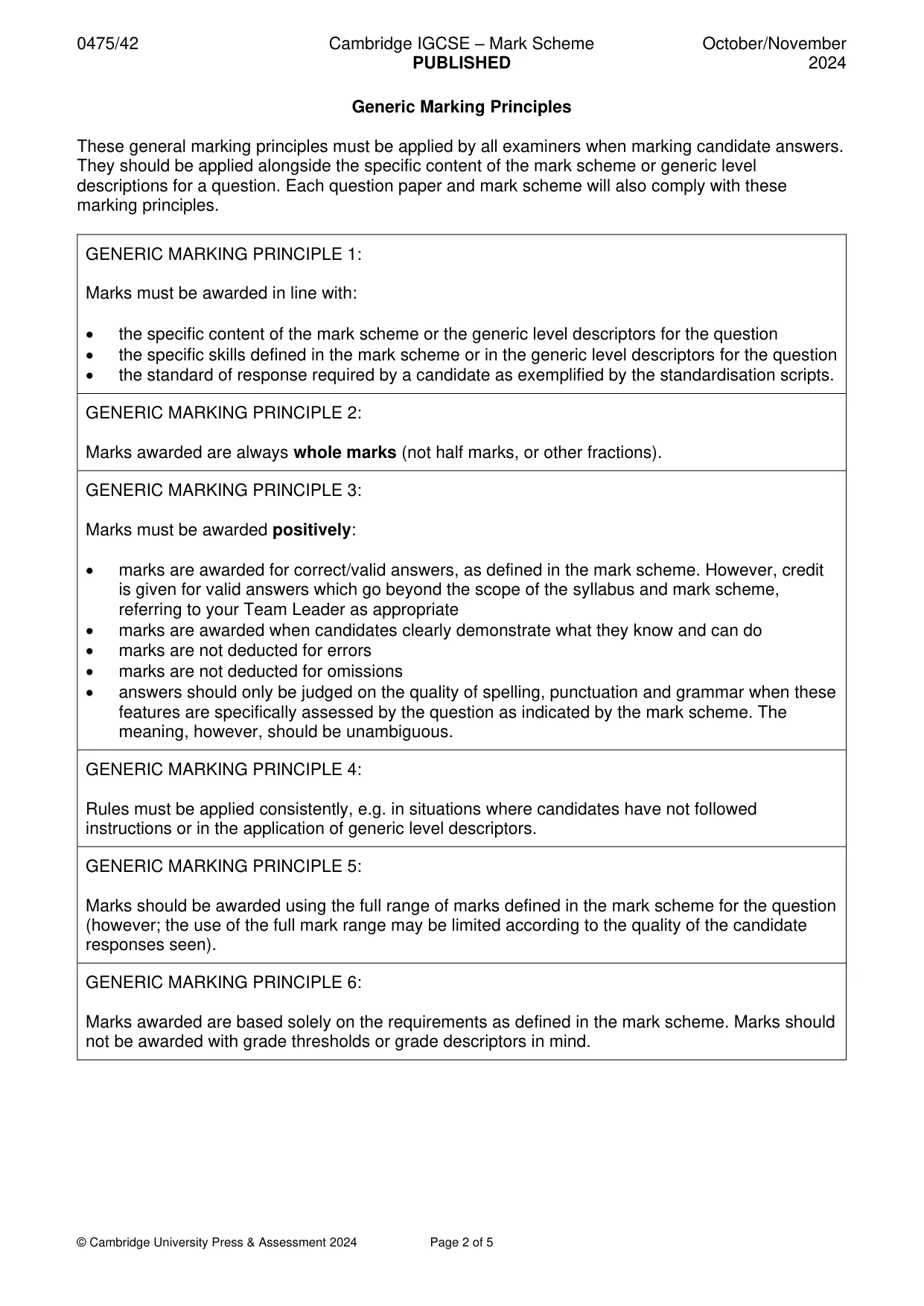
0475/42 Cambridge IGCSE – Mark Scheme PUBLISHED October/November 2024 © Cambridge University Press & Assessment 2024 Page 2 of 5 Generic Marking Principles These general marking principles must be applied by all examiners when marking candidate answers. They should be applied alongside the specific content of the mark scheme or generic level descriptions for a question. Each question paper and mark scheme will also comply with these marking principles. GENERIC MARKING PRINCIPLE 1: Marks must be awarded in line with: • the specific content of the mark scheme or the generic level descriptors for the question • the specific skills defined in the mark scheme or in the generic level descriptors for the question • the standard of response required by a candidate as exemplified by the standardisation scripts. GENERIC MARKING PRINCIPLE 2: Marks awarded are always whole marks (not half marks, or other fractions). GENERIC MARKING PRINCIPLE 3: Marks must be awarded positively: • marks are awarded for correct/valid answers, as defined in the mark scheme. However, credit is given for valid answers which go beyond the scope of the syllabus and mark scheme, referring to your Team Leader as appropriate • marks are awarded when candidates clearly demonstrate what they know and can do • marks are not deducted for errors • marks are not deducted for omissions • answers should only be judged on the quality of spelling, punctuation and grammar when these features are specifically assessed by the question as indicated by the mark scheme. The meaning, however, should be unambiguous. GENERIC MARKING PRINCIPLE 4: Rules must be applied consistently, e.g. in situations where candidates have not followed instructions or in the application of generic level descriptors. GENERIC MARKING PRINCIPLE 5: Marks should be awarded using the full range of marks defined in the mark scheme for the question (however; the use of the full mark range may be limited according to the quality of the candidate responses seen). GENERIC MARKING PRINCIPLE 6: Marks awarded are based solely on the requirements as defined in the mark scheme. Marks should not be awarded with grade thresholds or grade descriptors in mind.
Mark scheme, page 3
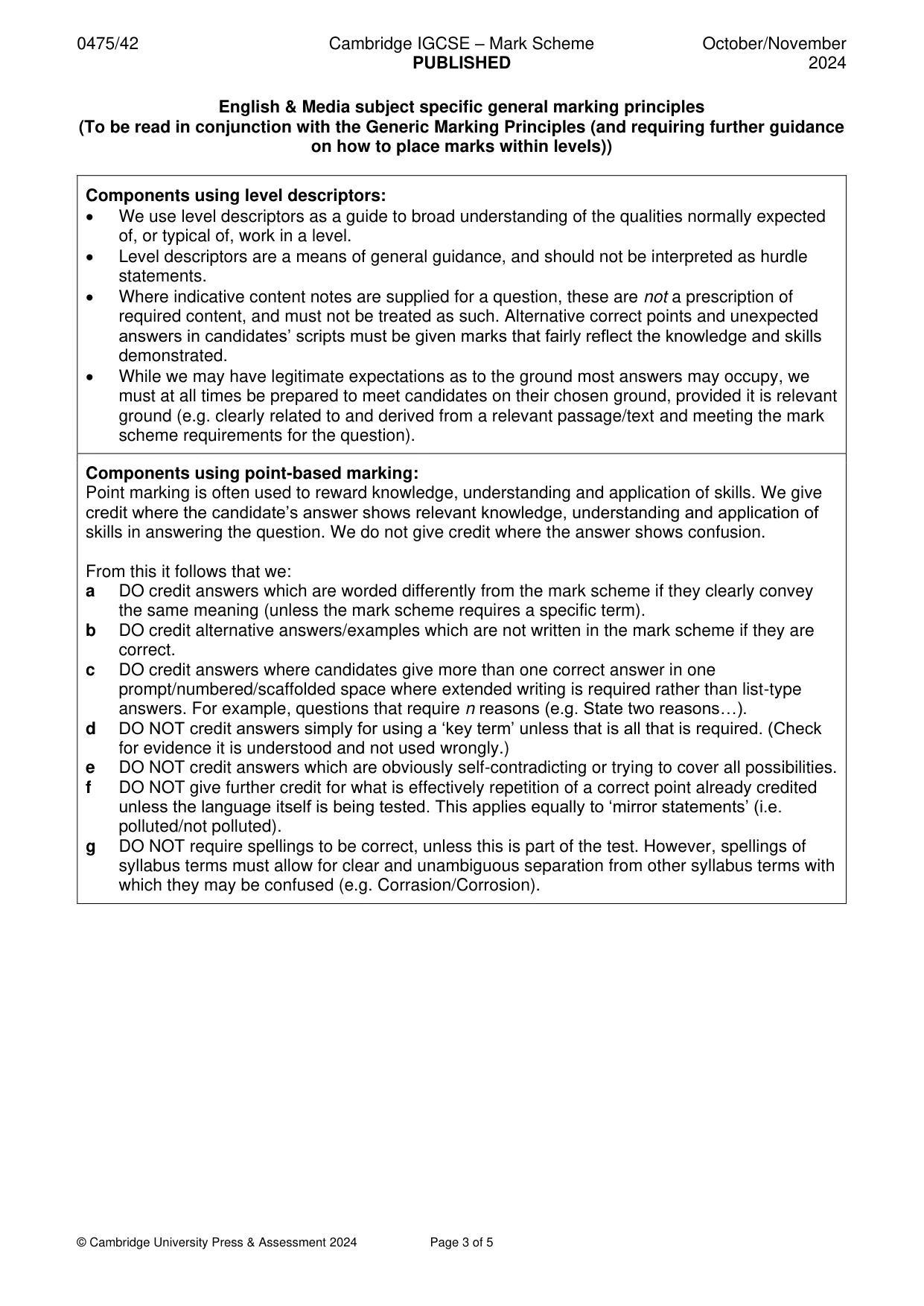
0475/42 Cambridge IGCSE – Mark Scheme PUBLISHED October/November 2024 © Cambridge University Press & Assessment 2024 Page 3 of 5 English & Media subject specific general marking principles (To be read in conjunction with the Generic Marking Principles (and requiring further guidance on how to place marks within levels)) Components using level descriptors: • We use level descriptors as a guide to broad understanding of the qualities normally expected of, or typical of, work in a level. • Level descriptors are a means of general guidance, and should not be interpreted as hurdle statements. • Where indicative content notes are supplied for a question, these are not a prescription of required content, and must not be treated as such. Alternative correct points and unexpected answers in candidates’ scripts must be given marks that fairly reflect the knowledge and skills demonstrated. • While we may have legitimate expectations as to the ground most answers may occupy, we must at all times be prepared to meet candidates on their chosen ground, provided it is relevant ground (e.g. clearly related to and derived from a relevant passage/text and meeting the mark scheme requirements for the question). Components using point-based marking: Point marking is often used to reward knowledge, understanding and application of skills. We give credit where the candidate’s answer shows relevant knowledge, understanding and application of skills in answering the question. We do not give credit where the answer shows confusion. From this it follows that we: a DO credit answers which are worded differently from the mark scheme if they clearly convey the same meaning (unless the mark scheme requires a specific term). b DO credit alternative answers/examples which are not written in the mark scheme if they are correct. c DO credit answers where candidates give more than one correct answer in one prompt/numbered/scaffolded space where extended writing is required rather than list-type answers. For example, questions that require n reasons (e.g. State two reasons…). d DO NOT credit answers simply for using a ‘key term’ unless that is all that is required. (Check for evidence it is understood and not used wrongly.) e DO NOT credit answers which are obviously self-contradicting or trying to cover all possibilities. f DO NOT give further credit for what is effectively repetition of a correct point already credited unless the language itself is being tested. This applies equally to ‘mirror statements’ (i.e. polluted/not polluted). g DO NOT require spellings to be correct, unless this is part of the test. However, spellings of syllabus terms must allow for clear and unambiguous separation from other syllabus terms with which they may be confused (e.g. Corrasion/Corrosion).
Mark scheme, page 4
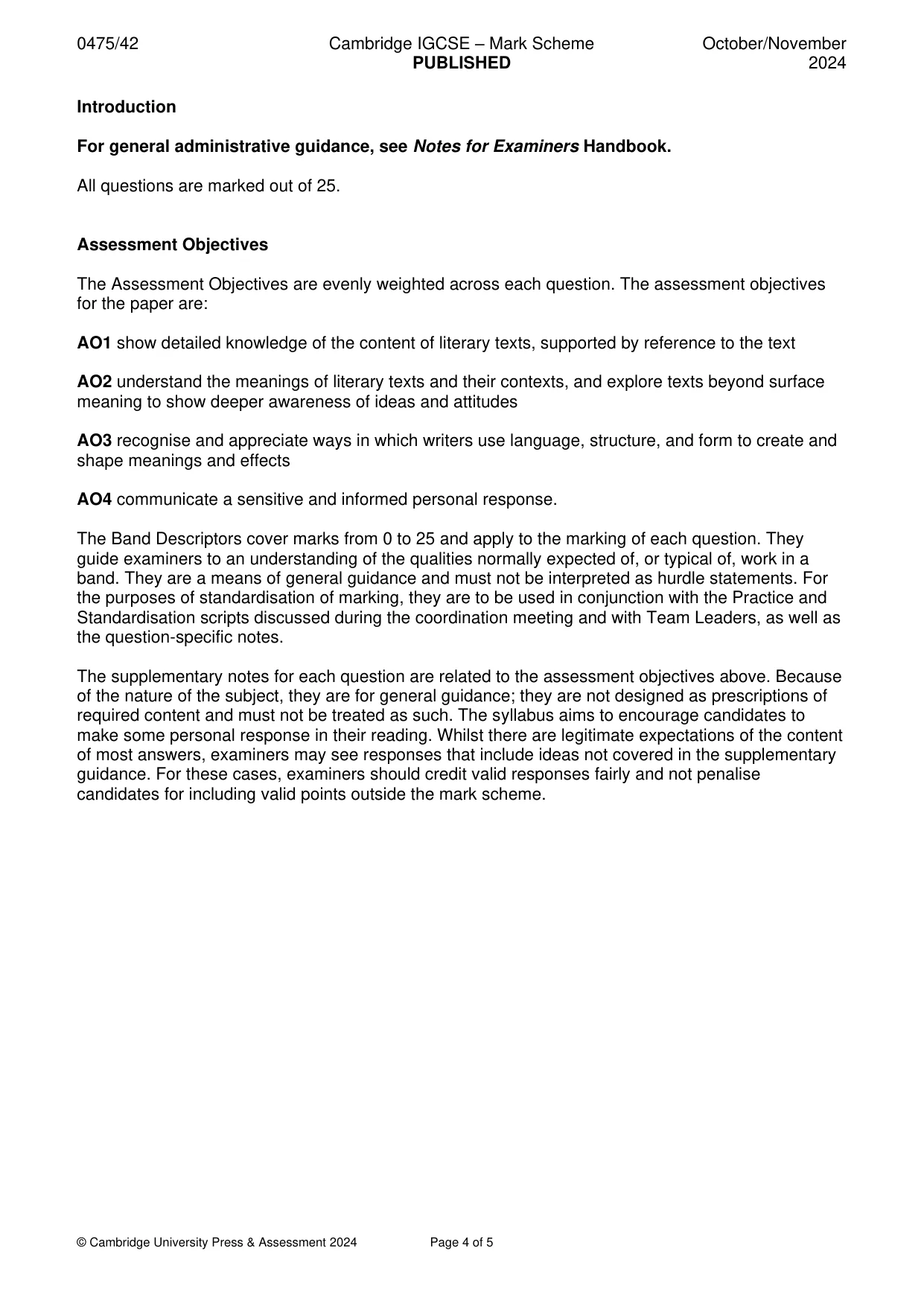
0475/42 Cambridge IGCSE – Mark Scheme PUBLISHED October/November 2024 © Cambridge University Press & Assessment 2024 Page 4 of 5 Introduction For general administrative guidance, see Notes for Examiners Handbook. All questions are marked out of 25. Assessment Objectives The Assessment Objectives are evenly weighted across each question. The assessment objectives for the paper are: AO1 show detailed knowledge of the content of literary texts, supported by reference to the text AO2 understand the meanings of literary texts and their contexts, and explore texts beyond surface meaning to show deeper awareness of ideas and attitudes AO3 recognise and appreciate ways in which writers use language, structure, and form to create and shape meanings and effects AO4 communicate a sensitive and informed personal response. The Band Descriptors cover marks from 0 to 25 and apply to the marking of each question. They guide examiners to an understanding of the qualities normally expected of, or typical of, work in a band. They are a means of general guidance and must not be interpreted as hurdle statements. For the purposes of standardisation of marking, they are to be used in conjunction with the Practice and Standardisation scripts discussed during the coordination meeting and with Team Leaders, as well as the question-specific notes. The supplementary notes for each question are related to the assessment objectives above. Because of the nature of the subject, they are for general guidance; they are not designed as prescriptions of required content and must not be treated as such. The syllabus aims to encourage candidates to make some personal response in their reading. Whilst there are legitimate expectations of the content of most answers, examiners may see responses that include ideas not covered in the supplementary guidance. For these cases, examiners should credit valid responses fairly and not penalise candidates for including valid points outside the mark scheme.
Mark scheme, page 5
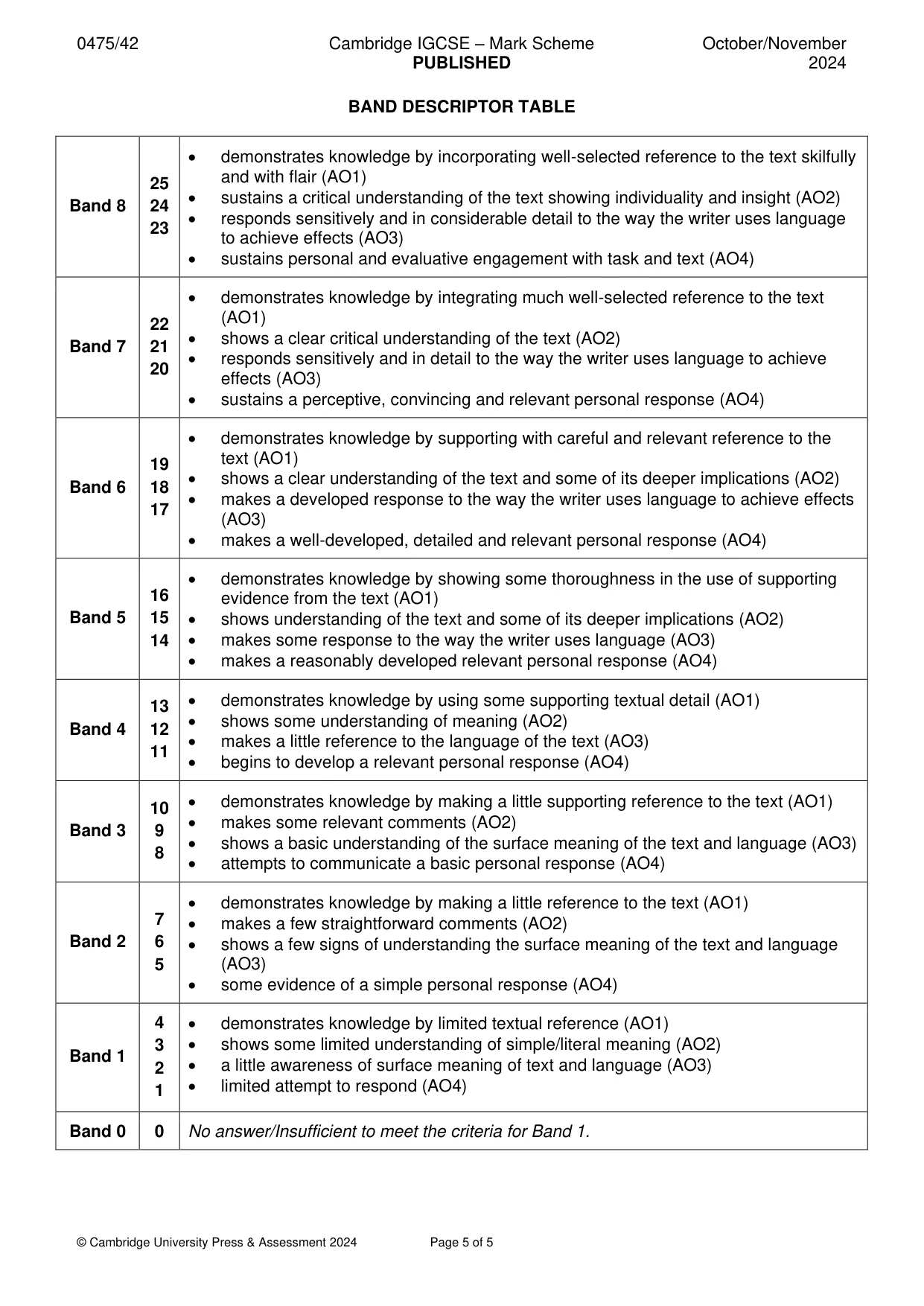
0475/42 Cambridge IGCSE – Mark Scheme PUBLISHED October/November 2024 © Cambridge University Press & Assessment 2024 Page 5 of 5 BAND DESCRIPTOR TABLE Band 8 25 24 23 • demonstrates knowledge by incorporating well-selected reference to the text skilfully and with flair (AO1) • sustains a critical understanding of the text showing individuality and insight (AO2) • responds sensitively and in considerable detail to the way the writer uses language to achieve effects (AO3) • sustains personal and evaluative engagement with task and text (AO4) Band 7 22 21 20 • demonstrates knowledge by integrating much well-selected reference to the text (AO1) • shows a clear critical understanding of the text (AO2) • responds sensitively and in detail to the way the writer uses language to achieve effects (AO3) • sustains a perceptive, convincing and relevant personal response (AO4) Band 6 19 18 17 • demonstrates knowledge by supporting with careful and relevant reference to the text (AO1) • shows a clear understanding of the text and some of its deeper implications (AO2) • makes a developed response to the way the writer uses language to achieve effects (AO3) • makes a well-developed, detailed and relevant personal response (AO4) Band 5 16 15 14 • demonstrates knowledge by showing some thoroughness in the use of supporting evidence from the text (AO1) • shows understanding of the text and some of its deeper implications (AO2) • makes some response to the way the writer uses language (AO3) • makes a reasonably developed relevant personal response (AO4) Band 4 13 12 11 • demonstrates knowledge by using some supporting textual detail (AO1) • shows some understanding of meaning (AO2) • makes a little reference to the language of the text (AO3) • begins to develop a relevant personal response (AO4) Band 3 10 9 8 • demonstrates knowledge by making a little supporting reference to the text (AO1) • makes some relevant comments (AO2) • shows a basic understanding of the surface meaning of the text and language (AO3) • attempts to communicate a basic personal response (AO4) Band 2 7 6 5 • demonstrates knowledge by making a little reference to the text (AO1) • makes a few straightforward comments (AO2) • shows a few signs of understanding the surface meaning of the text and language (AO3) • some evidence of a simple personal response (AO4) Band 1 4 3 2 1 • demonstrates knowledge by limited textual reference (AO1) • shows some limited understanding of simple/literal meaning (AO2) • a little awareness of surface meaning of text and language (AO3) • limited attempt to respond (AO4) Band 0 0 No answer/Insufficient to meet the criteria for Band 1.
What you needed in this session
Cambridge’s own grade thresholds for 2024 Oct/Nov, Paper 4 · Variant 2. A higher threshold means an easier paper — the bar moves with how the cohort did.