Cambridge IGCSE English - Literature in English 0475 — 2025 Oct/Nov Paper 4 · Variant 1
0475/41/O/N/25 · 25 marks · ≈28 min
The question paper and its mark scheme, free to read here and free to download. This is Cambridge’s own paper, exactly as it was sat.
Question paper8 pages



Mark scheme6 pages
Answers below. Sit the paper first if you are practising.
Paper as text
Question paper, page 1
Cambridge Assessment International Education Cambridge IGCSE™ LITERATURE IN ENGLISH 0475/41 Paper 4 Unseen October/November 2025 1 hour 15 minutes You must answer on the enclosed answer booklet. You will need: Answer booklet (enclosed) INSTRUCTIONS e Answer one question: either Question 1 or Question 2. e Follow the instructions on the front cover of the answer booklet. If you need additional answer paper, ask the invigilator for a continuation booklet. INFORMATION e The total mark for this paper is 25. e All questions are worth equal marks. This document has 8 pages. Any blank pages are indicated. DC (CE) 342099/4 © UCLES 2025 [Turn over
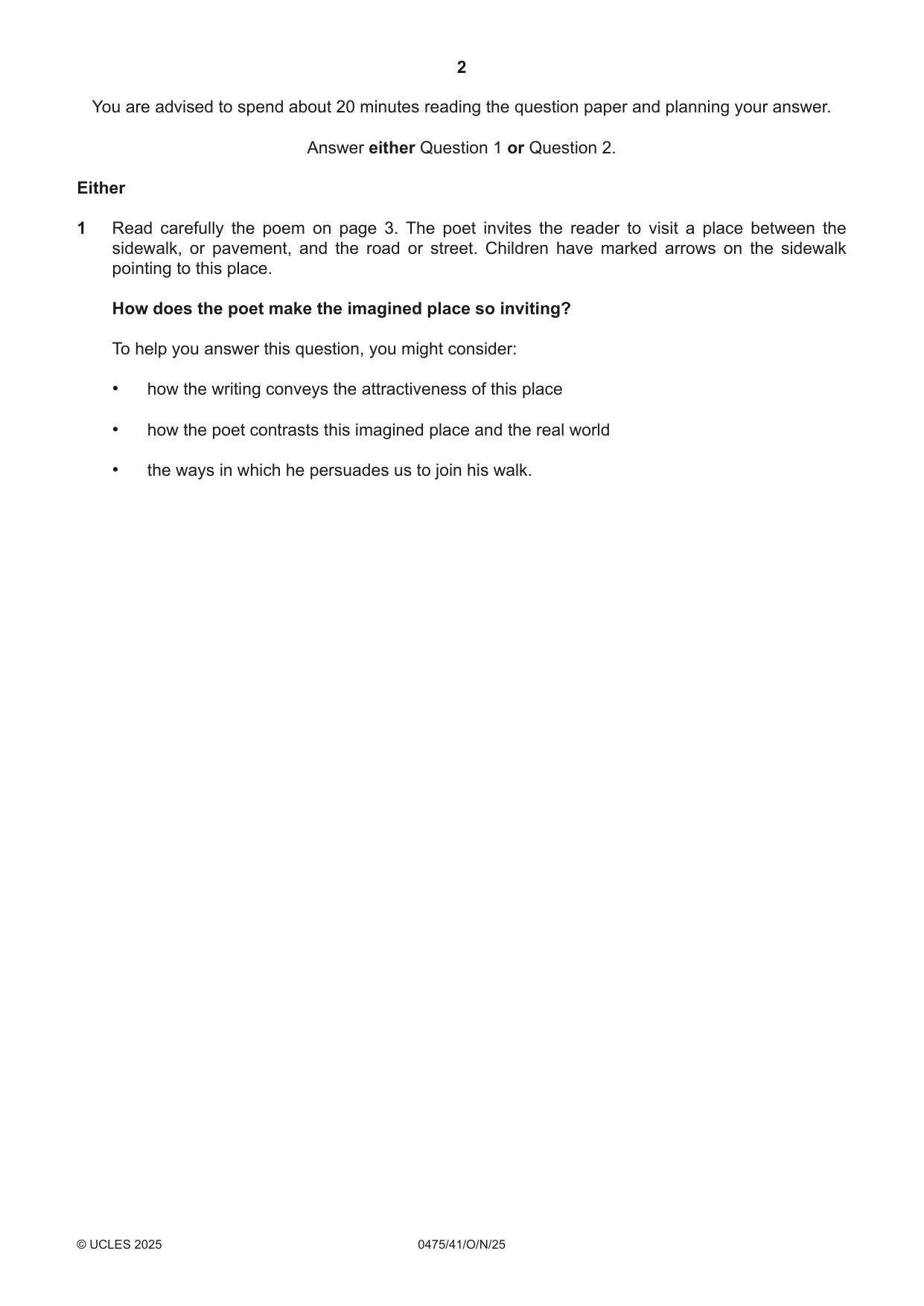
Question paper, page 2
2 0475/41/O/N/25 © UCLES 2025 You are advised to spend about 20 minutes reading the question paper and planning your answer. Answer either Question 1 or Question 2. Either 1 Read carefully the poem on page 3. The poet invites the reader to visit a place between the sidewalk, or pavement, and the road or street. Children have marked arrows on the sidewalk pointing to this place. How does the poet make the imagined place so inviting? To help you answer this question, you might consider: • how the writing conveys the attractiveness of this place • how the poet contrasts this imagined place and the real world • the ways in which he persuades us to join his walk.
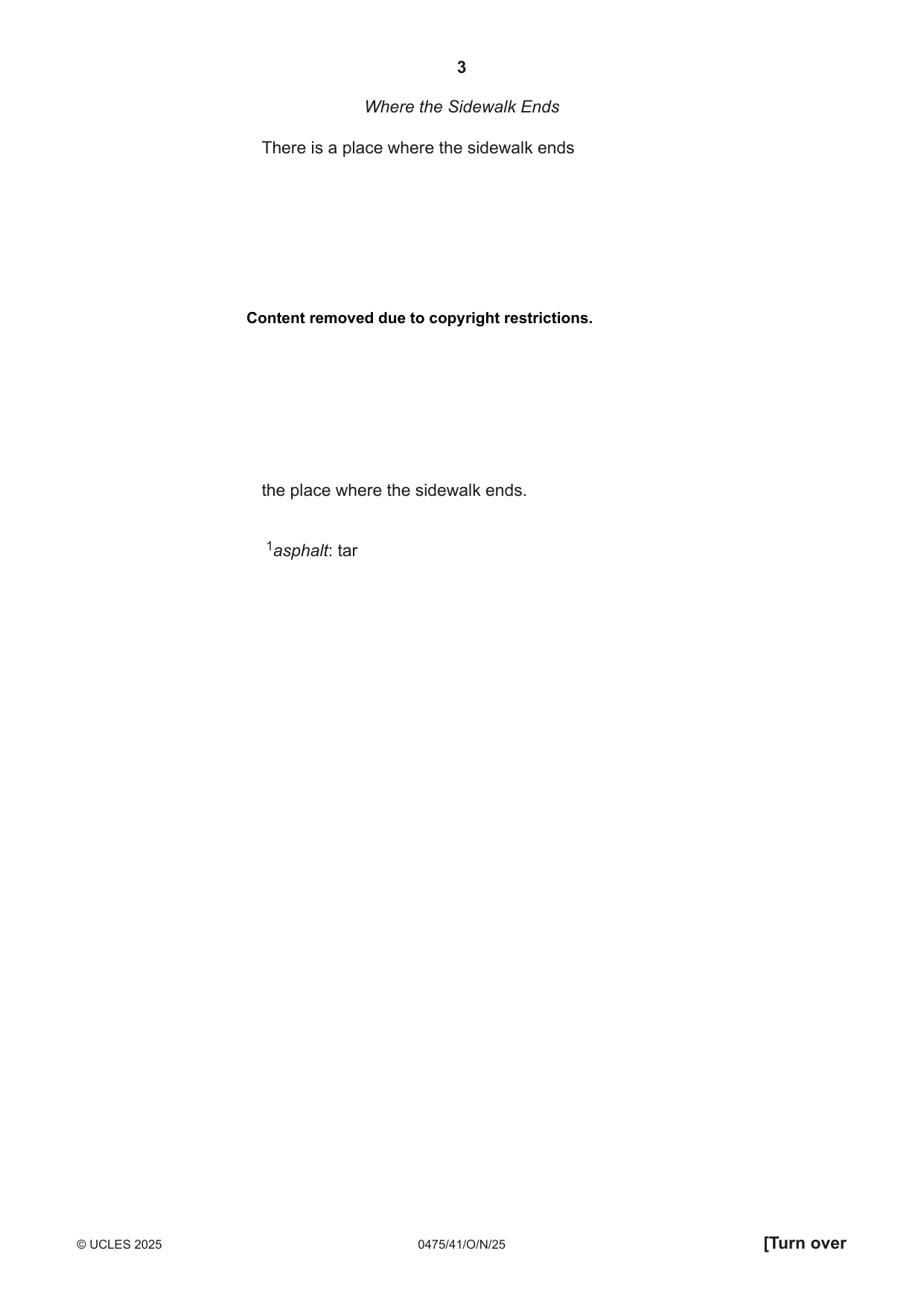
Question paper, page 3
3 0475/41/O/N/25 © UCLES 2025 [Turn over Where the Sidewalk Ends There is a place where the sidewalk ends the place where the sidewalk ends. 1asphalt: tar Content removed due to copyright restrictions.
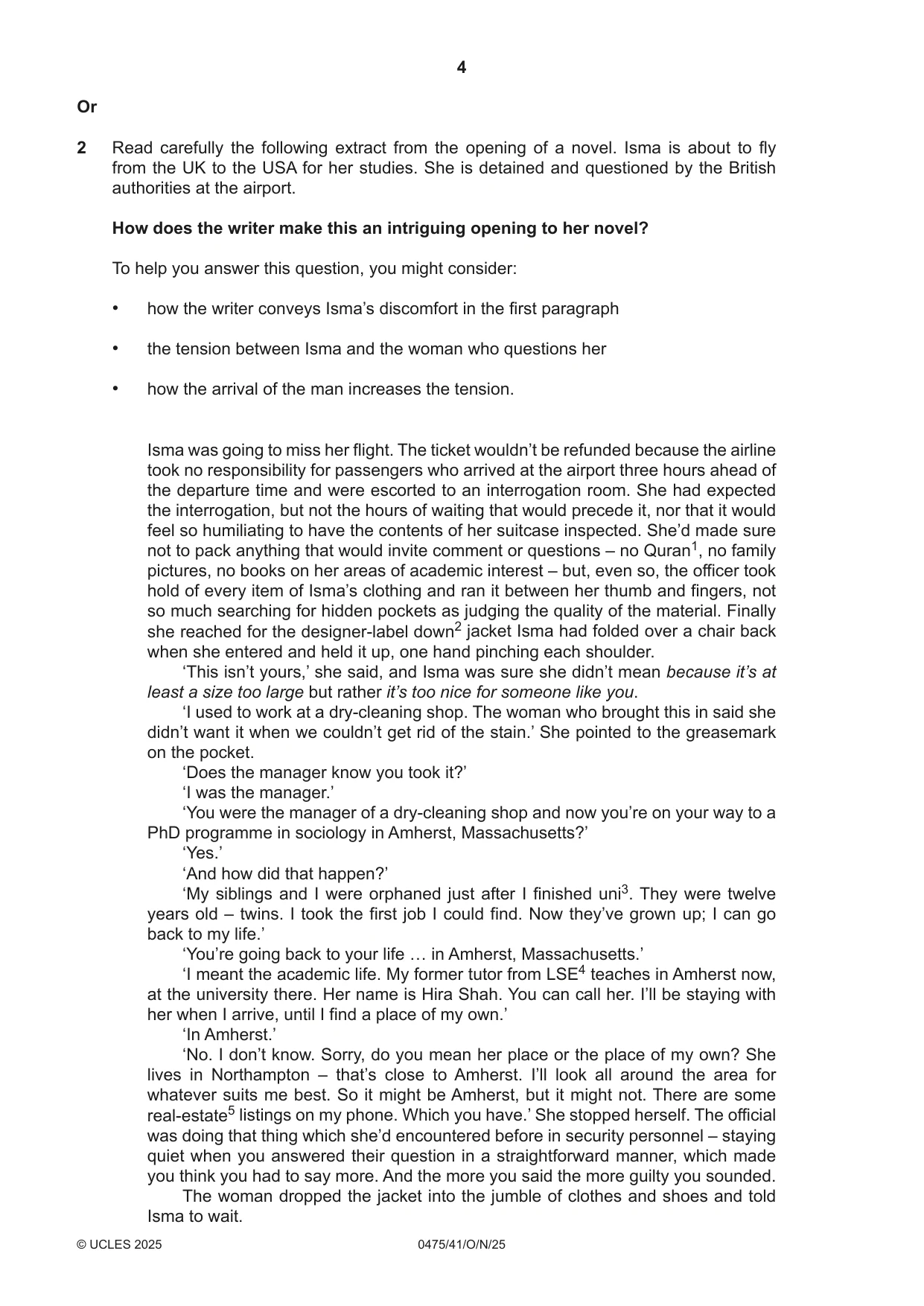
Question paper, page 4
4 0475/41/O/N/25 © UCLES 2025 Or 2 Read carefully the following extract from the opening of a novel. Isma is about to fly from the UK to the USA for her studies. She is detained and questioned by the British authorities at the airport. How does the writer make this an intriguing opening to her novel? To help you answer this question, you might consider: • how the writer conveys Isma’s discomfort in the first paragraph • the tension between Isma and the woman who questions her • how the arrival of the man increases the tension. Isma was going to miss her flight. The ticket wouldn’t be refunded because the airline took no responsibility for passengers who arrived at the airport three hours ahead of the departure time and were escorted to an interrogation room. She had expected the interrogation, but not the hours of waiting that would precede it, nor that it would feel so humiliating to have the contents of her suitcase inspected. She’d made sure not to pack anything that would invite comment or questions – no Quran1, no family pictures, no books on her areas of academic interest – but, even so, the officer took hold of every item of Isma’s clothing and ran it between her thumb and fingers, not so much searching for hidden pockets as judging the quality of the material. Finally she reached for the designer-label down2 jacket Isma had folded over a chair back when she entered and held it up, one hand pinching each shoulder. ‘This isn’t yours,’ she said, and Isma was sure she didn’t mean because it’s at least a size too large but rather it’s too nice for someone like you. ‘I used to work at a dry-cleaning shop. The woman who brought this in said she didn’t want it when we couldn’t get rid of the stain.’ She pointed to the greasemark on the pocket. ‘Does the manager know you took it?’ ‘I was the manager.’ ‘You were the manager of a dry-cleaning shop and now you’re on your way to a PhD programme in sociology in Amherst, Massachusetts?’ ‘Yes.’ ‘And how did that happen?’ ‘My siblings and I were orphaned just after I finished uni3. They were twelve years old – twins. I took the first job I could find. Now they’ve grown up; I can go back to my life.’ ‘You’re going back to your life … in Amherst, Massachusetts.’ ‘I meant the academic life. My former tutor from LSE4 teaches in Amherst now, at the university there. Her name is Hira Shah. You can call her. I’ll be staying with her when I arrive, until I find a place of my own.’ ‘In Amherst.’ ‘No. I don’t know. Sorry, do you mean her place or the place of my own? She lives in Northampton – that’s close to Amherst. I’ll look all around the area for whatever suits me best. So it might be Amherst, but it might not. There are some real-estate5 listings on my phone. Which you have.’ She stopped herself. The official was doing that thing which she’d encountered before in security personnel – staying quiet when you answered their question in a straightforward manner, which made you think you had to say more. And the more you said the more guilty you sounded. The woman dropped the jacket into the jumble of clothes and shoes and told Isma to wait.
Question paper, page 5
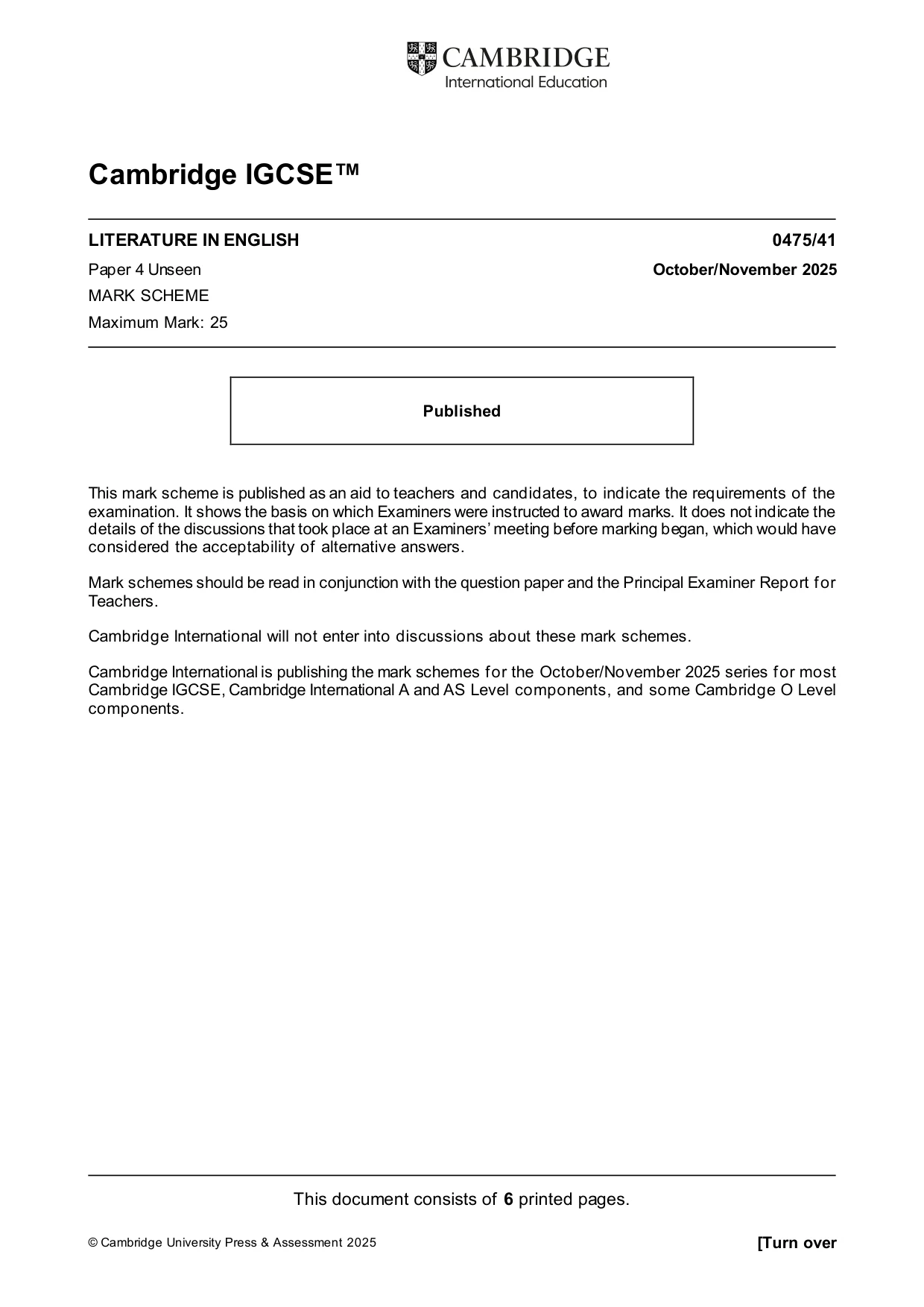
5 0475/41/O/N/25 © UCLES 2025 That had been a while ago. The plane would be boarding now. Isma looked over at the suitcase. She’d repacked when the woman left the room, and spent the time since worrying if doing that without permission constituted an offence. Should she empty the clothes out into a haphazard pile, or would that make things even worse? She stood up, unzipped the suitcase and flipped it open so its contents were visible. A man entered the office, carrying Isma’s passport, laptop and phone. She allowed herself to hope, but he sat down, gestured for her to do the same, and placed a voice recorder between them. ‘Do you consider yourself British?’ the man said. ‘I am British.’ ‘But do you consider yourself British?’ ‘I’ve lived here all my life.’ She meant there was no other country of which she could feel herself a part, but the words came out sounding evasive. 1Quran: Holy book of Islam 2down: feather-filled 3uni: (slang) university 4LSE: a British university 5real-estate: property
Question paper, page 6
6 0475/41/O/N/25 © UCLES 2025 BLANK PAGE
Question paper, page 7
7 0475/41/O/N/25 © UCLES 2025 BLANK PAGE
Question paper, page 8
8 0475/41/O/N/25 © UCLES 2025 BLANK PAGE Permission to reproduce items where third-party owned material protected by copyright is included has been sought and cleared where possible. Every reasonable effort has been made by the publisher (UCLES) to trace copyright holders, but if any items requiring clearance have unwittingly been included, the publisher will be pleased to make amends at the earliest possible opportunity. To avoid the issue of disclosure of answer-related information to candidates, all copyright acknowledgements are reproduced online in the Cambridge Assessment International Education Copyright Acknowledgements Booklet. This is produced for each series of examinations and is freely available to download at www.cambridgeinternational.org after the live examination series. Cambridge Assessment International Education is part of Cambridge Assessment. Cambridge Assessment is the brand name of the University of Cambridge Local Examinations Syndicate (UCLES), which is a department of the University of Cambridge.
Mark scheme, page 1
This document consists of 6 printed pages. © Cambridge University Press & Assessment 2025 [Turn over Cambridge IGCSE™ LITERATURE IN ENGLISH 0475/41 Paper 4 Unseen October/November 2025 MARK SCHEME Maximum Mark: 25 Published This mark scheme is published as an aid to teachers and candidates, to indicate the requirements of the examination. It shows the basis on which Examiners were instructed to award marks. It does not indicate the details of the discussions that took place at an Examiners’ meeting before marking began, which would have considered the acceptability of alternative answers. Mark schemes should be read in conjunction with the question paper and the Principal Examiner Report for Teachers. Cambridge International will not enter into discussions about these mark schemes. Cambridge International is publishing the mark schemes for the October/November 2025 series for most Cambridge IGCSE, Cambridge International A and AS Level components, and some Cambridge O Level components.
Mark scheme, page 2
0475/41 Cambridge IGCSE – Mark Scheme PUBLISHED October/November 2025 © Cambridge University Press & Assessment 2025 Page 2 of 6 Generic Marking Principles These general marking principles must be applied by all examiners when marking candidate answers. They should be applied alongside the specific content of the mark scheme or generic level descriptions for a question. Each question paper and mark scheme will also comply with these marking principles. GENERIC MARKING PRINCIPLE 1: Marks must be awarded in line with: • the specific content of the mark scheme or the generic level descriptors for the question • the specific skills defined in the mark scheme or in the generic level descriptors for the question • the standard of response required by a candidate as exemplified by the standardisation scripts. GENERIC MARKING PRINCIPLE 2: Marks awarded are always whole marks (not half marks, or other fractions). GENERIC MARKING PRINCIPLE 3: Marks must be awarded positively: • marks are awarded for correct/valid answers, as defined in the mark scheme. However, credit is given for valid answers which go beyond the scope of the syllabus and mark scheme, referring to your Team Leader as appropriate • marks are awarded when candidates clearly demonstrate what they know and can do • marks are not deducted for errors • marks are not deducted for omissions • answers should only be judged on the quality of spelling, punctuation and grammar when these features are specifically assessed by the question as indicated by the mark scheme. The meaning, however, should be unambiguous. GENERIC MARKING PRINCIPLE 4: Rules must be applied consistently, e.g. in situations where candidates have not followed instructions or in the application of generic level descriptors. GENERIC MARKING PRINCIPLE 5: Marks should be awarded using the full range of marks defined in the mark scheme for the question (however; the use of the full mark range may be limited according to the quality of the candidate responses seen). GENERIC MARKING PRINCIPLE 6: Marks awarded are based solely on the requirements as defined in the mark scheme. Marks should not be awarded with grade thresholds or grade descriptors in mind.
Mark scheme, page 3
0475/41 Cambridge IGCSE – Mark Scheme PUBLISHED October/November 2025 © Cambridge University Press & Assessment 2025 Page 3 of 6 English & Media subject specific general marking principles (To be read in conjunction with the Generic Marking Principles (and requiring further guidance on how to place marks within levels)) Components using level descriptors: • We use level descriptors as a guide to broad understanding of the qualities normally expected of, or typical of, work in a level. • Level descriptors are a means of general guidance and should not be interpreted as hurdle statements. • Where indicative content notes are supplied for a question, these are not a prescription of required content, and must not be treated as such. Alternative correct points and unexpected answers in candidates’ scripts must be given marks that fairly reflect the knowledge and skills demonstrated. • While we may have legitimate expectations as to the ground most answers may occupy, we must at all times be prepared to meet candidates on their chosen ground, provided it is relevant ground (e.g. clearly related to and derived from a relevant passage/text and meeting the mark scheme requirements for the question). Components using point-based marking: Point marking is often used to reward knowledge, understanding and application of skills. We give credit where the candidate’s answer shows relevant knowledge, understanding and application of skills in answering the question. We do not give credit where the answer shows confusion. From this it follows that we: a DO credit answers which are worded differently from the mark scheme if they clearly convey the same meaning (unless the mark scheme requires a specific term). b DO credit alternative answers/examples which are not written in the mark scheme if they are correct. c DO credit answers where candidates give more than one correct answer in one prompt/numbered/scaffolded space where extended writing is required rather than list-type answers. For example, questions that require n reasons (e.g. State two reasons…). d DO NOT credit answers simply for using a ‘key term’ unless that is all that is required. (Check for evidence it is understood and not used incorrectly.) e DO NOT credit answers which are obviously self-contradicting or trying to cover all possibilities. f DO NOT give further credit for what is effectively repetition of a correct point already credited unless the language itself is being tested. This applies equally to ‘mirror statements’ (i.e. polluted/not polluted). g DO NOT require spellings to be correct, unless this is part of the test. However, spellings of syllabus terms must allow for clear and unambiguous separation from other syllabus terms with which they may be confused (e.g. Corrasion/Corrosion).
Mark scheme, page 4
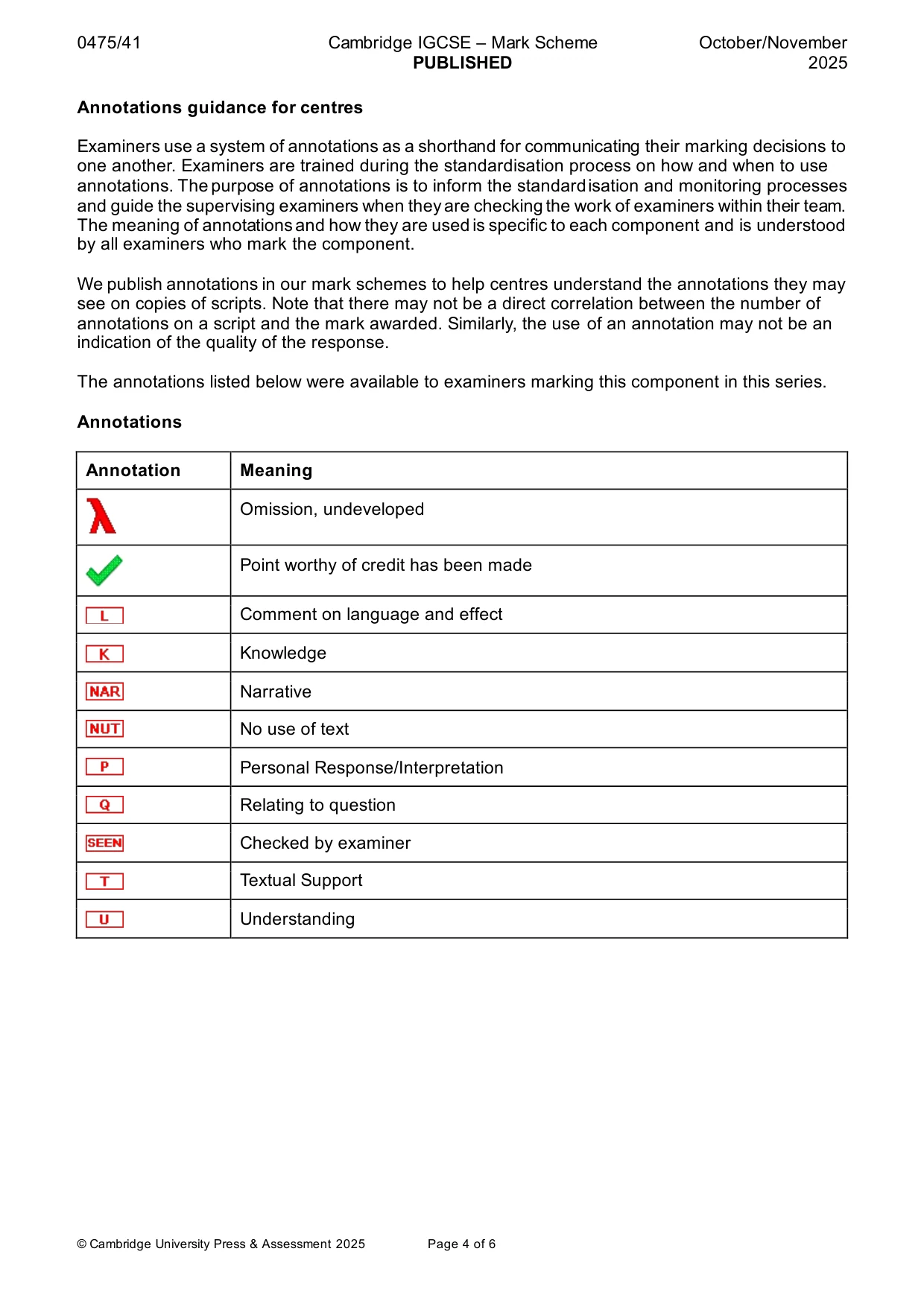
0475/41 Cambridge IGCSE – Mark Scheme PUBLISHED October/November 2025 © Cambridge University Press & Assessment 2025 Page 4 of 6 Annotations guidance for centres Examiners use a system of annotations as a shorthand for communicating their marking decisions to one another. Examiners are trained during the standardisation process on how and when to use annotations. The purpose of annotations is to inform the standardisation and monitoring processes and guide the supervising examiners when they are checking the work of examiners within their team. The meaning of annotations and how they are used is specific to each component and is understood by all examiners who mark the component. We publish annotations in our mark schemes to help centres understand the annotations they may see on copies of scripts. Note that there may not be a direct correlation between the number of annotations on a script and the mark awarded. Similarly, the use of an annotation may not be an indication of the quality of the response. The annotations listed below were available to examiners marking this component in this series. Annotations Annotation Meaning Omission, undeveloped Point worthy of credit has been made Comment on language and effect Knowledge Narrative No use of text Personal Response/Interpretation Relating to question Checked by examiner Textual Support Understanding
Mark scheme, page 5
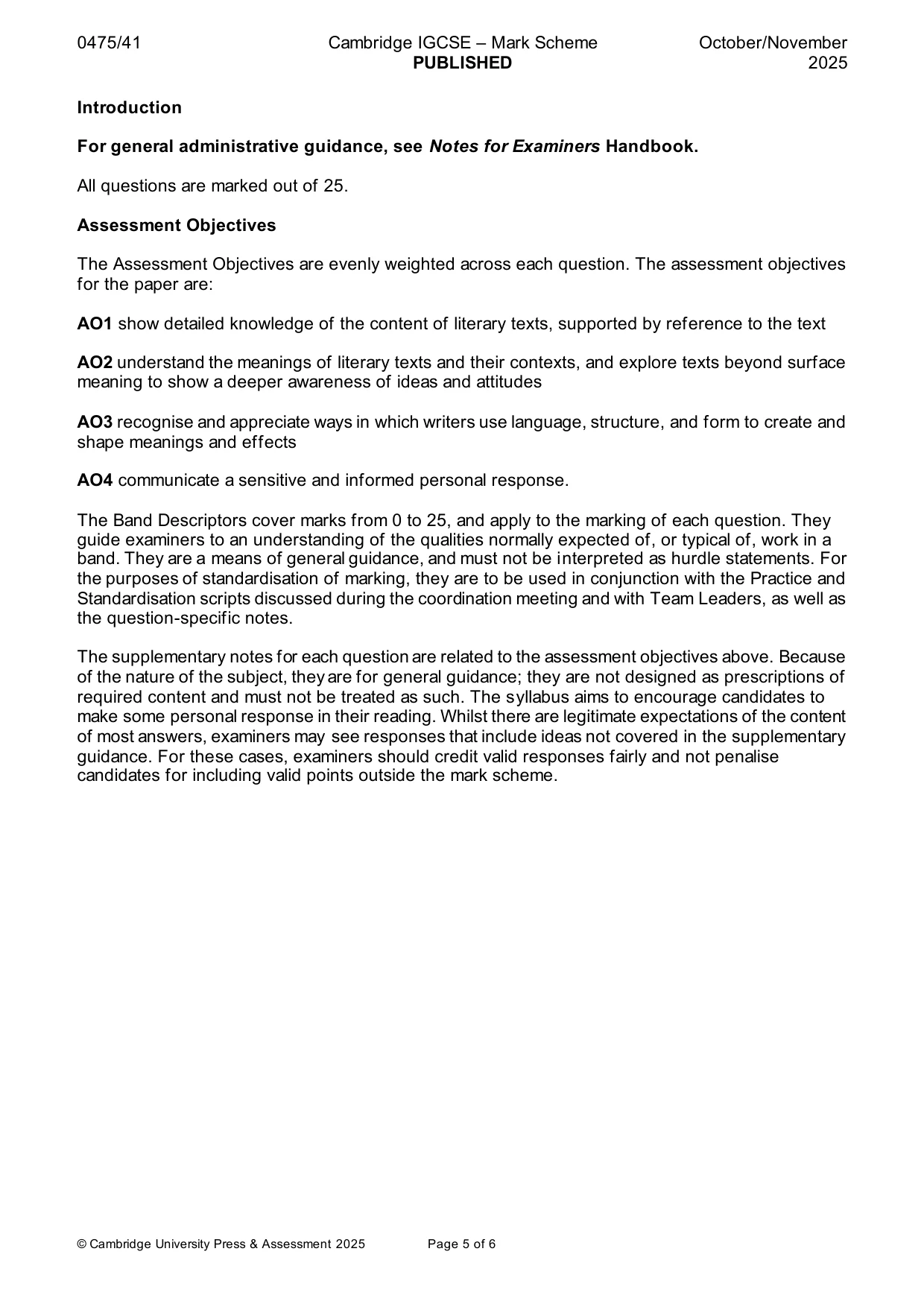
0475/41 Cambridge IGCSE – Mark Scheme PUBLISHED October/November 2025 © Cambridge University Press & Assessment 2025 Page 5 of 6 Introduction For general administrative guidance, see Notes for Examiners Handbook. All questions are marked out of 25. Assessment Objectives The Assessment Objectives are evenly weighted across each question. The assessment objectives for the paper are: AO1 show detailed knowledge of the content of literary texts, supported by reference to the text AO2 understand the meanings of literary texts and their contexts, and explore texts beyond surface meaning to show a deeper awareness of ideas and attitudes AO3 recognise and appreciate ways in which writers use language, structure, and form to create and shape meanings and effects AO4 communicate a sensitive and informed personal response. The Band Descriptors cover marks from 0 to 25, and apply to the marking of each question. They guide examiners to an understanding of the qualities normally expected of, or typical of, work in a band. They are a means of general guidance, and must not be interpreted as hurdle statements. For the purposes of standardisation of marking, they are to be used in conjunction with the Practice and Standardisation scripts discussed during the coordination meeting and with Team Leaders, as well as the question-specific notes. The supplementary notes for each question are related to the assessment objectives above. Because of the nature of the subject, they are for general guidance; they are not designed as prescriptions of required content and must not be treated as such. The syllabus aims to encourage candidates to make some personal response in their reading. Whilst there are legitimate expectations of the content of most answers, examiners may see responses that include ideas not covered in the supplementary guidance. For these cases, examiners should credit valid responses fairly and not penalise candidates for including valid points outside the mark scheme.
Mark scheme, page 6
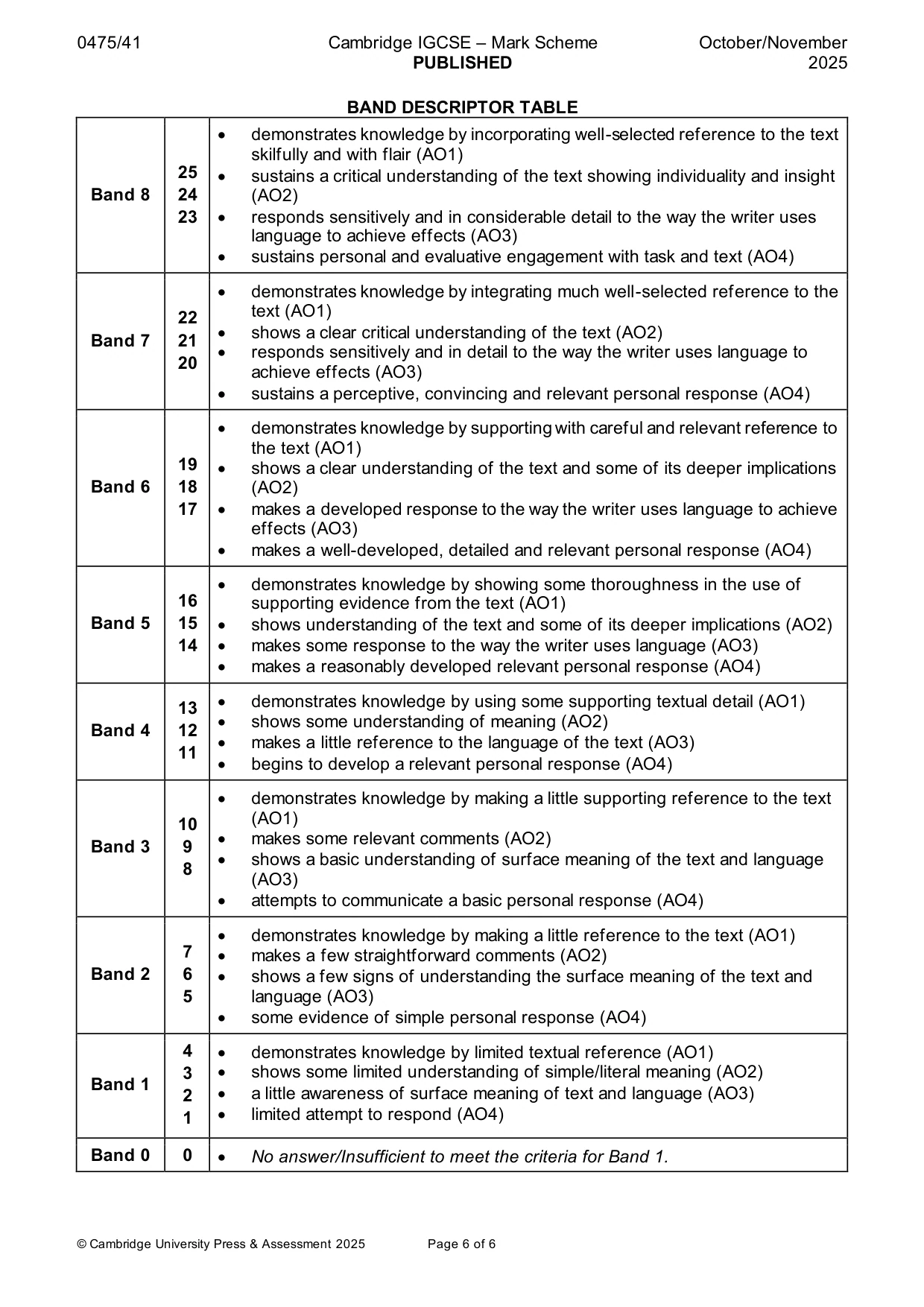
0475/41 Cambridge IGCSE – Mark Scheme PUBLISHED October/November 2025 © Cambridge University Press & Assessment 2025 Page 6 of 6 BAND DESCRIPTOR TABLE Band 8 25 24 23 • demonstrates knowledge by incorporating well-selected reference to the text skilfully and with flair (AO1) • sustains a critical understanding of the text showing individuality and insight (AO2) • responds sensitively and in considerable detail to the way the writer uses language to achieve effects (AO3) • sustains personal and evaluative engagement with task and text (AO4) Band 7 22 21 20 • demonstrates knowledge by integrating much well-selected reference to the text (AO1) • shows a clear critical understanding of the text (AO2) • responds sensitively and in detail to the way the writer uses language to achieve effects (AO3) • sustains a perceptive, convincing and relevant personal response (AO4) Band 6 19 18 17 • demonstrates knowledge by supporting with careful and relevant reference to the text (AO1) • shows a clear understanding of the text and some of its deeper implications (AO2) • makes a developed response to the way the writer uses language to achieve effects (AO3) • makes a well-developed, detailed and relevant personal response (AO4) Band 5 16 15 14 • demonstrates knowledge by showing some thoroughness in the use of supporting evidence from the text (AO1) • shows understanding of the text and some of its deeper implications (AO2) • makes some response to the way the writer uses language (AO3) • makes a reasonably developed relevant personal response (AO4) Band 4 13 12 11 • demonstrates knowledge by using some supporting textual detail (AO1) • shows some understanding of meaning (AO2) • makes a little reference to the language of the text (AO3) • begins to develop a relevant personal response (AO4) Band 3 10 9 8 • demonstrates knowledge by making a little supporting reference to the text (AO1) • makes some relevant comments (AO2) • shows a basic understanding of surface meaning of the text and language (AO3) • attempts to communicate a basic personal response (AO4) Band 2 7 6 5 • demonstrates knowledge by making a little reference to the text (AO1) • makes a few straightforward comments (AO2) • shows a few signs of understanding the surface meaning of the text and language (AO3) • some evidence of simple personal response (AO4) Band 1 4 3 2 1 • demonstrates knowledge by limited textual reference (AO1) • shows some limited understanding of simple/literal meaning (AO2) • a little awareness of surface meaning of text and language (AO3) • limited attempt to respond (AO4) Band 0 0 • No answer/Insufficient to meet the criteria for Band 1.
What you needed in this session
Cambridge’s own grade thresholds for 2025 Oct/Nov, Paper 4 · Variant 1. A higher threshold means an easier paper — the bar moves with how the cohort did.