Cambridge IGCSE English - Literature in English 0475 — 2022 Feb/March Paper 1 · Variant 2
0475/12/F/M/22 · 50 marks · ≈56 min
The question paper and its mark scheme, free to read here and free to download. This is Cambridge’s own paper, exactly as it was sat.
Question paper28 pages




Mark scheme5 pages
Answers below. Sit the paper first if you are practising.
Paper as text
Question paper, page 1
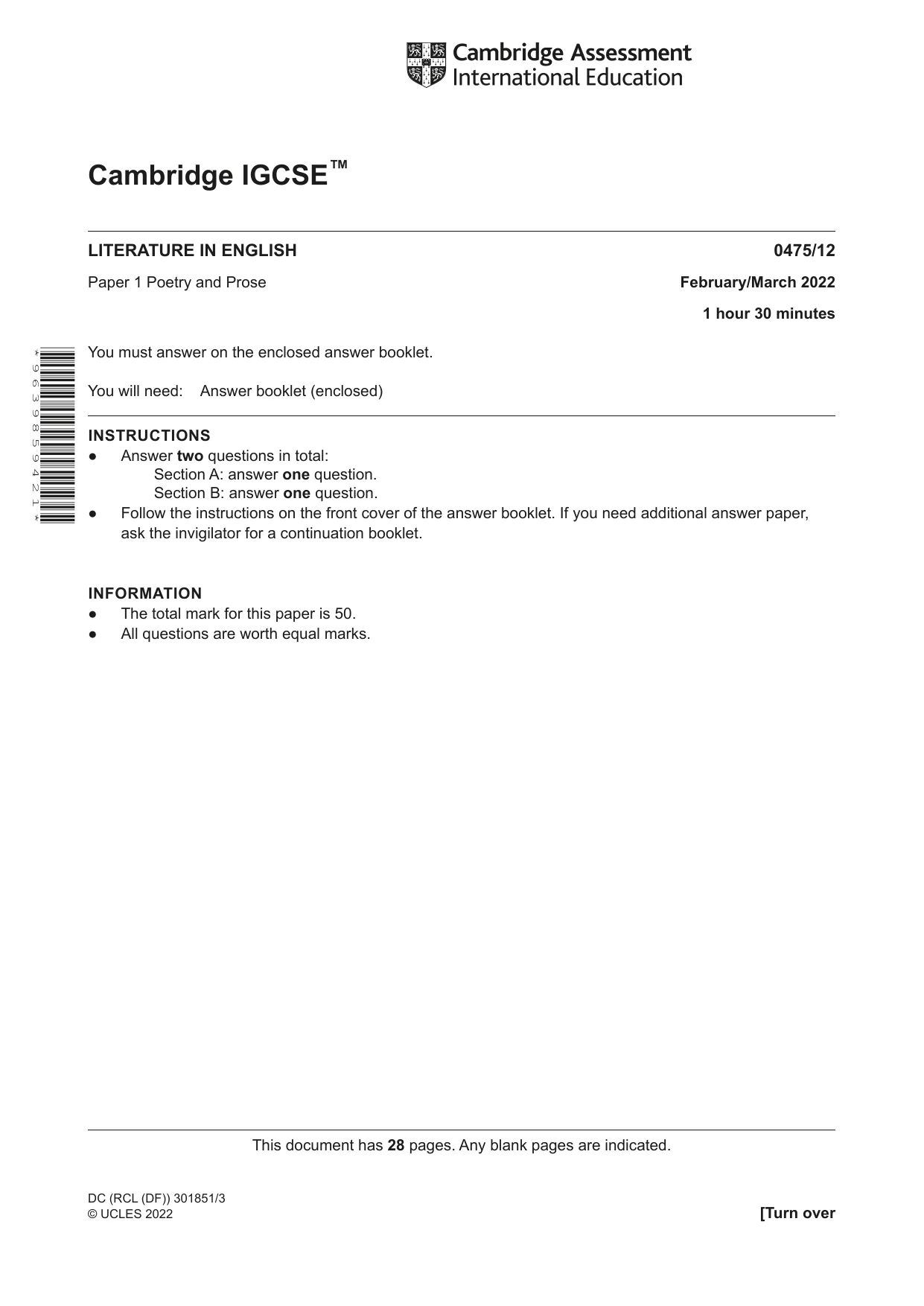
This document has 28 pages. Any blank pages are indicated. * 9 6 3 9 8 5 9 4 2 1 * Cambridge IGCSE™ DC (RCL (DF)) 301851/3 © UCLES 2022 [Turn over LITERATURE IN ENGLISH 0475/12 Paper 1 Poetry and Prose February/March 2022 1 hour 30 minutes You must answer on the enclosed answer booklet. You will need: Answer booklet (enclosed) INSTRUCTIONS ● Answer two questions in total: Section A: answer one question. Section B: answer one question. ● Follow the instructions on the front cover of the answer booklet. If you need additional answer paper, ask the invigilator for a continuation booklet. INFORMATION ● The total mark for this paper is 50. ● All questions are worth equal marks.
Question paper, page 2
2 0475/12/F/M/22 © UCLES 2022 BLANK PAGE
Question paper, page 3
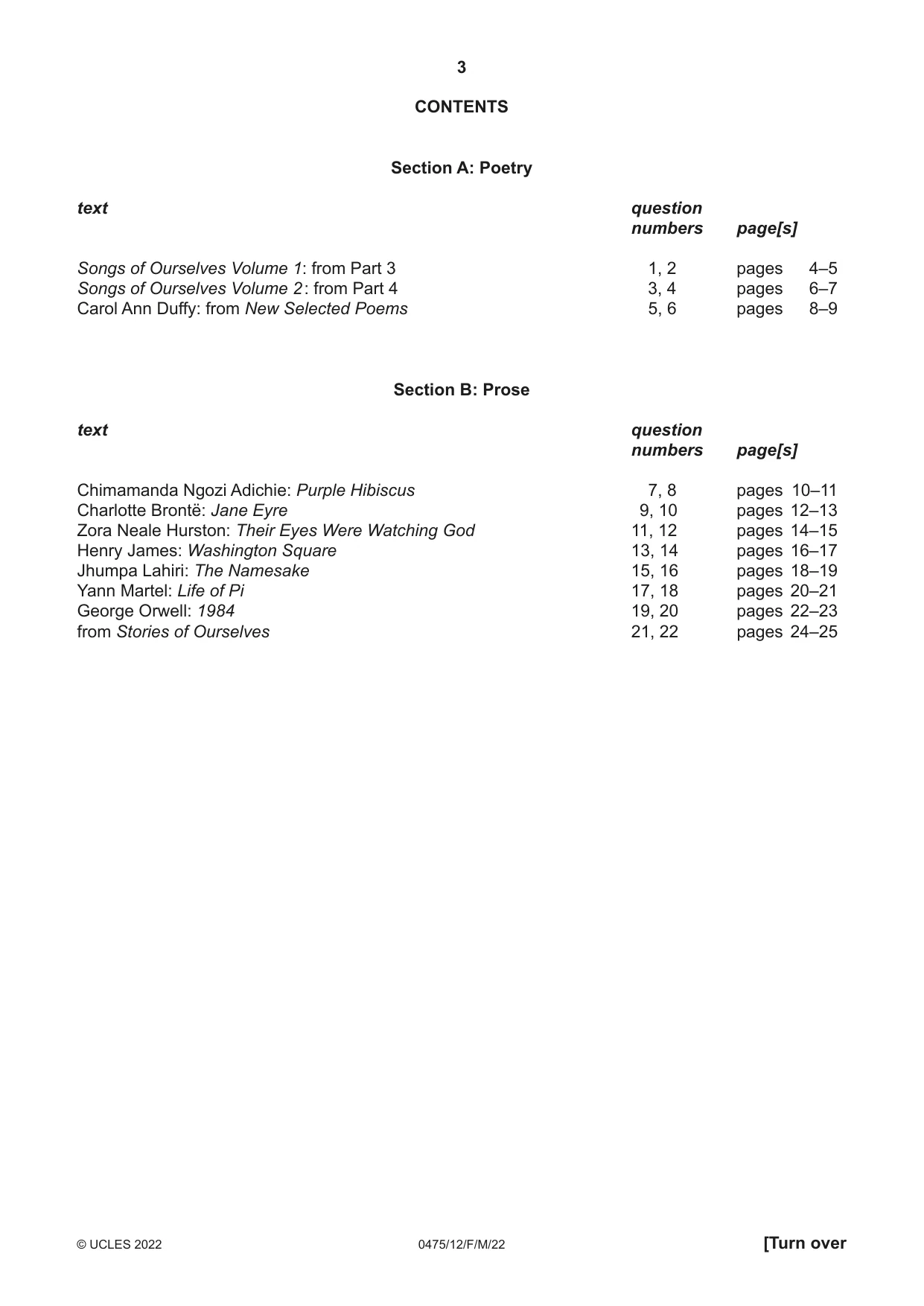
3 0475/12/F/M/22 © UCLES 2022 [Turn over CONTENTS Section A: Poetry text question numbers page[s] Songs of Ourselves Volume 1: from Part 3 1, 2 pages 4–5 Songs of Ourselves Volume 2 : from Part 4 3, 4 pages 6–7 Carol Ann Duffy: from New Selected Poems 5, 6 pages 8–9 Section B: Prose text question numbers page[s] Chimamanda Ngozi Adichie: Purple Hibiscus 7, 8 pages 10–11 Charlotte Brontë: Jane Eyre 9, 10 pages 12–13 Zora Neale Hurston: Their Eyes Were Watching God 11, 12 pages 14–15 Henry James: Washington Square 13, 14 pages 16–17 Jhumpa Lahiri: The Namesake 15, 16 pages 18–19 Yann Martel: Life of Pi 17, 18 pages 20–21 George Orwell: 1984 19, 20 pages 22–23 from Stories of Ourselves 21, 22 pages 24–25
Question paper, page 4
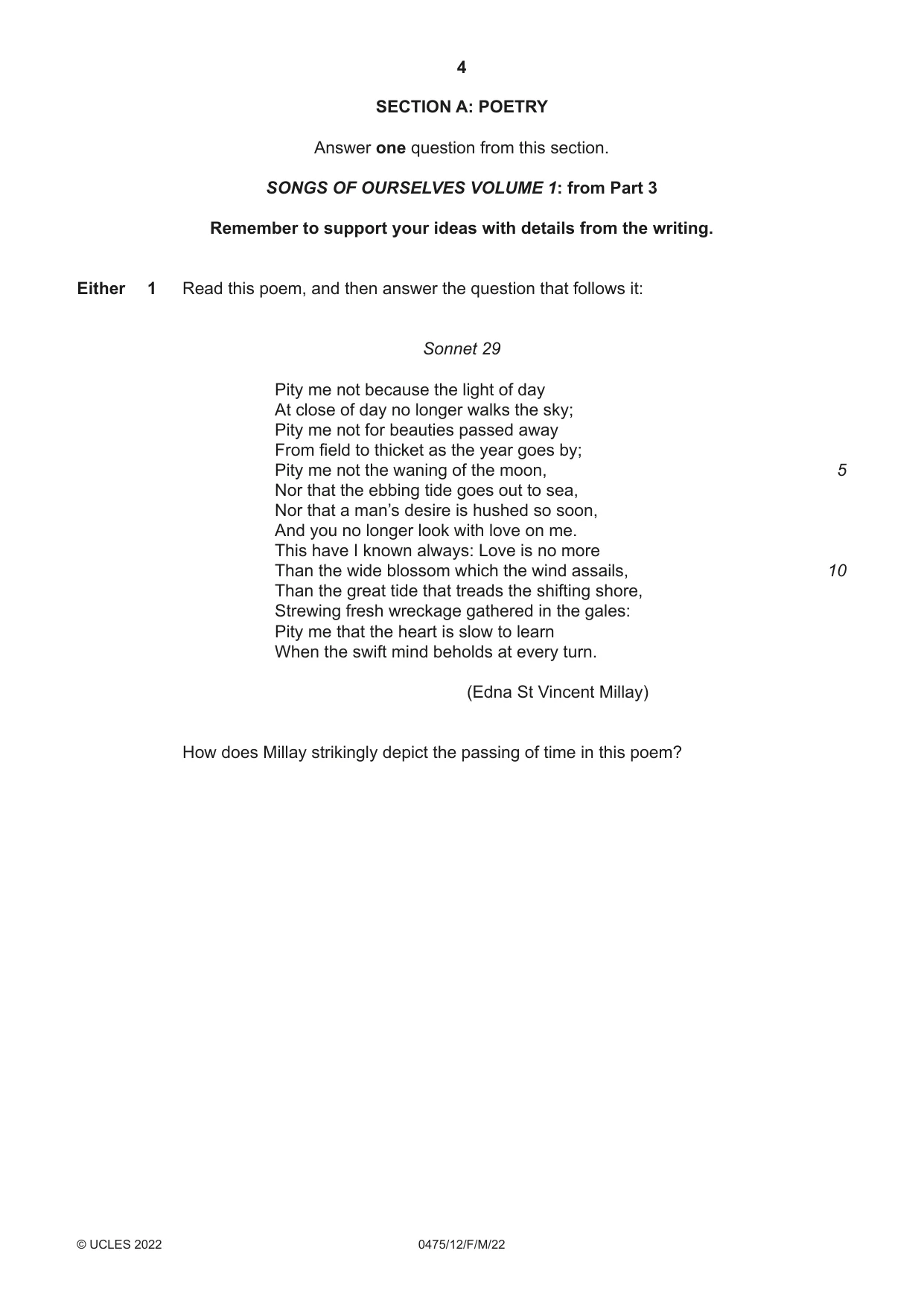
4 0475/12/F/M/22 © UCLES 2022 SECTION A: POETRY Answer one question from this section. SONGS OF OURSELVES VOLUME 1: from Part 3 Remember to support your ideas with details from the writing. Either 1 Read this poem, and then answer the question that follows it: Sonnet 29 Pity me not because the light of day At close of day no longer walks the sky; Pity me not for beauties passed away From field to thicket as the year goes by; Pity me not the waning of the moon, Nor that the ebbing tide goes out to sea, Nor that a man’s desire is hushed so soon, And you no longer look with love on me. This have I known always: Love is no more Than the wide blossom which the wind assails, Than the great tide that treads the shifting shore, Strewing fresh wreckage gathered in the gales: Pity me that the heart is slow to learn When the swift mind beholds at every turn. (Edna St Vincent Millay) How does Millay strikingly depict the passing of time in this poem? 5 10
Question paper, page 5
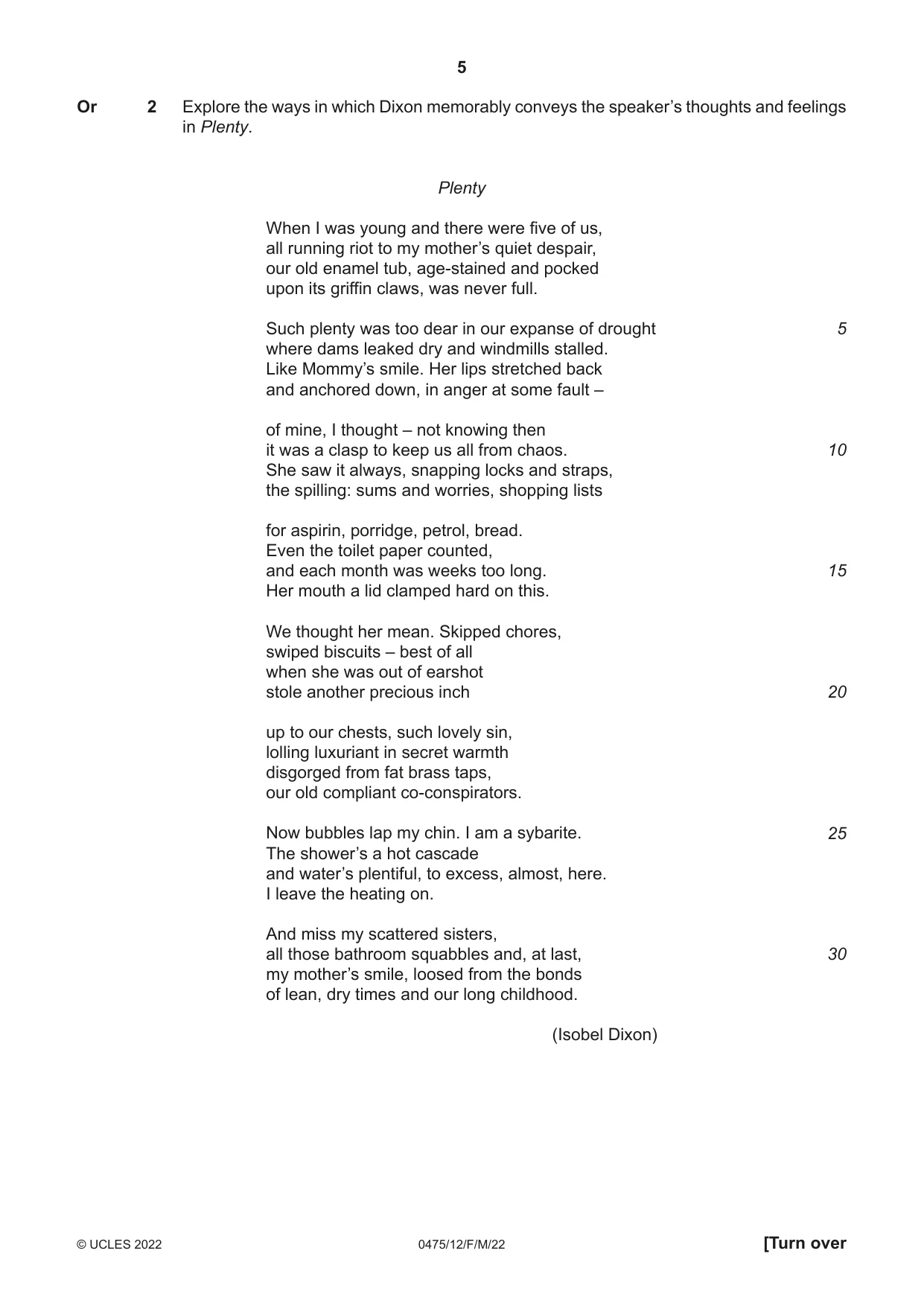
5 0475/12/F/M/22 © UCLES 2022 [Turn over Or 2 Explore the ways in which Dixon memorably conveys the speaker’s thoughts and feelings in Plenty. Plenty When I was young and there were five of us, all running riot to my mother’s quiet despair, our old enamel tub, age-stained and pocked upon its griffin claws, was never full. Such plenty was too dear in our expanse of drought where dams leaked dry and windmills stalled. Like Mommy’s smile. Her lips stretched back and anchored down, in anger at some fault – of mine, I thought – not knowing then it was a clasp to keep us all from chaos. She saw it always, snapping locks and straps, the spilling: sums and worries, shopping lists for aspirin, porridge, petrol, bread. Even the toilet paper counted, and each month was weeks too long. Her mouth a lid clamped hard on this. We thought her mean. Skipped chores, swiped biscuits – best of all when she was out of earshot stole another precious inch up to our chests, such lovely sin, lolling luxuriant in secret warmth disgorged from fat brass taps, our old compliant co-conspirators. Now bubbles lap my chin. I am a sybarite. The shower’s a hot cascade and water’s plentiful, to excess, almost, here. I leave the heating on. And miss my scattered sisters, all those bathroom squabbles and, at last, my mother’s smile, loosed from the bonds of lean, dry times and our long childhood. (Isobel Dixon) 5 10 15 20 25 30
Question paper, page 6
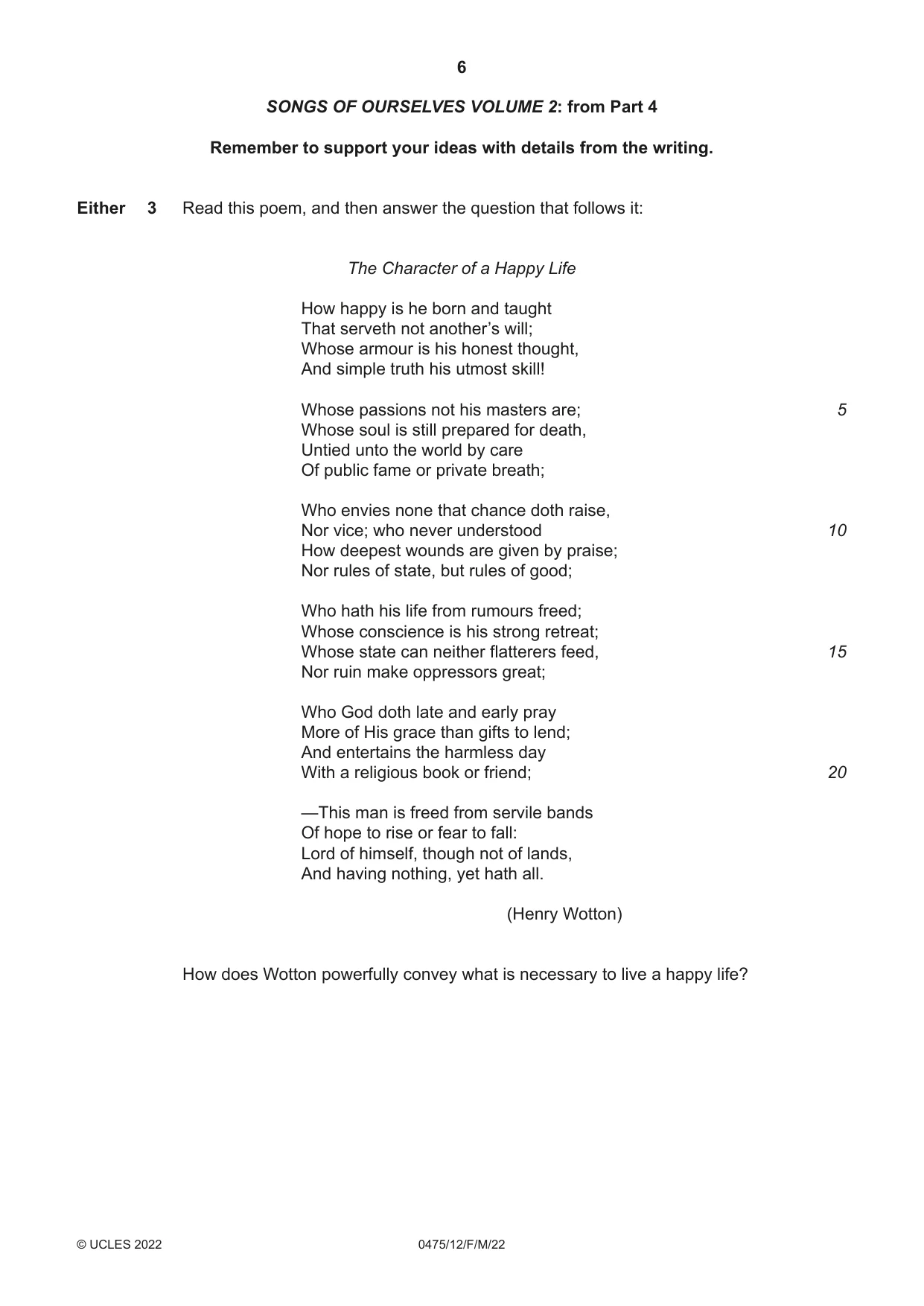
6 0475/12/F/M/22 © UCLES 2022 SONGS OF OURSELVES VOLUME 2: from Part 4 Remember to support your ideas with details from the writing. Either 3 Read this poem, and then answer the question that follows it: The Character of a Happy Life How happy is he born and taught That serveth not another’s will; Whose armour is his honest thought, And simple truth his utmost skill! Whose passions not his masters are; Whose soul is still prepared for death, Untied unto the world by care Of public fame or private breath; Who envies none that chance doth raise, Nor vice; who never understood How deepest wounds are given by praise; Nor rules of state, but rules of good; Who hath his life from rumours freed; Whose conscience is his strong retreat; Whose state can neither flatterers feed, Nor ruin make oppressors great; Who God doth late and early pray More of His grace than gifts to lend; And entertains the harmless day With a religious book or friend; —This man is freed from servile bands Of hope to rise or fear to fall: Lord of himself, though not of lands, And having nothing, yet hath all. (Henry Wotton) How does Wotton powerfully convey what is necessary to live a happy life? 5 10 15 20
Question paper, page 7
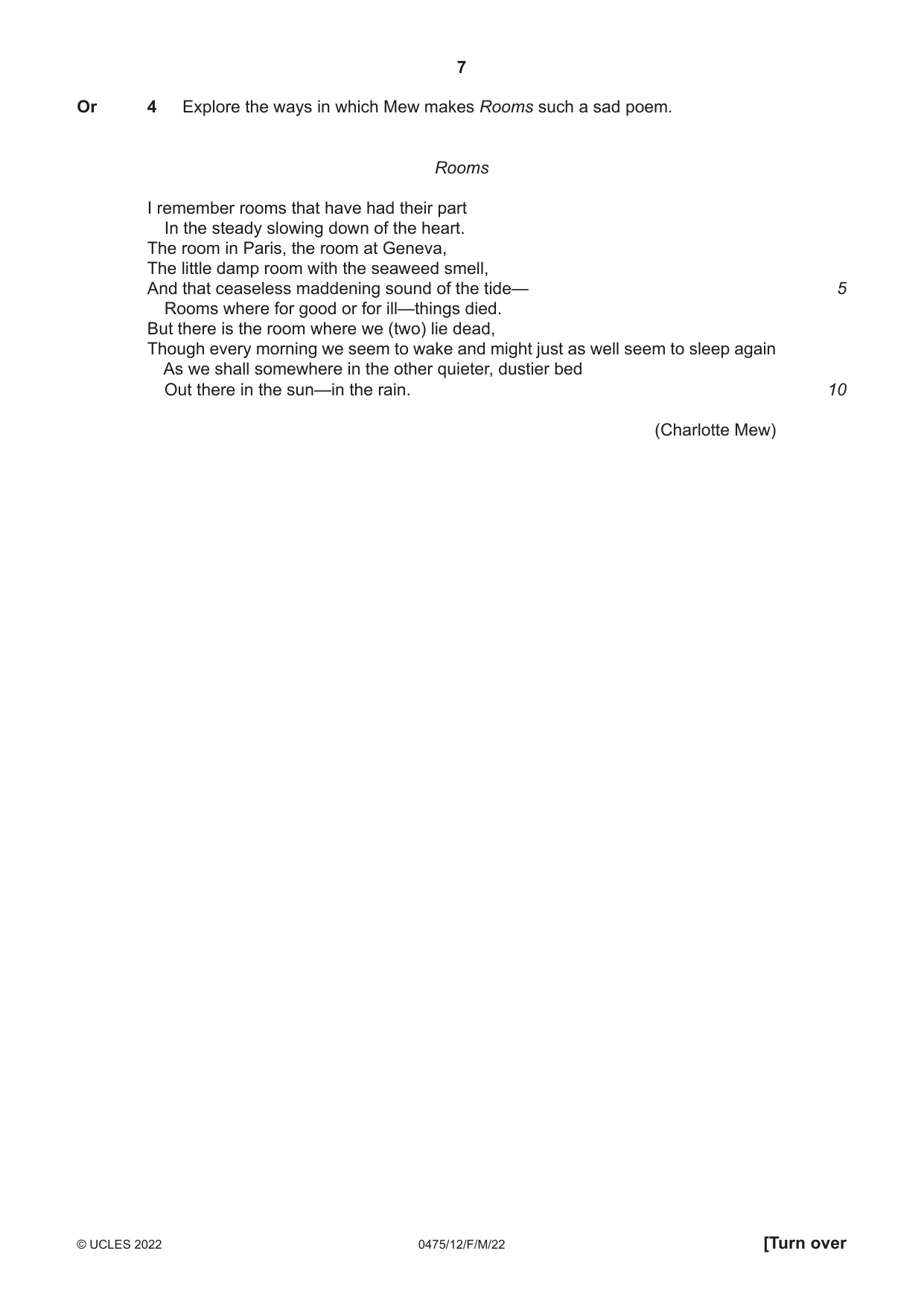
7 0475/12/F/M/22 © UCLES 2022 [Turn over Or 4 Explore the ways in which Mew makes Rooms such a sad poem. Rooms I remember rooms that have had their part In the steady slowing down of the heart. The room in Paris, the room at Geneva, The little damp room with the seaweed smell, And that ceaseless maddening sound of the tide— Rooms where for good or for ill—things died. But there is the room where we (two) lie dead, Though every morning we seem to wake and might just as well seem to sleep again As we shall somewhere in the other quieter, dustier bed Out there in the sun—in the rain. (Charlotte Mew) 5 10
Question paper, page 8
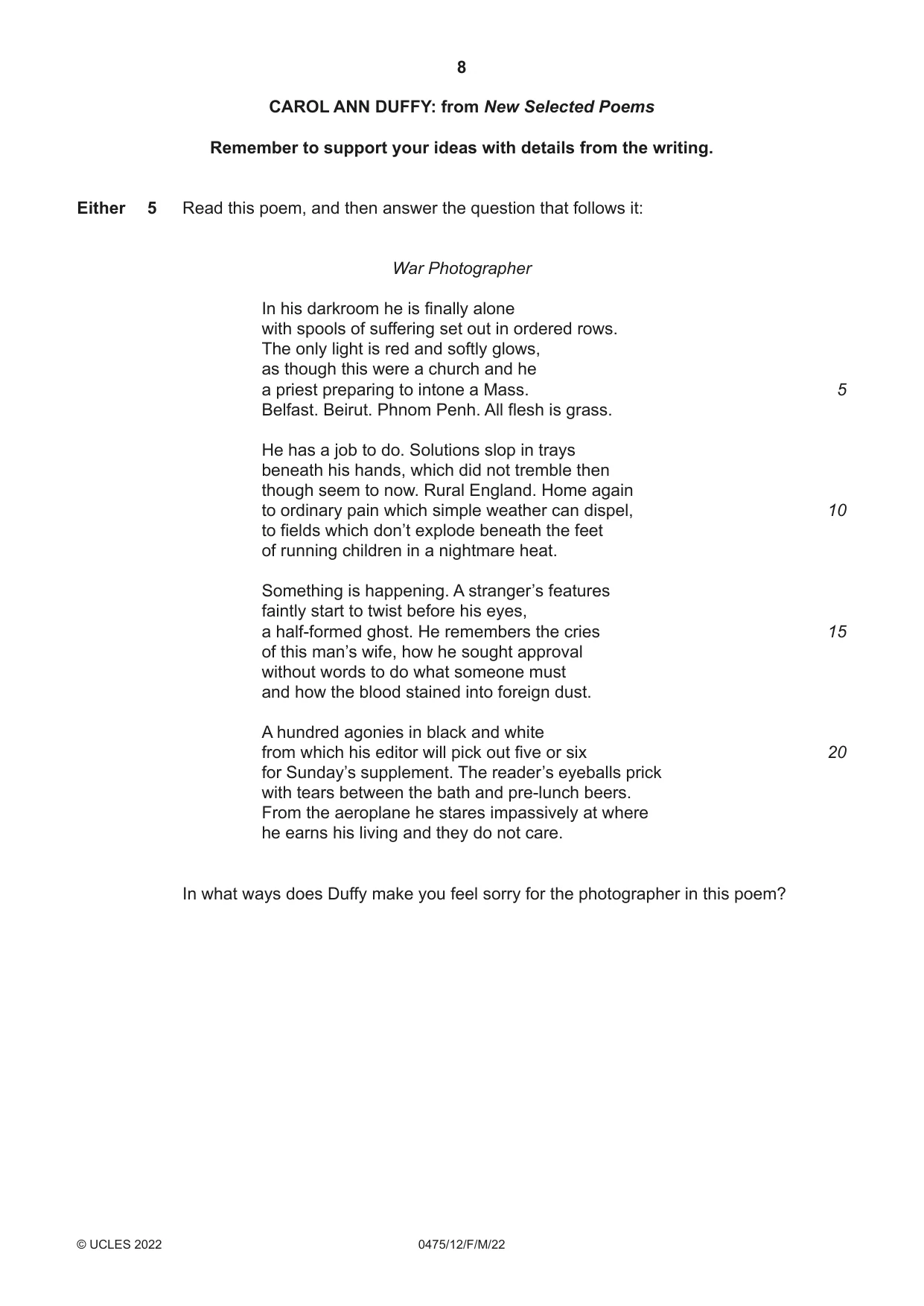
8 0475/12/F/M/22 © UCLES 2022 CAROL ANN DUFFY: from New Selected Poems Remember to support your ideas with details from the writing. Either 5 Read this poem, and then answer the question that follows it: War Photographer In his darkroom he is finally alone with spools of suffering set out in ordered rows. The only light is red and softly glows, as though this were a church and he a priest preparing to intone a Mass. Belfast. Beirut. Phnom Penh. All flesh is grass. He has a job to do. Solutions slop in trays beneath his hands, which did not tremble then though seem to now. Rural England. Home again to ordinary pain which simple weather can dispel, to fields which don’t explode beneath the feet of running children in a nightmare heat. Something is happening. A stranger’s features faintly start to twist before his eyes, a half-formed ghost. He remembers the cries of this man’s wife, how he sought approval without words to do what someone must and how the blood stained into foreign dust. A hundred agonies in black and white from which his editor will pick out five or six for Sunday’s supplement. The reader’s eyeballs prick with tears between the bath and pre-lunch beers. From the aeroplane he stares impassively at where he earns his living and they do not care. In what ways does Duffy make you feel sorry for the photographer in this poem? 5 10 15 20
Question paper, page 9
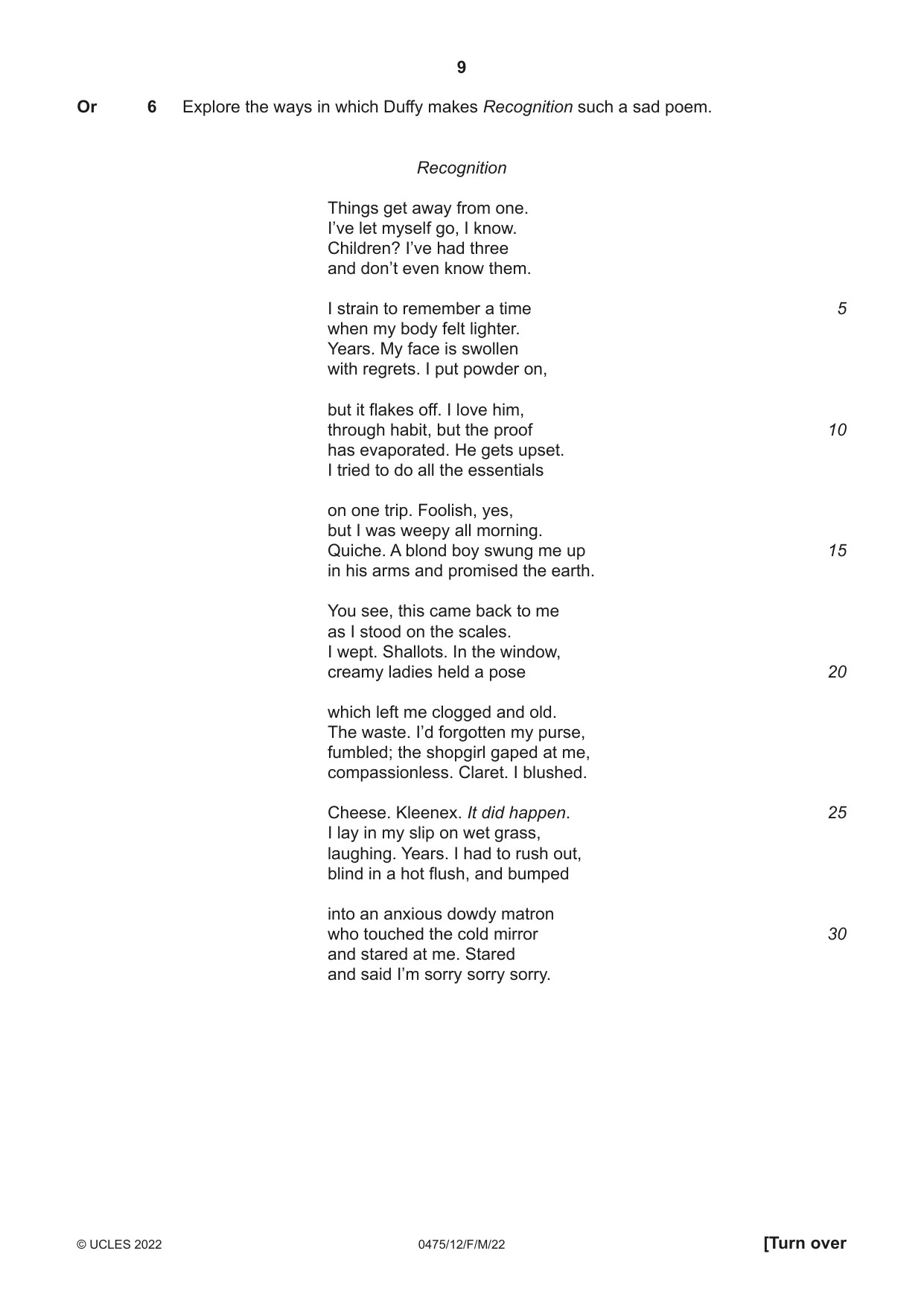
9 0475/12/F/M/22 © UCLES 2022 [Turn over Or 6 Explore the ways in which Duffy makes Recognition such a sad poem. Recognition Things get away from one. I’ve let myself go, I know. Children? I’ve had three and don’t even know them. I strain to remember a time when my body felt lighter. Years. My face is swollen with regrets. I put powder on, but it flakes off. I love him, through habit, but the proof has evaporated. He gets upset. I tried to do all the essentials on one trip. Foolish, yes, but I was weepy all morning. Quiche. A blond boy swung me up in his arms and promised the earth. You see, this came back to me as I stood on the scales. I wept. Shallots. In the window, creamy ladies held a pose which left me clogged and old. The waste. I’d forgotten my purse, fumbled; the shopgirl gaped at me, compassionless. Claret. I blushed. Cheese. Kleenex. It did happen. I lay in my slip on wet grass, laughing. Years. I had to rush out, blind in a hot flush, and bumped into an anxious dowdy matron who touched the cold mirror and stared at me. Stared and said I’m sorry sorry sorry. 5 10 15 20 25 30
Question paper, page 10
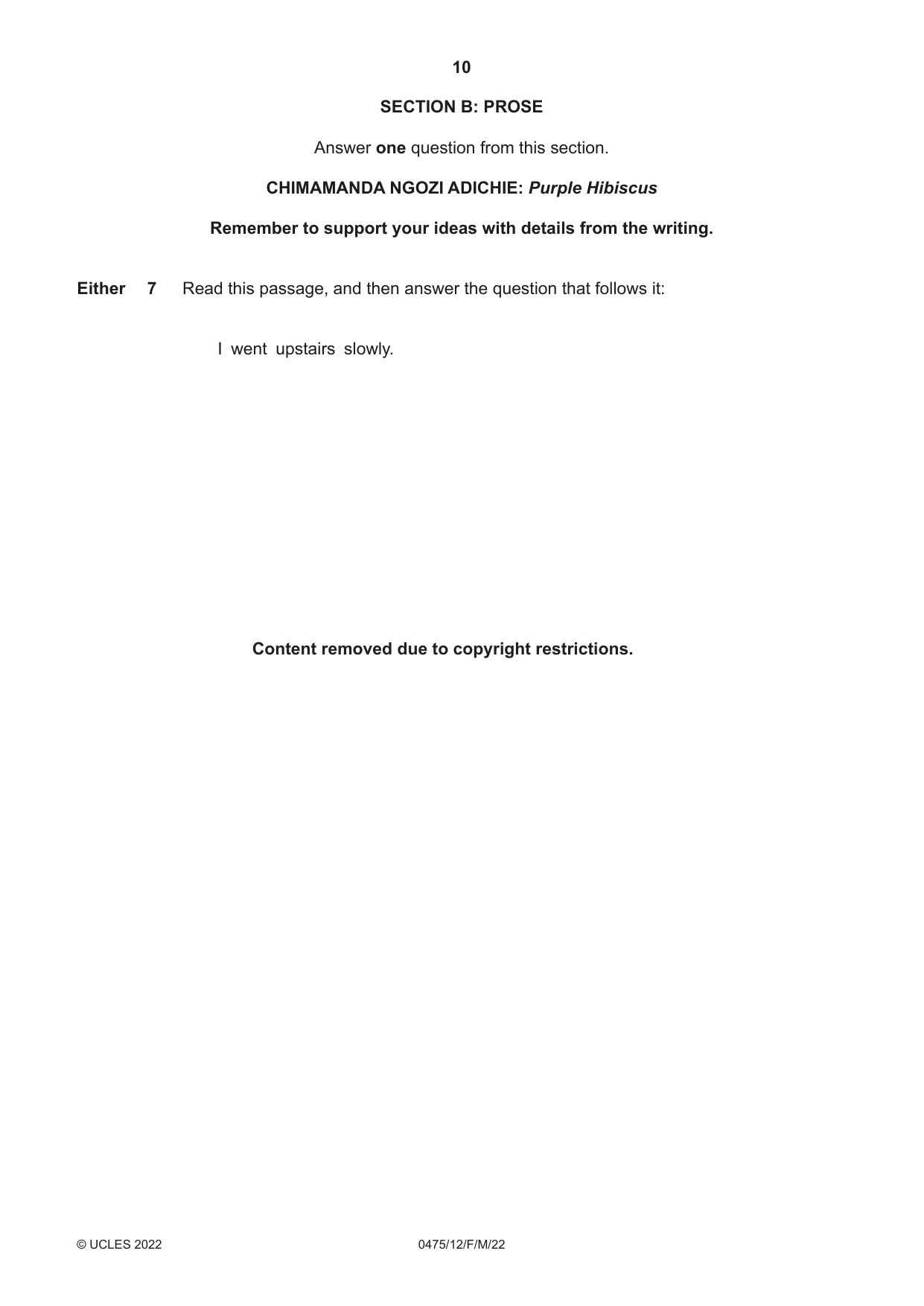
10 0475/12/F/M/22 © UCLES 2022 SECTION B: PROSE Answer one question from this section. CHIMAMANDA NGOZI ADICHIE: Purple Hibiscus Remember to support your ideas with details from the writing. Either 7 Read this passage, and then answer the question that follows it: I went upstairs slowly. Content removed due to copyright restrictions.
Question paper, page 11
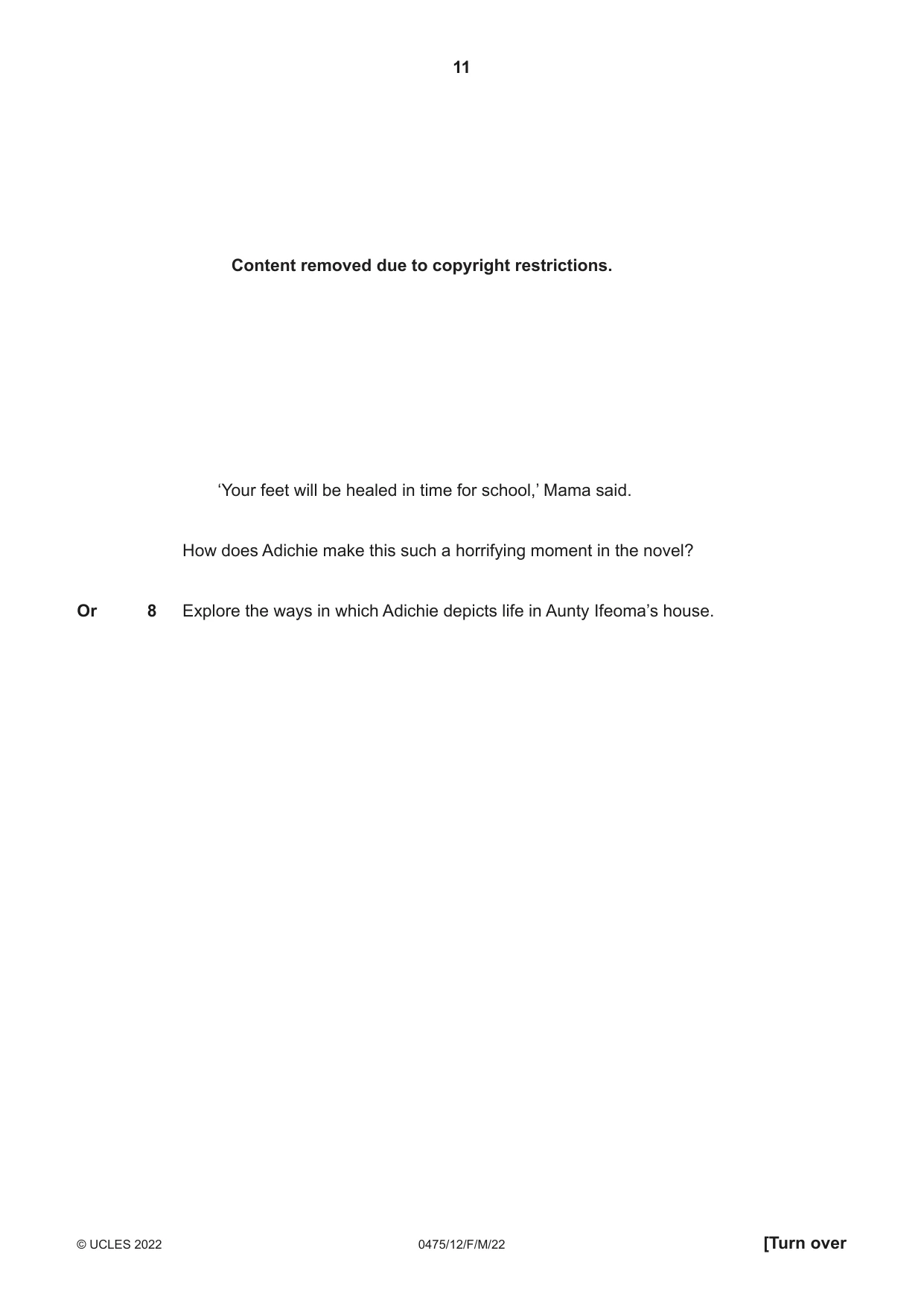
11 0475/12/F/M/22 © UCLES 2022 [Turn over ‘Your feet will be healed in time for school,’ Mama said. How does Adichie make this such a horrifying moment in the novel? Or 8 Explore the ways in which Adichie depicts life in Aunty Ifeoma’s house. Content removed due to copyright restrictions.
Question paper, page 12
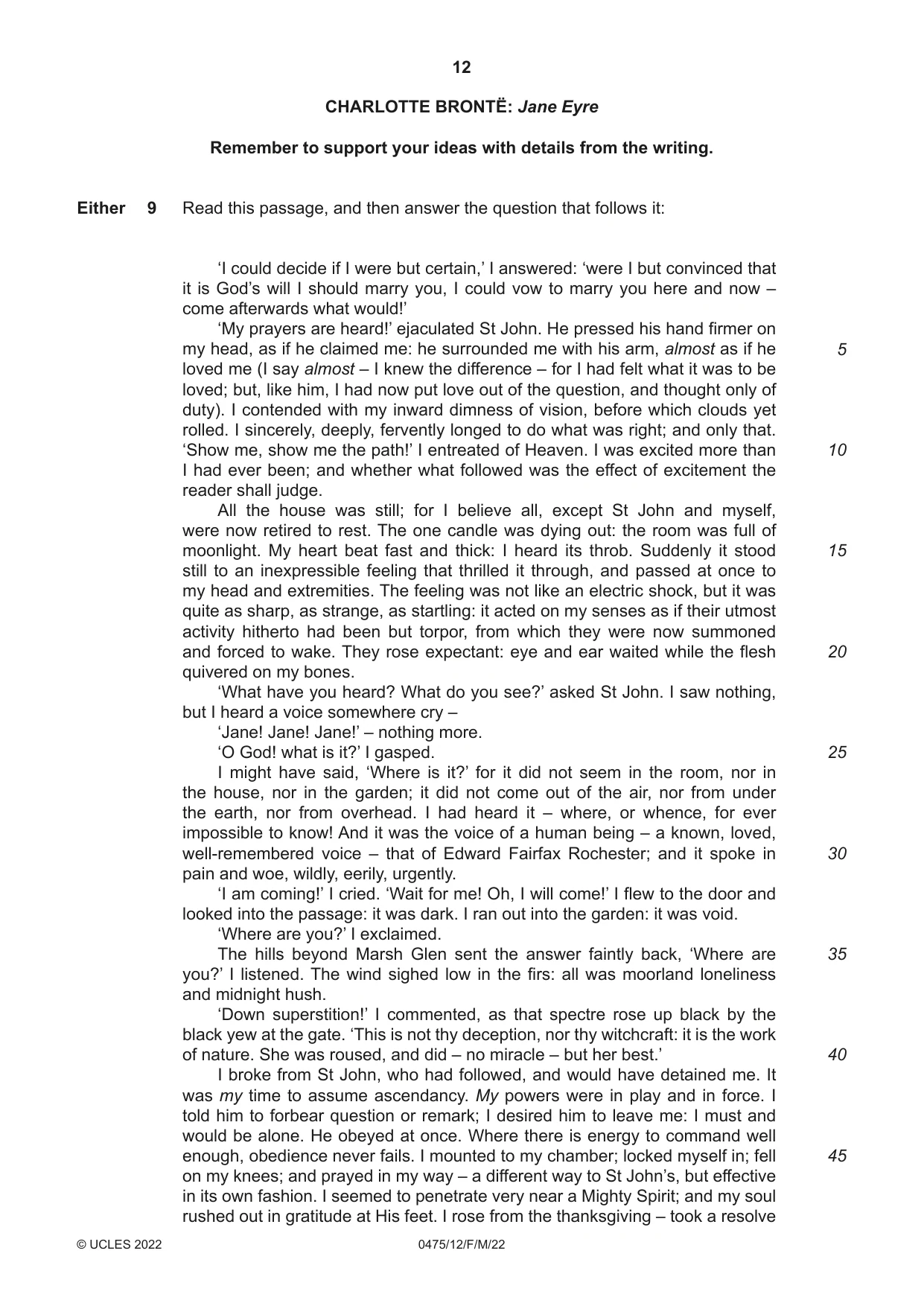
12 0475/12/F/M/22 © UCLES 2022 CHARLOTTE BRONTË: Jane Eyre Remember to support your ideas with details from the writing. Either 9 Read this passage, and then answer the question that follows it: ‘I could decide if I were but certain,’ I answered: ‘were I but convinced that it is God’s will I should marry you, I could vow to marry you here and now – come afterwards what would!’ ‘My prayers are heard!’ ejaculated St John. He pressed his hand firmer on my head, as if he claimed me: he surrounded me with his arm, almost as if he loved me (I say almost – I knew the difference – for I had felt what it was to be loved; but, like him, I had now put love out of the question, and thought only of duty). I contended with my inward dimness of vision, before which clouds yet rolled. I sincerely, deeply, fervently longed to do what was right; and only that. ‘Show me, show me the path!’ I entreated of Heaven. I was excited more than I had ever been; and whether what followed was the effect of excitement the reader shall judge. All the house was still; for I believe all, except St John and myself, were now retired to rest. The one candle was dying out: the room was full of moonlight. My heart beat fast and thick: I heard its throb. Suddenly it stood still to an inexpressible feeling that thrilled it through, and passed at once to my head and extremities. The feeling was not like an electric shock, but it was quite as sharp, as strange, as startling: it acted on my senses as if their utmost activity hitherto had been but torpor, from which they were now summoned and forced to wake. They rose expectant: eye and ear waited while the flesh quivered on my bones. ‘What have you heard? What do you see?’ asked St John. I saw nothing, but I heard a voice somewhere cry – ‘Jane! Jane! Jane!’ – nothing more. ‘O God! what is it?’ I gasped. I might have said, ‘Where is it?’ for it did not seem in the room, nor in the house, nor in the garden; it did not come out of the air, nor from under the earth, nor from overhead. I had heard it – where, or whence, for ever impossible to know! And it was the voice of a human being – a known, loved, well-remembered voice – that of Edward Fairfax Rochester; and it spoke in pain and woe, wildly, eerily, urgently. ‘I am coming!’ I cried. ‘Wait for me! Oh, I will come!’ I flew to the door and looked into the passage: it was dark. I ran out into the garden: it was void. ‘Where are you?’ I exclaimed. The hills beyond Marsh Glen sent the answer faintly back, ‘Where are you?’ I listened. The wind sighed low in the firs: all was moorland loneliness and midnight hush. ‘Down superstition!’ I commented, as that spectre rose up black by the black yew at the gate. ‘This is not thy deception, nor thy witchcraft: it is the work of nature. She was roused, and did – no miracle – but her best.’ I broke from St John, who had followed, and would have detained me. It was my time to assume ascendancy. My powers were in play and in force. I told him to forbear question or remark; I desired him to leave me: I must and would be alone. He obeyed at once. Where there is energy to command well enough, obedience never fails. I mounted to my chamber; locked myself in; fell on my knees; and prayed in my way – a different way to St John’s, but effective in its own fashion. I seemed to penetrate very near a Mighty Spirit; and my soul rushed out in gratitude at His feet. I rose from the thanksgiving – took a resolve 5 10 15 20 25 30 35 40 45
Question paper, page 13
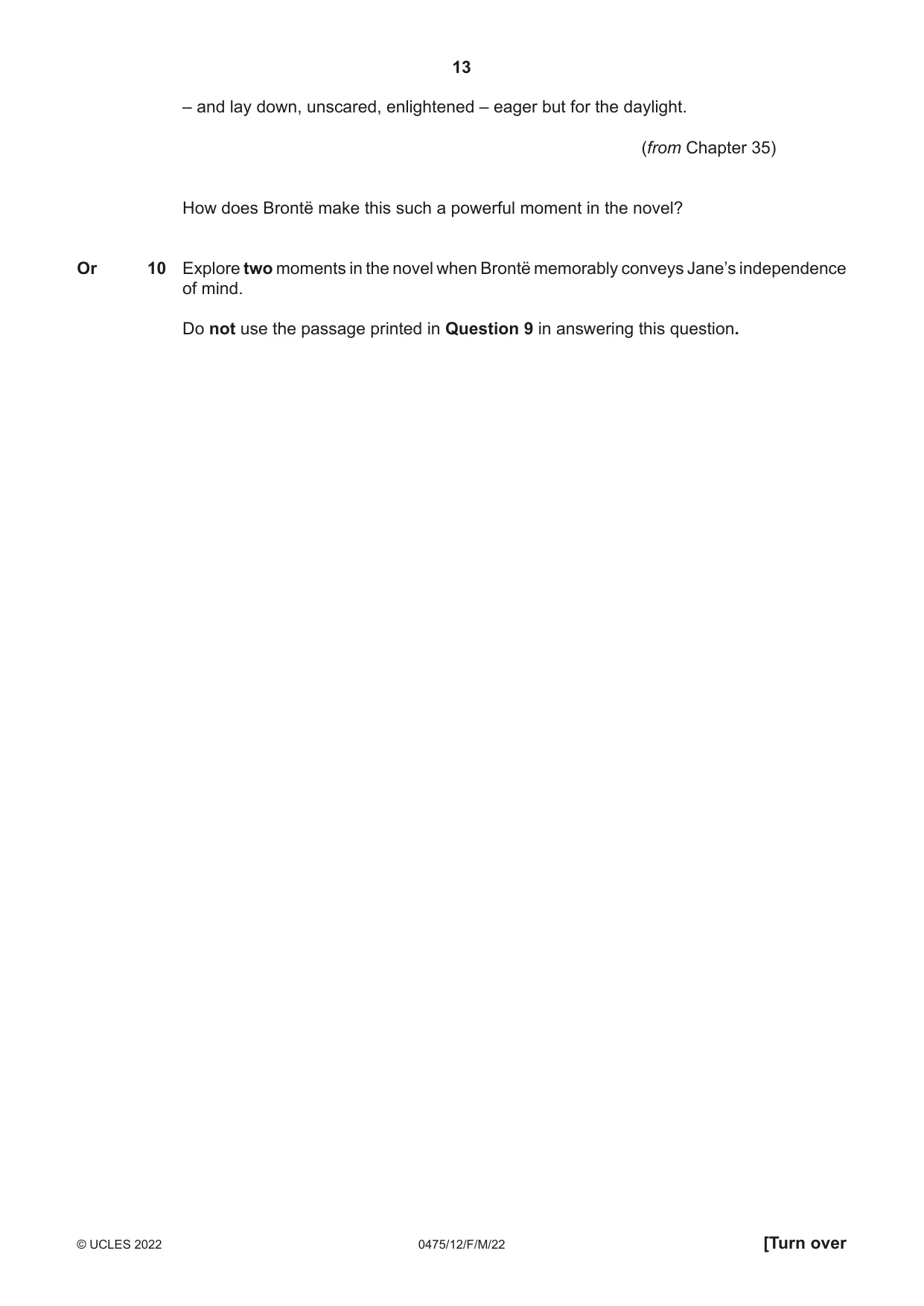
13 0475/12/F/M/22 © UCLES 2022 [Turn over – and lay down, unscared, enlightened – eager but for the daylight. (from Chapter 35) How does Brontë make this such a powerful moment in the novel? Or 10 Explore two moments in the novel when Brontë memorably conveys Jane’s independence of mind. Do not use the passage printed in Question 9 in answering this question.
Question paper, page 14
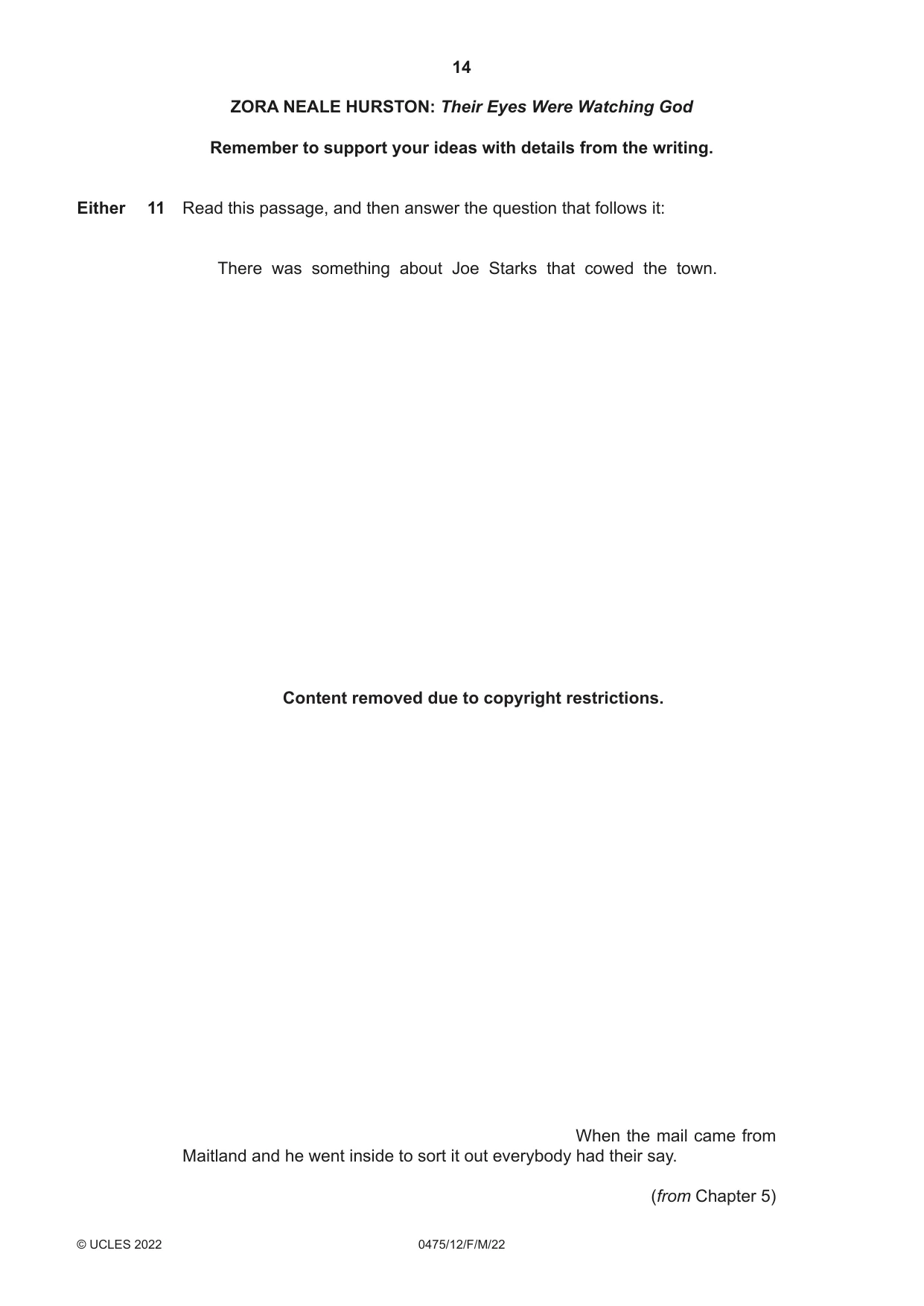
14 0475/12/F/M/22 © UCLES 2022 ZORA NEALE HURSTON: Their Eyes Were Watching God Remember to support your ideas with details from the writing. Either 11 Read this passage, and then answer the question that follows it: There was something about Joe Starks that cowed the town. When the mail came from Maitland and he went inside to sort it out everybody had their say. (from Chapter 5) Content removed due to copyright restrictions.
Question paper, page 15
15 0475/12/F/M/22 © UCLES 2022 [Turn over How does Hurston strikingly portray Joe Starks at this moment in the novel? Or 12 Explore the ways in which Hurston makes Janie such a memorable character.
Question paper, page 16
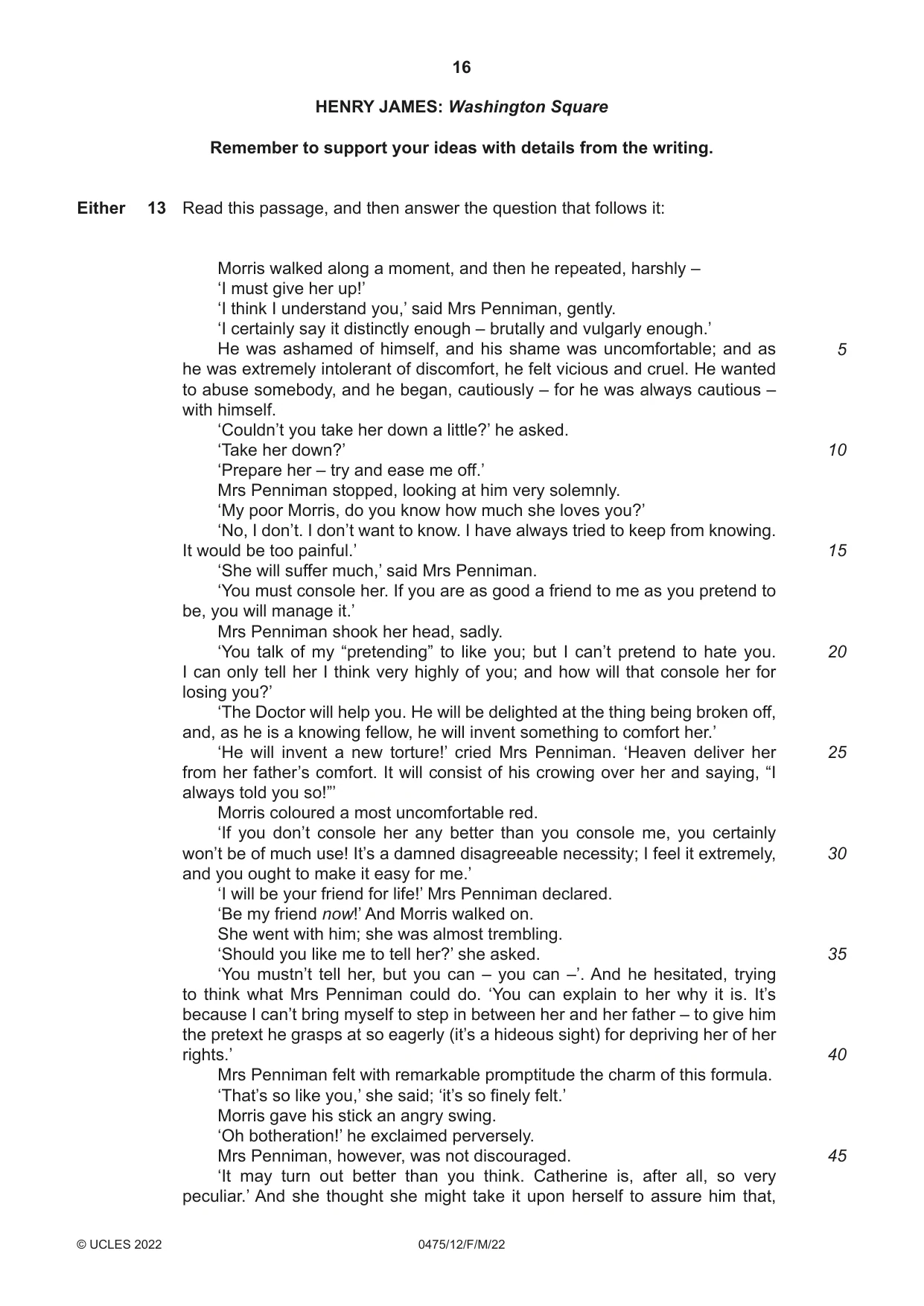
16 0475/12/F/M/22 © UCLES 2022 HENRY JAMES: Washington Square Remember to support your ideas with details from the writing. Either 13 Read this passage, and then answer the question that follows it: Morris walked along a moment, and then he repeated, harshly – ‘I must give her up!’ ‘I think I understand you,’ said Mrs Penniman, gently. ‘I certainly say it distinctly enough – brutally and vulgarly enough.’ He was ashamed of himself, and his shame was uncomfortable; and as he was extremely intolerant of discomfort, he felt vicious and cruel. He wanted to abuse somebody, and he began, cautiously – for he was always cautious – with himself. ‘Couldn’t you take her down a little?’ he asked. ‘Take her down?’ ‘Prepare her – try and ease me off.’ Mrs Penniman stopped, looking at him very solemnly. ‘My poor Morris, do you know how much she loves you?’ ‘No, I don’t. I don’t want to know. I have always tried to keep from knowing. It would be too painful.’ ‘She will suffer much,’ said Mrs Penniman. ‘You must console her. If you are as good a friend to me as you pretend to be, you will manage it.’ Mrs Penniman shook her head, sadly. ‘You talk of my “pretending” to like you; but I can’t pretend to hate you. I can only tell her I think very highly of you; and how will that console her for losing you?’ ‘The Doctor will help you. He will be delighted at the thing being broken off, and, as he is a knowing fellow, he will invent something to comfort her.’ ‘He will invent a new torture!’ cried Mrs Penniman. ‘Heaven deliver her from her father’s comfort. It will consist of his crowing over her and saying, “I always told you so!”’ Morris coloured a most uncomfortable red. ‘If you don’t console her any better than you console me, you certainly won’t be of much use! It’s a damned disagreeable necessity; I feel it extremely, and you ought to make it easy for me.’ ‘I will be your friend for life!’ Mrs Penniman declared. ‘Be my friend now!’ And Morris walked on. She went with him; she was almost trembling. ‘Should you like me to tell her?’ she asked. ‘You mustn’t tell her, but you can – you can –’. And he hesitated, trying to think what Mrs Penniman could do. ‘You can explain to her why it is. It’s because I can’t bring myself to step in between her and her father – to give him the pretext he grasps at so eagerly (it’s a hideous sight) for depriving her of her rights.’ Mrs Penniman felt with remarkable promptitude the charm of this formula. ‘That’s so like you,’ she said; ‘it’s so finely felt.’ Morris gave his stick an angry swing. ‘Oh botheration!’ he exclaimed perversely. Mrs Penniman, however, was not discouraged. ‘It may turn out better than you think. Catherine is, after all, so very peculiar.’ And she thought she might take it upon herself to assure him that, 5 10 15 20 25 30 35 40 45
Question paper, page 17
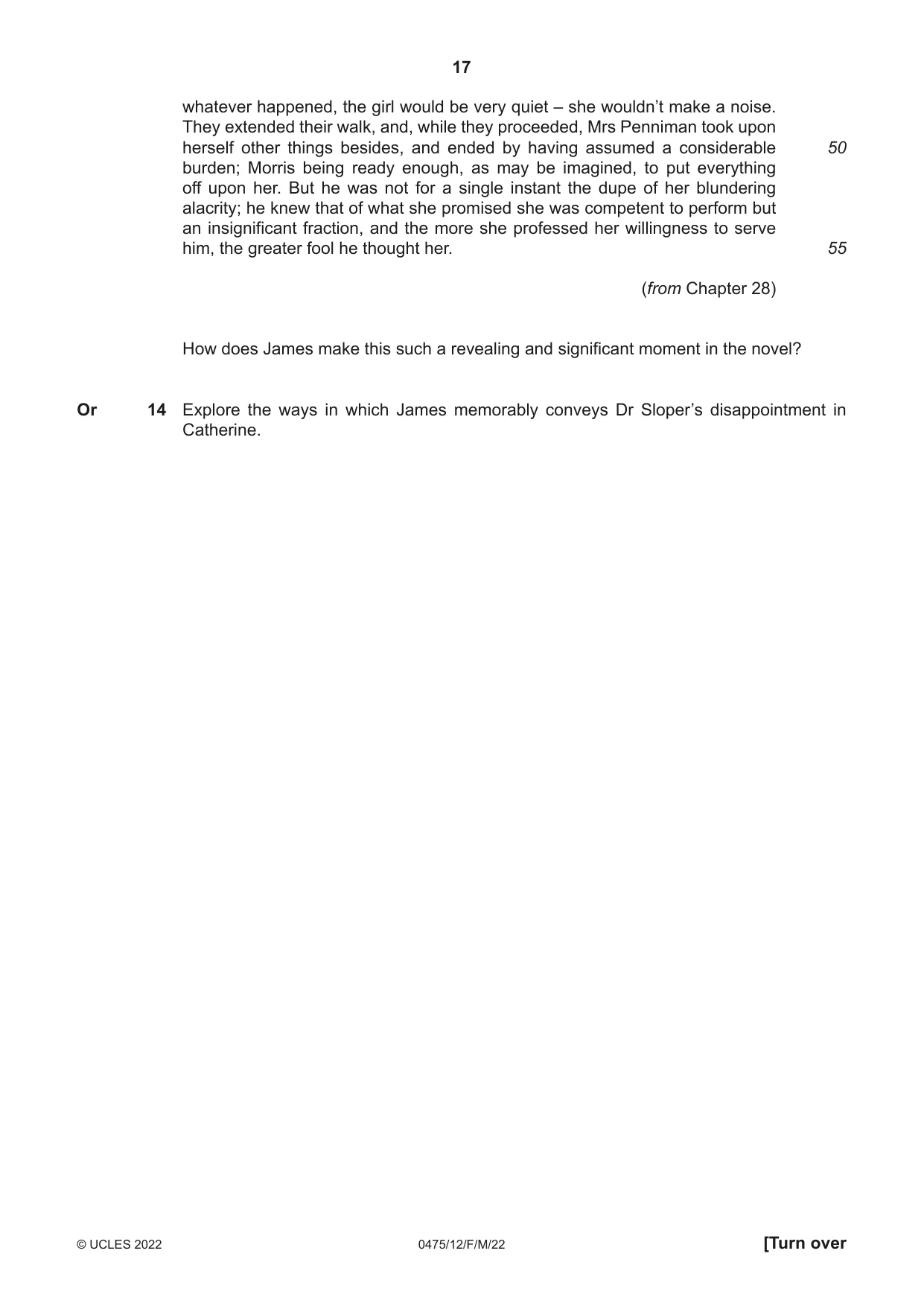
17 0475/12/F/M/22 © UCLES 2022 [Turn over whatever happened, the girl would be very quiet – she wouldn’t make a noise. They extended their walk, and, while they proceeded, Mrs Penniman took upon herself other things besides, and ended by having assumed a considerable burden; Morris being ready enough, as may be imagined, to put everything off upon her. But he was not for a single instant the dupe of her blundering alacrity; he knew that of what she promised she was competent to perform but an insignificant fraction, and the more she professed her willingness to serve him, the greater fool he thought her. (from Chapter 28) How does James make this such a revealing and significant moment in the novel? Or 14 Explore the ways in which James memorably conveys Dr Sloper’s disappointment in Catherine. 50 55
Question paper, page 18
18 0475/12/F/M/22 © UCLES 2022 JHUMPA LAHIRI: The Namesake Remember to support your ideas with details from the writing. Either 15 Read this passage, and then answer the question that follows it: It is here that his twenty-seventh birthday is celebrated, the first birthday in his life that he hasn’t spent with his own parents, either in Calcutta or on Pemberton Road. Content removed due to copyright restrictions.
Question paper, page 19
19 0475/12/F/M/22 © UCLES 2022 [Turn over That here at Maxine’s side, in this cloistered wilderness, he is free. (from Chapter 6) In what ways does Lahiri make this such a memorable and significant moment in the novel? Or 16 Explore how Lahiri vividly conveys different attitudes to marriage in The Namesake. Content removed due to copyright restrictions.
Question paper, page 20
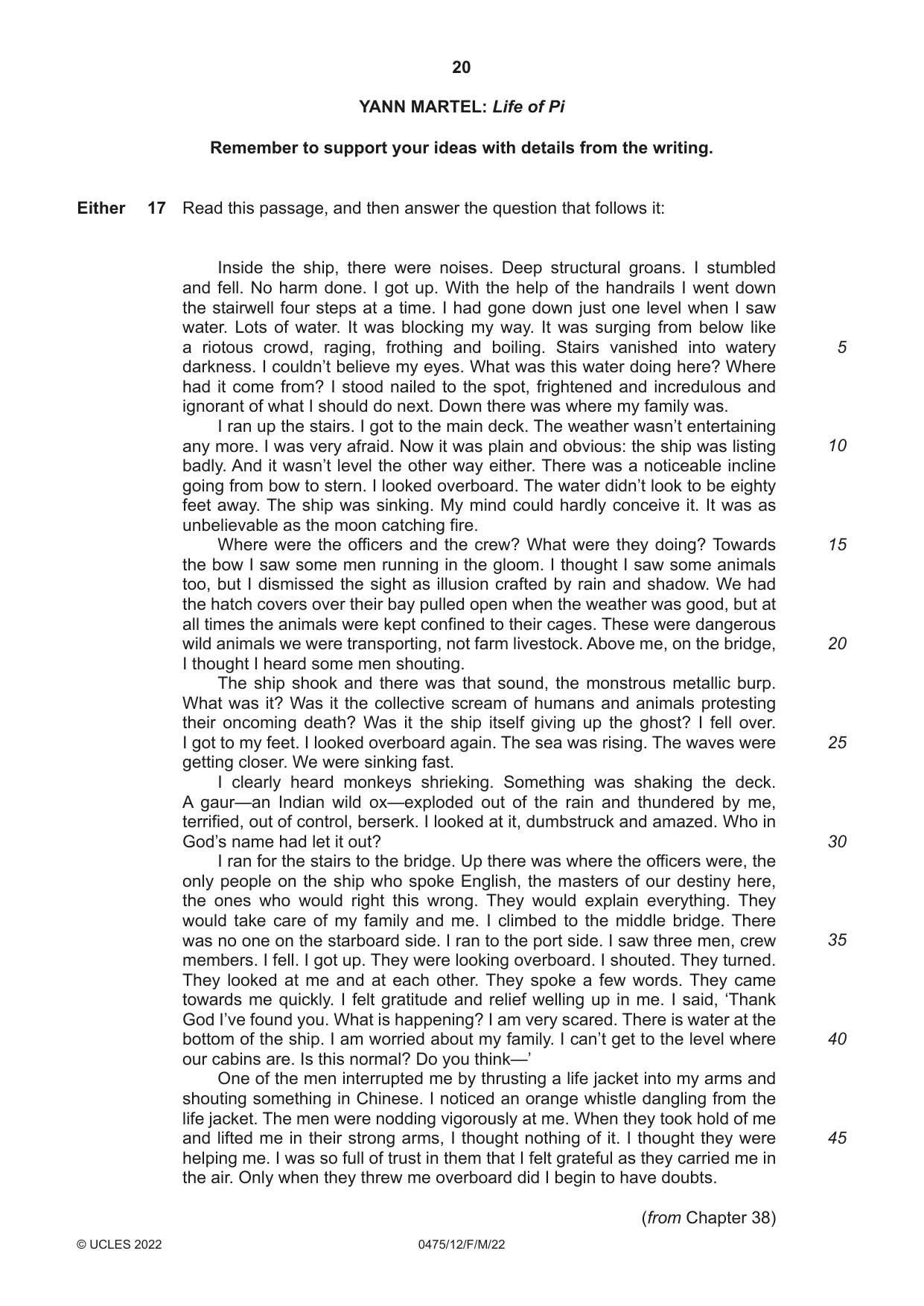
20 0475/12/F/M/22 © UCLES 2022 YANN MARTEL: Life of Pi Remember to support your ideas with details from the writing. Either 17 Read this passage, and then answer the question that follows it: Inside the ship, there were noises. Deep structural groans. I stumbled and fell. No harm done. I got up. With the help of the handrails I went down the stairwell four steps at a time. I had gone down just one level when I saw water. Lots of water. It was blocking my way. It was surging from below like a riotous crowd, raging, frothing and boiling. Stairs vanished into watery darkness. I couldn’t believe my eyes. What was this water doing here? Where had it come from? I stood nailed to the spot, frightened and incredulous and ignorant of what I should do next. Down there was where my family was. I ran up the stairs. I got to the main deck. The weather wasn’t entertaining any more. I was very afraid. Now it was plain and obvious: the ship was listing badly. And it wasn’t level the other way either. There was a noticeable incline going from bow to stern. I looked overboard. The water didn’t look to be eighty feet away. The ship was sinking. My mind could hardly conceive it. It was as unbelievable as the moon catching fire. Where were the officers and the crew? What were they doing? Towards the bow I saw some men running in the gloom. I thought I saw some animals too, but I dismissed the sight as illusion crafted by rain and shadow. We had the hatch covers over their bay pulled open when the weather was good, but at all times the animals were kept confined to their cages. These were dangerous wild animals we were transporting, not farm livestock. Above me, on the bridge, I thought I heard some men shouting. The ship shook and there was that sound, the monstrous metallic burp. What was it? Was it the collective scream of humans and animals protesting their oncoming death? Was it the ship itself giving up the ghost? I fell over. I got to my feet. I looked overboard again. The sea was rising. The waves were getting closer. We were sinking fast. I clearly heard monkeys shrieking. Something was shaking the deck. A gaur—an Indian wild ox—exploded out of the rain and thundered by me, terrified, out of control, berserk. I looked at it, dumbstruck and amazed. Who in God’s name had let it out? I ran for the stairs to the bridge. Up there was where the officers were, the only people on the ship who spoke English, the masters of our destiny here, the ones who would right this wrong. They would explain everything. They would take care of my family and me. I climbed to the middle bridge. There was no one on the starboard side. I ran to the port side. I saw three men, crew members. I fell. I got up. They were looking overboard. I shouted. They turned. They looked at me and at each other. They spoke a few words. They came towards me quickly. I felt gratitude and relief welling up in me. I said, ‘Thank God I’ve found you. What is happening? I am very scared. There is water at the bottom of the ship. I am worried about my family. I can’t get to the level where our cabins are. Is this normal? Do you think—’ One of the men interrupted me by thrusting a life jacket into my arms and shouting something in Chinese. I noticed an orange whistle dangling from the life jacket. The men were nodding vigorously at me. When they took hold of me and lifted me in their strong arms, I thought nothing of it. I thought they were helping me. I was so full of trust in them that I felt grateful as they carried me in the air. Only when they threw me overboard did I begin to have doubts. (from Chapter 38) 5 10 15 20 25 30 35 40 45
Question paper, page 21
21 0475/12/F/M/22 © UCLES 2022 [Turn over How does Martel vividly capture Pi’s panic at this moment in the novel? Or 18 Explore how Martel strikingly depicts Pi’s loneliness during his time at sea.
Question paper, page 22
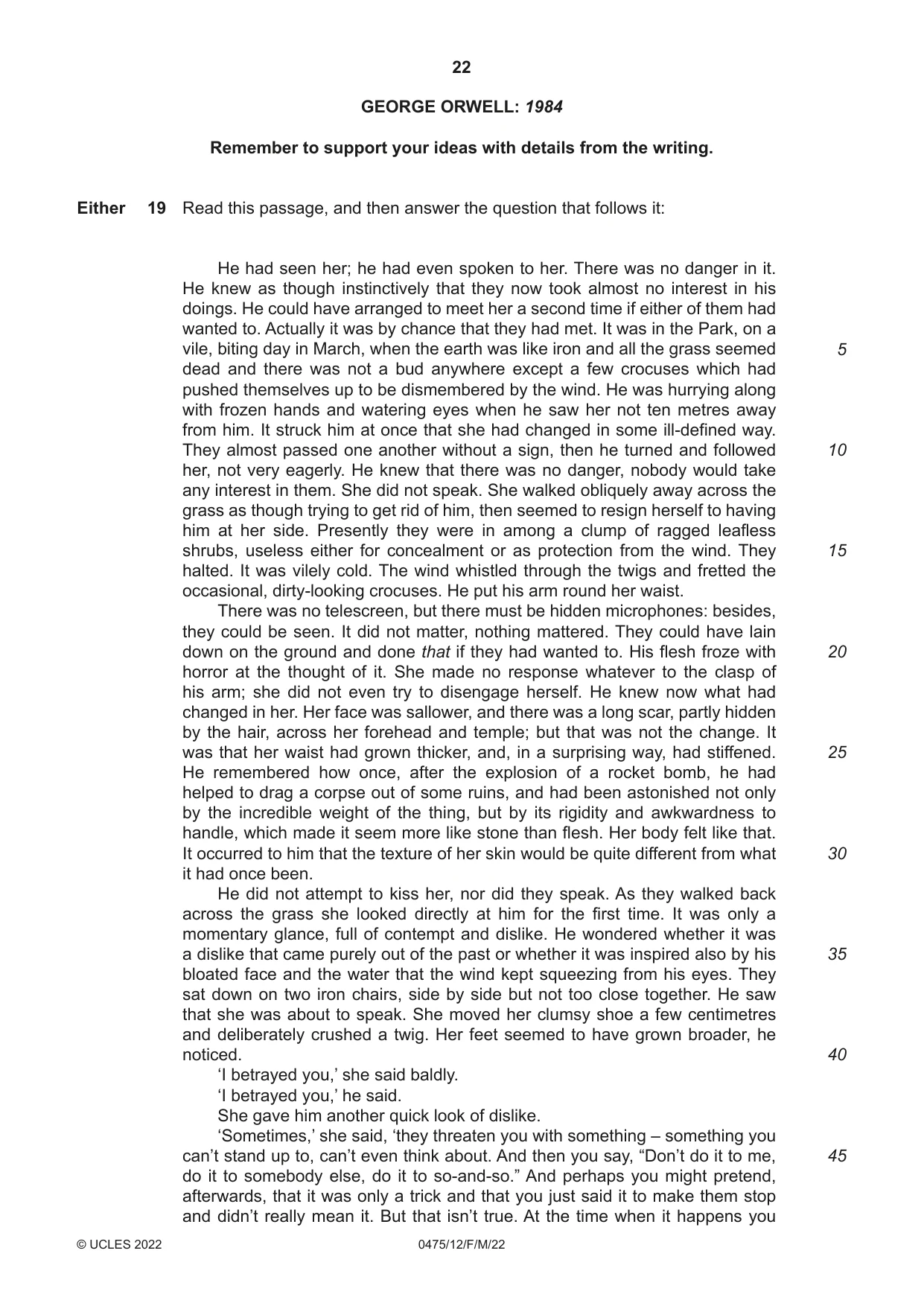
22 0475/12/F/M/22 © UCLES 2022 GEORGE ORWELL: 1984 Remember to support your ideas with details from the writing. Either 19 Read this passage, and then answer the question that follows it: He had seen her; he had even spoken to her. There was no danger in it. He knew as though instinctively that they now took almost no interest in his doings. He could have arranged to meet her a second time if either of them had wanted to. Actually it was by chance that they had met. It was in the Park, on a vile, biting day in March, when the earth was like iron and all the grass seemed dead and there was not a bud anywhere except a few crocuses which had pushed themselves up to be dismembered by the wind. He was hurrying along with frozen hands and watering eyes when he saw her not ten metres away from him. It struck him at once that she had changed in some ill-defined way. They almost passed one another without a sign, then he turned and followed her, not very eagerly. He knew that there was no danger, nobody would take any interest in them. She did not speak. She walked obliquely away across the grass as though trying to get rid of him, then seemed to resign herself to having him at her side. Presently they were in among a clump of ragged leafless shrubs, useless either for concealment or as protection from the wind. They halted. It was vilely cold. The wind whistled through the twigs and fretted the occasional, dirty-looking crocuses. He put his arm round her waist. There was no telescreen, but there must be hidden microphones: besides, they could be seen. It did not matter, nothing mattered. They could have lain down on the ground and done that if they had wanted to. His flesh froze with horror at the thought of it. She made no response whatever to the clasp of his arm; she did not even try to disengage herself. He knew now what had changed in her. Her face was sallower, and there was a long scar, partly hidden by the hair, across her forehead and temple; but that was not the change. It was that her waist had grown thicker, and, in a surprising way, had stiffened. He remembered how once, after the explosion of a rocket bomb, he had helped to drag a corpse out of some ruins, and had been astonished not only by the incredible weight of the thing, but by its rigidity and awkwardness to handle, which made it seem more like stone than flesh. Her body felt like that. It occurred to him that the texture of her skin would be quite different from what it had once been. He did not attempt to kiss her, nor did they speak. As they walked back across the grass she looked directly at him for the first time. It was only a momentary glance, full of contempt and dislike. He wondered whether it was a dislike that came purely out of the past or whether it was inspired also by his bloated face and the water that the wind kept squeezing from his eyes. They sat down on two iron chairs, side by side but not too close together. He saw that she was about to speak. She moved her clumsy shoe a few centimetres and deliberately crushed a twig. Her feet seemed to have grown broader, he noticed. ‘I betrayed you,’ she said baldly. ‘I betrayed you,’ he said. She gave him another quick look of dislike. ‘Sometimes,’ she said, ‘they threaten you with something – something you can’t stand up to, can’t even think about. And then you say, “Don’t do it to me, do it to somebody else, do it to so-and-so.” And perhaps you might pretend, afterwards, that it was only a trick and that you just said it to make them stop and didn’t really mean it. But that isn’t true. At the time when it happens you 5 10 15 20 25 30 35 40 45
Question paper, page 23
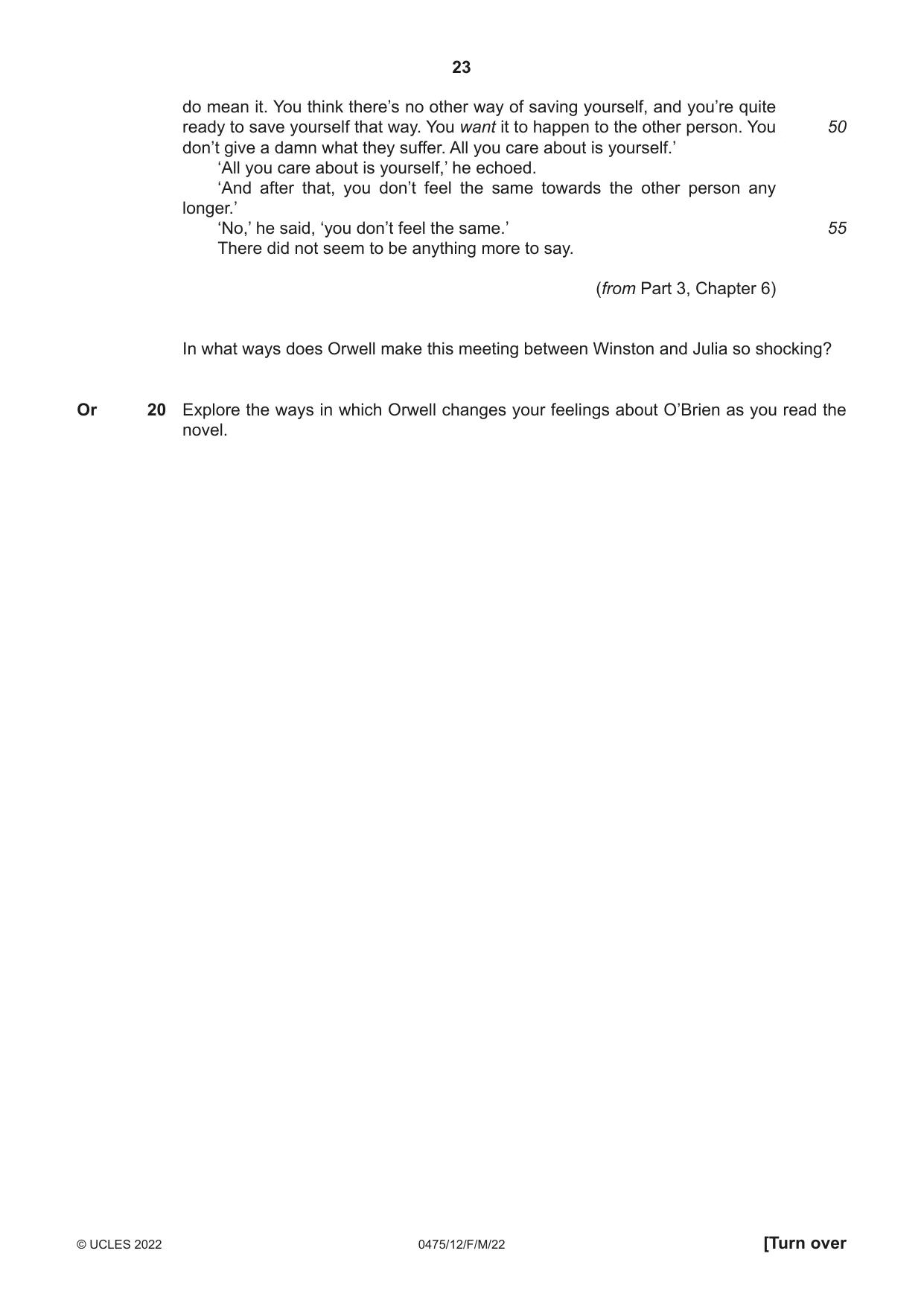
23 0475/12/F/M/22 © UCLES 2022 [Turn over do mean it. You think there’s no other way of saving yourself, and you’re quite ready to save yourself that way. You want it to happen to the other person. You don’t give a damn what they suffer. All you care about is yourself.’ ‘All you care about is yourself,’ he echoed. ‘And after that, you don’t feel the same towards the other person any longer.’ ‘No,’ he said, ‘you don’t feel the same.’ There did not seem to be anything more to say. (from Part 3, Chapter 6) In what ways does Orwell make this meeting between Winston and Julia so shocking? Or 20 Explore the ways in which Orwell changes your feelings about O’Brien as you read the novel. 50 55
Question paper, page 24
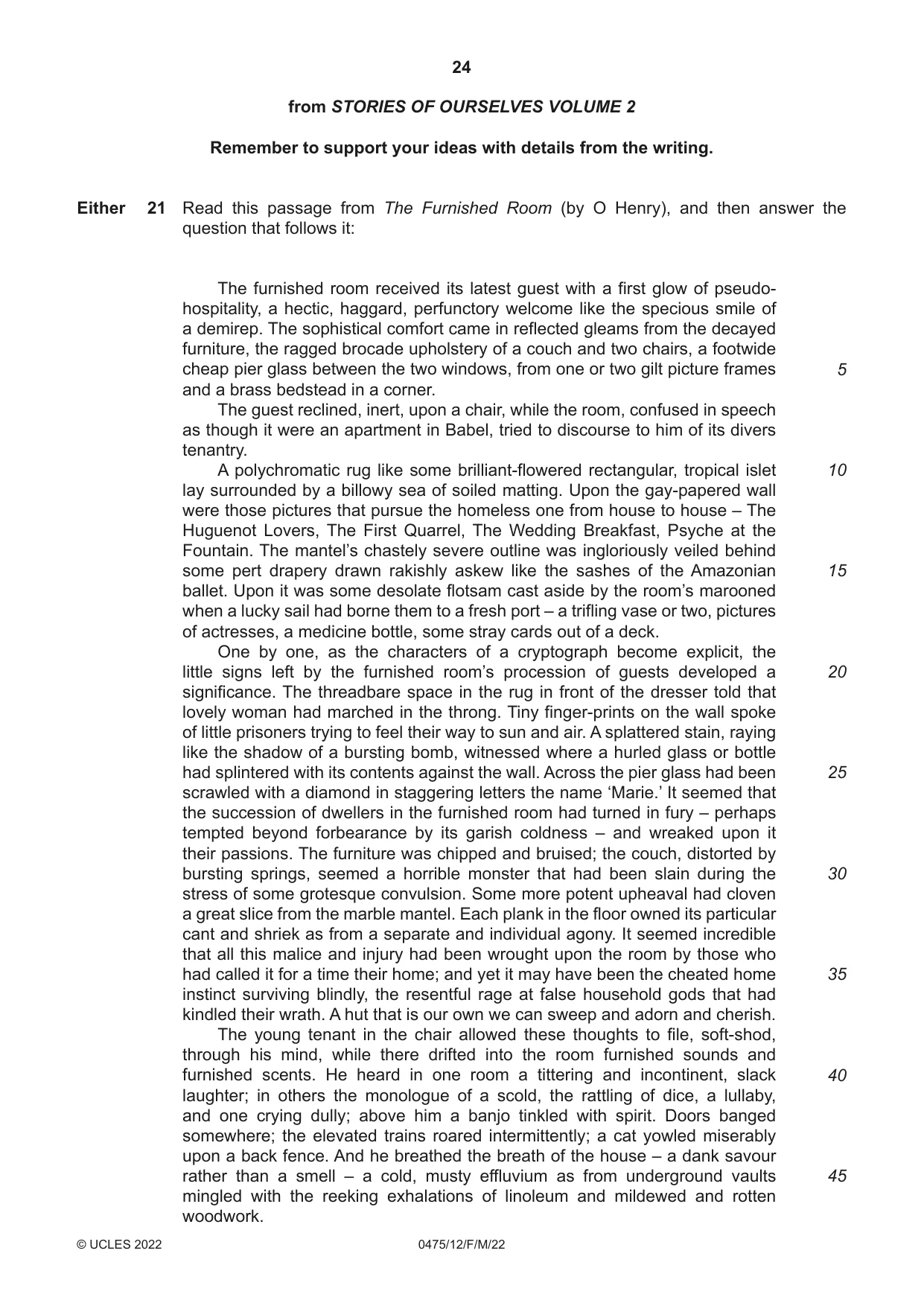
24 0475/12/F/M/22 © UCLES 2022 from STORIES OF OURSELVES VOLUME 2 Remember to support your ideas with details from the writing. Either 21 Read this passage from The Furnished Room (by O Henry), and then answer the question that follows it: The furnished room received its latest guest with a first glow of pseudo- hospitality, a hectic, haggard, perfunctory welcome like the specious smile of a demirep. The sophistical comfort came in reflected gleams from the decayed furniture, the ragged brocade upholstery of a couch and two chairs, a footwide cheap pier glass between the two windows, from one or two gilt picture frames and a brass bedstead in a corner. The guest reclined, inert, upon a chair, while the room, confused in speech as though it were an apartment in Babel, tried to discourse to him of its divers tenantry. A polychromatic rug like some brilliant-flowered rectangular, tropical islet lay surrounded by a billowy sea of soiled matting. Upon the gay-papered wall were those pictures that pursue the homeless one from house to house – The Huguenot Lovers, The First Quarrel, The Wedding Breakfast, Psyche at the Fountain. The mantel’s chastely severe outline was ingloriously veiled behind some pert drapery drawn rakishly askew like the sashes of the Amazonian ballet. Upon it was some desolate flotsam cast aside by the room’s marooned when a lucky sail had borne them to a fresh port – a trifling vase or two, pictures of actresses, a medicine bottle, some stray cards out of a deck. One by one, as the characters of a cryptograph become explicit, the little signs left by the furnished room’s procession of guests developed a significance. The threadbare space in the rug in front of the dresser told that lovely woman had marched in the throng. Tiny finger-prints on the wall spoke of little prisoners trying to feel their way to sun and air. A splattered stain, raying like the shadow of a bursting bomb, witnessed where a hurled glass or bottle had splintered with its contents against the wall. Across the pier glass had been scrawled with a diamond in staggering letters the name ‘Marie.’ It seemed that the succession of dwellers in the furnished room had turned in fury – perhaps tempted beyond forbearance by its garish coldness – and wreaked upon it their passions. The furniture was chipped and bruised; the couch, distorted by bursting springs, seemed a horrible monster that had been slain during the stress of some grotesque convulsion. Some more potent upheaval had cloven a great slice from the marble mantel. Each plank in the floor owned its particular cant and shriek as from a separate and individual agony. It seemed incredible that all this malice and injury had been wrought upon the room by those who had called it for a time their home; and yet it may have been the cheated home instinct surviving blindly, the resentful rage at false household gods that had kindled their wrath. A hut that is our own we can sweep and adorn and cherish. The young tenant in the chair allowed these thoughts to file, soft-shod, through his mind, while there drifted into the room furnished sounds and furnished scents. He heard in one room a tittering and incontinent, slack laughter; in others the monologue of a scold, the rattling of dice, a lullaby, and one crying dully; above him a banjo tinkled with spirit. Doors banged somewhere; the elevated trains roared intermittently; a cat yowled miserably upon a back fence. And he breathed the breath of the house – a dank savour rather than a smell – a cold, musty effluvium as from underground vaults mingled with the reeking exhalations of linoleum and mildewed and rotten woodwork. 5 10 15 20 25 30 35 40 45
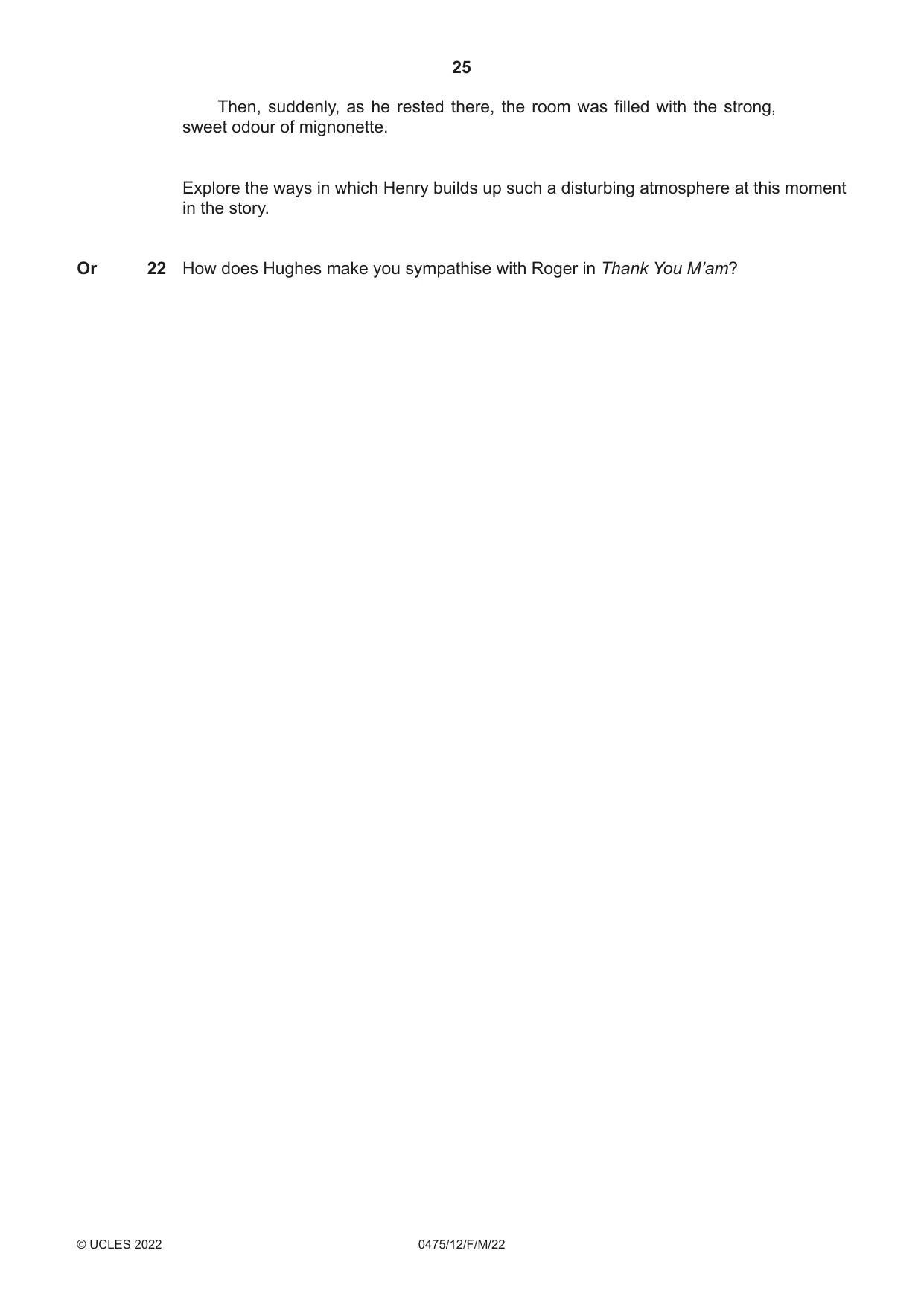
Question paper, page 25
25 0475/12/F/M/22 © UCLES 2022 Then, suddenly, as he rested there, the room was filled with the strong, sweet odour of mignonette. Explore the ways in which Henry builds up such a disturbing atmosphere at this moment in the story. Or 22 How does Hughes make you sympathise with Roger in Thank You M’am?
Question paper, page 26
26 0475/12/F/M/22 © UCLES 2022 BLANK PAGE
Question paper, page 27
27 0475/12/F/M/22 © UCLES 2022 BLANK PAGE
Question paper, page 28
28 0475/12/F/M/22 © UCLES 2022 Permission to reproduce items where third-party owned material protected by copyright is included has been sought and cleared where possible. Every reasonable effort has been made by the publisher (UCLES) to trace copyright holders, but if any items requiring clearance have unwittingly been included, the publisher will be pleased to make amends at the earliest possible opportunity. To avoid the issue of disclosure of answer-related information to candidates, all copyright acknowledgements are reproduced online in the Cambridge Assessment International Education Copyright Acknowledgements Booklet. This is produced for each series of examinations and is freely available to download at www.cambridgeinternational.org after the live examination series. Cambridge Assessment International Education is part of Cambridge Assessment. Cambridge Assessment is the brand name of the University of Cambridge Local Examinations Syndicate (UCLES), which is a department of the University of Cambridge. BLANK PAGE
Mark scheme, page 1
This document consists of 5 printed pages. © UCLES 2022 [Turn over Cambridge IGCSE™ LITERATURE IN ENGLISH 0475/12 Paper 1 Poetry and Prose February/March 2022 MARK SCHEME Maximum Mark: 50 Published This mark scheme is published as an aid to teachers and candidates, to indicate the requirements of the examination. It shows the basis on which Examiners were instructed to award marks. It does not indicate the details of the discussions that took place at an Examiners’ meeting before marking began, which would have considered the acceptability of alternative answers. Mark schemes should be read in conjunction with the question paper and the Principal Examiner Report for Teachers. Cambridge International will not enter into discussions about these mark schemes. Cambridge International is publishing the mark schemes for the February/March 2022 series for most Cambridge IGCSE™, Cambridge International A and AS Level components and some Cambridge O Level components.
Mark scheme, page 2
0475/12 Cambridge IGCSE – Mark Scheme PUBLISHED February/March 2022 © UCLES 2022 Page 2 of 5 Generic Marking Principles These general marking principles must be applied by all examiners when marking candidate answers. They should be applied alongside the specific content of the mark scheme or generic level descriptors for a question. Each question paper and mark scheme will also comply with these marking principles. GENERIC MARKING PRINCIPLE 1: Marks must be awarded in line with: • the specific content of the mark scheme or the generic level descriptors for the question • the specific skills defined in the mark scheme or in the generic level descriptors for the question • the standard of response required by a candidate as exemplified by the standardisation scripts. GENERIC MARKING PRINCIPLE 2: Marks awarded are always whole marks (not half marks, or other fractions). GENERIC MARKING PRINCIPLE 3: Marks must be awarded positively: • marks are awarded for correct/valid answers, as defined in the mark scheme. However, credit is given for valid answers which go beyond the scope of the syllabus and mark scheme, referring to your Team Leader as appropriate • marks are awarded when candidates clearly demonstrate what they know and can do • marks are not deducted for errors • marks are not deducted for omissions • answers should only be judged on the quality of spelling, punctuation and grammar when these features are specifically assessed by the question as indicated by the mark scheme. The meaning, however, should be unambiguous. GENERIC MARKING PRINCIPLE 4: Rules must be applied consistently, e.g. in situations where candidates have not followed instructions or in the application of generic level descriptors. GENERIC MARKING PRINCIPLE 5: Marks should be awarded using the full range of marks defined in the mark scheme for the question (however; the use of the full mark range may be limited according to the quality of the candidate responses seen). GENERIC MARKING PRINCIPLE 6: Marks awarded are based solely on the requirements as defined in the mark scheme. Marks should not be awarded with grade thresholds or grade descriptors in mind.
Mark scheme, page 3
0475/12 Cambridge IGCSE – Mark Scheme PUBLISHED February/March 2022 © UCLES 2022 Page 3 of 5 English & Media subject specific general marking principles (To be read in conjunction with the Generic Marking Principles (and requiring further guidance on how to place marks within levels)) Components using level descriptors: • We use level descriptors as a guide to broad understanding of the qualities normally expected of, or typical of, work in a level. • Level descriptors are a means of general guidance, and should not be interpreted as hurdle statements. • Where indicative content notes are supplied for a question, these are not a prescription of required content, and must not be treated as such. Alternative correct points and unexpected answers in candidates’ scripts must be given marks that fairly reflect the knowledge and skills demonstrated. • While we may have legitimate expectations as to the ground most answers may occupy, we must at all times be prepared to meet candidates on their chosen ground, provided it is relevant ground (e.g. clearly related to and derived from a relevant passage/text and meeting the mark scheme requirements for the question). Components using point-based marking: Point marking is often used to reward knowledge, understanding and application of skills. We give credit where the candidate’s answer shows relevant knowledge, understanding and application of skills in answering the question. We do not give credit where the answer shows confusion. From this it follows that we: a DO credit answers which are worded differently from the mark scheme if they clearly convey the same meaning (unless the mark scheme requires a specific term). b DO credit alternative answers/examples which are not written in the mark scheme if they are correct. c DO credit answers where candidates give more than one correct answer in one prompt/numbered/scaffolded space where extended writing is required rather than list-type answers. For example, questions that require n reasons (e.g. State two reasons…). d DO NOT credit answers simply for using a ‘key term’ unless that is all that is required. (Check for evidence it is understood and not used wrongly.). e DO NOT credit answers which are obviously self-contradicting or trying to cover all possibilities. f DO NOT give further credit for what is effectively repetition of a correct point already credited unless the language itself is being tested. This applies equally to ‘mirror statements’ (i.e. polluted/not polluted). g DO NOT require spellings to be correct, unless this is part of the test. However spellings of syllabus terms must allow for clear and unambiguous separation from other syllabus terms with which they may be confused (e.g. Corrasion/Corrosion).
Mark scheme, page 4
0475/12 Cambridge IGCSE – Mark Scheme PUBLISHED February/March 2022 © UCLES 2022 Page 4 of 5 All questions are marked out of 25. Assessment Objectives The Assessment Objectives are evenly weighted across each question. The assessment objectives for the paper are: • AO1 show detailed knowledge of the content of literary texts, supported by reference to the text • AO2 understand the meanings of literary texts and their context, and explore texts beyond surface meaning to show deeper awareness of ideas and attitudes • AO3 recognise and appreciate ways in which writers use language, structure, and form to create and shape meanings and effects • AO4 communicate a sensitive and informed personal response The Level Descriptors cover marks from 0 to 25 and apply to the marking of each question. They guide examiners to an understanding of the qualities normally expected of, or typical of, work in a level. They are a means of general guidance and must not be interpreted as hurdle statements. For the purposes of standardisation of marking, they are to be used in conjunction with the Practice and Standardisation scripts discussed during the coordination meeting and with Team Leaders, as well as the question-specific notes. The supplementary notes for each question are related to the assessment objectives above. Because of the nature of the subject, they are for general guidance; they are not designed as prescriptions of required content and must not be treated as such. The syllabus aims at encouraging candidates to make some personal response to their reading. Whilst there are legitimate expectations of the content of most answers, examiners will see responses that include ideas not covered in the supplementary guidance. For these cases, examiners should credit valid responses fairly and not penalise candidates for including valid points outside the mark scheme. Do not refer to indicative content notes on scripts. Applying the level descriptors You should read and annotate a response, and then make a judgement about which level statement is the best fit. Use the following guidance to arrive holistically at a specific mark out of 25: • if the work convincingly meets the level statement, award the highest mark in the level • if the work adequately meets the level statement, award the mark in the middle of the level • if the work just meets the level statement, award the lowest mark in the level. Where work does not match one level statement precisely, a judgement may need to be made across two or more levels. Marks should not be awarded with previous grade thresholds in mind, nor should level descriptors be confused with grades (either A*–G or 9–1).
Mark scheme, page 5
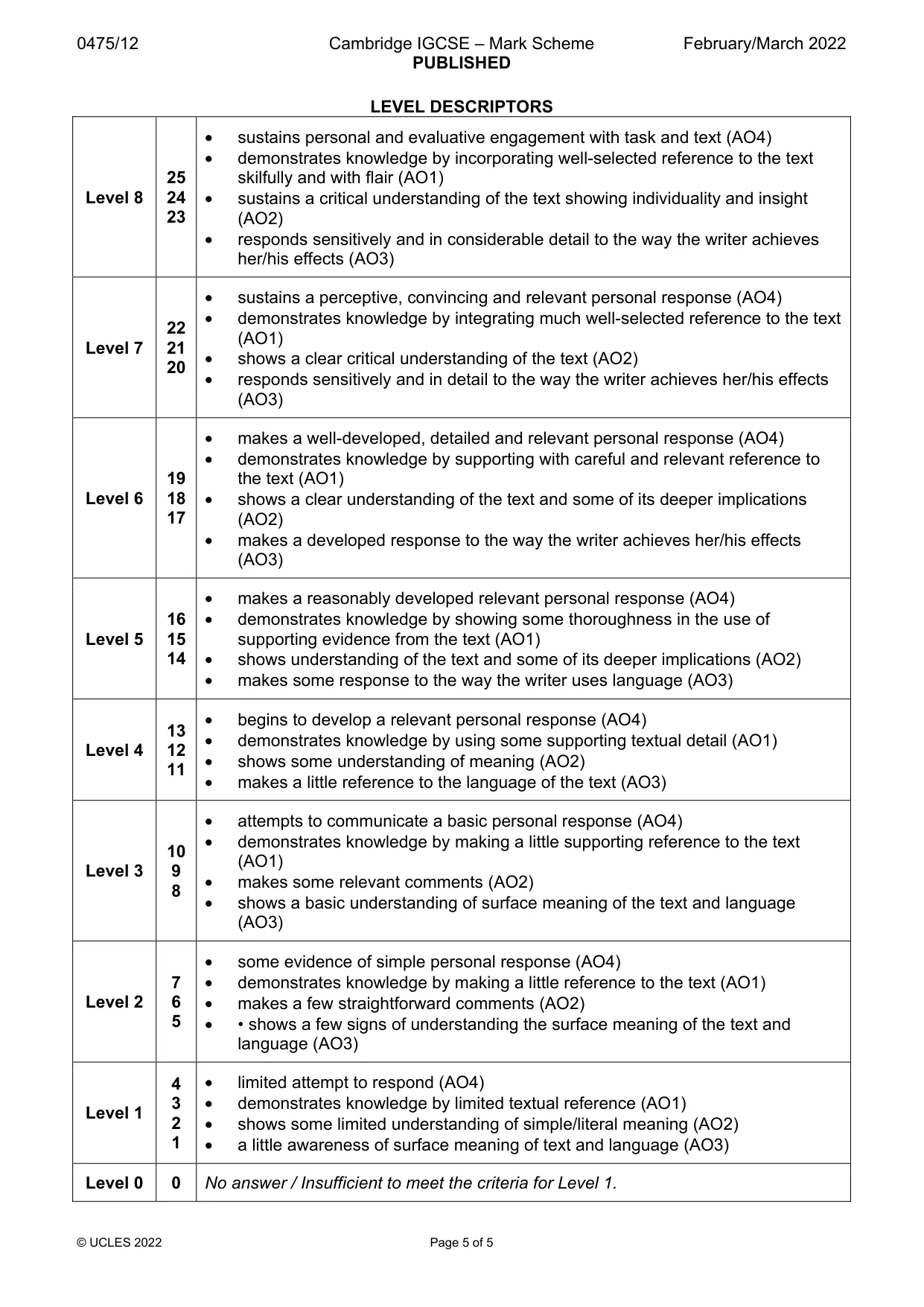
0475/12 Cambridge IGCSE – Mark Scheme PUBLISHED February/March 2022 © UCLES 2022 Page 5 of 5 LEVEL DESCRIPTORS Level 8 25 24 23 • sustains personal and evaluative engagement with task and text (AO4) • demonstrates knowledge by incorporating well-selected reference to the text skilfully and with flair (AO1) • sustains a critical understanding of the text showing individuality and insight (AO2) • responds sensitively and in considerable detail to the way the writer achieves her/his effects (AO3) Level 7 22 21 20 • sustains a perceptive, convincing and relevant personal response (AO4) • demonstrates knowledge by integrating much well-selected reference to the text (AO1) • shows a clear critical understanding of the text (AO2) • responds sensitively and in detail to the way the writer achieves her/his effects (AO3) Level 6 19 18 17 • makes a well-developed, detailed and relevant personal response (AO4) • demonstrates knowledge by supporting with careful and relevant reference to the text (AO1) • shows a clear understanding of the text and some of its deeper implications (AO2) • makes a developed response to the way the writer achieves her/his effects (AO3) Level 5 16 15 14 • makes a reasonably developed relevant personal response (AO4) • demonstrates knowledge by showing some thoroughness in the use of supporting evidence from the text (AO1) • shows understanding of the text and some of its deeper implications (AO2) • makes some response to the way the writer uses language (AO3) Level 4 13 12 11 • begins to develop a relevant personal response (AO4) • demonstrates knowledge by using some supporting textual detail (AO1) • shows some understanding of meaning (AO2) • makes a little reference to the language of the text (AO3) Level 3 10 9 8 • attempts to communicate a basic personal response (AO4) • demonstrates knowledge by making a little supporting reference to the text (AO1) • makes some relevant comments (AO2) • shows a basic understanding of surface meaning of the text and language (AO3) Level 2 7 6 5 • some evidence of simple personal response (AO4) • demonstrates knowledge by making a little reference to the text (AO1) • makes a few straightforward comments (AO2) • • shows a few signs of understanding the surface meaning of the text and language (AO3) Level 1 4 3 2 1 • limited attempt to respond (AO4) • demonstrates knowledge by limited textual reference (AO1) • shows some limited understanding of simple/literal meaning (AO2) • a little awareness of surface meaning of text and language (AO3) Level 0 0 No answer / Insufficient to meet the criteria for Level 1.
What you needed in this session
Cambridge’s own grade thresholds for 2022 Feb/March, Paper 1 · Variant 2. A higher threshold means an easier paper — the bar moves with how the cohort did.