Cambridge IGCSE English - Literature in English 0475 — 2021 Oct/Nov Paper 2 · Variant 1
0475/21/O/N/21 · 50 marks · ≈56 min
The question paper and its mark scheme, free to read here and free to download. This is Cambridge’s own paper, exactly as it was sat.
Question paper12 pages

Mark scheme5 pages
Answers below. Sit the paper first if you are practising.
Paper as text
Question paper, page 1
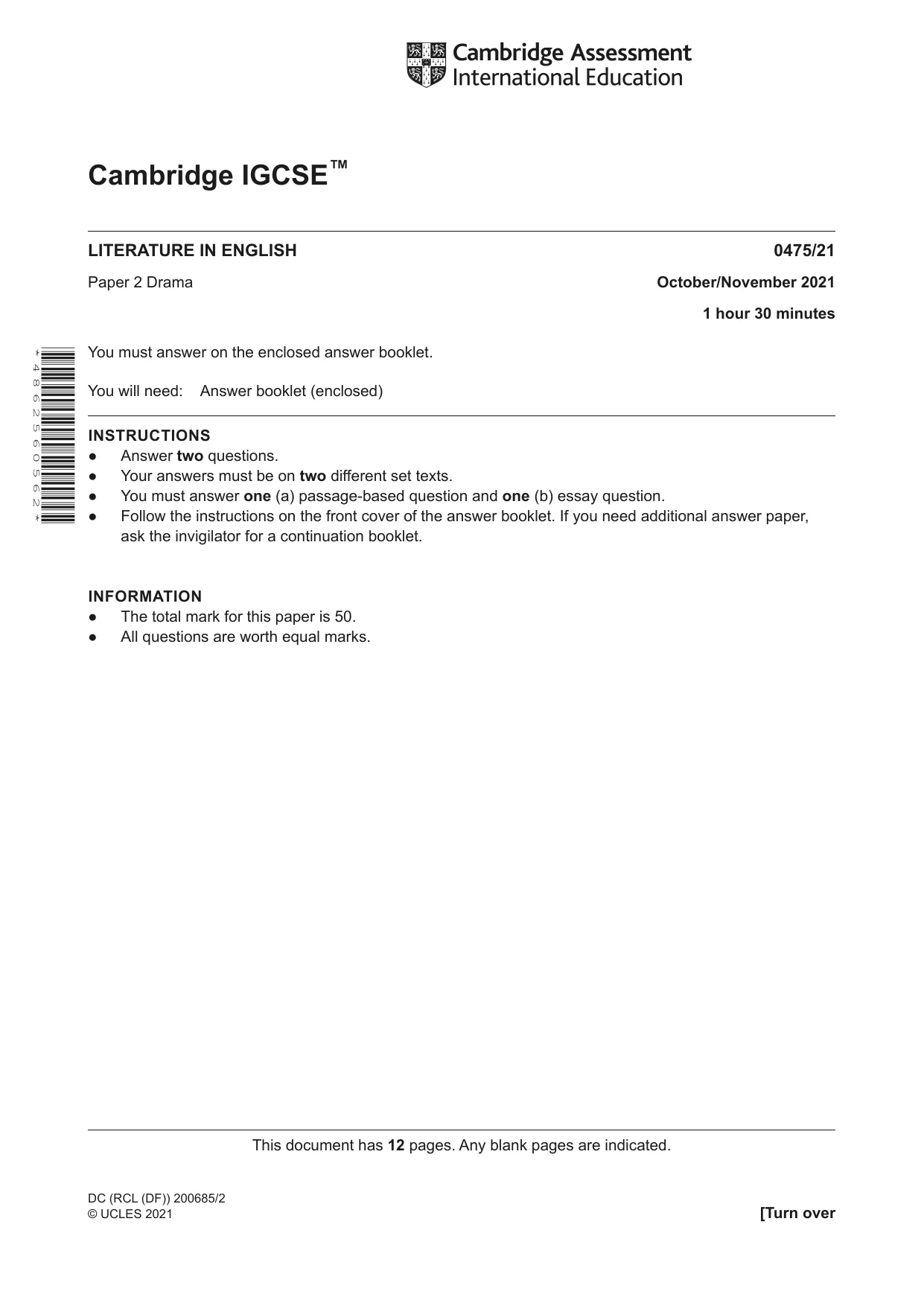
This document has 12 pages. Any blank pages are indicated. DC (RCL (DF)) 200685/2 © UCLES 2021 [Turn over * 4 8 6 2 5 6 0 5 6 2 * Cambridge IGCSE™ LITERATURE IN ENGLISH 0475/21 Paper 2 Drama October/November 2021 1 hour 30 minutes You must answer on the enclosed answer booklet. You will need: Answer booklet (enclosed) INSTRUCTIONS ● Answer two questions. ● Your answers must be on two different set texts. ● You must answer one (a) passage-based question and one (b) essay question. ● Follow the instructions on the front cover of the answer booklet. If you need additional answer paper, ask the invigilator for a continuation booklet. INFORMATION ● The total mark for this paper is 50. ● All questions are worth equal marks.
Question paper, page 2
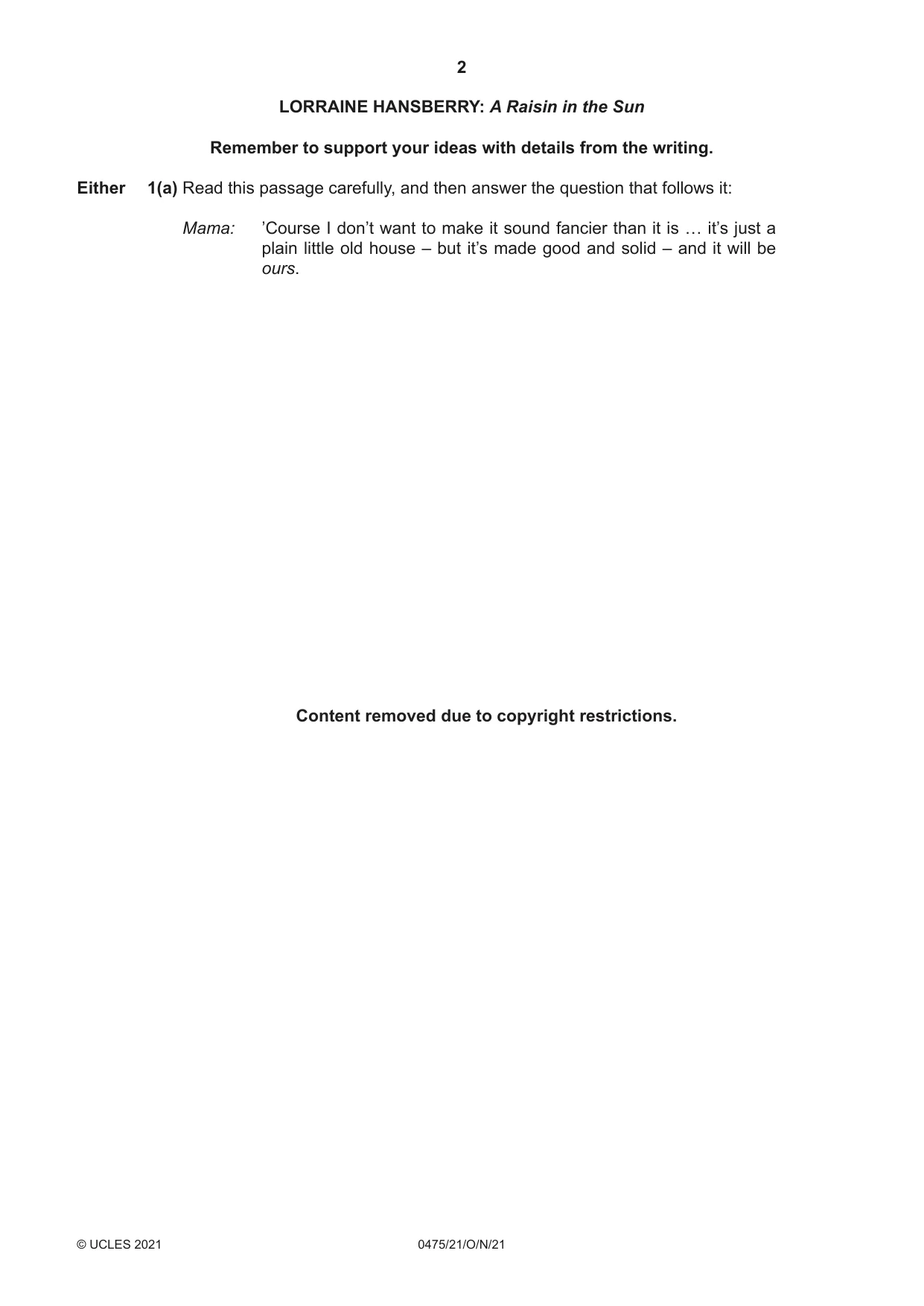
2 0475/21/O/N/21 © UCLES 2021 LORRAINE HANSBERRY: A Raisin in the Sun Remember to support your ideas with details from the writing. Either 1(a) Read this passage carefully, and then answer the question that follows it: Mama: ’Course I don’t want to make it sound fancier than it is … it’s just a plain little old house – but it’s made good and solid – and it will be ours. Content removed due to copyright restrictions.
Question paper, page 3
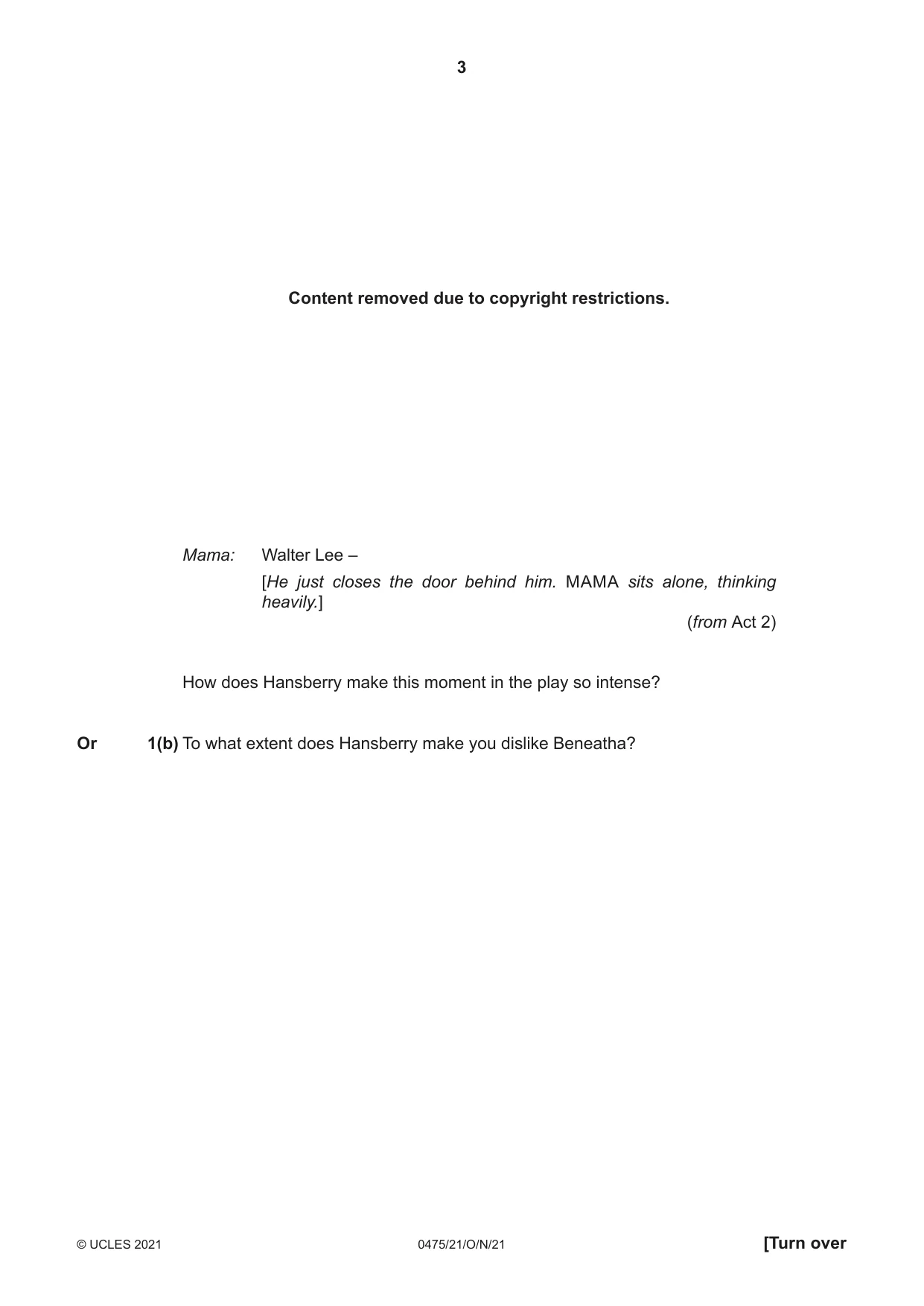
3 0475/21/O/N/21 © UCLES 2021 [Turn over Mama: Walter Lee – [He just closes the door behind him. MAMA sits alone, thinking heavily.] (from Act 2) How does Hansberry make this moment in the play so intense? Or 1(b) To what extent does Hansberry make you dislike Beneatha? Content removed due to copyright restrictions.
Question paper, page 4
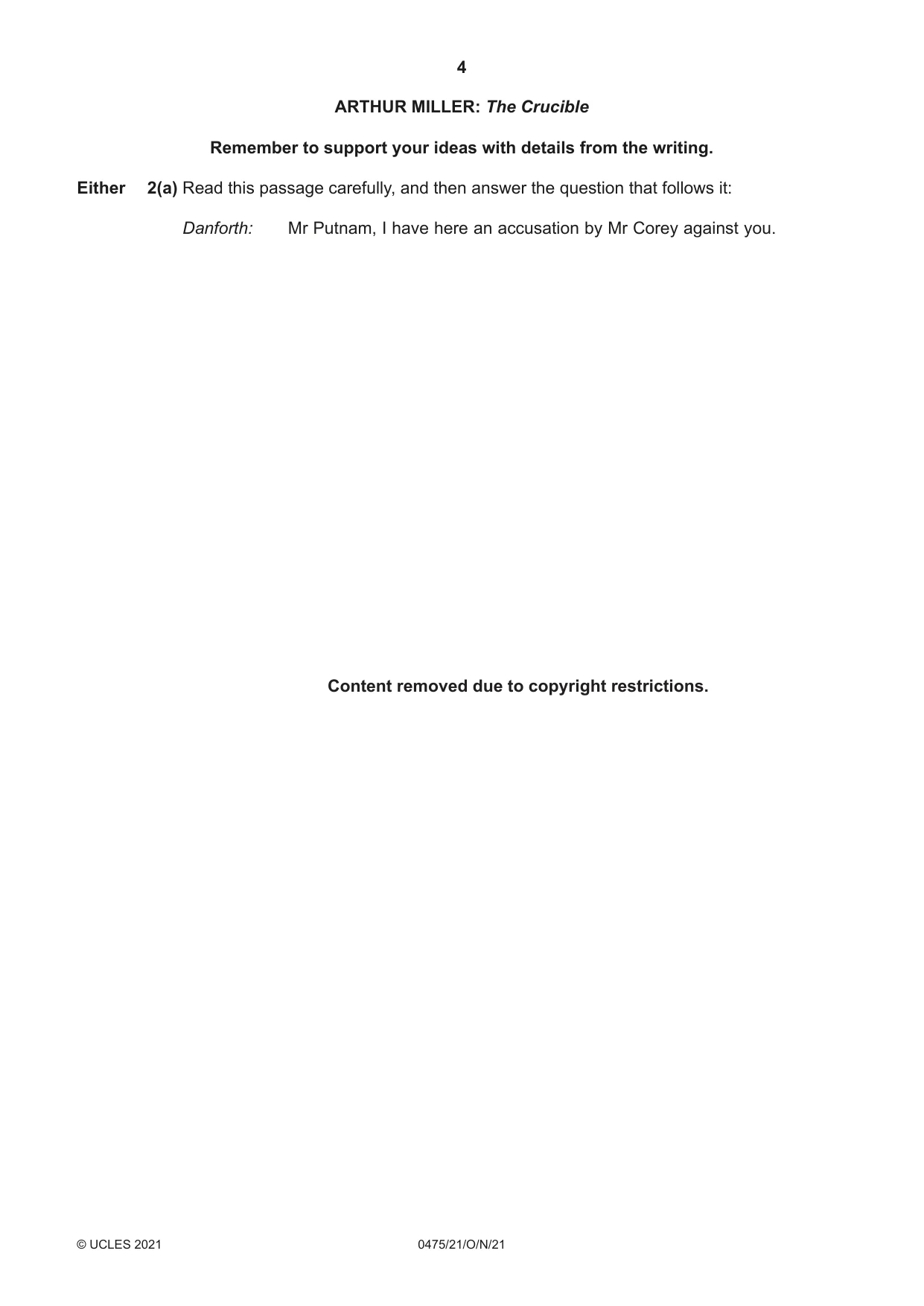
4 0475/21/O/N/21 © UCLES 2021 ARTHUR MILLER: The Crucible Remember to support your ideas with details from the writing. Either 2(a) Read this passage carefully, and then answer the question that follows it: Danforth: Mr Putnam, I have here an accusation by Mr Corey against you. Content removed due to copyright restrictions.
Question paper, page 5
5 0475/21/O/N/21 © UCLES 2021 [Turn over I’ll cut your throat, Putnam, I’ll kill you yet! (from Act 3) How does Miller encourage you to sympathise with Giles Corey at this moment in the play? Or 2(b) How does Miller’s portrayal of Tituba contribute to the dramatic impact of the play? Content removed due to copyright restrictions.
Question paper, page 6
6 0475/21/O/N/21 © UCLES 2021 R C SHERRIFF: Journey’s End Remember to support your ideas with details from the writing. Either 3(a) Read this passage carefully, and then answer the question that follows it: Stanhope: I’ve been having a good look round. Content removed due to copyright restrictions.
Question paper, page 7
7 0475/21/O/N/21 © UCLES 2021 [Turn over Osborne: It must. (from Act 2, Scene 1) How does Sherriff make this such a dramatic and significant moment in the play? Or 3(b) Explore the ways in which Sherriff portrays Osborne as a caring character. Do not use the passage printed in Question 3(a) in answering this question. Content removed due to copyright restrictions.
Question paper, page 8
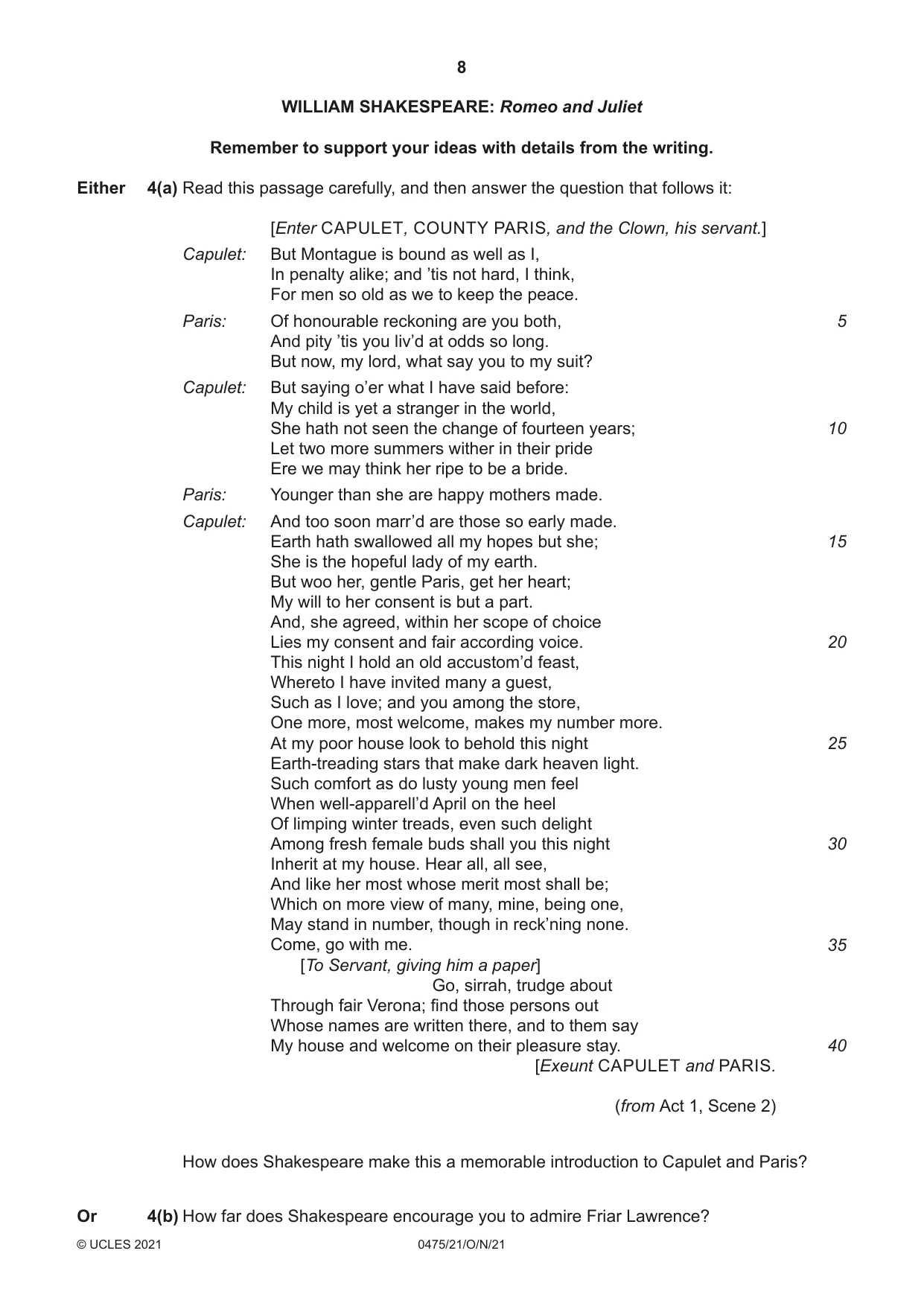
8 0475/21/O/N/21 © UCLES 2021 WILLIAM SHAKESPEARE: Romeo and Juliet Remember to support your ideas with details from the writing. Either 4(a) Read this passage carefully, and then answer the question that follows it: [Enter CAPULET, COUNTY PARIS, and the Clown, his servant.] Capulet: But Montague is bound as well as I, In penalty alike; and ’tis not hard, I think, For men so old as we to keep the peace. Paris: Of honourable reckoning are you both, And pity ’tis you liv’d at odds so long. But now, my lord, what say you to my suit? Capulet: But saying o’er what I have said before: My child is yet a stranger in the world, She hath not seen the change of fourteen years; Let two more summers wither in their pride Ere we may think her ripe to be a bride. Paris: Younger than she are happy mothers made. Capulet: And too soon marr’d are those so early made. Earth hath swallowed all my hopes but she; She is the hopeful lady of my earth. But woo her, gentle Paris, get her heart; My will to her consent is but a part. And, she agreed, within her scope of choice Lies my consent and fair according voice. This night I hold an old accustom’d feast, Whereto I have invited many a guest, Such as I love; and you among the store, One more, most welcome, makes my number more. At my poor house look to behold this night Earth-treading stars that make dark heaven light. Such comfort as do lusty young men feel When well-apparell’d April on the heel Of limping winter treads, even such delight Among fresh female buds shall you this night Inherit at my house. Hear all, all see, And like her most whose merit most shall be; Which on more view of many, mine, being one, May stand in number, though in reck’ning none. Come, go with me. [To Servant, giving him a paper] Go, sirrah, trudge about Through fair Verona; find those persons out Whose names are written there, and to them say My house and welcome on their pleasure stay. [Exeunt CAPULET and PARIS. (from Act 1, Scene 2) How does Shakespeare make this a memorable introduction to Capulet and Paris? Or 4(b) How far does Shakespeare encourage you to admire Friar Lawrence? 5 10 15 20 25 30 35 40
Question paper, page 9
9 0475/21/O/N/21 © UCLES 2021 [Turn over TURN OVER FOR QUESTION 5.
Question paper, page 10
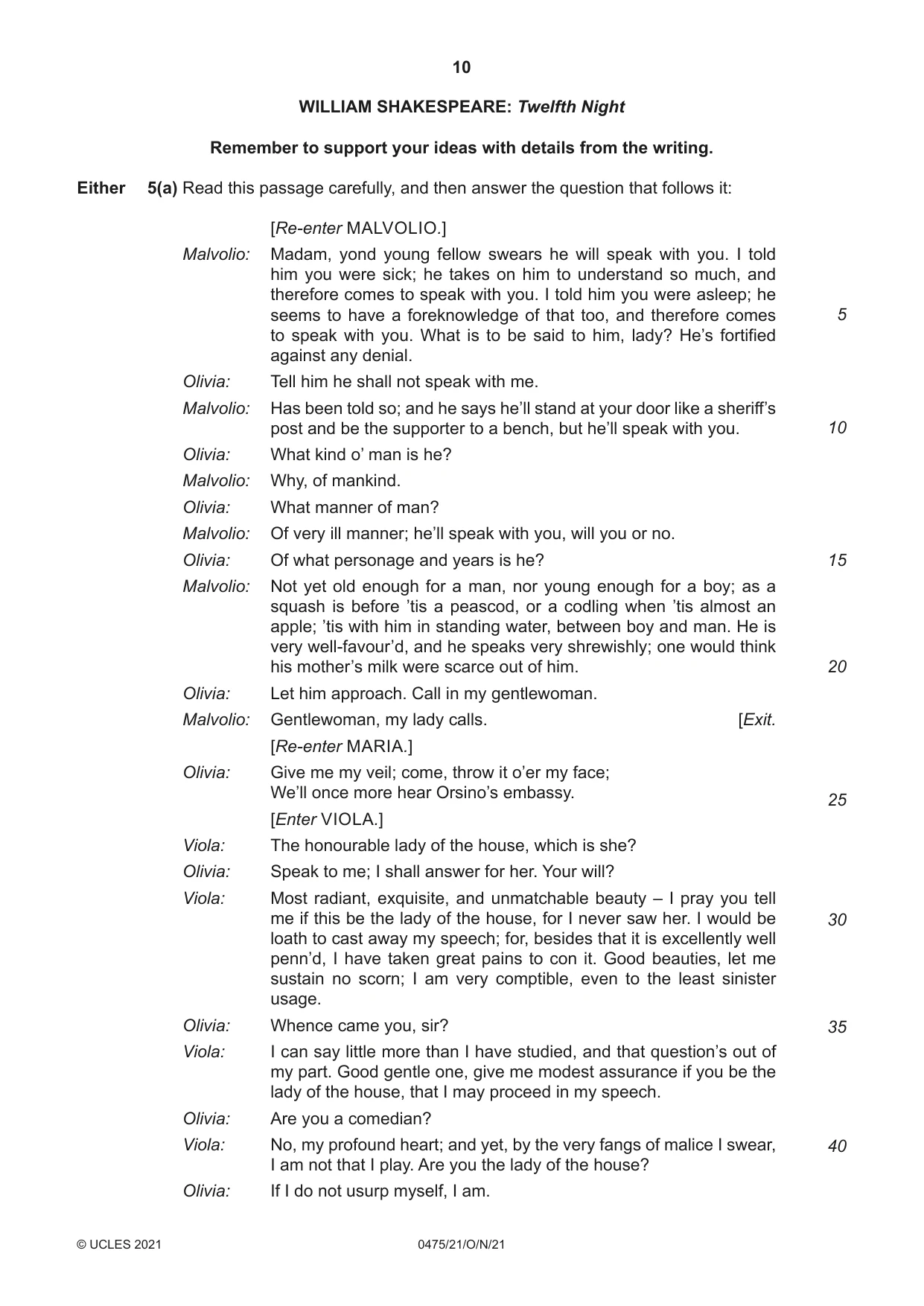
10 0475/21/O/N/21 © UCLES 2021 WILLIAM SHAKESPEARE: Twelfth Night Remember to support your ideas with details from the writing. Either 5(a) Read this passage carefully, and then answer the question that follows it: [Re-enter MALVOLIO.] Malvolio: Madam, yond young fellow swears he will speak with you. I told him you were sick; he takes on him to understand so much, and therefore comes to speak with you. I told him you were asleep; he seems to have a foreknowledge of that too, and therefore comes to speak with you. What is to be said to him, lady? He’s fortified against any denial. Olivia: Tell him he shall not speak with me. Malvolio: Has been told so; and he says he’ll stand at your door like a sheriff’s post and be the supporter to a bench, but he’ll speak with you. Olivia: What kind o’ man is he? Malvolio: Why, of mankind. Olivia: What manner of man? Malvolio: Of very ill manner; he’ll speak with you, will you or no. Olivia: Of what personage and years is he? Malvolio: Not yet old enough for a man, nor young enough for a boy; as a squash is before ’tis a peascod, or a codling when ’tis almost an apple; ’tis with him in standing water, between boy and man. He is very well-favour’d, and he speaks very shrewishly; one would think his mother’s milk were scarce out of him. Olivia: Let him approach. Call in my gentlewoman. Malvolio: Gentlewoman, my lady calls. [Exit. [Re-enter MARIA.] Olivia: Give me my veil; come, throw it o’er my face; We’ll once more hear Orsino’s embassy. [Enter VIOLA.] Viola: The honourable lady of the house, which is she? Olivia: Speak to me; I shall answer for her. Your will? Viola: Most radiant, exquisite, and unmatchable beauty – I pray you tell me if this be the lady of the house, for I never saw her. I would be loath to cast away my speech; for, besides that it is excellently well penn’d, I have taken great pains to con it. Good beauties, let me sustain no scorn; I am very comptible, even to the least sinister usage. Olivia: Whence came you, sir? Viola: I can say little more than I have studied, and that question’s out of my part. Good gentle one, give me modest assurance if you be the lady of the house, that I may proceed in my speech. Olivia: Are you a comedian? Viola: No, my profound heart; and yet, by the very fangs of malice I swear, I am not that I play. Are you the lady of the house? Olivia: If I do not usurp myself, I am. 5 10 15 20 25 30 35 40
Question paper, page 11
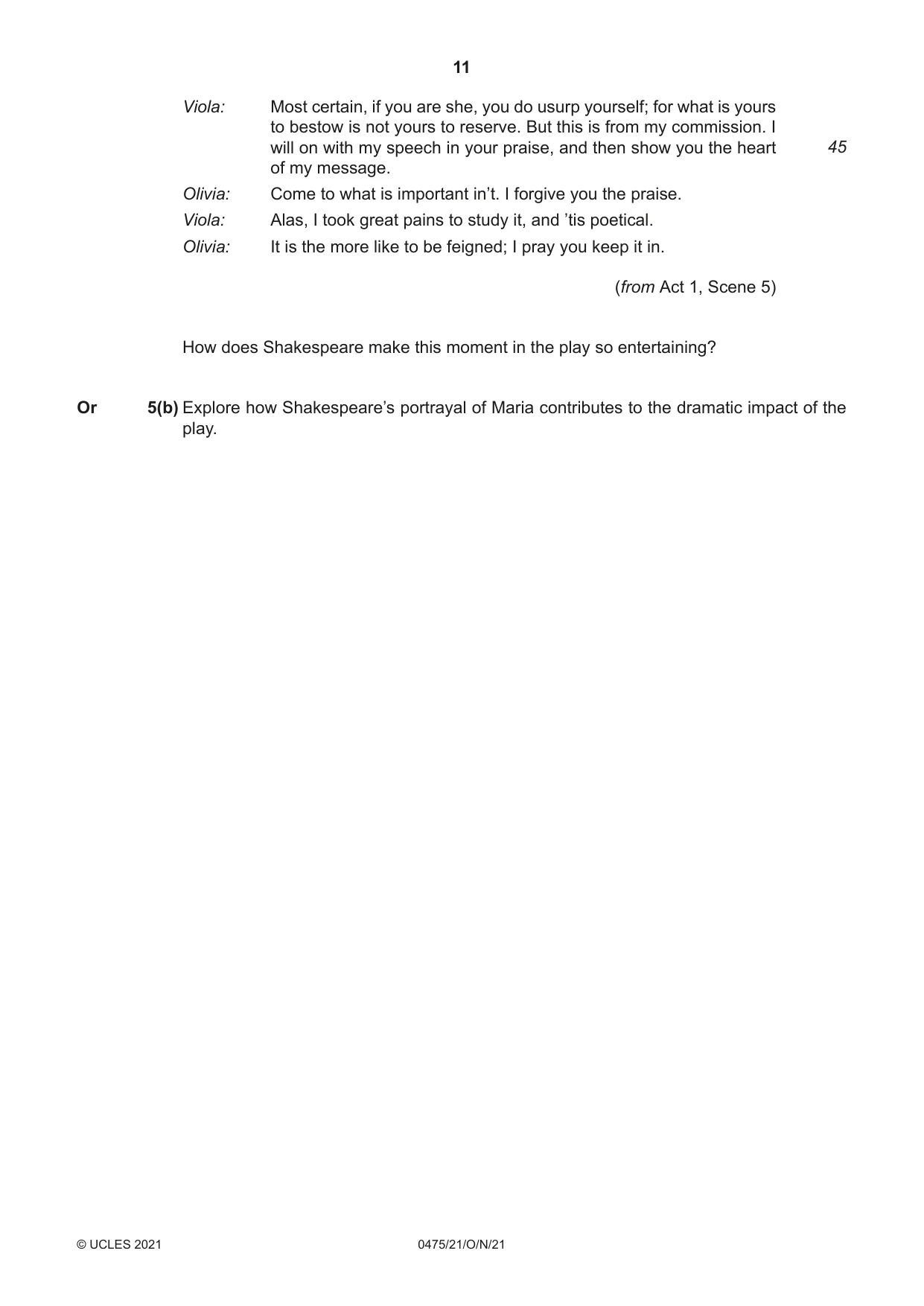
11 0475/21/O/N/21 © UCLES 2021 Viola: Most certain, if you are she, you do usurp yourself; for what is yours to bestow is not yours to reserve. But this is from my commission. I will on with my speech in your praise, and then show you the heart of my message. Olivia: Come to what is important in’t. I forgive you the praise. Viola: Alas, I took great pains to study it, and ’tis poetical. Olivia: It is the more like to be feigned; I pray you keep it in. (from Act 1, Scene 5) How does Shakespeare make this moment in the play so entertaining? Or 5(b) Explore how Shakespeare’s portrayal of Maria contributes to the dramatic impact of the play. 45
Question paper, page 12
12 0475/21/O/N/21 © UCLES 2021 Permission to reproduce items where third-party owned material protected by copyright is included has been sought and cleared where possible. Every reasonable effort has been made by the publisher (UCLES) to trace copyright holders, but if any items requiring clearance have unwittingly been included, the publisher will be pleased to make amends at the earliest possible opportunity. To avoid the issue of disclosure of answer-related information to candidates, all copyright acknowledgements are reproduced online in the Cambridge Assessment International Education Copyright Acknowledgements Booklet. This is produced for each series of examinations and is freely available to download at www.cambridgeinternational.org after the live examination series. Cambridge Assessment International Education is part of the Cambridge Assessment Group. Cambridge Assessment is the brand name of the University of Cambridge Local Examinations Syndicate (UCLES), which itself is a department of the University of Cambridge. BLANK PAGE
Mark scheme, page 1
This document consists of 5 printed pages. © UCLES 2021 [Turn over Cambridge IGCSE™ LITERATURE IN ENGLISH 0475/21 Paper 2 Drama 21 October/November 2021 MARK SCHEME Maximum Mark: 50 Published This mark scheme is published as an aid to teachers and candidates, to indicate the requirements of the examination. It shows the basis on which Examiners were instructed to award marks. It does not indicate the details of the discussions that took place at an Examiners’ meeting before marking began, which would have considered the acceptability of alternative answers. Mark schemes should be read in conjunction with the question paper and the Principal Examiner Report for Teachers. Cambridge International will not enter into discussions about these mark schemes. Cambridge International is publishing the mark schemes for the October/November 2021 series for most Cambridge IGCSE™, Cambridge International A and AS Level components and some Cambridge O Level components.
Mark scheme, page 2
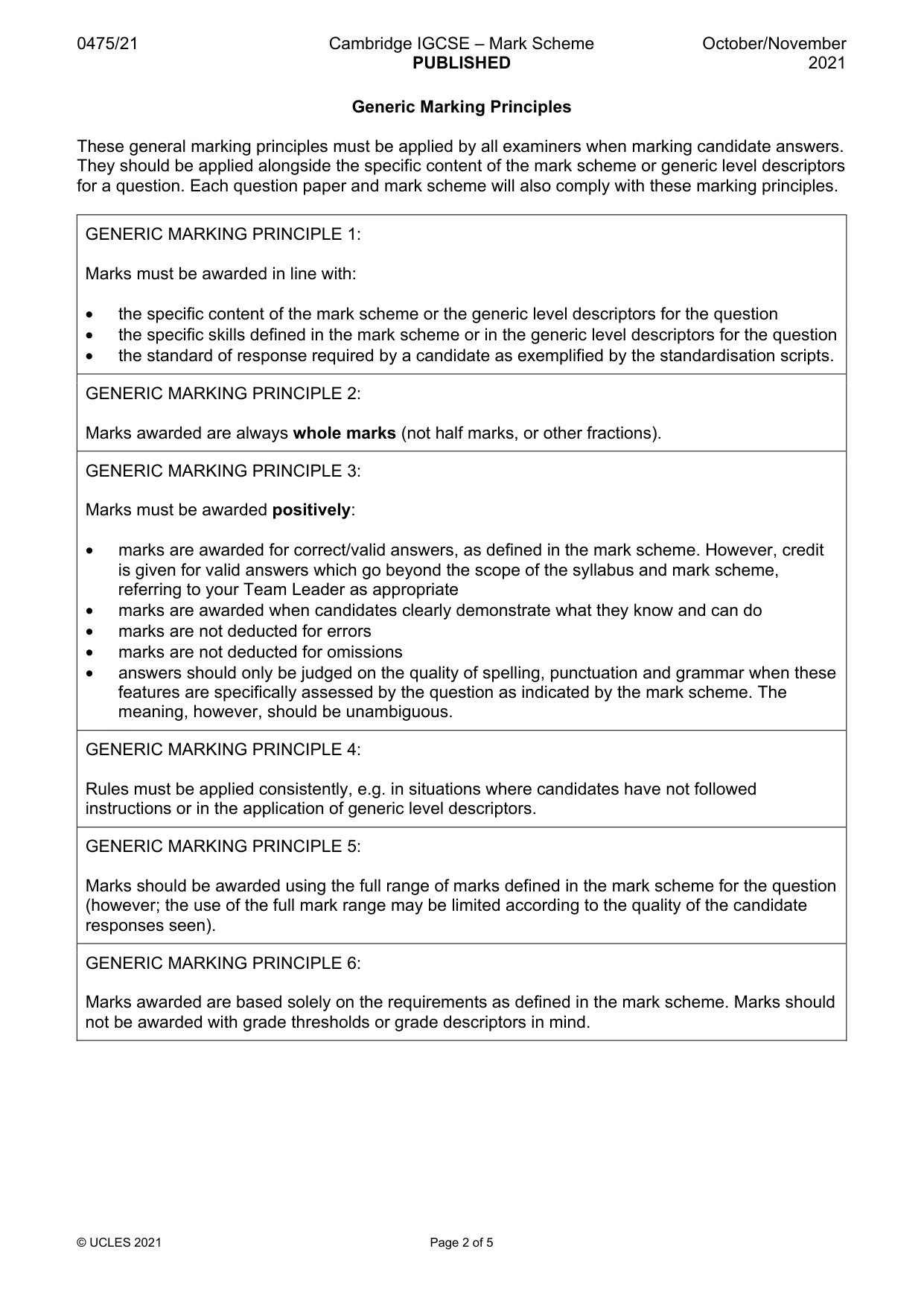
0475/21 Cambridge IGCSE – Mark Scheme PUBLISHED October/November 2021 © UCLES 2021 Page 2 of 5 Generic Marking Principles These general marking principles must be applied by all examiners when marking candidate answers. They should be applied alongside the specific content of the mark scheme or generic level descriptors for a question. Each question paper and mark scheme will also comply with these marking principles. GENERIC MARKING PRINCIPLE 1: Marks must be awarded in line with: • the specific content of the mark scheme or the generic level descriptors for the question • the specific skills defined in the mark scheme or in the generic level descriptors for the question • the standard of response required by a candidate as exemplified by the standardisation scripts. GENERIC MARKING PRINCIPLE 2: Marks awarded are always whole marks (not half marks, or other fractions). GENERIC MARKING PRINCIPLE 3: Marks must be awarded positively: • marks are awarded for correct/valid answers, as defined in the mark scheme. However, credit is given for valid answers which go beyond the scope of the syllabus and mark scheme, referring to your Team Leader as appropriate • marks are awarded when candidates clearly demonstrate what they know and can do • marks are not deducted for errors • marks are not deducted for omissions • answers should only be judged on the quality of spelling, punctuation and grammar when these features are specifically assessed by the question as indicated by the mark scheme. The meaning, however, should be unambiguous. GENERIC MARKING PRINCIPLE 4: Rules must be applied consistently, e.g. in situations where candidates have not followed instructions or in the application of generic level descriptors. GENERIC MARKING PRINCIPLE 5: Marks should be awarded using the full range of marks defined in the mark scheme for the question (however; the use of the full mark range may be limited according to the quality of the candidate responses seen). GENERIC MARKING PRINCIPLE 6: Marks awarded are based solely on the requirements as defined in the mark scheme. Marks should not be awarded with grade thresholds or grade descriptors in mind.
Mark scheme, page 3
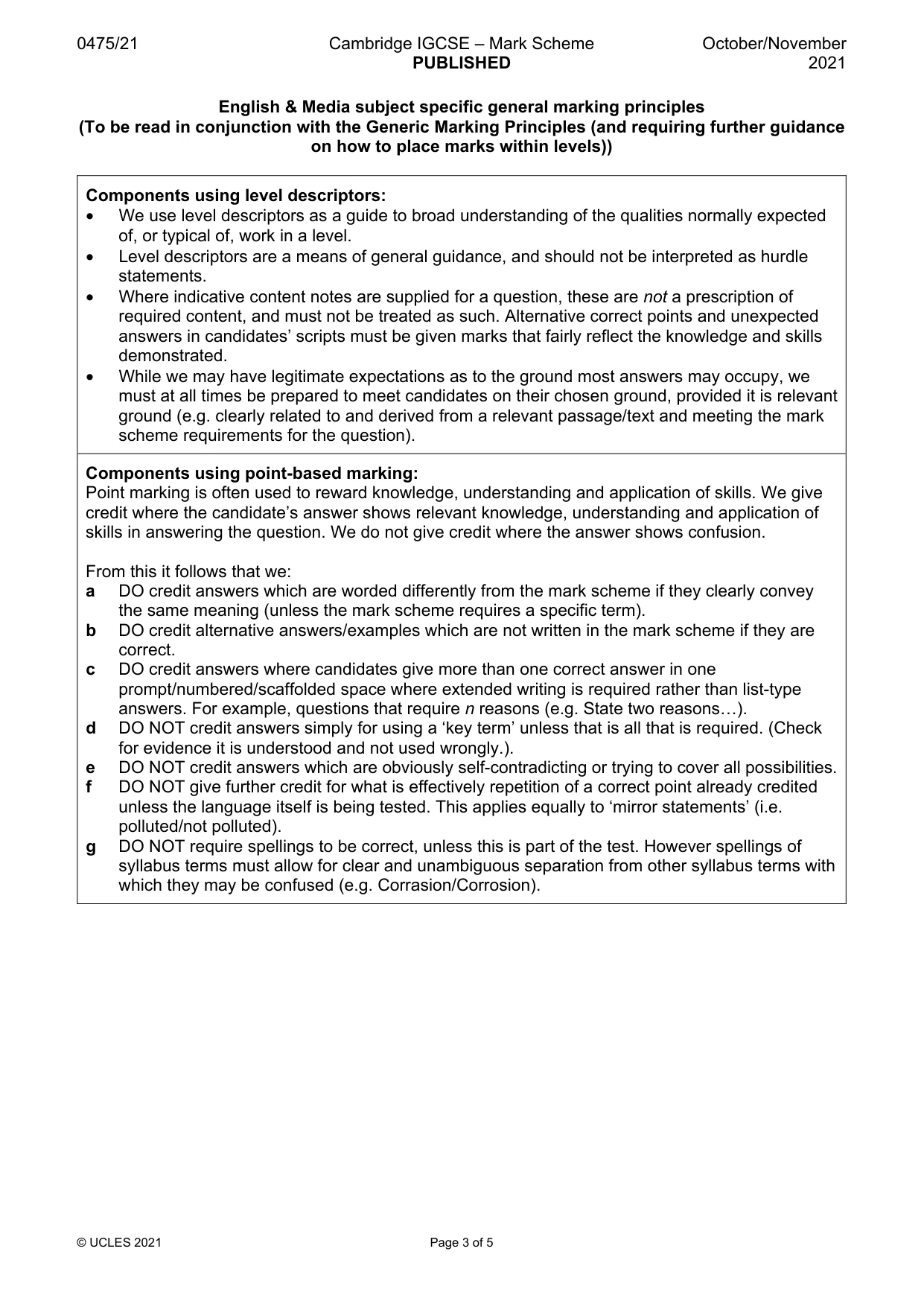
0475/21 Cambridge IGCSE – Mark Scheme PUBLISHED October/November 2021 © UCLES 2021 Page 3 of 5 English & Media subject specific general marking principles (To be read in conjunction with the Generic Marking Principles (and requiring further guidance on how to place marks within levels)) Components using level descriptors: • We use level descriptors as a guide to broad understanding of the qualities normally expected of, or typical of, work in a level. • Level descriptors are a means of general guidance, and should not be interpreted as hurdle statements. • Where indicative content notes are supplied for a question, these are not a prescription of required content, and must not be treated as such. Alternative correct points and unexpected answers in candidates’ scripts must be given marks that fairly reflect the knowledge and skills demonstrated. • While we may have legitimate expectations as to the ground most answers may occupy, we must at all times be prepared to meet candidates on their chosen ground, provided it is relevant ground (e.g. clearly related to and derived from a relevant passage/text and meeting the mark scheme requirements for the question). Components using point-based marking: Point marking is often used to reward knowledge, understanding and application of skills. We give credit where the candidate’s answer shows relevant knowledge, understanding and application of skills in answering the question. We do not give credit where the answer shows confusion. From this it follows that we: a DO credit answers which are worded differently from the mark scheme if they clearly convey the same meaning (unless the mark scheme requires a specific term). b DO credit alternative answers/examples which are not written in the mark scheme if they are correct. c DO credit answers where candidates give more than one correct answer in one prompt/numbered/scaffolded space where extended writing is required rather than list-type answers. For example, questions that require n reasons (e.g. State two reasons…). d DO NOT credit answers simply for using a ‘key term’ unless that is all that is required. (Check for evidence it is understood and not used wrongly.). e DO NOT credit answers which are obviously self-contradicting or trying to cover all possibilities. f DO NOT give further credit for what is effectively repetition of a correct point already credited unless the language itself is being tested. This applies equally to ‘mirror statements’ (i.e. polluted/not polluted). g DO NOT require spellings to be correct, unless this is part of the test. However spellings of syllabus terms must allow for clear and unambiguous separation from other syllabus terms with which they may be confused (e.g. Corrasion/Corrosion).
Mark scheme, page 4
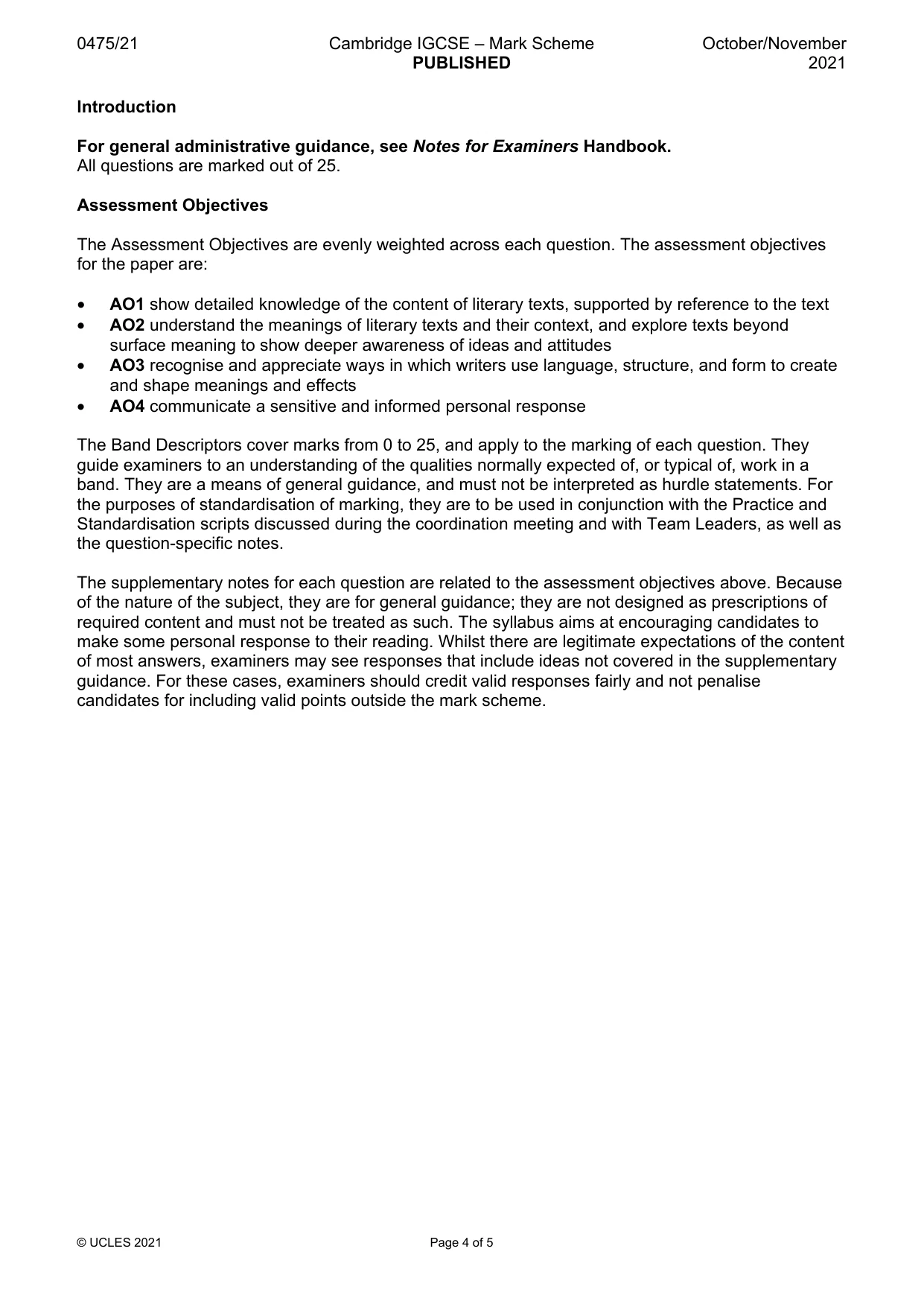
0475/21 Cambridge IGCSE – Mark Scheme PUBLISHED October/November 2021 © UCLES 2021 Page 4 of 5 Introduction For general administrative guidance, see Notes for Examiners Handbook. All questions are marked out of 25. Assessment Objectives The Assessment Objectives are evenly weighted across each question. The assessment objectives for the paper are: • AO1 show detailed knowledge of the content of literary texts, supported by reference to the text • AO2 understand the meanings of literary texts and their context, and explore texts beyond surface meaning to show deeper awareness of ideas and attitudes • AO3 recognise and appreciate ways in which writers use language, structure, and form to create and shape meanings and effects • AO4 communicate a sensitive and informed personal response The Band Descriptors cover marks from 0 to 25, and apply to the marking of each question. They guide examiners to an understanding of the qualities normally expected of, or typical of, work in a band. They are a means of general guidance, and must not be interpreted as hurdle statements. For the purposes of standardisation of marking, they are to be used in conjunction with the Practice and Standardisation scripts discussed during the coordination meeting and with Team Leaders, as well as the question-specific notes. The supplementary notes for each question are related to the assessment objectives above. Because of the nature of the subject, they are for general guidance; they are not designed as prescriptions of required content and must not be treated as such. The syllabus aims at encouraging candidates to make some personal response to their reading. Whilst there are legitimate expectations of the content of most answers, examiners may see responses that include ideas not covered in the supplementary guidance. For these cases, examiners should credit valid responses fairly and not penalise candidates for including valid points outside the mark scheme.
Mark scheme, page 5
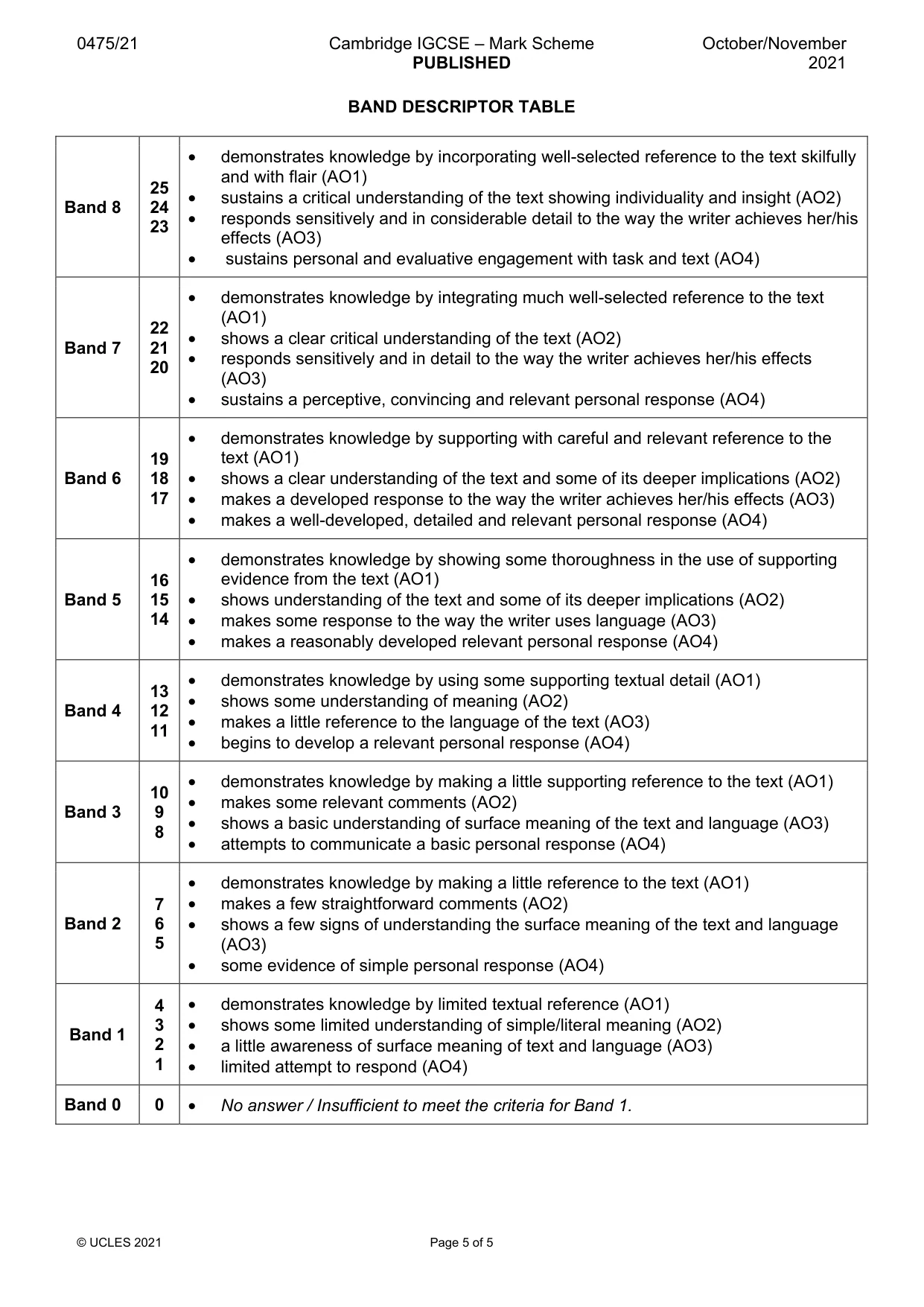
0475/21 Cambridge IGCSE – Mark Scheme PUBLISHED October/November 2021 © UCLES 2021 Page 5 of 5 BAND DESCRIPTOR TABLE Band 8 25 24 23 • demonstrates knowledge by incorporating well-selected reference to the text skilfully and with flair (AO1) • sustains a critical understanding of the text showing individuality and insight (AO2) • responds sensitively and in considerable detail to the way the writer achieves her/his effects (AO3) • sustains personal and evaluative engagement with task and text (AO4) Band 7 22 21 20 • demonstrates knowledge by integrating much well-selected reference to the text (AO1) • shows a clear critical understanding of the text (AO2) • responds sensitively and in detail to the way the writer achieves her/his effects (AO3) • sustains a perceptive, convincing and relevant personal response (AO4) Band 6 19 18 17 • demonstrates knowledge by supporting with careful and relevant reference to the text (AO1) • shows a clear understanding of the text and some of its deeper implications (AO2) • makes a developed response to the way the writer achieves her/his effects (AO3) • makes a well-developed, detailed and relevant personal response (AO4) Band 5 16 15 14 • demonstrates knowledge by showing some thoroughness in the use of supporting evidence from the text (AO1) • shows understanding of the text and some of its deeper implications (AO2) • makes some response to the way the writer uses language (AO3) • makes a reasonably developed relevant personal response (AO4) Band 4 13 12 11 • demonstrates knowledge by using some supporting textual detail (AO1) • shows some understanding of meaning (AO2) • makes a little reference to the language of the text (AO3) • begins to develop a relevant personal response (AO4) Band 3 10 9 8 • demonstrates knowledge by making a little supporting reference to the text (AO1) • makes some relevant comments (AO2) • shows a basic understanding of surface meaning of the text and language (AO3) • attempts to communicate a basic personal response (AO4) Band 2 7 6 5 • demonstrates knowledge by making a little reference to the text (AO1) • makes a few straightforward comments (AO2) • shows a few signs of understanding the surface meaning of the text and language (AO3) • some evidence of simple personal response (AO4) Band 1 4 3 2 1 • demonstrates knowledge by limited textual reference (AO1) • shows some limited understanding of simple/literal meaning (AO2) • a little awareness of surface meaning of text and language (AO3) • limited attempt to respond (AO4) Band 0 0 • No answer / Insufficient to meet the criteria for Band 1.
What you needed in this session
Cambridge’s own grade thresholds for 2021 Oct/Nov, Paper 2 · Variant 1. A higher threshold means an easier paper — the bar moves with how the cohort did.