Cambridge IGCSE English - Literature in English 0475 — 2021 Feb/March Paper 1 · Variant 2
0475/12/F/M/21
The question paper and its mark scheme, free to read here and free to download. This is Cambridge’s own paper, exactly as it was sat.
Question paper28 pages




Mark scheme4 pages
Answers below. Sit the paper first if you are practising.
Paper as text
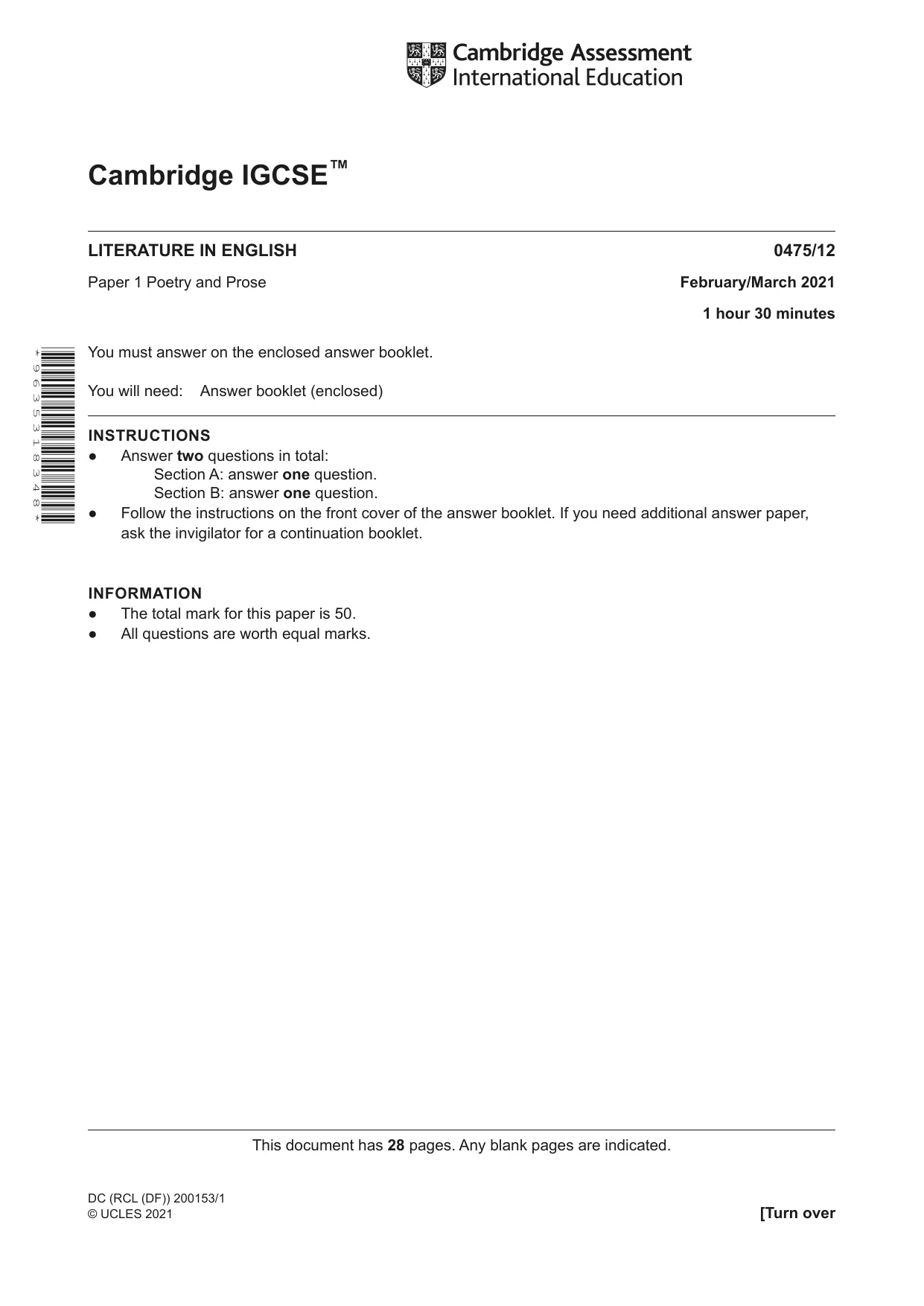
Question paper, page 1
This document has 28 pages. Any blank pages are indicated. * 9 6 3 5 3 1 8 3 4 8 * Cambridge IGCSE™ LITERATURE IN ENGLISH 0475/12 Paper 1 Poetry and Prose February/March 2021 1 hour 30 minutes You must answer on the enclosed answer booklet. You will need: Answer booklet (enclosed) INSTRUCTIONS ● Answer two questions in total: Section A: answer one question. Section B: answer one question. ● Follow the instructions on the front cover of the answer booklet. If you need additional answer paper, ask the invigilator for a continuation booklet. INFORMATION ● The total mark for this paper is 50. ● All questions are worth equal marks. DC (RCL (DF)) 200153/1 © UCLES 2021 [Turn over
Question paper, page 2
2 0475/12/F/M/21 © UCLES 2021 BLANK PAGE
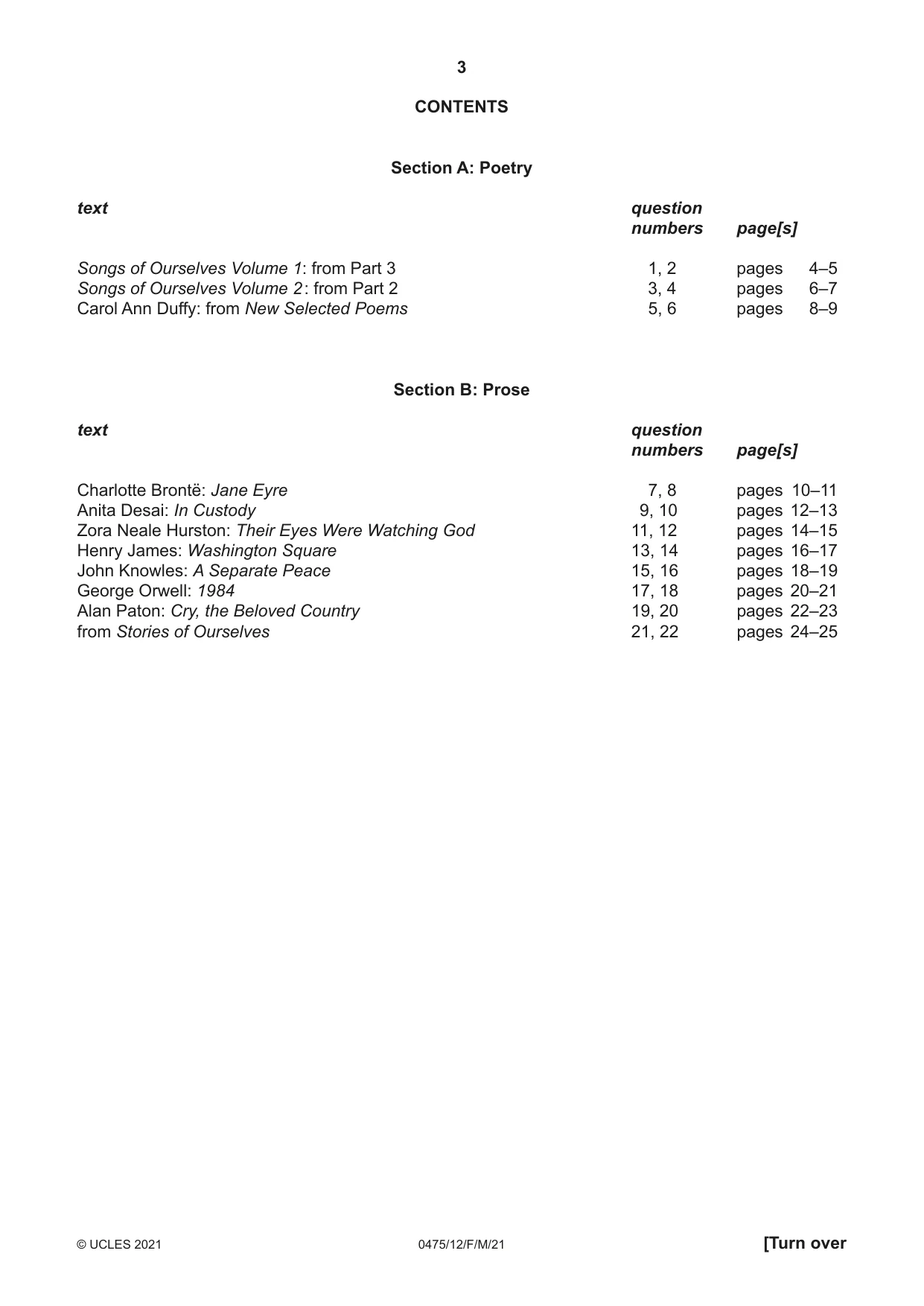
Question paper, page 3
3 0475/12/F/M/21 © UCLES 2021 [Turn over CONTENTS Section A: Poetry text question numbers page[s] Songs of Ourselves Volume 1: from Part 3 1, 2 pages 4–5 Songs of Ourselves Volume 2 : from Part 2 3, 4 pages 6–7 Carol Ann Duffy: from New Selected Poems 5, 6 pages 8–9 Section B: Prose text question numbers page[s] Charlotte Brontë: Jane Eyre 7, 8 pages 10–11 Anita Desai: In Custody 9, 10 pages 12–13 Zora Neale Hurston: Their Eyes Were Watching God 11, 12 pages 14–15 Henry James: Washington Square 13, 14 pages 16–17 John Knowles: A Separate Peace 15, 16 pages 18–19 George Orwell: 1984 17, 18 pages 20–21 Alan Paton: Cry, the Beloved Country 19, 20 pages 22–23 from Stories of Ourselves 21, 22 pages 24–25
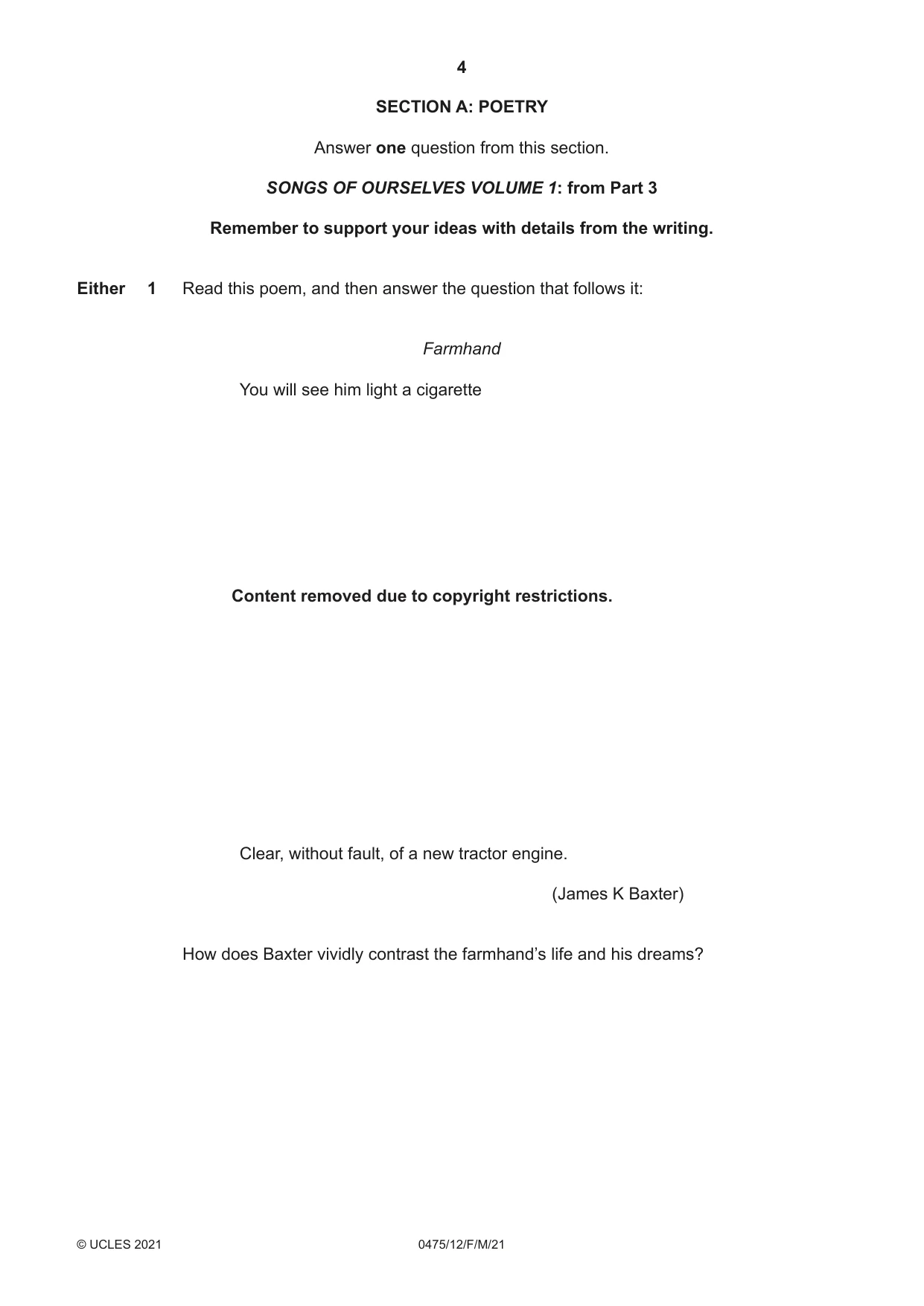
Question paper, page 4
4 0475/12/F/M/21 © UCLES 2021 SECTION A: POETRY Answer one question from this section. SONGS OF OURSELVES VOLUME 1: from Part 3 Remember to support your ideas with details from the writing. Either 1 Read this poem, and then answer the question that follows it: Farmhand You will see him light a cigarette Clear, without fault, of a new tractor engine. (James K Baxter) How does Baxter vividly contrast the farmhand’s life and his dreams? Content removed due to copyright restrictions.
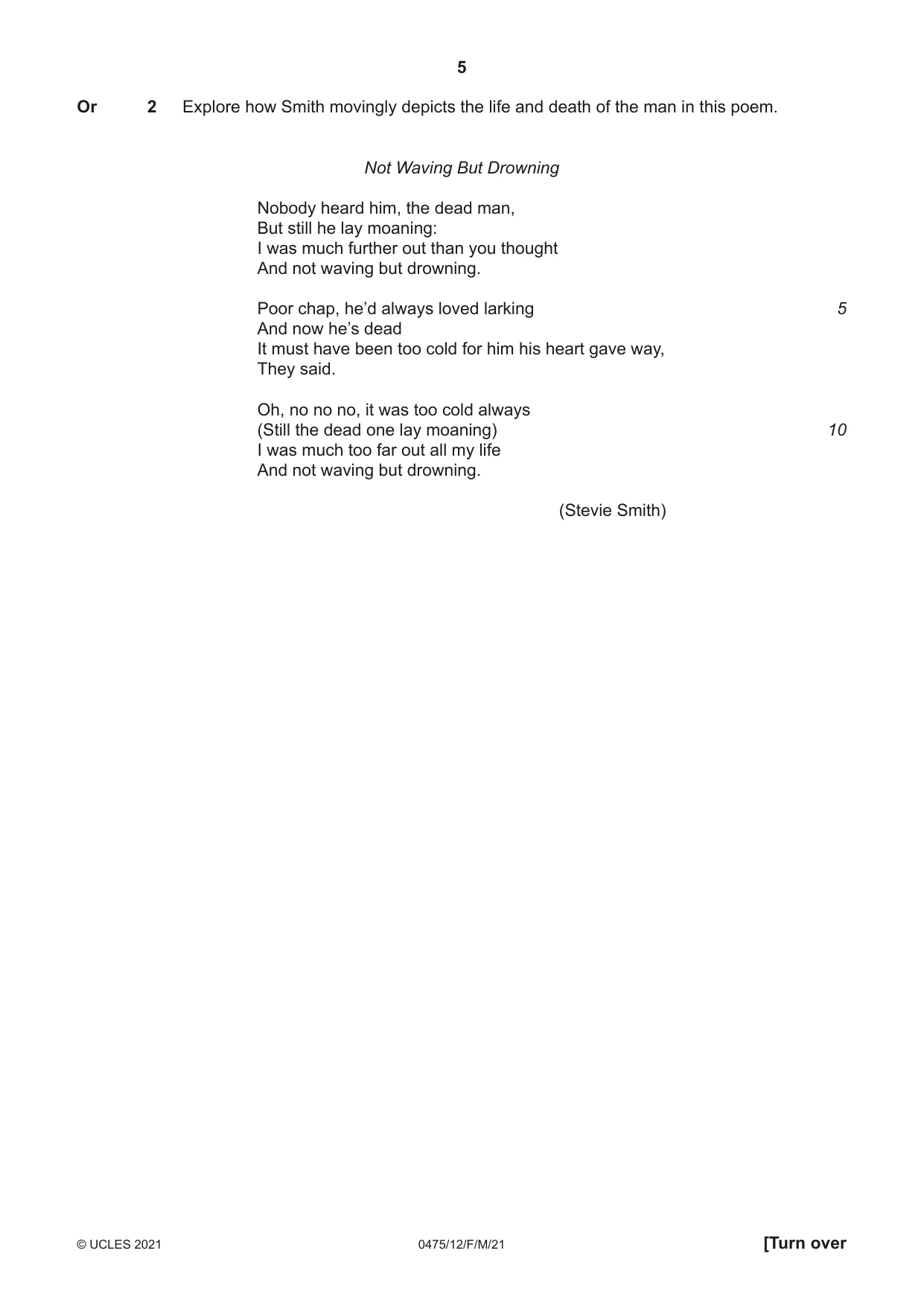
Question paper, page 5
5 0475/12/F/M/21 © UCLES 2021 [Turn over Or 2 Explore how Smith movingly depicts the life and death of the man in this poem. Not Waving But Drowning Nobody heard him, the dead man, But still he lay moaning: I was much further out than you thought And not waving but drowning. Poor chap, he’d always loved larking And now he’s dead It must have been too cold for him his heart gave way, They said. Oh, no no no, it was too cold always (Still the dead one lay moaning) I was much too far out all my life And not waving but drowning. (Stevie Smith) 5 10
Question paper, page 6
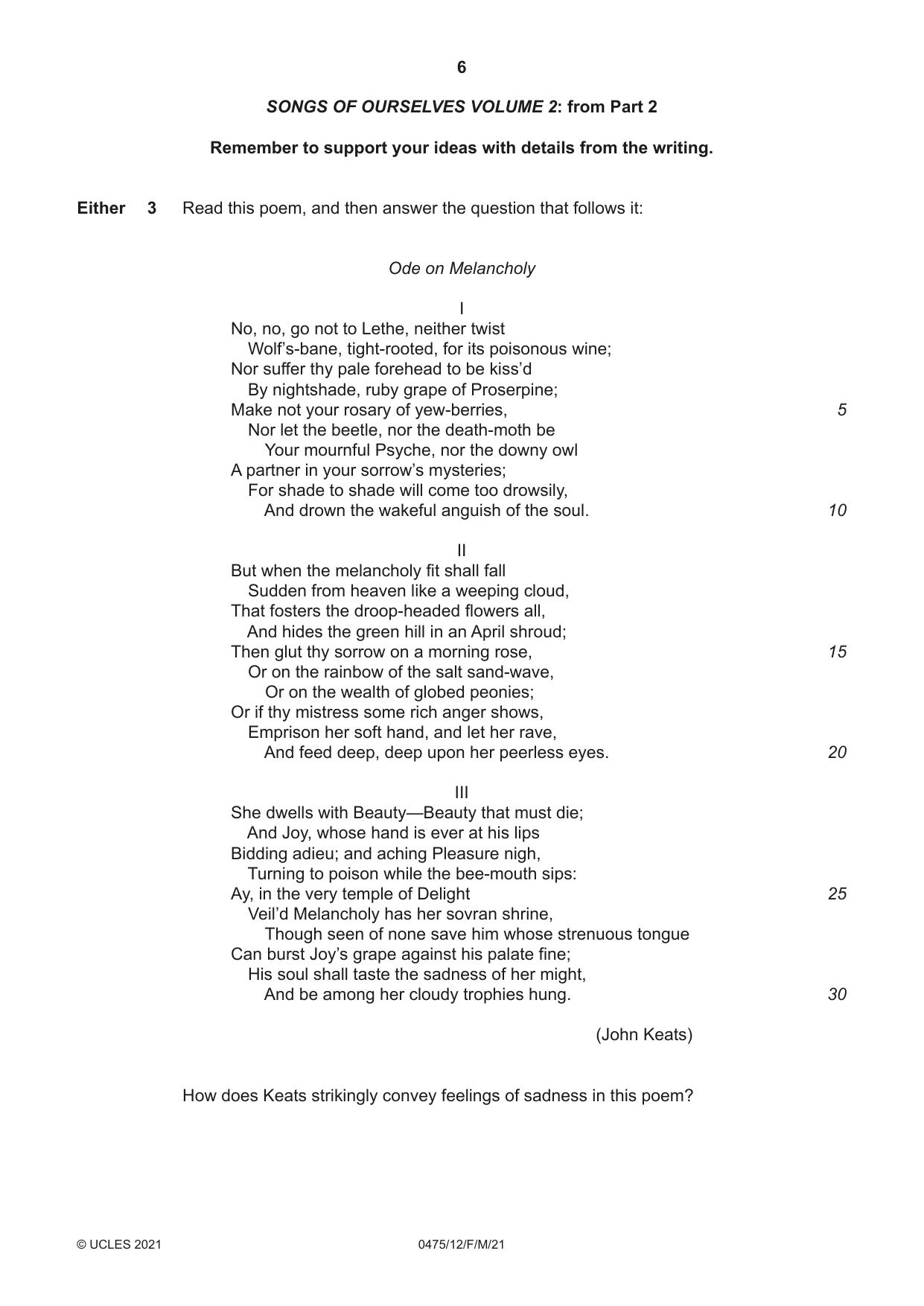
6 0475/12/F/M/21 © UCLES 2021 SONGS OF OURSELVES VOLUME 2: from Part 2 Remember to support your ideas with details from the writing. Either 3 Read this poem, and then answer the question that follows it: Ode on Melancholy I No, no, go not to Lethe, neither twist Wolf’s-bane, tight-rooted, for its poisonous wine; Nor suffer thy pale forehead to be kiss’d By nightshade, ruby grape of Proserpine; Make not your rosary of yew-berries, Nor let the beetle, nor the death-moth be Your mournful Psyche, nor the downy owl A partner in your sorrow’s mysteries; For shade to shade will come too drowsily, And drown the wakeful anguish of the soul. II But when the melancholy fit shall fall Sudden from heaven like a weeping cloud, That fosters the droop-headed flowers all, And hides the green hill in an April shroud; Then glut thy sorrow on a morning rose, Or on the rainbow of the salt sand-wave, Or on the wealth of globed peonies; Or if thy mistress some rich anger shows, Emprison her soft hand, and let her rave, And feed deep, deep upon her peerless eyes. III She dwells with Beauty—Beauty that must die; And Joy, whose hand is ever at his lips Bidding adieu; and aching Pleasure nigh, Turning to poison while the bee-mouth sips: Ay, in the very temple of Delight Veil’d Melancholy has her sovran shrine, Though seen of none save him whose strenuous tongue Can burst Joy’s grape against his palate fine; His soul shall taste the sadness of her might, And be among her cloudy trophies hung. (John Keats) How does Keats strikingly convey feelings of sadness in this poem? 5 10 15 20 25 30
Question paper, page 7
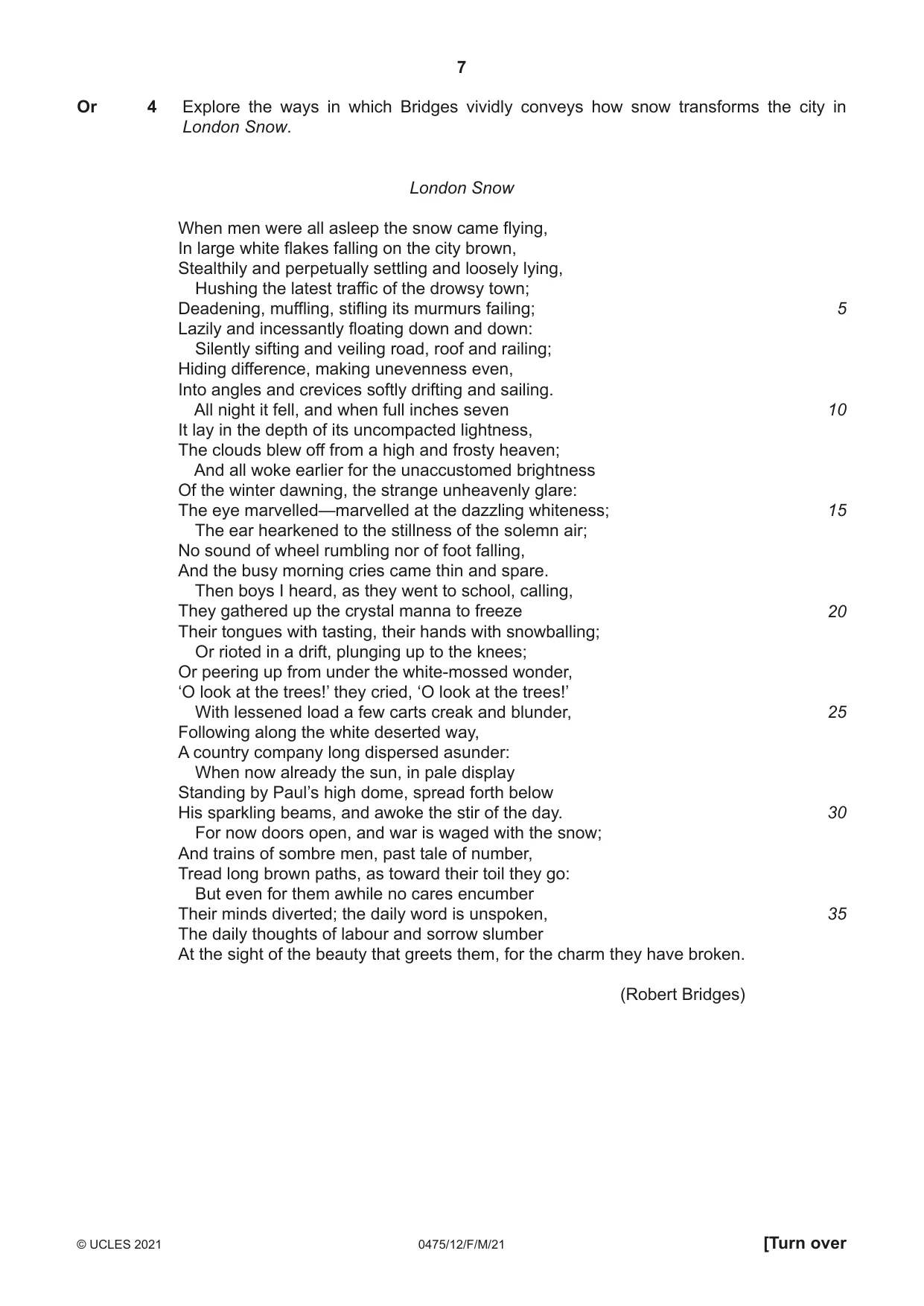
7 0475/12/F/M/21 © UCLES 2021 [Turn over Or 4 Explore the ways in which Bridges vividly conveys how snow transforms the city in London Snow. London Snow When men were all asleep the snow came flying, In large white flakes falling on the city brown, Stealthily and perpetually settling and loosely lying, Hushing the latest traffic of the drowsy town; Deadening, muffling, stifling its murmurs failing; Lazily and incessantly floating down and down: Silently sifting and veiling road, roof and railing; Hiding difference, making unevenness even, Into angles and crevices softly drifting and sailing. All night it fell, and when full inches seven It lay in the depth of its uncompacted lightness, The clouds blew off from a high and frosty heaven; And all woke earlier for the unaccustomed brightness Of the winter dawning, the strange unheavenly glare: The eye marvelled—marvelled at the dazzling whiteness; The ear hearkened to the stillness of the solemn air; No sound of wheel rumbling nor of foot falling, And the busy morning cries came thin and spare. Then boys I heard, as they went to school, calling, They gathered up the crystal manna to freeze Their tongues with tasting, their hands with snowballing; Or rioted in a drift, plunging up to the knees; Or peering up from under the white-mossed wonder, ‘O look at the trees!’ they cried, ‘O look at the trees!’ With lessened load a few carts creak and blunder, Following along the white deserted way, A country company long dispersed asunder: When now already the sun, in pale display Standing by Paul’s high dome, spread forth below His sparkling beams, and awoke the stir of the day. For now doors open, and war is waged with the snow; And trains of sombre men, past tale of number, Tread long brown paths, as toward their toil they go: But even for them awhile no cares encumber Their minds diverted; the daily word is unspoken, The daily thoughts of labour and sorrow slumber At the sight of the beauty that greets them, for the charm they have broken. (Robert Bridges) 5 10 15 20 25 30 35
Question paper, page 8
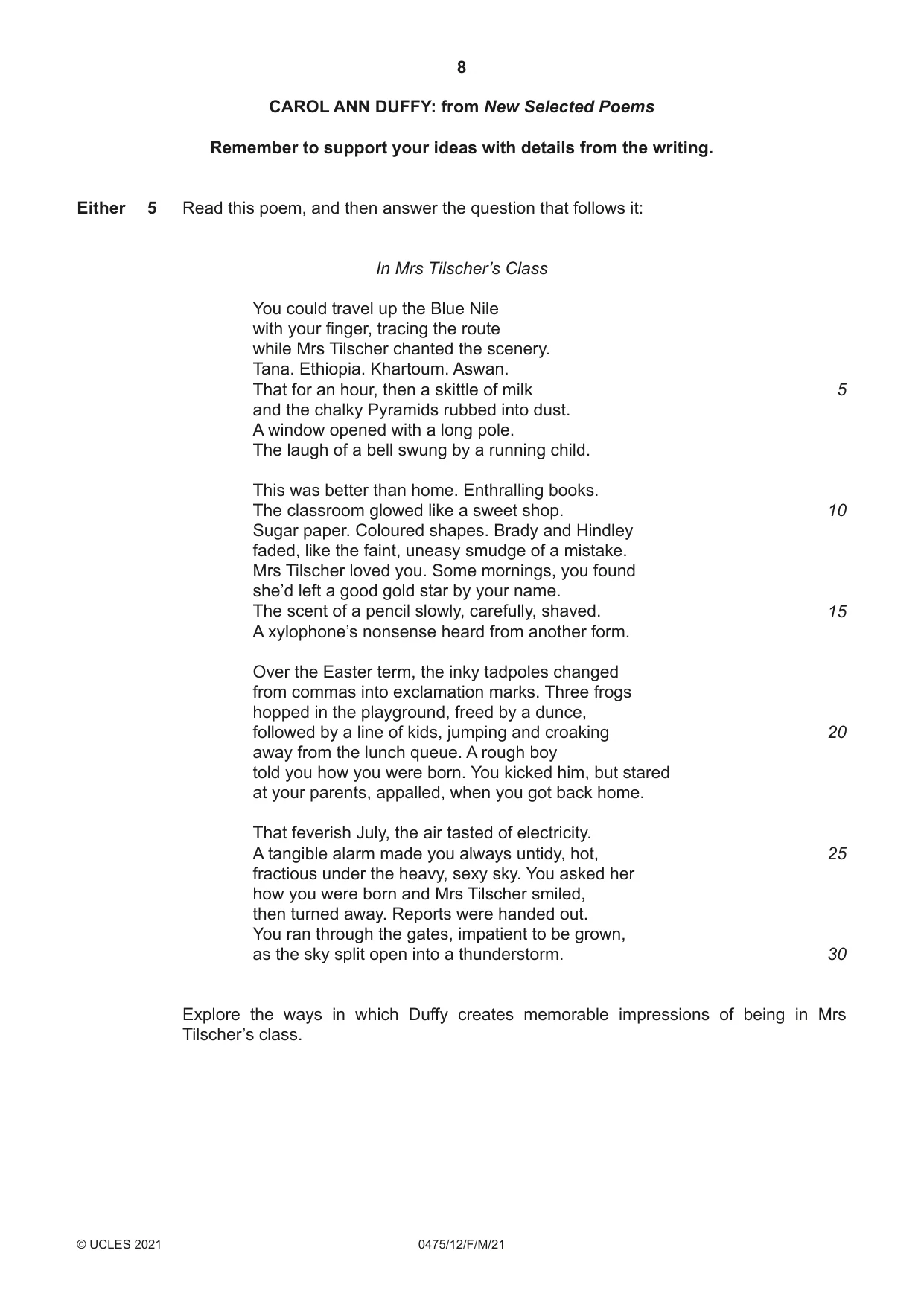
8 0475/12/F/M/21 © UCLES 2021 CAROL ANN DUFFY: from New Selected Poems Remember to support your ideas with details from the writing. Either 5 Read this poem, and then answer the question that follows it: Ιn Mrs Tilscher’s Class You could travel up the Blue Nile with your finger, tracing the route while Mrs Tilscher chanted the scenery. Tana. Ethiopia. Khartoum. Aswan. That for an hour, then a skittle of milk and the chalky Pyramids rubbed into dust. A window opened with a long pole. The laugh of a bell swung by a running child. This was better than home. Enthralling books. The classroom glowed like a sweet shop. Sugar paper. Coloured shapes. Brady and Hindley faded, like the faint, uneasy smudge of a mistake. Mrs Tilscher loved you. Some mornings, you found she’d left a good gold star by your name. The scent of a pencil slowly, carefully, shaved. A xylophone’s nonsense heard from another form. Over the Easter term, the inky tadpoles changed from commas into exclamation marks. Three frogs hopped in the playground, freed by a dunce, followed by a line of kids, jumping and croaking away from the lunch queue. A rough boy told you how you were born. You kicked him, but stared at your parents, appalled, when you got back home. That feverish July, the air tasted of electricity. A tangible alarm made you always untidy, hot, fractious under the heavy, sexy sky. You asked her how you were born and Mrs Tilscher smiled, then turned away. Reports were handed out. You ran through the gates, impatient to be grown, as the sky split open into a thunderstorm. Explore the ways in which Duffy creates memorable impressions of being in Mrs Tilscher’s class. 5 10 15 20 25 30
Question paper, page 9
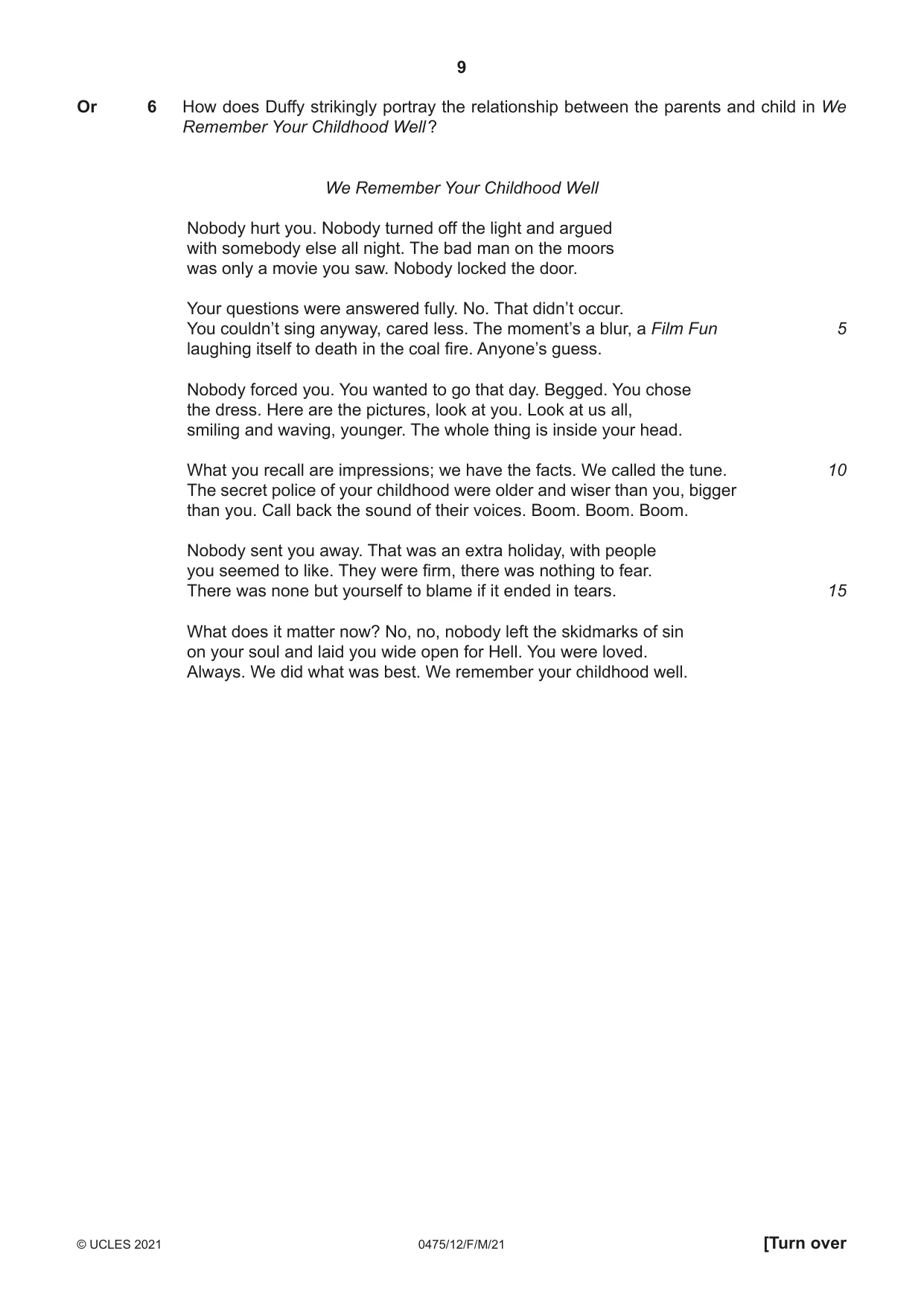
9 0475/12/F/M/21 © UCLES 2021 [Turn over Or 6 How does Duffy strikingly portray the relationship between the parents and child in We Remember Your Childhood Well ? We Remember Your Childhood Well Nobody hurt you. Nobody turned off the light and argued with somebody else all night. The bad man on the moors was only a movie you saw. Nobody locked the door. Your questions were answered fully. No. That didn’t occur. You couldn’t sing anyway, cared less. The moment’s a blur, a Film Fun laughing itself to death in the coal fire. Anyone’s guess. Nobody forced you. You wanted to go that day. Begged. You chose the dress. Here are the pictures, look at you. Look at us all, smiling and waving, younger. The whole thing is inside your head. What you recall are impressions; we have the facts. We called the tune. The secret police of your childhood were older and wiser than you, bigger than you. Call back the sound of their voices. Boom. Boom. Boom. Nobody sent you away. That was an extra holiday, with people you seemed to like. They were firm, there was nothing to fear. There was none but yourself to blame if it ended in tears. What does it matter now? No, no, nobody left the skidmarks of sin on your soul and laid you wide open for Hell. You were loved. Always. We did what was best. We remember your childhood well. 5 10 15
Question paper, page 10
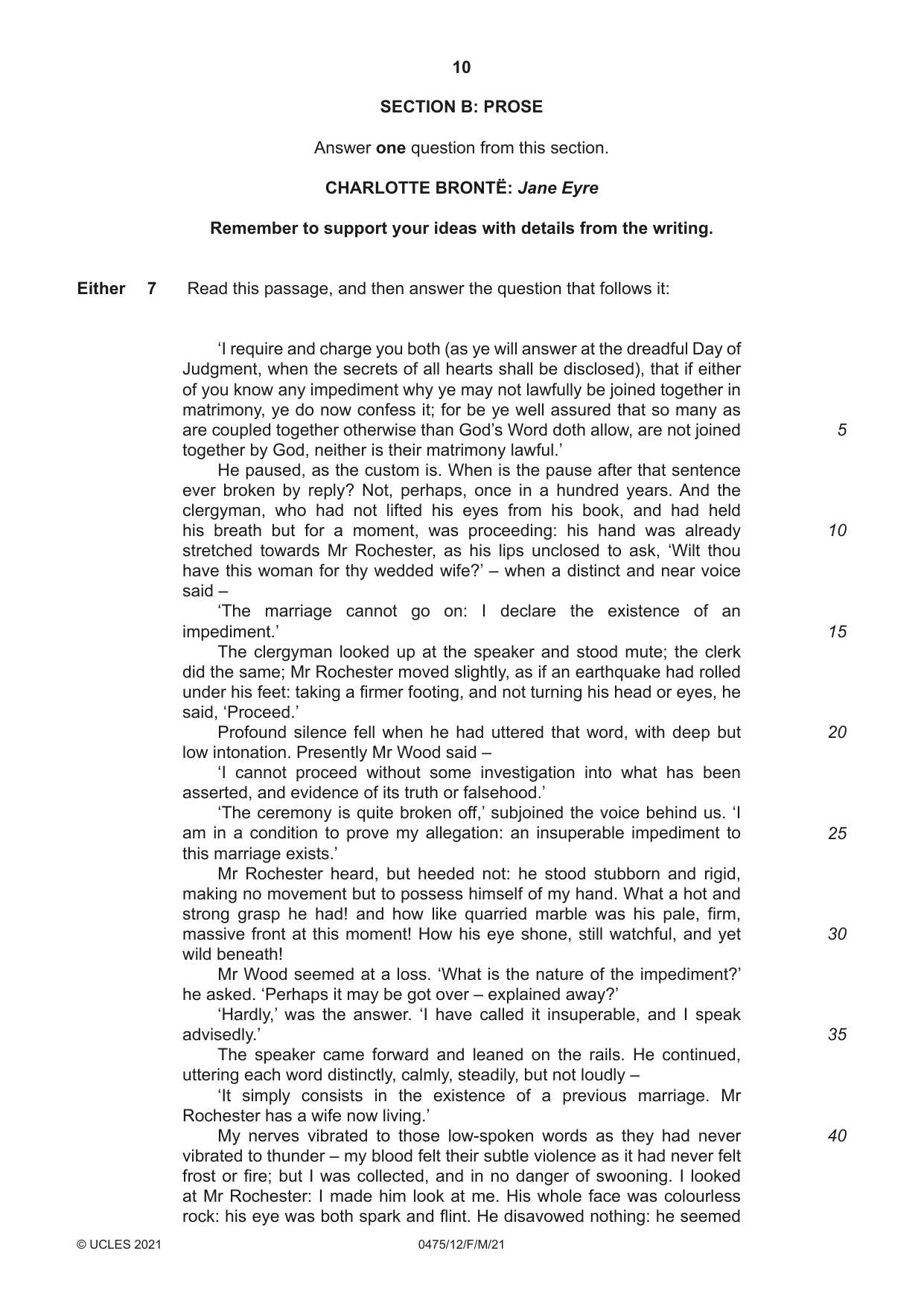
10 0475/12/F/M/21 © UCLES 2021 SECTION B: PROSE Answer one question from this section. CHARLOTTE BRONTË: Jane Eyre Remember to support your ideas with details from the writing. Either 7 Read this passage, and then answer the question that follows it: ‘I require and charge you both (as ye will answer at the dreadful Day of Judgment, when the secrets of all hearts shall be disclosed), that if either of you know any impediment why ye may not lawfully be joined together in matrimony, ye do now confess it; for be ye well assured that so many as are coupled together otherwise than God’s Word doth allow, are not joined together by God, neither is their matrimony lawful.’ He paused, as the custom is. When is the pause after that sentence ever broken by reply? Not, perhaps, once in a hundred years. And the clergyman, who had not lifted his eyes from his book, and had held his breath but for a moment, was proceeding: his hand was already stretched towards Mr Rochester, as his lips unclosed to ask, ‘Wilt thou have this woman for thy wedded wife?’ – when a distinct and near voice said – ‘The marriage cannot go on: I declare the existence of an impediment.’ The clergyman looked up at the speaker and stood mute; the clerk did the same; Mr Rochester moved slightly, as if an earthquake had rolled under his feet: taking a firmer footing, and not turning his head or eyes, he said, ‘Proceed.’ Profound silence fell when he had uttered that word, with deep but low intonation. Presently Mr Wood said – ‘I cannot proceed without some investigation into what has been asserted, and evidence of its truth or falsehood.’ ‘The ceremony is quite broken off,’ subjoined the voice behind us. ‘I am in a condition to prove my allegation: an insuperable impediment to this marriage exists.’ Mr Rochester heard, but heeded not: he stood stubborn and rigid, making no movement but to possess himself of my hand. What a hot and strong grasp he had! and how like quarried marble was his pale, firm, massive front at this moment! How his eye shone, still watchful, and yet wild beneath! Mr Wood seemed at a loss. ‘What is the nature of the impediment?’ he asked. ‘Perhaps it may be got over – explained away?’ ‘Hardly,’ was the answer. ‘I have called it insuperable, and I speak advisedly.’ The speaker came forward and leaned on the rails. He continued, uttering each word distinctly, calmly, steadily, but not loudly – ‘It simply consists in the existence of a previous marriage. Mr Rochester has a wife now living.’ My nerves vibrated to those low-spoken words as they had never vibrated to thunder – my blood felt their subtle violence as it had never felt frost or fire; but I was collected, and in no danger of swooning. I looked at Mr Rochester: I made him look at me. His whole face was colourless rock: his eye was both spark and flint. He disavowed nothing: he seemed 5 10 15 20 25 30 35 40
Question paper, page 11
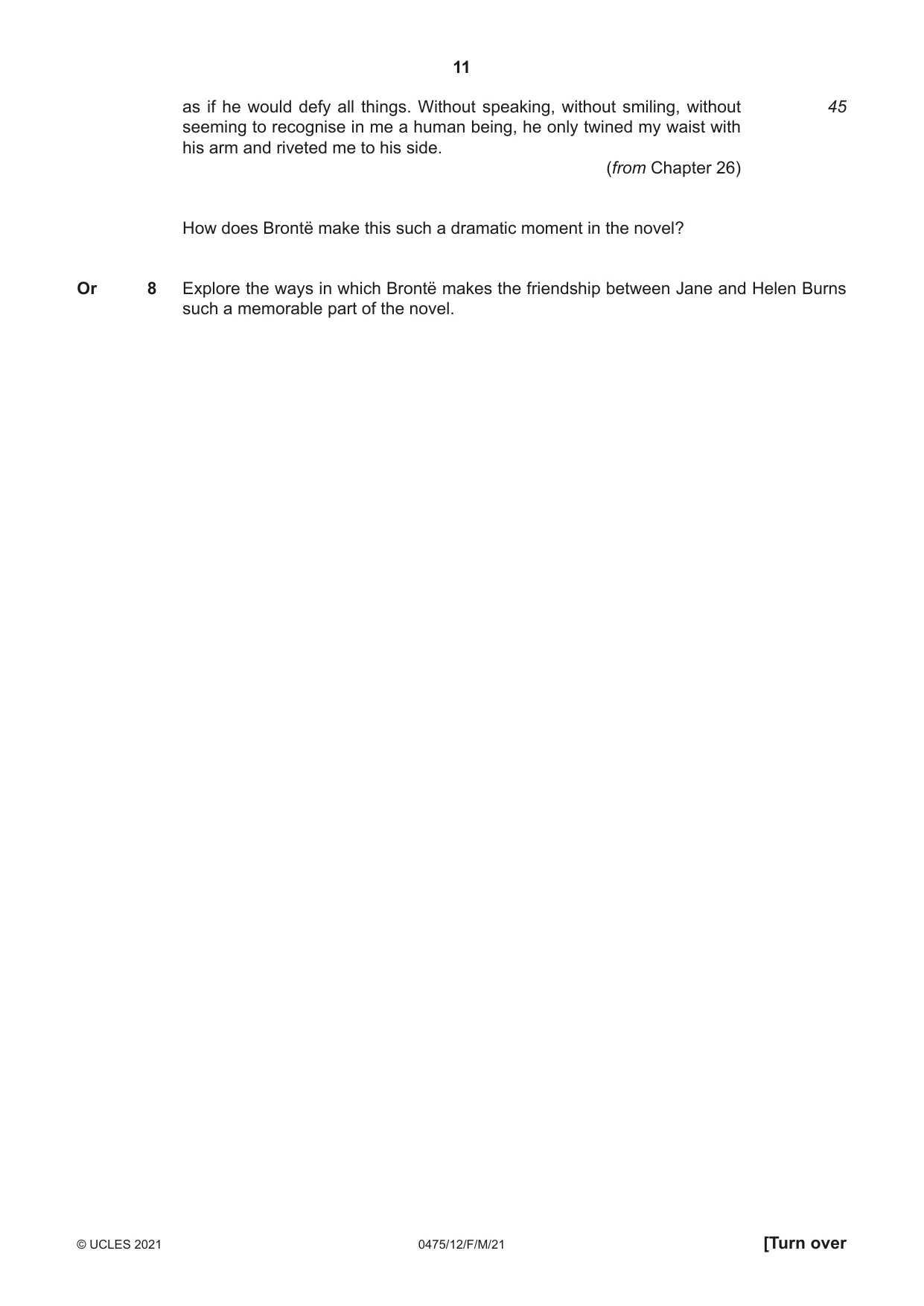
11 0475/12/F/M/21 © UCLES 2021 [Turn over as if he would defy all things. Without speaking, without smiling, without seeming to recognise in me a human being, he only twined my waist with his arm and riveted me to his side. (from Chapter 26) How does Brontë make this such a dramatic moment in the novel? Or 8 Explore the ways in which Brontë makes the friendship between Jane and Helen Burns such a memorable part of the novel. 45
Question paper, page 12
12 0475/12/F/M/21 © UCLES 2021 ANITA DESAI: In Custody Remember to support your ideas with details from the writing. Either 9 Read this passage, and then answer the question that follows it: His first feeling on turning around at the tap on his shoulder while he was buying cigarettes at the college canteen and seeing his old friend Murad was one of joy so that he gasped ‘Murad? Content removed due to copyright restrictions.
Question paper, page 13
13 0475/12/F/M/21 © UCLES 2021 [Turn over Then he swung away with such desperation that he dashed right into a group of girl students also coming up the stairs and caused much offence, affront, tittering and giggling which Murad stood and watched with a grin. (from Chapter 1) In what ways does Desai make this such a revealing opening to the novel? Or 10 How does Desai strikingly convey Deven’s obsession with Nur and Urdu poetry? Content removed due to copyright restrictions.
Question paper, page 14
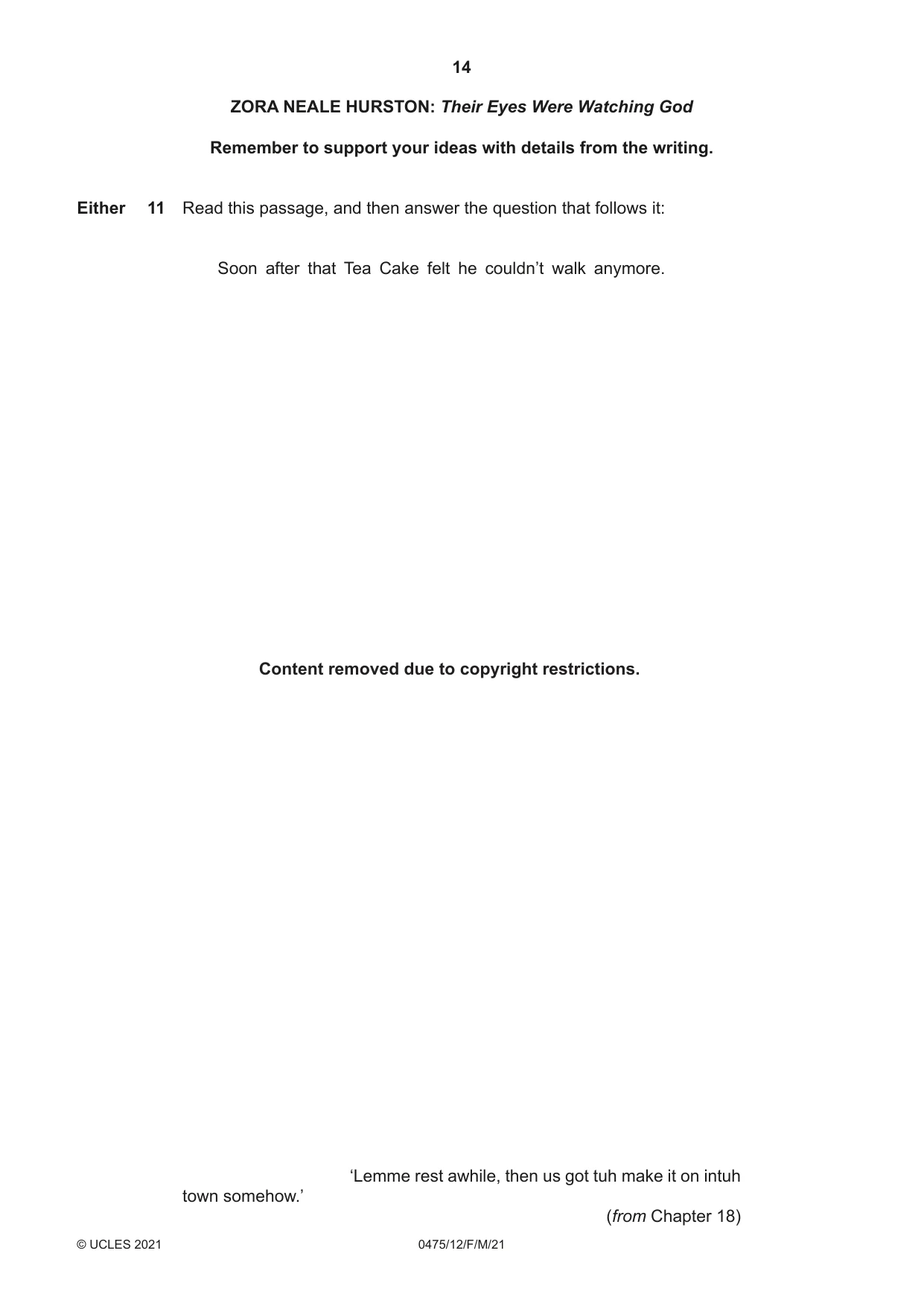
14 0475/12/F/M/21 © UCLES 2021 ZORA NEALE HURSTON: Their Eyes Were Watching God Remember to support your ideas with details from the writing. Either 11 Read this passage, and then answer the question that follows it: Soon after that Tea Cake felt he couldn’t walk anymore. ‘Lemme rest awhile, then us got tuh make it on intuh town somehow.’ (from Chapter 18) Content removed due to copyright restrictions.
Question paper, page 15
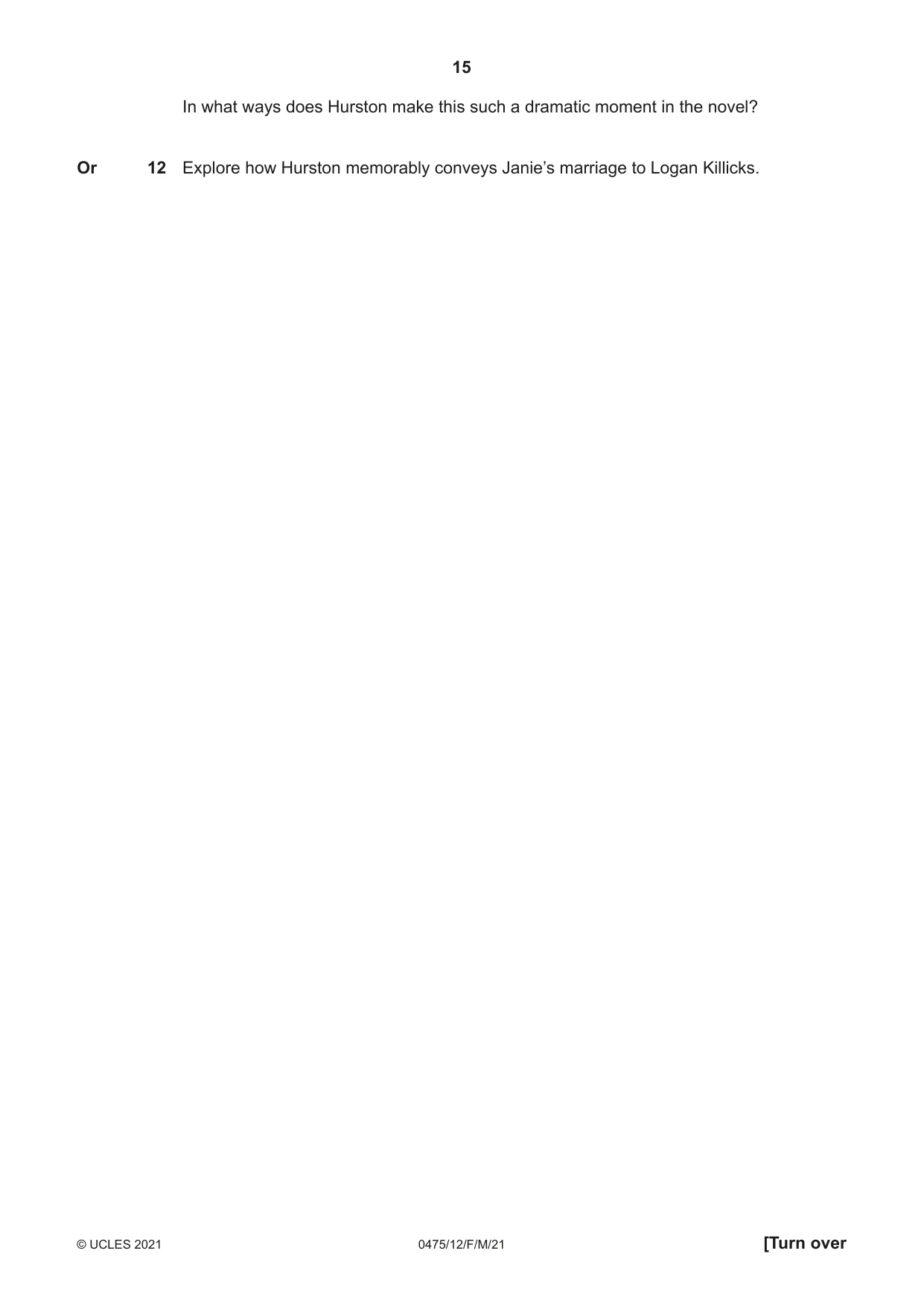
15 0475/12/F/M/21 © UCLES 2021 [Turn over In what ways does Hurston make this such a dramatic moment in the novel? Or 12 Explore how Hurston memorably conveys Janie’s marriage to Logan Killicks.
Question paper, page 16
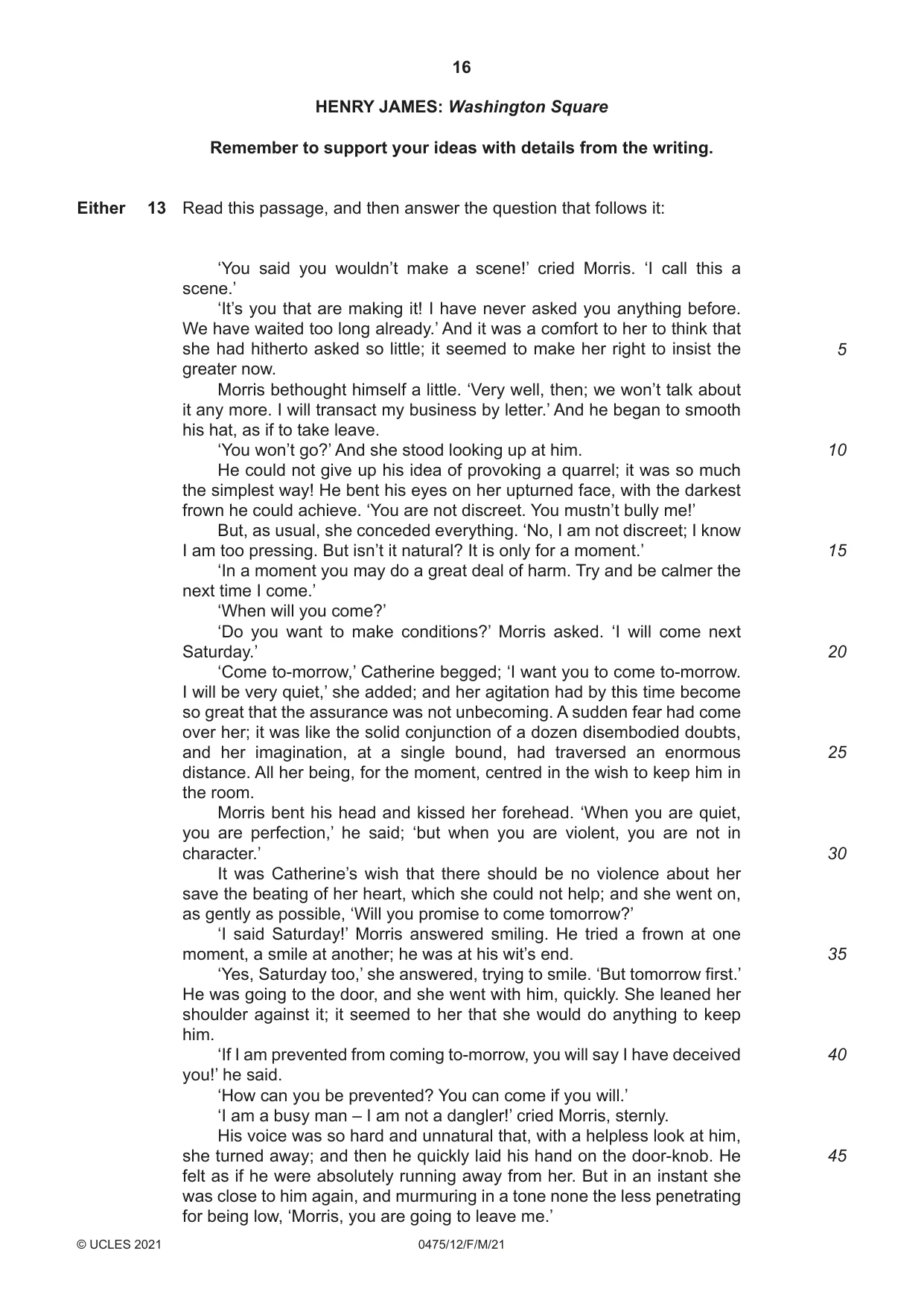
16 0475/12/F/M/21 © UCLES 2021 HENRY JAMES: Washington Square Remember to support your ideas with details from the writing. Either 13 Read this passage, and then answer the question that follows it: ‘You said you wouldn’t make a scene!’ cried Morris. ‘I call this a scene.’ ‘It’s you that are making it! I have never asked you anything before. We have waited too long already.’ And it was a comfort to her to think that she had hitherto asked so little; it seemed to make her right to insist the greater now. Morris bethought himself a little. ‘Very well, then; we won’t talk about it any more. I will transact my business by letter.’ And he began to smooth his hat, as if to take leave. ‘You won’t go?’ And she stood looking up at him. He could not give up his idea of provoking a quarrel; it was so much the simplest way! He bent his eyes on her upturned face, with the darkest frown he could achieve. ‘You are not discreet. You mustn’t bully me!’ But, as usual, she conceded everything. ‘No, I am not discreet; I know I am too pressing. But isn’t it natural? It is only for a moment.’ ‘In a moment you may do a great deal of harm. Try and be calmer the next time I come.’ ‘When will you come?’ ‘Do you want to make conditions?’ Morris asked. ‘I will come next Saturday.’ ‘Come to-morrow,’ Catherine begged; ‘I want you to come to-morrow. I will be very quiet,’ she added; and her agitation had by this time become so great that the assurance was not unbecoming. A sudden fear had come over her; it was like the solid conjunction of a dozen disembodied doubts, and her imagination, at a single bound, had traversed an enormous distance. All her being, for the moment, centred in the wish to keep him in the room. Morris bent his head and kissed her forehead. ‘When you are quiet, you are perfection,’ he said; ‘but when you are violent, you are not in character.’ It was Catherine’s wish that there should be no violence about her save the beating of her heart, which she could not help; and she went on, as gently as possible, ‘Will you promise to come tomorrow?’ ‘I said Saturday!’ Morris answered smiling. He tried a frown at one moment, a smile at another; he was at his wit’s end. ‘Yes, Saturday too,’ she answered, trying to smile. ‘But tomorrow first.’ He was going to the door, and she went with him, quickly. She leaned her shoulder against it; it seemed to her that she would do anything to keep him. ‘If I am prevented from coming to-morrow, you will say I have deceived you!’ he said. ‘How can you be prevented? You can come if you will.’ ‘I am a busy man – I am not a dangler!’ cried Morris, sternly. His voice was so hard and unnatural that, with a helpless look at him, she turned away; and then he quickly laid his hand on the door-knob. He felt as if he were absolutely running away from her. But in an instant she was close to him again, and murmuring in a tone none the less penetrating for being low, ‘Morris, you are going to leave me.’ 5 10 15 20 25 30 35 40 45
Question paper, page 17
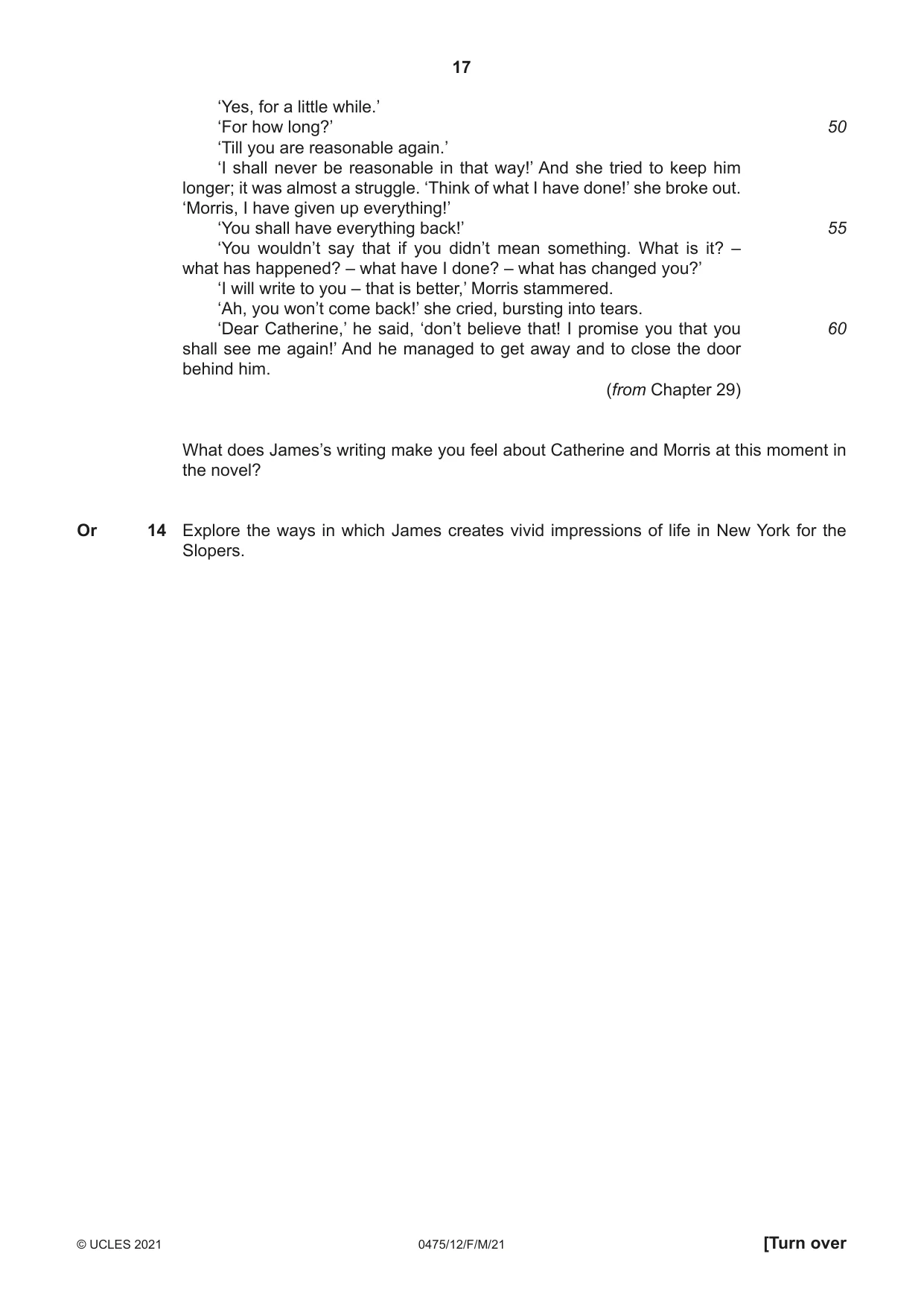
17 0475/12/F/M/21 © UCLES 2021 [Turn over ‘Yes, for a little while.’ ‘For how long?’ ‘Till you are reasonable again.’ ‘I shall never be reasonable in that way!’ And she tried to keep him longer; it was almost a struggle. ‘Think of what I have done!’ she broke out. ‘Morris, I have given up everything!’ ‘You shall have everything back!’ ‘You wouldn’t say that if you didn’t mean something. What is it? – what has happened? – what have I done? – what has changed you?’ ‘I will write to you – that is better,’ Morris stammered. ‘Ah, you won’t come back!’ she cried, bursting into tears. ‘Dear Catherine,’ he said, ‘don’t believe that! I promise you that you shall see me again!’ And he managed to get away and to close the door behind him. (from Chapter 29) What does James’s writing make you feel about Catherine and Morris at this moment in the novel? Or 14 Explore the ways in which James creates vivid impressions of life in New York for the Slopers. 50 55 60
Question paper, page 18
18 0475/12/F/M/21 © UCLES 2021 JOHN KNOWLES: A Separate Peace Remember to support your ideas with details from the writing. Either 15 Read this passage, and then answer the question that follows it: Far ahead of us four boys, looking like white flags on the endless green playing fields, crossed toward the tennis courts. Content removed due to copyright restrictions.
Question paper, page 19
19 0475/12/F/M/21 © UCLES 2021 [Turn over Finny had practically saved my life. (from Chapter 2) In what ways does Knowles make this such a memorable moment in the novel? Or 16 To what extent does Knowles make you like Gene? Do not use the passage printed in Question 15 in answering this question. Content removed due to copyright restrictions.
Question paper, page 20
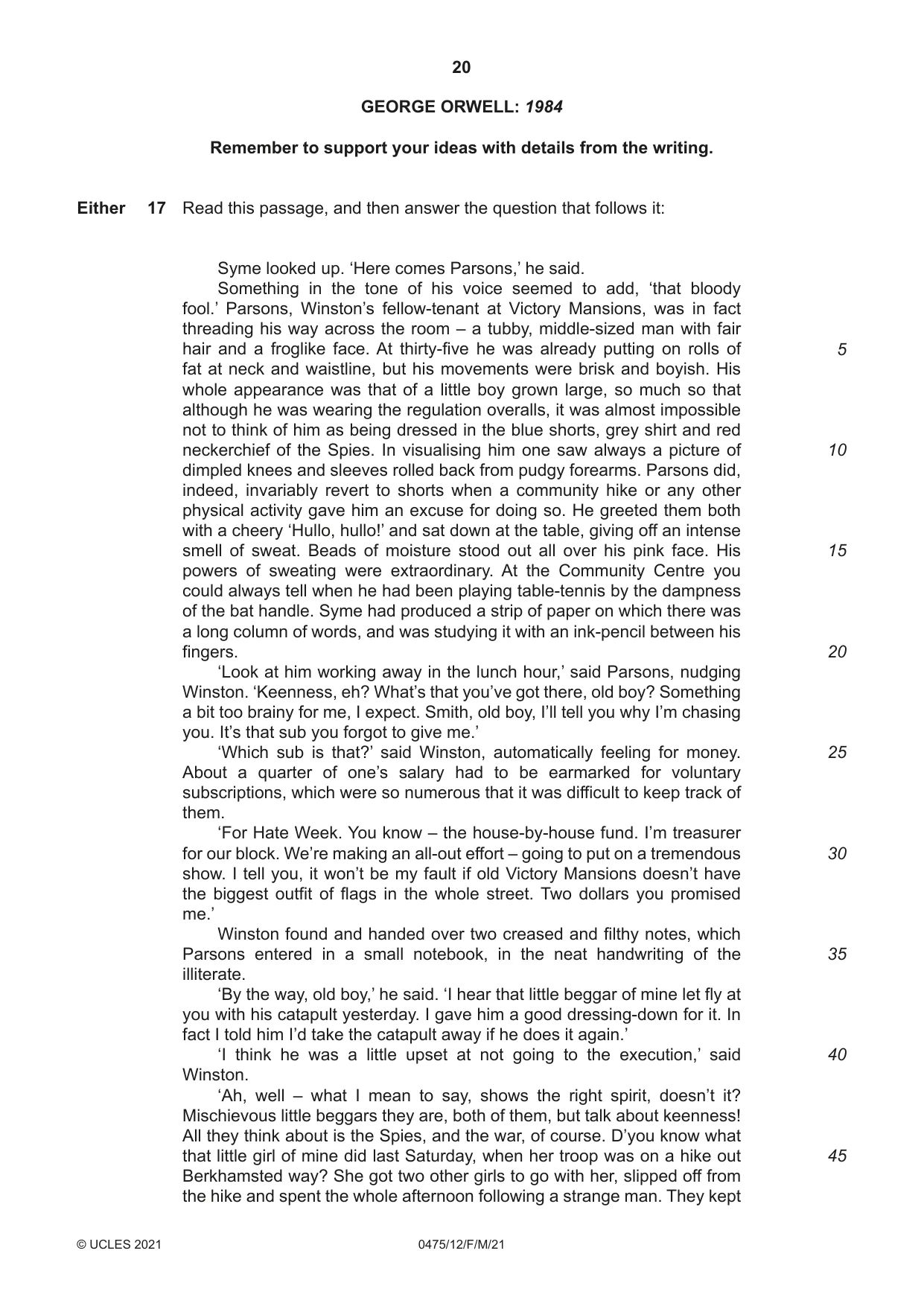
20 0475/12/F/M/21 © UCLES 2021 GEORGE ORWELL: 1984 Remember to support your ideas with details from the writing. Either 17 Read this passage, and then answer the question that follows it: Syme looked up. ‘Here comes Parsons,’ he said. Something in the tone of his voice seemed to add, ‘that bloody fool.’ Parsons, Winston’s fellow-tenant at Victory Mansions, was in fact threading his way across the room – a tubby, middle-sized man with fair hair and a froglike face. At thirty-five he was already putting on rolls of fat at neck and waistline, but his movements were brisk and boyish. His whole appearance was that of a little boy grown large, so much so that although he was wearing the regulation overalls, it was almost impossible not to think of him as being dressed in the blue shorts, grey shirt and red neckerchief of the Spies. In visualising him one saw always a picture of dimpled knees and sleeves rolled back from pudgy forearms. Parsons did, indeed, invariably revert to shorts when a community hike or any other physical activity gave him an excuse for doing so. He greeted them both with a cheery ‘Hullo, hullo!’ and sat down at the table, giving off an intense smell of sweat. Beads of moisture stood out all over his pink face. His powers of sweating were extraordinary. At the Community Centre you could always tell when he had been playing table-tennis by the dampness of the bat handle. Syme had produced a strip of paper on which there was a long column of words, and was studying it with an ink-pencil between his fingers. ‘Look at him working away in the lunch hour,’ said Parsons, nudging Winston. ‘Keenness, eh? What’s that you’ve got there, old boy? Something a bit too brainy for me, I expect. Smith, old boy, I’ll tell you why I’m chasing you. It’s that sub you forgot to give me.’ ‘Which sub is that?’ said Winston, automatically feeling for money. About a quarter of one’s salary had to be earmarked for voluntary subscriptions, which were so numerous that it was difficult to keep track of them. ‘For Hate Week. You know – the house-by-house fund. I’m treasurer for our block. We’re making an all-out effort – going to put on a tremendous show. I tell you, it won’t be my fault if old Victory Mansions doesn’t have the biggest outfit of flags in the whole street. Two dollars you promised me.’ Winston found and handed over two creased and filthy notes, which Parsons entered in a small notebook, in the neat handwriting of the illiterate. ‘By the way, old boy,’ he said. ‘I hear that little beggar of mine let fly at you with his catapult yesterday. I gave him a good dressing-down for it. In fact I told him I’d take the catapult away if he does it again.’ ‘I think he was a little upset at not going to the execution,’ said Winston. ‘Ah, well – what I mean to say, shows the right spirit, doesn’t it? Mischievous little beggars they are, both of them, but talk about keenness! All they think about is the Spies, and the war, of course. D’you know what that little girl of mine did last Saturday, when her troop was on a hike out Berkhamsted way? She got two other girls to go with her, slipped off from the hike and spent the whole afternoon following a strange man. They kept 5 10 15 20 25 30 35 40 45
Question paper, page 21
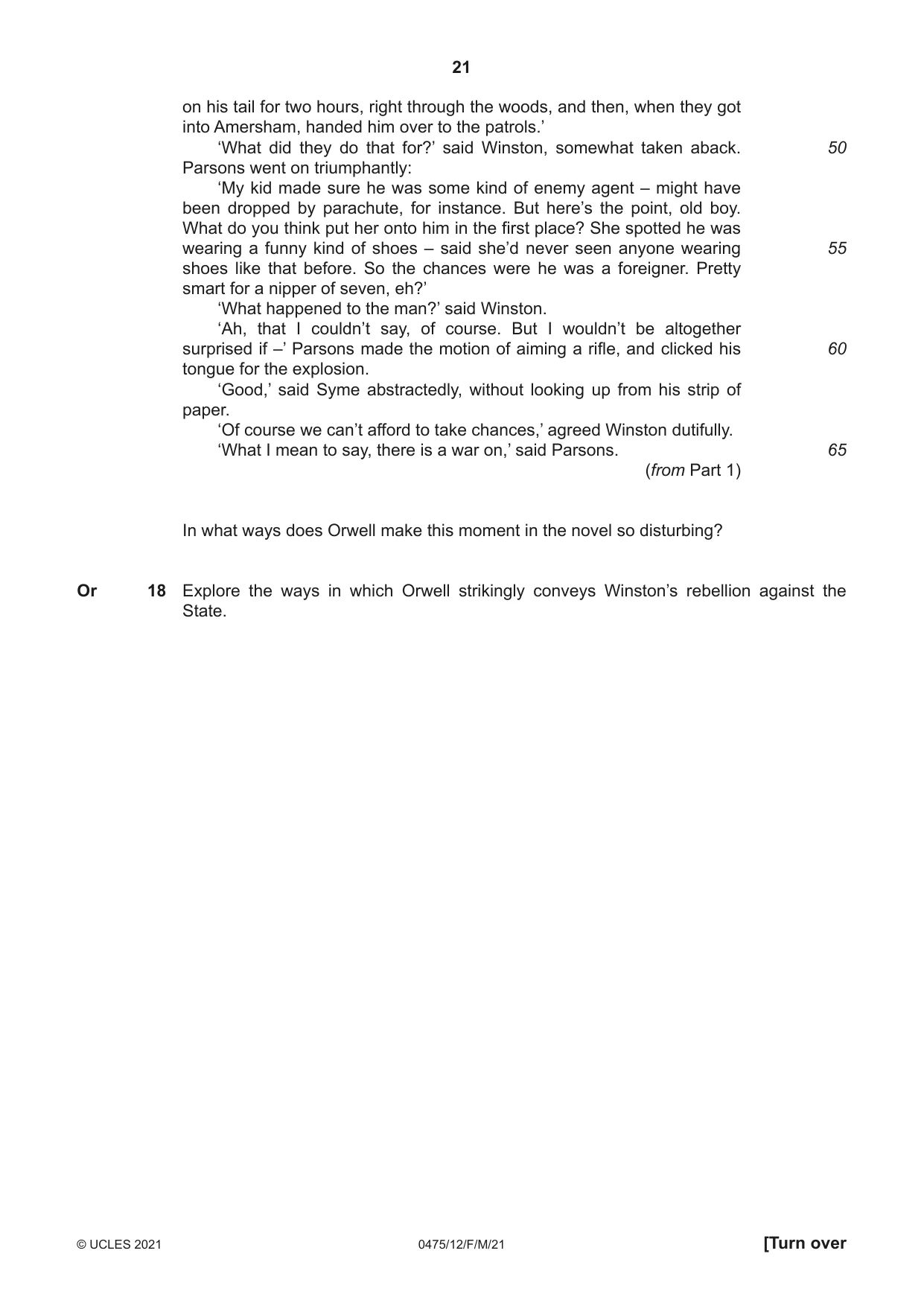
21 0475/12/F/M/21 © UCLES 2021 [Turn over on his tail for two hours, right through the woods, and then, when they got into Amersham, handed him over to the patrols.’ ‘What did they do that for?’ said Winston, somewhat taken aback. Parsons went on triumphantly: ‘My kid made sure he was some kind of enemy agent – might have been dropped by parachute, for instance. But here’s the point, old boy. What do you think put her onto him in the first place? She spotted he was wearing a funny kind of shoes – said she’d never seen anyone wearing shoes like that before. So the chances were he was a foreigner. Pretty smart for a nipper of seven, eh?’ ‘What happened to the man?’ said Winston. ‘Ah, that I couldn’t say, of course. But I wouldn’t be altogether surprised if –’ Parsons made the motion of aiming a rifle, and clicked his tongue for the explosion. ‘Good,’ said Syme abstractedly, without looking up from his strip of paper. ‘Of course we can’t afford to take chances,’ agreed Winston dutifully. ‘What I mean to say, there is a war on,’ said Parsons. (from Part 1) In what ways does Orwell make this moment in the novel so disturbing? Or 18 Explore the ways in which Orwell strikingly conveys Winston’s rebellion against the State. 50 55 60 65
Question paper, page 22
22 0475/12/F/M/21 © UCLES 2021 ALAN PATON: Cry, the Beloved Country Remember to support your ideas with details from the writing. Either 19 Read this passage, and then answer the question that follows it: There is laughter in the house, the kind of laughter of which one is afraid. Content removed due to copyright restrictions.
Question paper, page 23
23 0475/12/F/M/21 © UCLES 2021 [Turn over She sobs too. (from Book 1 Chapter 6) How does Paton make this such a striking introduction to Gertrude? Or 20 Explore the ways in which Paton vividly depicts crime in the novel. Content removed due to copyright restrictions.
Question paper, page 24
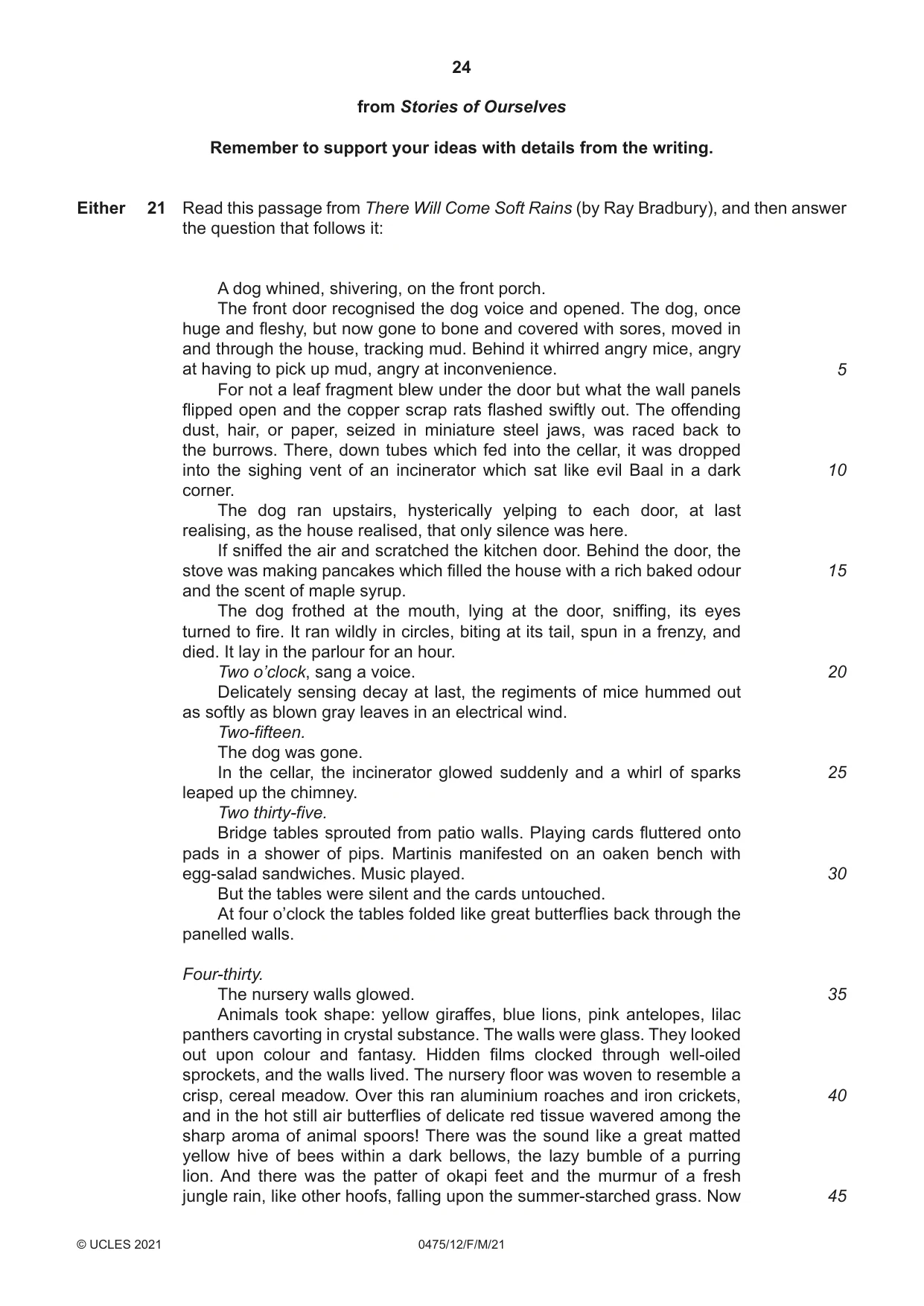
24 0475/12/F/M/21 © UCLES 2021 from Stories of Ourselves Remember to support your ideas with details from the writing. Either 21 Read this passage from There Will Come Soft Rains (by Ray Bradbury), and then answer the question that follows it: A dog whined, shivering, on the front porch. The front door recognised the dog voice and opened. The dog, once huge and fleshy, but now gone to bone and covered with sores, moved in and through the house, tracking mud. Behind it whirred angry mice, angry at having to pick up mud, angry at inconvenience. For not a leaf fragment blew under the door but what the wall panels flipped open and the copper scrap rats flashed swiftly out. The offending dust, hair, or paper, seized in miniature steel jaws, was raced back to the burrows. There, down tubes which fed into the cellar, it was dropped into the sighing vent of an incinerator which sat like evil Baal in a dark corner. The dog ran upstairs, hysterically yelping to each door, at last realising, as the house realised, that only silence was here. If sniffed the air and scratched the kitchen door. Behind the door, the stove was making pancakes which filled the house with a rich baked odour and the scent of maple syrup. The dog frothed at the mouth, lying at the door, sniffing, its eyes turned to fire. It ran wildly in circles, biting at its tail, spun in a frenzy, and died. It lay in the parlour for an hour. Two o’clock, sang a voice. Delicately sensing decay at last, the regiments of mice hummed out as softly as blown gray leaves in an electrical wind. Two-fifteen. The dog was gone. In the cellar, the incinerator glowed suddenly and a whirl of sparks leaped up the chimney. Two thirty-five. Bridge tables sprouted from patio walls. Playing cards fluttered onto pads in a shower of pips. Martinis manifested on an oaken bench with egg-salad sandwiches. Music played. But the tables were silent and the cards untouched. At four o’clock the tables folded like great butterflies back through the panelled walls. Four-thirty. The nursery walls glowed. Animals took shape: yellow giraffes, blue lions, pink antelopes, lilac panthers cavorting in crystal substance. The walls were glass. They looked out upon colour and fantasy. Hidden films clocked through well-oiled sprockets, and the walls lived. The nursery floor was woven to resemble a crisp, cereal meadow. Over this ran aluminium roaches and iron crickets, and in the hot still air butterflies of delicate red tissue wavered among the sharp aroma of animal spoors! There was the sound like a great matted yellow hive of bees within a dark bellows, the lazy bumble of a purring lion. And there was the patter of okapi feet and the murmur of a fresh jungle rain, like other hoofs, falling upon the summer-starched grass. Now 5 10 15 20 25 30 35 40 45
Question paper, page 25
25 0475/12/F/M/21 © UCLES 2021 the walls dissolved into distances of parched weed, mile on mile, and warm endless sky. The animals drew away into thorn brakes and water holes. It was the children’s hour. What does Bradbury’s writing make you feel as you read this passage? Or 22 How does MacLaverty make you feel sympathy for the boy in Secrets?
Question paper, page 26
26 0475/12/F/M/21 © UCLES 2021 BLANK PAGE
Question paper, page 27
27 0475/12/F/M/21 © UCLES 2021 BLANK PAGE
Question paper, page 28
28 0475/12/F/M/21 © UCLES 2021 Permission to reproduce items where third-party owned material protected by copyright is included has been sought and cleared where possible. Every reasonable effort has been made by the publisher (UCLES) to trace copyright holders, but if any items requiring clearance have unwittingly been included, the publisher will be pleased to make amends at the earliest possible opportunity. To avoid the issue of disclosure of answer-related information to candidates, all copyright acknowledgements are reproduced online in the Cambridge Assessment International Education Copyright Acknowledgements Booklet. This is produced for each series of examinations and is freely available to download at www.cambridgeinternational.org after the live examination series. Cambridge Assessment International Education is part of the Cambridge Assessment Group. Cambridge Assessment is the brand name of the University of Cambridge Local Examinations Syndicate (UCLES), which itself is a department of the University of Cambridge. BLANK PAGE
Mark scheme, page 1
This document consists of 4 printed pages. © UCLES 2021 [Turn over Cambridge IGCSE™ LITERATURE IN ENGLISH 0475/12 Paper 1 Poetry and Prose March 2021 MARK SCHEME Maximum Mark: 50 Published This mark scheme is published as an aid to teachers and candidates, to indicate the requirements of the examination. It shows the basis on which Examiners were instructed to award marks. It does not indicate the details of the discussions that took place at an Examiners’ meeting before marking began, which would have considered the acceptability of alternative answers. Mark schemes should be read in conjunction with the question paper and the Principal Examiner Report for Teachers. Cambridge International will not enter into discussions about these mark schemes. Cambridge International is publishing the mark schemes for the March 2021 series for most Cambridge IGCSE™, Cambridge International A and AS Level components and some Cambridge O Level components.
Mark scheme, page 2
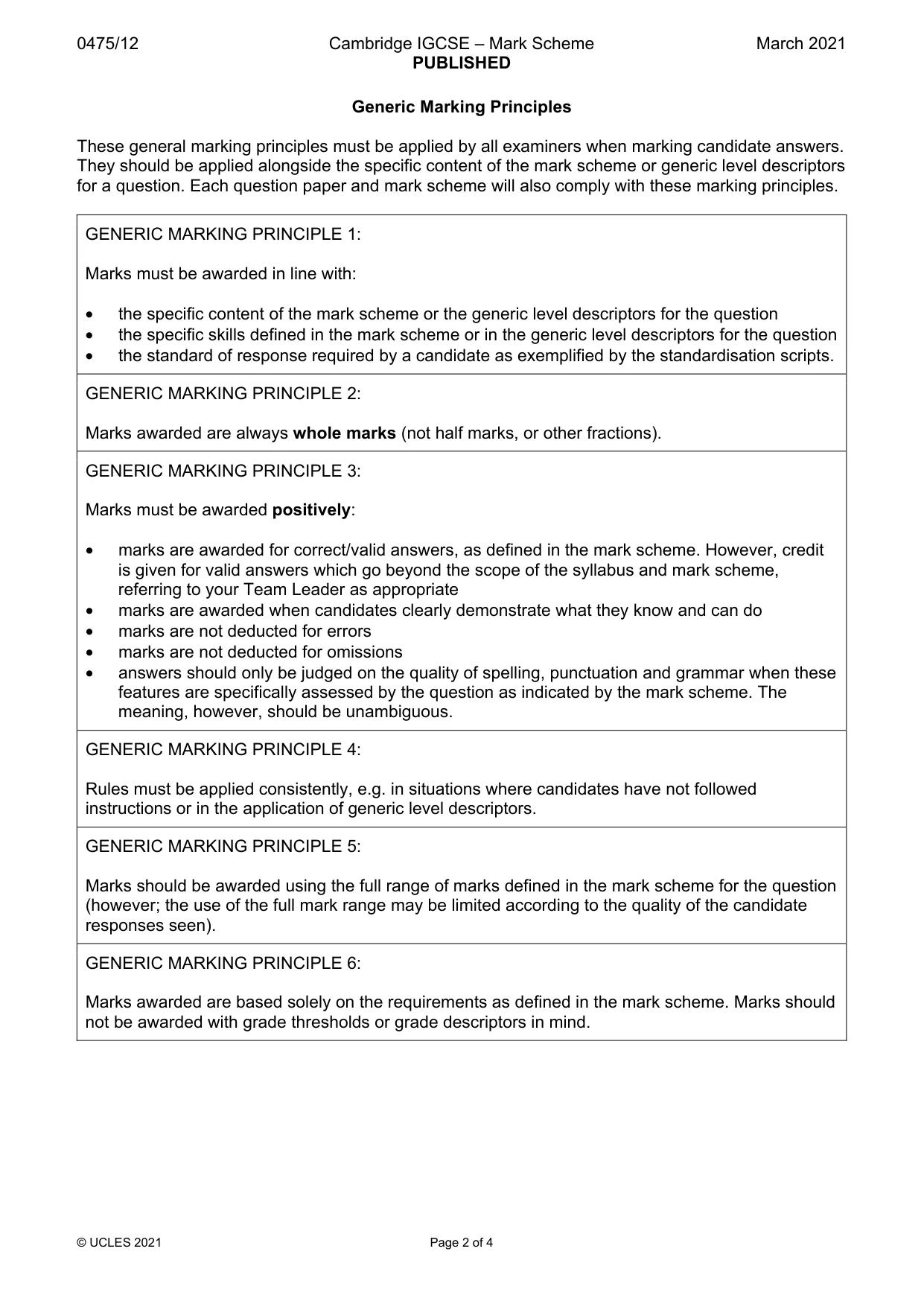
0475/12 Cambridge IGCSE – Mark Scheme PUBLISHED March 2021 © UCLES 2021 Page 2 of 4 Generic Marking Principles These general marking principles must be applied by all examiners when marking candidate answers. They should be applied alongside the specific content of the mark scheme or generic level descriptors for a question. Each question paper and mark scheme will also comply with these marking principles. GENERIC MARKING PRINCIPLE 1: Marks must be awarded in line with: • the specific content of the mark scheme or the generic level descriptors for the question • the specific skills defined in the mark scheme or in the generic level descriptors for the question • the standard of response required by a candidate as exemplified by the standardisation scripts. GENERIC MARKING PRINCIPLE 2: Marks awarded are always whole marks (not half marks, or other fractions). GENERIC MARKING PRINCIPLE 3: Marks must be awarded positively: • marks are awarded for correct/valid answers, as defined in the mark scheme. However, credit is given for valid answers which go beyond the scope of the syllabus and mark scheme, referring to your Team Leader as appropriate • marks are awarded when candidates clearly demonstrate what they know and can do • marks are not deducted for errors • marks are not deducted for omissions • answers should only be judged on the quality of spelling, punctuation and grammar when these features are specifically assessed by the question as indicated by the mark scheme. The meaning, however, should be unambiguous. GENERIC MARKING PRINCIPLE 4: Rules must be applied consistently, e.g. in situations where candidates have not followed instructions or in the application of generic level descriptors. GENERIC MARKING PRINCIPLE 5: Marks should be awarded using the full range of marks defined in the mark scheme for the question (however; the use of the full mark range may be limited according to the quality of the candidate responses seen). GENERIC MARKING PRINCIPLE 6: Marks awarded are based solely on the requirements as defined in the mark scheme. Marks should not be awarded with grade thresholds or grade descriptors in mind.
Mark scheme, page 3
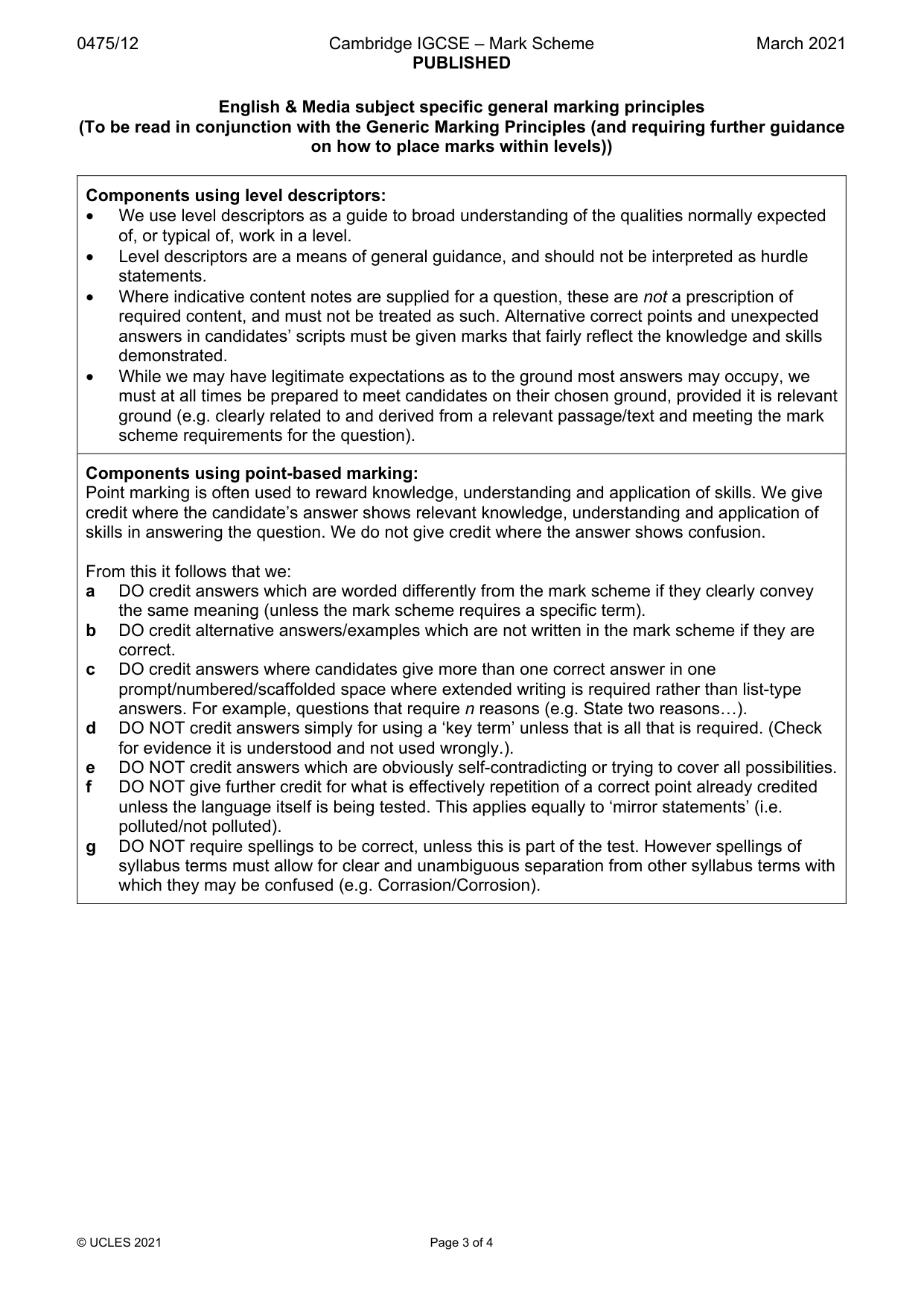
0475/12 Cambridge IGCSE – Mark Scheme PUBLISHED March 2021 © UCLES 2021 Page 3 of 4 English & Media subject specific general marking principles (To be read in conjunction with the Generic Marking Principles (and requiring further guidance on how to place marks within levels)) Components using level descriptors: • We use level descriptors as a guide to broad understanding of the qualities normally expected of, or typical of, work in a level. • Level descriptors are a means of general guidance, and should not be interpreted as hurdle statements. • Where indicative content notes are supplied for a question, these are not a prescription of required content, and must not be treated as such. Alternative correct points and unexpected answers in candidates’ scripts must be given marks that fairly reflect the knowledge and skills demonstrated. • While we may have legitimate expectations as to the ground most answers may occupy, we must at all times be prepared to meet candidates on their chosen ground, provided it is relevant ground (e.g. clearly related to and derived from a relevant passage/text and meeting the mark scheme requirements for the question). Components using point-based marking: Point marking is often used to reward knowledge, understanding and application of skills. We give credit where the candidate’s answer shows relevant knowledge, understanding and application of skills in answering the question. We do not give credit where the answer shows confusion. From this it follows that we: a DO credit answers which are worded differently from the mark scheme if they clearly convey the same meaning (unless the mark scheme requires a specific term). b DO credit alternative answers/examples which are not written in the mark scheme if they are correct. c DO credit answers where candidates give more than one correct answer in one prompt/numbered/scaffolded space where extended writing is required rather than list-type answers. For example, questions that require n reasons (e.g. State two reasons…). d DO NOT credit answers simply for using a ‘key term’ unless that is all that is required. (Check for evidence it is understood and not used wrongly.). e DO NOT credit answers which are obviously self-contradicting or trying to cover all possibilities. f DO NOT give further credit for what is effectively repetition of a correct point already credited unless the language itself is being tested. This applies equally to ‘mirror statements’ (i.e. polluted/not polluted). g DO NOT require spellings to be correct, unless this is part of the test. However spellings of syllabus terms must allow for clear and unambiguous separation from other syllabus terms with which they may be confused (e.g. Corrasion/Corrosion).
Mark scheme, page 4
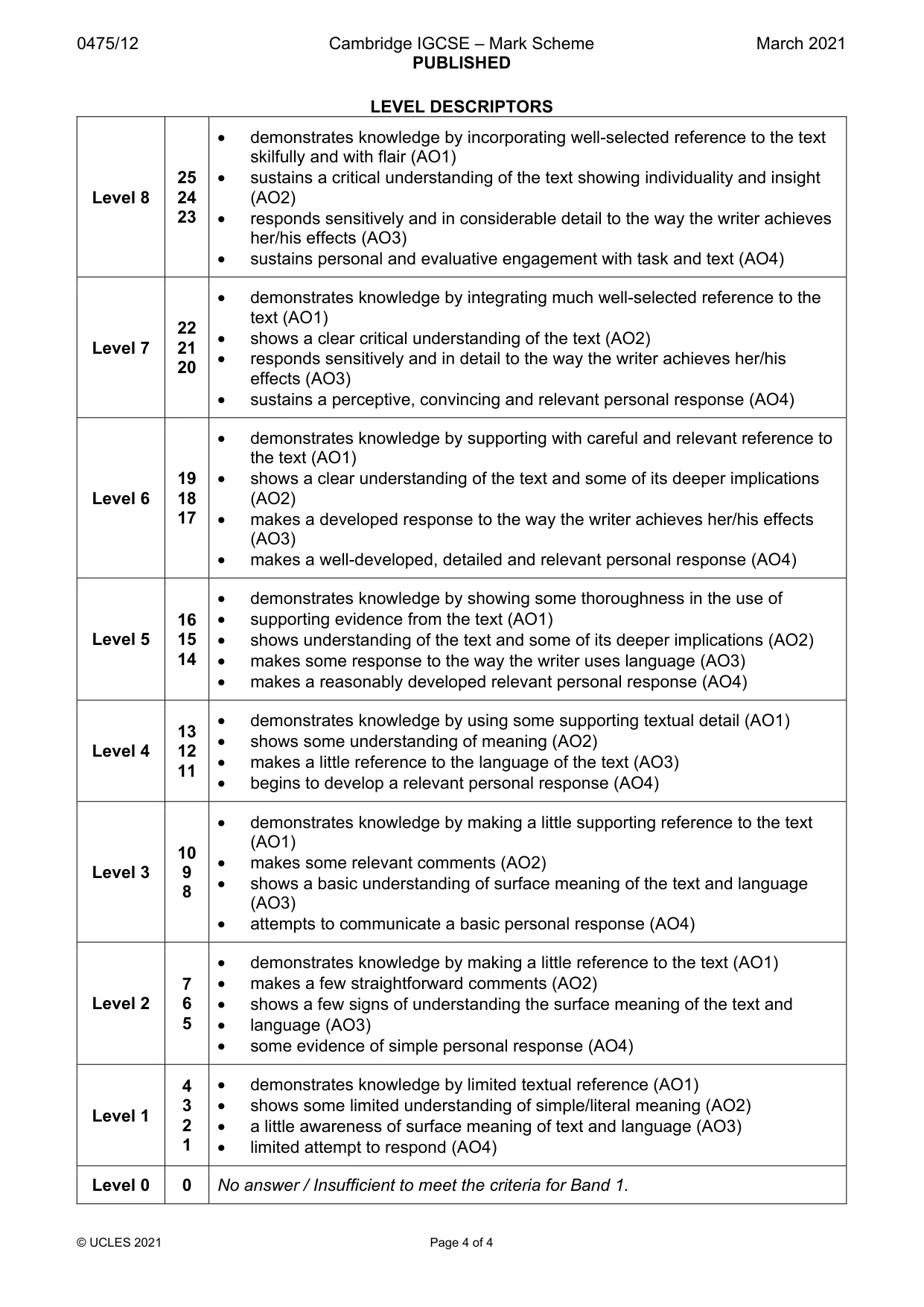
0475/12 Cambridge IGCSE – Mark Scheme PUBLISHED March 2021 © UCLES 2021 Page 4 of 4 LEVEL DESCRIPTORS Level 8 25 24 23 • demonstrates knowledge by incorporating well-selected reference to the text skilfully and with flair (AO1) • sustains a critical understanding of the text showing individuality and insight (AO2) • responds sensitively and in considerable detail to the way the writer achieves her/his effects (AO3) • sustains personal and evaluative engagement with task and text (AO4) Level 7 22 21 20 • demonstrates knowledge by integrating much well-selected reference to the text (AO1) • shows a clear critical understanding of the text (AO2) • responds sensitively and in detail to the way the writer achieves her/his effects (AO3) • sustains a perceptive, convincing and relevant personal response (AO4) Level 6 19 18 17 • demonstrates knowledge by supporting with careful and relevant reference to the text (AO1) • shows a clear understanding of the text and some of its deeper implications (AO2) • makes a developed response to the way the writer achieves her/his effects (AO3) • makes a well-developed, detailed and relevant personal response (AO4) Level 5 16 15 14 • demonstrates knowledge by showing some thoroughness in the use of • supporting evidence from the text (AO1) • shows understanding of the text and some of its deeper implications (AO2) • makes some response to the way the writer uses language (AO3) • makes a reasonably developed relevant personal response (AO4) Level 4 13 12 11 • demonstrates knowledge by using some supporting textual detail (AO1) • shows some understanding of meaning (AO2) • makes a little reference to the language of the text (AO3) • begins to develop a relevant personal response (AO4) Level 3 10 9 8 • demonstrates knowledge by making a little supporting reference to the text (AO1) • makes some relevant comments (AO2) • shows a basic understanding of surface meaning of the text and language (AO3) • attempts to communicate a basic personal response (AO4) Level 2 7 6 5 • demonstrates knowledge by making a little reference to the text (AO1) • makes a few straightforward comments (AO2) • shows a few signs of understanding the surface meaning of the text and • language (AO3) • some evidence of simple personal response (AO4) Level 1 4 3 2 1 • demonstrates knowledge by limited textual reference (AO1) • shows some limited understanding of simple/literal meaning (AO2) • a little awareness of surface meaning of text and language (AO3) • limited attempt to respond (AO4) Level 0 0 No answer / Insufficient to meet the criteria for Band 1.