Cambridge IGCSE English - Literature in English 0475 — 2020 Oct/Nov Paper 3 · Variant 3
0475/33/O/N/20 · 25 marks · ≈28 min
The question paper and its mark scheme, free to read here and free to download. This is Cambridge’s own paper, exactly as it was sat.
Question paper12 pages
Mark scheme7 pages
Answers below. Sit the paper first if you are practising.
Paper as text
Question paper, page 1
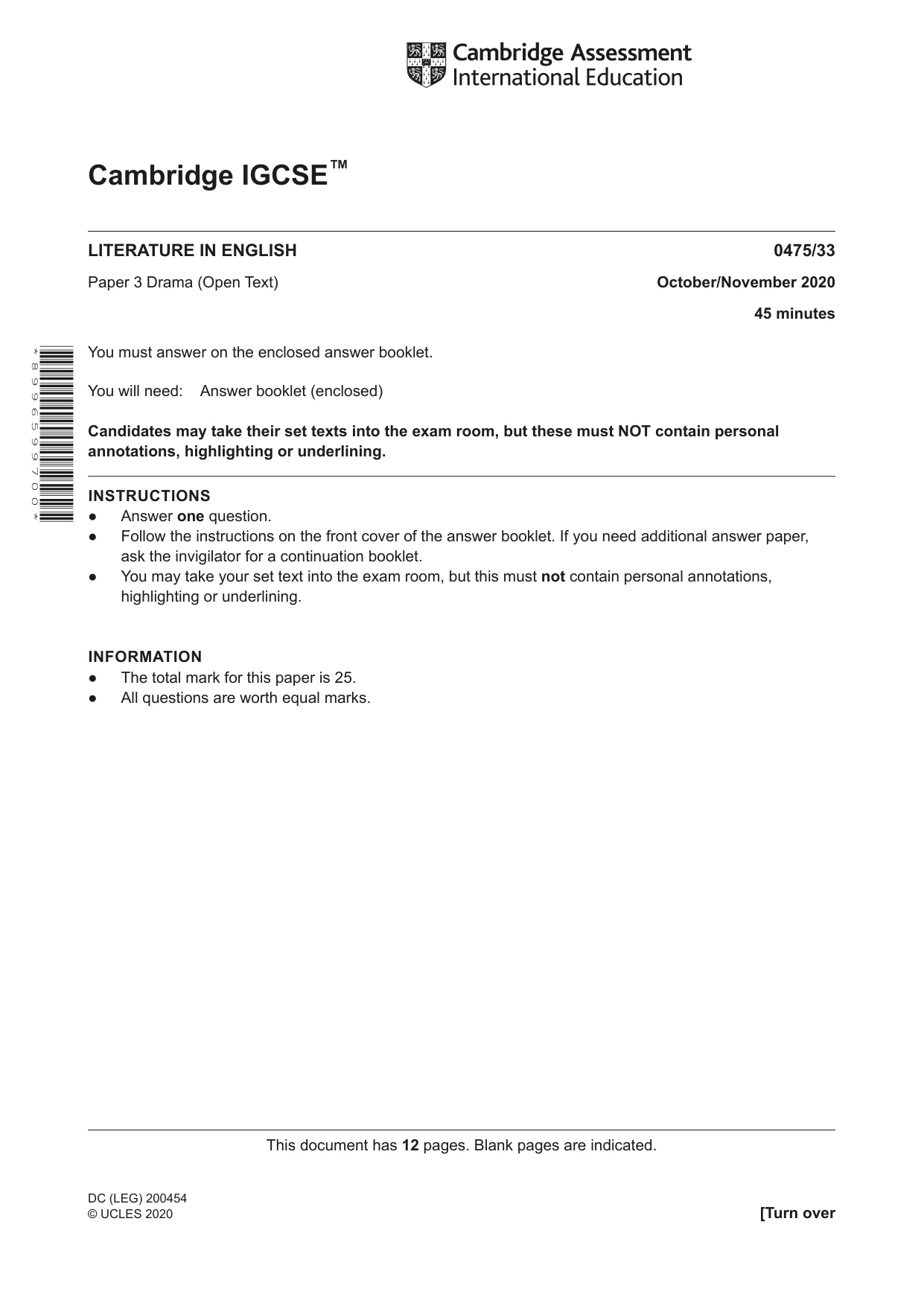
Cambridge IGCSE™ This document has 12 pages. Blank pages are indicated. * 8 9 9 6 5 9 9 7 0 0 * LITERATURE IN ENGLISH 0475/33 Paper 3 Drama (Open Text) October/November 2020 45 minutes You must answer on the enclosed answer booklet. You will need: Answer booklet (enclosed) Candidates may take their set texts into the exam room, but these must NOT contain personal annotations, highlighting or underlining. INSTRUCTIONS ● Answer one question. ● Follow the instructions on the front cover of the answer booklet. If you need additional answer paper, ask the invigilator for a continuation booklet. ● You may take your set text into the exam room, but this must not contain personal annotations, highlighting or underlining. INFORMATION ● The total mark for this paper is 25. ● All questions are worth equal marks. DC (LEG) 200454 © UCLES 2020 [Turn over
Question paper, page 2
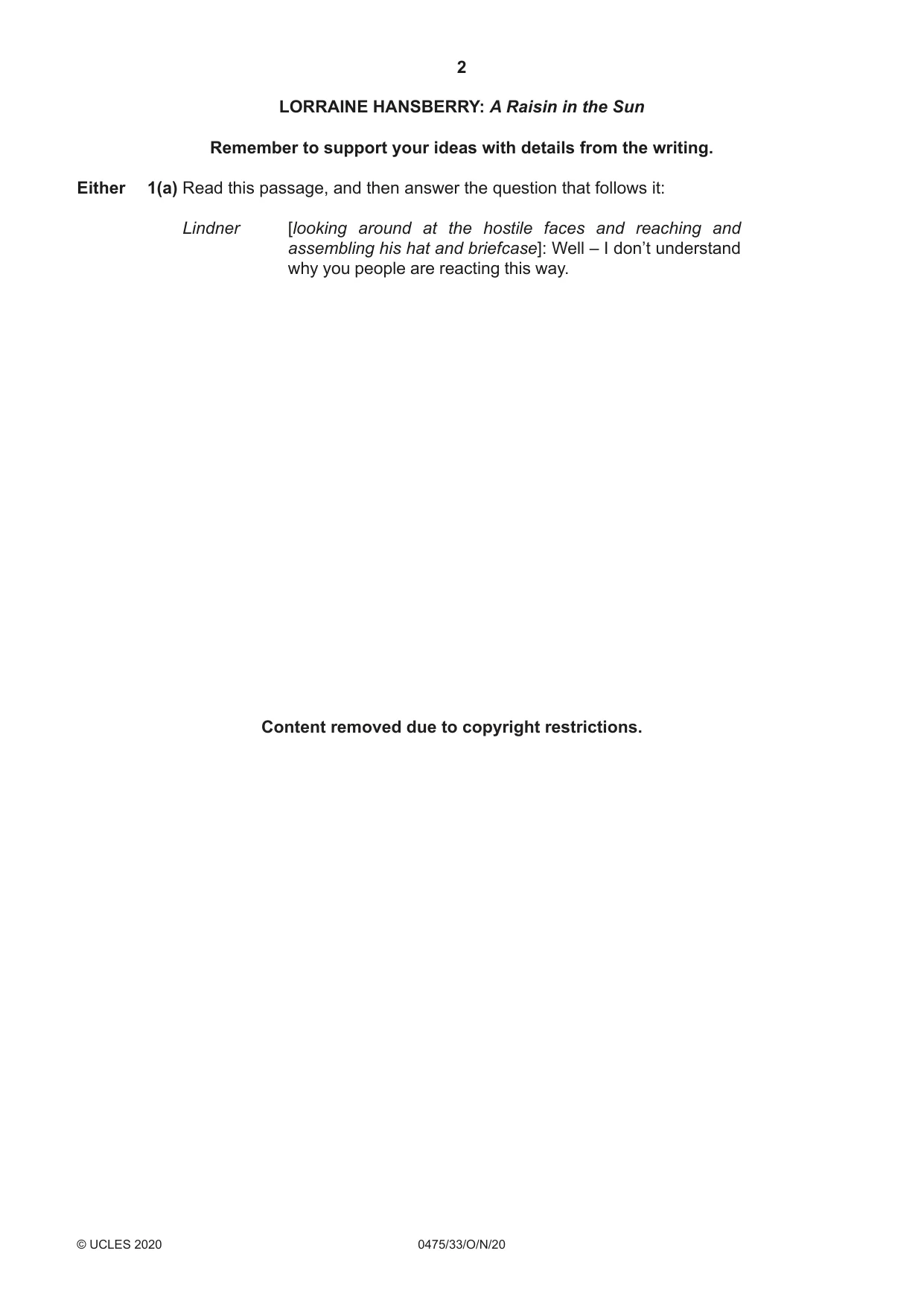
2 0475/33/O/N/20 © UCLES 2020 LORRAINE HANSBERRY: A Raisin in the Sun Remember to support your ideas with details from the writing. Either 1(a) Read this passage, and then answer the question that follows it: Lindner [looking around at the hostile faces and reaching and assembling his hat and briefcase]: Well – I don’t understand why you people are reacting this way. Content removed due to copyright restrictions.
Question paper, page 3
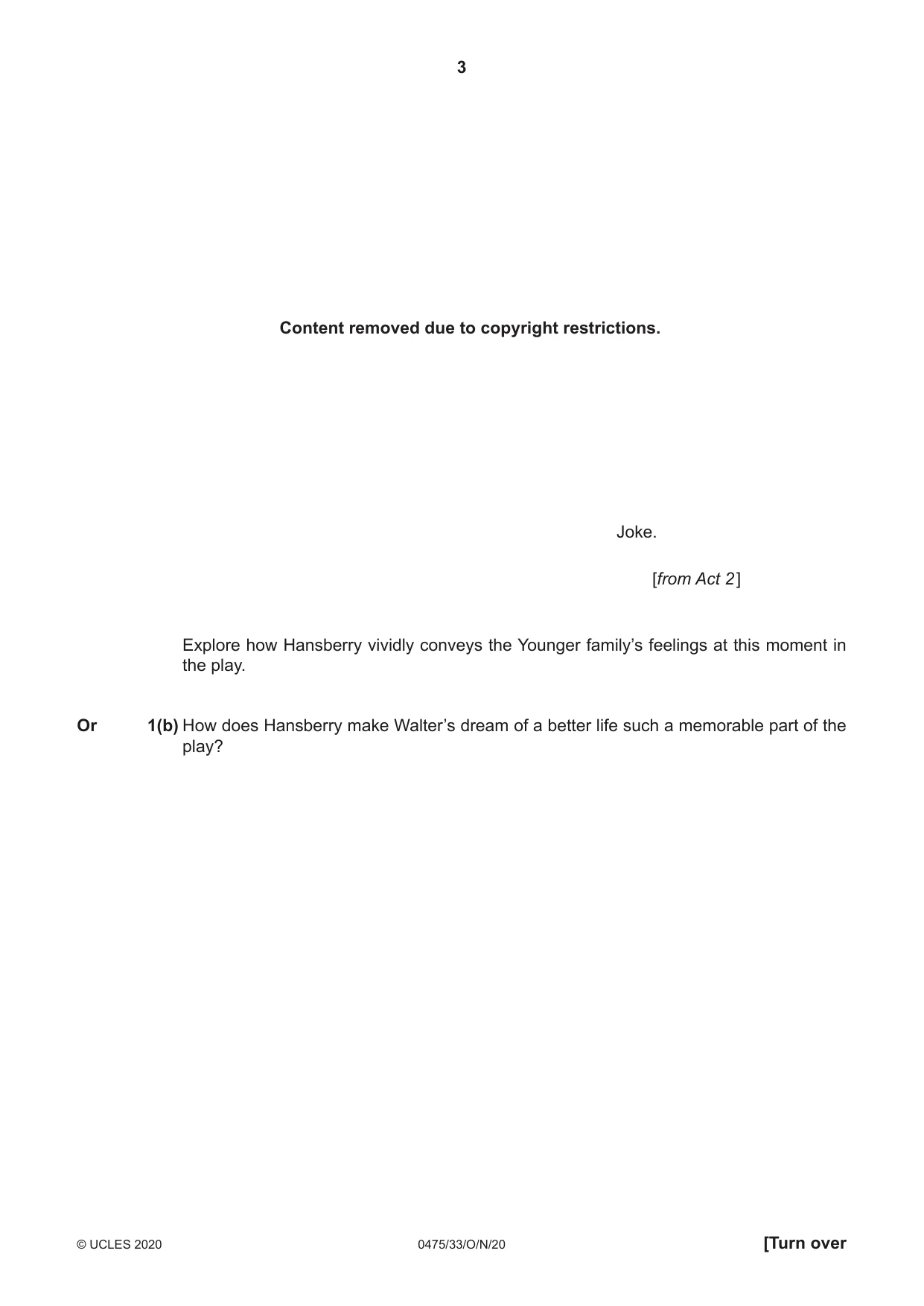
3 0475/33/O/N/20 © UCLES 2020 [Turn over Joke. [from Act 2 ] Explore how Hansberry vividly conveys the Younger family’s feelings at this moment in the play. Or 1(b) How does Hansberry make Walter’s dream of a better life such a memorable part of the play? Content removed due to copyright restrictions.
Question paper, page 4
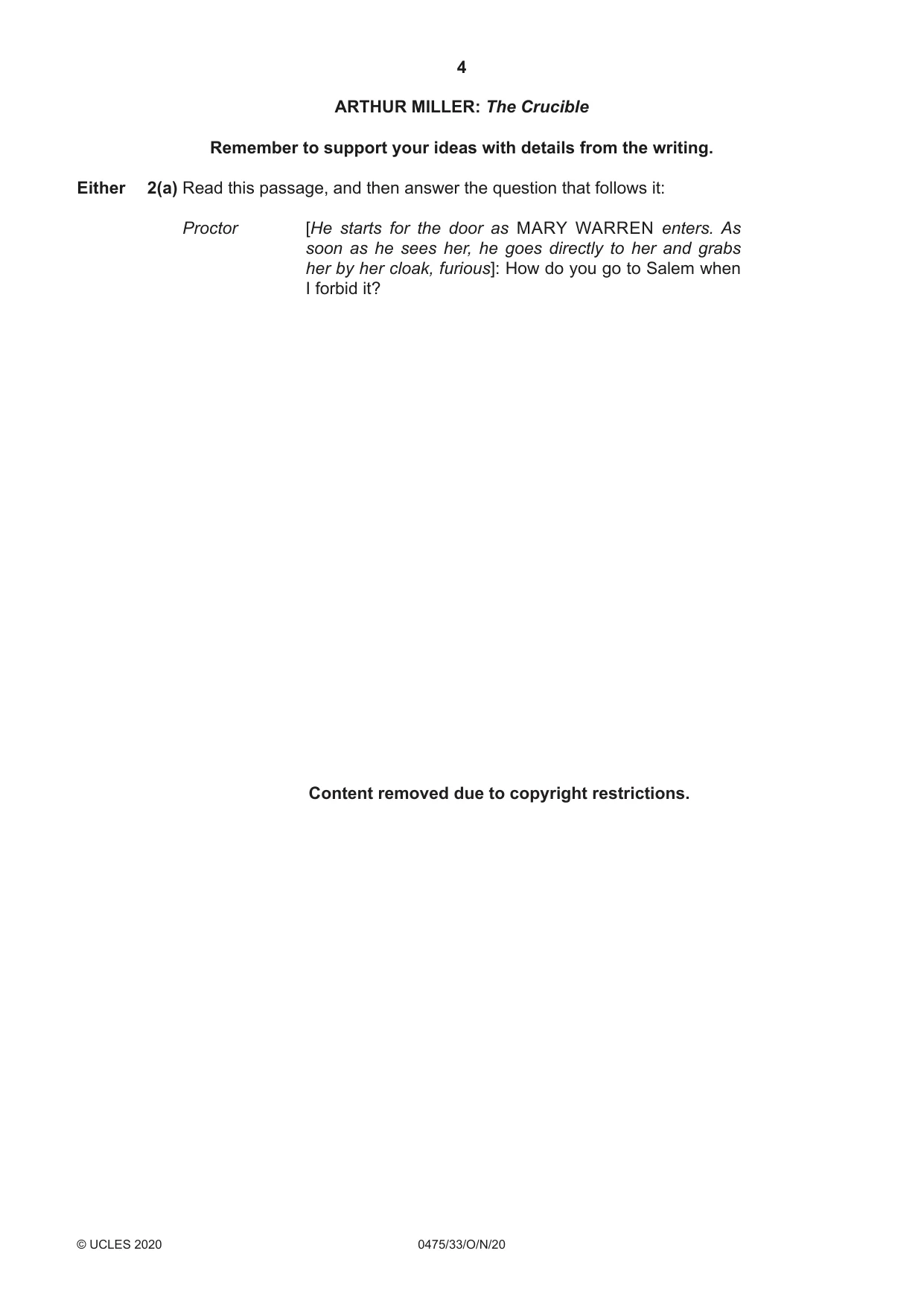
4 0475/33/O/N/20 © UCLES 2020 ARTHUR MILLER: The Crucible Remember to support your ideas with details from the writing. Either 2(a) Read this passage, and then answer the question that follows it: Proctor [He starts for the door as MARY WARREN enters. As soon as he sees her, he goes directly to her and grabs her by her cloak, furious]: How do you go to Salem when I forbid it? Content removed due to copyright restrictions.
Question paper, page 5
5 0475/33/O/N/20 © UCLES 2020 [Turn over Last month – a Monday, I think – she walked away, and I thought my guts would burst for two days after. [from Act 2 ] How does Miller make this such a disturbing moment in the play? Or 2(b) In what ways does Miller make Reverend Parris such a dislikeable character? Content removed due to copyright restrictions.
Question paper, page 6
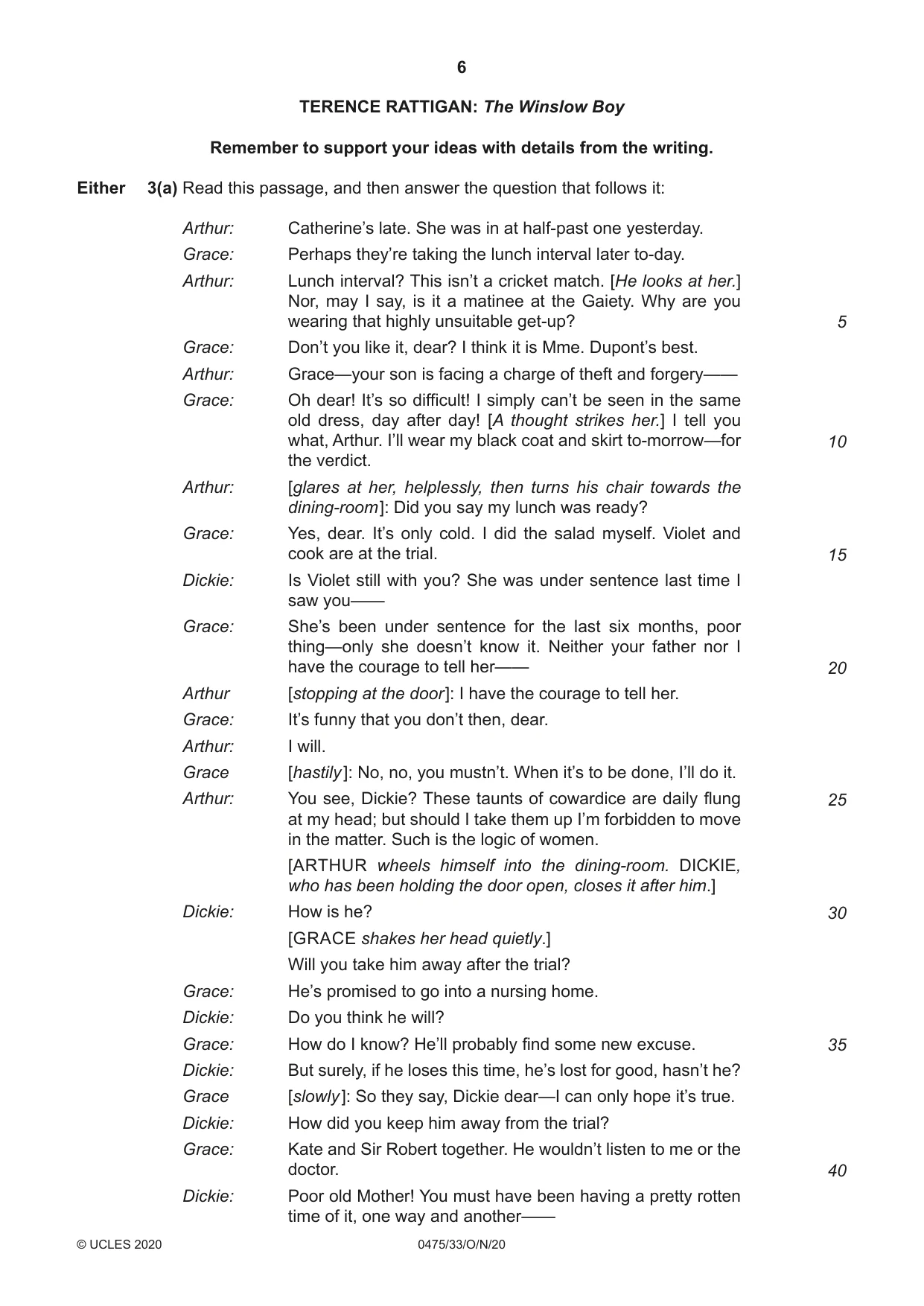
6 0475/33/O/N/20 © UCLES 2020 TERENCE RATTIGAN: The Winslow Boy Remember to support your ideas with details from the writing. Either 3(a) Read this passage, and then answer the question that follows it: Arthur: Catherine’s late. She was in at half-past one yesterday. Grace: Perhaps they’re taking the lunch interval later to-day. Arthur: Lunch interval? This isn’t a cricket match. [He looks at her.] Nor, may I say, is it a matinee at the Gaiety. Why are you wearing that highly unsuitable get-up? Grace: Don’t you like it, dear? I think it is Mme. Dupont’s best. Arthur: Grace—your son is facing a charge of theft and forgery—— Grace: Oh dear! It’s so difficult! I simply can’t be seen in the same old dress, day after day! [A thought strikes her.] I tell you what, Arthur. I’ll wear my black coat and skirt to-morrow—for the verdict. Arthur: [glares at her, helplessly, then turns his chair towards the dining-room ]: Did you say my lunch was ready? Grace: Yes, dear. It’s only cold. I did the salad myself. Violet and cook are at the trial. Dickie: Is Violet still with you? She was under sentence last time I saw you—— Grace: She’s been under sentence for the last six months, poor thing—only she doesn’t know it. Neither your father nor I have the courage to tell her—— Arthur [stopping at the door ]: I have the courage to tell her. Grace: It’s funny that you don’t then, dear. Arthur: I will. Grace [hastily ]: No, no, you mustn’t. When it’s to be done, I’ll do it. Arthur: You see, Dickie? These taunts of cowardice are daily flung at my head; but should I take them up I’m forbidden to move in the matter. Such is the logic of women. [ARTHUR wheels himself into the dining-room. DICKIE, who has been holding the door open, closes it after him.] Dickie: How is he? [GRACE shakes her head quietly.] Will you take him away after the trial? Grace: He’s promised to go into a nursing home. Dickie: Do you think he will? Grace: How do I know? He’ll probably find some new excuse. Dickie: But surely, if he loses this time, he’s lost for good, hasn’t he? Grace [slowly ]: So they say, Dickie dear—I can only hope it’s true. Dickie: How did you keep him away from the trial? Grace: Kate and Sir Robert together. He wouldn’t listen to me or the doctor. Dickie: Poor old Mother! You must have been having a pretty rotten time of it, one way and another—— 5 10 15 20 25 30 35 40
Question paper, page 7
7 0475/33/O/N/20 © UCLES 2020 [Turn over Grace: I’ve said my say, Dickie. He knows what I think. Not that he cares. He never has—all his life. Anyway, I’ve given up worrying. He’s always said he knew what he was doing. It’s my job to try and pick up the pieces, I suppose. [from Act 2 ] How does Rattigan vividly depict the impact of the trial on Grace Winslow at this moment in the play? Or 3(b) How does Rattigan strikingly convey the sacrifices Catherine Winslow makes in the play? 45
Question paper, page 8
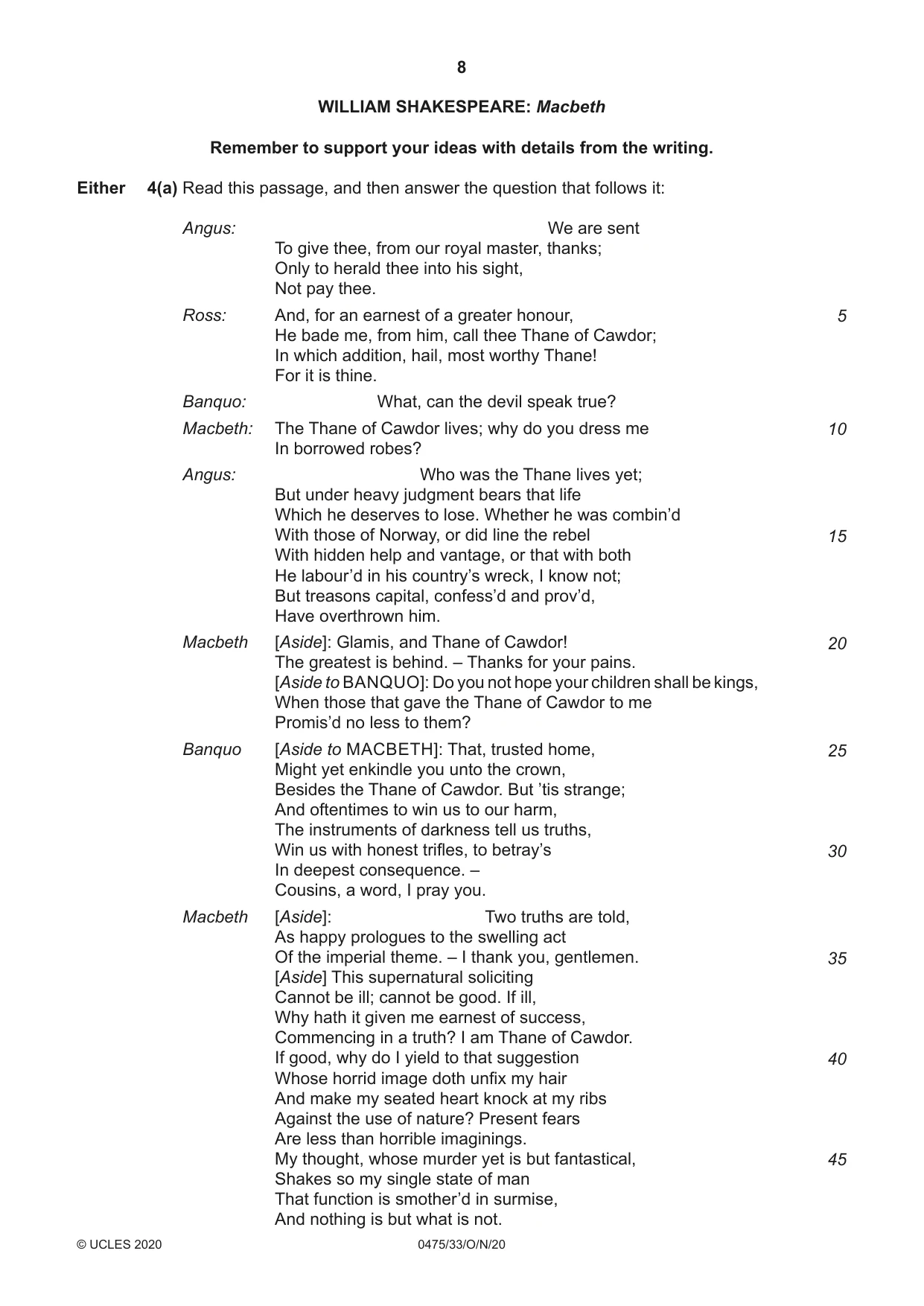
8 0475/33/O/N/20 © UCLES 2020 WILLIAM SHAKESPEARE: Macbeth Remember to support your ideas with details from the writing. Either 4(a) Read this passage, and then answer the question that follows it: Angus: We are sent To give thee, from our royal master, thanks; Only to herald thee into his sight, Not pay thee. Ross: And, for an earnest of a greater honour, He bade me, from him, call thee Thane of Cawdor; In which addition, hail, most worthy Thane! For it is thine. Banquo: What, can the devil speak true? Macbeth: The Thane of Cawdor lives; why do you dress me In borrowed robes? Angus: Who was the Thane lives yet; But under heavy judgment bears that life Which he deserves to lose. Whether he was combin’d With those of Norway, or did line the rebel With hidden help and vantage, or that with both He labour’d in his country’s wreck, I know not; But treasons capital, confess’d and prov’d, Have overthrown him. Macbeth [Aside]: Glamis, and Thane of Cawdor! The greatest is behind. – Thanks for your pains. [Aside to BANQUO]: Do you not hope your children shall be kings, When those that gave the Thane of Cawdor to me Promis’d no less to them? Banquo [Aside to MACBETH]: That, trusted home, Might yet enkindle you unto the crown, Besides the Thane of Cawdor. But ’tis strange; And oftentimes to win us to our harm, The instruments of darkness tell us truths, Win us with honest trifles, to betray’s In deepest consequence. – Cousins, a word, I pray you. Macbeth [Aside]: Two truths are told, As happy prologues to the swelling act Of the imperial theme. – I thank you, gentlemen. [Aside] This supernatural soliciting Cannot be ill; cannot be good. If ill, Why hath it given me earnest of success, Commencing in a truth? I am Thane of Cawdor. If good, why do I yield to that suggestion Whose horrid image doth unfix my hair And make my seated heart knock at my ribs Against the use of nature? Present fears Are less than horrible imaginings. My thought, whose murder yet is but fantastical, Shakes so my single state of man That function is smother’d in surmise, And nothing is but what is not. 5 10 15 20 25 30 35 40 45
Question paper, page 9
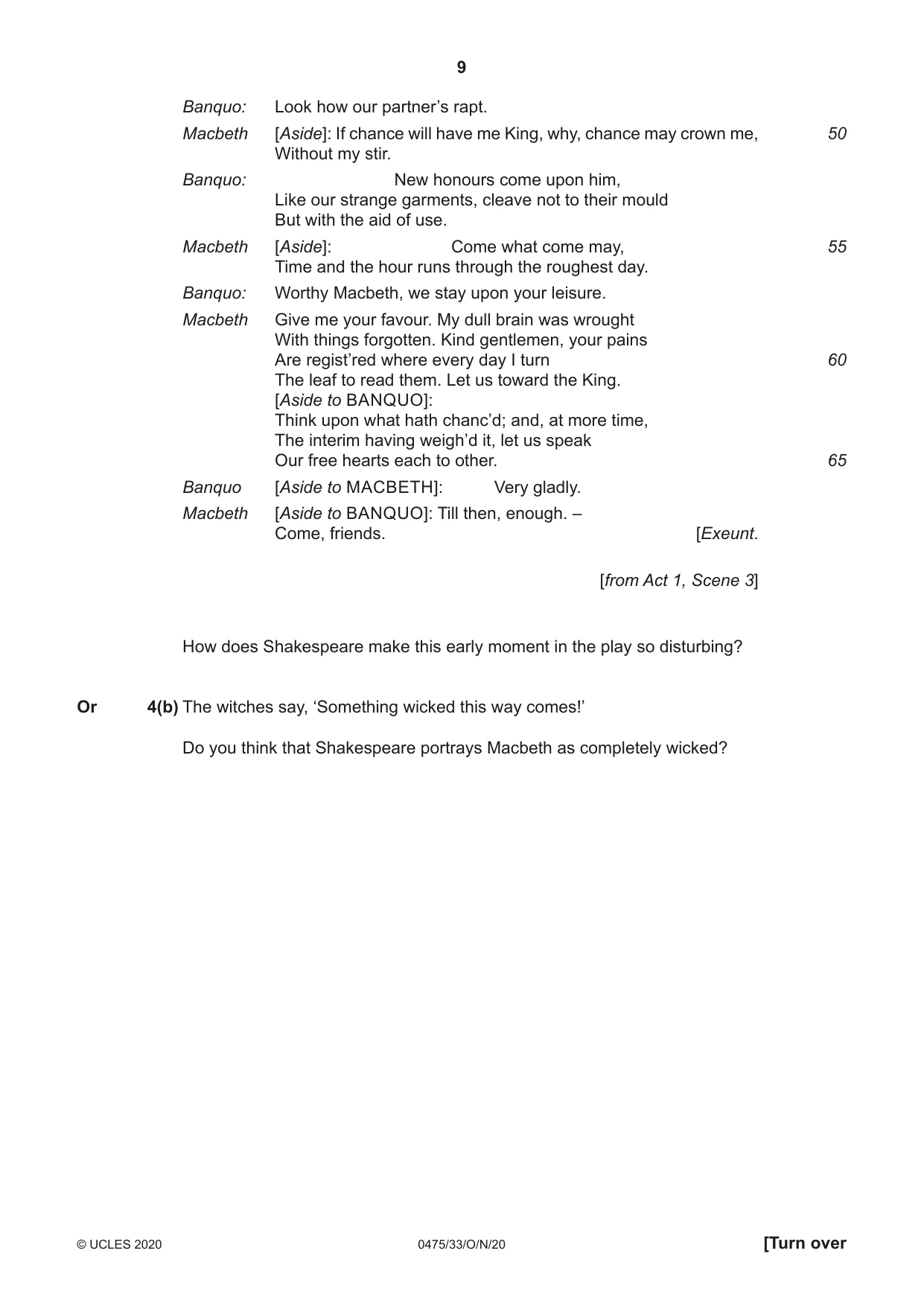
9 0475/33/O/N/20 © UCLES 2020 [Turn over Banquo: Look how our partner’s rapt. Macbeth [Aside]: If chance will have me King, why, chance may crown me, Without my stir. Banquo: New honours come upon him, Like our strange garments, cleave not to their mould But with the aid of use. Macbeth [Aside]: Come what come may, Time and the hour runs through the roughest day. Banquo: Worthy Macbeth, we stay upon your leisure. Macbeth Give me your favour. My dull brain was wrought With things forgotten. Kind gentlemen, your pains Are regist’red where every day I turn The leaf to read them. Let us toward the King. [Aside to BANQUO]: Think upon what hath chanc’d; and, at more time, The interim having weigh’d it, let us speak Our free hearts each to other. Banquo [Aside to MACBETH]: Very gladly. Macbeth [Aside to BANQUO]: Till then, enough. – Come, friends. [Exeunt. [from Act 1, Scene 3] How does Shakespeare make this early moment in the play so disturbing? Or 4(b) The witches say, ‘Something wicked this way comes!’ Do you think that Shakespeare portrays Macbeth as completely wicked? 50 55 60 65
Question paper, page 10
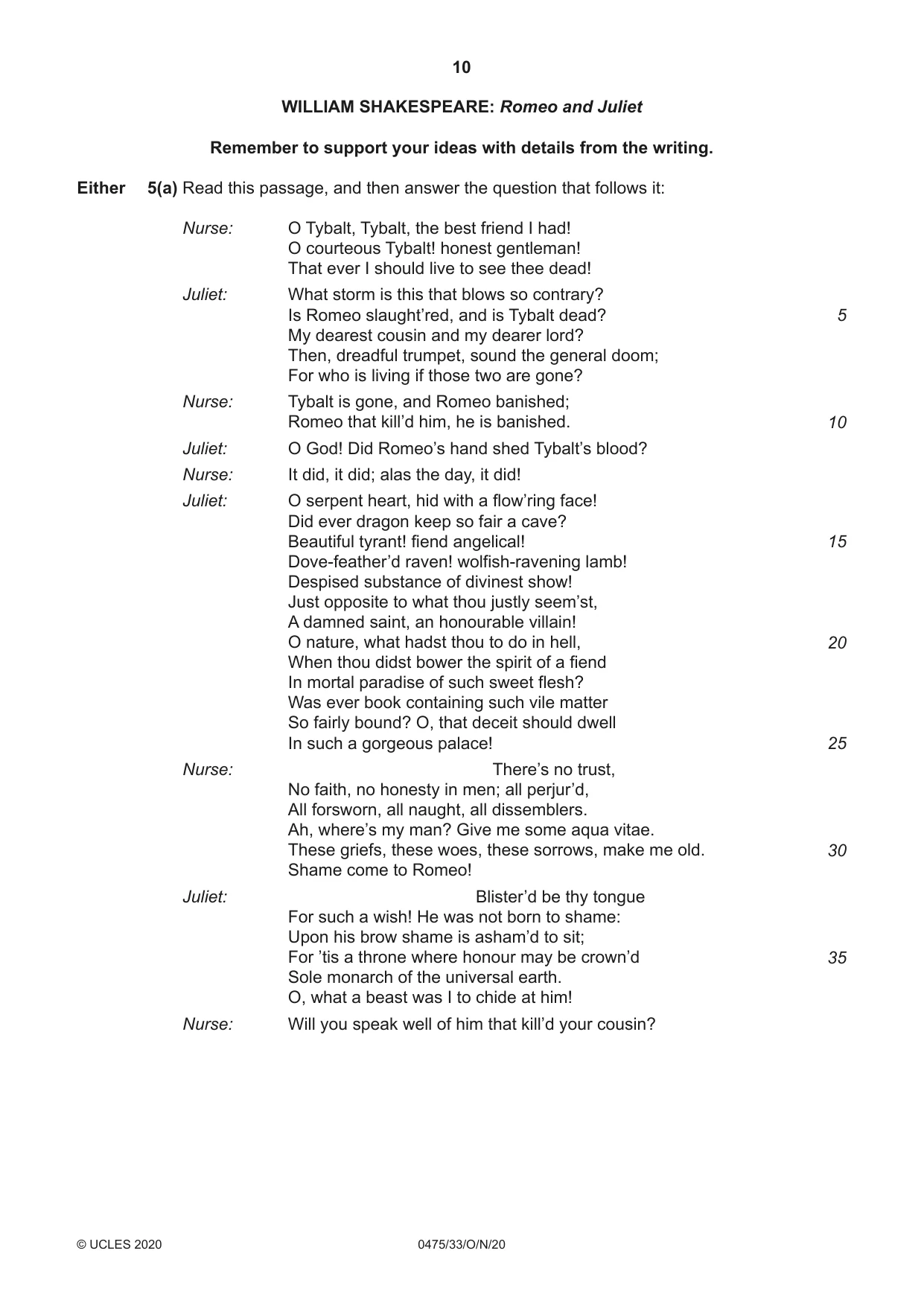
10 0475/33/O/N/20 © UCLES 2020 WILLIAM SHAKESPEARE: Romeo and Juliet Remember to support your ideas with details from the writing. Either 5(a) Read this passage, and then answer the question that follows it: Nurse: O Tybalt, Tybalt, the best friend I had! O courteous Tybalt! honest gentleman! That ever I should live to see thee dead! Juliet: What storm is this that blows so contrary? Is Romeo slaught’red, and is Tybalt dead? My dearest cousin and my dearer lord? Then, dreadful trumpet, sound the general doom; For who is living if those two are gone? Nurse: Tybalt is gone, and Romeo banished; Romeo that kill’d him, he is banished. Juliet: O God! Did Romeo’s hand shed Tybalt’s blood? Nurse: It did, it did; alas the day, it did! Juliet: O serpent heart, hid with a flow’ring face! Did ever dragon keep so fair a cave? Beautiful tyrant! fiend angelical! Dove-feather’d raven! wolfish-ravening lamb! Despised substance of divinest show! Just opposite to what thou justly seem’st, A damned saint, an honourable villain! O nature, what hadst thou to do in hell, When thou didst bower the spirit of a fiend In mortal paradise of such sweet flesh? Was ever book containing such vile matter So fairly bound? O, that deceit should dwell In such a gorgeous palace! Nurse: There’s no trust, No faith, no honesty in men; all perjur’d, All forsworn, all naught, all dissemblers. Ah, where’s my man? Give me some aqua vitae. These griefs, these woes, these sorrows, make me old. Shame come to Romeo! Juliet: Blister’d be thy tongue For such a wish! He was not born to shame: Upon his brow shame is asham’d to sit; For ’tis a throne where honour may be crown’d Sole monarch of the universal earth. O, what a beast was I to chide at him! Nurse: Will you speak well of him that kill’d your cousin? 5 10 15 20 25 30 35
Question paper, page 11
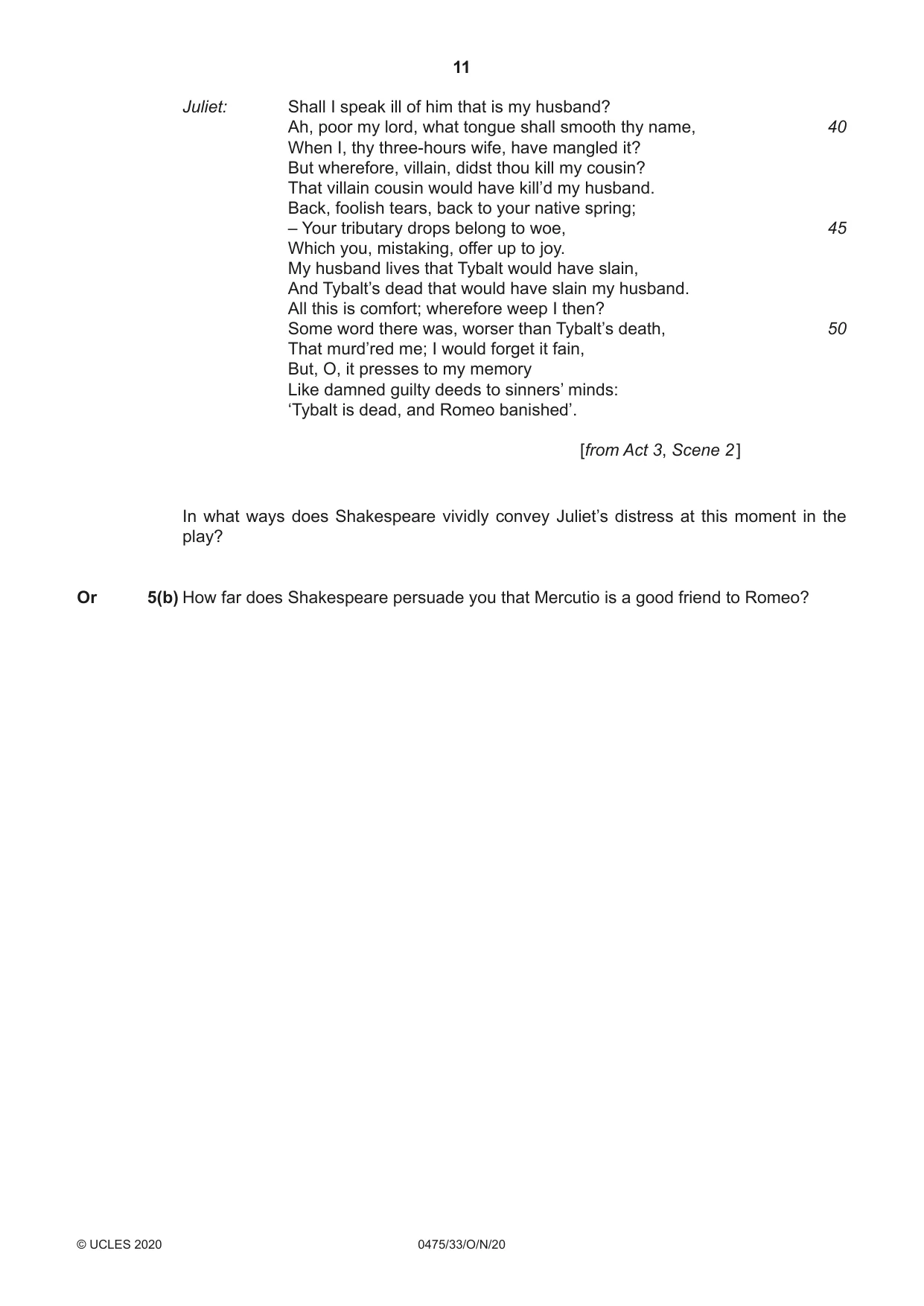
11 0475/33/O/N/20 © UCLES 2020 Juliet: Shall I speak ill of him that is my husband? Ah, poor my lord, what tongue shall smooth thy name, When I, thy three-hours wife, have mangled it? But wherefore, villain, didst thou kill my cousin? That villain cousin would have kill’d my husband. Back, foolish tears, back to your native spring; – Your tributary drops belong to woe, Which you, mistaking, offer up to joy. My husband lives that Tybalt would have slain, And Tybalt’s dead that would have slain my husband. All this is comfort; wherefore weep I then? Some word there was, worser than Tybalt’s death, That murd’red me; I would forget it fain, But, O, it presses to my memory Like damned guilty deeds to sinners’ minds: ‘Tybalt is dead, and Romeo banished’. [from Act 3, Scene 2 ] In what ways does Shakespeare vividly convey Juliet’s distress at this moment in the play? Or 5(b) How far does Shakespeare persuade you that Mercutio is a good friend to Romeo? 40 45 50
Question paper, page 12
12 0475/33/O/N/20 © UCLES 2020 Permission to reproduce items where third-party owned material protected by copyright is included has been sought and cleared where possible. Every reasonable effort has been made by the publisher (UCLES) to trace copyright holders, but if any items requiring clearance have unwittingly been included, the publisher will be pleased to make amends at the earliest possible opportunity. To avoid the issue of disclosure of answer-related information to candidates, all copyright acknowledgements are reproduced online in the Cambridge Assessment International Education Copyright Acknowledgements Booklet. This is produced for each series of examinations and is freely available to download at www.cambridgeinternational.org after the live examination series. Cambridge Assessment International Education is part of the Cambridge Assessment Group. Cambridge Assessment is the brand name of the University of Cambridge Local Examinations Syndicate (UCLES), which itself is a department of the University of Cambridge. BLANK PAGE
Mark scheme, page 1
This document consists of 7 printed pages. © UCLES 2020 [Turn over Cambridge IGCSE™ LITERATURE IN ENGLISH 0475/33 Paper 3 Drama (Open Text) 33 October/November 2020 MARK SCHEME Maximum Mark: Published This mark scheme is published as an aid to teachers and candidates, to indicate the requirements of the examination. It shows the basis on which Examiners were instructed to award marks. It does not indicate the details of the discussions that took place at an Examiners’ meeting before marking began, which would have considered the acceptability of alternative answers. Mark schemes should be read in conjunction with the question paper and the Principal Examiner Report for Teachers. Cambridge International will not enter into discussions about these mark schemes. Cambridge International is publishing the mark schemes for the October/November 2020 series for most Cambridge IGCSE™, Cambridge International A and AS Level and Cambridge Pre-U components, and some Cambridge O Level components.
Mark scheme, page 2
0475/33 Cambridge IGCSE – Mark Scheme PUBLISHED October/November 2020 © UCLES 2020 Page 2 of 7 Generic Marking Principles These general marking principles must be applied by all examiners when marking candidate answers. They should be applied alongside the specific content of the mark scheme or generic level descriptors for a question. Each question paper and mark scheme will also comply with these marking principles. GENERIC MARKING PRINCIPLE 1: Marks must be awarded in line with: • the specific content of the mark scheme or the generic level descriptors for the question • the specific skills defined in the mark scheme or in the generic level descriptors for the question • the standard of response required by a candidate as exemplified by the standardisation scripts. GENERIC MARKING PRINCIPLE 2: Marks awarded are always whole marks (not half marks, or other fractions). GENERIC MARKING PRINCIPLE 3: Marks must be awarded positively: • marks are awarded for correct/valid answers, as defined in the mark scheme. However, credit is given for valid answers which go beyond the scope of the syllabus and mark scheme, referring to your Team Leader as appropriate • marks are awarded when candidates clearly demonstrate what they know and can do • marks are not deducted for errors • marks are not deducted for omissions • answers should only be judged on the quality of spelling, punctuation and grammar when these features are specifically assessed by the question as indicated by the mark scheme. The meaning, however, should be unambiguous. GENERIC MARKING PRINCIPLE 4: Rules must be applied consistently, e.g. in situations where candidates have not followed instructions or in the application of generic level descriptors. GENERIC MARKING PRINCIPLE 5: Marks should be awarded using the full range of marks defined in the mark scheme for the question (however; the use of the full mark range may be limited according to the quality of the candidate responses seen). GENERIC MARKING PRINCIPLE 6: Marks awarded are based solely on the requirements as defined in the mark scheme. Marks should not be awarded with grade thresholds or grade descriptors in mind.
Mark scheme, page 3
0475/33 Cambridge IGCSE – Mark Scheme PUBLISHED October/November 2020 © UCLES 2020 Page 3 of 7 For general administrative guidance, see Notes for Examiners Handbook. All questions are marked out of 25. Assessment Objectives The Assessment Objectives are evenly weighted across each question. The assessment objectives for the paper are: AO1 show detailed knowledge of the content of literary texts, supported by reference to the text AO2 understand the meanings of literary texts and their context, and explore texts beyond surface meaning to show deeper awareness of ideas and attitudes AO3 recognise and appreciate ways in which writers use language, structure, and form to create and shape meanings and effects AO4 communicate a sensitive and informed personal response The Band Descriptors cover marks from 0 to 25 and apply to the marking of each question. They guide examiners to an understanding of the qualities normally expected of, or typical of, work in a band. They are a means of general guidance and must not be interpreted as hurdle statements. For the purposes of standardisation of marking, they are to be used in conjunction with the Practice and Standardisation scripts discussed during the coordination meeting and with Team Leaders, as well as the question-specific notes. The supplementary notes for each question are related to the assessment objectives above. Because of the nature of the subject, they are for general guidance; they are not designed as prescriptions of required content and must not be treated as such. The syllabus aims at encouraging candidates to make some personal response to their reading. While there are legitimate expectations of the content of most answers, examiners may see responses that include ideas not covered in the supplementary guidance. For these cases, examiners should credit valid responses fairly and not penalise candidates for including valid points outside the mark scheme. Do not refer to indicative content notes on scripts.
Mark scheme, page 4
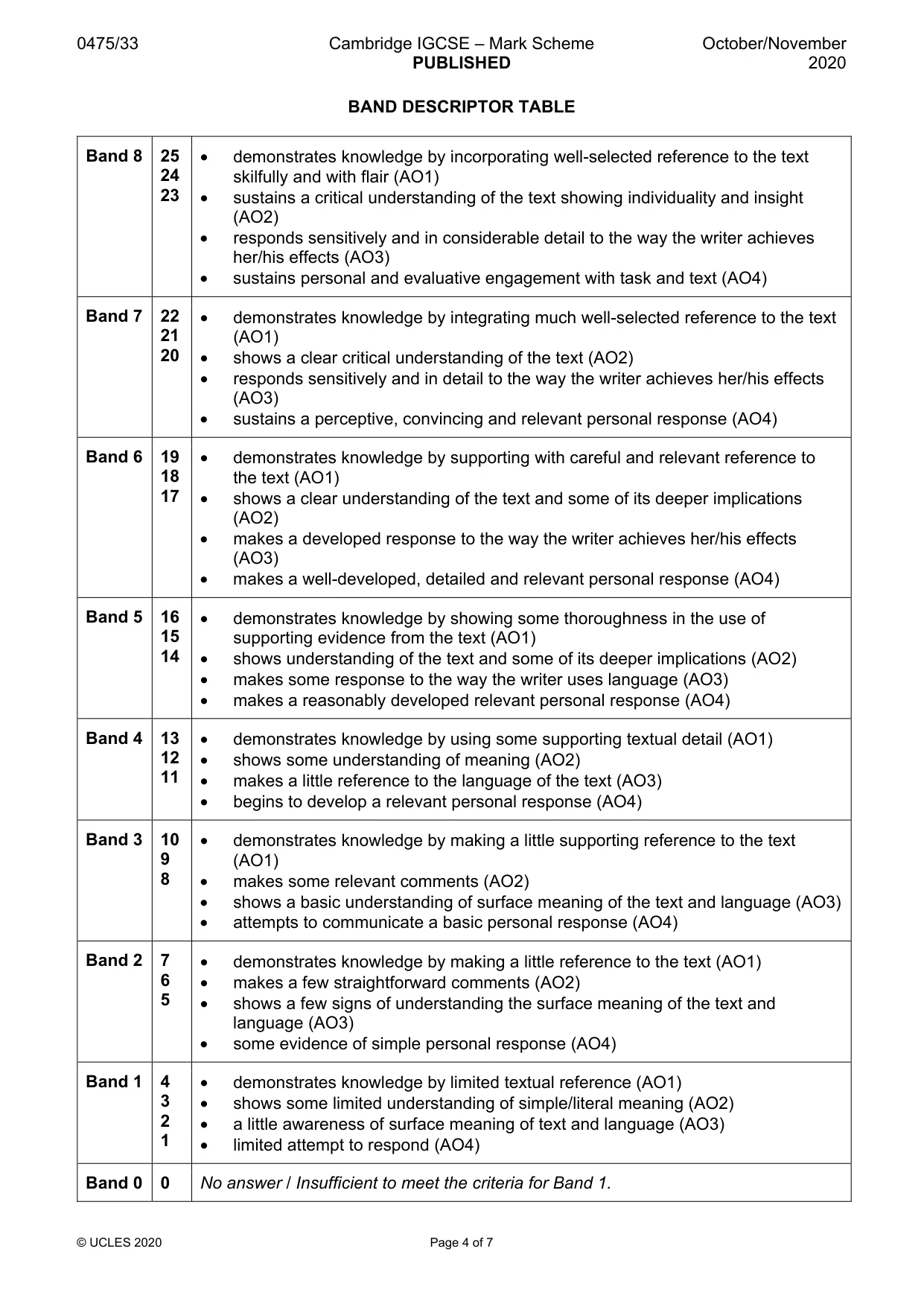
0475/33 Cambridge IGCSE – Mark Scheme PUBLISHED October/November 2020 © UCLES 2020 Page 4 of 7 BAND DESCRIPTOR TABLE Band 8 25 24 23 • demonstrates knowledge by incorporating well-selected reference to the text skilfully and with flair (AO1) • sustains a critical understanding of the text showing individuality and insight (AO2) • responds sensitively and in considerable detail to the way the writer achieves her/his effects (AO3) • sustains personal and evaluative engagement with task and text (AO4) Band 7 22 21 20 • demonstrates knowledge by integrating much well-selected reference to the text (AO1) • shows a clear critical understanding of the text (AO2) • responds sensitively and in detail to the way the writer achieves her/his effects (AO3) • sustains a perceptive, convincing and relevant personal response (AO4) Band 6 19 18 17 • demonstrates knowledge by supporting with careful and relevant reference to the text (AO1) • shows a clear understanding of the text and some of its deeper implications (AO2) • makes a developed response to the way the writer achieves her/his effects (AO3) • makes a well-developed, detailed and relevant personal response (AO4) Band 5 16 15 14 • demonstrates knowledge by showing some thoroughness in the use of supporting evidence from the text (AO1) • shows understanding of the text and some of its deeper implications (AO2) • makes some response to the way the writer uses language (AO3) • makes a reasonably developed relevant personal response (AO4) Band 4 13 12 11 • demonstrates knowledge by using some supporting textual detail (AO1) • shows some understanding of meaning (AO2) • makes a little reference to the language of the text (AO3) • begins to develop a relevant personal response (AO4) Band 3 10 9 8 • demonstrates knowledge by making a little supporting reference to the text (AO1) • makes some relevant comments (AO2) • shows a basic understanding of surface meaning of the text and language (AO3) • attempts to communicate a basic personal response (AO4) Band 2 7 6 5 • demonstrates knowledge by making a little reference to the text (AO1) • makes a few straightforward comments (AO2) • shows a few signs of understanding the surface meaning of the text and language (AO3) • some evidence of simple personal response (AO4) Band 1 4 3 2 1 • demonstrates knowledge by limited textual reference (AO1) • shows some limited understanding of simple/literal meaning (AO2) • a little awareness of surface meaning of text and language (AO3) • limited attempt to respond (AO4) Band 0 0 No answer / Insufficient to meet the criteria for Band 1.
Mark scheme, page 5
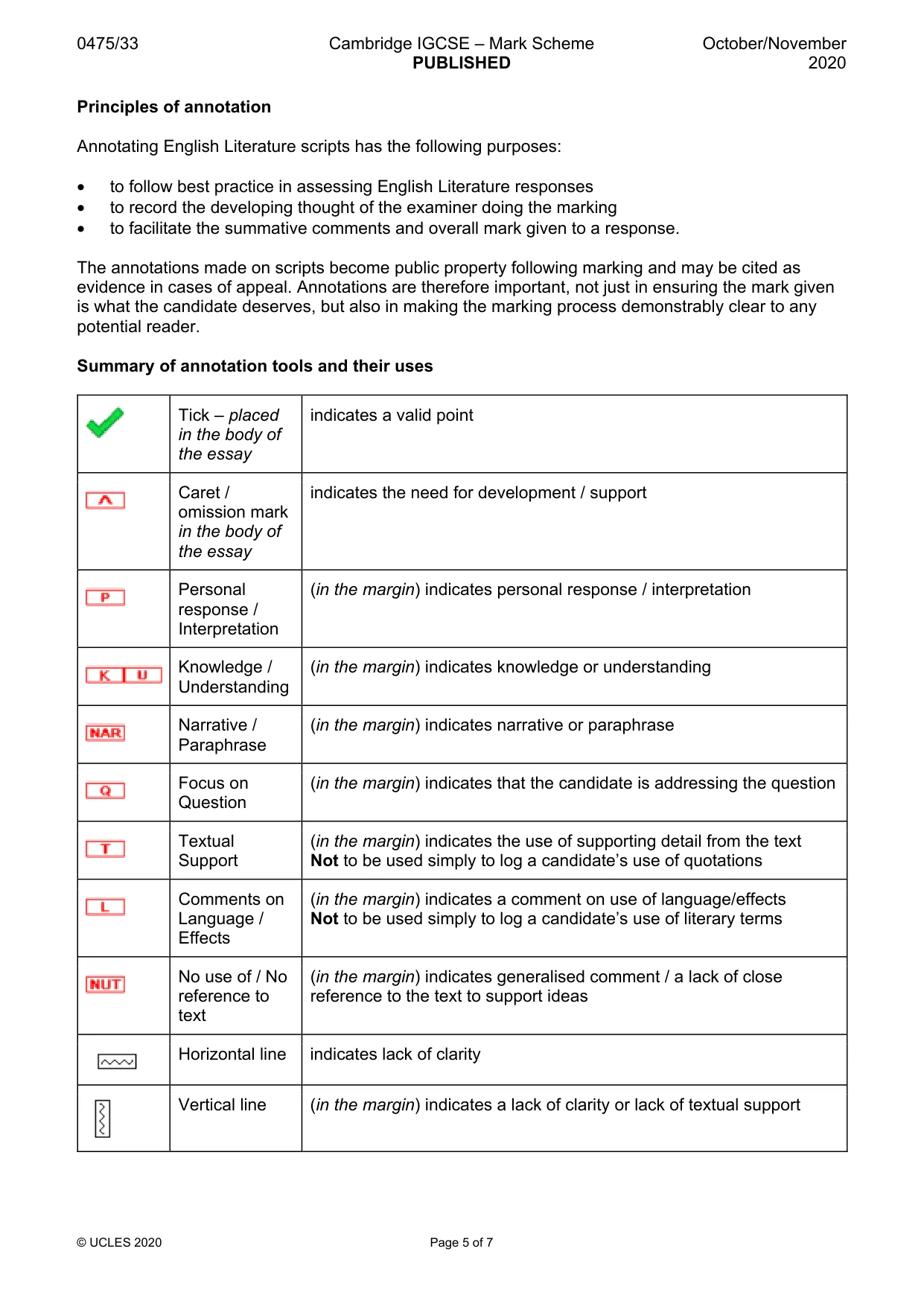
0475/33 Cambridge IGCSE – Mark Scheme PUBLISHED October/November 2020 © UCLES 2020 Page 5 of 7 Principles of annotation Annotating English Literature scripts has the following purposes: • to follow best practice in assessing English Literature responses • to record the developing thought of the examiner doing the marking • to facilitate the summative comments and overall mark given to a response. The annotations made on scripts become public property following marking and may be cited as evidence in cases of appeal. Annotations are therefore important, not just in ensuring the mark given is what the candidate deserves, but also in making the marking process demonstrably clear to any potential reader. Summary of annotation tools and their uses Tick – placed in the body of the essay indicates a valid point Caret / omission mark in the body of the essay indicates the need for development / support Personal response / Interpretation (in the margin) indicates personal response / interpretation Knowledge / Understanding (in the margin) indicates knowledge or understanding Narrative / Paraphrase (in the margin) indicates narrative or paraphrase Focus on Question (in the margin) indicates that the candidate is addressing the question Textual Support (in the margin) indicates the use of supporting detail from the text Not to be used simply to log a candidate’s use of quotations Comments on Language / Effects (in the margin) indicates a comment on use of language/effects Not to be used simply to log a candidate’s use of literary terms No use of / No reference to text (in the margin) indicates generalised comment / a lack of close reference to the text to support ideas Horizontal line indicates lack of clarity Vertical line (in the margin) indicates a lack of clarity or lack of textual support
Mark scheme, page 6
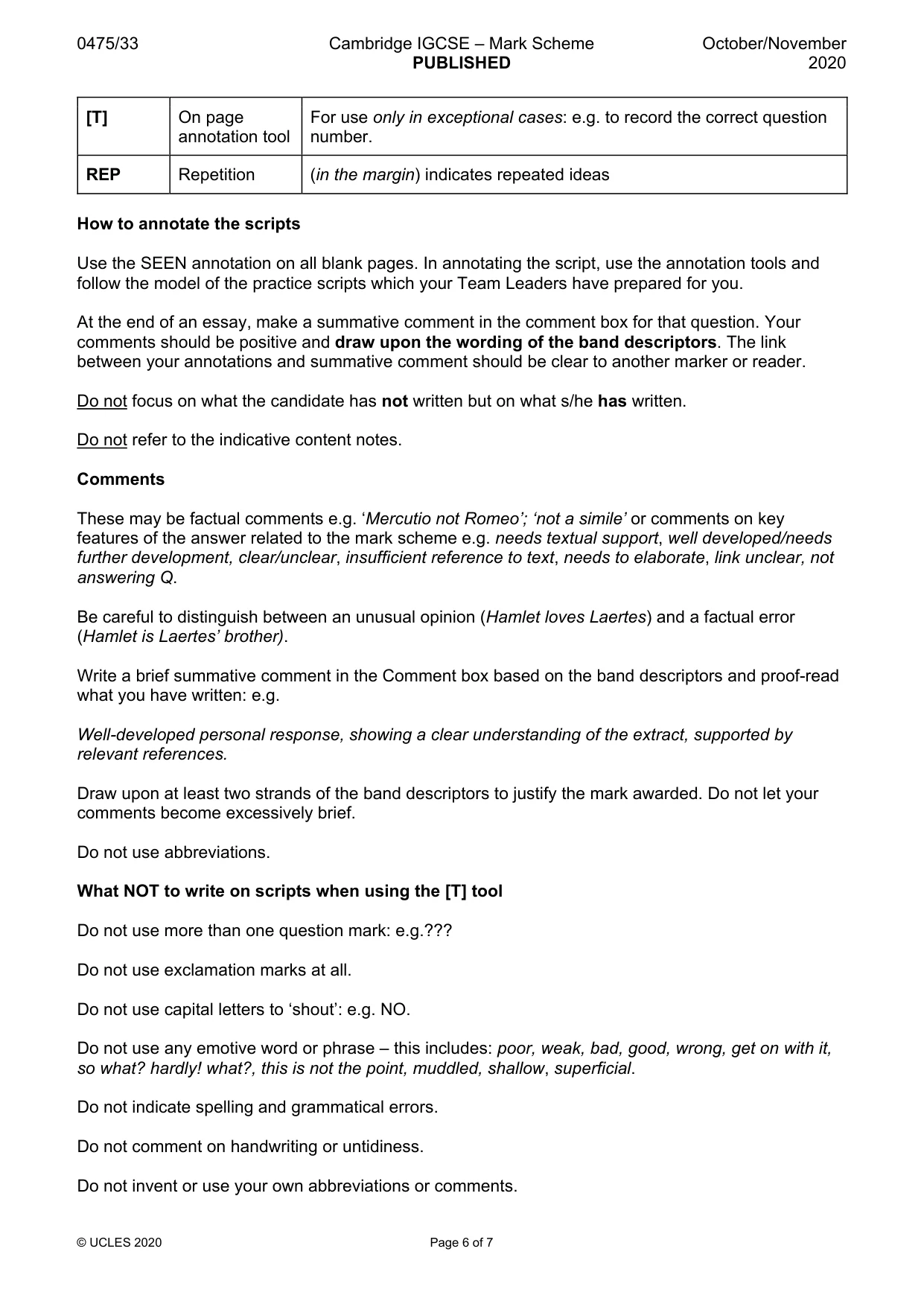
0475/33 Cambridge IGCSE – Mark Scheme PUBLISHED October/November 2020 © UCLES 2020 Page 6 of 7 [T] On page annotation tool For use only in exceptional cases: e.g. to record the correct question number. REP Repetition (in the margin) indicates repeated ideas How to annotate the scripts Use the SEEN annotation on all blank pages. In annotating the script, use the annotation tools and follow the model of the practice scripts which your Team Leaders have prepared for you. At the end of an essay, make a summative comment in the comment box for that question. Your comments should be positive and draw upon the wording of the band descriptors. The link between your annotations and summative comment should be clear to another marker or reader. Do not focus on what the candidate has not written but on what s/he has written. Do not refer to the indicative content notes. Comments These may be factual comments e.g. ‘Mercutio not Romeo’; ‘not a simile’ or comments on key features of the answer related to the mark scheme e.g. needs textual support, well developed/needs further development, clear/unclear, insufficient reference to text, needs to elaborate, link unclear, not answering Q. Be careful to distinguish between an unusual opinion (Hamlet loves Laertes) and a factual error (Hamlet is Laertes’ brother). Write a brief summative comment in the Comment box based on the band descriptors and proof-read what you have written: e.g. Well-developed personal response, showing a clear understanding of the extract, supported by relevant references. Draw upon at least two strands of the band descriptors to justify the mark awarded. Do not let your comments become excessively brief. Do not use abbreviations. What NOT to write on scripts when using the [T] tool Do not use more than one question mark: e.g.??? Do not use exclamation marks at all. Do not use capital letters to ‘shout’: e.g. NO. Do not use any emotive word or phrase – this includes: poor, weak, bad, good, wrong, get on with it, so what? hardly! what?, this is not the point, muddled, shallow, superficial. Do not indicate spelling and grammatical errors. Do not comment on handwriting or untidiness. Do not invent or use your own abbreviations or comments.
Mark scheme, page 7
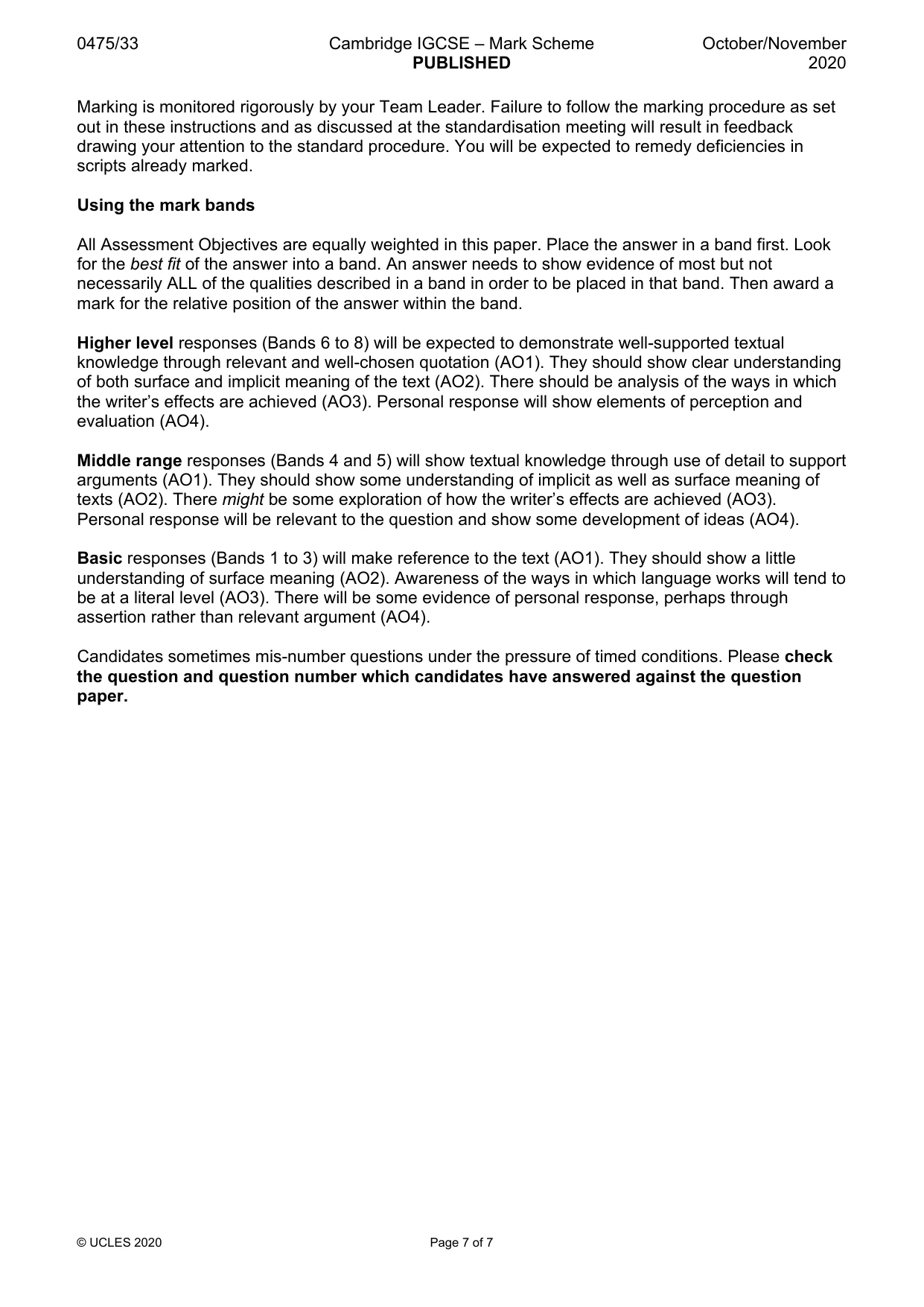
0475/33 Cambridge IGCSE – Mark Scheme PUBLISHED October/November 2020 © UCLES 2020 Page 7 of 7 Marking is monitored rigorously by your Team Leader. Failure to follow the marking procedure as set out in these instructions and as discussed at the standardisation meeting will result in feedback drawing your attention to the standard procedure. You will be expected to remedy deficiencies in scripts already marked. Using the mark bands All Assessment Objectives are equally weighted in this paper. Place the answer in a band first. Look for the best fit of the answer into a band. An answer needs to show evidence of most but not necessarily ALL of the qualities described in a band in order to be placed in that band. Then award a mark for the relative position of the answer within the band. Higher level responses (Bands 6 to 8) will be expected to demonstrate well-supported textual knowledge through relevant and well-chosen quotation (AO1). They should show clear understanding of both surface and implicit meaning of the text (AO2). There should be analysis of the ways in which the writer’s effects are achieved (AO3). Personal response will show elements of perception and evaluation (AO4). Middle range responses (Bands 4 and 5) will show textual knowledge through use of detail to support arguments (AO1). They should show some understanding of implicit as well as surface meaning of texts (AO2). There might be some exploration of how the writer’s effects are achieved (AO3). Personal response will be relevant to the question and show some development of ideas (AO4). Basic responses (Bands 1 to 3) will make reference to the text (AO1). They should show a little understanding of surface meaning (AO2). Awareness of the ways in which language works will tend to be at a literal level (AO3). There will be some evidence of personal response, perhaps through assertion rather than relevant argument (AO4). Candidates sometimes mis-number questions under the pressure of timed conditions. Please check the question and question number which candidates have answered against the question paper.
What you needed in this session
Cambridge’s own grade thresholds for 2020 Oct/Nov, Paper 3 · Variant 3. A higher threshold means an easier paper — the bar moves with how the cohort did.