Cambridge IGCSE English - Literature in English 0475 — 2020 Oct/Nov Paper 3 · Variant 1
0475/31/O/N/20 · 25 marks · ≈28 min
The question paper and its mark scheme, free to read here and free to download. This is Cambridge’s own paper, exactly as it was sat.
Question paper12 pages
Mark scheme5 pages
Answers below. Sit the paper first if you are practising.
Paper as text
Question paper, page 1
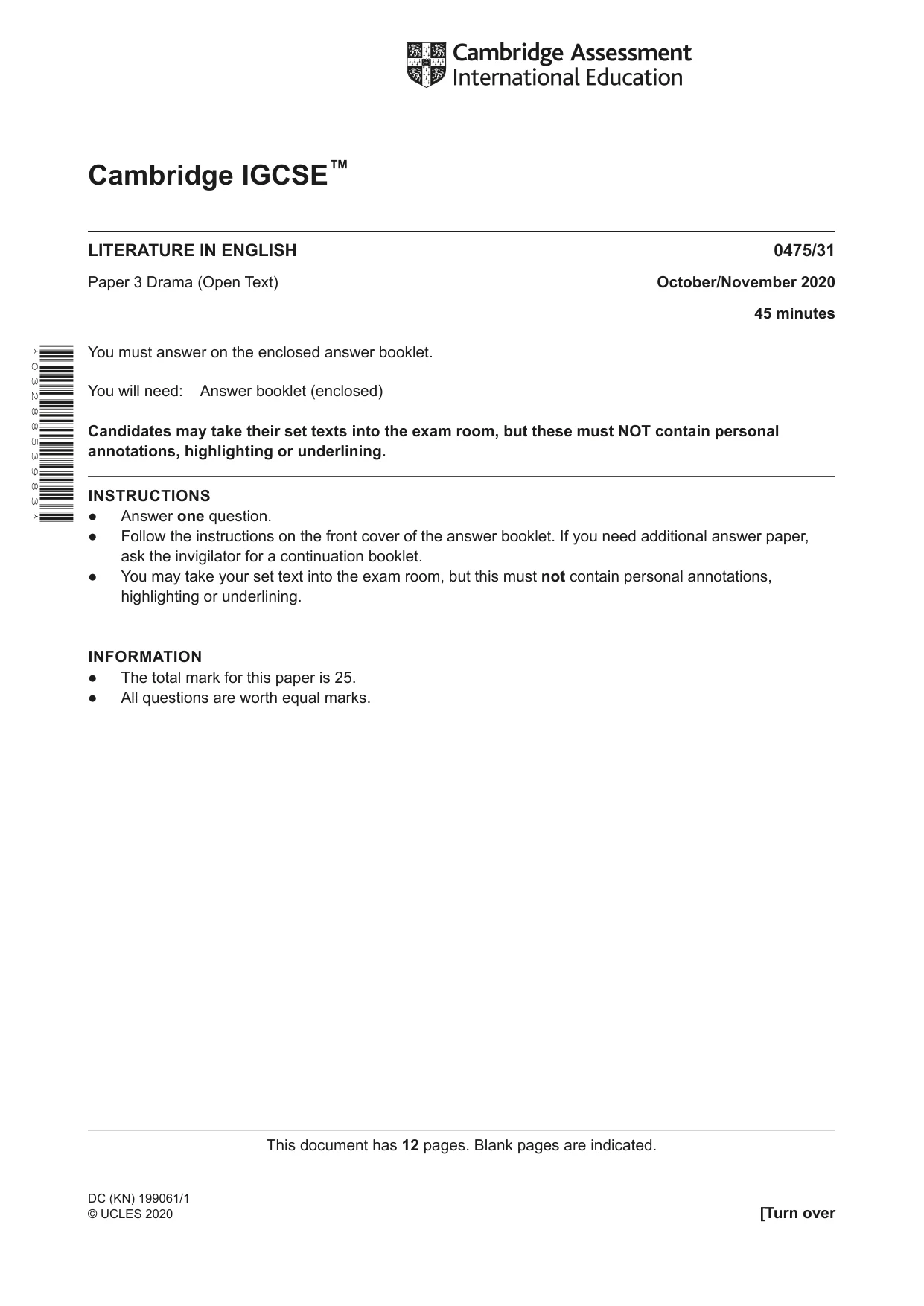
Cambridge IGCSE™ This document has 12 pages. Blank pages are indicated. LITERATURE IN ENGLISH 0475/31 Paper 3 Drama (Open Text) October/November 2020 45 minutes You must answer on the enclosed answer booklet. You will need: Answer booklet (enclosed) Candidates may take their set texts into the exam room, but these must NOT contain personal annotations, highlighting or underlining. INSTRUCTIONS ● Answer one question. ● Follow the instructions on the front cover of the answer booklet. If you need additional answer paper, ask the invigilator for a continuation booklet. ● You may take your set text into the exam room, but this must not contain personal annotations, highlighting or underlining. INFORMATION ● The total mark for this paper is 25. ● All questions are worth equal marks. DC (KN) 199061/1 © UCLES 2020 [Turn over * 0 3 2 8 8 5 3 9 8 3 *
Question paper, page 2
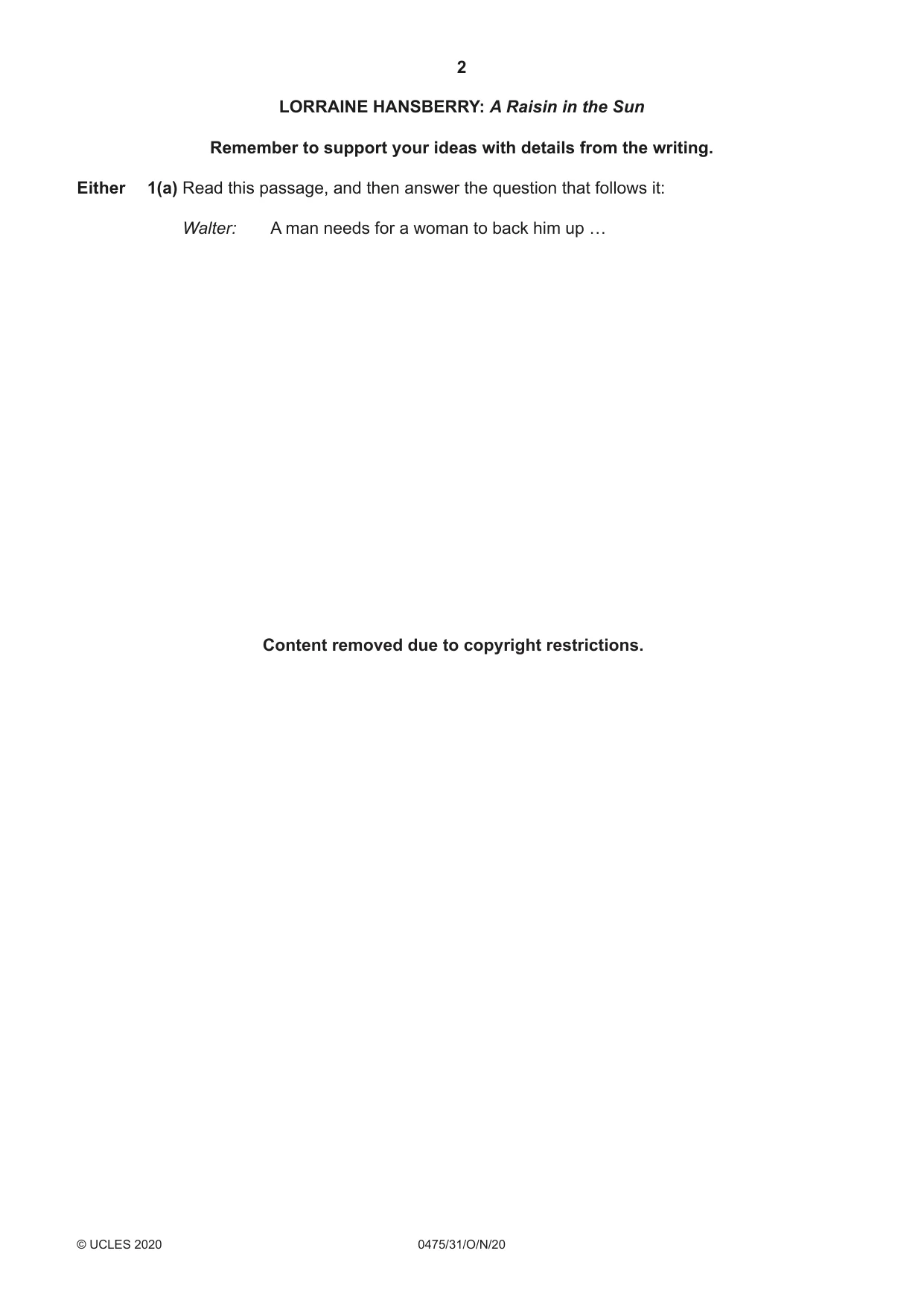
2 0475/31/O/N/20 © UCLES 2020 LORRAINE HANSBERRY: A Raisin in the Sun Remember to support your ideas with details from the writing. Either 1(a) Read this passage, and then answer the question that follows it: Walter: A man needs for a woman to back him up … Content removed due to copyright restrictions.
Question paper, page 3
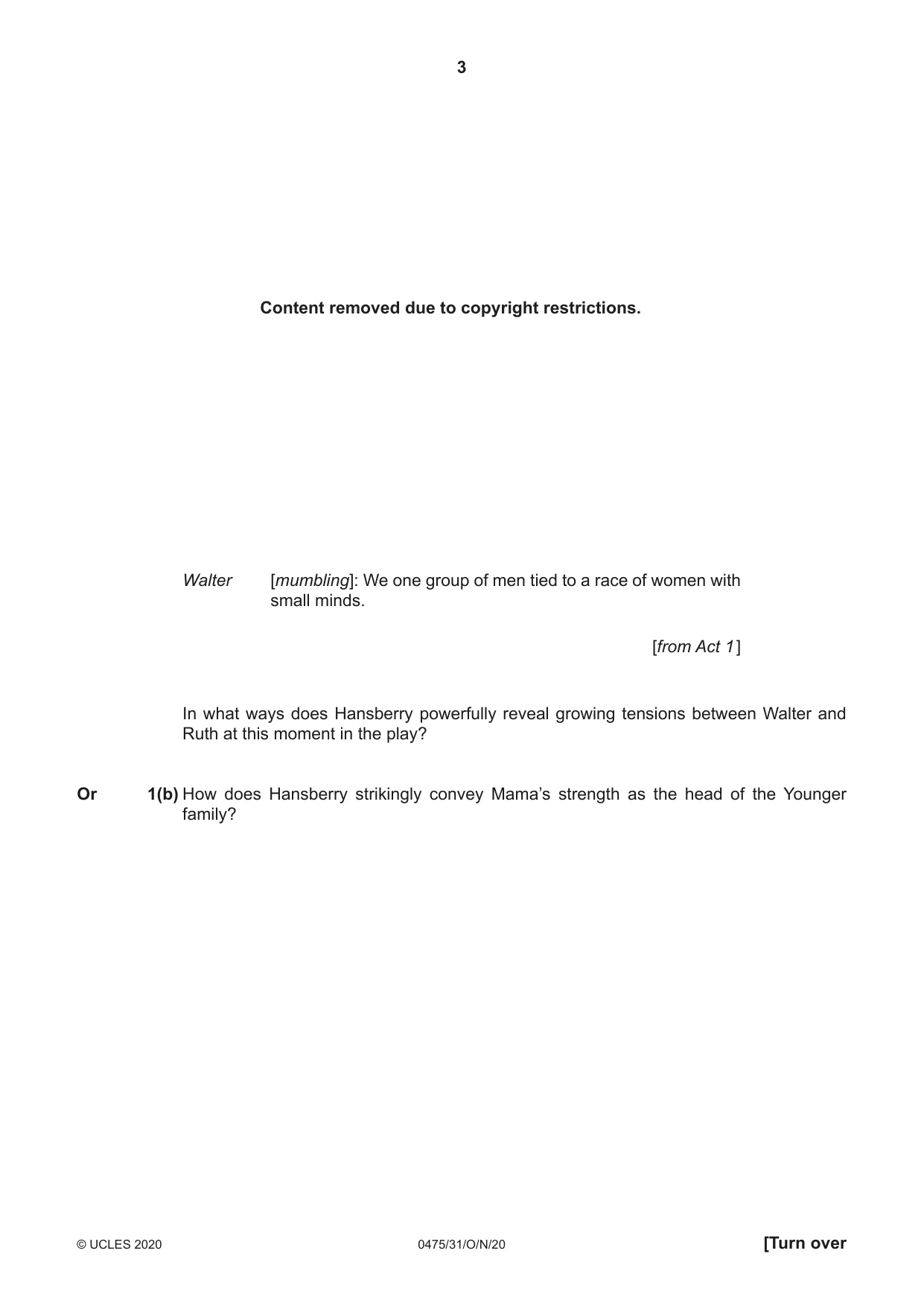
3 0475/31/O/N/20 © UCLES 2020 [Turn over Walter [mumbling]: We one group of men tied to a race of women with small minds. [from Act 1 ] In what ways does Hansberry powerfully reveal growing tensions between Walter and Ruth at this moment in the play? Or 1(b) How does Hansberry strikingly convey Mama’s strength as the head of the Younger family? Content removed due to copyright restrictions.
Question paper, page 4
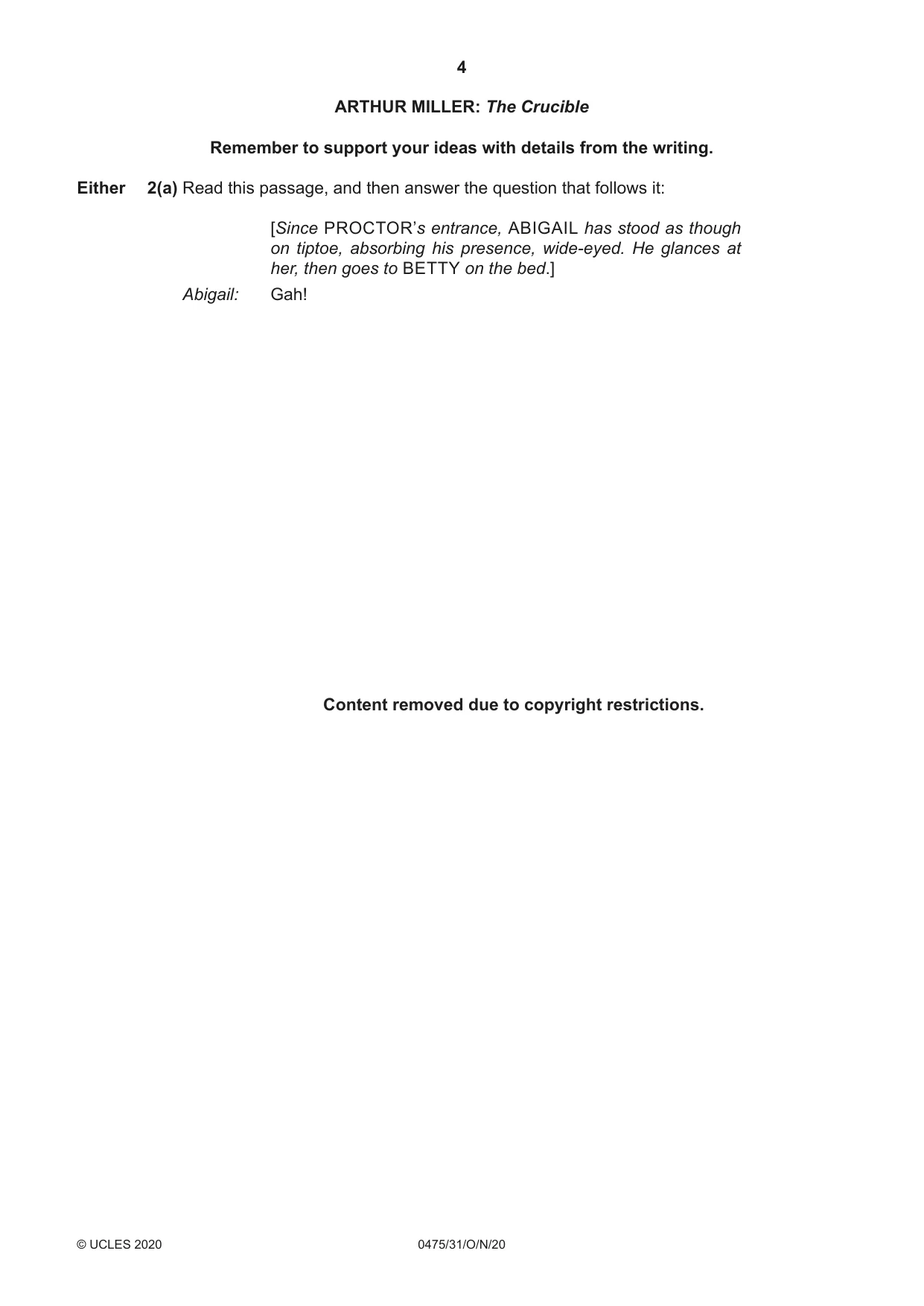
4 0475/31/O/N/20 © UCLES 2020 ARTHUR MILLER: The Crucible Remember to support your ideas with details from the writing. Either 2(a) Read this passage, and then answer the question that follows it: [Since PROCTOR’s entrance, ABIGAIL has stood as though on tiptoe, absorbing his presence, wide-eyed. He glances at her, then goes to BETTY on the bed.] Abigail: Gah! Content removed due to copyright restrictions.
Question paper, page 5
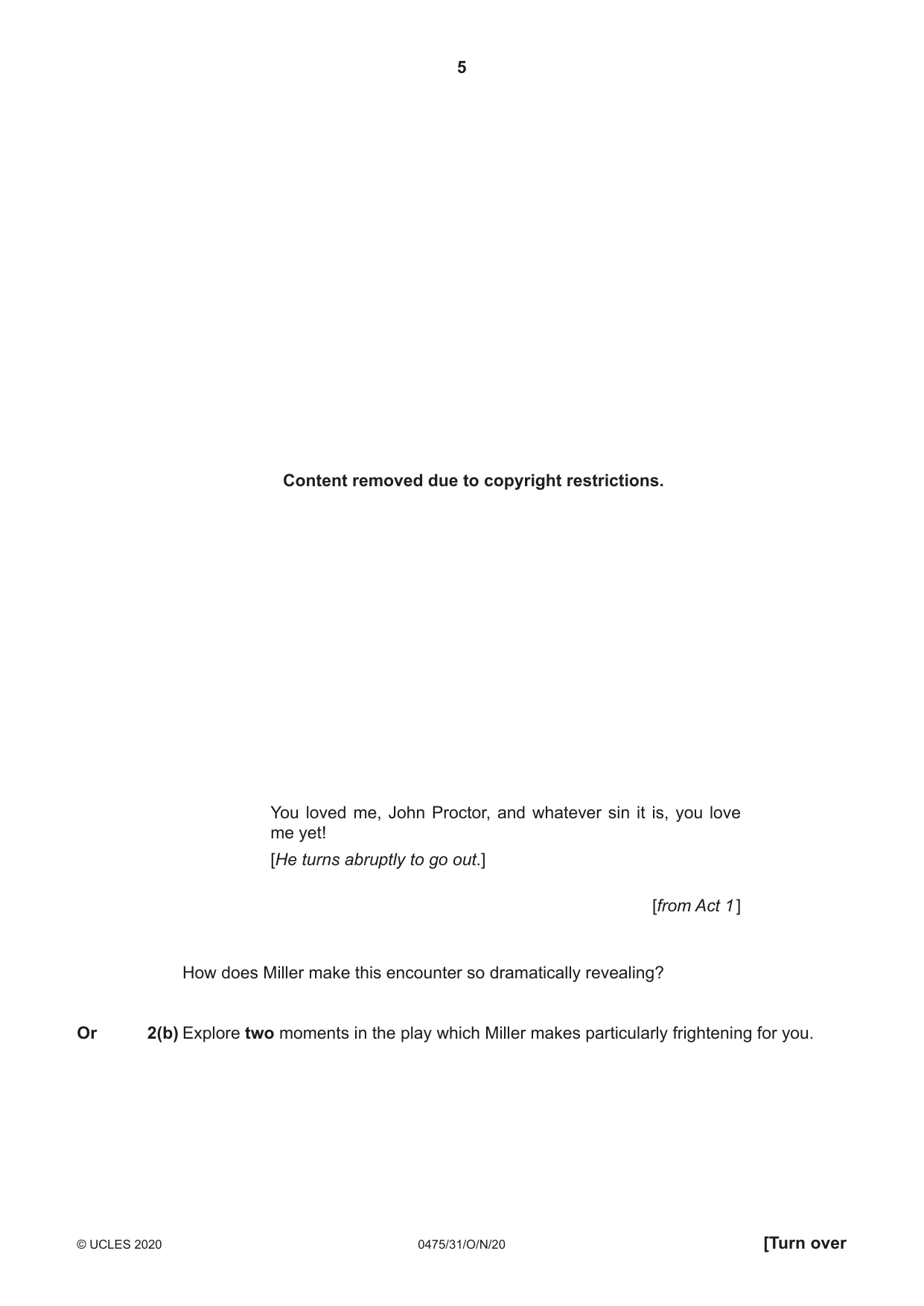
5 0475/31/O/N/20 © UCLES 2020 [Turn over You loved me, John Proctor, and whatever sin it is, you love me yet! [He turns abruptly to go out.] [from Act 1 ] How does Miller make this encounter so dramatically revealing? Or 2(b) Explore two moments in the play which Miller makes particularly frightening for you. Content removed due to copyright restrictions.
Question paper, page 6
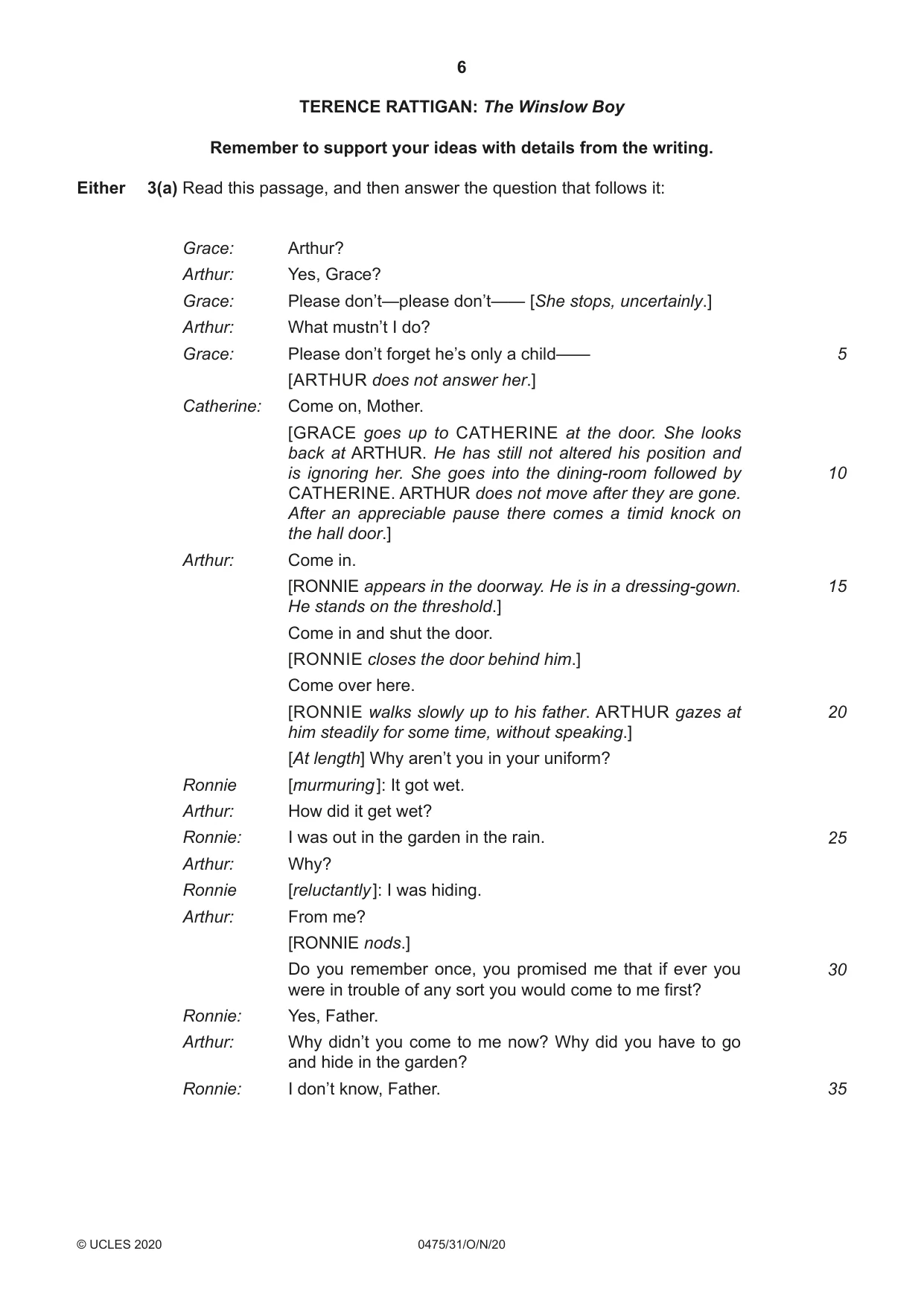
6 0475/31/O/N/20 © UCLES 2020 TERENCE RATTIGAN: The Winslow Boy Remember to support your ideas with details from the writing. Either 3(a) Read this passage, and then answer the question that follows it: Grace: Arthur? Arthur: Yes, Grace? Grace: Please don’t—please don’t—— [She stops, uncertainly.] Arthur: What mustn’t I do? Grace: Please don’t forget he’s only a child—— [ARTHUR does not answer her.] Catherine: Come on, Mother. [GRACE goes up to CATHERINE at the door. She looks back at ARTHUR. He has still not altered his position and is ignoring her. She goes into the dining-room followed by CATHERINE. ARTHUR does not move after they are gone. After an appreciable pause there comes a timid knock on the hall door.] Arthur: Come in. [RONNIE appears in the doorway. He is in a dressing-gown. He stands on the threshold.] Come in and shut the door. [RONNIE closes the door behind him.] Come over here. [RONNIE walks slowly up to his father. ARTHUR gazes at him steadily for some time, without speaking.] [At length] Why aren’t you in your uniform? Ronnie [murmuring ]: It got wet. Arthur: How did it get wet? Ronnie: I was out in the garden in the rain. Arthur: Why? Ronnie [reluctantly ]: I was hiding. Arthur: From me? [RONNIE nods.] Do you remember once, you promised me that if ever you were in trouble of any sort you would come to me first? Ronnie: Yes, Father. Arthur: Why didn’t you come to me now? Why did you have to go and hide in the garden? Ronnie: I don’t know, Father. 5 10 15 20 25 30 35
Question paper, page 7
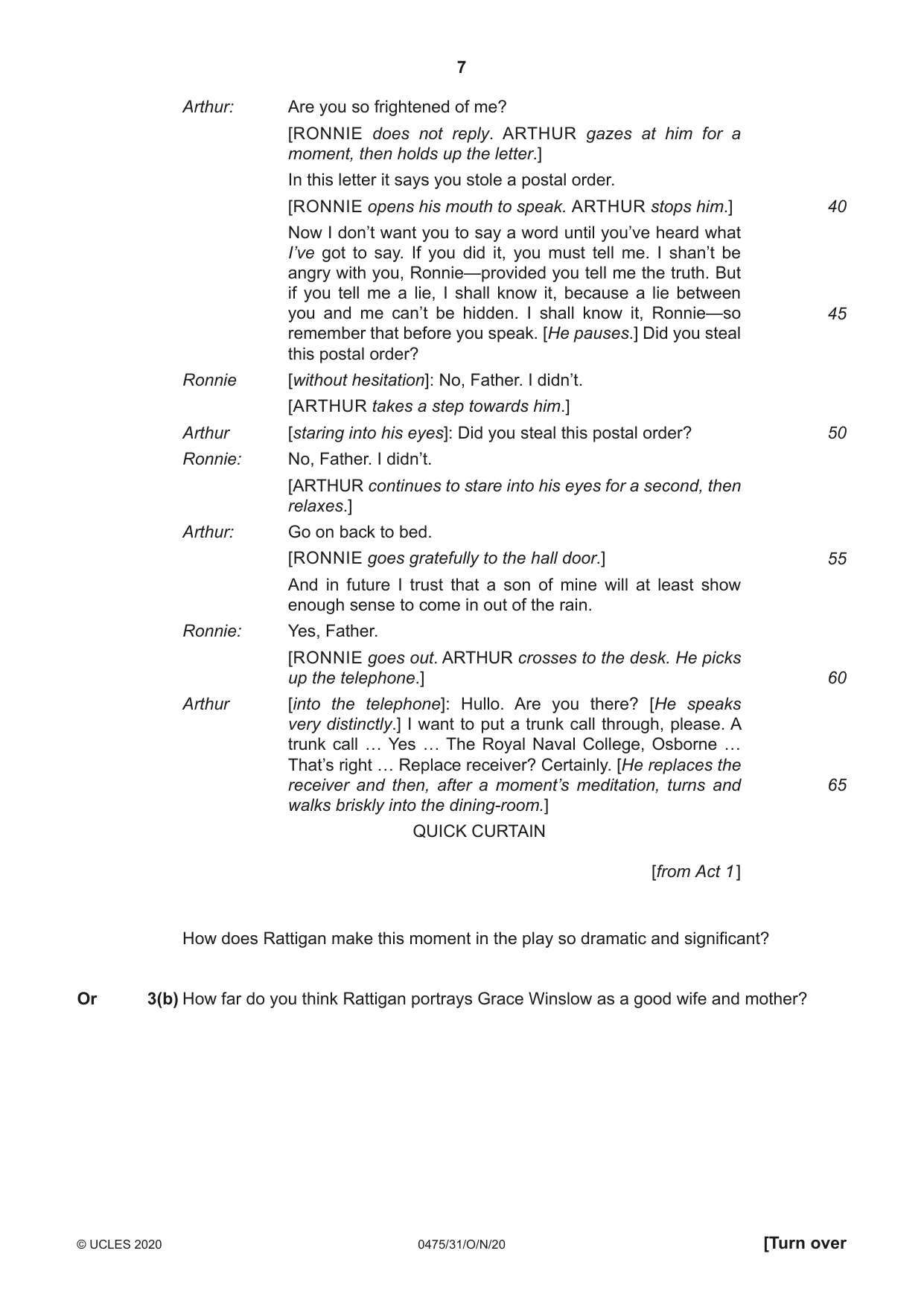
7 0475/31/O/N/20 © UCLES 2020 [Turn over Arthur: Are you so frightened of me? [RONNIE does not reply. ARTHUR gazes at him for a moment, then holds up the letter.] In this letter it says you stole a postal order. [RONNIE opens his mouth to speak. ARTHUR stops him.] Now I don’t want you to say a word until you’ve heard what I’ve got to say. If you did it, you must tell me. I shan’t be angry with you, Ronnie—provided you tell me the truth. But if you tell me a lie, I shall know it, because a lie between you and me can’t be hidden. I shall know it, Ronnie—so remember that before you speak. [He pauses.] Did you steal this postal order? Ronnie [without hesitation]: No, Father. I didn’t. [ARTHUR takes a step towards him.] Arthur [staring into his eyes]: Did you steal this postal order? Ronnie: No, Father. I didn’t. [ARTHUR continues to stare into his eyes for a second, then relaxes.] Arthur: Go on back to bed. [RONNIE goes gratefully to the hall door.] And in future I trust that a son of mine will at least show enough sense to come in out of the rain. Ronnie: Yes, Father. [RONNIE goes out. ARTHUR crosses to the desk. He picks up the telephone.] Arthur [into the telephone]: Hullo. Are you there? [He speaks very distinctly.] I want to put a trunk call through, please. A trunk call … Yes … The Royal Naval College, Osborne … That’s right … Replace receiver? Certainly. [He replaces the receiver and then, after a moment’s meditation, turns and walks briskly into the dining-room.] QUICK CURTAIN [from Act 1 ] How does Rattigan make this moment in the play so dramatic and significant? Or 3(b) How far do you think Rattigan portrays Grace Winslow as a good wife and mother? 40 45 50 55 60 65
Question paper, page 8
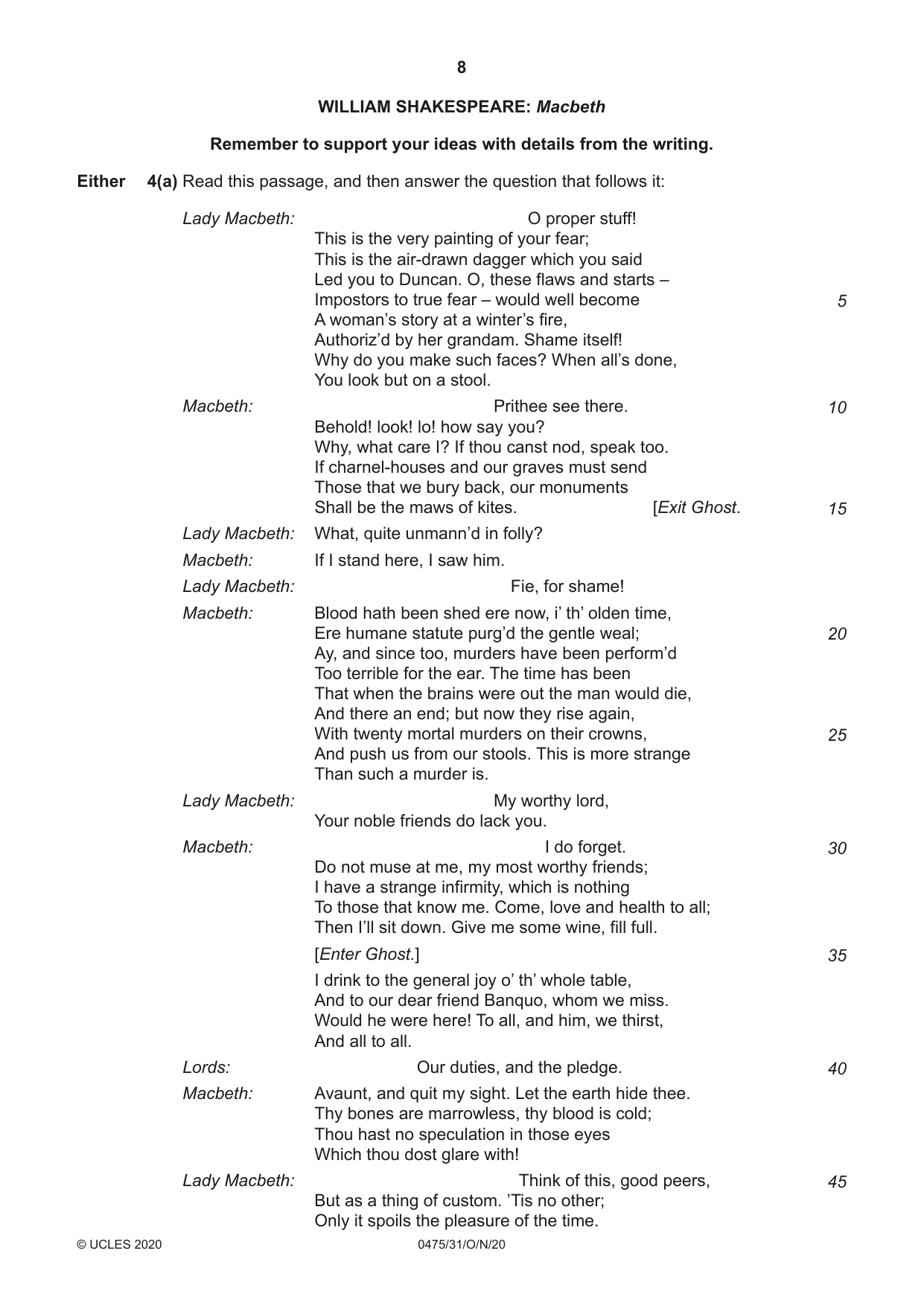
8 0475/31/O/N/20 © UCLES 2020 WILLIAM SHAKESPEARE: Macbeth Remember to support your ideas with details from the writing. Either 4(a) Read this passage, and then answer the question that follows it: Lady Macbeth: O proper stuff! This is the very painting of your fear; This is the air-drawn dagger which you said Led you to Duncan. O, these flaws and starts – Impostors to true fear – would well become A woman’s story at a winter’s fire, Authoriz’d by her grandam. Shame itself! Why do you make such faces? When all’s done, You look but on a stool. Macbeth: Prithee see there. Behold! look! lo! how say you? Why, what care I? If thou canst nod, speak too. If charnel-houses and our graves must send Those that we bury back, our monuments Shall be the maws of kites. [Exit Ghost. Lady Macbeth: What, quite unmann’d in folly? Macbeth: If I stand here, I saw him. Lady Macbeth: Fie, for shame! Macbeth: Blood hath been shed ere now, i’ th’ olden time, Ere humane statute purg’d the gentle weal; Ay, and since too, murders have been perform’d Too terrible for the ear. The time has been That when the brains were out the man would die, And there an end; but now they rise again, With twenty mortal murders on their crowns, And push us from our stools. This is more strange Than such a murder is. Lady Macbeth: My worthy lord, Your noble friends do lack you. Macbeth: I do forget. Do not muse at me, my most worthy friends; I have a strange infirmity, which is nothing To those that know me. Come, love and health to all; Then I’ll sit down. Give me some wine, fill full. [Enter Ghost.] I drink to the general joy o’ th’ whole table, And to our dear friend Banquo, whom we miss. Would he were here! To all, and him, we thirst, And all to all. Lords: Our duties, and the pledge. Macbeth: Avaunt, and quit my sight. Let the earth hide thee. Thy bones are marrowless, thy blood is cold; Thou hast no speculation in those eyes Which thou dost glare with! Lady Macbeth: Think of this, good peers, But as a thing of custom. ’Tis no other; Only it spoils the pleasure of the time. 5 10 15 20 25 30 35 40 45
Question paper, page 9
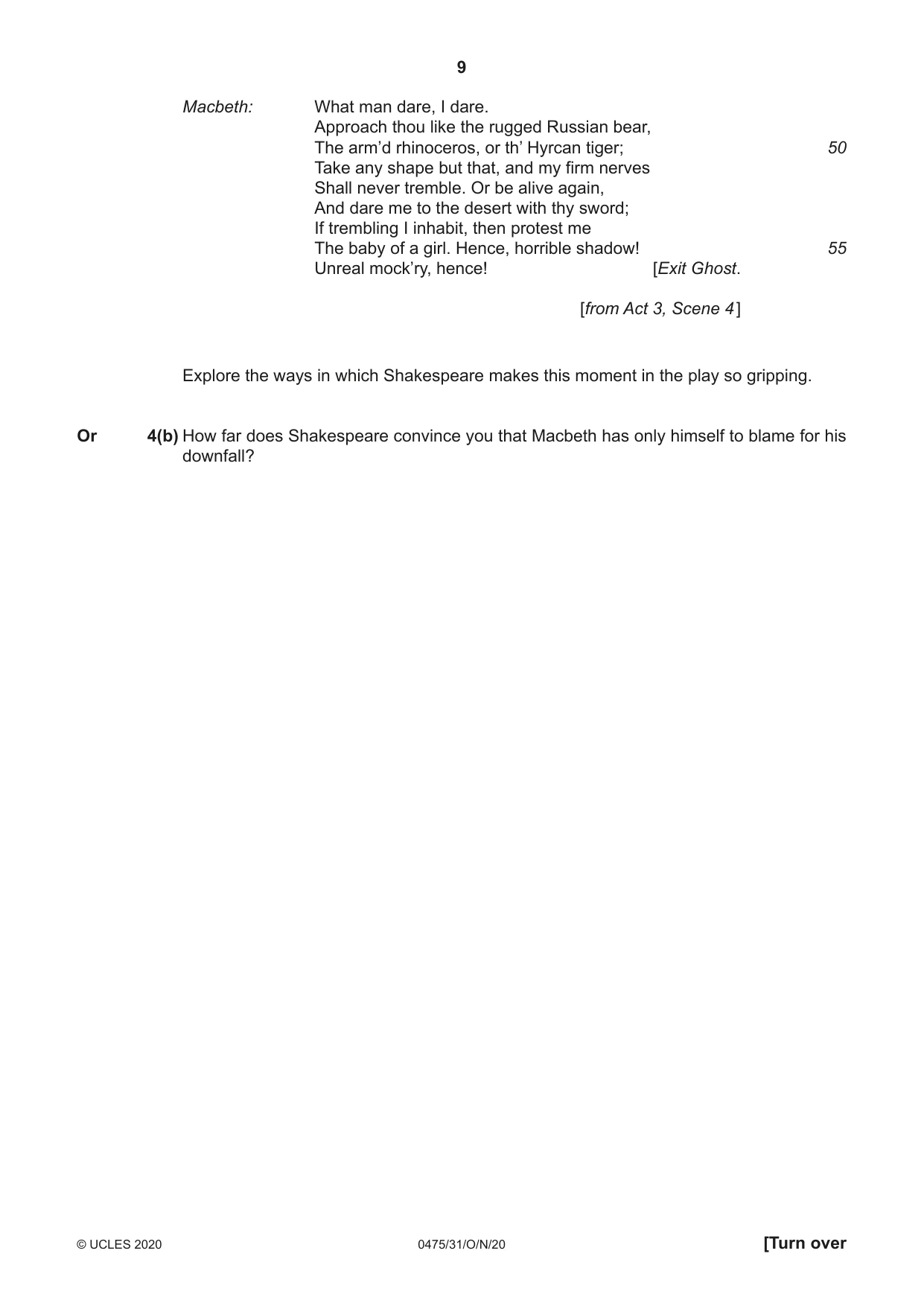
9 0475/31/O/N/20 © UCLES 2020 [Turn over Macbeth: What man dare, I dare. Approach thou like the rugged Russian bear, The arm’d rhinoceros, or th’ Hyrcan tiger; Take any shape but that, and my firm nerves Shall never tremble. Or be alive again, And dare me to the desert with thy sword; If trembling I inhabit, then protest me The baby of a girl. Hence, horrible shadow! Unreal mock’ry, hence! [Exit Ghost. [from Act 3, Scene 4 ] Explore the ways in which Shakespeare makes this moment in the play so gripping. Or 4(b) How far does Shakespeare convince you that Macbeth has only himself to blame for his downfall? 50 55
Question paper, page 10
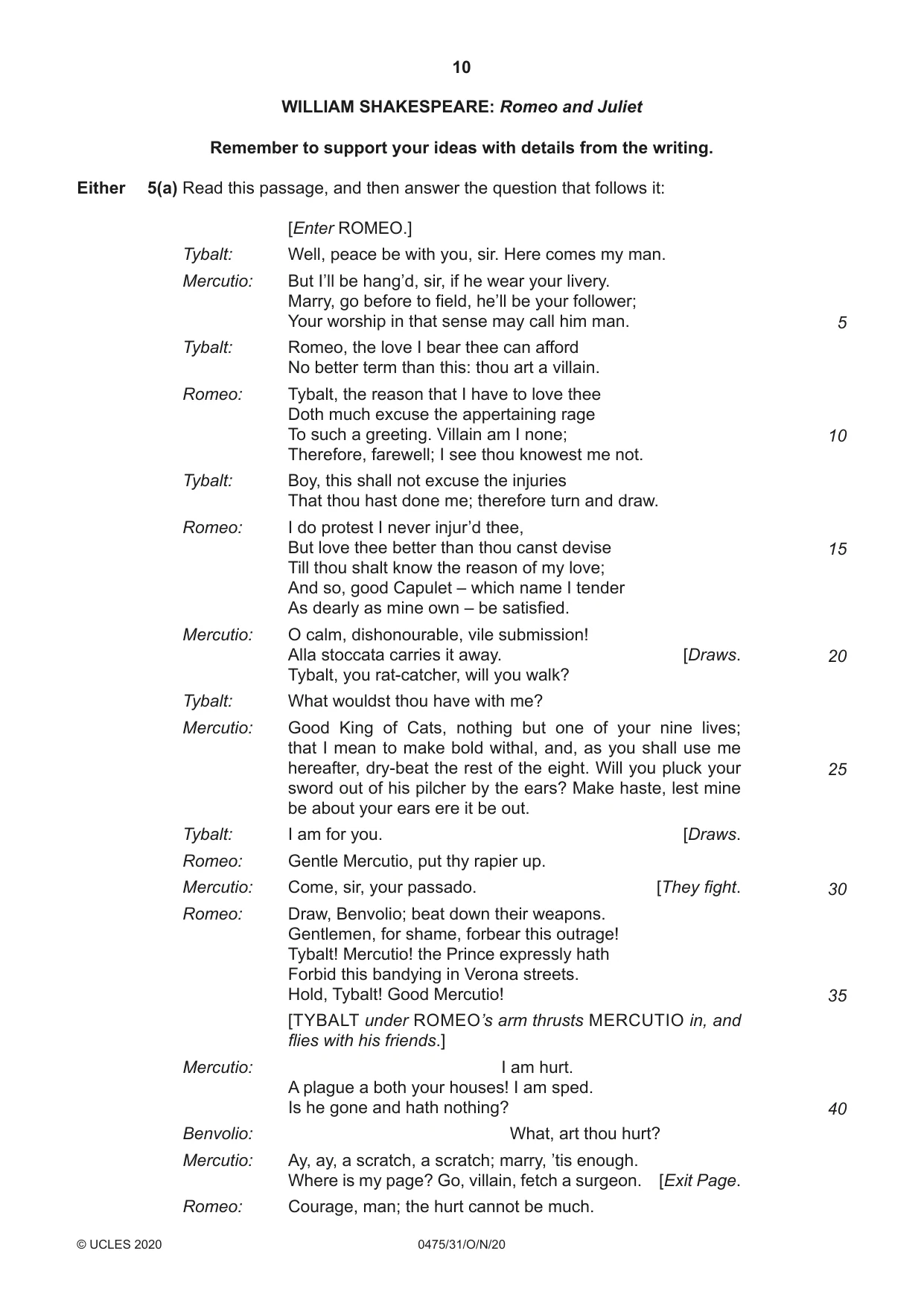
10 0475/31/O/N/20 © UCLES 2020 WILLIAM SHAKESPEARE: Romeo and Juliet Remember to support your ideas with details from the writing. Either 5(a) Read this passage, and then answer the question that follows it: [Enter ROMEO.] Tybalt: Well, peace be with you, sir. Here comes my man. Mercutio: But I’ll be hang’d, sir, if he wear your livery. Marry, go before to field, he’ll be your follower; Your worship in that sense may call him man. Tybalt: Romeo, the love I bear thee can afford No better term than this: thou art a villain. Romeo: Tybalt, the reason that I have to love thee Doth much excuse the appertaining rage To such a greeting. Villain am I none; Therefore, farewell; I see thou knowest me not. Tybalt: Boy, this shall not excuse the injuries That thou hast done me; therefore turn and draw. Romeo: I do protest I never injur’d thee, But love thee better than thou canst devise Till thou shalt know the reason of my love; And so, good Capulet – which name I tender As dearly as mine own – be satisfied. Mercutio: O calm, dishonourable, vile submission! Alla stoccata carries it away. [Draws. Tybalt, you rat-catcher, will you walk? Tybalt: What wouldst thou have with me? Mercutio: Good King of Cats, nothing but one of your nine lives; that I mean to make bold withal, and, as you shall use me hereafter, dry-beat the rest of the eight. Will you pluck your sword out of his pilcher by the ears? Make haste, lest mine be about your ears ere it be out. Tybalt: I am for you. [Draws. Romeo: Gentle Mercutio, put thy rapier up. Mercutio: Come, sir, your passado. [They fight. Romeo: Draw, Benvolio; beat down their weapons. Gentlemen, for shame, forbear this outrage! Tybalt! Mercutio! the Prince expressly hath Forbid this bandying in Verona streets. Hold, Tybalt! Good Mercutio! [TYBALT under ROMEO’s arm thrusts MERCUTIO in, and flies with his friends.] Mercutio: I am hurt. A plague a both your houses! I am sped. Is he gone and hath nothing? Benvolio: What, art thou hurt? Mercutio: Ay, ay, a scratch, a scratch; marry, ’tis enough. Where is my page? Go, villain, fetch a surgeon. [Exit Page. Romeo: Courage, man; the hurt cannot be much. 5 10 15 20 25 30 35 40
Question paper, page 11
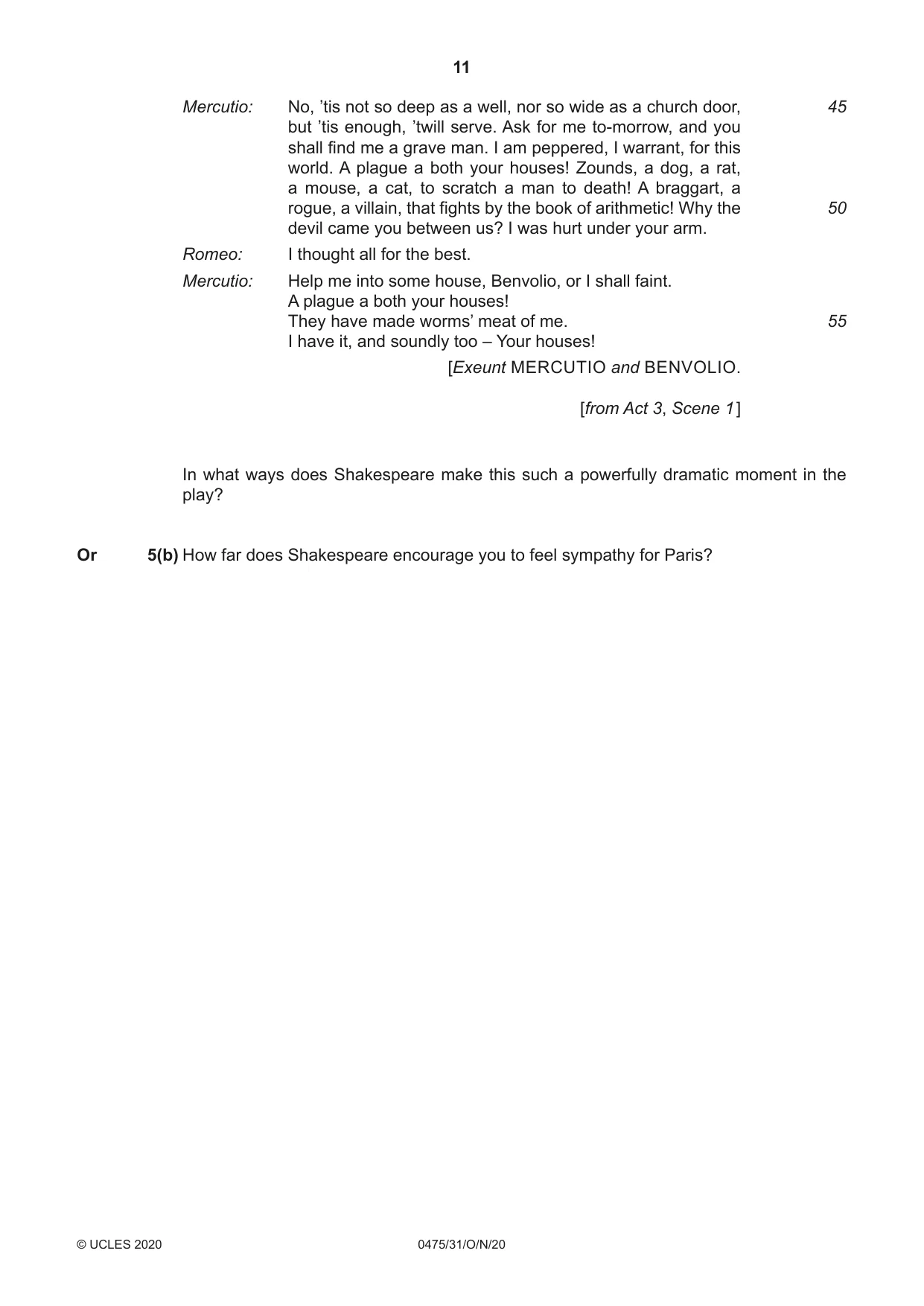
11 0475/31/O/N/20 © UCLES 2020 Mercutio: No, ’tis not so deep as a well, nor so wide as a church door, but ’tis enough, ’twill serve. Ask for me to-morrow, and you shall find me a grave man. I am peppered, I warrant, for this world. A plague a both your houses! Zounds, a dog, a rat, a mouse, a cat, to scratch a man to death! A braggart, a rogue, a villain, that fights by the book of arithmetic! Why the devil came you between us? I was hurt under your arm. Romeo: I thought all for the best. Mercutio: Help me into some house, Benvolio, or I shall faint. A plague a both your houses! They have made worms’ meat of me. I have it, and soundly too – Your houses! [Exeunt MERCUTIO and BENVOLIO. [from Act 3, Scene 1 ] In what ways does Shakespeare make this such a powerfully dramatic moment in the play? Or 5(b) How far does Shakespeare encourage you to feel sympathy for Paris? 45 50 55
Question paper, page 12
12 0475/31/O/N/20 © UCLES 2020 Permission to reproduce items where third-party owned material protected by copyright is included has been sought and cleared where possible. Every reasonable effort has been made by the publisher (UCLES) to trace copyright holders, but if any items requiring clearance have unwittingly been included, the publisher will be pleased to make amends at the earliest possible opportunity. To avoid the issue of disclosure of answer-related information to candidates, all copyright acknowledgements are reproduced online in the Cambridge Assessment International Education Copyright Acknowledgements Booklet. This is produced for each series of examinations and is freely available to download at www.cambridgeinternational.org after the live examination series. Cambridge Assessment International Education is part of the Cambridge Assessment Group. Cambridge Assessment is the brand name of the University of Cambridge Local Examinations Syndicate (UCLES), which itself is a department of the University of Cambridge. BLANK PAGE
Mark scheme, page 1
This document consists of 5 printed pages. © UCLES 2020 [Turn over Cambridge IGCSE™ LITERATURE IN ENGLISH 0475/31 Paper 2 Drama (Open Text) 31 October/November 2020 MARK SCHEME Maximum Mark: 50 Published This mark scheme is published as an aid to teachers and candidates, to indicate the requirements of the examination. It shows the basis on which Examiners were instructed to award marks. It does not indicate the details of the discussions that took place at an Examiners’ meeting before marking began, which would have considered the acceptability of alternative answers. Mark schemes should be read in conjunction with the question paper and the Principal Examiner Report for Teachers. Cambridge International will not enter into discussions about these mark schemes. Cambridge International is publishing the mark schemes for the October/November 2020 series for most Cambridge IGCSE™, Cambridge International A and AS Level and Cambridge Pre-U components, and some Cambridge O Level components.
Mark scheme, page 2
0475/31 Cambridge IGCSE – Mark Scheme PUBLISHED October/November 2020 © UCLES 2020 Page 2 of 5 Generic Marking Principles These general marking principles must be applied by all examiners when marking candidate answers. They should be applied alongside the specific content of the mark scheme or generic level descriptors for a question. Each question paper and mark scheme will also comply with these marking principles. GENERIC MARKING PRINCIPLE 1: Marks must be awarded in line with: • the specific content of the mark scheme or the generic level descriptors for the question • the specific skills defined in the mark scheme or in the generic level descriptors for the question • the standard of response required by a candidate as exemplified by the standardisation scripts. GENERIC MARKING PRINCIPLE 2: Marks awarded are always whole marks (not half marks, or other fractions). GENERIC MARKING PRINCIPLE 3: Marks must be awarded positively: • marks are awarded for correct/valid answers, as defined in the mark scheme. However, credit is given for valid answers which go beyond the scope of the syllabus and mark scheme, referring to your Team Leader as appropriate • marks are awarded when candidates clearly demonstrate what they know and can do • marks are not deducted for errors • marks are not deducted for omissions • answers should only be judged on the quality of spelling, punctuation and grammar when these features are specifically assessed by the question as indicated by the mark scheme. The meaning, however, should be unambiguous. GENERIC MARKING PRINCIPLE 4: Rules must be applied consistently, e.g. in situations where candidates have not followed instructions or in the application of generic level descriptors. GENERIC MARKING PRINCIPLE 5: Marks should be awarded using the full range of marks defined in the mark scheme for the question (however; the use of the full mark range may be limited according to the quality of the candidate responses seen). GENERIC MARKING PRINCIPLE 6: Marks awarded are based solely on the requirements as defined in the mark scheme. Marks should not be awarded with grade thresholds or grade descriptors in mind.
Mark scheme, page 3
0475/31 Cambridge IGCSE – Mark Scheme PUBLISHED October/November 2020 © UCLES 2020 Page 3 of 5 For general administrative guidance, see Notes for Examiners Handbook. All questions are marked out of 25. Assessment Objectives The Assessment Objectives are evenly weighted across each question. The assessment objectives for the paper are: AO1 show detailed knowledge of the content of literary texts, supported by reference to the text AO2 understand the meanings of literary texts and their context, and explore texts beyond surface meaning to show deeper awareness of ideas and attitudes AO3 recognise and appreciate ways in which writers use language, structure, and form to create and shape meanings and effects AO4 communicate a sensitive and informed personal response The Band Descriptors cover marks from 0 to 25 and apply to the marking of each question. They guide examiners to an understanding of the qualities normally expected of, or typical of, work in a band. They are a means of general guidance and must not be interpreted as hurdle statements. For the purposes of standardisation of marking, they are to be used in conjunction with the Practice and Standardisation scripts discussed during the coordination meeting and with Team Leaders, as well as the question-specific notes. The supplementary notes for each question are related to the assessment objectives above. Because of the nature of the subject, they are for general guidance; they are not designed as prescriptions of required content and must not be treated as such. The syllabus aims at encouraging candidates to make some personal response to their reading. While there are legitimate expectations of the content of most answers, examiners may see responses that include ideas not covered in the supplementary guidance. For these cases, examiners should credit valid responses fairly and not penalise candidates for including valid points outside the mark scheme. Do not refer to indicative content notes on scripts.
Mark scheme, page 4
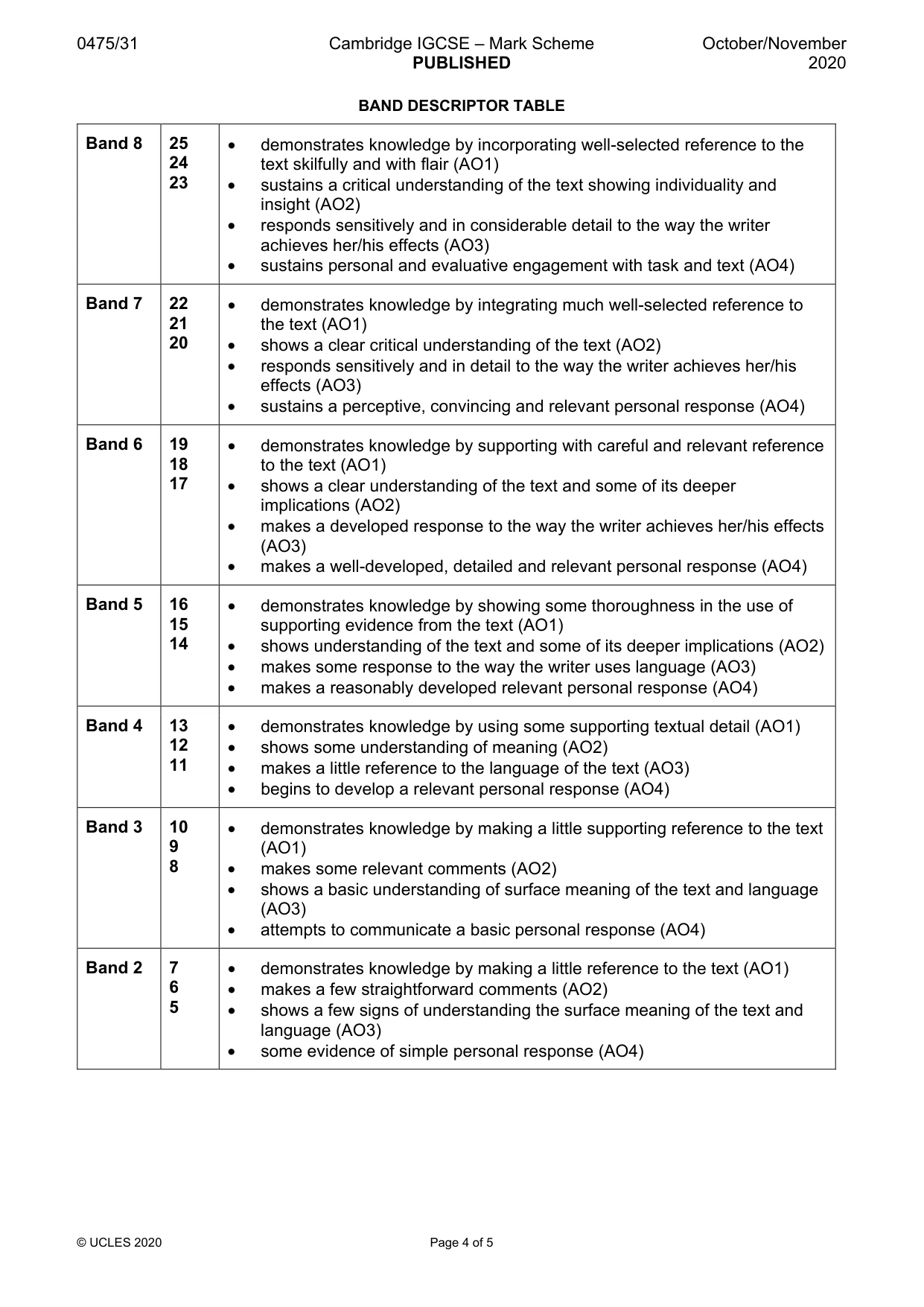
0475/31 Cambridge IGCSE – Mark Scheme PUBLISHED October/November 2020 © UCLES 2020 Page 4 of 5 BAND DESCRIPTOR TABLE Band 8 25 24 23 • demonstrates knowledge by incorporating well-selected reference to the text skilfully and with flair (AO1) • sustains a critical understanding of the text showing individuality and insight (AO2) • responds sensitively and in considerable detail to the way the writer achieves her/his effects (AO3) • sustains personal and evaluative engagement with task and text (AO4) Band 7 22 21 20 • demonstrates knowledge by integrating much well-selected reference to the text (AO1) • shows a clear critical understanding of the text (AO2) • responds sensitively and in detail to the way the writer achieves her/his effects (AO3) • sustains a perceptive, convincing and relevant personal response (AO4) Band 6 19 18 17 • demonstrates knowledge by supporting with careful and relevant reference to the text (AO1) • shows a clear understanding of the text and some of its deeper implications (AO2) • makes a developed response to the way the writer achieves her/his effects (AO3) • makes a well-developed, detailed and relevant personal response (AO4) Band 5 16 15 14 • demonstrates knowledge by showing some thoroughness in the use of supporting evidence from the text (AO1) • shows understanding of the text and some of its deeper implications (AO2) • makes some response to the way the writer uses language (AO3) • makes a reasonably developed relevant personal response (AO4) Band 4 13 12 11 • demonstrates knowledge by using some supporting textual detail (AO1) • shows some understanding of meaning (AO2) • makes a little reference to the language of the text (AO3) • begins to develop a relevant personal response (AO4) Band 3 10 9 8 • demonstrates knowledge by making a little supporting reference to the text (AO1) • makes some relevant comments (AO2) • shows a basic understanding of surface meaning of the text and language (AO3) • attempts to communicate a basic personal response (AO4) Band 2 7 6 5 • demonstrates knowledge by making a little reference to the text (AO1) • makes a few straightforward comments (AO2) • shows a few signs of understanding the surface meaning of the text and language (AO3) • some evidence of simple personal response (AO4)
Mark scheme, page 5
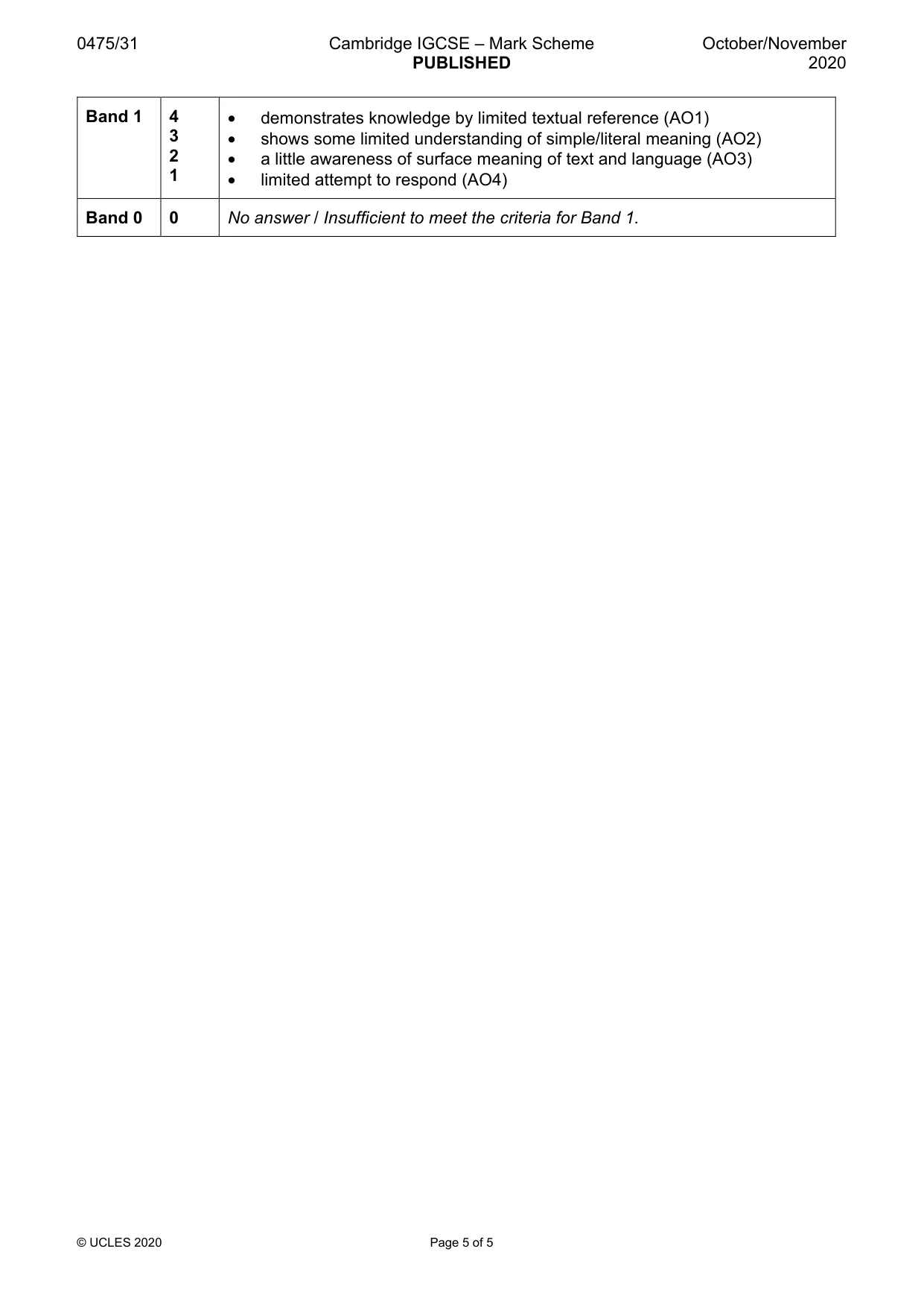
0475/31 Cambridge IGCSE – Mark Scheme PUBLISHED October/November 2020 © UCLES 2020 Page 5 of 5 Band 1 4 3 2 1 • demonstrates knowledge by limited textual reference (AO1) • shows some limited understanding of simple/literal meaning (AO2) • a little awareness of surface meaning of text and language (AO3) • limited attempt to respond (AO4) Band 0 0 No answer / Insufficient to meet the criteria for Band 1.
What you needed in this session
Cambridge’s own grade thresholds for 2020 Oct/Nov, Paper 3 · Variant 1. A higher threshold means an easier paper — the bar moves with how the cohort did.