Cambridge IGCSE English - Literature in English 0475 — 2024 Oct/Nov Paper 3 · Variant 3
0475/33/O/N/24 · 25 marks · ≈28 min
The question paper and its mark scheme, free to read here and free to download. This is Cambridge’s own paper, exactly as it was sat.
Question paper12 pages

Mark scheme4 pages
Answers below. Sit the paper first if you are practising.
Paper as text
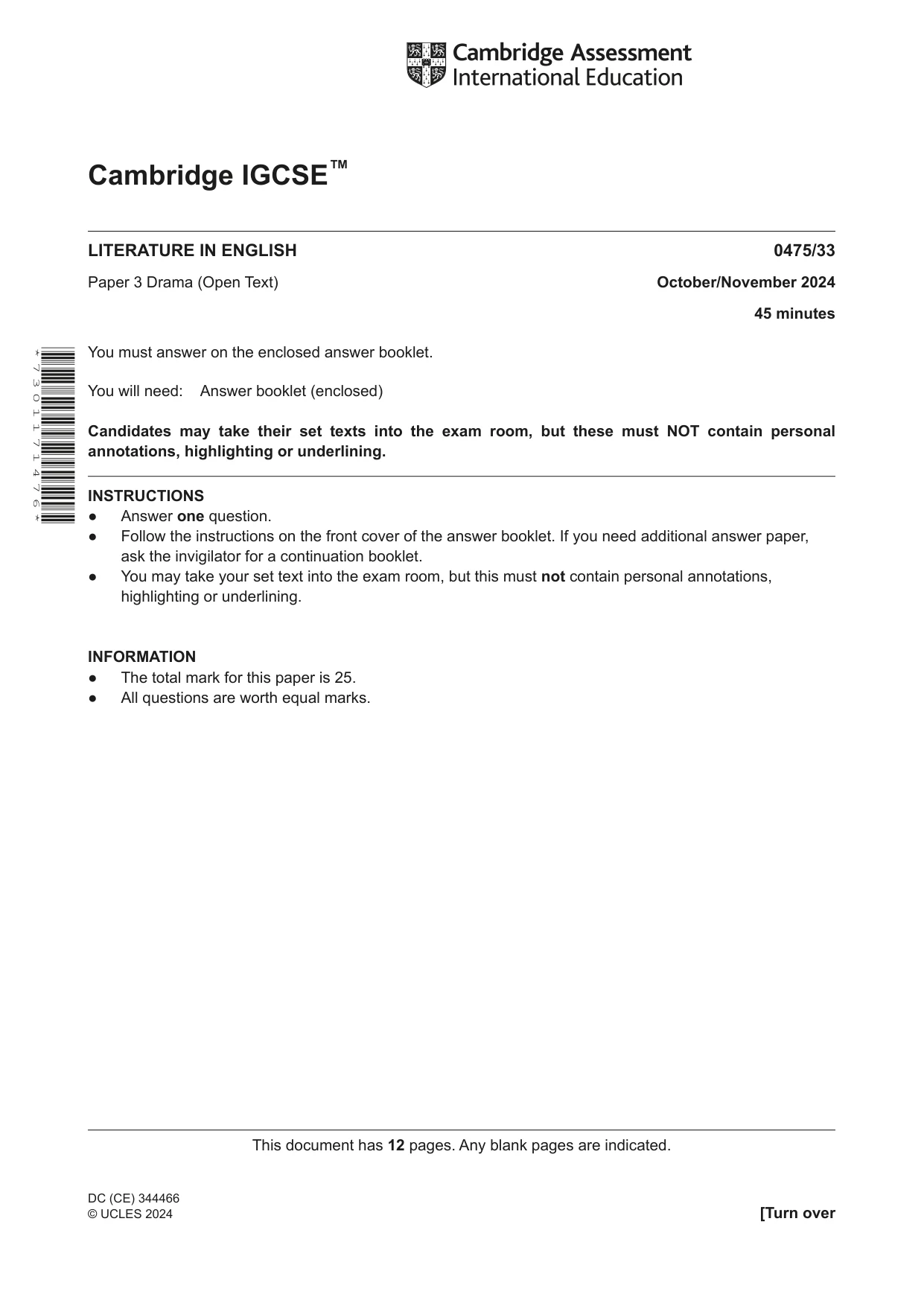
Question paper, page 1
This document has 12 pages. Any blank pages are indicated. [Turn over Cambridge IGCSE™ * 7 3 0 1 1 7 1 4 7 6 * DC (CE) 344466 © UCLES 2024 LITERATURE IN ENGLISH 0475/33 Paper 3 Drama (Open Text) October/November 2024 45 minutes You must answer on the enclosed answer booklet. You will need: Answer booklet (enclosed) Candidates may take their set texts into the exam room, but these must NOT contain personal annotations, highlighting or underlining. INSTRUCTIONS ● Answer one question. ● Follow the instructions on the front cover of the answer booklet. If you need additional answer paper, ask the invigilator for a continuation booklet. ● You may take your set text into the exam room, but this must not contain personal annotations, highlighting or underlining. INFORMATION ● The total mark for this paper is 25. ● All questions are worth equal marks.
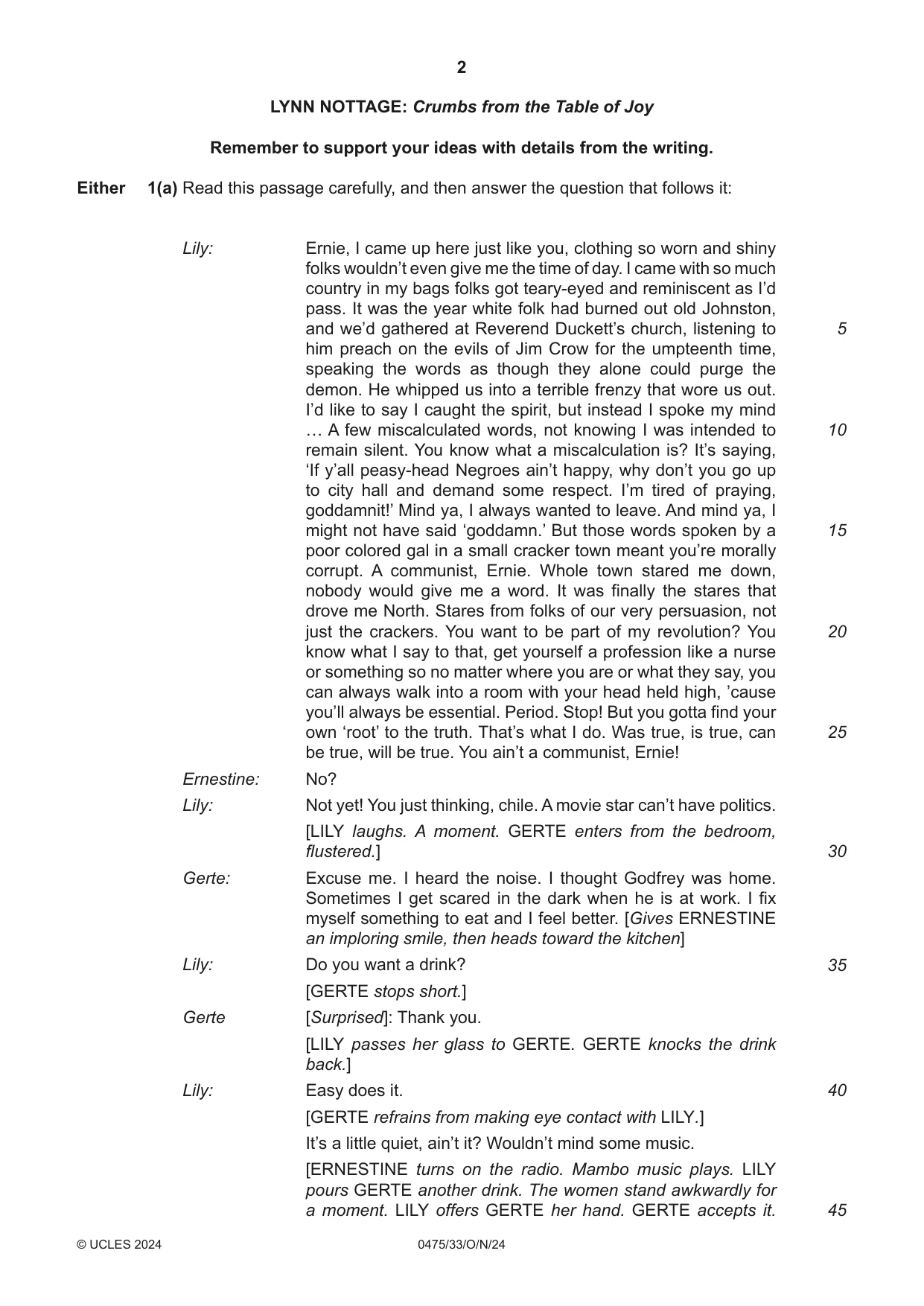
Question paper, page 2
2 0475/33/O/N/24 © UCLES 2024 LYNN NOTTAGE: Crumbs from the Table of Joy Remember to support your ideas with details from the writing. Either 1(a) Read this passage carefully, and then answer the question that follows it: Lily: Ernie, I came up here just like you, clothing so worn and shiny folks wouldn’t even give me the time of day. I came with so much country in my bags folks got teary-eyed and reminiscent as I’d pass. It was the year white folk had burned out old Johnston, and we’d gathered at Reverend Duckett’s church, listening to him preach on the evils of Jim Crow for the umpteenth time, speaking the words as though they alone could purge the demon. He whipped us into a terrible frenzy that wore us out. I’d like to say I caught the spirit, but instead I spoke my mind … A few miscalculated words, not knowing I was intended to remain silent. You know what a miscalculation is? It’s saying, ‘If y’all peasy-head Negroes ain’t happy, why don’t you go up to city hall and demand some respect. I’m tired of praying, goddamnit!’ Mind ya, I always wanted to leave. And mind ya, I might not have said ‘goddamn.’ But those words spoken by a poor colored gal in a small cracker town meant you’re morally corrupt. A communist, Ernie. Whole town stared me down, nobody would give me a word. It was finally the stares that drove me North. Stares from folks of our very persuasion, not just the crackers. You want to be part of my revolution? You know what I say to that, get yourself a profession like a nurse or something so no matter where you are or what they say, you can always walk into a room with your head held high, ’cause you’ll always be essential. Period. Stop! But you gotta find your own ‘root’ to the truth. That’s what I do. Was true, is true, can be true, will be true. You ain’t a communist, Ernie! Ernestine: No? Lily: Not yet! You just thinking, chile. A movie star can’t have politics. [LILY laughs. A moment. GERTE enters from the bedroom, flustered.] Gerte: Excuse me. I heard the noise. I thought Godfrey was home. Sometimes I get scared in the dark when he is at work. I fix myself something to eat and I feel better. [Gives ERNESTINE an imploring smile, then heads toward the kitchen] Lily: Do you want a drink? [GERTE stops short.] Gerte [Surprised]: Thank you. [LILY passes her glass to GERTE. GERTE knocks the drink back.] Lily: Easy does it. [GERTE refrains from making eye contact with LILY.] It’s a little quiet, ain’t it? Wouldn’t mind some music. [ERNESTINE turns on the radio. Mambo music plays. LILY pours GERTE another drink. The women stand awkwardly for a moment. LILY offers GERTE her hand. GERTE accepts it. 5 10 15 20 25 30 35 40 45
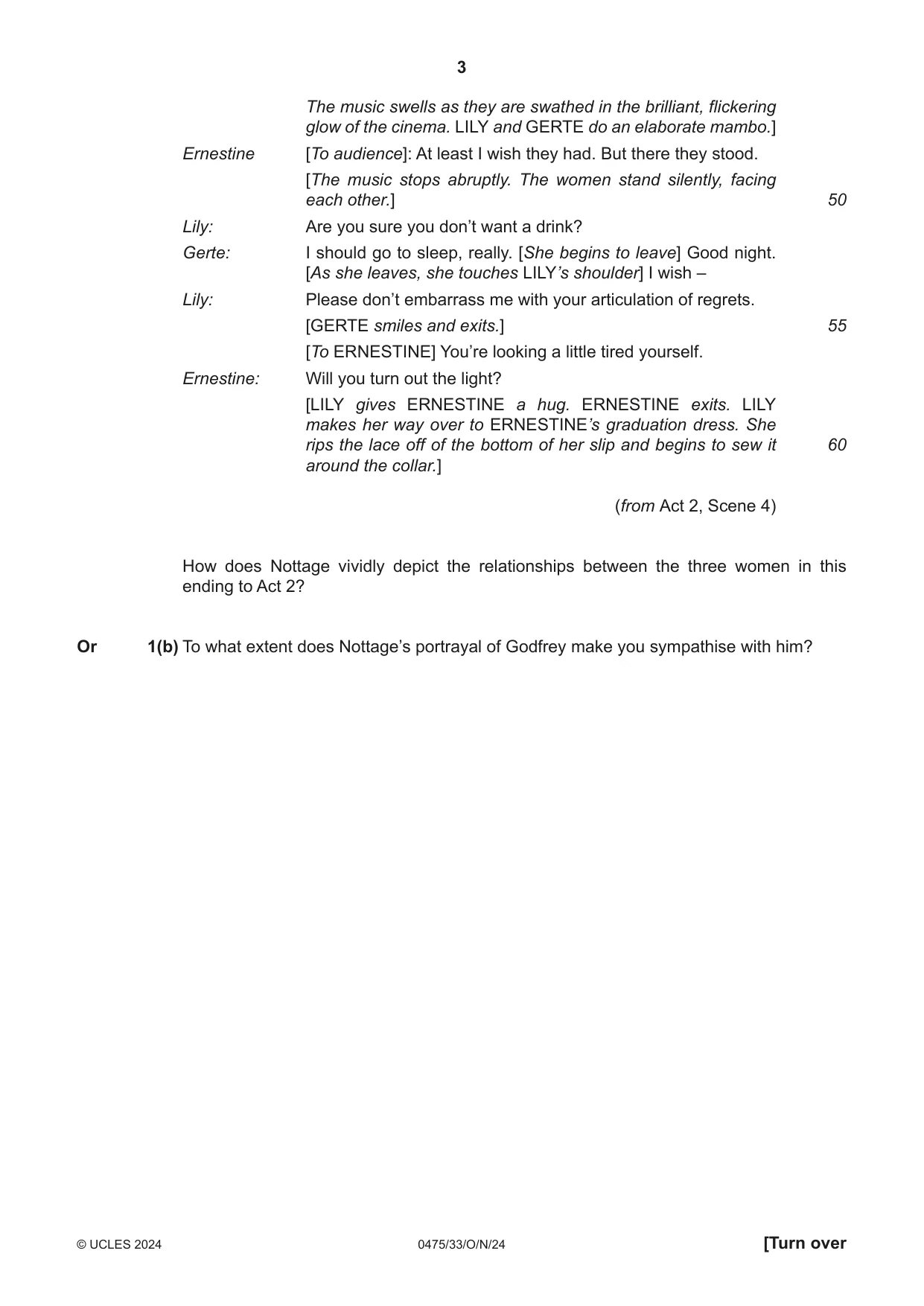
Question paper, page 3
3 0475/33/O/N/24 © UCLES 2024 [Turn over The music swells as they are swathed in the brilliant, flickering glow of the cinema. LILY and GERTE do an elaborate mambo.] Ernestine [To audience]: At least I wish they had. But there they stood. [The music stops abruptly. The women stand silently, facing each other.] Lily: Are you sure you don’t want a drink? Gerte: I should go to sleep, really. [She begins to leave] Good night. [As she leaves, she touches LILY’s shoulder] I wish – Lily: Please don’t embarrass me with your articulation of regrets. [GERTE smiles and exits.] [To ERNESTINE] You’re looking a little tired yourself. Ernestine: Will you turn out the light? [LILY gives ERNESTINE a hug. ERNESTINE exits. LILY makes her way over to ERNESTINE’s graduation dress. She rips the lace off of the bottom of her slip and begins to sew it around the collar.] (from Act 2, Scene 4) How does Nottage vividly depict the relationships between the three women in this ending to Act 2? Or 1(b) To what extent does Nottage’s portrayal of Godfrey make you sympathise with him? 50 55 60
Question paper, page 4
4 0475/33/O/N/24 © UCLES 2024 WOLE SOYINKA: Death and the King’s Horseman Remember to support your ideas with details from the writing. Either 2(a) Read this passage carefully, and then answer the question that follows it: Elesin: Wait. Content removed due to copyright restrictions.
Question paper, page 5
5 0475/33/O/N/24 © UCLES 2024 [Turn over The hidden path to me. (from Scene 3) How does Soyinka make this moment in the play so dramatic and mysterious? Or 2(b) How far does Soyinka suggest that Pilkings is responsible for the failure of Elesin’s ritual death? Content removed due to copyright restrictions.
Question paper, page 6
6 0475/33/O/N/24 © UCLES 2024 TENNESSEE WILLIAMS: A Streetcar Named Desire Remember to support your ideas with details from the writing. Either 3(a) Read this passage carefully, and then answer the question that follows it: Blanche: I am not being or feeling at all superior, Stella. Content removed due to copyright restrictions.
Question paper, page 7
7 0475/33/O/N/24 © UCLES 2024 [Turn over As the lights fade away, with a lingering brightness on their embrace, the music of the ‘blue piano’ and trumpet and drums is heard.] (from Scene 4) How does Williams make this such a memorable and significant moment in the play? Or 3(b) Explore the ways in which Williams powerfully portrays Stanley’s cruelty. Do not use the passage printed in Question 3(a) in answering this question. Content removed due to copyright restrictions.
Question paper, page 8
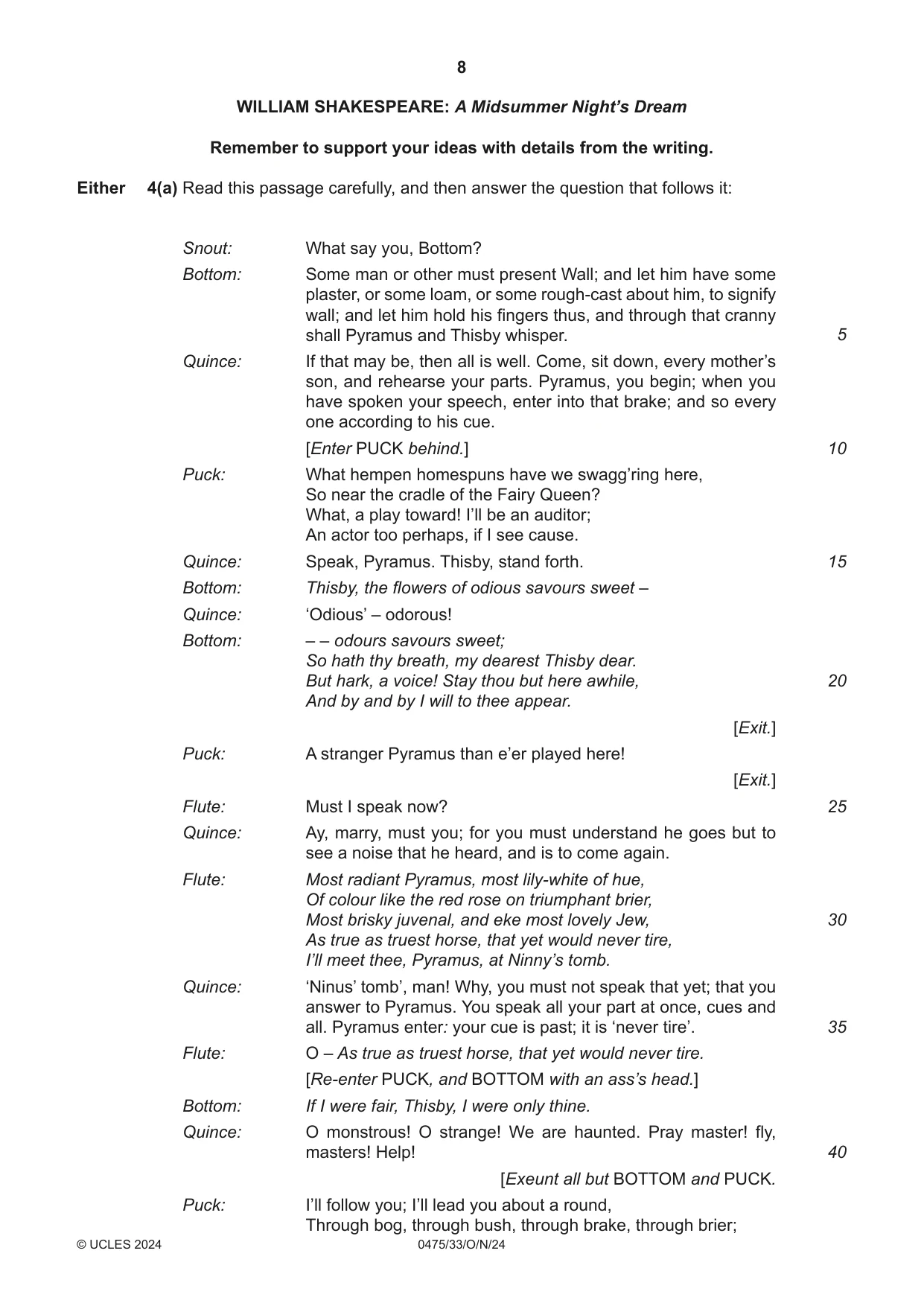
8 0475/33/O/N/24 © UCLES 2024 WILLIAM SHAKESPEARE: A Midsummer Night’s Dream Remember to support your ideas with details from the writing. Either 4(a) Read this passage carefully, and then answer the question that follows it: Snout: What say you, Bottom? Bottom: Some man or other must present Wall; and let him have some plaster, or some loam, or some rough-cast about him, to signify wall; and let him hold his fingers thus, and through that cranny shall Pyramus and Thisby whisper. Quince: If that may be, then all is well. Come, sit down, every mother’s son, and rehearse your parts. Pyramus, you begin; when you have spoken your speech, enter into that brake; and so every one according to his cue. [Enter PUCK behind.] Puck: What hempen homespuns have we swagg’ring here, So near the cradle of the Fairy Queen? What, a play toward! I’ll be an auditor; An actor too perhaps, if I see cause. Quince: Speak, Pyramus. Thisby, stand forth. Bottom: Thisby, the flowers of odious savours sweet – Quince: ‘Odious’ – odorous! Bottom: – – odours savours sweet; So hath thy breath, my dearest Thisby dear. But hark, a voice! Stay thou but here awhile, And by and by I will to thee appear. [Exit.] Puck: A stranger Pyramus than e’er played here! [Exit.] Flute: Must I speak now? Quince: Ay, marry, must you; for you must understand he goes but to see a noise that he heard, and is to come again. Flute: Most radiant Pyramus, most lily-white of hue, Of colour like the red rose on triumphant brier, Most brisky juvenal, and eke most lovely Jew, As true as truest horse, that yet would never tire, I’ll meet thee, Pyramus, at Ninny’s tomb. Quince: ‘Ninus’ tomb’, man! Why, you must not speak that yet; that you answer to Pyramus. You speak all your part at once, cues and all. Pyramus enter: your cue is past; it is ‘never tire’. Flute: O – As true as truest horse, that yet would never tire. [Re-enter PUCK, and BOTTOM with an ass’s head.] Bottom: If I were fair, Thisby, I were only thine. Quince: O monstrous! O strange! We are haunted. Pray master! fly, masters! Help! [Exeunt all but BOTTOM and PUCK. Puck: I’ll follow you; I’ll lead you about a round, Through bog, through bush, through brake, through brier; 5 10 15 20 25 30 35 40
Question paper, page 9
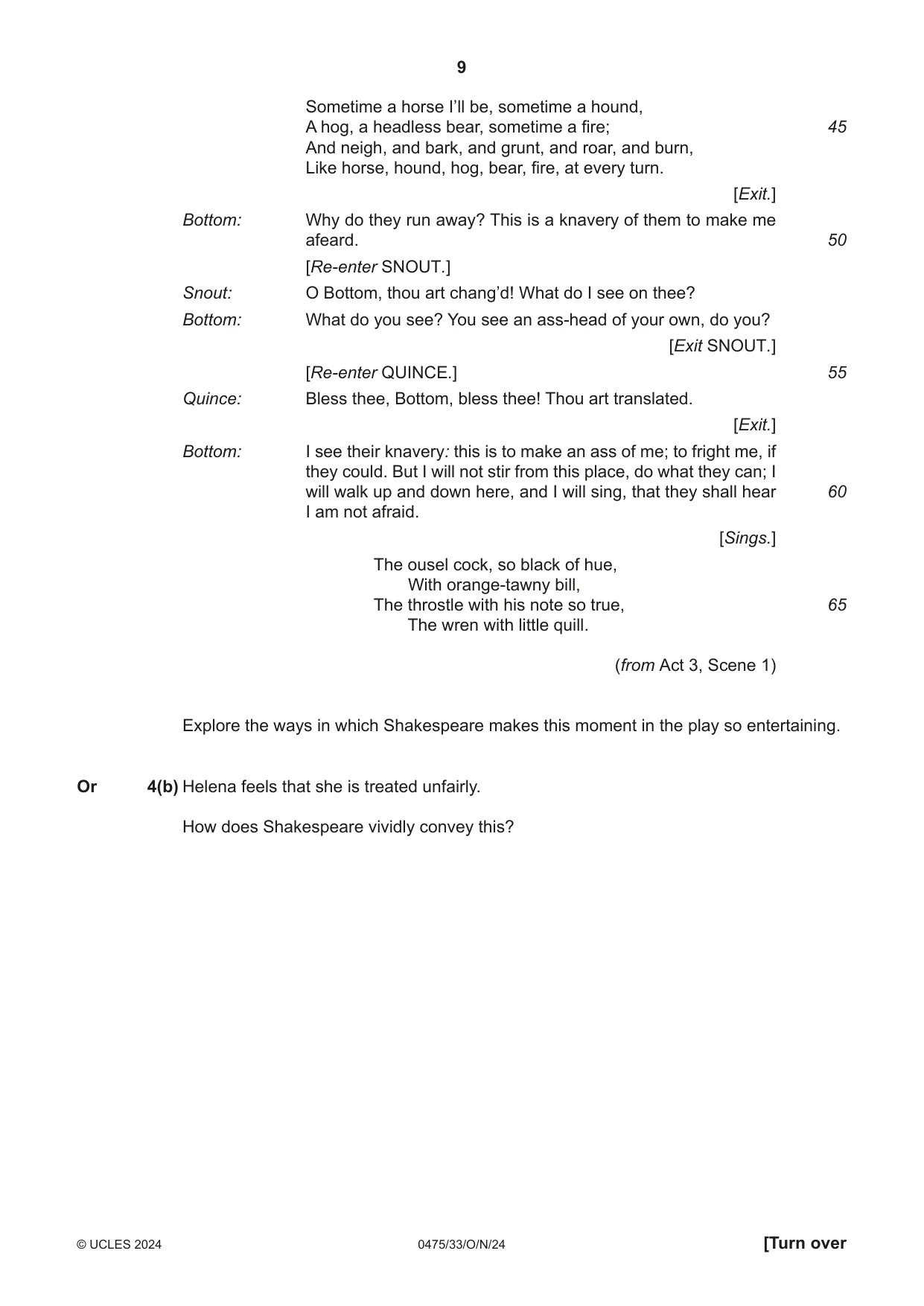
9 0475/33/O/N/24 © UCLES 2024 [Turn over Sometime a horse I’ll be, sometime a hound, A hog, a headless bear, sometime a fire; And neigh, and bark, and grunt, and roar, and burn, Like horse, hound, hog, bear, fire, at every turn. [Exit.] Bottom: Why do they run away? This is a knavery of them to make me afeard. [Re-enter SNOUT.] Snout: O Bottom, thou art chang’d! What do I see on thee? Bottom: What do you see? You see an ass-head of your own, do you? [Exit SNOUT.] [Re-enter QUINCE.] Quince: Bless thee, Bottom, bless thee! Thou art translated. [Exit.] Bottom: I see their knavery: this is to make an ass of me; to fright me, if they could. But I will not stir from this place, do what they can; I will walk up and down here, and I will sing, that they shall hear I am not afraid. [Sings.] The ousel cock, so black of hue, With orange-tawny bill, The throstle with his note so true, The wren with little quill. (from Act 3, Scene 1) Explore the ways in which Shakespeare makes this moment in the play so entertaining. Or 4(b) Helena feels that she is treated unfairly. How does Shakespeare vividly convey this? 45 50 55 60 65
Question paper, page 10
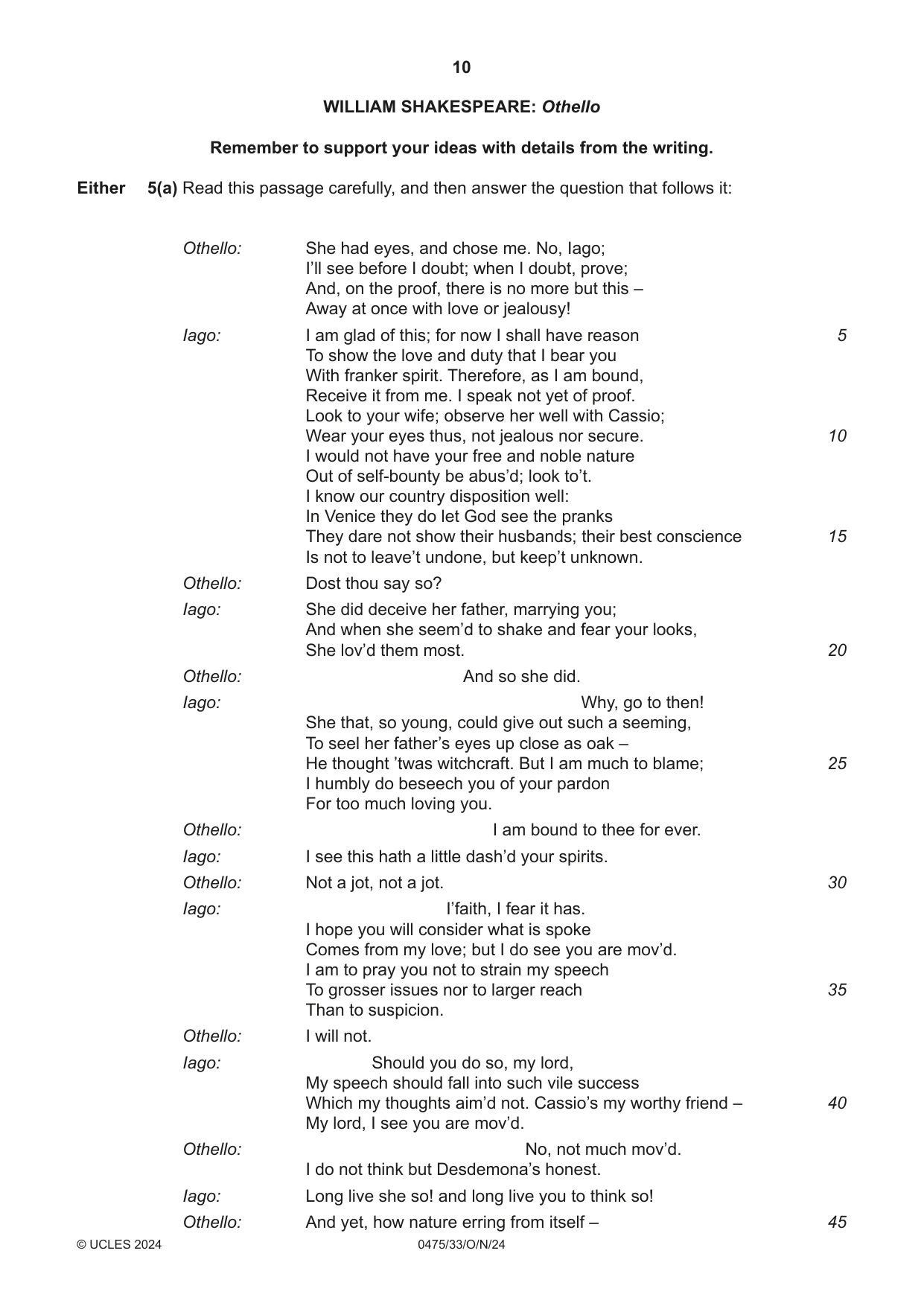
10 0475/33/O/N/24 © UCLES 2024 WILLIAM SHAKESPEARE: Othello Remember to support your ideas with details from the writing. Either 5(a) Read this passage carefully, and then answer the question that follows it: Othello: She had eyes, and chose me. No, Iago; I’ll see before I doubt; when I doubt, prove; And, on the proof, there is no more but this – Away at once with love or jealousy! Iago: I am glad of this; for now I shall have reason To show the love and duty that I bear you With franker spirit. Therefore, as I am bound, Receive it from me. I speak not yet of proof. Look to your wife; observe her well with Cassio; Wear your eyes thus, not jealous nor secure. I would not have your free and noble nature Out of self-bounty be abus’d; look to’t. I know our country disposition well: In Venice they do let God see the pranks They dare not show their husbands; their best conscience Is not to leave’t undone, but keep’t unknown. Othello: Dost thou say so? Iago: She did deceive her father, marrying you; And when she seem’d to shake and fear your looks, She lov’d them most. Othello: And so she did. Iago: Why, go to then! She that, so young, could give out such a seeming, To seel her father’s eyes up close as oak – He thought ’twas witchcraft. But I am much to blame; I humbly do beseech you of your pardon For too much loving you. Othello: I am bound to thee for ever. Iago: I see this hath a little dash’d your spirits. Othello: Not a jot, not a jot. Iago: I’faith, I fear it has. I hope you will consider what is spoke Comes from my love; but I do see you are mov’d. I am to pray you not to strain my speech To grosser issues nor to larger reach Than to suspicion. Othello: I will not. Iago: Should you do so, my lord, My speech should fall into such vile success Which my thoughts aim’d not. Cassio’s my worthy friend – My lord, I see you are mov’d. Othello: No, not much mov’d. I do not think but Desdemona’s honest. Iago: Long live she so! and long live you to think so! Othello: And yet, how nature erring from itself – 5 10 15 20 25 30 35 40 45
Question paper, page 11
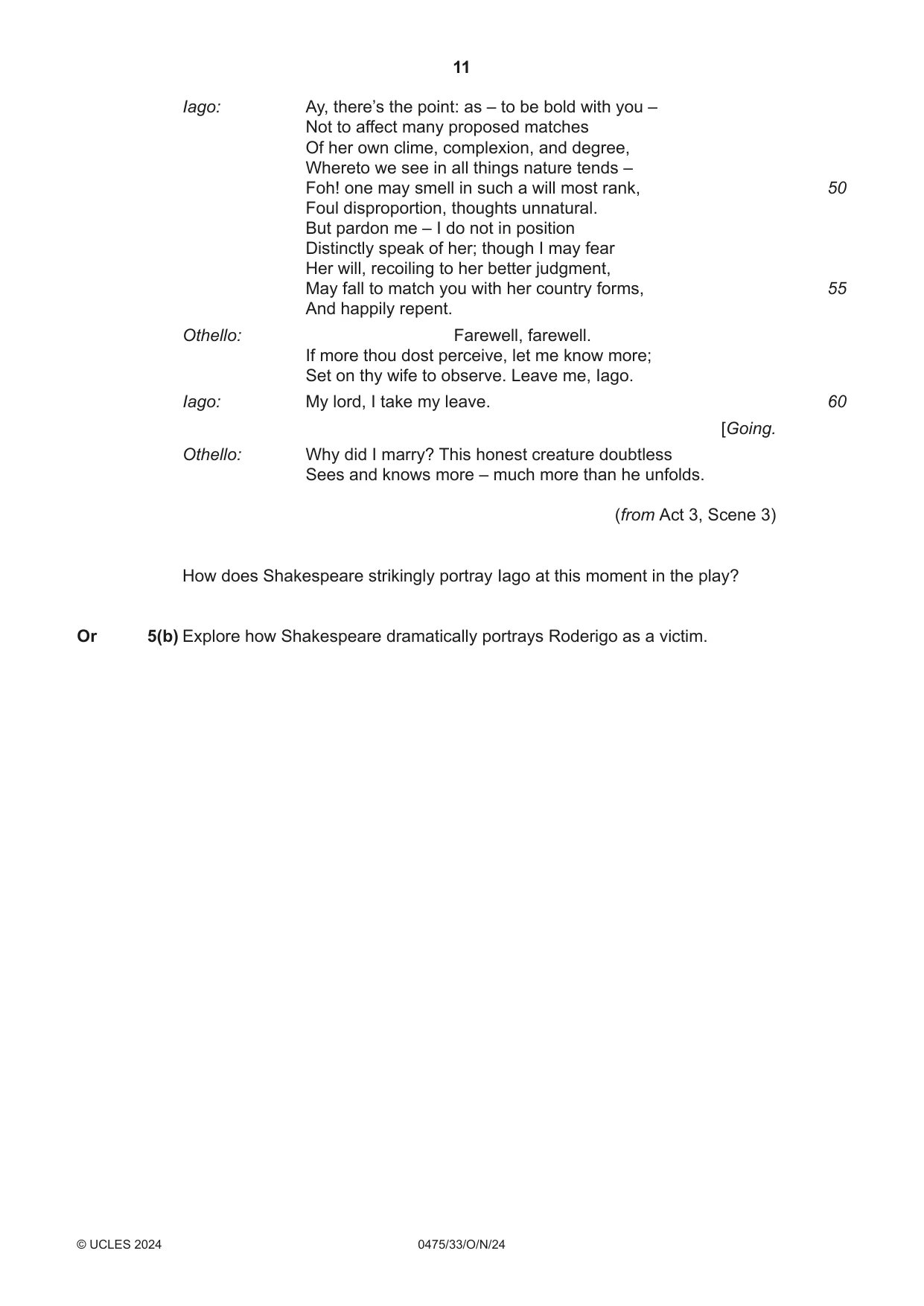
11 0475/33/O/N/24 © UCLES 2024 Iago: Ay, there’s the point: as – to be bold with you – Not to affect many proposed matches Of her own clime, complexion, and degree, Whereto we see in all things nature tends – Foh! one may smell in such a will most rank, Foul disproportion, thoughts unnatural. But pardon me – I do not in position Distinctly speak of her; though I may fear Her will, recoiling to her better judgment, May fall to match you with her country forms, And happily repent. Othello: Farewell, farewell. If more thou dost perceive, let me know more; Set on thy wife to observe. Leave me, Iago. Iago: My lord, I take my leave. [Going. Othello: Why did I marry? This honest creature doubtless Sees and knows more – much more than he unfolds. (from Act 3, Scene 3) How does Shakespeare strikingly portray Iago at this moment in the play? Or 5(b) Explore how Shakespeare dramatically portrays Roderigo as a victim. 50 55 60
Question paper, page 12
12 0475/33/O/N/24 © UCLES 2024 Permission to reproduce items where third-party owned material protected by copyright is included has been sought and cleared where possible. Every reasonable effort has been made by the publisher (UCLES) to trace copyright holders, but if any items requiring clearance have unwittingly been included, the publisher will be pleased to make amends at the earliest possible opportunity. To avoid the issue of disclosure of answer-related information to candidates, all copyright acknowledgements are reproduced online in the Cambridge Assessment International Education Copyright Acknowledgements Booklet. This is produced for each series of examinations and is freely available to download at www.cambridgeinternational.org after the live examination series. Cambridge Assessment International Education is part of Cambridge Assessment. Cambridge Assessment is the brand name of the University of Cambridge Local Examinations Syndicate (UCLES), which is a department of the University of Cambridge. BLANK PAGE
Mark scheme, page 1
This document consists of 4 printed pages. © Cambridge University Press & Assessment 2024 [Turn over Cambridge IGCSE™ LITERATURE IN ENGLISH 0475/33 Paper 3 Drama (Open Text) October/November 2024 MARK SCHEME Maximum Mark: 25 Published This mark scheme is published as an aid to teachers and candidates, to indicate the requirements of the examination. It shows the basis on which Examiners were instructed to award marks. It does not indicate the details of the discussions that took place at an Examiners’ meeting before marking began, which would have considered the acceptability of alternative answers. Mark schemes should be read in conjunction with the question paper and the Principal Examiner Report for Teachers. Cambridge International will not enter into discussions about these mark schemes. Cambridge International is publishing the mark schemes for the October/November 2024 series for most Cambridge IGCSE, Cambridge International A and AS Level components, and some Cambridge O Level components.
Mark scheme, page 2
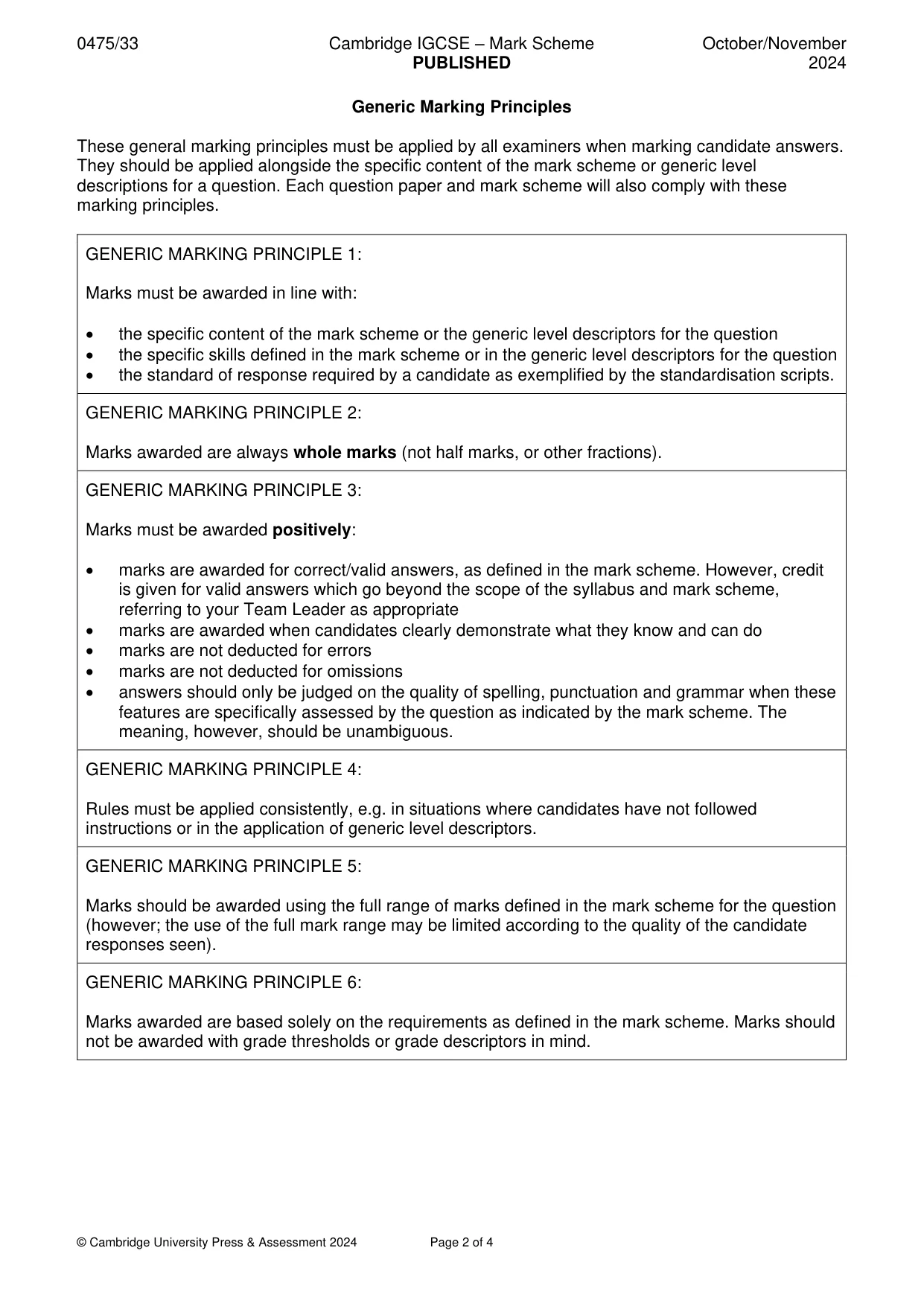
0475/33 Cambridge IGCSE – Mark Scheme PUBLISHED October/November 2024 © Cambridge University Press & Assessment 2024 Page 2 of 4 Generic Marking Principles These general marking principles must be applied by all examiners when marking candidate answers. They should be applied alongside the specific content of the mark scheme or generic level descriptions for a question. Each question paper and mark scheme will also comply with these marking principles. GENERIC MARKING PRINCIPLE 1: Marks must be awarded in line with: • the specific content of the mark scheme or the generic level descriptors for the question • the specific skills defined in the mark scheme or in the generic level descriptors for the question • the standard of response required by a candidate as exemplified by the standardisation scripts. GENERIC MARKING PRINCIPLE 2: Marks awarded are always whole marks (not half marks, or other fractions). GENERIC MARKING PRINCIPLE 3: Marks must be awarded positively: • marks are awarded for correct/valid answers, as defined in the mark scheme. However, credit is given for valid answers which go beyond the scope of the syllabus and mark scheme, referring to your Team Leader as appropriate • marks are awarded when candidates clearly demonstrate what they know and can do • marks are not deducted for errors • marks are not deducted for omissions • answers should only be judged on the quality of spelling, punctuation and grammar when these features are specifically assessed by the question as indicated by the mark scheme. The meaning, however, should be unambiguous. GENERIC MARKING PRINCIPLE 4: Rules must be applied consistently, e.g. in situations where candidates have not followed instructions or in the application of generic level descriptors. GENERIC MARKING PRINCIPLE 5: Marks should be awarded using the full range of marks defined in the mark scheme for the question (however; the use of the full mark range may be limited according to the quality of the candidate responses seen). GENERIC MARKING PRINCIPLE 6: Marks awarded are based solely on the requirements as defined in the mark scheme. Marks should not be awarded with grade thresholds or grade descriptors in mind.
Mark scheme, page 3
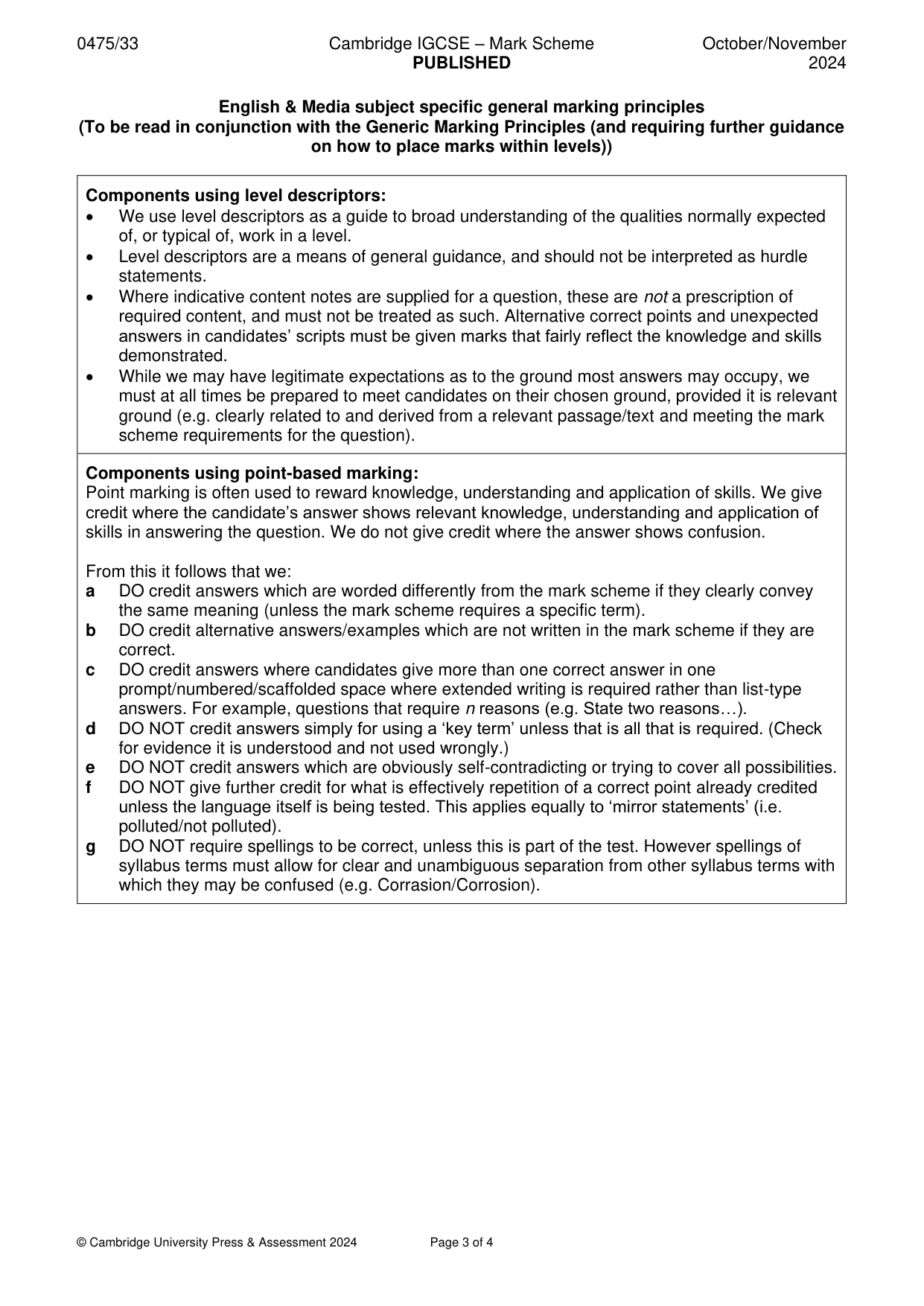
0475/33 Cambridge IGCSE – Mark Scheme PUBLISHED October/November 2024 © Cambridge University Press & Assessment 2024 Page 3 of 4 English & Media subject specific general marking principles (To be read in conjunction with the Generic Marking Principles (and requiring further guidance on how to place marks within levels)) Components using level descriptors: • We use level descriptors as a guide to broad understanding of the qualities normally expected of, or typical of, work in a level. • Level descriptors are a means of general guidance, and should not be interpreted as hurdle statements. • Where indicative content notes are supplied for a question, these are not a prescription of required content, and must not be treated as such. Alternative correct points and unexpected answers in candidates’ scripts must be given marks that fairly reflect the knowledge and skills demonstrated. • While we may have legitimate expectations as to the ground most answers may occupy, we must at all times be prepared to meet candidates on their chosen ground, provided it is relevant ground (e.g. clearly related to and derived from a relevant passage/text and meeting the mark scheme requirements for the question). Components using point-based marking: Point marking is often used to reward knowledge, understanding and application of skills. We give credit where the candidate’s answer shows relevant knowledge, understanding and application of skills in answering the question. We do not give credit where the answer shows confusion. From this it follows that we: a DO credit answers which are worded differently from the mark scheme if they clearly convey the same meaning (unless the mark scheme requires a specific term). b DO credit alternative answers/examples which are not written in the mark scheme if they are correct. c DO credit answers where candidates give more than one correct answer in one prompt/numbered/scaffolded space where extended writing is required rather than list-type answers. For example, questions that require n reasons (e.g. State two reasons…). d DO NOT credit answers simply for using a ‘key term’ unless that is all that is required. (Check for evidence it is understood and not used wrongly.) e DO NOT credit answers which are obviously self-contradicting or trying to cover all possibilities. f DO NOT give further credit for what is effectively repetition of a correct point already credited unless the language itself is being tested. This applies equally to ‘mirror statements’ (i.e. polluted/not polluted). g DO NOT require spellings to be correct, unless this is part of the test. However spellings of syllabus terms must allow for clear and unambiguous separation from other syllabus terms with which they may be confused (e.g. Corrasion/Corrosion).
Mark scheme, page 4
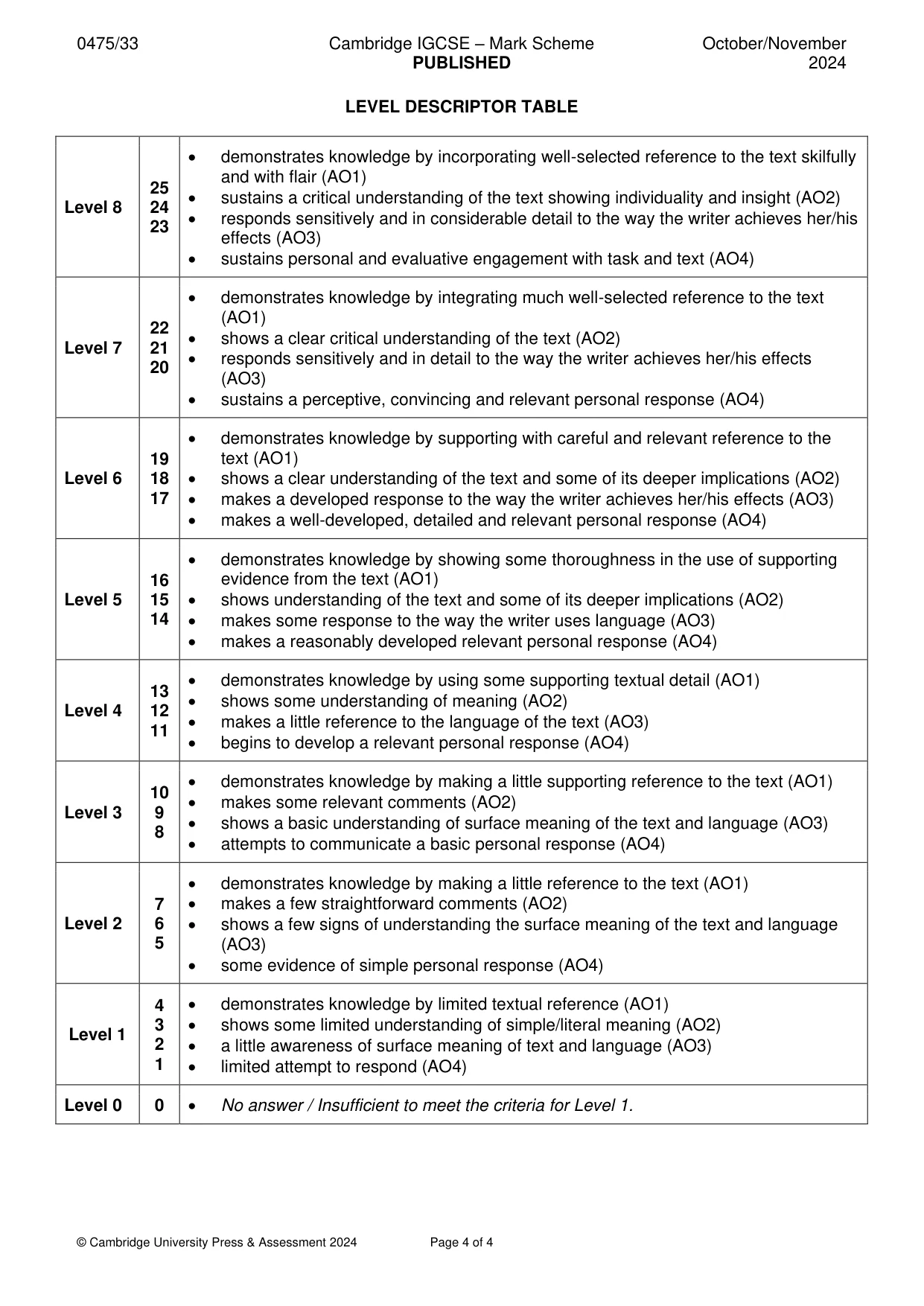
0475/33 Cambridge IGCSE – Mark Scheme PUBLISHED October/November 2024 © Cambridge University Press & Assessment 2024 Page 4 of 4 LEVEL DESCRIPTOR TABLE Level 8 25 24 23 • demonstrates knowledge by incorporating well-selected reference to the text skilfully and with flair (AO1) • sustains a critical understanding of the text showing individuality and insight (AO2) • responds sensitively and in considerable detail to the way the writer achieves her/his effects (AO3) • sustains personal and evaluative engagement with task and text (AO4) Level 7 22 21 20 • demonstrates knowledge by integrating much well-selected reference to the text (AO1) • shows a clear critical understanding of the text (AO2) • responds sensitively and in detail to the way the writer achieves her/his effects (AO3) • sustains a perceptive, convincing and relevant personal response (AO4) Level 6 19 18 17 • demonstrates knowledge by supporting with careful and relevant reference to the text (AO1) • shows a clear understanding of the text and some of its deeper implications (AO2) • makes a developed response to the way the writer achieves her/his effects (AO3) • makes a well-developed, detailed and relevant personal response (AO4) Level 5 16 15 14 • demonstrates knowledge by showing some thoroughness in the use of supporting evidence from the text (AO1) • shows understanding of the text and some of its deeper implications (AO2) • makes some response to the way the writer uses language (AO3) • makes a reasonably developed relevant personal response (AO4) Level 4 13 12 11 • demonstrates knowledge by using some supporting textual detail (AO1) • shows some understanding of meaning (AO2) • makes a little reference to the language of the text (AO3) • begins to develop a relevant personal response (AO4) Level 3 10 9 8 • demonstrates knowledge by making a little supporting reference to the text (AO1) • makes some relevant comments (AO2) • shows a basic understanding of surface meaning of the text and language (AO3) • attempts to communicate a basic personal response (AO4) Level 2 7 6 5 • demonstrates knowledge by making a little reference to the text (AO1) • makes a few straightforward comments (AO2) • shows a few signs of understanding the surface meaning of the text and language (AO3) • some evidence of simple personal response (AO4) Level 1 4 3 2 1 • demonstrates knowledge by limited textual reference (AO1) • shows some limited understanding of simple/literal meaning (AO2) • a little awareness of surface meaning of text and language (AO3) • limited attempt to respond (AO4) Level 0 0 • No answer / Insufficient to meet the criteria for Level 1.
What you needed in this session
Cambridge’s own grade thresholds for 2024 Oct/Nov, Paper 3 · Variant 3. A higher threshold means an easier paper — the bar moves with how the cohort did.