Cambridge IGCSE English - Literature in English 0475 — 2023 Oct/Nov Paper 3 · Variant 3
0475/33/O/N/23 · 25 marks · ≈28 min
The question paper and its mark scheme, free to read here and free to download. This is Cambridge’s own paper, exactly as it was sat.
Question paper12 pages
Mark scheme4 pages
Answers below. Sit the paper first if you are practising.
Paper as text
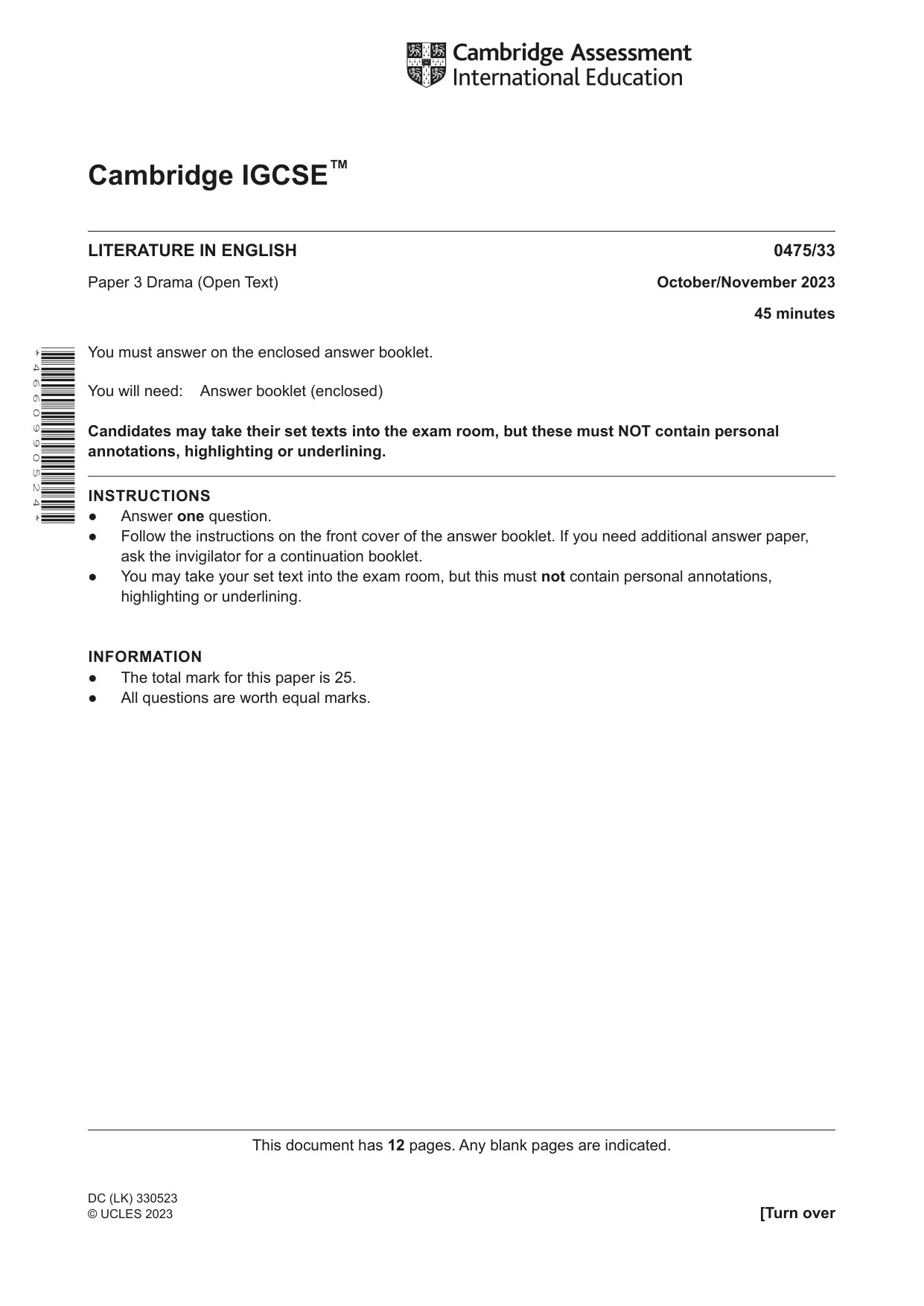
Question paper, page 1
This document has 12 pages. Any blank pages are indicated. [Turn over Cambridge IGCSE™ * 4 6 6 0 9 9 0 5 2 4 * DC (LK) 330523 © UCLES 2023 LITERATURE IN ENGLISH 0475/33 Paper 3 Drama (Open Text) October/November 2023 45 minutes You must answer on the enclosed answer booklet. You will need: Answer booklet (enclosed) Candidates may take their set texts into the exam room, but these must NOT contain personal annotations, highlighting or underlining. INSTRUCTIONS ● Answer one question. ● Follow the instructions on the front cover of the answer booklet. If you need additional answer paper, ask the invigilator for a continuation booklet. ● You may take your set text into the exam room, but this must not contain personal annotations, highlighting or underlining. INFORMATION ● The total mark for this paper is 25. ● All questions are worth equal marks.
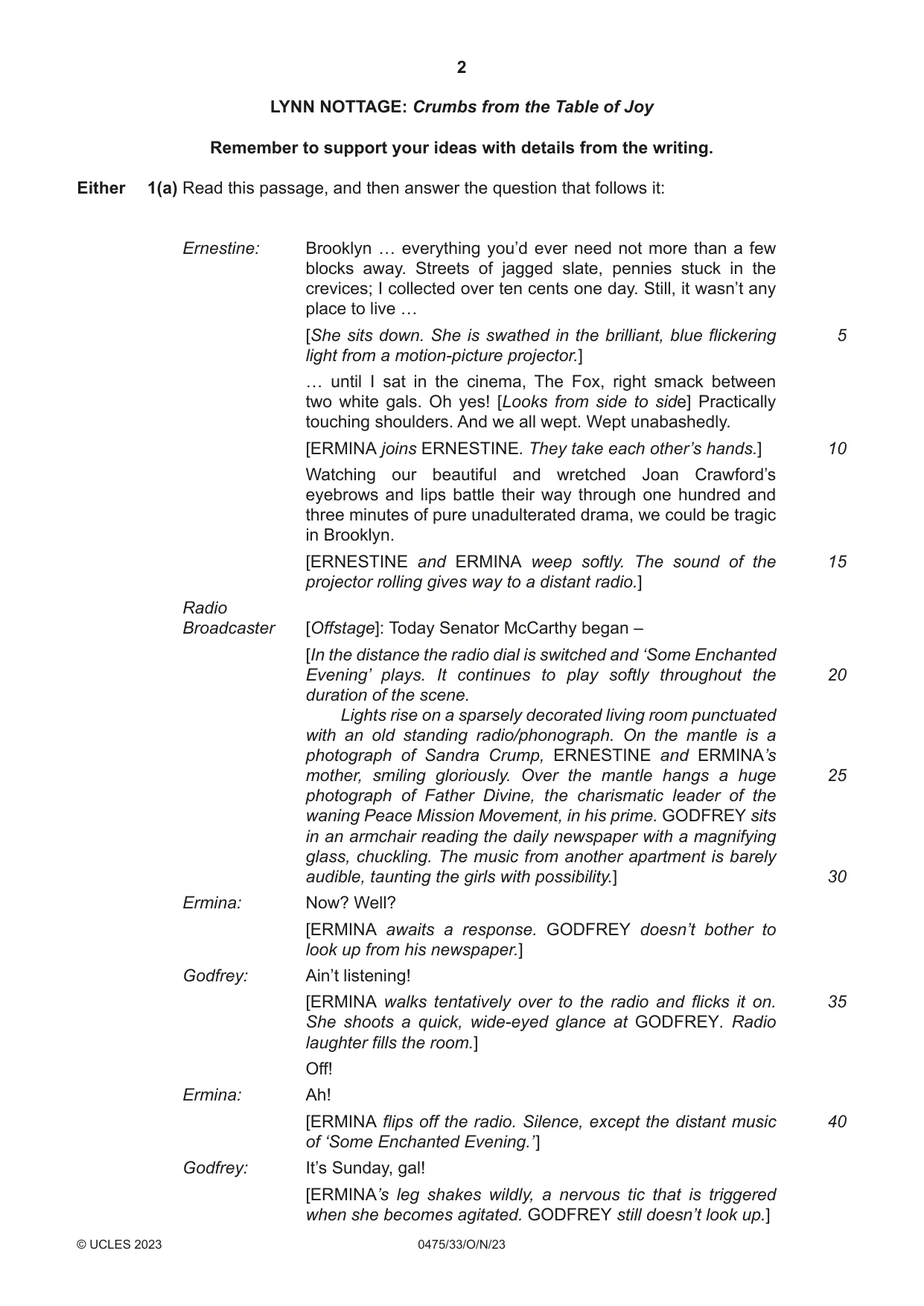
Question paper, page 2
2 0475/33/O/N/23 © UCLES 2023 LYNN NOTTAGE: Crumbs from the Table of Joy Remember to support your ideas with details from the writing. Either 1(a) Read this passage, and then answer the question that follows it: Ernestine: Brooklyn … everything you’d ever need not more than a few blocks away. Streets of jagged slate, pennies stuck in the crevices; I collected over ten cents one day. Still, it wasn’t any place to live … [She sits down. She is swathed in the brilliant, blue flickering light from a motion-picture projector.] … until I sat in the cinema, The Fox, right smack between two white gals. Oh yes! [Looks from side to side] Practically touching shoulders. And we all wept. Wept unabashedly. [ERMINA joins ERNESTINE. They take each other’s hands.] Watching our beautiful and wretched Joan Crawford’s eyebrows and lips battle their way through one hundred and three minutes of pure unadulterated drama, we could be tragic in Brooklyn. [ERNESTINE and ERMINA weep softly. The sound of the projector rolling gives way to a distant radio.] Radio Broadcaster [Offstage]: Today Senator McCarthy began – [In the distance the radio dial is switched and ‘Some Enchanted Evening’ plays. It continues to play softly throughout the duration of the scene. Lights rise on a sparsely decorated living room punctuated with an old standing radio/phonograph. On the mantle is a photograph of Sandra Crump, ERNESTINE and ERMINA’s mother, smiling gloriously. Over the mantle hangs a huge photograph of Father Divine, the charismatic leader of the waning Peace Mission Movement, in his prime. GODFREY sits in an armchair reading the daily newspaper with a magnifying glass, chuckling. The music from another apartment is barely audible, taunting the girls with possibility.] Ermina: Now? Well? [ERMINA awaits a response. GODFREY doesn’t bother to look up from his newspaper.] Godfrey: Ain’t listening! [ERMINA walks tentatively over to the radio and flicks it on. She shoots a quick, wide-eyed glance at GODFREY. Radio laughter fills the room.] Off! Ermina: Ah! [ERMINA flips off the radio. Silence, except the distant music of ‘Some Enchanted Evening.’ ] Godfrey: It’s Sunday, gal! [ERMINA’s leg shakes wildly, a nervous tic that is triggered when she becomes agitated. GODFREY still doesn’t look up.] 5 10 15 20 25 30 35 40
Question paper, page 3
3 0475/33/O/N/23 © UCLES 2023 [Turn over Leg’s gonna fall off. Ernestine [To audience]: Almost did, but that comes later. Ermina [Ventures]: Ain’t no use in having a radio. Might as well be a log, ’least we could burn it to keep warm. Godfrey: You sassing. Ermina: Nah, sir! Godfrey: Could have sworn you was. Ermina: Really? Well, I ain’t. Ernestine [To audience]: Tomorrow we’ll have nothing to talk about in school. Again, we will miss Amos ’n Andy. Ermina: Again ruined by Father Divine. [Rolls her eyes and turns toward the portrait of Father Divine hanging over the mantle] (from The Prologue) How does Nottage strikingly convey Ernestine’s thoughts and feelings at this early moment in the play? Or 1(b) Explore how Nottage powerfully conveys Ernestine’s strong feelings about Gerte. 45 50 55
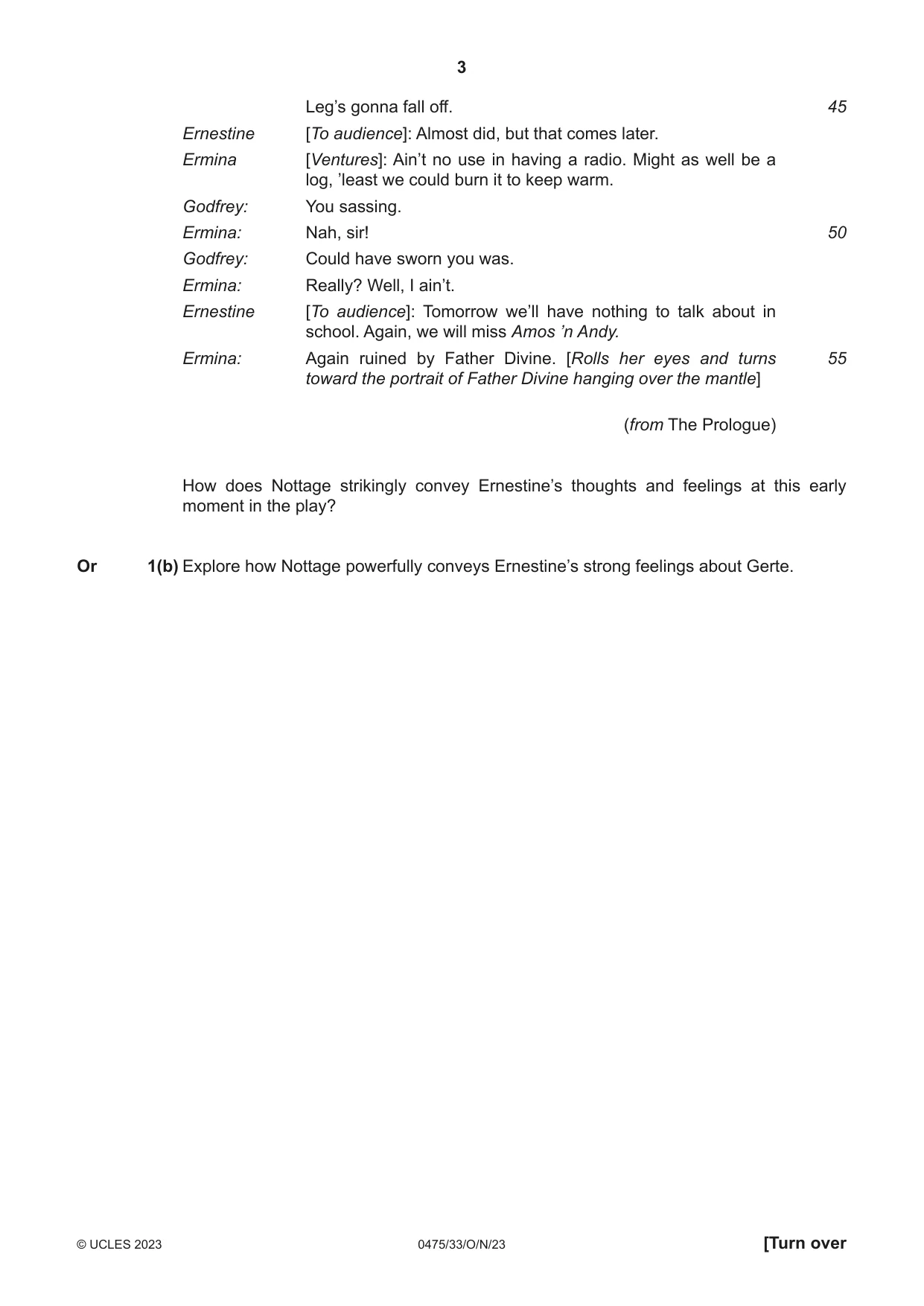
Question paper, page 4
4 0475/33/O/N/23 © UCLES 2023 R C SHERRIFF: Journey’s End Remember to support your ideas with details from the writing. Either 2(a) Read this passage, and then answer the question that follows it: [The SERGEANT-MAJOR comes down the steps.] Stanhope: Morning, sergeant-major. S-M: Morning, sir. Wiring parties are just in, sir. Made a decent job of it – right down to the support line. Stanhope: Good. Everything quiet? S-M: It’s all right opposite ’ere, sir, but the guns are goin’ ’ard down south. ’Eavy bombardment. Not sure if it ain’t spreading up this way, sir. Stanhope: Very likely it is. The officers are coming up in a minute. They’ll stand by with their platoons. I must stay here awhile in case of messages. I shall come up directly things begin to happen. S-M: Very good, sir. Stanhope: Are the men having their tea? S-M: Yessir. Stanhope: Let ’em have a decent drop of rum. S-M: About ’arf again, sir? Stanhope: Yes. S-M: If the attack don’t come, sir, ’ow long are we to stand-to? Stanhope: We must expect the attack any time up till midday. After then I don’t think it’ll come till tomorrow. S-M: Very good, sir. Stanhope: We must naturally make our plans to meet things as they happen. S-M: Quite, sir. Stanhope: All right, sergeant-major. I’ll see you up there soon. S-M: Yessir. [He salutes and goes away. MASON brings in four little packets of sandwiches, and puts one packet on the table for STANHOPE.] Mason: Your sambridges, sir. ’Arf bully beef and ’arf sardine. Sardine on top, sir. Stanhope: How delicious. No pâté de foie gras? Mason: No what, sir? Stanhope: No pâté de foie gras? Mason: No, sir. The milkman ’asn’t been yet. [MASON takes the other parcels to the left-hand dugout. STANHOPE pours a little whisky into his tea and the remainder of the content of the bottle into his flask. MASON returns.] Stanhope: Get dressed as soon as you can. Mason: Yessir. 5 10 15 20 25 30 35 40
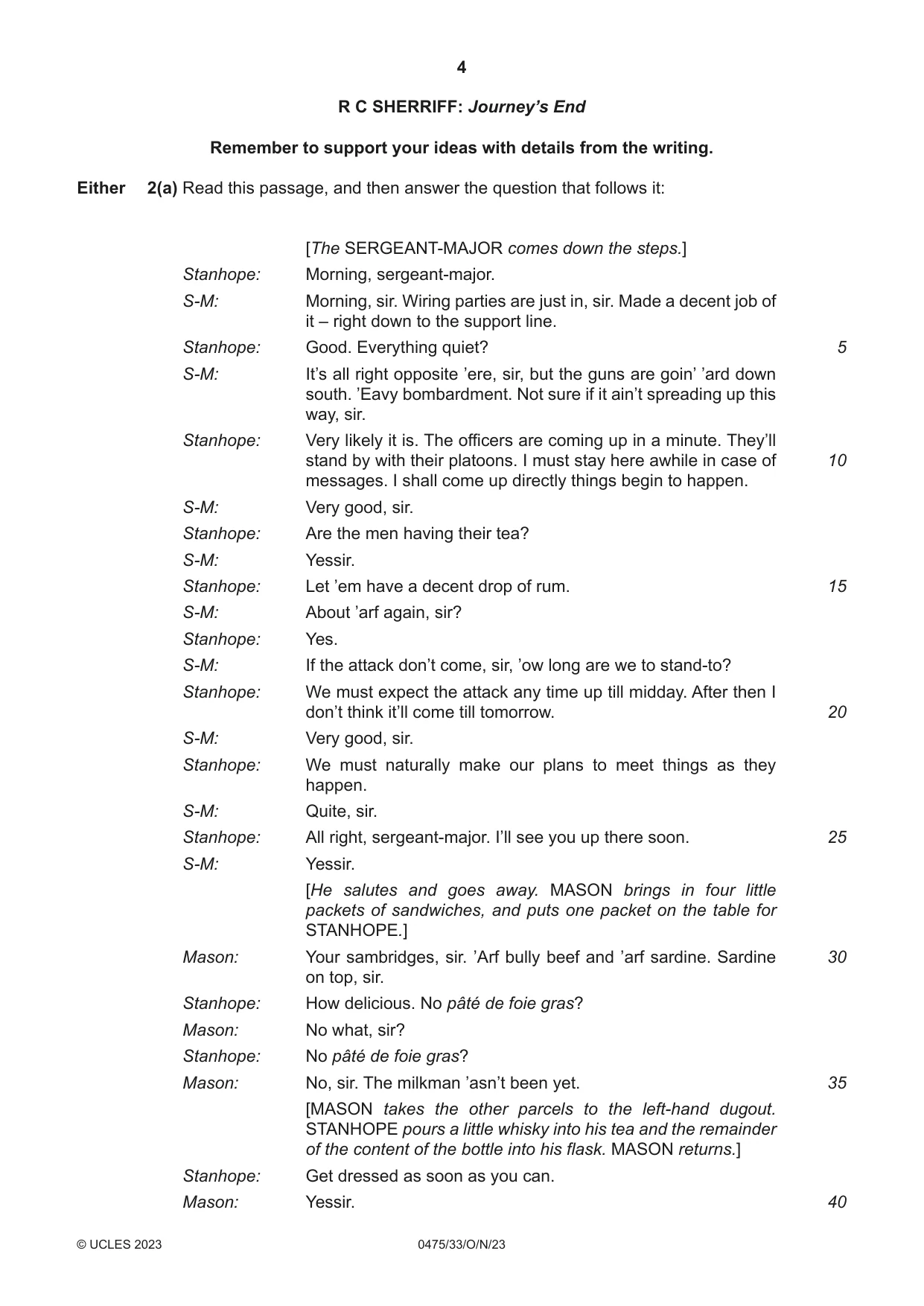
Question paper, page 5
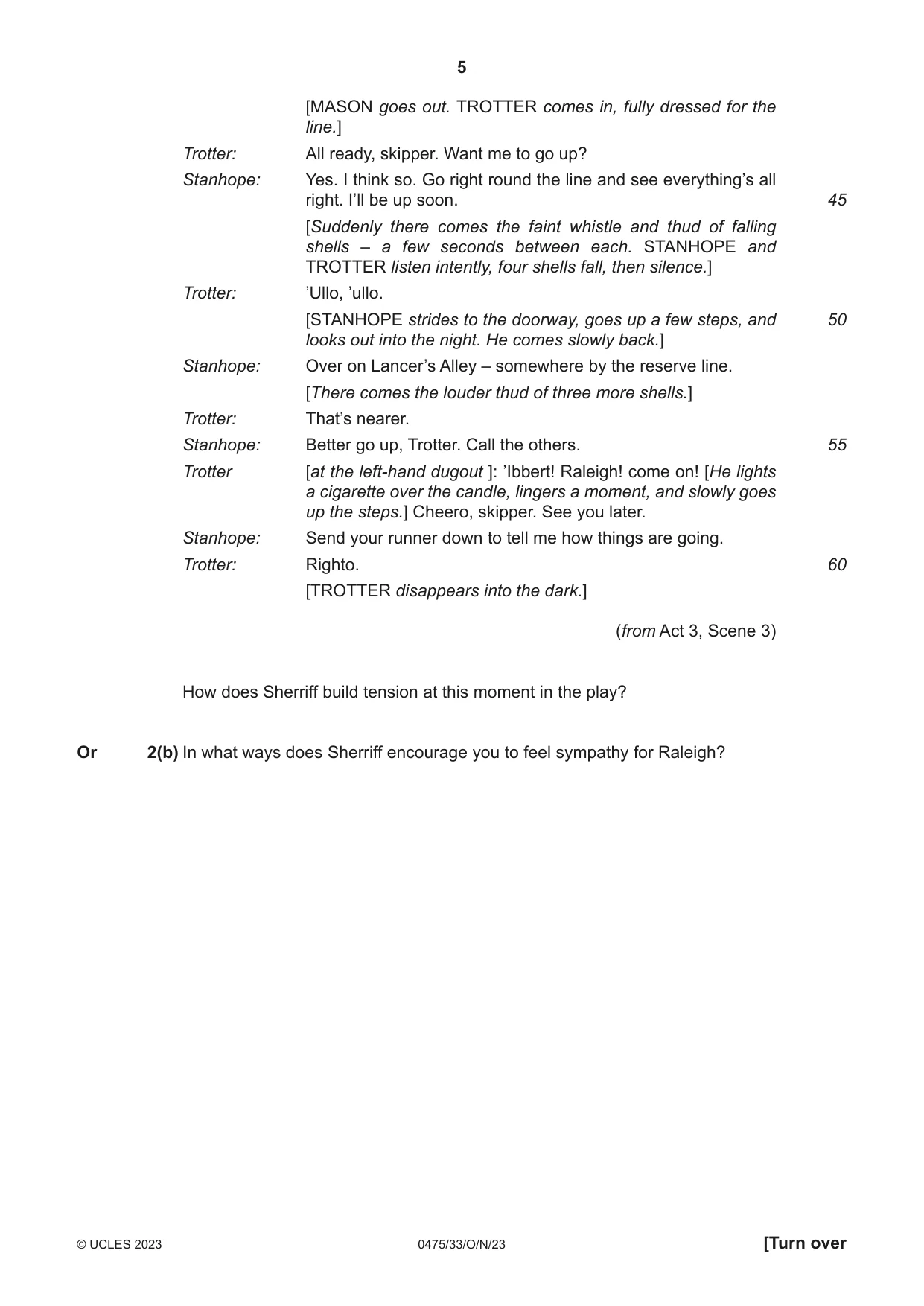
5 0475/33/O/N/23 © UCLES 2023 [Turn over [MASON goes out. TROTTER comes in, fully dressed for the line.] Trotter: All ready, skipper. Want me to go up? Stanhope: Yes. I think so. Go right round the line and see everything’s all right. I’ll be up soon. [Suddenly there comes the faint whistle and thud of falling shells – a few seconds between each. STANHOPE and TROTTER listen intently, four shells fall, then silence.] Trotter: ’Ullo, ’ullo. [STANHOPE strides to the doorway, goes up a few steps, and looks out into the night. He comes slowly back.] Stanhope: Over on Lancer’s Alley – somewhere by the reserve line. [There comes the louder thud of three more shells.] Trotter: That’s nearer. Stanhope: Better go up, Trotter. Call the others. Trotter [at the left-hand dugout ]: ’Ibbert! Raleigh! come on! [He lights a cigarette over the candle, lingers a moment, and slowly goes up the steps.] Cheero, skipper. See you later. Stanhope: Send your runner down to tell me how things are going. Trotter: Righto. [TROTTER disappears into the dark.] (from Act 3, Scene 3) How does Sherriff build tension at this moment in the play? Or 2(b) In what ways does Sherriff encourage you to feel sympathy for Raleigh? 45 50 55 60
Question paper, page 6
6 0475/33/O/N/23 © UCLES 2023 WOLE SOYINKA: Death and the King’s Horseman Remember to support your ideas with details from the writing. Either 3(a) Read this passage, and then answer the question that follows it: [ELESIN OBA enters along a passage before the market, pursued by his drummers and praise-singers. Content removed due to copyright restrictions.
Question paper, page 7
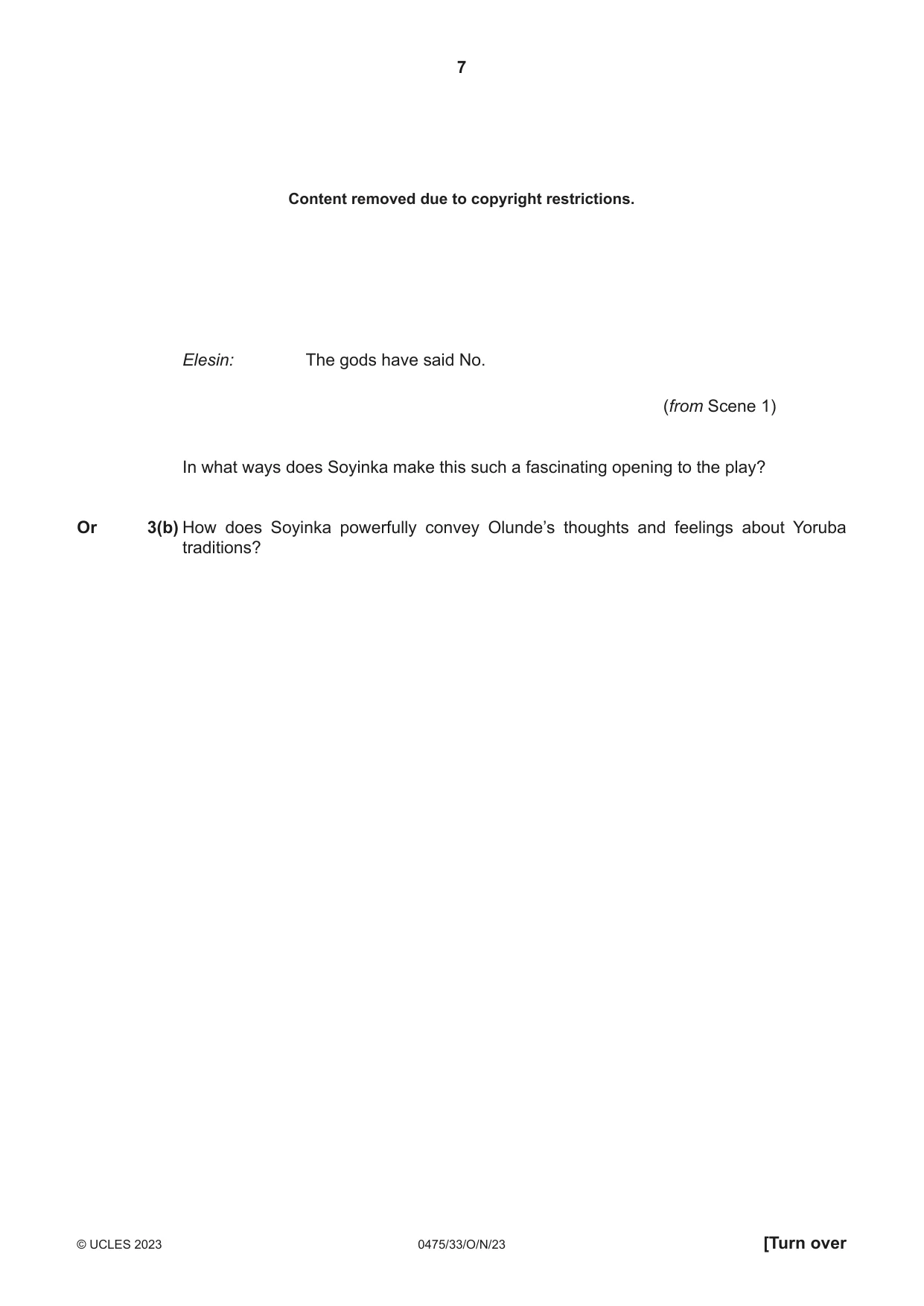
7 0475/33/O/N/23 © UCLES 2023 [Turn over Elesin: The gods have said No. (from Scene 1) In what ways does Soyinka make this such a fascinating opening to the play? Or 3(b) How does Soyinka powerfully convey Olunde’s thoughts and feelings about Yoruba traditions? Content removed due to copyright restrictions.
Question paper, page 8
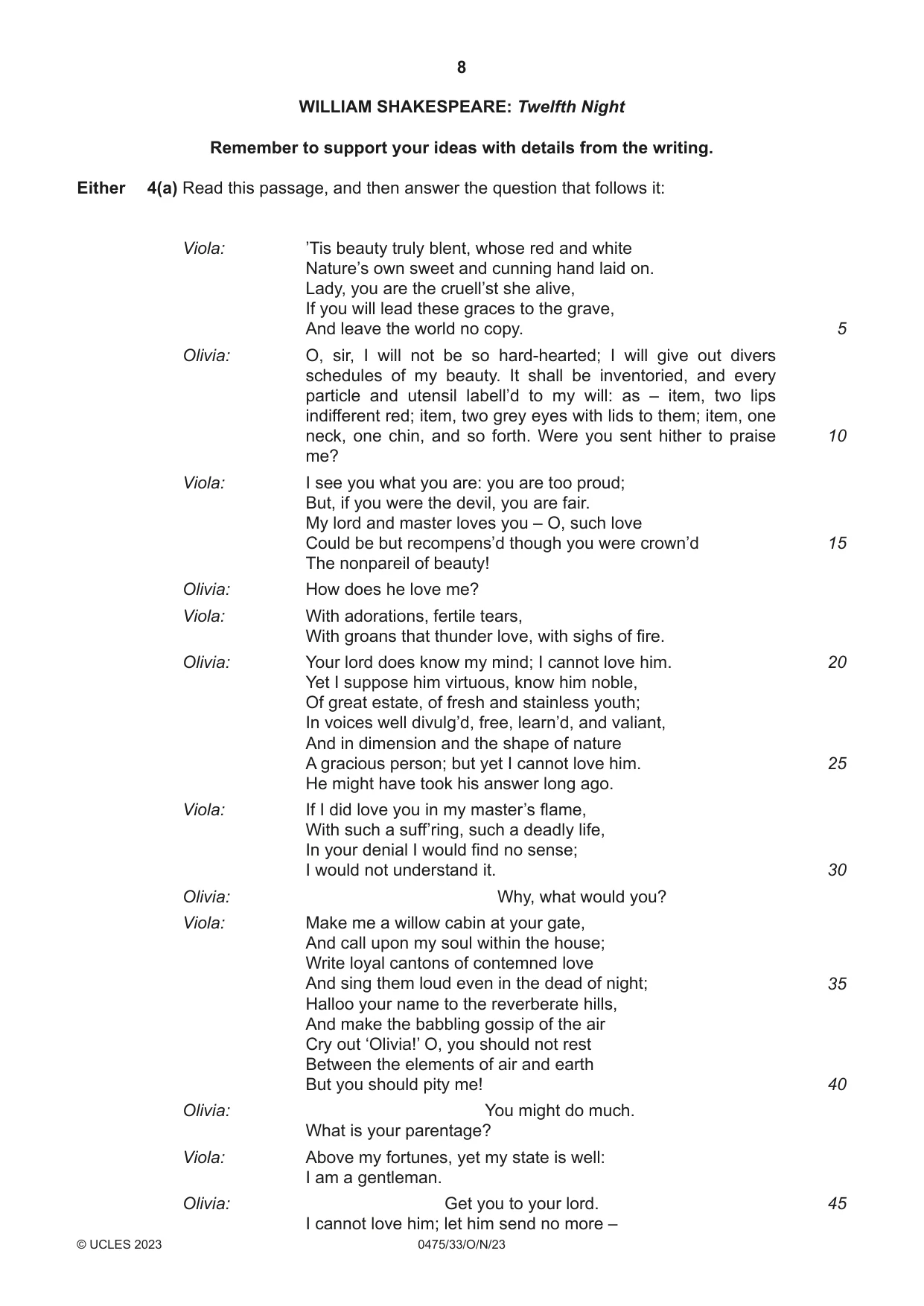
8 0475/33/O/N/23 © UCLES 2023 WILLIAM SHAKESPEARE: Twelfth Night Remember to support your ideas with details from the writing. Either 4(a) Read this passage, and then answer the question that follows it: Viola: ’Tis beauty truly blent, whose red and white Nature’s own sweet and cunning hand laid on. Lady, you are the cruell’st she alive, If you will lead these graces to the grave, And leave the world no copy. Olivia: O, sir, I will not be so hard-hearted; I will give out divers schedules of my beauty. It shall be inventoried, and every particle and utensil labell’d to my will: as – item, two lips indifferent red; item, two grey eyes with lids to them; item, one neck, one chin, and so forth. Were you sent hither to praise me? Viola: I see you what you are: you are too proud; But, if you were the devil, you are fair. My lord and master loves you – O, such love Could be but recompens’d though you were crown’d The nonpareil of beauty! Olivia: How does he love me? Viola: With adorations, fertile tears, With groans that thunder love, with sighs of fire. Olivia: Your lord does know my mind; I cannot love him. Yet I suppose him virtuous, know him noble, Of great estate, of fresh and stainless youth; In voices well divulg’d, free, learn’d, and valiant, And in dimension and the shape of nature A gracious person; but yet I cannot love him. He might have took his answer long ago. Viola: If I did love you in my master’s flame, With such a suff’ring, such a deadly life, In your denial I would find no sense; I would not understand it. Olivia: Why, what would you? Viola: Make me a willow cabin at your gate, And call upon my soul within the house; Write loyal cantons of contemned love And sing them loud even in the dead of night; Halloo your name to the reverberate hills, And make the babbling gossip of the air Cry out ‘Olivia!’ O, you should not rest Between the elements of air and earth But you should pity me! Olivia: You might do much. What is your parentage? Viola: Above my fortunes, yet my state is well: I am a gentleman. Olivia: Get you to your lord. I cannot love him; let him send no more – 5 10 15 20 25 30 35 40 45
Question paper, page 9
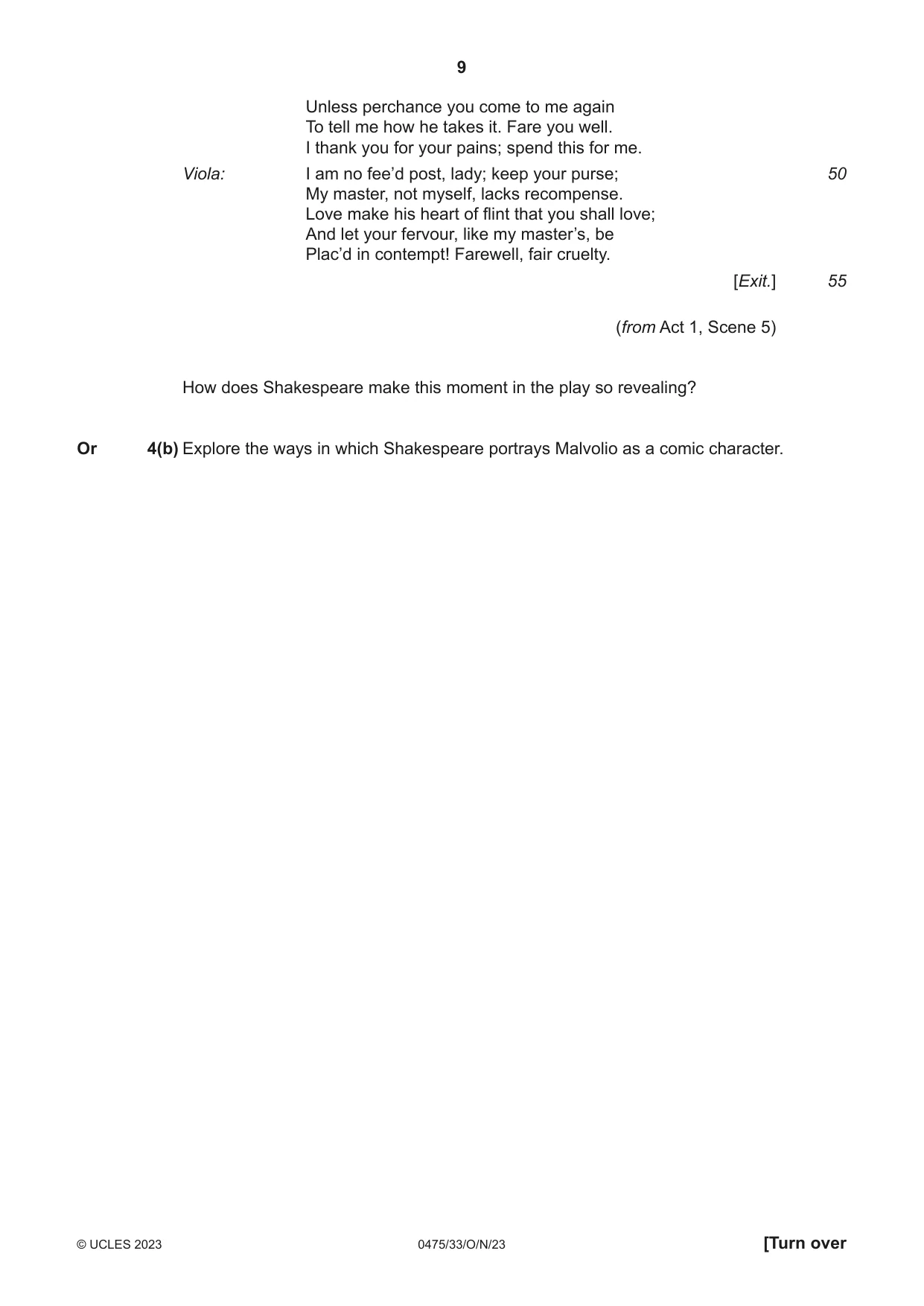
9 0475/33/O/N/23 © UCLES 2023 [Turn over Unless perchance you come to me again To tell me how he takes it. Fare you well. I thank you for your pains; spend this for me. Viola: I am no fee’d post, lady; keep your purse; My master, not myself, lacks recompense. Love make his heart of flint that you shall love; And let your fervour, like my master’s, be Plac’d in contempt! Farewell, fair cruelty. [Exit.] (from Act 1, Scene 5) How does Shakespeare make this moment in the play so revealing? Or 4(b) Explore the ways in which Shakespeare portrays Malvolio as a comic character. 50 55
Question paper, page 10
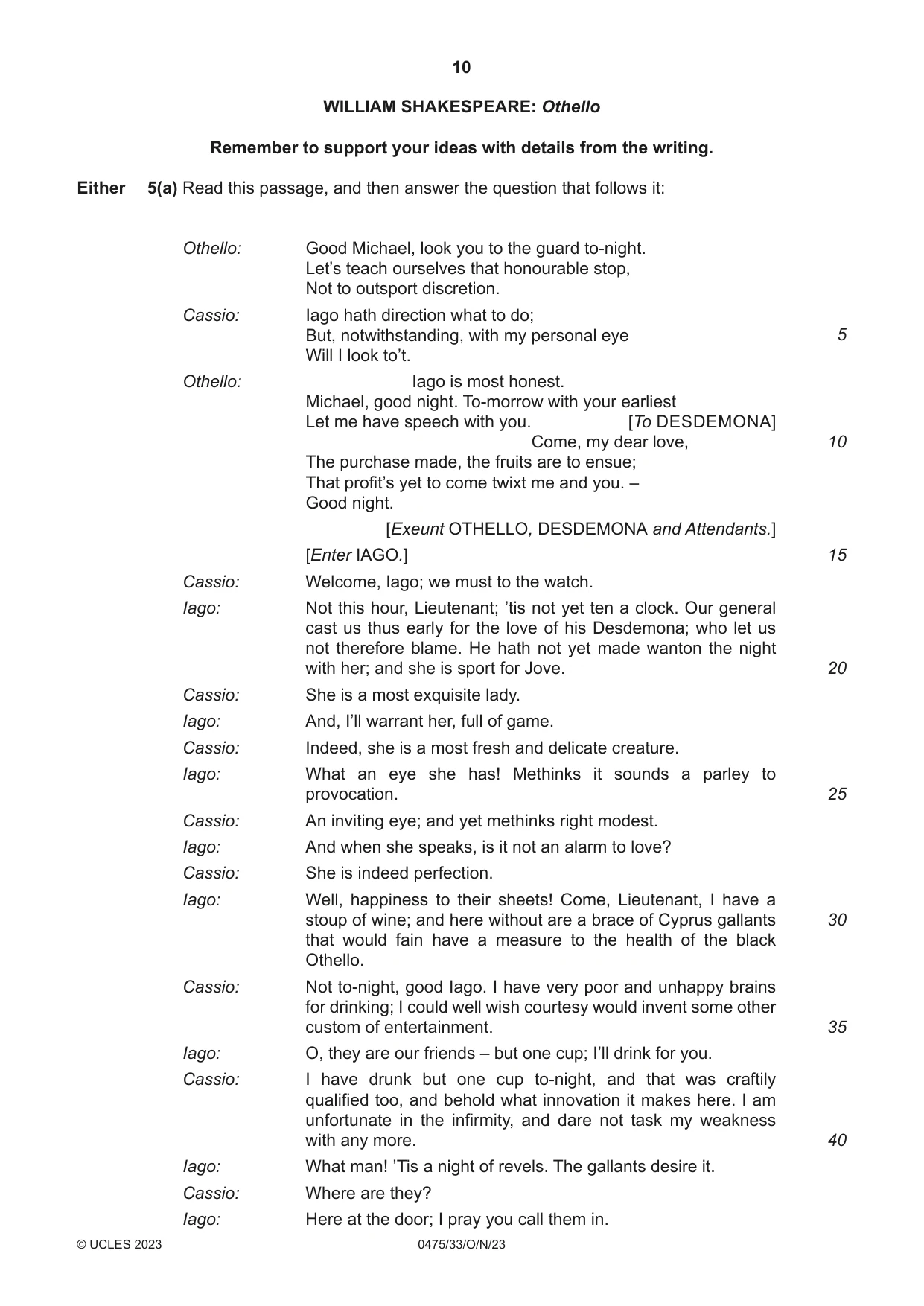
10 0475/33/O/N/23 © UCLES 2023 WILLIAM SHAKESPEARE: Othello Remember to support your ideas with details from the writing. Either 5(a) Read this passage, and then answer the question that follows it: Othello: Good Michael, look you to the guard to-night. Let’s teach ourselves that honourable stop, Not to outsport discretion. Cassio: Iago hath direction what to do; But, notwithstanding, with my personal eye Will I look to’t. Othello: Iago is most honest. Michael, good night. To-morrow with your earliest Let me have speech with you. [To DESDEMONA] Come, my dear love, The purchase made, the fruits are to ensue; That profit’s yet to come twixt me and you. – Good night. [Exeunt OTHELLO, DESDEMONA and Attendants.] [Enter IAGO.] Cassio: Welcome, Iago; we must to the watch. Iago: Not this hour, Lieutenant; ’tis not yet ten a clock. Our general cast us thus early for the love of his Desdemona; who let us not therefore blame. He hath not yet made wanton the night with her; and she is sport for Jove. Cassio: She is a most exquisite lady. Iago: And, I’ll warrant her, full of game. Cassio: Indeed, she is a most fresh and delicate creature. Iago: What an eye she has! Methinks it sounds a parley to provocation. Cassio: An inviting eye; and yet methinks right modest. Iago: And when she speaks, is it not an alarm to love? Cassio: She is indeed perfection. Iago: Well, happiness to their sheets! Come, Lieutenant, I have a stoup of wine; and here without are a brace of Cyprus gallants that would fain have a measure to the health of the black Othello. Cassio: Not to-night, good Iago. I have very poor and unhappy brains for drinking; I could well wish courtesy would invent some other custom of entertainment. Iago: O, they are our friends – but one cup; I’ll drink for you. Cassio: I have drunk but one cup to-night, and that was craftily qualified too, and behold what innovation it makes here. I am unfortunate in the infirmity, and dare not task my weakness with any more. Iago: What man! ’Tis a night of revels. The gallants desire it. Cassio: Where are they? Iago: Here at the door; I pray you call them in. 5 10 15 20 25 30 35 40
Question paper, page 11
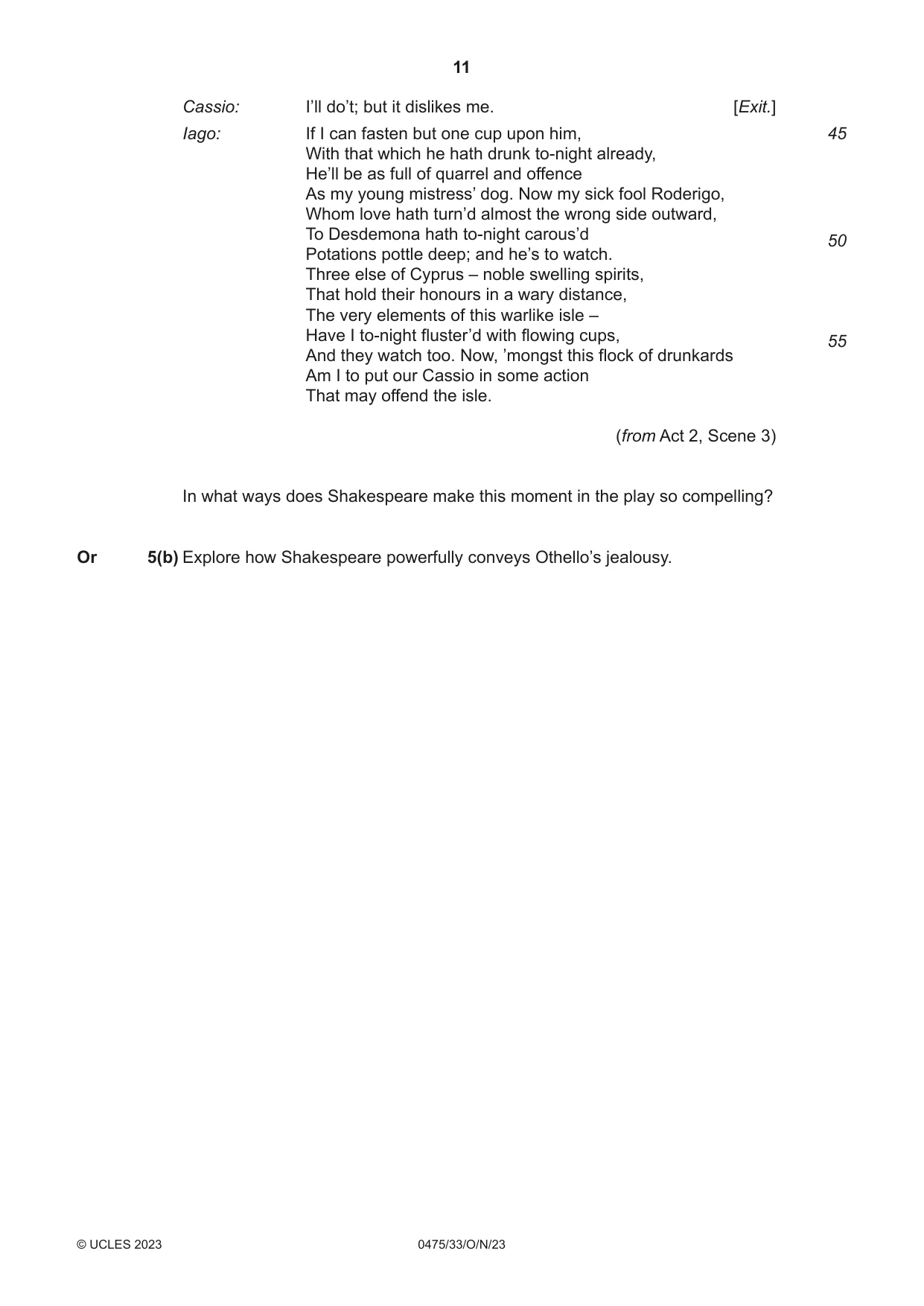
11 0475/33/O/N/23 © UCLES 2023 Cassio: I’ll do’t; but it dislikes me. [Exit.] Iago: If I can fasten but one cup upon him, With that which he hath drunk to-night already, He’ll be as full of quarrel and offence As my young mistress’ dog. Now my sick fool Roderigo, Whom love hath turn’d almost the wrong side outward, To Desdemona hath to-night carous’d Potations pottle deep; and he’s to watch. Three else of Cyprus – noble swelling spirits, That hold their honours in a wary distance, The very elements of this warlike isle – Have I to-night fluster’d with flowing cups, And they watch too. Now, ’mongst this flock of drunkards Am I to put our Cassio in some action That may offend the isle. (from Act 2, Scene 3) In what ways does Shakespeare make this moment in the play so compelling? Or 5(b) Explore how Shakespeare powerfully conveys Othello’s jealousy. 45 50 55
Question paper, page 12
12 0475/33/O/N/23 © UCLES 2023 Permission to reproduce items where third-party owned material protected by copyright is included has been sought and cleared where possible. Every reasonable effort has been made by the publisher (UCLES) to trace copyright holders, but if any items requiring clearance have unwittingly been included, the publisher will be pleased to make amends at the earliest possible opportunity. To avoid the issue of disclosure of answer-related information to candidates, all copyright acknowledgements are reproduced online in the Cambridge Assessment International Education Copyright Acknowledgements Booklet. This is produced for each series of examinations and is freely available to download at www.cambridgeinternational.org after the live examination series. Cambridge Assessment International Education is part of Cambridge Assessment. Cambridge Assessment is the brand name of the University of Cambridge Local Examinations Syndicate (UCLES), which is a department of the University of Cambridge. BLANK PAGE
Mark scheme, page 1
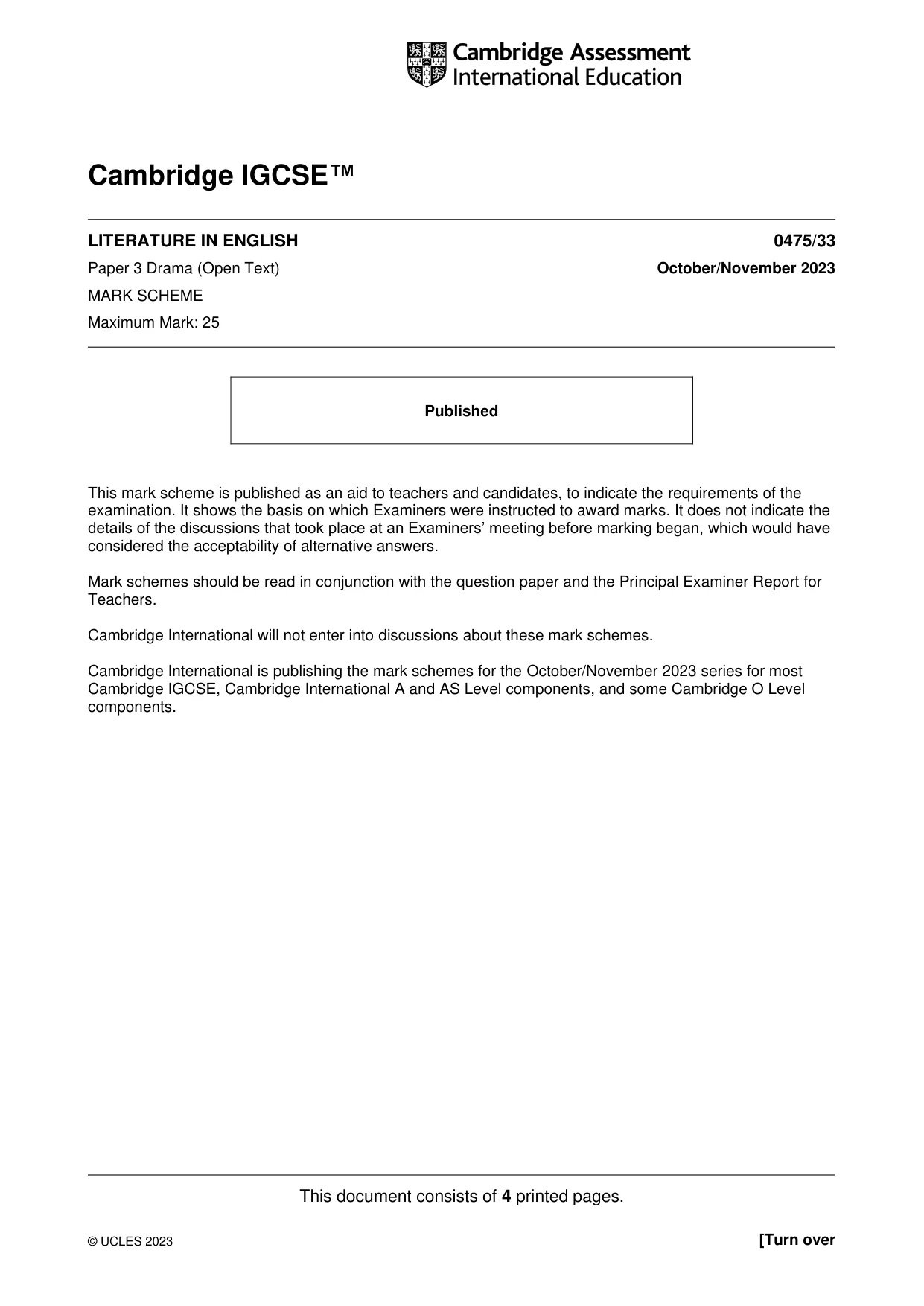
This document consists of 4 printed pages. © UCLES 2023 [Turn over Cambridge IGCSE™ LITERATURE IN ENGLISH 0475/33 Paper 3 Drama (Open Text) October/November 2023 MARK SCHEME Maximum Mark: 25 Published This mark scheme is published as an aid to teachers and candidates, to indicate the requirements of the examination. It shows the basis on which Examiners were instructed to award marks. It does not indicate the details of the discussions that took place at an Examiners’ meeting before marking began, which would have considered the acceptability of alternative answers. Mark schemes should be read in conjunction with the question paper and the Principal Examiner Report for Teachers. Cambridge International will not enter into discussions about these mark schemes. Cambridge International is publishing the mark schemes for the October/November 2023 series for most Cambridge IGCSE, Cambridge International A and AS Level components, and some Cambridge O Level components.
Mark scheme, page 2
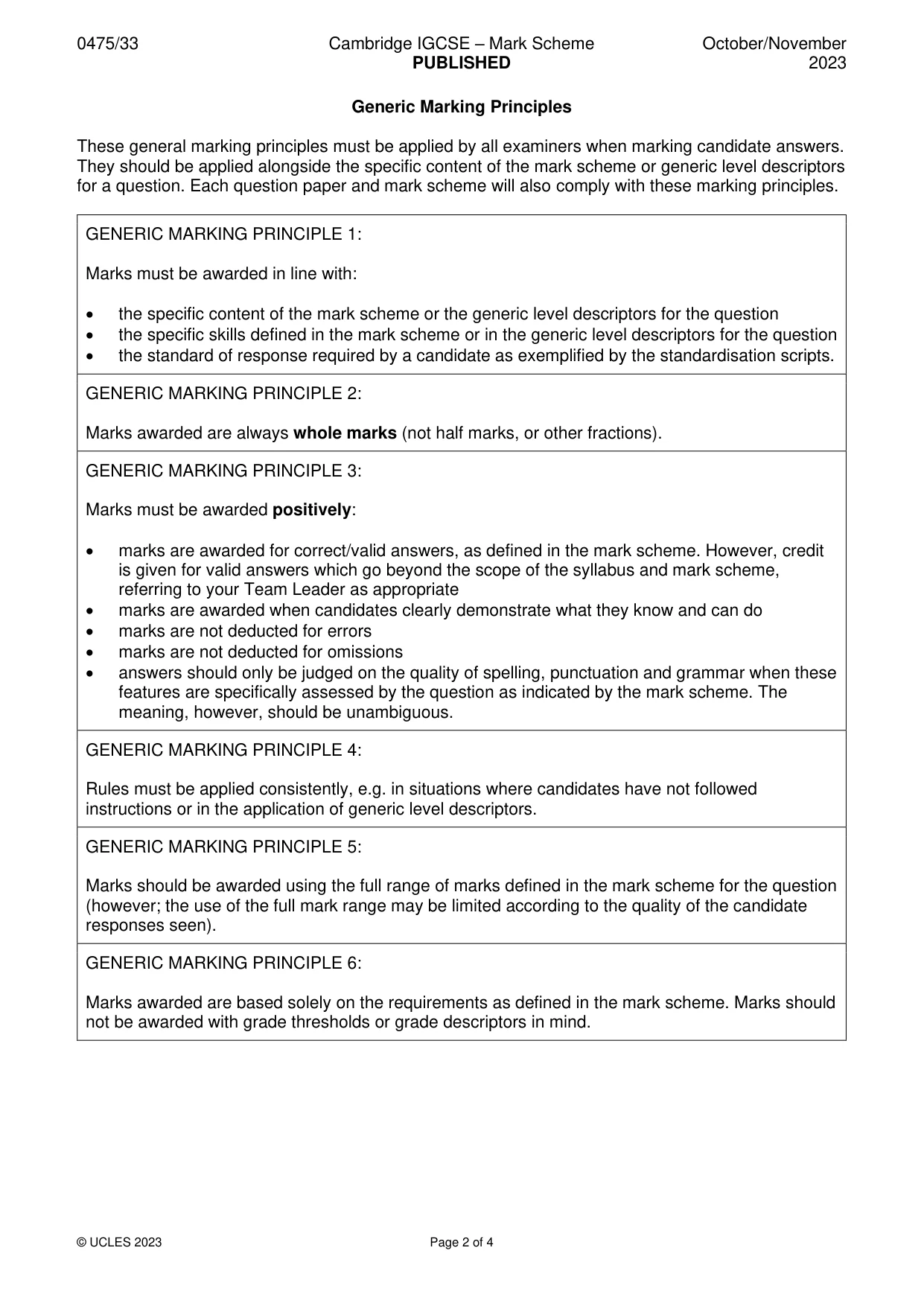
0475/33 Cambridge IGCSE – Mark Scheme PUBLISHED October/November 2023 © UCLES 2023 Page 2 of 4 Generic Marking Principles These general marking principles must be applied by all examiners when marking candidate answers. They should be applied alongside the specific content of the mark scheme or generic level descriptors for a question. Each question paper and mark scheme will also comply with these marking principles. GENERIC MARKING PRINCIPLE 1: Marks must be awarded in line with: • the specific content of the mark scheme or the generic level descriptors for the question • the specific skills defined in the mark scheme or in the generic level descriptors for the question • the standard of response required by a candidate as exemplified by the standardisation scripts. GENERIC MARKING PRINCIPLE 2: Marks awarded are always whole marks (not half marks, or other fractions). GENERIC MARKING PRINCIPLE 3: Marks must be awarded positively: • marks are awarded for correct/valid answers, as defined in the mark scheme. However, credit is given for valid answers which go beyond the scope of the syllabus and mark scheme, referring to your Team Leader as appropriate • marks are awarded when candidates clearly demonstrate what they know and can do • marks are not deducted for errors • marks are not deducted for omissions • answers should only be judged on the quality of spelling, punctuation and grammar when these features are specifically assessed by the question as indicated by the mark scheme. The meaning, however, should be unambiguous. GENERIC MARKING PRINCIPLE 4: Rules must be applied consistently, e.g. in situations where candidates have not followed instructions or in the application of generic level descriptors. GENERIC MARKING PRINCIPLE 5: Marks should be awarded using the full range of marks defined in the mark scheme for the question (however; the use of the full mark range may be limited according to the quality of the candidate responses seen). GENERIC MARKING PRINCIPLE 6: Marks awarded are based solely on the requirements as defined in the mark scheme. Marks should not be awarded with grade thresholds or grade descriptors in mind.
Mark scheme, page 3
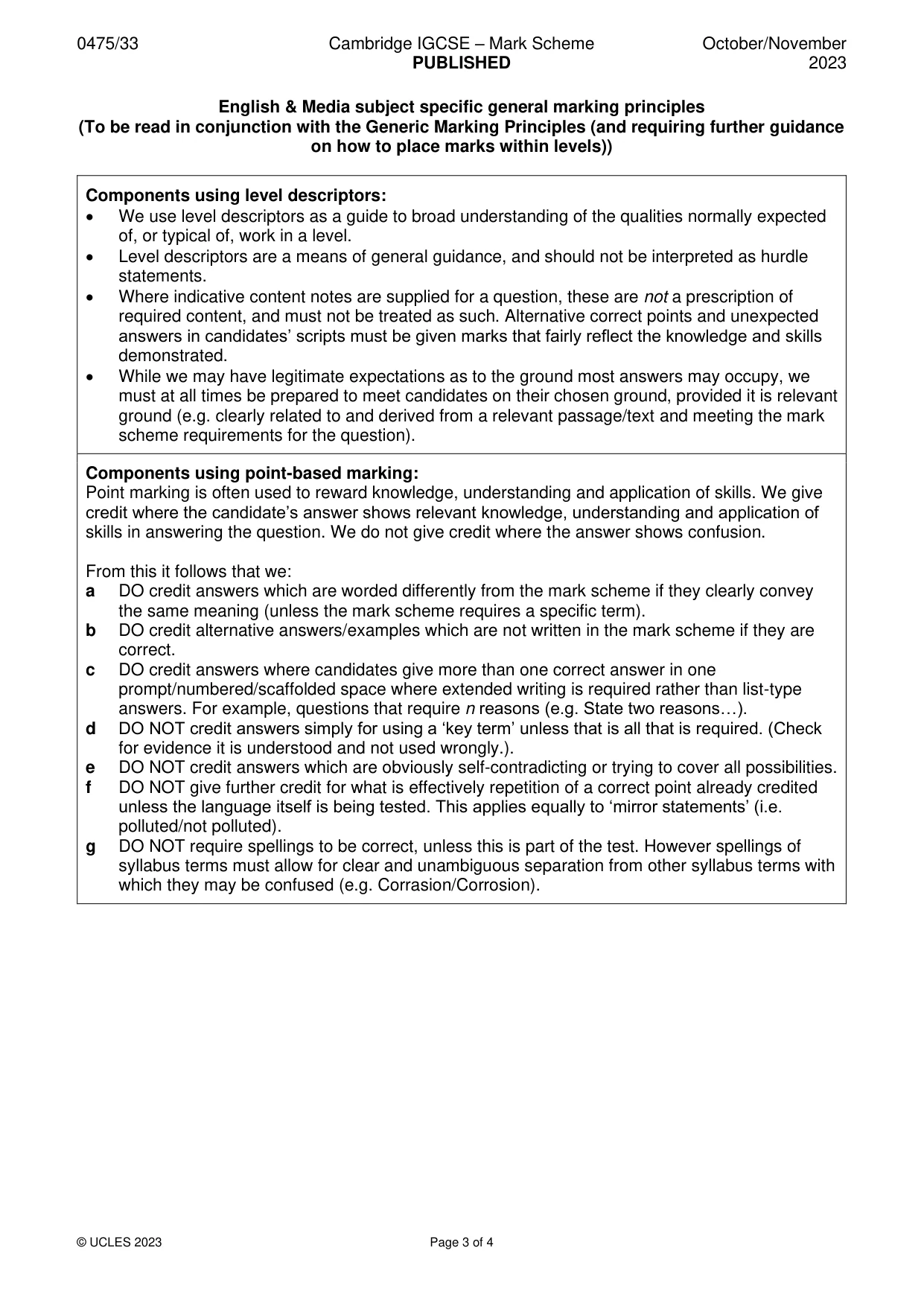
0475/33 Cambridge IGCSE – Mark Scheme PUBLISHED October/November 2023 © UCLES 2023 Page 3 of 4 English & Media subject specific general marking principles (To be read in conjunction with the Generic Marking Principles (and requiring further guidance on how to place marks within levels)) Components using level descriptors: • We use level descriptors as a guide to broad understanding of the qualities normally expected of, or typical of, work in a level. • Level descriptors are a means of general guidance, and should not be interpreted as hurdle statements. • Where indicative content notes are supplied for a question, these are not a prescription of required content, and must not be treated as such. Alternative correct points and unexpected answers in candidates’ scripts must be given marks that fairly reflect the knowledge and skills demonstrated. • While we may have legitimate expectations as to the ground most answers may occupy, we must at all times be prepared to meet candidates on their chosen ground, provided it is relevant ground (e.g. clearly related to and derived from a relevant passage/text and meeting the mark scheme requirements for the question). Components using point-based marking: Point marking is often used to reward knowledge, understanding and application of skills. We give credit where the candidate’s answer shows relevant knowledge, understanding and application of skills in answering the question. We do not give credit where the answer shows confusion. From this it follows that we: a DO credit answers which are worded differently from the mark scheme if they clearly convey the same meaning (unless the mark scheme requires a specific term). b DO credit alternative answers/examples which are not written in the mark scheme if they are correct. c DO credit answers where candidates give more than one correct answer in one prompt/numbered/scaffolded space where extended writing is required rather than list-type answers. For example, questions that require n reasons (e.g. State two reasons…). d DO NOT credit answers simply for using a ‘key term’ unless that is all that is required. (Check for evidence it is understood and not used wrongly.). e DO NOT credit answers which are obviously self-contradicting or trying to cover all possibilities. f DO NOT give further credit for what is effectively repetition of a correct point already credited unless the language itself is being tested. This applies equally to ‘mirror statements’ (i.e. polluted/not polluted). g DO NOT require spellings to be correct, unless this is part of the test. However spellings of syllabus terms must allow for clear and unambiguous separation from other syllabus terms with which they may be confused (e.g. Corrasion/Corrosion).
Mark scheme, page 4
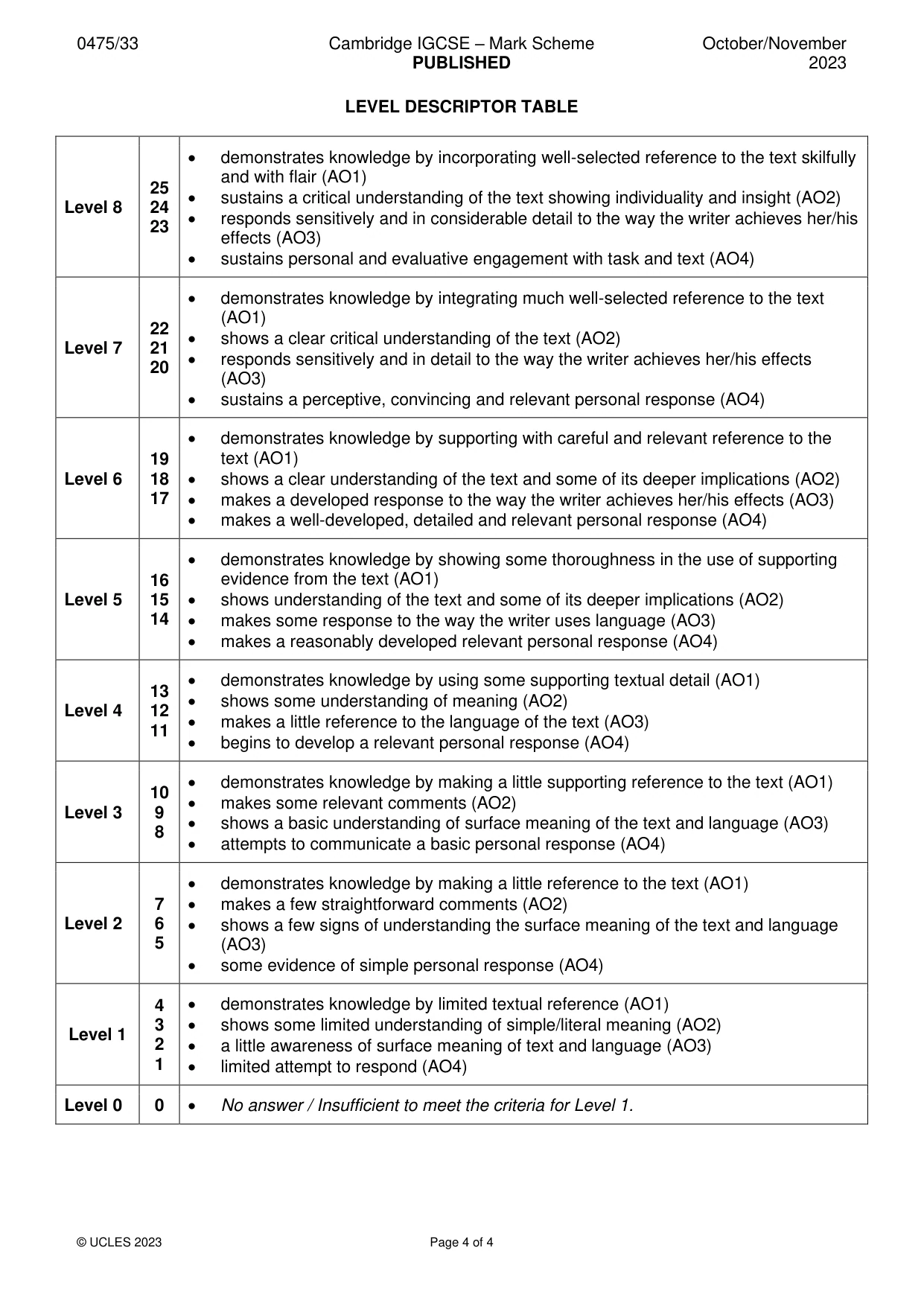
0475/33 Cambridge IGCSE – Mark Scheme PUBLISHED October/November 2023 © UCLES 2023 Page 4 of 4 LEVEL DESCRIPTOR TABLE Level 8 25 24 23 • demonstrates knowledge by incorporating well-selected reference to the text skilfully and with flair (AO1) • sustains a critical understanding of the text showing individuality and insight (AO2) • responds sensitively and in considerable detail to the way the writer achieves her/his effects (AO3) • sustains personal and evaluative engagement with task and text (AO4) Level 7 22 21 20 • demonstrates knowledge by integrating much well-selected reference to the text (AO1) • shows a clear critical understanding of the text (AO2) • responds sensitively and in detail to the way the writer achieves her/his effects (AO3) • sustains a perceptive, convincing and relevant personal response (AO4) Level 6 19 18 17 • demonstrates knowledge by supporting with careful and relevant reference to the text (AO1) • shows a clear understanding of the text and some of its deeper implications (AO2) • makes a developed response to the way the writer achieves her/his effects (AO3) • makes a well-developed, detailed and relevant personal response (AO4) Level 5 16 15 14 • demonstrates knowledge by showing some thoroughness in the use of supporting evidence from the text (AO1) • shows understanding of the text and some of its deeper implications (AO2) • makes some response to the way the writer uses language (AO3) • makes a reasonably developed relevant personal response (AO4) Level 4 13 12 11 • demonstrates knowledge by using some supporting textual detail (AO1) • shows some understanding of meaning (AO2) • makes a little reference to the language of the text (AO3) • begins to develop a relevant personal response (AO4) Level 3 10 9 8 • demonstrates knowledge by making a little supporting reference to the text (AO1) • makes some relevant comments (AO2) • shows a basic understanding of surface meaning of the text and language (AO3) • attempts to communicate a basic personal response (AO4) Level 2 7 6 5 • demonstrates knowledge by making a little reference to the text (AO1) • makes a few straightforward comments (AO2) • shows a few signs of understanding the surface meaning of the text and language (AO3) • some evidence of simple personal response (AO4) Level 1 4 3 2 1 • demonstrates knowledge by limited textual reference (AO1) • shows some limited understanding of simple/literal meaning (AO2) • a little awareness of surface meaning of text and language (AO3) • limited attempt to respond (AO4) Level 0 0 • No answer / Insufficient to meet the criteria for Level 1.
What you needed in this session
Cambridge’s own grade thresholds for 2023 Oct/Nov, Paper 3 · Variant 3. A higher threshold means an easier paper — the bar moves with how the cohort did.