Cambridge IGCSE English - Literature in English 0475 — 2023 Oct/Nov Paper 3 · Variant 1
0475/31/O/N/23 · 25 marks · ≈28 min
The question paper and its mark scheme, free to read here and free to download. This is Cambridge’s own paper, exactly as it was sat.
Question paper12 pages


Mark scheme4 pages
Answers below. Sit the paper first if you are practising.
Paper as text
Question paper, page 1
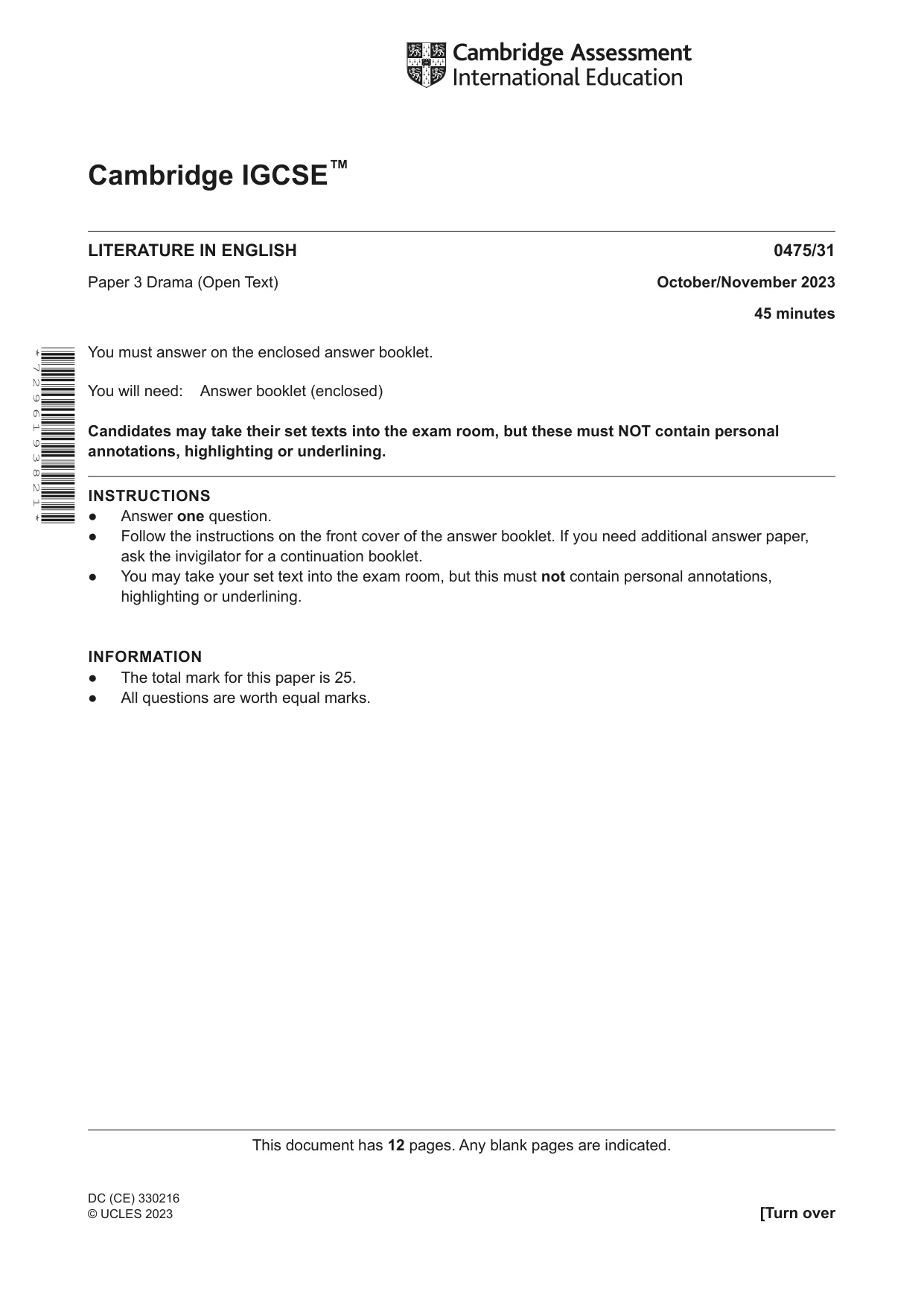
This document has 12 pages. Any blank pages are indicated. [Turn over Cambridge IGCSE™ * 7 2 9 6 1 9 3 8 2 1 * DC (CE) 330216 © UCLES 2023 LITERATURE IN ENGLISH 0475/31 Paper 3 Drama (Open Text) October/November 2023 45 minutes You must answer on the enclosed answer booklet. You will need: Answer booklet (enclosed) Candidates may take their set texts into the exam room, but these must NOT contain personal annotations, highlighting or underlining. INSTRUCTIONS ● Answer one question. ● Follow the instructions on the front cover of the answer booklet. If you need additional answer paper, ask the invigilator for a continuation booklet. ● You may take your set text into the exam room, but this must not contain personal annotations, highlighting or underlining. INFORMATION ● The total mark for this paper is 25. ● All questions are worth equal marks.
Question paper, page 2
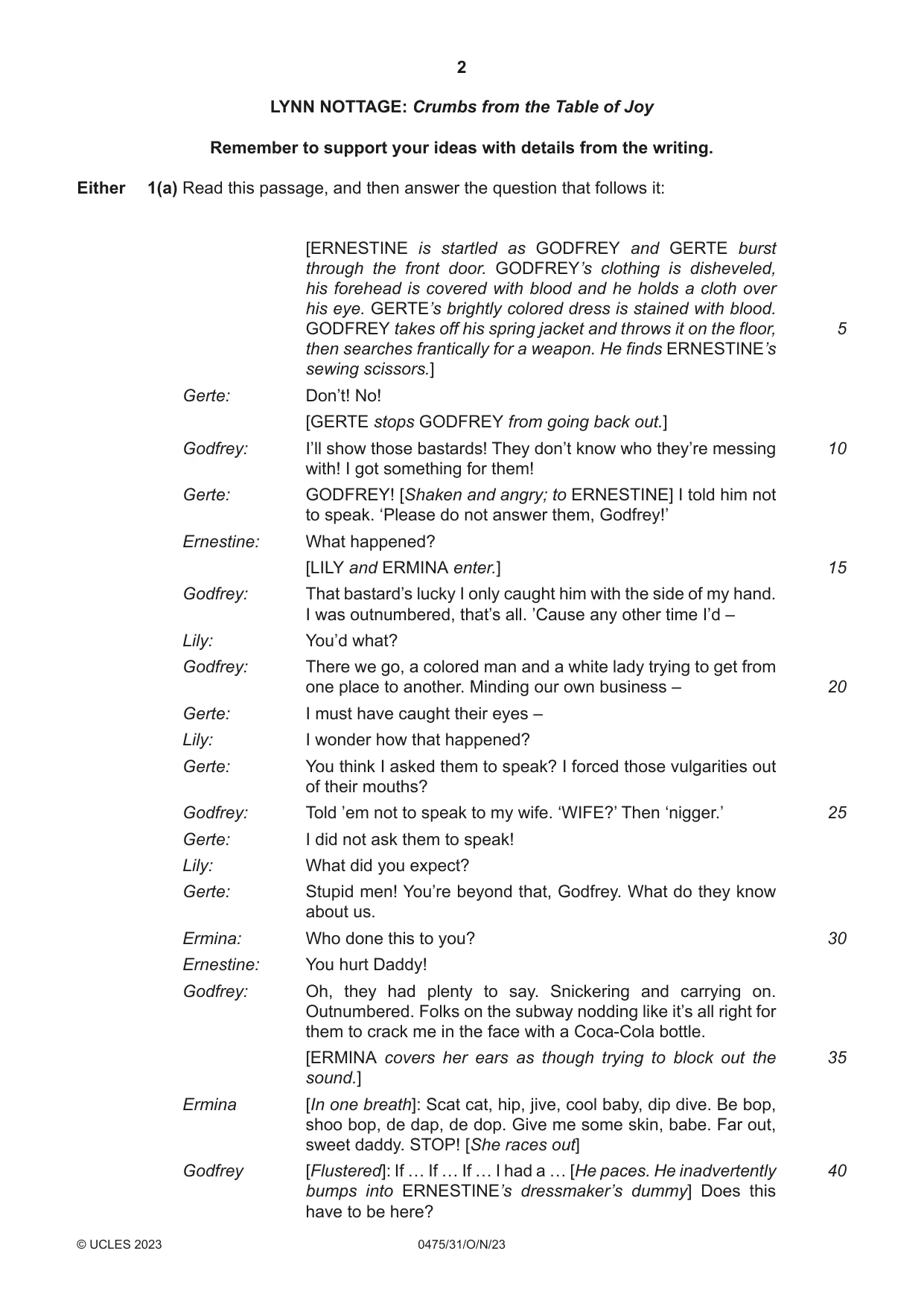
2 0475/31/O/N/23 © UCLES 2023 LYNN NOTTAGE: Crumbs from the Table of Joy Remember to support your ideas with details from the writing. Either 1(a) Read this passage, and then answer the question that follows it: [ERNESTINE is startled as GODFREY and GERTE burst through the front door. GODFREY’s clothing is disheveled, his forehead is covered with blood and he holds a cloth over his eye. GERTE’s brightly colored dress is stained with blood. GODFREY takes off his spring jacket and throws it on the floor, then searches frantically for a weapon. He finds ERNESTINE’s sewing scissors.] Gerte: Don’t! No! [GERTE stops GODFREY from going back out.] Godfrey: I’ll show those bastards! They don’t know who they’re messing with! I got something for them! Gerte: GODFREY! [Shaken and angry; to ERNESTINE] I told him not to speak. ‘Please do not answer them, Godfrey!’ Ernestine: What happened? [LILY and ERMINA enter.] Godfrey: That bastard’s lucky I only caught him with the side of my hand. I was outnumbered, that’s all. ’Cause any other time I’d – Lily: You’d what? Godfrey: There we go, a colored man and a white lady trying to get from one place to another. Minding our own business – Gerte: I must have caught their eyes – Lily: I wonder how that happened? Gerte: You think I asked them to speak? I forced those vulgarities out of their mouths? Godfrey: Told ’em not to speak to my wife. ‘WIFE?’ Then ‘nigger.’ Gerte: I did not ask them to speak! Lily: What did you expect? Gerte: Stupid men! You’re beyond that, Godfrey. What do they know about us. Ermina: Who done this to you? Ernestine: You hurt Daddy! Godfrey: Oh, they had plenty to say. Snickering and carrying on. Outnumbered. Folks on the subway nodding like it’s all right for them to crack me in the face with a Coca-Cola bottle. [ERMINA covers her ears as though trying to block out the sound.] Ermina [In one breath]: Scat cat, hip, jive, cool baby, dip dive. Be bop, shoo bop, de dap, de dop. Give me some skin, babe. Far out, sweet daddy. STOP! [She races out] Godfrey [Flustered]: If … If … If … I had a … [He paces. He inadvertently bumps into ERNESTINE’s dressmaker’s dummy] Does this have to be here? 5 10 15 20 25 30 35 40
Question paper, page 3
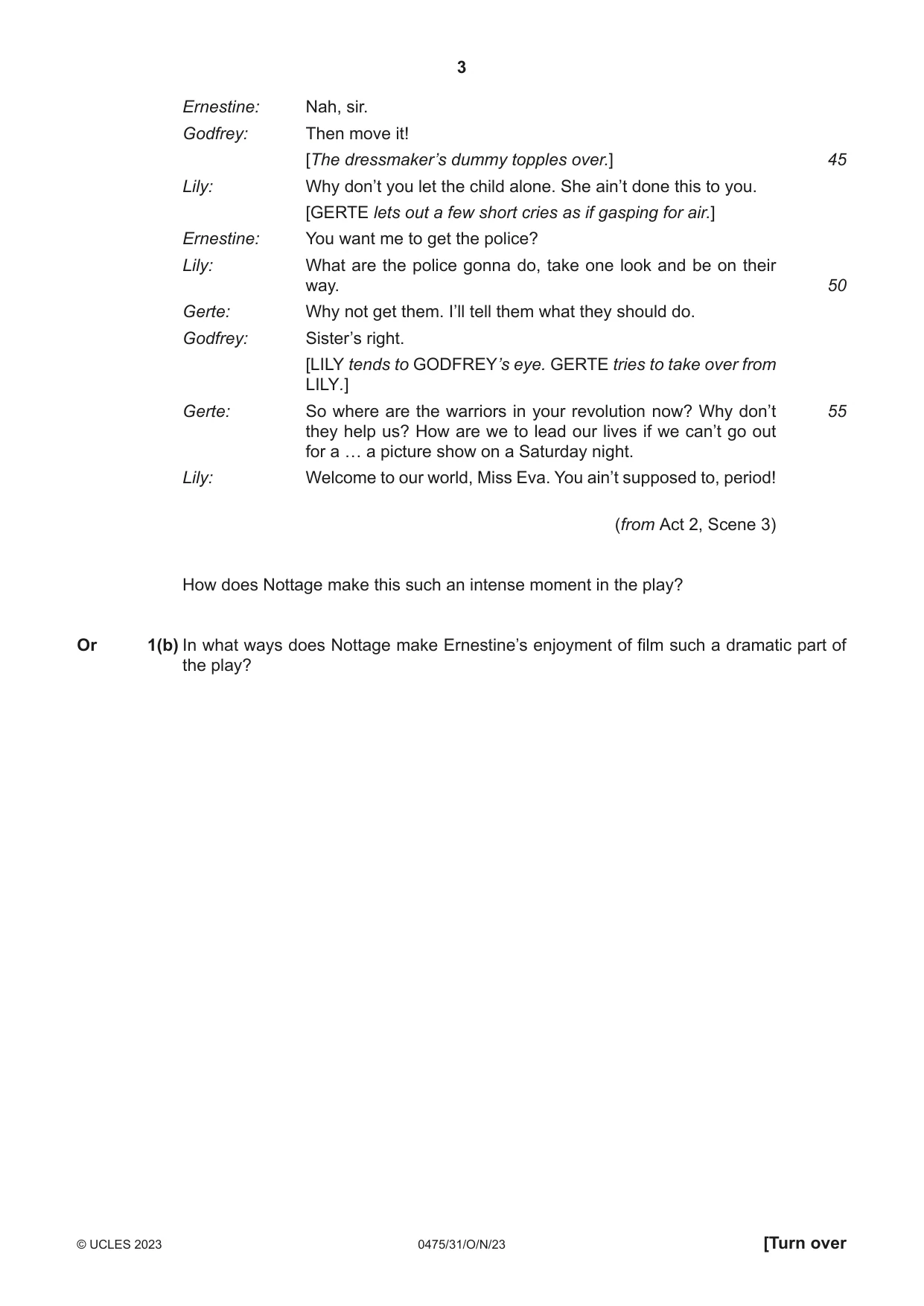
3 0475/31/O/N/23 © UCLES 2023 [Turn over Ernestine: Nah, sir. Godfrey: Then move it! [The dressmaker’s dummy topples over.] Lily: Why don’t you let the child alone. She ain’t done this to you. [GERTE lets out a few short cries as if gasping for air.] Ernestine: You want me to get the police? Lily: What are the police gonna do, take one look and be on their way. Gerte: Why not get them. I’ll tell them what they should do. Godfrey: Sister’s right. [LILY tends to GODFREY’s eye. GERTE tries to take over from LILY.] Gerte: So where are the warriors in your revolution now? Why don’t they help us? How are we to lead our lives if we can’t go out for a … a picture show on a Saturday night. Lily: Welcome to our world, Miss Eva. You ain’t supposed to, period! (from Act 2, Scene 3) How does Nottage make this such an intense moment in the play? Or 1(b) In what ways does Nottage make Ernestine’s enjoyment of film such a dramatic part of the play? 45 50 55
Question paper, page 4
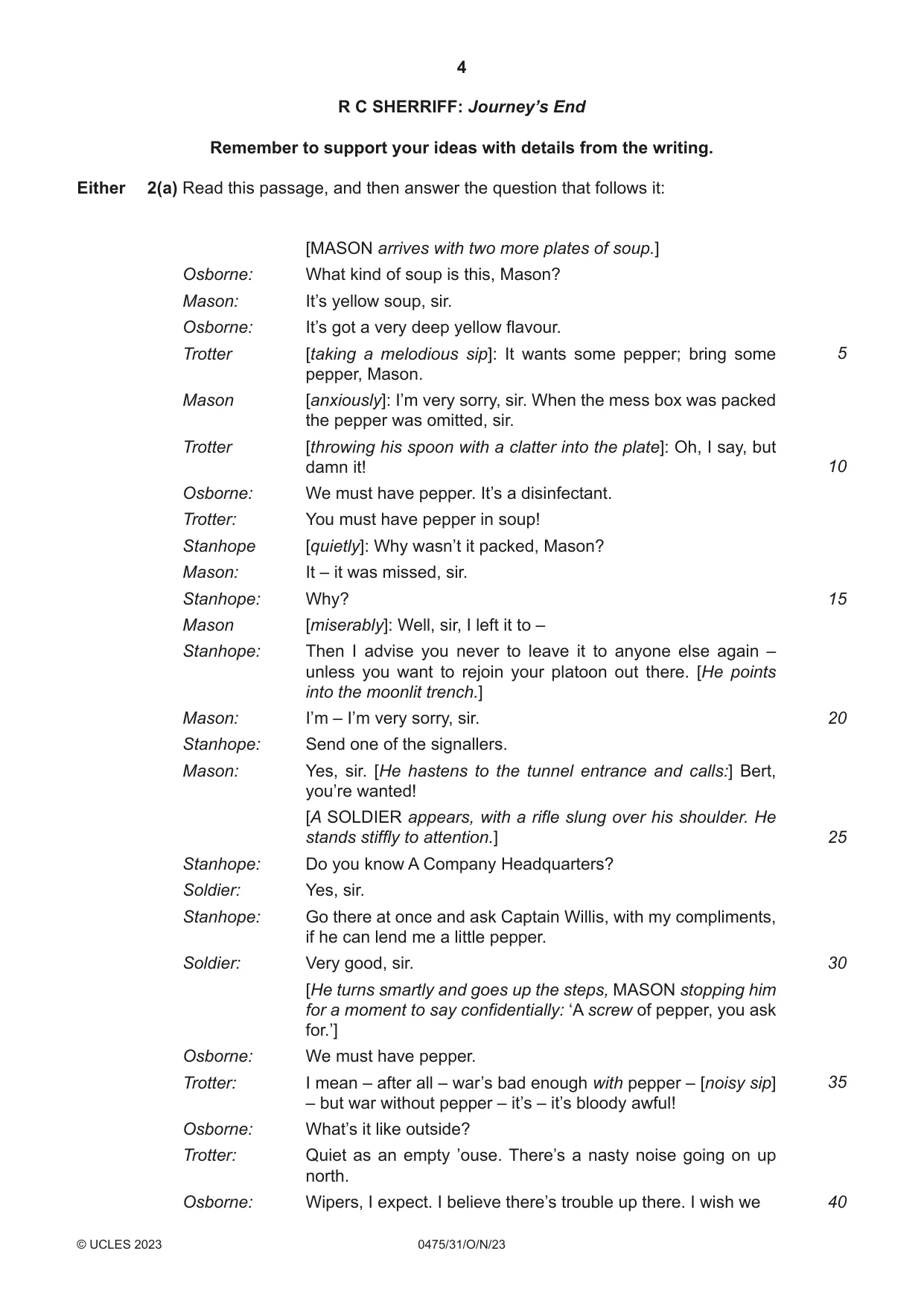
4 0475/31/O/N/23 © UCLES 2023 R C SHERRIFF: Journey’s End Remember to support your ideas with details from the writing. Either 2(a) Read this passage, and then answer the question that follows it: [MASON arrives with two more plates of soup.] Osborne: What kind of soup is this, Mason? Mason: It’s yellow soup, sir. Osborne: It’s got a very deep yellow flavour. Trotter [taking a melodious sip]: It wants some pepper; bring some pepper, Mason. Mason [anxiously]: I’m very sorry, sir. When the mess box was packed the pepper was omitted, sir. Trotter [throwing his spoon with a clatter into the plate]: Oh, I say, but damn it! Osborne: We must have pepper. It’s a disinfectant. Trotter: You must have pepper in soup! Stanhope [quietly]: Why wasn’t it packed, Mason? Mason: It – it was missed, sir. Stanhope: Why? Mason [miserably]: Well, sir, I left it to – Stanhope: Then I advise you never to leave it to anyone else again – unless you want to rejoin your platoon out there. [He points into the moonlit trench.] Mason: I’m – I’m very sorry, sir. Stanhope: Send one of the signallers. Mason: Yes, sir. [He hastens to the tunnel entrance and calls:] Bert, you’re wanted! [A SOLDIER appears, with a rifle slung over his shoulder. He stands stiffly to attention.] Stanhope: Do you know A Company Headquarters? Soldier: Yes, sir. Stanhope: Go there at once and ask Captain Willis, with my compliments, if he can lend me a little pepper. Soldier: Very good, sir. [He turns smartly and goes up the steps, MASON stopping him for a moment to say confidentially: ‘A screw of pepper, you ask for.’] Osborne: We must have pepper. Trotter: I mean – after all – war’s bad enough with pepper – [noisy sip] – but war without pepper – it’s – it’s bloody awful! Osborne: What’s it like outside? Trotter: Quiet as an empty ’ouse. There’s a nasty noise going on up north. Osborne: Wipers, I expect. I believe there’s trouble up there. I wish we 5 10 15 20 25 30 35 40
Question paper, page 5
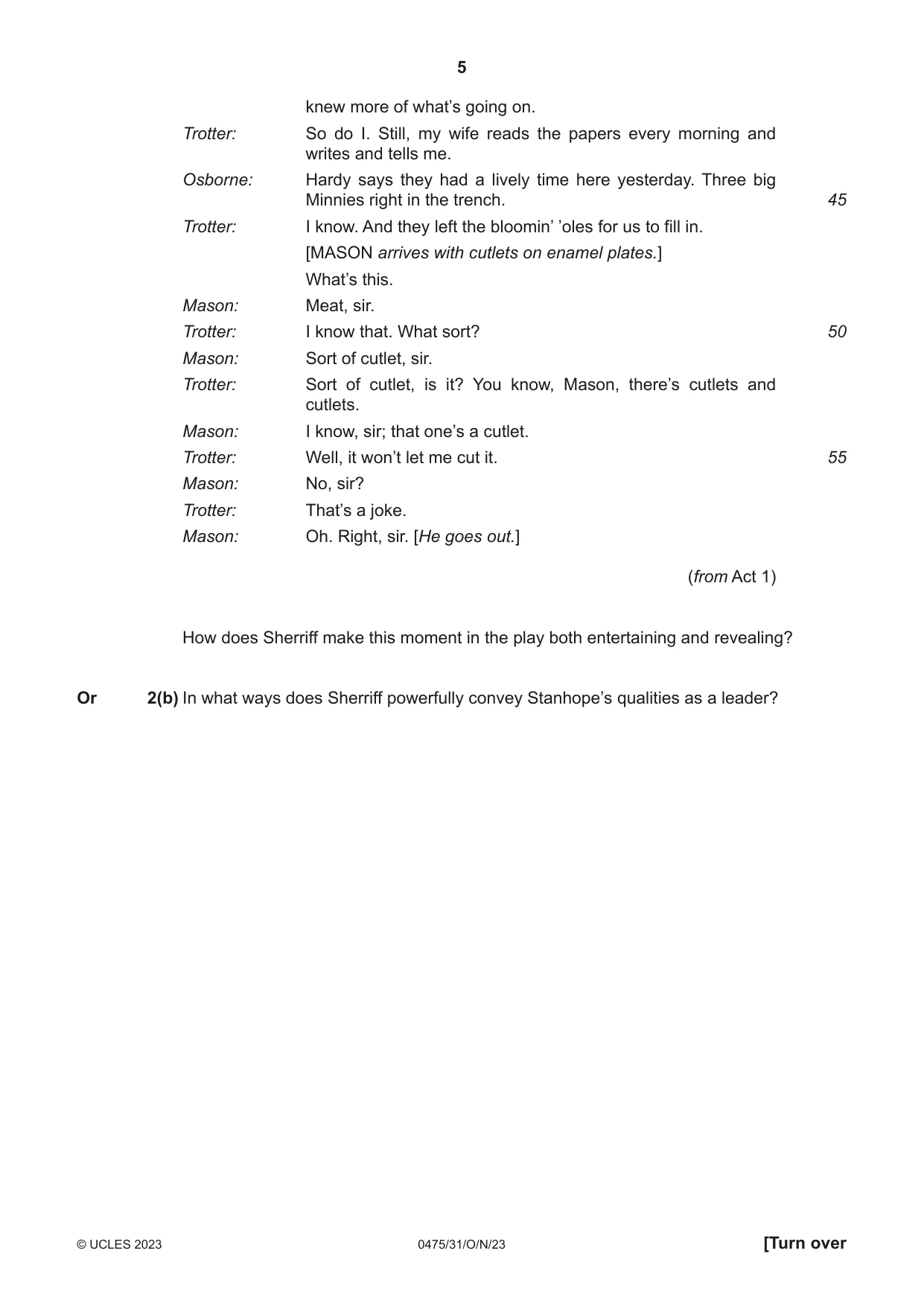
5 0475/31/O/N/23 © UCLES 2023 [Turn over knew more of what’s going on. Trotter: So do I. Still, my wife reads the papers every morning and writes and tells me. Osborne: Hardy says they had a lively time here yesterday. Three big Minnies right in the trench. Trotter: I know. And they left the bloomin’ ’oles for us to fill in. [MASON arrives with cutlets on enamel plates.] What’s this. Mason: Meat, sir. Trotter: I know that. What sort? Mason: Sort of cutlet, sir. Trotter: Sort of cutlet, is it? You know, Mason, there’s cutlets and cutlets. Mason: I know, sir; that one’s a cutlet. Trotter: Well, it won’t let me cut it. Mason: No, sir? Trotter: That’s a joke. Mason: Oh. Right, sir. [He goes out.] (from Act 1) How does Sherriff make this moment in the play both entertaining and revealing? Or 2(b) In what ways does Sherriff powerfully convey Stanhope’s qualities as a leader? 45 50 55
Question paper, page 6
6 0475/31/O/N/23 © UCLES 2023 WOLE SOYINKA: Death and the King’s Horseman Remember to support your ideas with details from the writing. Either 3(a) Read this passage, and then answer the question that follows it: Elesin: In a night which falls before our eyes Content removed due to copyright restrictions.
Question paper, page 7
7 0475/31/O/N/23 © UCLES 2023 [Turn over Is there now a streak of light at the end of the passage, a light I dare not look upon? (from Scene 3) Explore the ways in which Soyinka makes this moment in the play so mysterious. Or 3(b) In what ways does Soyinka encourage you to dislike Pilkings? Content removed due to copyright restrictions.
Question paper, page 8
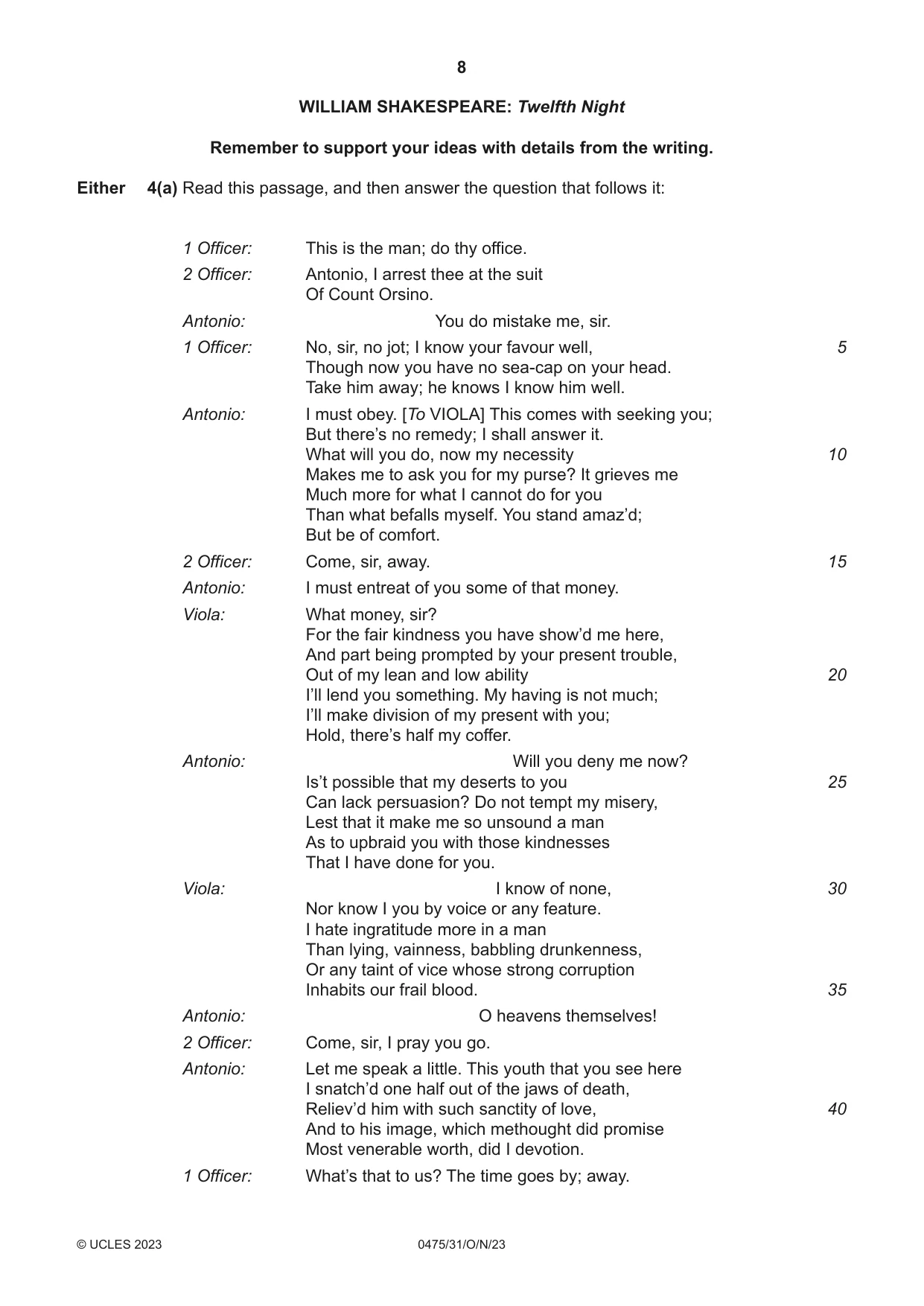
8 0475/31/O/N/23 © UCLES 2023 WILLIAM SHAKESPEARE: Twelfth Night Remember to support your ideas with details from the writing. Either 4(a) Read this passage, and then answer the question that follows it: 1 Officer: This is the man; do thy office. 2 Officer: Antonio, I arrest thee at the suit Of Count Orsino. Antonio: You do mistake me, sir. 1 Officer: No, sir, no jot; I know your favour well, Though now you have no sea-cap on your head. Take him away; he knows I know him well. Antonio: I must obey. [To VIOLA] This comes with seeking you; But there’s no remedy; I shall answer it. What will you do, now my necessity Makes me to ask you for my purse? It grieves me Much more for what I cannot do for you Than what befalls myself. You stand amaz’d; But be of comfort. 2 Officer: Come, sir, away. Antonio: I must entreat of you some of that money. Viola: What money, sir? For the fair kindness you have show’d me here, And part being prompted by your present trouble, Out of my lean and low ability I’ll lend you something. My having is not much; I’ll make division of my present with you; Hold, there’s half my coffer. Antonio: Will you deny me now? Is’t possible that my deserts to you Can lack persuasion? Do not tempt my misery, Lest that it make me so unsound a man As to upbraid you with those kindnesses That I have done for you. Viola: I know of none, Nor know I you by voice or any feature. I hate ingratitude more in a man Than lying, vainness, babbling drunkenness, Or any taint of vice whose strong corruption Inhabits our frail blood. Antonio: O heavens themselves! 2 Officer: Come, sir, I pray you go. Antonio: Let me speak a little. This youth that you see here I snatch’d one half out of the jaws of death, Reliev’d him with such sanctity of love, And to his image, which methought did promise Most venerable worth, did I devotion. 1 Officer: What’s that to us? The time goes by; away. 5 10 15 20 25 30 35 40
Question paper, page 9
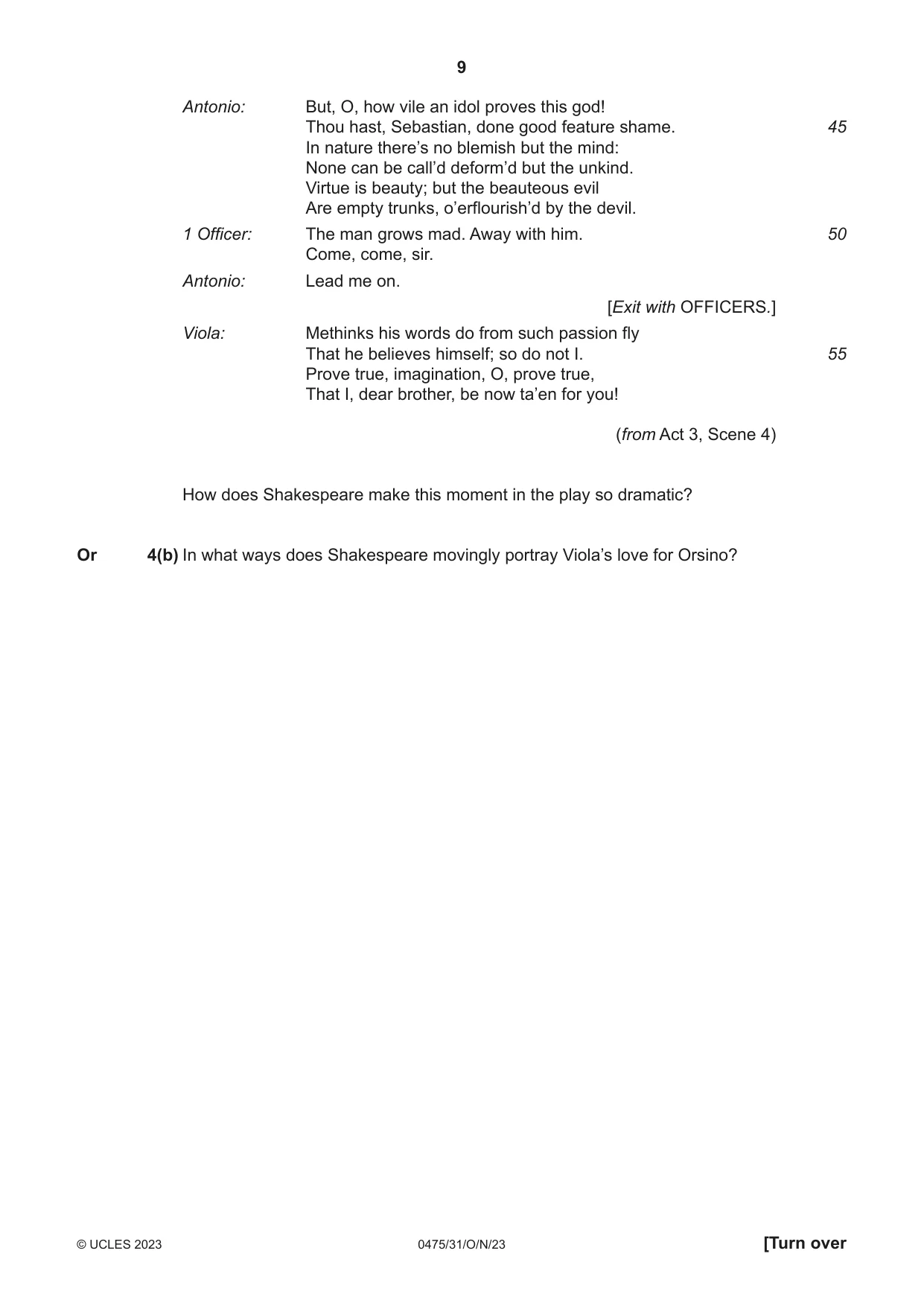
9 0475/31/O/N/23 © UCLES 2023 [Turn over Antonio: But, O, how vile an idol proves this god! Thou hast, Sebastian, done good feature shame. In nature there’s no blemish but the mind: None can be call’d deform’d but the unkind. Virtue is beauty; but the beauteous evil Are empty trunks, o’erflourish’d by the devil. 1 Officer: The man grows mad. Away with him. Come, come, sir. Antonio: Lead me on. [Exit with OFFICERS.] Viola: Methinks his words do from such passion fly That he believes himself; so do not I. Prove true, imagination, O, prove true, That I, dear brother, be now ta’en for you! (from Act 3, Scene 4) How does Shakespeare make this moment in the play so dramatic? Or 4(b) In what ways does Shakespeare movingly portray Viola’s love for Orsino? 45 50 55
Question paper, page 10
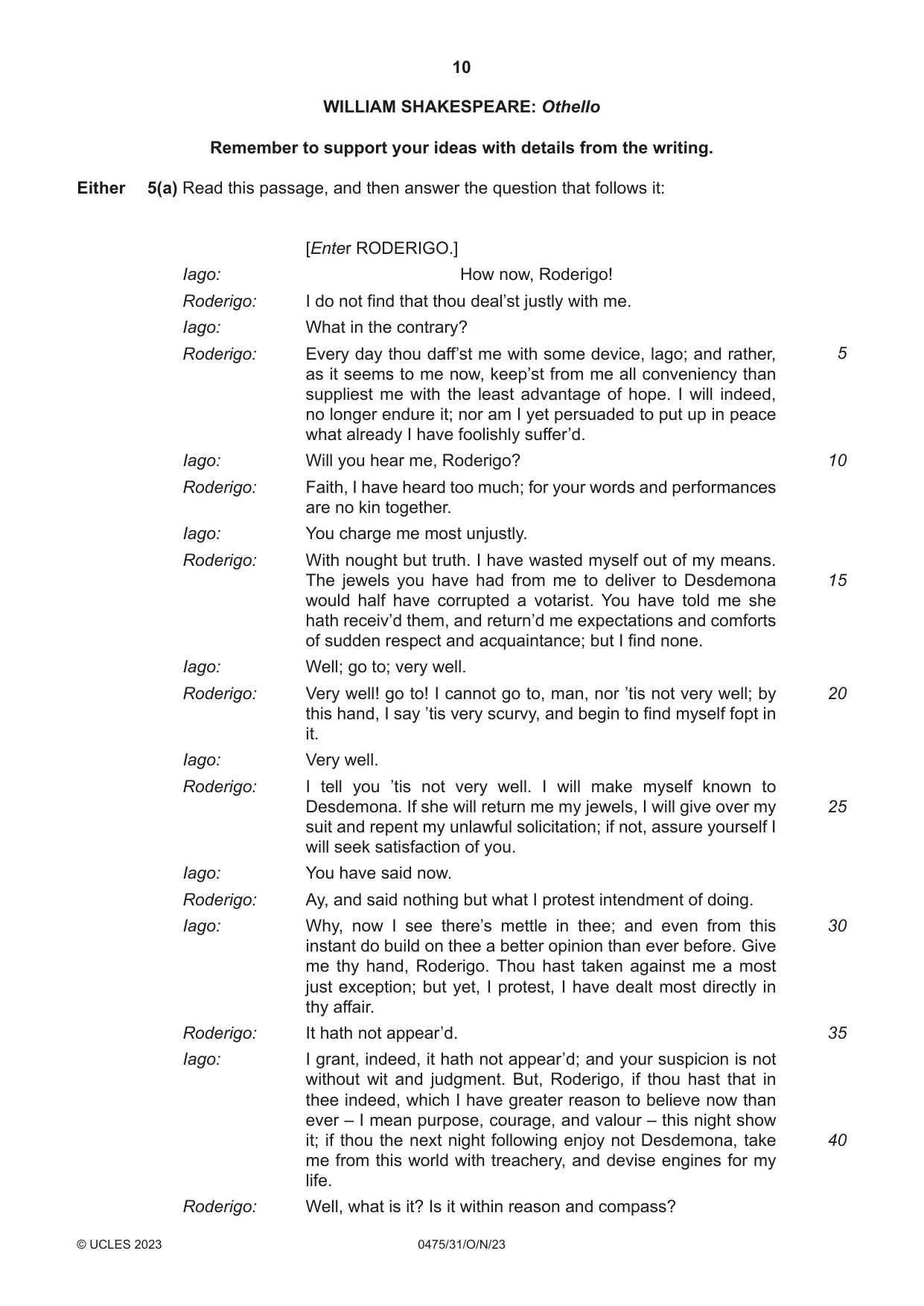
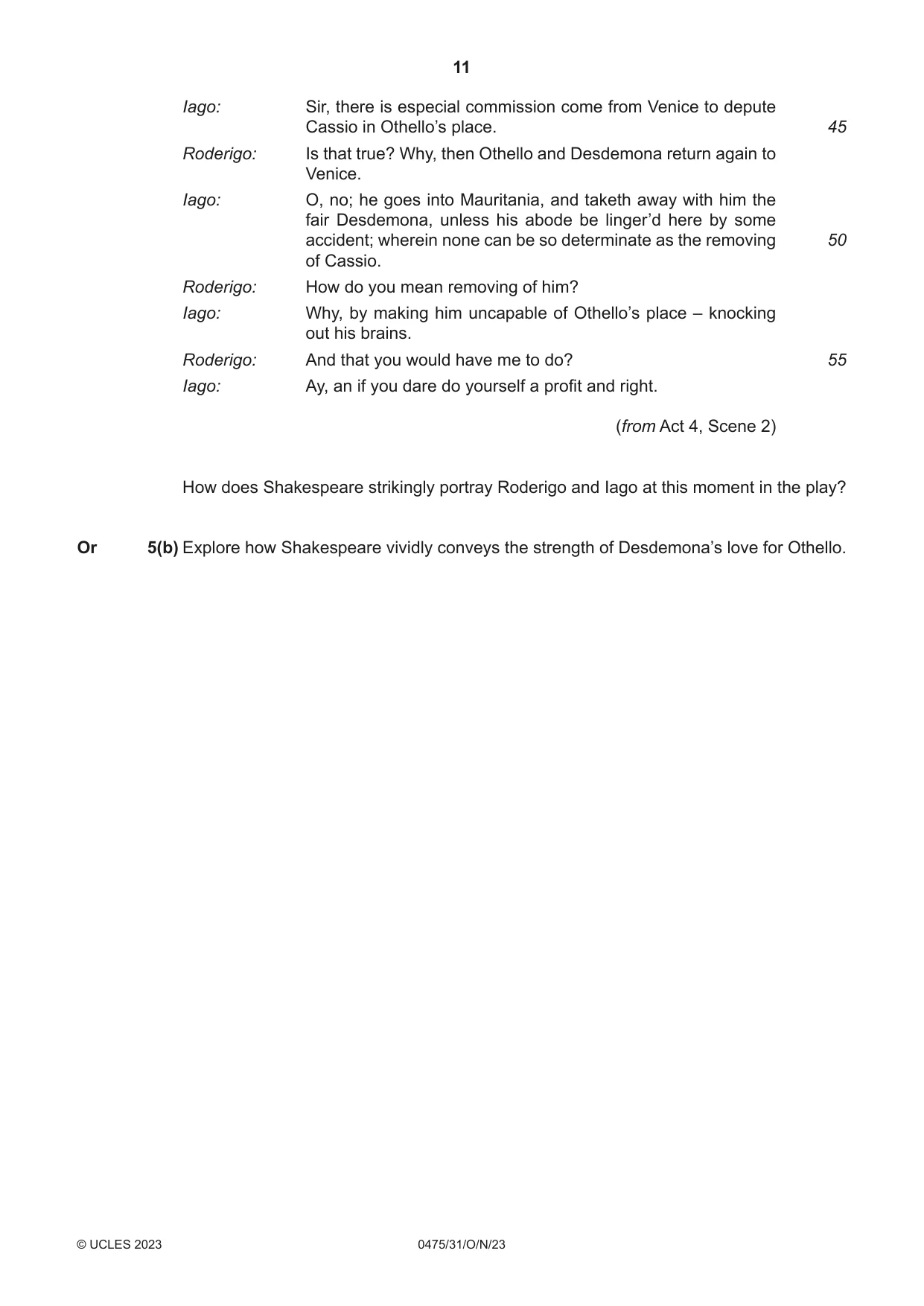
10 0475/31/O/N/23 © UCLES 2023 WILLIAM SHAKESPEARE: Othello Remember to support your ideas with details from the writing. Either 5(a) Read this passage, and then answer the question that follows it: [Enter RODERIGO.] Iago: How now, Roderigo! Roderigo: I do not find that thou deal’st justly with me. Iago: What in the contrary? Roderigo: Every day thou daff’st me with some device, lago; and rather, as it seems to me now, keep’st from me all conveniency than suppliest me with the least advantage of hope. I will indeed, no longer endure it; nor am I yet persuaded to put up in peace what already I have foolishly suffer’d. Iago: Will you hear me, Roderigo? Roderigo: Faith, I have heard too much; for your words and performances are no kin together. Iago: You charge me most unjustly. Roderigo: With nought but truth. I have wasted myself out of my means. The jewels you have had from me to deliver to Desdemona would half have corrupted a votarist. You have told me she hath receiv’d them, and return’d me expectations and comforts of sudden respect and acquaintance; but I find none. Iago: Well; go to; very well. Roderigo: Very well! go to! I cannot go to, man, nor ’tis not very well; by this hand, I say ’tis very scurvy, and begin to find myself fopt in it. Iago: Very well. Roderigo: I tell you ’tis not very well. I will make myself known to Desdemona. If she will return me my jewels, I will give over my suit and repent my unlawful solicitation; if not, assure yourself I will seek satisfaction of you. Iago: You have said now. Roderigo: Ay, and said nothing but what I protest intendment of doing. Iago: Why, now I see there’s mettle in thee; and even from this instant do build on thee a better opinion than ever before. Give me thy hand, Roderigo. Thou hast taken against me a most just exception; but yet, I protest, I have dealt most directly in thy affair. Roderigo: It hath not appear’d. Iago: I grant, indeed, it hath not appear’d; and your suspicion is not without wit and judgment. But, Roderigo, if thou hast that in thee indeed, which I have greater reason to believe now than ever – I mean purpose, courage, and valour – this night show it; if thou the next night following enjoy not Desdemona, take me from this world with treachery, and devise engines for my life. Roderigo: Well, what is it? Is it within reason and compass? 5 10 15 20 25 30 35 40
Question paper, page 11
11 0475/31/O/N/23 © UCLES 2023 Iago: Sir, there is especial commission come from Venice to depute Cassio in Othello’s place. Roderigo: Is that true? Why, then Othello and Desdemona return again to Venice. Iago: O, no; he goes into Mauritania, and taketh away with him the fair Desdemona, unless his abode be linger’d here by some accident; wherein none can be so determinate as the removing of Cassio. Roderigo: How do you mean removing of him? Iago: Why, by making him uncapable of Othello’s place – knocking out his brains. Roderigo: And that you would have me to do? Iago: Ay, an if you dare do yourself a profit and right. (from Act 4, Scene 2) How does Shakespeare strikingly portray Roderigo and Iago at this moment in the play? Or 5(b) Explore how Shakespeare vividly conveys the strength of Desdemona’s love for Othello. 45 50 55
Question paper, page 12
12 0475/31/O/N/23 © UCLES 2023 Permission to reproduce items where third-party owned material protected by copyright is included has been sought and cleared where possible. Every reasonable effort has been made by the publisher (UCLES) to trace copyright holders, but if any items requiring clearance have unwittingly been included, the publisher will be pleased to make amends at the earliest possible opportunity. To avoid the issue of disclosure of answer-related information to candidates, all copyright acknowledgements are reproduced online in the Cambridge Assessment International Education Copyright Acknowledgements Booklet. This is produced for each series of examinations and is freely available to download at www.cambridgeinternational.org after the live examination series. Cambridge Assessment International Education is part of Cambridge Assessment. Cambridge Assessment is the brand name of the University of Cambridge Local Examinations Syndicate (UCLES), which is a department of the University of Cambridge. BLANK PAGE
Mark scheme, page 1
This document consists of 4 printed pages. © UCLES 2023 [Turn over Cambridge IGCSE™ LITERATURE IN ENGLISH 0475/31 Paper 3 Drama (Open Text) October/November 2023 MARK SCHEME Maximum Mark: 25 Published This mark scheme is published as an aid to teachers and candidates, to indicate the requirements of the examination. It shows the basis on which Examiners were instructed to award marks. It does not indicate the details of the discussions that took place at an Examiners’ meeting before marking began, which would have considered the acceptability of alternative answers. Mark schemes should be read in conjunction with the question paper and the Principal Examiner Report for Teachers. Cambridge International will not enter into discussions about these mark schemes. Cambridge International is publishing the mark schemes for the October/November 2023 series for most Cambridge IGCSE, Cambridge International A and AS Level components, and some Cambridge O Level components.
Mark scheme, page 2
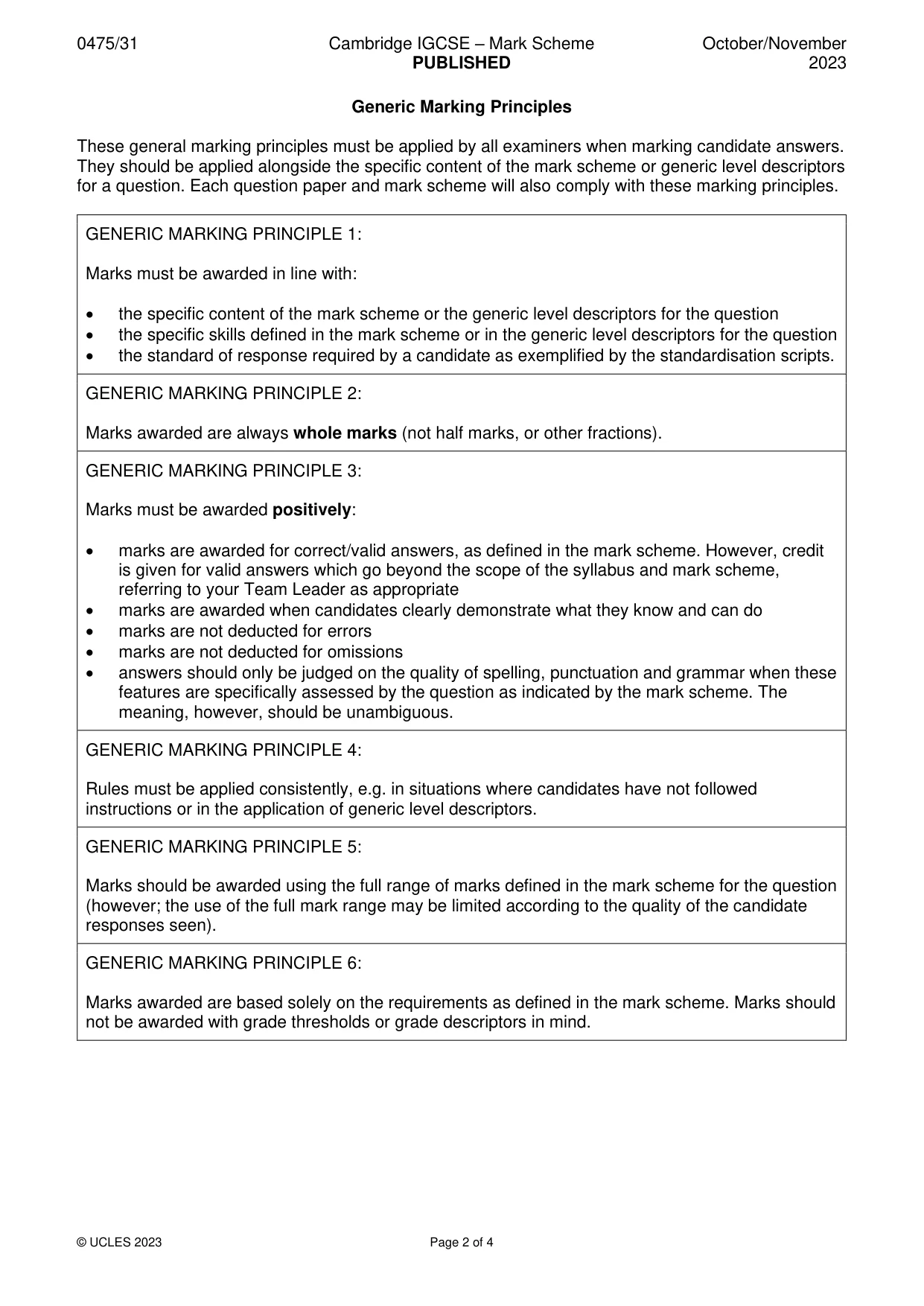
0475/31 Cambridge IGCSE – Mark Scheme PUBLISHED October/November 2023 © UCLES 2023 Page 2 of 4 Generic Marking Principles These general marking principles must be applied by all examiners when marking candidate answers. They should be applied alongside the specific content of the mark scheme or generic level descriptors for a question. Each question paper and mark scheme will also comply with these marking principles. GENERIC MARKING PRINCIPLE 1: Marks must be awarded in line with: • the specific content of the mark scheme or the generic level descriptors for the question • the specific skills defined in the mark scheme or in the generic level descriptors for the question • the standard of response required by a candidate as exemplified by the standardisation scripts. GENERIC MARKING PRINCIPLE 2: Marks awarded are always whole marks (not half marks, or other fractions). GENERIC MARKING PRINCIPLE 3: Marks must be awarded positively: • marks are awarded for correct/valid answers, as defined in the mark scheme. However, credit is given for valid answers which go beyond the scope of the syllabus and mark scheme, referring to your Team Leader as appropriate • marks are awarded when candidates clearly demonstrate what they know and can do • marks are not deducted for errors • marks are not deducted for omissions • answers should only be judged on the quality of spelling, punctuation and grammar when these features are specifically assessed by the question as indicated by the mark scheme. The meaning, however, should be unambiguous. GENERIC MARKING PRINCIPLE 4: Rules must be applied consistently, e.g. in situations where candidates have not followed instructions or in the application of generic level descriptors. GENERIC MARKING PRINCIPLE 5: Marks should be awarded using the full range of marks defined in the mark scheme for the question (however; the use of the full mark range may be limited according to the quality of the candidate responses seen). GENERIC MARKING PRINCIPLE 6: Marks awarded are based solely on the requirements as defined in the mark scheme. Marks should not be awarded with grade thresholds or grade descriptors in mind.
Mark scheme, page 3
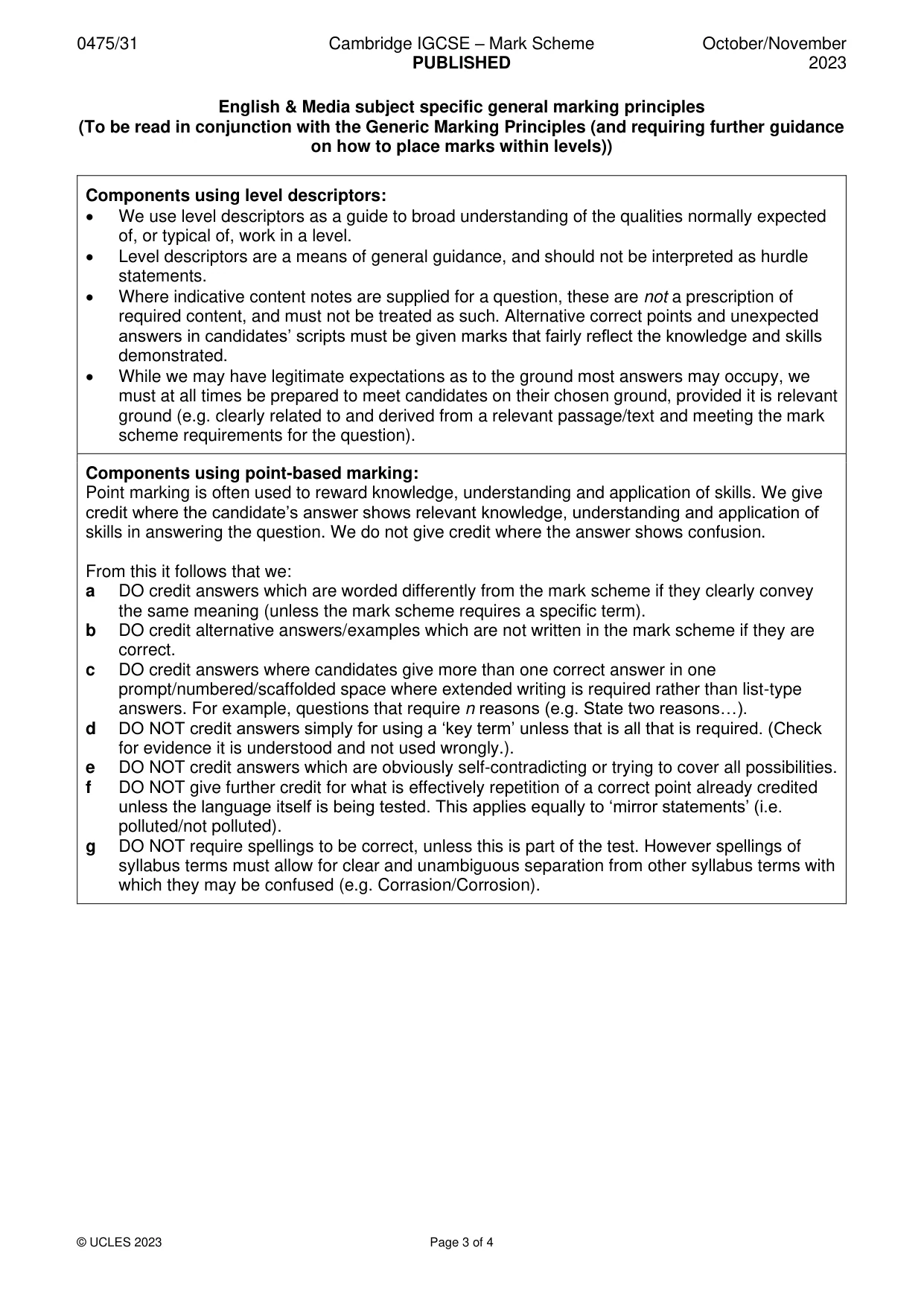
0475/31 Cambridge IGCSE – Mark Scheme PUBLISHED October/November 2023 © UCLES 2023 Page 3 of 4 English & Media subject specific general marking principles (To be read in conjunction with the Generic Marking Principles (and requiring further guidance on how to place marks within levels)) Components using level descriptors: • We use level descriptors as a guide to broad understanding of the qualities normally expected of, or typical of, work in a level. • Level descriptors are a means of general guidance, and should not be interpreted as hurdle statements. • Where indicative content notes are supplied for a question, these are not a prescription of required content, and must not be treated as such. Alternative correct points and unexpected answers in candidates’ scripts must be given marks that fairly reflect the knowledge and skills demonstrated. • While we may have legitimate expectations as to the ground most answers may occupy, we must at all times be prepared to meet candidates on their chosen ground, provided it is relevant ground (e.g. clearly related to and derived from a relevant passage/text and meeting the mark scheme requirements for the question). Components using point-based marking: Point marking is often used to reward knowledge, understanding and application of skills. We give credit where the candidate’s answer shows relevant knowledge, understanding and application of skills in answering the question. We do not give credit where the answer shows confusion. From this it follows that we: a DO credit answers which are worded differently from the mark scheme if they clearly convey the same meaning (unless the mark scheme requires a specific term). b DO credit alternative answers/examples which are not written in the mark scheme if they are correct. c DO credit answers where candidates give more than one correct answer in one prompt/numbered/scaffolded space where extended writing is required rather than list-type answers. For example, questions that require n reasons (e.g. State two reasons…). d DO NOT credit answers simply for using a ‘key term’ unless that is all that is required. (Check for evidence it is understood and not used wrongly.). e DO NOT credit answers which are obviously self-contradicting or trying to cover all possibilities. f DO NOT give further credit for what is effectively repetition of a correct point already credited unless the language itself is being tested. This applies equally to ‘mirror statements’ (i.e. polluted/not polluted). g DO NOT require spellings to be correct, unless this is part of the test. However spellings of syllabus terms must allow for clear and unambiguous separation from other syllabus terms with which they may be confused (e.g. Corrasion/Corrosion).
Mark scheme, page 4
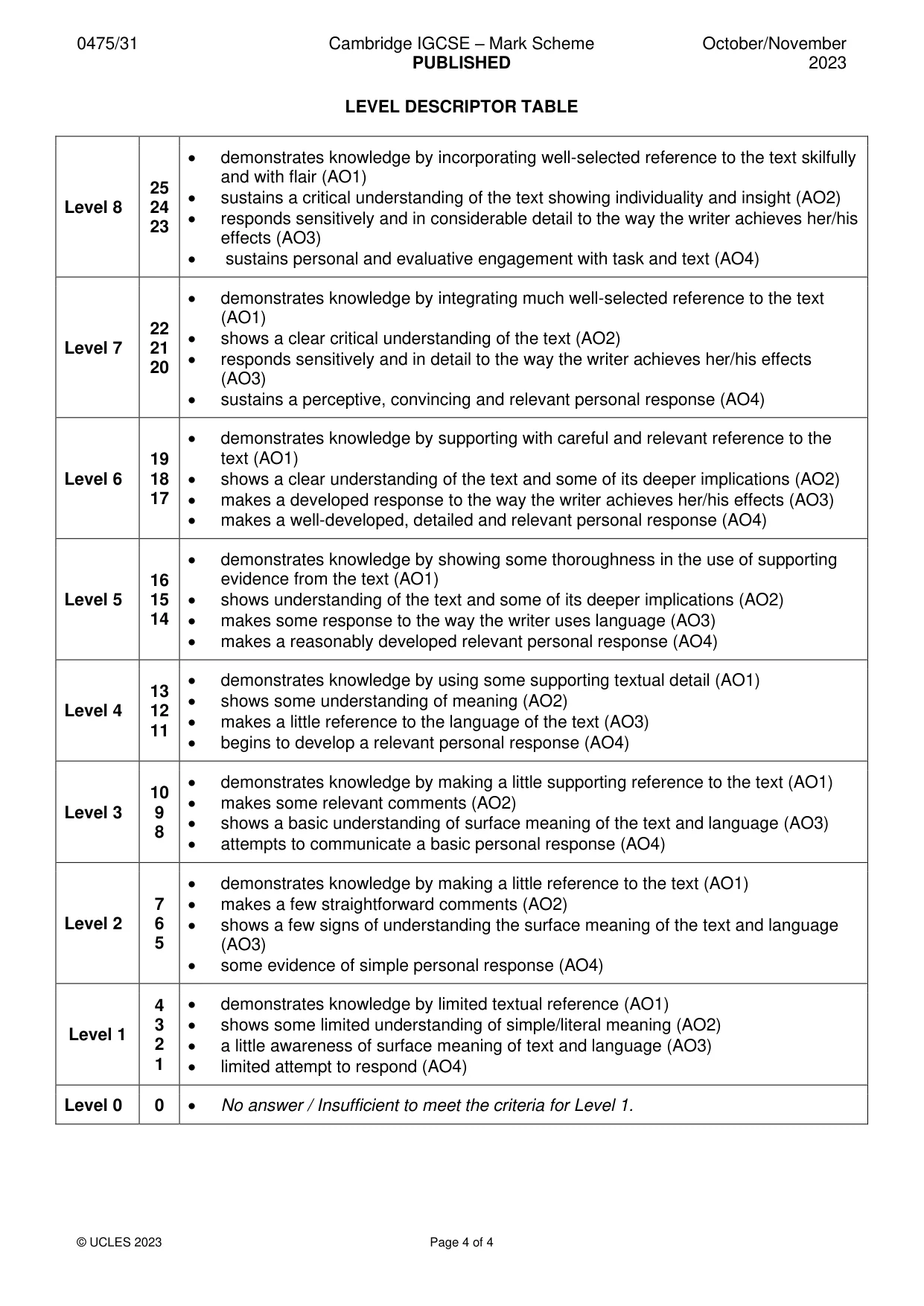
0475/31 Cambridge IGCSE – Mark Scheme PUBLISHED October/November 2023 © UCLES 2023 Page 4 of 4 LEVEL DESCRIPTOR TABLE Level 8 25 24 23 • demonstrates knowledge by incorporating well-selected reference to the text skilfully and with flair (AO1) • sustains a critical understanding of the text showing individuality and insight (AO2) • responds sensitively and in considerable detail to the way the writer achieves her/his effects (AO3) • sustains personal and evaluative engagement with task and text (AO4) Level 7 22 21 20 • demonstrates knowledge by integrating much well-selected reference to the text (AO1) • shows a clear critical understanding of the text (AO2) • responds sensitively and in detail to the way the writer achieves her/his effects (AO3) • sustains a perceptive, convincing and relevant personal response (AO4) Level 6 19 18 17 • demonstrates knowledge by supporting with careful and relevant reference to the text (AO1) • shows a clear understanding of the text and some of its deeper implications (AO2) • makes a developed response to the way the writer achieves her/his effects (AO3) • makes a well-developed, detailed and relevant personal response (AO4) Level 5 16 15 14 • demonstrates knowledge by showing some thoroughness in the use of supporting evidence from the text (AO1) • shows understanding of the text and some of its deeper implications (AO2) • makes some response to the way the writer uses language (AO3) • makes a reasonably developed relevant personal response (AO4) Level 4 13 12 11 • demonstrates knowledge by using some supporting textual detail (AO1) • shows some understanding of meaning (AO2) • makes a little reference to the language of the text (AO3) • begins to develop a relevant personal response (AO4) Level 3 10 9 8 • demonstrates knowledge by making a little supporting reference to the text (AO1) • makes some relevant comments (AO2) • shows a basic understanding of surface meaning of the text and language (AO3) • attempts to communicate a basic personal response (AO4) Level 2 7 6 5 • demonstrates knowledge by making a little reference to the text (AO1) • makes a few straightforward comments (AO2) • shows a few signs of understanding the surface meaning of the text and language (AO3) • some evidence of simple personal response (AO4) Level 1 4 3 2 1 • demonstrates knowledge by limited textual reference (AO1) • shows some limited understanding of simple/literal meaning (AO2) • a little awareness of surface meaning of text and language (AO3) • limited attempt to respond (AO4) Level 0 0 • No answer / Insufficient to meet the criteria for Level 1.
What you needed in this session
Cambridge’s own grade thresholds for 2023 Oct/Nov, Paper 3 · Variant 1. A higher threshold means an easier paper — the bar moves with how the cohort did.