Cambridge IGCSE English - Literature in English 0475 — 2020 May/June Paper 2 · Variant 1
0475/21/M/J/20
The question paper and its mark scheme, free to read here and free to download. This is Cambridge’s own paper, exactly as it was sat.
Question paper12 pages
Mark scheme4 pages
Answers below. Sit the paper first if you are practising.
Paper as text
Question paper, page 1
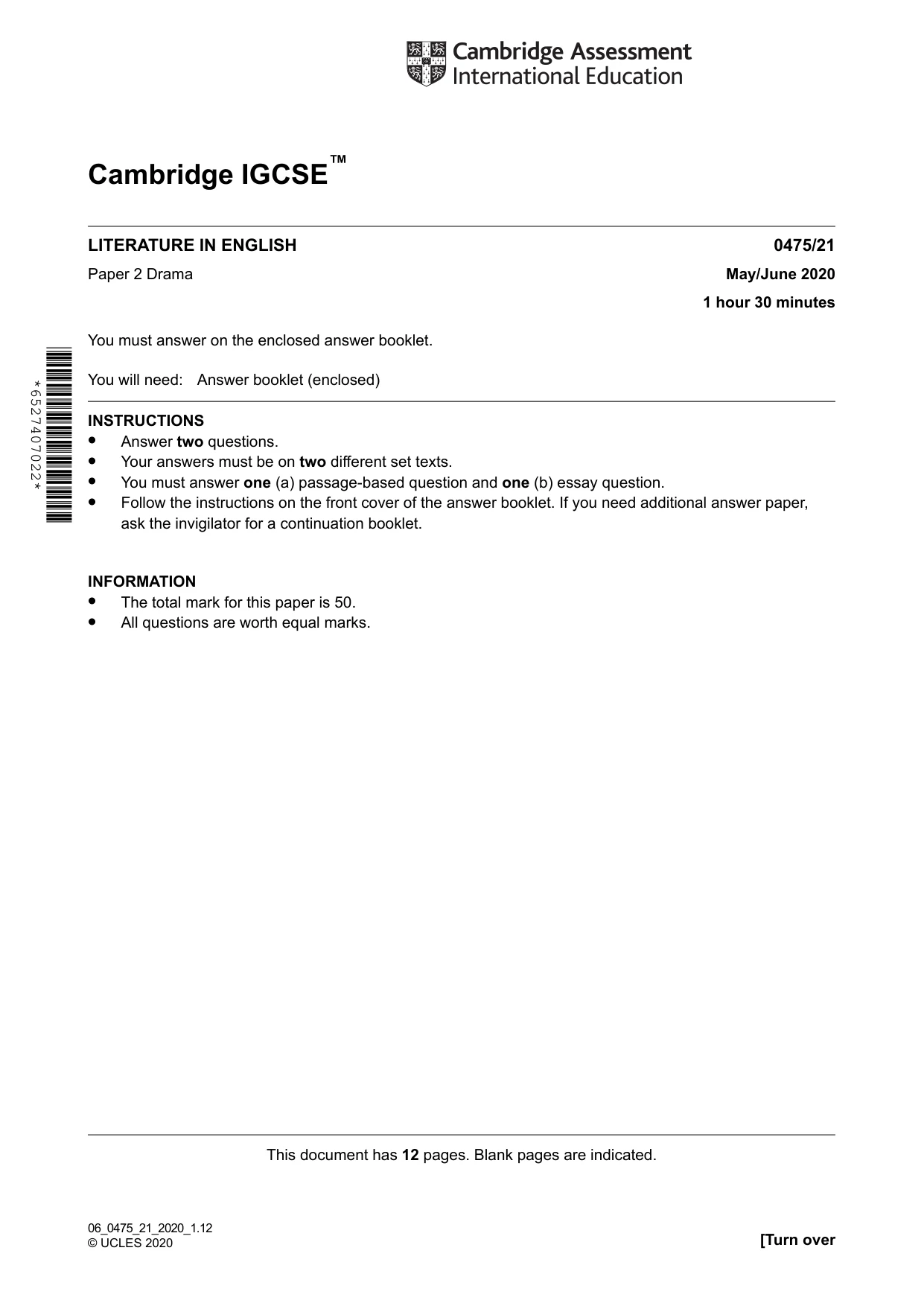
Cambridge IGCSE™ 0475/21 May/June 2020 1 hour 30 minutes LITERATURE IN ENGLISH Paper 2 Drama You must answer on the enclosed answer booklet. You will need: Answer booklet (enclosed) INSTRUCTIONS • Answer two questions. • Your answers must be on two different set texts. • You must answer one (a) passage-based question and one (b) essay question. • Follow the instructions on the front cover of the answer booklet. If you need additional answer paper, ask the invigilator for a continuation booklet. INFORMATION • The total mark for this paper is 50. • All questions are worth equal marks. This document has 12 pages. Blank pages are indicated. [Turn over 06_0475_21_2020_1.12 © UCLES 2020 *6527407022*
Question paper, page 2
LORRAINE HANSBERRY: A Raisin in the Sun Remember to support your ideas with details from the text. Either 1(a) Read this passage, and then answer the question that follows it: Cheque coming today? Walter: 06_0475_21_2020_1.12 © UCLES 2020 2 Content removed due to copyright restrictions.
Question paper, page 3
Eat your breakfast, Travis. [from Act 1, Scene 1] In what ways does Hansberry make this early moment in the play so revealing? Or 1(b) How does Hansberry’s portrayal of Beneatha contribute to the dramatic impact of the play? [Turn over 06_0475_21_2020_1.12 © UCLES 2020 3 Content removed due to copyright restrictions.
Question paper, page 4
ARTHUR MILLER: The Crucible Remember to support your ideas with details from the text. Either 2(a) Read this passage, and then answer the question that follows it: Through the partitioning wall at the right we hear a prosecutor’s voice, JUDGE HATHORNE’s, asking a question; then a woman’s voice, MARTHA COREY’s, replying. 06_0475_21_2020_1.12 © UCLES 2020 4 Content removed due to copyright restrictions.
Question paper, page 5
DANFORTH is respectfully silent.] [from Act 3] In what ways does Miller make this such a gripping opening to Act 3? Or 2(b) How does Miller make the relationship between John and Elizabeth Proctor so powerfully dramatic? [Turn over 06_0475_21_2020_1.12 © UCLES 2020 5 Content removed due to copyright restrictions.
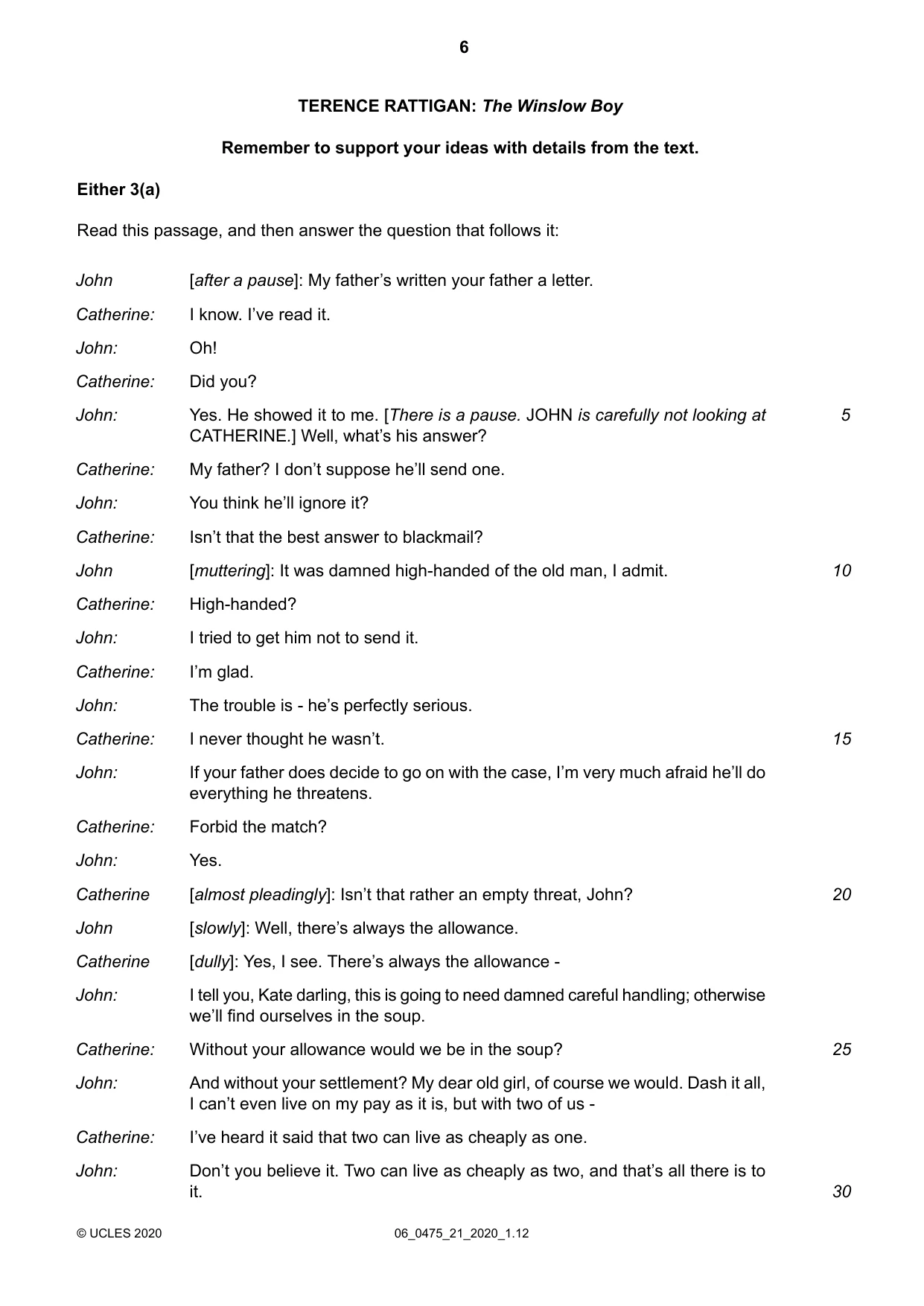
Question paper, page 6
30 25 20 15 10 5 TERENCE RATTIGAN: The Winslow Boy Remember to support your ideas with details from the text. Either 3(a) Read this passage, and then answer the question that follows it: [after a pause]: My father’s written your father a letter. John I know. I’ve read it. Catherine: Oh! John: Did you? Catherine: Yes. He showed it to me. [There is a pause. JOHN is carefully not looking at CATHERINE.] Well, what’s his answer? John: My father? I don’t suppose he’ll send one. Catherine: You think he’ll ignore it? John: Isn’t that the best answer to blackmail? Catherine: [muttering]: It was damned high-handed of the old man, I admit. John High-handed? Catherine: I tried to get him not to send it. John: I’m glad. Catherine: The trouble is - he’s perfectly serious. John: I never thought he wasn’t. Catherine: If your father does decide to go on with the case, I’m very much afraid he’ll do everything he threatens. John: Forbid the match? Catherine: Yes. John: [almost pleadingly]: Isn’t that rather an empty threat, John? Catherine [slowly]: Well, there’s always the allowance. John [dully]: Yes, I see. There’s always the allowance - Catherine I tell you, Kate darling, this is going to need damned careful handling; otherwise we’ll find ourselves in the soup. John: Without your allowance would we be in the soup? Catherine: And without your settlement? My dear old girl, of course we would. Dash it all, I can’t even live on my pay as it is, but with two of us - John: I’ve heard it said that two can live as cheaply as one. Catherine: Don’t you believe it. Two can live as cheaply as two, and that’s all there is to it. John: 06_0475_21_2020_1.12 © UCLES 2020 6
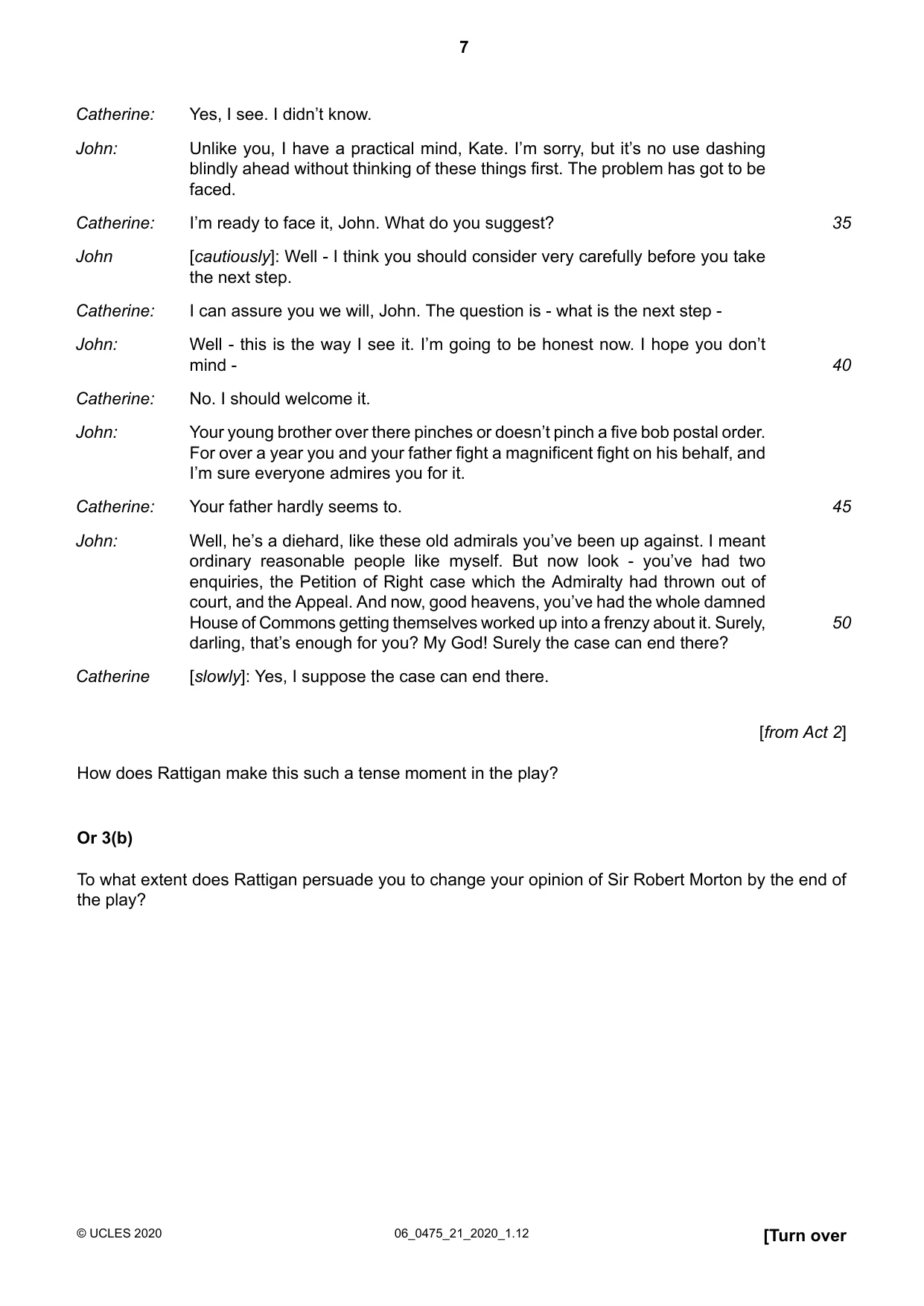
Question paper, page 7
50 45 40 35 Yes, I see. I didn’t know. Catherine: Unlike you, I have a practical mind, Kate. I’m sorry, but it’s no use dashing blindly ahead without thinking of these things first. The problem has got to be faced. John: I’m ready to face it, John. What do you suggest? Catherine: [cautiously]: Well - I think you should consider very carefully before you take the next step. John I can assure you we will, John. The question is - what is the next step - Catherine: Well - this is the way I see it. I’m going to be honest now. I hope you don’t mind - John: No. I should welcome it. Catherine: Your young brother over there pinches or doesn’t pinch a five bob postal order. For over a year you and your father fight a magnificent fight on his behalf, and I’m sure everyone admires you for it. John: Your father hardly seems to. Catherine: Well, he’s a diehard, like these old admirals you’ve been up against. I meant ordinary reasonable people like myself. But now look - you’ve had two enquiries, the Petition of Right case which the Admiralty had thrown out of court, and the Appeal. And now, good heavens, you’ve had the whole damned House of Commons getting themselves worked up into a frenzy about it. Surely, darling, that’s enough for you? My God! Surely the case can end there? John: [slowly]: Yes, I suppose the case can end there. Catherine [from Act 2] How does Rattigan make this such a tense moment in the play? Or 3(b) To what extent does Rattigan persuade you to change your opinion of Sir Robert Morton by the end of the play? [Turn over 06_0475_21_2020_1.12 © UCLES 2020 7
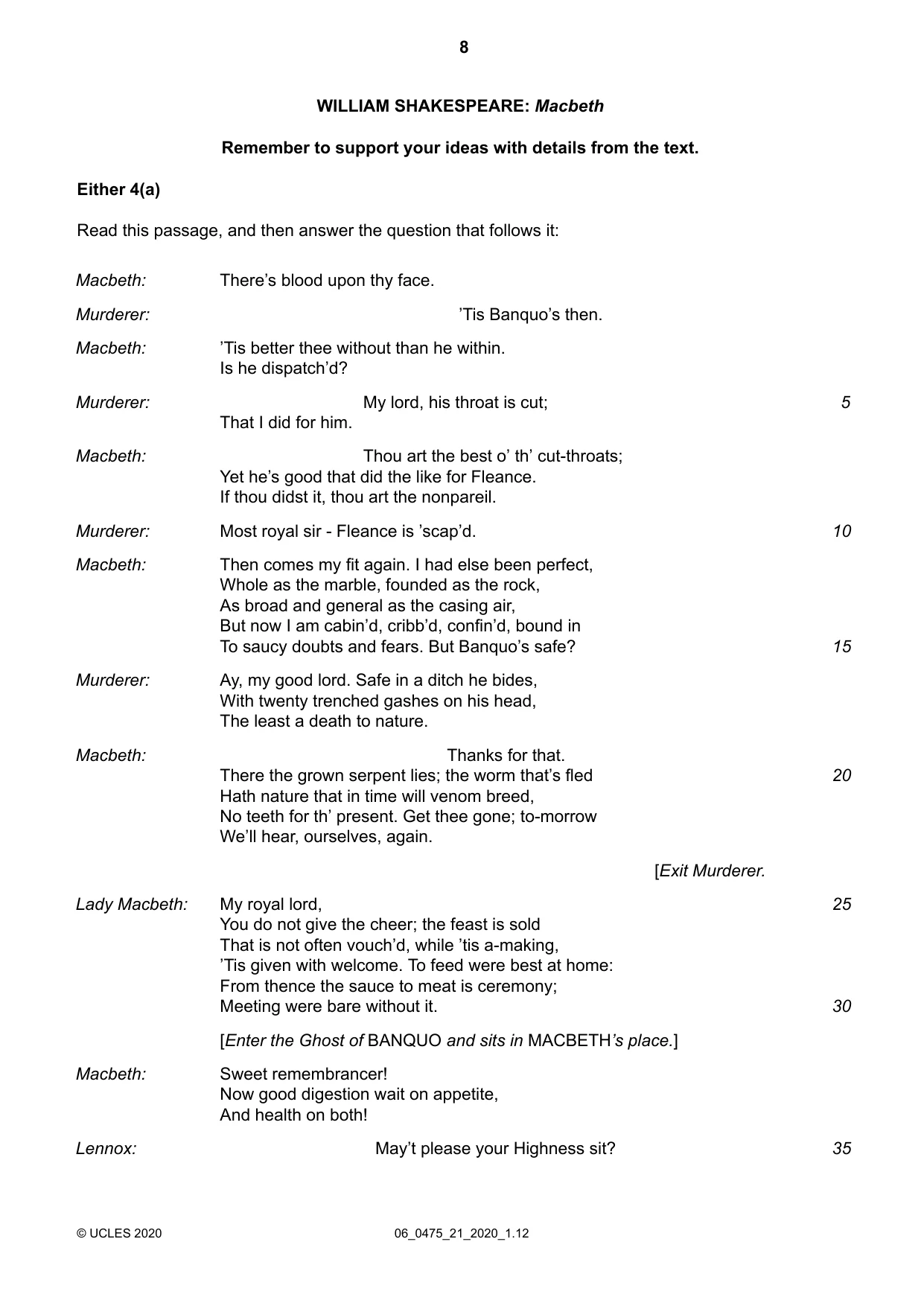
Question paper, page 8
35 30 25 20 15 10 5 WILLIAM SHAKESPEARE: Macbeth Remember to support your ideas with details from the text. Either 4(a) Read this passage, and then answer the question that follows it: There’s blood upon thy face. Macbeth: ’Tis Banquo’s then. Murderer: ’Tis better thee without than he within. Is he dispatch’d? Macbeth: My lord, his throat is cut; That I did for him. Murderer: Thou art the best o’ th’ cut-throats; Yet he’s good that did the like for Fleance. If thou didst it, thou art the nonpareil. Macbeth: Most royal sir - Fleance is ’scap’d. Murderer: Then comes my fit again. I had else been perfect, Whole as the marble, founded as the rock, As broad and general as the casing air, But now I am cabin’d, cribb’d, confin’d, bound in To saucy doubts and fears. But Banquo’s safe? Macbeth: Ay, my good lord. Safe in a ditch he bides, With twenty trenched gashes on his head, The least a death to nature. Murderer: Thanks for that. There the grown serpent lies; the worm that’s fled Hath nature that in time will venom breed, No teeth for th’ present. Get thee gone; to-morrow We’ll hear, ourselves, again. Macbeth: [Exit Murderer. My royal lord, You do not give the cheer; the feast is sold That is not often vouch’d, while ’tis a-making, ’Tis given with welcome. To feed were best at home: From thence the sauce to meat is ceremony; Meeting were bare without it. Lady Macbeth: [Enter the Ghost of BANQUO and sits in MACBETH’s place.] Sweet remembrancer! Now good digestion wait on appetite, And health on both! Macbeth: May’t please your Highness sit? Lennox: 06_0475_21_2020_1.12 © UCLES 2020 8
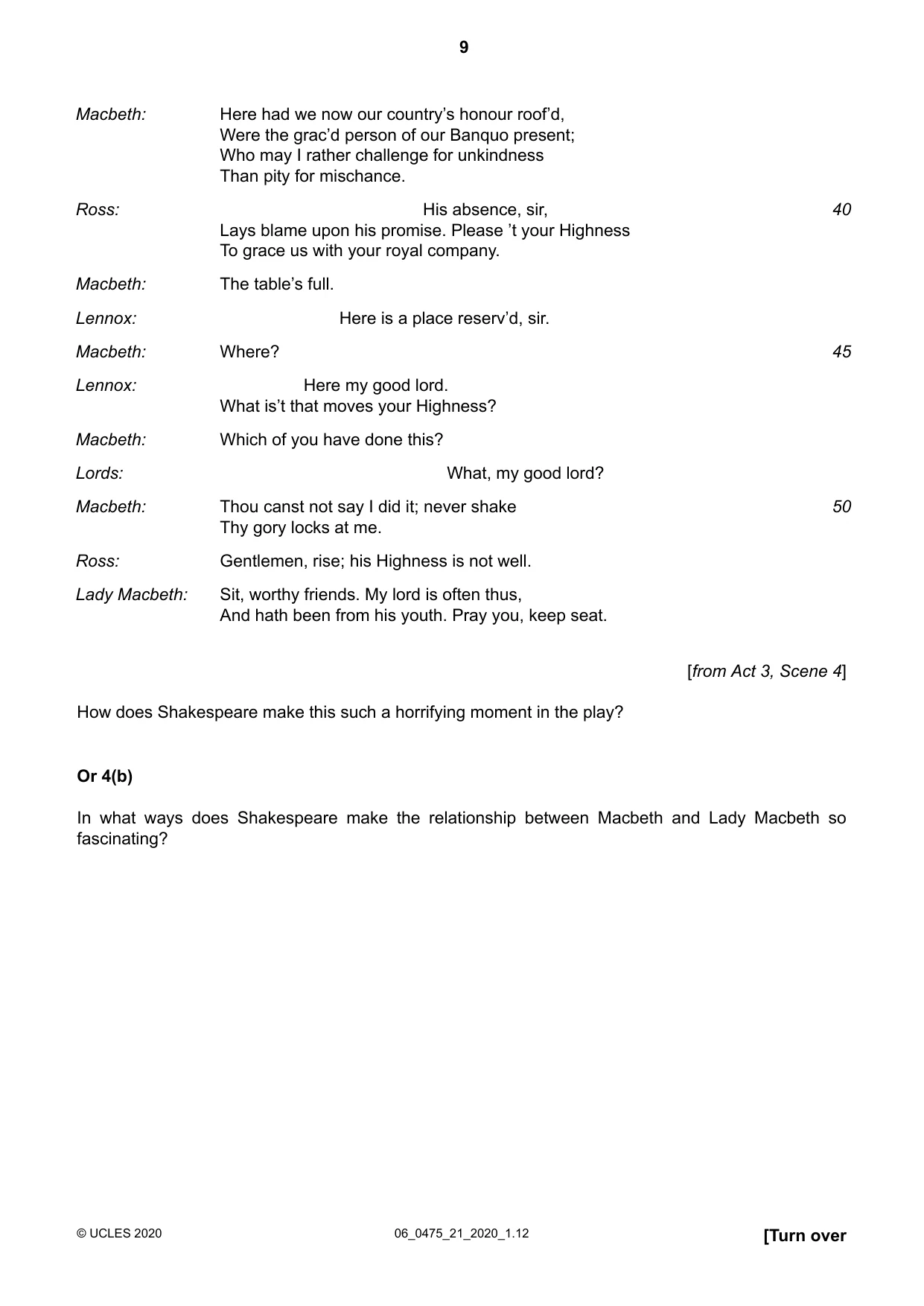
Question paper, page 9
50 45 40 Here had we now our country’s honour roof’d, Were the grac’d person of our Banquo present; Who may I rather challenge for unkindness Than pity for mischance. Macbeth: His absence, sir, Lays blame upon his promise. Please ’t your Highness To grace us with your royal company. Ross: The table’s full. Macbeth: Here is a place reserv’d, sir. Lennox: Where? Macbeth: Here my good lord. What is’t that moves your Highness? Lennox: Which of you have done this? Macbeth: What, my good lord? Lords: Thou canst not say I did it; never shake Thy gory locks at me. Macbeth: Gentlemen, rise; his Highness is not well. Ross: Sit, worthy friends. My lord is often thus, And hath been from his youth. Pray you, keep seat. Lady Macbeth: [from Act 3, Scene 4] How does Shakespeare make this such a horrifying moment in the play? Or 4(b) In what ways does Shakespeare make the relationship between Macbeth and Lady Macbeth so fascinating? [Turn over 06_0475_21_2020_1.12 © UCLES 2020 9
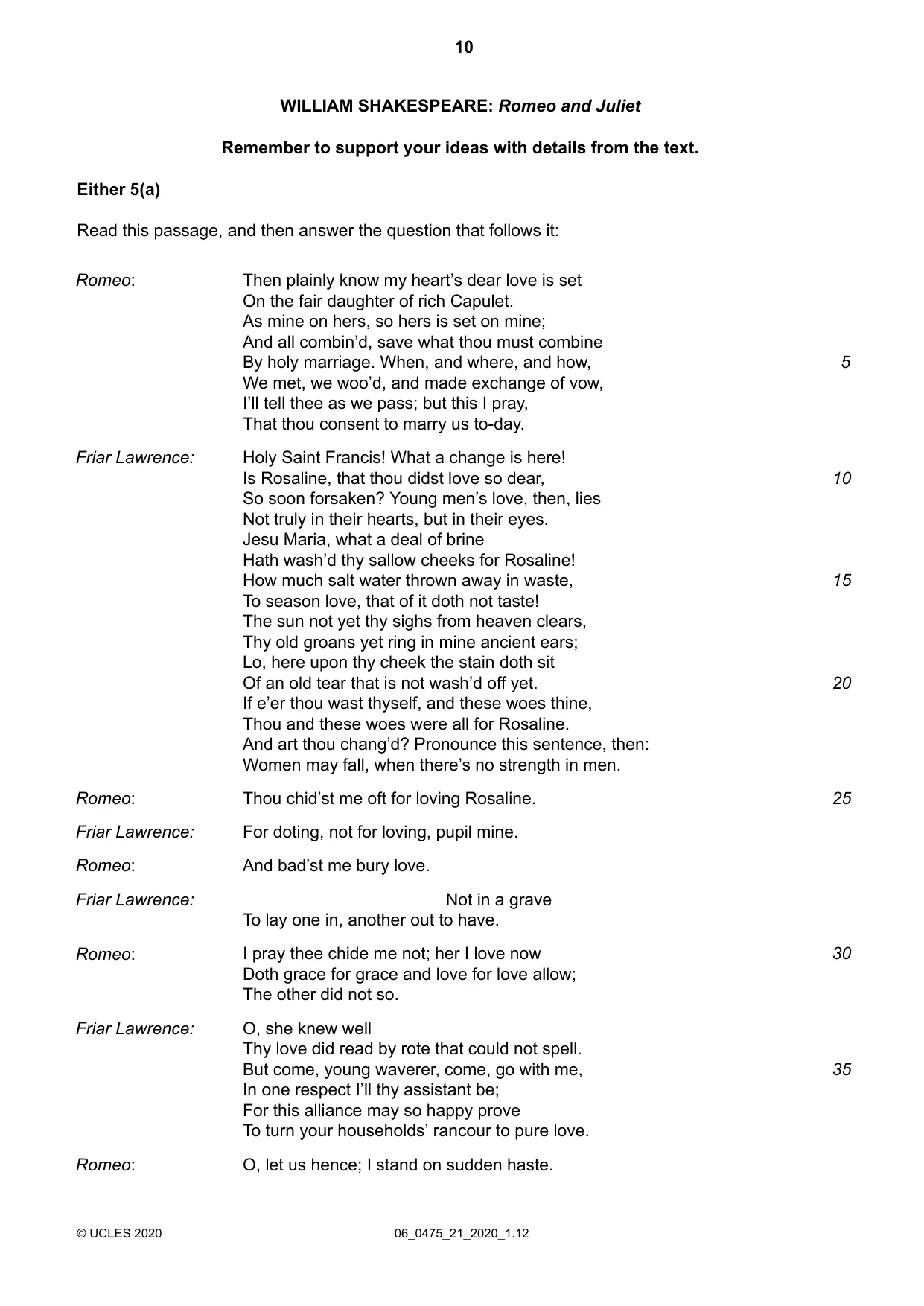
Question paper, page 10
35 30 25 20 15 10 5 WILLIAM SHAKESPEARE: Romeo and Juliet Remember to support your ideas with details from the text. Either 5(a) Read this passage, and then answer the question that follows it: Then plainly know my heart’s dear love is set On the fair daughter of rich Capulet. As mine on hers, so hers is set on mine; And all combin’d, save what thou must combine By holy marriage. When, and where, and how, We met, we woo’d, and made exchange of vow, I’ll tell thee as we pass; but this I pray, That thou consent to marry us to-day. Romeo: Holy Saint Francis! What a change is here! Is Rosaline, that thou didst love so dear, So soon forsaken? Young men’s love, then, lies Not truly in their hearts, but in their eyes. Jesu Maria, what a deal of brine Hath wash’d thy sallow cheeks for Rosaline! How much salt water thrown away in waste, To season love, that of it doth not taste! The sun not yet thy sighs from heaven clears, Thy old groans yet ring in mine ancient ears; Lo, here upon thy cheek the stain doth sit Of an old tear that is not wash’d off yet. If e’er thou wast thyself, and these woes thine, Thou and these woes were all for Rosaline. And art thou chang’d? Pronounce this sentence, then: Women may fall, when there’s no strength in men. Friar Lawrence: Thou chid’st me oft for loving Rosaline. Romeo: For doting, not for loving, pupil mine. Friar Lawrence: And bad’st me bury love. Romeo: Not in a grave To lay one in, another out to have. Friar Lawrence: I pray thee chide me not; her I love now Doth grace for grace and love for love allow; The other did not so. Romeo: O, she knew well Thy love did read by rote that could not spell. But come, young waverer, come, go with me, In one respect I’ll thy assistant be; For this alliance may so happy prove To turn your households’ rancour to pure love. Friar Lawrence: O, let us hence; I stand on sudden haste. Romeo: 06_0475_21_2020_1.12 © UCLES 2020 10
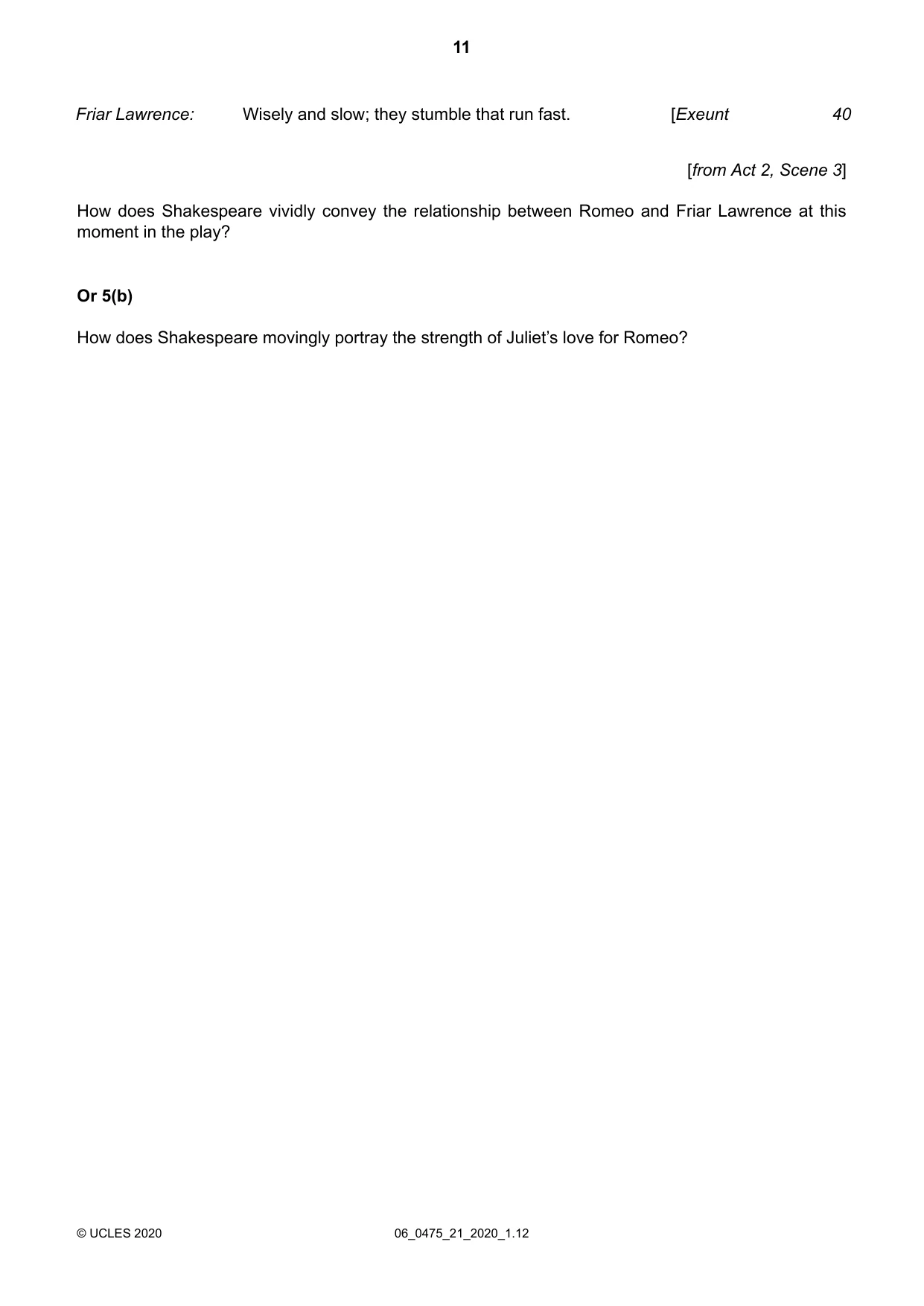
Question paper, page 11
40 Wisely and slow; they stumble that run fast. [Exeunt Friar Lawrence: [from Act 2, Scene 3] How does Shakespeare vividly convey the relationship between Romeo and Friar Lawrence at this moment in the play? Or 5(b) How does Shakespeare movingly portray the strength of Juliet’s love for Romeo? 06_0475_21_2020_1.12 © UCLES 2020 11
Question paper, page 12
BLANK PAGE Permission to reproduce items where third-party owned material protected by copyright is included has been sought and cleared where possible. Every reasonable effort has been made by the publisher (UCLES) to trace copyright holders, but if any items requiring clearance have unwittingly been included, the publisher will be pleased to make amends at the earliest possible opportunity. To avoid the issue of disclosure of answer-related information to candidates, all copyright acknowledgements are reproduced online in the Cambridge Assessment International Education Copyright Acknowledgements Booklet. This is produced for each series of examinations and is freely available to download at www.cambridgeinternational.org after the live examination series. Cambridge Assessment International Education is part of the Cambridge Assessment Group. Cambridge Assessment is the brand name of the University of Cambridge Local Examinations Syndicate (UCLES), which itself is a department of the University of Cambridge. 06_0475_21_2020_1.12 © UCLES 2020 12
Mark scheme, page 1
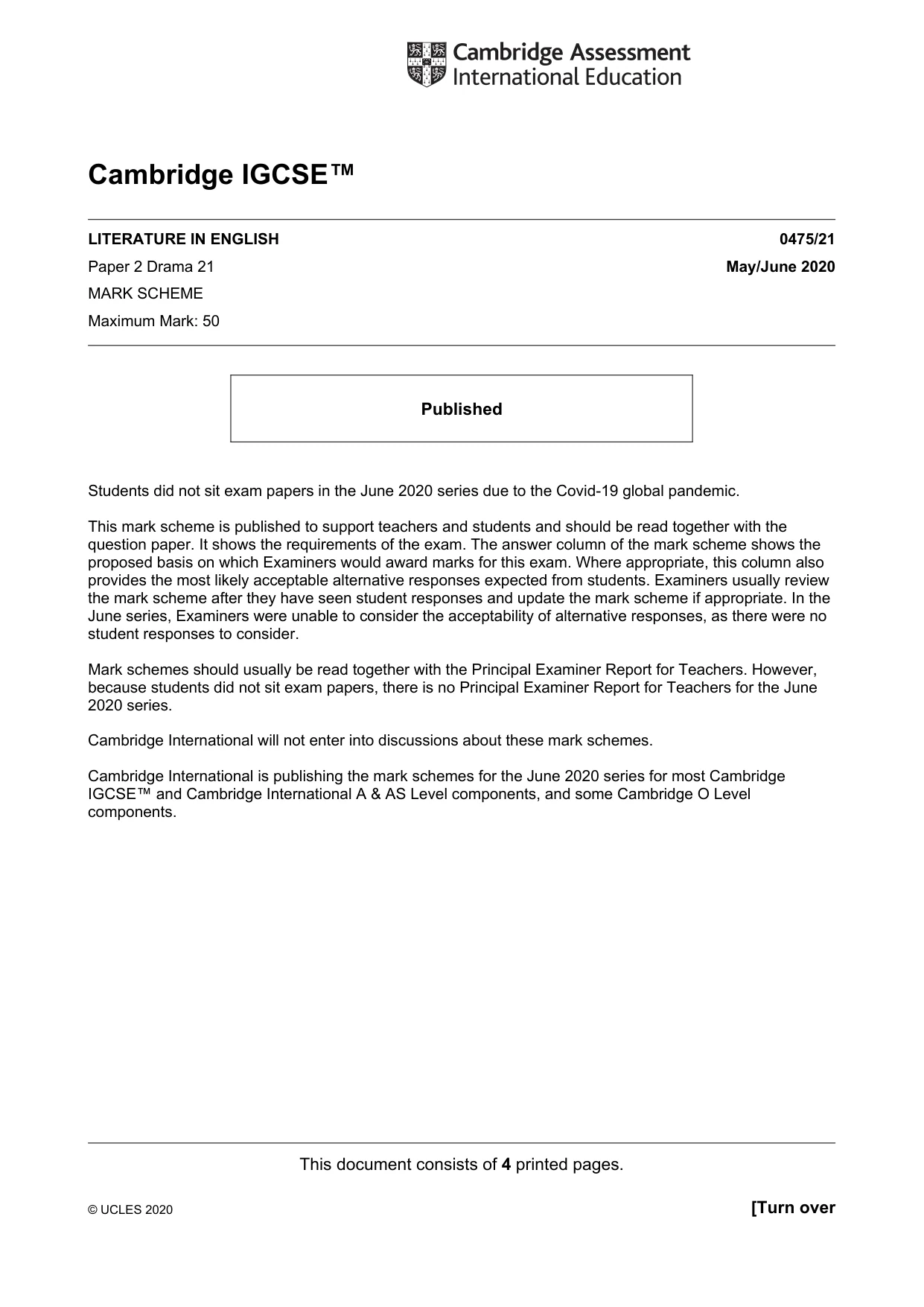
This document consists of 4 printed pages. © UCLES 2020 [Turn over Cambridge IGCSE™ LITERATURE IN ENGLISH 0475/21 Paper 2 Drama 21 May/June 2020 MARK SCHEME Maximum Mark: 50 Published Students did not sit exam papers in the June 2020 series due to the Covid-19 global pandemic. This mark scheme is published to support teachers and students and should be read together with the question paper. It shows the requirements of the exam. The answer column of the mark scheme shows the proposed basis on which Examiners would award marks for this exam. Where appropriate, this column also provides the most likely acceptable alternative responses expected from students. Examiners usually review the mark scheme after they have seen student responses and update the mark scheme if appropriate. In the June series, Examiners were unable to consider the acceptability of alternative responses, as there were no student responses to consider. Mark schemes should usually be read together with the Principal Examiner Report for Teachers. However, because students did not sit exam papers, there is no Principal Examiner Report for Teachers for the June 2020 series. Cambridge International will not enter into discussions about these mark schemes. Cambridge International is publishing the mark schemes for the June 2020 series for most Cambridge IGCSE™ and Cambridge International A & AS Level components, and some Cambridge O Level components.
Mark scheme, page 2
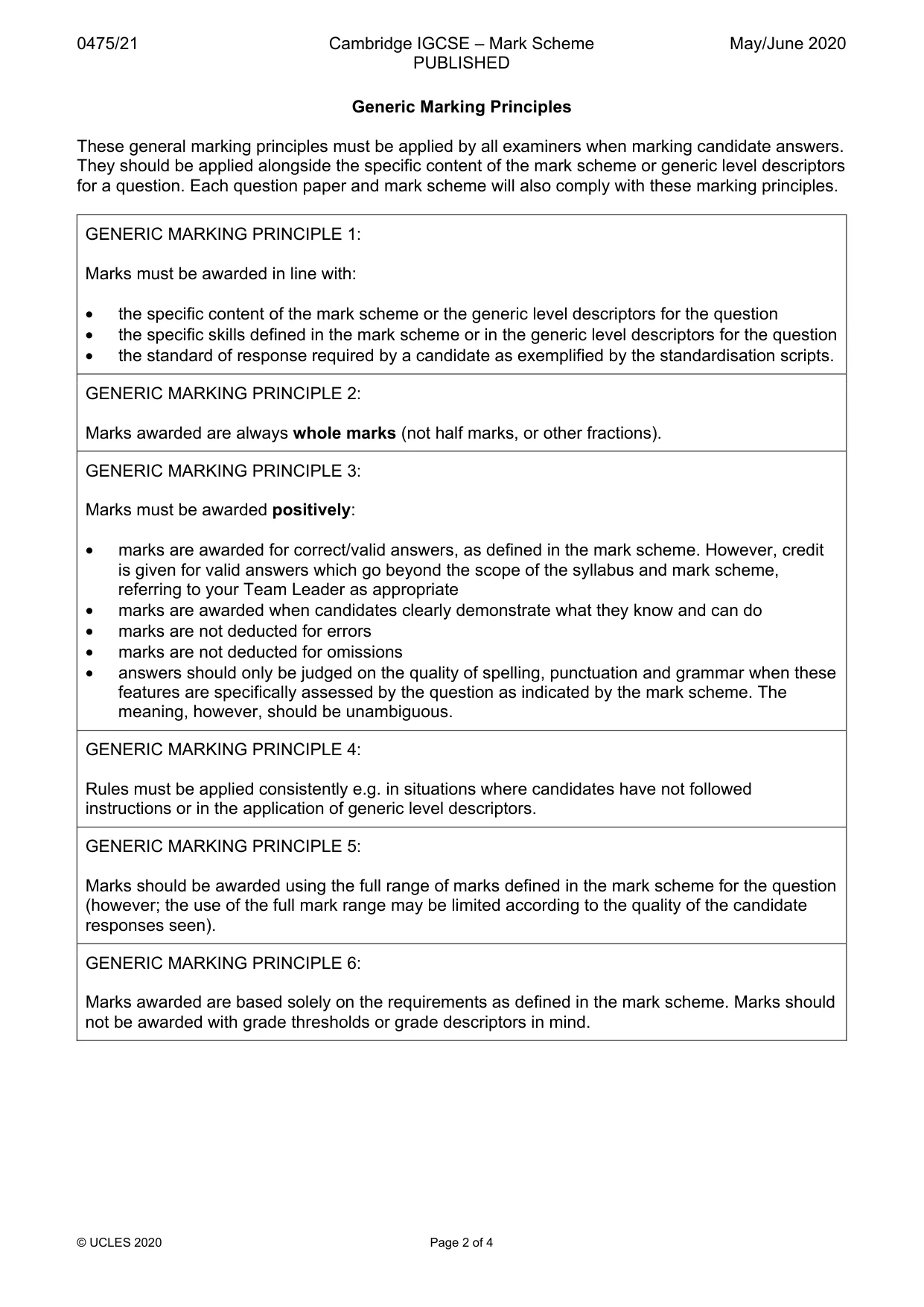
0475/21 Cambridge IGCSE – Mark Scheme PUBLISHED May/June 2020 © UCLES 2020 Page 2 of 4 Generic Marking Principles These general marking principles must be applied by all examiners when marking candidate answers. They should be applied alongside the specific content of the mark scheme or generic level descriptors for a question. Each question paper and mark scheme will also comply with these marking principles. GENERIC MARKING PRINCIPLE 1: Marks must be awarded in line with: • the specific content of the mark scheme or the generic level descriptors for the question • the specific skills defined in the mark scheme or in the generic level descriptors for the question • the standard of response required by a candidate as exemplified by the standardisation scripts. GENERIC MARKING PRINCIPLE 2: Marks awarded are always whole marks (not half marks, or other fractions). GENERIC MARKING PRINCIPLE 3: Marks must be awarded positively: • marks are awarded for correct/valid answers, as defined in the mark scheme. However, credit is given for valid answers which go beyond the scope of the syllabus and mark scheme, referring to your Team Leader as appropriate • marks are awarded when candidates clearly demonstrate what they know and can do • marks are not deducted for errors • marks are not deducted for omissions • answers should only be judged on the quality of spelling, punctuation and grammar when these features are specifically assessed by the question as indicated by the mark scheme. The meaning, however, should be unambiguous. GENERIC MARKING PRINCIPLE 4: Rules must be applied consistently e.g. in situations where candidates have not followed instructions or in the application of generic level descriptors. GENERIC MARKING PRINCIPLE 5: Marks should be awarded using the full range of marks defined in the mark scheme for the question (however; the use of the full mark range may be limited according to the quality of the candidate responses seen). GENERIC MARKING PRINCIPLE 6: Marks awarded are based solely on the requirements as defined in the mark scheme. Marks should not be awarded with grade thresholds or grade descriptors in mind.
Mark scheme, page 3
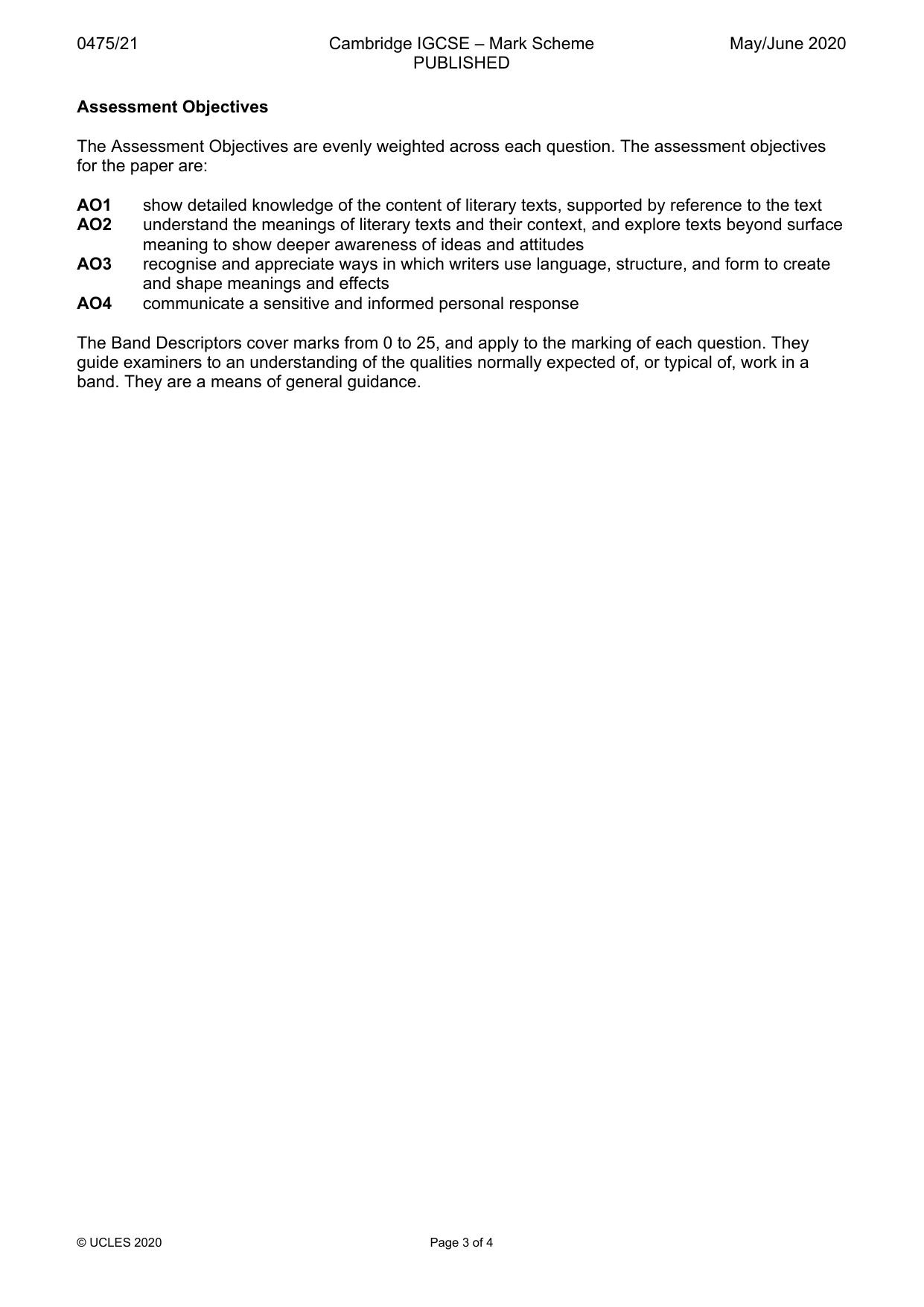
0475/21 Cambridge IGCSE – Mark Scheme PUBLISHED May/June 2020 © UCLES 2020 Page 3 of 4 Assessment Objectives The Assessment Objectives are evenly weighted across each question. The assessment objectives for the paper are: AO1 show detailed knowledge of the content of literary texts, supported by reference to the text AO2 understand the meanings of literary texts and their context, and explore texts beyond surface meaning to show deeper awareness of ideas and attitudes AO3 recognise and appreciate ways in which writers use language, structure, and form to create and shape meanings and effects AO4 communicate a sensitive and informed personal response The Band Descriptors cover marks from 0 to 25, and apply to the marking of each question. They guide examiners to an understanding of the qualities normally expected of, or typical of, work in a band. They are a means of general guidance.
Mark scheme, page 4
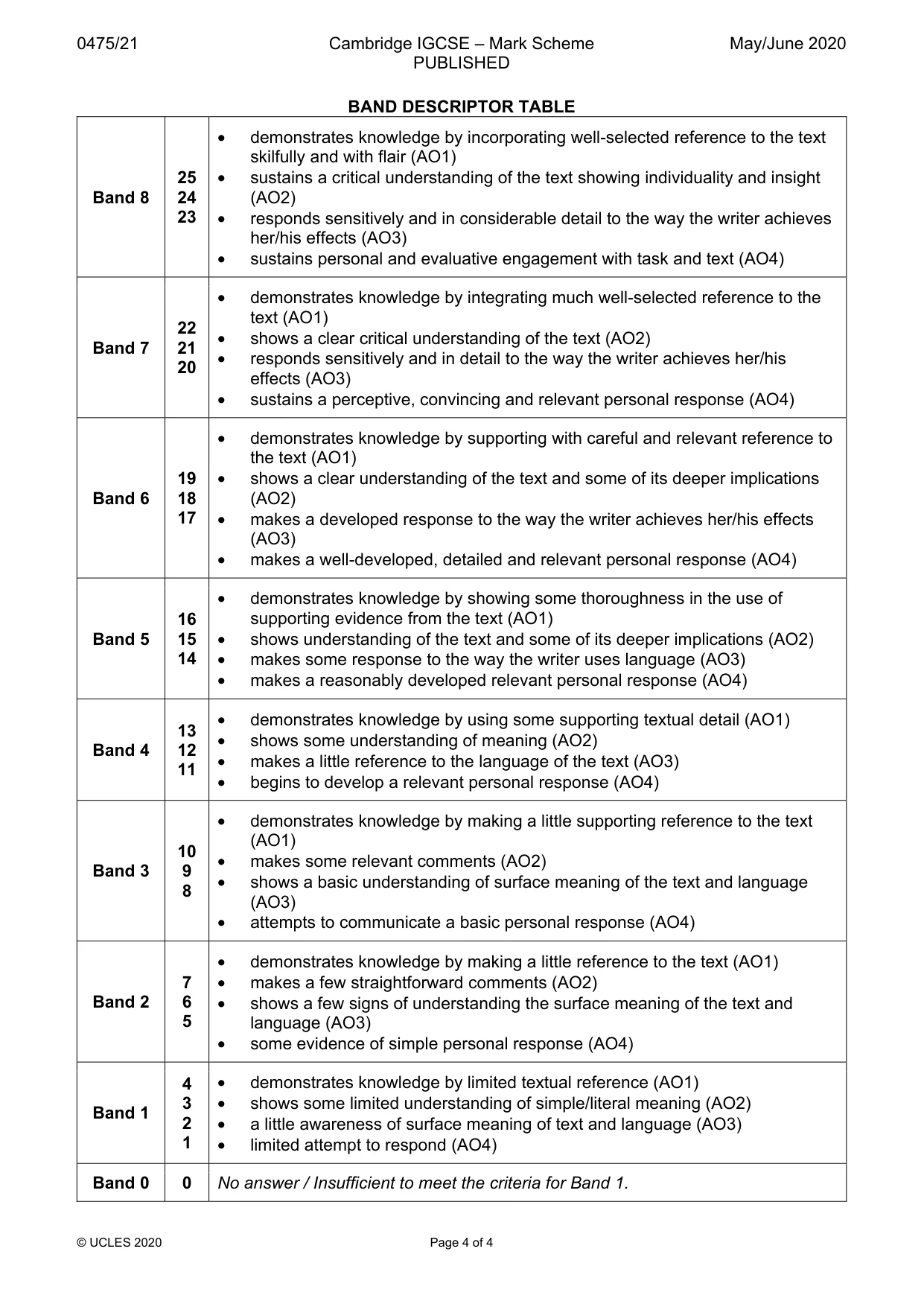
0475/21 Cambridge IGCSE – Mark Scheme PUBLISHED May/June 2020 © UCLES 2020 Page 4 of 4 BAND DESCRIPTOR TABLE Band 8 25 24 23 • demonstrates knowledge by incorporating well-selected reference to the text skilfully and with flair (AO1) • sustains a critical understanding of the text showing individuality and insight (AO2) • responds sensitively and in considerable detail to the way the writer achieves her/his effects (AO3) • sustains personal and evaluative engagement with task and text (AO4) Band 7 22 21 20 • demonstrates knowledge by integrating much well-selected reference to the text (AO1) • shows a clear critical understanding of the text (AO2) • responds sensitively and in detail to the way the writer achieves her/his effects (AO3) • sustains a perceptive, convincing and relevant personal response (AO4) Band 6 19 18 17 • demonstrates knowledge by supporting with careful and relevant reference to the text (AO1) • shows a clear understanding of the text and some of its deeper implications (AO2) • makes a developed response to the way the writer achieves her/his effects (AO3) • makes a well-developed, detailed and relevant personal response (AO4) Band 5 16 15 14 • demonstrates knowledge by showing some thoroughness in the use of supporting evidence from the text (AO1) • shows understanding of the text and some of its deeper implications (AO2) • makes some response to the way the writer uses language (AO3) • makes a reasonably developed relevant personal response (AO4) Band 4 13 12 11 • demonstrates knowledge by using some supporting textual detail (AO1) • shows some understanding of meaning (AO2) • makes a little reference to the language of the text (AO3) • begins to develop a relevant personal response (AO4) Band 3 10 9 8 • demonstrates knowledge by making a little supporting reference to the text (AO1) • makes some relevant comments (AO2) • shows a basic understanding of surface meaning of the text and language (AO3) • attempts to communicate a basic personal response (AO4) Band 2 7 6 5 • demonstrates knowledge by making a little reference to the text (AO1) • makes a few straightforward comments (AO2) • shows a few signs of understanding the surface meaning of the text and language (AO3) • some evidence of simple personal response (AO4) Band 1 4 3 2 1 • demonstrates knowledge by limited textual reference (AO1) • shows some limited understanding of simple/literal meaning (AO2) • a little awareness of surface meaning of text and language (AO3) • limited attempt to respond (AO4) Band 0 0 No answer / Insufficient to meet the criteria for Band 1.