Questions as text
Q1 · Calculate Pakistan’s trade in goods balance in 2017 0987/22 May/June 2020
1 (a) Calculate Pakistan’s trade in goods balance in 2017. [1] (b) Identify two possible causes of demand-pull inflation in Pakistan in 2017. [2] (c) Explain the opportunity cost to Pakistan of producing consumer goods. [2] (d) Explain two reasons why education is a merit good. [4] (e) Analyse why the children of poor families tend to receive less education than the children of rich families. [4] (f) Analyse the relationship between GDP per head and imports per head. [5] (g) Discuss whether or not the supply of teachers in Pakistan is likely to increase in the future. [6] (h) Discuss whether or not an increase in its import tariffs would be likely to benefit the Pakistani economy. [6]
30 marks
Mark scheme: Question Answer Marks 1(a) Calculate Pakistan’s trade in goods balance in 2017. 1 –$36.5bn (1). 1(b) Identify two possible causes of demand-pull inflation in Pakistan in 2 2017. Any two from: Higher government spending (1) higher consumer spending / rising population (1) increased investment (1). 1(c) Explain the opportunity cost to Pakistan of producing consumer 2 goods. Logical explanation which might include: Capital goods (1) resources that could have been used to produce capital goods are being used to produce consumer goods / (next) best alternative forgone (1). 1(d) Explain two reasons why education is a merit good. 4 Logical explanation which might include: People underestimate full benefit / private benefit (1) not appreciating health and job opportunity benefits (1). People not taking into account external benefits (1) e.g. better quality products/larger quantity of products or economic growth (1). 1(e) Analyse why the children of poor families tend to receive less 4 education than the children of rich families. Coherent analysis which might include: The children of the poor may not attend school (1) they may have to work (1) to help support their families (1). Poor families are likely to have difficulty paying to have their children educated (1) some schools in Pakistan are in the private sector (1) there seems to be a lack of low-cost schools (1). The children of the poor may leave school at a younger age (1) may miss more school days due to ill health (1). 1(f) Analyse the relationship between GDP per head and imports per head. 5 Coherent analysis which might include: Generally the countries with the highest GDP per head spend the most per head on imports (1) examples e.g. Norway has the highest income per head and the highest spending on imports per head and Haiti has the lowest income and the lowest spending on imports (up to 2) exception: Russia has a higher income per head than Mexico but a lower spending per head on imports (1). Expected relationship as income rises (1) people can afford more imports (1). The four countries with above average GDP per head spend above the global average on imports (1). The two countries with below average GDP per head spend more on imports (1). 1(g) Discuss whether or not the supply of teachers in Pakistan is likely to 6 increase in the future. Generic example mark Tax revenue may decrease… 1 ...because of reason e.g. incomes may be lower. 1 Tax revenue may increase because incomes may be higher i.e. 0 reverse of a previous argument. Tax revenue may increase because of a different reason i.e. not the reverse of a previous argument e.g. government spending on 1 subsidies may stimulate the economy more than spending on education. Award up to 4 marks for logical reasons why it might, which may include: • education standards may rise (1) which may increase those qualified to be teachers (1) • working conditions may improve (1) with better buildings (1) • population is increasing (1) which may increase the size of the labour force (1). Award up to 4 marks for logical reasons why it might not, which may include: • wages may not rise (1) teachers may switch to other jobs (1) • teachers may emigrate to other countries (1) • the qualifications required to be a teacher may increase (1) by more than educational standards rise (1). 1(h) Discuss whether or not an increase in its import tariffs would be likely 6 to benefit the Pakistani economy. Award up to 4 marks for logical reasons why it might, which may include: • may reduce the trade deficit (1) by reducing demand for imports (1) • tax revenue may increase (1) enabling the government to increase its spending (1) • may help protect infant industries (1) until they can take advantage of economies of scale (1). Award up to 4 marks for logical reasons why it might not, which may include: • demand for some finished imports may be price inelastic (1) • demand for capital goods / raw materials may be inelastic (1) • incomes may rise (1), leading to higher spending on imports (1) • other countries may impose trade restrictions (1) reducing Pakistan’s ability to export (1).
This question in 0987/22 May/June 2020
Q2 · Calculate the value of Nigeria’s exports of goods in 2017 0987/21 May/June 2021
1 (a) Calculate the value of Nigeria’s exports of goods in 2017. [1] (b) Identify two examples of capital goods. [2] (c) Explain whether Nigeria had a budget deficit or a budget surplus in 2017. [2] (d) Explain how government spending on training may increase tax revenue in the long run. [4] (e) Analyse how living standards in Nigeria compare with living standards in Ethiopia in 2017. [4] (f) Analyse how a government could encourage firms to increase their investment. [5] (g) Discuss whether or not an increase in Nigeria’s population will benefit its economy. [6] (h) Discuss whether or not an increase in Nigeria’s import tariff on rice would increase the output of Nigerian rice. [6]
30 marks
Mark scheme: 1(a) Calculate the value of Nigeria’s exports of goods in 2017. $43.1bn 1 $ is not essential. 1(b) Identify two examples of capital goods. Two from: • [delivery] vehicles • machines • [office] equipment 2 1(c) Explain whether Nigeria had a budget deficit or a budget surplus in 2017. • budget deficit (1) • government spending exceeded tax revenue (1) • government spending was $19.5bn and tax revenue was $12.9bn (1) 2 1(d) Explain how government spending on training may increase tax revenue in the long run. Logical explanation which might include: • Training may increase skills of workers (1) raise productivity (1) raise wages / incomes (1) increase job opportunities / employment / reduce unemployment (1) increase income tax revenue (1). • Higher wages may increase spending / demand (1) increase indirect tax revenue (1). • A more productive labour force may reduce costs of production (1) raise profits (1) increase corporation tax revenue (1). 4 Question Answer Marks Guidance 1(e) Analyse how living standards in Nigeria compare with the living standards in Ethiopia in 2017. Coherent analysis which might include: • Nigeria’s higher GDP per head (income) (1) suggests Nigerians may have been able to enjoy more goods and services (1). • Nigeria has a lower life expectancy (1) suggesting poorer healthcare (1). • Nigeria has a higher average number of years spent at school (1) suggesting the labour force may be more educated (1). • Nigeria has a higher percentage of underweight five-year olds (1) suggesting poor nutrition / income inequality (1). • Overall comment: Nigeria’s income per head and average years spent at school suggests a higher living standard but life expectancy and percentage of five years underweight suggests a lower living standard (1). 4 Question Answer Marks Guidance 1(f) Analyse how a government could encourage firms to increase their investment. Coherent analysis which might include: • Reduce the rate of interest (1) making it cheaper to borrow (1) encouraging borrowing as consumer spending is likely to rise (1). • Lower corporation tax (1) increasing the funds available to invest (1) increasing the incentive to invest as return from investment would rise (1). • Create greater economic certainty / confidence (1) by e.g. keeping inflation low and stable / not changing government spending and taxation frequently (1) making it easier for firms to plan / it can take time to get a return from investment (1). • Provide subsidies/grants/loans (1) decreasing cost of investments (1) encouraging MNCs (1). • Raise tariffs (1) increasing demand for home produced goods (1). • Less government regulation/policies (1) reduces costs for firms (1) more willing to invest (1). 5 Question Answer Marks Guidance 1(g) Discuss whether or not an increase in Nigeria’s population will benefit its economy. Award up to 4 marks for why it might: • Fall in death rate (1) may indicate improved healthcare (1). • Total (aggregate) demand will increase (1) may enable existing firms to expand / increase output (1) new firms to set up (1) attract MNCs (1). • Labour force may increase (1) causing total (aggregate) supply to increase / raise productive capacity (1) increase output / GDP (1). • May move country towards optimum population (1) if there are unused resources (1). • Net immigration will increase labour force (1) and reduce dependency ratio (1) • More tax revenue (1) can be spent on improving e.g., public services (1). Award up to 4 marks for why it might not: • Birth rate is rising (1) will increase dependency (1) resources which may have increased economic growth may have to be devoted to rearing the children (1). • Labour force may fall in the short run (1) to look after the children (1). • Pressure will be put on the environment (1) there may be more pollution (1) causing overcrowding / poor health (1). • If food output cannot be increased (1) may be more malnourishment/famine / poverty (1) more food is required / food may have to be imported (1) food prices may increase (1). 6 Apply this example to all questions with the command word DISCUSS (1(g), 1(h), 2(d), 3(d), 4(d) and 5(d)) Each point may be credited only once, on either side of an argument, but separate development as to how/why the outcome may differ is rewarded. Generic example Mark Tax revenue may decrease… 1 ...because of reason e.g. incomes may be lower. 1 Tax revenue may increase because incomes may be higher i.e. reverse of a previous argument. 0 Tax revenue may increase because of a different reason i.e. not the reverse of a previous argument e.g. government spending on subsidies may stimulate the economy more than spending on education. 1 Question Answer Marks Guidance 1(g) • Population is rising but age structure may be changing (1) as there is net emigration of young people (1) may result in reduction in labour force (1). • [Opportunity] cost for government (1) which has to spend on health/education rather than infrastructure (1). • Increase in output to meet demand (1) results in faster usage of resources in country (1) and shortages (1). Question Answer Marks Guidance 1(h) Discuss whether or not an increase in Nigeria’s import tariff on rice would increase the output of Nigerian rice. Award up to 4 marks for why it might: • A higher tariff may raise the price of imported rice (1) may reduce demand for / consumption of imported rice (1) may cause Nigerians to demand more home- produced rice as it is cheaper (1) effect would be greater, the greater the elasticity of demand for the import of rice (1) may enable Nigerian rice farmers to raise their price / make more profit (1). • A tariff may raise government tax revenue (1) some of this could be used to subsidise Nigerian rice farmers / modernise farming methods and so raise productivity (1). Award up to 4 marks for why it might not: • Nigerian farmers are less productive than Asian competitors (1) have high(er) costs of production (1) Nigerian price may still be higher even with the higher import tariff (1). • The supply of Nigerian rice may be price-inelastic (1) so even if Nigerian farmers could sell their rice for more, they may have difficulties adjusting supply (1). • More Nigerian rice will not be sold if quality is poor (1) consumers my prefer the varieties of rice produced in other countries (1) other countries retaliate by imposing higher tariffs (1) current account surplus may be reduced (1). • Increase in import tariffs may be small (1) making little difference to import prices and consumption (1). • Not enough resources/ factors of production e.g., farmers (1) to produce more rice in Nigeria (1). 6
This question in 0987/21 May/June 2021
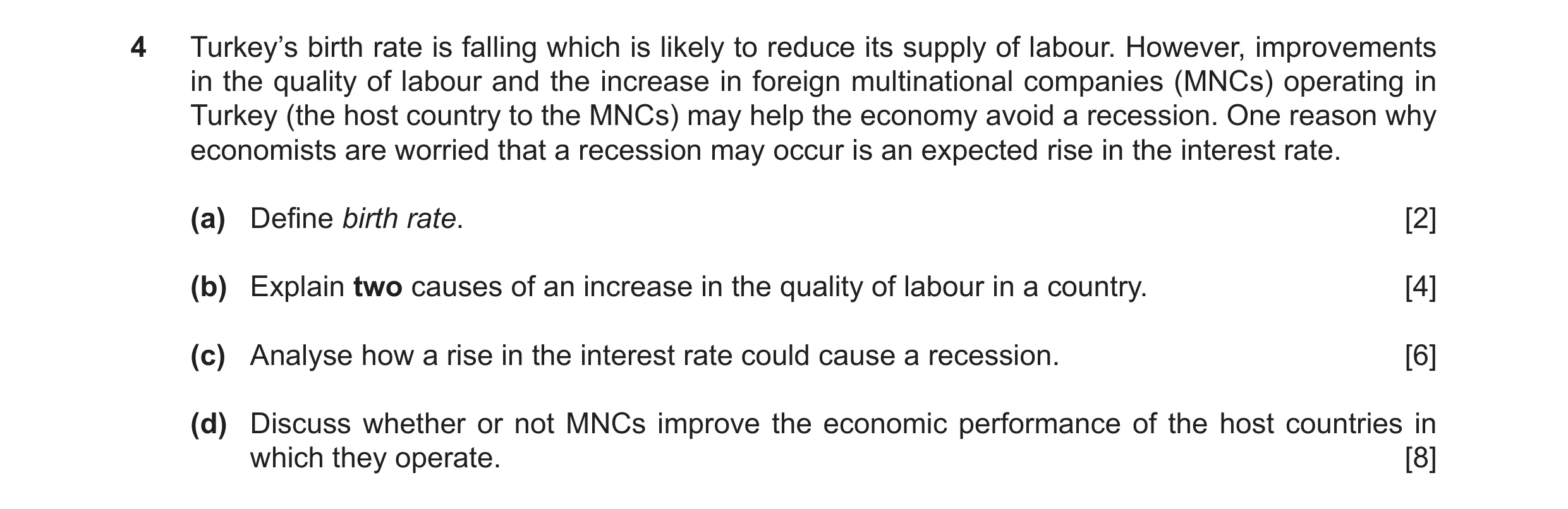
Q3 · Turkey’s birth rate is falling which is likely to reduce its supply of labour 0987/22 May/June 2021
4 Turkey’s birth rate is falling which is likely to reduce its supply of labour. However, improvements in the quality of labour and the increase in foreign multinational companies (MNCs) operating in Turkey (the host country to the MNCs) may help the economy avoid a recession. One reason why economists are worried that a recession may occur is an expected rise in the interest rate. (a) Define birth rate. [2] (b) Explain two causes of an increase in the quality of labour in a country. [4] (c) Analyse how a rise in the interest rate could cause a recession. [6] (d) Discuss whether or not MNCs improve the economic performance of the host countries in which they operate. [8]
20 marks
Mark scheme: 4(a) Define birth rate. The number of births per thousand of the population (1) in a year (1) live births (1) 2 Not sufficient to have just number of births. 4(b) Explain two causes of an increase in the quality of labour in a country. Logical explanation which might include: Improvements in education (1) qualifications / knowledge (1). Improvements in training (1) increasing skills (1). Improvements in healthcare (1) making workers physically/mentally stronger (1). Increases in pay (1) raising motivation (1). Improvements in nutrition (1) enabling workers to work harder / concentrate more (1). Reduction in working hours / length of working day (1) keeping workers fresher / enabling them to concentrate more (1). Improvements in working conditions (1) raising motivation / enabling workers to work harder / concentrate more (1) Immigration (1) of skilled workers (1). Experience (1) becoming more familiar with tasks (1). Specialisation (1) become more familiar with one task / ‘practice makes perfect’ (1). 4 One mark each for each of two causes identified and one mark each for each of two explanations. Question Answer Marks Guidance 4(c) Analyse how a rise in the interest rate could cause a recession. Coherent analysis which might include: A higher interest rate would increase the cost of borrowing (1) reduce borrowing (1) reduce the spending power of people who have borrowed in the past (1) increase saving (1) consumer expenditure / spending may fall (1) investment may fall / may discourage MNCs (1) unemployment may increase / employment may fall (1) total demand may fall (1) the output of goods and services / GDP may fall (1) if output falls over a period of two quarters / six months there will be a recession (1). A higher interest rate may encourage more people to buy the currency (1) to put money into the country’s financial institutions (1) raising the value of the foreign exchange rate (1) raising the price of exports (1) lowering demand for exports (1) reducing the price of imports (1) increasing demand for imports (1). 6 Question Answer Marks Guidance 4(d) Discuss whether or not MNCs improve the economic performance of the host countries in which they operate. In assessing each answer, use the table opposite. Why they might: • may bring in new technology and methods of production, increasing economic growth • may create new jobs, may reduce unemployment • may add to exports, reducing a current account deficit / increasing a current account surplus • may create more competition / have greater efficiency, lowering inflation • may increase tax revenue, enabling the government to spend more on e.g. education and healthcare Why they might not: • may drive out domestic producers, leaving the country’s output unchanged • may employ workers from their home country • may import capital equipment and raw materials from their home countries • may deplete non-renewable resources, reducing sustainable economic growth • may provide only low-skilled, low-paid jobs to locals • send profits back to home country • may cause external costs e.g. pollution 8 Help avoid a recession = one relevant identification. Level Description Marks 3 A reasoned discussion which accurately examines both sides of the economic argument, making use of economic information and clear and logical analysis to evaluate economic issues and situations. One side of the argument may have more depth than the other, but overall both sides of the argument are considered and developed. There is thoughtful evaluation of economic concepts, terminology, information and/or data appropriate to the question. The discussion may also point out the possible uncertainties of alternative decisions and outcomes. 6–8 2 A reasoned discussion which makes use of economic information and clear analysis to evaluate economic issues and situations. The answer may lack some depth and development may be one-sided. There is relevant use of economic concepts, terminology, information and data appropriate to the question. 3–5 1 There is a simple attempt at using economic definitions and terminology. Some reference may be made to economic theory, with occasional understanding. 1–2 0 A mark of zero should be awarded for no creditable content. 0
This question in 0987/22 May/June 2021
Q4 · The South Korean government thinks that Japan is dumping steel 0987/22 May/June 2022
4 The South Korean government thinks that Japan is dumping steel. South Korean firms trade with, and produce in, other countries. Some South Korean multinational companies (MNCs) claim to reduce poverty in their host countries. In 2019, South Korean firms were affected by a depreciation in South Korea’s foreign exchange rate. Some firms also experienced a shortage of workers, which was influenced by the country’s very low birth rate. (a) Define dumping. [2] (b) Explain two reasons why a country’s foreign exchange rate may depreciate. [4] (c) Analyse how a MNC could reduce poverty in a host country. [6] (d) Discuss whether or not a very low birth rate would be a cause for concern for a government. [8]
20 marks
Mark scheme: 4(a) Define dumping. The sale of a product at less than cost price (1) in a foreign country (1) to gain a larger market share (1) to get rid of surplus stock / to prevent price falling on the domestic market (1). 2 Accept the sale of a product at a low price. 4(b) Explain two reasons why a country’s foreign exchange rate may depreciate. Logical explanation which might include: Inflation / fall in productivity (1) may make domestic products less internationally competitive / reducing net exports / reducing exports / increasing imports (1). Income at home may rise (1) increasing demand for imports / diverting products from the home market (1). Incomes abroad may have fallen (1) reducing demand for exports (1). The rate of interest may have fallen (1) discouraging an inflow of funds from other countries / encouraging an outflow of funds to other countries (1). There may be speculation that the currency will fall in value (1) selling the currency before it falls in value (1) Inward foreign direct investment may fall / outward fdi may increase (1) due to changes in economic activity (1). A central bank/government may sell the currency (1) to increase exports / reduce imports / improve the balance of payments (1). Increase in supply of currency (could be shown by a diagram) (1). Decrease in demand for the currency (could be shown on a diagram) (1). 4 One mark for each of two reasons identified and one mark for each explanation. A common response may be an increase in the supply of the currency (1) to buy more imports (1); A decrease in demand for the currency (1) if less exports are sold (1). Total = 4. Question Answer Marks Guidance 4(c) Analyse how a MNC could reduce poverty in a host country. Coherent analysis which might include: A MNC could increase employment / create job opportunities (1) some of the unemployed could gain jobs / unemployment could fall (1). It may pay higher wages / incomes may rise (1) increasing workers’ ability to buy products / buy basic necessities (1). It may provide accommodation (1) and healthcare for workers (1). It may provide infrastructure (1) making e.g. transport/energy more affordable (1). It may provide training / invest in education (1) enabling people to earn higher wages in the long run (1). It may sell products at a cheaper price (1) enabling more goods and services to be purchased (1). It may pay taxes to the government / tax revenue may rise (1) enabling the government to spend on measures to reduce poverty (1). 6 Question Answer Marks Guidance 4(d) Discuss whether or not a very low birth rate would be a cause for concern for a government. In assessing each answer, use the table opposite. Why it might: may create an ageing population may reduce size of the labour force in the future may increase dependency ratio may reduce tax revenue may take population below the optimum level. Why it might not: may maintain the size of the labour force in the short run as parents do not have to leave the labour force may reduce overcrowding may reduce pollution may reduce depletion of non-renewable resources. 8 Level Description Marks 3 A reasoned discussion which accurately examines both sides of the economic argument, making use of economic information and clear and logical analysis to evaluate economic issues and situations. One side of the argument may have more depth than the other, but overall, both sides of the argument are considered and developed. There is thoughtful evaluation of economic concepts, terminology, information and/or data appropriate to the question. The discussion may also point out the possible uncertainties of alternative decisions and outcomes. 68 Question Answer Marks Guidance 4(d) 2 A reasoned discussion which makes use of economic information and clear analysis to evaluate economic issues and situations. The answer may lack some depth and development may be one-sided. There is relevant use of economic concepts, terminology, information and data appropriate to the question. 35 1 There is a simple attempt at using economic definitions and terminology. Some reference may be made to economic theory, with occasional understanding. 12 0 A mark of zero should be awarded for no creditable content. 0
This question in 0987/22 May/June 2022
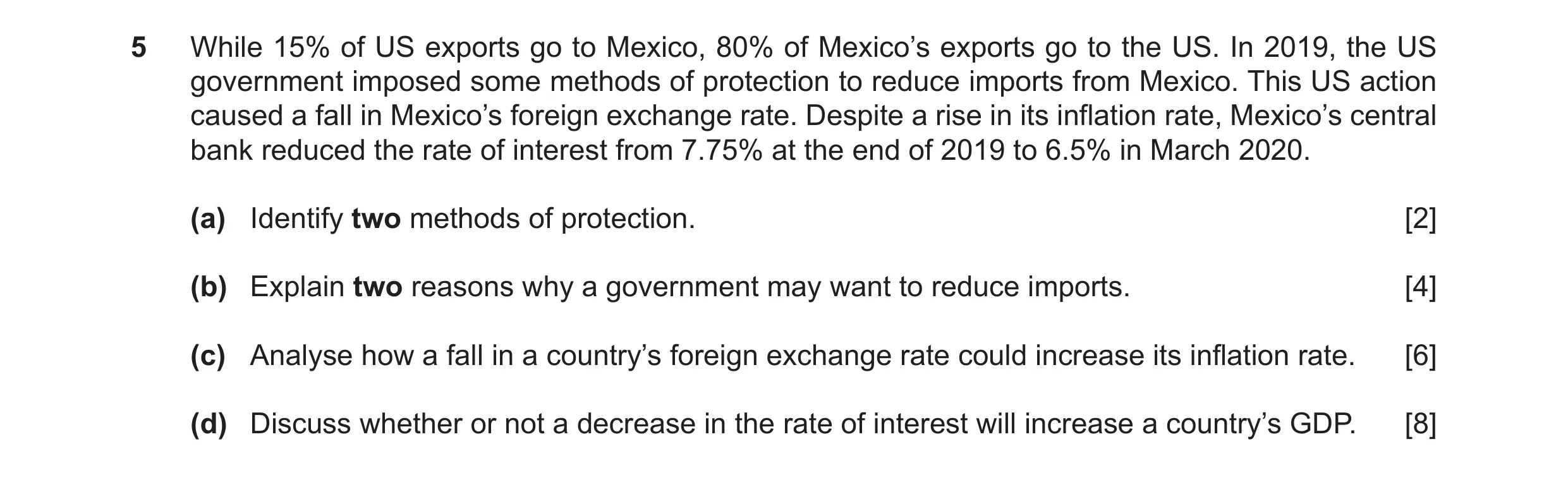
Q5 · While 15% of US exports go to Mexico, 80% of Mexico’s exports go to the US 0987/22 Oct/Nov 2022
5 While 15% of US exports go to Mexico, 80% of Mexico’s exports go to the US. In 2019, the US government imposed some methods of protection to reduce imports from Mexico. This US action caused a fall in Mexico’s foreign exchange rate. Despite a rise in its inflation rate, Mexico’s central bank reduced the rate of interest from 7.75% at the end of 2019 to 6.5% in March 2020. (a) Identify two methods of protection. [2] (b) Explain two reasons why a government may want to reduce imports. [4] (c) Analyse how a fall in a country’s foreign exchange rate could increase its inflation rate. [6] (d) Discuss whether or not a decrease in the rate of interest will increase a country’s GDP. [8]
20 marks
Mark scheme: 5(a) Identify two methods of protection. 2 Tariffs (1) quotas (1) subsidies (1) embargo (1). 5(b) Explain two reasons why a government may want to 4 One mark for each of two reasons identified and one mark reduce imports. for each explanation. So, for improve balance of payments reason, there is a maximum of 2 marks. Logical explanation which might include: To improve the current account of the balance of payments (1) reduce a current account deficit (1) move from a deficit to a surplus / move to a balance / achieve balance of payments stability (1) increase net exports (1). To increase GDP / economic growth (1) switch demand from imports to domestically produced products / increase demand for domestically produced goods / protect domestic firms (1) allow infant industries to grow (1) Prevent dumping (1) the sale of goods from abroad at below cost / predatory prices (1). To increase employment / reduce unemployment (1) to raise living standards (1). To reduce dependence on other countries / make the country more independent (1) as risk of supplies being cut off / price being increased (1). To stop / reduce a fall in the exchange rate (1) less of the currency will be sold to buy imports (1). 5(c) Analyse how a fall in a country’s foreign exchange rate 6 could increase its inflation rate. Coherent analysis which might include: Raise import prices (1) increase price of imported raw materials / capital goods (1) increase costs of production (1) if demand is inelastic (1) cause cost-push inflation / imported inflation (1). Reduce export prices (1) increase demand for exports (1) increase export revenue if demand is elastic (1) switch demand for imports to domestic products (1) increase total demand (1) cause demand-pull inflation (1). 5(d) Discuss whether or not a decrease in the rate of interest 8 Level Description Marks will increase a country’s GDP. 3 A reasoned discussion which 6–8 In assessing each answer, use the table opposite. accurately examines both sides of the economic argument, making use of Why it might: economic information and clear and • reduce saving logical analysis to evaluate economic • increase borrowing issues and situations. One side of the argument may have more depth than • increase consumer spending the other, but overall both sided of the • raise total demand argument are considered and • encourage firms to produce more developed. There is thoughtful • increase investment evaluation of economic concepts, • raise ability of firms to produce more terminology, information and/or data appropriate to the question. The Why it might not: discussion may also point out the • households and firms may be worried about the future possible uncertainties of alternative and so may not spend more decisions and outcomes. • there may be a culture of saving • households and firms may think the cut is only 2 A reasoned discussion which makes 3–5 use of economic information and clear temporary • the rate may initially have been low analysis to evaluate economic issues and situations. The answer may lack • may spend more on imports, increasing other countries’ some depth and development may be GDP one-sided. There is relevant use of • an economy may initially have been at full employment. economic concepts, terminology, information and data appropriate to the question. 1 There is a simple attempt at using 1–2 economic definitions and terminology. Some reference may be made to economic theory, with occasional understanding. 0 A mark of zero should be awarded for 0 no creditable content. 5(d) For an answer which shows awareness of how a change in the rate of interest may affect GDP but writes about an increase in the rate of interest = maximum of 2 marks.
This question in 0987/22 Oct/Nov 2022
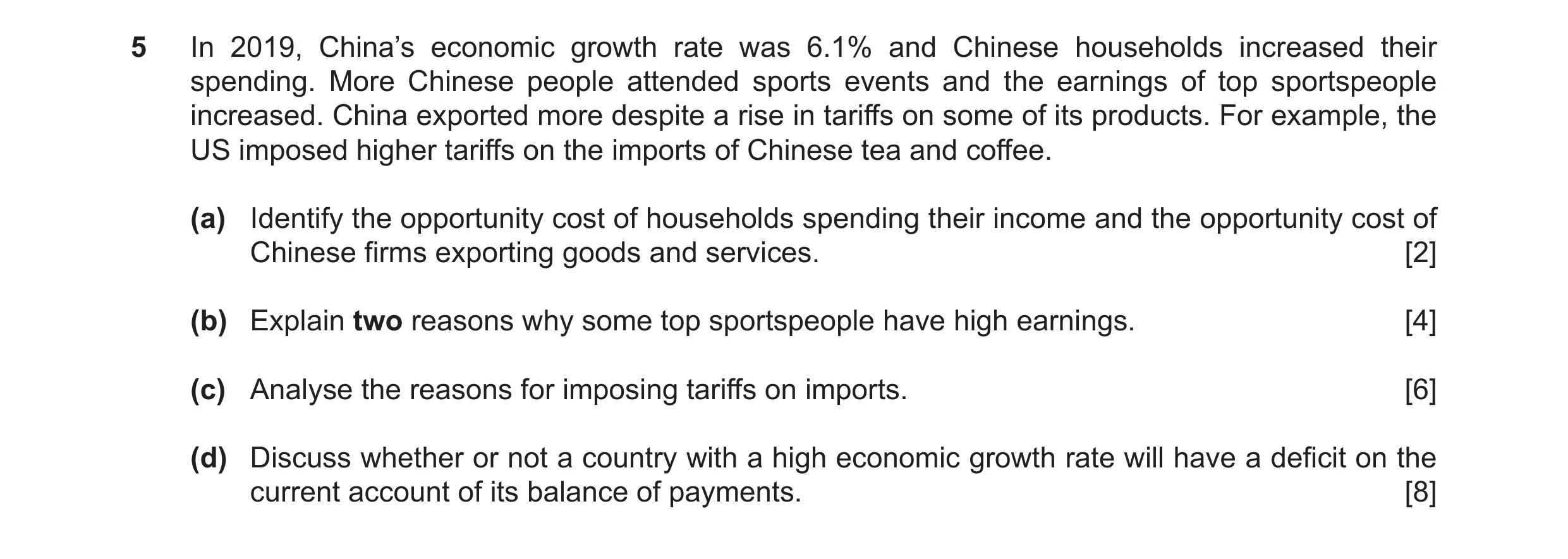
Q6 · In 2019, China’s economic growth rate was 6.1% and Chinese households increased their… 0987/22 May/June 2023
5 In 2019, China’s economic growth rate was 6.1% and Chinese households increased their spending. More Chinese people attended sports events and the earnings of top sportspeople increased. China exported more despite a rise in tariffs on some of its products. For example, the US imposed higher tariffs on the imports of Chinese tea and coffee. (a) Identify the opportunity cost of households spending their income and the opportunity cost of Chinese firms exporting goods and services. [2] (b) Explain two reasons why some top sportspeople have high earnings. [4] (c) Analyse the reasons for imposing tariffs on imports. [6] (d) Discuss whether or not a country with a high economic growth rate will have a deficit on the current account of its balance of payments. [8]
20 marks
Mark scheme: 5(a) Identify the opportunity cost of households spending their income and the opportunity cost of Chinese firms exporting goods and services. Saving (1) selling the products at home / consuming the products (1). 2 5(b) Explain two reasons why some top sportspeople have high earnings. Logical explanation which might include: High demand / inelastic demand for top sportspeople (1) large crowds watch top sportspeople / events (1) top sports events can be sold to TV firms for large fees (1) high merchandise sales / sponsorship deals / high gate receipts / can generate high profits for firms (1). Low supply / inelastic supply of sportspeople / lack of substitutes (1) high bargaining power (1) top sports people are skilled / talented (1) it may take years of training (1) high level of experience (1) some sports are dangerous (1). 4 Reasons may be linked in different ways. Also allow explanation of two reasons for high demand or two reasons for low supply. Reward but do not expect high mrp of labour and derived demand for labour. Question Answer Marks Guidance 5(c) Analyse the reasons for imposing tariffs on imports. Coherent analysis which might include: To improve the current account balance (1) make imports more expensive (1) reduce demand for imports / increase net exports (1) increase total demand (1). To protect domestic industries / infant industries / sunrise industries (1) protect sunset / declining industries (1) protect strategic industries (1) to increase economic growth (1) reduce unemployment / increase employment (1) encourage people to switch from buying imports to buying domestically produced products (1). To raise revenue (1) which the government can spend on e.g. education / reduce a budget deficit (1). To discourage the imports of harmful products / demerit goods (1) example (1). To prevent dumping / unfair competition (1) the selling of products at less than cost price / the selling of products produced by child labour (1). To retaliate (1) against another country’s tariffs (1). To prevent a fall in the exchange rate (1) to prevent switch from domestic to foreign currency (1). 6 Question Answer Marks Guidance 5(d) Discuss whether or not a country with a high economic growth rate will have a deficit on the current account of its balance of payments. In assessing each answer, use the table opposite. Why it might: incomes will rise and consumers may buy more imports firms may switch products from foreign markets to the growing home market firms may import more raw materials and capital goods the country may experience inflation which may reduce its international price competitiveness Why it might not: the economic growth may be export-led economic growth may encourage more investment, this could raise the quality of domestically produced products and lower their prices higher tax revenue may result in improvements in education and healthcare which could increase productivity the country may impose trade restrictions / reduce exchange rate. 8 Level Description Marks 3 A reasoned discussion which accurately examines both sides of the economic argument, making use of economic information and clear and logical analysis to evaluate economic issues and situations. One side of the argument may have more depth than the other, but overall, both sides of the argument are considered and developed. There is thoughtful evaluation of economic concepts, terminology, information and/or data appropriate to the question. The discussion may also point out the possible uncertainties of alternative decisions and outcomes. 6–8 2 A reasoned discussion which makes use of economic information and clear analysis to evaluate economic issues and situations. The answer may lack some depth and development may be one-sided. There is relevant use of economic concepts, terminology, information and data appropriate to the question. 3–5 1 There is a simple attempt at using economic definitions and terminology. Some reference may be made to economic theory, with occasional understanding. 1–2 0 A mark of zero should be awarded for no creditable content. 0
This question in 0987/22 May/June 2023
Q7 · Calculate what percentage of Honduran people did not have access to electricity in 2020 0987/22 Oct/Nov 2023
1 (a) Calculate what percentage of Honduran people did not have access to electricity in 2020. [1] (b) Identify two benefits the Honduran economy could gain from a growth in the US economy. [2] (c) Explain one advantage of an economy specialising. [2] (d) Explain two ways a government could redistribute income. [4] (e) Draw a demand and supply diagram to show how a report stating that bananas are good for health would affect the market for bananas. [4] (f) Analyse the relationship between the percentage of population living in poverty and life expectancy. [5] (g) Discuss whether or not the cost of producing clothes in Honduras will fall in the future. [6] (h) Discuss whether or not a fall in unemployment in Honduras is likely to cause inflation. [6]
30 marks
Mark scheme: Question Answer Marks Guidance 1(a) Calculate what percentage of Honduran people did not 1 Accept 8.0 or 8.3. have access to electricity in 2020. 8.3%. 1(b) Identify two benefits the Honduran economy could gain 2 If more than two benefits are given, consider the first three. from a growth in the US economy. Accept increase trade for more exports. Sell more exports to the US (1). Receive more money from Honduran workers in the US (1). Accept increase employment / lower unemployment for More job opportunities for Honduran workers in the US (1). more job opportunities. 1(c) Explain one advantage of an economy specialising. 2 One mark for an advantage identified and one mark an explanation. Gain skills (1) raise productivity / raise efficiency / ‘practice Identification mark must come directly from the source makes perfect’ / lower costs of production / raise quality / material. increase output / supply / less waste (1). A relevant explanation mark can be given even in the Gain a good reputation (1) increase demand (1). absence of an identification. 1(d) Explain two ways a government could redistribute 4 One mark each for each of two ways identified and one income. mark each for each of two explanations. Logical explanation which might include: If more than two reasons given, consider the first three. Provision of unemployment benefit / state benefit / welfare benefit / benefits (1) raise income of those on low or no One mark for taxing the rich and giving to the poor. income / enable the unemployed to buy basic necessities / reduce absolute poverty (1). Progressive income tax system (1) takes a higher proportion of the income of the rich / use some of tax revenue raised to increase spending to help those on low incomes (1). 1(e) Draw a demand and supply diagram to show how a 4 report stating that bananas are good for health would affect the market for bananas. Coherent analysis which might include: Demand and supply diagram: Axes correctly labelled – price and quantity or p and q (1). Original demand and supply curves correctly labelled (1). Demand curve shifted to the right (1). Equilibriums – shown by lines P1 and Q1 and P2 and Q2 or equilibrium points marked as E1 and E2 (1). If a candidate draws two diagrams, they may be able to get 3 marks: 1 mark for axes 1 mark for D & S labelled correctly 1 mark for the demand curve shifted to the right. They would not get the mark for the equilibriums as the two diagrams are likely to conflict on this. 1(f) Analyse the relationship between the percentage of 5 Responses do not have to be in the format suggested but population living in poverty and life expectancy. they should address the expected/normal relationship, offer supporting evidence of that, highlight any exceptions to that, Coherent analysis which might include: and analyse the overall data. Expected relationship: Inverse / negative (1) the higher the level of poverty, the lower the life expectancy / the lower the level of poverty, the higher the life expectancy (1). Supporting evidence: Sweden has the lowest % of population living in poverty and the highest life expectancy / The country / two countries / three countries / four countries with the lowest levels of poverty head had the longest life expectancy (1) the two countries, Chad and South Sudan, with the highest level of poverty had the lowest life expectancy (1). Analysis of expected relationship: A high level of poverty is likely to mean poor healthcare (1) low nutrition / poor housing / poor sanitation / low levels of education (1). Exception: Chad / South Sudan (1) Chad had a lower level of poverty but also a lower level of life expectancy than South Sudan (1) Analysis of exception: Life expectancy is determined by other influences e.g. wars (1). 1(g) Discuss whether or not the cost of producing clothes in 6 Allow higher productivity / efficiency once either in Honduras will fall in the future. connection with labour or capital. Some points may be given in reverse e.g. price of raw Award up to 4 marks for logical reasons why it might, which materials may fall. may include: Not accepting subsidising the clothes industry as the source • more training (1) better working conditions (1) may material indicates that it is a successful industry. increase labour productivity / efficiency / skills (1) reduce labour costs (1) Apply this example to all questions with the command • more use of capital goods (1) may reduce disruption to word DISCUSS production / make fewer mistakes / less waste (1) speed (1(g), 1(h), 2(d), 3(d), 4(d) and 5(d)) up production / increase productivity / efficiency (1) • improved working conditions (1) may reduce industrial Each point may be credited only once, on either side of an action (1) more motivation (1) argument, but separate development as to how/why the • successful clothes industry so firms may grow in size (1) outcome may differ is rewarded. more able to take advantage of economies of scale (1). Generic example Mark Award up to 4 marks for logical reasons why it might not, which may include: Tax revenue may decrease… 1 • price of raw materials may rise (1) may be subject to bad weather (1) exchange rate may fall / tariffs may be ...because of reason e.g. incomes 1 imposed on imported raw materials (1) reduce supply may be lower. (1) country has experience of inflation (1) • unemployment may fall (1) making it more difficult for Tax revenue may increase 0 the clothes industry to recruit labour (1) strengthening because incomes may be higher the bargaining power of workers (1) raising wages / i.e. reverse of a previous increasing labour costs (1) argument. • providing training (1) and better working conditions will involve a cost (1) Tax revenue may increase 1 • more use of capital goods may involve initial high because of a different reason i.e. not the reverse of a previous spending on equipment (1) firms may experience argument e.g. government diseconomies of scale (1) • higher indirect tax / tax may be imposed (on clothes / spending on subsidies may stimulate the economy more than clothes firms) (1). spending on education. 1(h) Discuss whether or not a fall in unemployment in 6 Honduras is likely to cause inflation. Award up to 4 marks for logical reasons why it might, which may include: • unemployment is already low (1) may move towards full employment (1) may push up wages (1) increase (average) costs (1) cause cost-push inflation / total supply less than total demand (1) • lower unemployment may increase incomes (1) causing a rise in consumer spending / purchasing power (1) increasing total demand (1) causing demand-pull inflation / total demand higher than total supply (1). • inflation already exists (1) which may lead workers to expect it to continue (1) increasing wage claims (1). Award up to 4 marks for logical reasons why it might not, which may include: • may be higher investment (1) could increase total supply / total supply may rise in line with total demand (1) reducing cost-push inflation (1) • lower unemployment could reduce spending on unemployment benefit (1) increase tax revenue (1) reduce the budget deficit (1) reduce the growth in total demand (1) some of higher tax revenue could be spent on supply-side policy / unemployment may have fallen due to supply-side policy (1) • the extra income may be saved / spent on imports (1) due to uncertainty about the future (1) • A fall in unemployment does not necessarily mean a rise in employment (1) the unemployed could have e.g. retired / emigrated (1).
This question in 0987/22 Oct/Nov 2023
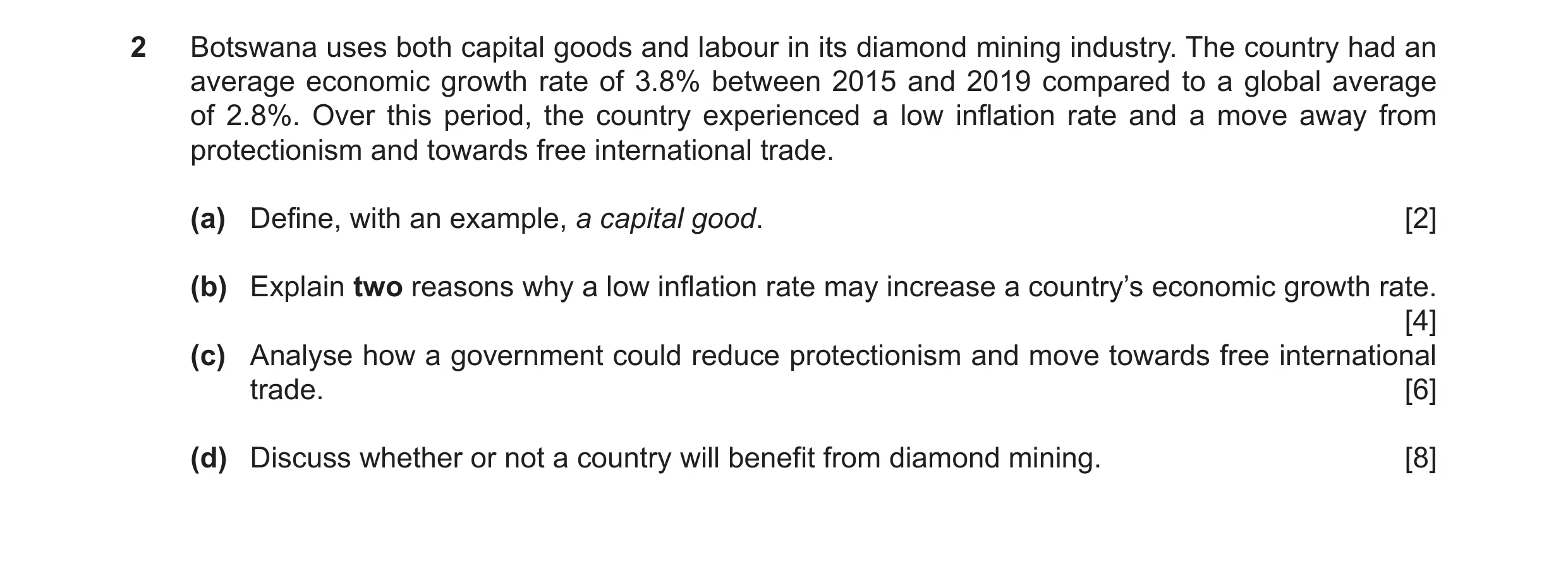
Q8 · Botswana uses both capital goods and labour in its diamond mining industry 0987/22 Oct/Nov 2023
2 Botswana uses both capital goods and labour in its diamond mining industry. The country had an average economic growth rate of 3.8% between 2015 and 2019 compared to a global average of 2.8%. Over this period, the country experienced a low inflation rate and a move away from protectionism and towards free international trade. (a) Define, with an example, a capital good. [2] (b) Explain two reasons why a low inflation rate may increase a country’s economic growth rate. [4] (c) Analyse how a government could reduce protectionism and move towards free international trade. [6] (d) Discuss whether or not a country will benefit from diamond mining. [8]
20 marks
Mark scheme: 2(a) Define, with an example, a capital good. 2 If more than two examples are given, consider the first two. A good used to produce another good or service / a human- made good used for production (1) e.g. a machine (1). 2(b) Explain two reasons why a low inflation rate may 4 One mark each for each of two reasons identified and one increase a country’s economic growth rate. mark each for each of two explanations. Logical explanation which might include: • make the country’s products internationally competitive (1) sell more exports / buy fewer imports (1) • create greater certainty (1) encourage investment / attract MNCs (1) • keep increase in costs low (1) may reduce claims for higher wages/ higher profits (1) • increase confidence (1) may increase demand / increase profits 1). 2(c) Analyse how a government could reduce protectionism 6 Allow deregulation as an alternative to remove quotas or and move towards free international trade. embargoes. Coherent analysis which might include: Reward removing / reducing bureaucracy, voluntary export restraints. • remove tariffs (1) reduce price of imports (1) if firms have lower costs of production, they will be able to Reward but do not expect reference to exchange control. compete (1) • remove quotas / increase quota (limit) (1) remove bans / embargoes (1) increase quantity of imports / reduce limits on imports (1) • remove subsidies (1) firms’ products will not be artificially cheap (1) • other countries may remove their protectionism (1) enabling exports to be sold without restrictions (1). 2(d) Discuss whether or not a country will benefit from 8 Reward but do not expect reference to social welfare will be diamond mining. increased if social benefit exceeds social cost. In assessing each answer, use the table opposite. Leve Description Mark l s Why it might: • high global demand 3 A reasoned discussion which 6–8 • can improve the current account of the balance of accurately examines both sides of payments the economic argument, making • create employment, both skilled and unskilled jobs use of economic information and • increase output / economic growth clear and logical analysis to • may increase tax revenue. evaluate economic issues and situations. One side of the Why it might not: argument may have more depth • demand will fall in a recession than the other, but overall, both • price may fluctuate sides of the argument are • may be competition considered and developed. There • can be accidents is thoughtful evaluation of • can create external costs e.g. pollution economic concepts, terminology, • if mined by an MNC, profit may be sent to the home information and/or data appropriate country to the question. The discussion • supply may be depleted may also point out the possible uncertainties of alternative • price may increase in the future so better to conserve decisions and outcomes. diamonds now • may not be a large proportion of GDP. 2 A reasoned discussion which 3–5 makes use of economic information and clear analysis to evaluate economic issues and situations. The answer may lack some depth and development may be one- sided. There is relevant use of economic concepts, terminology, information and data appropriate to the question. 2(d) 1 There is a simple attempt at using 1–2 economic definitions and terminology. Some reference may be made to economic theory, with occasional understanding. 0 A mark of zero should be awarded 0 for no creditable content.
This question in 0987/22 Oct/Nov 2023
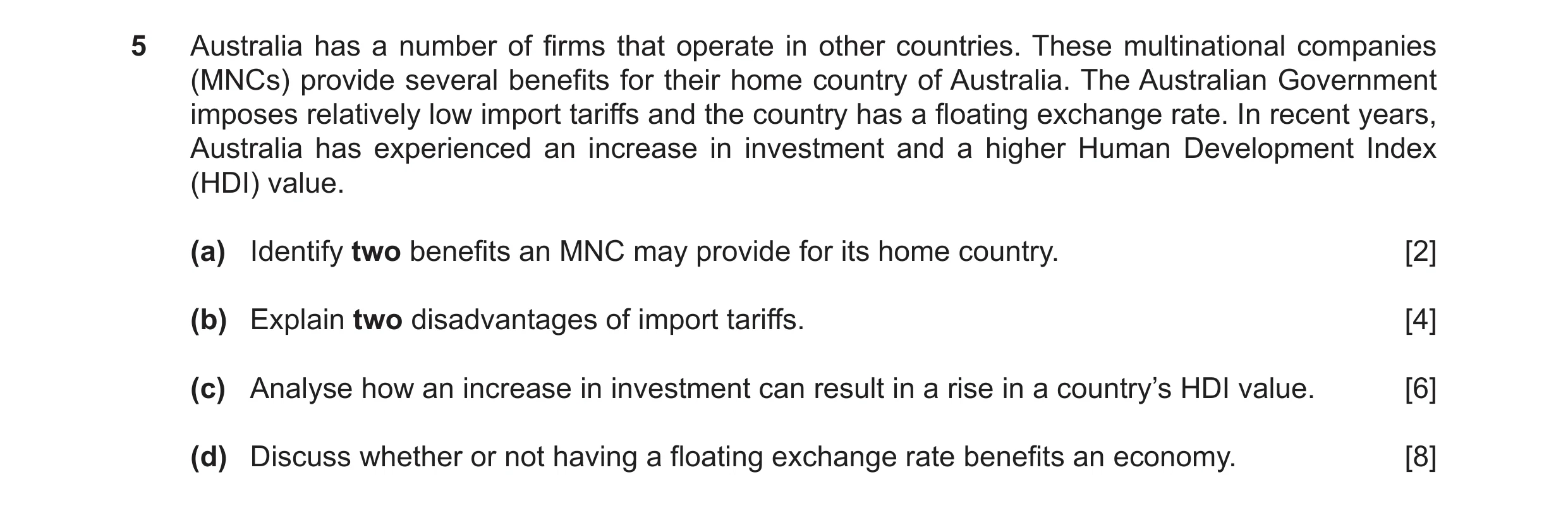
Q9 · Australia has a number of firms that operate in other countries 0987/21 May/June 2025
5 Australia has a number of firms that operate in other countries. These multinational companies (MNCs) provide several benefits for their home country of Australia. The Australian Government imposes relatively low import tariffs and the country has a floating exchange rate. In recent years, Australia has experienced an increase in investment and a higher Human Development Index (HDI) value. (a) Identify two benefits an MNC may provide for its home country. [2] (b) Explain two disadvantages of import tariffs. [4] (c) Analyse how an increase in investment can result in a rise in a country’s HDI value. [6] (d) Discuss whether or not having a floating exchange rate benefits an economy. [8]
20 marks
Mark scheme: 5(a) Identify two benefits an MNC may provide for its home 2 If more than two benefits given, consider the first three. country. Identify means that the benefit does not have to be Two from: explained. • profits • (increased) exports • raw materials • job opportunity / wages for workers • raise country’s income 5(b) Explain two disadvantages of import tariffs. 4 One mark each for each of two disadvantages identified and one mark each for each of two explanations. Logical explanation which might include: If more than two disadvantages given, consider the first • Reduce (free) trade (1) lower competition (1) . three. • Risk of retaliation (1) resulting in trade war / unemployment (1). Only allow one mark for reference to lower competition. • Raise price of imports (1) which may raise price of domestically produced goods (because of the lack of competition) (1) . • Raise the price of imported raw materials / capital goods (1) cause cost-push inflation (1) . • Reduce quality (1) due to lower competition (1) • Protected industries / infant industries / declining industries may become inefficient (1) if become reliant on tariff (protection) (1). • Reduce output / consumption / less quality / less choice (1) lower living standards (1). • Reduce ability of countries to specialise (1) less efficient use of resources / loss of potential economies of scale (1). 5(c) Analyse how an increase in investment can result in a 6 rise in a country’s HDI value. Coherent analysis which might include: • Investment can increase GDP / GNI (1) employment (1) which may increase GDP/ GNI per head (1) higher GDP/ GNI may raise tax revenue (1) enabling the government to spend more on education and healthcare (1). • Higher personal income / wages (1) enabling families to afford sending children to school (1) pay for private healthcare (1). • An increase in investment in healthcare facilities (1) can increase life expectancy (1). • An increase in investment in education (1) will increase mean / expected and expected years of schooling (1) increase skills/productivity (1) which may increase GDP per head (1) raise awareness about nutrition (1) increase life expectancy (1). • An increase in investment may introduce more advanced technology (1) which can make work less physically demanding (1) improving health / life expectancy (1). 5(d) Discuss whether or not having a floating exchange rate 8 Level Description Marks benefits an economy. 3 A reasoned discussion which accurately 6–8 In assessing each answer, use the table opposite. examines both sides of the economic argument, making use of economic Why it might: information and clear and logical • may eliminate a current account imbalance analysis to evaluate economic issues • if there is a current account deficit, exchange rate may and situations. One side of the fall making exports fall in price and imports rise in price argument may have more depth than • no need to keep reserves of foreign exchange the other, but overall both sided of the • no need to change interest rates to influence the argument are considered and exchange rate developed. There is thoughtful • enable government to concentrate on other aims as evaluation of economic concepts, does not have to keep the exchange rate fixed. terminology, information and/or data appropriate to the question. The Why it might not: discussion may also point out the • may make it difficult for firms to plan, not knowing how possible uncertainties of alternative much they will have to pay for imports and earn from decisions and outcomes. exports • may create uncertainty 2 A reasoned discussion which makes 3–5 • discourage investment use of economic information and clear • speculation can cause (significant) destabilising analysis to evaluate economic issues changes in the exchange rate. and situations. The answer may lack some depth and development may be one-sided. There is relevant use of economic concepts, terminology, information and data appropriate to the question. 5(d) 8 Level Description Marks 1 There is a simple attempt at using 1–2 economic definitions and terminology. Some reference may be made to economic theory, with occasional understanding. 0 A mark of zero should be awarded for 0 no creditable content. Note: reward candidates if they refer to the impact of appreciation and depreciation of the currency in their answers.
This question in 0987/21 May/June 2025
Q10 · Some countries engage in dumping by selling their products at less than cost price in… 0987/22 Oct/Nov 2025
5 Some countries engage in dumping by selling their products at less than cost price in Cambodia. The Cambodian Government wants the country to become a high-income economy by 2050. It uses fiscal, monetary and supply-side policies to increase its economic growth rate. Cambodia subsidises some infant industries. The country has one of the world’s largest deficits on the current account of its balance of payments (as a percentage of GDP). Some economists suggest cutting taxes would reduce this deficit. (a) Identify two motives for a firm dumping some of its products in a foreign market. [2] (b) Explain two differences between monetary policy and supply-side policy. [4] (c) Analyse how a government subsidy could help to protect an infant industry against foreign competition. [6] (d) Discuss whether or not cuts in taxes will reduce a deficit on the current account of a country’s balance of payments. [8]
20 marks
Mark scheme: 5(a) Identify two motives for a firm dumping some of its 2 If more than two motives are given, consider the first three. products in a foreign market. • Drive domestic firms out of the market / increase market share / gain monopoly power in (overseas) market (1). • Clear away surplus stock (1) keep price high on the domestic market (1) increase exports / sales / revenue (1). 5(b) Explain two differences between monetary policy and 4 If more than two differences are given, consider the first supply-side policy. three. Logical explanation which might include the following. • Monetary policy is usually implemented by the central bank (1) supply-side policy by the government (1). • Monetary policy may be used to increase or reduce economic activity (1) supply-side policy is only used to increase economic activity (1). • They have different policy measures (1) e.g. monetary policy has the rate of interest whereas supply side policy has privatisation (1). • Monetary policy aims to influence total demand (1) supply-side policy aims to increase total supply (1). • Supply side policies tend to take longer to implement and have an impact (1) than monetary policy which tends to have a more short -term impact (1). 5(c) Analyse how a government subsidy could help to 6 protect an infant industry against foreign competition. Coherent analysis which might include: An infant industry’s costs may initially be high (1) government subsidy is an extra payment to an industry (1) some of the subsidy could be used to buy more capital goods / technological innovation (1) employ skilled workers (1) enable an infant industry to grow in size / increase output (1) obtain economies of scale (1) lower (average) cost / improve productivity (1) lower their prices (1) making their products more (internationally) competitive (1) increase demand for their goods (1) increase exports (1) raise quality (1) increase quality competitiveness (1). 5(d) Discuss whether or not cuts in taxes will reduce a 8 Level Description Marks deficit on the current account of a country’s balance of payments. 3 A reasoned discussion which accurately 6–8 examines both sides of the economic In assessing each answer, use the table opposite. argument, making use of economic information and clear and logical Why it might: analysis to evaluate economic issues • cut in corporation (corporate income) tax may increase and situations. One side of the willingness and ability to invest argument may have more depth than • higher investment may raise quality and reduce costs the other, but overall, both sides of the • increase exports and lower imports argument are considered and • cut in personal income tax may increase workers’ developed. There is thoughtful motivation, raise productivity and cut costs evaluation of economic concepts, • lower corporation (corporate income) tax could be terminology, information and/or data imposed on infant industries appropriate to the question. The • attract MNCs which can increase exports and reduce discussion may also point out the imports possible uncertainties of alternative • cuts in indirect taxes may lead to lower prices which decisions and outcomes. may increase the demand for domestic goods and reduce the demand for imported substitutes 2 A reasoned discussion which makes 3–5 • cuts in tariffs may make it easier for firms to import use of economic information and clear cheaper raw materials from abroad which may enable analysis to evaluate economic issues them to reduce prices increasing export and situations. The answer may lack competitiveness. some depth and development may be one-sided. There is relevant use of Why it might not: economic concepts, terminology, • cut in personal income tax may increase spending information and data appropriate to the which may increase total demand leading to inflation question. reducing international competitiveness • more imports may be purchased • exports may be diverted to the home market • reduce tax revenue and lower government spending • lower government spending on education, healthcare, transport could reduce productivity • lower taxes on imports (tariffs) may increase imports. 5(d) Level Description Marks 1 There is a simple attempt at using 1–2 economic definitions and terminology. Some reference may be made to economic theory, with occasional understanding. 0 A mark of zero should be awarded for 0 no creditable content.
This question in 0987/22 Oct/Nov 2025
![Question 1: (a) Calculate Pakistan’s trade in goods balance in 2017. [1] (b) Identify two possible causes of demand-pull inflation in Pakistan in 2017.…](https://img.pastlit.com/crops/9e729439-a502-4a20-ab10-b68bff6b3496/q1.webp)
![Question 2: (a) Calculate the value of Nigeria’s exports of goods in 2017. [1] (b) Identify two examples of capital goods. [2] (c) Explain whether Nige…](https://img.pastlit.com/crops/ed31ca2a-80d0-40ae-b11f-ddaab7cd4d26/q1.webp)
 1 / 4
1 / 4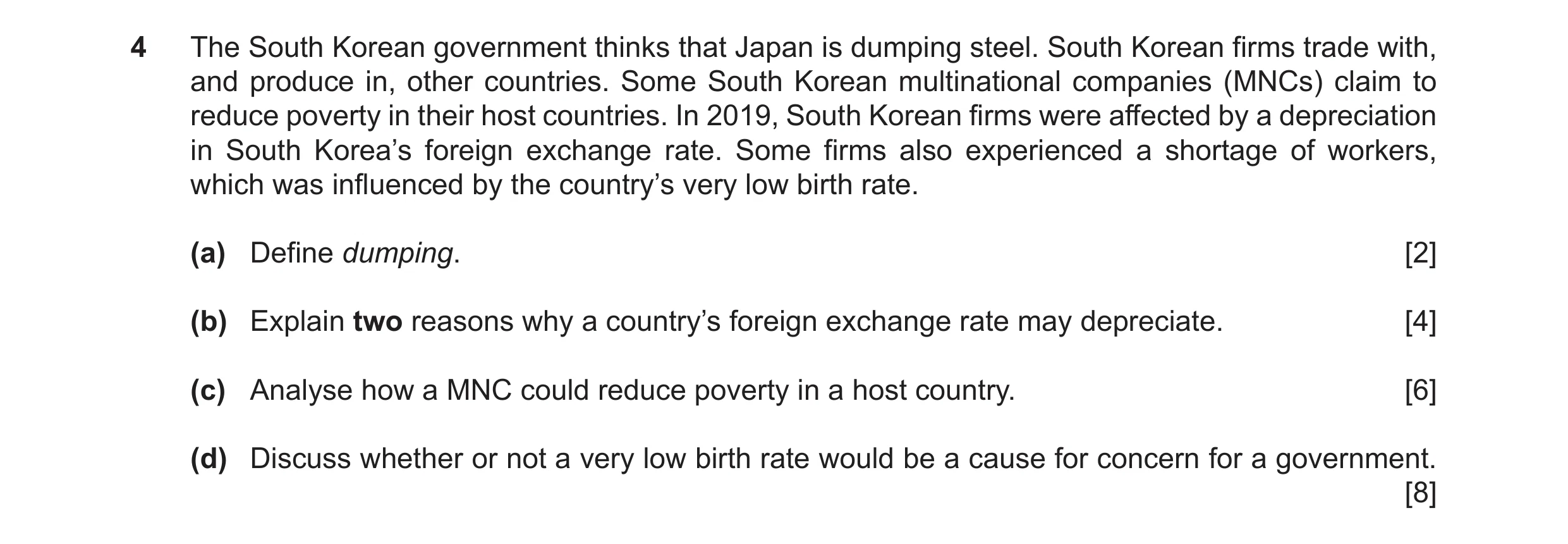
 2 / 4
2 / 4![Question 7: (a) Calculate what percentage of Honduran people did not have access to electricity in 2020. [1] (b) Identify two benefits the Honduran eco…](https://img.pastlit.com/crops/711b4dae-d871-4d27-988e-be99e0e00694/q1.webp)
 3 / 4
3 / 4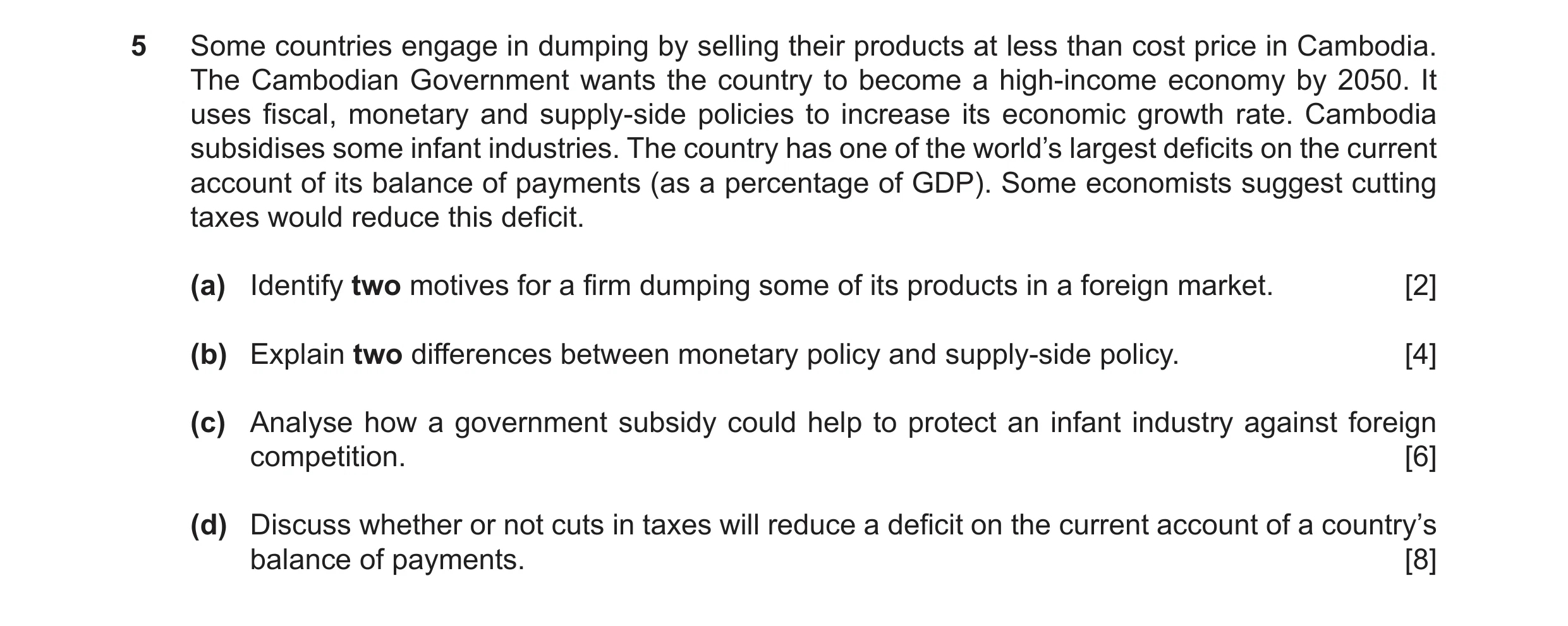 4 / 4
4 / 4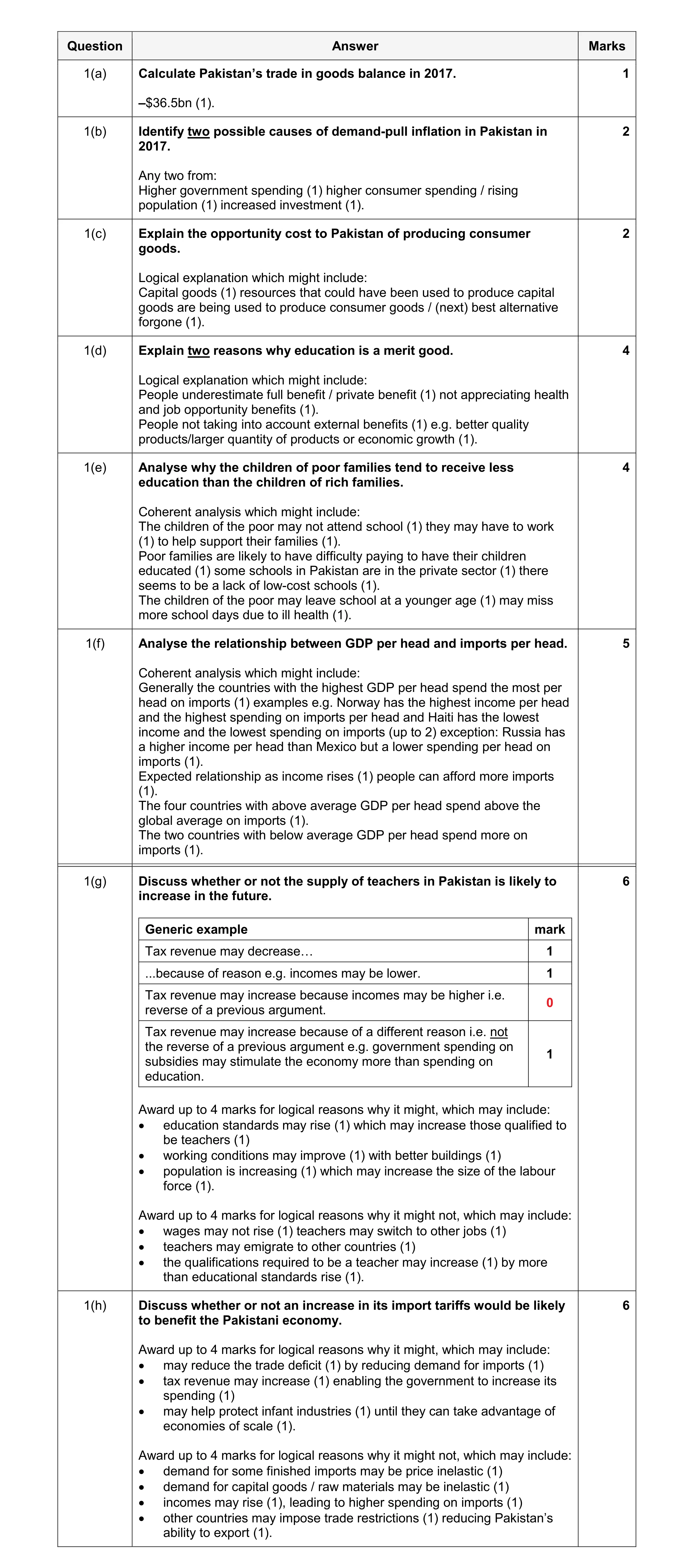 30
30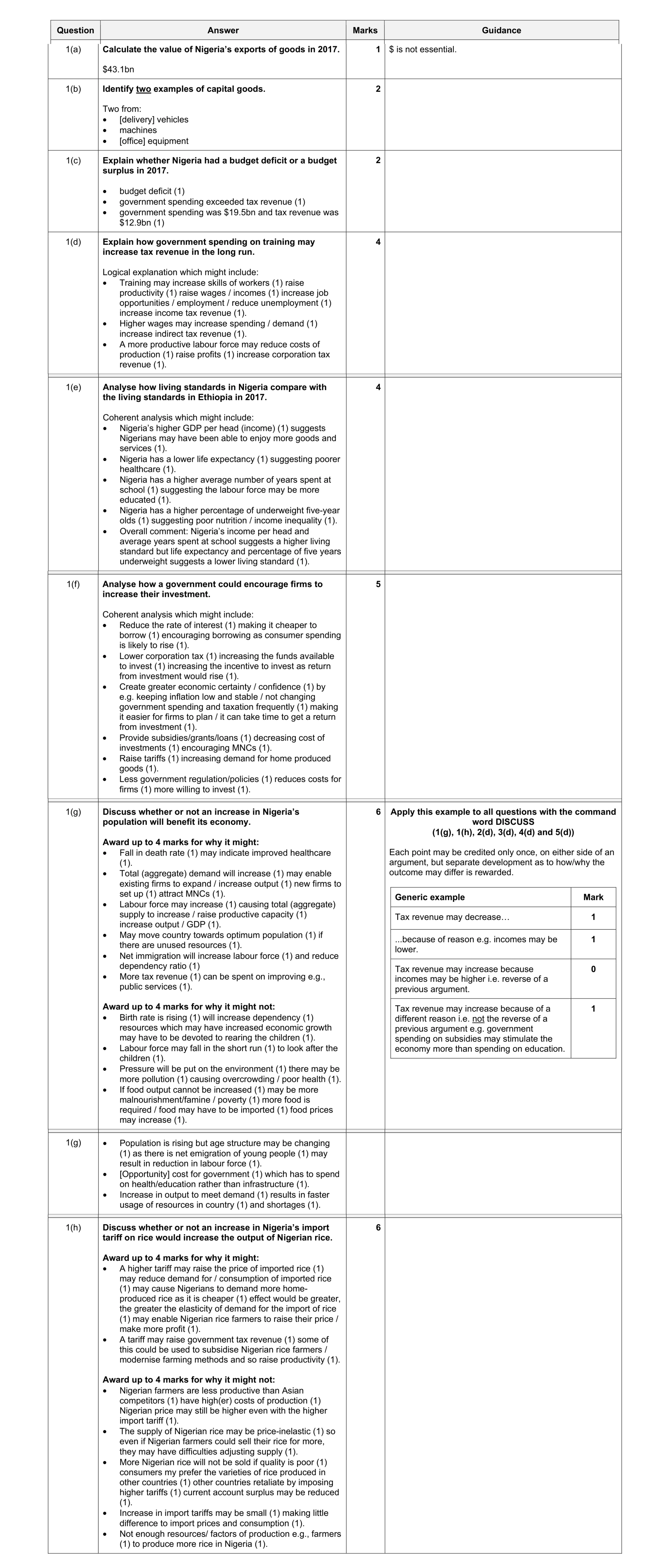 30
30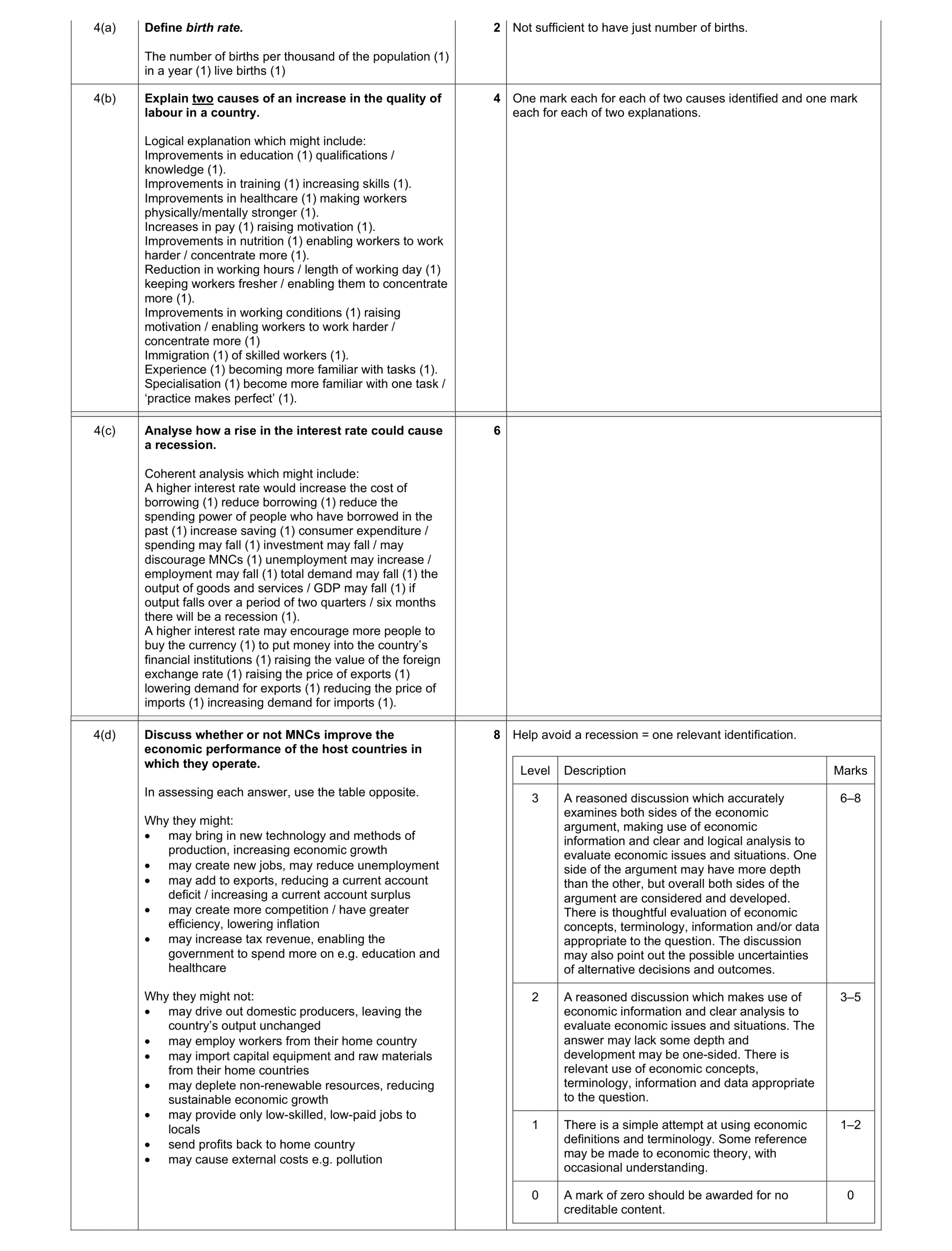 20
20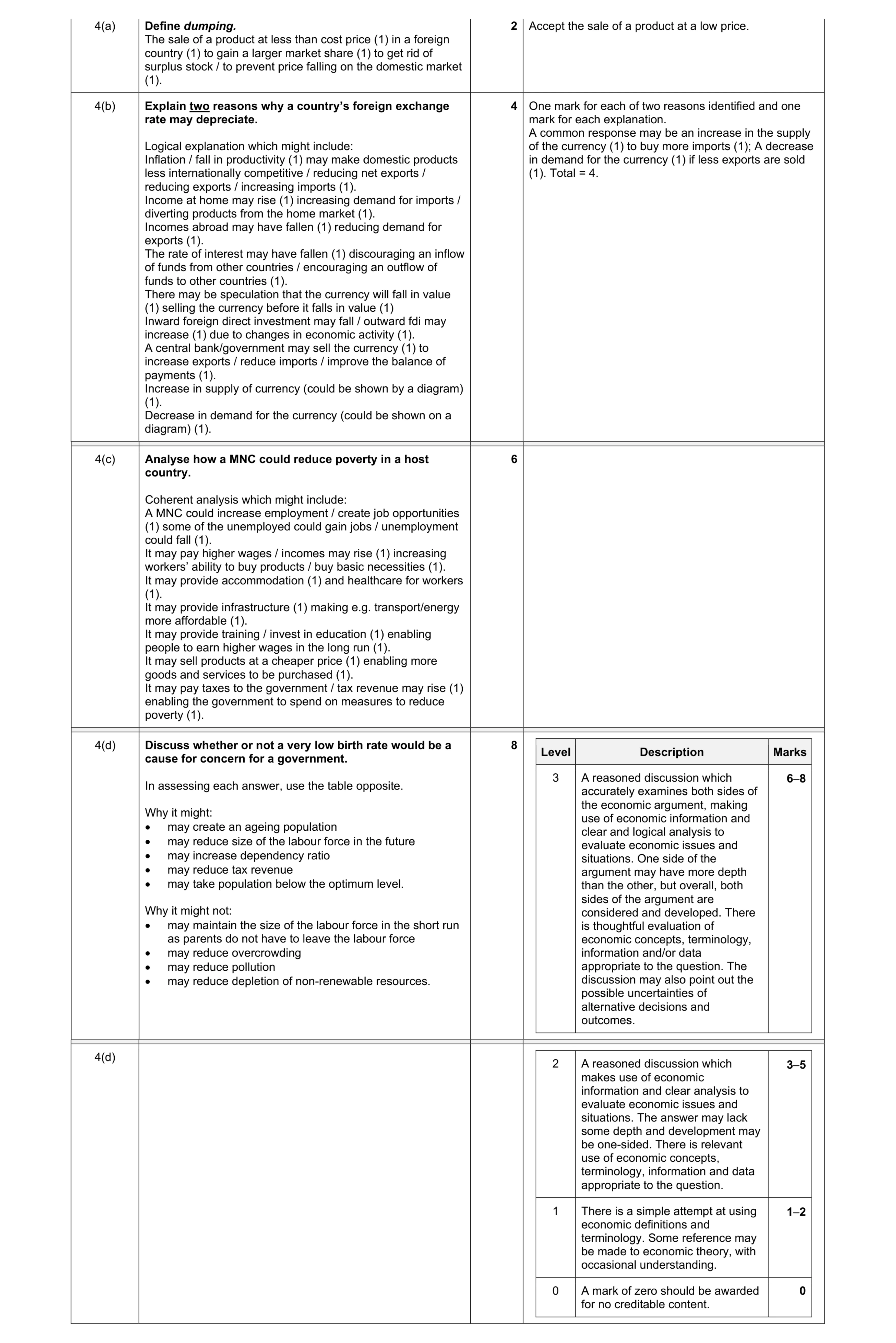 20
20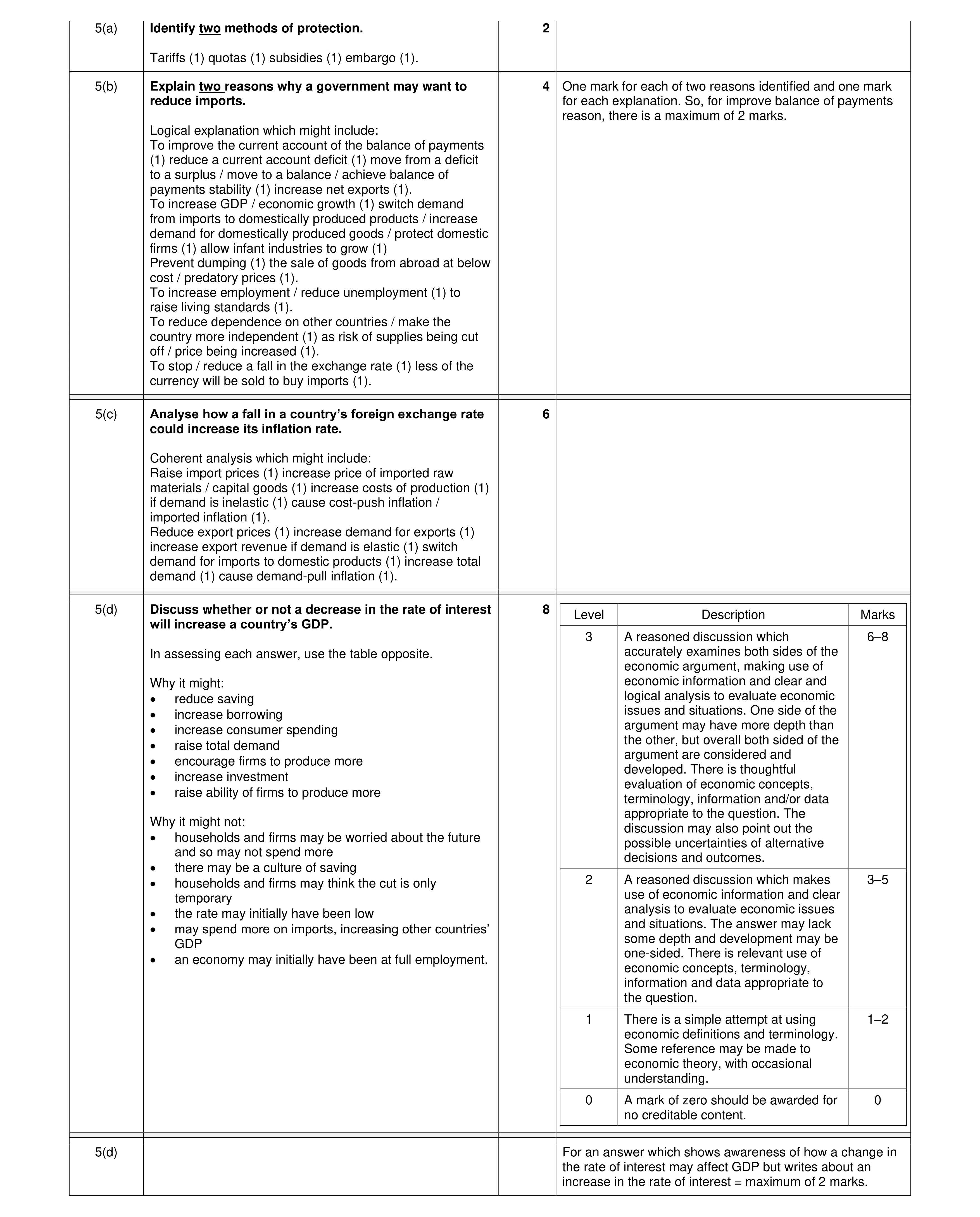 20
20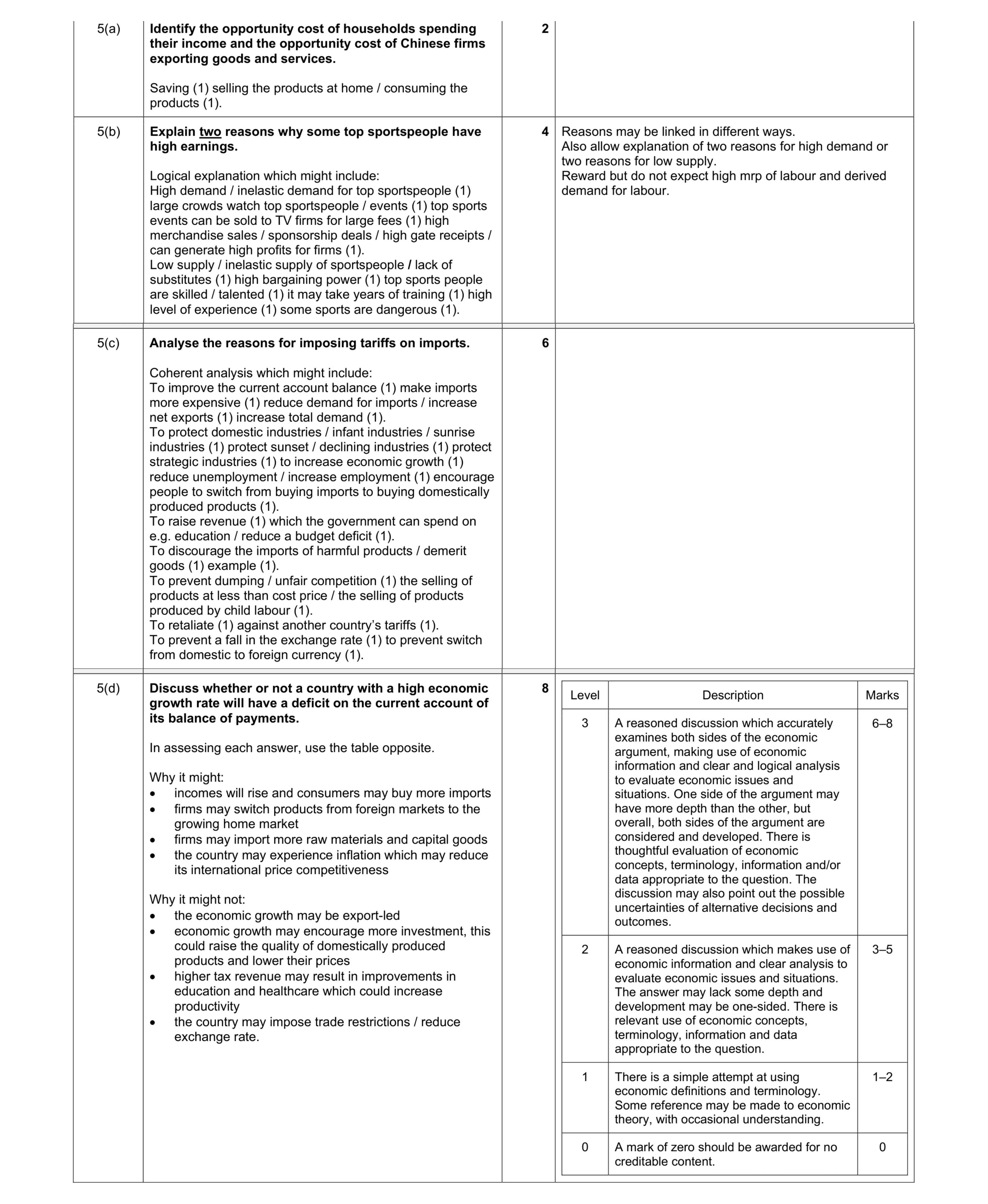 20
20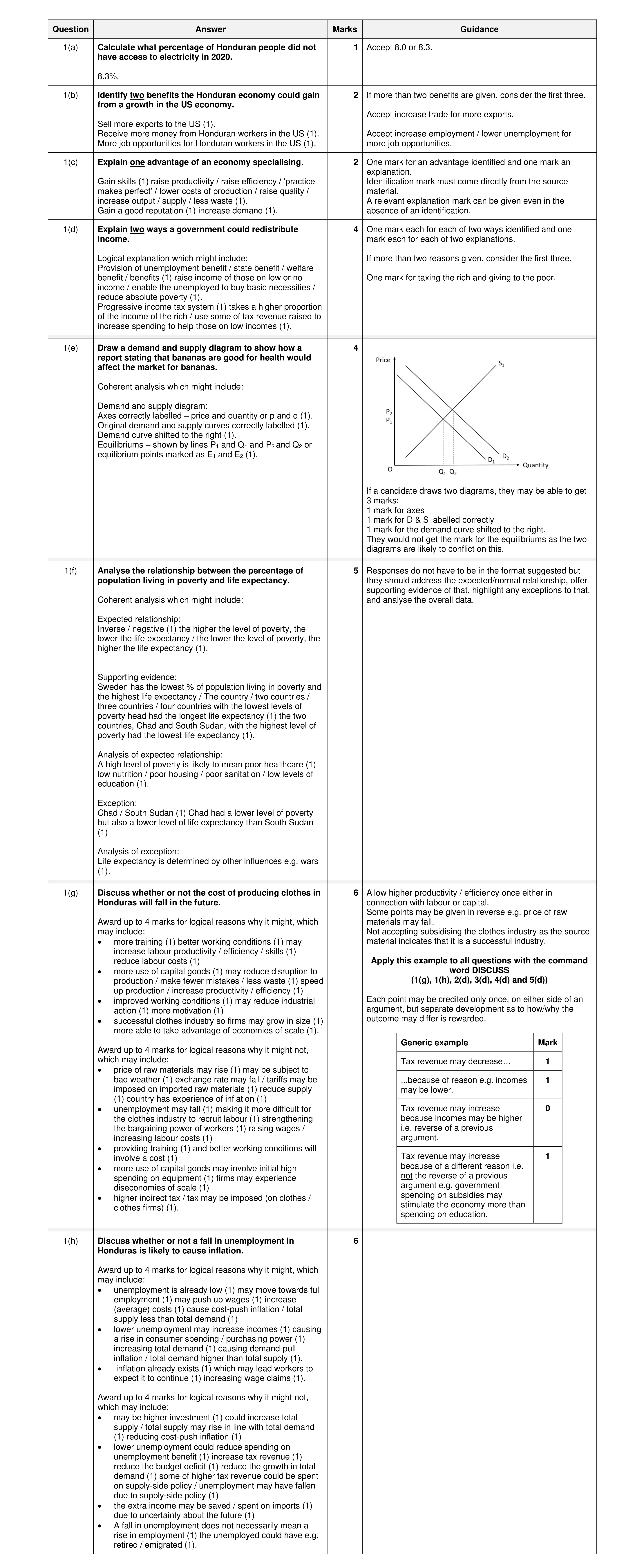 30
30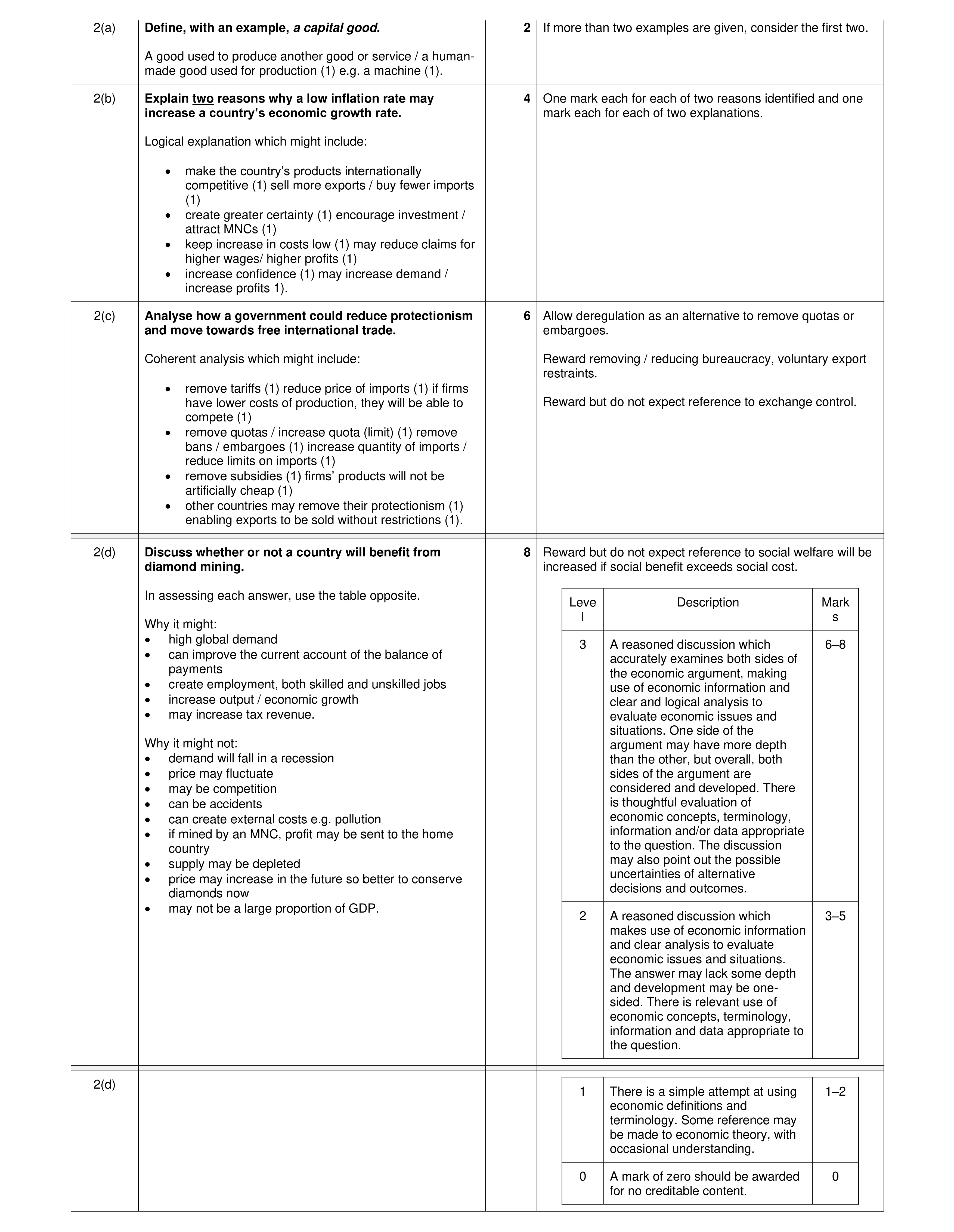 20
20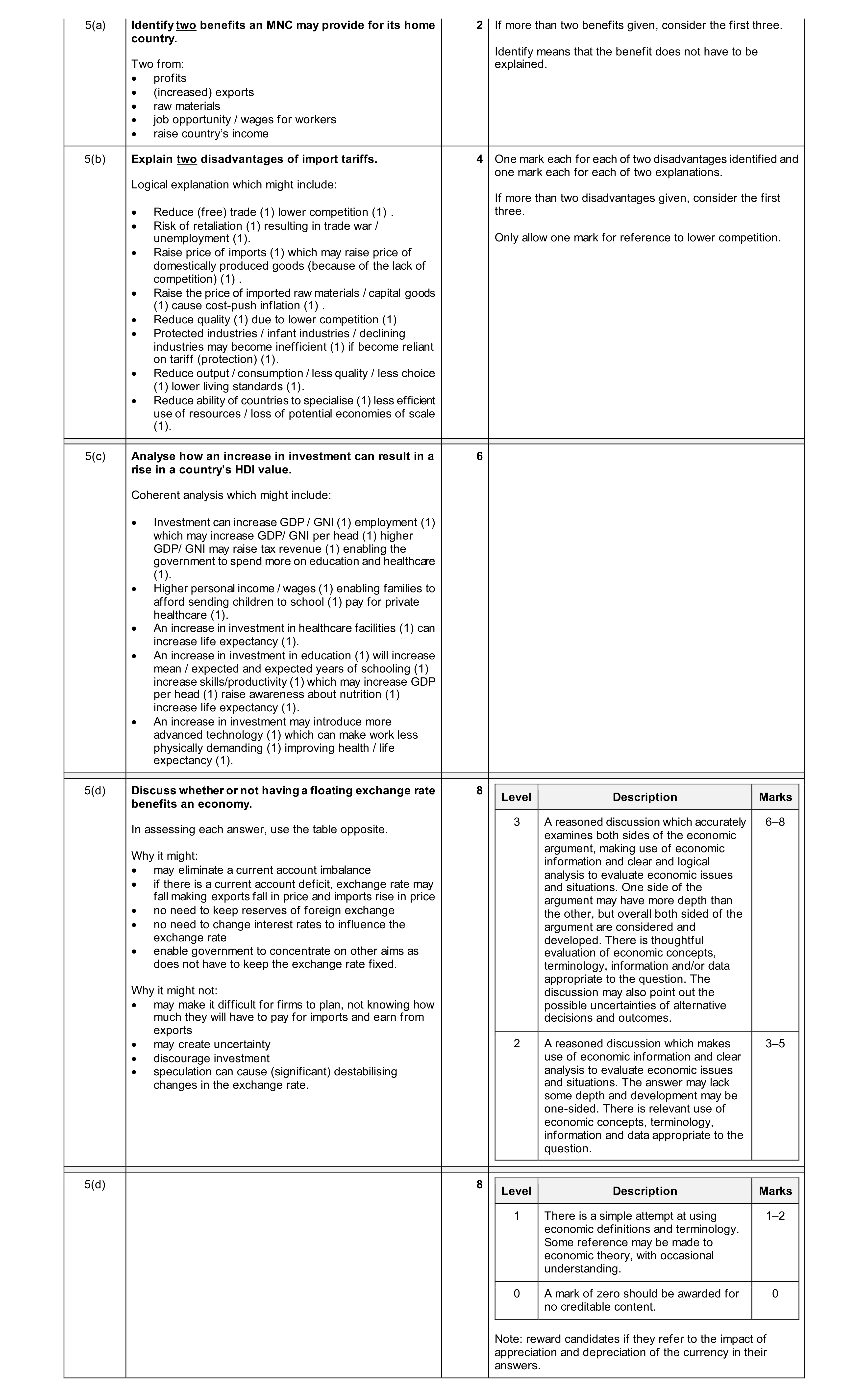 20
20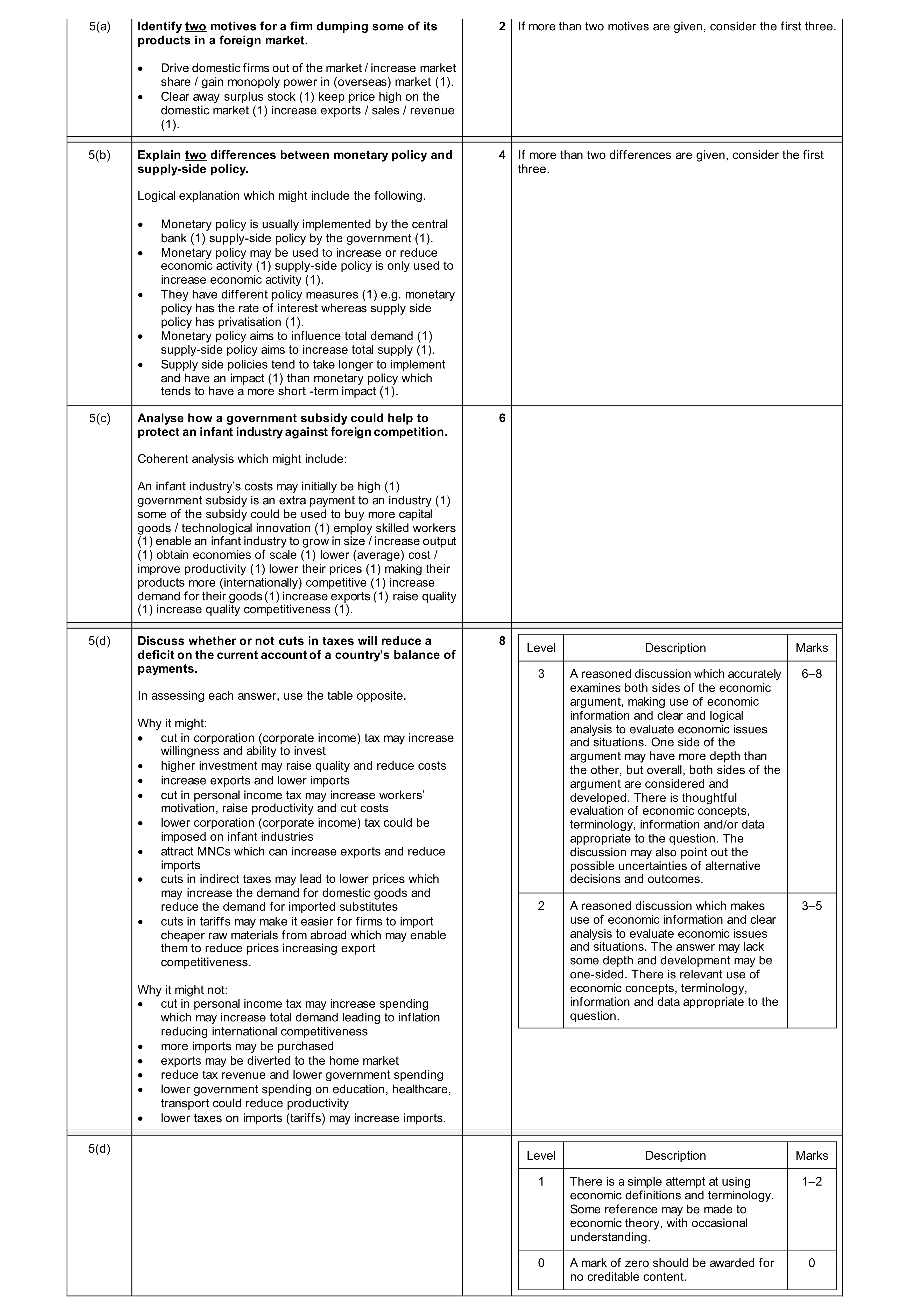 20
20