Cambridge IGCSE Drama 0411 — 2017 May/June Paper 1 · Variant 2
0411/12/M/J/17 · 80 marks · ≈90 min
The question paper and its mark scheme, free to read here and free to download. This is Cambridge’s own paper, exactly as it was sat.
Question paper4 pages

Mark scheme14 pages
Answers below. Sit the paper first if you are practising.
Paper as text
Question paper, page 1
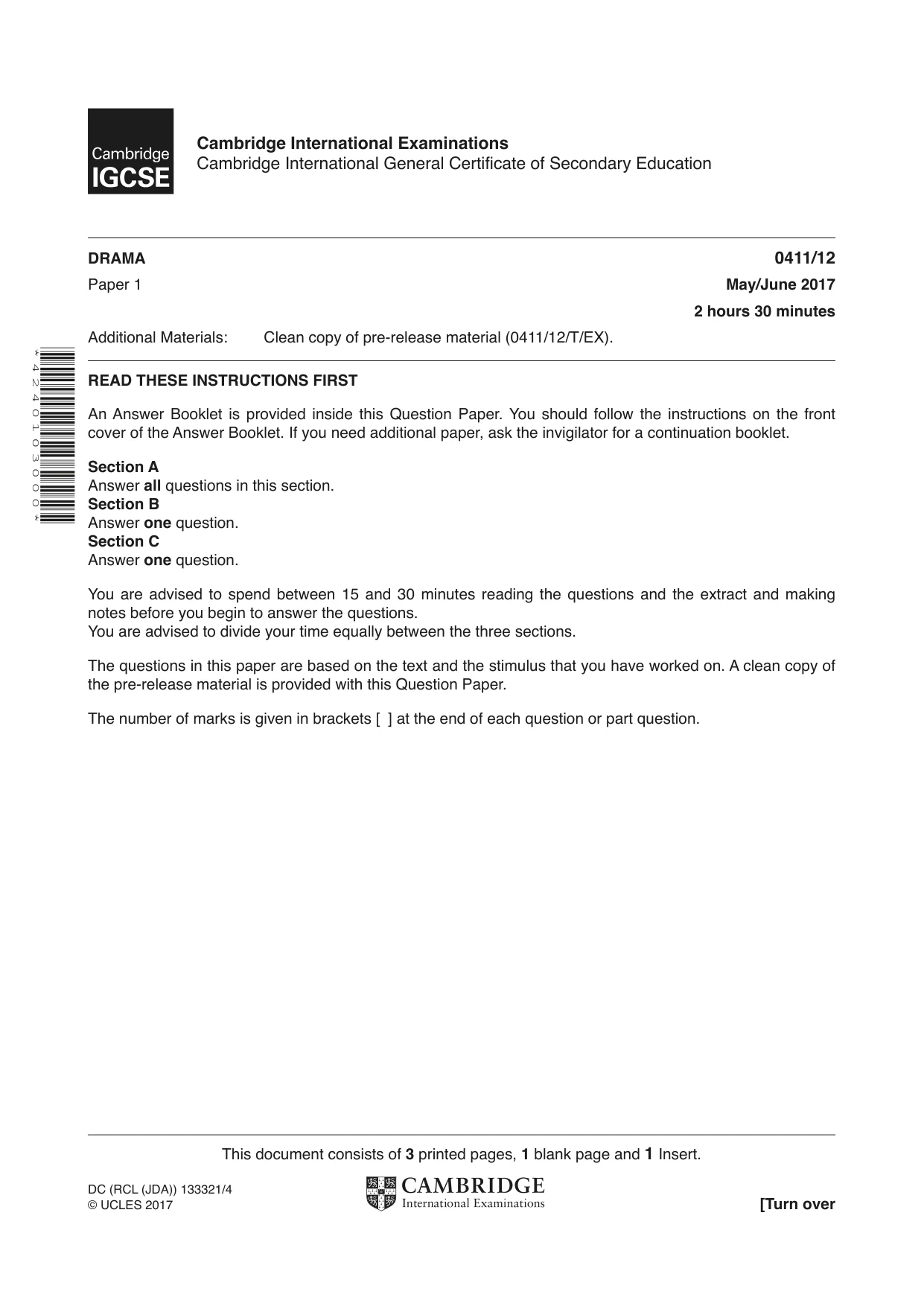
This document consists of 3 printed pages, 1 blank page and 1 Insert. DC (RCL (JDA)) 133321/4 © UCLES 2017 [Turn over Cambridge International Examinations Cambridge International General Certificate of Secondary Education * 4 2 4 0 1 0 3 0 0 0 * DRAMA 0411/12 Paper 1 May/June 2017 2 hours 30 minutes Additional Materials: Clean copy of pre-release material (0411/12/T/EX). READ THESE INSTRUCTIONS FIRST An Answer Booklet is provided inside this Question Paper. You should follow the instructions on the front cover of the Answer Booklet. If you need additional paper, ask the invigilator for a continuation booklet. Section A Answer all questions in this section. Section B Answer one question. Section C Answer one question. You are advised to spend between 15 and 30 minutes reading the questions and the extract and making notes before you begin to answer the questions. You are advised to divide your time equally between the three sections. The questions in this paper are based on the text and the stimulus that you have worked on. A clean copy of the pre-release material is provided with this Question Paper. The number of marks is given in brackets [ ] at the end of each question or part question.
Question paper, page 2
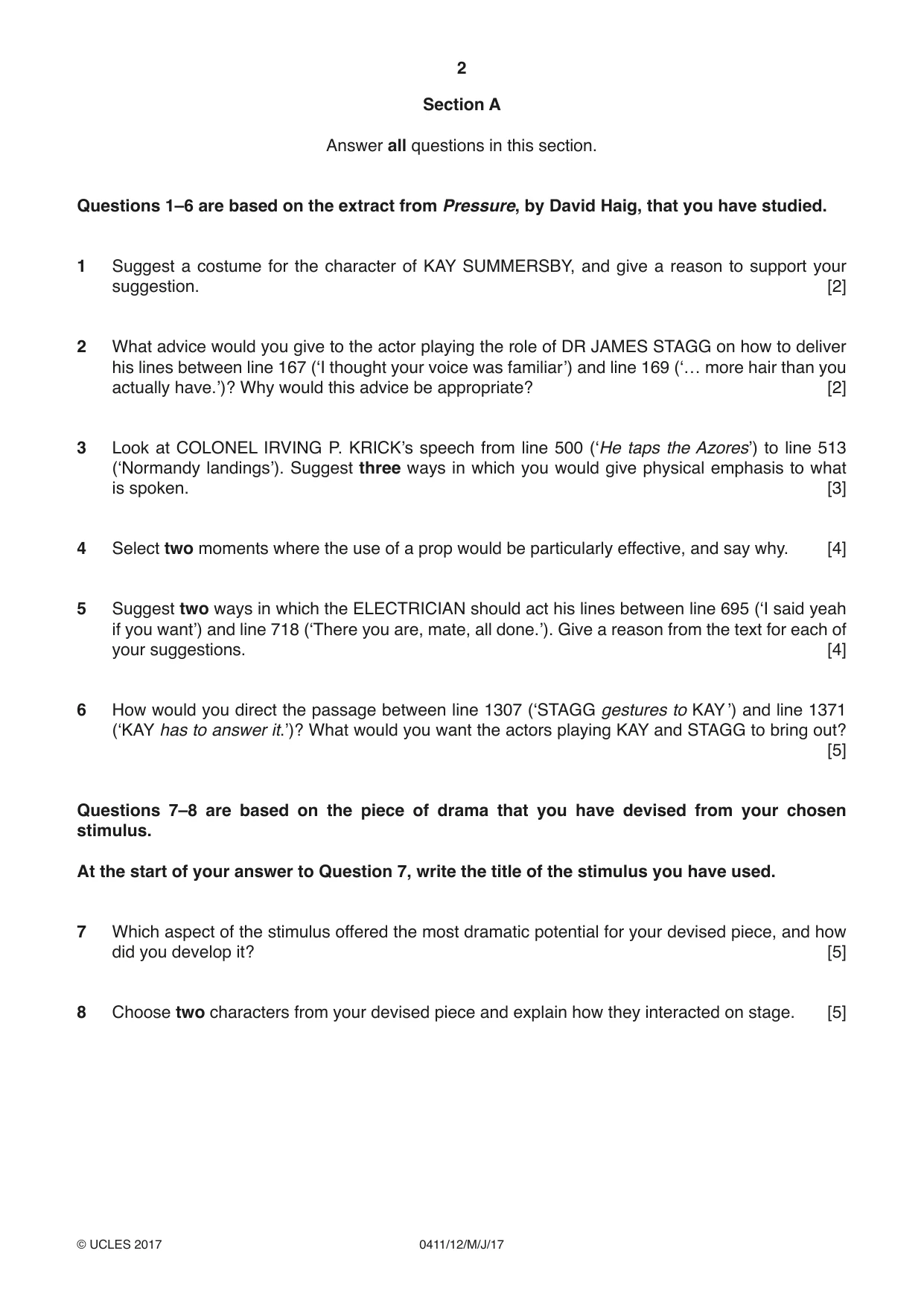
2 0411/12/M/J/17 © UCLES 2017 Section A Answer all questions in this section. Questions 1–6 are based on the extract from Pressure, by David Haig, that you have studied. 1 Suggest a costume for the character of KAY SUMMERSBY, and give a reason to support your suggestion. [2] 2 What advice would you give to the actor playing the role of DR JAMES STAGG on how to deliver his lines between line 167 (‘I thought your voice was familiar’) and line 169 (‘… more hair than you actually have.’)? Why would this advice be appropriate? [2] 3 Look at COLONEL IRVING P. KRICK’s speech from line 500 (‘He taps the Azores’) to line 513 (‘Normandy landings’). Suggest three ways in which you would give physical emphasis to what is spoken. [3] 4 Select two moments where the use of a prop would be particularly effective, and say why. [4] 5 Suggest two ways in which the ELECTRICIAN should act his lines between line 695 (‘I said yeah if you want’) and line 718 (‘There you are, mate, all done.’). Give a reason from the text for each of your suggestions. [4] 6 How would you direct the passage between line 1307 (‘STAGG gestures to KAY ’) and line 1371 (‘KAY has to answer it.’)? What would you want the actors playing KAY and STAGG to bring out? [5] Questions 7–8 are based on the piece of drama that you have devised from your chosen stimulus. At the start of your answer to Question 7, write the title of the stimulus you have used. 7 Which aspect of the stimulus offered the most dramatic potential for your devised piece, and how did you develop it? [5] 8 Choose two characters from your devised piece and explain how they interacted on stage. [5]
Question paper, page 3
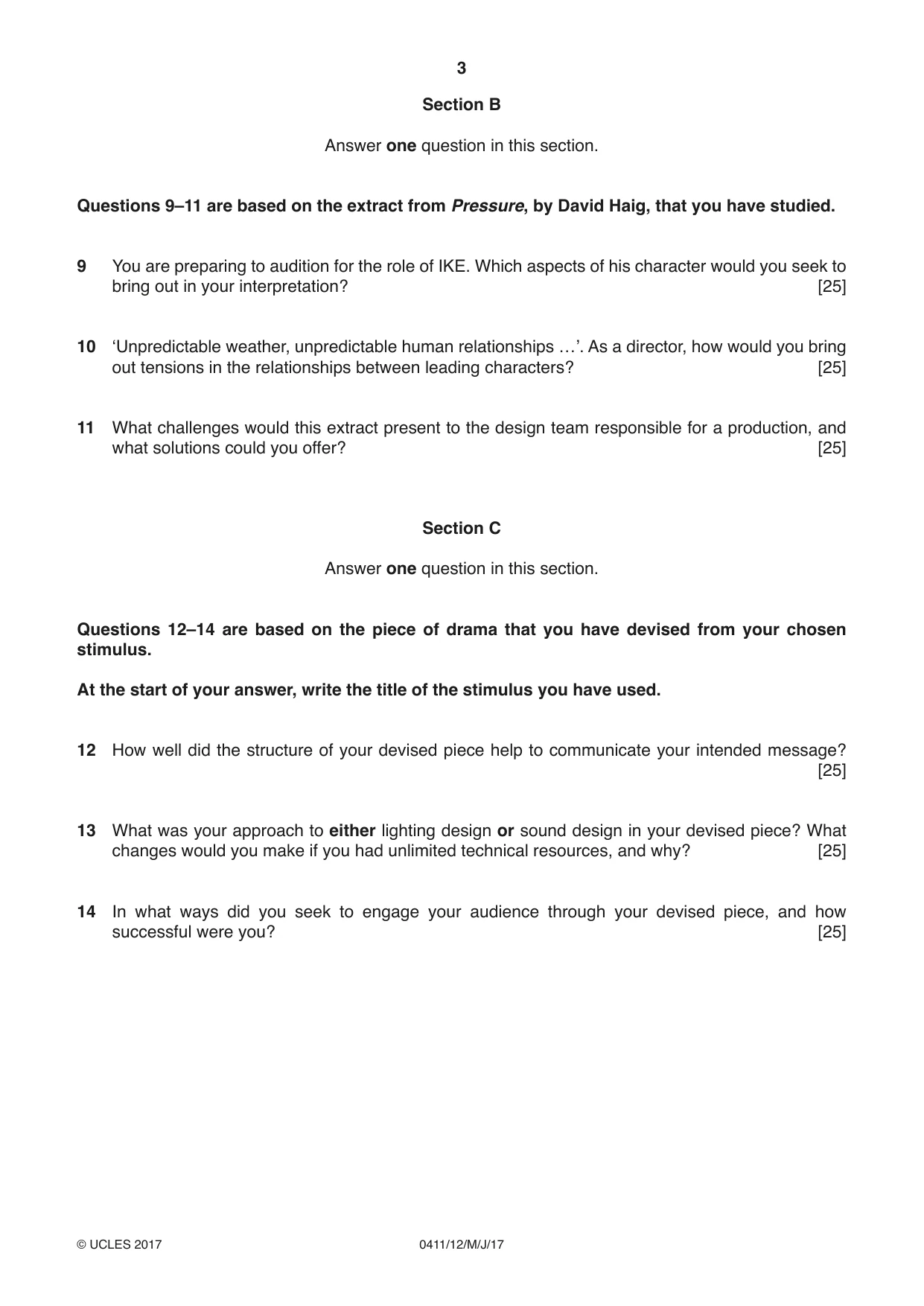
3 0411/12/M/J/17 © UCLES 2017 Section B Answer one question in this section. Questions 9–11 are based on the extract from Pressure, by David Haig, that you have studied. 9 You are preparing to audition for the role of IKE. Which aspects of his character would you seek to bring out in your interpretation? [25] 10 ‘Unpredictable weather, unpredictable human relationships …’. As a director, how would you bring out tensions in the relationships between leading characters? [25] 11 What challenges would this extract present to the design team responsible for a production, and what solutions could you offer? [25] Section C Answer one question in this section. Questions 12–14 are based on the piece of drama that you have devised from your chosen stimulus. At the start of your answer, write the title of the stimulus you have used. 12 How well did the structure of your devised piece help to communicate your intended message? [25] 13 What was your approach to either lighting design or sound design in your devised piece? What changes would you make if you had unlimited technical resources, and why? [25] 14 In what ways did you seek to engage your audience through your devised piece, and how successful were you? [25]
Question paper, page 4
4 0411/12/M/J/17 © UCLES 2017 Permission to reproduce items where third-party owned material protected by copyright is included has been sought and cleared where possible. Every reasonable effort has been made by the publisher (UCLES) to trace copyright holders, but if any items requiring clearance have unwittingly been included, the publisher will be pleased to make amends at the earliest possible opportunity. To avoid the issue of disclosure of answer-related information to candidates, all copyright acknowledgements are reproduced online in the Cambridge International Examinations Copyright Acknowledgements Booklet. This is produced for each series of examinations and is freely available to download at www.cie.org.uk after the live examination series. Cambridge International Examinations is part of the Cambridge Assessment Group. Cambridge Assessment is the brand name of University of Cambridge Local Examinations Syndicate (UCLES), which is itself a department of the University of Cambridge. BLANK PAGE
Mark scheme, page 1
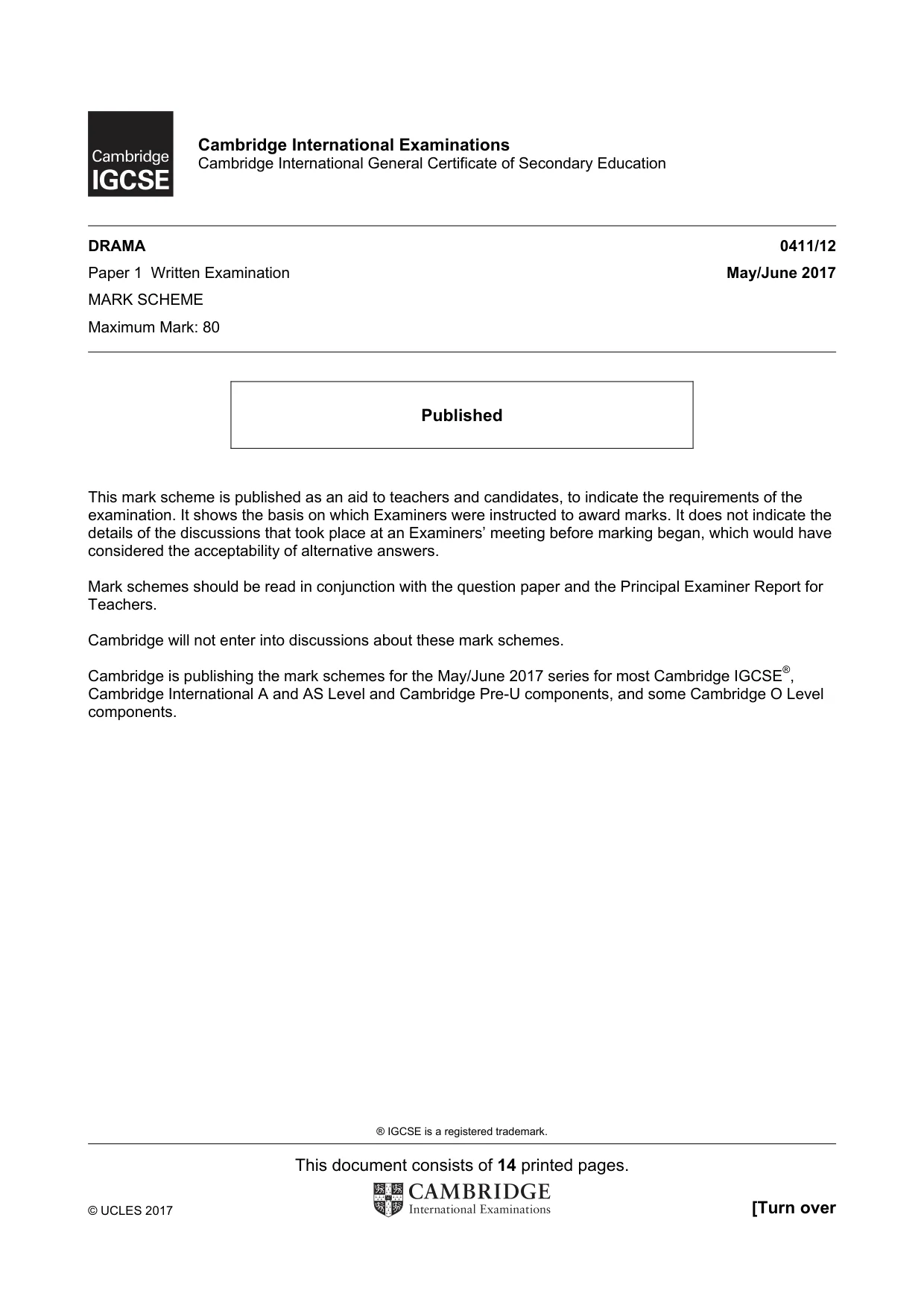
® IGCSE is a registered trademark. This document consists of 14 printed pages. © UCLES 2017 [Turn over Cambridge International Examinations Cambridge International General Certificate of Secondary Education DRAMA 0411/12 Paper 1 Written Examination May/June 2017 MARK SCHEME Maximum Mark: 80 Published This mark scheme is published as an aid to teachers and candidates, to indicate the requirements of the examination. It shows the basis on which Examiners were instructed to award marks. It does not indicate the details of the discussions that took place at an Examiners’ meeting before marking began, which would have considered the acceptability of alternative answers. Mark schemes should be read in conjunction with the question paper and the Principal Examiner Report for Teachers. Cambridge will not enter into discussions about these mark schemes. Cambridge is publishing the mark schemes for the May/June 2017 series for most Cambridge IGCSE®, Cambridge International A and AS Level and Cambridge Pre-U components, and some Cambridge O Level components.
Mark scheme, page 2
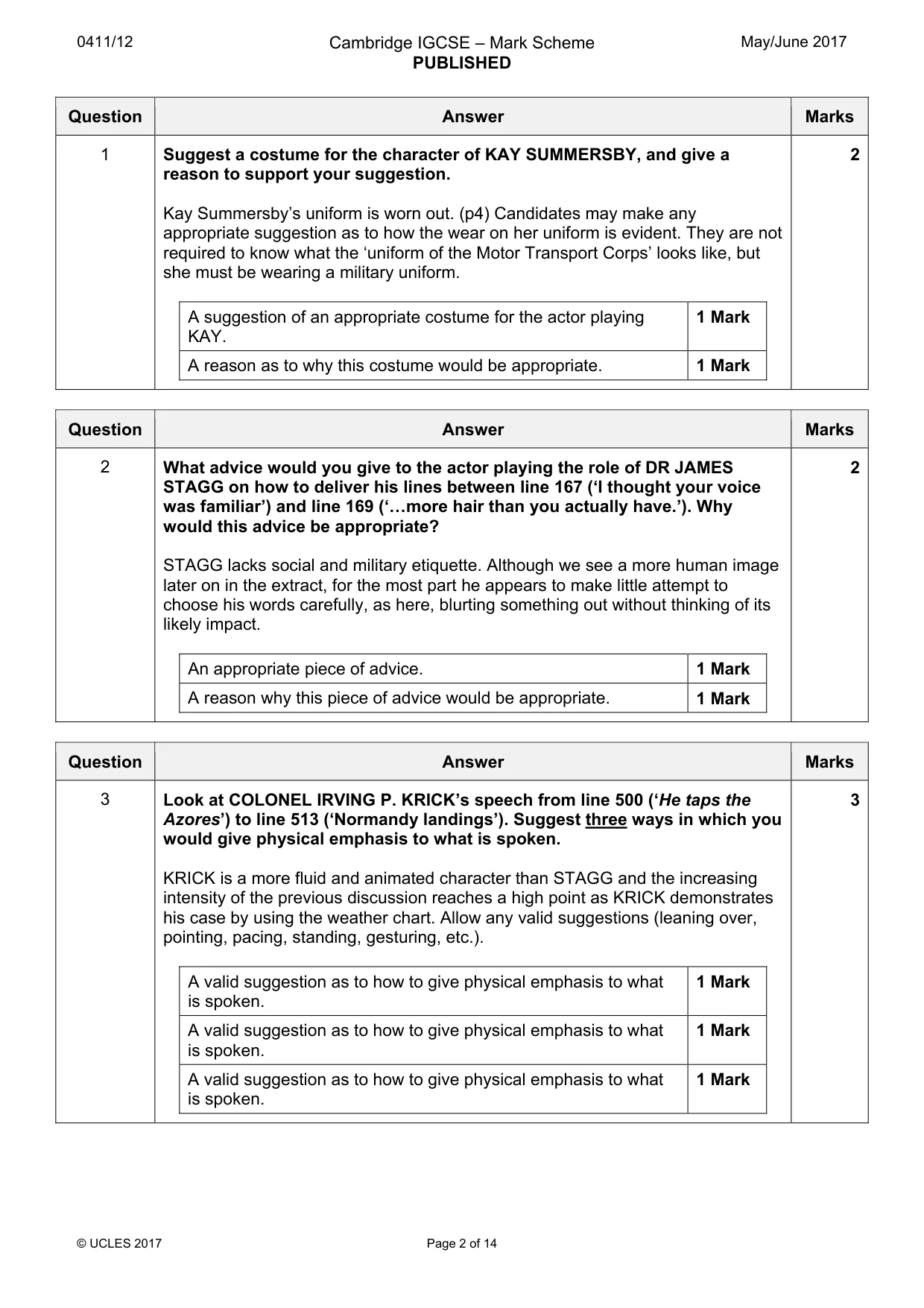
0411/12 Cambridge IGCSE – Mark Scheme PUBLISHED May/June 2017 © UCLES 2017 Page 2 of 14 Question Answer Marks 1 Suggest a costume for the character of KAY SUMMERSBY, and give a reason to support your suggestion. Kay Summersby’s uniform is worn out. (p4) Candidates may make any appropriate suggestion as to how the wear on her uniform is evident. They are not required to know what the ‘uniform of the Motor Transport Corps’ looks like, but she must be wearing a military uniform. A suggestion of an appropriate costume for the actor playing KAY. 1 Mark A reason as to why this costume would be appropriate. 1 Mark 2 Question Answer Marks 2 What advice would you give to the actor playing the role of DR JAMES STAGG on how to deliver his lines between line 167 (‘I thought your voice was familiar’) and line 169 (‘«more hair than you actually have.’). Why would this advice be appropriate? STAGG lacks social and military etiquette. Although we see a more human image later on in the extract, for the most part he appears to make little attempt to choose his words carefully, as here, blurting something out without thinking of its likely impact. An appropriate piece of advice. 1 Mark A reason why this piece of advice would be appropriate. 1 Mark 2 Question Answer Marks 3 Look at COLONEL IRVING P. KRICK’s speech from line 500 (‘He taps the Azores’) to line 513 (‘Normandy landings’). Suggest three ways in which you would give physical emphasis to what is spoken. KRICK is a more fluid and animated character than STAGG and the increasing intensity of the previous discussion reaches a high point as KRICK demonstrates his case by using the weather chart. Allow any valid suggestions (leaning over, pointing, pacing, standing, gesturing, etc.). A valid suggestion as to how to give physical emphasis to what is spoken. 1 Mark A valid suggestion as to how to give physical emphasis to what is spoken. 1 Mark A valid suggestion as to how to give physical emphasis to what is spoken. 1 Mark 3
Mark scheme, page 3
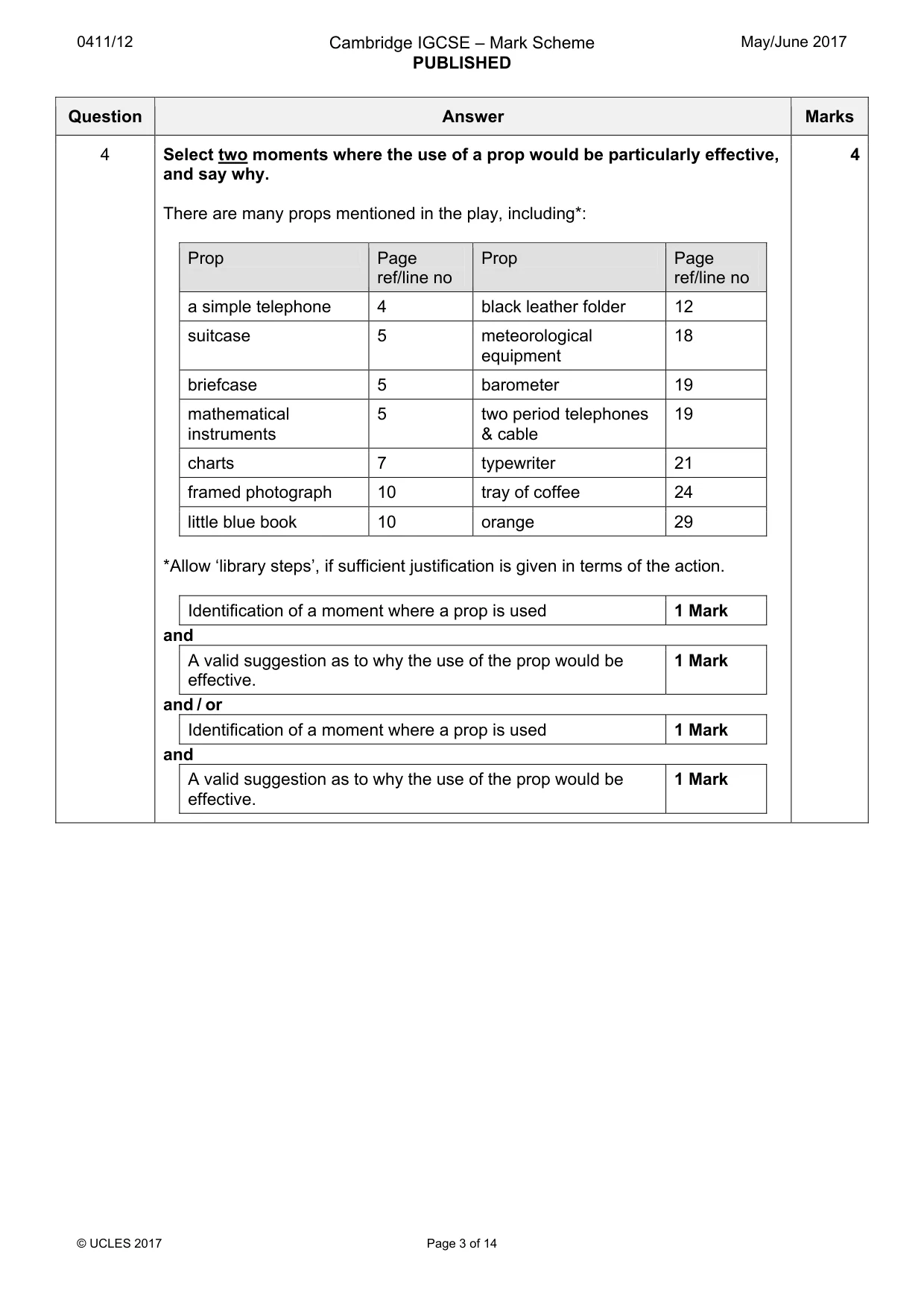
0411/12 Cambridge IGCSE – Mark Scheme PUBLISHED May/June 2017 © UCLES 2017 Page 3 of 14 Question Answer Marks 4 Select two moments where the use of a prop would be particularly effective, and say why. There are many props mentioned in the play, including*: Prop Page ref/line no Prop Page ref/line no a simple telephone 4 black leather folder 12 suitcase 5 meteorological equipment 18 briefcase 5 barometer 19 mathematical instruments 5 two period telephones & cable 19 charts 7 typewriter 21 framed photograph 10 tray of coffee 24 little blue book 10 orange 29 *Allow ‘library steps’, if sufficient justification is given in terms of the action. Identification of a moment where a prop is used 1 Mark and A valid suggestion as to why the use of the prop would be effective. 1 Mark and / or Identification of a moment where a prop is used 1 Mark and A valid suggestion as to why the use of the prop would be effective. 1 Mark 4
Mark scheme, page 4
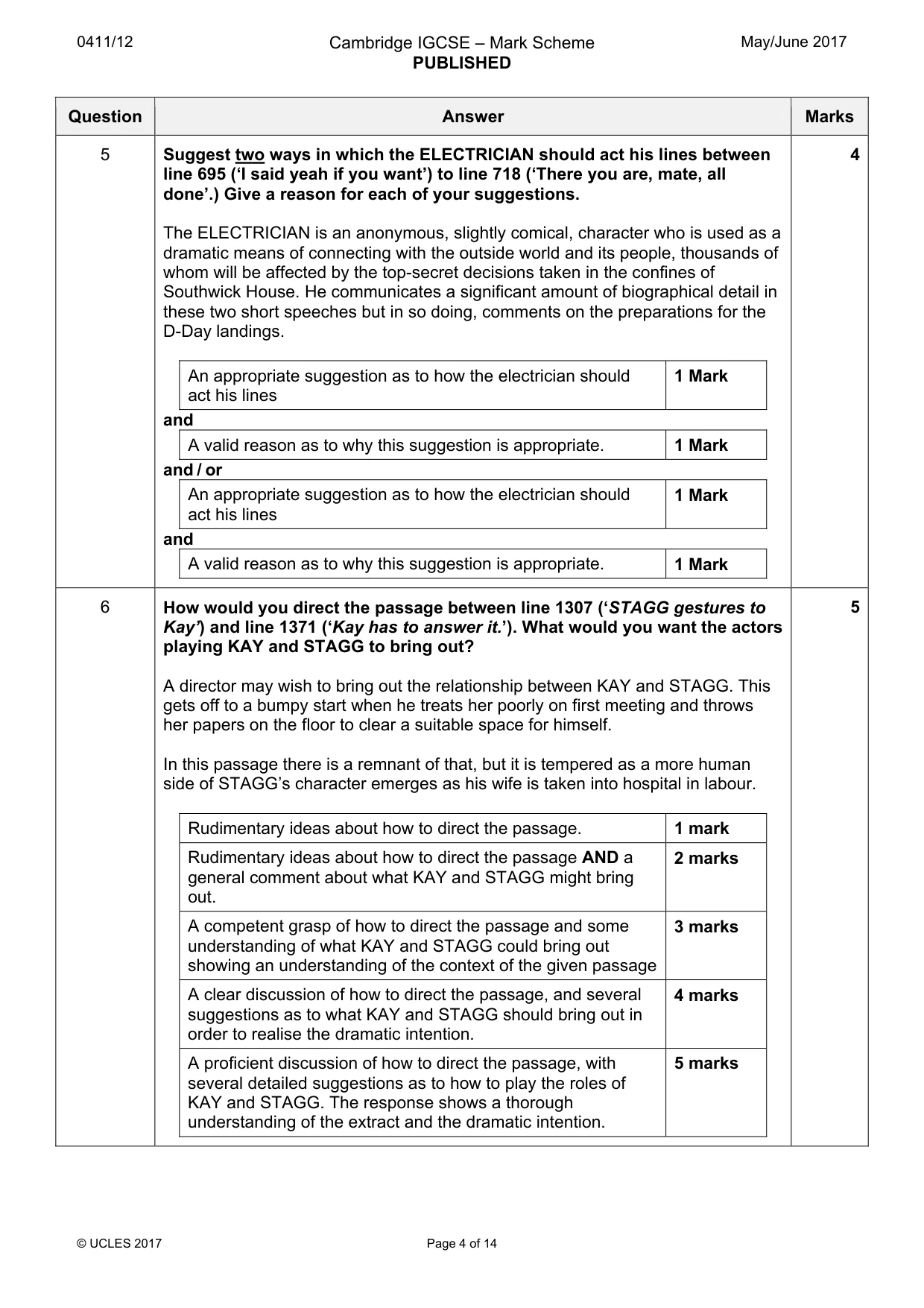
0411/12 Cambridge IGCSE – Mark Scheme PUBLISHED May/June 2017 © UCLES 2017 Page 4 of 14 Question Answer Marks 5 Suggest two ways in which the ELECTRICIAN should act his lines between line 695 (‘I said yeah if you want’) to line 718 (‘There you are, mate, all done’.) Give a reason for each of your suggestions. The ELECTRICIAN is an anonymous, slightly comical, character who is used as a dramatic means of connecting with the outside world and its people, thousands of whom will be affected by the top-secret decisions taken in the confines of Southwick House. He communicates a significant amount of biographical detail in these two short speeches but in so doing, comments on the preparations for the D-Day landings. An appropriate suggestion as to how the electrician should act his lines 1 Mark and A valid reason as to why this suggestion is appropriate. 1 Mark and / or An appropriate suggestion as to how the electrician should act his lines 1 Mark and A valid reason as to why this suggestion is appropriate. 1 Mark 4 6 How would you direct the passage between line 1307 (‘STAGG gestures to Kay’) and line 1371 (‘Kay has to answer it.’). What would you want the actors playing KAY and STAGG to bring out? A director may wish to bring out the relationship between KAY and STAGG. This gets off to a bumpy start when he treats her poorly on first meeting and throws her papers on the floor to clear a suitable space for himself. In this passage there is a remnant of that, but it is tempered as a more human side of STAGG’s character emerges as his wife is taken into hospital in labour. Rudimentary ideas about how to direct the passage. 1 mark Rudimentary ideas about how to direct the passage AND a general comment about what KAY and STAGG might bring out. 2 marks A competent grasp of how to direct the passage and some understanding of what KAY and STAGG could bring out showing an understanding of the context of the given passage 3 marks A clear discussion of how to direct the passage, and several suggestions as to what KAY and STAGG should bring out in order to realise the dramatic intention. 4 marks A proficient discussion of how to direct the passage, with several detailed suggestions as to how to play the roles of KAY and STAGG. The response shows a thorough understanding of the extract and the dramatic intention. 5 marks 5
Mark scheme, page 5
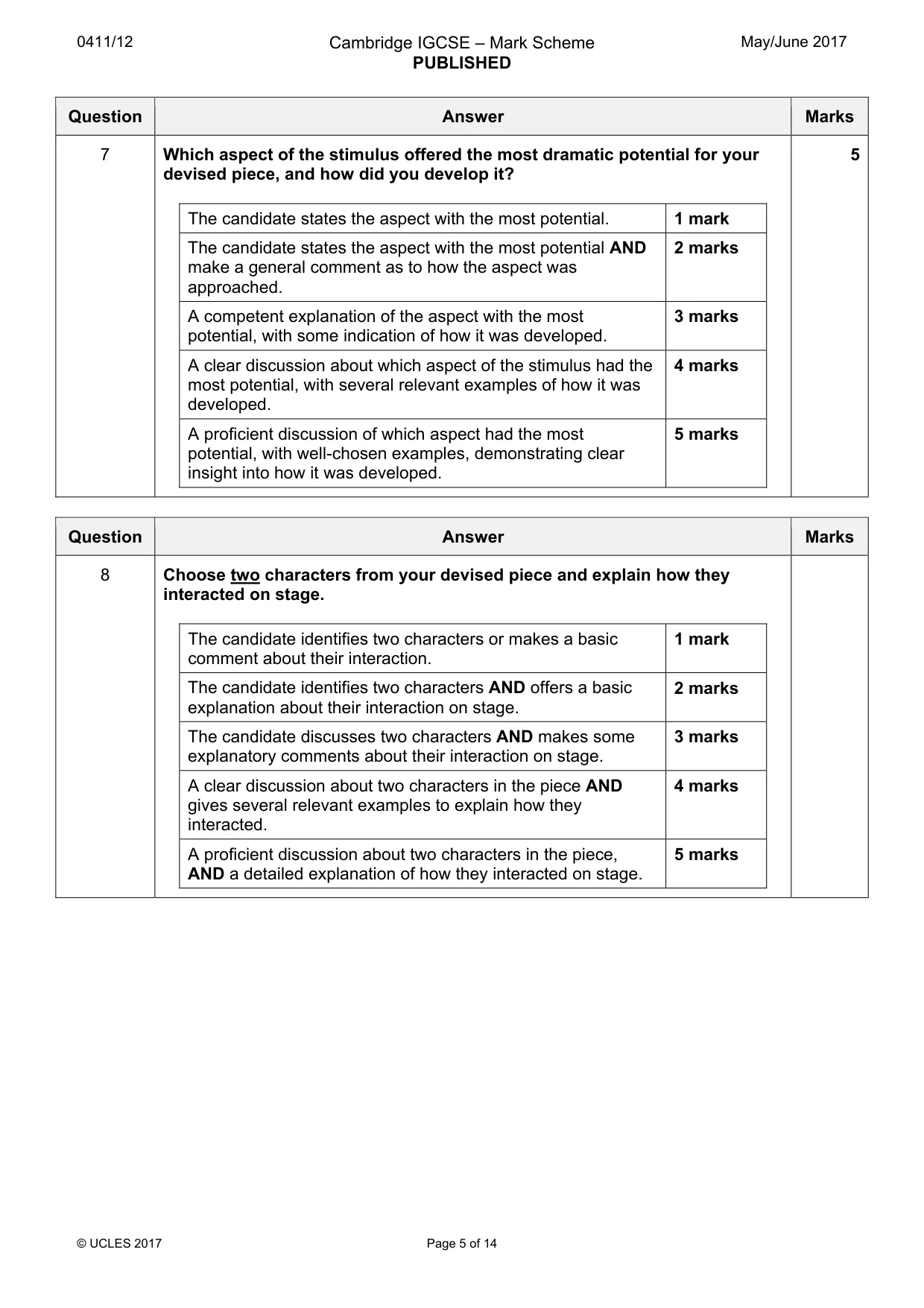
0411/12 Cambridge IGCSE – Mark Scheme PUBLISHED May/June 2017 © UCLES 2017 Page 5 of 14 Question Answer Marks 7 Which aspect of the stimulus offered the most dramatic potential for your devised piece, and how did you develop it? The candidate states the aspect with the most potential. 1 mark The candidate states the aspect with the most potential AND make a general comment as to how the aspect was approached. 2 marks A competent explanation of the aspect with the most potential, with some indication of how it was developed. 3 marks A clear discussion about which aspect of the stimulus had the most potential, with several relevant examples of how it was developed. 4 marks A proficient discussion of which aspect had the most potential, with well-chosen examples, demonstrating clear insight into how it was developed. 5 marks 5 Question Answer Marks 8 Choose two characters from your devised piece and explain how they interacted on stage. The candidate identifies two characters or makes a basic comment about their interaction. 1 mark The candidate identifies two characters AND offers a basic explanation about their interaction on stage. 2 marks The candidate discusses two characters AND makes some explanatory comments about their interaction on stage. 3 marks A clear discussion about two characters in the piece AND gives several relevant examples to explain how they interacted. 4 marks A proficient discussion about two characters in the piece, AND a detailed explanation of how they interacted on stage. 5 marks
Mark scheme, page 6
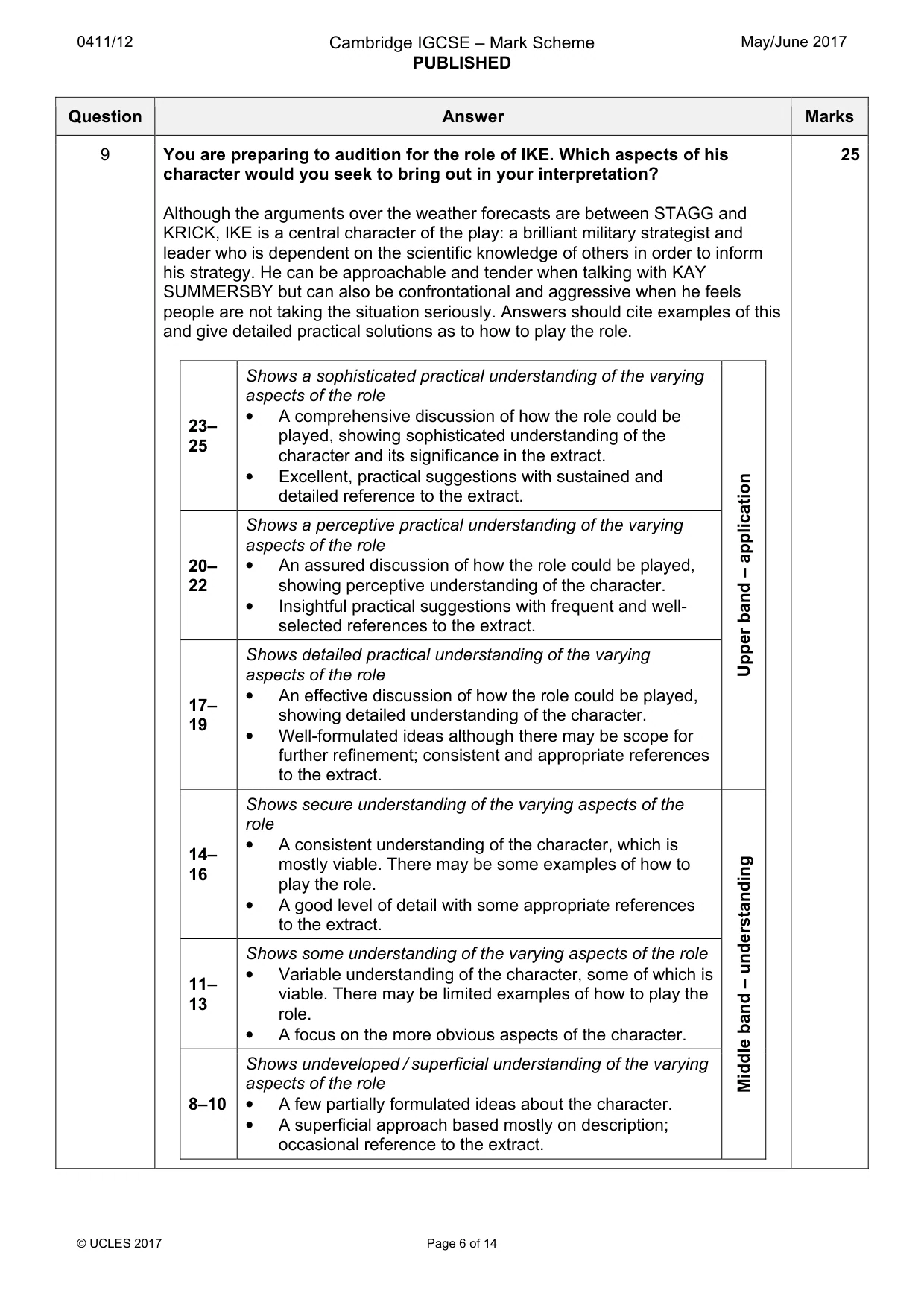
0411/12 Cambridge IGCSE – Mark Scheme PUBLISHED May/June 2017 © UCLES 2017 Page 6 of 14 Question Answer Marks 9 You are preparing to audition for the role of IKE. Which aspects of his character would you seek to bring out in your interpretation? Although the arguments over the weather forecasts are between STAGG and KRICK, IKE is a central character of the play: a brilliant military strategist and leader who is dependent on the scientific knowledge of others in order to inform his strategy. He can be approachable and tender when talking with KAY SUMMERSBY but can also be confrontational and aggressive when he feels people are not taking the situation seriously. Answers should cite examples of this and give detailed practical solutions as to how to play the role. 23– 25 Shows a sophisticated practical understanding of the varying aspects of the role • A comprehensive discussion of how the role could be played, showing sophisticated understanding of the character and its significance in the extract. • Excellent, practical suggestions with sustained and detailed reference to the extract. Upper band – application 20– 22 Shows a perceptive practical understanding of the varying aspects of the role • An assured discussion of how the role could be played, showing perceptive understanding of the character. • Insightful practical suggestions with frequent and well- selected references to the extract. 17– 19 Shows detailed practical understanding of the varying aspects of the role • An effective discussion of how the role could be played, showing detailed understanding of the character. • Well-formulated ideas although there may be scope for further refinement; consistent and appropriate references to the extract. 14– 16 Shows secure understanding of the varying aspects of the role • A consistent understanding of the character, which is mostly viable. There may be some examples of how to play the role. • A good level of detail with some appropriate references to the extract. Middle band – understanding 11– 13 Shows some understanding of the varying aspects of the role • Variable understanding of the character, some of which is viable. There may be limited examples of how to play the role. • A focus on the more obvious aspects of the character. 8–10 Shows undeveloped / superficial understanding of the varying aspects of the role • A few partially formulated ideas about the character. • A superficial approach based mostly on description; occasional reference to the extract. 25
Mark scheme, page 7
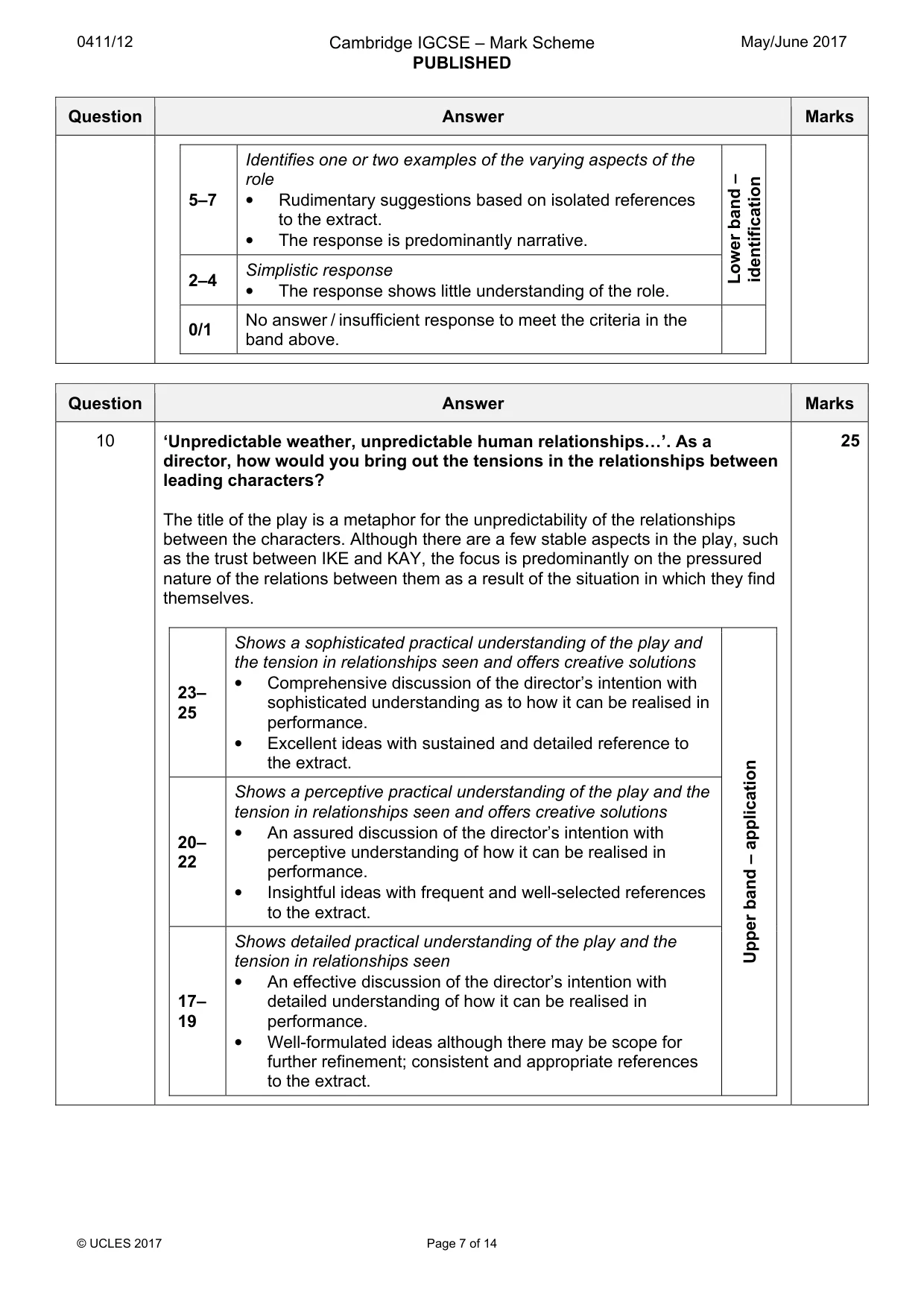
0411/12 Cambridge IGCSE – Mark Scheme PUBLISHED May/June 2017 © UCLES 2017 Page 7 of 14 Question Answer Marks 5–7 Identifies one or two examples of the varying aspects of the role • Rudimentary suggestions based on isolated references to the extract. • The response is predominantly narrative. Lower band – identification 2–4 Simplistic response • The response shows little understanding of the role. 0/1 No answer / insufficient response to meet the criteria in the band above. Question Answer Marks 10 ‘Unpredictable weather, unpredictable human relationships«’. As a director, how would you bring out the tensions in the relationships between leading characters? The title of the play is a metaphor for the unpredictability of the relationships between the characters. Although there are a few stable aspects in the play, such as the trust between IKE and KAY, the focus is predominantly on the pressured nature of the relations between them as a result of the situation in which they find themselves. 23– 25 Shows a sophisticated practical understanding of the play and the tension in relationships seen and offers creative solutions • Comprehensive discussion of the director’s intention with sophisticated understanding as to how it can be realised in performance. • Excellent ideas with sustained and detailed reference to the extract. Upper band – application 20– 22 Shows a perceptive practical understanding of the play and the tension in relationships seen and offers creative solutions • An assured discussion of the director’s intention with perceptive understanding of how it can be realised in performance. • Insightful ideas with frequent and well-selected references to the extract. 17– 19 Shows detailed practical understanding of the play and the tension in relationships seen • An effective discussion of the director’s intention with detailed understanding of how it can be realised in performance. • Well-formulated ideas although there may be scope for further refinement; consistent and appropriate references to the extract. 25
Mark scheme, page 8
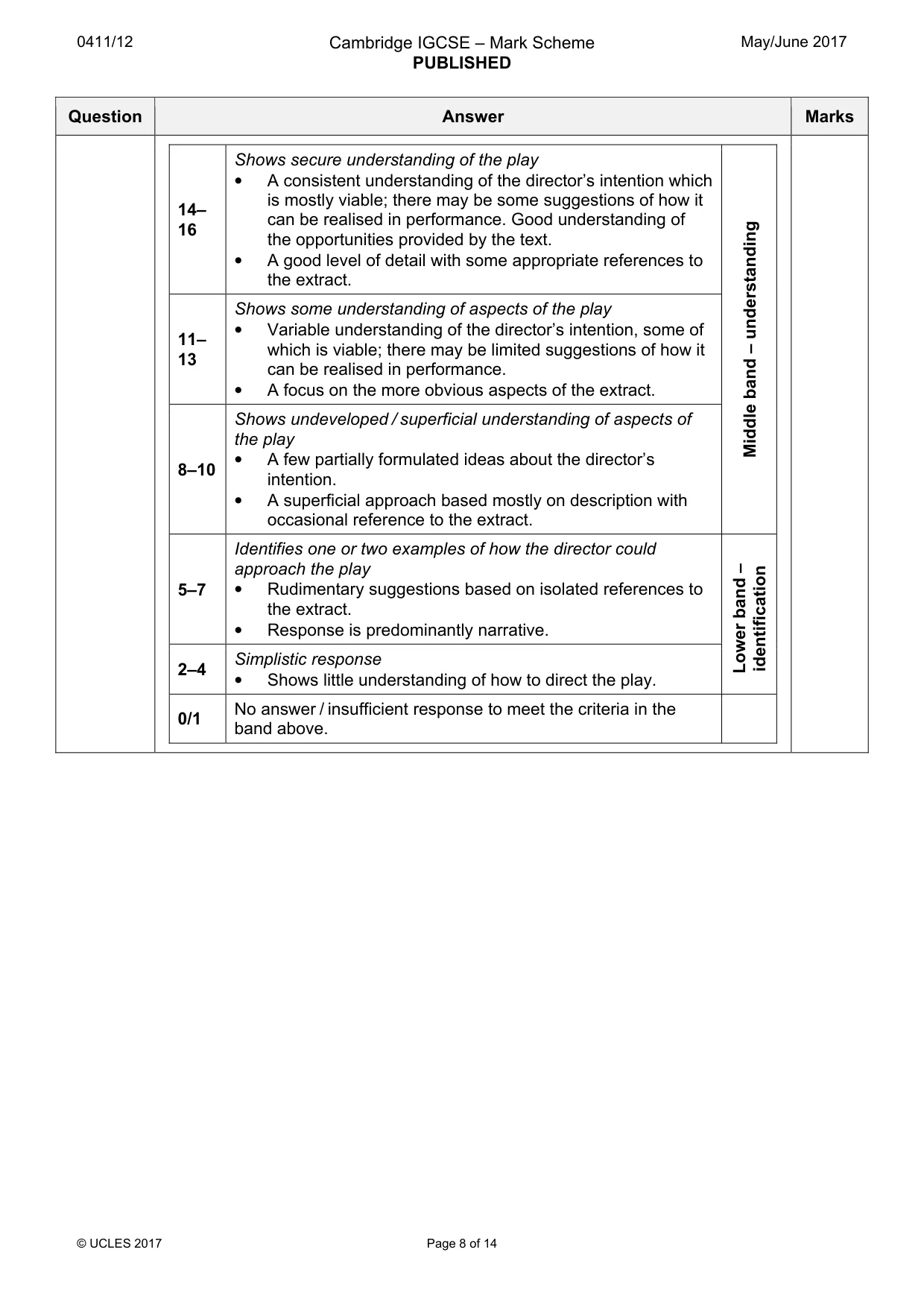
0411/12 Cambridge IGCSE – Mark Scheme PUBLISHED May/June 2017 © UCLES 2017 Page 8 of 14 Question Answer Marks 14– 16 Shows secure understanding of the play • A consistent understanding of the director’s intention which is mostly viable; there may be some suggestions of how it can be realised in performance. Good understanding of the opportunities provided by the text. • A good level of detail with some appropriate references to the extract. Middle band – understanding 11– 13 Shows some understanding of aspects of the play • Variable understanding of the director’s intention, some of which is viable; there may be limited suggestions of how it can be realised in performance. • A focus on the more obvious aspects of the extract. 8–10 Shows undeveloped / superficial understanding of aspects of the play • A few partially formulated ideas about the director’s intention. • A superficial approach based mostly on description with occasional reference to the extract. 5–7 Identifies one or two examples of how the director could approach the play • Rudimentary suggestions based on isolated references to the extract. • Response is predominantly narrative. Lower band – identification 2–4 Simplistic response • Shows little understanding of how to direct the play. 0/1 No answer / insufficient response to meet the criteria in the band above.
Mark scheme, page 9
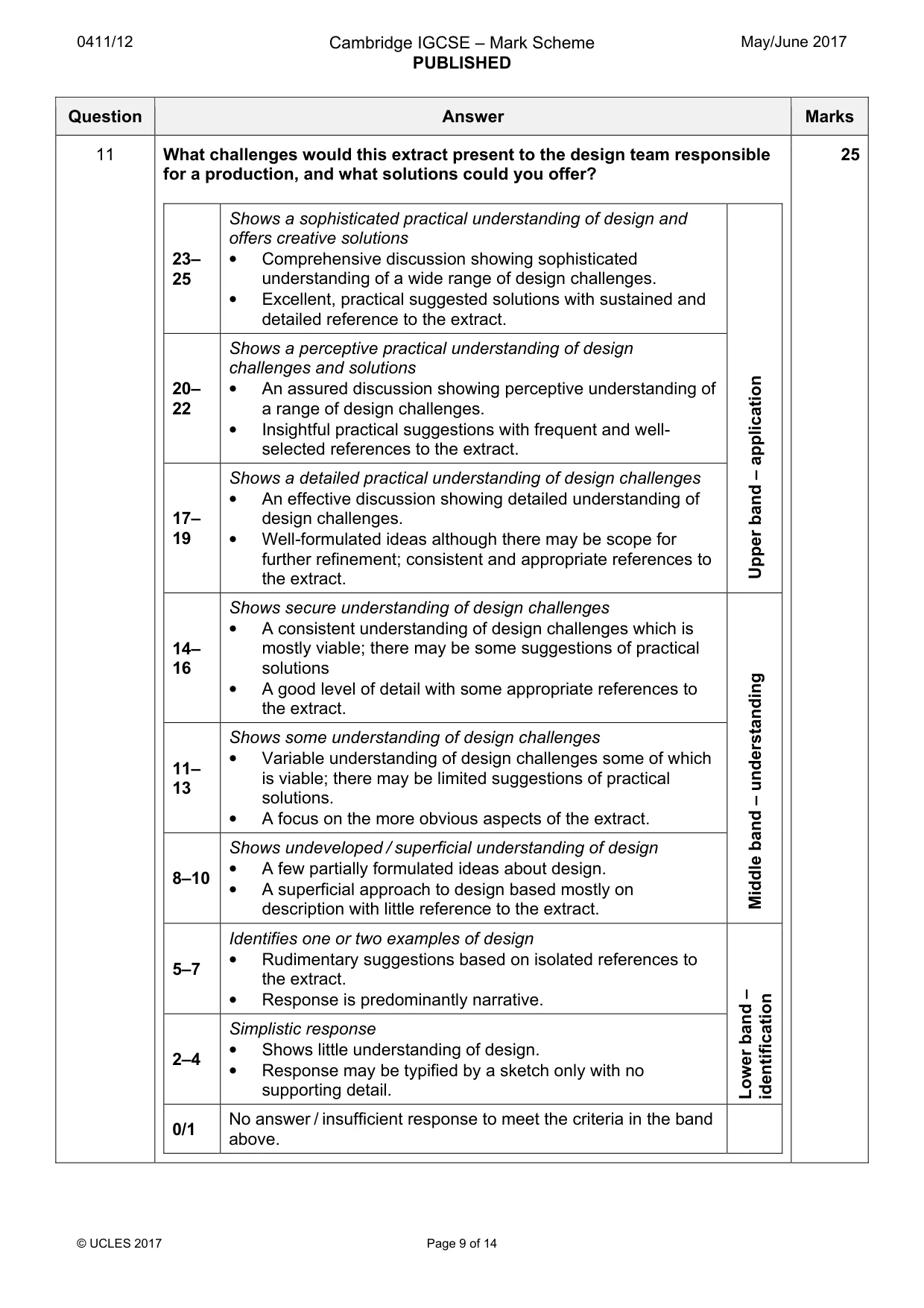
0411/12 Cambridge IGCSE – Mark Scheme PUBLISHED May/June 2017 © UCLES 2017 Page 9 of 14 Question Answer Marks 11 What challenges would this extract present to the design team responsible for a production, and what solutions could you offer? 23– 25 Shows a sophisticated practical understanding of design and offers creative solutions • Comprehensive discussion showing sophisticated understanding of a wide range of design challenges. • Excellent, practical suggested solutions with sustained and detailed reference to the extract. Upper band – application 20– 22 Shows a perceptive practical understanding of design challenges and solutions • An assured discussion showing perceptive understanding of a range of design challenges. • Insightful practical suggestions with frequent and well- selected references to the extract. 17– 19 Shows a detailed practical understanding of design challenges • An effective discussion showing detailed understanding of design challenges. • Well-formulated ideas although there may be scope for further refinement; consistent and appropriate references to the extract. 14– 16 Shows secure understanding of design challenges • A consistent understanding of design challenges which is mostly viable; there may be some suggestions of practical solutions • A good level of detail with some appropriate references to the extract. Middle band – understanding 11– 13 Shows some understanding of design challenges • Variable understanding of design challenges some of which is viable; there may be limited suggestions of practical solutions. • A focus on the more obvious aspects of the extract. 8–10 Shows undeveloped / superficial understanding of design • A few partially formulated ideas about design. • A superficial approach to design based mostly on description with little reference to the extract. 5–7 Identifies one or two examples of design • Rudimentary suggestions based on isolated references to the extract. • Response is predominantly narrative. Lower band – identification 2–4 Simplistic response • Shows little understanding of design. • Response may be typified by a sketch only with no supporting detail. 0/1 No answer / insufficient response to meet the criteria in the band above. 25
Mark scheme, page 10
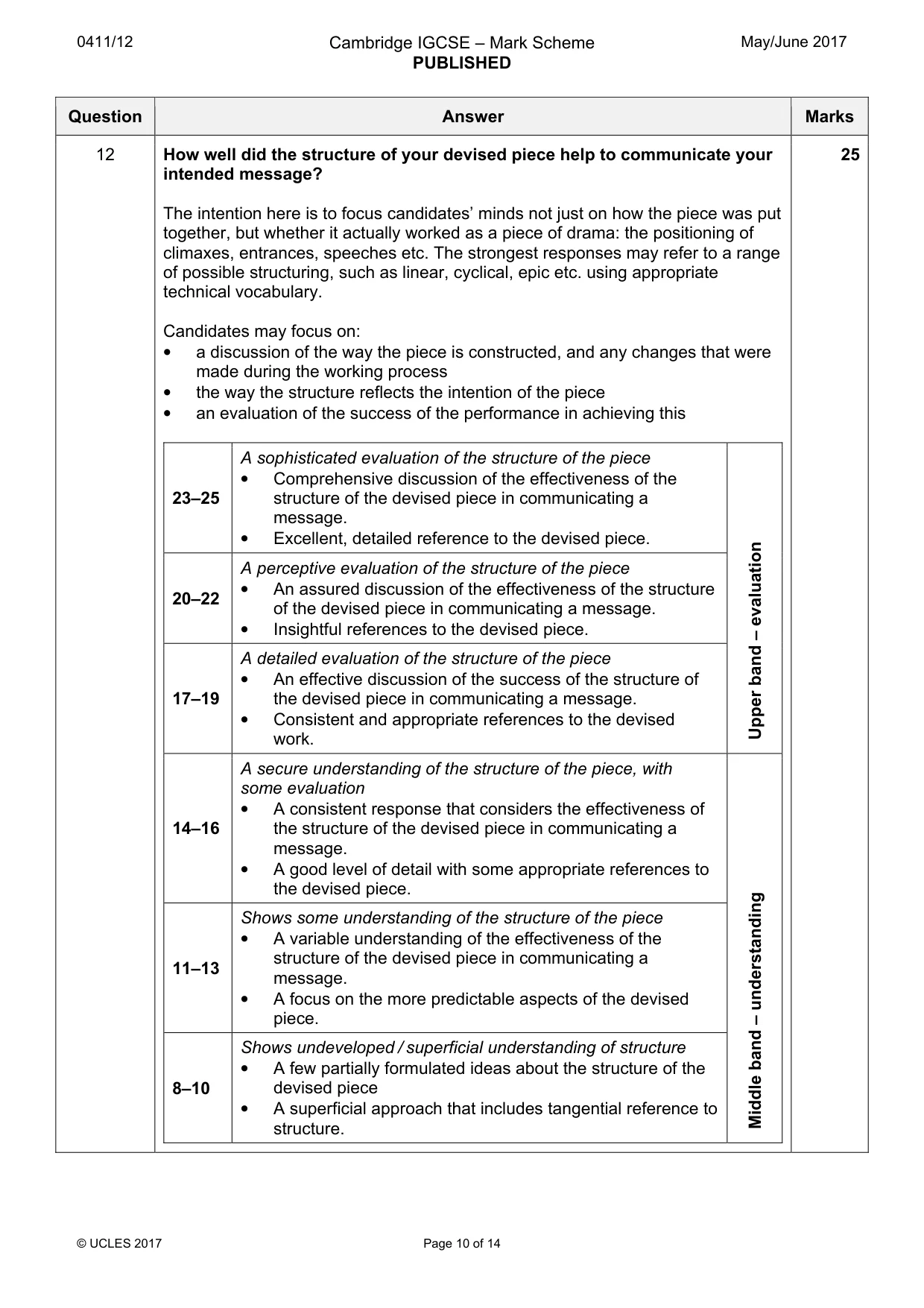
0411/12 Cambridge IGCSE – Mark Scheme PUBLISHED May/June 2017 © UCLES 2017 Page 10 of 14 Question Answer Marks 12 How well did the structure of your devised piece help to communicate your intended message? The intention here is to focus candidates’ minds not just on how the piece was put together, but whether it actually worked as a piece of drama: the positioning of climaxes, entrances, speeches etc. The strongest responses may refer to a range of possible structuring, such as linear, cyclical, epic etc. using appropriate technical vocabulary. Candidates may focus on: • a discussion of the way the piece is constructed, and any changes that were made during the working process • the way the structure reflects the intention of the piece • an evaluation of the success of the performance in achieving this 23–25 A sophisticated evaluation of the structure of the piece • Comprehensive discussion of the effectiveness of the structure of the devised piece in communicating a message. • Excellent, detailed reference to the devised piece. Upper band – evaluation 20–22 A perceptive evaluation of the structure of the piece • An assured discussion of the effectiveness of the structure of the devised piece in communicating a message. • Insightful references to the devised piece. 17–19 A detailed evaluation of the structure of the piece • An effective discussion of the success of the structure of the devised piece in communicating a message. • Consistent and appropriate references to the devised work. 14–16 A secure understanding of the structure of the piece, with some evaluation • A consistent response that considers the effectiveness of the structure of the devised piece in communicating a message. • A good level of detail with some appropriate references to the devised piece. Middle band – understanding 11–13 Shows some understanding of the structure of the piece • A variable understanding of the effectiveness of the structure of the devised piece in communicating a message. • A focus on the more predictable aspects of the devised piece. 8–10 Shows undeveloped / superficial understanding of structure • A few partially formulated ideas about the structure of the devised piece • A superficial approach that includes tangential reference to structure. 25
Mark scheme, page 11
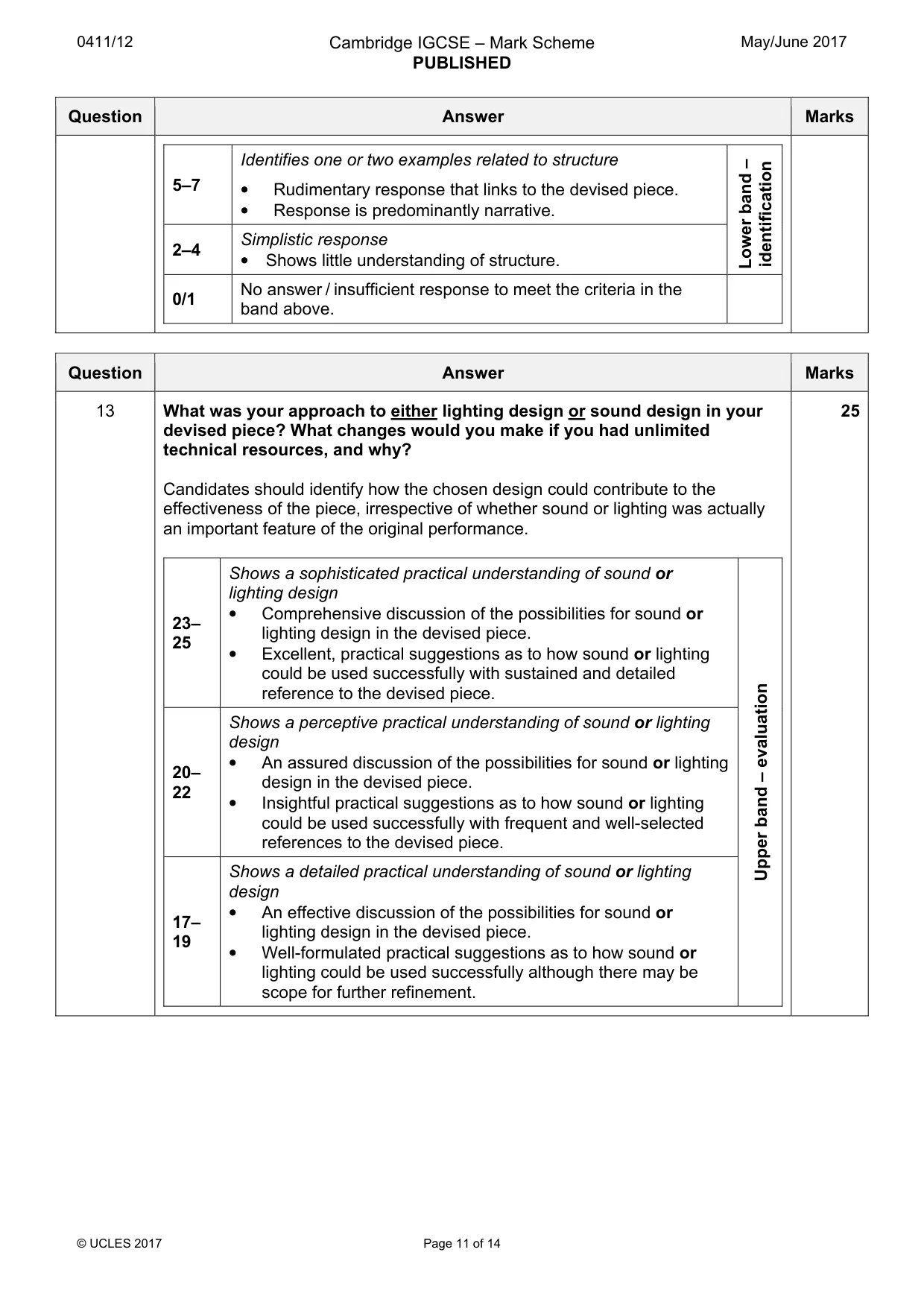
0411/12 Cambridge IGCSE – Mark Scheme PUBLISHED May/June 2017 © UCLES 2017 Page 11 of 14 Question Answer Marks 5–7 Identifies one or two examples related to structure • Rudimentary response that links to the devised piece. • Response is predominantly narrative. Lower band – identification 2–4 Simplistic response • Shows little understanding of structure. 0/1 No answer / insufficient response to meet the criteria in the band above. Question Answer Marks 13 What was your approach to either lighting design or sound design in your devised piece? What changes would you make if you had unlimited technical resources, and why? Candidates should identify how the chosen design could contribute to the effectiveness of the piece, irrespective of whether sound or lighting was actually an important feature of the original performance. 23– 25 Shows a sophisticated practical understanding of sound or lighting design • Comprehensive discussion of the possibilities for sound or lighting design in the devised piece. • Excellent, practical suggestions as to how sound or lighting could be used successfully with sustained and detailed reference to the devised piece. Upper band – evaluation 20– 22 Shows a perceptive practical understanding of sound or lighting design • An assured discussion of the possibilities for sound or lighting design in the devised piece. • Insightful practical suggestions as to how sound or lighting could be used successfully with frequent and well-selected references to the devised piece. 17– 19 Shows a detailed practical understanding of sound or lighting design • An effective discussion of the possibilities for sound or lighting design in the devised piece. • Well-formulated practical suggestions as to how sound or lighting could be used successfully although there may be scope for further refinement. 25
Mark scheme, page 12
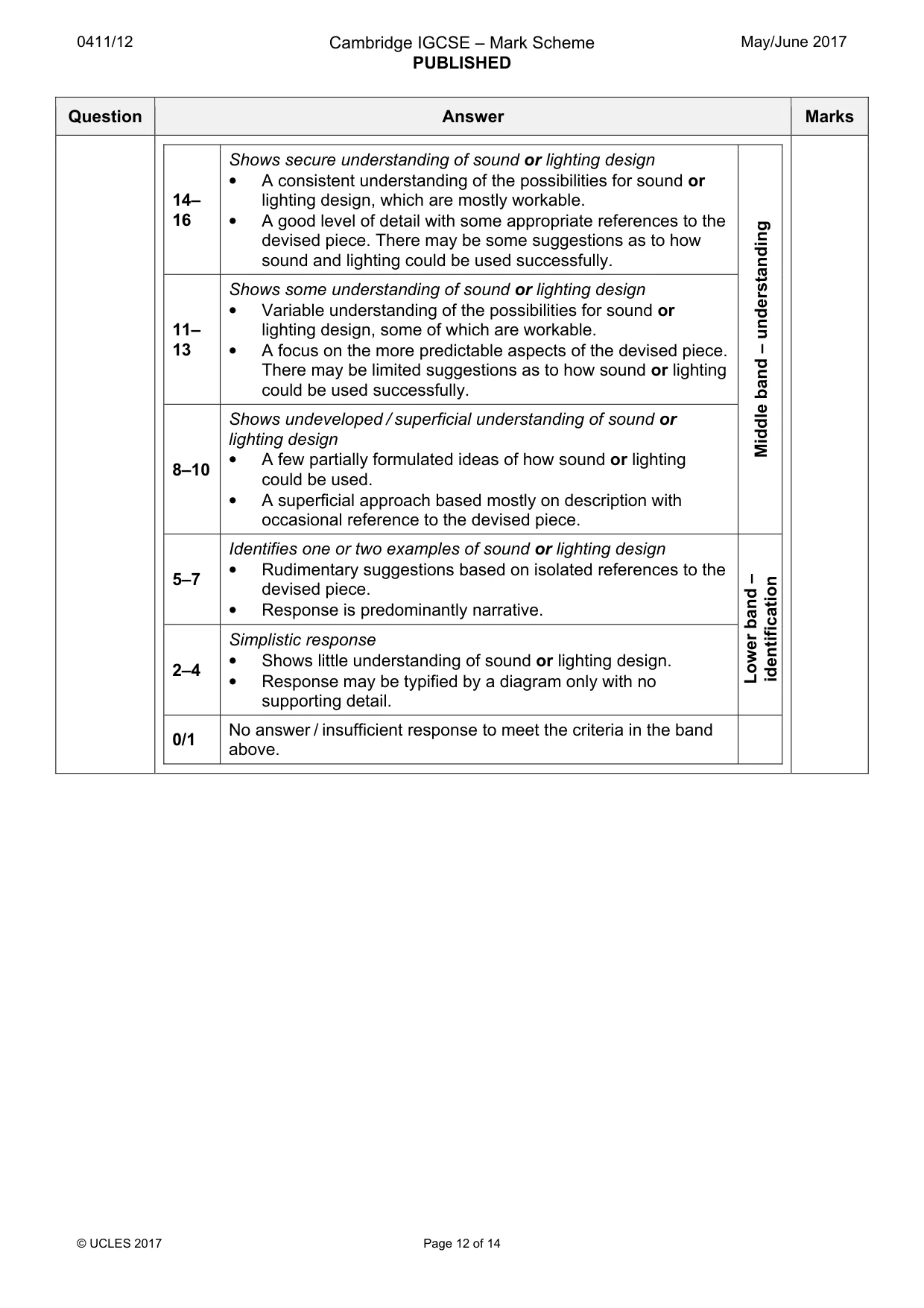
0411/12 Cambridge IGCSE – Mark Scheme PUBLISHED May/June 2017 © UCLES 2017 Page 12 of 14 Question Answer Marks 14– 16 Shows secure understanding of sound or lighting design • A consistent understanding of the possibilities for sound or lighting design, which are mostly workable. • A good level of detail with some appropriate references to the devised piece. There may be some suggestions as to how sound and lighting could be used successfully. Middle band – understanding 11– 13 Shows some understanding of sound or lighting design • Variable understanding of the possibilities for sound or lighting design, some of which are workable. • A focus on the more predictable aspects of the devised piece. There may be limited suggestions as to how sound or lighting could be used successfully. 8–10 Shows undeveloped / superficial understanding of sound or lighting design • A few partially formulated ideas of how sound or lighting could be used. • A superficial approach based mostly on description with occasional reference to the devised piece. 5–7 Identifies one or two examples of sound or lighting design • Rudimentary suggestions based on isolated references to the devised piece. • Response is predominantly narrative. Lower band – identification 2–4 Simplistic response • Shows little understanding of sound or lighting design. • Response may be typified by a diagram only with no supporting detail. 0/1 No answer / insufficient response to meet the criteria in the band above.
Mark scheme, page 13
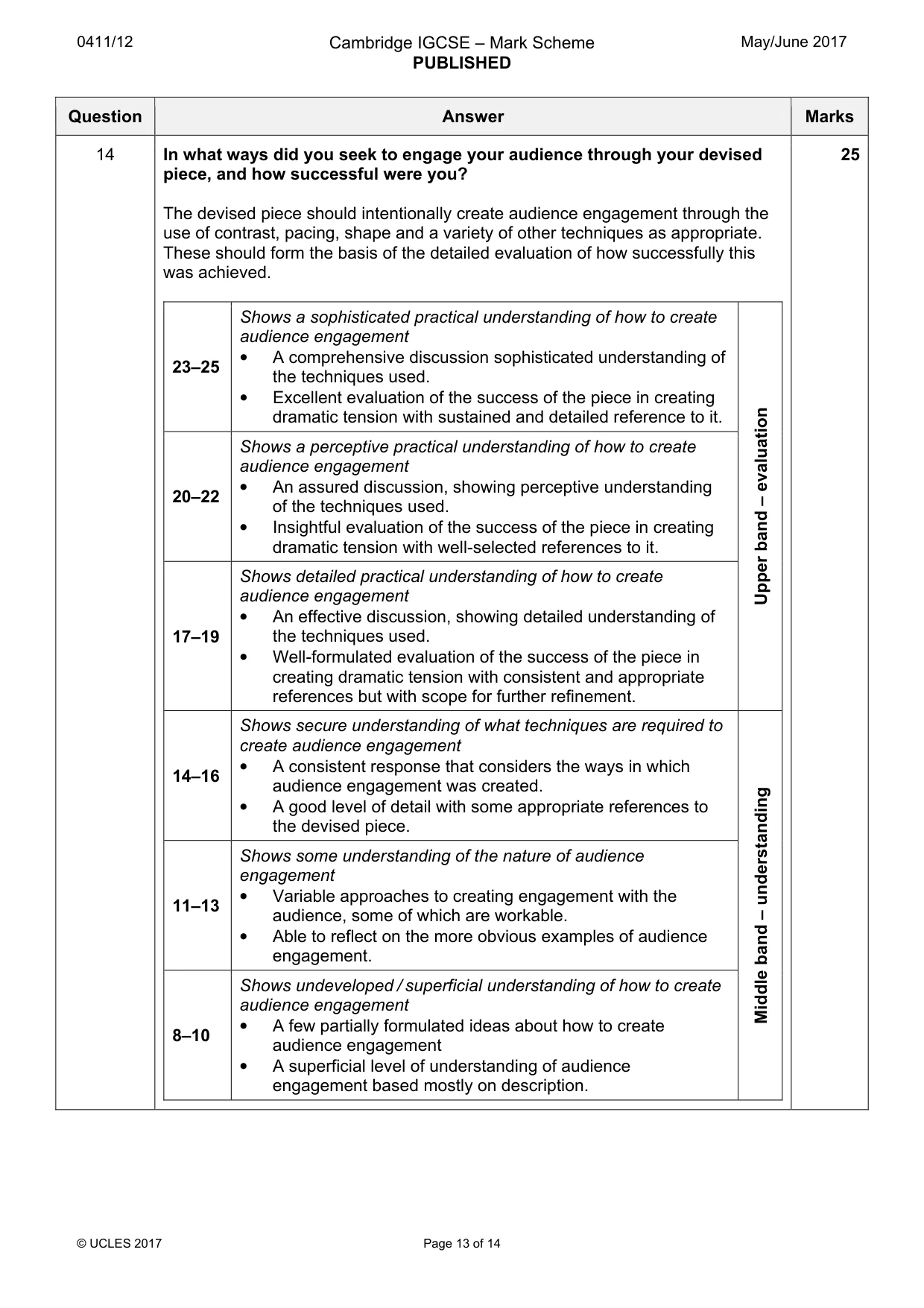
0411/12 Cambridge IGCSE – Mark Scheme PUBLISHED May/June 2017 © UCLES 2017 Page 13 of 14 Question Answer Marks 14 In what ways did you seek to engage your audience through your devised piece, and how successful were you? The devised piece should intentionally create audience engagement through the use of contrast, pacing, shape and a variety of other techniques as appropriate. These should form the basis of the detailed evaluation of how successfully this was achieved. 23–25 Shows a sophisticated practical understanding of how to create audience engagement • A comprehensive discussion sophisticated understanding of the techniques used. • Excellent evaluation of the success of the piece in creating dramatic tension with sustained and detailed reference to it. Upper band – evaluation 20–22 Shows a perceptive practical understanding of how to create audience engagement • An assured discussion, showing perceptive understanding of the techniques used. • Insightful evaluation of the success of the piece in creating dramatic tension with well-selected references to it. 17–19 Shows detailed practical understanding of how to create audience engagement • An effective discussion, showing detailed understanding of the techniques used. • Well-formulated evaluation of the success of the piece in creating dramatic tension with consistent and appropriate references but with scope for further refinement. 14–16 Shows secure understanding of what techniques are required to create audience engagement • A consistent response that considers the ways in which audience engagement was created. • A good level of detail with some appropriate references to the devised piece. Middle band – understanding 11–13 Shows some understanding of the nature of audience engagement • Variable approaches to creating engagement with the audience, some of which are workable. • Able to reflect on the more obvious examples of audience engagement. 8–10 Shows undeveloped / superficial understanding of how to create audience engagement • A few partially formulated ideas about how to create audience engagement • A superficial level of understanding of audience engagement based mostly on description. 25
Mark scheme, page 14
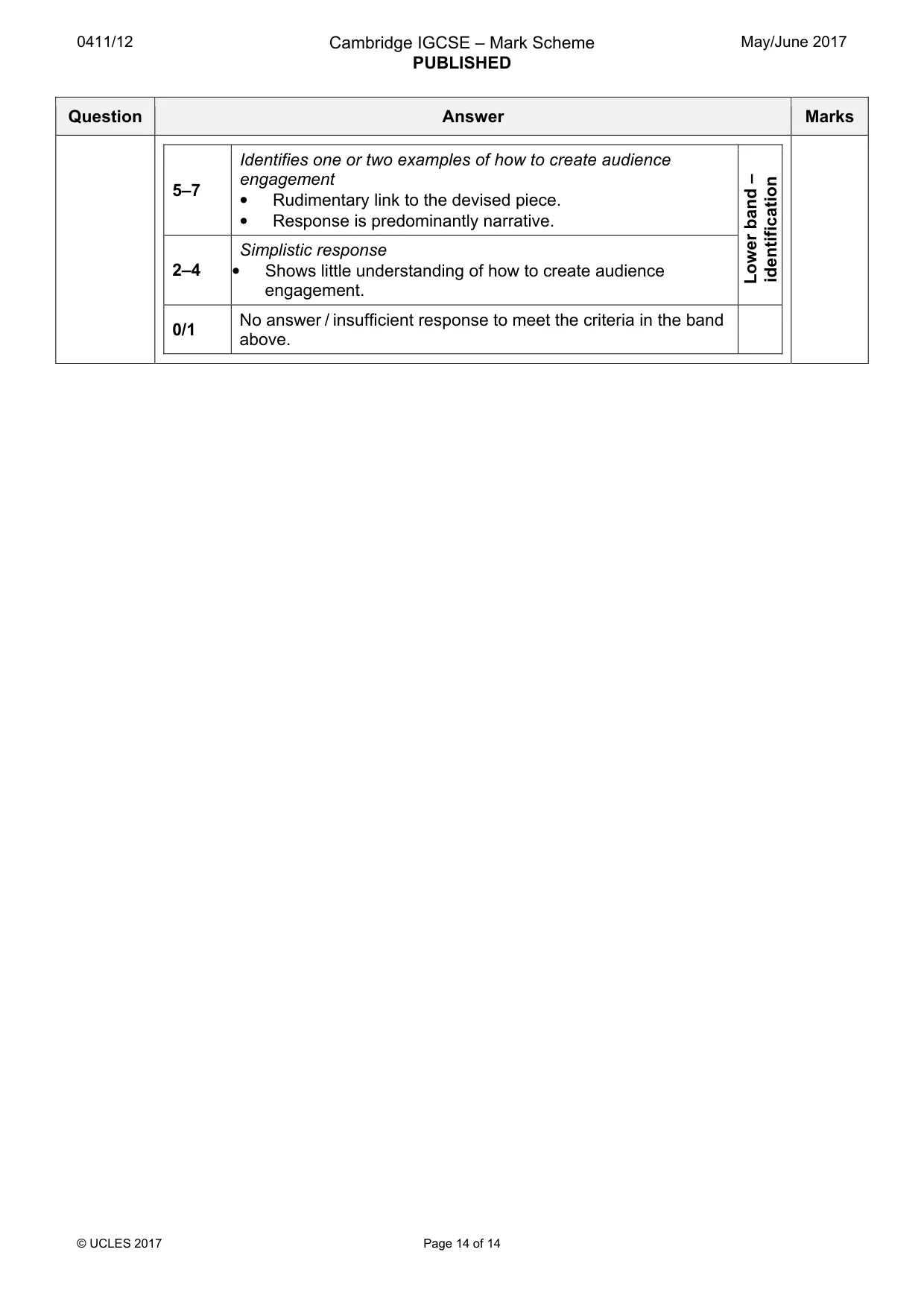
0411/12 Cambridge IGCSE – Mark Scheme PUBLISHED May/June 2017 © UCLES 2017 Page 14 of 14 Question Answer Marks 5–7 Identifies one or two examples of how to create audience engagement • Rudimentary link to the devised piece. • Response is predominantly narrative. Lower band – identification 2–4 Simplistic response • Shows little understanding of how to create audience engagement. 0/1 No answer / insufficient response to meet the criteria in the band above.
What you needed in this session
Cambridge’s own grade thresholds for 2017 May/June, Paper 1 · Variant 2. A higher threshold means an easier paper — the bar moves with how the cohort did.