Cambridge IGCSE Drama 0411 — 2017 May/June Paper 1 · Variant 3
0411/13/M/J/17 · 80 marks · ≈90 min
The question paper and its mark scheme, free to read here and free to download. This is Cambridge’s own paper, exactly as it was sat.
Question paper4 pages

Mark scheme19 pages
Answers below. Sit the paper first if you are practising.
Paper as text
Question paper, page 1
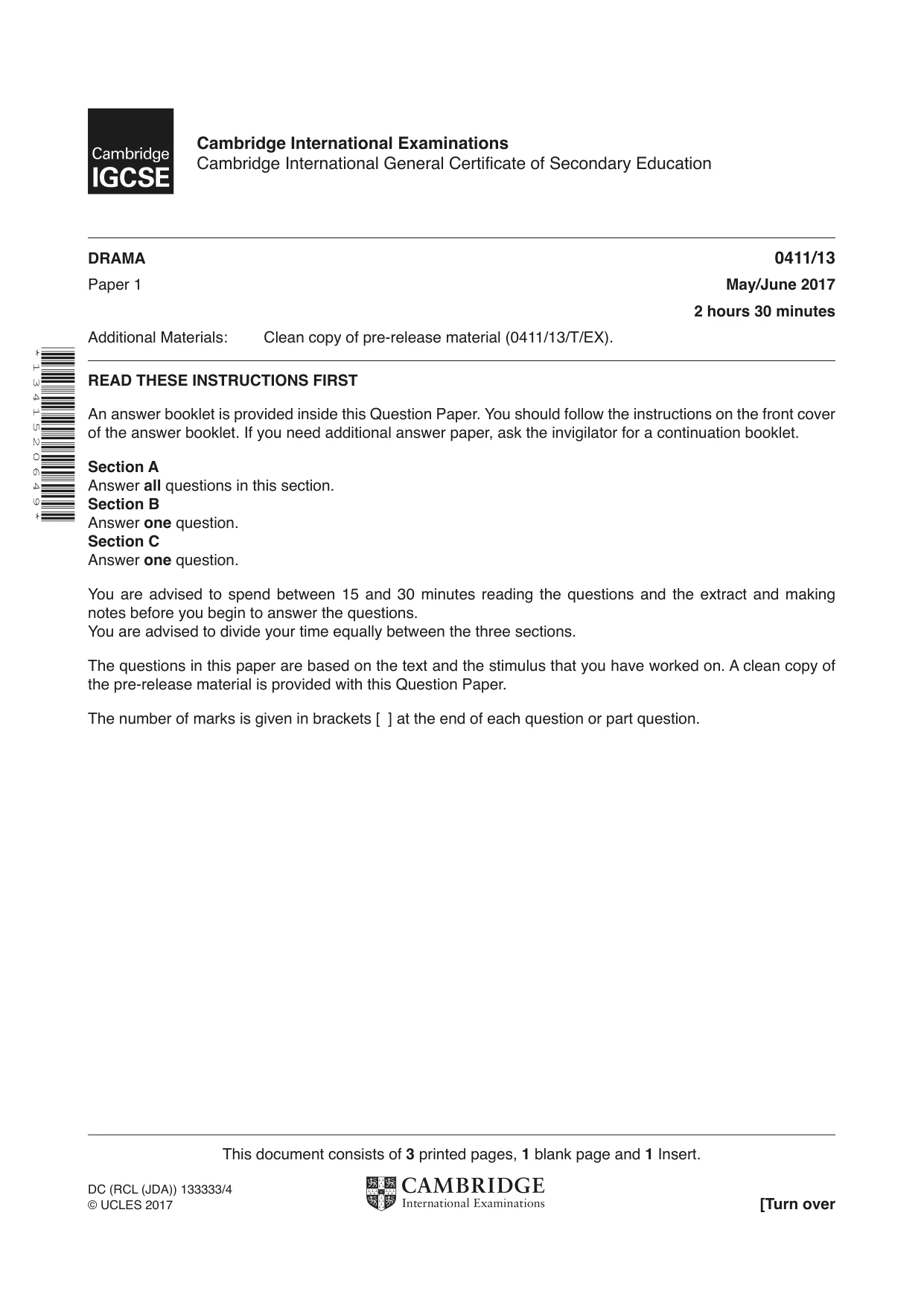
This document consists of 3 printed pages, 1 blank page and 1 Insert. DC (RCL (JDA)) 133333/4 © UCLES 2017 [Turn over Cambridge International Examinations Cambridge International General Certificate of Secondary Education * 1 3 4 1 5 2 0 6 4 9 * DRAMA 0411/13 Paper 1 May/June 2017 2 hours 30 minutes Additional Materials: Clean copy of pre-release material (0411/13/T/EX). READ THESE INSTRUCTIONS FIRST An answer booklet is provided inside this Question Paper. You should follow the instructions on the front cover of the answer booklet. If you need additional answer paper, ask the invigilator for a continuation booklet. Section A Answer all questions in this section. Section B Answer one question. Section C Answer one question. You are advised to spend between 15 and 30 minutes reading the questions and the extract and making notes before you begin to answer the questions. You are advised to divide your time equally between the three sections. The questions in this paper are based on the text and the stimulus that you have worked on. A clean copy of the pre-release material is provided with this Question Paper. The number of marks is given in brackets [ ] at the end of each question or part question.
Question paper, page 2
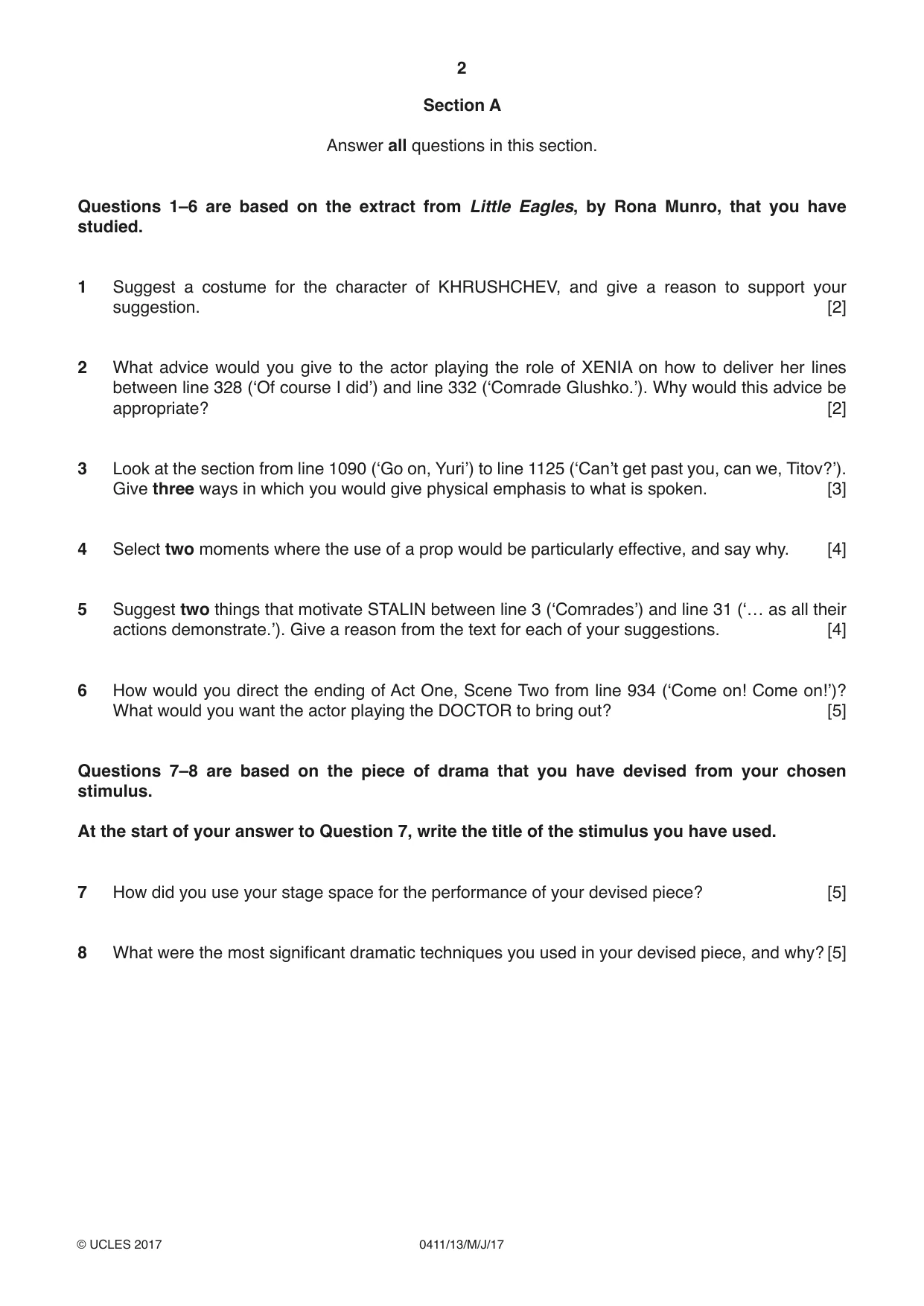
2 0411/13/M/J/17 © UCLES 2017 Section A Answer all questions in this section. Questions 1–6 are based on the extract from Little Eagles, by Rona Munro, that you have studied. 1 Suggest a costume for the character of KHRUSHCHEV, and give a reason to support your suggestion. [2] 2 What advice would you give to the actor playing the role of XENIA on how to deliver her lines between line 328 (‘Of course I did’) and line 332 (‘Comrade Glushko.’). Why would this advice be appropriate? [2] 3 Look at the section from line 1090 (‘Go on, Yuri’) to line 1125 (‘Can’t get past you, can we, Titov?’). Give three ways in which you would give physical emphasis to what is spoken. [3] 4 Select two moments where the use of a prop would be particularly effective, and say why. [4] 5 Suggest two things that motivate STALIN between line 3 (‘Comrades’) and line 31 (‘… as all their actions demonstrate.’). Give a reason from the text for each of your suggestions. [4] 6 How would you direct the ending of Act One, Scene Two from line 934 (‘Come on! Come on!’)? What would you want the actor playing the DOCTOR to bring out? [5] Questions 7–8 are based on the piece of drama that you have devised from your chosen stimulus. At the start of your answer to Question 7, write the title of the stimulus you have used. 7 How did you use your stage space for the performance of your devised piece? [5] 8 What were the most significant dramatic techniques you used in your devised piece, and why? [5]
Question paper, page 3
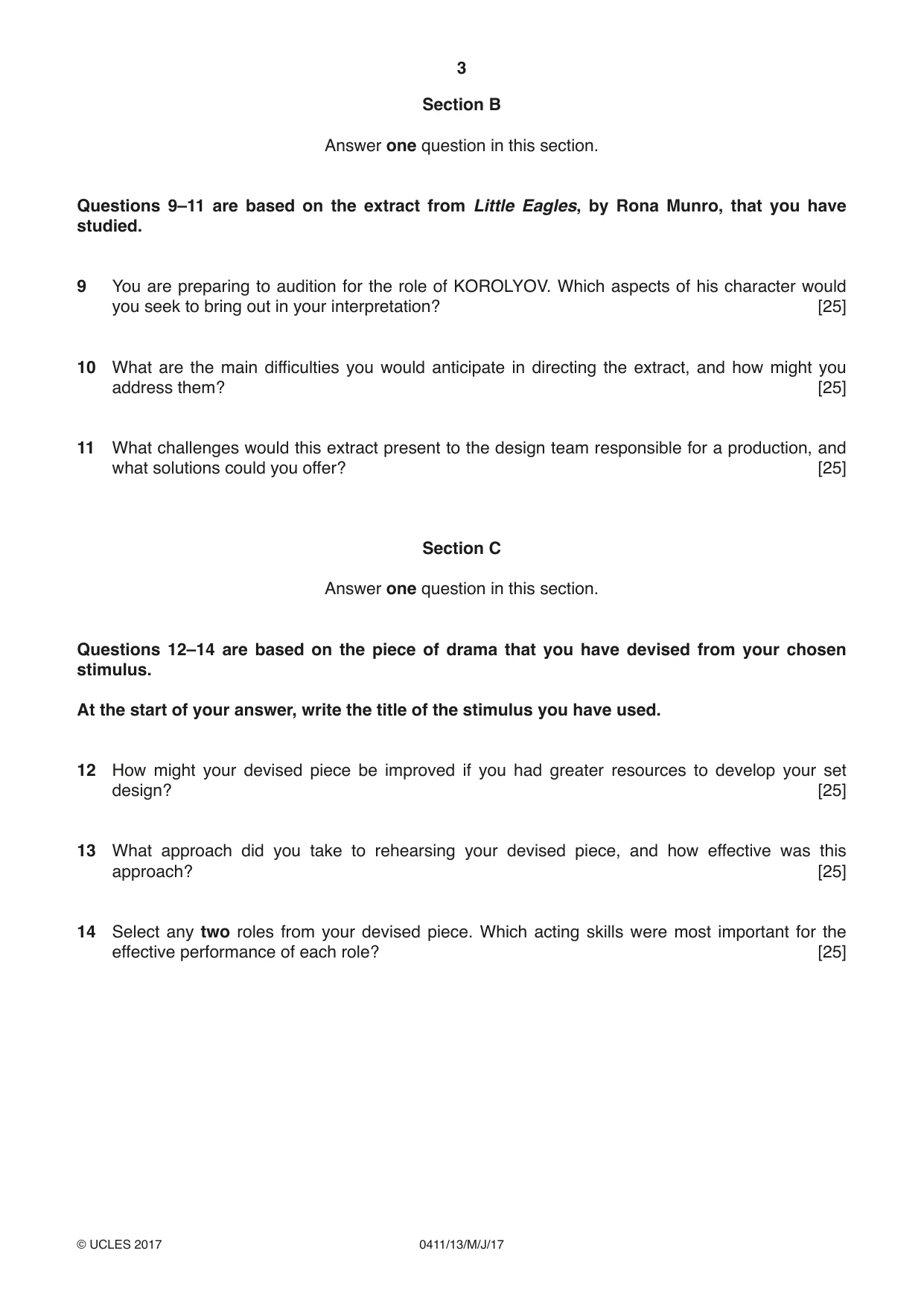
3 0411/13/M/J/17 © UCLES 2017 Section B Answer one question in this section. Questions 9–11 are based on the extract from Little Eagles, by Rona Munro, that you have studied. 9 You are preparing to audition for the role of KOROLYOV. Which aspects of his character would you seek to bring out in your interpretation? [25] 10 What are the main difficulties you would anticipate in directing the extract, and how might you address them? [25] 11 What challenges would this extract present to the design team responsible for a production, and what solutions could you offer? [25] Section C Answer one question in this section. Questions 12–14 are based on the piece of drama that you have devised from your chosen stimulus. At the start of your answer, write the title of the stimulus you have used. 12 How might your devised piece be improved if you had greater resources to develop your set design? [25] 13 What approach did you take to rehearsing your devised piece, and how effective was this approach? [25] 14 Select any two roles from your devised piece. Which acting skills were most important for the effective performance of each role? [25]
Question paper, page 4
4 0411/13/M/J/17 © UCLES 2017 Permission to reproduce items where third-party owned material protected by copyright is included has been sought and cleared where possible. Every reasonable effort has been made by the publisher (UCLES) to trace copyright holders, but if any items requiring clearance have unwittingly been included, the publisher will be pleased to make amends at the earliest possible opportunity. To avoid the issue of disclosure of answer-related information to candidates, all copyright acknowledgements are reproduced online in the Cambridge International Examinations Copyright Acknowledgements Booklet. This is produced for each series of examinations and is freely available to download at www.cie.org.uk after the live examination series. Cambridge International Examinations is part of the Cambridge Assessment Group. Cambridge Assessment is the brand name of University of Cambridge Local Examinations Syndicate (UCLES), which is itself a department of the University of Cambridge. BLANK PAGE
Mark scheme, page 1
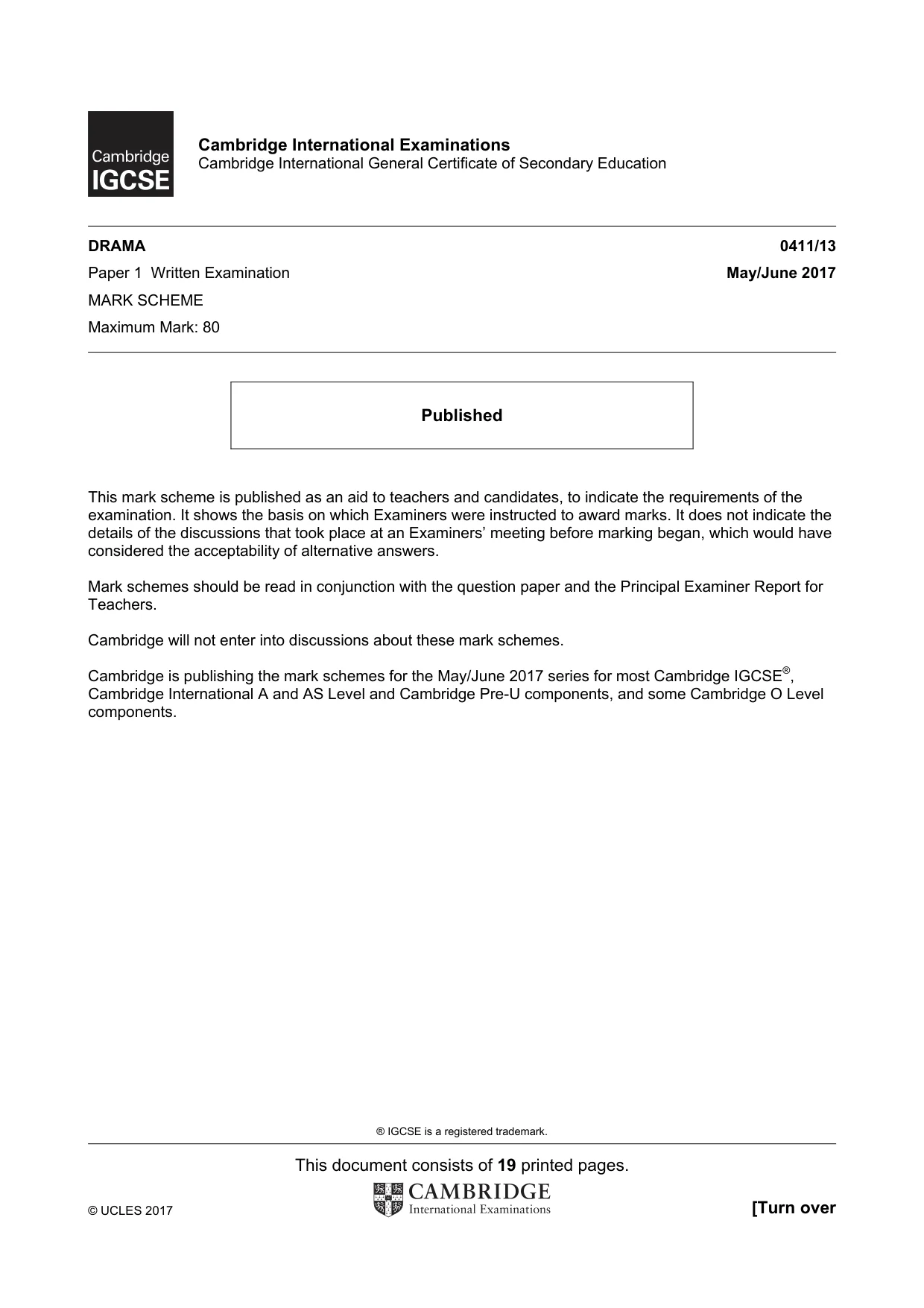
® IGCSE is a registered trademark. This document consists of 19 printed pages. © UCLES 2017 [Turn over Cambridge International Examinations Cambridge International General Certificate of Secondary Education DRAMA 0411/13 Paper 1 Written Examination May/June 2017 MARK SCHEME Maximum Mark: 80 Published This mark scheme is published as an aid to teachers and candidates, to indicate the requirements of the examination. It shows the basis on which Examiners were instructed to award marks. It does not indicate the details of the discussions that took place at an Examiners’ meeting before marking began, which would have considered the acceptability of alternative answers. Mark schemes should be read in conjunction with the question paper and the Principal Examiner Report for Teachers. Cambridge will not enter into discussions about these mark schemes. Cambridge is publishing the mark schemes for the May/June 2017 series for most Cambridge IGCSE®, Cambridge International A and AS Level and Cambridge Pre-U components, and some Cambridge O Level components.
Mark scheme, page 2
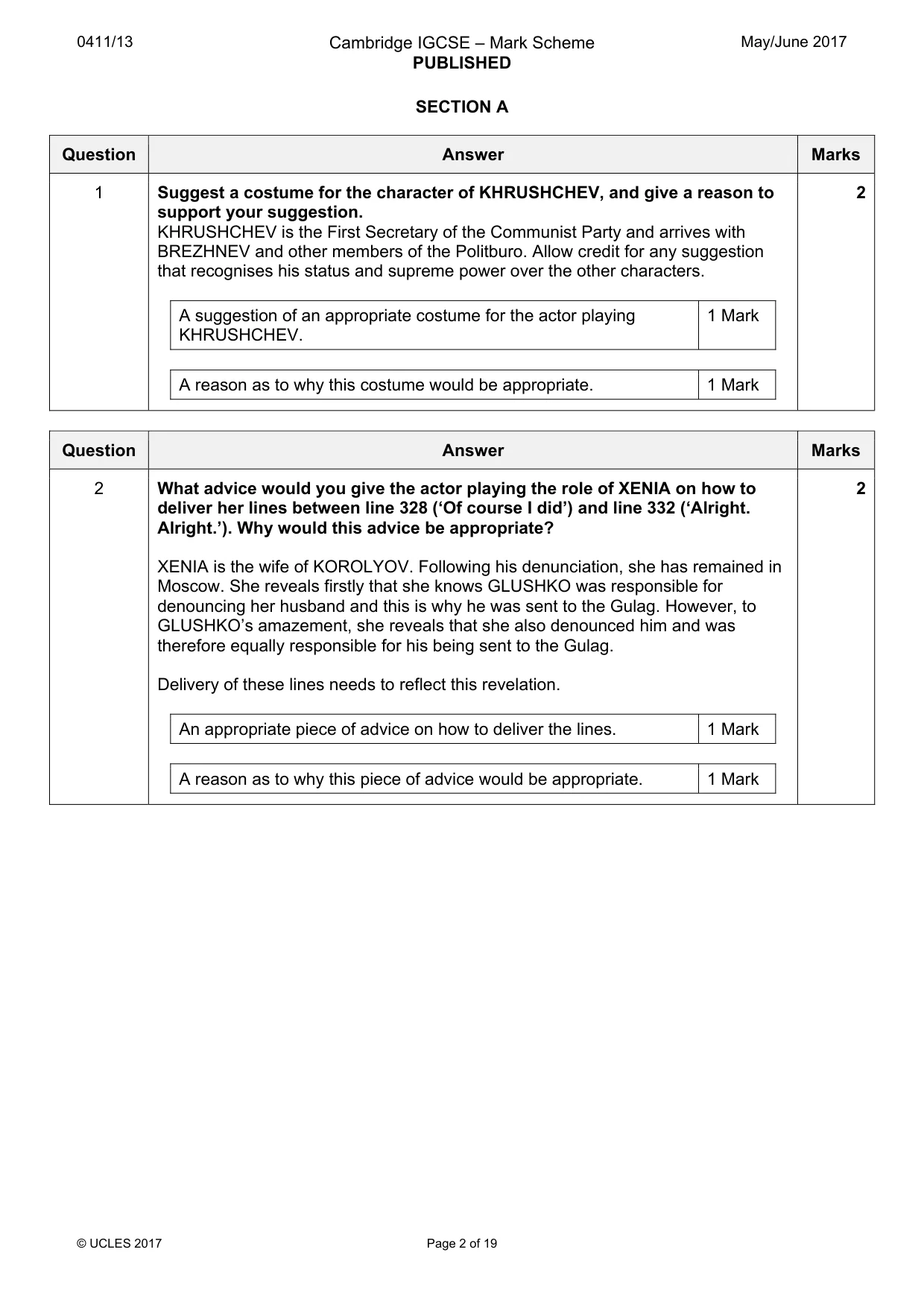
0411/13 Cambridge IGCSE – Mark Scheme PUBLISHED May/June 2017 © UCLES 2017 Page 2 of 19 SECTION A Question Answer Marks 1 Suggest a costume for the character of KHRUSHCHEV, and give a reason to support your suggestion. KHRUSHCHEV is the First Secretary of the Communist Party and arrives with BREZHNEV and other members of the Politburo. Allow credit for any suggestion that recognises his status and supreme power over the other characters. A suggestion of an appropriate costume for the actor playing KHRUSHCHEV. 1 Mark A reason as to why this costume would be appropriate. 1 Mark 2 Question Answer Marks 2 What advice would you give the actor playing the role of XENIA on how to deliver her lines between line 328 (‘Of course I did’) and line 332 (‘Alright. Alright.’). Why would this advice be appropriate? XENIA is the wife of KOROLYOV. Following his denunciation, she has remained in Moscow. She reveals firstly that she knows GLUSHKO was responsible for denouncing her husband and this is why he was sent to the Gulag. However, to GLUSHKO’s amazement, she reveals that she also denounced him and was therefore equally responsible for his being sent to the Gulag. Delivery of these lines needs to reflect this revelation. An appropriate piece of advice on how to deliver the lines. 1 Mark A reason as to why this piece of advice would be appropriate. 1 Mark 2
Mark scheme, page 3
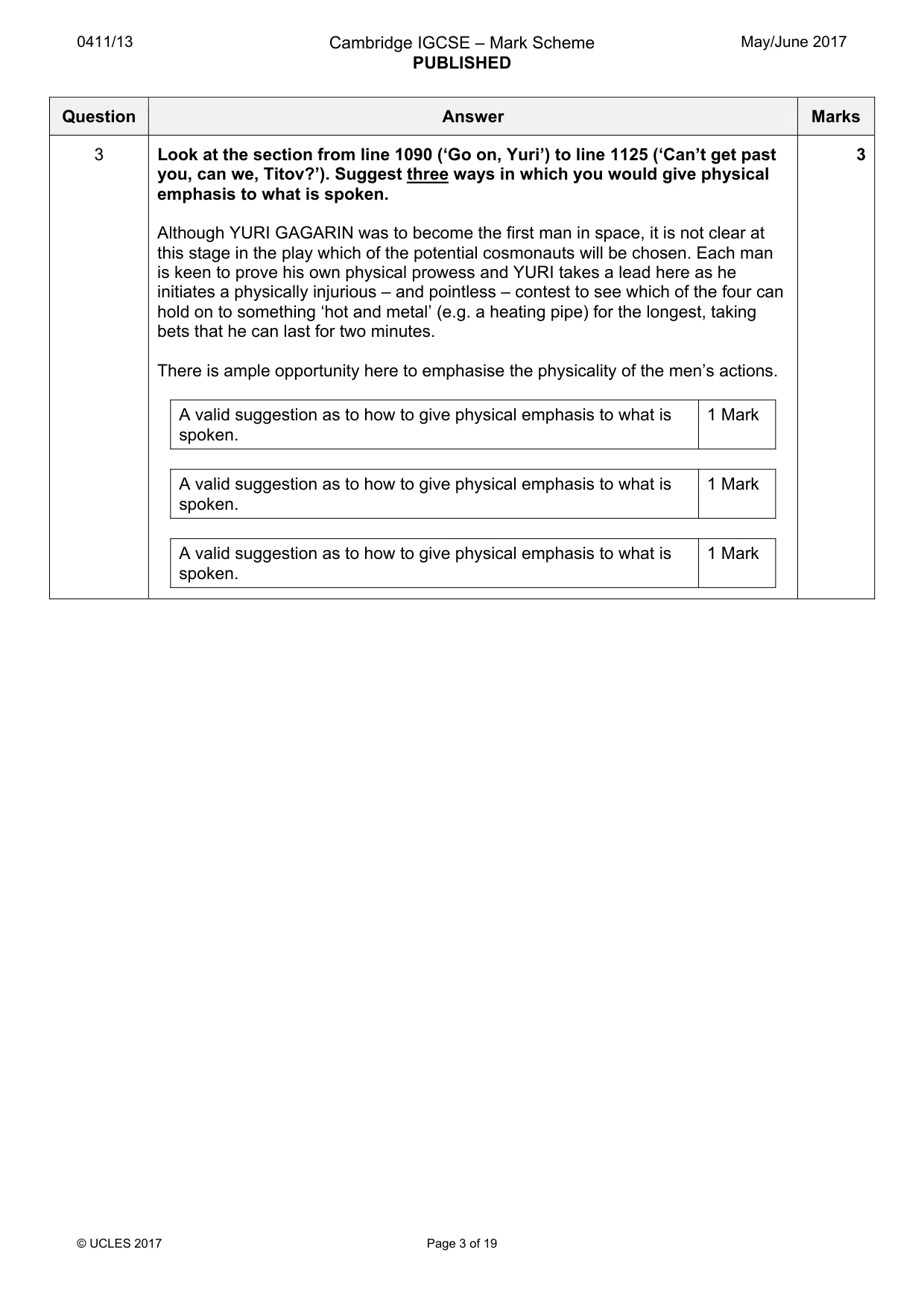
0411/13 Cambridge IGCSE – Mark Scheme PUBLISHED May/June 2017 © UCLES 2017 Page 3 of 19 Question Answer Marks 3 Look at the section from line 1090 (‘Go on, Yuri’) to line 1125 (‘Can’t get past you, can we, Titov?’). Suggest three ways in which you would give physical emphasis to what is spoken. Although YURI GAGARIN was to become the first man in space, it is not clear at this stage in the play which of the potential cosmonauts will be chosen. Each man is keen to prove his own physical prowess and YURI takes a lead here as he initiates a physically injurious – and pointless – contest to see which of the four can hold on to something ‘hot and metal’ (e.g. a heating pipe) for the longest, taking bets that he can last for two minutes. There is ample opportunity here to emphasise the physicality of the men’s actions. A valid suggestion as to how to give physical emphasis to what is spoken. 1 Mark A valid suggestion as to how to give physical emphasis to what is spoken. 1 Mark A valid suggestion as to how to give physical emphasis to what is spoken. 1 Mark 3
Mark scheme, page 4
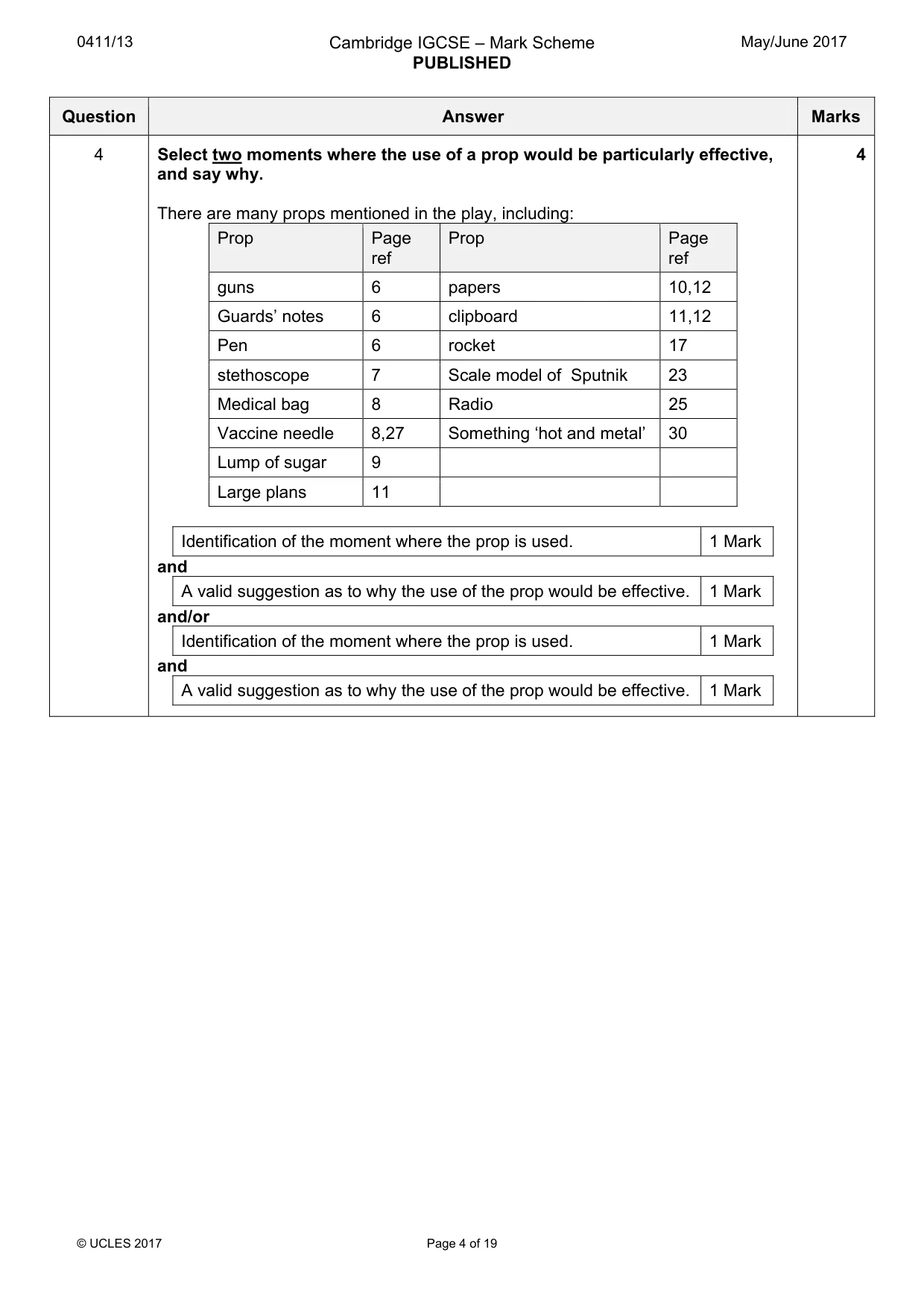
0411/13 Cambridge IGCSE – Mark Scheme PUBLISHED May/June 2017 © UCLES 2017 Page 4 of 19 Question Answer Marks 4 Select two moments where the use of a prop would be particularly effective, and say why. There are many props mentioned in the play, including: Prop Page ref Prop Page ref guns 6 papers 10,12 Guards’ notes 6 clipboard 11,12 Pen 6 rocket 17 stethoscope 7 Scale model of Sputnik 23 Medical bag 8 Radio 25 Vaccine needle 8,27 Something ‘hot and metal’ 30 Lump of sugar 9 Large plans 11 Identification of the moment where the prop is used. 1 Mark and A valid suggestion as to why the use of the prop would be effective. 1 Mark and/or Identification of the moment where the prop is used. 1 Mark and A valid suggestion as to why the use of the prop would be effective. 1 Mark 4
Mark scheme, page 5
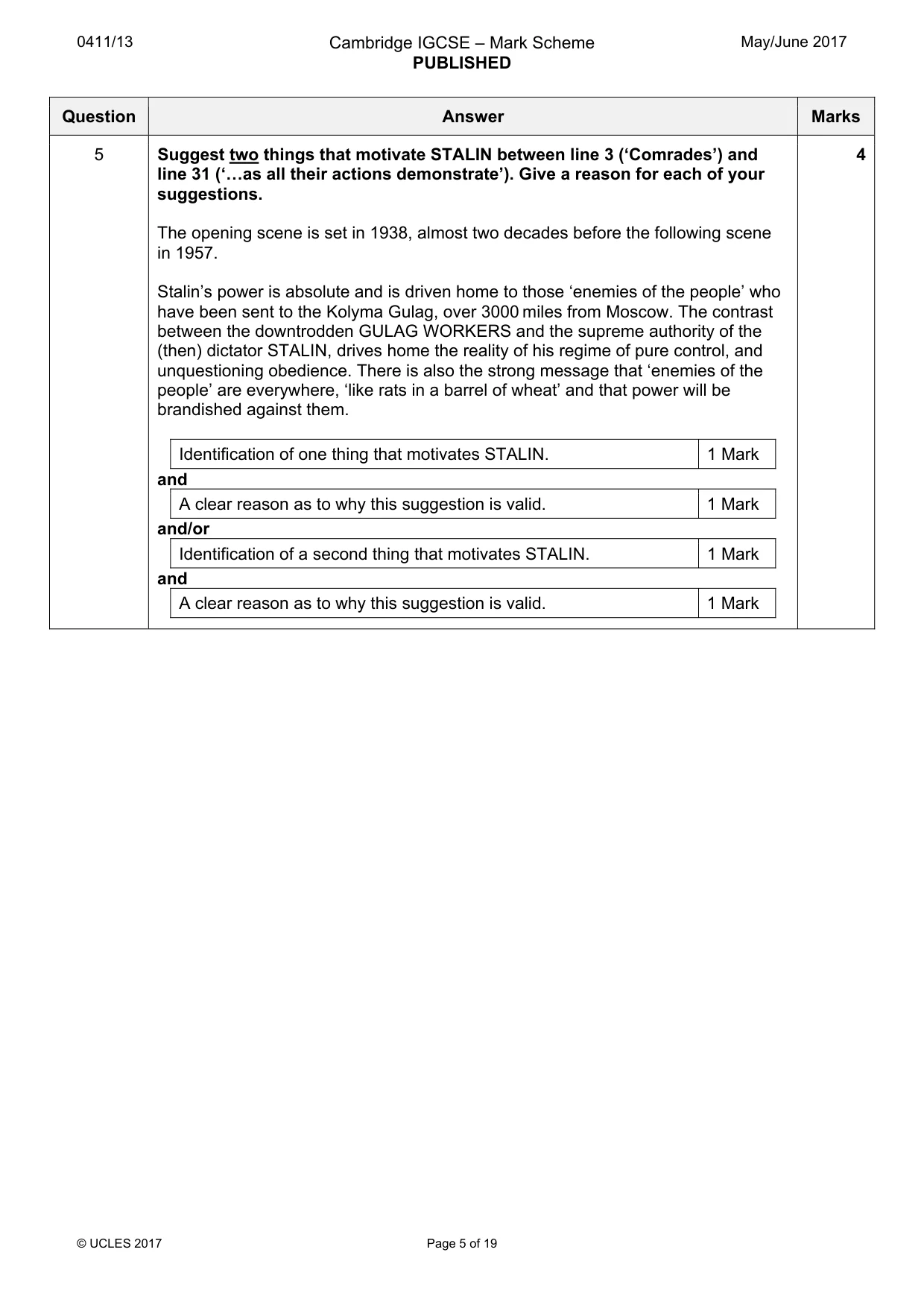
0411/13 Cambridge IGCSE – Mark Scheme PUBLISHED May/June 2017 © UCLES 2017 Page 5 of 19 Question Answer Marks 5 Suggest two things that motivate STALIN between line 3 (‘Comrades’) and line 31 (‘«as all their actions demonstrate’). Give a reason for each of your suggestions. The opening scene is set in 1938, almost two decades before the following scene in 1957. Stalin’s power is absolute and is driven home to those ‘enemies of the people’ who have been sent to the Kolyma Gulag, over 3000 miles from Moscow. The contrast between the downtrodden GULAG WORKERS and the supreme authority of the (then) dictator STALIN, drives home the reality of his regime of pure control, and unquestioning obedience. There is also the strong message that ‘enemies of the people’ are everywhere, ‘like rats in a barrel of wheat’ and that power will be brandished against them. Identification of one thing that motivates STALIN. 1 Mark and A clear reason as to why this suggestion is valid. 1 Mark and/or Identification of a second thing that motivates STALIN. 1 Mark and A clear reason as to why this suggestion is valid. 1 Mark 4
Mark scheme, page 6
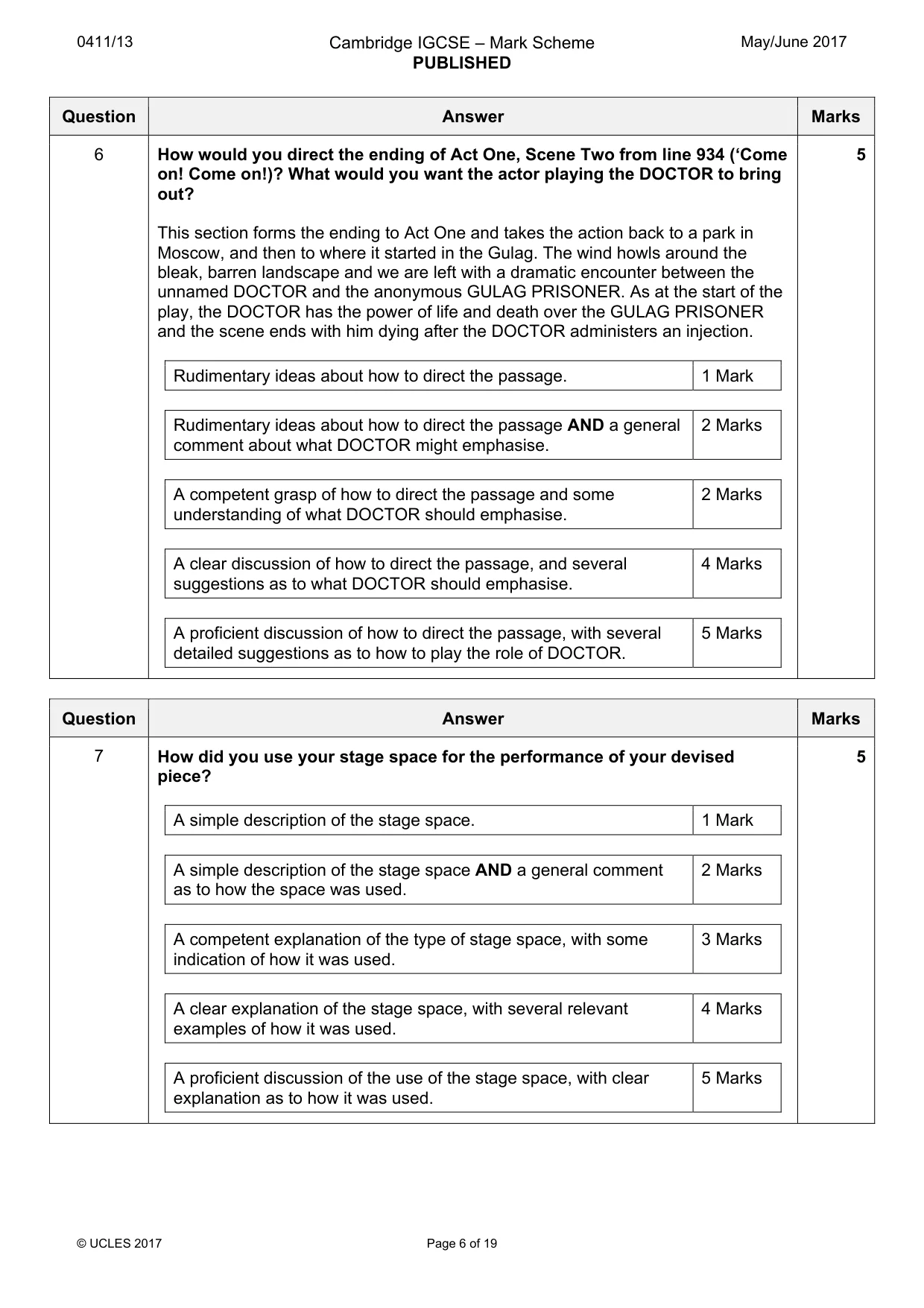
0411/13 Cambridge IGCSE – Mark Scheme PUBLISHED May/June 2017 © UCLES 2017 Page 6 of 19 Question Answer Marks 6 How would you direct the ending of Act One, Scene Two from line 934 (‘Come on! Come on!)? What would you want the actor playing the DOCTOR to bring out? This section forms the ending to Act One and takes the action back to a park in Moscow, and then to where it started in the Gulag. The wind howls around the bleak, barren landscape and we are left with a dramatic encounter between the unnamed DOCTOR and the anonymous GULAG PRISONER. As at the start of the play, the DOCTOR has the power of life and death over the GULAG PRISONER and the scene ends with him dying after the DOCTOR administers an injection. Rudimentary ideas about how to direct the passage. 1 Mark Rudimentary ideas about how to direct the passage AND a general comment about what DOCTOR might emphasise. 2 Marks A competent grasp of how to direct the passage and some understanding of what DOCTOR should emphasise. 2 Marks A clear discussion of how to direct the passage, and several suggestions as to what DOCTOR should emphasise. 4 Marks A proficient discussion of how to direct the passage, with several detailed suggestions as to how to play the role of DOCTOR. 5 Marks 5 Question Answer Marks 7 How did you use your stage space for the performance of your devised piece? A simple description of the stage space. 1 Mark A simple description of the stage space AND a general comment as to how the space was used. 2 Marks A competent explanation of the type of stage space, with some indication of how it was used. 3 Marks A clear explanation of the stage space, with several relevant examples of how it was used. 4 Marks A proficient discussion of the use of the stage space, with clear explanation as to how it was used. 5 Marks 5
Mark scheme, page 7
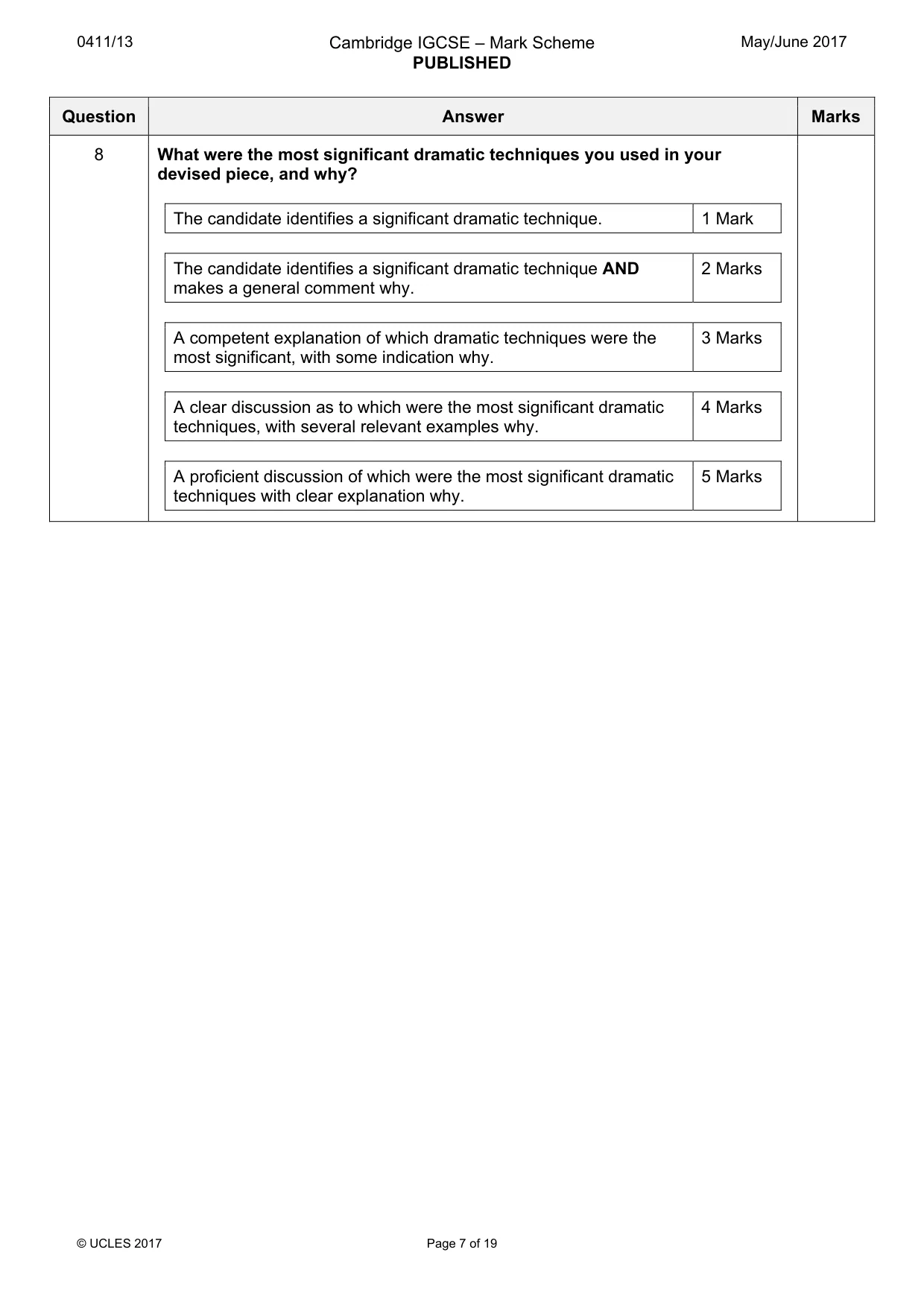
0411/13 Cambridge IGCSE – Mark Scheme PUBLISHED May/June 2017 © UCLES 2017 Page 7 of 19 Question Answer Marks 8 What were the most significant dramatic techniques you used in your devised piece, and why? The candidate identifies a significant dramatic technique. 1 Mark The candidate identifies a significant dramatic technique AND makes a general comment why. 2 Marks A competent explanation of which dramatic techniques were the most significant, with some indication why. 3 Marks A clear discussion as to which were the most significant dramatic techniques, with several relevant examples why. 4 Marks A proficient discussion of which were the most significant dramatic techniques with clear explanation why. 5 Marks
Mark scheme, page 8
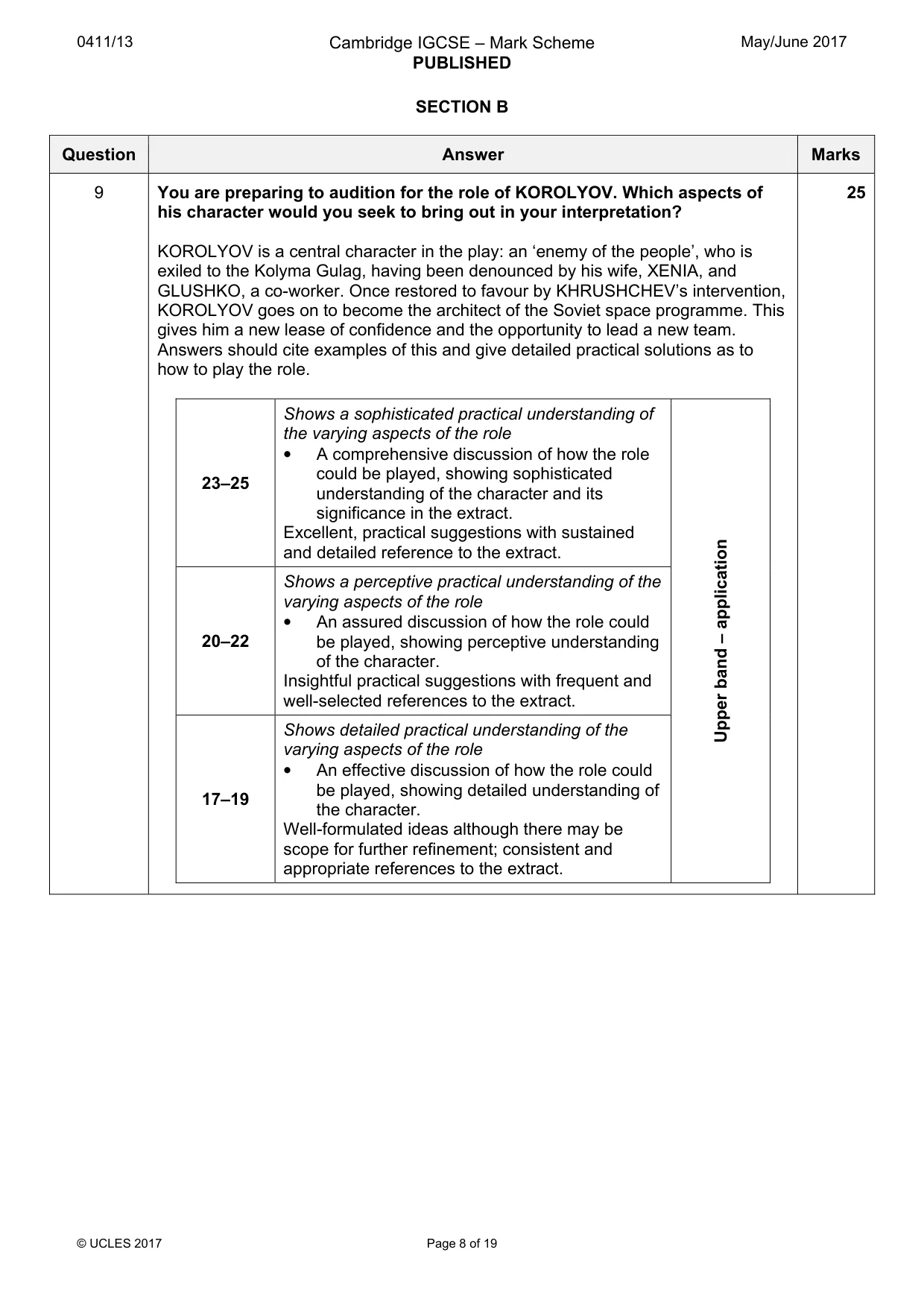
0411/13 Cambridge IGCSE – Mark Scheme PUBLISHED May/June 2017 © UCLES 2017 Page 8 of 19 SECTION B Question Answer Marks 9 You are preparing to audition for the role of KOROLYOV. Which aspects of his character would you seek to bring out in your interpretation? KOROLYOV is a central character in the play: an ‘enemy of the people’, who is exiled to the Kolyma Gulag, having been denounced by his wife, XENIA, and GLUSHKO, a co-worker. Once restored to favour by KHRUSHCHEV’s intervention, KOROLYOV goes on to become the architect of the Soviet space programme. This gives him a new lease of confidence and the opportunity to lead a new team. Answers should cite examples of this and give detailed practical solutions as to how to play the role. 23–25 Shows a sophisticated practical understanding of the varying aspects of the role • A comprehensive discussion of how the role could be played, showing sophisticated understanding of the character and its significance in the extract. Excellent, practical suggestions with sustained and detailed reference to the extract. Upper band – application 20–22 Shows a perceptive practical understanding of the varying aspects of the role • An assured discussion of how the role could be played, showing perceptive understanding of the character. Insightful practical suggestions with frequent and well-selected references to the extract. 17–19 Shows detailed practical understanding of the varying aspects of the role • An effective discussion of how the role could be played, showing detailed understanding of the character. Well-formulated ideas although there may be scope for further refinement; consistent and appropriate references to the extract. 25
Mark scheme, page 9
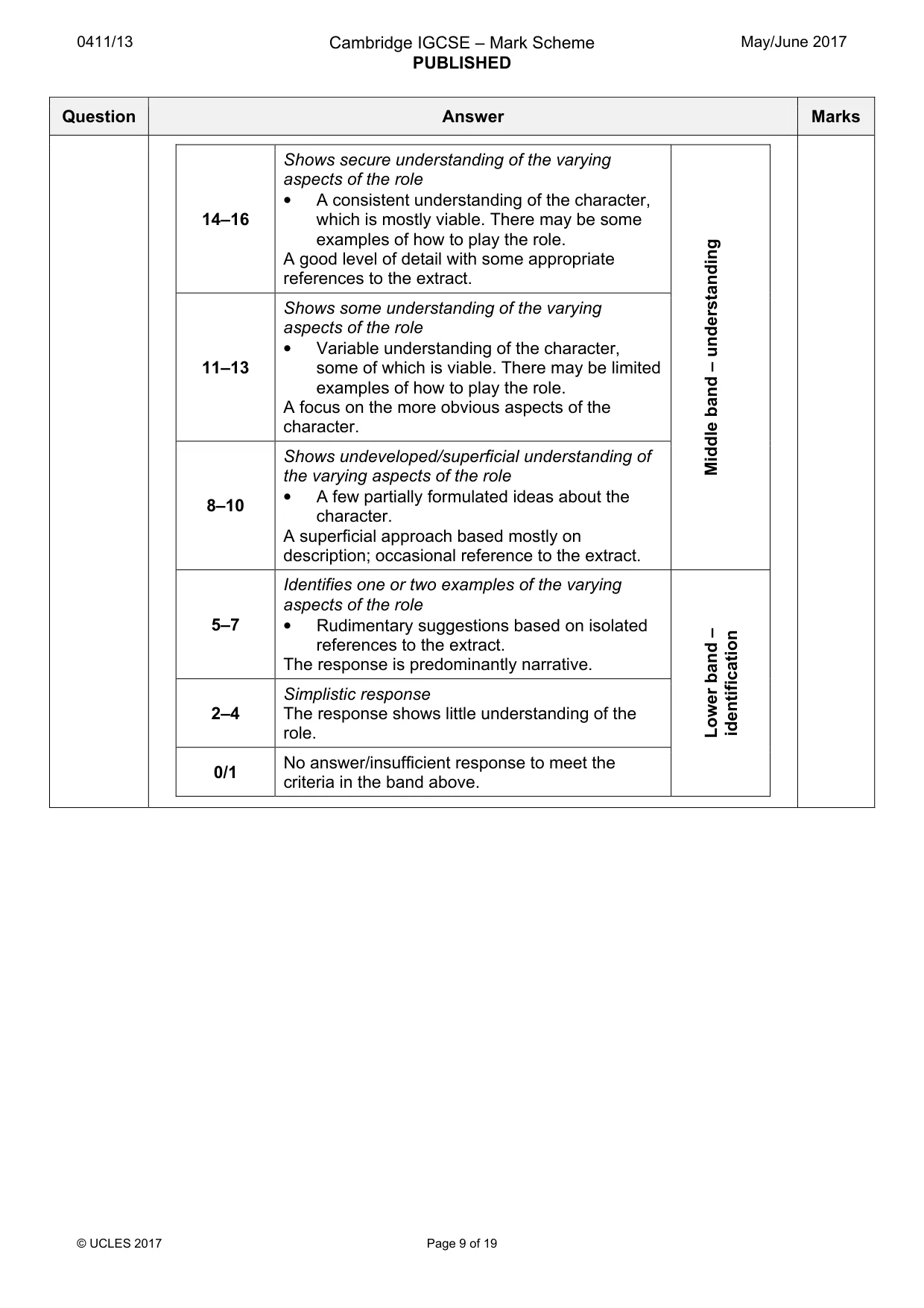
0411/13 Cambridge IGCSE – Mark Scheme PUBLISHED May/June 2017 © UCLES 2017 Page 9 of 19 Question Answer Marks 14–16 Shows secure understanding of the varying aspects of the role • A consistent understanding of the character, which is mostly viable. There may be some examples of how to play the role. A good level of detail with some appropriate references to the extract. Middle band – understanding 11–13 Shows some understanding of the varying aspects of the role • Variable understanding of the character, some of which is viable. There may be limited examples of how to play the role. A focus on the more obvious aspects of the character. 8–10 Shows undeveloped/superficial understanding of the varying aspects of the role • A few partially formulated ideas about the character. A superficial approach based mostly on description; occasional reference to the extract. 5–7 Identifies one or two examples of the varying aspects of the role • Rudimentary suggestions based on isolated references to the extract. The response is predominantly narrative. Lower band – identification 2–4 Simplistic response The response shows little understanding of the role. 0/1 No answer/insufficient response to meet the criteria in the band above.
Mark scheme, page 10
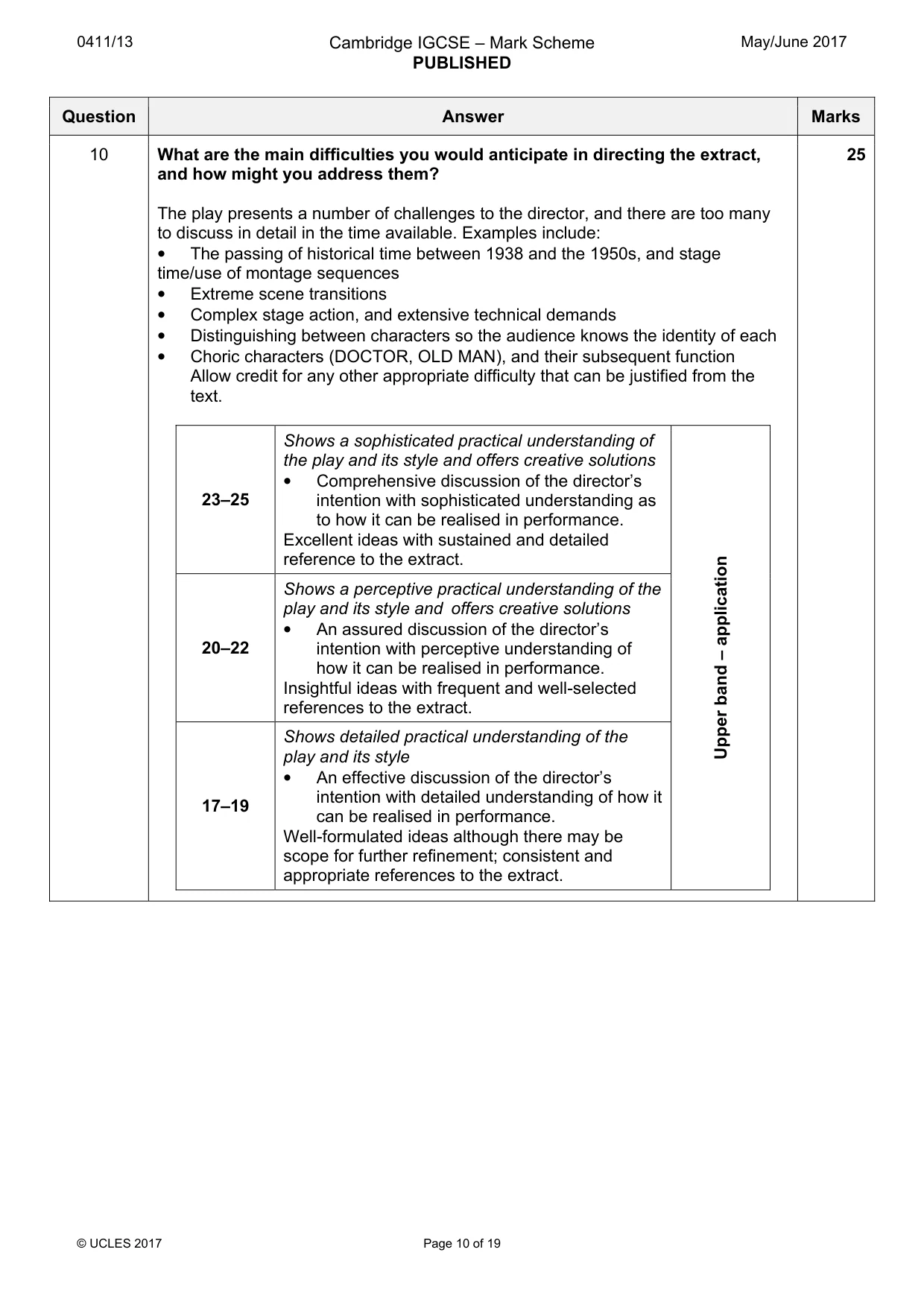
0411/13 Cambridge IGCSE – Mark Scheme PUBLISHED May/June 2017 © UCLES 2017 Page 10 of 19 Question Answer Marks 10 What are the main difficulties you would anticipate in directing the extract, and how might you address them? The play presents a number of challenges to the director, and there are too many to discuss in detail in the time available. Examples include: • The passing of historical time between 1938 and the 1950s, and stage time/use of montage sequences • Extreme scene transitions • Complex stage action, and extensive technical demands • Distinguishing between characters so the audience knows the identity of each • Choric characters (DOCTOR, OLD MAN), and their subsequent function Allow credit for any other appropriate difficulty that can be justified from the text. 23–25 Shows a sophisticated practical understanding of the play and its style and offers creative solutions • Comprehensive discussion of the director’s intention with sophisticated understanding as to how it can be realised in performance. Excellent ideas with sustained and detailed reference to the extract. Upper band – application 20–22 Shows a perceptive practical understanding of the play and its style and offers creative solutions • An assured discussion of the director’s intention with perceptive understanding of how it can be realised in performance. Insightful ideas with frequent and well-selected references to the extract. 17–19 Shows detailed practical understanding of the play and its style • An effective discussion of the director’s intention with detailed understanding of how it can be realised in performance. Well-formulated ideas although there may be scope for further refinement; consistent and appropriate references to the extract. 25
Mark scheme, page 11
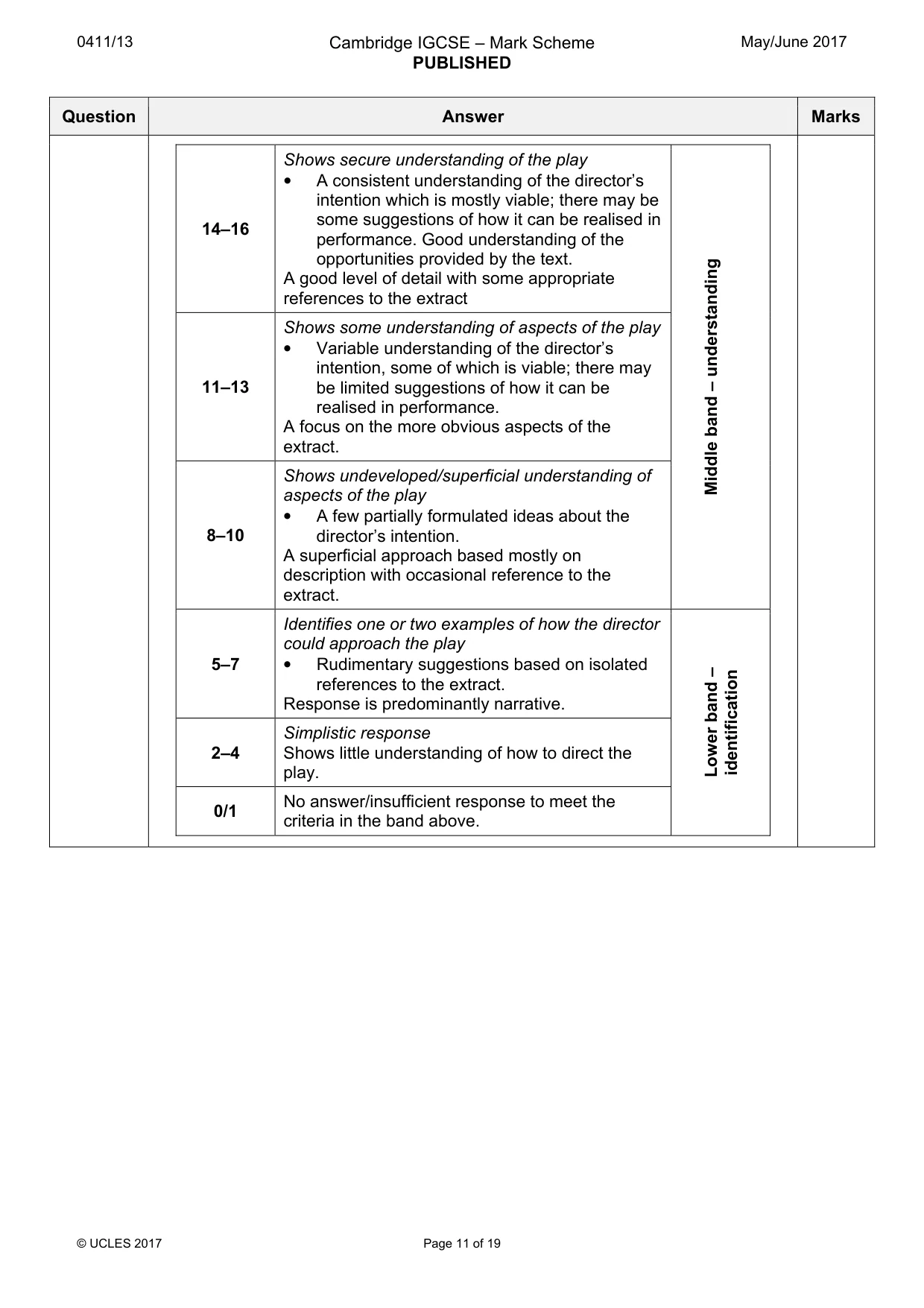
0411/13 Cambridge IGCSE – Mark Scheme PUBLISHED May/June 2017 © UCLES 2017 Page 11 of 19 Question Answer Marks 14–16 Shows secure understanding of the play • A consistent understanding of the director’s intention which is mostly viable; there may be some suggestions of how it can be realised in performance. Good understanding of the opportunities provided by the text. A good level of detail with some appropriate references to the extract Middle band – understanding 11–13 Shows some understanding of aspects of the play • Variable understanding of the director’s intention, some of which is viable; there may be limited suggestions of how it can be realised in performance. A focus on the more obvious aspects of the extract. 8–10 Shows undeveloped/superficial understanding of aspects of the play • A few partially formulated ideas about the director’s intention. A superficial approach based mostly on description with occasional reference to the extract. 5–7 Identifies one or two examples of how the director could approach the play • Rudimentary suggestions based on isolated references to the extract. Response is predominantly narrative. Lower band – identification 2–4 Simplistic response Shows little understanding of how to direct the play. 0/1 No answer/insufficient response to meet the criteria in the band above.
Mark scheme, page 12
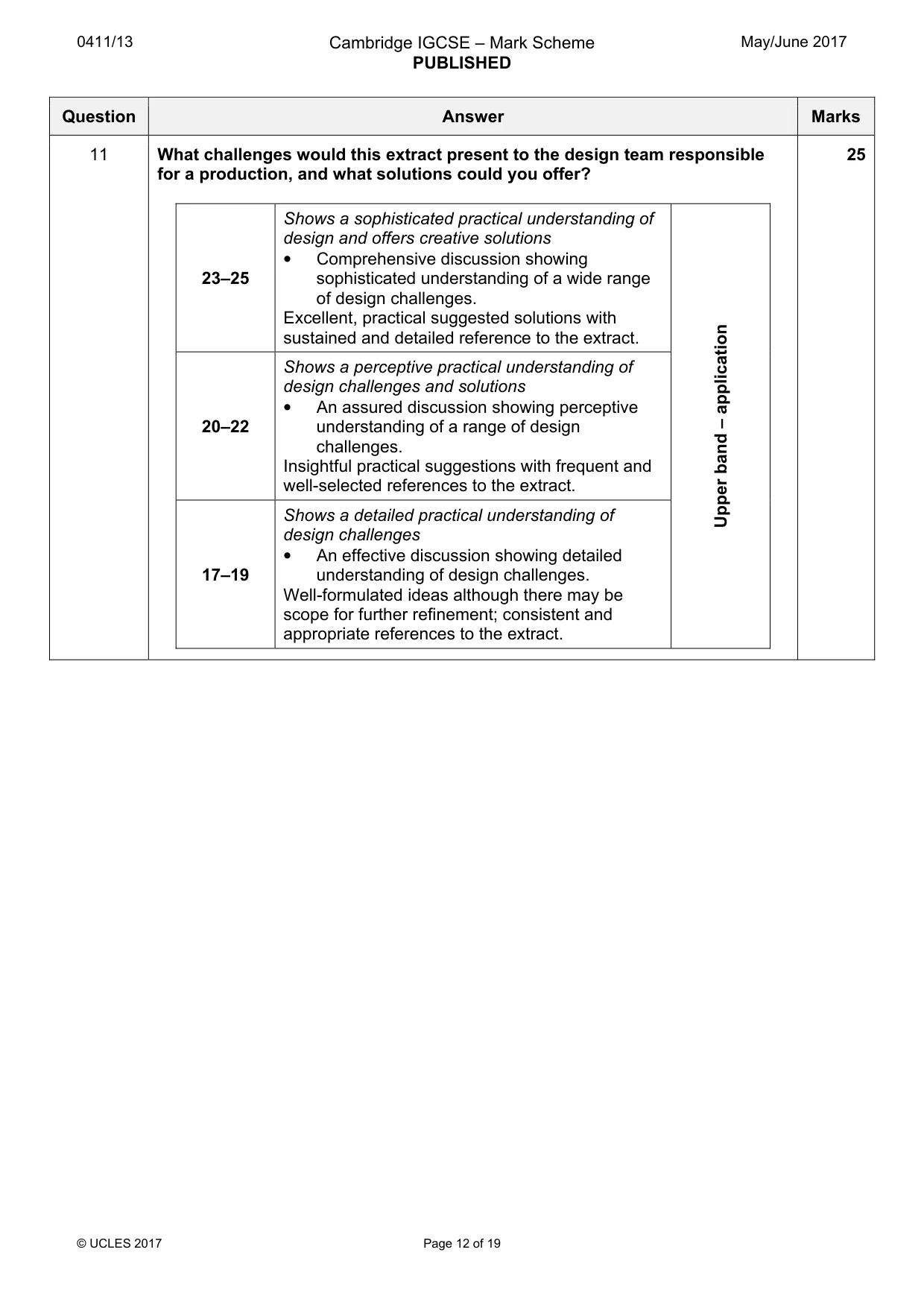
0411/13 Cambridge IGCSE – Mark Scheme PUBLISHED May/June 2017 © UCLES 2017 Page 12 of 19 Question Answer Marks 11 What challenges would this extract present to the design team responsible for a production, and what solutions could you offer? 23–25 Shows a sophisticated practical understanding of design and offers creative solutions • Comprehensive discussion showing sophisticated understanding of a wide range of design challenges. Excellent, practical suggested solutions with sustained and detailed reference to the extract. Upper band – application 20–22 Shows a perceptive practical understanding of design challenges and solutions • An assured discussion showing perceptive understanding of a range of design challenges. Insightful practical suggestions with frequent and well-selected references to the extract. 17–19 Shows a detailed practical understanding of design challenges • An effective discussion showing detailed understanding of design challenges. Well-formulated ideas although there may be scope for further refinement; consistent and appropriate references to the extract. 25
Mark scheme, page 13
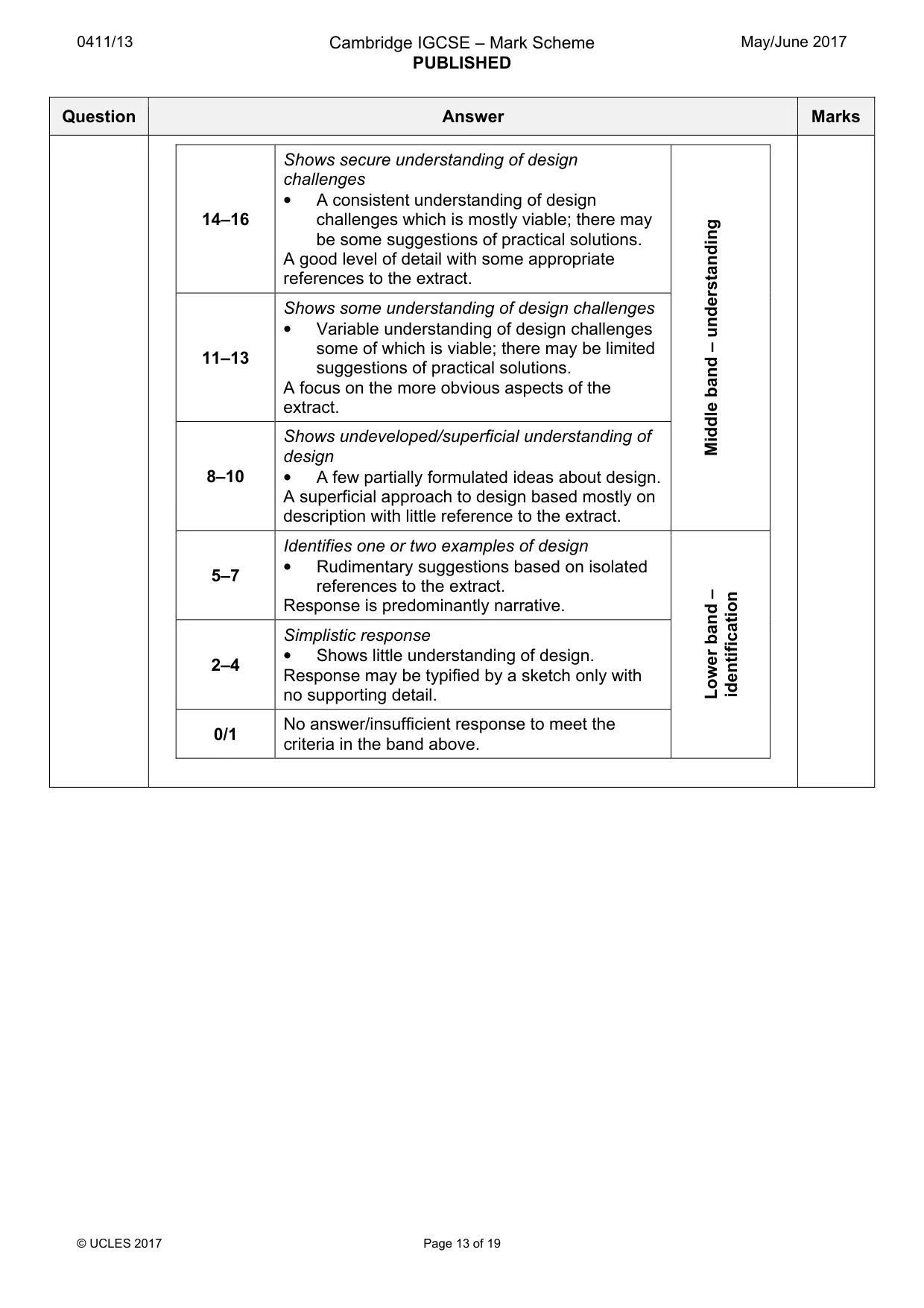
0411/13 Cambridge IGCSE – Mark Scheme PUBLISHED May/June 2017 © UCLES 2017 Page 13 of 19 Question Answer Marks 14–16 Shows secure understanding of design challenges • A consistent understanding of design challenges which is mostly viable; there may be some suggestions of practical solutions. A good level of detail with some appropriate references to the extract. Middle band – understanding 11–13 Shows some understanding of design challenges • Variable understanding of design challenges some of which is viable; there may be limited suggestions of practical solutions. A focus on the more obvious aspects of the extract. 8–10 Shows undeveloped/superficial understanding of design • A few partially formulated ideas about design. A superficial approach to design based mostly on description with little reference to the extract. 5–7 Identifies one or two examples of design • Rudimentary suggestions based on isolated references to the extract. Response is predominantly narrative. Lower band – identification 2–4 Simplistic response • Shows little understanding of design. Response may be typified by a sketch only with no supporting detail. 0/1 No answer/insufficient response to meet the criteria in the band above.
Mark scheme, page 14
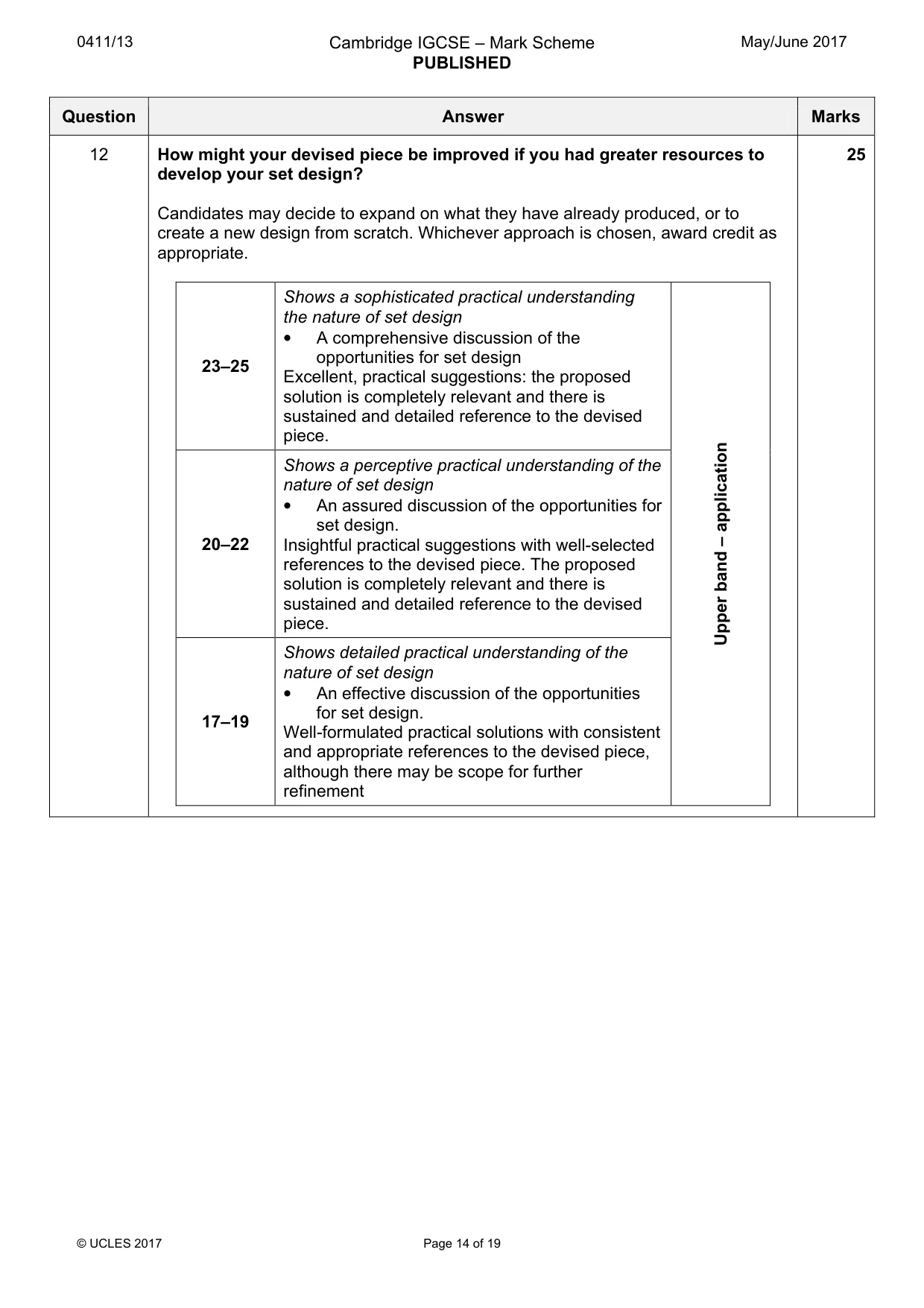
0411/13 Cambridge IGCSE – Mark Scheme PUBLISHED May/June 2017 © UCLES 2017 Page 14 of 19 Question Answer Marks 12 How might your devised piece be improved if you had greater resources to develop your set design? Candidates may decide to expand on what they have already produced, or to create a new design from scratch. Whichever approach is chosen, award credit as appropriate. 23–25 Shows a sophisticated practical understanding the nature of set design • A comprehensive discussion of the opportunities for set design Excellent, practical suggestions: the proposed solution is completely relevant and there is sustained and detailed reference to the devised piece. Upper band – application 20–22 Shows a perceptive practical understanding of the nature of set design • An assured discussion of the opportunities for set design. Insightful practical suggestions with well-selected references to the devised piece. The proposed solution is completely relevant and there is sustained and detailed reference to the devised piece. 17–19 Shows detailed practical understanding of the nature of set design • An effective discussion of the opportunities for set design. Well-formulated practical solutions with consistent and appropriate references to the devised piece, although there may be scope for further refinement 25
Mark scheme, page 15
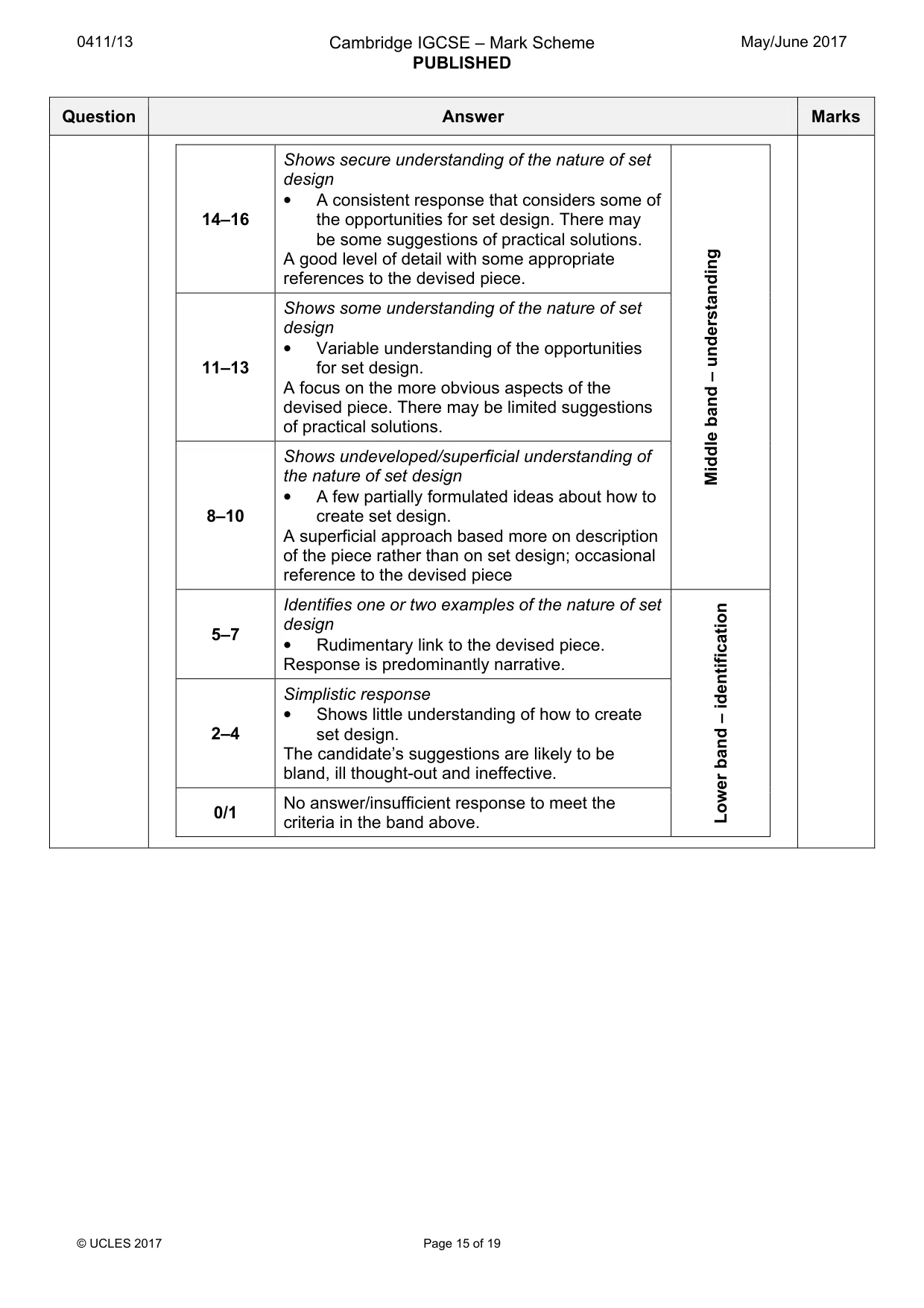
0411/13 Cambridge IGCSE – Mark Scheme PUBLISHED May/June 2017 © UCLES 2017 Page 15 of 19 Question Answer Marks 14–16 Shows secure understanding of the nature of set design • A consistent response that considers some of the opportunities for set design. There may be some suggestions of practical solutions. A good level of detail with some appropriate references to the devised piece. Middle band – understanding 11–13 Shows some understanding of the nature of set design • Variable understanding of the opportunities for set design. A focus on the more obvious aspects of the devised piece. There may be limited suggestions of practical solutions. 8–10 Shows undeveloped/superficial understanding of the nature of set design • A few partially formulated ideas about how to create set design. A superficial approach based more on description of the piece rather than on set design; occasional reference to the devised piece 5–7 Identifies one or two examples of the nature of set design • Rudimentary link to the devised piece. Response is predominantly narrative. Lower band – identification 2–4 Simplistic response • Shows little understanding of how to create set design. The candidate’s suggestions are likely to be bland, ill thought-out and ineffective. 0/1 No answer/insufficient response to meet the criteria in the band above.
Mark scheme, page 16
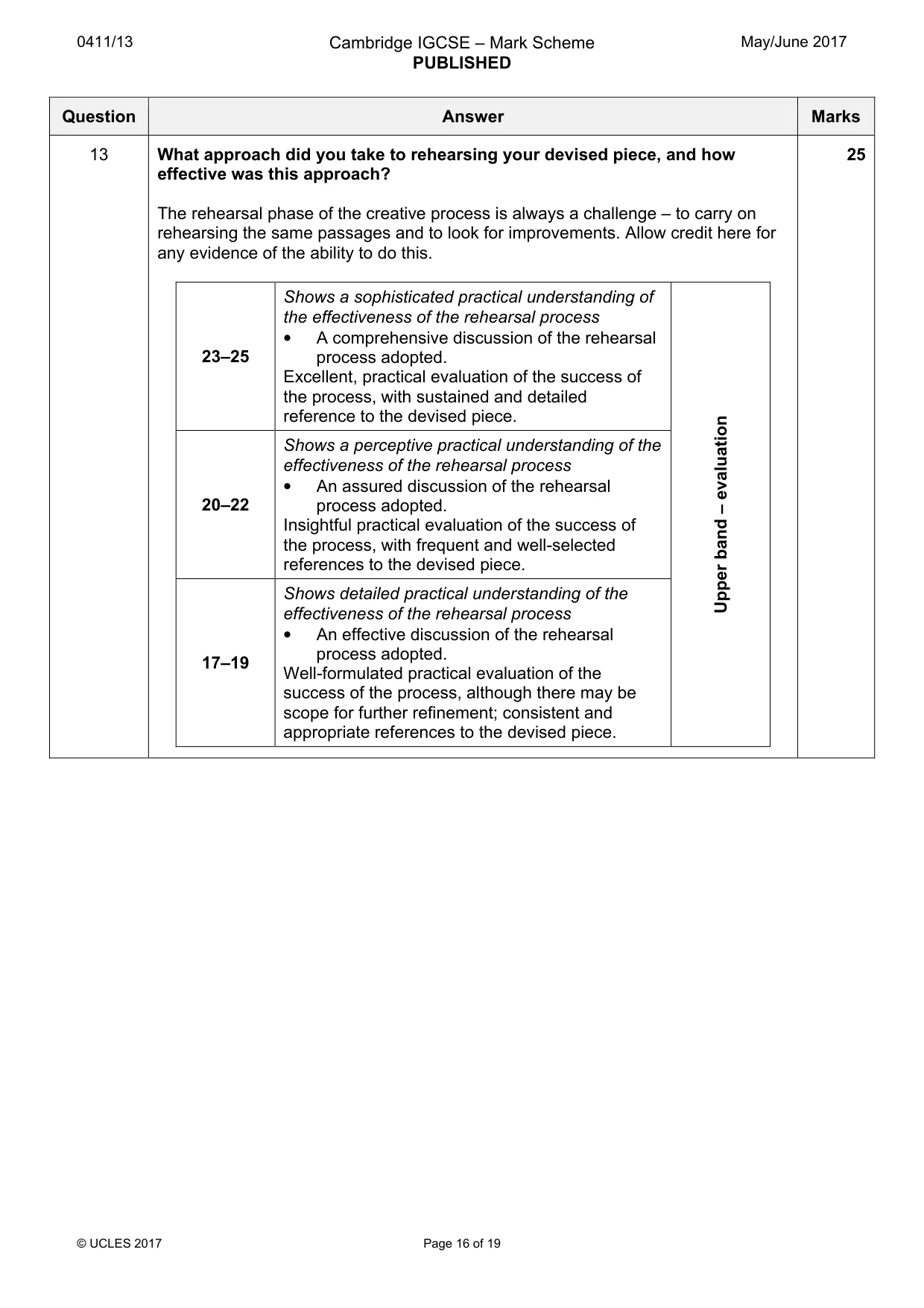
0411/13 Cambridge IGCSE – Mark Scheme PUBLISHED May/June 2017 © UCLES 2017 Page 16 of 19 Question Answer Marks 13 What approach did you take to rehearsing your devised piece, and how effective was this approach? The rehearsal phase of the creative process is always a challenge – to carry on rehearsing the same passages and to look for improvements. Allow credit here for any evidence of the ability to do this. 23–25 Shows a sophisticated practical understanding of the effectiveness of the rehearsal process • A comprehensive discussion of the rehearsal process adopted. Excellent, practical evaluation of the success of the process, with sustained and detailed reference to the devised piece. Upper band – evaluation 20–22 Shows a perceptive practical understanding of the effectiveness of the rehearsal process • An assured discussion of the rehearsal process adopted. Insightful practical evaluation of the success of the process, with frequent and well-selected references to the devised piece. 17–19 Shows detailed practical understanding of the effectiveness of the rehearsal process • An effective discussion of the rehearsal process adopted. Well-formulated practical evaluation of the success of the process, although there may be scope for further refinement; consistent and appropriate references to the devised piece. 25
Mark scheme, page 17
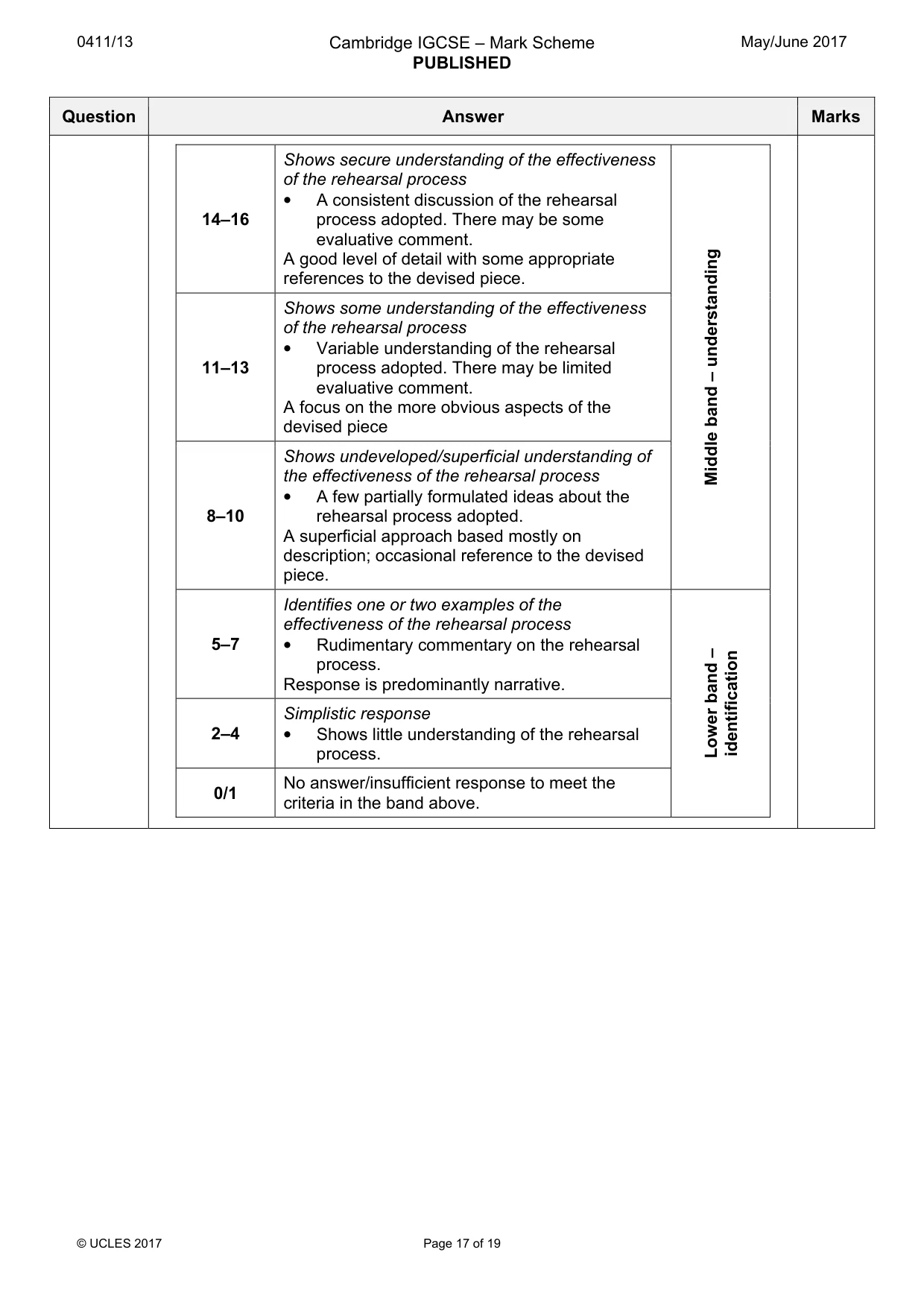
0411/13 Cambridge IGCSE – Mark Scheme PUBLISHED May/June 2017 © UCLES 2017 Page 17 of 19 Question Answer Marks 14–16 Shows secure understanding of the effectiveness of the rehearsal process • A consistent discussion of the rehearsal process adopted. There may be some evaluative comment. A good level of detail with some appropriate references to the devised piece. Middle band – understanding 11–13 Shows some understanding of the effectiveness of the rehearsal process • Variable understanding of the rehearsal process adopted. There may be limited evaluative comment. A focus on the more obvious aspects of the devised piece 8–10 Shows undeveloped/superficial understanding of the effectiveness of the rehearsal process • A few partially formulated ideas about the rehearsal process adopted. A superficial approach based mostly on description; occasional reference to the devised piece. 5–7 Identifies one or two examples of the effectiveness of the rehearsal process • Rudimentary commentary on the rehearsal process. Response is predominantly narrative. Lower band – identification 2–4 Simplistic response • Shows little understanding of the rehearsal process. 0/1 No answer/insufficient response to meet the criteria in the band above.
Mark scheme, page 18
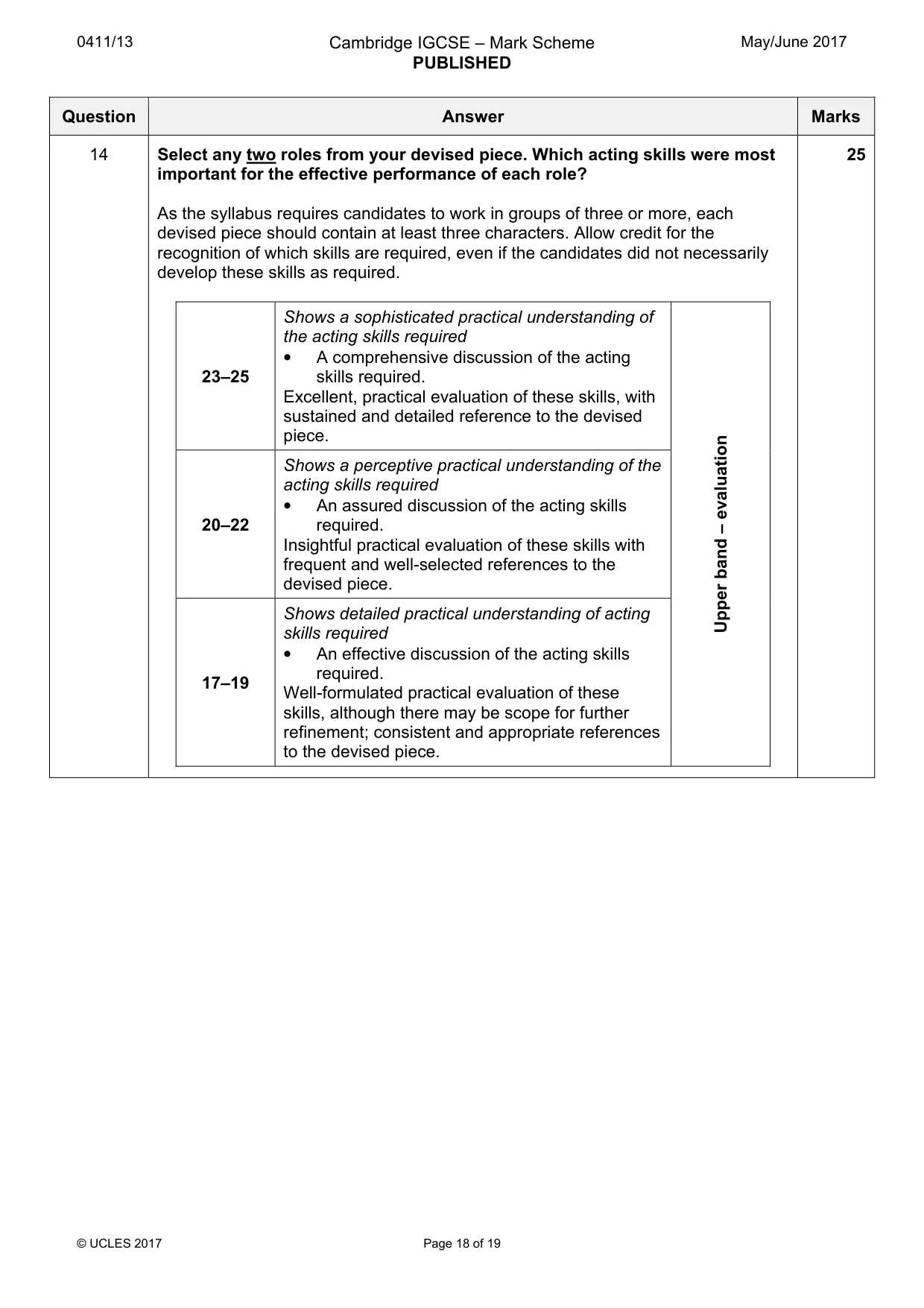
0411/13 Cambridge IGCSE – Mark Scheme PUBLISHED May/June 2017 © UCLES 2017 Page 18 of 19 Question Answer Marks 14 Select any two roles from your devised piece. Which acting skills were most important for the effective performance of each role? As the syllabus requires candidates to work in groups of three or more, each devised piece should contain at least three characters. Allow credit for the recognition of which skills are required, even if the candidates did not necessarily develop these skills as required. 23–25 Shows a sophisticated practical understanding of the acting skills required • A comprehensive discussion of the acting skills required. Excellent, practical evaluation of these skills, with sustained and detailed reference to the devised piece. Upper band – evaluation 20–22 Shows a perceptive practical understanding of the acting skills required • An assured discussion of the acting skills required. Insightful practical evaluation of these skills with frequent and well-selected references to the devised piece. 17–19 Shows detailed practical understanding of acting skills required • An effective discussion of the acting skills required. Well-formulated practical evaluation of these skills, although there may be scope for further refinement; consistent and appropriate references to the devised piece. 25
Mark scheme, page 19
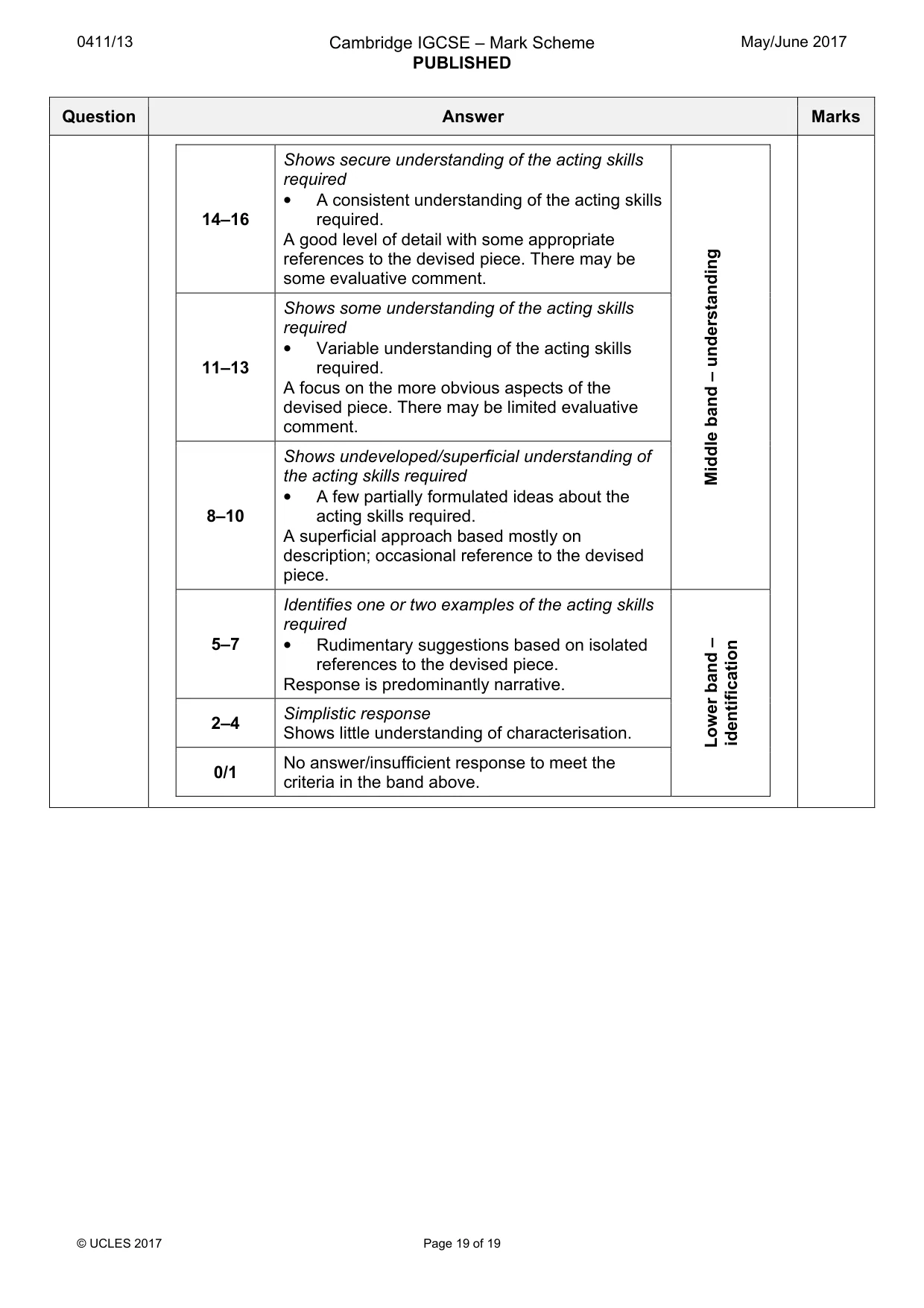
0411/13 Cambridge IGCSE – Mark Scheme PUBLISHED May/June 2017 © UCLES 2017 Page 19 of 19 Question Answer Marks 14–16 Shows secure understanding of the acting skills required • A consistent understanding of the acting skills required. A good level of detail with some appropriate references to the devised piece. There may be some evaluative comment. Middle band – understanding 11–13 Shows some understanding of the acting skills required • Variable understanding of the acting skills required. A focus on the more obvious aspects of the devised piece. There may be limited evaluative comment. 8–10 Shows undeveloped/superficial understanding of the acting skills required • A few partially formulated ideas about the acting skills required. A superficial approach based mostly on description; occasional reference to the devised piece. 5–7 Identifies one or two examples of the acting skills required • Rudimentary suggestions based on isolated references to the devised piece. Response is predominantly narrative. Lower band – identification 2–4 Simplistic response Shows little understanding of characterisation. 0/1 No answer/insufficient response to meet the criteria in the band above.
What you needed in this session
Cambridge’s own grade thresholds for 2017 May/June, Paper 1 · Variant 3. A higher threshold means an easier paper — the bar moves with how the cohort did.