Cambridge IGCSE Drama 0411 — 2022 May/June Paper 1 · Variant 2
0411/12/M/J/22 · 80 marks · ≈90 min
The question paper and its mark scheme, free to read here and free to download. This is Cambridge’s own paper, exactly as it was sat.
Question paper12 pages



Mark scheme11 pages
Answers below. Sit the paper first if you are practising.
Paper as text
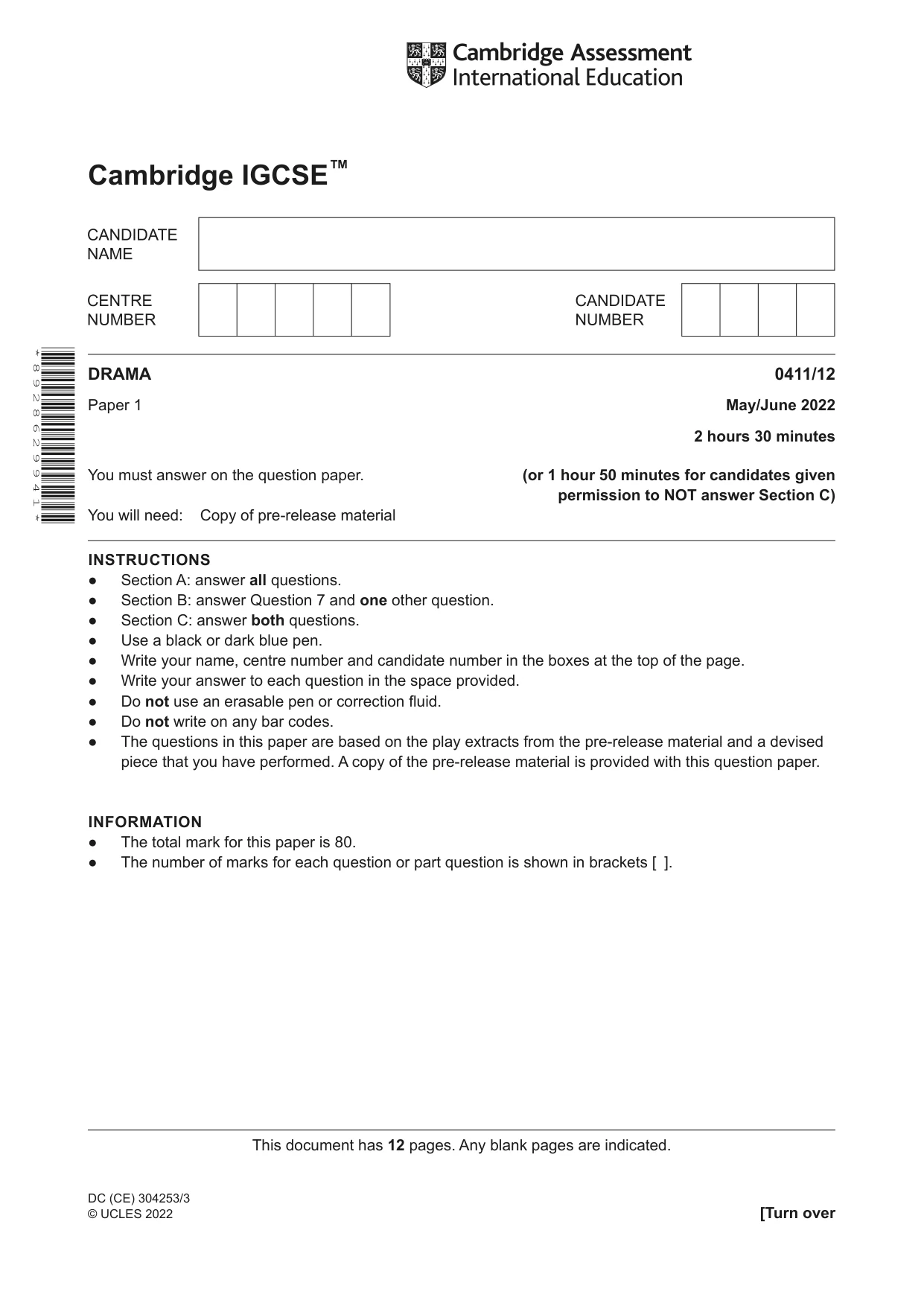
Question paper, page 1
This document has 12 pages. Any blank pages are indicated. [Turn over Cambridge IGCSE™ DC (CE) 304253/3 © UCLES 2022 DRAMA 0411/12 Paper 1 May/June 2022 2 hours 30 minutes You must answer on the question paper. (or 1 hour 50 minutes for candidates given permission to NOT answer Section C) You will need: Copy of pre-release material INSTRUCTIONS ● Section A: answer all questions. ● Section B: answer Question 7 and one other question. ● Section C: answer both questions. ● Use a black or dark blue pen. ● Write your name, centre number and candidate number in the boxes at the top of the page. ● Write your answer to each question in the space provided. ● Do not use an erasable pen or correction fluid. ● Do not write on any bar codes. ● The questions in this paper are based on the play extracts from the pre-release material and a devised piece that you have performed. A copy of the pre-release material is provided with this question paper. INFORMATION ● The total mark for this paper is 80. ● The number of marks for each question or part question is shown in brackets [ ]. * 8 9 2 8 6 2 9 9 4 1 *
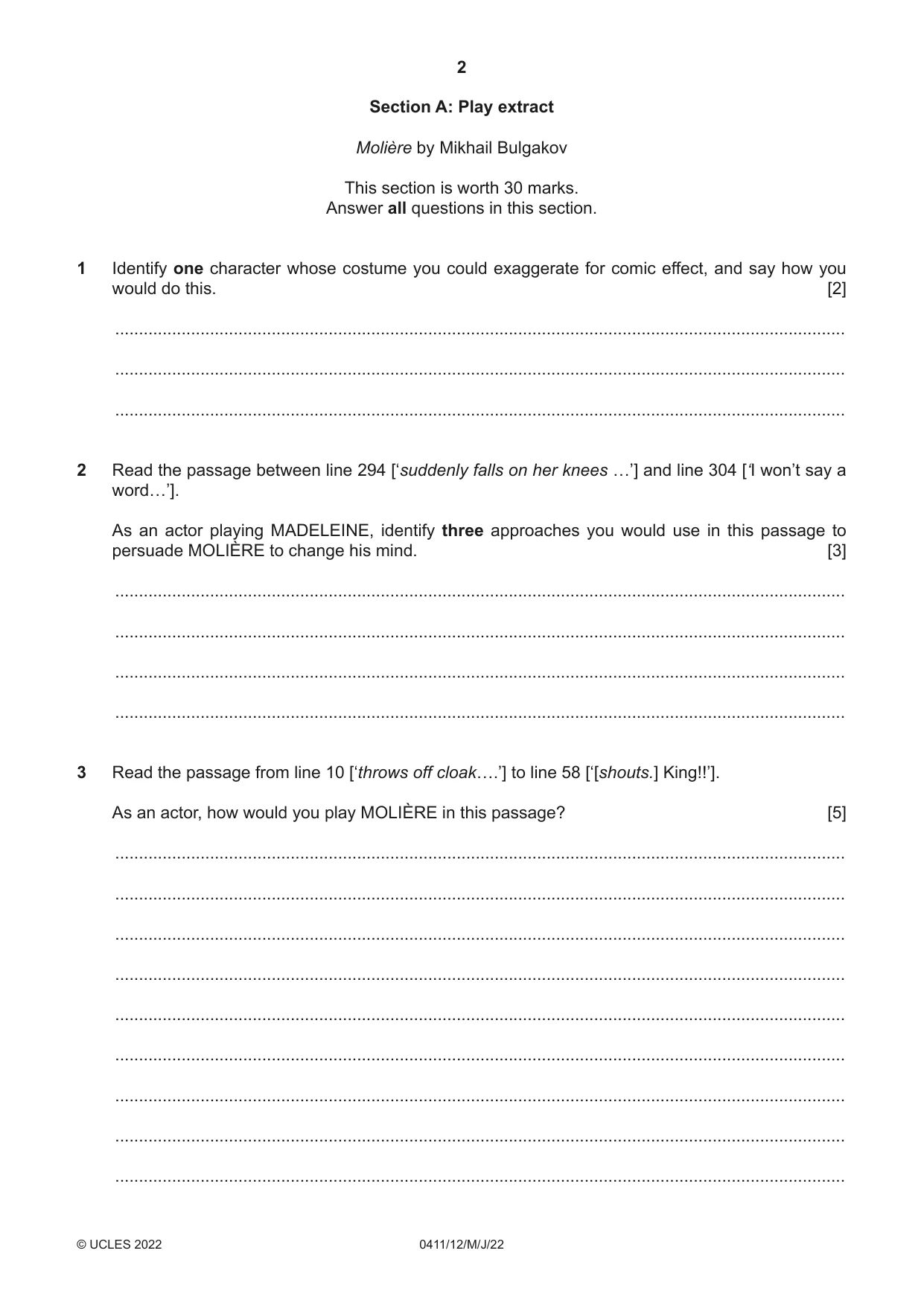
Question paper, page 2
2 0411/12/M/J/22 © UCLES 2022 Section A: Play extract Molière by Mikhail Bulgakov This section is worth 30 marks. Answer all questions in this section. 1 Identify one character whose costume you could exaggerate for comic effect, and say how you would do this. [2] … … … 2 Read the passage between line 294 [‘suddenly falls on her knees …’] and line 304 [‘I won’t say a word…’]. As an actor playing MADELEINE, identify three approaches you would use in this passage to persuade MOLIÈRE to change his mind. [3] … … … … 3 Read the passage from line 10 [‘throws off cloak….’] to line 58 [‘[shouts.] King!!’]. As an actor, how would you play MOLIÈRE in this passage? [5] … … … … … … … … …
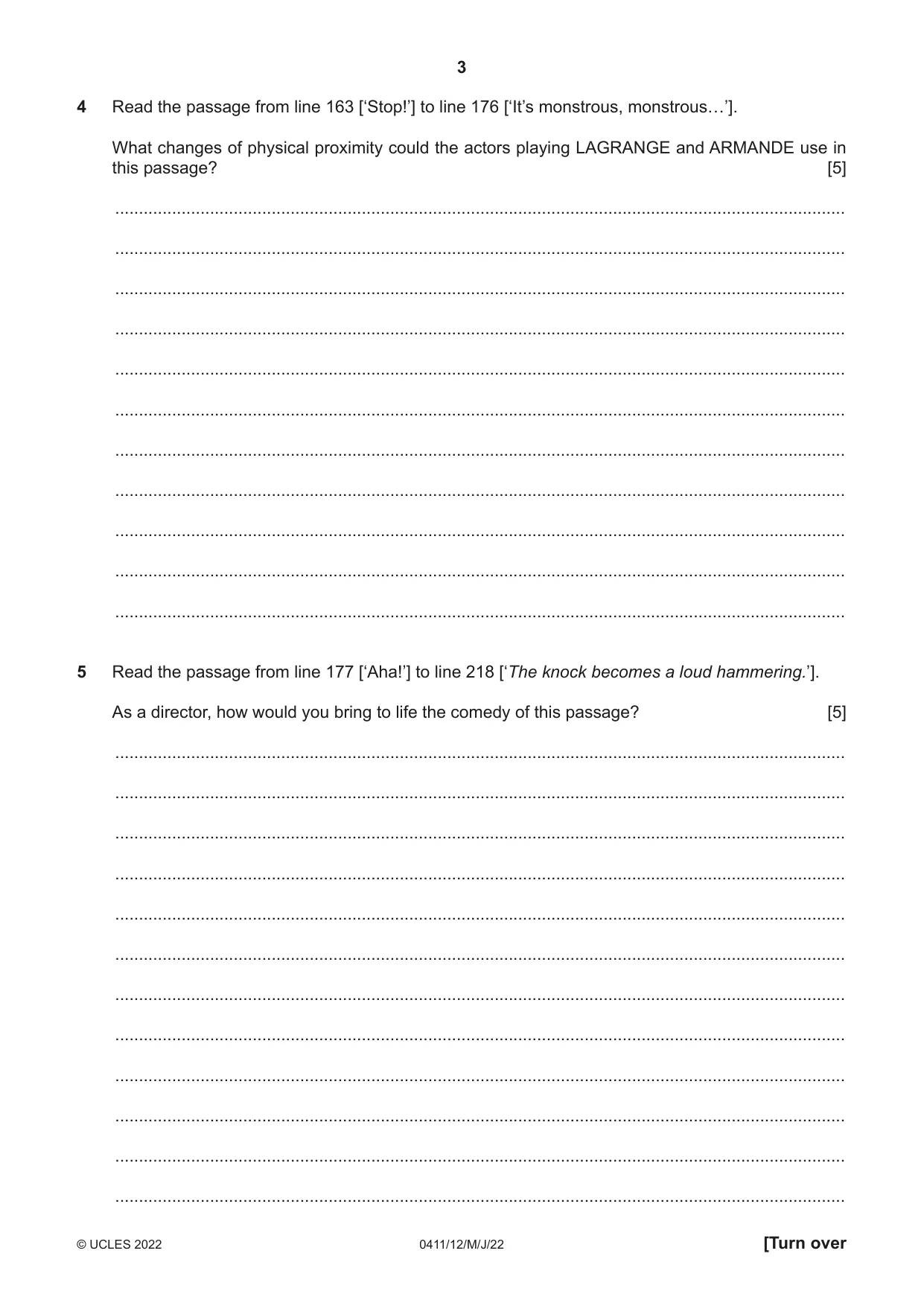
Question paper, page 3
3 0411/12/M/J/22 © UCLES 2022 [Turn over 4 Read the passage from line 163 [‘Stop!’] to line 176 [‘It’s monstrous, monstrous…’]. What changes of physical proximity could the actors playing LAGRANGE and ARMANDE use in this passage? [5] … … … … … … … … … … … 5 Read the passage from line 177 [‘Aha!’] to line 218 [‘The knock becomes a loud hammering.’]. As a director, how would you bring to life the comedy of this passage? [5] … … … … … … … … … … … …
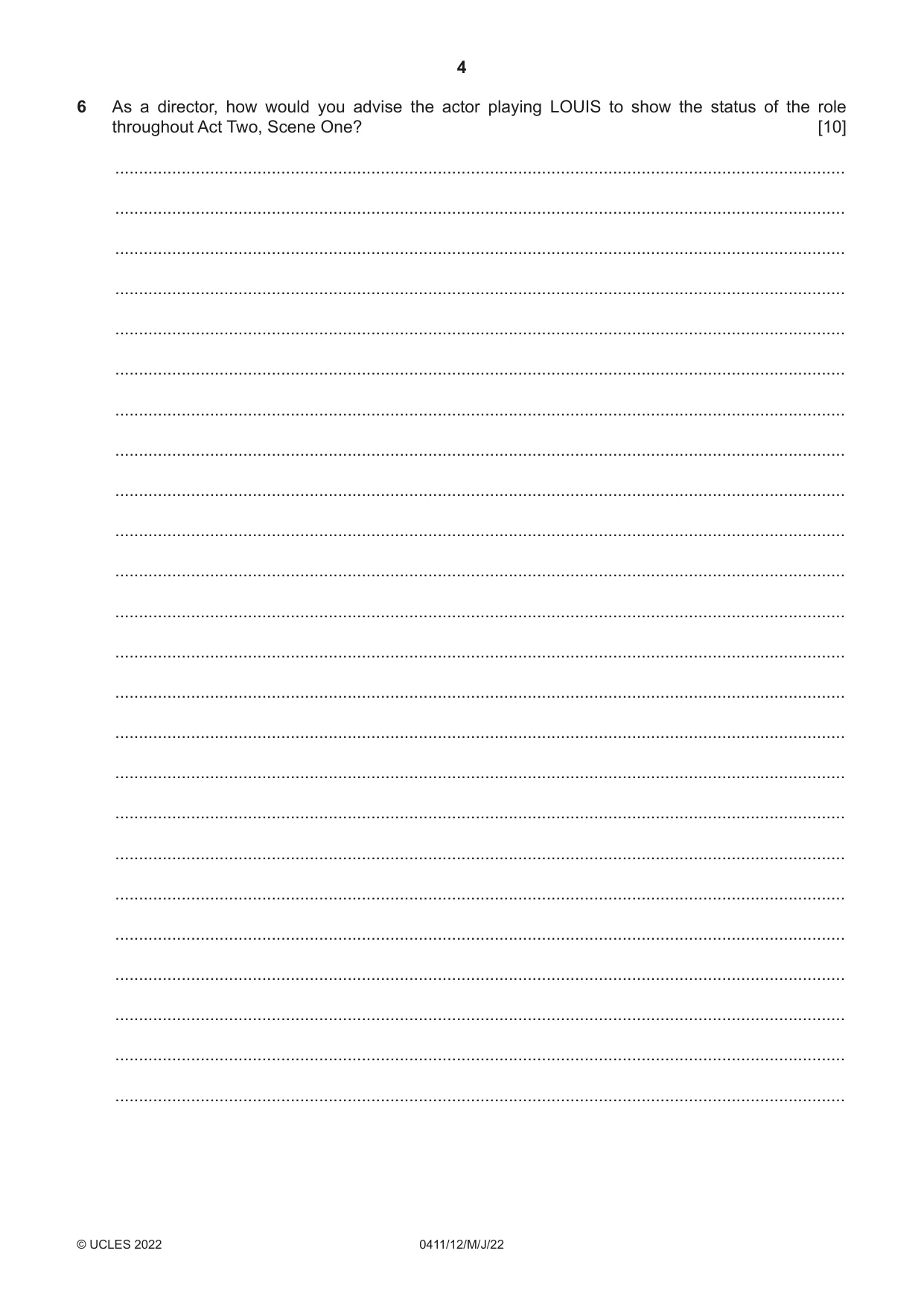
Question paper, page 4
4 0411/12/M/J/22 © UCLES 2022 6 As a director, how would you advise the actor playing LOUIS to show the status of the role throughout Act Two, Scene One? [10] … … … … … … … … … … … … … … … … … … … … … … … …
Question paper, page 5
5 0411/12/M/J/22 © UCLES 2022 [Turn over Section B: Play extract Like Doves We Rise by Yaël Farber This section is worth 25 marks. Answer Question 7 and EITHER Question 8 OR Question 9. 7 Read from the opening of the play to line 102 [‘Hey! Hey!’]. How could the actors use songs, movement and story-telling skills to create an effective opening to the piece? [10] … … … … … … … … … … … … … … … … … … … … … … …
Question paper, page 6
6 0411/12/M/J/22 © UCLES 2022 EITHER 8 As an actor, how would you perform the role of BONGI from line 117 [‘But that hour would always come…’] to the end of Scene One? Make close reference to specific lines from the extract in your answer. [15] OR 9 Read Scene Two from line 335 [‘A train whistles..’] to the end. How would you use physicality, sound and ensemble skills to show the horrors of MRS POPO’s school? [15] Question number: … … … … … … … … … … … … … … … … … … … … … … …
Question paper, page 7
7 0411/12/M/J/22 © UCLES 2022 [Turn over … … … … … … … … … … … … … … … … … … … … … … … … … … … …
Question paper, page 8
8 0411/12/M/J/22 © UCLES 2022 Section C: Devised piece If you have been given permission to NOT attempt this section you should leave these questions blank. Your time for the exam will be reduced to 1 hour 50 minutes. This section is worth 25 marks. Answer Question 10 AND Question 11. Questions 10 and 11 are based on a devised piece that you have developed and performed. In the box below briefly state the title of your chosen devised piece, the stimulus you used and the part you played. This information is to help the examiner but is not assessed. TITLE: STIMULUS: PART:
Question paper, page 9
9 0411/12/M/J/22 © UCLES 2022 [Turn over 10 Explain how you used the devising process to create moments of dramatic tension in your devised piece. [10] … … … … … … … … … … … … … … … … … … … … … … …
Question paper, page 10
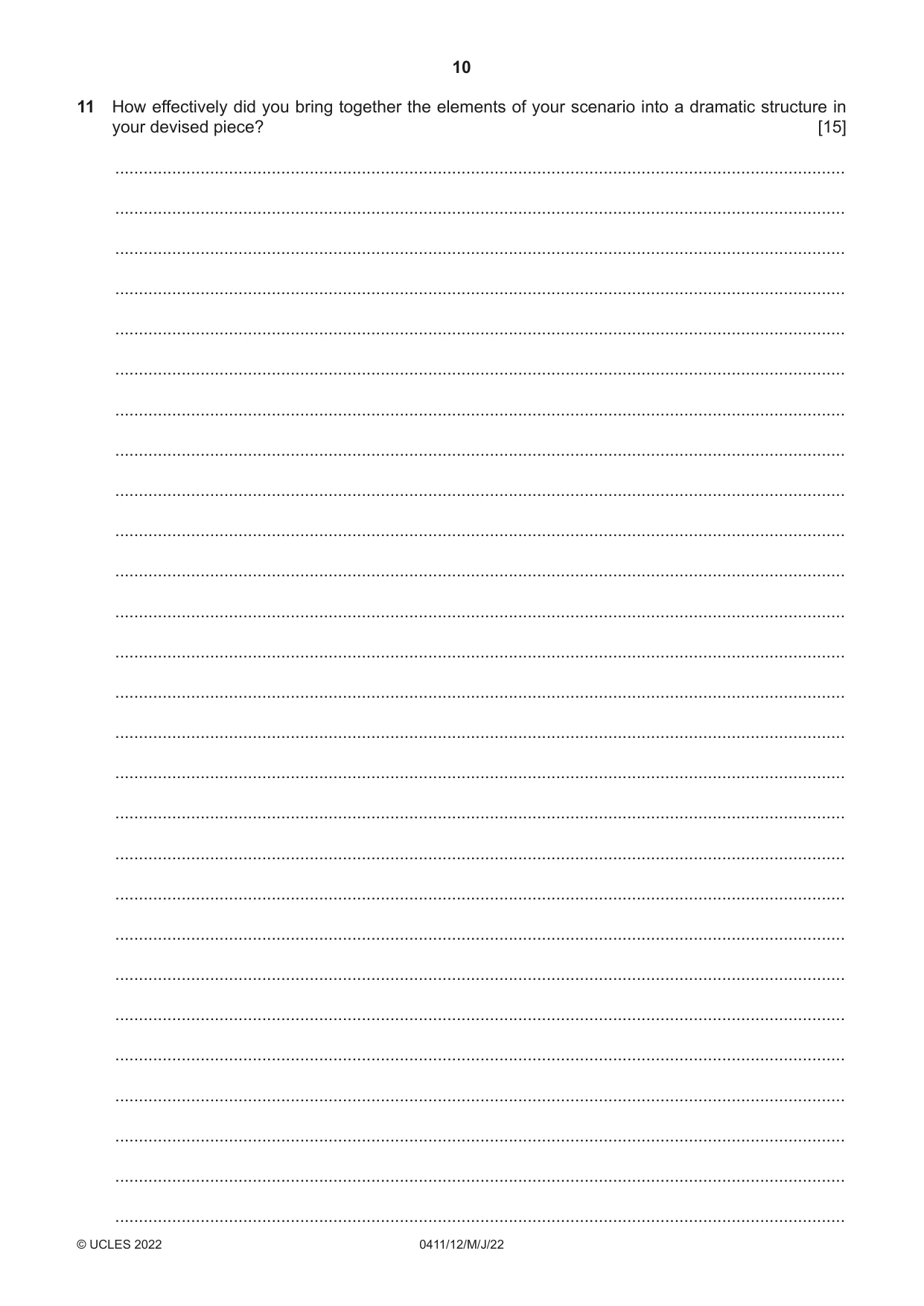
10 0411/12/M/J/22 © UCLES 2022 11 How effectively did you bring together the elements of your scenario into a dramatic structure in your devised piece? [15] … … … … … … … … … … … … … … … … … … … … … … … … … … …
Question paper, page 11
11 0411/12/M/J/22 © UCLES 2022 … … … … … … … … … … … … … … … … … … … … … … … … … … … …
Question paper, page 12
12 0411/12/M/J/22 © UCLES 2022 Permission to reproduce items where third-party owned material protected by copyright is included has been sought and cleared where possible. Every reasonable effort has been made by the publisher (UCLES) to trace copyright holders, but if any items requiring clearance have unwittingly been included, the publisher will be pleased to make amends at the earliest possible opportunity. To avoid the issue of disclosure of answer-related information to candidates, all copyright acknowledgements are reproduced online in the Cambridge Assessment International Education Copyright Acknowledgements Booklet. This is produced for each series of examinations and is freely available to download at www.cambridgeinternational.org after the live examination series. Cambridge Assessment International Education is part of Cambridge Assessment. Cambridge Assessment is the brand name of the University of Cambridge Local Examinations Syndicate (UCLES), which is a department of the University of Cambridge. BLANK PAGE
Mark scheme, page 1
This document consists of 11 printed pages. © UCLES 2022 [Turn over Cambridge IGCSE™ DRAMA 0411/12 Paper 1 Written Examination May/June 2022 MARK SCHEME Maximum Mark: 80 Published This mark scheme is published as an aid to teachers and candidates, to indicate the requirements of the examination. It shows the basis on which Examiners were instructed to award marks. It does not indicate the details of the discussions that took place at an Examiners’ meeting before marking began, which would have considered the acceptability of alternative answers. Mark schemes should be read in conjunction with the question paper and the Principal Examiner Report for Teachers. Cambridge International will not enter into discussions about these mark schemes. Cambridge International is publishing the mark schemes for the May/June 2022 series for most Cambridge IGCSE, Cambridge International A and AS Level and Cambridge Pre-U components, and some Cambridge O Level components.
Mark scheme, page 2
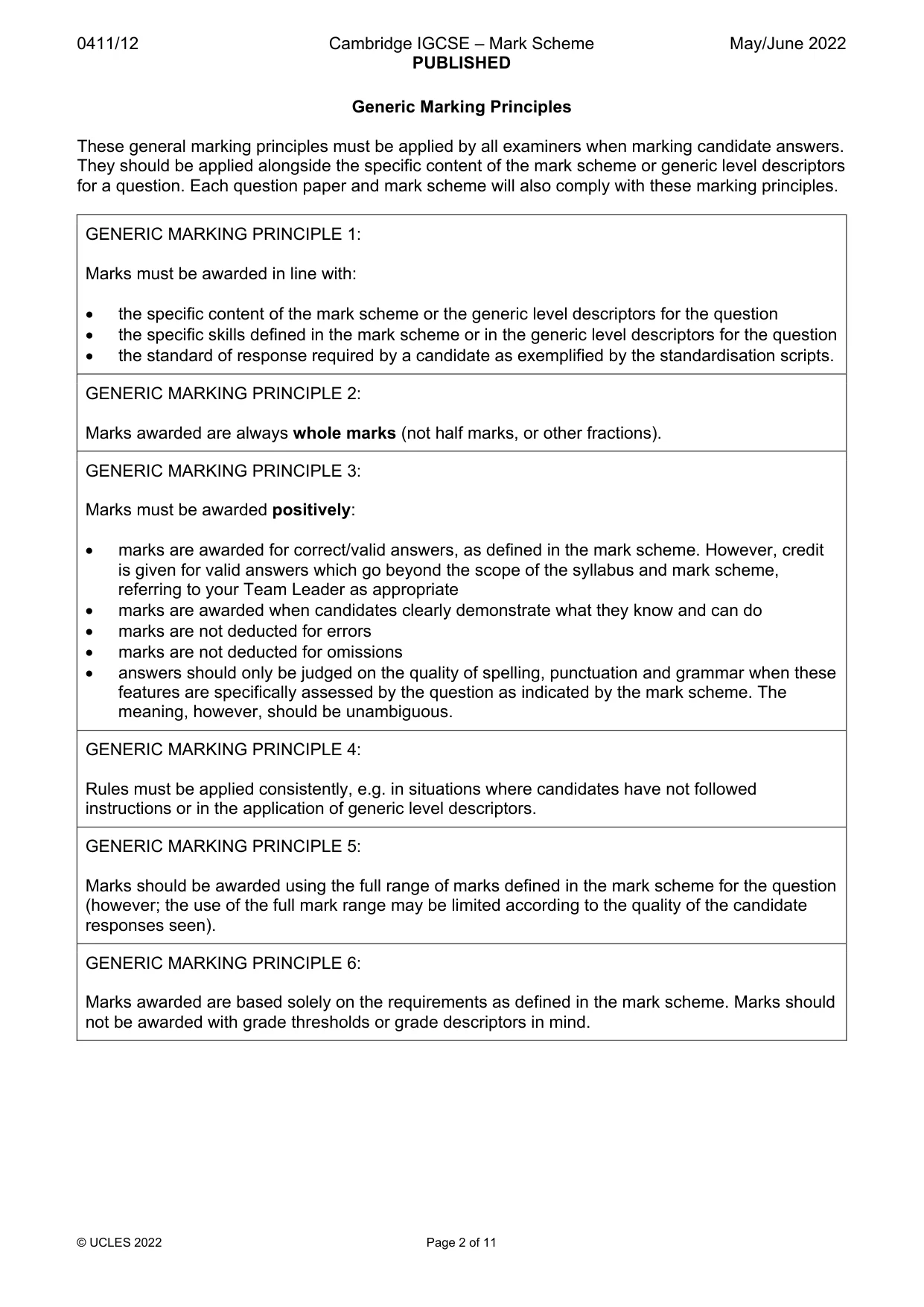
0411/12 Cambridge IGCSE – Mark Scheme PUBLISHED May/June 2022 © UCLES 2022 Page 2 of 11 Generic Marking Principles These general marking principles must be applied by all examiners when marking candidate answers. They should be applied alongside the specific content of the mark scheme or generic level descriptors for a question. Each question paper and mark scheme will also comply with these marking principles. GENERIC MARKING PRINCIPLE 1: Marks must be awarded in line with: the specific content of the mark scheme or the generic level descriptors for the question the specific skills defined in the mark scheme or in the generic level descriptors for the question the standard of response required by a candidate as exemplified by the standardisation scripts. GENERIC MARKING PRINCIPLE 2: Marks awarded are always whole marks (not half marks, or other fractions). GENERIC MARKING PRINCIPLE 3: Marks must be awarded positively: marks are awarded for correct/valid answers, as defined in the mark scheme. However, credit is given for valid answers which go beyond the scope of the syllabus and mark scheme, referring to your Team Leader as appropriate marks are awarded when candidates clearly demonstrate what they know and can do marks are not deducted for errors marks are not deducted for omissions answers should only be judged on the quality of spelling, punctuation and grammar when these features are specifically assessed by the question as indicated by the mark scheme. The meaning, however, should be unambiguous. GENERIC MARKING PRINCIPLE 4: Rules must be applied consistently, e.g. in situations where candidates have not followed instructions or in the application of generic level descriptors. GENERIC MARKING PRINCIPLE 5: Marks should be awarded using the full range of marks defined in the mark scheme for the question (however; the use of the full mark range may be limited according to the quality of the candidate responses seen). GENERIC MARKING PRINCIPLE 6: Marks awarded are based solely on the requirements as defined in the mark scheme. Marks should not be awarded with grade thresholds or grade descriptors in mind.
Mark scheme, page 3
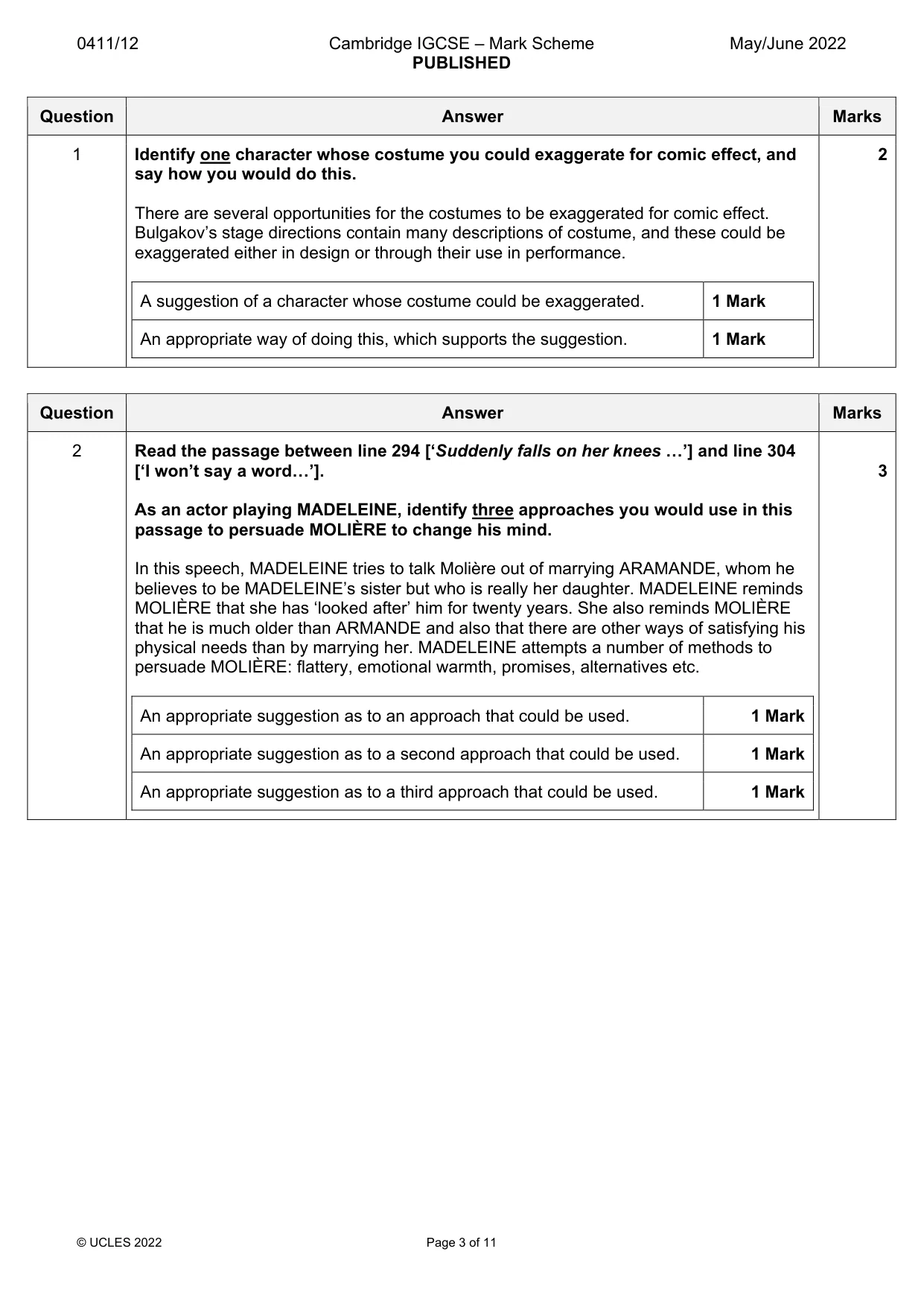
0411/12 Cambridge IGCSE – Mark Scheme PUBLISHED May/June 2022 © UCLES 2022 Page 3 of 11 Question Answer Marks 1 Identify one character whose costume you could exaggerate for comic effect, and say how you would do this. There are several opportunities for the costumes to be exaggerated for comic effect. Bulgakov’s stage directions contain many descriptions of costume, and these could be exaggerated either in design or through their use in performance. A suggestion of a character whose costume could be exaggerated. 1 Mark An appropriate way of doing this, which supports the suggestion. 1 Mark 2 Question Answer Marks 2 Read the passage between line 294 [‘Suddenly falls on her knees …’] and line 304 [‘I won’t say a word…’]. As an actor playing MADELEINE, identify three approaches you would use in this passage to persuade MOLIÈRE to change his mind. In this speech, MADELEINE tries to talk Molière out of marrying ARAMANDE, whom he believes to be MADELEINE’s sister but who is really her daughter. MADELEINE reminds MOLIÈRE that she has ‘looked after’ him for twenty years. She also reminds MOLIÈRE that he is much older than ARMANDE and also that there are other ways of satisfying his physical needs than by marrying her. MADELEINE attempts a number of methods to persuade MOLIÈRE: flattery, emotional warmth, promises, alternatives etc. An appropriate suggestion as to an approach that could be used. 1 Mark An appropriate suggestion as to a second approach that could be used. 1 Mark An appropriate suggestion as to a third approach that could be used. 1 Mark 3
Mark scheme, page 4
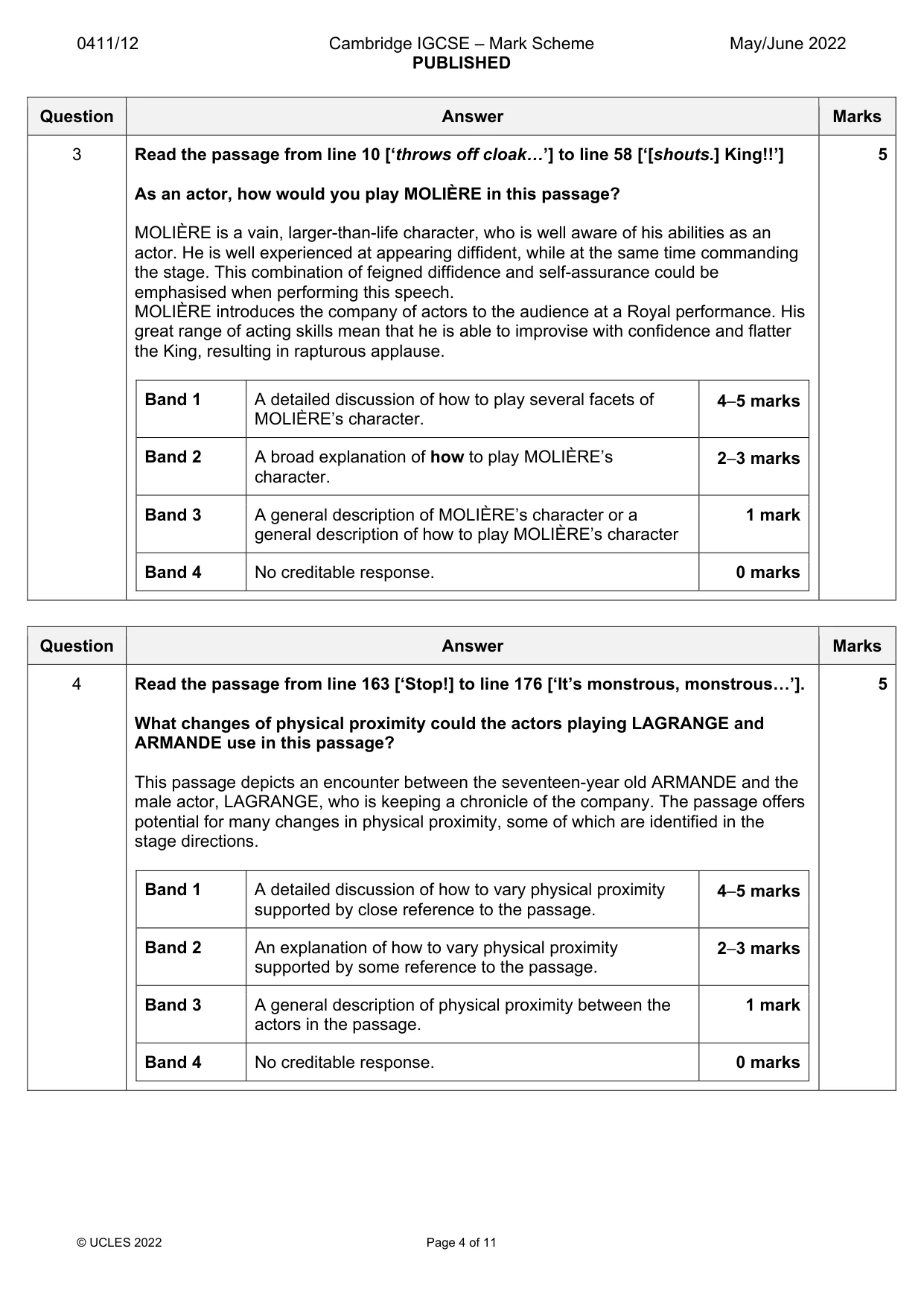
0411/12 Cambridge IGCSE – Mark Scheme PUBLISHED May/June 2022 © UCLES 2022 Page 4 of 11 Question Answer Marks 3 Read the passage from line 10 [‘throws off cloak…’] to line 58 [‘[shouts.] King!!’] As an actor, how would you play MOLIÈRE in this passage? MOLIÈRE is a vain, larger-than-life character, who is well aware of his abilities as an actor. He is well experienced at appearing diffident, while at the same time commanding the stage. This combination of feigned diffidence and self-assurance could be emphasised when performing this speech. MOLIÈRE introduces the company of actors to the audience at a Royal performance. His great range of acting skills mean that he is able to improvise with confidence and flatter the King, resulting in rapturous applause. Band 1 A detailed discussion of how to play several facets of MOLIÈRE’s character. 45 marks Band 2 A broad explanation of how to play MOLIÈRE’s character. 23 marks Band 3 A general description of MOLIÈRE’s character or a general description of how to play MOLIÈRE’s character 1 mark Band 4 No creditable response. 0 marks 5 Question Answer Marks 4 Read the passage from line 163 [‘Stop!] to line 176 [‘It’s monstrous, monstrous…’]. What changes of physical proximity could the actors playing LAGRANGE and ARMANDE use in this passage? This passage depicts an encounter between the seventeen-year old ARMANDE and the male actor, LAGRANGE, who is keeping a chronicle of the company. The passage offers potential for many changes in physical proximity, some of which are identified in the stage directions. Band 1 A detailed discussion of how to vary physical proximity supported by close reference to the passage. 45 marks Band 2 An explanation of how to vary physical proximity supported by some reference to the passage. 23 marks Band 3 A general description of physical proximity between the actors in the passage. 1 mark Band 4 No creditable response. 0 marks 5
Mark scheme, page 5
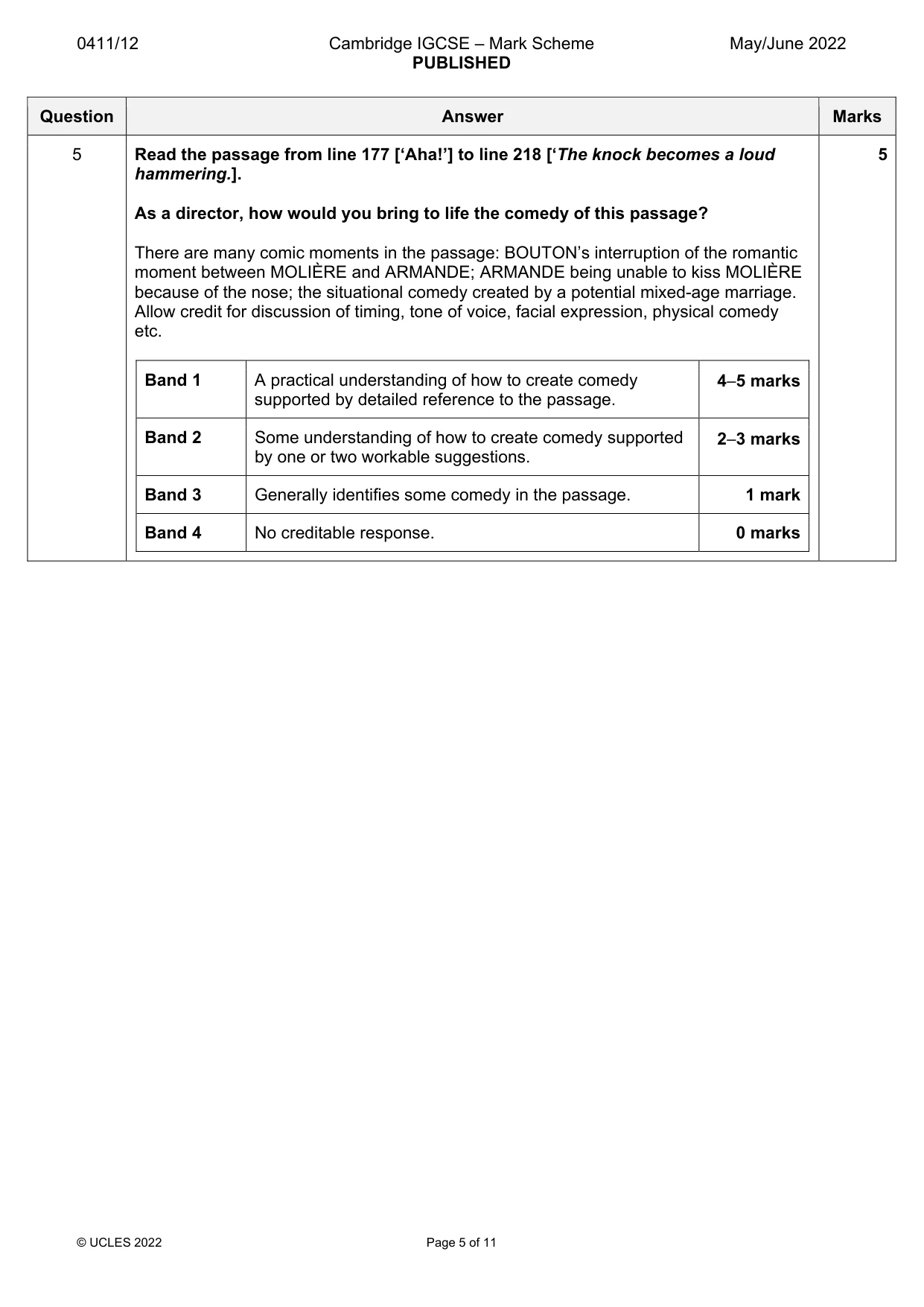
0411/12 Cambridge IGCSE – Mark Scheme PUBLISHED May/June 2022 © UCLES 2022 Page 5 of 11 Question Answer Marks 5 Read the passage from line 177 [‘Aha!’] to line 218 [‘The knock becomes a loud hammering.]. As a director, how would you bring to life the comedy of this passage? There are many comic moments in the passage: BOUTON’s interruption of the romantic moment between MOLIÈRE and ARMANDE; ARMANDE being unable to kiss MOLIÈRE because of the nose; the situational comedy created by a potential mixed-age marriage. Allow credit for discussion of timing, tone of voice, facial expression, physical comedy etc. Band 1 A practical understanding of how to create comedy supported by detailed reference to the passage. 45 marks Band 2 Some understanding of how to create comedy supported by one or two workable suggestions. 23 marks Band 3 Generally identifies some comedy in the passage. 1 mark Band 4 No creditable response. 0 marks 5
Mark scheme, page 6
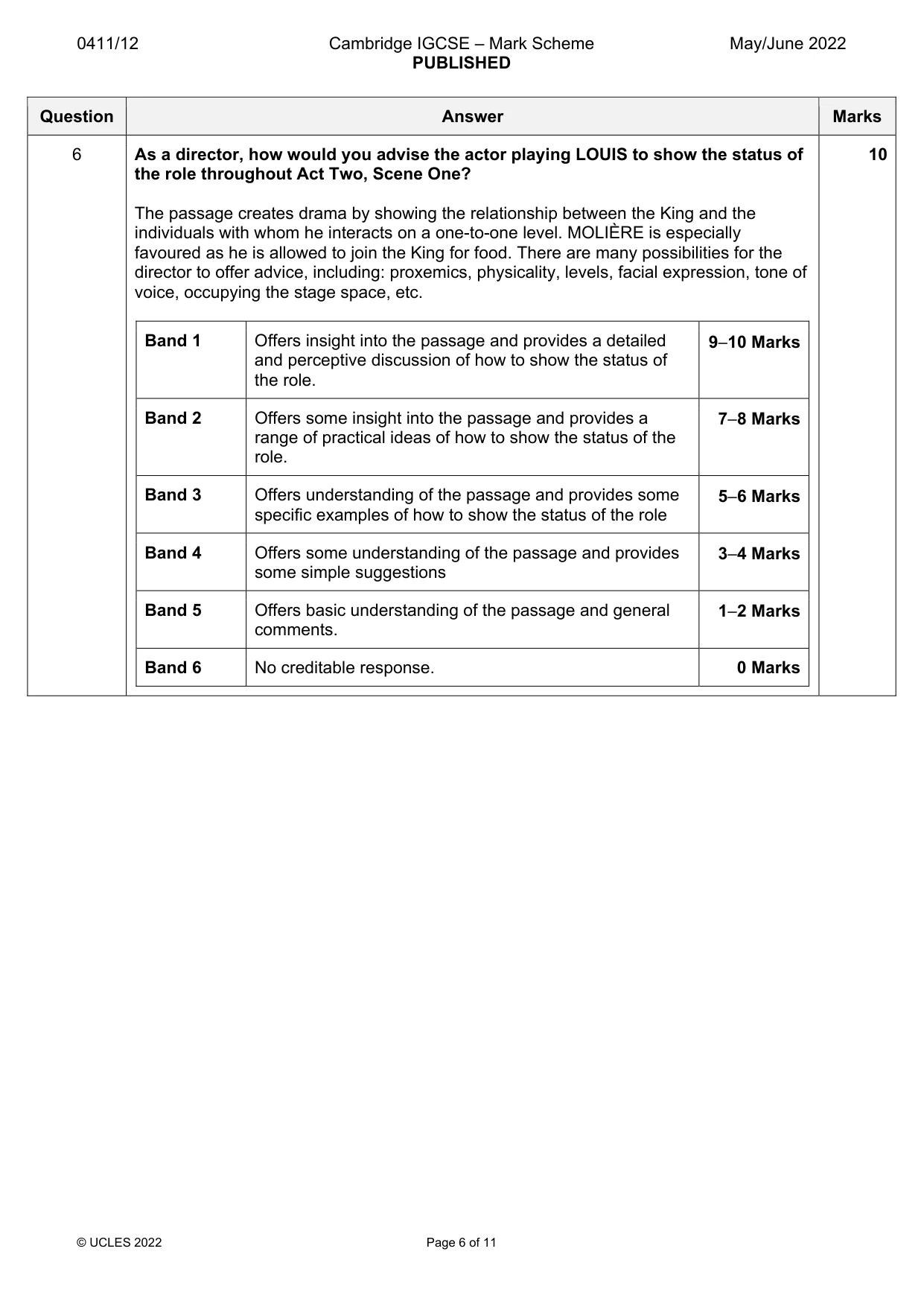
0411/12 Cambridge IGCSE – Mark Scheme PUBLISHED May/June 2022 © UCLES 2022 Page 6 of 11 Question Answer Marks 6 As a director, how would you advise the actor playing LOUIS to show the status of the role throughout Act Two, Scene One? The passage creates drama by showing the relationship between the King and the individuals with whom he interacts on a one-to-one level. MOLIÈRE is especially favoured as he is allowed to join the King for food. There are many possibilities for the director to offer advice, including: proxemics, physicality, levels, facial expression, tone of voice, occupying the stage space, etc. Band 1 Offers insight into the passage and provides a detailed and perceptive discussion of how to show the status of the role. 910 Marks Band 2 Offers some insight into the passage and provides a range of practical ideas of how to show the status of the role. 78 Marks Band 3 Offers understanding of the passage and provides some specific examples of how to show the status of the role 56 Marks Band 4 Offers some understanding of the passage and provides some simple suggestions 34 Marks Band 5 Offers basic understanding of the passage and general comments. 12 Marks Band 6 No creditable response. 0 Marks 10
Mark scheme, page 7
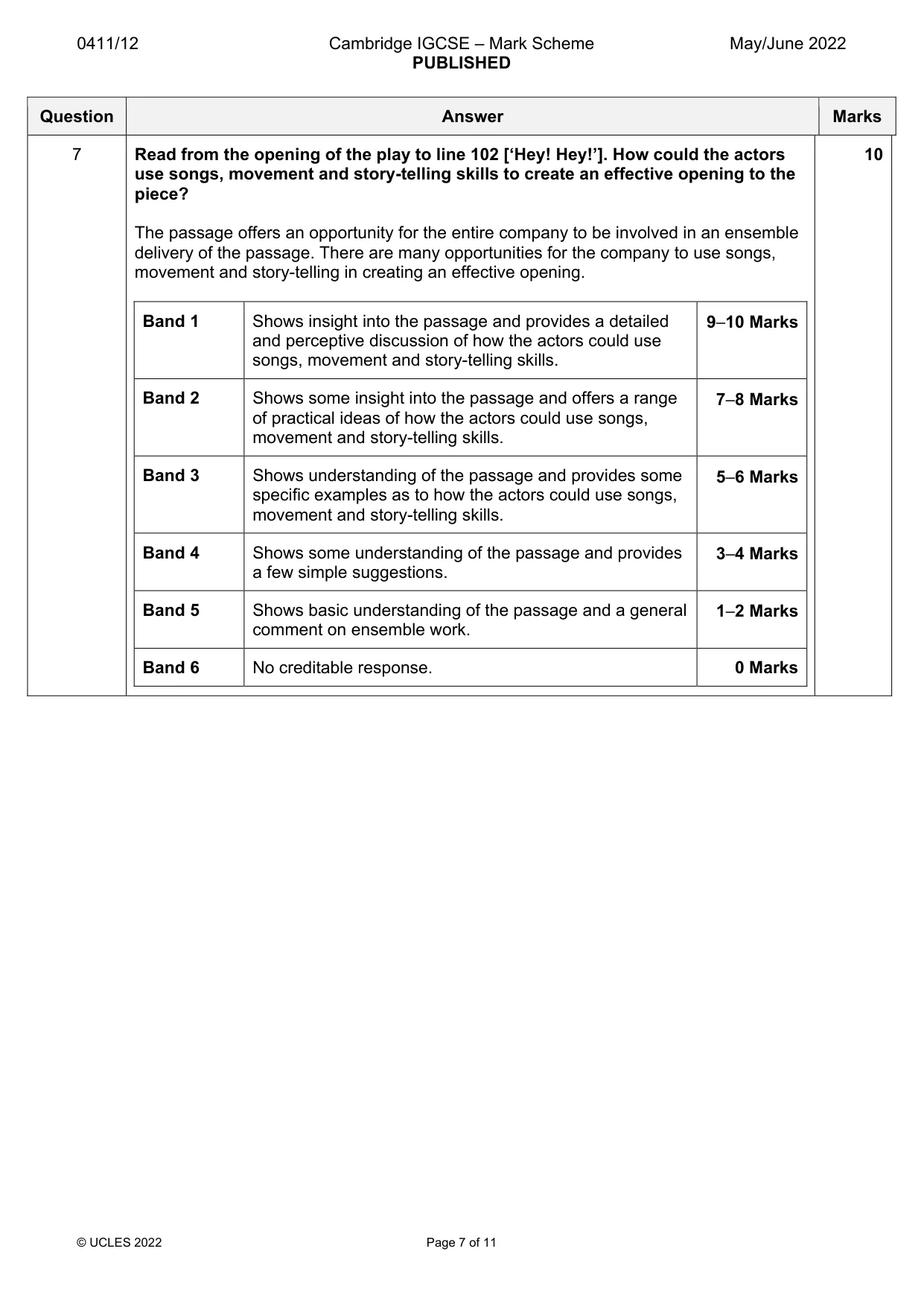
0411/12 Cambridge IGCSE – Mark Scheme PUBLISHED May/June 2022 © UCLES 2022 Page 7 of 11 Question Answer Marks 7 Read from the opening of the play to line 102 [‘Hey! Hey!’]. How could the actors use songs, movement and story-telling skills to create an effective opening to the piece? The passage offers an opportunity for the entire company to be involved in an ensemble delivery of the passage. There are many opportunities for the company to use songs, movement and story-telling in creating an effective opening. Band 1 Shows insight into the passage and provides a detailed and perceptive discussion of how the actors could use songs, movement and story-telling skills. 910 Marks Band 2 Shows some insight into the passage and offers a range of practical ideas of how the actors could use songs, movement and story-telling skills. 78 Marks Band 3 Shows understanding of the passage and provides some specific examples as to how the actors could use songs, movement and story-telling skills. 56 Marks Band 4 Shows some understanding of the passage and provides a few simple suggestions. 34 Marks Band 5 Shows basic understanding of the passage and a general comment on ensemble work. 12 Marks Band 6 No creditable response. 0 Marks 10
Mark scheme, page 8
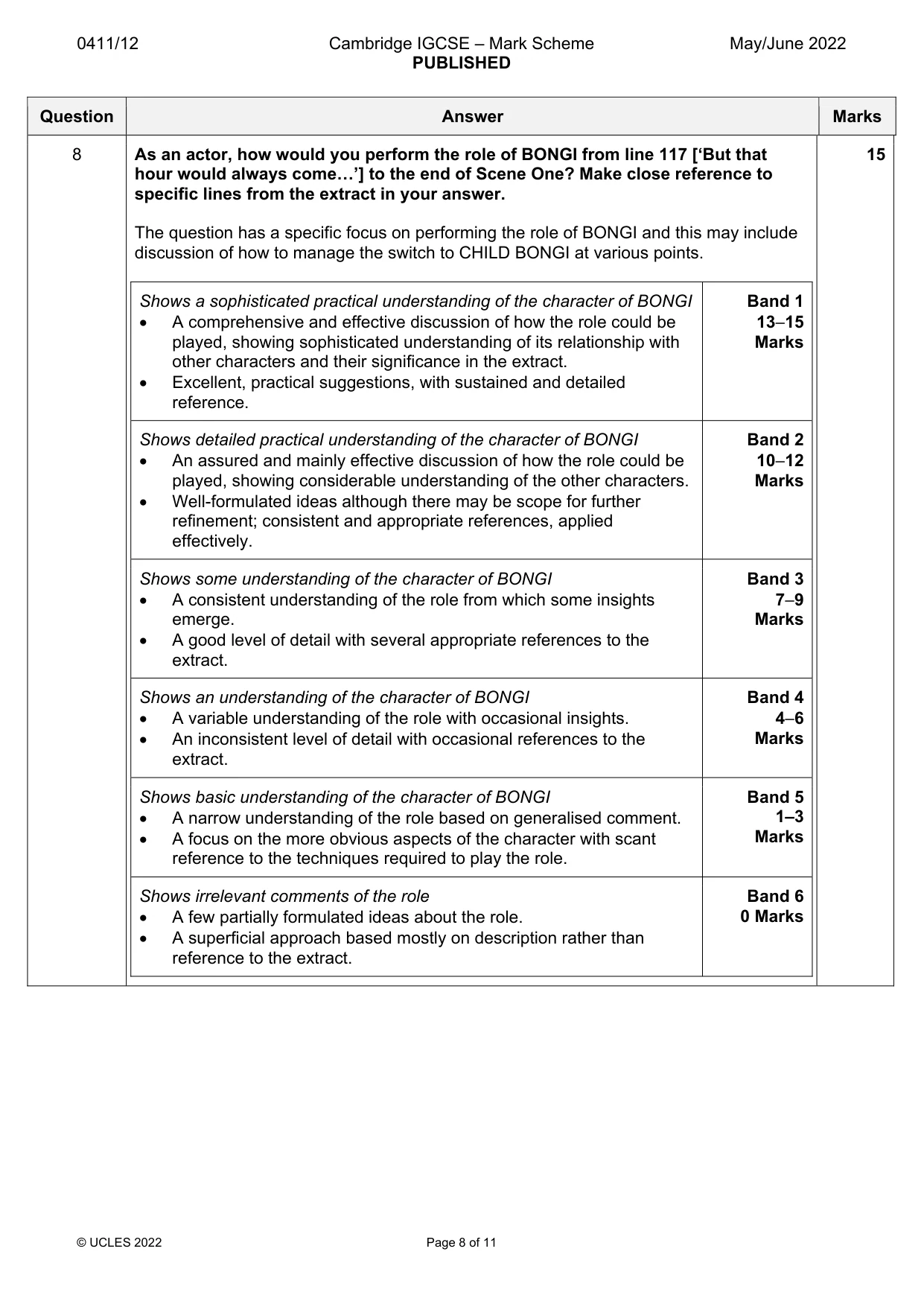
0411/12 Cambridge IGCSE – Mark Scheme PUBLISHED May/June 2022 © UCLES 2022 Page 8 of 11 Question Answer Marks 8 As an actor, how would you perform the role of BONGI from line 117 [‘But that hour would always come…’] to the end of Scene One? Make close reference to specific lines from the extract in your answer. The question has a specific focus on performing the role of BONGI and this may include discussion of how to manage the switch to CHILD BONGI at various points. Shows a sophisticated practical understanding of the character of BONGI A comprehensive and effective discussion of how the role could be played, showing sophisticated understanding of its relationship with other characters and their significance in the extract. Excellent, practical suggestions, with sustained and detailed reference. Band 1 1315 Marks Shows detailed practical understanding of the character of BONGI An assured and mainly effective discussion of how the role could be played, showing considerable understanding of the other characters. Well-formulated ideas although there may be scope for further refinement; consistent and appropriate references, applied effectively. Band 2 1012 Marks Shows some understanding of the character of BONGI A consistent understanding of the role from which some insights emerge. A good level of detail with several appropriate references to the extract. Band 3 79 Marks Shows an understanding of the character of BONGI A variable understanding of the role with occasional insights. An inconsistent level of detail with occasional references to the extract. Band 4 46 Marks Shows basic understanding of the character of BONGI A narrow understanding of the role based on generalised comment. A focus on the more obvious aspects of the character with scant reference to the techniques required to play the role. Band 5 1–3 Marks Shows irrelevant comments of the role A few partially formulated ideas about the role. A superficial approach based mostly on description rather than reference to the extract. Band 6 0 Marks 15
Mark scheme, page 9
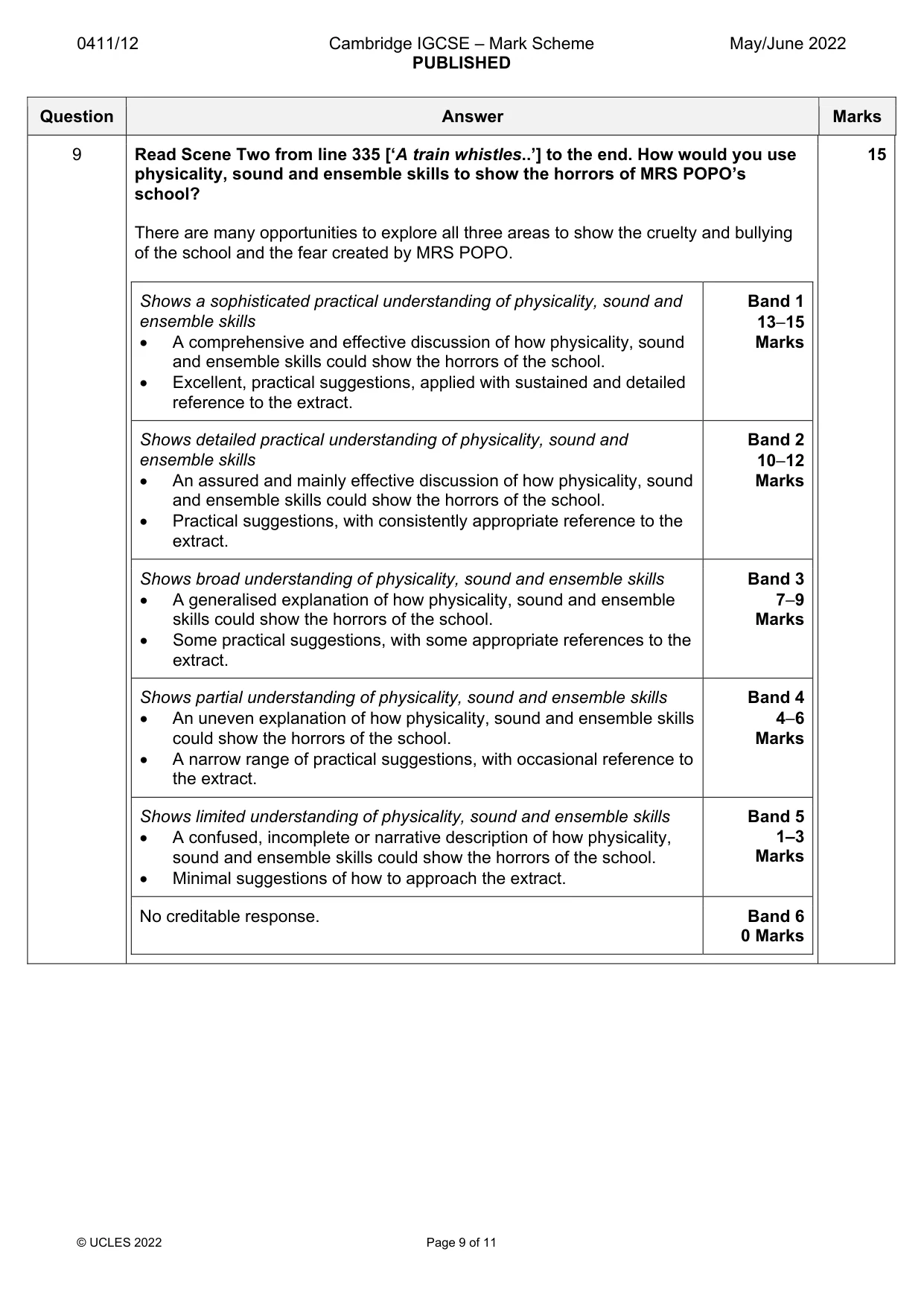
0411/12 Cambridge IGCSE – Mark Scheme PUBLISHED May/June 2022 © UCLES 2022 Page 9 of 11 Question Answer Marks 9 Read Scene Two from line 335 [‘A train whistles..’] to the end. How would you use physicality, sound and ensemble skills to show the horrors of MRS POPO’s school? There are many opportunities to explore all three areas to show the cruelty and bullying of the school and the fear created by MRS POPO. Shows a sophisticated practical understanding of physicality, sound and ensemble skills A comprehensive and effective discussion of how physicality, sound and ensemble skills could show the horrors of the school. Excellent, practical suggestions, applied with sustained and detailed reference to the extract. Band 1 1315 Marks Shows detailed practical understanding of physicality, sound and ensemble skills An assured and mainly effective discussion of how physicality, sound and ensemble skills could show the horrors of the school. Practical suggestions, with consistently appropriate reference to the extract. Band 2 1012 Marks Shows broad understanding of physicality, sound and ensemble skills A generalised explanation of how physicality, sound and ensemble skills could show the horrors of the school. Some practical suggestions, with some appropriate references to the extract. Band 3 79 Marks Shows partial understanding of physicality, sound and ensemble skills An uneven explanation of how physicality, sound and ensemble skills could show the horrors of the school. A narrow range of practical suggestions, with occasional reference to the extract. Band 4 46 Marks Shows limited understanding of physicality, sound and ensemble skills A confused, incomplete or narrative description of how physicality, sound and ensemble skills could show the horrors of the school. Minimal suggestions of how to approach the extract. Band 5 1–3 Marks No creditable response. Band 6 0 Marks 15
Mark scheme, page 10
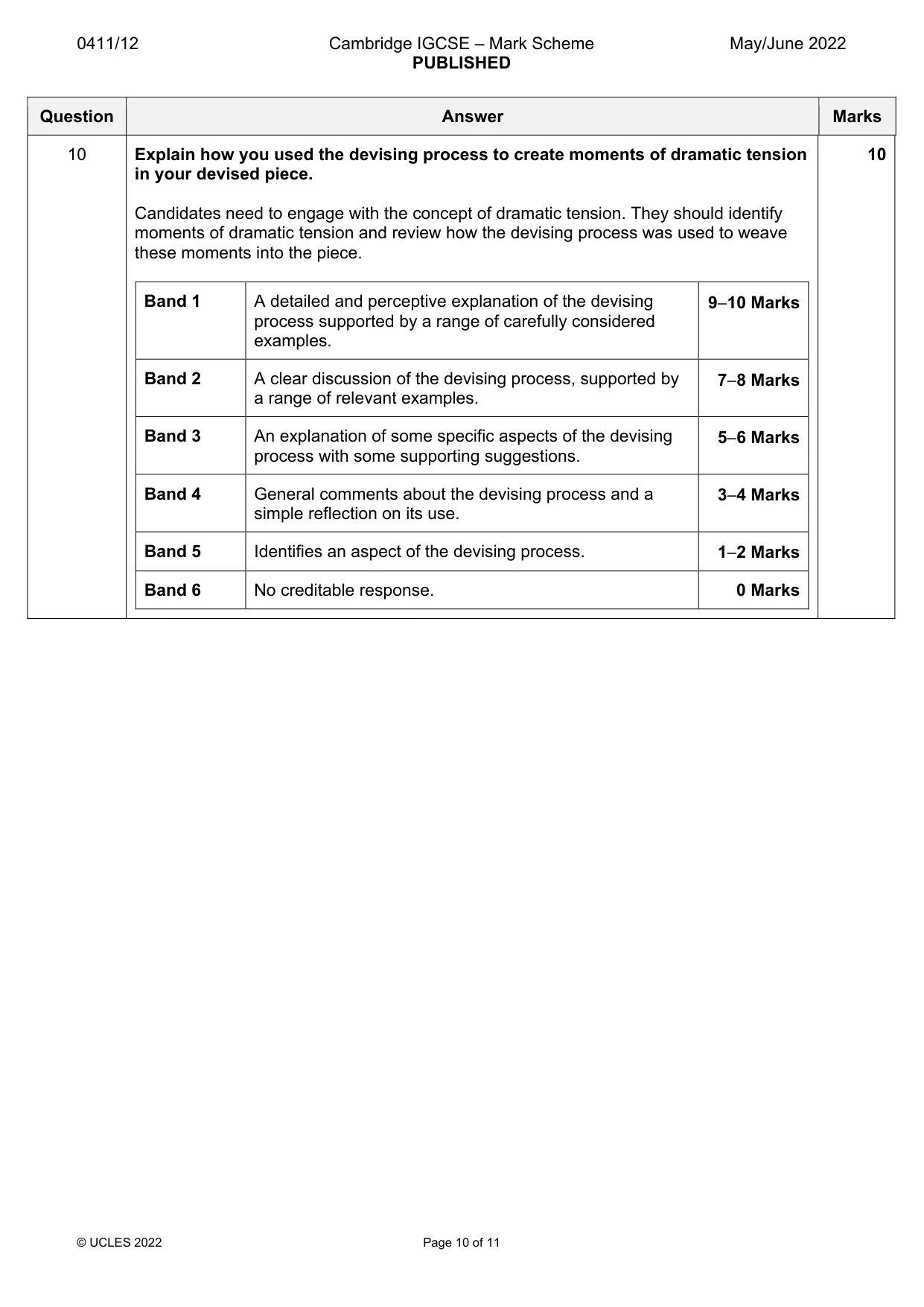
0411/12 Cambridge IGCSE – Mark Scheme PUBLISHED May/June 2022 © UCLES 2022 Page 10 of 11 Question Answer Marks 10 Explain how you used the devising process to create moments of dramatic tension in your devised piece. Candidates need to engage with the concept of dramatic tension. They should identify moments of dramatic tension and review how the devising process was used to weave these moments into the piece. Band 1 A detailed and perceptive explanation of the devising process supported by a range of carefully considered examples. 910 Marks Band 2 A clear discussion of the devising process, supported by a range of relevant examples. 78 Marks Band 3 An explanation of some specific aspects of the devising process with some supporting suggestions. 56 Marks Band 4 General comments about the devising process and a simple reflection on its use. 34 Marks Band 5 Identifies an aspect of the devising process. 12 Marks Band 6 No creditable response. 0 Marks 10
Mark scheme, page 11
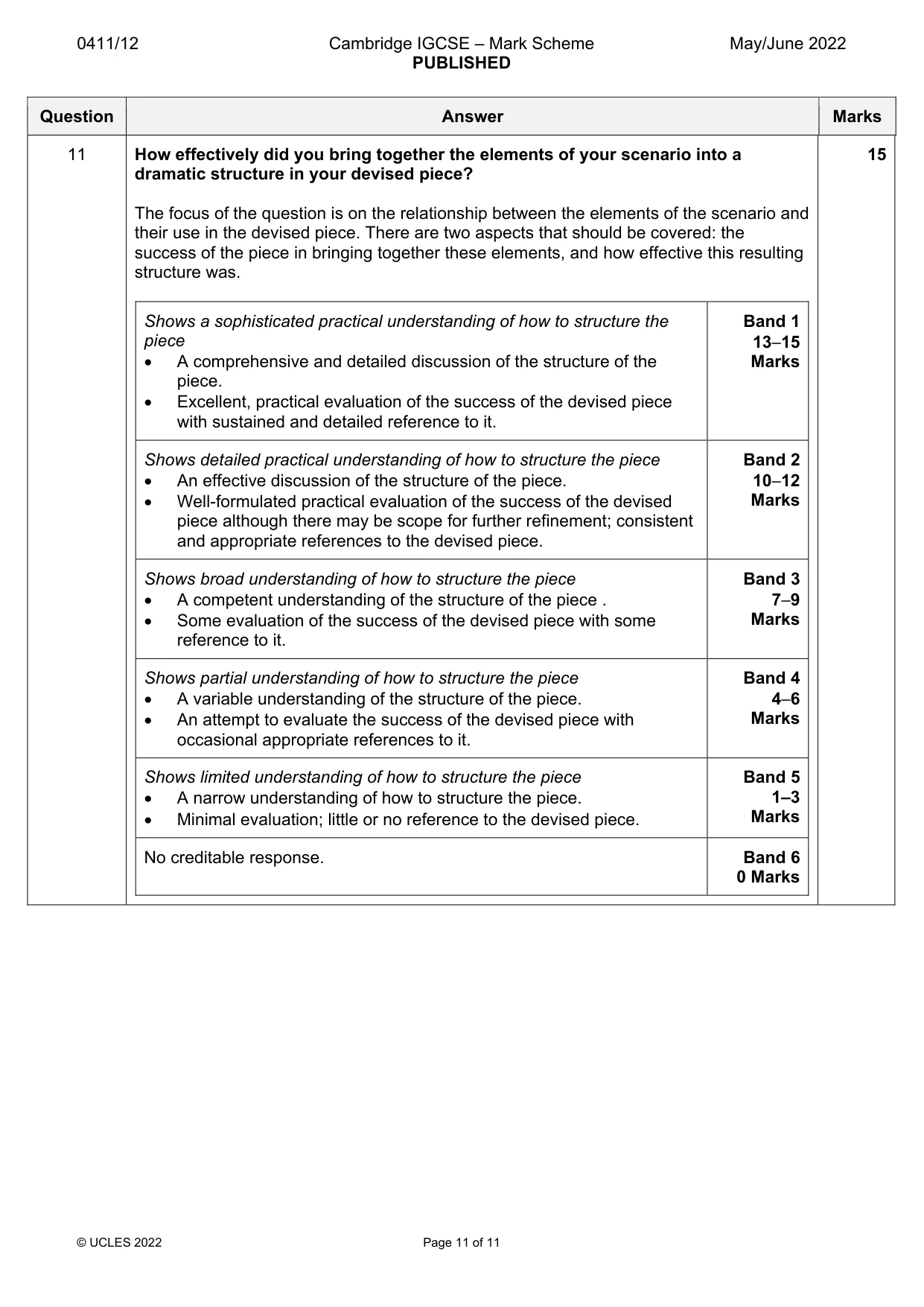
0411/12 Cambridge IGCSE – Mark Scheme PUBLISHED May/June 2022 © UCLES 2022 Page 11 of 11 Question Answer Marks 11 How effectively did you bring together the elements of your scenario into a dramatic structure in your devised piece? The focus of the question is on the relationship between the elements of the scenario and their use in the devised piece. There are two aspects that should be covered: the success of the piece in bringing together these elements, and how effective this resulting structure was. Shows a sophisticated practical understanding of how to structure the piece A comprehensive and detailed discussion of the structure of the piece. Excellent, practical evaluation of the success of the devised piece with sustained and detailed reference to it. Band 1 1315 Marks Shows detailed practical understanding of how to structure the piece An effective discussion of the structure of the piece. Well-formulated practical evaluation of the success of the devised piece although there may be scope for further refinement; consistent and appropriate references to the devised piece. Band 2 1012 Marks Shows broad understanding of how to structure the piece A competent understanding of the structure of the piece . Some evaluation of the success of the devised piece with some reference to it. Band 3 79 Marks Shows partial understanding of how to structure the piece A variable understanding of the structure of the piece. An attempt to evaluate the success of the devised piece with occasional appropriate references to it. Band 4 46 Marks Shows limited understanding of how to structure the piece A narrow understanding of how to structure the piece. Minimal evaluation; little or no reference to the devised piece. Band 5 1–3 Marks No creditable response. Band 6 0 Marks 15
What you needed in this session
Cambridge’s own grade thresholds for 2022 May/June, Paper 1 · Variant 2. A higher threshold means an easier paper — the bar moves with how the cohort did.