Cambridge IGCSE Drama 0411 — 2017 May/June Paper 1 · Variant 1
0411/11/M/J/17 · 80 marks · ≈90 min
The question paper and its mark scheme, free to read here and free to download. This is Cambridge’s own paper, exactly as it was sat.
Question paper4 pages

Mark scheme18 pages
Answers below. Sit the paper first if you are practising.
Paper as text
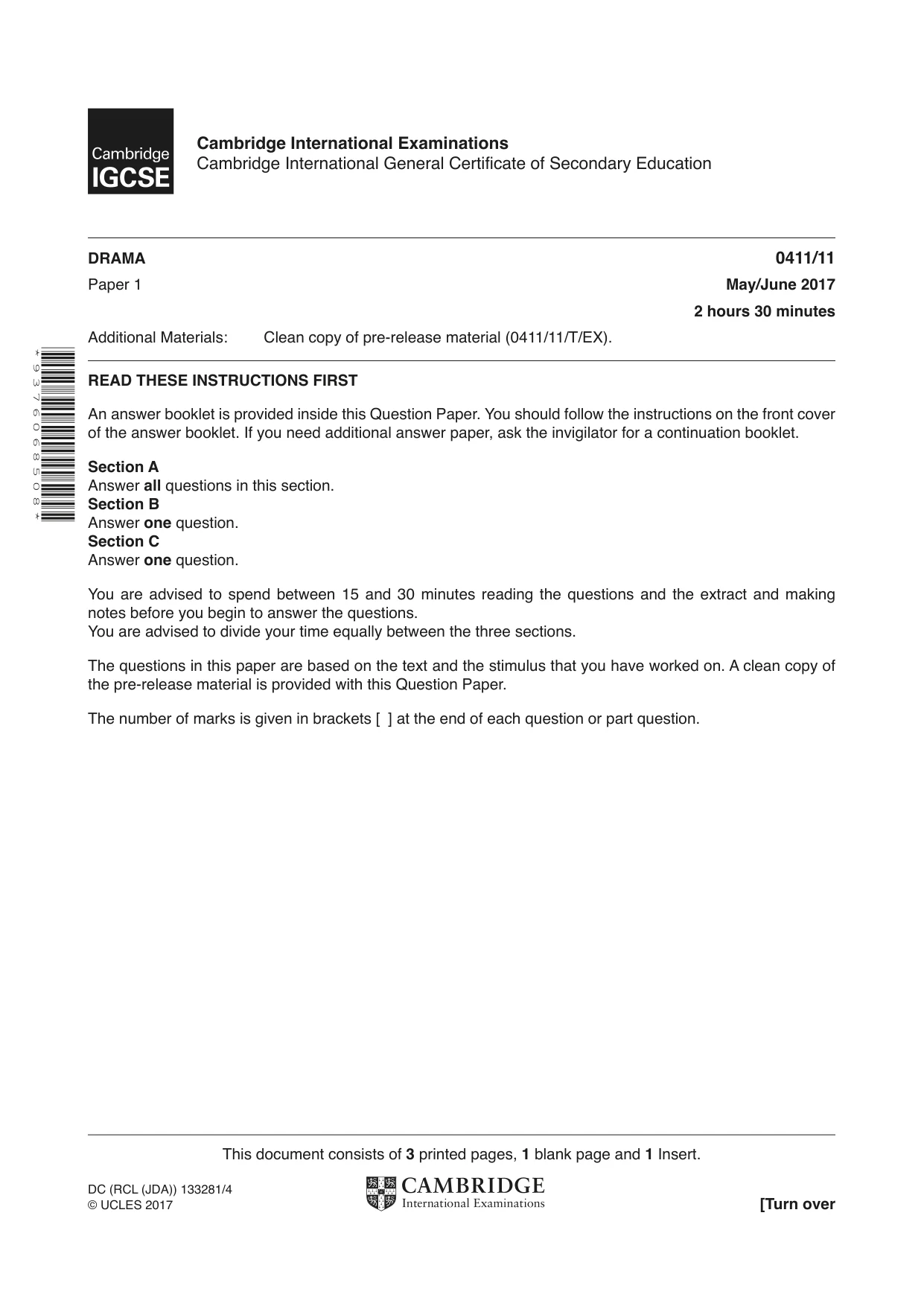
Question paper, page 1
This document consists of 3 printed pages, 1 blank page and 1 Insert. DC (RCL (JDA)) 133281/4 © UCLES 2017 [Turn over Cambridge International Examinations Cambridge International General Certificate of Secondary Education * 9 3 7 6 0 6 8 5 0 8 * DRAMA 0411/11 Paper 1 May/June 2017 2 hours 30 minutes Additional Materials: Clean copy of pre-release material (0411/11/T/EX). READ THESE INSTRUCTIONS FIRST An answer booklet is provided inside this Question Paper. You should follow the instructions on the front cover of the answer booklet. If you need additional answer paper, ask the invigilator for a continuation booklet. Section A Answer all questions in this section. Section B Answer one question. Section C Answer one question. You are advised to spend between 15 and 30 minutes reading the questions and the extract and making notes before you begin to answer the questions. You are advised to divide your time equally between the three sections. The questions in this paper are based on the text and the stimulus that you have worked on. A clean copy of the pre-release material is provided with this Question Paper. The number of marks is given in brackets [ ] at the end of each question or part question.
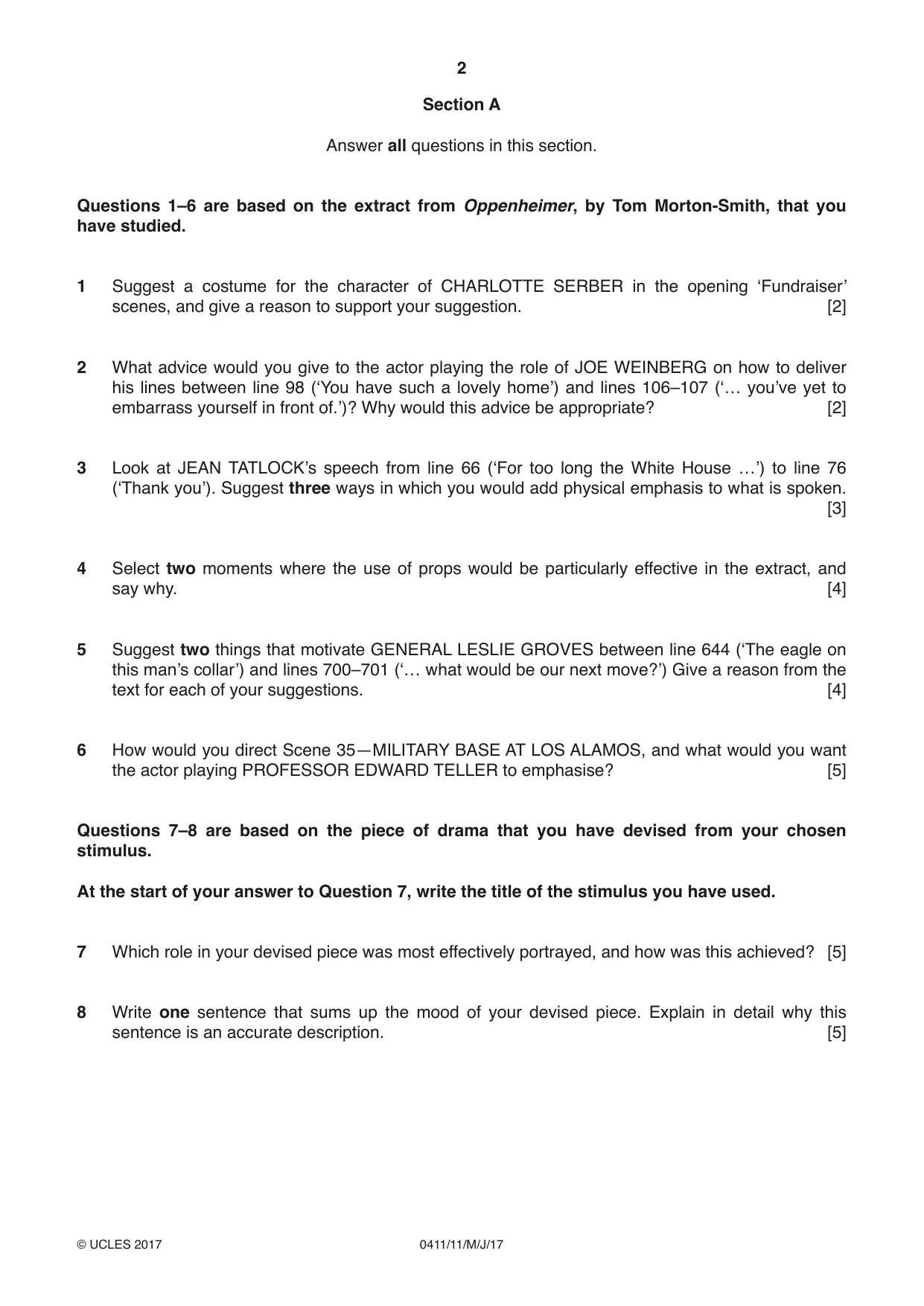
Question paper, page 2
2 0411/11/M/J/17 © UCLES 2017 Section A Answer all questions in this section. Questions 1–6 are based on the extract from Oppenheimer, by Tom Morton-Smith, that you have studied. 1 Suggest a costume for the character of CHARLOTTE SERBER in the opening ‘Fundraiser’ scenes, and give a reason to support your suggestion. [2] 2 What advice would you give to the actor playing the role of JOE WEINBERG on how to deliver his lines between line 98 (‘You have such a lovely home’) and lines 106–107 (‘… you’ve yet to embarrass yourself in front of.’)? Why would this advice be appropriate? [2] 3 Look at JEAN TATLOCK’s speech from line 66 (‘For too long the White House …’) to line 76 (‘Thank you’). Suggest three ways in which you would add physical emphasis to what is spoken. [3] 4 Select two moments where the use of props would be particularly effective in the extract, and say why. [4] 5 Suggest two things that motivate GENERAL LESLIE GROVES between line 644 (‘The eagle on this man’s collar’) and lines 700–701 (‘… what would be our next move?’) Give a reason from the text for each of your suggestions. [4] 6 How would you direct Scene 35—MILITARY BASE AT LOS ALAMOS, and what would you want the actor playing PROFESSOR EDWARD TELLER to emphasise? [5] Questions 7–8 are based on the piece of drama that you have devised from your chosen stimulus. At the start of your answer to Question 7, write the title of the stimulus you have used. 7 Which role in your devised piece was most effectively portrayed, and how was this achieved? [5] 8 Write one sentence that sums up the mood of your devised piece. Explain in detail why this sentence is an accurate description. [5]
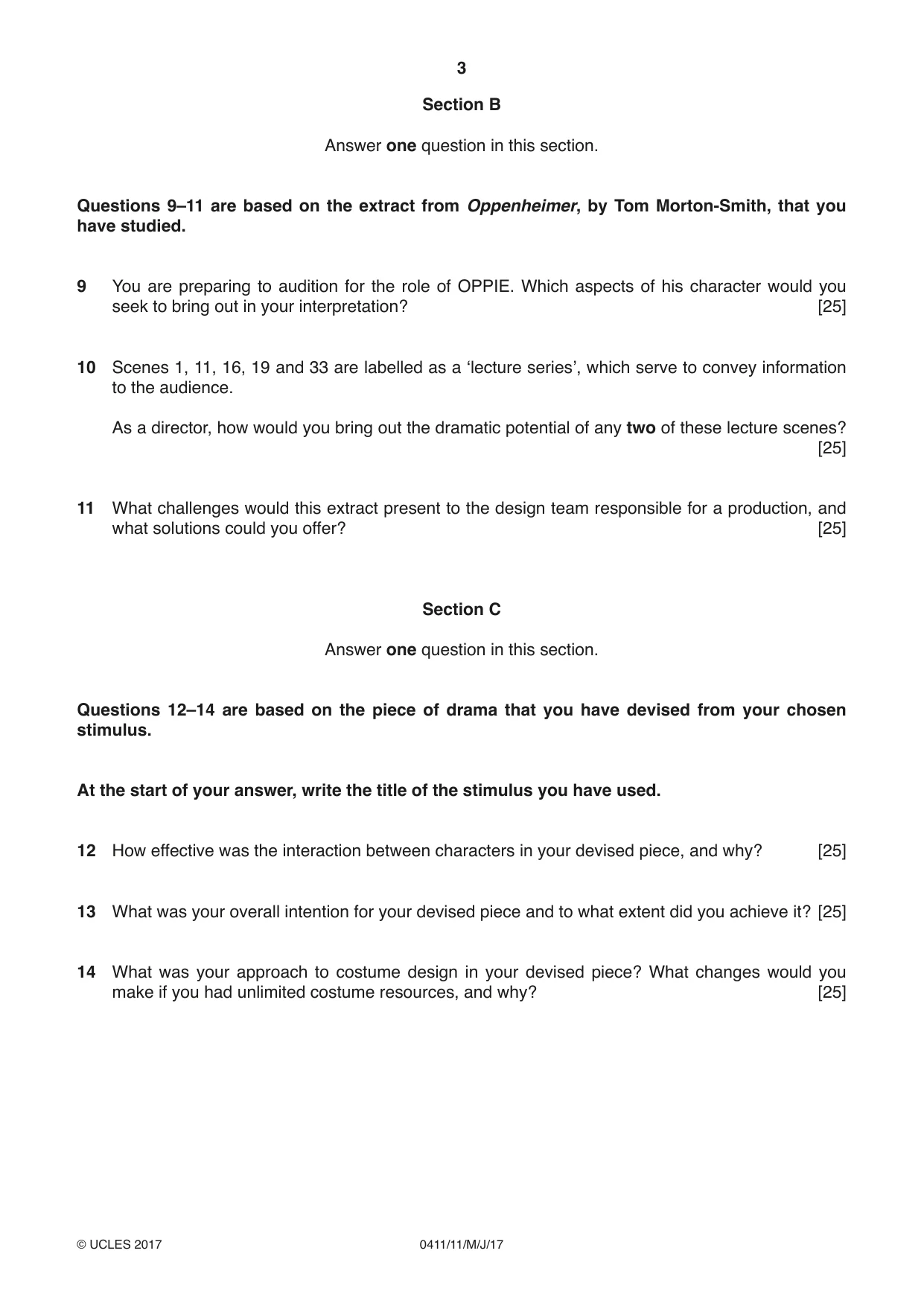
Question paper, page 3
3 0411/11/M/J/17 © UCLES 2017 Section B Answer one question in this section. Questions 9–11 are based on the extract from Oppenheimer, by Tom Morton-Smith, that you have studied. 9 You are preparing to audition for the role of OPPIE. Which aspects of his character would you seek to bring out in your interpretation? [25] 10 Scenes 1, 11, 16, 19 and 33 are labelled as a ‘lecture series’, which serve to convey information to the audience. As a director, how would you bring out the dramatic potential of any two of these lecture scenes? [25] 11 What challenges would this extract present to the design team responsible for a production, and what solutions could you offer? [25] Section C Answer one question in this section. Questions 12–14 are based on the piece of drama that you have devised from your chosen stimulus. At the start of your answer, write the title of the stimulus you have used. 12 How effective was the interaction between characters in your devised piece, and why? [25] 13 What was your overall intention for your devised piece and to what extent did you achieve it? [25] 14 What was your approach to costume design in your devised piece? What changes would you make if you had unlimited costume resources, and why? [25]
Question paper, page 4
4 0411/11/M/J/17 © UCLES 2017 Permission to reproduce items where third-party owned material protected by copyright is included has been sought and cleared where possible. Every reasonable effort has been made by the publisher (UCLES) to trace copyright holders, but if any items requiring clearance have unwittingly been included, the publisher will be pleased to make amends at the earliest possible opportunity. To avoid the issue of disclosure of answer-related information to candidates, all copyright acknowledgements are reproduced online in the Cambridge International Examinations Copyright Acknowledgements Booklet. This is produced for each series of examinations and is freely available to download at www.cie.org.uk after the live examination series. Cambridge International Examinations is part of the Cambridge Assessment Group. Cambridge Assessment is the brand name of University of Cambridge Local Examinations Syndicate (UCLES), which is itself a department of the University of Cambridge. BLANK PAGE
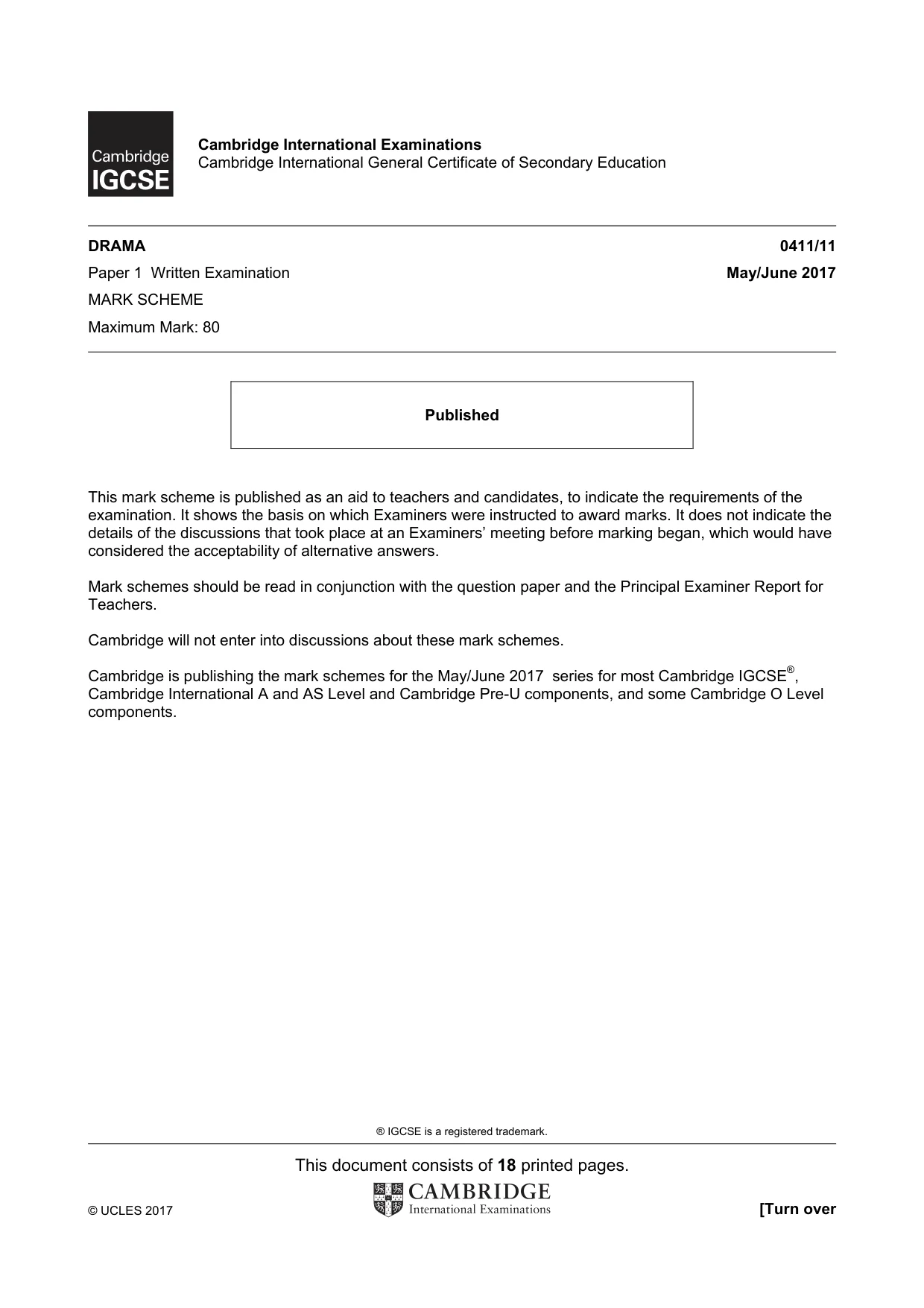
Mark scheme, page 1
® IGCSE is a registered trademark. This document consists of 18 printed pages. © UCLES 2017 [Turn over Cambridge International Examinations Cambridge International General Certificate of Secondary Education DRAMA 0411/11 Paper 1 Written Examination May/June 2017 MARK SCHEME Maximum Mark: 80 Published This mark scheme is published as an aid to teachers and candidates, to indicate the requirements of the examination. It shows the basis on which Examiners were instructed to award marks. It does not indicate the details of the discussions that took place at an Examiners’ meeting before marking began, which would have considered the acceptability of alternative answers. Mark schemes should be read in conjunction with the question paper and the Principal Examiner Report for Teachers. Cambridge will not enter into discussions about these mark schemes. Cambridge is publishing the mark schemes for the May/June 2017 series for most Cambridge IGCSE®, Cambridge International A and AS Level and Cambridge Pre-U components, and some Cambridge O Level components.
Mark scheme, page 2
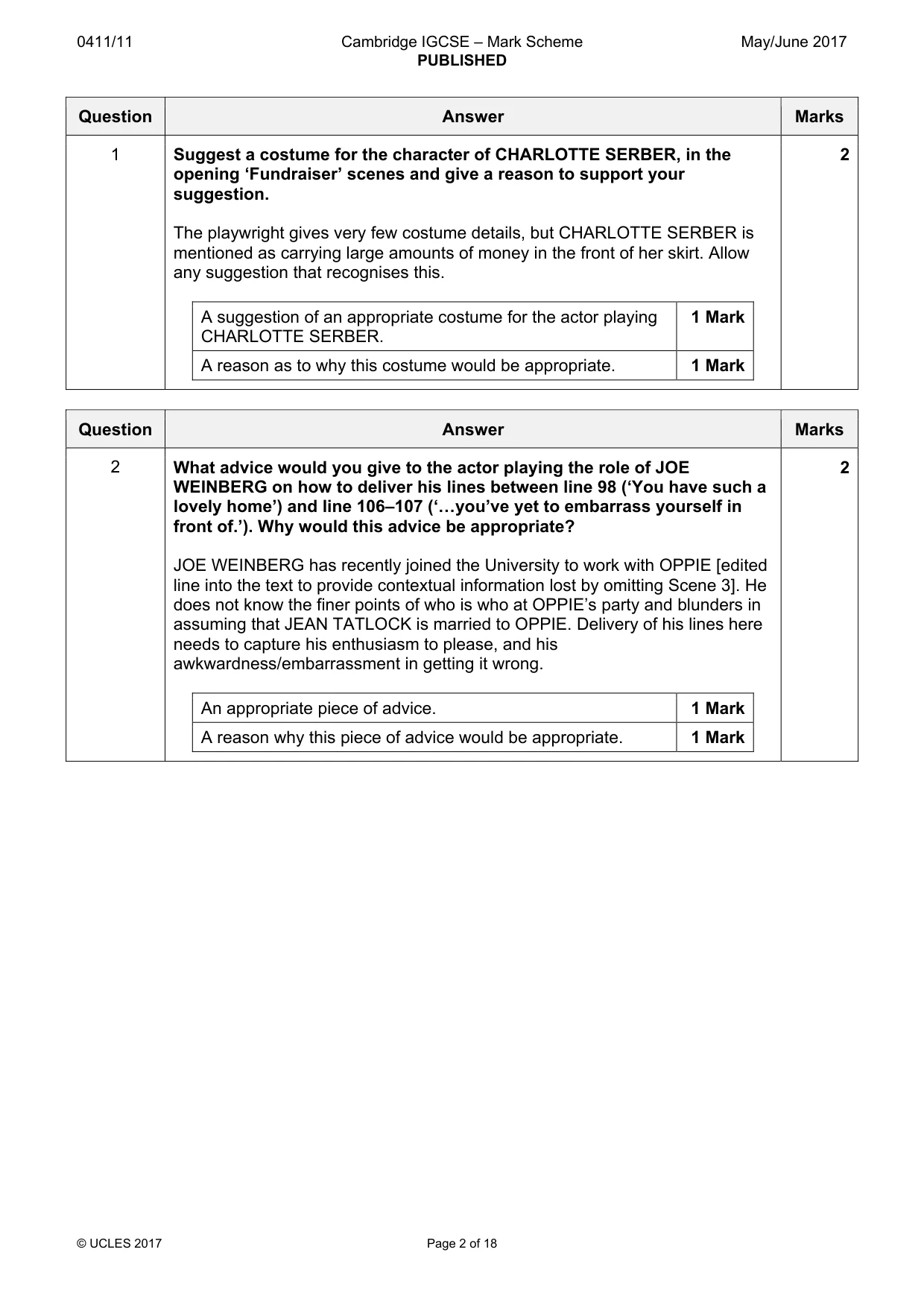
0411/11 Cambridge IGCSE – Mark Scheme PUBLISHED May/June 2017 © UCLES 2017 Page 2 of 18 Question Answer Marks 1 Suggest a costume for the character of CHARLOTTE SERBER, in the opening ‘Fundraiser’ scenes and give a reason to support your suggestion. The playwright gives very few costume details, but CHARLOTTE SERBER is mentioned as carrying large amounts of money in the front of her skirt. Allow any suggestion that recognises this. A suggestion of an appropriate costume for the actor playing CHARLOTTE SERBER. 1 Mark A reason as to why this costume would be appropriate. 1 Mark 2 Question Answer Marks 2 What advice would you give to the actor playing the role of JOE WEINBERG on how to deliver his lines between line 98 (‘You have such a lovely home’) and line 106–107 (‘«you’ve yet to embarrass yourself in front of.’). Why would this advice be appropriate? JOE WEINBERG has recently joined the University to work with OPPIE [edited line into the text to provide contextual information lost by omitting Scene 3]. He does not know the finer points of who is who at OPPIE’s party and blunders in assuming that JEAN TATLOCK is married to OPPIE. Delivery of his lines here needs to capture his enthusiasm to please, and his awkwardness/embarrassment in getting it wrong. An appropriate piece of advice. 1 Mark A reason why this piece of advice would be appropriate. 1 Mark 2
Mark scheme, page 3
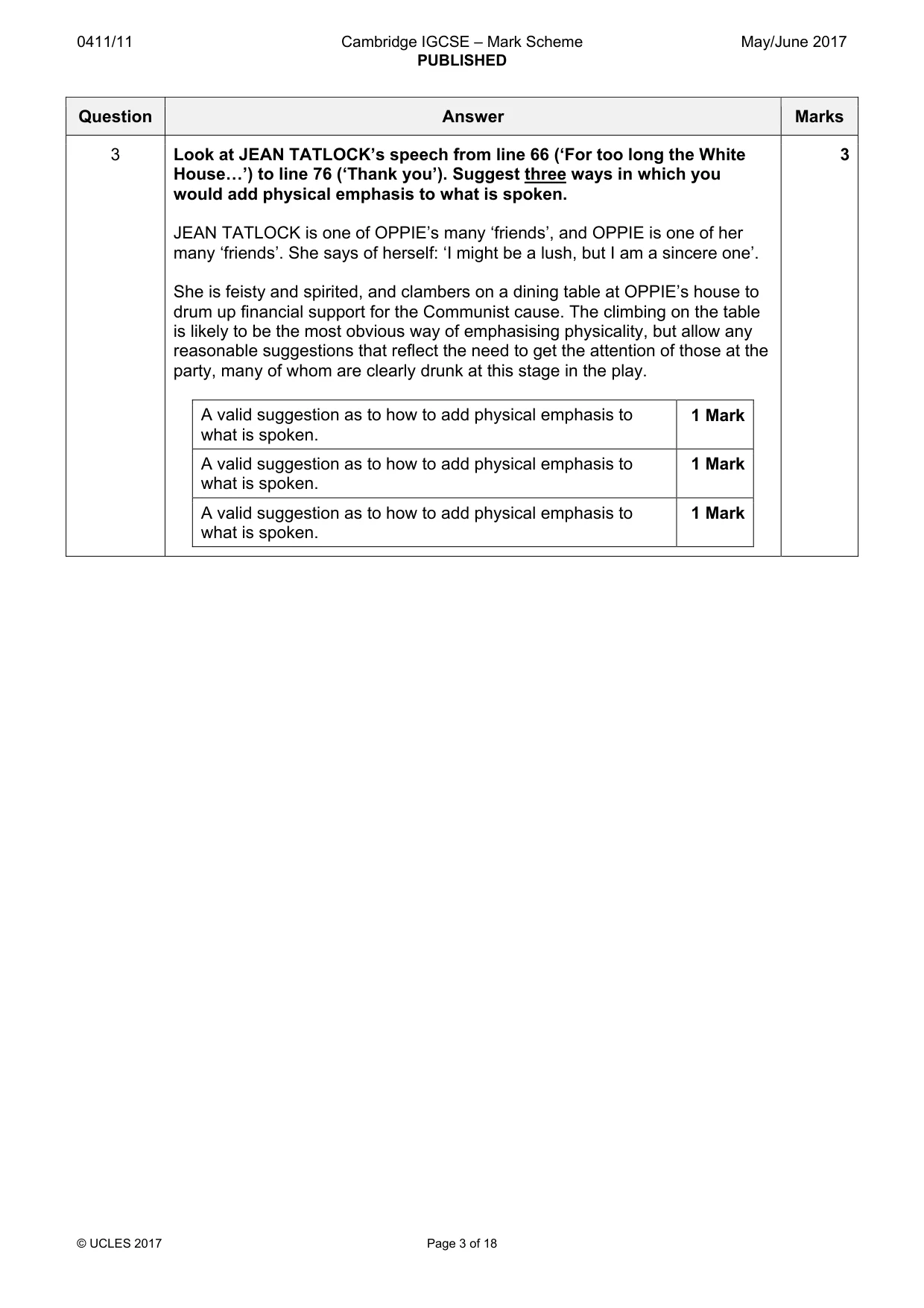
0411/11 Cambridge IGCSE – Mark Scheme PUBLISHED May/June 2017 © UCLES 2017 Page 3 of 18 Question Answer Marks 3 Look at JEAN TATLOCK’s speech from line 66 (‘For too long the White House«’) to line 76 (‘Thank you’). Suggest three ways in which you would add physical emphasis to what is spoken. JEAN TATLOCK is one of OPPIE’s many ‘friends’, and OPPIE is one of her many ‘friends’. She says of herself: ‘I might be a lush, but I am a sincere one’. She is feisty and spirited, and clambers on a dining table at OPPIE’s house to drum up financial support for the Communist cause. The climbing on the table is likely to be the most obvious way of emphasising physicality, but allow any reasonable suggestions that reflect the need to get the attention of those at the party, many of whom are clearly drunk at this stage in the play. A valid suggestion as to how to add physical emphasis to what is spoken. 1 Mark A valid suggestion as to how to add physical emphasis to what is spoken. 1 Mark A valid suggestion as to how to add physical emphasis to what is spoken. 1 Mark 3
Mark scheme, page 4
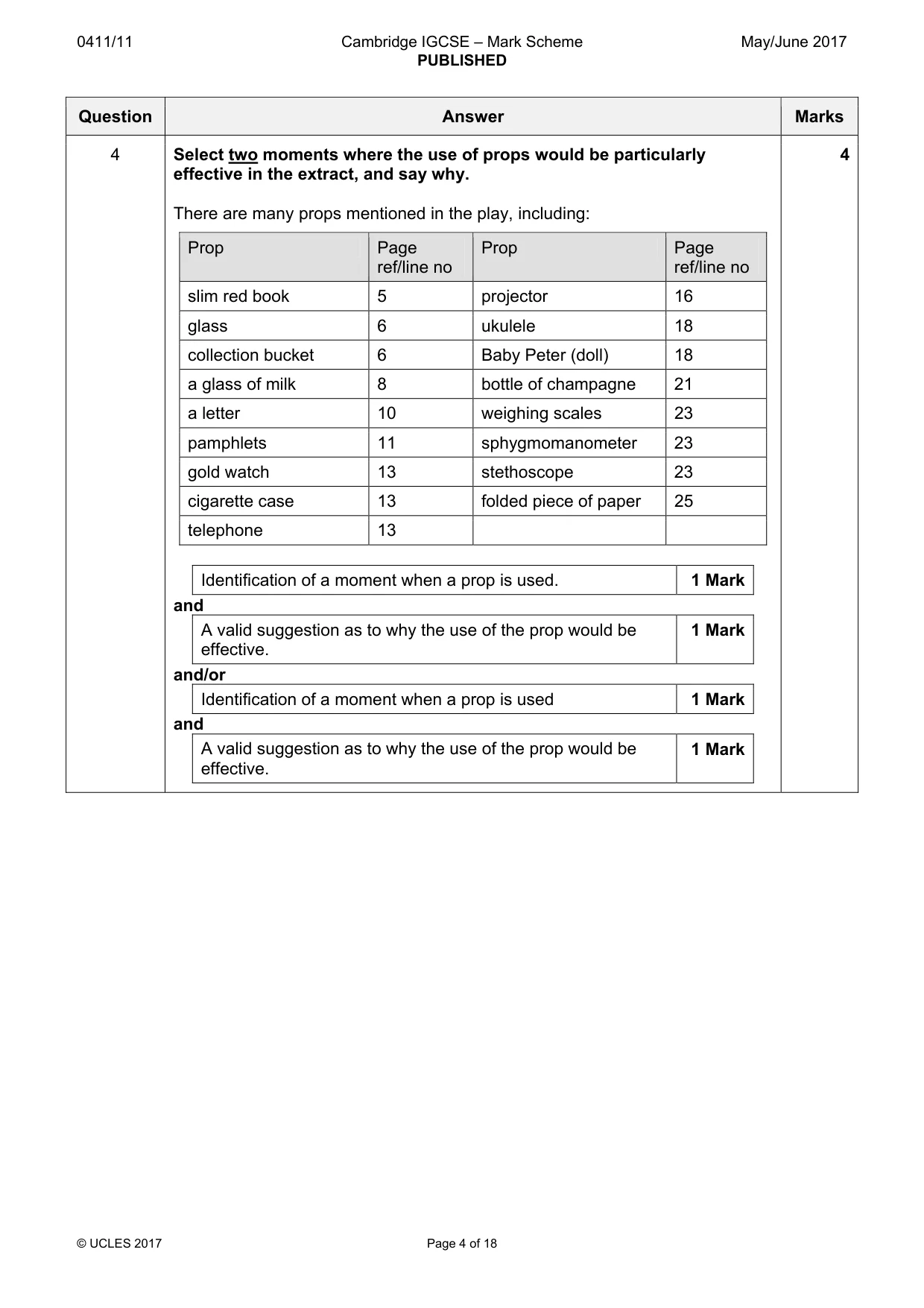
0411/11 Cambridge IGCSE – Mark Scheme PUBLISHED May/June 2017 © UCLES 2017 Page 4 of 18 Question Answer Marks 4 Select two moments where the use of props would be particularly effective in the extract, and say why. There are many props mentioned in the play, including: Prop Page ref/line no Prop Page ref/line no slim red book 5 projector 16 glass 6 ukulele 18 collection bucket 6 Baby Peter (doll) 18 a glass of milk 8 bottle of champagne 21 a letter 10 weighing scales 23 pamphlets 11 sphygmomanometer 23 gold watch 13 stethoscope 23 cigarette case 13 folded piece of paper 25 telephone 13 Identification of a moment when a prop is used. 1 Mark and A valid suggestion as to why the use of the prop would be effective. 1 Mark and/or Identification of a moment when a prop is used 1 Mark and A valid suggestion as to why the use of the prop would be effective. 1 Mark 4
Mark scheme, page 5
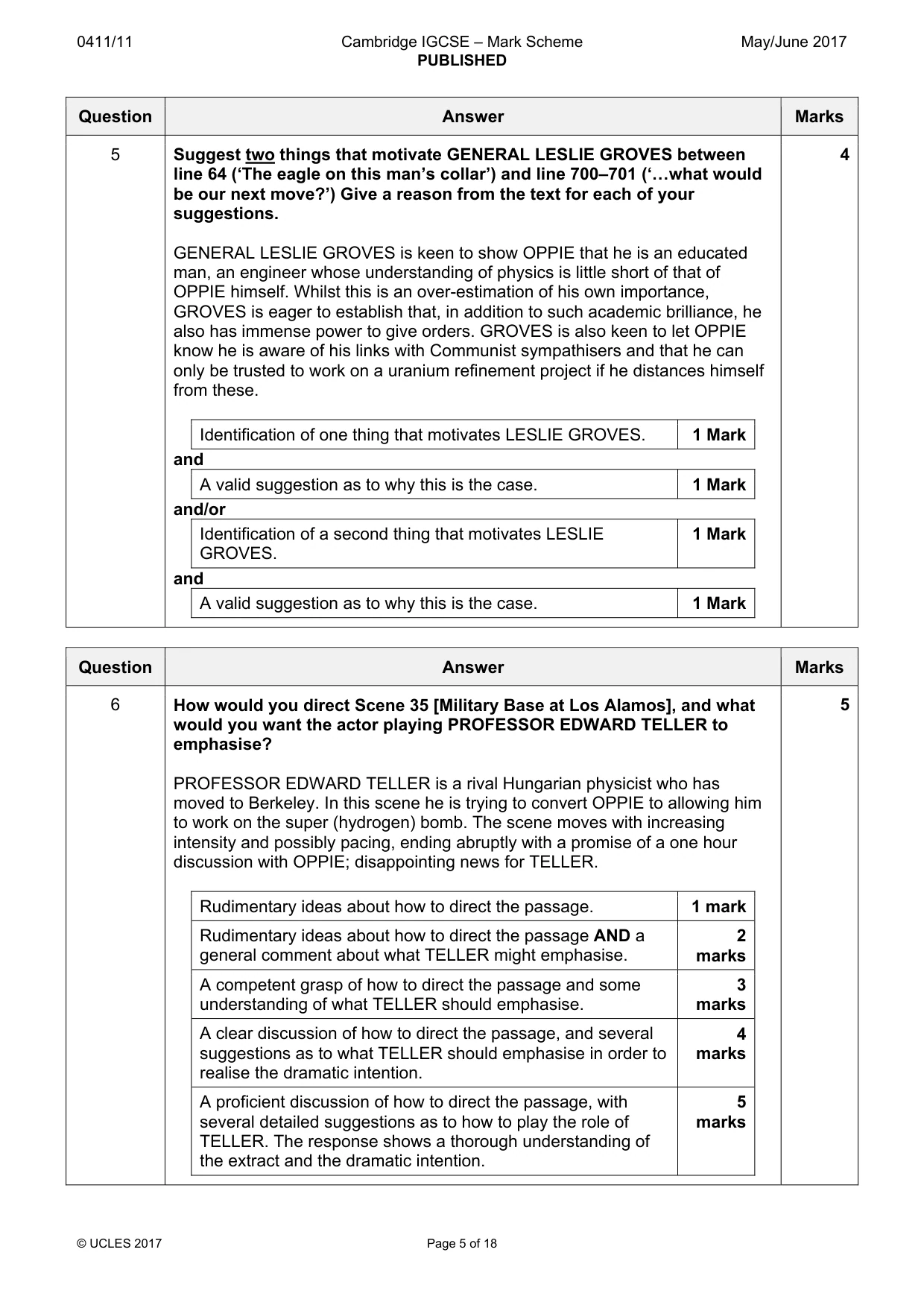
0411/11 Cambridge IGCSE – Mark Scheme PUBLISHED May/June 2017 © UCLES 2017 Page 5 of 18 Question Answer Marks 5 Suggest two things that motivate GENERAL LESLIE GROVES between line 64 (‘The eagle on this man’s collar’) and line 700–701 (‘«what would be our next move?’) Give a reason from the text for each of your suggestions. GENERAL LESLIE GROVES is keen to show OPPIE that he is an educated man, an engineer whose understanding of physics is little short of that of OPPIE himself. Whilst this is an over-estimation of his own importance, GROVES is eager to establish that, in addition to such academic brilliance, he also has immense power to give orders. GROVES is also keen to let OPPIE know he is aware of his links with Communist sympathisers and that he can only be trusted to work on a uranium refinement project if he distances himself from these. Identification of one thing that motivates LESLIE GROVES. 1 Mark and A valid suggestion as to why this is the case. 1 Mark and/or Identification of a second thing that motivates LESLIE GROVES. 1 Mark and A valid suggestion as to why this is the case. 1 Mark 4 Question Answer Marks 6 How would you direct Scene 35 [Military Base at Los Alamos], and what would you want the actor playing PROFESSOR EDWARD TELLER to emphasise? PROFESSOR EDWARD TELLER is a rival Hungarian physicist who has moved to Berkeley. In this scene he is trying to convert OPPIE to allowing him to work on the super (hydrogen) bomb. The scene moves with increasing intensity and possibly pacing, ending abruptly with a promise of a one hour discussion with OPPIE; disappointing news for TELLER. Rudimentary ideas about how to direct the passage. 1 mark Rudimentary ideas about how to direct the passage AND a general comment about what TELLER might emphasise. 2 marks A competent grasp of how to direct the passage and some understanding of what TELLER should emphasise. 3 marks A clear discussion of how to direct the passage, and several suggestions as to what TELLER should emphasise in order to realise the dramatic intention. 4 marks A proficient discussion of how to direct the passage, with several detailed suggestions as to how to play the role of TELLER. The response shows a thorough understanding of the extract and the dramatic intention. 5 marks 5
Mark scheme, page 6
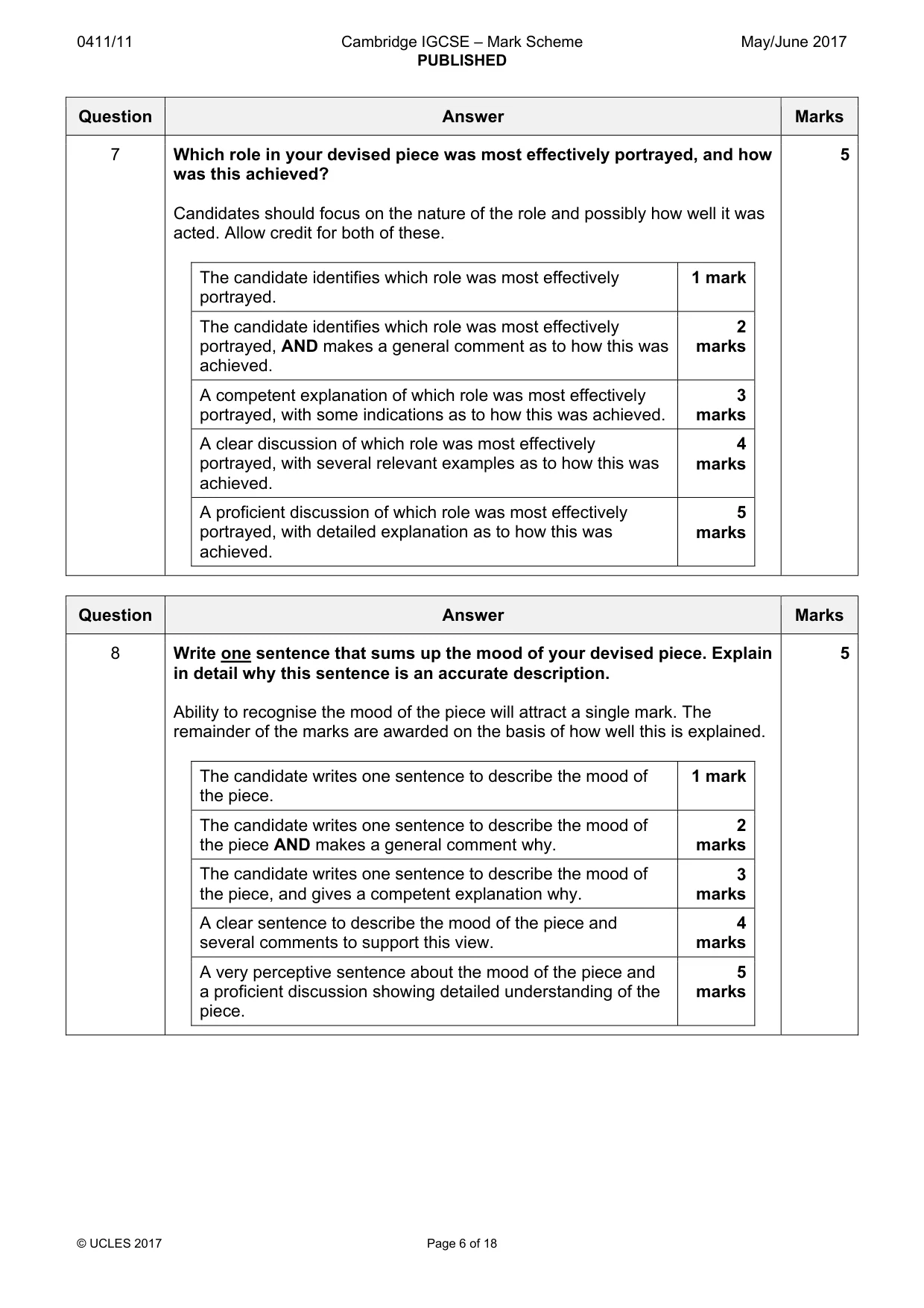
0411/11 Cambridge IGCSE – Mark Scheme PUBLISHED May/June 2017 © UCLES 2017 Page 6 of 18 Question Answer Marks 7 Which role in your devised piece was most effectively portrayed, and how was this achieved? Candidates should focus on the nature of the role and possibly how well it was acted. Allow credit for both of these. The candidate identifies which role was most effectively portrayed. 1 mark The candidate identifies which role was most effectively portrayed, AND makes a general comment as to how this was achieved. 2 marks A competent explanation of which role was most effectively portrayed, with some indications as to how this was achieved. 3 marks A clear discussion of which role was most effectively portrayed, with several relevant examples as to how this was achieved. 4 marks A proficient discussion of which role was most effectively portrayed, with detailed explanation as to how this was achieved. 5 marks 5 Question Answer Marks 8 Write one sentence that sums up the mood of your devised piece. Explain in detail why this sentence is an accurate description. Ability to recognise the mood of the piece will attract a single mark. The remainder of the marks are awarded on the basis of how well this is explained. The candidate writes one sentence to describe the mood of the piece. 1 mark The candidate writes one sentence to describe the mood of the piece AND makes a general comment why. 2 marks The candidate writes one sentence to describe the mood of the piece, and gives a competent explanation why. 3 marks A clear sentence to describe the mood of the piece and several comments to support this view. 4 marks A very perceptive sentence about the mood of the piece and a proficient discussion showing detailed understanding of the piece. 5 marks 5
Mark scheme, page 7
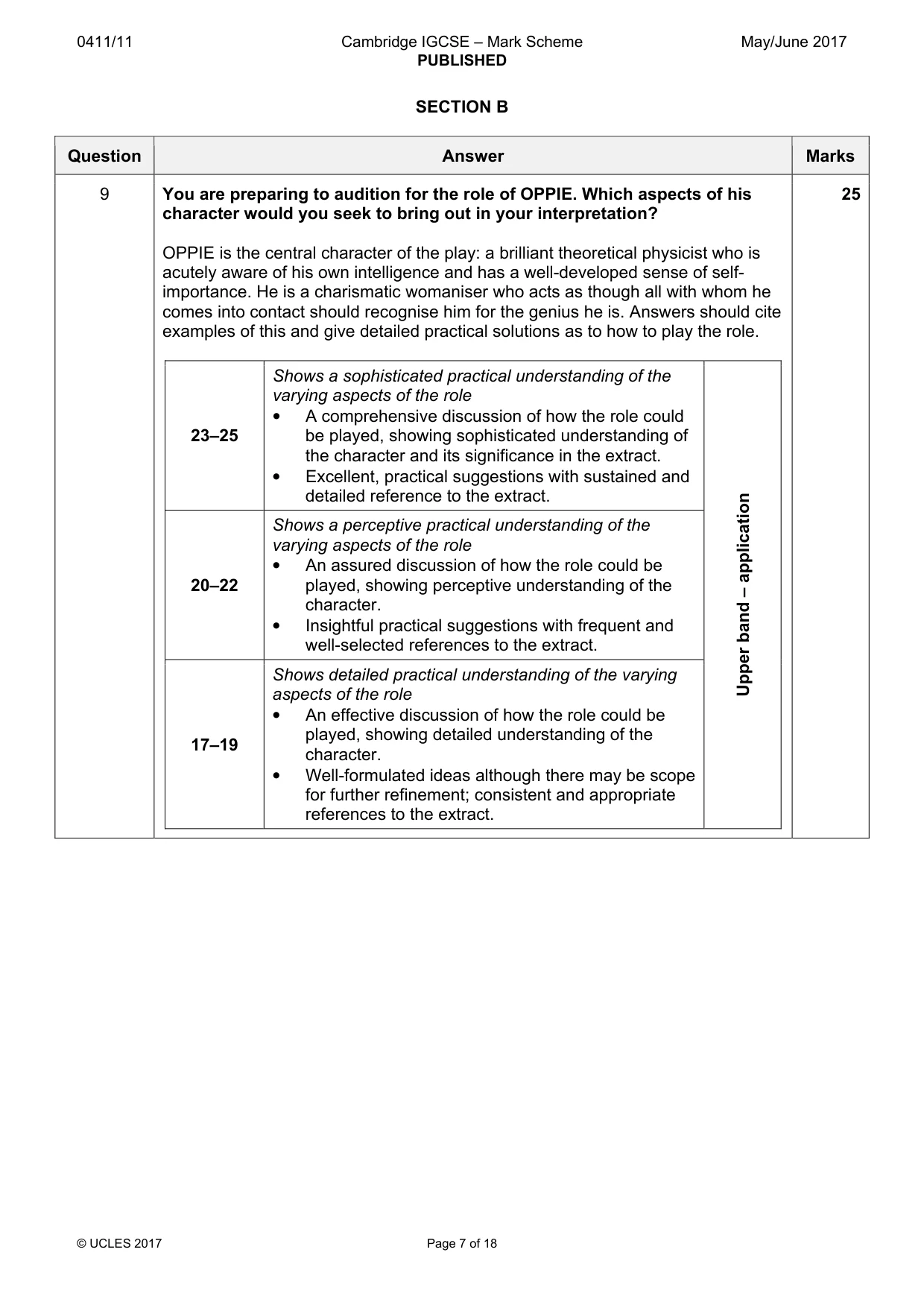
0411/11 Cambridge IGCSE – Mark Scheme PUBLISHED May/June 2017 © UCLES 2017 Page 7 of 18 SECTION B Question Answer Marks 9 You are preparing to audition for the role of OPPIE. Which aspects of his character would you seek to bring out in your interpretation? OPPIE is the central character of the play: a brilliant theoretical physicist who is acutely aware of his own intelligence and has a well-developed sense of self- importance. He is a charismatic womaniser who acts as though all with whom he comes into contact should recognise him for the genius he is. Answers should cite examples of this and give detailed practical solutions as to how to play the role. 23–25 Shows a sophisticated practical understanding of the varying aspects of the role • A comprehensive discussion of how the role could be played, showing sophisticated understanding of the character and its significance in the extract. • Excellent, practical suggestions with sustained and detailed reference to the extract. Upper band – application 20–22 Shows a perceptive practical understanding of the varying aspects of the role • An assured discussion of how the role could be played, showing perceptive understanding of the character. • Insightful practical suggestions with frequent and well-selected references to the extract. 17–19 Shows detailed practical understanding of the varying aspects of the role • An effective discussion of how the role could be played, showing detailed understanding of the character. • Well-formulated ideas although there may be scope for further refinement; consistent and appropriate references to the extract. 25
Mark scheme, page 8
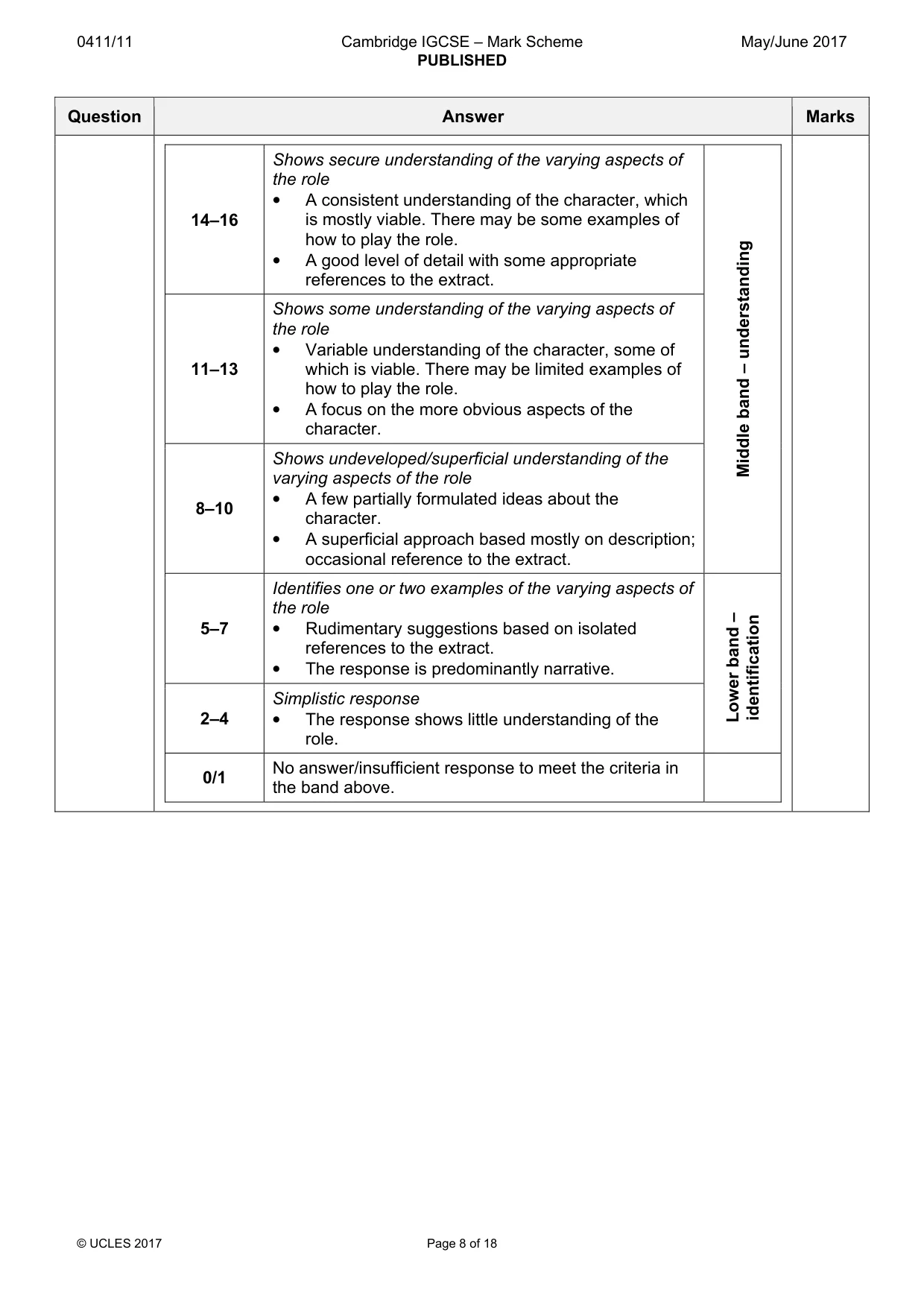
0411/11 Cambridge IGCSE – Mark Scheme PUBLISHED May/June 2017 © UCLES 2017 Page 8 of 18 Question Answer Marks 14–16 Shows secure understanding of the varying aspects of the role • A consistent understanding of the character, which is mostly viable. There may be some examples of how to play the role. • A good level of detail with some appropriate references to the extract. Middle band – understanding 11–13 Shows some understanding of the varying aspects of the role • Variable understanding of the character, some of which is viable. There may be limited examples of how to play the role. • A focus on the more obvious aspects of the character. 8–10 Shows undeveloped/superficial understanding of the varying aspects of the role • A few partially formulated ideas about the character. • A superficial approach based mostly on description; occasional reference to the extract. 5–7 Identifies one or two examples of the varying aspects of the role • Rudimentary suggestions based on isolated references to the extract. • The response is predominantly narrative. Lower band – identification 2–4 Simplistic response • The response shows little understanding of the role. 0/1 No answer/insufficient response to meet the criteria in the band above.
Mark scheme, page 9
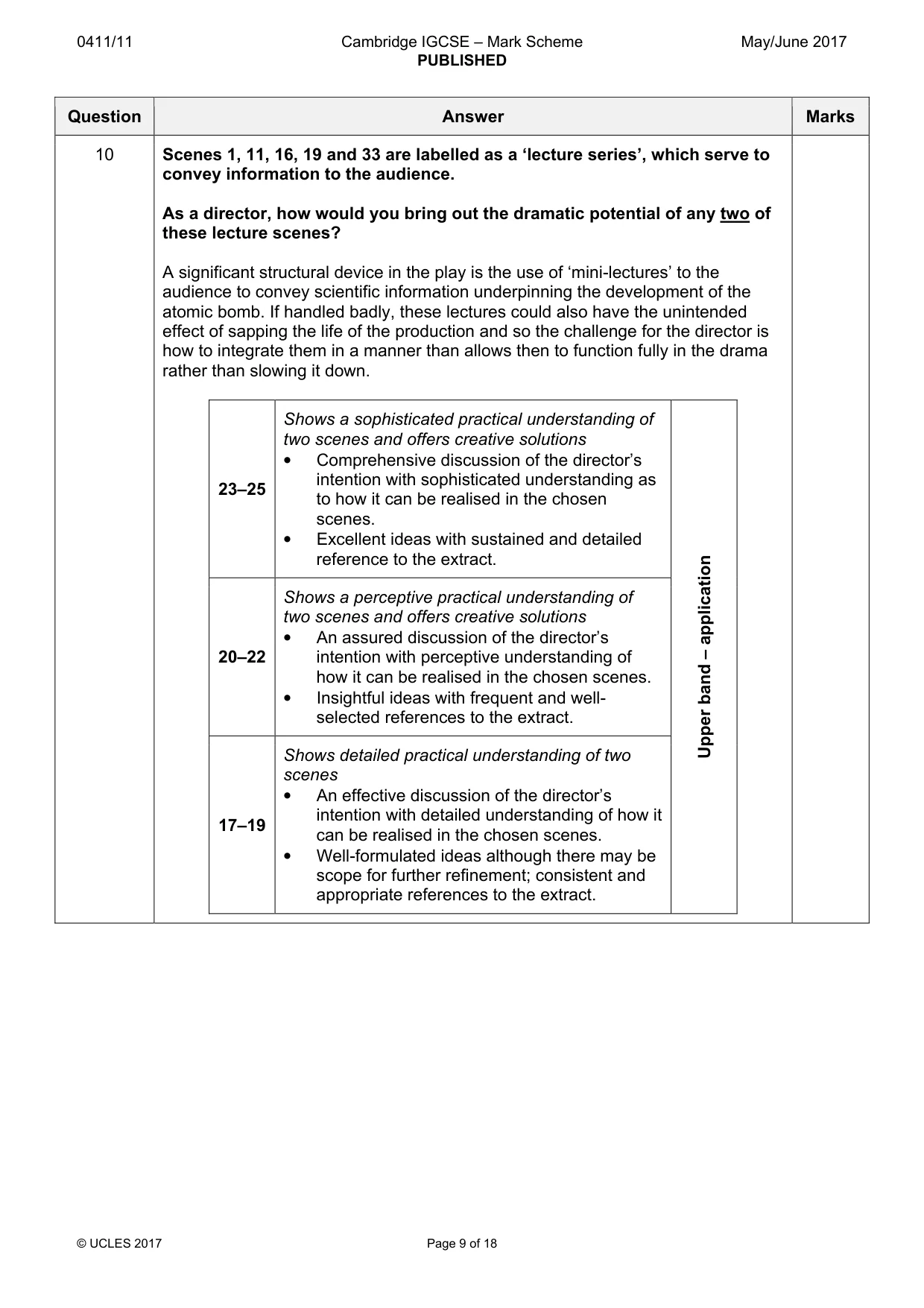
0411/11 Cambridge IGCSE – Mark Scheme PUBLISHED May/June 2017 © UCLES 2017 Page 9 of 18 Question Answer Marks 10 Scenes 1, 11, 16, 19 and 33 are labelled as a ‘lecture series’, which serve to convey information to the audience. As a director, how would you bring out the dramatic potential of any two of these lecture scenes? A significant structural device in the play is the use of ‘mini-lectures’ to the audience to convey scientific information underpinning the development of the atomic bomb. If handled badly, these lectures could also have the unintended effect of sapping the life of the production and so the challenge for the director is how to integrate them in a manner than allows then to function fully in the drama rather than slowing it down. 23–25 Shows a sophisticated practical understanding of two scenes and offers creative solutions • Comprehensive discussion of the director’s intention with sophisticated understanding as to how it can be realised in the chosen scenes. • Excellent ideas with sustained and detailed reference to the extract. Upper band – application 20–22 Shows a perceptive practical understanding of two scenes and offers creative solutions • An assured discussion of the director’s intention with perceptive understanding of how it can be realised in the chosen scenes. • Insightful ideas with frequent and well- selected references to the extract. 17–19 Shows detailed practical understanding of two scenes • An effective discussion of the director’s intention with detailed understanding of how it can be realised in the chosen scenes. • Well-formulated ideas although there may be scope for further refinement; consistent and appropriate references to the extract.
Mark scheme, page 10
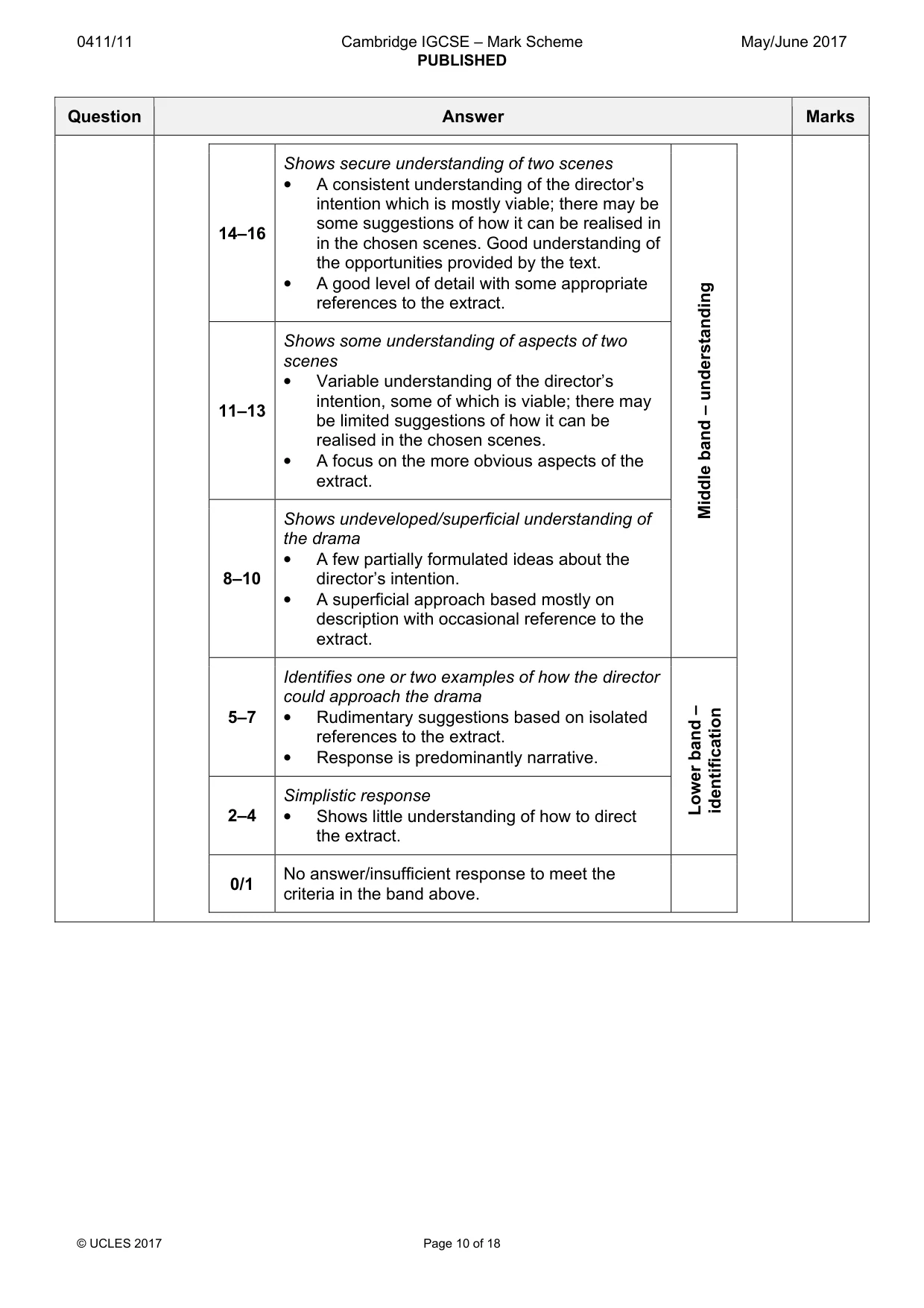
0411/11 Cambridge IGCSE – Mark Scheme PUBLISHED May/June 2017 © UCLES 2017 Page 10 of 18 Question Answer Marks 14–16 Shows secure understanding of two scenes • A consistent understanding of the director’s intention which is mostly viable; there may be some suggestions of how it can be realised in in the chosen scenes. Good understanding of the opportunities provided by the text. • A good level of detail with some appropriate references to the extract. Middle band – understanding 11–13 Shows some understanding of aspects of two scenes • Variable understanding of the director’s intention, some of which is viable; there may be limited suggestions of how it can be realised in the chosen scenes. • A focus on the more obvious aspects of the extract. 8–10 Shows undeveloped/superficial understanding of the drama • A few partially formulated ideas about the director’s intention. • A superficial approach based mostly on description with occasional reference to the extract. 5–7 Identifies one or two examples of how the director could approach the drama • Rudimentary suggestions based on isolated references to the extract. • Response is predominantly narrative. Lower band – identification 2–4 Simplistic response • Shows little understanding of how to direct the extract. 0/1 No answer/insufficient response to meet the criteria in the band above.
Mark scheme, page 11
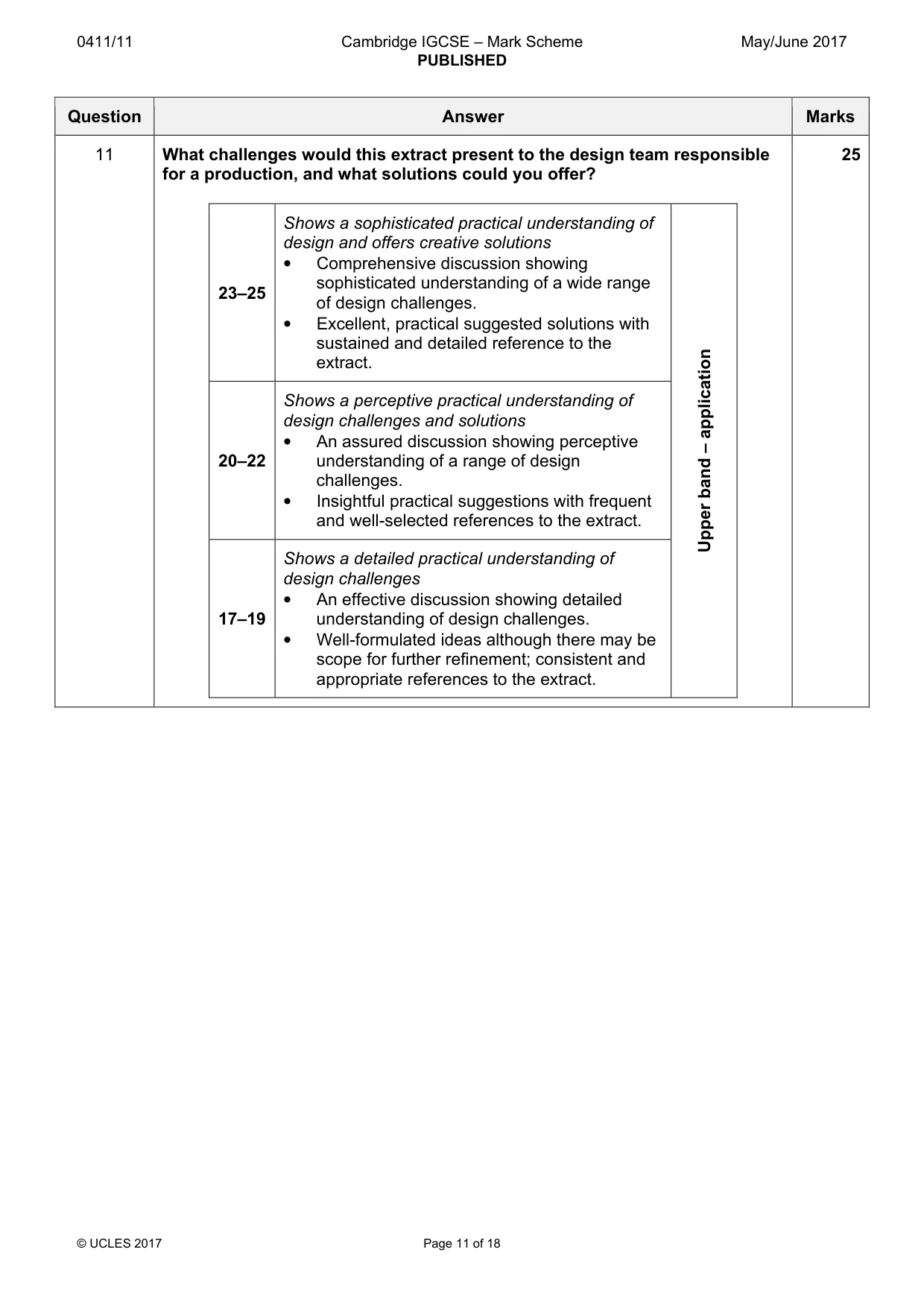
0411/11 Cambridge IGCSE – Mark Scheme PUBLISHED May/June 2017 © UCLES 2017 Page 11 of 18 Question Answer Marks 11 What challenges would this extract present to the design team responsible for a production, and what solutions could you offer? 23–25 Shows a sophisticated practical understanding of design and offers creative solutions • Comprehensive discussion showing sophisticated understanding of a wide range of design challenges. • Excellent, practical suggested solutions with sustained and detailed reference to the extract. Upper band – application 20–22 Shows a perceptive practical understanding of design challenges and solutions • An assured discussion showing perceptive understanding of a range of design challenges. • Insightful practical suggestions with frequent and well-selected references to the extract. 17–19 Shows a detailed practical understanding of design challenges • An effective discussion showing detailed understanding of design challenges. • Well-formulated ideas although there may be scope for further refinement; consistent and appropriate references to the extract. 25
Mark scheme, page 12
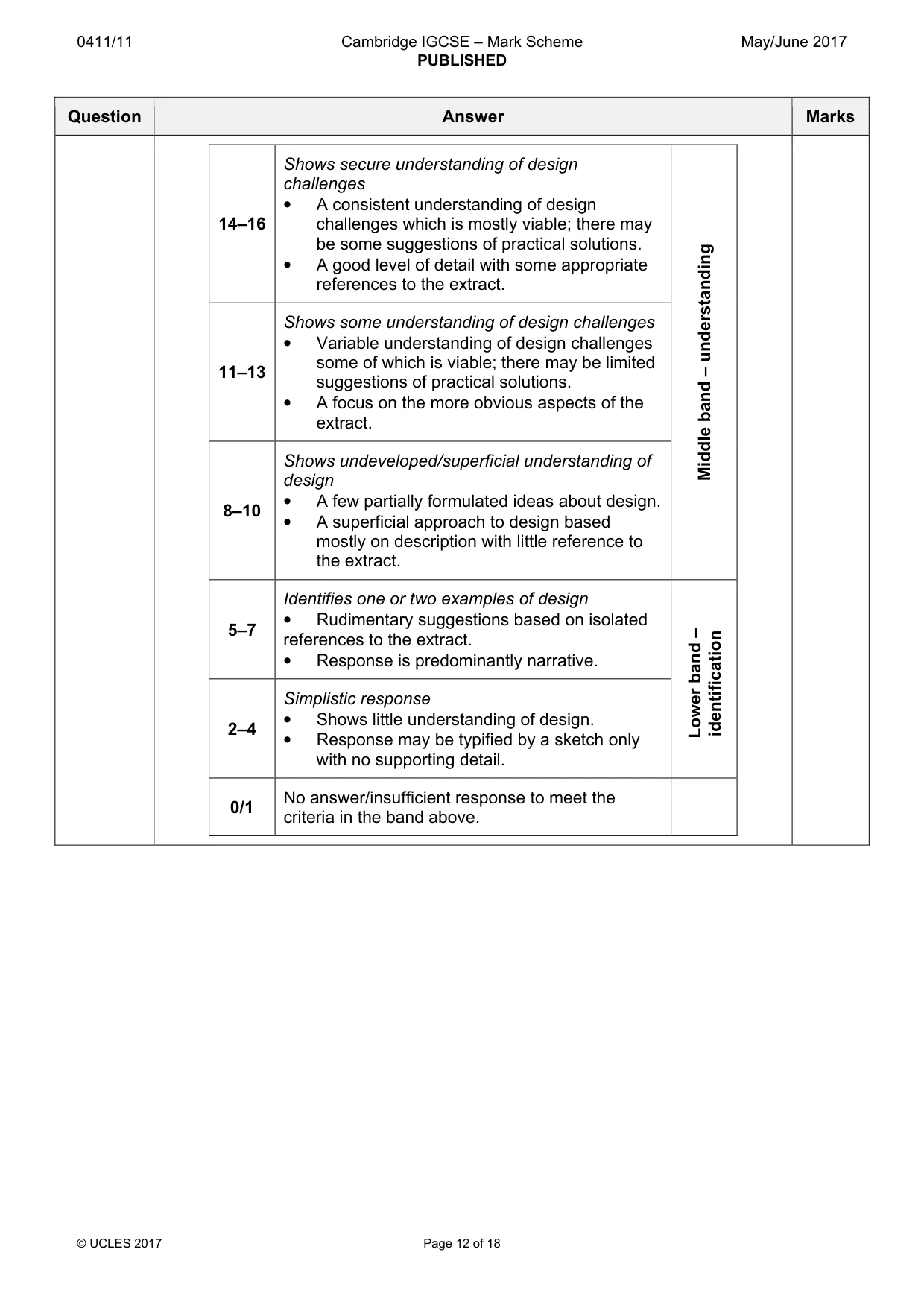
0411/11 Cambridge IGCSE – Mark Scheme PUBLISHED May/June 2017 © UCLES 2017 Page 12 of 18 Question Answer Marks 14–16 Shows secure understanding of design challenges • A consistent understanding of design challenges which is mostly viable; there may be some suggestions of practical solutions. • A good level of detail with some appropriate references to the extract. Middle band – understanding 11–13 Shows some understanding of design challenges • Variable understanding of design challenges some of which is viable; there may be limited suggestions of practical solutions. • A focus on the more obvious aspects of the extract. 8–10 Shows undeveloped/superficial understanding of design • A few partially formulated ideas about design. • A superficial approach to design based mostly on description with little reference to the extract. 5–7 Identifies one or two examples of design • Rudimentary suggestions based on isolated references to the extract. • Response is predominantly narrative. Lower band – identification 2–4 Simplistic response • Shows little understanding of design. • Response may be typified by a sketch only with no supporting detail. 0/1 No answer/insufficient response to meet the criteria in the band above.
Mark scheme, page 13
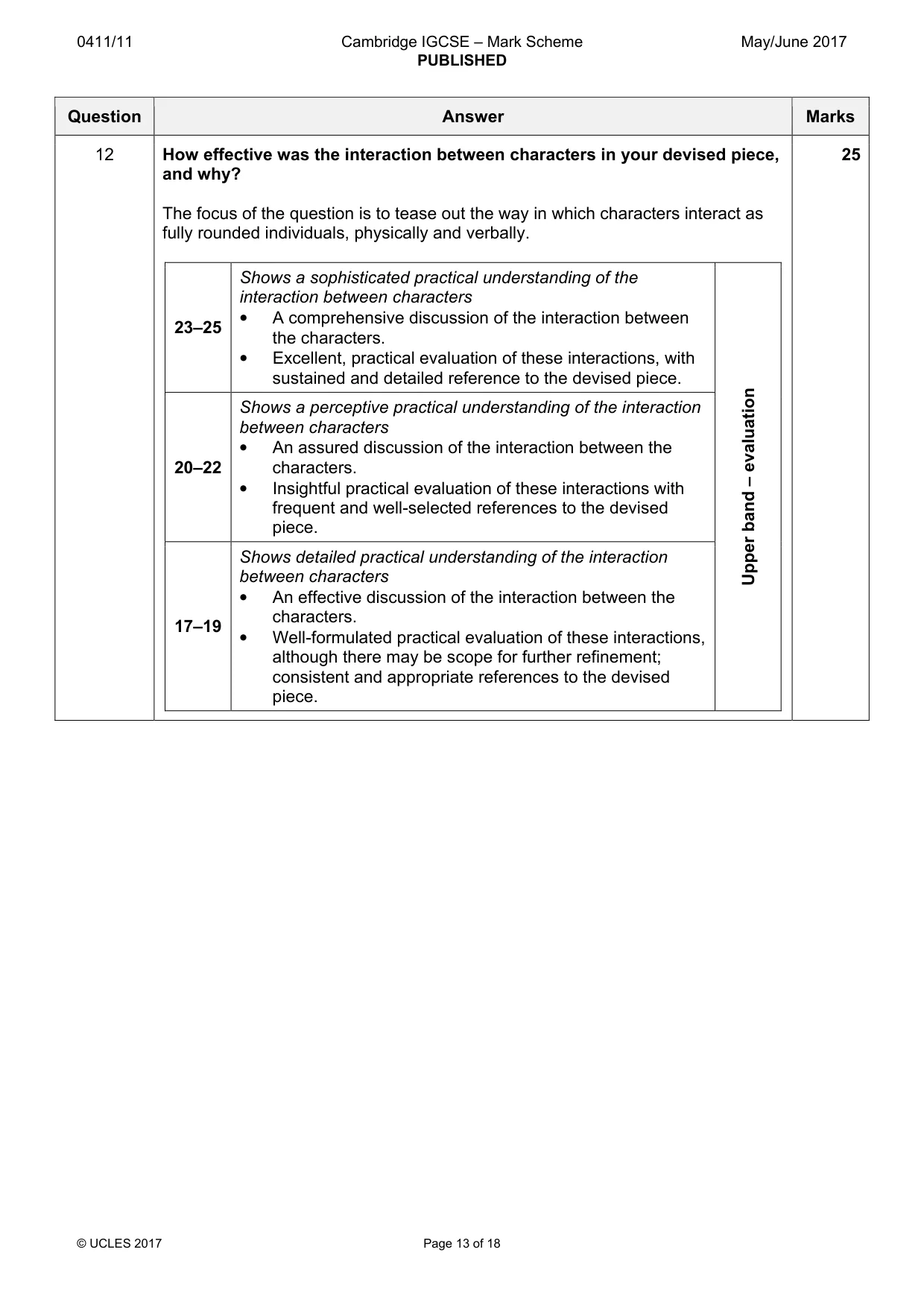
0411/11 Cambridge IGCSE – Mark Scheme PUBLISHED May/June 2017 © UCLES 2017 Page 13 of 18 Question Answer Marks 12 How effective was the interaction between characters in your devised piece, and why? The focus of the question is to tease out the way in which characters interact as fully rounded individuals, physically and verbally. 23–25 Shows a sophisticated practical understanding of the interaction between characters • A comprehensive discussion of the interaction between the characters. • Excellent, practical evaluation of these interactions, with sustained and detailed reference to the devised piece. Upper band – evaluation 20–22 Shows a perceptive practical understanding of the interaction between characters • An assured discussion of the interaction between the characters. • Insightful practical evaluation of these interactions with frequent and well-selected references to the devised piece. 17–19 Shows detailed practical understanding of the interaction between characters • An effective discussion of the interaction between the characters. • Well-formulated practical evaluation of these interactions, although there may be scope for further refinement; consistent and appropriate references to the devised piece. 25
Mark scheme, page 14
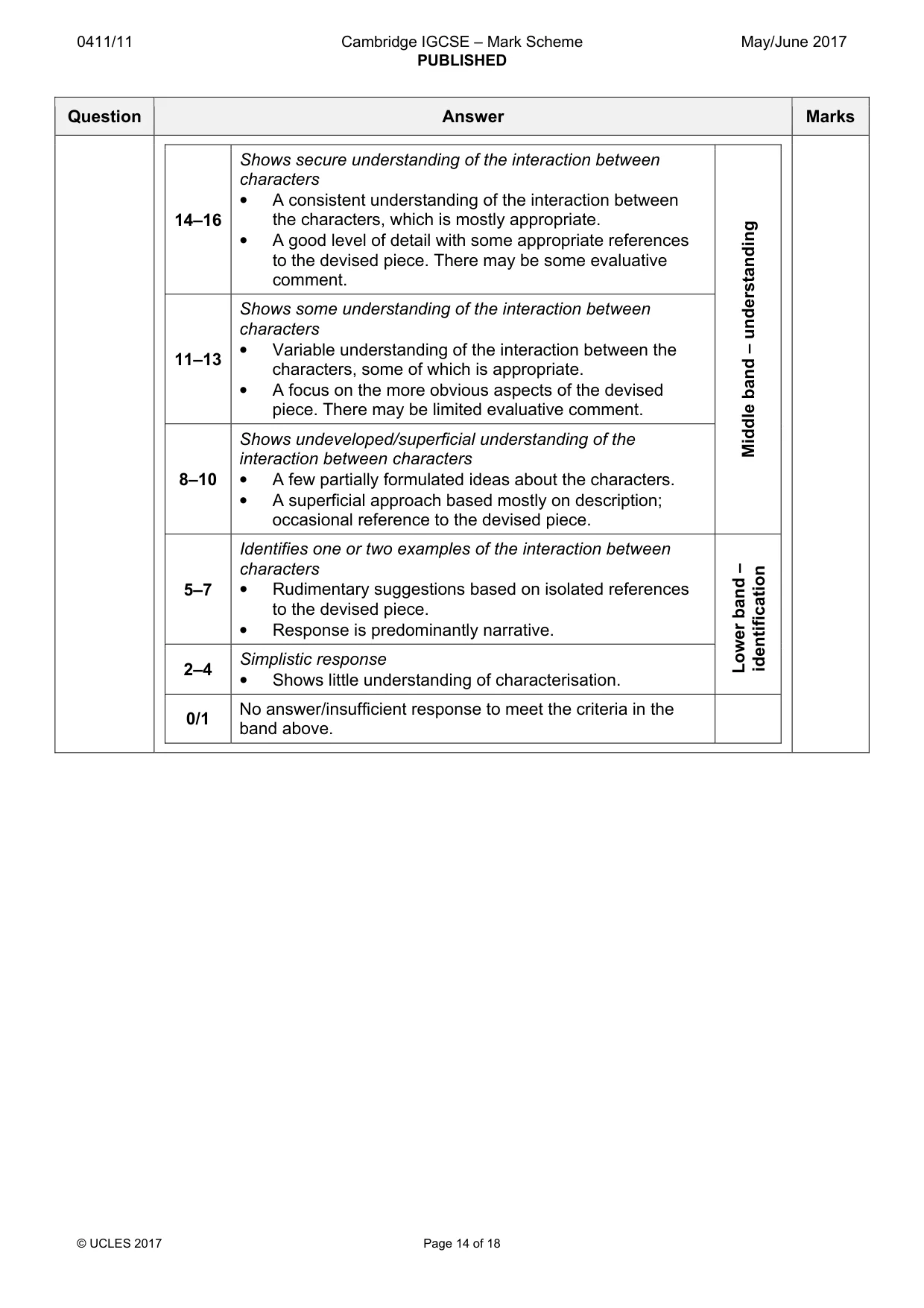
0411/11 Cambridge IGCSE – Mark Scheme PUBLISHED May/June 2017 © UCLES 2017 Page 14 of 18 Question Answer Marks 14–16 Shows secure understanding of the interaction between characters • A consistent understanding of the interaction between the characters, which is mostly appropriate. • A good level of detail with some appropriate references to the devised piece. There may be some evaluative comment. Middle band – understanding 11–13 Shows some understanding of the interaction between characters • Variable understanding of the interaction between the characters, some of which is appropriate. • A focus on the more obvious aspects of the devised piece. There may be limited evaluative comment. 8–10 Shows undeveloped/superficial understanding of the interaction between characters • A few partially formulated ideas about the characters. • A superficial approach based mostly on description; occasional reference to the devised piece. 5–7 Identifies one or two examples of the interaction between characters • Rudimentary suggestions based on isolated references to the devised piece. • Response is predominantly narrative. Lower band – identification 2–4 Simplistic response • Shows little understanding of characterisation. 0/1 No answer/insufficient response to meet the criteria in the band above.
Mark scheme, page 15
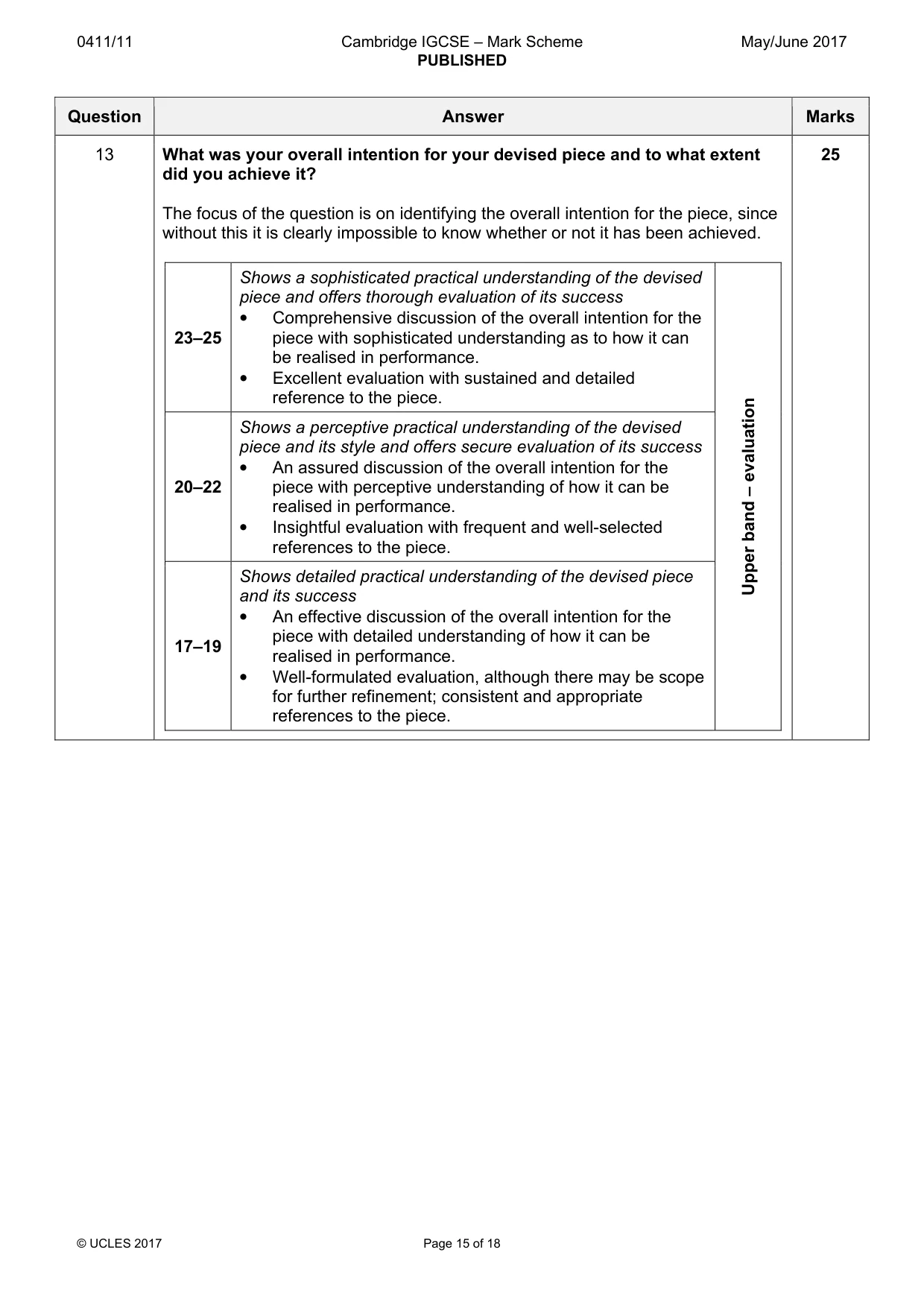
0411/11 Cambridge IGCSE – Mark Scheme PUBLISHED May/June 2017 © UCLES 2017 Page 15 of 18 Question Answer Marks 13 What was your overall intention for your devised piece and to what extent did you achieve it? The focus of the question is on identifying the overall intention for the piece, since without this it is clearly impossible to know whether or not it has been achieved. 23–25 Shows a sophisticated practical understanding of the devised piece and offers thorough evaluation of its success • Comprehensive discussion of the overall intention for the piece with sophisticated understanding as to how it can be realised in performance. • Excellent evaluation with sustained and detailed reference to the piece. Upper band – evaluation 20–22 Shows a perceptive practical understanding of the devised piece and its style and offers secure evaluation of its success • An assured discussion of the overall intention for the piece with perceptive understanding of how it can be realised in performance. • Insightful evaluation with frequent and well-selected references to the piece. 17–19 Shows detailed practical understanding of the devised piece and its success • An effective discussion of the overall intention for the piece with detailed understanding of how it can be realised in performance. • Well-formulated evaluation, although there may be scope for further refinement; consistent and appropriate references to the piece. 25
Mark scheme, page 16
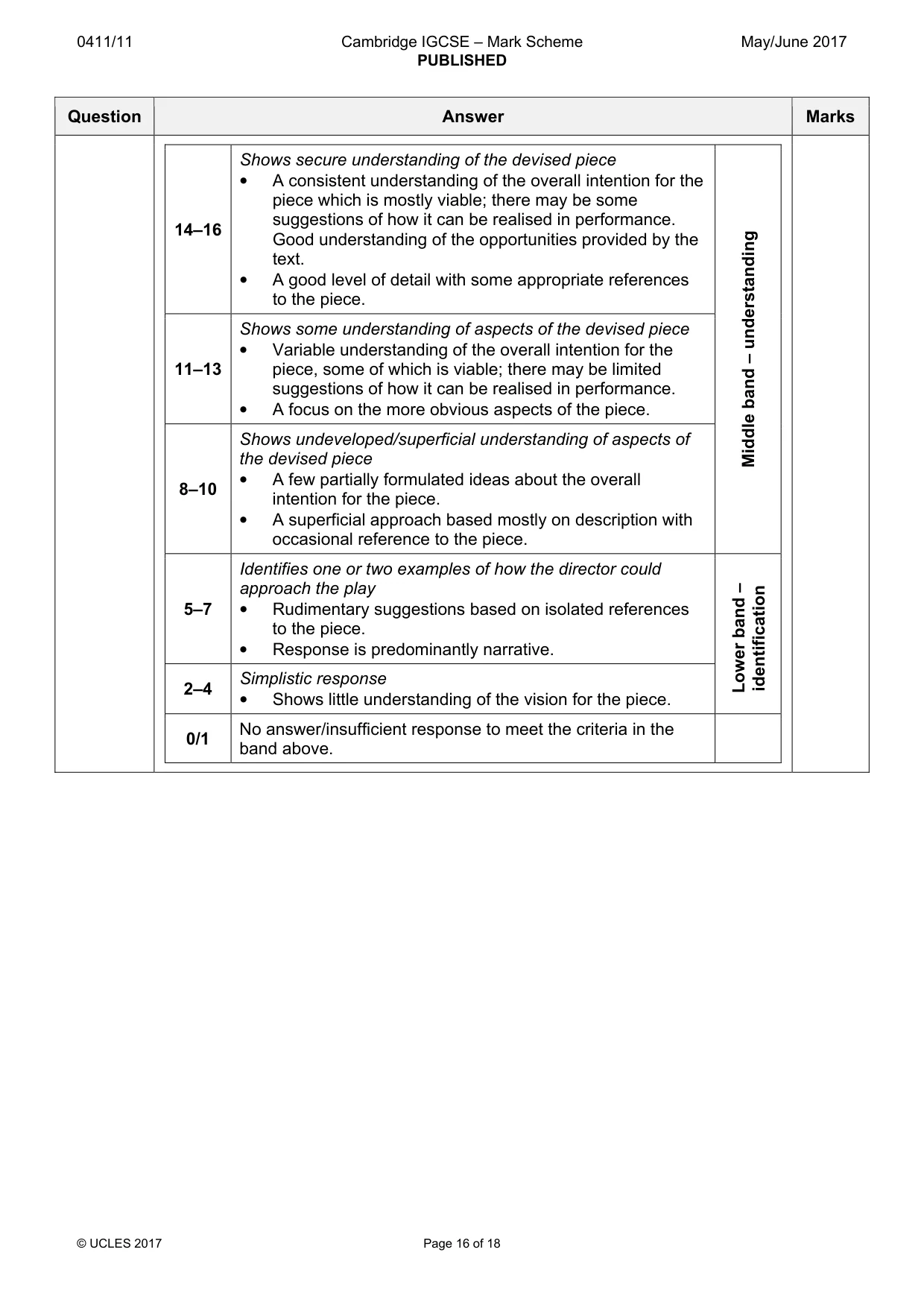
0411/11 Cambridge IGCSE – Mark Scheme PUBLISHED May/June 2017 © UCLES 2017 Page 16 of 18 Question Answer Marks 14–16 Shows secure understanding of the devised piece • A consistent understanding of the overall intention for the piece which is mostly viable; there may be some suggestions of how it can be realised in performance. Good understanding of the opportunities provided by the text. • A good level of detail with some appropriate references to the piece. Middle band – understanding 11–13 Shows some understanding of aspects of the devised piece • Variable understanding of the overall intention for the piece, some of which is viable; there may be limited suggestions of how it can be realised in performance. • A focus on the more obvious aspects of the piece. 8–10 Shows undeveloped/superficial understanding of aspects of the devised piece • A few partially formulated ideas about the overall intention for the piece. • A superficial approach based mostly on description with occasional reference to the piece. 5–7 Identifies one or two examples of how the director could approach the play • Rudimentary suggestions based on isolated references to the piece. • Response is predominantly narrative. Lower band – identification 2–4 Simplistic response • Shows little understanding of the vision for the piece. 0/1 No answer/insufficient response to meet the criteria in the band above.
Mark scheme, page 17
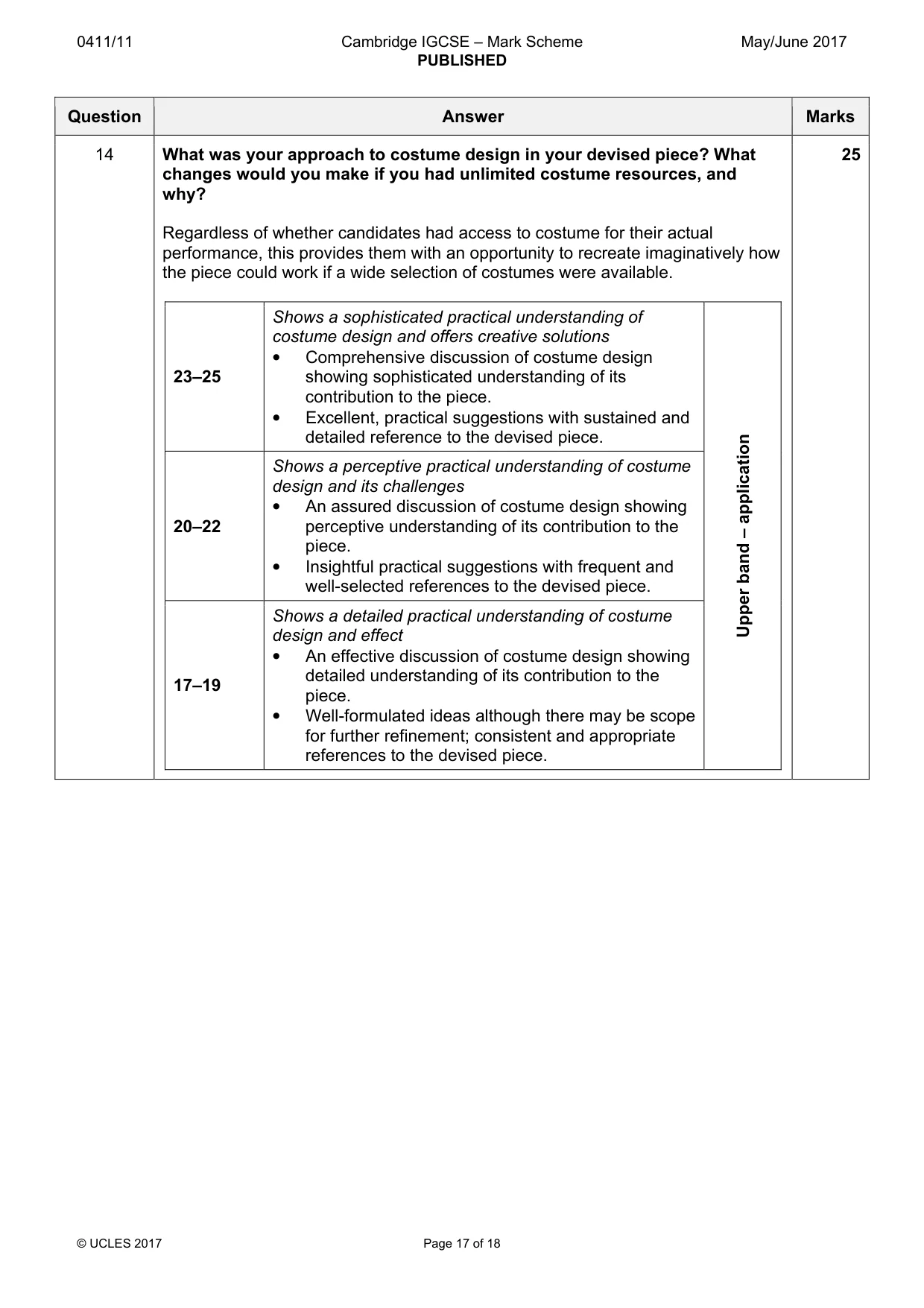
0411/11 Cambridge IGCSE – Mark Scheme PUBLISHED May/June 2017 © UCLES 2017 Page 17 of 18 Question Answer Marks 14 What was your approach to costume design in your devised piece? What changes would you make if you had unlimited costume resources, and why? Regardless of whether candidates had access to costume for their actual performance, this provides them with an opportunity to recreate imaginatively how the piece could work if a wide selection of costumes were available. 23–25 Shows a sophisticated practical understanding of costume design and offers creative solutions • Comprehensive discussion of costume design showing sophisticated understanding of its contribution to the piece. • Excellent, practical suggestions with sustained and detailed reference to the devised piece. Upper band – application 20–22 Shows a perceptive practical understanding of costume design and its challenges • An assured discussion of costume design showing perceptive understanding of its contribution to the piece. • Insightful practical suggestions with frequent and well-selected references to the devised piece. 17–19 Shows a detailed practical understanding of costume design and effect • An effective discussion of costume design showing detailed understanding of its contribution to the piece. • Well-formulated ideas although there may be scope for further refinement; consistent and appropriate references to the devised piece. 25
Mark scheme, page 18
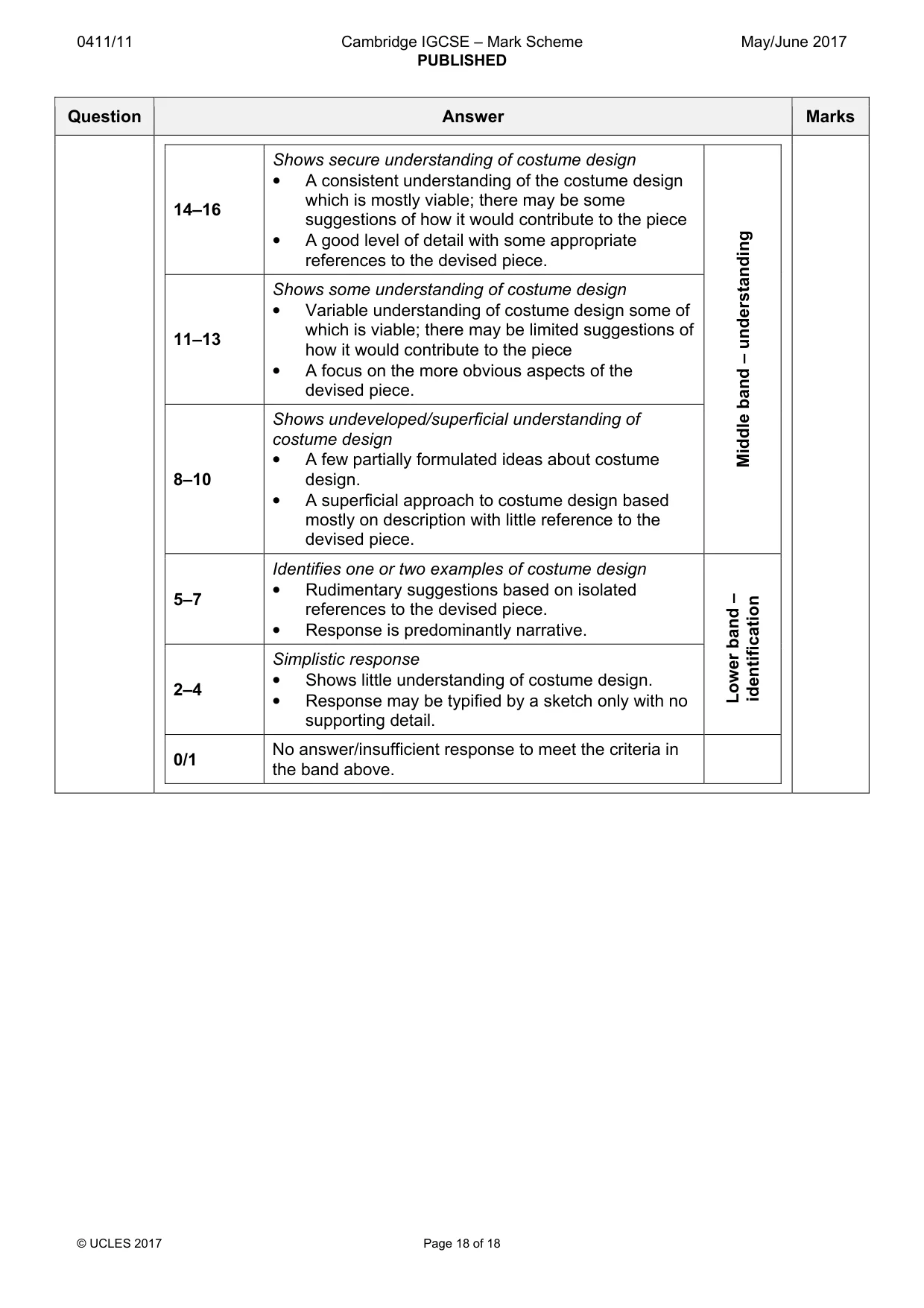
0411/11 Cambridge IGCSE – Mark Scheme PUBLISHED May/June 2017 © UCLES 2017 Page 18 of 18 Question Answer Marks 14–16 Shows secure understanding of costume design • A consistent understanding of the costume design which is mostly viable; there may be some suggestions of how it would contribute to the piece • A good level of detail with some appropriate references to the devised piece. Middle band – understanding 11–13 Shows some understanding of costume design • Variable understanding of costume design some of which is viable; there may be limited suggestions of how it would contribute to the piece • A focus on the more obvious aspects of the devised piece. 8–10 Shows undeveloped/superficial understanding of costume design • A few partially formulated ideas about costume design. • A superficial approach to costume design based mostly on description with little reference to the devised piece. 5–7 Identifies one or two examples of costume design • Rudimentary suggestions based on isolated references to the devised piece. • Response is predominantly narrative. Lower band – identification 2–4 Simplistic response • Shows little understanding of costume design. • Response may be typified by a sketch only with no supporting detail. 0/1 No answer/insufficient response to meet the criteria in the band above.
What you needed in this session
Cambridge’s own grade thresholds for 2017 May/June, Paper 1 · Variant 1. A higher threshold means an easier paper — the bar moves with how the cohort did.