Cambridge IGCSE Drama 0411 — 2016 May/June Paper 1 · Variant 2
0411/12/M/J/16 · 80 marks · ≈90 min
The question paper and its mark scheme, free to read here and free to download. This is Cambridge’s own paper, exactly as it was sat.
Question paper4 pages

Mark scheme21 pages
Answers below. Sit the paper first if you are practising.
Paper as text
Question paper, page 1
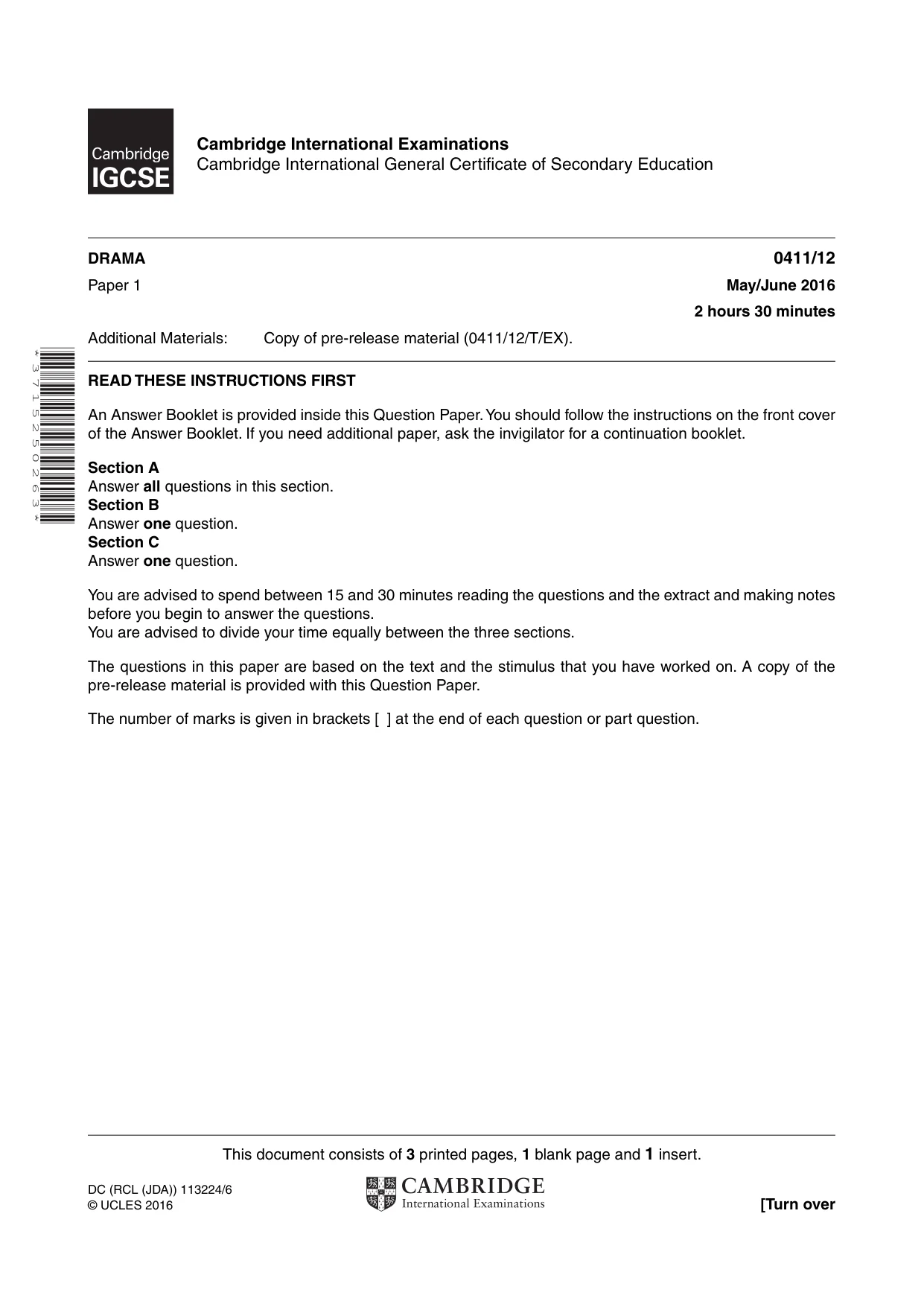
This document consists of 3 printed pages, 1 blank page and 1 insert. DC (RCL (JDA)) 113224/6 © UCLES 2016 [Turn over Cambridge International Examinations Cambridge International General Certificate of Secondary Education * 3 7 1 5 2 5 0 2 6 3 * DRAMA 0411/12 Paper 1 May/June 2016 2 hours 30 minutes Additional Materials: Copy of pre-release material (0411/12/T/EX). READ THESE INSTRUCTIONS FIRST An Answer Booklet is provided inside this Question Paper. You should follow the instructions on the front cover of the Answer Booklet. If you need additional paper, ask the invigilator for a continuation booklet. Section A Answer all questions in this section. Section B Answer one question. Section C Answer one question. You are advised to spend between 15 and 30 minutes reading the questions and the extract and making notes before you begin to answer the questions. You are advised to divide your time equally between the three sections. The questions in this paper are based on the text and the stimulus that you have worked on. A copy of the pre-release material is provided with this Question Paper. The number of marks is given in brackets [ ] at the end of each question or part question.
Question paper, page 2
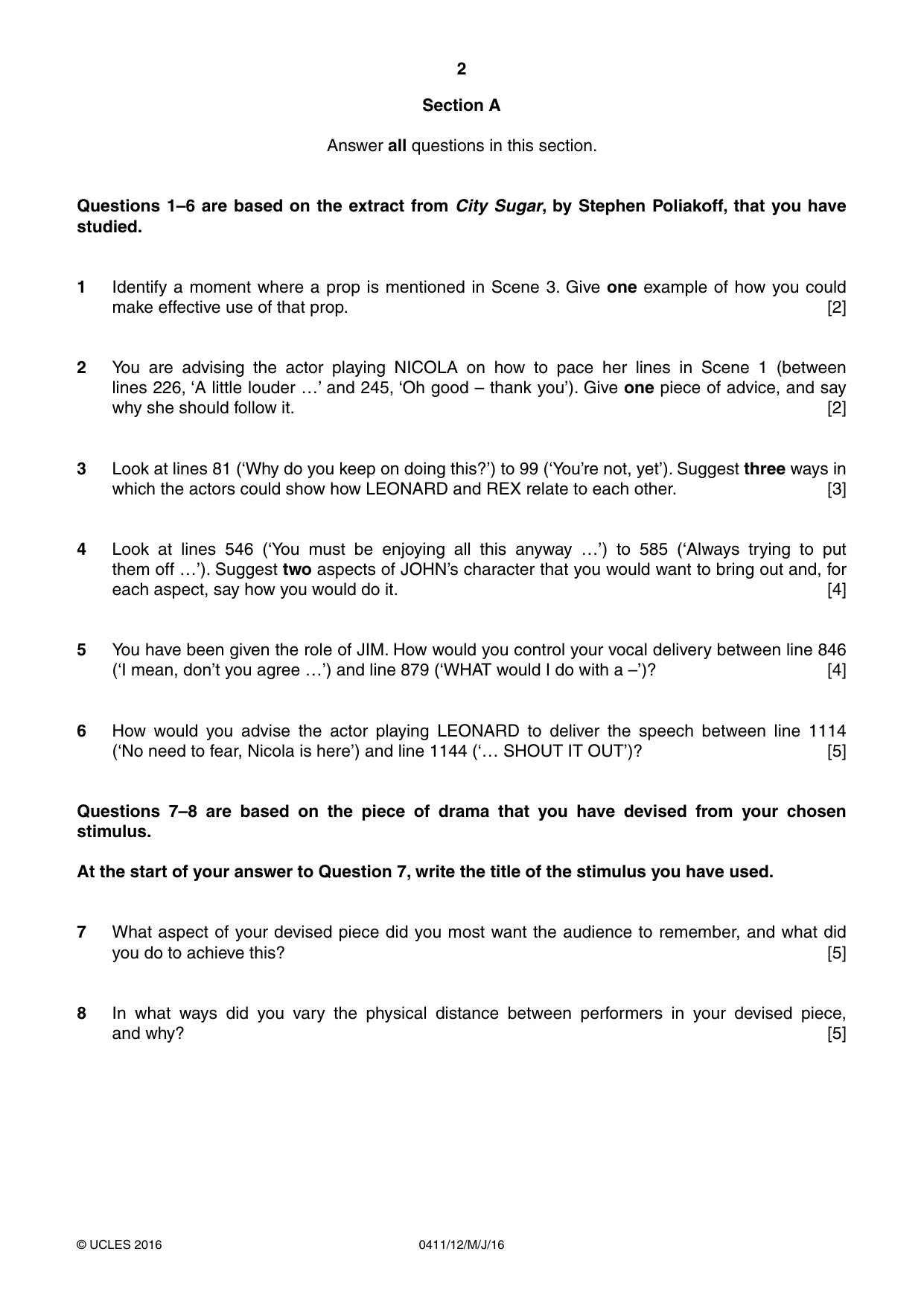
2 0411/12/M/J/16 © UCLES 2016 Section A Answer all questions in this section. Questions 1–6 are based on the extract from City Sugar, by Stephen Poliakoff, that you have studied. 1 Identify a moment where a prop is mentioned in Scene 3. Give one example of how you could make effective use of that prop. [2] 2 You are advising the actor playing NICOLA on how to pace her lines in Scene 1 (between lines 226, ‘A little louder …’ and 245, ‘Oh good – thank you’). Give one piece of advice, and say why she should follow it. [2] 3 Look at lines 81 (‘Why do you keep on doing this?’) to 99 (‘You’re not, yet’). Suggest three ways in which the actors could show how LEONARD and REX relate to each other. [3] 4 Look at lines 546 (‘You must be enjoying all this anyway …’) to 585 (‘Always trying to put them off …’). Suggest two aspects of JOHN’s character that you would want to bring out and, for each aspect, say how you would do it. [4] 5 You have been given the role of JIM. How would you control your vocal delivery between line 846 (‘I mean, don’t you agree …’) and line 879 (‘WHAT would I do with a –’)? [4] 6 How would you advise the actor playing LEONARD to deliver the speech between line 1114 (‘No need to fear, Nicola is here’) and line 1144 (‘… SHOUT IT OUT’)? [5] Questions 7–8 are based on the piece of drama that you have devised from your chosen stimulus. At the start of your answer to Question 7, write the title of the stimulus you have used. 7 What aspect of your devised piece did you most want the audience to remember, and what did you do to achieve this? [5] 8 In what ways did you vary the physical distance between performers in your devised piece, and why? [5]
Question paper, page 3
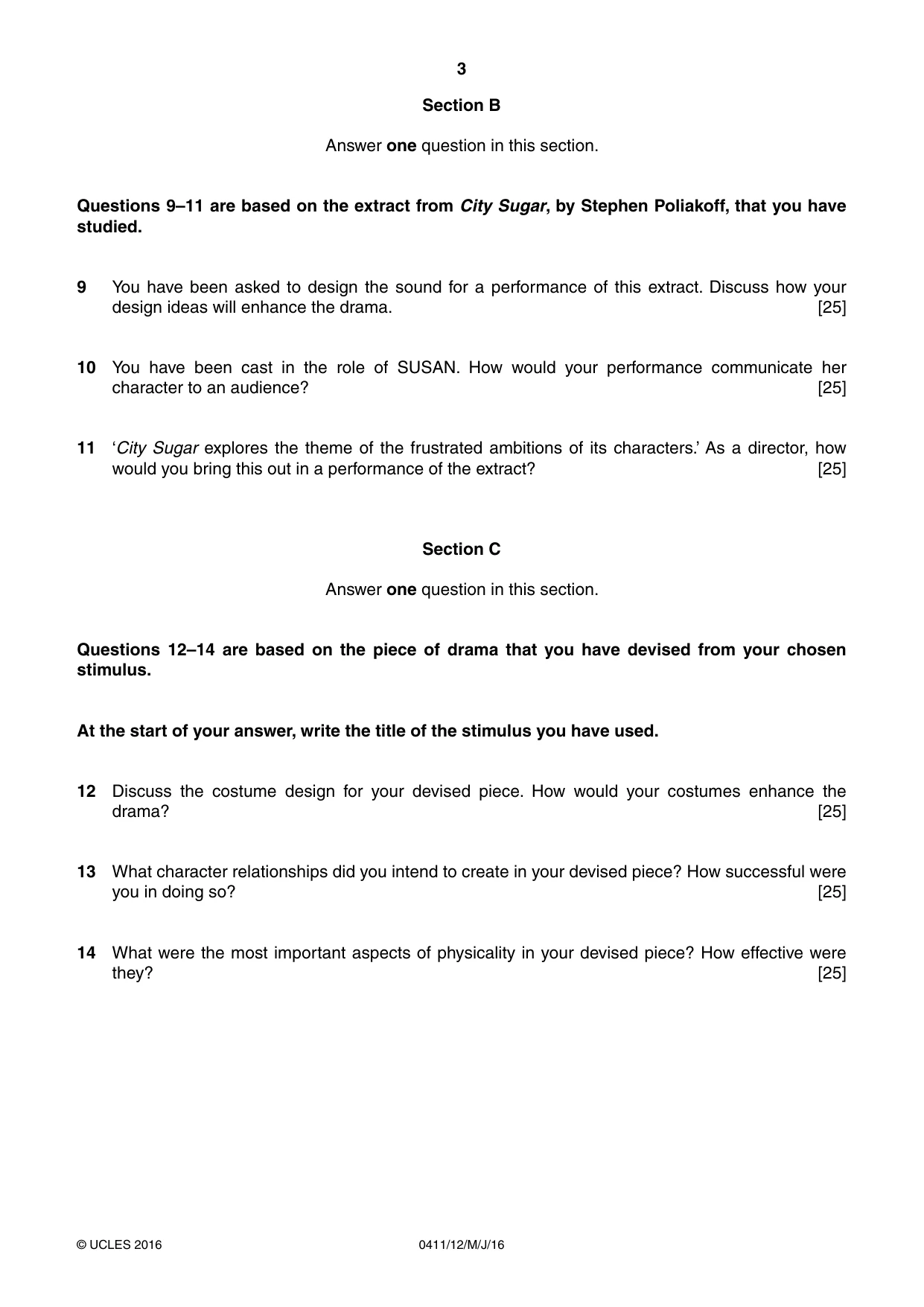
3 0411/12/M/J/16 © UCLES 2016 Section B Answer one question in this section. Questions 9–11 are based on the extract from City Sugar, by Stephen Poliakoff, that you have studied. 9 You have been asked to design the sound for a performance of this extract. Discuss how your design ideas will enhance the drama. [25] 10 You have been cast in the role of SUSAN. How would your performance communicate her character to an audience? [25] 11 ‘City Sugar explores the theme of the frustrated ambitions of its characters.’ As a director, how would you bring this out in a performance of the extract? [25] Section C Answer one question in this section. Questions 12–14 are based on the piece of drama that you have devised from your chosen stimulus. At the start of your answer, write the title of the stimulus you have used. 12 Discuss the costume design for your devised piece. How would your costumes enhance the drama? [25] 13 What character relationships did you intend to create in your devised piece? How successful were you in doing so? [25] 14 What were the most important aspects of physicality in your devised piece? How effective were they? [25]
Question paper, page 4
4 0411/12/M/J/16 © UCLES 2016 BLANK PAGE Permission to reproduce items where third-party owned material protected by copyright is included has been sought and cleared where possible. Every reasonable effort has been made by the publisher (UCLES) to trace copyright holders, but if any items requiring clearance have unwittingly been included, the publisher will be pleased to make amends at the earliest possible opportunity. To avoid the issue of disclosure of answer-related information to candidates, all copyright acknowledgements are reproduced online in the Cambridge International Examinations Copyright Acknowledgements Booklet. This is produced for each series of examinations and is freely available to download at www.cie.org.uk after the live examination series. Cambridge International Examinations is part of the Cambridge Assessment Group. Cambridge Assessment is the brand name of University of Cambridge Local Examinations Syndicate (UCLES), which is itself a department of the University of Cambridge.
Mark scheme, page 1
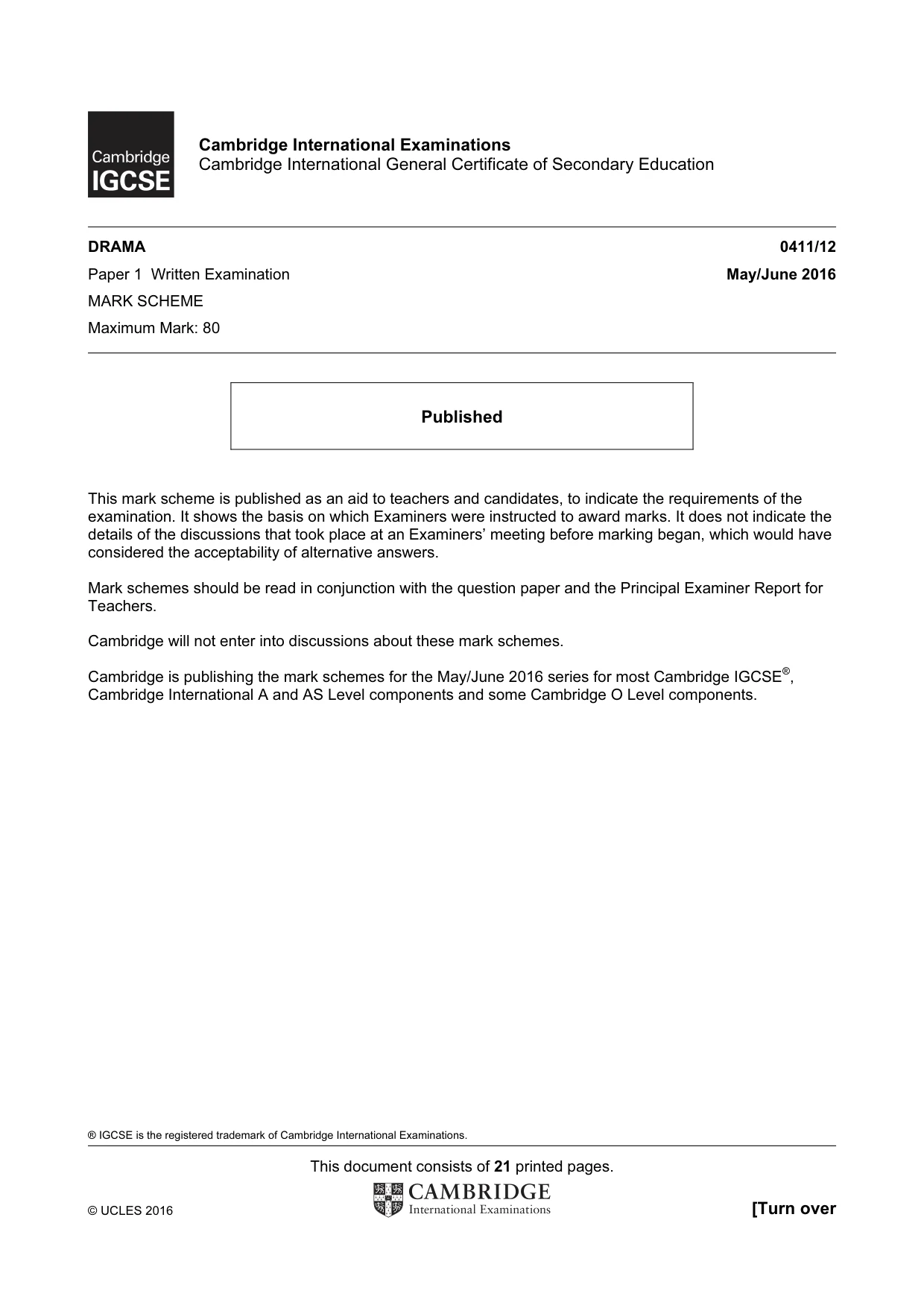
® IGCSE is the registered trademark of Cambridge International Examinations. This document consists of 21 printed pages. © UCLES 2016 [Turn over Cambridge International Examinations Cambridge International General Certificate of Secondary Education DRAMA 0411/12 Paper 1 Written Examination May/June 2016 MARK SCHEME Maximum Mark: 80 Published This mark scheme is published as an aid to teachers and candidates, to indicate the requirements of the examination. It shows the basis on which Examiners were instructed to award marks. It does not indicate the details of the discussions that took place at an Examiners’ meeting before marking began, which would have considered the acceptability of alternative answers. Mark schemes should be read in conjunction with the question paper and the Principal Examiner Report for Teachers. Cambridge will not enter into discussions about these mark schemes. Cambridge is publishing the mark schemes for the May/June 2016 series for most Cambridge IGCSE®, Cambridge International A and AS Level components and some Cambridge O Level components.
Mark scheme, page 2
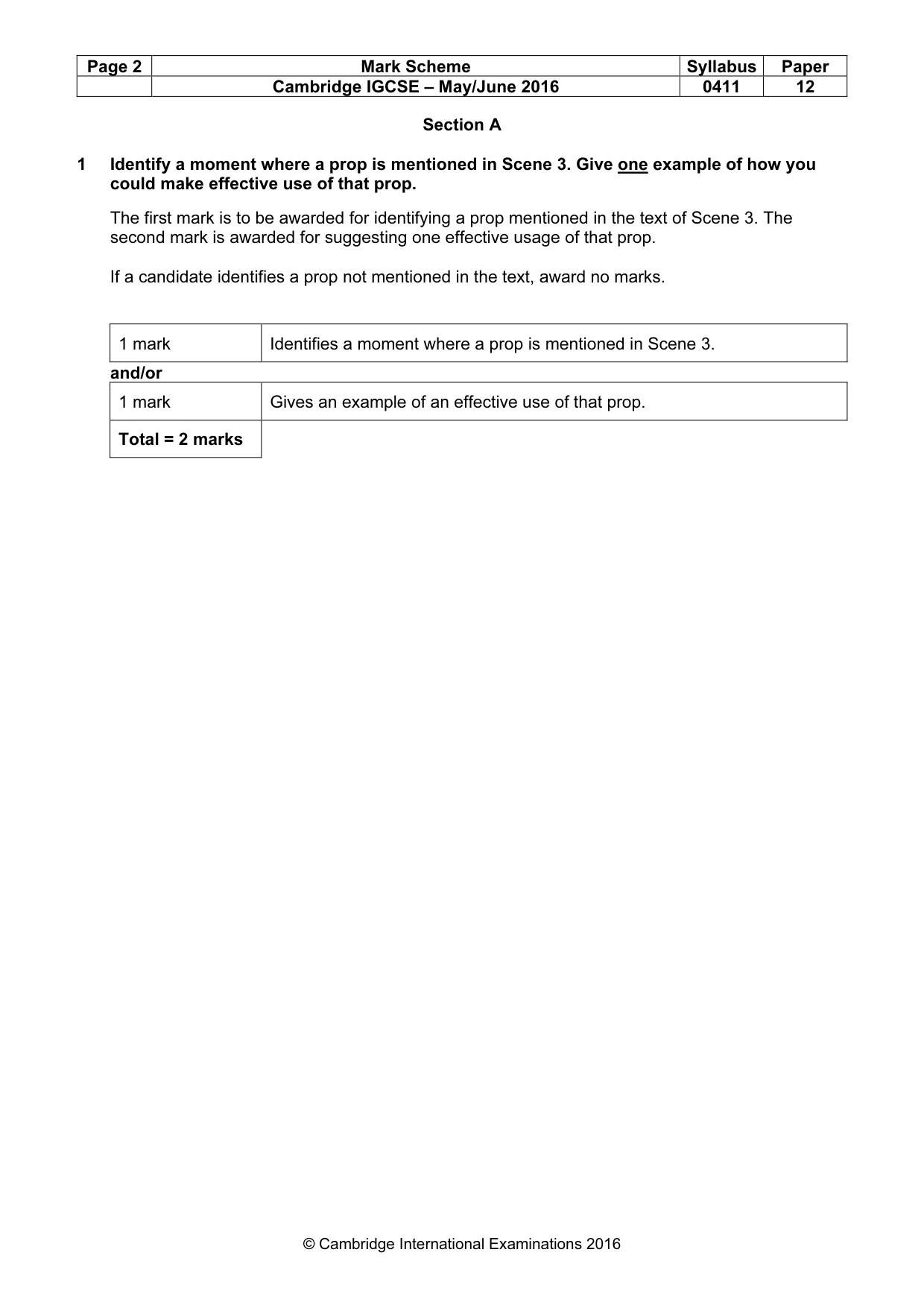
Page 2 Mark Scheme Syllabus Paper Cambridge IGCSE – May/June 2016 0411 12 © Cambridge International Examinations 2016 Section A 1 Identify a moment where a prop is mentioned in Scene 3. Give one example of how you could make effective use of that prop. The first mark is to be awarded for identifying a prop mentioned in the text of Scene 3. The second mark is awarded for suggesting one effective usage of that prop. If a candidate identifies a prop not mentioned in the text, award no marks. 1 mark Identifies a moment where a prop is mentioned in Scene 3. and/or 1 mark Gives an example of an effective use of that prop. Total = 2 marks
Mark scheme, page 3
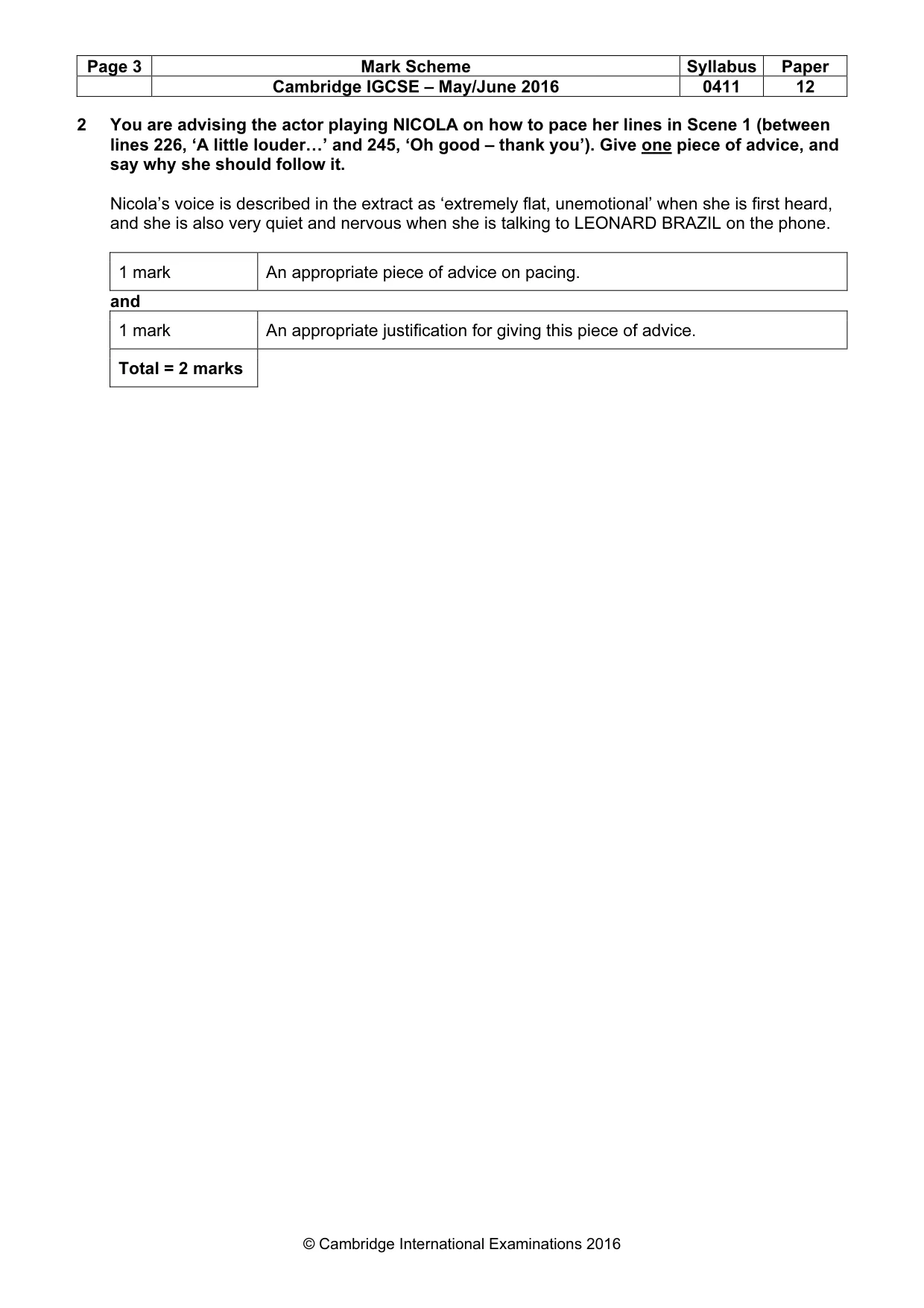
Page 3 Mark Scheme Syllabus Paper Cambridge IGCSE – May/June 2016 0411 12 © Cambridge International Examinations 2016 2 You are advising the actor playing NICOLA on how to pace her lines in Scene 1 (between lines 226, ‘A little louder…’ and 245, ‘Oh good – thank you’). Give one piece of advice, and say why she should follow it. Nicola’s voice is described in the extract as ‘extremely flat, unemotional’ when she is first heard, and she is also very quiet and nervous when she is talking to LEONARD BRAZIL on the phone. 1 mark An appropriate piece of advice on pacing. and 1 mark An appropriate justification for giving this piece of advice. Total = 2 marks
Mark scheme, page 4
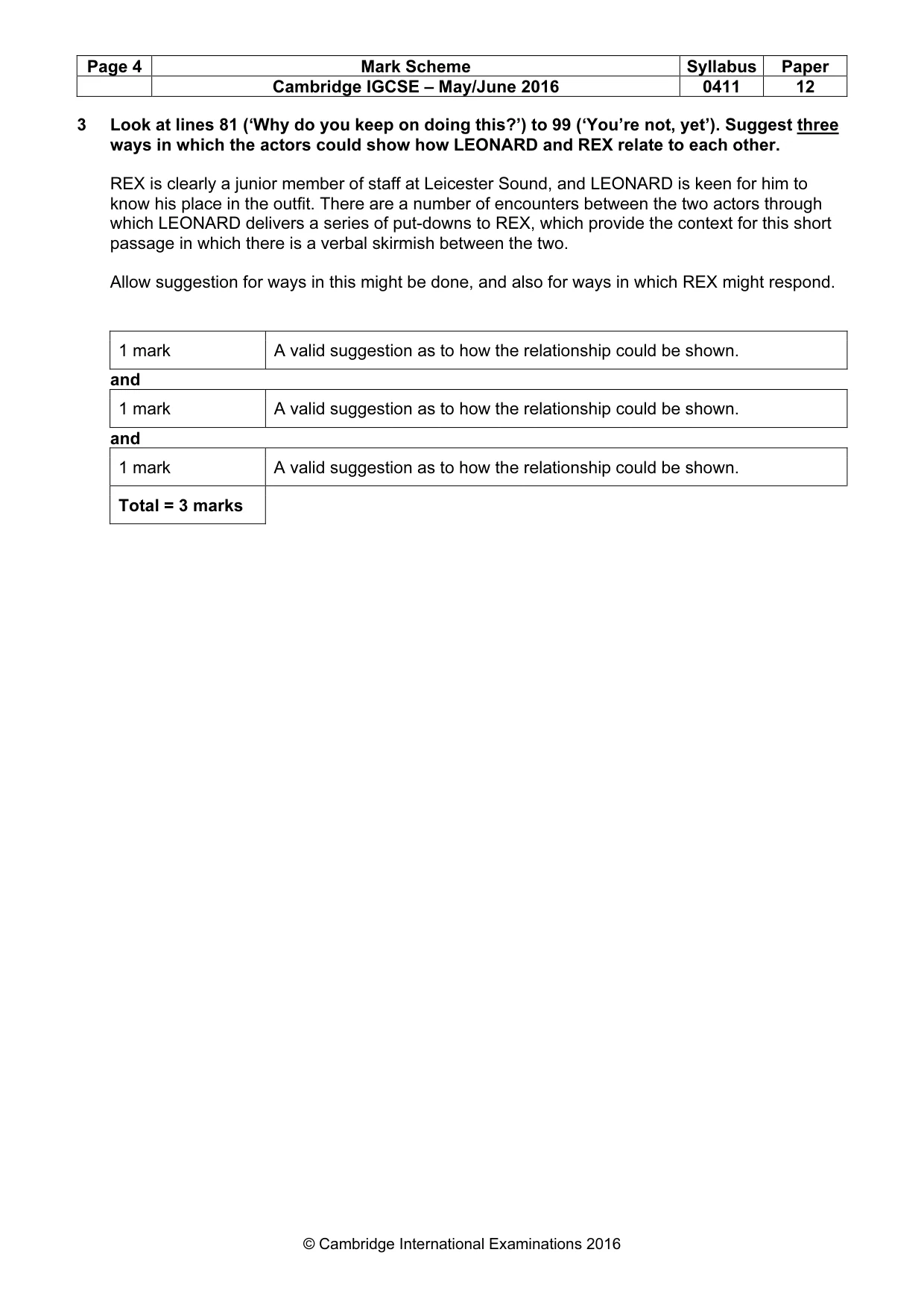
Page 4 Mark Scheme Syllabus Paper Cambridge IGCSE – May/June 2016 0411 12 © Cambridge International Examinations 2016 3 Look at lines 81 (‘Why do you keep on doing this?’) to 99 (‘You’re not, yet’). Suggest three ways in which the actors could show how LEONARD and REX relate to each other. REX is clearly a junior member of staff at Leicester Sound, and LEONARD is keen for him to know his place in the outfit. There are a number of encounters between the two actors through which LEONARD delivers a series of put-downs to REX, which provide the context for this short passage in which there is a verbal skirmish between the two. Allow suggestion for ways in this might be done, and also for ways in which REX might respond. 1 mark A valid suggestion as to how the relationship could be shown. and 1 mark A valid suggestion as to how the relationship could be shown. and 1 mark A valid suggestion as to how the relationship could be shown. Total = 3 marks
Mark scheme, page 5
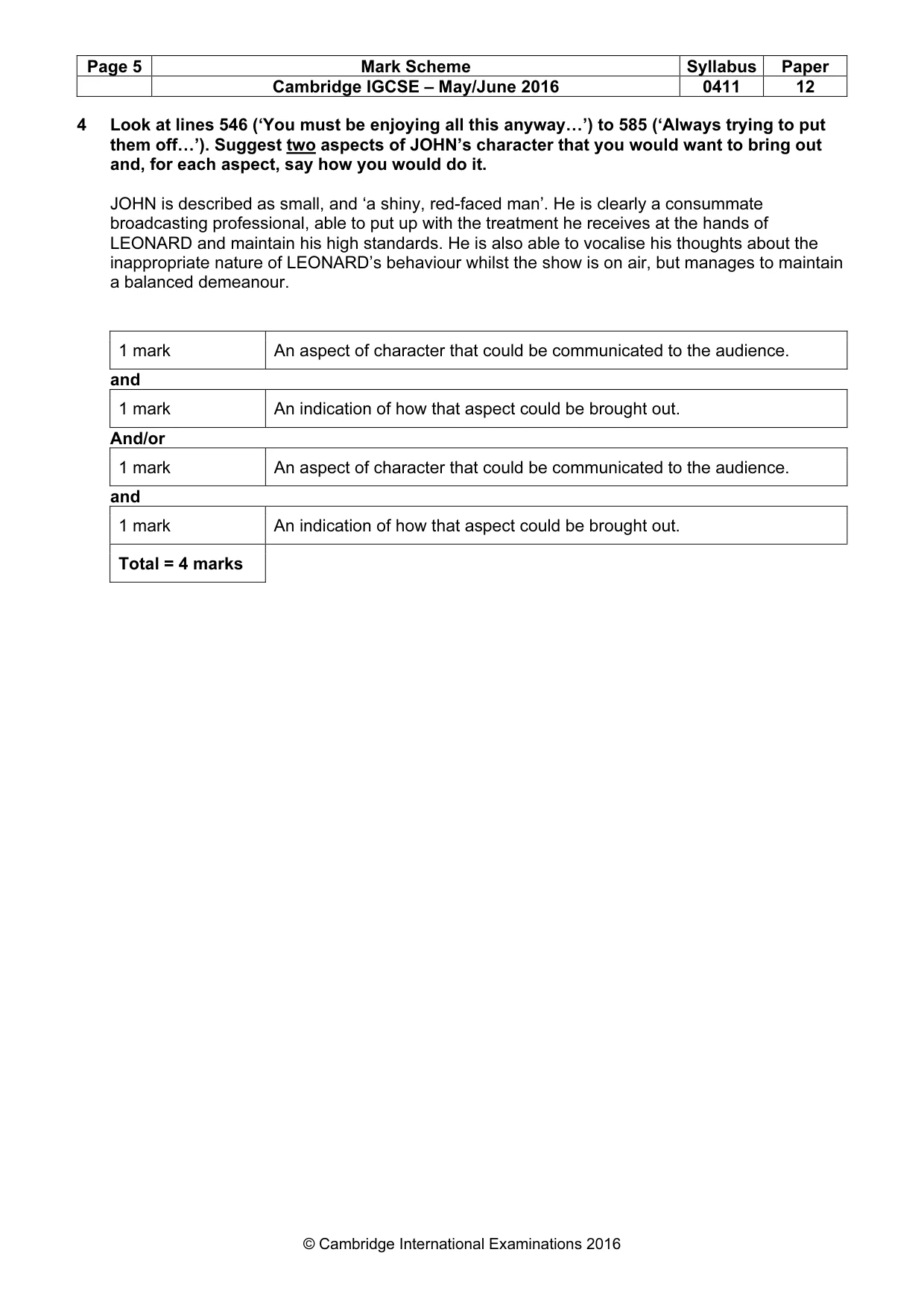
Page 5 Mark Scheme Syllabus Paper Cambridge IGCSE – May/June 2016 0411 12 © Cambridge International Examinations 2016 4 Look at lines 546 (‘You must be enjoying all this anyway…’) to 585 (‘Always trying to put them off…’). Suggest two aspects of JOHN’s character that you would want to bring out and, for each aspect, say how you would do it. JOHN is described as small, and ‘a shiny, red-faced man’. He is clearly a consummate broadcasting professional, able to put up with the treatment he receives at the hands of LEONARD and maintain his high standards. He is also able to vocalise his thoughts about the inappropriate nature of LEONARD’s behaviour whilst the show is on air, but manages to maintain a balanced demeanour. 1 mark An aspect of character that could be communicated to the audience. and 1 mark An indication of how that aspect could be brought out. And/or 1 mark An aspect of character that could be communicated to the audience. and 1 mark An indication of how that aspect could be brought out. Total = 4 marks
Mark scheme, page 6
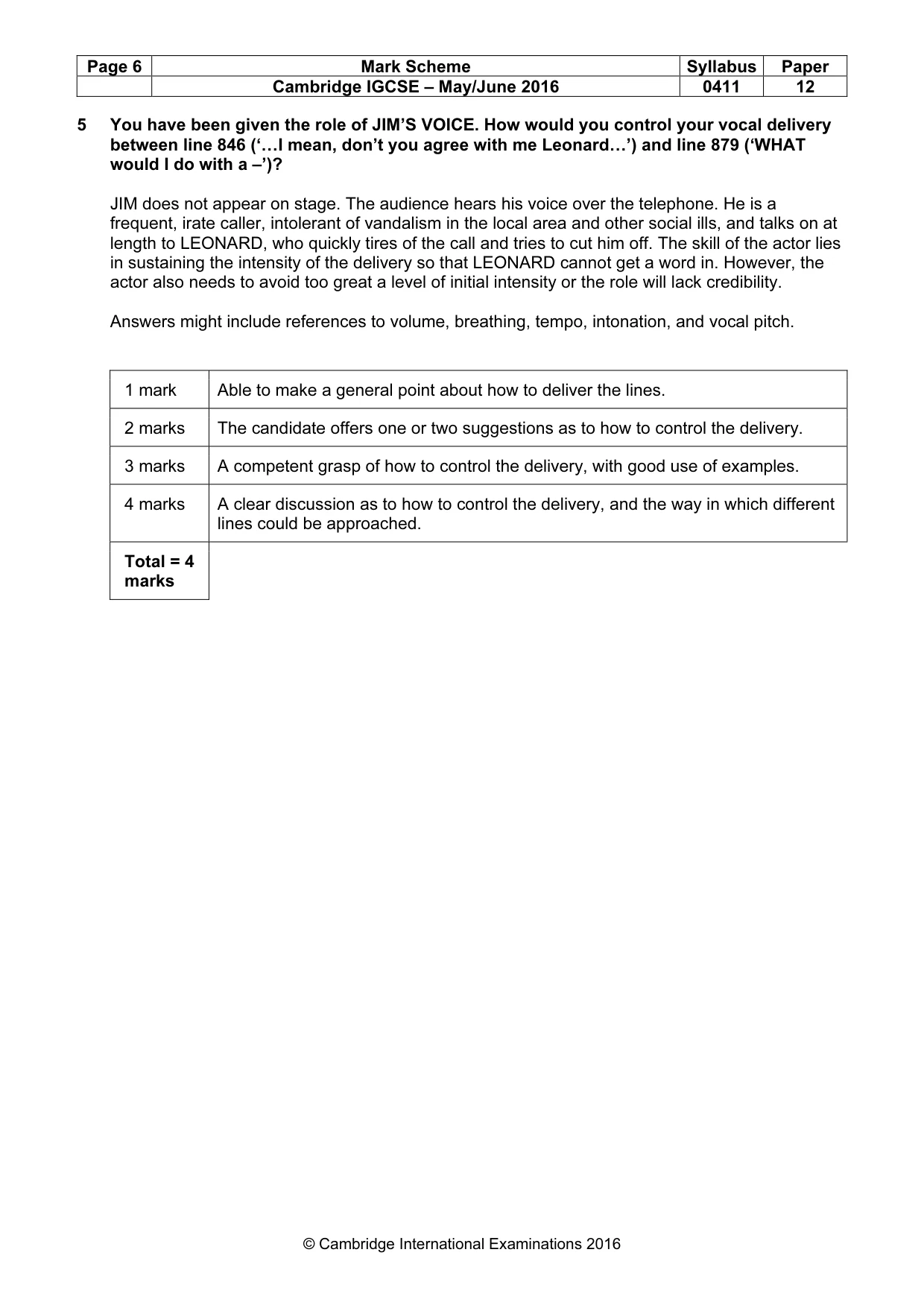
Page 6 Mark Scheme Syllabus Paper Cambridge IGCSE – May/June 2016 0411 12 © Cambridge International Examinations 2016 5 You have been given the role of JIM’S VOICE. How would you control your vocal delivery between line 846 (‘…I mean, don’t you agree with me Leonard…’) and line 879 (‘WHAT would I do with a –’)? JIM does not appear on stage. The audience hears his voice over the telephone. He is a frequent, irate caller, intolerant of vandalism in the local area and other social ills, and talks on at length to LEONARD, who quickly tires of the call and tries to cut him off. The skill of the actor lies in sustaining the intensity of the delivery so that LEONARD cannot get a word in. However, the actor also needs to avoid too great a level of initial intensity or the role will lack credibility. Answers might include references to volume, breathing, tempo, intonation, and vocal pitch. 1 mark Able to make a general point about how to deliver the lines. 2 marks The candidate offers one or two suggestions as to how to control the delivery. 3 marks A competent grasp of how to control the delivery, with good use of examples. 4 marks A clear discussion as to how to control the delivery, and the way in which different lines could be approached. Total = 4 marks
Mark scheme, page 7
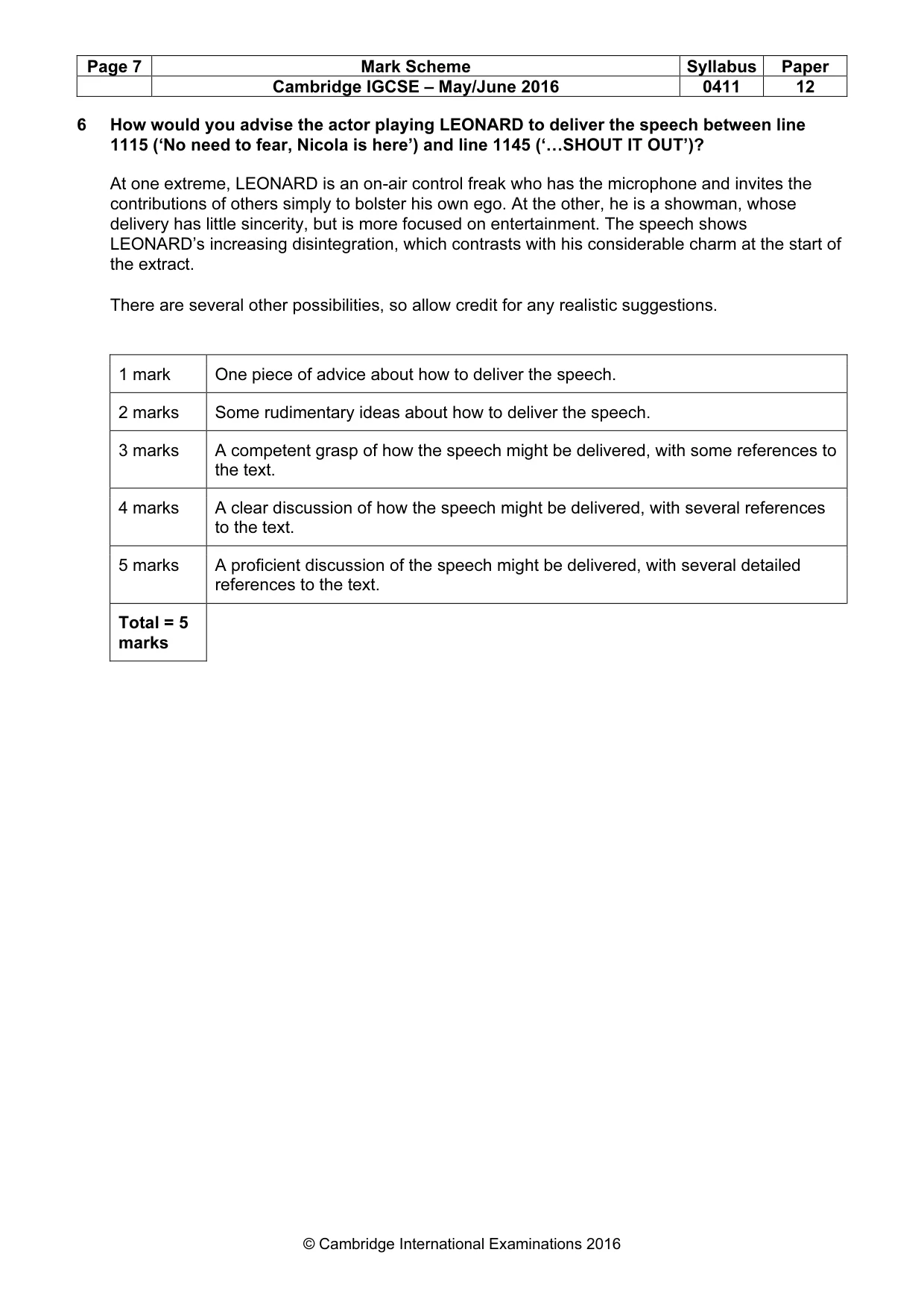
Page 7 Mark Scheme Syllabus Paper Cambridge IGCSE – May/June 2016 0411 12 © Cambridge International Examinations 2016 6 How would you advise the actor playing LEONARD to deliver the speech between line 1115 (‘No need to fear, Nicola is here’) and line 1145 (‘…SHOUT IT OUT’)? At one extreme, LEONARD is an on-air control freak who has the microphone and invites the contributions of others simply to bolster his own ego. At the other, he is a showman, whose delivery has little sincerity, but is more focused on entertainment. The speech shows LEONARD’s increasing disintegration, which contrasts with his considerable charm at the start of the extract. There are several other possibilities, so allow credit for any realistic suggestions. 1 mark One piece of advice about how to deliver the speech. 2 marks Some rudimentary ideas about how to deliver the speech. 3 marks A competent grasp of how the speech might be delivered, with some references to the text. 4 marks A clear discussion of how the speech might be delivered, with several references to the text. 5 marks A proficient discussion of the speech might be delivered, with several detailed references to the text. Total = 5 marks
Mark scheme, page 8
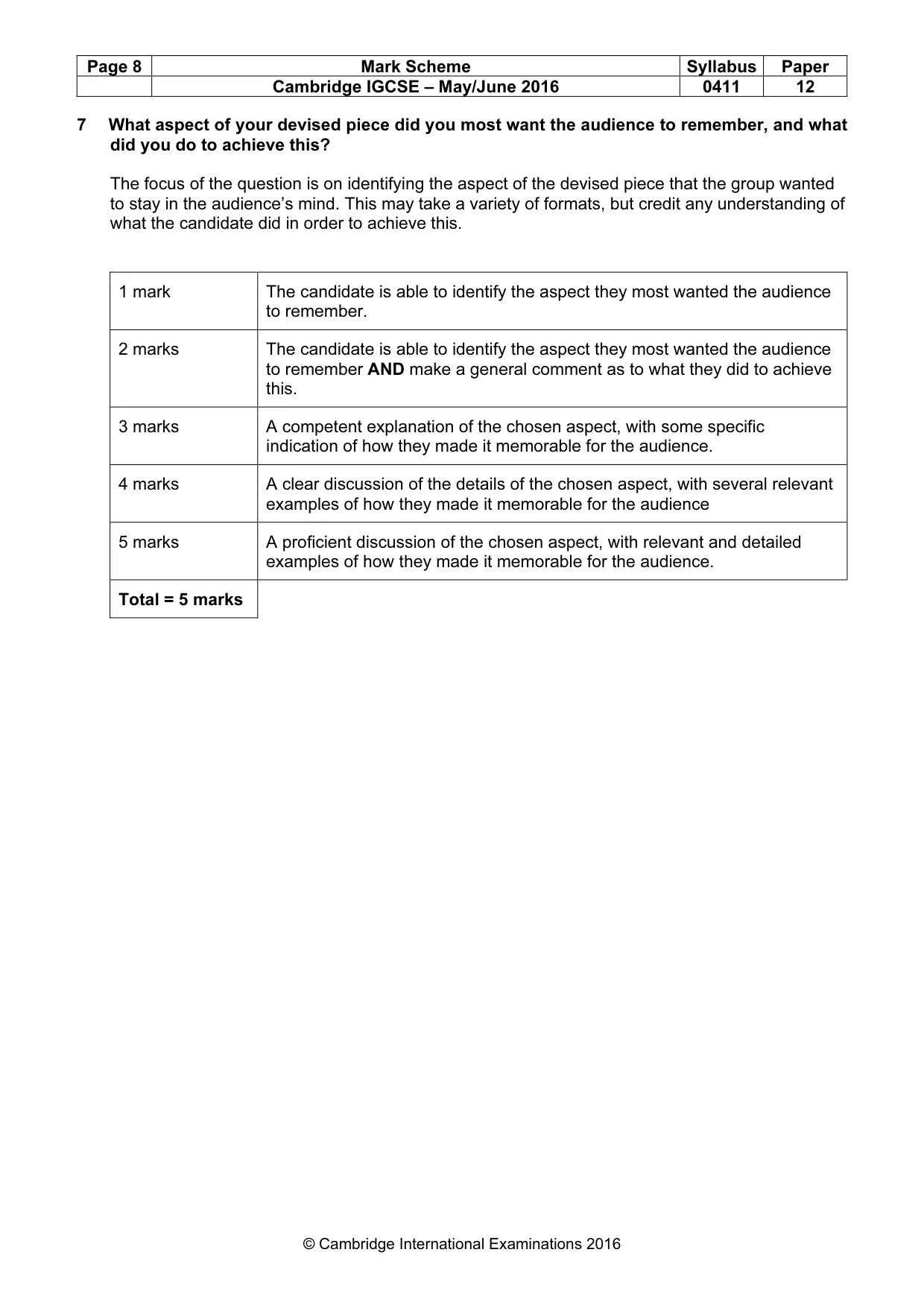
Page 8 Mark Scheme Syllabus Paper Cambridge IGCSE – May/June 2016 0411 12 © Cambridge International Examinations 2016 7 What aspect of your devised piece did you most want the audience to remember, and what did you do to achieve this? The focus of the question is on identifying the aspect of the devised piece that the group wanted to stay in the audience’s mind. This may take a variety of formats, but credit any understanding of what the candidate did in order to achieve this. 1 mark The candidate is able to identify the aspect they most wanted the audience to remember. 2 marks The candidate is able to identify the aspect they most wanted the audience to remember AND make a general comment as to what they did to achieve this. 3 marks A competent explanation of the chosen aspect, with some specific indication of how they made it memorable for the audience. 4 marks A clear discussion of the details of the chosen aspect, with several relevant examples of how they made it memorable for the audience 5 marks A proficient discussion of the chosen aspect, with relevant and detailed examples of how they made it memorable for the audience. Total = 5 marks
Mark scheme, page 9
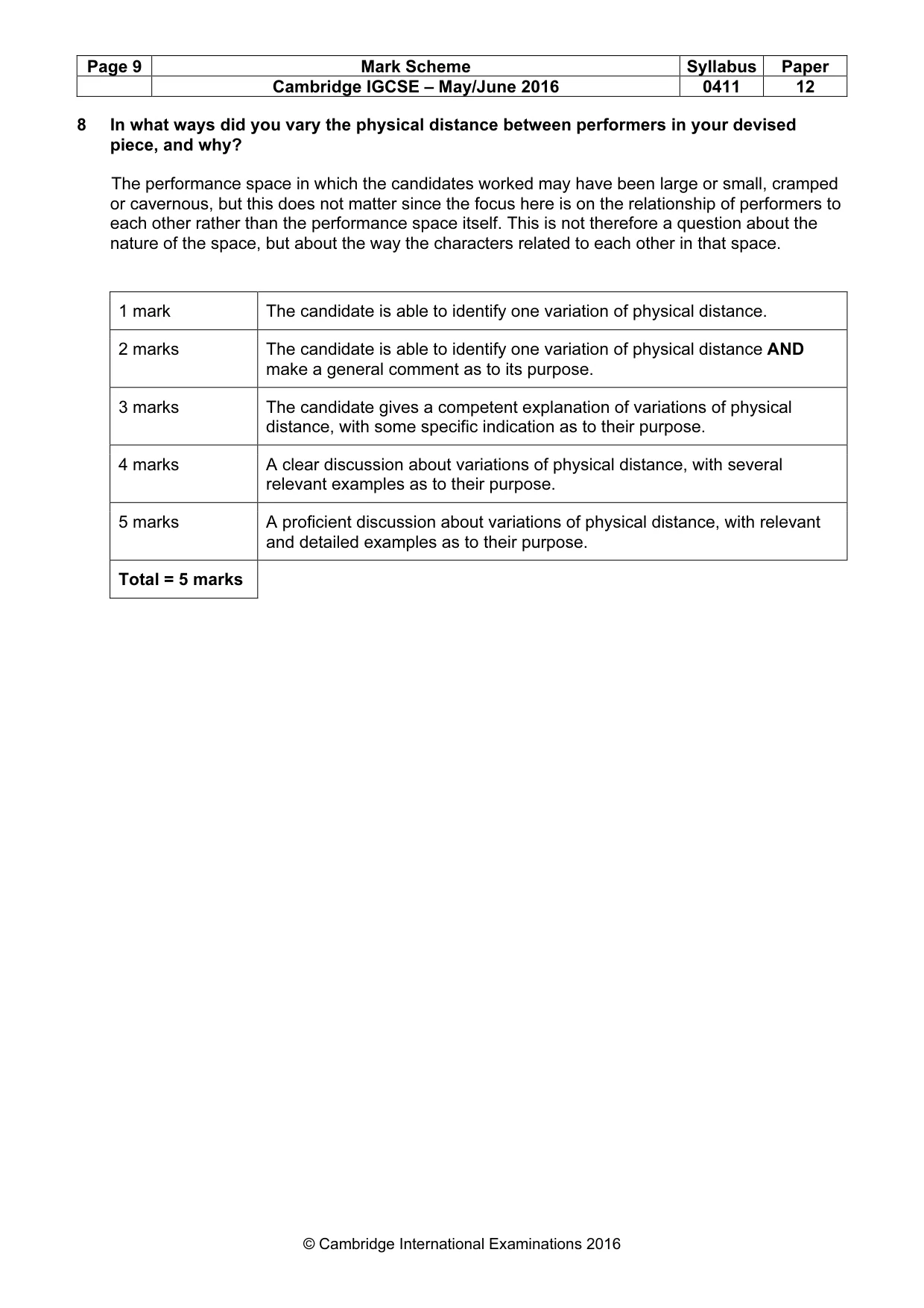
Page 9 Mark Scheme Syllabus Paper Cambridge IGCSE – May/June 2016 0411 12 © Cambridge International Examinations 2016 8 In what ways did you vary the physical distance between performers in your devised piece, and why? The performance space in which the candidates worked may have been large or small, cramped or cavernous, but this does not matter since the focus here is on the relationship of performers to each other rather than the performance space itself. This is not therefore a question about the nature of the space, but about the way the characters related to each other in that space. 1 mark The candidate is able to identify one variation of physical distance. 2 marks The candidate is able to identify one variation of physical distance AND make a general comment as to its purpose. 3 marks The candidate gives a competent explanation of variations of physical distance, with some specific indication as to their purpose. 4 marks A clear discussion about variations of physical distance, with several relevant examples as to their purpose. 5 marks A proficient discussion about variations of physical distance, with relevant and detailed examples as to their purpose. Total = 5 marks
Mark scheme, page 10
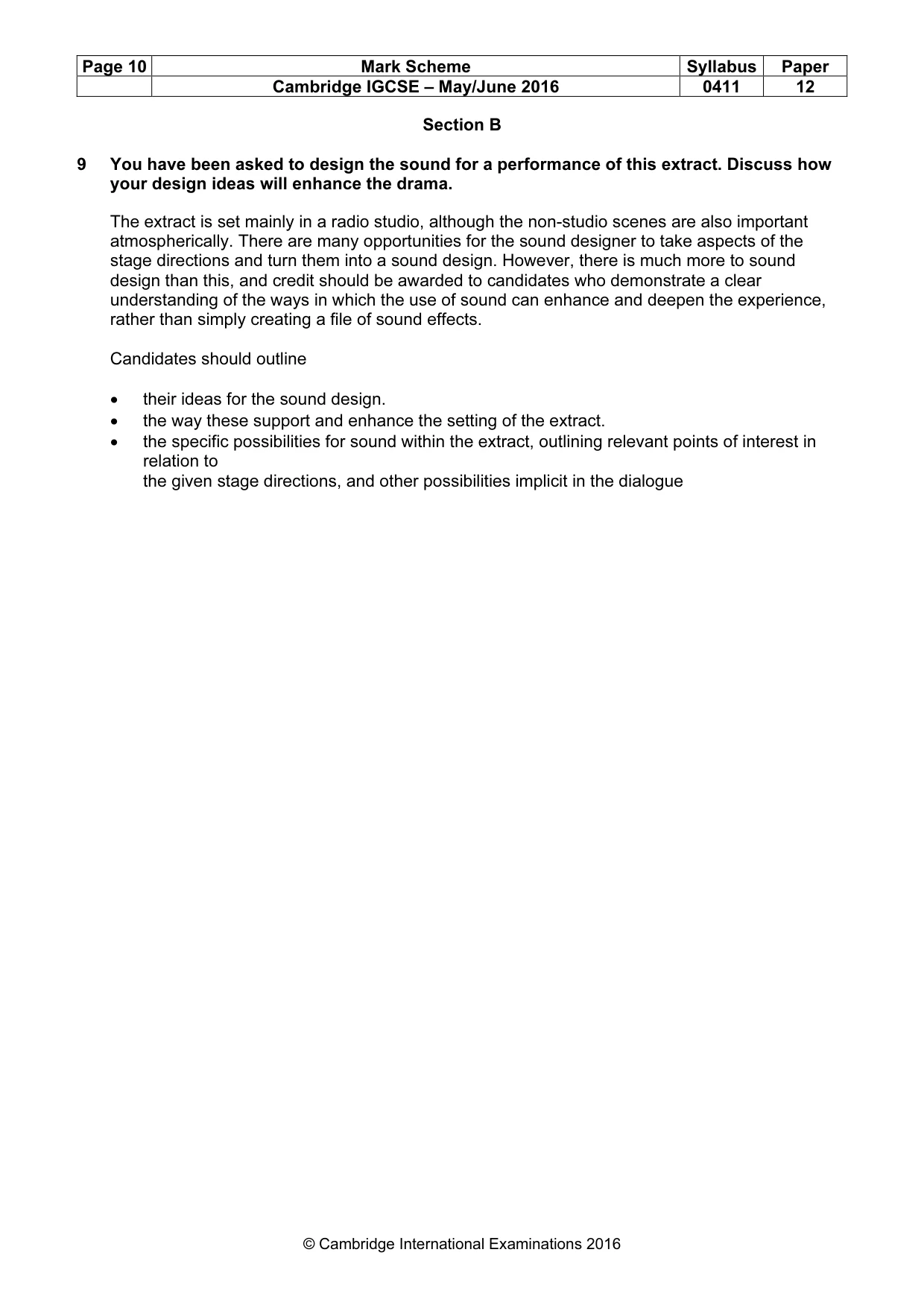
Page 10 Mark Scheme Syllabus Paper Cambridge IGCSE – May/June 2016 0411 12 © Cambridge International Examinations 2016 Section B 9 You have been asked to design the sound for a performance of this extract. Discuss how your design ideas will enhance the drama. The extract is set mainly in a radio studio, although the non-studio scenes are also important atmospherically. There are many opportunities for the sound designer to take aspects of the stage directions and turn them into a sound design. However, there is much more to sound design than this, and credit should be awarded to candidates who demonstrate a clear understanding of the ways in which the use of sound can enhance and deepen the experience, rather than simply creating a file of sound effects. Candidates should outline • their ideas for the sound design. • the way these support and enhance the setting of the extract. • the specific possibilities for sound within the extract, outlining relevant points of interest in relation to the given stage directions, and other possibilities implicit in the dialogue
Mark scheme, page 11
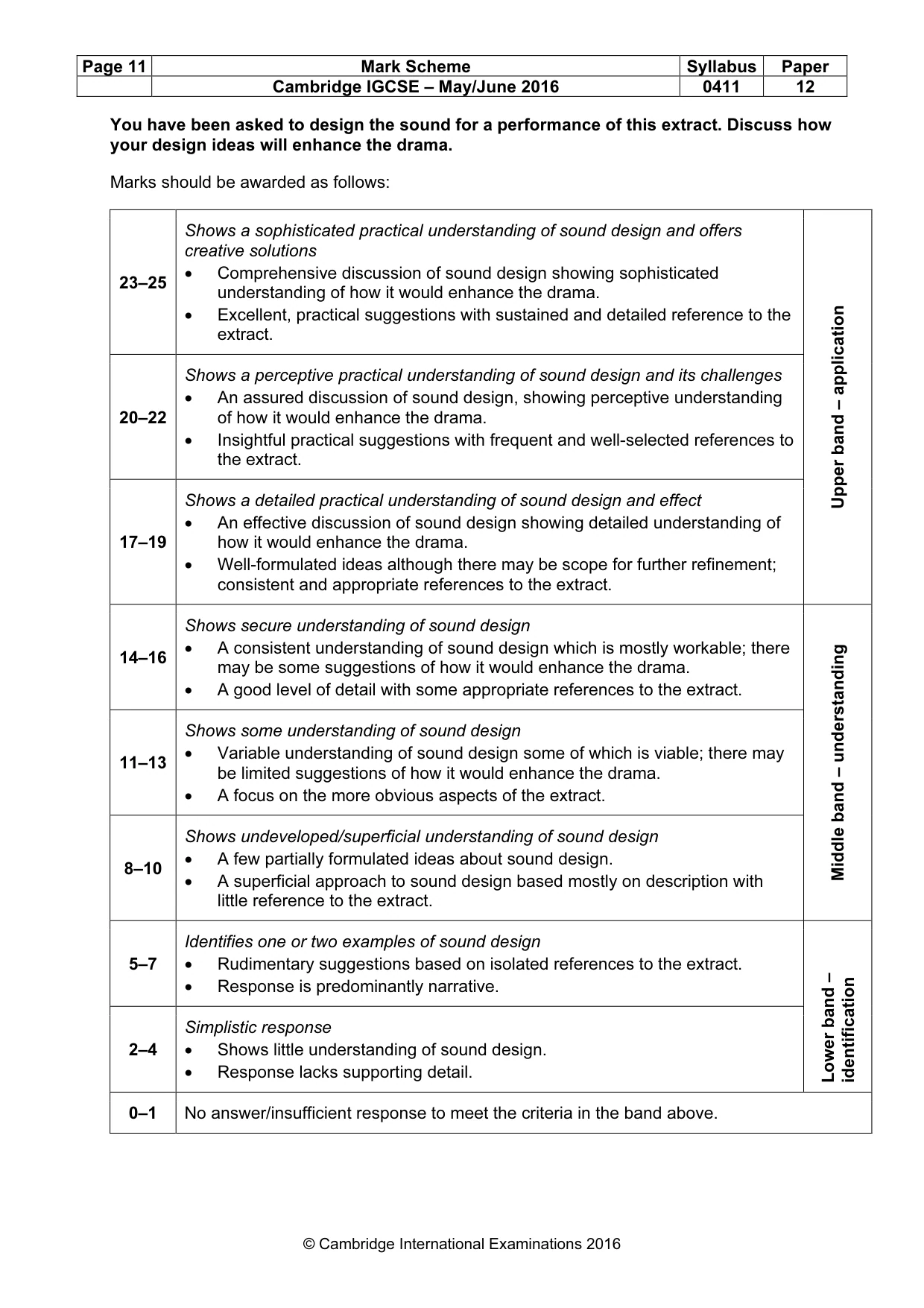
Page 11 Mark Scheme Syllabus Paper Cambridge IGCSE – May/June 2016 0411 12 © Cambridge International Examinations 2016 You have been asked to design the sound for a performance of this extract. Discuss how your design ideas will enhance the drama. Marks should be awarded as follows: 23–25 Shows a sophisticated practical understanding of sound design and offers creative solutions • Comprehensive discussion of sound design showing sophisticated understanding of how it would enhance the drama. • Excellent, practical suggestions with sustained and detailed reference to the extract. Upper band – application 20–22 Shows a perceptive practical understanding of sound design and its challenges • An assured discussion of sound design, showing perceptive understanding of how it would enhance the drama. • Insightful practical suggestions with frequent and well-selected references to the extract. 17–19 Shows a detailed practical understanding of sound design and effect • An effective discussion of sound design showing detailed understanding of how it would enhance the drama. • Well-formulated ideas although there may be scope for further refinement; consistent and appropriate references to the extract. 14–16 Shows secure understanding of sound design • A consistent understanding of sound design which is mostly workable; there may be some suggestions of how it would enhance the drama. • A good level of detail with some appropriate references to the extract. Middle band – understanding 11–13 Shows some understanding of sound design • Variable understanding of sound design some of which is viable; there may be limited suggestions of how it would enhance the drama. • A focus on the more obvious aspects of the extract. 8–10 Shows undeveloped/superficial understanding of sound design • A few partially formulated ideas about sound design. • A superficial approach to sound design based mostly on description with little reference to the extract. 5–7 Identifies one or two examples of sound design • Rudimentary suggestions based on isolated references to the extract. • Response is predominantly narrative. Lower band – identification 2–4 Simplistic response • Shows little understanding of sound design. • Response lacks supporting detail. 0–1 No answer/insufficient response to meet the criteria in the band above.
Mark scheme, page 12
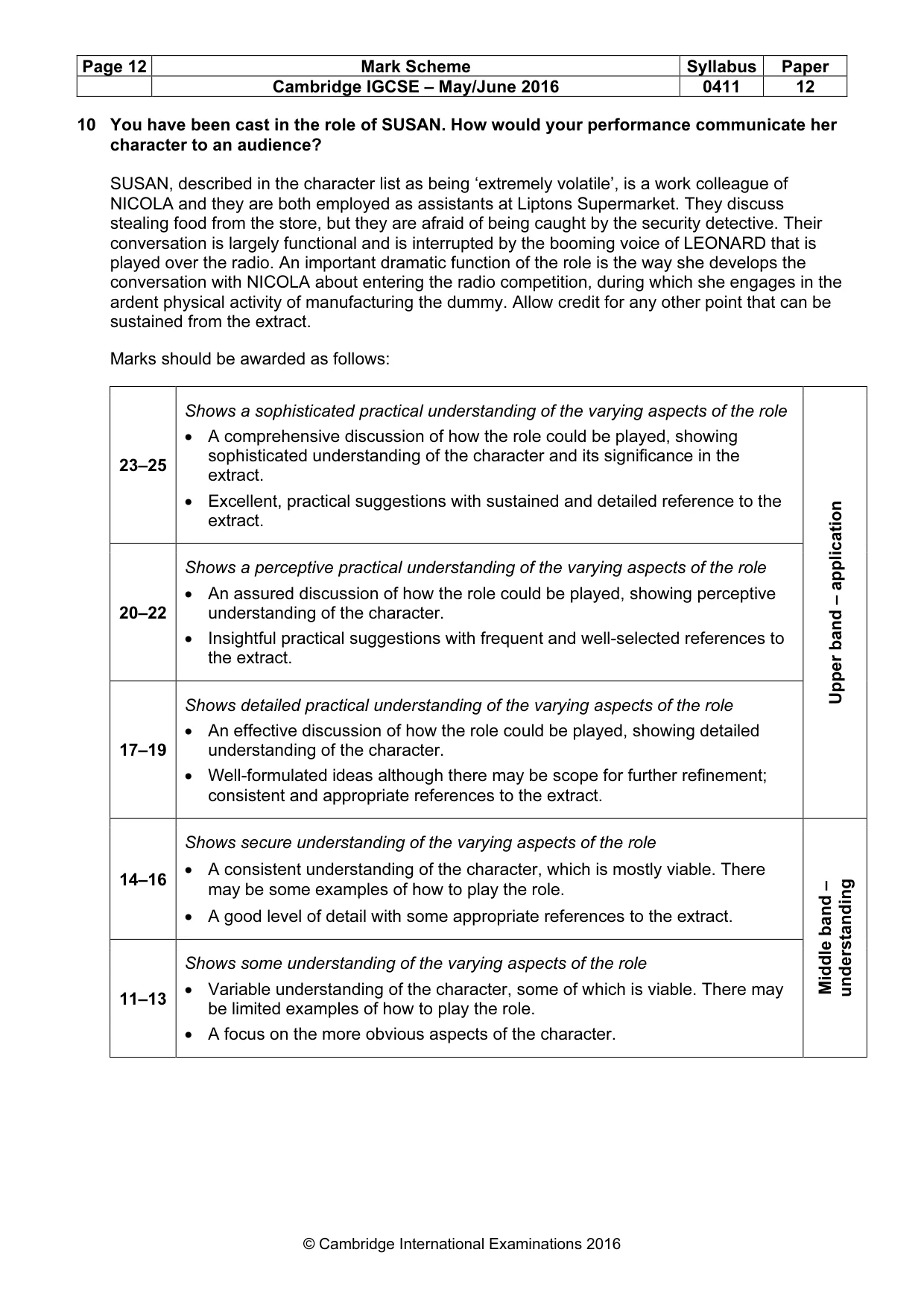
Page 12 Mark Scheme Syllabus Paper Cambridge IGCSE – May/June 2016 0411 12 © Cambridge International Examinations 2016 10 You have been cast in the role of SUSAN. How would your performance communicate her character to an audience? SUSAN, described in the character list as being ‘extremely volatile’, is a work colleague of NICOLA and they are both employed as assistants at Liptons Supermarket. They discuss stealing food from the store, but they are afraid of being caught by the security detective. Their conversation is largely functional and is interrupted by the booming voice of LEONARD that is played over the radio. An important dramatic function of the role is the way she develops the conversation with NICOLA about entering the radio competition, during which she engages in the ardent physical activity of manufacturing the dummy. Allow credit for any other point that can be sustained from the extract. Marks should be awarded as follows: 23–25 Shows a sophisticated practical understanding of the varying aspects of the role • A comprehensive discussion of how the role could be played, showing sophisticated understanding of the character and its significance in the extract. • Excellent, practical suggestions with sustained and detailed reference to the extract. Upper band – application 20–22 Shows a perceptive practical understanding of the varying aspects of the role • An assured discussion of how the role could be played, showing perceptive understanding of the character. • Insightful practical suggestions with frequent and well-selected references to the extract. 17–19 Shows detailed practical understanding of the varying aspects of the role • An effective discussion of how the role could be played, showing detailed understanding of the character. • Well-formulated ideas although there may be scope for further refinement; consistent and appropriate references to the extract. 14–16 Shows secure understanding of the varying aspects of the role • A consistent understanding of the character, which is mostly viable. There may be some examples of how to play the role. • A good level of detail with some appropriate references to the extract. Middle band – understanding 11–13 Shows some understanding of the varying aspects of the role • Variable understanding of the character, some of which is viable. There may be limited examples of how to play the role. • A focus on the more obvious aspects of the character.
Mark scheme, page 13
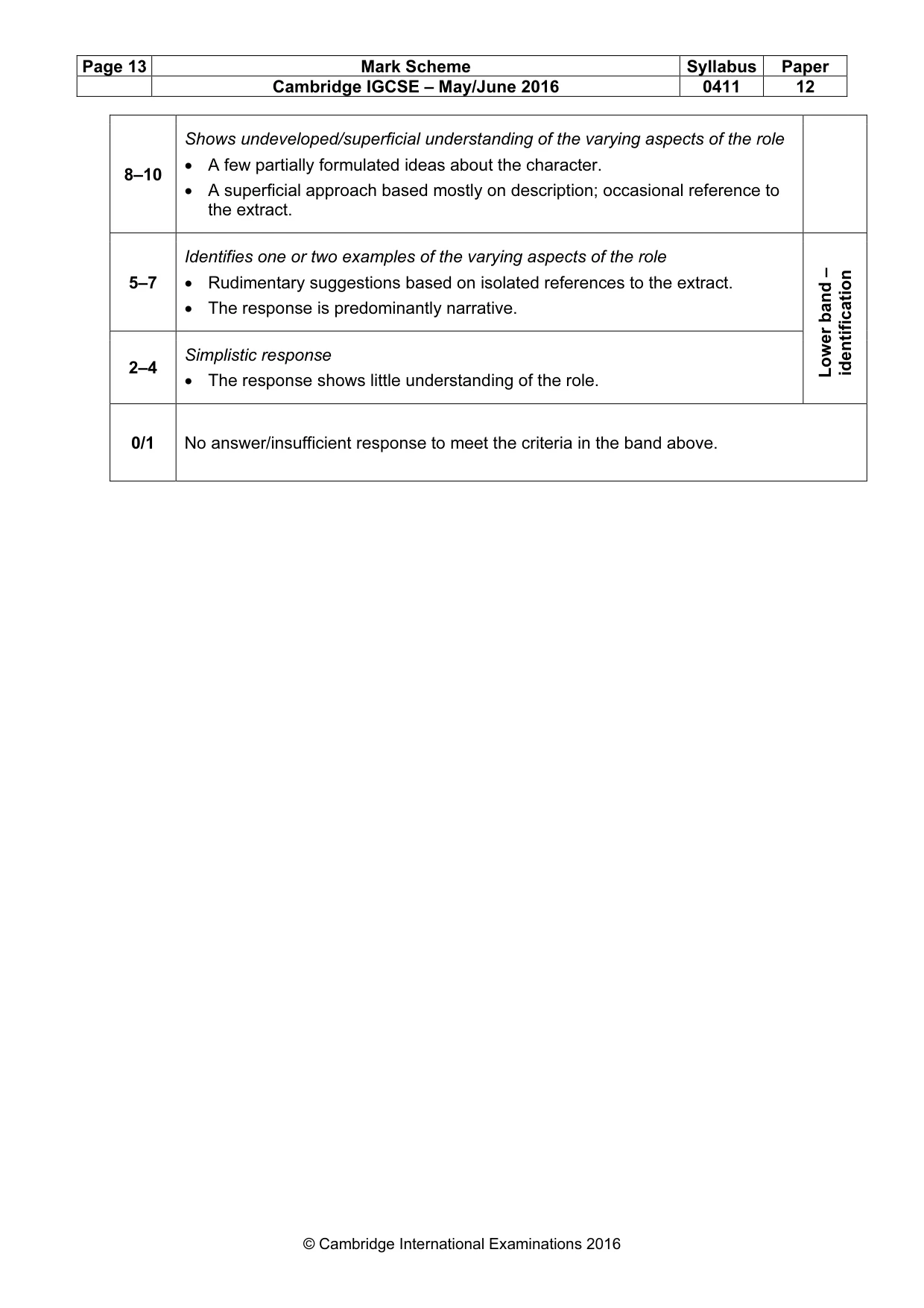
Page 13 Mark Scheme Syllabus Paper Cambridge IGCSE – May/June 2016 0411 12 © Cambridge International Examinations 2016 8–10 Shows undeveloped/superficial understanding of the varying aspects of the role • A few partially formulated ideas about the character. • A superficial approach based mostly on description; occasional reference to the extract. 5–7 Identifies one or two examples of the varying aspects of the role • Rudimentary suggestions based on isolated references to the extract. • The response is predominantly narrative. Lower band – identification 2–4 Simplistic response • The response shows little understanding of the role. 0/1 No answer/insufficient response to meet the criteria in the band above.
Mark scheme, page 14
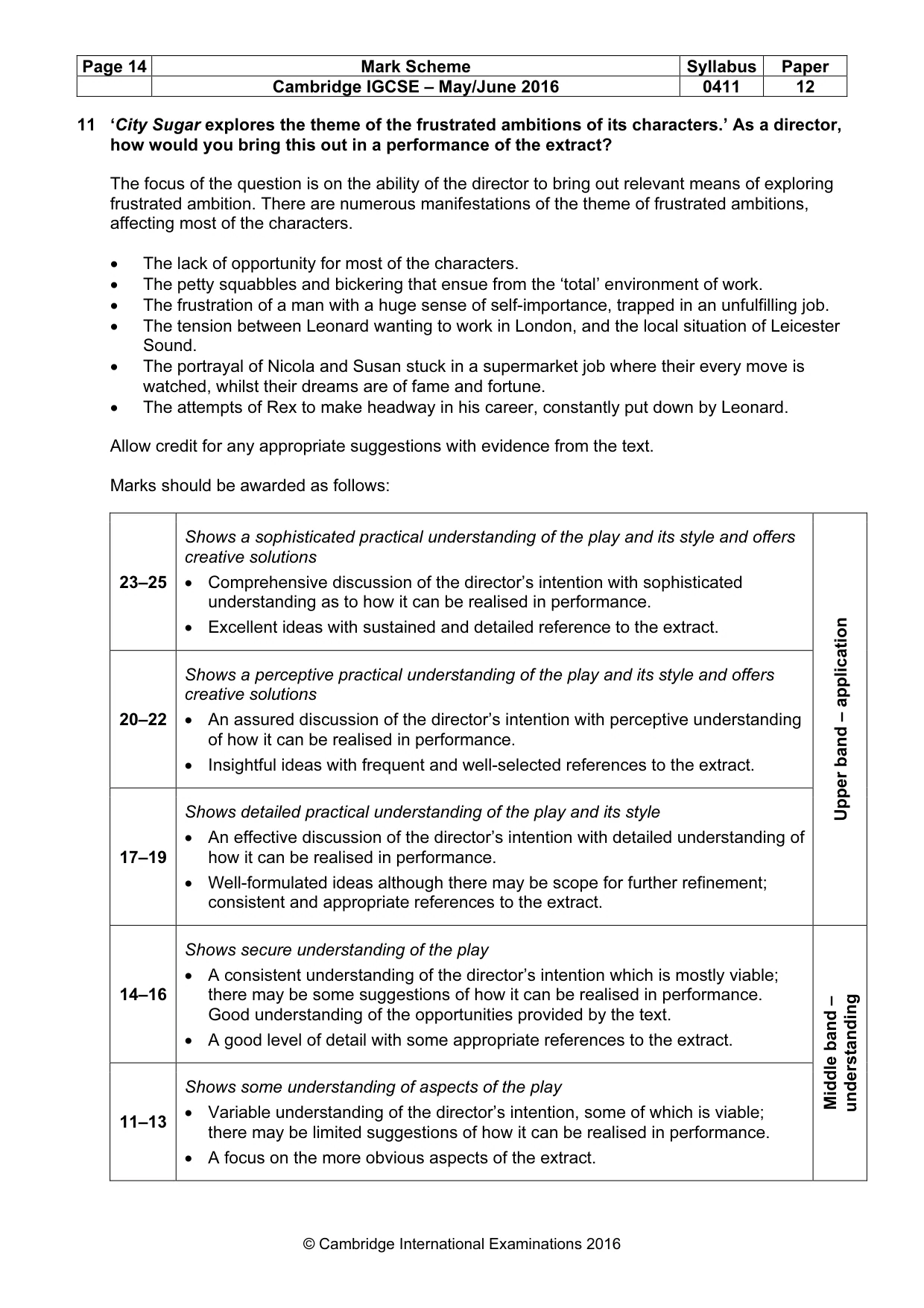
Page 14 Mark Scheme Syllabus Paper Cambridge IGCSE – May/June 2016 0411 12 © Cambridge International Examinations 2016 11 ‘City Sugar explores the theme of the frustrated ambitions of its characters.’ As a director, how would you bring this out in a performance of the extract? The focus of the question is on the ability of the director to bring out relevant means of exploring frustrated ambition. There are numerous manifestations of the theme of frustrated ambitions, affecting most of the characters. • The lack of opportunity for most of the characters. • The petty squabbles and bickering that ensue from the ‘total’ environment of work. • The frustration of a man with a huge sense of self-importance, trapped in an unfulfilling job. • The tension between Leonard wanting to work in London, and the local situation of Leicester Sound. • The portrayal of Nicola and Susan stuck in a supermarket job where their every move is watched, whilst their dreams are of fame and fortune. • The attempts of Rex to make headway in his career, constantly put down by Leonard. Allow credit for any appropriate suggestions with evidence from the text. Marks should be awarded as follows: 23–25 Shows a sophisticated practical understanding of the play and its style and offers creative solutions • Comprehensive discussion of the director’s intention with sophisticated understanding as to how it can be realised in performance. • Excellent ideas with sustained and detailed reference to the extract. Upper band – application 20–22 Shows a perceptive practical understanding of the play and its style and offers creative solutions • An assured discussion of the director’s intention with perceptive understanding of how it can be realised in performance. • Insightful ideas with frequent and well-selected references to the extract. 17–19 Shows detailed practical understanding of the play and its style • An effective discussion of the director’s intention with detailed understanding of how it can be realised in performance. • Well-formulated ideas although there may be scope for further refinement; consistent and appropriate references to the extract. 14–16 Shows secure understanding of the play • A consistent understanding of the director’s intention which is mostly viable; there may be some suggestions of how it can be realised in performance. Good understanding of the opportunities provided by the text. • A good level of detail with some appropriate references to the extract. Middle band – understanding 11–13 Shows some understanding of aspects of the play • Variable understanding of the director’s intention, some of which is viable; there may be limited suggestions of how it can be realised in performance. • A focus on the more obvious aspects of the extract.
Mark scheme, page 15
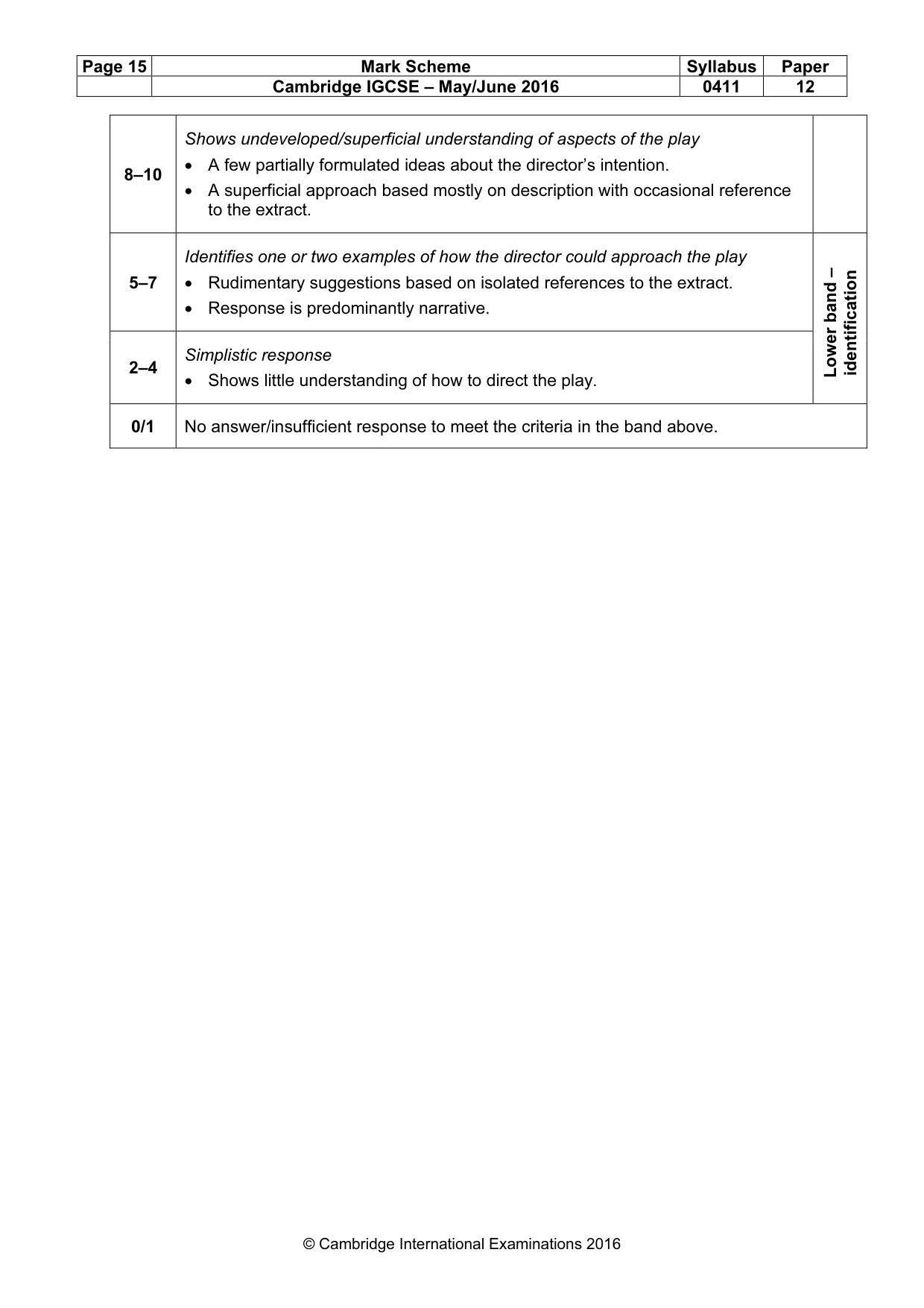
Page 15 Mark Scheme Syllabus Paper Cambridge IGCSE – May/June 2016 0411 12 © Cambridge International Examinations 2016 8–10 Shows undeveloped/superficial understanding of aspects of the play • A few partially formulated ideas about the director’s intention. • A superficial approach based mostly on description with occasional reference to the extract. 5–7 Identifies one or two examples of how the director could approach the play • Rudimentary suggestions based on isolated references to the extract. • Response is predominantly narrative. Lower band – identification 2–4 Simplistic response • Shows little understanding of how to direct the play. 0/1 No answer/insufficient response to meet the criteria in the band above.
Mark scheme, page 16
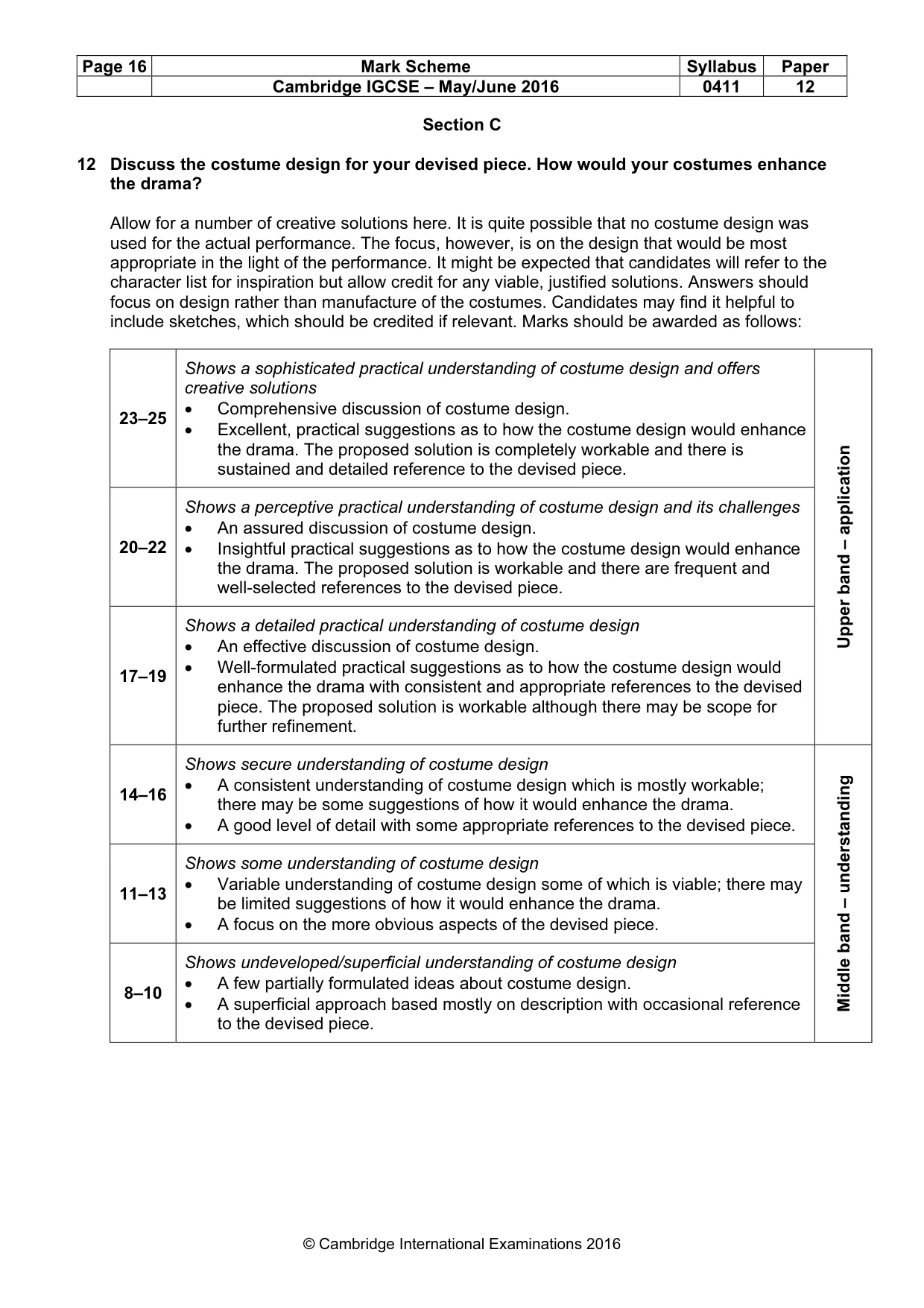
Page 16 Mark Scheme Syllabus Paper Cambridge IGCSE – May/June 2016 0411 12 © Cambridge International Examinations 2016 Section C 12 Discuss the costume design for your devised piece. How would your costumes enhance the drama? Allow for a number of creative solutions here. It is quite possible that no costume design was used for the actual performance. The focus, however, is on the design that would be most appropriate in the light of the performance. It might be expected that candidates will refer to the character list for inspiration but allow credit for any viable, justified solutions. Answers should focus on design rather than manufacture of the costumes. Candidates may find it helpful to include sketches, which should be credited if relevant. Marks should be awarded as follows: 23–25 Shows a sophisticated practical understanding of costume design and offers creative solutions • Comprehensive discussion of costume design. • Excellent, practical suggestions as to how the costume design would enhance the drama. The proposed solution is completely workable and there is sustained and detailed reference to the devised piece. Upper band – application 20–22 Shows a perceptive practical understanding of costume design and its challenges • An assured discussion of costume design. • Insightful practical suggestions as to how the costume design would enhance the drama. The proposed solution is workable and there are frequent and well-selected references to the devised piece. 17–19 Shows a detailed practical understanding of costume design • An effective discussion of costume design. • Well-formulated practical suggestions as to how the costume design would enhance the drama with consistent and appropriate references to the devised piece. The proposed solution is workable although there may be scope for further refinement. 14–16 Shows secure understanding of costume design • A consistent understanding of costume design which is mostly workable; there may be some suggestions of how it would enhance the drama. • A good level of detail with some appropriate references to the devised piece. Middle band – understanding 11–13 Shows some understanding of costume design • Variable understanding of costume design some of which is viable; there may be limited suggestions of how it would enhance the drama. • A focus on the more obvious aspects of the devised piece. 8–10 Shows undeveloped/superficial understanding of costume design • A few partially formulated ideas about costume design. • A superficial approach based mostly on description with occasional reference to the devised piece.
Mark scheme, page 17
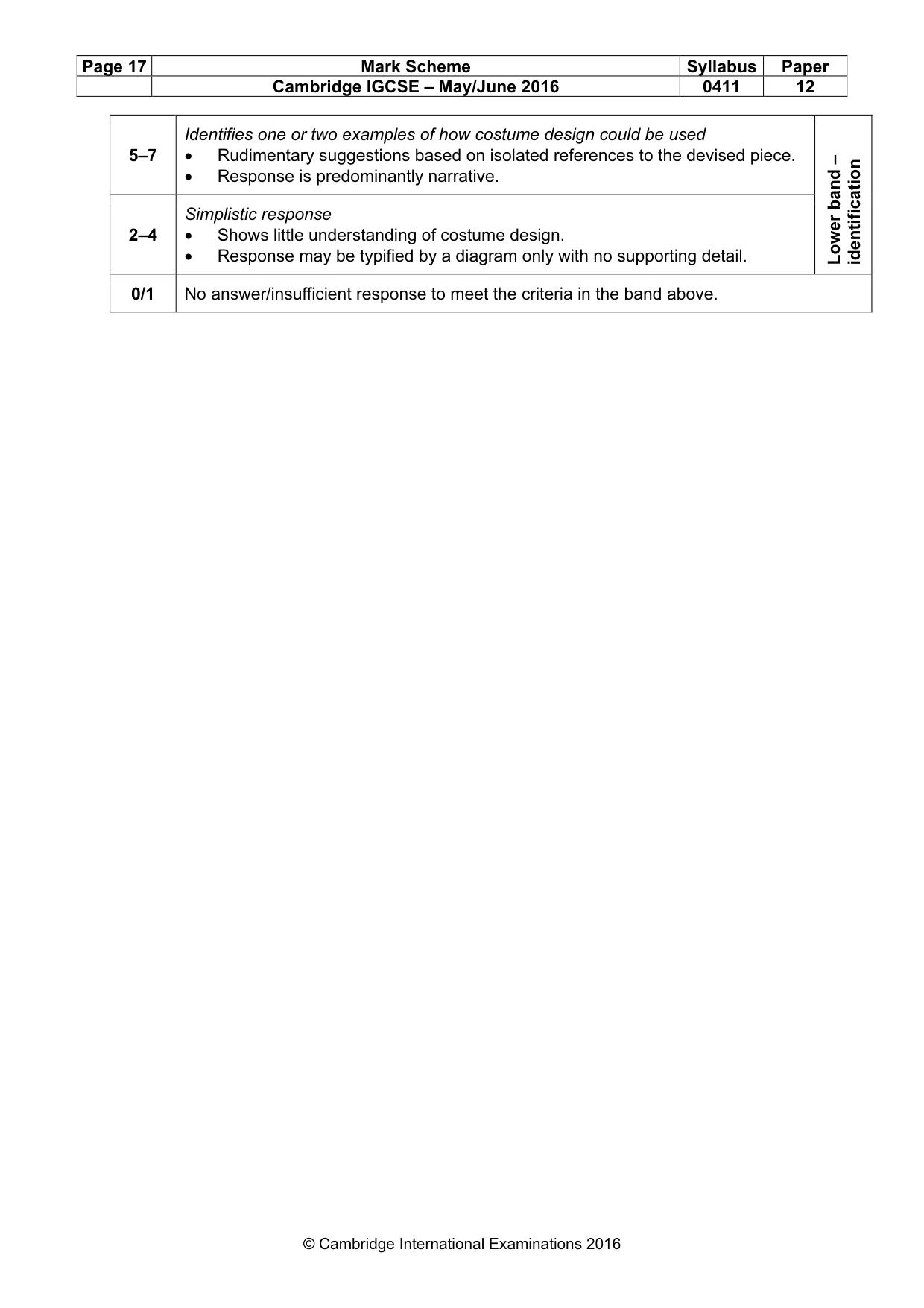
Page 17 Mark Scheme Syllabus Paper Cambridge IGCSE – May/June 2016 0411 12 © Cambridge International Examinations 2016 5–7 Identifies one or two examples of how costume design could be used • Rudimentary suggestions based on isolated references to the devised piece. • Response is predominantly narrative. Lower band – identification 2–4 Simplistic response • Shows little understanding of costume design. • Response may be typified by a diagram only with no supporting detail. 0/1 No answer/insufficient response to meet the criteria in the band above.
Mark scheme, page 18
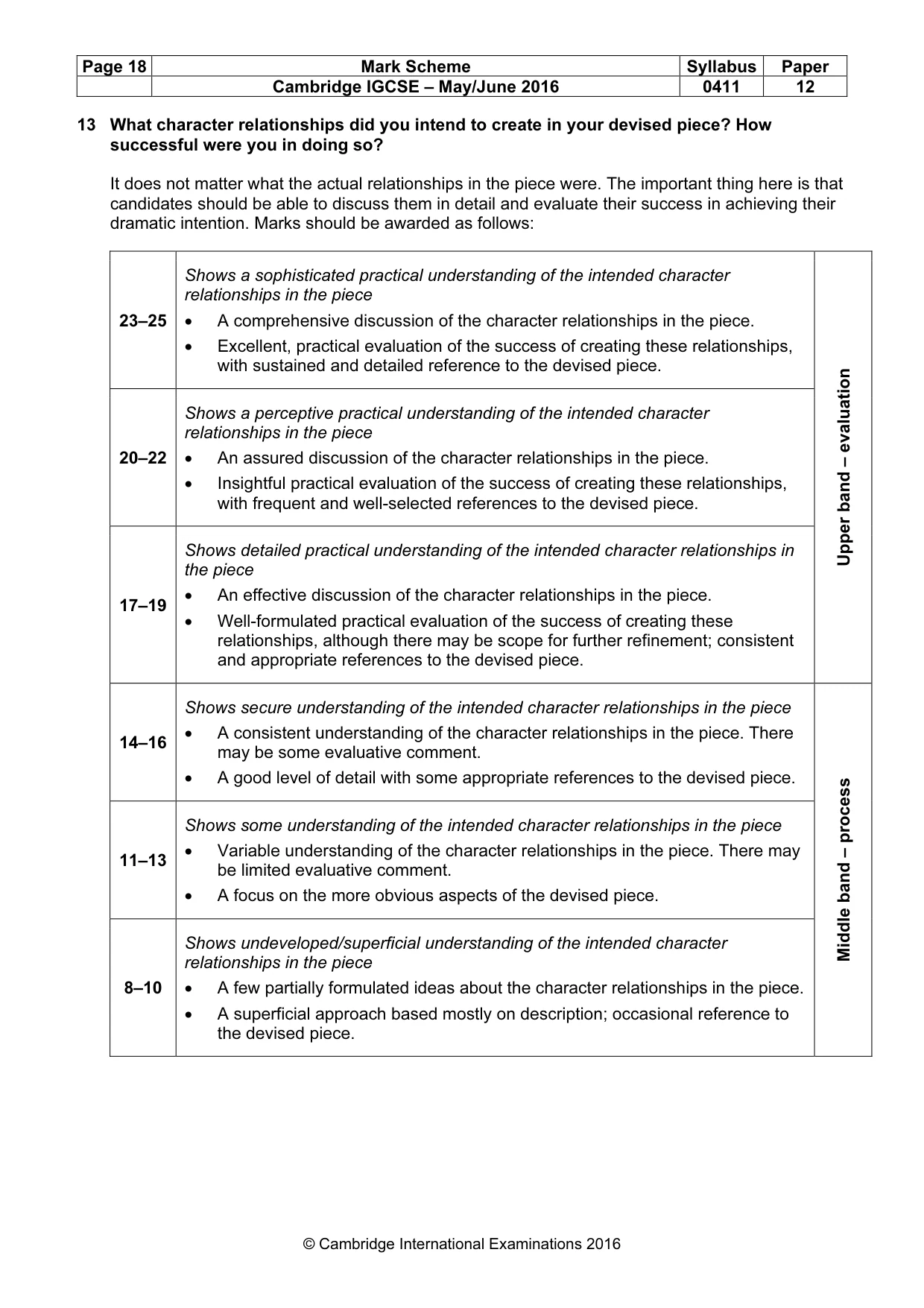
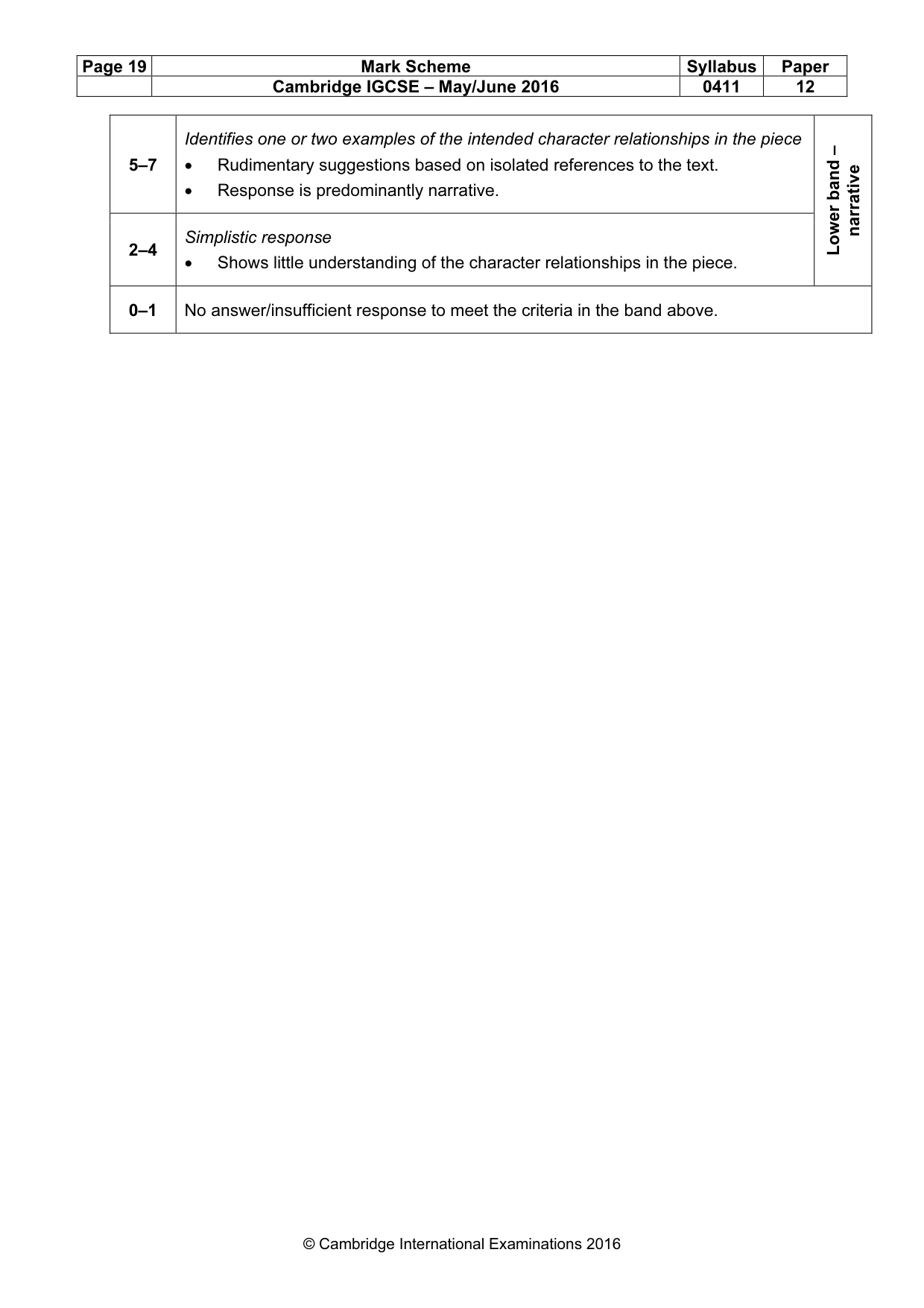
Page 18 Mark Scheme Syllabus Paper Cambridge IGCSE – May/June 2016 0411 12 © Cambridge International Examinations 2016 13 What character relationships did you intend to create in your devised piece? How successful were you in doing so? It does not matter what the actual relationships in the piece were. The important thing here is that candidates should be able to discuss them in detail and evaluate their success in achieving their dramatic intention. Marks should be awarded as follows: 23–25 Shows a sophisticated practical understanding of the intended character relationships in the piece • A comprehensive discussion of the character relationships in the piece. • Excellent, practical evaluation of the success of creating these relationships, with sustained and detailed reference to the devised piece. Upper band – evaluation 20–22 Shows a perceptive practical understanding of the intended character relationships in the piece • An assured discussion of the character relationships in the piece. • Insightful practical evaluation of the success of creating these relationships, with frequent and well-selected references to the devised piece. 17–19 Shows detailed practical understanding of the intended character relationships in the piece • An effective discussion of the character relationships in the piece. • Well-formulated practical evaluation of the success of creating these relationships, although there may be scope for further refinement; consistent and appropriate references to the devised piece. 14–16 Shows secure understanding of the intended character relationships in the piece • A consistent understanding of the character relationships in the piece. There may be some evaluative comment. • A good level of detail with some appropriate references to the devised piece. Middle band – process 11–13 Shows some understanding of the intended character relationships in the piece • Variable understanding of the character relationships in the piece. There may be limited evaluative comment. • A focus on the more obvious aspects of the devised piece. 8–10 Shows undeveloped/superficial understanding of the intended character relationships in the piece • A few partially formulated ideas about the character relationships in the piece. • A superficial approach based mostly on description; occasional reference to the devised piece.
Mark scheme, page 19
Page 19 Mark Scheme Syllabus Paper Cambridge IGCSE – May/June 2016 0411 12 © Cambridge International Examinations 2016 5–7 Identifies one or two examples of the intended character relationships in the piece • Rudimentary suggestions based on isolated references to the text. • Response is predominantly narrative. Lower band – narrative 2–4 Simplistic response • Shows little understanding of the character relationships in the piece. 0–1 No answer/insufficient response to meet the criteria in the band above.
Mark scheme, page 20
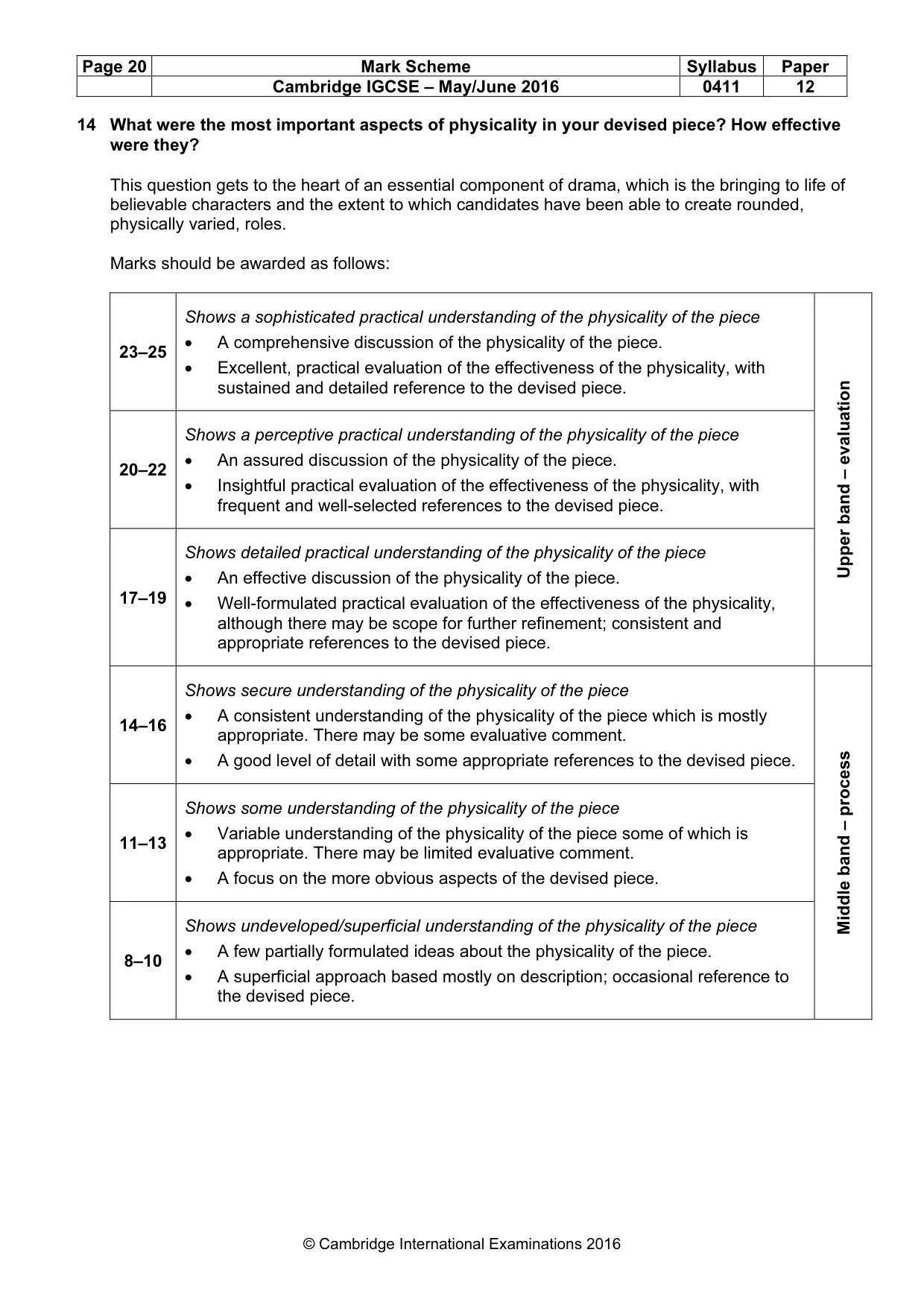
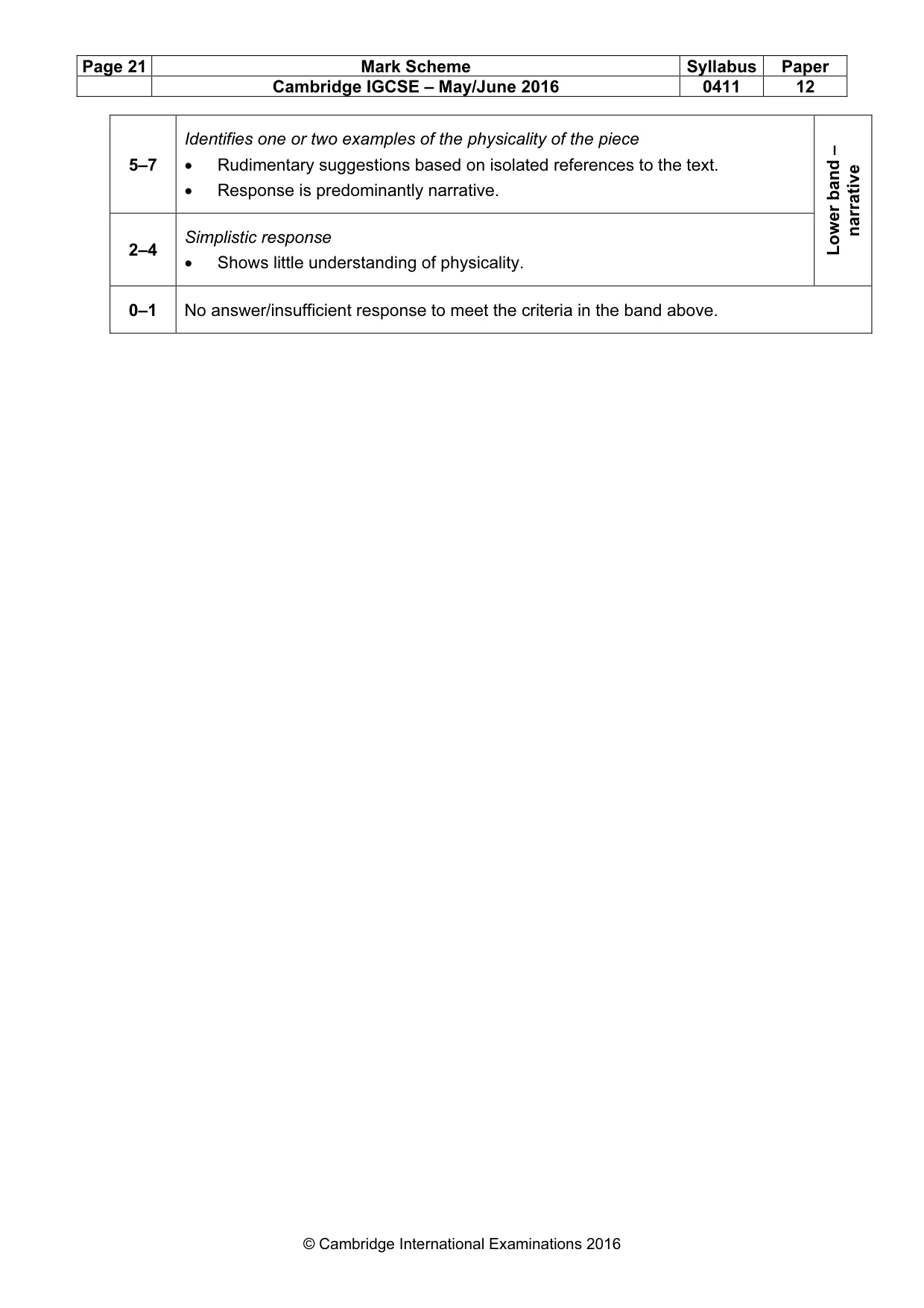
Page 20 Mark Scheme Syllabus Paper Cambridge IGCSE – May/June 2016 0411 12 © Cambridge International Examinations 2016 14 What were the most important aspects of physicality in your devised piece? How effective were they? This question gets to the heart of an essential component of drama, which is the bringing to life of believable characters and the extent to which candidates have been able to create rounded, physically varied, roles. Marks should be awarded as follows: 23–25 Shows a sophisticated practical understanding of the physicality of the piece • A comprehensive discussion of the physicality of the piece. • Excellent, practical evaluation of the effectiveness of the physicality, with sustained and detailed reference to the devised piece. Upper band – evaluation 20–22 Shows a perceptive practical understanding of the physicality of the piece • An assured discussion of the physicality of the piece. • Insightful practical evaluation of the effectiveness of the physicality, with frequent and well-selected references to the devised piece. 17–19 Shows detailed practical understanding of the physicality of the piece • An effective discussion of the physicality of the piece. • Well-formulated practical evaluation of the effectiveness of the physicality, although there may be scope for further refinement; consistent and appropriate references to the devised piece. 14–16 Shows secure understanding of the physicality of the piece • A consistent understanding of the physicality of the piece which is mostly appropriate. There may be some evaluative comment. • A good level of detail with some appropriate references to the devised piece. Middle band – process 11–13 Shows some understanding of the physicality of the piece • Variable understanding of the physicality of the piece some of which is appropriate. There may be limited evaluative comment. • A focus on the more obvious aspects of the devised piece. 8–10 Shows undeveloped/superficial understanding of the physicality of the piece • A few partially formulated ideas about the physicality of the piece. • A superficial approach based mostly on description; occasional reference to the devised piece.
Mark scheme, page 21
Page 21 Mark Scheme Syllabus Paper Cambridge IGCSE – May/June 2016 0411 12 © Cambridge International Examinations 2016 5–7 Identifies one or two examples of the physicality of the piece • Rudimentary suggestions based on isolated references to the text. • Response is predominantly narrative. Lower band – narrative 2–4 Simplistic response • Shows little understanding of physicality. 0–1 No answer/insufficient response to meet the criteria in the band above.
What you needed in this session
Cambridge’s own grade thresholds for 2016 May/June, Paper 1 · Variant 2. A higher threshold means an easier paper — the bar moves with how the cohort did.