Cambridge IGCSE Drama 0411 — 2016 May/June Paper 1 · Variant 3
0411/13/M/J/16 · 80 marks · ≈90 min
The question paper and its mark scheme, free to read here and free to download. This is Cambridge’s own paper, exactly as it was sat.
Question paper4 pages

Mark scheme18 pages
Answers below. Sit the paper first if you are practising.
Paper as text
Question paper, page 1
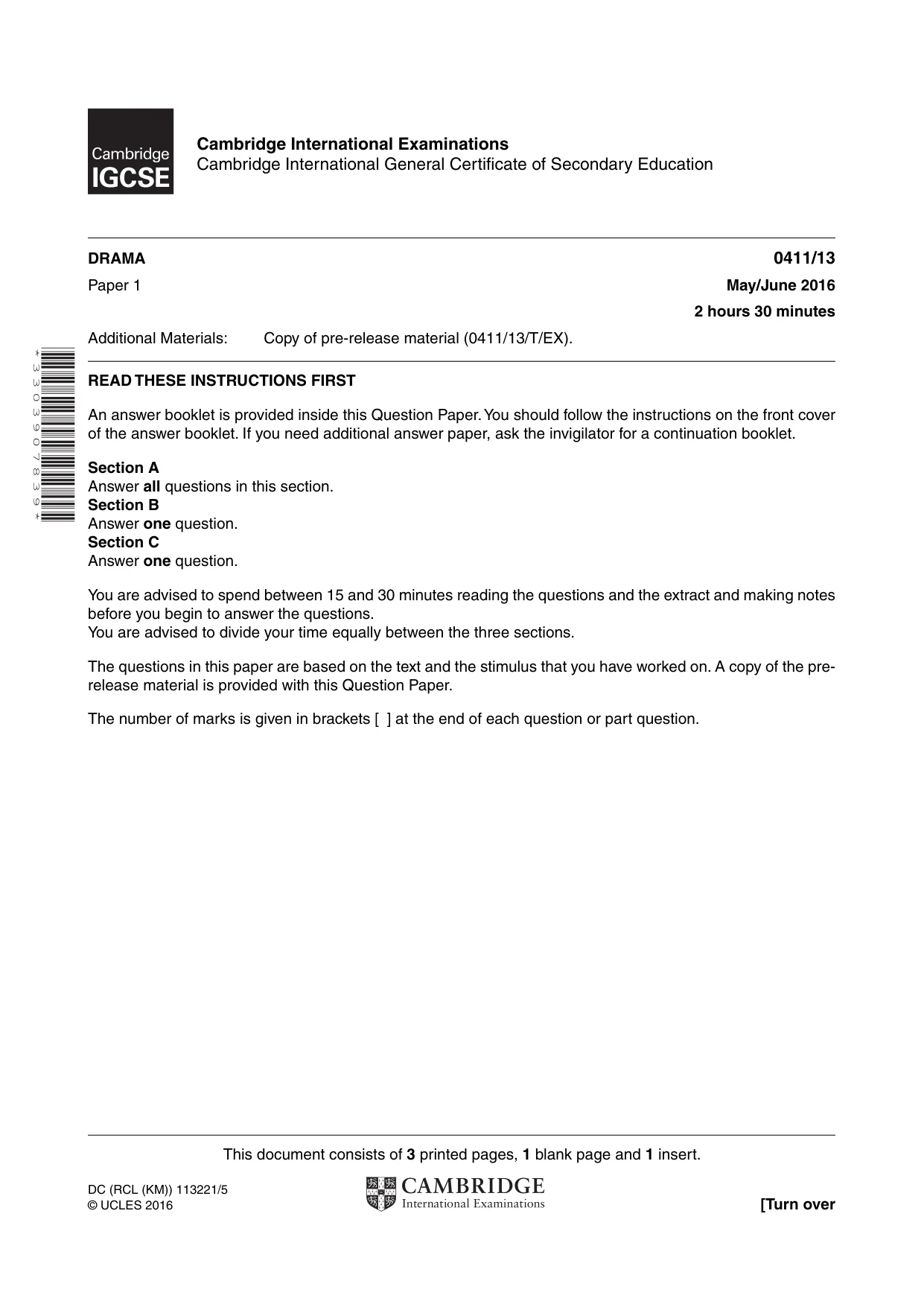
This document consists of 3 printed pages, 1 blank page and 1 insert. DC (RCL (KM)) 113221/5 © UCLES 2016 [Turn over Cambridge International Examinations Cambridge International General Certificate of Secondary Education * 3 3 0 3 9 0 7 8 3 9 * DRAMA 0411/13 Paper 1 May/June 2016 2 hours 30 minutes Additional Materials: Copy of pre-release material (0411/13/T/EX). READ THESE INSTRUCTIONS FIRST An answer booklet is provided inside this Question Paper. You should follow the instructions on the front cover of the answer booklet. If you need additional answer paper, ask the invigilator for a continuation booklet. Section A Answer all questions in this section. Section B Answer one question. Section C Answer one question. You are advised to spend between 15 and 30 minutes reading the questions and the extract and making notes before you begin to answer the questions. You are advised to divide your time equally between the three sections. The questions in this paper are based on the text and the stimulus that you have worked on. A copy of the pre- release material is provided with this Question Paper. The number of marks is given in brackets [ ] at the end of each question or part question.
Question paper, page 2
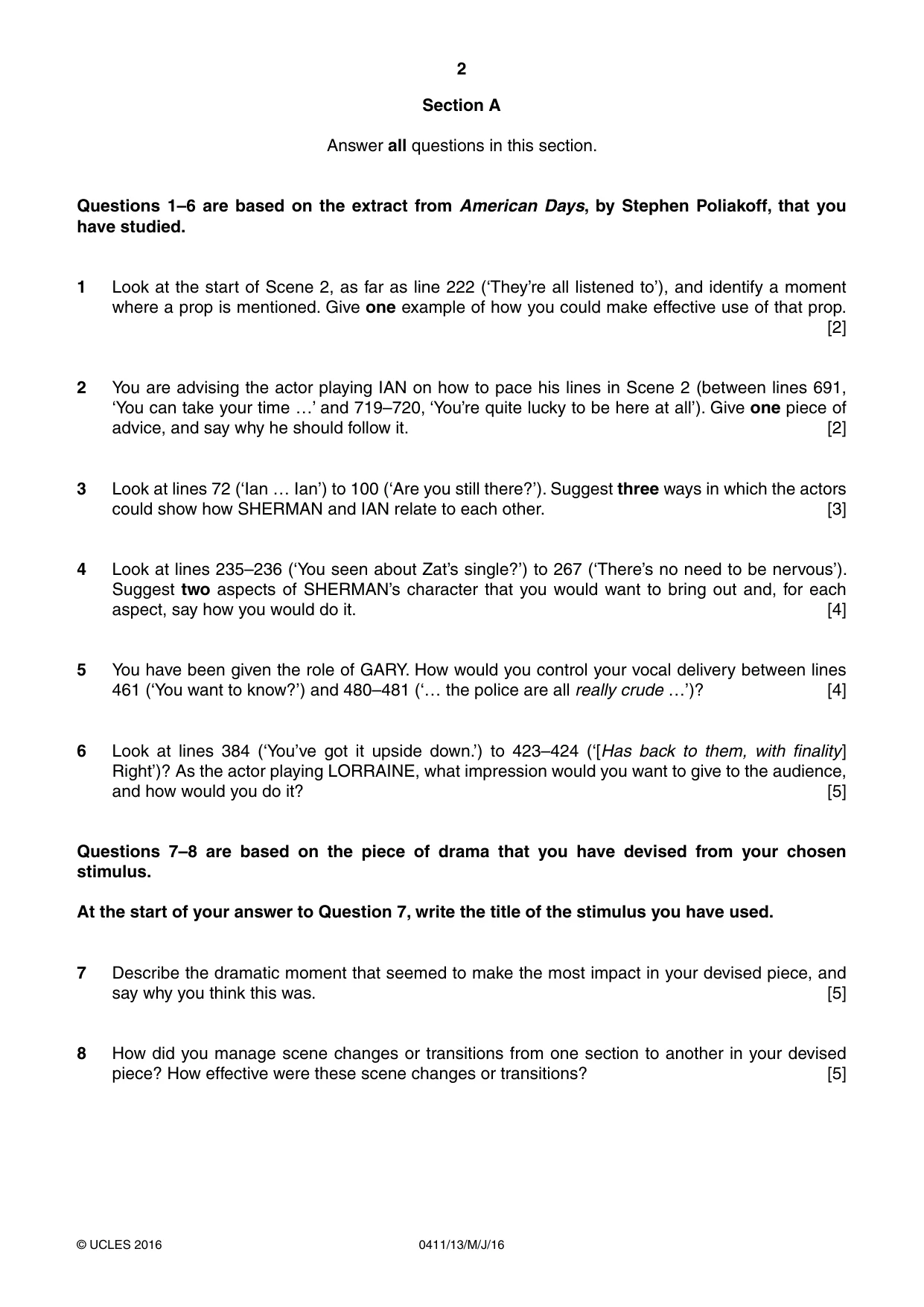
2 0411/13/M/J/16 © UCLES 2016 Section A Answer all questions in this section. Questions 1–6 are based on the extract from American Days, by Stephen Poliakoff, that you have studied. 1 Look at the start of Scene 2, as far as line 222 (‘They’re all listened to’), and identify a moment where a prop is mentioned. Give one example of how you could make effective use of that prop. [2] 2 You are advising the actor playing IAN on how to pace his lines in Scene 2 (between lines 691, ‘You can take your time …’ and 719–720, ‘You’re quite lucky to be here at all’). Give one piece of advice, and say why he should follow it. [2] 3 Look at lines 72 (‘Ian … Ian’) to 100 (‘Are you still there?’). Suggest three ways in which the actors could show how SHERMAN and IAN relate to each other. [3] 4 Look at lines 235–236 (‘You seen about Zat’s single?’) to 267 (‘There’s no need to be nervous’). Suggest two aspects of SHERMAN’s character that you would want to bring out and, for each aspect, say how you would do it. [4] 5 You have been given the role of GARY. How would you control your vocal delivery between lines 461 (‘You want to know?’) and 480–481 (‘… the police are all really crude …’)? [4] 6 Look at lines 384 (‘You’ve got it upside down.’) to 423–424 (‘[Has back to them, with finality ] Right’)? As the actor playing LORRAINE, what impression would you want to give to the audience, and how would you do it? [5] Questions 7–8 are based on the piece of drama that you have devised from your chosen stimulus. At the start of your answer to Question 7, write the title of the stimulus you have used. 7 Describe the dramatic moment that seemed to make the most impact in your devised piece, and say why you think this was. [5] 8 How did you manage scene changes or transitions from one section to another in your devised piece? How effective were these scene changes or transitions? [5]
Question paper, page 3
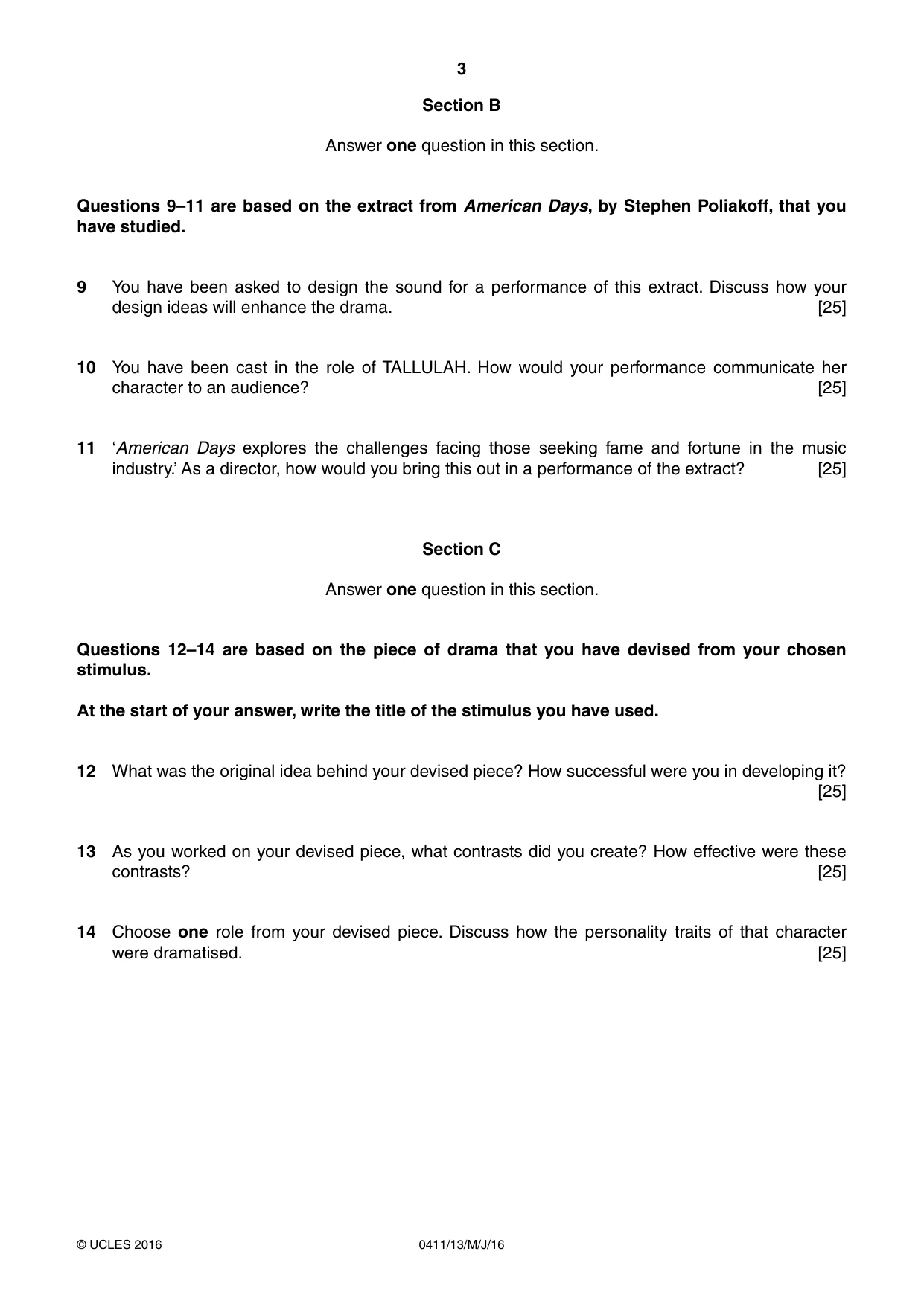
3 0411/13/M/J/16 © UCLES 2016 Section B Answer one question in this section. Questions 9–11 are based on the extract from American Days, by Stephen Poliakoff, that you have studied. 9 You have been asked to design the sound for a performance of this extract. Discuss how your design ideas will enhance the drama. [25] 10 You have been cast in the role of TALLULAH. How would your performance communicate her character to an audience? [25] 11 ‘American Days explores the challenges facing those seeking fame and fortune in the music industry.’ As a director, how would you bring this out in a performance of the extract? [25] Section C Answer one question in this section. Questions 12–14 are based on the piece of drama that you have devised from your chosen stimulus. At the start of your answer, write the title of the stimulus you have used. 12 What was the original idea behind your devised piece? How successful were you in developing it? [25] 13 As you worked on your devised piece, what contrasts did you create? How effective were these contrasts? [25] 14 Choose one role from your devised piece. Discuss how the personality traits of that character were dramatised. [25]
Question paper, page 4
4 0411/13/M/J/16 © UCLES 2016 BLANK PAGE Permission to reproduce items where third-party owned material protected by copyright is included has been sought and cleared where possible. Every reasonable effort has been made by the publisher (UCLES) to trace copyright holders, but if any items requiring clearance have unwittingly been included, the publisher will be pleased to make amends at the earliest possible opportunity. To avoid the issue of disclosure of answer-related information to candidates, all copyright acknowledgements are reproduced online in the Cambridge International Examinations Copyright Acknowledgements Booklet. This is produced for each series of examinations and is freely available to download at www.cie.org.uk after the live examination series. Cambridge International Examinations is part of the Cambridge Assessment Group. Cambridge Assessment is the brand name of University of Cambridge Local Examinations Syndicate (UCLES), which is itself a department of the University of Cambridge.
Mark scheme, page 1
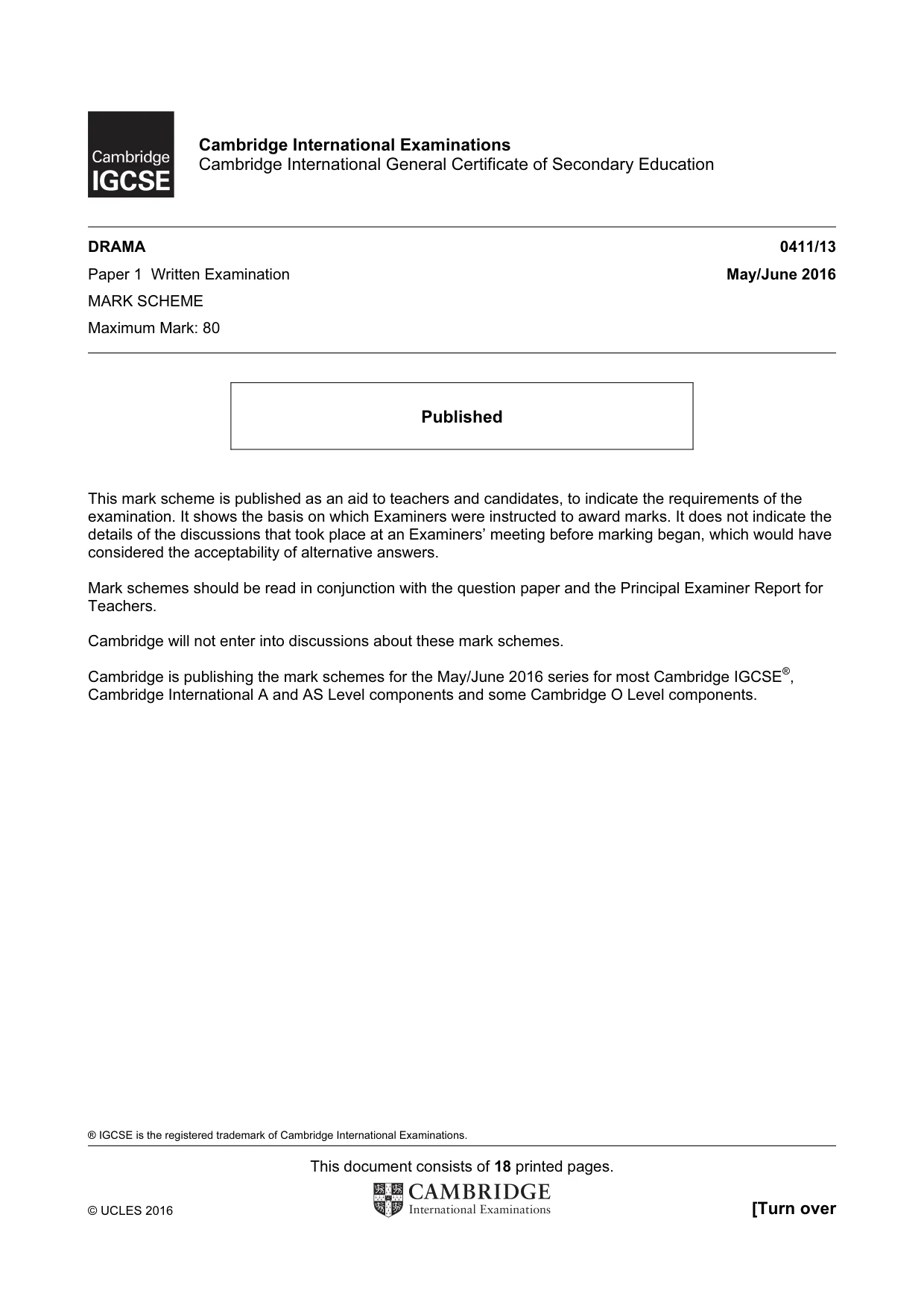
® IGCSE is the registered trademark of Cambridge International Examinations. This document consists of 18 printed pages. © UCLES 2016 [Turn over Cambridge International Examinations Cambridge International General Certificate of Secondary Education DRAMA 0411/13 Paper 1 Written Examination May/June 2016 MARK SCHEME Maximum Mark: 80 Published This mark scheme is published as an aid to teachers and candidates, to indicate the requirements of the examination. It shows the basis on which Examiners were instructed to award marks. It does not indicate the details of the discussions that took place at an Examiners’ meeting before marking began, which would have considered the acceptability of alternative answers. Mark schemes should be read in conjunction with the question paper and the Principal Examiner Report for Teachers. Cambridge will not enter into discussions about these mark schemes. Cambridge is publishing the mark schemes for the May/June 2016 series for most Cambridge IGCSE®, Cambridge International A and AS Level components and some Cambridge O Level components.
Mark scheme, page 2
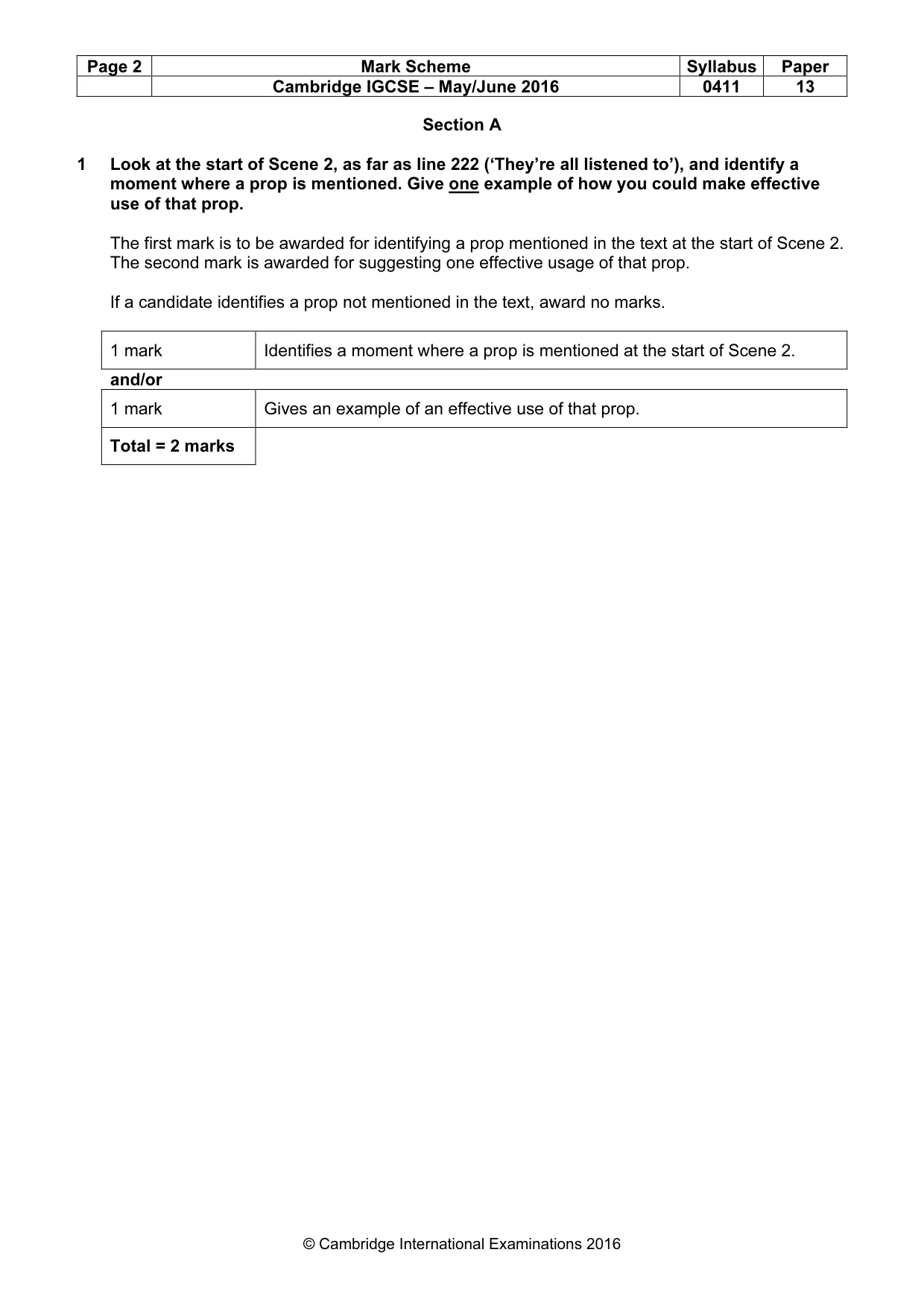
Page 2 Mark Scheme Syllabus Paper Cambridge IGCSE – May/June 2016 0411 13 © Cambridge International Examinations 2016 Section A 1 Look at the start of Scene 2, as far as line 222 (‘They’re all listened to’), and identify a moment where a prop is mentioned. Give one example of how you could make effective use of that prop. The first mark is to be awarded for identifying a prop mentioned in the text at the start of Scene 2. The second mark is awarded for suggesting one effective usage of that prop. If a candidate identifies a prop not mentioned in the text, award no marks. 1 mark Identifies a moment where a prop is mentioned at the start of Scene 2. and/or 1 mark Gives an example of an effective use of that prop. Total = 2 marks
Mark scheme, page 3
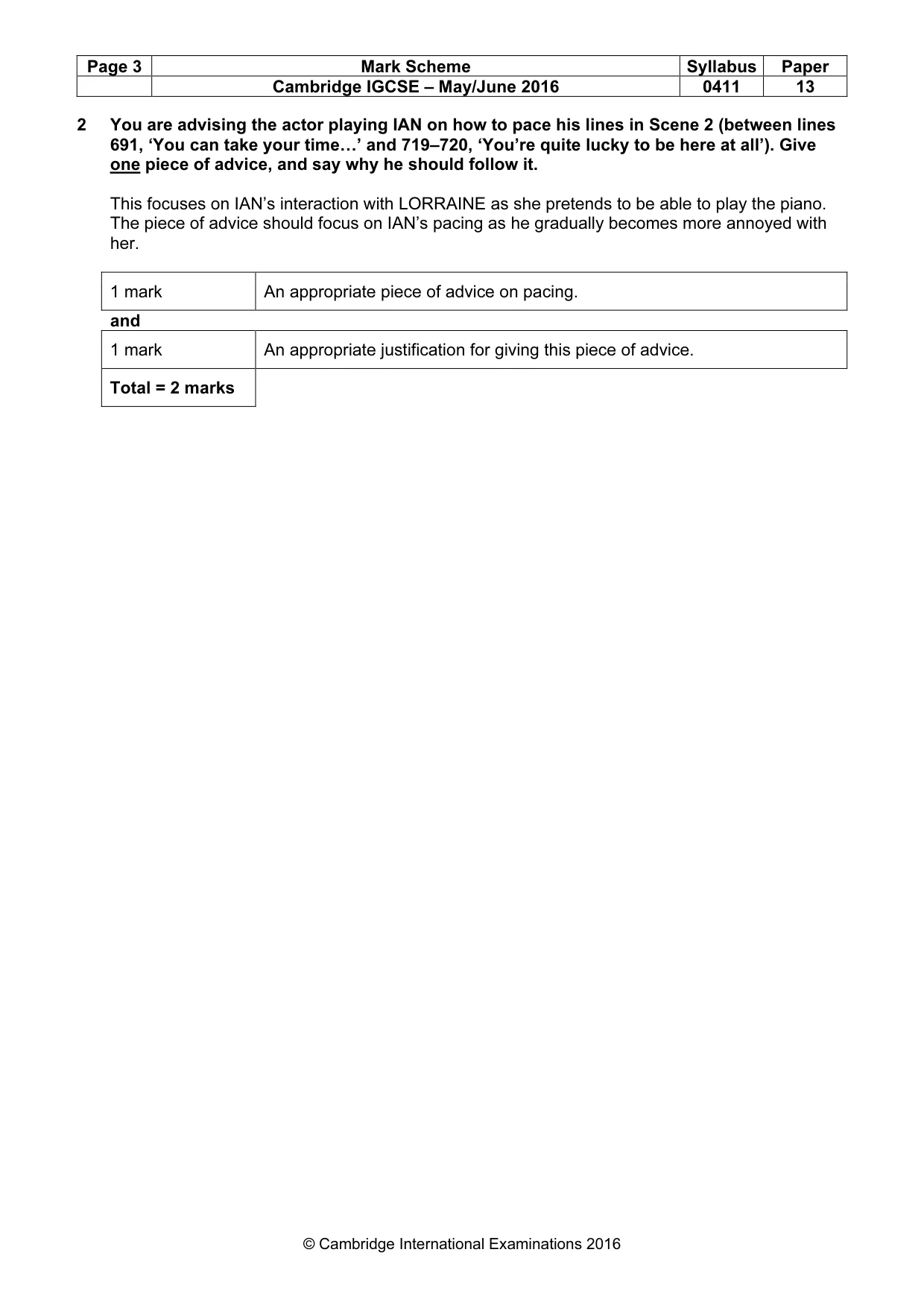
Page 3 Mark Scheme Syllabus Paper Cambridge IGCSE – May/June 2016 0411 13 © Cambridge International Examinations 2016 2 You are advising the actor playing IAN on how to pace his lines in Scene 2 (between lines 691, ‘You can take your time…’ and 719–720, ‘You’re quite lucky to be here at all’). Give one piece of advice, and say why he should follow it. This focuses on IAN’s interaction with LORRAINE as she pretends to be able to play the piano. The piece of advice should focus on IAN’s pacing as he gradually becomes more annoyed with her. 1 mark An appropriate piece of advice on pacing. and 1 mark An appropriate justification for giving this piece of advice. Total = 2 marks
Mark scheme, page 4
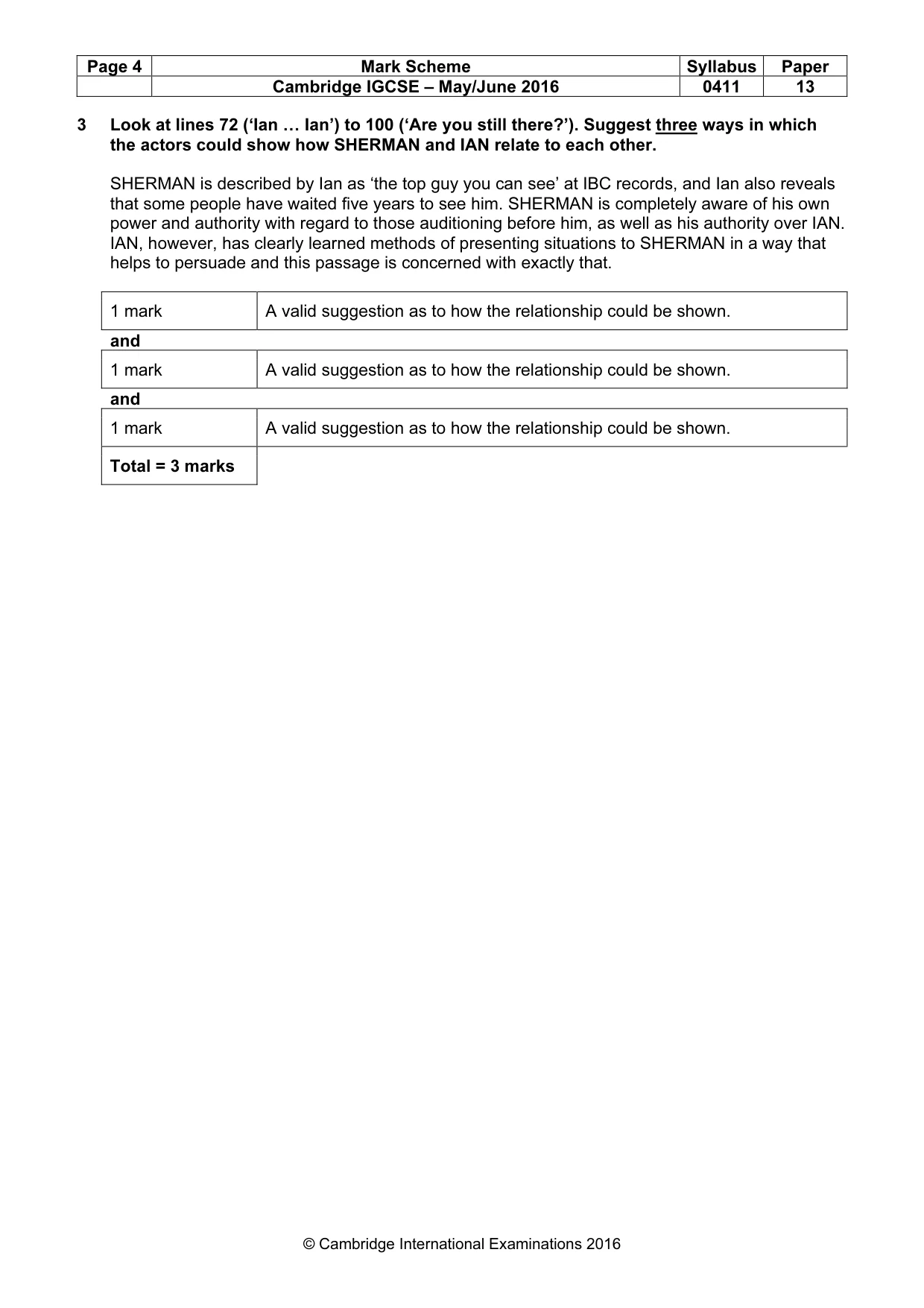
Page 4 Mark Scheme Syllabus Paper Cambridge IGCSE – May/June 2016 0411 13 © Cambridge International Examinations 2016 3 Look at lines 72 (‘Ian … Ian’) to 100 (‘Are you still there?’). Suggest three ways in which the actors could show how SHERMAN and IAN relate to each other. SHERMAN is described by Ian as ‘the top guy you can see’ at IBC records, and Ian also reveals that some people have waited five years to see him. SHERMAN is completely aware of his own power and authority with regard to those auditioning before him, as well as his authority over IAN. IAN, however, has clearly learned methods of presenting situations to SHERMAN in a way that helps to persuade and this passage is concerned with exactly that. 1 mark A valid suggestion as to how the relationship could be shown. and 1 mark A valid suggestion as to how the relationship could be shown. and 1 mark A valid suggestion as to how the relationship could be shown. Total = 3 marks
Mark scheme, page 5
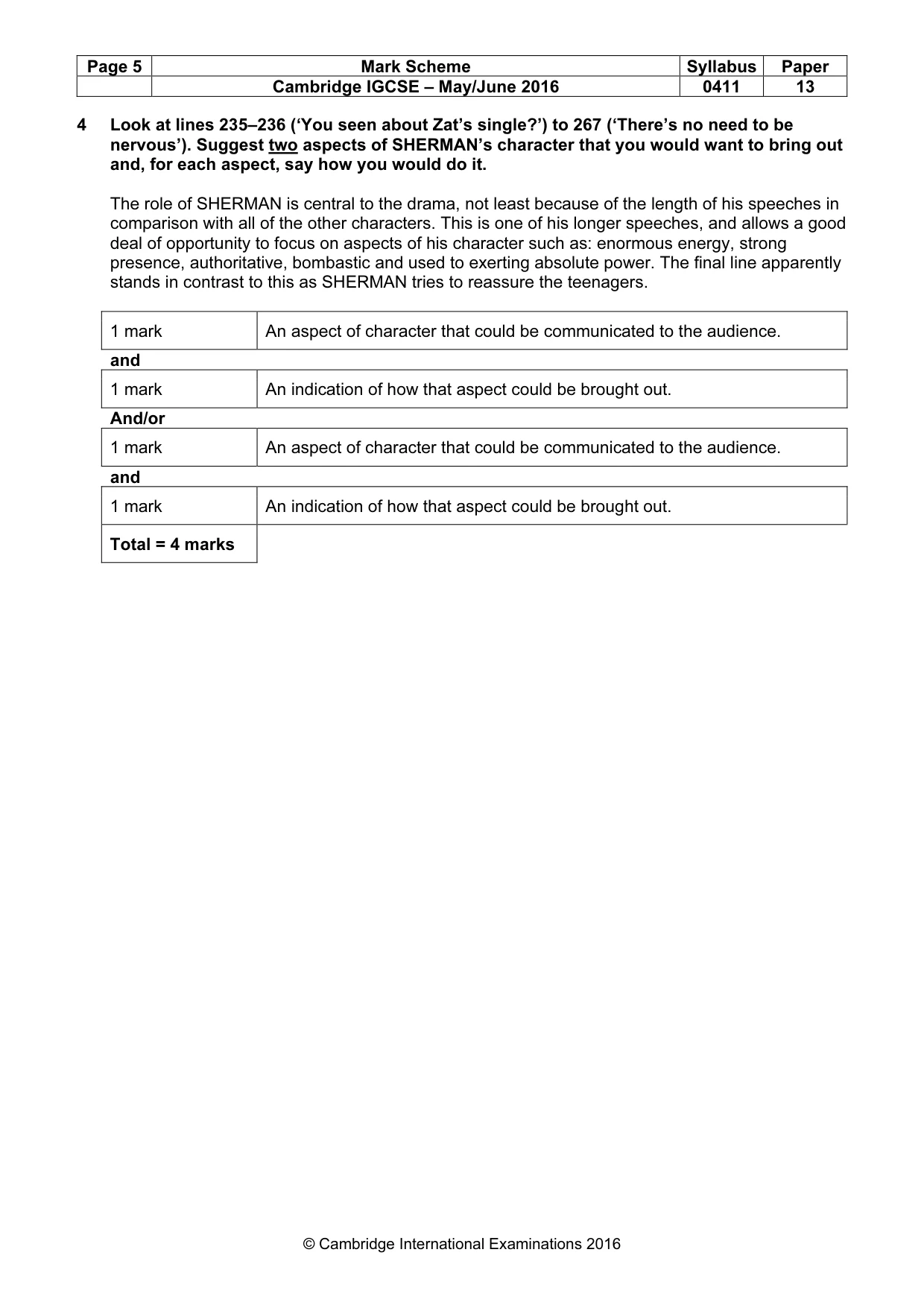
Page 5 Mark Scheme Syllabus Paper Cambridge IGCSE – May/June 2016 0411 13 © Cambridge International Examinations 2016 4 Look at lines 235–236 (‘You seen about Zat’s single?’) to 267 (‘There’s no need to be nervous’). Suggest two aspects of SHERMAN’s character that you would want to bring out and, for each aspect, say how you would do it. The role of SHERMAN is central to the drama, not least because of the length of his speeches in comparison with all of the other characters. This is one of his longer speeches, and allows a good deal of opportunity to focus on aspects of his character such as: enormous energy, strong presence, authoritative, bombastic and used to exerting absolute power. The final line apparently stands in contrast to this as SHERMAN tries to reassure the teenagers. 1 mark An aspect of character that could be communicated to the audience. and 1 mark An indication of how that aspect could be brought out. And/or 1 mark An aspect of character that could be communicated to the audience. and 1 mark An indication of how that aspect could be brought out. Total = 4 marks
Mark scheme, page 6
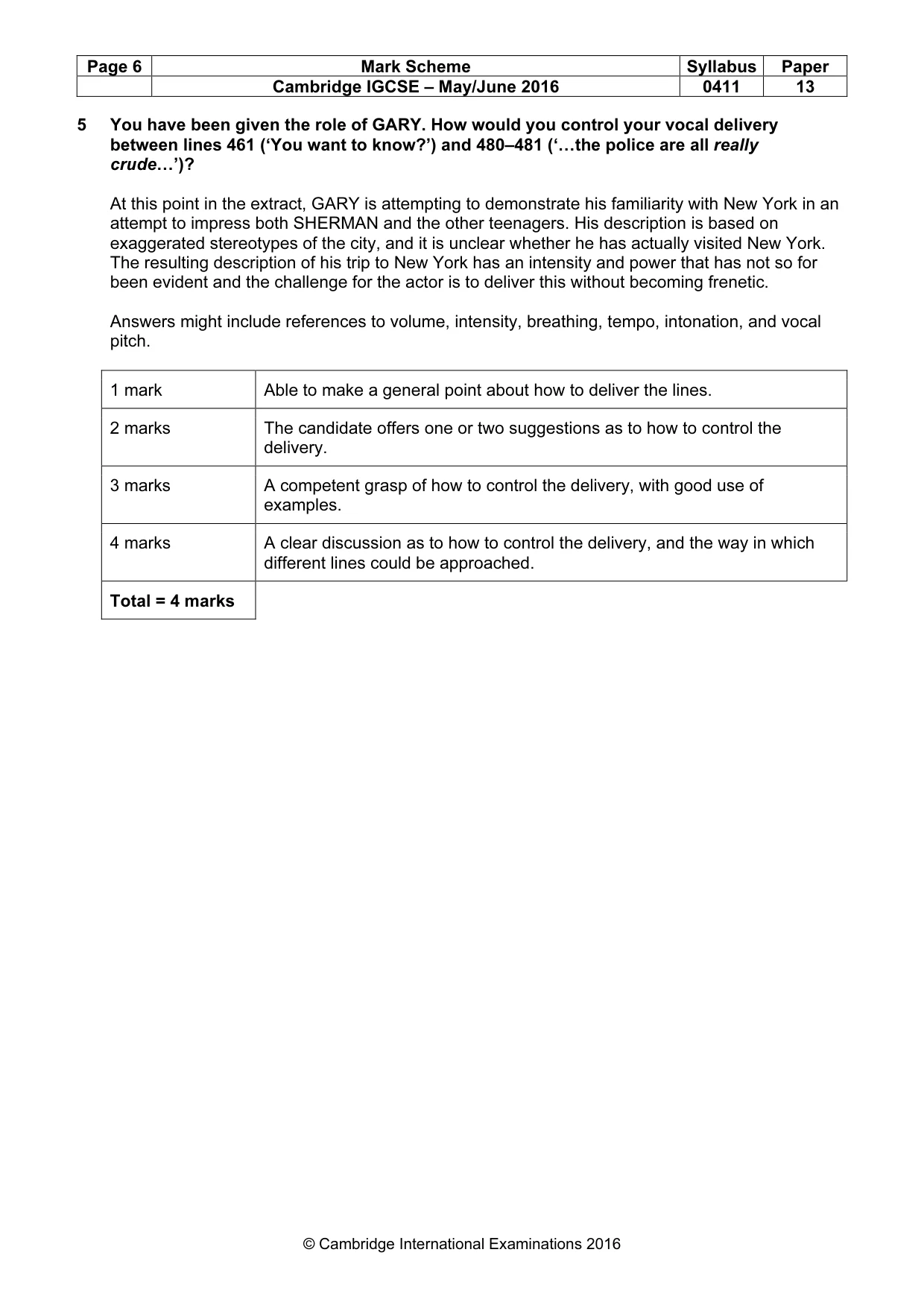
Page 6 Mark Scheme Syllabus Paper Cambridge IGCSE – May/June 2016 0411 13 © Cambridge International Examinations 2016 5 You have been given the role of GARY. How would you control your vocal delivery between lines 461 (‘You want to know?’) and 480–481 (‘…the police are all really crude…’)? At this point in the extract, GARY is attempting to demonstrate his familiarity with New York in an attempt to impress both SHERMAN and the other teenagers. His description is based on exaggerated stereotypes of the city, and it is unclear whether he has actually visited New York. The resulting description of his trip to New York has an intensity and power that has not so for been evident and the challenge for the actor is to deliver this without becoming frenetic. Answers might include references to volume, intensity, breathing, tempo, intonation, and vocal pitch. 1 mark Able to make a general point about how to deliver the lines. 2 marks The candidate offers one or two suggestions as to how to control the delivery. 3 marks A competent grasp of how to control the delivery, with good use of examples. 4 marks A clear discussion as to how to control the delivery, and the way in which different lines could be approached. Total = 4 marks
Mark scheme, page 7
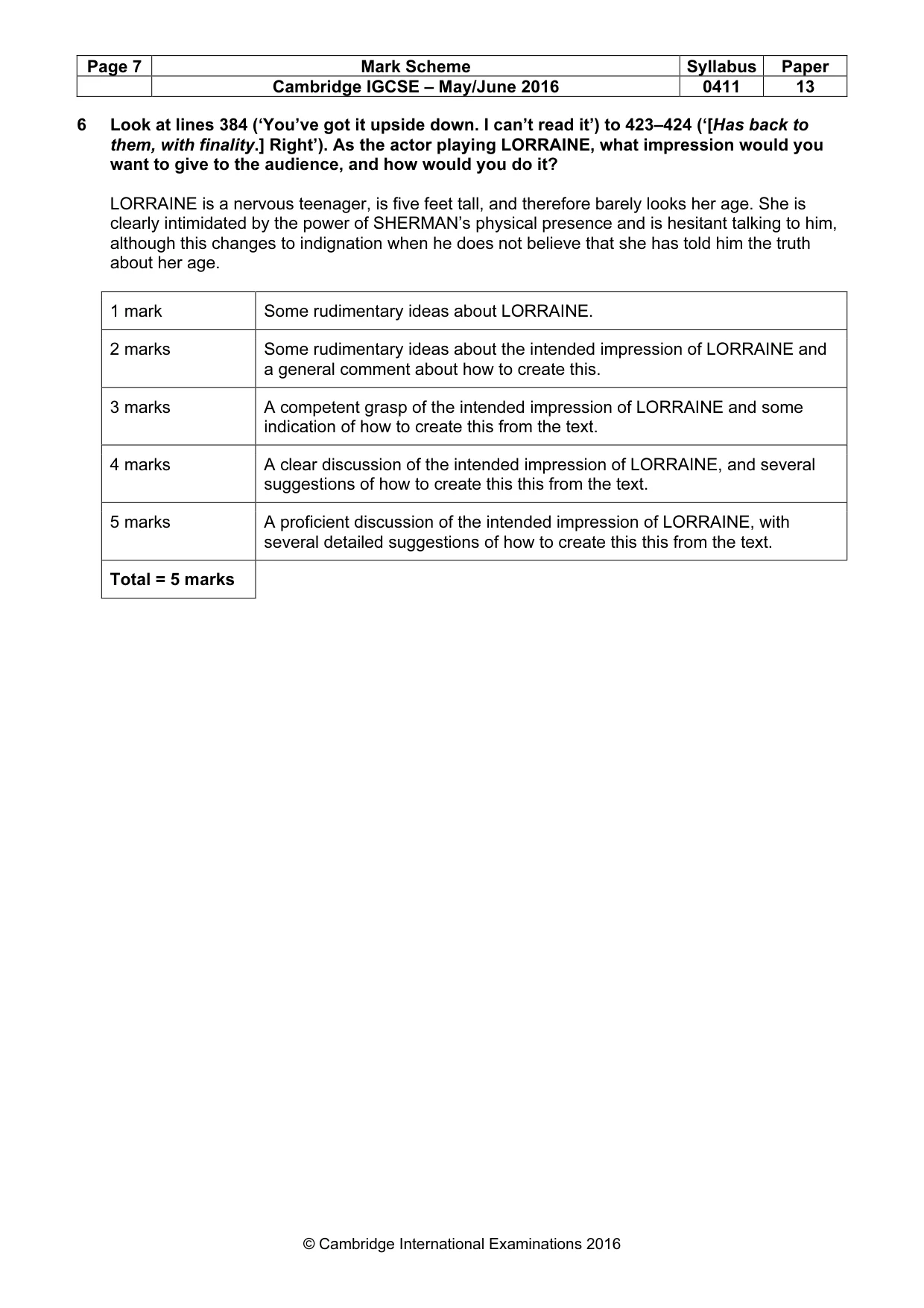
Page 7 Mark Scheme Syllabus Paper Cambridge IGCSE – May/June 2016 0411 13 © Cambridge International Examinations 2016 6 Look at lines 384 (‘You’ve got it upside down. I can’t read it’) to 423–424 (‘[Has back to them, with finality.] Right’). As the actor playing LORRAINE, what impression would you want to give to the audience, and how would you do it? LORRAINE is a nervous teenager, is five feet tall, and therefore barely looks her age. She is clearly intimidated by the power of SHERMAN’s physical presence and is hesitant talking to him, although this changes to indignation when he does not believe that she has told him the truth about her age. 1 mark Some rudimentary ideas about LORRAINE. 2 marks Some rudimentary ideas about the intended impression of LORRAINE and a general comment about how to create this. 3 marks A competent grasp of the intended impression of LORRAINE and some indication of how to create this from the text. 4 marks A clear discussion of the intended impression of LORRAINE, and several suggestions of how to create this this from the text. 5 marks A proficient discussion of the intended impression of LORRAINE, with several detailed suggestions of how to create this this from the text. Total = 5 marks
Mark scheme, page 8
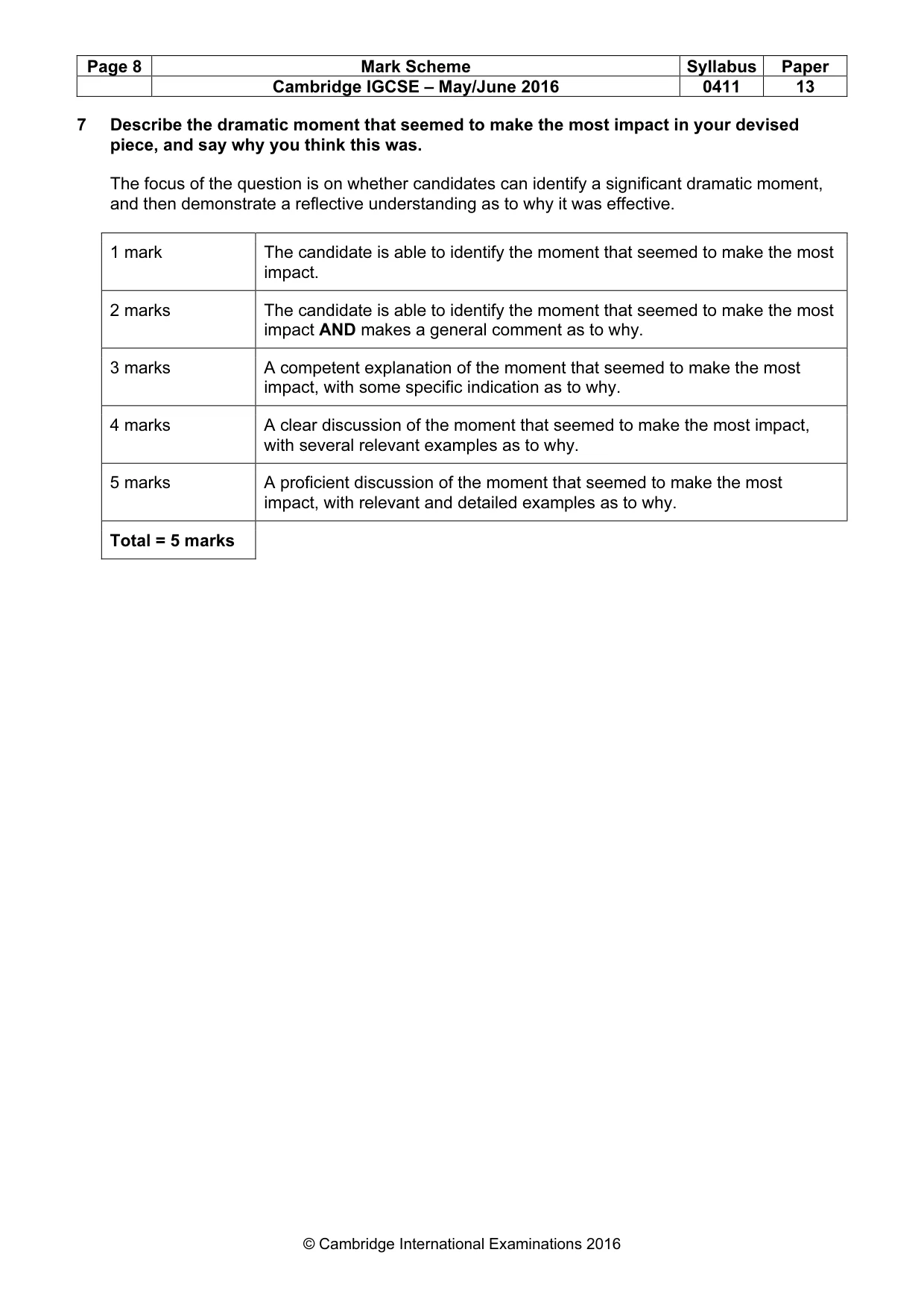
Page 8 Mark Scheme Syllabus Paper Cambridge IGCSE – May/June 2016 0411 13 © Cambridge International Examinations 2016 7 Describe the dramatic moment that seemed to make the most impact in your devised piece, and say why you think this was. The focus of the question is on whether candidates can identify a significant dramatic moment, and then demonstrate a reflective understanding as to why it was effective. 1 mark The candidate is able to identify the moment that seemed to make the most impact. 2 marks The candidate is able to identify the moment that seemed to make the most impact AND makes a general comment as to why. 3 marks A competent explanation of the moment that seemed to make the most impact, with some specific indication as to why. 4 marks A clear discussion of the moment that seemed to make the most impact, with several relevant examples as to why. 5 marks A proficient discussion of the moment that seemed to make the most impact, with relevant and detailed examples as to why. Total = 5 marks
Mark scheme, page 9
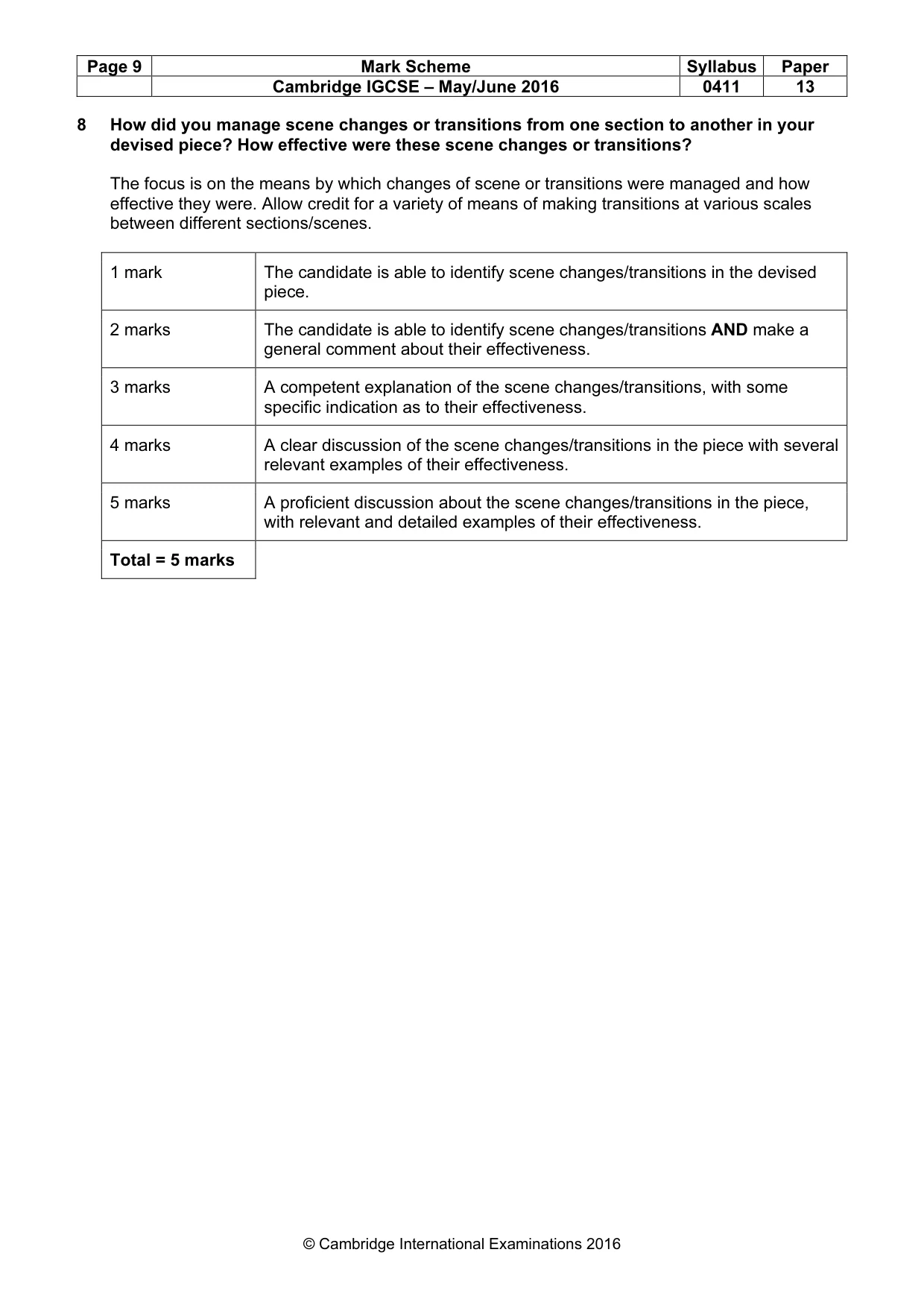
Page 9 Mark Scheme Syllabus Paper Cambridge IGCSE – May/June 2016 0411 13 © Cambridge International Examinations 2016 8 How did you manage scene changes or transitions from one section to another in your devised piece? How effective were these scene changes or transitions? The focus is on the means by which changes of scene or transitions were managed and how effective they were. Allow credit for a variety of means of making transitions at various scales between different sections/scenes. 1 mark The candidate is able to identify scene changes/transitions in the devised piece. 2 marks The candidate is able to identify scene changes/transitions AND make a general comment about their effectiveness. 3 marks A competent explanation of the scene changes/transitions, with some specific indication as to their effectiveness. 4 marks A clear discussion of the scene changes/transitions in the piece with several relevant examples of their effectiveness. 5 marks A proficient discussion about the scene changes/transitions in the piece, with relevant and detailed examples of their effectiveness. Total = 5 marks
Mark scheme, page 10
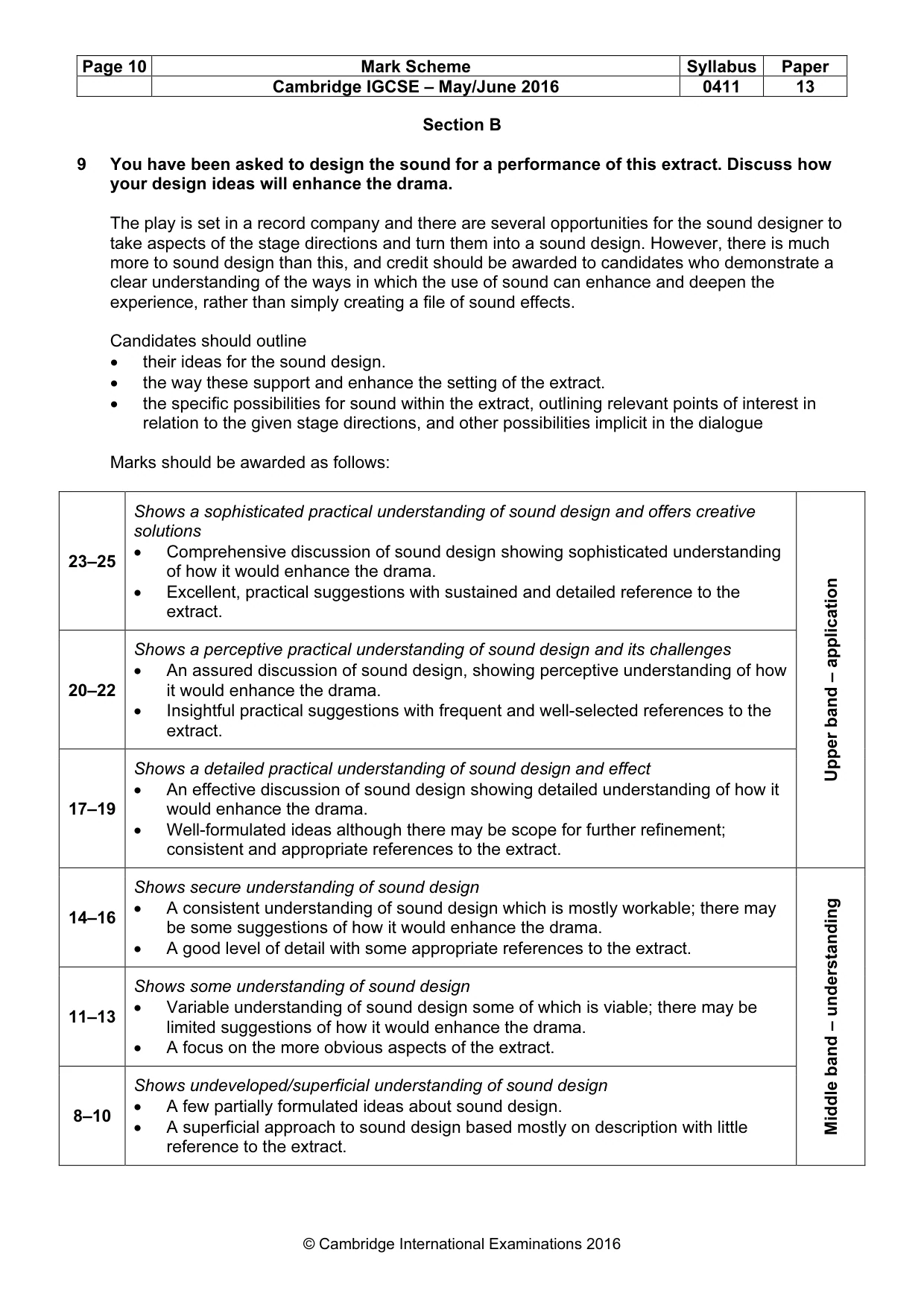
Page 10 Mark Scheme Syllabus Paper Cambridge IGCSE – May/June 2016 0411 13 © Cambridge International Examinations 2016 Section B 9 You have been asked to design the sound for a performance of this extract. Discuss how your design ideas will enhance the drama. The play is set in a record company and there are several opportunities for the sound designer to take aspects of the stage directions and turn them into a sound design. However, there is much more to sound design than this, and credit should be awarded to candidates who demonstrate a clear understanding of the ways in which the use of sound can enhance and deepen the experience, rather than simply creating a file of sound effects. Candidates should outline • their ideas for the sound design. • the way these support and enhance the setting of the extract. • the specific possibilities for sound within the extract, outlining relevant points of interest in relation to the given stage directions, and other possibilities implicit in the dialogue Marks should be awarded as follows: 23–25 Shows a sophisticated practical understanding of sound design and offers creative solutions • Comprehensive discussion of sound design showing sophisticated understanding of how it would enhance the drama. • Excellent, practical suggestions with sustained and detailed reference to the extract. Upper band – application 20–22 Shows a perceptive practical understanding of sound design and its challenges • An assured discussion of sound design, showing perceptive understanding of how it would enhance the drama. • Insightful practical suggestions with frequent and well-selected references to the extract. 17–19 Shows a detailed practical understanding of sound design and effect • An effective discussion of sound design showing detailed understanding of how it would enhance the drama. • Well-formulated ideas although there may be scope for further refinement; consistent and appropriate references to the extract. 14–16 Shows secure understanding of sound design • A consistent understanding of sound design which is mostly workable; there may be some suggestions of how it would enhance the drama. • A good level of detail with some appropriate references to the extract. Middle band – understanding 11–13 Shows some understanding of sound design • Variable understanding of sound design some of which is viable; there may be limited suggestions of how it would enhance the drama. • A focus on the more obvious aspects of the extract. 8–10 Shows undeveloped/superficial understanding of sound design • A few partially formulated ideas about sound design. • A superficial approach to sound design based mostly on description with little reference to the extract.
Mark scheme, page 11
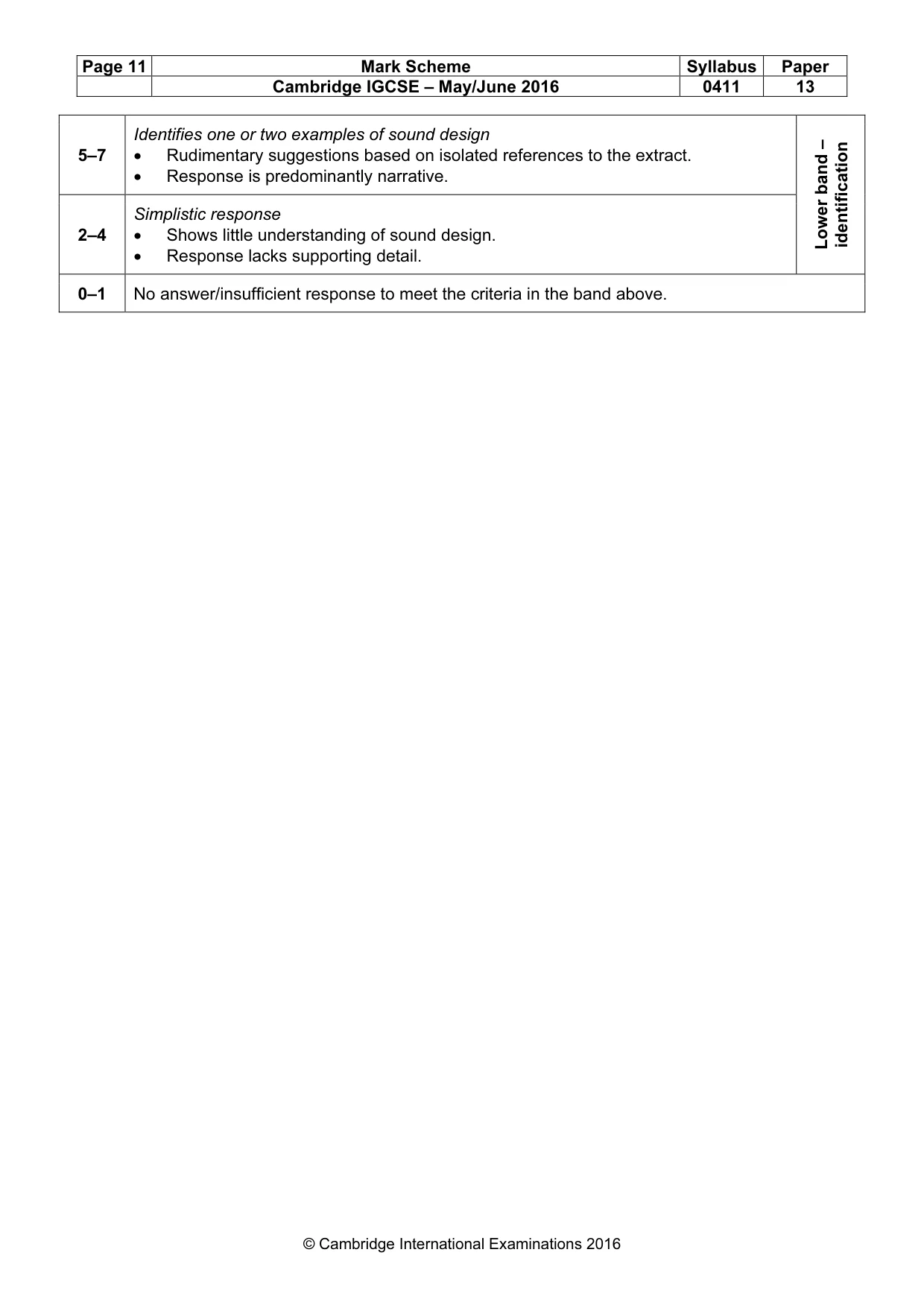
Page 11 Mark Scheme Syllabus Paper Cambridge IGCSE – May/June 2016 0411 13 © Cambridge International Examinations 2016 5–7 Identifies one or two examples of sound design • Rudimentary suggestions based on isolated references to the extract. • Response is predominantly narrative. Lower band – identification 2–4 Simplistic response • Shows little understanding of sound design. • Response lacks supporting detail. 0–1 No answer/insufficient response to meet the criteria in the band above.
Mark scheme, page 12
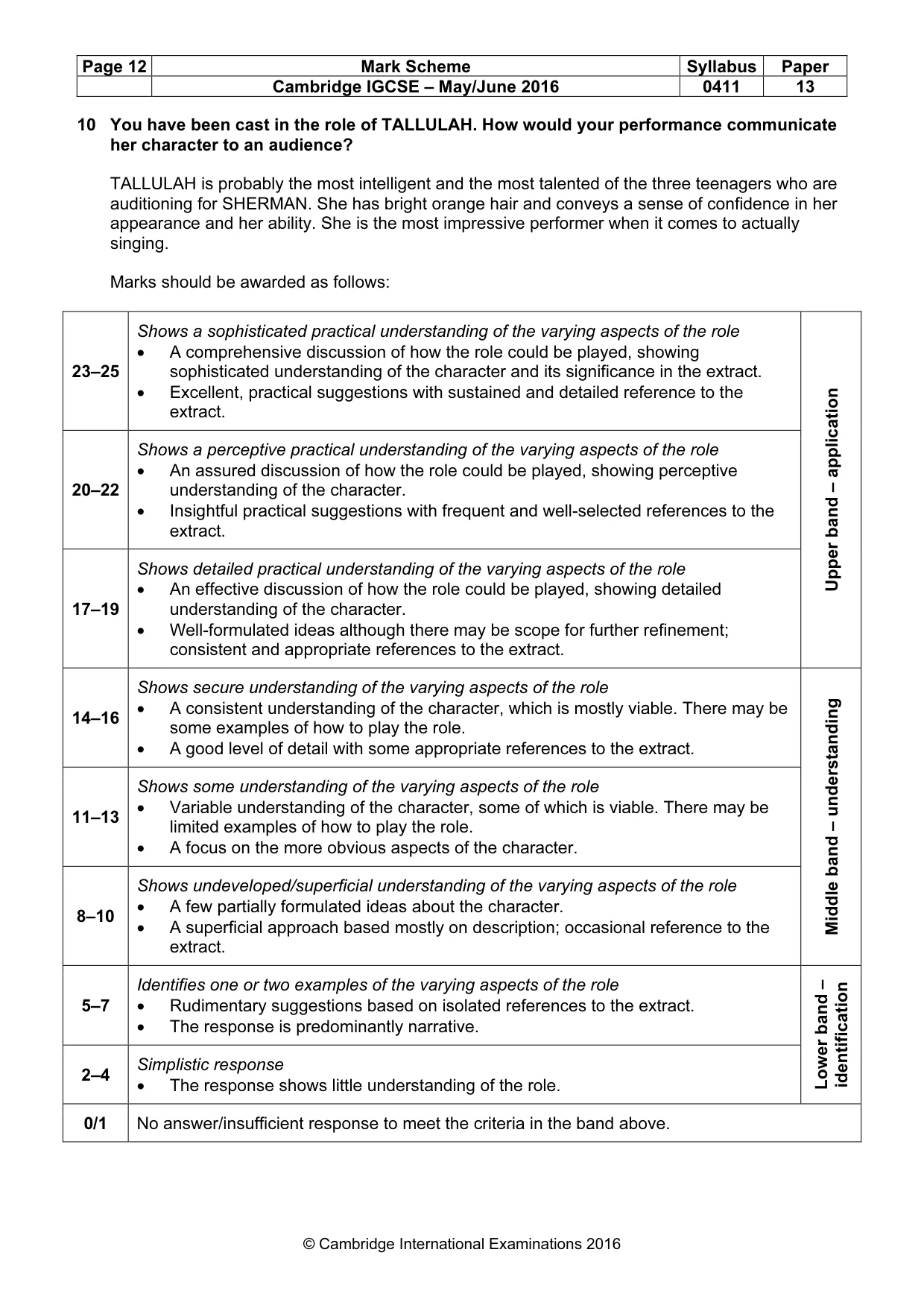
Page 12 Mark Scheme Syllabus Paper Cambridge IGCSE – May/June 2016 0411 13 © Cambridge International Examinations 2016 10 You have been cast in the role of TALLULAH. How would your performance communicate her character to an audience? TALLULAH is probably the most intelligent and the most talented of the three teenagers who are auditioning for SHERMAN. She has bright orange hair and conveys a sense of confidence in her appearance and her ability. She is the most impressive performer when it comes to actually singing. Marks should be awarded as follows: 23–25 Shows a sophisticated practical understanding of the varying aspects of the role • A comprehensive discussion of how the role could be played, showing sophisticated understanding of the character and its significance in the extract. • Excellent, practical suggestions with sustained and detailed reference to the extract. Upper band – application 20–22 Shows a perceptive practical understanding of the varying aspects of the role • An assured discussion of how the role could be played, showing perceptive understanding of the character. • Insightful practical suggestions with frequent and well-selected references to the extract. 17–19 Shows detailed practical understanding of the varying aspects of the role • An effective discussion of how the role could be played, showing detailed understanding of the character. • Well-formulated ideas although there may be scope for further refinement; consistent and appropriate references to the extract. 14–16 Shows secure understanding of the varying aspects of the role • A consistent understanding of the character, which is mostly viable. There may be some examples of how to play the role. • A good level of detail with some appropriate references to the extract. Middle band – understanding 11–13 Shows some understanding of the varying aspects of the role • Variable understanding of the character, some of which is viable. There may be limited examples of how to play the role. • A focus on the more obvious aspects of the character. 8–10 Shows undeveloped/superficial understanding of the varying aspects of the role • A few partially formulated ideas about the character. • A superficial approach based mostly on description; occasional reference to the extract. 5–7 Identifies one or two examples of the varying aspects of the role • Rudimentary suggestions based on isolated references to the extract. • The response is predominantly narrative. Lower band – identification 2–4 Simplistic response • The response shows little understanding of the role. 0/1 No answer/insufficient response to meet the criteria in the band above.
Mark scheme, page 13
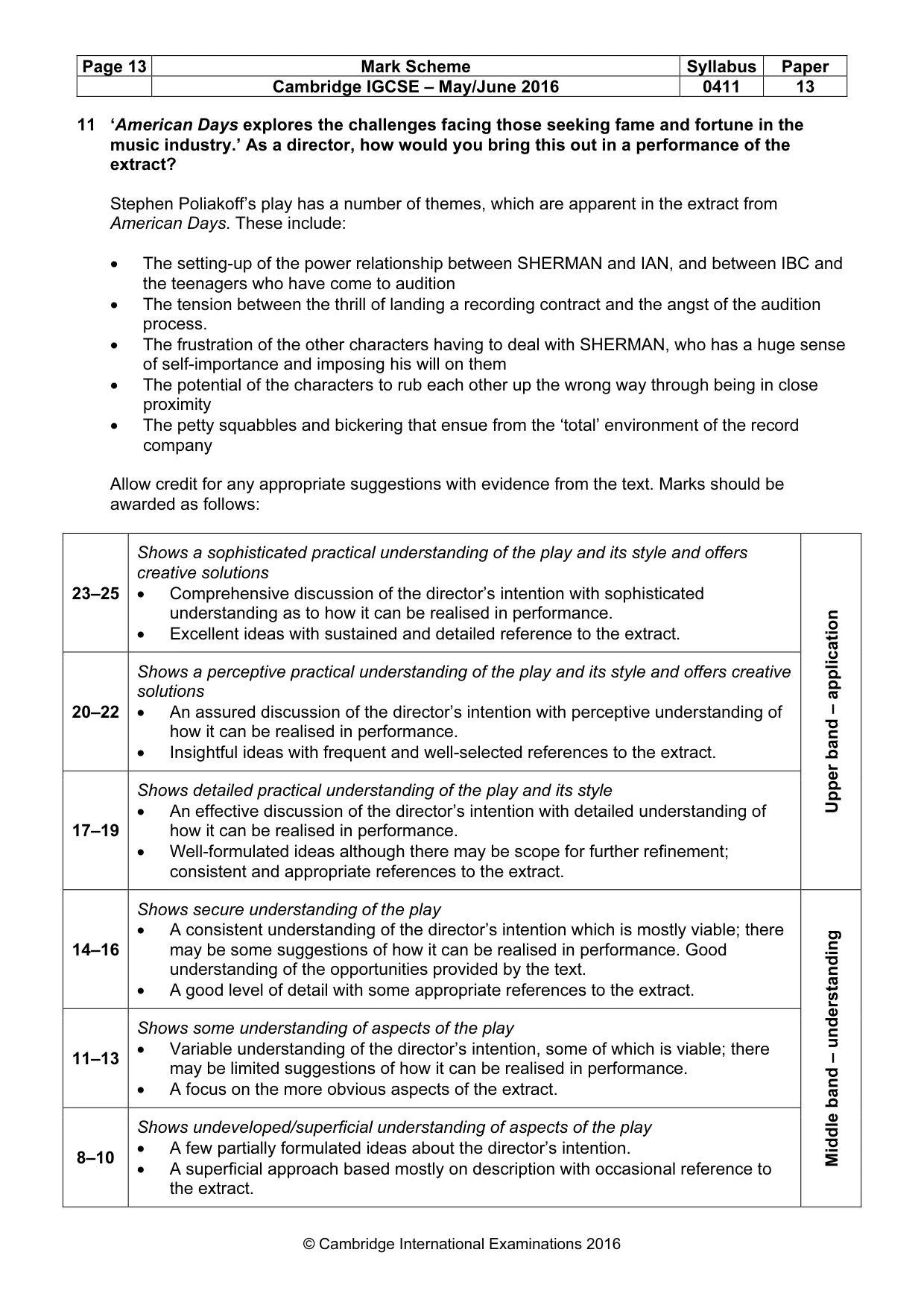
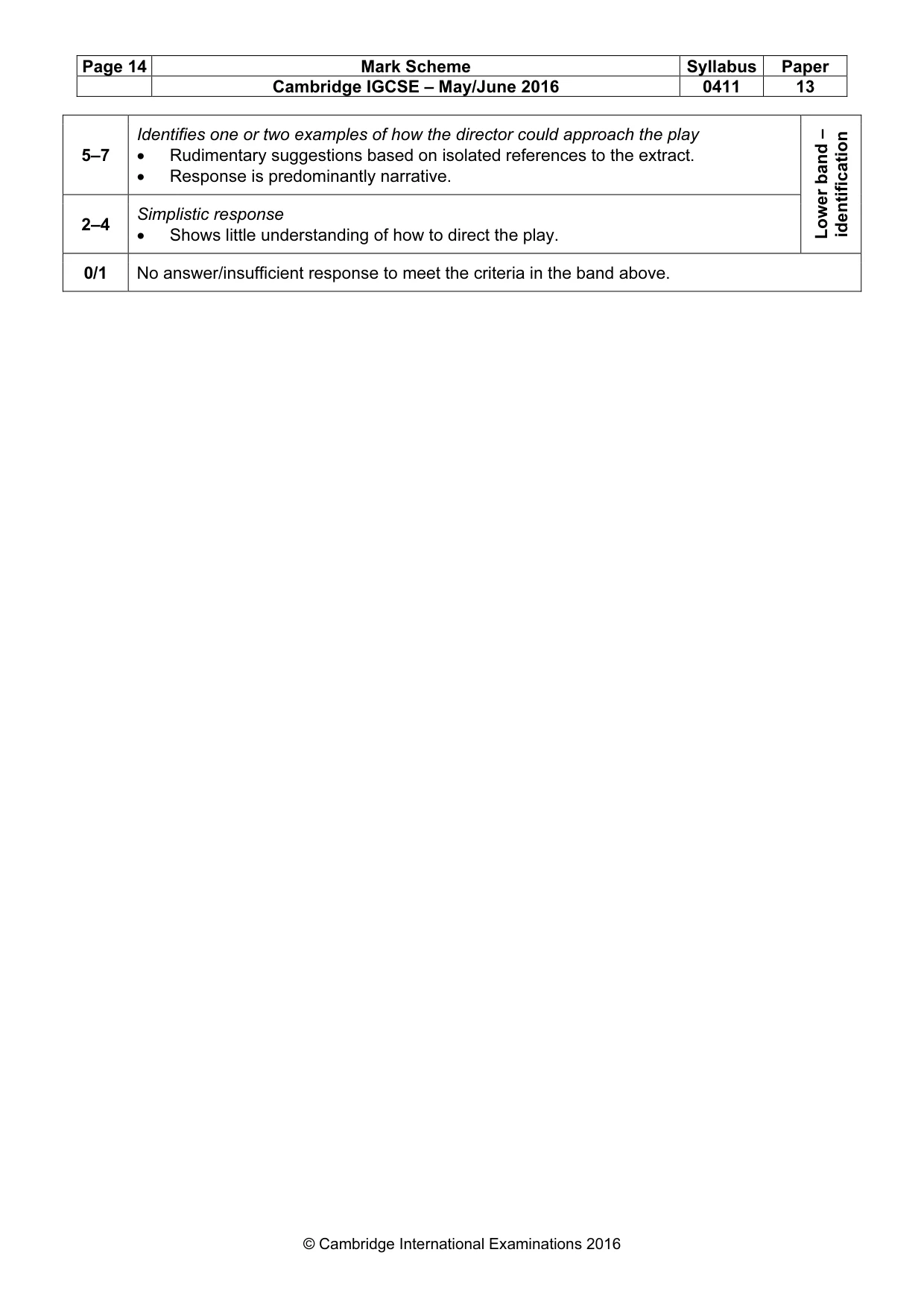
Page 13 Mark Scheme Syllabus Paper Cambridge IGCSE – May/June 2016 0411 13 © Cambridge International Examinations 2016 11 ‘American Days explores the challenges facing those seeking fame and fortune in the music industry.’ As a director, how would you bring this out in a performance of the extract? Stephen Poliakoff’s play has a number of themes, which are apparent in the extract from American Days. These include: • The setting-up of the power relationship between SHERMAN and IAN, and between IBC and the teenagers who have come to audition • The tension between the thrill of landing a recording contract and the angst of the audition process. • The frustration of the other characters having to deal with SHERMAN, who has a huge sense of self-importance and imposing his will on them • The potential of the characters to rub each other up the wrong way through being in close proximity • The petty squabbles and bickering that ensue from the ‘total’ environment of the record company Allow credit for any appropriate suggestions with evidence from the text. Marks should be awarded as follows: 23–25 Shows a sophisticated practical understanding of the play and its style and offers creative solutions • Comprehensive discussion of the director’s intention with sophisticated understanding as to how it can be realised in performance. • Excellent ideas with sustained and detailed reference to the extract. Upper band – application 20–22 Shows a perceptive practical understanding of the play and its style and offers creative solutions • An assured discussion of the director’s intention with perceptive understanding of how it can be realised in performance. • Insightful ideas with frequent and well-selected references to the extract. 17–19 Shows detailed practical understanding of the play and its style • An effective discussion of the director’s intention with detailed understanding of how it can be realised in performance. • Well-formulated ideas although there may be scope for further refinement; consistent and appropriate references to the extract. 14–16 Shows secure understanding of the play • A consistent understanding of the director’s intention which is mostly viable; there may be some suggestions of how it can be realised in performance. Good understanding of the opportunities provided by the text. • A good level of detail with some appropriate references to the extract. Middle band – understanding 11–13 Shows some understanding of aspects of the play • Variable understanding of the director’s intention, some of which is viable; there may be limited suggestions of how it can be realised in performance. • A focus on the more obvious aspects of the extract. 8–10 Shows undeveloped/superficial understanding of aspects of the play • A few partially formulated ideas about the director’s intention. • A superficial approach based mostly on description with occasional reference to the extract.
Mark scheme, page 14
Page 14 Mark Scheme Syllabus Paper Cambridge IGCSE – May/June 2016 0411 13 © Cambridge International Examinations 2016 5–7 Identifies one or two examples of how the director could approach the play • Rudimentary suggestions based on isolated references to the extract. • Response is predominantly narrative. Lower band – identification 2–4 Simplistic response • Shows little understanding of how to direct the play. 0/1 No answer/insufficient response to meet the criteria in the band above.
Mark scheme, page 15
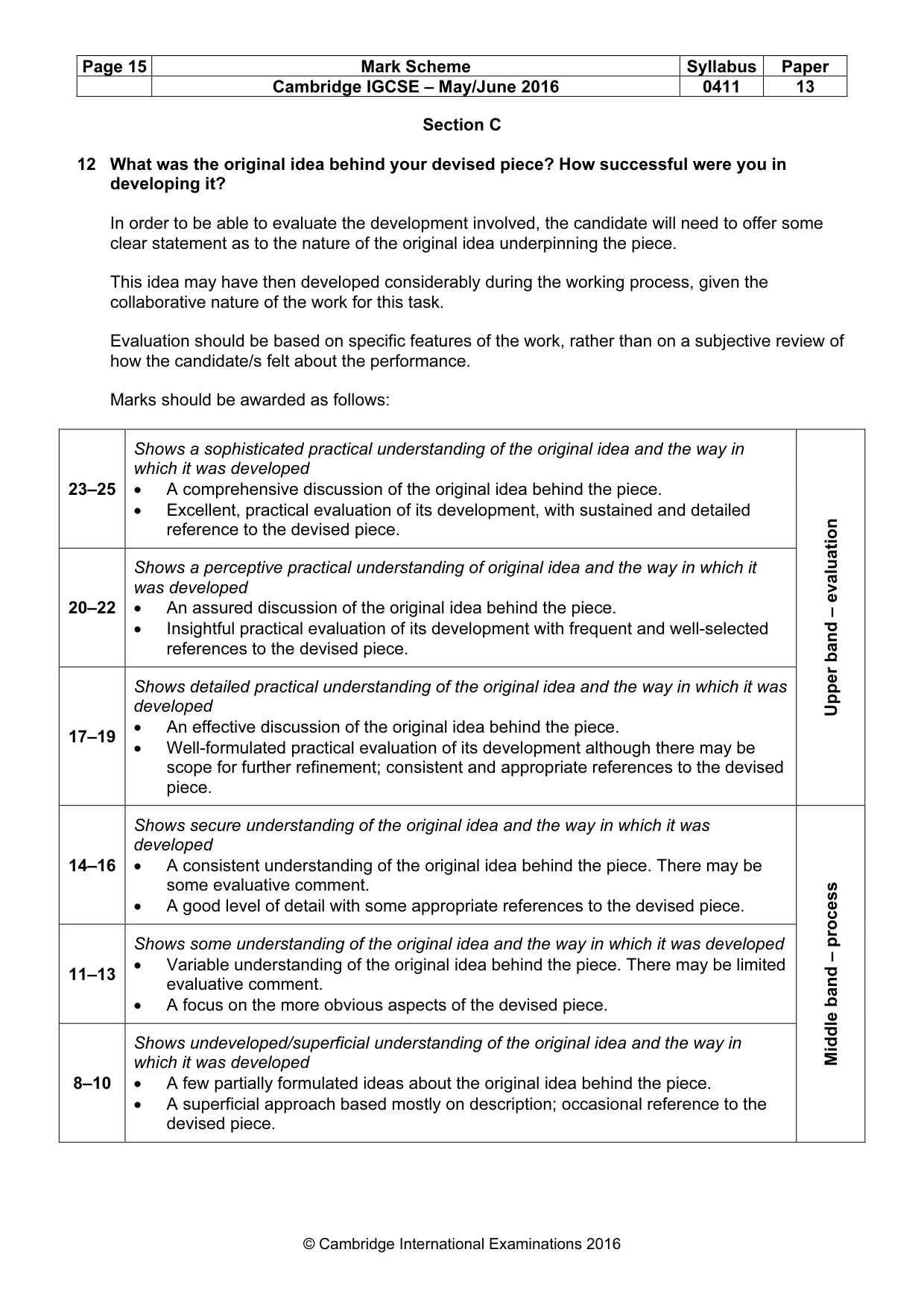
Page 15 Mark Scheme Syllabus Paper Cambridge IGCSE – May/June 2016 0411 13 © Cambridge International Examinations 2016 Section C 12 What was the original idea behind your devised piece? How successful were you in developing it? In order to be able to evaluate the development involved, the candidate will need to offer some clear statement as to the nature of the original idea underpinning the piece. This idea may have then developed considerably during the working process, given the collaborative nature of the work for this task. Evaluation should be based on specific features of the work, rather than on a subjective review of how the candidate/s felt about the performance. Marks should be awarded as follows: 23–25 Shows a sophisticated practical understanding of the original idea and the way in which it was developed • A comprehensive discussion of the original idea behind the piece. • Excellent, practical evaluation of its development, with sustained and detailed reference to the devised piece. Upper band – evaluation 20–22 Shows a perceptive practical understanding of original idea and the way in which it was developed • An assured discussion of the original idea behind the piece. • Insightful practical evaluation of its development with frequent and well-selected references to the devised piece. 17–19 Shows detailed practical understanding of the original idea and the way in which it was developed • An effective discussion of the original idea behind the piece. • Well-formulated practical evaluation of its development although there may be scope for further refinement; consistent and appropriate references to the devised piece. 14–16 Shows secure understanding of the original idea and the way in which it was developed • A consistent understanding of the original idea behind the piece. There may be some evaluative comment. • A good level of detail with some appropriate references to the devised piece. Middle band – process 11–13 Shows some understanding of the original idea and the way in which it was developed • Variable understanding of the original idea behind the piece. There may be limited evaluative comment. • A focus on the more obvious aspects of the devised piece. 8–10 Shows undeveloped/superficial understanding of the original idea and the way in which it was developed • A few partially formulated ideas about the original idea behind the piece. • A superficial approach based mostly on description; occasional reference to the devised piece.
Mark scheme, page 16
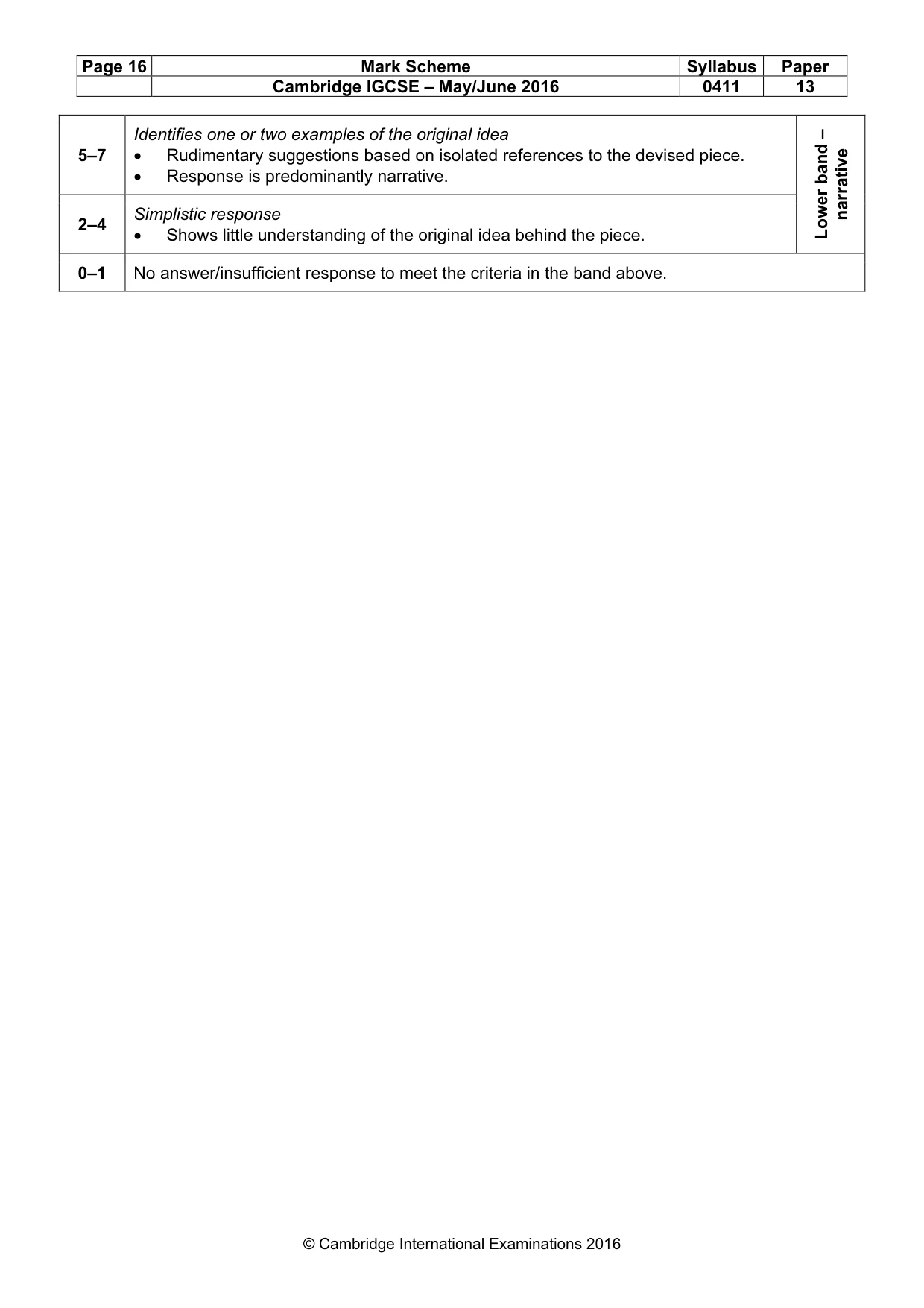
Page 16 Mark Scheme Syllabus Paper Cambridge IGCSE – May/June 2016 0411 13 © Cambridge International Examinations 2016 5–7 Identifies one or two examples of the original idea • Rudimentary suggestions based on isolated references to the devised piece. • Response is predominantly narrative. Lower band – narrative 2–4 Simplistic response • Shows little understanding of the original idea behind the piece. 0–1 No answer/insufficient response to meet the criteria in the band above.
Mark scheme, page 17
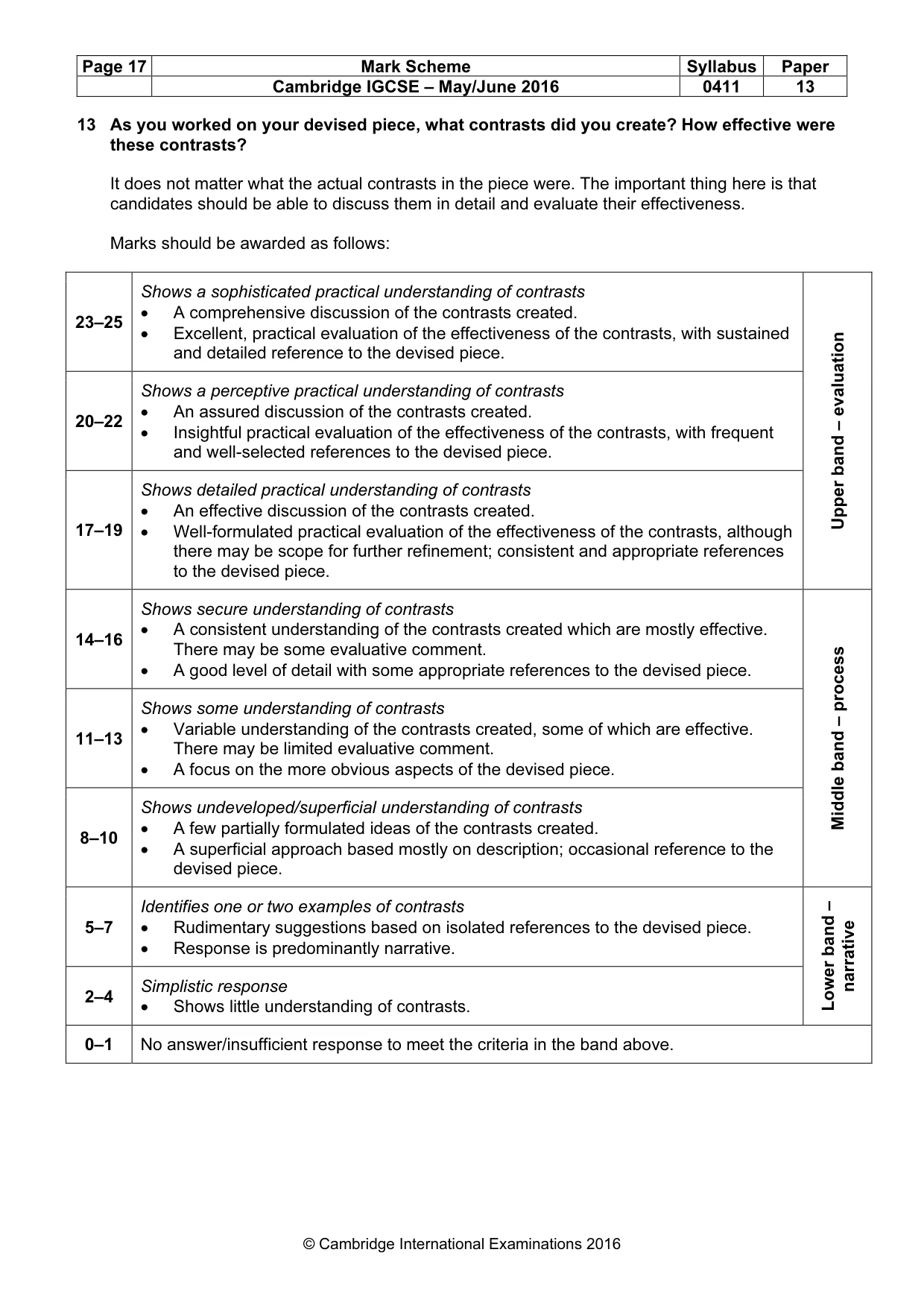
Page 17 Mark Scheme Syllabus Paper Cambridge IGCSE – May/June 2016 0411 13 © Cambridge International Examinations 2016 13 As you worked on your devised piece, what contrasts did you create? How effective were these contrasts? It does not matter what the actual contrasts in the piece were. The important thing here is that candidates should be able to discuss them in detail and evaluate their effectiveness. Marks should be awarded as follows: 23–25 Shows a sophisticated practical understanding of contrasts • A comprehensive discussion of the contrasts created. • Excellent, practical evaluation of the effectiveness of the contrasts, with sustained and detailed reference to the devised piece. Upper band – evaluation 20–22 Shows a perceptive practical understanding of contrasts • An assured discussion of the contrasts created. • Insightful practical evaluation of the effectiveness of the contrasts, with frequent and well-selected references to the devised piece. 17–19 Shows detailed practical understanding of contrasts • An effective discussion of the contrasts created. • Well-formulated practical evaluation of the effectiveness of the contrasts, although there may be scope for further refinement; consistent and appropriate references to the devised piece. 14–16 Shows secure understanding of contrasts • A consistent understanding of the contrasts created which are mostly effective. There may be some evaluative comment. • A good level of detail with some appropriate references to the devised piece. Middle band – process 11–13 Shows some understanding of contrasts • Variable understanding of the contrasts created, some of which are effective. There may be limited evaluative comment. • A focus on the more obvious aspects of the devised piece. 8–10 Shows undeveloped/superficial understanding of contrasts • A few partially formulated ideas of the contrasts created. • A superficial approach based mostly on description; occasional reference to the devised piece. 5–7 Identifies one or two examples of contrasts • Rudimentary suggestions based on isolated references to the devised piece. • Response is predominantly narrative. Lower band – narrative 2–4 Simplistic response • Shows little understanding of contrasts. 0–1 No answer/insufficient response to meet the criteria in the band above.
Mark scheme, page 18
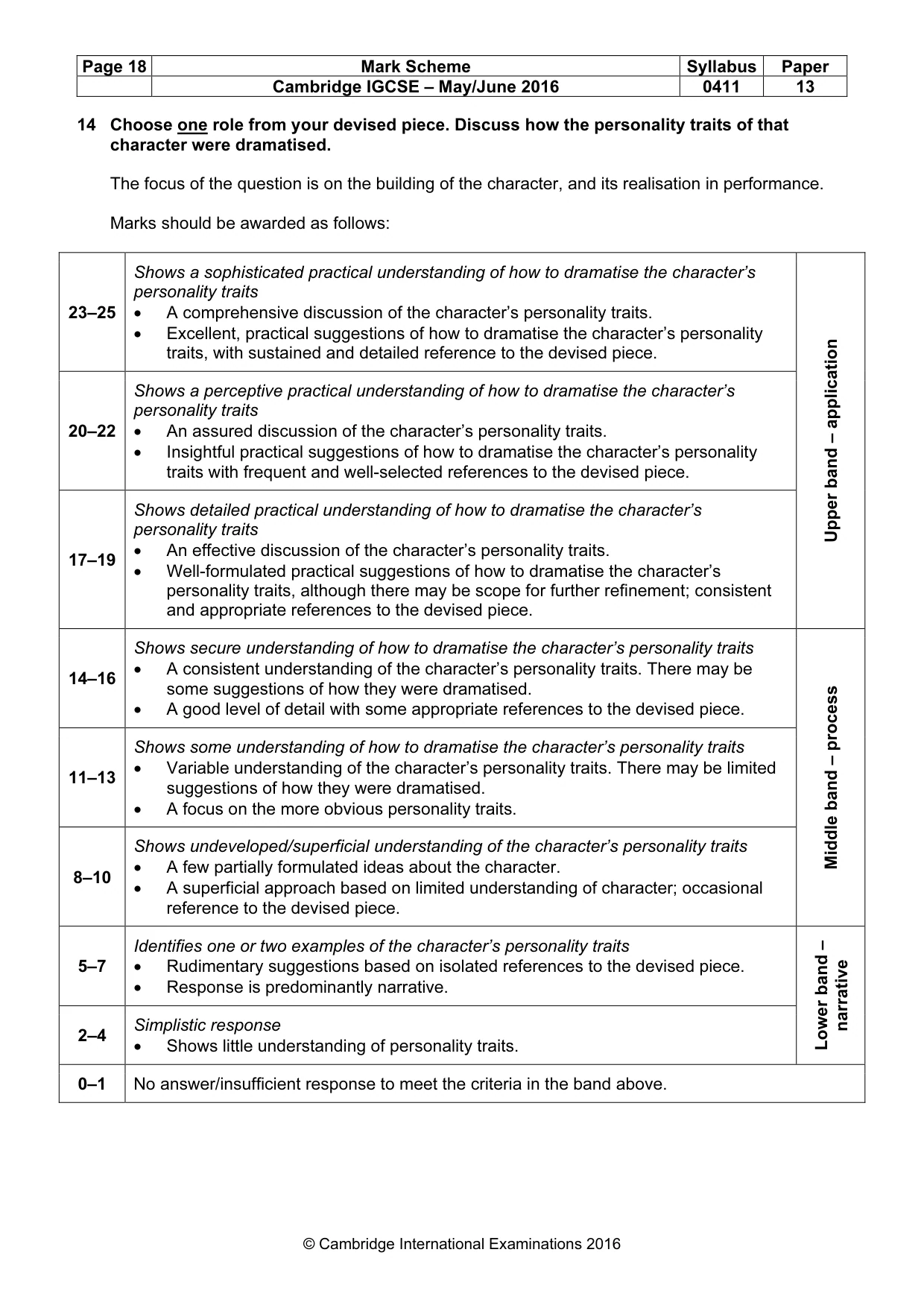
Page 18 Mark Scheme Syllabus Paper Cambridge IGCSE – May/June 2016 0411 13 © Cambridge International Examinations 2016 14 Choose one role from your devised piece. Discuss how the personality traits of that character were dramatised. The focus of the question is on the building of the character, and its realisation in performance. Marks should be awarded as follows: 23–25 Shows a sophisticated practical understanding of how to dramatise the character’s personality traits • A comprehensive discussion of the character’s personality traits. • Excellent, practical suggestions of how to dramatise the character’s personality traits, with sustained and detailed reference to the devised piece. Upper band – application 20–22 Shows a perceptive practical understanding of how to dramatise the character’s personality traits • An assured discussion of the character’s personality traits. • Insightful practical suggestions of how to dramatise the character’s personality traits with frequent and well-selected references to the devised piece. 17–19 Shows detailed practical understanding of how to dramatise the character’s personality traits • An effective discussion of the character’s personality traits. • Well-formulated practical suggestions of how to dramatise the character’s personality traits, although there may be scope for further refinement; consistent and appropriate references to the devised piece. 14–16 Shows secure understanding of how to dramatise the character’s personality traits • A consistent understanding of the character’s personality traits. There may be some suggestions of how they were dramatised. • A good level of detail with some appropriate references to the devised piece. Middle band – process 11–13 Shows some understanding of how to dramatise the character’s personality traits • Variable understanding of the character’s personality traits. There may be limited suggestions of how they were dramatised. • A focus on the more obvious personality traits. 8–10 Shows undeveloped/superficial understanding of the character’s personality traits • A few partially formulated ideas about the character. • A superficial approach based on limited understanding of character; occasional reference to the devised piece. 5–7 Identifies one or two examples of the character’s personality traits • Rudimentary suggestions based on isolated references to the devised piece. • Response is predominantly narrative. Lower band – narrative 2–4 Simplistic response • Shows little understanding of personality traits. 0–1 No answer/insufficient response to meet the criteria in the band above.
What you needed in this session
Cambridge’s own grade thresholds for 2016 May/June, Paper 1 · Variant 3. A higher threshold means an easier paper — the bar moves with how the cohort did.