Cambridge IGCSE Drama 0411 — 2016 May/June Paper 1 · Variant 1
0411/11/M/J/16 · 80 marks · ≈90 min
The question paper and its mark scheme, free to read here and free to download. This is Cambridge’s own paper, exactly as it was sat.
Question paper4 pages

Mark scheme19 pages
Answers below. Sit the paper first if you are practising.
Paper as text
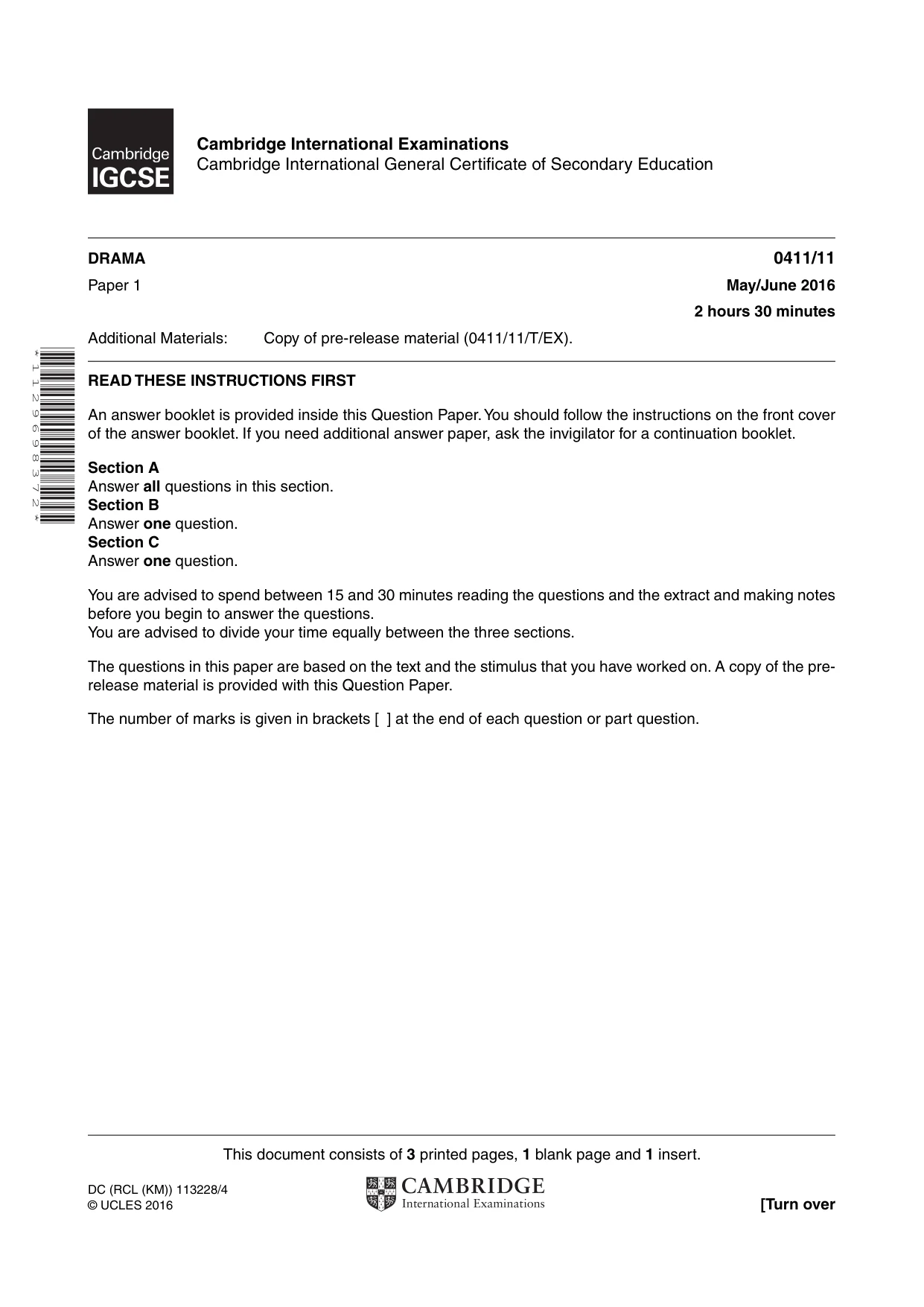
Question paper, page 1
This document consists of 3 printed pages, 1 blank page and 1 insert. DC (RCL (KM)) 113228/4 © UCLES 2016 [Turn over Cambridge International Examinations Cambridge International General Certificate of Secondary Education * 1 1 2 9 6 9 8 3 7 2 * DRAMA 0411/11 Paper 1 May/June 2016 2 hours 30 minutes Additional Materials: Copy of pre-release material (0411/11/T/EX). READ THESE INSTRUCTIONS FIRST An answer booklet is provided inside this Question Paper. You should follow the instructions on the front cover of the answer booklet. If you need additional answer paper, ask the invigilator for a continuation booklet. Section A Answer all questions in this section. Section B Answer one question. Section C Answer one question. You are advised to spend between 15 and 30 minutes reading the questions and the extract and making notes before you begin to answer the questions. You are advised to divide your time equally between the three sections. The questions in this paper are based on the text and the stimulus that you have worked on. A copy of the pre- release material is provided with this Question Paper. The number of marks is given in brackets [ ] at the end of each question or part question.
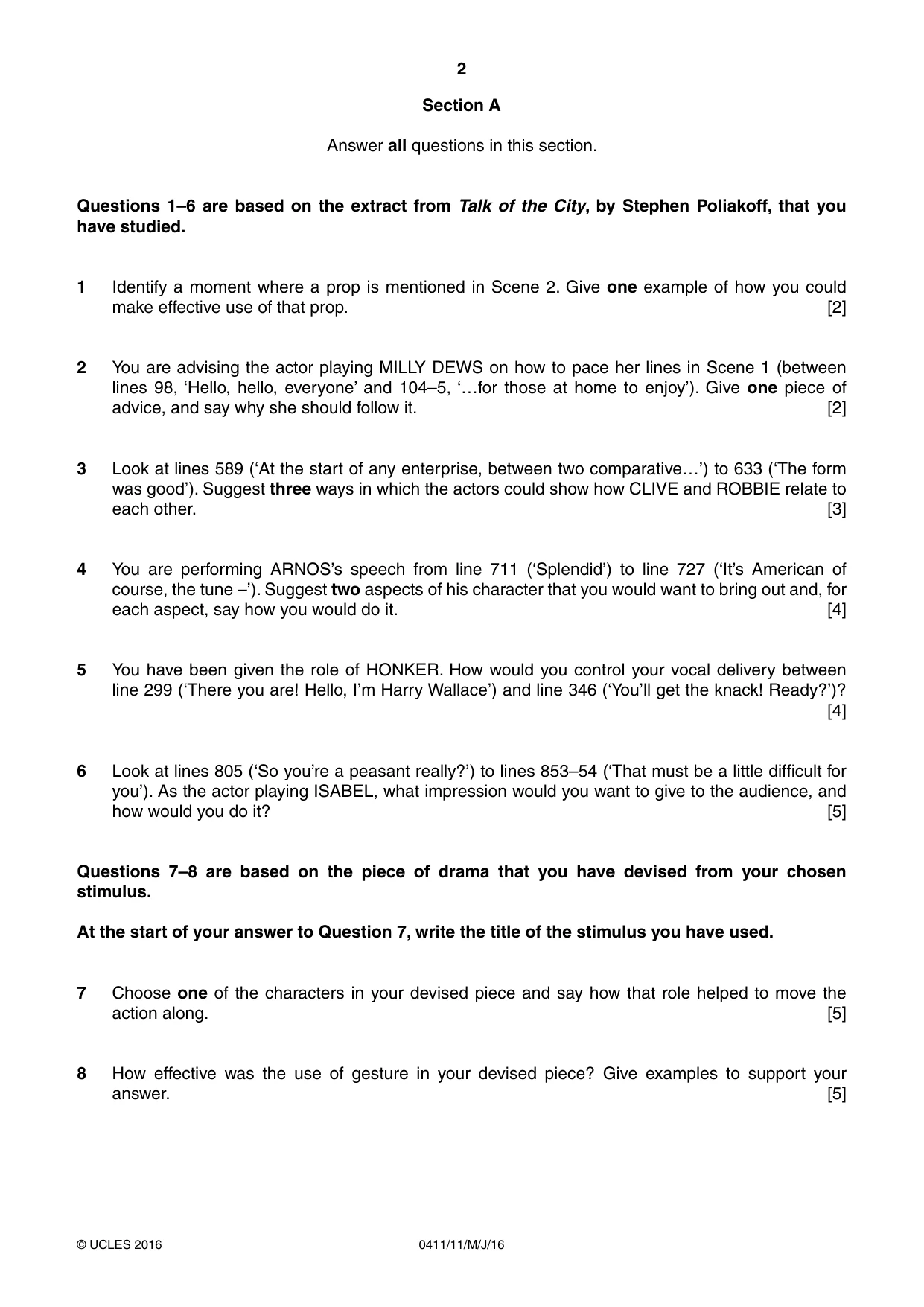
Question paper, page 2
2 0411/11/M/J/16 © UCLES 2016 Section A Answer all questions in this section. Questions 1–6 are based on the extract from Talk of the City, by Stephen Poliakoff, that you have studied. 1 Identify a moment where a prop is mentioned in Scene 2. Give one example of how you could make effective use of that prop. [2] 2 You are advising the actor playing MILLY DEWS on how to pace her lines in Scene 1 (between lines 98, ‘Hello, hello, everyone’ and 104–5, ‘…for those at home to enjoy’). Give one piece of advice, and say why she should follow it. [2] 3 Look at lines 589 (‘At the start of any enterprise, between two comparative…’) to 633 (‘The form was good’). Suggest three ways in which the actors could show how CLIVE and ROBBIE relate to each other. [3] 4 You are performing ARNOS’s speech from line 711 (‘Splendid’) to line 727 (‘It’s American of course, the tune –’). Suggest two aspects of his character that you would want to bring out and, for each aspect, say how you would do it. [4] 5 You have been given the role of HONKER. How would you control your vocal delivery between line 299 (‘There you are! Hello, I’m Harry Wallace’) and line 346 (‘You’ll get the knack! Ready?’)? [4] 6 Look at lines 805 (‘So you’re a peasant really?’) to lines 853–54 (‘That must be a little difficult for you’). As the actor playing ISABEL, what impression would you want to give to the audience, and how would you do it? [5] Questions 7–8 are based on the piece of drama that you have devised from your chosen stimulus. At the start of your answer to Question 7, write the title of the stimulus you have used. 7 Choose one of the characters in your devised piece and say how that role helped to move the action along. [5] 8 How effective was the use of gesture in your devised piece? Give examples to support your answer. [5]
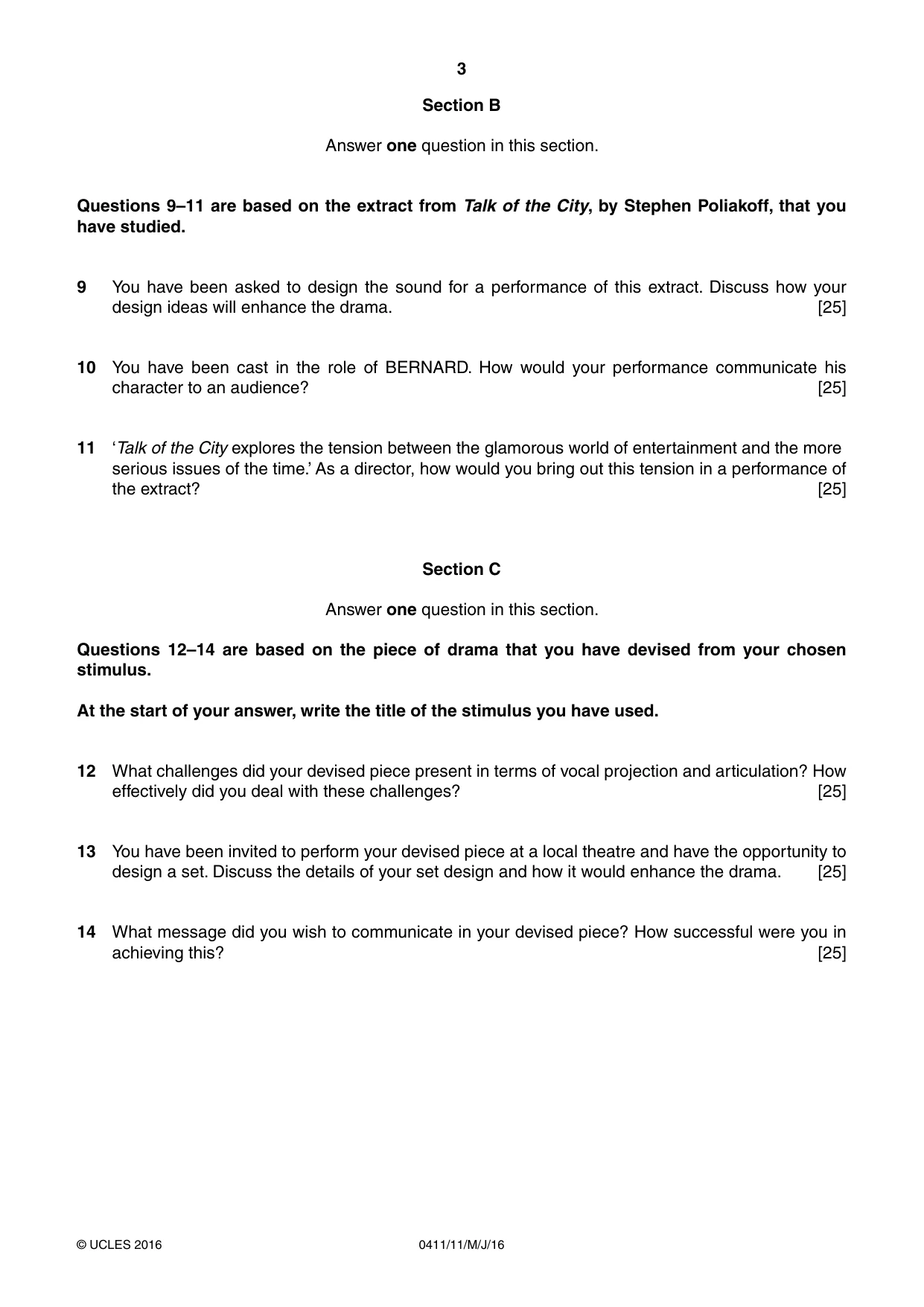
Question paper, page 3
3 0411/11/M/J/16 © UCLES 2016 Section B Answer one question in this section. Questions 9–11 are based on the extract from Talk of the City, by Stephen Poliakoff, that you have studied. 9 You have been asked to design the sound for a performance of this extract. Discuss how your design ideas will enhance the drama. [25] 10 You have been cast in the role of BERNARD. How would your performance communicate his character to an audience? [25] 11 ‘Talk of the City explores the tension between the glamorous world of entertainment and the more serious issues of the time.’ As a director, how would you bring out this tension in a performance of the extract? [25] Section C Answer one question in this section. Questions 12–14 are based on the piece of drama that you have devised from your chosen stimulus. At the start of your answer, write the title of the stimulus you have used. 12 What challenges did your devised piece present in terms of vocal projection and articulation? How effectively did you deal with these challenges? [25] 13 You have been invited to perform your devised piece at a local theatre and have the opportunity to design a set. Discuss the details of your set design and how it would enhance the drama. [25] 14 What message did you wish to communicate in your devised piece? How successful were you in achieving this? [25]
Question paper, page 4
4 0411/11/M/J/16 © UCLES 2016 BLANK PAGE Permission to reproduce items where third-party owned material protected by copyright is included has been sought and cleared where possible. Every reasonable effort has been made by the publisher (UCLES) to trace copyright holders, but if any items requiring clearance have unwittingly been included, the publisher will be pleased to make amends at the earliest possible opportunity. To avoid the issue of disclosure of answer-related information to candidates, all copyright acknowledgements are reproduced online in the Cambridge International Examinations Copyright Acknowledgements Booklet. This is produced for each series of examinations and is freely available to download at www.cie.org.uk after the live examination series. Cambridge International Examinations is part of the Cambridge Assessment Group. Cambridge Assessment is the brand name of University of Cambridge Local Examinations Syndicate (UCLES), which is itself a department of the University of Cambridge.
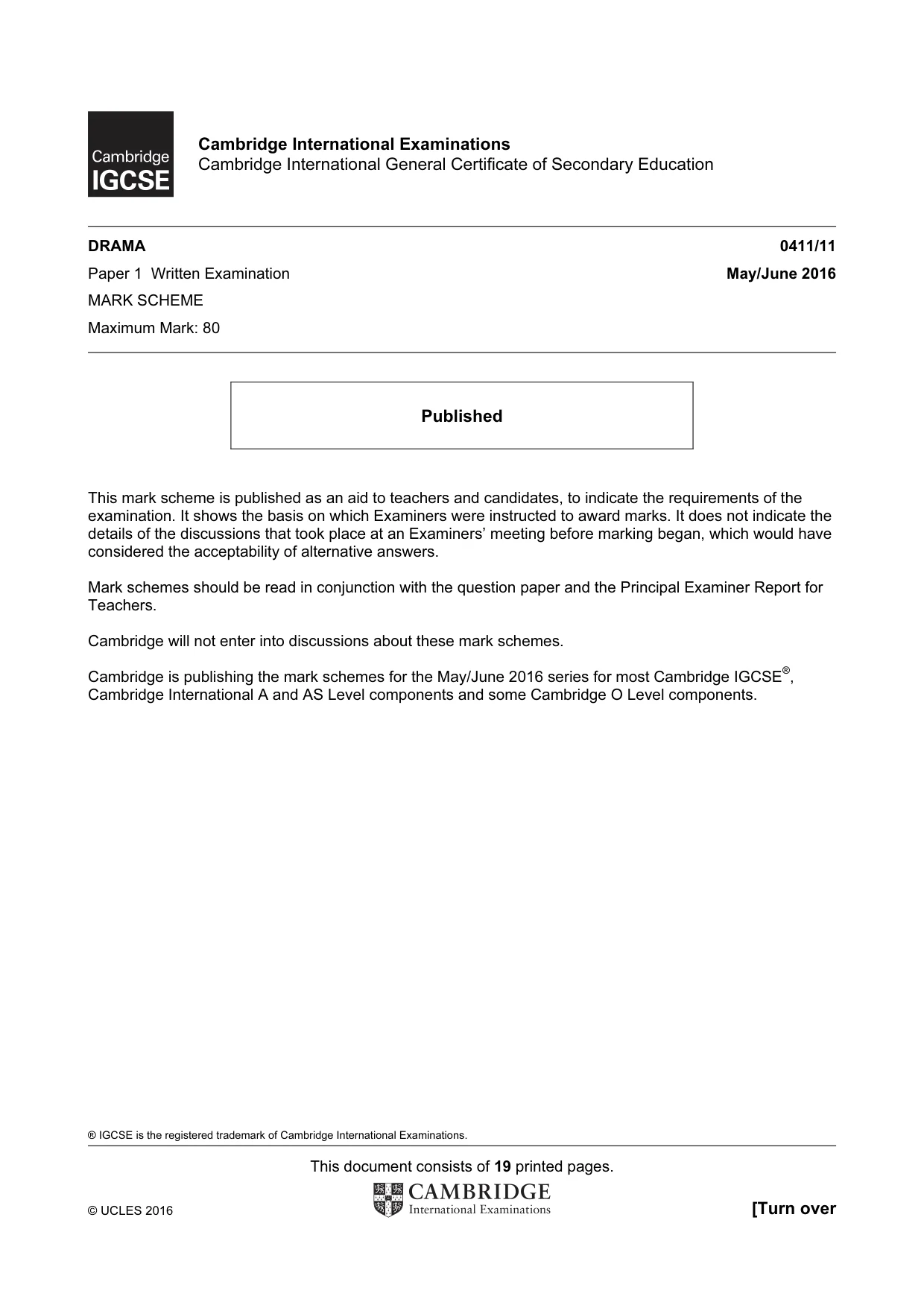
Mark scheme, page 1
® IGCSE is the registered trademark of Cambridge International Examinations. This document consists of 19 printed pages. © UCLES 2016 [Turn over Cambridge International Examinations Cambridge International General Certificate of Secondary Education DRAMA 0411/11 Paper 1 Written Examination May/June 2016 MARK SCHEME Maximum Mark: 80 Published This mark scheme is published as an aid to teachers and candidates, to indicate the requirements of the examination. It shows the basis on which Examiners were instructed to award marks. It does not indicate the details of the discussions that took place at an Examiners’ meeting before marking began, which would have considered the acceptability of alternative answers. Mark schemes should be read in conjunction with the question paper and the Principal Examiner Report for Teachers. Cambridge will not enter into discussions about these mark schemes. Cambridge is publishing the mark schemes for the May/June 2016 series for most Cambridge IGCSE®, Cambridge International A and AS Level components and some Cambridge O Level components.
Mark scheme, page 2
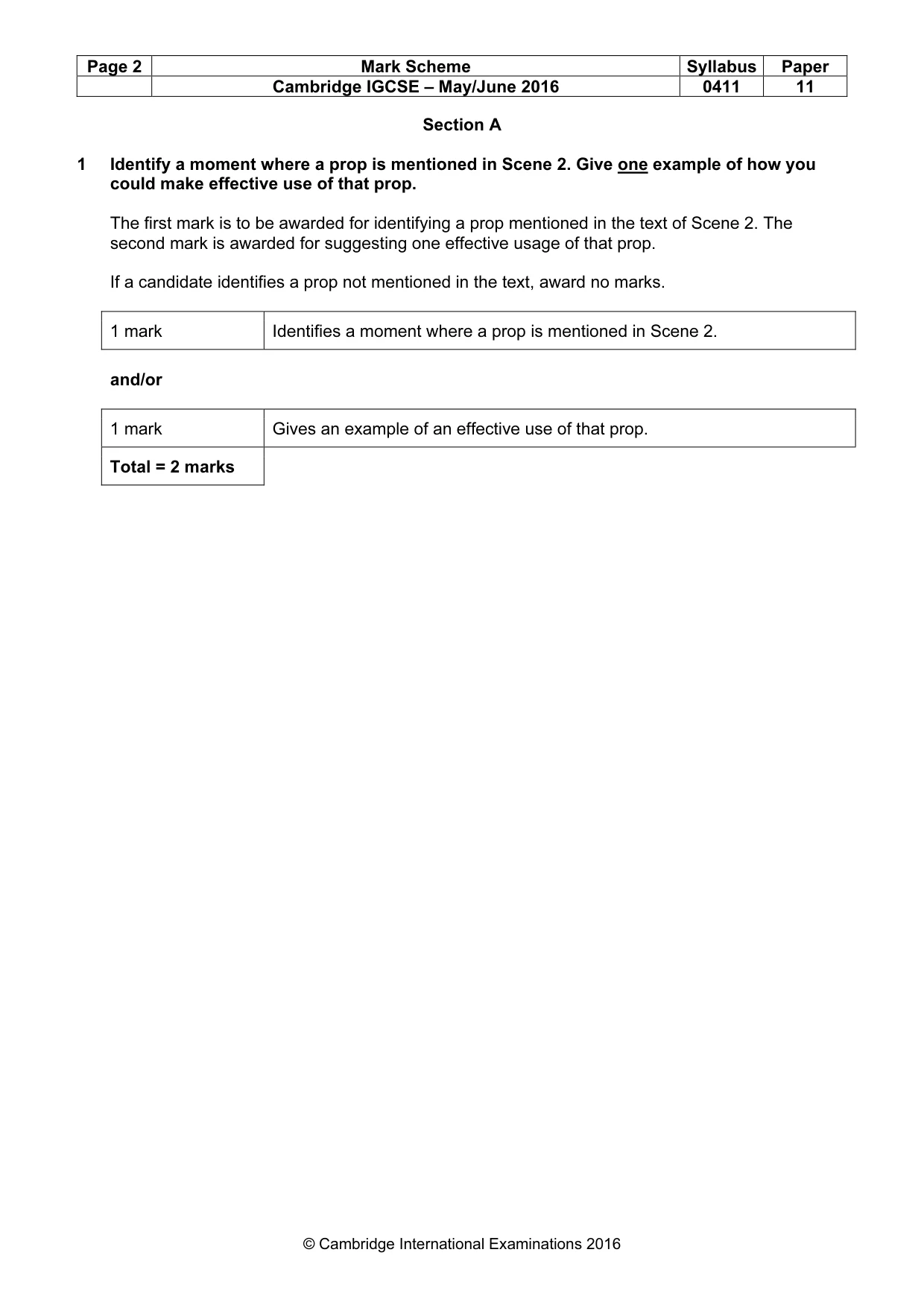
Page 2 Mark Scheme Syllabus Paper Cambridge IGCSE – May/June 2016 0411 11 © Cambridge International Examinations 2016 Section A 1 Identify a moment where a prop is mentioned in Scene 2. Give one example of how you could make effective use of that prop. The first mark is to be awarded for identifying a prop mentioned in the text of Scene 2. The second mark is awarded for suggesting one effective usage of that prop. If a candidate identifies a prop not mentioned in the text, award no marks. 1 mark Identifies a moment where a prop is mentioned in Scene 2. and/or 1 mark Gives an example of an effective use of that prop. Total = 2 marks
Mark scheme, page 3
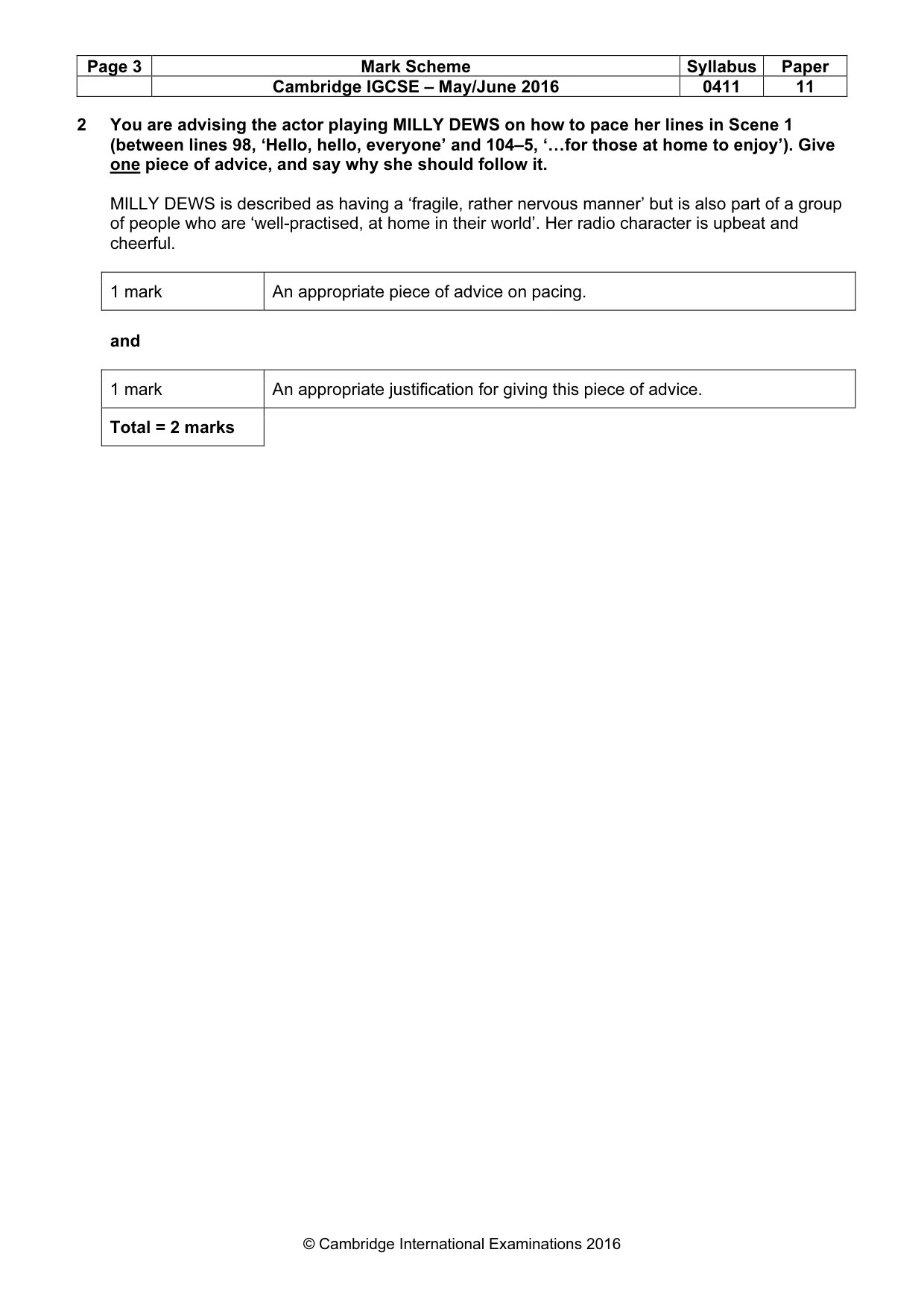
Page 3 Mark Scheme Syllabus Paper Cambridge IGCSE – May/June 2016 0411 11 © Cambridge International Examinations 2016 2 You are advising the actor playing MILLY DEWS on how to pace her lines in Scene 1 (between lines 98, ‘Hello, hello, everyone’ and 104–5, ‘…for those at home to enjoy’). Give one piece of advice, and say why she should follow it. MILLY DEWS is described as having a ‘fragile, rather nervous manner’ but is also part of a group of people who are ‘well-practised, at home in their world’. Her radio character is upbeat and cheerful. 1 mark An appropriate piece of advice on pacing. and 1 mark An appropriate justification for giving this piece of advice. Total = 2 marks
Mark scheme, page 4
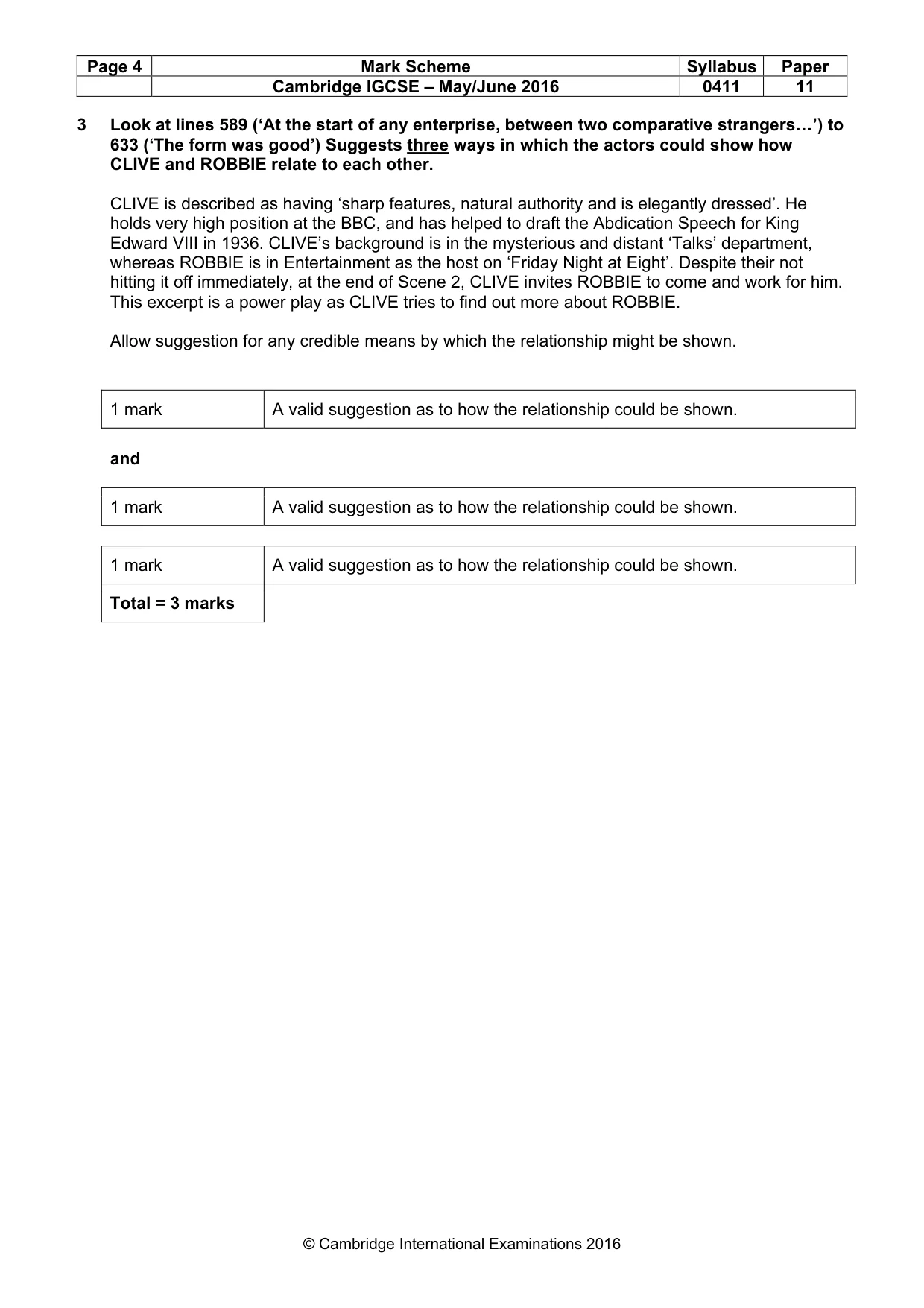
Page 4 Mark Scheme Syllabus Paper Cambridge IGCSE – May/June 2016 0411 11 © Cambridge International Examinations 2016 3 Look at lines 589 (‘At the start of any enterprise, between two comparative strangers…’) to 633 (‘The form was good’) Suggests three ways in which the actors could show how CLIVE and ROBBIE relate to each other. CLIVE is described as having ‘sharp features, natural authority and is elegantly dressed’. He holds very high position at the BBC, and has helped to draft the Abdication Speech for King Edward VIII in 1936. CLIVE’s background is in the mysterious and distant ‘Talks’ department, whereas ROBBIE is in Entertainment as the host on ‘Friday Night at Eight’. Despite their not hitting it off immediately, at the end of Scene 2, CLIVE invites ROBBIE to come and work for him. This excerpt is a power play as CLIVE tries to find out more about ROBBIE. Allow suggestion for any credible means by which the relationship might be shown. 1 mark A valid suggestion as to how the relationship could be shown. and 1 mark A valid suggestion as to how the relationship could be shown. 1 mark A valid suggestion as to how the relationship could be shown. Total = 3 marks
Mark scheme, page 5
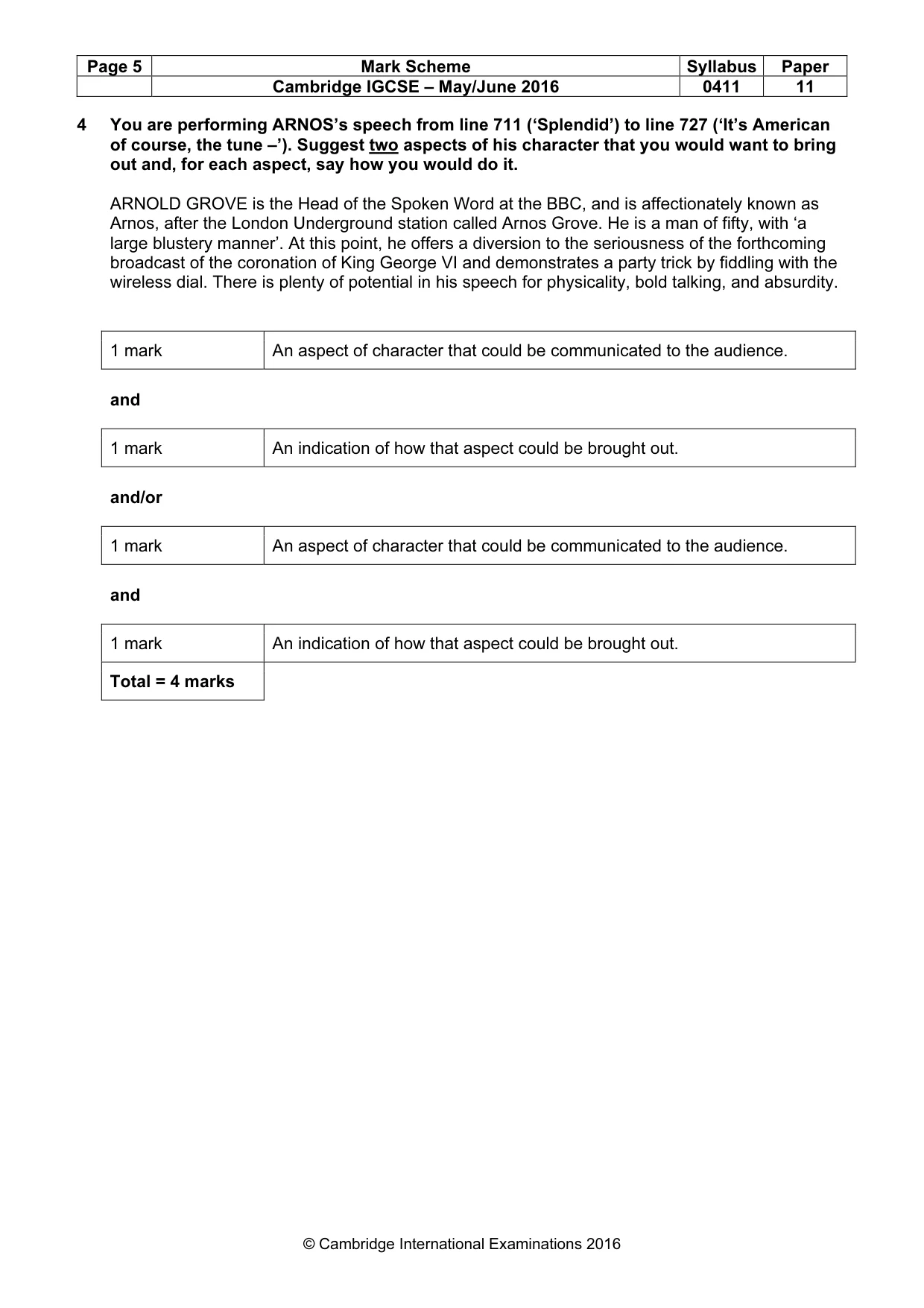
Page 5 Mark Scheme Syllabus Paper Cambridge IGCSE – May/June 2016 0411 11 © Cambridge International Examinations 2016 4 You are performing ARNOS’s speech from line 711 (‘Splendid’) to line 727 (‘It’s American of course, the tune –’). Suggest two aspects of his character that you would want to bring out and, for each aspect, say how you would do it. ARNOLD GROVE is the Head of the Spoken Word at the BBC, and is affectionately known as Arnos, after the London Underground station called Arnos Grove. He is a man of fifty, with ‘a large blustery manner’. At this point, he offers a diversion to the seriousness of the forthcoming broadcast of the coronation of King George VI and demonstrates a party trick by fiddling with the wireless dial. There is plenty of potential in his speech for physicality, bold talking, and absurdity. 1 mark An aspect of character that could be communicated to the audience. and 1 mark An indication of how that aspect could be brought out. and/or 1 mark An aspect of character that could be communicated to the audience. and 1 mark An indication of how that aspect could be brought out. Total = 4 marks
Mark scheme, page 6
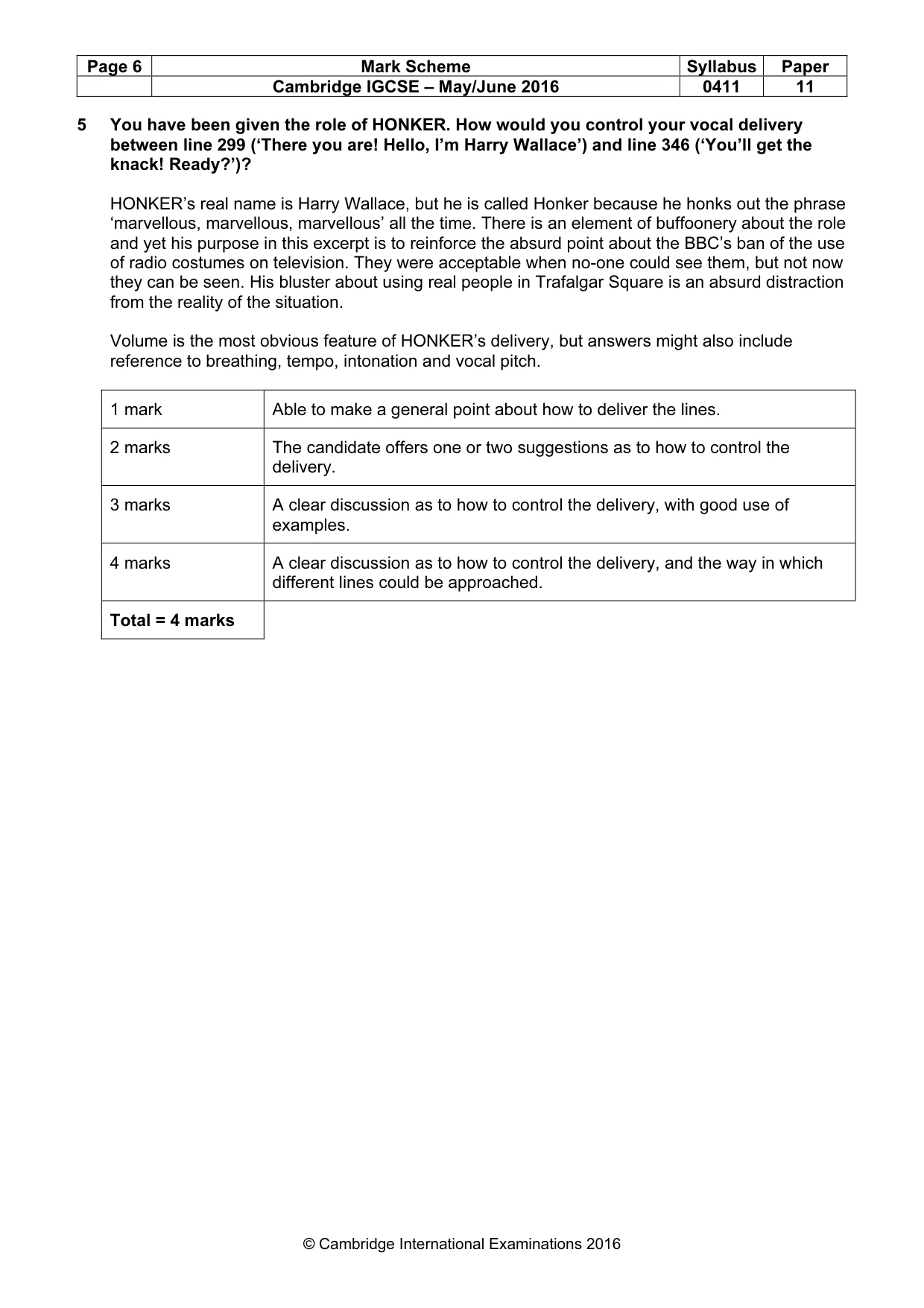
Page 6 Mark Scheme Syllabus Paper Cambridge IGCSE – May/June 2016 0411 11 © Cambridge International Examinations 2016 5 You have been given the role of HONKER. How would you control your vocal delivery between line 299 (‘There you are! Hello, I’m Harry Wallace’) and line 346 (‘You’ll get the knack! Ready?’)? HONKER’s real name is Harry Wallace, but he is called Honker because he honks out the phrase ‘marvellous, marvellous, marvellous’ all the time. There is an element of buffoonery about the role and yet his purpose in this excerpt is to reinforce the absurd point about the BBC’s ban of the use of radio costumes on television. They were acceptable when no-one could see them, but not now they can be seen. His bluster about using real people in Trafalgar Square is an absurd distraction from the reality of the situation. Volume is the most obvious feature of HONKER’s delivery, but answers might also include reference to breathing, tempo, intonation and vocal pitch. 1 mark Able to make a general point about how to deliver the lines. 2 marks The candidate offers one or two suggestions as to how to control the delivery. 3 marks A clear discussion as to how to control the delivery, with good use of examples. 4 marks A clear discussion as to how to control the delivery, and the way in which different lines could be approached. Total = 4 marks
Mark scheme, page 7
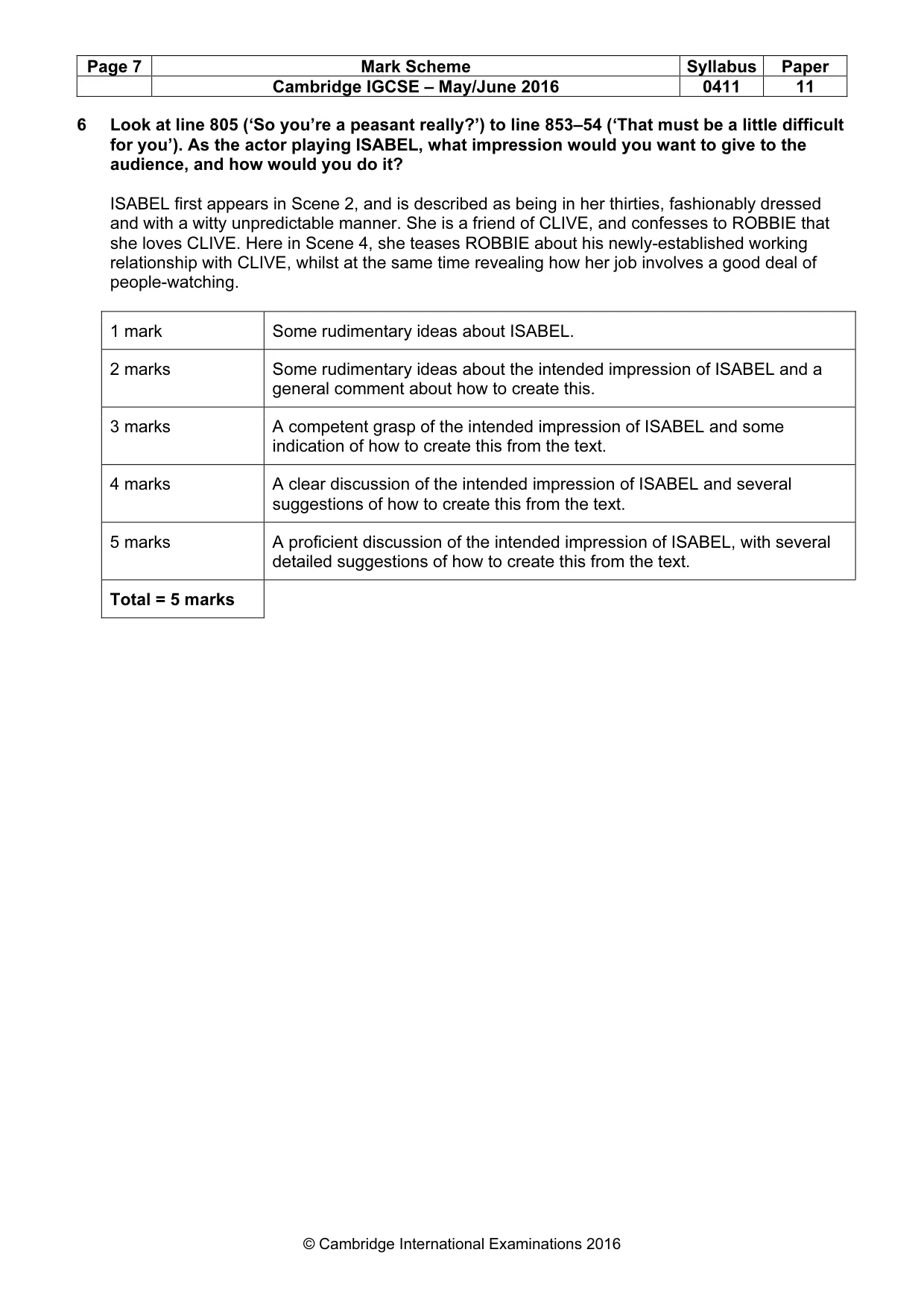
Page 7 Mark Scheme Syllabus Paper Cambridge IGCSE – May/June 2016 0411 11 © Cambridge International Examinations 2016 6 Look at line 805 (‘So you’re a peasant really?’) to line 853–54 (‘That must be a little difficult for you’). As the actor playing ISABEL, what impression would you want to give to the audience, and how would you do it? ISABEL first appears in Scene 2, and is described as being in her thirties, fashionably dressed and with a witty unpredictable manner. She is a friend of CLIVE, and confesses to ROBBIE that she loves CLIVE. Here in Scene 4, she teases ROBBIE about his newly-established working relationship with CLIVE, whilst at the same time revealing how her job involves a good deal of people-watching. 1 mark Some rudimentary ideas about ISABEL. 2 marks Some rudimentary ideas about the intended impression of ISABEL and a general comment about how to create this. 3 marks A competent grasp of the intended impression of ISABEL and some indication of how to create this from the text. 4 marks A clear discussion of the intended impression of ISABEL and several suggestions of how to create this from the text. 5 marks A proficient discussion of the intended impression of ISABEL, with several detailed suggestions of how to create this from the text. Total = 5 marks
Mark scheme, page 8
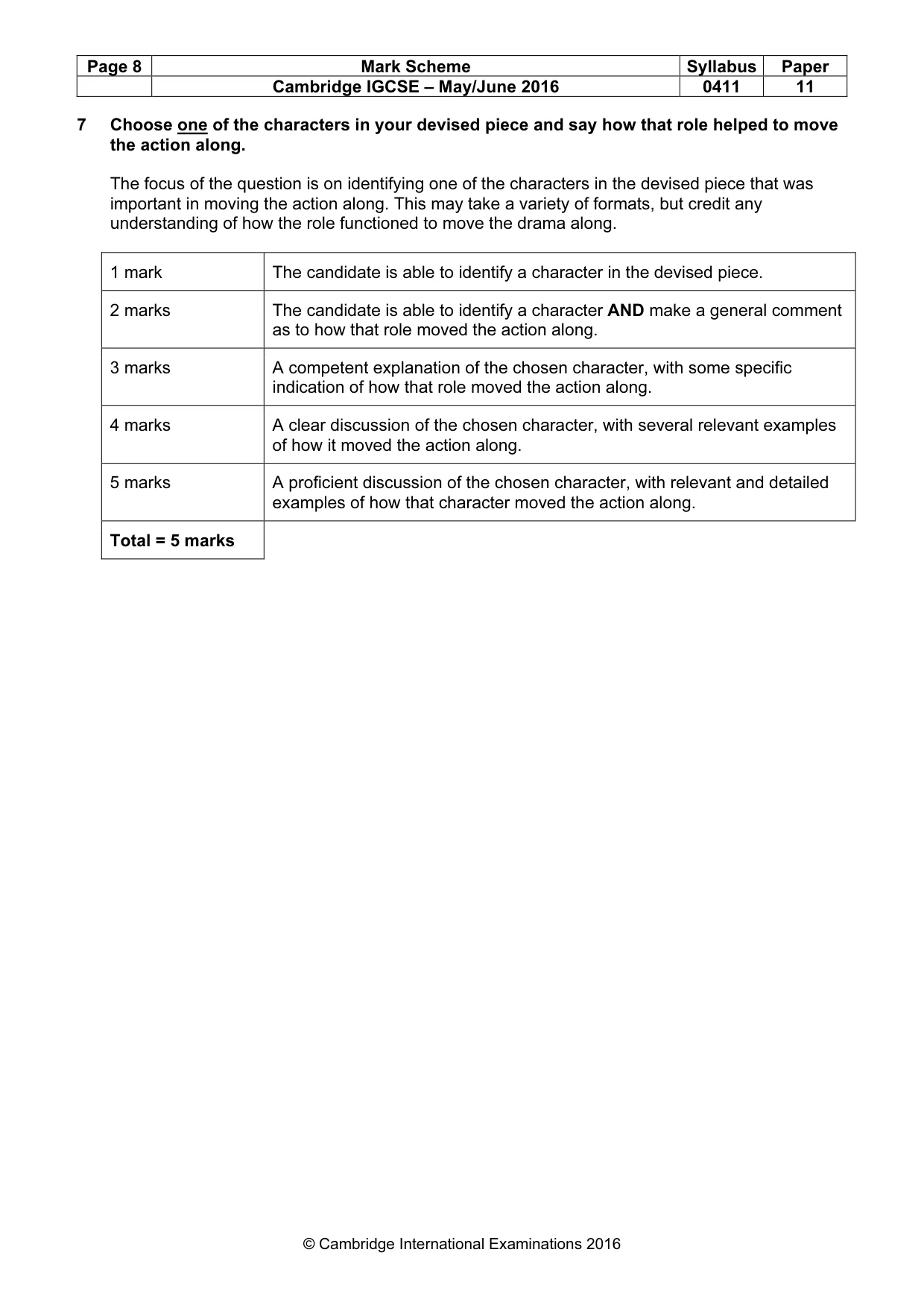
Page 8 Mark Scheme Syllabus Paper Cambridge IGCSE – May/June 2016 0411 11 © Cambridge International Examinations 2016 7 Choose one of the characters in your devised piece and say how that role helped to move the action along. The focus of the question is on identifying one of the characters in the devised piece that was important in moving the action along. This may take a variety of formats, but credit any understanding of how the role functioned to move the drama along. 1 mark The candidate is able to identify a character in the devised piece. 2 marks The candidate is able to identify a character AND make a general comment as to how that role moved the action along. 3 marks A competent explanation of the chosen character, with some specific indication of how that role moved the action along. 4 marks A clear discussion of the chosen character, with several relevant examples of how it moved the action along. 5 marks A proficient discussion of the chosen character, with relevant and detailed examples of how that character moved the action along. Total = 5 marks
Mark scheme, page 9
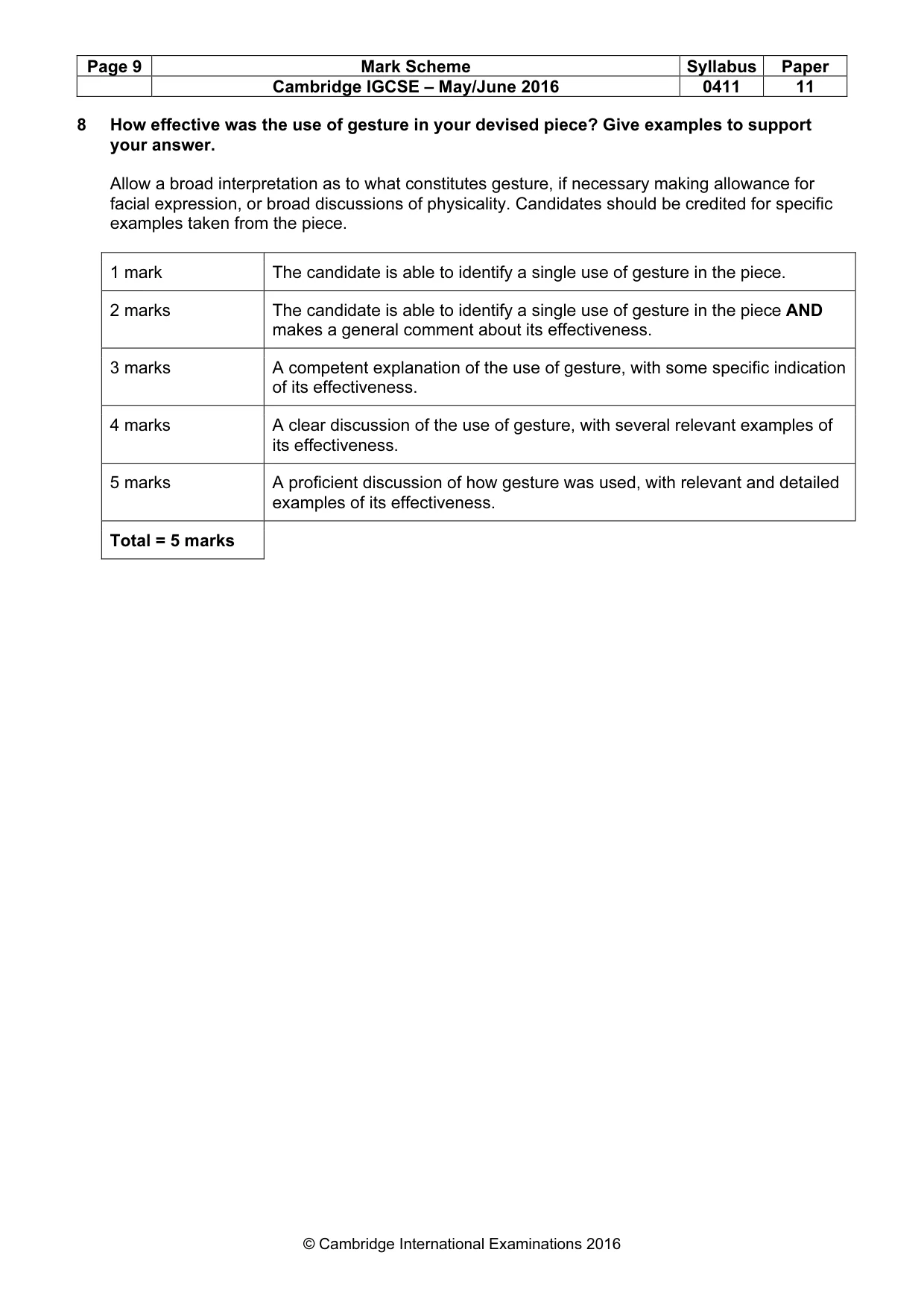
Page 9 Mark Scheme Syllabus Paper Cambridge IGCSE – May/June 2016 0411 11 © Cambridge International Examinations 2016 8 How effective was the use of gesture in your devised piece? Give examples to support your answer. Allow a broad interpretation as to what constitutes gesture, if necessary making allowance for facial expression, or broad discussions of physicality. Candidates should be credited for specific examples taken from the piece. 1 mark The candidate is able to identify a single use of gesture in the piece. 2 marks The candidate is able to identify a single use of gesture in the piece AND makes a general comment about its effectiveness. 3 marks A competent explanation of the use of gesture, with some specific indication of its effectiveness. 4 marks A clear discussion of the use of gesture, with several relevant examples of its effectiveness. 5 marks A proficient discussion of how gesture was used, with relevant and detailed examples of its effectiveness. Total = 5 marks
Mark scheme, page 10
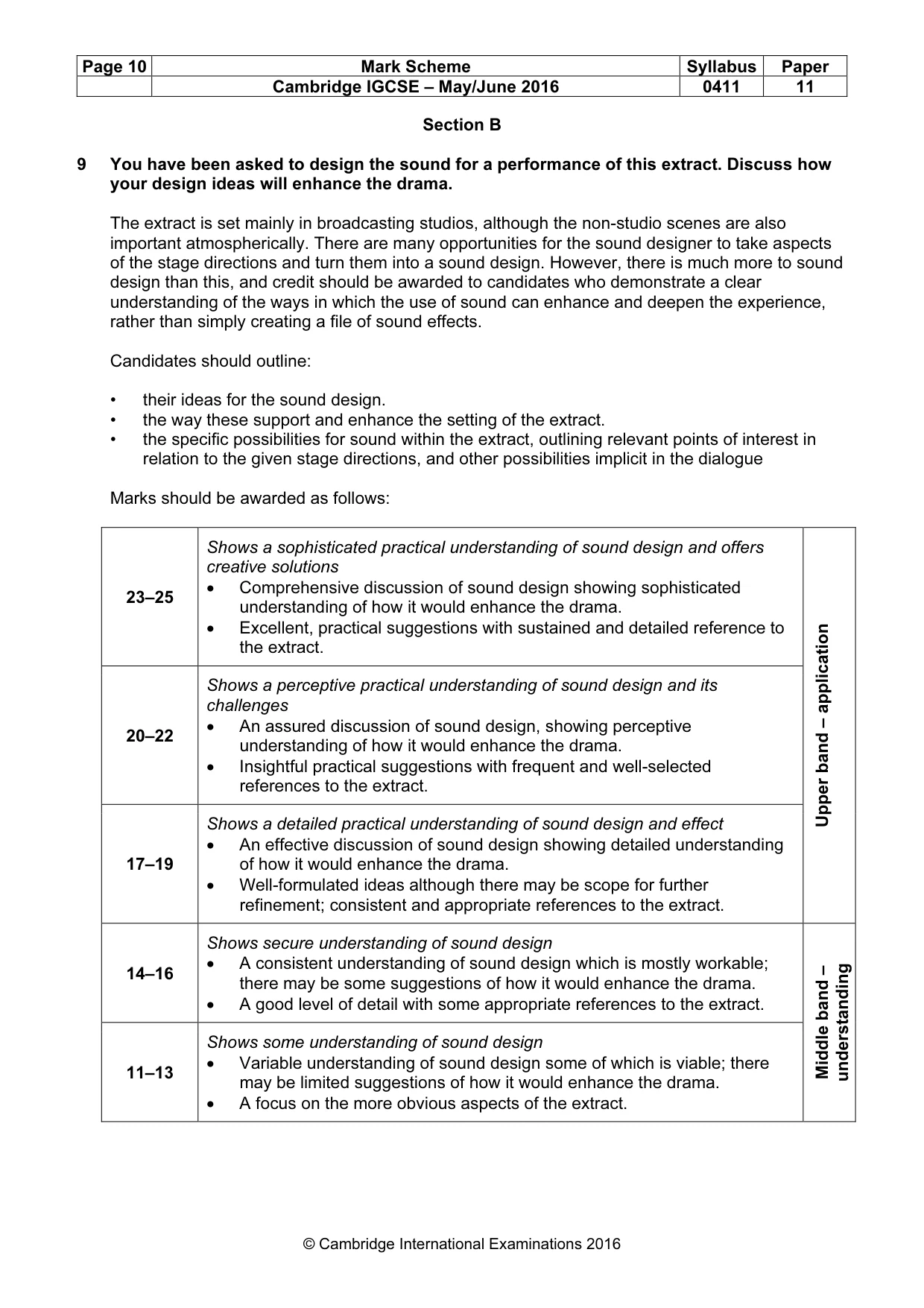
Page 10 Mark Scheme Syllabus Paper Cambridge IGCSE – May/June 2016 0411 11 © Cambridge International Examinations 2016 Section B 9 You have been asked to design the sound for a performance of this extract. Discuss how your design ideas will enhance the drama. The extract is set mainly in broadcasting studios, although the non-studio scenes are also important atmospherically. There are many opportunities for the sound designer to take aspects of the stage directions and turn them into a sound design. However, there is much more to sound design than this, and credit should be awarded to candidates who demonstrate a clear understanding of the ways in which the use of sound can enhance and deepen the experience, rather than simply creating a file of sound effects. Candidates should outline: • their ideas for the sound design. • the way these support and enhance the setting of the extract. • the specific possibilities for sound within the extract, outlining relevant points of interest in relation to the given stage directions, and other possibilities implicit in the dialogue Marks should be awarded as follows: 23–25 Shows a sophisticated practical understanding of sound design and offers creative solutions • Comprehensive discussion of sound design showing sophisticated understanding of how it would enhance the drama. • Excellent, practical suggestions with sustained and detailed reference to the extract. Upper band – application 20–22 Shows a perceptive practical understanding of sound design and its challenges • An assured discussion of sound design, showing perceptive understanding of how it would enhance the drama. • Insightful practical suggestions with frequent and well-selected references to the extract. 17–19 Shows a detailed practical understanding of sound design and effect • An effective discussion of sound design showing detailed understanding of how it would enhance the drama. • Well-formulated ideas although there may be scope for further refinement; consistent and appropriate references to the extract. 14–16 Shows secure understanding of sound design • A consistent understanding of sound design which is mostly workable; there may be some suggestions of how it would enhance the drama. • A good level of detail with some appropriate references to the extract. Middle band – understanding 11–13 Shows some understanding of sound design • Variable understanding of sound design some of which is viable; there may be limited suggestions of how it would enhance the drama. • A focus on the more obvious aspects of the extract.
Mark scheme, page 11
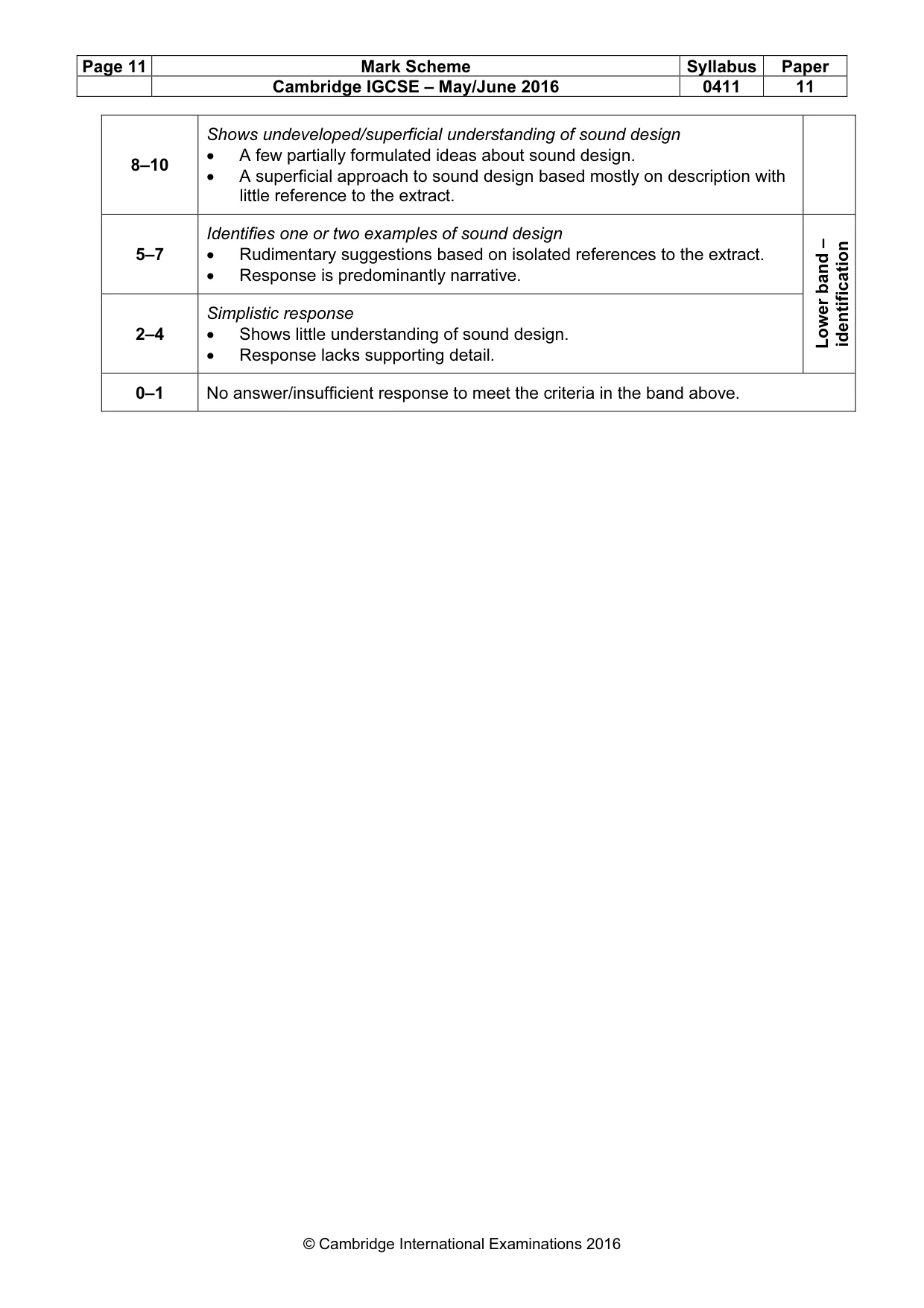
Page 11 Mark Scheme Syllabus Paper Cambridge IGCSE – May/June 2016 0411 11 © Cambridge International Examinations 2016 8–10 Shows undeveloped/superficial understanding of sound design • A few partially formulated ideas about sound design. • A superficial approach to sound design based mostly on description with little reference to the extract. 5–7 Identifies one or two examples of sound design • Rudimentary suggestions based on isolated references to the extract. • Response is predominantly narrative. Lower band – identification 2–4 Simplistic response • Shows little understanding of sound design. • Response lacks supporting detail. 0–1 No answer/insufficient response to meet the criteria in the band above.
Mark scheme, page 12
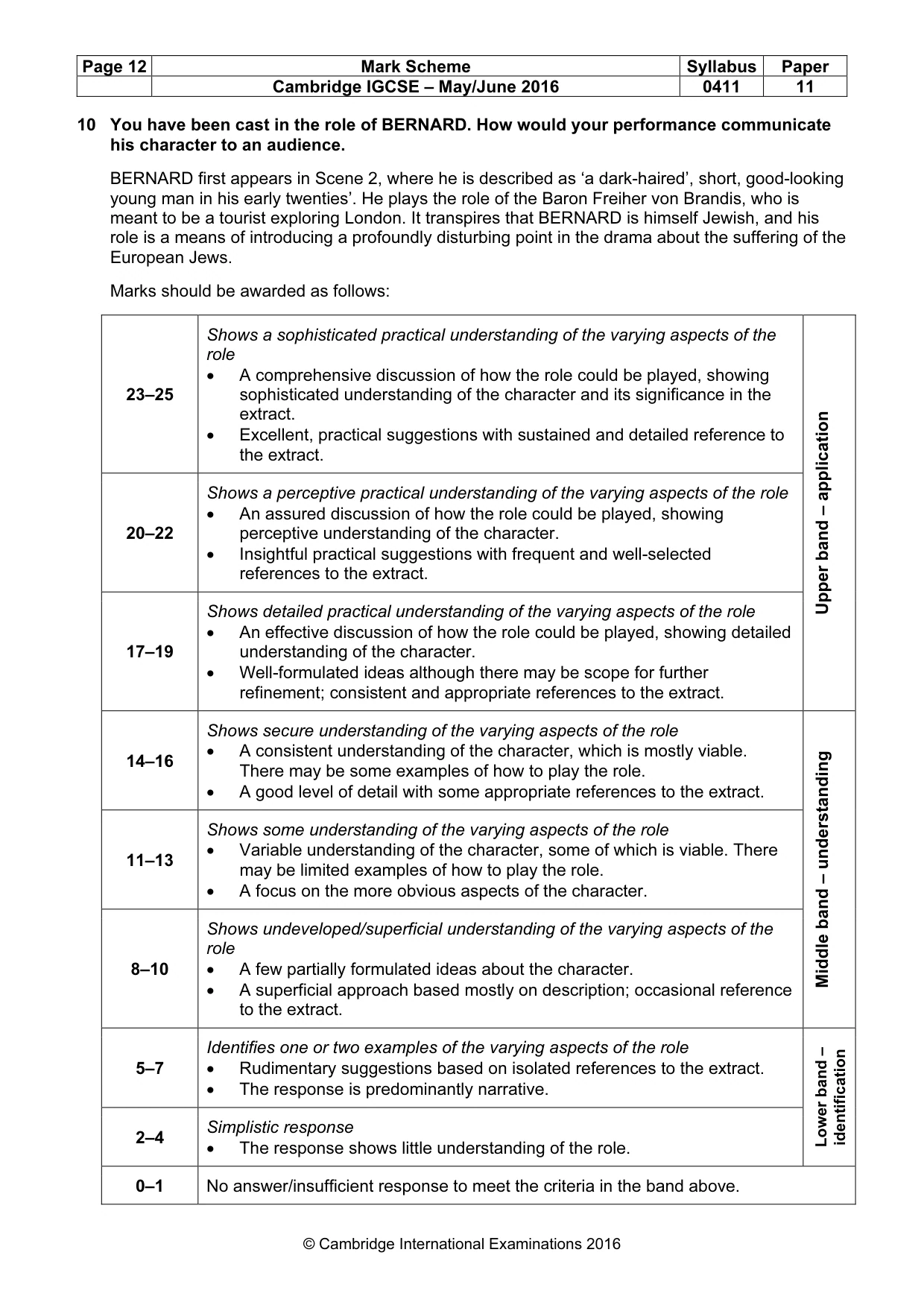
Page 12 Mark Scheme Syllabus Paper Cambridge IGCSE – May/June 2016 0411 11 © Cambridge International Examinations 2016 10 You have been cast in the role of BERNARD. How would your performance communicate his character to an audience. BERNARD first appears in Scene 2, where he is described as ‘a dark-haired’, short, good-looking young man in his early twenties’. He plays the role of the Baron Freiher von Brandis, who is meant to be a tourist exploring London. It transpires that BERNARD is himself Jewish, and his role is a means of introducing a profoundly disturbing point in the drama about the suffering of the European Jews. Marks should be awarded as follows: 23–25 Shows a sophisticated practical understanding of the varying aspects of the role • A comprehensive discussion of how the role could be played, showing sophisticated understanding of the character and its significance in the extract. • Excellent, practical suggestions with sustained and detailed reference to the extract. Upper band – application 20–22 Shows a perceptive practical understanding of the varying aspects of the role • An assured discussion of how the role could be played, showing perceptive understanding of the character. • Insightful practical suggestions with frequent and well-selected references to the extract. 17–19 Shows detailed practical understanding of the varying aspects of the role • An effective discussion of how the role could be played, showing detailed understanding of the character. • Well-formulated ideas although there may be scope for further refinement; consistent and appropriate references to the extract. 14–16 Shows secure understanding of the varying aspects of the role • A consistent understanding of the character, which is mostly viable. There may be some examples of how to play the role. • A good level of detail with some appropriate references to the extract. Middle band – understanding 11–13 Shows some understanding of the varying aspects of the role • Variable understanding of the character, some of which is viable. There may be limited examples of how to play the role. • A focus on the more obvious aspects of the character. 8–10 Shows undeveloped/superficial understanding of the varying aspects of the role • A few partially formulated ideas about the character. • A superficial approach based mostly on description; occasional reference to the extract. 5–7 Identifies one or two examples of the varying aspects of the role • Rudimentary suggestions based on isolated references to the extract. • The response is predominantly narrative. Lower band – identification 2–4 Simplistic response • The response shows little understanding of the role. 0–1 No answer/insufficient response to meet the criteria in the band above.
Mark scheme, page 13
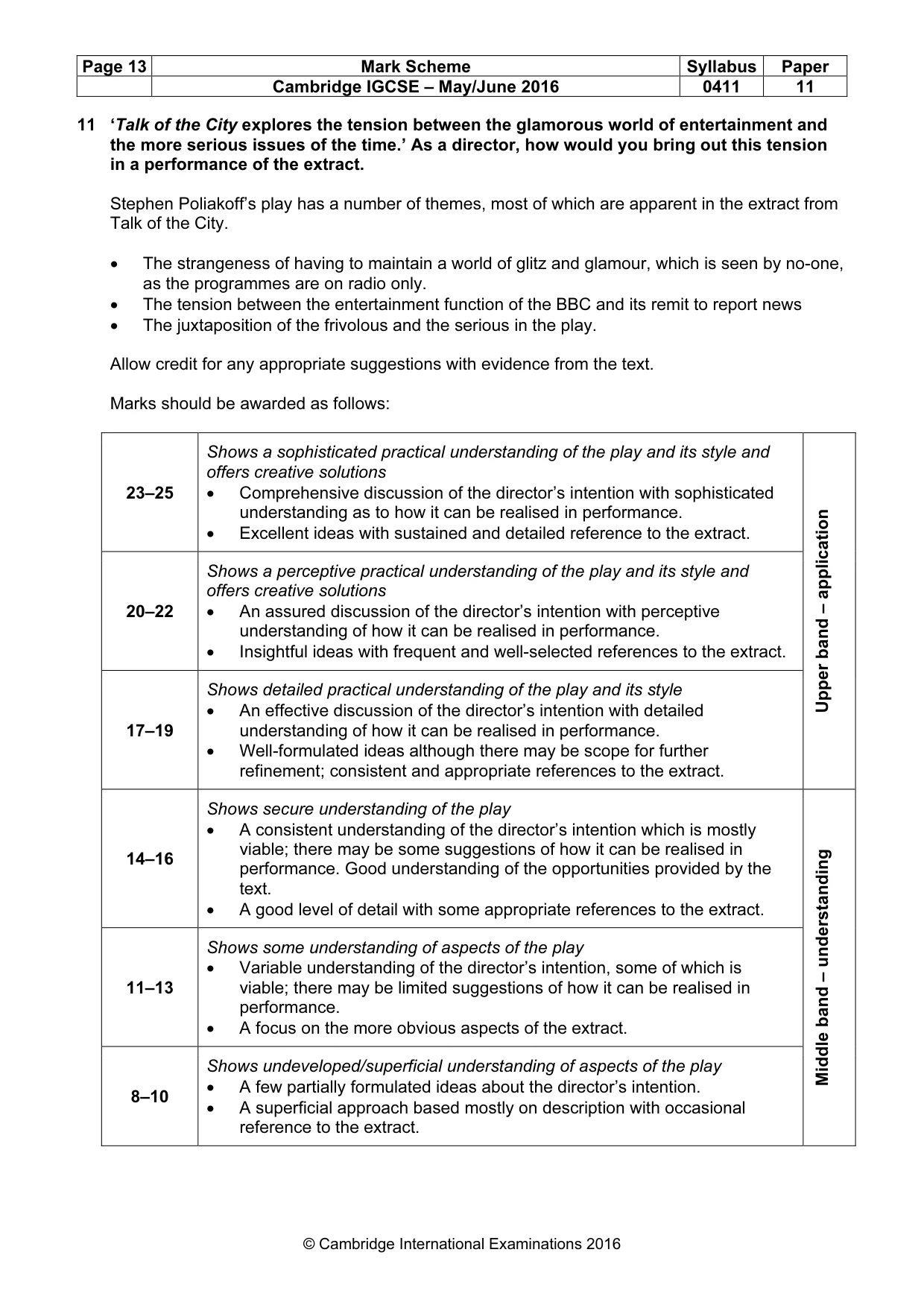
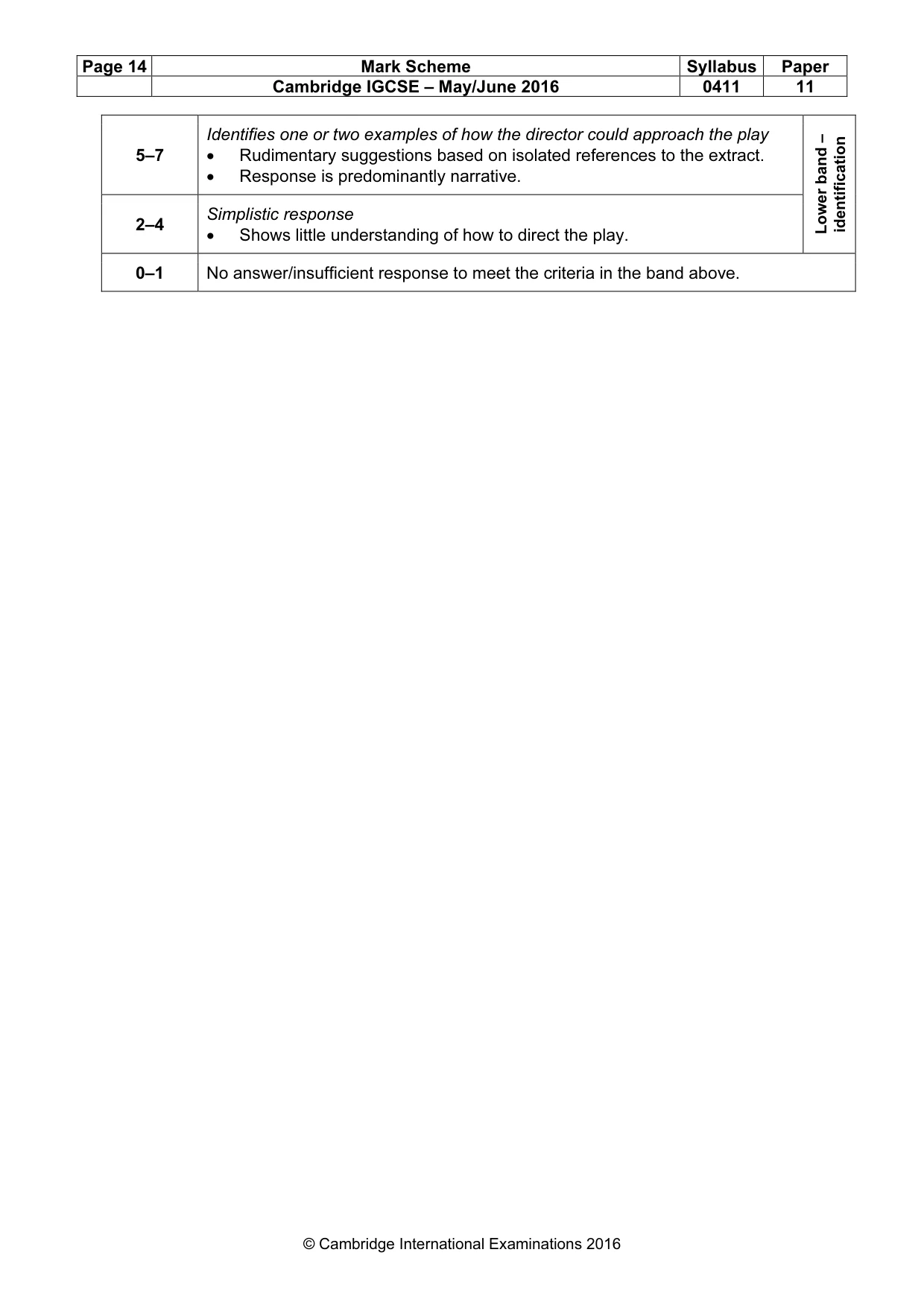
Page 13 Mark Scheme Syllabus Paper Cambridge IGCSE – May/June 2016 0411 11 © Cambridge International Examinations 2016 11 ‘Talk of the City explores the tension between the glamorous world of entertainment and the more serious issues of the time.’ As a director, how would you bring out this tension in a performance of the extract. Stephen Poliakoff’s play has a number of themes, most of which are apparent in the extract from Talk of the City. • The strangeness of having to maintain a world of glitz and glamour, which is seen by no-one, as the programmes are on radio only. • The tension between the entertainment function of the BBC and its remit to report news • The juxtaposition of the frivolous and the serious in the play. Allow credit for any appropriate suggestions with evidence from the text. Marks should be awarded as follows: 23–25 Shows a sophisticated practical understanding of the play and its style and offers creative solutions • Comprehensive discussion of the director’s intention with sophisticated understanding as to how it can be realised in performance. • Excellent ideas with sustained and detailed reference to the extract. Upper band – application 20–22 Shows a perceptive practical understanding of the play and its style and offers creative solutions • An assured discussion of the director’s intention with perceptive understanding of how it can be realised in performance. • Insightful ideas with frequent and well-selected references to the extract. 17–19 Shows detailed practical understanding of the play and its style • An effective discussion of the director’s intention with detailed understanding of how it can be realised in performance. • Well-formulated ideas although there may be scope for further refinement; consistent and appropriate references to the extract. 14–16 Shows secure understanding of the play • A consistent understanding of the director’s intention which is mostly viable; there may be some suggestions of how it can be realised in performance. Good understanding of the opportunities provided by the text. • A good level of detail with some appropriate references to the extract. Middle band – understanding 11–13 Shows some understanding of aspects of the play • Variable understanding of the director’s intention, some of which is viable; there may be limited suggestions of how it can be realised in performance. • A focus on the more obvious aspects of the extract. 8–10 Shows undeveloped/superficial understanding of aspects of the play • A few partially formulated ideas about the director’s intention. • A superficial approach based mostly on description with occasional reference to the extract.
Mark scheme, page 14
Page 14 Mark Scheme Syllabus Paper Cambridge IGCSE – May/June 2016 0411 11 © Cambridge International Examinations 2016 5–7 Identifies one or two examples of how the director could approach the play • Rudimentary suggestions based on isolated references to the extract. • Response is predominantly narrative. Lower band – identification 2–4 Simplistic response • Shows little understanding of how to direct the play. 0–1 No answer/insufficient response to meet the criteria in the band above.
Mark scheme, page 15
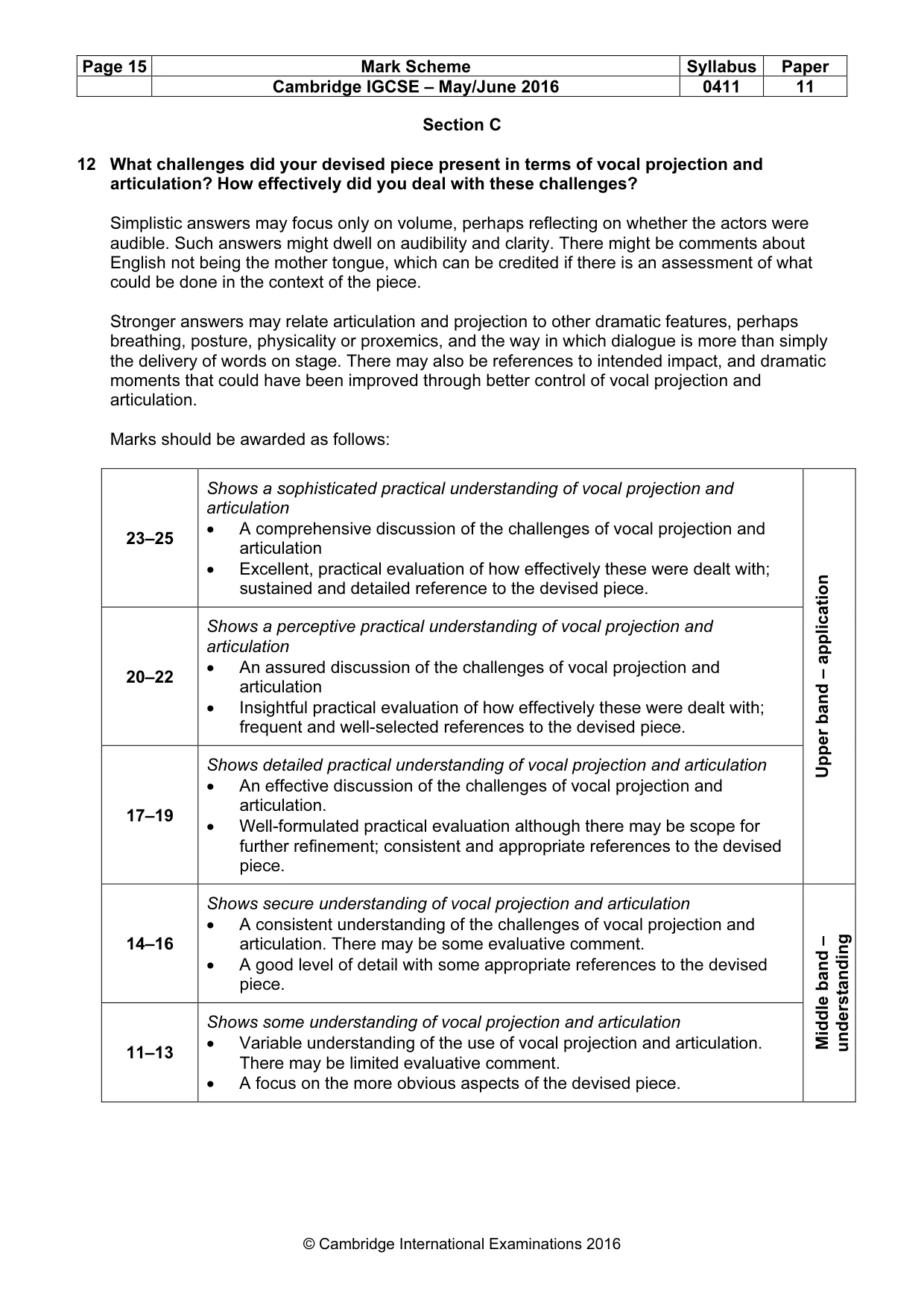
Page 15 Mark Scheme Syllabus Paper Cambridge IGCSE – May/June 2016 0411 11 © Cambridge International Examinations 2016 Section C 12 What challenges did your devised piece present in terms of vocal projection and articulation? How effectively did you deal with these challenges? Simplistic answers may focus only on volume, perhaps reflecting on whether the actors were audible. Such answers might dwell on audibility and clarity. There might be comments about English not being the mother tongue, which can be credited if there is an assessment of what could be done in the context of the piece. Stronger answers may relate articulation and projection to other dramatic features, perhaps breathing, posture, physicality or proxemics, and the way in which dialogue is more than simply the delivery of words on stage. There may also be references to intended impact, and dramatic moments that could have been improved through better control of vocal projection and articulation. Marks should be awarded as follows: 23–25 Shows a sophisticated practical understanding of vocal projection and articulation • A comprehensive discussion of the challenges of vocal projection and articulation • Excellent, practical evaluation of how effectively these were dealt with; sustained and detailed reference to the devised piece. Upper band – application 20–22 Shows a perceptive practical understanding of vocal projection and articulation • An assured discussion of the challenges of vocal projection and articulation • Insightful practical evaluation of how effectively these were dealt with; frequent and well-selected references to the devised piece. 17–19 Shows detailed practical understanding of vocal projection and articulation • An effective discussion of the challenges of vocal projection and articulation. • Well-formulated practical evaluation although there may be scope for further refinement; consistent and appropriate references to the devised piece. 14–16 Shows secure understanding of vocal projection and articulation • A consistent understanding of the challenges of vocal projection and articulation. There may be some evaluative comment. • A good level of detail with some appropriate references to the devised piece. Middle band – understanding 11–13 Shows some understanding of vocal projection and articulation • Variable understanding of the use of vocal projection and articulation. There may be limited evaluative comment. • A focus on the more obvious aspects of the devised piece.
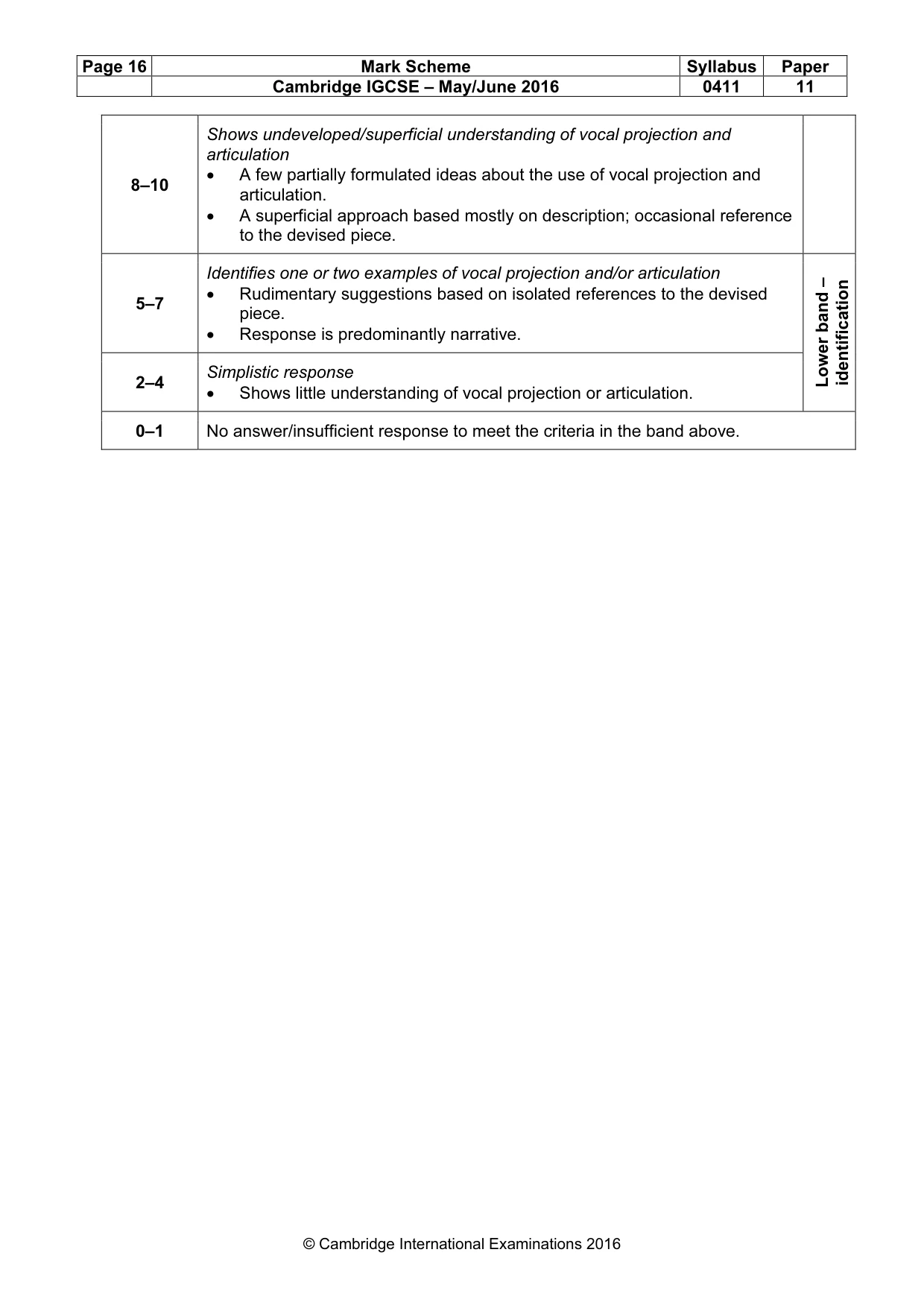
Mark scheme, page 16
Page 16 Mark Scheme Syllabus Paper Cambridge IGCSE – May/June 2016 0411 11 © Cambridge International Examinations 2016 8–10 Shows undeveloped/superficial understanding of vocal projection and articulation • A few partially formulated ideas about the use of vocal projection and articulation. • A superficial approach based mostly on description; occasional reference to the devised piece. 5–7 Identifies one or two examples of vocal projection and/or articulation • Rudimentary suggestions based on isolated references to the devised piece. • Response is predominantly narrative. Lower band – identification 2–4 Simplistic response • Shows little understanding of vocal projection or articulation. 0–1 No answer/insufficient response to meet the criteria in the band above.
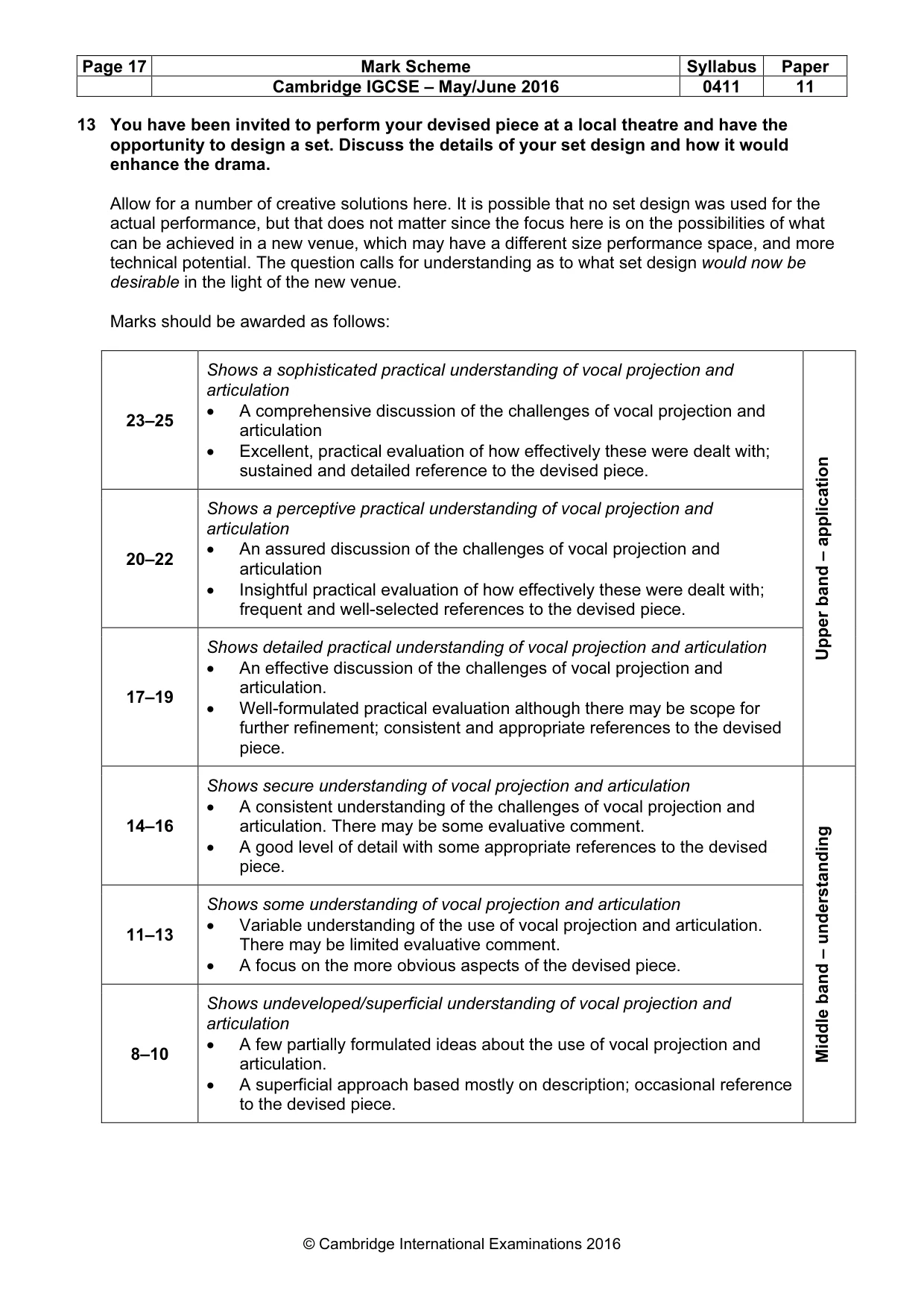
Mark scheme, page 17
Page 17 Mark Scheme Syllabus Paper Cambridge IGCSE – May/June 2016 0411 11 © Cambridge International Examinations 2016 13 You have been invited to perform your devised piece at a local theatre and have the opportunity to design a set. Discuss the details of your set design and how it would enhance the drama. Allow for a number of creative solutions here. It is possible that no set design was used for the actual performance, but that does not matter since the focus here is on the possibilities of what can be achieved in a new venue, which may have a different size performance space, and more technical potential. The question calls for understanding as to what set design would now be desirable in the light of the new venue. Marks should be awarded as follows: 23–25 Shows a sophisticated practical understanding of vocal projection and articulation • A comprehensive discussion of the challenges of vocal projection and articulation • Excellent, practical evaluation of how effectively these were dealt with; sustained and detailed reference to the devised piece. Upper band – application 20–22 Shows a perceptive practical understanding of vocal projection and articulation • An assured discussion of the challenges of vocal projection and articulation • Insightful practical evaluation of how effectively these were dealt with; frequent and well-selected references to the devised piece. 17–19 Shows detailed practical understanding of vocal projection and articulation • An effective discussion of the challenges of vocal projection and articulation. • Well-formulated practical evaluation although there may be scope for further refinement; consistent and appropriate references to the devised piece. 14–16 Shows secure understanding of vocal projection and articulation • A consistent understanding of the challenges of vocal projection and articulation. There may be some evaluative comment. • A good level of detail with some appropriate references to the devised piece. Middle band – understanding 11–13 Shows some understanding of vocal projection and articulation • Variable understanding of the use of vocal projection and articulation. There may be limited evaluative comment. • A focus on the more obvious aspects of the devised piece. 8–10 Shows undeveloped/superficial understanding of vocal projection and articulation • A few partially formulated ideas about the use of vocal projection and articulation. • A superficial approach based mostly on description; occasional reference to the devised piece.
Mark scheme, page 18
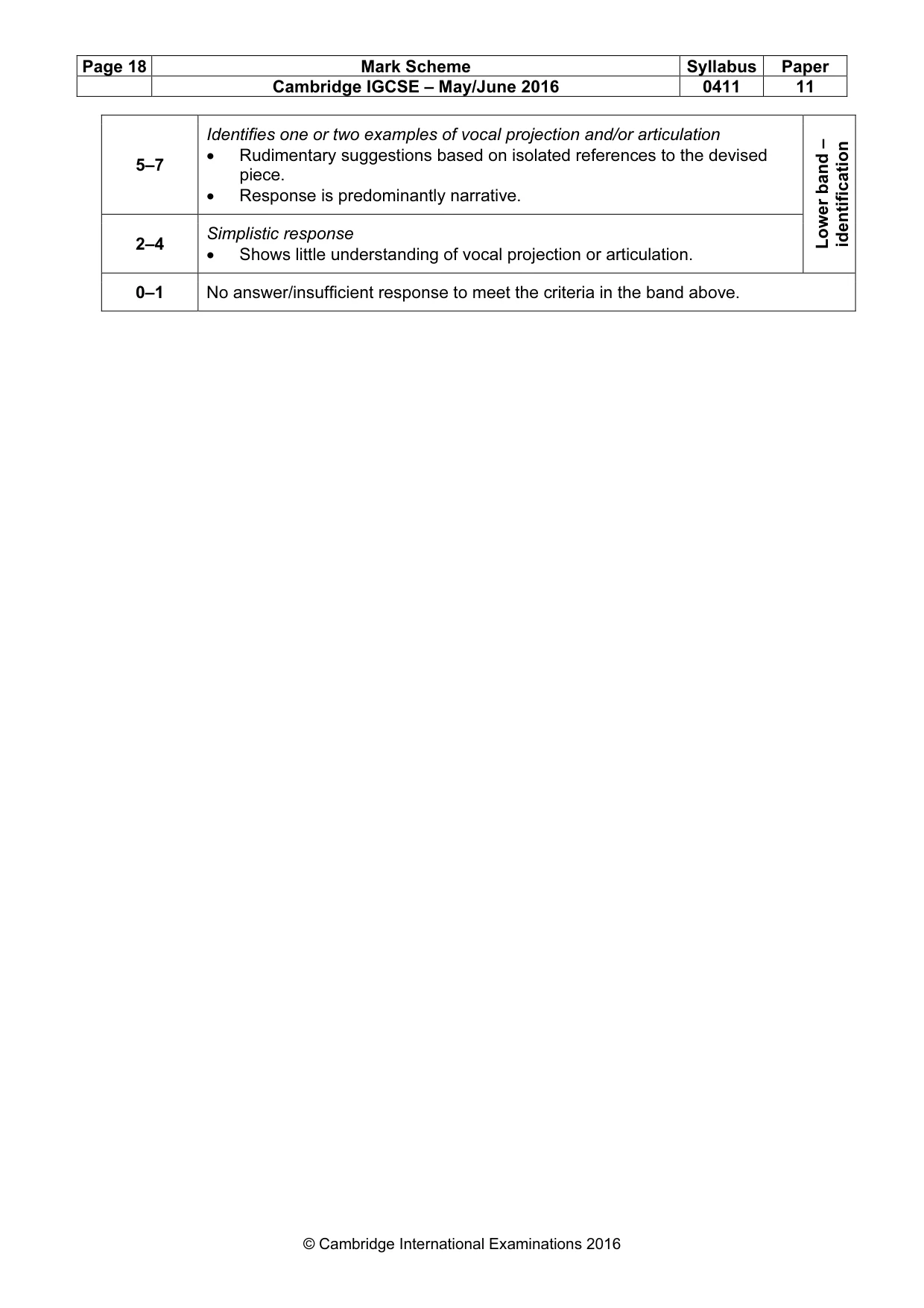
Page 18 Mark Scheme Syllabus Paper Cambridge IGCSE – May/June 2016 0411 11 © Cambridge International Examinations 2016 5–7 Identifies one or two examples of vocal projection and/or articulation • Rudimentary suggestions based on isolated references to the devised piece. • Response is predominantly narrative. Lower band – identification 2–4 Simplistic response • Shows little understanding of vocal projection or articulation. 0–1 No answer/insufficient response to meet the criteria in the band above.
Mark scheme, page 19
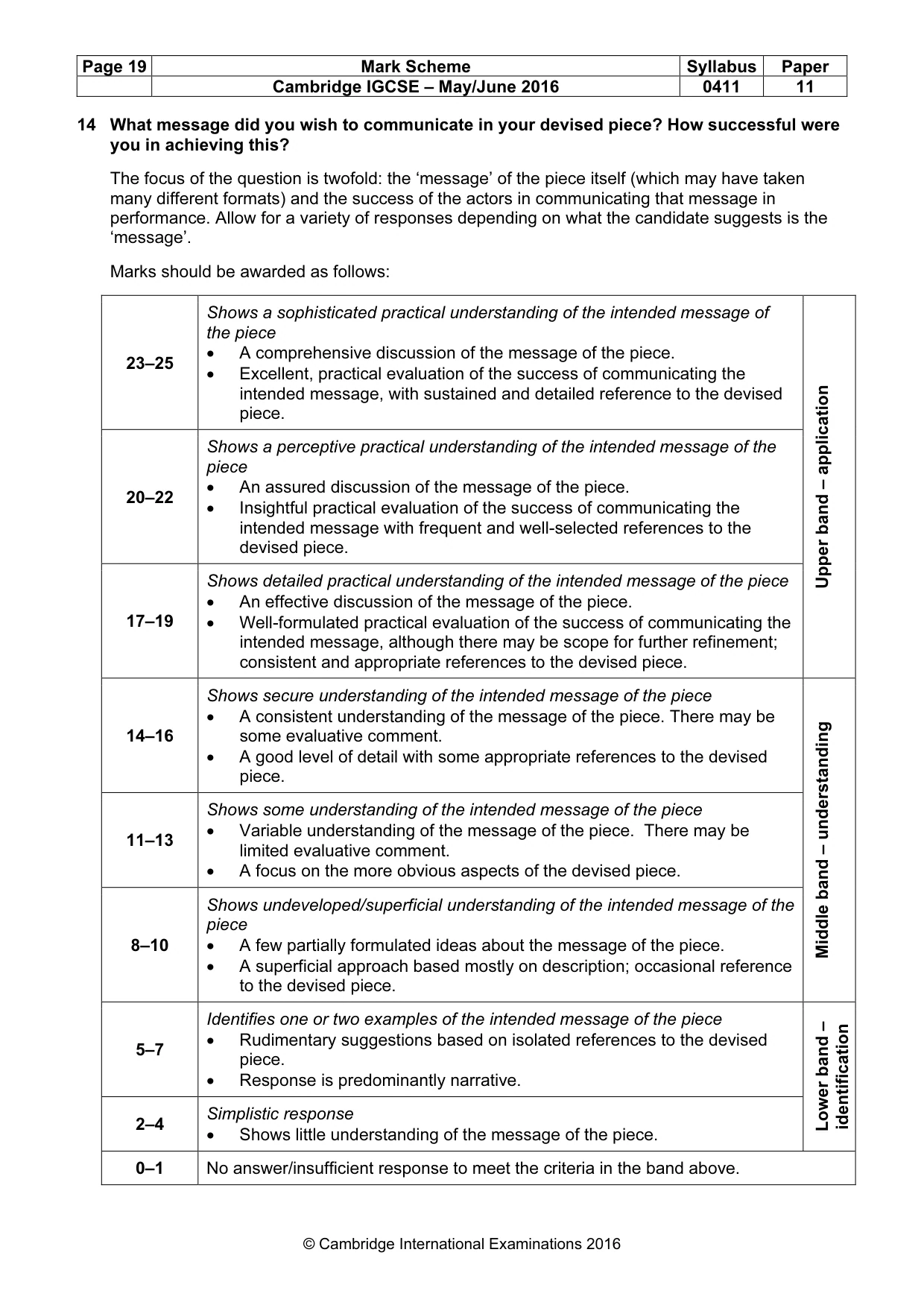
Page 19 Mark Scheme Syllabus Paper Cambridge IGCSE – May/June 2016 0411 11 © Cambridge International Examinations 2016 14 What message did you wish to communicate in your devised piece? How successful were you in achieving this? The focus of the question is twofold: the ‘message’ of the piece itself (which may have taken many different formats) and the success of the actors in communicating that message in performance. Allow for a variety of responses depending on what the candidate suggests is the ‘message’. Marks should be awarded as follows: 23–25 Shows a sophisticated practical understanding of the intended message of the piece • A comprehensive discussion of the message of the piece. • Excellent, practical evaluation of the success of communicating the intended message, with sustained and detailed reference to the devised piece. Upper band – application 20–22 Shows a perceptive practical understanding of the intended message of the piece • An assured discussion of the message of the piece. • Insightful practical evaluation of the success of communicating the intended message with frequent and well-selected references to the devised piece. 17–19 Shows detailed practical understanding of the intended message of the piece • An effective discussion of the message of the piece. • Well-formulated practical evaluation of the success of communicating the intended message, although there may be scope for further refinement; consistent and appropriate references to the devised piece. 14–16 Shows secure understanding of the intended message of the piece • A consistent understanding of the message of the piece. There may be some evaluative comment. • A good level of detail with some appropriate references to the devised piece. Middle band – understanding 11–13 Shows some understanding of the intended message of the piece • Variable understanding of the message of the piece. There may be limited evaluative comment. • A focus on the more obvious aspects of the devised piece. 8–10 Shows undeveloped/superficial understanding of the intended message of the piece • A few partially formulated ideas about the message of the piece. • A superficial approach based mostly on description; occasional reference to the devised piece. 5–7 Identifies one or two examples of the intended message of the piece • Rudimentary suggestions based on isolated references to the devised piece. • Response is predominantly narrative. Lower band – identification 2–4 Simplistic response • Shows little understanding of the message of the piece. 0–1 No answer/insufficient response to meet the criteria in the band above.
What you needed in this session
Cambridge’s own grade thresholds for 2016 May/June, Paper 1 · Variant 1. A higher threshold means an easier paper — the bar moves with how the cohort did.