Cambridge IGCSE Development Studies 0453 — 2007 Oct/Nov Paper 4 · Variant 1
0453/41/O/N/07 · 35 marks · ≈39 min
The question paper and its mark scheme, free to read here and free to download. This is Cambridge’s own paper, exactly as it was sat.
Question paper4 pages
Mark scheme4 pages
Answers below. Sit the paper first if you are practising.
Paper as text
Question paper, page 1
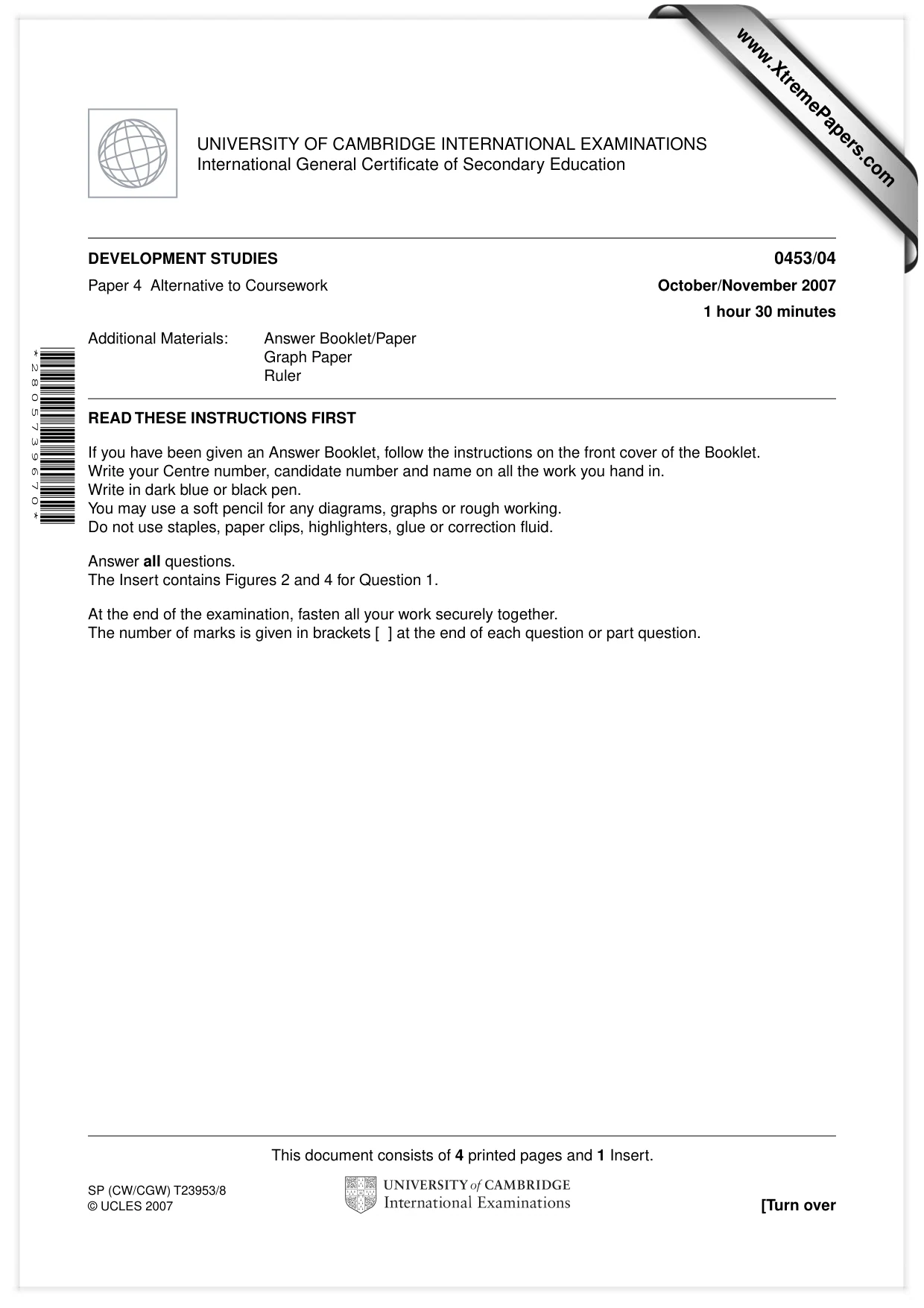
This document consists of 4 printed pages and 1 Insert. SP (CW/CGW) T23953/8 © UCLES 2007 [Turn over UNIVERSITY OF CAMBRIDGE INTERNATIONAL EXAMINATIONS International General Certificate of Secondary Education READ THESE INSTRUCTIONS FIRST If you have been given an Answer Booklet, follow the instructions on the front cover of the Booklet. Write your Centre number, candidate number and name on all the work you hand in. Write in dark blue or black pen. You may use a soft pencil for any diagrams, graphs or rough working. Do not use staples, paper clips, highlighters, glue or correction fluid. Answer all questions. The Insert contains Figures 2 and 4 for Question 1. At the end of the examination, fasten all your work securely together. The number of marks is given in brackets [ ] at the end of each question or part question. * 2 8 0 5 7 3 9 6 7 0 * DEVELOPMENT STUDIES 0453/04 Paper 4 Alternative to Coursework October/November 2007 1 hour 30 minutes Additional Materials: Answer Booklet/Paper Graph Paper Ruler www.XtremePapers.com
Question paper, page 2
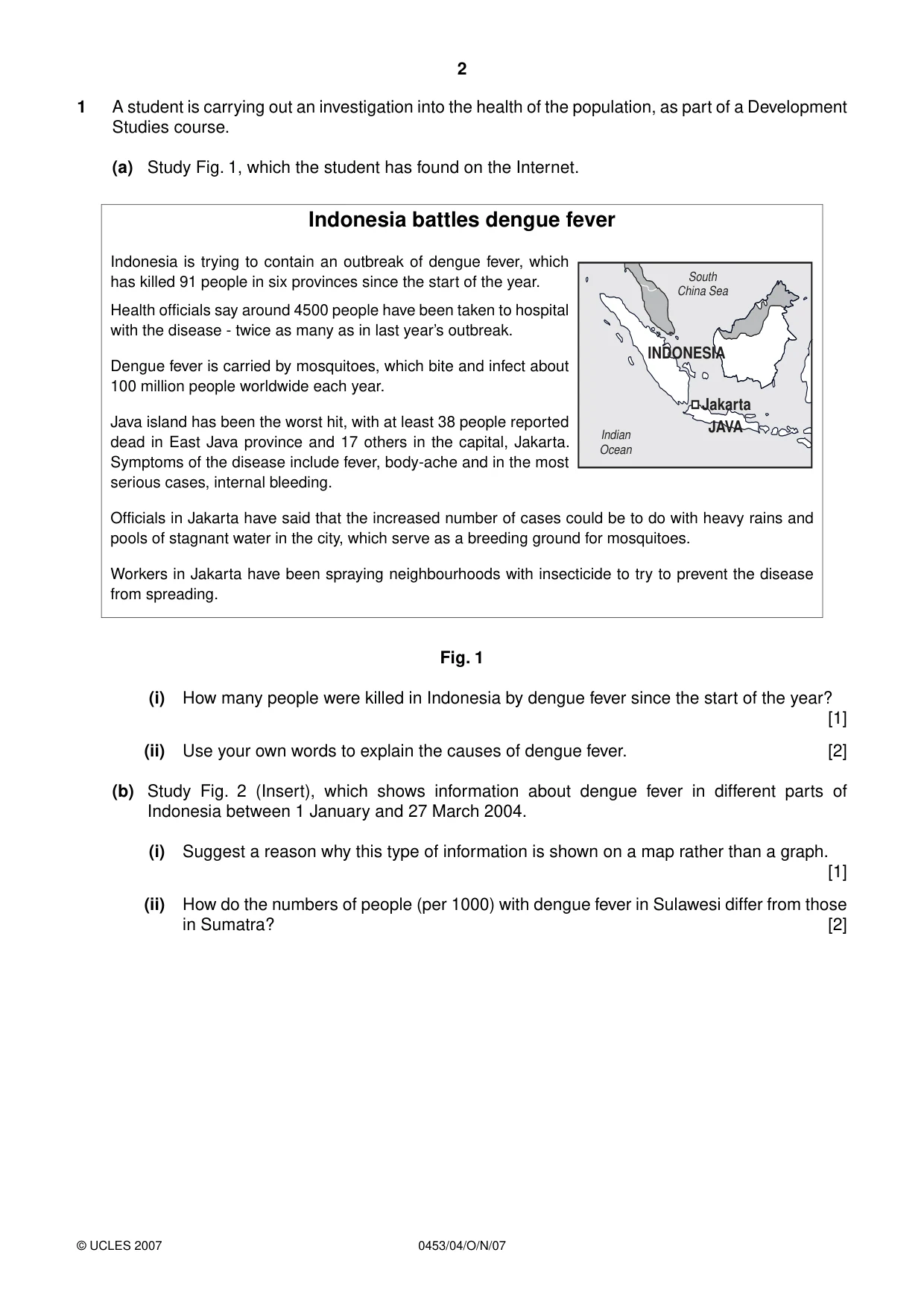
2 0453/04/O/N/07 © UCLES 2007 1 A student is carrying out an investigation into the health of the population, as part of a Development Studies course. (a) Study Fig. 1, which the student has found on the Internet. Indonesia battles dengue fever Indonesia is trying to contain an outbreak of dengue fever, which has killed 91 people in six provinces since the start of the year. Health officials say around 4500 people have been taken to hospital with the disease - twice as many as in last year’s outbreak. Dengue fever is carried by mosquitoes, which bite and infect about 100 million people worldwide each year. Java island has been the worst hit, with at least 38 people reported dead in East Java province and 17 others in the capital, Jakarta. Symptoms of the disease include fever, body-ache and in the most serious cases, internal bleeding. Officials in Jakarta have said that the increased number of cases could be to do with heavy rains and pools of stagnant water in the city, which serve as a breeding ground for mosquitoes. Workers in Jakarta have been spraying neighbourhoods with insecticide to try to prevent the disease from spreading. INDONESIA JAVA Jakarta South China Sea Indian Ocean Fig. 1 (i) How many people were killed in Indonesia by dengue fever since the start of the year? [1] (ii) Use your own words to explain the causes of dengue fever. [2] (b) Study Fig. 2 (Insert), which shows information about dengue fever in different parts of Indonesia between 1 January and 27 March 2004. (i) Suggest a reason why this type of information is shown on a map rather than a graph. [1] (ii) How do the numbers of people (per 1000) with dengue fever in Sulawesi differ from those in Sumatra? [2]
Question paper, page 3
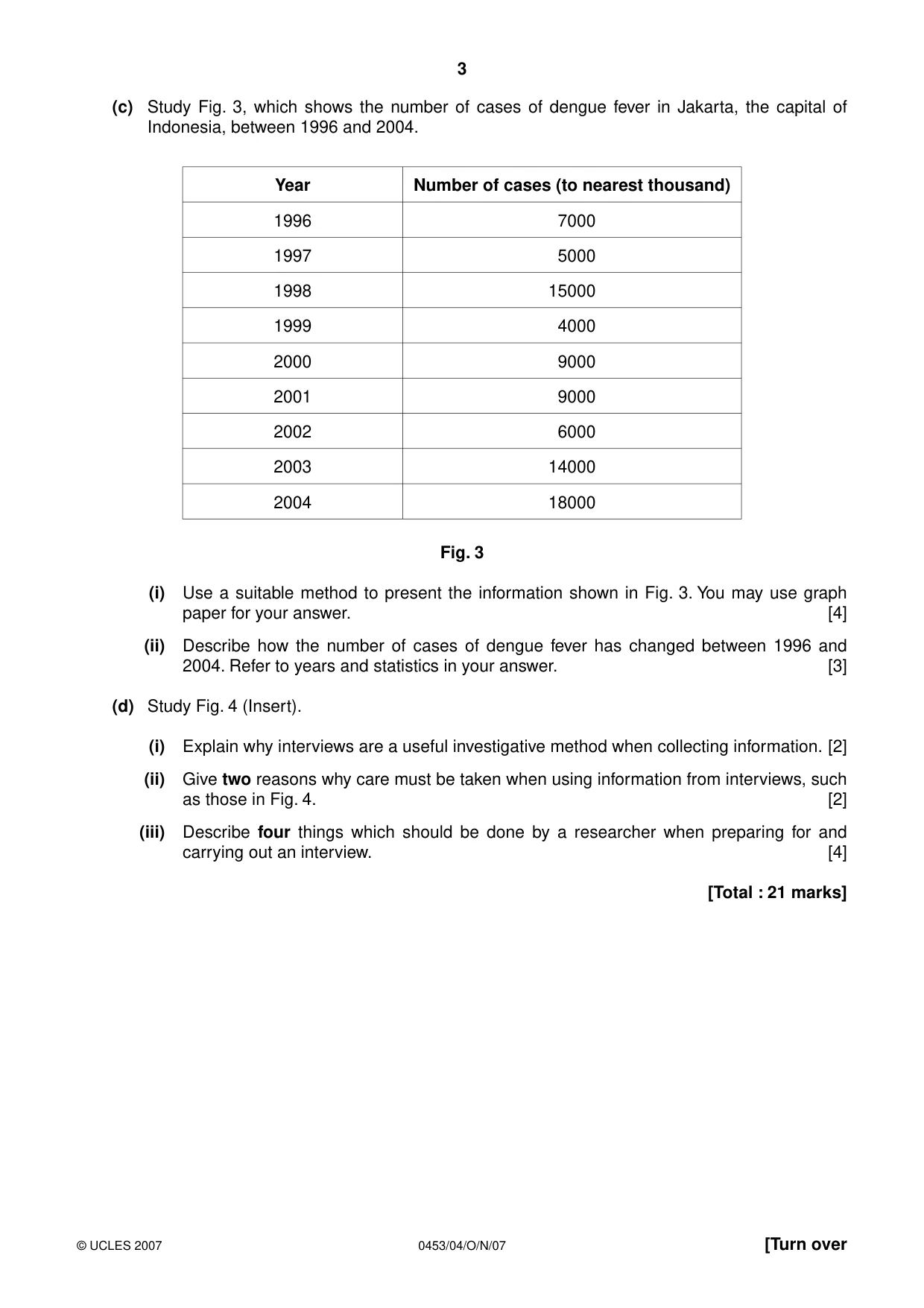
3 0453/04/O/N/07 © UCLES 2007 [Turn over (c) Study Fig. 3, which shows the number of cases of dengue fever in Jakarta, the capital of Indonesia, between 1996 and 2004. Year Number of cases (to nearest thousand) 1996 7000 1997 5000 1998 15000 1999 4000 2000 9000 2001 9000 2002 6000 2003 14000 2004 18000 Fig. 3 (i) Use a suitable method to present the information shown in Fig. 3. You may use graph paper for your answer. [4] (ii) Describe how the number of cases of dengue fever has changed between 1996 and 2004. Refer to years and statistics in your answer. [3] (d) Study Fig. 4 (Insert). (i) Explain why interviews are a useful investigative method when collecting information. [2] (ii) Give two reasons why care must be taken when using information from interviews, such as those in Fig. 4. [2] (iii) Describe four things which should be done by a researcher when preparing for and carrying out an interview. [4] [Total : 21 marks]
Question paper, page 4
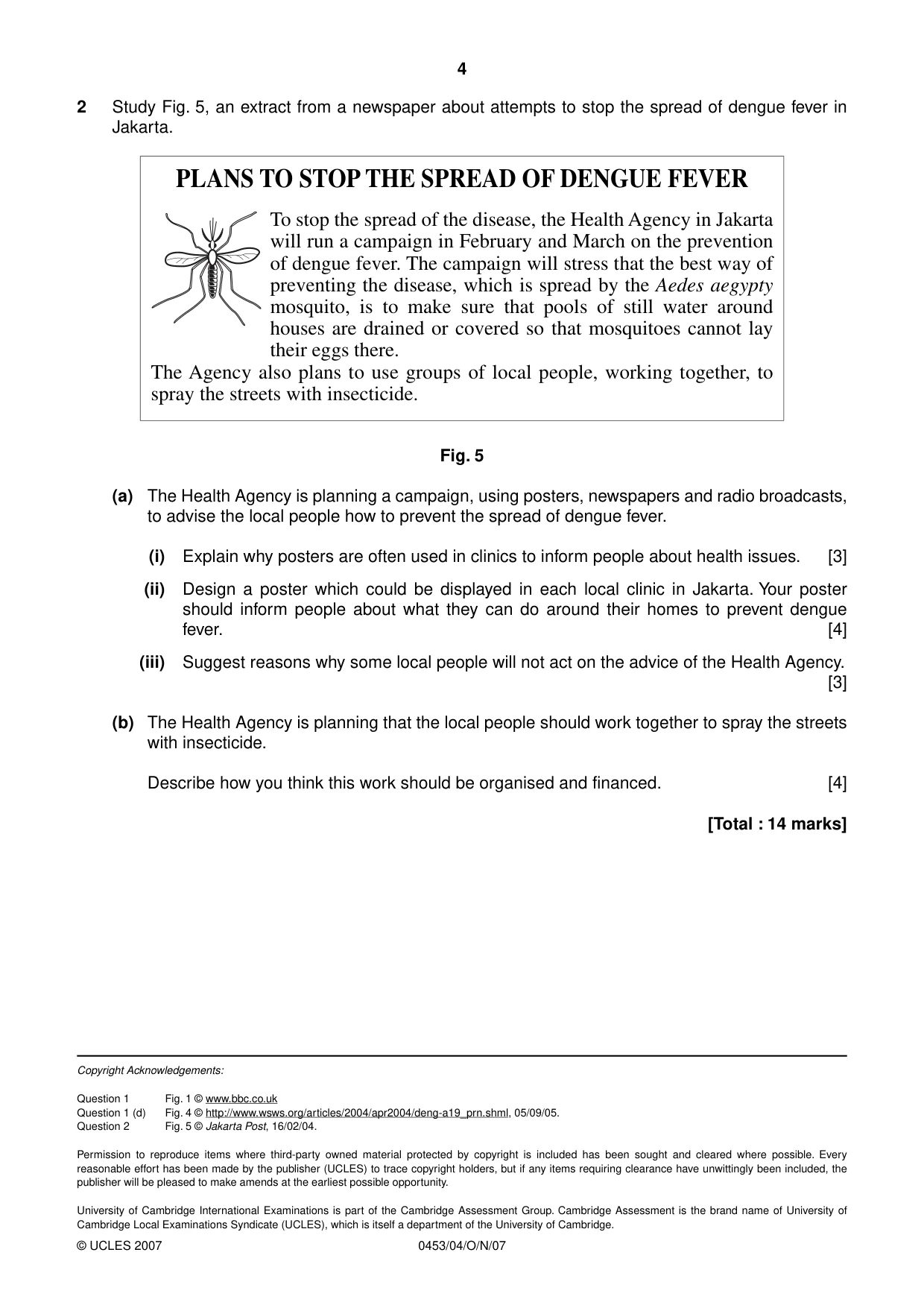
4 0453/04/O/N/07 © UCLES 2007 2 Study Fig. 5, an extract from a newspaper about attempts to stop the spread of dengue fever in Jakarta. PLANS TO STOP THE SPREAD OF DENGUE FEVER To stop the spread of the disease, the Health Agency in Jakarta will run a campaign in February and March on the prevention of dengue fever. The campaign will stress that the best way of preventing the disease, which is spread by the Aedes aegypty mosquito, is to make sure that pools of still water around houses are drained or covered so that mosquitoes cannot lay their eggs there. The Agency also plans to use groups of local people, working together, to spray the streets with insecticide. Fig. 5 (a) The Health Agency is planning a campaign, using posters, newspapers and radio broadcasts, to advise the local people how to prevent the spread of dengue fever. (i) Explain why posters are often used in clinics to inform people about health issues. [3] (ii) Design a poster which could be displayed in each local clinic in Jakarta. Your poster should inform people about what they can do around their homes to prevent dengue fever. [4] (iii) Suggest reasons why some local people will not act on the advice of the Health Agency. [3] (b) The Health Agency is planning that the local people should work together to spray the streets with insecticide. Describe how you think this work should be organised and financed. [4] [Total : 14 marks] Copyright Acknowledgements: Question 1 Fig. 1 © www.bbc.co.uk Question 1 (d) Fig. 4 © http://www.wsws.org/articles/2004/apr2004/deng-a19_prn.shml, 05/09/05. Question 2 Fig. 5 © Jakarta Post, 16/02/04. Permission to reproduce items where third-party owned material protected by copyright is included has been sought and cleared where possible. Every reasonable effort has been made by the publisher (UCLES) to trace copyright holders, but if any items requiring clearance have unwittingly been included, the publisher will be pleased to make amends at the earliest possible opportunity. University of Cambridge International Examinations is part of the Cambridge Assessment Group. Cambridge Assessment is the brand name of University of Cambridge Local Examinations Syndicate (UCLES), which is itself a department of the University of Cambridge.
Mark scheme, page 1
UNIVERSITY OF CAMBRIDGE INTERNATIONAL EXAMINATIONS International General Certificate of Secondary Education MARK SCHEME for the October/November 2007 question paper 0453 DEVELOPMENT STUDIES 0453/04 Paper 4 (Alternative to Coursework), maximum raw mark 35 This mark scheme is published as an aid to teachers and candidates, to indicate the requirements of the examination. It shows the basis on which Examiners were instructed to award marks. It does not indicate the details of the discussions that took place at an Examiners’ meeting before marking began. All Examiners are instructed that alternative correct answers and unexpected approaches in candidates’ scripts must be given marks that fairly reflect the relevant knowledge and skills demonstrated. Mark schemes must be read in conjunction with the question papers and the report on the examination. • CIE will not enter into discussions or correspondence in connection with these mark schemes. CIE is publishing the mark schemes for the October/November 2007 question papers for most IGCSE, GCE Advanced Level and Advanced Subsidiary Level syllabuses and some Ordinary Level syllabuses. www.XtremePapers.com
Mark scheme, page 2
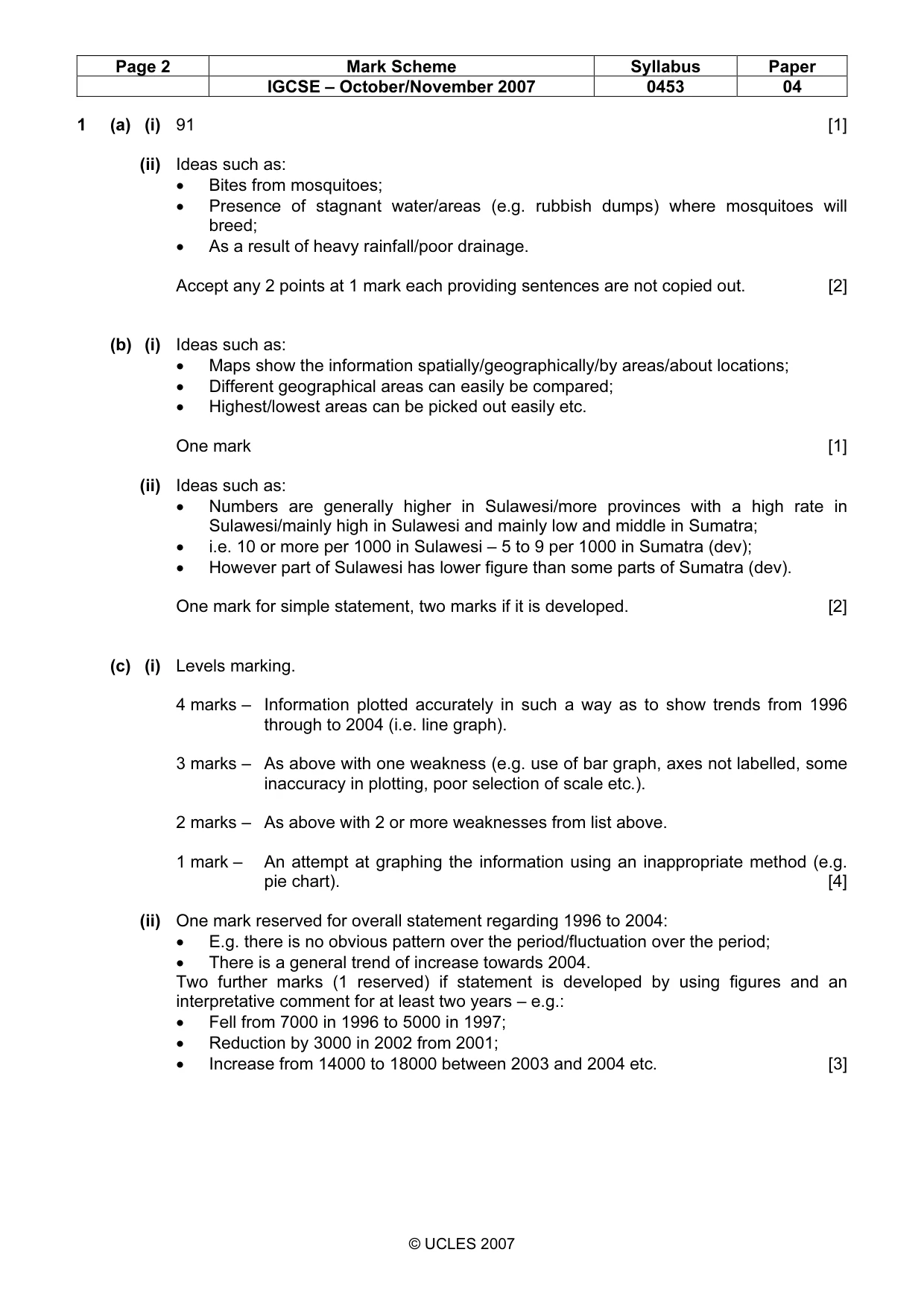
Page 2 Mark Scheme Syllabus Paper IGCSE – October/November 2007 0453 04 © UCLES 2007 1 (a) (i) 91 [1] (ii) Ideas such as: • Bites from mosquitoes; • Presence of stagnant water/areas (e.g. rubbish dumps) where mosquitoes will breed; • As a result of heavy rainfall/poor drainage. Accept any 2 points at 1 mark each providing sentences are not copied out. [2] (b) (i) Ideas such as: • Maps show the information spatially/geographically/by areas/about locations; • Different geographical areas can easily be compared; • Highest/lowest areas can be picked out easily etc. One mark [1] (ii) Ideas such as: • Numbers are generally higher in Sulawesi/more provinces with a high rate in Sulawesi/mainly high in Sulawesi and mainly low and middle in Sumatra; • i.e. 10 or more per 1000 in Sulawesi – 5 to 9 per 1000 in Sumatra (dev); • However part of Sulawesi has lower figure than some parts of Sumatra (dev). One mark for simple statement, two marks if it is developed. [2] (c) (i) Levels marking. 4 marks – Information plotted accurately in such a way as to show trends from 1996 through to 2004 (i.e. line graph). 3 marks – As above with one weakness (e.g. use of bar graph, axes not labelled, some inaccuracy in plotting, poor selection of scale etc.). 2 marks – As above with 2 or more weaknesses from list above. 1 mark – An attempt at graphing the information using an inappropriate method (e.g. pie chart). [4] (ii) One mark reserved for overall statement regarding 1996 to 2004: • E.g. there is no obvious pattern over the period/fluctuation over the period; • There is a general trend of increase towards 2004. Two further marks (1 reserved) if statement is developed by using figures and an interpretative comment for at least two years – e.g.: • Fell from 7000 in 1996 to 5000 in 1997; • Reduction by 3000 in 2002 from 2001; • Increase from 14000 to 18000 between 2003 and 2004 etc. [3]
Mark scheme, page 3
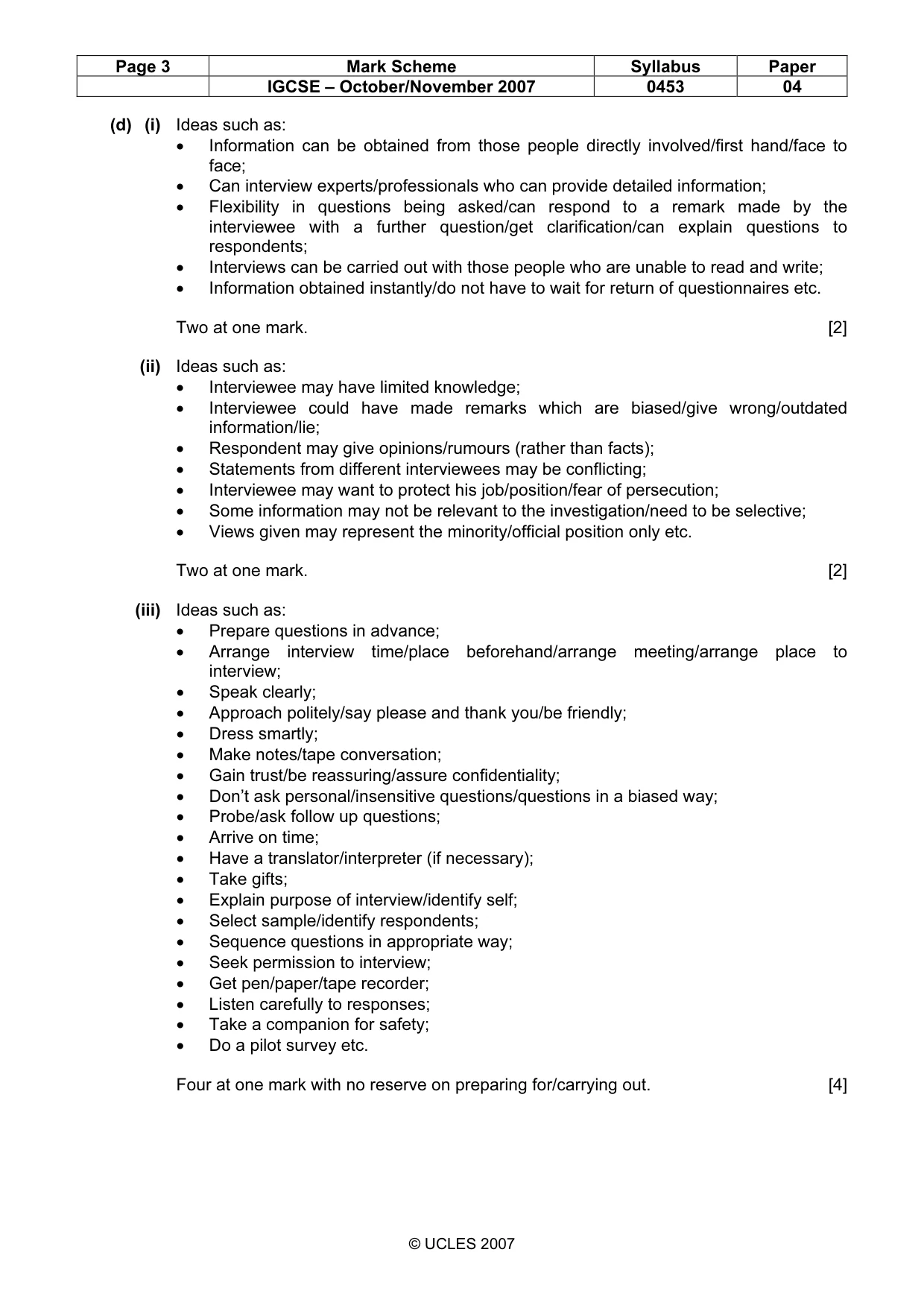
Page 3 Mark Scheme Syllabus Paper IGCSE – October/November 2007 0453 04 © UCLES 2007 (d) (i) Ideas such as: • Information can be obtained from those people directly involved/first hand/face to face; • Can interview experts/professionals who can provide detailed information; • Flexibility in questions being asked/can respond to a remark made by the interviewee with a further question/get clarification/can explain questions to respondents; • Interviews can be carried out with those people who are unable to read and write; • Information obtained instantly/do not have to wait for return of questionnaires etc. Two at one mark. [2] (ii) Ideas such as: • Interviewee may have limited knowledge; • Interviewee could have made remarks which are biased/give wrong/outdated information/lie; • Respondent may give opinions/rumours (rather than facts); • Statements from different interviewees may be conflicting; • Interviewee may want to protect his job/position/fear of persecution; • Some information may not be relevant to the investigation/need to be selective; • Views given may represent the minority/official position only etc. Two at one mark. [2] (iii) Ideas such as: • Prepare questions in advance; • Arrange interview time/place beforehand/arrange meeting/arrange place to interview; • Speak clearly; • Approach politely/say please and thank you/be friendly; • Dress smartly; • Make notes/tape conversation; • Gain trust/be reassuring/assure confidentiality; • Don’t ask personal/insensitive questions/questions in a biased way; • Probe/ask follow up questions; • Arrive on time; • Have a translator/interpreter (if necessary); • Take gifts; • Explain purpose of interview/identify self; • Select sample/identify respondents; • Sequence questions in appropriate way; • Seek permission to interview; • Get pen/paper/tape recorder; • Listen carefully to responses; • Take a companion for safety; • Do a pilot survey etc. Four at one mark with no reserve on preparing for/carrying out. [4]
Mark scheme, page 4
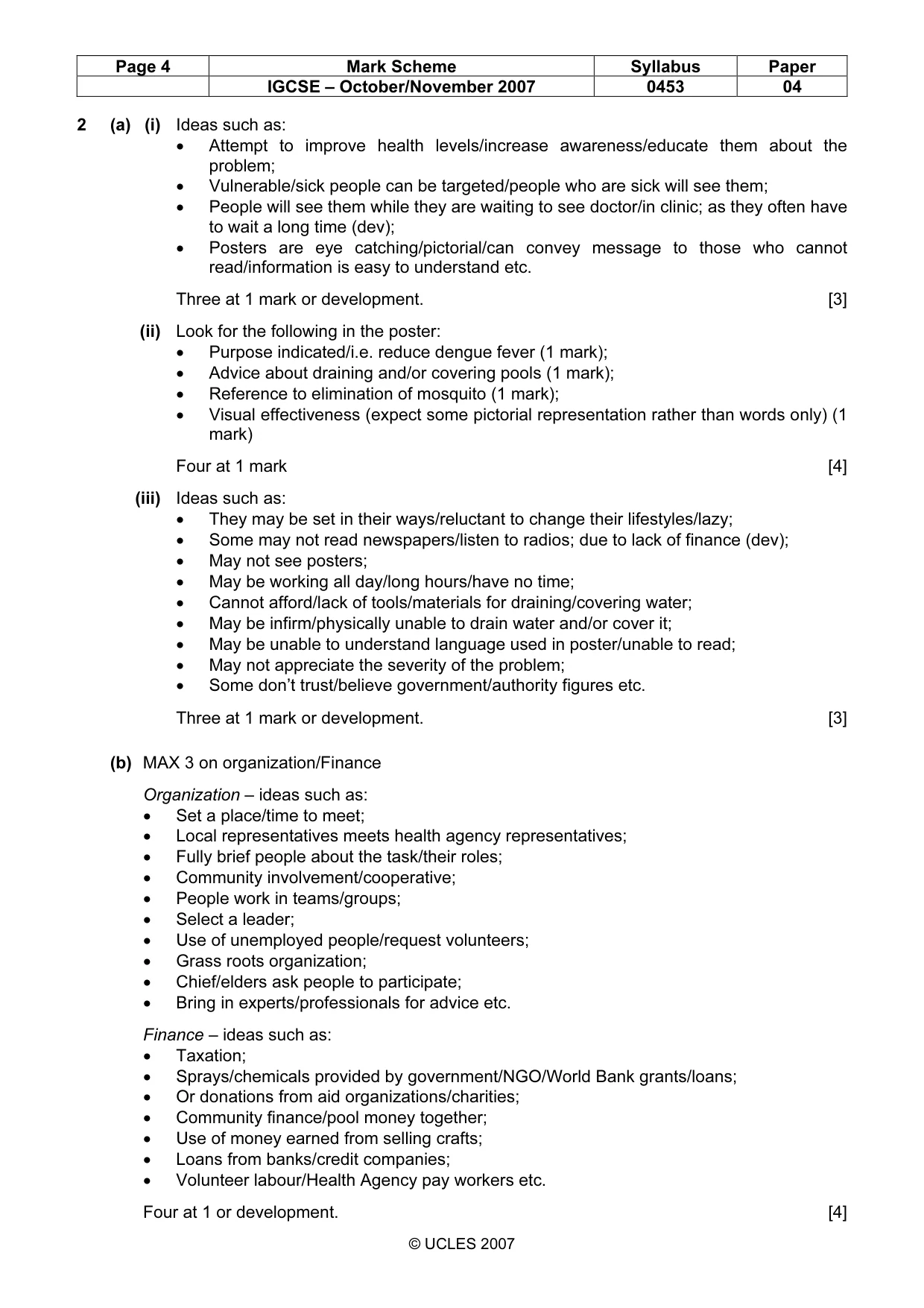
Page 4 Mark Scheme Syllabus Paper IGCSE – October/November 2007 0453 04 © UCLES 2007 2 (a) (i) Ideas such as: • Attempt to improve health levels/increase awareness/educate them about the problem; • Vulnerable/sick people can be targeted/people who are sick will see them; • People will see them while they are waiting to see doctor/in clinic; as they often have to wait a long time (dev); • Posters are eye catching/pictorial/can convey message to those who cannot read/information is easy to understand etc. Three at 1 mark or development. [3] (ii) Look for the following in the poster: • Purpose indicated/i.e. reduce dengue fever (1 mark); • Advice about draining and/or covering pools (1 mark); • Reference to elimination of mosquito (1 mark); • Visual effectiveness (expect some pictorial representation rather than words only) (1 mark) Four at 1 mark [4] (iii) Ideas such as: • They may be set in their ways/reluctant to change their lifestyles/lazy; • Some may not read newspapers/listen to radios; due to lack of finance (dev); • May not see posters; • May be working all day/long hours/have no time; • Cannot afford/lack of tools/materials for draining/covering water; • May be infirm/physically unable to drain water and/or cover it; • May be unable to understand language used in poster/unable to read; • May not appreciate the severity of the problem; • Some don’t trust/believe government/authority figures etc. Three at 1 mark or development. [3] (b) MAX 3 on organization/Finance Organization – ideas such as: • Set a place/time to meet; • Local representatives meets health agency representatives; • Fully brief people about the task/their roles; • Community involvement/cooperative; • People work in teams/groups; • Select a leader; • Use of unemployed people/request volunteers; • Grass roots organization; • Chief/elders ask people to participate; • Bring in experts/professionals for advice etc. Finance – ideas such as: • Taxation; • Sprays/chemicals provided by government/NGO/World Bank grants/loans; • Or donations from aid organizations/charities; • Community finance/pool money together; • Use of money earned from selling crafts; • Loans from banks/credit companies; • Volunteer labour/Health Agency pay workers etc. Four at 1 or development. [4]
What you needed in this session
Cambridge’s own grade thresholds for 2007 Oct/Nov, Paper 4 · Variant 1. A higher threshold means an easier paper — the bar moves with how the cohort did.