Cambridge IGCSE Development Studies 0453 — 2004 Oct/Nov Paper 4 · Variant 1
0453/41/O/N/04
The question paper and its mark scheme, free to read here and free to download. This is Cambridge’s own paper, exactly as it was sat.
Question paper8 pages


Mark scheme6 pages
Answers below. Sit the paper first if you are practising.
Paper as text
Question paper, page 1
This document consists of 6 printed pages and 2 blank pages. SP (SC/GR) S54259/4 © UCLES 2004 [Turn over UNIVERSITY OF CAMBRIDGE INTERNATIONAL EXAMINATIONS International General Certificate of Secondary Education DEVELOPMENT STUDIES 0453/04 Paper 4 Alternative to Coursework October/November 2004 1 hour 30 minutes Additional Materials: Answer Booklet/Paper READ THESE INSTRUCTIONS FIRST If you have been given an Answer Booklet, follow the instructions on the front cover of the Booklet. Write your Centre number, candidate number and name on all the work you hand in. Write in dark blue or black pen on both sides of the paper. You may use a soft pencil for any diagrams, graphs or rough working. Do not use staples, paper clips, highlighters, glue or correction fluid. Answer all questions. At the end of the examination, fasten all your work securely together. The number of marks is given in brackets [ ] at the end of each question or part question. www.XtremePapers.com
Question paper, page 2
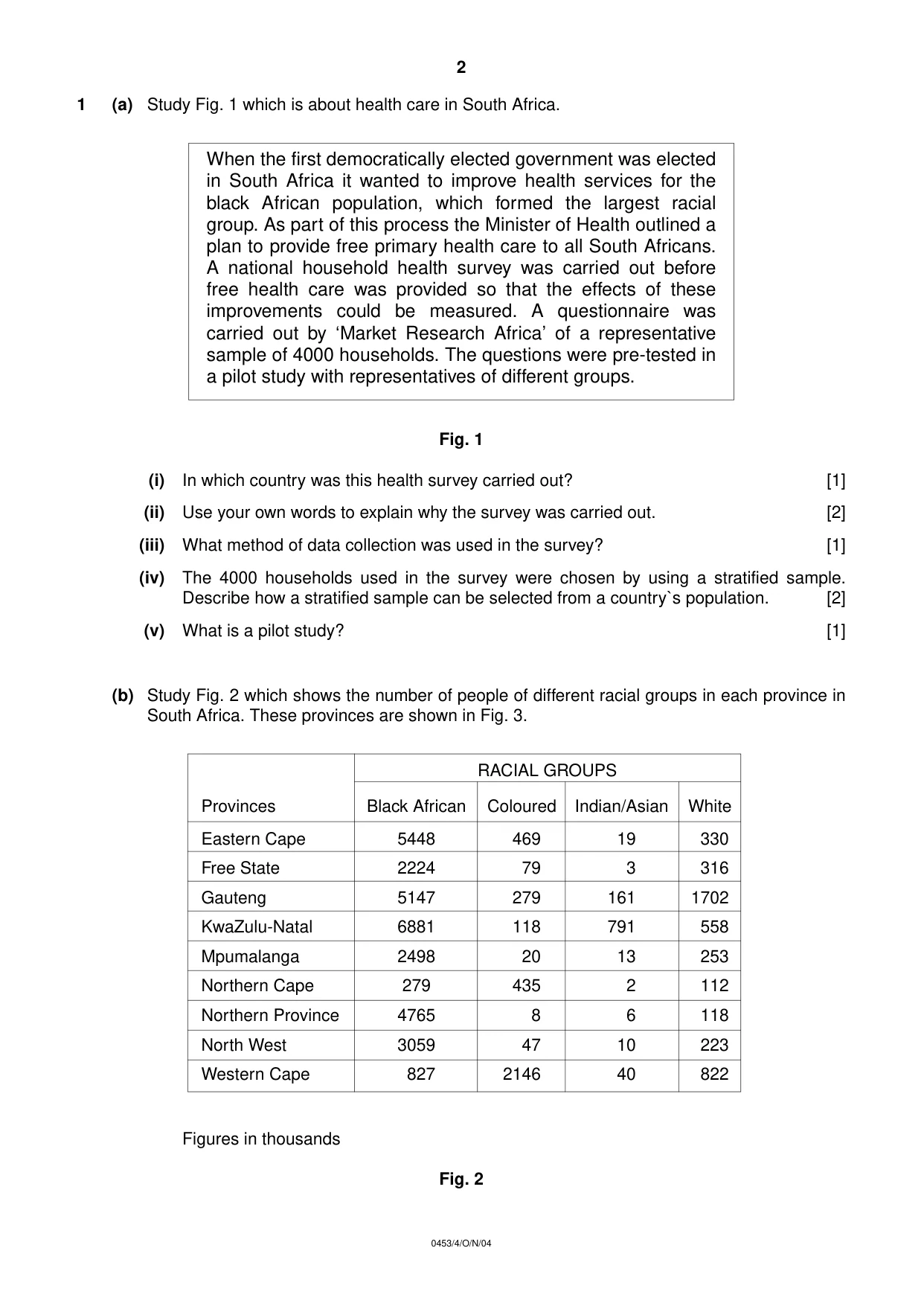
2 0453/4/O/N/04 1 (a) Study Fig. 1 which is about health care in South Africa. Fig. 1 (i) In which country was this health survey carried out? [1] (ii) Use your own words to explain why the survey was carried out. [2] (iii) What method of data collection was used in the survey? [1] (iv) The 4000 households used in the survey were chosen by using a stratified sample. Describe how a stratified sample can be selected from a country`s population. [2] (v) What is a pilot study? [1] (b) Study Fig. 2 which shows the number of people of different racial groups in each province in South Africa. These provinces are shown in Fig. 3. Figures in thousands Fig. 2 When the first democratically elected government was elected in South Africa it wanted to improve health services for the black African population, which formed the largest racial group. As part of this process the Minister of Health outlined a plan to provide free primary health care to all South Africans. A national household health survey was carried out before free health care was provided so that the effects of these improvements could be measured. A questionnaire was carried out by ‘Market Research Africa’ of a representative sample of 4000 households. The questions were pre-tested in a pilot study with representatives of different groups. RACIAL GROUPS Provinces Black African Coloured Indian/Asian White Eastern Cape 5448 469 19 330 Free State 2224 79 3 316 Gauteng 5147 279 161 1702 KwaZulu-Natal 6881 118 791 558 Mpumalanga 2498 20 13 253 Northern Cape 279 435 2 112 Northern Province 4765 8 6 118 North West 3059 47 10 223 Western Cape 827 2146 40 822
Question paper, page 3
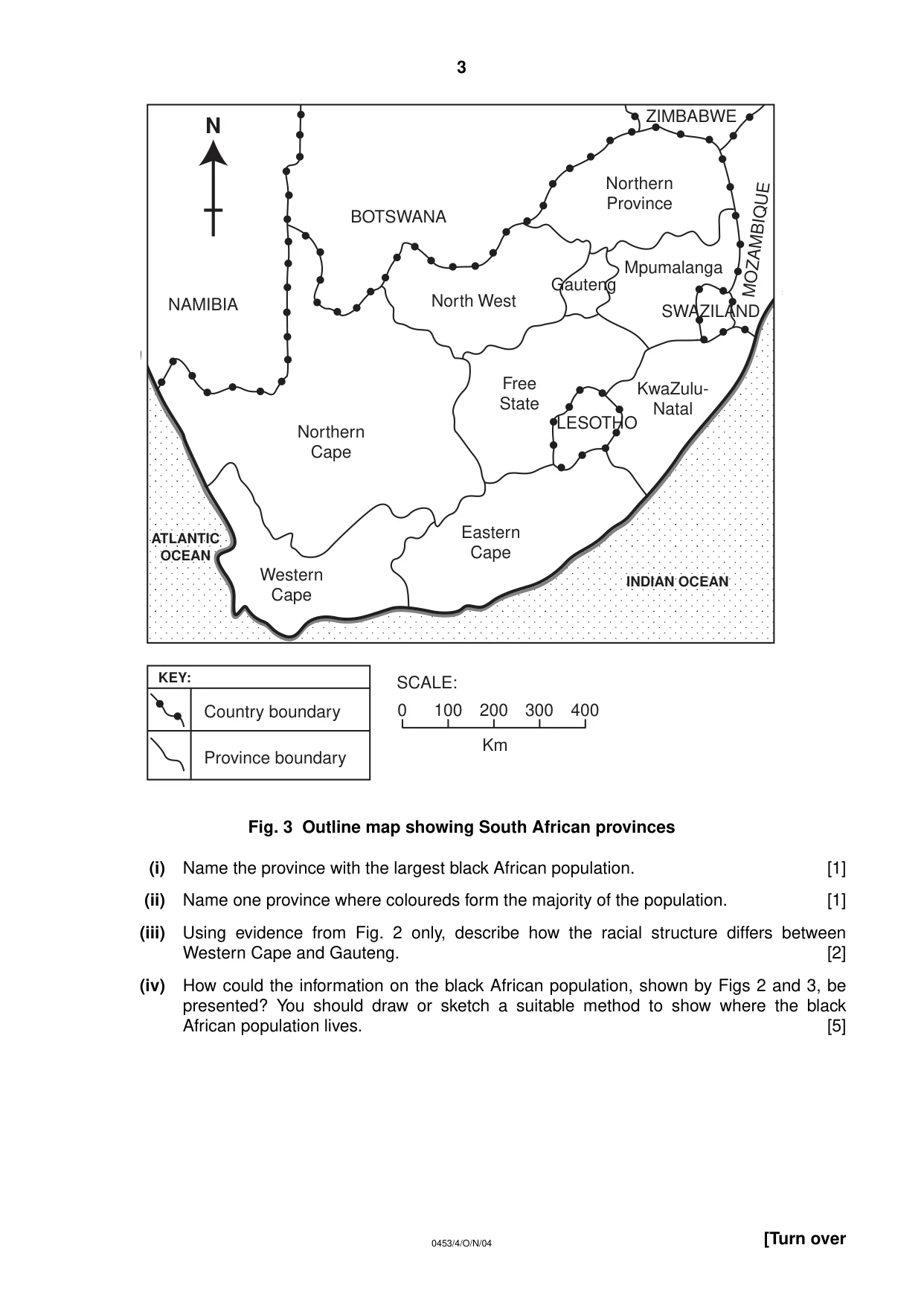
3 0453/4/O/N/04 [Turn over Fig. 3 Outline map showing South African provinces (i) Name the province with the largest black African population. [1] (ii) Name one province where coloureds form the majority of the population. [1] (iii) Using evidence from Fig. 2 only, describe how the racial structure differs between Western Cape and Gauteng. [2] (iv) How could the information on the black African population, shown by Figs 2 and 3, be presented? You should draw or sketch a suitable method to show where the black African population lives. [5] Northern Cape NAMIBIA BOTSWANA LESOTHO ZIMBABWE MOZAMBIQUE KwaZulu- Natal Mpumalanga Gauteng North West Free State Eastern Cape Western Cape Northern Province N SWAZILAND INDIAN OCEAN ATLANTIC OCEAN KEY: Country boundary Province boundary 0 100 200 300 400 SCALE: Km
Question paper, page 4
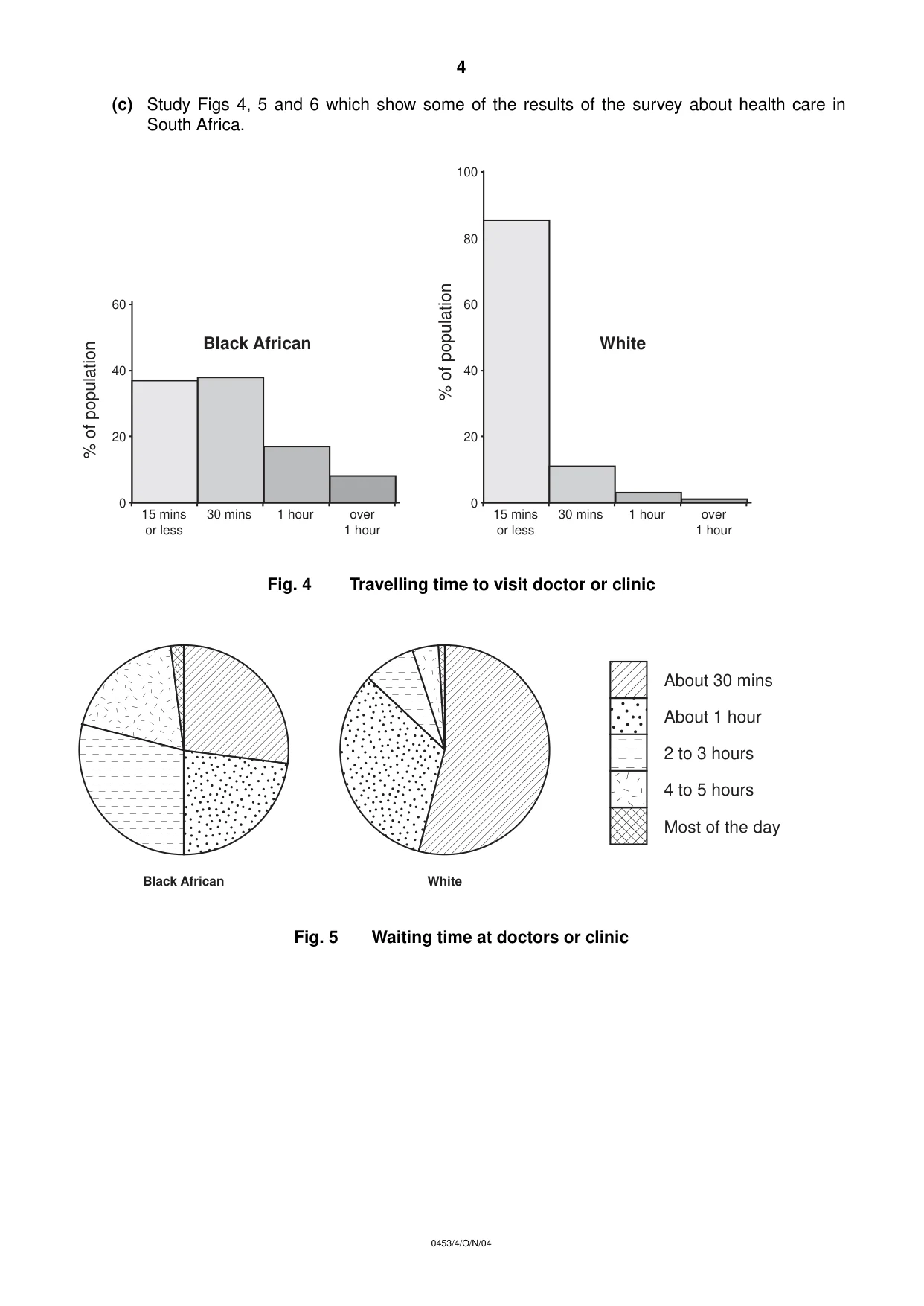
4 0453/4/O/N/04 (c) Study Figs 4, 5 and 6 which show some of the results of the survey about health care in South Africa. Fig. 4 Travelling time to visit doctor or clinic Fig. 5 Waiting time at doctors or clinic Black African White About 30 mins About 1 hour 2 to 3 hours 4 to 5 hours Most of the day 20 0 15 mins or less 30 mins 1 hour over 1 hour 40 60 Black African 20 0 15 mins or less 30 mins 1 hour over 1 hour 40 60 80 100 White % of population % of population
Question paper, page 5
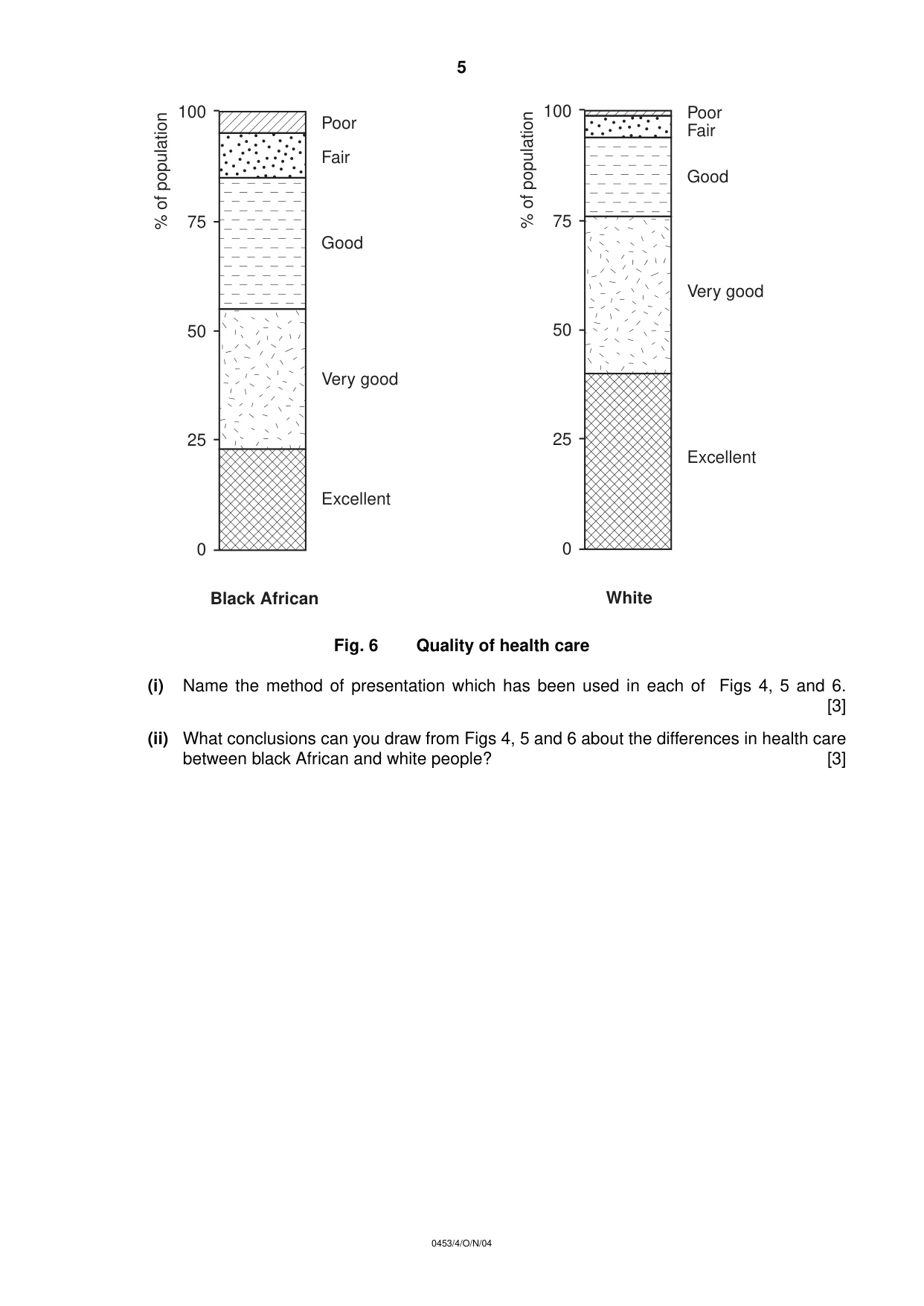
5 0453/4/O/N/04 Fig. 6 Quality of health care (i) Name the method of presentation which has been used in each of Figs 4, 5 and 6. [3] (ii) What conclusions can you draw from Figs 4, 5 and 6 about the differences in health care between black African and white people? [3] Black African Poor Fair Good Very good Excellent 100 75 50 25 0 % of population White Poor Fair Good Very good Excellent 100 75 50 25 0 % of population
Question paper, page 6
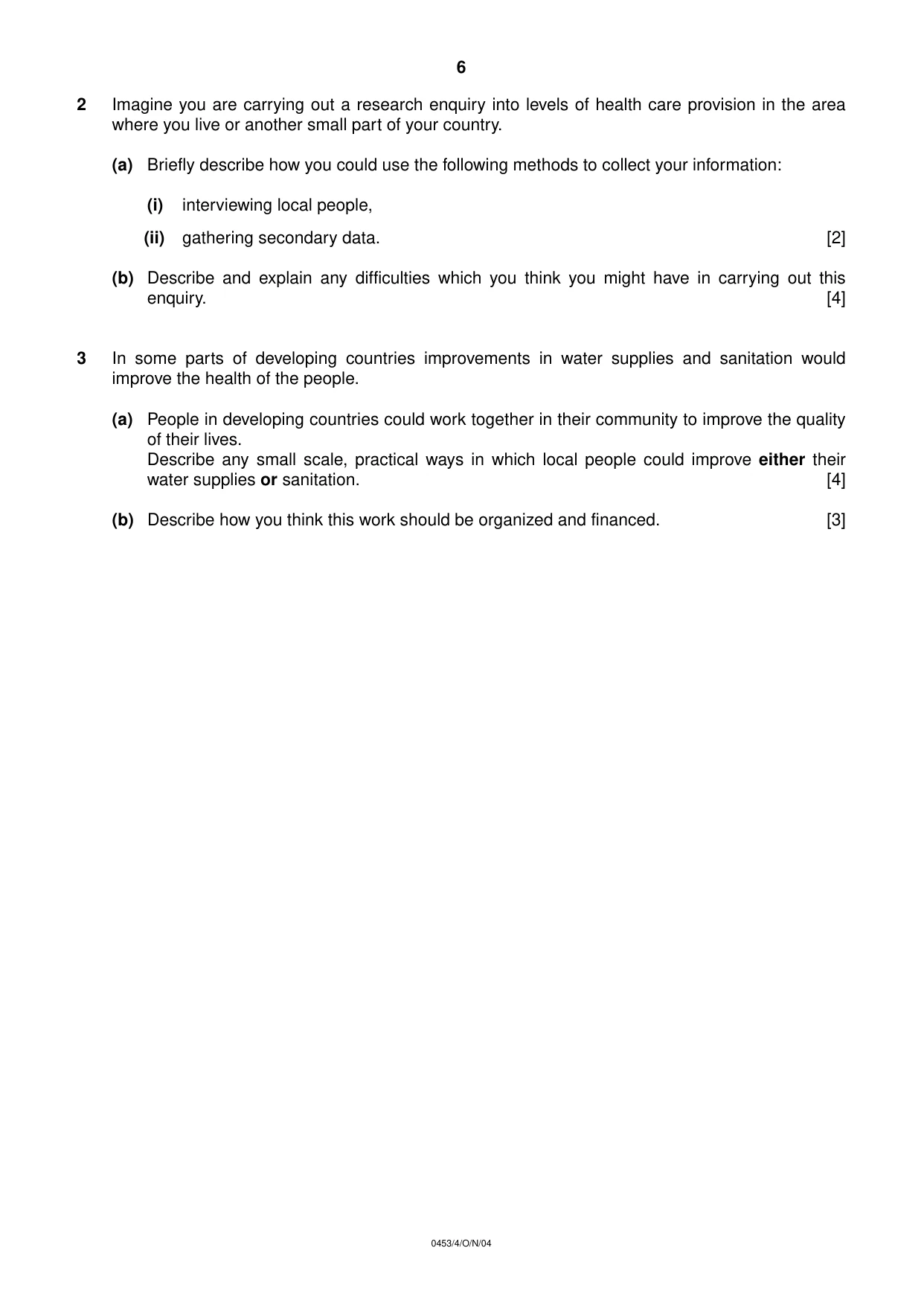
6 0453/4/O/N/04 2 Imagine you are carrying out a research enquiry into levels of health care provision in the area where you live or another small part of your country. (a) Briefly describe how you could use the following methods to collect your information: (i) interviewing local people, (ii) gathering secondary data. [2] (b) Describe and explain any difficulties which you think you might have in carrying out this enquiry. [4] 3 In some parts of developing countries improvements in water supplies and sanitation would improve the health of the people. (a) People in developing countries could work together in their community to improve the quality of their lives. Describe any small scale, practical ways in which local people could improve either their water supplies or sanitation. [4] (b) Describe how you think this work should be organized and financed. [3]
Question paper, page 8
8 0453/4/O/N/04 Copyright Acknowledgements: Question 1. Data adapted from Republic of South Africa Census, 1996. Cambridge International Examinations has made every effort to trace copyright holders, but if we have inadvertently overlooked any we will be pleased to make the necessary arrangements at the first opportunity.
Mark scheme, page 1
UNIVERSITY OF CAMBRIDGE INTERNATIONAL EXAMINATIONS International General Certificate of Secondary Education MARK SCHEME for the November 2004 question paper 0453 Development Studies 0453/04 (Alternative to Coursework) maximum mark 35 This mark scheme is published as an aid to teachers and students, to indicate the requirements of the examination. It shows the basis on which Examiners were initially instructed to award marks. It does not indicate the details of the discussions that took place at an Examiners’ meeting before marking began. Any substantial changes to the mark scheme that arose from these discussions will be recorded in the published Report on the Examination. All Examiners are instructed that alternative correct answers and unexpected approaches in candidates’ scripts must be given marks that fairly reflect the relevant knowledge and skills demonstrated. Mark schemes must be read in conjunction with the question papers and the Report on the Examination. • CIE will not enter into discussion or correspondence in connection with these mark schemes. CIE is publishing the mark schemes for the November 2004 question papers for most IGCSE and GCE Advanced Level syllabuses. www.XtremePapers.com
Mark scheme, page 2
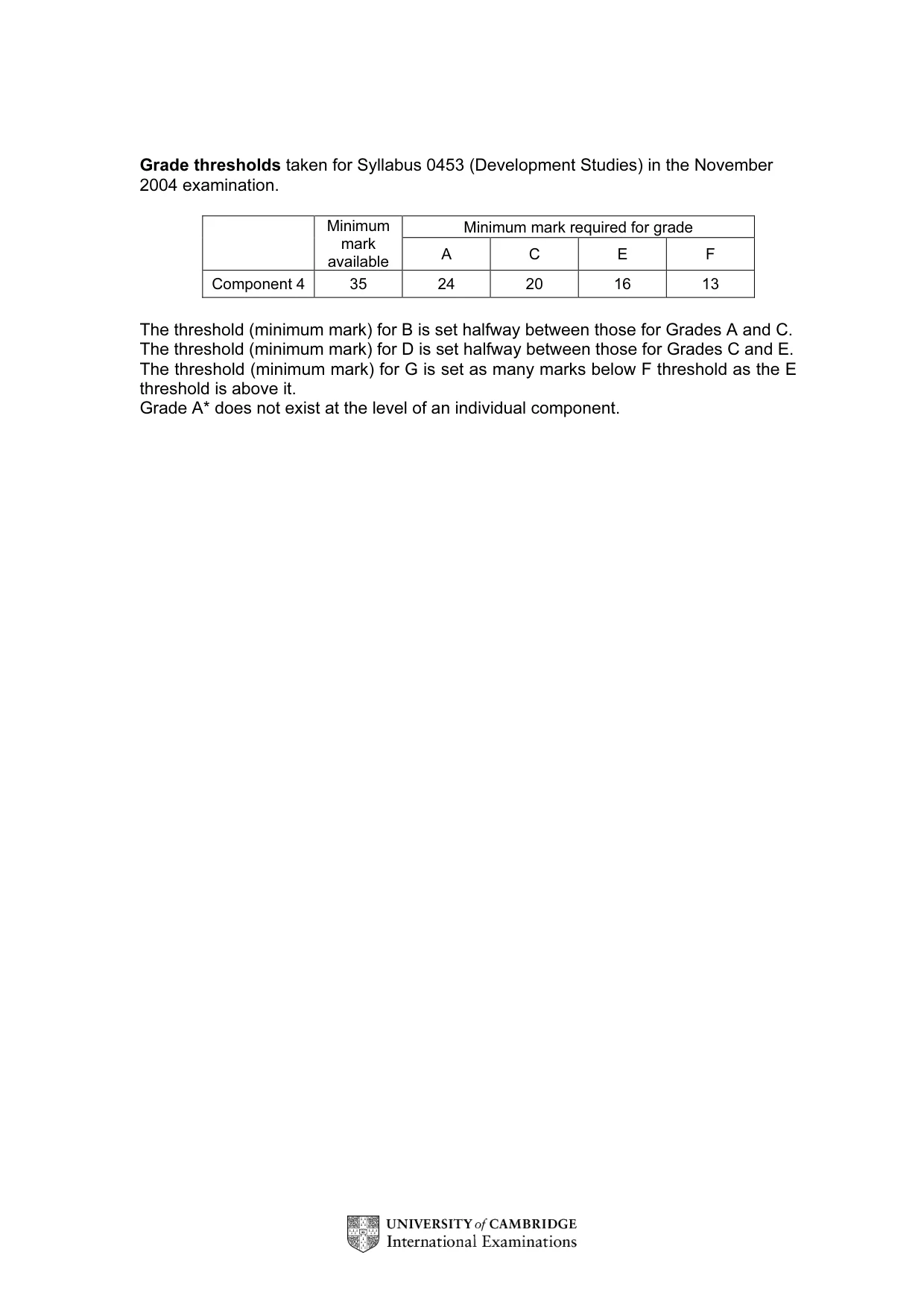
Grade thresholds taken for Syllabus 0453 (Development Studies) in the November 2004 examination. Minimum mark required for grade Minimum mark available A C E F Component 4 35 24 20 16 13 The threshold (minimum mark) for B is set halfway between those for Grades A and C. The threshold (minimum mark) for D is set halfway between those for Grades C and E. The threshold (minimum mark) for G is set as many marks below F threshold as the E threshold is above it. Grade A* does not exist at the level of an individual component.
Mark scheme, page 3
November 2004 INTERNATIONAL GCSE MARK SCHEME MAXIMUM MARK: 35 SYLLABUS/COMPONENT: 0453/04 DEVELOPMENT STUDIES Alternative to Coursework
Mark scheme, page 4
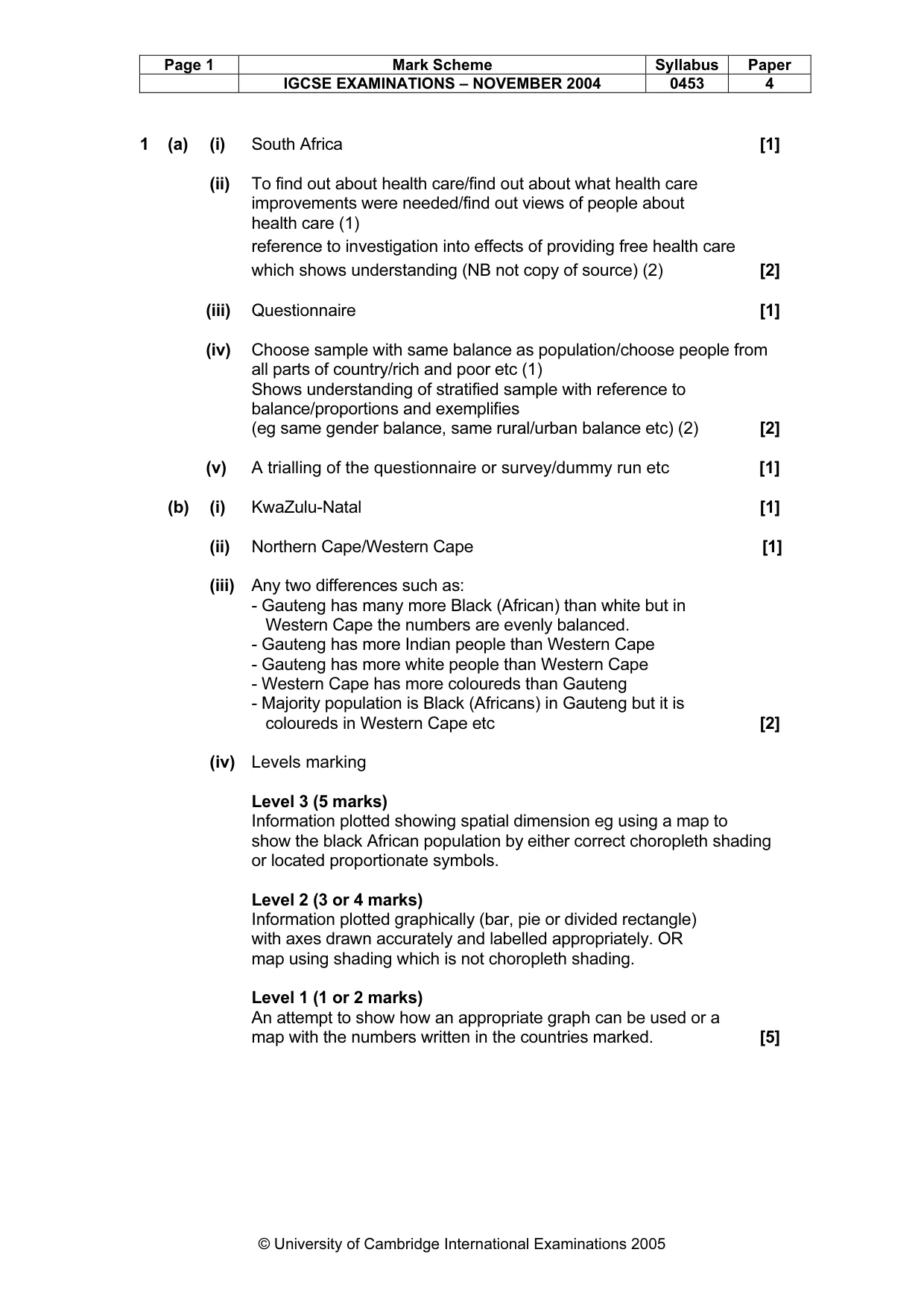
Page 1 Mark Scheme Syllabus Paper IGCSE EXAMINATIONS – NOVEMBER 2004 0453 4 © University of Cambridge International Examinations 2005 1 (a) (i) South Africa [1] (ii) To find out about health care/find out about what health care improvements were needed/find out views of people about health care (1) reference to investigation into effects of providing free health care which shows understanding (NB not copy of source) (2) [2] (iii) Questionnaire [1] (iv) Choose sample with same balance as population/choose people from all parts of country/rich and poor etc (1) Shows understanding of stratified sample with reference to balance/proportions and exemplifies (eg same gender balance, same rural/urban balance etc) (2) [2] (v) A trialling of the questionnaire or survey/dummy run etc [1] (b) (i) KwaZulu-Natal [1] (ii) Northern Cape/Western Cape [1] (iii) Any two differences such as: - Gauteng has many more Black (African) than white but in Western Cape the numbers are evenly balanced. - Gauteng has more Indian people than Western Cape - Gauteng has more white people than Western Cape - Western Cape has more coloureds than Gauteng - Majority population is Black (Africans) in Gauteng but it is coloureds in Western Cape etc [2] (iv) Levels marking Level 3 (5 marks) Information plotted showing spatial dimension eg using a map to show the black African population by either correct choropleth shading or located proportionate symbols. Level 2 (3 or 4 marks) Information plotted graphically (bar, pie or divided rectangle) with axes drawn accurately and labelled appropriately. OR map using shading which is not choropleth shading. Level 1 (1 or 2 marks) An attempt to show how an appropriate graph can be used or a map with the numbers written in the countries marked. [5]
Mark scheme, page 5
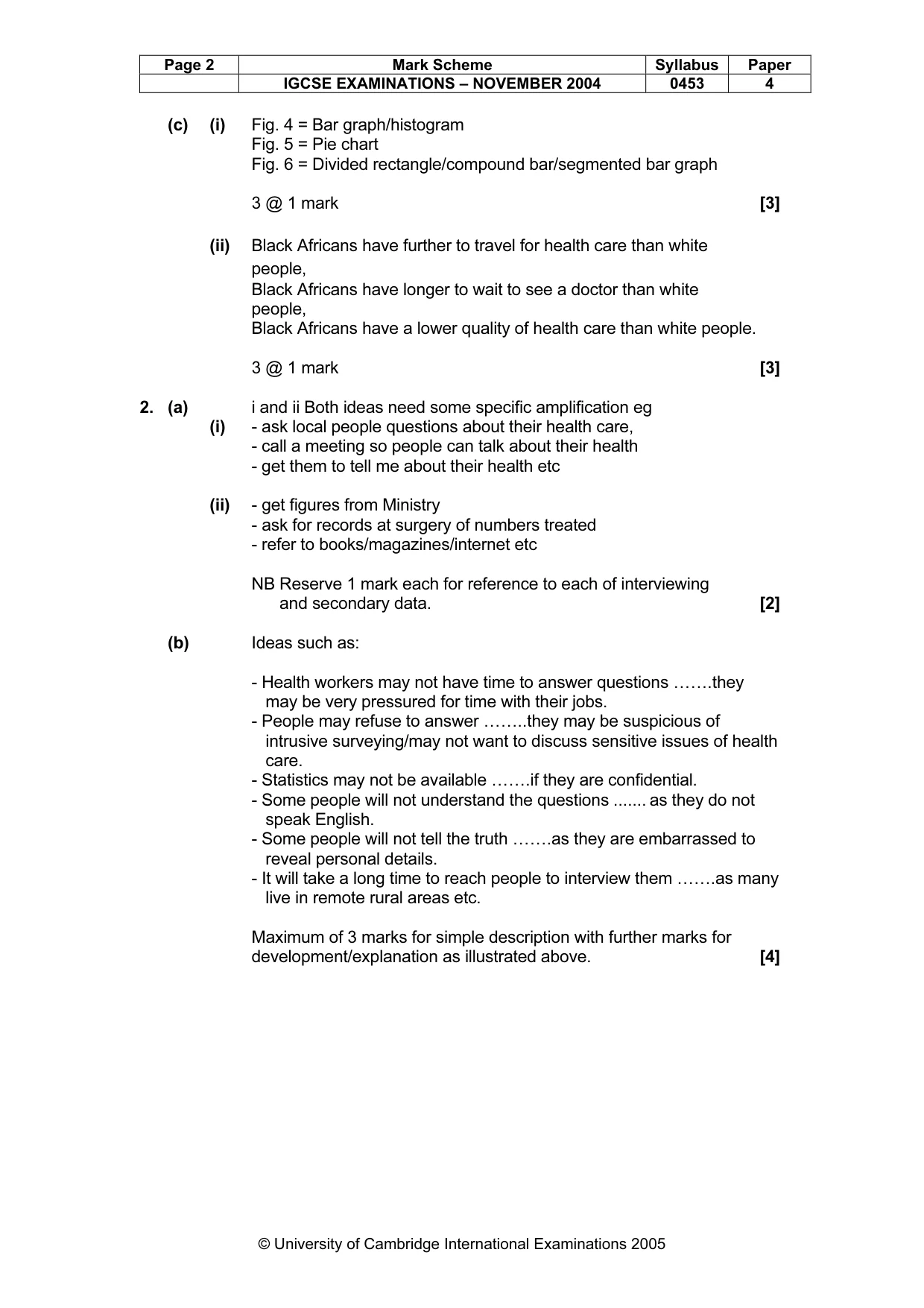
Page 2 Mark Scheme Syllabus Paper IGCSE EXAMINATIONS – NOVEMBER 2004 0453 4 © University of Cambridge International Examinations 2005 (c) (i) Fig. 4 = Bar graph/histogram Fig. 5 = Pie chart Fig. 6 = Divided rectangle/compound bar/segmented bar graph 3 @ 1 mark [3] (ii) Black Africans have further to travel for health care than white people, Black Africans have longer to wait to see a doctor than white people, Black Africans have a lower quality of health care than white people. 3 @ 1 mark [3] 2. (a) i and ii Both ideas need some specific amplification eg (i) - ask local people questions about their health care, - call a meeting so people can talk about their health - get them to tell me about their health etc (ii) - get figures from Ministry - ask for records at surgery of numbers treated - refer to books/magazines/internet etc NB Reserve 1 mark each for reference to each of interviewing and secondary data. [2] (b) Ideas such as: - Health workers may not have time to answer questions …….they may be very pressured for time with their jobs. - People may refuse to answer ……..they may be suspicious of intrusive surveying/may not want to discuss sensitive issues of health care. - Statistics may not be available …….if they are confidential. - Some people will not understand the questions … as they do not speak English. - Some people will not tell the truth …….as they are embarrassed to reveal personal details. - It will take a long time to reach people to interview them …….as many live in remote rural areas etc. Maximum of 3 marks for simple description with further marks for development/explanation as illustrated above. [4]
Mark scheme, page 6
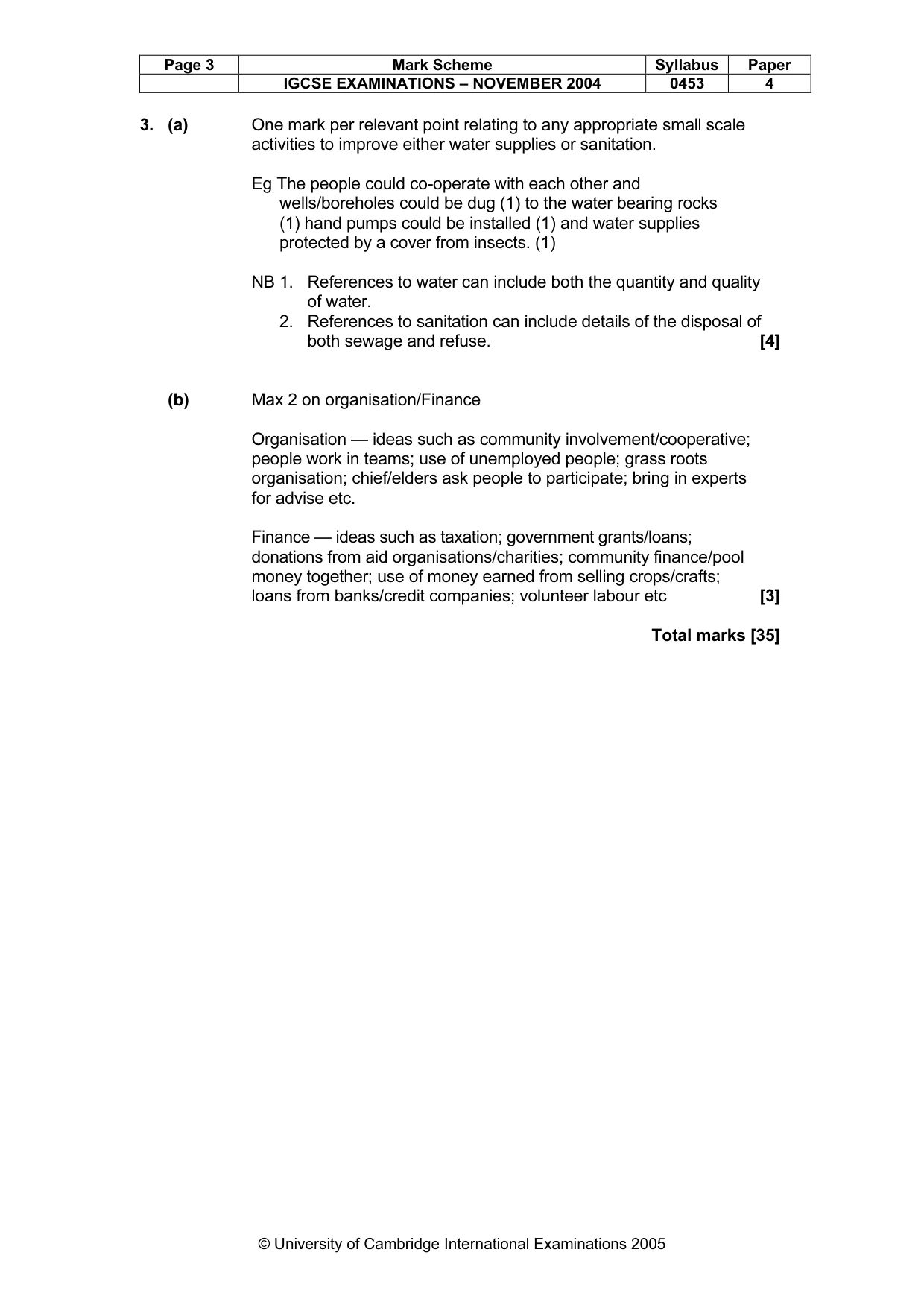
Page 3 Mark Scheme Syllabus Paper IGCSE EXAMINATIONS – NOVEMBER 2004 0453 4 © University of Cambridge International Examinations 2005 3. (a) One mark per relevant point relating to any appropriate small scale activities to improve either water supplies or sanitation. Eg The people could co-operate with each other and wells/boreholes could be dug (1) to the water bearing rocks (1) hand pumps could be installed (1) and water supplies protected by a cover from insects. (1) NB 1. References to water can include both the quantity and quality of water. 2. References to sanitation can include details of the disposal of both sewage and refuse. [4] (b) Max 2 on organisation/Finance Organisation — ideas such as community involvement/cooperative; people work in teams; use of unemployed people; grass roots organisation; chief/elders ask people to participate; bring in experts for advise etc. Finance — ideas such as taxation; government grants/loans; donations from aid organisations/charities; community finance/pool money together; use of money earned from selling crops/crafts; loans from banks/credit companies; volunteer labour etc [3] Total marks [35]