Cambridge IGCSE Development Studies 0453 — 2002 Oct/Nov Paper 4 · Variant 1
0453/41/O/N/02
The question paper and its mark scheme, free to read here and free to download. This is Cambridge’s own paper, exactly as it was sat.
Question paper8 pages



Mark scheme2 pages
Answers below. Sit the paper first if you are practising.
Paper as text
Question paper, page 1
This question paper consists of 6 printed pages and 2 blank pages. SP (SLC/SLC) S21445/1 © UCLES 2002 [Turn over International General Certificate of Secondary Education CAMBRIDGE INTERNATIONAL EXAMINATIONS DEVELOPMENT STUDIES 0453/4 PAPER 4 Alternative to Coursework OCTOBER/NOVEMBER SESSION 2002 1 hour 30 minutes Additional materials: Answer paper TIME 1 hour 30 minutes INSTRUCTIONS TO CANDIDATES Write your name, Centre number and candidate number in the spaces provided on the answer paper/answer booklet. Answer all questions. Write your answers on the separate answer paper provided. If you use more than one sheet of paper, fasten the sheets together. INFORMATION FOR CANDIDATES The number of marks is given in brackets [ ] at the end of each question or part question. www.XtremePapers.com
Question paper, page 2
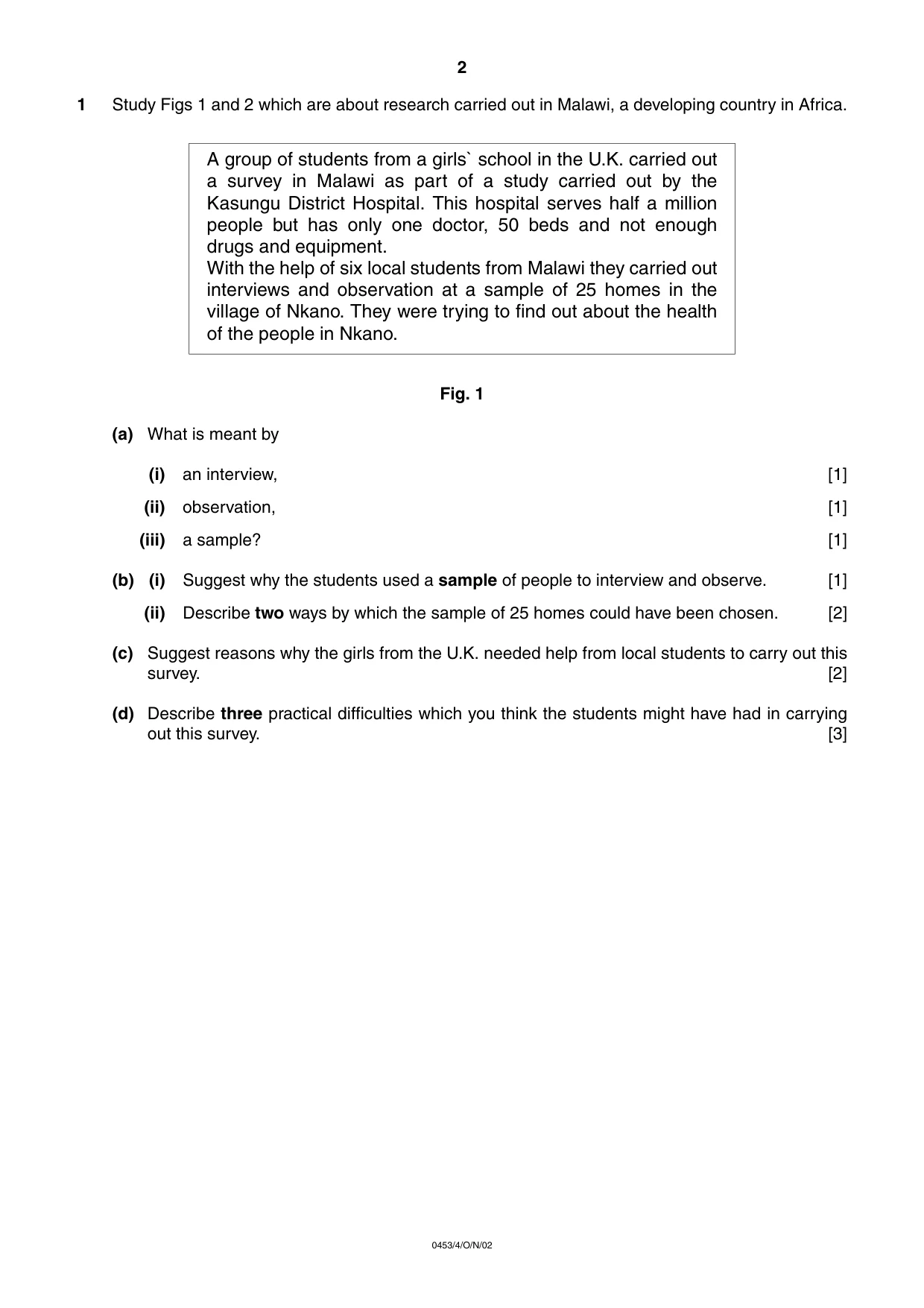
2 0453/4/O/N/02 1 Study Figs 1 and 2 which are about research carried out in Malawi, a developing country in Africa. Fig. 1 (a) What is meant by (i) an interview, [1] (ii) observation, [1] (iii) a sample? [1] (b) (i) Suggest why the students used a sample of people to interview and observe. [1] (ii) Describe two ways by which the sample of 25 homes could have been chosen. [2] (c) Suggest reasons why the girls from the U.K. needed help from local students to carry out this survey. [2] (d) Describe three practical difficulties which you think the students might have had in carrying out this survey. [3] A group of students from a girls` school in the U.K. carried out a survey in Malawi as part of a study carried out by the Kasungu District Hospital. This hospital serves half a million people but has only one doctor, 50 beds and not enough drugs and equipment. With the help of six local students from Malawi they carried out interviews and observation at a sample of 25 homes in the village of Nkano. They were trying to find out about the health of the people in Nkano.
Question paper, page 3
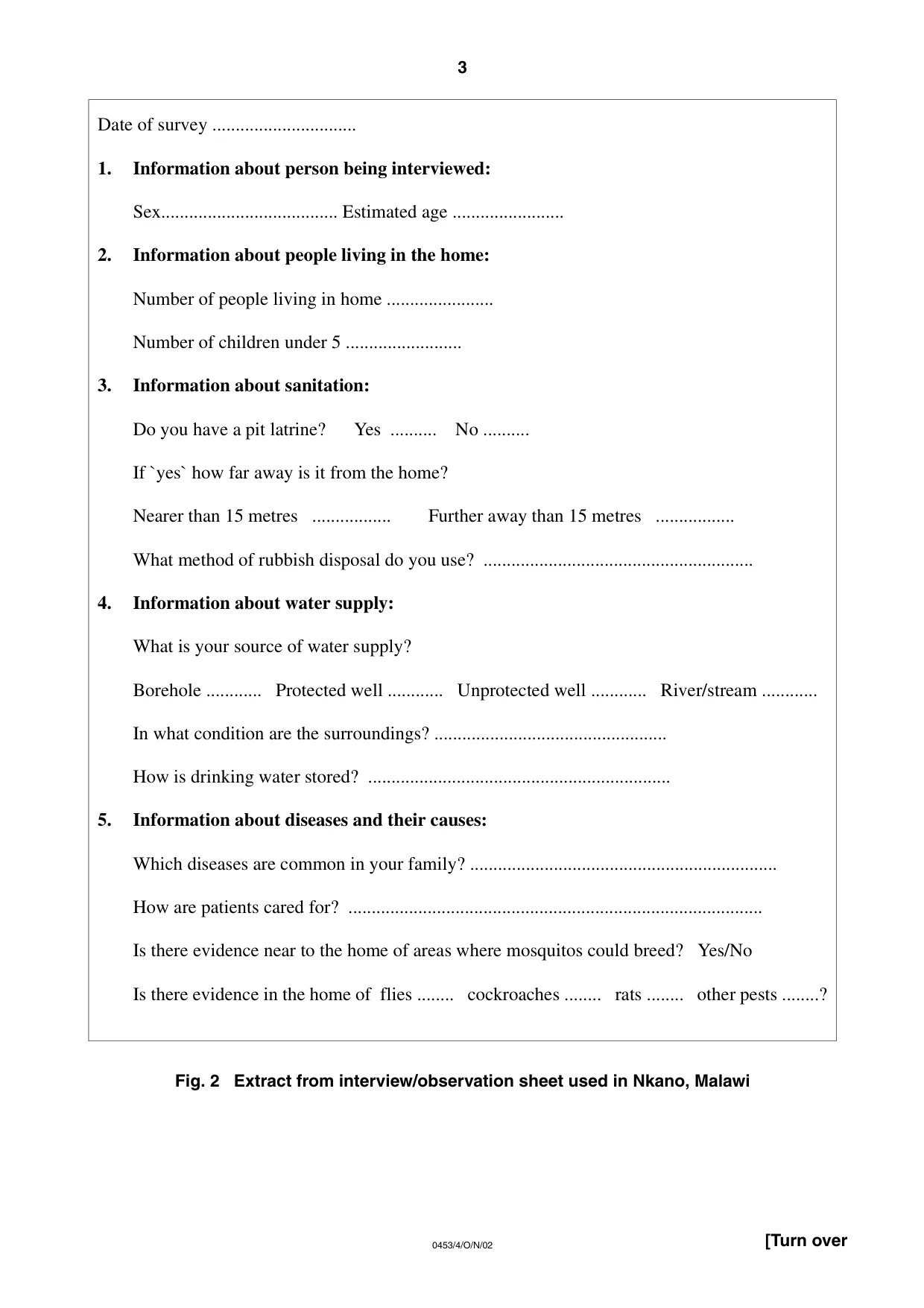
3 0453/4/O/N/02 [Turn over Fig. 2 Extract from interview/observation sheet used in Nkano, Malawi Date of survey … 1. Information about person being interviewed: Sex… Estimated age … 2. Information about people living in the home: Number of people living in home … Number of children under 5 … 3. Information about sanitation: Do you have a pit latrine? Yes … No … If `yes` how far away is it from the home? Nearer than 15 metres … Further away than 15 metres … What method of rubbish disposal do you use? … 4. Information about water supply: What is your source of water supply? Borehole … Protected well … Unprotected well … River/stream … In what condition are the surroundings? … How is drinking water stored? … 5. Information about diseases and their causes: Which diseases are common in your family? … How are patients cared for? … Is there evidence near to the home of areas where mosquitos could breed? Yes/No Is there evidence in the home of flies … cockroaches … rats … other pests …?
Question paper, page 4
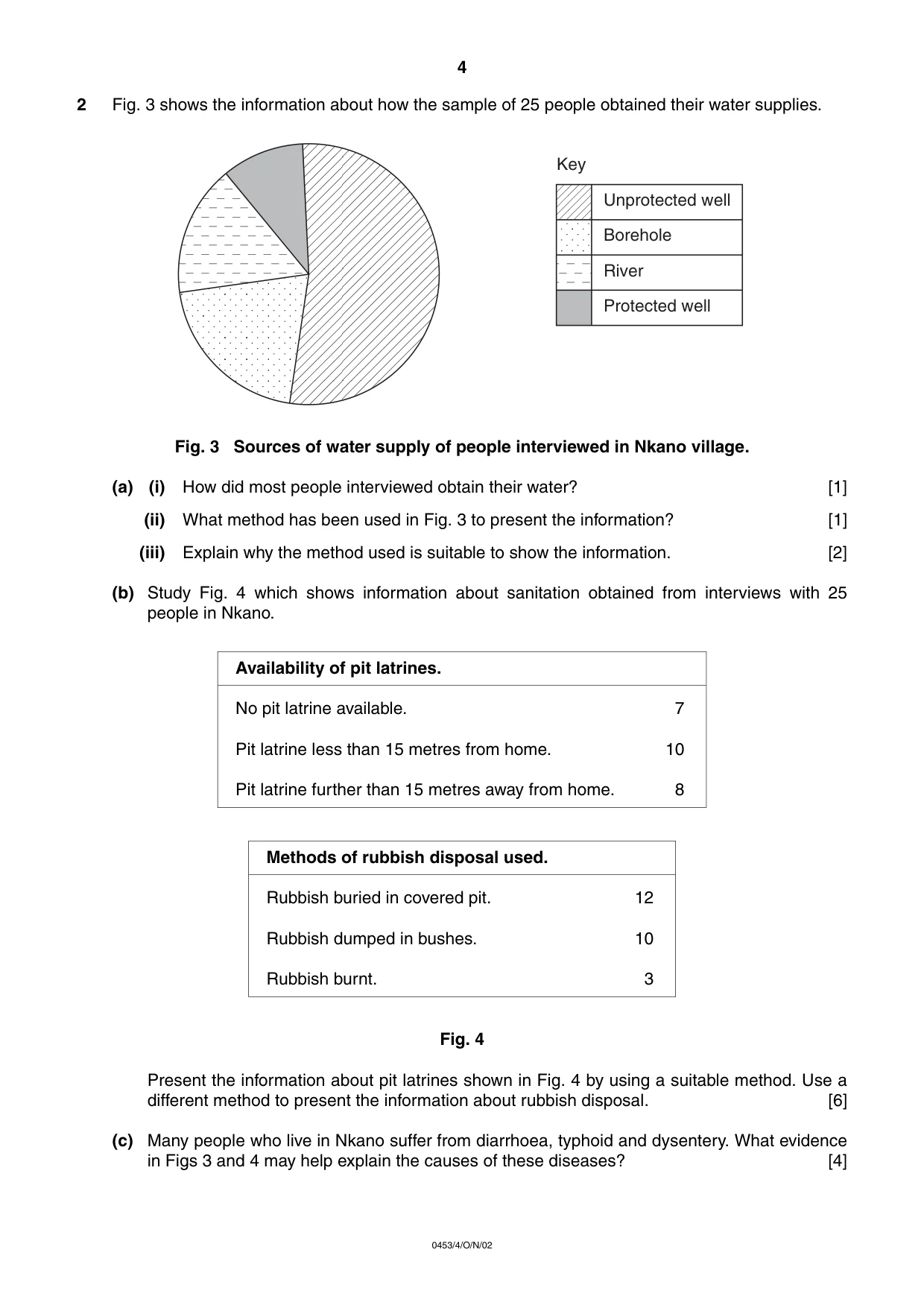
4 0453/4/O/N/02 2 Fig. 3 shows the information about how the sample of 25 people obtained their water supplies. Fig. 3 Sources of water supply of people interviewed in Nkano village. (a) (i) How did most people interviewed obtain their water? [1] (ii) What method has been used in Fig. 3 to present the information? [1] (iii) Explain why the method used is suitable to show the information. [2] (b) Study Fig. 4 which shows information about sanitation obtained from interviews with 25 people in Nkano. Fig. 4 Present the information about pit latrines shown in Fig. 4 by using a suitable method. Use a different method to present the information about rubbish disposal. [6] (c) Many people who live in Nkano suffer from diarrhoea, typhoid and dysentery. What evidence in Figs 3 and 4 may help explain the causes of these diseases? [4] Methods of rubbish disposal used. Rubbish buried in covered pit. 12 Rubbish dumped in bushes. 10 Rubbish burnt. 3 Availability of pit latrines. No pit latrine available. 7 Pit latrine less than 15 metres from home. 10 Pit latrine further than 15 metres away from home. 8 Unprotected well Borehole River Protected well Key
Question paper, page 5
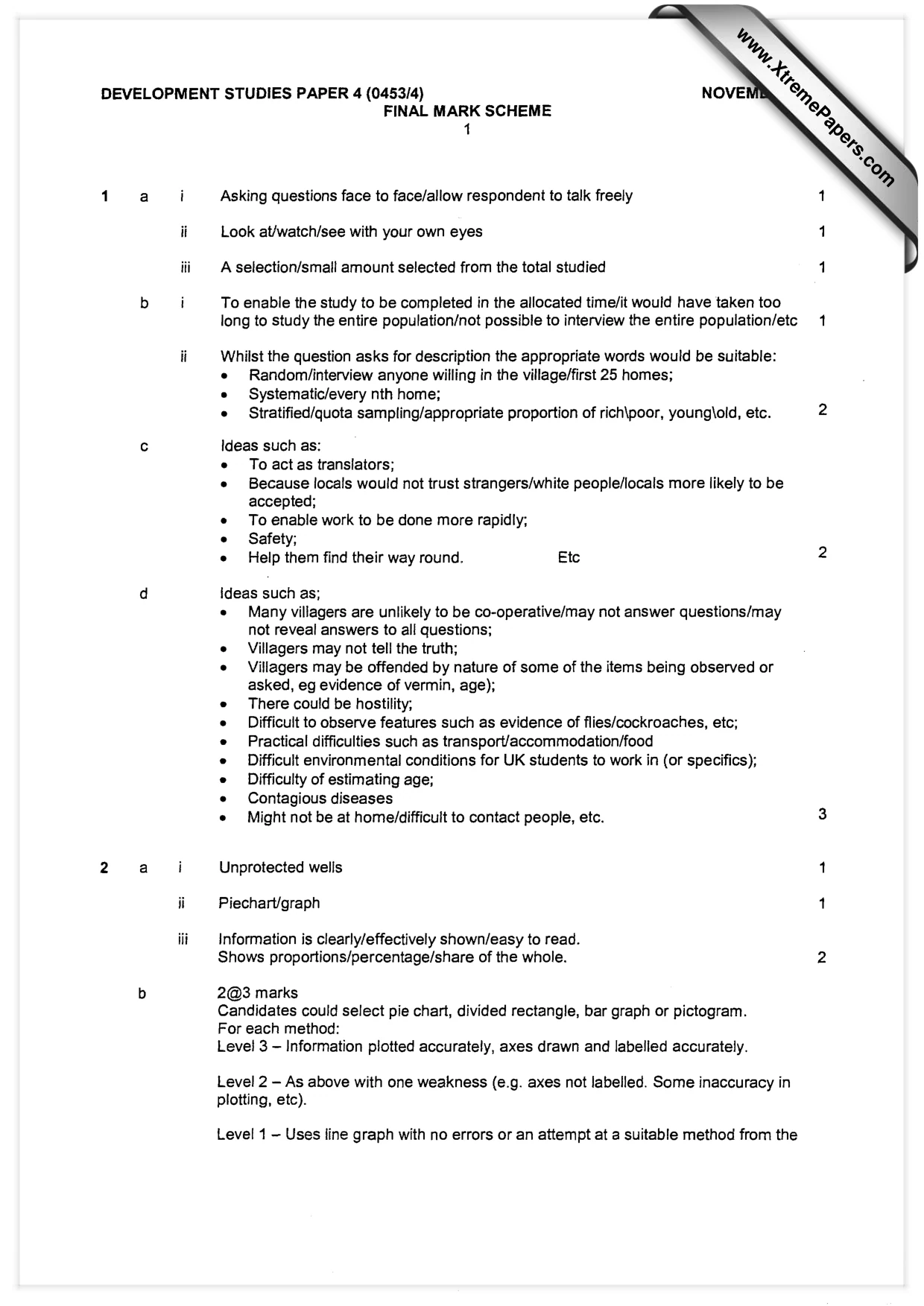
5 0453/4/O/N/02 3 Imagine that you are able to interview the doctor at the Kasungu District Hospital to find out more about the health of people in Nkano. Write down 4 questions which you could ask the doctor which would provide you with further useful information about the health of people in Nkano. [4] 4 Read the information in Fig. 5 about Kasungu District Hospital. Fig. 5 (a) Describe in your own words how the hospital have tried to solve the problem caused by shortage of staff. [1] (b) Suggest any other methods which could be used to improve the level of medical care in the Kasungu District. [5] Due to the shortage of staff each patient must bring a `carer` to look after them. These `carers`, who are often relatives of the patients, are often not very helpful because they do not understand basic medicine.
Question paper, page 8
8 0453/4/O/N/02 Copyright Acknowledgements: Questions 1 and 4 Figs 1 and 5. Wideworld Magazine. Phillip Allen Publishers. September 1998. Question 1 Leeds Girls High School. Cambridge International Examinations has made every effort to trace copyright holders, but if we have inadvertently overlooked any we will be pleased to make the necessary arrangements at the first opportunity.
Mark scheme, page 1
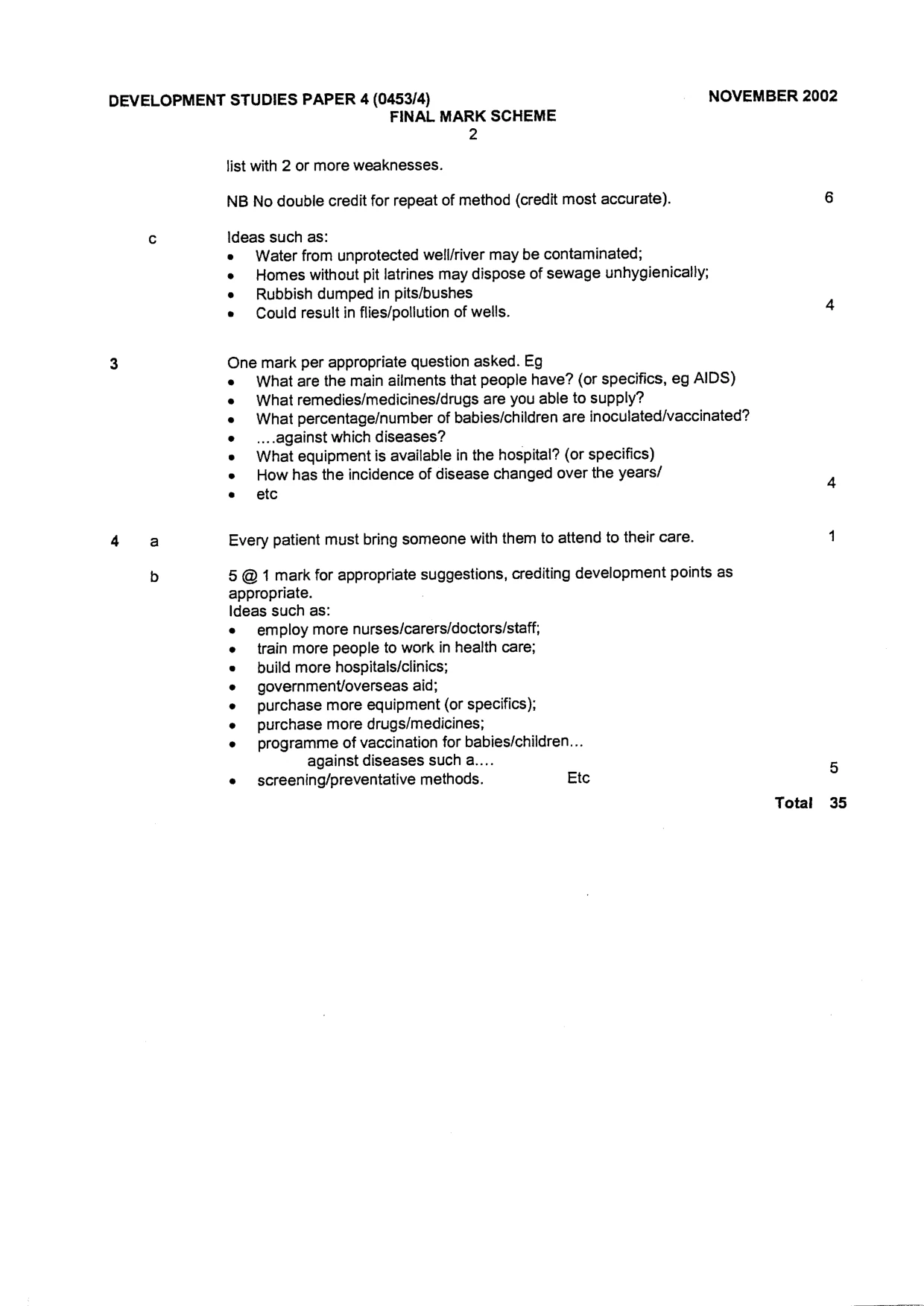
DEVELOPMENT STUDIES PAPER 4 (0453/4) FINAL MARK SCHEME 1 Asking questions face to face/allow respondent to talk freely Look at/watch/see with your own eyes A selection/small amount selected from the total studied To enable the study to be completed in the allocated time/it would have taken too long to study the entire population/not possible to interview the entire population/etc 1 Whilst the question asks for description the appropriate words would be suitable: e Random/interview anyone willing in the village/first 25 homes; e Systematic/every nth home; e — Stratified/quota sampling/appropriate proportion of rich\poor, young\old, etc. 2 Ideas such as: e To act as translators; e Because locals would not trust strangers/white people/locals more likely to be accepted; «To enable work to be done more rapidly; ° Safety; e Help them find their way round. Etc 2 ideas such as; e Many villagers are unlikely to be co-operative/may not answer questions/may not reveal answers to all questions; e Villagers may not tell the truth; Villagers may be offended by nature of some of the items being observed or asked, eg evidence of vermin, age); © There could be hostility; « Difficult to observe features such as evidence of flies/cockroaches, etc; * Practical difficulties such as transportaccommodation/food e Difficult environmental conditions for UK students to work in (or specifics); e Difficulty of estimating age; « Contagious diseases ¢ Might not be at home/difficult to contact people, etc. 3 Unprotected wells 1 Piechart/graph 1 Information is clearly/effectively shown/easy to read. Shows proportions/percentage/share of the whole. 2 2@3 marks Candidates could select pie chart, divided rectangle, bar graph or pictogram. For each method: Level 3 — Information plotted accurately, axes drawn and labelled accurately. Level 2 — As above with one weakness (e.g. axes not labelled. Some inaccuracy in plotting, etc). Level 1 — Uses line graph with no errors or an attempt at a suitable method from the
Mark scheme, page 2
DEVELOPMENT STUDIES PAPER 4 (0453/4) NOVEMBER 2002 FINAL MARK SCHEME 2 list with 2 or more weaknesses. NB No double credit for repeat of method (credit most accurate). 6 c Ideas such as: eee Water from unprotected well/river may be contaminated; Homes without pit latrines may dispose of sewage unhygienically; Rubbish dumped in pits/bushes Could result in flies/pollution of wells. 3 One mark per appropriate question asked. Eg What are the main ailments that people have? (or specifics, eg AIDS) What remedies/medicines/drugs are you able to supply? What percentage/number of babies/children are inoculated/vaccinated? …against which diseases? What equipment is available in the hospital? (or specifics) How has the incidence of disease changed over the years/ etc 4 a Every patient must bring someone with them to attend to their care. 41 b 5 @ 1 mark for appropriate suggestions, crediting development points as appropriate. Ideas such as: . employ more nurses/carers/doctors/staff; train more people to work in health care; build more hospitals/clinics; government/overseas aid; purchase more equipment (or specifics); purchase more drugs/medicines; programme of vaccination for babies/children... against diseases such a… screening/preventative methods. Etc 5 Total 35