Cambridge IGCSE Development Studies 0453 — 2006 Oct/Nov Paper 4 · Variant 1
0453/41/O/N/06 · 35 marks · ≈39 min
The question paper and its mark scheme, free to read here and free to download. This is Cambridge’s own paper, exactly as it was sat.
Question paper4 pages

Mark scheme4 pages
Answers below. Sit the paper first if you are practising.
Paper as text
Question paper, page 1
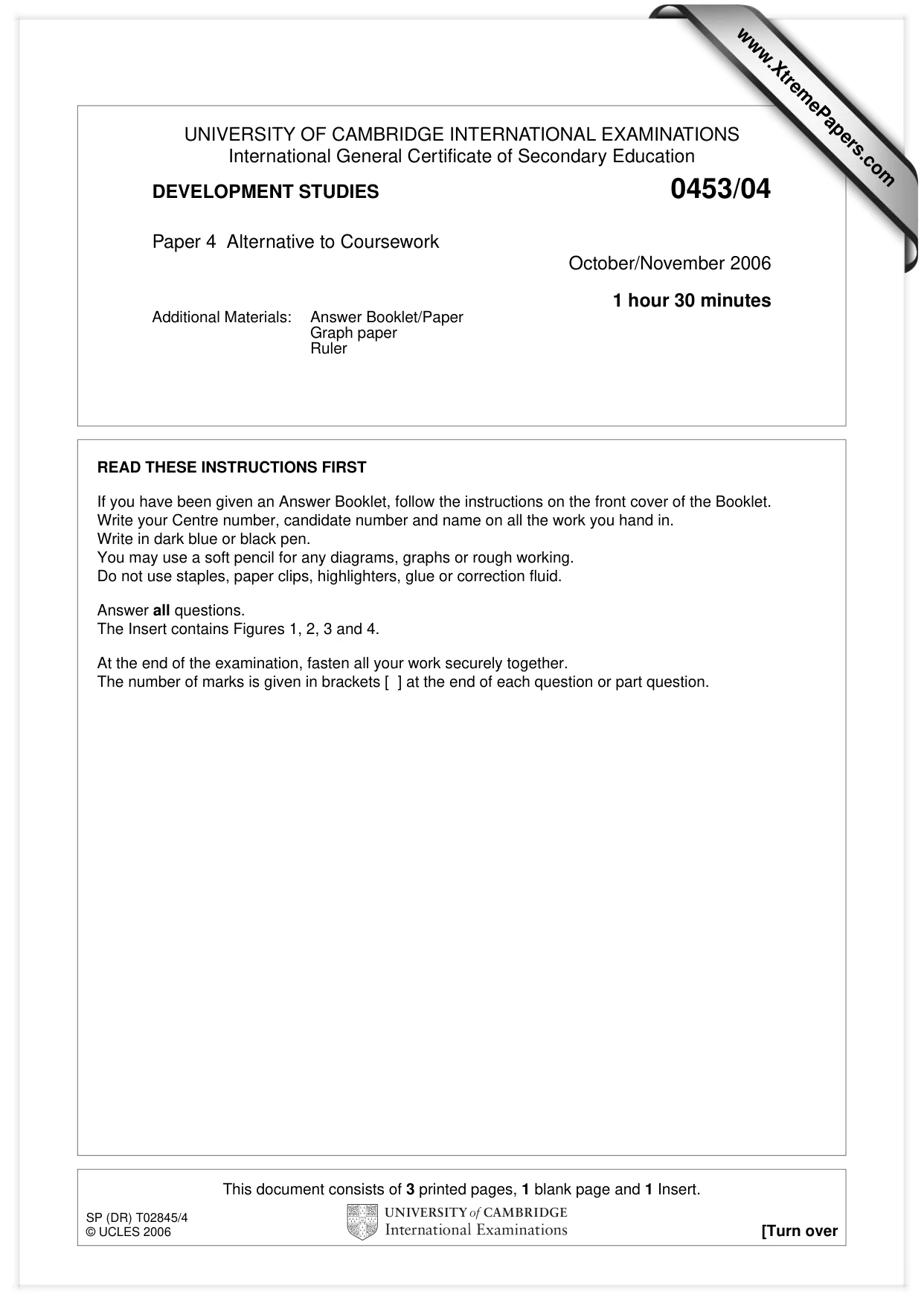
This document consists of 3 printed pages, 1 blank page and 1 Insert. SP (DR) T02845/4 © UCLES 2006 [Turn over UNIVERSITY OF CAMBRIDGE INTERNATIONAL EXAMINATIONS International General Certificate of Secondary Education DEVELOPMENT STUDIES 0453/04 Paper 4 Alternative to Coursework October/November 2006 1 hour 30 minutes Additional Materials: Answer Booklet/Paper Graph paper Ruler READ THESE INSTRUCTIONS FIRST If you have been given an Answer Booklet, follow the instructions on the front cover of the Booklet. Write your Centre number, candidate number and name on all the work you hand in. Write in dark blue or black pen. You may use a soft pencil for any diagrams, graphs or rough working. Do not use staples, paper clips, highlighters, glue or correction fluid. Answer all questions. The Insert contains Figures 1, 2, 3 and 4. At the end of the examination, fasten all your work securely together. The number of marks is given in brackets [ ] at the end of each question or part question. www.XtremePapers.com
Question paper, page 2
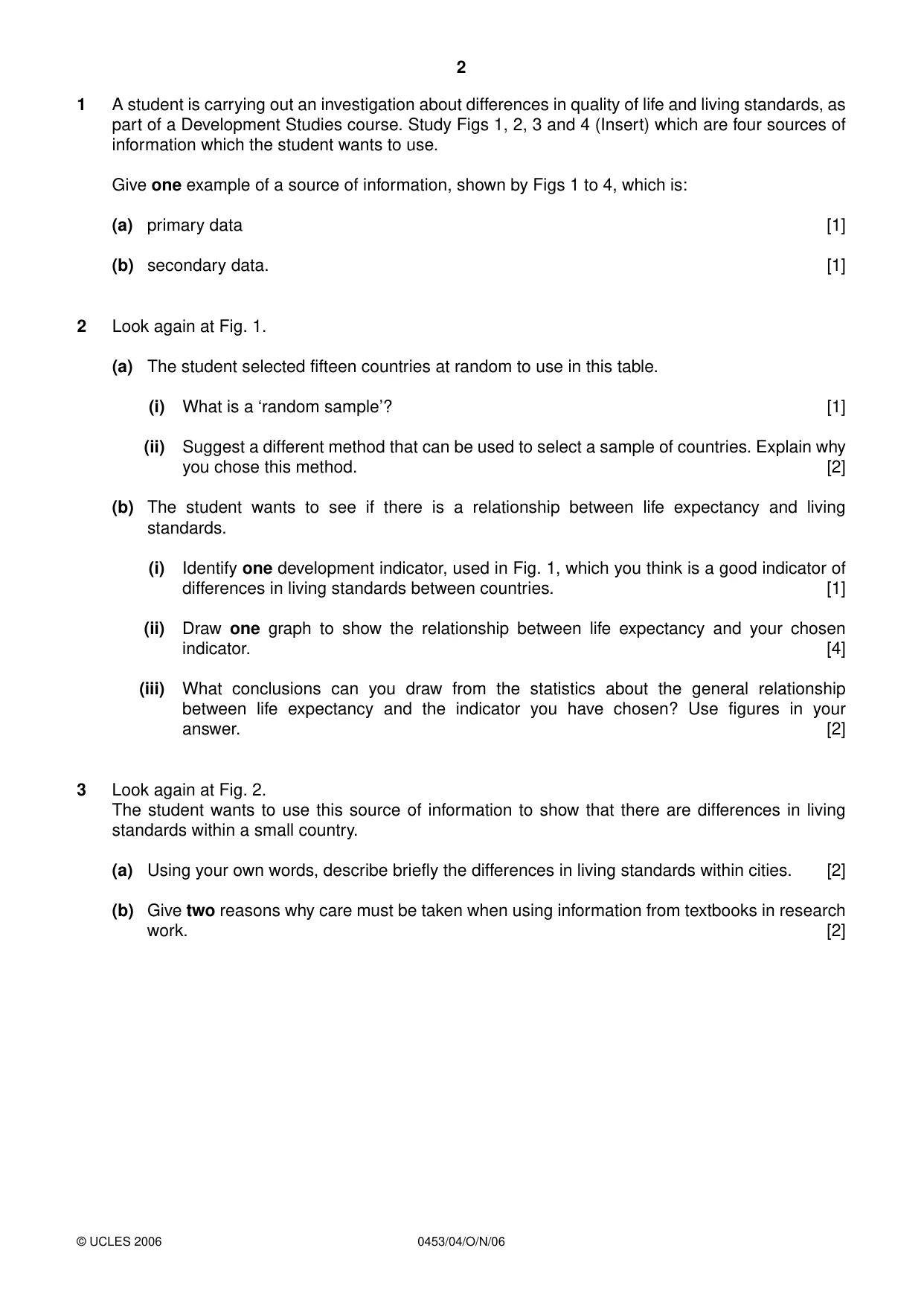
2 0453/04/O/N/06 1 A student is carrying out an investigation about differences in quality of life and living standards, as part of a Development Studies course. Study Figs 1, 2, 3 and 4 (Insert) which are four sources of information which the student wants to use. Give one example of a source of information, shown by Figs 1 to 4, which is: (a) primary data [1] (b) secondary data. [1] 2 Look again at Fig. 1. (a) The student selected fifteen countries at random to use in this table. (i) What is a ‘random sample’? [1] (ii) Suggest a different method that can be used to select a sample of countries. Explain why you chose this method. [2] (b) The student wants to see if there is a relationship between life expectancy and living standards. (i) Identify one development indicator, used in Fig. 1, which you think is a good indicator of differences in living standards between countries. [1] (ii) Draw one graph to show the relationship between life expectancy and your chosen indicator. [4] (iii) What conclusions can you draw from the statistics about the general relationship between life expectancy and the indicator you have chosen? Use figures in your answer. [2] 3 Look again at Fig. 2. The student wants to use this source of information to show that there are differences in living standards within a small country. (a) Using your own words, describe briefly the differences in living standards within cities. [2] (b) Give two reasons why care must be taken when using information from textbooks in research work. [2] © UCLES 2006
Question paper, page 3
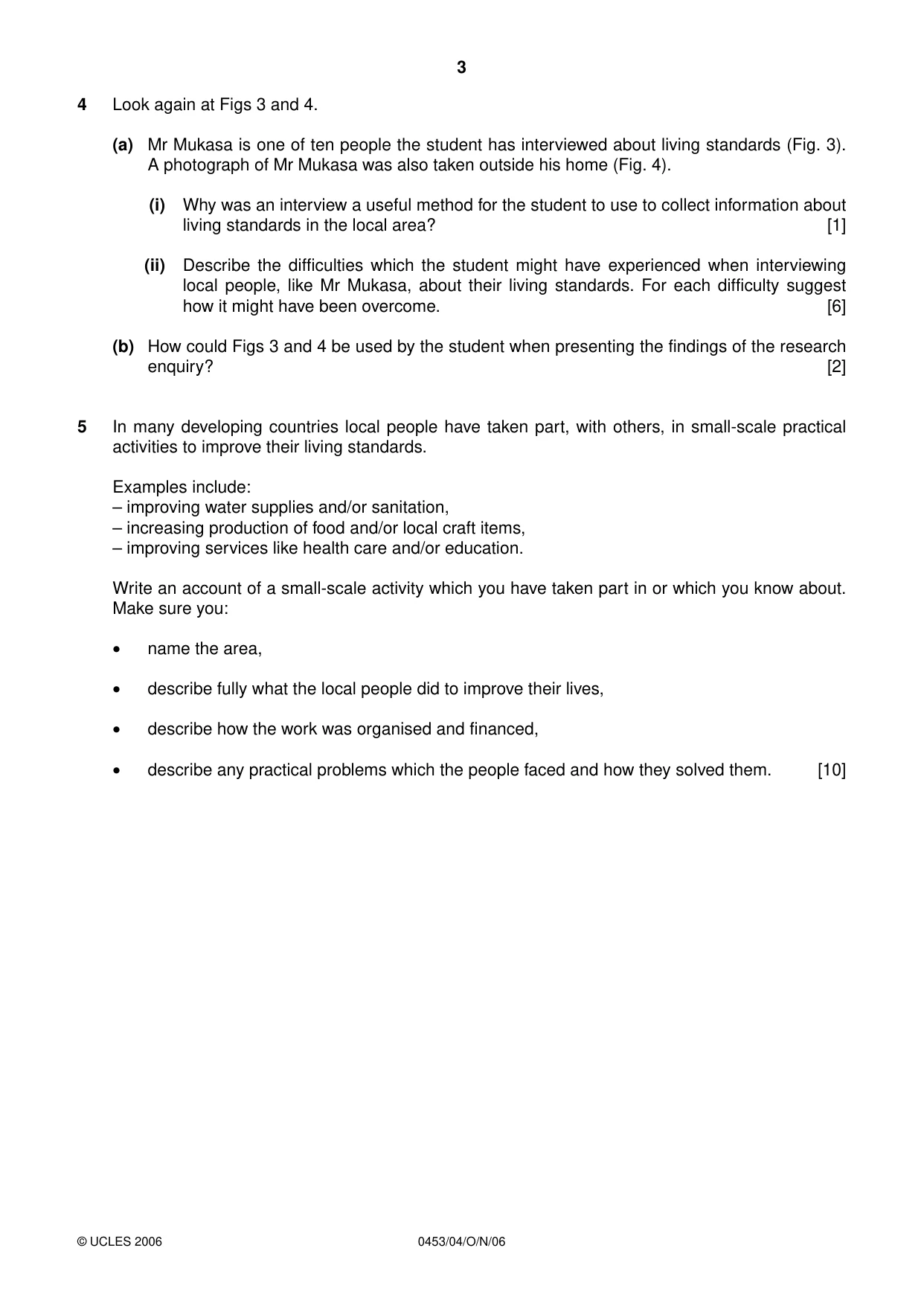
3 0453/04/O/N/06 4 Look again at Figs 3 and 4. (a) Mr Mukasa is one of ten people the student has interviewed about living standards (Fig. 3). A photograph of Mr Mukasa was also taken outside his home (Fig. 4). (i) Why was an interview a useful method for the student to use to collect information about living standards in the local area? [1] (ii) Describe the difficulties which the student might have experienced when interviewing local people, like Mr Mukasa, about their living standards. For each difficulty suggest how it might have been overcome. [6] (b) How could Figs 3 and 4 be used by the student when presenting the findings of the research enquiry? [2] 5 In many developing countries local people have taken part, with others, in small-scale practical activities to improve their living standards. Examples include: – improving water supplies and/or sanitation, – increasing production of food and/or local craft items, – improving services like health care and/or education. Write an account of a small-scale activity which you have taken part in or which you know about. Make sure you: • name the area, • describe fully what the local people did to improve their lives, • describe how the work was organised and financed, • describe any practical problems which the people faced and how they solved them. [10] © UCLES 2006
Question paper, page 4
4 0453/04/O/N/06 BLANK PAGE Copyright Acknowledgements: Question 3 Fig. 2 © F. Martin & A. Whittle; Poverty and Progress; Nelson Thornes; 1985. Question 4 Fig. 4; Steve Sibley © UCLES. Permission to reproduce items where third-party owned material protected by copyright is included has been sought and cleared where possible. Every reasonable effort has been made by the publisher (UCLES) to trace copyright holders, but if any items requiring clearance have unwittingly been included, the publisher will be pleased to make amends at the earliest possible opportunity. University of Cambridge International Examinations is part of the University of Cambridge Local Examinations Syndicate (UCLES), which is itself a department of the University of Cambridge.
Mark scheme, page 1
UNIVERSITY OF CAMBRIDGE INTERNATIONAL EXAMINATIONS International General Certificate of Secondary Education MARK SCHEME for the October/November 2006 question paper 0453 DEVELOPMENT STUDIES 0453/04 Paper 4 (Alternative to Coursework), maximum raw mark 35 This mark scheme is published as an aid to teachers and students, to indicate the requirements of the examination. It shows the basis on which Examiners were instructed to award marks. It does not indicate the details of the discussions that took place at an Examiners’ meeting before marking began. All Examiners are instructed that alternative correct answers and unexpected approaches in candidates’ scripts must be given marks that fairly reflect the relevant knowledge and skills demonstrated. Mark schemes must be read in conjunction with the question papers and the report on the examination. The grade thresholds for various grades are published in the report on the examination for most IGCSE, GCE Advanced Level and Advanced Subsidiary Level syllabuses. • CIE will not enter into discussions or correspondence in connection with these mark schemes. CIE is publishing the mark schemes for the October/November 2006 question papers for most IGCSE, GCE Advanced Level and Advanced Subsidiary Level syllabuses and some Ordinary Level syllabuses. www.XtremePapers.com
Mark scheme, page 2
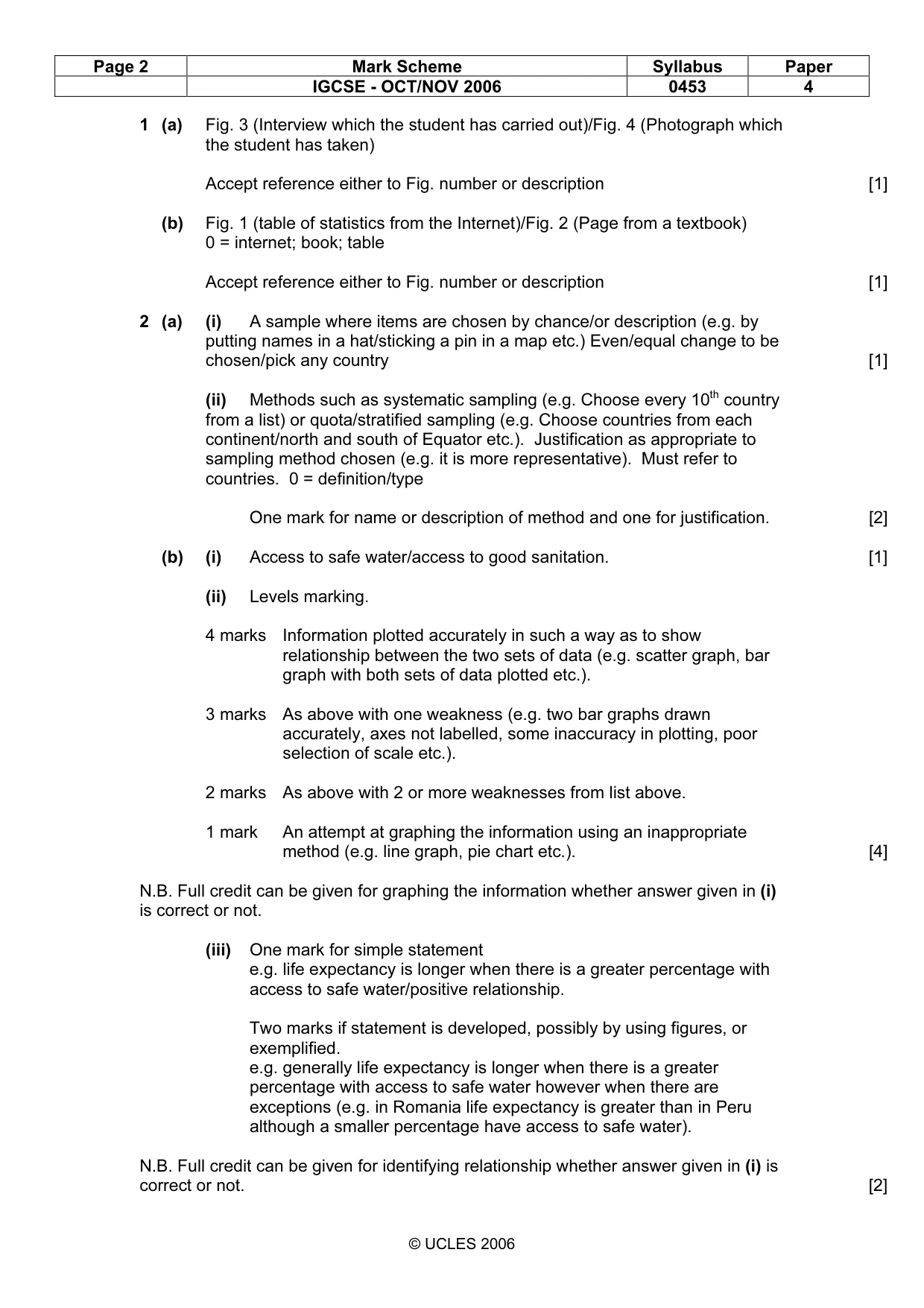
Page 2 Mark Scheme Syllabus Paper IGCSE - OCT/NOV 2006 0453 4 © UCLES 2006 1 (a) Fig. 3 (Interview which the student has carried out)/Fig. 4 (Photograph which the student has taken) Accept reference either to Fig. number or description [1] (b) Fig. 1 (table of statistics from the Internet)/Fig. 2 (Page from a textbook) 0 = internet; book; table Accept reference either to Fig. number or description [1] 2 (a) (i) A sample where items are chosen by chance/or description (e.g. by putting names in a hat/sticking a pin in a map etc.) Even/equal change to be chosen/pick any country [1] (ii) Methods such as systematic sampling (e.g. Choose every 10th country from a list) or quota/stratified sampling (e.g. Choose countries from each continent/north and south of Equator etc.). Justification as appropriate to sampling method chosen (e.g. it is more representative). Must refer to countries. 0 = definition/type One mark for name or description of method and one for justification. [2] (b) (i) Access to safe water/access to good sanitation. [1] (ii) Levels marking. 4 marks Information plotted accurately in such a way as to show relationship between the two sets of data (e.g. scatter graph, bar graph with both sets of data plotted etc.). 3 marks As above with one weakness (e.g. two bar graphs drawn accurately, axes not labelled, some inaccuracy in plotting, poor selection of scale etc.). 2 marks As above with 2 or more weaknesses from list above. 1 mark An attempt at graphing the information using an inappropriate method (e.g. line graph, pie chart etc.). [4] N.B. Full credit can be given for graphing the information whether answer given in (i) is correct or not. (iii) One mark for simple statement e.g. life expectancy is longer when there is a greater percentage with access to safe water/positive relationship. Two marks if statement is developed, possibly by using figures, or exemplified. e.g. generally life expectancy is longer when there is a greater percentage with access to safe water however when there are exceptions (e.g. in Romania life expectancy is greater than in Peru although a smaller percentage have access to safe water). N.B. Full credit can be given for identifying relationship whether answer given in (i) is correct or not. [2]
Mark scheme, page 3
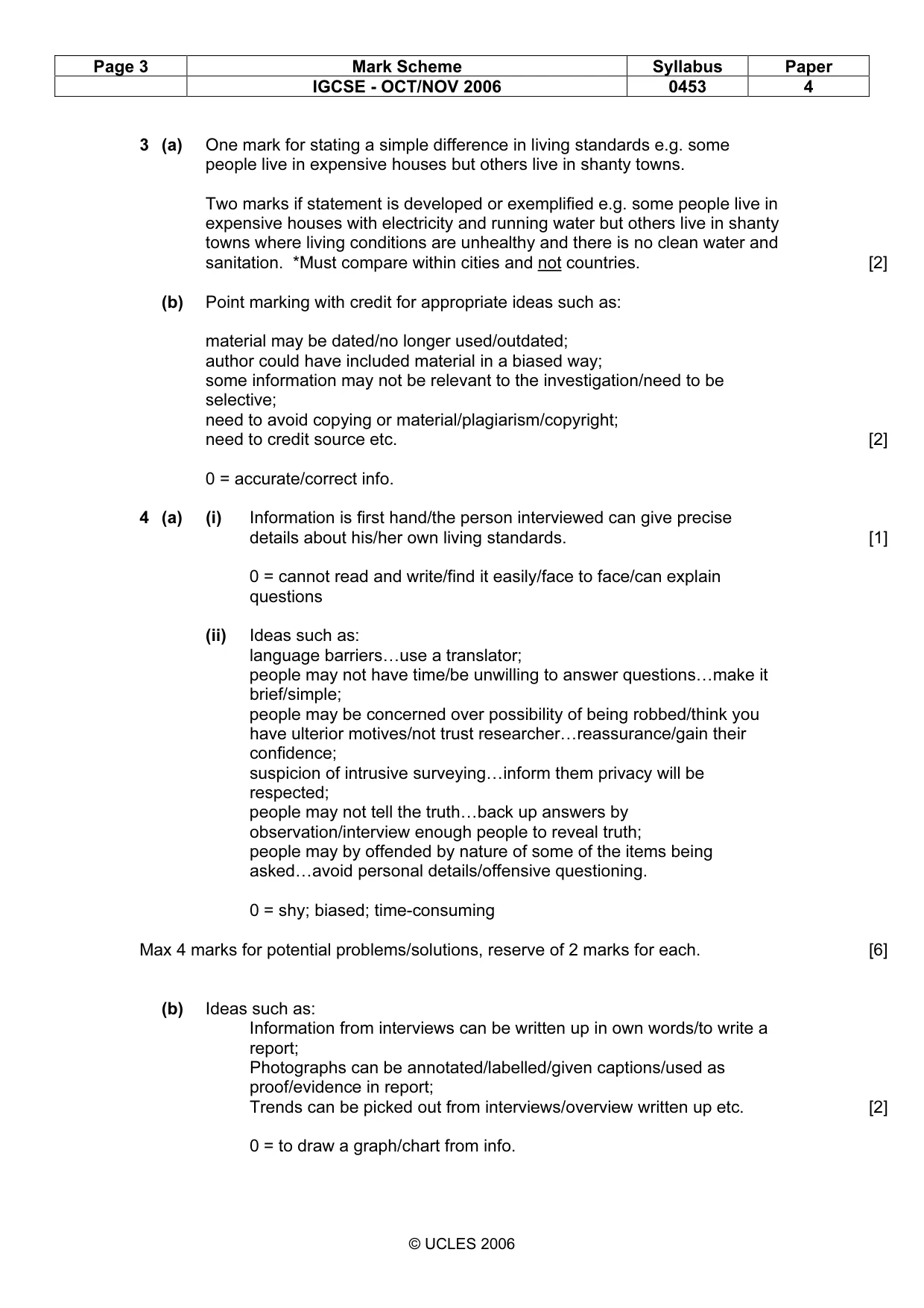
Page 3 Mark Scheme Syllabus Paper IGCSE - OCT/NOV 2006 0453 4 © UCLES 2006 3 (a) One mark for stating a simple difference in living standards e.g. some people live in expensive houses but others live in shanty towns. Two marks if statement is developed or exemplified e.g. some people live in expensive houses with electricity and running water but others live in shanty towns where living conditions are unhealthy and there is no clean water and sanitation. *Must compare within cities and not countries. [2] (b) Point marking with credit for appropriate ideas such as: material may be dated/no longer used/outdated; author could have included material in a biased way; some information may not be relevant to the investigation/need to be selective; need to avoid copying or material/plagiarism/copyright; need to credit source etc. [2] 0 = accurate/correct info. 4 (a) (i) Information is first hand/the person interviewed can give precise details about his/her own living standards. [1] 0 = cannot read and write/find it easily/face to face/can explain questions (ii) Ideas such as: language barriers…use a translator; people may not have time/be unwilling to answer questions…make it brief/simple; people may be concerned over possibility of being robbed/think you have ulterior motives/not trust researcher…reassurance/gain their confidence; suspicion of intrusive surveying…inform them privacy will be respected; people may not tell the truth…back up answers by observation/interview enough people to reveal truth; people may by offended by nature of some of the items being asked…avoid personal details/offensive questioning. 0 = shy; biased; time-consuming Max 4 marks for potential problems/solutions, reserve of 2 marks for each. [6] (b) Ideas such as: Information from interviews can be written up in own words/to write a report; Photographs can be annotated/labelled/given captions/used as proof/evidence in report; Trends can be picked out from interviews/overview written up etc. [2] 0 = to draw a graph/chart from info.
Mark scheme, page 4
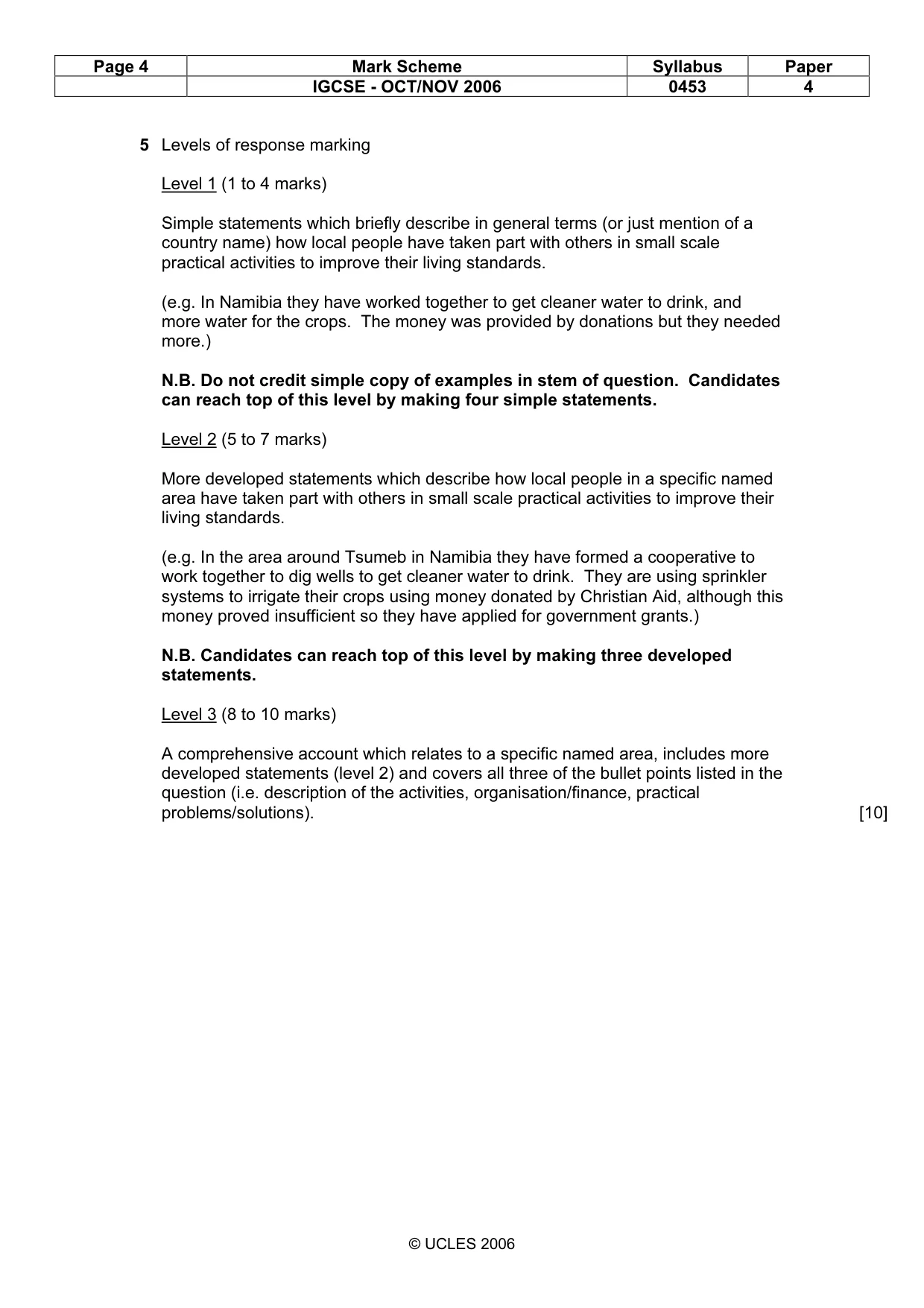
Page 4 Mark Scheme Syllabus Paper IGCSE - OCT/NOV 2006 0453 4 © UCLES 2006 5 Levels of response marking Level 1 (1 to 4 marks) Simple statements which briefly describe in general terms (or just mention of a country name) how local people have taken part with others in small scale practical activities to improve their living standards. (e.g. In Namibia they have worked together to get cleaner water to drink, and more water for the crops. The money was provided by donations but they needed more.) N.B. Do not credit simple copy of examples in stem of question. Candidates can reach top of this level by making four simple statements. Level 2 (5 to 7 marks) More developed statements which describe how local people in a specific named area have taken part with others in small scale practical activities to improve their living standards. (e.g. In the area around Tsumeb in Namibia they have formed a cooperative to work together to dig wells to get cleaner water to drink. They are using sprinkler systems to irrigate their crops using money donated by Christian Aid, although this money proved insufficient so they have applied for government grants.) N.B. Candidates can reach top of this level by making three developed statements. Level 3 (8 to 10 marks) A comprehensive account which relates to a specific named area, includes more developed statements (level 2) and covers all three of the bullet points listed in the question (i.e. description of the activities, organisation/finance, practical problems/solutions). [10]
What you needed in this session
Cambridge’s own grade thresholds for 2006 Oct/Nov, Paper 4 · Variant 1. A higher threshold means an easier paper — the bar moves with how the cohort did.